ManualGo.com
GA-7DXR - Motherboard GIGABYTE - Free user manual and instructions
Find the device manual for free GA-7DXR GIGABYTE in PDF.


Download the instructions for your Motherboard in PDF format for free! Find your manual GA-7DXR - GIGABYTE and take your electronic device back in hand. On this page are published all the documents necessary for the use of your device. GA-7DXR by GIGABYTE.
USER MANUAL GA-7DXR GIGABYTE
FCC Compliance Statement: DECLARATIQ) This equipment has been tested and found to FE comply with limits for a Class B digital device, pursuant to Part 15 of the FCC rules. These ad sat limits are designed to provide reasonable sn protection against harmful interference in residential installations. This equipment generates, uses, and can radiate radio frequency energy, and if not installed and used in accordance with the instructions, may cause harmful interference to radio communications However, there is no guarantee that interference will not occur in a particular installation. If this equipment does cause interference to radio or television equipment reception, which can be determined by turning the equipment off and on, the user is encouraged to try to correct the interference by one or more of the following measures: -Reorient or relocate the receiving antenna -Move the equipment away from the receiver -Plug the equipment into an outlet on a circuit different from that to which the receiver is connected -Consult the dealer or an experienced radio/television technician for additional suggestions You are cautioned that any change or modifications to the equipment not expressly approve by the party responsible for compliance could void Your authority to operate such equipment. This device complies with Part 15 of the FCC Rules. Operation is subjected to the following two conditions 1) this device may not cause harmful interference and 2) this device must accept any interference received, including interference that may cause undesired operation.
Declaration of Conformity We, Manufacturer/mporter (full address) G.B.T. Technology Träding GMbH Ausschlager Weg 41, 1F, 20537 Hamburg, Germany declare thatthe product {description ofthe apparatus, system, installation to which it refers) Mother Board GA-TDXR is in conformity with {reference to the specification under which conformiy is declared) in accordance with 89/336 EEC-EMC Directive [1 EN550ï1 Limits and methods of measurement CI EN 6100032 Disturbances in suppl systems caused ofradio distance characterstes ot IR] EN60S55-2 by householé applances and similar industrial, scientific and medical (SM lectical equipment “Harmonics” High frequency equipment [I ENSS013 … Limis and methods of measurement LI ENGL000-3-3* Disturbances in suppl systems caused ofradio distance characteristics ot DR] EN60S55-3 by householé applances and similar broadcast recevers and associated lectical equipment Voltage fluctuations" equipment CHEN 55014 Limis and methods of measurement D EN 500811 Generic emission standard Part 1 of radio disturbance characteristics of Residual, commercial and light industry household electrical appliances, portable pol and similar electrical HI EN 500821 Generic immuniy standard Par 1: aposraus Residual, commercial and light industry [1 EN55015 Limits and methods of measurement [1 En 550812 Generic emission standard Part 2 af radio disturbance characteristics of Industrial environment fluorescent lamps and luminaries [I EN 55020 | Immuniy from radio interference of [I EN 550822 Generic immuniy standard Par 2: broadcast recevers and associated Industrial environment equipment EX EN 55022 Limis and methods of measurement [I Env 55104 Immunty requirements for household af radio disturbance charactersties of epplances tools and similar apparatus information technology equipment [ oNVDE o8ss Cabled distribution systems: Equipment C] EN 50091-2 EMC requirements for unintemuphble D part10 for receiving andlr distribution from power systems (UPS) O pat12 sound and television signals D CE marking (EC contormity marking) ‘The manufacturer also declares the conformity of above mentioned product with the actual required safety standards in accordance with LVD 73/23 EEC [I ENGo06S Safety requirements formains operated C] EN 60950 Satety for information technology equipment lectranic and related apparatus for including electrical business equipment ousehold and similar general use [I EN 60335 Safety of household and similar [I En soo12 General and Satety requirements for electrical applances uninterupible power systems (UPS) Manufacturerlmporter Signature RekLin sans Date: Mar 23, 2001 Name Bertin
How This Manual Is Organized This manual is divided into the following sections:
9) Raid Instructions on Raid
11) Technical Support/RMA Sheet : Document equipment used for after sales
Initial release ofthe 7DXR motherboard user's manual. Mar. 2001 The author assumes no responsibility for any errors or omissions that may appear in this document nor does the author make a commitment to update the information contained herein Third-party brands and names are the property of their respective owners. Mar. 30, 2001 Taipei, Taiwan, R.O.C
Item Checklist BW The 7DXR Motherboard Cable for IDE / Floppy device CD (TUCD) for motherboard utilities 7DXR Users Manual Front USB Cable RKR&R
7DXR Motherboard Form Factor + 30.5 cm x 24.5 cm ATX size form factor, 4 layers PCB. CPU + AMD Athlon M/Duron'N (K7) Socket À Processor + 256K/64K L2 cache on die + Supports 600MHz - 1GHz and above Chipset TDXR, consisting of: + AMD 761 Memory/PCI/AGP Controller + VT82C686B PCI Super-l/0 Integrated Peripheral Controller (PSIPC) Clock Generator + ICS 94240 + 200/266 MHz DDR bus speeds + 95/100/106/114/120/133/140/150 MHz system bus speeds by CLK_SW DIP switch + Supports adjustable CPU frequency from 100MHz to 250MHz by 1MHz step in BIOS setup Memory + 3184-pin DDR DIMM sockets + Supports PC1600 DDR orPC2100 DDR SDRAM + Supports up to 3GB DRAM (Max) + Supports only 2.5V DDR SDRAM +__ Supports 72bit ECC type DRAM integrity mode 1/0 Control + VT82C686B Slots + 1'Universal AGP Pro slot 4X/2X (1.5V/3.3V) device support + 5PCislots supports 33MHz & PCI 2.2 compliant + LAMR (Audio Modem Riser) slot On-Board IDE + IDE Tand IDE 2 Supports PIO mode 3, 4 UDMA 337
ATA 66 / ATA100 IDE & ATAPI CD-ROM
+ IDE 3 and IDE 4 Compatible with Raid, Ultra ATA100, Ultra ATA66, Ultra ATA33, EIDE + 4 IDE bus master IDE ports for up to 8 ATAPI devices On-Board + 1 floppy port supports 2 FDD with 360K, 720K, L.2M, Peripherals 1.44M and 2.88M bytes + 1 parallel ports supports Normal/EPP/ECP mode + 2 serial ports (COM À & COM B) + AUSB ports + LIrDA connector for IR To be continued..
Features Summary Hardware Monitor CPU/System fan revolution detect CPU/System temperature detect System voltage detect CPU overheat warning detect On-Board Sound Creative CT5880 sound Line In/Line Out/Mic In/AUX In (Optional}/CD In/ TEL (Optional}/Game Port/ Four Speaker & SPDIF PS/2 Connector PS/2 Keyboard interface and PS/2 Mouse interface BIOS Licensed AWARD BIOS, 2M bit flash ROM Support Dual BIOS Additional Features Support Wake-On-LAN (WOL) Support Internal / External Modem Ring On Support USB KB/MS Wake up from S3 Includes 5 fan power connectors Poly fuse for keyboard over-current protection Support STR (Suspend-To-RAM) function Support @ BIOS ” and EasyTunelIl"
Installation Guide Installation Guide Getting Started WARNING! Computer motherboards and expansion cards contain very delicate Integrated Circuit (IC) chips. To protect them against damage from static electricity, you should follow some precautions whenever you work on your computer. 1 Unplug your computer when working on the inside.
2. Use a grounded wrist strap before handling computer components. If you do not have one,
touch both of your hands to a safely grounded object or to a metal object, such as the power supply case.
3. Hold components by the edges and try not touch the IC chips, leads or connectors, or
4. Place components on a grounded antistatic pad or on the bag that came with the
components whenever the components are separated from the system.
5. Ensure thatthe ATX power supply is switched off before you plug in or remove the ATX
power connector on the motherboard. Installing the motherboard to the chassis. Ifthe motherboard has mounting holes, but they don't line up with the holes on the base and there are no slots to attach the spacers, do not become alarmed you can still attach the spacers to the mounting holes. | ust cutthe bottom portion ofthe spacers (the spacer may be a little hard to cutoff, so be careful of your hands). In this way you can still attach the motherboard to the base without worrying about short circuits. Sometimes you may need to use the plastic springs to isolate the screw from the motherboard PCB surface, because the circuit wire may be near by the hole. Be careful, don't letthe screw contact any printed circuit write or parts on the PCB that are near the fixing hole, otherwise it may damage the board or cause board malfunctioning.
7DXR Motherboard To setup your computer, you must complete the following steps: © Step 1 - Set system jumpers © Step 2- Install he Central Processing Unit (CPU) © Step 3-Install memory modules © Step 4-Install expansion cards © Step 5-Connect ribbon cables, cabinet wires, and power supply © Step 6-Setup BIOS software © Step 7-Install supporting software tools Step 2 Step 3
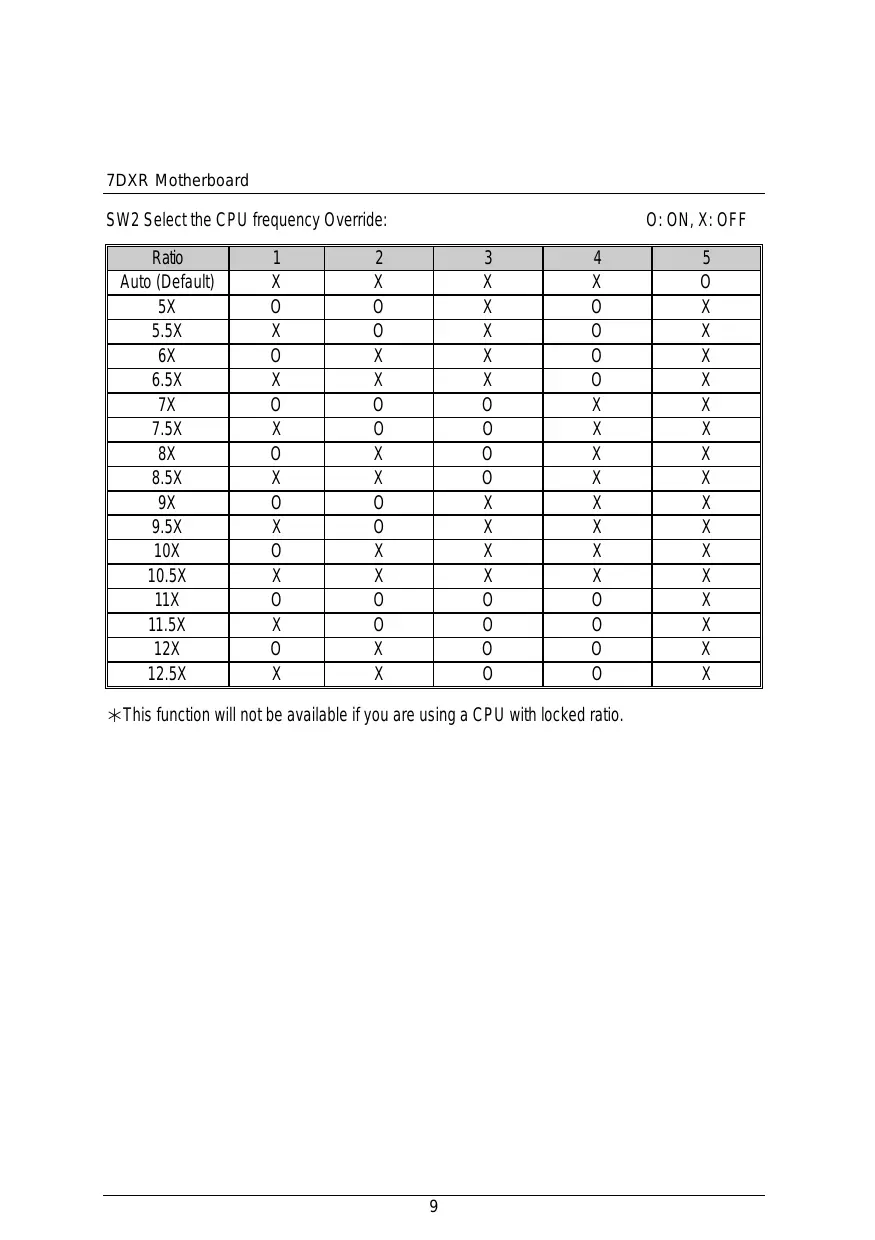
Installation Guide CPU Speed Setup The system bus speed is selectable at 95-150MHz. The user can select the system bus speed by DIP switch CLK_SW or J 19 & J 20 (For 100MHz or 133MHz). (The frequency ratio depend on CPU) CLK_SW Selectthe System Speed:
7DXR Motherboard SW2 Selectthe CPU frequency Override: O:ON,X:OFF Ratio 1 2 3 4 5 Auto (Default) x x X X 0 5X Q 0 X 0 x 5.5X x 0 X 0 X 6X Q x X 0 x 6.5X x x X 0 X 7X Q 0 0 X x 7.5X X Q Q x x 8x Q x 0 X x 8.5X x x 0 X X % 0 Q x x x 9.5X X Q x x x 10X 0 X x x x 10.5X X x x x x lX 0 Q Q Q x 11.5X X Q Q Q x 12X Q x 0 0 X 125X X X 0 0 x XThis function will not be available if you are using a CPU with locked ratio
Installation Guide CPU Installation Please make sure the CPU should be supported to the motherboard. CPU Bottom View CPU Top View 2.The notched comer should be orientated toward the blank space on the socket nearest the lever. The CPU will only fit in the orientation as shown. 1.Pull the lever out and lift it up. GPU Heat Sink Installation: Beware: Please check thatthe heat sink is in good contact with the CPU before you turn on your system. The poor contact will cause over heat, and might cause damage to your processor!
7DXR Motherboard 3.Align CPU and insert it : 4.Use compliant fan approved by AMD. (Please refer to your heatsink installation manual for application of thermal grease to provide better heat conduction between your CPU and heatsink.) 5.Hook one end of the cooler bracket to the CPU socket.
6. Hook the other end of the cooler bracket to the CPU socket
Le] {Please refer to the cooler's installation manual for detailed installation steps)
1. The DIMM slot has a notch, so the DIMM
memory module can only fit in one direction.
2. Insertthe DIMM memory module vertically
into the DIMM slot. Then push it down.
3. Close the plastic clip at both edges ofthe
DIMM slots to lock the DIMM module. Reverse the installation steps when you wish to remove the DIMM module. DDR Introduction Established on the existing SDRAM industry infrastructure, DDR (Double Data Rate) memory is a high performance and cost-effective solution that allows easy adoption for memory vendors, OEMs and system integrators. DDR memory is a sensible evolutionary solution for the PC industry that builds on the existing SDRAM infrastructure, yet makes awesome advances in solving the system performance bottleneck by doubling the memory bandwidth. DDR SDRAM will offer a superior solution and migration path from existing SDRAM designs due to its availability, pricing and overall market support. PC2100 DDR memory (DDR266) doubles the data rate through reading and writing at both the rising and falling edge of the clock, achieving data bandwidth 2X greater than PC133 when running with the same DRAM clock frequency. With peak bandwidth of 2.1GB per second, DDR memory enables system OEMS to build high performance and low latency DRAM subsystems that are suitable for servers, workstations, high-end PC's and value desktop SMA systems. With a core voltage of only 2.5 Volts compared to conventional SDRAM's 3.3 volts, DDR memory is a compelling solution for small form factor desktops and notebook applications.
7DXR Motherboard Connec ATX Power Pin No Definition 3,5,7,13,15-17 GND 12,11 3.3V 4,6,19,20 VCC 10 +12V 12 -12V 18 -5V 8 Power Good 9 SV SB (stand by#5V) 14 PS-ON(Soft On/Off) Please note: À AC power cord should only be inserted to your power supply unit after ATX power cable and other related devices are firmly connected to the mainboard. COM A/COM B/LPT Port LPT Port Please note: FN This mainboard supports 2 standard COM ports and 1 LPT port. Device like printer can be connected to LPT port ; mouse and modem etc can be connected to COM ports.
œ|{olul sw Please note: FN Before you connect your device(s) into USB connector(s), please make sure your device(s) has a standard USB interface like, USB keyboard, mouse, scanner, zip, speaker... Also make sure your OS supports USB controller (Win 95 w/ USB supperment, Win98, Windows 2000, Windows ME, Win NT w/ SP 6). If your OS does not support USB controller, please contact OS vander for passible patch or driver upgrade. For more information please contact your OS or device(s) vanders
Please note: FN Be careful with the polarity of the front panel USB connector. Check the pin assignment while you connect the front panel USB cable. Please contact your nearest dealer for optional front panel USB cable. Floppy Port RED LINE
Connectors Game & Audio Port Line In/Line Out 2 Please note: À Line Out 1: Line Outor SPDIF (The SPDIF output is capable of providing digital audio to external speakers or compressed AC3 data to an external Dolby digital decoder). To enable SPDIF, simply insert SPDIF connector into Line Ouf1. Line Qutl will become SPDIF Out automatically. (see page 56 for more information). To enable Four Speaker (for Creative 5880 audio only), simply follow instructions on page 53 and Line In will become Line Out2 to support second pair of stereo speakers. IDE1 (Primary), IDE2 (Secondary) Port RED LINE IDE 1 IDE2
Connectors AUXIN: AUX_IN (Optional) Pin No. | Definition 1 AUX-L 2 GND 3 GND 4 AUX-R TELE:TEL (The connector is for internal modem card with voice connector) [O ptional] Pin No. | Definition 1 Signal-In 2 GND 3 GND 4 Signal-Out
Connectors SYS_FANL: System Fan 1
7DXR Motherboard CPU_FAN: CPU Fan ins Pin No. | Definition 1 Control 2 +12V 3 SENSE Please note: FN À proper installation of the CPU cooler is essential to preventthe CPU from running under abnormal condition or damaged by overheating. With support CPU guardian function CPU cooler must connect with this connector, otherwise system could not boot. SYS_FAN2: System Fan 2 Pin No. | Definition 1 Control 2 +12V 3 SENSE
DIMM LED Connector Please note: FN Do not remove memory modules while DIMM LED is on. It might cause short or other unexpected damages due to the 2.5V stand by voltage. Remove memory modules only when STR function is disabled by jumper and AC Power cord is disconnected.
GND IR Data Output Please note: À Be careful with the polarity of the IR connector while you connect the IR. Please contact you nearest dealer for optional IR device AGP_12V (] 40): Power for AGP Pro
Pin No. Definition 1 +5V 2 GND 3 GND 4 +12V Please note: FN When using the AGP Pro Card, you must use the power connector (As the other one for HDD). Otheruise, AGP Pro Card will not work.
Pin No. | Definition 1 GND 2 +12V Please note: À Ifinstalled wrong direction, the Chip Fan will not work. Sometimes will damage the Chip Fan. (Usually black cable is GND) AGP_OV: AGP 4X Overvoltage Switch OL | al.
Please note: À The function provide AGP over voltage, Incorrect using it may cause your AGP card damage. For power End-User use only!
Please note: Provide DDR voltage override function. Incorrect using may cause your DDR broken. For power End-User only!
GN (Green Switch) Open: Normal Operation Close: Entering Green Mode GD (Green LED) Pin 1: LED anode(+ Pin 2: LED cathode(— HD (IDE Hard Disk Active LED) Pin 1: LED anode(+ Pin 2: LED cathode(— SPK (Speaker Connector) Pin 1: VCC(+ Pin 2- Pin 3: NC Pin 4: Data(-} RE (Reset Switch) Open: Normal Operation Close: Reset Hardware System P+PP Power LED) Pin 1: LED anode(+ Pin 2: LED cathode(—} Pin 3: LED cathode(— (Soft Power Connector) Open: Normal Operation Close: Power On/Off Please note: Please connectthe power LED, PC speaker, reset switch and power switch etc of your chassis front panel to the front panel jumper according to the pin assignment above.
Panel and Jumper Definition BUZ_EN: Internal Buzzer Connector (Optional) (Defai
CLR_CMOS: Clear CMOS Function Please note:
10] 1" sun sn Disable Clear CMOS (Default) Pin No. Definition Dm) 1-2 Close |Enable Clear CMOS I © Function 7 = |233 Close |Disable Clear CMOS Bi) : LH Function (Default) You may clear the CMOS data to its default values by this jumper.
7DXR Motherboard BIOS _WP: BIOS Write Protect Function (Optional) [sun] [eus] 1["1s) 1[s] Disable Write (Default) Protection Pin No. Definition 1-2 close [Write Protect Enable 2-3 close | Write Protect Disable (Default) Please note: À To feshupgrade BIOS on this MB BIOS_WP jumper must be opened. We recommend BIOS_WP jumper to be setto"2-3 close”, whenever user is not try to flash/upgrade the BIOS RUSB_ON {J6): Rear USB Device Wake up Selection eu EF RearUSB | Disable Enable (Default) Pin No. Definition 1-2 close |Rear USB Device Wake up Enable 2-3 close [Rear USB Device Wake up Disable (Default) Please note: EN To use ‘USB KB/MS Wakeup from S3-S5” function, set BIOS setting ‘USB KB/MS Wake up from S3-S5"to ENABLED and enable jumpers RUSB_ON (J 6) & STR_EN #Power on the computer and as soon as memory counting starts, press <Del>. You will enter BIOS Setup. Select the item “POWER MANAGEMENT SETUP”, then select “USB KB/MS Wake up from S3-S5”, Remember to save the seting by pressing "ESC" and choose the “SAVE & EXIT SETUP” option.
Panel and Jumper Definition FUSB_ON {J8): Front USB Device Wake up Selection Front USB Disable Enable (Default) Pin No. Definition Front USB Device Wake 1-2 close up Enable Front USB Device Wake 233 close | bisable (Defauit) Please note: À To use “USB KB/MS Wakeup from S3-S5" function, set BIOS setting ‘USB KEMS Make up from 53-55" to ENABLED and enable jumpers FUSB_ON {] 8) & #Poÿer on the computer and as soon as memory counting starts, pe <Del>. You will enter BIOS Setup. Select the item “POWER MANAGEMENT SETUP”, then select “USB KB/MS Wake up from S3-S5”. Remember to save the sen by pressing "ESC" and choose the “SAVE & EXIT SETUP” option. GUARDIAN (JP6): Guardian ll E Enable Disable (Default) Pin No. Definition 1-2 close [Enable Guardian Function (Default) 2-3 close [Disable Guardian Function Please note: À If CPU guardian function enable jou must let CPU cooler connect with CPU_FAN otherwise system could not boot.
7DXR Motherboard AMR_EN1 &AMR_EN2: AMR Selection (Optional) 1[n08 )AMR_ENI 1[ =0s8 JAMR_EN2 AMR_ENIJAMR_EN2] Primary CODEC 1-2 close | 1-2 close [AMR Primary AC'97 Disabled (Disabled Onboard CODEC) 2-3 close | 2-3 close [AMR Secondary (Default) Please note: À TDXR: If M/B has hardware audio (CT5880), your modem riser has been set to “Primary” automatically. No J umpers AMR_EN1 & AMR_EN2 for 7DXR. 7DXR: AMR_EN1 & AMR_EN2: 1-2 close: If you don't use onboard software audio, your audio/modem riser must be “Primary”. Mainboard's software audio will be disabled. AMR_EN1 & AMR_EN2: 2-3 close: If you use software audio{onboard CODEC on! jour modem riser must be “Secondary”. There are two kind GAMRM card in the market, Primary and secondary. If your AMR/MR card is primary, AMR_EN1 & AMR_EN2 should be setto 1-2, ifyou have secondary AMR/MR card AMR_EN1 &AMR_EN2 should be set to 2-3. Warning! 1f Primary AMR/MR card is used, on-board audio will be disabled. PIDE_EN (JP 52): Onboard Promise Selection 1e] 1-2) Enable Disable (Default) Pin No. Definition Enable Promise function (Default) 2-3 close [Disable Promise function 1-2 close
ATA 100 Mode Raid Mode (Default) Pin No. Definition 1-2 close [Raid Mode 2-3 close [ATA100 Mode (Default) Please note: À If you want to use "Raid Mode, your DE3 and IDE 4 must be connected with Hard Driver. Please set PDIE_EN (] BAT1: Battery 2} as enable before adjusting RAID_EN (JP 54).
CAUTION Sä Danger of explosion if battery is incorrectiy replaced Si Replace only with the same or equivalent type recommended by the manufacturer. 53 Dispose of used batteries according to the manufacturer's instructions
Performance List The following performance table lists the results of some popular benchmark testing programs These data are provided as reference only and in no way guarantee the system shall perform, and there is no responsibility for different testing data at exactly the same level. (The different Hardware & Software configuration will result in different benchmark testing results.) + CPU AMD K7 AthlonTM 1333MHz processor + DRAM (128x1) MB PC266 DDR RAM (SAMSUNG K4H280838B-TCBO) + CACHE SIZE 384 KB included in AlthonT!” + DISPLAY GA-GF2000 DDR (32MB) + STORAGE Onboard Promise RAIDO (IBM DTLA-307045 45GB x 2) °0S. Windows 2000 +SP1 +DirectX8 + DRIVER Display Driver at 1024 x 768 x 64k colors x 15Hz. TUCD ver. 1.7 Processor AMD Althon!"! 1333MHz (266x5) Winbench99 CPU mark 99 122 FPU Winmark 99 7310 Business Disk Winmark 99 11000 Hi-End Disk Winmark 99 25300 Business Graphics Winmark 99 640 Hi-End Graphics Winmark 99 1320 Winstone 2001 Business Winstone 2001 523 Content Creative Winstone 2001 55.5 € lfyou wish to maximize the performance of your system, please refer to the detail on P.96
Suspend to RAM Installation Suspend To RAM Installatio A.1 Introduce STR function: Suspend-to-RAM (STR) is a Windows 98 ACPI sleep mode function. When recovering from STR (S3) sleep mode, the system is able, in just a few seconds, to retrieve the last “state” of the system before it went to sleep and recover to that state. The “state” is stored in memory (RAM) before the system goes to sleep. During STR sleep mode, your system uses only enough energy to maintain critical information and system functions, primarily the system state and the ability to recognize various ‘ivake up”triggers or signals, respectively. A.2 STR function Installation Please use the following steps to complete the STR function installation Step-By-Step Setup Step 1: To utilize the STR function, the system must be in Windows 98 ACPI mode. Putting Windows 98 into ACPI mode is fairly easy. Setup with Windows 98 CD: A Insertthe Windows 98 CD into your CD-ROM drive, select Start, and then Run. B Type (without quotes) “D:\setup” in the window provided. Hit the enter key or click OK. (a After setup completes, remove the CD, and reboot your system (This manual assumes that your CD-ROM device drive letter is D:)
7DXR Motherboard Step 2: {If you want to use STR Function, please set jumper STR_EN Pin1-2 (Closed.)
Enable Pin No. Definition 1-2 close STR Enable 2-3 close| STR Disable (Default) Step 3: Power on the computer and as soon as memory counting starts, press <Del>. You will enter BIOS Setup. Select the item “POWER MANAGEMENT SETUP”, then select “ACPI Sleep Type: 3 /STR”. Remember to save the settings by pressing "ESC" and choose the “SAVE & EXIT SETUP” option. Congratulation! You have completed the installation and now can use the STR function.
Suspend to RAM Installation A3 How to put your system into STR mode? There are two ways to accomplish this: L Choose the ‘Stand by” item in the “Shut Down Windows" area A. Press the ‘Start’ button and then select "Shut Down” B. Choose the ‘Stand by"item and press “OK” Shut Down Windows. [x] ‘What do you want the computer ta do? € Shut doun C Bestait © Restart in MS-DOS mode Ok | Cancel Help
2. Define the system ‘power on” button to initiate STR sleep mode:
Suspend to RAM Installation C. Selectthe ‘Advanced”tab and ‘Standby" mode in Power Buttons. D. Restart your computer to complete setup. Now when you want to enter STR sleep mode, just momentarily press the ‘Power on" button. A4 How to recover from the STR sleep mode? There are seven ways to ‘wake up” the system: . Press the ‘Power On"button. … Use the ‘PS/2 Keyboard Power On"function. . Use the ‘PS/2 Mouse Power On” function. . Use the “Resume by Alarm”function. Use the ‘Modem Ring On function. . Use the ‘Wake On LAN"function. Use the ‘USB Device Wake Up"function. House wRre
7DXR Motherboard A.5 Notices: 1 In order for STR to function properly, several hardware and software requirements must be satisfied: A. Your ATX power supply must comply with the ATX 2.01 specification (provide more than 720 mA 5V Stand-By current). B. Your DDR SDRAM must be DDR-200 or DDR-266 compliant.
What is Dual BIOS Technology? Dual BIOS means that there are two system BIOS (ROM) on the motherboard, one is the Main BIOS and the other is Backup BIOS. Under the normal circumstances, the system works on the Main BIOS. Ifthe Main BIOS is corrupted or damaged, the Backup BIOS can take over while the system is powered on. This means that your PC will still be able to run stably as if nothing has happened in your BIOS How to use Dual BIOS? a. Boot Screen Award Moduier BIOS vé.00P6, An Energy Star AY Copyright (C) 1984-2000, Award Sofnare, Inc sxx xxx Check System Health OK, |A MD-Athlon(tm)-650MH2 (100x6.5) Check NVRAM (Wait. Press F1 Lo enter Dual BIOS Utility. Press ESC to quit
Press F1 to enter Dual BIOS Utility (C ) Ai 62-061:
7DXR Motherboard b. Dual BIOS Utility Dual BIOS Utility V6.60.g.01K (C) 1999, Gigabyte Technology Co., LTD. Wide Range Protection ‘Disabled Halt On BIOS Defects ‘Disabled lAuto Recovery ‘Enabled Boot From ‘Main BIOS BIOS Recovery Main to Backup F3: Load Default F5: Start BIOS Recovery F7: Save And Restart F9: Exit Without Saving Use <Space> key to toggle setup c. Dual BIOS Item explanation: Wide Range Protection: Disabled (Default), Enabled Status 1: If any failure (ex. Update ESCD failure, checksum error or reset...) occurs in the Main BIOS , just before the Operating System is loaded and after the power is on, and that the Wide Range Protection is set to ‘Enable”, the PC will boot from Backup BIOS automatically. Status 2: Ifthe ROM BIOS on peripherals cards{ex. SCSI Cards, LAN Cards,..) emits signals to request restart of the system after the user make any alteration on it, the boot up BIOS will not be changed to the Backup BIOS
Dual BIOS Introduction Halt On BIOS Defects: Disabled (Default), Enabled Ifthe BIOS occurs à checksum error or the Main BIOS occurs à WIDE RANGE PROTECTION error and Halt On BIOS Defects set to Enable, the PC will show messages on the boot screen, and the system will pause and wait for the user's instruction If Auto Recovery: Disabled, it will show <ortheotherkeyto continue > IfAuto Recovery: Enabled, it will show <orthe other Key to Auto Recover.> Auto Recovery: Enabled (Default), Disabled When one of the Main BIOS or Backup BIOS occurs checksum failure, the working BIOS will automatically recover the BIOS of checksum failure. {In the Power Management Setup of the BIOS Setting, if ACPI Suspend Type is set to Suspend to RAM, the Auto Recovery will be set to Enable automatically.) If you want to enter the BIOS setting, please press “Del” key when the boot screen appears.) Boot From: Main BIOS (Default), Backup BIOS Status 1: The user can set to boot from main BIOS or Backup BIOS. Status 2: Ifone of the main BIOS or the Backup BIOS fails, this item “Boot From: Main BIOS {Default}" will become gray and will not be changed by user. BIOS Recovery: Main to Backup Auto recovery message: BIOS Recovery: Min to Backup The means thatthe Main BIOS works normally and could automatically recover the Backup BIOS. BIOS Recovery: Backup to Min The means thatthe Backup BIOS works normally and could automatically recover the Main BIOS (This auto recovery utility is set by system automatically and can'tbe changed by user.)
JDXR Motherboard TM DualBIOS'" Technology FAQ GIGABYTE Technology is pleased to introduce DualBIOS technology, a hot spare for your system BIOS. This newest Value-added” feature, in a long series of innovations from GIGABYTE, is available on GA-7DXR motherboard. Future GIGABYTE motherboards will also incorporate this innovation. What's DualB10ST1? On GIGABYTE motherboards with DualBlOS there are physically two BIOS chips. For simplicity well call one your ‘Main BIOS "and the other we‘! call your “Backup” BIOS (your “hot spare”). If your Main BIOS fails, the Backup BIOS almost automatically takes over on your nextsystem boot. Almost automatically and with virtually zero down time! Whether the problem is a failure in flashing your BIOS or a virus or a catastrophic failure of the Main BIOS chip, the result is the same - the Backup BIOS backs you up, almost automatically.
1. Q: What is DualBIOST" technology?
Answer: DualBIOS technology is a patented technology from Giga-Byte Technology. The concept of this technology is based on the redundancy and fault tolerance theory. DualBIOST" technology simply means there are two system BIOSes (ROM) integrated onto the motherboard. One is a main BIOS, and the other is a backup BIOS. The mainboard will operate normally with the main BIOS, however, ifthe main BIOS is corrupt or damaged for various reasons, the backup BIOS will be automatically used when the system powered-On. Your PC will operate as before the main BIOS was damaged, and is completely transparent to the user. Il. Q: Why does anyone need a motherboard with DualBIOST" technology? Answer: In today's systems there are more and more BIOS failures. The most common reasons are virus attacks, BIOS upgrade failures, and/or deterioration ofthe BIOS (ROM) chip itself. 1 New computer viruses are being found that attack and destroy the system BIOS. They may corupt your BIOS code, causing your PC to be unstable or even not boot normally.
2. BIOS data will be corrupted if a power loss/surge occurs, or if a user resets the system, or
ifthe power button is pressed during the process of performing a system BIOS upgrade.
3. fa user mistakenly updates their mainboard with the incorrect BIOS file, then the system
may not be able to boot correctly. This may cause the PC system hang in operation or during boot.
4. Aflash ROM'S life cycle is limited according to electronic characteristics, The modern PC
utilizes the Plug and Play BIOS, and is updated regularly. If a user changes peripherals often, there is a slight chance of damage to the flash ROM With Giga-Byte Technology's patented DualBlOST" technology you can reduce the possibility of hangs during system boot up, and/or loss BIOS data due to above reasons. This new technology will eliminate valuable system down time and costly repair bills cause by BIOS failures.
7DXR Motherboard Ill, Q: How does DualBIOST" technology work? Answer:
DualBIOST" technology provides a wide range of protection during the boot up procedure. It protects your BIOS during system POST, ESCD update, and even all the way to PNP detection/assignment. … DualBIOST" provides automatic recovery for the BIOS. When the first BIOS used during boot up does not complete or if a BIOS checksum error occurs, boot-up is still possible. In the DualBIOST" utility, the "Auto Recovery" option will guarantee that if either the main BIOS or backup BIOS is corrupted, the DualBIOSTM technology will use the good BIOS and correct the wrong BIOS automatically. .… DualBIOST" provides manual recovery for the BIOS. DualBIOST" technology contains a built-in flash utility, which can flash your system BIOS from backup to main and/or visa versa There is no need for an OS-dependent flash utility program. . DualBIOST" contains à one-way flash utility. The built-in one-way flash utility will ensure that the corrupt BIOS is not mistaken as the good BIOS during recovery and that the correct BIOS (main vs. backup) will be flashed. This will prevent the good BIOS from being flashed.
Every user should have DualBIOSTM technology due to the advancement of computer viruses Everyday, there are new BIOS-type viruses discovered that will destroy your system BIOS Most commercial products on the market do not have solutions to guard against this type of virus intrusion. The DualBIOST" technology will provide a state-of-the-art solution to protect your PC: Case I.) Vicious computer viruses may wipe out your entire system BIOS. With a conventional single system BIOS PC, the PC will not be functional until it is sent for repairs. Case Il.) Ifthe "Auto Recovery" option is enabled in the DualBIOST" utility, and if a virus corrupts your system BIOS, the backup BIOS will automatically reboot the system and correctthe main BIOS. Case Ill.) À user may override booting from the main system BIOS. The DualBIOST" utility may be entered to manually change the boot sequence to boot from the backup BIOS.
2. During or after a BIOS upgrade, if DualBIOSTM detects that the main BIOS is corrupt, the
backup BIOS will take over the boot-up process automatically. Moreover, it will verify the main and backup BIOS checksums when booting-up. DualBIOSTM technology examines the checksum ofthe main and backup BIOS while the system is powered on to guarantee your BIOS operates properly. Power Users will have the advantage of having two BIOS versions on their mainboard. The benefit is being able to select either version BIOS to suit the performance system needs.
4. Flexibility for high-end desktop PCs and workstation/servers. In the DualBIOSTM utility,
the option can be set, "Halt On When BIOS Defects," to be enabled to halt your system with à warning message that the main BIOS has been corrupted. Most workstation/servers require constant operation to guarantee services have not been interrupted. In this situation, the "Halt On When BIOS Defects" message may be disabled to avoid system pauses during normal booting. Another advantage you gain from Giga-Byte's DualBIOSTM technology is the ability to upgrade from dual 2 Mbit BIOS to dual 4 Mbit BIOS in the future if extra BIOS storage is need.
7DXR Motherboard Four Speaker & SPDIF Introductio Four Speaker Introduction A. Whatis Four Speaker? The Creative CT5880 audio chip can support up to 4 speaker output. If you select ‘Four speaker out”, Line In will be reconfigured as another line out to support a second pair of speakers. B. How to use Four Speaker? Microsoft Windows 98 Second Edition setup procedure: a. Click the audio icon along the task bar and select “Configure 3D Audio” ECELEE TS b. Select two speaker (Default)
7DXR Motherboard b. Select “Audio” Page, and click “Advanced” button. C. Four Speaker Application The four speaker function will only be supported in application softwares that use Microsoft DirectX and Creative EAX, for example, the game titles, software DVD player and MP3 player.
Four Speaker & SPDIF Introduction e. Click “Digital” item, Line Out will be reconfigure to SPDIF Out. f. Recommend you to select “Autosense”, It will automatically detect the type (mono or stereo) of the audio connector that you plug into Line Out audio jack, then configure Line Out to either SPDIF or Speaker accordingly.
7DXR Motherboard @BIOS" Introduction Gigabyte announces @BIOS" Windows BIOS live update utility Have you ever updated BIOS by yourself? Or om like many other people, you just know what . BIOS is, but always hesitate to update it? Because you think updating newest BIOS is unnecessary and actually you don't know how to update it. Maybe not like others, you are very experienced in BIOS updating and spend quite à lot of time to do it. But of course you don't like to do ittoo much. First, download different BIOS from website and then switch the operating system to DOS mode. Secondly, use different flash utility to update BIOS. The above process is not a interesting job. Besides, always be carefully to store the BIOS source code correctly in your disks as if you update the wrong BIOS, it will be a nightmare. Certainly, you wonder why motherboard vendors could not just do something right to save your time and effort and save you from the lousy BIOS updating work? Here it comes! Now Gigabyte announces @ BIOS ” --the first Windows BIOS live update utility. This is a smart BIOS update software. It could help you to download the BIOS from internet and update it. Not like the other BIOS update software, its a Windows utility. With the help of "@ BIOS”, BIOS updating is no more than a click. Besides, no matter which mainboard you are using, ifit's à Gigabyte's product*, @BIOS” help you to maintain the BIOS. This utility could detect your correct mainboard model and help you to choose the BIOS accordingly. Itthen downloads the BIOS from the nearest Gigabyte ftp site automatically. There are several different choices; you could use “Internet Update"to download and update your BIOS directly. Or you may want to keep a backup for your current BIOS, just choose “Save Current BIOS" to save it first. You make a wise choice to use Gigabyte, and @ BIOS ” update your BIOS smartly. You are now worry free from updating wrong BIOS, and capable to maintain and manage your BIOS easily. Again, Gigabyte's innovative product erects à milestone in mainboard industries. For such a wonderful software, how much it costs? Impossible! Its free! Now, if you buy a Gigabyte's motherboard, you could find this amazing software in the attached driver CD. But please remember, connected to internet at first, then you could have a internet BIOS update from your Gigabyte @ BIOS”.
EasyTunellf M Introduction syTunelll” Introduction Gigabyte announces EasyTunelll"” Windows overdrive utility “Overdrive" might be one of the most common issues in computer field. But have many users ever tried it? The answer is probably “no”. Because ‘overdrive” is thought to be very difficult and includes à lot of technical know-how, sometimes ‘overdrive” is even considered as special skills found only in some enthusiasts. But as to the experts in ‘overdrive”, what's the truth? They may spend quite à lot of time and money to study, try and use many different hardware and software tools to do “overdrive”. And even with these technologies, they still learn that its quite a risk because the safety and stability of an “overdrive" system is unknown. Now everything is different because of a Windows overdrive utility EasyTunelIl” --announced by Gigabyte. This utility has totally changed the gaming rule of “overdrive”. This is the first overdrive utility suitable for both normal and power users. Users can choose either ‘Easy Mode” or ‘Advanced Mode” to run ‘overdrive” at their convenience. For users who choose “Easy Mode”, they just need to click “Auto Optimize" to have auto and immediate CPU overclocking. This software will then overdrive CPU speed automatically with the result being shown in the control panel. If someone prefers to “overdrive” by oneself, there is also another choice. Click ‘Advanced Mode” to enjoy “sport drive” class overclocking. In “Advanced Mode”, one can change the system bus speed in small increments to get ultimate system performance. And no matter which mainboard is used, ifits a Gigabyte's product*, EasyTunelIl” helps to perform the best of system. Besides, different from other traditional over-clocking methods, EasyTuneIIl" doesn't require users to change neither BIOS nor hardware switch/ jumper setting; on the other hand, they can do “overdrive” at only one click. Therefore, this is a safer way for ‘overdrive" as nothing is changed on software or hardware. If user runs EasyTunelIl” over systems limitation, the biggest lost is only to restart the computer again and the side effect is then well controlled. Moreover, if one well-performed system speed been tested in EasyTunelll”, user can “Save” this bus speed and “Load” it in next time. Obviously, Gigabyte EasyTuneIIl” has already tumed the “overdrive” technology toward to à newer generation.
7DXR Motherboard This wonderful software is now free bundled in Gigabyte motherboard attached driver CD. Users may make a test drive of"EasyTuneIIT ” "to find out more amazing features by themselves. For further technical information, please link to: http://www. gigabyte.com.tw % Note: For the latest version of EasyTuneIIT'", please visit our website.
Raid Introduction Raid Intro: What is RAID? tion This motherboard implements two different types of RAID levels as follows: RAID 0 (stripe) For capacity -- The motherboard array will be as big as the smallest HDD in the array times however many HDDs are in the array. Any larger HDDs will simply be truncated. The truncated space on the bigger HDDs will then be unusable. For sustained data transfers -- A RAID 0 array consisting of two HDDs will transfer at about twice the speed of the slowest HDD in the array. À RAID 0 array consisting of four HDDs will transfer at about three times the speed of the slowest HDD in the array. RAID 1 (mirror) For capacity - This Motherboard array will be as big as the smallest HDD in the array. The larger HDD will simply be truncated. The truncated space on the bigger HDD will then be unusable. For sustained data transfers -- This motherboard array will write data at the rate of the slowest HDD in the array. This motherboard array will read data at twice the rate of the slowest HDD in the array.
7DXR Motherboard About RAID Levels Striping (RAID 0) Reads and writes sectors of data interleaved between multiple drives. When any disk member fails, it affects the entire array. Performance is better than a single drive since the workload is balanced between the array members. This array type is for high performance systems. Identical drives are recommended for performance as well as data storage efficiency. The disk array data capacity is equal to the number of drive members times the smallest member capacity. For example, one 1GB and 1 drives will form a 2GB (2 x 1GB) disk array. Stripe Size - a value can be set from 1KB to 1024KB sector size. The size can directly affect performance. Inthe FastBuild BIOS, the Desktop" defaultis 8KB while “Server” and ‘AV Editing”are 64KB. Data Blocks RAID 0 (Striping)
Raid Introduction Mirroring (RAID 1) Writes duplicate data on to a pair of drives while reads are performed in parallel. ATA RAID 1 is fault tolerant because each drive of a mirrored pair is installed on separate IDE channels. lfone ofthe mirrored drives suffers à mechanical failure (e.g. spindle failure) or does not respond, the remaining drive will continue to function. This is called Faut Tolerance lf one drive has à physical sector error, the mirrored drive will continue to function
RAID 1 (Mirroring) On the next reboot, the FastBuildT M utility will display an error in the array and recommend to replace the failed drive. Users may choose to continue using their PC, however Promise recommends replacing the failed drive as soon as possible. See Chapter 4 for a functional description Due to redundancy, the drive capacity oftthe array is half the total drive capacity. For example, two 1GB drives that have a combined capacity of 2GB would have 1GB of usable storage. With drives of different capacities, there may be unused capacity on the larger drive.
7DXR Motherboard Creating Your Disk Array You will now use the FastBuild BIOS utility to create your array using the attached drives. There are two different scenarios in creating this array. You can create an array for performance, you can create a Security array using new hard drives (recommended). MARNING Îf creating a Security array using an existing hard drive, backup any necessary data. Failure to follow this accepted PC practice could result in data loss. 1 Boot your system. lfthis is the first time you have booted with RAID, the FastBuild BIOS will display the following screen FastTrak100 (tm) "Lite” BIOS Version 1.xx (Build xxxx) (c) 1995-2000 Promise Technology, Inc. All Rights Reserved No array defined Press <Ctri-F > to enter FastBuild (tm) Utility Orpress <SC> key to continue booting the system.
2. Press <Ctri-F> keys to display the FastBuild (tm) Utility Main Menu
3 Press “l’to display the Auto Setup Menu below. This is the fastest and easiest method to creating your first array. FastBuild (tm) Utility 1.xx (c) 1995-2000 Promise Technology, Inc. [Auto Setup Options Menu] Optimize Array for: Performance Typical Application usage: AV Editing [Auto Setup Configuration ] MO. Spare Driver... Drives used in Arra: Array Disk Capacity. mr Stripe
Raid Introduction Creating an Array for Performance NOTE: This motherboard allows users to create striped arrays with 1, 2 drives. To create an array for best performance, follow these steps: 1 Usingthe Spacebar, choose “Performance” under the Optimize Array for section.
2. Select how you will use your PC most under the Typical Application usage section The
choices are AJV Editing, Server, and Desktop (the default). 3 Press <Ctri-Y>keys to Save and create the array.
4. Reboot your system.
5. Once the array has been created, you will need to FDISK and format the array as if it were
a new single hard drive.
6. Proceed to Installing Drivers section of the manual (see RAID Manual of the TUCD).
Creating a Security Array With New Drives NOTE: This motherborad permit only two drives to be used for a single Mirrored array in Auto Setup. To create an array for data protection using new hard drives, follow these steps: 1 Using the Spacebar, choose “Security” under the Optimize Array for section.
2. Press <Ctrl-Y>keys to Save your selection
3. The window below will appear.
Do you want the disk image to be duplicated to another? (Yes/No) Y - Create and Duplicate N - Create Only
4. Press “N'forthe Create Only option.
5. A window will appear almost immediately confirming that your Security array has been
created. Press any key to reboot the system Array has been created. <Press Any Key to Reboot>
6. Proceed with normal FDISK and format procedures as if you had just installed a new hard
drive. 7... Once the arrayed drives have been formatted, proceed to the Installing Driver chapter (see RAID Manual of the TUCD) to install your operating system.
7DXR Motherboard Creating a Security Array With An Existing Data Drive NOTE: This motherboard permits only two drives to be used for a single Mirrored array in Auto Setup. You would use this method if you wish to use a drive that already contains data and/or is the bootable system drive in your system. You will need another drive of identical or larger storage capacity. VARNING Backup any necessary data before proceeding. Failure to follow this accepted PC practice could result in data loss. MARNING If you wish to include your current bootable drive using the Windows NT 4.x or Windows 2000 operating system as part of a bootable Mirrored (RAID 1) array on your system, do NOT connectthe hard drive to the motherboard controller yet. You MUST install the Windows NT4 or 2000 driver software first (see RAID Mënuel ofthe TUCD to this drive while it is still attached to your existing hard drive controller. For all other Operating Systems, proceed here. Follow these steps: 1 Usingthe Spacebar, choose “Security” under the Optimize Array for section.
2. Press <Ctri-Y>keys to Save your selection. The window below will appear.
Do you want the disk image to be duplicated to another? (Ves/No) Y - Create and Duplicate N - Create Only 3 Press "for the Create and Duplicate option. The window below will appear asking you to select the Source drive to use. FastBuild will copy all data from the Source drive to the Target drive Source Disk Channel:ID Drive Model Capacity (MB) Target Disk Channel:ID Drive Model Capacity (MB) [Please Select A Source Disk] Channel:ID Drive Model Capacity (MB) l':Master QUANTUMCR8.4A 8063 2:Master QUANTUMCR8.4A 8063 [T]Up[4 [ESCJEXxit [Ct-Y]Save
Raid Introduction Use the arrow keys to choose which drive contains the existing data to be copied. Press [Ctrl-Y] keys to Save selection and start duplication. The following progress screen will appear. Start to duplicate the image ..…. Do you want to continue? (Yes/No) Y - Continue N - Abort Select "to continue. If you choose “N”, you will be returned to step 1 Once complete, the following screen will appear confirming that your Security array has been created. Press any key to reboot the system Array has been created. <Press Any Key to Reboot> Proceed to the Installing Driver chapter (see RAID Manual of the TUCD) to install the RAID driver and/or operating system.
7DXR Motherboard Using FastBuild" Configuration Utility The FastBuildTM Configuration Utility offers several menu choices to create and manage the drive array on the motherboard. For purposes of this manual, itis assumed you have already created an array in the previous chapter and now wish to make a change to the array or view other options. Viewing BIOS Screen When you boot your system with the RAID function and drives installed, the FastBuild BIOS will detectthe drives attached and show the following screen. FastTrak100 (tm)"Lite” BIOS Version 1.xx (Build xx) (c) 1995-2000 Promise Technology, Inc. All Rights Reserved Scanning IDE drives... Ifan array exists already, the BIOS will display the following screen showing the board RAID BIOS version and status of the array, FastTrak100 (tm) “Lite"BIOS Version 1.xx (Build xxxx) (c) 1995-2000 Promise Technology, Inc. All Rights Reserved
ID MODE SIZE TRACK-MAPPING STATUS
de 1*2 Mirror 16126M 611/128/32 Functional Press <Ctri-F > to enter FastBuild (tm) Utility. The array status consists of three possible conditions: Functional, Critical, Offine. Functional - The array is operational. Critical - À mirored array contains a drive that has failed or disconnected. The remaining drive member in the array is functional. However, the array has temporarily lost its ability to provide fault tolerance. The user should identify the failed drive through the FastBuild Setup utility, and then replace the problem drive. Offline - À striped array has 1 drive that has failed or been disconnected. When the array condition is “offline,” the user must replace the failed drive(s), then restore data from a backup source.
Raid Introduction Navigating the FastBuild" Setup Menu When using the menus, these are some ofthe basic navigation tips: Arrow keys highlights through choices; [Space] bar key allows to cycle through options; [Enter] key selects an option; [ESC] key is used to abort or exitthe current menu. Using the Main Menu This is the first option screen when entering the FastBuildTM Setup. FastBuild (tm) Utility 1.xx (c) 1995-2000 Promise Technology, Inc. [Main Menu ] Auto Setup View Drive View Array … Delete Array. Rebuild Array . Controller Configuration [Keys Available ] Press 1.6 to SelectOption [ESCJExit To create a new array automatically, follow the steps under ‘Creating Arrays Automatically” on page 71. Promise recommends this option for most users. To view drives assigned to arrays, see Viewing Drive Assignments" on page 73. To delete an array (but not delete the data contained on the array), select ‘Deleting An Array"on page 80. To rebuild a mirrored array, see ‘Rebuilding an Array" on page 82. To view controller settings, see “Viewing Controller Configuration” on page 84. NOTE After configuring an array using FastBuild, you should FDISK and format the arrayed drive(s) if you are using new, blank drives. Depending on the type of array you are using.
7DXR Motherboard Creating Arrays Automatically The Auto Setup <1> selection from the Main Menu can intuitively help create your disk array. lt will assign all available drives appropriate for the disk array you are creating. After making all selections, use Ctrl-Y to Save selections. FastBuild will automatically build the array. FastBuild (tm) Utility 1.xx (c) 1995-2000 Promise Technology, Inc. [Auto Setup Options Menu] Optimize Array for: Performance Typical Application usage: AV Editing [Auto Setup Configuration ] Mode. Spare Drive Count. Drives used in Array, Array Disk Capacity. Stripe
[Keys Available ] [TJUp[{]Down [+,-,Space]Change Option [ESC]Exit [Ctri-Y]Save Optimize Array For Select whether you want Performance (RAID 0), Security (RAID 1) under the “Optimize Array for" setting. Performance (RAID 0 Striping Supports the maximum performance. The storage capacity equals the number of drives times the capacity of the smallest drive in the disk array. NOTE: This motherboard permits striped arrays using 1, 2 drive attached in Auto Setup mode Security (RAID 1 Mirroring) Creates a mirored (or fault tolerant) array for data security. NOTE: Under the Security setting, This motherboard permits two drives to be used for a single Mirrored array only.
Raid Introduction Defining Typical Application Usage Allows the user to choose the type of PC usage that will be performed in order to optimize how This motherboard handles data blocks to enhance performance. Your choice will determine the block size used. You may choose from: AJV Editing (for audio/video applications, or any similar application that requires large file transfers), Server (for numerous small file transfers), or Desktop (a combination of large and small file sizes). Creating Multiple Disk Arrays 1 lfyou plan to create multiple arrays, attach only the drives necessary to create the first disk array and complete the <1> Auto Setup.
2. _Installthe additional drives needed for the second array and again use the <1> Auto
Setup. NOTE: |f you wish to customize the settings of individual disk arrays (such as block size), you must manually create disk arrays with the Define Array <3> option from the Main Menu.
7DXR Motherboard Viewing Drive Assignments The View Drive Assignments <2> option in the Main Menu displays whether drives are assigned to a disk arrays or are unassigned. Under the ‘Assignment” column, drives are labeled with their assigned disk array or shown as “Free” ifunassigned. Such ‘Free" drives can be used for a future array. Unassigned drives are not accessible by the OS. The menu also displays the data transfer mode that relates to speed used by each drive (US refers to 100MB/sec transfers, U4 refers to 66MB/sec transfers, etc.) FastBuild (tm) Utility 1.xx (c) 1995-2000 Promise Technology, Inc. [ View Drive Assignments ] Channel:D Drive Model Capacity(MB) Assignment Mode 1:Master QUANTUMCR8.4A 8063 Array 1 U5 1:Slave QUANTUMCRB8.4A 8063 Free U5 2:Master QUANTUMCRS.4A 8063 Array 1 US [Keys Available ] [T]Up[4{]Down [ESC]JExit Mode (U=UDMA, P=10, D=DMA)
Raid Introduction Manually Creating an Array The Define Array <3> option from the Main Menu allows users to begin the process of manually defining the drive elements and RAID levels for one or multiple disk arrays attached to this motherboard. Users will commonly create one or two drive arrays with the motherboard, though the motherboard will support a maximum of four arrays!. NOTE: For most installations, We recommends the <1> Auto Setup for easy disk array creation. FastBuild (tm) Utility 1.xx (c) 1995-2000 Promise Technology, Inc. [Define Array Menu] ArrayNo RAIDMode TotalDrv Capacity(MB) Status Array 1 Stipe 2 16126 Functional Array 2 = _ = Array 3 _— _— _— _— Array 4 _— _— [Keys Available ] Note: *— Bootable Array [tlUpIHDown IESCJExt [EnterlSelect [Space] Change Boot Drive 1 To manually create an array from the Define Array Menu, use the arrow keys to highlight the array number you wish to define, and press [Enter] to select.
2. The Define Array Definition Menu will next appear that allows drive assignments to the disk
aray (see next page). 1 A user may use a single drive in either striping mode with system. In this rare scenario, the motherboard will create an individual array ID but will offer conventional controller performance, depending on the drive type. At a later time, a second drive can be added to the array and the array re-created to support RAID 1 mirroring.
1. Under the Definition section of this menu, highlight the Array # for which you want to
assign a RAID level.
2. Use the [Space] key to cycle through two array types: Performance (RAID 0 Striping),
Security (RAID 1 Mirroring). FastBuild (tm) Utility 1.xx (c) 1995-2000 Promise Technology, Inc. [ Define Array Definition Menu ] Array No RAID Mode TotalDrv Capacity(MB) Status Arayl Strpe 2 16126 Functional Stripe Block: 64 KB [Drive Assignments ] Channel:ID Drive Model Capacity(MB) Assignment 1: Master QUANTUMCR8.4A 8063 Y 1: Slave QUANTUMCRB8.4A 8063 N 2: Master QUANTUMCR8.4A 8063 Y [Keys Available ] [T]Up[{]Down [ESCJExit [Space]Select [Cti-Y]Save Selecting Stripe Block For RAID 0 Striped arrays only, you may manually select the “stripe block size." Use the Spacebar to scroll through choices progressing as follows (1, 2, 4, 8,16...1024). The size selected affects how montherboard sends and retrieves data blocks from the drives. You will need to perform your own testing to determine how the data block size is affecting your particular use of the array. In general, a larger block size is better when handling large data transfers (such as in A/V editing or graphics) while a smaller block size is better when handling e-mail and other common server data. The default is 64K. Assigning Drive(s) to Array 1 Underthe [ Drive Assignments ] section, highlight a drive using the [T] Up [ 4] keys.
2. Withthe [Space] bar key, change the Assignable option to "to add the drive to the disk
Raid Introduction 3 Press <Ctri-Y>to save the disk array information. Depending on the array type selected, the following scenarios will take place: a) choosing a Striping array, the initial Define Array Menu screen will appear with the arrays defined. From there you may ESC to exit and return to the Main Menu of FastBuild. b) Ifyou selected a Mirroring array for two drives, there is an additional window that appears as described in order to create the array. To do this you will use either two brand new drives, or one drive that contains existing data that you wish to mirror. Creating A Mirrored Array Using New Drives As described in the Drive Assignments Option section above, if you selected a mirroring array and wish to use two new assigned drives, follow the directions here. 1 After assigning new drives to a Mirroring array and saving the information with <Ctrl-Y >, the window below will appear. Do you wantthe disk Image to be duplicated to another? (Ves/No) Y - Create and Duplicate N - Create Only
2. Press “N”forthe Create Only option.
3. À window will appear almost immediately confirming that your Security array has been
created. Press any key to reboot the system Array has been created. <Press Any Key to Reboot> Adding Fault Tolerance to an Existing Drive This motherboard will create a mirrored array using an existing system drive with data. You must assign the existing drive and another drive of same or larger capacity to the Mirroring array. The BIOS will send the existing data to the new blank drive. MARNING Backup any necessary data before proceeding. Failure to follow this accepted PC practice could result in data loss. WARNING If you wish to include your current bootable drive using the Windows NT 4.x or Windows 2000 operating system as part of a bootable Mirrored (RAID
1) array on your system, do NOT connect the hard drive to the system controller
yet. You MUST install the Windows NT4 or 2000 driver software first (see RAID Manu ofthe TUCD to this drive while itis still attached to your existing hard drive controller. For all other Operating Systems, proceed here.
7DXR Motherboard After assigning the drives to a Mirroring array, press <Ctri-Y > keys to Save your selection. The window below will appear. Do you wantthe disk Image to be duplicated to another? (Ves/No) Y - Create and Duplicate N - Create Onh L Press ‘Y"forthe Create and Duplicate option. The window below will appear asking you to select the Source drive to use. FastBuild will copy all data from the Source drive to the Target drive. Source DISK Channel:ID Drive Model Capacity (MB) Target Disk Channel:ID Drive Model Capacity (MB) [Please Select A Source Disk] Channel:ID Drive Model Capacity (MB) 1:Master QUANTUMCRB8.4A 8063 2:Master QUANTUMCRS.4A 8063 [TJUp[4] [ESCJEXxit [Cti-Y]Save
2. Use the arrow keys to choose which drive contains the existing data to be
copied WARNING Al! target drive data will be erased. Make sure you choose the correct drive.
3. Press [Ctr-Y]keys to Save selection and start duplication. The following confirmation
screen will appear. Start to duplicate the image . Do you want to continue? (Yes/No) Y - Continue N - Abort
4. Select Y”"to continue. If you choose ‘N”, you will be returned to step 1.
5. Once Y'is selected, the following progress screen will appear. The process will take a few
minutes. Please Wait While Duplicating The Image 10% Complete
Once mirroring is complete, the following screen will appear confirming that your Security array has been created. Press any key to reboot the system Array has been created. <Press Any Key to Reboot> Making a Disk Array Bootable WARNING In order for you to boot from an array on the system, your PC or server must be configured in the CMOS Setup to use the system as a bootable device (versus the onboard controller). This option is not available ifthe system is being used as a secondary controller. Once you have retumed to the Define Array Menu window (below), you will see the array(s) you have created. You now may use the menu to select which previously-defined array will be used as the bootable array. FastBuild (tm) Utility 1.xx DELL (c) 1995-2000 Promise Technology, Inc. [Define Array Menu ] Array No RAID Mode Total Drv Capacity(MB) Status
- Arayl Stripe 2 13044 Functional Note: *— Bootable Array [tlUpIHDown IESCJExt [EnterlSelect [Space] Change Boot Drive Highlight the array which you want to boot from using the [ 1] Up [ 4] Down keys. Press the [Space] bar key. An * asterisk will appear next to the array number indicating it as bootable. The system will now recognize this array as the first array seen The system will then use this bootable array as the (fixed) boot C: drive. NOTE The bootable array must contain your configured operating system.
7DXR Motherboard How Orders Arrays During startup, the disk arrays on the motherboard are recognized in this order: 1) The array set to bootable in the FastBuild? M Setup, and 2) the Array number (i.e. Array 0, Array 1...) This would be involved in determining which drive letters will be assigned to each disk array. How Saves Array Information All disk array data is saved into the reserved sector on each array member. We suggests that users record their disk array information for future reference. Another feature of the motherboard disk array system is to recognize drive members even if drives are moved between different motherboard connectors(IDE 3&IDE4). Since each drive's array data identifies itself to the array, itis possible to move or swap drives without modifying the array setup. This is valuable when adding drives, or during a rebuild
Raid Introduction Deleting An Array The Delete Array <4> Menu option allows for deletion of disk array assignments. This is notthe same as deleting data from the drives themselves. If you delete an array by accident (and before it has been used again), the array can normally be recovered by defining the array identically as the deleted array. MARNING Deleting an existing disk array could result in its data loss. Make sure to record all array information including the array type, the disk members, and stripe block size in case you wish to undo a deletion. FastBuild (tm) Utility 1.xx (c) 1995-2000 Promise Technology, Inc. [Delete Array Menu ] Array No RAID Mode Total Drv Capacity(MB) Status Array 1 Mirror 2 8063 Functional Array 2 Stripe 1 8063 Functional Array 3 Stripe 1 8063 Functional Array 4 —— _—— —— [Keys Available ] [TI Up [4] Down [ESCIExit [Del] Delete 1 To delete an array, highlightthe Array you wish to delete and press the [Del] key.
2. The View Array Definition menu will appear (see below) showing which drives are
3. Confirm yes to the following warning message with the <Ctrl-Y > key to continue array
deletion: ATE you sure you want to delete His array? Press Ctri-Y to Delete, others to Abort
Raid Introduction Rebuilding À Mirrored Array The Rebuild Array <5> Menu option is necessary to recover from an error in a mirrored disk array. You will receive an error message when booting your system from the BIOS NOTE Drives MUST be replaced if they contain any physical errors. Follow these steps BEFORE using the Rebuild Array menu option:
1. On bootup, the system Startup BIOS will display an error message identifying which drive
has failed Press <Ct-F > keys to enter FastBuild Main Menu. Select submenu Define Array <3>. Selectthe failed array and identify the Channel and ID of the failed drive. Power off and physically remove the failed drive. Replace the drive with an identical model. Reboot the system and enter the FastBuild Main Menu. Sue» » ND Selectthe > Rebuild Array option. The following screen will appear. FastBuild (tm) Utility 1.xx (c) 1995-2000 Promise Technology, Inc. [Rebuild Array Menu ] Array No RAID Mode TotalDrv Capacity(MB) Status Array 1 Mirror 2 16126 Critical Array 2 Stripe 1 8063 Functional Array 3 Stripe 1 8063 Functional Array 4 == == _ == [Keys Available ] [TJ] Up [4] Down [ESC] Exit [Enter] Select
9. Highlightthe array whose Status is “Critical”.
10. Press [Enter]. The following screen will then appear (see next page)
7DXR Motherboard FastBuild (tm) Utility 1.xx (c) 1995-2000 Promise Technology, Inc. [Rebuild Array Menu ] Array No RAID Mode Total Drv Status Array 2 Mirror 2 Critical Stripe Block: Not Available [Select Drive for Rebuild ] Channel:ID Drive Model Capacity (MB) 1:Slave QUANTUMCR8.4A 8063 [Keys Available ] [TJ] Up [4] Down IESCJExit [Enter] Select Under [Select Drive for Rebuild], highlight the replacement drive. Press [Enter] and confirm that the data will be copied on to the selected drive. All data on the replacement drive will be written over with mirrored information from the array drive. A progress bar will appear as below. Please Wait While Duplicating The Image 10% Complete
13. Once the rebuild process is complete, the user will be asked to reboot the system.
Raid Introduction Viewing Controller Settings The Controller Configuration <> menu selection allows you to enable or disable the BIOS from halting (the default) if it detects an error on boot up. You may also view the system resources {Interrupt and 1/0 port address) of data channels. FastBuild (tm) Utility 1.xx (c) 1995-2000 Promise Technology, Inc. { Adapter Configuration - Options ] HaltOn Error. Enable [System Resources Configuration ] Channel 1 (IDE1) Interrupt : A 1/0 Port: FFFO Channel 2 (IDE 2) Interrupt: A 1/0 Port: FFA8 [Keys Available ] I, =, Space] Change Option [ESC] Exit Halting BIOS On Bootup Errors The [Adapter Configuration - Options] section allows you to enable or disable The system to Halt operation atthe BIOS startup screen should an error be detected. This is the only option that can be changed on this screen. Viewing System Resources The [System Resources Configuration] section of this submenu displays the PCI slot interrupt and port address used by the system. The resources used are determined by the Mainboard PCI PnP BIOS for the PCI slot in which the system resides. In the rare case thatthere is a resource conflict, refer to the Mainboard BIOS documentation on changes on resources allocated to the system PCI slot.
BIOS Setup BIOS Setup is an overview of the BIOS Setup Interface. The interface allows users to modify the basic system configuration, which is stored in battery-backed CMOS RAM so that the Setup information can be retained when the power is tumed off. ENTERING SETUP Power ON the computer and press <Del> immediately will allow you to enter Setup. If unsuccessful, you can restart the system and try again by pressing the "RESET" bottom on the system case. You may also restart by simultaneous|y pressing <Ctl> —<Alt>—<Del> keys CONTROL KEYS <> Move to previous item <b> Move to next item <> Move to the item in the left hand <> Move to the item in the right hand <Æsc> Main Menu - Quit and not save changes into CMOS Status Page Setup Menu and Option P age Setup Menu - Exit current page and retum to Main Menu <#PqgUp> ! Increase the numeric value or make changes </PgDn> | Decrease the numeric value or make changes <1> General help, only for Status Page Setup Menu and Option Page Setup Menu <2> Reserved <3> Reserved <4> Reserved <5> Restore the previous CMOS value from CMOS, only for Option Page Setup Menu <6> Load the default CMOS value from BIOS default table, only for Option Page Setup Menu <F7> Load the Optimized Defaults <F8> Reserved <9> Reserved <10> Save allthe CMOS changes, only for Main Menu
7DXR Motherboard GETTING HELP Main Menu The on-line description of the highlighted setup function is displayed at the bottom of the screen. Status Page Setup Menu / Option Page Setup Menu Press F1 to pop up a small help window that describes the appropriate keys to use and the possible selections for the highlighted item. To exitthe Help Window press <Esc>. The Main Menu Once you enter Award BIOS CMOS Setup Utility, the Main Menu (Figure 1) will appear on the screen. The Main Menu allows you to select from nine setup functions and two exit choices. Use arrow keys to select among the items and press <Enter> to accept or enter the sub-menu CMOS Setup Utilty-Copyright( C ) 1984-2000 Award Software » Standard CMOS Features » Frequency/Voltage Control » Advanced BIOS Features Load Fail-Safe Defaults > Advanced Chipset Features Load Optimized Defaults » Integrated Peripherals Set Supervisor Password
BIOS Setup Standard CMOS Features This setup page includes all the adjustable items in standard compatible BIOS Advanced BIOS Features This setup page includes all the adjustable items of Award special enhanced features. Advanced Chipset Features This setup page includes all the adjustable items of chipset special features. Integrated Peripherals This setup page includes all onboard peripherals Power Management Setup This setup page includes all the adjustable items of Green function features PnP/PCI Configurations This setup page includes all the adjustable configurations of PCI & PnP ISA resources PC Health Status This setup page is for monitoring system status such as temperature, voltage, and fan speed. Frequency/Voltage Control This setup page is for controlling CPU clock and frequency ratio Load Fail-Safe Defaults Load Fail-Safe Defaults option loads preset system parameter values to set the system in its most stable configurations Load Optimized Defaults Load Optimized Defaults option loads preset system parameter values to setthe system in its highest performance configurations. Set Supervisor Password Set Change or disable password. It allows you to limit access to the system and/or BIOS setup.
7DXR Motherboard + Set User Password Set Change or disable password. It allows you to limit access to the system. e Save & Exit Setup Save CMOS value settings to CMOS and exit setup. + Exit Without Saving Abandon all CMOS value changes and exit setup.
BIOS Setup Standard CMOS Features The items in Standard CMOS Setup Menu (Figure 2) are divided into 9 categories. Each category includes none, one or more than one setup items. Use the arrows to highlight the item and then use the <P gUp> or <P gDn> keys to selectthe value in each item. CMOS Setup Uüly-Copyright C ) 1084-2000 Award Software Standard CMOS Features Date (mm:dd:yy) Wed, [My 28 2001 Item Help Time (hh:mmiss) 2:31: 24 Menu Level ? » IDE Primary Master None » IDE Primary Slave None Change the » IDE Secondary Master None Day, month, » IDE Secondary Slave None Year and century Drive A 1.44M, 3.5in. Drive B None Floppy 3 Mode Support Disabled Video EGA /VGA HaltOn All, But Keyboard Base Memory Size 640K Extended Memory Size 63488K Total Memory 64512K Ti <:Move Enter:Select #-/PU/PD:Value F10:Save ESC:Exit F1:General Help F5:Previous Values F6:Fail-Safe Defaults F7:Optimized Defaults Figure 2: Standard CMOS Features ° Date The date format is <week>, <month> <day> <year>. Week The week, from Sun to Sat, determined by the BIOS and is display-only Month The month, Jan. Through Dec. Day The day, from 1 to 31 (or the maximum allowed in the month) Year The year, from 1994 through 2079
7DXR Motherboard Time The times format in <hour> <minute> <second>. The time is calculated based on the 24-hour military-time clock. For example, 1 p.m. is 13:00:00 IDE Primary Master / Slave, Secondary Master / Slave The category identifies the type of hard disk from drive C to F that has been installed in the computer. There are two settings: Auto, and Manual. Manual: HDD type is user-definable; Auto will automatically detect HDD type. Note that the specifications of your drive must match with the drive table. The hard disk will not work properly if you enter improper information for this category. If you select User Type, related information will be asked to enter to the following items Enter the information directly from the keyboard and press <Enter>. Such information should be provided in the documentation form your hard disk vendor or the system manufacturer. CYLS. Number of cylinders HEADS number of heads PRECOMP write precomp LANDZONE Landing zone SECTORS number of sectors fa hard disk has not been installed select NONE and press <Enter>. Drive A / Drive B The category identifies the type of floppy disk drive À or drive B that has been installed in the computer. None No floppy drive installed 360K, 5.25 in. 5.25 inch PC-type standard drive; 360K byte capacity. 1.2M, 5.25 in. 5.25 inch AT-type high-density drive; 1.2M byte capacity (3.5 inch when 3 Mode is Enabled). 720K, 3.5 in 3.5 inch double-sided drive; 720K byte capacity 1.44M, 3.5 in. 3.5 inch double-sided drive; 1.44M byte capacity. 2.88M, 3.5 in. 3.5 inch double-sided drive; 2.88M byte capacity.
BIOS Setup Floppy 3 Mode Support (for J apan Area) you do not have Disabled Normal Floppy Drive. (Default value) Drive À Drive À is 3 mode Floppy Drive. Drive B Drive B is 3 mode Floppy Drive. Both Drive À &B are 3 mode Floppy Drives. Video The category detects the type of adapter used for the primary system monitor, which must match your video display card and monitor. Although secondary monitors are supported, to select the type in setup. EGA/NGA Enhanced Graphics Adapter/Video Graphics Array. For EGA, VGA, SVGA, or PGA monitor adapters CGA 40 Color Graphics Adapter, power up in 40 column mode CGA 80 Color Graphics Adapter, power up in 80 column mode MONO Monochrome adapter, includes high resolution monochrome adapters Halt on The category determines whether the computer will stop if an error is detected during power up. NO Errors The system boot will not stop for any error that may be detected All Errors The system boot will stop on any error detected. All ButKeyboard ? The system boot will not stop for a keyboard error; it will stop for all other errors. (Default value) All, But Diskette The system boot will not stop for a disk error; it will stop for all other errors. Al, But DiskKey The system boot will not stop for a keyboard or disk error, it will stop for all other errors.
7DXR Motherboard ° Memory The category is display-only which is determined by POST (Power On Self Test) of the BIOS Base Memory Size The POST of the BIOS will determine the amount of base (or conventional) memory installed in the system. 640 K for systems with 640 K or more memory installed on the motherboard. Extended Memory Size The BIOS determines how much extended memory is present during the POST. This is the amount of memory located above 1 MB in the CPU's memory address map.
- RAID/SCSI Boot Order RAID, SCSI choose the VIRUS Floppy Drive Seek Disabled Warning feature BootUp Num-Lock On For IDE Hard disk Password Check Setup Boot sector HDD S.M.A.R.T Capability Disabled Protection. If this Function is enable And someone Attempt to write Data into this area , BIOS will show À waming Message on Screen and alarm beep Ts <:Move Enter:Select +-/PU/PD:Value F10:Save ESC:Exit F1:General Help F5:Previous Values F6:Fail-Safe Defauits F7:Optimized Defaults Figure 3: Advanced BIOS Features x This item will be available when "First / Second / Third Boot device" is setto SCSI/RAID. ° Virus Warning Ifitis set to enable, a warning will be displayed on the screen when there is any attempt to write to the boot sector or partition table of the hard disk drive. The system will halt and the following error message will appear in the mean time. You can run anti-virus program to locate the problem. Enabled Activates virus protection and displays a warning message whenever anything attempts to write to the boot sector or the hard disk partition table. Disabled No warning message appears when anything attempts to write to the boot sector or hard disk partition table. (Default value) + First/Second /Third Boot Device Floppy Set your boot device priority to Floppy. LS120 Set your boot device priority to LS 120.
7DXR Motherboard IDE-0-3 Set your boot device priority to IDE-0-3. SCSI/RAID Set your boot device priority to SCSI/RAID. CDROM Set your boot device priority to CDROM. ZIP Set your boot device priority to ZIP. Disabled Disable this function. LAN Set your boot device priority to LAN. ° RAID/SCSI Boot Order RAID, SCSI Select Boot first from RAID/ATA100 device on board. (Default value) SCSI, RAID Select Boot first from SCSI device on the add-on PCI SCSI card. + Floppy Drive Seek During POST, BIOS will determine if the floppy disk drive installed is 40 or 80 tracks. 360 type is 40 tracks while 720, 1.2 and 1.44 are all 80 tracks. Enabled BIOS searches for floppy disk drive to determine if it is 40 or 80 tracks. Note that BIOS can't differentiate between from 720, 1.2 or
1.44 drive type as they are all 80 tracks
Disabled BIOS will not search for the type of floppy disk drive by track number. Note that there will not be any waming message if the drive installed is 360. (Default Value) e _ BootUp Num-Lock On Keypad is number keys. (Default value) Off Keypad is arrow keys. + Password Check © Please refer to the detail on P.116 System The user must enter correct password in order to access the system and/or BIOS Setup. Setup The user must enter correct password in order to access BIOS setup utility. (Default Value) ° HDD S.M.AR.T. Capability Enabled Enable HDD S.M.A.R.T. Capability. Disabled Disable HDD S.M.A.R.T. Capability. (Default value)
7DXR Motherboard °__ AGP Mode 4x SetAGP Mode to 4X (Only ifthe AGP Card support 4X Rate) (Default Value) 1X/2X SetAGP Mode to 1X/2X. °__ AGP Always Compensate Enabled Enable AGP Always Compensate function. (Default Value) Disabled Disable this function. ° SDRAMECC Setting Disabled Disable DRAM ECC Setting function. (Default Value) Set DRAM ECC Setting to Check Only. Enable DRAM error Check Only checking function. Set DRAM ECC Setting to Correct Errors. Enable DRAM 1 bit error checking and correcting in CPU/AGP/PCI. SetDRAM ECC Setting to Correct+S crub. Enable DRAM 1bit error checking and correcting in CPU/AGP/PCI and DRAM ° DRAM Timing setting by Auto Set DRAM Timing setting to Auto. (Default value) Manual Set DRAM Timing setting to Manual. Correct Error Correct + Scrub ° DRAMPHLimit This function specify the number of consecutive P age-Hit requests to allow before choosing a non-P age-Hit request. 1 Cycle Set DRAM PH Limit to 1 Cycle. 4 Cycle Set DRAM PH Limit to 4 Cycle. 8 Cycle Set DRAM PH Limit to 8 Cycle. 16 Cycle Set DRAM PH Limitto 16 Cycle. ° DRAMlidle Limit This function specify the number of idle cycles to wait before precharging an idle bank.{Idle cycles are defined as cycles where no valid request is asserted to the MCT.) 0 Cycle Set DRAM Idle Limit to 0 Cycle. 8 Cycle Set DRAM Idle Limit to 8 Cycle. 12 Cycle Set DRAM Idle Limit to 12 Cycle.
BIOS Setup 16 Cycle Set DRAM Idle Limit to 16 Cycle. 24 Cycle Set DRAM Idle Limit to 24 Cycle. 32 Cycle Set DRAM Idle Limit to 32 Cycle. 48 Cycle Set DRAM Idle Limit to 48 Cycle. Disabled Disable this function. DRAM Trc Timing Value This function specify the minimum time from activate to activate of the same bank. 3 Cycle Set DRAM Trc Timing Value to 3 Cycle. 4 Cycle Set DRAM Trc Timing Value to 4 Cycle. 5 Cycle Set DRAM Trc Timing Value to 5 Cycle. 6 Cycle Set DRAM Trc Timing Value to 6 Cycle. 7 Cycle Set DRAM Trc Timing Value to 7 Cycle. 8 Cycle Set DRAM Trc Timing Value to 8 Cycle. 9 Cycle Set DRAM Trc Timing Value to 9 Cycle. 10 Cycle Set DRAM Trc Timing Value to 10 Cycle. DRAM Trp Timing Value This function s pecify the delay from precharge command to activate command 1 Cycle Set DRAM Trp Timing Value to 1 Cycle. 2 Cycle Set DRAM Trp Timing Value to 2 Cycle. 3 Cycle Set DRAM Trp Timing Value to 3 Cycle. 4 Cycle Set DRAM Trp Timing Value to 4 Cycle. DRAM Tras Timing Value This function specifies the minimum bank (active time: time from active to precharge of same bank) 2 Cycle Set DRAM Tras Timing Value to 2 Cycle. 3 Cycle Set DRAM Tras Timing Value to 3 Cycle. 4 Cycle Set DRAM Tras Timing Value to 4 Cycle. 5 Cycle Set DRAM Tras Timing Value to 5 Cycle. 6 Cycle Set DRAM Tras Timing Value to 6 Cycle. 7 Cycle Set DRAM Tras Timing Value to 7 Cycle. 8 Cycle Set DRAM Tras Timing Value to 8 Cycle. 9 Cycle Set DRAM Tras Timing Value to 9 Cycle.
2.5 Cycle Set DRAM CAS Latency to 2.5 Cycle
°_ SDRAM Trcd Timing Value This function specifies the delay from the activation of a bank to the time that a read or write command is accepted. 1 Cycle Set SDRAM Trcd Timing Value to 1 Cycle. 2 Cycle SetSDRAM Trcd Timing Value to 2 Cycle. 3 Cycle SetSDRAM Trcd Timing Value to 3 Cycle. 4 Cycle SetSDRAM Trcd Timing Value to 4 Cycle.
- These two items will be available when "UART 2 Mode”is set to HPSIR or ASKIR. % These two items will be available when "Onboard Parallel Mode"is set to ECP/EPP & These seven items will not be shown when there is sound chip onboard.
7DXR Motherboard + IR Function Duplex Half Half Duplex IR function. (Default Value) Full Full Duplex IR function e TX, RX inverting enable No, No SetTX, RX inverting enable to No, No. No, Yes SetTX, RX inverting enable to No, Yes. (Default value) Yes, No SetTX, RX inverting enable to Yes, No. Yes, Yes SetTX, RX inverting enable to Yes, Yes. + Onboard Parallel Port 378/1RQ7 Enable onboard LPT port and address is 378/IRQ7. (Default Value) 278/IRQ5 Enable onboard LPT port and address is 278/IRQ5. Disabled Disable onboard LPT port. 3BC/IRQ7 Enable onboard LPT port and address is 3BC/IRQ7. °__ Onboard Parallel Mode Normal Normal Operation. (Default value) EPP Using Parallel port as Enhanced Parallel Port. ECP Using Parallel port as Extended Capabilities Port. ECP/EPP Using Parallel port as ECP & EPP mode. + ECP Mode Use DMA 3 SetECP Mode Use DMA to 3. (Default Value) 1 SetECP Mode Use DMA to 1 ° Parallel Port EPP Type EPP 19 Set Parallel Port EPP Type to EPP 1.9. (Default value) EPP 1.7 SetParallel Port EPP Type to EPP 1.7. ° Sound Blaster Enabled Enable Sound Blaster. Disabled Disable Sound Blaster. (Default Value)
BIOS Setup System After AC Back Last State When AC-power back to the system, the system will return to the Last state before AC-power off. Of When AC-power back to the system, the system will be in “Off” state. (Default Value) On When AC-power back to the system, the system will be in "On" state. PME Event Wake Up Disabled Disable PME event wake up function Enabled The PME event wake up will bring the system out of soft-off or suspend state if this option is set ‘Enabled”. (Default Value) USB Dev Wakeup from 53-55 Enabled Enable USB Device Wakeup from ACPI S3, S4 and S5 mode. Disabled Disable USB Device Wakeup from ACPI S3, S4 and S5 mode. (Default Value) ModemRingOn/WakeOnLan Disabled Disable Modem Ring On / Wake On LAN function Enabled The modem ring / LAN wake up will bring the system out of soft-off or suspend state if this option is set ‘Enabled”. (Default Value) MODEM Use IRQ NA Set MODEM Use IRQ to NA 3 Set MODEM Use IRQ to 3. (Default value) 4 Set MODEM Use IRQ to 4.
7DXR Motherboard Resume by RTC Alarm You can set'Resume by RTC Alarm” item to Enabled and key in date/time to power on system Disabled Disable this function. (Default value) Enabled Enable alarm function to POWER ON system or wake up system from sleep mode Ifthe default value is Enabled. Date ( of Month) Alarm : 0-31 Time (hh: mm: ss) Alarm: | (0-23) : (0-59) : (0-59) IRQs Activity Disabled Disable this function. Primary The resource is used by Primary device. (Default value) Secondary The resource is used by Secondary device. IRQ [3-15] Disabled Disable specified IRQ to Wake up system from sleep mode or Reload PM Timerto prevent system to enter sleep mode. Enabled Enable specified IRQ to Wake up system from sleep mode or Reload PM Timerto prevent system to enter sleep mode. VGA OFF Disable monitor VGA activity to prevent system to enter sleep mode (Default value) ON Enable monitor VGA activity to prevent system to enter sleep mode. LPT & COM LPT/COM Enable LPT/COM Ports Activity to Wake up system from sleep mode or prevent system to enter sleep mode. (Default value) NONE Normal Operation. LPT Enable LPT Ports Activity to Wake up system from sleep mode or prevent system to enter sleep mode. coM Enable COM Ports Activity to Wake up system from sleep mode or prevent system to enter sleep mode.
BIOS Setup ° HDD&FDD ON Enable HDD & FDD Ports Activity to Wake up system from sleep mode or prevent system to enter sleep mode. (Default value) OFF Disable HDD & FDD Ports Activity to Wake up system from sleep mode or prevent system to enter sleep mode. °_ PCImaster ON Enable PCI master Activity to Wake up system from sleep mode or prevent system to enter sleep mode. OFF Disable PCI master Activity to Wake up system from sleep mode or prevent system to enter sleep mode. (Default value)
7DXR Motherboard PnP/PCI Configurations CMOS Setup Utility-Copyrignt( C ) 1984-2000 Award Software PnP/PCI Configurations Reset Configuration Data Disabled Item Help Resources Controlled By Auto (ESCD) Menu Level » X IRQ Resources Press Enter INT A Assignment Auto Default is Disabled. INT B Assignment Auto Select Enabled to INT C Assignment Auto reset Extended System INT D Assignment Auto Configuration Data ESCD) when you exit Setup if you have installed à new add-on and the System reconfiguration has caused such a serious conflict that the OS cannot boot Ti <Move EnterSelect #-/PU/PD:Value F10:Save ESC:Exit Fl:General Help F5:Previous Values F6:Fail-Safe Defauits F7:Optimized Defaults Figure 7: PnP/PCI Configurations ° Reset Configuration Data Advising BIOS clear PnP configuration data for usable value. Disabled Disable this function. (Default value) Enabled Reset PnP configuration data in order to re-initialize ESCD for PnP device ° Resources Controlled by Manual User can set the PnP resource (1/0 Address, IRQ & DMA channels) used by legacy ISA DEVICE. Auto(ESCD) BIOS automatically use these PnP rescuers. (Default value) ° RQ (3, 4,5, 7,9, 10, 11, 12, 14, 15) PCI Device The resource is used by PCI device. (Default value) Reserved Setthe resource to reserved.
BIOS Setup + _INTA/B/C/DAssignment Auto Will be automatically detected by BIOS. (Default value) 3 SetINT A /B/C /D Assignment to 3 4 SetINT A /B/C /D Assignment to 4 5 SetINT A /B/C /D Assignment to 5.
SetINT A /B/C /D Assignment to 7. SetINT A /B/C /D Assignment to 9. 10 SetINT A/B /C /D Assignment to 10. il SetINT A/B /C /D Assignment to 11. 12 SetINT A/B /C /D Assignment to 12. 14 SetINT A/B /C /D Assignment to 14. 15 SetINT A/B /C/D Assignment to 15.
BIOS Setup Set Supervisor / User Password When you select this function, the following message will appear at the center of the screen to assist you in creating a password. CMOS Setup Utility-Copyright( C ) 1984-2000 Award Software ? Standard CMOS Features » Frequency/Voltage Control » Advanced BIOS Features Load Fail-Safe Defaults > Advanced Chipset Features Load Optimized Defaults » Integrated Peripherals Supervisor Password] ? Power Manal Enter Password: > PnP/PCI Col > PC Health SG I EXT UWNNOUT 5 avMY ESC:Quit Ti + : Select Item F10:Save & Exit Setup Change / Set/ Disable Password Figure 12: Password Setting Type the password, up to eight characters, and press <Enter>. You will be asked to confirm the password. Type the password again and press <Enter>. You may also press <Esc> to abort the selection and not enter a password. To disable password, just press <Enter> when you are prompted to enter password. À message “PASSWORD DISABLED" will appear to confirm the password being disabled. Once the password is disabled, the system will boot and you can enter Setup freely. The BIOS Setup program allows you to specify two separate passwords: a SUPERVISOR PASSWORD and a USER PASSWORD. When disabled, anyone may access all BIOS Setup program function. When enabled, the Supervisor password is required for entering the BIOS Setup program and having full configuration fields, the User password is required to access only basic items If you select System” at ‘Password Check” in Advanced BIOS Feature Menu, you will be prompted for the password every time the system is rebooted or any time you try to enter Setup Menu: If you select ‘Setup”at ‘Password Check" in Advanced BIOS Feature Menu, you will be prompted only when you try to enter Setup.
BIOS Setup Exit Without Saving CMOS Setup Utility-Copyright( C ) 1984-2000 Award Software » Standard CMOS Features » Frequency/Voltage Control » Advanced BIOS Features Load Fail-Safe Defaults » Advanced Chipset Features Load Optimized Defaults » Integrated Peripherals Set Supervisor Password > Power Man] > PnP/PCI C4 Without Saving (Y/N)? N > PC Health # ESC:Quit Ti € : Selectitem F10:Save & Exit Setup Abandon all Datas Figure 14: Exit Without Saving Type "Y" will quitthe Setup Utility without saving to RTC CMOS. Type "N'will return to Setup Utility.
Appendix Appendix Appendix A: AMD 761_VIA 686A/B Chipsets Driver Installation A.AMD AGP Miniport Driver (Win98/SE/ME only): Insert the support CD that came with your motherboard into your CD-ROM driver or double -click the CD driver icon in My Computer to bring up the screen.
A mg nee De ns € When the AMD AGP Miniport Driver LORCRETESS installation is completed, please restart your (hs he qu monte do computer.
7DXR Motherboard B: VIA IDE Bus Master Driver Installation Insert the support CD that came with your motherboard into your CD-ROM drive or double-click the CD drive icon in My Computer to bring up the setup screen.
Appendix 6.Click “Finish” to restart computer.
7DXR Motherboard Appendix B: Promise PCI Device Installation A. Promise ATA100 Driver Installation: Insert the support CD that came with your motherboard into your CD-ROM driver or double -click the CD driver icon in My Computer to bring up the screen. anbbira dir 72 Dane vunty:cn
Appendix CEE © messes, 15.Type"D:\OthenP romiselata100\WINME" {This manual assumes that your CD-ROM device drive letter is D:). 17.Click ‘Next. F ] (1) (2)
7DXR Motherboard 20.Click Yes" to restart computer. (15) Cr you want to realize the setup information in detail, please refer to the “Driver Information” for setting your system completely.
Appendix B. Promise RAID Driver Installation: Insert the support CD that came with your motherboard into your CD-ROM driver or double -click the CD driver icon in My Computer to bring up the screen. Panedtauinty:co Ward vtnty:co 1.Click ‘Promise PCI Device”. Oror your reference, you can use the following = steps to complete the Promise RAID Driver Installation. CN:
15.Type'D:\0therlP romiselideR AID\win9x-ME" (This manual assumes that your CD-ROM device drive letter is D:). ES DR
Appendix 20.Click Yes" to restart computer. (15) Cr you want to realize the setup information in detail, please refer to the “Driver Information” for setting your system completely.
7DXR Motherboard C. FastTrak Utilities Installation: Insert the support CD that came with your motherboard into your CD-ROM driver or double -click the CD driver icon in My Computer to bring up the screen. Manbdtravunty-co ANanbdird'utiity co ? 7 =" + La ea 008, Momice RAÏ
1.Click ‘Promise PCI Device”. (2) LE éd neo one SERRE
= acier | sm. 3.Click'Next”
7DXR Motherboard Appendix C: Creative Sound Driver Installation Insert the support CD that came with your motherboard into your CD-ROM driver or double -click the CD driver icon in My Computer to bring up the screen. ar * EN L Bi Click ‘Creative 5880 Sound Driver | (] Dr" LAVA! Player 2.5"tem is selected, it will automatically be installed right after “Creative Sound Blaster PCI128 Software" installation. (2)
Appendix 8.Click ‘Finish”to complete setup. (O]
7DXR Motherboard Appendix D: EasyTunelII Utilities Installation Insert the support CD that came with your motherboard into your CD-ROM driver or double -click the CD driver icon in My Computer to bring up the screen. Main dard UtintÿcD 1e à Utiftyÿ:cD
4. Please enter your name and
company name, then click “Next”.
1. Update BIOS through Intemet
a. Click "Internet Update" icon b. Click "Update New BIOS" icon €. Select @BIOS'" sever ("Gigabyte @ BIOS" sever 1 in Taiwan" and "Gigabyte @BIOST" sever 2 in Taiwan" are available for now, the others will be completed soon) d. Select the exact model name on your motherboard e. System will automatically download and update the BIOS.
1. Update BIOS NOT through Intemet:
a. Do not click "Internet Update" icon b. Click "Update New BIOS" c. Please select "All Files" in dialog box while opening the old file. d. Please search for BIOS unzip file, downloading from internet or any other methods {such as: 7DXR.F1). e. Complete update process following the instruction. Ill. Save BIOS In the very beginning, there is "Save Current BIOS" icon shown in dialog box. It means to save the current BIOS version.
IV. Check out supported motherboard and Flash ROM:
In the very beginning, there is "About this program" icon shown in dialog box. It can help you check out which kind of motherboard and which brand of Flash ROM are supported. a. In method |, ifitshows two or more motherboard's model names to be selected, please make sure your motherboard's model name again. Sellecting name will cause the system unbooted. b. In method Il, be sure that motherboard's model name in BIOS unzip file are the same as your motherboard's. Otherwise, your system won't boot. €. In method |, ifthe BIOS file you need cannot be found in @ BIOST" server, please go onto Gigabyte's web site for downloading and updating it according to method IL d. Please note that any intercorruption during updating will cause system unbooted
7DXR Motherboard Orelse you can select flash BIOS in DOS mode. & Please check your BIOS vendor (AMI or AWARD), your motherboard name and PCB version on the motherboard.
Format a bootable system floppy diskette by the command “format a:/s”in command mode. Visitthe Gigabyte website at http:// www. gigabyte.com.tw , Select the BIOS file you need and download it to your bootable floppy diskette. Insert the bootable diskette containing the BIOS file into the floppy diskette driver. Assuming that the floppy diskette driver is A, reboot the system by using the A: driver. Atthe A: > prompt, run the BIOS upgraded file by executing the Flash BIOS utility and the BIOS file with its appropriate extension. Example: (AMI tool) (Where 7dxrf1 is name ofthe BIOS file name) Aflashooexe 7dxrfl + Example: (Award tool) (Where 7dxr.f1 is name of the BIOS fille name) As>Awdflash.exe 7dxr.fl + Upon pressing the <Enter> key, a flash memory writer menu will appear on screen. Enter the new BIOS file name with its extension filename into the text box after file name to program If you want to save the old BIOS file(perform as soon as system is operational, this is recommended), select Ÿ to DO YOU WANT TO SAVE BIOS, then type the old BIOS filename and the extension after filename to save: This option allows you to copy the contents of the flash memory chip onto a diskette, giving you a backup copy ofthe original motherboard BIOS in case you need to re-install it. Select N to DO YOU WANT TO SAVE BIOS, if you don't want to save the old BIOS file. After the decision to save the old BIOS file or notis made, select Y to ARE YOU SURE TO PROGRAM when the next menu appear, wait until a message showing Power Off or Reset the system appears. Then turn off your system. Remove the diskette and restart your system. Hold down <Delete> key to enter BIOS setup. You must select Load Setup BIOS Default’to activate the new BIOS, then you may set other item from the main menu