ECF01CRUS - Coffee maker SMEG - Free user manual and instructions
Find the device manual for free ECF01CRUS SMEG in PDF.


User questions about ECF01CRUS SMEG
0 question about this device. Answer the ones you know or ask your own.
Ask a new question about this device
Download the instructions for your Coffee maker in PDF format for free! Find your manual ECF01CRUS - SMEG and take your electronic device back in hand. On this page are published all the documents necessary for the use of your device. ECF01CRUS by SMEG.
USER MANUAL ECF01CRUS SMEG
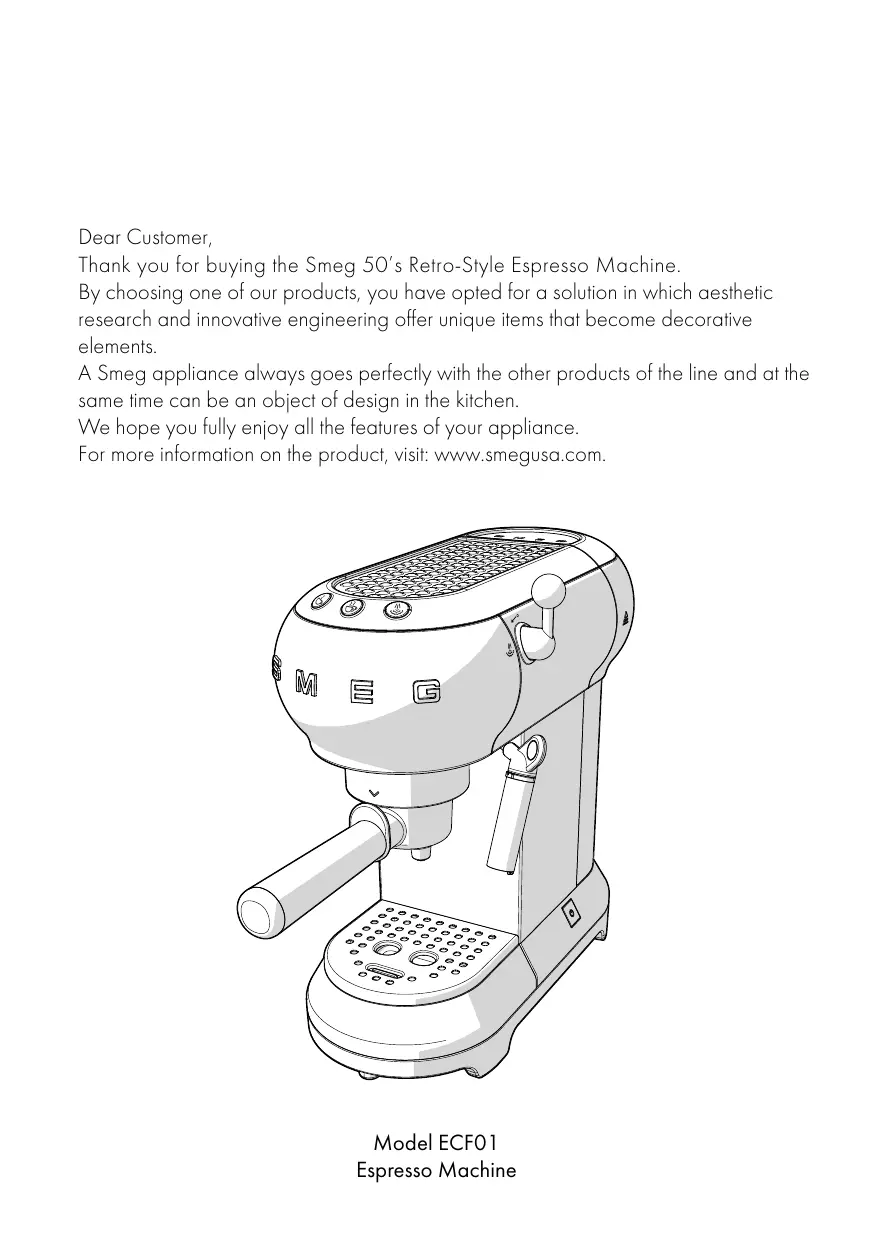
Thank you for buying the Smeg 50's Retro-Style Espresso Machine.
By choosing one of our products, you have opted for a solution in which aesthetic research and innovative engineering offer unique items that become decorative elements.
A Smeg appliance always goes perfectly with the other products of the line and at the same time can be an object of design in the kitchen.
We hope you fully enjoy all the features of your appliance.
For more information on the product, visit: www.smegusa.com.

Model ECF01
Espresso Machine
Contents
1 Instructions 7
1.1 Introduction 7
1.2 This user's manual 7
1.3 Intended use 7
1.4 Manufacturer's liability 8
1.5 Identification plate 8
1.6 Disposal 8
2 Description 9
2.1 Product Description 9
3 Use 10
3.1 Before first use 10
3.2 First use 11
3.3 How to make espresso 12
3.4 How to make cappuccino 14
3.5 How to heat water 15
3.6 Accessing the programming menus and changing the settings 15
3.7 How to cool down the boiler 18
4 Cleaning and maintenance 19
4.1Warnings 19
4.2 Cleaning the body of the espresso machine 19
4.3 Cleaning the parts of the espresso machine 19
4.4 Descaling 21
4.5 What to do if... 22
Important Safeguards
WARNING: If the instructions contained in this manual are not followed precisely, fire or explosion may result causing property damage, personal injury or death.

READ AND SAVE THESE INSTRUCTIONS - Your safety and the safety of others are very important.
We have provided many important safety messages throughout this manual and on the appliance.
Read all the instructions before using the appliance and always obey all safety messages.

RECOGNIZE SAFETY INFORMATION
This is a safety alert symbol. This symbol alerts you to potential hazards that can result in severe personal injury or death.
UNDERSTAND SIGNAL WORDS
A signal word - DANGER, WARNING or CAUTION - is used with the safety alert symbol. DANGER denotes the most serious hazards. It means you could be killed or seriously injured if you do not immediately follow the instructions.
WARNING means you could be killed or seriously injured if the instructions are not followed. CAUTION indicates a potentially hazardous situation, which, if not avoided, could result in minor to moderate injury.
WARNING

- This appliance is intended for use in the home only.
- Use this appliance only for its intended purpose. The manufacturer cannot be held liable for damage caused by improper use of this appliance.
- This appliance complies with current safety regulations. Improper use of this appliance can result in personal injury and material damage.
- Read all the instructions before installing or using the appliance for the first time.
- Keep these operating instructions in a safe place and pass them on to any future user.
The safety messages will inform you of potential hazards, on how to avoid the risk of injury and what can occur if the instructions are not followed.
IMPORTANT: Observe all codes and ordinances in force.
WARNING: For your safety, the instructions contained in this manual must be followed to minimize the risk of fire or explosion and to prevent property damage, personal injury or death.
Do not store or use gasoline or other flammable vapors, liquids or materials near this or any other appliance.

NOTE: This appliance is NOT designed for installation in manufactured (mobile) homes or in recreational vehicles (RVs).
DO NOT install this appliance outdoors.
WARNING

To reduce the risk of fire, electrical shock, personal injury, or damage when using the appliance, follow basic safety precautions, including the following:
Follow all safety precautions to ensure safe use of the appliance.
- Before using the appliance, read this user manual carefully.
- Do not use the appliance outdoors.
- This appliance is for household use only.
- Do not use the appliance for other than its intended use.
- Do not allow children to use the appliance.
Children should not play with the appliance. Keep the appliance out of the reach of children. - Turn off the appliance immediately after use.
- Do not leave the appliance unattended while it is running.
- Disconnect the appliance from the wall outlet before assembly, disassembly, cleaning and after each use.
- Let the appliance cool down before fitting or removing parts and before cleaning.
- To protect against fire, electrical shock and personal injury, do not immerse the appliance, the power cord or plug in water or any other liquid.
- Do not touch the appliance or the plug with wet hands.
-
Never try to extinguish a flame/fire with water: turn off the appliance, unplug it from the outlet and cover the flame with a lid or a fire blanket.
-
Do not use the appliance if the power cord or plug is damaged or if the appliance has been dropped or damaged in any way.
- Do not let the cord hang over the edge of a table or counter.
- If the power cord is damaged, contact the technical support service to get a replacement and to avoid possible hazards.
- Make sure the power cord does not come in contact with sharp edges.
- Do not pull on the cord to remove the plug from the socket.
- Do not place the appliance on or near switched-on gas or electric burners, inside an oven, or near heat sources.
- Do not touch hot surfaces. Use handles and knobs.
- Do not place the appliance near faucets or sinks.
- Never attempt to repair the appliance yourself or without the help of a qualified technician. Failing to do this will void the warranty.
- In case of malfunction, have the appliance repaired by a qualified technician.
- Do not make any changes to the appliance.
For this appliance
- Always unplug the espresso machine if left unattended, before assembly and disassembly of components and before cleaning.
- Unplug the espresso machine from the outlet when it is not in operation, before cleaning and in case of malfunction.
- Allow the espresso machine to cool before cleaning.
- Do not use the espresso machine without water in the tank or without the tank.
- Leave at least 1 inch of space between the espresso machine and any side or rear surface, and at least 6 inches of space above the espresso machine.
- Risk of scalding! The espresso machine generates heat and produces hot water and steam during operation.
- Risk of scalding! Do not touch the cup warmer tray during operation.
- Do not use the espresso machine in combination with parts or accessories from other manufacturers.
- Use only original spare parts from the manufacturer. The use of spare parts not recommended by the manufacturer may cause fire, electric shock or injury to persons.
- Place the espresso machine on a flat, dry surface.
-
Avoid wetting or spraying liquid on the espresso machine. In case of contact with liquid, immediately unplug the cord from the electrical outlet and dry thoroughly: Risk of electric shock!
-
Do not use abrasive cleaners or sharp objects to clean the espresso machine.
- A short power cord is provided to reduce risks resulting from becoming entangled in or tripping over a longer cord.
- Longer, detachable power supply cords or extension cords are available and may be used if care is exercised in their use.
- If an extension cord is used, the marked electrical rating should be at least as great as the electrical rating of the appliance. If the appliance is provided with 3-wire, grounding type cord, the extension should be a GROUNDING TYPE 3 - WIRE CORD. The longer cord should be arranged so that it will not drape over the counter-top or table top where it can be pulled on by children or tripped over.
- Your product is equipped with a polarized alternating current line plug (a plug having one blade wider than the other). This plug will fit into the power outlet only one way. This is a safety feature. If you are unable to insert the plug fully into the outlet, try reversing the plug. If the plug should still fail to fit, contact your electrician to replace your obsolete outlet. Do not defeat the safety purpose of the polarized plug.
SAVE THESE INSTRUCTIONS
1 Instructions
1.1 Introduction
Key information for the user:
Warnings

General information about the user manual, safety and final disposal.
Description

Description of the appliance.
Use

Information on using the appliance.
Cleaning and maintenance

Information for proper cleaning and maintenance.

Safety warning

Information

Suggestion
1.2 This user's manual
This user's manual is an integral part of the appliance and must be kept intact and available to the user throughout its life cycle.
1.3 Intended use
The appliance is for indoor use only.
- The appliance is intended solely for household-type use.
- The appliance can be used to prepare espresso and cappuccino using ground coffee or pods. Any other use is inappropriate. Do not use the appliance for purposes other than its intended use.

The California Safe Drinking Water and Toxic Enforcement Act requires the Governor of California to publish a list of substances known to the State of California to cause cancer, birth defects or other reproductive harm, and requires businesses to warn customers of potential exposure to such substances.

Warning
- This product contains a chemical known by the State of California to cause cancer, birth defects or other reproductive harm.
- This appliance can cause low-level exposure to some of the substances listed, including benzene, formaldehyde, carbon monoxide, toluene, and soot.

Important Safeguards
1.4 Manufacturer's liability
The manufacturer accepts no liability for damage to persons and property caused by:
- using the appliance in ways other than those provided;
not reading the user's manual; - tampering with any part of the appliance;
using non-original parts; - ignoring safety warnings.
1.5 Identification plate
The identification plate lists the technical data, serial number and brand name. The identification plate must never be removed.
1.6 Disposal

Power voltage Risk of electric shock
- Unplug the appliance.
-
Unplug the cord from the wall outlet.
-
Old electrical equipment must not be disposed of with household waste! In accordance with the law in force, electrical appliances at the end of their life should be taken to separate collection facilities for electrical and electronic waste. This is so that valuable materials from old appliances can be recycled and the environment can be protected. For more information, please contact your local authorities or recycling center employees.
Note that non-polluting and recyclable materials are used for packaging the appliance.
- Dispose of the packaging materials at appropriate differentiated waste collection centers.

Plastic packaging Risk of suffocation
- Do not leave the packaging or any part of it unattended.
- Do not allow children to play with the plastic packaging bags.
2 Description
2.1 Product Description

Model ECF01 - Espresso Machine
1 Cup warmer tray
2 Grouphead
3 Filter holder
4 Steel cup tray
5 Floater
6 Stainless steel drip tray
7 Hot water and steam wand/Cappuccino frother
8 Steam valve
9 ON/OFF switch
10 Water tank cover
1 Water tank (1 liter)
12 Measuring scoop/tamper
13 Pod filter basket
14 1-cup ground coffee filter basket
15 2-cup ground coffee filter basket
16 Water softener filter (optional)
17 1-cup coffee button (white light)
182-cup coffee button (white light)
19 Steam button (white light)/Descaler button (orange light)
20 Non-slip feet
3 Use
3.1 Before first use
- Remove any labels and stickers from the espresso machine.
- Thoroughly wash and dry the espressomachine's parts (see "4 Cleaning andmaintenance").
- Remove the cover (1) by pulling it upwards and then pull out the tank (2).

- Fill the tank (2) with fresh, clean water directly from the faucet or by using a pitcher, being careful not to exceed the maximum level indicated on the tank.


Risk of accident
- Do not operate the espresso machine without water in the tank or without the tank in place.

The parts that may come into contact with food are made of materials that comply with all legal provisions in force.
3.2 First use
- Turn on the espresso machine using the ON/OFF switch (1): the lights of the three buttons (2), (3) and (4) will flash in sequence.

-
Lights (2) and (3) will flash to indicate that the machine is reaching the pre-set temperature. The espresso machine is ready for use as soon as the lights stop flashing.
-
Place a container under the hot water/ steam wand (4).
- Turn the steam valve (5) to the position and dispense 1/2 cup of water.
- Turn the steam valve (5) back to the position.

i Make 4-5 espressos or 4-5 cappuccinos to obtain a satisfactory result.
- Attach the filter holder by aligning the handle with and turning it to the right to the position.
- To rinse the machine's internal circuits, place a container under the coffe spout and press the button.
- Repeat this procedure 5 times.
Then proceed with rinsing the "steam" circuit:
- Place a container under the hot water spout and turn the steam valve to the position. Hot water is delivered.
- When the appliance automatically stops the hot water delivery, turn the steam valve back to the position.
- Repeat this procedure 1 more time (if necessary, refill the tank).
Filters
The coffee machine comes with three filters: a one-cup filter, a two-cup filter, and a pod filter. Below each filter you will find the corresponding symbol.

3.3 How to make espresso
Ground coffee:
- Place the ground coffee filter basket (1) in the filter holder (2), choosing the one-cup or the two-cup basket.

- Tamp the ground coffee down using the tamper (3).

- Wipe off any excess ground coffee from the edge of the filter holder. Attach the filter holder by aligning the handle with and turning it to the right to the position.


- For one cup, fill the filter basket with one level scoop of coffee (about 1 tablespoon.)
- For two cups, fill the filter basket with two scoops of coffee.
- For a stronger coffee, tamp the ground coffee hard with the tamper.
-
For a weaker coffee, use the tamper to tamp the ground coffee lightly.
-
Place the cup or cups under the filter holder spouts and press the coffee button 2 or 22 .


Risk of scalding
- To avoid any splashing, do not detach the filter holder while coffee is being dispensed. Wait a few seconds for the process to finish.
Coffee pods:
- Insert the coffee pod filter basket in the filter holder.
- Insert the pod in the filter holder trying to center it as much as possible.
- Proceed in the same way as with ground coffee.

Risk of scalding
- To avoid any splashing, do not detach the filter holder while coffee is being dispensed. Wait a few seconds for the process to finish.

- The process can be interrupted at any time by pressing the coffee button.
- To increase the amount of coffee in the cup, hold down the coffee button.
3.4 How to make cappuccino
- Make an espresso in a large cup.
- Press the button: the light will flash.
-
Fill a container with 1/2 cup cold, partially skimmed milk for each cappuccino you want to make.
-
When the light stops flashing, place an empty container under the cappuccino frother (1) and turn the steam valve (2) to the position to drain any water present and then close the valve.
- Place the container with the milk under the cappuccino frother (1), immersing the cappuccino frother a few millimeters below the surface. Turn the steam valve (2) to the position and slowly move the container up and down to obtain a creamier foam.

- Once the volume of the milk has doubled, dip the cappuccino frother deep into the milk and heat to 140^ F ( 60^ C ). Stop the frothing process by turning the steam valve clockwise.
- Pour the milk into the cups with the espresso.


- To make more than one cappuccino, first prepare all the espresso and then froth the milk for all the cappuccinos.
- For hygiene reasons, it is recommended to clean the cappuccino frother after use.
- Clean out the milk residue by opening the steam valve to let out the steam.
- Release the steam for only a maximum of 60 seconds.
3.5 How to heat water
- Turn the machine on using the ON/OFF switch.
- Place a container under the cappuccino frother.
- Turn the steam valve to the position to let the hot water out.

- Release the steam for only a maximum of 60 seconds.
3.6 Accessing the programming menus and changing the settings
- Make sure that the machine is ready to use and hold the button for 10 seconds until the three buttons start flashing: the machine will enter programming mode.
- Program the machine settings to your own needs.
- To exit the menu, simply do not press any button for 15 seconds.
Setting the coffee temperature
- Access the programming menu.
- Press the button to select the temperature of the coffee. The lights of the current setting will turn on:
Lights
Temperature setting


Low


Medium


High
- The lights will start flashing in sequence.
- Press the button corresponding to the
desired temperature: low ( c 3 2 ) , medium ( c 2 2 ) or high ( c 1 1 ) .
5. The button will flash to indicate the selection has been saved.
Setting the amount of coffee
To change the quantity of coffee dispensed by the machine:
- Place one or two cups under the filter holder spouts.
- Press the button for one cup (32) or two cups (2210) and hold it down.
-
The machine will start dispensing coffee.
-
Release the button as soon as you reach the desired amount of coffee.
- The light will flash to indicate that the selected quantity has been saved.
Setting the water hardness
- Access the programming menu.
- Press the button to select the water hardness. The lights of the current setting will turn on:
Lights
Water setting


Soft


Medium


Hard
- The lights will start flashing in sequence.
- Press the button corresponding to the water hardness:

soft

medium

hard
$$ < 1 0 ^ {\circ} \mathrm {d H} $$
$$ 1 0 ^ {\circ} \mathrm {d H} - 2 0 ^ {\circ} \mathrm {d H} $$
$$
2 0 ^ {\circ} \mathrm {d H} $$
$$ < 1 8 ^ {\circ} \mathrm {f H} $$
$$ 1 8 ^ {\circ} f H - 3 6 ^ {\circ} f H $$
$$
3 6 ^ {\circ} \mathrm {f H} $$
$$ < 1 8 0 \mathrm {m g} / \mathrm {l} $$
$$ 1 8 0 - 3 0 0 \mathrm {m g} / \mathrm {l} $$
$$ 3 6 0 \mathrm {m g} / \mathrm {l} $$
$$ \mathrm {C a C o 3} $$
$$ \mathrm {C a C o 3} $$
$$ \mathrm {C a C o 3} $$
- The button will flash to indicate the selection has been saved.
Setting the auto shut-off time
For energy saving reasons, the espresso machine is equipped with an auto shut-off feature that activates when the machine has been left on for a long time.
To set the auto shut-off time:
- Access the programming menu.
- Press the button to select the auto shut-off time. The lights of the current setting will turn on:
Lights
Time setting


9 minutes


30 minutes


3 hours
- The lights will start flashing in sequence.
- Press the button corresponding to the time you want to set, choosing from 9 minutes ( 2 ) , 30 minutes ( 2 ) or 3 hours ( 1 ) .
- The button will flash to indicate the selection has been saved.
Restoring the factory settings
To restore factory settings:
- Access the programming menu.
- Turn the steam valve to the position.
- Press the button: the three lights will blink to indicate that the original settings have been restored.
- Turn the steam valve back to the position.
3.7 How to cool down the boiler
The boiler must be cooled down if you want to make coffee immediately after frothing milk for cappuccino.
If the boiler is not cooled down, the coffee will be burned.
- Place a container under the cappuccino frother and open the steam valve to dispense hot water.

- The hot water will stop coming out as soon as the machine has cooled down.
- Close the steam valve and proceed with making the coffee.
4 Cleaning and maintenance
4.1Warnings

Misuse
Risk of electric shock
- Unplug the espresso machine before cleaning.
- Do not immerse the espresso machine in water or other liquids.
- Allow the espresso machine to cool before cleaning.

Misuse
Risk of damage to surfaces
- Do not use steam jets to clean the espresso maker.
- Do not use cleaning products containing chlorine, ammonia or bleach on parts with metallic surface finishes (e.g. anodizing, nickel or chrome plating).
- Do not use abrasive or corrosive detergents (e.g. powders, stain removers and metal scouring pads).
- Do not use rough or abrasive materials or sharp metal scrapers.
4.2 Cleaning the body of the espressor machine
To maintain the outer surfaces, you must clean them regularly after each use after letting them cool down. Clean with a soft, damp cloth.
4.3 Cleaning the parts of the espresso machine
Cleaning the drip tray
The drip tray is fitted with a red floater (1) that protrudes from the cup tray as soon as the maximum level of liquid is exceeded.

- Remove the cup tray (2) and then the drip tray (3) to empty it.


- Clean the tray with a cloth and put it back in place with the cup tray.
Cleaning the filter baskets
Clean the filter baskets regularly under running water. If the holes are clogged, clean them with a pin or a brush.
Cleaning the cappuccino frother
Clean the cappuccino frother immediately after use.
- Turn the steam valve to release a little steam and to clean out the milk remaining inside it.
- Switch off the espresso machine using the ON/OFF switch.
- Hold the tube of the cappuccino frother (1) with one hand and with the other turn the cappuccino frother (2) clockwise and slide it down.

- Remove the rubber nozzle (3) from the frother tube by pulling down on it.

- Wash the cappuccino frother and the nozzle with warm water.
- Check that the hole (A) is not obstructed.

- Insert the nozzle (3) in the cappuccino frother tube (1) and reposition the cappuccino frother (2) by sliding it upwards and turning it counterclockwise.
- Put the cappuccino frother back together by following the cleaning instructions in reverse order.
Cleaning the grouphead
The grouphead should be rinsed out after every 200 coffees by flushing about 2 cups of water through it. To do this, press the coffee button without loading ground coffee or a pod.
Cleaning the water tank
Clean the water tank about once a month with a damp cloth and mild detergent.
4.4 Dscaling
The espresso machine should be descaled when the button lights up orange.
- Fill the water tank with a solution of water and descending solution in the amounts recommended by the manufacturer.
- Press the ON/OFF switch.
- Remove the filter holder and place a container under the cappuccino frother.
- Wait until the 2 or 22 lights stop flashing.
- Hold down the button for 10 seconds until the three buttons begin to blink in sequence.
- Turn the steam valve to the position.
- Press to start the descending process.
- The descending cycle will automatically perform a series of rinses to remove limescale from the espresso machine.
- When the orange indicator light flashes, it means the descending cycle has been interrupted.
- Remove the water tank, empty it and rinse it.
-
Fill the tank up to the maximum level and put it back in place.
-
Place an empty container under the cappuccino frother and check that the steam valve is in the position. Then, press the button to start the rinse cycle.
- When the water tank is empty, it is necessary to perform a new rinse cycle, following steps 10, 11 and 12.
- When the water tank is empty, the orange indicator light turns off to indicate that descending has finished.
- Make sure that the steam valve is in the closed position .

Risk of injury
- Descalera contains acids which may irritate the skin and eyes.
- Carefully follow the manufacturer's instructions and safety warnings on the packaging in the event of contact with the skin or eyes.
- Use a descending solution recommended by Smeg to avoid damage to the espresso machine.
Dscaling and rinsing the grouphead
During the descending cycle, close the steam valve from time to time to make the descending solution flow out of the grouphead.
During the rinse cycle, close the steam valve from time to time to rinse the grouphead.
4.5 What to do if...
| Problem | Possible cause | Solution |
| No water in the tank. | Fill the tank. | |
| The filter holes are blocked. | Clean the filter basket by using a brush or a pin. | |
| The tank is not inserted correctly. | Insert the tank correctly. | |
| Presence of limescale. | Run the descending cycle. | |
| The filter holder is not attached properly or is dirty. | Attach the filter holder and turn it until it stops. Clean the filter holder. | |
| The coffee drips from the filter holder and not from the spouts | The grouphead gasket is worn. | Have it replaced at an authorized service center. |
| The spout holes are clogged. | Clean the spout holes. |
Cleaning and maintenance
| Problem | Possible cause | Solution |
| The filter holder does not latch into the espresso machine | The filter basket is too full. | Use the measuring scoop provided and use the correct filter basket. |
| The espresso machine does not work and all the lights are blinking | Possible fault. | Unplug the espresso machine and contact an authorized service center. |
| The espresso'screa is clear and comes out too quickly from the spout | The ground coffee has not been tamped enough. | Tamp the coffee more. |
| There is too little ground coffee. | Increase the amount. | |
| The coffee grind is too coarse. | Only use ground coffee for espresso machines. | |
| The quality of the ground coffee is not correct. | Change the type of ground coffee. | |
| The ground coffee has been tamped too hard. | Tamp the coffee less. | |
| There is too much ground coffee. | Decrease the amount. | |
| The espresso's crema is dark and comes out too slowly from the spout | The grouphead or the filter basket is clogged. | Clean the outlet and the filter basket. |
| The coffee grind is too fine. | Only use ground coffee for espresso machines. | |
| Presence of limescale. | Run the descending cycle. | |
| Steam valve open. | Close the steam valve. | |
| The ② and ③ lights flash for a few seconds | Boiler temperature is too high. | Cool down the boiler. |
| Presence of limescale. | Run the descending cycle. |
Problem
Possible cause
Solution
No water in the tank.
Fill the tank.
The grouphead or the filter basket Clean the grouphead and is clogged. the filter.
The tank is not inserted correctly. Insert the tank correctly.

If the problem has not been resolved or there are other types of faults, contact your local authorized service center.
The manufacturer reserves the right to make any changes deemed useful for improvement of its products without prior notice. The illustrations and descriptions contained in this manual are therefore not binding and are merely indicative.