
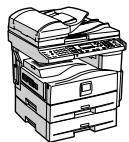
AFICIO MP 161 - Multifunction Printer RICOH - Free user manual and instructions
Find the device manual for free AFICIO MP 161 RICOH in PDF.


| Product type | Multifunction printer (copier, printer, scanner, fax) |
| Brand | Ricoh |
| Model | Aficio MP 161 |
| Functions | Copy, print, scan, fax |
| Copy format | A4, B5, A5, custom sizes (max 356 mm long) |
| Copy speed | Approx. 16 copies/min (A4) |
| Copy resolution | 600 × 600 dpi |
| Zoom | 50 to 200% in 1% increments |
| Advanced copy functions | Duplex, combine (2/4 pages 1-sided, 2/4/8 pages 2-sided), sort, stack |
| Paper feed | Paper tray(s) (standard capacity approx. 500 sheets) + bypass tray (capacity varies by type) |
| Bypass tray | For OHP, thick paper, envelopes, custom sizes (90-216 mm × 139-600 mm) |
| Paper weight | Standard tray: 64-90 g/m²; bypass: up to 157 g/m² |
| Document feeder | ARDF (automatic duplex document feeder, capacity ~50 sheets) |
| Dimensions (W × D × H) | Approx. 470 × 460 × 310 mm |
| Weight | Approx. 16 kg |
| Power supply | 220-240 V, 50/60 Hz, typical consumption ~800 W |
| Maintenance | Replace toner and drum as needed; clean glass and feeder |
| Security | User code lock, administrator authentication |
| Spare parts / repairability | Toner cartridge (type 161), drum, maintenance kit; troubleshooting guides available |
| Languages | French, English (user guide) |
| Display | Backlit LCD screen with selection buttons |
Frequently Asked Questions - AFICIO MP 161 RICOH
User questions about AFICIO MP 161 RICOH
0 question about this device. Answer the ones you know or ask your own.
Ask a new question about this device
Download the instructions for your Multifunction Printer in PDF format for free! Find your manual AFICIO MP 161 - RICOH and take your electronic device back in hand. On this page are published all the documents necessary for the use of your device. AFICIO MP 161 by RICOH.
USER MANUAL AFICIO MP 161 RICOH
DSm416/DSm416f/DSm416pf
LD016/LD016f/LD016spf
Afecto MP 161/161F/161SPF
Operating Instructions Copy Reference
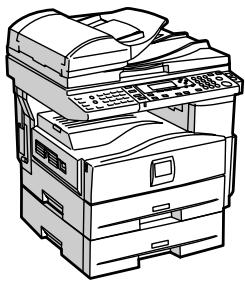
1 Placing Originals
2 Copying
3 Appendix
Introduction
This manual contains detailed instructions and notes on the operation and use of this machine. For your safety and benefit, read this manual carefully before using the machine. Keep this manual in a handy place for quick reference.
Important
Contents of this manual are subject to change without prior notice. In no event will the company be liable for direct, indirect, special, incidental, or consequential damages as a result of handling or operating the machine.
Do not copy or print any item for which reproduction is prohibited by law.
Copying or printing the following items is generally prohibited by local law:
bank notes, revenue stamps, bonds, stock certificates, bank drafts, checks, passports, driver's licenses.
The preceding list is meant as a guide only and is not inclusive. We assume no responsibility for its completeness or accuracy. If you have any questions concerning the legality of copying or printing certain items, consult with your legal advisor.
Notes:
Some illustrations in this manual might be slightly different from the machine.
Certain options might not be available in some countries. For details, please contact your local dealer.
Depending on which country you are in, certain units may be optional. For details, please contact your local dealer.
Caution:
Use of controls or adjustments or performance of procedures other than those specified in this manual might result in hazardous radiation exposure.
Two kinds of size notation are employed in this manual. With this machine refer to the inch version.
Manuals for This Machine
Refer to the manuals that are relevant to what you want to do with the machine. Manuals for machines with copier function only or with the DDST Unit are different. See "Manuals for Machines with Copier Function Only or with the DDST Unit".
Important
Media differ according to manual.
The printed and electronic versions of a manual have the same contents.
Adobe Acrobat Reader/Adobe Reader must be installed in order to view the manuals as PDF files.
Depending on which country you are in, there may also be html manuals. To view these manuals, a Web browser must be installed.
About This Machine
Be sure to read the Safety Information in this manual before using the machine. This manual provides an introduction to the functions of the machine. It also explains the control panel, preparation procedures for using the machine, how to enter text, and how to install the CD-ROMs provided.
General Settings Guide
Explains User Tools settings, and Address Book procedures such as registering fax numbers, e-mail addresses, and user codes. Also refer to this manual for explanations on how to connect the machine.
Troubleshooting
Provides a guide to solving common problems, and explains how to replace paper, toner, and other consumables.
Security Reference
This manual is for administrators of the machine. It explains security functions that the administrators can use to protect data from being tampered with, or prevent the machine from unauthorized use.
Also refer to this manual for the procedures for registering administrators, as well as setting user and administrator authentication.
Copy Reference
Explains Copier functions and operations. Also refer to this manual for explanations on how to place originals.
Facsimile Reference
Explains Facsimile functions and operations.
Printer Reference
Explains Printer functions and operations.
Scanner Reference
Explains Scanner functions and operations.
Network Guide
Explains how to configure and operate the machine in a network environment, and use the software provided.
This manual covers all models, and includes descriptions of functions and settings that might not be available on this machine. Images, illustrations, and information about operating systems that are supported might also differ slightly from those of this machine.
Other manuals
PostScript3 Supplement
- UNIX Supplement
- Manuals for Desktop Binder Lite
- DeskTopBinder Lite Setup Guide
- DesktopBinder Introduction Guide
- Auto Document Link Guide
Note
□ Manuals provided are specific to machine types.
For "UNIX Supplement", please visit our Web site or consult an authorized dealer.
- "PostScript3 Supplement" and "UNIX Supplement" include descriptions of functions and settings that might not be available on this machine.
Reference
p.iii "Manuals for Machines with Copier Function Only or with the DDST Unit"
Manuals for Machines with Copier Function Only or with the DDST Unit
This section describes the manuals for machines with copier function only or with the DDST Unit.
About This Machine
Be sure to read the Safety Information in this manual before using the machine. This manual provides an introduction to the functions of the machine. It also explains the control panel, preparation procedures for using the machine, and how to install the CD-ROMs provided.
General Settings Guide
Explains User Tools settings. Also refer to this manual for explanations on how to register user codes.
Troubleshooting
Provides a guide to solving common problems, and explains how to replace paper, toner, and other consumables.
Copy Reference
Explains Copier functions and operations. Also refer to this manual for explanations on how to place originals.
Printer/Scanner Reference
Explains system settings, functions and operations for the machine's printer/scanner unit. Also refer to this manual for explanations on how to connect the machine.
Network Guide
Explains how to configure and operate the machine in a network environment, and use the software provided.
Note
Some manuals include descriptions of functions and settings that are not available on machines with copier function only or with the DDST Unit.
What You Can Do with This Machine
Available functions differ depending on the model and options.
Reference
p.2 "Functions Requiring the ARDF"
Types of Duplex Copies
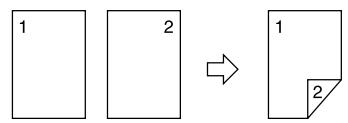
1 Sided 2 Pages 2 Sided 1 Page
See p.41 "Duplex".
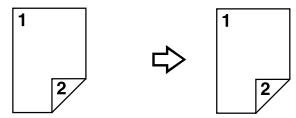
2 Sided 1 Page 2 Sided 1 Page
See p.41 "Duplex".
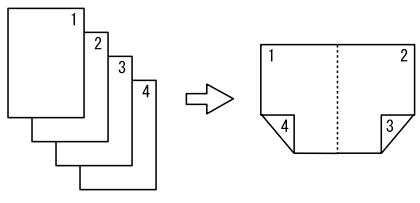
1 Sided 4 Pages Combine 2 Sided 1 Page
See p.47 "Two-Sided Combine".
GCSHVY9J
1 Sided 8 Pages Combine 2 Sided 1 Page See p.47 "Two-Sided Combine".
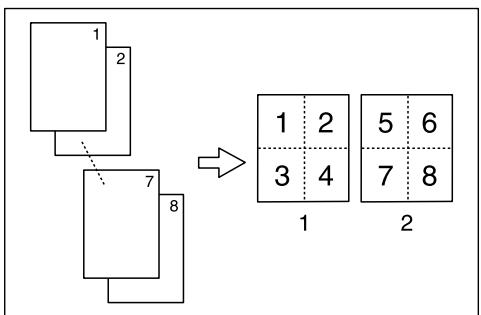
GCSHVYAE
1 Front
2 Back
2 Sided 2 Pages Combine 2 Sided 1 Page See p.47 "Two-Sided Combine".
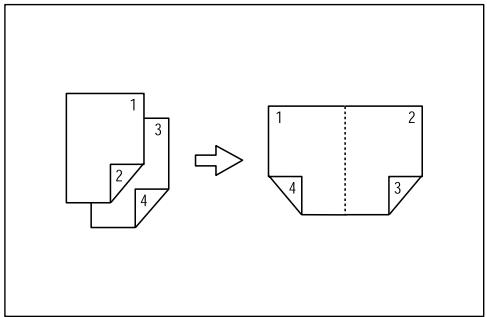
GCSHVY1E
2 Sided 4 Pages Combine 2 Sided 1 Page See p.47 "Two-Sided Combine".
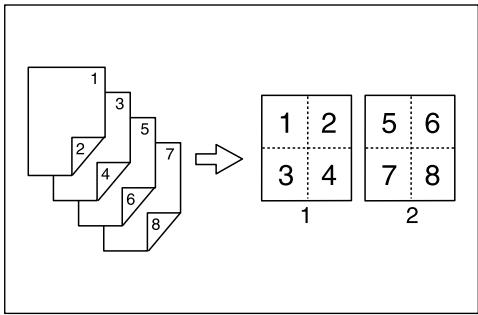
GCSHVY2E
1 Front
2 Back
Combining Multiple Pages onto a Single Page
See p.44 "One-Sided Combine".
1 Sided 2 Pages Combine 1 Sided 1 Page
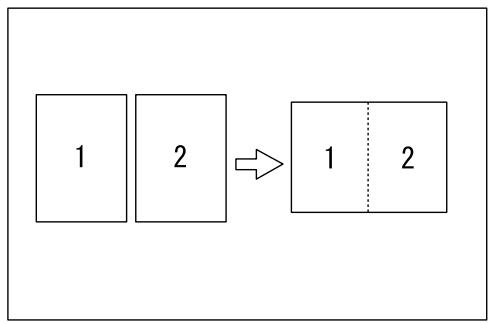
GCSHVY7J
1 Sided 4 Pages Combine 1 Sided 1 Page
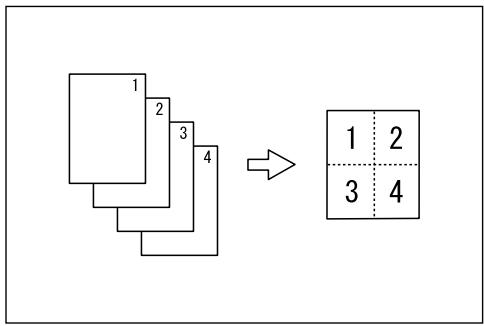
GCSHVY8J
2 Sided 1 Page Combine 1 Sided 1 Page
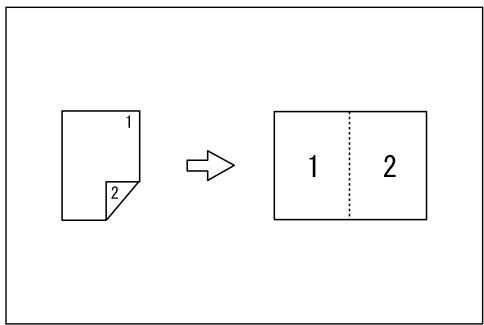
GCSHVYOJ
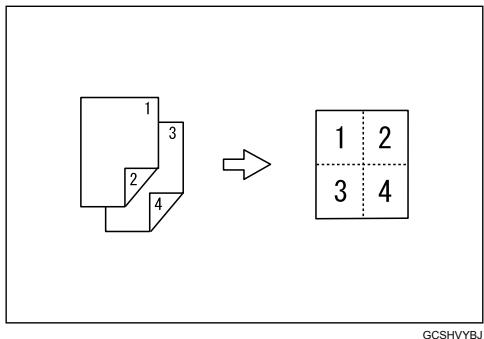
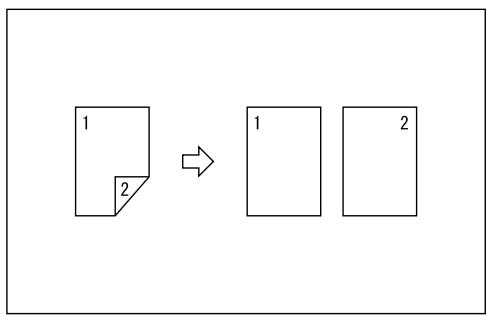
Copying 2-Sided Originals onto 1-Sided Pages
See p.50 "Series Copies".
2 Sided 1 Page 1 Sided 2 Pages
Copying onto Envelopes
Envelope
See p.30 "When Copying onto Envelopes".
TABLE OF CONTENTS
Manuals for This Machine
Manuals for Machines with Copier Function Only or with the DDST Unit.
What You Can Do with This Machine. iv
Types of Duplex Copies iv
Combining Multiple Pages onto a Single Page vi
Copying 2-Sided Originals onto 1-Sided Pages vii
Copying onto Envelopes vii
How to Read This Manual 1
Symbols 1
Name of Major Item. 1
Functions Requiring the ARDF 2
Display 3
Reading the Display 3
Using the Keys on the Control Panel 4
User Tools Menu (Copier Features) 5
1. Placing Originals
Originals 7
Sizes and Weights of Recommended Originals 7
Sizes Selectable as Regular Size Originals 9
Missing Image Area 10
Placing Originals 11
Original Orientation 11
Placing Originals on the Exposure Glass 12
Placing Originals in the ARDF 13
Specifying the Original Size When a Paper Tray is Selected 14
Specifying the Original Size When the Bypass Tray is Selected 17
2. Copying
Basic Procedure 21
Copying from the Bypass Tray 23
Loading Paper on the Bypass Tray 23
When Copying onto Regular Size Paper 25
When Copying onto Custom Size Paper 26
When Copying onto OHP Transparencies 27
When Copying onto Thick Paper 28
When Copying onto Envelopes 30
Copy Functions 34
Adjusting Image Density 34
Original Type Setting 34
Selecting Copy Paper 35
Preset Reduce/Enlarge 36
Zoom 37
Sort 39
Duplex 41
One-Sided Combine 44
Two-Sided Combine 47
Series Copies 50
3. Appendix
Combination Chart 53
Supplementary Information 54
INDEX. 57
How to Read This Manual

Note
For proper use of this product, be sure to read About This Machine first.
Supplementary information about the copier mode is described in "Supplementary Information".

Reference
p.54 "Supplementary Information"
Symbols
This manual uses the following symbols:

WARNING:
Indicates important safety notes.
Ignoring these notes could result in serious injury or death. Be sure to read these notes. They can be found in the "Safety Information" section of About This Machine.

CAUTION:
Indicates important safety notes.
Ignoring these notes could result in moderate or minor injury, or damage to the machine or to property. Be sure to read these notes. They can be found in the "Safety Information" section of About This Machine.

Important
Indicates points to pay attention to when using the machine, and explanations of likely causes of paper misfeeds, damage to originals, or loss of data. Be sure to read these explanations.

Note
Indicates supplementary explanations of the machine's functions, and instructions on resolving user errors.

Reference
This symbol is located at the end of sections. It indicates where you can find further relevant information.
[]
Indicates the names of keys that appear on the machine's display panel.
【】
Indicates the names of keys on the machine's control panel.
Name of Major Item
Major item of this machine is referred to as follows in this manual:
- Auto document feeder capable of scanning both sides of a sheet ARDF
Functions Requiring the ARDF
The following functions are available when the ARDF is installed:
Duplex
- 2 Sided 2 Sided
One-Sided Combine
- 2 Sided 1 Page Combine 1 Side
- 2 Sided 2 Pages Combine 1 Side
Two-Sided Combine
- 2 Sided 2 Pages Combine 2 Sides
- 2 Sided 4 Pages Combine 2 Sides
Series Copies
- 2 Sided 1 Sided
Display
This section explains how to read the display and how to use the selection keys on the copy display.

Note
The copy display is set as the default screen when the machine is turned on.
Reading the Display
Initial copy display
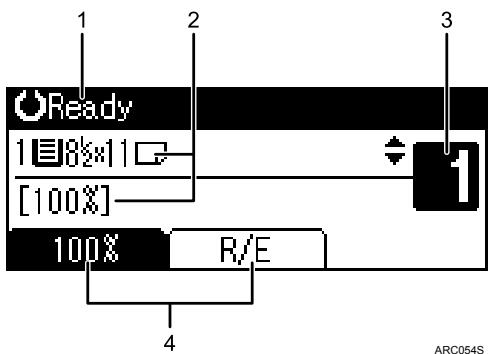
- Displays operational status and messages.
-
Displays the current paper tray and selected items that appear in brackets.
-
Displays the number of copies set.
- Displays frequently used functions.
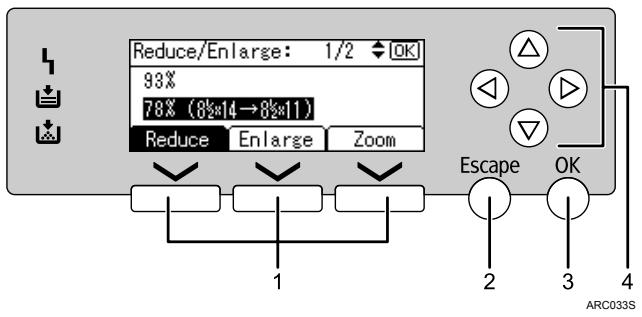
1. Selection keys
Correspond to items at the bottom line on the display.
Example: copy display
- When the instruction "press [Reduce]" appears in this manual, press the left selection key.
- When the instruction "press [Enlarge]" appears in this manual, press the center selection key.
- When the instruction "press [Zoom]" appears in this manual, press the right selection key.
2.【Escape】key
Press to cancel an operation or return to the previous display.
3. [OK] key
Press to set a selected item or entered numeric value.
4. Scroll keys
Press to move the cursor to each direction one by one.
When [],[],[] , or [] key appears in this manual, press the scroll key of the same direction.
User Tools Menu (Copier Features)
This section describes items you can set in the copier feature. The copier features screen can be displayed by pressing the [User Tools/Counter] key. For details about how to set up these items, see General Settings Guide.
| Item | Description |
| Auto Tray Switching | If you load paper of the same size and in the same orientation in two trays, the machine automatically shifts to the other tray when the first tray runs out of paper (if [On] is selected.) This function is called “Auto Tray Switching”. This setting specifies whether to use Auto Tray Switching or not. |
| Original Type Setting | You can adjust copy finish quality level according to original type. You can choose these functions after selecting [Original Type 1 (Text)] or [Original Type 2 (Photo)]. |
| Duplex Mode Priority | You can select the type of Duplex function effective when the machine is turned on, reset, or modes are cleared. |
| Orientation | You can select the original orientation when using the Combine/Series, or two-sided originals to one-sided Duplex function. The default setting is [Do not Specify]. |
| Max. Number of Sets | The maximum copy quantity can be set between 1 and 99 using the number keys. |
| Original Count Display | You can set to display the count of originals and copying pages on the display when [On] is selected. |
| Reproduction Ratio | You can select which reduce, enlarge, or input ratio is shown on the display with priority when [Reduce] or [Enlarge] is selected. |
| Preset R/E Priority | You can set the ratio with priority when [R/E] is selected. |
| Duplex Margin | Specify left margin on the back side of copies, and top margin on the front side. |
| Letterhead Setting | If you select [On] for this function, the machine rotates the image correctly. |
| Menu Protect | You can prevent unauthenticated users from changing the user tools settings. |
This chapter describes the types of originals you can set and how to place originals.
Originals
This section describes the types of originals that can be placed, and missing image area.
Sizes and Weights of Recommended Originals
The following describes recommended paper sizes and weights, and non-compatible originals for the ARDF.
Metric version
| Where original is placed | Original size | Original weight |
| Exposure glass | Up to A4 | -- |
| ARDS | One-sided originals: A4□-A5□ | 52-105 g/m2 |
| Two-sided originals: A4□-A5□ | 52-105 g/m2 |
Inch version
| Where original is placed | Original size | Original weight |
| Exposure glass | Up to 81/2" × 14" | -- |
| ARDF | One-sided originals: 81/2" × 14"□ - 51/2" × 81/2"□ | 14-28 lb. |
| Two-sided originals: 81/2" × 14"□ - 51/2" × 81/2"□ | 14-28 lb. |
Note
□ About 50 originals (80g / m^2,20lb.) can be placed in the ARDF.
- Do not place 2-sided originals in the ARDF if they are 17 lb. or less in weight and 13'' or more in length. Place them on the exposure glass instead.
Non-compatible originals for the ARDF
Placing the following types of originals in the ARDF can cause paper misfeeds or light and black lines, or result in damage to the originals. Place these originals on the exposure glass instead.
- Originals other than those specified in "Sizes and Weights of Recommended Originals"
- Stapled or clipped originals
- Perforated or torn originals
- Curled, folded, or creased originals
- Pasted originals
- Originals with any kind of coating, such as thermal fax paper, art paper, aluminum foil, carbon paper, or conductive paper
- Originals with perforated lines
- Originals with indexes, tags, or other projecting parts
- Sticky originals such as translucent paper
- Thin or highly flexible originals
- Thick originals such as postcards
- Bound originals such as books
- Transparent originals such as OHP transparencies or translucent paper
- Originals that are still wet with ink or correction fluid

Note
The original might become dirty if it is written with a pencil or a similar tool.
Sizes Selectable as Regular Size Originals
You can select the following original sizes on the display:
A4*1,B5JIS*2,A5 □,81/2"×14",81/2"×13",81/2"×11"□*3, 81/4"×14",81/4"×13",8"×13",51/2"×81/2"
1 Default size for the metric version
2 JIS: Japanese Industrial Standard
*3 Default size for the inch version
Maximum scanning area
Exposure glass
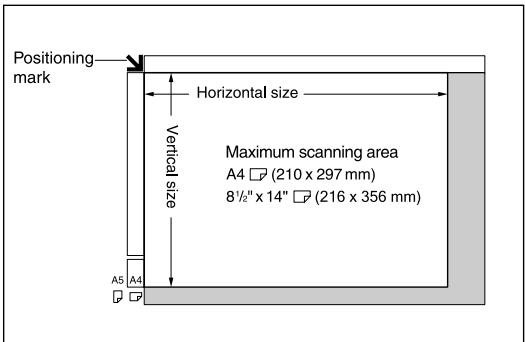
ARC053S
ARDF
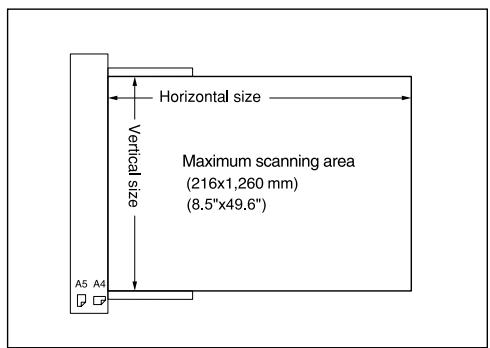
ARC022S
Note
- When you copy custom size originals, make sure you specify the size of the originals. If not, the image may not be copied properly.
For 2-sided originals that can be placed in the ARDF, the horizontal size is 160 - 356 mm (6.3"-14").
Reference
p.14 "Specifying the Original Size When a Paper Tray is Selected"
p.17 "Specifying the Original Size When the Bypass Tray is Selected"
Missing Image Area
Even if you correctly place originals in the ARDF or on the exposure glass, margins of a few millimeters on all four sides of the original might not be copied.
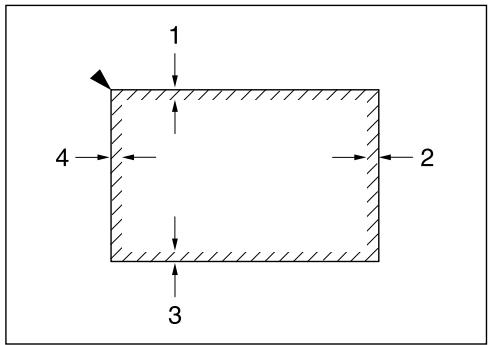
GCGENK2E
1 0.5-4.5 mm (0.02"-0.18")
2 1.0-5.0 mm (0.04"-0.20")*
3 0.5-3.5 mm (0.02"-0.14")
4 1.0-5.0 mm (0.04"-0.20")
- Back of 2-sided copy: 2.2 - 6.2 mm( 0.09^ - 0.25^ )
Placing Originals
This section describes the procedure for placing originals on the exposure glass and in the ARDF.
Take care to place originals after any correction fluid and ink has completely dried. Not taking this precaution could cause marks on the exposure glass that will be copied onto paper.

Reference
p.7 "Originals"
Original Orientation
You can set the original orientation in the following ways.
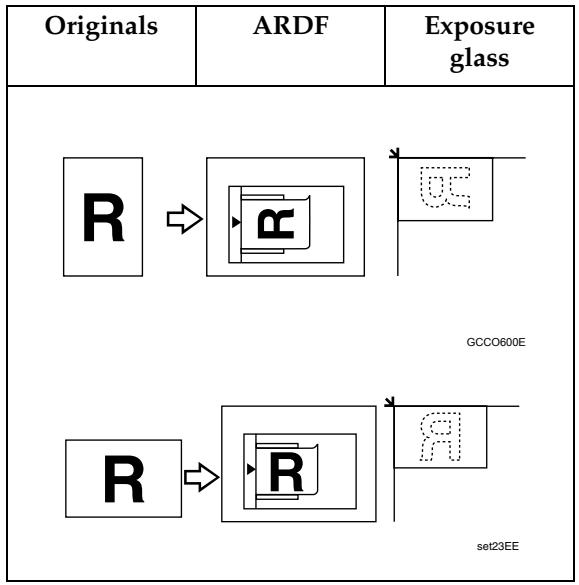

Note
- Originals should be aligned to the rear left corner when placing them on the exposure glass. However, some copy functions may produce different results depending on the orientation of the originals. For details, see the explanations of each function.

Reference
p.41 "Duplex"
p.44 "One-Sided Combine"
p.47 "Two-Sided Combine"
p.50 "Series Copies"
Placing Originals on the Exposure Glass
Place originals on the exposure glass.
Important
- Do not lift the exposure glass cover or ARDF forcefully. Otherwise, it will be damaged, or the cover of the ARDF might open.
Lift the exposure glass cover or ARDF.
Place the original face down on the exposure glass. The original should be aligned with the rear left corner.
Start with the first page to be copied.
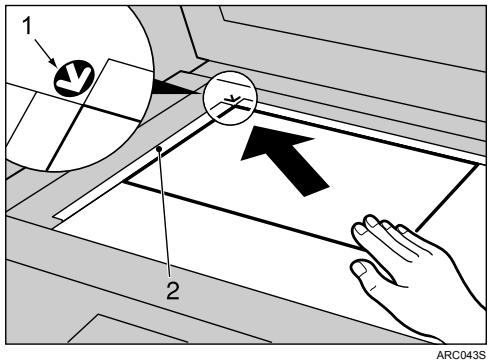
1 Positioning mark
2 Left scale
3 Lower the exposure glass cover or ARDF.
Placing Originals in the ARDF
Place originals in the ARDF.
Settings should be made when placing custom size originals.
When placing custom size originals:
See p.14 "Specifying the Original Size When a Paper Tray is Selected" and p.17 "Specifying the Original Size When the Bypass Tray is Selected".
ARDF
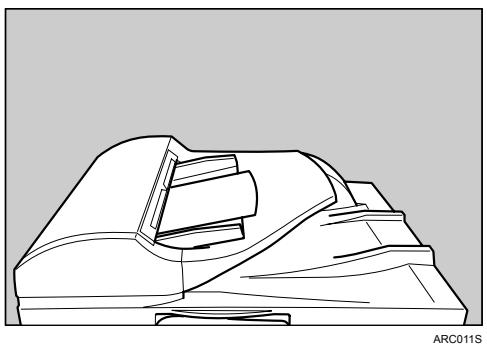
Adjust the document guide to the original size.
2 Set the aligned originals face up into the ARDF.
Do not stack originals beyond the limit mark.
The first page should be on the top.
Be sure not to place originals or other objects on the top cover. Doing so may cause a malfunction.
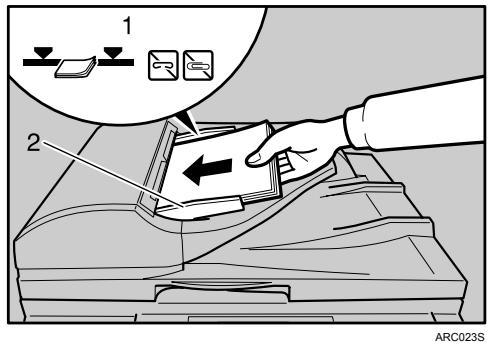
1 Limit mark
2 Document guide

Note
Originals that are 160mm or less along the feed direction, such as A5 or 5^1 / 2'' × 8^1 / 2'' , may jam inside the ARDF when you make duplex copies.
Thin originals (64g / m^2,17lb. or less) that are 310~mm (13") or more along the feed direction, such as 8^1 / 2''× 14'' or 8''× 13'' , may jam inside the ARDF when you make duplex copies.
Straighten curls in the originals before placing them in the ARDF.
To prevent multiple sheets from being fed at once, fan the originals before placing them in the ARDF.
Set the originals squarely.
Specifying the Original Size When a Paper Tray is Selected
You can select either regular or custom for the size of the original when a paper tray is selected.
Regular sizes
When placing regular size originals on the exposure glass or in the ARDF, select the size of the originals from the regular sizes shown on the display.
If you do not specify the original size, the machine will make copies on the paper size in the tray selected. When copy paper size and original size differ, you need to specify the original size as follows:
1 Select a desired paper tray using [] or [] .
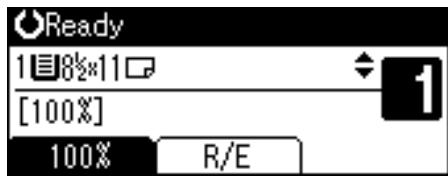
Press the [#] key.
3 Select [Regular Size] using [ ] or [ ] , and then press the [OK] key.
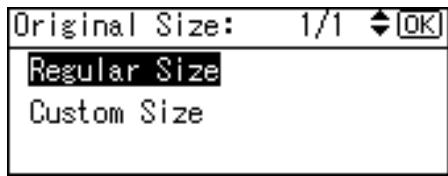
4 Select the original size using the scroll keys, and then press the [OK] key.
![RICOH AFICIO MP 161 - Select the original size using the scroll keys, and then press the [OK] key. - 1](/content/2025/01/136336/images/c465a9c4887b20037f2a963c17266aef77321016795d9c1c77bd8d6bcd5d0d2b.jpg)
The "Programmed" message appears.
When the regular size originals settings are registered, ^ Ready appears on the top of the copy display.
![RICOH AFICIO MP 161 - Select the original size using the scroll keys, and then press the [OK] key. - 2](/content/2025/01/136336/images/a73e8dc9044ad3690d06663f573a64825023389093379db668745ae33342c798.jpg)
![RICOH AFICIO MP 161 - Select the original size using the scroll keys, and then press the [OK] key. - 3](/content/2025/01/136336/images/1373ac528b718eabead68772ec76854075271c9c30530c0aed596af39c1e945b.jpg)
Note
To cancel the size you have set, press the [Clear Modes] key.
Custom sizes
When placing custom size originals on the exposure glass or in the ARDF, specify the size of the originals using the number keys.

Important
Original sizes that can be set with this function are:
- ARDF: vertical 139-216 mm (5.5"-8.5"), horizontal for 1-sided originals 139-1260 mm (5.5"-49.6"), horizontal for 2-sided originals 160-356 mm (6.3"-14")
- Exposure glass: vertical 139-216 mm (5.5"-8.5"), horizontal 160-356 mm (6.3"-14")
0 Select a desired paper tray using [ ] or [ ]
![RICOH AFICIO MP 161 - Select a desired paper tray using [ ] or [ ] - 1](/content/2025/01/136336/images/93c8b01fcf60f3d863593433619df67ec49fa20cd984657e417fa6d1a2b8d899.jpg)
Press the [#] key.
3 Select [Custom Size] using [ ] or [ ] , and then press the [OK] key.
![RICOH AFICIO MP 161 - Select [Custom Size] using [ ] or [ ] , and then press the [OK] key. - 1](/content/2025/01/136336/images/eb7504e35e5b8e56268b7fff65085fcd4a09c86cabdee5de1e50e9a967f24d39.jpg)
4 Enter the horizontal size of the original (Horiz.) with the number keys, and then press the [OK] key.
![RICOH AFICIO MP 161 - Select [Custom Size] using [ ] or [ ] , and then press the [OK] key. - 2](/content/2025/01/136336/images/bc8b9724b3a984eaea698b61e47ecb58f7e48716f189a54fd6911afa7f38b047.jpg)
![RICOH AFICIO MP 161 - Select [Custom Size] using [ ] or [ ] , and then press the [OK] key. - 3](/content/2025/01/136336/images/dd25ae2697e9a8663dde282ced5ecb63fc5fc0988a69e3c2c5d8cc95dac6fd6f.jpg)
1 Vertical size
2 Horizontal size
5 Enter the vertical size of the original (Vert.) with the number keys, and then press the [OK] key.
![RICOH AFICIO MP 161 - Select [Custom Size] using [ ] or [ ] , and then press the [OK] key. - 4](/content/2025/01/136336/images/9015235e76181f2a3440dd18184c5c1d9e0d8bbe53688fc9b9f3a1250f0137da.jpg)
The "Programmed" message appears.
When the custom size originals settings are registered,
![RICOH AFICIO MP 161 - Select [Custom Size] using [ ] or [ ] , and then press the [OK] key. - 5](/content/2025/01/136336/images/d8c2b55d13c9f14d85c123574986a5fc4580f33369d160558391da92060e7bc1.jpg)
Note
□ If you make a mistake in step 4 or 5, press the 【Clear/Stop】key, and then enter the value again.
To cancel the size you have set, press the [Clear Modes] key.
Specifying the Original Size When the Bypass Tray is Selected
You can select either regular or custom for the size of the original when the bypass tray is selected.
Regular sizes
When placing regular size originals on the exposure glass or in the ARDF, select the size of the originals from the regular sizes shown on the display.
If you do not specify the original size, the machine will make copies on the paper size in the tray selected. When copy paper size and original size differ, you need to specify the original size as follows:
1 Select the bypass tray using [▲] or [▼].
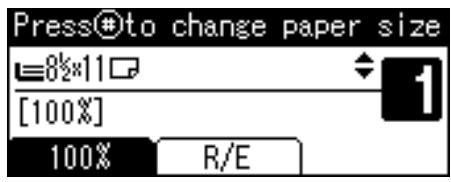
Press the [#] key.
3 Select [Original Size] using [ ] or [ ] , and then press the [OK] key.
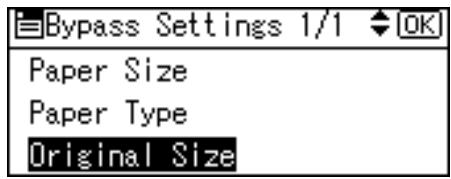
4 Select [Regular Size] using [ ] or [ ] , and then press the [OK] key.
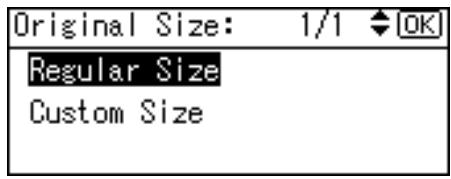
Select the original size using the scroll keys, and then press the [OK] key.
![RICOH AFICIO MP 161 - Select the original size using the scroll keys, and then press the [OK] key. - 1](/content/2025/01/136336/images/e3ef0ec40206d41e54dd4560cc0bc1103db0e8c2524eaadce7253cba9e863503.jpg)
The "Programmed" message appears.
When the regular size originals settings are registered, ^ ready appears on the top of the copy display.
![RICOH AFICIO MP 161 - Select the original size using the scroll keys, and then press the [OK] key. - 2](/content/2025/01/136336/images/3c2a9a1df86932041bc6e358de732095df964b174c056798a09b97da22c755ab.jpg)
Note
To cancel the size you have set, press the [Clear Modes] key.
Custom sizes
When placing custom size originals on the exposure glass or in the ARDF, specify the size of the originals using the number keys.
Important
Original sizes that can be set with this function are:
- ARDF: vertical 139-216 mm (5.5"-8.5"), horizontal for 1-sided originals 139-1260 mm (5.5"-49.6"), horizontal for 2-sided originals 160-356 mm (6.3"-14")
- Exposure glass: vertical 139-216 mm (5.5"-8.5"), horizontal 160-356 mm (6.3"-14")
1 Select the bypass tray using [▲] or [▼].
![RICOH AFICIO MP 161 - Select the bypass tray using [▲] or [▼]. - 1](/content/2025/01/136336/images/6a3c103538ddb5034e14aa66e9c354e6441d6a95bc9822c1137fa60a1f0e93c8.jpg)
Press the [#] key.
3 Select [Original Size] using [] or [] , and then press the [OK] key.
![RICOH AFICIO MP 161 - Select [Original Size] using [] or [] , and then press the [OK] key. - 1](/content/2025/01/136336/images/52ef56998e9481c795c8e0f9122f1cb97e23b33f4dca108e9a9c0dbaf7bf1faa.jpg)
4 Select [Custom Size] using [ ] or [ ] , and then press the [OK] key.
![RICOH AFICIO MP 161 - Select [Original Size] using [] or [] , and then press the [OK] key. - 2](/content/2025/01/136336/images/95341fd5aec370669a3cfec8f200a307840e5c97d22402fe4090b33841b79a22.jpg)
5 Enter the horizontal size of the original (Horiz.) with the number keys, and then press the [OK] key.
![RICOH AFICIO MP 161 - Select [Original Size] using [] or [] , and then press the [OK] key. - 3](/content/2025/01/136336/images/69f487e19e64747a5b1d1898fc4b222b62e6ca4b25462de6e487a1d84aea413a.jpg)
6 Enter the vertical size of the original (Vert.) with the number keys, and then press the [OK] key.
![RICOH AFICIO MP 161 - Select [Original Size] using [] or [] , and then press the [OK] key. - 4](/content/2025/01/136336/images/5371301a0f3aac42830fc6623ffe64830f1f9a2be3a01c1d531babfa357cf6d1.jpg)
The "Programmed" message appears.
When the custom size originals settings are registered, ^ × eady appears on the top of the copy display.
![RICOH AFICIO MP 161 - Select [Original Size] using [] or [] , and then press the [OK] key. - 5](/content/2025/01/136336/images/78cff2624466d74957b41a64f43e79eb47fddce344f2dad61476ef5f2084b430.jpg)
Note
□ If you make a mistake in step 3 or 4, press the [Clear/Stop] key, and then enter the value again.
To cancel the size you have set, press the【Clear Modes】key.
1
This chapter describes procedures for making copies in various modes.
Basic Procedure
This section describes the basic procedure for making copies.
Important
□ When User Code Authentication is set, enter your user code (up to eight digits) with the number keys so that the machine accepts copy jobs. See "Authentication Information", General Settings Guide.
□ When Basic Authentication, Windows Authentication, LDAP Authentication, or Integration Server Authentication is set, enter your login user name and password so that the machine accepts copy jobs. Ask the administrator for the login user name and password. For details, see "When the Authentication Screen is Displayed", About This Machine.
Make sure "Ready" appears on the screen.
If any other function is displayed, press the [Copy] key.
Initial copy display
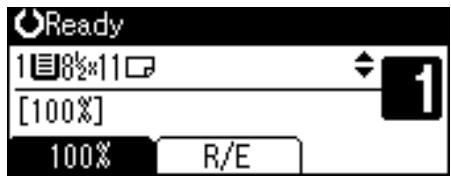
2 Make sure no previous settings remain.
When there are previous settings remaining, press the【Clear Modes】key.
Place the originals.
Make desired settings.
5 Enter the number of copies using the number keys.
The maximum copy quantity that can be set is 99.
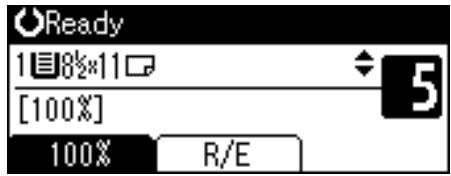
6 Press the [Start] key.
![RICOH AFICIO MP 161 - Press the [Start] key. - 1](/content/2025/01/136336/images/5c6f2b897b301e4d14320720721672ea3bafb46cb4e6d71254b4de12e8c541f4.jpg)
The machine starts copying.
When placing originals on the exposure glass, press the [#] key after all originals are scanned.
Copies are delivered face down.
Note
- Always log off when you have finished using the machine to prevent unauthorized users from using the machine.
To stop the machine during a multicopy run, press the [Clear/Stop] key.
To return the machine to its initial state after copying, press the [Clear Modes] key.
To clear an entered value, press the [Clear/Stop] key.
Reference
p.11 "Placing Originals"
"When the Authentication Screen is Displayed", About This Machine
Copying from the Bypass Tray
Use the bypass tray to copy onto OHP transparencies, thick paper, envelopes, and paper that cannot be loaded in the paper trays.
Important
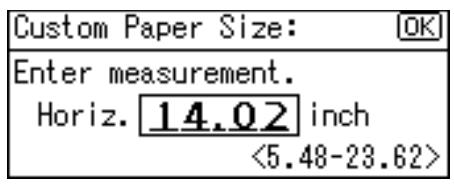
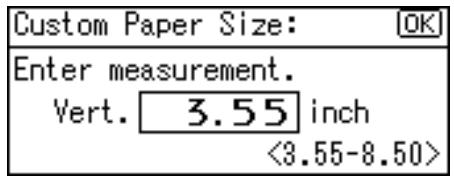
- Paper that has a vertical length of 90 - 216mm (3.55"-8.50") and a horizontal length of 139 - 600mm (5.48"-23.62") can be copied from the bypass tray. However, when paper larger than 356mm (14.02") in size is used, the paper may become wrinkled, may not be fed into the machine, or may cause paper jams.
□ You cannot use the duplex function when copying from the bypass tray.
Reference
"Copy Paper", About This Machine
Loading Paper on the Bypass Tray
Use the bypass tray to copy onto OHP transparencies, thick paper, envelopes and paper that cannot be loaded in the paper trays.
Important
- When copying on OHP transparencies or paper heavier than 157g / m^2 (about 42 lb.) you need to specify the type and size of paper.
The maximum number of sheets you can load into the bypass tray depends on the paper type. Load only as much paper as can be held between the paper guides on the bypass tray.
Open the bypass tray.
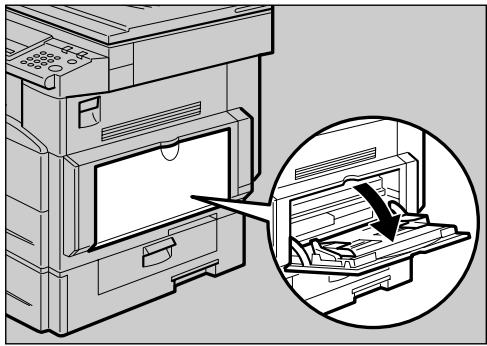
ABU027S
Push up the release lever.
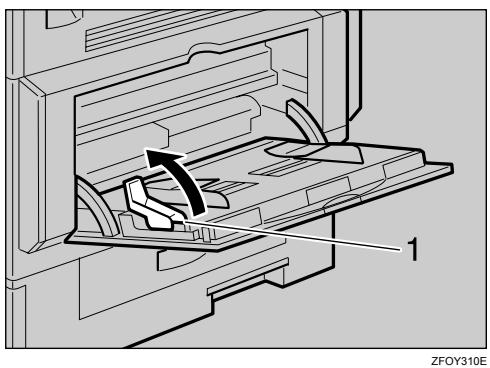
1 Release lever
Align the paper guides to the paper size, and then insert the paper face down.
If the guides are not flush against the paper, images might be skewed or paper misfeeds might occur.
Load only as much paper as can be held between the guides on the bypass tray. Overloading the bypass tray can result in misfeeds and skewed images.
To support A4 , 8^1/2" × 11'' , or larger paper sizes, pull out the extender.
To prevent multiple sheets from being fed at once, fan paper before placing it on the tray.
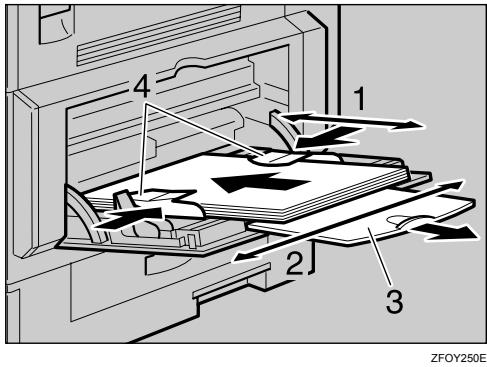
1 Horizontal size
2 Vertical size
3 Extender
4 Paper guides
Pull down the release lever.
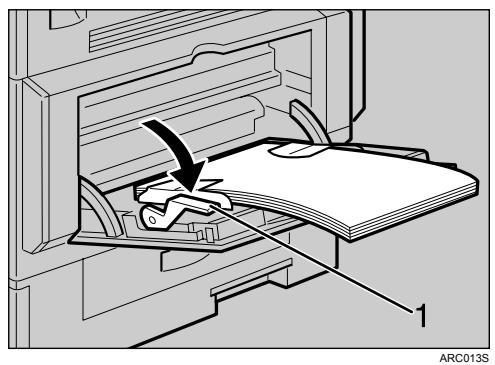
1 Release lever
The bypass tray is selected on the display.
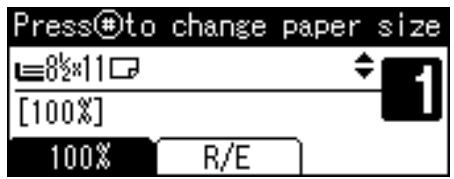
Select the size and type of the paper, if required.
Note
□ If the bypass tray is not selected on the display in step 4, select using [▲] or [▼], and then press the [#] key.
□ When Panel Key Sound is turned off, the beeper will not sound even if you insert paper into the bypass tray.
When Copying onto Regular Size Paper
Makes copies onto regular size paper from the bypass tray.
1 Load paper face down on the bypass tray.
2 Select the bypass tray using [▲] or [▼].
Press the [#] key.
4 Select [Paper Size] using [] or [] , and then press the [OK] key.
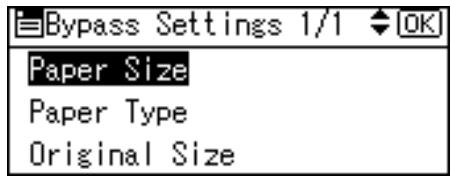
5 Select [Regular Size] using [ ] or [ ] , and then press the [OK] key.
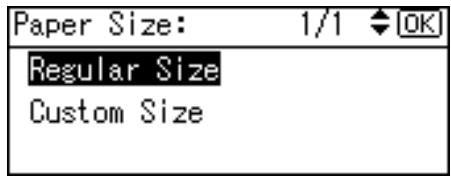
6 Select the paper size using the scroll keys, and then press the [OK] key.
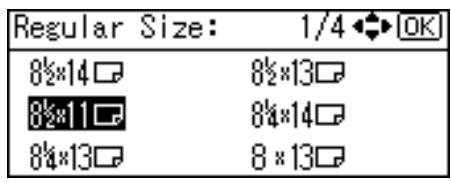
The "Programmed" message appears.
7 Place the originals, and then press the [Start] key.
3 When the copy job is finished, press the [Clear Modes] key to clear the settings.
Reference
p.23 "Loading Paper on the Bypass Tray"
When Copying onto Custom Size Paper
Makes copies onto custom size paper from the bypass tray.
1 Load paper face down on the bypass tray.
2 Select the bypass tray using [▲] or [▼].
Press the [#] key.
4 Select [Paper Size] using [ ] or [ ] , and then press the [OK] key.
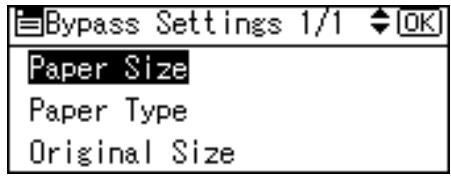
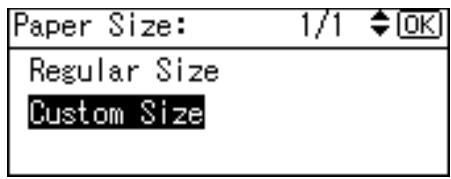
Select [Custom Size] using [] or [] , and then press the [OK] key.
6 Enter the horizontal size of the paper (Horiz.) with the number keys, and then press the [OK] key.
7 Enter the vertical size of the paper (Vert.) with the number keys, and then press the [OK] key.
The "Programmed" message appears.
Place the originals, and then press the [Start] key.
9 When the copy job is finished, press the [Clear Modes] key to clear the settings.
Note
□ If you make a mistake in step 6 or 7, press the [Clear/Stop] key, and then enter the value again.
Reference
p.23 "Loading Paper on the Bypass Tray"
When Copying onto OHP Transparency
When copying onto OHP transparencies, select [OHP (Transparency)] in Paper Type.
Important
- OHP transparencies must be loaded face down in the tray with the notched corner of the sheet in the appropriate corner of the tray.
- Load OHP transparencies one at time in the bypass tray. This prevents multiple sheets being fed in together, which can cause jams and misprints.
- Remove copied sheets from the internal tray one by one.
1 Load OHP transparencies face down on the bypass tray.
2 Select the bypass tray using [▲] or [▼].
Press the [#] key.
4 Select [Paper Type] using [ ] or [ ] , and then press the [OK] key.
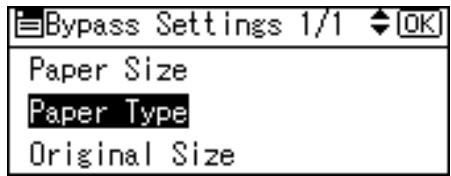
5 Select [OHP (Transparency)] using [] or [] , and then press the [OK] key.
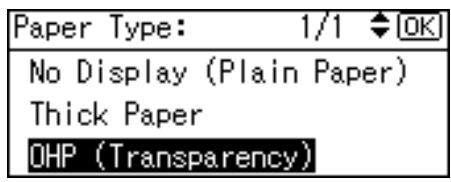
The "Programmed" message appears.
6 Select the paper size, if required.
7 Place the originals, and then press the [Start] key.
3 When the copy job is finished, press the [Clear Modes] key to clear the settings.
Note
□ Printing on OHP transparencies is slower than printing on plain paper.
Reference
p.23 "Loading Paper on the Bypass Tray"
When Copying onto Thick Paper
When copying onto thick paper, select [Thick Paper] in Paper Type.
Important
To prevent multiple sheets from being fed at once, fan paper before placing it on the tray.
1 Load thick paper face down on the bypass tray.
2 Select the bypass tray using [▲] or [▼].
Press the [#] key.
4 Select [Paper Type] using [ ] or [ ] , and then press the [OK] key.
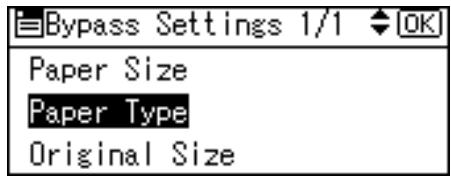
Select [Thick Paper] using [ ] or [ ] , and then press the [OK] key.
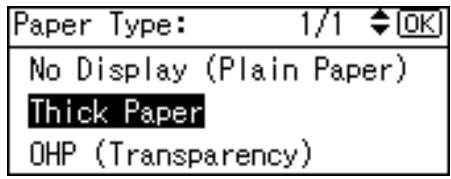
The "Programmed" message appears.
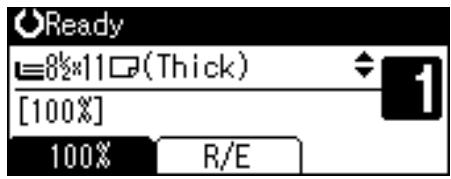
6 Select the paper size, if required.
7 Place the originals, and then press the [Start] key.
3 When the copy job is finished, press the [Clear Modes] key to clear the settings.
Note
□ Printing on thick paper is slower than printing on plain paper.
Reference
p.23 "Loading Paper on the Bypass Tray"
When Copying onto Envelopes
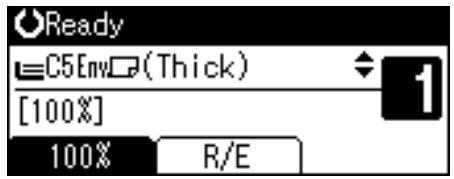
When copying onto envelopes, select the envelope size in Paper Size, and [Thick Paper] in Paper Type.
Important
Before loading envelopes, use a pen or similar to flatten their edges.
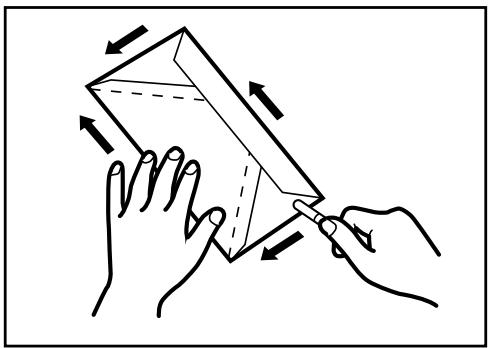
ALZ050S
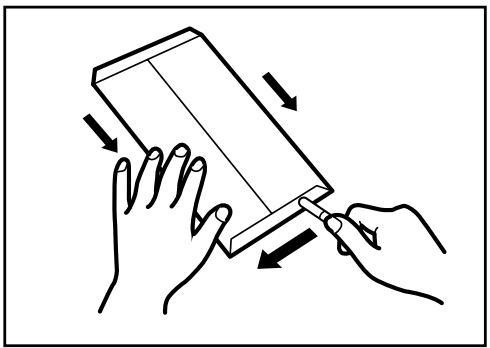
ALZ051S
Printable area
The following areas of envelopes can be printed on:
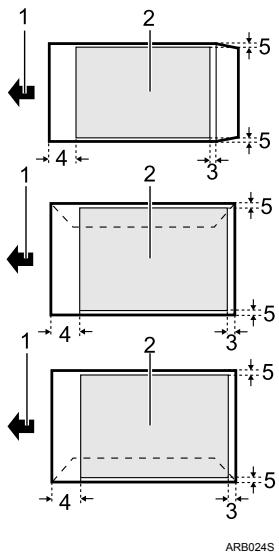
1 Feeding direction
2 Printable area
3 10 mm (0.4")
4 10 mm (0.4")
5 10 mm (0.4")
Orientation of Originals and Envelopes
Originals and envelopes must be placed in the same orientation.
To minimize waste and time, check that originals and envelopes are loaded in the same orientation.
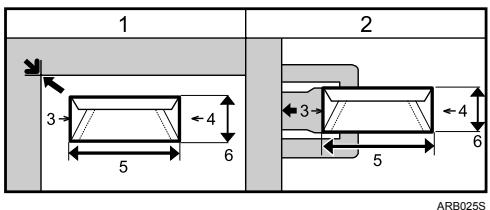
The illustration shows the orientation of originals and envelopes.
1 Original on the exposure glass
2 Envelope on the bypass tray
3 Top
4 Bottom
5 Horizontal size
6 Vertical size
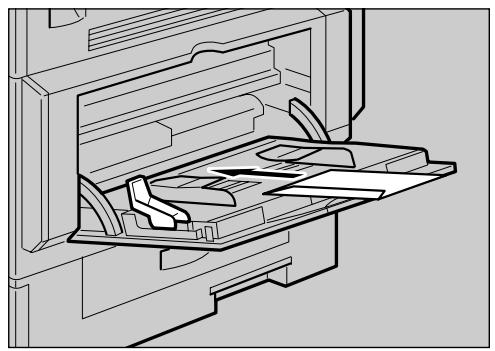
1 Load envelopes face down on the bypass tray.
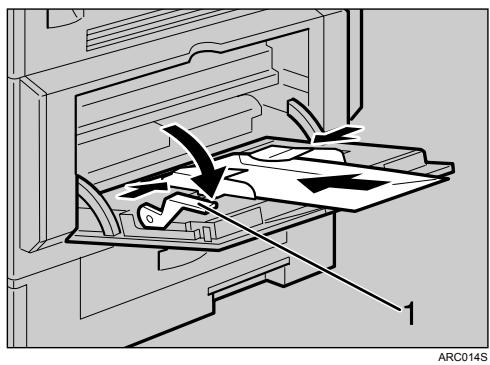
1 Release lever
2 Select the bypass tray using [▲] or [▼].
Press the [#] key.
4 Select [Paper Size] using [ ] or [ ] , and then press the [OK] key.
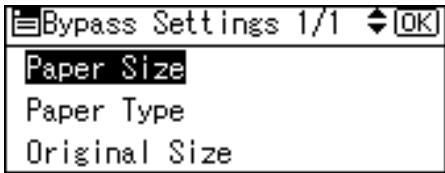
Select [Regular Size] using [ ] or [ ] , and then press the [OK] key.
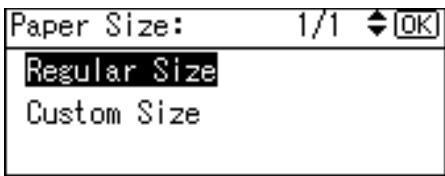
6 Select the envelope size using [ ] or [ ] , and then press the [OK] key.
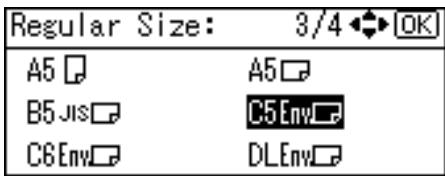
The "Programmed" message appears.
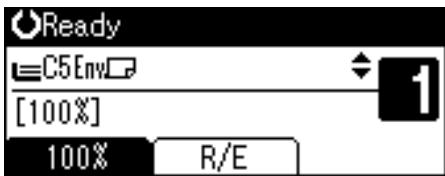
Press the [#] key.
3 Select [Paper Type] using [ ] or [ ] , and then press the [OK] key.
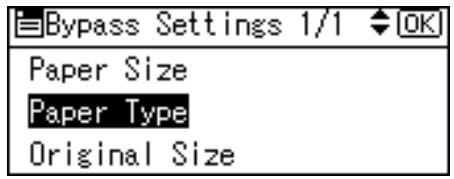
9 Select [Thick Paper] using [ ] or [ ] , and then press the [OK] key.
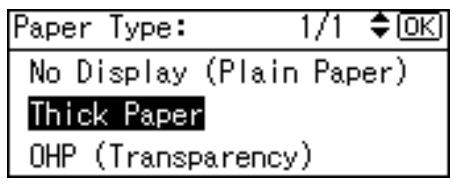
The "Programmed" message appears.
Place the original, and then press the [Start] key.
When the copy job is finished, press the [Clear Modes] key to clear the settings.
Note
- When copying on a small-sized envelope, align the flap to the paper guide on the left.
ABU050S
Reference
p.23 "Loading Paper on the Bypass Tray"
Copy Functions
Adjusting Image Density
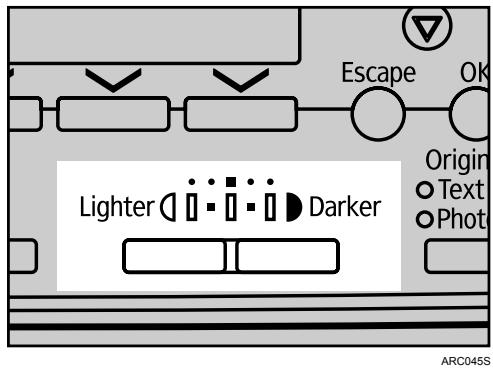
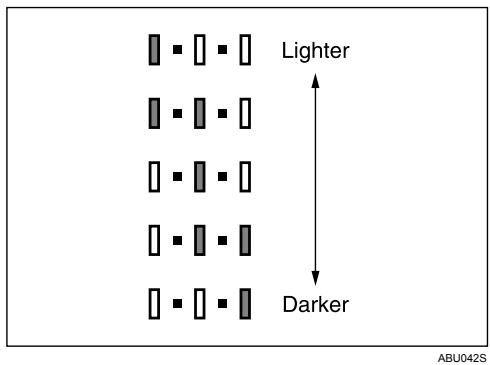
You can adjust the image density in five levels. If you want darker or lighter copies, adjust the image density accordingly.
Press the [Lighter] or [Darker] key to adjust the image density.
The density indicator moves.
The image density changes in five increments as follows:
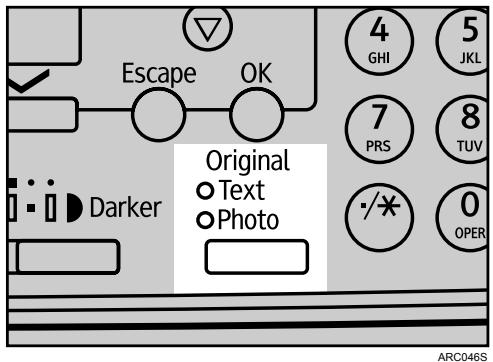
Original Type Setting
Select one of the following original types to match your originals:
Text
Select this mode when your originals contain only text (no pictures).
Photo
Delicate tones of photographs and pictures can be reproduced with this mode.
- When copying developed photographs
- When copying photographs or pictures that are printed on paper (e.g. magazines)
- When copying originals generated by color copiers
Press the [Original] key to select the original type. The indicator of the selected original type goes on.

Reference
"Original Type Setting", General Settings Guide
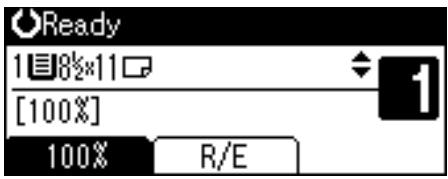
Selecting Copy Paper
Choose a tray containing the paper you want to copy onto: the paper trays or the bypass tray.

Select a desired tray using [ ] or [ ]
The selected tray and paper size are displayed.

Reference
p.23 "Copying from the Bypass Tray"
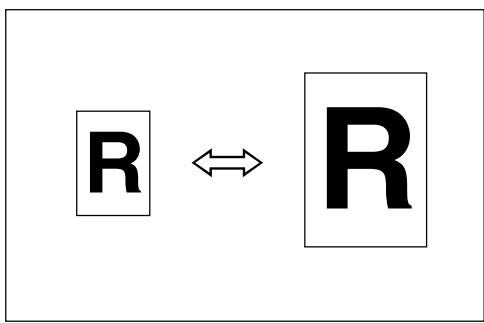
Preset Reduce/Enlarge
You can select a preset reduce or enlarge ratio for copying.
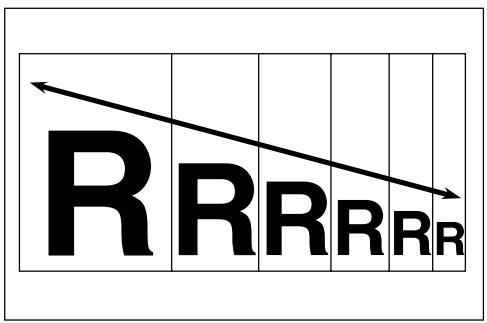
Base Point
The base point of Reduce/Enlarge differs depending on how the original is scanned. When the original is set on the exposure glass, the upper left corner will be the base point. When it is set in the ARDF, the bottom left corner of the original will be the base point.
The figure below is the resulting copy images that differ depending on how the original is scanned.
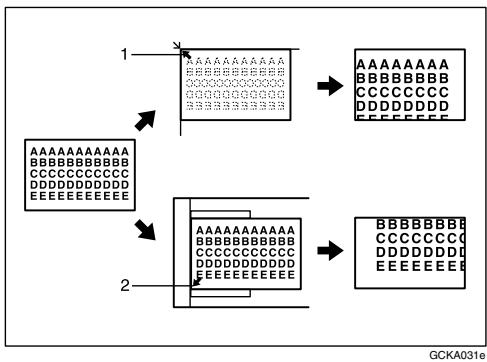
1 Base point when placing on the exposure glass
2 Base point when placing in the ARDF
Press [R/E].
![RICOH AFICIO MP 161 - Press [R/E]. - 1](/content/2025/01/136336/images/69d0d9a8425fed5e70d38dd1494eaff980dfcddb0efe21f362ce69e0fe8cbbe1.jpg)
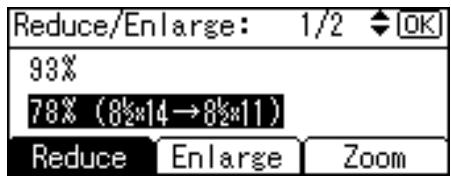
Press [Enlarge] or [Reduce].
![RICOH AFICIO MP 161 - Press [Enlarge] or [Reduce]. - 1](/content/2025/01/136336/images/cfa0cb71c0036d4045cac147cd3403a0f396e7e97074ef9534684a08ed3ba3b2.jpg)
3 Select a ratio using [] or [] , and then press the [OK] key.
The "Programmed" message appears.
Place the originals, and then press the [Start] key.
Reference
"Reproduction Ratio", General Settings Guide
"Preset R/E Priority", General Settings Guide
Zoom
You can change the reproduction ratio in increments of 1% .
Selecting a ratio using the scroll keys
Select a ratio using [ ] or [ ]
Press [R/E].
![RICOH AFICIO MP 161 - Press [R/E]. - 1](/content/2025/01/136336/images/0c34f8e6a08ce2299919cb7fe357d34448a70c8e314d2f904cf6648b0003addf.jpg)
2 Select a preset ratio which is close to the desired ratio with [Enlarge] or [Reduce], and then press [Zoom].
![RICOH AFICIO MP 161 - Press [R/E]. - 2](/content/2025/01/136336/images/e578af0381044d218d6b51f0e69e1be6c221d7c1591000f55de796f5ac64d310.jpg)
3 Specify a ratio using [ ] or [ ] , and then press the [OK] key.
![RICOH AFICIO MP 161 - Press [R/E]. - 3](/content/2025/01/136336/images/c5c39d08dd3124579b358757c42f7f4d45598faefe843ccb5f2553f5ef91ae18.jpg)
Pressing [] or [] changes the ratio in increments of 1% . Pressing and holding down the relevant key changes the ratio in increments of 10% .
The "Programmed" message appears.
Place the original, and then press the [Start] key.
Note
□ If you make a mistake in step 3, readjust it using [ ] or [ ]
Entering a ratio with the number keys
Select a ratio using the number keys.
Press [R/E].
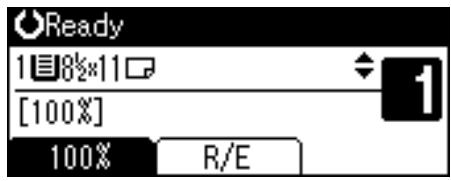
Press [Zoom].
3 Enter the desired ratio with the number keys, and then press the [OK] key.
![RICOH AFICIO MP 161 - Enter the desired ratio with the number keys, and then press the [OK] key. - 1](/content/2025/01/136336/images/a6606361c117deb3b2ad6a2f810a25189c8b8eb65768be5ceaf8e8b7789d5b88.jpg)
The "Programmed" message appears.
Place the original, and then press the [Start] key.
Note
□ If you make a mistake in step 3, press the 【Clear/Stop】 key, and then enter the value again.
Sort
The machine assembles copies as sets in sequential order.
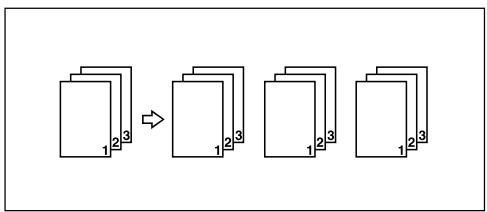
Press the [Sort] key.
![RICOH AFICIO MP 161 - Press the [Sort] key. - 1](/content/2025/01/136336/images/72eaf99c6fc04b60cd6da2c612dec336c8ba3bdb5406cd39b77b072468b34025.jpg)
The indicator goes on.
2 Enter the number of copy sets using the number keys.
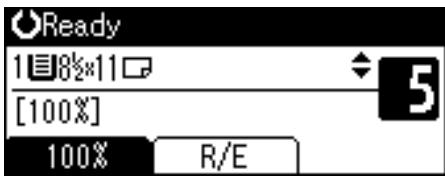
3 Place the originals.
When placing originals on the exposure glass, start with the first page to be copied. When placing originals in the ARDF, set the first page on the top.
Press the [Start] key.
When placing originals on the exposure glass, press the [#] key after all originals are scanned.
Note
To cancel the Sort function in step 1, press the [Sort] key again. Make sure the indicator goes off.
Changing the number of sets
You can change the number of copy sets during copying.
Important
This function can only be used when the Sort function is turned on.
While "Copying..." is displayed, press the [Clear/Stop] key.
Press [Sets].
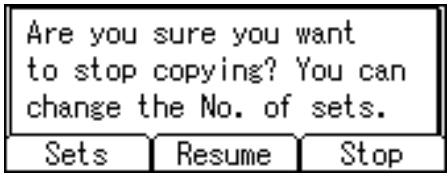
3 Enter the number of copy sets with the number keys, and then press [Resume].
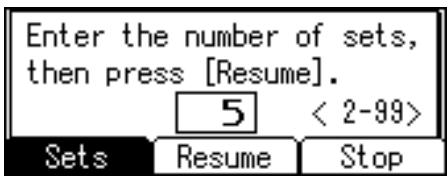
Copying starts again.
Note
The number of sets you can enter in step 3 differs depending on when the [Clear/Stop] key is pressed.
Duplex
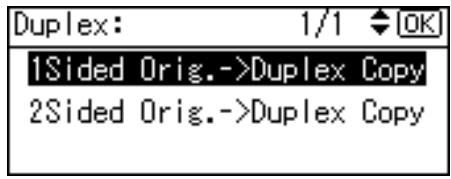
There are two types of Duplex available.
Important
□ You cannot use the bypass tray with this function.
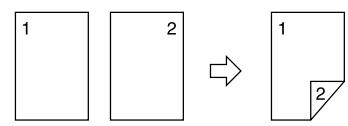
1 Sided 2 Sided
Copies 2 one-sided pages to 1 two-sided page.
2 Sided 2 Sided
Copies 1 two-sided page to 1 two-sided page.
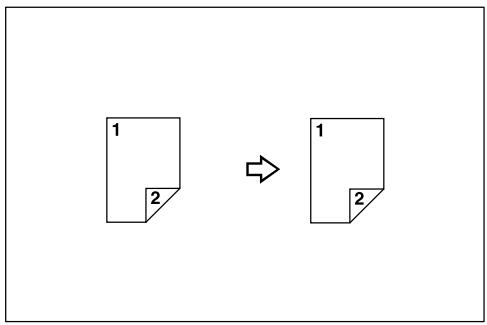
Note
The ARDF is required to scan two-sided originals.
Original orientation and completed copies
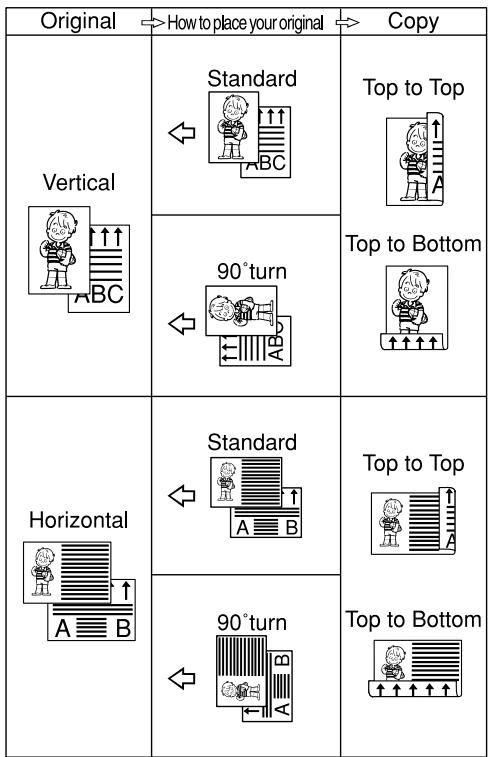
The resulting copy image will differ according to the orientation in which you place the originals (vertical or horizontal).
The table shows the orientation of images on the front and back of copies, not the orientation of delivery.
GCRYOU1E
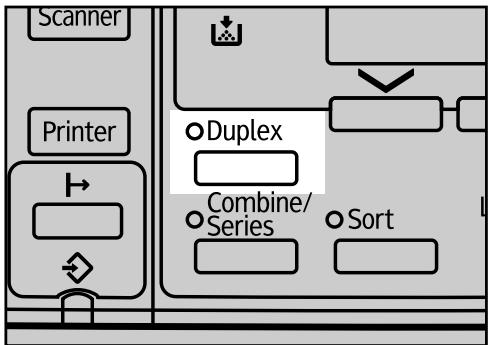
Press the [Duplex] key.
ARC048S
The indicator goes on.
2 Select the duplex mode using [ ] or [ ] , and then press the [OK] key.
3 Select the original orientation using [] or [] , and then press the [OK] key.
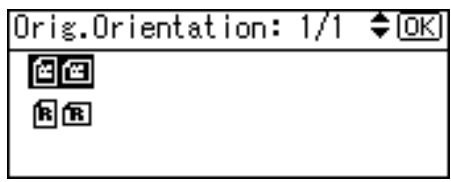
4 Select the duplex orientation using [] or [] , and then press the [OK] key.
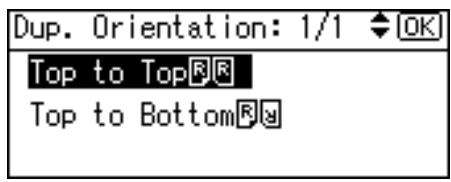
The "Programmed" message appears.
Place the originals.
When placing originals on the exposure glass, start with the first page to be copied. When placing originals in the ARDF, set the first page on the top.
6 Press the [Start] key.
When placing originals on the exposure glass, press the [#] key after all originals are scanned.
Note
The paper weight that can be used with duplex copying is 64 - 90g / m^2 (20-24 lb.)
To cancel the Duplex function in step 0, press the [Duplex] key again. Make sure the indicator goes off.
To display the screens in steps 3 and 4, select [Always Specify] for [Orientation] with Copier Features in User Tools. If [Do not Specify] is selected, proceed to step 5.
□ You can change the margins of duplex copies.
Reference
"Duplex Margin", General Settings Guide
"Orientation", General Settings Guide
One-Sided Combine
Combines several pages to one side of a sheet.
There are four types of One-Sided Combine available.
1 Sided 2 Pages Combine 1 Side
Copies 2 one-sided originals to one side of a sheet.
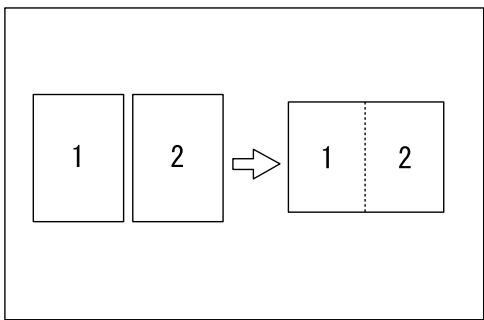
GCSHVY7J
1 Sided 4 Pages Combine 1 Side
Copies 4 one-sided originals to one side of a sheet.
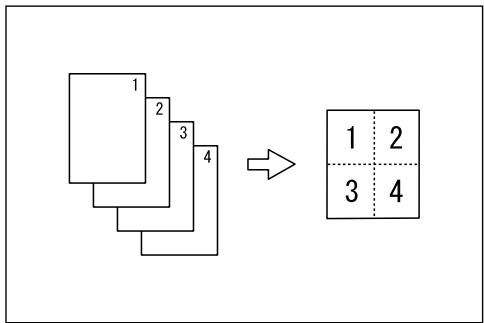
GCSHVY8J
2 Sided 1 Page Combine 1 Side
Copies 1 two-sided original to one side of a sheet.
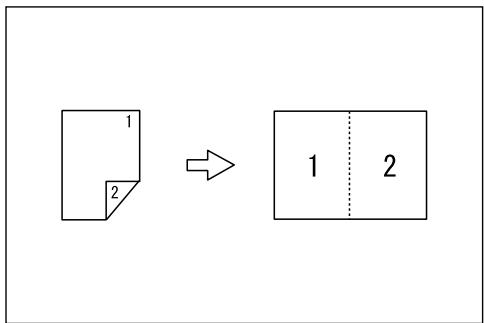
GCSHVYOJ
2 Sided 2 Pages Combine 1 Side
Copies 2 two-sided originals to one side of a sheet.
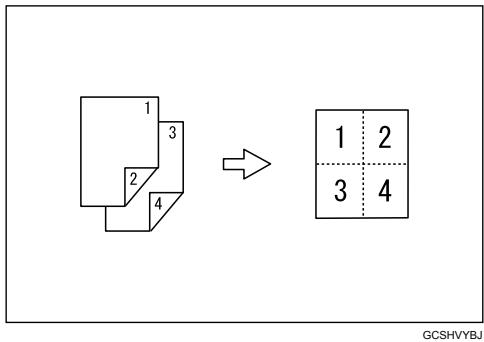

Note
The ARDF is required to scan two-sided originals.
□ You cannot apply this function to sheets of 357mm or longer that are fed from the bypass tray.
Original orientation and image position of Combine
Open to left (D) originals
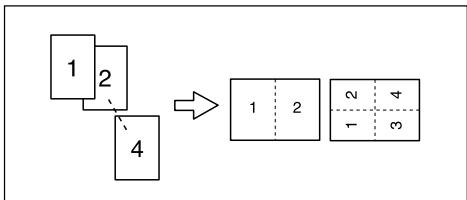
GCSHUY3E
Open to top () originals
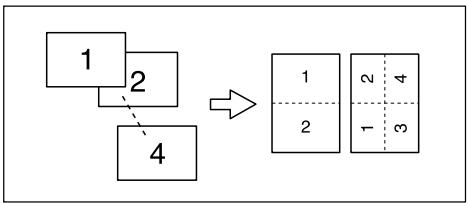
GCSHUY4E
Placing originals (originals placed in the ARDF)
- Originals read from left to right
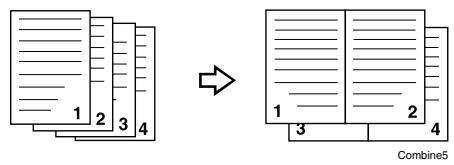
- Originals read from top to bottom
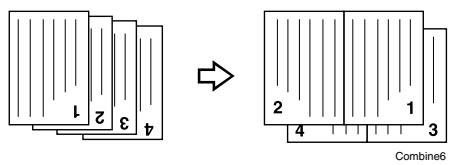
Press the [Combine/Series] key.
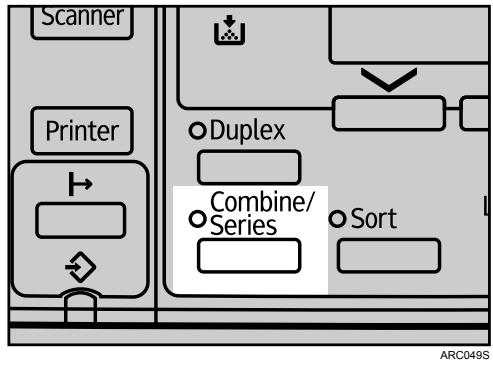
The indicator goes on.
2 Select the combine mode using [] or [] , and then press the [OK] key.
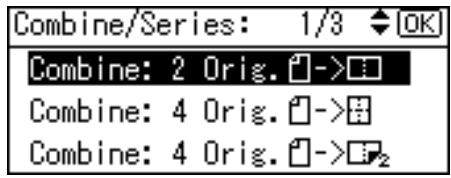
3 Select the original orientation using [] or [] , and then press the [OK] key.
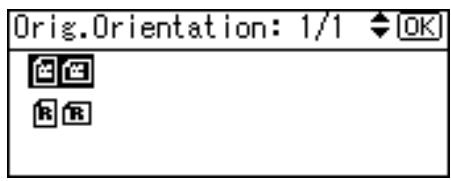
The "Programmed" message appears.
4 Select the paper size using [] or [] .
![RICOH AFICIO MP 161 - Select the paper size using [] or [] . - 1](/content/2025/01/136336/images/0ef4f7ad6da0fc87b37d2b15639479c7a5c0bbee3d3f190ee090920c66e1ea43.jpg)
Place the originals, and then press the [Start] key.
Note
To cancel the One-Sided Combine function in step 1, press the [Combine/Series] key again. Make sure the indicator goes off.
To display the screen in step 3, select [Always Specify] for [Orientation] with Copier Features in User Tools. If [Do not Specify] is selected, proceed to step 4.
Reference
"Orientation", General Settings Guide
Two-Sided Combine
Combines various pages of originals onto one two-sided sheet.
There are four types of Two-Sided Combine.
Important
□ You cannot use the bypass tray with this function.
1 Sided 4 Pages Combine 2 Sides
Copies 4 one-sided originals to one sheet with two pages per side.
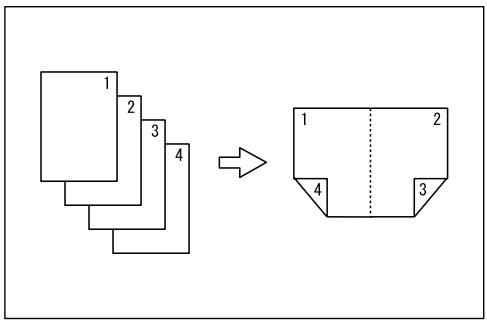
GCSHVY9J
1 Sided 8 Pages Combine 2 Sides
Copies 8 one-sided originals to one sheet with four pages per side.
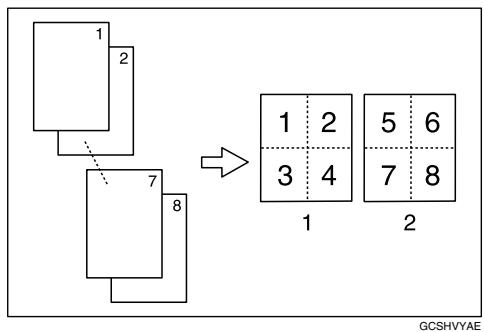
1 Front
2 Back
2 Sided 2 Pages Combine 2 Sides
Copies 2 two-sided originals to one sheet with two pages per side.
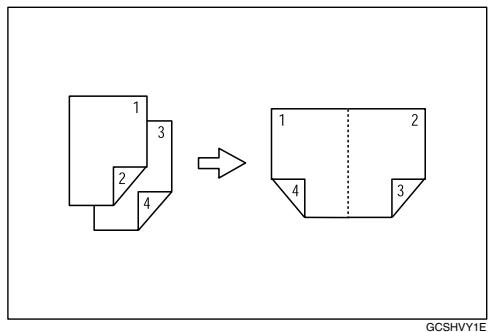
2 Sided 4 Pages Combine 2 Sides
Copies 4 two-sided originals to one sheet with four pages per side.
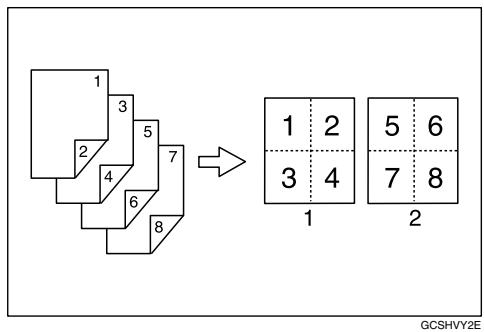
1 Front
2 Back
Press the [Combine/Series] key.
![RICOH AFICIO MP 161 - Press the [Combine/Series] key. - 1](/content/2025/01/136336/images/63f5f749cf35e72408126ad1cabb4e3193f02cbc41a840fe9cffd8f7b604003f.jpg)
The indicator goes on.
2 Select the combine mode using [] or [] , and then press the [OK] key.
![RICOH AFICIO MP 161 - Select the combine mode using [] or [] , and then press the [OK] key. - 1](/content/2025/01/136336/images/3d8d9786aa491d4dc9e092894ef369d7cebf7f1880cc8a10317934b9d6d46947.jpg)
3 Select the original orientation using [] or [] , and then press the [OK] key.
![RICOH AFICIO MP 161 - Select the original orientation using [] or [] , and then press the [OK] key. - 1](/content/2025/01/136336/images/6689d9b60a71b6300d27a8a8c67289bd2b3084aad650034245bcbd926cf47538.jpg)
4 Select the duplex orientation using [ ] or [ ] , and then press the [OK] key.
![RICOH AFICIO MP 161 - Select the duplex orientation using [ ] or [ ] , and then press the [OK] key. - 1](/content/2025/01/136336/images/2eddf0a9a4df0bb9b40dac28d181b35bc0e17a45cb257e89841e086ee9dad05c.jpg)
The "Programmed" message appears.
Select the paper size using [ ] or [ ]
![RICOH AFICIO MP 161 - Select the paper size using [ ] or [ ] - 1](/content/2025/01/136336/images/e68f6bf05ff339e1c762103cfa92f5ef0bd467c64b94a4d3992dd8c9989e044c.jpg)
6 Place the originals, and then press the [Start] key.
![RICOH AFICIO MP 161 - Place the originals, and then press the [Start] key. - 1](/content/2025/01/136336/images/dd90da5c405b09119c46aba06609360fa1ea6bb91709026fc139f00be45d049e.jpg)
Note
The ARDF is required to scan 2-sided originals.
To cancel the Two-Sided Combine function in step ①, press the 【Combine/Series】key again. Make sure the indicator goes off.
To display the screens in steps 3 and 4, select [Always Specify] for [Orientation] with Copier Features in User Tools. If [Do not Specify] is selected, proceed to step 5.

Reference
"Orientation", General Settings Guide
Series Copies
You can separately copy the front and back of a two-sided original onto two sheets.
2 Sided 1 Sided
Copies each side of a two-sided original to two separate pages.
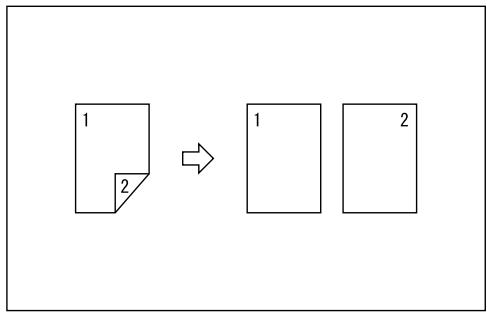
Press the [Combine/Series] key.
![RICOH AFICIO MP 161 - Press the [Combine/Series] key. - 1](/content/2025/01/136336/images/5266dca65908de8676da6d682dfbf1abfdb74156d38854cbc1ae5e1df7b5a223.jpg)
The indicator goes on.
2 Select [Series:2Sided Orig.] using [] or [] , and then press the [OK] key.
![RICOH AFICIO MP 161 - Press the [Combine/Series] key. - 2](/content/2025/01/136336/images/585c13f5470d2d4b305e212c6c5233cf4118be255d480bad7f867dc90a143cb2.jpg)
3 Select the original orientation using [] or [] , and then press the [OK] key.
![RICOH AFICIO MP 161 - Press the [Combine/Series] key. - 3](/content/2025/01/136336/images/09de9431b00a2d59c8d97a904c9bc8657fc4b671189041526f8bf6104d3641e0.jpg)
The "Programmed" message appears.
![RICOH AFICIO MP 161 - Press the [Combine/Series] key. - 4](/content/2025/01/136336/images/c81d469c5dd135b9a041a01199c0d6072bd1da23e4d8c5a879f62972e48a2aff.jpg)
Place the originals, and then press the [Start] key.
Note
The ARDF is required to scan 2-sided originals.
To cancel the Series Copies function in step ①, press the [Combine/Series] key again. Make sure the indicator goes off.
To display the screen in step 3, select [Always Specify] for [Orientation] with Copier Features in User Tools. If [Do not Specify] is selected, proceed to step 4.
Reference
"Orientation", General Settings Guide
2
Combination Chart
This chapter describes the copy machine's specifications and the function compatibility. The combination chart given below shows which modes can be used together.
Blank : These modes can be used together.
: These modes cannot be used together. The second mode selected will be the mode you are working in.
The following shows the combinations of functions.
| Second mode selected | |||||||||||||||||
| Regular Size Originals | Custom Size Originals | Bypass Tray | Manual Image Density | Text Originals | Photo Originals | Preset Reduce/Enlarge | Zoom | 1-Sided → Combine 1 Side | 1-Sided → Combine 2 Sides | 2-Sided → Combine 1 Side | 2-Sided → Combine 2 Sides | 2-Sided → Series | 1-Sided → Duplex | 2-Sided → Duplex | Sort | ||
| First mode selected | Regular Size Originals | ● | |||||||||||||||
| Custom Size Originals | ● | *1 | *1 | *1 | *1 | ||||||||||||
| Bypass Tray | *2 | *4 | *2 | *4 | *4 | *4 | *2 | ||||||||||
| Manual Image Density | |||||||||||||||||
| Text Originals | ● | ||||||||||||||||
| Photo Originals | ● | ||||||||||||||||
| Preset Reduce/Enlarge | ● | *3 | *3 | *3 | *3 | ||||||||||||
| Zoom | ● | *3 | *3 | *3 | *3 | ||||||||||||
| 1-Sided → Combine 1 Side | *2 | ● | ● | ● | ● | ● | ● | ||||||||||
| 1-Sided → Combine 2 Sides | *4 | ● | ● | ● | ● | ● | ● | ||||||||||
| 2-Sided → Combine 1 Side | *1 | *2 | ● | ● | ● | ● | ● | ● | |||||||||
| 2-Sided → Combine 2 Sides | *1 | *4 | ● | ● | ● | ● | ● | ● | |||||||||
| 2-Sided → Series | *1 | ● | ● | ● | ● | ● | ● | ||||||||||
| 1-Sided → Duplex | *4 | ● | ● | ● | ● | ● | ● | ● | |||||||||
| 2-Sided → Duplex | *1 | *4 | ● | ● | ● | ● | ● | ● | ● | ||||||||
| Sort | *2 | ||||||||||||||||
1 Originals that are 357mm or longer cannot be used with the two-sided original function.
2 This combination is not available on paper that is 357mm or longer.
3 The mode selected second changes the reduce/enlarge ratio.
4 An error message appears if you specify these combinations. You cannot make copies until one of the functions is canceled.
Supplementary Information
The following describes the detailed specifications of the respective functions.
Bypass Tray Copy
- The following paper sizes can be selected.
A4□, A5□, B5 JIS□, 8¹/²" × 14"□, 8¹/²" × 13"□, 8¹/⁴" × 14"□, 8¹/⁴" × 13"□, 8" × 13"□, 8¹/²" × 11"□, 7¹/⁴" × 10¹/²"□, 5¹/²" × 8¹/²"□, 16K□, C6 Envelope□, C5 Envelope□, DL Envelope□, 4¹/8" × 9¹/2"□, 3⁷/8" × 7¹/²"□
Preset Reduce/Enlarge
- You can select one of five preset ratios (two enlargement ratios, three reduction ratios). To change a ratio assigned to Preset Reduce/Enlarge, use Copier Features in User Tools.
- Any ratio can be specified as a User R/E Ratio.
- The machine's preset Reduce/Enlarge ratios are listed below.
Metric version
| Ratio (%) | Original → Paper size |
| 200 *1 (enlarge area by 4) | A6→A4 |
| 141 *1 (enlarge area by 2) | A5→A4 |
| 122 | -- |
| 115 | -- |
| 93 *1 | -- |
| 87 | -- |
| 82 | 8'' × 13''→A4 |
| 71 *1 (reduce area by 1/2) | A4→A5 |
| 65 | -- |
| 50 *1 (reduce area by 1/4) | A4→A6 |
*1 Default settings
Inch version
| Ratio (%) | Original → Paper size |
| 200 (enlarge area by 4) | -- |
| 155 *1 (enlarge area by 2) | 51/2" × 81/2" → 81/2" × 14" |
| 129 *1 | 51/2" × 81/2" → 81/2" × 11" |
| 121 | -- |
| 93 *1 | -- |
| 85 | 81/2" × 13" → 81/2" × 11" |
| 78 *1 | 81/2" × 14" → 81/2" × 11" |
| 73 | -- |
| 65 *1 | 81/2" × 11" → 51/2" × 81/2" |
| 50 (reduce area by 1/4) | -- |
*1 Default settings
- You can select a ratio regardless of the size of an original or paper. With some ratios, parts of the image might not be copied or margins will appear on copies.
Zoom
- The reproduction ratios you can specify are 50 - 200% .
- You can select a ratio regardless of the size of an original or paper. With some ratios, parts of the image might not be copied or margins will appear on copies.
Duplex
- The following paper sizes and orientations can be duplexed.
$$ \begin{array}{l} \mathrm {A 4 \square , B 5 J I S \square , 8 ^ {1} / _ {2} " \times 1 4 " \square , 8 ^ {1} / _ {2} " \times 1 3 " \square , 8 ^ {1} / _ {2} " \times 1 1 " \square , 8 ^ {1} / _ {4} " \times 1 4 " \square ,} \ \mathrm {8 ^ {1} / _ {4} " \times 1 3 " \square , 1 6 K \square} \end{array} $$
-
You cannot use the following paper with this function:
-
Paper smaller than B5 JIS or 8^1 / _2^ × 11^
- Paper thicker than 90g / m^2 (24 lb.)
- Paper thinner than 64g / m^2 (17 lb.)
- Translucent paper
Label paper (adhesive labels) - OHP transparencies
Thick paper -
Envelopes
-
When an odd number of originals is placed in the ARDF, the back of the last page of copied paper is blank.
- During copying, the image is shifted to allow for the binding margin.
Combine
- In this mode, the machine selects the reproduction ratio automatically. This reproduction ratio depends on paper size and the number of originals.
- The reproduction ratios selectable by the machine are 50 - 200% .
- If the calculated ratio is under the minimum ratio, it is automatically adjusted to within the available range. However, with some ratios, parts of the image might not be copied.
- If the orientation of originals is different from that of the paper, the machine will automatically rotate the image by 90^ to make copies properly.
- If the number of originals placed is less than the number specified for combining, the last page segment is left blank as shown.
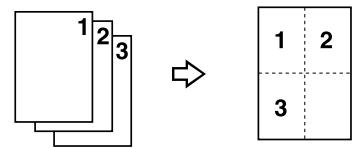
Duplex Margin
- If you set a binding margin that is too wide, parts of the image may not be copied.
- When making copies using the Combine function, a binding margin is added to copies after the images are combined.
INDEX
1 Sided 2 Pages to Combine 1 Side, 44
1 Sided 4 Pages to Combine 1 Side, 44
1 Sided 4 Pages to Combine 2 Sides, 47
1 Sided 8 Pages to Combine 2 Sides, 47
1 Sided to 2 Sided, 41
2 Sided 1 Page to Combine 1 Side, 44
2 Sided 2 Pages to Combine 1 Side, 44
2 Sided 2 Pages to Combine 2 Sides, 47
2 Sided 4 Pages to Combine 2 Sides, 47
2 Sided to 1 Sided, 50
2 Sided to 2 Sided, 41
A
Adjusting Image Density, 34
ARDF, 1, 2, 9, 13
Auto Tray Switching, 5
B
Base Point, 36
Basic procedure for making copies, 21
Book to 1 Sided, 50
Bypass Tray, 17, 23
Bypass Tray Copy, 54
C
Changing the Number of Sets, 40
CombinationChart,53
Combine, 44, 47, 54
Combine/Series key, 45, 47, 50
Combining Multiple Pages onto a
Single Page, vi
Control Panel, 4
Copier Features, 5
Copy Functions, 34
Copying, 21
Copying 2-Sided Originals onto
1-Sided Pages, vii
Copying from the Bypass Tray, 23
Copying onto Custom Size Paper, 26
Copying onto Envelopes, vii, 30
Copying onto OHP transparencies, 27
Copying onto Regular Size Paper, 25
Copying onto Thick Paper, 28
Copy key, 21
Copy Paper, 35
Custom size originals, 15, 18
Custom Size Paper, 26
D
Darker key, 34
Display, 3
Document guide, 13
Duplex, 41, 54
Duplex key, 41
Duplex Margin, 5, 54
Duplex Mode Priority, 5
E
Enlarge, 36
Envelopes, 30
Escape key, 4
Exposure glass, 9, 12
Extender, 23
F
Functions Requiring the ARDF, 2
H
Horizontal size, 15, 18, 23, 26
How to Read This Manual, 1
1
Image Position of Combine, 44
Initialcopydisplay,3,21
K
Keys on the Control Panel, 4
L
Letterhead Setting, 5
Lighterkey,34
Limitmark,13
Loading Paper on the Bypass Tray, 23
M
Maximum scanning area, 9
Max.Number of Sets,5
Menu Protect, 5
Missing Image Area, 10
N
Non-compatible originals for the ARDF, 8
Number keys, 15, 18, 21, 26, 38, 39, 40
0
OHP transparencies, 27
OK key, 4
One-Sided Combine, 44
Orientation, 5
Orientation of Originals and Envelopes, 30
Original Count Display, 5
Original Orientation, 11, 41, 44
Originals, 7
Original size, 7, 9
Original Type key, 34
Original Type Setting, 5, 34
Original weight, 7
P
Paper, 35
Paper guides, 23
Paper Tray, 14
Photo, 34
Placing custom size originals, 15, 18
Placing Originals, 7, 11
Placing Originals in the ARDF, 13
Placing Originals on the Exposure Glass, 12
Placing regular size originals, 14, 17
Positioning mark, 9
Preset Reduce/Enlarge, 36, 54
Preset R/E Priority, 5
Printable area, 10, 30
R
Ratio, 37, 38, 54
Reading the Display, 4
Recommended originals, 7
Reduce, 36
Regular size originals, 14, 17
Regular Size Paper, 25
Release lever, 23
Reproduction Ratio, 5
s
Scroll keys, 4, 37
Selecting a Paper Tray, 14
Selecting Copy Paper, 35
Selecting the Bypass Tray, 17
Selection keys, 4
Series Copies, 50
Sizes Selectable as Regular Size Originals, 9
Sort, 39, 54
Sort key, 39
Supplementary Information, 54
Symbols, 1
T
Text, 34
Thick paper, 28
Two-Sided Combine, 47
Types of Duplex Copies, iv
U
User Tools, 5
Using the Keys on the Control Panel, 4
V
Vertical size, 15, 18, 23, 26
W
What You Can Do with This Machine, iv
Z
Zoom, 37, 54
In accordance with IEC 60417, this machine uses the following symbols for the main power switch:
I means POWER ON.
means STAND BY.
Trademarks
Acrobat® is a registered trademark of Adobe Systems Incorporated.
Other product names used herein are for identification purposes only and might be trademarks of their respective companies. We disclaim any and all rights to those marks.
- Operating Instructions Copy Reference
- Introduction
- Important
- Notes:
- Caution:
- Manuals for This Machine
- About This Machine
- General Settings Guide
- Troubleshooting
- Security Reference
- Copy Reference
- Facsimile Reference
- Printer Reference
- Scanner Reference
- Network Guide
- Other manuals
- Note
- P Reference
- Manuals for Machines with Copier Function Only or with the DDST Unit
- Printer/Scanner Reference
- What You Can Do with This Machine
- Reference
- Types of Duplex Copies
- Combining Multiple Pages onto a Single Page
- Copying 2-Sided Originals onto 1-Sided Pages
- Copying onto Envelopes
- TABLE OF CONTENTS
- Placing Originals
- Copying
- Appendix
- How to Read This Manual
- Symbols
- WARNING:
- Name of Major Item
- Functions Requiring the ARDF
- Display
- Reading the Display
- Initial copy display
- Selection keys
- 2.【Escape】key
- [OK] key
- Scroll keys
- User Tools Menu (Copier Features)
- Originals
- Sizes and Weights of Recommended Originals
- Metric version
- Inch version
- Non-compatible originals for the ARDF
- Sizes Selectable as Regular Size Originals
- Maximum scanning area
- Exposure glass
- ARDF
- Missing Image Area
- Placing Originals
- Original Orientation
- Placing Originals on the Exposure Glass
- Placing Originals in the ARDF
- Specifying the Original Size When a Paper Tray is Selected
- Regular sizes
- Select the original size using the scroll keys, and then press the [OK] key.
- Custom sizes
- Select a desired paper tray using [ ] or [ ]
- Press the [#] key.
- Select [Custom Size] using [ ] or [ ] , and then press the [OK] key.
- Specifying the Original Size When the Bypass Tray is Selected
- Select the original size using the scroll keys, and then press the [OK] key.
- Select the bypass tray using [▲] or [▼].
- Select [Original Size] using [] or [] , and then press the [OK] key.
- Basic Procedure
- Press the [Start] key.
- Copying from the Bypass Tray
- Loading Paper on the Bypass Tray
- Open the bypass tray.
- Push up the release lever.
- Release lever
- Align the paper guides to the paper size, and then insert the paper face down.
- Pull down the release lever.
- Select the size and type of the paper, if required.
- When Copying onto Regular Size Paper
- When Copying onto Custom Size Paper
- When Copying onto OHP Transparency
- When Copying onto Thick Paper
- When Copying onto Envelopes
- Printable area
- Orientation of Originals and Envelopes
- Copy Functions
- Adjusting Image Density
- Original Type Setting
- Text
- Photo
- Selecting Copy Paper
- Preset Reduce/Enlarge
- Base Point
- Press [R/E].
- Press [Enlarge] or [Reduce].
- Select a ratio using [] or [] , and then press the [OK] key.
- Place the originals, and then press the [Start] key.
- Zoom
- Selecting a ratio using the scroll keys
- Entering a ratio with the number keys
- Enter the desired ratio with the number keys, and then press the [OK] key.
- Place the original, and then press the [Start] key.
- Sort
- Press the [Sort] key.
- Enter the number of copy sets using the number keys.
- Place the originals.
- Press the [Start] key.
- Changing the number of sets
- Duplex
- Sided → 2 Sided
- Sided → 2 Sided
- Original orientation and completed copies
- One-Sided Combine
- Sided 2 Pages → Combine 1 Side
- Sided 4 Pages → Combine 1 Side
- Sided 1 Page → Combine 1 Side
- Sided 2 Pages → Combine 1 Side
- Original orientation and image position of Combine
- Select the paper size using [] or [] .
- Two-Sided Combine
- Sided 4 Pages → Combine 2 Sides
- Sided 8 Pages → Combine 2 Sides
- Sided 2 Pages → Combine 2 Sides
- Sided 4 Pages → Combine 2 Sides
- Press the [Combine/Series] key.
- Select the combine mode using [] or [] , and then press the [OK] key.
- Select the original orientation using [] or [] , and then press the [OK] key.
- Select the duplex orientation using [ ] or [ ] , and then press the [OK] key.
- Select the paper size using [ ] or [ ]
- Place the originals, and then press the [Start] key.
- Series Copies
- Sided → 1 Sided
- Combination Chart
- Supplementary Information
- Bypass Tray Copy
- Inch version
- Combine
- Duplex Margin
- INDEX
- A
- B
- C
- D
- E
- F
- H
- 1
- K
- L
- M
- N
- 0
- P
- R
- s
- T
- U
- V
- W
- Z
- Trademarks
Brand : RICOH
Model : AFICIO MP 161
Category : Multifunction Printer