
ZRB34W - Combined refrigerator ZANUSSI - Free user manual and instructions
Find the device manual for free ZRB34W ZANUSSI in PDF.



| Brand | ZANUSSI |
| Model | ZRB34W |
| Product type | Combined refrigerator with bottom freezer compartment |
| Gross refrigerator volume | 226 L |
| Gross freezer volume | 110 L |
| Net refrigerator volume | 223 L |
| Net freezer volume | 92 L |
| Dimensions (W x H x D) | 595 x 1750 x 632 mm |
| Weight | 66 kg |
| Energy class | A |
| Annual consumption | 339 kWh/year |
| Freezing capacity | 4 kg/24h |
| Storage time in case of power failure | 20 h |
| Rated current | 1.1 A |
| Noise level | 38 dB |
| Number of compressors | 1 |
| Refrigerant | Isobutane (R600a) |
| Refrigerator defrost | Automatic |
| Freezer defrost | Manual (2 to 3 times per year) |
| Interior lighting | Bulb T25, 230-240 V, 15 W, socket E14 |
| Climate class | SN-ST (+10°C to +38°C) |
| Door reversibility | Yes, from right to left |
| Adjustable feet | 2 at the front |
| Supplied accessories | Ice cube tray, defrost spatula, cleaning stick |
Frequently Asked Questions - ZRB34W ZANUSSI
User questions about ZRB34W ZANUSSI
0 question about this device. Answer the ones you know or ask your own.
Ask a new question about this device
Download the instructions for your Combined refrigerator in PDF format for free! Find your manual ZRB34W - ZANUSSI and take your electronic device back in hand. On this page are published all the documents necessary for the use of your device. ZRB34W by ZANUSSI.
USER MANUAL ZRB34W ZANUSSI
Before installing and using the appliance, read this user's instruction book carefully. It contains safety precautions, hints, information, and ideas. If the refrigerator is used in compliance with the instructions written, it will operate properly and provide you with the greatest satisfaction.
The symbols below help you to find things more easily:
Safety precautions
Warnings and information at this symbol serve safety for you and your appliance.
Hints, useful information

Environmental information
Symbol for ideas
At this symbol, ideas can be found according to food and its storing.

The symbol on the product or on its packaging indicates that this product may not be treated as household waste. Instead, it shall be handed over to the applicable collection point for the recycling of electrical and electronic equipment. By ensuring this product is disposed of correctly, you will help prevent potential negative consequences for the environment and human health, which could otherwise be caused by inappropriate waste handling of this product. For more detailed information about recycling of this product, please contact your local city office, your household waste disposal service, or the shop where you purchased the product.
Contents
Important safety information. 42
General safety precautions 42
Precautions for child safety 42
Safety precautions for installation 42
Safety precautions for isobutane 42
Instructions for the User 43
General information 43
Description of the appliance, main parts 43
Handling the appliance 44
Putting it into use 44
Controlling the temperature, setting 44
How to use the refrigerator 44
Storing in the refrigerator 44
Storage time and temperature of foods 44
How to use the freezer 44
Freezing 44
Storing in the freezer 45
How to make ice cubes 45
Some useful information and advice. 45
Hints and ideas. 45
How to save energy. 45
The appliance and environment. 45
Maintenance 46
Defrosting. 46
Regular cleaning 47
When the refrigerator is not in use 47
Trouble shooting 47
How to change the bulb 47
If something does not work. 47
Instructions for the Installer 49
Technical data 49
Installing the appliance 49
Transportation, unpacking 49
Cleaning 49
Placement 49
Change of door opening direction 50
Electrical connection 51
Storage time chart (1) 52
Storage time chart (2) 53
From the Electrolux Group. The world's No.1 choice.
The Electrolux Group is the world's largest producer of powered appliances for kitchen, cleaning and outdoor use. More than 55 million Electrolux Group products (such as refrigerators, cookers, washing machines, vacuum cleaners, chain saws and lawn mowers) are sold each year to a value of approx. USD 14 billion in more than 150 countries around the world.
Important safety information
General safety precautions
- Keep these instructions and they should remain with the appliance when moving away or changing owner. This appliance is designed for storing food, domestic use according to these instructions only.
- Specialised companies that are qualified to do so by the manufacturer must carry out service and repairs including repairing and changing the power cord. Accessory parts supplied by them should be used only for repairing. Otherwise the appliance can be damaged or can cause other damage or injury. The appliance is out of circuit only in that case if the plug is removed from the socket. Before cleaning and maintenance always unplug it (do not get it by the cable). If the socket is difficult to reach, switch off the appliance by cutting off the current. Power cord must not be lengthened.
- Make sure that the power plug is not squashed or damaged by the back of the fridge/freezer.
- A damaged power plug may overheat and cause a fire.
- Do not place heavy articles or the fridge/freezer itself on the power cord.
- There is a risk of a short circuit and fire.
- Do not remove the power cord by pulling on its lead, particularly when the fridge/freezer is being pulled out of its niche.
- Damage to the cord may cause a short-circuit, fire and/or electric shock.
- If the power cord is damaged, it must be replaced by a certified service agent or qualified service personnel.
- If the power plug socket is loose, do not insert the power plug.
- There is a risk of electric shock or fire.
- Without the lamp cover of interior lighting you must not operate the appliance.
- When cleaning, defrosting, taking out frozen food or ice tray do not use sharp, pointed or hard devices, as they can cause damage to the appliance.
- Be careful not to allow liquids to the temperature control and lighting box.
- Ice and ice-cream can cause hurt if they are eaten immediately after removal from the frozen food compartment.
- After dissolving frozen food must not be refrorozen, it must be used up as soon as possible.
- Store pre-packed frozen food in accordance with the frozen food manufacturer's instructions.
- You must not make defrosting faster with any electric heating appliance or chemicals.
- Do not put hot pots on the plastic parts.
- Do not store flammable gas and liquid in the appliance, because they may explode.
- Do not store carbonated drinks, bottled drinks, and bottled fruits in the frozen food compartment.
- Check and clean the outlet of melting water coming
during defrosting regularly. If it is clogged, the melting water gathered can cause earlier failure.
Precautions for child safety
- Do not allow children to play with the packaging of the appliance. Plastic foil can cause suffocation. Adults must handle the appliance. Do not allow children to play with it or its controlling parts.
- If you are discarding the appliance, pull the plug out of the socket, cut the connection cable (as close to the appliance as you can), and remove the door to prevent playing children from suffering electric shock or closing themselves into it. This appliance is not intended for use by persons (including children) with reduced physical, sensory, or mental capabilities, or lack of experience and knowledge, unless they have been given supervision or instruction concerning use of the appliance by a person responsible for their safety.
Children should be supervised to ensure that they do not play with the appliance.
Safety precautions for installation
- Put the appliance to the wall to avoid touching or catching warm parts (compressor, condenser) to prevent possible burn.
- When moving the appliance, take care that the plug is not in the socket.
- When placing the appliance, take care not to stand it on the power cord.
- Adequate air circulation should be around the appliance; lacking this leads to overheating. To achieve sufficient ventilation, follow the instructions relevant to installation.
Safety precautions for isobutane
Warning
The refrigerant of the appliance is isobutane (R 600a) that is inflammable and explosive to a greater extent. - Keep ventilation openings, in the appliance enclosure or in the built-in structure, clear of obstruction. - Do not use mechanical devices or other means to accelerate the defrosting process, other than those recommended by the manufacturer. - Do not damage the refrigerant circuit. - Do not use electrical appliances inside the food storage compartments of the appliance, unless they are of the type recommended by the manufacturer.
For the safety of life and property keep the precautions of these user's instructions as the manufacturer is not responsible for damages caused by omission.
Instructions for the User
General information
The official designation of the appliance is "refrigerator-freezer combination with one motor compressor and freezer placed in the lower part". The appliance has - besides the general services- a freezer with its own door and is completely separated from the other unit.
According to this the appliance is suitable for storing frozen and deep-frozen food, freezing products in quanti
ty given in the user's instructions at home and making ice.
The appliance can meet the requirements of standards between different temperature limits according to the climate class.
The letter symbol for climate class can be found on the data label.
Description of the appliance, main parts
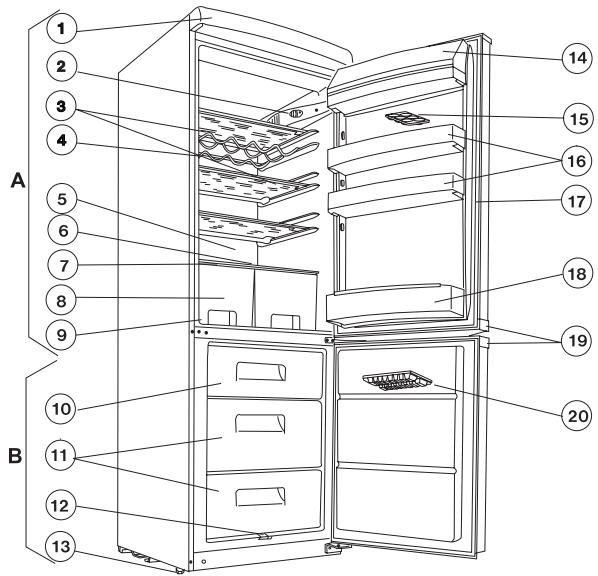
A - Refrigerator
B - Freezer
- Top
- Lighting box
- Glass shelves
- Bottle rack
- Cooling surface
- Defrost water drain
- Glass shelf
- Vegetable boxes
- Data label
- Freezing compartment
- Storing compartment(s)
- Defrost water outlet
- Adjustable feet
- Butter compartment lid
- Egg tray
- Door shelf
- Door gasket
- Bottle shelf
- Handles
- Ice tray
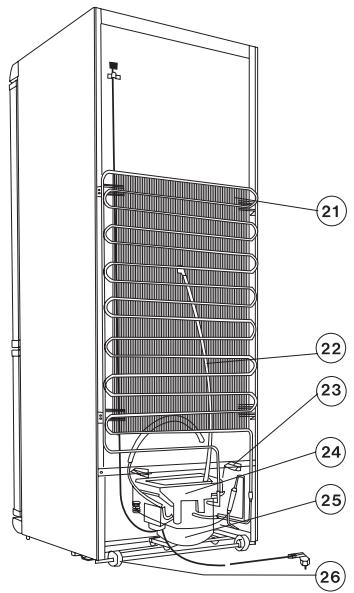
- Condenser
- Defrost water outlet tube
- Spacer
- Evaporator tray
- Compressor
- Rollers
Handling the appliance
Putting it into use
Place the accessories into the appliance then plug to the mains socket.
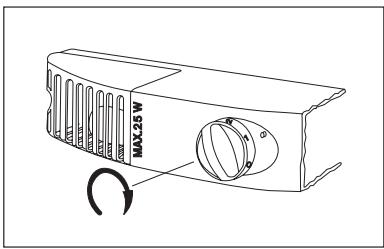
The thermostat knob is on the light box in the refrigerator. You can switch the appliance on and set the temperature with it by turning the knob clockwise.
The next paragraph will give instructions for setting.
Controlling the temperature, setting
The thermostat interrupts the operation of the appliance automatically for more or less time depending on the setting then restarts it assuring the required temperature.
The closer it is set to maximum position the more intensive the refrigerating will be. When the thermostat knob is set to a medium position (between minimum and maximum), in the freezing compartment -18°C in the fresh food compartment +5°C can be reached. Setting it to a medium position is adequate for everyday use.
The temperature coming about in the refrigerator is effected by not only the position of the thermostat but the ambient temperature, frequency of door openings and the quantity of food put into it newly, etc.
In the maximum position - in case of increased demand e.g. during heatwaves - the compressor may operate continually. This does not cause damages to the appliance.
How to use the refrigerator
For adequate cooling developing interior air circulation is necessary. For this reason you are asked not to cover the air circulation gaps behind the shelves (e.g. with tray etc.). Do not put hot food into the refrigerator. Allow it to reach room temperature naturally. In this way the unnecessary frost building up can be avoided. i Foods can take over odours from each other. So it is essential to put foods in closed dishes or wrap them in cellophane, aluminium foil, greaseproof paper or cling film before placing them into the refrigerator. This way foods will keep their moisture e.g. vegetables will not dry out after some days.
Storing in the refrigerator
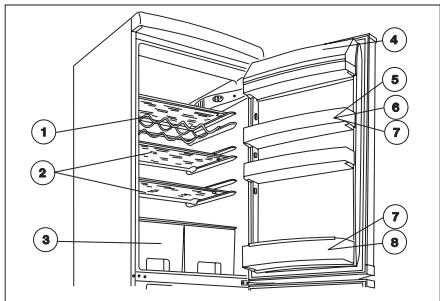
When placing the different kinds of food take into consideration the sketch below in figure:
- Confectionery, ready-cooked foods, foods in dishes, fresh meat, cold cuts, drinks
- Milk, dairy products, foods in dishes
- Fruits, vegetables, salads
- Cheese, butter
- Eggs
- Yoghurt, sour cream
- Small bottles, soft drinks
- Big bottles, drinks
Storage time and temperature of foods
The storage time chart at the end of the instruction book gives information about storage time.
The storage time cannot be determined exactly in advance, as it depends on the freshness and handling of the cooled food. That is why the storage time provided is only informative.
If you do not want to use up deep-frozen foods bought immediately, they can be stored for about 1 day (until thawing) in the refrigerator.
How to use the freezer
Freezing
The appliance can be used to freeze fresh food of the quantity specified on the data label. Freezing different products should always be done after proper preparation as follows.
Set the thermostat knob to a medium position.
Put the previously frozen food - or some of it - into another basket or baskets. Put the fresh food into the upper basket, leaving enough space for airflow. If there is some previously frozen food left in the upper basket, put this food into the back of the basket, avoiding contact between the fresh food and the already frozen food.
Run the appliance this way for 24 hours.
After 24 hours, set the thermostat knob according to your choice or leave it in a medium position, which is generally appropriate for everyday cooling needs.
Should you want to freeze the quantity declared by the producer, remove the upper basket from the appliance and put the fresh food uniformly distributed directly on the cooling surface.
Setting the thermostat knob to a higher (e.g., maximum) position is not recommended. Although doing so would make the freezing time shorter, on the other hand, the temperature of the fridge compartment may go permanently below 0°C, which yields freezing the food and drinks stored there.
Never freeze food in bigger quantity than given in the 'Technical data' at the same time, otherwise freezing will not be thorough and after dissolving various deterioration may take place (losing taste and aroma, lysing, etc.).
Do not make ice during freezing preferably, because making ice reduces freezing capacity.
Storing in the freezer
It is practical to replace frozen products into the basket(s) after freezing has finished. Doing this you could make room in the freezing compartment for another freezing. Intermediate freezing does not deteriorate foods already stored.
If large quantities of food are to be stored, remove the baskets except the lowermost one from the appliance and place food on the cooling surface.
Do not forget to keep to the storage time given on the packaging of frozen products if you buy them frozen. To store home-frozen products see the storing instructions placed in the door of the freezer. Symbols signify the various foods, numbers mean maximum storing time given in months.
It is safe to store quick-frozen, frozen foods only if they have not dissolved even for a short time until placing them into the freezer. If the deep-frozen food has already dissolved, refreezing is not recommended, it has to be used up as soon as possible.
How to make ice cubes
To make ice cubes fill the enclosed ice cube tray with water and put it to the frozen food compartment. Setting thermostatic control knob to maximum position can shorten preparing time. After finishing do not forget to reset the thermostatic control to the suitable position.
Ready ice cubes can be taken out of the tray under running water then twist or hit it. If the ice tray freezes to the compartment, avoid using metal tools or knife to take it out as the cooling system can be damaged.
Some advice
- The variable shelves are worth paying attention to, which increases the usability of the fresh food compartment considerably. Rearranging the shelves is also possible when the door is open at an angle of 90°.
- After opening and closing the door of the freezer, vacuum will rise inside the appliance because of the low temperature. So wait 2-3 minutes after closing the door - if you want to open it again - while inner pressure equalizes. Take care of operating the freezer at a position of thermostatic control so that the inside temperature can never go above -18°C, since temperature higher than this storing time of frozen foods can decrease. It is practical to make sure of faultless operation of the appliance daily so as to notice possible failure in time and prevent deterioration of frozen foods.
Hints and ideas
In this chapter practical hints and ideas are given about how to use the appliance to reach maximum energy saving and there is environmental information about the appliance as well.
How to save energy
- Avoid putting the appliance in a sunny place and near anything that gives off heat.
- Be sure that the condenser and the compressor are well ventilated. Do not cover the sections where ventilation is.
- Wrap products in tightly closing dishes or cling film to avoid building up unnecessary frost.
- Do not leave the door open longer than necessary and avoid unnecessary openings.
- Put warm foods into the appliance only when they are at room temperature.
- Keep the condenser clean.
The appliance and environment
This appliance does not contain gasses which could damage the ozone layer, in either its refrigerant circuit or insulation materials. The appliance shall not be discarded together with the urban refuse and rubbish. Avoid damaging the cooling unit, especially at the rear near the heat exchanger. Information on your local disposal sites may be obtained from your municipal authorities.
The materials used on this appliance marked with the symbol are recyclable.
Maintenance
Defrosting
Bleeding part of the moisture of cooling chambers in form of frost and ice goes with the operation of the appliance.
Thick frost and ice has an insulating effect, so it reduces cooling efficiency as the temperature increases in the cooling chambers, they need more energy.
At this type of appliance defrosting the cooling surface of the refrigerator is automatic without any external intervention. The thermostatic control interrupts the operation of compressor at regular intervals for more or less time - during this cooling is interrupted - the temperature of the cooling surface goes above 0°C due to interior heating load of the compartment, so defrosting occurs. When the surface temperature of the cooling surface has reached +3 - +4°C the thermostatic control restarts operation of the system.
Melting water flows through defrost water outlet leaded through the back into the evaporator tray maintained on the top of compressor and evaporates due to its warmth.
Check and clean the outlet of melting water coming during defrosting regularly - a label inside the appliance warns you for this. If it is clogged the melting water gathered can cause earlier failure as it can go to the insulating of the appliance.
Clean the melting water outlet with the supplied pipe scraper that can be seen in the figure. The pipe scraper has to be stored in the outlet.
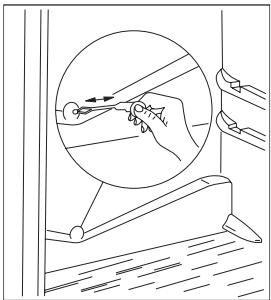
The most typical case of clogging up in the melting water outlet when you put food wrapped in some paper into the appliance and this paper contacts back plate of the refrigerator and freezes to it. If you remove the food right at this moment the paper will tear and it can cause clogging up in the outlet by getting into it. So you are asked to be careful - because of the above - when placing foods wrapped in paper into the appliance.
In case of increased demand e.g. during heatwaves, the refrigerator temporarily happens to operate constantly - during this the automatic defrosting does not work.
Remaining small ice and frost stains on back plate of the refrigerator after defrosting period is not abnormal.
The freezer can not be equipped with automatic defrost-ing set since the deep-frozen and frozen foods do not endure melting temperature.
When small frost and ice occurs, scrape off and remove frost and ice coating with the supplied plastic scraper.
When ice coating is so thick that it cannot be removed with the plastic scraper, the cooling gill have to be defrosted. Frequency of defrosting depends on usage (generally 2-3 times a year).
Take the frozen foods out of the appliance, and put them into a basket lined with paper or cloth. Store them in a possibly cool place or replace them into another refrigerator.
Pull out the mains plug from the mains socket, so both parts of the appliance are out of operation.
Open the doors of both parts of the appliance and clean the refrigerator according to 'Regular cleaning'. Maintain and clean the freezer as following:
Sweep off the melting water with a cloth or sponge in the direction of the sides of the cooling plates. The melting water that is swept down gathers in the outlet channel practically formed in the bottom of the appliance and can be removed according to the figure.
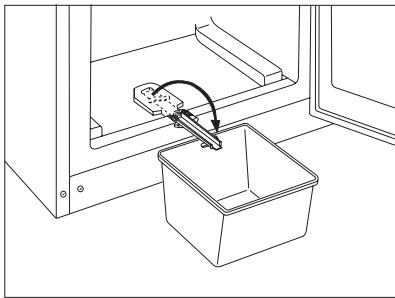
Put an adequately high bowl or dish under the outlet.
The bowl in the figure is not a piece of accessories to the appliance!
Wipe the surfaces after defrosting and leading the water out.
Put the mains plug into the mains socket and put the foods taken out back to their places.
It is recommended to operate the appliance at the highest position of the thermostatic control for some hours so that it can reach the sufficient storing temperature as soon as possible.
Regular cleaning
It is recommended to wash the inside of the refrigerator in 3-4 weeks time using lukewarm water then wipe it (it is practical to clean the inside of the freezer and defrost it at a time).
Household cleaner or soap must not be used.
After breaking the circuit, wash the appliance with lukewarm water then wipe it. Clean the door gasket with clean water. After cleaning, apply voltage to the appliance.
It is recommended to remove the dust and dirt collected on the back of the refrigerator and the condenser and to clean the evaporative tray on top of the compressor once or twice a year.
When the refrigerator is not in use
In case the appliance will not be used for a long time, follow these steps:
Break the circuit of the appliance.
Remove foods from the refrigerator.
Defrost and clean it as written before.
Leave the door open to avoid a build up of air inside.
Troubleshooting
How to change the bulb
Should the light fail to work you can change it as below:
Break the circuit of the appliance.
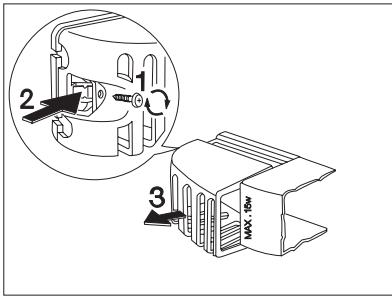
Unscrew the screw holding the cover (1), press the rear hook (2) and at the same time slide the cover in the direction indicated by arrow (3). So the bulb can be replaced. (Bulb type: 230-240 V, 15 W, E 14 thread)
After changing the bulb replace the cover, snap it in place, screw back the screw and apply voltage to the appliance.
If something does not work
During operation of the appliance some smaller but annoying trouble can often occur, which does not require calling a technician out. In the following chart information is given about them to avoid unnecessary charges on service.
We draw your attention that operation of appliance goes with certain sounds (compressor- and circulating sound). This is not trouble, this goes together with the operation of the appliance.
We draw it to your attention again that the appliance operates discontinuously, so the stopping of compressor does not mean being no-current. That is why you must not touch the electrical parts of the appliance before breaking the circuit.
| Problem | Possible cause | Solution |
| It is too warm in the refrigerator. | Thermostatic control can be set wrongly. If products are not cold enough or placed wrongly. The door does not close tightly or it is not shut properly. | Set the thermostat knob to higher position. Place the products to the appropriate place. Check if the door closes well and the gas-ket is unhurt and clean. |
| It is too warm in the freezer. | Thermostatic control can be set wrongly. The door does not close tightly or it is not shut properly. Products in big quantity to be frozen were put in. Products to be frozen are placed too closely to each other. | Set the thermostat knob to higher position. Check if the door closes well and the gas-ket is unhurt and clean. Wait some hours and then check the temperature again. Place the products in a way so that cold air could circulate among them. |
| Water flows at the back plate of the refrigerator. Water flows into the cham- ber. Water flows onto the floor. | It is normal. During automatic defrosting frost melts on the back plate. The outlet of the chamber can be clogged up. Products placed in can prevent water from flowing into the collector. The melting water outlet flows not into the evaporative tray above the compressor. | Clean the outlet. Replace the products so that they can not touch the back plate directly. Put the melting water outlet to the evaporative tray. |
| There are too much frost and ice. | Products are not wrapped properly. Doors are not shut properly or do not close tightly. The thermostatic control can be set wrongly. | Wrap the products better. Check if the doors close well and the gas-kets are unhurt and clean. Set the thermostat knob to a position that gives higher temperature. |
| The compressor operates continually. | The thermostatic control is set wrongly. Doors are not shut properly or do not close tightly. Products in big quantity to be frozen were put in. Too warm food was put in. The appliance is in too warm place. | Set the thermostat knob to a position that gives higher temperature. Check if the doors close well and the gas-kets are unhurt and clean. Wait some hours and then check the temperature again. Put food at max. room temperature. Try to reduce the temperature in the room where the appliance stands. |
| The appliance does not work at all. Neither cooling, nor lighting works. | Plug is not connected to the mains socket properly. The fuse burnt out. The thermostatic control is not on. There is no voltage in the mains socket. (Try to connect another appliance into it.) | Connect the mains plug properly. Change the fuse. Start the appliance according to instruc-tions in chapter 'Putting it into use'. Call an electrician. |
| The appliance is noisy. | The appliance is not supported properly. | Check if the appliance stands stable (all the four feet should be on the floor). |
Inasmuch as the advice does not lead to result, call the nearest brand-mark service.
Instructions for the Installer
Technical data
| Model | ZRB634W |
| Gross capacity (l) | Freezer: 226 Refrigerator: 110 |
| Net capacity (l) | Freezer: 223 Refrigerator: 92 |
| Width (mm) | 595 |
| Height (mm) | 1750 |
| Depth (mm) | 632 |
| Energy consumption (kWh/24h) | 0,929 |
| (kWh/year) | 339 |
| Energy class, according to EU standards | A |
| Freezing capacity (kg/24h) | 4 |
| Rising time (h) | 20 |
| Rated current (A) | 1,1 |
| 38 | |
| Weight (kg) | 66 |
| Number of compressors | 1 |
Installing the appliance
Transportation, unpacking
It is recommended to deliver the appliance in its original packaging, in a vertical position, considering the protective warning on the packaging.
After each transportation, the appliance must not be switched on for approximately 2 hours.
Unpack the appliance and check for any damages. Report any possible damages immediately to the place of purchase. In that case, retain the packaging.
Cleaning
Remove all adhesive tape and anything else that ensures the accessories do not move inside the appliance.
Wash the inside of the appliance using lukewarm water and a mild detergent. Use a soft cloth.
After cleaning, wipe out the inside of the appliance.
Placement
The ambient temperature has an effect on the energy consumption and proper operation of the appliance. When placing it, take into consideration that it is practical to operate the appliance between ambient temperature limits according to the climate class given in the chart below and found on the data label.
| Class of climate | Ambient temperature |
| SN | +10 ... +32 °C |
| N | +16 ... +32 °C |
| ST | +18 ... +38 °C |
If the ambient temperature goes below the lower limit, the temperature of the cooling compartment can go beyond the prescribed temperature.
If the ambient temperature goes beyond the upper limit, this means longer operating time of the compressor, breakdown in the automatic defrosting, increasing temperature in the cooling compartment, or increasing energy consumption.
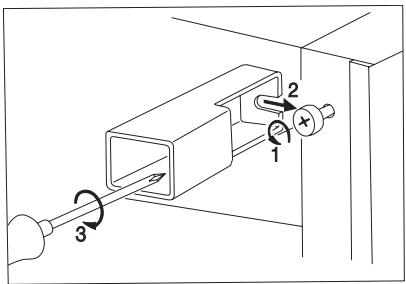
In the bag of accessories, there are two spacers which must be fitted in the two top corners.
Loosen the screws and insert the spacer under the screw head, then re-tighten the screws.
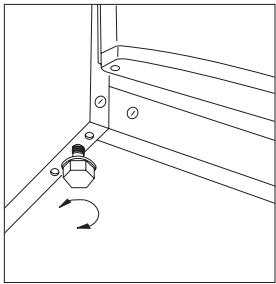
When placing the appliance, ensure that it stands level. This can be achieved by two adjustable feet at the bottom in front.
Do not stand the appliance in a sunny place or close to a radiator or cooker.
If it is unavoidable because of furnishing and the appliance has to be stood near a cooker, take these minimum distances into consideration:
- In case of gas or electric cooker, 3 cm must be left. When it is less, put a 0.5-1 cm non-flammable insulation between the two appliances. In case of oil or coal-fired stove, the distance must be 30 cm since they give off more heat.
The refrigerator is designed to operate when it is totally pushed to the wall.

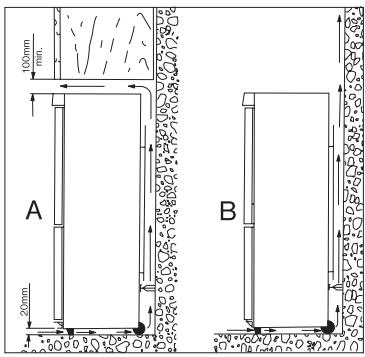
When placing the refrigerator, keep the minimal distances recommended in the figure.
A: placing it under a wall-cupboard. B: placing it freely.
Change of door opening direction
Should the setting-up place or handling demand it, the door-opening direction can be refitted from right-handed to left-handed.
Appliances on the market are right-handed.
The following operations are to be done on the basis of figures and explanations:
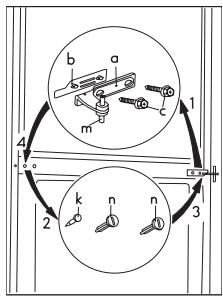
To perform the operations listed below, it is recommended to ask another person for help who can safely keep the doors while performing the operations. - Disconnect the appliance from the electricity supply. - Open the doors and dismount the double door hinge (a, b) by removing the screws (2 pieces) (c). (fig.2)
Take off the double door hinge (a, b, c) by gradually removing it from the cabinet, slightly tilting both doors. Do not forget to remove the plastic spacer (b) under the hinge. (fig.2) Take off the refrigerator door by pulling it slightly downwards. Take off the freezer door by pulling it slightly upwards. - Remove the plug on the upper side of the refrigerator door and put it to the other side. - Remove the plug on the upper side of the freezer door and put it to the other side.
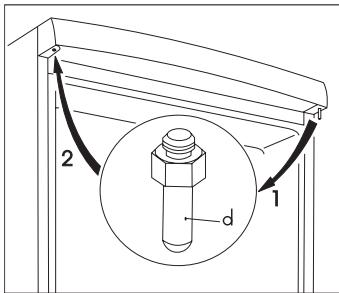
- Unscrew the top door hinge pin (d) of the refrigerator, then screw it back on the other side. (fig.1)
- Remove the plugs (u) at the bottom of the appliance. (fig.3)
- Remove the lower hinge (e) by removing its screws (s) and mount it on the other side. (fig.3)
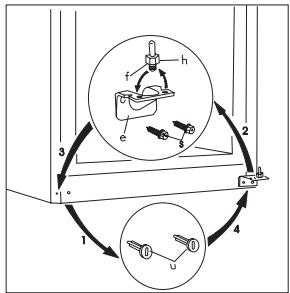
- Unmount the lower hinge pin (f) and its washer (h) and mount them into the other hole of the lower hinge. (fig.3)
- Replace the plugs (u) on the other side.
- Remove the covering nails (3 pieces) (n, k) of the double door holder on the left side and put them to the other side. (fig.2)
- Fit the pin of the double door hinge (m) into the left drill of the freezer door. (fig.2)
- Fit the freezer door to the lower door hinge pin (f). (fig.3)
- Fit the refrigerator door to the upper door hinge pin (d) then slightly tilting both doors fit the pin of the double door hinge (m) into the left drill of the refrigerator door.
- Put the appliance to its place, set it level, and apply voltage to it.
In case you do not want to perform the procedures above, call the nearest brand-mark service.
Technicians will accomplish the refitting expertly for charge.
Electrical connection
This refrigerator is designed to operate on a 230 VAC (~) 50 Hz supply.
The plug must be put into a socket with protective contact. If there is no such, it is recommended to get an electrician to fit an earthed socket in compliance with standards near the refrigerator.
This appliance complies with the following E.E.C. Directives: 73/23 EEC of 19.02.73 (Low Voltage Directive) and subsequent modifications, 89/336 EEC of 03.05.89 (Electromagnetic Compatibility Directive) and subsequent modifications, 96/57 EEC - 96/09/03 (Energy Efficiency Directive) and its subsequent amendments.
Storage time chart (1)
Time and method of storage of fresh foods in the refrigerator
| Foods1 | Storage time in days | Method of packaging | |||||||
| 2 | 3 | 4 | 5 | 6 | 7 | ||||
| Raw meat | X | X | x | x | x | cling film, airtight | |||
| Cooked meat | X | X | X | x | x | x | dish covered | ||
| Roasted meat | X | X | X | x | x | dish covered | |||
| Raw minced meat | X | dish covered | |||||||
| Roasted minced meat | X | X | x | x | dish covered | ||||
| Cold cuts, Vienna sausage | X | X | x | x | cling film, cellophane, grease-proof paper | ||||
| Fresh fish | X cling | x x cling film, airtight | Electrical connectionThis refrigerator is designed to operate on a 230 V AC (~) 50 Hz supply. | ||||||
| Cooked fish | X dish covered | X x covered | x | ||||||
| Fried fish | X dish covered | X x covered | x | The plug must be put into a socket with protective contact. If there is no such, it is recommended to get an electrician to fit an earthed socket in compliance with standards near the refrigerator. | |||||
| Tinned fish, open | X dish covered | X x covered | |||||||
| Fresh chicken | X cling | X x cling film, airtight | x | This appliance complies with the following E.E.C. Directives: | |||||
| xx | - 73/23 EEC of 19.02.73 (Low Voltage Directive) and subsequent modifications, | ||||||||
| Fried chicken | X dish covered | X x covered | x | ||||||
| Fresh hen | X cling | X x cling film, airtight | x | - 89/336 EEC of 03.05.89 (Electromagnetic Compatibility Directive) and subsequent modifications. | |||||
| k | |||||||||
| Boiled hen | X dish covered | X x covered | x | ||||||
| k | |||||||||
| Fresh duck, goose | X cling | X x cling film, airtight | x | ||||||
| xx | |||||||||
| Roasted duck, goose | X x dish covered | X x covered | X | ||||||
| xx | |||||||||
| Butter unopened | X | X | X | X | X | X | X | X | original packaging |
| Butter opened | X | X | x | x | x | x | x | x | original packaging |
| Milk in a plastic bag | X | X | X | x | x | original packaging | |||
| Cream | X | X | x | x | plastic box | ||||
| Sour cream | X | X | X | X | x | x | x | x | plastic box |
| Cheese (hard) | X | X | X | X | X | X | X | X | aluminium foil |
| Cheese (soft) | X | X | X | X | x | x | x | x | cling film |
| Curds | X | X | X | X | x | x | x | x | cling film |
| Egg | X | X | X | X | X | X | X | X | |
| Spinach, sorrel | X | X | x | x | cling film | ||||
| Green peas, green beans | X | X | X | X | x | x | x | x | cling film |
Notation:
X usual storage time x possible storage time (concerns to really fresh product only)
Storage time chart (2)
Storage time of deep-frozen and frozen products
| Foods | In the fresh food compartment +2 - +7°C | In the **** frozen food compartment -18°C |
| Vegetables: green beans, green peas, mixed vegetables, marrow, corn, etc. | 1 day | 12 months |
| Ready-cooked foods: vegetable dish, trimmings, with meat, etc. | 1 day | 12 months |
| Ready-cooked foods: sirloin steaks, stew from knuckle of ham, meat from pig pudding, etc. | 1 day | 6 months |
| Foods from potatoes, pasta: mashed potato, gnocchi, dumpling, pasta filled with jam, chips | 1 day | 12 months |
| Soups: meat-broth, soup from green beans, soup from green peas, etc. | 1 day | 6 months |
| Fruits: sour cherry, cherry, gooseberry, fruit cream, mashed maroon | 1 day | 12 months |
| Meat: chicken, duck, goose fillets, tuna fish | 1 day | 5 months |
| 1 day | 6 months | |
| Popsicle, ice-cream | 1 day | 3 weeks |
www.electrolux.com


- SAFETY PRECAUTIONS
- HINTS, USEFUL INFORMATION
- ENVIRONMENTAL INFORMATION
- SYMBOL FOR IDEAS
- CONTENTS
- IMPORTANT SAFETY INFORMATION
- MAINTENANCE
- INSTRUCTIONS FOR THE INSTALLER
- STORAGE TIME CHART (1)
- STORAGE TIME CHART (2)
- FROM THE ELECTROLUX GROUP. THE WORLD'S NO.1 CHOICE
- GENERAL SAFETY PRECAUTIONS
- PRECAUTIONS FOR CHILD SAFETY
- SAFETY PRECAUTIONS FOR INSTALLATION
- SAFETY PRECAUTIONS FOR ISOBUTANE
- WARNING
- INSTRUCTIONS FOR THE USER
- GENERAL INFORMATION
- DESCRIPTION OF THE APPLIANCE, MAIN PARTS
- A - REFRIGERATOR
- B - FREEZER
- HANDLING THE APPLIANCE
- PUTTING IT INTO USE
- CONTROLLING THE TEMPERATURE, SETTING
- HOW TO USE THE REFRIGERATOR
- STORING IN THE REFRIGERATOR
- STORAGE TIME AND TEMPERATURE OF FOODS
- HOW TO USE THE FREEZER
- FREEZING
- STORING IN THE FREEZER
- HOW TO MAKE ICE CUBES
- SOME ADVICE
- HINTS AND IDEAS
- HOW TO SAVE ENERGY
- THE APPLIANCE AND ENVIRONMENT
- DEFROSTING
- REGULAR CLEANING
- WHEN THE REFRIGERATOR IS NOT IN USE
- TROUBLESHOOTING
- HOW TO CHANGE THE BULB
- IF SOMETHING DOES NOT WORK
- INSTALLING THE APPLIANCE
- TRANSPORTATION, UNPACKING
- CLEANING
- PLACEMENT
- CHANGE OF DOOR OPENING DIRECTION
- ELECTRICAL CONNECTION
- TIME AND METHOD OF STORAGE OF FRESH FOODS IN THE REFRIGERATOR
- NOTATION
- STORAGE TIME OF DEEP-FROZEN AND FROZEN PRODUCTS
Brand : ZANUSSI
Model : ZRB34W
Category : Combined refrigerator