
ZBB7294 - Combined refrigerator ZANUSSI - Free user manual and instructions
Find the device manual for free ZBB7294 ZANUSSI in PDF.


| Product type | Fridge-freezer |
| Brand | ZANUSSI |
| Model | ZBB7294 |
| Height | 1780 mm |
| Width | 560 mm |
| Depth | 550 mm |
| Estimated weight | 65 kg |
| Power supply | 220-240 V, 50 Hz |
| Net refrigerator capacity | 210 L |
| Freezer net capacity | 70 L |
| Energy consumption | 0.87 kWh/24h (318 kWh/year) |
| Freezing capacity | 4 kg/24h |
| Autonomy in case of failure | 20 h |
| Climate class | SN to T (10°C to 43°C) |
| Refrigeration | Automatic defrost |
| Freezing | 4 stars, manual defrost |
| Main features | Refrigeration, freezing, interior lighting, removable shelves, adjustable door bins, ice cube trays, thermal accumulators |
| Maintenance and cleaning | Internal cleaning with warm water and bicarbonate, dusting of the condenser, manual defrosting of the freezer |
| Safety | Magnetic seal, instructions to prevent child entrapment, unplug before cleaning, do not use metal objects for defrosting |
| Spare parts and repairability | Bulb (max power indicated on diffuser), plastic spatula, ice cube trays. Repairs by authorized personnel only |
| Door reversibility | Yes, right opening convertible to left |
Frequently Asked Questions - ZBB7294 ZANUSSI
User questions about ZBB7294 ZANUSSI
0 question about this device. Answer the ones you know or ask your own.
Ask a new question about this device
Download the instructions for your Combined refrigerator in PDF format for free! Find your manual ZBB7294 - ZANUSSI and take your electronic device back in hand. On this page are published all the documents necessary for the use of your device. ZBB7294 by ZANUSSI.
USER MANUAL ZBB7294 ZANUSSI
These warnings weren't given to him, but he knew what he wanted. He didn't know what he wanted to know. These were the last words he had spoken in his head.
Safety
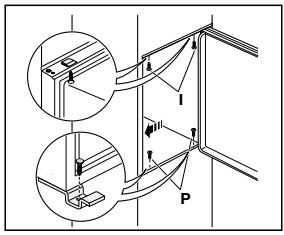
(I = short) (P = long)
It is most important that this instruction book should be retained with the appliance for future reference. Should the appliance be sold or transferred to another owner, or should you move house and leave the appliance, always ensure that the book is supplied with the appliance in order that the new owner can be acquainted with the functioning of the appliance and the relevant warnings.
If this appliance featuring magnetic door seals is to replace an older appliance having a spring lock (latch) on the door or lid, be sure to make that spring lock unusable before you discard the old appliance. This will prevent it from becoming a death-trap for a child.
These warnings are provided in the interest of safety. You must read them carefully before installing or using the appliance.
General Safety
- This appliance is not intended for use by persons (including children) with reduced physical, sensory or mental capabilities, or lack of experience and knowledge, unless they have been given supervision or instruction concerning use of the appliance by a person responsible for their safety. Children should be supervised to ensure that they do not play with the appliance. It is dangerous to alter the specifications or modify this product in any way.
- Before any cleaning or maintenance work is carried out, be sure to switch off and unplug the appliance.
- This appliance is heavy. Care should be taken when moving it.
- Ice lollies can cause frost burns if consumed straight from the appliance. Take utmost care when handling your appliance so as not to cause any damages to the cooling unit with consequent possible fluid leakages.
- The appliance must not be located close to radiators or gas cookers.
- Avoid prolonged exposure of the appliance to direct sunlight.
- There must be adequate ventilation round the back of the appliance and any damage to the refrigerant circuit must be avoided.
- For freezers only (except built-in models): an ideal location is the cellar or basement.
- Do not use other electrical appliances (such as ice cream makers) inside of refrigerating appliances.
Service/Repair
- Any electrical work required to install this appliance should be carried out by a qualified electrician or competent person. This product should be serviced by an authorized
Service Centre, and only genuine spare parts should be used.
- Under no circumstances should you attempt to repair the appliance yourself. Repairs carried out by inexperienced persons may cause injury or more serious malfunctioning. Refer to your local Service Centre, and always insist on genuine spare parts.
- This appliance contains hydrocarbons in its cooling unit; maintenance and recharging must therefore only be carried out by authorized technicians.
Use
- The domestic refrigerators and freezers are designed to be used specifically for the storage of edible foodstuffs only.
- Best performance is obtained with ambient temperature between +18°C and +43°C (class T); +18°C and +38°C (class ST); +16°C and +32°C (class N); +10°C and +32°C (class SN). The class of your appliance is shown on its rating plate.
Warning: when the ambient temperature is not included within the range indicated for the class of this appliance, the following instructions must be observed: when the ambient temperature drops below the minimum level, the storage temperature in the freezer compartment cannot be guaranteed; therefore it is advisable to use the food stored as soon as possible.
- Frozen food must not be re-frozen once it has been thawed out. Manufacturers' storage recommendations should be strictly adhered to. Refer to relevant instructions.
- The inner lining of the appliance consists of channels through which the refrigerant passes. If these should be punctured this would damage the appliance beyond repair and cause food loss. DO NOT USE SHARP INSTRUMENTS to scrape off frost or ice. Frost may be removed by using the scraper provided. Under no circumstances should solid ice be forced off the liner. Solid ice should be
allowed to thaw when defrosting the appliance.
- Do not place carbonated or fizzy drinks in the freezer as it creates pressure on the container, which may cause it to explode, resulting in damage to the appliance. Do not use a mechanical device or any artificial means to speed up the thawing process other than those recommended by the manufacturer. Never use metal objects for cleaning your appliance as it may get damaged.
Installation
- During normal operation, the condenser and compressor at the back of the appliance heat up considerably. For safety reasons, minimum ventilation must be as shown in the instructions.
Attention: keep ventilation openings clear of obstruction.
- Care must be taken to ensure that the appliance does not stand on the electrical supply cable. Important: if the supply cord is damaged, it must be replaced by a special cord or assembly available from the manufacturer or its service agent.
- If the appliance is transported horizontally, it is possible that the oil contained in the compressor flows in the refrigerant circuit. It is advisable to wait at least two hours before connecting the appliance to allow the oil to flow back in the compressor.
- There are working parts in this product which heat up. Always ensure that there is adequate ventilation as a failure to do this will result in component failure and possible food loss. See installation instructions.
- Parts which heat up should not be exposed. Wherever possible the back of the product should be against a wall.
CONTENTS
Warnings 51
Use 53
Cleaning the interior 53 Operation 53 Temperature regulation 53 Fresh food refrigeration 53 Freezing fresh food 54 Storage of frozen food 54 Thawing 54 Ice-cube production 54 Movable shelves 55 Positioning the door shelves 55 Cold accumulators 55 Freezing calendar 55 Hints 56

Environment Protection
This appliance does not contain gasses which could damage the ozone layer, in either its refrigerant circuit or insulation materials. The appliance shall not be discarded together with the urban refuse and rubbish. Avoid damaging the cooling unit, especially at the rear near the heat exchanger. Information on your local disposal sites may be obtained from municipal authorities. The materials used on this appliance marked by the symbol are recyclable.
Disposal of old Appliances
The symbol on the product or on its packaging indicates that this product may not be treated as household waste. Instead it shall be handed over to the applicable collection point for the recycling of electrical and electronic equipment. By ensuring this product is disposed of correctly, you will help prevent potential negative consequences for the environment and human health, which could otherwise be caused by inappropriate waste handling of this product. For more detailed information about recycling of this product, please contact your local city office, your household waste disposal service or the shop where you purchased the product.
Hints for refrigeration 56 Hints for freezing 56 Hints for storage of frozen food 56 Maintenance 57 Periodic cleaning 57 Periods of no operation 57 Interior light 57 Defrosting 57 Customer service and spare parts 58 Technical information 59 Installation 59 Location 59 Electrical connection 59 Changing the opening direction of the doors 60 Instructions for totally built-in 60 Guarantee 64
USE
Cleaning the interior
Before using the appliance for the first time, wash the interior and all internal accessories with lukewarm water and some neutral soap so as to remove the typical smell of a brand-new product, then dry thoroughly.

Do not use detergents or abrasive powders, as these will damage the finish.
Operation
Insert the plug into the wall socket.
Open the refrigerator door and turn the thermostat knob, clockwise, beyond the «O» (STOP) position.
The appliance will start to operate.
Temperature regulation
The temperature is automatically regulated and can be increased to achieve a higher temperature (warmer) by rotating the thermostat knob toward lower settings or reduced (colder) rotating the knob towards higher settings.
However, the exact setting should be chosen keeping in mind that the temperature inside the refrigerator depends on:
- room temperature; how often the door is opened; the quantity of food stored;
- location of appliance.
A medium setting is generally the most suitable.

Important
If the ambient temperature is high or the appliance is fully loaded, and the appliance is set to the lowest temperatures, it may run continuously causing frost to form on the rear wall. In this case the dial must be set to a higher temperature to allow automatic defrosting and therefore reduced energy consumption.
Fresh food refrigeration
To obtain the best performance:
- do not store warm food or evaporating liquids in the refrigerator;
- do cover or wrap the food, particularly if it has a strong flavour.
- Position food so that air can circulate freely round it.
Freezing fresh food
The 4-star compartment is suitable for long term storage of commercially frozen food, and for freezing fresh food.
To freeze fresh foods it is not necessary to change the setting of the thermostat knob.
However, for a quicker freezing operation, turn the thermostat knob to the coldest setting; but remember that, in this condition, the refrigerator compartment temperature might drop below 0°C .
If this occurs reset thermostat knob to a warmer setting.

Important
Do not put carbonated liquids (fizzy drinks, etc.) in the freezing compartment as they may burst.
Water ices, if consumed immediately after removal from the freezing compartment, can possibly cause the skin to be freeze burnt.
Remember that, once thawed, frozen food deteriorates rapidly.
Storage of frozen food
When first starting up or after a period out of use, before putting the products in the compartment, let the appliance run for at least two hours on the coldest setting, then turn the thermostat knob to the normal operating position.
To obtain the best performance from this appliance, you should:
If large quantities of food are to be stored, remove all drawers and baskets from the appliance and place food on cooling shelves.
Pay careful attention not to exceed the load limit stated on the side of the upper section (where applicable).

Important
In the event of accidental defrosting, for example due to a power failure, if the power has been off for longer than the value shown in the technical characteristics chart under "rising time", the defrosted food must be consumed quickly or cooked immediately and then refrozen (after cooling).
Thawing
Deep-frozen or frozen food, prior to being used, can be thawed in the refrigerator compartment or at room temperature, depending on the time available for this operation.
Small pieces may even be cooked still frozen, directly from the freezer: in this case, cooking will take longer.
Ice-cube production
This appliance is equipped with one or more trays for the production of ice-cubes. Fill these trays with water, then put them in the freezer compartment.
Do not use metallic instruments to remove the trays from the freezer.
Movable shelves
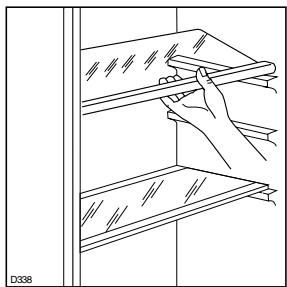
The walls of the refrigerator are equipped with a series of runners so that the shelves can be positioned as desired.
For better use of space, the front half-shelves can lie over the rear ones.
Positioning the door shelves
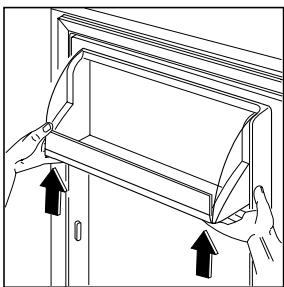
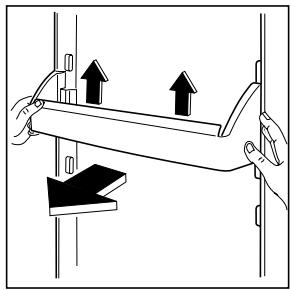
To permit storage of food packages of various sizes, the door shelves can be placed at different heights.
To make these adjustments proceed as follows: Gradually pull the shelf in the direction of the arrows until it comes free, then reposition as required.
Cold accumulators
2 cold accumulators are supplied in the freezer; these increase the length of time for which food will keep in the event of a power failure or breakdown. They must be placed in the top compartment.
Freezing Calendar

The symbols show different types of frozen goods.
The numbers indicate storage times in months for the appropriate types of frozen goods. Whether the upper or lower value of the indicated storage time is valid depends on the quality of the foods and pre-treating before freezing.
Hints for refrigeration
Useful hints:
Meat (all types): wrap in polythene bags and place on the glass shelf above the vegetable drawer.
For safety, store in this way only one or two days at the most.
Cooked foods, cold dishes, etc... these should be covered and may be placed on any shelf.
Fruit and vegetables: these should be thoroughly cleaned and placed in the special drawer(s) provided.
Butter and cheese: these should be placed in special airtight containers or wrapped in aluminium foil or polythene bags to exclude as much air as possible.
Milk bottles: these should have a cap and should be stored in the bottle rack on the door.
Bananas, potatoes, onions and garlic, if not packed, must not be kept in the refrigerator.
Hints for freezing
To help you make the most of the freezing process, here are some important hints:
- The maximum quantity of food which can be frozen in 24 hrs. is shown on the rating plate.
- The freezing process takes 24 hours. No further food to be frozen should be added during this period; only freeze top quality, fresh and thoroughly cleaned foodstuffs.
- Prepare food in small portions to enable it to be rapidly and completely frozen and to make it possible subsequently to thaw only the quantity required.
- Wrap up the food in aluminium foil or polythene and make sure that the packages are airtight.
- Do not allow fresh, unfrozen food to touch food which is already frozen, thus avoiding a rise in temperature of the latter.
- Lean foods store better and longer than fatty ones; salt reduces the storage life of food; water ices, if consumed immediately after removal from the freezer compartment, can possibly cause the skin to be freeze burnt.
- It is advisable to show the freezing-in date on each individual pack to enable you to keep tab of the storage time.
- Do not put carbonated liquids (fizzy drinks, etc.) in the freezer compartment as they may burst.
Hints for storage of frozen food
To obtain the best performance from this appliance, you should:
Make sure that the commercially frozen foodstuffs were adequately stored by the retailer; be sure that frozen foodstuffs are transferred from the food store to the freezer in the shortest possible time; do not open the door frequently or leave it open longer than absolutely necessary. Once defrosted, food deteriorates rapidly and cannot be refrozen. Do not exceed the storage period indicated by the food manufacturer.
MAINTENANCE

Unplug the appliance before carrying out any maintenance operation.
Warning
This appliance contains hydrocarbons in its cooling unit; maintenance and recharging must therefore only be carried out by authorized technicians.
Periodic cleaning
Clean the inside with warm water and bicarbonate of soda.
Rinse and dry thoroughly.
Clean the condenser (black grill) and the compressor at the back of the appliance with a brush or a vacuum cleaner. This operation will improve the performance of the appliance and save electricity consumption.
Interior light
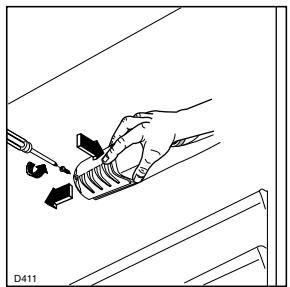
The light bulb inside the refrigerator compartment can be reached as follows:
- Unscrew the light cover securing screw.
- Unhook the moving part as shown in the figure.

If the light does not come on when the door is open, check that it is screwed into place properly. If it still does not light up, change the bulb.
The rating is shown on the light bulb cover.
Defrosting
Frost is automatically eliminated from the evaporator of the refrigerator compartment every time the motor compressor stops, during normal use. The defrost water drains out through a trough into a special container at the back of the appliance, over the motor compressor, where it evaporates.
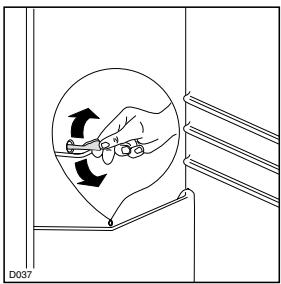
It is important to periodically clean the defrost water drain hole in the middle of the refrigerator compartment channel to prevent the water overflowing and dripping onto the food inside. Use the special cleaner provided, which you will find already inserted into the drain hole.
The freezer compartment, however, will become progressively covered with frost. This should be removed with the special plastic scraper provided, whenever the thickness of the frost exceeds 4 mm. During this operation it is not necessary to switch off the power supply or to remove the foodstuffs.
Periods of non-operation
When the appliance is not in use for long periods, take the following precautions:
remove the plug from the wall socket;
remove all food;
defrost and clean the interior and all accessories;
leave the door ajar to allow air to circulate to prevent unpleasant smells.
Never use sharp metal tools to scrape off frost from the evaporator as you could damage it.
However, when the ice becomes very thick on the inner liner, complete defrosting should be carried out as follows:
- pull out the plug from the wall socket or turn the thermostat knob to the «O» setting;
- remove any stored food, wrap it in several layers of newspaper and put it in a cool place;
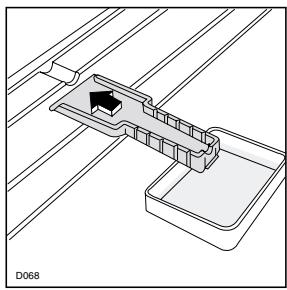
- leave the door open, and insert the plastic scraper in the appropriate seating at the bottom centre, placing a basin underneath to collect the defrost water.
- When defrosting is completed, dry the interior thoroughly; keep the scraper for future use;
- Turn the thermostat knob back to the required setting or replace the plug in the power socket.
- After two or three hours, reload the previously removed food into the compartment.

Important:
Never use sharp metal tools to scrape off frost from the evaporator as you could damage it.
Do not use a mechanical device or any artificial means to speed up the thawing process other than those recommended by the manufacturer.
A temperature rise of the frozen food packs, during defrosting, may shorten their safe storage life.
CUSTOMER SERVICE AND SPARE PARTS
If the appliance is not functioning properly, check that:
- the plug is firmly in the wall socket and the mains power switch is on;
- there is an electricity supply (find out by plugging in another appliance);
- the thermostat knob is in the correct position.
- If there are water drops on the bottom of the cabinet, check that the defrost water drain opening is not obstructed (see "Defrosting" section).
If your appliance is still not working properly after making the above checks, contact the nearest service centre.
To obtain fast service, it is essential that when you apply for it you specify the model and serial number of your appliance which can be found on the guarantee certificate or on the rating plate located inside the appliance, on the bottom left-hand side.
TECHNICAL INFORMATION
| Fridge Net Capacity It. | 210 |
| Freezer Net Capacity It. | 70 |
| Energy Consumption kWh/24h | 0,87 |
| Energy Consumption kWh/annuo | 318 |
| Freezing Capacity kg/24h | 4 |
| Rising Time | 20 |
The technical information is on the rating plate located on the left inside the appliance.
INSTALLATION
Location
The appliance should be installed well away from sources of heat such as radiators, boilers, direct sunlight, etc.
For building into kitchen units, follow the special "Building-in" instructions provided.
Electrical connection
Before plugging in, ensure that the voltage and frequency shown on the serial number plate correspond to your domestic power supply. Voltage can vary by ±6% of the rated voltage.
For operation with different voltages, a suitably sized auto-transformer must be used.
The appliance must be earthed.
The power supply cable plug is provided with a contact for this purpose.
If the domestic power supply socket is not earthed, connect the appliance to a separate earth in compliance with current regulations, consulting a specialist technician.
The manufacturer declines all responsibility if the above safety precautions are not observed.

This appliance complies with the following E.E.C. Directives:
- 87/308 EEC of 2/6/87 relative to radio interference suppression.
- 73/23 EEC of 19.2.73 (Low Voltage Directive) and subsequent modifications;
- 89/336 EEC of 3.5.89 (Electromagnetic Compatibility Directive) and subsequent modifications.

Attention
It must be possible to disconnect the appliance from the mains power supply; the plug must therefore be easily accessible after installation.
Instructions for totally built-in appliances
Door reversibility

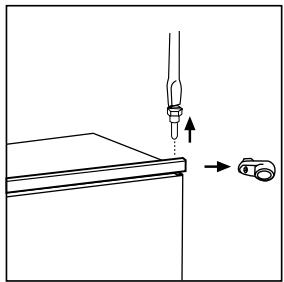
The appliance is supplied with the right left door opening. To change the opening section of the door proceed as in the following instructions before installing it.
- Unscrew the upper pin and remove the spacer.
- Remove the upper pin and the upper door.
- Unscrew the middle hinge.
- Remove the lower door.
- Unscrew the lower pin and refit it on the opposite side
- Refit the lower door.
- Rescrew the middle hinge und the covers on the opposite side.
- Refit the upper door and rescrew the hinge pin and the spacer on the opposite side.
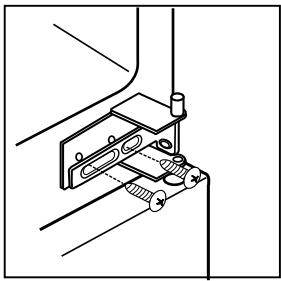
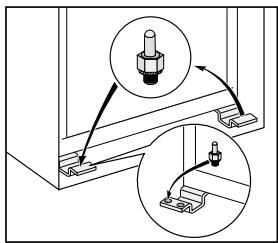

Instructions for totally built-in appliances
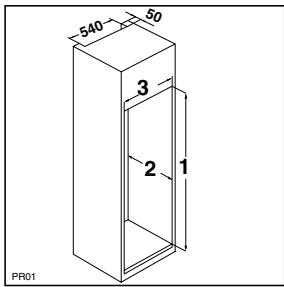
Dimensions of the recess
Height (1) 1780 mm
Depth (2) 550 mm
Width (3) 560 mm
For safety reasons, minimum ventilation must be as shown in Fig. Attention: keep ventilation openings clear of obstruction.
Furthermore, it is necessary that the niche is provided with a ventilation duct having the following dimensions:
depth 50 mm
width 540 mm
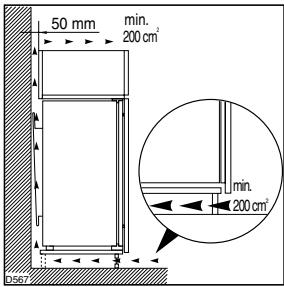
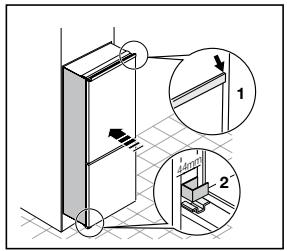
Make sure that a distance of 44 mm is maintained in the lower part between the kitchen furniture and the border of the appliance.
The lower hinge cover inserted in the accessories bag is useful to guarantee the exact position of the kitchen furniture and the appliance.
Also make sure that the appliance does not clamp the mains cable.
Fasten the appliance with 4 screws provided in the kit included with the appliance. (I = short) (P = long)
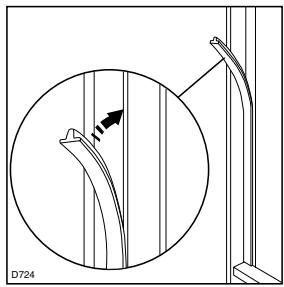
Apply the sealing strip pushing it between the refrigerator and the adjacent cabinet.
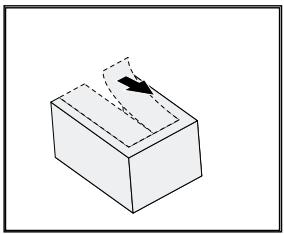
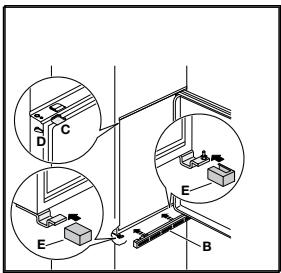
From the plastic cover (E), which is used to cover the hinge with the pivot pin, you must take away the part as indicated in the drawing.
This operation is made easier since there is, in the internal part of the cover hinge lid, a groove that facilitates the removal of this component.
Remove the part marked with DX, if the pivot pin is inserted in the right hinge, SX in the opposite case.
Apply covers (C-D) on joint cover lugs and into hinge holes.
Snap vent grille (B) and hinge covers (E) into position.
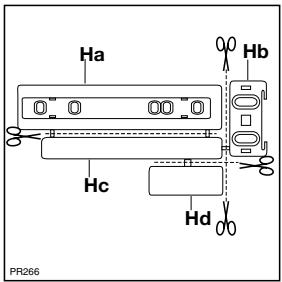
Separate parts Ha, Hb, Hc, Hd as shown in the figure.
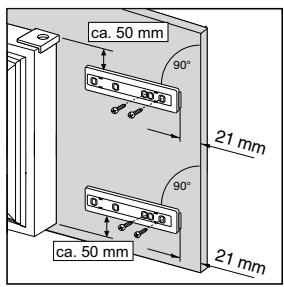
Place guide (Ha) on the inside part of the furniture door, up and down as shown in the figure and mark the position of external holes. After having drilled holes, fix the guide with the screws supplied.
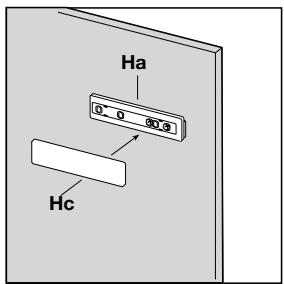
Fix cover (Hc) on guide (Ha) until it clips into place.
Open the appliance door and the furniture door at 90°. Insert the small square (Hb) into guide (Ha).
Put together the appliance door and the furniture door and mark the holes as indicated in the figure.
Remove the brackets and mark a distance of 8 mm from the outer edge of the door where the nail must be fitted (K).
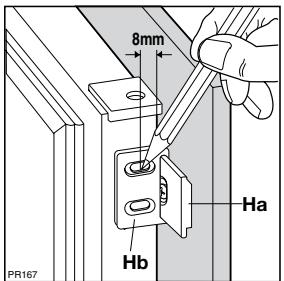
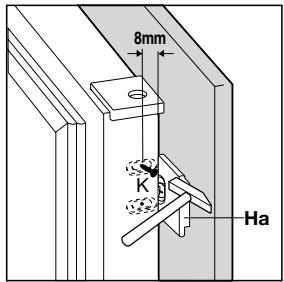
Place the small square on the guide again and fix it with the screws supplied.
Should the lining up of the furniture door be necessary, use the clearance of slots.
At the end of operations, it is necessary to check if the door of the furniture closes properly.
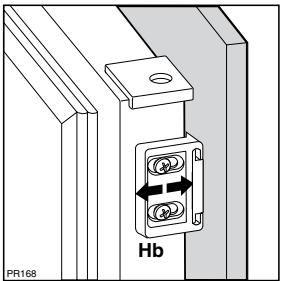
Fix cover (Hd) on guide (Hb) until it clips into place.
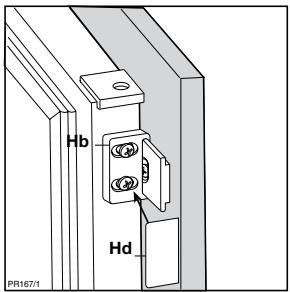
If the appliance is to be fitted laterally to the kitchen unit, it will be sufficient to loosen the screws of the little plates (D), move them as shown in Fig. and then fasten them up again. Fit the cover (E).
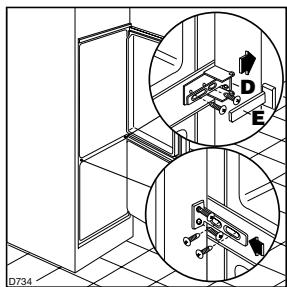
After having reversed the opening direction of the doors, check that all the screws are properly tightened and that the magnetic seal adheres to the cabinet. If the ambient temperature is cold (i.e., in Winter), the gasket may not fit perfectly to the cabinet. In that case, wait for the natural fitting of the gasket or accelerate this process by heating up the part involved with a normal hairdryer.
DECLARATION OF GUARANTEE TERMS
Our appliances are produced with the greatest of care. However, a defect may still occur. Our consumer services department will repair this upon request, either during or after the guarantee period. The service life of the appliance will not, however, be reduced as a result.
This declaration of guarantee terms is based on European Union Directive 99/44/EC and the provisions of the CE Civil Code. The statutory rights that the consumer has under this legislation are not affected by this declaration of guarantee terms.
This declaration does not affect the vendor's statutory warranty to the end user. The appliance is guaranteed within the context of and in adherence with the following terms.
- In accordance with provisions laid down in paragraphs 2 to 15, we will remedy free of charge any defect that occurs within 24 months from the date the appliance is delivered to the first end user. These guarantee terms do not apply in the event of use for professional or equivalent purposes.
- Performing the guarantee means that the appliance is returned to the condition it was in before the defect occurred. Defective parts are replaced or repaired. Parts replaced free of charge become our property.
- So as to avoid more severe damage, the defect must be brought to our attention immediately.
- Applying the guarantee is subject to the consumer providing proof of purchase showing the purchase and/or delivery.
- The guarantee will not apply if damage caused to delicate parts, such as glass, synthetic materials and rubber, is the result ofles.
- The guarantee cannot be called on for minor faults that do not affect the value or the overall reliability of the appliance.
- The statutory warranty does not apply when defects are caused by:
a chemical or electrochemical reaction caused by water; - abnormal environmental conditions in general; unsuitable operating conditions; contact with harsh substances.
- The guarantee does not apply to defects due to transport which have occurred outside of our responsibility. Nor will the guarantee cover those caused by inadequate installation or assembly, lack of maintenance or failure to the assembly instructions or directions for use.
- Defects that result from repairs or measures carried out by people who are not qualified or expert, or defects that result from the addition of non-original accessories or spare parts, are not covered by the guarantee. 10. Appliances that are easy to transport may be delivered or sent to the consumer services department. Home repairs are only anticipated for bulky appliances or built-in appliances. 11. If the appliances are built-in, built-under, fixed, or suspended in such a way that removing and replacing them in the place where they are fitted takes more than half an hour, the costs that result therefrom will be charged for. Connected damage caused by these removal and replacement operations will be the responsibility of the user.
- If, during the guarantee period, repairing the same defect repeatedly is not conclusive, or if the repair costs are considered disproportionate, in agreement with the consumer, the defective appliance may be replaced with another appliance of the same value.
In this event, we reserve the right to ask for a financial contribution calculated according to the length of time it has been used.
13. A repair under guarantee does not mean that the normal guarantee period will be extended nor that a new guarantee period begins. 14. We give a twelve month guarantee for repairs, limited to the same. 15. Except in the event where liability is legally imposed, this declaration of guarantee terms excludes any compensation for damage outside the appliance for which the consumer wishes to assert his right. In the event of legally admitted liability, compensation will not exceed the purchase price paid for the appliance.
These guarantee terms are only valid for appliances purchased and used in Belgium. For exported appliances, the user must first make sure that they satisfy the technical conditions (e.g.: voltage, frequency, installation instructions, type of gas, etc.) for the country concerned, and that they can withstand the local climatic and environmental conditions. For appliances purchased abroad, the user must first ensure that they meet the qualifications required in Belgium. Non-essential or requested adjustments are not covered by the guarantee and are not possible in all cases.
Our consumer services department is always at your disposal, even after the guarantee period has expired.
Address for our consumer services department:
ELECTROLUX HOME PRODUCTS BELGIUM
Bergensesteenweg, 719-1502 LEMBEEK
Teél.02.3630444
www.electrolux.com
www.zanussi.nl


- SAFETY
- GENERAL SAFETY
- SERVICE/REPAIR
- USE
- INSTALLATION
- ATTENTION: KEEP VENTILATION OPENINGS CLEAR OF OBSTRUCTION
- CONTENTS
- WARNINGS
- ENVIRONMENT PROTECTION
- DISPOSAL OF OLD APPLIANCES
- CLEANING THE INTERIOR
- OPERATION
- TEMPERATURE REGULATION
- IMPORTANT
- FRESH FOOD REFRIGERATION
- FREEZING FRESH FOOD
- STORAGE OF FROZEN FOOD
- THAWING
- ICE-CUBE PRODUCTION
- MOVABLE SHELVES
- POSITIONING THE DOOR SHELVES
- COLD ACCUMULATORS
- FREEZING CALENDAR
- HINTS FOR REFRIGERATION
- HINTS FOR FREEZING
- HINTS FOR STORAGE OF FROZEN FOOD
- MAINTENANCE
- WARNING
- PERIODIC CLEANING
- INTERIOR LIGHT
- DEFROSTING
- PERIODS OF NON-OPERATION
- NEVER USE SHARP METAL TOOLS TO SCRAPE OFF FROST FROM THE EVAPORATOR AS YOU COULD DAMAGE IT
- CUSTOMER SERVICE AND SPARE PARTS
- TECHNICAL INFORMATION
- LOCATION
- ELECTRICAL CONNECTION
- THE APPLIANCE MUST BE EARTHED
- THE MANUFACTURER DECLINES ALL RESPONSIBILITY IF THE ABOVE SAFETY PRECAUTIONS ARE NOT OBSERVED
- ATTENTION
- INSTRUCTIONS FOR TOTALLY BUILT-IN APPLIANCES
- DOOR REVERSIBILITY
- DECLARATION OF GUARANTEE TERMS
Brand : ZANUSSI
Model : ZBB7294
Category : Combined refrigerator