
HD4391 - Kettle PHILIPS - Free user manual and instructions
Find the device manual for free HD4391 PHILIPS in PDF.


| Product type | Electric kettle |
| Brand | Philips |
| Model | HD4391 |
| Capacity | 1.7 L |
| Power | 2400 W |
| Voltage | 220-240 V, 50-60 Hz |
| Body material | Stainless steel |
| Swivel base | 360° |
| Anti-scale filter | Removable |
| Auto shut-off | Yes |
| Overheat protection | Yes |
| Water level indicator | Graduated display |
| Lid opening | Push-button |
| Color | Black / Stainless steel |
| Dimensions (L x W x H) | 22 x 22 x 25 cm |
| Net weight | 1.0 kg |
| Cord length | 70 cm |
| Maintenance and cleaning | Descale regularly with vinegar or citric acid |
| Spare parts | Filter, lid, base available |
| Repairability | Repairability index 7.5/10 |
Frequently Asked Questions - HD4391 PHILIPS
User questions about HD4391 PHILIPS
0 question about this device. Answer the ones you know or ask your own.
Ask a new question about this device
Download the instructions for your Kettle in PDF format for free! Find your manual HD4391 - PHILIPS and take your electronic device back in hand. On this page are published all the documents necessary for the use of your device. HD4391 by PHILIPS.
USER MANUAL HD4391 PHILIPS
- Keep page 3 open when reading these operating instructions.
Français Page 7
natural_image
Line drawing of a hand holding a device with a vertical scale and handle (no text or symbols)
natural_image
Line drawing of a hand pouring liquid into a container with a tool, no text or symbols present


natural_image
Illustration of hands using a tool to interact with a device (no text or symbols visible)
natural_image
Diagram showing a red arrow pointing to a rectangular object inside a container (no text or symbols)English
Important
- Read these instructions carefully in conjunction with the illustrations before using the appliance for the first time.
Keep these instructions for future reference. - Before connecting the kettle, check if the voltage indicated on the appliance (underside of kettle and base unit) corresponds with the mains voltage in your home. If this is not the case, contact your dealer and do not use the kettle.
- Use the kettle only with the supplied base unit. Do not use the base unit for other purposes.
- If the mains cord of this appliance is damaged, it must be replaced by the special cord.
Apply to your Philips dealer or the Philips organisation in your country. - Connect the base unit to an earthed wall socket only.
- The kettle is protected against damage due to operation with insufficient water by means of a safety cut-out. This cuts off the power when the heating element gets too hot.
- If the kettle ever is operated with too little or no water, first remove the mains plug from the wall socket. Leave to cool down for 15 minutes before re-filling with cold water. The safety cut-out will automatically reset.
- Place the appliance on a stable flat surface. Ensure that the base unit and the kettle cannot fall into water and that no water can be splashed onto the base unit.
- Never immerse the kettle or the base unit in water. Do not allow water to penetrate the electrical parts inside the kettle or the base unit.
- Prevent children from pulling the mains cord or knocking the kettle over.
- The kettle may be cleaned with a damp cloth. First remove the kettle from the base unit. The base unit can be cleaned in the same manner. First remove the mains plug from the wall socket.
If the kettle is tipped too far backwards, water may be spilt through the rear cover. If this happens the kettle will still be electrically safe. Extra care must be taken if the kettle contains hot or boiling water. - Do not place the kettle on a hot surface.
- Pour away the very first water boiled with this kettle. The appliance is then ready for use.
General description (fig. 1)
A Water gauge
B Lid
On/off switch
D Pilot light
E Base unit with cord storage (underside)
F Connector
G "Filterline" scale filter (with type HD 4391 only)
Cord storage
- The length of the free mains cord from the base can be adjusted.
For added safety, only the minimum length of cord should be visible between the base unit and the wall socket.
The mains cord length can be reduced by pushing the excess cord back into the base
unit. Do not pull heavily on the cord to prevent damage.
- Underneath the base unit there are two alternative mains cord exit points. Select the point that will be closest to the wall socket. Press the cord firmly into the slot.
How to use the kettle
Filling
- Remove the kettle from the base unit before filling.
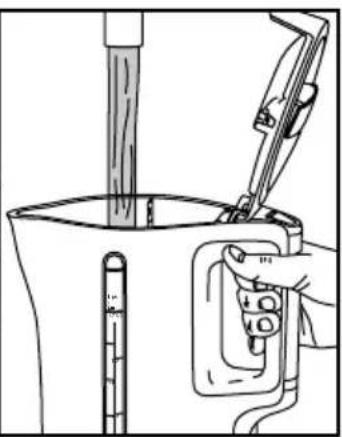
- (Fig. 2a) You can fill the kettle via the spout or...
- (Fig. 2b) ...after opening the lid. Do not forget to close the lid after filling, otherwise the kettle will not automatically switch off after use.
Do not fill with less than 0.35 litre of water (up to "MIN" indication) to prevent the kettle running dry while operating.
Do not fill with more than 1.7 litres of water (up to "MAX" indication).
Avoid overfilling to prevent boiling water being ejected from around the top of the kettle.
Switching on
- (Fig. 3) Place the kettle on the base unit, which is connected to a wall socket. (You can keep the base unit connected.)
- (Fig. 4) The appliance is switched on by setting the on/off switch into the "up" position. The pilot light will come on.
Switching off
- (Fig. 5a) When the water has boiled the appliance switches off automatically.
- (Fig. 5b) At any time you can switch the kettle off manually by setting the on/off switch into the "down" position.
Switching on again?
- If switched off automatically, first allow the built-in thermal safety switch 15-20 seconds to cool down.
Then you may switch on again.
During the cooling down time do not force the on/off switch into the "up" ("ON") position as this can damage the operating mechanism.
Cleaning
- Do not immerse in water.
- The kettle may be cleaned with a damp cloth. First remove the kettle from the base unit. The base unit can be cleaned in the same manner. First remove the mains plug from the wall socket.
- Soap or detergent can be used to remove troublesome stains. Do not use aggressive and abrasive cleaning agents.
Filterline scale filter (with type HD 4391 only)
To prevent loose particles of limescale being poured out into your beverage, your kettle is fitted with a scale filter.
The filter is removable to enable cleaning and replacement.
Limescale deposits
Limescale is a harmless deposit which is naturally formed when (more or less) hard water is heated. It can be found mostly adhered to the heating element.
The amount of limescale deposited (and
subsequently the need to clean or descale) largely depends on the water hardness in your area and the frequency with which the kettle is used. Limescale is not harmful to your health. But if poured into your beverage it can give a powdery taste to your drink.
The scale filter is designed to prevent these scale particles from being poured out by trapping them within the kettle.
Cleaning the scale filter
To avoid an excessive amount of limescale building up inside your kettle, it is important that both the kettle and filter are cleaned on a regular basis.
Scale can be removed from the filter by
- running it under a tap, whilst gently brushing with a soft nylon brush (fig. 6);
-
or by soaking the filter in vinegar or a proprietary descaling agent.
-
Before removing the filter (for replacement or cleaning):
- Ensure that the kettle is unplugged from the mains.
- Do not attempt to remove the filter when hot or when the kettle contains hot water.
- Never leave the filter loose inside the kettle. Ensure that the filter is always correctly placed between the two ribs.
- Slide the filter downwards until it clicks into position (fig. 7).
Periodically: descaling
In the course of time, a build-up of limescale may occur on the filter gauze, reducing the filling (via the spout) and pouring performance of the kettle. Limescale adhered to the heating element will reduce the heating capacity.
Therefore, the kettle with the filter in place, should be descaled periodically as indicated in section "Descaling".
Replacement filters
Replacement filters can be obtained under type nr. HD 4961 from your Philips dealer.
Scale filters can also be applied with kettles type HD 4390 if provided with locating ribs (see fig. 7).
Descaling
Descale the kettle regularly. With normal use: at least twice a year.
- Boil 700 ml of water in the kettle.
- Switch off and unplug from the electrical supply.
- Add 300 ml of ordinary vinegar to the water in
the kettle.
- Leave the solution to stand in the kettle overnight.
- Empty out the solution into e.g. a jug. Rinse the inside of the kettle with clean water.
- Fill the kettle with clean water up to the "MAX" level.
- Boil the water and empty the kettle. Rinse the inside of the kettle with clean water.
If any scale remains:
- Pour the water & vinegar solution into the kettle again.
- Reheat the solution until it starts to fizz again. Then switch off and unplug from the electrical supply. Do not boil.
- Leave the hot solution in the kettle until the fizzing stops.
- Empty out the solution into e.g. a jug and rinse the inside of the kettle thoroughly.
- Fill the kettle with clean water up to the "MAX" level.
- Boil the water and empty the kettle. Rinse the inside of the kettle with clean water.
Fitting a plug
Connections - Applicable to U.K. only
IMPORTANT
WARNING - THIS APPLIANCE MUST BE EARTHED
The wires in this mains lead are coloured in accordance with the following code:
As the colours of the wires in the mains lead of this appliance may not correspond with the coloured markings identifying the terminals in your plug, proceed as follows:
The wire which is coloured GREEN AND YELLOW must be connected to the terminal which is marked with the letter "E" or by the earth symbol ± or coloured GREEN or GREEN AND YELLOW.
The wire which is coloured BROWN must be connected to the terminal which is marked with the letter "L" or coloured RED.
The wire which is coloured BLUE must be connected to the terminal which is marked with a letter "N" or coloured BLACK.
Note: If the terminals of the plug are unmarked or if you are in any doubt consult a qualified electrician.
If a BS 1363 13A plug is used this must be fitted with a 13A fuse.
Français
Important
Kalkfilter schoonmaken


- Français Page 7
- English
- Important
- General description (fig. 1)
- Cord storage
- How to use the kettle
- Filling
- Switching on
- Switching off
- Switching on again?
- Cleaning
- Filterline scale filter (with type HD 4391 only)
- Limescale deposits
- Cleaning the scale filter
- Periodically: descaling
- Replacement filters
- Descaling
- If any scale remains:
- Fitting a plug
- Connections - Applicable to U.K. only
- WARNING - THIS APPLIANCE MUST BE EARTHED
- Français
- Kalkfilter schoonmaken
Brand : PHILIPS
Model : HD4391
Category : Kettle