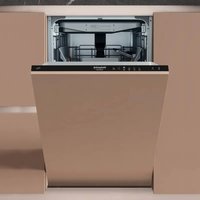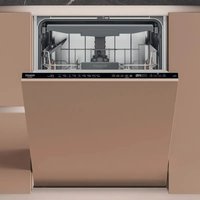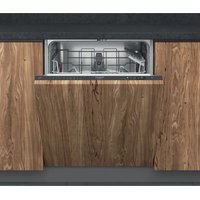
LSFF 9M114 CX EU - Dishwasher HOTPOINT - Free user manual and instructions
Find the device manual for free LSFF 9M114 CX EU HOTPOINT in PDF.



User questions about LSFF 9M114 CX EU HOTPOINT
0 question about this device. Answer the ones you know or ask your own.
Ask a new question about this device
Download the instructions for your Dishwasher in PDF format for free! Find your manual LSFF 9M114 CX EU - HOTPOINT and take your electronic device back in hand. On this page are published all the documents necessary for the use of your device. LSFF 9M114 CX EU by HOTPOINT.
USER MANUAL LSFF 9M114 CX EU HOTPOINT
Operating instructions
DISHWASHER - Contents
Operating instructions,1
Precautions and advice, 2-3
Product Data, 9
Assistance, 11
Installation, 12-13
Description of the appliance, 14
Refined salt and rinse aid, 15
Loading the racks, 16-17
Detergent and dishwasher use, 18
Wash cycles, 19
Special wash cycles and options, 20
Care and maintenance, 21
Troubleshooting, 22

François
Mode d'emploi
LAVE-VAISSELLE - Sommaire
Mode d'emploi, 1
EN Precautions and advice
This appliance was designed and manufactured in compliance with international safety standards. The following information has been provided for safety reasons and should be read carefully.
Keep this instruction manual in a safe place for future reference. If the appliance is sold, given away or moved, make sure the manual is kept with the machine.
Read the instructions carefully, as they include important information on safe installation, use and maintenance.
This appliance was designed for domestic use or similar applications, for example:
-farmhouses;
- use by guests in hotels, motels and other residential settings;
- bed & breakfasts.
Remove the appliance from all packaging and make sure it was not damaged during transportation. If it was damaged, contact the retailer and do not proceed any further with the installation process.
General safety
- This appliance should not be operated by children younger than 8 years, people with reduced physical, sensory or mental capacities, or inexperienced people who are not familiar with the product, unless they are given close supervision or instructions on how to use it safely and are made aware by a responsible person of the dangers its use might entail.
Children must not play with the appliance. - It is the user's responsibility to clean and maintain the appliance. Children should never clean or maintain it unless they are given supervision.
- The appliance was designed for domestic use inside the home and is not intended for commercial or industrial use.
- The appliance must be used to wash domestic crockery in accordance with the instructions in this manual.
- The appliance must not be installed outdoors, even in covered areas. It is extremely dangerous to leave the machine exposed to rain and storms.
- Do not touch the appliance when barefoot.
- When unplugging the appliance always
pull the plug from the mains socket. Do not pull on the cable.
- The water supply tap must be shut off and the plug should be removed from the electrical socket at the end of every cycle and before cleaning the appliance or carrying out any maintenance work.
- The maximum number of place settings is shown in the product sheet.
- If the appliance breaks down, do not under any circumstances touch the internal parts in an attempt to perform the repair work yourself.
- Do not lean or sit on the open door: this may cause the appliance to overturn.
- The door should not be left open as it may create a dangerous obstacle.
- Keep detergent and rinse aid out of reach of children.
- The packaging material should not be used as a toy.
- Knives and other utensils with sharp edges must be placed either with the points/blades facing downwards in the cutlery basket or horizontally on the tip-up compartments or in the tray/third basket, if available.
Disposal
- To dispose of any packaging materials, follow local legislation so that the packagings may be reused.
- The European Directive 2012/19/EU relating to Waste Electrical and Electronic Equipment (WEEE) states that household appliances should not be disposed of using the normal solid urban waste cycle. Exhausted appliances should be collected separately in order to optimise the cost of reusing and recycling the materials inside the machine, while preventing potential damage to the atmosphere and public health. The crossed-out dustbin symbol shown on all products reminds the owners of their obligations regarding separated waste collection.
For further information relating to the correct disposal of household appliances, owners may contact the relevant public authority or the local appliance dealer.
Saving energy and respecting the environment
Saving water and energy
- Only begin a wash cycle when the dishwasher is full. While waiting for the
dishwasher to be filled, prevent unpleasant odours with the Soak cycle (if available, see Wash Cycles).
-
Select a wash cycle that is suited to the type of crockery and to the soil level using the Table of Wash Cycles:
-
For dishes with a normal soil level, use the Eco wash cycle, which guarantees low energy and water consumption levels.
-
If the load is smaller than usual activate the Half Load option (see Special wash cycles and options, if available).
-
If your electricity supply contract gives details of electricity-saving time bands, run the wash cycles when electricity prices are lower. The Delayed Start option can help you organise the wash cycles accordingly (see Special wash cycles and options, if available).
Cy MeH KyaTbI yHeMdey
-
bldbic kyy MaunHaCbI TOJFaH Ke3de
faha kyy zuklbH bactaHbI3. blbc kyy
MaunHaCbIHbI TOnyblH KytIN TypfAHa
XaFBIMCbI3 NiCTepdIH aJbIH aJIbIHbI3 (baP
boIca, «kyy zukdpbI» beNIMIn KaapabI3).
«Kyy Σικλίαρβί» KecteciH naɪdaɪaHa OTbIPbɪn, bɪdɪc-aɪk Tуріне XəHe JɑctaHу ἀρεχεсίH e Kɔlaɪŋbɪ Jxyy ΣικλlbɪN Taɪndaɪhɒl3: -
OptaHaJnactaHFaH bIDbICTap yuIH 3Ko Kyy uNKbIH naJaIaNbIHbI3, ON Kyat peH CydbIH TEmeH DeHrei KOJaHbIaNbIHbIH KaMTaMaCbI3 eTeDi.
-Жуктemeэдпгднанa3бога,Жарынaj ЖуктeyОПцЯсьIH(«Арайыжу лИКларыMeH ОПцялары»белIMINКарань3(бapбога)). - Erep TOK JKTi3y KeIicIM-7apTbIHda TOKtbl yHemDeyre apHaIraH yaKbIT apaIbIKTapbl 6oIca, TeMeH 6aFa KOnDaHbIaTbIH Ke3de Jyy ZnKJdApBIn OpbIHdaHbI3. KEUkTIPIIN BACTAV onuAcbI Jyy ZnKJdApBIn TnicTi TypDe peTteyre KEmeKTece aIaBIs («Aphai/ Jyy ZnKJdApBIm MeH ONUaIapbl» BeJIIMH KapaHbI3 (6ap 6oIca)).
EN Product Data (product fiche)
Product Fiche
| Brand | HOTPOINT ARISTON |
| Model | LSFF 9M114 |
| Rated capacity in standard place settings (1) | 10 |
| Energy efficiency class on a scale from A+++ (low consumption) to D (high consumption) | A+ |
| Energy consumption per year in kWh (2) | 237 |
| Energy consumption of the standard cleaning cycle in kWh | 0.83 |
| Power consumption of the off-mode in W | 0.5 |
| Power consumption of the left-on mode in W | 5.0 |
| Water consumption per year in litres (3) | 2520 |
| Drying efficacy class on a scale from G (low efficacy) to A (high efficacy) | A |
| Programme time for standard cleaning cycle in minutes | 180 |
| The duration of the left-on mode in minutes | 12 |
| Noise in dB(A) Re 1pW | 44 |
| Built-in model | No |
| NOTES | |
| 1) The information on the label and fiche relates to the standard cleaning cycle, this programme is suitable to clean normally soiled tableware and it is the most efficient programme in terms of combined energy and water consumption. The standard cleaning cycle corresponds to the Eco cycle. | |
| 2) Based on 280 standard cleaning cycles using cold water fill and the consumption of the low power modes. Actual energy consumption depends on how the appliance is used. | |
| 3) Based on 280 standard cleaning cycles. Actual water consumption depends on how the appliance is used. | |
FR
Fiche de produit
Before contacting Assistance:
- Check whether the problem can be resolved using the Troubleshooting guide (see Troubleshooting).
- Restart the programme to check whether the problem has ceased to exist.
- If the problem persists, contact the Authorised Technical Assistance Service.
A Never use the services of unauthorised technicians.
Please have the following information to hand:
- The type of malfunction.
- The appliance model (Mod.).
- The serial number (S/N).
This information can be found on the appliance data plate (see Description of the appliance).
FR Service
A KyeJanaHbIbIpblMaHaH MaMaHdapFa Kbl3MeT KepcetKl36eHi3.
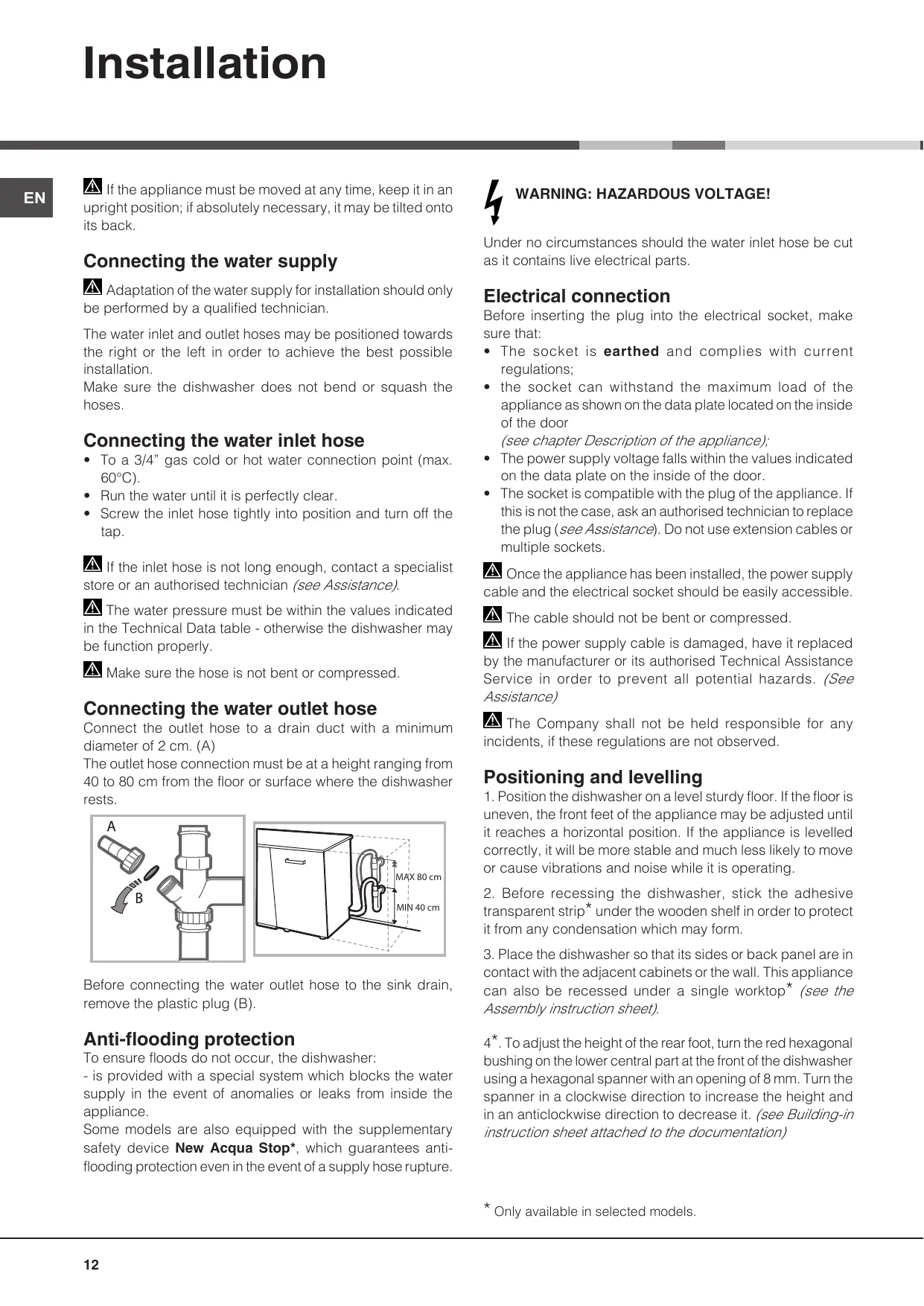
A If the appliance must be moved at any time, keep it in an upright position; if absolutely necessary, it may be tilted onto its back.
Connecting the water supply
Adaptation of the water supply for installation should only be performed by a qualified technician.
The water inlet and outlet hoses may be positioned towards the right or the left in order to achieve the best possible installation.
Make sure the dishwasher does not bend or squash the hoses.
Connecting the water inlet hose
- To a 3 / 4" gas cold or hot water connection point (max. 60^ C ).
- Run the water until it is perfectly clear.
- Screw the inlet hose tightly into position and turn off the tap.
If the inlet hose is not long enough, contact a specialist store or an authorised technician (see Assistance).
The water pressure must be within the values indicated in the Technical Data table - otherwise the dishwasher may be function properly.
A Make sure the hose is not bent or compressed.
Connecting the water outlet hose
Connect the outlet hose to a drain duct with a minimum diameter of 2cm . (A)
The outlet hose connection must be at a height ranging from 40 to 80~cm from the floor or surface where the dishwasher rests.
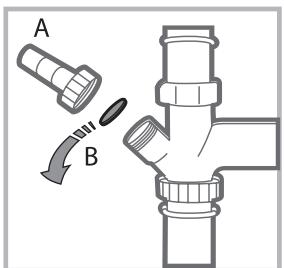
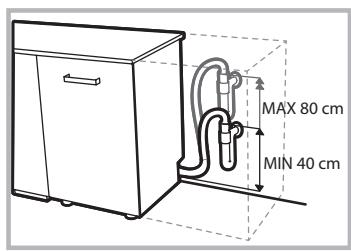
Before connecting the water outlet hose to the sink drain, remove the plastic plug (B).
Anti-flooding protection
To ensure floods do not occur, the dishwasher:
- is provided with a special system which blocks the water supply in the event of anomalies or leaks from inside the appliance.
Some models are also equipped with the supplementary safety device New Acqua Stop*, which guarantees anti-flooding protection even in the event of a supply hose rupture.

WARNING: HAZARDOUS VOLTAGE!
Under no circumstances should the water inlet hose be cut as it contains live electrical parts.
Electrical connection
Before inserting the plug into the electrical socket, make sure that:
- The socket is earthed and complies with current regulations;
- the socket can withstand the maximum load of the appliance as shown on the data plate located on the inside of the door
(see chapter Description of the appliance);
- The power supply voltage falls within the values indicated on the data plate on the inside of the door.
- The socket is compatible with the plug of the appliance. If this is not the case, ask an authorised technician to replace the plug (see Assistance). Do not use extension cables or multiple sockets.
Once the appliance has been installed, the power supply cable and the electrical socket should be easily accessible.
The cable should not be bent or compressed.
If the power supply cable is damaged, have it replaced by the manufacturer or its authorised Technical Assistance Service in order to prevent all potential hazards. (See Assistance)
The Company shall not be held responsible for any incidents, if these regulations are not observed.
Positioning and levelling
- Position the dishwasher on a level sturdy floor. If the floor is uneven, the front feet of the appliance may be adjusted until it reaches a horizontal position. If the appliance is levelled correctly, it will be more stable and much less likely to move or cause vibrations and noise while it is operating.
- Before recessing the dishwasher, stick the adhesive transparent strip* under the wooden shelf in order to protect it from any condensation which may form.
- Place the dishwasher so that its sides or back panel are in contact with the adjacent cabinets or the wall. This appliance can also be recessed under a single worktop* (see the Assembly instruction sheet).
4^ . To adjust the height of the rear foot, turn the red hexagonal bushing on the lower central part at the front of the dishwasher using a hexagonal spanner with an opening of 8 ~mm . Turn the spanner in a clockwise direction to increase the height and in an anticlockwise direction to decrease it. (see Building-in instruction sheet attached to the documentation)
* Only available in selected models.
Advice regarding the first wash cycle
After the installation, remove the stoppers from the racks and the retaining elastic elements from the upper rack (if any).
Water softener settings
Before starting the first wash cycle, set the hardness level of the water from the mains supply. (see chapter Rinse aid and refined salt).
First load the softener tank with water, then introduce about 1 kg of salt. It is perfectly normal for water to flow out.
As soon as this procedure is complete, run a wash cycle.
Only use salt that has been specifically designed for dishwashers.
After the salt has been poured into the machine, the LOW SALT indicator light* switches off.
If the salt container is not filled, the water softener and the heating element may be damaged as a result.
| Technical data | |
| Dimensions | width 45 cm height 85 cm depth 60 cm |
| Capacity | 10 standard place-settings |
| Water supply pressure | 0,05 ÷ 1MPa (0.5 ÷ 10 bar) 7,25 psi – 145 psi |
| Power supply voltage | See appliance data plate |
| Total absorbed power | See appliance data plate |
| Fuse | See appliance data plate |
| CE | This dishwasher conforms to the following European Community Directives: -2006/95/EC (Low Voltage) -2004/108/EC (Electromagnetic Compatibility) -2009/125/EC (Comm. Reg. 1016/2010) (Ecodesign) -97/17/EC (Labelling) -2012/19/ CE Waste Electrical and Electronic Equipment (WEEE) |
The machine has a buzzer/set of tones (depending on the dishwasher model) to inform the user that a command has been implemented: power on, cycle end etc.
The symbols/indicator lights/LEDs on the control panel/ display may vary in colour and may have a flashing or fixed light (depending on the dishwasher model).
The display* provides useful information concerning the type of wash cycle, drying/wash-cycle phase, remaining time, temperature etc.
EN
Overall view
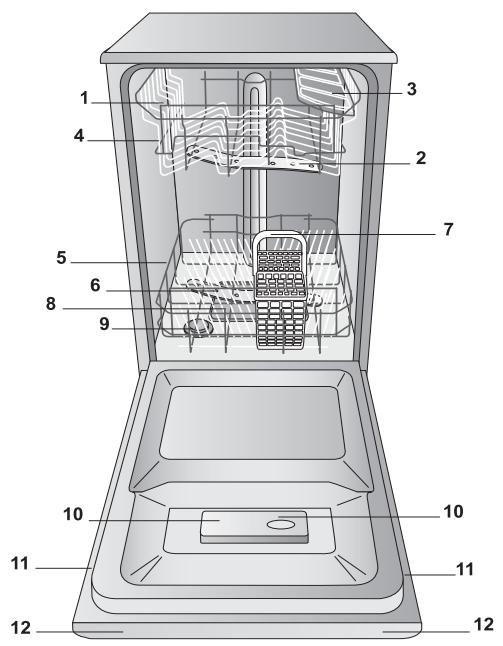
- Upper rack
- Upper spray arm
- Tip-up compartments
- Rack height adjuster
- Lower rack
- Lower spray arm
- Cutlery basket
- Washing filter
- Salt dispenser
- Detergent and rinse aid dispensers
- Data plate
- Control Panel***
Control panel
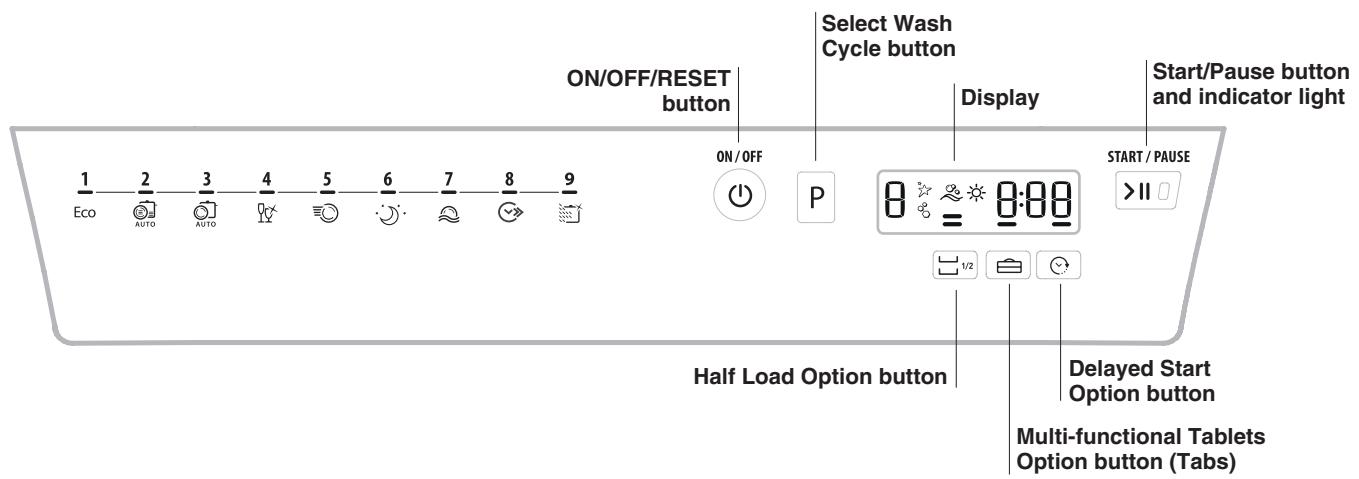
Display
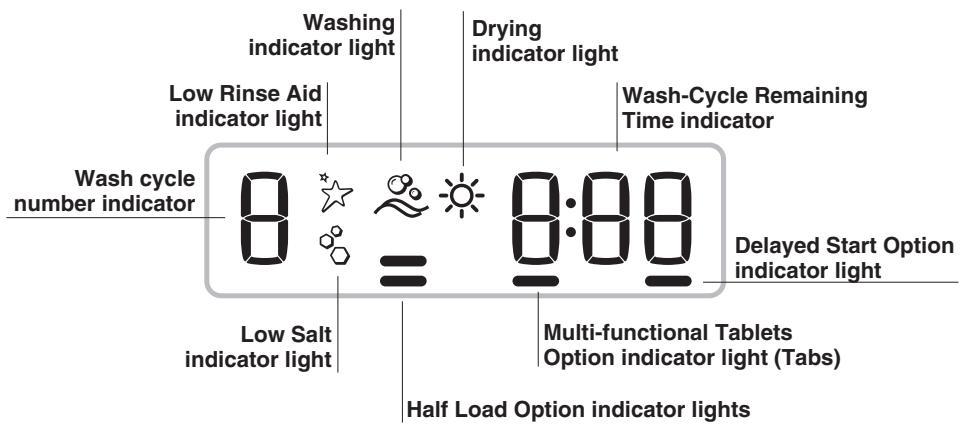
*** Only in completely built-in models.
* Only available in selected models.
The number and type of wash cycles and options may vary depending on the dishwasher model.
Only use products which have been specifically designed for dishwashers. Do not use table salt or industrial salt. Follow the instructions given on the packaging.
If you are using a multi-function product, we recommend that you add salt in any case, especially if the water is hard or very hard. (Follow the instructions given on the packaging.)
A If you do not add salt or rinse aid, the LOW SALT and LOW RINSE AID indicator lights will remain lit.
Measuring out the refined salt
The use of salt prevents the formation of LIMESCALE on the dishes and on the machine's functional components.
- It is important that the salt dispenser be never empty.
- It is important to set the water hardness.
The salt dispenser is located in the lower part of the dishwasher (see Description) and should be filled:
- When the LOW RINSE AID indicator light in the control panel is lit :
- When the green float* on the cap of the salt dispenser is no longer visible.
See autonomy in the water hardness table.
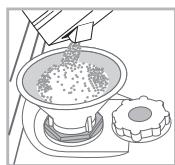
- Remove the lower rack and unscrew the container cap (anticlockwise).
- Only the first time you do this: fill the water dispenser up to the edge.
- Position the funnel (see figure) and fill the salt container right up to its edge
(approximately 1 kg); it is not unusual for a little water to leak out. 4. Remove the funnel and wipe any salt residue away from the opening; rinse the cap under running water and then screw it on. It is advisable to perform this procedure every time you add salt to the container.
Make sure the cap is screwed on tightly, so that no detergent can get into the container during the wash cycle (this could damage the water softener beyond repair).
Whenever you need to add salt, we recommend carrying out the procedure before the washing cycle is started.
Setting the water hardness
For perfect water softener operation, it is essential that the adjustment be based on the water hardness in your house. Ask your local water supplier for this information. The factory setting is for medium water hardness.
- Switch the dishwasher on using the On/Off button.
- Switch it off using the On/Off button (1)
- Hold down the START/PAUSE button for 5 seconds until you hear a beep.
- Switch it on using the On/Off button
- The display shows the current selection level number and the salt indicator light.
- Press button P to select the desired hardness level (see Hardness Table).
- Switch it off using the On/Off button
-
Setting is complete!
-
Only available in selected models.
| Water Hardness Table | Average autonomy salt dispenser with 1 wash cycle per day | |||
| level | °dH | °fH | mmol/l | months |
| 1 | 0 - 6 | 0 - 10 | 0 - 1 | 7 months |
| 2 | 6 - 11 | 11 - 20 | 1.1 - 2 | 5 months |
| 3 | 12 - 17 | 21 - 30 | 2.1 - 3 | 3 months |
| 4 | 17 - 34 | 31 - 60 | 3.1 - 6 | 2 months |
| 5* | 34 - 50 | 61 - 90 | 6.1 - 9 | 2/3 weeks |
| For values between 0°f and 10°f, we do not recommend the use of salt. A setting of 5 may increase cycle duration. | ||||
(^ dH) = hardness measured in German degrees - ^ f = hardness measured in French degrees - mmol/l = millimoles per litre)
Measuring out the rinse aid
Rinse aid makes dish DRYING easier. The rinse aid dispenser should be filled:
- When the LOW RINSE AID indicator light on the panel/display is lit ;
- When the dark optical indicator on the dispenser door “E” becomes transparent.
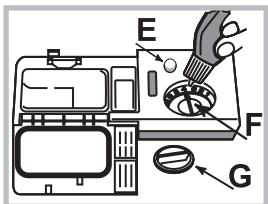
- Open the dispenser by turning the cap "G" in an anticlockwise direction.
- Pour in the rinse aid, making sure it does not overflow from the dispenser. If this happens, clean the spill immediately with a dry cloth.
- Screw the cap back on.
NEVER pour the rinse aid directly into the tub.
Adjusting the amount of rinse aid
If you are not completely satisfied with the drying results, you can adjust the quantity of rinse aid used. Turn the adjuster "F". A maximum of 4 levels can be set according to the dishwasher model. The factory setting is for a medium level.
- If you see bluish streaks on the dishes, set a low number (1-2).
- If there are drops of water or limescale marks on the dishes, set a high number (3-4).
Tips
Before loading the racks, remove all food residues from the crockery and empty liquids from glasses and containers. No preventive rinsing is needed under running water.
Arrange the crockery so that it is held in place firmly and does not tip over; and arrange the containers with the openings facing downwards and the concave/convex parts placed obliquely, thus allowing the water to reach every surface and flow freely.
Make sure that the lids, handles, trays and frying pans do not prevent the spray arms from rotating. Place any small items in the cutlery basket.
Since plastic dishes and non-stick frying pans usually retain more water drops, their drying will be not so good as that of ceramic or stainless-steel dishes.
Lightweight items such as plastic containers should be placed in the upper rack and arranged so that they cannot move.
After loading the appliance, make sure that the spray arms can rotate freely.
Lower rack
The lower rack can hold pans, lids, dishes, salad bowls, cutlery etc. Large plates and lids should ideally be placed at the sides.
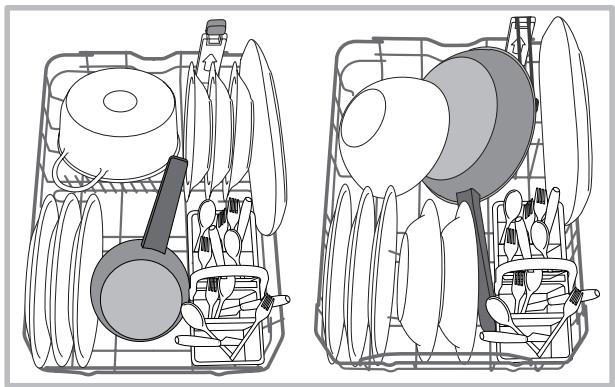
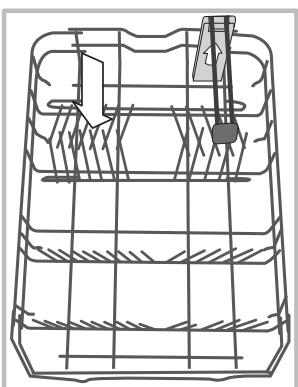
Several dishwasher models are fitted with tip-up sectors*
They can be used in a vertical position when arranging dishes or in a horizontal position (lower) to load pans and salad bowls easily.
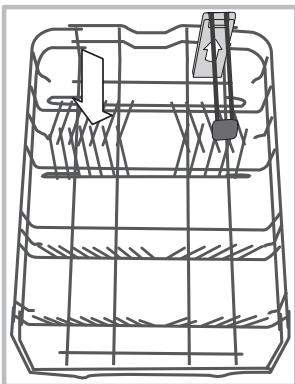
Some models are equipped with Vertical Zone, special pull-out supports*in the rear of the rack that can be used to support frying pans and baking pans in a more vertical position, thus taking up
less space.
In order to use it, just get hold of the coloured grip and pull it upwards while rotating it forward. The supports can slide right and left to fit the size of the crockery.
Very soiled dishes and pans should be placed in the lower rack because in this sector the water sprays are stronger and allow a higher washing performance.
Cutlery basket
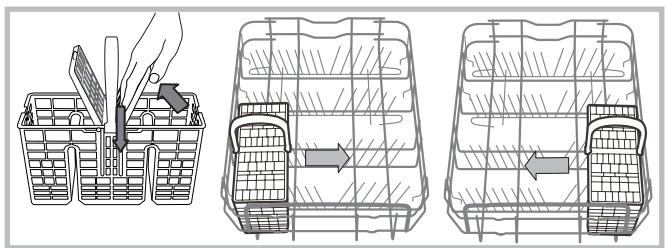
The basket is equipped with top grilles for improved cutlery arrangement. The cutlery basket should be positioned only at the front of the lower rack.
Upper rack
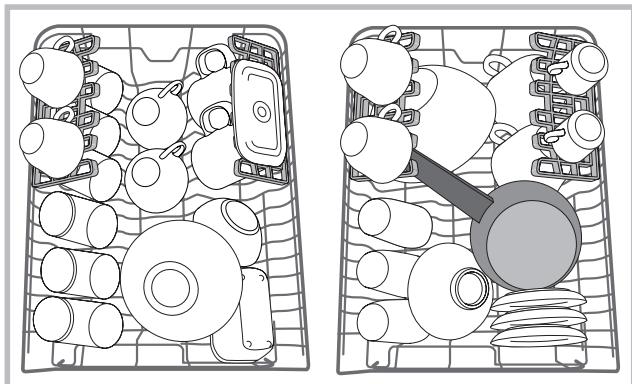
Load this rack with delicate and lightweight crockery such as glasses, cups, saucers and shallow salad bowls.
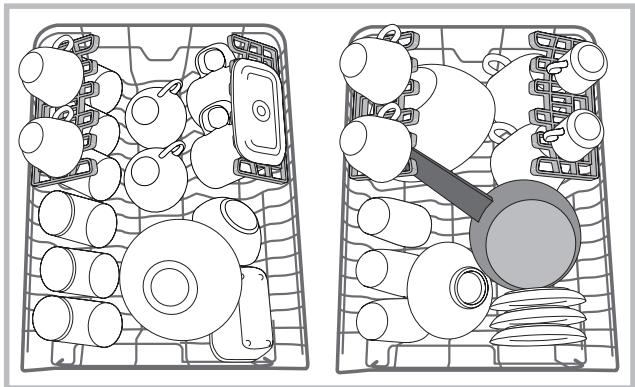
Adjustable position tip-up compartments*
The side tip-up compartments can be positioned at three different heights to optimize the arrangement of the crockery inside the rack.
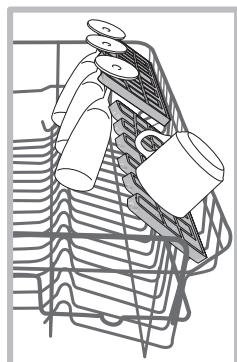
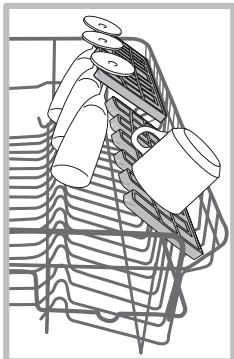
Wine glasses can be placed safely in the tip-up compartments by inserting the stem of each glass into the corresponding slot.
For optimum drying results incline the tip-up compartments more. To change the inclination, pull up the tip-up compartment, slide it slightly and position it as you wish.
*Only available in selected models with different numbers and positions.
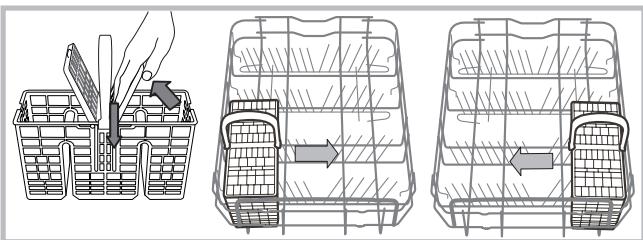
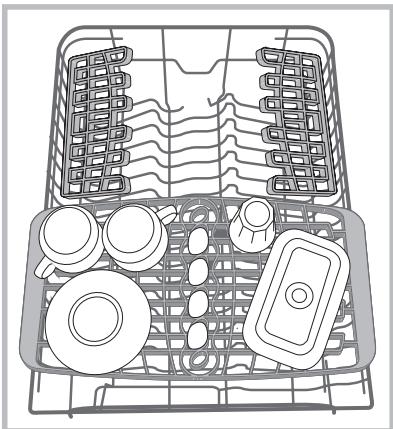
Tray*
Some dishwasher models are fitted with a sliding tray which can be used to hold small crockery and cutlery. For optimum washing performance, avoid positioning bulky crockery directly below the tray. The cutlery tray can be removed. (see Figure.)
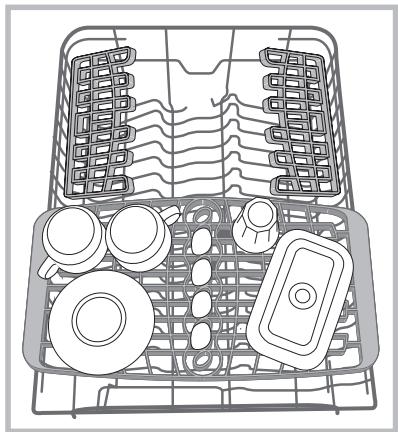
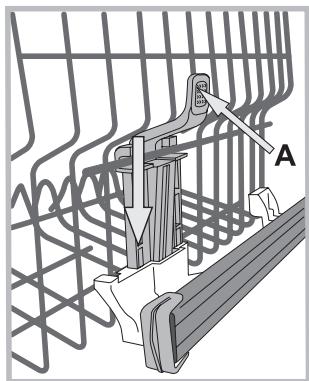
Adjusting the height of the upper rack
The height of the upper rack can be adjusted: high position to place bulky crockery in the lower rack and low position to make the most of the tip-up compartments by creating more space upwards.
The height of the upper rack should be adjusted WHEN THE RACK IS EMPTY.
NEVER raise or lower the rack on one side only.
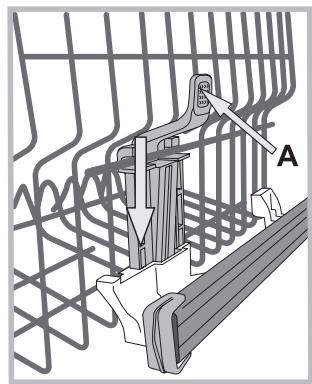
If the rack is equipped with a Lift-Up device* (see figure), lift it up by holding its sides. To restore the lower position, press the levers (A) at the sides of the rack and follow the rack down.
Unsuitable crockery
Wooden crockery and cutlery.
- Delicate decorated glasses, artistic handicraft and antique crockery. Their decorations are not resistant.
- Parts in synthetic material which do not withstand high temperatures.
Copper and tin crockery.
- Crockery soiled with ash, wax, lubricating grease or ink.
The colours of glass decorations and aluminium/silver pieces can change and fade during the washing process. Some types of glass (e.g. crystal objects) can become opaque after a number of wash cycles too.
Damage to glass and crockery
Caused by:
- Type of glass and glass production process.
Chemical composition of detergent.
Water temperature of rinse cycle.
Tips:
- Only use glasses and porcelain guaranteed by the manufacturer as dishwasher safe.
- Use a delicate detergent suitable for crockery.
- Collect glasses and cutlery from the dishwasher as soon as the wash cycle is over.
Measuring out the detergent
Good washing results also depend on the correct amount of detergent being used. Exceeding the stated amount does not result in a more effective wash and increases environmental pollution.
The amount can be adjusted to the soil level.
In the case of normally soiled items, use approximately either 35g (powder detergent) or 35ml (liquid detergent). If tablets are used, one tablet will be enough.
If the crockery is only lightly soiled or if it has been rinsed with water before being placed in the dishwasher, reduce the amount of detergent used accordingly.
For good washing results also follow the instructions shown on the detergent box.
For further questions please ask the detergent producers.
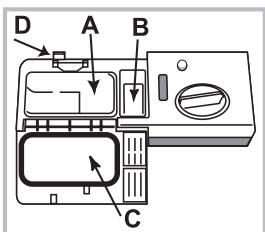
Open the detergent dispenser using button D and measure out the detergent according to the Table of wash cycles:
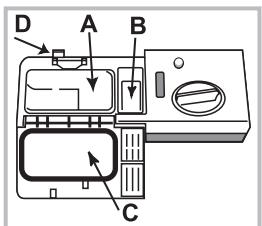
- powder or liquid: compartments A (wash detergent) and B (pre-wash detergent)
- tablets: when the cycle requires 1 tablet, place it in compartment A and close cover C; when it requires 2 tablets, place the second tablet on the bottom of the appliance.
Remove detergent residues from
the edges of the compartment and close cover C until it clicks. The detergent dispenser automatically opens up at the right time according to the wash cycle.
If all-in-one detergents are used, we recommend using the TABS option, because it adjusts the cycle so that the best washing and drying results are always achieved.
Only use detergent which has been specifically designed for dishwashers.
DO NOT USE washing up liquid.
Using excessive detergent may result in foam residues remaining in the machine after the cycle has ended.
To achieve the best washing and drying results, the combined use of detergent, rinse aid liquid and refined salt is required.

We recommend using detergents that do not contain phosphates or chlorine, as these products are harmful to the environment.
Starting the dishwasher
- Turn the water tap on.
- Press the ON/OFF button.
- Open the door and pour in a suitable amount of detergent (see Measuring out the detergent.)
- Load the racks (see Loading the racks) and close the door.
- Select the wash cycle in accordance with the type of crockery and its soil level (see Table of wash cycles) by pressing the P button.
- Select the wash options (see Options).
- Press the Start/Pause button to start the cycle (fixed light): a long beep signals the start of the wash cycle, the cycle indicator lights up and the display shows the cycle number and the time remaining until the end of the cycle.
- Two short beeps and one long beep indicate the end of the wash cycle, the Start/Pause button switches off and the word END appears on the display. Switch off the appliance by pressing the ON/OFF button.
- Wait for a few minutes before removing the crockery - to avoid burns. Unload the racks, beginning with the lower level.
The machine will switch off automatically during long periods of inactivity in order to minimise electricity consumption.
AUTO WASH CYCLES*: some models of dishwasher are equipped with a special sensor which can be used to assess the level of soiling and automatically select the most efficient and economic wash cycle accordingly. The duration of the auto wash cycles may vary due to the operation of the sensor.
Changing a wash cycle in progress
If a mistake was made in the wash-cycle selection process, it is possible to change the cycle provided that it has only just begun: Once the wash cycle has started, in order to change the wash cycle switch off the machine by pressing and holding the ON/OFF/Reset button. Switch it back on using the same button and select the desired wash cycle and options.
Adding extra crockery
Press the Start/Pause button and open the door, taking care to avoid the escaping steam. Then place the crockery inside the dishwasher. Press the Start/Pause button: The cycle will start again after a long beep has been emitted.
A If the delayed start has been set, at the end of the countdown the wash cycle will not start. It will stay in Pause mode.
Press the Start/Pause button to pause the machine; the wash cycle is stopped.
At this stage the wash cycle cannot be changed.
Accidental interruptions
If the door is opened during the wash cycle or there is a power cut, the cycle stops. It starts again from the point at which it was interrupted once the door has been shut or the electricity supply restored.
Wash-cycle data is measured under laboratory conditions according to European Standard EN 50242.
Based on the different conditions of use, the wash-cycle duration and data can change.
The number and type of wash cycles and options may vary depending on the dishwasher model.
| Wash cycle | Wash cycle which include drying | Options | Approximate duration of wash cycles h:min. | Water consumption (l/cycle) | Energy consumption (KWh/cycle) |
| 1. Eco | Yes | Delayed start – Half Load - Tabs | 03:00 | 9,0 | 0,83 |
| 2. Auto Intensive AUTO | Yes | Delayed start – Half Load - Tabs | 02:20 - 03:00 | 13,0 - 14,0 | 1,20 - 1,45 |
| 3. Auto Normal AUTO | Yes | Delayed start – Half Load - Tabs | 01:40 - 02:20 | 13,5 - 14,5 | 1,00 - 1,20 |
| 4. Delicates | Yes | Delayed start – Half Load - Tabs | 01:40 | 9,0 | 0,90 |
| 5. Express | No | Delayed start – Tabs | 00:25 | 8,0 | 0,45 |
| 6. Good Night | Yes | Delayed start – Tabs | 03:30 | 13,0 | 0,85 |
| 7. Soak | No | Delayed start – Half Load | 00:10 | 4,0 | 0,01 |
| 8. Short Time | Yes | Delayed start – Tabs | 01:20 | 15,5 | 1,05 |
| 9. Ultra Intensive | Yes | Delayed start – Half Load - Tabs | 02:50 | 17,0 | 1,50 |
Instructions on wash-cycle selection and detergent dosage
- The ECO wash cycle is the standard cycle to which the energy label data refers. It can be used to wash crockery with a normal soil level and is the most efficient cycle in terms of energy and water consumption for this type of crockery.
4 gr/ml* + 21 gr/ml - 1 Tab (Quantity of pre-washing detergent) - Heavily soiled dishes and pans (not to be used for delicate items). 25 gr/ml - 1 Tab
- Normally soiled pans and dishes. 4 gr/ml** + 21 gr/ml - 1 Tab
- Cycle for delicate items, which are more sensitive to high temperatures 25 gr/ml - 1 Tab
- Fast cycle to be used for slightly dirty dishes (ideal for 2 place settings) 21 gr/ml - 1 Tab
- Optimum performance ensured. Ideal for night-time operation. 25 gr/ml - 1 Tab
- Pre-wash while awaiting completion of the load with the dishes from the next meal. No detergent.
- Quick wash and dry cycle, suitable for crockery and pans with a normal soil level. 25 gr/ml - 1 Tab
- Heavily soiled saucepans or pans with residual dried-on food. 4 gr/ml**+ 25 gr/ml - 1+1 Tab
Standby consumption: Left-on mode consumption: 5 W - Off mode consumption: 0.5 W.
Special wash cycles and Options
EN
Notes:
Optimum performance levels when using the "Express" cycles can be achieved by respecting the specified number of place settings.
To reduce consumption even further, only run the dishwasher when it is full.
Note for Test Laboratories: for information on comparative EN testing conditions, please send an email to the following address: assistenza_en_lvs@indesitcompany.com
Wash options*
The OPTIONS may only be set, changed or reset after the wash cycle has been selected and before the Start/Pause button has been pressed.
Only the options which are compatible with the type of wash cycle set may be selected. If an option is not compatible with the selected wash cycle (see Table of wash cycles), the corresponding symbol flashes rapidly 3 times.
If an option is selected which is not compatible with another (previously selected) option, it will flash 3 times and switch off, while the most recently selected option will remain active.
To deselect an option which has been set by mistake, press the corresponding button again.

Delayed start
It is possible to delay the start time of the cycle by a period of time between 1 and 24 hours:
- Select the desired wash cycle and any other options required; press the DELAYED START button. The indicator light will go on. Use the same button to select when the wash cycle will start (h01, h02 etc.)
- Confirm the selection using the START/PAUSE button to start the countdown.
- Once this time has elapsed, the DELAYED START indicator light goes off and the wash cycle begins.
To deselect the DELAYED START option, press the DELAYED START button until the text OFF appears.

The Delayed Start function cannot be set once a washer cycle has started.

Half load using the upper or lower rack
1/2 If there are not many dishes to be washed, a half load cycle may be used in order to save water, electricity and detergent. Select the wash cycle and then press the HALF LOAD button: the indicator corresponding to the chosen rack lights up and the wash cycle starts only in the upper or lower rack.
Remember to load the upper or lower rack only, and to reduce the amount of detergent accordingly.

Multi-functional tablets (Tabs)
This option optimises washing and drying results.
When using multi-functional tablets, press the MULTIFUNCTIONAL TABLETS button; the corresponding symbol will light up. If the button is pressed again, the option will be deselected.
The "Multi-functional tablets" option results in a longer wash cycle.
Shutting off the water and electricity supplies
- Turn off the water tap after every wash cycle to avoid leaks.
- Always unplug the appliance when cleaning it and when performing maintenance work.
Cleaning the dishwasher
- The external surfaces of the machine and the control panel can be cleaned using a non-abrasive cloth which has been dampened with water. Do not use solvents or abrasive products.
- Any marks on the inside of the appliance may be removed using a cloth dampened with water and a little vinegar.
Preventing unpleasant odours
Always keep the door of the appliance ajar in order to avoid moisture from forming and being trapped inside the machine.
- Clean the seals around the door and detergent dispensers regularly using a damp sponge. This will avoid food becoming trapped in the seals, which is the main cause behind the formation of unpleasant odours.
Cleaning the spray arms
Food residue may become encrusted onto the spray arms and block the holes used to spray the water. It is therefore recommended that you check the arms from time to time and clean them with a small non-metallic brush.
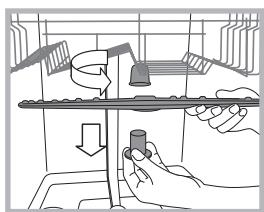
The two spray arms may both be removed.
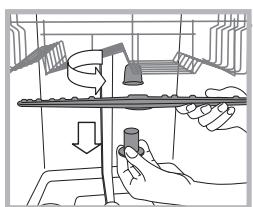
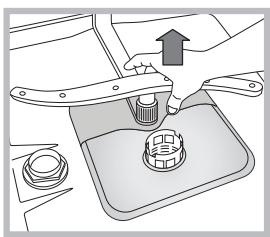
To remove the upper spray arm, turn the plastic locking ring in an anti-clockwise direction. The upper spray arm should be replaced so that the side with the greater number of holes is facing upwards.
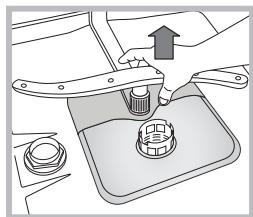
The lower spray arm can be removed by pressing on the side tabs and pulling it upwards.
Cleaning the water inlet hose*
If the water hoses are new or have not been used for an extended period of time, let the water run to make sure it is clear and free of impurities before performing the necessary connections. If this precaution is not taken, the water inlet could become blocked and damage the dishwasher.
Clean the water inlet filter at the tap outlet regularly.
- Turn off the water tap.
- Unscrew the end of the water inlet hose, remove the filter and clean it carefully under running water.
- Re-place the filter and screw the water hose back into position.
Cleaning the filters
The filter assembly consists of three filters which remove food residues from the washing water and then recirculate the water. They must be cleaned if you wish to achieve the best results in every wash.
Clean the filters regularly.
The dishwasher must not be used without filters or if the filter is loose.
- After several washes, check the filter assembly and if necessary clean it thoroughly under running water, using a non-metallic brush and following the instructions below:
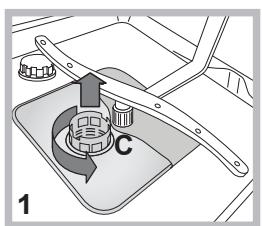
1. Turn the cylindrical filter C in an anti-clockwise direction and pull it out (fig. 1).
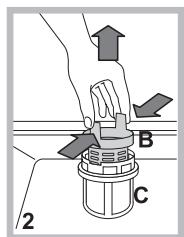
2. Remove the cup filter B by exerting a slight pressure on the side flaps (fig. 2);
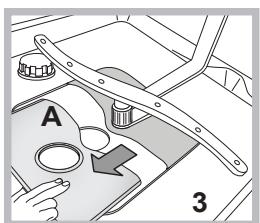
3. Slide out the stainless-steel plate filter A. (fig. 3).
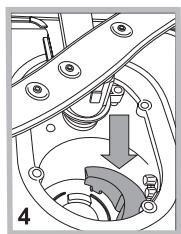
4. Inspect the trap and remove any food residues. NEVER REMOVE the wash-cycle pump protection (black detail) (fig.4).
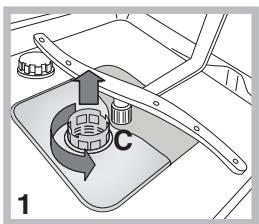

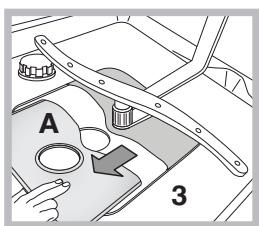
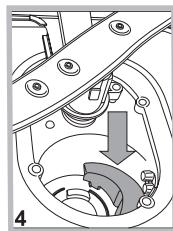
After cleaning the filters, re-place the filter assembly and fix it in position correctly; this is essential for maintaining the efficient operation of the dishwasher.
Leaving the machine unused for extended periods
- Disconnect the appliance from the electricity supply and shut off the water tap.
- Leave the door of the appliance ajar.
-
When you return, run a wash cycle when the dishwasher is empty.
-
Only available in selected models.
Whenever the appliance fails to work, check for a solution from the following list before calling for Assistance.
| Problem: | Possible causes / Solutions: |
| The dishwasher does not start or cannot be controlled. | ·The water supply tap is not turned on. ·Switch off the appliance by pressing the ON/OFF button, switch it back on after approximately one minute and reset the wash cycle. ·The appliance has not been plugged in properly or another electricity socket should be used. ·The dishwasher door has not been closed properly. |
| The door won't close. | ·Make sure that the racks were inserted all the way. ·The lock was released. Strongly push the door until a “clacking” noise is heard. |
| No water drain out of the dishwasher. | ·The wash cycle has not finished yet. ·The water drain hose is bent (see Installation). ·The drain duct is clogged up. ·The filter is clogged up with food residues. ·Check the height of the drain hose. |
| The dishwasher makes excessive noise. | ·The dishes are rattling against each other or against the sprayer arms. Place the dishes properly and make sure the sprayer arms can rotate freely. ·Too much foam: the detergent has not been measured out correctly or it is not suitable for use in dishwashers. (See Detergent and dishwasher use.) Do not prewash the dishes by hand. |
| The dishes and glasses are covered in a white film or limescale deposits. | ·No refined salt. ·Water hardness adjustment is not suitable: increase the relevant values. (See Refined Salt and Rinse Aid.) ·The salt and rinse-aid dispenser cap has not been closed properly. ·The rinse aid has been used up or the dosage is too low. |
| The dishes and glasses are streaked or have a bluish tinge. | ·The rinse aid dosage is too high. |
| The crockery has not been dried properly. | ·A wash cycle without a drying programme has been selected. ·The rinse aid has been used up. (See Refined Salt and Rinse Aid.) ·The rinse aid dispenser setting is not suitable. ·The crockery is made from non-stick material or plastic; the presence of water drops is normal. |
| The dishes are not clean. | ·The crockery has not been arranged properly. ·The sprayer arms cannot rotate freely, being hindered by the dishes. ·The wash cycle is too gentle (see Wash Cycles). ·Too much foam: the detergent has not been measured out correctly or it is not suitable for use in dishwashers. (See Detergent and dishwasher use.) ·The lid on the rinse aid compartment has not been closed correctly. ·The filter is dirty or clogged up (see Care and maintenance.) ·The refined salt level is low (See Refined Salt and Rinse Aid.) ·Make sure that the height of the dishes is compatible with the rack adjustment. ·The holes in the sprayer arms are clogged up. (See Care and maintenance.) |
| The dishwasher won't load any water. It is blocked with flashing lights. | ·There is no water in the mains supply or the tap is shut off. ·The water inlet hose is bent (see Installation). ·The filters are clogged up: they need cleaning. (See Care and maintenance.) ·The drain duct is clogged up: it needs cleaning. ·After checking and cleaning, switch the dishwasher on and off and start a new wash cycle. ·If the problem persists, turn off the water tap, remove the plug and call the Service Centre. |
- Only available in selected models.
Raccordements hydrauliques
Tnpabnueckne coeHHeHHa
AaantauyraDpaBnuecko Cntembl DnMaOTaxaNocydomoeuHmMaHHbI DOJXHa BbINOHNrTcRToNbKO KBaJIINpUOBAHbIM TEXHkOM.
IJIaHn IOnaun CInBa BOdb MoYt 6bItb HappaBneHb BnpaBO nIN BNeBO DnI ONTImaJbHOy UCTaHOBKn MaUNHb. Tpy6bl He DoJIxHb 3aJIaMbIBaTbcra NIN cDaBnBaTcMa- shHoN.
IopcoeHHeHne ⅢaHra nOdaun BObbl
Y3Opbl nO CTekIy, aJIOMMHHeBbIe I CEpe6pHbIe 3NeMeHTbI MOrTy IN3MeHnTb CBOI CBEt N POINHrTb. HeKOTOpblc BnDbI cTeKla (HaPnIMep, XpyTaIb) NOcJIe MHOROKpaTHoM MoKN MOrTy cTaTb MATOBblM.
PobpekdeHne cTeKla n nocydbI
PnUHbI:
TIN MToD N3ROTOBJeHnCTeKJa.
XIMMueckn COCTAB MOUeRO BeueCTBa.
Tempepatya BODIb I nporpaMMe OonoackBaHna.
Pekomehdauin:
- IcnoIb3OBAt b ToIbKO cTaKaHa n φapφop, ImeIoUne rapaHTnIO npOn3BODInTeJI y DJIyMbITbBy B NocCyDOMoeHbIX MaunHax.
- IcnoIb3OBAt b MOIOJIe BSeIeCTBO, npeHa3NaeHHoe CneuaJIbHO dIg NocyDOMOeHbIX MaIIINH.
- BbIHyt b cTaKaHb i n cToJolBbI npi6Opb i n3 nocyDomOeHoi MaunHb KaK MOxHO CKopee no 3aBepWeHNn pOrpaMMbl.
CpeIcTBA npOTnB HnnpTbIX 3anaxOB
Bcerda ocTabIaIte DBepu MaunHbI nOly-npIKpbITOn BO n36exKaHne 3acto BlaXHOCTn.
- Perylaryno npouuzaite nepimetpaNbhe ynploTHenn IDBepcI INdo3aTopoB MOUeero cpeDCTBa pni NMOOn BnaXHoN r6Kn. TaKIM oBa3OM ydaJIaOTc8 OCTaTK Niu -OCHOBHO npuHbI oBa3BaHn HEnpriaTHbIX 3anaxOB.
Unctka opocnteien
OctaTkn Pnun MOryT npJInnHyTb K Nonactm opocnteien n 3acopntb OTBepCTn, n3 KOtOpbIX BbIXoINT BoDa: Bpem O T BpemeHn CneJeYET npOBepaTb opocnteien n npOuNcaTb Nx HEMetanJInuYeCKoN IeTKoN.
O6a opocnteJRABnHOTcCbeMHbIM.
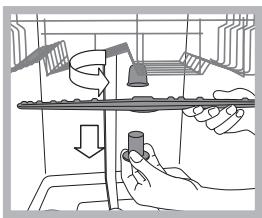
Дя сьема Верх Hero opocintela Heo6xOIMMO OTBnHTntb npOTNB yacoboi cTpTeKN pIaCTmaccobyo raKy. BepxHn opocintb yctahabJINaBaETcra OTBepCTnramn BBepx.
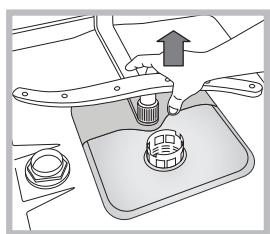
EcnBamHaioObpaTbCBy CepBnchbI ueHTp:
BhImaHne! PnppeMOHTe Tpe6yIte IcNoJIb3OBAHnOpuHaJIbHbIX 3anaChbIX YacTei.
Ipeed tem kak o6paTntbCBA CepBc TexHnueckoro 6cbJyXnBaHHa:
- Пюверьт, мохно Ли устравн'tь Heисправноь самостялбно (сm. Иисправнои MeToДы nx yстравен).
BHOb3anyctnte nporpammy dny npobepkn ncpnpaBHocT MaunHbl.
B npotnbHOM cnyae o6paTntecb BynoJIHOMOeHHbI CepBnC TexHnueckOro 6cbnykBaHna.
A HnKorda He o6paaTecsb K HeynoJHOMOeHHbIM TexHnKaM.
Pn o6paueHn B CepBna Texnueckoro 06cJyXnBaHn coo6uHTe:
XapakTepeHncpabHoctn
- MoDJIb n3dEIny (MoI.)
- cepиньий Homep ("S/N")
3Tn daHHbIe Bbl haJeTe Ha nacnpTHoT Ta6nUKe, paCnoJooKHeHOr Ha n3dJIIN (cm. OnPcAHne n3dJIInr).
Cy aIbIn KeTyuDeH KopFay
Cy aIbIn KeTyIe Jxon 6epMey yuH, bIDbc Jyy MaunHacbl: - KaIbInCbI3 KzaFdaiNapda Hemece KypblfBihH iUiHeH cy aFBIn KeTKeH Ke3De cy Ke3IH 6yTaTTaTbH apHaBb IxyJEmEH Xa6DbIKtanraH.
CoHdaI-ak, Kei6ip yIrrinep New Acqua Stop* den atanaTbIH KocbIMwa Kayinc3dIK KypaIbIme Hka6dbkTaNfAH, ON TiNti Kipic TyTirih KbIpTBJbn KeTKeHHde de cy aIbIn KeTydeH KopfaIbI.
- Tek keh6ip ynlirape 6ap.
ECKEPTY: KAYINTI KEPHEY!
Cydbin kipic tyTirih eW6ip kafdaia KInoBb 60MaHb3, ce6ebi OHda TOK eTeiH 3neKtp 6enikTep 6ap.
Tokka kajfay
AиbIpdbIpo3eTKaFaKocnac6ypbIH,MbHaXaFdaNapraKe3 XeTKi3iH3:
- Po3eTka Jxepre TynbIKtanFaH XHe aftbIMdaIpejxeJepre caikec keeni.
p03eTka KypblfblHbH eH KEN KyaTbHa 乌da anaDbI. Byn mAn ecikTIH iKki JkaFbIHda opHaJnackaH depeKTeP tiImuueciHde KepcetinreH (Kypblfbl CNTaTTAmcbI) TaaybH KapaHb3); - Tok keleniciinH kepheyi depekter tiimuseciHne kepcTiJireH Məndep aykbmbiHda JkaTbip.
- P03etka kþpblfblhIn wTeNCenblik yUsbHa cəiKeC keJIeI. Oaai 6oImaca, kyənaHdbIpblfHaM mAmHdbI uKaBipTbIn, aibipbl aybictbipbl3 («Kemek» 6eJIMin KapaHb3). ¥3apTy ka6ebndepin Hemece 6ipHeWe po3etkahbl kondaHbAhl3.
A Kypblfbl OphbIbnFaHHaH KeiH, TOK CbIMbI MeH PO3eTKaFA OHn KOJI XeTki3y MymKIn 6onybl Tnic.
A CbIMbl MaNbICTbipyHa HeMece OraH KbICbIM caNyfa 6oImaIbI.
A Tok cbIMbl 3aKbIMdaIc, baplbIK bIKTImaI KaTePneppeH caKaTHy ysiH OHbl eHdpuyi Hemece OHbIH eKiJETTI TexHnKaIbIK KEMeK KepCey KbI3MeTi aybICTbipyKepeK. («Kemek» bJImin Kapahb3)
A Byn epexepe npbHdaImaca, KomnaHna Ke3 KeIre H XafbIMcbI 0Knfapra kayantbl 6OImaIbI.
OphaIacTbIpy XəHe Tγ3yIey
- bIbIc Jyy MaunHacbIh Teric api KaIbIInTb IeHe rE oPhaIaCTbIPbIH3. EDeH Teric 6oImaca, KypblfBbIH aIbIbFl aKTapbH petTeN, OHbl KeIeHeH KaIbIKa Ketki3yRe 6oJaIb. Kypblfbl DypbIC TsyJeHce, ON KaIbIbTI b6oJaIb XHe JxMbIC icTeN TyprA H Ke3e XbIjXy HeMece diipin MeH WbI IN BIfapy MymKinDi rI a3 6oJaIb.
- bɪdɪc Jyʊ Maɪnɪhæbɪn OphbɪHa opHʌnæctbɪpMa c 6þbɪH, eciːkɪ t aʌbɪn, Tʒiŋy i MymkɪH KOndeHcaɪnɪaɪn KɔpFay yɪsh Jɛɡɪmɪ Məŋdip IeHTaHbI * afaɪ TapTnaHbɪn aCTbɪHa JɑsbiCTbɪpbiHbɪ3.
- bIbIC Jyy MaunHacblHn KaHdapbl Hemece apTkbl nahei KaKbIHdaftbl 1kaqTapMeH Hemece KaBiprame TneTihde Tpyde opHaNactblpblH3. Byn KypblfblHb tiTti bip YcTeHH yCTIHr taKaTaBlHbH actblHa da Kipri3yre 6oNaDb * (OpHaty BoHbHwa Hyckayllk npaFbH kapaHb3).
4^* .AptKbI aAKTbIH 6NIKTIRiH pettey ywiH bIDbc Jyy MaunHacbIHbIH KypblfblHBn anDbIHbfJ KaftHdaftb TeMeHri opta 6eNirihde 8 MM teciri 6apantbI 6ypbIHTbraika KJIITH (Kb3Bn TycTI) 6ypaHbI. Cafat tini 6afbltmeH 6ypcaHbI 6NIKTk apTaNb, an cafat tiine HkapcbI 6afblTTa 6ypcaHbI, 6NIKTk a3aIbI. (OCb I KyKaattama da 6epinre HEnipy HcKaylbIFH KapaHbI3
Bipinshi xyy znkblHa KaTbICTb KeHec
OphatkaHHaH KeiH TapTnAnapDaH TbIfbIHapDbI (6ap 0bnca), XOfapFbI TapTnada KaJFaH 3JIaCTnKaIbIK 3JIeMeHTepdi anbIn TaCTaHbI3.
Cy kymcapTkblbHbH napameTpnepi
Anfawkbj Kyyu NKblbH bactamac 6ypbH cy JeicihEn KeJenTt H CydbH KaTbIbK DeHReHH OPhaTbHb3. (UHaofa KEmekuli 3at XeHe Ta3aJaHaFah Ty3» TapaybH KapaHb3).
Andbimc cy KybIiFaH XyMCapTkblbIi bIbIcbln CaIbIbI3, Oanah Kein HwaamMeH 1 Kr Tv3 KocblbI3. Cy acbln, aflbIn Ketce, eWTeHe etnei.
Byn npoceypa aayktanap-ayktaImac xyy cikblh icke KOCbIHbI3.
bldbic kyy MaunHaapbHa apHaBIn JxacanFaH Ty3DbI FaHa KOJaHbIHbI3.
Tуз Maшинага Күйылганн Keин, ТУЗ A3 Иndикаторшамы* cehedi.
A Ty3 KOHTeHepi TOnTbIpbIImaca, HToNKeCiHde cy KymCapTKblbMeH KblbTy 6eJiri 3akbIMdanybl MyMKIn.
Kypbifbida naaDanahybifa nepMeH KOJdaHbIfaHbIH 6iDipyre aphanfah CnHaN/YHdep KnbHbI 6ap (bIbICbJI Kyy MaunHacbIHbN Ylrinche bainhaBcIbI): Kocy, uNKl coHbl, T.6.
Backapy TaKtacsHafti/DnncIeJeeri TaH6aIapdbH/ INHdkatop WAMdApbHbH/DnOdTapdbH Tyci eP Typni XHe XbInbIKTaH Hemece TypaKtbI XapbFbI 6OJybl MymKiH (bbic Kyy MaunHacbHbH YnRcIe BaaiNaHbICTbI).
DncnneJe Jyy uKJIbIbIH Typi, KeTIpy/Jyy uKJIbIHbIH Ke3eHi, KaIraH yaKbIT, TemnepaTpya XHe T.6. KaTbICTbl naIdaIbI aknapat 6epinei.
| Курал: | ыдьс жу машинасы |
| Сayda atayы | Hotpoint ARISTON |
| Өндірүшін сayda 6elrici | |
| Yltri | LSFF 9M114 |
| Дайындахан | Indesit Company |
| Өндіріл'reн сeли | Почьшада жасалган |
| Сыйым'dыл'tы | 10 дacтархан жбдыfы |
| Өлшем'depi | Ени 45 см Биіktirì 85 сm Терен'dirì 60 сm |
| Тok жeелісін'deri кер'veу'dін Неме кер'veулөр ayкы'mынн HOM'Ha'l'dы Mәнi | 220-240 B ~ |
| 3үлөтpr TOKТын STAN'dap'Tы Турін Неме аийн'mын TOKТын HOM'Ha'l'dы Мәнi | 50 Гù |
| Су Кыс'll'mы | 0,05-1 Мпа (0,5-10 6ap) 7,25-145 Фуnt/шаршы дюм |
| Сакtaн'dыр'll'mu | Жаб'dык'tын Тхнікал'tын Depeктөр Keç'teciH karpa'Hыз |
| Жуусын'tы | A |
| Кent tipyсын'tы | A |
| Куат тү'tынчсын'tы | A |
| 3үлөтpr TOK TUTbIHy | 0,83 kBt/carfat |
| Сан'dap'Tылжу синл'dын су тү'tbIHy | 9 пир |
| 3үлөтpr TOKТан Koprayсын'tы | I koprayсын'tы |
| IPX0 Карastыр'llудаftы курал boьынша сәйkeстik Куәліktepl'tуралы кosityмба aknapat hemece сәйkeстik Куәліrinɪн кәшip'mechі кожет bonca, cert.rus@indesit.com элөklрон'dik пошta мeledнжайын суpay xizhepyiizre болды. | Жаб'dык төмэн'derі Eypona зхономікал'tык КaybIMdactlbIhNдіректіваларын сәйkeс кел'di: - 2006/95/EC ("Төmen Керney") - 2004/108/EC ("элөтpr магнітгі кільесім'dinіk") - 2009/125/EC ("Comm. Reg. 1016/2010") (Зкоданаи) - 97/17/EC (Бел'reney) - 2012/19/EU («Кok'tс злөтр xэHe олөтрон'dык жб'dык») «Оразma мен on'tьн 6өлшөтрі taramfa Тим'deyi Тиic» |
| Осы курал'dын сөн'dipін'reн күнін shtrpx-ku'dta KERSEтіл'ren ceрял'tык həmір'den tabуга solal'dы (S/N XXXXXXX * XXXXXXXXXXX), ягни: | - Сериял'tын Немір'derі 1-can hxbl'dын cofl'dы саньн bіл'dipeidi. - Сериял'tын Немір'derі 2-жэne 3-can aідьн petтik Немірін 6il'dipeidi. - Сериял'tын Немір'derі 4-жэne 5-can aітьлfan'aіmen Жуll'dын кунін bіл'dipeidi. |
| Өндірuyшi: | Indesit Company S.p.A. |
| Viale A. Merloni 47, 60044 Fabriano (AN), Италя | |
| Имpop TTayшi: | OOO Indesit RUS |
| Сурактусыз 6ар 6олса, мына мекенхайfa xaбapласьньз (Ресейde): | 01.01.2011 Кунініе.Deійн: Павильон 46, ВВU, поспект Мира, 129223 Мәсkey, Ресey |
| 01.01.2011 Кунініен кійн: корпUC 1, 12-уй, Двицев кішeci, 127018 Мәсkey, Ресey |
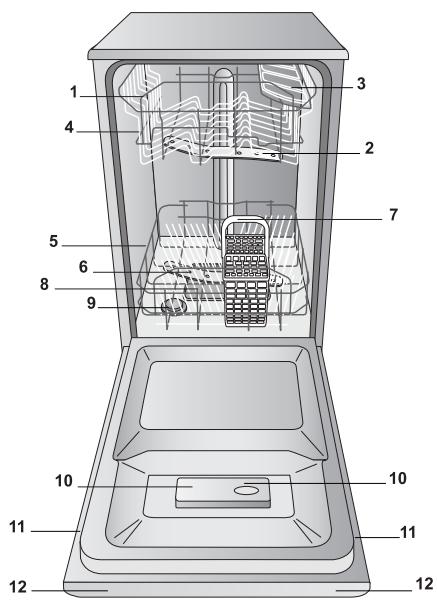
XaJIbI ωJy
- Kofapfbl Taptna
- KofapfbI To3aHdaTkbIiE3ekwe
- KaibpmaIb6eImupe
- TaptnaHbH 6nIKTirih peTTey KypaJIbI
- Temehri taptna
- TemeHri To3aHaTaKbIw e3eKwe
- bIbIc-aK ce6eri
- Kyy cyarici
- Ty3 dncnepci
- Kyfbil 3at nen IuaHofa KEmekuli 3at DncnEhcepnepi
- DepekTeP tiImweci
- Backapy TaKTaCbI***
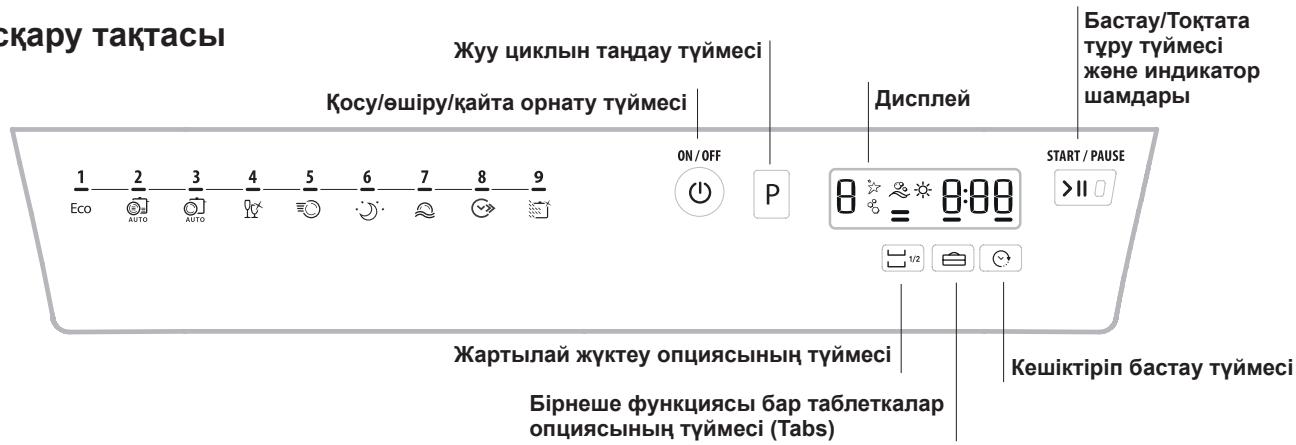
Backapy TaKTacbl
Ducnnei
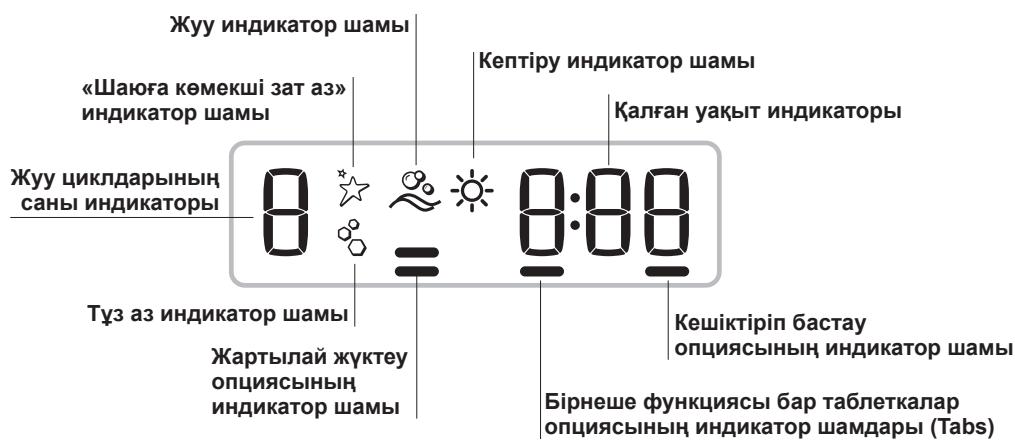
** TEK TOIbIbIMeH iUke caJIbHaTbH yIrInepDe * TEK Kei6ip yIrInepDe 6ap.
bldic jyy maunHacbHbIn ylriciHe 6aJnHaBcTbI jyy cKndapbHbIn caHbI MeH Typi Jxhe onuJaIap aRtpnI 6onybl MymkiH.
Ta3aJaHfah Ty3 XHe ShaIOfa KomeKwI 3aT
Ablbc Jyy MaunHaapbHa apHaJIbn XacanraH eHIMdepri raha KOJaHaBHyI3. Ac Ty3bIH HeMeCE TexHnKaJIbIK Ty3dbI KOJaHaYf6OImaJbI.
Opamada 6epinren HucKaynapdbI opbHdaHbI3.
KenФункцялbl eHIM KOndaHbIlnca,6eP6ip Tz3 KockaH xH, ecipece cy KaTbI Hemece eTe KaTbI bOnca. (Opama da bepinreH uCKaynapdbOpbHaDb3.)
A Ty3 Hemece 7aIOFA KEMEKJI 3aTTbI KocnacaHbI3, TY3 A3* XeHe 7AI0FA KEMEKJI 3AT A3* INdNKatOp 7aMdapbl KaHbIN Tpya 6pepi.
Ta3anaHfah Tv3dbI eJlwey
Ty3 KOndaHbInca, bIbIcTa XHe KypbIbIbIHbIH cyHKUraJIbIK Kypamdac 6eJIkTePiHde KAK ty3ImeMdi.
- Ty3 dincehcepi ewkaanb 6oc 6oImaybKepek.
CyKaTbIbIbIbOpHaTyMaHbI3bl.
Tуз дисениcopeи bIDIC kyy MaшинаьИн TemeHri БeinerIHe opHaJaNackан («Cunattama» BeiIMH KapaHb3) XaHe MblHa KaFaДиларda TOnTbIpblIybl Tnic: - IJIAOFA KΘMEKJI 3AT A3 INДиКаТОР WAMbl 6aCKapy TaKTacbIHda JkaHfAH Ke3de *;
Tуз диссерін Какпаftында Хасьл KaNTКы* KepiH6eKETKEH Ke3Ne.
CkattbIbIbHbIH KeCTeIHDeri aBOTHOMdbIKbI KaapHaB3.
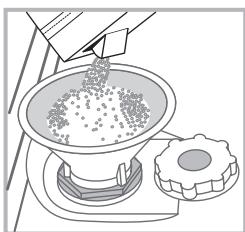
- TemeHri tapTnahbI WbIFapbIn aJIbIN, KOHTeHHeK KaNafbH 6ypan WbIFapbIn aJIbHb3 (Carat TiNiHe KapcB 6aftTTa).
- MyhI TeK bipHsi pet opbHaFaH Ke3e: cy DCnCHecepH MoHbHa DeiH TOITbIpbHbI3.
- BopoHkaHbI opHaIacTbIpbIn (cypETTI KapaHbI3), TY3 KOHTeHepiN Wetine Dein H ToTbIpbHbI3 (OaH 1 amameh 1 Kc cbHObI Tnic); 6ipa3 cy
aftin keTce eUte He etnei.
- Bopohka anbin tacan, tecikte kaIbIn kOyraH ty3dbI cyptin aIbIbI3; KaKnaKTbI cy aFbIHbIHda waBbIn, opHbHa 6ypaHbI3. KoHTeINhepre ty3 KockaH caBbIN 6yI npoueDypaHbI opbIHdaFaH xEh.
Kyy zuknb6apbcihda KOHTeHepre Kyfbi 3aT Kipin KeTneTIHde KaKnak MblTan XabblfahbHa Ke3 KeTki3iH3 (eHTnce, cy KymCapTkblbXeHdyeRe KeImeiTIHde 6byIyby MyMKIH).
A Ty3 Kocy npoceypacbIH Jyy cikblb bactaImaTpybIn opbHdaFah KcH.
Cydbih KaTbIbnBIfbIH OPhaTy
Cy jxMCapTkbIbI TnCTI Type JxMbIC iCTeyi yHIn cy KaTbIbIFbH IyHIsderi MHe rce CneKec opHaTy MaHb3dbI. Byn AknapaTbI JxepriNtCi cy XeTki3yUdEn CypaHb3. 3aybITTa optaHa cy KaTbIbIfbHa opHaTbIbAbl.
Kocy/ewipy Tymecimeh ()blbIC Kyy MaunHaCbIH KocbHbI3.
- Ohbl Kocy/ewipipy Tymecimeh 1 ewipiH3
- Bactay/ToKtata Tpy TYMecin >| ciHan ectiJireHwe 5 cekyHd bacbI N TypbHbI3.
- OHbI Kocy/əuipy TyMecimeh KocbiHb3
-Дисплелде afbIMdafbl TaHdaIFaH DeHRei HEmipi MeH TуЗ
ИндиКаTOpblHbIsh Wambl KepeciJIeI.
KaKETTI KaTbIbIK DeHReiIH TaHday yUiH P TyIMecIH 6acblb3 (KaTbIbIK KeCTecIH KapaHbI3).
- Ohbl Kocy/əwipy TyuMecimeh
- Ophaty aarkaIbI!
| Су катылынынкессici | Ортаа abTOHOMыК-kyніе 1 жуу сNKлы opындаIGNан жafдайдытУЗ диспецri | |||
| Денгей | °dH | °FH | MMоль/л | aɪ |
| 1 | 0 - 6 | 0 - 10 | 0 - 1 | 7 aɪ |
| 2 | 6 - 11 | 11 - 20 | 1,1 - 2 | 5 aɪ |
| 3 | 12 - 17 | 21 - 30 | 2,1 - 3 | 3 aɪ |
| 4 | 17 - 34 | 31 - 60 | 3,1 - 6 | 2 aɪ |
| 5* | 34 - 50 | 61 - 90 | 6,1 - 9 | 2/3 anтɑ |
| 0°f Meн 10°f apа lyblындаblы Мэндер ушін ТУзди КОлдану * усынblмайдь. «5» параметри сNKл мерзімін узартуbl муMKін. | ||||
(^ d H = 葱蒙汗 唐 胜 肾素能 脂 他 e 羽毛 热 阴 K a T b J N b I k - ^ f = . Φphahcy3 dapexkelepiHneelseHre KaTbIbIK-MMOJb/π=6ip JIITpderi MNNNMOJb)
Uaiofa kEmekwi 3aTTbI eJiwey
Jiaofa kemeki 3at bIbIcTbH KE6YiHE kemekecei. Jiaofa Kemeki 3at dncnEcepMbHa XaFdaJnapDa TOnTbIpbIybl Tnic:
- IIAIOFA KÖMEKÜII 3AT A3 İNİNKaTOP ÜMaMbı TaΚTaɪda/ ÜncnPηnde JęaHraH Ke3de ;
-Диспенер ecirihderi“E"koIO TycTi ONTNkaJIbIK INHdNKaTop MELdipIeHreH Ke3de.
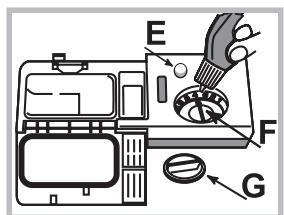
- KaKaNaKTbI (G) caFAT tIiHe Kapcbl 6aftTa 6ypay apKbJIbI dncnEhcepdi aWbIHbI3.
2.Дисн electen tobn arbin ketnyiHe haap ayapa OtbipbIn, 7aHofa KEmekuli 3aTTb KybHbI3. ByOpbH anca, terinre cybIKTBkTb Kyfak WybepekeNeh
Depey cyptin aIbIbI3.
3. KaKnakTbI opHbHa 6paHbI3.
IaIora KEmekwi 3aTTbI KypblfblHbIH iWiHe TikeNe EUKKAUAH KyowbI 6oMaHbI3.
Iaiofakemekw3aTTbHmJWeepin pettey
Kentipy HətnxkeiHe ToIbIbIme KaHaFat 6oJMaCaHbI3, KOndaHbIaTbIH WaIofa KEmekwI 3aTTbIH MeJIsePiH petTeYiHi3re 6oNaIbI. "F" pTeTeriWiN 6pyaHbI3. bIDbc Jyy MaunHacbIHbIH yIrricHe 6aIIaHbICtB I eN K6bi 4 DeHreI opHaTyfa 6oNaIbI. 3aybITTa opTaWa DeHreIe opHaTbIaNbl.
- bɪdɪc-aɪkTæ kɛkʌiːn cɒbɪkTap 6ap 6ɔnca, təmehɪpeK caɪnɒbɪ opHaɪtɪhɒɪs (1-2).
- bɪdɪc-ərʌkTæ cy Taɪmʌbɪnapβi Hemece Kaɪ daɪkTapβi 6ɔnca, Kɔfapβi caɪdɪbɪ opHaɪtbɪhɒi 3-(3-4).
Kehectep
TapTnapanapdbj kyttemec 6ypbH, bIbIC-aKTAH 6apnbTK TAmak KaJIbIKTapbIH Ta3aIaNbI3 XHe CTAKaHAp MeH bIDICTapdaH cyIbIKTBkTAPDbI TeriHi3. AfbH cy actbHda anDbH ana WauOdbH Kaxketi XOK.
blIbIC-aK MbIKtan opHbIHda yCTaIbn TYpaTbIHdai XeHe KUlan KeTneTIHdeOpHaNacTbIPbIHb3;XeHe bIDICTapDbI ayB13bIN TeMeH KapaTbIN, DeHec 6eNIkTePiE hKeiTin KObIHb3, COHa cy BapJIbIK 6etTepre TIn, epKin TypDe aFaBl.
KaKnakTap, TyTkapanap, Hayanap XHe Ta6anap To3aHdaTkbIe 3eKwenepein 6ypbIybHa Keepri KeNTipMeiTiHIne Ke3 XeTKi3iH3. KiSi 3aTAPbl bIDc-ay KceBtiHe KObIHbI3.
Пл actmacca bIDbICtap MeH Jka6bIcnaIbIH Ta6aIapda cy TamblapbK6bipeK KaIaNbIKTaH, OIAP KepaMnKaIbIK Hemece TOT 6acNaIbIH 6oJaTTah JkacaIFaH bIDbCTapfa KaparHaHa coHdai JkaKcbI KeNneiDi.
Пл actmaccadanжacanfaH bIDbICTap cnaKTbJ KeHIN 3aTTapdbI KOfapbT TapTnafKaOnblN,ЖblNkblMaIbTbIHdAnOpHaNactbIpblNybl Tnic.
KypbIJIbIbHI KYKTereHHeH KeiH,TO3aHdaTKbIuE3eKUWeNep epKiH XblJXn aJIaTbIHbHa Ke3 KEtki3iH3.
Temehri Taptna
TemeHri tapTnfa kactpeIeepdi, KaKnaKTapdbi, TapeJIkeIepdi, caIaT bIbIcTapbIH jHe T.6. canyfA 60anaIyIKeTapeJIkeIep MeH KaKnaKTapdbiTapTnAbH IwET JkaKTbHa KOJFaH JeH.
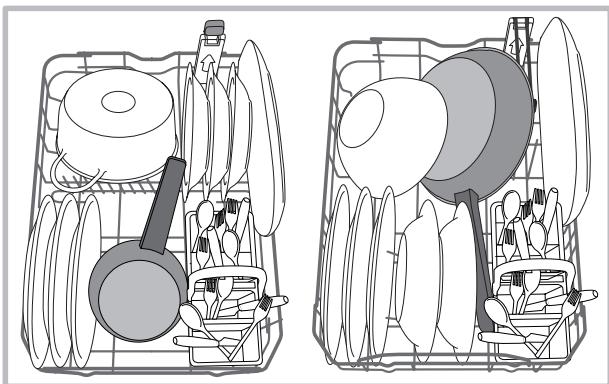
KaTbI NaCTaHFaH Ta6aKTap MeH KAcTppeNdepeI TeMeHri TapTaNaF aKOIO KepeK, Ce6e6i 6yJn JepDe cy KaTbI 7a7bIpauNbI da, Jyy eHIMdiJiri Jcofapbl 6oJaBl.
BipHeWe bIbIc Jyy MaunHacbl KaIbIpMaIb 6eImuEnepeMeH Xa6DbIKTaHaH*.
O npbl Ta bKaT apbl opHaIaCTbIPraH Ke3de TIK KyJde Hemece Ta6aIap MeH caIaT bIbICTapIH OHai OphJaCTbpy YuIN KENDeHEn KYJde (TeMeHri) KONdaHyfa 60naBl.
Kei6ip MoeJIbIep TiK ayMaKneH,
fHN TApTnAbHbI aPbI KaFbIHdaFbl
a PHa bI WbI F apbl aTbH
TipeKTepeMeH*KaabkTaIaNbI;
Onapbl Tabapap Meh JkaiaK TaTabapbl TIK Knyde TipeN KoBIn, opbH yHemdey yuiH kondahyfa 6oanaBl.
Ohbl konlahy yuH, Typni-Tycti TyTkacbHaH yCTan, anFa kapaB 6ypan OTbipIn, xofapbl kapaCybIbHb3. bIbIC-ayKtBnE nnemine caikec KeNTipy yuH tipeKTepei OHfa XHe confa cbIpblTyfa 6oNaDbI.
bldbic-aykcebeti
TeMeHri tapTnadafbl opbIHbI OHtaJIbI naJdaIaNHy yUH MoyNbDi ce6eTTi cbIpblTyfa 6OlaDbI. On bIdbc-aAaKtbl opHaIaCTbIpdybl JeHINdETerIH yCTIHRI TOPnapMeH Ka6dbkTaIraFAn.
Xofapfbl TapTna
BvI tapTnafc taKaHdap, bblblaayKTap, tabakwlaip Meh TaIIaK caIaT bIDbICTapbI CnAeKbI H3iK epi JKeHJI bIDbc-aayKT apCaIbIHbI3.
*Hemipnepi MeH no3uJnapbI eP TpyPi TaHdaynbI ynrinepe rana 6ap.
POnuIcBpeTteJetIH KaIbIpMaIbI 6JIkTeP\*
blblic-aaktbtaptna iihinde OHtaJIbI Tpype pettey yuin wetki KaibpmaJIb6eNikTeprDi yu6nIKTikke opHaJacTbipyfa 6oanaJI.
Uapan 6okanapbH aRbH Tnicti
tecikke cany apkblnb KaibpmaIb
6eiktepre Kayinc3 Typde
ophaactbipyfa 6oJaBb.
OHTaIbI KeTtipy HTeNKeScHe KOn
KeTKi3y yWIn KaBIPMaIbI 6eNIkTepei
KeBiPeK eHKeTIi3. EKeTIy DeHReiH
E3repty yWIn, KaBIPMaIbI 6eNIkTi cyBipIn aBn, a3dAn cbPfblHBi3
Da, KaJAYbIH3wa opHaNACTbPbIHbI3.
Haya*
Keibip bIDbc Jyy MaunHa ynirinepi Kiiwi IbHiaKapdbi Hemece ac KypaIapbIH YCTan TypyFa KOJaHbIaNbIH cbIpblAmbl Hayameh Ka6dkTajFaH.
Kyy eHimdiiniri OHTaINbI 6OlybI yWIn YNKeH bIDbc-AaKTbI HayaHBn dAn actbHa KoMaHbI. Ac KypanDaBbI HayacbH anbn Tactayfa 6oanaBIs (CypeTti KepiH3).
* Tek Kei6ip yIriJepde 6ap.
XofapfbTatTpTnabHbN 6niktirH peTtey
KorapfI tapTnabHbN 6nIKTirH peTteyre 6oJaIb: YnKeH bIdbacAraKTb TEmeHrI TapTnara K0IO yuH IN XoRapfI N03uZn JxHeXoRapb JkaKaTa Ke6iPeK opBb KaIdbpy apkbl KaIbIpMaJIb6eNikTepeD bapbIHwa naDaIaNHy yuH TeMeHri No3uZn.
KofapbI tapTnabHbIn 6niktiri TAPTNA BOC BOJFAHDA peTeyi kepek.
TaptnahbI TEK 6ip KafbIHah KeTepin Hemece TEmeHdetin KOIOsbI 6OJImaHbI3.
Taptna Ketepy KypalbIme* (cpeTTi kapaHb/3)XabblkTaIFaH 6oJca, Ohbl eki XaftbHaH YCTan KeTepiH3. TeMeHri No3nUraF aKaItaDah KOIO YsiH TaptnaHbH WETTEpIHderi TTKaIapDbI (A) 6acbl, TaptnaHbI TEmHeIeriH3.
JaibKcb3 bIDbc-aJk
AfaaTaHaJXacalFaH bIDbc-aK peH ac KypaIapbl.
- Be3eHdipiInrE H3EKCTaKaHdap, KOJdAn JkacalFaH 6yIbIMdAp KHe KeHe bIbIC-aRk. OnapdbH eWeKeei Te3imDi emec.
KofapbI TemnepaTypaFa Te3imDi eMec CHTeTKaNbik MaTePnaJdAn JacaJaan H6JIkTep 6ap bIdbc-ayK.
- Мьс пон калайдан касанган bIDbc-aя.
Kyn, 6aayb3, MaJlaTbH MaHemeCnmeH NaCTaHfAH bIbIC-aK.
Kyy npoeci 6abibcHnda aecm 7bHb Meh anIOHMn/Kymic 3aTTapdbH Tyci e3repin, hIn KeTy i MymKiH. CoHdai-ak, bipHewe pet KyraHHan KeiH KeBip 7bHb Typnepi (MbicaJIb, xpyctaJIb) 6IbIHbip 60bnkTcyi MymKiH.
IbHbMeh bIDbc-aKtbiH 3aKbIMJaIybl
Cebée:
- ΜυBIHbI MeN ΜυBiHbI ΜυBfApy npoueciHiN Typi.
Kyfbll3aTbIH XIMNIAI Kypambl. - ⅢaIO UIKNbIbIaNdaFbI cy TEMpePaTypacbl.
Kehectep:
- Θндіруші bIDIC kyy Maшинacьнда кууfa 6ОпаТынын Kaenindik БергшынMeн ФарфордіКоДаНынБi3.
- bIbIc-aAkkKa KOnaJIbI H3iK JyfbIi 3aT KOndaHbIbI3.
- CtaKaHap MeH bIbIc-aK Kyy cIKbl aAaTaNfAH Ke3depeey bIbIc Kyy MaUnHacbIHah WbIFapbIn aJIbIbI3.
Xyfbi 3aTTbI eJnwey
Xakcbi Kyy Hətnkenepi Kyfbih 3aTbIH Dypbc MeIwepi KOJaHaBInFaHbHa Da 6aJnAhnbICTb 6oJaBl. BEnrineHren MOpepdHen KEN KOJaHcy Kyy TImdiJirH apTbIPMaHdbi XHe KopwaHn optAhbl Ke6ipeK nactayfa eKeJeDi.
MnIeepin nactaHy deHreinye cKepeTeyre 6oNaIbI. Opta7a IacTaHaH 3aTTap ywiH wamAmeh 25 r (yHTaK Jyfb1w 3aT) HeMece 25 Ml (cynbIK Kxyfb1w 3aT) KOJaHaB1Hb13. Ta6Netkajap KonDaHaB1nca, 6ipeyi KekTKiNkTi.
blbic-aak a3 nactaHfah 60Jca Hemece bIbic Jyy MaunHacbiHa caIbIH6ac 6ypbIH waIbIraH 60Jca, Xyfbi3aTTbIH MeJIwePi a3aIbTbIHbI3.
Xyy HToNkeci XaKcbI 6onybl ywiH Kyfb13aT Kopa6bHaBbI HyckaynapdbI da opbIHdaHbI3.
KocbIMwa cypaKaTapbIHbI3 60nca, KyfbI 3aTeHdipywinepiHe xa6apNaCbIHbI3.
D TymecinH KemerimEn JyfbIu 3aT DnCneHcepIn aBbIn, Xyy uKJIapbIHbH KeCTeciHe Caikec JyfbIu 3at MJIWeepiH aHbIKTaHbI3:
-
YHTaK HeMeCe CyIbIKTbIK: A (XyyyFa apHaIraH Xyfbls 3aT) XHe B (aIbIH ana Xyyfa apHaIraH Xyfbls 3aT) 6eniKepi
-
tabnetkana: zukf1a 1 tabnetka kajet Ke3e, onbI A 6eJIirHe caIbIn C kaknafbH Jaa6bIHy3; 2 tabNetka kajet 6oJca, ekHsi tabNetkaHb KpylbIbHbH Ty6iHe caIbHb3.
BəniktiH wetinderi JyftbI 3aT KaIdbIKTapbI cyptin aIbIn, C KaKnaFbI TbIK etKeHwe nTepin ka6bIb3.
XyfbIi 3at tapTnacbl kyy cikblHa caikec Tniicti yaKbTTa abTomatbl Typde aublaabli.
ÖMb6eBn JyFbI W 3aTtap KOnDaHbIJcA, TABS onuNcBn NaJaJaHaHfAn JxH, Ce6eBi ON ZKKnDbI ePdaiBm E H JxakCbI Jxuy XHe KeNTipy HToXKeIepiHe KOn JxetKti3eTInde peTTeiNi.
AblbIC Jyy MaunHaJapbHa apHaIbn XacaIraH JyfbIa3aTTapdbI rHa KaJaHaBbIbI3.
KoImeH bIDbc Jyyf a apHaIraH cyIbIKtbIKTbI KOJIaHBAHbl3.
UamaanTbIC JyIbI 3aTTbI naDanaHy uKJI aKaTfAHa KaPbInfB1 iwiHne Ke6ikTIn KaLybHa eKeNyi MymKiH.
EH Kofapbl kyy khe Hen KeTtipy Hntnkelepine KOn XeKti3y ywiH, KByIi 3aTTbI, WauOFA KEmekwI CyBbIKTBtB1 XHe Ta3aJaHaH Ty3bI 6ipre KondaHy KaXeT.

ΦocpaTapdbI HeMece XIpOdbI KaMTbImaTbIH Kyfbl3aTtapdbI naJaHaH faH xH, c6e6i 6yI eHIMdepKopwaFaH opTaF 3nHdbI.
bldbic kyy MaunHacbH icke Kocy
- JyMeKti aJbIbI3.
- KOCY/ΘUIPY Tymecin 6abcbI3.
- EciKti aUbIn JyFbI 3aTbH KOnaiNbI MeIeepiN KyBbIbI3 (XyFbI 3aTbI eJIweY) 6eJIIMH KapaHbI3.)
- TapTnapanapdbI kYkTeH3 («TapTnapanapdbI kYkTey» 6eJIIMH KapaHb3), OanH KeiH ecikTi JkaBbHb3.
- P TyuMecin bacy apKbIbI bIbIc-ayk Tpyi MeH OHbIH NaCTaHy dApexekci He caikec Kyy LInKJIbIH TaHaHbI3 (Kyy LInKJdpabihbH keCTecIH kapaHbI3).
- Jyy onuynapbIH TaHdaHb3* (Onuynapbl kapaHb3).
- Lüknblb6actay yuih Bactay/ToKtaTa Tpy TyMecin 6acblb3 (wam jahbn typa) : y3ak cnHnJyy zukblb 6actaHaBn 6bnipei, zuknbln HnHnkaTopb JkaHaDbj XeHe DnCnpeJe dzkn Hemipi MeH zuknblbAaykTanybHa KaFah yaBt KepceTjnei.
- Eki KblcKa CnHaH MeH 6ip y3aK CnHaH Jyy CnKlbHbH aKtaTaNfAhn B6inDipei, Bactay/ToKtata Typy Tymeci Owei jkHe DnCnIeJe COHbI cezi Kepcetinei. KOCY/OWIPY tyMecin bacy apKblbkyPflbHbI eWipih3.
- blbic-aykbl 6iphewe MNHyTTah KeiH fana aIbHb3 Kyni KaJmay yuiH. TapTnapanapdb TeMeHHHe 6actan 6ocatbl3.
A ToKtbl 6apbHwa a3 TyTbHy ywiH Kypblfbl y3aK 6eInceHi3dk Ke3depiHne aBTOMaTTb Tpype eweedi.
A ABTOMATTbI Jyy CUNKJDApbl*Keibip bIbIc Jyy MaunHaapbl NaCTaHy DeHreinH aHbIKtan, eH TnIMdi opi yHemdi Jyy CUNkbH ABOTAMBTL Tpye TaHdayfa MymkiHik 6epetih apHaBla DaTynkneH XabIKtaTfah. DaTynKTiH KymbcIbHa 6aJIaHbICTbl ATO Jyy CUNKJDApblH Y3akTBIFbl aPTypni 6onybl MymkiH.
OpbHdIaIbI JkaTkaH Kyy CukKlbH e3repTy
Jyy zukbln taHday 6apbcihda KaTe KeTKeH bOnca, zkn JkaHa rHa 6bactaIfah 6oIfah XaFaDnla, Ohbl e3repy MymKIn: Jyy zukbln e3repy ywiH, Jyy zukblb 6bactaIfAHn HKeiH KOCY/0UWIPy TuMecin 6acbl n YcTan Tpy apkbln kypbln HbEwipij3. CoN TYmMeHH KEmerImeH OHbl KaHTaDaH Kocbln, KaXeTTI Jyy zukbl MeH ONuJInapbl TaHdaHb3.
KocbIMsa bIbIC-ak Kocy
Kocy/ToKTata Typy Tymecin BacbIn, uBikKaH 6byFa TImeYre TbIpbCbIn ecKiTi aBbHb3 Da, bDbIC-aAKeTbblDbc Jyy MaunHacbHbH iUHe KObHb3. Bactay/ToKTata Typy Tymecin BacbHb3: Y3aK CnHan 6epiReHHen KeiH cNkJ KaTaDaH bactanaDbI.
Keiikipin bactay opnatbnfah 6onca, kepi cahaktbH cohInda xyy uKblb 6actanaDb. On Toktan typy peximnde Kaanda.
A KypbInfBihb TOKTaTbIN KOIO yuH Bactan/TOKTata Typy;Xyy UKNJIbI TOKtaNDbI.
BykKe3eJxuyzIKbH e3repy MymkiH emec.
Ke3deincoK toKtaynap
Kyy zukbl opbHany bapbcihda ecik aublnca Hemece TOK eWIn kAnca, znkToKtaNb. Ecik JaaBilfahnH Hemece TOK KocblfAHHaH KeiH ON ToKtaFah JepiHe KaTadaH icKe KocblJaBl.
Xyy zikblihbH deperei EN-50242 EyponaIbIK cTaHapbHa cAkec 3epTxHaJIbIK kAfdaJa eJWeHei.
Otp Tpyni KOnlaHy wapTtapbI Heri3iHde xyy uKnbHbH y3aKtbfbl MeH deperi e3repyIMyMkiH.

blbc kyy MaunacbHbIn ynricHe 6aJIaNbIcTbI KU NKdapbIHbIn caHb MeN Typi XHe OunnaJap eptypni 6onyi MyMkiH.
| Жуу цьы | Кent tipy | Опциялар | Жуу цьынthetic Узakсыы | Су тьыну (П/ цьк) | Куат тьыну (КВТ/цьк) |
| 1. Eco | Иэ | Delay Start - Half Load - Tabs | 03:00 | 9,0 | 0,83 |
| 2. Авто карынды | AUTO | Иэ | Delay Start - Half Load - Tabs | 02:20 - 03:00 | 13,0 - 14,0 |
| 3. Авто калыntы | AUTO | Иэ | Delay Start - Half Load - Tabs | 01:40 - 02:20 | 13,5 - 14,5 |
| 4. Назik | Y | Иэ | Delay Start - Half Load - Tabs | 01:40 | 9,0 |
| 5. Tez | Жok | Delay Start - Tabs | 00:25 | 8,0 | |
| 6. Good Night | Иэ | Delay Start - Tabs | 03:30 | 13,0 | |
| 7.Сува салынкою | Жok | Delay Start - Half Load | 00:10 | 4,0 | |
| 8. Short Time | Иэ | Delay Start - Tabs | 01:20 | 15,5 | |
| 9. Ultra Intensive | Иэ | Delay Start - Half Load - Tabs | 02:50 | 17,0 |
Xyy uNKbIH TaHay XeHe XyfbIi 3aT MOnIeepiHaBikTay HycKaynapbl:
- 3K0 Kyy uikbl - kyat benricinderi depekTep HcKan TpyfAH cTaNapTTbU cKN. OhJI NaCTaHy dEpxeci optaHa bIbIC-ayKTbI Kyy yuIN KOJdAnhyfa 6oanaBx HeocbblbIC-aK TyPiHe kyat neH cybl eH TImDi TyPe Jxymcauibl.
4 r/Mn* + 21 r/Mn - 1 ta6neTka (AndbH ana kyy Ke3iHe KOJdaHbIaTBH KByfbl 3aT MeJIWeepi) - KaTbI NaCTaHFaT Ta6aKTap MeH KAcTpEeP (H3iK 3aTTap yuHn PauHaNbImaybTiNc). 25 r/Mn - 1 TabNetka
- Kyndeniikti NaCTaHydbiH WeKTeuI MJIsepi (4 Kicinik JKHnKaTap YsiH KOnaIbI) 25 r/Mn - 1 TabneTa
- XofapbI TEMnepaTypa ce3imTaJI H3iK 3aTTapFa apHaNfAun ZIKN 25 r/Mn - 1 TabNetka
5.A3an kipneHren bIbIcTap yuHn Kblamd uKKn KOJaHbIaBt (2 Kicinik KInHaKTap yuHn KOnaJIbI) 21 r/Mn - 1 TabNetka - Optaama JiaCTaHFaH bIDbc-aaykTap MeN TabaJapFa KOnaIbI XblIam Jyy XeHe KeTtpy ZcKbI 25 r/Mn - 1 TaBneTa
- KeNeci TaMaKtAH Ta6aKTapbIH JyKTeJyHIn AaKaTaNbH Kytin TpyFaH Ke3De bIbIcTaPbI aIaNbH aJIa Jyy. KfYbI 3aTcbI3.
- OptaSHA nactaHraH bIbIc-ayKTap MeH Ta6anapFa KOnaJIbI JxblIam Jxyy Jxhe KeTIPy UINKbl 25 r/MJ - 1 TabNetka
- KaTbI NaCTaHFaH Ta6aIap Hemece KaIdbIbKTap Keyin KaIraH KacTppeIep. 4 r/Mn** + 25 r/Mn - 1+1 Ta6neTa
Kyty KyinHderi TybHyb: KocBInBn Typy peximHderi TybHyb: 5 Bt - Kyy eipyni peximHderi TybHyb: 0,5 BT
EckepTneJep:
《Te3》ZIKIapbIH KOJaHFaH Ke3Je, OHTaIbI HToNKeere bIbICaAHTbIH 6enrileHReH MeIsepiH Jyy apKblbI KOn JeTki3yRe 6oJadbl.
TyTbIHybI OaH epi a3aIy yuIH bIbIC kyy MaunHaCbIH TEK TOITbIPbIN kymbic ICTeTIiH3.
CbHaK 3epTxahanapbHa aphanraeckpTne: caIbIcTbIpMaJIb EN cbHaK XaJdaiJapbl yuH IN TeMeHderi MeKeHkaJFa 3JeKToHDbIK xAT Kj6epiH3: assistenza_en_lvs@indesitcompany.com
Kyy onznaIapbl
Kyy ukkbl TaHdaBbIn, Bactay/ToKtata Typy Tymeci 6acbIraHa deHH fHa ONLJAPDbI opHaTyfa, e3reptyre Hemece KaTa opHaTyfa 6onaDbI.
OphatbIinaH kyy zKkblbHbIH TypimE yInecimDi onuHaapbl fana TaHdaYfa 6oNaDb. OnuHa TaHdaFAn Hyy zKkblbHa cKeke KeImece (Kyy zKkndapbHbIH KeCTecIH KapaHb3), Tnicti TaHb3 pet XbldAm XblnbTaNbl.
Backa onuymen (6ypbH TaHaJFaH) yIneCiMdi eMeC onuHa TaHaJaCa, on 3 pet XbInblkTan eWeDi, an eH CoHfB TaHaJFaH onuza KaHbIn Tpya 6peDi.
Katelecin opHaTbIrfan onuHbTaHdaydAn bac TapTy uHn Tnicti TyMeHi TaBbip pet BacbHb3.

Kewiktipin 6actay
Luknblb6actanyyaKbItbH1-24cafapaJIbIbHndaFbIbipMep3imReKeWikTipyre6oJaBl:
-
Kaeketti Jyy Zukblm Meh Ke3 KeIreH baca OnuJnapb taHdAn, KEUIKTIPIIN BACTAY TuMecin H bacHBi3. INDnKaTOp 7aMbI JkaHaDb. Jyy Zukblb 6actanaTbH YAkbITbTaHday YsiH dAeL cO TynMeHi KOndaHbHb3 (h01, h02 XHe T.6.)
-
Kepi cahaktbkocy yuin H KOCY/TOKTATA TYPY TYmeciniH Kemerimeh TaHdaydbI paCTaHbI3.
3.YaKbIT aKaTaNfHaHHaH KeiH, KEUkTIPIIN BACTAY HdNkATOp 7aMbI eWedi De, KyyuKnbl bactaJadbl.
KEUIKTIPIIN BACTAY onuycbH aIbIn Tactay yuIH KEUIKTIPIIN BACTAY TuMeciH OUIPYNI MTeHl KepeTilreHwe 6acbl Tpyblbl3.

Jyy zukblb6actanfahHHan Keinh KewikTipin 6actay HkuncbIH opHaTy MymkiH emc.
Korapfbl Hemece TEmeHri TapTnaHb KoJaHa Otbipbn KApTbIaN JyKTeY (Half Load)
KyblatbH bDlc KEN 60JMaCA, cy, TOK nen Jyfb3aTbI yHeMeDeY yWIn XapTbIna JyKTEy cIKbIn KOJaHyfaoJa. Jyy cIKbIn TaHdAn, OaH KeiH JAKPTbIAJ KYKTEY TyMecin BacbH3: TaHdAnFaH TapTaRa cKeKc KeJeTIH INdKATOp KaHbIn, TEK KOFapFb HEmeCe TeMeHi TapTaNa da Jyy cIKbI bactaJadbl.
A TeK Jxorapfbl Hemece TEmehri TapTnahbl XyKTeydi XeHe Tnicti Typde xyfbll 3at MeIwepih a3aIydbI yMbITnab13.

BipHeWe yHKcunacbI 6ap Ta6NeTkaJap (Ta6NeTkaJap-Tabs)
ByonunjxuyxheKeTipyHtNkepein OHTaJnAdbipadbl.
BipHeWe fynKcunrcbl 6ap TabNetkapanpbl KOndaHraH Ke3de,
BIPHEWE FyHKUcRbI BAP TABJIETKALAP Tymecin
bacInb3; Tnici TaHa JkaHaDbI. TyMe KaTaDah BacInca,
OnuJaanb6acTapbJaDbI.

«BipHeWe fynKcIa6bap Ta6JIeTKaIap» onuIcbl Jyy IbIHbH Mep3IMH y3apTaBl.
Cy MeH ToKtbl eWipy
Cy afbin KeTneyi yuHn ap6ip kyy uKbHaH keiH cy uMyerIH xaybIn OTbIPbHB3.
KypbIfblHbTa3aJanaHaN Ke3Je XHe TexHnKaJIbIK KbI3MeT KepCteTy XyMbICTapBbOpbIHdaFaH Ke3Je OHbI TOKTaH axbIpaTbIHbI3.
bldbic kyy MaunHaCbIn Ta3aJlay
KypbIfblHbIHcIPTkbl6eTTepi MeH backapy TaKTacBH cyMeH bIflaJdaHraH, abpa3nBTi emec wY6peKeNeh Ta3anayra 6oJaBb. EpitkiTepdi Hemece abpa3nBTi eHIMdePdi KOnDaH6aHbI3.
KypbIbIbHbI iHdIe Ke3 KeIreH caTak i3epdi cymHe XaHcipKeMeH bIfAHaHraH uSy6peKeHn KeTipyre 6oanaBl.
XaftbIMcbI3 niCTepdiH aIdbH anly
KypblfblHbIH iwi DbIMKblIaHbIN KeTneyi yIiH OHbIH eciriH apdaibM ibpa3 aUbIn YCTaHbI3.
Eciak aHaHacbHdaFbI 6ekitkiWtepeMn KyfbI 3aT dncneHcepJIepmep3imDi Tpyde bIrlan rY6kamen Ta3aJAN OTbIPbIH3. MyhIn HetNkeCHe6ekitkiWtepeT TaMAK TypbIN KaImaNbl, an 6yn JkaFdAn JkaFBIMCbI3 niCTepDIN naJa 6OlybIHIn Heri3ri ce6eBi.
To3aHdaTkbIsh 03ekwelepepi Ta3anay
TamaK KaIbIKapbl To3aHdaTkbl E3eKweneepin 6eTIHe KaTbIN KaIbIN, cy WaaTaBn TecikTepei 6iteyi MymKiH. CoHbIKtAH, e3eKweneepi MEP3imDi Tpyde Tekcepi, MetaIcbl3 1eTKaMeH Ta3aHaBn TypfaHbIXeH. Eki To3aHdaTkbl W3eKwenei De wIfapbl anyfa 6oIaBl.
Korapfbl To3aHdaTkbIw e3ekuwehi wblfapbn any ywiin Kynbntay caKnHaCbIH Cafat Tinihe Kapcbi 6aftta bypahbi.
Kofapbl To3aHdaTkbll 03eKuweHi TecikTeepih Kofapbl Kapatbl KaTadaH opHbHa KOIO Kepek.
TemeHri To3aHaTbIu e3ekUeHi XoFapbl Kapa TApTy apKbIbI bIfapbl Anyfa 60laBl.
Cydbin Kipic cy3ricin Ta3aIay\*
CytytiktepiKaHa Hemece y3aKyaKbIT 60nbI KOJaHaBnMaFaH 60nc, KaIraMaC 6ypbH onap apkblc cy eTki3in, Ta3a epi iuiHde KaIdbIKTap JOK eKeHIne Ke3 JeTki3iH3. Byn caKtbI KwaapacbI opbHdaMaCa, cydbH kipic 6iteJin, bIDbc Kyy
- Tek kei6ip ynlirepnde 6ap.
MaIHHacbI 3aKbIMdAJIybl MymKiH.
A Ljymek Jkafbihdafbci cydbih Kipic cy3ricin Mep3imdi Typde Ta3aJan OTbIPbHb3.
-CyUyMeryHxa6bIbI3.
-CydbH Kipic TytiriHin WeTIN 6ocatbIn aIbIHb3, OaH KeiH Cy3rHi aIbIn, OHbCy afblbI actbHda XakcbJIan Ta3JaHaB3.
-Cy3rHiOpHbHaKoYbIn,CyTytirOpHbHa6ypaHbI3.
Cy3rjIepDi Ta3anay
Cy3ri KINHaTb CyDIt TaMaK KaIDbIKTapbH Ta3aIaNbIH XHe OanH KeiH CyDIt KaI Ta aHAnDbipaTBH YW Cy3rIeH TypaBt. Op6ip Kyyda eH KAKcBi HETNXe RON KETKI3RHi3 KeJnce, OanPdbTa T3aIay KepeK.
Cy3rinepei MEP3imDi Tpyde Ta3aJaan OtbipbHbI3.
Ablblic Kyy MaunnacbiH cy3rici3 Hemece cy3ri 6ocan KeTkeH Ke3de naDanaHyfa 6oImaIbl.
- Biphewe pet JyfahnHn KeiH, cy3ri XHaBbIn TekcepiH3
XeHe Kaxet 6oJca OHbl MetaIcbl3 5eTkAmeh opi TEmeHderi
HyCKayIapDbI opbHdai OTbIPbIN, cy afbHbI actbIHda
XaKcbIan Ta3anaHbI3:
1. LünlnHrpNik C cy3ricin cafat tilihe Kapcbi 6aftTa 6ypaHbI3 da, cybpbln anbHbI3 (1-cypet).
2. 甲bHbIaK B cy3ricin JxneKeTepi a3dAn 6acy apKbJIbI bHfapbIn anbHb3 (2-cypet).
3. Tot 6acnaiTbIH 6oNaT TiJIMWe A cy3riciH cyblpbln aJIbIbI3 (3-cyper).
4. Ty3akTbI Kapan nbIbHbI 3 Da, Ke3 KeJIreH TaMaK KaIbIbITapbIHah Ta3apTbIHbI3. Jyy UKNbIHbIH COPfbcIH EUKAUAH ANYUbI BOJMAHbI3 (4-cypem).
Cy3rinepTa3aIarFaHHaKeIH,cy3rJxHnHaFBiH opHbHaKoYbIN,OHyDyPbICTan6eKITiH;6yNblDlcXyyMaunHaCbIHbTHIMDiXMyBcblYsiH eTe MaHb3dbl.
Maunhabl y3ak yaKbIT naJaIaHa6ayra KaIdbIpy
KypblfblbHbTOKTaHafblbIn, cyWyMerihXa6bHb3.
KypbIbnfbi eciH cAn aWbIK KaIbIpbIbIbI3.
KaiTbIn KeIreH Ke3Je, bIbIc Jyy MaunHacbIH 6oc yCTan Jyy cIKMbIH icKe KocbIHbI3.
KypbIybl dypbic kymbc ic tteme KaJIfAH Ke3de, KEmek KbI3MeTIHe Tenepon COKnac 6ypbIH TeMeHderi TiImHe Hweimdi i3DeHi3.
| Акayльк: | ыктумал сбentерi / чебимдерi: |
| ыдьс xуу машинасы iccke кocьлмайды hemece onblб acakapу муdkin emec. | •Сушmerи ausilmarан. • Крпьгынь KOCV/ОШIPY tvimecin bacy apkblы ewilipin3, одан кеин onblb 6bp iшamamen bip minhyttan keih kocbln, куу лк blin kaita ophtblnb3. • Крпьгы розетка на дурвic kocьлмafan hemece bockа розеткахы koлдану керек. •ыдьс xуу машинасын bln eciri duypic kackылмаган. |
| Есik xаылмайды. | •Тарлалар толыбиме салыногьнда КЗ 3жеткizid3. •Кулн bocatblnf an. «Тык» etken duibic ecitintrene ecikti katbli nteripin3. |
| ыдьс xуу машинасынан cy arызлмайды. | •ыдьс xуу машинасынан салкblы ebliaя ausталмafan. •Суарыу Тутiri майыскан («Орату» boimin karapb3). •Aby3y TUTI BITEENR. •Cyr3i tamak kaildiknapbimen bitelin kailran. •Aby3y TUTIRINH boiktirin Tekcepiniz3. |
| ыдьс xуу машинасышамадан Тьс уылшыгд. | •Тарлар bip-бірін Hemece tozahandatkblu ewzekwere tini narpсылдь.ыдьсстарды dypbc ophanactbipin, tozahandatkblu ewzekwenepe epkih aihaanlalbniHa Ke3 xetK31H3. •Көбik тын кел: Куflblu 3at duypic eblieнberen hemece oblc xуу машиналарында калдану каллы emec. («Жуflblu 3at Пен bldic JyU Maushinacsbn Kollanly» boimin karapb3.) bldictapdbu kokmen anldin alya kymahb3. |
| Та akтар men CTakандарынbetигддakун hemece tar kalдытakрынem Kantanlaran. | •Тазанлган Ty3 xok. •Су кattылгынь пarametri Tnicti emec: kaxetti məndeprdi ynpkeɪtiniz. («Таалноган Ty3 xəhe ləiora kemeki 3at» boimin karapb3.) •Ту3 Бен laiora kemeki 3at dinchencepiniH kaskarblу duypic xakibmairan. •ШаORA kemeki 3at tauchinfaH hemece Obln məlleerneMeci TbIM Temen. |
| Та akтар men CTakандарсылган hemece pehrig көшin. | •ШаORA kemeki 3atTbIn MELIeplemeci TbIM xofapbI. |
| ыдьс -ая xурьс кentирлmedи. | •Ken'tipty baraplamacbi xok xуу lckbl taHdallanFAN. •ШаORA kemeki 3at tauchinfaHAN. («Таалноган Ty3 xəhe ləiora kemeki 3at» boimin karapb3.) •ШаORA kemeki 3at dinchencepiniH parnametri kolaillb emec. •ыдьс -ая xубicnabHIM matepnaIaDAN Hemece PIIactNKTeH XacaIaNFAH; cy tamshilnapbI bonca, estehe etneidi. |
| Та akтар таза emec. | •ыдьс -ая duypbic pettenmener. •ыдьстар кедрихжacaraHdiktan, tozahandatkblu ewekwenepe epkih aihaanlmaДы. •Жуу lckblы Тыm Иэзik («Жуу lcklndapbl» boimin karapb3). •Көбik тын кел: Куflblu 3at duypic eblieнberen hemece oblc xуу машиналарында калдану каллы emec. («Жуflblu 3at Пен bldic JyU Maushinacsbn Kollanly» boimin karapb3.) •ШаORA kemeki 3at boimirinderi kaknak duypic xazilmaran. •Суотанган Ty3 Dehreii Temen («ЛаORA kemeki 3at xazne Ty3» boimin karapb3). •ыдьстардын binktiri raptnara cəiikec keletiniHne Ke3 xetizhi3. •Таалноган Ty3 Dehreii Temen («ЛаORA kemeki 3at xazne Ty3» boimin karapb3). •ыдьстардын binktiri raptnara cəiikec keletiniHne Ke3 xetizhi3. •Таалноган Ty3 Dehreii Temen («ЛаORA kemeki 3at xazne Ty2» boimin karapb3) •БелIMIN Karapb3.) |
| ыдьс xуу машинасыну су куылмайды. Оны xуblыньтarkan shamadap bilдпedi. | •Су wуесиende cy xok Heemece xумек xубллар.•Сydьн корic tytiri mайыскан («Орату» boimin karapb3). •Сугinerр bidelenr: onapdbi ta7anay kaxet. («Кутimg xəhe TchHKaJIbK Kbl3Met Kepctety» boimin karapb3.) •Aby3y TUTI BITEENR: onbl ta7anay kepek. •Tekcepin raasanafahan h kieln, bldic xуу машинасын кocbln eulipin3 de, xana xуу xizklbH bactahls. •Масе xшшimece, cy wуserin jaybIn, kpyblfblbHbpo3etkaadan aflItbHb3 da, Kbl3met Керсетуoptaibfbina TeleponcofboHb3. |
KZ
Indesit Company Spa
Viale Aristide Merloni 47
60044 Fabriano (AN)
Italy
www.hotpoint-ariston.com