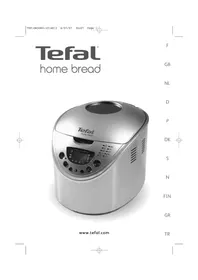
HOME BREAD OW 200130 - Bread maker TEFAL - Free user manual and instructions
Find the device manual for free HOME BREAD OW 200130 TEFAL in PDF.


User questions about HOME BREAD OW 200130 TEFAL
0 question about this device. Answer the ones you know or ask your own.
Ask a new question about this device
Download the instructions for your Bread maker in PDF format for free! Find your manual HOME BREAD OW 200130 - TEFAL and take your electronic device back in hand. On this page are published all the documents necessary for the use of your device. HOME BREAD OW 200130 by TEFAL.
USER MANUAL HOME BREAD OW 200130 TEFAL
Thank you for choosing an appliance in the « Breadmaker » range exclusively designed for making bread, brioche, cakes, dough, jam and compote.
Description
A Body
B Lid with window
C Air vents
D Tub
E Pan
F Mixer
G Measuring cup
H Measuring spoon a=1 teaspoon b=1 tablespoon
I Control panel:
i1 Display panel
i2 Delayed start buttons
i3 Weight setting button
i4 "On/Off" button
i5 Browning setting button
i6 "Menu" button: programme selections
J On/off switch
Safety instructions
Before using your appliance for the first time, please read these instructions carefully: any use which does not conform to these instructions will absolve the manufacturer from any liability.
- Never leave the appliance within reach of children without supervision. The use of this appliance by young children or by disabled people must always be supervised.
- Check that the power rating of your appliance does in fact match that of your household electrical wiring system.
Any connection error will render the guarantee null and void.
- It is essential that this appliance be connected to an earthed socket.
Non-compliance with this requirement could result in electric shock and give rise to severe injury.
For your own safety, make sure your earth connection complies with the electrical wiring standards applicable in your country.
If your wiring system does not have an earthed socket, before connecting your appliance, call on the services of an approved
electrician to bring your electrical system up to standard.
- Your appliance is intended only for domestic, indoor use.
- Put the on/off switch (J) in the "0" position and unplug your appliance as soon as you have finished using it or to clean it.
- Do not use your appliance if it is not working correctly or if it has been damaged. If this happens, you should contact an approved service centre (see list in the service booklet).
- Any intervention other than cleaning and normal maintenance by the customer must be performed by an approved service centre.
- Do not put the appliance, the power cable or the plug in water or in any other liquid.
- Do not allow the power cable to hang down within reach of children.
- The power cable must never be close to or in contact with the hot parts of the appliance, near a source of heat or a sharp angle.
- Do not use the appliance if the power cable or plug is damaged. To avoid any risk, these must be replaced by an approved service centre (see list in the service booklet).
- For your own safety, only use accessories and spare parts designed for your appliance.
- All our appliances undergo strict quality control. Hands-on tests are carried out on appliances at random, which accounts for any traces of use.
- At the end of the programme, always use oven gloves to handle the pan or the hot parts of the appliance. The appliance becomes very hot during use.
- Never block the air vents.
- Be extremely careful as steam can come out when you open the lid at the end of or during the programme.
- When using programme 8 (jam, compote), watch out for hot splashes and the jet of steam that escapes when you open the lid.
- Stick to the quantities shown in the recipes do not over-fill the appliance.
Before using your appliance for the first time
- Unpack the appliance and wash the pan and accessories in soapy dishwater. Rinse and dry thoroughly.
- Wipe the tub with a damp sponge.
FOR BEST RESULTS WITH YOUR BREAD
Read the instructions and use the recipe book: the method for making bread with this appliance is not the same as for handmade bread.
All ingredients should be at room temperature.
Only good quality fresh ingredients should be used. Use the ingredients before their use-by date and keep them cool and dry. The appliance must be kept and used at room temperature.
For the bread, brioche, and cake recipes, it is recommended to use pastry flour.
For successful bread-making, it is important to use the exact flour measure. For this reason, we suggest that you carefully weigh the flour on a kitchen scale.
Use either fresh or dried yeast. Do not use baking powder.
Always follow the precise order and use the exact quantity of ingredients indicated in the recipe book.
Never put the yeast in direct contact with the salt.
To avoid interfering with the rising process, we suggest you put all the ingredients in the pan at the beginning and avoid opening the lid while the machine is operating.
Your bread will be more close-textured than baker's bread.
The recipes for other appliances will give different results if used with your "Home Bread", as the appliances have different programmes.
Order of ingredients
It is preferable to put the ingredients in the pan in the following order: First the liquid ingredients followed by the dry ingredients.
The yeast should be added after all the other ingredients have been put into the pan: the yeast should not be in direct contact with the sugar, milk, water or salt.
After adding the liquid ingredients, we suggest that you proceed as follows:
Add part of the flour. Add the dry ingredients except for the yeast. Add the remaining flour being careful to cover all the dry ingredients. Lastly, add the yeast.
Ingredients
Butter/oil
Fats give the bread a tender crumb and a more succulent taste. If you are using butter, cut it into small pieces so as to evenly distribute it into the mixture, or melt.
Water
Use lukewarm water.
If your recipe calls for eggs, put them in then add the water. We suggest that you use spring water.
Flour
The weight of the flour varies according to the type of flour used.
The baking results can vary depending on the quality of the flour used. If using hard flour (wholemeal, rye, etc.) the bread doesn't rise as much.
Milk
Fresh or powdered milk may be used. If using powdered milk, add the quantity of water initially called for.
If using fresh milk, you can also add water: the total volume of liquid must always be equal to the volume called for in the recipe.
Sugar
As a preference, use white sugar, brown sugar or honey. Do not use refined or cubed sugar.
Salt
Salt enhances flavour and controls yeast activity. Salt makes the dough rise more slowly, creating a firm and close-textured dough.
Yeast
Yeast allows the dough to rise.
Use either fresh or dried yeast. The quality of the yeast can vary, causing the dough to rise in different ways. The bread can therefore vary depending upon the yeast used.
Using your appliance
The "Home Bread" machine enables you to make bread, brioche, cakes, dough, jam and computes easily, without any intervention once you have programmed your appliance. The selection of a programme sets off a series of stages which take place automatically, one after the other. You will find a time chart for each of these stages at the end of the booklet.
1. Before using your Home Bread
- Plug in the appliance, and switch it on (on/off switch (J) on the "l" position). "P1" for programme "1" appears in the display panel followed by the corresponding time.
- Open the lid.
- Pull out the pan (E) by the handle and check that the mixer (F) is properly in place.
2. Adding the ingredients
- Put the ingredients in the pan, following the order given in the recipe.
- Put the pan back in the tub, making sure it is correctly positioned on the drive pin located at the bottom of the tub. Then, push down on the pan to slot it into the drive pin and two side clips.
- Close the lid.
3. Selecting the programme
- Select the programme corresponding to the recipe:
Use the "Menu" button (i6), to select the programme. The time corresponding to the length of this programme will be displayed.
Note:
If you choose programme "1", you don't have to press the "Menu" button (i6): you can go straight to selecting the browning level (i5) and the weight (i3).
- Selecting the browning level and the weight (programmes 1 to 7 only): Press the button (i5) to set the browning level (1 being the lowest browning level, and 3 being the highest browning level).
At the bottom of the display panel, an arrow will point to the selected browning level: 1/slightly browned, 2/medium browned, 3/well browned.
The recipes suggest browning levels that you are free to adapt according to your own taste.
- Press the weight button (i3), to select the weight indicated in the recipe: 500 or 750g . On the side of the display panel, an arrow will point to the weight chosen.
- Press the "On/Off" button (i4) to start the appliance.
4. Delayed start
You can program your appliance so that your bread is ready at the time you choose. Up to 15 hours in advance. This step comes after the selection of the programme, browning level and weight.
- Calculate the amount of time between the time at which you are setting the programme and the time at which you want your cooking to be ready.
- Use the + and - buttons (i2), to set the amount of time calculated. This cancels out and replaces the pre-programmed time shown on the display panel.
E.g.: It's 8 p.m. (20:00) and you want your bread to be ready at 7 the next morning: se the + and - buttons (i2), to program 11 hours.
- Press the "On/Off" button.
5. Stopping
At the end of the cooking cycle, a beep is sounded to indicate the end of the programme. You can take out the pan (E) immediately:
- Press the "On/Off" button (i4). Put the On/Off switch in the "0" position, and unplug the appliance.
Pick up the pan by the handle using oven gloves and take it out. If necessary, run a plastic spatula around the edge of the bread then tip the bread out of the pan. Put the bread on a rack to let it cool. - If the mixer (F) is still in the bread, wait until it's cooled to remove it.
6. Keeping warm
You can also leave the bread in the appliance and move on to a one-hour cycle to keep the bread warm.
The display panel will remain at 0.00 during the one-hour "keep warm" cycle. Beeps will be heard at regular intervals throughout this cycle. At the end of the cycle, the appliance will stop automatically after sounding 3 beeps. The time of the previously chosen programme will appear on the display panel.
- Unplug the appliance and pick up the pan by the handle using oven gloves.
You can stop the "keep warm" cycle at any time by pressing the "On/Off" button (i4).
If you wish, you can also increase cooking time.
- Press the "Menu" button (i6) and select programme "9".
Automatically, an extra hour will appear on the display panel (beep at the end of the hour). You can stop this programme at any time by pressing the "On/Off" button (i4).
Useful tips
- Programmes "3", "4" and "8" include a preheat period: therefore the appliance does not necessarily start immediately after you press the "On/Off" button.
- If you do two programmes in a row, wait 30 minutes before you start the second one.
- Do not pay any attention to the beeps you may hear during the programme.
- If the programme is interrupted during the cycle by a power failure or an accidental operation, the programming will be lost.
You can use programme "9" to finish the cooking process.
Storage and cutting of home-baked bread
Allow the bread to cool for at least an hour before cutting it with a sharp, serrated knife or an electric knife. If you wish to eat the bread while it is still warm, we advise you to cut thick slices of 2.5cm (1 inch) so that they are even.
Keep the bread in a sealed container, in a cool, dry place.
Do not keep it in the refrigerator, as it will dry out and lose its freshness.
Because home-baked bread contains no preservatives, it tends to dry out and lose its freshness more quickly than commercially produced bread; it should, nevertheless, be possible to store it for about 2 days.
Breads containing eggs or made without fat must be eaten the day after they are made.
To freeze home-baked bread, wrap it in cling film or freezer bags; it should then be de-frosted at room temperature or in a microwave.
What to do if...?
- The paddle remains stuck in the bread: grease the paddle with cooking oil before fitting the bowl. Wait for the bread to cool before removing the paddle.
- The paddle remains stuck in the bowl: put some hot water with a little washing-up liquid in the bowl and leave to soak for at least 5 minutes.
- The bread rises too much or is too moist: measure the quantities of yeast and salt precisely; use less yeast; check that you have added all the ingredients; ensure that the ingredients are added in the correct order, the yeast last of all.
- The bread does not rise enough, or is pasty: measure the quantities precisely; use a little more flour (+1/4 teaspoon); use fresh ingredients; do not open the cover while the dough is rising; the yeast needs sugar to work.
- The bread does not rise at all: use a yeast that has not passed its use-by date from a sachet that has not been open for more than 48 hours; add the ingredients in the correct order, liquids first and yeast last; only use ingredients at room temperature.
Cleaning
- Unplug the appliance and let it cool.
- Clean the body of the appliance and the inside of the tub with a damp sponge. Dry thoroughly.
- Wash the pan and mixer in warm soapy dishwater. Rinse and dry quickly and thoroughly.
- Remove the lid to clean it with warm soapy dishwater. Rinse and dry quickly and thoroughly. Do not submerge it or soak it in water, so as to avoid getting water in the air vents.
- Do not wash any part of the appliance in a dishwasher.
- Do not use a scouring pad, alcohol or scouring powder to clean the appliance.
What to do if your appliance does not work?
- Check the electrical connection.
- Wait 30 minutes between successive programmes.
If your appliance is still not working: Contact an approved Moulinex service centre (see list in the service booklet).
Recipes
The ingredients should be put in the pan (E) in the precise order given in the recipe. Raisins, nuts, small pieces of bacon, olives or seeds may be added to the bread and brioche mixtures. If you wish you can add a teaspoon of sugar after the first measure of flour to make the bread rise even more.
Brioches
French Milk Bread
250ml milk,
50g butter,
200g flour,
2 tbsp sugar,
1^1/2 tsp salt,
175g flour,
1 sachet of dried yeast (dehydrated).
Programme: 5 (3^h13)
Browning: 2
Weight: 500g
Brioche
3 eggs,
125g butter,
125g flour,
2^1/2 tbsp sugar,
1 tsp salt,
125g flour,
1 sachet of dried yeast (dehydrated).
1 tbsp milk,
Programme: 1 (2^h55)
Browning: 1
Weight: 750g
Cramique
125ml milk,
1 egg,
50g butter,
125g flour,
1 tbsp sugar,
1 pinch of salt,
125g flour,
1 sachet of dried yeast (dehydrated).
Programme: 5 (3^h19)
Browning: 2
Weight: 750g
Kugelhof
4 tbsp milk,
2 eggs,
100g butter,
125g flour,
2^1/2 tbsp sugar,
1 pinch of salt,
125g flour,
1 sachet of dried yeast (dehydrated),
100g raisins.
Programme: 5 (3^h09)
Browning: 1
Weight: 750g
Panettone
4 tbsp milk,
2 eggs,
80g butter,
130g flour,
60g sugar,
130g flour,
1 sachet of dried yeast (dehydrated),
6 tbsp raisins,
4 tbsp candied citron.
Programme: 5 (3^h09)
Browning: 1
Weight: 750g
Breads
White Bread
210ml water,
200g flour,
1^1/2 tsp salt,
150g flour,
1 sachet of dried yeast (dehydrated).
Programme: 6 (3^h20)
Browning: 2
Weight: 500g
Farmhouse Loaf
220 ml water,
250g flour,
1^1 / 2 tsp salt,
50g rye flour,
50g wholemeal flour,
1 sachet of dried yeast (dehydrated).
Programme: 1 (2^h55)
Browning: 1
Weight: 750g
French country bread
175 ml water,
125g flour,
1 tsp salt,
100g flour,
25g rye flour,
2 tsps dried baker's yeast
(dehydrated).
Programme: 3 (3h34)
Browning: 1
Weight: 750g
Cakes
Raisin Cake
100ml milk,
2 eggs,
125g butter,
120g sugar,
1 sachet of vanilla sugar,
125g flour,
1/2 sachet of baking powder,
125g flour,
1 pinch of salt,
6 tbsp ground almonds,
125g raisins.
Programme: 7 (1 ^h 25)
Browning: 2
Weight: 750g
Hazelnut Cake
2 eggs,
1 pinch of salt,
200g sugar,
125 g butter,
200ml milk,
200g flour,
1 sachet of vanilla sugar,
1/2 sachet of baking powder,
100g hazelnuts.
Programme: 7 (1 ^h 25)
Browning: 2
Weight: 750g
Lemon Cake
4 eggs,
1 pinch of salt,
200g butter,
200g sugar,
250g flour,
2 tsp baking powder,
lemon zest.
Programme: 7 (1 ^h 25)
Browning: 2
Weight: 750g
Dough
Fresh pasta
500g flour,
1/2 tsp salt,
4 eggs,
3 tbsp water.
Programme: 11 (13 min.). Roll out and shape the pasta as you wish. Cook in boiling water for a maximum of 5 minutes.
Pizza Dough
200ml water,
3 tbsp olive oil,
350g flour,
2 tsp salt,
1 sachet of baker's yeast.
Programme: 12 (1^h10)
These recipes require baking in a traditional oven, 20 min. at 190^ .
Jams and Compotes
Slice or chop your fruit as you prefer before putting it in your breadmaker.
Strawberry, Peach,
Rhubarb or Apricot Jam
500g fruit,
300g granulated sugar,
Programme: 8 (1^h20) , followed by
Programme: 9 (1^h) (keep warm)
Apple Rhubarb Compote
250 g rhubar,
250g apples,
3 tbsp granulated sugar.
Programme: 8 (1h20)
Rhubarb Compote
500g rhubar,
3 tbsp granulated sugar.
Programme: 8 (1 ^h 20)
| Weight | Brow- ning | Time | Pre- heating | 1stkneading | 2ndkneading | 1strising | 3rdkneading | 2ndrising | 4thkneading | 3rdrising | Cooking | Warm | ||
| Basic bread | 1 | 500 | 1 | 02:50 | X | 3 | 22 | 37 | 15 sec. | 28 | 3 sec. | 35 | 45 | 60 |
| 2 | 03:00 | X | 3 | 22 | 37 | 15 sec. | 28 | 3 sec. | 35 | 55 | 60 | |||
| 3 | 03:10 | X | 3 | 22 | 37 | 15 sec. | 28 | 3 sec. | 35 | 65 | 60 | |||
| 750 | 1 | 02:55 | X | 3 | 22 | 37 | 15 sec. | 28 | 3 sec. | 35 | 50 | 60 | ||
| 2 | 03:05 | X | 3 | 22 | 37 | 15 sec. | 28 | 3 sec. | 35 | 60 | 60 | |||
| 3 | 03:15 | X | 3 | 22 | 37 | 15 sec. | 28 | 3 sec. | 35 | 70 | 60 | |||
| Basic bread (quick recipe) | 2 | 500 | 1 | 01:52 | X | 3 | 20 | X | X | 12 | 2 sec. | 34 | 43 | 60 |
| 2 | 01:55 | X | 3 | 20 | X | X | 12 | 2 sec. | 34 | 46 | 60 | |||
| 3 | 02:00 | X | 3 | 20 | X | X | 12 | 2 sec. | 34 | 51 | 60 | |||
| 750 | 1 | 01:54 | X | 3 | 20 | X | X | 12 | 2 sec. | 34 | 45 | 60 | ||
| 2 | 01:57 | X | 3 | 20 | X | X | 12 | 2 sec. | 34 | 48 | 60 | |||
| 3 | 02:02 | X | 3 | 20 | X | X | 12 | 2 sec. | 34 | 53 | 60 | |||
| Wheat bread | 3 | 500 | 1 | 03:28 | 30 | 3 | 22 | 50 | 15 sec. | 20 | 3 sec. | 40 | 43 | 60 |
| 2 | 03:38 | 30 | 3 | 22 | 50 | 15 sec. | 20 | 3 sec. | 40 | 53 | 60 | |||
| 3 | 03:48 | 30 | 3 | 22 | 50 | 15 sec. | 20 | 3 sec. | 40 | 63 | 60 | |||
| 750 | 1 | 03:34 | 30 | 3 | 22 | 50 | 15 sec. | 20 | 3 sec. | 40 | 49 | 60 | ||
| 2 | 03:44 | 30 | 3 | 22 | 50 | 15 sec. | 20 | 3 sec. | 40 | 59 | 60 | |||
| 3 | 03:54 | 30 | 3 | 22 | 50 | 15 sec. | 20 | 3 sec. | 40 | 69 | 60 | |||
| Wheat bread (quick recipe) | 4 | 500 | 1 | 02:19 | 5 | 3 | 20 | X | X | 22 | 3 sec. | 40 | 49 | 60 |
| 2 | 02:24 | 5 | 3 | 20 | X | X | 22 | 3 sec. | 40 | 54 | 60 | |||
| 3 | 02:32 | 5 | 3 | 20 | X | X | 22 | 3 sec. | 40 | 62 | 60 | |||
| 750 | 1 | 02:22 | 5 | 3 | 20 | X | X | 22 | 3 sec. | 40 | 52 | 60 | ||
| 2 | 02:27 | 5 | 3 | 20 | X | X | 22 | 3 sec. | 40 | 57 | 60 | |||
| 3 | 02:35 | 5 | 3 | 20 | X | X | 22 | 3 sec. | 40 | 65 | 60 | |||
| Sweet breads | 5 | 500 | 1 | 03:03 | X | 3 | 22 | 43 | 15 sec. | 27 | 3 sec. | 40 | 48 | 60 |
| 2 | 03:13 | X | 3 | 22 | 43 | 15 sec. | 27 | 3 sec. | 40 | 58 | 60 | |||
| 3 | 03:23 | X | 3 | 22 | 43 | 15 sec. | 27 | 3 sec. | 40 | 68 | 60 | |||
| 750 | 1 | 03:09 | X | 3 | 22 | 43 | 15 sec. | 27 | 3 sec. | 40 | 54 | 60 | ||
| 2 | 03:19 | X | 3 | 22 | 43 | 15 sec. | 27 | 3 sec. | 40 | 64 | 60 | |||
| 3 | 03:29 | X | 3 | 22 | 43 | 15 sec. | 27 | 3 sec. | 40 | 74 | 60 | |||
| French breads | 6 | 500 | 1 | 03:10 | X | 3 | 22 | 42 | 15 sec. | 28 | 3 sec. | 50 | 45 | 60 |
| 2 | 03:20 | X | 3 | 22 | 42 | 15 sec. | 28 | 3 sec. | 50 | 55 | 60 | |||
| 3 | 03:30 | X | 3 | 22 | 42 | 15 sec. | 28 | 3 sec. | 50 | 65 | 60 | |||
| 750 | 1 | 03:15 | X | 3 | 22 | 42 | 15 sec. | 28 | 3 sec. | 50 | 50 | 60 | ||
| 2 | 03:25 | X | 3 | 22 | 42 | 15 sec. | 28 | 3 sec. | 50 | 60 | 60 | |||
| 3 | 03:35 | X | 3 | 22 | 42 | 15 sec. | 28 | 3 sec. | 50 | 70 | 60 | |||
| Cake | 7 | 500 | 1 | 01:10 | X | 3 | 16 | X | X | X | X | X | 51 | 22 |
| 2 | 01:20 | X | 3 | 16 | X | X | X | X | X | 61 | 22 | |||
| 3 | 01:30 | X | 3 | 16 | X | X | X | X | X | 71 | 22 | |||
| 750 | 1 | 01:15 | X | 3 | 16 | X | X | X | X | X | 56 | 22 | ||
| 2 | 01:25 | X | 3 | 16 | X | X | X | X | X | 66 | 22 | |||
| 3 | 01:35 | X | 3 | 16 | X | X | X | X | X | 76 | 22 | |||
| Jam | 8 | 01:20 | 15 | X | X | X | X | X | X | X | 65 | 14 | ||
| Keeping warm | 9 | 01:00 | X | X | X | X | X | X | X | X | 60 | 60 | ||
| Damper | 10 | 00:59 | X | 1 | 8 | X | X | X | X | 8 | 42 | 60 | ||
| Pasta | 11 | 00:13 | X | 3 | 5 | X | X | 1 | 10 sec. | 4 | X | X | ||
| Pizza dough | 12 | 01:10 | X | 3 | 15 | 52 | X | X | X | 52 | X | X | ||