
FURM30000 - Smoke detector ABUS - Free user manual and instructions
Find the device manual for free FURM30000 ABUS in PDF.


| Product Type | Smoke Detector |
| Brand | ABUS |
| Model | FURM30000 |
| Dimensions (L x W x H) | Approx. 100 x 100 x 40 mm |
| Weight | Approx. 150 g (without batteries) |
| Power Supply | 2 AA 1.5 V batteries (included) |
| Battery Life | Up to 1 year |
| Sensor Type | Photoelectric |
| Main Functions | Smoke detection, audible alarm (85 dB), indicator light, test/silence button |
| Alarm Sound Level | 85 dB at 3 m |
| Detection Range | Approx. 40 m² |
| Operating Temperature | 0 °C to 40 °C |
| Operating Humidity | 10 % to 90 % RH |
| Mounting | Ceiling, screw or adhesive (included) |
| Maintenance and Cleaning | Dust with a dry cloth once a month |
| Safety | Compliant with EN 14604 standards, CE certification |
| Spare Parts and Repairability | No spare parts available, device not repairable |
| Warranty | 2 years |
| Package Contents | Detector, mounting bracket, 2 batteries, dowels and screws, user manual |
| Country of Origin | Germany |
Frequently Asked Questions - FURM30000 ABUS
User questions about FURM30000 ABUS
0 question about this device. Answer the ones you know or ask your own.
Ask a new question about this device
Download the instructions for your Smoke detector in PDF format for free! Find your manual FURM30000 - ABUS and take your electronic device back in hand. On this page are published all the documents necessary for the use of your device. FURM30000 by ABUS.
USER MANUAL FURM30000 ABUS
Security Tech Germany
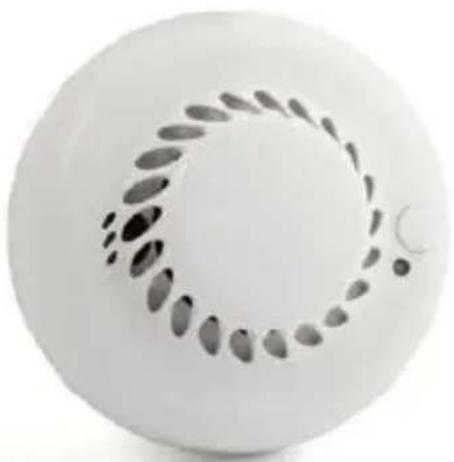
EN14604:2005/AC:2008
FURM30000#05/14
CE 14


| 305/2011/EU | Construction Product Regulation (CPR) |
| 93/68/EEC | The CE Marking Directive |
| 1999/5/EC | R&TTE Directive |
| 2011/65/EU | Restriction of Hazardous Substances (RoHS) Directive |
| 2012/19/EU | Waste from Electrical and Electronic Equipment (WEEE) Directive |
SMOKE DETECTORS FOR MINIMUM SECURITY
○ SMOKE DETECTORS FOR MORE SECURITY


A

Gneral description....22
Preface and intended use 22
Limitation of liability....23
Declaration of conformity 24
Performance declaration 24
Disposal....25
Symbol description 25
Safety information 26
General 26
Battery warning 26
Cleaning....27
Packaging 27
Functioning of the device 27
Selection of device location 28
Where to install your smoke alarm / heat detector 28
Where not to install your smoke alarm / heat detector 30
Where the "heat only" mode can be used 31
Installation and configuration 31
Installation of the detector 32
Configuration of the detector 34
The red LED display....34
How to test your smoke alarm / heat detector 34
Maintenance 35
Cleaning....35
Replacing the batteries 36
Smoke alarm / heat detector limitations....36
Scope of delivery....37
Technical data....37
B. General description
The Privest FURM30000 wireless smoke alarm / heat detector from ABUS Security-Center GmbH & Co. KG combines advanced technology with a compact, streamlined design, making it the perfect choice for house owners who want the highest safety standards.
Smoke is detected by an advanced photoelectric chamber while the temperature is monitored by means of two separate thermosensors, which measure the rate of temperature increase as well as the absolute temperature. With the choice of either smoke or heat detection, or the combination of both, the smoke / heat detector makes for a highly sensitive and reliable product for the early warning of fire hazards under various environmental conditions with a reduced risk for false alarms.
The Privest wireless smoke alarm / heat detector fulfils standard EN14604:2005/AC:2008, is easy to install and is also compatible with the Privest control panels.
1. Preface and intended use
Dear customer,
Thank you for purchasing the FURM30000 wireless smoke alarm / heat detector. This device is built with state-of-the-art technology.
These instructions contain important installation and operation information. Follow the directions and instructions in this manual to ensure safe operation. Store these instructions in a safe place for future reference. These instructions are part of the device. If you pass the device on to third parties, remember to include these instructions with the device.
The Privest wireless smoke alarm / heat detector was designed to operate together with 868 MHz ABUS narrow band receivers. The device contains an integrated transmitter.
The wireless smoke alarm / heat detector does not conform to EN54 or to other local standards required by law for fire detection systems which contact the fire service automatically.
EN

The wireless smoke alarm / heat detector has been designed for use in family homes, apartments or small offices. It is less suited for use in business or industrial environments.
The principal function of the smoke alarm / heat detector is to detect smoke and heat and to set off a local alarm.
This wireless smoke alarm / heat detector also transmits a message to the alarm system's alarm control panel. The alarm system's alarm control panel can also then set off an alarm tone to inform the occupants in the building. The alarm system's alarm control panel can then also inform individuals remotely (e.g. the landlord or the caretaker) using the respective communication devices installed.
Only use the device for the purpose which it was designed and built for. Any other use is not considered to be the intended use.
2. Limitation of liability
Everything possible has been done to ensure that the content of these instructions is correct.
However, neither the author nor ABUS Security-Center GmbH & Co. KG can be held liable for loss or damage caused by incorrect or improper installation and operation or failure to observe the safety instructions and warnings. No liability can be accepted for resulting damage. No part of the product may be changed or modified in any way. If you do not follow these instructions, your guarantee claim becomes invalid. We want you to work only with devices that incorporate state-of-the-art technology. For this reason, we reserve the right to make technical modifications.
We reserve the right to make changes to these instructions without prior notice.
3. Declaration of conformity
ABUS Security-Center GmbH & Co. KG hereby declares that the FURM30000 wireless smoke alarm / heat detector complies with the essential requirements and other relevant provisions of the following directives:
| 305/2011/EU | Construction Product Regulation (CPR) |
| 93/68/EEC | The CE Marking Directive |
| 1999/5/EC | R&TTE Directive |
| 2011/65/EU | Restriction of Hazardous Substances (RoHS) Directive |
| 2012/19/EU | Waste from Electrical and Electronic Equipment (WEEE) Directive |
The declaration of conformity can be obtained from the following address:
4. Performance declaration
This smoke alarm device is tested and certified as a building product in accordance with regulation EU 305/2011. Production is monitored by regular and independent inspections for continued compliance with legal and standard specifications. The respective performance declaration FURM30000#05/14 can be found at www.abus.com


5. Disposal
Device

Batteries
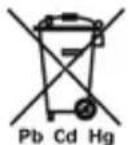
Battery contains:
Pb = Lead
Cd = Cadmium
Hg = Mercury
EU Directive WEEE 2002/96/EC regulates the proper return, handling, and recycling of used electronic devices. This symbol means that in the interest of environmental protection, the device must be disposed of separately from household or industrial waste at the end of its service life in accordance with applicable local legal guidelines. Used devices can be disposed of at official recycling centres in your country. Obey local regulations when disposing of material. Further details on returns (also for non-European countries) can be obtained from your local authority. Separate collection and recycling conserves natural resources and ensures that all the provisions for protecting health and the environment are observed when recycling the product.
Your product uses batteries which are subject to the European directive 2006/66/EC and may not be disposed of with domestic waste.
Find out about the regulations for the separate collection of batteries which apply in your country.
Proper disposal of batteries helps prevent harm to health and the environment.
Batteries that contain harmful chemicals are labelled with these signs:
6. Symbol description
The following symbols are used in this manual:
| Symbol | Signal word | Meaning | |
 | Warning | Indicates a risk of injury or health hazards. | |
 | Warning | Indicates a risk of injury or health hazards caused by electrical voltage. | |
 | Important | Indicates possible damage to the device/accessories. | |
 | Note | Indicates important information. | |
7. Safety information
7.1 General

- The wireless smoke alarm / heat detector does not detect gas, steam, heat or fire/flames. Detectors with special sensors are required for this.
- Persons with impaired hearing cannot hear the alarm. Special alarms with optical signalisation are available for such cases.
- Smoke alarms / heat detectors help save lives. Therefore, for safety's sake, you should regularly test the battery and the operation of the detector. For day-to-day use, remember that the wireless smoke alarm / heat detector cannot prevent fires but simply provides signalization in the event of such a fire. For your own safety, please replace the wireless smoke alarm / heat detector every 10 years at the latest.
- Very high electromagnetic radiation can cause malfunctions. Therefore, avoid installation near devices which produce electromagnetic radiation.
7.2 Battery warning

- Make sure that batteries are kept away from small children. Children may put batteries in their mouths and swallow them. This can cause serious harm to their health. If this happens, consult a doctor immediately.
- Do not charge normal batteries, heat them up or throw them into naked flames (they may explode).
- The battery may not be directly exposed to heat or sunlight, and may not be stored in hot places.
• The battery may not come into contact with water.
• The battery may not be dismantled, pierced or otherwise damaged. - Leaky or damaged batteries can cause chemical burns on contact with the skin. In this case, wear protective gloves. Clean the battery compartment with a dry cloth.
• The battery contacts may not be short-circuited.
• Change low batteries in good time.
• Always change all the batteries at the same time and use batteries of the same type.
• Do not insert with incorrect polarity (+/-).
7.3 Cleaning

- Dusty devices must be cleaned. You can clean dust from the air vents using a vacuum cleaner or compressed air. If necessary, you can remove the dust with a brush.
- You can clean the surface using a cloth slightly dampened in soapy water. Only use suitable microfibre cloths on high-gloss surfaces.
• Do not allow water to penetrate inside the device.
• Do not clean the device in a dishwasher.
• Do not use sharp, pointed, abrasive, or corrosive cleaning materials or hard brushes. - Do not use chemicals.
• Do not use flammable liquids for cleaning the device.
7.4 Packaging

- Keep packaging material away from children - danger of suffocation!
- Remove all packaging material before using the device.
7.5 Functioning of the device

To ensure the perfect functioning of the device, please observe the following points:
- Do not cover the device.
• Do not paint over the device or cover it with wallpaper.
- Do not, on any account, open or repair the device. Failure to observe this instruction will invalidate the warranty.
- Do not use the device if it has been dropped or damaged in any other way.
- If you pass the device on to third parties, you must include these instructions with the device.
8. Selection of device location

Pay attention to all fire precaution regulations and recommendations, especially the standard use of smoke alarm devices according to the applicable legal requirements. Detailed information is available in the DIN 14676 standard “Smoke alarm devices for use in residential buildings, apartments and rooms with similar purposes - Installation, use and maintenance”.
8.1 Where to install your smoke alarm / heat detector
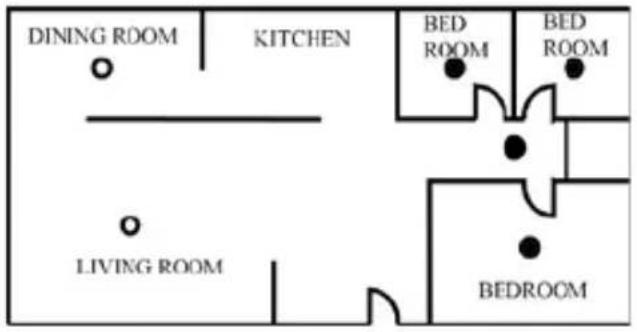
• Install a smoke alarm / heat detector in the hallway outside of every separate sleeping area, as shown in illustration 1. Two detectors are necessary in homes with two areas with bedrooms.
• Install a smoke alarm / heat detector in every room that is used as a sleeping area.
• Install a smoke alarm / heat detector in every floor or a multiple-floor home, as shown in illustration 2.
• Install at least two detectors in every home.
• Install smoke alarms / heat detectors at both ends of a hallway between bedrooms if the hallway is more than 12 meters long.
• In basements, install detectors at the bottom on basement stairs.
• For upper storeys, install detectors at the top of the staircase leading to the storey.
• Make sure that the path of the smoke to the detector is not blocked by a door or another obstacle.
- Install additional detectors in your living room, dining room, family room and attic as well as in laundry and storage rooms.
• Install smoke alarms / heat detectors as close as possible to the centre of the ceiling. If that is not practical, install the detector no closer than 0.3m to walls or corners, as shown in illustration 3.
- If installing on the ceiling is not possible and state and local authorities allow the installation of detectors on walls, assemble them on walls at a distance of 0.3 - 0.5 m from the ceiling, see also in illustration 3.
- If your home has sloped ceilings or gables, try to install the detectors 90cm from the highest point of the ceiling, measured horizontally, as shown in illustration 4.
EN

SMOKE DETECTORS FOR MINIMUM SECURITY
○ SMOKE DETECTORS FOR MORE SECURITY
Illustration 1: Installation locations for smoke alarms / heat detectors in single-family apartments or homes with only one sleeping area

SMOKE DETECTORS FOR MINIMUM SECURITY
Illustration 2: Installation locations for smoke alarms / heat detectors in multiple-floor apartments

Illustration 3: Recommendations for best and acceptable installation locations for installing smoke alarms / heat detectors

Illustration 4: Recommended installation location for smoke alarms / heat detectors in rooms with sloped ceilings or gables (slope >20°)
| Smoke detectors for minimum security |
| Smoke detectors for increased security |
| Horizontal distance from peak |
| Living room / family room |
| Acceptable location |
| Centre of ceiling |
| Best location |
| Ground floor |
| Dining room |
| Never here |
| Basement |
| Bedroom |
| Air return |
| Air entry |
| Detector |
| Kitchen |
| Garage |
| Ceiling |
| Stove |
| Bathroom |
| Wall |
8.2 Where not to install your smoke alarm / heat detector
A false alarm can be triggered if smoke alarms / heat detectors are installed where they cannot function properly. To prevent such false alarms, do not install smoke alarms / heat detectors as follows:
- In areas with fresh air supply. Movement of fresh air can keep smoke from the smoke alarm / heat detector, thereby limiting its effectiveness.
• Near paint thinner vapours.
• In very hot or cold areas, including unheated buildings or exterior spaces.
• Near air ducts or in draughty areas, such as near air conditioners, heaters or fans. - In areas with still air, such as under pointed roofs or in corners between walls and the ceiling. Still air can prevent smoke from reaching the detector. See illustrations 3 and 4 for recommended installation locations.
- Areas prone to insects. If insects enter the sensor chamber of a detector, they can trigger false alarms. If you have a bug problem, take care of it before you install detectors.
- Near fluorescent lights, since electromagnetic fields from fluorescent lights can trigger false alarms. Install smoke alarms / heat detectors at least 1.5 meters from such lights.


8.3 Where the "heat only" mode can be used
To prevent false alarms, you can use your detector in the "heat only" mode. Use the detector in this mode only in or near areas where typically only harmless combustion particles exist which do not present a fire hazard. If the distance of the detector to places at which combustion particles normally exist - for example in kitchens - is less than 6 meters, install the detector as a heat detector only and as far away from the combustion particles as possible. To prevent false alarms, make sure the ventilation in such places is good. Never try to prevent false alarms by switching off the detector.
Other locations:
- In damp or humid areas or near bathrooms with showers. The humidity in the air can get into the measuring chamber and form droplets as it cools, which can then trigger false alarms.
- In very dirty or dusty areas. Dirt and dust can collect in the measuring chamber of the detector and cause it to become over-sensitive.
In addition, dirt or dust can block the openings to the measuring chamber and prevent the detector from detecting smoke.
9. Installation and configuration
The smoke alarm / heat detector must be assembled on the ceiling or, if necessary, on the wall. The smoke alarm / heat detector cannot be networked with other detectors.
Before installation, read the sections titled "Where to install your smoke alarm / heat detector" and "Where not to install your smoke alarm / heat detector" in these operating instructions.
9.1 Installation of the detector
(See illustrations 5 and 6)
- Select the installation location.
- Remove the mounting fixture from the unit by turning it anti-clockwise.
- Remove the locking pin (see illustration 5).
- Use the fixture for labelling the mounting openings.
- Use suitable mounting material for attaching the mounting fixture to the labelled position. If in doubt, consult an expert before installing.
When marking out the drill holes, make sure there are no electrical wires or cables, pipes or other important components behind them. If in doubt, consult an expert before drilling.
Warning
- Configure the detector as described in chapter 9.2.
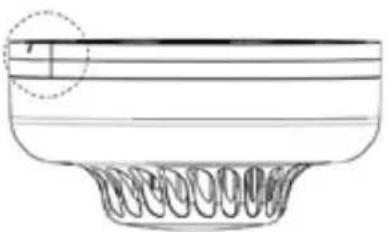
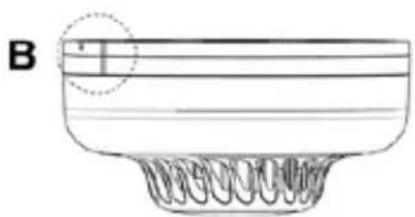
- Align the side marking of the mounting fixture with the detector. Set the detector on the mounting fixture and turn it clockwise in order to mount it at the correct point. (See illustrations 5 A and B)
- Slide in the locking pin to lock the mounting fixture onto the detector (see illustration 5 C).
- Make sure that the detector is firmly connected to the mounting fixture.


A
Setting the detector on the mounting fixture
B
Turning the detector to lock into the mounting fixture
C – Mounting fixture with:
(1) - Screws
(2) - Locking pin
Illustration5: Installing the smoke alarm / heat detector

Illustration 6: Rear side of the detector without mounting fixture
A - DIP switch with:
| 1 | 2 | 3 |
| N. A. | Smoke | Heat |
| ON | ON* | ON* |
| OFF* | OFF | OFF |
* = Standard setting
B - Tamper contact
C – Battery compartment

Attention: DIP switch 1 must be OFF!
9.2 Configuration of the detector
-
Setting the mode Set DIP switch 1 to "OFF" and configure either smoke (2), heat (3) or smoke and heat.
-
Open the cover of the battery compartment (see illustration 6).
-
Make sure the polarisation is correct, place two CR123 3V type lithium batteries (included in delivery) into the battery compartment and close the cover.
-
To ensure the smoke alarm / heat detector can detect the system receiver, register it by entering the 11-digit serial code number or taking the following steps for assigning the radio frequency:
a. Set the alarm system to "teach" mode.
b. Take the battery out of the package and place it into the transmitter, making sure the polarity is correct.
c. Send a teach message by pressing on the tamper contact for at least 3 seconds (or close the mount) until it indicates that it has detected the message.
9.3 The red LED display
If the red LED display (see illustration 7) flashes once every 30 seconds, the detector is functioning normally. If the red LED flashes constantly and an audible warning signal can be heard, the detector is reacting to an alarm trigger.
9.4 How to test your smoke alarm / heat detector
To ensure that your detector is functioning correctly, test it every week with the following test procedure:
- Press the test button firmly. If the detector is functioning correctly, a siren goes off and an alarm message is sent to the alarm control panel.
- Press the test button again to switch off the siren.
- If the detector test is unsuccessful, you must have it repaired or replaced immediately.


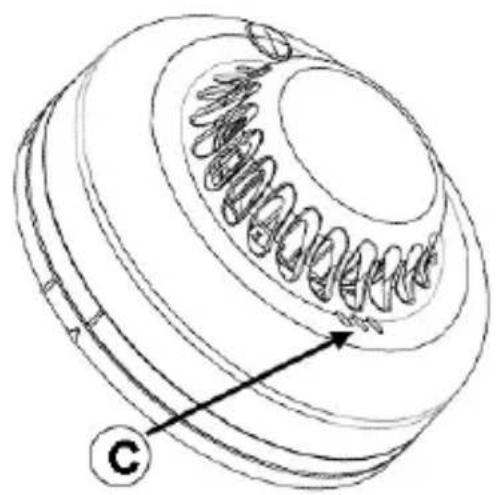
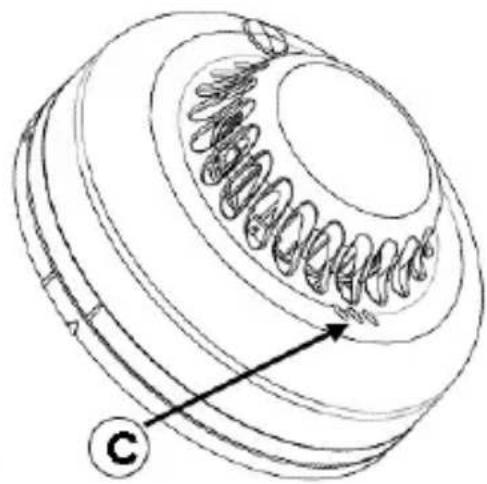
A - LED
B - Test / mute button
C – Opening for sounder
Illustration 7: Housing of the smoke alarm / heat detector

Note
Smoke from cooking or a dusty oven can trigger the detector (false alarm due to disturbance variables). The warning signal switches off as soon as the air is completely clean. If the warning signal rings again, activate the heat mode. Note the information on selecting the location of the detector.
Do not separate the batteries from the detector, as this means the detector will no longer set off fire warnings.
9.5 Maintenance
To ensure the detector continues to function properly, you must test it once a week as described in section "How to test your smoke alarm / heat detector".
9.6 Cleaning
Clean the detector housing with a dry or damp cloth to remove dirt and dust.
Here's how you to clean your detector:
- Remove the detector from its mounting fixture.
- Remove the batteries.
- Use a small paintbrush to remove dirt.
- Reattach the detector to the mounting fixture.
- Check if the detector is functioning properly as described in chapter 9.4.
9.7 Replacing the batteries
Replace the batteries once a year or whenever the low battery signal tone rings.

Low battery signal tone
If the detector beeps once every 35 seconds, the detector batteries are low. Replace the batteries immediately. You should always have back-up batteries for this reason.
After you mount the detector on the detector base, you need to check the smoke alarm device. To do this, conduct a functional test as described above.
Always follow the battery instructions.
10. Smoke alarm / heat detector limitations

Wireless smoke alarms / heat detectors are extremely reliable, but it is possible that they will not function properly in all cases. No smoke alarm / heat detector offers complete protection of life or property. Smoke alarms / heat detectors are not a substitute for life insurance. Smoke alarms / heat detectors need a power source to function.
The smoke alarm / heat detector will not work and the warning signal will not ring if the batteries are dead or if they were not properly installed.
It is possible that the smoke alarm / heat detector will not be heard. Someone who is sleeping deeply, has drunk alcohol or taken drugs might not wake up if the detector is installed outside of the bedroom. Closed or partially closed doors and spatial distance can block or weaken the tone. This detector was not designed for the hearing-impaired.
It is possible that the smoke alarm / heat detector will not activate and trigger an early waning. If a fire breaks out in a fireplace, a wall, on the roof, on the other side of closed doors or on another floor of the building, it is possible that the amount of smoke which reaches the smoke alarm / heat detector is too small to trigger a signal.
Smoke alarms / heat detectors are an immense help in containing damages, reducing injuries and even preventing death. However, despite the high quality of the devices, their function is not always perfect in all possible cases, and we must point out that you cannot expect a smoke alarm / heat detector to protect you from all damage and injury at all times and with 100% certainty.
EN

C. Scope of delivery
| • Wireless smoke alarm / heat detector | • Installation material |
| • 2 x CR123 3V lithium batteries | • Installation and Operating Instructions, available in several languages |
D. Technical data
| Item No. | FURM30000 |
| Smoke alarm | Optical sensor for detecting smoke |
| Heat detector | Dual thermosensor for measuring temperature increase (5°C a minute) and limit value (65°C) |
| Certification | EN14604:2005/AC:2008 |
| Operating modes | Smoke + Heat (OR logic)Only smokeOnly heat |
| Signals | Acoustic (Piezo) and visual (LED) |
| Volume of the warning signal | Min. 85 dB(A) at 3m |
| Sound frequency | 3.6 kHz |
| Standby power consumption: | 0.02mA |
| Alarm power consumption: | 100mA |
| Battery life: | Approx. 3 years |
| Battery type: | 2 x CR123 3V lithium batteries |
| “Dead battery” error message: | < 2.5 V |
| “Dead battery” warning: | 30 days before complete discharge |
| Signal in event of dead battery: | A beep every 30 seconds |
| Operating temperature: | -10°C to 40°C |
| Humidity during operation: | 10% to 85% RH, no condensation or icing |
| Environmental class | II (EN50131-1) |
| Protection class | IP 31 |
| Colour: | White |
| Dimensions: | Diameter: 108 mm / Height: 53 mm |
| Weight: | 175 g net |
| Wireless frequency operating modes | Unidirectional (one-way) |
| Nominal centre frequency | 868.65 MHz |
| Supervision monitoring | Approx. every 15 min. |
| Wireless transmission power | 10mW |
| Wireless range | Up to 300 m (unobstructed) |
| HF immunity | 10 V/m (EN50130-4:2011) |


FR

A. Sommaire
Sommaire 39
| 305/2011/EU | Construction Product Regulation (CPR) |
| 93/68/EEC | The CE Marking Directive |
| 1999/5/EC | R&TTE Directive |
| 2011/65/EU | Restriction of Hazardous Substances (RoHS) Directive |
| 2012/19/EU | Waste from Electrical and Electronic Equipment (WEEE) Directive |
● SMOKE DETECTORS FOR MINIMUM SECURITY
○ SMOKE DETECTORS FOR MORE SECURITY
B
C

FR
A
| 305/2011/EU | Construction Product Regulation (CPR) |
| 93/68/EEC | The CE Marking Directive |
| 1999/5/EC | R&TTE Directive |
| 2011/65/EU | Restriction of Hazardous Substances (RoHS) Directive |
| 2012/19/EU | Waste from Electrical and Electronic Equipment (WEEE) Directive |
● SMOKE DETECTORS FOR MINIMUM SECURITY
○ SMOKE DETECTORS FOR MORE SECURITY

A

A - LED




- A
- GENERAL DESCRIPTION
- PREFACE AND INTENDED USE
- EN
- LIMITATION OF LIABILITY
- DECLARATION OF CONFORMITY
- PERFORMANCE DECLARATION
- DISPOSAL
- SYMBOL DESCRIPTION
- SAFETY INFORMATION
- 7.1 GENERAL
- 7.2 BATTERY WARNING
- 7.3 CLEANING
- 7.4 PACKAGING
- 7.5 FUNCTIONING OF THE DEVICE
- SELECTION OF DEVICE LOCATION
- 8.1 WHERE TO INSTALL YOUR SMOKE ALARM / HEAT DETECTOR
- 8.2 WHERE NOT TO INSTALL YOUR SMOKE ALARM / HEAT DETECTOR
- 8.3 WHERE THE "HEAT ONLY" MODE CAN BE USED
- OTHER LOCATIONS
- INSTALLATION AND CONFIGURATION
- 9.1 INSTALLATION OF THE DETECTOR
- WARNING
- B
- 9.2 CONFIGURATION OF THE DETECTOR
- 9.3 THE RED LED DISPLAY
- 9.4 HOW TO TEST YOUR SMOKE ALARM / HEAT DETECTOR
- 9.5 MAINTENANCE
- 9.6 CLEANING
- 9.7 REPLACING THE BATTERIES
- SMOKE ALARM / HEAT DETECTOR LIMITATIONS
- SCOPE OF DELIVERY
- TECHNICAL DATA
- FR
- SOMMAIRE
Brand : ABUS
Model : FURM30000
Category : Smoke detector