
T14T95N2 - Cooker NEFF - Free user manual and instructions
Find the device manual for free T14T95N2 NEFF in PDF.


| Product type | Freestanding cooker |
| Brand | Neff |
| Model | T14T95N2 |
| Width | 60 cm |
| Height | 85 cm |
| Depth | 60 cm |
| Weight | Approximately 50 kg |
| Cooking type | Ceramic hob |
| Number of cooking zones | 4 cooking zones |
| Oven type | Fan-assisted oven |
| Oven volume | 71 litres |
| Cleaning | Pyrolytic cleaning |
| Oven functions | Fan-assisted heating, grill, base heat, defrost |
| Child safety | Child lock |
| Power supply | 230 V / 50 Hz |
| Total power | Approximately 10 kW |
| Energy class | A |
| Repairability index | 8.2 / 10 |
| Spare parts available | Yes, via after-sales service |
| Annual consumption | Approximately 300 kWh |
| Noise level | 48 dB(A) |
Frequently Asked Questions - T14T95N2 NEFF
User questions about T14T95N2 NEFF
0 question about this device. Answer the ones you know or ask your own.
Ask a new question about this device
Download the instructions for your Cooker in PDF format for free! Find your manual T14T95N2 - NEFF and take your electronic device back in hand. On this page are published all the documents necessary for the use of your device. T14T95N2 by NEFF.
USER MANUAL T14T95N2 NEFF
natural_image
Close-up of a smiling couple enjoying wine and salad at a table (no visible text or symbols)KOCHFELD
TABLE DE CUISSON
HOB
KOOKPLAAT
[en] INSTRUCTION MANUAL ......27
Anzeigen
natural_image
3D rendering of a circular mechanical component with a black arrow indicating rotation (no text or symbols)natural_image
Simple diagram showing a circular component with an arrow and a sunburst symbol (no text or labels)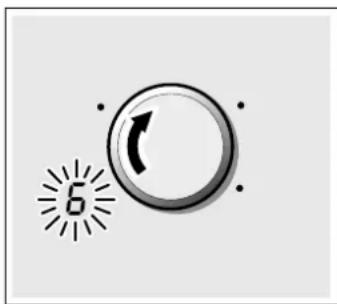
Anti-effacement.... 22
Réglages de base 22
Affichages
natural_image
3D rendering of a metallic circular component with a black arrow indicating rotation (no text or symbols)natural_image
Simple diagram of a circular component with an arrow and a sunburst symbol (no text or labels)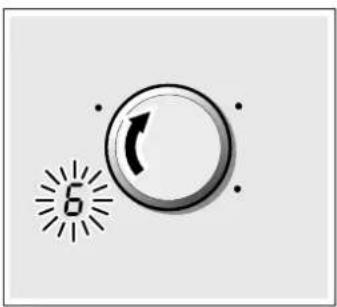
natural_image
Circular dial indicator with a speedometer showing 6, no text or symbols presentTableau de cuisson
Safety precautions ....27
Causes of damage 28
Environmental protection....28
Environmentally-friendly disposal.... 28
Energy-saving tips.... 28
Getting to know your appliance....29
The control panel....29
The hotplates ....29
Residual heat indicator....30
Twistpad with twist knob ....30
Removing the twist knob.... 30
Storing the twist knob ....30
Operation without the twist knob 30
Setting the hob ....30
Switching the hob on and off 30
Setting a hotplate....30
Table of cooking times 31
Childproof lock 32
Switching the childproof lock on and off....32
Automatic childproof lock 32
Timer....33
Automatic hotplate switch-off.... 33
Automatic timer 33
Kitchen timer.... 33
Automatic time limit ....33
Keep warm function ....33
Wipe protection ....34
Basic settings ....34
Changing the basic settings....35
Cleaning and care ....35
Ceramic 35
Hob surround.... 35
Twist knob 35
Rectifying faults ....36
After-sales service 36
Test dishes....37
Additional information on products, accessories, replacement parts and services can be found at www.neff-
international.com and in the online shop www.neff-eshop.com
⚠ Safety precautions
Please read this manual carefully. Please keep the instruction and installation manual as well as the appliance certificate in a safe place for later use or for subsequent owners.
Check the appliance for damage after unpacking it. Do not connect the appliance if it has been damaged in transport.
Only a licensed professional may connect appliances without plugs. Damage caused by incorrect connection is not covered under warranty.
This appliance is intended for domestic use only. The appliance must only be used for the preparation of food and drink. The appliance must be supervised during operation. Only use this appliance indoors.
Do not use covers. These can cause accidents, due to overheating, catching fire or materials shattering, for example.
Do not use inappropriate child safety shields or hob guards. These can cause accidents.
This appliance may be used by children over the age of 8 years old and by persons with reduced physical, sensory or mental capabilities or by persons with a lack of
experience or knowledge if they are supervised or are instructed by a person responsible for their safety how to use the appliance safely and have understood the associated hazards.
Children must not play with, on, or around the appliance. Children must not clean the appliance or carry out general maintenance unless they are at least 8 years old and are being supervised.
Keep children below the age of 8 years old at a safe distance from the appliance and power cable.
Risk of fire!
Hot oil and fat can ignite very quickly. Never leave hot fat or oil unattended. Never use water to put out burning oil or fat. Switch off the hotplate. Extinguish flames carefully using a lid, fire blanket or something similar.
■ The hotplates become very hot. Never place combustible items on the hob. Never place objects on the hob.
■ The appliance gets hot. Do not keep combustible objects or aerosol cans in drawers directly underneath the hob.
- The hob switches off automatically and can no longer be operated. It may switch on unintentionally at a later point. Switch off the circuit breaker in the fuse box. Contact the after-sales service.
Risk of burns!
■ The hotplates and surrounding area (particularly the hob surround, if fitted) become very hot. Never touch the hot surfaces. Keep children at a safe distance.
- The hotplate heats up but the display does not work. Switch off the circuit breaker in the fuse box. Contact the after-sales service.
Risk of electric shock!
- Incorrect repairs are dangerous. Repairs may only be carried out by one of our trained after-sales engineers. If the appliance is faulty, unplug the mains plug or switch off the fuse in the fuse box. Contact the after-sales service.
- Do not use any high-pressure cleaners or steam cleaners, which can result in an electric shock.
Causes of damage
Caution!
■ Rough pot and pan bases scratch the ceramic.
- Avoid boiling pots dry. This may cause damage.
■ Never place hot pots or pans on the control panel, the display area or the surround. This may cause damage.
Overview
The following table provides an overview of the most frequent kinds of damage:
A defective appliance may cause electric shock. Never switch on a defective appliance. Unplug the appliance from the mains or switch off the circuit breaker in the fuse box. Contact the after-sales service.
- Cracks or fractures in the glass ceramic may cause electric shocks. Switch off the circuit breaker in the fuse box. Contact the after-sales service.
Hazard due to magnetism!
The removable control element is magnetic and may affect electronic implants, e. g. heart pacemakers or insulin pumps. For people with electronic implants: never carry the control element in clothing pockets. The minimum distance to heart pacemaker should be 10 cm.
Risk of injury!
Saucepans may suddenly jump due to liquid between the pan base and the hotplate. Always keep the hotplate and saucepan bases dry.
■ Damage can occur if hard or pointed objects fall on the hob.
■ Aluminium foil and plastic containers melt on hot hotplates. Oven protective foil is not suitable for your hob.
Damage Cause Action
| Stains Food spills Remove spills immediately with a glass scraper. |
| Unsuitable cleaning agents Only use cleaning agents which are suitable for ceramic |
Scratches Salt, sugar and sand Do not use the hob as a work surface or storage space.
Rough pot and pan bases scratch the Check your cookware. ceramic.
Discolouration Unsuitable cleaning agents Only use cleaning agents which are suitable for ceramic
Pan abrasion (e.g. aluminium) Lift the pots and pans when moving them.
Blisters Sugar, food with a high sugar content Remove spills immediately with a glass scraper.
Environmental protection
Environmentally-friendly disposal
Dispose of packaging in an environmentally-friendly manner.
This appliance is labelled in accordance with European Directive 2012/19/EU concerning used electrical and electronic appliances (waste electrical and electronic equipment - WEEE). The guideline determines the framework for the return and recycling of used appliances as applicable throughout the EU.
Energy-saving tips
■ Always place suitable lids on saucepans. When cooking without a lid, considerably more energy is required. A glass lid means that you can see inside without having to lift the lid.
■ Use pots and pans with even bases. Uneven bases increase energy consumption.
The diameter of pot and pan bases should be the same size as the hotplate. In particular, small saucepans on the hotplate cause energy losses. Please note: cookware manufacturers often indicate the upper diameter of the saucepan. This is usually bigger than the diameter of the base of the pan.
■ Use a small saucepan for small quantities. A larger, less full saucepan requires a lot of energy.
■ Cook with only a little water. This will save energy. Vitamins and minerals in vegetables are preserved.
■ Always cover as large an area of the hotplate as possible with your saucepan.
■ Switch to a lower heat setting in good time.
■ Select a suitable ongoing cooking setting. You will waste energy by using an ongoing cooking setting which is too high.
■ Use the residual heat of the hob. For longer cooking times, you can switch the hotplate off 5-10 minutes before the end of the cooking time.
Getting to know your appliance
The instruction manual is the same for various different hobs. An overview of the models with their dimensions is given on page 2.
The control panel
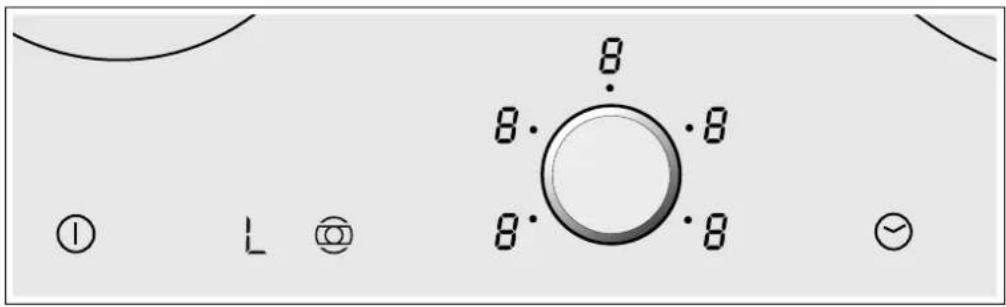
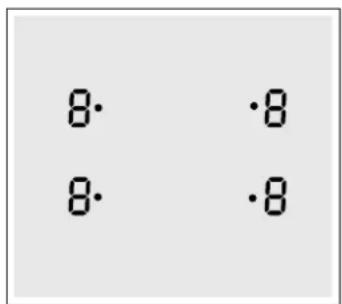
| Displays | |
| 1-9 | Heat settings |
| 0 | Operating readiness |
| H/h | Residual heat |
| L | Keep warm function |
| 88 | Timer |
| Controls | |
| 1 | Main switch |
| 2 | Childproof lock |
| Controls | |
| L | Keep warm function |
| ◎ | Automatic zone control |
| √ | Timer |
Notes
■ When you touch a symbol, the respective function is activated.
■ Always keep the controls dry. Moisture reduces their effectiveness.
- Do not pull pans close to the displays and sensors. The electronics could overheat.
The hotplates
| Hotplate Activating and deactivating | ||
| ○ | Single-circuit hotplate | |
| ◎ | Dual-circuit hotplate | Select the hotplate, touch the ☐ symbol. |
| ◎ | Dual-circuit hotplate, hotplate with extended cooking zone | Select hotplate, touch the ☐ symbol, 2nd filament circuit is activated.Touch the ☐ symbol again, 3rd filament circuit is activated. |
When the hotplate is activated: the corresponding indicator lights up.
Hotplates with bridge heating element
Two individual hotplates can be interconnected with a bridge heating element to create one large extended cooking zone Under normal operation, these hotplates both work as normal single-circuit and dual-circuit hotplates.
To activate the bridge heating element: the single-circuit hotplate must be switched off.
-
Switch on the dual-circuit hotplate.
-
Touch the Ⓞ symbol. The outer filament circuit on the dual-circuit hotplate is activated. The indicator light lights up.
- Touch the Ⓞ symbol again. The extended cooking zone is activated. The indicator light lights up.
To deactivate the extended cooking zone: touch the Ⓞ symbol again. The indicator lamp goes out. The extended cooking zone is deactivated.
You can also change the heat setting using the control panels for the two hotplates.
Residual heat indicator
The hob has a two-stage residual heat indicator for each hotplate.
If H appears in the display the hob is still hot. It may be used, for example, to keep a small meal warm or to melt cooking chocolate. As the hotplate cools down further, the display changes to h. The display remains lit until the hotplate has cooled sufficiently.
Twistpad with twist knob
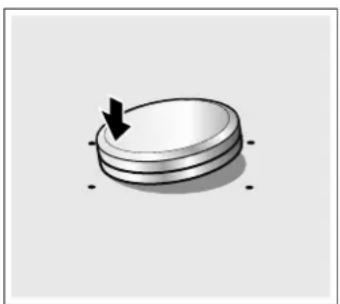
The twistpad is the area in which you can select the hotplates and set heat settings using the twist knob. The twist knob automatically centres itself in the twistpad.
natural_image
3D rendered image of a circular mechanical component with a black arrow indicating rotation (no text or symbols)The twist knob is magnetic and is placed on the twistpad. Tapping the twist knob where there is a marking activates the relevant hotplate. Turning the twist knob sets the heat setting.
Removing the twist knob
You can remove the twist knob. This makes cleaning easier.
You can also remove the twist knob while the hotplate is in operation. The wipe protection function is activated and switches the hotplate off after 35 seconds.
Risk of fire!
If you place a metal object on the twistpad, the hob may continue to heat up. For this reason, always switch off the hob using the main switch.
Storing the twist knob
The twist knob contains a strong magnet. Keep the twist knob away from magnetic data carriers, such as video cassettes, diskettes, credit cards or cards with magnetic strips. The data these contain could otherwise be wiped. They can also cause interference in television sets and monitors.
⚠️ Hazard due to magnetism!
For wearers of electronic implants, e.g. pacemakers or insulin pumps. Implants could be affected by magnetic fields. You must therefore never carry the twist knob in a pocket in your clothing. They must be kept at least 10 cm from pacemakers.
Note: The twist knob is magnetic. Metal particles which stick to the underside can scratch the ceramic hob top. Always wipe the twist knob thoroughly.
Operation without the twist knob
If you have misplaced the twist knob, you can operate the hob without it:
- Switch on the hob using the main switch.
- Within the next 5 seconds, simultaneously touch the L and ⭕ symbols. A signal sounds.
- Touch the ⬕ symbol repeatedly until the indicator for the desired hotplate lights up.
- Set the desired heat setting using the L (-) and Ⓞ (+) symbol. The hotplate is switched on.
Note: You can place the twist knob back on the twistpad at any time.
Setting the hob
This section informs you how to set the hotplates. The table shows heat settings and cooking times for various meals.
Switching the hob on and off
The main switch is used to switch the hob on and off.
To switch on: touch the ① symbol. A signal sounds. The indicator above the main switch lights up. The hob is ready for use.
To switch off: touch the ① symbol until the display above the main switch goes out. All hotplates are switched off. The residual heat indicator remains on until the hotplates have cooled down sufficiently.
Notes
■ The hob switches off automatically if all hotplates have been switched off for more than 15 seconds.
The settings remain stored for 4 seconds after the hob has been switched off. If you switch it on again during this time, the hob will operate using the previously stored settings.
Setting a hotplate
Use the twist knob to set the desired cooking time.
Heat setting 1 = lowest setting
Heat setting 9 = highest setting
There is an intermediate setting between each heat setting. This is identified by a dot.
Set the heat setting
The hob must be switched on.
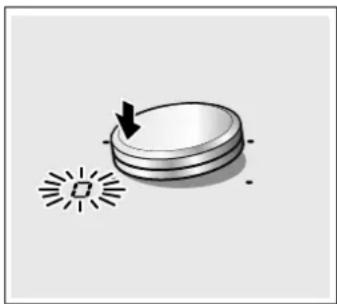
- Select the hotplate. To do this, tap the twist knob in the appropriate area for the desired hotplate.
- Within the next 5 seconds, turn the twist knob until the desired heat setting indicator appears in the heat setting display.
natural_image
Simple diagram showing a circular component with an arrow and a sunburst symbol (no text or labels)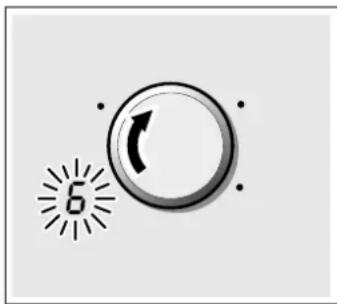
The hotplate is switched on.
Changing the heat setting
Select the hotplate and set the new heat setting.
To switch off the hotplate:
Select the hotplate and set it to ☐. After about 5 seconds, the residual heat indicator appears.
Table of cooking times
The following table provides some examples.
Cooking times and heat settings may vary depending on the type of food, its weight and quality. Deviations are therefore possible.
Note: Hotplate temperature is regulated by the heat switching on and off. The heat may also switch on and off at the highest setting.
For bringing liquids to the boil, use heat setting 9.
Stir thick liquids occasionally.
| Ongoing cooking setting | Ongoing cooking time in minutes | |
| Melting | ||
| Chocolate coating | 1-1. | - |
| Butter, honey, gelatine | 1-2 | - |
| Heating and keeping warm | ||
| Stew (e.g. lentil stew) | 1-2 | - |
| Milk** | 1.-2. | - |
| Heating sausages in water** | 3-4 | - |
| Defrosting and heating | ||
| Frozen spinach | 2.-3. | 10-20 min |
| Frozen goulash | 2.-3. | 20-30 min |
| Poaching, simmering | ||
| Dumplings | 4.-5.* | 20-30 min |
| Fish | 4-5* | 10-15 min |
| White sauces, e.g. béchamel sauce | 1-2 | 3-6 min |
| Emulsified sauces, e.g. béarnaise sauce, hollandaise sauce | 3-4 | 8-12 min |
| Boiling, steaming, braising | ||
| Rice (with double the quantity of water) | 2-3 | 15-30 min |
| Rice pudding | 1.-2. | 35-45 min |
| Unpeeled boiled potatoes | 4-5 | 25-30 min |
| Boiled potatoes | 4-5 | 15-25 min |
| Pasta, noodles | 6-7* | 6-10 min |
| Stew, soups | 3.-4. | 15-60 min |
| Vegetables | 2.-3. | 10-20 min |
| Frozen vegetables | 3.-4. | 10-20 min |
| Cooking in a pressure cooker | 4-5 | - |
| Braising | ||
| Roulades | 4-5 | 50-60 min |
| Pot roasts | 4-5 | 60-100 min |
| Goulash | 2.-3. | 50-60 min |
* Ongoing cooking without a lid
** Without lid
*** Turn frequently
| Ongoing cooking setting | Ongoing cooking time in minutes | |
| Frying** | ||
| Escalope, plain or breaded | 6-7 | 6-10 min |
| Escalope, frozen | 6-7 | 8-12 min |
| Cutlet, plain or breaded*** | 6-7 | 8-12 min |
| Steak (3 cm thick) | 7-8 | 8-12 min |
| Hamburger, rissoles (3 cm thick)*** | 4.-5. | 30-40 min |
| Poultry breast (2 cm thick)*** | 5-6 | 10-20 min |
| Poultry breast, frozen*** | 5-6 | 10-30 min |
| Fish and fish fillet, plain | 5-6 | 8-20 min |
| Fish and fish fillet, breaded | 6-7 | 8-20 min |
| Fish and fish fillet, breaded and frozen, e.g. fish fingers | 6-7 | 8-12 min |
| Scampi and prawns | 7-8 | 4-10 min |
| Stir fry, frozen | 6-7 | 6-10 min |
| Pancakes | 6-7 | consecutively |
| Omelette | 3.-4. | consecutively |
| Fried eggs | 5-6 | 3-6 min |
| Deep-fat frying (fry 150-200 g per portion continuously in 1-2 litres oil**) | ||
| Frozen products, e.g. chips, chicken nuggets | 8-9 | - |
| Croquettes | 7-8 | - |
| Meat, e.g. chicken portions | 6-7 | - |
| Fish, breaded or battered | 5-6 | - |
| Vegetables, mushrooms, breaded or battered | 5-6 | - |
| Small baked items, e.g. doughnuts, fruit in batter | 4-5 | - |
* Ongoing cooking without a lid
** Without lid
*** Turn frequently
Childproof lock
You can use the childproof lock to prevent children from switching on the hotplates.
Switching the childproof lock on and off
The hob must be switched off.
To switch on: touch the L symbol for approx. 3 seconds. The ∞ symbol lights up for 10 seconds. The hob is locked.
To switch off: touch the L symbol for approx. 3 seconds. The hob is unlocked.
Automatic childproof lock
This function automatically activates the childproof lock every time you switch the hob off.
Switching on and off
You can find out how to switch the automatic childproof lock on and off in the Basic settings section.
Timer
The timer can be used in two different ways:
■ To switch a hotplate off automatically
As a kitchen timer
Automatic hotplate switch-off
Enter a cooking time for the relevant hotplate. When the cooking time has elapsed, the hotplate switches off automatically.
Setting the cooking time
The hotplate must be switched on.
- Select the hotplate using the twist knob.
- Touch the ⏻ symbol. 📄 lights up on the timer display. Use the twist knob to set the desired cooking time.
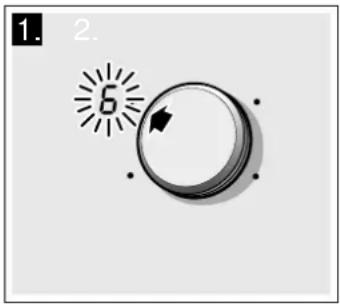
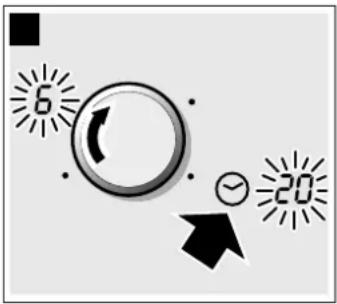
The cooking time counts down. If you have set a cooking time for several hotplates, the shortest cooking time will be displayed. The I→I indicator for the hotplate lights up brightly.
When the cooking time has elapsed
When the cooking time has elapsed, the hotplate switches off. 0 lights up in the hotplate display. A signal sounds. 00 lights up in the timer display for one minute. The I→I hotplate indicator flashes. Touch any control. The indicators go out and the audible signal ceases.
Changing or cancelling the cooking time
Select the hotplate using the twist knob. Touch the ⏻ symbol and change the cooking time or set to ☐☐.
Notes
If you wish to call up the cooking time for a hotplate, use the twist knob to select the hotplate. The cooking time appears for 5 seconds.
■ You can set a cooking time of up to 99 minutes.
Automatic timer
You can use this function to preselect a cooking time for all hotplates. Each time a hotplate is switched on, the preselected cooking then counts down. When the cooking time has elapsed, the hotplate switches off automatically.
You can find out how to switch on the automatic timer in the Basic settings section.
Note: You can change the cooking time for a hotplate or switch off the automatic timer for the hotplates.
Select the hotplate and touch the ⏻ symbol. Change the cooking time or set to 00 in the settings area.
Kitchen timer
You can use the kitchen timer to set a time of up to 99 minutes. It runs independently of all the other settings.
Setting the kitchen timer
No hotplate should have been selected.
- Touch the ⏻ symbol, 00 lights up in the timer display.
- Set the required cooking time using the twist knob.
The timer starts counting down after a few seconds.
When the cooking time has elapsed
A signal sounds for one minute and 00 lights up in the timer display. The indicator flashes. Touch any control. The indicators go out and the audible signal ceases.
Changing the time
Touch the ⬤ symbol and use the twist knob to change the time.
Automatic time limit
If a hotplate is in use for a long time without the setting being changed, the automatic time limit is activated.
The hotplate stops heating. F and B flash alternately in the hotplate indicator.
The display goes out when you touch any control. You can make new settings.
When the time limit is activated depends on the heat setting selected (1 to 10 hours).
Keep warm function
The keep warm function is suitable for melting chocolate or butter and for warming food and cookware.
Switching on the keep warm function:
-
Select the hotplate using the twist knob.
-
In the next 5 seconds, touch the L symbol.
L appears in the heat setting display. The keep warm function is switched on.
Switching off the keep warm function:
Select the hotplate and touch the L symbol. ☐ appears in the heat setting display.
After approximately 5 seconds, the hotplate is switched off, and the residual heat indicator appears.
Wipe protection
If you wipe over the control panel while the hob is switched on, settings may be altered.
Your hob has a wipe protection function to avoid this. Remove the twist knob. A signal sounds. The control panel is locked for 30 seconds. You can now wipe over the control panel without altering any settings.
Notes
■ The main switch is excluded from the wipe protection function. You can switch off the hob at any time.
- You can place the twist knob back on the twistpad at any time.
■ The hotplate automatically switches off after 35 seconds.
Basic settings
Your appliance has various basic settings. You can adapt these settings to your needs.
| Indicator Function | |
| c1 | Automatic childproof lock0 Switched off.*1 Switched on. |
| c2 | Audible signal0 Confirmation signal and fault notification switched off.1 Only fault notification switched on.2 Confirmation signal and fault notification switched on.* |
| c5 | Automatic timer0 Switched off.*1-99 Cooking time, after which the hotplates switch off |
| c6 | Duration of the timer end signal1 10 seconds.2 30 seconds3 1 minute.* |
| c7 | Activation of the filament circuits0 Switched off.*1 Switched on.2 Last setting before the hotplate was switched off. |
| c8 | Operation without twist knob0 Switched off1 Switched on* |
| c0 | Reset to basic setting0 Switched off.1 Switched on. |
| *Basic setting | |
Changing the basic settings
The hob must be switched off.
- Switch on the hob.
- Within the next 10 seconds, touch the ⏻ symbol for 4 seconds.
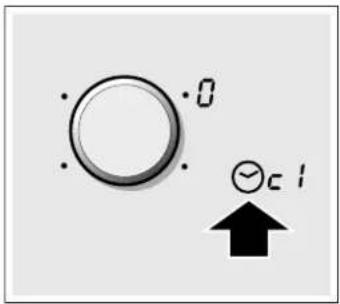
c 1 appears in the timer display and 0 in the hotplate display.
- Touch the ⏻ symbol repeatedly until the desired symbol appears in the timer display.
- Set the desired value using the twist knob.
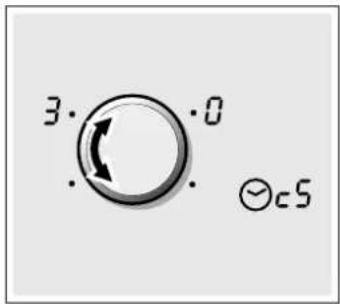
- Touch the 3√ symbol for 4 seconds.
The setting is activated.
Switching off
To exit the basic setting, switch off the hob with the main switch and make new settings.
Cleaning and care
The information in this section provides help on how best to care for your hob.
Suitable maintenance and cleaning products can be purchased from the after-sales service or in our e-Shop.
Ceramic
Clean the hob after each use. This will prevent spills from burning onto the ceramic.
Only clean the hob when it has cooled down sufficiently.
Use only cleaning agents which are suitable for glass ceramic. Follow the cleaning instructions on the packaging.
Never use:
■ Undiluted washing-up liquid
■ Detergent intended for dishwashers
■ Scouring agents
■ Harsh cleaning agents such as oven spray or stain remover
■ Abrasive sponges
■ High-pressure cleaners or steam jet cleaners
Ground-in dirt can be best removed with a glass scraper, available from retailers. Please note the manufacturer's instructions.
You can also obtain a suitable glass scraper from our after-sales service or from the e-Shop.
Using special sponges to clean glass ceramic achieves great cleaning results.
Hob surround
To prevent damage to the hob surround, observe the following instructions:
■ Use only hot soapy water.
■ Wash new sponge cloths thoroughly before use.
■ Do not use any sharp or abrasive agents.
■ Do not use the glass scraper.
Twist knob
It is recommended that the touch knob is wiped with lukewarm soapy water only. Do not use harsh or abrasive agents. The twist knob will be damaged if cleaned in the dishwasher or immersed in soapy water.
Rectifying faults
Malfunctions often have simple explanations. Please read the following notes before calling the after-sales service.
Indicator Fault Action
| Blank There is no power supply. Check the household fuse for the appliance. Check whether there is a power cut by trying other electronic appliances. | ||
| Eis flashing | The controls are damp or an object is resting on them. | Dry the controls or remove the object. |
| Er-38 | Twist knob not centred in the twistpad. | Place the twist knob in the centre of the twistpad. |
| Er+ number | Electronic fault. Switch the appliance off and back on again after about 30 seconds using either the household fuse or the circuit breaker in the fuse box. Contact the after-sales service if this appears in the display again. | |
| F2 | The electronics have overheated and have switched off the corresponding hotplate. | Wait until the electronics have cooled down sufficiently. Then touch a control for the hotplate.* |
| F4 | The electronics have overheated and have switched off all hotplates. | Wait until the electronics have cooled down sufficiently. Then touch any control.* |
| F8 | The hotplate was in operation for too long and has switched itself off. | You can switch the hotplate back on again immediately. |
* Do not place hot pans close to or on the control panel
After-sales service
Our after-sales service is there for you if your appliance should need to be repaired. We are committed to find the best solution also in order to avoid an unnecessary call-out.
E number and FD number:
Please quote the E number (product number) and the FD number (production number) of your appliance when contacting the after-sales service. The rating plate bearing these numbers can be found on the appliance certificate.
Please note that a visit from an after-sales service engineer is not free of charge, even during the warranty period.
Please find the contact data of all countries in the enclosed customer service list.
To book an engineer visit and product advice
GB 0844 8928989
Calls from a BT landline will be charged at up to 3 pence per minute. A call set-up fee of up to 6 pence may apply.
IE 01450 2655
0.03 € per minute at peak. Off peak 0.0088 € per minute.
Rely on the professionalism of the manufacturer. You can therefore be sure that the repair is carried out by trained service technicians who carry original spare parts for your appliances.
Test dishes
This table has been produced for test institutes to facilitate the testing of our appliances.
The data in the table refers to our accessory cookware from Schulte Ufer (4-part induction pot set Z9442X0) with the following dimensions:
■ Saucepan dia.16 cm, 1.2 litres, for 14.5 cm dia. single-circuit hotplate
■ Cooking pot dia. 16 cm, 1.7 litres, for 14.5 cm dia. single-circuit hotplate
■ Cooking pot dia. 22 cm, 4.2 litres, for 18 cm dia. or 17 cm dia. hotplate
■ Frying pan dia. 24 cm, for 18 cm dia. or 17 cm dia. hotplate
| Heating up/bringing to boil Ongoing cooking | |||||
| Test dishes Heat setting Cooking time (min:sec) Lid Ongoing cooking | setting | Lid | |||
| Melting chocolate | |||||
| Cookware: saucepan | |||||
| Chocolate couverture (e.g. Dr. Oetker Zartbitter, 150 g) on 14.5 dia. hotplate | - | - | - | 1 | |
| Heating and keeping lentil stew warm | |||||
| Cookware: cooking pot | |||||
| Lentil stew made to DIN 44550 | |||||
| Initial temperature 20 °C | |||||
| Amount 450 g for 14.5 cm dia. hotplate | 9 | approx. 2:00 without stirring | Yes | 1 | Yes |
| Amount 800 g for 18 cm dia. or 17 cm dia. hotplate | 9 approx. 2:00 without stirring Yes | 1 | Yes | ||
| Lentil stew from the tin | |||||
| e.g. lentil terrine with sausages from Erasco: initial temperature 20 °C | |||||
| Amount 500 g for 14.5 cm dia. hotplate 9 | approx. 2:00(Stir after approx. 1:30) | Yes | 1 | Yes | |
| Amount 1000 g for 18 cm dia. or 17 cm dia. hotplate | 9 | approx. 2:30(Stir after approx. 1:30) | Yes | 1 | Yes |
| Simmering Béchamel sauce | |||||
| Cookware: saucepan | |||||
| Milk temperature: 7 °C | |||||
| Recipe: 40 g butter, 40 g flour, 0.5 l milk (3.5% fat content) and one pinch of salt for 14.5 cm dia. hotplate | 9^2 | approx. 5:20 | No | 1^1,3 | No |
| ^1 Melt the butter, stir in the flour and salt and keep cooking the roux for 3 minutes | |||||
| ^2 Add the milk to the roux and bring to the boil, stirring continuously | ^3 After the Béchamel has come to the boil, keep cooking it at Level 1 for a further 2 minutes, stirring all the time | ||||
| Cooking rice pudding | |||||
| Cookware: cooking pot | |||||
| Milk temperature: 7 °C | |||||
| Recipe: 190 g round grain rice, 22.5 g sugar, 750 ml milk (3.5% fat content) and one pinch of salt for 14.5 cm dia. hotplate | 9 | approx. 6:30 | No | 2 | Yes |
| Heat the milk until it starts to rise up. Switch down to the ongoing cooking setting and add the rice, sugar and salt to the milk | |||||
| Stir the rice pudding after 10 minutes | |||||
| Test dishes | Heating up/bringing to boil Ongoing cooking | ||||
| Heat setting | Cooking time (min:sec) | Lid | Ongoing cooking setting | Lid | |
| Recipe: 250 g round grain rice, 30 g sugar, 1 l milk (3.5% fat content) and one pinch of salt for 18 cm dia. or 17 cm dia. hotplate | 9 approx. 6:30 | No 2 Yes | |||
| Heat the milk until it starts to rise up. Switch down to the ongoing cooking setting and add the rice, sugar and salt to the milk | |||||
| Stir the rice pudding after 10 minutes | |||||
| Cooking rice | |||||
| Cookware: cooking pot | |||||
| Water temperature 20 °C | |||||
| Recipe made to DIN 44550: | 9 approx. 2:48 Yes 2 Yes | ||||
| 125 g long grain rice, 300 g water and a pinch of salt for 14.5 cm dia. hotplate | |||||
| Recipe made to DIN 44550: | 9 approx. 3:15 Yes 2. Yes | ||||
| 250 g Long grain rice, 600 g water and a pinch of salt for 18 cm dia. or 17 cm dia. hotplate | |||||
| Frying pork loin chops | |||||
| Cookware: frying pan | |||||
| Initial temperature of loin chops: 7 °C | |||||
| Amount: 3 loin chops (total weight approx. 300 g, about 1 cm thick) 15 g sunflower oil for 18 cm dia.or 17 cm dia. hotplate | 9 approx. 2:40 No 7 No | ||||
| Frying pancakes | |||||
| Cookware: frying pan | |||||
| Recipe made to DIN EN 60350-2 | |||||
| Amount: 55 ml mixture per pancake for 18 cm dia. or 17 cm dia. hotplate | 9 approx. 2:40 No 6 or 6. depending | on browning level | No | ||
| Deep-fat frying frozen chips | |||||
| Cookware: cooking pot | |||||
| Amount: 1.8 kg sunflower seed oil, per portion: 200 g frozen chips (e.g. McCain 123 Original fries) for 18 cm dia. or 17 cm dia. hotplate | 9 Until oil temperature reaches 180 °C | No 9 No | |||
If the tests are carried out with an 18 cm dia. hotplate with a power rating of 1500 W, the boiling time is increased by approx. 20% and the ongoing cooking setting is increased by one ongoing cooking setting.
Inhoudsopgave
Indicaties
natural_image
3D rendering of a circular mechanical component with a black arrow indicating rotation (no text or symbols)natural_image
Simple diagram of a circular component with an arrow and a sunburst symbol (no text or labels)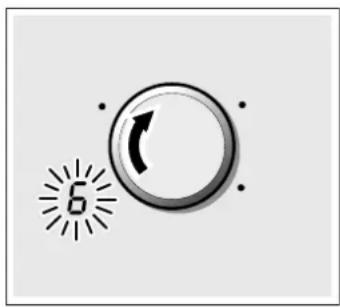
natural_image
Blurred photo of two people interacting, one in dark blue shirt and the other in light pink shirt (no visible text or symbols)Constructa Neff
Vertriebs-GmbH
Carl-Wery-Straße 34
D-81739 München
- Tableau de cuisson
- ⚠ Safety precautions
- Risk of fire!
- Risk of burns!
- Risk of electric shock!
- Causes of damage
- Caution!
- Overview
- Hazard due to magnetism!
- Risk of injury!
- Environmental protection
- Environmentally-friendly disposal
- Energy-saving tips
- Getting to know your appliance
- The control panel
- Notes
- The hotplates
- Hotplates with bridge heating element
- Residual heat indicator
- Twistpad with twist knob
- Removing the twist knob
- Storing the twist knob
- ⚠️ Hazard due to magnetism!
- Operation without the twist knob
- Setting the hob
- Switching the hob on and off
- Setting a hotplate
- Set the heat setting
- Changing the heat setting
- To switch off the hotplate:
- Table of cooking times
- Childproof lock
- Switching the childproof lock on and off
- Automatic childproof lock
- Switching on and off
- Timer
- Automatic hotplate switch-off
- Setting the cooking time
- When the cooking time has elapsed
- Changing or cancelling the cooking time
- Automatic timer
- Kitchen timer
- Setting the kitchen timer
- Changing the time
- Automatic time limit
- Keep warm function
- Wipe protection
- Basic settings
- Changing the basic settings
- Switching off
- Cleaning and care
- Ceramic
- Hob surround
- Twist knob
- Rectifying faults
- After-sales service
- E number and FD number:
- To book an engineer visit and product advice
- Test dishes
- Inhoudsopgave
Brand : NEFF
Model : T14T95N2
Category : Cooker