PSR-E413 - Keyboard YAMAHA - Free user manual and instructions
Find the device manual for free PSR-E413 YAMAHA in PDF.


User questions about PSR-E413 YAMAHA
0 question about this device. Answer the ones you know or ask your own.
Ask a new question about this device
Download the instructions for your Keyboard in PDF format for free! Find your manual PSR-E413 - YAMAHA and take your electronic device back in hand. On this page are published all the documents necessary for the use of your device. PSR-E413 by YAMAHA.
USER MANUAL PSR-E413 YAMAHA
This product utilizes batteries or an external power supply (adapter). DO NOT connect this product to any power supply or adapter other than one described in the manual, on the name plate, or specifically recommended by Yamaha.
WARNING: Do not place this product in a position where anyone could walk on, trip over, or roll anything over power or connecting cords of any kind. The use of an extension cord is not recommended! If you must use an extension cord, the minimum wire size for a 25' cord (or less) is 18 AWG. NOTE: The smaller the AWG number, the larger the current handling capacity. For longer extension cords, consult a local electrician.
This product should be used only with the components supplied or; a cart, rack, or stand that is recommended by Yamaha. If a cart, etc., is used, please observe all safety markings and instructions that accompany the accessory product.
SPECIFICATIONS SUBJECT TO CHANGE:
The information contained in this manual is believed to be correct at the time of printing. However, Yamaha reserves the right to change or modify any of the specifications without notice or obligation to update existing units.
This product, either alone or in combination with an amplifier and headphones or speaker/s, may be capable of producing sound levels that could cause permanent hearing loss. DO NOT operate for long periods of time at a high volume level or at a level that is uncomfortable. If you experience any hearing loss or ringing in the ears, you should consult an audiologist.
IMPORTANT: The louder the sound, the shorter the time period before damage occurs.
Some Yamaha products may have benches and / or accessory mounting fixtures that are either supplied with the product or as optional accessories. Some of these items are designed to be dealer assembled or installed. Please make sure that benches are stable and any optional fixtures (where applicable) are well secured BEFORE using.
Benches supplied by Yamaha are designed for seating only. No other uses are recommended.
NOTICE:
Service charges incurred due to a lack of knowledge relating to how a function or effect works (when the unit is operating as designed) are not covered by the manufacturer's warranty, and are therefore the owners responsibility. Please study this manual carefully and consult your dealer before requesting service.
ENVIRONMENTAL ISSUES:
Yamaha strives to produce products that are both user safe and environmentally friendly. We sincerely believe that our products and the production methods used to produce them, meet these goals. In keeping with both the letter and the spirit of the law, we want you to be aware of the following:
Battery Notice:
This product MAY contain a small non-rechargeable battery which (if applicable) is soldered in place. The average life span of this type of battery is approximately five years. When replacement becomes necessary, contact a qualified service representative to perform the replacement.
This product may also use “household” type batteries. Some of these may be rechargeable. Make sure that the battery being charged is a rechargeable type and that the charger is intended for the battery being charged.
When installing batteries, do not mix batteries with new, or with batteries of a different type. Batteries MUST be installed correctly. Mismatches or incorrect installation may result in overheating and battery case rupture.
Warning:
Do not attempt to disassemble, or incinerate any battery. Keep all batteries away from children. Dispose of used batteries promptly and as regulated by the laws in your area. Note: Check with any retailer of household type batteries in your area for battery disposal information.
Disposal Notice:
Should this product become damaged beyond repair, or for some reason its useful life is considered to be at an end, please observe all local, state, and federal regulations that relate to the disposal of products that contain lead, batteries, plastics, etc. If your dealer is unable to assist you, please contact Yamaha directly.
NAME PLATE LOCATION:
The name plate is located on the bottom of the product. The model number, serial number, power requirements, etc., are located on this plate. You should record the model number, serial number, and the date of purchase in the spaces provided below and retain this manual as a permanent record of your purchase.
Model
Serial No.
Purchase Date
92-BP (bottom)
PLEASE KEEP THIS MANUAL
FCC INFORMATION (U.S.A.)
1. IMPORTANT NOTICE: DO NOT MODIFY THIS UNIT!
This product, when installed as indicated in the instructions contained in this manual, meets FCC requirements. Modifications not expressly approved by Yamaha may void your authority, granted by the FCC, to use the product.
2. IMPORTANT: When connecting this product to accessories and/or another product use only high quality shielded cables. Cable/s supplied with this product MUST be used. Follow all installation instructions. Failure to follow instructions could void your FCC authorization to use this product in the USA.
3. NOTE: This product has been tested and found to comply with the requirements listed in FCC Regulations, Part 15 for Class "B" digital devices. Compliance with these requirements provides a reasonable level of assurance that your use of this product in a residential environment will not result in harmful interference with other electronic devices. This equipment generates/uses radio frequencies and, if not installed and used according to the instructions found in the users manual, may cause interference harmful to the operation of other electronic devices. Compliance with FCC regulations does
not guarantee that interference will not occur in all installations. If this product is found to be the source of interference, which can be determined by turning the unit "OFF" and "ON", please try to eliminate the problem by using one of the following measures:
Relocate either this product or the device that is being affected by the interference.
Utilize power outlets that are on different branch (circuit breaker or fuse) circuits or install AC line filter/s.
In the case of radio or TV interference, relocate/reorient the antenna. If the antenna lead-in is 300 ohm ribbon lead, change the lead-in to co-axial type cable.
If these corrective measures do not produce satisfactory results, please contact the local retailer authorized to distribute this type of product. If you can not locate the appropriate retailer, please contact Yamaha Corporation of America, Electronic Service Division, 6600 Orangethorpe Ave, Buena Park, CA90620
The above statements apply ONLY to those products distributed by Yamaha Corporation of America or its subsidiaries.
* This applies only to products distributed by YAMAHA CORPORATION OF AMERICA.
(class B)
IMPORTANT NOTICE FOR THE UNITED KINGDOM Connecting the Plug and Cord
IMPORTANT. The wires in this mains lead are coloured in accordance with the following code:
BLUE : NEUTRAL
BROWN : LIVE
As the colours of the wires in the mains lead of this apparatus may not correspond with the coloured makings identifying the terminals in your plug proceed as follows:
The wire which is coloured BLUE must be connected to the terminal which is marked with the letter N or coloured BLACK.
The wire which is coloured BROWN must be connected to the terminal which is marked with the letter L or coloured RED.
Making sure that neither core is connected to the earth terminal of the three pin plug.
• This applies only to products distributed by Yamaha Music U.K. Ltd.
(2 wires)
COMPLIANCE INFORMATION STATEMENT (DECLARATION OF CONFORMITY PROCEDURE)
Responsible Party : Yamaha Corporation of America
Address : 6600 Orangethorpe Ave., Buena Park, Calif. 90620
Telephone : 714-522-9011
Type of Equipment : Digital Keyboard
Model Name : PSR-E413
This device complies with Part 15 of the FCC Rules.
Operation is subject to the following two conditions:
1) this device may not cause harmful interference, and
2) this device must accept any interference received including interference that may cause undesired operation.
See user manual instructions if interference to radio reception is suspected.
* This applies only to products distributed by YAMAHA CORPORATION OF AMERICA.
(FCC DoC)
OBSERVERA!
* Please keep this manual in a safe place for future reference.

WARNING
Always follow the basic precautions listed below to avoid the possibility of serious injury or even death from electrical shock, short-circuiting, damages, fire or other hazards. These precautions include, but are not limited to, the following:
Power supply/AC power adaptor
- Only use the voltage specified as correct for the instrument. The required voltage is printed on the name plate of the instrument.
- Use the specified adaptor (PA-130 or an equivalent recommended by Yamaha) only. Using the wrong adaptor can result in damage to the instrument or overheating.
- Check the electric plug periodically and remove any dirt or dust which may have accumulated on it.
- Do not place the AC adaptor cord near heat sources such as heaters or radiators, and do not excessively bend or otherwise damage the cord, place heavy objects on it, or place it in a position where anyone could walk on, trip over, or roll anything over it.
Do not open
- Do not open the instrument or attempt to disassemble the internal parts or modify them in any way. The instrument contains no user-serviceable parts. If it should appear to be malfunctioning, discontinue use immediately and have it inspected by qualified Yamaha service personnel.
Water warning
- Do not expose the instrument to rain, use it near water or in damp or wet conditions, or place containers on it containing liquids which might spill into any openings. If any liquid such as water seeps into the instrument, turn off the power immediately and unplug the power cord from the AC outlet. Then have the instrument inspected by qualified Yamaha service personnel.
- Never insert or remove an electric plug with wet hands.
Fire warning
- Do not put burning items, such as candles, on the unit. A burning item may fall over and cause a fire.
If you notice any abnormality
- If the AC adaptor cord or plug becomes frayed or damaged, or if there is a sudden loss of sound during use of the instrument, or if any unusual smells or smoke should appear to be caused by it, immediately turn off the power switch, disconnect the adaptor plug from the outlet, and have the instrument inspected by qualified Yamaha service personnel.

CAUTION
Always follow the basic precautions listed below to avoid the possibility of physical injury to you or others, or damage to the instrument or other property. These precautions include, but are not limited to, the following:
Power supply/AC power adaptor
- When removing the electric plug from the instrument or an outlet, always hold the plug itself and not the cord.
- Unplug the AC power adaptor when not using the instrument, or during electrical storms.
- Do not connect the instrument to an electrical outlet using a multiple-connector. Doing so can result in lower sound quality, or possibly cause overheating in the outlet.
Battery
- Always make sure all batteries are inserted in conformity with the +/- polarity markings. Failure to do so might result in overheating, fire, or battery fluid leakage.
- Always replace all batteries at the same time. Do not use new batteries together with old ones. Also, do not mix battery types, such as alkaline batteries with manganese batteries, or batteries from different makers, or different types of batteries from the same maker, since this can cause overheating, fire, or battery fluid leakage.
-
Do not dispose of batteries in fire.
-
Do not attempt to recharge batteries that are not intended to be charged.
- When the batteries run out, or if the instrument is not to be used for a long time, remove the batteries from the instrument to prevent possible leakage of the battery fluid.
- Keep batteries away from children.
- If the batteries do leak, avoid contact with the leaked fluid. If the battery fluid should come in contact with your eyes, mouth, or skin, wash immediately with water and consult a doctor. Battery fluid is corrosive and may possibly cause loss of sight or chemical burns.
Location
- Do not expose the instrument to excessive dust or vibrations, or extreme cold or heat (such as in direct sunlight, near a heater, or in a car during the day) to prevent the possibility of panel disfiguration or damage to the internal components.
- Do not use the instrument in the vicinity of a TV, radio, stereo equipment, mobile phone, or other electric devices. Otherwise, the instrument, TV, or radio may generate noise.
-
Do not place the instrument in an unstable position where it might accidentally fall over.
-
Before moving the instrument, remove all connected adaptor and other cables.
- When setting up the product, make sure that the AC outlet you are using is easily accessible. If some trouble or malfunction occurs, immediately turn off the power switch and disconnect the plug from the outlet. Even when the power switch is turned off, electricity is still flowing to the product at the minimum level. When you are not using the product for a long time, make sure to unplug the power cord from the wall AC outlet.
- Use only the stand specified for the instrument. When attaching the stand or rack, use the provided screws only. Failure to do so could cause damage to the internal components or result in the instrument falling over.
Connections
- Before connecting the instrument to other electronic components, turn off the power for all components. Before turning the power on or off for all components, set all volume levels to minimum. Also, be sure to set the volumes of all components at their minimum levels and gradually raise the volume controls while playing the instrument to set the desired listening level.
Maintenance
- When cleaning the instrument, use a soft, dry cloth. Do not use paint thinners, solvents, cleaning fluids, or chemical-impregnated wiping cloths.
Handling caution
- Do not insert a finger or hand in any gaps on the instrument.
- Never insert or drop paper, metallic, or other objects into the gaps on the panel or keyboard. If this happens, turn off the power immediately and unplug the power cord from the AC outlet. Then have the instrument inspected by qualified Yamaha service personnel.
- Do not place vinyl, plastic or rubber objects on the instrument, since this might discolor the panel or keyboard.
- Do not rest your weight on, or place heavy objects on the instrument, and do not use excessive force on the buttons, switches or connectors.
- Do not use the instrument/device or headphones for a long period of time at a high or uncomfortable volume level, since this can cause permanent hearing loss. If you experience any hearing loss or ringing in the ears, consult a physician.
Saving data
Saving and backing up your data
- The panel settings and some other types of data are not retained in memory when you turn off the power to the instrument. Save data you want to keep to the Registration Memory (page 80.) Saved data may be lost due to malfunction or incorrect operation. Save important data to an external device such as a computer (pages 92).
Yamaha cannot be held responsible for damage caused by improper use or modifications to the instrument, or data that is lost or destroyed.
Always turn the power off when the instrument is not in use.
When using a power adaptor, even when the power switch is in the "STANDBY" position, electricity is still flowing to the instrument at the minimum level. When you are not using the instrument for a long time, make sure you unplug the AC power adaptor from the wall AC outlet.
Make sure to discard used batteries according to local regulations.
The illustrations and LCD screens as shown in this manual are for instructional purposes only, and may appear somewhat different from those on your instrument.
- Trademarks
- Windows is a registered trademark of Microsoft® Corporation in the United States and other countries.
- The company names and product names in this manual are the trademarks or registered trademarks of their respective companies.
Copyright Notice
The following is the title, credits and copyright notices for the song pre-installed in this electronic keyboard:
Composition Title: Against All Odds
Composer's Name: Collins 0007403
Copyright Owner's Name: EMI MUSIC PUBLISHING LTD AND HIT & RUN MUSIC LTD
All Rights Reserved, Unauthorized copying, public performance and broadcasting are strictly prohibited.
This product incorporates and bundles computer programs and contents in which Yamaha owns copyrights or with respect to which it has license to use others' copyrights. Such copyrighted materials include, without limitation, all computer software, style files, MIDI files, WAVE data, musical scores and sound recordings. Any unauthorized use of such programs and contents outside of personal use is not permitted under relevant laws. Any violation of copyright has legal consequences. DON'T MAKE, DISTRIBUTE OR USE ILLEGAL COPIES.
Copying of the commercially available musical data including but not limited to MIDI data and/or audio data is strictly prohibited except for your personal use.
Logos

GM System Level 1
“GM System Level 1” is an addition to the MIDI standard which ensures that any GM-compatible music data can be accurately played by any GM-compatible tone generator, regardless of manufacturer. The GM mark is affixed to all software and hardware products that support GM System Level.

XGlite
As its name implies, “XGlite” is a simplified version of Yamaha’s high-quality XG tone generation format. Naturally, you can play back any XG song data using an XGlite tone generator. However, keep in mind that some songs may play back differently compared to the original data, due to the reduced set of control parameters and effects.

USB
USB is an abbreviation for Universal Serial Bus. It is a serial interface for connecting a computer with peripheral Devices. It allows “hot swapping” (connecting peripheral devices while the power to the computer is on).

Stereo Sampled Piano
The instrument has a special Portable Grand Piano Voice—created by state-of-the-art stereo sampling technology and using Yamaha's sophisticated AWM (Advanced Wave memory) tone generation system.

Touch Response
The exceptionally natural Touch Response feature, with a convenient front panel on/off switch, gives you maximum expressive level control over the voices. It also works in conjunction with the Dynamic Filter, which dynamically adjusts the timbre or tone of a voice according to your playing strength—just a like a real musical instrument!

STYLE FILE
The Style File Format is Yamaha's original style file format which uses a unique conversion system to provide high-quality automatic accompaniment based on a wide range of chord types.
Congratulations and thank you for purchasing the Yamaha PSR-E413 Digital Keyboard!
Please read this owner's manual carefully before using the instrument in order to take full advantage of its various features.
Make sure to keep this manual in a safe and handy place even after you finish reading, and refer to it often when you need to better understand an operation or function.
Included Accessories
The PSR-E413 package includes the following items. Please check that you have them all.
- Owner's Manual
- Music rest
- Accessory CD-ROM
● Music Rest

text_image
Insert the music rest into the slots as shown.Special Features of the PSR-E413
■ Creating New Sounds ▶Page 18
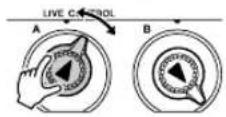
By adjusting just two knobs you can add varying degrees of distortion, "sweetness," or other characteristics to a sound to change it subtly or drastically. Parameters that can be assigned to the knobs include effect, filter, envelope generator and more. You can create new sounds in real time!
Similar to the arpeggio functions provided on some synthesizers, this function automatically produces arpeggios (broken chords) when you simply play the appropriate notes on the keyboard. A variety of arpeggios can be produced by changing your fingering or the arpeggio type.
■ Performance assistant technology ▶Page 23
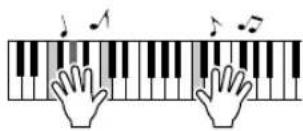
Play along with a song on the instrument's keyboard and produce a perfect performance every time ... even if you play wrong notes! All you have to do is play on the keyboard—alternately on the left- and right-hand ranges of the keyboard, for example—and you'll sound like a pro as long as you play in time with the music.
text_image
Illustration of two hands typing on a piano keyboard with musical notes above them■ Play a Variety of Instrument Voices ▶Page 28
The instrument voice that sounds when you play the keyboard can be changed to violin, flute, harp, or any of an extensive range of voices. You can change the mood of a song written for piano, for example, by using violin to play it instead. Experience a whole new world of musical variety.

■ Play Along with Styles ▶Page 33
Want to play with full accompaniment? Try the auto-accompaniment Styles. The accompaniment styles provide the equivalent of a full backing band covering a wide variety of styles from waltzes to 8-beat to euro-trance ... and much more. Select a style that matches the music you want to play, or experiment with new styles to expand your musical horizons.
Contents
Copyright Notice 6
Logos 6
Included Accessories 7
Special Features of the PSR-E413 8
Setting Up 10
Power Requirements 10
Connecting Headphones (PHONES/OUTPUT Jack)...... 11
Connecting a Footswitch (SUSTAIN Jack) 11
Connecting to a Computer (USB Terminal) 11
Turning the Power On.... 11
Panel Controls and Terminals 12
Front Panel 12
Rear Panel 13
Quick Guide
Creating Arpeggios 14
Create Original Sounds 18
Assigning Effects to the Knobs 18
Using the Knobs.... 21
The Easy Way to Play Piano 23
Play with Both Hands.... 23
Change the Song Tempo.... 27
Try Playing a Variety of Instrument Voices 28
Select and Play a Voice—MAIN 28
Play Two Voices Simultaneously—DUAL.... 29
Play Different Voices with the Left and Right Hands —SPLIT 30
Play the Grand Piano Voice.... 31
Fun Sounds 32
Drum Kits 32
Sound Effects.... 32
Playing Styles 33
Select a Style Rhythm.... 33
Play Along with a Style 34
Playing Auto-accompaniment Chords.... 38
Using Songs 39
Select and Listen to a Song 39
Song Fast Forward, Fast Reverse, and Pause.... 40
Types of Songs 42
Select a Song For a Lesson 43
Lesson 1—Waiting....43
Lesson 2—Your Tempo 46
Lesson 3—Minus One 47
Practice Makes Perfect—Repeat and Learn.... 48
Play Using the Music Database 49
Change a Song's Style 50
Listen to the DEMO Song for Easy Song Arranger.... 50
Using the Easy Song Arranger 50
Record Your Own Performance
Recording Procedure 52
Song Clear—Deleting User Songs 55
Track Clear—Deleting a Specified Track
from a User Song....55
Backup and Initialization 56
Backup 56
Initialization 56
Basic Operation and Displays 57
Basic Operation 57
Display Items 59
Reference
Adding Effects 60
Harmony....60
Adding Reverb 61
Adding Chorus 62
Handy Performance Features 63
The Metronome....63
Setting the Number of Beats per Measure,
and the Length of Each Beat 64
Adjusting the Metronome Volume....64
Tap Start 65
Touch Response Sensitivity....65
Pitch Bend....66
Pitch Controls....66
Controlling Arpeggio Volume with Keyboard Dynamics......67
One Touch Setting 68
Adjusting the Harmony Volume....69
Select an EQ Setting for the Best Sound....69
Style (Auto-accompaniment) Functions 70
Pattern Variation (Sections) 70
Adjusting the Style Volume 72
Setting the Split Point....72
Play a Style with Chords but No Rhythm
(Stop Accompaniment) 73
Loading Style Files....74
Chord Basics....75
Looking Up Chords Using the Chord Dictionary .....77
Song Settings 78
Song Volume....78
A-B Repeat....78
Muting Independent Song Parts....79
Change the Melody Voice....79
Memorize Your Favorite Panel Settings 80
Saving to the Registration Memory 80
Recalling a Registration Memory 81
Setting the Sleep Mode 82
The Functions 83
Selecting and Setting Functions....83
Connecting to a Computer 86
What Is MIDI? 86
Connecting a Personal Computer 87
Transferring Performance Data to and from a Computer.....88
Remote Control of MIDI Devices....89
Initial Send 90
Transferring Data between the Computer and Instrument...90
Accessory CD-ROM Installation Guide 93
Important Notices about the CD-ROM 93
CD-ROM Contents....94
System Requirements....95
Software Installation....95
Appendix
Troubleshooting....99
Scores....100
Voice List 106
Drum Kit List 110
Style List....112
Arpeggio List.... 113
Music Database List 114
Songs Provided On the Supplied CD-ROM 116
Effect Type List 117
MIDI Implementation Chart 118
MIDI Data Format 120
Specifications.... 123
Index....124
Be sure to do the following operations BEFORE turning on the power.
Power Requirements
Although the instrument will run either from an optional AC adaptor or batteries, Yamaha recommends use of an AC adaptor whenever possible. An AC adaptor is more environmentally friendly than batteries and does not deplete resources.
■ Using an AC Power Adaptor
① Make sure that the [STANDBY/ON] switch of the instrument is set to STANDBY.

WARNING
- Use the specified adaptor (PA-130 or an equivalent recommended by Yamaha) only. The use of other adaptors may result in irreparable damage to both the adaptor and the instrument.
② Connect the AC adaptor to the power supply jack.
③ Plug the AC adaptor into an AC outlet.

CAUTION
- Unplug the AC Power Adaptor when not using the instrument, or during electrical storms.
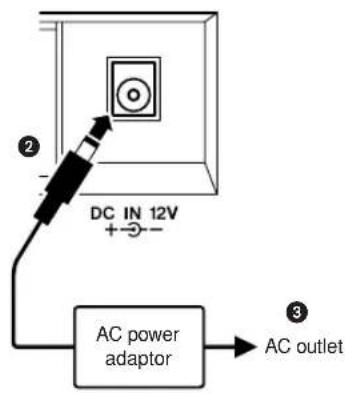
text_image
DC IN 12V +→-- AC power adaptor AC outlet■ Using Batteries
① Open the battery compartment cover located on the instrument's bottom panel.
② Insert the six new batteries, being careful to follow the polarity markings on the inside of the compartment.
③ Replace the compartment cover, making sure that it locks firmly in place.
NOTE
- Connecting the AC power adaptor automatically supplies power from the adaptor and overrides battery power, even when batteries are installed.
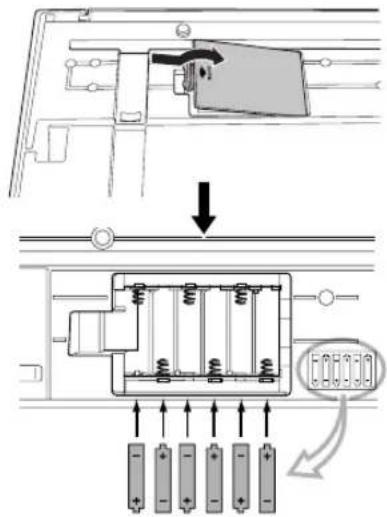
text_image
Diagram showing battery charging process with circuit breakers and battery arrangement, including a directional arrow indicating sequence.For battery operation the instrument requires six 1.5V "AA" size, LR6 or equivalent batteries. (Alkaline batteries are recommended.) When battery power becomes too low for proper operation, make sure to replace all batteries, following the precautions listed below. If necessary, also make sure to save all important User data (see page 56), since custom panel settings are lost when the batteries are removed.
CAUTION
- Use only manganese or alkaline batteries for this instrument. Other types of batteries (including rechargeable batteries) may exhibit a sudden drop in power when the batteries are low, possibly resulting in a loss of flash memory data.
- Be sure to install the batteries in the same direction, maintaining the correct polarity (as shown). Incorrect battery installation may result in heat, fire and/or leaking of corrosive chemicals.
- When the batteries run down, replace them with a complete set of six new batteries. NEVER mix old and new batteries. Do not use different kinds of batteries (e.g. alkaline and manganese) at the same time.
- If the instrument will not be used for an extended period of time, remove the batteries to prevent possible fluid leakage.
- Please use the power adaptor when transferring data to flash memory. Batteries (including rechargeable types) can be drained rapidly by this type of operation. If the batteries do become drained during a data transfer, both the data being transferred and the data currently in the transfer destination will be lost.
Make all necessary connections below BEFORE turning the power on.
Connecting Headphones (PHONES/OUTPUT Jack)
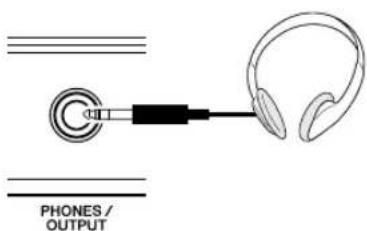
text_image
PHONES / OUTPUTThe PSR-E413 speakers are automatically shut off when a plug is inserted into this jack.
The PHONES/OUTPUT jack also functions as an external output. You can connect the PHONES/OUTPUT jack to a keyboard amplifier, stereo system, mixer, tape recorder, or other line-level audio device to send the instrument's output signal to that device.
WARNING
- A v oid listening with the headphones at high volume for long periods of time; doing so may not only result in ear fatigue, it may be damaging to your hearing.
CAUTION
- To prevent damage to the speakers, set the volume of the external devices at the minimum setting before connecting them. Failure to observe these cautions may result in electric shock or equipment damage. Also, be sure to set the volumes of all devices at their minimum levels and gradually raise the volume controls while playing the instrument to set the desired listening level.
Connecting a Footswitch (SUSTAIN Jack)
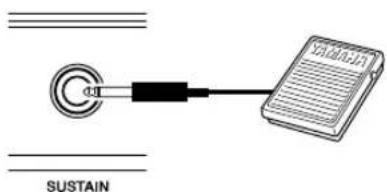
text_image
SUSTAINThe sustain function lets you produce a natural sustain as you play by pressing a footswitch. Plug the Yamaha FC4 or FC5 footswitch into this jack and use it to switch sustain on and off.
NOTE
- Make sure that the footswitch plug is properly connected to the SUS-TAIN jack before turning on the power.
- Do not press the footswitch while turning the power on. Doing this changes the recognized polarity of the footswitch, resulting in reversed footswitch operation.
Connecting to a Computer (USB Terminal)
text_image
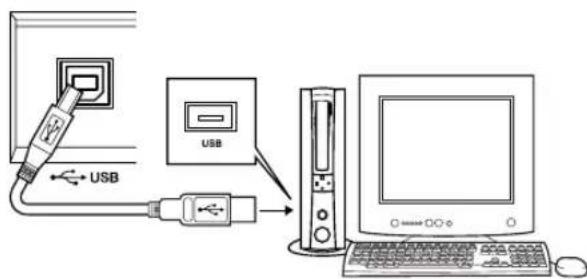
Diagram showing USB connection to a computer with monitor, highlighting the USB portConnect the instrument's USB terminal to the USB terminal of a computer, and you can transfer performance data and song files between the two (page 87). To use the USB data-transfer features you'll need to do the following:
- First, make sure the POWER switch on the instrument is set to OFF, then use an AB type USB cable to connect the instrument to the computer. After making the connections, turn on the power of the instrument.
• Install the USB-MIDI driver on your computer.
Installation of the USB-MIDI driver is described on page 95.
NOTE
- Make sure to purchase a quality USB cable at a musical instrument store, computer store or electrical appliance store.
Turning the Power On
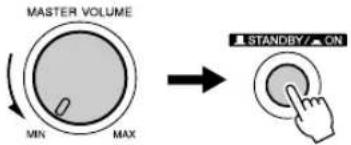
Turn down the volume by turning the [MASTER VOLUME] control to the left and press the [STANDBY/ON] switch to turn on the power. Press the [STANDBY/ON] switch again to turn the power OFF.
text_image
MASTER VOLUME MIN MAX STANDBY/ONBackup data in the flash memory is loaded to the instrument when the power is turned on. If no backup data exists on flash memory, all instrument settings are restored to the initial factory defaults when the power is turned on.
CAUTION
- Even when the switch is in the "STANDBY" position, electricity is still flowing to the instrument at the minimum level. When you are not using the instrument for a long time, make sure you unplug the AC power adaptor from the wall AC outlet, and/or remove the batteries from the instrument.
CAUTION
- N e ver attempt to turn the power off when a "WRITING!" message is shown in the display. Doing so can damage the flash memory and result in data loss.
Front Panel
text_image
Song Category List (page 41) Style Category List (page 112) Display (page 59) SONG WORD MATERIAL VOLUME 3 4 5 6 7 PERFORMANCE MOINTANT EASY SMO AVIANCE FUNCTION 8 L R START METHNICUM TEMP/THAP 9 SONG MEMORY 10 11 12 SONG CONTROL 13 14 YAMAHA GrandPro 00 :Front Panel
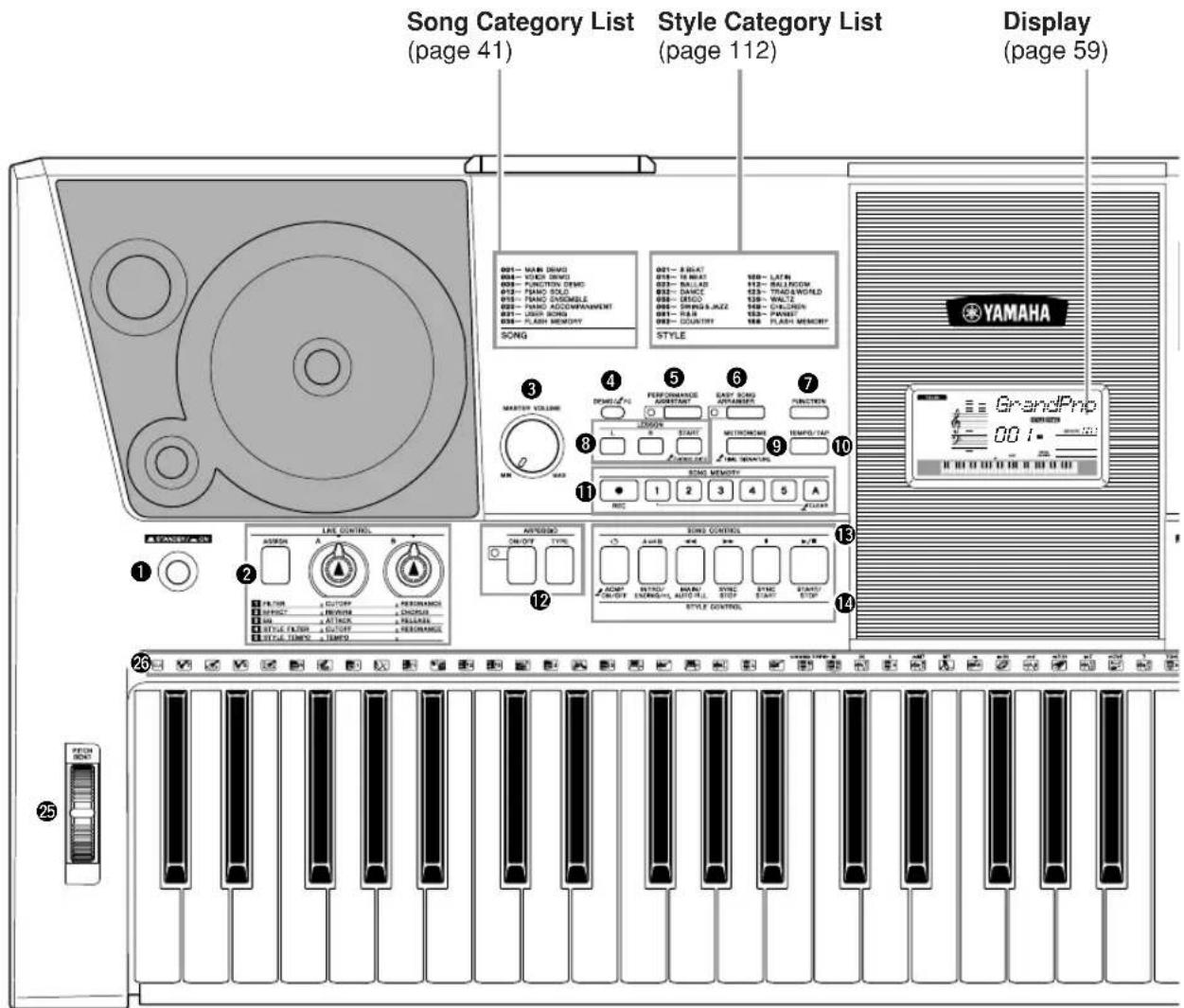
① [STANDBY/ON] switch ...... page 11
② LIVE CONTROL
[ASSIGN] button...... page 18
[A] and [B] knobs ...... page 21
③ [MASTER VOLUME] control.... pages 11, 57
④ [DEMO/PC] button...... page 40
⑤ [PERFORMANCE ASSISTANT] button ...... page 23
⑥ [EASY SONG ARRANGER] button ...... page 50
⑦ [FUNCTION] button ...... page 83
⑧ LESSON
[L], [R] buttons...... page 44
[START] button ...... page 44
⑨ [METRONOME] button ...... page 63
⑩ [TEMPO/TAP] button ...... page 27
⑪ SONG MEMORY
[REC], [1]–[5], [A] buttons...... page 52
⑫ ARPEGGIO
[ON/OFF] button...... page 14
[TYPE] button ...... page 15
⑬ SONG CONTROL
[💡] (REPEAT & LEARN) button... page 48
[A⇌B] (A-B REPEAT) button ...... page 78
[◀◀] (REW) button ...... page 40
[▶▶] (FF) button ...... page 40
[Ⅱ] (PAUSE) button...... page 40
[▶/■] (START/STOP) button....pages 40, 58
14 STYLE CONTROL
[ACMP ON/OFF] button ...... page 34
[INTRO/ENDING/rit.] button...... page 71
[MAIN/AUTO FILL] button...... page 71
[SYNC STOP] button...... page 71
[SYNC START] button...... page 70
[START/STOP] button ......pages 33, 58
text_image
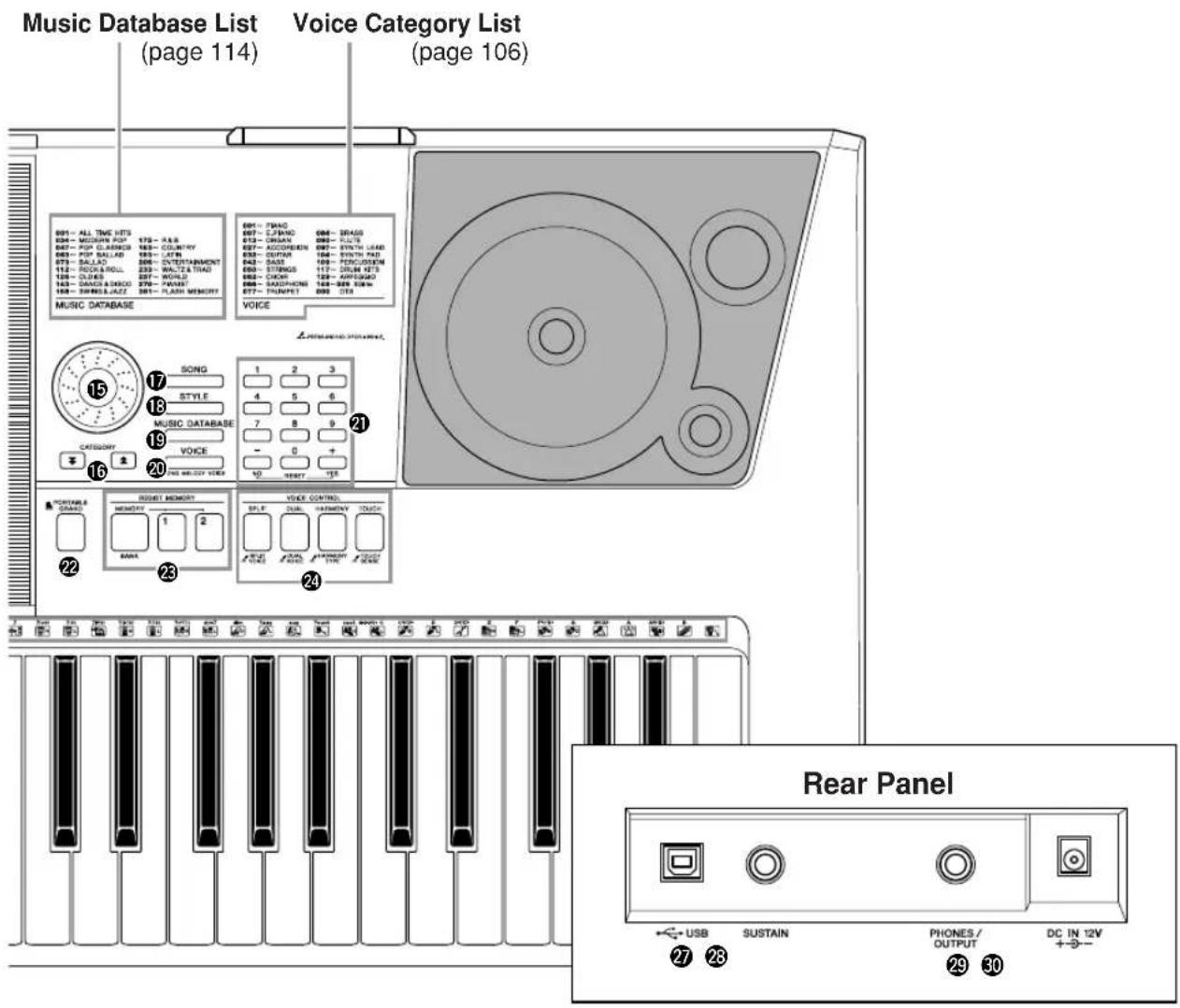
Music Database List (page 114) Voice Category List (page 106) 895 ALL TIME HITS 236 MEDIUM RISP 178 - RLS 247 POP CLARINGS 165 - COUNTRY 265 POP SELLAD 165 - LTR 273 SALAC 306 - ENTERTAINMENT 274 ROCK ROLL 233 - WATZ & THAD 282 OLIVE 237 - WORLD 283 SANS A DISCO 270 - PANEL 284 SWRSLAZZ 281 - FLASH MEMORY MUSIC DATABASE VOICE LITERATURES LISTING 15 17 18 19 20 21 1 2 3 STYLE 4 5 6 MUSIC DATABASE 7 8 9 VOICE - 0 + 10 RIGHT 22 23 24 PORTABLE GRAND RESET MEMORY MEMORY 1 2 BANK VOICE CONTROL SPLD DUAL HARNESSY TOUCH TWO FOR YOUR HOME Rear Panel USB SUSTAIN PHONES / OUTPUT DC IN 12V +→- 27 23 29 30⑮ Dial.... pages 58, 83
16 CATEGORY [ ] and [ ] buttons ...... pages 58, 83
⑰ [SONG] button ...... page 39
18 [STYLE] button ...... page 33
19 [MUSIC DATABASE] button ...... page 49
20 [VOICE] button...... page 28
② Number buttons [0]–[9], [+] and [-] buttons...... pages 58, 83
②2 [PORTABLE GRAND] button ...... page 31
23 REGIST MEMORY [MEMORY/BANK], [1], [2] buttons .. page 80
24 VOICE CONTROL [SPLIT] button ...... page 30
[DUAL] button...... page 29
[HARMONY] button ...... page 60
[TOUCH] button ...... page 65
25 PITCH BEND wheel ...... page 66
26 Drum Kit...... page 32
The illustrations next to each key indicate the drum and percussion instruments assigned to the keys when "Standard Kit 1" is selected.
Rear Panel
⑳ USB terminal ......pages 11, 87
28 SUSTAIN jack...... page 11
29 PHONES/OUTPUT jack ...... page 11
③0 DC IN 12V jack...... page 10
Creating Arpeggios
The arpeggio function lets you create arpeggios (broken chords) by simply playing the required notes on the keyboard. For example, you could play the notes of a triad—the root, third, and fifth—and the arpeggio function will automatically create a variety of interesting arpeggio-type phrases. By changing the arpeggio type and the notes you play it is possible to create a wide range of patterns and phrases that can be used for music production as well as performance.
1 Press the ARPEGGIO [ON/OFF] button to turn the arpeg-gio function on.
The indicator lights when the Arpeggio function is on.
![YAMAHA PSR-E413 - Press the ARPEGGIO [ON/OFF] button to turn the arpeg-gio function on. - 1](/content/2026/06/1244056/images/bdbf9f4c22d50282fa291b160ab4caf4999eeb1e2618c258e3c89a7661dc525f.jpg)
● Voices and the Arpeggio Function
This instrument lets you select a variety of “voices” that you can play via the keyboard. When you select a voice number between 129 and 148 the arpeggio function will automatically be engaged so you can start playing arpeggios immediately. The arpeggio function will automatically be turned off when you select any other voice.
If you want to use voices 129–148 for normal performance without the arpeggio function, press the ARPEGGIO [ON/OFF] button to turn the arpeggio function off after selecting the voice.
NOTE
• See "Try Playing a Variety of Instrument Voices" on page 28.
● Voices for which the arpeggio function is automatically turned on.
| Voice No. | Voice Name | Voice No. | Voice Name |
| 129 | Concerto 139 | ReggaeOrgan | |
| 130 | Pizzicato 140 | Harpeggio | |
| 131 | Piano | Ballad 141 SalsaPlano | |
| 132 | Synth | Sequence 142 AnalogSequence | |
| 133 | Guitarist 143 | Sawtooth | |
| 134 | Pauls | Bass 144 Piano Arpeggio | |
| 135 | Trance | Bass 145 Guitar Arpeggio | |
| 136 | Synth | Chords 146 ClubBeat | |
| 137 | Acid | Bass | 147 R&B Loop |
| 138 | Funky | Clavi | 148 ClubAdds |
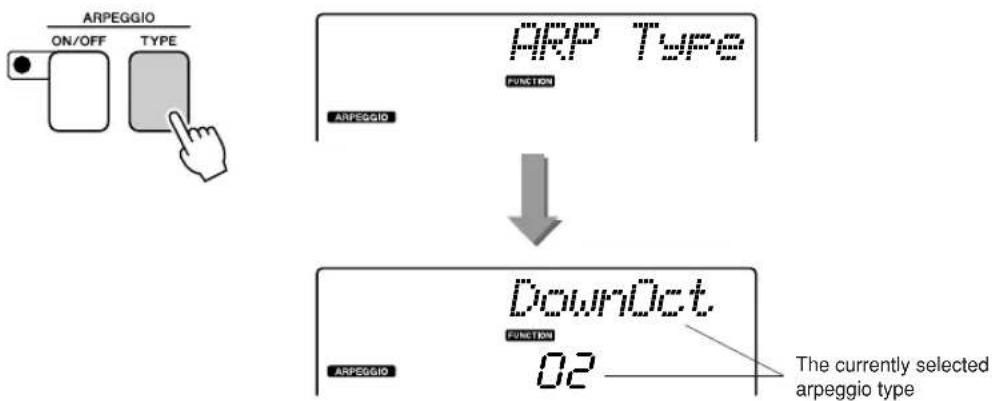
2 Select an arpeggio type.
The most suitable arpeggio type is automatically selected when you select a voice, but you can easily select any other arpeggio type.
text_image
ARPEGGIO ON/OFF TYPE APP Type FUNCTION ARPEGGIO DownOct. FUNCTION 02 The currently selected ARPEGGIO typePress the ARPEGGIO [TYPE] button and the name of the current arpeggio type will appear in the display. Rotate the dial to select the desired arpeggio type. A list of the available arpeggio types is provided on page 113.
3 Play the keyboard.
natural_image
Illustration of a hand pressing down on a piano keyboard (no text or symbols)The sound of the arpeggio produced will change according to the number of notes you play and the area of the keyboard you play in. You can save the instrument's settings at this point and then recall them at any time you want to repeat your performance (page 80). You can also record your performance (page 52).
The arpeggio function applies only to the main and dual voices, and does not affect split voices. The arpeggio function cannot be used at the same time as the harmony function.
4 When you have finished playing with the arpeggio function, press the ARPEGGIO [ON/OFF] button to turn it off.
NOTE
• Make sure that you are not pressing any of the keyboard's keys while turning the arpeggio function on or off.
Create a Pop Tune
You can play a style and specify the style chords with your left hand while playing arpeggios with your right hand to create interesting sonic textures and backgrounds.
1 Select the keyboard voice (page 28).
For this example we'll use a grand piano voice, so press the [PORTABLE GRAND] button. This convenient voice selection method lets you instantly select a voice with a single button press.
2 After turning the arpeggio function on, select an arpeggio type (steps 1 and 2 on the preceding page).
For this example select "02 DownOct".
That completes preparation to use the arpeggio function.
3 Select the style you want to play along with the arpeggio function.
A "style" is an automatic accompaniment pattern.
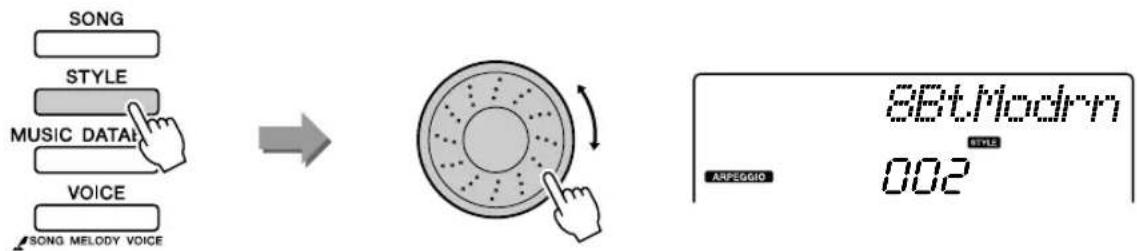
Press the [STYLE] button and the name of the currently selected style will appear in the display. Rotate the dial to select the desired style. For this example we'll use the "002 8BtModrn" (8 Beat Modern) style.
flowchart
graph LR
    A["SONG"] --> B["STYLE"]
    B --> C["MUSIC DATA"]
    C --> D["VOICE"]
    D --> E["SONG MELODY VOICE"]
    E --> F["Image Display"]
    F --> G["ARPEGGIO: 8Bt.Modrm\nSTYLE: 002"]
NOTE
- Refer to "Playing Styles" on page 33.
4 Press the [ACMP ON/OFF] button to turn auto accompaniment on.
![YAMAHA PSR-E413 - Press the [ACMP ON/OFF] button to turn auto accompaniment on. - 1](/content/2026/06/1244056/images/3f3e4998446b2f90010240980d064684d0081f1a56b042028980a91c99f56180.jpg)
![YAMAHA PSR-E413 - Press the [ACMP ON/OFF] button to turn auto accompaniment on. - 2](/content/2026/06/1244056/images/595f679047bd88a3e7fdc3d4155259bb2ca44abce2469842e96c002b0fabb286.jpg)
text_image
8BtModrn STYLE 002 ARPEGGIO ACMP ON ACMP ON The ACMP ON icon will appear.When auto accompaniment is turned on, the left-hand section of the keyboard is used only for specifying accompaniment chords.
NOTE
- Refer to "When automatic accompaniment is on ..." on page 34.
5 Press the [START/STOP] button.
The rhythm accompaniment will start.
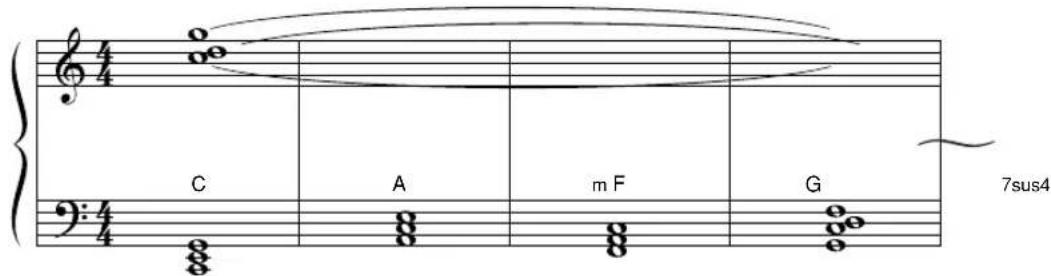
6 Begin playing.
text_image
C A m F G 7sus4Listen carefully to the rhythm of the style, then play the notes shown in the score at the beginning of a measure. The style and arpeggio will begin playing together.
The accompaniment will change accordingly each time you play a new left-hand chord. Of course you can also change your right-hand fingering to produce interesting changes.
If you're not comfortable with right-hand playing yet, you could use the performance assistant technology feature described on page 23. When the performance assistant feature is on, playing any right-hand key will always produce musically appropriate notes!
text_image
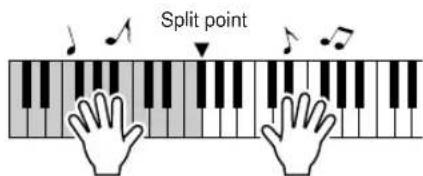
Split pointWhenever you're playing a style as well as a right-hand part, be sure that your left hand plays only to the left of the split point and your right hand plays only to the right of the split point. (page 30)
Create Original Sounds
The two knobs located in the lower left area of the panel can be used to add variations to the sound being played, transforming the sound in a variety of musical ways. Filter, envelope generator, and other effects can be assigned to the two knobs as required. In this section we'll explain how effects can be assigned to the knobs, and provide a few tips for their use.
Assigning Effects to the Knobs
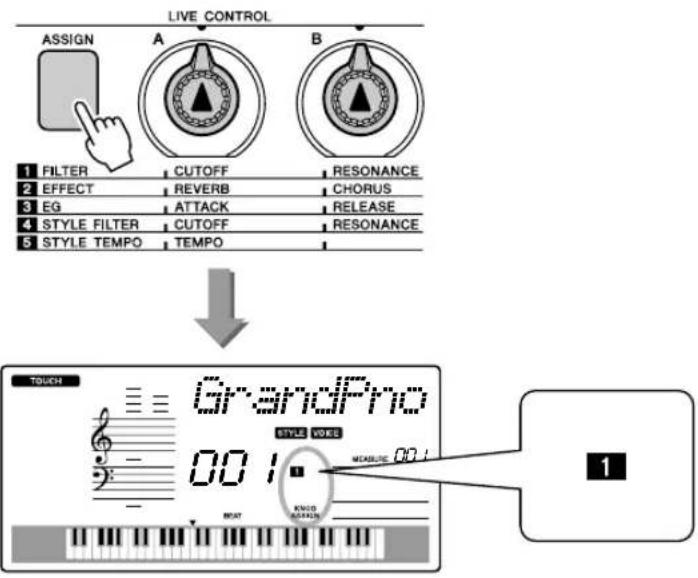
Repeatedly press the [ASSIGN] button to sequentially select the five effect combinations provided: 1 → 2 → 3 → 4 → 5 → 1 → ... etc. The currently selected combination is shown in the display.
text_image
LIVE CONTROL ASSIGN A B 1 FILTER CUTOFF RESONANCE 2 EFFECT REVERB CHORUS 3 EG ATTACK RELEASE 4 STYLE FILTER CUTOFF RESONANCE 5 STYLE TEMPO TEMPO TOUCH GrandPro STYLE VOKE MEASURE 001 KNOO MEASURE 1| Number/Effect Knob A Knob B | ||
| 1 | Filter Filter Cutoff Filter Resonance | |
| 2 | Effect Reverb Send Level Chorus Send Level | |
| 3 | EG Attack Time Release Time | |
| 4 | Style Filter Filter Cutoff Filter Resonance | |
| 5 | Style Tempo Tempo –No Effect– | |
The assignable knob effects are pre-programmed in the pairs listed above. It is not possible to assign different effect combinations.
1-3 affect the main and dual voices only. Split voices will not be affected. Styles and songs will also not be affected.
4-5 affect styles only.
1 Filter
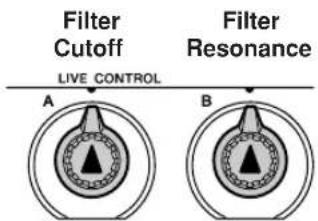
Filter effects shape sound by allowing only a specified range of frequencies to pass and/or by producing a resonance peak at the filter's “cutoff” frequency. Filter effects can be used to create a range of synthesizer-like sounds.
* Filter effects can sometimes cause distortion in the bass frequencies.
Some hints for using the filter effects are provided on page 22.
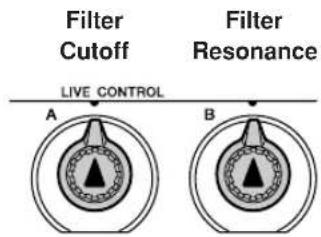
text_image
Filter Cutoff Filter Resonance LIVE CONTROL A BKnob A adjusts the filter's cutoff frequency, and therefore the brightness of the sound.
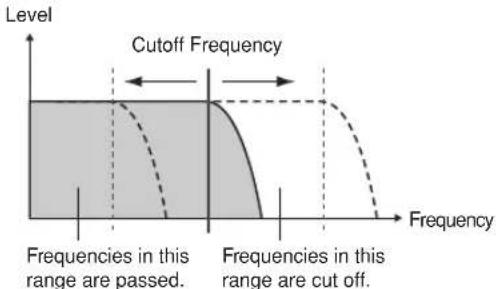
area
| Frequency Range | Cutoff Frequency | | --------------- | ---------------- | | Passes | Low | | Cut Off | High |Knob B adjusts the amount of resonance applied at the filter's cutoff frequency. Increasing the resonance emphasizes the frequencies at the cutoff frequency, and thus “strengthens” the perceived effect of the filter.
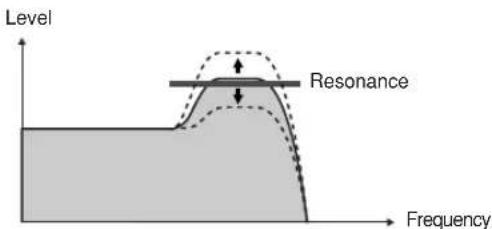
text_image
Level Resonance Frequency2 Effect
Reverb reproduces the acoustic ambience of a concert hall or club, while chorus produces a layered “multi-instrument” effect.
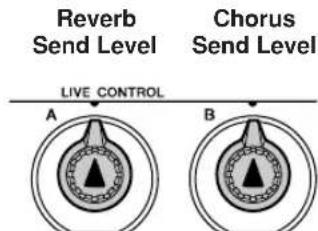
text_image
Reverb Send Level LIVE CONTROL Chorus Send Level A BKnob A adjusts the depth of the reverb effect, and Knob B adjusts the depth of the chorus effect.
3 EG (Envelope Generator)
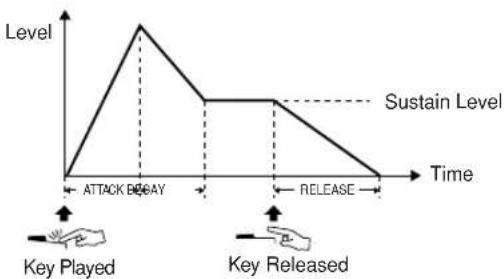
Envelope Generator effects determine how the level of the sound varies over time. You can make the attack faster for a more percussive sound or slower for a violin-like sound, for example. Or you can lengthen or shorten the sustain to most ideally match the music.
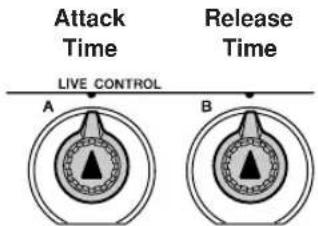
text_image
Attack Time LIVE CONTROL Release Time A BKnob A adjusts attack time (the amount of time it takes the sound to reach maximum level when a key is played).
Knob B adjusts release time (the amount of time it takes for the sound to decay to silence after a key is released).
flowchart
graph TD
    A["Key Played"] --> B["Level at Time 0"]
    B --> C["Attack Breakout"]
    C --> D["Sustain Level"]
    D --> E["Release"]
    E --> F["Key Released"]
    F --> G["Key Released"]
    style A fill:#f9f,stroke:#333
    style G fill:#f9f,stroke:#333
4 Style Filter
text_image
Filter Cutoff LIVE CONTROL Filter Resonance A BIn this case the knobs apply the filter effect to the style being played. Knob A and Knob B have the same functions as for “1 Filter” described on the preceding page.
5 Style Tempo
text_image
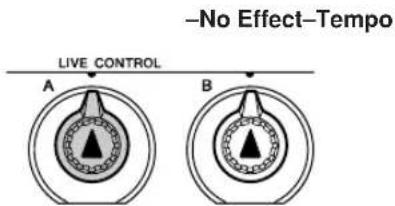
-No Effect-Tempo LIVE CONTROL A BKnob A adjusts the tempo of the style and arpeggios. Rotating the knob clockwise increases the tempo while rotating it counterclockwise decreases the tempo. The knob's center position produces the initial default tempo.
Using the Knobs
1 Select the voice you want to play on the keyboard.
text_image
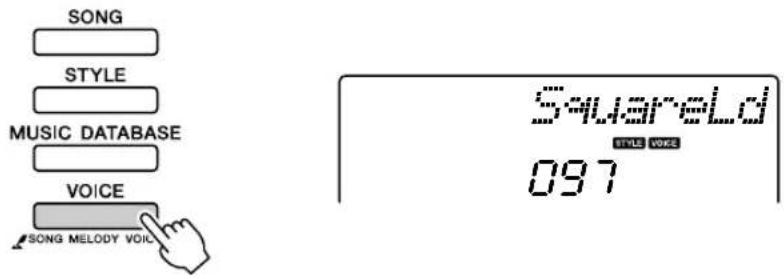
SONG STYLE MUSIC DATABASE VOICE SONG MELODY VOIC SQUARELD STYLE VOICE 097The name of the currently selected voice will appear in the display when you press the [VOICE] button. Use the dial to select the desired voice. For this example we want to use a synth-lead type voice, so select "97 SquareLd" (Square-wave Lead).
2 Press the [ASSIGN] button as many times as necessary to select "1 FILTER" ("1" will appear in the display).
![YAMAHA PSR-E413 - Press the [ASSIGN] button as many times as necessary to select "1 FILTER" ("1" will appear in the display). - 1](/content/2026/06/1244056/images/52b3365b1dbd6e443754bfbefe09650869ecd5b414ed5bac2e1d694424e778a8.jpg)
text_image
LIVE CONTROL ASSIGN A 1 FILTER CUTOFF 2 EFFECT REVERB 3 EG ATTACK 4 STYLE FILTER CUTOFF 5 STYLE TEMPO TEMPO SquareId STYLE VOICE 097 "1" appears here. ENJOA ASSIGNKnob A can now be used to adjust the filter cutoff frequency, and Knob B can be used to adjust the resonance.
3 Rotate Knob B to its maximum setting (all the way to the right).
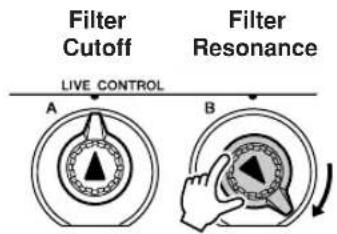
text_image
Filter Cutoff LIVE CONTROL Filter Resonance A BRotating the knob to the right while the volume is set to a high level can result in distortion. If this occurs, reduce the volume level.
4 Play with the right hand while operating Knob A with the left hand.
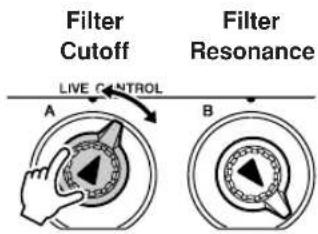
text_image
Filter Cutoff LIVE CONTROL Filter Resonance A B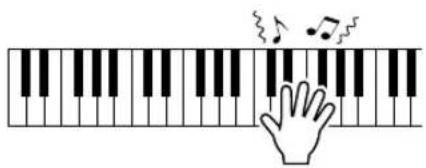
text_image
Illustration of a hand pressing down on a piano keyboard with musical notes above itIf you select a different keyboard voice the knobs will be reset and the ideal settings for the selected voice will be automatically recalled. In the same way, if the “4 STYLE FILTER” effect is selected, the knobs will be reset if a different style is selected. If you create an original setting you like, it might be a good idea to save it in the instrument’s Registration Memory (page 80) so you can recall the same settings again at any time. You can also record performances using original sounds you’ve created (page 52).
The chart below lists some interesting ways to use the various effects that can be assigned to the knobs.
Changing the knob settings does not immediately change the sound. Newly assigned effects will only change the sound when the knobs are first operated after the new effect has been selected.
● Some Ideas for Using the Knobs
| Number/Effect Try This | |
| 1 FILTER | Select a synth-type lead or pad voice (page 106). Turn Knob B all the way up and operate Knob A while playing for some spacey, floating 1980's effects. |
| 2 EFFECT | Select a voice that sounds as though it already has reverb and chorus effects applied, and turn Knob A and Knob B all the way down to hear the "direct" sound of the voice. You can then turn the Knob A and Knob B settings up to add extra impact and richness to the voice. |
| 3 EG | Select a piano voice, and turn Knob B all the way up and Knob A to about the 3 o'clock position. This should give you a majestic, organ-like sound. The attack time is quite long so play the keys and hold them to let the sound come in fully. Ideal for slow pieces. |
| 4 STYLE FILTER | Select style 39, Euro Trance. Turn accompaniment on and start style playback (page 34). Set Knob B to about 3 o'clock, and Knob A to about 8 o'clock. The overall sound of the style should be a bit muffled, with the drums emphasized for solid rhythmic impact. |
| 5 STYLE TEMPO Play a style and/or | arpeggio (page 14) and use Knob A to adjust the tempo. |
The Easy Way to Play Piano
This instrument includes a performance assistant technology feature that lets you play along with a song and sound like a great pianist (even though you might be making lots of mistakes)! In fact, you can play any notes and still sound good!
So even if you can't play piano and can't read a note of music, you can have some musical fun. It's never too late to start learning!
Refer to page 25 for more information on using performance assistant technology to help you play.
Play with Both Hands
1 Press the [PERFORMANCE ASSISTANT] button.
The indicator lights when the performance assistant technology feature is on.
![YAMAHA PSR-E413 - Press the [PERFORMANCE ASSISTANT] button. - 1](/content/2026/06/1244056/images/fae446e5a3bffeb628e6227bae0f6e199647bd9864acf84cb1b9c6d5b892e35a.jpg)
Press the [PERFORMANCE ASSISTANT] button to turn the function on or off.
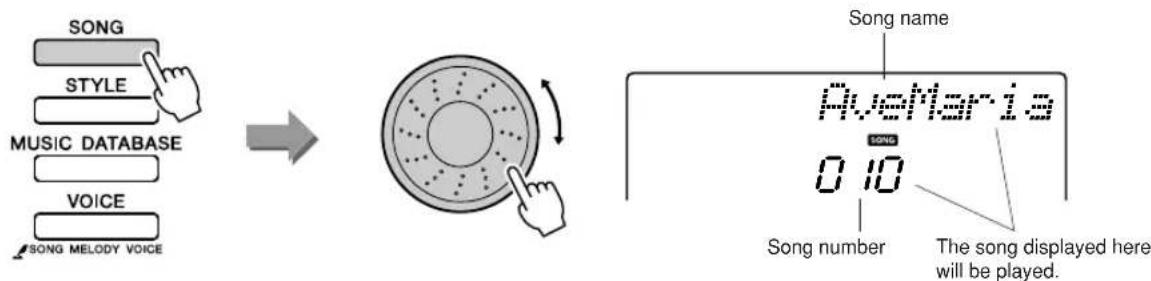
2 Select a song.
Press the [SONG] button, and the song number and name will be displayed. You can use the dial or other selection controls to select a different song.
For this example try selecting the "010 AveMaria".
flowchart
graph LR
    A["SONG"] --> B["STYLE"]
    B --> C["MUSIC DATABASE"]
    C --> D["VOICE"]
    D --> E["SONG MELODY VOICE"]

    F["Screen Screen"] --> G["Arrow pointing to the screen"]

    H["Song name"] --> I["AveMaria"]
    I --> J["SONG"]
    J --> K["0 10"]
    K --> L["Song number"]
    L --> M["The song displayed here will be played."]
● What is a “Song”?
Of course you know the normal meaning of the word, but for this instrument the term “song” also refers to the data that makes up a piece of music. You can listen to the songs, use them for lessons, and use them with a range of other functions (page 39).
3 Press the [+/(START/STOP) button.
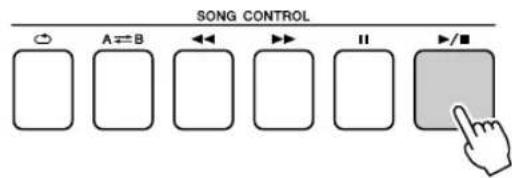
text_image
SONG CONTROL A ⇌ B ◀◀ ▶▶ II ▶/■
text_image
MASTER VOLUME MIN MAX Adjusts volume.Song playback will begin.
The basic pattern will repeat. Listen to four measures while memorizing the basic pattern. It's your turn to play the part from the fifth measure.
4 Play on the keyboard.
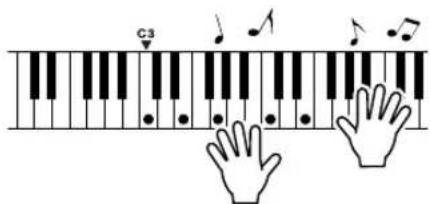
text_image
C3 1 2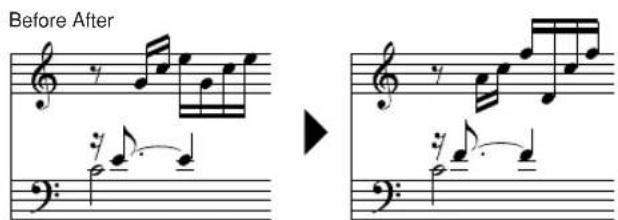
text_image
Before AfterPlay the score on the left along with the accompaniment using both hands. You can even play the same keys over and over: C, E, G, C, E, G, C, E. Performance assistant technology will make sure that the notes will come out as if they were played according to the score on the right. Keep playing, and performance assistant technology will continue to “correct” the notes that you play.
You can stop song playback at any time by pressing the [▶/START/STOP) button.
5 Press the [PERFORMANCE ASSISTANT] button to turn the performance assistant technology feature off.
The complete score for Ave Maria is provided on page 102.
Use the Performance Assistant to Play Like a Pro!
To begin, try to feel the rhythm of the song. Then, with your hands spread as shown in the illustration, simply play the keyboard alternately with your left and right hands (any notes will do).

text_image
Sounds like you're playing the right notes! G ↓ E You will get even better results if you match your left-hand rhythm to the rhythm of the chord indicat- tor in the display.How does it sound? You'll get acceptable results no matter where you play thanks to performance assistant technology!
Next try the three playing methods illustrated below. Different ways of playing produce different results.
● Play with the left and right hands at the same timing—type 1.
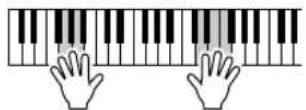
Play 3 notes at once with your right hand.
● Play with the left and right hands at the same timing—type 2.
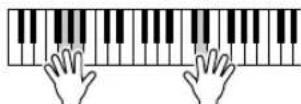
Play 1 note at a time with your right hand (for example: index finger → middle finger → ring finger).
● Play alternately with the left and right hands—type 3.
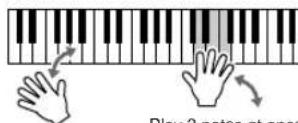
Play 3 notes at once with your right hand.
Once you get a feel for it, try playing chords with your left hand and a melody with your right ... or any other combination.
To use the performance assistant technology feature it is necessary to play a song that includes chord data, or a style with auto accompaniment on.
If a song includes the required data, the chords are shown on the right side of the display (page 59).
Next try playing the Chopin Nocturne.
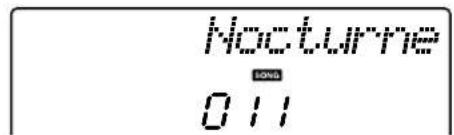
1 The procedure is that same as that described for playing Ave Maria on pages 23–25. Select "011 Nocturne".
text_image
Nocturrie 0112 Listen to eight measures, then begin playing from the ninth measure.
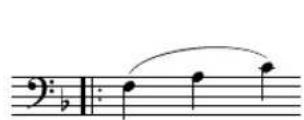
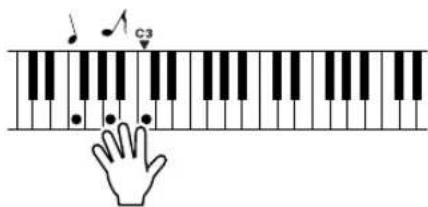
Play the keys shown in the illustration. Keep playing F, A and C with your left hand and the correct notes will sound as the song proceeds. When you get used to playing the left hand part, refer to “The Easy Way to Play Piano” on page 23 and try adding the right-hand part.
text_image
C23 Press the [PERFORMANCE ASSISTANT] button to turn the performance assistant technology feature off.
The complete score for Nocturne is provided on page 104.
Change the Song Tempo
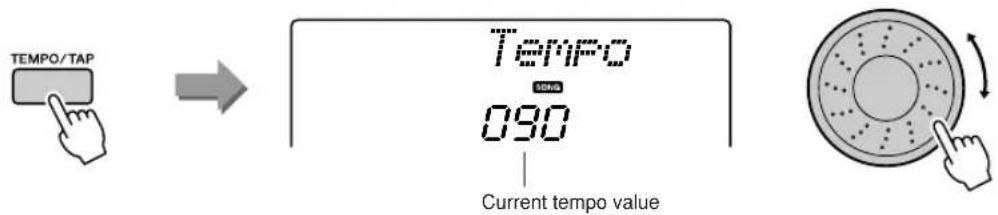
When using the performance assistant technology or in other situations in which the tempo of the song is too fast or too slow for you, you can change the tempo as required. Press the [TEMPO/TAP] button. The tempo display will appear and you can use the dial, the [+] and [-] buttons, or the [0] to [9] number buttons to set to tempo to anywhere from 011 and 280 quarter-note beats per minute.
text_image
TEMPO/TAP Tempo SONA 090 Current tempo valueYou can return to the original tempo by simultaneously pressing the [+] and [-] buttons.
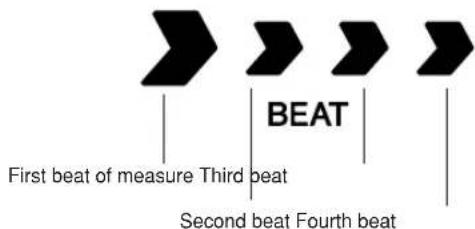
● About the Beat Display
The arrow marks in the beat display flash in time with the rhythm of the song or style.
text_image
First beat of measure Third beat Second beat Fourth beat BEATTry Playing a Variety of Instrument Voices
In addition to piano, organ, and other “standard” keyboard instruments, this instrument has a large range of voices that includes guitar, bass, strings, sax, trumpet, drums and percussion, sound effects ... a wide variety of musical sounds.
Select and Play a Voice—MAIN
This procedure selects the main voice you will play on the keyboard.
1 Press the [VOICE] button.
The voice number and name will be displayed.
![YAMAHA PSR-E413 - Press the [VOICE] button. - 1](/content/2026/06/1244056/images/98083d06eaead5084259ad46c30621267cac55f76b2ff58111668037c0245ae6.jpg)
text_image
SONG STYLE MUSIC DATABASE VOICE SONG MELODY VOIC Voice name GrandPro STYLE VIOE 00:1 Voice number Appears when the Voice mode is engaged.2 Select the voice you want to play.
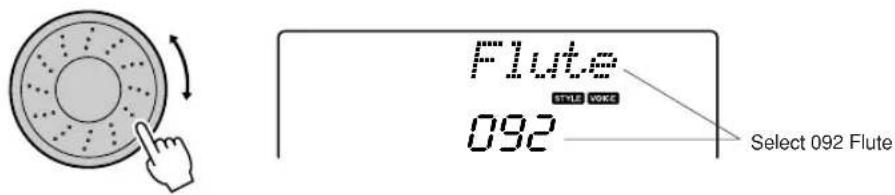
While watching the displayed voice name rotate the dial. The available voices will be selected and displayed in sequence. The voice selected here becomes the main voice.
For this example select the "092 Flute" voice.
NOTE
- Y ou can also select the voice using the CATEGORY [▲and
[▼] buttons after pressing the [VOICE] button. (page 58)
text_image
Flute STYLE VOICE 092 Select 092 Flute3 Play the keyboard.
text_image
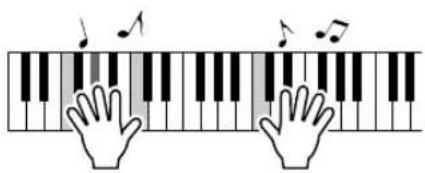
Illustration showing two hands typing on a piano keyboard with musical notes above themTry selecting and playing a variety of voices.
Play Two Voices Simultaneously—DUAL
You can select a second voice which will play in addition to the main voice when you play the keyboard. The second voice is known as the “dual” voice.
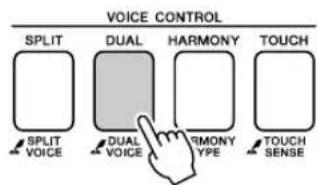
1 Press the [DUAL] button. The [DUAL] button turns the d
The [DUAL] button turns the dual voice on or off.
When turned on the dual voice icon will appear in the display. The currently selected dual voice will sound in addition to the main voice when you play the keyboard.
NOTE
• The dual voice feature cannot be used during a song lesson (page 43).
text_image
VOICE CONTROL SPLIT DUAL HARMONY TOUCH SPLIT VOICE DUAL VOICE RIMONY YPE TOUCH SENSE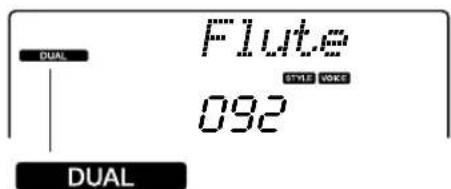
text_image
Flute DUAL STYLE VOKE 092 DUALDual voice icon
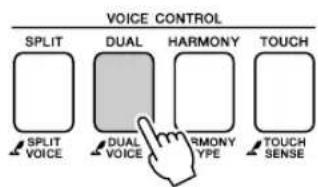
2 Press and hold the [DUAL] button for longer than a second.
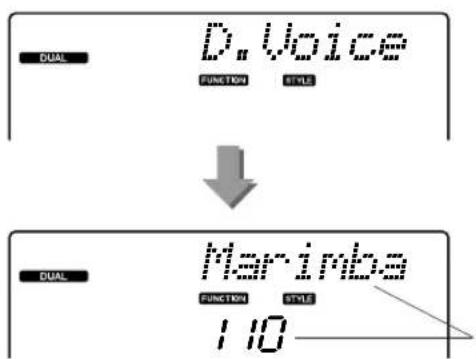
“D.VOICE” appears in the display for a few seconds, then the currently selected dual voice will be displayed.
NOTE
- Y ou can also select the Dual Voice display by pressing the [FUNCTION] button and then using the CATEGORY [▲ and ▼] buttons to select the "D.Voice" item.
text_image
VOICE CONTROL SPLIT DUAL HARMONY TOUCH SPLIT VOICE DUAL VOICE ARMONY YPE TOUCH SENSEHold for longer than a second
text_image
D. Voice FUNCTION STYLE ↓ DUAL MARINBA FUNCTION STYLE 110The currently selected dual voice
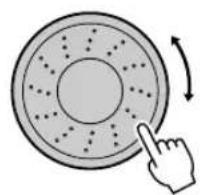
3 Select the desired dual voice. Watch the displayed dual voice and
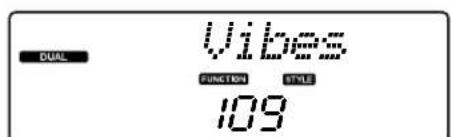
Watch the displayed dual voice and rotate the dial until the voice you want to use is selected. The voice selected here becomes the dual voice. For this example try selecting the "109 Vibraphone" voice.
text_image
DUAL Vibes FUNCTION STYLE 1094 Play the keyboard.
text_image
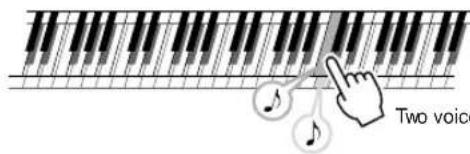
Two voicesTwo voices will sound at the same time.
Try selecting and playing a range of dual voices.
Play Different Voices with the Left and Right Hands—SPLIT
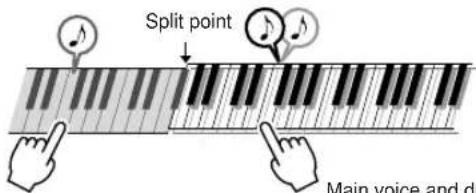
In the split mode you can play different voices to the left and right of the keyboard “split point”. The main and dual voices can be played to the right of the split point, while the voice played to the left of the split point is known as the “split voice”. The split point setting can be changed as required (page 72).
text_image
Split point Main voice and dMain voice and dual voiceSplit voice
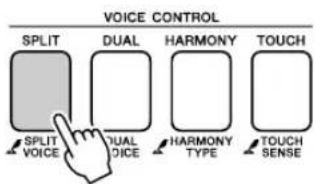
1 Press the [SPLIT] button. The [SPLIT] button turns the s
The [SPLIT] button turns the split voice on or off.
When turned on the split voice icon will appear in the display. The currently selected split voice will sound to the left of the keyboard split point.
NOTE
• The split voice feature cannot be used during a song lesson (page 43).
flowchart
graph LR
    A["SPLIT"] --> B["DUAL"]
    B --> C["HARMONY"]
    C --> D["TOUCH"]
    style A fill:#fff,stroke:#000
    style B fill:#fff,stroke:#000
    style C fill:#fff,stroke:#000
    style D fill:#fff,stroke:#000
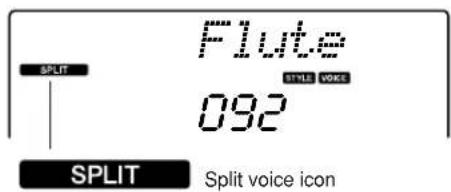
text_image
Flute SPLIT STYLE VOKE 092 SPLIT Split voice icon2 Press and hold the [SPLIT] button for longer than a second.
“S.VOICE” appears in the display for a few seconds, then the currently selected split voice will be displayed.
NOTE
- Y ou can also select the Split Voice display by pressing the [FUNCTION] button and then using the CATEGORY [▲ and [▼] buttons to select the "S.Voice" item.
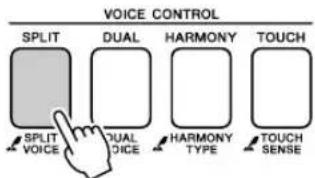
text_image
VOICE CONTROL SPLIT DUAL HARMONY TOUCH SPLIT VOICE DUAL VOICE HARMONY TYPE TOUCH SENSEHold for longer than a second
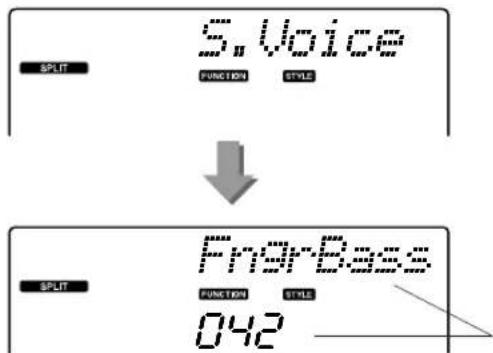
text_image
S, Voice FUNCTION STYLE SPLIT Progress FUNCTION STYLE 042The currently selected SPLIT voice
3 Select the desired split voice. Watch the displayed split voice and
Watch the displayed split voice and rotate the dial until the voice you want to use is selected. The voice selected here becomes the split voice which will play to the left of the keyboard split point. For this example try selecting the “033 Folk Guitar” voice.
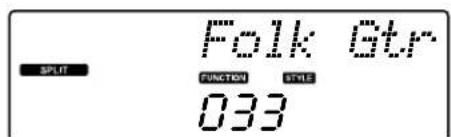
text_image
SPLIT Folk Str FUNCTION STYLE 0334 Play the keyboard.
text_image
Illustration of two hands typing on a piano keyboard with musical notes above themTry selecting and playing a range of split voices.
Play the Grand Piano Voice
When you just want to play piano, all you have to do is press one convenient button.
Press the [PORTABLE GRAND] button.
The "001 Grand Piano" voice will be selected.
![YAMAHA PSR-E413 - Press the [PORTABLE GRAND] button. - 1](/content/2026/06/1244056/images/f23300c9656829092ce62fe494c49e65702ea1f264cc1286a382803778ad6703.jpg)
NOTE
- When you press the [PORTABLE GRAND] button all settings other than touch sensitivity are turned off. The dual and split voices will also be turned off, so only the Grand Piano voice will play over the entire keyboard.
Fun Sounds
This instrument includes a range of drum kits and unique sound effects you can use for entertainment. Laughter, babbling brooks, jet fly-bys, eerie effects, and much more. These sounds can be a great way to enhance the mood at parties.
Drum Kits
Drum kits are collections of drum and percussion instruments. When you select a violin or other normal instrument main voice, for example, all keys produce the sound of the same violin, only at different pitches. If you select a drum kit as the main voice, however, each key produces the sound of a different drum or percussion instrument.
◆ Drum Kit Selection Procedure → (refer to steps 1 and 2 on page 28)
1 Press the [VOICE] button.
2 Use the dial to select "117 Std.Kit1".
3 Try out each key and enjoy the drum and percussion sounds!
Try out each key and enjoy the drum and percussion sounds! Don't forget the black keys! You'll hear a triangle, maracas, bongos, drums ... a comprehensive variety of drum and percussion sounds. For details on the instruments included in the drum kit voices (voice numbers 117 to 128), see the "Drum Kit List" on page 110.
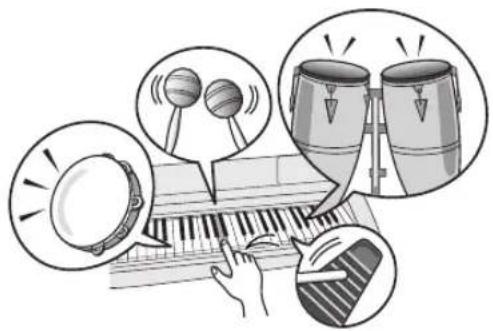
natural_image
Illustration of a hand playing piano with three circular insets showing mallets and drum pieces (no text or symbols)Sound Effects
The sound effects are included in the drum kit voice group (voice numbers 127 and 128). When either of these voices are selected you will be able to play a range of sound effects on the keyboard.
◆ Sound Effect Selection Procedure → (refer to steps 1 and 2 on page 28)
1 Press the [VOICE] button.
2 Use the dial to select "128 SFX Kit2".
3 Try out each key and enjoy the sound effects!
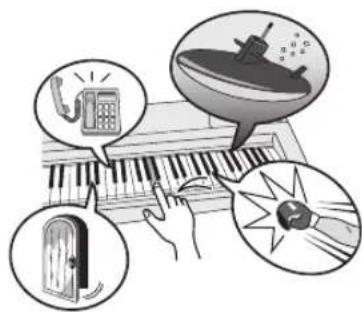
natural_image
Illustration of a piano with hands, playing keys, and decorative icons (no text or symbols)As you try out the various keys you'll hear the sound of a submarine, a telephone bell, a creaking door, laughter, and many other useful effects. "127 SFX Kit1" includes lightning, running water, dogs barking, and others. Some keys do not have assigned sound effects, and will therefore produce no sound. For details on the instruments included in the SFX kit voices, see "SFX Kit 1" and "SFX Kit 2" in the "Drum Kit List" on page 110.
Playing Styles
This instrument has an auto accompaniment feature that produces accompaniment (rhythm + bass + chords) in the style you choose to match chords you play with your left hand. You can select from 165 different styles covering a range of musical genres and time signatures (see page 112 for a complete list of the available styles). In this section we'll learn how to use the auto accompaniment features.
Select a Style Rhythm
Most styles includes a rhythm part. You can select from a wide variety of rhythmic types—rock, blues, Euro trance, and many, many more. Let's begin by listening to just the basic rhythm. The rhythm part is played using percussion instruments only.
1 Press the [STYLE] button. The style number and name will
![YAMAHA PSR-E413 - Press the [STYLE] button. The style number and name will - 1](/content/2026/06/1244056/images/f18536f3c5de0d43148f697c36570d4e168ea6c0a300451e034454e2ccd62fa8.jpg)
text_image
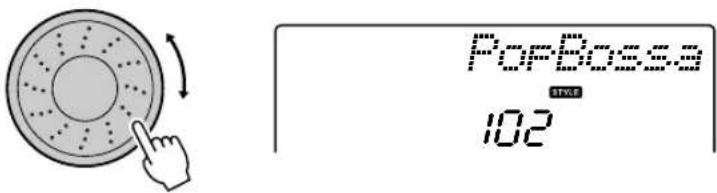
SONG STYLE MUSIC DATABASE VOICE SONG MELODY VOICE Style Name BritRock 001 Style Number This icon appears when a style number and name is displayed.2 Select a style. Use the dial to set
Use the dial to select the style you want to use. A list of all the available styles is provided on page 112.
text_image
PopBossa STYLE 102NOTE
- An external style file loaded into style number 166 can be selected and used in the same way as the internal styles. The style file must be loaded into style number 166 after transferring it to the instrument from a computer. For details, refer to the section "Loading Style Files" on page 74.
3 Press the [START/STOP] button. The style rhythm will start playing.
Press the [START/STOP] button a second time when you want to stop playback.
![YAMAHA PSR-E413 - Press the [START/STOP] button. The style rhythm will start playing. - 1](/content/2026/06/1244056/images/109b5316669f86980b9d4800ebffbf0645dec291d2b012b3d399eaf6c4132d19.jpg)
text_image
ACMP ON/OFF INTRO/ ENDING/rit. MAIN/ AUTO FILL SYNC STOP SYNC START START/ STOP STYLE CONTROLNOTE
- Style numbers 141, 153–165 have no rhythm part and therefore no rhythm will play if you use them for the above example. For these styles first turn auto accompaniment on as described on page 34, press the [START/STOP] button, and the accompaniment bass and chord parts will begin playing when you play a key to the left of the keyboard split point.
Play Along with a Style
You learned how to select a style rhythm on the preceding page.
Here we'll see how to add bass and chord accompaniment to the basic rhythm to produce a full, rich accompaniment that you can play along with.
1 Press the [STYLE] button and select the desired style.
2 Turn automatic accompaniment on.
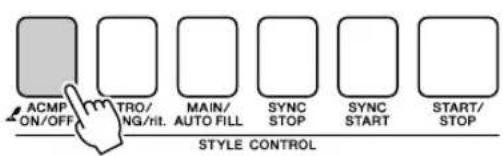
Press the [ACMP ON/OFF] button.
Pressing this button a second time will turn automatic accompaniment off.
text_image
ACMP ON/OFF TRO/ NG/HT. MAIN/ AUTO FILL SYNC STOP SYNC START START/ STOP STYLE CONTROL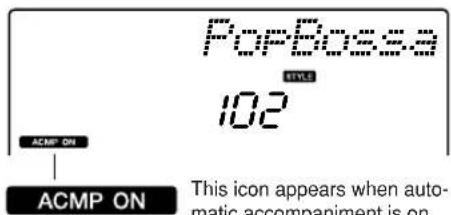
text_image
PopBossa STYLE 102 ACMP ON ACMP ON This icon appears when automatic accompaniment is on.- When automatic accompaniment is on ...
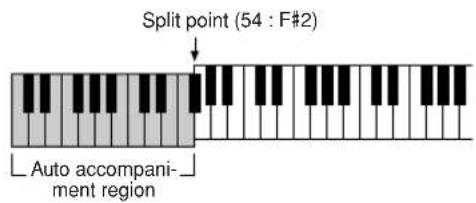
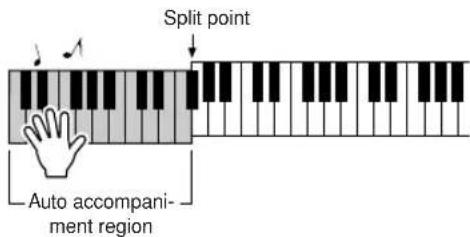
The area of the keyboard to the left of the split point (54 : F#2) becomes the “auto accompaniment region” and is used only for specifying the accompaniment chords.
text_image
Split point (54 : F#2) Auto accompani- ment regionNOTE
- The keyboard split point can be changed as required: refer to page 72.
3 Turn sync start on. Press the ISYNC STAR
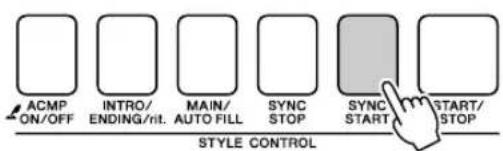
Press the [SYNC START] button to turn the sync start function on.
text_image
ACMP ON/OFF INTRO/ ENDING/rit. MAIN/ AUTO FILL SYNC STOP SYNC START START/ STOP STYLE CONTROL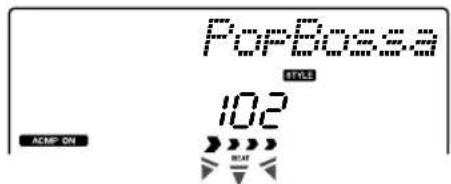
text_image
PopPassa STYLE 102 ACMP ON >>>Flashes when sync start is on.
When sync start is on, the bass and chord accompaniment included in a style will start playing as soon as you play a note to left of the keyboard split point. Press the button a second time to turn the sync start function off.
4 Play a left-hand chord to start the style.
You can still “play” chords even if you don’t actually know any chords. This instrument will recognize even a single note as a chord. Try playing from one to three notes at the same time to the left of the split point. The accompaniment will change according to the left-hand notes you play.
Try this!
Scores for some chord progressions are provided on page 36. These examples should help you get a feel for what types of chord progressions sound good with the styles.
text_image
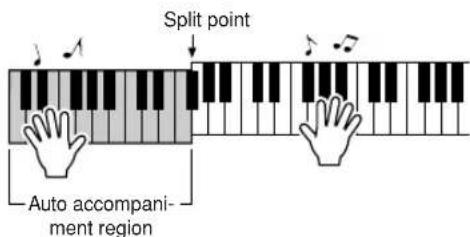
Split point Auto accompani- ment region5 Play a variety of left-hand chords while playing a melody with your right hand.
text_image
Split point Auto accompani- ment region6 Press the [START/STOP] button to stop style playback when you're done.
![YAMAHA PSR-E413 - Press the [START/STOP] button to stop style playback when you're done. - 1](/content/2026/06/1244056/images/3304dda356dd4e84651e0a70f5fd73933c5f0ae457ab1861e235ba96b7c9515e.jpg)
text_image
ACMP ON/OFF INTRO/ ENDING/ill MAIN/ AUTO FILL SYNC STOP SYNC START START/ STOP STYLE CONTROLYou can switch style “sections” to add variety to the accompaniment. Refer to “Pattern Variation (Sections)” on page 70.
Styles Are More Fun When You Understand Chords
Chords, created by playing multiple notes at the same time, are the basis for harmonic accompaniment. In this section we'll take a look at sequences of different chords played one after another, or "chord sequences." Since each chord has it's own unique "color"—even if it's different fingerings of the same chord—the chords you choose to use in your chord progressions have a huge influence on the overall feel of the music you play.
On page 34 you learned how to play colorful accompaniments using styles. Chord progressions are vital to creating interesting accompaniments, and with a little chord know-how you should be able to take your accompaniments to a new level.
On these pages we'll introduce three easy-to-use chord progressions. Be sure to try them out with the instrument's accompaniment styles. The style will respond to the chord progression you play, effectively creating a complete song.
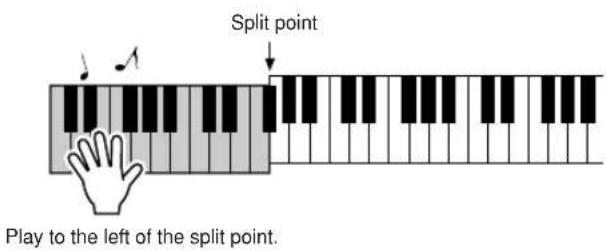
■Playing the Chord Progressions ....
Play the scores with the left hand.
Before playing the scores follow steps 1 through 3 of "Play Along with a Style" on page 34.
* The scores provided here are not standard song scores, but rather simplified scores that indicate which notes to play to produce the chord progressions.
text_image
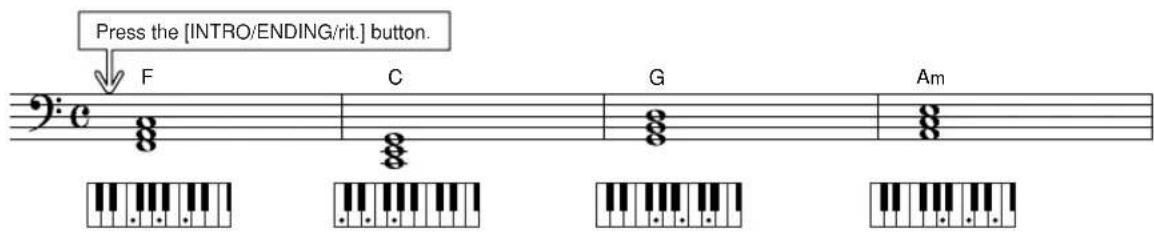
Split point Play to the left of the split point.Recommended Style 039 Euro Trance
—Dance music with simple chords—
text_image
Press the [INTRO/ENDING/rit.] button. F C G Am 9: c 8 8 8 8 8 8 8 8This is a simple-but-effective chord progression. When you play through to the end of the score, start again from the beginning. When you're ready to stop playing press the [INTRO/ENDING/rit.] button and the auto accompaniment function will create a perfect ending.
Recommended Style
158 Piano Boogie
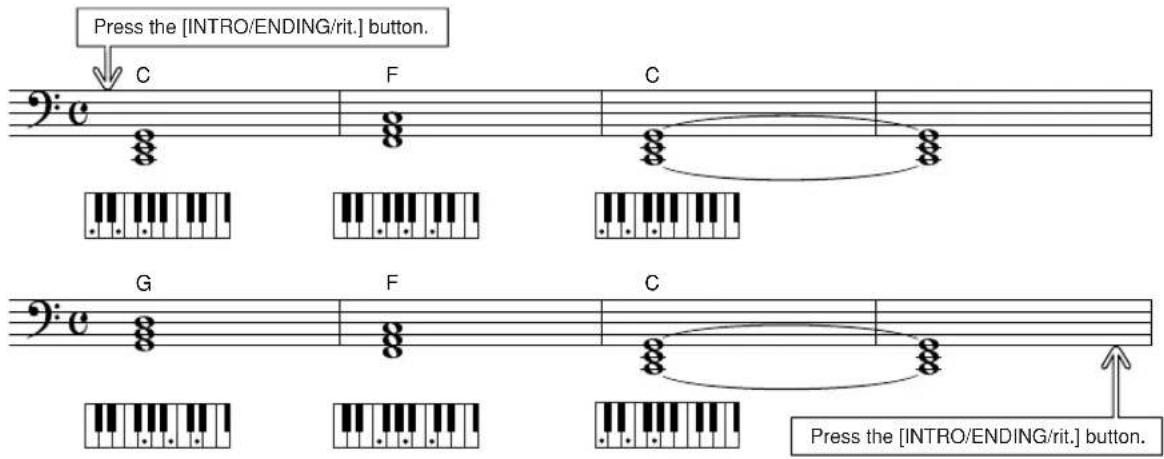
—3-chord boogie-woogie—
text_image
Press the [INTRO/ENDING/rit.] button. C F C G F C Press the [INTRO/ENDING/rit.] button.This progression provides varied harmonic backing with just three chords. When you get a feel for the progression in the score, try changing the order of the chords!
Recommended Style
101 Bossa Nova
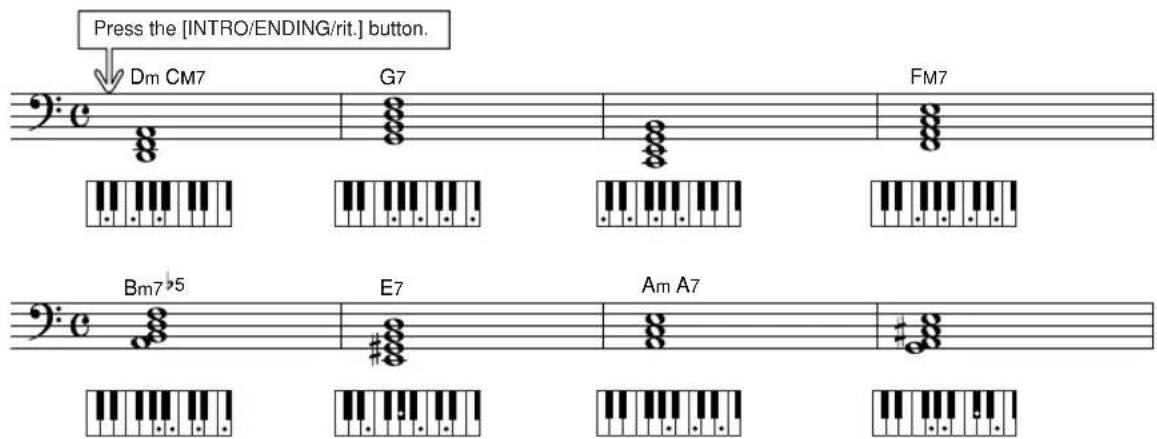
—Bossa nova with jazz-style chords—
text_image
Press the [INTRO/ENDING/rit.] button. Dm CM7 G7 FM7 Bm7→5 E7 Am A7This progression includes jazzy “two-five” (II-V) changes. Try playing it through several times. When you’re ready to stop playing press the [INTRO/ENDING/rit.] button.
Playing Auto-accompaniment Chords
There are two ways of playing auto-accompaniment chords:
● Easy Chords
● Standard Chords
The instrument will automatically recognize the different chord types. This function is called Multi Fingering.
Press the [ACMP ON/OFF] button to turn auto-accompaniment on (page 34). The keyboard to the left of the split point (default: 54/F#2) becomes the “accompaniment range”. Play the accompaniment chords in this area of the keyboard.
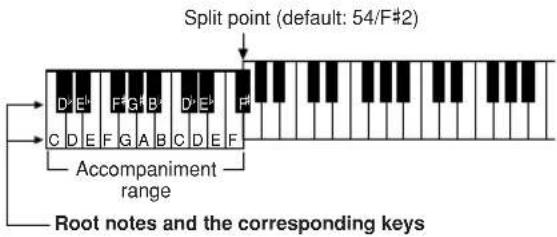
text_image
Split point (default: 54/F#2) Accompaniment range Root notes and the corresponding keys■Easy Chords
This method lets you easily play chords in the accompaniment range of the keyboard using only one, two, or three fingers.
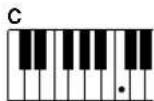
• To play a major chord Press the root note of the chord.
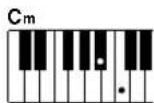
• To play a minor chord Press the root note together with the nearest black key to the left of it.
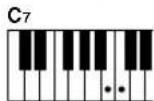
• To play a seventh chord Press the root note together with the nearest white key to the left of it.
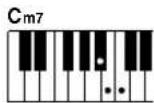
• To play a minor seventh chord Press the root note together with the nearest white and black keys to the left of it (three keys altogether).
Standard Chords
This method lets you produce accompaniment by playing chords using normal fingerings in the accompaniment range of the keyboard.
● How to play Standard Chords [Example for "C" chords]
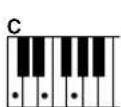
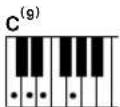
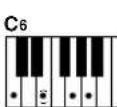
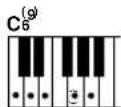
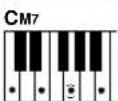
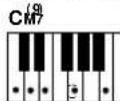
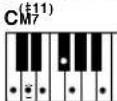
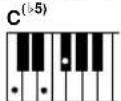
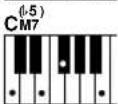
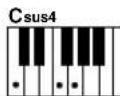
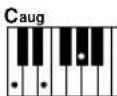
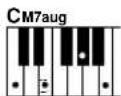

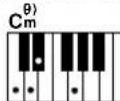
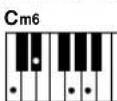
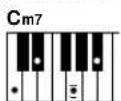
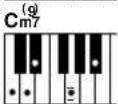
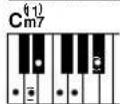

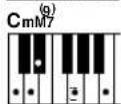
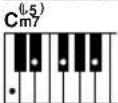
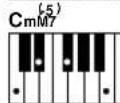
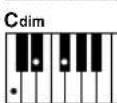
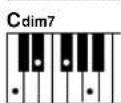
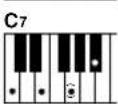
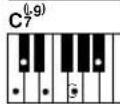
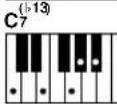
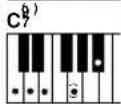
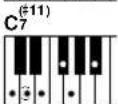
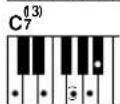
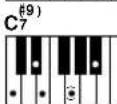
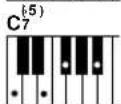
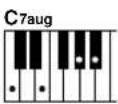
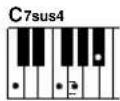
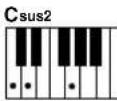
* Notes enclosed in parentheses (♀ are optional; the chords will be recognized without them.
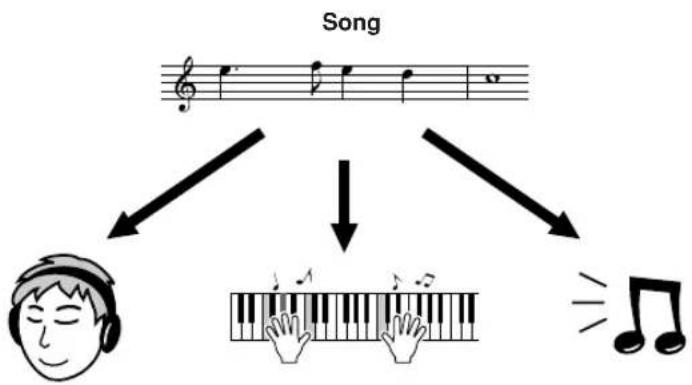
With this instrument the term “song” refers the data that makes up a piece of music. You can simply enjoy listening to the 30 internal songs, or use them with just about any of the many functions provided—the performance assistant technology feature, lessons, and more. The songs are organized by category.
In this section we'll learn how to select and play songs, and briefly describe the 30 songs provided.
flowchart
graph TD
    A["Song"] --> B["Downlinking"]
    B --> C["Playdown"]
    C --> D["Playdown"]
Listen Lesson Record
Select and Listen to a Song
1 Press the [SONG] button. The song number and name will
The song number and name will be displayed. You can use the dial to select a different song.
![YAMAHA PSR-E413 - Press the [SONG] button. The song number and name will - 1](/content/2026/06/1244056/images/bc97e7a3d7bdd0f963c06ed0da1834b81f89aa953febeb5d3d204d56613fbf02.jpg)
text_image
SONG STYLE MUSIC DATABASE VOICE SONG MELODY VOICE Nocturne 011 The currently selected song and number are displayed2 Select a song.
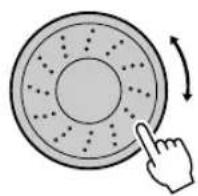
Select a song after referring to the preset song category list on page 41. Use the dial to select the song you want to listen to.

text_image
ForElise SOUND 0 12The song displayed here can be played
NOTE
- Y ou can also play songs you have recorded yourself (User Songs) or songs that have been transferred to the instrument from a computer in the same way that you play the internal songs.
| 001-030 Built in Songs (see next page) |
| 031-035 User Songs (Songs you record yourself). |
| 036-Songs transferred from a computer (pages 90-92) |
3 Listen to the song. Press the [L/S/START/S]
Press the [▶/START/STOP) button to begin playback of the selected song.
You can stop playback at any time by pressing the [▶/(START/STOP) button again.
![YAMAHA PSR-E413 - Listen to the song. Press the [L/S/START/S] - 1](/content/2026/06/1244056/images/514ef68a1c470d29dc73c3388d97827547d50b4365e73861f3aa0b6a512329c2.jpg)
flowchart
graph LR
    A[" "] --> B["A ⇌ B"]
    B --> C["◀"]
    C --> D["▶"]
    D --> E["II"]
    E --> F["▶/■"]
    F --> G[" "]
    G --> H[" "]
    style A fill:#fff,stroke:#000
    style B fill:#fff,stroke:#000
    style C fill:#fff,stroke:#000
    style D fill:#fff,stroke:#000
    style E fill:#fff,stroke:#000
    style F fill:#fff,stroke:#000
    style G fill:#fff,stroke:#000
    note right of G: "Song start!"
● Using the [DEMO/PC] button
Press the [DEMO/PC] button to play Songs 001–008 in sequence. Playback will continue repeatedly starting again from the first Song (001).
You can select a song by using the [-] and [+] buttons after pressing the [DEMO/PC] button.
You can stop playback at any time by pressing the [DEMO/PC] button.
![YAMAHA PSR-E413 - ● Using the [DEMO/PC] button - 1](/content/2026/06/1244056/images/720578ac3584383c97544d50333ea070a02383681a64f34e0d6e62738345d4e4.jpg)
Song Fast Forward, Fast Reverse, and Pause
These are just like the transport controls on a cassette deck or CD player, letting you fast forward [▶▶ (FF), rewind [▶(REW) and pause [ ] (HAUSE) playback of the song.
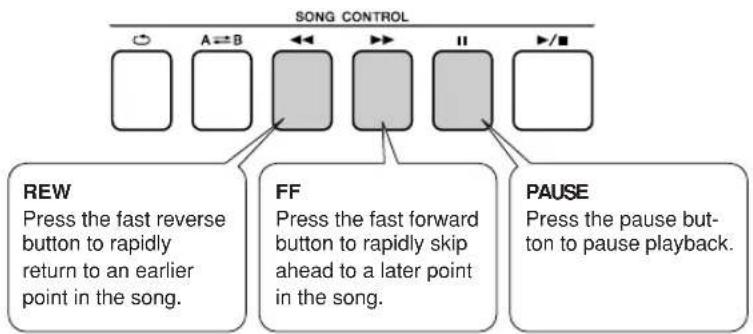
flowchart
graph TD
    A["REW"] --> B["A ↔ B"]
    B --> C["FF"]
    C --> D["II"]
    D --> E["PAUSE"]
    style A fill:#fff,stroke:#000
    style B fill:#fff,stroke:#000
    style C fill:#ccc,stroke:#000
    style D fill:#ccc,stroke:#000
    style E fill:#fff,stroke:#000
NOTE
- When an A-B repeat range is specified the fast reverse and forward function will only work within that range.
● Song List
These 30 songs include songs that effectively demonstrate the instrument's easy song arranger feature, songs that are ideally suited for use with the performance assistant technology feature, and more. The “Suggested Uses” column provides some ideas as to how the songs can most effectively used.
| Category No. Name Suggested Uses | ||
| Main Demo | 1 CHORDents | The songs in this category have been created to give you an idea of the advanced capabilities of this instrument. They're great for listening, or for use with the performance assistant technology feature. |
| 2 CHORDca | ||
| 3 CHORD | ||
| Voice Demo | 4 CHORD | G r and Piano Demo |
| 5 CHORD | S w eet! Tenor Sax Demo | |
| 6 CHORD Rotor Organ Demo | ||
| 7 CHORD Galaxy Electric Piano Demo | ||
| 8 CHORDrn Harp & Sweet! Soprano Demo | ||
| Function Demo | 9 CHORDujah Chorus | Use these songs to experience some of the instrument's advanced features: song number 9 for the easy song arranger, and songs 10 and 11 for the performance assistant technology feature. |
| 10 CHORDMaria | ||
| 11 CHORDrne op.9-2 | ||
| Piano Solo | 12 For Elise | |
| 13 Maple Leaf Rag | ||
| 14 The Last Rose of Summer | ||
| Piano Ensemble | 15 CHORDing Grace | A selection of piano ensemble songs that are also well suited for use as lesson songs. |
| 16 CHORDorelei | ||
| 17 Piano Concerto No.21 2nd mov. | ||
| 18 CHORDorough Fair | ||
| 19 CHORDolks at Home | ||
| Piano Accompaniment | 20 CHORD | Ac Ballad (Against All Odds: Collins 0007403) |
| 21 CHORDallad | ||
| 22 CHORDe Woogie | ||
| 23 CHORD Piano | ||
| 24 CHORD | ||
| 25 CHORDtry Piano | ||
| 26 CHORDel R&B | ||
| 27 CHORDum Swing | ||
| 28 CHORDWaltz | ||
| 29 CHORDum Bossa | ||
| 30 CHORDRock | ||
CHORD : Includes chord data.
The scores for the internal songs—except for songs 1–11, 20, and 30 are provided in the Song Book on the CD-ROM. The scores for songs 9–11 are provided in this manual.
Some of the classic and/or traditional songs have been edited for length or for ease in learning, and may not be exactly the same as the original.
Types of Songs
The following three types of songs can be used by the PSR-E413.
- Preset Songs (the 30 songs built into the instrument) ....Song numbers 001–030.
● User Songs (recordings of your own performances) ......Song numbers 031–035.
● External song files (song data transferred from a computer*) ...Song numbers 036-.
* The Accessory CD-ROM includes a selection of 70 MIDI songs. See page 91 for instructions on how to transfer the songs to the instrument.
The chart below shows the basic PSR-E413 processes flow for using the preset songs, user songs, and external song files—from storage to playback.
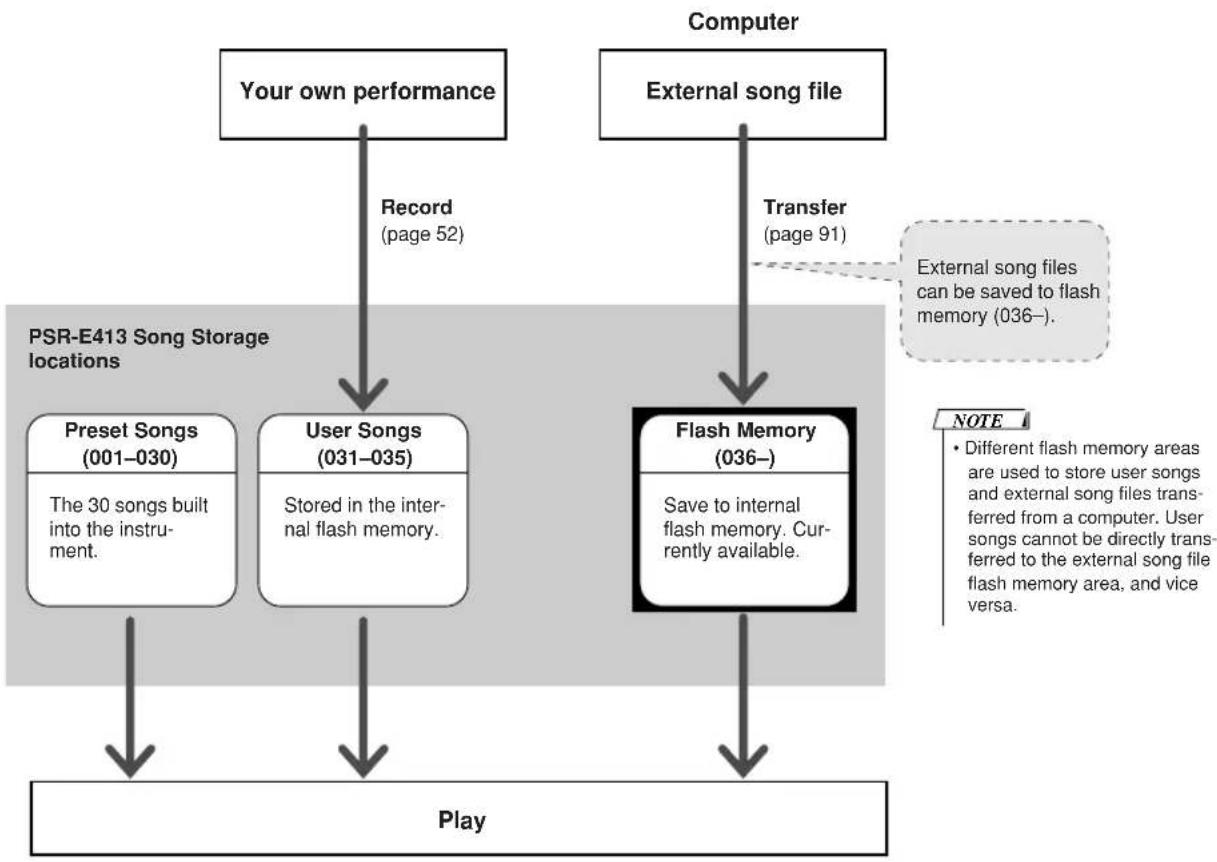
flowchart
graph TD
    A["Your own performance"] -->|Record (page 52)| B["User Songs (031-035)"]
    C["External song file"] -->|Transfer (page 91)| D["Flash Memory (036-)"]
    B --> E["Preset Songs (001-030)"]
    B --> F["The 30 songs built into the instrument."]
    D --> G["Save to internal flash memory. Currently available."]
    H["External song files can be saved to flash memory (036-)."] -.-> D
    I["Play"] --> J["Note"]
    style A fill:#f9f,stroke:#333
    style C fill:#f9f,stroke:#333
    style I fill:#ccf,stroke:#333
Yamaha Education Suite
You can select song you like and use it for a left-hand, right-hand, or both-hands lesson. You can also use songs (only SMF format 0) downloaded from the Internet and saved to flash memory. (pages 90–92) During the lesson you can play as slowly as you like, and you can even play wrong notes. Song playback will slow down to a speed you can handle. It's never too late to start learning!
Lesson Flow:
Select a song from the Piano Solo, Piano Ensemble category!

flowchart
graph LR
    A["Select the song you want to learn."] --> B["Select the part you want to work on (right hand, left hand, both hands)."]
    B --> C["Select lesson 1, 2, or 3."]
    C --> D["Lesson start!"]
The practice methods:
- Lesson 1 ....Learn to play the correct notes.
- Lesson 2 ....Learn to play the correct notes with the correct timing.
- Lesson 3 ....Learn to play the correct notes at the correct timing along with the song.
NOTE
- Song numbers 10 and 11 are function demos for performance assistant. The lesson function cannot be used with them.
Lesson 1—Waiting
In this lesson, try playing the correct notes. Play the note shown in the display. The song will wait until you play the right note.
1 Select a song for your lesson. Press the [SONG] button, and rotate 1
Press the [SONG] button, and rotate the dial to select the song you want to use for your lesson. As listed on page 42 there are a variety of song types. For this example try selecting the “012 ForElise”.
![YAMAHA PSR-E413 - Select a song for your lesson. Press the [SONG] button, and rotate 1 - 1](/content/2026/06/1244056/images/092daa2f5b0730252cf0b339c8c1bef653c8b04e8b6de90a09e067bf519e1eea.jpg)
flowchart
graph LR
    A["SONG"] --> B["STYLE"]
    B --> C["MUSIC DATABASE"]
    C --> D["VOICE"]
    D --> E["SONG MELODY VOICE"]
    E --> F["For Elise"]
    F --> G["0.12"]
2 Select the part you want to practice. Press the [R] button for a right-hand lesson.
Press the [R] button for a right-hand lesson, [L] button for a left-hand lesson, or press both the [R] and [L] buttons simultaneously for a both-hands lesson.
The currently selected part is shown in the display.
![YAMAHA PSR-E413 - Select the part you want to practice. Press the [R] button for a right-hand lesson. - 1](/content/2026/06/1244056/images/bcec3702ac736a8cb270095df669896e716a03f25028b863ad7eac5013dc74a2.jpg)
text_image
LESSON L R START CHORD DICT. Right Right-hand lesson Left Left-hand lesson BothHand Both-hands lesson3 Start Lesson 1. Press the LESSON
Press the LESSON [START] button to select Lesson 1. Each time the LESSON [START] button is pressed the lesson modes are selected in sequence: Lesson 1 → Lesson 2 → Lesson 3 → Off → Lesson 1 .... The currently selected mode is shown in the display.
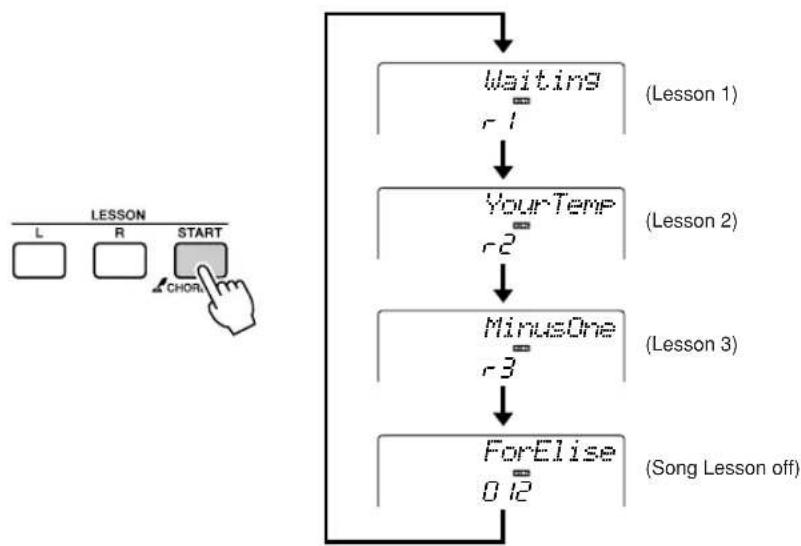
flowchart
graph TD
    A["LESSON"] --> B["L"]
    A --> C["R"]
    A --> D["START"]
    D --> E["CHOR"]
    B --> F["Waiting r1"]
    F --> G["YourTemp r2"]
    G --> H["MinusOne r3"]
    H --> I["ForElise 0.12"]
    I --> J["(Song Lesson off)"]
Song playback will begin automatically when you select Lesson 1.

Start the lesson!
Play the note shown in the display. When you play the correct note, the next note you need play is shown. The song will wait until you play the correct note.
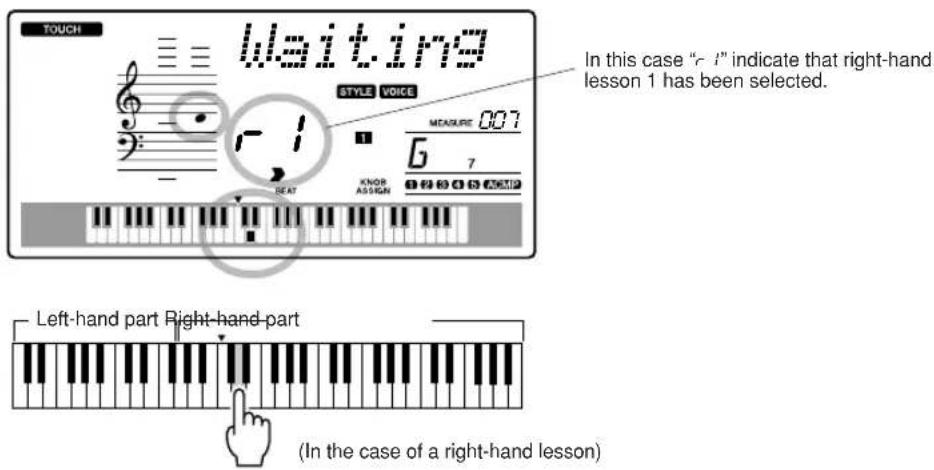
text_image
WAITING STYLE VOICE r-1 MEASURE 007 6 7 BEAT KNOR ASSIGN In this case "c" indicate that right-hand lesson 1 has been selected. Left-hand part Right-hand-part (In the case of a right-hand lesson)4 Stop the Lesson mode. You can stop the Lesson mode
You can stop the Lesson mode at any time by pressing the [▶]/■ (START/STOP) button.
Once you've mastered Lesson 1, move on to Lesson 2.
■See How You've Done ....
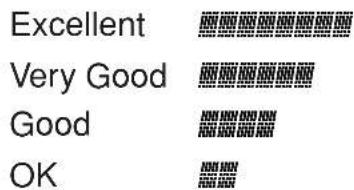
text_image
Excellent Very Good Good OKWhen the lesson song has played all the way through your performance will be evaluated in 4 levels: OK, Good, Very Good, or Excellent. "Excellent!" is the highest evaluation.
After the evaluation display has appeared, the lesson will start again from the beginning.
NOTE
• The evaluation feature can be turned off via the FUNCTION Grade item (page 85).
Lesson 2—Your Tempo
Learn to play the correct notes with the correct timing. Song playback tempo will vary to match the speed you are playing at. The song will slow down when you play wrong notes, so you can learn at your own pace.
1 Select the song and part you want to practice (steps 1 and 2 on pages 43, 44).
2 Start Lesson 2. Each time the I ES
Each time the LESSON [START] button is pressed the lesson modes are selected in sequence: Lesson 1 → Lesson 2 → Lesson 3 → Off → Lesson 1 ...
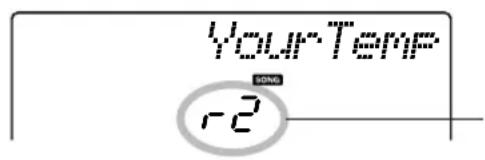
text_image
Your Temp SONG -r2In this case “r-2” indicate that right-hand lesson 2 has been selected.
Song playback will begin automatically when Lesson 2 is selected.

Start the lesson!
Play the note shown in the display. Try to play the notes at the correct timing. As you learn to play the right notes at the right timing the tempo will increase until eventually you'll be playing at the song's original tempo.
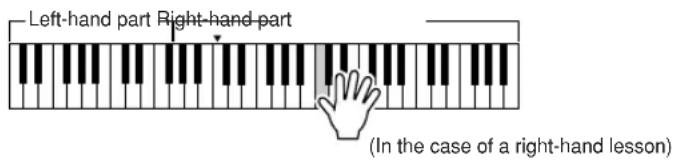
text_image
Left-hand part Right-hand-part (In the case of a right-hand lesson)3 Stop the Lesson mode. You can stop the Lesson mode.
You can stop the Lesson mode at any time by pressing the [▶]/■ (START/STOP) button.
Once you've mastered Lesson 2, move on to Lesson 3.
Lesson 3—Minus One
Here's where you can perfect your technique.
The song will play at the normal tempo, minus the part you have chosen to play. Play along while listening to the song.
1 Select the song and part you want to practice (steps 1 and 2 on pages 43, 44).
2 Start Lesson 3. Each time the I ES
Each time the LESSON [START] button is pressed the lesson modes are selected in sequence: Lesson 1 → Lesson 2 → Lesson 3 → Off → Lesson 1 ...

text_image
LESSON L R START CHOR MinusOne r-3 In this case "r-3" indicate that right-hand lesson 3 has been selected.Song playback will begin automatically when Lesson 3 is selected.

Play the note shown in the display.
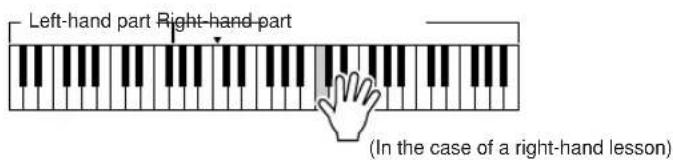
text_image
Left-hand part Right-hand-part (In the case of a right-hand lesson)3 Stop the Lesson mode. You can stop the Lesson mode.
You can stop the Lesson mode at any time by pressing the [▶]/■ (START/STOP) button.
Practice Makes Perfect—Repeat and Learn
Use this feature when you want to start again just ahead of a section on which you made a mistake, or to repeatedly practice a section you find difficult.
Press the [ ] (BEPEAT & LEARN) button during a lesson.
The song location will move back four measures from the point at which you pressed the button, and playback will begin after a one-measure count-in. Playback will continue up to the point at which you pressed the [REPEAT & LEARN) button, and then jump back four measures and begin again after a count-in. This process will repeat, so all you have to do is press the [REPEAT & LEARN) button when you make a mistake in order to repeat practice of that section until you get it right.
NOTE
- Y ou can change the number of measures the Repeat and learn function jumps back by pressing a number button [1]–[9] during repeat playback.
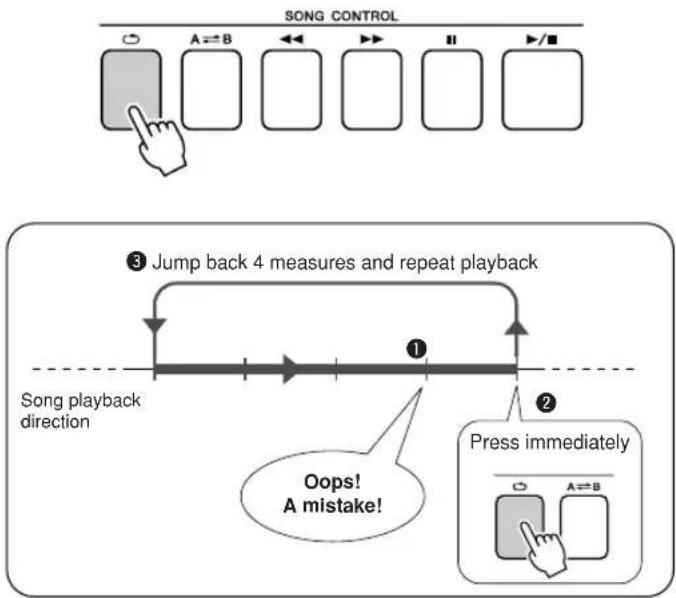
flowchart
graph TD
    A["SONG CONTROL"] --> B["1: Jump back 4 measures and repeat playback"]
    B --> C["2: Press immediately"]
    C --> D["3: Jump back 4 measures and repeat playback"]
    D --> E["Oops! A mistake!"]
Play Using the Music Database
You want to play music in your favorite style, but you're not sure how to select the best voice and style for the type of music you want to play ... simply select the appropriate style from the Music Database. The panel settings will automatically be adjusted for the ideal combination of sounds and style!
1 Press the [MUSIC DATABASE] button.
![YAMAHA PSR-E413 - Press the [MUSIC DATABASE] button. - 1](/content/2026/06/1244056/images/a1a7cf887dcf17f07a90768c4f524849853758c5a416b7df812e6dd76bb5cf2e.jpg)
text_image
SONG STYLE MUSIC DATABASE VOICE SONG MELODY VOICE Jude Hey STYLE MUSIC DATABASE 001A Music Database name will appear in the display.
2 Select a Music Database.
Referring to the list on the panel or Music Database List on page 114 of the manual, use the dial to select a music database. Select one that matches the image of the song you intend to play. For this example select the “158 Patrol”.
text_image
Patrol STYLE MUSIC DATABASE 158NOTE
- Music Database (MDB) files transferred from a computer can be selected and used in the same way as the internal Music Databases (MDB numbers 301–). File transfer instructions are provided on page 90.
3 Play the chords with your left hand and melody with your right.
The jazz style will start playing when you play a left-hand chord to the left of the split point (page 30). Refer to page 38 for information about playing chords.

text_image
Split PointPress the [START/STOP] button to stop playback.
Change a Song's Style
In addition to each song's default style, you can select any other style to play the song with the Easy Song Arranger feature. This means that you can play a song that is normally a ballad, for example, as a bossa nova, as a hip-hop tune, etc. You can create totally different arrangements by changing the style with which a song is played.
You can also change the song's melody voice and the keyboard voice for a complete change of image.
Listen to the DEMO Song for Easy Song Arranger
The "Hallelujah Chorus" in the preset songs lets you experience the Easy Song Arranger. Playing it.
Press the [SONG] button, then select a "009 Hallelujah Chorus" by using the dial. Press the [▶/■] (START/STOP) button to play it.
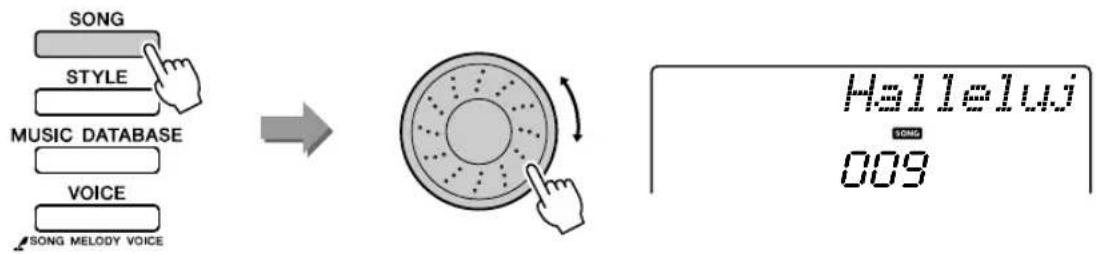
flowchart
graph LR
    A["SONG"] --> B["STYLE"]
    B --> C["MUSIC DATABASE"]
    C --> D["VOICE"]
    D --> E["SONG MELODY VOICE"]
    E --> F["Circle Display Panel"]
    F --> G["Hallelui"]
    G --> H["009"]
As the song progresses, you will see only the style changes while the song remains the same.
Keep in mind that you can enjoy using Easy Song Arranger with other songs as well—any songs that include chord data.
Using the Easy Song Arranger
1 Press the [EASY SONG ARRANGER] button.
The indicator lights when the Easy Song Arranger function is on.
![YAMAHA PSR-E413 - Press the [EASY SONG ARRANGER] button. - 1](/content/2026/06/1244056/images/6e1bef77acd873324bf30c31cea16b6c422539341b4758850bbf0912a58053ff.jpg)
You can use the [SONG] and [STYLE] buttons to select a song or style, respectively, while the Easy Song Arranger function is on.
2 Select a Song. Press the [SONG]
Press the [SONG] button, then select the song you want to arrange.
2 Listen to the song.
Press the [▶(START/STOP) button to begin playback of the song. Move on to the next step while the song is playing.
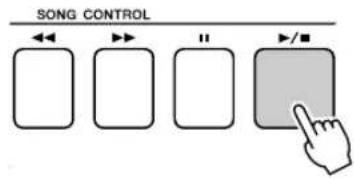
text_image
SONG CONTROL ◀◀ ▶▶ 〃 ▶/■
Song start!
NOTE
- When playing song numbers 010, 011 and 020 to 030 while using the Easy Song Arranger, melody tracks will be automatically muted and no melody will sound. In order to hear the melody tracks you will need to press the SONG MEMORY buttons [3] to [5].
4 Select a style.
Press the [STYLE] button and then rotate the dial to hear how the song sounds with different styles. As you select different styles the song will remain the same while only the styles change. When you have selected a suitable style move on to the next step while the song is still playing.
5 Select a voice you want to play as a song melody.
Press the [VOICE] button. The currently selected voice number and name will be displayed. Use the dial to select a different voice.
NOTE
- Because the Easy Song Arranger uses song data by playing in the accompaniment range of the keyboard. The [ACMP ON/OFF] button will not function. - If the time signature of the song and style are different, the time signature of the song will be used.
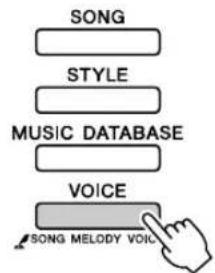
flowchart
graph TD
    A["VOICE"] --> B["MUSIC DATABASE"]
    B --> C["STYLE"]
    C --> D["SONG"]
    style A fill:#f9f,stroke:#333
    style B fill:#ccf,stroke:#333
    style C fill:#cfc,stroke:#333
    style D fill:#fcc,stroke:#333
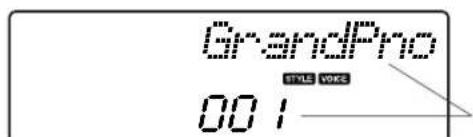
text_image
GrandPro STYLE WIKK 001The currently selected voice number and name are displayed here.
6 Change the song's melody voice.
Press and hold the [VOICE] button for longer than a second. After SONG MELODY VOICE appears on the display the voice you selected in step 5 becomes the song's melody voice.
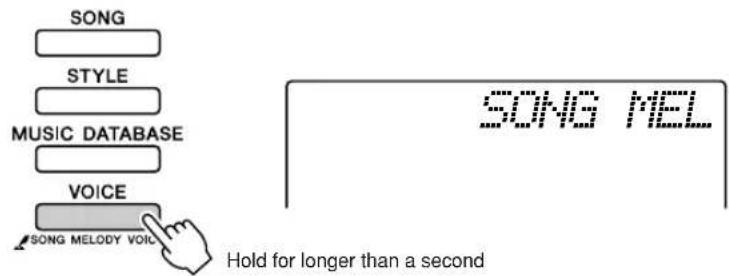
text_image
SONG STYLE MUSIC DATABASE VOICE SONG MEL HOLD for longer than a second7 Press the [EASY SONG ARRANGER] button to turn the function off.
The indicator will go out.
Record Your Own Performance
You can record up to 5 of your own performances and save them as user songs 031 through 035. The recorded song can be played back on the instrument.
■ Recordable Data
You can record to a total of 6 tracks: 5 melody tracks and 1 style (chord) track. Each track can be recorded individually. To record your own performance, first use the SONG MEMORY [1]–[5] and [A] buttons to specify the track(s) you want to record on.
● Melody Track [1]–[5]..... Record the melody parts.
● Style Track [A] .... Records the chord part.
NOTE
- Up to approximately 10,000 notes can be recorded for the five user songs if you record only to the melody tracks. Up to approximately 5,500 chord changes can be recorded for the five user songs if you record only to the style track.
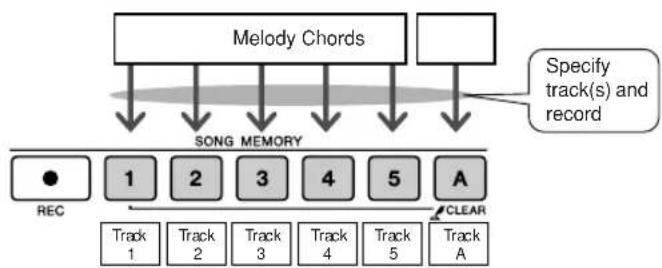
flowchart
graph TD
    A["Melody Chords"] --> B["SONG MEMORY"]
    B --> C["RECACT"]
    C --> D["1 Track 1"]
    C --> E["2 Track 2"]
    C --> F["3 Track 3"]
    C --> G["4 Track 4"]
    C --> H["5 Track 5"]
    C --> I["A Track A"]
    J["Specify track(s) and record"] --> A
    K["CLEAR"] --> L["Track A"]
Track Mute
This instrument allows you to choose whether recorded tracks will play back while you are recording or playing back other tracks (page 79).
Recording Procedure
1 Press the [SONG] button, then use the dial to select the user song number (031–035) you want to record to.
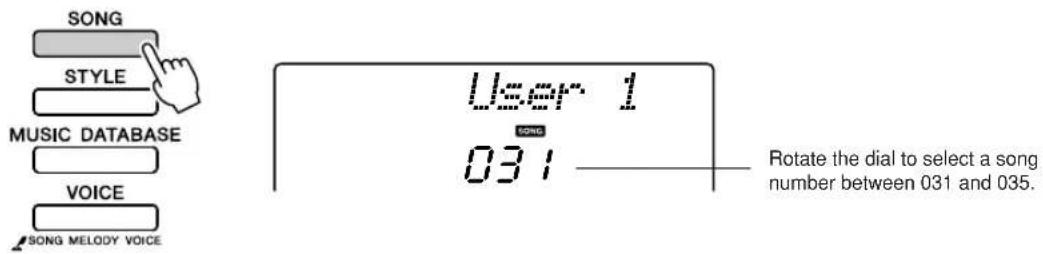
text_image
SONG STYLE MUSIC DATABASE VOICE SONG MELODY VOICE User 1 03:1 Rotate the dial to select a song number between 031 and 035.2 Select the track(s) you want to record to and confirm your selection on the display.
◆ Record a Melody Track and the Accompaniment Track Together
Press the melody track button [1]–[5] you want to record to while holding the [REC] button.
Next, press the [A] button while holding the [REC] button.
The selected tracks will flash in the display.
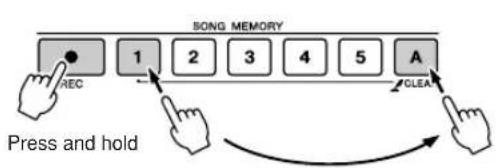
flowchart
graph TD
    A["●"] --> B["1"]
    B --> C["2"]
    C --> D["3"]
    D --> E["4"]
    E --> F["5"]
    F --> G["A"]
    G --> H["↑"]
    H --> I["↓"]
    I --> J["Press and hold"]
    style A fill:#ccc,stroke:#333
    style G fill:#ccc,stroke:#333
    style H fill:#ccc,stroke:#333
    style I fill:#ccc,stroke:#333
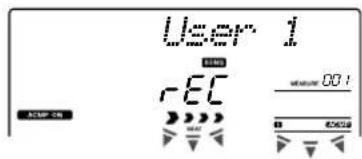
text_image
User 1 R/C rEC 00:1 ACMP 23◆ Record a Melody track
Press the melody track button [1]–[5] you want to record to while holding the [REC] button.
The selected track will flash in the display.
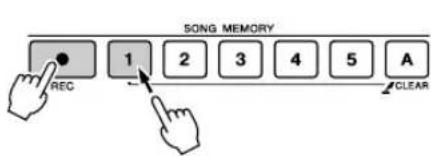
text_image
SONG MEMORY REC 1 2 3 4 5 A CLEAR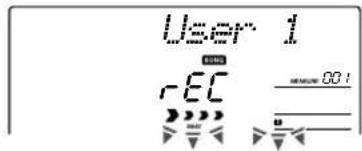
To cancel recording to a selected track, press that track button a second time. Style accompaniment cannot be turned on or off while recording is in progress.
3 Recording will start when you play on the keyboard. You can also start recording by pressing the [▶/START/STOP]
You can also start recording by pressing the [▶/(START/STOP) button.
The current measure will be shown on the display during recording.
![YAMAHA PSR-E413 - Recording will start when you play on the keyboard. You can also start recording by pressing the [▶/START/STOP] - 1](/content/2026/06/1244056/images/68845e78e84bc8fd84fd4818b0a3fe205668bcdf55fc5a88026a2b1404740b56.jpg)
text_image
Recording starts User 1 rEC 003Current measure
CAUTION
- If you record to a track that contains previously-recorded data the previous data will be overwritten and lost.
NOTE
- Style accompaniment is automatically turned on when you select the style track [A] for recording.
• Style accompaniment cannot turned on or off while recording is in progress.
• If you use a split voice for recording, notes played to the left of the split point will not be recorded.
NOTE
- If style accompaniment is on and track [A] has not yet been recorded, the style track [A] will automatically be selected for recording when a melody track is selected. If you only want to record a melody track, be sure to turn the style track [A] off.
NOTE
- If the memory becomes full during recording a warning message will appear and recording will stop automatically. Use the song clear or track clear (page 55) function to delete unwanted data and make more room available for recording, then do the recording again.
4 Stop recording by pressing the [▶(START/STOP) or [REC] button.
![YAMAHA PSR-E413 - Stop recording by pressing the [▶(START/STOP) or [REC] button. - 1](/content/2026/06/1244056/images/f34aeb2b17b49523f03ce4aece1d010c9de41f2d99ba6e4d880440c7c85cd927.jpg)
or
![YAMAHA PSR-E413 - Stop recording by pressing the [▶(START/STOP) or [REC] button. - 2](/content/2026/06/1244056/images/b61c27d4e42827f6c7169a2426e1886364440a97ad7b37607ee36554b105e01f.jpg)
If you press the [INTRO/ENDING/rit.] button while recording the style track an appropriate ending pattern will play and then recording will stop. When recording stops the current measure number will return to 001 and the recorded track numbers in the display will light.
● To Record Other Tracks
Repeat steps 2 through 4 to record any of the remaining tracks. By selecting an unrecorded track—SONG MEMORY buttons [1]–[5], [A]—you can record the new track while listening to previously recorded tracks (the playback tracks will appear in the display). You can also mute previously recorded tracks (the muted tracks will not appear in the display) while recording new tracks.
● To Re-record a Track
Simple select the track you want to re-record for recording in the normal way. The new material will overwrite the previous data.
5 When the recording is done ...
◆ To Play Back a User Song
User songs are played back in the same way as regular songs (page 39).
1 Press the [SONG] button.
2 The current song number/name will be displayed—use the dial to select the user song (031–035) you want to play.
3 Press the button to start playback.
● Data Recording Limitations
• The split voice cannot be recorded.
- The following data are recorded at the beginning of the track. Changes made during the song will not be recorded.
- reverb type, chorus type, time signature, style number, style volume tempo
Song Clear—Deleting User Songs
This function clears an entire user song (all tracks).
1 Press the [SONG] button, then select the user song (031-035) you want to clear.
2 Press and hold the SONG MEMORY [1] button for longer than a second while holding the SONG MEMORY [A] button.
A confirmation message will appear on the display.
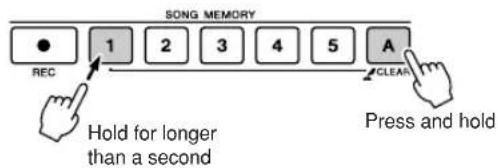
text_image
SONG MEMORY REC 1 2 3 4 5 A Hold for longer than a second Press and hold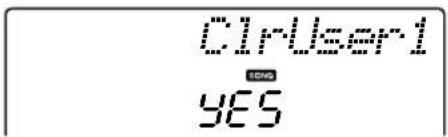
text_image
CIR User1 SING YES2 Press the [+] button.
A confirmation message will appear on the display. You can cancel the clear operation by pressing the [-] button.
4 Press the [+] button to clear the song.
The clear-in-progress message will appear briefly on the display while the song is being cleared.
NOTE
- To execute the Song Clear function press the [+] button. Press [-] to cancel the Song Clear operation.
Track Clear—Deleting a Specified Track from a User Song
This function lets you delete a specified track from a user song.
1 Press the [SONG] button, then select the user song (031-035) you want to clear.
2 Press and hold the SONG MEMORY track button ([1]–[5], [A]) corresponding to the track you want to clear for longer than a second.
A confirmation message will appear on the display.
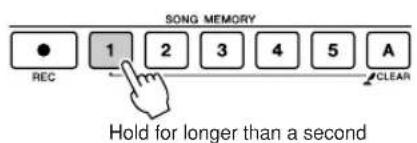
text_image
SONG MEMORY ● 1 2 3 4 5 A REC CLEAR Hold for longer than a second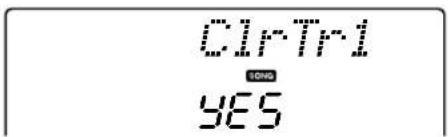
text_image
CIP-TR1 LONG YES2 Press the [+] button.
A confirmation message will appear on the display. You can cancel the clear operation by pressing the [-] button.
1 Press the [+] button to clear the track.
The clear-in-progress message will appear briefly on the display while the track is being cleared.
NOTE
- To execute the Track Clear function press the [+] button. Press [-] to cancel the Track Clear operation.
Backup
The following settings are always backed up, and are maintained even when the power is turned off. If you want to initialize the settings, use the Initialize operation as explained below.
● The Backup Parameters
- User Songs
- Style 166
- Touch Response on/off
- Registration Memory
- FUNCTION Settings: Tuning, Split Point, Touch Sensitivity, Style Volume, Song Volume, Metronome Volume, Grade, Demo Cancel, Master EQ type, Sleep
Initialization
This function erases all backup data in the instrument's flash memory and restores the initial default settings. The following initialization procedures are provided.
■Backup Clear....
To clear data backed up to the internal flash memory—panel user setting, registration memory, user songs, style file 166—turn the power on by pressing the [STANDBY/ON] switch while holding the highest white key on the keyboard. The backed up data will be erased and the default values restored.
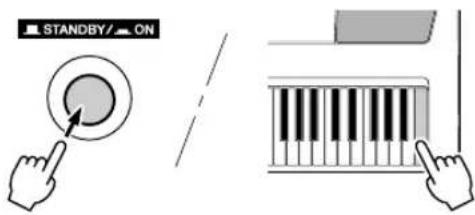
text_image
STANDBY/ON■Flash Clear
To clear song, style and music database files that have been transferred to the internal flash memory from a computer, turn the power on by pressing the [STANDBY/ON] switch while simultaneously holding the highest white key on the keyboard and the three highest black keys.
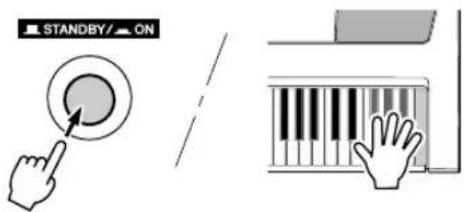
text_image
STANDBY/ON
CAUTION
- When you execute the Flash Clear operation, data you have purchased will also be cleared. Be sure to save data you want to keep to a computer.
Basic Operation
Overall PSR-E413 control is based on the following simple operations.
1 Press a button to select a basic function.
2 Use the dial to select an item or value.
3 Start a function.
3 Start a function.
2 Select an item or value.
1 Select a basic function
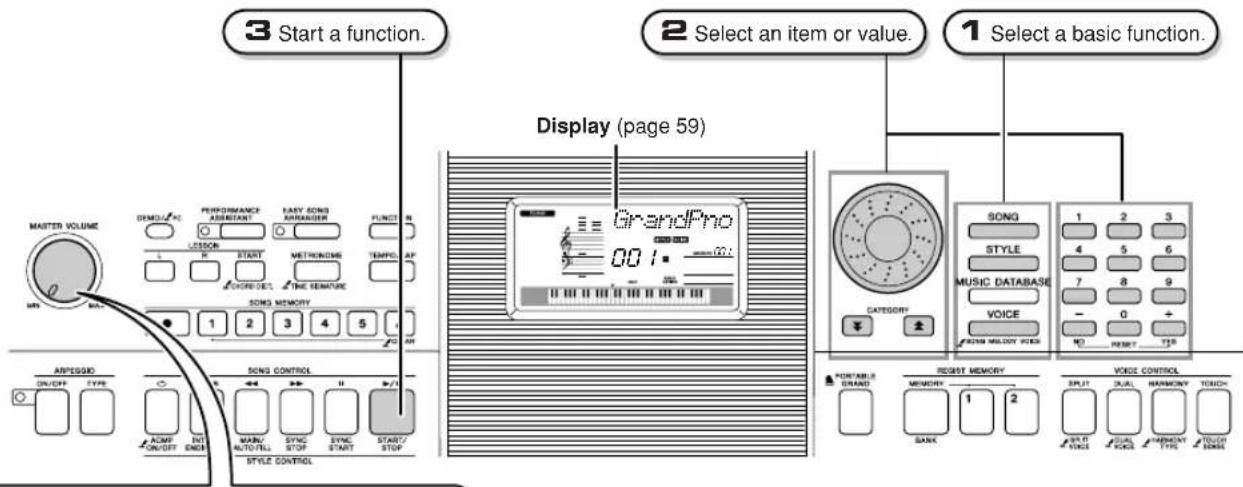
text_image
3 Start a function. 2 Select an item or value. 1 Select a basic function. Display (page 59) Master volume DIN/FFC PERFORMANCE ABRANT EASY SONG ARRANGER FUNCTION MIN LONDON START METHONOMS TEMPLO AP ACROSS TIME REMOUE SONS MEMORY 1 2 3 4 5 OFF ARPISSIO ON/OFF TYPE ACMP ON/OFF INT ENDR SONS CONTROL MAIN/ AUTO/TILL SYNC STOP SYNC START START/ STOP STYLE CONTROL CATEGORY SONG STYLE MUSIC DATABASE VOICE FROM MALOY BOX 1 2 3 4 5 6 7 8 9 - 0 + NO RESET 110 PORTABLE BRAND RESET MEMORY MEMORY 1 2 BANK OUTPUTING SUAL KIOS RADIOLOGY VOICE CONTROL SPLIT DUAL HARMORY TOUCH● Volume Adjustment
Adjusts the volume of the sound heard via the instrument's speakers or a pair of headphones plugged into the PHONES jack.
Rotate counterclockwise to lower the volume.
Rotate clockwise to increase the volume.
The "Press & Hold" Symbol
The “” symbol that appears next to some buttons indicates that the button can be pressed and held for longer than a second to call up a related function. This provides convenient direct access to a range of functions.
1 Press a button to select a basic function.
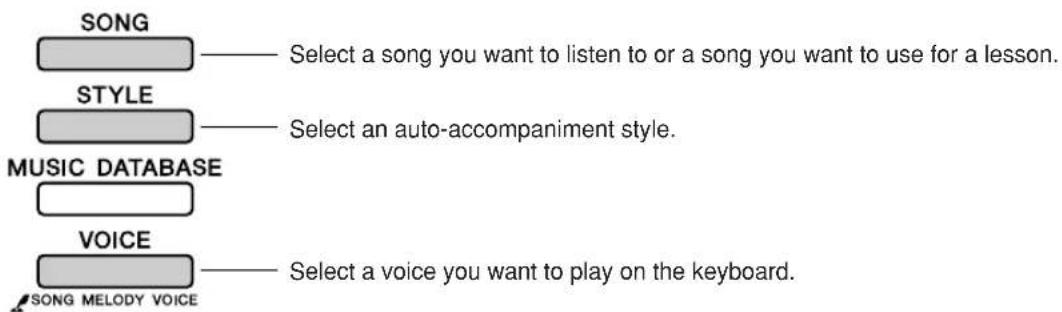
text_image
SONG ——— Select a song you want to listen to or a song you want to use for a lesson. STYLE ——— Select an auto-accompaniment style. MUSIC DATABASE VOICE ——— Select a voice you want to play on the keyboard. SONG MELODY VOICE2 Use the dial to select an item or value.
When you select a basic function, the item corresponding to that function will be displayed. You can then use the dial or the number buttons [0]–[9] to select the desired item.
For Elise
0 12
This portion of the display indicates the name and number of the currently selected song, voice and style. It also displays the name and current setting/value of other functions.
■ Changing Values.
● Dial
Rotate the dial clockwise to increase the value of the selected item, or counterclockwise to decrease it's value. Rotate the dial continuously to continuously increase or decrease the value.
● [+] and [-] Buttons
Press the [+] button briefly to increment the value by 1, or press the [-] button briefly to decrement the value by 1. Press and hold either button to continuously increment or decrement the value in the corresponding direction.
![YAMAHA PSR-E413 - ● [+] and [-] Buttons - 1](/content/2026/06/1244056/images/a7d4ce3bf807e43b9429c181229fe88e21b2a579210f800100c15dcb4f9ea90a.jpg)
![YAMAHA PSR-E413 - ● [+] and [-] Buttons - 2](/content/2026/06/1244056/images/655d2b60f76f956685083003d1851432245cc74fa6e32d6da3016ffb8486190a.jpg)
text_image
7 8 9 - 0 + NO RESET YES Press briefly to decrement. Press briefly to increment.● Number Buttons [0]–[9]
The number buttons can be used to directly enter a song number or parameter value.
Hundreds or tens digits that are "0" can be omitted (see below).
Example: Song number "003" can be entered in three ways.
• [0] → [0] → [3]
• [ 0 ] → [3]
("003" will appear on the display after a brief delay)
• [3]
("003" will appear on the display after a brief delay)
text_image
1 2 3 4 5 6 7 8 9 - 0 + NO RESET YESPress number buttons [0], [0], [3].
● CATEGORY [▲and [ ] buttons
When selecting a song, style, or voice, you can use these buttons to jump to the first item in the next or previous category.
The CATEGORY [▲] and [▼] buttons are useful for selecting categorized items, as in the example below.
![YAMAHA PSR-E413 - ● CATEGORY [▲and [ ] buttons - 1](/content/2026/06/1244056/images/c5351da85522a2e36ea187f272594b7d8bbcf82a55f03605e28edf3bcfa10baa.jpg)
Jump to the first item in the next or previous category.
Example: VOICE SELECT
![YAMAHA PSR-E413 - ● CATEGORY [▲and [ ] buttons - 2](/content/2026/06/1244056/images/165a946c10bde218084f2b77e73f9ccb1c8764388f54df1e7f71a7d50c1ae042.jpg)
The first voice in the selected category is selected.
In a display in which a category appears, selection is easy if you first use the CATEGORY [▲] and [▼] buttons to select the category containing the desired item, then use the dial or [+] and [-] buttons to select the item. This can be particularly handy when you have to select from a large number of voices.
In most procedures described throughout this owner's manual the dial is recommended for selection simply because it is the easiest and most intuitive selection method. Please note however, that most items or values that can be selected using the dial can also be selected using the [+] and [-] buttons.
3 Start a function.
This is the [START/STOP] button.
Press the [START/STOP] button after pressing the [SONG] or [STYLE] button to start playback of the selected song or style (rhythm).
Display Items
The display shows all of the current basic settings: song, style, voice.
It also includes a range of indicators that show the on/off status of a range of functions.
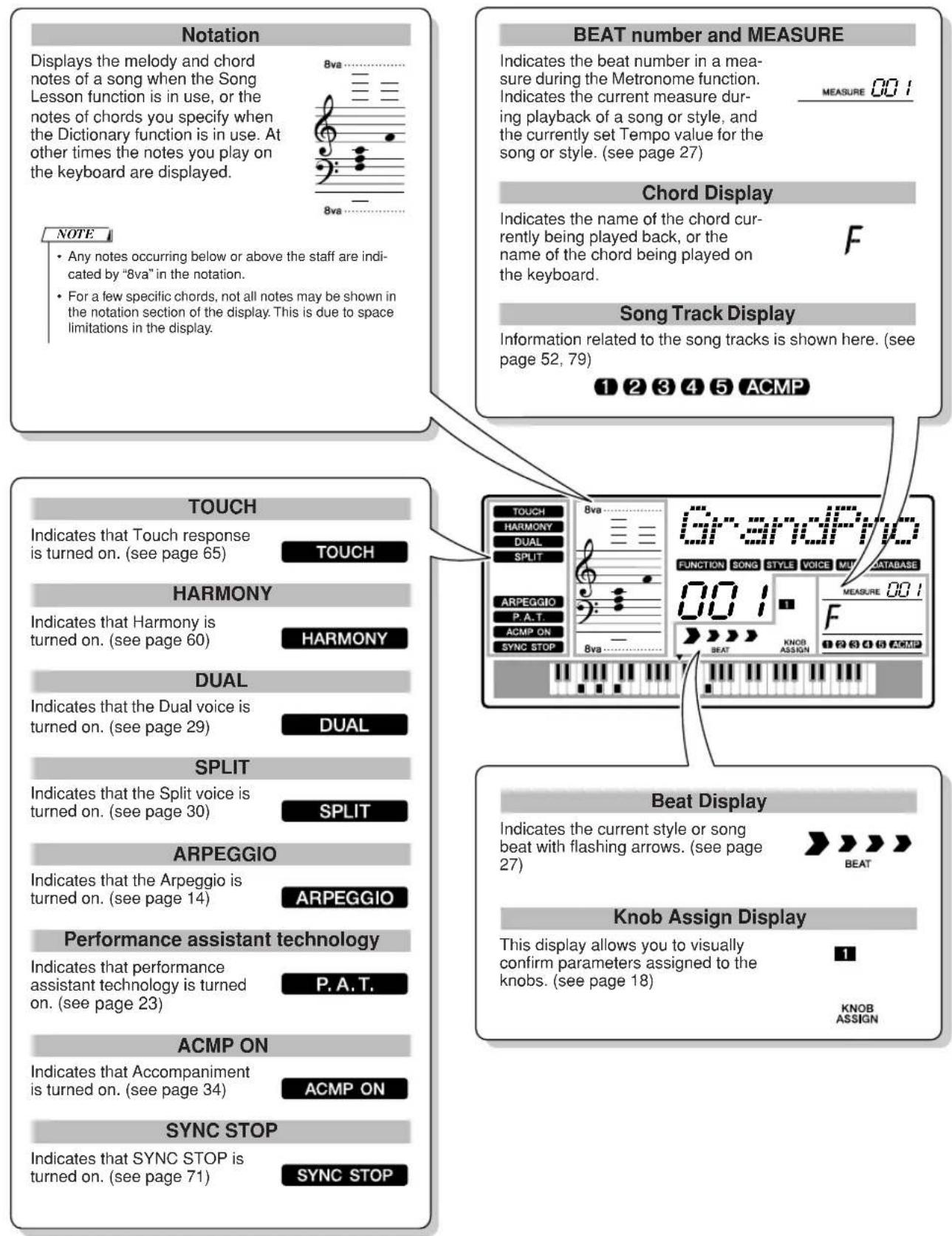
text_image
Notation Displays the melody and chord notes of a song when the Song Lesson function is in use, or the notes of chords you specify when the Dictionary function is in use. At other times the notes you play on the keyboard are displayed. NOTE Any notes occurring below or above the staff are indicated by "8va" in the notation. For a few specific chords, not all notes may be shown in the notation section of the display. This is due to space limitations in the display. BEAT number and MEASURE Indicates the beat number in a measure during the Metronome function. Indicates the current measure during playback of a song or style, and the currently set Tempo value for the song or style. (see page 27) MEASURE 001 Chord Display Indicates the name of the chord currently being played back, or the name of the chord being played on the keyboard. F Song Track Display Information related to the song tracks is shown here. (see page 52, 79) 1 2 3 4 5 ACMP TOUCH Indicates that Touch response is turned on. (see page 65) TOUCH HARMONY Indicates that Harmony is turned on. (see page 60) HARMONY DUAL Indicates that the Dual voice is turned on. (see page 29) DUAL SPLIT Indicates that the Split voice is turned on. (see page 30) SPLIT ARPEGGIO Indicates that the Arpeggio is turned on. (see page 14) ARPEGGIO Performance assistant technology Indicates that performance assistant technology is turned on. (see page 23) P.A.T. ACMP ON Indicates that Accompaniment is turned on. (see page 34) ACMP ON SYNC STOP Indicates that SYNC STOP is turned on. (see page 71) SYNC STOP GrandPro FUNCTION SONG STYLE VOICE MIND DATABASE 001 F BEAT KNOB ASSIGN ACMP Beat Display Indicates the current style or song beat with flashing arrows. (see page 27) BEAT Knob Assign Display This display allows you to visually confirm parameters assigned to the knobs. (see page 18) KNOB ASSIGNHarmony
This feature adds harmony notes to the main voice.
1 Press the [HARMONY] button to turn Harmony feature on.
To turn Harmony off, press the [HARMONY] button again.
![YAMAHA PSR-E413 - Press the [HARMONY] button to turn Harmony feature on. - 1](/content/2026/06/1244056/images/6218e49e92f25405c3d14668cac3475cf6c867c5e4a6996cadf85691c931eb3a.jpg)
text_image
HARMONY HARMONY TYPE HARMONY HARMONY When harmony is on the harmony icon will appear in the display.When you press the [HARMONY] button to turn this feature on, the appropriate harmony type for the currently selected main voice is automatically selected.
2 Press and hold the [HARMONY] button for longer than a second so that the Harmony Type item appears.
"HarmType" appears in the display for a few seconds, and the currently selected harmony type will be displayed. Use the dial to select a different harmony type.
![YAMAHA PSR-E413 - Press and hold the [HARMONY] button for longer than a second so that the Harmony Type item appears. - 1](/content/2026/06/1244056/images/9d4ad55fde59f80d3c333866c81d29eb6cc777714f88631ba38897fdfb29429f.jpg)
text_image
HARMONY HARMONY TYPE Hold for longer than a second. HARMONY HarmType FUNCTION Trip 02The currently selected harmony type
3 Use the dial to select a harmony type.
Refer to the Effect Type List on page 117 for information about the available harmony types. Try playing the keyboard with the harmony function. The effect and operation of each Harmony Type is different-refer to the below section “How to sound each Harmony Type” as well as the Effect Type List for details.
NOTE
- The harmony notes can be added only to the Main Voice, not to Dual or Split Voices.
- The keys left of the Split Point of the keyboard produce no harmony notes when the auto accompaniment is on (ACMP ON is lit).
● How to sound each Harmony Type
- Harmony type 01 to 05
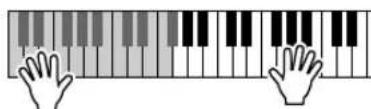
natural_image
Illustration of two hands typing on a piano keyboard (no text or symbols)Press the right-hand keys while playing chords in the auto accompaniment range of the keyboard when the Auto Accompaniment is on (page 34).
• Harmony type 06 to 12 (Trill)
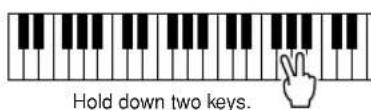
text_image
Hold down two keys.• Harmony type 13 to 19 (Tremolo)
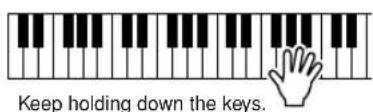
text_image
Keep holding down the keys.• Harmony type 20 to 26 (Echo)
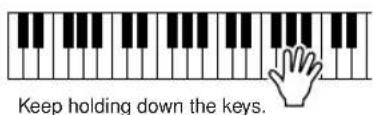
text_image
Keep holding down the keys.You can adjust the Harmony Volume in the Function Settings (page 69).
Adding Reverb
Reverb lets you play with a rich concert hall type ambience. When you select a style or song the optimum reverb type for the voice used is automatically selected. If you want to select a different reverb type, use the procedure described below.
1 Press the [FUNCTION] button.
![YAMAHA PSR-E413 - Press the [FUNCTION] button. - 1](/content/2026/06/1244056/images/2c56b2b88202b4d9d9f07fc374d521f4e77645f2f08aa6d14f1f3c4af6e5d7ea.jpg)
text_image
FUNCTION StyleVol 1002 Use the CATEGORY [A] and [ ] buttons to select the Reverb Type item.
“Reverb” appears in the display for a few seconds, and the currently selected reverb type will be displayed.
![YAMAHA PSR-E413 - Use the CATEGORY [A] and [ ] buttons to select the Reverb Type item. - 1](/content/2026/06/1244056/images/9c190b4fd2a19b1a2a2c18032deba7fcac5f13a8fc1b083ece3be7efd6a5eb2e.jpg)
text_image
CATEGORY Reverb ↓ Hall 12 02 The currently selected reverb type3 Use the dial to select a reverb type.
You can check how the selected reverb type sounds by playing on the keyboard.
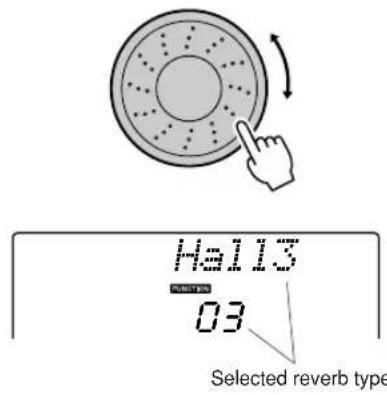
text_image
Hall3 03 Selected reverb typeRefer to the Effect Type List on page 117 for information about the available reverb types.
● Adjusting the Reverb Send Level
You can individually adjust the amount of reverb that is applied to the main, dual, and split voices. (See page 84).
Adding Chorus
The chorus effect creates a thick sound that is similar to many of the same voices being played in unison. When you select a style or song the optimum chorus type for the voice used is automatically selected. If you want to select a different chorus type, use the procedure described below.
1 Press the [FUNCTION] button.
![YAMAHA PSR-E413 - Press the [FUNCTION] button. - 1](/content/2026/06/1244056/images/7e51a5a21f293fb53e72070af8041ac9891a45edadfe035b59ec1f88545960bd.jpg)
2 Use the CATEGORY [1] and [ ] buttons to select the Chorus Type item.
“Chorus” appears in the display for a few seconds, and the currently selected chorus type will be displayed.
![YAMAHA PSR-E413 - Use the CATEGORY [1] and [ ] buttons to select the Chorus Type item. - 1](/content/2026/06/1244056/images/2db5af248517694b51098dce7e68e5beffd24ad9d673bd52cd0c94034f2c6d95.jpg)
text_image
CATEGORY![YAMAHA PSR-E413 - Use the CATEGORY [1] and [ ] buttons to select the Chorus Type item. - 2](/content/2026/06/1244056/images/cbe3b726f247a404e541130b04bca077eca4b921c9473980088a2c13c1bd736a.jpg)
flowchart
graph TD
    A["Chorus"] --> B["The currently selected chorus type"]
3 Use the dial to select a chorus type.
You can check how the selected chorus type sounds by playing on the keyboard.
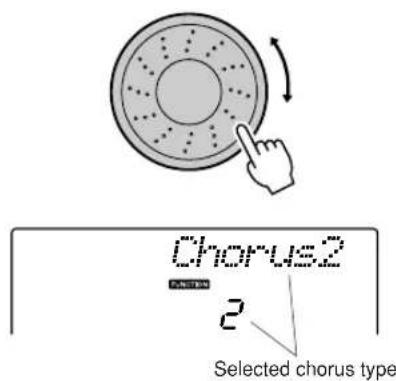
text_image
Chorus2 2 Selected chorus typeRefer to the Effect Type List on page 117 for information about the available chorus types.
● Adjusting the Chorus Send Level
You can individually adjust the amount of chorus that is applied to the main, dual, and split voices. (See page 84).
The Metronome
The instrument includes a metronome with adjustable tempo and time signature. Use it to set the tempo that is most comfortable for you.
■Start the metronome......
Turn the metronome on and start it by pressing the [METRONOME] button.
To stop the metronome, press the [METRO-NOME] button again.
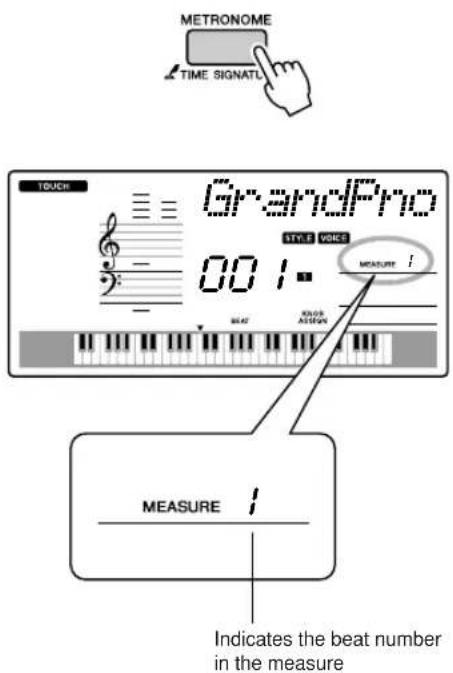
text_image
METRONOME TIME SIGNATE TOUCH GrandFino 001 STYLE VOICE MEASURE / BEAT KHOOD ASSIGN MEASURE / Indicates the beat number in the measure■Adjusting the Metronome Tempo ....
1 Press the [TEMPO/TAP] button to call up the tempo setting.
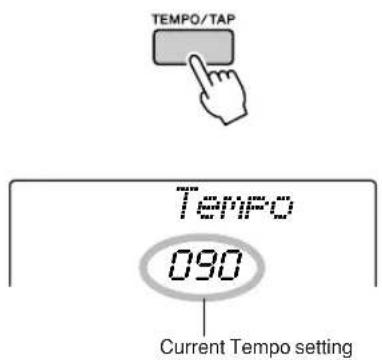
text_image
TEMPO/TAP Tempo 090 Current Tempo setting2 Use the dial to select a tempo from 11 to 280.
Setting the Number of Beats per Measure, and the Length of Each Beat
In this example we'll set up a 5/8 time signature.
1 Press and hold the [METRONOME] button for longer than a second to select the number of beats per measure function "TimesigN".
Hold for longer than a second.
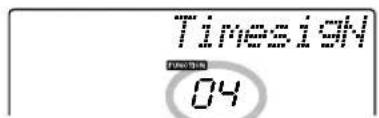
text_image
Timesign FUNCTION 04Number of beats per measure.
2 Use the dial to select the number of beats per measure.
A chime will sound on the first beat of each measure while the other beats will click. All beats will simply click with no chime at the beginning of each measure if you set this parameter to "00".
The available range is from 0 through 60.
Select 5 for this example.
NOTE
- The metronome time signature will synchronize to a style or song that is playing, so these parameters cannot be changed while a style or song is playing.
3 Press the CATEGORY [1 and [ ] buttons as many times as necessary to select the beat length function "TimesigD".
The currently selected beat length will be displayed.
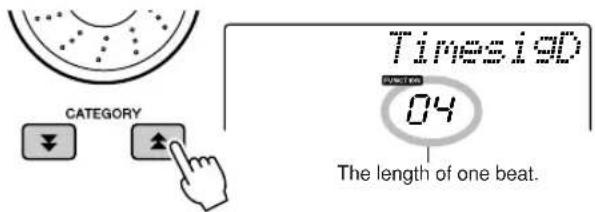
text_image
CATEGORY TimesigD 04 The length of one beat.4 Use the dial to select the beat length.
Select the required length for each beat: 2, 4, 8, or 16 (half note, quarter note, eighth note, or 16^th note). Select 8 for this example.
Adjusting the Metronome Volume
1 Press the [FUNCTION] button.
2 Use the CATEGORY [A] and [ ] buttons to select the Metronome Volume item.
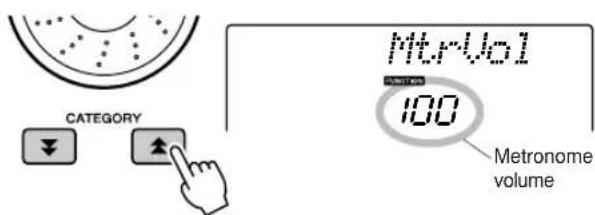
text_image
CATEGORY MtrVol 100 Metronome volume3 Use the dial to set the metronome volume as required.
Tap Start
You can supply a count-in at any tempo you like to start playback. Simply tap the [TEMPO/TAP] button at any tempo—4 times for time signatures in 4, and 3 times for time signatures in 3—and the selected style/song will begin playing at the tapped tempo.
Touch Response Sensitivity
When touch response is on you can adjust the keyboard's sensitivity to dynamics in three steps.
1 Press the [TOUCH] button to turn touch response on.
The touch response icon will appear in the display when touch response is on (page 59).
![YAMAHA PSR-E413 - Press the [TOUCH] button to turn touch response on. - 1](/content/2026/06/1244056/images/7cd278bfa9fe08ce751133df4789a5c74edc3e15dd3497832f4ef210d29e7b17.jpg)
![YAMAHA PSR-E413 - Press the [TOUCH] button to turn touch response on. - 2](/content/2026/06/1244056/images/df622c7710a02cff8528b7bef5c2ef7a081f348d13935d914fd19f1d92819bb6.jpg)
text_image
TOACH GrandPro OFFICE WAVE 001TOUCH
Touch response icon
2 Press and hold the [TOUCH] button for longer than a second so that the Touch Sensitivity item appears.
“TouchSns” appears in the display for a few seconds, and the currently selected touch sensitivity will be displayed.
![YAMAHA PSR-E413 - Press and hold the [TOUCH] button for longer than a second so that the Touch Sensitivity item appears. - 1](/content/2026/06/1244056/images/dc08f453dfb504b0e29232fe84c40c19612eb4db46141d3577f372e66acfae34.jpg)
Hold for longer than a second.
![YAMAHA PSR-E413 - Press and hold the [TOUCH] button for longer than a second so that the Touch Sensitivity item appears. - 2](/content/2026/06/1244056/images/5f776d34d3e3082d69929ab6bf5b2eeb402347e2a41bc1532b913d08d660df5a.jpg)
text_image
TOUGER TouchSms FUNCTION![YAMAHA PSR-E413 - Press and hold the [TOUCH] button for longer than a second so that the Touch Sensitivity item appears. - 3](/content/2026/06/1244056/images/0e732eac5894ce6eb02aec7096af1ff4e0622884fc98556e1b826526a0a92123.jpg)
![YAMAHA PSR-E413 - Press and hold the [TOUCH] button for longer than a second so that the Touch Sensitivity item appears. - 4](/content/2026/06/1244056/images/fdfce712473cf245bcf91c62d2c3a2eae6b98b5e03cf506935115157d0cd6894.jpg)
text_image
TOUCH Medium FUNCTION 2Touch Sensitivity
3 Use the dial in response to keyboard dynamics to select a touch sensitivity setting between 1 and 3. Higher values produce greater (easier) volume variation in response to keyboard dynamics—i.e. greater sensitivity.
NOTE
- The initial default touch sensitivity setting is "2".
Pitch Bend
The pitch bend wheel can be used to add smooth pitch variations to notes you play on the keyboard. Roll the wheel upward to raise the pitch, or downward to lower the pitch. If you use this feature with a voice such as the “040 Overdriven” guitar voice, you can produce remarkably realistic string-bending effects.
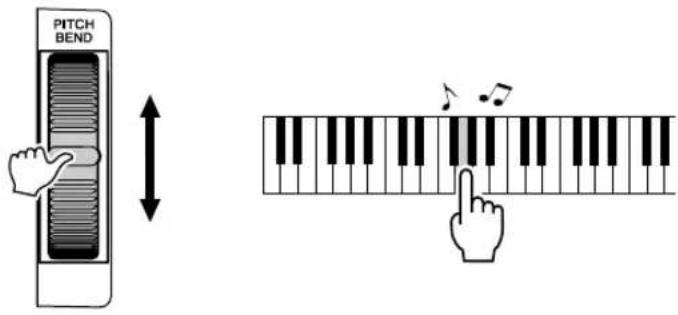
text_image
PITCH BEND ↑ ↓Pitch Controls
◆ Large Pitch Changes (Transpose)
The overall pitch of the instrument can by shifted up or down by a maximum of 1 octave in semitone increments.
1 Press the [FUNCTION] button.
![YAMAHA PSR-E413 - Press the [FUNCTION] button. - 1](/content/2026/06/1244056/images/8a6f908e950ee9bae9453198c1860aed1e4f48204eae035895aa517c49053e24.jpg)
2 Use the CATEGORY [A] and [ ] buttons to select the Transpose item.
![YAMAHA PSR-E413 - Use the CATEGORY [A] and [ ] buttons to select the Transpose item. - 1](/content/2026/06/1244056/images/91a122f6c5f521c04507a7d2c32caa8926c4fc95645ddd1ab62b264a8ea7262b.jpg)
text_image
TransPOS FUNTER 003 Use the dial to set the transpose value between -12 and +12 as required.
NOTE
• The pitch of Drum Kits voices cannot be changed.
◆ Small Pitch Changes (Tuning)
The overall tuning of the instrument can by shifted up or down by a maximum of 100 cents in 1-cent increments (100 cents = 1 semitone).
1 Press the [FUNCTION] button.
![YAMAHA PSR-E413 - Press the [FUNCTION] button. - 1](/content/2026/06/1244056/images/bad05b7e3305b7e995a5ffb953d5896e5f9a0481abe5e5d7ab6ea1672148fa59.jpg)
2 Use the CATEGORY [1 and [ ] buttons to select the Tuning item.
![YAMAHA PSR-E413 - Use the CATEGORY [1 and [ ] buttons to select the Tuning item. - 1](/content/2026/06/1244056/images/9b09fce6d7086018e02048f00343faa0594283956913133d064c9889903332b4.jpg)
text_image
Tuning FUNCTION 0003 Use the dial to set the tuning value between -100 and +100 as required.
NOTE • The pitch of Drum Kits voices cannot be changed.
Controlling Arpeggio Volume with Keyboard Dynamics
1 Press the [FUNCTION] button.
![YAMAHA PSR-E413 - Press the [FUNCTION] button. - 1](/content/2026/06/1244056/images/5131cd9ab080eb4efce7280f6fdfd8383d9b1c4e86c06c9095cdf46a38786aad.jpg)
2 Press the CATEGORY [4] and [ ] buttons as many times as necessary to select the arpeggio velocity function "ARP Velo".
“ARP Velo” will be shown in the display for a few seconds, then the currently selected arpeggio velocity setting will appear.
![YAMAHA PSR-E413 - Press the CATEGORY [4] and [ ] buttons as many times as necessary to select the arpeggio velocity function "ARP Velo". - 1](/content/2026/06/1244056/images/99fabcefd490657c70b58ca824a06722e3a3e2acac36ac3c6aa906551102b0a5.jpg)
text_image
CATEGORY ARP Velo FUNCTION Original FUNCTION The currently selected arpeggio velocity.3 Use the dial to select "2 Thru".
When "1 Original" is selected the arpeggio volume is the same regardless of changes in keyboard velocity.
One Touch Setting
Sometimes selecting the ideal voice to play with a song or style can be confusing. The One Touch Setting feature automatically selects a well-balanced voice for you when you select a style or song. Simply select voice number “000” to activate this feature.
1 Select voice number "000" (steps 1 to 2 on page 28).
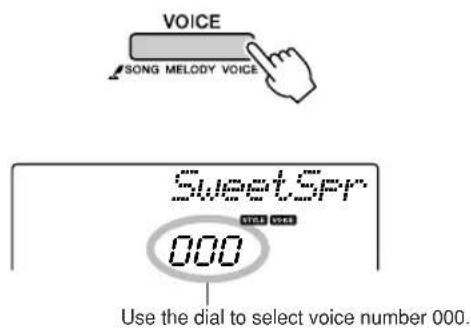
text_image
VOICE SONG MELODY VOICE SweetSpr 000 Use the dial to select voice number 000.2 Select and play back any song (steps 1 to 3 on page 39).
3 Play the keyboard and remember the sound of the voice.

text_image
Illustration of two hands typing on a piano keyboard with musical notes above themIf you have stopped playback at some point during this procedure press the [▶/■ (START/STOP) button to start playback again.
4 Use the dial to change songs, then play the keyboard and listen to the voice.
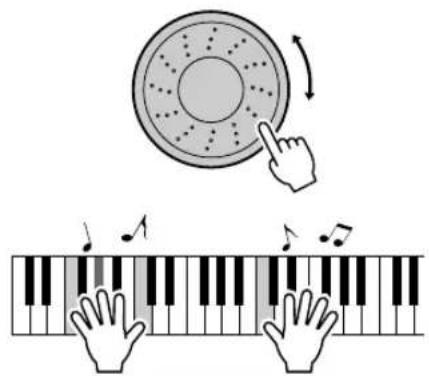
text_image
Illustration showing a hand pressing on a CD to rotate and press the keyboard, with musical notes below.You should hear a different keyboard voice than you played in step 3. Press the [VOICE] button after changing songs to see the name of the voice being used.
Adjusting the Harmony Volume
1 Press the [FUNCTION] button.
![YAMAHA PSR-E413 - Press the [FUNCTION] button. - 1](/content/2026/06/1244056/images/f4882ebe044837a214e73a904efa6193c1314fcfe2795de4e4e15ef9d2cf7fc2.jpg)
2 Use the CATEGORY [4] and [ ] buttons to select the Harmony Volume item.
![YAMAHA PSR-E413 - Use the CATEGORY [4] and [ ] buttons to select the Harmony Volume item. - 1](/content/2026/06/1244056/images/43941c285babad8b0ab727f7e7f79f908561cf5f955c38b04cf8bf3fd9c9e760.jpg)
text_image
CATEGORY HarvVol 0803 Use the dial to set the harmony volume between 000 and 127.
Select an EQ Setting for the Best Sound
Five different master equalizer (EQ) settings are provided to give you the best possible sound when listening through different reproduction systems—the instrument's internal speakers, headphones, or an external speaker system.
1 Press the [FUNCTION] button.
The currently selected function will appear in the display.
![YAMAHA PSR-E413 - Press the [FUNCTION] button. - 1](/content/2026/06/1244056/images/2f3e084856db2fddbc6524193bbd4adccd21ac98be8dbe81ae697b0877569177.jpg)
2 Press the CATEGORY [4] and [ ] buttons as many times as necessary to select the master EQ type function "MasterEQ".
"MasterEQ" will be shown in the display for a few seconds, then the currently selected EQ type will appear.
![YAMAHA PSR-E413 - Press the CATEGORY [4] and [ ] buttons as many times as necessary to select the master EQ type function "MasterEQ". - 1](/content/2026/06/1244056/images/a14450a20231846f5e4b575955d70bcdff1a84c4d4a84adbdb994ac4a78247ce.jpg)
flowchart
graph TD
    A["Master EQ"] --> B["Speaker 1"]
    B --> C["The currently selected master EQ type."]
3 Use the dial to select the desired Master EQ setting.
Five settings are available: 1–5. Settings 1 and 2 are best for listening via the instrument's built-in speakers, setting 3 is for headphones, and settings 4 and 5 are ideal for listening via external speakers.
Basic operation of the Style (auto-accompaniment) feature is described on page 33 of the Quick Guide.
Here are some other ways you can play the styles, the style volume adjustment procedure, how you can play chords using the styles, and more.
Pattern Variation (Sections)
The PSR-E413 features a wide variety of style “sections” that allow you to vary the arrangement of the accompaniment to match the song you are playing.
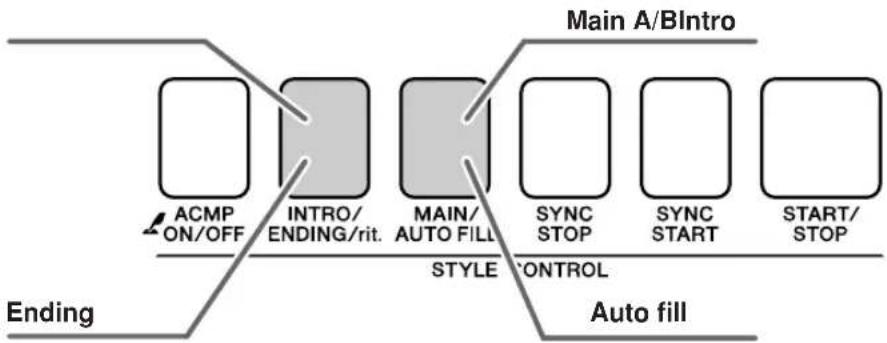
flowchart
graph LR
    A["ACMP ON/OFF"] --> B["INTRO/ ENDING/rit."]
    B --> C["MAIN/ AUTO FILL"]
    C --> D["SYNC STOP"]
    C --> E["SYNC START"]
    C --> F["START/ STOP"]
    G["Main A/BIntro"] --> C
    H["Ending"] --> A
    I["Style CONTROL"] --> C
    J["Auto fill"] --> C
- INTRO section
This is used for the beginning of the Song. When the intro finishes playing, accompaniment shifts to the main section. The length of the intro (in measures) differs depending on the selected Style.
- MAIN section
This is used for playing the main part of the Song. It plays a main accompaniment pattern, and repeats indefinitely until another section's button is pressed. There are two variations on the basic pattern (A and B), and the Style playback sound changes harmonically based on the chords you play with your left hand.
- Fill-in section
This is automatically added before changing to section A or B.
● ENDING section
This is used for the ending of the Song. When the ending is finished, the auto accompaniment stops automatically. The length of the ending (in measures) differs depending on the selected Style.
1 Press the [STYLE] button and then select a style.
2 Press the [ACMP ON/OFF] button to turn auto accompaniment on.
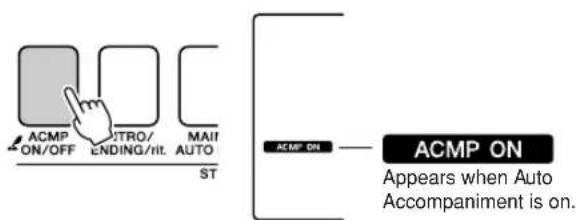
text_image
ACMP ON/OFF STRO/ ENDING/rit. MAI AUTO ACMP ON — ACMP ON Appears when Auto Accompaniment is on.3 Press the [SYNC START] button to turn synchro start on.
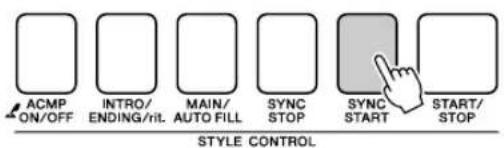
text_image
ACMP ON/OFF INTRO/ ENDING/rit. MAIN/ AUTO FILL SYNC STOP SYNC START START/ STOP STYLE CONTROL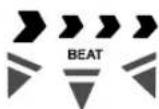
Beat arrows will flash when the synchro start standby mode is engaged
● Synchro Start
When the synchro start standby mode is engaged, style playback will begin as soon as you play a chord in the accompaniment range of the keyboard. You can disengage the synchro-start standby mode by pressing the [SYNC START] button again.
4 Press the [MAIN/AUTO FILL] button.
![YAMAHA PSR-E413 - Press the [MAIN/AUTO FILL] button. - 1](/content/2026/06/1244056/images/d5d66c3945f5fa9c9ee687309f0b59df641c9bbf4642834814223e2d06ed1547.jpg)
text_image
ACMP ON/OFF INTRO/ ENDING/rit. MAIN/ AUTO FILL SYNC STOP SYNC START START/ STOP STYLE CONTROL MAIN A TITLEThe name of the selected section—MAIN A or MAIN B—will be displayed.
5 Press the [INTRO/ENDING/rit.] button.
![YAMAHA PSR-E413 - Press the [INTRO/ENDING/rit.] button. - 1](/content/2026/06/1244056/images/5799d4a5a11fc5a930b17f66acab9c20659343242d213e95f8e4530a3ee42471.jpg)
text_image
ACMP ON/OFF INTRO/ ENDING/rit. MAIN/ AUTO FILL SYNC STOP SYNC START START/ STOP STYLE CONTROL INTRO+A STYLEYou're now ready to play the intro.
6 As soon as you play a chord with your left hand, the Intro of the selected Style starts.
For this example, play a C major chord (as shown below). For information on how to enter chords, see “Playing Auto-accompaniment Chords” on page 38.

text_image
Split point Accompaniment range7 Press the [MAIN/AUTO FILL] button.
![YAMAHA PSR-E413 - Press the [MAIN/AUTO FILL] button. - 1](/content/2026/06/1244056/images/6e7f137620377b0130ca187ac7cd33e7f4b6ddb564ea0497d8e9a26f7e197d6e.jpg)
text_image
ACMP ON/OFF INTRO/ ENDING/rit. MAIN/ AUTO FILL SYNC STOP SYNC START START/ STOP STYLE CONTROL FILL A>B FULLWhen the fill-in is finished, it leads smoothly into the selected main section A/B.
8 Press the [INTRO/ENDING/rit.] button.
![YAMAHA PSR-E413 - Press the [INTRO/ENDING/rit.] button. - 1](/content/2026/06/1244056/images/08aaf8ecea2ccde0c71d911d38f77fff2cfe4042da1098fe4bf49cecce85679e.jpg)
text_image
ACMP ON/OFF INTRO/ ENDING/rit. MAIN/ AUTO FILL SYNC STOP SYNC START START/ STOP STYLE CONTROL ENDING OKSThis switches to the ending section. When the ending is finished, the auto accompaniment stops automatically. You can have the ending gradually slow down (ritardando) by pressing the [INTRO/ENDING/rit.] button again while the ending is playing back.
● Synchro Stop
When this function is selected the accompaniment style will only play while you are playing chords in the accompaniment range of the keyboard. Style playback will stop when you release the keys. To turn the function on, press the [SYNC STOP] button.
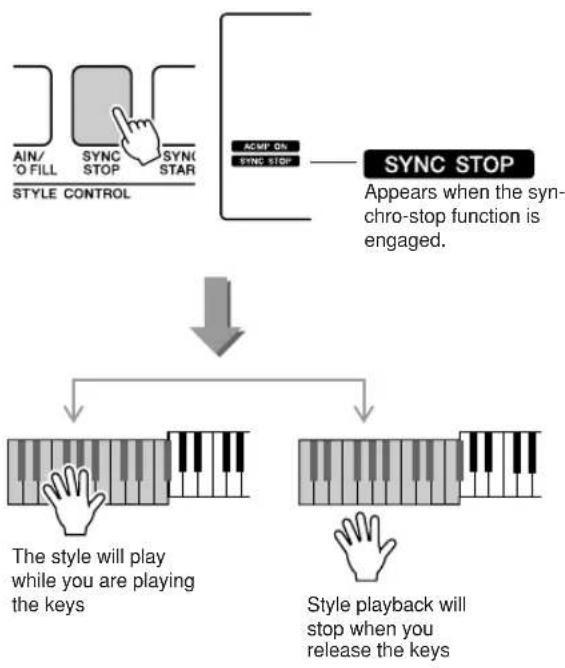
flowchart
graph TD
    A["STYLE CONTROL"] --> B["ACMF ON SYNC STOP"]
    B --> C["SYNC STOP"]
    C --> D{Appears when the syn-chro-stop function is engaged.}
    D --> E["The style will play while you are playing the keys"]
    D --> F["Style playback will stop when you release the keys"]
Adjusting the Style Volume
Press the [STYLE] button to engage the style function.
1 Press the [FUNCTION] button.
2 Use the CATEGORY [▲ and [ ] buttons to select the Style Volume item.
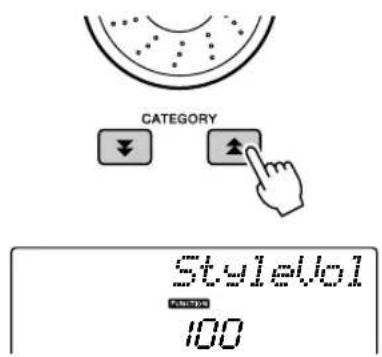
text_image
CATEGORY StyleVol 1003 Use the dial to set the style volume between 000 and 127.
Setting the Split Point
The initial default split point is key number 54 (the F#2 key), but you can change it to another key using the procedure described below.
1 Press the [STYLE] button.
2 Press and hold the [ACMP ON/OFF] for longer than a second so that the Split point item appears.
text_image
ACMP ON/OFF CTRO/ ENDING/rit MAIN/ AUTO FILL SYNC STOP SYNC START START/ STOPHold for longer than a second
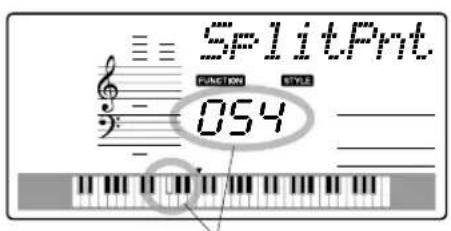
text_image
SplitPrt FUNCTION STYLE 054Split point
3 Use the dial to set the split point to any key from 000 through 127.
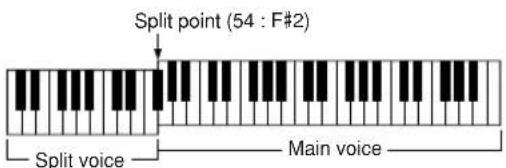
text_image
Split point (54 : F#2) Split voice Main voiceNOTE
- When you change the split point the auto-accompaniment split point also changes.
- The split point cannot be changed during a song lesson.
NOTE
You can also access the Split Point item by pressing the [FUNCTION] button and using the CATEGORY [▲] and [▼] buttons to locate the item (page 83).
Play a Style with Chords but No Rhythm (Stop Accompaniment)
When auto accompaniment is on (the ACMP ON icon is showing) and Synchro Start is off, you can play chords in the left-hand accompaniment range of the keyboard while the style is stopped and still hear the accompaniment chords. This is “Stop Accompaniment”, and any of the chord fingerings recognized by the instrument can be used (page 38).
Press the [STYLE] button to engage the style function, then press the [ACMP ON/OFF] button to turn the auto accompaniment on.
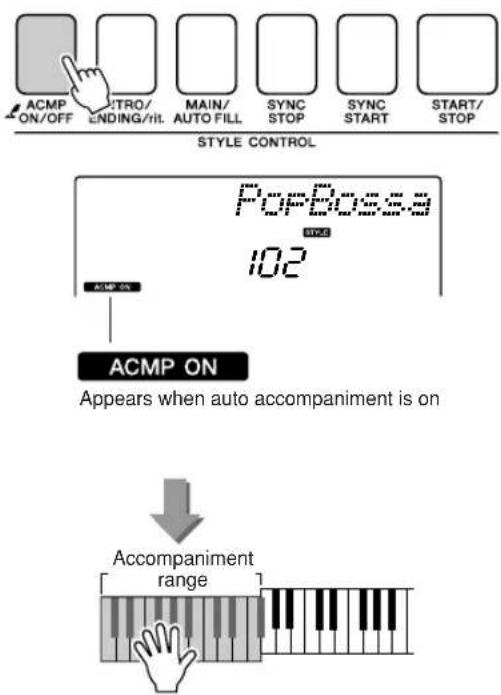
flowchart
graph TD
    A["ACMP ON/OFF"] --> B["STRO/ENDING/RIT"]
    B --> C["MAIN/AUTO FILL"]
    C --> D["SYNC STOP"]
    D --> E["SYNC START"]
    E --> F["START/STOP"]
    G["ACMP ON"] --> H["ACMP ON"]
    H --> I["102"]
    I --> J["Form/Format 102"]
    K["ACMP ON"] --> L["Appears when auto accompaniment is on"]
    M["Accompaniment range"] --> N["Hand with keyboard"]
Loading Style Files
This instrument features 165 internal styles, but other styles, such as those provided on the CD-ROM and others that can be obtained from the internet (only styles with the “.sty” suffix), can be loaded into style number 166 and used in the same way as the internal styles.
In order to use the style file load function, the file must already have been transferred from the computer to the instrument. The procedure for transferring files from a computer to the instrument is described on page 90 (“Transferring Data between the Computer and Instrument”).
The procedure described below loads a style file that has already been transferred from a computer to the instrument into style number 166.
1 Press the [FUNCTION] button.
The currently selected function will appear in the display.
![YAMAHA PSR-E413 - Press the [FUNCTION] button. - 1](/content/2026/06/1244056/images/cd2a1fd943215a2d1d8149f0ac0adfe2276ccaa7ad6a3713155fa0967ef1f035.jpg)
2 Press the CATEGORY [4] and [ ] buttons as many times as necessary to select the style file load function "Sff Load".
![YAMAHA PSR-E413 - Press the CATEGORY [4] and [ ] buttons as many times as necessary to select the style file load function "Sff Load". - 1](/content/2026/06/1244056/images/495354a28fe9f5023ed5acbba481f92919ea6707dccba7f52a6305cae5586956.jpg)
text_image
CATEGORY SFF Load FUNCTIONAfter about 2 seconds the name of a loadable style file will appear in the display.
If multiple loadable style files have been transferred to the instrument, you can use the dial or the [+] and [-] buttons to select the other files in sequence.
3 Execute the load operation.
With the name of the style file you want to load shown in the display, press the number [0] button.
4 A confirmation message for the load operation will appear. Press the [+/YES] button to actually load the file.
![YAMAHA PSR-E413 - A confirmation message for the load operation will appear. Press the [+/YES] button to actually load the file. - 1](/content/2026/06/1244056/images/a9e73b5e6c7f5767809f80b6774babf19e65860a6316f2449c7bff2d701efdf3.jpg)
Chord Basics
Two or more notes played together constitute a "chord".
The most basic chord type is the “triad” consisting of three notes: the root, third, and fifth degrees of the corresponding scale. A C major triad, for example, is made up of the notes C (the root), E (the third note of the C major scale), and G (the fifth note of the C major scale).
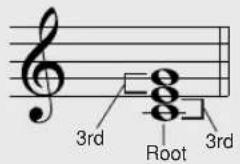
text_image
3rd Root 3rdIn the C major triad shown above, the lowest note is the “root” of the chord (this is the chord’s “root position” ... using other chord notes for the lowest note results in “inversions”). The root is the central sound of the chord, which supports and anchors the other chord notes.
The distance (interval) between adjacent notes of a triad in root position is either a major or minor third.
Major third-four half steps (semitones) Minor third-three half steps (semitones)
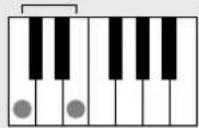
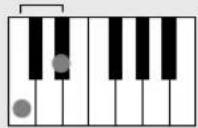
The lowest interval in our root-position triad (between the root and the third) determines whether the triad is a major or minor chord, and we can shift the highest note up or down by a semitone to produce two additional chords, as shown below.
Major chord
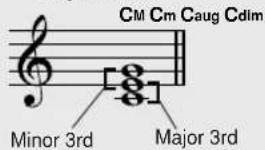
text_image
CM Cm Caug Cdlm Minor 3rd Major 3rdMinor chord Augmented chord Diminished chord
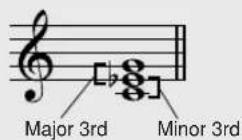
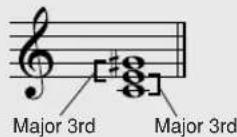
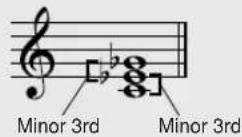
The basic characteristics of the chord sound remain intact even if we change the order of the notes to create different inversions. Successive chords in a chord progression can be smoothly connected, for example, by choosing the appropriate inversions (or chord “voicings”).
● Reading Chord Names
Chord names tell you just about everything you need to know about a chord (other than the inversion/voicing). The chord name tells you what the root of the chord is, whether it is a major, minor, or diminished chord, whether it requires a major or flatted seventh, what alterations or tensions it uses ... all at a glance.
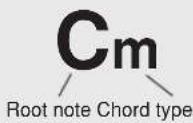
● Some Chord Types (These are just some of the "Standard" chord types recognized by the PSR-E413.)
Suspended 4 th
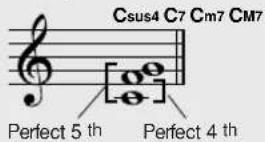
7th
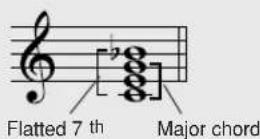
Minor 7 th
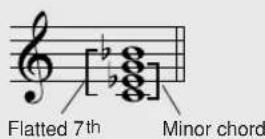
Major 7 th
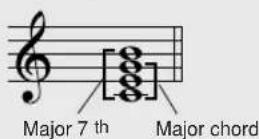
Minor/major 7 th
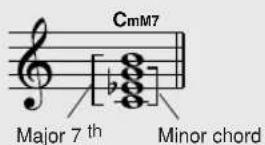
7th,flatted 5 th
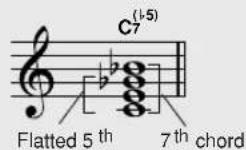
Minor 7th, flatted 5th
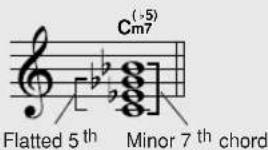
text_image
Cm7^{(-5)} [ ] Flatted 5th Minor 7th chord7th, suspended 4 th
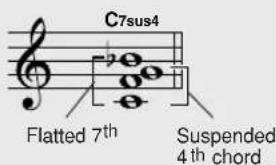
text_image
C7sus4 Flatted 7th Suspended 4th chord■Recognized Standard Chords.
All chords in the chart are "C-root" chords.
| Chord Name/[Abbreviation] Normal | Voicing Chord (C) Display | ||
| Major [M] 1 - 3 - 5 C | C | ||
| Add ninth [(9)] 1 - 2 - 3 - 5 C | C^(9) | (9) | |
| Sixth [6] 1 - (3) - 5 - 6 C6 | C_6 | ||
| Sixth ninth [6(9)] 1 - 2 - 3 - (5) - 6 C6 | C_6^(9) | (9)* | |
| Major seventh [M7] | 1 - 3 - (5) - 7 or1 - (3) - 5 - 7 | CM_7 | CM7 |
| Major seventh ninth [M7(9)] 1 - 2 - 3 - (5) - 7 CM7 | C_M7^(9) | (9)* | |
| Major seventh add sharp eleventh [M7(#11)] | 1 - (2) - 3 - #4 - 5 - 7 or1 - 2 - 3 - #4 - (5) - 7 | C_M7^(#11) | CM7(#11)* |
| Flatted fifth [(b5)] | 1 - 3 - b5C | C^(>5) | b5* |
| Major seventh flatted fifth [M7b5] | 1 - 3 - b5 - 7 | C_M7^(b5) | CM7b5* |
| Suspended fourth [sus4] | 1 - 4 - 5 Csus4 | C_sus4 | |
| Augmented [aug] | 1 - 3 - #5 | Caug | Caug |
| Major seventh augmented [M7aug] | 1 - (3) - #5 - 7 | CM7aug | CM7aug* |
| Minor [m] 1 - b3 - 5 | Cm | Cm | |
| Minor add ninth [m(9)] | 1 - 2 - b3 - 5 | C_m^(9) | Cm (9) |
| Minor sixth [m6] | 1 - b3 - 5 - 6 | C_m6 | Cm6 |
| Minor seventh [m7] | 1 - b3 - (5) - b7 | C_m7 | Cm7 |
| Minor seventh ninth [m7(9)] | 1 - 2 - b3 - (5) - b7 | C_m7^(9) | Cm7 (9) |
| Minor seventh add eleventh [m7(11)] | 1 - (2) - b3 - 4 - 5 - (b7) | C_m7^(1) | Cm7 (11)* |
| Minor major seventh [mM7] | 1 - b3 - (5) - 7 | C_mM7 | CmM7 |
| Minor major seventh ninth [mM7(9)] | 1 - 2 - b3 - (5) - 7 | C_mM7^(9) | CmM7 (9)* |
| Minor seventh flatted fifth [m7b5] | 1 - b3 - b5 - b7 | C_m7^(b5) | Cm7b5 |
| Minor major seventh flatted fifth [mM7b5] | 1 - b3 - b5 - 7 | C_mM7^(b5) | CmM7b5* |
| Diminished [dim] 1 - b3 - b5 | Cdim | Cdim | |
| Diminished seventh [dim7] | 1 - b3 - b5 - 6 | Cdim7 | Cdim7 |
| Seventh [7] | 1 - 3 - (5) - b7 or1 - (3) - 5 - b7 | C7 | C7 |
| Seventh flatted ninth [7(b9)] | 1 - b2 - 3 - (5) - b7 | C_7^(b9) | C7(b9) |
| Seventh add flatted thirteenth [7(b13)] | 1 - 3 - 5 - b6 - b7 | C_7^(b13) | C7(b13) |
| Seventh ninth [7(9)] | 1 - 2 - 3 - (5) - b7 | C_7^(9) | C7(9) |
| Seventh add sharp eleventh [7(#11)] | 1 - (2) - 3 - #4 - 5 - b7 or1 - 2 - 3 - #4 - (5) - b7 | C_7^(f11) | C7(#11) |
| Seventh add thirteenth [7(13)] | 1 - 3 - (5) - 6 - b7 | C_7^(f3) | C7(13) |
| Seventh sharp ninth [7(#9)] | 1 - #2 - 3 - (5) - b7 | C_7^(f9) | C7(#9) |
| Seventh flatted fifth [7b5] | 1 - 3 - b5 - b7 | C_7b5 | C7b5* |
| Seventh augmented [7aug] | 1 - 3 - #5 - b7 | C_7aug | C7aug |
| Seventh suspended fourth [7sus4] | 1 - 4 - (5) - b7 | C_7sus4 | C7sus4 |
| Suspended second [sus2] | 1 - 2 - 5 C* | C_sus2 | |
* These chords are not shown in the Dictionary function.
NOTE
- Notes in parentheses can be omitted.
- Playing two same root keys in the adjacent octaves produces accompaniment based only on the root.
- A perfect fifth (1+5) produces accompaniment based only on the root and fifth which can be used with both major and minor chords.
- The chord fingerings listed are all in "root" position, but other inversions can be used—with the following exceptions: m7, m7b5, 6, m6, sus4, aug, dim7, 7b5, 6(9), sus2.
NOTE
- Inversion of the 7sus4 and m7(11) chords are not recognized if the notes shown in parentheses are omitted.
- The auto accompaniment will sometimes not change when related chords are played in sequence (e.g. some minor chords followed by the minor seventh).
- Two-note fingerings will produce a chord based on the previously played chord.
Looking Up Chords Using the Chord Dictionary
The Dictionary function is essentially a built-in “chord book” that shows you the individual notes of chords. It is ideal when you know the name of a certain chord and want to quickly learn how to play it.
1 Press and hold the LESSON [START] button for longer than a second.
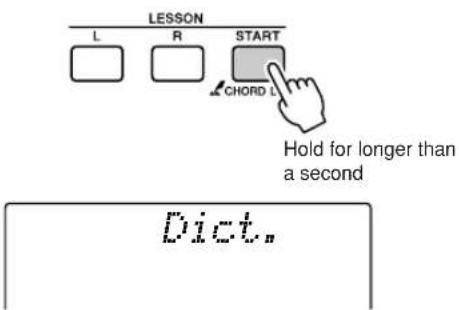
text_image
LESSON L R START CHORD L Hold for longer than a second Dict.2 As an example, we'll learn how to play a GM7 (G major seventh) chord. Press the "G" key in the section of the keyboard labeled "ROOT". (The note doesn't sound.) The root note you set is shown in the display.

text_image
ROOT C G TOUCH Dict. STYLE MEASURE 03:1 6 Bra... MEAT KNOE ASIK RAN3 Press the "M7" (major seventh) key in the section of the keyboard labeled "CHORD TYPE". (The note doesn't sound.) The notes you should play for the specified chord (root note and chord type) are shown in the display, both as notation and in the keyboard diagram.
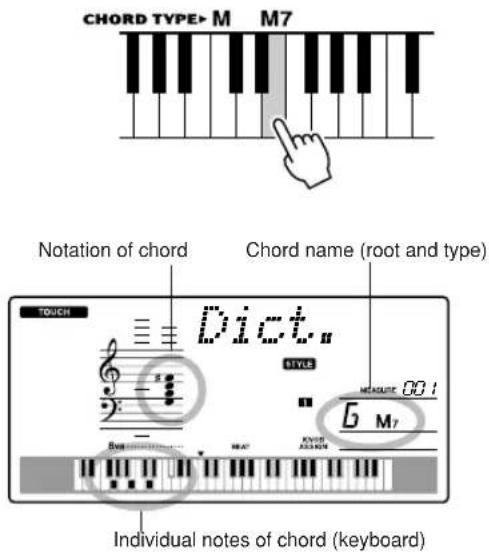
text_image
CHORD TYPE M M7 Notation of chord Chord name (root and type) TOUCH Dict. STYLE 6 M7 Individual notes of chord (keyboard)To call up possible inversions of the chord, press the [+]/[-] buttons.
NOTE - About major chords: Simple major chords are usually indicated only by the root note. For example, "C" refers to C major. However, when specifying major chords here, make sure to select "M" (major) after pressing the root note.
4 Try playing a chord in the auto accom- paniment section of the keyboard, checking the indications in the display. When you've played the chord properly, a bell sound signals your success and the chord name in the display flash.
Song Volume
1 Press the [FUNCTION] button.
![YAMAHA PSR-E413 - Press the [FUNCTION] button. - 1](/content/2026/06/1244056/images/0008377add9e5ae5e202ac795066180ec3dd532d8aee69b372b88765bf63d817.jpg)
2 Use the CATEGORY [▲] and [▼] buttons to select the Song Volume item.
![YAMAHA PSR-E413 - Use the CATEGORY [▲] and [▼] buttons to select the Song Volume item. - 1](/content/2026/06/1244056/images/18c9c28c85a95dacddd53eeaf0c52722cc0134459df37400f367b6bff56a4411.jpg)
text_image
CATEGORY SongVol 100 Song volume3 Use the dial to set the song volume between 000 and 127.
NOTE • Song volume can be adjusted while a song is selected.
A-B Repeat
You can specify a section of a song—“A” is the start point and “B” is the end point—for repeat playback.
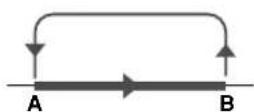
1 Play the song (page 39) and press the [A⇌B] (A-B REPEAT) button at the beginning of the section you want to repeat (the “A” point).
![YAMAHA PSR-E413 - Play the song (page 39) and press the [A⇌B] (A-B REPEAT) button at the beginning of the section you want to repeat (the “A” point). - 1](/content/2026/06/1244056/images/4a13d2639d07b7a5ef542e061297746b238695f18db4261d59d53304cf6aef88.jpg)
text_image
SONG CONTROL A ⇌ B ← →2 Press the [A⇌B] (A-B REPEAT) button a second time at the end of the section you want to repeat (the "B" point).
![YAMAHA PSR-E413 - Press the [A⇌B] (A-B REPEAT) button a second time at the end of the section you want to repeat (the "B" point). - 1](/content/2026/06/1244056/images/cf253c5b50f91bd5c096486f2ddfc856dde5a1ae76a4f82cbc35e2bbf643cea2.jpg)
text_image
SONG CONTROL A ⇌ B ←→3 The specified A-B section of the song will now play repeatedly.
You can stop repeat playback at any time by pressing the [A↔B] (A-B REPEAT) button.
NOTE
- The repeat start and end points can be specified in one-measure increments.
- The current measure number is shown in the display during play-back.
- If you want to set the start point "A" at the very beginning of the song press the [A(A-B)REPEAT) button before starting playback of the song.
Muting Independent Song Parts
Each “track” of a song plays a different part of the song—melody, percussion, accompaniment, etc. You can mute individual tracks and play the muted part on the keyboard yourself, or simply mute tracks other than the ones you want to listen to. To mute a track, press the appropriate track button (TRACK [1]–[5], [A]) button. Press the same button a second time to disengage track muting.

text_image
SONG MEMORY REC 1 2 3 4 5 A CLEAR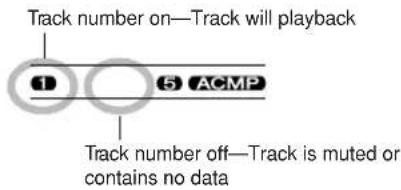
text_image
Track number on—Track will playback 1 5 ACMP Track number off—Track is muted or contains no dataChange the Melody Voice
You can change a song's melody voice to any other voice you prefer.
NOTE
- Y ou cannot change the melody voice of a user song.
1 Select the song and play it.
2 Rotate the dial to select the voice you want to listen to after pressing the [VOICE] button.
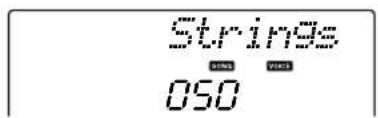
text_image
Strings STING POST 0503 Press the [VOICE] button for longer than a second. "SONG MELODY VOICE" appears in the display for a few seconds, indicating that the voice selected in step #2 has replaced the song's original melody voice.
Hold for longer than a second
SONG MEL
This instrument has a Registration Memory feature that lets you save your favorite settings for easy recall whenever they're needed. Up to 16 complete setups can be saved (8 banks of two setups each).
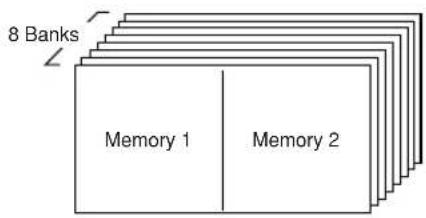
text_image
8 Banks Memory 1 Memory 2Up to 16 presets (eight banks of two each) can be memorized.
Saving to the Registration Memory
1 Set the panel controls as required—select a voice, accompaniment style, etc.
2 Press the [MEMORY/BANK] button. A bank number will appear in the display when you release the button.
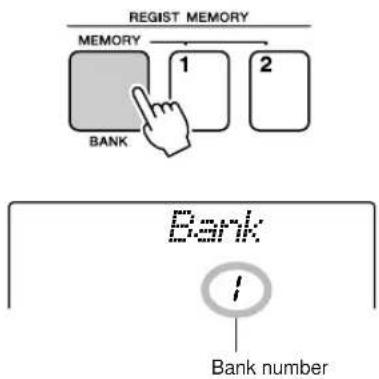
text_image
REGIST MEMORY MEMORY 1 2 BANK Bank Bank number3 Use the dial or the [1]–[8] number buttons to select a bank number from 1 to 8.
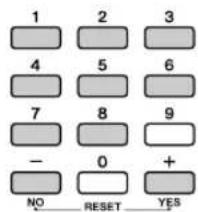
text_image
1 2 3 4 5 6 7 8 9 - 0 + NO RESET YESNOTE
- Data cannot be saved to the registration memory during song play-back.
4 Press the REGIST MEMORY [1] or [2] button while holding the [MEMORY/BANK] button to store the current panel settings to the specified registration memory.
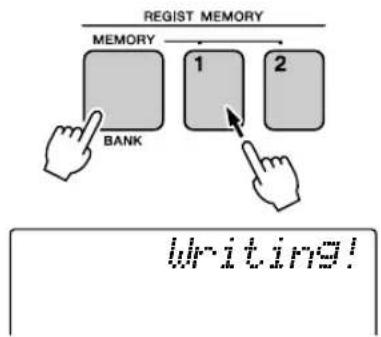
flowchart
graph TD
    A["REGIST MEMORY"] --> B["BANK"]
    B --> C["1"]
    C --> D["2"]
    D --> E["writing!"]
NOTE
- If you select a Registration Memory number that already contains data, the previous data is deleted and overwritten by the new data.

CAUTION
- Do not turn off the power while saving settings to the registration memory, otherwise the data may be damaged or lost.
Recalling a Registration Memory
1 Press the [MEMORY/BANK] button. A bank number will appear in the display when you release the button.
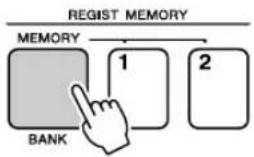
flowchart
graph TD
    A["REGIST MEMORY"] --> B["1"]
    A --> C["2"]
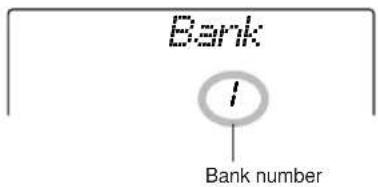
text_image
Bank 1 Bank number2 Use the dial or the [1]–[8] number buttons to select bank you want to recall.

text_image
1 2 3 4 5 6 7 8 9 - 0 + NO RESET YES3 Press the REGIST MEMORY button, [1] or [2], containing the settings you want to recall. The recalled REGIST MEMORY number appears in the display for a few seconds. The panel controls will be instantly set accordingly.
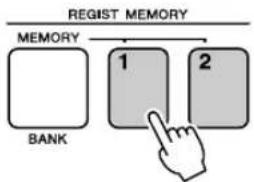
flowchart
graph TD
    A["REGIST MEMORY"] --> B["1"]
    A --> C["2"]
    D["BANK"] --> B
    D --> C
REGIST 1
;
● Settings That Can be Saved to the Registration Memory
- Style settings*
Style number, Auto Accompaniment ON/OFF, Split Point, Style settings (Main A/B), Style Volume, Tempo
- Voice settings
Main Voice setting (Voice number, Volume, Octave, Pan, Reverb Send Level, Attack Time, Release Time, Filter Cutoff, Filter Resonance, Chorus Send Level), Dual Voice settings (Dual ON/OFF, Voice number, Volume, Octave, Pan, Reverb Send Level, Chorus Send Level, Attack Time, Release Time, Filter Cutoff, Filter Resonance), Split Voice settings (Split ON/OFF, Voice number, Volume, Octave, Pan, Reverb Send Level, Chorus Send Level)
- Effect settings
Reverb Type, Chorus Type
- Arpeggio settings
Arpeggio Type, Arpeggio ON/OFF
- Harmony settings
Harmony ON/OFF, Harmony Type, Harmony Volume
- Other settings
Transpose, Pitch Bend Range, Knob Assign
* Style settings are not available for Registration Memory when using the Song features.
This instrument has a Sleep Mode function that allows it to automatically go into a low-power “sleep” mode if not operated for specified period of time. In Sleep Mode all panel indicators and the display backlight are off to conserve power. The Sleep Mode function is initially disabled (OFF) by default.
1 Press the [FUNCTION] button.
2 Use the CATEGORY [▲] and [▼] buttons to select the SLEEP item.
text_image
Sleep FUNCTION OFF Time to Sleep Mode3 Rotate the dial to set the desired time until Sleep Mode begins (3–20 minutes).
The time can be set in one-minute increments. Select OFF to disable Sleep Mode (the instrument will not go to sleep). The instrument will wake from Sleep Mode as soon as a panel control is operated, a key is pressed, or a MIDI command is received. No sound will be produced for approximately two seconds after waking from sleep.
The “Functions” provide access to a range of detailed instrument parameters for tuning, setting the split point, and adjusting the voices and effects. Take a look at the function list starting on the opposite page.
When you locate a function you want to set up, simply select the function's display name (shown to the right of the function name in the list) and adjust as required.
Selecting and Setting Functions
1 Find the function you want to set in the list that begins on page 84.
2 Press the [FUNCTION] button.
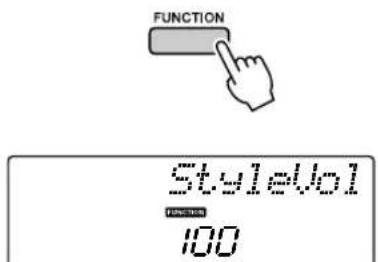
text_image
FUNCTION StyleVol 1003 Select a function.
Press the CATEGORY [▲] and [▼] buttons as many times as necessary until the function's display name appears in the display.
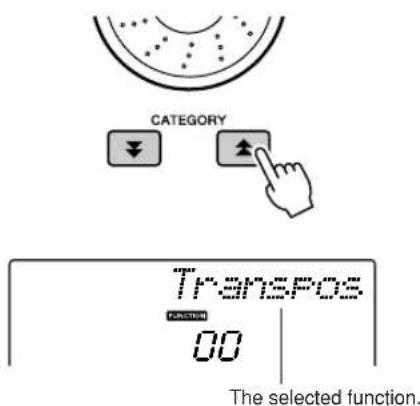
text_image
CATEGORY TransPos 00 The selected function.4 Use the dial, the [+] and [-] buttons, or the [0] – [9] number buttons to set the selected function as required.
The [+] and [-] buttons are used to make ON/OFF type settings: [+]=ON, [-]=OFF . In some cases the [+] button will initiate execution of the selected function, and the [-] will cancel the selection.
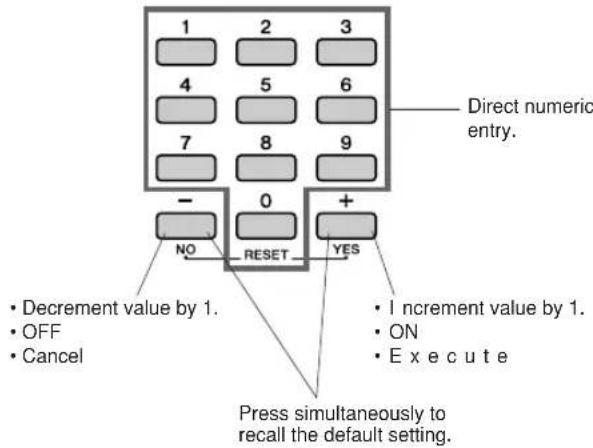
text_image
1 2 3 4 5 6 7 8 9 - 0 + NO RESET YES • Decrement value by 1. • OFF • Cancel • I increment value by 1. • ON • E x e c u t e Press simultaneously to recall the default setting.Some Function settings are stored in memory as soon as they are changed. See “The Backup Parameters” on page 56 for information on the function settings that are stored on the instrument.
To restore all initial factor default settings perform the “Backup Clear” procedure described in the “Initialization” section on page 56.
● Function Setting List
| Setting Item title | Range/Settings | Description | |
| Style Volume StyleVol | 000-127 Determines the volume of the Song. | ||
| Song Volume SongVol | 000-127 Determines the volume of the Song. | ||
| Transpose | TransFos | -12-12 | Determines the pitch of the instrument by semitone increments. |
| Tuning | Tuning | -100-100 | Sets the pitch of the instrument's sound in 1-cent increments. |
| Pitch Bend Range | PERange | 01-12 | Sets the pitch bend range in semitone increments. |
| Split Point | SplitPnt | 000-127 (C-2-G8) | Determines the highest key for the Split voice and sets the Split "point"-in other words, the key that separates the Split (lower) and Main (upper) voices. The Split Point setting and Accompaniment Split Point setting are automatically set to the same value. |
| Touch Sensitivity | TouchSns | 1(Soft), 2(Medium), 3(Hard) | When Touch Response is on, this determines the sensitivity of the feature. |
| Main Voice Volume | M.Volume | 000-127 | Determines the volume of the Main voice. |
| Main Voice Octave | M.Octave | -2-+2 | Determines the octave range for the Main voice. |
| Main Voice Pan | M.Pan | 000 (left)-64 (center)-127 (right) | Determines the pan position of the Main voice in the stereo image. The value "0" results in the sound being panned full left; the value "127" results in the sound being panned full right. |
| Main Voice Reverb Level | M.Reverb | 000-127 | Determines how much of the Main voice's signal is sent to the Reverb effect. |
| Main Voice Chorus Level | M.Chorus | 000-127 | Determines how much of the Main voice's signal is sent to the Chorus effect. |
| Main Voice Attack Time | M.Attack | 000-127 | Sets the Main voice attack time. |
| Main Voice Release Time | M.Releas | 000-127 | Sets the Main voice release time. |
| Main Voice Filter Cutoff | M.Cutoff | 000-127 | Sets the Main voice filter cutoff frequency. |
| Main Voice Filter Resonance | M.Reso. | 000-127 Sets the Main voice filter resonance. | |
| Dual Voice | D.Voice | 001-509 | Selects the Dual voice. |
| Dual Voice Volume | D.Volume | 000-127 | Determines the volume of the Dual voice. |
| Dual Voice Octave | D.Octave | -2-+2 | Determines the octave range for the Dual voice. |
| Dual Voice Pan | D.Pan | 000 (left)-64 (center)-127 (right) | Determines the pan position of the Dual voice in the stereo image. The value "0" results in the sound being panned full left; the value "127" results in the sound being panned full right. |
| Dual Voice Reverb Level | D.Reverb | 000-127 | Determines how much of the Dual voice's signal is sent to the Reverb effect. |
| Dual Voice Chorus Level | D.Chorus | 000-127 | Determines how much of the Dual voice's signal is sent to the Chorus effect. |
| Dual Voice Attack Time | D.Attack | 000-127 | Sets the Dual voice attack time. |
| Dual Voice Release Time | D.Releas | 000-127 | Sets the Dual voice release time. |
| Dual Voice Filter Cutoff | D.Cutoff | 000-127 | Sets the Dual voice filter cutoff frequency. |
| Dual Voice Filter Resonance | D.Reso. | 000-127 Sets the Dual voice filter resonance. | |
| Split Voice | S.Voice | 001-509 | Selects the Split voice. |
| Split Voice Volume | S.Volume | 000-127 | Determines the volume of the Split voice. |
| Split Voice Octave | S.Octave | -2-+2 | Determines the octave range for the Split voice. |
| Split Voice Pan | S.Pan | 000 (left)-64 (center)-127 (right) | Determines the pan position of the Split voice in the stereo image. The value "0" results in the sound being panned full left; the value "127" results in the sound being panned full right. |
| Split Voice Reverb Level | S.Reverb | 000-127 | Determines how much of the Split voice's signal is sent to the Reverb effect. |
| Split Voice Chorus Level | S.Chorus | 000-127 | Determines how much of the Split voice's signal is sent to the Chorus effect. |
| Setting | Item title | Range/Settings | Description |
| Reverb Type | Reverb | 01-10 | Determines the Reverb type, including off (10). (See the list on page 117) |
| Chorus Type | Chorus | 01-05 | Determines the Chorus type, including off (05). (See the list on page 117) |
| Master EQ Type Master EQ | Speaker1,Speaker2,Headphone,Line Out1,Line Out2 | Sets the equalizer applied to the speaker output for optimum sound in different listening situations. | |
| Harmony Type | HarmType | 01-26 | Determines the Harmony type. (See the list on page 117) |
| Harmony Volume | HarmVol | 000-127 | Determines the volume of the Harmony effect. |
| Arpeggio Type | ARP Type | 01-100 | Determines the Arpeggio type. (See the list on page 14) |
| Arpeggio Velocity | ARP Velo | 1 (Original),2 (Thru) | Sets the velocity mode for arpeggio playback. |
| Style File Load | Sff Load | 001-nnn Loads a Style file. | |
| PC mode | PC mode | PC1/PC2/OFF | Optimizes the MIDI settings when you connect to a computer (page 89). |
| Local On/Off Local | ON/OFF | Determines whether the instrument's keyboard controls the internal tone generator (ON) or not (OFF). (page 88) | |
| External Clock ExtClock | ON/OFF | Determines whether the instrument synchronizes to the internal clock (OFF) or an external clock (ON). (page 88) | |
| Keyboard Out | KbdOut ON/OFF | Determines whether keyboard performance data of the instrument is transmitted (ON) or not (OFF). | |
| Style Out | StyleOut ON/OFF | Determines whether Style data is transmitted (ON) via USB or not (OFF) during Style playback. | |
| Song Out | SongOut ON/OFF | Determines whether User Song is transmitted (ON) via USB or not (OFF) during Song playback. | |
| Initial Send | InitSend YES/NO | Lets you send the data of the panel settings to a computer. Press [+] to send, or press [-] to cancel. | |
| Time Signature Numerator | Timesign 00-60 Determines the time signature of the Metronome. | ||
| Time Signature Denominator | TimesigD | Half note,Quarter note,Eighth note,Sixteenth note | Sets the length of each metronome beat. |
| Metronome Volume | MtrVol | 000-127 | Determines the volume of the Metronome. |
| Lesson Track (R) | R-Part | GuideTrack 1-16 | Determines the guide track number for your right hand lesson. The setting is only effective for songs in SMF format 0 transferred from a computer. |
| Lesson Track (L) | L-Part | GuideTrack 1-16 | Determines the guide track number for your left hand lesson. The setting is only effective for songs in SMF format 0 transferred from a computer. |
| Grade | Grade | ON/OFF | Determines whether the Grade function is on or off. |
| Demo Cancel | D-Cancel ON/OFF | Determines whether Demo cancel is enabled or not. When this is set to ON, the Demo Song will not play, even if the [DEMO/PC] button is pressed. | |
| Sleep | Sleep | 3-20, OFF | Sets the amount of time before the instrument will go into Sleep Mode. |
* All these settings can be conveniently reset to their initial default values by pressing the [+] and [-] buttons simultaneously. (The exception to this is Initial Send, which is an operation, not a setting.)
Nearly all of the electronic musical instruments made today—particularly synthesizers, sequencers and computer music related devices—use MIDI. MIDI is a worldwide standard that allows these devices to send and receive performance and setting data. Naturally, this instrument lets you save or send your keyboard performance as MIDI data, as well as the songs, styles and panel settings.
The potential MIDI holds for your live performances and music creation/production is enormous—simply by connecting this instrument to a computer and transmitting MIDI data. In this section, you’ll learn the basics of MIDI and the specific MIDI functions provided by this instrument.
What Is MIDI?
No doubt you have heard the terms “acoustic instrument” and “digital instrument”. In the world today, these are the two main categories of instruments. Let’s consider a grand piano and a classical guitar as representative acoustic instruments. They are easy to understand. With the piano, you strike a key, and a hammer inside hits some strings and plays a note. With the guitar, you directly pluck a string and the note sounds. But how does a digital instrument go about playing a note?
● Acoustic guitar note production
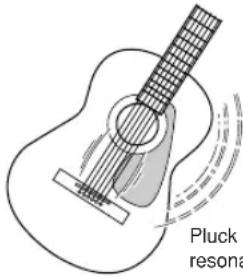
text_image
Pluck a resonaPluck a string and the body resonates the sound.
● Digital instrument note production
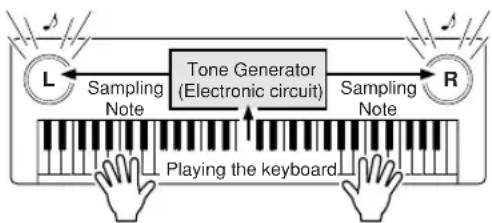
flowchart
graph TD
    L["Input"] -->|Sampling Note| Tone["Electronic Circuit"]
    Tone -->|Sampling Note| R["Output"]
    style L fill:#f9f,stroke:#333
    style R fill:#f9f,stroke:#333
    note1["Playing the keyboard"] --> Tone
    note2["Playing the keyboard"] --> Tone
    note3["Playing the keyboard"] --> Tone
    note4["Playing the keyboard"] --> Tone
    note5["Note"] --> Tone
    note6["Note"] --> Tone
    note7["Note"] --> Tone
Based on playing information from the keyboard, a sampling note stored in the tone generator is played through the speakers.
As shown in the illustration above, in an electronic instrument the sampling note (previously recorded note) stored in the tone generator section (electronic circuit) is played based on information received from the keyboard. So then what is the information from the keyboard that becomes the basis for note production?
For example, let's say you play a “C” quarter note using the grand piano sound on the instrument. Unlike an acoustic instrument that puts out a resonated note, the electronic instrument puts out information from the keyboard such as “with what voice”, “with which key”, “about how strong”, “when was it pressed”, and “when was it released”. Then each piece of information is changed into a number value and sent to the tone generator. Using these numbers as a basis, the tone generator plays the stored sampling note.
Example of Keyboard Information
| Voice number (with what voice) 1 (grand piano) | |
| Note number (with which key) 60 (C3) | |
| Note on (when was it pressed) and note off (when was it released) | Timing expressed numerically (quarter note) |
| Velocity (about how strong) 120 (strong) | |
Your keyboard performance and all panel operations of this instrument are processed as MIDI data. The songs, auto accompaniment (styles), and User songs are also made up of MIDI data.
MIDI is an acronym that stands for Musical Instrument Digital Interface and it allows different musical instruments and devices to instantly communicate with each other, via digital data. The MIDI standard is used all over the world and was designed to transmit performance data between electronic musical instruments (or computers). Thanks to MIDI, you can control one instrument from another and transmit performance data between the devices-taking your creative and performance potential to even higher levels.
MIDI messages can be divided into two groups: Channel messages and System messages.
● Channel Messages
This instrument is capable of handling 16 MIDI channels simultaneously—meaning it can play up to sixteen different instruments at the same time. Channel messages transmit information such as Note ON/OFF, Program Change, for each of the 16 channels.
| Message Name | Instrument Operation/Panel Setting |
| Note ON/OFF | Performance data of the keyboard (contains note number and velocity data) |
| Program Change | Instrument selection (including bank select MSB/LSB, if necessary) |
| Control Change | Instrument settings (volume, pan, etc.) |
● System Messages
This is data that is used in common by the entire MIDI system. System messages include messages like Exclusive Messages that transmit data unique to each instrument manufacturer and Realtime Messages that control the MIDI device.
| Message Name Instrument Operation/Panel Setting | |
| Exclusive Message Reverb/chorus settings, etc. | |
| Realtime Messages Start/stop operation |
Connecting a Personal Computer
The following functions become available when this instrument is connected to a computer.
● Performance data can be transferred between the instrument and the computer (page 88).
● Files can be transferred between the instrument and the computer (page 90).
The connection procedure is as follows:
1 Install the USB-MIDI driver on your computer.
The USB-MIDI driver is included on the CD-ROM. Installation of the USB-MIDI driver is described on page 93.
2 Connect the USB terminal of the computer to the USB terminal on the instrument using an AB type USB cable (USB cable sold separately).
The supplied CD-ROM also includes a Musicsoft Downloader application that allows you to transfer song files from your computer to the instrument's flash memory. For instructions about how to install Musicsoft Downloader and how to transfer song files, see page 91.
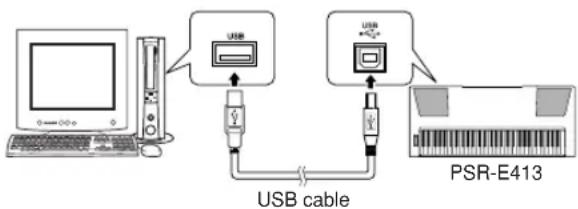
flowchart
graph TD
    A["Computer"] --> B["USB"]
    B --> C["USB cable"]
    C --> D["PSR-E413"]
    style A fill:#f9f,stroke:#333
    style B fill:#ccf,stroke:#333
    style C fill:#cfc,stroke:#333
    style D fill:#fcc,stroke:#333
■ Precautions when using the USB terminal
When connecting the computer to the USB terminal, make sure to observe the following points. Failing to do so risks freezing the computer and corrupting or losing the data. If the computer or the instrument freezes, restart the application software or the computer OS, or turn the power to the instrument off then on again.
CAUTION
- Use an AB type USB cable of less than about 3 meters.
- Before connecting the computer to the USB terminal, exit from any power-saving mode of the computer (such as suspended, sleep, standby).
- Before turning on the power to the instrument, connect the computer to the USB terminal.
- E x acute the following before turning the power to the instrument on/off or plugging/unplugging the USB cable to/from the USB terminal.
- Quit any open application software on the computer.
- Make sure that data is not being transmitted from the instrument. (Data is transmitted whenever you play on the keyboard or play back a song, etc.)
- While the computer is connected to the instrument, you should wait for six seconds or more between these operations: (1) when turning the power of the instrument off then on again, or (2) when alternately connecting/disconnecting the USB cable.
Transferring Performance Data to and from a Computer
By connecting the instrument to a computer, the instrument's performance data can be used on the computer, and performance data from the computer can be played on the instrument.
- When the instrument is connected with computer, it transmits/receives performance data.
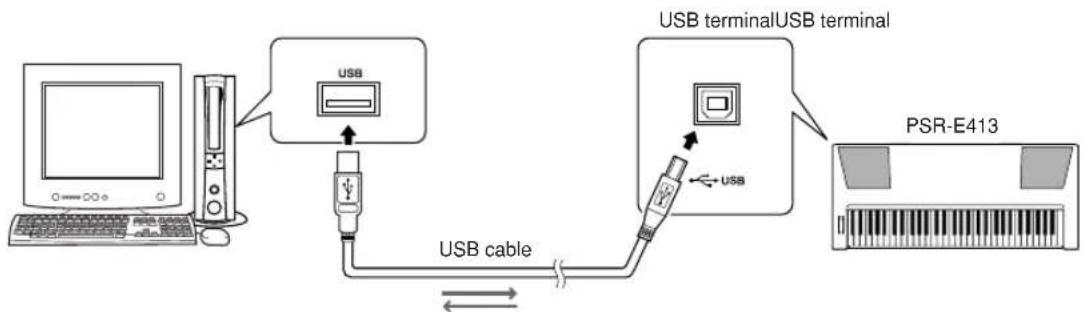
flowchart
graph TD
    A["Computer"] --> B["USB"]
    B --> C["USB cable"]
    C --> D["USB terminal"]
    D --> E["PSR-E413"]
    style A fill:#f9f,stroke:#333
    style B fill:#ccf,stroke:#333
    style C stroke:#000,stroke-width:2px
    style D stroke:#000,stroke-width:2px
    style E stroke:#000,stroke-width:2px
■MIDI settings
These settings pertain to performance data transmission and reception.
| Item Range/Settings Description | ||
| Local ON/OFF | Local control determines whether or not notes played on the instrument are sounded by its internal tone generator system: the internal tone generator is active when local control is on, and inactive when local control is off. | |
| External Clock ON/OFF | These settings determine whether the instrument is synchronized to its own internal clock (OFF), or to a clock signal from an external device (ON). | |
| Keyboard Out ON/OFF | These settings determine whether keyboard performance data of the instrument is transmitted (ON) or not (OFF). | |
| Style Out ON/OFF These settings | determine whether Style data is transmitted (ON) or not (OFF) during Style playback. | |
| Song Out ON/OFF These settings | determine whether User Song is transmitted (ON) or not (OFF) during Song playback. | |
CAUTION
- If you can't get any sound out of the instrument, this may be the most likely cause.
CAUTION
- If External Clock is ON and no clock signal is being received from an external device, the song, style, and metronome functions will not start.
1 Press the [FUNCTION] button.
![YAMAHA PSR-E413 - Press the [FUNCTION] button. - 1](/content/2026/06/1244056/images/2af7070599f6ef43b92447e95fda2cd6f108e9493ad21974138f7a09caf1fd69.jpg)
2 Use the CATEGORY [▲ and [ ]▶buttons to select the item you want to change its value.
![YAMAHA PSR-E413 - Press the [FUNCTION] button. - 2](/content/2026/06/1244056/images/4c7447c214947e71485e91dc339c9233c268cdd39ca5ea19caa08009b6786d11.jpg)
text_image
CATEGORY3 Use the dial to select ON or OFF.
■PC Mode ....
A number of MIDI settings need to be made when you want to transfer performance data between the computer and the instrument. The PC Mode item can conveniently make multiple settings for you in one operation. Three settings are available: PC1, PC2, and OFF.
This setting is not necessary when transferring song or backup files between the computer and the instrument.
* Set the PC mode to PC2 when using Digital Music Notebook.
| PC1 PC2* OFF | ||
| Local OFF OFF ON | ||
| External Clock ON OFF OFF | ||
| Song Out OFF OFF OFF | ||
| Style Out OFF OFF OFF | ||
| Keyboard Out OFF ON ON |
1 Press and hold the [DEMO/PC] button for longer than a second so that the PC Mode item appears.
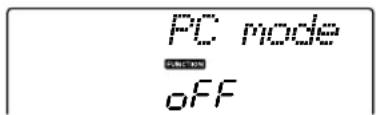
text_image
PC mode OFF2 Use the dial to select PC1, PC2, or OFF.
NOTE
- When the PC2 setting is selected the instrument's style, song, demo, song recording, and lesson features cannot be used.
NOTE
- You can also access the PC Mode item by first pressing the [FUNCTION] button and then using the CATEGORY [▲] and [▼] buttons to locate it (page 83).
Remote Control of MIDI Devices
You can also use this instrument as a remote control device for the Digital Music Notebook application on your computer (via the USB connection)—controlling playback, stop and transport functions from the panel.
■Remote control keys......
To use the remote control functions, simultaneously hold down the lowest two keys on the keyboard (C1 and C#1) and press the appropriate key (shown below).
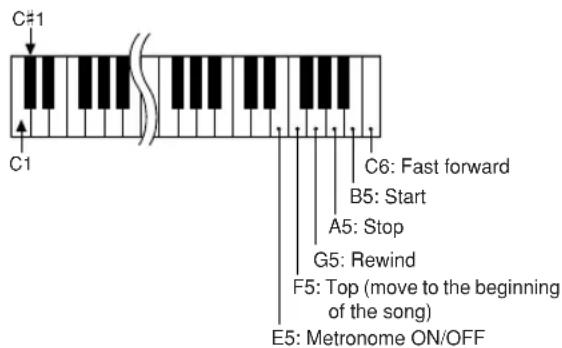
text_image
C#1 C1 C6: Fast forward B5: Start A5: Stop G5: Rewind F5: Top (move to the beginning of the song) E5: Metronome ON/OFFNOTE
- Remote control of MIDI devices will function independently of the PC2 mode.
Initial Send
This function lets you send the panel setup data to a computer. Before you record performance data to a sequencer application running on your computer, it is a good idea to first send and record the panel setup data before the actual performance data.
1 Press the [FUNCTION] button.
2 Use the CATEGORY[▲] and buttons to select the Initial Send item.
text_image
CATEGORY3 Press [+/YES] to send, or press [-/NO] to cancel.
Transferring Data between the Computer and Instrument
Songs, styles, or Music Database files residing on a computer or the supplied CD-ROM, can be transferred to the instrument. Backup files can also be transferred from the instrument to the computer and back.
In order to transfer files between your computer and the instrument you will need to install the Musicsoft Downloader application and the USB-MIDI Driver included on the Accessory CD-ROM on your computer. Refer to the Accessory CD-ROM Installation Guide on page 93 for installation details.
● Data that can be transferred from a computer to this instrument.
• Data Capacity: 373 KB 256 files total for the Song, Style and Music Database.
- Data Format Song: (.mid) SMF format 0/1 Style: (.sty) Music Database: (.mfd) Backup File: 08PK61.bup
● What is SMF (Standard MIDI File)?
The SMF (Standard MIDI File) format is one of the most common and widely compatible sequence formats used for storing sequence data. There are two variations: Format 0 and Format 1. A large number of MIDI devices are compatible with SMF Format 0, and most commercially available MIDI sequence data is provided in SMF Format 0.
■With the Musicsoft Downloader You Can. ....
- Transfer files from the computer to the instrument's flash memory.
⇒ refer to the procedure described on page 91.
The procedure for transferring songs included on the Accessory CD-ROM from your computer to the instrument is given as an example.
● Backup files can be transferred from the instrument to a computer and back.
⇒ refer to the procedure described on page 92.
Use the Musicsoft Downloader application with Internet Explorer 5.5 or higher.
■Use Musicsoft Downloader To Transfer Songs From the Accessory CD-ROM To the Instrument's flash memory.....
NOTE
- If a song or style is being played, stop playback before proceeding.
1 Install the Musicsoft Downloader and USB-MIDI driver to your computer, then connect the computer and the instrument (page 95).
2 Insert the included CD-ROM into the CD-ROM drive.
A start window will appear automatically.
3 Double-click the Musicsoft Downloader shortcut icon that is created on the desktop.
This will launch the Musicsoft Downloader application and the main window will appear.
NOTE
- The instrument cannot be operated while the Musicsoft Downloader is running.
4 Click the "Add File" button and the Add File window will appear.
5 Click the button to the right of "Look in" and select the CD-ROM drive from the dropdown menu that appears. Double-click the "SampleData" Folder on the window. Select the file from the "SongData" Folder you want to transfer to the instrument, and click "Open".
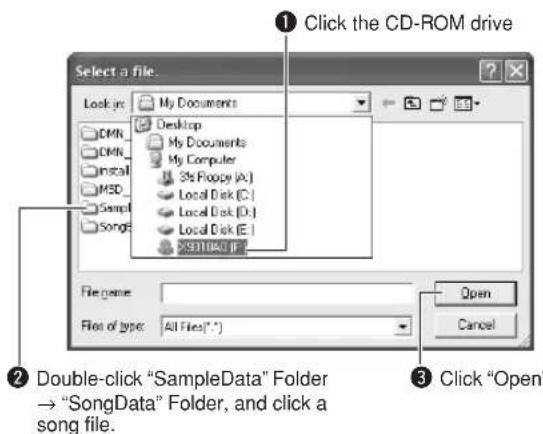
text_image
Select a file. Look in: My Documents Desktop My Documents My Computer 36 Floppy (A:) Local Disk (C:) Local Disk (D:) Local Disk (E:) 20010407 (F:) File name: File of type: All Files(*.*) ① Click the CD-ROM drive ② Double-click "SampleData" Folder → "SongData" Folder, and click a song file. ③ Click "Open" Open CancelAt this point you can select a Style or Music Database file on the computer or CD-ROM and transfer it to the instrument in the same way as a song file.
6 A copy of the selected MIDI song file will appear in the "List of files stored temporarily" at the top of the window.
The memory medium will also be displayed at the bottom of the window to specify the destination for the transfer. Click the “Electronic Musical Instruments”, and then “Flash memory.”
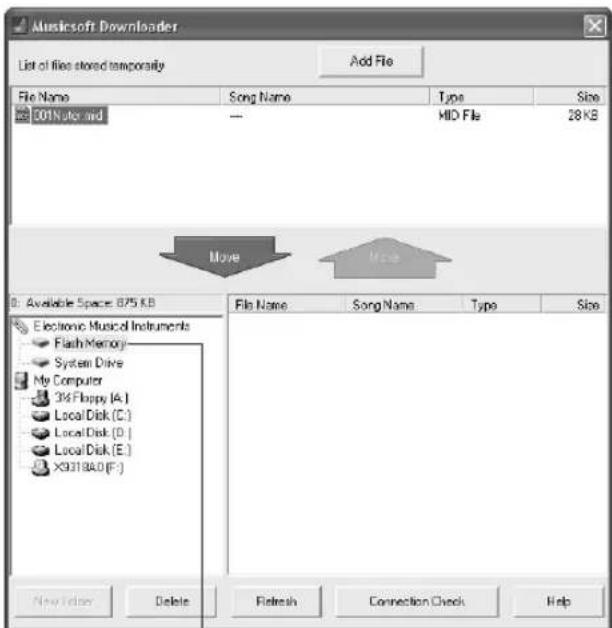
text_image
Musicsoft Downloader List of files stored temporarily Add File File Name Song Name Type Size 001Nuto mid — MID File 28 KB Move Move 0: Available Space: 675 KB Electronic Musical Instruments Flash Memory System Drive My Computer 3% Floppy (A:) Local Disk (C:) Local Disk (D:) Local Disk (E:) X3318A0 (F:) New Info Delete Refresh Connection Check Help① Click the "Electronic Musical Instruments", and then "Flash Memory"
7 After selecting the file in the "List of files stored temporarily", click the downward [Move] button and a confirmation message will appear. Click [OK] and the song will be transferred from the "List of files stored temporarily" to the instrument's memory.
8 Close the window to end the Musicsoft Downloader.
NOTE
- End the Musicsoft Downloader to playback the file transferred from your computer.
9 To playback a song stored in flash memory, press the [SONG] button. Use the dial to select the song you want to play, then press the [▶/■] (STOP) button to start playback.
CAUTION
- Do not unplug the USB cable during a data transfer. Not only will the data not be transferred and saved, but operation of the memory media may become unstable and its contents may disappear completely when the power is turned on or off.
CAUTION
- Store data can be lost due to equipment malfunction or improper operation. For safety we recommend that you keep a copy of all important data stored on your computer.
- We recommend that you use a power adaptor rather than batteries when transferring data. The data can be corrupted if the batteries fail during the transfer.
● To Use transferred Songs For Lessons...
In order to use songs (only SMF format 0) transferred from a computer for lessons it is necessary to specify which channels are to be played back as the right-hand and left-hand parts.
1 Press the [SONG] button and select the song (036-) residing in flash memory for which you want to set the guide track.
2 Press the [FUNCTION] button.
3 Use the CATEGORY ▲ and [▼buttons to select the R-Part or L-Part item.
4 Use the dial to select the channel you want to play back as the specified right- or left-hand part.
We recommend that you select channel 1 for the right-hand part and channel 2 for the left-hand part.
■Transfer a backup file from the instrument to a computer...
You can use the Musicsoft Downloader to transfer "Backup Files" containing backup data (page 56), including the five User Songs stored on the instrument, to a computer. If you click "Electronic Musical Instruments" in the Musicsoft Downloader display, and then "System Drive", a file named "08PK61.bup" will appear in the lower right corner of the Musicsoft Downloader display. This is the backup file. For details about how to transmit backup file using the Musicsoft Downloader application, refer to the Online help "Transferring Data Between the Computer and Instrument (for unprotected data)" in the application.
(START NOTE)
- Preset Song data cannot be transmitted from the instrument.
CAUTION
- The backup data, including the five User Songs is transmitted/received as a single file. As a result, all backup data will be overwritten every time you transmit or receive. Keep this in mind when transferring data.
CAUTION
- Do not rename the backup file on the computer. If you do so, it will not be recognized when transferred to the instrument.
SPECIAL NOTICES
- The software and this manual are the exclusive copyrights of Yamaha Corporation.
- Use of the software and this manual is governed by the license agreement which the purchaser fully agrees to upon breaking the seal of the software packaging. (Please read carefully the Software Licensing Agreement at the end of this manual before installing the application.)
- Copying of the software or reproduction of this manual in whole or in part by any means is expressly forbidden without the written consent of the manufacturer.
- Yamaha makes no representations or warranties with regard to the use of the software and documentation and cannot be held responsible for the results of the use of this manual and the software.
- This disk containing the software is not meant for use with an audio/visual system (CD player, DVD player, etc.). Do not attempt to use the disk on equipment other than a computer.
- Future upgrades of application and system software and any changes in specifications and functions will be announced separately.
- The screen displays as illustrated in this manual are for instructional purposes, and may appear somewhat different from the screens which appear on your computer.
Important Notices about the CD-ROM
● Data Types
This CD-ROM includes application software. Please refer to page 95 for software installation instructions.
CAUTION
- Do not attempt to play this CD-ROM on any playback device other than a computer. The resulting high-volume noise may cause hearing damage or damage to the playback device.
● Operating System (OS)
The applications in this CD-ROM are provided in versions for Windows operating systems.
CD-ROM Contents
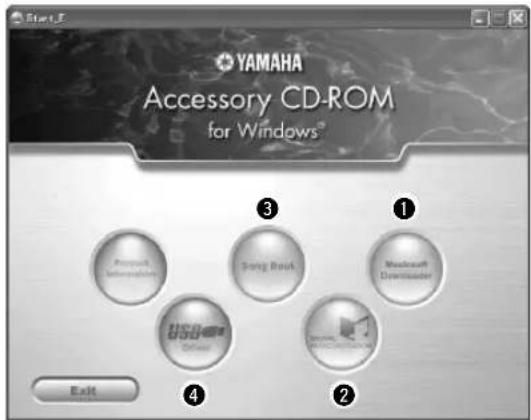
text_image
YAMAHA Accessory CD-ROM for Windows® Microsoft Senshinolabs Song Book Microsoft Downloader USB Deluxe Microsoft Deluxe Exit| Folder Name Application / Data Name Contents | |||
| 1 | MSD_Musicsoft Downloader | ||
| 2 | DMN_Digital Music Notebook | ||
| DMN_FlashDemo | Digital Music Notebook Flash Demo | ||
| 3 | SongBook Song Book | ||
| 4 | USBdrv2k_ | USB-MIDI Driver (Windows 2000/XP) | |
| USBdrvVista_ | USB-MIDI Driver (Windows Vista/XP x64) | ||
| SampleData | SongData M | IDI 70 songs | |
| StyleData 5 | style files | ||
| MDB | 5 music database files | ||
In order to view PDF scores, you will need to install Adobe Reader in your computer. You can download the Adobe Reader. Please check the following URL: http://www.adobe.com/
■Using the CD-ROM ....
Please read the Software License Agreement on page 121 before opening the CD-ROM package.
1 Check the system requirements to make sure that the software will run on your computer.
2 Insert the included CD-ROM into the CD-ROM drive.
The start window should appear automatically.
3 Install the USB-MIDI driver to the computer.
Refer to "Installing the USB-MIDI Driver" on page 95 for installation and setup instructions.
4 Connect the instrument to the computer.
The connection procedure is described on page 87.
5 Install the software.
Musicsoft Downloader: See page 97.
6 Launch the software.
For further software operation refer to the online help supplied with the software.
Refer to the “Troubleshooting” on page 98 when you have trouble with installing the driver.
System Requirements
| Application/Data OS | CPU Memory Hard Disk Display | ||||
| Musicsoft Downloader | Windows 2000/XP Home Edition/XP Professional/Vista* Only 32-bit is supported. | 233 MHz or higher; Intel® Pentium®/Celeron® Processor family (500 MHz or higher is recommended) | 64 MB or more (256 MB or more is recommended) | at least 128 MB of free space (at least 512 MB of free space is recommended) | 800 x 600 HighColor (16-bit) |
| USB Driver for Windows 2000/XP | Windows 2000/XP Home Edition/XP Professional | 166 MHz or higher; Intel® Pentium®/Celeron® Processor family | 32 MB or more (64 MB or more is recommended) | at least 3 MB of free space | — |
| USB Driver for Windows Vista/XP x64 | Windows Vista/XP Professional x64 Edition | 800 MHz or higher; Intel® Pentium®/Celeron® Processor family or Intel® 64 compatible processor | 512 MB or more | at least 3 MB of free space | — |
| Digital Music Notebook | Windows XP Home/Professional Edition, Service Pack 1a (SP1a) more/Windows Vista* Only 32-bit is supported. | 400 MHz or higher processor clock speed (Intel® Pentium®/Celeron® Processor family, or compatible processor recommended) | 128 MB or more (256 MB or more is recommended) | at least 150 MB of free space | 1024 x 768 HighColor (16-bit) |
| Digital Music Notebook (Requirements for playing content with video included.) | Windows 2000/XP Home Edition/XP Professional/Vista* Only 32-bit is supported. | 1 GHz or higher; Intel® Pentium®/Celeron® Processor family (1.4 GHz or more is recommended) | 256 MB or more | ||
Software Installation
● Uninstall (Removing the Software)
Installed software can be removed from your computer as follows:
From the Windows Start menu select Start → Settings → Control panel → Add or Remove Applications → Install and Uninstall. Select the item you want to remove and click [Add or Remove]. Follow the on-screen instructions to remove the selected software.
NOTE
The actual names of the menu items and buttons will depend on the OS version you are using.
■Installing the USB-MIDI Driver...
In order to be able to communicate with and use MIDI devices connected to your computer, the appropriate driver software must be properly installed on your computer.
The USB-MIDI driver allows sequence software and similar applications on your computer to transmit and receive MIDI data to and from MIDI devices via a USB cable.
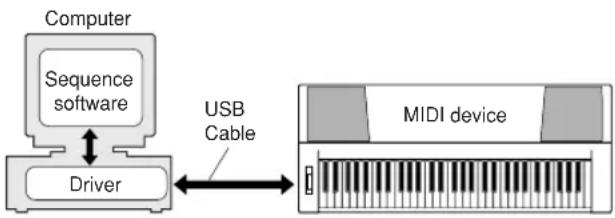
flowchart
graph LR
    A["Computer"] --> B["Sequence software"]
    B --> C["Driver"]
    C --> D["USB Cable"]
    D --> E["MIDI device"]
- W indows 2000 installation → page 96.
- W indows XP installation → page 96.
• W indows Vista installation → page 97
Check the drive name of the CD-ROM drive you will be using (D:, E:, Q: etc.) The drive name is displayed beside the CD-ROM icon in your "My Computer" folder. The root directory of the CD-ROM drive will be D:\, E:\, or Q:\, respectively.
Installing the driver on Windows 2000
1 Start the computer and use the "Administrator" account to log on to Windows 2000.
2 Select [My Computer] → [Control Panel] → [System] → [Hardware] → [Driver Signing] → [File Signature Verification], and check the radio button to the left of "Ignore—Install all files, regardless of file signature" and click [OK].
3 Insert the supplied CD-ROM into the CD-ROM drive. A start window will appear automatically.
4 First, make sure the POWER switch on the MIDI device is set to OFF, then use a USB cable to connect the MIDI device to the computer. After making the connections, turn on the power of the MIDI device. The system automatically launches the Found New Hardware Wizard. Click [Next]. (Some computers may take a while to display the Wizard window.)
Otherwise, refer to "Troubleshooting" in the "Accessory CD-ROM Installation Guide" section of the Owner's Manual.
5 Select the radio button for "Search for a suitable driver for my device [recommended]", then click [Next].
6 Check the "CD-ROM drives" check box, deselect all other check boxes, then click [Next].
NOTE
- If the system prompts you to insert the Windows CD-ROM during detection of the drivers, point to the "USBdrv2k_" folder (e.g., D:\USBdrv2k_) and continue the installation.
7 Deselect the "Install one of the other drivers", then click [Next].
NOTE
- If the Wizard panel informs you that "The software you are about to install does not contain a Microsoft digital signature", click [Yes].
8 When the installation is complete, the Wizard displays "Completing the Found New Hardware Wizard".
Click [Finish]. (Some computers may take a while to display the Wizard window.)
9 Restart the computer.
The USB-MIDI driver installation is complete.
Installing the driver on Windows XP
1 Start the computer and use the "Administrator" account to log on to Windows XP.
2 Select [Start] → [Control Panel]. If the control panel appears as "Pick a category", click "Switch to Classic View" in the upper left of the window. All control panels and icons will be displayed.
3 Go to [System] → [Hardware] → [Driver Signing Options] and check the radio button to the left of "Ignore" and click [OK].
4 Click the [OK] button to close System Properties, and then click "X" in the upper right of the window to close the Control Panel.
5 Insert the supplied CD-ROM into the CD-ROM drive. A start window will appear automatically.
6 First, make sure the POWER switch on the MIDI device is set to OFF, then use a USB cable to connect the MIDI device to the computer. After making the connections, turn on the power of the MIDI device. The system launches the Found New Hardware Wizard automatically. Otherwise, refer to “Troubleshooting” in the “Accessory CD-ROM Installation Guide” section of the Owner’s Manual. If the system displays “Found New Hardware” in the lower right corner, wait until Wizard window is displayed. (Some computers may take a while to display the window.)
If the Wizard window prompts you to specify whether or not to connect to Windows Update, select the radio button for "No, not this time", then click [Next].
7 Select the radio button for "Install the software automatically (recommended)", then click [Next].
NOTE
- If during the installation the system displays “...has not passed Windows Logo testing to verify its compatibility with Windows XP”, click [Continue Anyway].
8 When the installation is complete, the Wizard displays "Completing the Found New Hardware Wizard".
Click [Finish]. (Some computers may take a while to display the Wizard window.)
9 Restart the computer.
If the system displays “Found New Hardware” in the lower right corner, wait until the Wizard window is displayed. (Some computers may take a while to display the Wizard window.)
The USB-MIDI driver installation is complete.
NOTE
- This Wizard window will not appear when using Windows XP Professional x64 Edition. There is no need to restart the computer.
10 When using Windows XP Professional x64 Edition, the Support Module must be installed.
After installing the USB-MIDI drivers for all the connected USB devices, select "My Computer" from the Start menu. Right-click the CD-ROM icon and select "Open" from the pop-up menu. Select "USBdrvVista_" →
“XPx64SupportModule” → “Setup.exe” and launch “Setup.exe.” Follow the onscreen directions.
NOTE
- Once the Support Module is installed, this step is not necessary, even if you've connected a new USB device or updated the USB-MIDI driver.
Installing the driver in Windows Vista
1 Start the computer and use the "Administrator" account to log on to Windows Vista.
2 Insert the included CD-ROM into the CD-ROM drive. A start window will appear automatically.
3 First, make sure the POWER switch on the MIDI device is set to OFF, then use a USB cable to connect the MIDI device to the computer. After making the connections, turn on the power of the MIDI device. The system automatically launches the "Found New Hardware" window. Click "Locate and install driver software (recommended)".
Otherwise, refer to “Troubleshooting” in the “Accessory CD-ROM Installation Guide” section of the Owner’s Manual. (Some computers may take a while to display the window.).
NOTE
- If the "User Account Control" window appears, click [Continue].
4 If a message allowing Windows to search online for driver software appears, click "Don't search online."
5 If a message prompting you to insert the disk that came with your device appears, click [Next].
The system starts the installation.
NOTE
- If the "Windows Security" window appears, confirm this software is authored by Yamaha Corporation then click [Install].
6 When the installation is complete, the system displays the message "The software for this device has been successfully installed." Click [Close].
(Some computers may take a while to display the window.)
The USB-MIDI driver installation is complete.
■Installing the Musicsoft Downloader and Digital Music Notebook Applications...
IMPORTANT
- Y ou will need to log on with administrator (root) privileges in order to install Musicsoft Downloader on a computer running Windows 2000, XP or Vista.
- You will need to log on with administrator (root) privileges in order to install Digital Music Notebook on a computer running Windows XP or Vista.
IMPORTANT
- When installing the Digital Music Notebook, make sure that Internet Explorer 6.0 (with SP1) or higher is installed to your computer.
IMPORTANT
- Credit card settlement is required to purchase Digital Music Notebook content. Credit card processing may not be possible for some areas, so please check with your local authorities to make sure that your credit card can be used.
NOTE
- Use of the DMN (Digital Music Notebook) is governed by the SIBEL-IUSSCORCH LICENSE AGREEMENT, which the purchaser fully agrees to when using the application. Please read carefully the AGREEMENT at the end of this manual before using the application
1 Insert the Accessory CD-ROM into your computer's CD-ROM drive. The start window will appear automatically showing software applications.
NOTE
- If the start window does not appear automatically, double click your "My Computer" folder to open it. Right-click the CD-ROM icon and select "Open" from the pop-up menu. Double click "Start.exe" and proceed to step 2, below.
2 Click [Musicsoft Downloader] or [Digital Music Notebook].
3 Click the [install] button, and follow the on-screen instructions to install the software.
For Digital Music Notebook operating instructions see the help menu: launch the Digital Music Notebook application and click “Help”.
For Musicsoft Downloader operating instructions see the Help menu: launch the Musicsoft Downloader application and click "Help".
* Y ou can obtain the latest version of the Musicsoft Downloader at the following Internet URL. http://music.yamaha.com/download/
IMPORTANT
- Only Musicsoft Downloader can be used to transfer files between this instrument and a computer. No other file transfer application can be used.
Troubleshooting
The driver cannot be installed.
- Is the USB cable connected correctly?
Check the USB cable connection. Disconnect the USB cable, then connect it again.
• Is the USB function enabled on your computer?
When you connect the instrument to the computer for the first time, if the “Add New Hardware Wizard” does not appear, the USB function on the computer may be disabled. Perform the following steps.
1 Select [Control Panel]* → [System] → [Hardware] → [Device Manager] (for Windows 2000/XP), or select [Control Panel] → [Device Manager] (for Windows Vista).
* Classic View only in Windows XP.
2 Make sure that no “!” or “x” marks appear at “Universal serial bus controller” or “USB Root Hub”. If you see an “!” or “x” mark, the USB controller is disabled.
• Is any unknown device registered?
If driver installation fails, the instrument will be marked as an "Unknown device", and you will not be able to install the driver. Delete the "Unknown device" by following the steps below.
1 Select [Control Panel]* → [System] → [Hardware] → [Device Manager] (for Windows 2000/XP), or select [Control Panel] → [Device Manager] (for Windows Vista).
* Classic View only in Windows XP.
2 Look for "Other devices" in the menu "View devices by type".
3 If you find "Other devices", double-click it to extend the tree to look for "Unknown device". If one appears, select it and click the [Remove] button.
4 Remove the USB cable from the instrument, and make the connection again.
5 Install the driver again.
• W indows 2000 users..... see page 96
- Windows XP users...... see page 96
- Windows Vista users ...... see page 97
When controlling the instrument from your computer via USB, the instrument does not operate correctly or no sound is heard.
• Did you install the driver? (page 95)
• Is the USB cable connected correctly?
- A re the volume settings of the instrument, playback device, and application program set to the appropriate levels?
• H ave you selected an appropriate port in the sequence software?
- A re you using the latest USB-MIDI driver? The latest driver can be downloaded from the following web site.
http://music.yamaha.com/download/
Playback response is delayed.
- Does your computer satisfy the system requirements?
• Is any other application or device driver running?
Cannot suspend or resume the computer correctly.
- Do not suspend the computer while the MIDI application is running.
You may not be able to suspend/resume normally, depending on the particular environment (USB Host Controller, etc.). Even so, simply disconnecting and connecting the USB cable will allow you to use the instrument functions again.
How can I remove the driver?
[Windows 2000/XP/Vista]
1 Start the computer and use the "Administrator" account to log on Windows. Close all applications and windows that are open.
2 Insert the included CD-ROM into the CD-ROM drive.
3 Select "My Computer" from the Start menu.
4 Right-click the CD-ROM icon and select "Open" from the pop-up menu.
5 Select "USBdrvVista_" or "USBdrv2k_ folder → "uninstall" folder → "uninstall.exe" file and launch "uninstall.exe." file.
Follow the on-screen instructions to uninstall the driver.
NOTE
- When using a 64-bit OS, click "uninstall_x64.exe." from "USBdrvVista_" folder.
NOTE
- If the "User Account Control" window appears, click [Continue].
6 A message asking you to restart your computer in order to complete the uninstall procedure will appear.
Driver removal will be complete when you have restarted your computer.
| Problem Possible Cause and Solution | |
| When the instrument is turned on or off, a popping sound is temporarily produced. | This is normal and indicates that the instrument is receiving electrical power. |
| When using a mobile phone, noise is produced. | Using a mobile phone in close proximity to the instrument may produce interference. To prevent this, turn off the mobile phone or use it further away from the instrument. |
| There is no sound even when the keyboard is played or when a song or style is being played back. | Check that nothing is connected to the PHONES/OUTPUT jack on the rear panel. When a set of headphones is plugged into this jack, no sound is output. |
| Check the Local Control on/off. (See page 88.) | |
| Playing keys in the right hand area of the keyboard does not produce any sound. | When using the Dictionary function (page 77), the keys in the right hand area are used only for entering the chord root and type. |
| The volume is too soft.The sound quality is poor.The rhythm stops unexpectedly or will not play.The recorded data of the song, etc. does not play correctly.The LCD display suddenly goes dark, and all panel settings are reset. | The batteries are low or dead. Replace all six batteries with completely new ones, or use the optional AC adaptor. |
| The style or song does not play back when the [START/STOP] button is pressed. | Is External Clock set to ON? Make sure External Clock is set to OFF; refer to “External Clock” on page 88. |
| The style does not sound properly. | Make sure that the Style Volume (page 84) is set to an appropriate level. |
| Is the split point set at an appropriate key for the cords you are playing? Set the split point at an appropriate key (page 72).Is the “ACMP ON” indicator showing in the display? If it is not showing press the [ACMP ON/OFF] button so that it does show. | |
| No rhythm accompaniment plays when the [START/ STOP] button is pressed after selecting style number 141 or a style between 153 and 165 (Pianist). | This is not a malfunction. Style number 141 and style numbers 153–165 (Pianist) have no rhythm parts, so no rhythm will play. The other parts will begin playing when you play a chord in the accompaniment range of the keyboard if style playback is turned on. |
| Not all of the voices seem to sound, or the sound seems to be cut off. | The instrument is polyphonic up to a maximum of 32 notes. If the Dual voice or Split voice is being used and a style or song is playing back at the same time, some notes/sounds may be omitted (or “stolen”) from the accompaniment or song. |
| Some notes don’t sound when playing multiple notes simultaneously on the keyboard, or some notes don’t sound when playing arpeggios. | You have exceeded 32 simultaneous notes, which is the maximum polyphony (the maximum number of notes that can be played simultaneously) of the instrument. The instrument will play normally as long as no more than 32 notes are being played at once, both on the keyboard and by any automatic playback functions. |
| The footswitch (for sustain) seems to produce the opposite effect. For example, pressing the footswitch cuts off the sound and releasing it sustains the sounds. | The polarity of the footswitch is reversed. Make sure that the footswitch plug is properly connected to the SUSTAIN jack before turning on the power. |
| The sound of the voice changes from note to note. | This is normal. The AWM tone generation method uses multiple recordings (samples) of an instrument across the range of the keyboard; thus, the actual sound of the voice may be slightly different from note to note. |
| The wrong notes sound when the keyboard is played. | Perhaps the performance assistant technology is turned on.Press the [PERFORMANCE ASSISTANT] button to turn it off. |
| The ACMP ON indicator does not appear when the [ACMP ON/OFF] button is pressed. | Is the [STYLE] button lit? Always press the [STYLE] button first when you are going to use any style-related function. |
| There is no harmony sound. | The harmony effects (01–26) behave differently according to their type. Types 01–05 function when style playback is on, chords are played in the accompaniment range of the keyboard, and a melody is played in the right-hand range. Types 06–26 will function whether style playback is on or off. For types 06 = 12 you need to play two notes at the same time. |
| No sound is produced for about two seconds after the instrument wakes from sleep mode. | This is normal. The speakers are muted for about two seconds, until the instrument wakes fully from the sleep mode. |
This demo is an example of how the Easy Song Arranger can be used to change styles throughout a piece.
Song No. 3 ♪ ♪ =123
(Function Demo for Easy Song Arranger)
Hallelujah Chorus
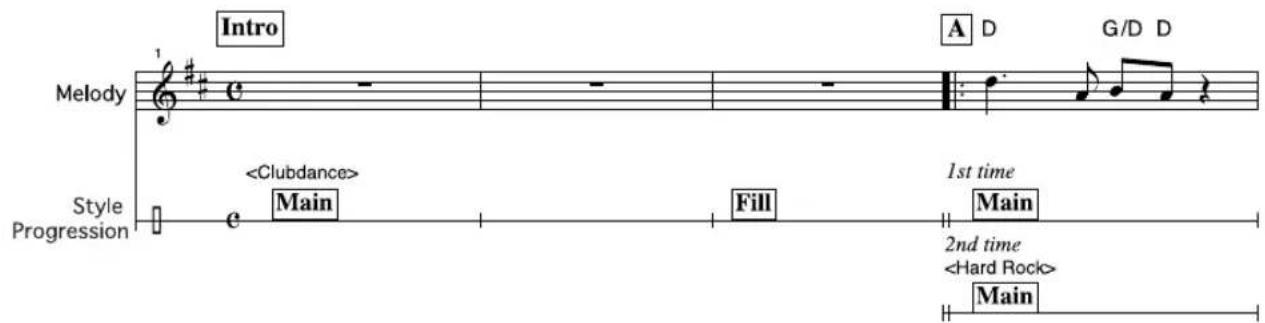
text_image
Intro Melody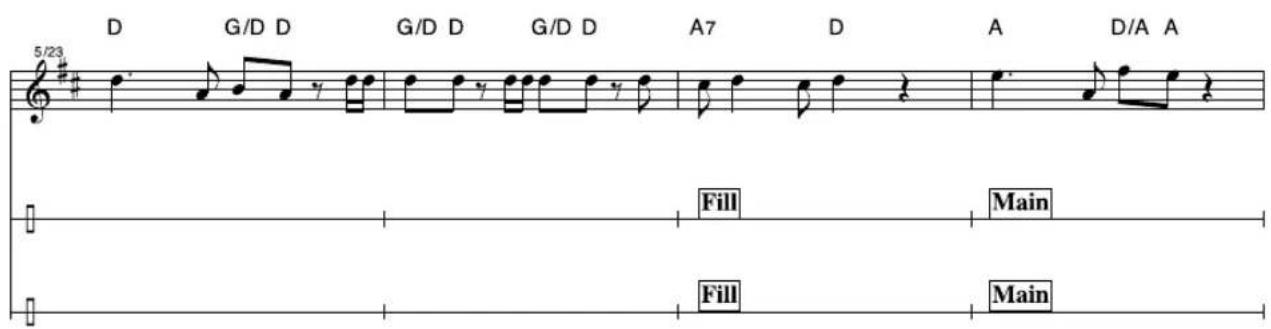
text_image
5/23 D G/D D G/D D G/D D A7 D A D/A A Fill Main Fill Main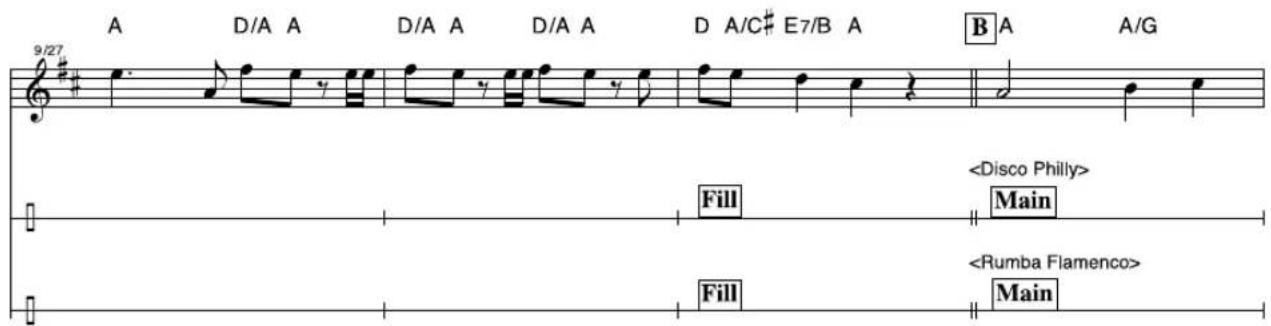
text_image
A D/A A D/A A D/A A D A/C# E7/B A B A A/G 9/27 Fill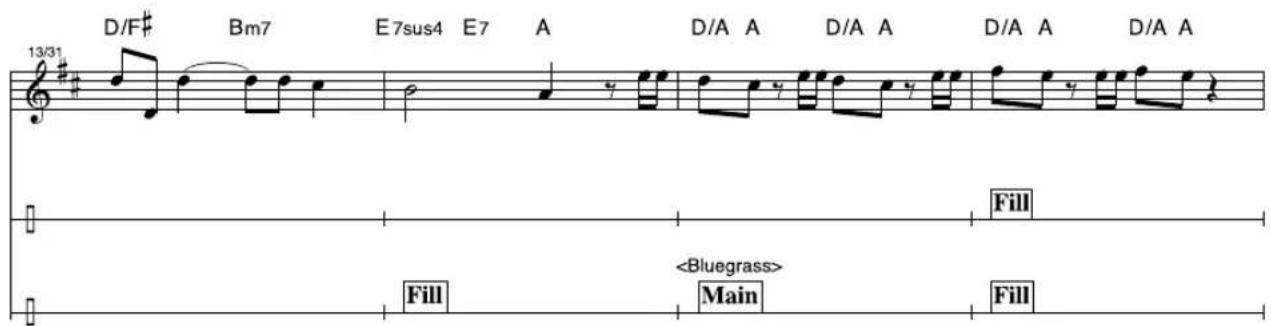
text_image
D/F# Bm7 E7sus4 E7 A D/A A D/A A D/A A D/A A 13/31 Fill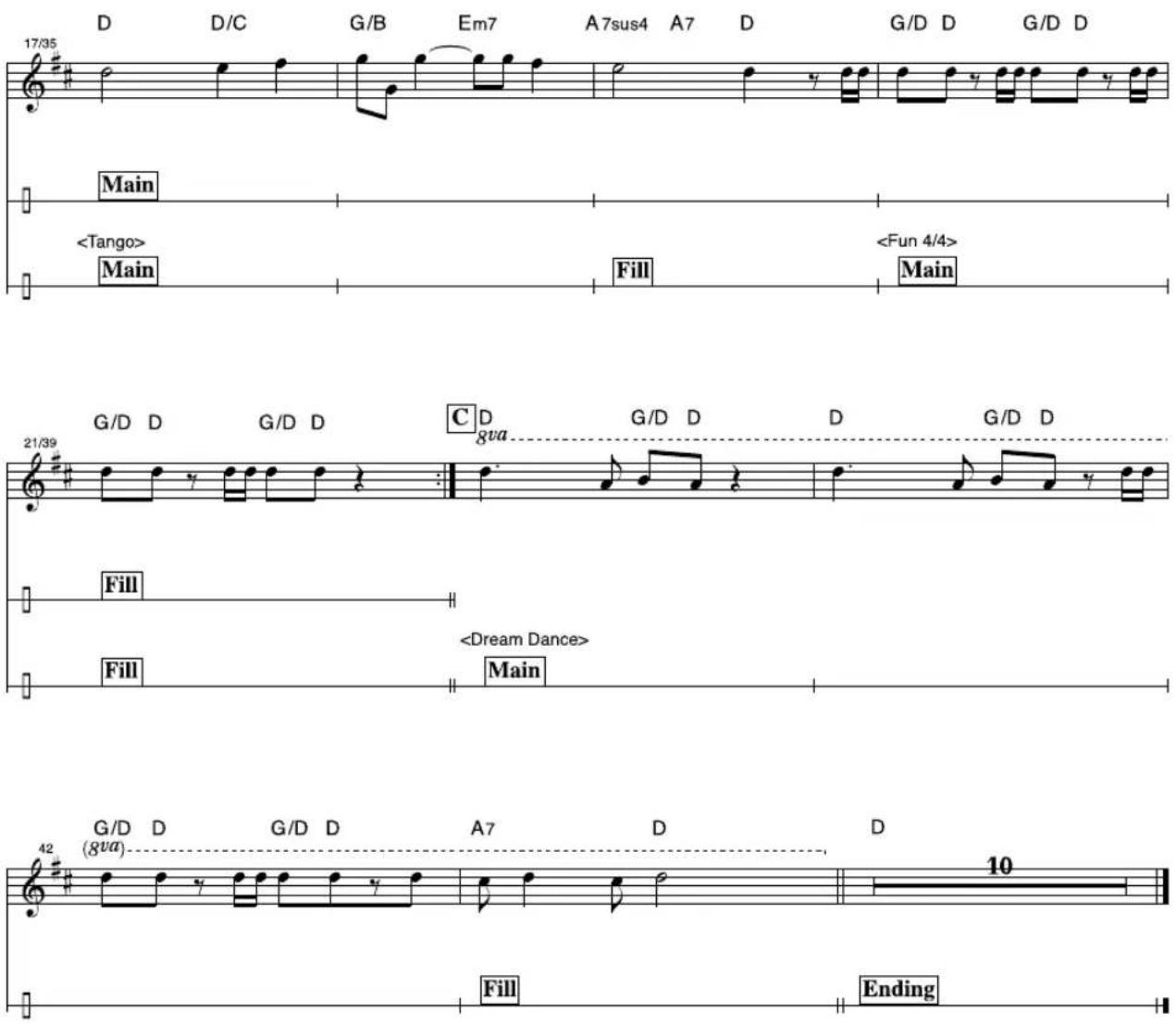
text_image
17/35 D D/C G/B Em7 A7sus4 A7 D G/D D G/D D MainThis score is provided with the intent that the pitch will be corrected by the performance assistant technology feature. If you play the “Play These Notes” part using the performance assistant technology feature, the part will be corrected and played so that it matches the backing part.
Song No.
0 ♩ ♩
♩ =61
(Function Demo for performance assistant technology)
Ave Maria
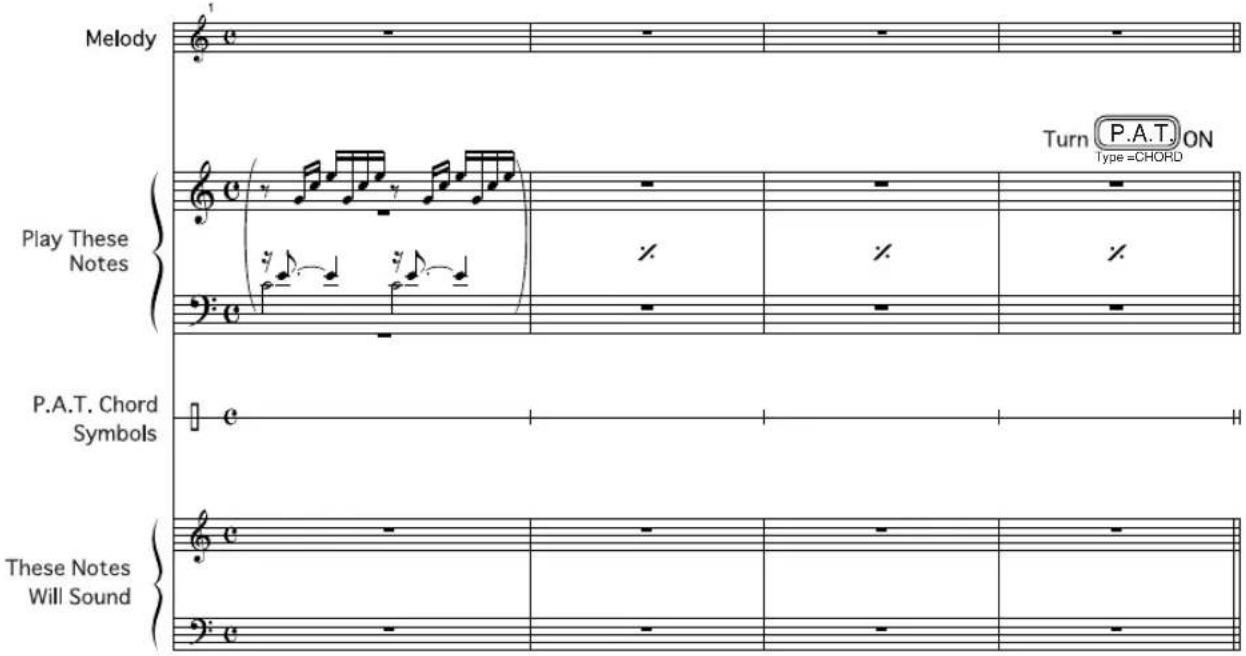
text_image
Melody Turn P.A.T. Type=CHORD Play These Notes P.A.T. Chord Symbols These Notes Will Sound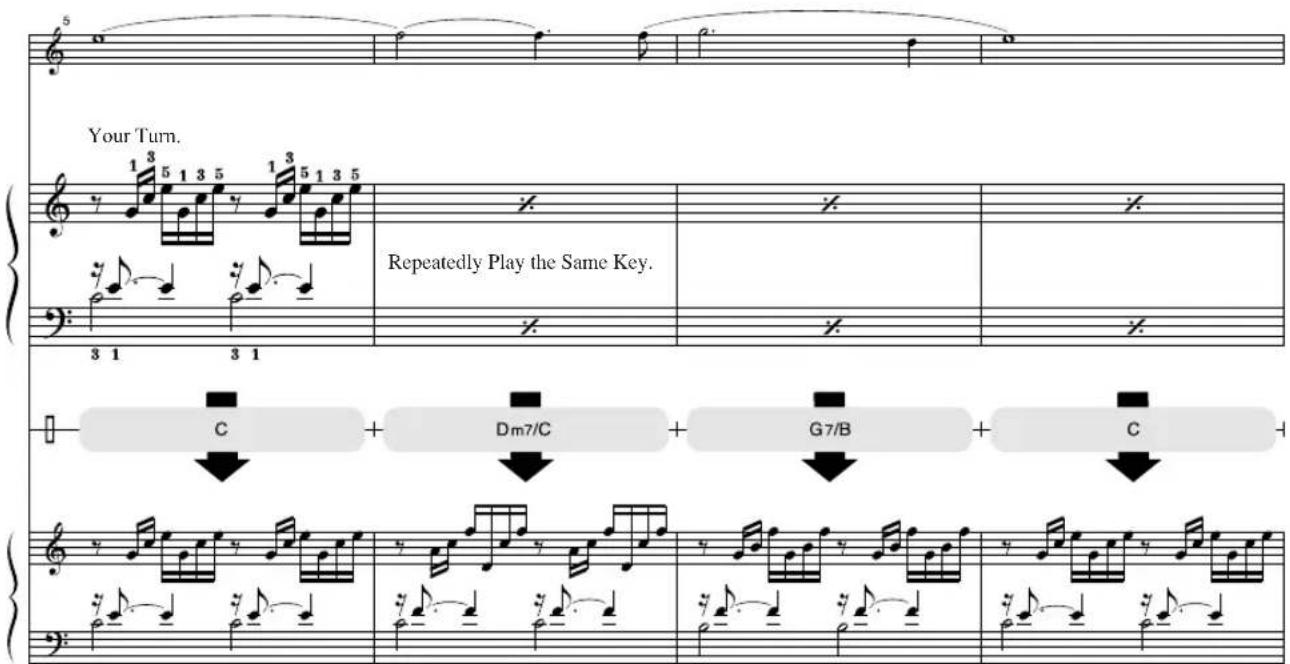
text_image
Your Turn. Repeatedly Play the Same Key. C Dm7/C G7/B C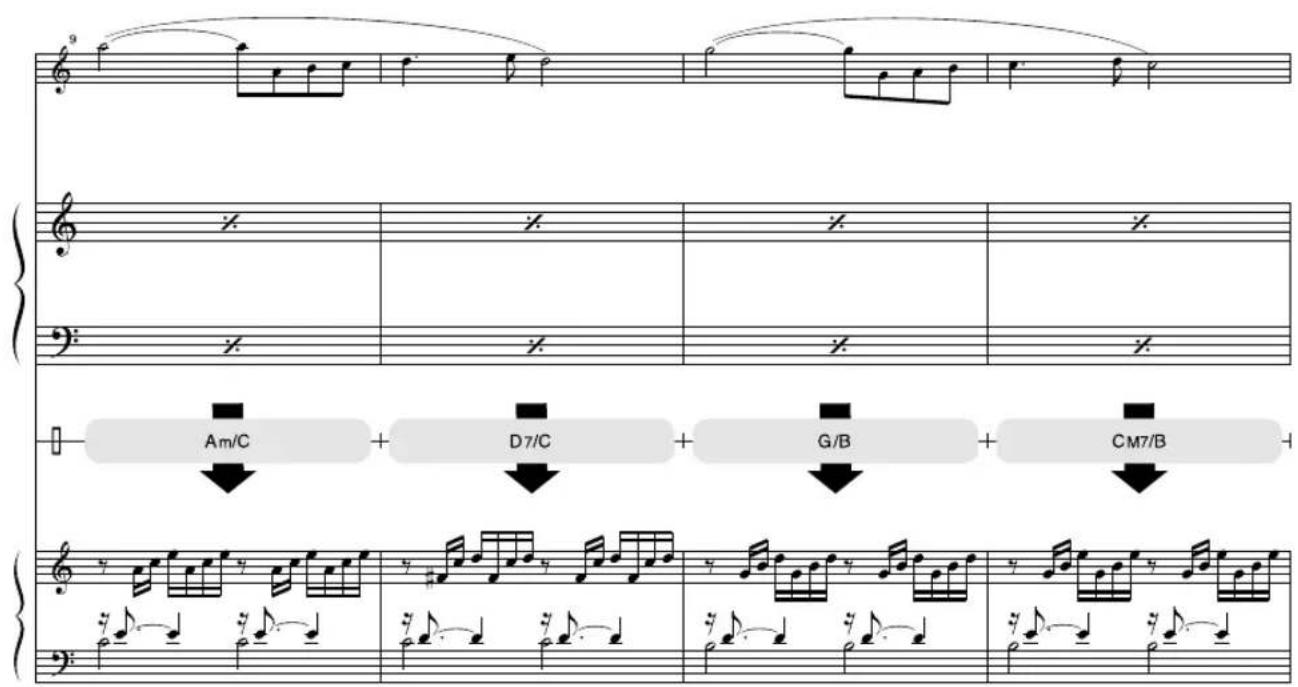
text_image
Musical score snippet with treble and bass clefs, showing notes and dynamic markings like Am/C, D7/C, G/B, CM7/B.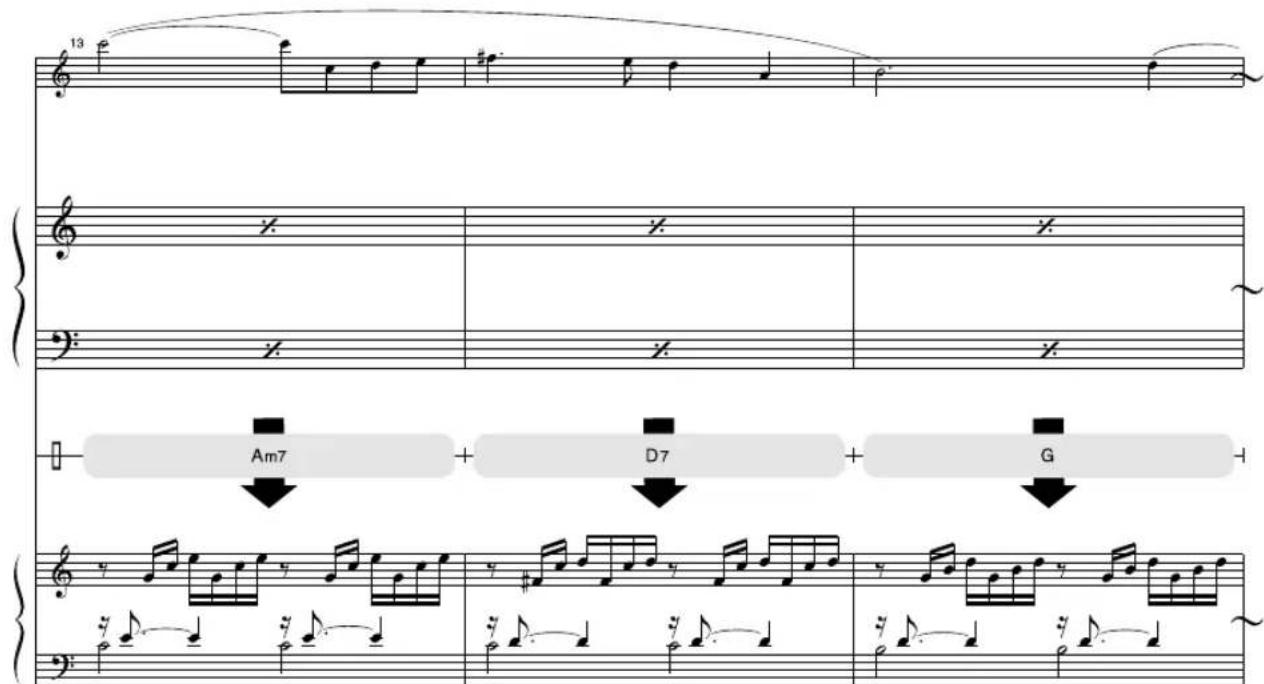
text_image
13 Am7 + D7 + GThis score is provided with the intent that the pitch will be corrected by the performance assistant technology feature. If you play the “Play These Notes” part using the performance assistant technology feature, the part will be corrected and played so that it matches the backing part.
Song No. 1 ♩♩ ♩ =108
(Function Demo for performance assistant technology)
Nocturne op.9-2
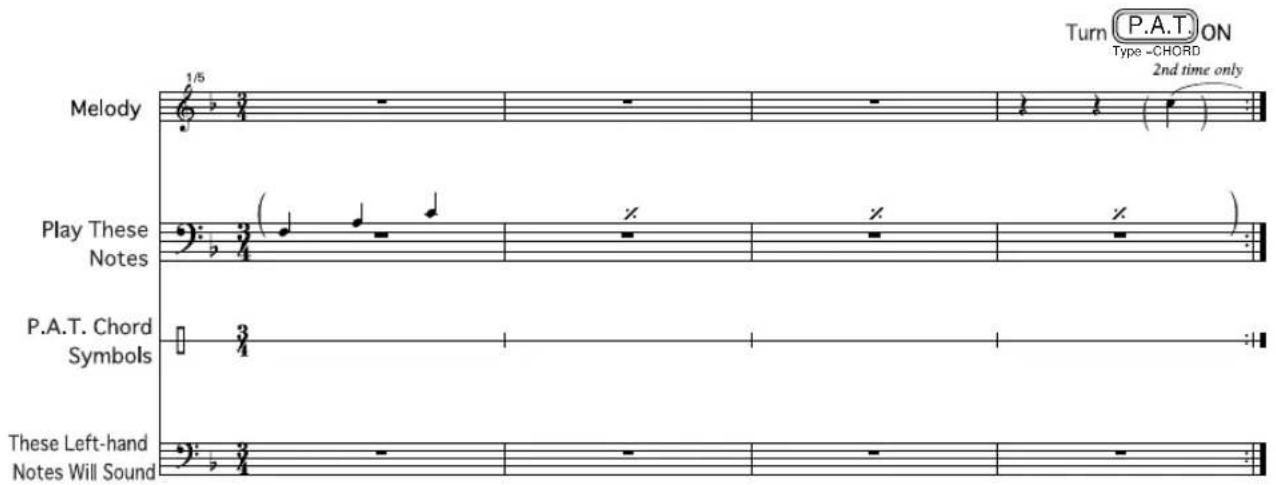
text_image
Turn P.A.T ON Type -CHORD 2nd time only Melody Play These Notes P.A.T. Chord Symbols These Left-hand Notes Will Sound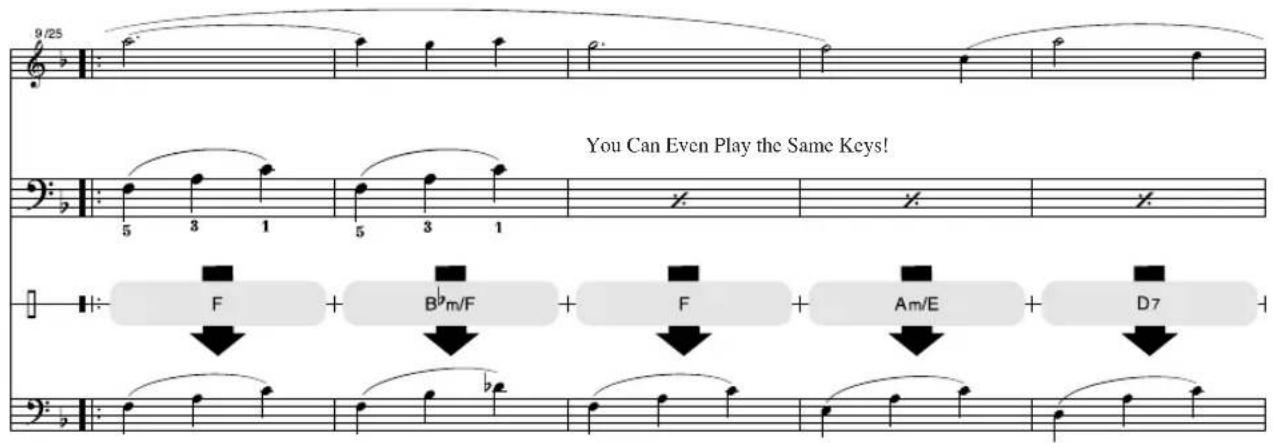
text_image
9/25 You Can Even Play the Same Keys! F + Bbm/F + F + Am/E + D7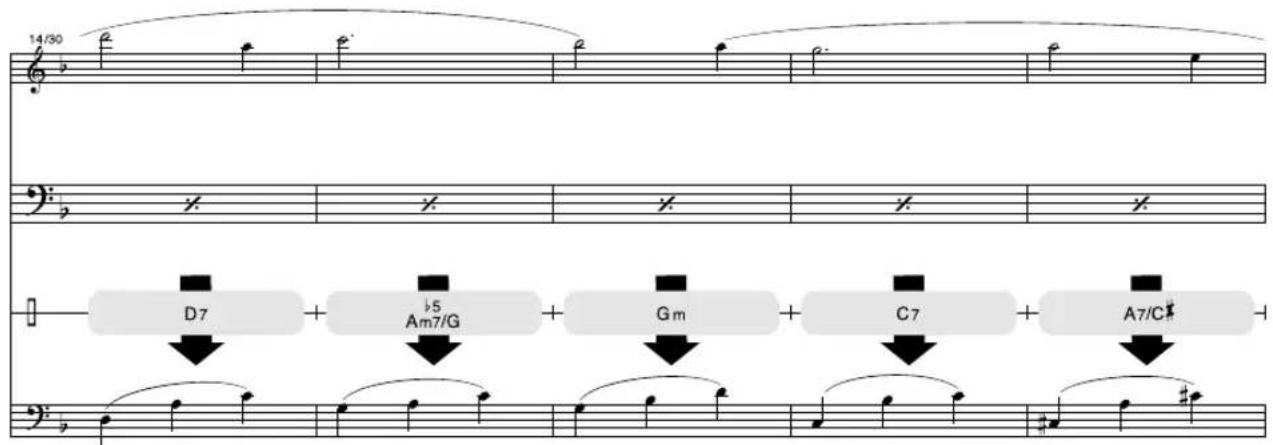
text_image
14/30 D7 + Am7/G + Gm + C7 + A7/C#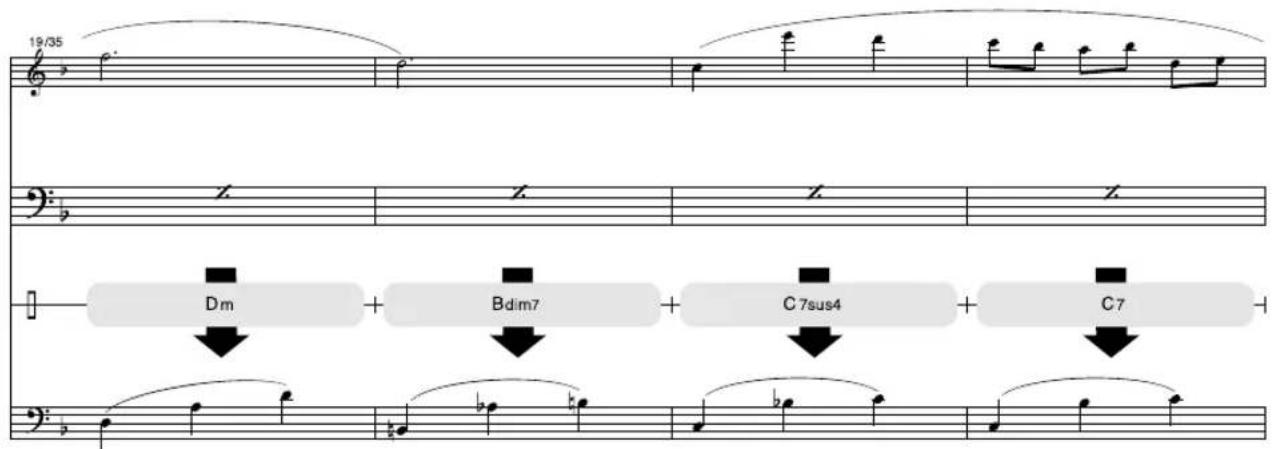
text_image
19/35 Dm + Bdim7 + C7sus4 + C7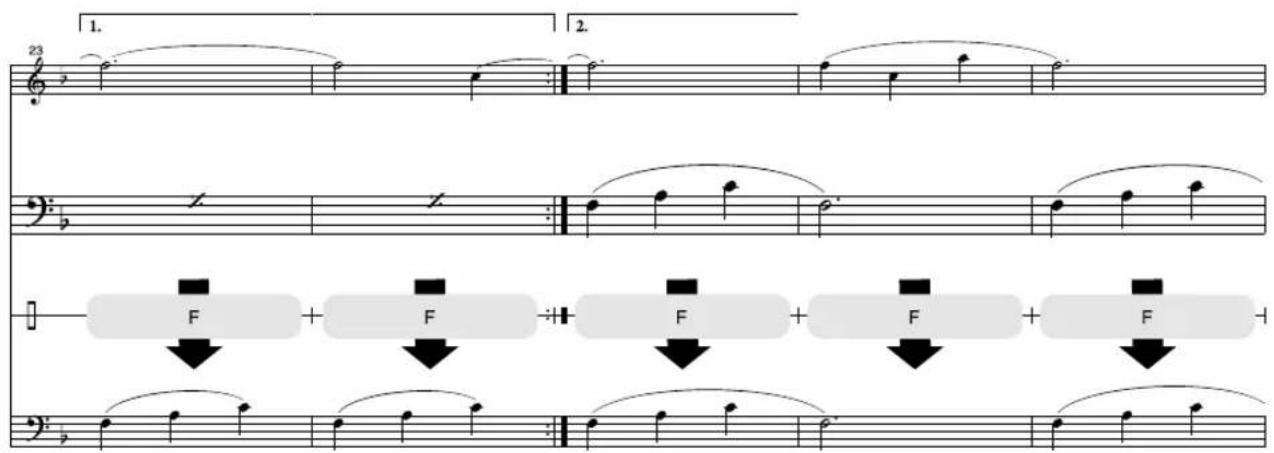
text_image
1. 23 F + F + F + F + F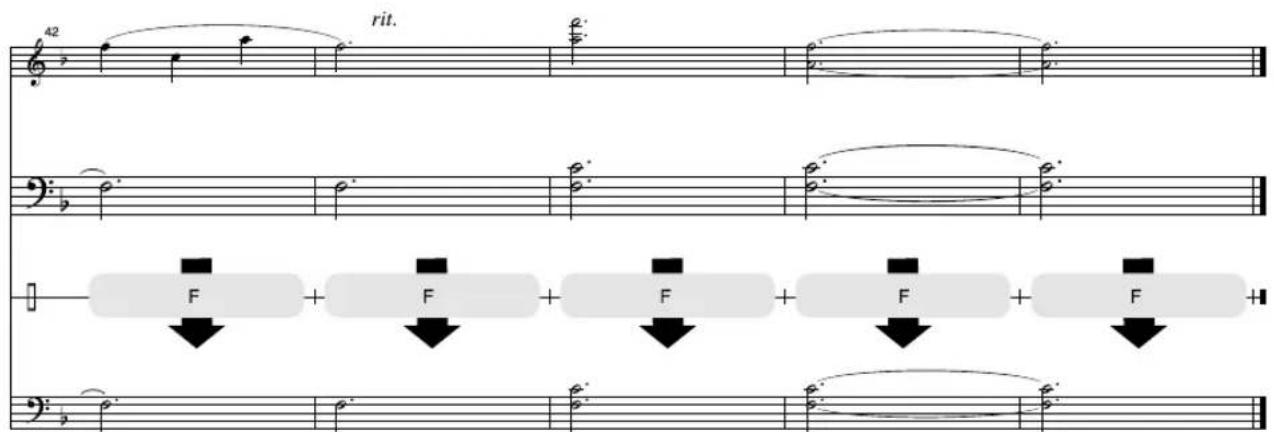
text_image
42 rit. F + F + F + F + F +■ Maximum Polyphony······
The instrument has 32-note maximum polyphony. This means that it can play a maximum of up to 32 notes at once, regardless of what functions are used. Auto accompaniment uses a number of the available notes, so when auto accompaniment is used the total number of available notes for playing on the keyboard is correspondingly reduced. The same applies to the Split Voice and Song functions. If the maximum polyphony is exceeded, earlier played notes will be cut off and the most recent notes have priority (last note priority).
NOTE
- The Voice List includes MIDI program change numbers for each voice. Use these program change numbers when playing the instrument via MIDI from an external device.
- Program change numbers are often specified as numbers "0–127." Since this list uses a "1–128" numbering system, in such cases it is necessary to subtract 1 from the transmitted program change numbers to select the appropriate sound: e.g. to select No. 2 in the list, transmit program change number 1.
- Some voices may sound continuously or have a long decay after the notes have been released while the sustain pedal (footswitch) is held.
Panel Voice List
| Voice No. | Bank Select | MIDI Program Change# (1-128) | Voice Name | |
| MSB (0-127) | LSB (0-127) | |||
| PIANO | ||||
| 1 | 0 | 112 1 Grand Piano | ||
| 2 | 0 | 112 2 Bright Piano | ||
| 3 | 0 | 112 7 Harpsichord | ||
| 4 | 0 | 112 4 Honky-tonk Piano | ||
| 5 | 0 | 112 MIDI Grand Piano | ||
| 6 | 0 | 113 CP 80 | ||
| E.PIANO | ||||
| 7 | 0 | 114 5 Cool! Galaxy Electric Piano | ||
| 8 | 0 | 113 Hyper Tines | ||
| 9 | 0 | 112 5 Funky Electric Piano | ||
| 10 0 | 112 6 DX Modern Electric Piano | |||
| 11 0 | 114 6 Venus Electric Piano | |||
| 12 0 | 112 8 Clavi | |||
| ORGAN | ||||
| 13 0 | 118 19 Cool! Organ | |||
| 14 0 | 117 19 Cool! Rotor Organ | |||
| 15 0 | 112 17 Jazz Organ 1 | |||
| 16 0 | 113 17 Jazz Organ 2 | |||
| 17 0 | 112 19 Rock Organ | |||
| 18 0 | 114 19 Purple Organ | |||
| 19 0 | 112 18 Click Organ | |||
| 20 0 | 116 17 Bright Organ | |||
| 21 0 | 127 19 Theater Organ | |||
| 22 0 | 121 20 16'+2' Organ | |||
| 23 0 | 120 20 16'+4' Organ | |||
| 24 0 | 113 20 Chapel Organ | |||
| 25 0 | 112 20 Church Organ | |||
| 26 0 | 112 21 Reed Organ | |||
| ACCORDION | ||||
| 27 0 | 112 22 Musette Accordion | |||
| 28 0 | 113 22 Traditional Accordion | |||
| 29 0 | 113 24 Bandoneon | |||
| 30 0 | 113 23 Modern Harp | |||
| 31 0 | 112 23 Harmonica | |||
| GUITAR | ||||
| 32 0 | 112 25 Classical Guitar | |||
| 33 0 | 112 26 Folk Guitar | |||
| 34 0 | 112 27 Jazz Guitar | |||
| 35 0 | 117 28 60's Clean Guitar | |||
| 36 0 | 113 26 12Strings Guitar | |||
| 37 0 | 112 28 Clean Guitar | |||
| 38 0 | 113 27 Octave Guitar | |||
| 39 0 | 112 29 Muted Guitar | |||
| 40 0 | 112 30 Overdriven Guitar | |||
| 41 0 | 112 31 Distortion Guitar | |||
| BASS | ||||
| 42 0 | 112 34 Finger Bass | |||
| 43 0 | 112 33 Acoustic Bass | |||
| 44 0 | 112 35 Pick Bass | |||
| 45 0 | 112 36 Fretless Bass | |||
| 46 0 | 112 37lap Bass | |||
| 47 0 | 112 39 Synth Bass | |||
| 48 0 | 113 39 Hi-Q Bass | |||
| 49 0 | 113 40 Dance Bass | |||
| Voice No. | Bank Select | MIDI Program Change# (1-128) | Voice Name | |
| MSB (0-127) | LSB (0-127) | |||
| STRINGS | ||||
| 50 0 | 112 49 | tring Ensemble | ||
| 51 0 | 112 50 | Chamber Strings | ||
| 52 0 | 113 50 | low Strings | ||
| 53 0 | 112 45 | Tremolo Strings | ||
| 54 0 | 112 51 | ynth Strings | ||
| 55 0 | 112 46 | Pizzicato Strings | ||
| 56 0 | 112 41 | Violin | ||
| 57 0 | 112 43 | Cello | ||
| 58 0 | 112 44 | Contrabass | ||
| 59 0 | 112 47 | Harp | ||
| 60 0 | 112 106 | Banjo | ||
| 61 0 | 112 56 | Orchestra Hit | ||
| CHOIR | ||||
| 62 0 | 112 53 | Choir | ||
| 63 0 | 113 53 | Vocal Ensemble | ||
| 64 0 | 112 55 | Air Choir | ||
| 65 0 | 112 54 | Vox Humana | ||
| SAXOPHONE | ||||
| 66 0 | 117 67 | Sweet! Tenor Sax | ||
| 67 0 | 113 65 | weet! Soprano Sax | ||
| 68 0 | 112 67 | Tenor Sax | ||
| 69 0 | 112 66 | Alto Sax | ||
| 70 0 | 112 65 | oprano Sax | ||
| 71 0 | 112 68 | Baritone Sax | ||
| 72 0 | 114 67 | Breathy Tenor Sax | ||
| 73 0 | 112 72 | Clarinet | ||
| 74 0 | 112 69 | Oboe | ||
| 75 0 | 112 70 | English Horn | ||
| 76 0 | 112 71 | Bassoon | ||
| TRUMPET | ||||
| 77 0 | 115 57 | Sweet! Trumpet | ||
| 78 0 | 112 57 | Trumpet | ||
| 79 0 | 112 58 | Trombone | ||
| 80 0 | 113 58 | Trombone Section | ||
| 81 0 | 112 60 | Muted Trumpet | ||
| 82 0 | 112 61 | French Horn | ||
| 83 0 | 112 59 | Tuba | ||
| BRASS | ||||
| 84 0 | 112 62 | Brass Section | ||
| 85 0 | 113 62 | Big Band Brass | ||
| 86 0 | 113 63 | 80's Brass | ||
| 87 0 | 119 62 | Mellow Horns | ||
| 88 0 | 114 63 | Techno Brass | ||
| 89 0 | 112 63 | ynth Brass | ||
| FLUTE | ||||
| 90 0 | 114 74 | weet! Flute | ||
| 91 0 | 113 76 | weet! Pan Flute | ||
| 92 0 | 112 74 | Flute | ||
| 93 0 | 112 73 | Piccolo | ||
| 94 0 | 112 76 | Pan Flute | ||
| 95 0 | 112 75 | Recorder | ||
| 96 0 | 112 80 | Ocarina | ||
| SYNTH LEAD | ||||
| 97 0 | 112 81 | quare Lead | ||
| 98 0 | 112 82 | awtooth Lead | ||
| 99 0 | 115 82 | Analogon | ||
| 100 0 | 119 82 | Fargo | ||
| 101 0 | 112 99 | Star Dust | ||
| 102 0 | 112 86 | Voice Lead | ||
| 103 0 | 112 101 | Brightness | ||
| SYNTH PAD | ||||
| 104 0 | 112 92 | Xenon Pad | ||
| 105 0 | 112 95 | Equinox | ||
| 106 0 | 112 89 | Fantasia | ||
| 107 0 | 113 90 | Dark Moon | ||
| 108 0 | 113 101 | Bell Pad | ||
| PERCUSSION | ||||
| 109 0 | 112 12 | Vibraphone | ||
| 110 0 | 112 13 | Marimba | ||
| 111 0 | 112 14 | Xylophone | ||
| 112 0 | 112 115 | Steel Drums | ||
| 113 0 | 112 9 | Celesta | ||
| 114 0 | 112 11 | Music Box | ||
| 115 0 | 112 15 | Tubular Bells | ||
| 116 0 | 112 48 | Timpani | ||
| DRUM KITS | ||||
| 117 1 | 27 0 1 | Standard | Kit 1 | |
| 118 1 | 27 0 2 | Standard | Kit 2 | |
| 119 1 | 27 0 9 | Room Kit | ||
| 120 1 | 27 0 17 | Rock Kit | ||
| 121 1 | 27 0 25 | Electronic Kit | ||
| 122 1 | 27 0 26 | Analog Kit | ||
| 123 1 | 27 0 113 | Dance Kit | ||
| 124 1 | 27 0 33 | Jazz Kit | ||
| 125 1 | 27 0 41 | Brush Kit | ||
| 126 1 | 27 0 49 | Symphony Kit | ||
| 127 1 | 26 0 1 | SFX Kit 1 | ||
| 128 1 | 26 0 2 | SFX Kit 2 | ||
| ARPEGGIO | ||||
| 129 0 | 112 49 | Concerto | ||
| 130 0 | 112 46 | Pizzicato | ||
| 131 0 | 112 1 | Piano Ballad | ||
| 132 0 | 96 82 | Synth Sequence | ||
| 133 0 | 117 28 | Guitarist | ||
| 134 0 | 112 37 | Pauls Bass | ||
| 135 0 | 113 39 | Trance Bass | ||
| 136 0 | 6 | 82 SynthChords | ||
| 137 0 | 113 39 | Acid Bass | ||
| 138 0 | 112 8 | Funky Clavi | ||
| 139 0 | 112 18 | ReggaeOrgan | ||
| 140 0 | 112 47 | Harpeggio | ||
| 141 0 | 112 2 | SalsaPlano | ||
| 142 0 | 115 82 | AnalogSequence | ||
| 143 0 | 6 | 82 Sawtooth | ||
| 144 0 | 112 1 | Piano Arpeggio | ||
| 145 0 | 112 25 | Guitar Arpeggio | ||
| 146 1 | 27 0 113 | ClubBeat | ||
| 147 1 | 27 0 1 | R&B Loop | ||
| 148 1 | 27 0 113 | ClubAdds | ||
● XGlite Voice/XGlite Optional Voice* List
| Voice No. | Bank Select | MIDI Program Change# (1-128) | Voice Name | |
| MSB (0-127) | LSB (0-127) | |||
| PIANO | ||||
| 149 0 | 0 | 1 Grand | Piano | |
| 150 0 | 1 | 1 Grand | Piano K$P | |
| 151 0 | 40 1 Piano Strings | |||
| 152 0 | 41 1 Dream | |||
| 153 0 | 0 | 2 Bright | Piano | |
| 154 0 | 1 | 2 Bright | Piano KSP | |
| 155 0 | 0 | 3 Electric | Grand Piano | |
| 156 0 | 1 | 3 Electric | Grand Piano KSP | |
| 157 0 | 32 3 Detuned CP80 | |||
| 158 0 | 0 | 4 Honky-tonk Piano | ||
| 159 0 | 1 | 4 Honky-tonk Piano KSP | ||
| 160 0 | 0 | 5 Electric Piano 1 | ||
| Voice No. | Bank Select | MIDI Program Change# (1-128) | Voice Name | |
| MSB (0-127) | LSB (0-127) | |||
| 161 0 | 1 | 5 Electric Piano 1 | KSP | |
| 162 0 | 32 5 Ch | orus Electric Piano 1 | ||
| 163 0 | 0 | 6 Electric Piano 2 | ||
| 164 0 | 1 | 6 Electric Piano 2 | KSP | |
| *165 0 | 32 6 Ch | orus Electric Piano 2 | ||
| 166 0 | 41 6 DX | + Analog Electric Piano | ||
| 167 0 | 0 | 7 Harpsichord | ||
| 168 0 | 1 | 7 Harpsichord KSP | ||
| 169 0 | 35 7 Harpsichord 2 | |||
| 170 0 | 0 | 8 Clavi | ||
| 171 0 | 1 | 8 Clavi | KSP | |
| CHROMATIC | ||||
| 172 0 | 0 | 9 Celesta | ||
| 173 0 | 0 | 10 Glockenspiel | ||
| 174 0 | 0 | 11 Music Box | ||
| 175 0 | 64 11 Orgel | |||
| 176 0 | 0 | 12 Vibraphone | ||
| 177 0 | 1 | 12 Vibraphone KSP | ||
| 178 0 | 0 | 13 Marimba | ||
| 179 0 | 1 | 13 Marimba KSP | ||
| 180 0 | 64 13 Sine Marimba | |||
| 181 0 | 97 13 Balimba | |||
| 182 0 | 98 13 Log Drums | |||
| 183 0 | 0 | 14 Xylophone | ||
| 184 0 | 0 | 15 Tubular Bells | ||
| 185 0 | 96 15 Church Bells | |||
| 186 0 | 97 15 Carillon | |||
| 187 0 | 0 | 16 Dulcimer | ||
| 188 0 | 35 16 Dulcimer 2 | |||
| 189 0 | 96 16 Cimbalom | |||
| 190 0 | 97 16 Santur | |||
| ORGAN | ||||
| 191 0 | 0 | 17 Drawbar Organ | ||
| 192 0 | 32 17 Detuned Drawbar Organ | |||
| 193 0 | 33 17 60's Drawbar Organ 1 | |||
| 194 0 | 34 17 60's Drawbar Organ 2 | |||
| 195 0 | 35 17 70's Drawbar Organ 1 | |||
| 196 0 | 37 17 60's Drawbar Organ 3 | |||
| 197 0 | 40 17 16+2'2/3 | |||
| 198 0 | 64 17 Organ Bass | |||
| 199 0 | 65 17 70's Drawbar Organ 2 | |||
| 200 0 | 66 17 Cheezy Organ | |||
| 201 0 | 67 17 Rawbar Organ 2 | |||
| 202 0 | 0 | 18 Percussive Organ | ||
| 203 0 | 24 18 70's Percussive Organ | |||
| 204 0 | 32 18 Detuned Percussive Organ | |||
| 205 0 | 33 18 Light Organ | |||
| 206 0 | 37 18 Percussive Organ 2 | |||
| 207 0 | 0 | 19 Rock Organ | ||
| 208 0 | 64 19 Rotary Organ | |||
| 209 0 | 65 19 Slow Rotary | |||
| 210 0 | 66 19 Fast Rotary | |||
| 211 0 | 0 | 20 Church Organ | ||
| 212 0 | 32 20 Church Organ 3 | |||
| 213 0 | 35 20 Church Organ 2 | |||
| 214 0 | 40 20 Notre Dame | |||
| 215 0 | 64 20 Organ Flute | |||
| 216 0 | 65 20 Tremolo Organ Flute | |||
| 217 0 | 0 | 21 Reed Organ | ||
| 218 0 | 40 21 Puff Organ | |||
| 219 0 | 0 | 22 Accordion | ||
| 220 0 | 0 | 23 Harmonica | ||
| 221 0 | 32 23 Harmonica 2 | |||
| 222 0 | 0 | 24 Tango Accordion | ||
| 223 0 | 64 24 Tango Accordion 2 | |||
| GUITAR | ||||
| 224 0 | 0 | 25 Nylon Guitar | ||
| 225 0 | 43 25 Velocity Guitar Harmonics | |||
| 226 0 | 96 25 Ukulele | |||
| 227 0 | 0 | 26 Steel Guitar | ||
| 228 0 | 35 26 12-string Guitar | |||
| 229 0 | 40 26 Nylon & Steel Guitar | |||
| 230 0 | 41 26 Steel Guitar with Body Sound | |||
| 231 0 | 96 26 Mandolin | |||
| 232 0 | 0 27 Jazz Guitar | |||
| 233 0 | 32 27 Jazz Amp | |||
| 234 0 | 0 28 Clean Guitar | |||
| 235 0 | 32 28 Chorus Guitar | |||
| 236 0 | 0 29 Muted Guitar | |||
| 237 0 | 40 29 Funk Guitar | |||
| 238 0 | 41 29 Muted Steel Guitar | |||
| 239 0 | 45 29 Jazz Man | |||
| 240 0 | 0 30 Overdriven Guitar | |||
| 241 0 | 43 30 Guitar Pinch | |||
| 242 0 | 0 31 Distortion Guitar | |||
| 243 0 | 40 31 Feedback Guitar | |||
| 244 0 | 41 31 Feedback Guitar 2 | |||
| 245 0 | 0 32 Guitar Harmonics | |||
| 246 0 | 65 32 Guitar Feedback | |||
| 247 0 | 66 32 Guitar Harmonics 2 | |||
| BASS | ||||
| 248 0 | 0 33 Acoustic Bass | |||
| 249 0 | 40 33 Jazz Rhythm | |||
| 250 0 | 45 33 Velocity Crossfade | Upright Bass | ||
| 251 0 | 0 34 Finger Bass | |||
| 252 0 | 18 34 Finger Dark | |||
| 253 0 | 40 34 Bass & Distorted Electric Guitar | |||
| 254 0 | 43 34 Finger Slap Bass | |||
| 255 0 | 45 34 Finger Bass 2 | |||
| 256 0 | 65 34 Modulated Bass | |||
| 257 0 | 0 35 Pick Bass | |||
| 258 0 | 28 35 Muted Pick Bass | |||
| 259 0 | 0 36 Fretless Bass | |||
| 260 0 | 32 36 Fretless Bass 2 | |||
| 261 0 | 33 36 Fretless Bass 3 | |||
| 262 0 | 34 36 Fretless Bass 4 | |||
| 263 0 | 0 37 Slap Bass 1 | |||
| 264 0 | 32 37 Punch Thumb Bass | |||
| 265 0 | 0 38 Slap Bass 2 | |||
| 266 0 | 43 38 Velocity Switch Slap | |||
| 267 0 | 0 39 Synth Bass 1 | |||
| 268 0 | 40 39 Techno Synth Bass | |||
| 269 0 | 0 40 Synth Bass 2 | |||
| 270 0 | 6 40 Mellow Synth Bass | |||
| 271 0 | 12 40 Sequenced Bass | |||
| 272 0 | 18 40 Click Synth Bass | |||
| 273 0 | 19 40 Synth Bass 2 Dark | |||
| *274 0 | 40 40 Modular Synth Bass | |||
| 275 0 | 41 40 DX Bass | |||
| STRINGS | ||||
| 276 0 | 0 41 Violin | |||
| 277 0 | 8 41 Slow Violin | |||
| 278 0 | 0 42 Viola | |||
| 279 0 | 0 43 Cello | |||
| 280 0 | 0 44 Contrabass | |||
| 281 0 | 0 45 Tremolo Strings | |||
| 282 0 | 8 45 Slow Tremolo Strings | |||
| 283 0 | 40 45 Suspense Strings | |||
| 284 0 | 0 46 Pizzicato Strings | |||
| 285 0 | 0 47 Orchestral Harp | |||
| 286 0 | 40 47 Yang Chin | |||
| 287 0 | 0 48 Tirpani | |||
| ENSEMBLE | ||||
| 288 0 | 0 49 Strings 1 | |||
| 289 0 | 3 49 Stereo Strings | |||
| 290 0 | 8 49 Slow Strings | |||
| 291 0 | 35 49 60's Strings | |||
| 292 0 | 40 49 Orchestra | |||
| 293 0 | 41 49 Orchestra 2 | |||
| 294 0 | 42 49 Tremolo Orchestra | |||
| 295 0 | 45 49 Velocity Strings | |||
| 296 0 | 0 50 Strings 2 | |||
| 297 0 | 3 50 Stereo Slow Strings | |||
| 298 0 | 8 50 Legato Strings | |||
| 299 0 | 40 50 Warm Strings | |||
| 300 0 | 41 50 Kingdom | |||
| 301 0 | 0 51 Synth Strings 1 | |||
| Voice No. | Bank Select | MIDI Program Change# (1-128) | Voice Name | |
| MSB (0-127) | LSB (0-127) | |||
| 302 0 | 0 52 Synth Strings 2 | |||
| 303 0 | 0 53 Choir Aahs | |||
| 304 0 | 3 53 Stereo Choir | |||
| 305 0 | 32 53 Mellow Choir | |||
| 306 0 | 40 53 Choir Strings | |||
| 307 0 | 0 54 Voice Oohs | |||
| 308 0 | 0 55 Synth Voice | |||
| 309 0 | 40 55 Synth Voice 2 | |||
| 310 0 | 41 55 Choral | |||
| 311 0 | 64 55 Analog Voice | |||
| 312 0 | 0 56 Orchestra Hit | |||
| 313 0 | 35 56 Orchestra Hit 2 | |||
| 314 0 | 64 56 Impact | |||
| BRASS | ||||
| 315 0 | 0 57 Trumpet | |||
| 316 0 | 32 57 Warm Trumpet | |||
| 317 0 | 0 58 Trombone | |||
| 318 0 | 18 58 Trombone 2 | |||
| 319 0 | 0 59 Tuba | |||
| 320 0 | 0 60 Muted Trumpet | |||
| 321 0 | 0 61 French Horn | |||
| 322 0 | 6 61 French Horn Solo | |||
| 323 0 | 32 61 French Horn 2 | |||
| 324 0 | 37 61 Horn Orchestra | |||
| 325 0 | 0 62 Brass Section | |||
| 326 0 | 35 62 Trumpet & Trombone Section | |||
| 327 0 | 0 63 Synth Brass 1 | |||
| 328 0 | 20 63 Resonant Synth Brass | |||
| 329 0 | 0 64 Synth Brass 2 | |||
| 330 0 | 18 64 Soft Brass | |||
| 331 0 | 41 64 Choir Brass | |||
| REED | ||||
| 332 0 | 0 65 Soprano Sax | |||
| 333 0 | 0 66 Alto Sax | |||
| 334 0 | 40 66 Sax Section | |||
| 335 0 | 0 67 Tenor Sax | |||
| 336 0 | 40 67 Breathy Tenor Sax | |||
| 337 0 | 0 68 Baritone Sax | |||
| 338 0 | 0 69 Oboe | |||
| 339 0 | 0 70 English Horn | |||
| 340 0 | 0 71 Bassoon | |||
| 341 0 | 0 72 Clarinet | |||
| PIPE | ||||
| 342 0 | 0 73 Piccolo | |||
| 343 0 | 0 74 Flute | |||
| 344 0 | 0 75 Recorder | |||
| 345 0 | 0 76 Pan Flute | |||
| 346 0 | 0 77 Blown Bottle | |||
| 347 0 | 0 78 Shakuhachi | |||
| 348 0 | 0 79 Whistle | |||
| 349 0 | 0 80 Ocarina | |||
| SYNTH LEAD | ||||
| 350 0 | 0 81 Square Lead | |||
| 351 0 | 6 81 Square Lead 2 | |||
| 352 0 | 8 81 LM Square | |||
| 353 0 | 18 81 Hollow | |||
| 354 0 | 19 81 Shroud | |||
| 355 0 | 64 81 Mellow | |||
| 356 0 | 65 81 Solo Sine | |||
| 357 0 | 66 81 Sine Lead | |||
| 358 0 | 0 82 Sawtooth Lead | |||
| 359 0 | 6 82 Sawtooth Lead 2 | |||
| 360 0 | 8 82 Thick Sawtooth | |||
| 361 0 | 18 82 Dynamic Sawtooth | |||
| 362 0 | 19 82 Digital Sawtooth | |||
| 363 0 | 20 82 Big Lead | |||
| 364 0 | 96 82 Sequenced Analog | |||
| 365 0 | 0 83 Calliope Lead | |||
| 366 0 | 65 83 Pure Lead | |||
| 367 0 | 0 84 Chiff Lead | |||
| 368 0 | 0 85 Charang Lead | |||
| 369 0 | 64 85 Distorted Lead | |||
| 370 0 | 0 86 Voice Lead | |||
| 371 0 | 0 87 Fifths Lead | |||
| 372 0 | 35 87 Big Five | |||
| 373 0 | 0 88 Bass & Lead | |||
| 374 0 | 16 88 Big & Low | |||
| 375 0 | 64 88 Fat & Perky | |||
| 376 0 | 65 88 S pft Whirl | |||
| SYNTH PAD | ||||
| 377 0 | 0 89 New Age Pad | |||
| 378 0 | 64 89 Fantasy | |||
| 379 0 | 0 90 Warm Pad | |||
| 380 0 | 0 91 Poly Synth Pad | |||
| 381 0 | 0 92 Choir Pad | |||
| 382 0 | 66 92 Itopia | |||
| 383 0 | 0 93 Bowed Pad | |||
| 384 0 | 0 94 Metallic Pad | |||
| 385 0 | 0 95 Halo Pad | |||
| 386 0 | 0 96 Sweep Pad | |||
| SYNTH EFFECTS | ||||
| 387 0 | 0 97 Rain | |||
| 388 0 | 65 97 African Wind | |||
| 389 0 | 66 97 Carib | |||
| 390 0 | 0 98 Sound Track | |||
| 391 0 | 27 98 Prologue | |||
| 392 0 | 0 99 Crystal | |||
| 393 0 | 12 99 Synth Drum Comp | |||
| 394 0 | 14 99 Popcorn | |||
| 395 0 | 18 99 Tiny Bells | |||
| 396 0 | 35 99 Pound Glockenspiel | |||
| 397 0 | 40 99 Glockenspiel Chimes | |||
| 398 0 | 41 99 Clear Bells | |||
| 399 0 | 42 99 Chorus Bells | |||
| 400 0 | 65 99 Soft Crystal | |||
| 401 0 | 70 99 Air Bells | |||
| 402 0 | 71 99 Bell Harp | |||
| 403 0 | 72 99 Gamelimba | |||
| 404 0 | 0 100 Atmosphere | |||
| 405 0 | 18 100 Warm Atmosphere | |||
| 406 0 | 19 100 Hollow Release | |||
| 407 0 | 40 100 Nylon Electric Piano | |||
| 408 0 | 64 100 Nylon Harp | |||
| 409 0 | 65 100 Harp Vox | |||
| 410 0 | 66 100 Atmosphere Pad | |||
| 411 0 | 0 101 Brightness | |||
| 412 0 | 0 102 Goblins | |||
| 413 0 | 64 102 Goblins Synth | |||
| 414 0 | 65 102 Creeper | |||
| 415 0 | 67 102 Ritual | |||
| 416 0 | 68 102 To Heaven | |||
| 417 0 | 70 102 Night | |||
| 418 0 | 71 102 Glisten | |||
| 419 0 | 96 102 Bell Choir | |||
| 420 0 | 0 103 Echoes | |||
| 421 0 | 0 104 Sci-Fi | |||
| WORLD | ||||
| 422 0 | 0 105 Sitar | |||
| 423 0 | 32 105 Detuned Sitar | |||
| 424 0 | 35 105 Sitar 2 | |||
| 425 0 | 97 105 Tamboura | |||
| 426 0 | 0 106 Banjo | |||
| 427 0 | 28 106 Muted Banjo | |||
| 428 0 | 96 106 Rabab | |||
| 429 0 | 97 106 Gopichant | |||
| 430 0 | 98 106 Dud | |||
| 431 0 | 0 107 Shamisen | |||
| 432 0 | 0 108 Koto | |||
| 433 0 | 96 108 Taisho-kin | |||
| 434 0 | 97 108 Kanoon | |||
| 435 0 | 0 109 Kalimba | |||
| 436 0 | 0 110 Bagpipe | |||
| 437 0 | 0 111 Fiddle | |||
| 438 0 | 0 112 Shanai | |||
| PERCUSSIVE | ||||
| 439 0 | 0 113 Tinkle Bell | |||
| Voice No. | Bank Select | MIDI Program Change# (1-128) | Voice Name | |
| MSB (0-127) | LSB (0-127) | |||
| 440 0 | 96 113 | Bonang | ||
| 441 0 | 97 113 | Altair | ||
| 442 0 | 98 113 | Gamelan Gongs | ||
| 443 0 | 99 113 | Stereo Gamelan Gongs | ||
| 444 0 | 100 113 | Rama Cymbal | ||
| 445 0 | 0 114 | Agogo | ||
| 446 0 | 0 115 | Steel Drums | ||
| 447 0 | 97 115 | Glass Percussion | ||
| 448 0 | 98 115 | Thai Bells | ||
| 449 0 | 0 116 | Woodblock | ||
| 450 0 | 96 116 | Castanets | ||
| 451 0 | 0 117 | Taiko Drum | ||
| 452 0 | 96 117 | Gran Cassa | ||
| 453 0 | 0 118 | Melodic Tom | ||
| 454 0 | 64 118 | Melodic Tom 2 | ||
| 455 0 | 65 118 | Real Tom | ||
| 456 0 | 66 118 | Rock Tom | ||
| 457 0 | 0 119 | Synth Drum | ||
| 458 0 | 64 119 | Analog Tom | ||
| 459 0 | 65 119 | Electronic Percussion | ||
| 460 0 | 0 120 | Reverse Cymbal | ||
| SOUND EFFECTS | ||||
| 461 0 | 0 121 | Fret Noise | ||
| 462 0 | 0 122 | Breath Noise | ||
| 463 0 | 0 123 | Seashore | ||
| 464 0 | 0 124 | Brd Tweet | ||
| 465 0 | 0 125 | Telephone Ring | ||
| 466 0 | 0 126 | Helicopter | ||
| 467 0 | 0 127 | Applause | ||
| 468 0 | 0 128 | Gunshot | ||
| 469 6 | 4 0 1 | Cutting Noise | ||
| 470 6 | 4 0 2 | Cutting Noise 2 | ||
| 471 6 | 4 0 4 | String Slap | ||
| 472 6 | 4 0 17 | Flute Key Click | ||
| 473 6 | 4 0 33 | Shower | ||
| 474 6 | 4 0 34 | Thunder | ||
| 475 6 | 4 0 35 | Wind | ||
| 476 6 | 4 0 36 | Stream | ||
| 477 6 | 4 0 37 | Bubble | ||
| 478 6 | 4 0 38 | Feed | ||
| 479 6 | 4 0 49 | Dog | ||
| 480 6 | 4 0 50 | Horse | ||
| 481 6 | 4 0 51 | Bird Tweet 2 | ||
| 482 6 | 4 0 56 | Maou | ||
| 483 6 | 4 0 65 | Phone Call | ||
| 484 6 | 4 0 66 | Door Squeak | ||
| 485 6 | 4 0 67 | Door Slam | ||
| 486 6 | 4 0 68 | Scratch Cut | ||
| 487 6 | 4 0 69 | Scratch Split | ||
| 488 6 | 4 0 70 | Wind Chime | ||
| 489 6 | 4 0 71 | Telephone Ring 2 | ||
| 490 6 | 4 0 81 | Car Engine Ignition | ||
| 491 6 | 4 0 82 | Car Tires Squeal | ||
| 492 6 | 4 0 83 | Car Passing | ||
| 493 6 | 4 0 84 | Car Crash | ||
| 494 6 | 4 0 85 | Siren | ||
| 495 6 | 4 0 86 | Train | ||
| 496 6 | 4 0 87 | Jet Plane | ||
| 497 6 | 4 0 88 | Starship | ||
| 498 6 | 4 0 89 | Burst | ||
| 499 6 | 4 0 90 | Roller Coaster | ||
| 500 6 | 4 0 91 | Submarine | ||
| 501 6 | 4 0 97 | Laugh | ||
| 502 6 | 4 0 98 | Scream | ||
| 503 6 | 4 0 99 | Punch | ||
| 504 6 | 4 0 100 | Heartbeat | ||
| 505 6 | 4 0 101 | Footsteps | ||
| 506 6 | 4 0 113 | Machine Gun | ||
| 507 6 | 4 0 114 | Laser Gun | ||
| 508 6 | 4 0 115 | Explosion | ||
| 509 6 | 4 0 116 | Firework | ||
The voice number with an asterisk (*) is XGlite optional voice.
- “ ____” indicates that the drum sound is the same as “Standard Kit 1”.
• Each percussion voice uses one note. - The MIDI Note # and Note are actually one octave lower than keyboard Note # and Note. For example, in "117: Standard Kit 1", the "Seq Click H" (Note# 36/Note C1) corresponds to (Note# 24/Note C0).
- Key Off: Keys marked "O" stop sounding the instant they are released.
- Voices with the same Alternate Note Number (*1 ... 4) cannot be played simultaneously. (They are designed to be played alternately with each other.)
| Voice No. 117 118 119 120 121 122 | ||||||||||
| MSB (0-127) / LSB (0-127) / PC (1-128) 127/000/001 127/000/002 127/000/009 127/000/017 127/000/025 127/000/026 | ||||||||||
| Keyboard MDI | Key Off | Alternate assign | Standard Kit 1 Standard Kit 2 Room Kit Rock Kit Electronic Kit Analog Kit | |||||||
| Note# | Note | Note# | Note | |||||||
| 25 | C# 0 | 13 | C# -1 | 3 | Surdo Mute | |||||
| 26 | D 0 | 14 | D -1 | 3 | Surdo Open | |||||
| 27 | D# 0 | 15 | D# -1 | Hi Q | ||||||
| 28 | E 0 | 16 | E -1 | Whip Slap | ||||||
| 29 | F 0 | 17 | F -1 | 4 | Scratch H | |||||
| 30 | F# 0 | 18 | F# -1 | 4 | Scratch L | |||||
| 31 | G 0 | 19 | G -1 | Finger Snap | ||||||
| 32 | G# 0 | 20 | G# -1 | Click Noise | ||||||
| 33 | A 0 | 21 | A -1 | Metronome Click | ||||||
| 34 | A# 0 | 22 | A# -1 | Metronome Bell | ||||||
| 35 | B 0 | 23 | B -1 | Seq Click L | ||||||
| 36 | C 1 | 24 | C 0 | Seq Click H | ||||||
| 37 | C# 1 | 25 | C# 0 | Brush Tap | ||||||
| 38 | D 1 | 26 | D 0 | O | Brush Swirl | |||||
| 39 | D# 1 | 27 | D# 0 | Brush Slap | ||||||
| 40 | E 1 | 28 | E 0 | O | Brush Tap Swirl | Reverse Cymbal | Reverse Cymbal | |||
| 41 | F 1 | 29 | F 0 | O | Snare Roll Snare Roll 2 | |||||
| 42 | F# 1 | 30 | F# 0 | Castanet | Hi Q 2 | Hi Q 2 | ||||
| 43 | G 1 | 31 | G 0 | Snare Soft Snare Soft 2 | Snare Noisy | Snare Snappy Electro Snare Noisy 4 | ||||
| 44 | G# 1 | 32 | G# 0 | Sticks | ||||||
| 45 | A 1 | 33 | A 0 | Kick Soft | Kick Tight 2 | Kick 3 | Kick Tight 2 | |||
| 46 | A# 1 | 34 | A# 0 | Open Rim Shot Open Rim Shot H Short | ||||||
| 47 | B 1 | 35 | B 0 | Kick Tight Kick Tight Short | Kick 2 | Kick Gate | Kick Analog Short | |||
| 48 | C 2 | 36 | C 1 | Kick Kick Short | Kick Gate | Kick Gate Heavy | Kick Analog | |||
| 49 | C# 2 | 37 | C# 1 | Side Stick | Side Stick Analog | |||||
| 50 | D 2 | 38 | D 1 | Snare Snare Short Snare Snappy Snare Rock Snare Noisy 2 Snare Analog | ||||||
| 51 | D# 2 | 39 | D# 1 | Hand Clap | ||||||
| 52 | E 2 | 40 | E 1 | Snare Tight Snare Tight H Snare Tight Snappy Snare Rock Rim Snare Noisy 3 Snare Analog 2 | ||||||
| 53 | F 2 | 41 | F 1 | Floor Tom L Tom Room 1 Tom Rock 1 Tom Electro 1 Tom Analog 1 | ||||||
| 54 | F# 2 | 42 | F# 1 | 1 | Hi-Hat Closed | Hi-Hat Closed Analog | ||||
| 55 | G 2 | 43 | G 1 | Floor Tom H Tom Room 2 Tom Rock 2 Tom Electro 2 Tom Analog 2 | ||||||
| 56 | G# 2 | 44 | G# 1 | 1 | Hi-Hat Pedal | Hi-Hat Closed Analog 2 | ||||
| 57 | A 2 | 45 | A 1 | Low Tom Tom Room 3 Tom Rock 3 Tom Electro 3 Tom Analog 3 | ||||||
| 58 | A# 2 | 46 | A# 1 | 1 | Hi-Hat Open | Hi-Hat Open Analog | ||||
| 59 | B 2 | 47 | B 1 | Mid Tom L Tom Room 4 Tom Rock 4 Tom Electro 4 Tom Analog 4 | ||||||
| 60 | C 3 | 48 | C 2 | Mid Tom H Tom Room 5 Tom Rock 5 Tom Electro 5 Tom Analog 5 | ||||||
| 61 | C# 3 | 49 | C# 2 | Crash Cymbal 1 | Crash Analog | |||||
| 62 | D 3 | 50 | D 2 | High Tom Tom Room 6 Tom Rock 6 Tom Electro 6 Tom Analog 6 | ||||||
| 63 | D# 3 | 51 | D# 2 | Ride Cymbal 1 | ||||||
| 64 | E 3 | 52 | E 2 | Chinese Cymbal | ||||||
| 65 | F 3 | 53 | F 2 | Ride Cymbal Cup | ||||||
| 66 | F# 3 | 54 | F# 2 | Tambourine | ||||||
| 67 | G 3 | 55 | G 2 | Splash Cymbal | ||||||
| 68 | G# 3 | 56 | G# 2 | Cowbell | Cowbell Analog | |||||
| 69 | A 3 | 57 | A 2 | Crash Cymbal 2 | ||||||
| 70 | A# 3 | 58 | A# 2 | Vibraslap | ||||||
| 71 | B 3 | 59 | B 2 | Ride Cymbal 2 | ||||||
| 72 | C 4 | 60 | C 3 | Bongo H | ||||||
| 73 | C# 4 | 61 | C# 3 | Bongo L | ||||||
| 74 | D 4 | 62 | D 3 | Conga H Mute | Conga Analog H | |||||
| 75 | D# 4 | 63 | D# 3 | Conga H Open | Conga Analog M | |||||
| 76 | E 4 | 64 | E 3 | Conga L | Conga Analog L | |||||
| 77 | F 4 | 65 | F 3 | Timbale H | ||||||
| 78 | F# 4 | 66 | F# 3 | Timbale L | ||||||
| 79 | G 4 | 67 | G 3 | Agogo H | ||||||
| 80 | G# 4 | 68 | G# 3 | Agogo L | ||||||
| 81 | A 4 | 69 | A 3 | Cabasa | ||||||
| 82 | A# 4 | 70 | A# 3 | Maracas | Maracas 2 | |||||
| 83 | B 4 | 71 | B 3 | O | Samba Whistle H | |||||
| 84 | C 5 | 72 | C 4 | O | Samba Whistle L | |||||
| 85 | C# 5 | 73 | C# 4 | Guiro Short | ||||||
| 86 | D 5 | 74 | D 4 | O | Guiro Long | |||||
| 87 | D# 5 | 75 | D# 4 | Claves | Claves 2 | |||||
| 88 | E 5 | 76 | E 4 | Wood Block H | ||||||
| 89 | F 5 | 77 | F 4 | Wood Block L | ||||||
| 90 | F# 5 | 78 | F# 4 | Cuica Mute | Scratch H 2 Scratch H 2 | |||||
| 91 | G 5 | 79 | G 4 | Cuica Open | Scratch L 2 Scratch L 3 | |||||
| 92 | G# 5 | 80 | G# 4 | 2 | Triangle Mute | |||||
| 93 | A 5 | 81 | A 4 | 2 | Triangle Open | |||||
| 94 | A# 5 | 82 | A# 4 | Shaker | ||||||
| 95 | B 5 | 83 | B 4 | Jingle Bells | ||||||
| 96 | C 6 | 84 | C 5 | Bell Tree | ||||||
| 97 | C# 6 | 85 | C# 5 | |||||||
| 98 | D 6 | 86 | D 5 | |||||||
| 99 | D# 6 | 87 | D# 5 | |||||||
| 100 | E 6 | 88 | E 5 | |||||||
| 101 | F 6 | 89 | F 5 | |||||||
| 102 | F# 6 | 90 | F# 5 | |||||||
| 103 | G 6 | 91 | G 5 | |||||||
| C1 | C#1 |
| D1 | D#1 |
| E1 | E#1 |
| F1 | F#1 |
| G1 | G#1 |
| A1 | A#1 |
| B1 | B1 |
| C2 | C#2 |
| D2 | D#2 |
| E2 | E#2 |
| F2 | F#2 |
| G2 | G#2 |
| A2 | A#2 |
| B2 | B3 |
| C3 | C#3 |
| D3 | D#3 |
| E3 | E4 |
| F3 | F#3 |
| G3 | G#3 |
| A3 | A#3 |
| B3 | B4 |
| C4 | C#4 |
| D4 | D#4 |
| E4 | E5 |
| F4 | F#4 |
| G4 | G#4 |
| A4 | A#4 |
| B4 | B5 |
| C5 | C#5 |
| D5 | D#5 |
| E5 | E6 |
| F5 | F#5 |
| G5 | G#5 |
| A5 | A#5 |
| B5 | B6 |
| Note No. 117-122-124-125-126-127-128 | |||||||||||
| MSB (0-127) L.SB (0-127) PC (1-128) | 127/00/113 | 127/00/033 | 127/00/041 | 127/00/049 | 126/00/001 | 126/00/002 | |||||
| Keyboard MID | Standard Kit 1 | Jazz Kit | Brush Kit | Symphony Kit | SFX Kit 1 | SFX Kit 2 | |||||
| Note # | Note | Note | Key | Alternate | |||||||
| 25 | C# | 0 | 13 | C# | Surdo Mute | ||||||
| 26 | D | 0 | 14 | D -1 | 3 | Surdo Open | |||||
| 27 | D# | 0 | 15 | D# -1 | Hi O | ||||||
| 28 | E | 0 | 16 | E -1 | Whip Slap | ||||||
| 29 | F | 0 | 17 | F -1 | 4 | Scratch H | |||||
| 30 | F# | 0 | 18 | F# -1 | Scratch L | ||||||
| 31 | G | 0 | 19 | G -1 | Finger Snap | ||||||
| 32 | C# | 0 | 20 | C# -1 | Click Nose | ||||||
| 33 | A | 0 | 21 | A -1 | Metronome Click | ||||||
| 34 | A# | 0 | 22 | A# -1 | Seq Click L | ||||||
| 35 | B | 0 | 23 | B -1 | Seq Click H | ||||||
| 36 | C | 1 | 24 | C 0 | Brush Tap | ||||||
| 37 | C# | 1 | 25 | C# 0 | Brush Tap | ||||||
| 38 | D | 1 | 26 | D 0 | Brush Swirl | ||||||
| 39 | D# | 1 | 27 | D# 0 | Brush Slap | ||||||
| 40 | E | 1 | 28 | E 0 | Brush Tap Swirl | Reverse Cymbal | |||||
| 41 | F | 1 | 29 | F 0 | Snare Roll | ||||||
| 42 | F# | 1 | 30 | F# 0 | Castanet | Hi O 2 | |||||
| 43 | G | 1 | 31 | G 0 | Share Soft | Snare Techno | Snare Jazz H | Brush Slap 2 | |||
| 44 | C# | 1 | 32 | C# 0 | Slicks | ||||||
| 45 | A | 1 | 33 | A 0 | Kick Soft | Kick Techno Q | Kick Soft 2 | ||||
| 46 | A# | 1 | 34 | A# 0 | Open Rim Shot | Rim Gate | |||||
| 47 | B | 1 | 35 | B 0 | Kick Tight | Kick Techno L | Gran Cassa | ||||
| 48 | C | 2 | 36 | C 1 | Kick | Kick Techno | Kick Jazz | Kick Small | Grain Cassa Mute | ||
| 49 | C# | 2 | 37 | C# 1 | Side Stick | Side Stick Analog | Cutting Noise | Door Squeak | |||
| 50 | D | 2 | 38 | D 1 | Snare Clap | Snare Jazz L | Brush Slap 3 | Band Snare | Door Slam | ||
| 51 | D# | 2 | 39 | D# 1 | Hand Clap | Snare Dry | Snare Jazz M | Brush Tap 2 | String Slap | ||
| 52 | E | 2 | 40 | E 1 | Snare Light | Snare Jazz M | Brush Tap 2 | Band Snare 2 | Scratch Cut | ||
| 53 | F | 2 | 41 | F 1 | Floor Tom L | Tom Analog 1 | Tom Jazz 1 | Tom Brush 1 | Scratch H 3 | ||
| 54 | F# | 2 | 42 | F# 1 | 1 | Hi-Hat Closed Analog3 | Hi-Hat Closed Analog3 | Wind Chime | |||
| 55 | G | 2 | 43 | G 1 | Floor Tom H | Tom Analog 2 | Tom Jazz 2 | Tom Brush 2 | Telephone Ring 2 | ||
| 56 | G# | 2 | 44 | G# 1 | 1 | Hi-Hat Pedal | Hi-Hat Closed Analog 4 | Tom Jazz 2 | |||
| 57 | A | 2 | 45 | A 1 | Low Tom | Tom Analog 3 | Tom Jazz 3 | Tom Brush 3 | Door Squeak | ||
| 58 | A# | 2 | 46 | A# 1 | Hi-Hat Open | Hi-Hat Open Analog 2 | Tom Jazz 4 | Tom Brush 4 | Door Slam | ||
| 59 | B | 2 | 47 | B 1 | Mid Tom L | Tom Analog 4 | Tom Jazz 4 | Tom Brush 4 | Scratch Cut | ||
| 60 | C | 3 | 48 | C 2 | Mid Tom H | Tom Analog 5 | Tom Brush 5 | Tom Jazz 5 | Scratch H 3 | ||
| 61 | C# | 3 | 49 | C# 2 | Crash Cymbal 1 | Crash Analog | Tom Brush 5 | Hand Cymbal | Wind Chime | ||
| 62 | D | 3 | 50 | D 2 | High Tom | Tom Analog 6 | Tom Brush 6 | Tom Jazz 6 | |||
| 63 | D# | 3 | 51 | D# 2 | Ride Cymbal 1 | Hand Cymbal Short | Hand Cymbal Short | ||||
| 64 | E | 3 | 52 | E 2 | Chinese Cymbal | Flute Key Click | Car Engine Ignition | ||||
| 65 | F | 3 | 53 | F 2 | Ride Cymbal Cup | Car Ires Squeeze | |||||
| 66 | F# | 3 | 54 | F# 2 | Tambourine | Car Passing | |||||
| 67 | G | 3 | 55 | G 2 | Splish Cymbal | Car Crash | |||||
| 68 | C# | 3 | 56 | C# 2 | Cowbell | Siren | |||||
| 69 | A | 3 | 57 | A 2 | Crash Cymbal 2 | Hand Cymbal 2 | Train | ||||
| 70 | A# | 3 | 58 | A# 2 | Vibraslap | Jet Plane | |||||
| 71 | B | 3 | 59 | B 2 | Ride Cymbal 2 | Hand Cymbal 2 Short | Starship | ||||
| 72 | C | 4 | 60 | C 3 | Bongo H | Burst | |||||
| 73 | C# | 4 | 61 | C# 3 | Bongo L | Roller Coaster | |||||
| 74 | D | 4 | 62 | D 3 | Conga H Mute | Conga Analog H | |||||
| 75 | D# | 4 | 63 | D# 3 | Conga H Open | Conga Analog M | |||||
| 76 | E | 4 | 64 | E 3 | Conga L | Conga Analog L | |||||
| 77 | F | 4 | 65 | F 3 | Trimdale H | ||||||
| 78 | F# | 4 | 66 | F# 3 | Trimdale L | ||||||
| 79 | G | 4 | 67 | G 3 | Apopp H | ||||||
| 80 | G# | 4 | 68 | G# 3 | Apopp L | Shower | |||||
| 81 | A | 4 | 69 | A 3 | Cabasa | Thunder | |||||
| 82 | A# | 4 | 70 | A# 3 | Maracas | Wind | |||||
| 83 | B | 4 | 71 | B 3 | Samba Whistle H | Stream | |||||
| 84 | C | 5 | 72 | C 4 | Samba Whistle L | Heartbeat | |||||
| 85 | C# | 5 | 73 | C# 4 | Guino Short | Footsteps | |||||
| 86 | D | 5 | 74 | D 4 | Guino Long | Feed | |||||
| 87 | D# | 5 | 75 | D# 4 | Claves | ||||||
| 88 | E | 5 | 76 | E 4 | Wood Block H | ||||||
| 89 | F | 5 | 77 | F 4 | Wood Block L | ||||||
| 90 | F# | 5 | 78 | F# 4 | Cuica Mute | Scratch H 2 | |||||
| 91 | G | 5 | 79 | G 4 | Culca Open | Scratch L 3 | |||||
| 92 | G# | 5 | 80 | G# 4 | Triangle Mute | ||||||
| 93 | A | 5 | 81 | A 4 | Triangle Open | ||||||
| 94 | A# | 5 | 82 | A# 4 | Shaker | ||||||
| 95 | B | 5 | 83 | B 4 | Jingle Bells | ||||||
| 96 | C | 6 | 84 | C 5 | Bell Tree | ||||||
| 97 | C# | 6 | 85 | C# 5 | |||||||
| 98 | D | 6 | 86 | D 5 | |||||||
| 99 | D# | 6 | 87 | D# 5 | |||||||
| 100 | E | 6 | 88 | E 5 | |||||||
| 101 | F | 6 | 89 | F 5 | |||||||
| 102 | F# | 6 | 90 | F# 5 | |||||||
| 103 | G | 6 | 91 | G 5 | |||||||
| Style No. | Style Name |
| 8BEAT | |
| 1 BritRock | |
| 2 8BtModrn | |
| 3 Cool 3Bt | |
| 4 60sGtPop | |
| 5 8BtAdria | |
| 6 60s8Beat | |
| 7 BblgumPp | |
| 8 BritPpSw | |
| 9 8Beat | |
| 10 Off Beat | |
| 11 60s Rock | |
| 12 HardRock | |
| 13 RockShfl | |
| 14 8Bt Rock | |
| 16BEAT | |
| 15 16Beat | |
| 16 PopShf 1 | |
| 17 PopShf 2 | |
| 18 Gtr Pop | |
| 19 16Bt Up | |
| 20 KoolShfl | |
| 21 JazzRock | |
| 22 HH Light | |
| BALLAD | |
| 23 PianoBld | |
| 24 LoveSong | |
| 25 68Modern | |
| 26 68SlowRk | |
| 27 68OrcBld | |
| 28 OrganBld | |
| 29 Pop Bld | |
| 30 16Bld 1 | |
| 31 16Bld 2 | |
| DANCE | |
| 32 ClubBeat | |
| 33 Electron | |
| 34 FunkyHse | |
| 35 ChartR&B | |
| 36 MellowHH | |
| 37 SoulR&B | |
| 38 Chillout | |
| 39 EuTrance | |
| 40 Ibiza | |
| 41 DreamDnc | |
| 42 NewHipHp | |
| 43 Pop R&B | |
| 44 TrancPop | |
| 45 ChartPop | |
| 46 HouseMsk | |
| 47 Swing H | |
| 48 TcnPolis | |
| 49 Clubdanc | |
| 50 Club Ltn | |
| 51 Garage 1 | |
| 52 Garage 2 | |
| 53 TcnParty | |
| 54 UK Pop | |
| 55 HHGroove | |
| 56 Hip Shfl | |
| 57 HipHopPp | |
| Style No. | Style Name |
| DISCO | |
| 58 Mod | Disco |
| 59 70s | Dsc 1 |
| 60 70s | Dsc 2 |
| 61 Latin | Dsc |
| 62 Dsc | Phily |
| 63 Sat | Night |
| 64 Dsc | Choco |
| 65 Dsch | hands |
| SWING&JAZZ | |
| 66 BB Fast | |
| 67 BBMedium | |
| 68 BBBallad | |
| 69 BB Shfl | |
| 70 Acid | Jazz |
| 71 Jazz | Club |
| 72 Swing | 1 |
| 73 Swing | 2 |
| 74 Orch | Swng |
| 75 Five | Four |
| 76 Jazz | Bld |
| 77 Dixie | |
| 78 Ragtime | |
| 79 Afro | Cubn |
| 80 Char | stn |
| R&B | |
| 81 Soul | |
| 82 DetPop | 1 |
| 83 60s R&R | |
| 84 6/8 Soul | |
| 85 ModmR&B | |
| 86 CroTwist | |
| 87 Rck8 Roll | |
| 88 DetPop | 2 |
| 89 Boogie | 1 |
| 90 Boogie | 2 |
| 91 6/8Blues | |
| COUNTRY | |
| 92 Cntry | 8Bt |
| 93 Cntry | Pop |
| 94 Cntry | Swg |
| 95 Cntry | Bld |
| 96 Cntry | 2/4 |
| 97 CowboyBg | |
| 98 Cntry | Shf |
| 99 Blgrass | |
| LATIN | |
| 100 BrzSamba | |
| 101 Bossa | |
| 102 Pop | Bossa |
| 103 Tijuana | |
| 104 Dsc | Latin |
| 105 Mambo | |
| 106 Salsa | |
| 107 Beguine | |
| 108 GtrFumba | |
| 109 Flamenco | |
| 110 RmbIsInd | |
| 111 Reggae | |
| Style No. | Style Name |
| BALLROOM | |
| 112 Vien | Wltz |
| 113 Eng | Waltz |
| 114 Slow | fox |
| 115 Foxtrot | |
| 116 Quickstp | |
| 117 Tango | |
| 118 Pasodobl | |
| 119 Samba | |
| 120 Cha | Cha |
| 121 Rumba | |
| 122 Jive | |
| TRAD & WORLD | |
| 123 US | March |
| 124 6/8 | March |
| 125 Ger | March |
| 126 Polka | Pop |
| 127 Ober | Plka |
| 128 Trntella | |
| 129 Showtune | |
| 130 Xmas | Swg |
| 131 Xmas | Wltz |
| 132 Reel | |
| 133 Hawaiian | |
| 134 Indi | Pop |
| 135 Bhangra | |
| 136 Garba | |
| 137 Goa | Pop |
| 138 Bhajan | |
| WALTZ | |
| 139 Italy | Wlz |
| 140 Mria | Wlz |
| 141 Serenade | |
| 142 Swing | Wlz |
| 143 Jz Wlz | 1 |
| 144 Jz Wlz | 2 |
| 145 Cntry | Wlz |
| 146 Ober | Wltz |
| 147 Musette | |
| CHILDREN | |
| 148 Learn | 2/4 |
| 149 Learn | 4/4 |
| 150 Learn | 6/8 |
| 151 Fun | 3/4 |
| 152 Fun | 4/4 |
| PIANIST | |
| 153 Stride | |
| 154 Pno | Bls 1 |
| 155 Pno | Bls 2 |
| 156 Pno | Rag |
| 157 Pno | R&R |
| 158 Pno | Boogi |
| 159 Pno | JzWlz |
| 160 Pno | JzBld |
| 161 Arpeggio | |
| 162 Musical | |
| 163 Slow | Rock |
| 164 8Pno | Bld |
| 165 Pno | Swing |
| Arpeggio No. Arpeggio Name | |
| 1 UpOct | |
| 2 DownOct | |
| 3 UpDnOct | |
| 4 SynArp1 | |
| 5 SynArp2 | |
| 6 SynArp3 | |
| 7 SynArp4 | |
| 8 SyncEcho | |
| 9 PulsLine | |
| 10 StepLine | |
| 11 Random | |
| 12 Down&Up | |
| 13 SuperArp | |
| 14 AcidLine | |
| 15 TekEcho | |
| 16 VelGruv | |
| 17 Trance1 | |
| 18 Trance2 | |
| 19 SynChrd1 | |
| 20 SynChrd2 | |
| 21 Hybrid1 | |
| 22 Hybrid2 | |
| 23 Hybrid3 | |
| 24 Hybrid4 | |
| 25 PfArp1 | |
| 26 PfArp2 | |
| 27 PfArp3 | |
| 28 PnClub1 | |
| 29 PnClub2 | |
| 30 PfBallad | |
| 31 PfChd8th | |
| 32 EPArp | |
| 33 PfShfl | |
| 34 PfRock | |
| 35 Clavi1 | |
| 36 Clavi2 | |
| 37 ChordUp | |
| 38 ChdDance | |
| 39 Salsa1 | |
| 40 Salsa2 | |
| 41 Reggae1 | |
| 42 Reggae2 | |
| 43 Reggae3 | |
| 44 6/8R&B | |
| 45 Gospel | |
| 46 BilldEP | |
| 47 Strum1 | |
| 48 Strum2 | |
| 49 Pickin | |
| 50 GuitChd1 | |
| Arpeggio No. | Arpeggio Name |
| 51 | GuitChd2 |
| 52 | GuitChd3 |
| 53 | GuitArp |
| 54 | FngrPck1 |
| 55 | FngrPck2 |
| 56 | CleanGt |
| 57 | Slowfl |
| 58 | Samba1 |
| 59 | Samba2 |
| 60 | Harp1 |
| 61 | Harp2 |
| 62 | FngrBass |
| 63 | CooFunk |
| 64 | SlapBass |
| 65 | AcidBas1 |
| 66 | AcidBas2 |
| 67 | FunkyBs |
| 68 | ComboJaz |
| 69 | TranceBs |
| 70 | LatinBs |
| 71 | PercArp |
| 72 | Strings1 |
| 73 | Strings2 |
| 74 | Strings3 |
| 75 | StrngDwn |
| 76 | StrngUp |
| 77 | Orchest |
| 78 | Pizz1 |
| 79 | Pizz2 |
| 80 | Perc1 |
| 81 | Perc2 |
| 82 | R&B |
| 83 | Funk1 |
| 84 | Funk2 |
| 85 | HipHop |
| 86 | Trance |
| 87 | Dream |
| 88 | 2 Step |
| 89 | Ibiza1 |
| 90 | ClubHs1 |
| 91 | ClubHs2 |
| 92 | EuroTek |
| 93 | House |
| 94 | Ibiza2 |
| 95 | Ibiza3 |
| 96 | Garage |
| 97 | African |
| 98 | Tamb |
| 99 | Latin |
| 100 | Arabic |
| MDB No. | MDB Name |
| ALL TIME HITS | |
| 1 Jude | Hey |
| 2 New | UK |
| 3 MyLoving | |
| 4 | A II OK |
| 5 Buttercp | |
| 6 JustCall | |
| 7 CheepChp | |
| 8 Daddy's | |
| 9 Dance? | |
| 10 GetBack | |
| 11 GtrWheel | |
| 12 HighTide | |
| 13 IWasBorn | |
| 14 Sailing | |
| 15 BluJeans | |
| 16 Holiday | |
| 17 Imagine | |
| 18 LoveMe | |
| 19 LetItBld | |
| 20 LdyMdona | |
| 21 YelowSub | |
| 22 Marriage | |
| 23 MovinOut | |
| 24 My Shell | |
| 25 NowNever | |
| 26 DoLoveMe | |
| 27 TcktRide | |
| 28 SeeClear | |
| 29 Masachus | |
| 30 Hard Day | |
| 31 USA Pie | |
| 32 Norway | |
| 33 YesterBd | |
| MODERN POP | |
| 34 Watches | |
| 35 SoundMPH | |
| 36 Hold Us | |
| 37 Unfound | |
| 38 NeedSome | |
| 39 PrtTmLvr | |
| 40 MoorShdw | |
| 41 NikitSng | |
| 42 Sure of | |
| 43 Off Day | |
| 44 Tell Her | |
| 45 GirlsMne | |
| 46 NeedLove | |
| POP CLASSICS | |
| 47 Standing | |
| 48 RainLaff | |
| 49 Sunshine | |
| 50 ForNamdo | |
| 51 ThankFor | |
| 52 ManPiano | |
| 53 CoinLane | |
| 54 LovesYou | |
| 55 Tmbourin | |
| 56 Alone | |
| 57 GldField | |
| 58 Raindrop | |
| 59 SultanSw | |
| 60 Life'sWk | |
| 61 TopWorld | |
| MDB No. MDB Name |
| 62 WatchGrl |
| POP BALLAD |
| 63 WnderLnd |
| 64 CanlStop |
| 65 EvryTime |
| 66 IvoryAnd |
| 67 TheWorld |
| 68 LovWoman |
| 69 Dolannes |
| 70 Madigan |
| 71 Paradise |
| 72 Whisper |
| BALLAD |
| 73 AllOdds |
| 74 AtonaFl |
| 75 Hero |
| 76 Woman |
| 77 RunToYou |
| 78 LoveOfAl |
| 79 CndleWnd |
| 80 Cavatina |
| 81 Cherish |
| 82 ToLoveMe |
| 83 YouKnow |
| 84 Evrything |
| 85 EyesOfBI |
| 86 Hello |
| 87 BeThere |
| 88 FlyAway |
| 89 LoveYou |
| 90 NeverLet |
| 91 JustOnce |
| 92 IfYouGo |
| 93 SavingAl |
| 94 InTheDrk |
| 95 LovePwr |
| 96 Vision |
| 97 Beautifl |
| 98 AllAlone |
| 99 Opposite |
| 100 BeHonest |
| 101 SayYou |
| 102 SayNthng |
| 103 Stranger |
| 104 OneDay |
| 105 TheBayou |
| 106 ThisSong |
| 107 Distance |
| 108 ThisWay |
| 109 LoveGone |
| 110 Inspiring |
| 111 TrueColr |
| ROCK & ROLL |
| 112 ShakenUp |
| 113 Beethovn |
| 114 HurryLov |
| 115 BeCruel |
| 116 Jumping |
| 117 Countdwn |
| 118 SuePeggy |
| 119 Champion |
| 120 Jailhous |
| 121 BlueShoe |
| 122 Rockin24 |
| MDB No. | MDB Name |
| 123 | Shouting |
| 124 | Rock&Rll |
| 125 | HonkyTnk |
| OLDIES | |
| 126 | Daydream |
| 127 | Sumertme |
| 128 | Diana's |
| 129 | Uptown |
| 130 | Apache |
| 131 | IGotlt |
| 132 | Tonight |
| 133 | MyPillow |
| 134 | NoRain |
| 135 | FinalDance |
| 136 | SlpnLion |
| 137 | Ghetto |
| 138 | LipsLcky |
| 139 | PrettyWm |
| 140 | TikiGtr |
| 141 | TurnThre |
| 142 | Sherry |
| DANCE & DISCO | |
| 143 | Babylon |
| 144 | Goodbye |
| 145 | Catch22 |
| 146 | DISCO |
| 147 | Survival |
| 148 | TheNavy |
| 149 | DontHide |
| 150 | Celebrat |
| 151 | LondonRU |
| 152 | 10,2 Sun |
| 153 | ShakeYou |
| 154 | Believe |
| 155 | BoySumer |
| 156 | I'mSexy |
| 157 | StuffHot |
| SWING & JAZZ | |
| 158 | Patrol |
| 159 | Charles |
| 160 | GiveLove |
| 161 | Rhythm |
| 162 | LOVE |
| 163 | LeroyBad |
| 164 | Caraban |
| 165 | Misbehav |
| 166 | Safari |
| 167 | Smiling |
| 168 | SoWhatls |
| 169 | TimeGone |
| 170 | TasteHny |
| 171 | Sandman |
| 172 | Tunisian |
| 173 | TwoFoot |
| 174 | MyBaby |
| R&B | |
| 175 | AsPlayed |
| 176 | BabyGrov |
| 177 | Highwy66 |
| 178 | SweetCHI |
| 179 | JustU&Me |
| 180 | ManLoves |
| 181 | OurLove |
| 182 | WishI |
| COUNTRY | |
| 183 OnTheRd | |
| 184 Breathe | |
| 185 InMyMind | |
| 186 ContryHw | |
| 187 GreenGrs | |
| 188 EverNeed | |
| 189 Lonesone | |
| 190 Lucile | |
| 191 HomeRng | |
| 192 Tennessee | |
| LATIN | |
| 193 Bananabt | |
| 194 DanceMng | |
| 195 DntWorry | |
| 196 Jamaica | |
| 197 FleaSpa | |
| 198 I'mPola | |
| 199 MamboJm | |
| 200 OneNote | |
| 201 PasoCani | |
| 202 SayNoMor | |
| 203 Beguine | |
| 204 Tijuana | |
| 205 Picture | |
| ENTERTAINMENT | |
| 206 OnTheHil | |
| 207 Barnacle | |
| 208 Califrag | |
| 209 DadClock | |
| 210 DanceLd | |
| 211 DnceFire | |
| 212 BigCntry | |
| 213 Cabaret | |
| 214 OdeToJoy | |
| 215 Mi-Re-Do | |
| 216 MyPrince | |
| 217 Necessary | |
| 218 NoBuiz | |
| 219 NoisyOld | |
| 220 Sleigh | |
| 221 RockBasy | |
| 222 Magnifiq | |
| 223 Magnfcnt | |
| 224 SilentNt | |
| 225 Nabucco | |
| 226 Standing | |
| 227 SummerPI | |
| 228 Christms | |
| 229 Favorite | |
| 230 Tubbie | |
| 231 Turkish | |
| 232 12OClock | |
| WALTZ & TRADITIONAL | |
| 233 Blk&White | |
| 234 CanCan | |
| 235 Charmain | |
| 236 Musicbox | |
| 237 Clementn | |
| 238 Doodah! | |
| 239 Dreamer | |
| 240 EnterRag | |
| 241 Birthday | |
| 242 MaryLamb | |
| MDB No. | MDB Name |
| 243 | Donald's |
| 244 | MoonWlz |
| 245 | MoulinHt |
| 246 | Sunshine |
| 247 | PieceOf |
| 248 | GreenSlv |
| 249 | TakeFour |
| 250 | TexRose |
| 251 | ThePolka |
| 252 | Scarboro |
| 253 | Edelweis |
| 254 | AroundWd |
| 255 | Whatever |
| 256 | Yankee's |
| WORLD | |
| 257 | Hawaii |
| 258 | D'amor |
| 259 | ElCondor |
| 260 | GoodbyRm |
| 261 | ILandOn |
| 262 | ItalyBel |
| 263 | Cucarumb |
| 264 | Puntuali |
| 265 | Cielio |
| 266 | ItalySun |
| 267 | SantaLuc |
| 268 | Trumpetr |
| 269 | VanMass |
| PIANIST | |
| 270 | ItalySun |
| 271 | BeGood |
| 272 | Birdland |
| 273 | BlueRose |
| 274 | Chale's |
| 275 | Highwy66 |
| 276 | Leaves |
| 277 | Miload |
| 278 | Cabaret |
| 279 | Wonderfl |
| 280 | Imagine |
| 281 | LittleStar |
| 282 | MapeRag |
| 283 | Mi-Re-Do |
| 284 | NoBuiz |
| 285 | OhBlah |
| 286 | Charades |
| 287 | Sally's |
| 288 | Nabucco |
| 289 | SunnyStr |
| 290 | MistyFln |
| 291 | LdnBridg |
| 292 | GrndClick |
| 293 | Importnc |
| 294 | Snowman |
| 295 | Favorite |
| 296 | SongForU |
| 297 | SugerSpn |
| 298 | ThisWay |
| 299 | WenSmile |
| 300 | ZipperD |
| File Name Song Name Composer | |||
| 001Nutcr.mid Danse des Mirlitons from “The Nutcracker” P.I. Tchaikovsky | |||
| 002Orphe.mid “Orphée aux Enfers” Ouverture J. Offenbach | |||
| 003Slavo.mid Slavonic Dances op.72-2 A. Dvorák | |||
| 004Prima.mid La Primavera (from Le Quattro Stagioni) A. Vivaldi | |||
| 005Medit.mid Méditation (Thaïs) J. Massenet | |||
| 006Guill.mid Guillaume Tell G. Rossini | |||
| 007Fruhl.mid | Frühlingslied | F. Mendelssohn | |
| 008Ungar.mid Ungarische | Tänze Nr.5 | J. Brahms | |
| 009Fruhl.mid | Frühlingsstimmen | J. Strauss II | |
| 010Dolly.mid | Dolly’s Dreaming and Awakening | T.Oesten | |
| 011Cande.mid | La Candeur | J.F.Burgmüller | |
| 012Arabe.mid | Arabesque | J.F.Burgmüller | |
| 013Pasto.mid | Pastorale | J.F.Burgmüller | |
| 014Petit.mid Petite Réunion | J.F.Burgmüller | ||
| 015Innoc.mid Innocence | J.F.Burgmüller | ||
| 016Progr.mid Progrès | J.F.Burgmüller | ||
| 017Taren.mid Tarentelle | J.F.Burgmüller | ||
| 018Cheva.mid | La Chevaleresque | J.F.Burgmüller | |
| 019Etude.mid Etude op.10-3 “Chanson de l’adieu” | F.Chopin | ||
| 020Marci.mid Marcia alla Turca | L.v. Beethoven | ||
| 021Turki.mid | Turkish March | W.A. Mozart | |
| 022Valse.mid Valse op.64-1 “Petit Chien” | F.Chopin | ||
| 023Menue.mid | Menuett | L. Boccherini | |
| 024Momen.mid | Moments Musicaux op.94-3 | F. Schubert | |
| 025Enter.mid The Entertainer | S. Joplin | ||
| 026Prelu.mid | Prelude (Wohltemperierte Klavier 1-1) | J.S. Bach | |
| 027Violl.mid | La Viollette | L.Streabbog | |
| 028Angel.mid | Angels Serenade | Traditional | |
| 029Saraf.mid Krasnyj Sarafan | Traditional | ||
| 030Ameri.mid America the Beautiful S.A. Ward | |||
| 031Brown.mid | Little Brown Jug | Traditional | |
| 032Lomon.mid | Loch Lomond | Traditional | |
| 033Bonni.mid | My Bonnie | Traditional | |
| 034Londo.mid Londonderry Air | Traditional | ||
| 035Banjo.mid | Ring de Banjo | S.C. Foster | |
| 036Vogle.mid | Wenn ich ein Vöglein wär ? | Traditional | |
| 037Lorel.mid | Die Lorelei | F. Silcher | |
| 038Funic.mid Funiculi Funcula | L. Denza | ||
| 039Turke.mid | Turkey in the Straw | Traditional | |
| 040Campt.mid | Camptown Races | S.C. Foster | |
| 041Jingl.mid | Jingle Bells | J.S. Pierpont | |
| 042Muss.mid Muss i denn | F. Silcher | ||
| 043Liebe.mid Liebesträume Nr.3 | F. Liszt | ||
| 044Jesu.mid | Jesu, Joy Of Man’s Desiring | J.S. Bach | |
| 045Joy.mid | Ode to Joy | L.v. Beethoven | |
| 046Pearl.mid | Pearl Fisher | G. Bizet | |
| 047Gavot.mid | Gavotte | F.J. Gossec | |
| 048Seren.mid | Serenade/Haydn | F.J. Haydn | |
| 049Menue.mid | Menuett BWV. Anh.114 | J.S. Bach | |
| 050Canon.mid | Canon in D | J. Pachelbel | |
| 051Vogel.mid | Der Vogelfänger Bin Ich Ja “Die zauberflöte” | W.A. Mozart | |
| 052Piano.mid | Piano Sonate No.14 op.27-2 “Mondschein” | L.v. Beethoven | |
| 053Surpr.mid The “Surprise” Symphony No.94 | F.J. Haydn | ||
| 054WildR.mid | To a Wild Rose | E.A. MacDowell | |
| 055Chans.mid | Chanson du Toreador | G. Bizet | |
| 056Babbi.mid | O Mio Babbino Caro | G. Puccini | |
| 057RowRo.mid | Row Row Row Your Boat (DUET) | Traditional | |
| 058Smoky.mid | On Top of Old Smoky (DUET) | Traditional | |
| 059WeWis.mid | We Wish You A Merry Christmas (DUET) | Traditional | |
| 060ImMai.mid Im Mai (DUET) | Traditional | ||
| 061Chris.mid | O Christmas Tree (DUET) | Traditional | |
| 062MaryH.mid | Mary Had a Little Lamb (DUET) | Traditional | |
| 063TenLi.mid Ten Little Indians (DUET) S. Winner | |||
| 064PopGo.mid | Pop Goes The Weasel (DUET) | Traditional | |
| 065Twink.mid Twinkle Twinkle Little Star (DUET) | Traditional | ||
| 066Close.mid | Close Your Hands, Open Your Hands (DUET) | J.J. Rousseau | |
| 067Cucko.mid | The Cuckoo (DUET) | Traditional | |
| 068August.mid | O du lieber Augustin (DUET) | Traditional | |
| 069Londo.mid London Bridge (DUET) | Traditional | ||
| 070Three.mid Three Blind Mice (DUET) | Traditional | ||
The easy song arranger can only be used with songs that include chord data.
● Harmony Types
| No. | Harmony Type Description | ||
| 01 | Duet | Harmony types 01-05 are pitch-based and add one-, two- or three-note harmonies to the single-note melody played in the right hand. These types sound when chords are played in the auto accompaniment range of the keyboard. These Harmony types will also work when playing songs that contain chord data. | |
| 02 | Trio | ||
| 03 | Block | ||
| 04 | Country | ||
| 05 | Octave | ||
| 06 | Trill 1/4 note |  | Types 6-26 are rhythm-based effects and add embellishments or delayed repeats in time with the auto accompaniment. These types sound whether the auto accompaniment is on or not; however, the actual speed of the effect depends on the Tempo setting (page 27). The individual note values in each type let you synchronize the effect precisely to the rhythm. Triplet settings are also available: 1/6 = quarter-note triplets, 1/12 = eighth-note triplets, 1/24 = sixteenth-note triplets.The Trill effect Types (06-12) create two-note trills (alternating notes) when two notes are held.The Tremolo effect Types (13-19) repeat all held notes (up to four).The Echo effect Types (20-26) create delayed repeats of each note played. |
| 07 | Trill 1/6 note | ||
| 08 | Trill 1/8 note | ♪ | |
| 09 | Trill 1/12 note |  | |
| 10 | Trill 1/16 note | ||
| 11 | Trill 1/24 note | - | |
| 12 | Trill 1/32 note |  | |
| 13 | Tremolo 1/4 note | ♪ | |
| 14 | Tremolo 1/6 note |  | |
| 15 | Tremolo 1/8 note | - | |
| 16 | Tremolo 1/12 note |  | |
| 17 | Tremolo 1/16 note | ● | |
| 18 | Tremolo 1/24 note |  | |
| 19 | Tremolo 1/32 note | ♪ | |
| 20 | Echo 1/4 note |  | |
| 21 | Echo 1/6 note |  | |
| 22 | Echo 1/8 note | 1 | |
| 23 | Echo 1/12 note |  | |
| 24 | Echo 1/16 note |  | |
| 25 | Echo 1/24 note |  | |
| 26 | Echo 1/32 note | ● | |
- Reverb Types
| No. | Reverb Type Description | |
| 01–03 Hall 1–3 Concert hall reverb. | ||
| 04–05 Room 1–2 Small room reverb. | ||
| 06–07 Stage 1–2 Reverb for solo instruments. | ||
| 08–09 Plate 1–2 | Simulated steel plate reverb. | |
| 10 | Off | No effect. |
● Chorus Types
| No. | Chorus Type | Description |
| 01–02 Chorus 1–2 | Conventional chorus program with rich, warm chorusing. | |
| 03–04 Flanger 1–2 | Pronounced three-phase modulation with a slight metallic sound. | |
| 05 | Off | No effect. |
YAMAHA Model PSR-E413 MIDI Implementation Chart Date:10-OCT-2007 Version : 1.0
*1 Refer to #2 on page 120. Mode 1 : OMNI ON, POLY Mode 2 : OMNI ON, MONO o : Yes Mode 3 : OMNI OFF, POLY Mode 4 : OMNI OFF, MONO x : No
NOTE:
1 By default (factory settings) the instrument ordinarily functions as a 16-channel multi-timbral tone generator, and incoming data does not affect the panel voices or panel settings. However, the MIDI messages listed below do affect the panel voices, auto accompaniment, and songs.
• MIDI Master Tuning
- System exclusive messages for changing the Reverb Type and Chorus Type.
2 Messages for these control change numbers cannot be transmitted from the instrument itself. However, they may be transmitted when playing the accompaniment, song or using the Harmony effect.
3 Exclusive
- This message automatically restores all default settings for the instrument, with the exception of MIDI Master Tuning.
- This message allows the volume of all channels to be changed simultaneously (Universal System Exclusive).
- The values of "mm" is used for MIDI Master Volume. (Values for "ll" are ignored.)
- This message simultaneously changes the tuning value of all channels.
- The values of "mm" and "ll" are used for MIDI Master Tuning.
- The default value of "mm" and "ll" are 08H and 00H, respectively. Any values can be used for "n" and "cc".
Refer to the Effect Map (page 120) for details.
Refer to the Effect Map (page 120) for details.
4 When the accompaniment is started, an FAH message is transmitted. When accompaniment is stopped, an FCH message is transmitted. When the clock is set to External, both FAH (accompaniment start) and FCH (accompaniment stop) are recognized.
5 Local ON/OFF
Value for "n" is ignored.
■ Effect map
* When a Type LSB value is received that corresponds to no effect type, a value corresponding to the effect type (coming the closest to the specified value) is automatically set.
* The numbers in parentheses in front of the Effect Type names correspond to the number indicated in the display.
● REVERB
| TYPEMSB | TYPE LSB | ||||||||
| 00 01 02 | 08 16 17 18 | 19 20 | |||||||
| 000 No Effect | |||||||||
| 001 (01) Hall1 (02) Hall2 (03) Hall3 | |||||||||
| 002 Room | (04) Room1 | (05) Room2 | |||||||
| 003 Stage | (06) Stage1 (07) Stage2 | ||||||||
| 004 Plate | (08) Plate1 (09) Plate2 | ||||||||
| 005...127 | No Effect | ||||||||
● CHORUS
| TYPEMSB | TYPE LSB | ||||||||
| 00 01 02 | 08 16 17 18 | 19 20 | |||||||
| 000...063 | No Effect | ||||||||
| 064 Thru | |||||||||
| 065 Chorus | (02)Chorus2 | ||||||||
| 066 Celeste | (01)Chorus1 | ||||||||
| 067 Flanger | (03)Flanger1 | (04)Flanger2 | |||||||
| 068...127 | No Effect | ||||||||
ATTENTION
SOFTWARE LICENSE AGREEMENT
PLEASE READ THIS SOFTWARE LICENSE AGREEMENT (“AGREEMENT”) CAREFULLY BEFORE USING THIS SOFTWARE. YOU ARE ONLY PERMITTED TO USE THIS SOFTWARE PURSUANT TO THE TERMS AND CONDITIONS OF THIS AGREEMENT. THIS AGREEMENT IS BETWEEN YOU (AS AN INDIVIDUAL OR LEGAL ENTITY) AND YAMAHA CORPORATION (“YAMAHA”).
BY BREAKING THE SEAL OF THIS PACKAGE YOU ARE AGREEING TO BE BOUND BY THE TERMS OF THIS LICENSE. IF YOU DO NOT AGREE WITH THE TERMS, DO NOT INSTALL, COPY, OR OTHERWISE USE THIS SOFTWARE.
1. GRANT OF LICENSE AND COPYRIGHT
Yamaha hereby grants you the right to use one copy of the software program(s) and data ("SOFTWARE") accompanying this Agreement. The term SOFTWARE shall encompass any updates to the accompanying software and data. The SOFTWARE is owned by Yamaha and/or Yamaha's licensor(s), and is protected by relevant copyright laws and all applicable treaty provisions. While you are entitled to claim ownership of the data created with the use of SOFTWARE, the SOFTWARE will continue to be protected under relevant copyrights.
- You may use the SOFTWARE on a single computer.
- You may make one copy of the SOFTWARE in machine-readable form for backup purposes only, if the SOFTWARE is on media where such backup copy is permitted. On the backup copy, you must reproduce Yamaha's copyright notice and any other proprietary legends that were on the original copy of the SOFTWARE.
- You may permanently transfer to a third party all your rights in the SOFTWARE, provided that you do not retain any copies and the recipient reads and agrees to the terms of this Agreement.
2. RESTRICTIONS
- You may not engage in reverse engineering, disassembly, decompilation or otherwise deriving a source code form of the SOFTWARE by any method whatsoever.
- You may not reproduce, modify, change, rent, lease, or distribute the SOFTWARE in whole or in part, or create derivative works of the SOFTWARE.
- You may not electronically transmit the SOFTWARE from one computer to another or share the SOFTWARE in a network with other computers.
- You may not use the SOFTWARE to distribute illegal data or data that violates public policy.
- You may not initiate services based on the use of the SOFTWARE without permission by Yamaha Corporation.
Copyrighted data, including but not limited to MIDI data for songs, obtained by means of the SOFTWARE, are subject to the following restrictions which you must observe.
- Data received by means of the SOFTWARE may not be used for any commercial purposes without permission of the copyright owner.
- Data received by means of the SOFTWARE may not be duplicated, transferred, or distributed, or played back or performed for listeners in public without permission of the copyright owner.
- The encryption of data received by means of the SOFTWARE may not be removed nor may the electronic watermark be modified without permission of the copyright owner.
3. TERMINATION
This Agreement becomes effective on the day that you receive the SOFTWARE and remains effective until terminated. If any copyright law or provisions of this Agreement is violated, the Agreement shall terminate automatically and immediately without notice from Yamaha. Upon such termination, you must immediately destroy the licensed SOFTWARE, any accompanying written documents and all copies thereof.
4. LIMITED WARRANTY ON MEDIA
As to SOFTWARE sold on tangible media, Yamaha warrants that the tangible media on which the SOFTWARE is recorded will be free from defects in materials and workmanship under normal use for a period of fourteen (14) days from the date of receipt, as evidenced by a copy of the receipt. Yamaha's entire liability and your exclusive remedy will be replacement of the defective media if it is returned to Yamaha or an authorized Yamaha dealer within fourteen days with a copy of the receipt. Yamaha is not responsible for replacing media damaged by accident, abuse or misapplication. TO THE FULLEST EXTENT PERMITTED BY LAW, YAMAHA EXPRESSLY DISCLAIMS ANY IMPLIED WARRANTIES ON THE TANGIBLE MEDIA, INCLUDING THE IMPLIED WARRANTIES OF MERCHANTABILITY AND FITNESS FOR A PARTICULAR PURPOSE.
5. DISCLAIMER OF WARRANTY ON SOFTWARE
You expressly acknowledge and agree that use of the SOFTWARE is at your sole risk. The SOFTWARE and related documentation are provided "AS IS" and without warranty of any kind. NOTWITHSTANDING ANY OTHER PROVISION OF THIS AGREEMENT, YAMAHA EXPRESSLY DISCLAIMS ALL WARRANTIES AS TO THE SOFTWARE, EXPRESS, AND IMPLIED, INCLUDING BUT NOT LIMITED TO THE IMPLIED WARRANTIES OF MERCHANTABILITY, FITNESS FOR A PARTICULAR PURPOSE AND NON-INFRINGEMENT OF THIRD PARTY RIGHTS. SPECIFICALLY, BUT WITHOUT LIMITING THE FOREGOING, YAMAHA DOES NOT WARRANT THAT THE SOFTWARE WILL MEET YOUR REQUIREMENTS, THAT THE OPERATION OF THE SOFTWARE WILL BE UNINTERRUPTED OR ERROR-FREE, OR THAT DEFECTS IN THE SOFTWARE WILL BE CORRECTED.
6. LIMITATION OF LIABILITY
YAMAHA'S ENTIRE OBLIGATION HEREUNDER SHALL BE TO PERMIT USE OF THE SOFTWARE UNDER THE TERMS HEREOF. IN NO EVENT SHALL YAMAHA BE LIABLE TO YOU OR ANY OTHER PERSON FOR ANY DAMAGES, INCLUDING, WITHOUT LIMITATION, ANY DIRECT, INDIRECT, INCIDENTAL OR CONSEQUENTIAL DAMAGES, EXPENSES, LOST PROFITS, LOST DATA OR OTHER DAMAGES ARISING OUT OF THE USE, MISUSE OR INABILITY TO USE THE SOFTWARE, EVEN IF YAMAHA OR AN AUTHORIZED DEALER HAS BEEN ADVISED OF THE POSSIBILITY OF SUCH DAMAGES. In no event shall Yamaha's total liability to you for all damages, losses and causes of action (whether in contract, tort or otherwise) exceed the amount paid for the SOFTWARE.
7. THIRD PARTY SOFTWARE
Third party software and data (“THIRD PARTY SOFTWARE”) may be attached to the SOFTWARE. If, in the written materials or the electronic data accompanying the Software, Yamaha identifies any software and data as THIRD PARTY SOFTWARE, you acknowledge and agree that you must abide by the provisions of any Agreement provided with the THIRD PARTY SOFTWARE and that the party providing the THIRD PARTY SOFTWARE is responsible for any warranty or liability related to or arising from the THIRD PARTY SOFTWARE. Yamaha is not responsible in any way for the THIRD PARTY SOFTWARE or your use thereof.
- Y amaha provides no express warranties as to the THIRD PARTY SOFTWARE. IN ADDITION, YAMAHA EXPRESSLY DISCLAIMS ALL IMPLIED WARRANTIES, INCLUDING BUT NOT LIMITED TO THE IMPLIED WARRANTIES OF MERCHANTABILITY AND FITNESS FOR A PARTICULAR PURPOSE, as to the THIRD PARTY SOFTWARE.
- Y amaha shall not provide you with any service or maintenance as to the THIRD PARTY SOFTWARE.
- Y amaha is not liable to you or any other person for any damages, including, without limitation, any direct, indirect, incidental or consequential damages, expenses, lost profits, lost data or other damages arising out of the use, misuse or inability to use the THIRD PARTY SOFTWARE.
8. GENERAL
This Agreement shall be interpreted according to and governed by Japanese law without reference to principles of conflict of laws. Any dispute or procedure shall be heard before the Tokyo District Court in Japan. If for any reason a court of competent jurisdiction finds any portion of this Agreement to be unenforceable, the remainder of this Agreement shall continue in full force and effect.
9. COMPLETE AGREEMENT
This Agreement constitutes the entire agreement between the parties with respect to use of the SOFTWARE and any accompanying written materials and supersedes all prior or contemporaneous understandings or agreements, written or oral, regarding the subject matter of this Agreement. No amendment or revision of this Agreement will be binding unless in writing and signed by a fully authorized representative of Yamaha.
By installing and/or using this Product you (an individual or legal entity) agree with the Licensor to be bound by the terms of this License which will govern your use of the Product. If you do not accept these terms, do not install or use this Product.
The Product is copyright © 1987-2007 Sibelius Software, a division of Avid Technology, Inc, and its licensors.
1. Definitions
In this License the following words and expressions have the following meanings:
“License”: this agreement between you and the Licensor and, if permitted by the context, the conditional license granted to you in this agreement.
“Licensor”: Avid Technology, Inc., of Avid Technology Park, One Park West, Tewksbury, MA 01876 USA, through its division Sibelius Software, of 20-23 City North, Fonthill Road, London N4 3HF, UK
"Product": the Software and the Documentation.
“Software”: the Sibelius Scorch web browser plug-in, Opus, Helsinki, Inkpen2 and Reprise font families, any other programs or tiles supplied by the Licensor which are included in or with the Sibelius Scorch installer, and the Sibelius Scorch installer.
“Documentation”: any documentation in any form relating to the Software supplied to you with the Software or by the Licensor.
2. License
2.1 The Licensor grants to you a non-exclusive non-transferable license to use this Software in accordance with the Documentation on any number of computers. Title to the Product is not transferred to you. Ownership of the Product remains vested in the Licensor and its licensors, subject to the rights granted to you under this License. All other rights are reserved.
2.2 You may make one printout for your own use of any part of the Documentation provided in electronic form. You shall not make or permit any third party to make any further copies of any part of the Product whether in eye or machine-readable form.
2.3 You shall not, and shall not cause or permit any third party to,
(1) translate, enhance, modify, alter or adapt the Product or any part of it for any purpose (including without limitation for the purpose of error correction);
(2) create derivative works based on the Product, or cause the whole or any part of the Product to be combined with or incorporated into any other program, file or product, for any purpose; or
(3) use the Software to create files in any format (other than temporary files created and required by your computer's operating system or web browser), including without limitation screen capture files, files generated from the Software's playback, graphics files and print files, for any purpose, except for creating MIDI files (if permitted by the Software) for private non-commercial use.
2.4 You shall not, and shall not cause or permit any third party to, decompile, decode, disassemble or reverse engineer the Software in whole or in part for any purpose.
2.5 You shall not, and shall not cause any third party to, translate, convert, decode or reverse engineer any file capable of being read by any copy or version of the Software or any data transmitted to or from any copy or version of the Software, in whole or in part for any purpose.
2.6 The Product or any part of it must not be used to infringe any right of copyright or right of privacy, publicity or personality or any other right whatsoever of any other person or entity.
3. Copyright
3.1 You acknowledge that copyright in the Product as a whole and in the components of the Product as between you and the Licensor belongs to the Licensor or its licensors and is protected by copyright laws, national and international, and all other applicable laws.
4. Disclaimer of Liability
4.1 In consideration of the fact that the Product is licensed hereunder free of charge, (a) the Licensor disclaims any and all warranties with respect to the Product, whether expressed or implied, including without limitation any warranties that the Product is free from defects, will perform in accordance with the Documentation, is merchantable, or is fit for any particular purpose, and (b) the Licensor shall not have or incur any liability to you for any loss, cost, expense or claim (including without limitation any liability for loss or corruption of data and loss of profits, revenue or goodwill and any type of special, indirect or consequential loss) that may arise out of or in connection with your installation and use of the Product.
5. Termination
5.1 This License shall terminate automatically upon your destruction of the Product. In addition, the Licensor may elect to terminate this License in the event of a material breach by you of any condition of this License or of any of your representations, warranties, covenants or obligations hereunder. Upon notification of such termination by the Licensor, you will immediately delete the Software from your computer and destroy the Documentation.
6. Miscellaneous
6.1 No failure to exercise and no delay in exercising on the part of the Licensor of any right, power or privilege arising hereunder shall operate as a waiver thereof, nor shall any single or partial exercise of any right, power or privilege preclude any other or further exercise thereof or the exercise of any other right, power or privilege. The rights and remedies of the Licensor in connection herewith are not exclusive of any rights or remedies provided by law.
6.2 You may not distribute, loan, lease, sub-license, rent or otherwise transfer the Product to any third party.
6.3 You agree to the use of your personal data in accordance with the Licensor's privacy policy (available from the Licensor or on www.sibelius.com), which may change from time to time.
6.4 This License is intended by the parties hereto to be a final expression of their agreement with respect to the subject matter hereof and a complete and exclusive statement of the terms of such agreement. This License supersedes any and all prior understandings, whether written or oral, between you and the Licensor relating to the subject matter hereof.
6.5 (This section only applies if you are resident in the European Union:) This License shall be construed and governed by the laws of England, and both parties agree to submit to the exclusive jurisdiction of the English courts.
6.6 (This section only applies if you are not resident in the European Union:) This License shall be construed and enforced in accordance with and governed by the laws of the State of California. Any suit, action or proceeding arising out of or in any way related or connected to this License shall be brought and maintained only in the United States District Court for the Northern District of California, sitting in the City of San Francisco. Each party irrevocably submits to the jurisdiction of such federal court over any such suit, action or proceeding. Each party knowingly, voluntarily and irrevocably waives trial by jury in any suit, action or proceeding (including any counterclaim), whether at law or in equity, arising out of or in any way related or connected to this License or the subject matter hereof.
(License v5.0 (DMN), 30 July 2007)
Keyboards
- 61 standard-size keys (C1–C6), with Touch Response.
Display
display (backlit)
Setup
• STANDBY/ON
• MASTER VOLUME: MIN-MAX
Panel Controls
• VOICE CONTROL: [SPLIT], [DUAL], [HARMONY], [TOUCH]
• LIVE CONTROL: [ASSIGN]
- STYLE CONTROL: [ACMP ON/OFF], [INTRO/ENDING/rit.], [MAIN/AUTO FILL], [SYNC STOP], [SYNC START], [START/STOP]
- SONG CONTROL: [REPEAT & LEARN), [ (A,B= B REPEAT), [ (REW), [ (FF)▶] (PAUSE), [ ] ▶/■ (START/STOP)
• REGIST MEMORY: [MEMORY/BANK], [1], [2]
• SONG MEMORY: [REC], [1]-[5], [A]
- LESSON: [START], [L], [R]
• ARPEGGIO: [ON/OFF], [TYPE]
- [DEMO/PC], [PERFORMANCE ASSISTANT], [FUNCTION], [MUSIC DATABASE], [METRONOME], [PORTABLE GRAND], [SONG], [EASY SONG ARRANGER], [STYLE], [VOICE], Dial, CATEGORY[★], [●]-[9], [+]/[-], [TEMPO/TAP]
Realtime Control
- Pitch Bend Wheel
- Knobs A, B
A: Cutoff, Reverb, Attack, Style Cutoff, Style Tempo
B: Resonance, Chorus, Release, Style Resonance
Voice
• 116 panel voices + 12 drum/SFX kits + 361 XGlite voices + 20 arpeggio voices
• Polyphony: 32
• DUAL
• SPLIT
Style
• 165 Preset Styles + External files
- Style Control: ACMP ON/OFF, SYNC STOP, SYNC START, START/STOP, INTRO/ENDING/rit., MAIN/AUTO FILL
• Fingering: Multi Finger
- Style Volume
Music Database
• 300 + External files
Education Feature
- Dictionary
- Lesson 1–3, Repeat & Learn
Registration Memory
- 8 banks x 2 types
Function
• VOLUME: Style Volume, Song Volume
• OVERALL: Tuning, Transpose, Split Point, Touch Sensitivity, Pitch Bend Range
• MAIN VOICE: Volume, Octave, Pan, Reverb Level, Chorus Level, Attack Time, Release Time, Filter Cutoff, Filter Resonance
• DUAL VOICE: Voice, Volume, Octave, Pan, Reverb Level, Chorus Level, Attack Time, Release Time, Filter Cutoff, Filter Resonance
- SPLIT VOICE: Voice, Volume, Octave, Pan, Reverb Level, Chorus Level, Attack Time, Release Time, Filter Cutoff, Filter Resonance
• EFFECT: Reverb Type, Chorus Type, Master EQ Type
• HARMONY: Harmony Type, Harmony Volume
• ARPEGGIO: Arpeggio Type, Arpeggio Velocity
• SFF Load: Style File Load
• PC: PC Mode
- MIDI: Local On/Off, External Clock, Initial Send, Keyboard Out, Style Out, Song Out
• METRONOME: Time Signature Numerator, Time Signature Denominator, Metronome Volume
- LESSON: Lesson Track (R), Lesson Track (L)
• UTILITY: Grade, Demo Cancel, Sleep
Effects
- Reverb: 9 types
- Chorus: 4 types
• Harmony: 26 types
• Arpeggio: 100 types
Song
• 30 Preset Songs + 5 User Songs + Accessory CD-ROM Songs (70)
- Song Clear, Track Clear
- Song Volume
- Song Control: REPEAT & LEARN, A-B REPEAT, PAUSE, REW, FF, START/STOP
Performance assistant technology
Recording
- Song
User Song: 5 Songs
Recording Tracks: 1, 2, 3, 4, 5, STYLE
MIDI
- Local On/Off - Initial Send - External Clock
- Keyboard Out • Style Out - Song Out
Auxiliary jacks
- PHONES/OUTPUT, DC IN 12V, USB, SUSTAIN
Amplifier
- 2.5W + 2.5W
Speakers
- 12cm× 2 + 3cm× 2
Power Consumption
• 10W
Power Supply
- Adaptor: PA-130 or an equivalent recommended by Yamaha
- Batteries: Six "AA" size, LR6 or equivalent batteries
Dimensions (W x D x H)
- 946 x 402 x 136 mm (37-1/4" x 15-13/16" x 5-3/8")
Weight
- 7.0kg (15 lbs. 7 oz.) (not including batteries)
Supplied Accessories
- Music Rest
- Accessory CD-ROM
- Owner's Manual
Optional Accessories
• AC Power Adaptor: PA-130 or an equivalent recommended by Yamaha
- Footswitch: FC4/FC5
• Keyboard Stand: L-2C/L-2L
• Headphones: HPE-150
* Specifications and descriptions in this owner's manual are for information purposes only. Yamaha Corp. reserves the right to change or modify products or specifications at any time without prior notice. Since specifications, equipment or options may not be the same in every locale, please check with your Yamaha dealer.
Panel controls and terminals
+, - 13,58
57
(REPEAT & LEARN) ..... 12, 48
A=B (A-B REPEAT) 12,78
(REW) 12,40
▶▶ (FF) 12,40
II (PAUSE) 12,40
▶/■ (START/STOP) 12,58
0-9 13,58
ACMP ON/OFF 12,34
ARPEGGIO ON/OFF 12,14
ARPEGGIO TYPE 12, 15
ASSIGN 12, 18
CATEGORY [▲and [ ] ▼..... 13, 58
DC IN 12V 10,13
DEMO/PC 12,40
Dial 13,58
DUAL 13,29
EASY SONG ARRANGER ..... 12, 50
FUNCTION 12,83
HARMONY 13,60
INTRO/ENDING/rit. 12,71
KNOB A, B 12, 18
LESSON L, R 12, 44
LESSON START 12.44
MAIN/AUTO FILL 12,71
MASTER VOLUME 12,24
MEMORY/BANK, 1, 2 ...... 13, 80
METRONOME 12,63
MUSIC DATABASE 13,49
PERFORMANCE ASSISTANT .... 12, 23
PHONES/OUTPUT 11, 13
PITCH BEND wheel 13,66
PORTABLE GRAND 13,31
REC, 1–5, A 12, 52
REGIST MEMORY 13,80
SONG 13,39
SONG MEMORY 12,52
SPLIT 13,30
STANDBY/ON 11-12
STYLE 13,33
SUSTAIN 11, 13
SYNC START 12,70
SYNC STOP 12,71
TEMPO/TAP 12,27
TOUCH 13,65
USB 13,87
VOICE 13,28
nabetical order
A
A-B Repeat 78
Accessories 7
ACMP 34
Arpeggio 14
Arpeggio List 113
Arpeggio Type ....15
Arpeggio Velocity 67
Attack 20
Auto Accompaniment Range ....34
Auto-Accompaniment 34
AWM 6
B
Backup 56
C
CD-ROM 93
Channel Message 87
Chord 36, 38, 75-76
Chord Dictionary 77
CHORD ROOT 77
CHORD TYPE 77
Chorus 19,62
Chorus Type 62,117
Computer 87
Cutoff 19
D
Default Setting 83
Delete (Song Track) 55
Delete (User Song) 55
Demo 40
Demo Cancel 85
Display 59
Drum Kit 32
Drum Kit List 110
Dual Voice 29
Dual Voice Chorus Level 84
Dual Voice Octave 84
Dual Voice Pan 84
Dual Voice Reverb Level 84
Dual Voice Volume 84
E
Easy Chords ....38
Easy Song Arranger 50
Effect Map 120
Effect Type List 117
External Song 42
F
Filter 19
Filter (Style) 20
Flash Memory 42
Foot Switch 11
Function 83-84
G
Grade 45
H
Harmony 60
Harmony Type 60
Harmony Volume 69
Headphones 11
I
Initial Send 85,90
Initialization 56
K
Keyboard Out 88
L
Lesson 43
Load SFF 74
Local 88
L-Part 92
M
Main Voice 28
Main Voice Chorus Level 84
Main Voice Octave 84
Main Voice Pan 84
Main Voice Reverb Level 84
Main Voice Volume 84
Master EQ Type 69
Measure 59
Melody Voice 51,79
Metronome 63
MIDI 86
MIDI Data Format 120
MIDI Implementation Chart ...... 118
Music Database 49
Music Database List 114
Music Rest 7
Mute 79
N
Notation 59
0
One Touch Setting 68
P
PC Mode 89
Performance assistant technology ..... 23
Pitch Bend Range 84
Power Adaptor 10
Preset Song 39, 41-42
R
Recording 52
Registration Memory 80
Release 20
Remote control 89
Repeat 48
Resonance 19
Reverb 19,61
Reverb Type 117
R-Part 92
S
Save (Backup File) 92
Save (Panel Setting) 80
Score 100-105
Sleep 82
SMF (Standard MIDI File) 90
Software Licensing Agreement ..... 121
Song 39
Song Clear 55
Song List 41,116
Song Memory 52
Song Out 88
Song Volume 78
Specifications 123
Split Point 30,72
Split Voice 30
Split Voice Chorus Level 84
Split Voice Octave 84
Split Voice Pan 84
Split Voice Reverb Level 84
Split Voice Volume 84
Standard Chords 38
Style 33-37, 70
Style File 74
Style List 112
Style Out 88
Style Tempo 20
Style Volume 72
Sustain (Footswitch) 11
Synchro Start 34, 36, 70
Synchro Stop 71
System Message 87
T
Tempo 27
Time Denominator 64
Time Numerator 64
Time Signature 63
Touch Response 65
Touch Sensitivity 65
Track 52-55
Track Clear 55
Transfer 90-92
Transpose 66
Troubleshooting (Installation) .....98
Troubleshooting (Instrument) .....99
Tuning 66
U
USB 87
USB-MIDI Driver 96-97
User Song 52
V
Voice 28
Voice List 106
X
XGlite 6
Limited Warranty
90 DAYS LABOR 1 YEAR PARTS
Yamaha Corporation of America, hereafter referred to as Yamaha, warrants to the original consumer of a product included in the categories listed below, that the product will be free of defects in materials and/or workmanship for the periods indicated. This warranty is applicable to all models included in the following series of products:
PSR SERIES OF DIGITAL KEYBOARD
If during the first 90 days that immediately follows the purchase date, your new Yamaha product covered by this warranty is found to have a defect in material and/or workmanship, Yamaha and/or its authorized representative will repair such defect without charge for parts or labor.
If parts should be required after this 90 day period but within the one year period that immediately follows the purchase date, Yamaha will, subject to the terms of this warranty, supply these parts without charge. However, charges for labor, and/or any miscellaneous expenses incurred are the consumers responsibility. Yamaha reserves the right to utilize reconditioned parts in repairing these products and/or to use reconditioned units as warranty replacements.
THIS WARRANTY IS THE ONLY EXPRESS WARRANTY WHICH YAMAHA MAKES IN CONNECTION WITH THESE PRODUCTS. ANY IMPLIED WARRANTY APPLICABLE TO THE PRODUCT, INCLUDING THE WARRANTY OF MERCHANT ABILITY IS LIMITED TO THE DURATION OF THE EXPRESS WARRANTY. YAMAHA EXCLUDES AND SHALL NOT BE LIABLE IN ANY EVENT FOR INCIDENTAL OR CONSEQUENTIAL DAMAGES.
Some states do not allow limitations that relate to implied warranties and/or the exclusion of incidental or consequential damages. Therefore, these limitations and exclusions may not apply to you.
This warranty gives you specific legal rights. You may also have other rights which vary from state to state.
CONSUMERS RESPONSIBILITIES
If warranty service should be required, it is necessary that the consumer assume certain responsibilities:
-
Contact the Customer Service Department of the retailer selling the product, or any retail outlet authorized by Yamaha to sell the product for assistance. You may also contact Yamaha directly at the address provided below.
-
Deliver the unit to be serviced under warranty to: the retailer selling the product, an authorized service center, or to Yamaha with an explanation of the problem. Please be prepared to provide proof purchase date (sales receipt, credit card copy, etc.) when requesting service and/or parts under warranty.
-
Shipping and/or insurance costs are the consumers responsibility.* Units shipped for service should be packed securely.
*Repaired units will be returned PREPAID if warranty service is required within the first 90 days.
IMPORTANT: Do NOT ship anything to ANY location without prior authorization. A Return Authorization (RA) will be issued that has a tracking number assigned that will expedite the servicing of your unit and provide a tracking system if needed.
- Your owners manual contains important safety and operating instructions. It is your responsibility to be aware of the contents of this manual and to follow all safety precautions.
EXCLUSIONS
This warranty does not apply to units whose trade name, trademark, and/or ID numbers have been altered, defaced, exchanged removed, or to failures and/or damages that may occur as a result of:
- Neglect, abuse, abnormal strain, modification or exposure to extremes in temperature or humidity.
- Improper repair or maintenance by any person who is not a service representative of a retail outlet authorized by Yamaha to sell the product, an authorized service center, or an authorized service representative of Yamaha.
- This warranty is applicable only to units sold by retailers authorized by Yamaha to sell these products in the U.S.A., the District of Columbia, and Puerto Rico. This warranty is not applicable in other possessions or territories of the U.S.A. or in any other country.
Please record the model and serial number of the product you have purchased in the spaces provided below.
Model ____ Serial # ____ Sales Slip # ____
Purchased from Date
(Retailer)
YAMAHA CORPORATION OF AMERICA
Electronic Service Division
6600 Orangethorpe Avenue
Buena Park, CA 90620
KEEP THIS DOCUMENT FOR YOUR RECORDS. DO NOT MAIL!
For details of products, please contact your nearest Yamaha representative or the authorized distributor listed below.
Yamaha Canada Music Ltd.
135 Milner Avenue, Scarborough, Ontario,
M1S 3R1, Canada
Tel: 416-298-1311
U.S.A.
Yamaha Corporation of America
6600 Orangethorpe Ave., Buena Park, Calif. 90620,
U.S.A.
Tel: 714-522-9011
CENTRAL & SOUTH AMERICA
MEXICO
PANAMA AND OTHER LATIN
AMERICAN COUNTRIES/
CARIBBEAN COUNTRIES
Yamaha Music Latin America, S.A.
Sherbourne Drive, Tilbrook, Milton Keynes,
MK7 8BL. England
Tel: 01908-366700
IRELAND
Danfay Ltd.
61D, Sallynoggin Road, Dun Laoghaire, Co. Dublin
Tel: 01-2859177
GERMANY
Yamaha Music Central Europe GmbH
Siemensstraße 22-34, 25462 Rellingen, Germany
Tel: 04101-3030
Branch Austria, CEE Department
Schleiergasse 20, A-1100 Wien, Austria
Tel: 01-602039025
POLAND
Yamaha Music Central Europe GmbH
147 Skiathou Street, 112-55 Athens, Greece
Tel: 01-228 2160
SWEDEN
Yamaha Scandinavia AB
J. A. Wettergrens Gata 1, Box 30053
S-400 43 Göteborg, Sweden
Tel: 031 89 34 00
DENMARK
YS Copenhagen Liaison Office
Generatorvej 6A, DK-2730 Herlev, Denmark
Tel: 44 92 49 00
FINLAND
F-Musiikki Oy
Kluuvikatu 6, P.O. Box 260.
SF-00101 Helsinki, Finland
Tel: 09 618511
NORWAY
Yamaha Music (Russia)
Office 4015, entrance 2, 21/5 Kuznetskii
Most street, Moscow, 107996, Russia
Tel: 495 626 0660
OTHER EUROPEAN COUNTRIES
Yamaha Music Central Europe GmbH
Siemensstraße 22-34, 25462 Rellingen, Germany
Tel: +49-4101-3030
AFRICA
Yamaha Corporation,
Asia-Pacific Music Marketing Group
Nakazawa-cho 10-1, Naka-ku, Hamamatsu,
Japan 430-8650
Tel: +81-53-460-2312
MIDDLE EAST
TURKEY/CYPRUS
Yamaha Music Central Europe GmbH
Siemensstraße 22-34, 25462 Rellingen, Germany
Tel: 04101-3030
OTHER COUNTRIES
Yamaha Music Gulf FZE
LOB 16-513, P.O.Box 17328, Jubel Ali,
Dubai, United Arab Emirates
Tel: +971-4-881-5868
ASIA
THE PEOPLE'S REPUBLIC OF CHINA
Yamaha Music & Electronics (China) Co., Ltd.
25/F., United Plaza, 1468 Nanjing Road (West),
Jingan, Shanghai, China
Tel: 021-6247-2211
HONG KONG
Tom Lee Music Co., Ltd.
11/F., Silvercord Tower 1, 30 Canton Road,
Tsimshatsui, Kowloon, Hong Kong
Tel: 2737-7688
INDONESIA
PT. Yamaha Music Indonesia (Distributor)
PT. Nusantik
Gedung Yamaha Music Center, Jalan Jend. Gatot
Subroto Kav. 4, Jakarta 12930, Indonesia
Tel: 21-520-2577
KOREA
Yamaha Music Korea Ltd.
8F, 9F, Dongsung Bldg. 158-9 Samsung-Dong,
Kangnam-Gu, Seoul, Korea
Tel: 080-004-0022
MALAYSIA
Yamaha Music Malaysia, Sdn., Bhd.
Lot 8, Jalan Perbandaran, 47301 Kelana Jaya,
Petaling Jaya, Selangor, Malaysia
Tel: 3-78030900
PHILIPPINES
Yupangco Music Corporation
339 Gil J. Puyat Avenue, P.O. Box 885 MCPO,
Makati, Metro Manila, Philippines
Tel: 819-7551
SINGAPORE
Yamaha Music Asia Pte., Ltd.
03-11 A-Z Building
140 Paya Lebor Road, Singapore 409015
Tel: 747-4374
TAIWAN
Yamaha KHS Music Co., Ltd.
3F, #6, Sec.2, Nan Jing E. Rd. Taipei.
Taiwan 104, R.O.C.
Tel: 02-2511-8688
THAILAND
Siam Music Yamaha Co., Ltd.
4, 6, 15 and 16^th floor, Siam Motors Building,
891/1 Rama 1 Road, Wangmai,
Pathumwan, Bangkok 10330, Thailand
Tel: 02-215-2626
OTHER ASIAN COUNTRIES
Yamaha Corporation,
Asia-Pacific Music Marketing Group
Nakazawa-cho 10-1, Naka-ku, Hamamatsu,
Japan 430-8650
Tel: +81-53-460-2317
OCEANIA
AUSTRALIA
Yamaha Music Australia Pty. Ltd.
Level 1, 99 Queensbridge Street, Southbank,
Victoria 3006, Australia
Tel: 3-9693-5111
NEW ZEALAND
Music Works LTD
P.O.BOX 6246 Wellesley, Auckland 4680,
New Zealand
Tel: 9-634-0099
COUNTRIES AND TRUST
TERRITORIES IN PACIFIC OCEAN
Yamaha Corporation,
Asia-Pacific Music Marketing Group
Nakazawa-cho 10-1, Naka-ku, Hamamatsu,
Japan 430-8650
Tel: +81-53-460-2312

YAMAHA
Yamaha Home Keyboards Home Page http://music.yamaha.com/homekeyboard
Yamaha Manual Library
© 2007 Yamaha Corporation