TM-1912 - Rice cooker Tomado - Free user manual and instructions
Find the device manual for free TM-1912 Tomado in PDF.


| Brand | Tomado |
| Model | TM-1912 |
| Product type | Rice cooker |
| Power supply | 220-240 V ~ 50 Hz |
| Power | 650 W |
| Dimensions (L x W x H) | 270 x 260 x 270 mm |
| Net weight | 2,58 kg |
| Cooking capacity | Approximately 1,2 L (up to 5 cups of uncooked rice) |
| Main functions | Rice cooking, automatic keep warm, steam cooking |
| Included accessories | Steamer basket, measuring cup, removable inner container |
| Indicator lights | « Cook » (cooking) and « Warm » (keep warm) |
| Maintenance and cleaning | Inner container and lid washable with soapy water; do not immerse the housing; clean the heating plate with steel wool |
| Safety | Automatic shut-off at end of cooking, switch to keep warm; hot surfaces – use handles; unplug before cleaning |
| Spare parts and repairability | Inner container and steamer basket available; repairs by an authorized Tomado service center |
| Warranty | 2 years against manufacturing and material defects |
| General information | Domestic use only; do not use with an external timer |
Frequently Asked Questions - TM-1912 Tomado
User questions about TM-1912 Tomado
0 question about this device. Answer the ones you know or ask your own.
Ask a new question about this device
Download the instructions for your Rice cooker in PDF format for free! Find your manual TM-1912 - Tomado and take your electronic device back in hand. On this page are published all the documents necessary for the use of your device. TM-1912 by Tomado.
USER MANUAL TM-1912 Tomado
natural_image
White rice cooker with lid and control panel (no visible text or symbols)Gebruiksaanwijzing
Mode d'emploi
Instruction manual
Rice cooker

natural_image
White rice cooker with a glass lid and 'TOMADO' branding, no visible text or symbols on the body.TOMADO®
| RIZ NON CUIT | QUANTITE D'EAU AVEC LE DOSEUR | LIGNE DE NIVEAU DANS LE RECIPIENT | QUANTITE APPROXIMATIVE DE RIZ CUIT |
| 1 tasse 1 1/2 tasse | Ligne 1 2 tasses | ||
| 2 tasses 2 1/2 tasses | Ligne 2 4 tasses | ||
| 3 tasses 3 1/2 tasses | Ligne 3 6 tasses | ||
| 4 tasses 4 1/2 tasses | Ligne 4 8 tasses | ||
| 5 tasses 5 1/2 tasses | Ligne 5 10 tasses | ||
| 6 tasses 6 1/2 tasses | Ligne 6 12 tasses | ||
| 7 tasses 7 1/2 tasses | Ligne 7 14 tasses | ||
| 8 tasses 8 1/2 tasses | Ligne 8 16 tasses | ||
| 9 tasses 9 1/2 tasses | Ligne 9 18 tasses | ||
| 10 tasses 10 1/2 tasses | Ligne 10 20 tasses |
CONSEILS UTILES
Congratulations on your purchase of this high-quality product. Read these instructions carefully, so that you can make the best use of this rice cooker., These instructions give you all the necessary directions and advice for using, cleaning and maintaining the appliance. If you follow these instructions, you will always get the best result from the appliance. You will also save time and avoid any problems.
We hope that you will enjoy using this rice cooker.
IMPORTANT SAFEGUARDS
- Read all instructions carefully.
- Do not touch hot surfaces. Use handles.
- To prevent electrical hazards, do not immerse cord, plug or rice cooker heating plate in liquid or water.
- Adult supervision is necessary when operating any appliance near children.
- Unplug appliance from the wall outlet when not in use and before cleaning. Allow the appliance to cool completely before adding or removing the pot.
- Do not operate the appliance if the cord has been damaged, or if the appliance malfunctions or is damaged in any way. Return appliance to the nearest authorized service facility for examination, repair or adjustment.
- Never put water or any liquid into the outer pot.
- Never plug in the power cord without the inner pot inside the cooker.
- Always attach the plug to the cooker first and then plug the power cord into the wall outlet.
-
Any use of accessory attachments not recommended by the manufacturer may cause hazards.
-
Do not use outdoors.
- Do not let cord dangle or hang over the edge of table or counter tops, or allow it to touch hot surfaces.
- Do not place appliance on or near gas or electric burners, on a stovetop or in an oven.
- Use extreme caution when moving or handling appliances containing hot oil or other liquids.
- Do not use this appliance for any other purpose but its intended use.
- Always unplug after use. Your cooker's power will remain on unless unplugged.
- This appliance is not intended for use by persons (including children) with reduced physical sensory or mental capabilities, or lack of experience and knowledge, unless they have been given supervision or instruction concerning use of the appliance by a person responsible for their safety. Children should be supervised to ensure that they do not play with the appliance.
- If the supply cord is damaged, it must be replaced by the manufacturer, its service agent or similarly qualified person in order to avoid a hazard.
- The machine should not be operated by means of an external timer-switch or by means of a separate system with remote control.
- Use the appliance on a flat, dry and heat resistance surface.
-
This appliance is intended to be used in household and similar applications such as:
-
staff kitchen areas in shops, offices and other working environments;
- farm houses;
• by clients in hotels, motels and other residential type environment
• bed and breakfast type environments.
FEATURE DIAGRAM
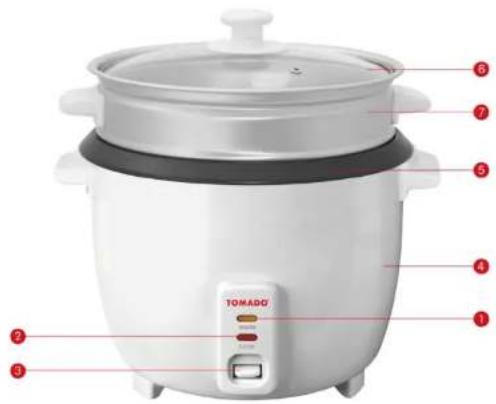
- "Warm" indicator light
- "Cook" indicator light
- Cooking switch
- Outer bowl
- Inner bowl
- Lid
- Steam basket
ADDITIONAL NOTES:
Short power-supply cord is provided to reduce the risk resulting from tripping over or becoming entangled in a longer cord.
Longer detachable power-supply cords or extension are available and may be used if care is exercised in their use.
If a longer detachable power-supply cord or extension cord is used, the marked electrical rating of the cord set or extension should be at least as great as the electrical rating of the appliance, and the cord should be arranged so that it will not drape
OPERATING INSTRUCTIONS
Only use this product with the correct AC outlet (220-240V).
Place the inner pot inside the cooker before operating. The cooker will not turn on unless the inner pot is in place. When ready to cook, plug the cord into the cooker first, then into the wall outlet. Then depress your cooking switch. When your rice is done or food is steamed, the cooker will automatically switch to the warm function. Always unplug after use. Your cooker's power will remain on unless unplugged. Allow cooling before cleaning. Place the lid on your inner pot while cooking. Keep the lid in place after serving to prevent your rice from drying out or discolouring. To reheat cold rice, add about 1/4 cup (4Tb) of cold water per cup of cooked rice, stir to mix, then press switch to cook. Note: Leftover rice is excellent for making fried rice. Keep the bottom of your inner pot and the surface of the heating plate free from any foreign matter to prevent operating malfunctions. This appliance is intended for use with standard 220-240V power outlets. Different levels of voltage in different homes may change approximate cooking times. Turn the Pot gently sideways to make sure it sits flat inside
MAINTAINING YOUR RICE COOKER
Cleaning: Before cleaning your rice cooker, always unplug and allow cooling. Remove the inner pot and lid from the rice cooker and wash then in hot sudsy water. Rinses completely, and then dry with a soft clean cloth. Clean the outside of your cooker when necessary with a clean damp cloth or with a mild dish detergent. NEVER use abrasive cleaners. Do not use any metal tools or steel wool on the outside finish or on cooking pot as they may cause damage. Do not submerge any part of the rice cooker body in water. To clean the heating plate and thermo-control plate, use steel wool to polish or remove any residue. Then wipe with a damp cloth. Allow drying completely before re-using. You must keep the heating plate and thermo-control plate free from any foreign objects; otherwise the cooker will not operate properly. Any residue of vinegar or salt may cause your inner pot to corrode. Always cleanse completely after each use.
Any servicing other than cleaning should be performed by an authorized service representative.
QUICK CLEANING TIP
Add 1/2 cup of water and a small amount of liquid dish or dishwasher detergent to inner pot. Press the switch to COOK and allow heating for 10 minutes. Cool. Rinse well and dry completely before re-using.
ABOUT RICE
Rice is a valuable source of complex carbohydrates and nutrition. It has no fat and is rich in thiamine, niacin and iron. An interesting note, more than half of the world's population eats rice every day.
There are many different varieties of rice available at your market. You may want to try several to see which types best suit your taste. Here are some of the more common types and some of their characteristics:
LONG GRAIN RICE
Typically used for recipes calling for loose, non-sticky, individual grains after cooking. "California" rice is soft while "Caroline" a bit firmer. "Jasmine" is the firmest and is very flavourful and fragrant.
SHORT GRAIN RICE
This variety, while softer and sticker is the rice most commonly used in oriental recipes. The "California" variety is soft; "Sweet Rice", often called "Pearl" rice, is rounder in shape. The sweet rice is extra sticky and is often the variety of choice for making rice pudding.
BROWN RICE
Brown rice is often considered the healthiest variety. If offers itself in its natural unbleached, bran rich form. It contains more B-complex vitamins, irons, calcium and fibre than other varieties.
WILD RICE
Wild rice comes in many delicious varieties and mixes. Often it is mixed with long grain rice for its firmer texture and rich brown to black colour. Wild rice makes a wonderful stuffing for poultry when cooked with broth and mixed with your favourite dried fruits.
COOKING RICE
You'll have excellent results using this guideline. For your convenience, the inner pot features water measurement lines inside. We have also provided a handy cup that is designed to measure rice and water. Using the measuring cup provided in the package, measure and add rice to the inner pot. One full-level measure equals one cup. You may choose any one of the following ways to add water for cooking: By measuring cup, add proper amount of water to the rice inside the inner pot. (See measurement chart). By waterline, add water to the rice inside the inner pot up to the proper waterline. Example: for 3 cups of uncooked rice, add water to line 3.
For softer rice, we suggest preparing rice and water in the inner pot and let it soak for 10-20 minutes before cooking. Replace lid on cooker and plug in power cord. Press switch to cook. When your rice is cooked the cooker will automatically switch to the Warm function. After cooking it is important to allow rice to stand, for 5-10 minutes without removing lid. This will ensure that rice is cooked trough. Brown rice will take longer to cook. We suggest adding an additional 3/4-cup of water to accommodate the proper cooking time.
STEAM FOOD
Fill the inner bowl with plenty of water, the quantity of water depends on the desired steaming time. Place the inner bowl in the outer bowl. Place the food that you wish to prepare in the steam basket. Place the steam basket on top of the inner bowl and place the lid on the steam basket .connect the power cord to the outer bowl. Set the cooking switch to the lowest setting. The "cook" indicator light will now be lit. After a while, the water will start to boil and give off steam, Use a kitchen timer to set the steaming time . Once the steaming time has elapsed, Place the cooking switch in the highest setting. The "warm" indicator light will now be lit. The appliance will stop steaming. But will keep you meal warm, After use, remove the plug from the power socket.
RICE / WATER MEASUREMENT CHART
| RICE UNCOOKED | WATERWITH MEASURING CUP PROVIDED | WATERLINE INSIDEINNER POT | APPROX COOKED RICE YIELD |
| 1 cup | 1 1/2 | 1 cups | 2 Line |
| 2 cups 2 1/2 cups Line | 2 | 4 | |
| 3 cups 3 1/2 cups Line | 3 | 6 | |
| 4 cups 4 1/2 cups Line | 4 | 8 | |
| 5 cups 5 1/2 cups Line | 5 | 10 | |
| 6 cup | 6 1/2 | 6 cups | 12 Line |
| 7 cups 7 1/2 cups Line | 7 | 14 | |
| 8 cups 8 1/2 cups Line | 8 | 16 | |
| 9 cups 9 1/2 cups Line | 9 | 18 | |
| 10 cups 10 1/2 cups Line 10 | 20 cups |
HELPFUL HINTS
You may rinse rice to remove excess bran and starch. This will help to reduce rice browning and sticking to the bottom of your pot after cooking, but it may also lose
some nutrients in the rice. Remember: Place rice to your inner pot first and then add water before cooking. If you have experienced any sticking due to the type of rice you choose, try adding a light coating of vegetable oil to the bottom of inner pot before placing rice. When cooking brown or wild rice, add 3/4 additional cup of water. As there are many different kinds of rice available, rice/water measurement might be slightly different by using different kind of rice. Remember to make the adjustment to get the better result. Notes: Always use the Measuring Cup coming together with your Rice Cooker, otherwise fill the water to the bottom of the waterline.
Soups and stews
A hearty bowl of soup or stew is always welcome at any table. Be creative and use various leftover meats and vegetables with your favourite stock and create your own unique recipes. When preparing soup or stew, try to allow extra time for it to "simmer". This will allow flavours to blend and meat to be more tender. To thicken your stew, mix 1/4-cup flour with enough cold water to form a thin paste. Gradually add it to the stew and stir till thickened. If using fresh parsley or herbs in your recipe, add them in the last few moments of cooking to preserve flavour. Save any leftovers for the next day. The flavours increase overnight in your refrigerator. Canned stewed tomatoes or water with bouillon seasoning and spices added make great stock starters for soups and stews.
TECHNICAL DATA
Type nr: TM-1912
Power: 650W
Supply voltage: 220-240V\~50Hz
Dimensions:
Product measurements: 270 x 260 x 270mm
Net weight: 2.58kg
We would like to congratulate you on buying an appliance from the TOMADO product range.
Warranty regulations
• TOMADO provides a 2-year warranty for all defects caused by hidden deficiencies which render the appliance useless for normal operation.
- The warranty runs from the date of purchase; we advise you to carefully save your receipt.
- Within the warranty period any defects in production or material will be resolved free of charge, by means of reparation, replacement of parts or replacement of the appliance as a whole.
- The warranty certificate has to be filled in by the sales person at the moment of purchase.
- Repairs will only be made under warranty in case it can proven (by means of a filled in warranty card and the receipt) that the day the complaint is filed falls into the warranty period.
- The warranty does not apply when defects or damages result from an accident, misuse, negligence (e.g. incorrect cleansing), or when repairs of alterations have been executed outside the authorized TOMADO service centre (excl. disassembling, as stated in the instruction manual).
- The warranty does not cover any defects arising when the appliance is connected to the wrong outlet voltage, not following the guidelines in the instruction manual and usual wear and tear.
- The warranty does not cover any defects arising from the lack of frequent descaling of appliances, whatever type of water has been used (especially for steam irons, coffee machines and water boilers).
• TOMADO cannot be held responsible for any material damage or personal accident resulting from connecting
the appliance in breach of the locally applicable safety regulations and technical standards (for instance an inferior AC outlet). The warranty under no circumstances grants the right for any compensation.
- All other claims, including damages, are excluded unless the Law states otherwise.
- Other warranty regulations than the warranty regulations stated above are not applicable.
Service
For more information you can write to the following address (postage paid):
TOMADO Consumentenservice
Antwoordnummer 19016
NL - 1000 VC Amsterdam
The Netherlands
What do you do in case your appliance does not work?
When your appliance shows defects, you can refer to your salesperson. Your salesperson will make sure any defect will be repaired as soon as possible.
Repairs outside the warranty period
You can always hand in your appliance to have it repaired outside the warranty period. This will of course not be free of charge.

487
Guidelines for protection of the environment
This appliance should not be put into the domestic garbage at the end of its useful life, but must be disposed of at a central point for recycling of electric and electronic domestic
appliances. This symbol on appliance, instruction manual and packaging puts your attention to this important issue. The materials used in this appliance can be recycled. By recycling used domestic appliances you contribute an important push to the protection of our environment. Ask your local authorities for information regarding the point of recollection..

487

- CONSEILS UTILES
- IMPORTANT SAFEGUARDS
- ADDITIONAL NOTES:
- OPERATING INSTRUCTIONS
- MAINTAINING YOUR RICE COOKER
- QUICK CLEANING TIP
- ABOUT RICE
- LONG GRAIN RICE
- SHORT GRAIN RICE
- BROWN RICE
- WILD RICE
- COOKING RICE
- STEAM FOOD
- HELPFUL HINTS
- Soups and stews
- TECHNICAL DATA
- Warranty regulations
- Service
- What do you do in case your appliance does not work?
- Repairs outside the warranty period
- Guidelines for protection of the environment
Brand : Tomado
Model : TM-1912
Category : Rice cooker