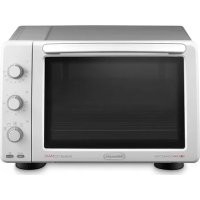
EO 1835.A - Electric oven DELONGHI - Free user manual and instructions
Find the device manual for free EO 1835.A DELONGHI in PDF.


User questions about EO 1835.A DELONGHI
0 question about this device. Answer the ones you know or ask your own.
Ask a new question about this device
Download the instructions for your Electric oven in PDF format for free! Find your manual EO 1835.A - DELONGHI and take your electronic device back in hand. On this page are published all the documents necessary for the use of your device. EO 1835.A by DELONGHI.
USER MANUAL EO 1835.A DELONGHI
1.1 Specifications 13
1.2 Description of the oven and the accessories 14
1.3 Summary of operation 15
1.4Warnings 16
CHAPTER 2 USE OF THE OVEN AND REFERENCE COOKING TIMES
2.1 Use of the controls 17
2.2 Tips on use 18
2.3 How to set the functions 18
- Keeping food warm 18
Delicate cooking 18
Oven cooking 19
Grilling and cooking au gratin 20
Grilling with the turnspit (if fitted) 22
CHAPTER 3 CLEANING AND MAINTENANCE 23
1.3 - SPECIFICATIONS
Operating voltage . see rating plate
Maximum power absorbed . . . . . . . . . . . . . . . . . . . . . . . . . . . . . . . . . . . . . . . . . . . . . . . . . . . . . . . . .
POWER CONSUMPTION (CENELEC STANDARD HD 376)
To reach 200^ 0,2 KWh
To maintain 200^ for one hour . . . . . . . . . . . . . . . . . . . . . . . . . . . . . . . . . . . . . . . . . . . . . . . . . . . . . . . . . . . . . . . . . . . . . . . . . . .
Total .0,90 KWh
This appliance conforms to EC directives 89/336 and 92/31 on Electromagnetic Compatibility and EC directive no. 1935/2004 of 27/10/2004 on materials intended for contact with food.
1.2 - DESCRIPTION OF THE OVEN AND THE ACCESSORIES
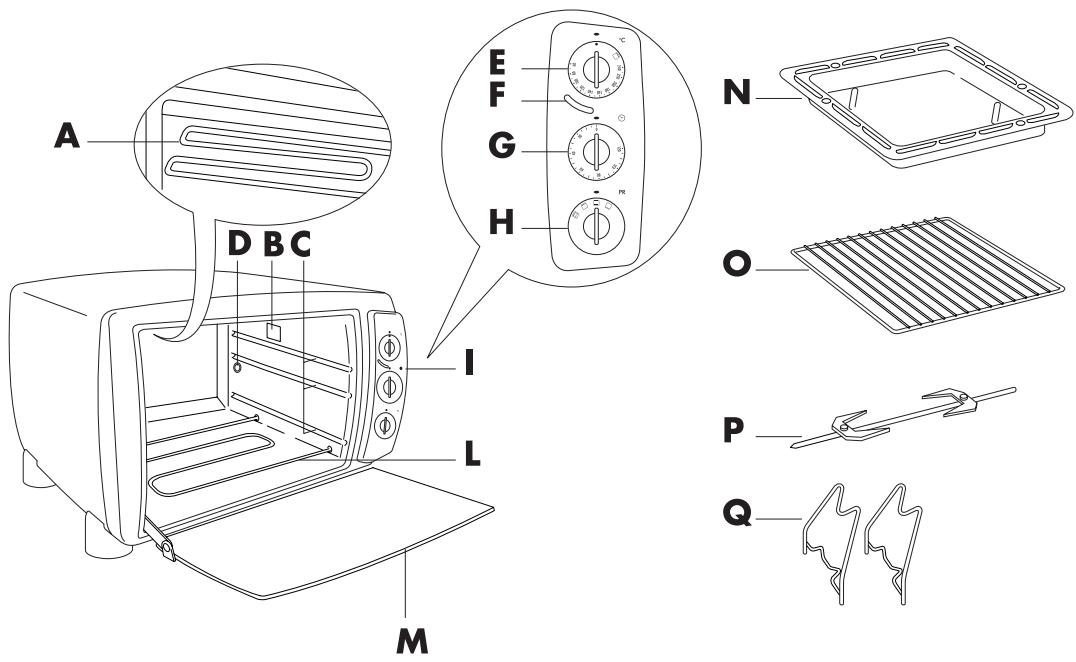
A Top heating element
B Oven light (if fitted)
C Side guides
D Turnspit mount (if fitted)
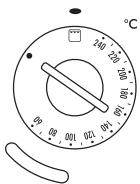
E Thermostat knob
F Thermostat pilot light
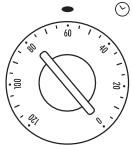
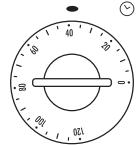
G On/off and timer knob
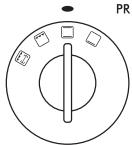
H Function selector knob
Control panel
L Bottom heating element
M Glass door
N Dripping pan (if supplied)
O Wire rack
P Spit (if supplied)
Q Spit supports (if supplied)
The oven features 3 guides for positioning the baking pans and wire racks at different heights
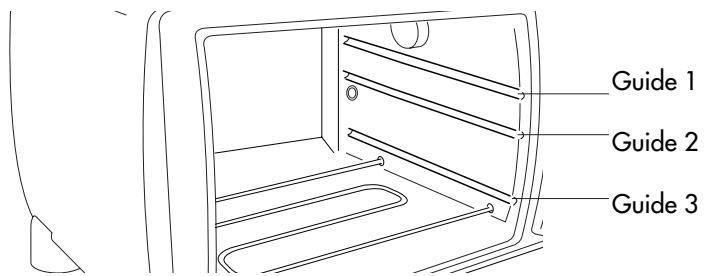
SIDE GUIDES
1.3 - SUMMARY OF OPERATION
| PROGRAM | FUNCTION SELECTOR KNOB SETTING | THERMOSTAT KNOB SETTING | POSITION OF WIRE RACK AND ACCESSORIES | GUIDES | NOTES/TIPS |
| KEEPING FOOD WARM | 60° | 1 2 3 | If the food needs to be kept warm for longer than 20-30 minutes, it should be covered with tinfoil, to prevent it from becoming too dry. | ||
| DELICATE COOKING | 60°-240° | 1 2 3 | Use the dripping pan, sliding it directly into the lower guide, or a baking pan on the wire rack (in the lower guide) | ||
| OVEN COOKING | 60°-240° (see table on page 19) | 1 2 3 1 2 3 | Use the dripping pan, sliding it directly into the guides, or a baking pan placed directly on the wire rack. | ||
| GRILLING AND COOKING AU GRATIN | 1 2 3 | Ideal for all types of tradi- tional grill; hamburgers, frankfurters, kebabs, toast, etc. Place the food directly on the wire rack. The dripping pan is used to collect any drops of fat. | |||
| 1 2 3 | Ideal for dishes that need to be cooked au gratin (e.g. coquilles Saint-Jacques, etc.). In this case, the con- tainer (with the food inside) should be placed on the wire rack. | ||||
| GRILLING WITH THE TURNSPIT (IF FITTED) | 1 2 3 | Ideal for cooking chick- ens, fowl in general, roast pork, etc. A glass of water can be poured into the dripping pan to make cleaning easier and pre- vent smoke being pro- duced by the burning fat. |
1.4 - WARNINGS
- Read all the instructions carefully before using the appliance.
This oven has been designed to cook food. It must never be used for other purposes, modified or tampered with in any way. - Place the appliance on a horizontal surface at a height of at least 85~cm and out of reach of children.
-
Wash all accessories thoroughly before use.
Before plugging into the mains, make sure that: -
the mains voltage corresponds to the voltage indicated on the rating plate;
- the mains socket has a minimum rating of 16A and an earth wire.
The manufacturer declines all liability in the event that this important accident-prevention rule is not respected.
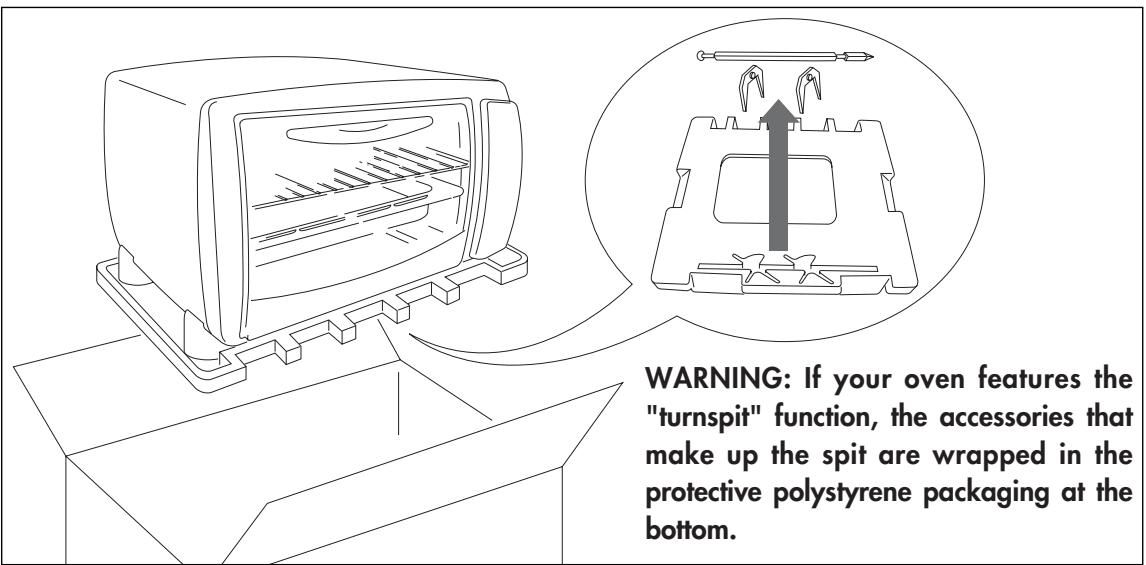
Before using the oven for the first time, remove any paper and other material inside the oven such as protective cardboard, booklets, plastic bags, etc.
Before using for the first time, operate the oven empty with the thermostat at maximum for at least 15 minutes to eliminate the "new" smell and any smoke caused by the presence of protective substances applied to the elements before transport. During this operation, ventilate the room.
IMPORTANT: when you have unpacked the appliance, make sure the door is undamaged and working correctly. The door is made from glass and is therefore fragile. If it is visibly chipped, scored or scratched, it should be replaced. While using, cleaning or moving the appliance, avoid slamming or knocking the door violently. Do not pour cold liquid onto the glass while the appliance is hot.
- Do not use harsh abrasive cleaners or sharp metal scrapers to clean the oven door glass since they can scratch the surface, which may result in shattering of the glass
- When in operation, the door and accessible external surfaces could become very hot. Always use the knobs, handles and buttons. Never touch metal parts or the glass. Use oven gloves if necessary.
- This electrical appliance operates at high temperatures which could cause burns.
- The appliance is not intended for use by young children or infirm persons. Young children should be supervised to ensure that they do not play with the appliance.
-
Do not move the appliance while in use.
Do not use the appliance if... -
the power cable is faulty,
-
the appliance has been dropped, is visibly damaged or malfunctions.
Should this occur, to avoid all risk take the appliance to your nearest authorised service centre.
- Do not let the power cable dangle and avoid touching hot parts of the oven. Never unplug the appliance by pulling on the power cable.
If you intend to use an extension, make sure it is in good condition, that the plug is earthed and that the cross section of the wires is at least equal to that of the power cable provided with the appliance. - To avoid all risk of electric shock, never immerse the power cable, plug or appliance itself in water.
- Never position the appliance near heat sources.
- Do not leave inflammable products near the oven or under the work surface where it is located.
- Bread may burn. Never leave the oven unattended during toasting or grilling. Never operate the appliance under a wall cupboard or shelf or near inflammable materials such as curtains, blinds, etc.
- Do not use the appliance as a heat source.
- Never place paper, cardboard or plastic inside the oven and never rest anything on top of the appliance (utensils, wire racks, other objects).
- Never insert anything into the ventilation openings. Make sure they are unobstructed.
If food or other parts of the oven catch fire, never try and put out the flames with water. Close the door, unplug from the mains and smother the flames with a damp cloth. - This oven is not designed for built-in installation.
-
When the door is open, remember:
-
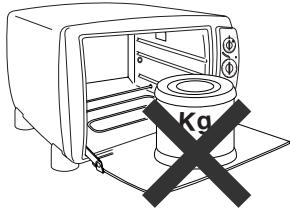
never exert excessive pressure with overly heavy objects or pull the handle downwards;
-
never rest heavy containers or boiling saucepans just out of the oven on the open door.
-
Given the differences in legislation in force, if the appliance is used in a country other than that where it was bought, have it checked by an authorised service centre.
- For your personal safety, never take the appliance to pieces on your own. Always contact an authorised service centre.
- This appliance is designed for domestic use only. Professional or inappropriate use, or failure to observe the instructions absolves the manufacturer from all responsibility and invalidates the guarantee.
- When not in use and before cleaning, always unplug the appliance.
If the supply cord is damaged, it must be replaced by the manufacturer or its service agent or a similarly qualified person in order to avoid a hazard.
Keep these instructions
CHAPTER 2 - USE OF THE OVEN AND REFERENCE COOKING TIMES
2.1 - USE OF THE CONTROLS
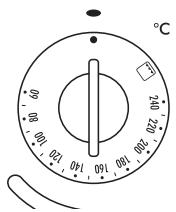
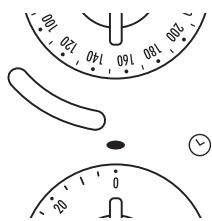
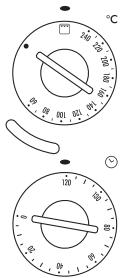
- THERMOSTAT KNOB (E)
Select the desired temperature as follows
- Keeping food warm: Thermostat knob set to 60^ .
- Oven cooking: Thermostat knob set from 60^ to 240^ .
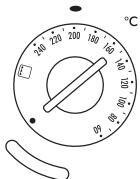
- All types of grilling and cooking with the turnspit (if fitted): Thermostat knob in position.
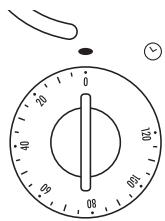
ON/OFF AND TIMER KNOB (G)
- To set the cooking time: Turn the knob clockwise to the desired time (max. 120 minutes). A bell will ring when the set time has elapsed, and the oven will automatically switch itself off.
- To switch the oven off: Turn the knob to position "0".
When setting times of less than 10 minutes, first turn the knob all the way round, and then set the desired time.
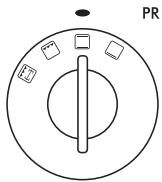
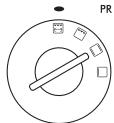
FUNCTION SELECTOR KNOB (H)
This knob is used to select from the available cooking functions, as follows:
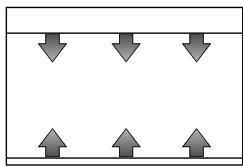

OVEN COOKING AND KEEPING FOOD WARM
(top heating element and bottom heating element on only)
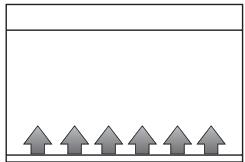

DELICATE COOKING
lower heating element only operating)
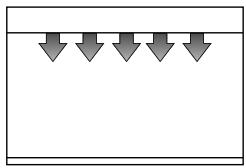

GRILLING

TURNSPIT (IF FITTED)
(top heating element on only, at maximum power)
- THERMOSTAT PILOT LIGHT (F)
The light comes on to indicate that the oven is heating up, and goes off when the oven has reached the set temperature.
2.2 - GENERAL ADVICE
- For oven cooking and "delicate" cooking, for best results the oven should always be preheated to the desired temperature.
- The cooking times depend on the quality of the products, the temperature of the food and individual tastes. The times given in the table are only intended as a guide, and may need to be varied. They do not take into account the time required to preheat the oven.
- When cooking frozen food, follow the recommendations on the package.
2.3 - HOW TO SET THE FUNCTIONS
- KEEPING FOOD WARM
Place the dripping pan or the wire rack with a pan on top in guide no. 3, as shown in the figure on page 15. This function is used to keep the food warm until serving. The food should not be left in the oven too long, as it may become too dry (to avoid this, cover the pan with tinfoil or baking paper).
Turn the function selector knob (H) to position
Turn the thermostat knob (E) to 60^ .
Turn the ON/OFF and timer knob (G) to the time desired. A bell will ring when the set time has elapsed; if the food being kept warm is served before the end of the set time, manually turn the ON/OFF and timer knob (G) to position "0".
DELICATE COOKING
Place the dripping pan or the wire rack with a pan on top in guide 3, as shown in the figure on page 15. Ideal for pastries and cakes with icing. Good results are also achieved when completing the cooking of the base of foods or for cooking that requires heat above all at the bottom. The baking pan should be inserted in the lower guide (3).
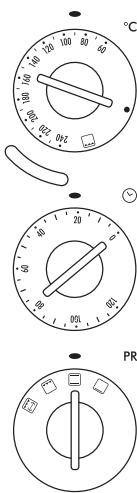
Turn the function selector knob (H) to position
Select the desired temperature using the thermostat knob (E).
Turn the ON/OFF and timer knob (G) to the time desired. A bell will ring when the set time has elapsed; if the food being kept warm is served before the end of the set time, manually turn the ON/OFF and timer knob (G) to position "0".
OVEN COOKING
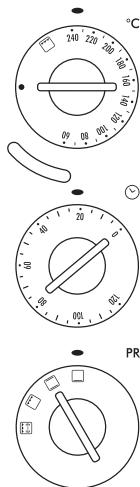
Turn the function selector knob (H) to position
Select the desired temperature using the thermostat knob (E).
Turn the ON/OFF and timer knob (G) to the time desired.
Wait for the oven to reach the set temperature (the pilot light goes off), then place the dish containing the food on the wire rack (previously placed in the oven), or, if the food is in the dripping pan, place the pan directly into the guide (refer carefully to the table below). A bell will ring when the set time has elapsed.
| RECIPPE | QUANTITY | THERMOSTAT KNOB | TIME | WIRE RACK/DRIP- PING PAN POSITION | OBSERVATIONS AND TIPS |
| FRESH PIZZA | 400 g | 200°C | 25 min. | 3 | Rest the dripping pan (N) or a tray on the wire rack (O) |
| SAVOURY PIE | 600 g | 200°C | 35 min. | 3 | Use the dripping pan (N) or a cake tin on the wire rack |
| FROZEN PIZZA | 450 g | 220°C | 13 min. | 2 | Can be placed directly on the wire rack (O) or on the dripping pan (N) |
| LASAGNE | 1500 g | 200°C | 40 min. | 3 | Place the baking pan directly on the wire rack (O) |
| CANNELONI | 2300 g | 200°C | 40 min. | 3 | Place the baking pan directly on the wire rack (O) |
| WHOLE CHICKEN | 1500 g | 220°C | 90 min. | 3 | Pierce with a fork to drain the fat |
| ROAST PORK | 1500 g | 220°C | 90 min. | 3 | Leave a little fat around the edges to prevent it from becoming too dry |
| MEAT LOAF | 1000 g | 200°C | 60 min. | 3 | Place it directly on the dripping pan (N) or in a pan resting on the wire rack (O) |
| RABBIT PIECES | 1000 g | 200°C | 60 min. | 3 | Add a little water. If necessary, turn half way through cooking. |
| SEA BASS IN SALT | 900 g | 190°C | 40 min. | 3 | Cover the fish completely with rock salt. |
| BAKED BREAM | 1000 g | 190°C | 40 min. | 3 | These can be cooked directly on the dripping pan (N) or in a pan resting on the wire rack (O) |
| TROUT BAKED IN FOIL | 800 g | 190°C | 40 min. | 3 | These can be cooked directly on the dripping pan (N) or in a pan resting on the wire rack (O), wrapped in tinfoil |
| AUBERGINES WITH PARMESAN | 1700 g | 200°C | 30 min. | 2 | Place the baking pan on the wire rack (O) |
| COURGETTES WITH TUNA | 1000 g | 200°C | 40 min. | 2 | Rest the dripping pan (N) or a pan on the wire rack (O): add oil, tomato and water |
| POTATOES AU GRATIN | 1500 g | 200°C | 40 min. | 2 | Place the baking pan on the wire rack (O) |
| APPLE PIE | 1000 g | 190°C | 90 min. | 3 | Place the cake tin on the wire rack (O) |
| MUFFINS | 600 g | 200°C | 18 min. | 2 | Place the muffin cups directly on the dripping pan |
Add around 5 minutes to the cooking time for preheating.
GRILLING AND COOKING AU GRATIN
This function is ideal for grilling hamburgers, chops, frankfurters, sausages, etc. In addition, this function may be used for browning foods: gnocchi alla romana, coquilles Saint-Jacques, etc..
Operate as follows:
Place the food being grilled directly on the wire rack and the dripping pan (N) in the centre guide (2) as shown in Figure 1. Leave the door ajar as shown in Figure 2. Pour a glass of water into the dripping pan (N) to make cleaning easier and prevent smoke being produced by the burning fat.
Turn the function selector knob (H) to position
Turn the thermostat knob (E) to position
Turn the ON/OFF and timer knob (G) to the time desired.
Important: for best results, place the food on the wire rack (O), leaving an empty space of around 2cm near the door (see Figure 1).
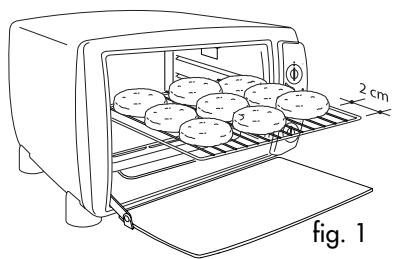
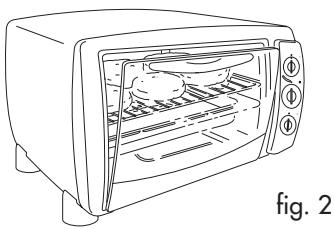
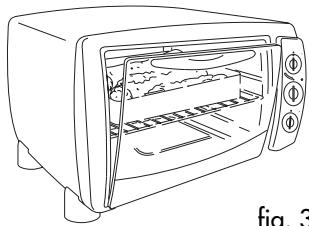
fig. 3
In the case of food that has already been cooked or is to be cooked au gratin, place the container directly on the wire rack in the centre guide (2); the door must be left ajar as shown in Figure 3. A bell will ring when the set cooking time has elapsed; if cooking is completed before the end of the set time, manually turn the ON/OFF and timer knob (G) to position "0".
To correctly toast bread, place the slices as shown in the figure to the side, that is, leaving 2cm of free space at the ends of the wire rack.
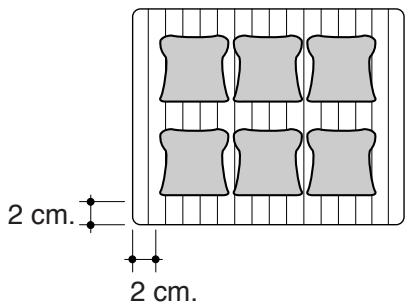
FOR TOASTING BREAD ONLY: preheat the oven for 2-3 minutes with the door ajar (as shown in the figure to the side)
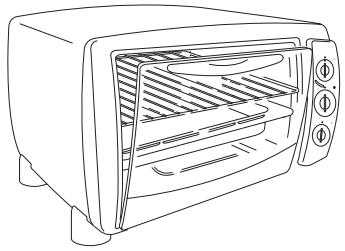
The table below provides some useful tips for preparing great grilled food.
| RECIPCE | QUANTITY | THERMOSTAT KNOB | TIME | OBSERVATIONS AND TIPS |
| PORK CHOPS (4) | 600 g | 20 min. | Turn after approx. 12 minutes | |
| SAUSAGES (12) | 1200 g | 25 min. | Pierce with a fork to drain the fat. Turn after approx. 15 minutes | |
| HAMBURGERS (6) | 700 g | 20 min. | Turn after approx. 12 minutes | |
| FRANKFURTERS (6) | 500 g | 10 min. | Turn after approx. 3-4 minutes | |
| KEBABBS (4) | 650 g | 25 min. | Turn after approx. 15 minutes | |
| TOAST | 6 slices | 3,5 min. | Turn half way throughasting. | |
| GNOCCHI ALLA ROMANA | 1500 g | 15 min. | Place the baking pan on the wire rack, positioned in the centre guide (2) |
GRILLING WITH THE TURNSPIT (IF FITTED)
This function is ideal for cooking chickens on the spit, fowl in general, roast pork and veal.
Operate as follows:
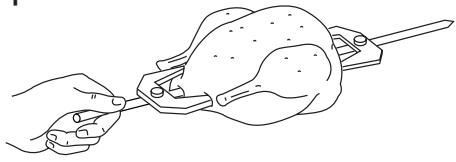
fig. 5
Place the food on the spit (P) and hold it firm using the forks (for best results, tie the meat using kitchen string).
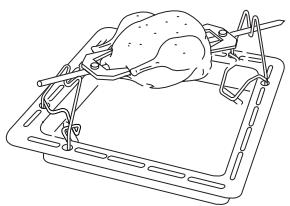
fig. 7
Place the spit on the supports.
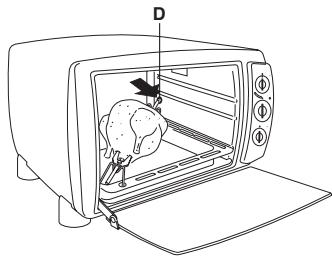
fig. 9
Once the dripping pan is in place, push the spit into the turnspit mount (D), tilting the spit supports (Q) to the right.
The oven does not need to be preheated for this function.
Turn the function selector knob (H) to position
Turn the thermostat knob (E) to position
Turn the ON/OFF and timer knob (G) to the time desired.
If the cooking time is longer than 2 hours, remember to reset the timer.
Once cooking is complete, manually turn the ON/OFF and timer knob (G) to position "0".
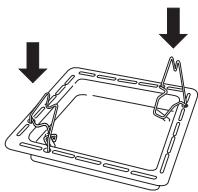
fig. 6
Place the spit supports (Q) on the dripping pan, in the holes provided.
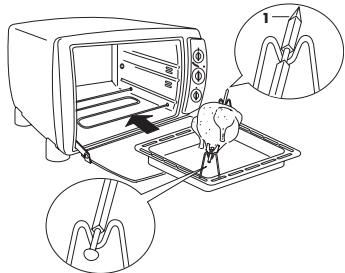
fig. 8
Place the dripping pan with the food being cooked in the lower guide (3), tilting the spit supports (Q) to the left. Make sure that the tip of the spit 1 is facing forwards.
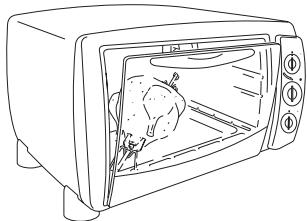
fig. 10
Close the door, leaving it slightly ajar, as highlighted in the figure (half-open).
CHAPTER 3 - CLEANING AND MAINTENANCE
Frequent cleaning will prevent the formation of smoke and bad smells during cooking.
Before performing any cleaning operations, always unplug the appliance from the power socket.
Never immerse the appliance in water; do not wash it by spraying it with water. The wire rack, dripping pan, and spit (if supplied) are washed like normal dishes, by hand or in the dishwasher. Always use a damp sponge to clean the outer surface. Avoid using abrasive products that may damage the surface finish (enamel or paint). Make sure water or liquid soap does not infiltrate through the slits on the right-hand side of the oven. To clean the inside of the oven, never use corrosive products and do not scrape the walls with sharp objects or blades. Only use non-abrasive liquid detergents. Do not attempt to push forks, knives or sharp objects into the openings on the right-hand side and the rear of the oven. To make the bottom of the oven easier to clean, the lower heating element (L) must be raised by pulling it upwards and to the right (see Figure 10). After cleaning, fasten the heating element back in place, as shown in Figure 11.
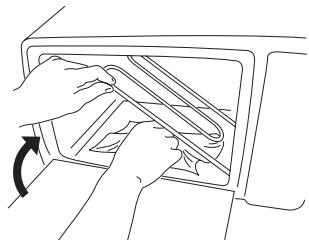
fig. 10
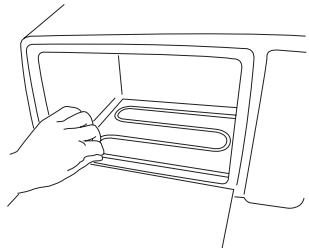
fig. 11
OVEN LIGHT (if fitted)
The oven light (B) is always on when the oven is on. To replace the bulb, contact authorised personnel or an authorised Service Centre. N.B. The oven can still be used even if the bulb is burnt-out.
IMPORTANT INFORMATION FOR CORRECT DISPOSAL OF THE PRODUCT IN ACCORDANCE WITH EC DIRECTIVE 2002/96/EC.
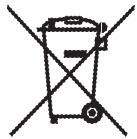
At the end of its working life, the product must not be disposed of as urban waste. It must be taken to a special local authority differentiated waste collection centre or to a dealer providing this service. Disposing of a household appliance separately avoids possible negative consequences for the environment and health deriving from inappropriate disposal and enables the constituent materials to be recovered to obtain significant savings in energy and resources. As a reminder of the need to dispose of household appliances separately, the product is marked with a crossed-out wheeled dustbin.
ELECTRICAL CONNECTION (UK ONLY)
A) If your appliance comes fitted with a plug, it will incorporate a 13 Amp fuse. If it does not fit your socket, the plug should be cut off from the mains lead, and an appropriate plug fitted, as below.
WARNING: Very carefully dispose of the cut off plug after removing the fuse: do not insert in a 13 Amp socket elsewhere in the house as this could cause a shock hazard.
With alternative plugs not incorporating a fuse, the circuit must be protected by a 15 Amp fuse.
WARNING - THIS APPLIANCE MUST BE EARTHED IMPORTANT
The wires in the mains lead are coloured in accordance with the following code:
Green and yellow: Earth
Blue: Neutral
Brown: Live

If the plug is a moulded-on type, the fuse cover must be re-fitted when changing the fuse using a 13 Amp Asta approved fuse to BS 1362. In the event of losing the fuse cover, the plug must NOT be used until a replacement fuse cover can be obtained from your nearest electrical dealer. The colour of the correct replacement fuse cover is that as marked on the base of the plug.
B) If your appliance is not fitted with a plug, please follow the instructions provided below:
As the colours of the wires in the mains lead may not correspond with the coloured markings identifying the terminals in your plug, proceed as follows:
The green and yellow wire must be connected to the terminal in the plug marked with the letter E or the earth symbol or coloured green or green and yellow.
The blue wire must be connected to the terminal marked with the letter N or coloured black.
The brown wire must be connected to the terminal marked with the letter L or coloured red.