VK211 - KVM Switch ATEN - Free user manual and instructions
Find the device manual for free VK211 ATEN in PDF.


User questions about VK211 ATEN
0 question about this device. Answer the ones you know or ask your own.
Ask a new question about this device
Download the instructions for your KVM Switch in PDF format for free! Find your manual VK211 - ATEN and take your electronic device back in hand. On this page are published all the documents necessary for the use of your device. VK211 by ATEN.
USER MANUAL VK211 ATEN
RS-232/Contact to USB Keyboard Converter User Manual
Compliance Statements
FEDERAL COMMUNICATIONS COMMISSION INTERFERENCE STATEMENT
This equipment has been tested and found to comply with the limits for a Class A digital device, pursuant to Part 15 of the FCC Rules. These limits are designed to provide reasonable protection against harmful interference when the equipment is operated in a commercial environment. This equipment generates, uses, and can radiate radio frequency energy and, if not installed and used in accordance with the instruction manual, may cause harmful interference to radio communications. Operation of this equipment in a residential area is likely to cause harmful interference in which case the user will be required to correct the interference at his own expense.
The device complies with Part 15 of the FCC Rules. Operation is subject to the following two conditions: (1) this device may not cause harmful interference, and (2) this device must accept any interference received, including interference that may cause undesired operation.
FCC Caution
Any changes or modifications not expressly approved by the party responsible for compliance could void the user's authority to operate this equipment.
Warning
Operation of this equipment in a residential environment could cause radio interference.
Achtung
Industry Canada Statement
This Class A digital apparatus complies with Canadian ICES-003.
CAN ICES-003 (A) / NMB-003 (A)
HDMI Trademark Statement
The terms HDMI, HDMI High-Definition Multimedia Interface, and the HDMI Logo are trademarks or registered trademarks of HDMI Licensing Administrator, Inc.

RoHS
This product is RoHS compliant.
User Information
Online Registration
Be sure to register your product at our online support center:
International http://eservice.aten.com
Telephone Support
For telephone support, call this number:
| International 886-2-86 | 92-6959 |
| China 86-400-810-0-8 | 10 |
| Japan 81-3-5615-581 | 1 |
| Korea 82-2-467-6789 | |
| North America 1-888- | 999-ATEN ext 4988 |
| 1-949-428-1111 |
User Notice
All information, documentation, and specifications contained in this manual are subject to change without prior notification by the manufacturer. The manufacturer makes no representations or warranties, either expressed or implied, with respect to the contents hereof and specifically disclaims any warranties as to merchantability or fitness for any particular purpose. Any of the manufacturer's software described in this manual is sold or licensed as is. Should the programs prove defective following their purchase, the buyer (and not the manufacturer, its distributor, or its dealer), assumes the entire cost of all necessary servicing, repair and any incidental or consequential damages resulting from any defect in the software.
The manufacturer of this system is not responsible for any radio and/or TV interference caused by unauthorized modifications to this device. It is the responsibility of the user to correct such interference.
The manufacturer is not responsible for any damage incurred in the operation of this system if the correct operational voltage setting was not selected prior to operation. PLEASE VERIFY THAT THE VOLTAGE SETTING IS CORRECT BEFORE USE.
Product Information
For information about all ATEN products and how they can help you connect without limits, visit ATEN on the Web or contact an ATEN Authorized Reseller. Visit ATEN on the Web for a list of locations and telephone numbers:
International http://www.aten.com
North America http://www.aten-usa.com
Package Contents
Check to make sure that all the components are in working order. If you encounter any problem, please contact your dealer.
The VK211 package consists of:
◆ 1 VK211 RS-232/Contact to USB Keyboard Converter
◆ 1 3-pin terminal block
◆ 1 5-pin terminal block
◆ 1 USB Type-B to USB Type-A cable
◆ 1 USB Micro-B to USB Type-A cable
◆ 1 foot pad set (4 pcs)
◆ 1 user instructions
Contents
Compliance Statements ...... ii
User Information iv
Online Registration .....iv
Telephone Support .....iv
User Notice .iv
Product Information v
Package Contents v
Contents ......vi
About this Manual ...... vii
Conventions ...... viii
Terminology . . . . . . . . . . . . . . . . . . . . . . . . . . . . . . . . . . . . . . . . . . . . . . . . . . . . . . . . . . . . . . . . . . . . . . . . . . . . . . . . . . . . viii
1. Introduction
Overview....1
Features 2
Getting Started Tasks 2
2. Hardware Setup
Components 3
Installing the VK211 5
3. Configuration
Overview. 7
Remote Control through Contact In 7
Configuring Presets through CLI Commands 7
Remote Control through RS-232 8
Creating an RS-232 Session....8
Command Notifications....8
Commands for Supported Actions 9
Simulating Keypresses 9
Configuring Contact In Ports 10
Echo 11
Read 12
Set 12
Reset 13
Supported Keycodes....14
4. Control and Maintenance
Enabling / Disabling Remote Control 19
Firmware Upgrade 19
Appendix
Safety Instructions 23
General 23
Technical Support 25
International 25
Specifications 26
ATEN Standard Warranty Policy 27
About this Manual
This User Manual is provided to help you get the most from your RS-232/Contact to USB Keyboard Converter. It covers all aspects of the installation, configuration, and operation for the following models of the RS-232/Contact to USB Keyboard Converter.
An overview of the information found in the manual is provided below.
Chapter 1, Introduction introduces you to the RS-232/Contact to USB Keyboard Converter. Its purpose, features, and benefits are presented.
Chapter 2, Hardware Setup describes how to install the unit.
Chapter 3, Configuration explains the fundamental concepts involved in operating the RS-232/Contact to USB Keyboard Converter.
Chapter 3, Configuration details all of the concepts and procedures involved in the hotkey operation of your Multi-View KVMP™ Switch.
Appendix provides specifications and other technical information regarding the RS-232/Contact to USB Keyboard Converter.
Note:
- Read this manual thoroughly and follow the installation and operation procedures carefully to prevent any damage to the unit and/or connected devices.
The product may be updated, with features and functions added, improved, or removed since the release of this manual. For an up-to-date user manual, visit http://www.aten.com/global/en/.
Conventions
This manual uses the following conventions:
Monospaced Indicates text that you should key in.
[ ] Indicates keys you should press. For example, [Enter] means to press the Enter key. If keys need to be chorded, they appear together in the same bracket with a plus sign between them: [Ctrl+Alt].
- Numbered lists represent procedures with sequential steps.
"Bullet lists provide information, but do not involve sequential steps.
Indicates selecting the option (on a menu or dialog box, for example), that comes next. For example, Start > Run means to open the Start menu, and then select Run.

Indicates critical information.
Terminology
| Terminology Description | |
| ATEN Controller, controller | ATEN Controller or controller refers to all models of ATEN Control Box and ATEN Control Pad. |
| Project A project is a set of configurations for an ATEN Control System, including configurations of one or more controllers and managed devices. | |
Overview
The RS-232/Contact to USB Keyboard Converter (VK211) makes remote control possible for PC-based devices or KVM switches (that do not have remote control capabilities) by converting control signals to full-range USB keyboard signals. With an RS-232 serial port on the controller, you can remotely perform control actions (using CLI commands) from the controller's supported interface, such as an ATEN Viewer; Through a contact in port on the controller, you can configure and store up to 4 presets (actions) to the converter, which you can execute from the converter.
In cases of urgent needs for local control, you can enable the priority mode to disable remote control. LEDs are built in on the top panel to instant and convenient viewing of the status of digital input signals, priority control, and power.
With the capabilities of emulating USB keyboard signals, the VK211 is an ideal solution for providing RS-232 / Contact In interfaces for KVMs or any PC-based devices that do not have remote control functionalities. Its compact size and non-power source design are suitable for applications such as factory production lines, control rooms, or any facility that requires automation with control system and remote secure operation without installing any software.
Features
- Converts RS-232 to full-range USB keyboard signals for remote control of USB keyboard-based devices such as KVMs and PCs
◆ Recalls the stored key codes and allows storage of up to 4 preset actions triggered via Contact In signals
◆ Local USB console ports for keyboard / mouse connection - On-panel priority control push button for local operators to manage remote access in case of emergencies
- LEDs indicate the status of digital input signals, priority control, and power at a glance
- No extra power required by utilizing the connection with USB devices
Learn mode eases the setup procedure and configurations
◆ Compatible with ATEN KVMs
Getting Started Tasks
Follow the procedure below to help you get started with the VK211.
| Step | Task Detailed Information | |
| 1. | Install hardware to the VK211. | Installing the VK211, page 5 |
| 2. Set up remote control actions on your chosen interface (e.g. ATEN Viewer or a keypad). | Chapter 3 Configuration. | |
Chapter 2
Hardware Setup

-
Please review the safety information regarding the placement of this device in Safety Instructions, page 23.
-
Do not power on the VK211 until all the necessary hardware is connected.
Components
This section provides an overview of the VK211's hardware components, their locations and functions.

text_image
Technical diagram of a device rear panel with labeled components and numbered parts| No. | Component Description | |
| 1 | USB type-A port (mouse) Connects to a USB type-A mouse. | |
| 2 | USB type-A port (keyboard) Connects to a USB type-A keyboard. | |
| 3 | USB Type-B port | Connects to a KVM switch or a USB keyboard based device (e.g. PC). |
| 4 | present LEDs | A preset LED blinks to indicate that the corresponding preset has been selected for configuration or triggered. |
| 5 | priority LED Lights up to indicate that the control is restricted to the local operator. | |
| 6 | power LED Lights green when | the VK211 receives power. |
| 7 | priority button | ◆ To enable the priority mode (which restricts control to local operator), press the priority button.◆ To enable learning mode, press and hold the priority button for 3 seconds. |
| 8 | contact in port Connects to a | contact device to trigger control signals. |
| 9 | RS-232 port Connects to an RS | RS-232 serial port to transmit control signals. |
| 10 | USB Micro-B port (power) (Optional) | Connects to a KVM switch or USB keyboard-based device as a power source. For more details, see Installing the VK211, page 5. |
Installing the VK211
Follow the steps below to safely install the RS-232/Contact to USB Keyboard Converter.

flowchart
graph TD
    A["ATEN Controller or 3rd-party Controller"] --> B["RS-232"]
    B --> C["Contact In"]
    C --> D["VR211 (Side View)"]
    D --> E["USB"]
    E --> F["USB"]
    F --> G["VR211 (Side View)"]
    G --> H["USB"]
    H --> I["KeyboardMouse"]
    I --> J["2"]
    I --> K["3"]
    G --> L["4"]
    L --> M["USB"]
    M --> N["KVM Switch or USB Keyboard-based Device"]
- Connect an ATEN or 3rd-party controller to the converter (VK211) using one of the following methods:
- To control using CLI commands, use the supplied 3-pin terminal block to connect the controller to the RS-232 port of the keyboard converter.
- To control through the contact in port, which supports up to 4 preset controls, use the supplied 5-pin terminal block to connect the contact in port of the keyboard converter to the appropriate port of the selected control interface (e.g. relay port), as illustrated below. The diagram on the next page illustrates how to wire a single channel.
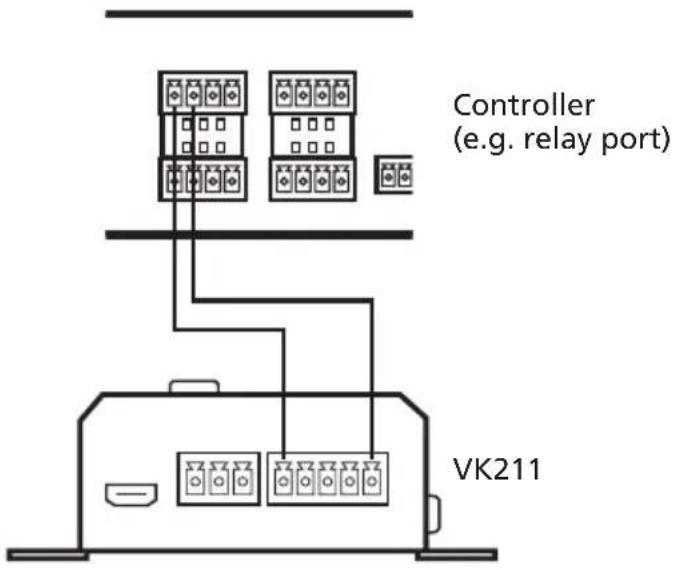
text_image
Controller (e.g. relay port) VK211- Connect a USB mouse to the USB Type-A port for mouse on the keyboard converter.
- Connect a USB keyboard to the USB Type-A port for keyboard on the keyboard converter.
- Connect a KVM switch or a USB keyboard based device (e.g. PC) to the USB Type-B port on the keyboard converter.
- (Optional) If the connected keyboard / mouse does not function properly, use one of the following methods to supply power:
- Use the supplied USB Micro-B to USB Type-A cable to connect the keyboard converter's power port to any USB port on the connected device.
- Connect the keyboard converter to a power source using a DC power adapter with the supplied USB Micro-B to USB Type-A cable.
Overview
This chapter provides recommended procedure and required information on setting up
Remote Control through Contact In
With the contact in port wired and connected to the controller (page 5), you can store up to 4 sequences of keystrokes (presets) and trigger the sequences from a keypad or a software control interface. To configure and store these sequences, use the priority button on the VK211 panel or remotely with CLI commands.
Configuring Presets with Learning Mode
To set up a preset with the priority button:
- Select a preset.
a) Press and hold the priority button for about 3 seconds until preset 1 LED blinks to enable learning mode.
b) To configure preset 1, continue to the next step; to select another preset, press the priority button to cycle through the presets. A preset LED blinks to indicate that it is selected.
- Perform the control action(s) on the local keyboard.
Note: The converter exits learning mode if no input is received within 5 seconds.
- Press the priority button to finish learning. The preset LED dims.
Configuring Presets through CLI Commands
To set up a preset remotely with CLI commands, refer to the next section on how to create an RS-232 session (page 8) and the command syntax for configuring contact in ports (page 10).
Remote Control through RS-232
Through RS-232 serial connection between your ATEN or third-party controller (page 5), you can set up control actions using CLI commands. Refer to the user manual of your chosen controller for details on where to enter these commands.
Creating an RS-232 Session
On PuTTY or any terminal emulator to create an RS-232 session using the following settings:
Baud rate: 19200
◆ Data bit: 8
- Stop bit: 1
Parity: None
- Your terminal COM port
Command Notifications
The command syntax uses the following notifications:
| Notation Description | |
| [ ] Indicates optional items. Only type the information in the brackets, not the brackets themselves. | |
| Indicates the name of the value that the user must provide.Only type the information in the angle brackets, not the brackets themselves. | |
| | Indicates two or more mutually exclusive choices in a command line. Only type one of the choices in the command line, not the symbol. | |
| Represents the action of pressing an Enter key. | |
Commands for Supported Actions
Simulating Keypresses
◆ Usage: Simulate key presses with specified duration and interval.
- Syntax:
keypress k
Keyword:
k: keycode
d: the duration for pressing and holding a key.
t: the time interval between two key presses. The maximum value is 500ms.
Parameter:
◆ sequence: Enter one or more keycode IDs. To look up keycode IDs, see Supported Keycodes, page 14.
XX: Press the key that corresponds to the specified once.
XX, YY, ZZ: Press the keys that correspond to the specified keycodes once, in the specified order.
XX+YY+ZZ: Press the keys that correspond to the specified keycodes at the same time.
Note: You can simulate up to 30 key within one keypress command.
type:
allup: Release all the specified keys simultaneously
fdfu (First down first up): For key combinations, a key that is pressed first will also be released first.
fdlu (First down last up): For key combinations, a key that is pressed first will be released at last.
Note: These parameters are used for key combination only. The default setting is allup.
◆ duration: press and hold for the specified duration (ms).
◆ interval: time interval between each key (ms). The maximum is 500ms.
- Acknowledge:
Command OK: Command is correct and the function is executed.
Command incorrect: Command and/or parameters are incorrect and not executed.
Example:
keypress k 01∠: Single pressing with keycode 01.
keypress k 01,A0,A5,81,84: Single pressing with keycodes 01,A0,A5,81 and 84.
keypress k 01+A0+A5 ∠: Key combination (01, A0 and A5), and all key are released simultaneously.
keypress k 01+A0+A5 fdfu∠: Key combination (01, A0 and A5), and keycode 01 is released at first.
keypress k 01 d 1000 : Keycode 01 is long-pressed for 1000 ms.
keypress t 300∠: Set the time interval between key pressing to 300 ms.
Configuring Contact In Ports
◆ Usage: Configure and save keypress actions to contact in ports.
- Syntax:
io p
Keyword:
p: port
k: keycode
d: duration
t: time interval
Parameter:
◆ Sequence1: number for contact in port, for example, 01, 02, 03, 04
◆ Sequence2:
XX: Press the key that corresponds to the specified once.
XX, YY, ZZ: Press the keys that correspond to the specified keycodes once, in the specified order.
XX+YY+ZZ: Press the keys that correspond to the specified keycodes at the same time.
Note: You can simulate up to 30 key within one keypress command.
type:
allup: Release all the specified keys simultaneously
fdfu (First down first up): For key combinations, a key that is pressed first will also be released first.
fdlu (First down last up): For key combinations, a key that is pressed first will be released at last.
Note: These parameters are used for key combination only.
◆ duration: press and hold for the specified duration (ms).
◆ interval: time interval between each key (ms). The maximum is 500ms.
- Acknowledge:
Command OK: Command is correct and the function is executed.
Command incorrect: Unavailable command or parameters.
Example:
io p01 k 01∠: Save the action of pressing keycode 01 once to port 1.
io p01 k 01,A0,A5,81,84: Save the action of pressing keycodes 01, A0, A5, 81, and 84 once to port 1.
io p02 k 01+A0+A5∠: Save the action of pressing 01, A0, and A5 together, and then releasing them simultaneously to port 2.
io p01 k 01+A0+A5 fdfu: Save the action of pressing 01, A0, and A5 together, and releasing keycode 01 first to port 1.
io p01 k 01 d 1000 : Save the action of pressing and holding 01 for 1000 ms to port 1.
io p01 t 300∠: Set the time interval between key pressing to 300 ms.
Echo
- Usage: To show keyboard inputs (performed at the local console) on the remote console through RS-232 serial communication.
- Syntax:
echo
◆ Parameter:
control:
on: to enable the function
off: to disable the function. This is the default setting.
Response:
Each response is shown as follows, where xx is a corresponding keycode of the pressed key:
keypress xx
keypress 00
- Acknowledge:
Command OK: Command is correct and the function is executed.
Command incorrect: Unavailable command or parameters.
Example:
echo on ∠: enable responding console keyboard value
echo off: disable responding console keyboard value
Read
◆ Usage: Check the connection of the USB keyboard device to the VK211.
- Syntax:
read
Response:
connection OK
connection Failed
- Acknowledge:
Command OK: Command is correct and the function is executed.
Command incorrect: Unavailable command or parameters.
Example:
read∠: Response device's information through RS-232.
Set
◆ Usage: Configure USB polling speed.
- Syntax:
set usbpolling= [level]
Parameter:
◆ level: 1(2ms), 2(4ms), 3(8ms), 4(16ms), 5(32ms)
Note: The first digits are option numbers and the number in brackets are the polling speed values. The default setting is 3(8ms).
Response:
USB polling speed = 8 ms
- Acknowledge:
Command OK: Command is correct and the function is executed.
Command incorrect: Unavailable command or parameters.
Example:
set usbpolling=1 : Configure the USB polling speed to 2 ms.
set usbpolling=2∠: Configure the USB polling speed to 4 ms.
Reset
◆ Usage: Restore systems settings to factory defaults.
- Syntax:
reset
Response:
System settings were successfully restored t default values.
- Acknowledge:
Command OK: Command is correct and the function is executed.
Command incorrect: Unavailable command or parameters.
Example:
reset∠: Restore system settings to defaults.
Supported Keycodes
| Usage ID (Hex) Usage Name | |
| 00 Reserved (no event indicated) | |
| 01 Keyboard ErrorRollOver | |
| 02 Keyboard POSTFail | |
| 03 Keyboard ErrorUndefined | |
| 04 Keyboard a and A | |
| 05 Keyboard b and B | |
| 06 Keyboard c and C | |
| 07 Keyboard d and D | |
| 08 Keyboard e and E | |
| 09 Keyboard f and F | |
| 0A Keyboard g and G | |
| 0B Keyboard h and H | |
| 0C Keyboard i and I | |
| 0D Keyboard j and J | |
| 0E Keyboard k and K | |
| 0F Keyboard l and L | |
| 10 Keyboard m and M | |
| 11 Keyboard n and N | |
| 12 Keyboard o and O | |
| 13 Keyboard p and P | |
| 14 Keyboard q and Q | |
| 15 Keyboard r and R | |
| 16 Keyboard s and S | |
| 17 Keyboard t and T | |
| 18 Keyboard u and U | |
| 19 Keyboard v and V | |
| 1A Keyboard w and W | |
| 1B Keyboard x and X | |
| 1C Keyboard y and Y | |
| 1D Keyboard z and Z | |
| 1E Keyboard 1 and ! | |
| 1F Keyboard 2 and @ | |
| 20 Keyboard 3 and # | |
| 21 Keyboard 4 and $ | |
| 22 Keyboard 5 and % | |
| 23 | Keyboard 6 and ^ |
| 24 Keyboard 7 and & | |
| 25 Keyboard 8 and * | |
| 26 Keyboard 9 and ( | |
| 27 Keyboard 0 and ) | |
| 28 Keyboard Return (ENTER) | |
| 29 Keyboard ESCAPE | |
| 2A Keyboard DELETE (Backspace) | |
| 2B Keyboard Tab | |
| 2C Keyboard Spacebar | |
| 2D Keyboard - and (underscore) | |
| 2E Keyboard = and + | |
| 2F Keyboard [ and { | |
| 30 Keyboard ] and } | |
| 31 Keyboard \ and | | |
| 32 Keyboard Non-US # and ~ | |
| 33 Keyboard ; and : | |
| 34 Keyboard ' and " | |
| 35 Keyboard Grave Accent and Tilde | |
| 36 Keyboard, and < | |
| 37 Keyboard . and > | |
| 38 Keyboard / and ? | |
| 39 Keyboard Caps Lock | |
| 3A Keyboard F1 | |
| Usage ID (Hex) | Usage Name |
| 3B Keyboard | F2 |
| 3C Keyboard | F3 |
| 3D Keyboard | F4 |
| 3E Keyboard | F5 |
| 3F Keyboard | F6 |
| 40 Keyboard | F7 |
| 41 Keyboard | F8 |
| 42 Keyboard | F9 |
| 43 Keyboard | F10 |
| 44 Keyboard | F11 |
| 45 Keyboard | F12 |
| 46 Keyboard | PrintScreen |
| 47 Keyboard | Scroll Lock |
| 48 Keyboard | Pause |
| 49 Keyboard | Insert |
| 4A Keyboard | Home |
| 4B Keyboard | PageUp |
| 4C Keyboard | Delete Forward |
| 4D Keyboard | End |
| 4E Keyboard | PageDown |
| 4F Keyboard | RightArrow |
| 50 Keyboard | LeftArrow |
| 51 Keyboard | DownArrow |
| 52 Keyboard | UpArrow |
| 53 Keypad Num Lock and Clear | |
| 54 Keypad / | |
| 55 Keypad * | |
| 56 Keypad - | |
| 57 Keypad + | |
| 58 Keypad ENTER | |
| Usage ID (Hex) Usage Name | |
| 59 Keypad 1 and End | |
| 5A Keypad 2 and Down Arrow | |
| 5B Keypad 3 and PageDn | |
| 5C Keypad 4 and Left Arrow | |
| 5D Keypad 5 | |
| 5E Keypad 6 and Right Arrow | |
| 5F Keypad 7 and Home | |
| 60 Keypad 8 and Up Arrow | |
| 61 Keypad 9 and PageUp | |
| 62 Keypad 0 and Insert | |
| 63 Keypad . and Delete | |
| 64 Keyboard Non-US \ and | | |
| 65 Keyboard Application | |
| E0 Keyboard LeftControl | |
| E1 Keyboard LeftShift | |
| E2 Keyboard LeftAlt | |
| E3 Keyboard Left GUI | |
| E4 Keyboard RightControl | |
| E5 Keyboard RightShift | |
| E6 Keyboard RightAlt | |
| E7 Keyboard Right GUI | |
This Page Intentionally Left Blank
Control and Maintenance
Enabling / Disabling Remote Control
Remote control (through RS-232 or contact in) is enabled by default. To disable remote control, press the priority button on the keyboard converter. The priority LED lights orange to indicate that the control is restricted to the local operator. To allow remote control, press the priority button again. The priority button dims.
Firmware Upgrade
To upgrade the firmware of a VK211:
- Download the firmware from the product page.
-
Press and hold the priority button and then power on the VK211 by connecting the unit to the PC with a USB type-B to USB type-A cable. All preset LEDs and the priority LED blink.
-
Execute the installer. This screen appears.

text_image
Welcome to the Firmware Upgrade Utility. Put your device into Firmware Upgrade Mode. Use the Firmware Upgrade Cable to connect its Firmware Upgrade Port to your computer (or connect via Ethernet). Agree to the License Agreement; Then Click Next. LICENSE AGREEMENT LICENSE GRANT A TEN International Co., Ltd. ("Licensor") grants to you a non-exclusive, non-transferable license to access and use FIRMWARE UPGRADE UTILITY (the "Product") during the "Term" set forth below. You may install the Product on a hard disk or other storage device; install and use the Product on a file server for use on a network for the purposes of (i) permanent installation onto hard disks or other storage devices or (ii) use of the Product over such network; and make backup copies of the Product. RESTRICTIONS You agree not to modify, adapt, translate, reverse engineer, recompile, disassemble or otherwise attempt to discover the source code of the Product, or create derivative works based on the Product, or remove any proprietary notices or labels on the Product, including copyright, trademark or patent pending notices. You may not sublicense the Product or otherwise allow others to use the Product licensed to you.- Click Next to accept the license agreement. This screen appears.
text_image
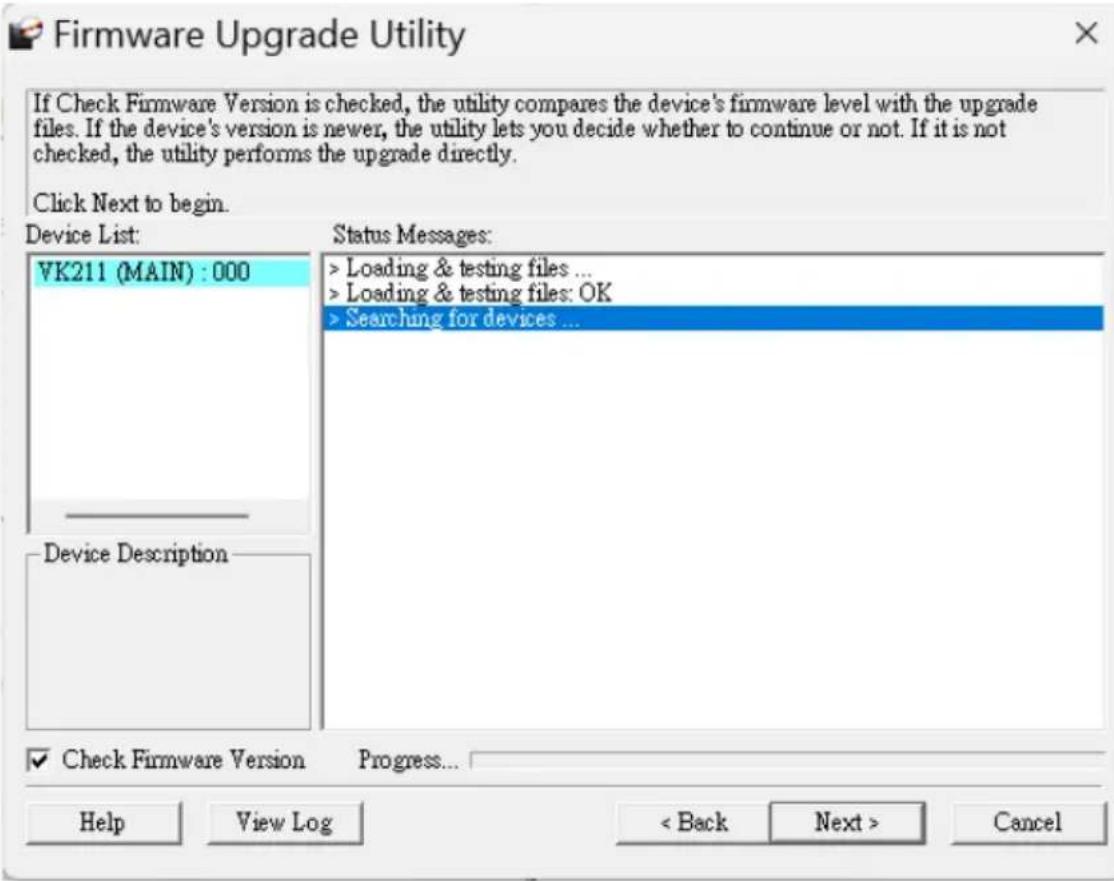
Firmware Upgrade Utility If Check Firmware Version is checked, the utility compares the device's firmware level with the upgrade files. If the device's version is newer, the utility lets you decide whether to continue or not. If it is not checked, the utility performs the upgrade directly. Click Next to begin. Device List: VK211 (MAIN) : 000 Device Description Status Messages: > Loading & testing files ... > Loading & testing files: OK > Searching for devices ...- Click Next to proceed. The upgrade starts.

text_image
Firmware Upgrade Utility If Check Firmware Version is checked, the utility compares the device's firmware level with the upgrade files. If the device's version is newer, the utility lets you decide whether to continue or not. If it is not checked, the utility performs the upgrade directly. Click Next to begin. Device List: VK211 (MAIN) : 000 Status Messages: > Loading & testing files ... > Loading & testing files: OK > Searching for devices ... > Preparing firmware upgrade ... > Firmware version is not newer than device VK211 (MAIN) : 000 > Preparing firmware upgrade: OK > Upgrading device VK211 (MAIN) : 000 ... Device Description CPU : STM32 Device F/W: Ver 1.0.062 U-Code: Ver 1.1.101 ✓ Check Firmware Version Progress... Help View Log < Back Next > Cancel- The upgrade is complete when the system indicates "Firmware upgrade: OK" on the screen.

text_image
Firmware Upgrade Utility The Firmware upgrade was successful. Click Finish to close the utility. Device List: VK211 (MAIN) : 000 Device Description CPU : STM32 Device F/W: Ver 1.0.062 U-Code: Ver 1.1.101 Status Messages: > Loading & testing files ... > Loading & testing files: OK > Searching for devices ... > Preparing firmware upgrade ... > Firmware version is not newer than device VK211 (MAIN) : 000 > Preparing firmware upgrade: OK > Upgrading device VK211 (MAIN) : 000 ... > Upgrading device VK211 (MAIN) : 000: OK > Firmware upgrade: OK > Firmware upgrade: OK Check Firmware Version Progress... Help View Log < Back Finish Cancel7. Click Finish.
Note: In any case if the upgrade was unsuccessful, make sure to perform this procedure again from step 2 (powering on the unit by replugging the USB cable).
This Page Intentionally Left Blank
General
- This product is for indoor use only.
- Read all of these instructions. Save them for future reference.
◆ Follow all warnings and instructions marked on the device. - Do not place the device on any unstable surface (cart, stand, table, etc.). If the device falls, serious damage will result.
- Do not use the device near water.
- Do not place the device near, or over, radiators or heat registers.
- The device cabinet is provided with slots and openings to allow for adequate ventilation. To ensure reliable operation, and to protect against overheating, these openings must never be blocked or covered.
- The device should never be placed on a soft surface (bed, sofa, rug, etc.) as this will block its ventilation openings. Likewise, the device should not be placed in a built-in enclosure unless adequate ventilation has been provided.
- Never spill liquid of any kind on the device.
- Unplug the device from the wall outlet before cleaning. Do not use liquid or aerosol cleaners. Use a damp cloth for cleaning.
- The device should be operated from the type of power source indicated on the marking label. If you are not sure of the type of power available, consult your dealer or local power company.
- To prevent damage to your installation it is important that all devices are properly grounded.
Do not allow anything to rest on the power cord or cables. Route the power cord and cables so that they cannot be stepped on or tripped over. - Position system cables and power cables carefully; Be sure that nothing rests on any cables.
-
Never push objects of any kind into or through cabinet slots. They may touch dangerous voltage points or short out parts resulting in a risk of fire or electrical shock.
-
Do not attempt to service the device yourself. Refer all servicing to qualified service personnel.
-
If the following conditions occur, unplug the device from the wall outlet and bring it to qualified service personnel for repair.
-
The power cord or plug has become damaged or frayed.
- Liquid has been spilled into the device.
- The device has been exposed to rain or water.
- The device has been dropped, or the cabinet has been damaged.
- The device exhibits a distinct change in performance, indicating a need for service.
- The device does not operate normally when the operating instructions are followed.
- Only adjust those controls that are covered in the operating instructions. Improper adjustment of other controls may result in damage that will require extensive work by a qualified technician to repair.
Technical Support
International
- For online technical support – including troubleshooting, documentation, and software updates: http://support.aten.com
◆ For telephone support, call this number:
| International 886-2-8692-6959 |
| China 86-400-810-0-810 |
| Japan 81-3-5615-5811 |
| Korea 82-2-467-6789 |
| North America 1-888-999-ATEN ext 4988 |
| 1-949-428-1111 |
North America
| Email Support support@aten-usa.com | ||
| Online Technical Support | Troubleshooting Documentation Software Updates | http://www.aten-usa.com/support |
| Telephone Support 1-888-999-ATEN ext 4988 | ||
When you contact us, please have the following information ready beforehand:
◆ Product model number, serial number, and date of purchase
- Your computer configuration, including operating system, revision level, expansion cards, and software
◆ Any error messages displayed at the time the error occurred
◆ The sequence of operations that led up to the error
◆ Any other information you feel may be of help
Specifications
| Connectors | |
| Console Ports | 2 x USB Type-A Female |
| Device Ports | 1 x USB Type-B Female |
| RS-232 | 1 x Bi-directional RS-232 port (3-pin terminal connector)◆ Baud rate: 19200◆ Data bit: 8◆ Stop bit: 1◆ Parity: None |
| Contact In | 4 x Contact Closure Input Ports (1 x 5-pole terminal block) |
| Power (Optional) 1 x USB Micro B Female | |
| Priority Button | |
| ◆ 1 x Pushbutton◆ Toggle switch for remote control◆ Hold and press for 3 seconds to enter learning mode | |
| LED | |
| Contact In 4 (green) | |
| Power 1 (green) | |
| Priority 1 (orange) | |
| Power Consumption | |
| DC5V:0.69W:7BTU/h | |
| Power Rating | |
| 5VDC | |
| Environmental | |
| Operating Temperature 0 - | 50°C |
| Storage Temperature -20 - | 60°C |
| Humidity 0 x 80% RH, Non- | Condensing |
| Physical | |
| Housing Metal | |
| Weight 0.15 kg (0.33 lb) | |
| Dimensions (L x W x H) 8.20 x 7.30 x 2.62 cm (3.23 x 2.87 x 1.03 in.) | |
ATEN Standard Warranty Policy
Limited Hardware Warranty
ATEN warrants its hardware in the country of purchase against flaws in materials and workmanship for a Warranty Period of two [2] years (warranty period may vary in certain regions/countries) commencing on the date of original purchase. This warranty period includes the LCD panel of ATEN LCD KVM switches. Select products are warranted for an additional year (see A+ Warranty for further details). Cables and accessories are not covered by the Standard Warranty.
What is covered by the Limited Hardware Warranty
ATEN will provide a repair service, without charge, during the Warranty Period. If a product is detective, ATEN will, at its discretion, have the option to (1) repair said product with new or repaired components, or (2) replace the entire product with an identical product or with a similar product which fulfills the same function as the defective product. Replaced products assume the warranty of the original product for the remaining period or a period of 90 days, whichever is longer. When the products or components are replaced, the replacing articles shall become customer property and the replaced articles shall become the property of ATEN.
To learn more about our warranty policies, please visit our website: http://www.aten.com/global/en/legal/policies/warranty-policy/
© Copyright 2024 ATEN® International Co., Ltd.
Released: 5 August 2024 11:31 am
ATEN and the ATEN logo are registered trademarks of ATEN International Co., Ltd. All rights reserved. All other brand names and trademarks are the registered property of their respective owners.