
P2500 - Power Tools RYOBI - Free user manual and instructions
Find the device manual for free P2500 RYOBI in PDF.


| Product Type | Cordless Telescopic Pole Pruner |
| Brand | RYOBI |
| Model | P2500 |
| Rated Voltage | 18 V DC |
| Blade Length | 12.7 cm (5 in) |
| Maximum Cutting Capacity | 10.2 cm (4 in) |
| Net Weight | 3.34 kg (7.37 lb) |
| Power Source Type | Rechargeable Ni-Cd Battery |
| Compatible Battery Model | P100 (130255004) |
| Recommended Charger | P110 (1423701, 140237023 or 130224028) |
| Charge Time | 1 hour |
| Total Adjustable Length | From 1.8 to 2.4 m (6 to 8 ft) |
| Main Functions | Pruning and trimming branches up to 10.2 cm in diameter |
| Additional Features | Blade protector, cutting guide, integrated hex key, tool-free adjustment collar, trigger lock |
| Maintenance and Cleaning | Clean with a clean cloth; avoid solvents; replace blade with part no. 6968001 |
| Safety | Wear safety glasses, ear protection and gloves; keep bystanders at 15 m; do not use near power lines |
| Spare Parts and Repairability | Repair by authorized center; identical spare parts; replacement blade no. 6968001 |
| General Information | Domestic use; assembly required; battery and charger sold separately |
Frequently Asked Questions - P2500 RYOBI
User questions about P2500 RYOBI
0 question about this device. Answer the ones you know or ask your own.
Ask a new question about this device
Download the instructions for your Power Tools in PDF format for free! Find your manual P2500 - RYOBI and take your electronic device back in hand. On this page are published all the documents necessary for the use of your device. P2500 by RYOBI.
USER MANUAL P2500 RYOBI
Your pole pruner has been engineered and manufactured to our high standard for dependability, ease of operation, and operator safety. When properly cared for, it will give you years of rugged, trouble-free performance.

WARNING: To reduce the risk of injury, the user must read and understand the operator's manual before using this product.
Thank you for your purchase.
TABLE OF CONTENTS
Introduction 2
General Safety Rules 3
■ Specific Safety Rules. 3-4
Safety Rules for Charger 5
Symbols 6-7
Features 8
Assembly 9
■ Operation 10-14
■ Maintenance. 15
Parts Ordering / Service 16
INTRODUCTION
This tool has many features for making its use more pleasant and enjoyable. Safety, performance, and dependability have been given top priority in the design of this product making it easy to maintain and operate.
GENERAL SAFETY RULES

WARNING!
READ AND UNDERSTAND ALL INSTRUCTIONS. Failure to follow all instructions listed below, may result in electric shock, fire and/or serious personal injury.
SAVE THESE INSTRUCTIONS
■ Know your tool. Read and understand the operator's manual and observe the warnings and instruction labels affixed to the tool.
- Stay alert, watch what you are doing, and use common sense when operating a power tool. Do not use tool while tired or under the influence of drugs, alcohol, or medication. A moment of inattention while operating power tools may result in serious personal injury.
- Do not allow children or untrained individuals to use this unit.
- Store idle tools out of reach of children and other untrained persons. Tools are dangerous in the hands of untrained users.
Wear safety glasses or goggles that are marked to comply with ANSI Z87.1 standards and hearing protection when operating this unit.
Wear heavy long pants, boots, and gloves. Do not wear loose fitting clothing, short pants, jewelry of any kind, or go barefoot.
- Secure long hair so it is above shoulder level to prevent entanglement in any moving parts.
- Keep all bystanders, children, and pets at least 50 feet away.
- Do not force tool. Use the correct tool for your application. The correct tool will do the job better and safer at the rate for which it is designed.
- Do not overreach. Keep proper footing and balance at all times. Proper footing and balance enables better control of the pole pruner in unexpected situations. Do not use on a ladder or unstable support.
Do not operate in poor lighting.
- Keep all parts of your body away from any moving part.
- Do not use tool if switch does not turn it on or off. A tool that cannot be controlled with the switch is dangerous and must be repaired.
- Avoid accidental starting. Be sure switch is in the locked or off position before inserting battery pack. Carrying tools with your finger on the switch or inserting the battery pack into a tool with the switch on invites accidents.
- Avoid dangerous environments. Do not use the attachment in damp or wet locations. Do not use in rain.
- Maintain tools with care. Keep cutting tools sharp and clean. Properly maintained tools with sharp cutting edges are less likely to bind and are easier to control.
- Check for misalignment or binding of moving parts, breakage of parts, and any other condition that may affect the tool's operation. If damaged, have the tool serviced before using. Many accidents are caused by poorly maintained tools.
- Keep the tool and its handle dry, clean, and free from oil and grease. Always use a clean cloth when cleaning. Never use brake fluids, gasoline, petroleum-based products, or any strong solvents to clean your tool. Following this rule will reduce the risk of loss of control and deterioration of the enclosure plastic.
- Use only accessories that are recommended by the manufacturer for your model. Accessories that may be suitable for one tool may create a risk of injury when used on another tool.
- Tool service must be performed only by qualified repair personnel. Service or maintenance performed by unqualified personnel may result in a risk of injury.
- When servicing a tool, use only identical replacement parts. Follow instructions in the Maintenance section of this manual. Use of unauthorized parts or failure to follow Maintenance instructions may create a risk of shock or injury.
SPECIFIC SAFETY RULES
Before you start the unit, make sure the blade is not contacting any object.
- Stop the unit, remove the battery pack, and make sure the blade has stopped before setting the unit down.
- Never cut any material with a diameter greater than 4 in.
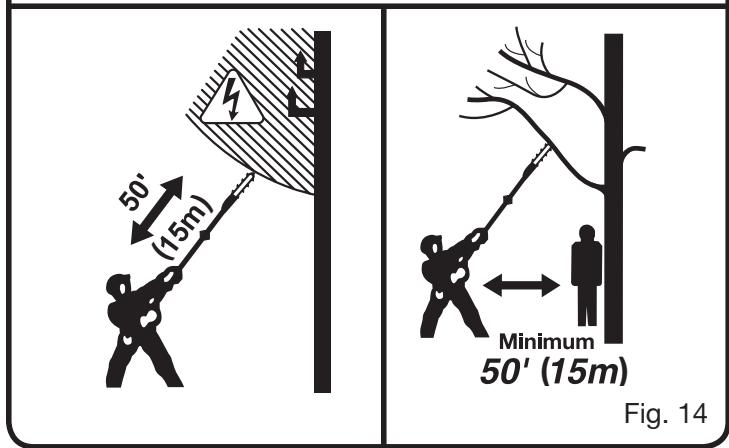
To protect yourself from electrocution, do not operate within 50 feet of overhead electrical lines.
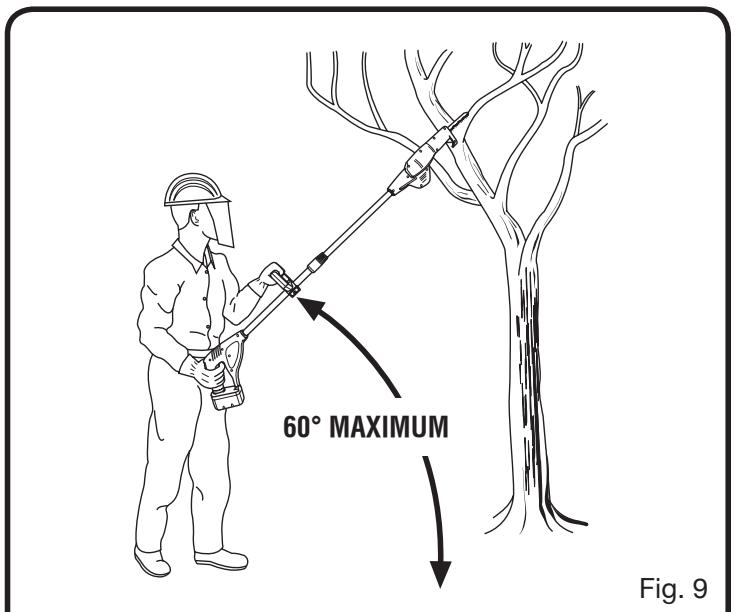
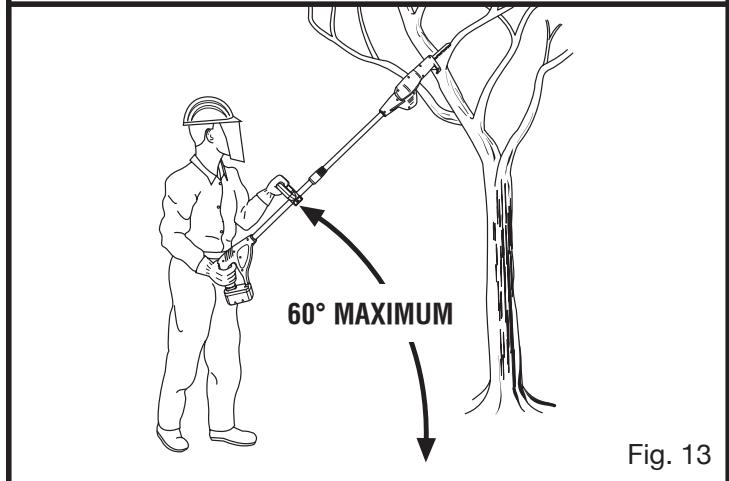
To protect yourself from falling branches, do not stand directly under the branch or limb being cut. This unit should not be held at an angle over 60^ from ground level.
- Replace any blade that has been damaged. Always make sure blade is installed correctly and securely fastened before each use. Failure to do so can cause serious injury.
SPECIFIC SAFETY RULES
PRECAUTIONS AGAINST KICKBACK
Kickback is a dangerous reaction that can lead to serious injury.
- Keep a firm grip on the unit with both hands when operating the unit. Place your right hand on the rear handle and your left hand on the front handle. A firm grip will help you reduce kickback and maintain control of the unit.
Make sure that the area in which you are cutting is free from obstructions. Do not let the blade come in contact with any obstruction while operating the unit.
Always cut with the unit at full speed. Fully squeeze the trigger and maintain a steady cutting speed. - Use only the replacement blade specified for your unit.
ELECTRICAL SAFETY
A battery operated tool with integral batteries or a separate battery pack must be recharged only with the specified charger for the battery. A charger that may be suitable for one type of battery may create a risk of fire when used with another battery.
- Use battery operated tool only with specifically designated battery pack. Use of any other batteries may create a risk of fire.
Use battery only with charger listed.
MODEL BATTERY PACK (P100) CHARGER (P110)
P2500
130255004
1423701, 140237023
or 130224028
or 140237021
- Battery tools do not have to be plugged into an electrical outlet; therefore, they are always in operating condition. Be aware of possible hazards when not using your battery tool or when changing accessories. Following this rule will reduce the risk of electric shock, fire, or serious personal injury.
-
Disconnect battery pack from tool or place the switch in the locked or off position before making any adjustments, changing accessories, or storing the tool. Such preventive safety measures reduce the risk of starting the tool accidentally.
-
Do not place battery tools or their batteries near fire or heat. This will reduce the risk of explosion and possibly injury.
- Do not mutilate the battery pack. Released electrolyte is corrosive and may cause damage to the eyes or skin. It may be toxic if swallowed.
- Never use a battery that has been dropped or received a sharp blow. A damaged battery is subject to explosion. Properly dispose of a dropped or damaged battery immediately.
- Batteries vent hydrogen gas and can explode in the presence of a source of ignition, such as a pilot light. To reduce the risk of serious personal injury, never use any cordless product in the presence of open flame. An exploded battery can propel debris and chemicals. If exposed, flush with water immediately.
- Do not charge battery tool in a damp or wet location. Following this rule will reduce the risk of electric shock.
- For best results, your battery tool should be charged in a location where the temperature is more than 50^ but less than 100^ . Do not store outside or in vehicles.
Under extreme usage or temperature conditions, battery leakage may occur. If liquid comes in contact with your skin, wash immediately with soap and water, then neutralize with lemon juice or vinegar. If liquid gets into your eyes, flush them with clean water for at least 10 minutes, then seek immediate medical attention. - When battery pack is not in use, keep it away from other metal objects like: paper clips, coins, keys, nails, screws, or other small metal objects that can make a connection from one terminal to another. Shorting the battery terminals together may cause sparks, burns, or a fire.
SAFETY RULES FOR CHARGER

WARNING!
READ AND UNDERSTAND ALL INSTRUCTIONS.
Failure to follow all instructions listed below, may result in electric shock, fire and/or serious personal injury.
Before using battery charger, read all instructions and cautionary markings in this manual, on battery charger, battery, and product using battery to prevent misuse of the products and possible injury or damage.

CAUTION:
To reduce the risk of electric shock or damage to the charger and battery, charge only nickel-cadmium rechargeable batteries as specifically designated on your charger. Other types of batteries may burst, causing personal injury or damage.
- Do not use charger outdoors or expose to wet or damp conditions. Water entering charger will increase the risk of electric shock.
- Use of an attachment not recommended or sold by the battery charger manufacturer may result in a risk of fire, electric shock, or injury to persons. Following this rule will reduce the risk of electric shock, fire, or serious personal injury.
- Do not abuse cord or charger. Never use the cord to carry the charger. Do not pull the charger cord rather than the plug when disconnecting from receptacle. Damage to the cord or charger could occur and create an electric shock hazard. Replace damaged cords immediately.
Make sure cord is located so that it will not be stepped on, tripped over, come in contact with sharp edges or moving parts or otherwise subjected to damage or stress. This will reduce the risk of accidental falls, which could cause injury, and damage to the cord, which could result in electric shock. - Keep cord and charger from heat to prevent damage to housing or internal parts.
- Do not let gasoline, oils, petroleum-based products, etc. come in contact with plastic parts. They contain chemicals that can damage, weaken, or destroy plastic.
An extension cord should not be used unless absolutely necessary. Use of improper extension cord could result in a risk of fire and electric shock. If extension cord must be used, make sure:
a. That pins on plug of extension cord are the same number, size and shape as those of plug on charger.
b. That extension cord is properly wired and in good electrical condition; and
c. That wire size is large enough for AC ampere rating of charger as specified below:
| Cord Length (Feet) | 25' | 50' | 100' |
| Cord Size (AWG) | 16 | 16 | 16 |
NOTE: AWG = American Wire Gauge
- Do not operate charger with a damaged cord or plug, which could cause shorting and electric shock. If damaged, have the charger replaced by an authorized serviceman.
- Do not operate charger if it has received a sharp blow, been dropped, or otherwise damaged in any way. Take it to an authorized serviceman for electrical check to determine if the charger is in good working order.
- Do not disassemble charger. Take it to an authorized serviceman when service or repair is required. Incorrect reassembly may result in a risk of electric shock or fire.
- Unplug charger from outlet before attempting any maintenance or cleaning to reduce the risk of electric shock.
- Disconnect charger from the power supply when not in use. This will reduce the risk of electric shock or damage to the charger if metal items should fall into the opening. It also will help prevent damage to the charger during a power surge.
■ Risk of electric shock. Do not touch uninsulated portion of output connector or uninsulated battery terminal. - Save these instructions. Refer to them frequently and use them to instruct others who may use this tool. If you loan someone this tool, loan them these instructions also to prevent misuse of the product and possible injury.
SYMBOLS
Some of the following symbols may be used on this tool. Please study them and learn their meaning. Proper interpretation of these symbols will allow you to operate the tool better and safer.
SYMBOL
NAME
DESIGNATION/EXPLANATION
| V | Volts | Voltage |
| Hz | Hertz | Frequency (cycles per second) |
| A | Amperes | Current |
| W | Watt | Power |
| min | Minutes | Time |
| ~ | Alternating Current | Type of current |
| = | Direct Current | Type or a characteristic of current |
| n0 | No Load Speed | Rotational speed, at no load |
| Class II Construction | Double-insulated construction | |
| .../min | Per Minute | Revolutions, strokes, surface speed, orbits etc., per minute |
| Wet Conditions Alert | Do not expose to rain or use in damp locations. | |
| Read The Operator's Manual | To reduce the risk of injury, user must read and understand operator's manual before using this product. | |
| Eye, Hearing, and Head Protection | Wear eye, hearing, and head protection when operating this equipment. | |
| Safety Alert | Precautions that involve your safety. | |
| Gloves | Wear non-slip, heavy-duty protective gloves when handling the pole pruner and the blade. | |
| Safety Footwear | Wear non-slip safety footwear when using this equipment. | |
| Moving Parts | Keep hands away from moving parts. | |
| Keep Bystanders Away | Keep all bystanders at least 50 ft. away. | |
| Kickback | DANGER! Beware of kickback. | |
| Hot Surfaces | To reduce the risk of injury or damage, avoid contact with any hot surface. | |
| Risk of Electrocution | DANGER! Risk of electrocution! | |
| No Hands Symbol | Failure to keep your hands away from the blade will result in serious personal injury. |
SYMBOLS
| The following signal words and meanings are intended to explain the levels of risk associated with this product. | ||
| SYMBOL | SIGNAL | MEANING |
| DANGER: | Indicates an imminently hazardous situation, which, if not avoided, will result in death or serious injury. | |
| WARNING: | Indicates a potentially hazardous situation, which, if not avoided, could result in death or serious injury. | |
| CAUTION: | Indicates a potentially hazardous situation, which, if not avoided, may result in minor or moderate injury. | |
| CAUTION: | (Without Safety Alert Symbol) Indicates a situation that may result in prop-erty damage. | |
SERVICE
Servicing requires extreme care and knowledge and should be performed only by a qualified service technician. For service we suggest you return the product to the nearest AUTHORIZATION SERVICE CENTER for repair. When servicing, use only identical replacement parts.

WARNING:
To avoid serious personal injury, do not attempt to use this product until you read thoroughly and understand completely the operator's manual. Save this operator's manual and review frequently for continuing safe operation and instructing others who may use this product.

WARNING:

The operation of any power tool can result in foreign objects being thrown into your eyes, which can result in severe eye damage. Before beginning power tool operation, always wear safety goggles, safety glasses with side shields, or a full face shield when needed. We recommend Wide Vision Safety Mask for use over eyeglasses or standard safety glasses with side shields. Always use eye protection which is marked to comply with ANSI Z87.1.
SAVE THESE INSTRUCTIONS
FEATURES
PRODUCT SPECIFICATIONS
Motor 18 Volt DC
Blade Length 5 in.
Cutting Capacity. Max 4 in.
Net Weight 7.37 lb.
Charger Input 120 V, 60 Hz, AC only
Charge Rate 1 hour
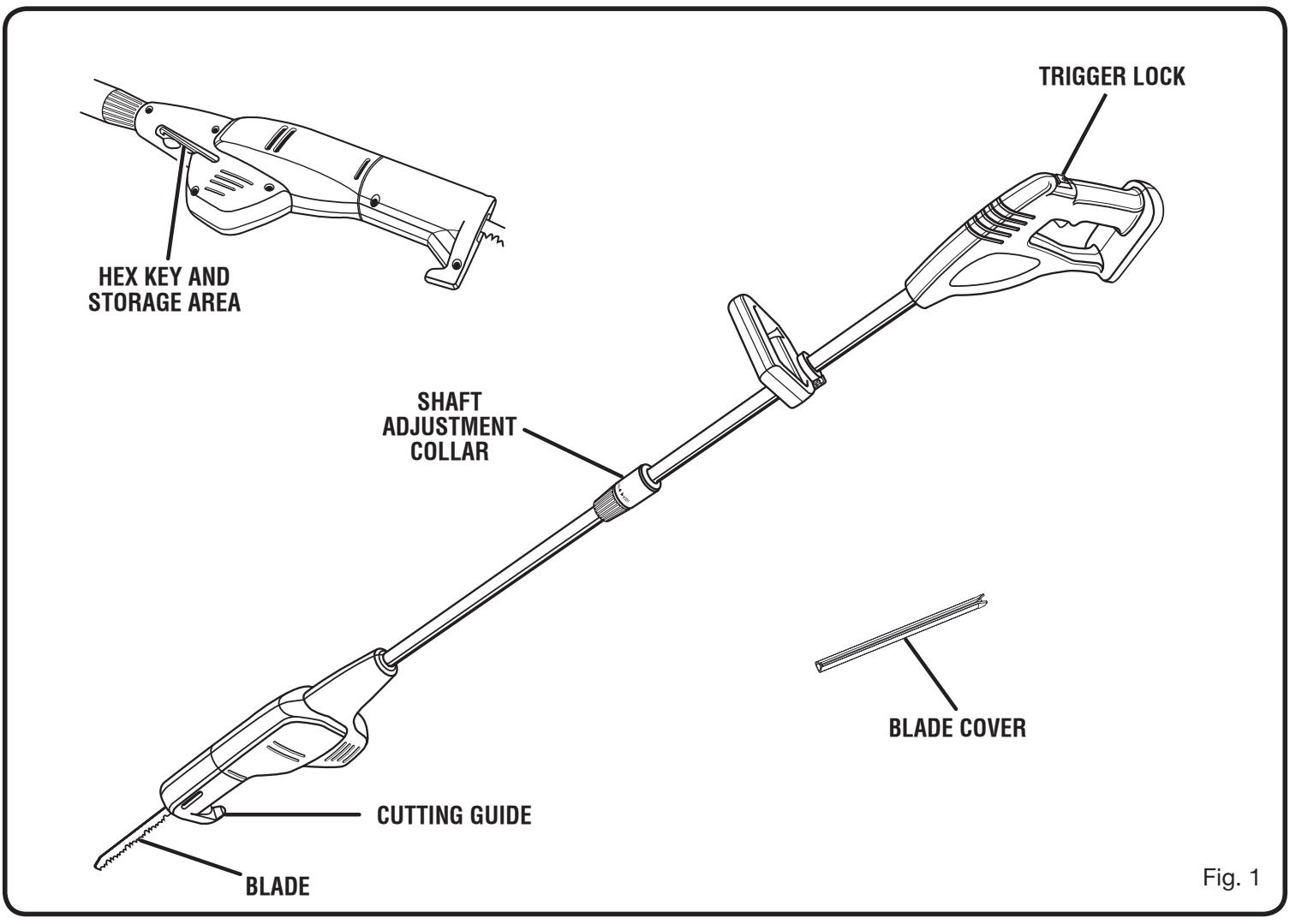
KNOW YOUR POLE PRUNER
See Figure 1.
Before attempting to use this product, familiarize yourself with all operating features and safety rules.
BLADE COVER
The blade cover protects the blade when the tool is being stored or transported.
CUTTING GUIDE
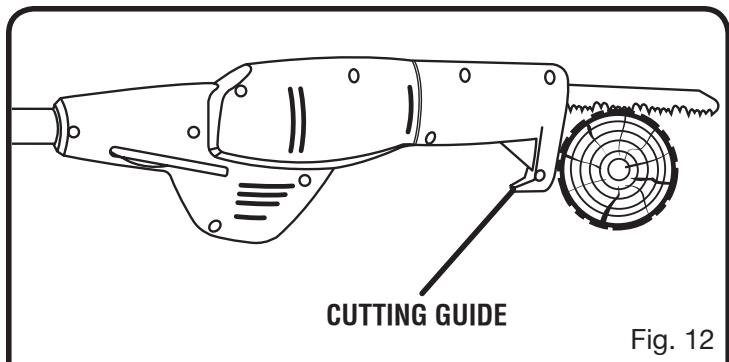
The cutting guide helps to steady a limb when making cuts.
HEX KEY AND STORAGE AREA
The hex key provided with your pole pruner can be used for quick blade changes and returned to a convenient storage area.
SHAFT ADJUSTMENT COLLAR
The shaft adjustment collar easily locks and unlocks for tool-free adjustments to the length of your pole pruner.
TRIGGER LOCK
The trigger lock prevents unintentional starting of the pole pruner.
UNPACKING
This product requires assembly.
- Carefully remove the tool and any accessories from the box. Make sure that all items listed in the packing list are included.
Inspect the tool carefully to make sure no breakage or damage occurred during shipping. - Do not discard the packing material until you have carefully inspected and satisfactorily operated the tool.
If any parts are damaged or missing, please call 1-800-860-4050 for assistance.
PACKING LIST
Pole Pruner
Blade
Blade Cover
Hex Key
Operator's Manual
Warranty Registration Card

WARNING:
If any parts are damaged or missing do not operate this tool until the damaged or missing parts are replaced. Failure to do so could result in possible serious personal injury.

WARNING:
Do not attempt to modify this tool or create accessories not recommended for use with this tool. Any such alteration or modification is misuse and could result in a hazardous condition leading to possible serious personal injury.

WARNING:
To prevent accidental starting that could cause serious personal injury, always remove the battery pack from the tool when assembling parts.

WARNING:
Blades are sharp. When installing and removing the blade, wear non-slip, heavy-duty protective gloves. Do not place your hand or fingers in any position where they could get cut. NEVER touch the blade or service the unit with the battery pack installed.
INSTALLING/REMOVING THE BLADE
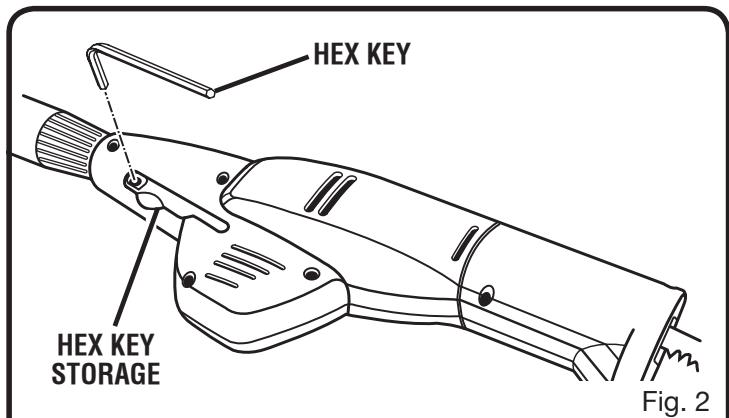
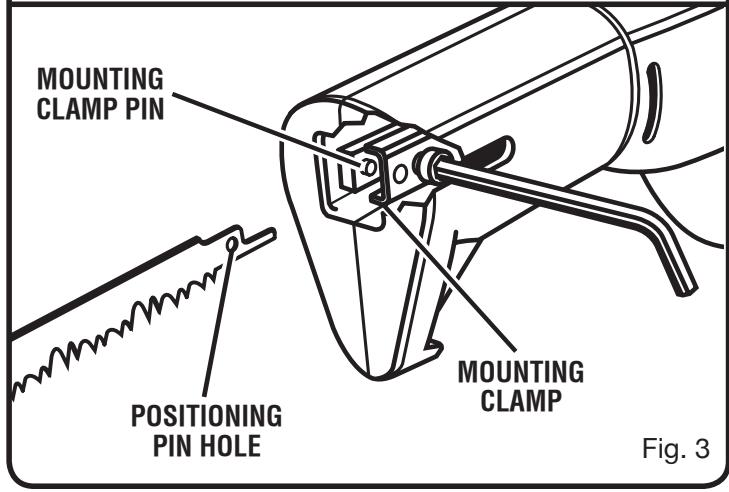
See Figures 2 - 3.
INSTALLING THE BLADE:
Remove the battery pack from the pole pruner.
Remove the hex key from the storage area.
- Place the hex key in the access hole and loosen the blade retaining screw.
Install the blade into the mounting clamp.
NOTE: Make sure the mounting clamp pin is positioned correctly in the positioning pin hole of the blade. If not positioned correctly the mounting clamp will not hold the blade securely.
- Tighten the blade retaining screw securely with the hex key.
Return the hex key to the storage area.
Reinstall the battery pack in the tool.
REMOVING THE BLADE
Remove the battery pack from the pole pruner.
Remove the hex key from the storage area.
- Place the hex key in access hole and remove the blade retaining screw.
- Remove the blade from the unit, making sure the blade clears the mounting clamp pin.
Reinstall the battery pack in the tool.
OPERATION

WARNING:
Do not allow familiarity with tools to make you careless. Remember that a careless fraction of a second is sufficient to inflict serious injury.

WARNING:
Always wear safety goggles or safety glasses with side shields when operating tools. Failure to do so could result in objects being thrown into your eyes, resulting in possible serious injury.

WARNING:
Do not use any attachments or accessories not recommended by the manufacturer of this tool. The use of attachments or accessories not recommended can result in serious personal injury.
APPLICATIONS
You may use this tool for the purpose listed below:
- Limbing and pruning small branches and limbs up to 4 in. in diameter
CAUTION:
If at any point during the charging process none of the LEDs are lit, remove the battery pack from the charger to avoid damaging the product. DO NOT insert another battery. Return the charger and battery to your nearest service center for service or replacement.
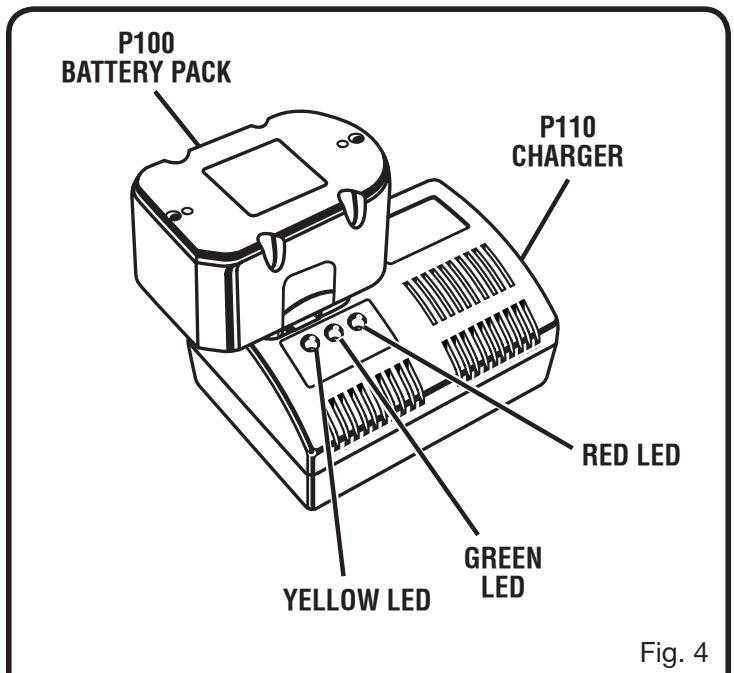
LED FUNCTIONS OF CHARGER
LED WILL BE ON TO INDICATE STATUS OF CHARGER AND BATTERY PACK:
Red LED on = Fast charging mode.
- Green LED on = Fully charged and in maintenance charge mode.
- Green LED on = When battery pack is inserted into charger, indicates hot battery pack or that battery pack is out of normal temperature range.
Yellow and Green LEDs on = Deeply discharged or defective battery pack.
No LED on = Defective charger or battery pack.
CHARGING THE BATTERY PACK
Battery packs for this tool are shipped in a low charge condition to prevent possible problems. Therefore, you should charge it until the green LED on the front of the charger comes on.
NOTE: Batteries will not reach full charge the first time they are charged. Allow several cycles (operation followed by recharging) for them to become fully charged.
If battery pack is within normal temperature range, the red LED on charger will come on.
NOTE: If the charger does not charge the battery pack under normal circumstances, return both the battery pack and charger to your nearest Authorized Service Center for electrical check.
Charge the battery pack only with the charger provided.
Make sure the power supply is normal household voltage, 120 volts, 60 Hz, AC only.
Connect the charger to the power supply.
- Place the battery pack in the charger aligning raised rib on the battery pack with the groove in the charger. See Figure 4.
Press down on the battery pack to be sure contacts on the battery pack engage properly with contacts in the charger.
- Normally the red LED on charger will come on. This indicates the charger is in fast charging mode.
- Red LED should remain on for approximately 1 hour then the green LED will come on. Green LED on indicates battery pack is fully charged and charger is in maintenance charge mode.
NOTE: The green LED will remain on until the battery pack is removed from the charger or charger is disconnected from the power supply.
If both yellow and green LEDs come on, this indicates a deeply discharged or defective battery pack. Allow the battery pack to remain in the charger for 15 to 30 minutes. When the battery pack reaches normal voltage range, the red LED should come on. If the red LED does not come on after 30 minutes, this may indicate a defective battery pack that should be replaced.
After normal usage, a minimum of 1 hour of charging time is required to fully recharge battery pack.
- The battery pack will become slightly warm to the touch while charging. This is normal and does not indicate a problem.
- Do not place the charger and battery pack in an area of extreme heat or cold. They will work best at normal room temperature.
NOTE: The charger and battery pack should be placed in a location where the temperature is more than 50^ but less than 100^ .
- When batteries become fully charged, unplug the charger from power supply and remove the battery pack.
OPERATION
CHARGING A HOT BATTERY PACK
When using the tool continuously, the batteries in the battery pack will become hot. You should let a hot battery pack cool down for approximately 30 minutes before attempting to recharge. When the battery pack becomes discharged and is hot, this will cause the green LED to come on instead of the red LED. After 30 minutes, reinsert the battery pack in the charger. If the green LED continues to remain on, return battery pack to your nearest Authorized Service Center for checking or replacing.
NOTE: This situation only occurs when continuous use of the tool causes the batteries to become hot. It does not occur under normal circumstances. Refer to CHARGING A COOL BATTERY PACK for normal recharging of batteries. If the charger does not charge your battery pack under normal circumstances, return both the battery pack and charger to your nearest Authorized Service Center for electrical check.
TO INSTALL BATTERY PACK
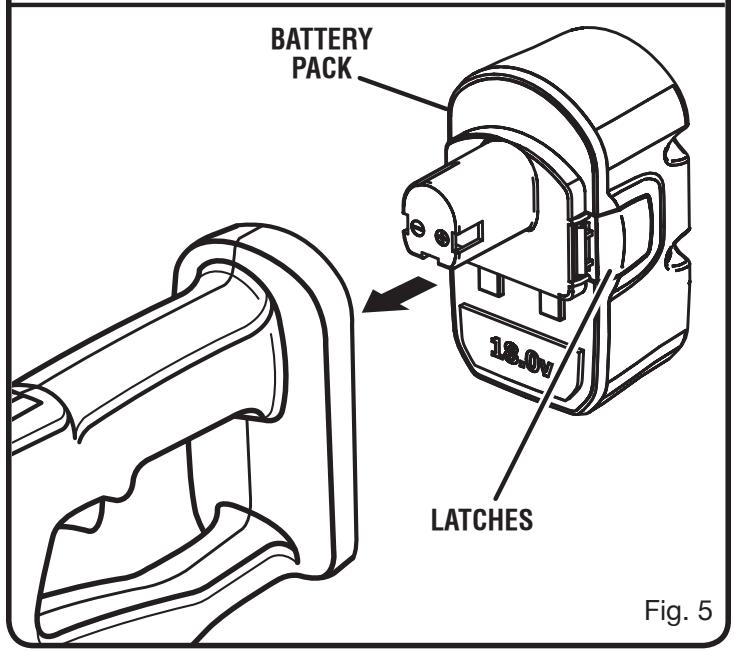
See Figure 5.
- Place the battery pack in the pole pruner. Align the raised rib on the battery pack with groove in pole pruner's battery port.
- Make sure the latches on each side of the battery pack snap in place and that the battery pack is secured in the pole pruner before beginning operation.
CAUTION:
When placing battery pack in the tool, be sure raised rib on battery pack aligns with the bottom of the pole pruner and latches into place properly. Improper installation of the battery pack can cause damage to internal components.
TO REMOVE BATTERY PACK
See Figure 5.
- Locate the latches on the side of the battery pack and depress both sides to release the battery pack from the pole pruner.
OPERATION

WARNING:
Battery tools are always in operating condition. Therefore, switch should always be locked when not in use or carrying at your side.
ADJUSTING THE SHAFT
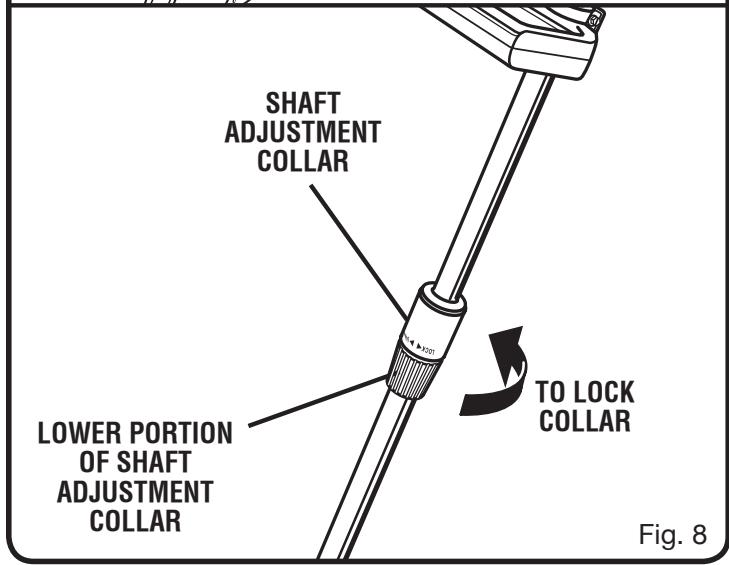
See Figures 6 - 8.
- Rotate the lower portion of the shaft adjustment collar to the "Unlock" position.
- The lower shaft should now be free to slide down from inside the upper shaft. Make sure the shaft is pulled out to the desired position.
- Rotate the shaft adjustment collar to the "Lock" position and tighten securely.
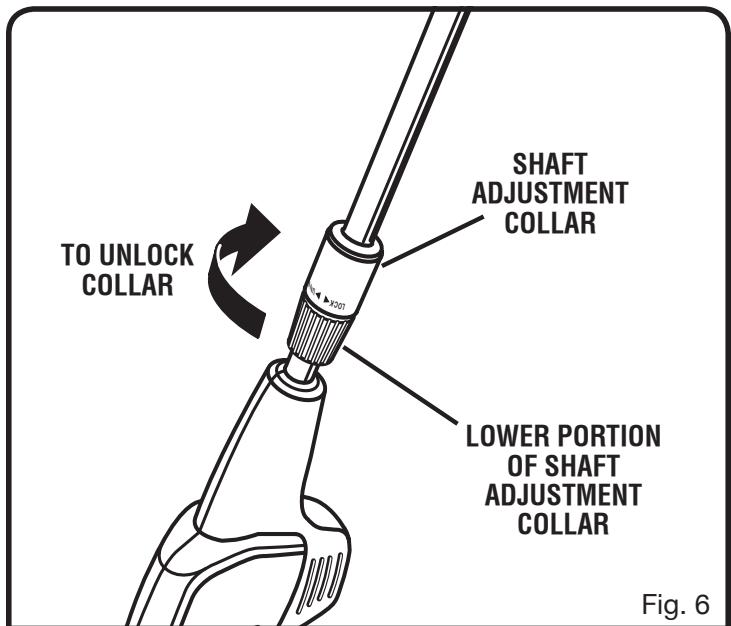
Fig. 6
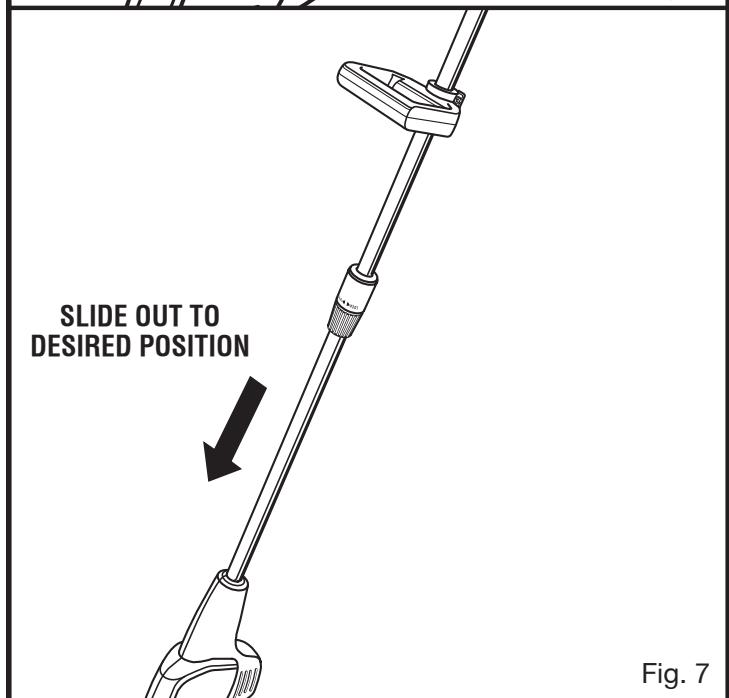
Fig. 7
OPERATION
STARTING AND STOPPING THE POLE PRUNER
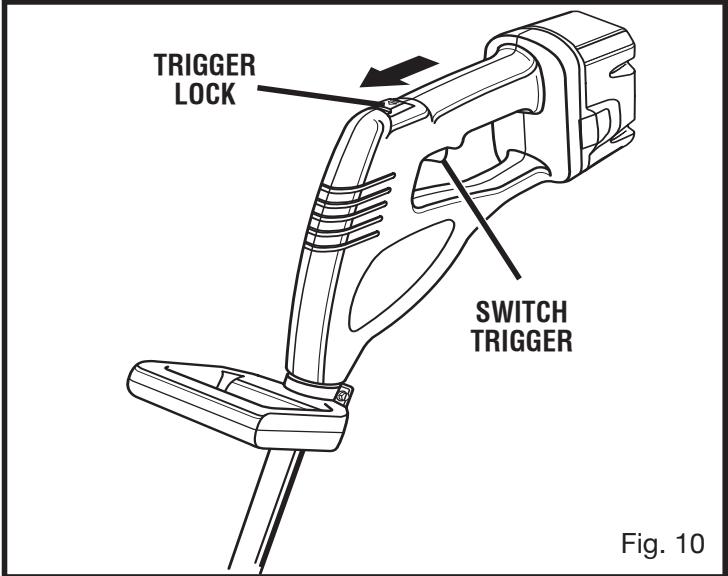
See Figures 9 - 10.
STARTING THE POLE PRUNER
Hold the pole pruner as shown and ensure that you are well away from anything that may contact the blade.
Press and hold the trigger lock.
Depress the switch trigger.
- Release the trigger lock. Continue to depress the trigger for extended operation.
STOPPING THE POLE PRUNER
Release the trigger to stop the pole pruner.
Upon release of the trigger, the trigger lock will automatically reset to the locked position.
PROCEDURES FOR CUTTING
PROPER GRIP ON HANDLES
See Figure 9.
Wear non-slip gloves for maximum grip and protection.
- Maintain a proper grip on the unit when in operation. Use your right hand to firmly grip the rear handle while your left hand has a firm grip on the front handle.
Never stand directly under the limb you are cutting.
BASIC CUTTING PROCEDURE
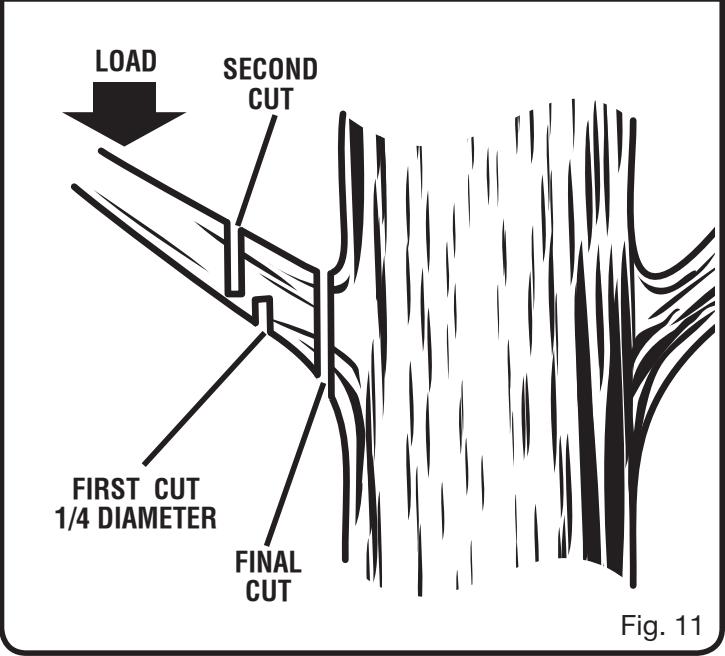
See Figures 11 - 12.
- Cut only wood or materials made from wood: no sheet metal, no plastics, no masonry, no non-wood building materials.
- Accelerate the unit to full speed just before entering the cut by squeezing the trigger.
- Do not use a back-and-forth sawing-type motion for cutting.
To prevent damage to tree or shrub bark:
The first cut should be a shallow cut (1/4 of the limb diameter) on underside of limb or trunk.
The second cut should be made from the top side of the limb outboard from first cut.
Make the final cut close to the trunk and from the top of the branch.
OPERATION
- Keep the unit at full speed the entire time you are cutting.
For second and final cuts (from top of limb or branch), hold the front cutting guide against the limb being cut. This will help steady the limb and make it easier to cut. - Allow the blade to cut for you; exert only light downward pressure. If you force the cut, damage to the blade or unit can result.
- Release the trigger as soon as the cut is completed, allowing the unit to stop.
LIMBING AND PRUNING
See Figures 13 - 14.
This unit is designed for trimming small branches and limbs up to 4 in. in diameter.
Plan the cut carefully. Be aware of the direction in which the branch will fall.
- Branches may fall in unexpected directions. Do not stand directly under the branch being cut.
The pole pruner should typically be positioned at an angle of 60^ or less, depending on the specific situation.
As the boom-to-ground angle of the unit increases, the difficulty of making the first cut (from the underside of limb) increases. Failure to keep the tool at the correct angle can result in the blade binding and becoming pinched or trapped in the limb. If this should happen:
- Stop the unit and remove the battery pack.
- Remove the blade retaining screw, using the hex key supplied, then remove the unit from the trapped blade.
- Lift the limb while holding the blade. This should release the "pinch" and free the blade.
- If the blade or pole pruner is still trapped, call a professional for assistance.
The long reach of the unit allows the operator to prune branches or limbs that are normally out of reach.
- Long branches should be removed in several stages.
- Cut lower branches first to allow the top branches more room to fall.
■ Work slowly, keeping both hands on the pole pruner with a firm grip. Maintain secure footing and balance. - Keep the tree between you and the blade while limbing. Cut from the side of the tree opposite the branch you are cutting.
- Do not cut from a ladder. This is extremely dangerous. Leave this operation for professionals.
Do not use for felling or bucking.
When pruning trees, it is important not to make the flush cut next to the main limb or trunk until you have cut off
the limb further out to reduce the weight. This prevents stripping the bark from the main member. Underbuck the branch 1/4-way through for your first cut. Your second cut should overbuck to drop the branch off. Now make your final cut smoothly and neatly against the main member so the bark will grow back to seal the wound.
- To prevent electrocution, do not operate within 50 feet of overhead electrical lines.
- Keep all bystanders at least 50 ft. away.
- Never climb into a tree to limb or prune. Do not stand on ladders, platforms, or a log, or in any position which can cause you to lose your balance or control of the unit.
MAINTENANCE

WARNING:
When servicing, use only identical replacement parts. Use of any other parts may create a hazard or cause product damage.

WARNING:
Always wear safety goggles or safety glasses with side shields during power tool operation or when blowing dust. If operation is dusty, also wear a dust mask.

WARNING:
To avoid serious personal injury, always remove the battery pack from the tool when cleaning or performing any maintenance.
GENERAL MAINTENANCE
Avoid using solvents when cleaning plastic parts. Most plastics are susceptible to damage from various types of commercial solvents and may be damaged by their use. Use clean cloths to remove dirt, dust, oil, grease, etc.

WARNING:
Do not at any time let brake fluids, gasoline, petroleum-based products, penetrating oils, etc., come in contact with plastic parts. Chemicals can damage, weaken or destroy plastic which may result in serious personal injury.
Only the parts shown on the parts list are intended to be repaired or replaced by the customer. All other parts should be replaced at an Authorized Service Center.
TRANSPORTING AND STORING
Always place the blade cover on the blade before storing or transporting the pole pruner. Use caution to avoid the sharp teeth of the blade.
- Clean the pole pruner thoroughly before storing. Store the pole pruner indoors, in a dry place that is inaccessible to children. Keep away from corrosive agents such as garden chemicals and de-icing salts.
BLADE REPLACEMENT
When replacing the blade on this unit, use only replacement blade part no. 6968001.
BATTERIES
The battery pack for this tool is equipped with nickel-cadmium rechargeable batteries. Length of service from each charging will depend on the type of work you are doing.
The batteries in this tool have been designed to provide maximum trouble-free life. However, like all batteries, they will eventually wear out. Do not disassemble battery pack and attempt to replace the batteries. Handling of these batteries, especially when wearing rings and jewelry, could result in a serious burn.
To obtain the longest possible battery life, we suggest the following:
- Remove the battery pack from the charger once it is fully charged and ready for use.
For battery storage longer than 30 days:
Store the battery pack where the temperature is below 80^ .
Store battery packs in a "discharged" condition.
BATTERY PACK REMOVAL AND PREPARATION FOR RECYCLING

To preserve natural resources, please recycle or dispose of batteries properly.
This product contains nickel-cadmium batteries. Local, state or federal laws may prohibit disposal of nickel-cadmium batteries in ordinary trash.
Consult your local waste authority for information regarding available recycling and/or disposal options.

WARNING:
Upon removal, cover the battery pack's terminals with heavy-duty adhesive tape. Do not attempt to destroy or disassemble battery pack or remove any of its components. Nickel-cadmium batteries must be recycled or disposed of properly. Also, never touch both terminals with metal objects and/or body parts as short circuit may result. Keep away from children. Failure to comply with these warnings could result in fire and/or serious injury.
- SERVICE
Now that you have purchased your tool, should a need ever exist for repair parts or service, simply contact your nearest Authorized Service Center. Be sure to provide all pertinent facts when you call or visit. Please call 1-800-860-4050 for your nearest Authorized Service Center. You can also check our web site at www.ryobitools.com for a complete list of Authorized Service Centers.
- MODEL NO. AND SERIAL NO.
The model number of this tool will be found on a plate attached to the motor housing. Please record the model number and serial number in the space provided below.
HOW TO ORDER REPAIR PARTS
When ordering repair parts, always give the following information:
- MODEL NUMBER
P2500
- SERIAL NUMBER
Ryobi® is a registered trademark of Ryobi® Limited used under license.
- TABLE OF CONTENTS
- INTRODUCTION
- GENERAL SAFETY RULES
- WARNING!
- SAVE THESE INSTRUCTIONS
- SPECIFIC SAFETY RULES
- PRECAUTIONS AGAINST KICKBACK
- ELECTRICAL SAFETY
- MODEL BATTERY PACK (P100) CHARGER (P110)
- SAFETY RULES FOR CHARGER
- READ AND UNDERSTAND ALL INSTRUCTIONS.
- CAUTION:
- SYMBOLS
- SERVICE
- WARNING:
- FEATURES
- PRODUCT SPECIFICATIONS
- KNOW YOUR POLE PRUNER
- BLADE COVER
- CUTTING GUIDE
- HEX KEY AND STORAGE AREA
- SHAFT ADJUSTMENT COLLAR
- TRIGGER LOCK
- UNPACKING
- PACKING LIST
- INSTALLING/REMOVING THE BLADE
- INSTALLING THE BLADE:
- REMOVING THE BLADE
- OPERATION
- APPLICATIONS
- LED FUNCTIONS OF CHARGER
- LED WILL BE ON TO INDICATE STATUS OF CHARGER AND BATTERY PACK:
- CHARGING THE BATTERY PACK
- CHARGING A HOT BATTERY PACK
- TO INSTALL BATTERY PACK
- See Figure 5.
- TO REMOVE BATTERY PACK
- ADJUSTING THE SHAFT
- STARTING AND STOPPING THE POLE PRUNER
- STARTING THE POLE PRUNER
- STOPPING THE POLE PRUNER
- PROCEDURES FOR CUTTING
- PROPER GRIP ON HANDLES
- BASIC CUTTING PROCEDURE
- LIMBING AND PRUNING
- MAINTENANCE
- GENERAL MAINTENANCE
- TRANSPORTING AND STORING
- BLADE REPLACEMENT
- BATTERIES
- BATTERY PACK REMOVAL AND PREPARATION FOR RECYCLING
- - SERVICE
- - MODEL NO. AND SERIAL NO.
- HOW TO ORDER REPAIR PARTS
Brand : RYOBI
Model : P2500
Category : Power Tools