
PHONEFAX 2440 - Fax SAGEM - Free user manual and instructions
Find the device manual for free PHONEFAX 2440 SAGEM in PDF.


| Product type | Thermal fax with telephone |
| Brand | SAGEM |
| Model | PHONEFAX 2440 |
| Dimensions (W x D x H) | 300 x 250 x 120 mm |
| Weight | 3,5 kg |
| Power supply | 220-240 V, 50 Hz |
| Paper type | Thermal paper roll (210 mm x 30 m) |
| Transmission speed | 9,6 kbit/s (G3) |
| Page memory | Up to 15 pages |
| Main functions | Send, receive, copy, built-in answering machine, speed dial, automatic redial |
| Number of speed dial entries | 30 |
| Display | LCD 2 lines, 16 characters |
| Telephone handset | Yes, with hands-free function |
| Maintenance and cleaning | Clean the print head with a cotton swab soaked in isopropyl alcohol |
| Safety | Use a grounded wall outlet; do not expose to moisture |
| Spare parts and repairability | Thermal paper roll, handset, telephone cord available |
| Manufacturer reference | 23226033-4 / 23260056-2 |
| General information | Device from the PHONEFAX range, compatible with analog telephone lines |
Frequently Asked Questions - PHONEFAX 2440 SAGEM
User questions about PHONEFAX 2440 SAGEM
0 question about this device. Answer the ones you know or ask your own.
Ask a new question about this device
Download the instructions for your Fax in PDF format for free! Find your manual PHONEFAX 2440 - SAGEM and take your electronic device back in hand. On this page are published all the documents necessary for the use of your device. PHONEFAX 2440 by SAGEM.
USER MANUAL PHONEFAX 2440 SAGEM
1 : key to print documents received in the memory
2 : key to play back messages received on the answering machine
- blinking: presence of messages not played back
- steady: presence of played back messages
3 LCD screen made of 2 lines of 16 characters and 10 icons
4 Choice of fax transmission resolution
- (Fine): fine icon on
- (Photo): photo icon on
5 Lineicon :
on: fax communication in progress
- blinking: establishment of fax communication or phone communication in progress
6 Memory status (0 to 4)
7 Choice of reception mode (A)
- icon (TEL): telephone in service Blinking icon: mute ring
- icon (FAX): automatic fax reception
- icon (TAD): TAD in service
8 Web (WEB TO PRINT) key: access to Web services directory
9 (DIRECTORY) key: access to directory
10 _R key: insertion of a dialling break (/), or flash feature (PABX)
11 (REDIAL) key: automatic call-back of one of the last 10 called numbers
12 Numeric keypad
13 (START) key: fax transmission, or local copy
14 @ (INTERNET) key: transmission via the Internet
15 (STOP) key: stop of the operation in progress, or activation of the secret mode
16 (LOUDSPEAKER) key: hands-free mode or speaker mode
17 key: move up in menus or to the left in an entry field - Volume up
18 OK key: confirmation of the displayed selection
19 (M) (MENU) key: access to the various functions
20 key: move down in menus or to the right in an entry field - Volume down
21 C key: return to previous displayed message or clearing of
the last character entered in an entry field
22 Alphabetic keypad
23 Ctrl key: used in conjunction with any letter on the keypad to access the symbols shown above the alphabetic characters
24 @ key: used alone to insert a space. Used in conjunction with the Ctrl key to enter the @ character in an Internet address
25 (shift) key:used in conjunction with any letter on the keypad to enter a capital letter
26 F1 F2 F3 keys: preprogrammed keys to access the following functions:
F1 : list of callers (Service Class)
F2 : might mode
F3:access to the print menu
CONTENTS
INTRODUCTION 1
Unpacking. 1
Connections 2
Loading the paper 2
Choosing the operating mode 4
The menus. 5
TELEPHONING 7
Calling 7
Answering a call. 7
Functions available during a call 8
DIRECTORY (MENU 1) 9
Creating a record. 9
Making a call from the directory 10
Editing a record 10
Deletingarecord 11
Printing the directory. 11
Saving/ loading the directory 11
SETTINGSMENU2) 13
Date/Time 13
Number/Name 13
Ringing melody and key beeps. 13
Network 14
Night mode. 14
Number of rings for the auto mode. 15
Cordless phone 15
Protection of your machine. 15
FAX (MENU 3) 17
Inserting the document into the feeder 17
Sending a fax. 18
Receiving a fax 20
During transmission 21
Advanced functions 21
Operation with a cellphone. 22
TAD (MENU 4) 23
Greeting messages 23
Switching on 24
Messages 24
Remote access 25
Advanced functions 26
Printing 29
Local copy 29
Ribbon gauge display 30
Printing the Web site directory 30
DOCUMENT CONTROL (MENU 6) 31
Executing a pending command 31
Modifying or consulting the queue 31
Deleting a command from the queue 31
Print a document waiting for transmission 31
Printing out the list of pending operations 32
ADVANCED FUNCTIONS (MENU 7) 33
Mailbox (MBX) 33
Technical parameters 35
Remote control from an extension set 35
SERVICES (MENU 8) 37
Web to print service 37
F@x^TM to Fax service (depending on model) 39
INTERNET (MENU 9) 41
Internet subscription 41
Transmission/Reception on the internet 43
Settings 45
OPTIONS 49
Display 49
Using the R key. 50
Connection to a PC 50
APPENDIX 51
Replacement of consumables. 51
Troubleshooting. 54
Codes of the transmission report 55
Technical specifications 56
This equipment has been approved in accordance with Council Decision 98/482/EC for pan-European single terminal connection to the public switched telephone network (PSTN). This equipment is in accordance to the following standards: I-CTR 37, CTR 38, ETSI EG 201 121.
In the event of problems, you should contact your equipment supplier in the first instance.
QUICK REFERENCE GUIDE,MENUGUIDE
DIRECTORY (MENU 1)
| Press | Function called | Function description | See page |
| M 11 OK | ADD | Add a record into the directory | 9 |
| M 12 OK | MODIFY | Modify a record in the directory | 10 |
| M 13 OK | CANCEL | Delete a record from the directory | 11 |
| M 14 OK | Print the directory | 11 | |
| M 16 OK | SAVE/LOAD | Save/load the directory on a chip card | |
| M 161 OK | SAVE | Save the directory on a chip card | 11 |
| M 162 OK | LOAD | Load the directory from a chip card | 11 |
SETTINGS (MENU 2)
| Press | Function called | Function description | See page |
| M 21 OK | DATE/TIME | Enter the date and time | 13 |
| M 22 OK | NUMBER/NAME | Enter your number and name | 13 |
| M 23 OK | MELODIES/BEEPS | Choose the ring melody and key beeps | 13 |
| M 231 OK | MELODY | Choose the ring melody | |
| M 232 OK | BEEPS | Choose the key beeps | |
| M 233 OK | ALARM | Switch alarm On/Off | |
| M 24 OK | NETWORK | Set network parameters | 14 |
| M 241 OK | NETWORK TYPE | Select network type | |
| M 242 OK | PREFIX | Activate the prefix | |
| M 25 OK | NIGHT MODE | Control the night mode | 14 |
| M 26 OK | NB OF RINGS | Set the number of rings | 15 |
| M 27 OK | CORDLESS | Cordless phone (depending on model) | 15 |
| M 271 OK | HANDSET REGIS | Register handset (depending on model) | |
| M 272 OK | HANDSET ERASE | De-register handset (depending on model) | |
| M 273 OK | HANDSET CODE | Radio encryption code (depending on model) | |
| M 28 OK | SECURITY | Protected access | 15 |
| M 281 OK | MEM ACCESS | Lock fax and voice messages | |
| M 282 OK | REMOTE CODE | Remote access code |
FAX (MENU 3)
| Press : | Function called | Function description | See page |
| M 31 OK | FCT TRANSM | Delayed transmission and broadcasting | 18 |
| M 32 OK | POLLING ACTV | Perform an active polling | 21 |
| M 33 OK | POLLING PASS | Perform a passive polling | 21 |
| M 34 OK | SEND REPORT | Print choice of transmission reports | 19 |
| M 35 OK | TX FROM MEM | Transmission from the memory or document feeder | 19 |
| M 36 OK | RX TO MEM | Reception of documents into the memory or on paper | 20 |
| M 39 OK | GSM TRANSM | Transmission from a GSM device | 22 |
TAD (MENU 4)
| Press : | Function called | Function description | See page |
| M 41 OK | OGM RECORD | Record the outgoing greeting message | 23 |
| M 42 OK | OGM PLAYING | Play back the outgoing greeting message | 23 |
| M 43 OK | MEMO | Record a message (memo) | 24 |
| M 44 OK | DELETE MSG | Delete the voice messages | 25 |
| M 45 OK | TYPE | Select the type of TAD | 24 |
| M 46 OK | FILTERING | Select the call filtering feature | 26 |
| M 47 OK | PRIVIL ACCES | Select the privileged access mode | 26 |
| M 48 OK | PRIVIL CODE | Select the privileged access code | 26 |
| Press : | Function called | Function description | See page |
| M 51 OK | GUIDE | Print the menus | 29 |
| M 52 OK | LOGS | Print the Tx and Rx logs | 29 |
| M 53 OK | DIRECTORY | Print the directory | 29 |
| M 54 OK | SETTINGS | Print the setting list | 29 |
| M 55 OK | SEND REPORT | Print the last communication report | 29 |
| M 56 OK | LOCAL COPY | Choose the number of copies | 29 |
| M 57 OK | RIBBON GAUGE | Display the ribbon gauge status | 30 |
| M 58 OK | INTERNET SERVICE | Print the Web site directory | 30 |
DOCUMENT CONTROL (MENU 6)
| Press : | Function called | Function description | See page |
| M 61 OK | PERFORM | Perform a pending command | 31 |
| M 62 OK | MODIFY | Modify a pending command | 31 |
| M 63 OK | CANCEL | Cancel a pending command | 31 |
| M 64 OK | PRINTING DOC | Print a pending document | 31 |
| M 65 OK | PRINT LIST | Print the command list | 32 |
ADVANCED FUNCTIONS (MENU 7)
| Press : | Function called | Function description | See page |
| M 71 OK | MAILBOX | Mailbox functions | |
| M 711 OK | CREATE | Create a mailbox | 33 |
| M 712 OK | CANCEL | Cancel mailboxes | 33 |
| M 713 OK | TX MAILBOX | Transmission to a mailbox | 34 |
| M 714 OK | MBX POLLING | Poll a mailbox | 34 |
| M 79 OK | TECHNICAL | Modification of the technical parameters | 35 |
SERVICES (MENU 8)
| Press : | Function called | Function description | See page |
| M 81 OK | WEB TO PRINT | Print Web pages | |
| M 811 OK | MY LOG | Select Web sites for my log | 37 |
| M 812 OK | UPDATE | Automatic update of the WEB directory | 37 |
| M 813 OK | ADD | Add a record into the directory | 38 |
| M 814 OK | MODIFY | Modify a name in the WEB directory | 39 |
| M 815 OK | CANCEL | Delete a name from the WEB directory | 39 |
| M 816 OK | Print the WEB directory | 37 | |
| M 82 OK | F@XTM TO FAX | Transmission to a fax machine via the Internet + Translation of the attachments | 39 |
| M 83 OK | CARD CODE | Register the Services card | 39 |
INTERNET (MENU 9)
| Press : | Function called | Function description | See page |
| M 91 OK | PROVIDER | Choose the access provider | 42 |
| M 92 OK | IMMED ACCESS | Immediate connection to the Internet access provider | 43 |
| M 93 OK | SEND E-MAIL | Send a message from the keypad | 44 |
| M 94 OK | SEND V-MAIL | Send a voice mail | 44 |
| M 95 OK | SETTINGS | ||
| M 951 OK | CONNECTION | Choose the type of connection | 45 |
| M 952 OK | TRANSMISSION | Print the Internet parameters | 46 |
| M 953 OK | SERVERS | Internet server addresses | 46 |
| M 954 OK | Choose the type of transmission | 45 | |
| M 96 OK | MAIL SWITCH | Sort the received mails: choose the type of reception | 46 |
| M 98 OK | REROUTING | Reroute fax and voice messages | 47 |
| M 981 OK | ON | Switch on the rerouting function | |
| M 982 OK | OFF | Switch off the rerouting function | |
| M 983 OK | SETTINGS | Set rerouting parameters | |
| M 99 OK | SUBSCRIPTION | ||
| M 991 OK | REGISTERING | Send subscription form | 42 |
| M 992 OK | NEW ADDR | Enter the new e-mail address | 42 |
NOTE POUR
L'IMPRIMEUR :
Insérer ici
The devices in the Internet Phonef@xTM range are both versatile and powerful communication tools. You can use them to phone and fax documents, but also to send faxes that addresses will receive as e-mail, or else to print out pages from an Internet site the address of whom you know. Moreover, even if you do not have a personal computer, anyone can send you e-mail which you will receive and print out directly on your fax machine.
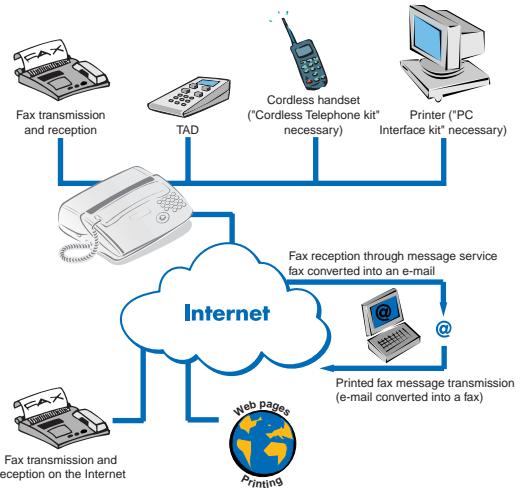
Internet Phonef@xtM features
Because you can use this new generation of fax machines to send your faxes via the Internet, you will benefit from reduced rates since you will be charged only for a local call for all the calls you make (please refer to the section entitled INTERNET (MENU 9) on page 41).
The installation of your machine and the operation of all of its functions and features require a telephone socket and a mains socket near the machine. Internet connections require Internet access (or subscription).
UNPACKING
Check for the following items when unpacking your machine:
- Main unit,
Power cord, - Telephone handset,
- Telephone line cord,
- Paper,
- Paper holder ^(*) ,
- DECT kit (cordless phone, charger and base station)**
An ink ribbon and its gauge card are pre-installed in the machine. You will have to replace them when they are worn (please refer to § Replacement of consumables on page 51).
CONNECTIONS
Caution - Please refer to the Safety Instructions at the beginning of this User's manual.
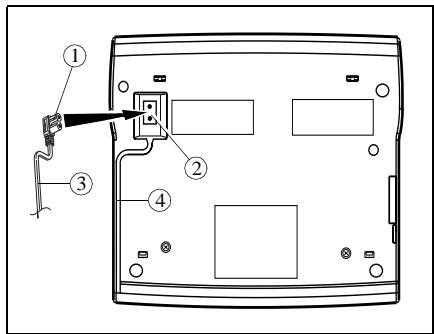
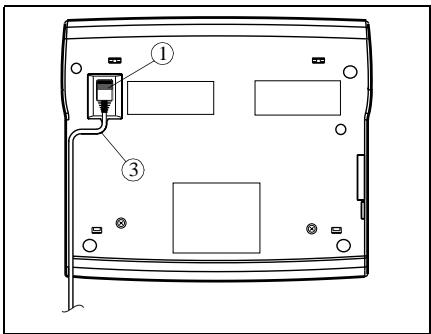
Turn your machine upside down.
Insert the plug (1) of the power cord into the connector (2) of the main unit.
Run the power cord (3) into the groove (4).
Replace your machine the right way round.
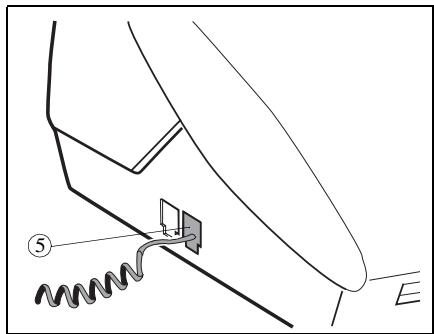
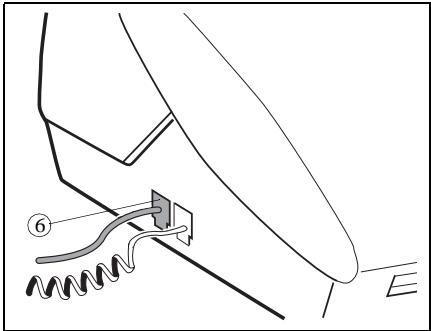
Connect the telephone handset cord to the appropriate connector (5) on the main unit.
Connect the telephone line cord plug to the appropriate connector (6) on the main unit, and connect the other end to the wall telephone socket.
Connect the power plug to the wall mains socket.
LOADING THE PAPER
You may use any standard plain paper (A4 format photocopying paper, approx. 80g / m^2 ). However, for optimal print quality results, we suggest you use the type of paper recommended by the manufacturer (please refer to the last page of this User's manual).
To avoid malfunctions and get optimal print quality, you should observe the following basic instructions:
- use perfectly new paper without folds or rolled edges,
- do not reload the paper tray while printing is in progress,
- always remove all the pages left in the tray before reloading paper.
MODELS WITH A FIXED PAPER TRAY
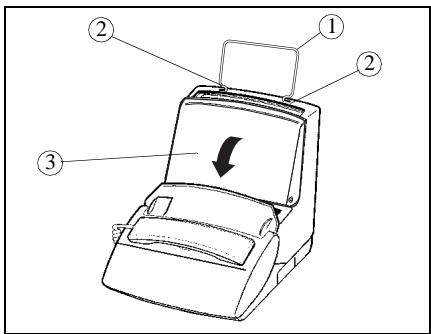
Snap the paper holder (1) in the two slots (2) provided at the top of the sheet feeder.
Open the feeder cover (3)
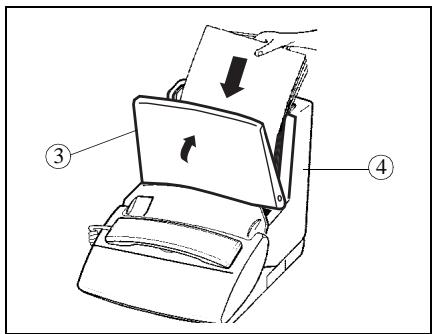
Prepare a stack of plain paper (100 sheets maximum)
Place the paper stack into the feeder (4).
Close the feeder cover (3).
MODELS WITH A REMOVE PAPER TRAY
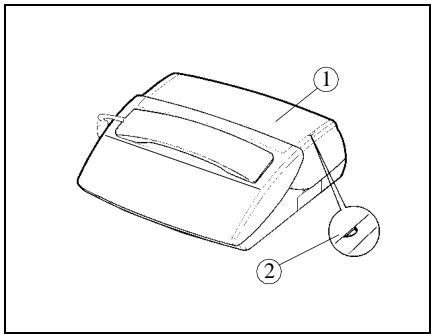
To open the cover (1), use notch (2) on the side.
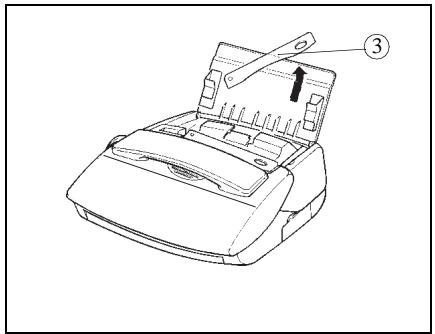
Lift the paper support bracket (3).
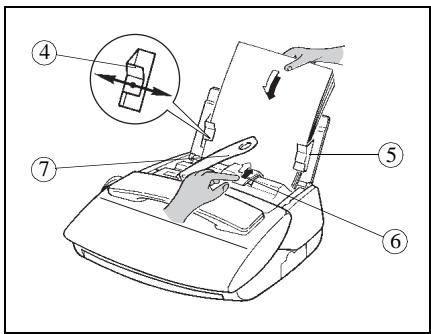
Prepare a stack of paper (30 sheets max.).
Insert it between the paper guides (4 and 5).
Press the clip (6) to insert the paper in the fax machine's paper store.
Adjust the left paper guide (4) to the width of the paper.
Caution - Lift the support bracket to facilitate printout stacking.
CHOOSING THE OPERATING MODE
Your Internet Phonef@xTM machine has three distinct operating modes, which are described below:
- automatic mode with TAD: your machine answers all calls and records incoming messages,
- automatic mode without TAD: your machine sorts incoming calls before presenting them to you,
- manual mode: your fax machine never answers any calls automatically.
In each of these three modes, you may pick up the handset at any time:
- when receiving a fax call, you can switch your fax machine to the fax reception mode by pressing the key,
- when receiving a voice call, talk with the caller as you would on the phone.
Press the key once or repeatedly depending on the required reception mode: the icons corresponding to each mode are blanked (function off) or displayed (function on), as shown in the following three sections.
AUTOMATIC MODE WITH TAD
Your unit works like a telephone answering device combined with a fax machine. Select that mode when you go out or if you do not want to lose any fax or voice calls.
When your machine rings, it answers after a couple of rings and plays the greeting message you have recorded on your TAD:
- if the call is a fax call, it automatically switches to the fax reception mode,
- if the call is a voice call, the caller will be able to leave a message on your TAD.
□ You can set the number of rings before your machine automatically answers (please refer to § Number of rings for the auto mode on page 15).
AUTOMATIC MODE WITHOUT TAD
Your machine automatically sorts the calls before presenting them to you. Select that mode if you receive many faxes and you do not want to be disturbed by their reception.
When it receives a call, your machine automatically answers without ringing ^(*) , then it emits a waiting signal, and:
- if the call is a fax call, it switches to the fax reception mode,
- if the call is a voice call, it rings (warning ring) for 30 seconds** and the caller can hear a ringing tone. you can then pick up and talk. Otherwise, the caller will be able to leave a message on your TAD, which will answer after 30 seconds and play the greeting message.
MANUAL MODE
Your machine mainly works like a telephone set: select that mode if you usually do not receive any taxes.
In that mode, your machine never answers automatically (except after 10 rings if remote interrogation is enabled. In that case, it will play the greeting message).
THE MENUS
ACCESSING THE MENUS
As described in the next sections, your machine features many functions accessible through the menus, which allow you to set and modify them: recording a directory of numbers, memorising received or sent faxes, setting the number of rings, etc.
As can be seen in the menu guide, all functions are numbered in a main menu (e.g.1. Directory), from which you can access the various settings for the selected function (e.g. 1.1 Add, 1.2 Modify or 1.3 Delete a directory record).
Main menu: access to functions
Press the M key.
Sub-menus: access to function settings
Press the key to select the previous menu line.
Press the key to select the next menu line.
Press the OK key to confirm and go on to the next menu.
Press the C (ECM) key to return to the previous menu.
Press the (START) key to confirm and exit from the main menu.
Press the (STOP) key to exit from the current menu.
Moving inside a data entry field
Press the C key to delete the last character.
Hold the C key down to delete all the characters entered.
Press the key to move the cursor to the left within a data entry field
Press the key to move the cursor to the right within a data entry field
Press the @ key to insert a space.
Press the OK key to confirm entry and go on to the next menu item.
Press the (START) key to confirm entry and exit from the current menu.
Press the key to cancel entry and return to the initial value.

PRINTING THE MENU GUIDE
To print the menus and thus get an overview of menus, proceed as follows:
Insert paper.
Press the M, 5, 1 and OK keys or the F3 and OK keys.
The menus are classified in their order of function number (please refer to the section entitled QUICK REFERENCE GUIDE, MENU GUIDE). The functions are classified in their order of appearance in this manual. Tabs are provided for quick access to the required information.
TELEPHONING
Although it features advanced functions, your Internet PhoneF@xTM machine is also a telephone set providing a whole range of user-friendly functions.
CALLING
CALLING USING THE HANDSET
You can also dial the number before picking up the handset. In that case, you can correct any dialling error by means of the C key.
You can use the and keys to adjust the volume.
CALLING USING THE KEY
Loudspeaker listening
Dial your party's number. This is displayed on the screen.
Pick up the handset, the machine dials automatically.
When your party answers, press the key to activate loudspeaker listening.
You can use the and keys to adjust the volume.
Press the key again to de-activate loudspeaker listening.
Hands-free mode (on-hook listening)
Dial your party's number.
Press the key: the machine dials automatically.
You can use the and keys to adjust the volume..
At any time, you can pick up the handset and continue the call (in which case the speaker and microphone are automatically disabled).
CALLING USING THE DIRECTORY
Your machine can store phone numbers in a directory. To know the applicable procedure, please refer to the section entitled DIRECTION (MENU 1) on page 9.
REDIALLING ONE OF THE LAST TEN NUMBERS CALLED
Press the (REDIAL) key.
Select the required number using the and keys.
To call the number displayed press the key or pick up your handset.
At any time, you can delete the REDIAL number by pressing the C, (REDIAL) and OK keys.
ANSWERING A CALL
When someone calls you, your phone rings and the LINE icon blinks. Pick up your handset (or press the key) and speak. To end the call, hang up the handset (or press the key).
FUNCTIONS AVAILABLE DURING A CALL
KNOWING THE DURATION OF THE CALL
Ten seconds after dialling, a counter displays the approximate duration of the call.
ACTIVATING LOUDSPEAKER LISTENING
During the call, press the key. This will activate the loudspeaker, enabling another person to listen to the conversation.
SWITCHING FROM LOUDSPEAKER LISTENING TO HANDS-FREE MODE
Hold down the key.
Hang up the handset.
Release the key. Conversation then goes on in the hands-free mode.
ACTIVATING THE SECRET MODE
During a call, if you want your party not to hear you for a while, press the key. Press that key again to resume your conversation.
RECORDING A CALL
During a handset call, you can record the conversation.
Press the M and keys: recording starts.
To stop recording, press
REROUTING A CALL
To reroute a call to another set (connected to the same telephone line):
Press the M and keys.
Hang up the handset.
Go to the other set, pick up and continue the call.
You should hang up the handset within 4 seconds. You have about 25 isecods to pick up the other handset.
SWITCH TO FAX RECEPTION MODE
If you pick up a secondary handset or take the line from a cordless phone and you cannot hear anyone speaking, you can switch your machine remotely to fax reception mode by typing # then 7 (please refer to the section entitled FAX (MENU 3) on page 17).
DIRECTORY (MENU 1)
The directory is a file in which you can store phone and fax numbers, especially those of the parties you call most frequently. So, instead of dialling a phone or fax number or entering an e-mail address each time you want to communicate with one of your parties, you have only to select their names from the directory. Using the data you have stored, your Internet Phonef@xTM machine will dial automatically for you.
The records stored in the directory are classified in alphabetical order.
CREATING A RECORD
To fill in the directory, enter each party's phone number and name in a record. To create a new record and add it to the directory:
PRESS THE M,1,1,OK KEYS
You can cancel the process at any time by pressing
YOUR PARTY'S NAME
Enter your party's name.
Press the OK key to confirm.
You can move in the data entry field using the or key, delete the last character entered by briefly pressing the C key, delete all the characters entered by holding down the C key.
PHONE AND FAX NUMBERS
Then, enter your party's phone and/or fax number.
Press the OK key to confirm.
If your fax machine is in the premises of a company, it may be connected to a private automatic branch exchange (PABX). Some of these telephone exchanges require the insertion of a dialling prefix (e.g. 0). All numbers should be stored in the directory without that prefix. You can program the prefix automatically for all numbers (please refer to § Prefix on page 14). Some telephone exchanges also require the insertion of a post-dial delay. If such is the case, press the R key in order to insert the post-dial delay (the character / is inserted in the number displayed).
INTERNET ADDRESS
Then, enter your party's e-mail address, if any, and press OK to confirm.
or
press the OK key if your party does not have an e-mail address.
To enter the character @, press the Ctrl and keys at the same time.
To enter the dot, press the key.
VOICE MEMO
The voice memo is a mini message that you record and associate to the party stored in the record. You will hear the voice memo each time you call them or they call you. For instance, if you select "Robert Smith" and record "It's Robert" as a voice memo, you will hear "It's Robert" each time he calls you and each time you call him. The voice memo thus informs you on your party's identity before you answer the call.
Enable or disable this function using the or key:
-
WITHOUT MEMO: no memo is associated to the record. Press OK to confirm.
-
VOX MEMO: enables you to record a memo associated to the party: press OK to confirm, pick up the handset, record your memo and hang up.
Caution - The voice memo is always enabled for outgoing calls (only in the case of hands-free calls). To enable the voice memo feature for incoming calls, you should first subscribe to the Display Caller service.
Once you have stored all your parties' numbers and names in the directory, you can select one of them (to phone or send a fax or an e-mail) using either their name or abbreviated number as explained below.
SELECTION BY NAME
Type in the first letters of your party's name or press the key: names are classified in alphabetical order.
If several names begin with the same letters, you can refine the search by entering extra letters or using the and keys.
Then you can:
- pick up the handset or press to call them,
or
- place a document in the document feeder and press to fax the document,
or
- place a document in the document feeder and press @ to send them an e-mail.
SELECTION BY ABBREVIATED NUMBER
Your fax machine has automatically associated a 2-digit abbreviated number to each newly created record: 00 for the 1st record, 04 for the 5th record, and so on.
Press the , key to dial your party's abbreviated number.
Then you can:
- pick up the handset or press to call them,
or
- place a document in the document feeder and press to fax the document,
or
- place a document in the document feeder and press @ to send them an e-mail.
If you do not remember which abbreviated number corresponds to such or such record, you can print out the directory for a copy of all the information it contains (please refer to Printing the directory on page 11).
EDITING A RECORD
PRESS M,1,2,OK
To select a record:
- type in the first letters of the required name
or
- use the and keys to select the required name.
Press the OK key.
To correct the data in the record (name, phone/fax number, e-mail address or abbreviated number), use the or C key: edit the relevant data using the alphabetic and/or numeric keystads.
Press OK to confirm and go on to the next data.
To enable/disable the voice memo option, make your choice using the and keys and press OK to confirm.
-
VOX MEMO:
-
if no voice memo is associated to the record, you should record one (if you want to use this option): pick up the handset, record the memo and hang up.
-
if a voice memo is associated to the record, you can choose KEEP MEMO if you want to keep it, or NEW MEMO to record a new memo as described above and press OK to confirm.
-
WITHOUT MEMO: if any memo is associated to the record, it will be deleted.
If you have subscribed to the Display Caller service (please refer to § Display on page 49), you can customise some of your incoming calls:
through a specific ringing melody,
- by assigning them a specific mailbox number,
- by assigning them a specific cordless phone.
Move the pointer > to the required option using the or keys:
- Choose PHONE CALL if the number associated to the record is a phone number.
Press OK, select the ringing melody you want to associate to the calls of this party using the or , keys and press OK again to confirm.
- Choose FAX CALL if the number associated to the record is a fax number and press OK to confirm. Select the mailbox number you want to associate to the calls of your party (please refer to § Mailbox (MBX) on page 33). Press OK.
Select the number of the cordless phone you want to associate to the calls of your party (if at least one cordless phone is connected to your machine) and press OK.
DELETEING A RECORD
PRESS M, 1, 3, OK
Select the record you want to delete by typing in the letters of your party's name or using the or , keys and press OK twice to confirm: the record will be deleted.
PRINTING THE DIRECTORY
PRESS M,1,4,OK
The directory is printed automatically. This document contains all the information you have entered (names, phone/fax numbers, e-mail addresses, as well as the abbreviated numbers automatically associated to each record).
SAVING/LOADING THE DIRECTORY
Your Internet Phonef@xTM machine is fitted with a chip card reader used to save and load the directory and the machine's parameters e.g. if you return your machine to the workshop (power cuts, no matter how long they are, will not delete the contents of your directory). To benefit from this option, you should get a data saving kit from your supplier. Please refer to the instructions coming with the kit for any further information.
SETTINGS (MENU 2)
The different settings enable you to customise calls and the operating mode of your machine (choosing a ringing melody, storing faxes, etc.), but also set technical and security parameters (choosing a type of network, locking, using an access code, etc.).
DATE/TIME
PRESS M, 2, 1, OK
Enter the date and time using the numeric keypad and press OK to confirm. Example: 7 May 2000, 9.15: press 0705000915 and OK.
NUMBER/NAME
The data you enter in these fields will automatically be inserted in the headers of the faxes you will send, so that they will be printed on the faxes received by your contacts.
To do so, the TX HEADER setting should be enabled (please refer to § Technical parameters on page 35).
PRESS M, 2, 2, OK
Enter your fax number and press OK to confirm and go on to the next field.
Enter your name and press OK to confirm.
RINGING MELODY AND KEY BEEPS
You can choose between 4 melodies or NO MELODY and adjust the volume of the selected melody. You can also program beeps that you will hear each time you press a key.
If you choose NO MELODY, the icon will blink permanently. In that case, only the message INCOMING CALL, which is displayed on the screen when you receive a call, will tell you someone is calling you.
RINGING MEODY
PRESS M, 2, 3, 1, OK
Select the required melody using the or key and press OK to confirm.
To adjust the volume, press the or key and press OK to confirm.
KEY BEEPS
PRESS M, 2, 3, 2, OK
Select WITH or WITHOUT and press OK to confirm.
ALARM
PRESS M, 2, 3, 3, OK
Select the required option using the or key and press OK to confirm.
- START: alarm switch-on.
Enter the time at which you want the alarm to ring out, and press the OK key to confirm: to the right of the time, the screen displays a symbol indicating the alarm is in service.
- STOP: alarm switch-off.
The alarm rings for 30 seconds. Press any key on the keypad to stop it earlier.
NETWORK
TYPE OF NETWORK
The telephone line to which your machine is connected may be linked either to the public network or to a private network (e.g; in a company with a PABX).
PRESS M, 2, 4, 1, OK
Select the type of network, PABX or PSTN, to which you are connected and press to confirm.
PREFIX
If your machine is connected to the private automatic branch exchange (PABX) of a company, you have to enter a prefix (generally 0) for outgoing calls before the number you want to call, provided that:
- the intercom numbers (for which no prefix is required) are short numbers not exceeding the minimum length from which the prefix should automatically be inserted (to be defined),
- the external numbers (for which a prefix is always required) are long numbers exceeding or equalling the minimum length from which the prefix should automatically be inserted (to be defined, for instance 10 digits in the UK).
IMPORTANT NOTE: Do not change anything in the numbers you have stored in the directory. Indeed, enabling or disabling the prefix will respectively switch your machine to PABX operation (WITH prefix) or PSTN operation (WITHOUT prefix).
To set the local prefix
PRESS M, 2, 4, 2, OK
Select the WITH option using the or key and press OK to confirm.
Enter the number used by your PABX to access the public telephone network (e.g. 0) followed by the / sign (or pause, access by pressing the R key, and press OK to confirm.
If necessary, enter the phone number length from which the prefix should automatically be added (e.g. 10 digits in the UK) and press OK to confirm.
NIGHT MODE
This mode enables you to switch off the ringing of your machine for a given period of time (during the night for instance), while still receiving your calls. The machine then switches to automatic reception/TAD mode and will answer after 5 rings. It will automatically receive all voice and fax messages. At the end of the NIGHT mode, the screen displays the number of messages received and the keys blink, and your machine automatically switches to the current reception mode. To activate the night mode:
PRESS M, 2, 5, OK
OR PRESSF2ANDOK
Select using the or key and press OK to confirm.
Select the night mode start time and press OK to confirm.
Select the night mode stop time and press OK to confirm.
To deactivate the night mode,
PRESS M, 2, 5, OK
Select using the or key and press to confirm.
NUMBER OF RINGS FOR THE AUTO MODE
This function enables you to set the number of rings before the automatic activation of your telephone answering device.
PRESS M, 2, 6, OK
Change the number of rings and press OK to confirm.
CORDLESSPHONE
The machine can be used together with one or more cordless phone sets, which require the installation of the cordless phone kit supplied with your machine or available from your supplier. Please refer to the instructions coming with the kit for more information. When fitted with this kit, your machine gives you access to the functions described below.
REGISTERING A CORDLESS PHONE
For each cordless phone you want to register on your machine:
PRESS M, 2, 7, 1, OK
On the cordless phone, press OK and 6. A number specific to each handset appears on its display screen.
DE-REGISTERING A CORDLESS PHONE
PRESS M, 2, 7, 2, OK
The main unit's screen displays the numbers for the registered handset.
Enter the number corresponding to the handset you want to de-register and press OK. Your machine emits a series of beeps telling you that de-registration is in progress.
BASE STATION REGISTRATION CODE
PRESS M, 2, 7, 3, OK
This function enables you to define a 4-digit registration code intended to protect your base station, e.g. from the registration of handset that do not belong to you but are in the same reception zone as your machine.
PROTECTION OF YOUR MACHINE
PROTECTION OF VOICE OR FAX MESSAGES
You can protect all your messages by a code, which you will have to enter prior to consulting them. To do so, you have to set a message access lock and choose an access code other than 0000.
Message access lock
PRESS M, 2, 8, 1, OK
Select the required option using the or key:
- WITHOUT: no access code for local access to the messages,
- WITH: local access to the messages is possible only after entering the access code.
Press OK to confirm.
Access to locked messages
If you have chosen WITH message access lock, the message access procedure is as follows:
Press the or key, depending on the type of messages (fax or voice messages).
Type 0 or, if you have a personal mailbox, enter its number (please refer to the section entitled ADVANCED FUNCTIONS (MEN7) on page 33) and press the OK key.
Enter the remote interrogation code or your mailbox code.
REMOTE ACCESS CODE
This function is used to define the remote interrogation code for any voice or fax messages received.
PRESS M, 2, 8, 2, OK
Enter your code.
Press OK to confirm.
FAX (MENU 3)
INSERTING THE DOCUMENT INTO THE FEEDER
MODELS WITH A FIXED PAPER TRAY
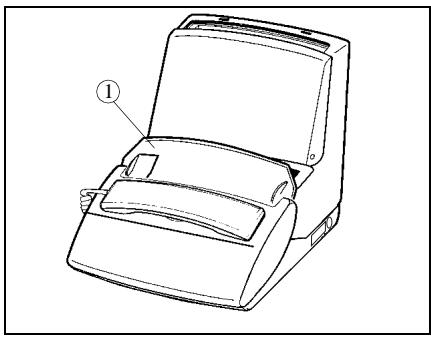
The document feeder (1) receives up to 15 pages.
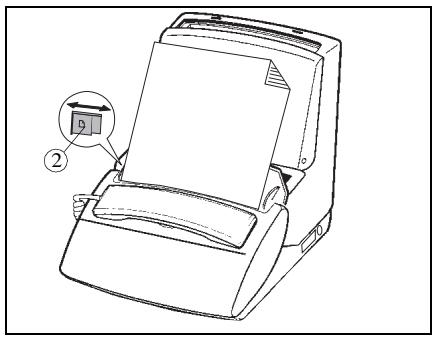
Insert the document, printed face down, into the document feeder. If necessary, adjust the left paper guide (2) to the width of the document.
The machine displays READY.
Your machine has an automatic document feeder. The last sheet in the stack will be sent out first.
MODELS WITH A REMOVE PAPER TRAY
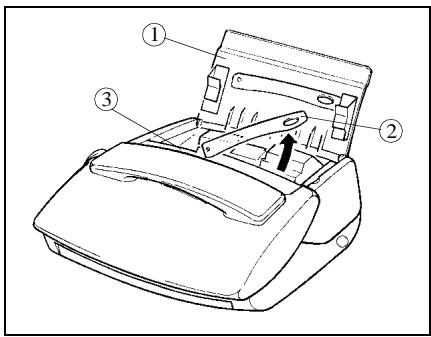
Lift the fax access door (1).
Lift the document support bracket (2).
The document feeder (3) receives up to 15 pages.
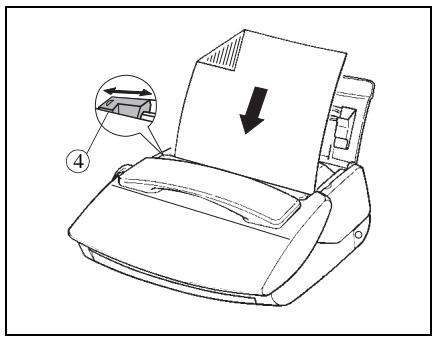
Insert the document, printed face down, into the document feeder. If necessary, adjust the left paper guide (4) to the width of the document.
The machine displays READY.
Your machine has an automatic document feeder. The last sheet in the stack will be sent out first.
SENDING A FAX
DOCUMENT RESOLUTION
Your Internet Phonef@xTM machine has three resolution modes. You will select one of these modes according to the type and print quality of the document you want to fax.
- standard mode: for a good quality document without minute details.
- FF (FINE) mode: for a document with small characters or drawings.
- (PHOTO) mode: when the document is a photograph.
Press the FF key to change the resolution mode. The mode selected is indicated by the status of the FF and icons.
SENDING A FAX
Immediate transmission
Insert the document into the feeder, printed face down, first page last in the stack of sheets.
Dial the addressee's fax number and press to confirm.
Transmission from the directory
When all your parties' names and numbers are stored in the directory you can select one of them (to phone them or send them a fax), please refer to the section entitled Directory (MENU 1) on page 9 for further information.
Broadcast transmission
To send the same document to several addressees, proceed as follows:
Place the document into the feeder, dial the fax number of the first addressee, or select it from the directory. Press the OK key to confirm.
Dial the fax number of the next addressee or select it from the directory. Press the OK key to confirm.
Repeat the procedure for each individual addressee (10 addressees max.), making sure you press the OK key each time.
Press to send the document..
You can move in the data entry field using the or , delete the last character entered by briefly pressing the C key, delete all the characters entered by holding the C key down.
Delayed transmission
To program delayed transmission for a document, proceed as follows:
Insert the document into the feeder.
PRESS M, 3, 1, OK
Dial the addressee's fax number.
Press OK if you want to enter another addressee.
or
Enter the time at which you want your fax to be sent and press OK to confirm.
Choose the required type of transmission (from the machine's MEMORY or from the document FEEDER) and press OK to confirm. (please refer to § Transmission from the machine's memory or the document feeder on page 19, for further information).
Enter the number of pages of the document and press OK to confirm.
Choose or not a cover page for your document and press OK.
Enter the text for the cover page as appropriate and press OK to confirm.
Sending a short message
Your Internet Phonef@xTM machine enables you to type in a message intended for the addressee. Such a message will be either inserted on the cover page of the faxed document or directly printed on a sheet of unstamped paper. To send a short message, proceed as follows:
PRESS M, 3, 1, OK
Dial the addressee's fax number.
Press OK if you want to enter a second addressee,
or
press OK twice to go on to the next menu item.
Enter the time at which you want your message to be sent and press OK.
Choose ALPHA KEYPAD using the or key and press OK.
Choose WITH HEADER PG or WITHOUT PAGE using the or key and press OK to confirm.
Type in the message you want to send using the alphabetic keypad.
Press OK to send the message.
CHOOSING THE TYPE OF TRANSMISSION REPORT
You can program your machine so that a transmission report is printed each time you send a fax. There are three types of reports available:
PRESS M, 3, 4, OK
Select the required option using the or :
- WITH: a transmission report is printed if there has been no transmission problem or if it is definitively aborted (i.e. after 6 unsuccessful attempts). So, there is only one report for each transmission request.
- WITHOUT: no report is printed following a fax transmission (consult the transmission log to keep track of all communications).
- IF ERROR: a transmission report is printed after each unsuccessful transmission attempt.
Press OK to confirm.
TRANSMISSION FROM THE MACHINE'S MEMORY OR THE DOCUMENT FEEDER
You can choose between two modes of transmission:
- from the machine's memory: the document to be faxed is stored in your machine's memory before it is sent. This mode enables you to pick up original copies more quickly.
- from the document feeder: the document is faxed right after placing it in the feeder and dialling. This mode enables you to send voluminous documents whose size may exceed the memory capacity.
PRESS M, 3, 5, OK
Select the required option using the or key.
- MEMORY:
The document is first stored in the memory of your fax machine, then it is transmitted.
ADF:
Document scanning and transmission are performed at the same time. If the addressee's fax machine does not answer, the documents remains in the feeder.
Press OK to confirm.
RECEIVING A FAX
Your machine has a reception memory enabling it to receive your faxes or e-mail even when out of paper. Depending on the settings made, your machine can print out your faxes as soon as these are received or store them in its memory. Faxes and e-mail will be received automatically if the is on. If the icon is off, press the
key (please refer to Choosing the operating mode on page 4 for more information).
When at least one fax is present in the memory, the key of your machine blinks. The key is off if there is no fax in the memory or if you have printed all the faxes received.
PRINTING FAXES RECEIVED IN THE MEMORY
To print out stored faxes, put paper in the paper tray, and press the key. If the machine runs out of paper, add some so that printing restarts automatically after the last printed page.
□ You can protect the access to your faxes by means of a code (please refer to § Protection of voice or fax messages on page 15 for more information).
RECEPTION FROM THE MEMORY (FAX ANSWERING MACHINE) OR THE FEEDER
When activated, this function enables you to store all messages received in the memory, until you choose to print them out. When the function is de-activated, all documents are printed as soon as they are received.
PRESS M,3,6,OK
Select the required option using the or key:
- WITH: the documents you receive are stored in the memory,
- WITHOUT: the documents you receive are printed at once (if there is paper in the feeder),
Press OK to confirm.
REMOTE ACCESS OF THE FAX ANSWERING MACHINE
If you are away and have a fax machine where you are (set to the tone dialling mode), you can retrieve and print the faxes received on you own fax machine.
As delivered, the remote access option of the fax answering machine of your Phonef@xTM is not available: to access your fax answering machine remotely, you should first enter an access code, which is shared with the TAD so that you can also listen to your voice messages (please refer to § Remote access code on page 16 for more information) and set your machine to the "automatic reception mode with TAD" mode.
On a remote fax machine featuring a telephone set, dial your own number.
Press the * key during the greeting message, then enter the 4 digits of your access code: the machine first delivers the voice messages.
As you hear the beeps, press the 8 then 0 keys.
Switch on the fax machine by pressing the key as soon as you hear the fax tone: your own fax machine will then forward all the faxes stored in its memory.
Caution - When you access your fax answering machine remotely, the forwarded documents are automatically erased from its memory.
RECEPTION MEMORY SATURATION
When there are too many documents or voice messages in the memory, the machine is saturated and will not be able to take in any extra messages: the 4 or 10 blinks and the message MEMORY FULL is displayed on the screen. Print the stored faxes and/or erase all voice messages to free some memory.
The memory status is indicated by these icons:
DURING TRANSMISSION
STOPPING A TRANSMISSION
Press the key.
Press the key again to confirm you want to stop the current transmission.
PHONE CALLS
To call your party
You can call your party just after sending or receiving a fax. To do so, while the document is being transmitted (send or receive mode), you should:
Press the key while your fax machine displays TRANSMIS or RECEPTION. Your fax machine then displays PHONE:
- once the fax has been transmitted, your party's phone rings, if its machine is compatible,
- if they answer, your machine starts ringing: pick up and speak.
Your party calls you
When your party calls you, your phone rings and you can pick up and speak.
ADVANCED FUNCTIONS
POLLING A DOCUMENT
Polling a document consists in leaving it in your machine's memory or document feeder, thus making it available to one person (single polling), or several persons (multi polling), who can then perform "active polling" on it. This requires that your machine be set to the automatic mode.
PRESS M, 3, 3, OK
Select one of these two options using the or key:
- SINGLE POLLING: the document will be deleted from the memory as soon as it has been retrieved.
- MULTI POLLING: the document can be retrieved by several persons.
Press OK to confirm.
Select one of these three options using the or key:
- MEMORY: the document is stored in your machine's memory. This solution frees your machine and the document can be retrieved by several persons.
- PAPER FEEDER: the document can be retrieved by only one person (only in the case of SINGLE POLLING).
- ALPHA KEYPAD: the document is a text you type using the alphabetic keypad.
Press OK to confirm.
Enter the number of pages of the document and press OK to confirm.
A message on the screen tells you if there is any document for polling. A single polling document will automatically be deleted from the memory as soon as retrieved, unlike multi-polling, which you can cancel through menu 63 (please refer to § Deleting a command from the queue on page 31).
RETRIEVING A DOCUMENT
When a document has been polled on a remote fax, you can perform "active polling" on it (i.e. print it out on your own fax machine), only if there is no document in your feeder.
PRESS M, 3, 2, OK
Dial the number of the fax machine containing the polled fax and press the OK key.
Press the key for immediate active polling.
or
Press OK for multiple active polling (maximum 10 addressees).
or
Press OK twice for delayed active polling:
- Enter the time required for active polling, and press the key to confirm.
- When active polling is performed on the document, the key blinks (in the AUTOMATIC operating mode, please refer to § Choosing the operating mode on page 4). Press the key to print the document.
You can connect a SAGEM cellphone (GSM) to your machine, which will enable you to send or receive faxes via your cellphone (please refer to the section entitled QUICK REFERENCE GUIDE, MENU GUIDE, Menu 39). This function requires the installation of a Fax-Cellphone connection kit available from your supplier. Please refer to the instructions coming with the kit for further information.
Caution - Before connecting a SAGEM cellphone to your machine, disconnect your machine from the mains supply and plug it back in once you have connected it to the GSM device.
TAD (MENU 4)
Your machine features a telephone answering device (TAD) whose simple and extensive functions provide a wide range of possibilities: leaving a message to persons calling you in your absence, letting them leave you a accessing message, your machine remotely as done for faxes, etc.
Your TAD features two options:
- ANSWERING MACHINE: callers cannot leave you a message after the greeting message, which only gives them some information.
- ANSWERING-RECORDING MACHINE: callers can leave you a message after the greeting message.
GREETING MESSAGES
The machine has 2 distinct greeting messages, corresponding to the two functions of the TAD (answering machine or answering-recording machine); the answering-recording machine's greeting message is prerecorded. You can change it by recording your own greeting message.
ANSWERING-RECORDING MACHINE
Recording the greeting message
PRESS M, 4, 1, 1, OK
Pick up your handset and record your greeting message (20 seconds max.).
The time in seconds is counted down as you record your message.
Hang up your handset to stop the recording. Your message is then played back, after which you can put your TAD into service.
Playing back the greeting message
PRESS M, 4, 2, 1, OK
Your machine plays back the greeting message you have recorded.
ANSWERING MACHINE
Recording the greeting message
PRESS M, 4, 1, 2, OK
Pick up your handset and record your greeting message (90 seconds max.).
The time in seconds is counted down as you record your message.
Hang up your handset to stop the recording. Your message is then played back, after which you
can put your TAD into service.
Playing back the greeting message
PRESS M, 4, 2, 2, OK
Your machine plays back the greeting message you have recorded.
SWITCHING ON
SELECTING THE TYPE OF TAD
PRESS M, 4, 5, OK
Select the required type of TAD (ANSWERING MACHINE or ANSWERING-RECORDING MACHINE) using the or key and press OK to confirm.
SWITCHING THE TAD ON / OFF
Switching on
Press the key. When the icon is on, your TAD is in service.
Switching off
Press the key. When the icon is off, your TAD is not in service.
MESSAGE
When you have received at least one message, the screen displays the total number of messages (except in the case of delayed transmission or active polling, or passive polling) and the key on your machine blinks.
This key is off if there are no pending messages, and is steady on when all received messages have been listened to.
LISTENING TO MESSAGES
Press the key. For each message being listened to, the screen displays the sequence number together with the date and time of reception.
While listening to the messages, you can press the following keys:
- or to adjust the audio volume,
- C twice to return to the beginning of the message,
- OK to skip to the next message,
for a pause. Press the same key again to resume listening, - you can also use the remote access controls (please refer to § Remote access on page 25).
LOCALMESSAGE
You can record a local message on your TAD, which will be like a message left by a remote caller. This function is very useful when you have to go out of your office or home and you want to leave a message for anyone coming in after you.
Recording the local message
PRESS M AND , OR
PRESS M, 4, 3, OK
Pick up the handset and record your message.
Hang up the handset to stop the recording.
Playing back the local message
Press the key.
DELETEING MESSAGES
Deleting all messages
PRESS M, 4,4, OK
Deleting a selected message
Press the C key, then OK during the message you want to delete.
You cannot delete the messages you have not listened to.
SATURATION OF THE TAD'S MEMORY
When too many faxes have been received and too many messages have been recorded, your machine is saturated and cannot take in any other messages: the 口 or 口 icon blinks and the message MEMORY FULL is displayed. Print out the faxes and/or delete the voice messages to get some spare memory.
REMOTE ACCESS
You can interrogate your TAD remotely and thus listen to the messages you have received, only if the telephone set you are calling from supports the tone dialling mode.
As delivered, this option is not available: to interrogate your TAD remotely, you should first enter a remote access code, which is shared with the fax answering machine (so that you can also print out the faxes received). Please refer to § Remote access code on page 16 for more information.
On a remote telephone set, dial your own number.
Press the * key during the greeting message, then enter the 4 digits of your access code: the machine delivers all the voice messages you have received.
After the last message or if there is no message, the machine emits a series of beeps.
List of available remote operations:
While listening:
- Pause or resume message listening by pressing 5 .
- Go to the next message by pressing 6 .
- Listen to the same message by pressing 4.
- Go back to the previous message by pressing 4. twice
After listening:
- Delete received messages by pressing 1 then 5 .
- Record your greeting message by pressing 8 then 3 and stop the recording by pressing any key.
- Listen to your greeting message by pressing ③.
- Switch on your TAD by pressing 7.
- Switch off your TAD by pressing 9.
- Resume message listening by pressing 5.
ADVANCED FUNCTIONS
CALL SCREENING
This function enables you to listen to the caller leaving you a message on your TAD, before deciding on whether to pick up or not.
PRESS M, 4, 6, OK
Select the required option using the or key:
- WITH CALL SCREENING: you can hear the messages as they are recorded on your TAD, and:
- adjust the SPEAKER volume using the and keys,
- pick up to answer the call.
- WITHOUT CALL SCREENING: messages are recorded in silence, only a message on the screen tells you you are receiving a call and a message is being recorded:
- you can pick up to answer the call.
Press OK to confirm.
The call screening feature is not available if you have activated the privileged access mode (see below).
PRIVILEGED ACCESS
This function enables you to choose a code, which you will give to those persons who may call you at a given moment (e.g. your collaborators during a meeting or your close relatives from a certain time).
Setting the code
PRESS M, 4, 8, OK
Enter a privileged access code other than 0000 and different from the remote access code.
Press OK to confirm.
Putting the privileged access function into service
PRESS M, 4, 7, OK
Choose WITH using the and keys.
Press OK to confirm.
□ When the privileged access function is in service, the icon blinks.
Privileged calls
Only those privileged callers having your privileged access code will be able to call you.
To do so, they should proceed as follows:
Dial your number.
Press the * key during the greeting message, then enter the 4 digits of your privileged access code: your machine only starts ringing after the code has been entered.
If you do not answer, the caller will have the possibility to leave a message on your TAD, if this is in service.
DETACHABLE QUICK REFERENCE CARD
| Quick reference card for operating your TAD featuring the remote access function Your TAD code: * | ||
| ① Delete | ② | ③ Announce |
| ④ Last Message | ⑤ Pause/ Message | ⑥ Next Message |
| ⑦ Answering machine ON | ⑧ Recording | ⑨ Answering machine OFF |
| * | ⑩ | # |

Services 8

Internet
Options
Prints the list of the numbered functions.
LOGS
PRESS M, 5, 2, OK
Prints the transmission and reception logs, which list the last 30 communications.
DIRECTORY
PRESS M, 5, 3, OK
Prints the directory.
SETTINGS
PRESS M, 5, 4, OK
Prints the list of your machine's settings.
LATEST TRANSMISSION REPORT
PRESS M, 5, 5, OK
LOCAL COPY
PHOTOCOPY
Insert the document to be copied in the document feeder, as for transmission.
Choose the resolution mode by pressing the FF key.
Press the key.
MULTICOPY
PRESS M, 5, 6, OK
Type in the number of copies you want to print on the numeric keypad (1 to 99).
Press the OK key: the document is stored and then printed.
The multicopy function cannot be used to print out a received fax; it applies only to a printed document of which you want one or more duplicates.
RIBBON GAUGE DISPLAY
PRESS M, 5, 7, OK
The ribbon gauge shows the percentage of ribbon available.
Prints the Web site directory.
For any information on the Web site directory, please refer to § Creating and automatically updating the Web site directory on page 37.
DOCUMENT CONTROL (MENU 6)
A set of menus enables you to control all the pending commands.
EXECUTING A PENDING COMMAND
This function is used to immediately execute a pending command:
PRESS M, 6, 1, OK
The status of the pending documents is shown:
- DOC: PASSIVE POLLING
POL: ACTIVE POLLING
TX : DELAYED TRANSMISSION - NET:INTERNET TRANSMISSION (fax or e-mail)
- CNT:INTERNET CONNECTION
- MBX: TRANSMISSION TO A MAILBOX
POL: ACTIVE POLLING TO A MAILBOX
Select the required command using the or key.
Press the OK key to execute it.
MODIFYING OR CONSULTING THE Queue
PRESS M,6,2,OK
Select the command you want to consult or modify using the or key.
Press the OK key and modify the parameters for the displayed transmission request.
Press the OK key to confirm your changes.
DELETING A COMMAND FROM THE Queue
PRESS M, 6, 3, OK
Select the command you want to delete using the or key.
Press the OK key to delete the request from the queue.
Press the OK key to confirm deletion.
PRINT A DOCUMENT WAITING FOR TRANSMISSION
This function enables you to know the content of a document waiting for transmission.
PRESS M, 6, 4, OK
Select the pending document using the or key.
Press the OK key to print out the selected document.
PRINTING OUT THE LIST OF PENDING OPERATIONS
This list shows, for each pending document: the sequence number of the pending operation, the addressee's name, the scheduled transmission time, the type of pending operation, the number of pages in the document and its size (percentage of memory taken up by the document).
To print out the list,
PRESS M, 6, 5, OK
ADVANCED FUNCTIONS (MENU 7)
MAILBOX (MBX)
If you create a mailbox on your machine, you can receive faxes and messages confidentially: indeed, by transmitting a given number to your machine using his/her numeric keypad, your party will deposit the messages into your personal mailbox. You will just have to enter this number to print out your faxes or listen to your messages.
CREATING A MAILBOX
PRESS M, 7, 1, 1, OK
Type in a number between 1 and 5, this will be your mailbox number.
Press the OK key twice.
Then, enter a 4-digit code (other than 0000, and different from both your remote access and privileged access codes) and press OK twice.
This 4-digit code enables you to interrogate your mailbox remotely and/or protect it.
Activating the access code
Using the or key, choose between:
- WITH: to protect your mailbox by means of the access code,
- WITHOUT: to disable protection.
Press OK to confirm.
Recording a greeting message
You can record a greeting message specific to your mailbox, which will be played each time someone accesses it to leave a message.
Select MBX ANNOUNCE and press the OK key.
- Pick up your handset and record your greeting message.
- Hang up the handset: the message is then played back, and will be played to anyone accessing your mailbox.
Registering a handset
Choose HANDSET NUMBER if you have a cordless phone and you want to consult the contents of your mailbox from that phone without having to enter the mailbox protection code:
- Press the OK key.
- Type a number between 1 and 4 corresponding to your cordless phone.
- Press OK to confirm.
The value 0 means there is no handset associated to the mailbox.
DELETEING A MAILBOX
PRESS M, 7, 1, 2, OK
Type in the number of the mailbox you want to delete and press OK.
Press OK again to confirm deletion.
USING YOUR MAILBOX
What callers need to do to deposit a message or a fax in your mailbox
For your mailbox to accept a message or a fax, your machine should be in the reception mode. Then, callers should follow this procedure:
For a fax, insert the document to be sent in the feeder.
Dial your number: they can hear your greeting message.
Press the # and 1 keys and type your mailbox number (between 1 and 5): they can hear the greeting message specific to the mailbox.
After the beep, record their message or press to send their fax.
Depositing a fax or a text message in your party's mailbox
If your party has a compatible machine, you can deposit a fax directly in his/her personal mailbox.
To do so, follow this procedure:
PRESS M, 7, 1, 3, OK
Dial your party's number and press OK twice.
Enter his/her mailbox number and confirm with for immediate transmission, or with OK for delayed transmission.
In the latter case, enter the required time for fax transmission and press OK to confirm.
Select the type of document to be sent (memory, feeder or keypad) and press OK to confirm.
If you have chosen either one of the first two alternatives, enter the number of pages to be sent, insert the document and press OK to confirm.
If you have chosen ALPHA KEYPAD, type in your message and press OK to confirm.
Polling a party's mailbox
If your party has a compatible machine, you can poll the documents he/she has received in his/her mailbox. To do so, follow this procedure:
PRESS M, 7, 1, 4, OK
Dial your party's number and press OK twice.
Enter your party's mailbox number (between 1 and 5) and press OK to confirm.
Enter the code for access to your party's mailbox and press for immediate polling or OK to schedule delayed polling.
In the latter case, enter the required polling time and press OK to confirm.
ACCESSING YOUR MAILBOX
Press the key to listen to a message, and the key to print out a fax.
Enter your mailbox number (between 1 and 5) and press the OK key.
- If the access to your mailbox is not protected (MEM ACCESS =NO), you can hear your voice message or your fax gets printed,
- If the access to your mailbox is protected (MEM ACCESS = YES), enter your 4-digit mailbox code.
To listen to a message or print out a fax not received in a mailbox, enter 0 as the mailbox number.
MAILBOX REMOTE ACCESS
Dial your number from a remote telephone set or fax machine; you can hear your TAD's greeting message.
Press#, 1 then enter your mailbox number (between 1 and 5).
Then enter the 4 digits of your mailbox access code:
- listen to deposited messages, if any (you can hear beeps if there are no messages),
- if calling from a fax machine, press 8 and 0 as you hear the fax machine beeps and press the key as you hear a shrill sound in order to switch your machine to fax reception mode.
TECHNICAL PARAMETERS
Your machine has been configured for operation on all telephone networks. However, some of its technical parameters may be changed.
The technical parameters are arranged into a list in which you move using the and keys. To access technical parameters:
PRESS M, 7, 9, OK
01 DIALLING choice of the type of dialling ( pulse or tone)
02 TX HEADER: you can insert your name, your fax number, the date and time on the header of the fax received by the addressee.
03 TX LOCK UP: lock up the fax transmission speed.
04 ANTI ECHO: inhibit the satellite echo in case of fax problems in long-haul calls.
05 DISTINCTIVE RING for Australia only: signal voice calls by the normal ringing pattern, and fax transmission by a special ringing pattern.
10 RX HEADER: print the sender's name and fax number as well as the date and time on the header of the fax you receive.
11 RX LOCKUP: lock up the fax reception speed.
20REDUCE MODE: choose the printing reduction mode (received faxes, local copies): automatic or manual.
21REDUCE RATE: set the printing reduction mode.
22 NB OF PAGES: enter the number of pages printed (received faxes and local copies) since machine switch-on.
40 FLASH LENGTH: choose the in-line interrupt time (long or short) of the R key "Flash" signal.
50 SORTED PRINT: print documents in reverse order of reception (or scanning for a local copy).
71 NET ACTIVE: choose whether automatic Internet connections are authorised on weekend days.
72 MODEM LOCK UP: lock up the transmission/reception speed via the Internet.
73 RECORD REP@: automatically record the Internet address of a fax addressee into the directory.
74 EMPTY MBX: delete the first message from the mailbox at the next connection.
75 PPP COMPRESS.: for connection to certain access providers.
REMOTE CONTROL FROM AN EXTENSION SET
You can control your machine remotely from an extension tone dialling telephone set in your installation, i.e. a set connected to another socket on the same line (same subscriber's number).
If the extension set is configured in pulse dialling mode, type * to switch it to tone dialling mode.
SWITCHING OFF THE TAD
If you take the line from an extension set and your machine did so before you and is playing your TAD's greeting message, press # then 0 to switch off the TAD.
SWITCHING TO FAX RECEPTION MODE
If you take the line from an extension set and you cannot hear anyone speaking, you can switch your machine remotely to fax reception mode by typing # then 7.
SERVICES (MENU 8)
WEB TO PRINT SERVICE
To be able to use this service, you should first create your Internet mailbox (please refer to the section entitled INTERNET (MENU 9) on page 41).
Your Internet Phonef@xTM machine will then provide you access to selected Internet sites and enable you to print out the related Web pages.
The Web pages are defined by their addresses (called URL: Uniform Resource Locator) with the following format: http://www.sagem.com (for the Sagem Web site).
These addresses are stored in a directory called the Web site directory.
The Web key provides direct access to that directory.
Press the M then Web keys to gain direct access to the directory control menu.
CREATING AND AUTOMATICALLY UPDATING THE WEB SITE DIRECTORY
Your Web site directory enables you to store Web addresses. It is controlled and handled like a phone and fax number directory.
It contains addresses to specific Web sites, selected by your machine (news, travelling, culture, leisure, sport, weather...).
This directory is automatically created as you first connect to the Internet (please refer to the section entitled INTERNET (MENU 9) on page 41)
The directory can then be updated:
- periodically (please refer to § My log: periodic printing of a set of Web pages): getting connected to the site called "UPDATE" will automatically update the directory,
- whenever required, by proceeding as follows:
PRESS M, 8, 1, 2, OK
Your fax machine connects to the Internet and automatically prints out the list of Web sites added to your directory during the update process.
To print out the Web site directory at any time,
PRESS M, 8, 1, 6, OK
PRINTING OUT A WEB PAGE
My log: periodic printing of a set of Web pages
This function enables you to select a list of sites (10 sites max.) for which you want to schedule Internet connection at the same dates and times for Web page printout purposes.
So, you will have to enter these connection parameters only once for all the sites you have selected.
To draw up the site list,
PRESS M, 8, 1, 1, OK
Select the first site and press OK to confirm.
Repeat the procedure for all the other sites and press OK to confirm.
- You can select UPDATE among the sites to programme automatic directory update, at the same time as the printout of selected Web pages.
Press OK again to confirm the last selected site once you are finished with your selection.
Choose the days of the week for which you want to schedule the printing of selected Web pages. To do so:
- use the and keys to move to the different days (M T W T F S S),
- select or de-select the days by means of the C key (the screen displays the letter corresponding to the day of the week when this is selected, or "-") otherwise),
- press OK to confirm.
Enter the time at which you want to connect and print out these Web pages and press OK to confirm.
Your machine will connect to the selected sites as chosen to print out the corresponding Web pages.
Periodically printing a Web page from the directory
If you have selected a time and one or more days for connection to a Web site in the directory (through Menu 813), your fax machine will periodically connect to that site at the scheduled time and automatically print out the relevant Web page.
Immediate printing of a Web page from the directory
Press the Web key (direct access to the Web site directory),
Select the Web site of which you want to print out the page using the and keys.
Press the @ key.
Your fax connects and automatically prints out the relevant Web page.
Immediately printing a Web page in the manual mode
Press the @ key, and type the Web site address (e.g. http://www.sagem.com) or the corresponding key word.
Press @ to confirm.
Your tax egets connected and automatically prints out the relevant Web page.
MANUALLY UPDATING THE DIRECTORY
You can customise and complement the Web site directory created by your machine by adding other sites.
Adding a Web site in the directory
PRESS M, 8, 1, 3, OK
Enter the Web site name and press OK to confirm,
Type the Web site address (e.g.: http://www.sagem.com) or the corresponding key word and press OK to confirm,
You can choose to print out the Web page:
on request (MANUAL ACCESS),
- or by getting connected periodically at a given time on certain days of the week (AUTO ACCESS).
Press OK to confirm your choice.
If you have chosen AUTO ACCESS, you should set the connection days and times as follows:
-
choose the days of the week on which you want to get connected. To do so:
-
use the and keys to move to the different days,
- select or de-select the days by means of the C key (the screen displays the letter corresponding to the day of the week when this is selected, or "- otherwise),
- Press OK to confirm,
- enter the time at which you want to get connected and press OK to confirm.
A record associated to the selected Web site has been created. Your fax machine has assigned a sequence number to it, namely the "assigned number".
Editing a Web site in the directory
PRESS M, 8, 1, 4, OK
Select the required Web site using the and keys and press OK to confirm. You can edit the following elements:
- the name of the Web site, its address or the corresponding key word, the connection day(s) using the and keys and C , the connection time.
- Confirm each change you make by pressing the OK key.
Deleting a Web site from the directory
PRESS M, 8, 1, 5, OK
Select the required Web site using the and keys and press OK to confirm.
Press OK to confirm deletion.
Internet Printing is a free-of-charge service (you will only be charged for calls).
SAGEM SA reserves the right to suspend that service at any time and shall in no case be held responsible for that. SAGEM SA shall not be held responsible for the contents and availability of the Internet sites accessible through that Service.
F@X™ TO FAX SERVICE (DEPENDING ON MODEL)
For comprehensive information on this service, please refer to Transmission to a fax machine (F@x^TM to Fax service) on page 44.
To activate or de-activate this service,
PRESS M, 8, 2, OK
Choose using the or key and press OK to confirm:
- WITH: enter the PIN CODE you received when you subscribed to the service and press OK to confirm.
- WITHOUT.
INTERNET (MENU 9)
Your machine gives you access to a number of functions available on the Internet :
- sending and receiving faxes, e-mail and voice messages via the Internet,
- sending a short message which will be received by e-mail,
- receiving files unprocessable by your machine (e.g. Word, Excel... files) and converting them into documents recognisable by your machine ( F@x^TM to Fax service),
- print out the pages of a Web site the address of which you know,
- send a fax to a standard fax machine via the Internet.
As delivered, your machine is ready to use for direct access to the Internet functions. An access provider has been pre-programmed in factory.
To benefit from this offer, please refer to Internet subscription on page 41. You will then have access to a server which will feature your Internet mailbox through which you will be able to get connected to the Internet.
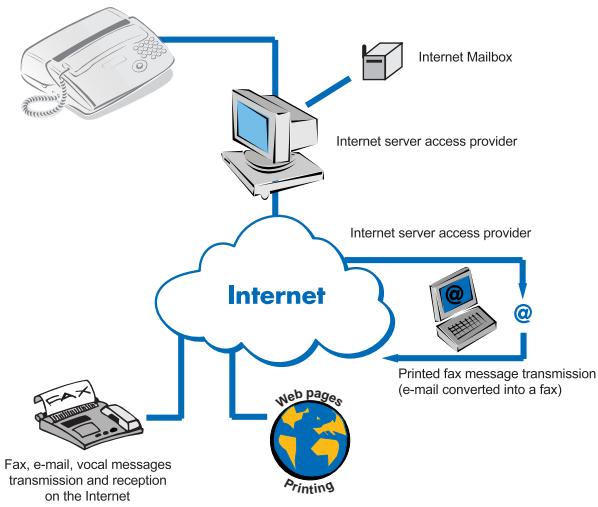
Functions available via the Internet
The advantage to send your faxes and messages via the Internet is plain to see: when you take out your subscription, your access provider gives you a local or regional call number. When you send a long distance message, your machine routes it to your provider's server on a local call cost basis. The server then forwards the message to your party via the Internet, without you being charged for the cost of the long distance call.
INTERNET SUBSCRIPTION
SUBSCRIPTION (DEPENDING ON MODEL)
Your machine is delivered ready to use: an Internet subscription has been pre-programmed in factory. If you want to benefit from this offer, please proceed as follows:
Fill in the Internet subscription form provided with your machine,
Place it in the document feeder (as for a fax transmission),
The form is automatically sent to the access provider, who will return to you a subscription confirmation together with your e-mail address.
When you receive your e-mail address:
PRESS M, 9, 9, 2, OK
Enter your e-mail address and press OK to confirm.
INTERNET SETTINGS
When you take out an Internet subscription, the access provider gives you some information concerning the settings necessary to get connected and identify your machine on the network. These settings can be divided up into three categories:
- the connection parameters include the information necessary to the establishment of the communication: your call number, a connection identifier (your name for instance) and a password (which will not be displayed on the screen),
- the e-mail parameters enable you to define your identifier and your password for access to your e-mailbox once communication has been established, as well as your e-mail address whose syntax is as follows: < first name.name@server.uk >.
-
the servers parameters are addresses (4 sets of 3 digits max., e.g. 193.252.13.0) which identify the servers of your access provider on the Internet :
-
SMTP servers (used for sending your messages),
- POP3 server (for receptions in your mailbox),
- servers PRIMARY DNS and SECONDARY DNS (which routes messages on the Internet).
To perform your Internet settings, collect the information given by your provider and proceed as follows:
PRESS M, 9, 1, OK
Select your access provider using the or key. If your provider is not on the list, select OTHER.
Press OK to confirm.
Then, define all the Internet parameters that have not yet been set, referring to your subscription confirmation. Press OK to confirm each parameter and go on to the next one:
call number,
- connection identifier (login),
- connection password,
e-mail identifier,
- e-mail password,
e-mail address,
- SMTP server: automatically gives the server address for any transmission on the Internet,
- POP3 server: automatically gives the server address for any document reception in your Internet mailbox,
- PRIMARY DNS: routes the messages on the Internet (the server address is composed of 4 sets of 3 digits max. separated by dots),
- SECONDARY DNS.
If your access provider did not specify any particulars for the SECONDARY DNS, enter those for the PRI- MARY DNS.
IGNORING THE INTERNET FUNCTIONS
If you do not want to use the Internet functions:
PRESS M, 9, 1, OK
Select WITHOUT ACCESS using the or key.
Press OK to confirm.
TRANSMISSION/RECEPTION ON THE INTERNET
CONNECTION TO THE INTERNET
When connected to the Internet (immediate or scheduled connection, depending on your settings), it enables you to send and receive documents during the same connection, as follows:
- transmission to the Internet mailbox(es) of your party (parties) of all the pending Internet documents (faxes, e-mail, voice messages). If the addressee is a PC, the voice or fax message will be received as the attachment to an e-mail.
- reception of all the Internet documents (faxes, e-mail or voice messages) deposited in your Internet mailbox.
Immediate connection
You have two immediate connection alternatives available:
Access through the menu,
PRESS M, 9, 2, OK
Access through the keys,
Press the @ key twice.
Scheduled connection
To get scheduled connections, you should first set your machine (please refer to § Connection on page 45).
TRANSMISSION VIA THE INTERNET
Whatever the document to be transmitted (fax, e-mail or voice message), this is stored in the machine's memory and will be transmitted via the Internet the next time you get connected.
Transmission to an e-mail address
Transmitting a fax to an e-mail address
Place the document in the feeder.
Press the @ key.
Type your party's e-mail address (or use either the directory key or the BIS) key.
Press the @ key to confirm. or
If you want to send the document to several addressees:
- Press the OK key.
- Press the @ key.
- Type the next e-mail address.
- Repeat the procedure for each new e-mail address.
Press the @ key.
The document will be transmitted via the Internet the next time you get connected.
To enter the character @, use the Ctrl and @ keys on the alphabetic keypad.
To enter the dot, press the · key.
For capital letters, press the key and the relevant letter at the same time.
You can move in the data entry field using the or key, delete the last character by briefly pressing the C key or delete all characters by holding the C key down.
Sending an e-mail to an e-mail address
To send a typed message to an e-mail address:

PRESS M, 9, 3, OK
Enter your party's e-mail address and press OK twice to confirm.
or
If you want to send the e-mail to several addressees:
- Type the e-mail of the first addressee,
- Press the OK key.
- Type the next e-mail address.
- Press OK again to type new e-mail addresses.
- Press OK twice to confirm the last e-mail address.
Type in the subject of the message and press OK to confirm.
Then type in the text of your message and press OK to confirm.
The text you have typed in will be sent via the Internet the next time you get connected.
Sending a voice message to an e-mail address
To send a voice message to an e-mail address:

PRESS M, 9, 4, OK
Type the e-mail address and press OK to confirm.
Pick up the handset and record your voice message.
Hang up the handset after the recording.
To enter the character @, press the Ctrl and @ keys at the same time on the alphabetic keypad.
Transmission to a fax machine (F@xTM to Fax service)
The F@x^TM to Fax service enables you:
- to fax, via the Internet, a document to another fax machine that does not feature Internet functions,
to convert e-mail attachments that are unable to be processed by your fax machine into readable documents.
To benefit from this service, you should:
- take out a subscription by filling in the F@x^TM to Fax form provided with your machine,
- activate the service by pressing the M, 8, 2 and OK keys.
To fax your document to a party whose fax machine does not feature Internet functions, place the document in the feeder.
Press the Ctrl and A keys at the same time to insert the + sign, then dial the international number of your party, such as 33 1 23 45 67 89 (33 for France followed by the phone number without the 0).
Press the @ key: document transmission takes place automatically.
You can store your party's international number in the directory, in the e-mail address item (do not forget to enter the + sign in before the international number).
RECEPTION VIA THE INTERNET
Whatever the document received (fax, e-mail or voice message), reception takes place automatically each time you connect to the Internet.
A file other than a fax (Word processing, CAD, etc, file) cannot be processed by your fax machine (except if you subscribed to the F@x^TM to Fax service). You can keep these documents in your Internet mailbox for future process using a PC (please refer to Sorting received mails on page 46).
Receiving faxes and e-mail on the Internet
To print out your faxes or e-mail, press the key as you would do for a fax.
Receiving a voice message via the Internet
To listen to a voice message, press the key, as you would do for a message received on your TAD.
SETTINGS
PRINTING OUT INTERNET SETTINGS
The Internet settings can be printed out through two menus:
PRESS M, 9, 5, 4, OK
or
PRESS M, 5, 4, OK
(this will print out all the machine settings).
CURRENT SETTINGS
Connection
To choose your mode of connection to the Internet:
PRESS M, 9, 5, 1, OK
Choose either one of the following two options using the or key and press OK to confirm:
- VOLONTARY
The connection to the Internet will be established only at your request as you press:

TWICE or M, 9, 2, and OK (INTERNET/IMMEDIATE ACCESS).
PERIODICAL
The connection will be established a certain number of times a day. To do so, define:
- THE FIRST CALL: this is the time of the first connection. Press OK to confirm.
- THE NUMBER OF CALLS: this is the required number of connections each day. Press OK to confirm.
- THE LAST CALL: this is the time of the last connection (this parameter appears only if you have chosen to make at least 2 calls). Press OK to confirm.
The Internet connection start and end times are extended to + / - 15mn around the chosen time, to avoid Internet access saturation.
Transmission
To choose your Internet transmission mode:
PRESS M, 9, 5, 2, OK
Choose using the or key and press OK to confirm:
- IMMEDIATE
A connection takes place as soon as a fax, e-mail or voice message to be sent via the Internet is stored in the machine's memory, generating the immediate transmission of that document.
- AT CONNECTION
The faxes, e-mail or voice messages to be sent via the Internet will be transmitted only at the time of connection (whether automatic or manual).
Servers
To access the servers parameters (if you did not choose OTHERS as the access provider):
PRESS M, 9, 5, 3, OK
Modify one of the following servers as required:
- SMTP server: shows the address of the Internet transmission server, which you can modify. Press OK to confirm.
- POP3 server: shows the address of the Internet reception server, which you can modify. Press OK to confirm.
- PRIMARY DNS and SECONDARY DNS servers: shows the addresses of the servers routing messages on the Internet, which you can modify. Press OK to confirm.
Sorting received mails
To choose the destination of the e-mail received on your fax machine.
PRESS M, 9, 6, OK
Then, choose one of the following three options using the or key, and press OK to confirm:
F@XTM ONLY: all mail is received by your fax machine.
PC ONLY: all mail is kept in the mailbox to be read from a PC.
Your fax machine then only indicates the number of messages (faxes, e-mail or voice messages) received in your Internet mailbox, avoiding you to needlessly connect your PC when you have not received any message.
^ SHARE PC: the documents processable by your fax machine (faxes, e-mail and voice messages) can be printed out or listened to. All other documents are kept in the mailbox to be read from a PC.. Choose one of these options using the or key and press OK to confirm:
- FORWARD TO PC: enter your PC's e-mail address (assuming in that case that the PC subscription differs from the fax machine subscription) and press OK to confirm. Choose the type of e-mail to be sent on the PC (all e-mail, or only those with unprocessed attachments), and press OK to confirm.
- SHARED PC MBOX (the PC and fax machine share the same e-mail address).
Choose and press OK to confirm:
- to delete the e-mail from your mailbox,
- to keep them.
If you have chosen PC SHARING or PC ONLY, your fax machine will tell you the number of mails present in your mailbox at the end of the connection.
Relaying received documents
Activating/De-activating the relay function
You can automatically relay all received messages (faxes, e-mail or voice messages) to another telephone set, fax machine or PC.
PRESS M, 9, 8, OK
Choose one of the following three options using the or key, and press OK to confirm:
13 ON
-
If you choose WITH RELAIS and press OK to confirm, all your messages (faxes, voice messages and readable attachments) are relayed to a phone/fax machine.
-
Enter the destination phone/fax number. Press OK to confirm.
- Choose the type of messages to be forwarded (VOICE, FAX or FAX/VOICE RELAY) and press OK to confirm.
- If you have chosen VOICE or FAX/VOICE, enter the remote access code of the fax/voice answering machine (if not already done), and press OK to confirm.
- Choose WITH or WITHOUT OGM and press OK to confirm.
If you choose WITH OGM, this will inform you on the destination phone / fax of the incoming of relayed documents. To record the greeting message, pick up the handset, record the OGM and hang up.
- Choose SECURED RELAY or FREE RELAY and press OK to confirm.
-
If you have chosen FAX and SECURED RELAY, enter the remote access code of the fax/voice answering machine (if not already done), and press OK to confirm.
-
If you choose WITH RELAY @ and press OK to confirm: all your messages will be relayed to an e-mail address. Choose one of the following two options using the or key and press OK to confirm:
-
TO MY MAIL, to relay all your messages to your own e-mail address (shared with a PC for instance),
- TO OTHER ADD: enter the relay e-mail address and press OK to confirm. The connection will be established a certain number of times a day, depending on the Connection settings made (please refer to § Connection to the Internet on page 43)
DEACTIVATE: all your messages will be kept in your fax machine.
SETTINS: if you have already activated the relay function once, this menu enables you to change a number of parameters (addressee's phone/fax number or e-mail address, type of messages to be relayed, remote access code, OGM, secured relay or free relay, etc.).
Once you have made the changes, validate menu 981>Activate again by pressing the OK key in order to re-activate the relay function taking the changes into account.
Retrieving relayed documents
When receiving your relayed documents on the destination phone/fax, you should apply the following procedure:
Pick up the handset.
Enter the remote access code as you hear the beeps or the relay message.
Then, follow the same procedure as for remote access to listen to the voice messages and/or receive the fax messages and/or e-mail.
OPTIONS
DISPLAY
If you subscribe to a caller display service, the machine will show the caller information on its display and on the handset display.
| Machine display | Handset display | |
| Number | INCOMING CALL alternating with NUMBER/NAME | NUMBER ONLY |
| Number withheld | INCOMING CALL alternating with WITHHELD | ----- |
| Number unavailable | INCOMING CALL alternating with UNAVAILABLE | xxxxxxxxxx |
| Operator | INCOMING CALL alternating with UNAVAILABLE | xxxxxxxxxx |
| International | INCOMING CALL alternating with UNAVAILABLE | xxxxxxxxxx |
| Payphone | INCOMING CALL alternating with NUMBER | NUMBER |
| Ringback | INCOMING CALL alternating with NUMBER/NAME | NUMBER ONLY |
If the call is from a number stored in the machine's directory, the display will show the name it belongs to rather than the number. The handset display will only show the number.
The machine stores the date, time and number or name of up to 10 calls - after 10 calls have been stored it retains the last 10. If a new call is from the same number as an earlier call only the later call details will be stored. Number Withheld, Number Unavailable, Operator and International calls will not be stored.
The list of stored call details can be reviewed from the base station and from the handset.
To review the list from the base station
- Press M then . The display shows details of the last call.
- Use the and keys to scroll through the list.
- To call a number from the stored list press the key while the number is displayed.
- To fax to a number from the list press while the number is displayed.
When displaying call details the display alternates between the name (or number) and the date and time of the call. It will also show a T to indicate a telephone call, or, if the call was a fax and was answered, an F.
To review the list from the cordless handset
Press i then . The display shows details of the last call.
- Use the and keys to scroll through the list.
- To call a number from the stored list press the key while the number is displayed.
USING THE KEY
R KEY
If your machine is connected to a private network (PABX), this key usually enables you to transfer a call (refer to the automatic switchboard documentation).
CONNECTION TO A PC
When connected to a PC, the device enables you to print PC-issued files (GDI Interface). To do so, you have to get the "PC interface kit", available at your retailer's. The device may then be used as a secondary printer for your micro-computer.
APPENDIX
REplacement OF CONSUMABLES
Consumables (ink ribbon and ribbon gauge card) are already installed in your machine, but you will eventually have to change them. To do so, please refer to the instructions given in the following paragraphs.
INK RIBBON
The ink ribbon enables the unit to print on normal paper.
Only use the ink ribbon matching the manufacturer's specifications. To use other types of ink ribbon could damage the unit and invalidate the guaranty. Documents printed by your unit can be read from the used portion of the worn ink ribbon. If these documents are considered as confidential, you may want to remove the ink ribbon whenever you leave the unit.
Pick up the handset and put it on the side.
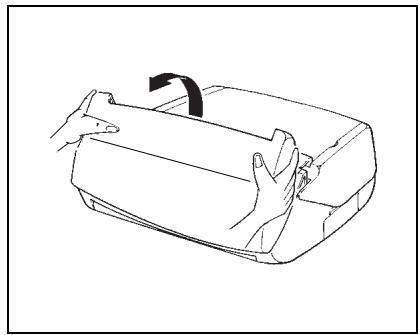
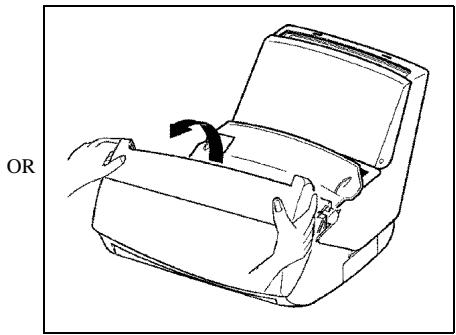
Open the front cover: lift it towards you until it remains open.
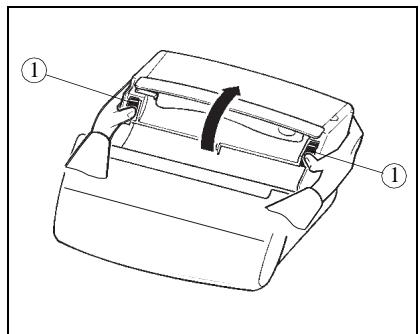
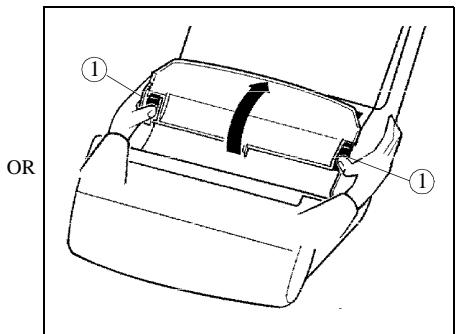
Open the rear cover: unlock the latches (1) before pushing the cover towards the rear.
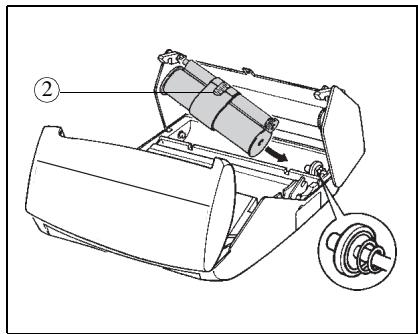
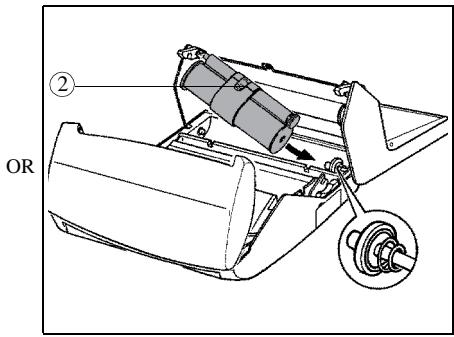
Remove the worn ink ribbon from its housing.
Position the ink ribbon above its housing under the rear cover.
Insert the ink ribbon into its housing without removing the adhesive strip (2):
- Position the right-hand (white) end of the main roller onto the retractable axis. Position the left-hand (green) end of the main roller onto the left axis.
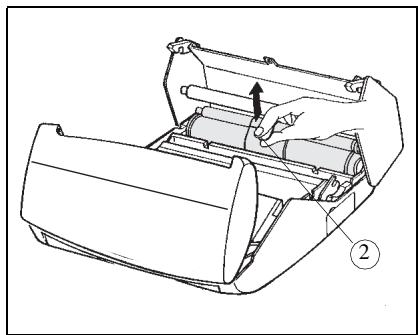
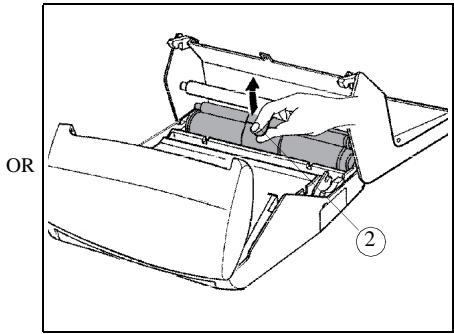
Pull off the adhesive strip (2) from the ink ribbon.
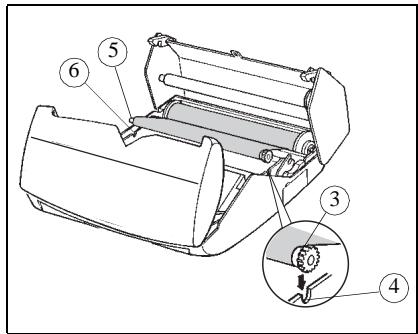
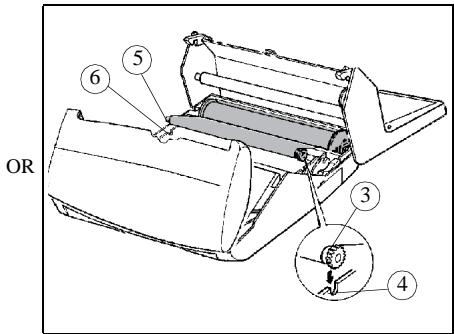
Insert the small roller into its housing:
Check that the gear axis (3) is correctly positioned in its slot (4) as is the other axis (5) in its corresponding slot (6).
RIBBON GAUGE
The gauge card enables screen display, after printout, of the percentage of remaining ink ribbon.
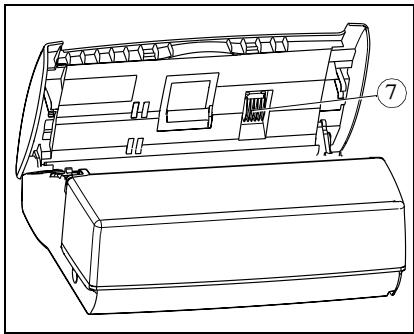
The front cover being open, locate the gauge card housing (7).
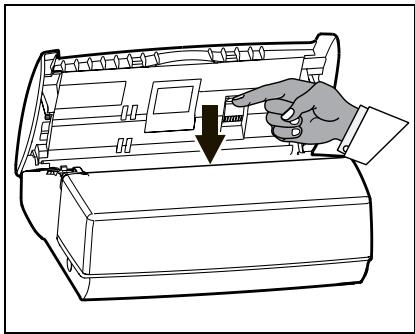
Push downward on the gauge card housing to unlock it: it opens automatically, letting you access the worn gauge card.
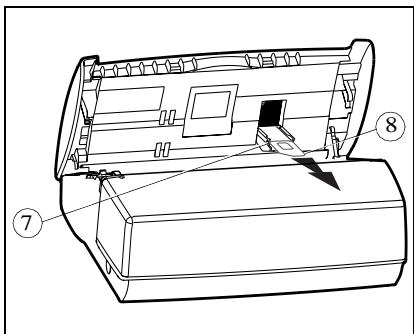
Remove the worn gauge card (8) from its housing.
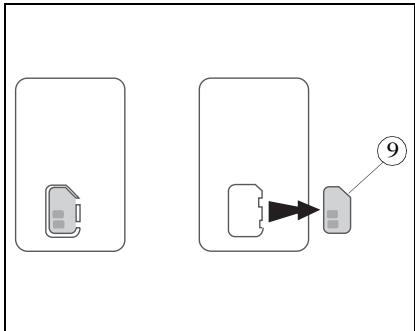
Remove the new (pre-cut) gauge (9) from the ribbon gauge card (8).
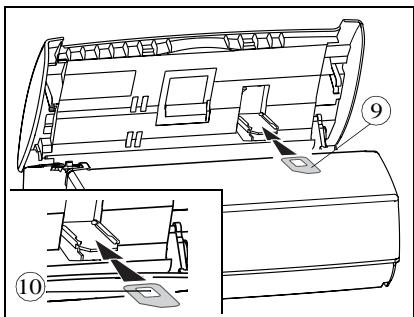
Insert the new gauge card (9) into its housing. Make sure the chip (10) of the gauge card (9) is upwards, bevelled corner to the top left side.
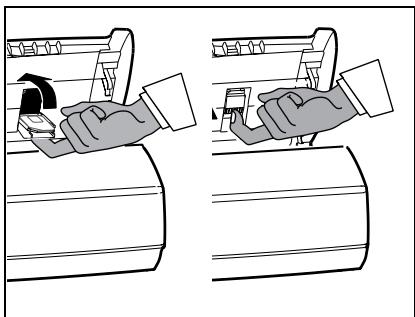
Close the flap of the gauge card housing by rotating it. Once into place, push it upward to block it. Close the cover and replace the handset.
The gauge card displays on the screen, after each printing, the percentage of remaining ink ribbon. If the gauge is not installed or not properly installed, the unit displays: ~GAUGE .
If you forgot to change the gauge at the same time as the ribbon, the unit displays: [GAUGE EMPTY].
TROUBLESHOOTING
| Failures | Remedies |
| ·The screen remains blank. | ·Check that the power cord is correctly connected on both its sides. |
| ·The machine does not answer the call. | ·The 4 icon may be off: check the reception mode. ·Check the number of rings (please refer to § Number of rings for the auto mode on page 15). ·Configure the machine on "private network" (please refer to § Type of network on page 14). |
| ·The printed photocopy is blank. | ·The document was placed upside down in the document feeder. |
| ·The telephone exchange does not recognise the number you have called. | ·Check that the telephone line cord is correctly connected to the device. ·Check the telephone line and the phone outlet. |
| ·The machine does not ring. | ·The 5 icon flashes: restore ringing (please refer to § Ringing melody on page 13). |
| ·The telephone does not work. | ·Check that the power cord is correctly connected on both its sides. ·There may be a power failure. ·Check the telephone line and the phone outlet. |
| ·One or several vertical black strips appear on the documents copied or received by your party. | ·Open the front cover and clean the scanning device (analysis) located in front of the white roller with a soft lint-free rag soaked with alcohol. After cleaning, close the front cover and make a copy to check that the black strips have disappeared. |
| ·The gauge card housing has unclipped. | ·You may easily put it back into place: approach the gauge card housing, striations downwards, and position both axes towards the slots of the housing lower part, then push until clipping (please refer to § Replacement of consumables on page 51). |
| The screen displays: OUT OF PAPER PRINTER COVER PAPER JAM OVERHEATING | ·Put paper into the paper feeder. ·Close the rear cover. ·Open the rear cover to access to the paper path and remove the sheet of paper. Make sure the rear cover is properly closed afterwards. ·The last printed documents show a lot of black smears, the printer temperature is too high. Wait a few moments for it to cool. |
| GAUGE EMPTY | You probably forgot to replace the gauge when you replaced the printer ribbon. |
| MISSING GAUGE | Remove the gauge housing cover and make sure the gauge is present and correctly positioned. |
| CHANGE RIBBON | The ink ribbon is completely used: install a new printer ribbon with its new gauge. |
| REMOVE DOCUMENT | Open the front cover and check the document path. |
| MEMORY FULL | Print the received faxes (and/or listen to the vocal messages received). |
| Other cases | Unplug your device from the mains socket, then plug it back. If the failure persists, call your after-sales service. |
CODES OF THE TRANSMISSION REPORT
The result of each communication is given by the logs (transmission/reception) and the communication report. In case of failure, the result is a code, whose meaning is as follows:
FAILURE CODES OF THE PHONEF@XTM
Code 01 - Your party does not answer
Please call later.
Code 02 - The called number is suspect, since no fax answers
Check the number of your party.
Code 03 - STOP
You pushed on STOP during the communication.
Code 04 - Invalid abbreviated number
Check the number.
Code 05 - Document feeder failure during the communication
Document jam or failure of the document feeder.
Code 07 - Failure in the operation of the remote terminal or line
Restart the communication.
Code 08 - The document you sent may not have been correctly received
Send it again and check with your party.
Code 0A - Active polling
You tried an active polling while the remote terminal had no polled document.
Code 0B - Difference between the number of pages forecast at transmission and the number of pages sent
Check the number of pages.
Code 13 - Full memory
Fax reception has become impossible. Print the received faxes and/or listen to your calls.
Code 17 - Protected access
Your machine is in protected access; a party tried to call you while he/she did not have your password.
Code 23 - Unknown mailbox number
The number of mailbox you entered is unknown by your party's machine.
INTERNET COMMUNICATION FAILURE CODES
Codes 40 et 41 - No answer from the access provider
Establishing a modem communication with the access provider is impossible. If the failure is systematic, check the call number of your access provider.
Code 42 - Connection with the access provider is impossible
The access provider refuses the connection; the service is momentarily unavailable. If the failure is systematic, check your Internet connection parameters.
Code 43 - Connection with the SMTP server is impossible
Establishing a communication with the SMTP server delivering the mail is impossible; the service is momentarily unavailable. If the failure is systematic, check the Internet mail and servers' parameters.
Code 44 - Connection with the POP3 server is impossible
Establishing a communication with the POP3 server recovering the mail is impossible; the service is momentarily unavailable. If the failure is systematic, check the Internet mail and servers parameters.
Code 45 - Disconnection of the access provider
The service is momentarily unavailable. Retry later.
Code 46 - Disconnection of the SMTP server
Disconnection of the SMTP server delivering the mail; the service is momentarily unavailable. Retry later.
Code 47 - Disconnection of the POP3 server
Disconnection of the POP3 server recovering the mail; the service is momentarily unavailable. Retry later.
Code 48 - Disconnection of the Internet
The service is momentarily unavailable. Retry later.
TECHNICAL SPECIFICATIONS
Your Phonef@x™ operates with any Internet access provider complying with all of the following specifications:
- § modem access: V42bis (14400 b/s) or (9600 b/s) - V42
• § protocols: TCP / IP / PPP
• § mail: SMTP-POP3
TO ORDER RIBBON AND PAPER
Ink ribbon and gauge card
Your copier uses the TTR815 ribbon, which prints over 230 pages.
Please use the following reference to order new ribbons:
TTR815 RIBBON, Reference: 23645699-4
Paper
Print quality will vary according to the kind of paper used.
To get the best results, use SAGEM "series 300" paper available in packets of 500 sheets.
SAGEM "series 300" paper, Reference: 23273604-9
Ribbon + paper lot
To simplify your orders, a lot grouping one TTR815 ribbon and 250 SAGEM "series 300" sheets of paper has been created and may be ordered under the reference:
TTR lot Reference: 23646882-4
Note - the free ink ribbon sample provided with your unit will allow you to print about 50 pages.
USER'S MANUAL RÉF. 23260053-3 IND A

DATA SUBJECT TO CHANGE WITHOUT NOTICE

6, avenue d'Iena - 75783 PARIS CEDEX 16 - FRANCE
- CONTENTS
- INTRODUCTION 1
- TELEPHONING 7
- DIRECTORY (MENU 1) 9
- SETTINGSMENU2) 13
- FAX (MENU 3) 17
- TAD (MENU 4) 23
- DOCUMENT CONTROL (MENU 6) 31
- ADVANCED FUNCTIONS (MENU 7) 33
- SERVICES (MENU 8) 37
- INTERNET (MENU 9) 41
- OPTIONS 49
- APPENDIX 51
- QUICK REFERENCE GUIDE,MENUGUIDE
- NOTE POUR
- L'IMPRIMEUR :
- Insérer ici
- UNPACKING
- CONNECTIONS
- LOADING THE PAPER
- MODELS WITH A FIXED PAPER TRAY
- MODELS WITH A REMOVE PAPER TRAY
- CHOOSING THE OPERATING MODE
- AUTOMATIC MODE WITH TAD
- AUTOMATIC MODE WITHOUT TAD
- MANUAL MODE
- THE MENUS
- ACCESSING THE MENUS
- Main menu: access to functions
- Sub-menus: access to function settings
- Moving inside a data entry field
- PRINTING THE MENU GUIDE
- TELEPHONING
- CALLING
- CALLING USING THE HANDSET
- CALLING USING THE KEY
- Loudspeaker listening
- Hands-free mode (on-hook listening)
- CALLING USING THE DIRECTORY
- REDIALLING ONE OF THE LAST TEN NUMBERS CALLED
- ANSWERING A CALL
- FUNCTIONS AVAILABLE DURING A CALL
- KNOWING THE DURATION OF THE CALL
- ACTIVATING LOUDSPEAKER LISTENING
- SWITCHING FROM LOUDSPEAKER LISTENING TO HANDS-FREE MODE
- ACTIVATING THE SECRET MODE
- RECORDING A CALL
- REROUTING A CALL
- SWITCH TO FAX RECEPTION MODE
- DIRECTORY (MENU 1)
- CREATING A RECORD
- YOUR PARTY'S NAME
- PHONE AND FAX NUMBERS
- INTERNET ADDRESS
- VOICE MEMO
- SELECTION BY NAME
- SELECTION BY ABBREVIATED NUMBER
- EDITING A RECORD
- DELETEING A RECORD
- PRINTING THE DIRECTORY
- SAVING/LOADING THE DIRECTORY
- SETTINGS (MENU 2)
- DATE/TIME
- NUMBER/NAME
- RINGING MELODY AND KEY BEEPS
- RINGING MEODY
- KEY BEEPS
- ALARM
- NETWORK
- TYPE OF NETWORK
- PREFIX
- To set the local prefix
- NIGHT MODE
- To deactivate the night mode,
- NUMBER OF RINGS FOR THE AUTO MODE
- CORDLESSPHONE
- REGISTERING A CORDLESS PHONE
- DE-REGISTERING A CORDLESS PHONE
- BASE STATION REGISTRATION CODE
- PROTECTION OF YOUR MACHINE
- PROTECTION OF VOICE OR FAX MESSAGES
- Message access lock
- Access to locked messages
- REMOTE ACCESS CODE
- FAX (MENU 3)
- INSERTING THE DOCUMENT INTO THE FEEDER
- SENDING A FAX
- DOCUMENT RESOLUTION
- Immediate transmission
- Transmission from the directory
- Broadcast transmission
- Delayed transmission
- Sending a short message
- CHOOSING THE TYPE OF TRANSMISSION REPORT
- TRANSMISSION FROM THE MACHINE'S MEMORY OR THE DOCUMENT FEEDER
- RECEIVING A FAX
- PRINTING FAXES RECEIVED IN THE MEMORY
- RECEPTION FROM THE MEMORY (FAX ANSWERING MACHINE) OR THE FEEDER
- REMOTE ACCESS OF THE FAX ANSWERING MACHINE
- RECEPTION MEMORY SATURATION
- DURING TRANSMISSION
- STOPPING A TRANSMISSION
- PHONE CALLS
- To call your party
- Your party calls you
- ADVANCED FUNCTIONS
- POLLING A DOCUMENT
- RETRIEVING A DOCUMENT
- TAD (MENU 4)
- GREETING MESSAGES
- ANSWERING-RECORDING MACHINE
- Recording the greeting message
- Playing back the greeting message
- ANSWERING MACHINE
- SWITCHING ON
- SELECTING THE TYPE OF TAD
- SWITCHING THE TAD ON / OFF
- Switching off
- MESSAGE
- LISTENING TO MESSAGES
- LOCALMESSAGE
- Recording the local message
- Playing back the local message
- DELETEING MESSAGES
- Deleting all messages
- Deleting a selected message
- SATURATION OF THE TAD'S MEMORY
- REMOTE ACCESS
- List of available remote operations:
- While listening:
- After listening:
- CALL SCREENING
- PRIVILEGED ACCESS
- Setting the code
- Putting the privileged access function into service
- Privileged calls
- DETACHABLE QUICK REFERENCE CARD
- LOGS
- DIRECTORY
- SETTINGS
- LATEST TRANSMISSION REPORT
- LOCAL COPY
- PHOTOCOPY
- MULTICOPY
- RIBBON GAUGE DISPLAY
- DOCUMENT CONTROL (MENU 6)
- EXECUTING A PENDING COMMAND
- MODIFYING OR CONSULTING THE Queue
- DELETING A COMMAND FROM THE Queue
- PRINT A DOCUMENT WAITING FOR TRANSMISSION
- PRINTING OUT THE LIST OF PENDING OPERATIONS
- ADVANCED FUNCTIONS (MENU 7)
- MAILBOX (MBX)
- CREATING A MAILBOX
- Activating the access code
- Recording a greeting message
- Registering a handset
- DELETEING A MAILBOX
- USING YOUR MAILBOX
- What callers need to do to deposit a message or a fax in your mailbox
- Depositing a fax or a text message in your party's mailbox
- Polling a party's mailbox
- ACCESSING YOUR MAILBOX
- MAILBOX REMOTE ACCESS
- TECHNICAL PARAMETERS
- REMOTE CONTROL FROM AN EXTENSION SET
- SWITCHING OFF THE TAD
- SWITCHING TO FAX RECEPTION MODE
- SERVICES (MENU 8)
- WEB TO PRINT SERVICE
- CREATING AND AUTOMATICALLY UPDATING THE WEB SITE DIRECTORY
- PRINTING OUT A WEB PAGE
- My log: periodic printing of a set of Web pages
- Periodically printing a Web page from the directory
- Immediate printing of a Web page from the directory
- Immediately printing a Web page in the manual mode
- MANUALLY UPDATING THE DIRECTORY
- Adding a Web site in the directory
- Editing a Web site in the directory
- Deleting a Web site from the directory
- F@X™ TO FAX SERVICE (DEPENDING ON MODEL)
- INTERNET (MENU 9)
- Functions available via the Internet
- INTERNET SUBSCRIPTION
- SUBSCRIPTION (DEPENDING ON MODEL)
- INTERNET SETTINGS
- IGNORING THE INTERNET FUNCTIONS
- TRANSMISSION/RECEPTION ON THE INTERNET
- CONNECTION TO THE INTERNET
- Immediate connection
- Scheduled connection
- TRANSMISSION VIA THE INTERNET
- Transmission to an e-mail address
- Sending an e-mail to an e-mail address
- Sending a voice message to an e-mail address
- Transmission to a fax machine (F@xTM to Fax service)
- RECEPTION VIA THE INTERNET
- Receiving faxes and e-mail on the Internet
- Receiving a voice message via the Internet
- PRINTING OUT INTERNET SETTINGS
- CURRENT SETTINGS
- Connection
- Transmission
- - IMMEDIATE
- - AT CONNECTION
- Servers
- Sorting received mails
- Relaying received documents
- Activating/De-activating the relay function
- ON
- Retrieving relayed documents
- OPTIONS
- DISPLAY
- To review the list from the base station
- To review the list from the cordless handset
- USING THE KEY
- R KEY
- CONNECTION TO A PC
- APPENDIX
- REplacement OF CONSUMABLES
- INK RIBBON
- RIBBON GAUGE
- CODES OF THE TRANSMISSION REPORT
- FAILURE CODES OF THE PHONEF@XTM
- INTERNET COMMUNICATION FAILURE CODES
- Codes 40 et 41 - No answer from the access provider
- Code 42 - Connection with the access provider is impossible
- Code 43 - Connection with the SMTP server is impossible
- Code 44 - Connection with the POP3 server is impossible
- Code 45 - Disconnection of the access provider
- Code 46 - Disconnection of the SMTP server
- Code 47 - Disconnection of the POP3 server
- Code 48 - Disconnection of the Internet
- TECHNICAL SPECIFICATIONS
- TO ORDER RIBBON AND PAPER
- Ink ribbon and gauge card
- Paper
- Ribbon + paper lot
Brand : SAGEM
Model : PHONEFAX 2440
Category : Fax