
32-191F3DB - Television BUSH - Free user manual and instructions
Find the device manual for free 32-191F3DB BUSH in PDF.


| Product Type | Full HD 3D Slim LED TV |
| Model | 32-191F3DB |
| Screen Size | 32 inches (81 cm) diagonal |
| Resolution | 1920 x 1080 (Full HD) |
| Video Inputs | 3 x HDMI, 1 x VGA/PC, 1 x SCART, 1 x Composite/Video, 1 x Component/YPbPr |
| Audio Inputs | 1 x shared audio for Composite/Video & Component/YPbPr, 1 x 3.5mm PC audio input |
| Audio Outputs | 1 x Coax audio output, 1 x 3.5mm headphone jack |
| USB Port | 1 x USB (supports FAT32, media playback) |
| Sound Power | 2 x 9W RMS |
| Dimensions (with stand) | 755 x 515 x 180 mm |
| Net Weight | 10.8 kg |
| Power Consumption | 40W (Ecohome), 60W (Standard), 80W (Max); Standby <0.5W |
| Voltage | 110-240V, 50/60Hz |
| Energy Rating | EEI - A |
| 3D Support | Yes (includes 8 pairs of 3D glasses) |
| TV System | PAL-SECAM |
| Key Features | SRS TruSurround HD, Ecohome mode, USB Media Player, 7-Day TV Guide, Parental Lock, Sleep Timer, PC Input, VESA Wall Mount 200x100 |
| What's in the Box | TV, Remote Control, 2 x AAA Batteries, RF Cable, Stand Installation Pack, 8 x 3D Glasses, Quick Start Guide, User Guide |
| Maintenance | Clean with soft dry cloth; use mild detergent for stubborn dirt; eyeglass cleaner for screen; avoid alcohol, thinner, benzene |
| Safety Warnings | Avoid exposure to dust, rain, moisture; ensure ventilation; do not place open flames; use correct fuse; disconnect from mains when not in use |
| Wall Mount Compatibility | VESA 200 x 100 |
Frequently Asked Questions - 32-191F3DB BUSH
User questions about 32-191F3DB BUSH
0 question about this device. Answer the ones you know or ask your own.
Ask a new question about this device
Download the instructions for your Television in PDF format for free! Find your manual 32-191F3DB - BUSH and take your electronic device back in hand. On this page are published all the documents necessary for the use of your device. 32-191F3DB by BUSH.
USER MANUAL 32-191F3DB BUSH
Full HD 3D Slim LED TV with USB Media Player
User Guide

natural_image
Line drawing of a flat-screen computer monitor with a blank screen (no text or symbols)Model No
32-191F3DB
Important Safety Instructions
IMPORTANT - Please read these instructions. All the safety and operating instructions should be read before the appliance is operated.

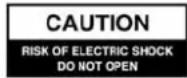

Warnings
- To reduce the risk of fi re, electric shock or damage to the television, do not expose it to dust, rain or moisture, or place any objects fi lled with liquids on or near the television.
- Do not place the television in a confined space, ensure that nothing can obstruct the ventilation openings at the rear of the television.
To prevent the spread of fi re, keep candles or other open fl ames away from this product at all times

- Dispose of this television and any components including batteries in an environmentally friendly manner. If in doubt, please contact your local authority for details of recycling.
Safety
- For your safety, this appliance is fitted with a fused moulded 3 pin mains plug. Should the fuse need to be replaced, ensure that any replacement is of the same amperage and approved with the BSI mark.
- The television should be connected to a main socket outlet with a protective earthing connection.
- Never try and replace the mains plug unless you have adequate qualifications and are legally authorised to do so. In the event that a replacement Mains cable is required, contact the manufacturer for a suitable replacement.
- Never use the television if it is damaged in any way.
- Always place the television on a fl at level surface avoiding anywhere which may be subject to strong vibration.
- Ensure the television is not placed on top of the power cable as the weight of the television may damage the cable and cause a safety hazard.
- Never place mobile phones, speakers or any other device which may cause magnetic or radio interference with the television. If interference is apparent, move the device causing the interference away from the television.
-
To disconnect the apparatus from the mains, please use the all pole mains switch located on the side, underside or rear of the TV. The switch shall remain readily operable.
-
Batteries (battery pack or batteries installed) shall not be exposed to excessive heat such as sunshine, fire or the like.
- Install the product at least 5cm from the wall for ventilation.
Maintenance
- To clean this unit, wipe with a soft, dry cloth. If the surfaces are extremely dirty, use a soft cloth dipped in a soap and water solution or a mild detergent solution.
- Use eyeglass cleaner to remove stubborn dirt from the LCD/LED Screen.
- Never use alcohol, paint thinner or benzene to clean this unit.
- Before using a chemically treated cloth, read the instructions that came with the cloth carefully.

CAUTION: If water or other liquid enters the television through the display panel surface or back cover a malfunction may occur.
Packaging
- The safest way to transport your item is in the original box/packaging - please save your packaging for this.
- You will need original box/packaging in the event of warranty/service repair or support. We are unable to carry out warranty/service if you are unable to package it correctly.
Important Safety Instructions
IMPORTANT - Please read these instructions. All the safety and operating instructions should be read before the appliance is operated.

Important Information - Regarding Use of Video Games, Computers, Captions or Other Fixed Image Displays
The extended use of fixed image program material can cause a permanent “shadow image” on the LCD panel.
This background image is viewable on normal programs in the form of a stationary fixed image. This type of irreversible LCD/LED panel deterioration can be limited by observing the following steps:
- Reduce the brightness/contrast setting to a minimum viewing level.
- Do not display the fixed image for extended periods of time.
- Turn the power off when not in actual use.
Examples of images that you need to watch out for are as follows (this is not an exhaustive list):
- TV Channel Logos: e.g. Shopping channel logos and pricing displays; especially if they are bright and stationary.
- Moving or low contrast graphics are less likely to cause ageing of the screen.
- Time Displays
- Teletext: Do not view a stationary page for a long period of time
• TV/DVD Menus: e.g. Listings of DVD disc content - Pause Mode: Do not leave the TV in pause mode for long periods of time, e.g. When watching DVDs or videos.
Important - Once 'shadow image/screen burn' occurs, it will never disappear and is not repairable under warranty.

TruSurround HD
SRS TruSurround HD™ creates an immersive, feature-rich surround sound experience from two speakers, complete with rich bass, high frequency detail and clear dialog.
TruSurround HD, SRS and the Symbol are trademarks of SRS Labs, Inc.
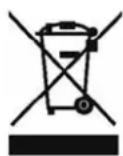
How do I dispose of this product?
UK: Waste electrical products should not be disposed of with household waste. Separate disposal facilities exist. For your nearest facilities, please see www.recycle-more.co.uk or in store for details.
ROI: Waste electrical products should not be disposed of with household waste. Separate disposal facilities exist. Check with your Local Authority or retailer for recycling advice.
Observe the correct polarity when inserting batteries.
Batteries
- Do not use different types of batteries together or mix old and new batteries.
- Dispose of batteries in an environmentally friendly way.
- Certain regions may regulate the disposal of batteries.
Please consult your local authority.
Cd
Important Safety Instructions
IMPORTANT - Please read these instructions. All the safety and operating instructions should be read before the appliance is operated.

3D Safety Information
- If you watch the 3D imaging too closely or for a long period of time, it may harm your eyesight.
- Watching the TV or playing video games that incorporate 3D imaging with the 3D glasses for a long period of time can cause drowsiness, headaches or fatigue to you and/or your eyes. If you have a headache, or otherwise feel fatigued or drowsy, stop watching the TV and take a rest.
- Pregnant woman, seniors, persons with heart problems or persons who experience frequent drowsiness should refrain from watching 3D TV.
- Some 3D imaging may cause you to duck or dodge the image displayed in the video. Therefore, it is best if you do not watch 3D TV near fragile objects or near any objects that can be knocked over easily.
- Please prevent children under the age of 5 from watching 3D TV as it may affect their vision development.
Warning for photosensitization seizure
- Some viewers may experience a seizure or epilepsy when exposed to certain factors, including f1 ashing lights or images in TV or video games. If you or anybody from your family has a history of epilepsy or seizure, please consult with your doctor before watching 3D TV. Also certain symptoms can occur in unspecified conditions without any previous history. If you experience any of the following symptoms, immediately stop watching the 3D imaging and consult a doctor: dizziness or light headedness, visual transition or altered vision, visual or facial instability, such as eye or muscle twitching, unconscious action, convulsion, loss of conscience, confusion or disorientation, loss of directional sense, cramps, or nausea. Parents should monitor their children, including teenagers, for these symptoms as they may be more sensitive to the effects of watching 3D TV.
Risk of photosensitization seizure can be reduced with the following actions.
• Take frequent breaks from watching 3D TV.
- For those who have vision that is different in each eye, they should watch the TV after taking vision correction measures.
- Watch the TV so that your eyes are on the same level as the 3D screen and refrain from sitting too closely to the TV.
- Do not watch the 3D imaging when tired or sick, and avoid watching the 3D imaging for a long period of time.
- Do not wear the 3D glasses for any other purpose than viewing 3D imaging on a 3D TV.
- Some viewers may feel disoriented after watching 3D TV. Therefore, after you watch 3D TV, take a moment to regain awareness of your situation before moving.
Contents
Manufacturers Guarantee Information 3
Important Safety Instructions 4-6
What is included in the box 8
Attaching the stand 9
Detaching the stand and wall mounting 10
Getting Started - Initial Set Up 11
TV Buttons and Input Source Menu 12
Remote Control 13
Connections 14-15
TV Menu Operation 16-22
Channel Menu 16
Picture Menu 17
Sound Menu 18
Time Menu 19
Lock Menu 20
Setup Menu 21
3D Settings 22
PC Operation 23-24
7 Day TV Guide 25
USB Mode / Media Player 26
General Information 27-31
Using your TV with a Sky digital set top box 27
Frequently Asked Questions 28-29
Technical Specifications 30
Index 31
What Is Included In The Box
Accessories
Included with this TV are the following accessories:
1 x User Guide
1 x Remote Control

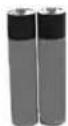
1 x Quick Start Guide 2 x AAA Batteries

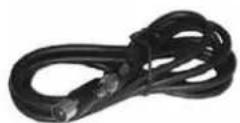
1 x RF Cable
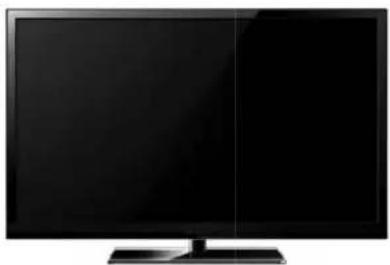
1 x TV
natural_image
Front view of a modern flat-screen monitor with black screen and stand (no visible text or symbols)8 x 3D Glasses

natural_image
Black-framed 3D glasses with clear lenses (no text or symbols visible)1 x Stand Installation Pack

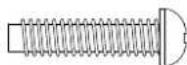
5 x M (4x12)
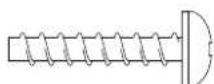
4 x ST (4x16)
Please save your packaging as you will need this in the event of warranty/service repair or support. We are unable to carry out warranty/service if you are unable to package it correctly. The safest way to package your item in the event of warranty/service repair is in its original box/packaging.
Attaching The Stand
To complete the stand installation you will require a Phillips screw driver.
The Stand Installation pack comes with two sets of screws.
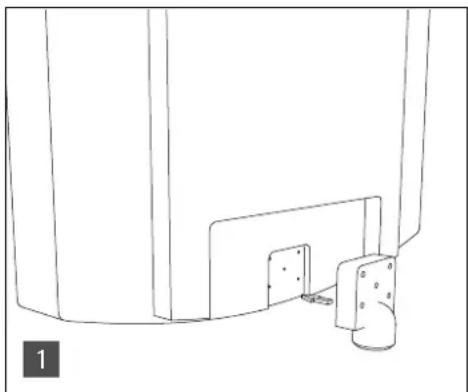
fig 1) Attach the stand neck to the rear of the TV set.
fig 2) Secure the neck to the TV using the 5 x M (4x12) screws provided.
fi g 3) Attach the stand base to the neck.
fig 4) Secure the base to the neck using the 4 x ST (4x16) screws provided.

M (4x12)

ST (4x16)
natural_image
Technical line drawing of a mechanical assembly with mounting bracket and base mount (no text or symbols)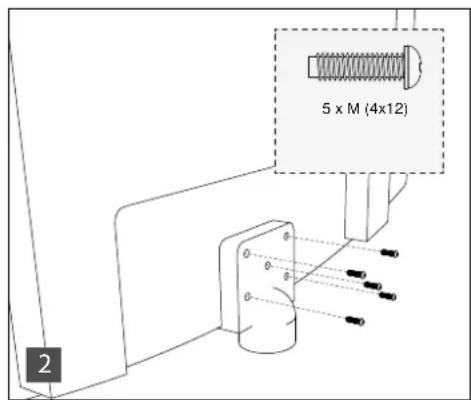


Detaching The Stand And Wall Mounting
Detaching the Stand
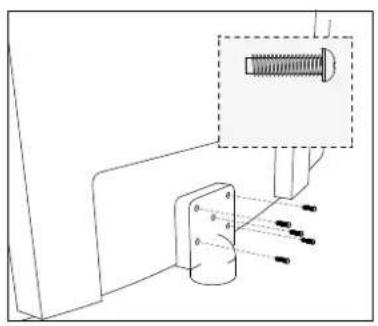
To detach the stand please remove the 5 screws highlighted then remove the stand neck and base from the rear of the TV set.
natural_image
Technical diagram showing a mechanical assembly with a bolt and pin, no text or symbols present
natural_image
Simple line drawing of a cylindrical object with a rectangular base and a small protruding component (no text or symbols)Wall Mounting the TV
IMPORTANT - Before drilling any holes in the wall ensure you are not drilling where there could be any electric wires, water or gas pipes.
This TV requires a VESA 200 x 100 wall mounting bracket

natural_image
Diagram of a computer monitor with directional arrows indicating orientation (no text or symbols)IMPORTANT – If wall mounting this TV, only use the screws already provided in the wall mounting holes. Using other screws which are longer could cause irreparable damage to internal parts.
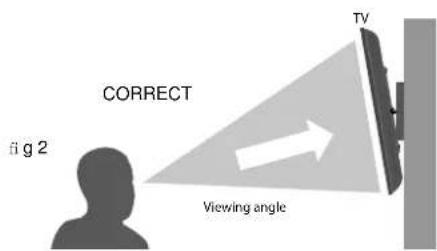
For optimum viewing, if wall mounting the TV higher than eye level, the TV should be tilted downwards so that the TV's screen is 'face on'. See fig 1 and 2
1) Remove the four screws highlighted below.
2) The wall mount can now be easily attached to the mounting holes on the rear of the TV. These holes are indicated in the picture below.

Getting Started - Initial Set Up
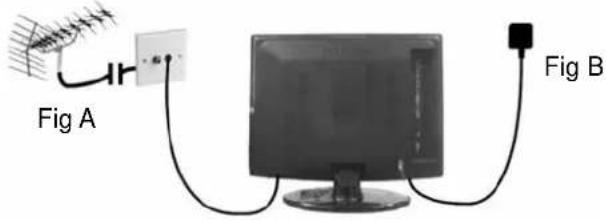
1) Using the RF cable supplied, connect the TV to the TV Aerial wall socket (Fig A)
Connect the power cable to the Electrical outlet (Fig B)
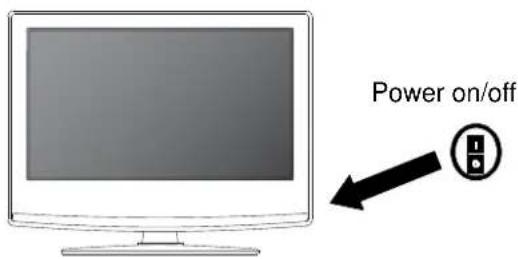
2) Switch on the television using the power on/off switch located on the side of the TV.
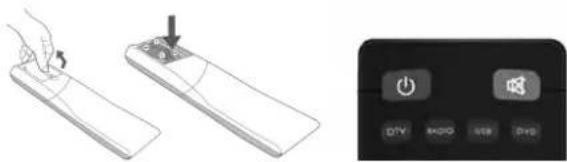
3) Insert the batteries supplied into the Remote control and press the Standby button to power on the TV
4) You will now be welcomed with the initial set-up screen. If it does not appear, on the remote control, please press [MENU] then 8-8-8-8 and the menu will appear. Press OK on the remote control and tuning will start.*
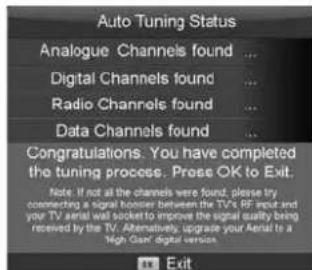
5) After tuning the following screen will appear.*
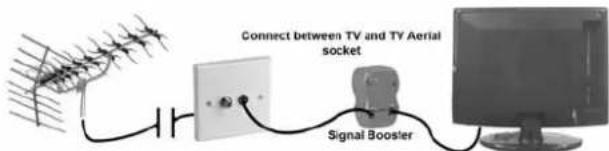
If you are missing channels, the reason for this is likely to be signal strength, you should consider connecting signal booster and re-tuning the TV.
* Screen shots/images are shown for illustration purposes only and may change dependent on model/region
Important
As part of our ongoing development to reduce power consumption, we have added an extra function to this Television called 'Ecohome' (you will see this during the first time installation set up). Power consumption using the Ecohome function is approximately 15% lower than some other modes. The picture brightness is reduced using the Ecohome function. If this function is not suitable for your viewing environment, you can select other modes as necessary. (Please note, 'Demo' mode is for optimum default picture settings, however, power consumption is approximately 15% higher than 'Ecohome' mode)
Please refer to the user guide section 'Picture settings' in order to change the mode to one that maybe more suitable for your environment. There is also a shortcut button on the remote control called 'P-Mode' should you wish to change to another mode.
1
2
3
natural_image
Illustration of a handheld device with a hand pressing down and a control panel showing icons for power, radio, audio, and video (no text or symbols on the device itself)4

5
TV Buttons & Source Menu

- Volume up and menu right
- Volume down and menu left
- Programme/Channel up and menu up
-
Programme/Channel down and menu down
-
Displays Menu/OSD
- Displays the input source menu
- Standby Power On/Off
Choosing Mode Input/Source
To switch between the different input/connections.
A) Using the buttons on the remote control:
1) Press [SOURCE/ AV] - The source menu will appear
2) Press [V] or [A] to select the input you require.
3) Press [OK]
B) Using the buttons on the Television:
1) Press [SOURCE]
2) Scroll up / down using CH+/CH- buttons to the input/source you require
3) Press Vol+ to change input/source to the one selected.

Remote Control
Viewing remote control - TV
- STANDBY
- MUTE
- DTV
- RADIO
- DVD
- USB
- NUMBER BUTTONS
- TV GUIDE
- -To return to the previous channel viewed
- P.MODE - Scrolls through picture mode options
- VOL ▲/▼
- CH ▲/▼
- S.MODE - Scrolls through sound mode options
- FAV - To display favourites menu
- MENU
- EXIT
- (▲Allows 96) to navigate the on-screen menus and adjust the system settings to your preference
- SOURCE/AV
- INFO - Press once for now/next channel information Press twice for programme information about current programme
- ASPECT
- SLEEP
- SUBTITLE
- AUDIO
- TEXT
- TEXT HOLD
- DISPLAY
- TEXT/DVD ZOOM - DVD Zoom TEXT
- DVD Menu




Connections

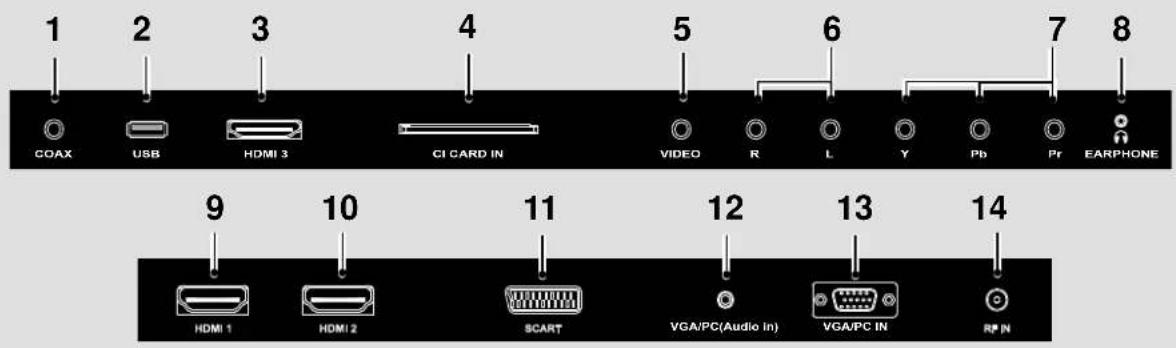
natural_image
Illustration of a computer monitor with a blank screen and two gray geometric shapes below (no text or symbols)1 COAX Audio Out Digital Coax output
2 USB USB Input
3 HDMI 3 HDMI input
4 CI CARD IN Common Interface module
5 Video Video Input
6 R/L Audio in Component Audio input
7 COMPONENT (HD) Component input (YPbPr)
8 EARPHONE Earphone Socket
9 HDMI 1 HDMI input
10 HDMI 2 HDMI input
11 SCART SCART input
12 VGA PC Audio In 3.5mm PC audio input
13 VGA PC VGA-PC input
14 RF IN RF / TV Aerial Input
Connecting a DVD Player/Recorder, Video Recorder or Cable/Satellite Box
TVs Input/Source should be set to SCART

flowchart
graph LR
    A["TV Aerial Wall Socket"] --> B["DVD or VCR"]
    B --> C["SCART OUT"]
    B --> D["RFIN"]
    B --> E["SCART"]
    C --> F["Computer"]
Connections
Connecting a Camcorder, Camera or Games Console
Source should be set to Video

flowchart
graph LR
    A["Camera or Camcorder"] --> B["Yellow"]
    A --> C["White"]
    A --> D["Red"]
    B --> E["Video"]
    C --> F["Audio In L/R"]
Connecting a High Definition (HD) Device
Option 1 - via HDMI to HDMI cable
A HDMI cable can output both video and audio and enables you to enjoy digital-quality video and audio with minimal loss of quality.
TVs Input/Source should be set to HDMI.
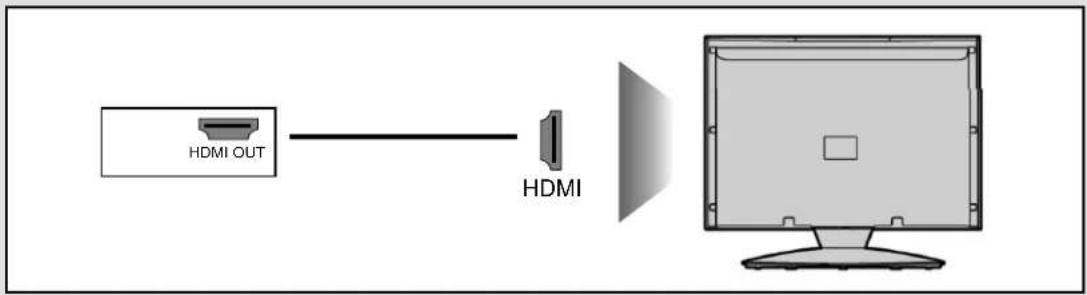
flowchart
graph LR
    A["HDMI OUT"] --> B["HDMI"]
    B --> C["Computer"]
Connecting a High Definition (HD) Device
Option 2 - via Component cable
If you are supplied with a cable from the device which has RED, GREEN, BLUE, RED & WHITE connectors you must connect via Component (for picture) and by phono cable (for sound).
TV Source should be set to Component.
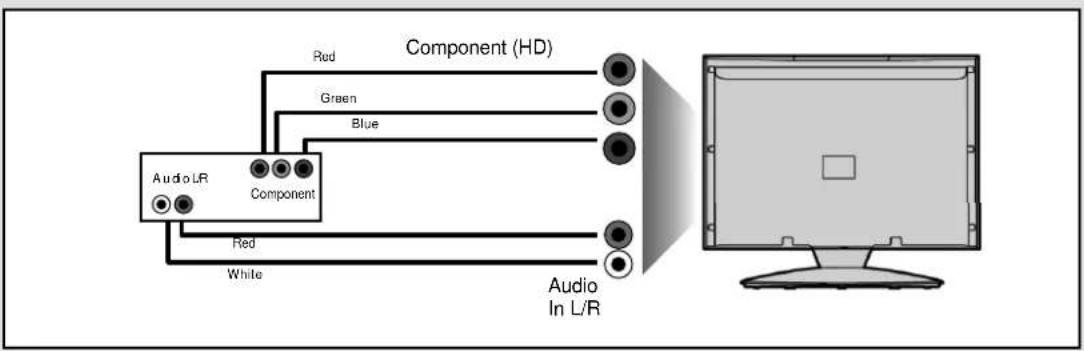
flowchart
graph TD
    A["Component (HD)"] --> B["Red"]
    A --> C["Green"]
    A --> D["Blue"]
    A --> E["Red"]
    A --> F["White"]
    G["Audio In L/R"] --> H["Computer"]
Channel Menu

Auto Tuning
Allows you to retune the television for all digital channels, digital radio stations and analogue channels.
ATV Manual Tuning
Allows you to manually tune your analogue signal
DTV Manual Tuning
Allows you to manually tune your digital signal
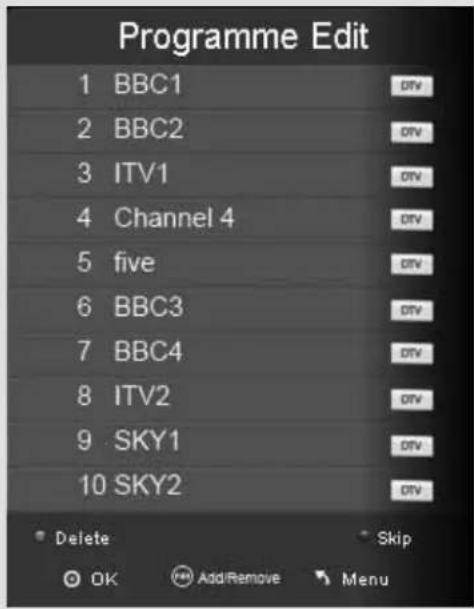
Programme Edit
Allows you to delete, skip and add favourite channels.
Schedule List
Lists your programme reminders
CI Information
Pay per view services require a "smartcard" to be inserted into the TV. If you subscribe to a pay per view service the provider will issue you with a 'CAM' and a "smartcard". The CAM can then be inserted into the COMMON INTERFACE PORT (CI Card In).
Signal Information
Displays signal strength information
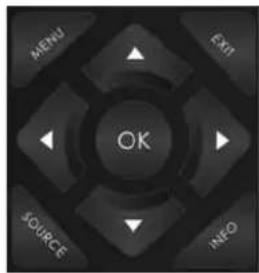
To access this menu, press [MENU] button on the remote control. To enter a menu press [OK]
If you wish to make changes to any of the default settings, use the scroll buttons. To confirm any settings press [OK] button.
To exit this menu at anytime, press [EXIT] button.
Tip: If you do not press any buttons for 10 seconds, the menu will automatically exit. You can change the length of time before the menu exits automatically - see 'Menu Duration' section.
Picture Menu

Picture Mode
- Standard - Default settings
• Dynamic - Recommended settings for fast moving pictures - Mild - Set to be lighter in colour and less bright
- Personal - Lets you manually alter all the settings
- Ecohome - Power saving mode which reduces the energy used by up to 25% (by reducing the power to the LED/LCD panel).in Ecohome mode, the TV will switch itself to Standby mode after 4-5 hours in the event that the TV buttons or remote control buttons are not pressed (see the time menu to de-activate this function).
Contrast
Switch the balance between black and white
Brightness
Increase or decrease the brightness of the picture
Colour
Increases the colour from black and white
Tint
Lets you increase or decrease the level of tint within the picture
Sharpness
Increase or decrease the sharpness of the picture
Colour Temperature
• Normal - Default settings
- Warm - Increases red within the picture
• Cool - Increases blue within the picture
Noise Reduction
- Off - Turns noise reduction off
- Low - Minor system adjustment
• Middle - Medium system adjustments
• High - Maximum system adjustments - Default - Default settings
To access this menu, press [MENU] button on the remote control. To enter a menu press [OK]
If you wish to make changes to any of the default settings, use the scroll buttons. To confirm any settings press [OK] button.
To exit this menu at anytime, press [EXIT] button.
Sound Menu

Sound Mode
- Standard - Default settings
• Music - Emphasises music over voices
• Movie - Provides live and full sound for movies
• Personal - Selects your personal sound settings
• Sports - Emphasises sound for sports
Treble
To adjust the amount of high frequency within the sound
Bass
To adjust the amount of low frequency within the sound
Balance
To switch the sound between the left and right speakers
Auto Volume Level (AVL)
When 'on' is selected, the volume will stay at a constant level regardless of input/source
Surround Sound
- Off - Off
- SRS TruSurround HD - SRS TruSurround HD™ creates an immersive, feature-rich surround sound experience from two speakers, complete with rich bass, high frequency detail and clear dialog.

Digital Output
- Off - Off
• Auto - Selects the best settings automatically - PCM - Select this option if you are connecting to a Stereo Hi-fi via coax cable (Pulse-code modulation (PCM) is a digital representation of an analogue signal)
AD Volume
This allows the user to increase and decrease the AD (Audio Description) volume level.
(Audio Description is a service available on certain programmes. It provides a description of what is happening during the selected programme for a person who is visually impaired)
Tip: Treble and bass levels can only be adjusted when the sound mode 'Personal' is selected.
Time Menu
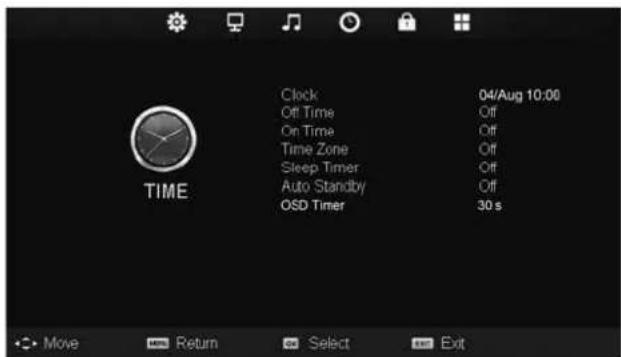
Clock
Shows the date and time
Off Time
Allows you to set a specific time for your TV to turn off
On Time
Allows you to set a specific time for your TV to turn on, the channel it will then display, the source it will be on and also the volume. This function can then be toggled to repeat every day or a certain day.
Time Zone
Change your current time zone
Sleep Timer
Lets you set the sleep timer so the television automatically switches off after a set amount of time. Off -> 10min -> 20min -> 30min -> 60min -> 90min -> 120min -> 180min -> 240min
Auto standby
Toggle the Function on and off
OSD Timer
Lets you adjust the amount of time the On Screen Menu stays on the screen before disappearing
To access this menu, press [MENU] button on the remote control. To enter a menu press [OK]
If you wish to make changes to any of the default settings, use the scroll buttons. To confirm any settings press [OK] button.
To exit this menu at anytime, press [EXIT] button.
Lock Menu
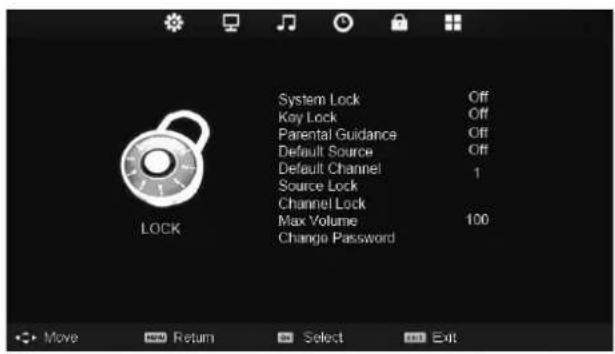
System Lock
Allows you to lock or unlock the menu. You will be asked to enter a 4 digit password use the ▶button to quit the password input. Use the ▶button to clear. Default password is 0000
Key Lock
Allows you to lock the buttons on the side of the TV set
Parental Guidance
Allows you to set the rating to block certain content based on age information
Default Source
Allows the user to set the default source. The default source is the source the TV starts on when first switched on
Default Channel
Allows the user to set a channel as the default channel on the Digital source. The default channel is the channel the TV starts on when fi rst switched on
Source Lock
Allows you to lock the source menu
Channel Lock
Allows you to lock certain channels manually
Max Volume
Allows you to adjust and set the maximum volume
Change Password
Allows you to change the password

To access this menu, press [MENU] button on the remote control. To enter a menu press [OK]
If you wish to make changes to any of the default settings, use the scroll buttons. To confirm any settings press [OK] button.
To exit this menu at anytime, press [EXIT] button.
Setup Menu
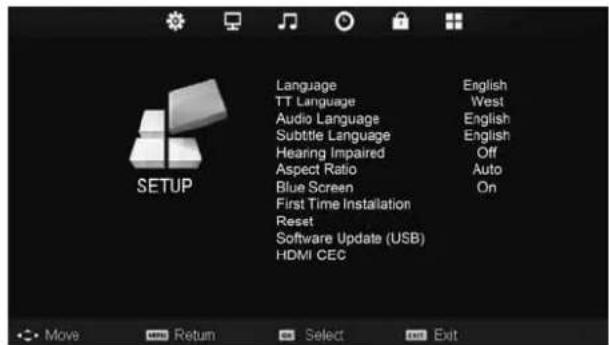
Language
Allows you to change the language of the menu
TT Language
Encoding settings for the proper display of teletext characters
Audio language
Allows the user to change the audio language
Subtitle Language
Allows the user to change the subtitle language
Hearing Impaired
This allows the user to turn on the Hearing Impaired function, this produces subtitles on the screen which provide a description of what is happening during the selected program.
Aspect Ratio
Blue Screen
Changes the background when there is no input between clear and a blue background (Only available on some sources)
First Time Installation
Allows you to retune the television for all digital channels, digital radio stations and analogue channels.
Reset:
Reset Menu System - This resets the menus to factory settings. Reset TV Channels - This clears all the TV channels from the television.
Software Update (USB)
This menu lets you install the new software/fi rmware onto the television. Further details of how to do this will be issued with the fi rmware. Contact the helpline or refer to the 'product support' section of the website.
HDMI CEC (Consumer Electronic Control)
Allows HDMI devices to control each other and allows the user to operate multiple devices with one remote control. (only available with compatible devices)
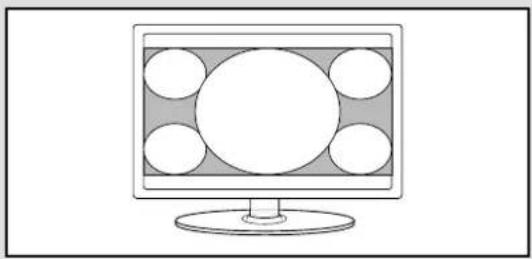
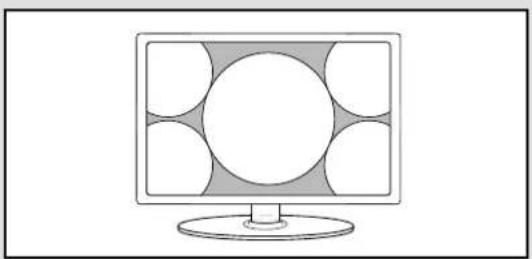
Within the UK the picture format varies depending on the channel/broadcast. There are a number of different options to best meet your needs
- Auto - Automatically displays the best picture format. So the picture is in the correct position. May have black lines at the top/bottom and/or sides.
- Original - Will display the picture from the broadcaster without any change
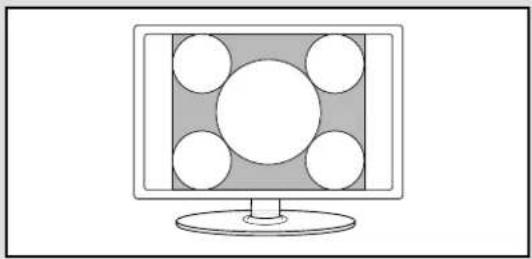
• 4:3 - Displays the 4:3 picture in its original size. Side bars are shown to fill the 16:9 screen
natural_image
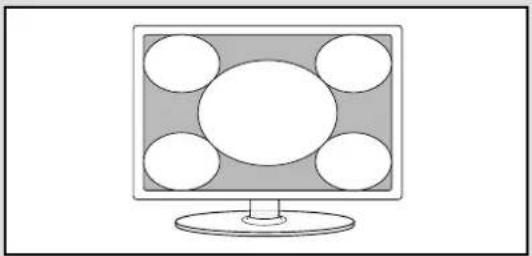
Illustration of a computer monitor with a central screen and surrounding circular elements (no text or symbols)• 16:9 - Fills the screen with a regular 16:9 signal and 4:3 will stretch to fill the screen
natural_image
Simple line drawing of a computer monitor with five circular windows on the screen (no text or symbols)- 14:9 - Displays the 14:9 picture in the correct proportion. As a result side bars are shown on the screen
natural_image
Illustration of a computer monitor with five circular buttons arranged in a grid pattern (no text or symbols)- Zoom - The picture is the correct proportion but zoomed in to fill the screen
natural_image
Line drawing of a computer monitor with a circular design on the screen (no text or symbols)For the best 3D picture effect, watch your TV from vertical angle +/- 10°.
3D Type
When connecting a 3D product sometimes the picture maybe displayed incorrectly; choose from the following settings to correct this. You can toggle these settings by pressing the '3D' button on your remote
| 3D Off Default settings | |
| Side by Side | 3D format is commonly used in 3D broadcasting, works by halving the horizontal resolution of videos to store left and right eye images in each frame. It effectively displays up to 960 x 1080 pixel pictures to each eye, enabling TV stations to telecast 3D content at a much lower bandwidth compared with 3D Blu-ray discs. Typical supported resolutions are limited to 720p and 1080i for 3D TV programs.Users will need to manually select the correct 3D format to properly display side-by-side 3D content on a 3D TV. |
| Top Bottom | 3D format is alternative for 3D broadcast, which is pretty similar to side-by-side 3D except that it halves the vertical resolution instead. Available primarily up to 720p resolution, top-and-bottom 3D offers 1280 pixels horizontally. The higher pixel count is generally considered more suitable for displaying panning motion insports programs. |
| Frame Packing | As its name suggests, this format stacks the left and right eye images in each frame to retain the content's original resolution for the best 3D pictures. Most, if not all, 1080p 3D Blu-ray movie discs and 720p PS3 3D games are produced utilizing this technique. Another key differentiator is that all 3D TVs should be able to automatically detect frame-packing 3D signals and correctly display the content without user intervention. |
| Line by Line | The picture signals for left and right eyes are interleaved in alternate lines. The left clip's resolution is halved then placed in the odd lines of the video stream. Correspondingly, the right clip's resolution is halved then placed in the even lines of the video stream. When combined the video stream totals 1920×1080. |
Exchange 3D L/R
Change picture sequence for different viewing
Using The Television As A Computer Monitor
How to set up for Windows XP & Windows Vista (connecting via VGA cable to the TV)
IMPORTANT – Before connecting the computer to the television you must ensure the computer settings are correct for the television. You MUST do this using your old monitor.
1) Switch on your computer
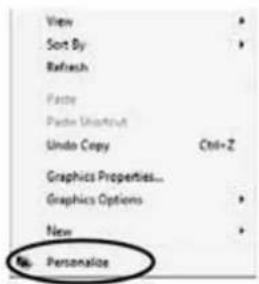
2) When fi nished booting up right click your mouse anywhere on the screen

XP Screen
VISTA Screen
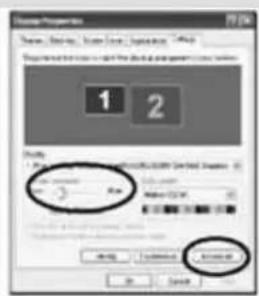
4) Left click your mouse on Setting/Display Settings. Ensure the screen resolution is set to what is shown in the technical specifications section toward the rear of this user guide. To correct the resolution to that of the television move the slider.
XP Screen
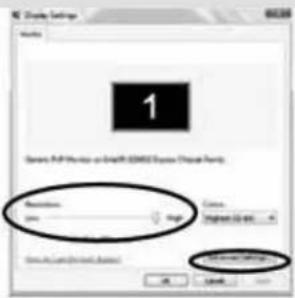
VISTA Screen
3) Left click your mouse on Properties/Personalise
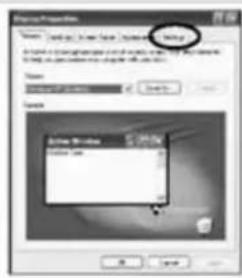
XP Screen

VISTA Screen
5) Left click your mouse on Advance/Advanced Settings and left click on Monitor
![Play Shadow File Path Name: Image Balance Play Shadow Status: Show type: Show size: Size: [ ] Alt space that the keyboard is displayed [ ] Clear the keyboard to allow this specific display for the optional keyboard. The key key is an additional display optional keyboard.](/content/2026/06/1191538/images/04dd1ba5363c2c6aa685c58b26f9288af8e5dcb242d28cb566faaf8e74e70ac9.jpg)
XP Screen
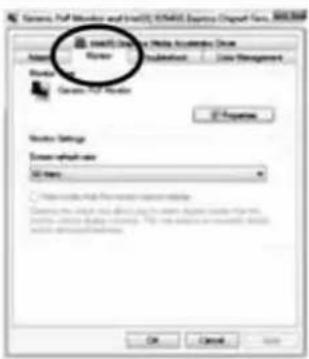
VISTA Screen
6) Left click on the drop down for Screen refresh rate and select 60 Hertz, if you experience picture noise or 'f' ickering', select 50 hertz or 70 hertz.
7) Click on Apply, then click Yes and the settings will be saved.
8) Now switch off your computer and connect the television (as shown)
9) Switch on the TV, select the input/source to VGA/PC and re-start your PC.

natural_image
Line drawing of a flat-screen computer monitor with no text or symbolsConnecting a Laptop
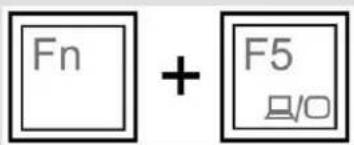
In addition to the above if you are connecting a laptop to the television you will also need to activate the VGA connection on the laptop. This can vary based on the brand of laptop you have, on many brands/models, it is as per below.
1) Connect the laptop to the television
2) On the Laptop push buttons
The screen will now switch to the television.
PC Settings

Auto Adjust
Lets you automatically configure the television to be used as a computer monitor
H Offset
Changes the horizontal position of the picture
V Offset
Changes the vertical position of the picture
Size
Increase picture size
Phase
To adjust delay time of phase in order to reduce the noise of picture
Position Reset
Changes back to the factory settings

To access this menu, press [MENU] button on the remote control. To enter a menu press [OK]
If you wish to make changes to any of the default settings, use the scroll buttons. To confirm any settings press [OK] button.
To exit this menu at anytime, press [EXIT] button.
Tip: If the computer is left in-active for a period of time, the television will switch into a 'sleep' state (the screen will power off to save power). To switch back on press the standby button.
7 Day TV Guide
TV Guide is available in Digital TV mode. It provides information about forthcoming programmes (where supported by the freeview channel). You can view the start and end time of all programmes and on all channels for the next 7 days and set reminders.
1) Press [TV GUIDE]. The following 7 Day TV Guide will appear.
| 7 Day TV GUIDE | ||
| 10 Years Younger: The ChallengeSeason 2Support worker Janice Cassidy's lifestyle of long working hours and a penchant for tanninghas taken its toll, while the stress of bringing up two daughters and heavy smoking hasaffected interior designer Shere Morady. Surgeon Jan Stanek and the team set out to provide | ||
| 04 Aug 2010 10:42 | ||
| BBC1 | 05:00-06:00 | 10 Years Younger: The Challenge |
| BBC2 | 06:00-06:30 | The Simpsons |
| ITV1 | 06:30-07:00 | Hollyoaks |
| Channel 4 | 07:00-08:00 | Channel 4 News |
| five | 08:00-09:00 | How to Look Good Naked |
| BBC3 | 09:00-10:00 | Newlyweds: The One Year Itch |
| BBC4 | 10:00-11:15 | Big Brother |
| ITV2 | 11:15-11:45 | The Big Bang Theory |
| RemindPrev DayNext DayMove ViewDisplay | ||
2) Navigate through the menu using ▲▼▶◀
You can now:
Set a reminder by pressing GREEN
View a previous day by pressing YELLOW
View the next day by pressing BLUE
3) Press [EXIT] to exit the 7 day TV Guide.
USB Mode / Media Player
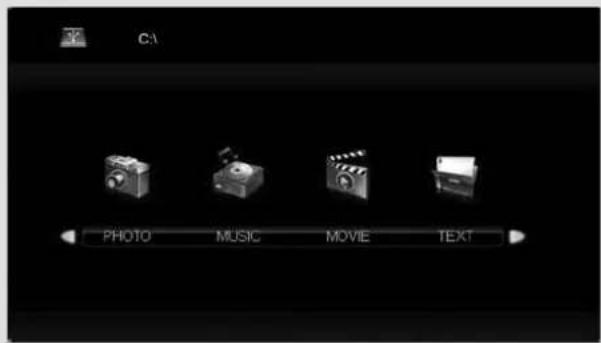
USB mode offers playback of various different types of content that you have saved on your USB Memory Stick.
On switching to USB source the above menu screen will appear. The content will be divided into Photo, Music, Movie and Text based on file type.
1) You can navigate through the menus using the scroll ▲buttons. To confirm the item you wish to play/view press [OK] button.
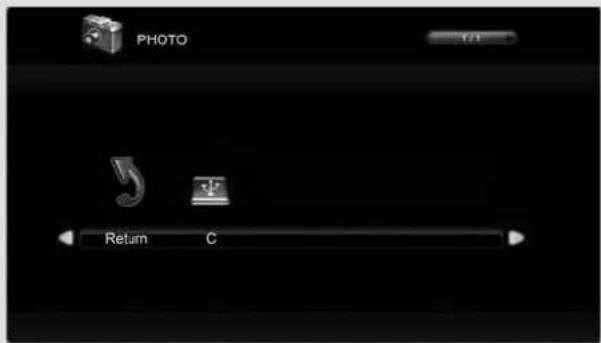
2) Select the drive you require.
(If your drive only has 1 partition you will only see 1 item).
3) You can now access the item. Press OK to view.
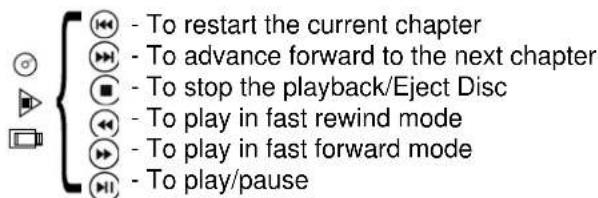
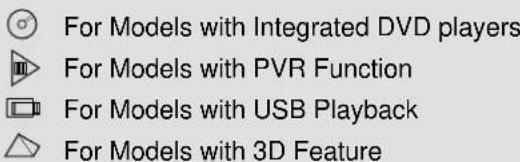
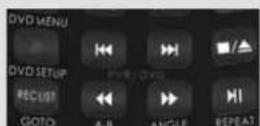
4) While viewing you control the item using (Fig A) or by pressing (i) and using ▲and (OK)
1)
2)
3)

4)
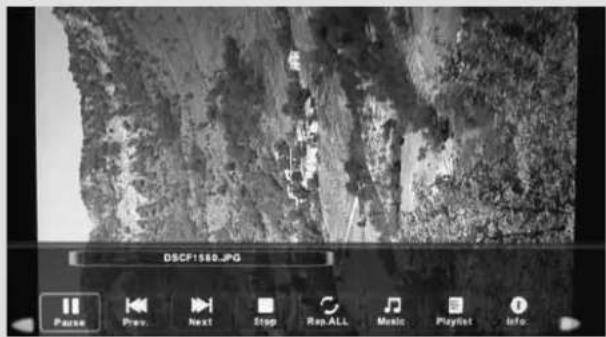
Fig A
Using Your TV With a Sky Digital Set Top Box
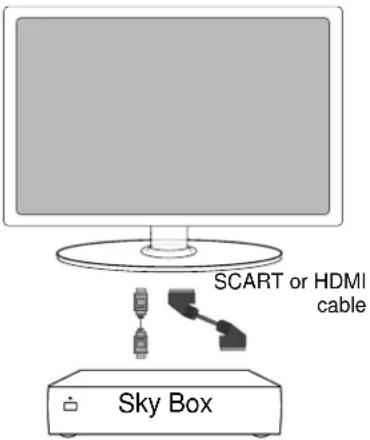
Option 1) Connecting your TV to your Sky box (when both the TV and Sky Box are located in the same room)
Depending on your Sky Box & TV model, connect either by SCART or HDMI cables (available separately)
If connecting by SCART, select the 'Input source' on the TV as SCART.
If connecting by HDMI, select the 'Input source' on the TV as HDMI (if the TV has more than 1 HDMI port, ensure you select the input source to match the HDMI numbered port on the rear of the TV)
If you wish to use your Sky remote to operate the TV's functions, you will need a Sky remote control (Revision 9 or later) and you will need to programme a 4 digit code into it. See bottom of this page.
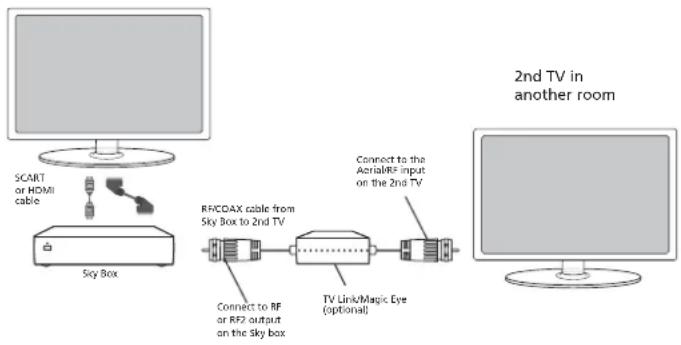
Option 2) Connecting your TV to your Sky box (when your Sky box is located in a different room to the TV)
Please note, if you are adding a 'Magic Eye/TV Link' to your system so that you can use your Sky remote control to change the Sky channel in the room where the 2nd TV is located, please refer to the instructions included with the TV link/magic eye in order to ensure the RF or RF2 output on your Sky box is powered on. (The red LED light on the TV link/magic eye will light up if the RF / RF2 output is correctly set up) If you do not have the instructions that came with the TV link/magic eye, instructions on how to do it can be found on our web site.
flowchart
graph LR
    A["2nd TV in another room"] --> B["TV Link/Magic Eye (optional)"]
    B --> C["RF/CDAX cable from Sky Box to 2nd TV"]
    C --> D["SCART or HDMI cable"]
    D --> E["Sky Box"]
    E --> F["Connect to RF or RF2 output on the Sky box"]
    F --> G["Connect to the AerialRF input on the 2nd TV"]
1) To tune the TV to the Sky box, on the 2nd TV, select the 'Analogue' input source.
2) Select the channel that you wish to store the Sky box/channel on. (If you do not use channels 1-5 because you no longer have analogue terrestrial channels after digital switchover, you may choose to select channel 1 to store the Sky box/channel, if you still have and use analogue channels 1-5, you may for example decide that channel 6 is the best option for you)
3) Press the corresponding number on the remote control to select the desired analogue channel chosen as per point 2 above.
4) On the TV remote control, press Menu. Now navigate through the menus to select Manual Tuning or Analogue Manual tuning (refer to the Tuning/Channel menu section of this user guide if necessary)
5) Manually tune in the channel (usually, the Sky box is at a frequency between 800Mhz and 850Mhz) once the Sky box/channel is found, press 'OK' to store it.
If you wish to use your Sky remote to operate the TV's functions, you will need a Sky remote control (Revision 9 or later) and you will need to programme a 4 digit code into it. Please see below.
Using a Sky Remote or a Universal Remote to operate your TV - Sky Remote Control, If you wish to use your Sky remote to operate the basic functions of your TV, you need to programme a 4 digit code into it. Please note. you will need the latest Sky Revision 9 remote control as this is the only version that includes the latest software/firmware necessary to operate this model of TV. The code required for this television is 2134. If you wish to upgrade/replace your existing Sky remote control to the latest version, you can do so on our web site.
Universal Remote Control, If you wish to use a Universal remote control to operate your TV, please refer to the web site for a full list of codes. (Please note we only have codes for One for All branded remote controls, if you have an alternative brand of Universal remote, please refer to the manufacturer for the code.)
Frequently Asked Questions
| General I would like to have louder sound by connecting additional speakers | Subject to the TV model and connections, it is possible to connect the TV to an external amplifier or surround sound (subject to connections/inputs on the device) as follows:-1) Connect a COAX cable* from the TV's COAX output to your amplifier/surround systems COAX input2) Connect a 3.5mm jack to L/R phono cable* from the TV's headphone socket (where fitted) to your amplifier/surround sound L/R input. Please note sound to the TV's speakers will be disabled.3) On selected models, it maybe possible to connect a SCART input/output* switch with an additional L/R Phono cable* to the TV's SCART socket and to the L/R Phono Input of your amplifier/surround sound. Please note due to copyright laws it is not possible to output video/sound from the TV on certain sources, i.e. HDMI, DVD etc.*cables and switches mentioned are available to purchase separately from your retailer. |
| General Why are some options in the menu unavailable and greyed out | Some options are only available in certain sources, i.e. HDMI, PC/VGA. They are unavailable in the other sources where they have no affect. |
| General Can I stop my TV turning off after 4hrs? | Yes1) In the picture settings menu, de-select Eco-home2) In the time settings menu, scroll down to Auto standby and select OFF |
| TV I have tuned in Digital TV but I am not receiving any or all of the channels and/or the channels I receive are breaking up | 1) Check you are in an area that can receive Freeview. Visit www.freeview.co.uk2) Check you are using an aerial that is able to receive a good digital signal. In most cases, you will need an outdoor digital hi-gain/wideband aerial. In areas that have excellent Freeview coverage, you may be able to use a loft type aerial but it is highly likely that you will also need to connect a booster between the back of the TV and the TV aerial wall socket. Unfortunately, to receive a good enough digital signal, it is not possible to use a portable/indoor type aerial. This may change once the analogue signal is switched off in 2012 and the Digital signal strength is increased. |
| TV I have re-tuned my television but when I switch it off it is not storing the channels | Complete a first time installation, please refer to the set-up menu section of the manual of how to do this |
| VCR/DVD Recorder | I have connected the TV to my VCR or DVD Recorder via SCART but it is not recording |
Frequently Asked Questions
| Game Consoles | I have connected my PS3 to the TV via HDMI, but I am not receiving any pictures or sound on my TV | 1) Ensure the TVs source is on HDMI2) Check your settings on your PS3 are as per the PS3 instruction manual |
| Game Consoles | I have connected my Xbox 360 to the TV via Component Cables (Red, Green & Blue) but I am not receiving any sound | Component cables only provide HD Pictures. For the sound you will need to connect the Red & White audio cables on the Xbox to the Red & White phono inputs on the rear of the TV. Please refer to the ‘Connections’ pages. |
| USB Mode | I have inserted a USB Memory Key, but the TV does not recognise it | Ensure the USB Memory Key is formatted to type FAT32. |
| USB Mode | Using a USB portable hard drive | If you wish to use a portable hard drive larger than 32GB, please note that it must be formatted to the FAT32 file system in order to operate on this TV. Windows XP/Vista computers are only capable of formatting up to 32GB, therefore, you will need a software programme/utility to format larger hard drives. Please refer to the web site for more information. |
| System Lock | I have changed the password on the television and now forgotten it | There is a master password of 4711, to gain access to the TV menu and reset the normal password |
| 3D mode The picture is not displaying correctly | Press the 3D button to toggle through the different 3D picture formats. | |
| 3D mode I have downloaded a 3D movie but it will not play via USB | 3D mode is not supported via USB. | |
Note:
Supplier may change TV software and on screen graphics without warning
Technical Specification
| Model 32/191F3DB | |
| Screen size (diagonal) 32"/81cm | |
| Resolution 1920 x 1080 | |
| RF 75 ohm Antenna / PAL-SECAM | |
| Video Inputs 3 x HDMI, 1 x VGA/PC, 1 x $CART, 1 x USB, 1 x Composite/Video, 1 x Component/YPbPr | |
| Sound Inputs | 1 x shared audio for Composite/Video & Component/YPbPr,1 x 3.5mm jack for PC audio input |
| Sound Outputs 1 x Coax Audio output, 1 x 3.5mm headphone jack | |
| USB Port 1 | |
| Sound power,watts (RMS) | 2 x 9W |
| Dimensions including stand (mm) 755W x 515H x 180D | |
| Net weight 10.8 kgs | |
| Energy Consumption Info | |
| Voltage and power consumption 110-240v 50 / 60Hz40 / 60 / 80W (Ecohome / Standard / Max)EEI - A (Energy Rating)(in standby less than 0.5w) | |
Index
| 3D Settings 22 | |
| Attaching the stand 9 | |
| Aspect Ratio 21 | |
| Auto Configuration of screen (PC) 23 | |
| Auto Tuning 16 | |
| Auto Volume Level 18 | |
| Balance 18 | |
| Bass 18 | |
| Blue Screen 21 | |
| Brightness 17 | |
| Clock | 19 |
| Colour 17 | |
| Colour Temperature 17 | |
| Common Interface | 20 |
| Connections | 14-15 |
| Contrast | 17 |
| Detaching the base/stand | 10 |
| Digital Output | 18 |
| First Time Installation | 11 |
| Frequently Asked Questions | 28-29 |
| Getting Started | 11 |
| Horizontal Position (PC) | 24 |
| Important installation instructions | 10 |
| Language | 21 |
| Manual Search | 16 |
| Noise Reduction | 17 |
| Phase (PC) | 24 |
| Picture Mode | 17 |
| Remote control | 13 |
| Reset to default | 21 |
| Sharpness | 17 |
| Sleep Timer | 20 |
| Sound Mode | 18 |
| Source Menu | 12 |
| System Lock | 20 |
| Technical Specifications | 30 |
| Treble | 18 |
| TV buttons | 12 |
| TV Guide | 25 |
| USB Mode / Media Player | 26 |
| Using the television as a computer monitor | 23 |
| Using your TV with a Sky digital set top box | 27 |
| Vertical Position (PC) | 24 |
| Wall mounting | 10 |
| What is included in the box | 8 |
- Full HD 3D Slim LED TV with USB Media Player
- User Guide
- Important Safety Instructions
- Warnings
- Safety
- Maintenance
- Packaging
- Important Information - Regarding Use of Video Games, Computers, Captions or Other Fixed Image Displays
- TruSurround HD
- How do I dispose of this product?
- Batteries
- 3D Safety Information
- Warning for photosensitization seizure
- Risk of photosensitization seizure can be reduced with the following actions.
- Contents
- What Is Included In The Box
- Attaching The Stand
- To complete the stand installation you will require a Phillips screw driver.
- Detaching The Stand And Wall Mounting
- Detaching the Stand
- Wall Mounting the TV
- Getting Started - Initial Set Up
- Important
- TV Buttons & Source Menu
- Choosing Mode Input/Source
- Remote Control
- Viewing remote control - TV
- Connections
- Connecting a DVD Player/Recorder, Video Recorder or Cable/Satellite Box
- Connecting a Camcorder, Camera or Games Console
- Connecting a High Definition (HD) Device
- Option 1 - via HDMI to HDMI cable
- Option 2 - via Component cable
- Channel Menu
- Auto Tuning
- ATV Manual Tuning
- DTV Manual Tuning
- Programme Edit
- Schedule List
- CI Information
- Signal Information
- Picture Menu
- Picture Mode
- Contrast
- Brightness
- Colour
- Tint
- Sharpness
- Colour Temperature
- Noise Reduction
- Sound Menu
- Sound Mode
- Treble
- Bass
- Balance
- Auto Volume Level (AVL)
- Surround Sound
- Digital Output
- AD Volume
- Time Menu
- Clock
- Off Time
- On Time
- Time Zone
- Sleep Timer
- Auto standby
- OSD Timer
- Lock Menu
- System Lock
- Key Lock
- Parental Guidance
- Default Source
- Default Channel
- Source Lock
- Channel Lock
- Max Volume
- Change Password
- Setup Menu
- Language
- TT Language
- Audio language
- Subtitle Language
- Hearing Impaired
- Aspect Ratio
- Blue Screen
- First Time Installation
- Reset:
- Software Update (USB)
- HDMI CEC (Consumer Electronic Control)
- 3D Type
- Exchange 3D L/R
- Using The Television As A Computer Monitor
- How to set up for Windows XP & Windows Vista (connecting via VGA cable to the TV)
- Connecting a Laptop
- PC Settings
- Auto Adjust
- H Offset
- V Offset
- Size
- Phase
- Position Reset
- Day TV Guide
- USB Mode / Media Player
- Using Your TV With a Sky Digital Set Top Box
- Option 1) Connecting your TV to your Sky box (when both the TV and Sky Box are located in the same room)
- Option 2) Connecting your TV to your Sky box (when your Sky box is located in a different room to the TV)
- Frequently Asked Questions
- Note:
- Technical Specification
- Index
Brand : BUSH
Model : 32-191F3DB
Category : Television