REALiS WX6500 D - Video projector CANON - Free user manual and instructions
Find the device manual for free REALiS WX6500 D CANON in PDF.


User questions about REALiS WX6500 D CANON
0 question about this device. Answer the ones you know or ask your own.
Ask a new question about this device
Download the instructions for your Video projector in PDF format for free! Find your manual REALiS WX6500 D - CANON and take your electronic device back in hand. On this page are published all the documents necessary for the use of your device. REALiS WX6500 D by CANON.
USER MANUAL REALiS WX6500 D CANON
MULTIMEDIA PROJECTOR
WUX6500
User's Manual
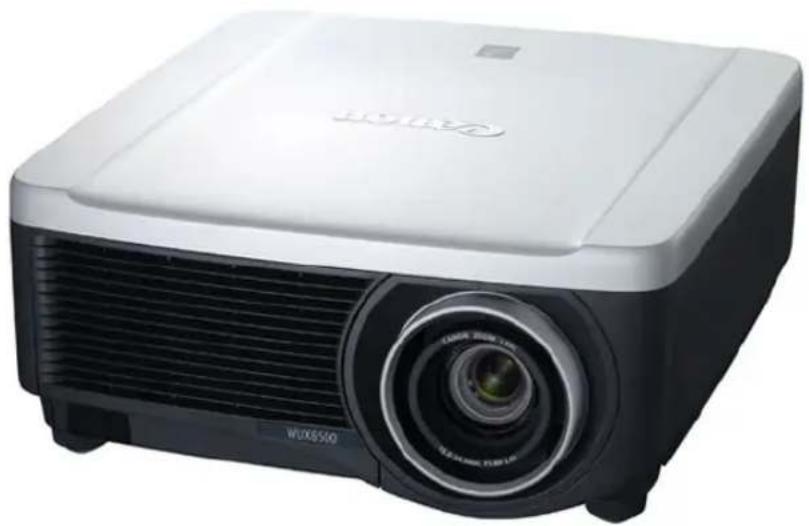
natural_image
Exterior view of a white projector with black bezel and circular lens (no visible text or symbols)
AISYS
Aspectual Illumination System
CHDBT ^TM ASE
HDMI™ PJLink™
Safety Instructions
Before Use
Basic Guide
Installation Procedure
Connection Procedure
Projection Procedure
Convenient Features
Advanced Guide
Using Menus
Menu Configuration
Menu Description
Advanced Projection
Other Information
Maintenance
Product Specifications
Troubleshooting
How to Use This Manual
Thank you for purchasing a Canon projector.
The WUX6500 Multimedia Projector is a high-performance projector that is capable of projecting a high-resolution computer screen and high-quality digital image on a large screen.
This Manual
This is the user's manual for WUX6500 Multimedia Projectors (hereafter, "projector"). The "Basic Guide" section describes installation and basic use of the projector. Descriptions of menus and how to connect the projector to a network are given in the "Advanced Guide" section. Read this manual thoroughly to make the most of your projector. We recommend requesting installation by a qualified technician or the Canon Customer Support Center.
Symbols of Button Operations
The projector can be operated using the buttons on the remote control or on the side of the projector. The remote control allows you to operate all functions of the projector.
In this document, the button's operations are shown as below.

text_image
Operation of buttons on side of projector Remote control button operation Indicate the buttons to be pressed Selecting Screen Aspect Select the correct aspect ratio for the screen which is used. 1 Press the MENU button to display the menu window. Remote control Projector Analog PC-1 Audio PC Input settings 1800 x 1200 123.450Hz Input group settings Split screen OFFSymbols Used in This Manual
Sections labeled with these symbols give the following kinds of information.

Indicates precautions and information to note when using the projector.
Table of Contents
How to Use This Manual...... 2
Projector Highlights...... 5
Safety Instructions...... 7
Safety Precautions....8
CAUTION ON HANGING FROM THE CEILING 8
AC Power Cord Requirement...... 11
Federal Communication Commission Notice .... 12
Precautions for Use 14
Installation and Handling Precautions .... 15
Precautions on the Lamp 17
Precautions for the Batteries of the Remote Control 18
For Safe Use 20
Before Installation.... 22
Precautions When Carrying/Shipping the Projector.... 22
Precautions for Installation...... 22
Open Source Software 27
Before Use 28
Included Accessories 28
Part Names 29
Projector 29
Side Control.... 30
LED Indicators.... 31
Input Terminal 33
Remote Control 35
Preparing the Remote Control...... 37
Basic Guide ......39
Installation Procedure 40
Setting Up the Projector.... 40
Relationship Between Image Size and Projecting Distance 43
Lens Shift Function 47
Connection Procedure 49
Connecting a Computer 49
Connecting AV Equipment...... 51
Plugging the Projector In 52
Projection Procedure...... 53
Step 1 Turn the Projector On .... 53
Step 2 Select an Input Signal...... 56
Step 3 Adjust the Image .... 57
Step 4 Select an Aspect Ratio (Screen Aspect) Matching the Screen.... 63
Step 5 Adjusting Keystone Distortion 67
Step 6 Select the Image Quality (Image Mode) .... 70
Step 7 Turn the Projector Off...... 71
Convenient Features....72
Adjusting the Volume 74
Muting the Sound.... 74
Zooming Part of an Image.... 75
Advanced Guide ......77
Using Menus ....78
Menu Configuration 78
Basic Menu Operations 79
Menu Configuration ....81
Menu Description .....90
Input settings 90
Image adjustment 96
Install settings.... 104
System settings 116
Network settings 127
Completing Projector Settings ..... 129
Completing Computer Settings ..... 136
Checking Projector Information ..... 156
Advanced Projection......157
Projecting Images on a USB Flash Drive 157
Description of USB File Browser..... 159
Selecting an Image for Projection .... 160
Operating the Projected Image...... 160
Running a Slideshow of Data Saved in a USB Flash Memory 161
Split-Screen Display 161
Projecting from Multiple Projectors at Once (Edge Blending) 162
Other Information ......169
Maintenance....170
Cleaning the Projector and the Air Filter 170
Cleaning the Air Filter.... 171
Replacing the Air Filter.... 172
Replacing the Lamp.... 173
Replacement Lamp 175
Table of Contents
Lamp Replacement Procedure ..... 176
Installing / Removing the Lens Unit .... 178
Product Specifications .... 183
Relationship between Aspect and Screen Aspect .... 183
Displayed Test Patterns .... 187
Supported Signal Types...... 188
Troubleshooting...... 198
LED Indicator Details.... 198
Symptoms and Solutions...... 199
Index...... 205
Option 207
Projector Highlights
High-Resolution LCOS Projection
Projection at 1920x1200 (WUXGA), thanks to high-resolution reflective liquid crystal on silicon (LCOS) panels.
HDBaseT Input
The projector supports HDBaseT, a next-generation connectivity standard.
HDBaseT offers a convenient connection for carrying high-quality video and audio signals equivalent to HDMI across distances up to 100 m over a single LAN cable.
This port can also be used to connect the projector to a network.
(P50, P51, P120, P121, P127)
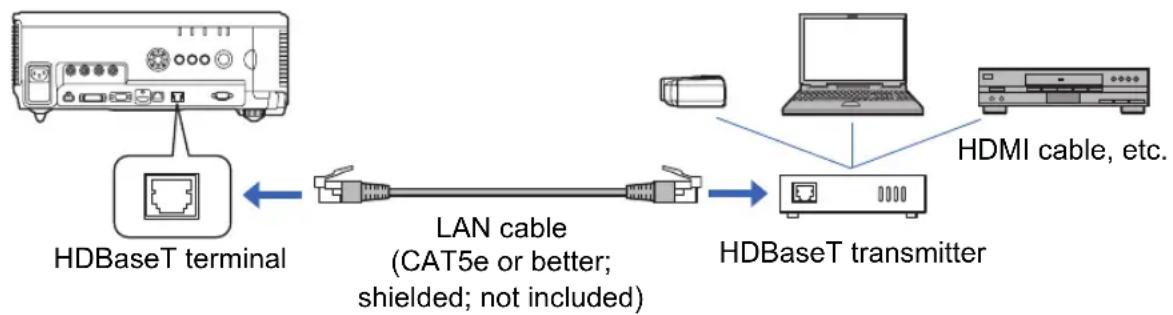
flowchart
graph LR
    A["HDBaseT terminal"] --> B["LAN cable (CAT5e or better; shielded; not included)"]
    B --> C["HDBaseT transmitter"]
    D["Laptop"] --> C
    E["HDMI cable, etc."] --> C
Lens Shift
Lens shift enables motorized image repositioning up, down, left, or right (P47) for greater freedom in installation.
Motorized Zoom and Focus Adjustment
Efficient setup using motorized zoom and focus adjustment.
Five Lens Units Available
Choose the optimal lens unit for the projection distance or purpose.
Split-Screen Display

text_image
Diagram showing a monitor displaying a line chart with pie charts and a projector, illustrating data visualization and layout.Splits the screen for projection of two separate input signals at once. (P161)
Edge Blending
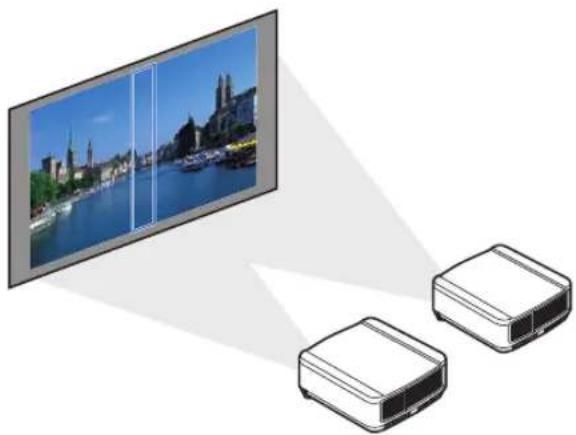
natural_image
Illustration of a projector and a TV displaying a scenic cityscape (no text or symbols)Blend the overlapping edges of images from multiple projectors to make the overall image more seamless. (P162)
Networked Multi-Projection (NMPJ)
Project images from multiple computers via a network connection. For details on Networked Multi-Projection (NMPJ), refer to the NMPJ user's manual.

flowchart
graph TD
    A["Laptop"] --> B["LAN"]
    B --> C1["Image: projector"]
    B --> C2["Image: projector"]
    B --> C3["Image: projector"]
    B --> C4["Image: projector"]
    C1 --> D1["Image: cityscape"]
    C2 --> D2["Image: cityscape"]
    C3 --> D3["Image: cityscape"]
    C4 --> D4["Image: cityscape"]
Safety Instructions
Before installing and operating the projector, read this manual thoroughly.
This projector provides many convenient features and functions. Operating the projector properly enables you to manage those features and maintain it in good condition for many years to come.
Improper operation may result in not only shortening the product life, but also malfunctions, fire hazards, or other accidents.
If your projector does not seem to be operating properly, read this manual again, check operations and cable connections, and try the solutions in the
“Troubleshooting” section in the back of this manual. If the problem still persists, contact the Canon Customer Support Center.

CAUTION
RISK OF ELECTRIC SHOCK DO NOT OPEN

CAUTION: TO REDUCE THE RISK OF ELECTRIC SHOCK, DO NOT REMOVE COVER (OR BACK). NO USER-SERVICEABLE PARTS INSIDE EXCEPT LAMP REPLACEMENT. REFER SERVICING TO QUALIFIED SERVICE PERSONNEL.

THIS SYMBOL INDICATES THAT DANGEROUS VOLTAGE CONSTITUTING A RISK OF ELECTRIC SHOCK IS PRESENT WITHIN THIS UNIT.

THIS SYMBOL INDICATES THAT THERE ARE IMPORTANT OPERATING AND MAINTENANCE INSTRUCTIONS FOR THIS UNIT IN THE OWNER'S MANUAL.
CAUTION
Not for use in a computer room as defined in the Standard for the Protection of Electronic Computer / Data Processing Equipment, ANSI / NFPA 75.

Safety Precautions
WARNING:
• THIS APPARATUS MUST BE GROUNDED.
• TO REDUCE THE RISK OF FIRE OR ELECTRIC SHOCK, DO NOT EXPOSE THIS APPLIANCE TO RAIN OR MOISTURE.
- This projector produces intense light from the projection lens. Do not stare directly into the lens, otherwise eye damage could result. Be especially careful that children do not stare directly into the beam.
• Install the projector in a proper position. Otherwise it may result in a fire hazard. - Allowing the proper amount of space on the top, sides, and rear of the projector cabinet is critical for proper air circulation and cooling of the unit. The diagrams shown here indicates the minimum space required. If the projector is to be built into a compartment or similarly enclosed, these minimum distances must be maintained.
SIDE and TOP REAR
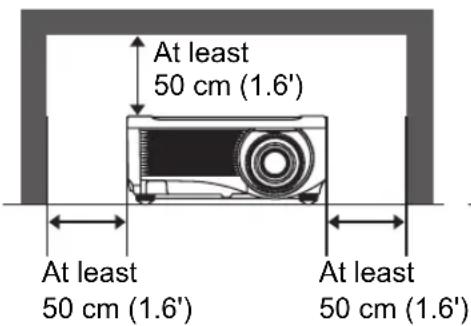
text_image
At least 50 cm (1.6') At least 50 cm (1.6') At least 50 cm (1.6')
text_image
At least 50 cm (1.6')- Do not cover the ventilation slots on the projector. Heat build-up can reduce the service life of your projector, and can also be dangerous.
- If the projector is unused for an extended time, unplug the projector from the power outlet.
- Do not project the same image for a long time.
An afterimage may remain on the LCD panels due to the characteristics of the panels of the projector.

CAUTION ON HANGING FROM THE CEILING
When hanging the projector from the ceiling, clean the air intake vents and top of the projector periodically with a vacuum cleaner. If you leave the projector unclean for a long time, the cooling fans can be clogged with dust, and it may cause a breakdown or a disaster.
DO NOT SET THE PROJECTOR IN GREASY, WET, OR SMOKY CONDITIONS SUCH AS IN A KITCHEN TO PREVENT A BREAKDOWN OR A DISASTER. IF THE PROJECTOR COMES IN CONTACT WITH OIL OR CHEMICALS, IT MAY BECOME DETERIORATED.
■READ AND KEEP THIS OWNER'S MANUAL FOR LATER USE.
All the safety and operating instructions should be read before beginning to operate the product.
Read all of the instructions given here and retain them for later use. Unplug this projector from the AC power supply before cleaning. Do not use liquid or aerosol cleaners on the projector. Use a damp cloth for cleaning.
Follow all warnings and instructions marked on the projector.
For added protection of the projector during a lightning storm, or when it is left unattended or unused for long periods of time, unplug it from the wall outlet. This will prevent damage due to lightning and power surges.
Do not expose this unit to rain or use near water... for example, in a wet basement, near a swimming pool, etc...
Do not use attachments not recommended by the manufacturer as they may result in hazards.
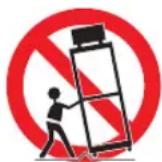
Do not place this projector on an unstable cart, stand, or table. The projector may fall, causing serious injury to a child or adult, and serious damage to the projector. Use only with a cart or stand recommended by the manufacturer, or sold with the projector. Wall or shelf mounting should be carried out in accordance with the manufacturer's directions, and should use a mounting kit approved by the manufacturers.
An appliance and cart combination should be moved with care. Sudden stops, excessive force, and uneven surfaces may cause the appliance and cart combination to overturn.
Slots and openings in the rear and front of the cabinet are provided for ventilation, to insure reliable operation of the equipment and to protect it from overheating.
The openings should never be covered with cloth or other materials, and the bottom opening should not be blocked by placing the projector on a bed, sofa, rug, or other similar surface. This projector should never be placed near or over a radiator or heat register.
This projector should not be placed in a built-in installation such as a book case unless proper ventilation is provided.
Safety Instructions
Never push objects of any kind into this projector through cabinet slots as they may touch dangerous voltage points or short out parts that could result in a fire or electric shock. Never spill liquid of any kind onto the projector.
Do not install the projector near the ventilation duct of air-conditioning equipment.
This projector should be operated using only the type of power source indicated on the marking label. If you are not sure of the type of power supplied, contact the Canon Customer Support Center or local power company.
Do not overload wall outlets and extension cords as this can result in fire or electric shock. Do not allow anything to rest on the power cord. Do not locate this projector where the cord may be damaged by people walking on it.
Do not attempt to service this projector yourself as opening or removing covers may expose you to dangerous voltages or other hazards. Refer all servicing to qualified service personnel.
Unplug this projector from the wall outlet and refer servicing to qualified service personnel under the following conditions:
a. When the power cord or plug is damaged or frayed.
b. If liquid has been spilled into the projector.
c. If the projector has been exposed to rain or water.
d. If the projector does not operate normally after following the operating instructions. Adjust only those controls that are covered in the operating instructions as improper adjustment of other controls may result in damage and will often require extensive work by a qualified technician to restore the projector to normal operating condition.
e. If the projector has been dropped or the cabinet has been damaged.
f. When the projector exhibits a distinct change in performance—this indicates a need for servicing.
When replacement parts are required, be sure the service technician uses replacement parts specified by the manufacturer that have the same characteristics as the original parts. Unauthorized substitutions may result in fire, electric shock, or injury.
Upon completion of any service or repairs to this projector, ask the service technician to perform routine safety checks to determine that the projector is in safe operating condition.
AC Power Cord Requirement
The AC Power Cord supplied with this projector meets the requirements for use in the country you purchased it.
AC Power Cord for the United States and Canada:
The AC Power Cord used in the United States and Canada is listed by the Underwriters Laboratories (UL) and certified by the Canadian Standard Association (CSA).
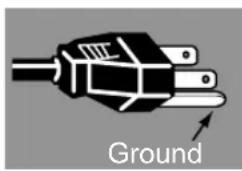
The AC Power Cord has a grounding-type AC line plug. This is a safety feature to ensure the plug fits into the power outlet. Do not try to tamper with this safety feature. Should you be unable to insert the plug into the outlet, contact your electrician.
natural_image
Diagram of a hand holding an electrical plug with a labeled 'Ground' arrow (no other text or symbols)THE SOCKET-OUTLET SHOULD BE INSTALLED NEAR THE EQUIPMENT AND EASILY ACCESSIBLE.

For the U.S. and Canada, LAMP (S) INSIDE THIS PRODUCT CONTAIN MERCURY AND MUST BE RECYCLED OR DISPOSED OF ACCORDING TO LOCAL, MUNICIPAL, STATE, PROVINCIAL, OR FEDERAL LAWS.
For lamp recycling and disposal information please call 1-800-OK-CANON for the U.S. and Canada.

Only for European Union and EEA (Norway, Iceland and Liechtenstein)
These symbols indicate that this product is not to be disposed of with your household waste, according to the WEEE Directive (2012/19/EU), the Battery Directive (2006/66/EC) and/or national legislation implementing those Directives.
If a chemical symbol is printed beneath the symbol shown above, in accordance with the Battery Directive, this indicates that a heavy metal (Hg = Mercury, Cd = Cadmium, Pb = Lead) is present in this battery or accumulator at a concentration above an applicable threshold specified in the Battery Directive.

This product should be handed over to a designated collection point, e.g., on an authorized one-for-one basis when you buy a new similar product or to an authorized collection site for recycling waste electrical and electronic equipment (EEE) and batteries and accumulators. Improper handling of this type of waste could have a possible impact on the environment and human health due to potentially hazardous substances that are generally associated with EEE. Your cooperation in the correct disposal of this product will contribute to the effective usage of natural resources.
For more information about the recycling of this product, please contact your local city office, waste authority, approved scheme or your household waste disposal service or visit www.canon-europe.com/weee, or www.canon-europe.com/battery.
Federal Communication Commission Notice
This device complies with Part 15 of the FCC Rules. Operation is subject to the following two conditions:
- This device may not cause harmful interference, and
- This device must accept any interference received, including interference that may cause undesired operation.
Note: This equipment has been tested and found to comply with the limits for a Class A digital device, pursuant to Part 15 of the FCC Rules. These limits are designed to provide reasonable protection against harmful interference when the equipment is operated in a commercial environment. This equipment generates, uses, and can radiate radio frequency energy and, if not installed and used in accordance with the instruction manual, may cause harmful interference to radio communications. Operation of this equipment in a residential area is likely to cause harmful interference in which case the user will be required to correct the interference at his own expense. The cable with a ferrite core provided with the projector must be used with this equipment in order to comply with Class A of the FCC Rules. Use of a shielded cable is required to comply with Class A of FCC Rules. Do not make any changes or modifications to the equipment unless otherwise specified in the instructions. If such changes or modifications should be made, you could be required to stop operation of the equipment.
Warning:
This is a class A product. In a domestic environment this product may cause radio interference in which case the user may be required to take adequate measures.
The cable with a ferrite core provided with the projector must be used with this equipment in order to comply with Class A.
Use of a shielded cable is required to comply with Class A.
Safety Symbols in this Manual
This section describes the safety symbols used in this manual. Important projector safety information is identified by the following symbols. Always observe the safety information by these symbols.
 | Denotes the risk of death or serious injury from improper handling if the information is not observed. To ensure safe use, always observe this information. |
 | Denotes the risk of injury from improper handling if the information is not observed. To ensure safe use, always observe this information. |
 | Denotes the risk of electric shock from improper handling if the information is not observed. To ensure safe use, always observe this information. |
 | Denotes the risk of burns from improper handling if the information is not observed. To ensure safe use, always observe this information. |
 Prohibition Prohibition | Denotes prohibited actions. |
 Caution Caution | Denotes required actions or information that must be observed. |
Precautions for Use
As this section contains important safety-related information, be sure to read the following carefully beforehand in order to use your projector correctly and safely.

Warning
During installation, keep the projector plug easily accessible so that the projector can be unplugged immediately if necessary, or keep a circuit breaker within reach.
If the following situations occur, turn the power off, remove the power plug from the power outlet and contact the Canon Customer Support Center. Failure to do so could cause a fire or result in an electric shock.

- If smoke is emitted
- If an unusual smell or noise is emitted
- If water or other liquid has entered the projector
- If metal or any other foreign material has entered the projector
- If the projector is knocked over or dropped and the cabinet is damaged
Pay attention to the following points regarding the power source, power plug and handling of the connector. Failure to do so may cause a fire or electric shock.

Prohibition

- Do not place any objects on the power cord and do not allow it to become trapped under the projector.
- Do not cover the power cord with a carpet.
- Do not modify or excessively bend, twist, pull, wind, or bundle the power cord.
- Keep the power cord away from heaters and other sources of heat.
- Do not use a damaged power cord. If the power cord is damaged, purchase a replacement from your dealer.
- The power cord included with this projector is for use exclusively with this product. Do not use this cord for other products.

Warning
Pay attention to the following points regarding the power source, power plug and handling of the connector. Failure to do so may cause a fire or electric shock.

Prohibition

- Do not use any power source with a voltage other than the voltage indicated (AC 100–240 V).
- Do not pull the power cord and be sure to hold the power plug or connector when removing. Incorrect handling may damage the power cord.
- Do not insert any metal objects into the contact parts of the power plug or connector.


Caution

- Do not remove the power plug or connector with wet hands.
- Insert the power plug and connector securely up to the base. Additionally, do not use a damaged power plug or an outlet that is loose.
- When using an extension cord, do not exceed the cord's rated capacity.

Caution
- Periodically inspect the power plug and outlet and remove any dust or dirt from between the plug and the outlet.
Installation and Handling Precautions
Pay attention to the following points regarding installation and handling of the projector. Failure to do so may cause a fire, electric shock or personal injury.

- Do not use the projector where it might get wet, such as outdoors or by bathtubs or showers.
- Do not place containers containing a liquid on top of the projector.

- Do not touch the projector itself, the power cord, or the cable if lightening strikes.
- Do not move the projector until you have switched off the power, removed the power plug from the power outlet and unplugged any other cables.

- Unplug the projector before cleaning or maintenance.
- Before you attach or replace a lens unit, be sure to unplug the power plug of the projector from the power outlet.
RISK GROUP 3 (RG3) label
RISK GROUP 3
WARNING
Possibly hazardous optical radiation emitted from this product.
Do not look at operating lamp. Eye injury may result.
GROUPE DE RISQUE 3
AVERTISSEMENT
Pay attention to the following points regarding installation and handling of the projector. Failure to do so may cause a fire, electric shock or personal injury.

Prohibition
- Do not remove the cabinet from the projector or disassemble it. The interior of the projector contains high-voltage components as well as parts that are hot. If inspection, maintenance or repair is required, contact the Canon Customer Support Center.
- Do not disassemble or modify the projector (including consumable parts) or the remote control.
- Do not look directly into the exhaust vents during use.
- Do not insert any object into vents in the projector, such as the air intake vent or exhaust vents.
- Do not place a pressurized can in front of the exhaust vents. The pressure of the contents of the can may increase due to heat from the exhaust vents and this could result in an explosion.
- When cleaning off dust or dirt from projector parts such as the lens or filter, never use any spray that is flammable. Internal parts that become hot may ignite and cause a fire.
• Light from the projector is classified as Risk Group 3 (RG3) according to IEC 62471:2006.


Prohibition
- Possibly hazardous optical radiation emitted from this product. Do not look at operating lamp. Eye injury may result. Pay particular attention to prevent small children from doing so.
- When setting the projector on a high surface for projection, be sure the surface is flat and stable.
- Do not use the projector on a soft surface such as carpet or sponge mat, etc. Doing so could cause heat to build up inside the projector and this could result in a fire.
- For ceiling mounting precautions, refer to the installation manual included with the ceiling mount (sold separately).

Caution
- When hanging the projector from a ceiling, put the projector down on the floor or a workbench before attaching or replacing the lens unit. Failure to do so could result in parts falling off the projector and may cause an accident or personal injury.
Precautions on the Lamp
This projector uses a high-pressure mercury lamp, which must be handled carefully and correctly as described below.
The mercury lamp has the following characteristics.
• The lamp will gradually become darker over time.
- Impact, abrasion, or use of worn-out lamps may cause lamps to rupture (accompanied by a loud noise) or burn out.
- Lamps are more likely to rupture after the lamp replacement message is displayed (see "Replacing the Lamp" (P173)). Replace the lamp with a new one as soon as possible.
- Useful life of lamps varies widely from lamp to lamp and depending on the environment of use. Some lamps may fail or rupture soon after they are first used.

Warning
Note the following precautions during lamp replacement or when a lamp has ruptured. Failure to do so could result in an electric shock, personal injury or burns.

- Before replacing the lamp, always unplug the projector and wait at least one hour.
- If the lamp ruptures, dust and gas (containing mercury vapor) may come out of the exhaust vents. If this happens, immediately open the windows and doors to provide ventilation to the room. Ruptured lamps may scatter shards of glass inside the projector. Contact the qualified technician or Canon Customer Support Center for cleaning and inspection of the projector interior and lamp replacement.
- If you accidentally inhale gas from the lamp or get any pieces in your eyes or mouth, consult a doctor immediately.
Note the following precautions when replacing lamps that stop working. Failure to do so could result in personal injury.

- If illumination suddenly stops, either when you turn the projector on or after it has been on for a while, the lamp may have ruptured. In this case, never attempt to replace the lamp by yourself. Always request service from the Canon Customer Support Center.
- With ceiling-mounted projectors, the lamp may fall out when you open the lamp cover, or during replacement. During replacement, stand to the side of the lamp cover, not directly under it.
Precautions for the Batteries of the Remote Control
Pay attention to the following points regarding handling of batteries. Failing to do so could result in a fire or personal injury.

- Do not heat, short circuit or disassemble the batteries, or place them in a fire.
- Do not attempt to recharge the batteries that are included with the remote control.
- Remove the batteries when they are flat or when the remote control will not be used for a long period of time.
- When replacing the batteries, replace both at the same time. Also, do not use two batteries of a different type at the same time.
- Insert the batteries with the + and - terminals in the correct directions.
- If any liquid from inside the batteries leaks out and contacts your skin, be sure to wash the liquid off thoroughly.


Caution
Pay attention to the following points regarding installation and handling of the projector.

Prohibition
- If the projector will not be used for a long period of time, be sure to remove the power plug from the power outlet to ensure safety. Failure to do so presents a risk of fire if dust accumulates on the plug or outlet.
- Parts of the cabinet around and above the exhaust vents may become hot during projection. Touching these areas during operation could cause burns to the hands. Pay particular attention in preventing young children from touching these parts. Additionally, do not place any metal objects around or above the exhaust vents. Due to the heat from the projector, doing so could cause an accident or personal injury.
- Do not place the projector where it may be exposed to oily smoke or steam, such as near kitchen counters or humidifiers. Doing so may cause fire or electric shock.
- Do not place any heavy objects on top of the projector or sit / stand on it. Pay particular attention to prevent small children from doing so. The projector may be knocked over and this could result in damage or a personal injury.
- Do not place the projector on an unstable or slanted surface. Doing so may cause the projector to fall or be knocked over and could result in a personal injury.
- Do not place any objects in front of the lens during projection. Doing so could cause a fire.
- Presenters in front of the projector should stand where the light does not seem too bright, and where their shadow does not fall on the sc
- The projector is provided with a lens shift function to move the lens up, down, left, and right using the motor. Do not touch the lens while it is moving. Touching the lens when it is moving may result in personal injury.
- Before replacing the lens unit, wait at least one hour after the projector is turned off to allow the projector to cool thoroughly. Failure to do so could result in a burn or injury.
When handling the lamp, pay attention to the following points.

Caution

- Lamps are more likely to rupture once the lamp replacement message has been displayed. Replace the lamp with a new one as soon as possible.
- Be sure not to handle the lamp immediately after it has been used. Be sure to switch off the power and wait for approximately 1 hour for the lamp and the projector to cool down sufficiently. Failure to do so could result in a burn or personal injury due to heat from the lamp or projector.
- Be prepared by keeping a spare lamp.
- Dispose of used mercury lamps in accordance with local regulations.
Caution
Pay attention to the following points when carrying or transporting the projector.
- This projector is a precision instrument. Do not knock it over or subject it to impacts.
- When carrying or holding up the projector after attaching the lens unit, be sure not to hold the lens. Doing so may cause damage to the lens unit.
- Protection of the projector cannot be guaranteed if used packaging or shock-absorbent materials are reused. Fragments from shock-absorbent material may also enter the interior of the projector which could cause a malfunction.
- If transportation is necessary, the lens unit should be removed before transporting the projector. If the projector is subjected to excessive impacts during transportation, the lens unit may be damaged.
- Disconnect the cables connected to the projector. Carrying the projector while the cables are attached may cause an accident.
- Retract the adjustable feet before moving the projector. Leaving the feet extended may cause damage.
- Do not touch the lens with bare hands. Doing so may result in deterioration of image quality.

Caution
Pay attention to the following points when installing or using the projector.
- Be careful of condensation. If the projector is abruptly taken to a warmer location, or if the room temperature rises abruptly, moisture in the air may condense on the lens and mirror, causing the image to become blurred.
- Do not install the projector in a location where the temperature is high or low. Doing so may cause a malfunction. Ranges for the environment of use and storage are as follows.
- Environment of use: 0^ (32°F) to 40^ (104°F), up to 85% RH
- Storage temperature: -30^ (-22°F) to 60^ (140°F)
- When using the projector at altitudes above 2,300 m (7,545.8'), or when projecting upward or downward:
Adjust projector installation settings from the menu (P108). Failure to adjust the settings may shorten the lamp life or damage the lamp.
- Do not install the projector facing the wrong direction. Install the projector so that it is not tilted left or right by more than 10^ . (P25)
- Do not block the air intake or exhaust vents. Blocking the vents may trap heat inside the projector, which may shorten the useful life of optical components or other parts and damage the projector.
• Install the projector leaving at least 50 cm (1.6') between air intake/exhaust vents and walls. Failure to do so may trap heat inside the projector and damage it. - Do not place any objects on top of the projector that may change shape or color due to heat.
- Do not install the projector in a location that is damp, or where there is a lot of dust, oily smoke or tobacco smoke. Doing so could cause contamination of optical components such as the lens and the mirror and may result in deterioration of image quality.
- Do not install the projector near high-voltage electrical power lines or an electrical power source.
- Clean the air filter regularly. (P171) Dust that accumulates inside over long periods without cleaning may eventually damage the projector or affect picture quality.

Precautions When Carrying/Shipping the Projector
Prepare the projector as described below before carrying it.

- Disconnect the cables connected to the projector. Carrying the projector with the cables attached may cause an accident.
- Retract the adjustable feet before moving the projector. Leaving the feet extended may cause damage.
- Do not subject the projector to strong impacts or vibrations.
Precautions for Installation
Be sure to read “Safety Instructions” and “For Safe Use” (P7 – P21). Also take the following precautions during installation.

- Do not strike the projector or subject it to impact. Doing so may cause a malfunction.
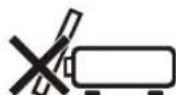
- Do not stand the projector vertically, lean it against another object, or otherwise place it in an unstable state. The projector may be damaged if it tips over.
■Do Not Use in the Following Environments

- Locations with excessive humidity, dust, oily smoke or tobacco smoke Adhesion to the lens, mirrors or other optical parts may reduce image quality.
- Near high-voltage power lines or sources of electrical power This may cause malfunction.
- On soft surfaces such as carpets or cushioned mats This may cause a fire or damage the projector.
- Locations with excessive temperature or humidity This may damage the projector. Acceptable ranges for operating and storage temperature and humidity are as follows. * Operating temperature and humidity applies to when the projector is projecting or in standby mode.
| Operating temperature | Operating humidity Storage temperature | |
| 0°C (32°F) – 40°C (104°F) | Up to 85% | -30°C (-22°F) – 60°C (140°F) |
■Do Not Touch the Lens with Bare Hands

- Do not touch the lens with bare hands. Any smudges or fingerprints on the lens may affect image quality.
■ Allow a 30 Min. Warm Up before Focus Adjustment (P59), if Possible
The focus position may not stabilize immediately after startup, due to lamp heat. When adjusting focus, it is also helpful to use the test pattern (10) (P115, P187).
■ Install at a Sufficient Distance from Walls and Other Obstructions

If the air intake or exhaust vent is blocked, heat will accumulate inside the projector, possibly resulting in a shortened projector lifetime or a malfunction.
Similarly, do not install in narrow, enclosed spaces with poor ventilation. Install in a well-ventilated location.
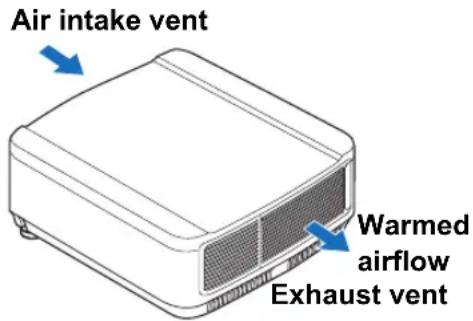
text_image
Air intake vent Warmed airflow Exhaust ventEnsure a minimum clearance of 50 cm (1.6 ft.) above, on both sides, and behind the projector, as shown below.

text_image
At least 50 cm (1.6') At least 50 cm (1.6') At least 50 cm (1.6')
text_image
At least 50 cm (1.6')■Be Careful of Condensation
If the temperature of the room rises suddenly, moisture in the air may condense on the projector lens and mirror, causing the image to become blurred. Wait until the condensation has evaporated for the image projected to return to normal.
■ At Altitudes above 2,300 m (7,545.8'), Adjust the Settings
Projector settings must be adjusted when using the projector at altitudes of 2,300 m (7,545.8') or higher. Specifically, refer to instructions for [Fan mode] (P108) in the [Install settings] menu.
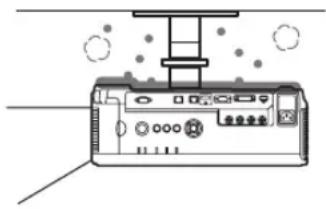
■When Using Mounted on the Ceiling
When the projector is used mounted on the ceiling or installed in a high location, it is necessary to periodically clean the air intake and exhaust vents, and the area around the air filter. Dust that accumulates in intake or exhaust vents may impair ventilation, raising the temperature inside and posing a risk of damage or fire. Use a vacuum cleaner or similar means to remove dust from the intake vent and exhaust vent.
natural_image
Illustration of a projector device with indicator lights and a stand (no text or symbols)■Install Facing in the Correct Direction

- The projector can be installed facing any direction, as shown below. However, projection upward or downward may shorten the useful life of the lamp. [Install settings] of the projector must also be adjusted.
- For upward or downward projection, refer to instructions for [Vertical projection] (P108) in the [Install settings] menu.
- Do not attempt to install the projector for upward or downward projection by yourself. Always request installation by a qualified technician or the Canon Customer Support Center.

text_image
Upward projection: Inclination of the projector should be no more than 10° from the vertical axis.* Downward projection: Inclination of the projector should be no more than 10° from the vertical axis.* If installing the projector on the floor or hanging from the ceiling, the left / right inclination of the projector should be no more than 10°.* Do not use the projector standing on its side. This may damage the lamp.** Failure to do so may damage the lamp.

There are no options for installing the projector other than the ceiling attachment.
Copyright Notice
Please note that enlarging or reducing the size of an image for commercial purposes or public presentation may infringe on the legally protected copyright or the copyright holder of the original material.
Ensure Network Security
Take measures to ensure network security. Note that Canon is not liable in any way for direct or indirect loss from network security incidents, such as unauthorized access.
Before using the projector, configure the appropriate projector, computer, and network security settings.
Install the projector in a network protected by a firewall or other security measures. Do not connect it directly to the Internet.
About Trademarks
- Ethernet is a registered trademark of Xerox Corporation.
- Microsoft, Windows, Windows Vista, Windows 7, Windows 8, Windows 8.1 and Windows 10 are registered trademarks or trademarks of Microsoft Corporation in the United States and / or other countries.
• Mac, Mac OS and Macintosh are trademarks of Apple Inc., registered in the United States and / or other countries. - HDMI, the HDMI logo and High-Definition Multimedia Interface are trademarks or registered trademarks of HDMI Licensing, LLC.
- PJLink is a registered trademark of JBMIA and pending trademark in some countries.
- PJLink is a registered trademark, or an application has been submitted for trademark, in Japan, the United States and / or other countries or regions.
- AMX is a trademark of AMX Corporation.
- Crestron®, Crestron RoomView®, and Crestron Connected™ are registered trademarks of Crestron Electronics, Inc.
- HDBaseT™ and the HDBaseT Alliance logo are trademarks of the HDBaseT Alliance.
- All other trademarks are the property of their respective owners.
Open Source Software
The product contains Open Source Software modules. For details, refer to the third-party software license file "Third-Party Software" in the License folder of the user's manual CD-ROM. Each module's license conditions are also available in the same folder.
■Software under the GNU General Public License Version 2
Contained programs are free software; you can redistribute them and/or modify them under the terms of the GNU General Public License attached to each copy of the program.
Each program is distributed in the hope that it will be useful, but WITHOUT ANY WARRANTY; without even the implied warranty of MERCHANTABILITY or FITNESS FOR A PARTICULAR PURPOSE. Please see “NO WARRANTY” and “NO SUPPORT” stated below. For more detail, please see full text of the GNU General Public License.
NO WARRANTY
BECAUSE THE PROGRAM IS LICENSED FREE OF CHARGE, THERE IS NO WARRANTY FOR THE PROGRAM, TO THE EXTENT PERMITTED BY APPLICABLE LAW. EXCEPT WHEN OTHERWISE STATED IN WRITING THE COPYRIGHT HOLDERS AND/OR OTHER PARTIES PROVIDE THE PROGRAM "AS IS" WITHOUT WARRANTY OF ANY KIND, EITHER EXPRESSED OR IMPLIED, INCLUDING, BUT NOT LIMITED TO, THE IMPLIED WARRANTIES OF MERCHANTABILITY AND FITNESS FOR A PARTICULAR PURPOSE. THE ENTIRE RISK AS TO THE QUALITY AND PERFORMANCE OF THE PROGRAM IS WITH YOU. SHOULD THE PROGRAM PROVE DEFECTIVE, YOU ASSUME THE COST OF ALL NECESSARY SERVICING, REPAIR OR CORRECTION.
IN NO EVENT UNLESS REQUIRED BY APPLICABLE LAW OR AGREED TO IN WRITING WILL ANY COPYRIGHT HOLDER, OR ANY OTHER PARTY WHO MAY MODIFY AND/OR REDISTRIBUTE THE PROGRAM AS PERMITTED ABOVE, BE LIABLE TO YOU FOR DAMAGES, INCLUDING ANY GENERAL, SPECIAL, INCIDENTAL OR CONSEQUENTIAL DAMAGES ARISING OUT OF THE USE OR INABILITY TO USE THE PROGRAM (INCLUDING BUT NOT LIMITED TO LOSS OF DATA OR DATA BEING RENDERED INACCURATE OR LOSSES SUSTAINED BY YOU OR THIRD PARTIES OR A FAILURE OF THE PROGRAM TO OPERATE WITH ANY OTHER PROGRAMS), EVEN IF SUCH HOLDER OR OTHER PARTY HAS BEEN ADVISED OF THE POSSIBILITY OF SUCH DAMAGES.
NO SUPPORT
Canon Inc., and all its subsidiaries or its dealers do not make any support service regarding the source code. Canon Inc., and all its subsidiaries or its dealers shall not respond to any questions or enquiries, from you or any other customers, regarding the source code.
Before Use
Included Accessories
Before use, make sure the following items are included in the package.
- Remote control
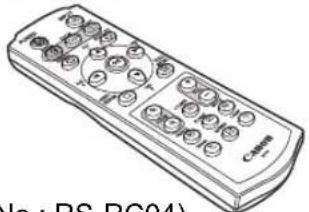
natural_image
Line drawing of a remote control with buttons and a 'C' button (no text or symbols on the device itself)(part No.: RS-RC04)
- Batteries for the remote control
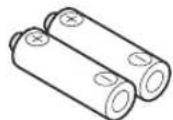
(AAA size x2)

Optional remote controls are also available (RS-RC05). The RS-RC05 can also be used as a wired remote. (P38)
- Computer cable (1.8 m / 5.9') (mini D-sub 15-pin / mini D-sub 15-pin)
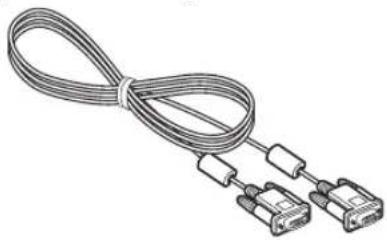
natural_image
Illustration of a long, coiled cable with two connected VGA connectors (no text or symbols)- Important Information

natural_image
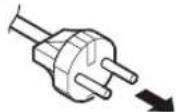
Blank white image with a thin gray border (no text, symbols, or markings)• Power cord (1.8 m / 5.9')
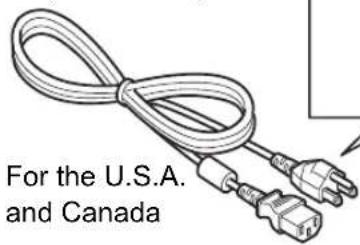
text_image
For the U.S.A. and CanadaFor Continental Europe
- User's Manual (CD-ROM)
- Warranty Card
Part Names
Projector
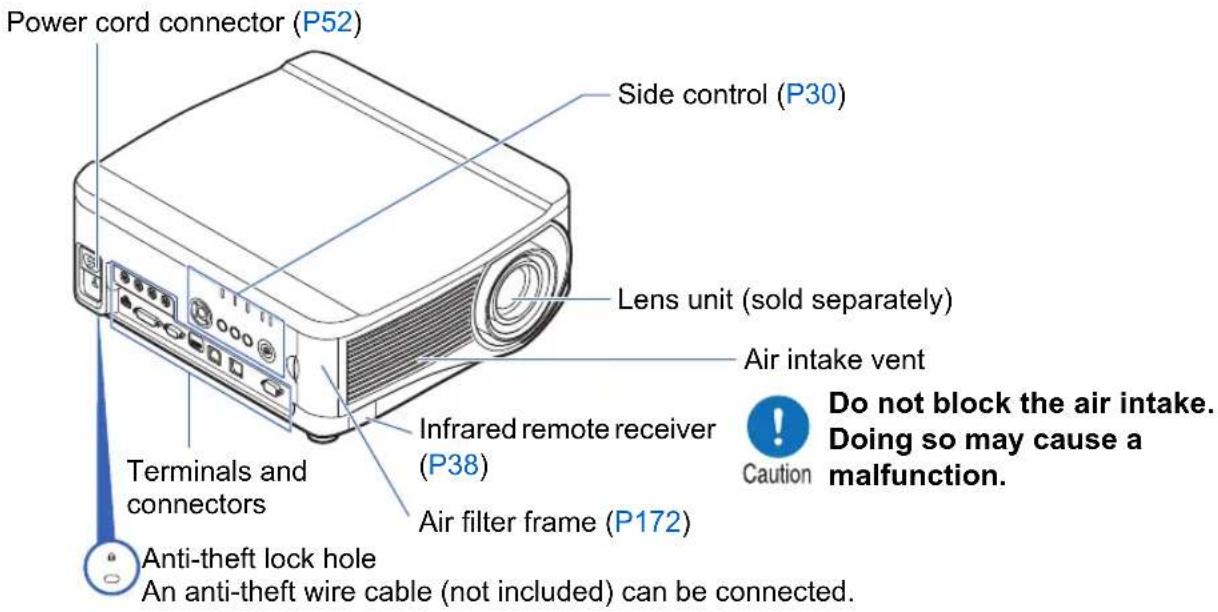
text_image
Power cord connector (P52) Side control (P30) Lens unit (sold separately) Air intake vent Infrared remote receiver (P38) Air filter frame (P172) Terminals and connectors Anti-theft lock hole An anti-theft wire cable (not included) can be connected. Do not block the air intake. Doing so may cause a malfunction. Caution■Rear Side

text_image
Exhaust vent Do not block the air exhaust. Doing so may cause a malfunction. Caution Lamp cover Infrared remote receiver (P38)■Bottom Side

natural_image
Line drawing of a projector with labeled components (no text or symbols present)Bolt holes for installation of ceiling attachment
Adjustable feet (P40)
Side Control
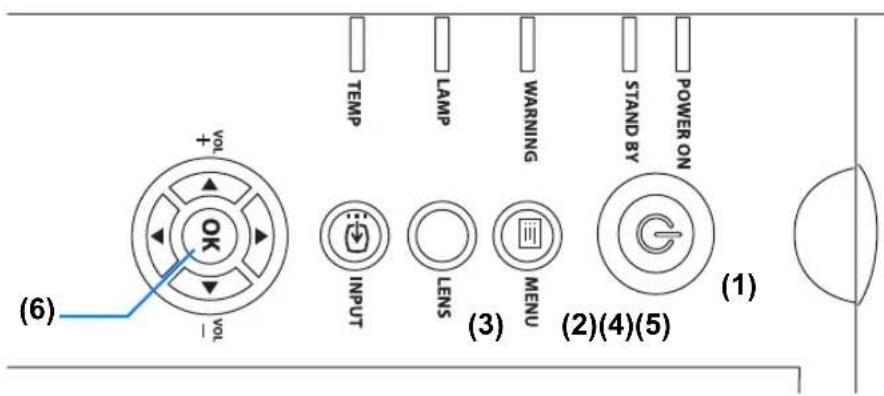
text_image
(6) VOL + OK VOL TEMP LAMP WARNING STAND BY POWER ON INPUT LENS MENU (3) (2)(4)(5) (1)(1) POWER button (P53, P71)
Turns the projector on or off.
(2) MENU button (P78)
Displays a menu on the screen.
(3) LENS button
Each time the button is pressed, the screen changes to focus adjustment (P59), zoom (image size) adjustment (P60), or lens shift (image position) adjustment (P61). To adjust, use the [ ]/ [ ]or the [ ]/ [ ]buttons.
(4) INPUT button (P56)
Switches the input signal.
(5) Pointer / VOL buttons (P79)
Up, down, left, or right in menu navigation or other operations. Adjust the sound volume.
[▲VOL+ button: Increases the volume.
[▼VOL—button: Decreases the volume.
Selects the upper, lower, left or right item in the menu.
(6) OK button (P79)
Determines the item selected from the menu.
LED Indicators
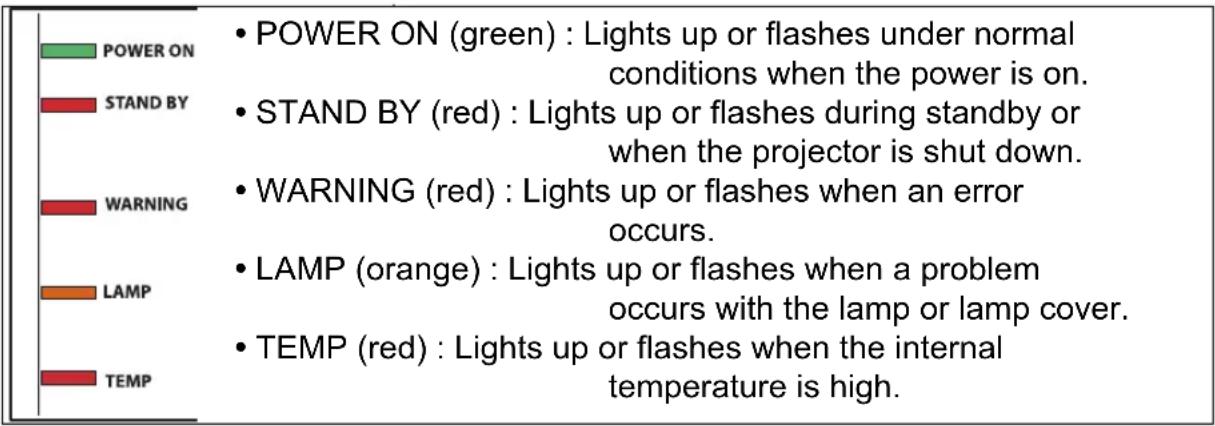
The projector status is shown by the LED indicators (off / lit / flashing).
text_image
POWER ON STAND BY WARNING LAMP TEMP POWER ON (green) : Lights up or flashes under normal conditions when the power is on. STAND BY (red) : Lights up or flashes during standby or when the projector is shut down. WARNING (red) : Lights up or flashes when an error occurs. LAMP (orange) : Lights up or flashes when a problem occurs with the lamp or lamp cover. TEMP (red) : Lights up or flashes when the internal temperature is high.■LED Indicator Displays
The LED indicators flash or illuminate to indicate the operating status of the projector.
Legend: Example of when the POWER ON indicator is on; ☐Off : Lit : Flashing
| LED indicator | Operating status | ||||
| POWER ON (green) | STAND BY (red) | WARNING (red) | LAMP (orange) | TEMP (red) | |
| Not plugged in. | |||||
| In standby mode. | |||||
| Power is on. | |||||
| Transitioning from standby mode to power on. | |||||
| Cooling down while transitioning from power on to standby mode or power management mode. | |||||
| In power management mode, with the lamp off. | |||||
| Nearly time to replace the lamp (in standby mode). | |||||
| Nearly time to replace the lamp (during projecting). | |||||
| Internal temperature is high (in standby mode). | |||||
| Internal temperature is high (during projecting). | |||||
| A lamp error has occurred. | |||||
| A temperature error has occurred. | |||||
| The lamp cover is open. | |||||
| Another error has occurred. | |||||

A flashing LAMP indicator means that it is almost time to replace the lamp. Prepare a replacement lamp.
Input Terminal
text_image
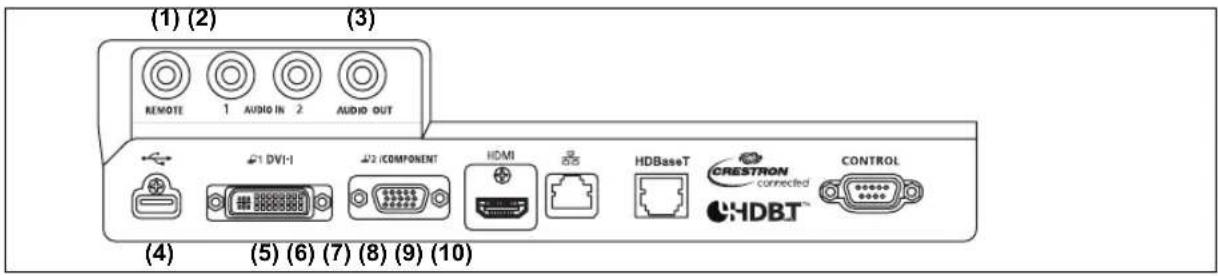
(1) (2) REMOTE 1 AUDIO IN 2 AUDIO OUT (3) 4) 5) (6) (7) (8) (9) (10) (+1 DVI-I) +2 /COMPONENT HDMI HDBaseT CRESTRON connected HDBT™ CONTROL(1) Terminal for wired remote control (REMOTE) (P38)
This terminal is used to connect the optional remote control (RS-RC05) using a cable.
(2) AUDIO IN terminal (AUDIO IN) (P49, P50, P51)
Terminals for audio input. Audio supplied to these terminals is played through the internal speaker when you select [Audio in] as the source audio terminal for the selected source video. (P119)
(3) AUDIO OUT terminal (AUDIO OUT) (P49, P50, P51)
Outputs the audio to external AV equipment. This outputs the audio signal that corresponds to the projected image signal.
(4) USB port (P157)
Connects a USB flash drive. Used for projection of images on a USB flash drive, or for firmware updates.
(5) DVI-I terminal ( DVI-I) (P49)
Connects the external monitor output from a computer.
Receives digital PC signal (Digital PC).
A VGA-DVI-I cable can also be used to receive analog computer signals (Analog PC-1).
(6) ANALOG PC-2 / COMPONENT input terminal (/COMPONENT) (P50, P51)
Receives the analog PC signal (Analog PC-2).
A component cable can be used to receive the component image signal (Component).
(7) HDMI terminal (HDMI) (P50, P51)
Receives digital video signals (HDMI).
Carries both video and audio signals across a single cable.
(8) LAN port (P127)
Connects the LAN cable (shielded twisted pair).
Used to connect the projector to a network.
(9) HDBaseT terminal (P50, P51, P127)
Receives HDBaseT input including digital video and audio signals.
A single LAN cable (shielded twisted pair) can be used for both video and audio input.
This port can also be used to connect the projector to a network.
Before Use
(10) Service port (CONTROL) (P195)
Used to control the projector with user commands (P196 - P197).
Remote Control
The projector can be operated using buttons on the remote control or the side control on the projector.

text_image
(1) POWER INPUT (2) FOCUS ZOOM LENS-SHIFT ASPECT Ch1/ 1 AUTO PC (3) Ch4/ 4 OK Ch2/ 2 D.SHIFT/ KEystone ch3/ 3 chALL/ MENU (4) D.ZOOM P-TIMER VOL FREEZE BLANK MUTE IMAGE GAMMA LAMP (5) Canon RS-RC04(1) POWER button (P53, P71)
Turns the projector on or off.
(2) FOCUS button (P59)
Adjusts focusing.
[▲/ [ ]buttons:
Moves the focus position further away.
[▼/ [ ]◀buttons:
Moves the focus position nearer.
(3) ASPECT button (P65, P91)
Changes the aspect ratio mode.
(4) D.SHIFT/KEYSTONE button (P67)
Corrects keystone distortion.
The [Keystone] setting enables both horizontal/vertical keystone correction (by adjusting top/bottom/left/right length) and corner correction.
- Moves the image up, down, left, or right when the screen aspect setting is [16:9 D. image shift] or [4:3 D. image shift] is selected. (P64, P65)
- To move the image, use the [ ]/ [ ]▼ or the [ ]/ [ ]buttons.
(5) D.ZOOM button (P75)
Zooms the image in or out digitally.
[Button: Zooms the image in (up to 12x).
[∅button: Zooms the image out (1x minimum).
[▲/ [ ]▼[ ] / [◀] buttons: Move the zoom-in location.
(6) FREEZE button (P72)
Freezes the projected image.
(7) IMAGE button (P70)
Switches the image mode (image quality).
(8) INPUT button (P56)
Switches the input signal.
text_image
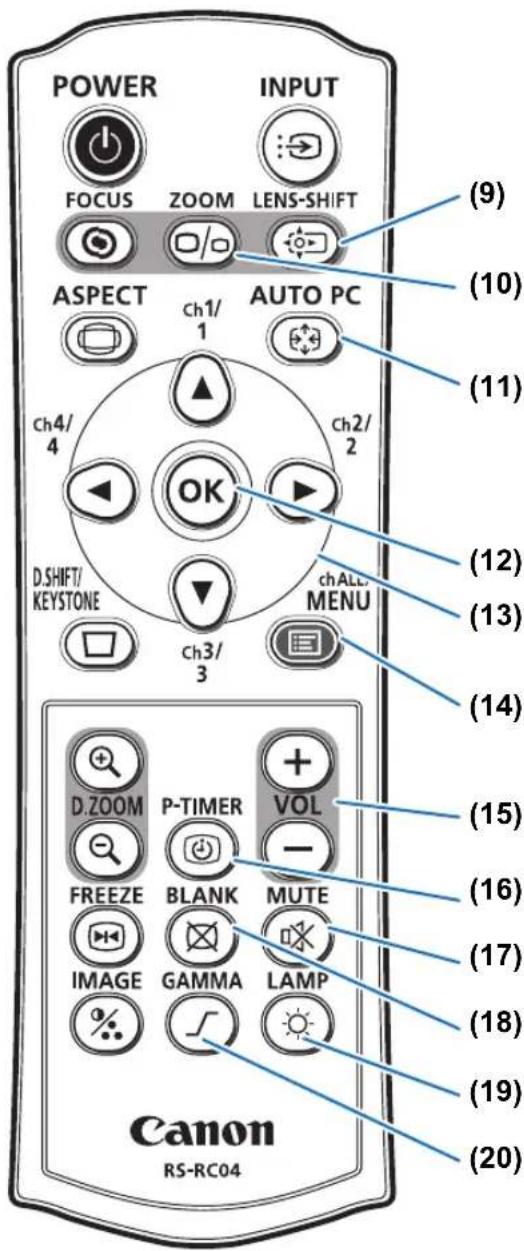
POWER INPUT FOCUS ZOOM LENS-SHIFT ASPECT ch1/ 1 AUTO PC Ch4/ 4 Ch2/ 2 OK D.SHIFT/ KEystone ch3/ 3 chALU MENU D.ZOOM P-TIMER VOL FREEZE BLANK MUTE IMAGE GAMMA LAMP Canon RS-RC04 (9) (10) (11) (12) (13) (14) (15) (16) (17) (18) (19) (20)(9) LENS-SHIFT button (P61)
Moves the lens up, down, left, or right.
[▲/ [ ]▼[ ] /◀] buttons:
Moves the image.
(10) ZOOM button (P60)
Adjusts the image size.
[▲/ [ ]▶buttons:
Increase the image size.
[▼/ [ ]◀buttons:
Decrease the image size.
(11) AUTO PC button (P58)
Adjusts tracking etc. automatically in accordance with the signal from a computer when the analog PC input is selected.
(12) OK button (P79)
Determines the item selected from the menu.
(13) Pointer buttons (P79)
Selects the upper, lower, left or right item in the menu. Also used to assign a channel to the remote control.
(14) MENU button (P78)
Displays a menu on the screen. Also used to assign a channel to the remote control. (P119)
(15) VOL button (P74)
Adjusts the sound volume.
[+] button: Increases the volume.
[-] button: Decreases the volume.
(16) P-TIMER button
Cannot be used on this projector.
(17) MUTE button (P74)
Mutes the sound.
(18) BLANK button (P72)
Temporarily blacks out the image.
(19) LAMP button (P102)
Displays the power saver settings screen, where you can adjust the lamp mode (Full power / Power saver) (P102), set the power management (P121) and specify the network standby settings (P131).
(20) GAMMA button (P98)
Adjusts the gamma of the image.
[▶] button:
Corrects dark parts of the image so that they are easier to see.
[◀button:
Corrects bright parts of the image so that they are easier to see.
Preparing the Remote Control
■Installing Remote Control Batteries
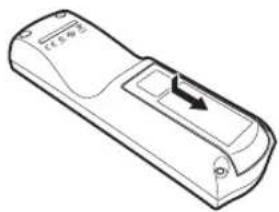
1 Open the battery compartment lid. Slide the lid while pressing it down.
2Insert batteries. Insert 2 new AAA batteries in the compartment with the + and – terminals positioned correctly.
3Close the compartment lid. Slide the lid until you hear a click to securely close it.
natural_image
Line drawing of a remote control device with an arrow indicating left-side motion (no text or symbols)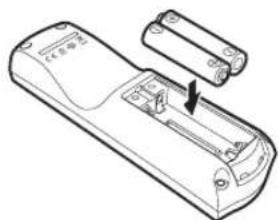
natural_image
Line drawing of a remote control device with an arrow pointing to the internal components (no text or symbols)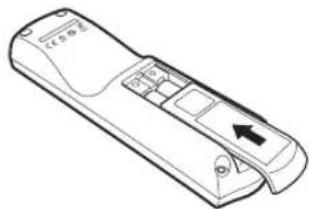
natural_image
Line drawing of a remote control device with buttons and a black arrow pointing to the right side (no text or symbols)
- If buttons on the remote control are inoperative when you attempt to operate the projector, replace the batteries with new ones.
- Do not drop the remote control or subject it to impact.
- Do not spill any liquids on the remote control. Doing so may cause a malfunction.


Pay attention to the following points when handling the batteries. Failing to do so could result in a fire or personal injury.
- Do not heat, short circuit or disassemble the batteries, or place them in a fire.
- Do not attempt to recharge the batteries that are included with the remote control.
- Remove the batteries when they are flat or when the remote control will not be used for a long period of time.
- When replacing the batteries, replace both at the same time. Also, do not use two batteries of a different type at the same time.
- Insert the batteries with the + and - terminals in the correct directions.
- If any liquid from inside the batteries leaks out and contacts your skin, be sure to wash the liquid off thoroughly.
■Remote Control Operating Range
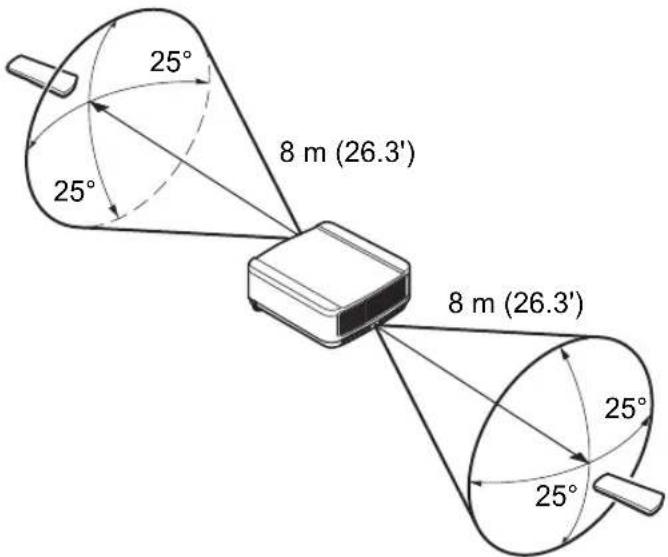
The remote control is an infrared type. Point it at the infrared remote receiver on the front or rear of the projector to operate it.
text_image
25° 25° 8 m (26.3') 8 m (26.3') 25° 25°
- Use the remote control no further than approximately 8 m (26.3') from the projector.
- Use the remote control within an angle of 25^ in any direction from directly in front of the infrared remote receiver.
- The remote control may be inoperative if there is an obstacle between the remote control and the projector or the infrared remote receiver on the projector is exposed to direct sunlight or strong light of lighting equipment.
- When you use 2 or more projectors at the same time, you can change the channel settings to prevent the 2 remote controls from interfering with each other. (P119)
■Using an Optional Wired Remote (RS-RC05)
To use a wired remote control with the projector, use the RS-RC05, sold separately. Use a cable with a 3.5 mm stereo mini jack (not included).
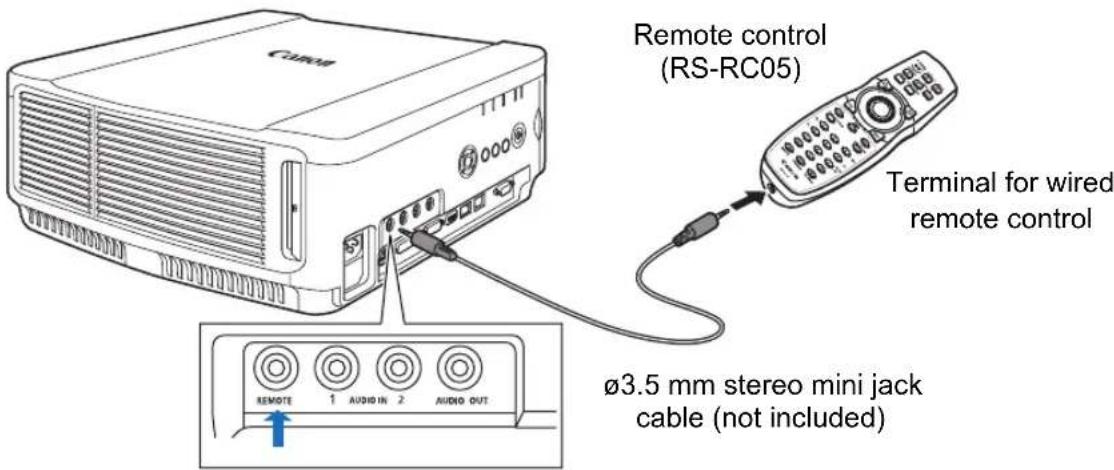
text_image
Remote control (RS-RC05) Terminal for wired remote control Ø3.5 mm stereo mini jack cable (not included)
- Infrared operations cannot be performed if a cable is connected to the projector or the remote control.
- Use a cable with a 3.5mm stereo mini jack (not included) with a length of 30m (98.4') or less.
Basic Guide
Safety Instructions
Before Use
Basic Guide
Installation Procedure
Connection Procedure
Projection Procedure
Convenient Features
Advanced Guide
Using Menus
Menu Configuration
Menu Description
Advanced Projection
Other Information
Maintenance
Product Specifications
Troubleshooting
Before setting up the projector, be sure to read "Before Installation" (P22).
Setting Up the Projector
■Positioning the Projector in Front of the Screen
Place the projector in front of the screen.

• To avoid keystone distortion, install the projector so that it is at right angles to the screen.
- The screen must not be exposed to direct sunlight or light from lighting equipment. In a bright room, it is recommended that lights be turned off, curtains be drawn, and other steps taken to make the screen easier to see.

text_image
Screen Optical axis■Floor Installation
To adjust the projection position when the projector is installed on the floor, use the lens shift function (P47, P61) to adjust up / down / left / right. You can also use the adjustable feet to incline the projector upward by up to 6^ .
For information about the relationship between screen size and projection distance, refer to page 43.

natural_image
Illustration of a truck with an upward arrow inside a rectangular frame and a projector nearby (no text or symbols)Lens shift
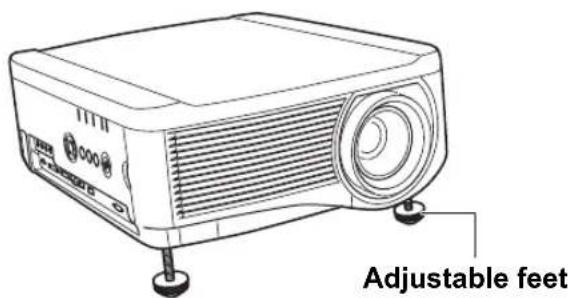
text_image
Adjustable feet■Installation Tilted Upward
To correct keystone distortion when the projector is tilted upward (using adjustable feet, for example), perform keystone correction (P67) or corner adjustment (P68).
■Installation on High Surfaces
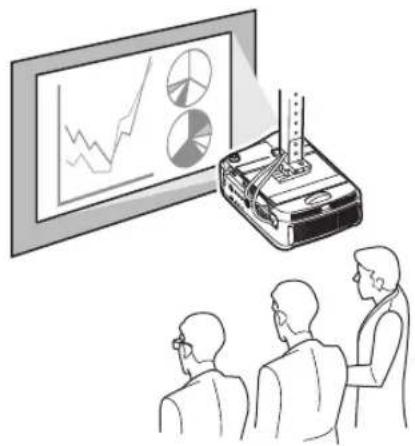
For projection from a shelf or other high surface, the projector can be installed upside-down and the projected image inverted.

natural_image
Illustration of a presentation with a presenter pointing at a screen displaying charts and pie charts (no text or symbols present)
When setting the projector on a high surface for projection, be sure the surface is flat and stable.
Failure to do so poses a risk of the projector falling and causing accidents or injury.
■Ceiling Mounting or Rear Projection
You can mount the projector on the ceiling (ceiling mounting) with it turned upside down or place it behind the screen (rear projection) if you use a translucent screen.
natural_image
Illustration of a presentation with charts and pie charts on screen, viewed by three people (no text or symbols)Ceiling mounting Rear projection
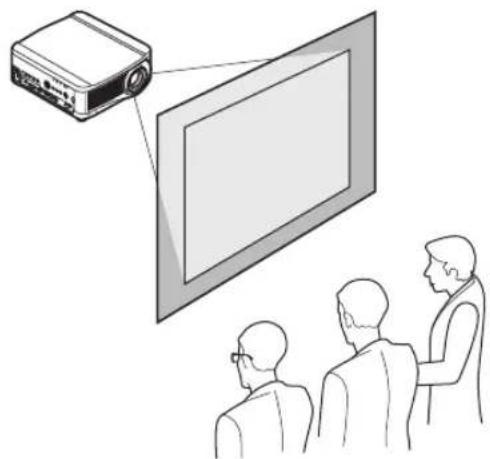
natural_image
Illustration of a projector projecting onto a screen to three people watching (no text or symbols present)Make sure to use the optional ceiling attachment. For the ceiling attachment, refer to "Option" (P207). For details, refer to the assembly and installation manual provided with the ceiling attachment.
Mounting the Projector on the Ceiling
You can mount the projector on the ceiling. The ceiling attachment (part No.: RS-CL11) is required in order to mount the projector on the ceiling. Depending on the installation environment, an extension pipe (part No.: RS-CL08 or RS-CL09) may also be required. Contact the Canon Customer Support Center for more detailed information.
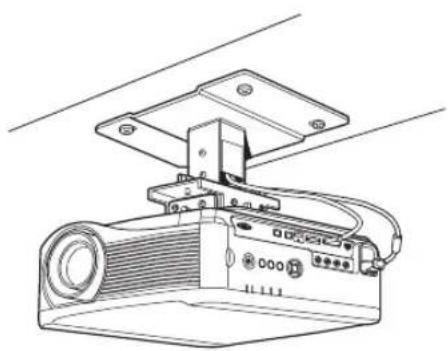
natural_image
Technical line drawing of a mechanical device with mounting bracket and control panel (no text or symbols)
Caution
- Make sure to use the optional ceiling attachment.
- You should never install the ceiling attachment by yourself.

If you mount the projector on the ceiling, you have to invert the projected image by selecting [Image flip H/V] from the menu. (P105)
Relationship Between Image Size and Projecting Distance
The projected image size is determined by the distance between the projector and the screen (projection distance) as well as the zoom. Refer to the following table and decide the distance between the projector and screen.

text_image
16:9 / 16:10 Screen size (diagonal) Height Width
text_image
4:3 Width Height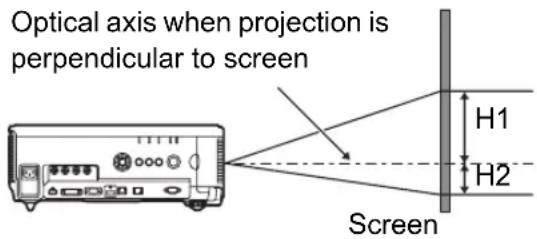
text_image
Optical axis when projection is perpendicular to screen H1 H2 Screen
- H1 and H2 are the distances when lens shift is the default value below.
- Standard Zoom Lens / Long Zoom Lens / Ultra Long Zoom Lens / Wide Zoom Lens: +50% (up / down), 0% (left / right)
Short Fixed Lens: 0% (up / down / left / right)
WUX6500
| Lens unit | Diagonal when 16:10 | Image size (cm) | Projection distance m (feet) | Distance from optical axis when projection is perpendicular to screen (cm) | |||||||
| 16:10 16:9 4:3 16:10 | |||||||||||
| Width | Height | Width | Height | Width | Height | Wide limit | Tele limit | H1 H2 | |||
| Standard Zoom Lens RS-IL01ST | 40 86 | 54 89 | 50 81 | 61 | 1.3(4.3) | 1.9(6.2) | 54 0 | ||||
| 60 | 129 | 81 | 133 | 75 | 122 | 91 | 1.9(6.2) | 2.9(9.5) | 81 | 0 | |
| 80 | 172 | 108 | 177 | 100 | 163 | 122 | 2.6(8.5) | 3.9(12.8) | 108 | 0 | |
| 100 | 215 | 135 | 221 | 125 | 203 | 152 | 3.2(10.5) | 4.8(15.7) | 135 | 0 | |
| 150 | 323 | 202 | 332 | 187 | 305 | 229 | 4.8(15.7) | 7.2(23.6) | 202 | 0 | |
| 200 | 431 | 269 | 443 | 249 | 406 | 305 | 6.4(21.0) | 9.6(31.5) | 269 | 0 | |
| 250 | 538 | 337 | 553 | 311 | 508 | 381 | 8.0(26.2) | 12.1(39.7) | 337 | 0 | |
| 300 | 646 | 404 | 664 | 374 | 610 | 457 | 9.6(31.5) | 14.5(47.6) | 404 | 0 | |
| 350 | 754 | 471 | 775 | 436 | 711 | 533 | 11.3(37.1) | 16.9(55.4) | 471 | 0 | |
| 400 | 862 | 538 | 886 | 498 | 813 | 610 | 12.9(42.3) | 19.3(63.3) | 538 | 0 | |
| 450 | 969 | 606 | 996 | 560 | 914 | 686 | 14.5(47.6) | 21.7(71.2) | 606 | 0 | |
| 500 | 1077 | 673 | 1107 | 623 | 1016 | 762 | 16.1(52.8) | 24.1(79.1) | 673 | 0 | |
| 550 | 1185 | 740 | 1218 | 685 | 1118 | 838 | 17.7(58.1) | 26.6(87.3) | 740 | 0 | |
| 600 | 1292 | 808 | 1328 | 747 | 1219 | 914 | 19.3(63.3) | 29.0(95.1) | 808 | 0 | |
| Long Zoom Lens RS-IL02LZ | 40 86 | 54 89 | 50 81 61 | 1.9(6.2) | 3.2(10.5) | 54 | 0 | ||||
| 60 129 | 81 13 | 3 75 1 | 22 91 | 2.8(9.2) | 4.8(15.7) | 81 | 0 | ||||
| 80 172 | 108 1 | 77 100 | 163 1 | 22 | 3.8(12.5) | 6.4(21.0) | 108 0 | ||||
| 100 215 | 135 | 221 125 | 203 | 152 | 4.7(15.4) | 8.0(26.2) | 135 0 | ||||
| 150 323 | 202 | 332 187 | 305 | 229 | 7.1(23.3) | 12.1(39.7) | 202 0 | ||||
| 200 431 | 269 | 443 249 | 406 | 305 | 9.5(31.2) | 16.1(52.8) | 269 0 | ||||
| 250 538 | 337 | 553 311 | 508 | 381 | 11.9(39.0) | 20.2(66.3) | 337 0 | ||||
| 300 646 | 404 | 664 374 | 610 | 457 | 14.2(46.6) | 24.2(79.4) | 404 0 | ||||
| 350 754 | 471 | 775 436 | 711 | 533 | 16.6(54.5) | 28.3(92.8) | 471 0 | ||||
| 400 862 | 538 | 886 498 | 813 | 610 | 19.0(62.3) | 32.3(106.0) | 538 0 | ||||
| 450 969 | 606 | 996 560 | 914 | 686 | 20.9(68.6) | 35.6(116.8) | 606 0 | ||||
| 500 107 | 77 673 | 1107 | 623 10 | 16 762 | 23.8(78.1) | 40.4(132.5) | 673 0 | ||||
| 550 118 | 85 740 | 1218 | 685 11 | 18 838 | 26.1(85.6) | 44.5(146.0) | 740 0 | ||||
| 600 129 | 92 808 | 1328 | 747 12 | 19 914 | 28.5(93.5) | 48.5(159.1) | 808 0 | ||||
| Short Fixed Lens RS-IL03WF | 40 | 86 | 54 | 89 | 50 | 81 | 61 | 0.7 (2.3) | 27 | 27 | |
| 60 | 129 | 81 | 133 | 75 | 122 | 91 | 1.0 (3.3) | 41 | 41 | ||
| 80 | 172 | 108 | 177 | 100 | 163 | 122 | 1.4 (4.6) | 54 | 54 | ||
| 100 | 215 | 135 | 221 | 125 | 203 | 152 | 1.7 (5.6) | 68 | 68 | ||
| 150 | 323 | 202 | 332 | 187 | 305 | 229 | 2.6 (8.5) | 101 | 101 | ||
| 200 | 431 | 269 | 443 | 249 | 406 | 305 | 3.4 (11.2) | 135 | 135 | ||
| 250 | 538 | 337 | 553 | 311 | 508 | 381 | 4.3 (14.1) | 168 | 168 | ||
| 300 | 646 | 404 | 664 | 374 | 610 | 457 | 5.2 (17.1) | 202 | 202 | ||
| Ultra Long Zoom Lens RS-IL04UL | 60 129 | 81 13 | 3 75 1 | 22 91 | 4.6(15.1) | 9.0(29.5) | 81 | 0 | |||
| 80 172 | 108 1 | 77 100 | 163 1 | 22 | 6.1(20.0) | 12.0(39.4) | 108 0 | ||||
| 100 215 | 5 135 | 221 125 | 5 203 | 152 | 7.6(24.9) | 14.9(50.2) | 135 0 | ||||
| 150 323 | 3 202 | 332 187 | 7 305 | 229 | 11.4(37.4) | 22.3(77.3) | 202 0 | ||||
| 200 431 | 1 269 | 443 249 | 4 406 | 305 | 15.2(49.7) | 29.8(97.8) | 269 0 | ||||
| 250 538 | 3 337 | 553 311 | 1 508 | 381 | 18.9(62.0) | 37.2(122.0) | 337 0 | ||||
| 300 646 | 6 404 | 664 374 | 4 610 | 457 | 22.7(74.5) | 44.6(146.3) | 404 0 | ||||
| 350 754 | 4 471 | 775 436 | 7 711 | 533 | 26.4(86.6) | 52.0(170.6) | 471 0 | ||||
| 400 862 | 5 338 | 886 498 | 8 813 | 610 | 30.2(99.1) | 59.4(194.9) | 538 0 | ||||
| 450 | 969 | 606 | 996 | 560 | 914 | 686 | 34.0(111.5) | 66.8(219.2) | 606 | 0 | |
| 500 107 | 77 673 | 1107 | 623 | 1016 | 762 | 37.7(123.7) | 74.2(243.4) | 673 0 | |||
| 550 | 1185 | 740 | 1218 | 685 | 1118 | 838 | 41.5(136.2) | 81.6(267.7) | 740 | 0 | |
| 600 129 | 92 808 | 1328 | 747 | 1219 | 914 | 45.2(148.3) | 89.0(292.0) | 808 0 | |||
| WideZoom Lens RS-IL05WZ | 40 | 86 | 54 | 89 | 50 | 81 | 61 | 0.9(3.0) | 1.3(4.3) | 54 | 0 |
| 60 129 | 81 13 | 3 75 | 122 91 | 1.3(4.3) | 1.9(6.2) | 81 | 0 | ||||
| 80 172 | 108 | 177 100 | 163 | 122 | 1.7(5.6) | 2.6(8.5) | 108 0 | ||||
| 100 215 | 5 135 | 221 125 | 5 203 | 152 | 2.2(7.2) | 3.2(10.5) | 135 0 | ||||
| 150 323 | 3 202 | 332 187 | 7 305 | 229 | 3.2(10.5) | 4.9(16.1) | 202 0 | ||||
| 200 431 | 1 269 | 443 249 | 9 406 | 305 | 4.3(14.1) | 6.5(21.3) | 269 0 | ||||
| 250 538 | 3 337 | 553 311 | 1 508 | 381 | 5.4(17.7) | 8.1(26.6) | 337 0 | ||||
| 300 646 | 6 404 | 664 374 | 4 610 | 457 | 6.5(21.3) | 9.7(31.8) | 404 0 | ||||
| 350 754 | 4 471 | 775 436 | 6 711 | 533 | 7.5(24.6) | 11.4(37.4) | 471 0 | ||||
| 400 862 | 5 338 | 886 498 | 813 | 610 | 8.6(28.2) | 13.0(42.7) | 538 0 | ||||
| 450 | 969 | 606 | 996 | 560 | 914 | 686 | 9.7(31.8) | 14.6(47.9) | 606 | 0 | |
| 500 107 | 77 673 | 1107 | 623 | 1016 | 762 | 10.8(35.4) | 16.3(53.5) | 673 0 | |||
| 550 | 1185 | 740 | 1218 | 685 | 1118 | 838 | 11.8(38.7) | 17.9(58.7) | 740 | 0 | |
| 600 129 | 92 808 | 1328 | 747 | 1219 | 914 | 12.9(42.3) | 19.5(64.0) | 808 0 | |||
Lens Shift Function
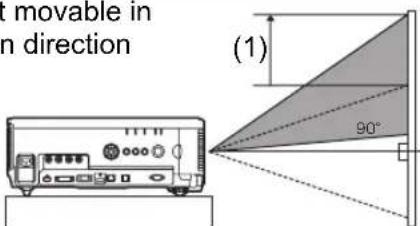
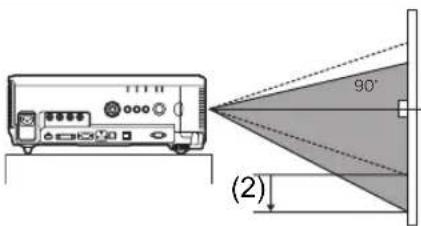
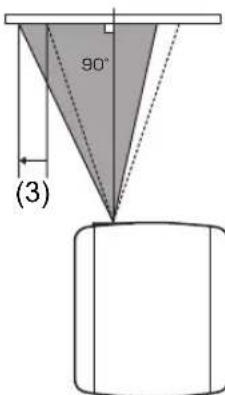
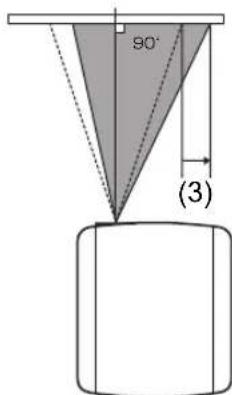
The projector includes a lens shift function. Operation of the buttons slides the lens up, down, left, and right, moving the image position. For instructions, refer to "Adjusting the Image Position" (P61).
The amount of lens shift is indicated as a percentage relative to the image height and width.
The table below shows the lens shift for each lens.
| Lens unit WUX6500 | |
| Standard Zoom Lens (RS-IL01ST) | Up (1): +55%Down (2): -15%Left / right (3): ±10% |
| Long Zoom Lens (RS-IL02LZ) | |
| Ultra Long Zoom Lens (RS-IL04UL) | |
| Wide Zoom Lens (RS-IL05WZ) | |
| Short Fixed Lens (RS-IL03WF) | Up (1): +5%Down (2): -5%Left / right (3): ±2% |
Amount movable in up/down direction
text_image
t movable in in direction (1) 90°At maximum upward lens shift
text_image
(2) 90°At maximum downward lens shift
Amount movable
in left/right
direction
text_image
90° (3)At maximum leftward lens shift
text_image
90° (3)At maximum rightward lens shift
Area Outside the Lens Shift Range
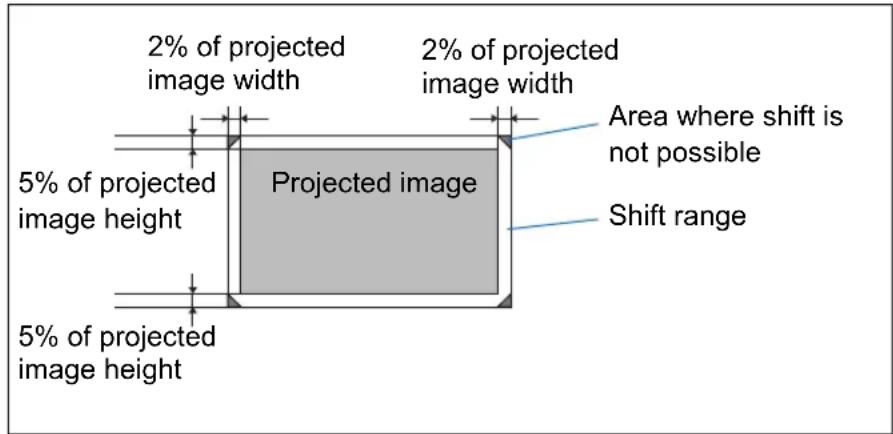
With the Standard Zoom Lens, Long Zoom Lens, Ultra Long Zoom Lens, and Wide Zoom Lens, when the shift exceeds 44% in the upward direction, the amount of available shift in the left / right directions decreases. When the lens is shifted upward to the maximum (1), the amount of available shift in the left / right direction is ±2%.

text_image
Amount of shift relative to projected image width Amount of shift relative to projected image width Area where shift is not possible (1) Shift range Projected image Amount of shift relative to projected image heightThe more you shift the Short Fixed Lens up or down, the less you can shift it left or right. At the position of maximum lens shift upward or downward, the lens cannot be shifted left or right.
text_image
2% of projected image width 2% of projected image width 5% of projected image height Projected image Area where shift is not possible Shift range 5% of projected image height
Caution
Before connecting the projector to other equipment, turn off both the projector and the other equipment.
Connecting a Computer
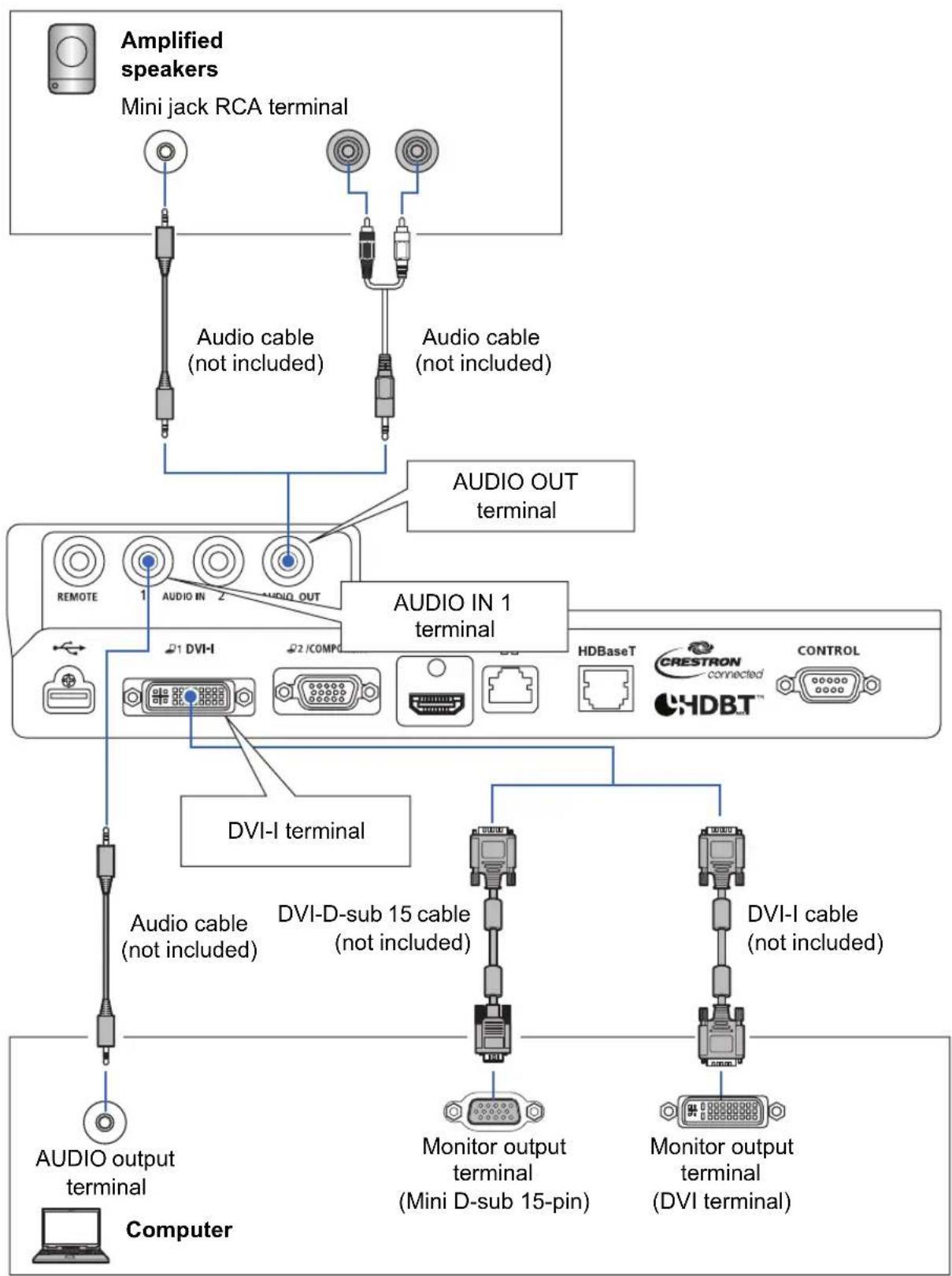
flowchart
graph TD
    A["Amplified speakers\nMini jack RCA terminal"] --> B["Audio cable (not included)"]
    A --> C["Audio OUT terminal"]
    B --> D["REMOPE 1 AUDIO IN 2 AUDIO OUT"]
    C --> E["AUDIO IN 1 terminal"]
    D --> F["DVI-I DVI-I"]
    E --> G["HDBaseT CRESTRON connected HDBT™ CONTROL"]
    F --> H["Audio cable (not included)"]
    G --> I["DVI-D-sub 15 cable (not included)"]
    H --> J["AUDIO output terminal\nMini D-sub 15-pin"]
    I --> K["Monitor output terminal\nDVI terminal"]
Connecting a Computer (continued)

flowchart
graph TD
    A["Computer"] --> B["AUDIO output terminal"]
    B --> C["Monitor output terminal (Mini D-sub 15-pin)"]
    C --> D["Audio cable (not included)"]
    C --> E["Computer cable (not included)"]
    D --> F["AUDIO IN 2 terminal"]
    E --> F
    F --> G["ANALOG PC-2 / COMPONENT terminal"]
    G --> H["HDMI"]
    H --> I["HDMI terminal"]
    I --> J["LAN cable (CAT5e or better; shielded; not included)"]
    J --> K["HDMI cable (not included)"]
    K --> L["HDMI terminal"]
    L --> M["HDMI cable (not included)"]
    M --> N["HDMI transmission"]
    N --> O["HDBaseT transmitter"]
    O --> P["CONTROL"]
    P --> Q["HDBBaseT"]
    Q --> R["CRESTRON connected"]
    R --> S["HDBBaseT terminal"]
    S --> T["BNC cable (not included) or Mini D-sub 15-pin - BNC terminal converter cable (not included)"]
Connecting AV Equipment

flowchart
graph TD
    A["Amplified speakers"] --> B["Mini jack"]
    A --> C["RCA terminal"]
    D["AV equipment"] --> E["Mini jack"]
    D --> F["RCA terminal"]
    D --> G["D terminal"]
    D --> H["RCA component terminal"]
    D --> I["RCA plug - RCA plug component cable (not included)"]
    I --> J["Component cable (not included)"]
    K["ANALOG PC-2 / COMPONENT terminal"] --> L["HDVI-H"]
    K --> M["AUDIO OUT terminal"]
    N["HDBaseT terminal"] --> O["CRESTRON connected"]
    O --> P["CONTROL"]
    Q["LAN cable (CAT5e or better; shielded; not included)"] --> R["HDBaseT transmitter"]
    S["HDMI terminal"] --> T["HDMI cable (not included)"]
    U["HDMI cable (not included)"] --> V["HDMI cable (not included)"]
    W["AV equipment"] --> X["AV instrument"]

Notes on HDBaseT
- Use a shielded cable rated at CAT5e or better.
• Maximum transmission distance is 100 m.
• However, maximum transmission distance may be shorter in some environments. - Do not use the LAN cable when it is coiled or bundled.
- Inserting or removing the LAN cable during projection may cause noise.
- Connectivity with all HDBaseT transmitters on the market is not guaranteed.
- Some HDBaseT transmitters may not enable correct projection when used to connect source equipment to the projector.
Plugging the Projector In
Connect the power cord to the projector and plug it in.
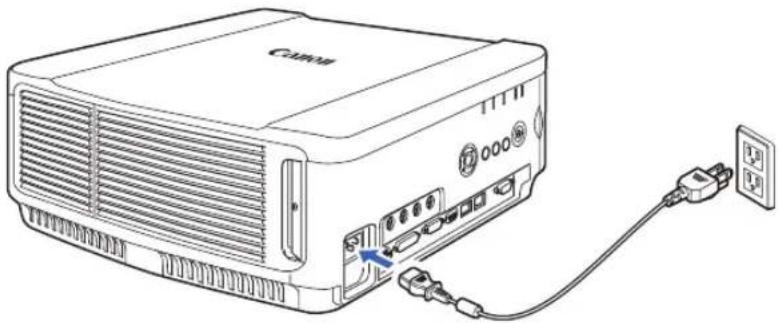
natural_image
Line drawing of a Canon projector with external cable and power outlet (no text or symbols)
Insert the power plug and connector securely up to the base.

- After turning off the projector, wait at least 5 minutes before turning it on again. Turning the projector on immediately after turning it off may shorten the lamp life.
- Unplug the power cord when the projector is not in use.
Step 1 Turn the Projector On
1 Check the connection between the projector and the computer or AV equipment. (P49 - P51)
For instructions on connecting the power cord, refer to "Plugging the Projector In" (P52).
2Press the POWER button.
The [POWER ON] indicator initially flashes green, after which it remains lit.
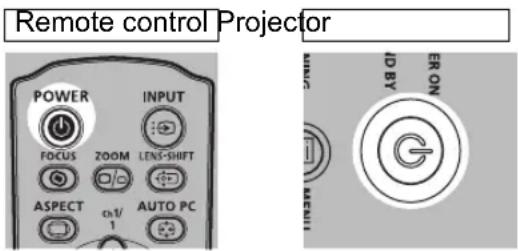
text_image
Remote control Projector POWER INPUT FOCUS ZOOM LENS-SHIFT ASPECT 0x1/ AUTO PC 1 MENI ID BY ER ONThe countdown window is displayed for approximately 20 seconds, and then the projection is started. Press the OK button to hide the countdown window.

• Network functions are not available for the first 40 seconds after startup.
- A window appears when the projector is turned on for the first time. You can select a language to be used by the projector for displaying menus and messages in the window. Select the desired language with the pointer buttons and press the OK button. (P54)
You can change the language from the menu at a later time. (P123)
3Turn on the computer or AV equipment power.
Changing Operations When Projector is Turned On
You can change operations when the projector is turned on as follows.
- You can turn on the projector by connecting the power cord, without pressing the POWER button. (P122)
- You can change the countdown window. (P118)
- You can skip the countdown window. (P118)
When the Projector Is Left Idle
If no signal is received, the power management feature automatically turns off the projector after a certain period of inactivity (by the factory default, 15 minutes). (P121)
■When the Language Selection Screen Appears
A screen appears when the projector is turned on for the first time. You can select a language to be used by the projector for displaying menus and messages in the window. Select the desired language with the pointer buttons and press the OK button.
You can change the language from the menu at a later time. (P123) If the language selection screen is out of focus, adjust the focus. (P59)

text_image
Remote control Projector +10A OK 10A
text_image
Language English Pycckii Čeština Deutsch Nederlands Dansk Français Suomi İnlölde Italiano Norsk 中文简体 Español Türkçe 中文繁體 Português Polski 赴马尔 Svenska Magyar 日本語An item highlighted in orange will be selected.
■When the Password Input Screen Appears
If you have set a password, the password input screen appears. Enter your password. (P124)
■When "No signal" Appears
With a notebook computer, the user must turn on the external monitor output. (P55) Press the INPUT button to select the input signal. (P56)
■When Notebook Computer Screen Does Not Appear
Set your notebook computer to output signals to an external monitor. For more details, refer to "Changing Notebook Computer Screen Output" (P55).
■Adjusting Image
- Set the display resolution of the computer to the highest resolution or the resolution closest to that setting. (P57)
- Use the auto PC function to adjust shift in computer image or the flickering of the screen. (P58)
- Adjust the size of projected images by zooming. For the Standard Zoom Lens, Long Zoom Lens, Ultra Long Zoom Lens, and Wide Zoom Lens, use optical zoom (P60). For the Short Fixed Lens, use digital zoom (P106).
- Correct any keystone distortion by pressing the D.SHIFT/KEYSTONE button. (P67)
- Select the aspect ratio of the projected image (screen aspect) or a screen mode (aspect) according to the aspect ratio of the screen, type of input image signal etc. (P63 – P66)
- Select an image mode depending on the projected image. (P70)

The image can also be adjusted by projecting a test pattern (P187).
Changing Notebook Computer Screen Output
For projection from a notebook computer, the computer settings must be adjusted to switch display output.
This operation is not required for a desktop computer.
■Turning on External Monitor Output
You can turn on the external monitor output via keyboard operation.
To turn on the external monitor output with most computers, press the function key ([F1] to [F12]) which is marked with the external monitor icon while holding down the [Fn] key.

text_image
While pressing Key press a key such as ☐.
- The function key you use and the method used to turn on the external monitor output vary depending on the model. For details, see the manual for your notebook computer.
- With Windows 10, Windows 8.1, Windows 8 or Windows 7, you can turn on image output by holding down the Windows logo key and pressing the [P] key.
Step 2 Select an Input Signal
Select the input signal in the [Input] menu when you want to project a digital PC or AV equipment signal, or to switch between inputs when multiple computers or multiple sets of AV equipment are connected.
Skip this step if you have not changed the input signal since the last projection.
1 Press the INPUT button to display the window shown below.
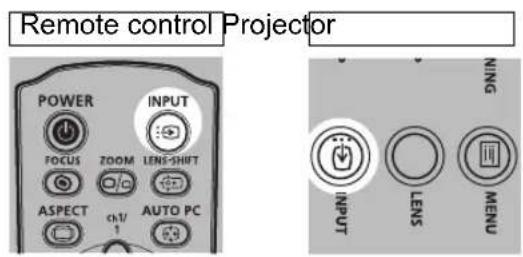
text_image
Remote control Projector POWER INPUT FOCUS ZOOM LENS-SHIFT ASPECT ON/ AUTO PC NING INPUT LENS MENU
text_image
Input HDMI Digital PC A1 Analog PC-1 A2 Analog PC-2 Component HDBT HDBaseT LAN USB USBThe currently active input signal is marked with a green circle and enclosed by a orange border.
Names of input signals available for projection are displayed in white, and unavailable signal names are grayed out. However, [Digital PC] and [Analog PC-1] may be grayed out even when available.
2You can switch the available input signal types by pressing the INPUT button.
You can select the target input signal with [▲/ [▼]
3Press the OK button to confirm the input signal type.

- Screens of computers connected to the projector over a network can be projected when you have selected [LAN] as the input signal. For details, refer to the NMPJ user's manual.
- Images on USB flash drives can be projected when you have selected [USB] as the input signal. For details, refer to "Projecting Images on a USB Flash Drive" (P157).
- In split-screen mode, the side without control rights is identified by a white circle.
Step 3 Adjust the Image
Setting the Display Resolution of the Computer
Based on the maximum resolution of the projector, set the display resolution of the computer to the resolution closest to the output signal resolution of the projector.
(P188)
Maximum resolution
1920 X 1200 dots
■Windows 10
1 Open the [Control Panel] from the start menu, then select [Appearance and Personalization] - [Adjust screen resolution] in the [Control Panel Home].
2Click the [Resolution] tab, and move the slider to select the resolution closest to the maximum output signal resolution of the projector.
3Click the [OK] button.
■Windows 8 / 8.1
1Move the cursor toward the upper or lower right corner to access the menu.
2Click [Settings], and then click [Control Panel].
3From [Control Panel Home] - [Appearance and Personalization], select [Adjust screen resolution].
4Click the [Resolution] tab, and move the slider to select the resolution closest to the maximum output signal resolution of the projector.
5Click the [OK] button.
■Windows 7
1 Open the [Control Panel] from the start menu, then select [Appearance and Personalization] - [Adjust screen resolution].
2Click the [Resolution] tab, and move the slider to select the resolution closest to the maximum output signal resolution of the projector.
3Click the [OK] button.
■Windows Vista
1 Open the [Control Panel] from the start menu, then select [Appearance and Personalization] - [Adjust screen resolution] in the [Control Panel Home].
2Select the resolution closest to the maximum output signal resolution of the projector from the [Resolution] list.
3Click the [OK] button.
■Mac OS X
1 Open the Apple Menu and select [System Preferences].
2In the [System Preferences] window, click the [Displays] icon to display the Display window.
3Select the [Display] tab and select the resolution closest to the maximum output signal resolution of the projector from the [Resolutions] list.
4Close the [System Preferences] window.
Auto PC Adjustment
If the image display is shifted or there is flickering of the screen when [Analog PC-1] or [Analog PC-2] is selected, press the AUTO PC button to adjust the projector to the optimal condition.
The adjustment results will be stored. If the projector is used again with the same computer, when the input signal is selected the image will be projected automatically under the same conditions that were previously adjusted.

text_image
Remote control POWER INPUT POCUS ZOOM LENS-SHIFT ASPECT CX1/ AUTO PC
If the Auto PC adjustment is insufficient, perform the following operations.
- Select the input signal that matches the resolution of the computer from [Input signal select]. (P91)
- If adjustment is insufficient even when using the above operation, adjust [Total dots], [Tracking], [Horizontal position], [Vertical position], [Horizontal pixels] and [Vertical pixels] in [Input signal settings]. (P92)
- For the signal types supported by the projector, see the table on page 188 to 189.
Focusing, Resizing, or Moving the Image
■Adjusting Image Focus
To adjust the focus, press the FOCUS button on the remote control or the LENS button on the projector.
For the projection distances of the lens unit, refer to "Relationship Between Image Size and Projecting Distance" on page 43.
1Press either the FOCUS button on the remote control or the LENS button on the projector to display the focus adjustment window.
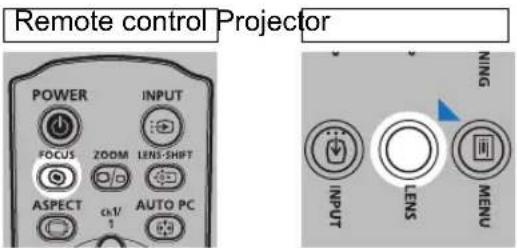
text_image
Remote control Projector POWER INPUT FOCUS ZOOM LENS-SHIFT ASPECT OK/ AUTO PC NING INPUT LENS MENUPress once.
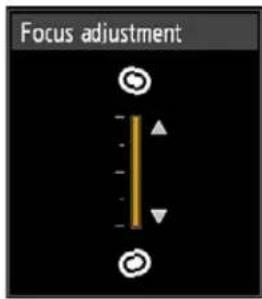
text_image
Focus adjustment2Press the pointer buttons to adjust the focus.
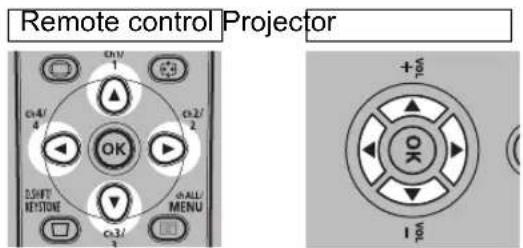
text_image
Remote control Projector +70A OK 1 2 3 4 5 6 7 8 9 10 11 12 13 14 15 16 17 18 19 20 21 22 23 24 25 26 27 28 29 30 31 32 33 34 35 36 37 38 39 40 41 42 43 44 45 46 47 48 49 50 51 52 53 54 55 56 57 58 59 60 61 62 63 64 65 66 67 68 69 70To adjust the focus, use the [▲/ [ ]▼[ ] /▼] buttons on the remote control or projector.
To continue adjusting the focus in a specific direction, hold down the [▲/ [▼] buttons on the remote control or projector.
3When the focus is adjusted optimally, press the OK button or the FOCUS button.
■Adjusting Image Size
The size of the projected image can be adjusted by pressing the ZOOM button on the remote control or the LENS button on the projector. Change the projector installation position if your desired image is too large or too small to adjust it with the zoom function. (P40)
1 Press either the ZOOM button on the remote control or the LENS button on the projector twice to display the zoom adjustment window.
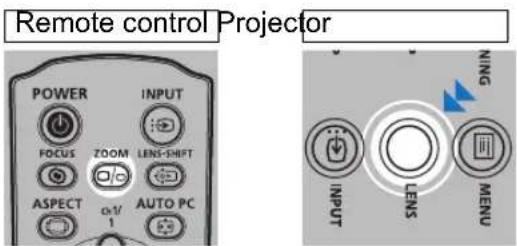
text_image
Remote control Projector POWER INPUT FOCUS ZOOM LENS-SHIFT ASPECT 0x17 AUTO PC 1 NING INPUT LENS MENUPress twice.

text_image
Zoom adjustment2Press the pointer buttons to adjust the image size.
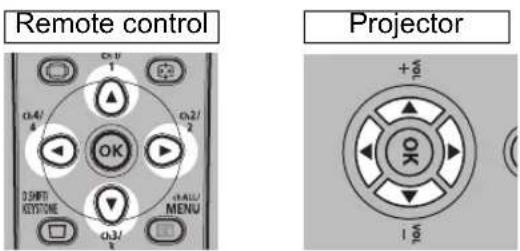
text_image
Remote control Projector +6 OK 1-5
text_image
ScreenTo enlarge the image, use the [A] / [ ] buttons on the remote control or projector.
To reduce the image, use the ▼/ [ ]buttons on the remote control or projector.
To continue adjusting the size in a specific direction, hold down the [▲] / [▼][◀]/ [ ]buttons on the remote control or projector.
3When the desired image size is selected, press the OK button or the ZOOM button.

When the Short Fixed Lens (RS-IL03WF) is attached, digital zoom adjustment is performed in place of optical zoom adjustment.
■Adjusting the Image Position
To adjust the screen position up, down, left, or right, press the LENS-SHIFT button on the remote control or the LENS button on the projector. It can change the projected screen to the most suitable position by moving the position of the lens up/down/left/right.

- The available range for lens shift (percentage of movement relative to the screen size) varies depending on the lens unit which is used. (P47)
- Lens shift is not available in each corner for the Short Fixed Lens (RS-IL03WF) or in the top left and top right for the other lenses. (P48)
1 Press either the LENS-SHIFT button on the remote control or the LENS button on the projector three times to display the lens shift adjustment window.
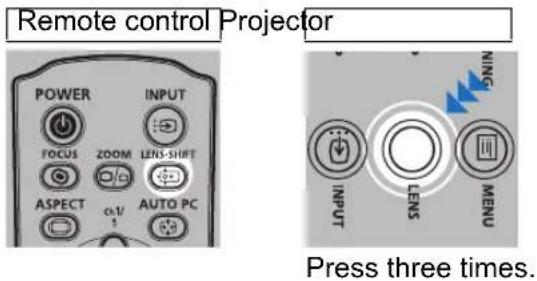
text_image
Remote control Projector POWER INPUT FOCUS ZOOM LENS-SHIFT ASPECT ω1/1 AUTO PC NING INPUT LENS MENU Press three times.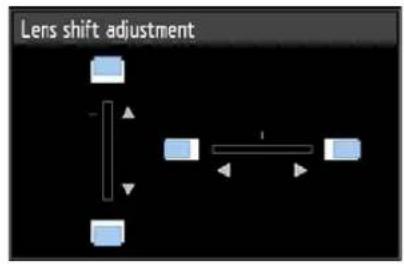
text_image
Lens shift adjustment2Press the pointer buttons to adjust.
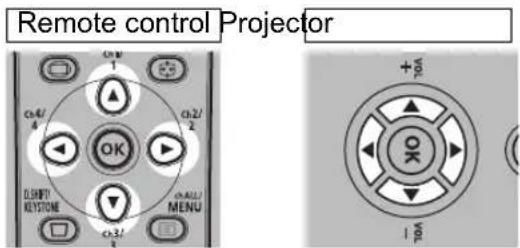
text_image
Remote control Projector +70A OK 1-70A
flowchart
graph TD
    A["User Group"] --> B["Road"]
    C["User Group"] --> B
    D["User Group"] --> B
    E["User Group"] --> B
    F["User Group"] --> B
    G["User Group"] --> B
    H["User Group"] --> B
    I["User Group"] --> B
    J["User Group"] --> B
    K["User Group"] --> B
    L["User Group"] --> B
    M["User Group"] --> B
    N["User Group"] --> B
    O["User Group"] --> B
    P["User Group"] --> B
    Q["User Group"] --> B
    R["User Group"] --> B
    S["User Group"] --> B
    T["User Group"] --> B
    U["User Group"] --> B
    V["User Group"] --> B
    W["User Group"] --> B
    X["User Group"] --> B
    Y["User Group"] --> B
    Z["User Group"] --> B
    AA["User Group"] --> B
    AB["User Group"] --> B
    AC["User Group"] --> B
    AD["User Group"] --> B
    AE["User Group"] --> B
    AF["User Group"] --> B
    AG["User Group"] --> B
    AH["User Group"] --> B
    AI["User Group"] --> B
    AJ["User Group"] --> B
    AK["User Group"] --> B
    AL["User Group"] --> B
    AM["User Group"] --> B
    AN["User Group"] --> B
    AO["User Group"] --> B
    AP["User Group"] --> B
    AQ["User Group"] --> B
    AR["User Group"] --> B
    AS["User Group"] --> B
    AT["User Group"] --> B
    AU["User Group"] --> B
    AV["User Group"] --> B
    AW["User Group"] --> B
    AX["User Group"] --> B
    AY["User Group"] --> B
    AZ["User Group"] --> B
    BA["User Group"] --> B
    BB["User Group"] --> B
    BC["User Group"] --> B
    BD["User Group"] --> B
    BE["User Group"] --> B
    BF["User Group"] --> B
    BG["User Group"] --> B
    BH["User Group"] --> B
    BI["User Group"] --> B
    BJ["User Group"] --> B
    BK["User Group"] --> B
    BL["User Group"] --> B
    BM["User Group"] --> B
    BN["User Group"] --> B
    BO["User Group"] --> B
    BP["User Group"] --> B
    BQ["User Group"] --> B
    BR["User Group"] --> B
    BS["User Group"] --> B
    BT["User Group"] --> B
    BU["User Group"] --> B
    BV["User Group"] --> B
    BW["User Group"] --> B
    BX["User Group"] --> B
    BY["User Group"] --> B
    CA["User Group"] --> B
To raise or lower the image, use the [A] / [ ] buttons on the remote control or projector.
To move the image left or right, use the [◀] / [ ] buttons on the remote control or projector.
To continue moving the image in a specific direction, hold down the corresponding button.
3When the desired position is reached, press the OK button.
■Resetting the Position
The lens position after movement with the lens shift function is not returned when the power is turned off. To return it to its original position, perform reset.
During screen position adjustment, press and hold the LENS-SHIFT button on the remote
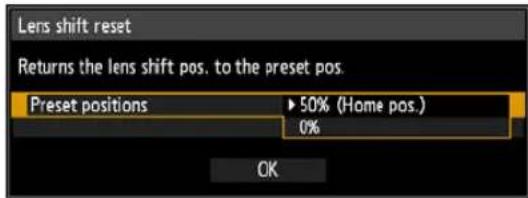
text_image
Lens shift reset Returns the lens shift pos. to the preset pos. Preset positions ▶ 50% (Home pos.) 0% OKcontrol or the LENS button on the projector to display the [Lens shift reset] window. The selections for the lens currently used are displayed. Use the pointer buttons to select one of them, then press the OK button.
| Lens unit type Available items | |
| Standard Zoom LensRS-IL01ST | 50% (Home position): Up 50%, left / right 0%0%: Up / down / left / right 0% |
| Long Zoom LensRS-IL02LZ | |
| Ultra Long Zoom LensRS-IL04UL | |
| Wide Zoom LensRS-IL05WZ | |
| Short Fixed LensRS-IL03WF | 0% (Home position): Up / down / left / right 0% |
Step 4 Select an Aspect Ratio (Screen Aspect) Matching the Screen
Select an optimum aspect ratio of the projected image (screen aspect) or an optimum screen mode (aspect) according to the aspect ratio of the screen, type of input image signal and so on for the projection to make best use of the screen size.
[Screen aspect] Select the same screen aspect ratio as the screen you are using.
[Aspect] In general, select [Auto].
You may need to change the setting depending on the resolution of the computer or other AV equipment connected. If the image is not projected with the desired aspect ratio, refer to “Relationship between Aspect and Screen Aspect” on page 183.
Selecting Screen Aspect
Select the correct aspect ratio for the screen which is used.
1 Press the MENU button to display the menu window.
text_image
Remote control Projector OK INPUT LENS MENU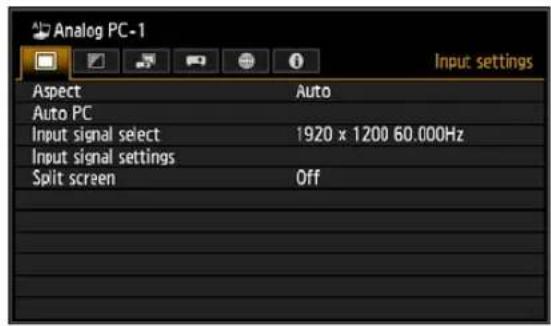
text_image
Analog PC-1 Aspect Auto Auto PC Input signal select 1920 x 1200 60.000Hz Input signal settings Split screen Off2Press the [ ] / [ ] buttons to select the [Install settings] tab.
![CANON REALiS WX6500 D - 2Press the [ ] / [ ] buttons to select the [Install settings] tab. - 1](/content/2026/06/1190230/images/1d9b53641a6d0596e0c6359ef25a5e4a8773431b45f419cc715f4604e9050876.jpg)
text_image
Remote control Projector OK ON2/2 ON4/3 ON3/2 ON1/2 ON2/2 ON3/2 ON4/3 ON3/2 ON1/2![CANON REALiS WX6500 D - 2Press the [ ] / [ ] buttons to select the [Install settings] tab. - 2](/content/2026/06/1190230/images/400560c5794b3d6bd95f03f6e91b7a26a644c2a70ce7e88f83a15387f78a31af.jpg)
text_image
Analog PC-1 Install settings Positional lock Off Image flip H/V None Screen aspect 16:10 Zoom Keystone Horizontal-vertical keystone Digital image shift Professional settings Lens - Position Screen color Normal On screen Test pattern Off![CANON REALiS WX6500 D - 2Press the [ ] / [ ] buttons to select the [Install settings] tab. - 3](/content/2026/06/1190230/images/aaaff94a64987bed9b4a4bcfc5a2e85776bb17a0e7ae5a5451b1aa308963c764.jpg)
When the Short Fixed Lens is attached and if the projected image does not fit on the screen, you can display the image by electronically reducing its size.
The [Zoom] setting will appear in the menu only when the Short Fixed Lens (RS-IL03WF) is attached.
3Select [Screen aspect] with the [ ] ▲[ ] buttons, and then press the OK button.
Remote control Projector
![CANON REALiS WX6500 D - 3Select [Screen aspect] with the [ ] ▲[ ] buttons, and then press the OK button. - 1](/content/2026/06/1190230/images/f417e75ee35decb2edab7682d26314128d9bd5ca50040e9c666d774f570c1550.jpg)
text_image
O-4/ 4 OK O-2/ 2 SHIFT CYSTONE OK MENU + OK OK 1 OK![CANON REALiS WX6500 D - 3Select [Screen aspect] with the [ ] ▲[ ] buttons, and then press the OK button. - 2](/content/2026/06/1190230/images/8a3034fc44849cc92db5fc6778bc4bf8150451d83e25f808fc31e658f4cd6027.jpg)
text_image
Analog PC-1 Positional lock Off Image flip H/V None Screen aspect 16:10 Zoom Keystone Horizontal-vertical keystone Digital image shift Professional settings Lens - Position Screen color Normal On screen Test pattern Off4Use the [ ] △[ ] buttons to select the desired contents.
Remote control Projector
![CANON REALiS WX6500 D - 4Use the [ ] △[ ] buttons to select the desired contents. - 1](/content/2026/06/1190230/images/cdc3cbac779f19b4a15d74b81bc0952de53d37d64ce6a7658aab9b32cb1f2549.jpg)
text_image
O 4/4 1 O 2/2 4 OK 2 O 3/3/ C YSTONE MENU +OK OK 1 OK![CANON REALiS WX6500 D - 4Use the [ ] △[ ] buttons to select the desired contents. - 2](/content/2026/06/1190230/images/7cbdc52e2151b5475cdd8dbc9097f3bab302df11db1e7952dd29060e2546519a.jpg)
text_image
Analog PC-1 Positional lock Off Image flip H/V None Screen aspect ► 16:10 Zoom 16:9 Keystone 4:3 Digital image shift 16:9 D. image shift Professional settings 4:3 D. image shift Lens - Position Screen color Normal On screen Test pattern Off16:10
Select this when you use a screen with an aspect ratio of 16:10. Also select this screen aspect when projecting on a wall. You can correct keystone distortion with this mode. (P67)
natural_image
Black-and-white cityscape featuring a river with boats and historic buildings (no visible text or signage)16:10 screen
16:9
Select this when you use a screen with an aspect ratio of 16:9. You can correct keystone distortion with this mode. (P67)
natural_image
Black-and-white cityscape featuring a river with boats and historic buildings (no visible text or signage)16:9 screen
4:3
Select this when you use a screen with an aspect ratio of 4:3. You can correct keystone distortion with this mode. (P67)
natural_image
Black-and-white cityscape featuring a river with boats and buildings, no visible text or symbols4:3 screen
16:9 D. image shift
Select this when you use a screen with an aspect
ratio of 16:9. Keystone correction cannot be performed in this mode. However, it is possible to move the image up / down when projecting level. For details about how to move the image, refer to “Digital image shift” on page 107.
4:3 D. image shift
Select this when you use a screen with an aspect ratio of 4:3. Keystone correction cannot be performed in this mode. However, it is possible to move the image left / right when projecting level. For details about how to move the image, refer to "Digital image shift" on page 107.
5Press the OK button to accept your setting and then press the MENU button.
Resetting the Image Shift
Perform the following steps to reset the image shift adjustment.
1Access the [D. image shift adjustment] window and press the D.SHIFT/KEYSTONE button to display the [D. image shift reset] window.
2Next, select [OK] with the [] button, and then press the OK button.
Your specified [D.image shift adjustment] is now reset.
Select the Aspect
Select [Aspect] based on the input signal type, aspect ratio of the screen and resolution. For more details about aspect ratios, refer to “Relationship between Aspect and Screen Aspect” on page 183.
Types of Aspect Ratios
■Auto
An image is projected at the aspect ratio of the input signal. Select this mode for normal image projection.
■16:10
The image is projected using an input signal aspect ratio of 16:10. Select this if an image of 16:10 aspect ratio cannot be correctly projected in [Auto] mode.

There may be some cases when this cannot be selected, depending on the input signal and/or resolution.
■16:9
The image is projected using an input signal aspect ratio of 16:9. Select this if an image of 16:9 aspect ratio cannot be correctly projected in [Auto] mode.
4:3
The image is projected using an input signal aspect ratio of 4:3. Select this if an image of 4:3 aspect ratio cannot be correctly projected in [Auto] mode.
Zoom
This cuts the upper / lower or left / right part of the screen according to the screen aspect and zooms in the center of the image. Select this if a letter box is displayed (black lines at the top/bottom of the screen) when watching video.

There may be some cases when this cannot be selected, depending on the input signal and/or resolution.
True size
The image is projected with the original resolution of the input signal. Screens of computers with a lower display resolution than the projector are displayed smaller but clearer than in other aspect ratios.

There may be some cases when this cannot be selected, depending on the input signal and/or resolution.
Selecting an Aspect Ratio
Press the ASPECT button on the remote control and select an appropriate aspect ratio. Press the ASPECT button to change the aspect ratio type. For more details about aspect ratios, refer to “Relationship between Aspect and Screen Aspect” on page 183.
Remote control

text_image
POWER INPUT FOCUS ZOOM LENS-SHIFT ASPECT ch/1 AUTO PCExample:
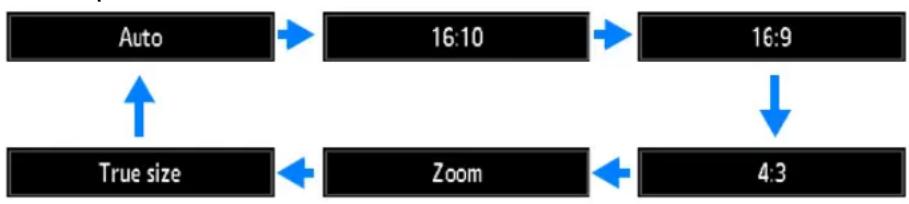
flowchart
graph TD
    A["Auto"] --> B["16:10"]
    B --> C["16:9"]
    C --> D["4:3"]
    D --> E["Zoom"]
    E --> F["True size"]
    F --> A
You can also select any aspect ratio from [Aspect] in the menu. (P91)

Some aspect ratios may not appear depending on the type of input signal.
Step 5 Adjusting Keystone Distortion
To correct keystone distortion, press the D.SHIFT/KEYSTONE button.
Two types of correction are available: horizontal/vertical correction and corner correction.
Use horizontal/vertical keystone correction to adjust image width or height distortion separately, and use corner correction to adjust the position of each corner of the image.
For instructions on switching keystone correction, refer to "Keystone" (P106).

- The result of keystone adjustment is stored in memory. If you place the projector in the same position, the keystone adjustment is not necessary.
- If keystone distortion is excessive and cannot be fully corrected, straighten the projector so that it faces the screen directly.
- Signals are processed digitally when keystone distortion is corrected. The image may look different from the original one. In addition, the aspect ratio of the image may change.
- The digital image shift function is accessed when this button is pressed and the screen aspect is [4:3 D. image shift] or [16:9 D. image shift]. (P107)
■Horizontal/Vertical Keystone Correction

[Zoom] (P106) in the [Install settings] menu is not available during horizontal/vertical keystone correction.
1 Press the D.SHIFT/KEYSTONE button on the remote control to display the horizontal-vertical keystone adjustment window when [Keystone] is set to [Horizontal-vertical keystone].
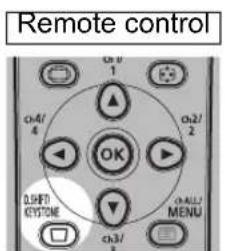
text_image
Remote control OK CA4/ 4 CA2/ 2 CA3/ 3 CA1/2 CYSTONE MENU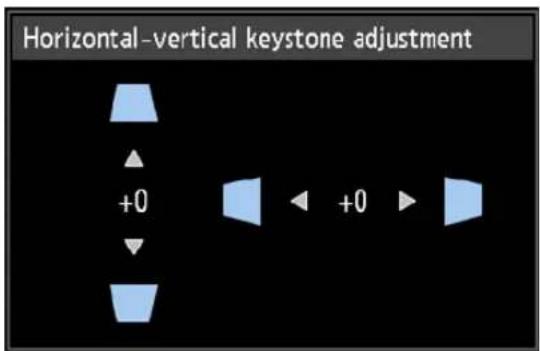
text_image
Horizontal–vertical keystone adjustment +0 +02Press the pointer buttons to adjust the dimensions.
text_image
Remote control OK SETT KEYSTONE MENU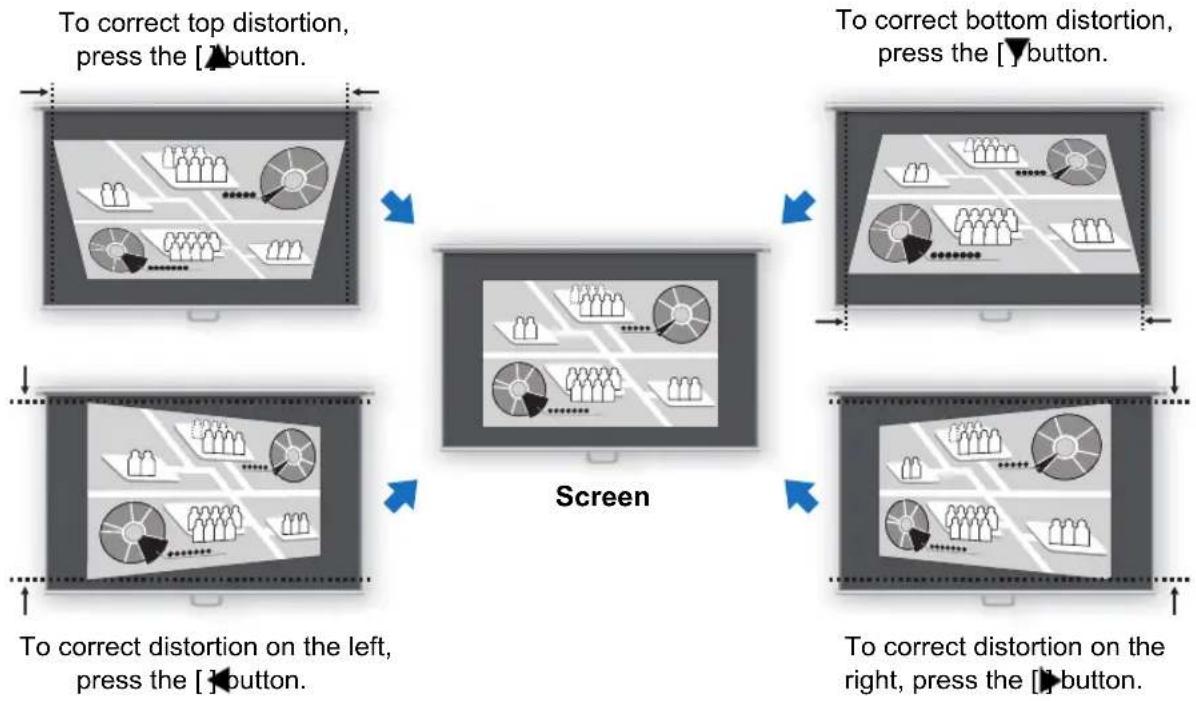
flowchart
graph TD
    A["To correct top distortion, press the [▲button."]] --> B["Screen"]
    C["To correct bottom distortion, press the [▼button."]] --> B
    D["To correct distortion on the left, press the [▼button."]] --> B
    E["To correct distortion on the right, press the [▼button."]] --> B
3 When keystone distortion has been corrected, press the OK button.
■Corner Adjustment
1 Press the D.SHIFT/KEYSTONE button on the remote control to display the corner adjustment window when [Keystone] is set to [Corner adjustment].
![CANON REALiS WX6500 D - Press the D.SHIFT/KEYSTONE button on the remote control to display the corner adjustment window when [Keystone] is set to [Corner adjustment]. - 1](/content/2026/06/1190230/images/d775496af20d0c9c40855bd0f7804b2e6ad881efdfd7f62234e5337f0b625ce7.jpg)
text_image
Remote control OK ON/O ON/O ON/O ON/O ON/O ON/O ON/O ON/O ON/O ON/O ON/O ON/O ON/O ON/O ON/O ON/O ON/O ON/O ON/O ON/O ON/O ON/O ON/O ON/O ON/O ON/O ON/O ON/O ON/O ON/O ON/O ON/O ON/O ON/O![CANON REALiS WX6500 D - Press the D.SHIFT/KEYSTONE button on the remote control to display the corner adjustment window when [Keystone] is set to [Corner adjustment]. - 2](/content/2026/06/1190230/images/b72c47059c167574ffc40683ca869364f2a4104ef34936a5397eb60a1fd05099.jpg)
text_image
Corner adjustment Choose corner to adjust.2Press the pointer button of the corner for correction, and then press the OK button.
![CANON REALiS WX6500 D - Press the D.SHIFT/KEYSTONE button on the remote control to display the corner adjustment window when [Keystone] is set to [Corner adjustment]. - 3](/content/2026/06/1190230/images/d2d002d7e66ac6bfc7a5c631a73c25039c6eb782ed06d8fe33849d845491b028.jpg)
text_image
Remote control OK LIGHT KITCHEN ON/O ON/O ON/O ON/O ON/O ON/O ON/O ON/O ON/O ON/O ON/O ON/O ON/O ON/O ON/O ON/O ON/O ON/O ON/O ON/O ON/O ON/O ON/O ON/O ON/O ON/O ON/O ON/O ON/O ON/O ON/O ON/O ON/O ON/O![CANON REALiS WX6500 D - Press the D.SHIFT/KEYSTONE button on the remote control to display the corner adjustment window when [Keystone] is set to [Corner adjustment]. - 4](/content/2026/06/1190230/images/fc24025a8b387dd3a7fc075e12d07f4facff5f6ed118e80c08354e5567e4d5ff.jpg)
text_image
Corner adjustment Choose corner to adjust.3Press the pointer buttons to adjust the corner.
![CANON REALiS WX6500 D - Press the D.SHIFT/KEYSTONE button on the remote control to display the corner adjustment window when [Keystone] is set to [Corner adjustment]. - 5](/content/2026/06/1190230/images/42b327e2cc1047d003d279e5787f5c216f9c27f87b0bac5325457dc189444327.jpg)
text_image
Remote control OK Left CSTONE Left 2 3 4 5 6 7 8 9 10 11 12 13 14 15 16 17 18 19 20 21 22 23 24 25 26 27 28 29 30 31 32 33 34 35 36 37 38 39 40 41 42 43 44 45 46 47 48 49 50 51 52 53 54 55 56 57 58 59 60 61 62 63 64 65 66 67 68 69 70 71 72 73 74 75 76 77 78 79 80![CANON REALiS WX6500 D - Press the D.SHIFT/KEYSTONE button on the remote control to display the corner adjustment window when [Keystone] is set to [Corner adjustment]. - 6](/content/2026/06/1190230/images/eac391186b44403bc1dc06c576decba25d82a6e4801aa18223dbb7fcf15c23a3.jpg)
text_image
Corner adjustment Use arrow keys to adjust.4When you have finished correcting, press the OK button.
![CANON REALiS WX6500 D - Press the D.SHIFT/KEYSTONE button on the remote control to display the corner adjustment window when [Keystone] is set to [Corner adjustment]. - 7](/content/2026/06/1190230/images/63b9da80211459d897441bcc18d26a1e85e531a7872713710467de85673bce54.jpg)
Corner adjustment settings will be cleared if you subsequently use [Zoom] (P106) in the [Install settings] menu.
■Resetting the Keystone Adjustment
Horizontal-vertical keystone and corner adjustment can be reset as follows.
1 First, press the D.SHIFT/KEYSTONE button on the remote control twice to display the [Keystone reset] window.
2Next, select [OK] with the [] button, and then press the OK button.
Your specified keystone adjustment is now reset.

text_image
Horizontal-vertical keystone reset Horizontal-vertical keystone adjustment will be reset. OK? OK CancelStep 6 Select the Image Quality (Image Mode)
You can select an image mode to suit the projected image.
In each image mode, you can further adjust the brightness, contrast, sharpness, gamma, color adjustment, advanced adjustment, and lamp mode. (P97)
Image Modes
Available image modes vary depending on the selected input signal and whether [HDMI image input] (P121) and [HDBaseT image input] (P121) is set to [Auto] or [Computer].
○: Compatible ÷ Not compatible
| Image mode | Compatible input signals | Functions(1) Ambient Brightness(2) Types of Images(3) Image Mode Characteristics | |
| Digital PCAnalog PC-1/2HDMI*1HDBaseT*2LANUSB | ComponentHD M I*HDBaseT*4 | ||
| Standard | ○ | ○ | (1) Bright(2) Computer screens, or media played with video software(3) Whites and natural colors |
| Presentation | ○ | — | (1) Bright(2) Images mainly consisting of text(3) Keeps the screen bright |
| Dynamic | — | ○ | (1) Bright(2) Media played with video software(3) Keeps the screen bright |
| VividPhoto | ○ | — | (1) Somewhat dark(2) Digital photos(3) Produces vibrant colors |
| Video | — | ○ | (1) Somewhat dark(2) Video from camcorders(3) Close to the color space of TVs |
| Photo/sRGB | ○ | ○ | (1) Somewhat dark(2) Digital photos from sRGB-compatible cameras(3) Conforms to the sRGB standard |
| Cinema | — | ○ | (1) Dark(2) Movies(3) Designed especially for movies |
| User 1 – 5 | ○ | ○ | Up to 5 user-selected combinations of image quality settings can be stored in the memory (P97). Stored settings can be selected as an image mode. |
*1 [HDMI image input] set to [Computer] *3 [HDMI image input] set to [Auto]
*2 [HDBaseT image input] set to [Computer] *4 [HDBaseT image input] set to [Auto]
■Selecting an Image Mode
Press the IMAGE button on the remote control to select.
The image mode changes each time the IMAGE button is pressed. (The displayed image modes vary depending on the selected input signal.)

flowchart
graph TD
    A["Standard"] --> B["Presentation"]
    B --> C["VividPhoto"]
    D["User 1"] <--> E["Photo/sRGB"]
    E --> C
    C --> A
You can also select any image mode from the [Image mode] menu. (P97)
- User settings 1 - 5 are displayed when the desired image settings have been created and stored using the user memory function in the image adjustment menu. (P97)
Step 7 Turn the Projector Off
1 Press the POWER button to display the window shown below.
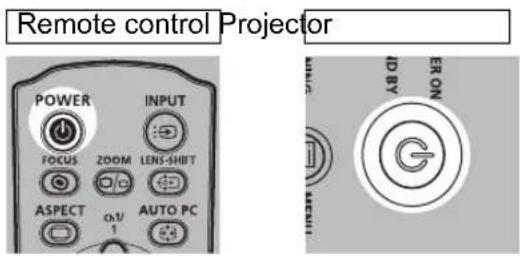
text_image
Remote control Projector POWER INPUT FOCUS ZOOM LENS-SHIFT ASPECT CAV AUTO PC ER ON ID BY MEMS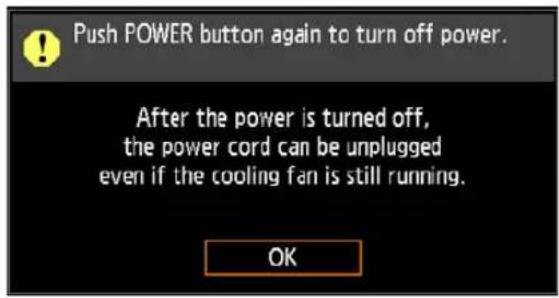
text_image
Push POWER button again to turn off power. After the power is turned off, the power cord can be unplugged even if the cooling fan is still running. OK2When this window is displayed, press the POWER button again to turn off the power.
After you turn the power off, the projector will enter standby mode once it cools down.

- If you want to continue projecting without turning off the power, press a button other than POWER, or else wait until the confirmation message disappears.
• After turning off the projector, wait at least 5 minutes before turning it on again. It may shorten the lamp life if you turn on the projector immediately after turning it off. - Using the projector for extended periods may shorten the life of the lamp and internal optical components.
- Unplug the projector if it will not be used for an extended period.
Convenient Features
This section describes features convenient during presentations and in other situations.
Temporarily Blacking Out an Image
Projection can be temporarily blanked after a presentation, or to divert the audience's attention away from the screen.
text_image
Remote control D:ZOOM P-TIMER VOL FREEZE BLANK MUTE IMAGE GAMA LAMPPress the BLANK button to black out the image. Press the BLANK button again to show the image.
- You can set the screen state while blacking out the image in the menu. (P117)
- The lamp remains illuminated while the image is blacked out.
Freezing the Picture
Projection can be temporarily frozen during computer operations that would be distracting, or to pause playback of video or animation.
text_image
Remote control DZOOM P-TIMER VOL FREEZE BLANK MUTE IMAGE GAMMA LAMPPress the FREEZE button to freeze the moving image. The projector shows the following icon.
Press the FREEZE button again to return to the original display.
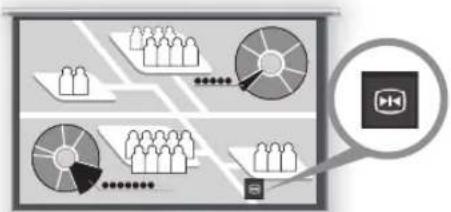
flowchart
graph TD
    A["User Group"] --> B["Video Activity"]
    B --> C["User Group"]
    C --> D["Video Action"]
    D --> E["Play Icon"]
    style A fill:#f9f,stroke:#333
    style B fill:#ccf,stroke:#333
    style C fill:#cfc,stroke:#333
    style D fill:#fcc,stroke:#333
    style E fill:#ffc,stroke:#333
Screen
- It is also cancelled when the input signal is terminated.
Projecting Images Stored on a USB Flash Drive

natural_image
Illustration of a C200 projector with a close-up view of its front screen showing a river and cityscape (no text or symbols on the device itself)Even without using a computer, you can project images stored on a USB flash drive simply by connecting it to the USB port.
For instructions on projection from a USB flash drive in the projector's USB port, see "Projecting Images on a USB Flash Drive" (P157).
Projecting a Test Pattern from the Menu
Even without any input signals, the projector can project a test pattern. Test patterns can be projected during installation to check how the projector is installed. For details on projecting test patterns, see “Install settings” (P104) or “Displayed Test Patterns” (P187).
Set Power-Saving Settings
Set power-saving settings as needed.
The following four settings are available. For details, refer to the page describing each function.
- Lamp mode (P102)
Adjust lamp and fan power consumption in the image mode.
• Power management mode (P121)
Automatically turns off the lamp or the power after a certain period if the projector is idle without an input signal.
• Power management duration (P122)
Specify the period after which the lamp or the projector should go off automatically if left idle without an input signal when [Power management mode] is set to [Lamp off] or [Standby].
• Network standby settings (P131)
Conserve energy in standby mode, as needed.
Adjusting the Volume
Useful when:
- You want to adjust the volume level of the projector or external speakers.
Remote control
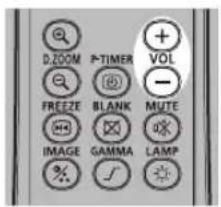
text_image
D:ZOOM P-TIMER + VOL - FREEZE BLANK MUTE IMAGE GAMMA LAMPPress the VOL button. The following screen appears.
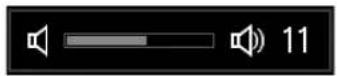
- You can also adjust the volume level with the [ ] buttons of the projector.
- Adjust the volume or mute setting on the computer if the volume level is too low.
- You can also adjust the volume level of the speakers connected via the audio output terminal.
Muting the Sound
Useful when:
- You want to temporarily mute unnecessary sound.
- You want to immediately mute the sound.
Remote control
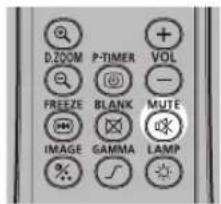
text_image
D-ZOOM P-TIMER VOL FREEZE BLANK MUTE IMAGE GAMMA LAMPPress the MUTE button to mute the sound. The projector shows the following icon.

flowchart
graph TD
    A["User Group"] --> B{Decision Point}
    B -->|Yes| C["Process Step 1"]
    B -->|No| D["Process Step 2"]
    C --> E["User Group 1"]
    D --> F["User Group 3"]
    E --> G["User Group 4"]
    F --> H["User Group 5"]
Screen
Press the MUTE button again to cancel the mute function.
- You can also mute the sound of the speakers connected via the audio output terminal.
Zooming Part of an Image
Useful when:
- Zooming in on an object such as a small graph during a presentation (up to 12x).
- Focusing on the current subject.
Remote control

text_image
D:ZOOM P:TIMER VOL FREEZE BLANK MUTE IMAGE GAMMA LAMPPress the +D.ZOOM button to enlarge a part of the image. Press the -D.ZOOM button to reduce the image size.
• The magnification appears on the screen.
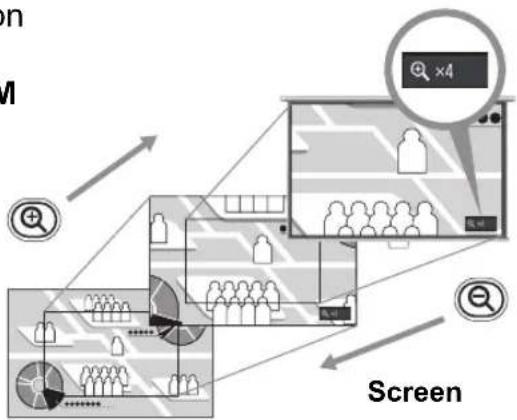
flowchart
graph TD
    A["Search"] --> B["Map with User Group"]
    B --> C["User Interface with Search Icon"]
    C --> D["Screen"]
    style A fill:#f9f,stroke:#333
    style B fill:#ccf,stroke:#333
    style C fill:#cfc,stroke:#333
    style D fill:#fcc,stroke:#333
You can move the enlarged area by using the [▲/ [ ]▼[ ] /◀] buttons.
Remote control
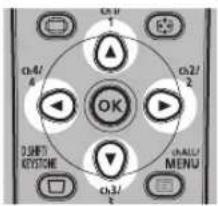
text_image
OK OK CHANNEL MENU Ch3/ Ch2/2 Ch4/6 Ch5/1Projector
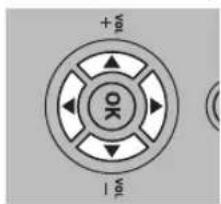
text_image
+40 OK +40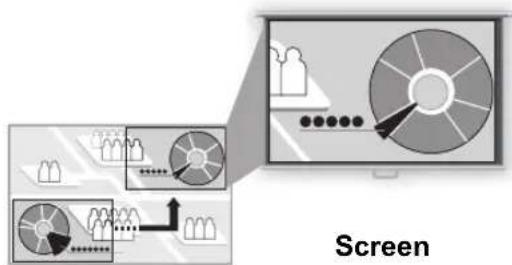
flowchart
graph TD
    A["User Interaction"] --> B["Data Processing"]
    B --> C["Output"]
    C --> D["Screen"]
You can restore the original size of the image by pressing the OK button.

The D.ZOOM buttons work differently than [Zoom] in the [Install settings] menu (P106).
Advanced Guide
Safety Instructions
Before Use
Basic Guide
Installation Procedure
Connection Procedure
Projection Procedure
Convenient Features
Advanced Guide
Using Menus
Menu Configuration
Menu Description
Advanced Projection
Other Information
Maintenance
Product Specifications
Troubleshooting
Use the menus to set the operation of the projector in detail.
Menu Configuration
The menu screen is divided into 6 tabs as shown below.

[Input settings] tab (P90)
You can set the type of signal or the method of projection of the images input.
![CANON REALiS WX6500 D - [Input settings] tab (P90) - 1](/content/2026/06/1190230/images/33481d31c949a08998d83654c44b4df8c50ad4a5d0506310a2b1ac2a44784a31.jpg)
[Image adjustment] tab (P96)
You can adjust the image quality and colors according to your preference.
![CANON REALiS WX6500 D - [Image adjustment] tab (P96) - 1](/content/2026/06/1190230/images/141796cdfa1f39e42fb0bc4968bc9c0e5ed2cd35864f89335423873819571b37.jpg)
[Install settings] tab (P104)
This setting is used when installing the projector.
![CANON REALiS WX6500 D - [Install settings] tab (P104) - 1](/content/2026/06/1190230/images/a1f28a003b94fc5e6499f286082f39a6c472972f692c601c61dd6c354dabe2a4.jpg)
[System settings] tab (P116)
You can set the operation of the projector.
![CANON REALiS WX6500 D - [System settings] tab (P116) - 1](/content/2026/06/1190230/images/e43671252f9b2df51fffc453f7351441f708b7c7de262462f833d1014cb461b6.jpg)
[Network settings] tab (P129)
These settings are for when using the projector from a PC via a network.
![CANON REALiS WX6500 D - [Network settings] tab (P129) - 1](/content/2026/06/1190230/images/2da5e6ca9d3bfbbd780766af751e8936cbc22471dc00644726b1e510518a60c1.jpg)
[Information] tab (P156)
You can check information about the signal types of the images projected and other information.
![CANON REALiS WX6500 D - [Information] tab (P156) - 1](/content/2026/06/1190230/images/248441079125e4a787071db7eb447f3f43cf4b5229ad462310f2f07e1bfeb2fb.jpg)
Analog PC-1


Input settings
Aspect
Auto PC
Input signal select
Input signal settings
Split screen
Auto
1920 × 1200 60.000Hz
Off
Contents of menu
Menu items
Basic Menu Operations
1 Press the MENU button to display the menu window.
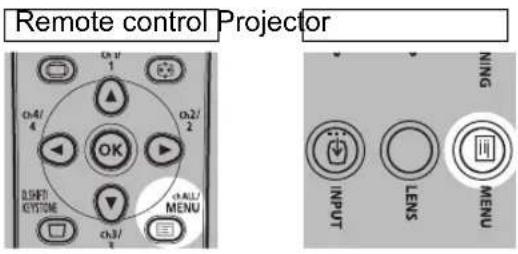
text_image
Remote control Projector OK 4 2 ON/OFF SYSTEM 3/1 3/2 3/3/ MENU NING INPUT LENS MENU
text_image
Analog PC-1 Aspect Auto Auto PC Input signal select 1920 x 1200 60.000Hz Input signal settings Split screen Off2Press the [ ] ◀[ ] buttons to select a tab.
![CANON REALiS WX6500 D - 2Press the [ ] ◀[ ] buttons to select a tab. - 1](/content/2026/06/1190230/images/5f2c700ece609f1e48bb6acc5a342d0de954493f21b81c9e7f6b668d1aa0f34d.jpg)
text_image
Remote control Projector ON 1 ON 2 ON 3 ON 4 ON 5 ON 6 ON 7 ON 8 ON 9 ON 10 ON 11 ON 12 ON 13 ON 14 ON 15 ON 16 ON 17 ON 18 ON 19 ON 20 ON 21 ON 22 ON 23 ON 24 ON 25 ON 26 ON 27 ON 28 ON 29 ON 30 ON 31 ON 32 ON 33 ON 34 ON 35 ON 36 ON 37 ON 38 ON 39 ON 40 ON 41 ON 42 ON 43 ON 44 ON 45 ON 46 ON 47 ON 48 ON 49 ON 50 +/-![CANON REALiS WX6500 D - 2Press the [ ] ◀[ ] buttons to select a tab. - 2](/content/2026/06/1190230/images/bae38c9aa1ad9ff5ab2d8752e6c0deb85f83494764d98e17d0f5147c24b54f5c.jpg)
text_image
Analog PC-1 Image adjustment Image mode Standard Create profile Brightness * +0 Contrast ● +0 Sharpness ● +2 Gamma # +0 Color adjustment Advanced adjustment Lamp mode Full power Reset- If the tab position is not highlighted in orange, press the [ ]N [ ] Buttons to move the current selection to the top.
3Press the [ ] ▲[ ] buttons to select an item.
![CANON REALiS WX6500 D - 3Press the [ ] ▲[ ] buttons to select an item. - 1](/content/2026/06/1190230/images/024ad4d07db7a242e4622215df7f87eef54ffd1a7177fdb74ac57eec15d04e6b.jpg)
text_image
Remote control Projector OK +5 OK 1 5![CANON REALiS WX6500 D - 3Press the [ ] ▲[ ] buttons to select an item. - 2](/content/2026/06/1190230/images/f3bd08d890de0a770a734151fb6683a86d96e158121f97832d2c20ea7f56eb35.jpg)
text_image
Analog PC-1 Image mode Create profile Brightness Contrast Sharpness Gamma Color adjustment Advanced adjustment Lamp mode Reset Standard +0 +2 +0 Full power Image adjustment4Select contents.
How to select the contents varies depending on the item.
Selecting from a list Example: Aspect (P91)

text_image
Analog PC-1 Input settings Aspect Auto PC 16:10 Input signal select 16:9 Input signal settings 4:3 Split screen True size- Select [Aspect].
- Press the OK button or [ ] button to display a list of the contents.
- Use the [ ] [ ] Buttons to select the desired contents.
- When you have found the contents you desired, press the OK button or [▶].
Adjusting with the [ ]/ [ ]buttons
![CANON REALiS WX6500 D - Adjusting with the [ ]/ [ ]buttons - 1](/content/2026/06/1190230/images/b5737483767a5600b555117289f3c85794b3801f0844e2e79f6a455c26d1e34a.jpg)
text_image
Analog PC-1 Image adjustment Image mode Standard Create profile Brightness * +0 Contrast ● +0 Sharpness ● +2 Gamma ✓ +0 Color adjustment Advanced adjustment Lamp mode Full power ResetExample: Contrast (P98)
- Select [Contrast].
- Use the [ ]◀ [ ] ▶buttons to adjust the setting.
Selecting from a different screen (1)
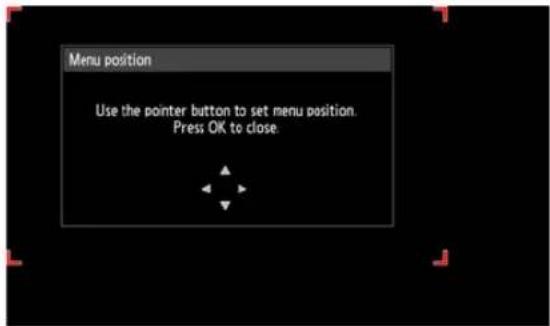
text_image
Menu position Use the pointer button to set menu position. Press OK to close.Example: Menu position (P113)
- Select [Menu position].
- Press the OK button to display a different screen.
- Then follow the instruction on the screen.
Selecting from a different screen (2)
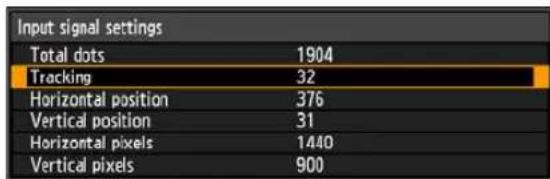
text_image
Input signal settings Total dots 1904 Tracking 32 Horizontal position 376 Vertical position 31 Horizontal pixels 1440 Vertical pixels 900Example: Tracking (P92)
- Select [Input signal settings].
- Press the OK button to display a different screen.
- Select [Tracking].
- Use the [ ]▼ [ ] buttons to select the setting, then use the [ ]▼ [ ]▶ buttons to select the value.
5Pressing the MENU button causes the menu screen to disappear.
Input settings (P90)
| Aspect | Digital PC / Analog PC-1/2 / HDMI (when [HDMI In] is [Computer]) / HDBaseT (when [HDBaseT In] is [Computer]) | P91 |
| Auto* | ||
| 16:10 | ||
| 16:9 | ||
| 4:3 | ||
| True size | ||
| HDMI (when [HDMI In] is [Auto]) / Component / HDBaseT (when [HDBaseT In] is [Auto]) | ||
| Auto* | ||
| 16:9 | ||
| 4:3 | ||
| Zoom | ||
| True size | ||
| USB / LAN | ||
| Auto | ||
| Auto PC | Analog PC-1 / 2 | P91 |
| Input signal select | Analog PC-1 / 2 | P91 |
| 640 x 480 | ||
| : | ||
| 1920 x 1200 | ||
| Input signal settings | Analog PC-1 / 2 | P92 |
| Total dots | ||
| Tracking | ||
| Horizontal position | ||
| Vertical position | ||
| Horizontal pixels | ||
| Vertical pixels | ||
| Input level | HDMI / HDBaseT | P93 |
| Auto* | ||
| Normal | ||
| Expanded | ||
| Color space | HDMI / HDBaseT | P94 |
| Auto* | ||
| RGB | ||
| YCbCr | ||
| Over scan*1 | HDMI / HDBaseT | P94 |
| Off | ||
| On | ||
| Progressive | Component / HDMI / HDBaseT | P95 |
| Off | ||
| Film/auto* | ||
| Video 1 | ||
| Video 2 | ||
| 25p/30p(PsF) |
* Factory default, or state after [Factory defaults] is executed.
*1 Factory default settings are based on these conditions: [On] when HDMI ([HDMI In]) is [Auto], and [Off] when it is [Computer].
Menu Configuration
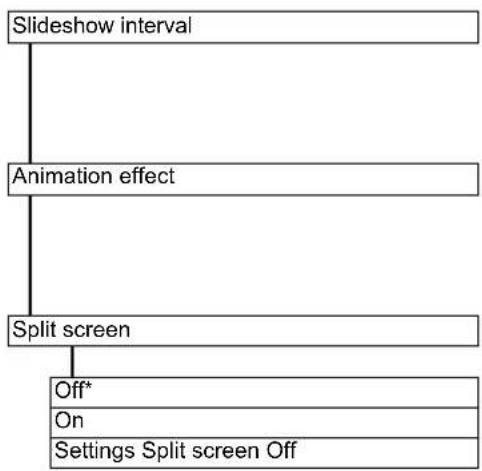
flowchart
graph TD
    A["Slideshow interval"] --> B["Animation effect"]
    B --> C["Split screen"]
    C --> D["Off*"]
    C --> E["On"]
    C --> F["Settings Split screen Off"]
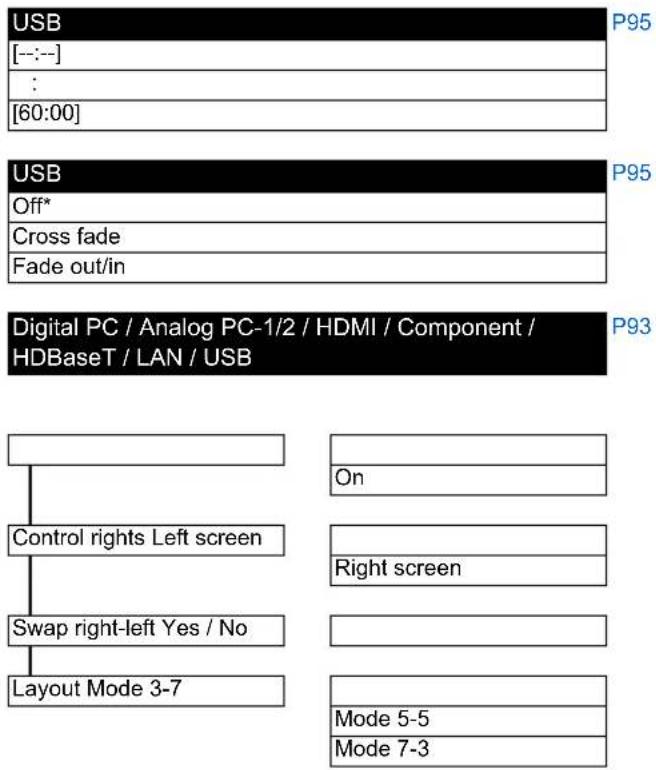
flowchart
graph TD
    A["Control rights Left screen"] --> B["Swap right-left Yes / No"]
    B --> C["Layout Mode 3-7"]
    D["On"] --> E["Right screen"]
    F["P95"] --> G["Off*"]
    H["P95"] --> I["Cross fade"]
    J["P95"] --> K["Fade out/in"]
    L["P93"] --> M["Mode 5-5"]
    L --> N["Mode 7-3"]
Image adjustment (P96)
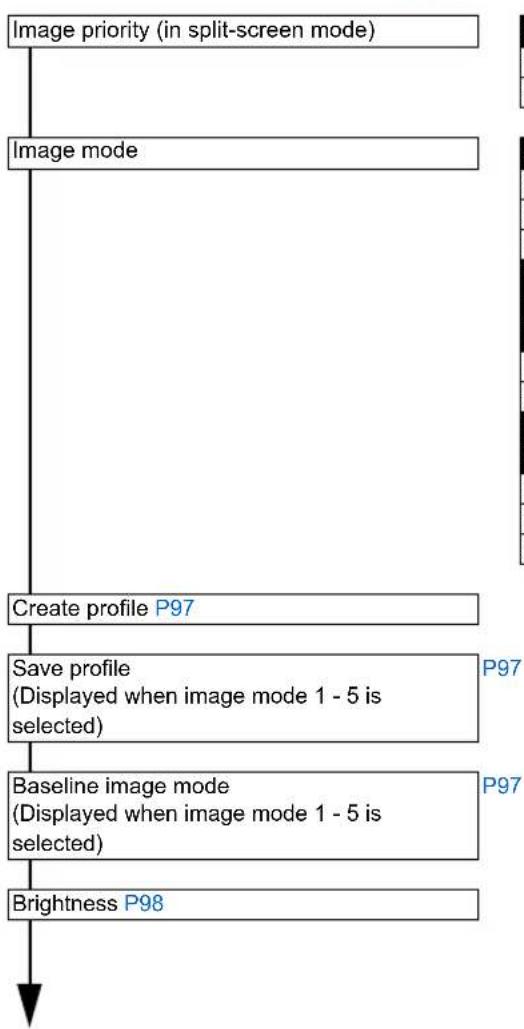
flowchart
graph TD
    A["Image priority (in split-screen mode)"] --> B["Image mode"]
    B --> C["Create profile P97"]
    C --> D["Save profile (Displayed when image mode 1 - 5 is selected)"]
    D --> E["Baseline image mode (Displayed when image mode 1 - 5 is selected)"]
    E --> F["Brightness P98"]
| COMMON | P96 |
| Primary* | |
| Secondary | |
| COMMON | P97 |
| Standard* | |
| Photo/sRGB | |
| User 1 - 5 (when creating profile) | |
| Digital PC / Analog PC-1/2 / HDMI (when [HDMI In] is [Computer]) / HDBaseT (when [HDBaseT In] is [Computer]) / LAN / USB | |
| VividPhoto | |
| Presentation* | |
| Component / HDMI (when [HDMI In] is [Auto]) / HDBaseT (when [HDBaseT In] is [Auto]) | |
| Dynamic | |
| Video | |
| Cinema |
* Factory default, or state after [Factory defaults] is executed.

flowchart
graph TD
    A["Contrast P98"] --> B["Sharpness P98"]
    B --> C["Gamma P98"]
    C --> D["Color adjustment Color level P98"]
    D --> E["Advanced adjustment P99"]
    E --> F["Ambient light Off* P99"]
    F --> G["Random noise reduction Off* P99"]
    G --> H["MPEG noise reduction Off* P100"]
    H --> I["Mosquito noise reduction Off* P100"]
    I --> J["Dynamic gamma*2"]
    J --> K["Mem. color correct*3"]

    L["Color balance"] --> M["Color temperature"]
    M --> N["R Gain"]
    M --> O["G Gain"]
    M --> P["B Gain"]
    M --> Q["R Offset"]
    M --> R["G Offset"]
    M --> S["B Offset"]

    T["Adjust"] --> U["Type Tungsten"]
    U --> V["Fluorescent*"]
    U --> W["Level L"]
    W --> X["H*"]

    Y["Weak"] --> Z["Middle"]
    Z --> AA["Strong"]

    AB["Weak"] --> AC["Middle"]
    AC --> AD["Strong"]

    AE["Weak"] --> AF["Middle"]
    AF --> AG["Strong"]

    AH["Off"] --> AI["P100"]
    AJ["Off"] --> AK["P100"]
    AL["Flesh"] --> AM["Off"]
    AN["Sky"] --> AO["Weak"]
    AP["Green"] --> AQ["Middle"]
    AR["Off"] --> AS["P100"]
* Factory default, or state after [Factory defaults] is executed.
Under the following setting, differs from factory defaults.
*2 • For Analog PC-1/2, Digital PC or HDMI (when [HDMI In] is [Computer]), the factory default is [Off].
- [Weak] by default for Component or HDMI (when [HDMI In] is [Auto]).
*3 • [Off] by default for HDMI (when [HDMI In] is [Computer]), or for Digital PC, Analog PC (1 or 2), USB, or LAN.
• HDMI (when [HDMI In] is [Auto]) or COMPONENT: Weak
Menu Configuration
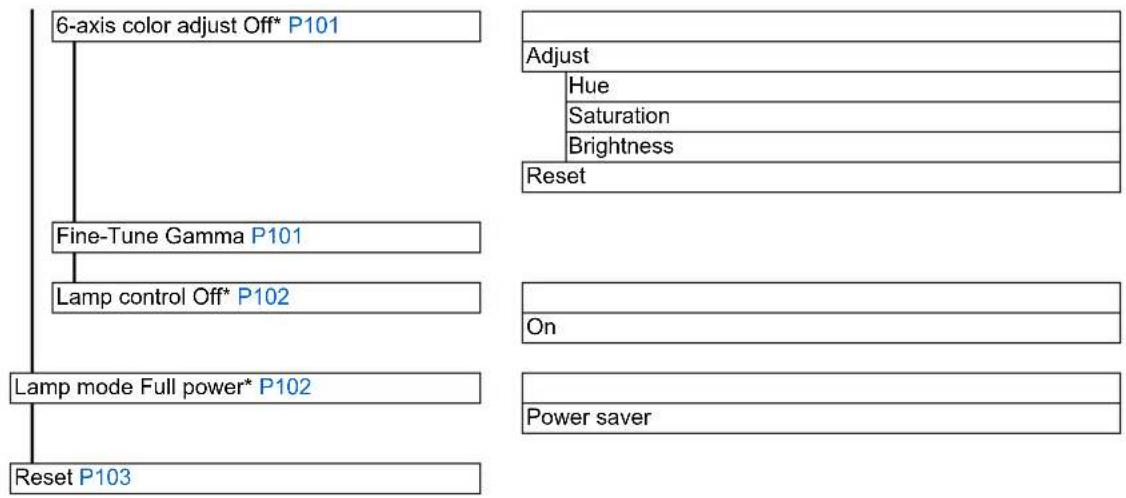
flowchart
graph TD
    A["6-axis color adjust Off* P101"] --> B["Fine-Tune Gamma P101"]
    B --> C["Lamp control Off* P102"]
    C --> D["Lamp mode Full power* P102"]
    D --> E["Reset P103"]
    F["Adjust"] --> G["Hue"]
    F --> H["Saturation"]
    F --> I["Brightness"]
    F --> J["Reset"]
    K["On"] --> L["Power saver"]
Install settings (P104)

flowchart
graph TD
    A["Positional lock Off* P105"] --> B["Image flip H/V None* P105"]
    B --> C["Screen aspect 16:10* P105"]
    C --> D["Zoom P106"]
    D --> E["Keystone Horizontal-vertical keystone* P106"]
    E --> F["Digital image shift"]
    F --> G["Professional settings"]
    G --> H["Micro-digital image shift"]
    H --> I["Registration"]
    I --> J["Fan mode Normal*"]
    J --> K["Vertical projection"]

    A --> L["On"]
    B --> M["Ceiling mounted"]
    B --> N["Rear"]
    B --> O["Rear, Ceiling mounted"]
    C --> P["16:9"]
    C --> Q["4:3"]
    C --> R["16:9 D. image shift"]
    C --> S["4:3 D. image shift"]

    E --> T["Corner adjustment"]
    E --> U["Reset"]

    F --> V["P107"]
    G --> W["P108"]
    H --> X["Off* P107"]
    H --> Y["Adjust"]

    I --> Z["Off*"]
    I --> AA["Adjust"]

    J --> AB["P107"]
    J --> AC["P108"]

    K --> AD["High altitude"]
    K --> AE["P108"]

    L --> AF["Upward"]
    L --> AG["Downward"]
* Factory default, or state after [Factory defaults] is executed.

flowchart
graph TD
    A["Edge blending Off* P109"] --> B["Adjust"]
    B --> C["Side"]
    B --> D["Color blending adjustment"]
    B --> E["Black level adjustment"]
    B --> F["Marker"]
    B --> G["Reset"]
    H["Lens - Position Load position 1-3 P112"] --> I["Save position 1-3"]
    H --> J["Lens shift reset"]
    K["Screen color Normal* P113"] --> L["Greenboard"]
    K --> M["Adjust"]
    K --> N["Red / Green / Blue"]
    O["On screen P113"] --> P["Menu position Upper L P113"]
    P --> Q["Upper R"]
    P --> R["Center*"]
    P --> S["Lower L"]
    P --> T["Lower R"]
    U["Guide Off P113"] --> V["On*"]
    W["Show input status Off P114"] --> X["On*"]
    Y["Overheat warning display Off* P114"] --> Z["On"]
    AA["Menu display time"] --> AB["Normal* P114"]
    AA --> AC["Extended"]
    AD["Lamp warning display"] --> AE["Off P115"]
    AD --> AF["On*"]
    AG["Air filter warning display"] --> AH["Off"]
    AG --> AI["On*"]
    AJ["Split screen ID display"] --> AK["Off"]
    AJ --> AL["On*"]
    AM["Test pattern"] --> AN["Off*"]
    AM --> AO["On"]
System settings (P116)
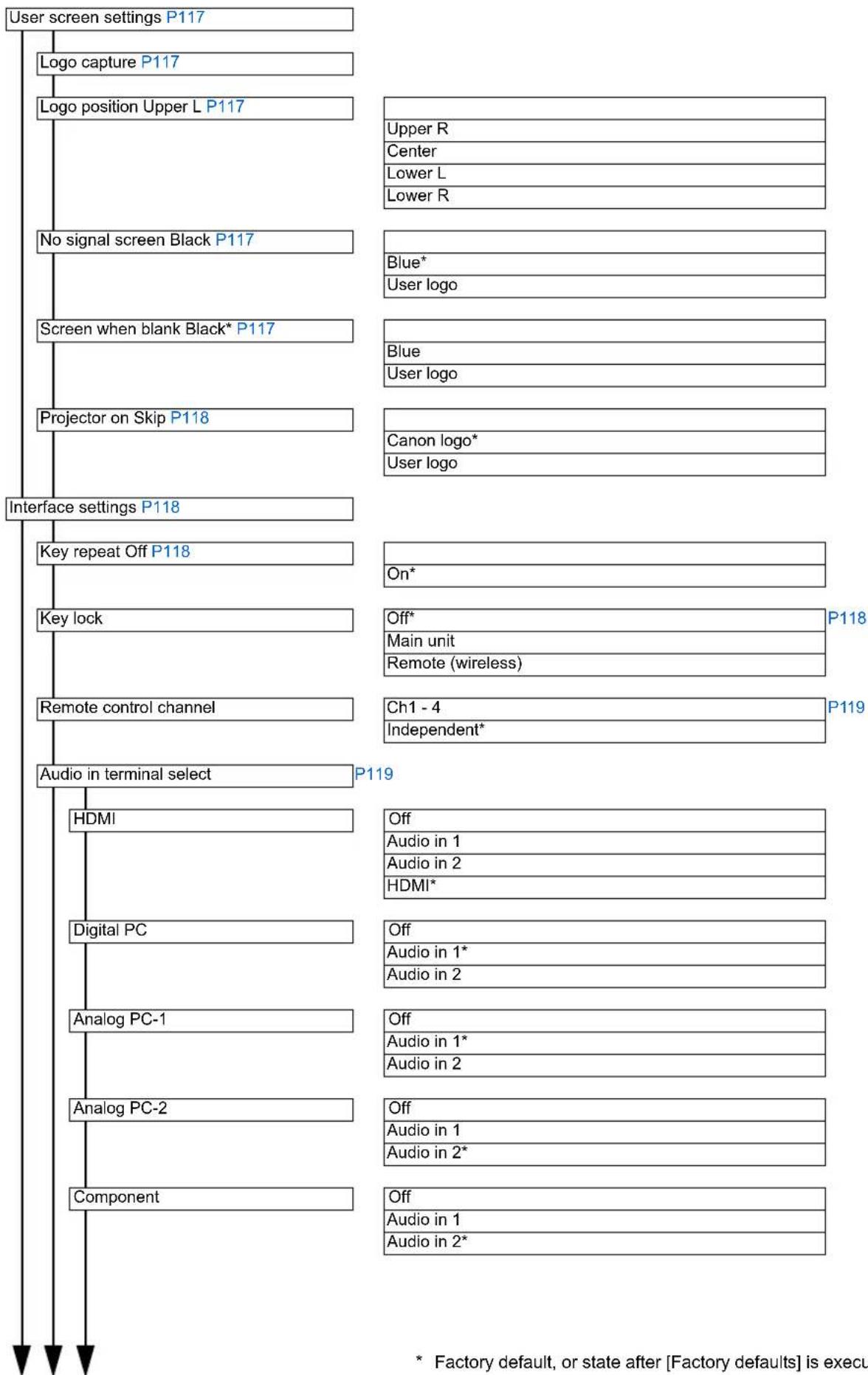
flowchart
graph TD
    A["User screen settings P117"] --> B["Logo capture P117"]
    B --> C["Logo position Upper L P117"]
    C --> D["No signal screen Black P117"]
    D --> E["Screen when blank Black* P117"]
    E --> F["Projector on Skip P118"]
    F --> G["Interface settings P118"]
    G --> H["Key repeat Off P118"]
    H --> I["Key lock"]
    I --> J["Remote control channel"]
    J --> K["Audio in terminal select"]
    K --> L["HDMI"]
    L --> M["Digital PC"]
    M --> N["Analog PC-1"]
    N --> O["Analog PC-2"]
    O --> P["Component"]
    P --> Q["* Factory default, or state after [Factory defaults"] is execu]

    C --> R["Upper R"]
    C --> S["Center"]
    C --> T["Lower L"]
    C --> U["Lower R"]

    D --> V["Blue*"]
    D --> W["User logo"]

    E --> X["Blue"]
    E --> Y["User logo"]

    F --> Z["Canon logo*"]
    F --> AA["User logo"]

    G --> AB["On*"]

    H --> AC["Off*"]
    H --> AD["Main unit"]
    H --> AE["Remote (wireless)"]

    J --> AF["Ch1 - 4"]
    J --> AG["Independent*"]

    K --> AH["P119"]

    L --> AI["Off"]
    L --> AJ["Audio in 1"]
    L --> AK["Audio in 2"]
    L --> AL["HDMI*"]

    M --> AM["Off"]
    M --> AN["Audio in 1*"]
    M --> AO["Audio in 2"]

    N --> AP["Off"]
    N --> AQ["Audio in 1*"]
    N --> AR["Audio in 2"]

    O --> AS["Off"]
    O --> AT["Audio in 1"]
    O --> AU["Audio in 2*"]

    P --> AV["Off"]
    P --> AW["Audio in 1"]
    P --> AX["Audio in 2*"]
* Factory default, or state after [Factory defaults] is executed.

flowchart
graph TD
    A["HDBaseT Off"] --> B["LAN Off"]
    B --> C["USB Off"]
    C --> D["HDBaseT Off* P120"]
    D --> E["Communication settings Serial communication P120"]
    E --> F["Service port*"]
    E --> G["HDBaseT"]
    E --> H["Detail"]
    H --> I["Baud rate"]
    H --> J["Data bits"]
    H --> K["Parity"]
    H --> L["Stop bit"]
    H --> M["1*"]
    H --> N["2"]
    E --> O["Wired network"]
    O --> P["LAN port*"]
    O --> Q["HDBaseT"]
    E --> R["HDMI image input Auto"]
    E --> S["HDBaseT image input Auto"]
    R --> T["Computer*"]
    S --> U["Computer*"]
    T --> V["Power management mode Disabled P121"]
    U --> V
    V --> W["Lamp off"]
    V --> X["Standby*"]
    W --> Y["Power management duration 5 min."]
    Y --> Z["P122"]
    Z --> AA["10 min."]
    Z --> AB["15 min.*"]
    Z --> AC["20 min."]
    Z --> AD["30 min."]
    Z --> AE["60 min."]
    Y --> AF["Direct power on"]
    AF --> AG["Off* P122"]
    AG --> AH["On"]
    V --> AI["Beep"]
    AI --> AJ["Off"]
    AI --> AK["On*"]
    V --> AL["Motion blur reduction"]
    AL --> AM["Off* P123"]
    AM --> AN["On"]
Menu Configuration

flowchart
graph TD
    A["Language English Turkish P123"] --> B["Other settings P124"]
    B --> C["Password settings Off* P124"]
    C --> D["Register password Password input P125"]
    D --> E["[Fn"] button settings Disable*]
    E --> F["Gamma restore"]
    F --> G["Lamp counter"]
    G --> H["Air filter counter"]
    H --> I["Power counter"]
    I --> J["Firmware"]
    J --> K["Factory defaults"]

    A --> L["German Polish"]
    A --> M["French Hungarian"]
    A --> N["Italian Czech"]
    A --> O["Spanish Danish"]
    A --> P["Portuguese Arabic"]
    A --> Q["Swedish Chinese (Simplified)"]
    A --> R["Russian Chinese (Traditional)"]
    A --> S["Dutch Korean"]
    A --> T["Finnish Japanese"]
    A --> U["Norwegian"]

    L --> V["On"]
    M --> V
    N --> V
    O --> V
    P --> V
    Q --> W["P125 Split screen"]
    R --> W
    S --> X["Off* P125 Adjust"]
    T --> Y["Reset / Return"]
    U --> Z["Reset / Return"]
    V --> AA["P125 P126"]
    W --> AB["P126"]
    X --> AC["P126"]
    Y --> AD["P126"]
    Z --> AE["P126"]
    AA --> AF["Yes / No OK / Cancel"]
    AB --> AG["P126"]
    AC --> AH["P126"]
    AD --> AI["P126"]
Network settings (P127)
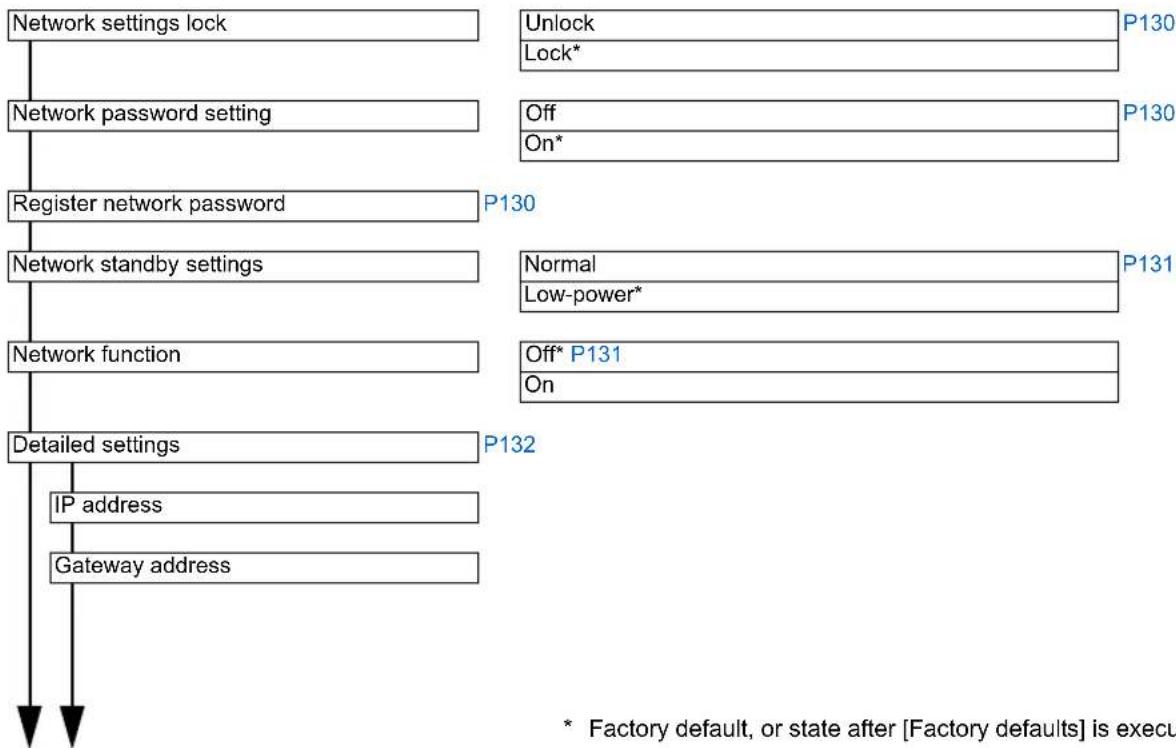
flowchart
graph TD
    A["Network settings lock"] --> B["Network password setting"]
    B --> C["Register network password"]
    C --> D["Network standby settings"]
    D --> E["Network function"]
    E --> F["Detailed settings"]
    F --> G["IP address"]
    F --> H["Gateway address"]
    I["Unlock"] --> J["P130"]
    K["Lock*"] --> L["P130"]
    M["Off"] --> N["P130"]
    O["On*"] --> P["P130"]
    Q["Normal"] --> R["P131"]
    S["Low-power*"] --> T["P131"]
    U["Off* P131"] --> V["On"]
    W["* Factory default, or state after [Factory defaults"] is execu] --> F
* Factory default, or state after [Factory defaults] is executed.

flowchart
graph TD
    A["MAC address"] --> B["DHCP Off*"]
    B --> C["TCP/IP settings IP address"]
    C --> D["Network setting initialization Yes / No"]
    D --> E["PJLink Off P134"]
    E --> F["AMX Device Discovery Off* P135"]
    F --> G["Crestron RoomView Off* P135"]
    G --> H["On"]
    H --> I["On"]
    I --> J["On"]
    J --> K["On"]
    K --> L["On"]
    L --> M["On"]
    M --> N["On"]
    N --> O["On"]
    O --> P["On"]
    P --> Q["On"]
    Q --> R["On"]
    R --> S["On"]
    S --> T["On"]
    T --> U["On"]
    U --> V["On"]
    V --> W["On"]
    W --> X["On"]
    X --> Y["On"]
    Y --> Z["On"]
    Z --> AA["On"]
    AA --> AB["On"]
    AB --> AC["On"]
    AC --> AD["On"]
    AD --> AE["On"]
    AE --> AF["On"]
    AF --> AG["On"]
    AG --> AH["On"]
    AH --> AI["On"]
    AI --> AJ["On"]
    AJ --> AK["On"]
    AK --> AL["On"]
    AL --> AM["On"]
    AM --> AN["On"]
    AN --> AO["On"]
    AO --> AP["On"]
    AP --> AQ["On"]
    AQ --> AR["On"]
    AR --> AS["On"]
    AS --> AT["On"]
    AT --> AU["On"]
    AU --> AV["On"]
    AV --> AW["On"]
    AW --> AX["On"]
    AX --> AY["On"]
    AY --> AZ["On"]
    AZ --> BA["On"]
    BA --> BB["On"]
    BB --> BC["On"]
    BC --> BD["On"]
    BD --> BE["On"]
    BE --> BF["On"]
    BF --> BG["On"]
    BG --> BH["On"]
    BH --> BI["On"]
    BI --> BJ["On"]
    BJ --> BK["On"]
    BK --> BL["On"]
    BL --> BM["On"]
    BM --> BN["On"]
    BN --> BO["On"]
    BO --> BP["On"]
    BP --> BQ["On"]
    BQ --> BR["On"]
    BR --> BS["On"]
    BS --> BT["On"]
    BT --> BU["On"]
    BU --> BV["On"]
    BV --> BW["On"]
    BW --> BX["On"]
    BX --> BY["On"]
    BY --> BZ["On"]
Information (P156)
| Model name |
| Input signal |
| Firmware |
| Serial no. |
| Projector usage time |
| IP address |
| E-mail sender address |
| E-mail recipient address |
| Projector name |
| Comments |
| System information ID |

The following settings are not reset even when factory defaults are restored.
- Selected input signal
- Lamp counter
- Language
- Remote control channel
- Network settings
- Air filter counter
- Micro-digital image shift
- Registration
- Fan mode
- Vertical projection
- HDBaseT
- Wired network
- Serial communication
- User profile
- Lens - Position
- Projector usage time
- Power counter
Menu Description
Input settings
This section describes settings for aspect ratio, resolution, and projection from a USB flash drive.
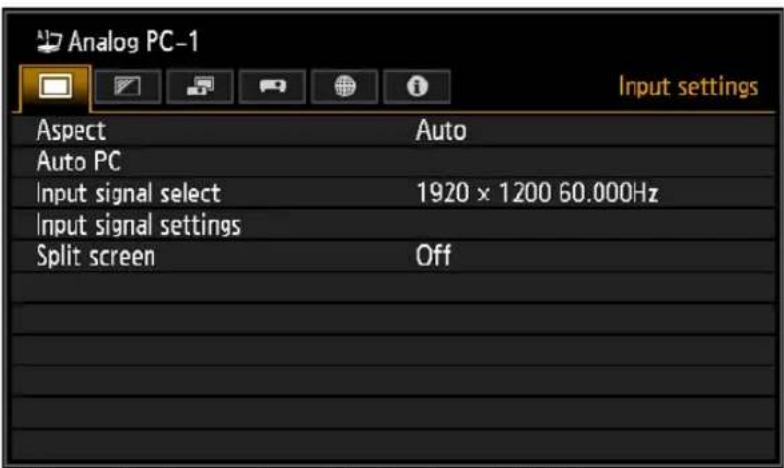
text_image
Analog PC-1 Input settings Aspect Auto Auto PC Input signal select 1920 x 1200 60.000Hz Input signal settings Split screen Off(When the input signal is Analog PC-1)
| Menu Function | Details | |
| Aspect Select an image aspect ratio. P91 | ||
| Auto PC | Automatically adjusts display position misalignment and screen flickering. | P91 |
| Input signal select Manually set a resolution to suit computer images. P91 | ||
| Input signal settings Complete input signal settings. P92 | ||
| Split screen Project two input images side by side. P93 | ||
| Input level Select the input level for HDMI or HDBaseT signals. P93 | ||
| Color space Select the color space for HDMI or HDBaseT signals. P94 | ||
| Over scan | Trim peripheral distortion from HDMI or HDBaseT images before projection. | P94 |
| Progressive | Select progressive processing for still images in cinematic content or moving images in videos. | P95 |
| Slideshow interval | Specify how long individual images on a USB flash drive are projected in slideshows. | P95 |
| Animation effect | Specify the transition between images on a USB flash drive in slideshows. | P95 |
Menus that are not available are grayed out or hidden.
Aspect

[Input settings] > [Aspect]
Select a projection aspect ratio for images.
| Option Function | |
| Auto | An image is projected at the aspect ratio of the input signal. Suitable for most projection. |
| 16:10 The image is projected using an input signal aspect ratio of 16:10. | |
| 16:9 The image is projected using an input signal aspect ratio of 16:9. | |
| 4:3 The image is projected using an input signal aspect ratio of 4:3. | |
| Zoom | This cuts the upper/lower or left/right part of the screen according to the screen aspect and zooms in or out of the center of the image. |
| True size | The image is projected with the original resolution of the input signal. |
Menus that are not available are grayed out or hidden.

- For LAN and USB input, [Auto] is selected automatically.
- Different contents are displayed for different screen aspects or input signal types.
- The ASPECT button on the remote control can also be used to select the [Aspect] settings.
Auto PC

[Input settings] > [Auto PC]
Automatically adjusts display position misalignment and screen flickering.

If the Auto PC adjustment is insufficient, perform the following operations.
- Select the input signal that matches the computer resolution from [Input signal select].
- If adjustment remains insufficient, adjust [Total dots], [Tracking], [Horizontal/Vertical position] and [Horizontal/Vertical pixels] in [Input signal settings]. (P92)
- For supported signals, see the table on page 188 – 189.
Input signal select

[Input settings] > [Input signal select]
Select a suitable resolution if Auto PC (P58) does not project computer images correctly.
Select the input signal that matches the computer resolution. Press the OK button to confirm the setting, and then press the MENU button.

For supported signals, see the table on page 188 - 189.
Input signal settings

[Input settings] > [Input signal settings]
Complete input signal settings. Use the [◀/ [ ]▶buttons to adjust the levels as needed.
| Input signal settings | |
| Total dots | 1904 |
| Tracking | 32 |
| Horizontal position | 376 |
| Vertical position | 31 |
| Horizontal pixels | 1440 |
| Vertical pixels | 900 |
| Return | |
| Submenu Function | |
| Total dots | Adjust the total number of horizontal dots. Adjust it when stripes are displayed on the screen. |
| Tracking | Fine-tune the timing of image generation from signals. Adjusts the tracking when the image distorts or flickers. |
| Horizontal position | Adjust the horizontal image position to correct horizontal misalignment. |
| Vertical position Adjust the vertical image position to correct vertical misalignment. | |
| Horizontal pixels Adjust the horizontal image resolution. | |
| Vertical pixels Adjust the vertical image resolution. | |
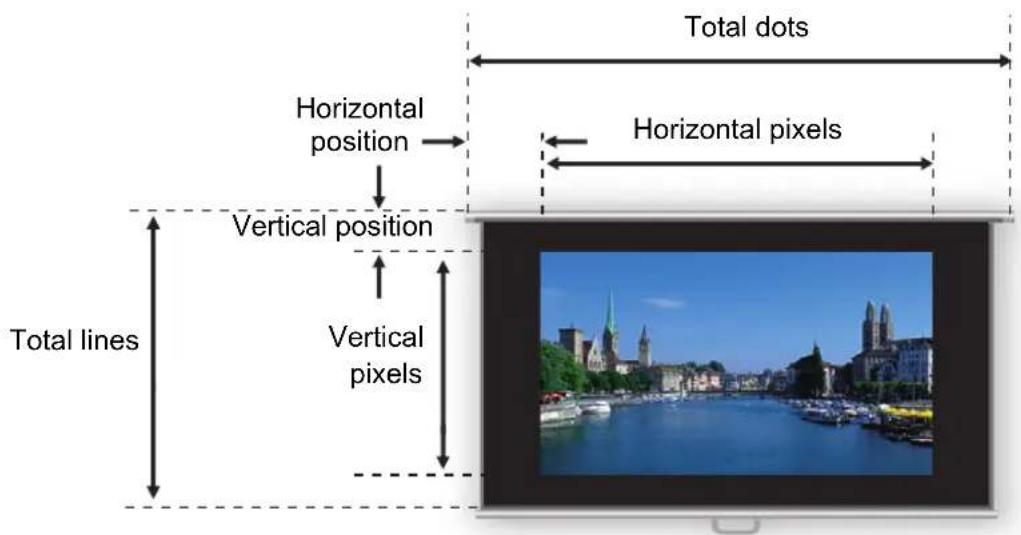
text_image
Total dots Horizontal position Horizontal pixels Vertical position Vertical pixels Total lines Total lines
Perform this adjustment if the Auto PC function (P91) cannot adjust the projected image correctly.
Split screen

[Input settings] > [Split screen]
Two input images from devices connected to the projector can be projected side by side.
| Option Function | ||
| Off Exit split-screen | mode. | |
| On Activate split-screen mode. | ||
| Settings | ||
| Submenu Function | ||
| Split screen Sw | Switch between normal and split-screen projection. | |
| Control rights | Select the image to control. When the left image is selected, 1 is displayed, and when the right image is selected, 2 is displayed. | |
| Swap right-left | Switch the sides that images are projected on. | |
| Layout | Mode 3-7 Use 30% of the screen width for the left side and 70% for the right. | |
| Mode 5-5 Use 50% of the screen width for the left side and 50% for the right. | ||
| Mode 7-3 Use 70% of the screen width for the left side and 30% for the right. | ||

- Network and USB input cannot be combined for split-screen display. Similarly, HDBaseT and HDMI input cannot be combined.
- Control can be switched to the other side by pressing the [ ]◀[ ] on the remote control when ∠()◀ ( ) is displayed in the center of the image area.
- When you switch to split-screen display, the left and right signals and input status are shown in the input window.
For details on split-screen mode, see "Split-Screen Display" (P161).
Input level

[Input settings] > [Input level]
Adjust the input level for content projected via HDMI or HDBaseT.
| Option Function | |
| Auto Automatically switches the input level based on the input signal. | |
| Normal Limits the input level to 16 - 235. | |
| Expanded Enables a full input level of 0 - 255. |

- You can select this only when the type of signal sent from AV equipment is RGB.
- In [Auto] mode, the signal level is selected automatically. (Some AV equipment and HDBaseT transmitters may not support this.)
- If your AV equipment HDMI output can be set to [Normal] or [Expanded], we recommend [Expanded]. The contrast of images will be improved and dark scenes will be rendered more realistically. In this case, set [Input Level] to [Auto] or [Expanded]. For more detailed information, refer to the user's manual for the AV equipment connected to the projector.
Color space

[Input settings] > [Color space]
Select the color space for HDMI or HDBaseT signals.
| Option Function | |
| Auto Selects the optimal color format for input signals. | |
| RGB Forces the projector to handle the input signal as an RGB signal. | |
| YCbCr | Forces the projector to handle the input signal as a color difference signal. |
Over scan

[Input settings] > [Over scan]
Select this setting to trim peripheral distortion from content projected via HDMI or HDBaseT.
| Option Function | |
| Off | Project all (100%) of the input signal.The images projected may be smaller than the full projection screen. |
| On | Project images with peripheral distortion removed. (5% of the image is trimmed, along the edges.) |

With some signal resolutions, image edges may be cut off. In such a case, select [Off].
Progressive

[Input settings] > [Progressive]
Performs progressive processing optimized for still images in cinematic content or moving images in videos.
| Option Function | |
| Off Does not perform | progressive processing. |
| Film/auto | Suitable for still images or typical moving images. Performs progressive processing for video or cinematic content. |
| Video 1 | Suitable for projecting video with high image quality and relatively slow movement. Performs progressive processing optimized for HD video. |
| Video 2 | Suitable for projecting video with faster movement. Performs progressive processing optimized for fast-moving video. |
| 25p/30p (PsF) | Performs progressive processing optimized for 1080 PsF/25 or 1080 PsF/30 video (25 or 30 fps, respectively). |

- Select [Off] when flickers and horizontal lines are noticeable in media that has a lot of fast-moving action.
- Not available in split-screen mode.
Slideshow interval

[Input settings] > [Slideshow interval]
You can project images on a USB flash drive automatically, one after another. Use the [◀/ [ ]buttons to set the interval after which images are switched in a range of 1 seconds to 60 minutes, in the format min.:sec.

- Switching the input signal to an option other than [USB] will stop any slideshow in progress. To resume the slideshow from the last image shown, return the input signal to [USB].
- If you use digital zoom during a slideshow, the digital zoom will be cancelled when you switch to the next image.
Animation effect

[Input settings] > [Animation effect]
Specify the transition for slideshows of images on a USB flash drive.
| Option Function | |
| Off Disable slideshow transitions. | |
| Cross fade Fade out | one image as the next image fades in. |
| Fade out/in Fade out | one image to black, and then fade the next image in. |
Image adjustment
This section describes image quality settings such as brightness, contrast, and sharpness.

text_image
Analog PC-1 Image adjustment Image mode Standard Create profile Brightness +0 Contrast +0 Sharpness +2 Gamma +0 Color adjustment Advanced adjustment Lamp mode Full power Reset(When the input signal is Analog PC-1)
| Menu Function | Details | |
| Image mode * Select overall image quality to suit the projected image. P97 | ||
| Create profile Save desired image quality settings as profiles. P97 | ||
| Baseline image mode Shows the image mode that is basis of the profile. P97 | ||
| Brightness * Adjust image brightness. P98 | ||
| Contrast * Adjust image contrast. P98 | ||
| Sharpness * Adjust image sharpness. P98 | ||
| Gamma * Correct loss of detail in shadows or highlights. P98 | ||
| Color adjustment * | Fine-tune image colors. | P98 |
| Advanced adjustment * | Fine-tune noise reduction and color tone. | P99 |
| Lamp mode * | Select the lamp brightness. | P102 |
| Reset | Restore default image settings. | P103 |
| Image priority * | Select which side is the basis for image processing in split-screen mode. | P103 |
Menus that are not available are grayed out or hidden.
* Any adjustments you make are stored for each combination of input signal and image mode.
Image mode

[Image adjustment] > [Image mode]
Select the overall image quality for projected images. Can also be selected by pressing the IMAGE button on the remote control. (P70)
| Option Types of Images Characteristics | ||
| Standard | Computer screens, or media played with video software | Bright overall; white, with natural colors |
| Presentation Images mainly consisting of text Bright overall | ||
| Dynamic Video content | Bright overall | |
| VividPhoto Digital photos | Subdued brightness overall, with vibrant colors | |
| Video Video from camcorders | Somewhat dark; colors resemble TV | |
| Photo/sRGB | Digital photos from sRGB-compatible cameras | Somewhat dark; conforms to the sRGB standard |
| Cinema Movies Designed especially for movies | ||
| User 1 - 5 | Up to five user profiles can be stored for your selected image quality settings. Stored profiles are available in this setting as an image mode. | |
Menus that are not available are grayed out or hidden.

You can adjust the image quality by adjusting the following items in each image mode: [Brightness], [Contrast], [Sharpness], [Gamma], [Color adjustment], [Advanced adjustment], and [Lamp mode]
Create profile

[Image adjustment] > [Create profile]
Save desired image quality settings in up to five user profiles.

- The saved settings consist of the brightness, contrast, sharpness, gamma, color adjustment, advanced adjustment, and lamp mode.
- Although only five user profiles are displayed, different profiles can be created to apply depending on whether the projector is connected to a computer (with Analog PC, Digital PC, HDMI (when [HDMI image input] (P121) is [Computer]), or HDBaseT (when [HDBaseT image input] (P121) is [Computer])), AV equipment (with Component, HDMI (when [HDMI image input] (P121) is [Auto]), or HDBaseT (when [HDBaseT image input] (P121) is [Auto])), a LAN, or a USB flash drive. As a result, it is possible to save up to 10 settings.
- The image mode name which was the basis for the settings change is also saved in the user memory. When a user memory is selected as the image mode, the image mode that was the base for that user memory is displayed in the menu as [Baseline image mode].
Brightness
MENU > [Image adjustment] > [Brightness]
Adjust image brightness.
Contrast
MENU > [Image adjustment] > [Contrast]
Sharpen or soften image contrast.
Sharpness
MENU > [Image adjustment] > [Sharpness]
Adjust image sharpness.
Gamma
MENU > [Image adjustment] > [Gamma]
Correct image areas that are too dark or too bright to see clearly. Can also be selected by pressing the GAMMA button on the remote control.

For more detailed adjustment, use Fine-Tune Gamma (P101).
Color adjustment
MENU > [Image adjustment] > [Color adjustment]
Adjust color-related settings such as color level, color balance, and color temperature.
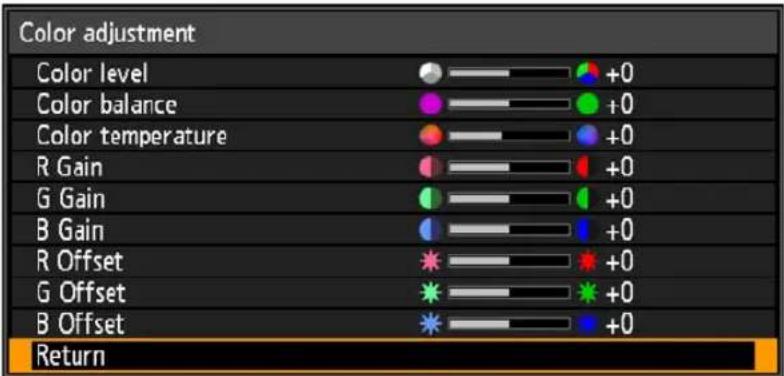
text_image
Color adjustment Color level Color balance Color temperature R Gain G Gain B Gain R Offset G Offset B Offset Return| Submenu Function | |
| Color level Adjusts the intensity of colors. | |
| Color balance Adjusts the color balance of a purplish or greenish image. | |
| Color temperature Adjusts the white color temperature. | |
| R / G / B Gain Adjust the gain of each color. | |
| R / G / B Offset Adjusts the color offset of each color. | |
Advanced adjustment

[Image adjustment] > [Advanced adjustment]
Fine-tune noise reduction and color tone.
| Advanced adjustment | |
| Ambient light | Off |
| Random noise reduction | Off |
| MPEG noise reduction | Off |
| Dynamic gamma | Off |
| Mem. color correct | |
| 6-axis color adjust | Off |
| Fine-Tune Gamma | |
| Return | |
| Ambient lightMinimize the effect of ambient light on the screen. | ||
| Option Function | ||
| Off Projects an image with no correction. | ||
| Adjust | Type | Tungsten For ambient light from conventional light bulbs or fluorescent light of this color. |
| Fluorescent For ambient light from a “day white” fluorescent source. | ||
| Level | L For an ordinary brightness of ambient light. | |
| H For bright ambient light. | ||
| Examples of Ambient Light Level Settings | ||
| Level Example Location | ||
| L Projection room, sports bar, etc. | ||
| H Conference room, lecture room, etc. | ||
| The [Ambient light] setting is available in Photo/sRGB, Video, and Cinema image modes. (P97) | ||
| Random noise reductionReduce random image noise*.* Effective on noise with an irregular frequency or amplitude. | ||
| Option Function | ||
| Off Disables random noise reduction. | ||
| WeakMiddleStrong | Specify one of three levels of intensity of the random noise reduction. | |
| Select [Weak] for fast-moving images or [Strong] for slow-moving images.This setting is not displayed for LAN or USB input. | ||
| MPEG noise reductionReduce MPEG image noise*.* Block noise resembles pixelation and may affect either on JPEG images or in MPEG video. | ||
| Option Function | ||
| Off Disables MPEG noise reduction. | ||
| WeakMiddleStrong | Specify one of three levels of intensity of the MPEG noise reduction. | |
| [5T46] This setting is not displayed for LAN or USB input. | ||
| Mosquito noise reductionReduce mosquito noise*.* A type of noise affecting image edges or areas where colors change significantly, either on JPEG images or in MPEG video. | ||
| Option Function | ||
| Off Disables mosquito noise reduction. | ||
| WeakMiddleStrong | Specify one of three levels of intensity of the mosquito noise reduction. | |
| [XACS] This setting is not displayed for HDMI, Digital PC, Analog PC-1, Analog PC-2, or Component input signals. | ||
| Dynamic gammaYou can adjust the gradation representation of light and dark portions of an image automatically. | ||
| Option Function | ||
| Off Disable dynamic gamma adjustment. | ||
| WeakMiddleStrong | Specify one of three levels of dynamic gamma adjustment. | |
| Mem. color correctEnhances skin tones, blue skies, and greens, so that these colors are more consistent with people's remembered impressions. | ||
| Submenu Function | ||
| FleshSkyGreen | Off Disable correction. | |
| WeakMiddleStrong | Specify the level of correction. | |
| 6-axis color adjustFine-tune RGB (red, green, blue) and CMY (cyan, magenta, yellow) hues in images. | ||
| Option Function | ||
| Off Disables 6-axis color adjustment. | ||
| Adjust | 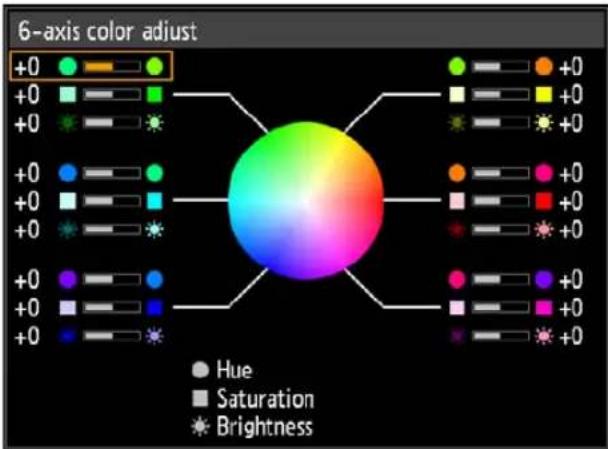 Use the [▲/ [ ]▼buttons to select [ Hue], [ Saturation], or [Brightness], and use the [ ] / [ ] buttons for adjustment.When you are finished adjusting the color, press the OK button.Adjustment is not applied to the projected menu itself. Use the [▲/ [ ]▼buttons to select [ Hue], [ Saturation], or [Brightness], and use the [ ] / [ ] buttons for adjustment.When you are finished adjusting the color, press the OK button.Adjustment is not applied to the projected menu itself. | |
| Reset Returns all adjustment values to zero. | ||
Fine-Tune GammaAdjust white, red, green, and blue gamma curves. Red, green, and blue can be adjusted separately. Adjustments to white are also applied to the three other colors. Note that adjusting any color will overwrite previous adjustments.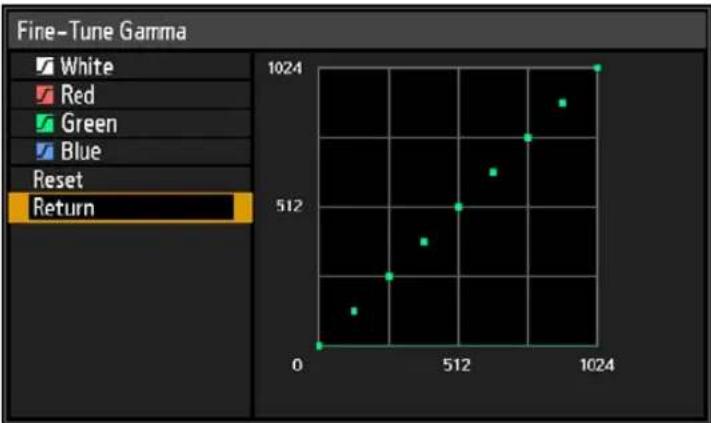 | ||
| [TP40]For details on gamma correction, see page 98.Use input signals or a test pattern for adjustment.Adjustment is not applied to the projected menu itself.Use the [▲] / [▼] buttons to select a color, and then press the OK button.Next use the [◀/ [ ]▼buttons to select a point on the gamma curve, and then use the [▲/ [ ]▼buttons to adjust the position of the point. When adjustment is finished, press the OK button to confirm the setting. | ||
| Lamp controlDims the lamp automatically when the input signal is completely black. | ||
| Option Function | ||
| Off No lamp control. | ||
| On | Lamp control. Dims the lamp in response to fully black input signals. Normal brightness is restored once the input signal changes from fully black. | |
| The projector automatically enters standby mode if the lamp is dimmed (that is, if the input signal is fully black) for more than one hour. A countdown window is displayed 10 minutes before entering standby.The lamp is not dimmed when projection is blanked, when no signals are supplied, or when black is projected during gamma restore.Lamp control is not available for the following settings:- In split-screen mode- During test pattern projection- When [Lamp mode] is set to [Power saver]- When [Vertical projection] is set to [Upward] or [Downward]- When [Fan mode] is set to [High altitude]No lamp control is performed in the first 20 minutes after the projector is turned on. | ||

- All image adjustments are stored as modified settings for the current input signal and image mode.
- Resolution may seem lower with [Random noise reduction], [MPEG noise reduction], or [Mosquito noise reduction].
Lamp mode

[Image adjustment] > [Lamp mode]
Reducing the lamp brightness reduces power consumption and cooling fan noise.
| Option Function | |
| Full power Projects | images at full brightness. |
| Power saver Reduces | lamp brightness to save energy. |

- This setting can also be adjusted from the power saver settings screen by pressing the LAMP button on the remote control.
- The lamp mode is set to [Power saver] and cannot be changed when [Install settings] > [Fan mode] is set to [High altitude].
Reset

[Image adjustment] > [Reset]
Restore the current image quality settings to the factory defaults.
| Option Function | |
| OK Resets the image adjustment settings. | |
| Cancel Cancels resetting of the image adjustment settings. |

- Performing reset when [Image mode] is set to a profile from [User 1] to [User 5] will restore the settings originally saved for that user profile.
- Only the setting for the combination of input signal and image mode for the current projection is reset.
Image priority

[Image adjustment] > [Image priority]
Select which side image adjustment settings to apply in split-screen mode.
| Option Function | |
| Primary | Use the side with control rights as the [Primary] side. For image adjustment settings that are not configured separately, [Primary] side settings apply to both sides. |
| Secondary | Not available when the [Primary] side has control rights. To reverse the side given priority for image adjustment (whether on the left or right side), switch control rights to the other side and change [Secondary] to [Primary]. |

- Can be independently configured
Brightness (P98), Contrast (P98), Gamma (P98), Color adjustment (P98), Fine-Tune Gamma (P101)
• [Primary] setting also applies to [Secondary]
Image mode (P97), Advanced adjustment except Fine-Tune Gamma (P99 - P101), Lamp mode (P102)
Install settings
Adjust projection to suit the screen or the type of images, or how the projector is installed.
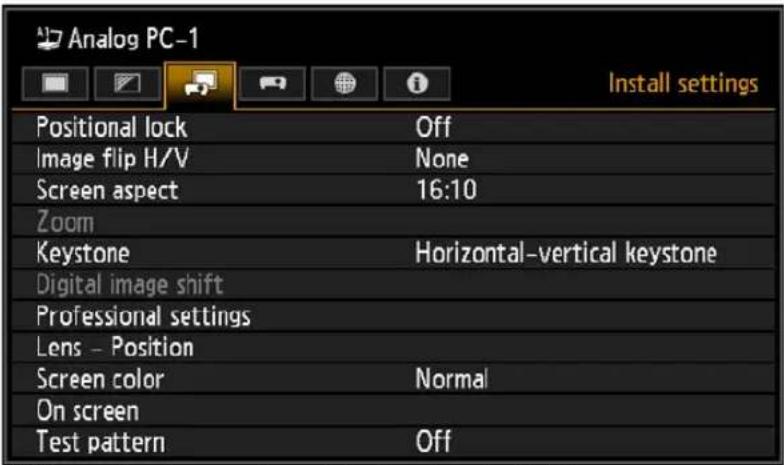
text_image
Analog PC-1 Install settings Positional lock Off Image flip H/V None Screen aspect 16:10 Zoom Keystone Horizontal–vertical keystone Digital image shift Professional settings Lens – Position Screen color Normal On screen Test pattern Off(When the input signal is Analog PC-1)
| Menu Function | Details | |
| Positional lock | Operation of installation related functions can be prohibited. | P105 |
| Image flip H/V | Specify settings for projection from behind the screen, from the ceiling, or both. | P105 |
| Screen aspect | Select an aspect ratio that matches that of the projection screen. (P63) | P105 |
| Zoom | Digitally reduce images projected with a Short Fixed Lens. | P106 |
| Keystone Set the type of keystone correction. P106 | ||
| Digital image shift Moves the position of the projected image. P107 | ||
| Professional settings | Specify settings for image positioning and the altitude of installation. | P107 |
| Lens - Position | Save the current lens information, or restore previous lens conditions that were saved. | P112 |
| Screen color Adjust projection colors to suit the screen color. P113 | ||
| On screen | Specify display details for on-screen menus, help, and warning or precaution icons. | P113 |
| Test pattern | Project a test pattern to check the resolution and color of projection during installation. | P115 |
Positional lock

[Install settings] > [Positional lock]
Operation of installation-related functions can be prohibited.
- Image flip H/V • Screen aspect • Keystone
- Save position (in [Lens - Position]) • Lens shift reset
- Digital image shift
- Professional settings
| Option Function | |
| Off The positional lock is not used. | |
| On Prevents adjustment of installation-related functions. | |
Press the OK button to confirm the setting, and then press the MENU button.
Image flip H/V

[Install settings] > [Image flip H/V]
Specify the orientation of how the projector is installed.
| Option Function | |
| None Select for normal projection, without inversion. | |
| Ceiling mounted | Select when the projector is installed upside-down on the ceiling.The projected image is inverted in both vertical and horizontal directions. |
| Rear | Select this to project an image from behind the screen.The projected image is inverted in the horizontal direction. |
| Rear, Ceiling mounted | Select this to project an image from behind the screen with the projector hung from the ceiling.The projected image is inverted in the vertical direction. |

- To hang the projector from the ceiling, use the optional bracket. Contact the Canon Customer Support Center for more detailed information.
- Image flipping will reset any adjustment for keystone distortion. In this case, redo the adjustment.
Screen aspect

[Install settings] > [Screen aspect]
Select an aspect ratio that matches that of the projection screen.
| Option Function | |
| 16:10 Select this when you use a screen with an aspect ratio of 16:10. | |
| 16:9 Select this when you use a screen with an aspect ratio of 16:9. | |
| 4:3 Select this when you use a screen with an aspect ratio of 4:3. | |
| 16:9 D. Image Shift | Select this when you use a screen with an aspect ratio of 16:9. Although keystone correction is not available in this mode, images can be shifted up or down. (P64) |
| 4:3 D. Image Shift | Select this when you use a screen with an aspect ratio of 4:3. Although keystone correction is not available in this mode, images can be shifted left or right. (P65) |

- Changing the screen aspect will reset any keystone or digital image shift setting.
- [Auto] may be automatically selected for the aspect depending on the screen aspect setting.
Zoom

[Install settings] > [Zoom]
When the Short Fixed Lens is attached and if the projected image does not fit on the screen, you can display the image by electronically reducing its size. This type of zooming reduces overall image dimensions, relative to the center of the image. Press the [▶] button on the remote control to project images at a reduced size, and press the [▶] button to enlarge images to full size. Images can be projected at 75-100% of the original size.

• D.ZOOM buttons on the remote control cannot be used for this [Zoom] function.
- [Zoom] is not available when the following features are used.
- Horizontal/vertical keystone correction
- Split-screen mode (P161)
- Using [Zoom] after specifying corner adjustment (P166) will clear corner adjustment settings and apply the zoom setting. Instead, use [Zoom] before fine-tuning the image position with corner adjustment.
- If images still extend off the screen even after you use [Zoom], you can use corner adjustment (P166) to finetune the position of image corners, so that images fit on the screen.
- Switching to lenses other than the Short Fixed Lens will reset the setting to 100% .
Keystone

[Install settings] > [Keystone]
Two types of keystone correction are available: horizontal/vertical keystone and corner adjustment. Keystone correction can also be reset. Keystone correction can also be applied by pressing the KEYSTONE button on the remote control.
| Submenu Function | |
| Horizontal-vertical keystone | Apply horizontal-vertical keystone correction. Image height and length is adjusted. |
| Corner adjustment | Apply corner adjustment. Each corner of the image can be repositioned. |
| Reset Resets the specified keystone value. | |

- Pressing the KEYSTONE button when the screen aspect is 16:9 D. image shift or 4:3 D. image shift will apply digital image shift.
- Resetting the keystone value will also reset the zoom setting for the Short Fixed Lens (RS-IL03WF).
Digital image shift

[Install settings] > [Digital image shift]
Moves the position of the projected image.
When screen aspect is 16:9 D. Image Shift, move images vertically using the [▲/ [▼buttons, and for 4:3 D. Image Shift, move images horizontally using the [ ]◀[ ] ▶ buttons.

This cannot be selected when the screen aspect is 16:9, 16:10 or 4:3.
Professional settings

[Install settings] > [Professional settings]
Specify advanced installation settings.
| Professional settings | |
| Micro-digital image shift | Off |
| Registration | Off |
| Fan mode | Normal |
| Vertical projection | Off |
| Edge blending | Off |
| Return | |
| Micro-digital image shiftUse this setting to fine-tune the position of the projected image. | |
| Submenu Function | |
| Off Does not perform | micro digital image shift. |
| Adjust | Adjust Use the [▲/ [ ]▼buttons for vertical shift and the [ ] / ◀[▶]buttons for horizontal shift. |
| Chart Displays a chart to assist in adjustment. Watch the chart as you fine-tune the position. | |
| Return Dismiss the chart. | |
| RegistrationAdjusts colors that are out of alignment. You can adjust red, green and blue registration independently. | |
| Submenu Function | |
| Off Does not perform | image registration. |
| Adjust | Red / Green / Blue Use the [▲/ [ ]▼buttons for vertical shift and the [ ] / ◀[▶]buttons for horizontal shift. |
| Chart Displays a chart to assist in adjustment. Watch the chart as you fine-tune the position. | |
| Return Dismiss the chart. | |
| Fan modeSwitch the fan mode to suit installation at low or high altitudes (above 2,300 m (7,545.8')). | |
| Option Function | |
| Normal Setting for altitudes lower than 2,300 m (7,545.8'). | |
| High altitude Setting for altitudes of 2,300 m (7,545.8') or higher. | |
 Incorrect settings may shorten the useful life of the lamp or other parts.The lamp mode is set to [Power saver] and cannot be changed when [Install settings] > [Fan mode] is set to [High altitude]. Incorrect settings may shorten the useful life of the lamp or other parts.The lamp mode is set to [Power saver] and cannot be changed when [Install settings] > [Fan mode] is set to [High altitude]. | |
| Vertical projectionYou can ensure adequate cooling by switching the fan mode to suit upward- or downward-facing installations. For precautions on vertical projection, see “Install Facing in the Correct Direction” (P25). | |
| Option Function | |
| Off Does not alter the fan mode. | |
| Upward Setting for use when the projector faces upward. | |
| Downward Setting for downward projection. | |
| [9252]Be sure to perform this setting to use vertical projection.Projecting vertically without using this setting will shorten the useful life of the lamp and other parts.Even if you complete this setting, vertical projection will result in a shorter useful life of the lamp and other parts than horizontal projection. | |
Edge blending
Brightness and colors of overlapping edges of images from multiple projectors, which form a blending area, can be adjusted for a more seamless appearance. For detailed instructions, see "Projecting from Multiple Projectors at Once (Edge Blending)" (P162).
[Off] Disable blending.
[Adjust] Display the menu for blending area adjustment.
| Edge blending | ||
| Side | Width | Start position |
| Left | 0 | 0 |
| Right | 0 | 0 |
| Top | 0 | 0 |
| Bottom | 0 | 0 |
| Color blending adjustment | Off | |
| Black level adjustment | Off | |
| Marker | Off | |
| Reset | ||
| Corner adjustment | ||
| Return | ||

text_image
Start marker End marker Blending areaWhen adjusting the image projected from the right side

- Adjustment may not eliminate different colors or brightnesses in the blending area.
- For best edge-blending results, use all projectors in the same image mode and make the following adjustments.
(1) Brightness, contrast, R/G/B gain and offset, black level, blending color, color temperature, color level, color balance, sharpness, and gamma (P98)
(2) Color adjustment, by using 6-axis color adjustment (P101)
(3) Gamma adjustment, by using fine-tune gamma (P101)
(4) Corner adjustment, using keystone correction (P106)
| Submenu Function | ||
| Side | Left, Right, Top, Bottom Select the direction of the blending area to adjust. | |
| Width Specify the width between the start and end markers. | ||
| Start Position Moves the position of the start marker. | ||
| Large blending areas may cover input signal dialog boxes and other interface elements. In this case, momentarily set edge blending to [Off] and check the display.Although the starting marker is normally aligned with the image edge, it can also be aligned toward the center of the image. In this case, the black blending area will lie outside of the starting marker. | ||
| Color blending adjustment | Adjust unwanted colors or discrepancies between colors in the blending area. | |
| Submenu Function | ||
| Off Do not adjust colors of blended images. | ||
| Adjust | Adjust unwanted colors or discrepancies between colors in the blending area. | |
| Option Function | ||
| White Simultaneously adjust red, green, and blue to correct unwanted colors or discrepancies in the blending area. | ||
| Red/Green/Blue Individually adjust red, green, and blue to correct unwanted colors or discrepancies in the blending area. | ||
| Black level adjustment | Because black is lighter in the blending area than in other areas, you can adjust the black level outside the blending area to make this difference in brightness less noticeable. Position of end marker (hidden) Left image  | Area A: Black level cannot be adjusted. Area B: Adjust to a black level different from that of area D. Area C: Adjust to provide a smooth transition relative to the black levels of areas B and D. |
| Off Do not adjust the black level. | ||
| Area Adjust areas C - A to smoothen the boundaries of the blending area. | ||
| Option Function | ||
| Side | Select the direction to adjust from Left/Right/ Top/Bottom. | |
| A-Width/ B-Width/ C-Width | Adjust the widths of areas A - C. | |
| Black level Adjust the black level brightness and color of areas B and D. | ||
| Option Function | ||
| B/D-area base Adjust the black level brightness of B/D areas. | ||
| B/D-area red / green / blue | Adjust the red, green, and blue components of B/D area black levels individually. | |
| Marker | Show the blending area markers. | |
| Option Function | ||
| Off Hide the blending area markers. | ||
| On | Show the blending area markers. The start marker is red, and the end marker is green. | |
| Reset Reset the marker settings. | ||
| Submenu Function | |
| Corner adjustment | Correct image distortion by aligning corners of the blending area with the image from the reference projector. For multi-projection alignment, align the corners with the projector blending area (already adjusted) that forms the basis.Points |
| Left, Right, Top, Bottom Select the direction of the blending area to adjust. As you reposition the corners of the selected area, the overall image changes to match the adjustment. | |
| Sides set to an edge-blending width of 12 or more can be adjusted when [Keystone] is set to [Corner adjustment] and the aspect ratio is [16:10].To reset adjustment, use [Keystone] (P69). | |
Lens - Position

[Install settings] > [Lens - Position]
The projector can save information about the lens position in memory. Up to three sets of lens information (including focus, zoom, and lens shift settings) can be saved, and the lens can be restored to these positions.
| Submenu Function |
| Load position 1-3 Restores the lens to the positions saved using Save position 1-3. |
| Save position 1-3 Saves the lens position as positions 1-3. |
| Lens shift reset Restores the lens to the original position. |

- To lock (protect) the saved position, set [Positional lock] (P105) to [On].
-
The values of the following settings are saved in addition to the lens position information:
-
Horizontal/vertical keystone / corner adjustment
- Screen color
- Screen aspect
- Zoom
-
Digital image shift
-
[Load position] is not available unless you perform [Save position] once.
- The original lens position varies depending on the type of lens used.
- When saved lens positions are restored, images may be projected in a slightly different position than the saved position.
- Specifying a somewhat smaller image size than the screen size (image area) enables you to switch among multiple lens positions without having the image extend off the screen.
- When precise positioning is needed, use lens shift, zoom, and focus functions for fine adjustment.
Screen color

[Install settings] > [Screen color]
You can adjust the color quality of the images projected according to the color of the projection screen.
| Submenu Function | |
| Normal | Select this if a standard type of projection screen is used. The images are projected in a light quality similar to that of natural light. |
| Greenboard | Select if a dark green surface such as a blackboard is used as the screen. The color quality similar to [Normal] is obtained on the greenboard. |
| Adjust Select to fine-tune red, green and blue. | |
On screen

[Install settings] > [On screen]
Specify display details for on-screen menus, help, and warning or precaution icons.
| On screen | |
| Menu position | |
| Guide | On |
| Show input status | On |
| Overheat warning display | Off |
| Menu display time | Normal |
| Lamp warning display | On |
| Air filter warning display | On |
| Split screen ID display | On |
| Return | |
| Menu positionReposition menu display.Use the [▲/ [ ]▶[ ] / ▼ buttons to move the menu to the desired position. | |
| GuideShows the guide screen. | |
| Option Function | |
| Off Hides the guide | screen. |
| On Shows the guide | screen. |
| Show input statusSpecify whether signal status is shown when there is no signal or when you are completing signal settings. | |
| Option Function | |
| Off The input status | is not displayed. |
| On The input status | is displayed. |
| Overheat warning displaySpecify whether the icon warning of high temperature (WE) is shown when the internal temperature is high and the projector may overheat. | |
| Option Function | |
| Off Disable high temperature warning icon display. | |
| On Enable high temperature warning icon display. | |
| Menu display timeExtend menu display from the standard 10 or 30 seconds to 3 minutes. | |
| Option Function | |
| Normal The menu is | displayed for 10 or 30 seconds. |
| Extended The menu | is displayed for 3 minutes. |
| The following display times are also changed. | |
| Item [Normal] [Extended] | ||
| - MENU screen- Power-Saving Settings (P73) | 30 seconds | 3 minutes |
| - Input (P56)- Keystone adjustment (P67)- Keystone reset (P69)- Focus adjustment (P59)- Zoom adjustment (P60)- Lens shift adjustment (P61)- Lens shift reset (P62)- D.image shift adjustment (P64)- D.image shift reset (P65)- Aspect (P65)- Image mode (P70)- Volume adjustment (P74)- Gamma correction (P98) | 10 seconds | 3 minutes |
| Lamp warning displaySpecify whether to show a lamp replacement message after the lamp has been used for a specified period. | |
| Option Function | |
| Off The prepare lamp | message and the lamp warning are not displayed. |
| On The prepare lamp | message and the lamp warning are displayed. |
 When it is almost time to replace the lamp, the projector's [LAMP] indicator will flash. For details, see “LED Indicator Displays” (P32).Setting display to [Off] will disable both the message to prepare a replacement lamp and the warning to replace the lamp. To review the replacement timing, check the lamp counter (P125).Lamps that are still used after the timing for lamp replacement are more likely to rupture. Replace the lamp with a new one as soon as possible. When it is almost time to replace the lamp, the projector's [LAMP] indicator will flash. For details, see “LED Indicator Displays” (P32).Setting display to [Off] will disable both the message to prepare a replacement lamp and the warning to replace the lamp. To review the replacement timing, check the lamp counter (P125).Lamps that are still used after the timing for lamp replacement are more likely to rupture. Replace the lamp with a new one as soon as possible. | |
| Air filter warning displayA message advising you to perform cleaning can be set to display when the filter needs cleaning. | |
| Option Function | |
| Off The air filter warning is not displayed. | |
| On The air filter warning is displayed. | |
 Setting [Air filter warning display] to [Off] will disable display of the warning to clean the air filter. We recommend checking the air filter counter (P126) occasionally to know when to replace the filter. Setting [Air filter warning display] to [Off] will disable display of the warning to clean the air filter. We recommend checking the air filter counter (P126) occasionally to know when to replace the filter. | |
| Split screen ID displaySpecify whether to show the digit (1 or 2) identifying screens in split-screen mode. Note that even if [Off] is selected, corner markers will be shown to indicate the side with control rights. | |
| Option Function | |
| Off Hides the screen ID. | |
| On Shows the screen ID. | |
Test pattern

[Install settings] > [Test pattern]
You can project a test pattern (P187) to check resolution, color, and other details even without supplying an input signal.
| Option Function | |
| Off Disable test pattern display. | |
| On Enable test pattern display. | |

- While the test pattern menu is displayed, you can use the [ ] [ ] buttons to switch patterns. Additionally, options of test pattern that have options can be changed with the [ ] [ ] buttons.
- The test pattern menu is no longer displayed after a little while, but you can view it again by pressing the [√] buttons.
System settings
Customize projector and remote control operation, beeping, and other details after startup, during standby, and in other situations.

text_image
Analog PC-1 System settings User screen settings Interface settings Power management mode Standby Power management duration 15 min. Direct power on On Beep On Motion blur reduction Language English Other settings(When the input signal is Analog PC-1)
| Menu Function | Details | |
| User screen settings | Customize user screens shown at startup, when no signal is detected, and in other situations. | P117 |
| Interface settings | Specify interface details such as settings for input signals of connected equipment. | P118 |
| Power management mode | You can specify to turn the lamp or projector off automatically after a certain period if the projector and remote control are not used, or if there is no input signal. | P121 |
| Power management duration | Specify how long before the lamp is turned off or the projector enters standby, depending on the [Power management mode] setting. | P122 |
| Direct power on | You can turn on the projector by connecting the power cable without pressing the POWER button. | P122 |
| Beep | You can select whether a beep sounds or not when you operate the projector. | P122 |
| Motion blur reduction | Motion blur is blurring that occurs during video playback. Motion blur reduction can make this blurring less noticeable. | P123 |
| Language | You can select the language in which the menus are displayed. | P123 |
| Other settings | Set a password, reset counters for lamp or air filter replacement, and access other settings and information. | P124 |
User screen settings

[System settings] > [User screen settings]
Capture a logo and specify logo display settings.
| User screen settings | |
| Logo capture | |
| Logo position | Center |
| No signal screen | Blue |
| Screen when blank | Black |
| Projector on | Canon logo |
| Return | |
| Logo captureRegisters the current image as a user logo. Registered user logos can be shown when no signal is received, when the BLANK button is pressed, or as the startup image. | |
| Option Function | |
| OK | Display the image for logo registration.Align the image with the red boundary lines indicating the portion that will be stored, and then press the OK button. The portion of the image within the boundary lines is now registered. |
| Cancel Cancels logo registration. | |
| Only images at an aspect ratio of 16:10 can be registered as user logos. | |
| Logo positionSpecify the position of registered user logos as follows.You can specify the position after a logo has been registered. Choose from upper left, upper right, center, lower left, or lower right. | |
| No signal screenCustomize the screen shown when no input signals are received. | |
| Option Function | |
| Black The screen is | all black. |
| Blue The screen is | all blue. |
| User logo The user | ogo is projected. |
| Screen when blankSelect the screen shown when projection is temporarily blanked out by pressing the BLANK button on the remote control. | |
| Option Function | |
| Black The screen is | all black. |
| Blue The screen is | all blue. |
| User logo The user | ogo is projected. |
| Projector onSelect a logo to project after startup until input signals can be projected. | |
| Option Function | |
| Skip A black screen | is projected. |
| Canon logo Displays | the Canon logo that was registered in advance at the factory. |
| User logo The user | ogo is projected. |
Interface settings

[System settings] > [Interface settings]
Specify interface details such as settings for input signals of connected equipment.
| Interface settings | |
| Key repeat | On |
| Key lock | Off |
| Remote control channel | Independent |
| Audio in terminal select | |
| HDBaseT | On |
| Communication settings | |
| HDMI image input | Auto |
| HDBaseT image input | Auto |
| Return | |
| Key repeatKey repeat enables projector or remote control buttons to be held down instead of pressing them repeatedly. | |
| Option Function | |
| Off Key repeat is not enabled. | |
| On Key repeat is enabled. | |
| Key lockLock the projector to prevent direct or remote control operation. | |
| Option Function | |
| Off Disables the key | lock. |
| Main unit | Operation is not possible using the main unit.Use the remote control. |
| Remote (wireless) | Disables infrared remote control operations (P38). Use buttons on the main unit.Operation is also possible with an optional wired remote control (RS-RC05). |
To Unlock Key Lock Function
Turn off the projector and unplug the power plug. Hold down the OK button on the main unit and plug in the power cord, as you continue to hold down the OK button. In a moment, a beep will sound, and the controls will be unlocked.

When you access this setting from the projector's side controls, [Main unit] is not available. Similarly, when you access the setting from the remote control, [Remote (wireless)] is not available.
Remote control channel
Separate channels can be assigned to up to four projectors so that a single remote control can be used with each projector.
Selecting the Projector Channel
If an optional wired remote control (RS-RC05) is used, there is no need to set the remote control channel.
Option Function
| Ch1Ch2Ch3Ch4 | Select the remote control channel to use with this projector. |
| Independent Can be controlled from a remote control set to any channel. | |
Selecting a Channel on the Remote Control
After changing the projector channel from the menu, always change the remote control channel accordingly.
| Ch1 Hold both the OK button and [ ] button for 3 seconds. |
| Ch2 Hold both the OK button and [ ] button for 3 seconds. |
| Ch3 Hold both the OK button and [ ] button for 3 seconds. |
| Ch4 Hold both the OK button and [ ] button for 3 seconds. |
| Independent Hold both the OK button and MENU button for 3 seconds. |
Audio in terminal select
Select the source terminal for audio output.
Option Function
| Off No audio is output. | |
| Audio in 1 Use audio signals from AUDIO IN 1 for audio output. | |
| Audio in 2 Use audio signals from AUDIO IN 2 for audio output. | |
| HDMI Use HDMI audio signals for audio output. | |
| HDBaseT Use HDBaseT audio signals for audio output. | |
| LAN | Use LAN audio signals for audio output. Audio is transferred by the NMPJ application. |
| Audio is transferred via the port selected in [Communication settings] > [Wired network] (P120). | |
| HDBaseT Enable or disable HDBaseT. Refer to the following sections for details on HDBaseT connections. For video/audio details, see “Connection Procedure” (P50, P51). For network details, see “Connection Methods” (P127). | ||
| Option Function | ||
| Off Disable HDBaseT. | ||
| On Enable HDBaseT. | ||
| Image signal quality | The HDBaseT input signal value received is indicated by a white line. 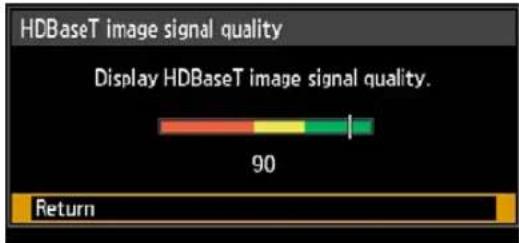 | |
| High | Indicated by the green portion. This is the recommended level. | |
| Middle | Indicated by the yellow portion. The signal is fluctuating. Check the cable. | |
| Low | Indicated by the red portion. The signal cannot be used. Fix the cable connection or replace the cable. | |
| [0647] Do not coil or bundle cables. | ||
| Communication settings Select ports used for serial communication and network connections. Otherwise, you can refer to this setting to check setting values for the port selected for serial communication. | ||
| Submenu Function | ||
| Serial communication | Service port Use the service port (CONTROL). | |
| HDBaseT Use the HDBaseT port. | ||
| Details | ||
| Option Function | ||
| Baud rate Modulation | rate, in bits per second. | |
| Data bits Number of | bits of data. | |
| Parity Number of parity bits. | ||
| Stop bit | Length of mark representing the end of data bits. Select 1 or 2. | |
| Wired network | LAN port Use the LAN port. | |
| HDBaseT Use the HDBaseT port. | ||
| [HDBaseT] is not available when [HDBaseT] is set to [Off]. [Wired network] is not available when [Network function] (P131) is set to [Off]. Changes to the wired network setting do not take effect immediately. To apply [Wired network] settings, restart the projector. | ||
Communication settings
| Select ports used for serial communication and network connections. Otherwise, you can refer to this setting to check setting values for the port selected for serial communication. | |
| Submenu Function | |
| Serial communication | Service port Use the service port (CONTROL). |
| HDBaseT Use the HDBaseT port. | |
| Details | |
| Option Function | |
| Baud rate Modulation rate, in bits per second. | |
| Data bits Number of bits of data. | |
| Parity Number of parity bits. | |
| Stop bit Length of mark representing the end of data bits.Select 1 or 2. | |
| Wired network | LAN port Use the LAN port. |
| HDBaseT Use the HDBaseT port. | |
| HDMI image inputSet the type of equipment which is connected to the HDMI port. Note that to some extent, the [HDMI image input] setting determines which image modes are available. (P70) | |
| Option Function | |
| Auto | Select when AV equipment will be connected. Image processing, menu displays, and other elements are adjusted for video equipment. |
| Computer | Select when a computer will be connected. Image processing, menu displays, and other elements are adjusted for a computer. |
| HDBaseT image inputSpecify the type of equipment connected to the HDBaseT port. Note that to some extent, the [HDBaseT image input] setting determines which image modes are available. (P70) | |
| Option Function | |
| Auto | Select when AV equipment will be connected. Image processing, menu displays, and other elements are adjusted for video equipment. |
| Computer | Select when a computer will be connected. Image processing, menu displays, and other elements are adjusted for a computer. |
Power management mode

[System settings] > [Power management mode]
You can specify to turn the lamp or projector off automatically after a certain period if the projector and remote control are not used, or if there is no input signal.
| Option Function | |
| Disabled Disable power management mode. | |
| Lamp off Only turns the lamp off. | |
| Standby Turns the projector off and puts it in standby. | |

- Projection resumes when the same input signal is restored, when the remote control or projector is operated, or when a user command to activate the projector is received.
• After the projector enters standby, restoring projection requires the same steps as when turning the projector on normally. - When [Disabled] is selected, [Direct power on] (P122) is not available.
- This setting can also be adjusted from the power saver settings screen by pressing the LAMP button on the remote control.
Power management duration

[System settings] > [Power management duration]
Specify how long before the lamp is turned off or the projector enters standby, depending on the [Power management mode] setting.
| Option Function | |
| 5 min. - 60 min. | After 30 seconds without an input signal when the projector is idle, the projector starts displaying a countdown of the selected time. |

- If conditions that would start countdown are met while you are blanking projection, blanking is canceled.
- Once countdown begins, audio output stops.
Direct power on

[System settings] > [Direct power on]
You can turn on the projector by connecting the power cable without pressing the POWER button.
| Option Function | |
| Off The POWER button must be pressed to turn the projector on. | |
| On You can turn on the projector by connecting the power cable only. | |

- Before enabling direct power on, be sure to set [Power management mode] to an option other than [Disabled]. When [Disabled] is selected, [Direct power on] is not available.
- After turning off the projector, wait at least 5 minutes before turning it on again. It may shorten the lamp life if you turn on the projector immediately after turning it off.
- The projector is also equipped with a Direct Power Off feature. No damage is caused to the projector even if it is unplugged during projection to turn it off without pressing the POWER button. However, setting adjustments made immediately before unplugging the projector may not be stored.
Beep

[System settings] > [Beep]
You can select whether a beep sounds or not when you operate the projector.
| Option Function | |
| Off Disables the beep. | |
| On Enables the beep. |

The beep will not sound if you mute the projector sound with the MUTE button on the remote control.
Motion blur reduction

[System settings] > [Motion blur reduction]
Motion blur is blurring that occurs during video playback. Motion blur reduction can make this blurring less noticeable.
| Option Function | |
| Off Motion blur reduction | is not performed. |
| On Motion blur reduction | is performed. |

- If reducing motion blur produces distracting image noise, select [Off].
- Effects of motion blur reduction cannot be checked during menu display.
- Especially effective for motion of computer graphics and similar high-resolution images.
- This feature is not available during LAN/USB input.
Language

[System settings] > [Language]
Select the menu display language.
| Language | ||
| EnglishEnglish Russian Czech | Русский | Čeština |
| DeutschGerman Dutch Danish | Nederlands | Dansk |
| FrançaisFrench Finnish Arabic | Suomi | إنجليزی |
| ItalianoItalian Norwegian Chinese (Simplified) | Norsk | 中文简体 |
| EspañolSpanish Turkish Chinese (Traditional) | Türkçe | 中文繁體 |
| PortuguêsPortuguese | PolskiPolish | 한국어Korean |
| SvenskaSwedish | MagyarHungarian | 日本語Japanese |
Other settings

[System settings] > [Other settings]
Lock operation with a password, set a password, reset counters for lamp or air filter replacement, and access other settings and information.
| Other settings | |
| Password settings | Off |
| Register password | |
| [Fn] button settings | Disable |
| Gamma restore | Off |
| Lamp counter | |
| Air filter counter | |
| Firmware | 00.010002 |
| Factory defaults | |
| Return | |
Password settings
Disables the projector unless the correct password is entered.
Option Function
Off The projector can be used even if no password is entered.
On The projector cannot be used unless you enter your password.
To Cancel the Password
| Cancellation on the Projector | Turn off the projector and unplug the power plug. Hold down the MENU button on the side control and connect the power plug. Make sure to keep holding down the MENU button until a beep sounds. When the projector beeps, the password is canceled. (The entered password is also reset.) |
| Cancellation on the Remote Control | To forcibly cancel the password from the remote control, in standby state press the MENU button 3 times, then press the POWER button. |

- You cannot set [On] unless you have completed [Register password].
Once you set a password, the password entry screen appears at power-on.
Enter a 4 digit password.
Enter the password using the [▲] / [▶] / [▼] / [◀] buttons.
If the password is valid, the projection starts. If you enter a wrong password three times, the power will be turned off. - The projector also goes off after three minutes of inactivity on the password input screen.
| Register passwordYou can register a password for starting projection.Enter a 4 digit password.Enter the password using the [▲/ [ ]▶[ ] / ▼] buttons.The 4-digit password is entered from the left to right digits. When the final digit is entered, the password is automatically registered.Press the MENU button to abort the registration. | |
| [Fn] button settingsYou can select a function to be assigned to the Fn button on a remote control. | |
| Option Function | |
| Disable | Disables assigning a function to the Fn button on the remote control. |
| Split screen | Enables split-screen mode toggling using the Fn button on the remote control. |
| [××T5] Select the function to assign to the Fn button of a remote control (RS-RC05, sold separately). | |
| Gamma restoreRestore the original gamma if, after the projector has been used for some time, you notice that tone curves have changed, or if neutral colors have become tinted. Gamma restore can only be used when the lamp has been on for approximately 30 minutes or longer. | |
| [××G4] Submenu Function | |
| Off Returns to the factory default without performing Gamma restore. | |
| Adjust Restore the original gamma and apply the result. | |
| [AHHH]If Gamma restore is performed, the tone characteristics and achromatic color will be restored as close as possible to the condition when the projector was purchased, however it is not possible to restore it completely to the original condition.If Gamma restore is performed, the adjustment screen will be projected for approximately 150 seconds.To cancel Gamma restore, press the POWER button. | |
| Lamp counterYou can reset the lamp counter that indicates the time for lamp replacement.For details on lamp counter display, see “Replacing the Lamp” (P173).[XYZY]Do not reset the lamp counter except when you have replaced the lamp. Otherwise, the lamp counter cannot indicate the correct timing for replacing the lamp.Lamps are more likely to rupture once the lamp replacement message has been displayed (P173). Replace the lamp with a new one as soon as possible.The lamp counter provides an estimate of the time remaining until the lamp must be replaced. This value is based on the hours in use and the present load on the lamp.The number of hours indicated is equivalent to use under these conditions: [Vertical projection] (P108) set to [Off], and [Lamp mode] (P102) set to [Full power]. | |
Air filter counter
This resets the counter which reminds you of the time for cleaning and replacing the air filter.

For details on replacing or cleaning the filter, see P171 - P172.
Power counter
Indicates the total time that the projector has been connected to a power supply.

This value is not reset even if [Factory defaults] is executed.
Firmware
Update the projector firmware.
Check the version indicated before updating the firmware.

text_image
Firmware update Firmware version correct? 01.000000 → 01.000001 Yes NoUpdate the projector firmware as follows.
- Download updated firmware from the Canon website and store it at the root directory on a USB flash drive.
- Insert the USB flash drive in the USB port.
- Follow the instructions shown to complete the update process.

- Firmware versions shown here are for illustration only and differ from actual versions.
- In some cases, it may not be possible to download updates. For details, contact the Canon Customer Support Center.
- Firmware updating takes a few minutes. During the update, the LED indicator will flash in red. Do not turn off the projector while the LED is flashing. After the update, the projector will automatically turn itself off and enter standby mode.
Factory defaults
You can reset the menu item settings and restore the system settings to the factory defaults.
Option Function
| OK Settings are reset to default. | |
| Cancel Settings are not reset to default. |
Network settings
Network Connection Overview
Connecting the projector to a network enables you to control the projector from a computer and receive notification of projector errors via email.
Depending on the method of network connection, preparation on the computer side may be necessary. The following is an explanation of preparation on the computer side.
Connection Methods
To connect the projector to a computer network, use a LAN cable. The LAN cable can be connected to either the LAN port or HDBaseT port.
When using the LAN port, connect the projector as follows.
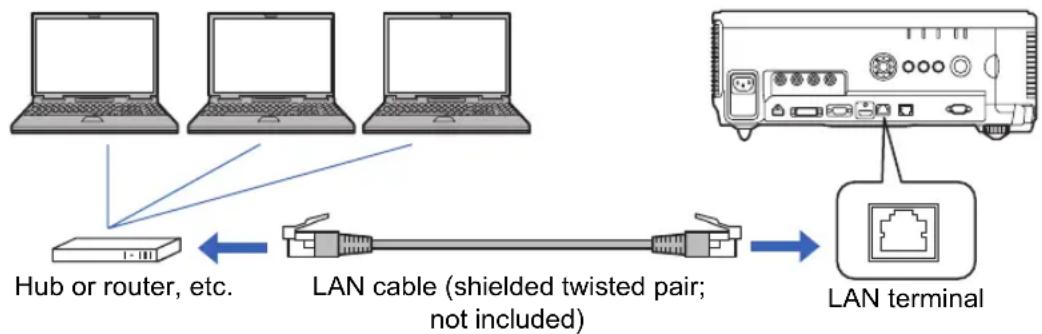
flowchart
graph TD
    A["Laptop"] --> B["Hub or router, etc."]
    C["Laptop"] --> B
    D["Laptop"] --> E["LAN cable (shielded twisted pair; not included)"]
    F["Laptop"] --> G["LAN terminal"]
    B <--> E
    E <--> G
When using the HDBaseT port, connect the projector as follows.

flowchart
graph LR
    A["Laptop"] -->|LAN cable (CAT5e or better, shielded-compatible; sold separately)| B["HDBaseT transmitter"]
    B -->|LAN cable (CAT5e or better, shielded-compatible; sold separately)| C["HDBaseT port"]
- The LAN port and HDBaseT port cannot be used at the same time for a network connection.
- Network connectivity provided by the HDBaseT port and LAN port is identical, except that the HDBaseT provides a maximum transfer speed of 100 Mbps.
- When the [Network function] setting of the projector is set to [Off] (Network Connections is disabled), switch it to [On] to enable it. (P131)
- Select which port to use in [Communication settings] > [Wired network] (P120).
- Referring to “Checking Projector Information” (P156), confirm that the projector’s IP address is not the same as that of other computers on the network. To set a projector IP address, follow the instructions in “Controlling the Projector from a Computer” (P154) and use the web screen, or use projector TCP/IP settings. (P132)
Menu Description
- When you connect the computer to the network for the first time, it is also necessary to perform settings on the computer. In this case, consult the network administrator regarding the necessary settings.

In a network environment where a DHCP server is operating, choose [On] on the projector [DHCP] screen to enable the DHCP function and connect it. (P132)
Completing Projector Settings
Settings described in this section apply to the network connections, setting a network password, and other aspects of networked projection.

text_image
Analog PC-1 Network settings Network settings lock Unlocked Network password setting On Register network password Network standby settings Low-power Network function On Detailed settings PJLink On AMX Device Discovery Off Crestron RoomView Off(When the input signal is Analog PC-1)
| Menu Function | Details | |
| Network settings lock Lock | network settings to prevent changes. P130 | |
| Network password setting | Activate or deactivate password protection for network settings. | P130 |
| Register network password | Set a network password. P130 | |
| Network standby settings | Specify the extent of network functionality in standby mode. | P131 |
| Network function You can | turn the projector network function on or off. P131 | |
| Detailed settings | Display and set advanced settings for network connections. | P132 |
| PJLink Enable or disable PJLink. P134 | ||
| AMX Device Discovery Enable or disable AMX Device Discovery. P135 | ||
| Crestron RoomView Enable or disable Crestron RoomView. P135 | ||
Network settings lock

[Network Settings] > [Network settings lock]
You can lock/unlock the network settings so that they cannot be changed.
| Option Function | |
| Unlock | Cancels the lock and allows other network settings to be changed. The password must be entered in order to cancel the lock. Use the [▼/ [▼/ [▼]buttons to enter the 4-digit password. |
| Lock Lock the settings. | |

- Forcibly canceling the network lock
Press these buttons in the following order to cancel the lock: [OK] [ ] OK] [ ] ▼ [OK]. This operation resets the network password to [ ] [ ] ▲ ▲ - Setting [Network password setting] to [Off] leaves network settings unlocked.
Network password setting

[Network settings] > [Network password setting]
You can set whether or not a password is required in order to change the projector network settings.
| Option Function | |
| Off A network password is not used. | |
| On A network password is used. |
Register network password

[Network settings] > [Register network password]
Use the [▲/ [ ]▶[ ] /▼] buttons to enter the projector network password.
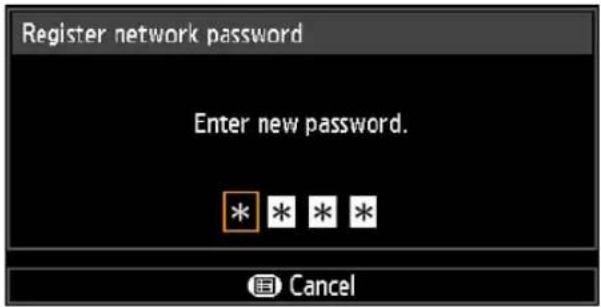
text_image
Register network password Enter new password. * * * * CancelNetwork standby settings

[Network settings] > [Network standby settings]
Specify the network function operating status in standby mode as follows.
| Option Function | |
| Normal | All network functions are available even in standby mode, including the web screen, control over the network, and PJLink. |
| Low-power | All network functions are available even in standby mode. However, the projector may be less responsive than usual when some functions are initially used. |

- [Low-power] may delay access over the network for some functions. For faster access, select [Normal].
- Power consumption when Network function is [On] varies depending on whether Network standby settings is set to Normal or Low-power.
- This setting can also be adjusted from the power saver settings screen by pressing the LAMP button on the remote control.
Network function

[Network settings] > [Network function]
Enable or disable network function.
Specifying [Off] can save energy.
| Option Function | |
| Off Disable the network function. | |
| On Enable the network function. | |
Detailed settings

[Network settings] > [Detailed settings]
Display and manually change the IP address, gateway address, and other settings. Available only when the network function is [On].

text_image
Detailed settings IP address 192. 168. 254. 254 Gateway address 0. 0. 0. 0 MAC address DHCP Off TCP/IP settings Network setting initialization Return| Menu Function | |
| IP address IP address of the projector. | |
| Gateway address Gateway address of the projector. | |
| MAC address MAC address of the projector. | |
| DHCP |  |
| TCP/IP settings | This menu is not available (grayed out) when [DHCP] is [On].If an invalid value is entered, the message “Invalid entry” appears. If this occurs, enter a valid value. |
| Network setting initialization | The following network settings are initialized.Settings configured from the projector menuNetwork settings lock (P130)Network password setting (P130)Register network password (P130)Network standby settings (P131)Network function (P131)Detailed settings(P132)PJLink (P134)AMX Device Discovery (P135)Crestron RoomView (P135)Settings configured from the web screen[Password] (P143)[Network] (P144)[NMPJ Password] (P145)[Mail] (P146)[Mail auth] (P147)[SNMP] (P148)[Projector info.] (P149)[PJLink] (P150) |
PJLink

[Network settings] > [PJLink]
You can enable or disable the PJLink network function of the projector.
When this function is enabled, control is possible over a network using PJLink commands.
| Option Function | |
| Off Disables the PJLink function. | |
| On Enables the PJLink function. | |

- The projector conforms to Class 1 as defined in PJLink standards established by the Japan Business Machine and Information System Industries Association (JBMIA). This projector supports all commands that are defined by PJLink Class 1, and has been verified as conforming to the PJLink standard Class 1 definition.
- For details on using PJLink, see "Setting PJLink [PJLink]" (P150).
What is PJLink?
In September 2003, the PJLink Working Group was established under the Data Projector Committee. During the first year, this PJLink Working Group standardized PJLink as a new interface specification for projectors.
PJLink is a unified standard for operation and control of projectors.
It allows centralized control of projectors and operation from a controller for all projectors regardless of manufacturer.
The objective is for JBMIA to improve convenience for users and expand the use of projectors through early systemization for network monitoring and control of projectors, which will become the mainstream in the future.
Class 1: Standardization of control and monitoring specifications for basic projector functions
Basic projector control: Power control, input selection, etc.
Acquisition of projector information and status: Power status, input selection status, error status, lamp use time, etc.
JBMIA: Japan Business Machine and Information System Industries Association.
The JBMIA is an organization which was launched in 1960 and changed its name on April 1, 2002.
PJLink website: http://pjlink.jbmia.or.jp/english/

PJLink is a registered trademark of JBMIA and pending trademark in some countries.
PJLink is a registered trademark, or an application has been submitted for trademark, in Japan, the United States and / or other countries or regions.
AMX Device Discovery

[Network settings] > [AMX Device Discovery]
In a network environment, AMX Device Discovery can be used to enable other equipment to discover the projector. For networks without AMX Device Discovery, select [Off].
| Option Function | |
| Off Disables AMX Device | Discovery. |
| On | Enables AMX Device Discovery. The projector will periodically send out AMX beacon packets over the network. |

- For details on AMX Device Discovery, visit the AMX website. http://www.amx.com/
Crestron RoomView

[Network settings] > [Crestron RoomView]
Crestron RoomView enables centralized management of multiple projectors over a network. Networked projectors can be remotely controlled to troubleshoot issues, check the useful life of lamps, or turn the projectors on or off. Specify whether to use Crestron RoomView.
| Option Function | |
| Off Disable Crestron RoomView. | |
| On | Enables Crestron RoomView. A port for RoomView will be opened, and the projector will respond to CIP packets. Communication is possible via the RoomView Express/Server application or via Crestron Controller. (P150) |

- For details on Crestron RoomView, visit the Crestron® website. http://www.crestron.com/
Completing Computer Settings
Specifying an IP Address
Instructions for setting a computer's IP address are as follows for each operating system.
■Windows 10
1 Right-click the Start button (Windows logo) in the lower left of the screen.
- In desktop mode (from the desktop screen)
The same operation is possible by pressing Win+X.
2In the shortcut menu displayed in the lower left, click [Control Panel].
3Click [View network status and tasks].
- In Icon View:
Click [Network and Sharing Center].
4Click [Change adapter settings].
5Right-click [Ethernet], and then click [Properties].
6In the [This connection uses the following items] list, select [Internet Protocol Version 4 (TCP/IPv4)] and click the [Properties] button. Make a note of the original network settings (IP address, subnet mask, default gateway, etc).
7 Select [Use the following IP address] and set the IP address and subnet mask.
The factory default IP address for the projector is "192.168.254.254". Set an IP address which is different from this.
8 When finished, click the [OK] button, and then click the [Close] button in the [Ethernet Properties] window to close it.
■Windows 8 / 8.1
1 Right-click on the start screen background and click [All Apps] in the lower right.
- Windows 8.1 Users: Click the down arrow in the lower left of the start screen.
2Click [Control Panel].
- From the Desktop: Press Win+X. In the shortcut menu displayed in the lower left, click [Control Panel].
3Click [View network status and tasks].
- In Icon View: Click [Network and Sharing Center].
4Click [Change adapter settings].
5Right-click [Ethernet], and then click [Properties].
6In the [This connection uses the following items] list, select [Internet Protocol Version 4 (TCP/IPv4)] and click the [Properties] button. Make a note of the original network settings (IP address, subnet mask, default gateway, etc).
7 Select [Use the following IP address] and set the IP address and subnet mask. The factory default IP address for the projector is “192.168.254.254”. Set an IP address which is different from this.
8 When finished, click the [OK] button, and then click the [Close] button in the [Ethernet Properties] window to close it.
■Windows 7
1 From the PC [Start] menu, select [Control Panel].
2Click on [Network and Internet], then click on [View network status and tasks].
3From the menu on the left side of the window, click on [Change adapter settings].
4Right-click [Local Area Connection], and open [Properties].
5Select [Internet Protocol Version 4 (TCP/IPv4)] and click the [Properties] button. Make a note of the original network settings (IP address, subnet mask, default gateway, etc).
6Select [Use the following IP address] and set the IP address and subnet mask.
The factory default IP address for the projector is "192.168.254.254". Set an IP address which is different from this.
7 When the settings are completed, click the [OK] button and then click the [OK] button on the [Local Area Connection Properties] window to close it.
■Windows Vista
1 From the PC [Start] menu, select [Control Panel].
2Click on [View network status and tasks].
3From the menu on the left side of the window, click on [Manage network connections].
4Right-click [Local Area Connection], and open [Properties].
5Select [Internet Protocol Version 4 (TCP/IPv4)] and click the [Properties] button. Make a note of the original network settings (IP address, subnet mask, default gateway, etc).
6Select [Use the following IP address] and set the IP address and subnet mask.
The factory default IP address for the projector is “192.168.254.254”. Set an IP address which is different from this.
7 When the settings are completed, click the [OK] button and then click the [OK] button on the [Local Area Connection Properties] window to close it.
■Mac OS X
1 Open the Apple Menu and select [System Preferences].
2In the System Preferences window, click [Network] to display the Network window.
3Select [Built-in Ethernet] and click the [TCP/IP] tab. Make a note of the original network settings (IP address, subnet mask, router, DNS server, etc.).
4Create a new network environment and set the IP address and subnet mask.
The factory default IP address for the projector is "192.168.254.254". Set an IP address which is different from this.
5Click [Apply] to close the network preference window.
■Resetting the IP Address Setting of the Computer
Follow the same procedure as for changing the IP address and reset the values to the original values based on the notes taken before the change.
Setting Up the Network
■Displaying the Network Configuration Screen
1 Turn on the computer and projector.

Network functions are not available for the first 40 seconds after projector startup.
2 Launch a web browser, enter "http://projector IP address)" in the address bar, and press the Enter key.
The projector web screen appears.
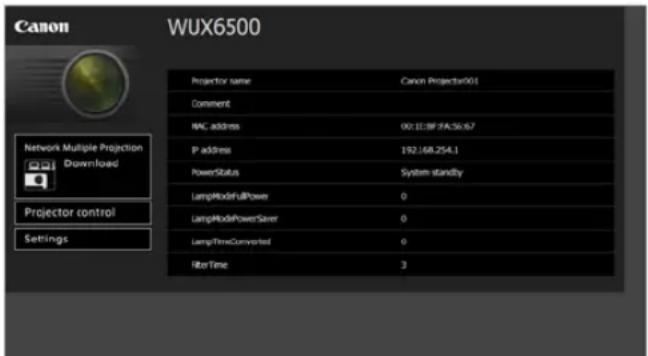
text_image
Canon WUX6500 Projector name Canon ProjectorX01 Comment MAC address 00:11.8F FA:36.67 P address 192.16R 254.1 PowerStatus System standby LampModeUPower 0 LampModePowerSaver 0 LampTimeConverted 0 Filter Time 3 Network Multiple Projection Download Projector control SettingsThe following information is displayed.
| Network Multiple Projection Download | For downloading the Networked Multi-Projection (NMPJ) program.* |
| Projector control Displays the projector control screen. | |
| Settings Shows the settings screen. | |
| Projector name The name of the projector on the network | |
| Comment Relevant notes, such as where the projector is installed | |
| MAC address The MAC address of the projector | |
| IP address The IP address of the projector | |
| PowerStatus The power status of the projector | |
| LampModeFullPower Lamp operating time in [Full power] lamp mode | |
| LampModePowerSaver Lamp operating time in [Power saver] lamp mode | |
| LampTimeConverted Lamp operating time (converted value) | |
| FilterTime Air filter operating time | |
| Alert Error message (if an error has occurred)Temperature abnormalityFaulty lampFaulty cooling fanFaulty air filter unitFaulty power supplyFaulty lens connectorUnknown error | |
* For details on downloading the Networked Multi-Projection (NMPJ) application, refer to the NMPJ user's manual.

The factory default IP address is "192.168.254.254". If DHCP settings are used, ask the network administrator for the projector IP address. It is possible to check the IP address from the projector menu. (P132)
3Click [Settings] on the web screen.
The password input window appears.
4Enter the user name and password on the password input window, then click [OK].
The factory default user name is "root" and the password is "system". The settings screen is displayed. Complete the network settings on this screen.
![CANON REALiS WX6500 D - 4Enter the user name and password on the password input window, then click [OK]. - 1](/content/2026/06/1190230/images/d65b8b4a74c7c50913d3567b8ffb0e8a87af536198d23be957a7087475054aaa.jpg)
text_image
WUX6500 Canon Projector001 Password User name: root 4-15 characters New password: ******** 4-15 characters Custom new password: ******** 4-15 characters OK Cancel![CANON REALiS WX6500 D - 4Enter the user name and password on the password input window, then click [OK]. - 2](/content/2026/06/1190230/images/cc4a1a7b149c730e2e25605100f65f4dc78a772f2af132fdada76bce4da5e897.jpg)
To control the projector from the computer, click [Projector control]. (P154)
■Network Setting
1 Select a function to set up from the settings screen menu.

text_image
WUX6500 Canon Projector001 Projector control Back to top Password Network NMPJ Password Mail Mail auth Send text mail SNMP Projector info. PLink Ciestron Initiate Wire network status MAC address 00:1E:3F:FA:56.67 DHCP Off IP address 192.148.254.1 Submit mask 266.288.268.9 Default gateway 30.68 OK Cancel2Enter setting details in the fields shown (1), and then click [OK] (2).
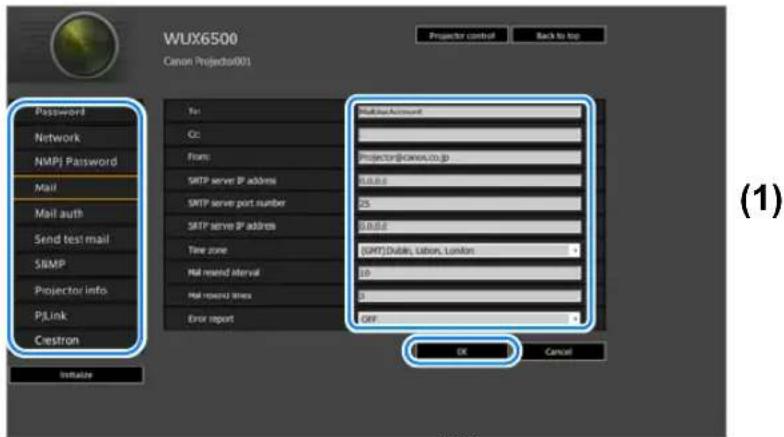
text_image
WUX6500 Canon Projecta001 Projector control Back to top Password Network NMPJ Password Mail Mail auth Send test mail SNMP Projector info PJLink Ciestron Initiate To: Qc: From: SRTP serve IP address SRTP serve port number SRTP serve IP address Time zone Mail round interval Mail round time Error report Status Account Projector@conn.co.jp 80.0.6 25 90.0.6 [GMT]Dublin, Lablon, London 10 9 OFF OK Cancel (1)(2)
3A confirmation window appears. Check the contents and if they are correct, click [Apply].

text_image
WUX6500 Canon Projector001 Projector control Back to top Password Network NMPJ Password Mail Mail auth Send test mail SNMP Projector info. PLink Crestron Initiate Save and apply settings. OK? IE: MathNet Account CE: From: Projector@canos.co.jp SMTP server IP address: 0.0.0.0 SMTP server port number: 25 SMTP server IP address: 0.0.0.0 Time zone: [OMT] Dublin, Lisbon, London Mail send interval: 10 Mail send times: 3 Error report: OFF Apply CancelThe settings are applied to the projector.
Selecting [Network] or [Password] in the menu will cause this message to be displayed: "Save completed. Please change setting and reconnect."
If you select functions other than above, "Save completed" is displayed. Click [Back to top] to return to the top page of the web screen.
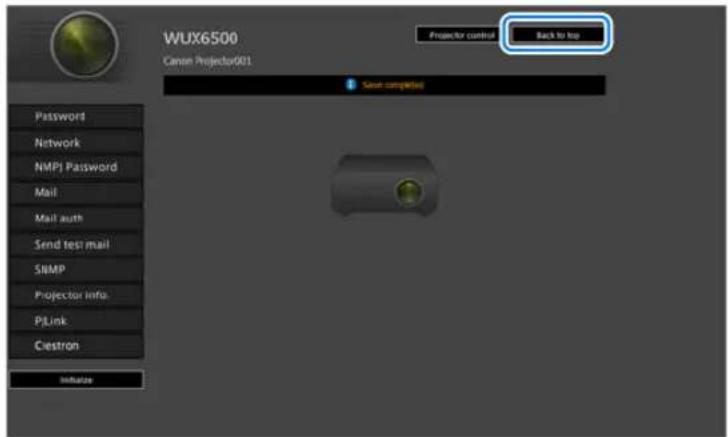
text_image
WUX6500 Canon Projector001 Projector control Back to top Save completed Password Network NMP1 Password Mail Mail auth Send test mail SNMP Projector info. PLink: Crestron InstituteSetting a Password [Password]
From [Password] in the settings screen, you can set a user name and password for web screen login. For the setting procedure, refer to "Network Setting" (P141).
![CANON REALiS WX6500 D - Setting a Password [Password] - 1](/content/2026/06/1190230/images/891edb2be8496ea1adf50cd24bf51968bba27ba4d8ab06dd97281ca1db702198.jpg)
text_image
WUX6500 Canon Projectu001 Password Network NMPJ Password Mail Mail auth Send test mail SIMP Projector info. PLink Crestron Initiate User name root 4.15 characters New password ******** 4.15 characters Custom new password ******** 4.15 characters OK Cancel| Item Explanation | Factory default setting | |
| User name When logging | into the web screen,enter the user name in 1-byte alphanumeric characters and symbols (4 -15 characters). | root |
| New password When logging | ing into the web screen,enter the password in 1-byte alphanumeric characters and symbols (4 -15 characters). | system |
| Confirm new password For confirmation, enter the same password that you entered in [New password]. | system | |
Setting Basic Information [Network]
From [Network] in the settings screen, you can log into the web screen and set basic network information. For the setting procedure, refer to "Network Setting" (P141).
![CANON REALiS WX6500 D - Setting Basic Information [Network] - 1](/content/2026/06/1190230/images/4dd383d4cf6359746051e738f004db23c15be3bb10d918300d030554a522a520.jpg)
text_image
WUX6500 Cancel Projector001 Projector control Back to top Password Network NIMP Password Mail Mail auth Send test mail SIMP Projector info. PS link Cestron Initialize Wire network status MAC address 00:1E:3F:FA:56.57 OKCF OFF BAddress 192,148,254.1 Subset mask 206,206,305.0 Default gateway 80.64 OK Cancel| Item Explanation | Factory default setting | |
| MAC address Shows the projector's MAC address. The MAC address of the projector | ||
| DHCP Select whether to turn the DHCP function on or off. The following settings cannot be configured manually when this setting is [ON], because the IP address is acquired from the server.[IP address][Subnet mask][Default gateway] | OFF | |
| IP address Enter the IP address of the projector in 1-byte numbers. | 192.168.254.254 | |
| Subnet mask Enter the subnet mask in 1-byte numbers. | 255.255.255.0 | |
| Default gateway Enter the default gateway IP address in 1-byte numbers. | 0.0.0.0 | |
![CANON REALiS WX6500 D - Setting Basic Information [Network] - 2](/content/2026/06/1190230/images/da9aa9d8ef5abb9807409f36dbcaf450c4ad2d7cbfead6762203ab9224eb2365.jpg)
If settings related to TCP/IP were changed, it is necessary to disconnect and reconnect to the network.
If the network subnet mask was changed, select [Subnet mask] in the above screen and set the new subnet mask.
Specifying Networked Multi-Projection Settings [NMPJ Password]
From [NMPJ Password] in the settings screen, you can specify the items needed for NMPJ authentication. For the setting procedure, refer to "Network Setting" (P141).
![CANON REALiS WX6500 D - Specifying Networked Multi-Projection Settings [NMPJ Password] - 1](/content/2026/06/1190230/images/3be80878407a77e45a640bbd9aa884f22f02d22621438a5a1dabe5ad83f92c9a.jpg)
text_image
WUX6500 Canon Projector001 Password Network NAPI Password Mail Mail auth Send text mail SIMP Projector info. PLink Ciestron Initialize Projector control Back to top Password 0-15 characters Confirm password 0-15 characters OK Cancel| Item Explanation Factory default setting | ||
| Password Enter the password required for a networked multi-projection connection in single-byte alphanumeric characters (0-15 characters). | ||
| Confirm password For confirmation, enter the same password as you entered in [Password]. | ||
![CANON REALiS WX6500 D - Specifying Networked Multi-Projection Settings [NMPJ Password] - 2](/content/2026/06/1190230/images/91b41246f0340eb73486160182ba1afcf4222d61c389e4379033d17d245f7496.jpg)
For details on Networked Multi-Projection (NMPJ), refer to the NMPJ user's manual.
Setting Up Email [Mail]
From [Mail] in the settings screen, you can set the items necessary to send error mails and test mails. For the setting procedure, refer to "Network Setting" (P141).
![CANON REALiS WX6500 D - Setting Up Email [Mail] - 1](/content/2026/06/1190230/images/6b6ffb7089cb2abd82bdd04898cebd2a049f51a1cb3ead085e3c8241a8c5d73d.jpg)
text_image
WUX6500 Canon Projecto4001 Projector control Back to top Password Network NMPJ Password Mail Mail auth Send test mail SlAMP Projector info. PLink Crestron Initiate File: Mail: Account Cc: From: Projector @Canon.co.jp SRTP server IP address: 0.0.0.0 SRTP server port number: 25 SRTP server IP address: 0.0.0.0 Time zone: (SRT)Oulite, Libors, London Mail reserved interval: 10 Mail reserved times: 3 Error report: OFF OK Cancel| Item Explanation Factory default setting | ||
| To: | Enter the recipient address for error mails in 1-byte alphanumeric characters and symbols (1 - 63 characters). | MailUserAccount |
| Cc: | Enter the CC address for error mails in 1-byte alphanumeric characters and symbols (1 - 63 characters). | |
| From: | Enter the sender address for error mails in 1-byte alphanumeric characters and symbols (1 - 63 characters). | Projector@canon.co.jp |
| SMTP server IP address Enter the SMTP server IP address in 1-byte numbers. | 0.0.0.0 | |
| SMTP server port number | Enter the SMTP server port number in 1-byte numbers (1 - 65535). | 25 |
| SNTP server IP address Enter the SNTP server IP address in 1-byte numbers. | 0.0.0.0 | |
| Time zone Select the time zone where the projector is used. | (GMT) Dublin, Lisbon, London | |
| Mail resend interval* Enter the interval for resending mail when an error occurred (unit: seconds) within the range of 0 - 59 seconds using 1-byte numbers. | 10 | |
| Mail resend times Enter the number of times to resend mail when an error occurred within the range of 0 - 255 using 1-byte numbers. | 3 | |
| Error report Select whether to turn the error mail sending function on or off. | OFF | |
* When the interval is set to 0 seconds, repeated attempts to send mail are made (as set in [Mail resend times]) without pausing between attempts.
Mail Authentication Settings [Mail auth]
From [Mail auth] in the settings screen, you can configure the settings for authentication of mail that is sent when an error occurs. For the setting procedure, refer to "Network Setting" (P141).
![CANON REALiS WX6500 D - Mail Authentication Settings [Mail auth] - 1](/content/2026/06/1190230/images/3f5759a07fc67c4c37e90caa2815460215adba9c56e81d5d61853ae69c85df26.jpg)
text_image
WUX6500 Canon Projector001 Projector control Back to top Password Network NIMP Password Mail Mail auth Send test mail SIMP Projector info. PLink Crestron Initiate Mail authentication Off User value Password Confirm password POP name: 2.000000 59484 POP name: port number 110 POP button: PROF response rate 300 OK Cancel| Item Explanation | Factory default setting | |
| Mail authentication Select | the mail authentication method. If OFF is selected, the other mail authentication settings cannot be changed. | OFF |
| User name | Enter the user name to use for mail authentication in 1-byte alphanumeric characters and symbols (1 - 63 characters). | |
| Password | Enter the password for mail authentication in 1-byte alphanumeric characters and symbols (1 - 63 characters). | |
| Confirm password For con | confirmation, enter the same password as you entered in [Password]. | |
| POP3 server IP address | Enter the POP3 server IP address in 1-byte numbers. | 0.0.0.0 |
| POP3 server port number | Enter the POP3 server port number in 1-byte numbers (1 - 65535). | 110 |
| POP before SMTP response time | Enter the SMTP authentication timeout period after POP3 authentication (unit: milliseconds) using 1-byte numbers (0 - 9999 milliseconds). | 300 |
Sending a Test Mail [Send test mail]
From [Send test mail] in the settings screen, you can send a test mail to the mail address that was set in [Mail]. The settings cannot be changed from this screen.
![CANON REALiS WX6500 D - Sending a Test Mail [Send test mail] - 1](/content/2026/06/1190230/images/3989476384554e4a1ba068c23ebfedf17b14bd11aa4148496d625a528ba10543.jpg)
text_image
WUX6500 Canon Projecta001 Password Network NMPJ Password Mail Mail auth Send test mail SkMP Projector info PLink Crestron Initiate To: Mailback account Cc: From: Projector@canox.co.jp Subject: Canon Projector test Send| Item Explanation | |
| To: | The recipient address which was set from [Mail] in the settings screen (P146) is displayed. |
| Cc: | The CC address which was set from [Mail] in the settings screen (P146) is displayed. |
| From: | The sender address which was set from [Mail] in the settings screen (P146) is displayed. |
| Subject: The | predetermined mail title “Canon Projector test” is displayed. |
SNMP Settings [SNMP]
From [SNMP] in the settings screen, you can configure the settings related to control of projectors which use SNMP (Simple Network Management Protocol). For the setting procedure, refer to "Network Setting" (P141).
![CANON REALiS WX6500 D - SNMP Settings [SNMP] - 1](/content/2026/06/1190230/images/3e403c876950456f5a3f312fe4010b501da041ee36241d44fd2fe5ac6ddc6853.jpg)
text_image
WUX6500 Canon Projector001 Password Network NMPJ Password Mail Mail auth Send test mail SNMP Projector info PLink Cestron Initiate Projector control Back to top SNMP CNF Service Community Password 0.15 Custom password 0.15 OK Cancel| Item Explanation | Factory default setting | |
| SNMP Select the SNMP function version. If OFF is selected, the SNMP function will be turned off and the other settings in this screen cannot be changed. | OFF | |
| Receive community Enter | the community name which will receive projector information in 1-byte alphanumeric characters and symbols (1 - 15 characters). | |
| Password Enter the community settings password in 1-byte alphanumeric characters and symbols (8 - 15 characters). It can be set only when the SNMP version is V3. | ||
| Confirm password For confirmation, enter the same password as you entered in [Password]. | ||
Setting Projector Information [Projector info.]
From [Projector info.] in the settings screen, you can enter relevant comments such as projector names and locations where projectors are installed so that the information can be used to identify projectors when multiple projectors are installed on the network. For the setting procedure, refer to "Network Setting" (P141).
![CANON REALiS WX6500 D - Setting Projector Information [Projector info.] - 1](/content/2026/06/1190230/images/b661df55f86e5c279cfe7b8da20de9decf455ae80854ed24a4819b5e4d14840c.jpg)
text_image
WUX6500 Canon Projector001 Projector control Back to top Password Cancel (Projector001) Network NMPJ Password Mail Mail auth Send test mail SIMP Projector info. PLink Ciestron Initiate Comment OK Cancel| Item Explanation Factory default setting | ||
| Projector name Enter the | projector name in 1-byte alphanumeric characters and symbols (1 - 63 characters). | Canon Projector001 |
| Comment | Enter any relevant notes, such as where the projector is installed. | |
![CANON REALiS WX6500 D - Setting Projector Information [Projector info.] - 2](/content/2026/06/1190230/images/e06ac17752ed70d6fa5b7c6dfa4a1e47ea7d3b986f1f00dee7d91e9b52ac5b6a.jpg)
Some characters such as # cannot be used for [Projector name] and [Comment].
Setting PJLink [PJLink]
From [PJLink] in the settings screen, you can set the PJLink functions which are the standard for projector management on a network. For the setting procedure, refer to "Network Setting" (P141). For information about PJLink, refer to "What is PJLink?" (P134).
![CANON REALiS WX6500 D - Setting PJLink [PJLink] - 1](/content/2026/06/1190230/images/51c0addb8eb6467c9aaed67c2e6b0e2524f812552d62a80884e50007eeb6f25e.jpg)
text_image
WUX6500 Canon Projector001 Projector control Back to top Password Network NMPJ Password Mail Mail auth Send test mail SIMP Projector info. PLink Ciestron Initiate PLink OK PLink authentication OK Password ****** Custom password ****** OK Cancel| Item Explanation | Factory default setting | |
| PJLink Turn the PJLink function on or off. If OFF is selected, the PJLink function will be turned off and the other settings in this screen cannot be changed. | ON | |
| PJLink authentication Select whether to turn the PJLink authentication function on or off. The following settings cannot be changed when this setting is [OFF]. [Password] [Confirm password] | ON | |
| Password Enter the PJLink authentication password in 1-byte alphanumeric characters (1 - 32 characters). | system | |
| Confirm password For confirmation, enter the same password that you entered in [Password]. | system | |
Setting Up a Controller Manufactured by Crestron Electronics [Crestron Controller]
The [Crestron e-Control] screen will open. For details on the Crestron Controller, visit the Crestron website.
http://www.crestron.com/
Setting Errors
When a setting-related error occurs, the error name is displayed on the screen, and a “!” mark is displayed next to the input field which caused the error.

text_image
WUX6500 Canon Projecta001 Password setting error Password User name root 4-15 characters New password masked 4-15 characters Confirm new password masked 4-15 characters OK Cancel InitiateThe error meanings are as shown below.
| Error Meaning | |
| Input error A setting outside the valid range | was set on the settings screen. |
| Password setting error The set password and confirmation password did not match. | |
| Invalid SMTP The SMTP server IP address has not been set. | |
| System failed to connect SMTP server. Failed to connect to the SMTP server when sending a test mail. | |
| System failed to connect POP3 server. Failed to connect to the POP3 server attempting to send a test mail. | |
| System doesn’t support this auth type. An authentication type was set which is not supported by the server. | |
| System failed to authenticate. Authentication failed attempting to send a test mail. | |
| The system failed to send the test mail. Sending of test mail failed due to a connection failure with the SMTP server or an error which does not ordinarily occur. | |
| Unknown error Unknown error | |
Resetting Network Settings to the Default Settings
1 Perform steps 1 - 3 on "Displaying the Network Configuration Screen" (P139) to display the settings screen.
2Click [Initialize].
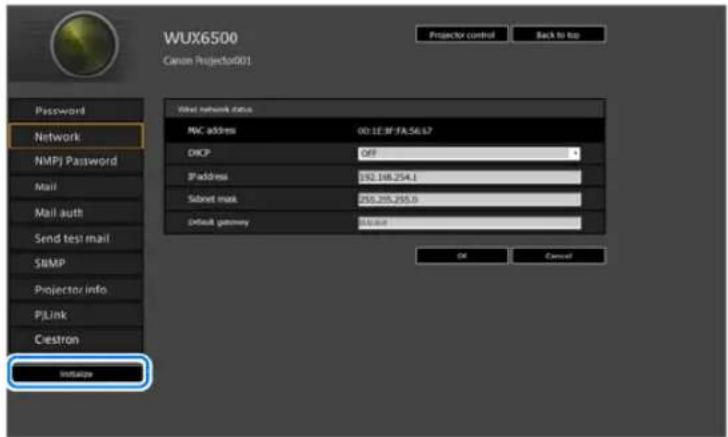
text_image
WUX6500 Canon Projector01 Projector control Back to top Password Network NMPJ Password Mail Mail auth Send test mail SNMP Projector info PJLink Ciestron Initiate Wire network status MVC address 00:1E:3F FA:56.57 OKP Off IP address 192,148,254.1 Subset mask 250,295,255.0 Default gateway 8x8x8 OK Cancel3A confirmation window appears. Click [OK].
■Error Notification Mails
The messages shown in the following error list are sent when an error occurs in the projector.
Error list
| Errors related to temperature | Error name T | temperature abnormality |
| Text The | temperature inside the projector is too high for some reason or the outside air temperature is higher than the specified one.If the problem is inside the projector, check whether the projector is installed and operated normally, turn off the projector to cool its inside, and retry projection. If the same warning occurs again, the projector may be defective. Contact your dealer. | |
| Errors related to the lamp | Error name F | Faulty lamp |
| Text The | lamp has burnt out. Replace the lamp with a new one. If the same warning occurs again, the lamp drive circuit may be defective. Contact your dealer. | |
| Errors related to the fan | Error name F | Faulty cooling fan |
| Text The | cooling fan or another component may be defective.Contact your dealer. | |
| Errors related to the air filter | Error name F | Faulty air filter unit |
| Text The | air filter unit is not installed properly.Check whether the air filter unit is installed properly.If it is installed properly, the air filter unit detection switch may be defective. Contact your dealer. | |
| Errors related to the power | Error name F | Faulty power supply |
| Text The | voltage of part of the power supply is abnormally high or any other problem has occurred in the power supply.Contact your dealer. | |
| Errors related to the lens connector | Error name F | Faulty lens connector |
| Text The | lens cable is not connected to the lens unit. Check whether the lens cable is connected to the lens unit properly. If it is connected properly, the lens connector or cable may be defective. Contact your dealer. |
Controlling the Projector from a Computer
When the projector is connected to a network, it is possible to control the projector from a computer via the network.
1Turn on the computer and projector.
2Launch a web browser, enter "http://(projector IP address)" in the address bar, and press the Enter key.
The projector web screen appears.

The factory default IP address is "192.168.254.254". If DHCP settings are used, ask the network administrator for the projector IP address. It is possible to check the IP address from the projector menu.
3Click [Projector control] on the web screen.
The password input window appears.
4Enter the user name and password on the password input window, then click [OK].
The factory default user name is "root" and the password is "system".
The projector control screen appears.
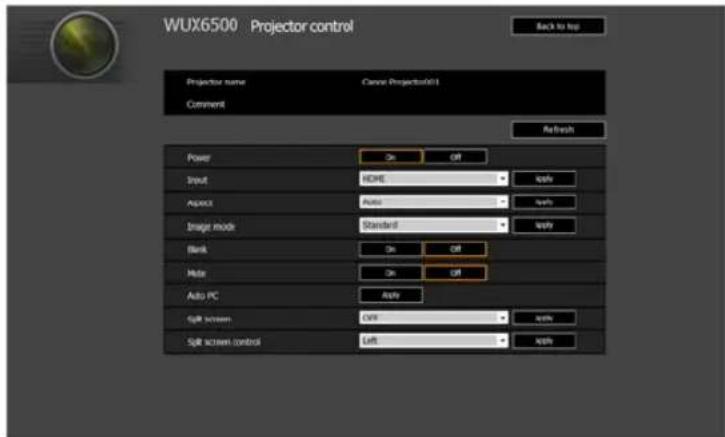
text_image
WUX6500 Projector control Back to top Projector name Cancel Projector@1 Comment Refresh Power On Off Input HDMI Apply Aspect Auto Apply Image mode Standard Apply Blank On Off Mode On Off Auto PC Apply Split screen Left Apply Split screen control Left ApplyThe projector can be controlled from this screen.
| Item Explanation | |
| Projector name | The name of the connected projector is displayed. (P149) |
| Comment | Shows notes, such as where the projector is installed. (P149) |
| Refresh Refreshes | the displayed contents with the most recent information. |
| Power Turns projector power on or off. | |
| Input Select an input signal and click [Apply] to change to that input signal. (P56) | |
| Aspect | Select an aspect and click [Apply] to change to that aspect. (P65) |
| Image mode Select an image mode and click [Apply] to change to that image mode. (P70) | |
| Blank Switches the blank setting on or off. (P72) | |
| Mute Switches the mute setting on or off. (P36) | |
| Auto PC | Click [Apply] to perform Auto PC adjustment. (P58) |
| Split screen Select the setting for split-screen mode and click [Apply] to switch to split-screen projection. | |
| Split screen control | Select the control rights setting for split-screen mode and click [Apply] to switch the side currently under control. |
| Information The control results and control error information are displayed at the top of the screen. | |
5When the operations are finished, click [Back to top] to return the initial web screen.
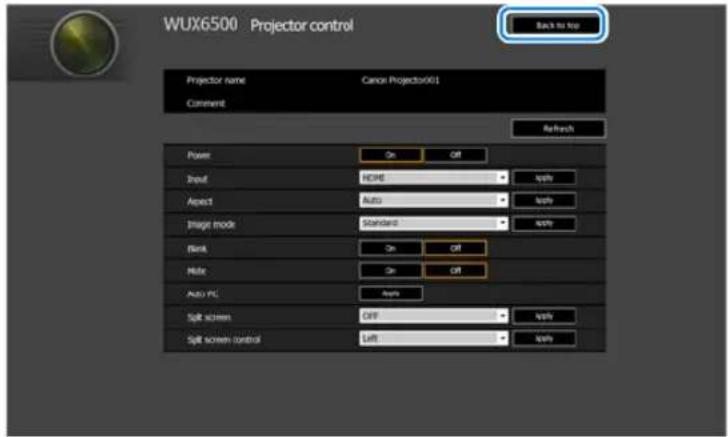
text_image
WUX6500 Projector control Back to top Projector name Cancel Projector001 Comment Refresh Power On Off Input NOMC Apply Aspect Auto Apply Image mode Standard Apply Flint On Off Mite On Off Auto PC Apply Split screen COFF Apply Split screen control Left ApplyChecking Projector Information
You can check information about the signal types of the images projected and other information.
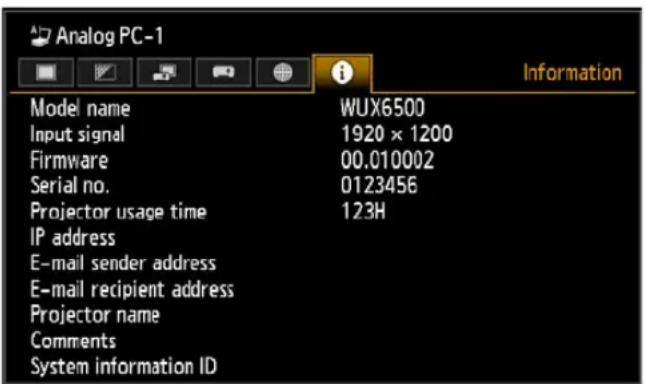
text_image
Analog PC-1 Model name Input signal Firmware Serial no. Projector usage time IP address E-mail sender address E-mail recipient address Projector name Comments System information ID WUX6500 1920 × 1200 00.010002 0123456 123H Information| Menu Function | |
| Model name Shows the model name. | |
| Input signal | Details of the input signal currently selectedInformation such as the type, resolution, frequency, and color format of the signal is displayed. |
| Firmware Current firmware version | |
| Serial no. Serial number unique to this projector | |
| Projector usage time Shows the total time the projector has been on. | |
| IP address* IP address used when connected to a network. | |
| E-mail sender address* | Sender e-mail address used for sending error mails (P146) |
| E-mail recipient address* | Displays [Already set] or [Not set] to show whether a recipient e-mail address has been set for receiving error mails. (P146) |
| Projector name* | Name which identifies this projector on the network (P149) |
| Comments* | Comments such as the location in which the projector is installed are displayed. (P149) |
| System information ID System information. Normally this is not displayed. | |
* The values are not displayed when network functions are [Off].
Advanced Projection
Projecting Images on a USB Flash Drive
JPEG images stored on a USB flash drive connected to the projector can be projected as follows. Individual images can be selected for projection, or you can project all images in a slideshow. JPEG images up to 10912×8640 can be projected.

- USB flash drives with security features are not recognized by the projector and cannot be selected as the image source.
- If the projector cannot mount the file system, the drive name is grayed out and the following icon is displayed. In this case, the USB flash drive cannot be used.

USB1 USB CARD1
1 Insert the USB flash drive in the USB port.
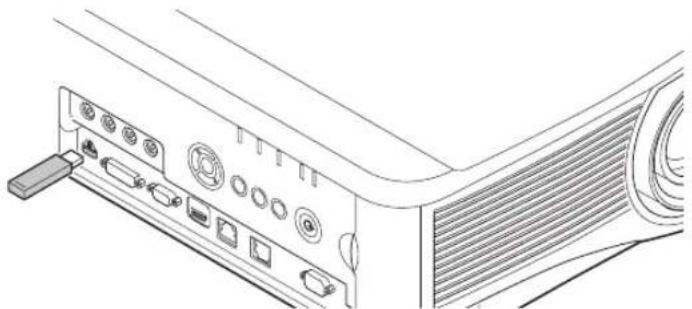
natural_image
Line drawing of a computer monitor rear panel with ports and ventilation slots (no text or symbols)Either connect the USB flash drive directly to the projector's USB port or use a USB cable to connect a USB multi-card reader. USB flash drives connected via a USB hub will not be recognized.
2Press the INPUT button to select [USB].
Thumbnails of JPEG files on the USB flash drive are now listed.
![CANON REALiS WX6500 D - 2Press the INPUT button to select [USB]. - 1](/content/2026/06/1190230/images/00212cabd8854009d5c19c73744054ebc93d0842a7aefd255647fc42030d3e6a.jpg)
text_image
123.00 Image 00 00 power_251.JPG power_853.JPG power_251.JPG power_254.JPG power_345.JPG power_358.JPG power_657.JPG power_258.JPG power_359.JPG power_553.JPG power_251.JPG power_252.JPG power_512.JPG File name: power_251.jpg File type: 1.jpg File size: 100x100x100mm File format: plain File type: plain COM/LOGISTICS![CANON REALiS WX6500 D - 2Press the INPUT button to select [USB]. - 2](/content/2026/06/1190230/images/348ce6cdae6b1cd629f159edba131ddbbe429d3b3cd689c6027f14a870c89776.jpg)
- Up to six USB flash drives, 999 folders, or 9,999 files can be displayed.
- If there are multiple drives, a drive selection screen is displayed. Use the [▲] ▼ [ ] buttons to select the desired drive, and then press the OK button. Files on the drive are now listed.
- On file and drive selection screens, you can switch between thumbnail and list display.
- Network input is not available when [USB] is selected as the other input signal in split-screen display.
3Select a file to project.

Motion blur reduction is not available when projecting JPEG files on a USB flash drive. (P123)
4Switch to other images as needed.
To switch to the previous image, press the [▲] button. To switch to the next image, press the [▼] button. To rotate images left 90°, press the [◀] button. To rotate images right 90°, press the ▶] button.
5After projection is finished, remove the USB flash drive.

The projector can also play a slideshow of images on a USB flash drive automatically. (P161)
Description of USB File Browser
If a USB flash memory is connected to the projector, the USB file browser appears. In the USB file browser, you can select the image file to be projected by operating the file list in the USB memory device.
Thumbnail view List view

text_image
(1) Last view Return 03 02 private_001.JPG private_002.JPG private_003.JPG private_004.JPG private_005.JPG private_006.JPG private_007.JPG private_008.JPG private_009.JPG private_010.JPG private_011.JPG private_012.JPG private_013.JPG (2) (3) (4)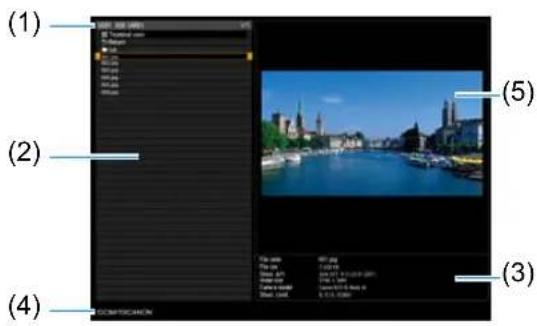
text_image
(1) (2) (4) (5) (3)(1) List title
Identifies the current USB flash drive and number of pages in the file list displayed. (Current page number/total number of pages)
(2) Drive/file list
Lists recognized USB flash drives and files in folders on the drive, by name. Select an image file or folder with the pointer buttons. The following icons are shown.
| Icon Function | |
| Recognized USB flash drive | |
| Unrecognized USB flash drive (in thumbnail view) | |
| Unrecognized USB flash drive (in list view) | |
| No removable media in the card reader or similar device | |
| Switch to list view (from thumbnail view) | |
| Switch to thumbnail view (from list view) | |
| Go to the parent folder | |
| Folder | |
| Unsupported JPEG file (in thumbnail view) | |

File or folder names in Arabic are not displayed correctly.
(3) File information area
Information of the image selected in the file list appears here.
- File name
- File size
- Shoot. d/t
- Image size
- Camera model
- Shoot. cond.
(4) File path area
Path name of the image selected in the file list appears here.
(5) Preview area (in list view)
Image selected in the Drive/file list appears with reduced size. ? displayed when an unsupported JPEG format is selected.
If a folder is currently selected, the folder icon appears.
Selecting an Image for Projection
This section describes the steps for selecting an image in the USB file browser and projecting on the screen.
■Selecting a Drive
This step may not be necessary when a USB flash drive is connected directly to the projector's USB port.
If a USB memory card reader having multiple memory slots is connected, the drive (memory slot) list is displayed in the file list.
Select the drive in which the memory card is inserted with [▲/ [ ], and press the OK button.
• Active drives are displayed in white text, while inactive drives are grayed out.
■Selecting a Folder
In list view, folders that contain images can be selected.
- To return to the higher level, select

■Selecting an Image File for Projection
When you select an image file, a small preview of the image is shown in the preview area.
For full-screen projection of the image, press the OK button.
To return to the higher level, select

■Changing the View
To switch the view, select [Thumbnail view] or [List view] in the drive or file list and press the OK button.
Operating the Projected Image
When images are projected, you can perform the following operations.
Project the previous or next image by pressing the [▲/ [ ]▼buttons.
Rotate images left or right 90° by pressing the [◀] / [ ] buttons.
Return to the USB file browser by pressing the OK button.
• These operations are also available during slideshows. (Except during transitions.)
- If the image contains rotational information, the image is rotated to an appropriate direction automatically.
Running a Slideshow of Data Saved in a USB Flash Memory
Multiple images on a USB flash drive can be projected consecutively, with each shown for a specific interval.
■Creating an Image File Folder
During slideshows, files in a folder are projected in alphabetical order by file name. Keep this in mind when preparing the files in a folder on the USB flash drive.
■Setting a Slideshow Interval
Set the projection interval in [Slideshow interval] (P95) in the menu.
Split-Screen Display
Two input images can be projected side by side. This is split-screen display. When you activate split-screen display, the current image is shown on the left side, and the new image is shown at right. You can change the source of images shown on each side by pressing the INPUT button. However, you cannot specify the same input signal (terminal) as the source for both sides.

Network and USB input cannot be combined for split-screen display. Similarly, HDBaseT and HDMI input, Analog PC-2 and Component input, or Digital PC and Analog PC-1 input cannot be combined.
1 Supply two signals to the projector.
2Press the MENU button on the remote control to select the [Input settings] tab.
3Select [Split screen] and set it to [On].
![CANON REALiS WX6500 D - 3Select [Split screen] and set it to [On]. - 1](/content/2026/06/1190230/images/e71b7ea8e55114f4360b98496d541ba57a8ece2ce42dba5b7d77e688c4240e4d.jpg)
- A number is displayed in the center of the screen. The screen at left is labeled "1," and the screen at right, "2." The image labeled with a number has "control rights," and the sound for that image will be played.
- For split-screen image adjustment, use the [Image priority] setting (P103).
- Some functions are not available, such as [Image flip H/V] (P105), [Screen aspect] (P105), [Keystone] (P106), [Digital image shift] (P107), [Professional settings] (P107) and [Logo capture] (P117).
- Image mode colors differ somewhat from those in single-image mode.
4If or is displayed in the center of the image area, you can switch control to the other side.
5Press the INPUT button, and then select the input signal for the side with control rights.
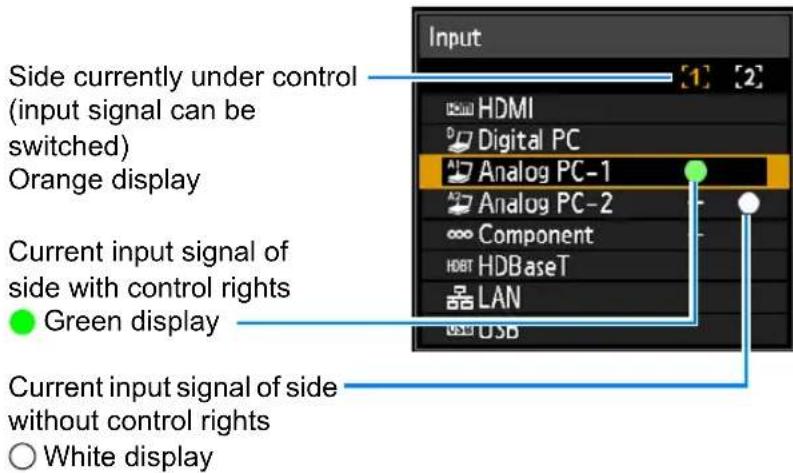
text_image
Side currently under control (input signal can be switched) Orange display Current input signal of side with control rights Green display Current input signal of side without control rights White display
- If you specify [LAN] or [USB] as an input signal, the screen width is evenly divided between the left and right areas. (P93)
- When projection resumes from standby or after the lamp is momentarily turned off in split-screen mode, display reverts to single-image mode, showing the input signal with display rights.
Projecting from Multiple Projectors at Once (Edge Blending)
Overlapping edges of images from multiple projectors used together can be blended to make the overall image more seamless.
■Basic Instructions
Follow these steps when using two projectors side by side.
1In the [Install settings] menu, select [Professional settings] > [Edge blending] > [Adjust].
![CANON REALiS WX6500 D - 1In the [Install settings] menu, select [Professional settings] > [Edge blending] > [Adjust]. - 1](/content/2026/06/1190230/images/5d86157ffb77525f2d0902e9c80f82011250e697d72b29380c85c6fb562e1ffc.jpg)
- If you have already completed edge blending settings, selecting [Adjust] will apply them.
- To restore the default settings before adjustment, select [Reset].
2Set [Marker] to [On].
Marker lines are projected on the images. The red marker indicates the start position for adjustment, and the green marker, the end position.
| Edge blending | ||
| Side | Width | Start position |
| Left | 0 | 0 |
| Right | 0 | 0 |
| Top | 0 | 0 |
| Bottom | 0 | 0 |
| Color blending adjustment | Off | |
| Black level adjustment | Off | |
| Marker | Off | |
| Reset | ||
| Corner adjustment | ||
| Return | ||
![CANON REALiS WX6500 D - 2Set [Marker] to [On]. - 1](/content/2026/06/1190230/images/825afc54ab36e114b76f8137807a55154fcfa2b1dc63d936d0c7150d1e3048a0.jpg)
By default, the green and red markers are displayed in the same position, so only the red marker is visible.
3Adjust [Start position] for the side where images overlap. Move the start marker to the outer edge of the overlapping area.
4Adjust [Width]. Move the end marker to the inner edge of the overlapping area.
The area between the starting and ending markers is called the blending area. Shading is applied to this area, and the brightness is adjusted to match portions that overlap with other areas. After you complete settings for one image, do the same thing for the other one to specify the blending area. Adjust the settings to make the blending area for each image the same.
5Set [Marker] to [Off].
■Color Adjustment
In overlapping projection, portions of images in the overlapping area that pick up other colors or are miscolored may be more noticeable. You can make this overlapping area appear less distracting by performing Color blending adjustment.
1In the [Install settings] menu, select [Professional settings] > [Edge blending] > [Adjust] > [Color blending adjustment] > [Adjust].
2As you watch the image, adjust the value to eliminate unwanted colors in the overlapping area.
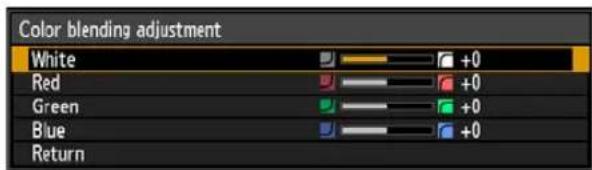
text_image
Color blending adjustment White +0 Red +0 Green +0 Blue +0 ReturnFirst adjust red, green, and blue together by changing the [White] value, and then adjust [Red], [Green], and [Blue] values individually.
3Repeat this adjustment on all projectors.
■Black Level Adjustment
In overlapping projection, dark colors are projected with less intensity than other colors in the overlapping area. You can make this overlapping area less distracting by adjusting the black level of non-overlapping image areas.
Left image Right image

text_image
Area where dark colors look lighter Position of end marker (hidden) D-area Blending areaHere, the non-overlapping image area (from the end marker toward the center of the image) is called area "D."
Normally, three areas are identified in the context of end markers: A, B, and C. In the following instructions, only area D is adjusted, and the widths of A, B, and C are left at the default value of 0.

To prepare for adjustment, set [No signal screen] to [Black], start projection with no input signal, and turn off the room lights, so that you can check dark image areas. (P117)
1In the [Install settings] menu, select [Professional settings] > [Edge blending] > [Adjust] > [Black level adjustment] > [Adjust].
2Select [Adjustment type] > [Black level].
3After selecting [D-area base], as you watch the image, adjust the values so that the brightness and colors of the blending area and area D match.
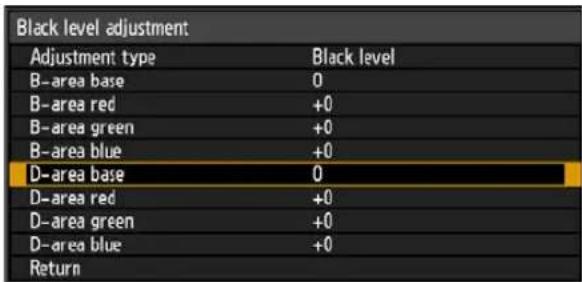
text_image
Black level adjustment Adjustment type Black level B-area base 0 B-area red +0 B-area green +0 B-area blue +0 D-area base 0 D-area red +0 D-area green +0 D-area blue +0 ReturnAdjust [D-area base] to lighten the black level, and adjust [Red], [Green], and [Blue] to obtain an optimal black level color tone, as needed.
4 Repeat this adjustment on all projectors.
■ Smoother Overlapping Areas
The black level along the right edge of area D (along the blending area) may be more noticeable than that of surrounding areas.
By adjusting the black level of area B, you can make the transition smoother.
To compensate, adjust each area as follows.

text_image
Left image CBAD-area Blending area
Position of end marker (hidden)
Area A: Black level cannot be adjusted.
Area B: Adjust to a black level different from that of area D.
Area C: Adjust to provide a smooth transition relative to the black levels of areas B and D.
Areas C-A (default: 0)
When the projected image has multiple blending areas (on the top, bottom, and each side), the width of areas A, B, and C must be adjusted to suit these blending areas.
In this example, instructions are given for adjusting area B.
1 In the [Install settings] menu, select [Professional settings] > [Edge blending] > [Adjust] > [Black level adjustment] > [Adjust].
2Select [Adjustment type] > [Area] > [Side] > [Right].
3Select [B-width], and then specify the width of area B.
Adjust the width of area B to roughly match the area where the black level is noticeable.
This will make the width of area D narrower.
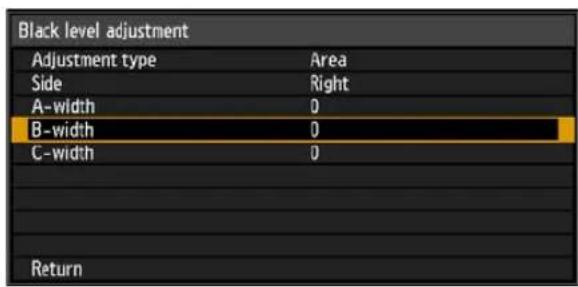
text_image
Black level adjustment Adjustment type Area Side Right A-width 0 B-width 0 C-width 0 Return4Shading is applied to this area, and the brightness is adjusted to match portions that overlap with other areas.

Results of adjusting the black level of area B are applied to all sides.
5As you watch the image, adjust the width of areas A, B, and C.
6Readjust the black level of area B, as needed.
• To reduce distracting colors and colors that are out of alignment in areas where the images overlap, perform [Color blending adjustment] targeting the main tone in the envisaged projected image.

- If you perform adjustments using [Color blending adjustment] or other menus, that may not eliminate the distracting colors and differences in brightness in areas where the images overlap.
- Blending can be fine-tuned by adjusting [Adjustment type] > [Black level] > [Red], [Green], and [Blue].
■Corner Adjustment
Projected images from multiple projectors used in overlapping projection must be precisely repositioned. Positions of each corner in the blending area can be aligned with the blending area of the reference projector.

- First, complete [Side] adjustment as described in "Basic Instructions" (P162).
- Sides set to an edge-blending width of 12 or more can be adjusted when [Keystone] is set to [Corner adjustment] and the aspect ratio is [16:10].
• To reset adjustment, use [Keystone] (P106). - A small edge-blending width may limit the amount of adjustment available.
1 On the reference projector, configure keystone (P106) and edge-blending (P109) settings, and then set the edge-blending markers to [On] (P163).
2In the [Install settings] menu, select [Professional settings] > [Edge blending] > [Adjust] > [Corner adjustment].
3Select a point to adjust, and move it so that the image as a whole looks symmetrical.

text_image
Edge blending corner adjustment Choose corner to adjust. Amount of adjustment is limited. If adjustment is not possible, change other points or projector position. Return Edge blending corner adjustment Adjust using direction keys. Amount of adjustment is limited. If adjustment is not possible, change other points or projector position. Return4As you watch the projected images, fine-tune markers of the projector you are adjusting so that they overlap the reference projector markers as much as possible.
Image from reference projector
Image from the projector adjusted

flowchart
graph TD
    A["Input 1"] --> C["Process Unit"]
    B["Input 2"] --> C
    D["Input 3"] --> C
Adjust positions of each of the four corners in the overlapping area. Correcting the position of one point will also move the point on the opposite side of the overlapping area, so that the screen as a whole is corrected.
5 Set the reference projector's edge-blending markers to [Off] (P163).
Other Information
Safety Instructions
Before Use
Basic Guide
Installation Procedure
Connection Procedure
Projection Procedure
Convenient Features
Advanced Guide
Using Menus
Menu Configuration
Menu Description
Advanced Projection
Other Information
Maintenance
Product Specifications
Troubleshooting
Cleaning the Projector and the Air Filter
Clean the projector frequently to prevent dust from settling on the surface.
A dirty lens may ruin the quality of the projected image.
Before cleaning the projector, always turn it off, unplug it after the cooling fan stops, and wait at least one hour. Otherwise, you may get burned because the main unit is very hot immediately after the projector is turned off.
Wipe the projector's main unit softly with a soft cloth.
If the projector is heavily soiled, soak the cloth in water with a small amount of detergent in it, squeeze the cloth thoroughly, and then wipe the projector with it.
After cleaning, wipe the projector with a dry cloth.
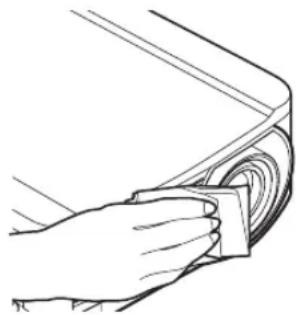
natural_image
Line drawing of a hand holding a small object near a curved surface (no text or symbols)
- Never use volatile cleaning liquid or benzine, as these may damage the finish of the projector.
- When using a chemical dust cloth, make sure to read the instructions thoroughly.
- When cleaning the projector's lens, use a commonly available air blower or lens cleaning paper. The lens surface is easily damaged, so do not use a hard cloth or tissues.
Request Internal Cleaning Regularly
Dust that accumulates over long periods without cleaning may eventually cause fire or electric shock. Once a year, request internal cleaning from the Canon Customer Support Center. (Note that a fee is charged.) Cleaning before damp, rainy seasons is especially effective.
Cleaning the Air Filter
The air filter protects the lens and mirror inside the projector from dust and dirt. Should the air filter become clogged with dust, the projector may be damaged since it will block the air flow into the projector and raise the internal temperature of the projector. The following screen is displayed when turning on the projector if the air filter needs to be cleaned. Clean the air filter if it is displayed.

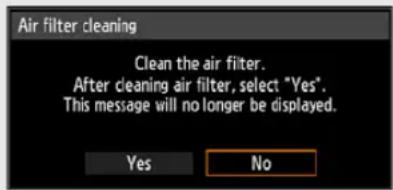
text_image
Air filter cleaning Clean the air filter. After cleaning air filter, select "Yes". This message will no longer be displayed. Yes No- Only the [◀], [▶], OK and POWER buttons are available while this screen is displayed. (When you press the POWER button, the "Push POWER button again to turn off power." message appears.)
-
When this screen has disappeared after being displayed for 10 seconds, all buttons become operable.
-
Turn the power of the projector off and pull out the power plug.
- Hook your finger around the air filter handle on the front of the projector and remove the air filter. Use a vacuum cleaner to clean off the dust.
- If the air filter cleaning screen is displayed when turning on the projector after cleaning the air filter, select [Yes] and press the OK button. The air filter counter is reset, and the message is no longer displayed.
- This screen is not displayed when [Air filter warning display] is set to [Off]. (P115) Reset the air filter counter manually. (P126)

Do not rinse the air filter in water. This may damage the air filter and projector.
Replacing the Air Filter
Follow the procedure below when replacing the air filter.
1 Turn off the projector power and remove the power plug.
2Hook your finger around the air filter frame handle on the side of the projector, and pull the air filter out to remove it.
3Remove the filter from the air filter frame. First disengage the tab on the inside, then remove the entire air filter from the frame.
4Install a new air filter into the frame. First insert the air filter tab into the groove on the handle side of the frame, then press the air filter into the frame.
5 Securely insert the frame holding the air filter, all the way into the projector.
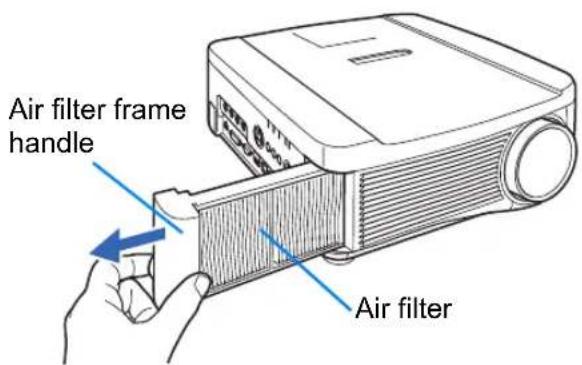
text_image
Air filter frame handle Air filter
text_image
Air filter Air filter frame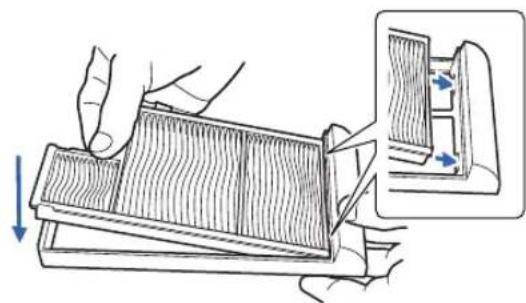
natural_image
Illustration of a hand holding a layered electronic component with an inset showing a close-up of its internal structure (no text or symbols present)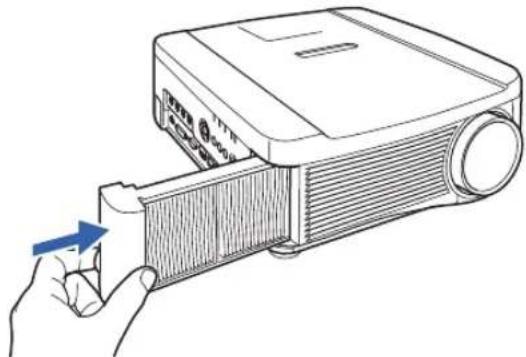
natural_image
Line drawing of a projector with a hand inserting a slide into it (no text or symbols)
- Handle the air filter carefully. If damaged, the air filter will not work properly.
- When the lamp is replaced, it is recommended that you also replace the air filter.
- Replacement lamp part no.: RS-LP11
- Contact the Canon Customer Support Center for further information.
- Replacement air filter part no.: RS-FL01
Replacing the Lamp
When the usage time of the lamp exceeds a certain amount of time, the following message (two types) is displayed for 10 seconds every time the projector is turned on.
2,700 hours to less than 3,000 hours
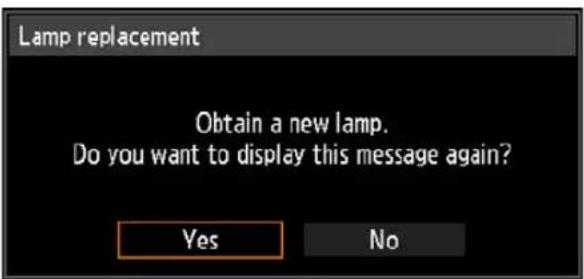
text_image
Lamp replacement Obtain a new lamp. Do you want to display this message again? Yes NoPrepare a new lamp when this screen is displayed.
- Only the [◀], [▶], OK, POWER, FOCUS, ZOOM and LENS SHIFT buttons are available while this screen is displayed.
- When you press the POWER button, "Push POWER button again to turn off power." message appears.
• After this screen has been displayed for 10 seconds and disappeared, all buttons become operable. - This message will not be displayed again if you select [No] in response to the message "Do you want to display this message again?".
3,000 hours or more
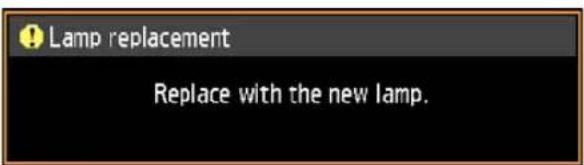
text_image
Lamp replacement Replace with the new lamp.If a lamp replacement message is displayed, refer to "Lamp Replacement Procedure" (P176).
- Only the POWER, OK, FOCUS, ZOOM and LENS SHIFT buttons are available while this screen is displayed.
- When you press the POWER button, the "Push POWER button again to turn off power." message appears.
- When this screen has disappeared after being displayed for 10 seconds, all buttons become operable.
- You can check the usage time of the lamp in [Lamp counter] in the [System settings] menu. (P125)
- This screen is not displayed when [Lamp warning display] is set to [Off]. (P115)

Caution
- Lamps are more likely to rupture once the lamp replacement message has been displayed. Replace the lamp with a new one as soon as possible.
- Lamps should be replaced about every 3,000 hours. Note that there is no guarantee about how long lamps will last.
- Useful life of lamps varies widely from lamp to lamp and depending on the environment of use. Some lamps may fail or rupture soon after they are first used.
- Dispose of used lamps in accordance with local regulations.
Replacement Lamp
This projector uses the following lamps.
Lamp part no.: RS-LP11
Contact the Canon Customer Support Center when purchasing a replacement lamp.

Precautions when replacing lamps that stop working If the illumination suddenly stops when the projector is in use or after you turn it on, the lamp may be broken. In this case, never attempt to replace the lamp by yourself. Always request service from the qualified technician or Canon Customer Support Center. Additionally, with ceiling-mounted projectors, the lamp may fall out when you open the lamp cover or while you are attempting to replace it. During replacement, stand to the side of the lamp cover, not directly under it. If the lamp breaks and any glass shards or other pieces get in your eyes or mouth, consult a doctor immediately.
Before replacing the lamp, always turn off the projector, unplug it after the cooling fan stops, and wait at least one hour. Do not touch the lamp immediately after turning the projector off. It is very hot initially and poses a risk of burns.
- Be sure to use the specified lamp.
- Contact the Canon Customer Support Center for further information. This can also be purchased from the Canon website.
- Do not touch the inner glass surface when you replace the lamp. Doing so may cause deterioration to the projector's performance.
- Handle lamps with care. Impact or abrasion may cause lamps to rupture while they are in use. If a lamp ruptures, contact the Canon Customer Support Center and follow the instructions in “Note the following precautions when replacing lamps that stop working. Failure to do so could result in personal injury.” (P18).
- When replacing the lamp, do not remove any screws other than those specified.

Lamp Replacement Procedure
1 Turn off the projector power and remove the power plug.
2Loosen one screw and open the lamp cover in the direction of the arrow.
The lamp cover screw is attached to the lamp cover and designed to prevent it from falling off.
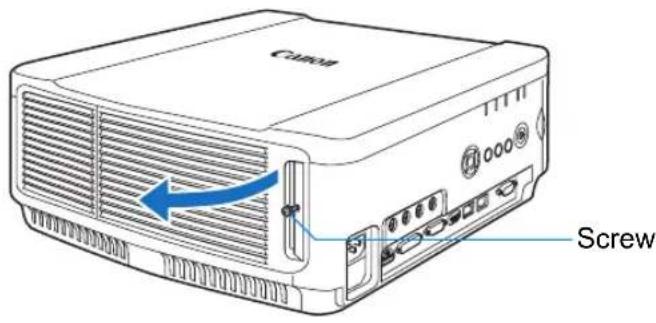
text_image
Cusca Screw3Loosen the 3 screws on the inside of the lamp unit, then slowly pull out the lamp unit in the direction of the arrow.
Even when the screws are loosened, they will not fall off the lamp unit.
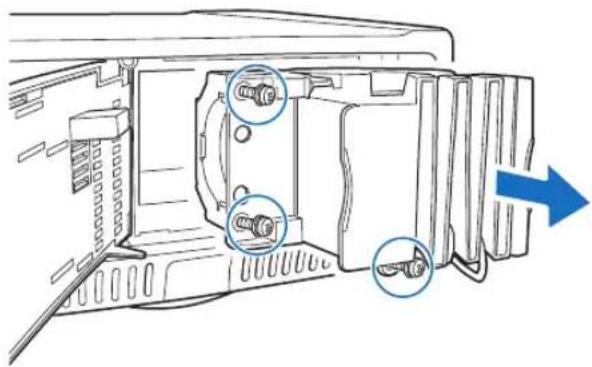
natural_image
Technical line drawing of a mechanical assembly with two labeled components and an arrow indicating direction (no text or symbols present)4 Fully insert a new lamp unit and secure it with the 3 screws.
5Close the lamp cover and tighten the screws.
6Turn on the power. Bring up the menu and select [System settings] > [Other settings] > [Lamp counter].
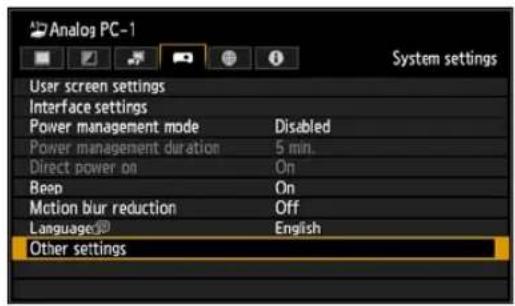
text_image
Analog PC-1 User screen settings Interface settings Power management mode Disabled Power management duration 5 min. Direct power on On Beep On Motion blur reduction Off Language® English Other settings

text_image
Other settings Password settings Off Register password [Fn] button settings Disable Gamma restore Off Lamp counter Air filter counter Firmware 00.010002 Factory defaults Return7 Select [Reset] > [Yes] to reset the lamp counter.
![CANON REALiS WX6500 D - Select [Reset] > [Yes] to reset the lamp counter. - 1](/content/2026/06/1190230/images/5f4c385aa39cbc5f44f3d0064100309c0a7b43f13e24ce3787839490909904d1.jpg)
text_image
Lamp counter 3100 Reset Return Lamp counter reset Only do this after changing the lamp. Reset the lamp counter? Yes No![CANON REALiS WX6500 D - Select [Reset] > [Yes] to reset the lamp counter. - 2](/content/2026/06/1190230/images/fb3da492070b61c44dbf4fa2dcc37972b08e391f43b9dafe19b0603236c73d44.jpg)
- It is recommended that you also replace the air filter when you replace the lamp. (P170)
- Contact the Canon Customer Support Center for further information.
- Replacement air filter part no.: RS-FL01
Installing / Removing the Lens Unit
■Installing the Lens Unit
- Before installing or removing the lens unit, be sure to disconnect the power plug or connector. Failure to do so may result in fire, electric shock, or injury.
- When hanging the projector from a ceiling, put the projector down on the floor or a workbench before attaching or replacing the lens unit. Failure to do so could result in parts falling off the projector and may cause an accident or personal injury.
- Do not touch the lens when the lens is moving (the lens is shifting) to adjust the projected image after installation. There is the risk of injury.
- Before replacing the lens unit, make sure to turn off the projector, wait at least 1 hour to allow the projector to cool thoroughly. Failure to do so may result in burns or other injuries.
- Do not attempt to install or remove the lens unit yourself. Be sure to request this service from a qualified technician or contact the Canon Customer Support Center.
- When installing and removing the lens unit, be sure not to touch the surface of the lens with your hands or scratch it.
- Do not apply force to parts (e.g. lead wires) that are connected to the lens unit or lens motor. Doing so may cause a malfunction.
- Do not replace the lens unit in a dusty location. If any dust or dirt enters the projector, this may adversely affect picture quality.
- When carrying or holding up the projector after attaching the lens unit, be sure not to hold the lens. Doing so may cause damage to the lens unit.
- If transportation is necessary, the lens unit should be removed before transporting the projector. If the projector is subjected to excessive impacts during transportation, the lens unit may be damaged.
- For details about which devices the projector is compatible with, contact the Canon Customer Support Center.
1 Use a Phillips-head screwdriver and loosen the lamp cover screw, then open the lamp cover.
The lamp cover screw is attached to the lamp cover and designed to prevent it from falling off.

text_image
Canon Screw2Loosen the cosmetic panel screw, then slide the cosmetic panel toward the rear to remove it.
The cosmetic panel screw is attached to the cosmetic panel and designed to prevent it from falling off.
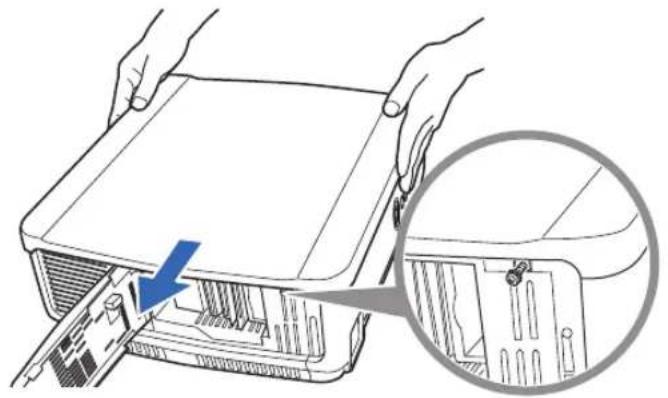
natural_image
Illustration of hands installing or removing a device into a container, with an inset magnified view showing internal components (no text or symbols)3In order to prevent damage, close the lamp cover and temporarily fasten the screw.

natural_image
Diagram of a computer monitor with ventilation slots and a close-up view showing internal components (no text or symbols)4Remove the sleeve screws (2 on top and 2 on bottom).
After the 2 screws on top are removed, turn the projector upside down on a flat desk or similar location and remove the 2 screws from the bottom.
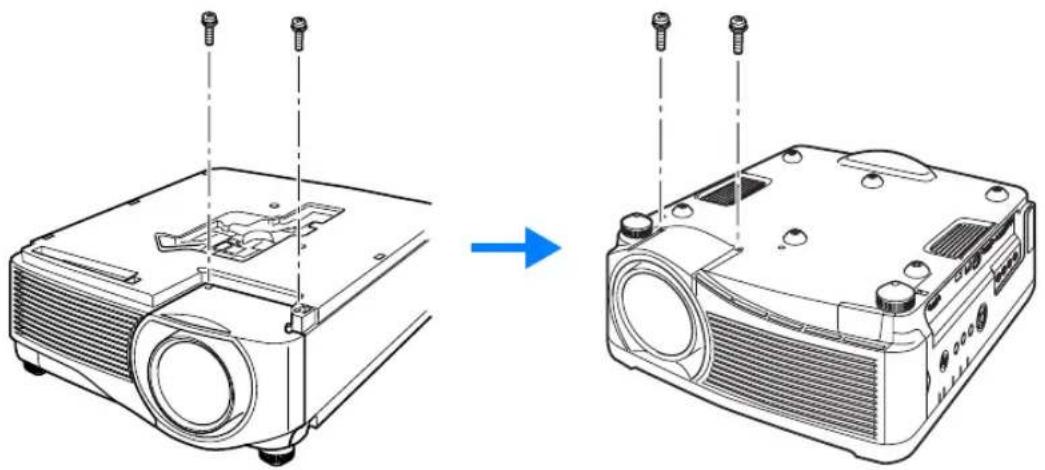
natural_image
Technical line drawing of an projector with mounting holes and a side view showing internal components (no text or symbols)5Then turn the projector back over and remove the sleeve.
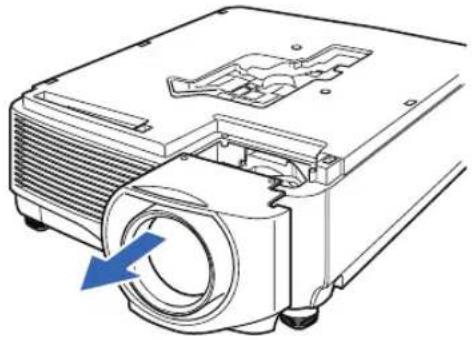
natural_image
Technical line drawing of a projector with a blue arrow indicating the blade (no text or symbols present)6Referring to the following illustration, insert the lens connector of the lens unit into the front right side of the projector slowly until it contacts the end. At this time, pull out the lens cable shown in the illustration and fix it.
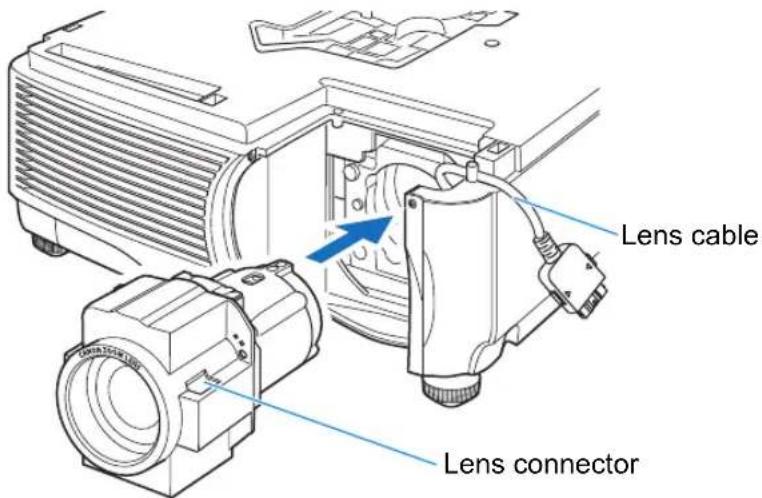
text_image
Lens cable Lens connector7 Tighten the 4 screws to fasten the lens unit in place.
The 4 lens unit screws are attached to the lens unit and cannot be removed.
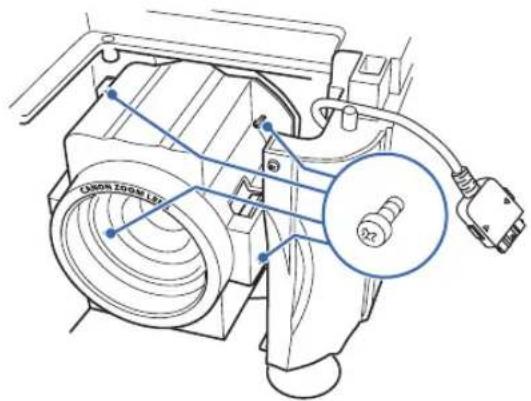
text_image
COSCO 100W L27 1278 Insert the projector lens cable into the connector until a click sound is heard.
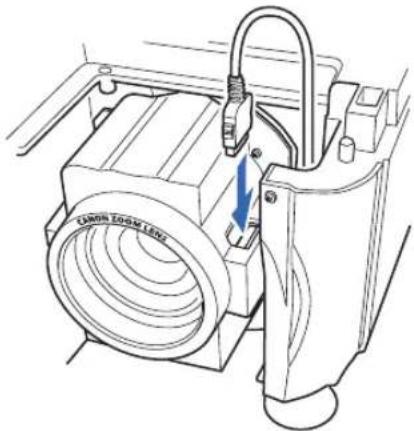
text_image
CANON EIGHT LENS9Reinstall the sleeve, cosmetic panel, and lamp cover in their original positions.

When the power is first turned on after the lens unit has been installed or replaced, lens shift initialization operation will be performed. It will take approximately 1 minute for the initialization operation to start up. However, if the lens has been replaced with a lens of the same model number, initialization operation will not be performed. The position will be the same as before the lens was replaced.

The lens shift initialization operation uses the motor to move the lens up / down / left / right. Do not touch the lens. Doing so could result in an injury.

When installing and removing the lens unit, be sure to fix the lens cable as shown in the illustration. When inserting the lens unit, it is possible to damage the lens cable between the lens unit and projector.

natural_image
Technical line drawing of an internal mechanical assembly with no visible text or symbols■Removing the Lens Unit
1 Perform steps 1 to 5 of "Installing the Lens Unit" (P178 – P180) to remove the sleeve.
2 Disconnect the lens cable from the lens connector.

When pulling out (disconnecting) the lens cable, press the buttons on both sides of the lens cable connector while pulling out the cable.

text_image
CANON EDGE LEASE3 Fix the lens cable as shown in the illustration and loosen the 4 screws to remove the lens unit.
The 4 lens unit screws are attached to the lens unit and cannot be removed.

text_image
LUNION FORUM LEO 127Relationship between Aspect and Screen Aspect
This section describes the relationship between screen aspect (P63) and aspect (P65).
Select an optimum aspect ratio of the projected image (screen aspect) or an optimum screen mode (aspect) according to the aspect ratio of the screen, type of input image signal and so on for the projection to make best use of the screen size.
- If a computer image with an aspect ratio of 16:9 is not projected correctly when the setting is [Auto], select [16:9] as the screen aspect.
- For a 16:9 image with black borders at the top and bottom, such as a terrestrial broadcast movie, you can project the 16:9 image area so that it is projected on the entire screen by selecting [Zoom] in [Aspect].
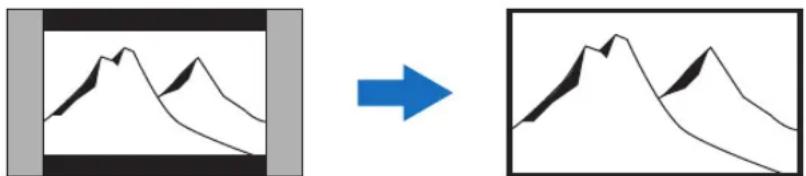
natural_image
Diagram showing a mountain silhouette transforming into a simplified mountain silhouette, with a blue arrow indicating transformation (no text or symbols)There may be some cases that [Zoom] cannot be selected depending on the input signal and/or resolution.
- For keystone correction (P67), select an option other than [4:3 D. image shift] or [16:9 D. image shift] for Screen aspect.
■When projecting at the original aspect ratio on a 16:10 screen
| Original Aspect Ratio | Screen aspect setting (P63) | Aspect setting (P65) | Screen image |
| (16:10)1920 x 12001440 x 9001280 x 800 | [16:10] | [16:10][Auto] | 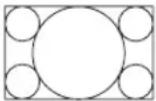 |
| (16:9)1920 x 10801280 x 720 | [16:9][Auto] | 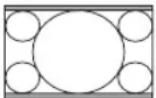 | |
| (4:3)1600 x 12001400 x 1050640 x 480 | [4:3][Auto] | 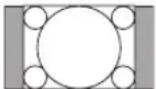 |
■When projecting at the original aspect ratio on a 16:9 screen
| Original Aspect Ratio | Screen aspect setting (P63) | Aspect setting (P65) | Screen image |
| (16:10)1920 x 12001440 x 9001280 x 800 | [16:9][16:9D. image shift] | [Auto] |  |
| (16:9)1920 x 10801280 x 720 | [16:9][Auto] |  | |
| (4:3)1600 x 12001400 x 1050640 x 480 | [4:3][Auto] | 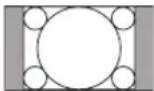 |
■When projecting at the original aspect ratio on a 4:3 screen
| Original Aspect Ratio | Screen aspect setting (P63) | Aspect setting (P65) | Screen image |
| (16:10)1920 x 12001440 x 9001280 x 800 | [4:3][4:3D. image shift] | [Auto] | 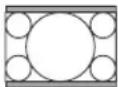 |
| (16:9)1920 x 10801280 x 720 | [16:9][Auto] | 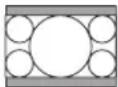 | |
| (4:3)1600 x 12001400 x 1050640 x 480 | [4:3][Auto] | 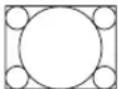 |
■When projecting to fill a 16:10 screen
| Original Aspect Ratio | Screen aspect setting (P63) | Aspect setting (P65) | Screen image |
| (16:10)1920 x 12001440 x 9001280 x 800 | [16:10] | [16:10][Auto] | 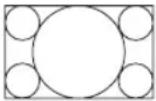 |
| (16:9)1920 x 10801280 x 720 | [16:10] | 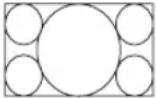 | |
| (4:3)1600 x 12001400 x 1050640 x 480 | [16:10] | 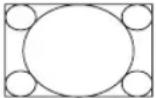 |
■When projecting to fill a 16:9 screen
| Original Aspect Ratio | Screen aspect setting (P63) | Aspect setting (P65) | Screen image |
| (16:10)1920 x 12001440 x 9001280 x 800 | [16:9][16:9D. image shift] | [16:9] |  |
| (16:9)1920 x 10801280 x 720 | [16:9][Auto] | 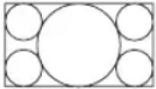 | |
| (4:3)1600 x 12001400 x 1050640 x 480 | [16:9] | 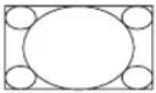 |
■When projecting to fill a 4:3 screen
| Original Aspect Ratio | Screen aspect setting (P63) | Aspect setting (P65) | Screen image |
| (16:10)1920 x 12001440 x 9001280 x 800 | [4:3][4:3D. image shift] | [4:3] | 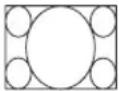 |
| (16:9)1920 x 10801280 x 720 | [4:3] |  | |
| (4:3)1600 x 12001400 x 1050640 x 480 | [4:3][Auto] | 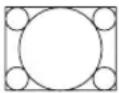 |
Displayed Test Patterns
To access the test pattern menu, from the [Install settings] menu, select [Test pattern] > [On] (P115).
While the test pattern is displayed, you can use the [▲/ [ ]▼buttons to switch patterns. Also, if there is an option pattern available, you can use the [◀/ [ ]▼ buttons to switch pattern. A dialog box is shown during test pattern display that identifies the current test pattern and provides operating instructions.
The following test patterns can be displayed.
Use [▲/ [ ]▼o switch patterns
Use [◀/ [ ]▶ to switch option patterns

flowchart
graph TD
    A["Color bars"] --> B["(2)"]
    B --> C["Stairstep H"]
    C --> D["(3)"]
    D --> E["Stairstep V"]
    E --> F["(4)"]
    F --> G["(5)"]
    G --> H["Color steps"]
    H --> I["(6)"]
    I --> J["(7)"]
    J --> K["Checker"]
    K --> L["(8)"]
    L --> M["Multi"]
    M --> N["(9)"]
    N --> O["Character"]
    O --> P["(10)"]
    P --> Q["Focus"]
    Q --> R["(11)"]
    R --> S["Border"]
    S --> T["(12)"]
    T --> U["Cross Hatch"]
    style A fill:#f9f,stroke:#333
    style T fill:#ccf,stroke:#333
Supported Signal Types
This projector supports the following signal types.
If your computer or AV equipment is compatible with any one of these signal types, the projector's Auto PC function selects the input signal type to project an image appropriately.
Analog PC
| Resolution (dots) | Signal type | Horizontal frequency (kHz) | Vertical frequency (Hz) |
| 640 x 480 VGA 31.469 59.940 | |||
| 720 x 480 - 31.469 59.940 | |||
| 720 x 576 - 31.250 50.000 | |||
| 800 x 600 SVGA 37.879 60.317 | |||
| 848 x 480 - 31.020 60.000 | |||
| 1024 x 768 XGA 48.363 60.004 | |||
| 1280 x 768 | WXGA | 47.776 59.870 | |
| 47.396 59.995 | |||
| 1280 x 800 | 49.702 59.810 | ||
| 49.306 59.910 | |||
| 1280 x 960 - 60.000 60.000 | |||
| 1280 x 1024 SXGA 63.981 60.020 | |||
| 1366 x 768 - 47.712 59.790 | |||
| 1400 x 1050 SXGA+ | 64.744 59.948 | ||
| 65.317 59.978 | |||
| 1440 x 900 | WXGA+ | 55.935 59.887 | |
| 55.469 59.901 | |||
| 1600 x 900 - 60.000 60.000 | |||
| 1600 x 1200 UXGA 75.000 60.000 | |||
| 1680 x 1050 | WSXGA+ | 64.674 59.883 | |
| 65.290 59.954 | |||
| 1920 x 1080 | - | 56.250 50.000 | |
| 67.500 60.000 | |||
| 1920 x 1200 | WUXGA | 74.038 59.950 | |
Digital PC
| Resolution (dots) | Signal type | Horizontal frequency (kHz) | Vertical frequency (Hz) |
| 640 x 480 | D-VGA | 31.469 59.940 | |
| 720 x 480 - 31.469 59.940 | |||
| 720 x 576 - 31.250 50.000 | |||
| 800 x 600 D-SVGA | 37.879 60.317 | ||
| 1024 x 768 | D-XGA | 48.363 60.004 | |
| 1280 x 720 - | 37.500 50.000 | ||
| 45.000 60.000 | |||
| 1280 x 800 | D-WXGA | 49.702 59.810 | |
| 49.306 59.910 | |||
| 1280 x 1024 | D-SXGA | 63.981 60.020 | |
| 1366 x 768 - 47.712 59.790 | |||
| 1400 x 1050 | D-SXGA+ | 64.744 59.948 | |
| 65.317 59.978 | |||
| 1440 x 900 | D-WXGA+ | 55.935 59.887 | |
| 55.469 59.901 | |||
| 1600 x 900 - 60.000 60.000 | |||
| 1600 x 1200 | D-UXGA | 75.000 60.000 | |
| 1680 x 1050 | D-WSXGA+ | 64.674 59.883 | |
| 65.290 59.954 | |||
| 1920 x 1080 | - | 27.000 24.000 | |
| 56.250 50.000 | |||
| 67.500 60.000 | |||
| Resolution (dots) Signal type | Horizontal frequency (kHz) | Vertical frequency (Hz) | |
| 1080PsF(1920 x 1080i) | - | 27.000 24.000 | |
| 28.125 25.000 | |||
| 33.750 30.000 | |||
| 1920 x 1200 D-WU | XGA 74.038 59.950 | ||
HDMI/HDBaseT
Connecting to a computer
| Resolution (dots) Signal type | Horizontal frequency (kHz) | Vertical frequency (Hz) | |
| 640 x 480 VGA 31 | .469 59.940 | ||
| 800 x 600 SVGA | 37.879 60.317 | ||
| 1024 x 768 XGA | 48.363 60.004 | ||
| 1280 x 800 WXGA | 49.702 59.810 | ||
| 49.306 59.910 | |||
| 1280 x 1024 | SXGA | 63.981 60.020 | |
| 1366 x 768 | - | 47.712 59.790 | |
| 1400 x 1050 | SXGA+ | 64.744 59.948 | |
| 65.317 59.978 | |||
| 1440 x 900 | WXGA+ | 55.935 59.887 | |
| 55.469 59.901 | |||
| 1600 x 900 | - | 60.000 60.000 | |
| 1600 x 1200 | UXGA | 75.000 60.000 | |
| 1680 x 1050 | WSXGA+ | 64.674 59.883 | |
| 65.290 59.954 | |||
| 1920 x 1200 | WUXGA | 74.038 59.950 | |
Connecting with AV equipment
| Signal type | Horizontal frequency (kHz) | Vertical frequency (Hz) |
| 480p | 31.469 | 59.940 |
| 576p | 31.250 | 50.000 |
| 720p | 37.500 | 50.000 |
| 45.000 | 60.000 | |
| 1080i | 28.125 | 50.000 |
| 33.750 | 60.000 | |
| 1080p | 27.000 | 24.000 |
| 56.250 | 50.000 | |
| 67.500 | 60.000 |
Component
| Signal type | Horizontal frequency (kHz) | Vertical frequency (Hz) |
| 480i | 15.734 | 59.940 |
| 480p | 31.469 | 59.940 |
| 576i | 15.625 | 50.000 |
| 576p | 31.250 | 50.000 |
| 720p | 37.500 | 50.000 |
| 45.000 | 60.000 | |
| 1080i | 28.125 | 50.000 |
| 33.750 | 60.000 | |
| 1080p | 56.250 | 50.000 |
| 67.500 | 60.000 | |
| 1080PsF | 27.000 | 24.000 |
| 28.125 | 25.000 | |
| 33.750 | 30.000 |
* The specifications in the table above are subject to change without notice.
* This projector does not support any computer output signal with a dot clock of higher than 162 MHz.
* Use a computer cable in which all pins are connected. If the cable is a type in which all pins are not connected, the image may not be correctly displayed.
■Projector
| Model name WUX6500 | ||
| Display system Reflective liquid | crystal panel (LCOS) : 3 panels | |
| Optical system | Color separation by dichroic mirror / polarizing beam splitter and color composition by prism | |
| Display device | Effective display area size 0.71" / 16:10 | |
| Effective number of pixels 2,304,000 (1920 x 1200) | ||
| Other features Active matrix system | ||
| Projection lens | Zoom (*4) 1.5x (Electric) | |
| Focus Electric | ||
| Lens shift (*4) V: -15% to +55% (Electric), H: ±10% (Electric) | ||
| Focal length (*4) f = 23.0 to 34.5 mm (0.9" - 1.4") | ||
| F value (*4) F1.89 to F2.65 | ||
| Light source High pressure mercury lamp 370 W | ||
| Image size / Projection distance (*4) | Minimum: 101.6 cm (40") to Maximum: 1524 cm (600"), Projection distance: 1.3 m to 29.0 m (4.3'- 95.1') | |
| Number of colors 16,770,000 colors | ||
| Brightness (*1) (*2) 6,500 lumen | ||
| Contrast ratio (*1) (*3) 2000:1 (Fully white : fully black, native) | ||
| Ratio of brightness at periphery to center (*1) (*4) | 88% | |
| Speaker 5W monaural | ||
| Supported input signal types | Refer to “Supported Signal Types” (P188 - P189) | |
| Display resolution | Computer signal input | Maximum input resolution 1920 x 1200 dots |
| Video signal input | Maximum input resolution 1920 x 1200 dots | |
| Video signals | Analog PC input | WUXGA / UXGA / WSXGA+ / SXGA+ / WXGA+ / FWXGA / WXGA / SXGA / XGA / SVGA / VGA |
| Digital PC input | WUXGA / UXGA / WSXGA+ / SXGA+ / WXGA+ / FWXGA / WXGA / SXGA / XGA / SVGA / VGA | |
| Digital video input | 1080p / 1080i / 720p / 576p / 480p | |
| Component video input | 1080p / 1080i / 720p / 576p / 576i / 480p / 480i | |
| Video signal input terminal | Mini D-sub 15-pin | Analog PC, Component |
| DVI-I | Analog PC, Digital PC (29-pin DVI connector) | |
| HDMI | Digital PC, Digital Video | |
| RJ-45 (HDBaseT) | HDBaseT input (video / audio / control / network) | |
| Other terminals and connectors | Mini jack x 2 AUDIO IN | |
| Mini jack AUDIO OUT | ||
| Mini jack Wired remote control | ||
| RS-232C CONTROL (Dsub9) | ||
| USB USB Type A | ||
| RJ-45 Network connections | (1000BASE-T/100BASE-TX/10BASE-T) | |
| Noise 43dB / 39dB (lamp mode: Full power / Power saver) | ||
| Operating temperature 0°C (32°F) to 40°C (104°F) | ||
| Power supply AC100V to 240V | 50 / 60Hz | |
| Full power 500W | ||
| Power consumption in standby mode | Networking and HDBaseT off | 0.3W |
| Low-power networking on, HDBaseT off | 0.7W | |
| Networking off, HDBaseT on | 1.9W | |
| Low-power networking and HDBaseT on | 2.0W | |
| Standard dimensions | 380 mm (W) x 170 mm (H) x 430 mm (D) / 15.0 (W) x 6.7 (H) x 16.9 (D) in | |
| Weight 8.5 kg / 18.7 lbs | ||
| Accessories | Remote control, remote control dry-cell batteries, power cord, PC cable, Important Information, User's Manual (CD-ROM) and Warranty Card | |
*1 Compliance with ISO21118-2012
*2 When using a Standard Zoom Lens (RS-IL01ST) in [Presentation] image mode and [Full power] lamp mode.
*3 When using a Standard Zoom Lens (RS-IL01ST) in [Presentation] image mode and setting the lamp control to [On].
*4 When using a Standard Zoom Lens (RS-IL01ST).
* 99.99% or more of the LCD panel pixels are effective. During projection, 0.01% or less of pixels may stay lit or unlit due to the characteristics of the LCD panel.
* Using the projector continuously for an extended period of time may accelerate the deterioration of optical parts.
* Product specifications and appearance are subject to change without prior notice.
■Remote Control
| Type RS-RC04 RS- | RC05 (Option) | |
| Power supply | DC 3.0V, using two AAA-size batteries | DC 3.0V, using two AA-size batteries |
| Operating range Approx. 8 m±25° horizontal and vertical (to infrared remote receiver) | ||
| Dimensions | 43 mm (W) x 23 mm (H) x 135 mm (D) / 1.7 (W) x 0.9 (H) x 5.3 (D) in. | 51 mm (W) x 28 mm (H) x 176 mm (D) / 2.0 (W) x 1.1 (H) x 6.9 (D) in. |
| Weight 56 g / 2.0 oz | 100 g / 3.5 oz | |
■Specification of Each Lens Unit (Option)
| Name Standard Zoom Lens Long Zoom Lens | ||
| Model number RS-IL01ST RS-IL02LZ | ||
| External View |  |  |
| Focal length | 23.0 - 34.5 mm(0.9 - 1.4") | 34.0 - 57.7 mm(1.3 - 2.3") |
| F number 1.89 - 2.65 | 1.99 - 2.83 | |
| Width 97.4 mm (3.8") | 97.4 mm (3.8") | |
| Height | 106.5 mm (4.2") | 106.5 mm (4.2") |
| Length | 173.4 mm (6.8") | 173.4 mm (6.8") |
| Weight | 550 g (1.2 lbs) | 755 g (1.7 lbs) |
| Zoom ratio | 1.5x | 1.7x |
| Projection distance | 1.3 - 29.0 m(4.3 - 95.1') | 1.9 - 48.5 m(6.2 - 159.1') |
| Size 100 projection distance | 3.2 - 4.8 m(10.5 - 15.7') | 4.7 - 8.0 m(15.4 - 26.2') |
For details about the amount of lens shift, refer to "Lens Shift Function" on page 47.
| Name Short | Fixed Lens Ultra Long Zoom Lens | |
| Model number RS- | IL03WF RS-IL04UL | |
| External View | 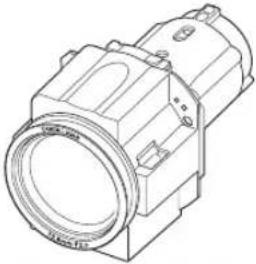 | 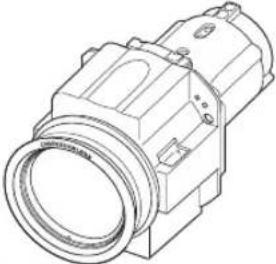 |
| Focal length 12.8 mm (0.5") 53.6 - 105.6 mm (2.1 - 4.2") | ||
| F number 2.0 2.34 - 2.81 | ||
| Width 97.4 mm (3.8") 97.4 mm (3.8") | ||
| Height 106.5 mm (4.2") 106.5 mm (4.2") | ||
| Length 175.2 mm (6.9") 184.2 mm (7.3") | ||
| Weight | 910 g (2.0 lbs) | 940 g (2.1 lbs) |
| Zoom ratio – | 1.95x | |
| Projection distance | 0.7 - 5.2 m (2.3 - 17.1') | 4.6 - 90.0 m (15.1 - 295.3') |
| Size 100 projection distance | 1.7 m (5.6') | 7.7 - 15.0 m (25.3 - 49.2') |
| Name | Wide Zoom Lens |
| Model number RS-IL05WZ | |
| External View | 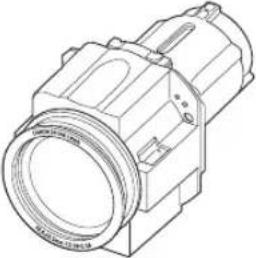 |
| Focal length | 15.6 - 23.3 mm (6.0 - 9.0") |
| F number | 2.09 - 2.34 |
| Width 97.4 mm (3.8") | |
| Height 106.5 mm (4.2") | |
| Length 180.3 mm (7.1") | |
| Weight | 905 g (2.0 lbs) |
| Zoom ratio | 1.5x |
| Projection distance | 0.9 - 19.5 m (3.0 - 64.0') |
| Size 100 projection distance | 2.2 - 3.2 m (7.2 - 10.5') |
For details about the amount of lens shift, refer to "Lens Shift Function" on page 47.
■External View
WUX6500

Bolt holes (M4 x 6) for installation of ceiling attachment
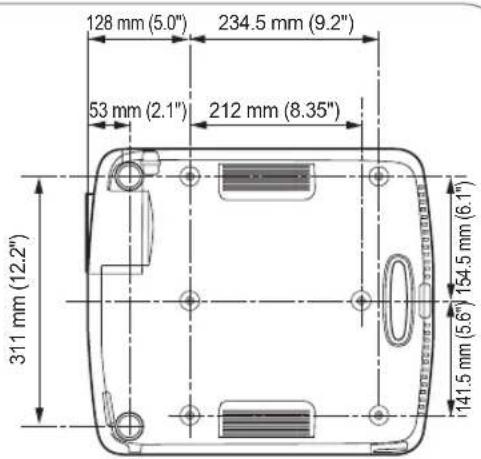
text_image
128 mm (5.0") 234.5 mm (9.2") 53 mm (2.1") 212 mm (8.35") 311 mm (12.2") 154.5 mm (6.1) 141.5 mm (5.6)■ANALOG PC-2 / COMPONENT Terminal
This terminal is used as a computer ANALOG PC input or COMPONENT input terminal. Use a D-sub computer cable.
The terminal specifications for the ANALOG PC input and COMPONENT input are the same.
Mini D-sub 15-pin

natural_image
Diagram of a 16-pin D-sub connector (no text or symbols)| Pin No. | Signal Pin No. | Signal | |
| 1 R 9 | +5 V power | ||
| 2 | G 10 | Ground(Vertical sync.) | |
| 3 B | 11 Ground | ||
| 4 | OPEN | 12 | DDC data |
| 5 | Ground(Horizontal sync.) | 13 | Horizontal sync. |
| 6 Ground (R) | 14 Vertical sync. | ||
| 7 Ground (G) | 15 DDC clock | ||
| 8 Ground (B) | |||
■Service Port (CONTROL)
Pin assignment
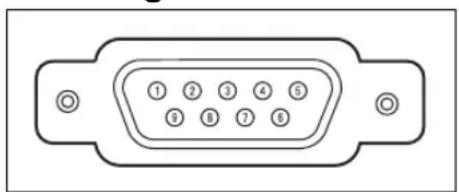
natural_image
Diagram of a 2.5-pin D-sub connector (no text or symbols)| Pin No. | Signal |
| 1 | OPEN |
| 2 | RxD |
| 3 | TxD |
| 4 | OPEN |
| 5 | GND |
| 6 | OPEN |
| 7 | Internal pull-up |
| 8 | OPEN |
| 9 | OPEN |
Communication format
Communication mode : RS-232C, asynchronous, half-duplex communication
Communication speed : 19200bps
Character length : 8 bits
Stop bits : Switchable between 1 bit and 2 bits. Factory default, or
state after [Factory defaults] is executed, is 1 bit.
Parity : None
Flow control : None

The service port is not available when [HDBaseT] is set to [On] and [Serial communication] is set to [HDBaseT].
User commands
| Commands ASCII representation Binary representation | |||
| Power supply | Power on POW | ER=ON50h 4Fh 57h 45h 5 | 2h 3Dh 4Fh 4Eh 0Dh |
| Power off POW | ER=OFF | 50h 4Fh 57h 45h 52h 3Dh 4Fh 46h 46h 0Dh | |
| Power status acquisition | GET=POWER | 47h 45h 54h 3Dh 50h 4Fh 57h 45h 52h 0Dh | |
| Input source | HDMI INPUT=HDMI | 49h 4Eh 50h 55h 54h 3Dh 48h 44h 4Dh 49h 0Dh | |
| Digital PC INPUT=D-RGB | 49h 4Eh 50h 55h 54h 3Dh 44h 2Dh 52h 47h 42h 0Dh | ||
| Analog PC-1 INPUT=A-RGB1 | 49h 4Eh 50h 55h 54h 3Dh 41h 2Dh 52h 47h 42h 31h 0Dh | ||
| Analog PC-2 INPUT=A-RGB2 | 49h 4Eh 50h 55h 54h 3Dh 41h 2Dh 52h 47h 42h 32h 0Dh | ||
| Component INPUT=COMP | 49h 4Eh 50h 55h 54h 3Dh 43h 4Fh 4Dh 50h 0Dh | ||
| LAN INPUT=LAN | 49h 4Eh 50h 55h 54h 3Dh 4Ch 41h 4Eh 0Dh | ||
| USB INPUT=USB | 49h 4Eh 50h 55h 54h 3Dh 55h 53h 42h 0Dh | ||
| HDBaseT INPUT=HDBT | 49h 4Eh 50h 55h 54h 3Dh 48h 44h 42h 54h 0Dh | ||
| Input source acquisition | GET=INPUT | 47h 45h 54h 3Dh 49h 4Eh 50h 55h 54h 0Dh | |
| Image Mode | Standard IMAGE=STANDARD | 49h 4Dh 41h 47h 45h 3Dh 53h 54h 41h 4Eh 44h 41h 52h 44h 0Dh | |
| Presentation IMAGE=PRESENTATION | 49h 4Dh 41h 47h 45h 3Dh 50h 52h 45h 53h 45h 4Eh 54h 41h 54h 49h 4Fh 4Eh 0Dh | ||
| VividPhoto | IMAGE=VIVID_PHOTO | 49h 4Dh 41h 47h 45h 3Dh 56h 49h 56h 49h 44h 5Fh 50h 48h 4Fh 54h 4Fh 0Dh | |
| Photo/sRGB IMAGE=PHOTO_SRGB | 49h 4Dh 41h 47h 45h 3Dh 50h 48h 4Fh 54h 4Fh 5Fh 53h 52h 47h 42h 0Dh | ||
| Dynamic | IMAGE=DYNAMIC | 49h 4Dh 41h 47h 45h 3Dh 44h 59h 4Eh 41h 4Dh 49h 43h 0Dh | |
| Video IMAGE=VIDEO | 49h 4Dh 41h 47h 45h 3Dh 56h 49h 44h 45h 4Fh 0Dh | ||
| Cinema | IMAGE=CINEMA | 49h 4Dh 41h 47h 45h 3Dh 43h 49h 4Eh 45h 4Dh 41h 0Dh | |
| User 1 | IMAGE=USER_1 | 49h 4Dh 41h 47h 45h 3Dh 55h 53h 45h 52h 5Fh 31h 0Dh | |
| User 2 | IMAGE=USER_2 | 49h 4Dh 41h 47h 45h 3Dh 55h 53h 45h 52h 5Fh 32h 0Dh | |
| User 3 | IMAGE=USER_3 | 49h 4Dh 41h 47h 45h 3Dh 55h 53h 45h 52h 5Fh 33h 0Dh | |
| User 4 | IMAGE=USER_4 | 49h 4Dh 41h 47h 45h 3Dh 55h 53h 45h 52h 5Fh 34h 0Dh | |
| User 5 | IMAGE=USER_5 | 49h 4Dh 41h 47h 45h 3Dh 55h 53h 45h 52h 5Fh 35h 0Dh | |
| Image mode acquisition | GET=IMAGE | 47h 45h 54h 3Dh 49h 4Dh 41h 47h 45h 0Dh | |
| Brightness | Brightness value setting | BRI=<value><CR> 42h 52h 49h | 3Dh <numeric code> 0Dh |
| Brightness acquisition | GET=BRI<CR> 47h 45h 54h 3Dh | 42h 52h 49h 0Dh | |
| Sharpness | Sharpness value setting | SHARP=<value><CR> | 53h 48h 41h 52h 50h 3Dh <numeric code> 0Dh |
| Sharpness acquisition | GET=SHARP<CR> | 47h 45h 54h 3Dh 53h 48h 41h 52h 50h 0Dh | |
| Contrast | Contrast value setting | CONT=<value><CR> | 43h 4Fh 4Eh 54h 3Dh <numeric code> 0Dh |
| Contrast acquisition | GET=CONT<CR> 47h 45h 54h 3Dh 43h 4Fh 4Eh 54h 0Dh | ||
| Aspect | Auto ASPECT=AUTO<CR> | 41h 53h 50h 45h 43h 54h 3Dh 41h 55h 54h 4Fh 0Dh | |
| 4:3 ASPECT=4:3<CR> | 41h 53h 50h 45h 43h 54h 3Dh 34h 3Ah 33h 0Dh | ||
| 16:9 ASPECT=16:9<CR> | 41h 53h 50h 45h 43h 54h 3Dh 31h 36h 3Ah 39h 0Dh | ||
| 16:10 ASPECT=16:10<CR> | 41h 53h 50h 45h 43h 54h 3Dh 31h 36h 3Ah 31h 30h 0Dh | ||
| Zoom ASPECT=ZOOM<CR> | 41h 53h 50h 45h 43h 54h 3Dh 5Ah 4Fh 4Fh 4Dh 0Dh | ||
| True size ASPECT=TRUE<CR> | 41h 53h 50h 45h 43h 54h 3Dh 54h 52h 55h 45h 0Dh | ||
| Aspect value acquisition | GET=ASPECT<CR> | 47h 45h 54h 3Dh 41h 53h 50h 45h 43h 54h 0Dh | |
| Lamp mode | Full power LAMP=FULL<CR> | 4Ch 41h 4Dh 50h 3Dh 46h 55h 4Ch 4Ch 0Dh | |
| Power saver LAMP=ECO<CR> 4Ch 41h 4Dh 50h 3Dh 45h 43h 4Fh 0Dh | |||
| Lamp mode value acquisition | GET=LAMP<CR> 47h 45h 54h 3Dh 4Ch 41h 4Dh 50h 0Dh | ||
| Blank | Blank On | BLANK=ON<CR> 42h 4Ch 41h 4Eh 4Bh 3Dh 4Fh 4Eh 0Dh | |
| Blank Off | BLANK=OFF<CR> | 42h 4Ch 41h 4Eh 4Bh 3Dh 4Fh 46h 46h 0Dh | |
| Blank acquisition | GET=BLANK<CR> | 47h 45h 54h 3Dh 42h 4Ch 41h 4Eh 4Bh 0Dh | |
LED Indicator Details
When there is a problem with the projector, the LED indicator on the side of the projector illuminates or flashes continuously after the projector is turned off.
- Wait until the cooling fan stops and disconnect the power plug from the electrical outlet before dealing with the problem.
| LED indicator status | Meaning Cause and countermeasure | |
| WARNING and TEMP are lit. | Temperature abnormality | The temperature inside the projector is too high for some reason or the outside air temperature is higher than the operating range. If the problem is inside the projector, check whether the projector is installed and operating normally, unplug the projector from the power outlet to cool down the projector interior and then restart projection. If the air intake or exhaust vent is blocked, remove the obstacle. If the air filter is clogged, clean or replace it. (P171, P172) If the same warning occurs again, there may be a malfunction in the projector. Contact the Canon Customer Support Center. |
| WARNING and LAMP are lit. | Faulty lamp The lamp does not illuminate. If the lamp does not illuminate, replace it. (P173) If the same warning occurs again, there may be a malfunction in the lamp drive circuit. Contact the Canon Customer Support Center. | |
| WARNING flashes 3 times, LAMP is lit. | Faulty lamp cover | The lamp cover is open. Unplug the projector from the power outlet, then install the lamp cover correctly and turn on the projector again. If the lamp cover has been installed properly, there may be a malfunction in the lamp cover detection switch. Contact the Canon Customer Support Center. |
| WARNING (only) flashes 4 times repeatedly. | Faulty cooling fan | There may be a malfunction in the cooling fan or another component. Unplug the projector from the electrical outlet, then plug it back into the outlet and turn on the projector again. Contact the Canon Customer Support Center if the same warning occurs again. |
| WARNING (only) flashes 5 times repeatedly. | Faulty power supply | Abnormal voltage is applied to some parts in the power supply or another failure may have occurred. Unplug the projector from the electrical outlet, then plug it back into the outlet and turn on the projector again. Contact the Canon Customer Support Center if the same warning occurs again. |
| WARNING (only) flashes 3 times repeatedly. | Filter error The air filter is not installed. Check whether or not the air filter is installed correctly. Contact the Canon Customer Support Center if the same warning occurs again. | |
| WARNING (only) flashes 6 times repeatedly. | Faulty lens connector | The lens cable is not connected to the lens unit correctly. Unplug the projector, connect the lens cable to the lens unit correctly, and then plug the projector in again. Contact the Canon Customer Support Center if the same warning occurs again. |
Symptoms and Solutions
■You Cannot Turn on the Projector
| Cause Countermeasure | |
| The power cord is not connected correctly. | Check whether the power cord is connected correctly. (P52) |
| The power cord has just been connected. | Wait at least one second after plugging the projector in until you press the POWER button. You cannot turn the projector on immediately after plugging it in. (P53) |
| The lamp cover is open. | Unplug the projector from the power outlet, then install the lamp cover correctly and turn on the projector again. |
| The safety device is activated because the air intake or the exhaust vent is blocked and the internal temperature of the projector has increased. | When the safety device is active, the [POWER ON] indicator does not turn on when you connect the power cord. You cannot disable this safety device. Remove any obstacle that is blocking the air intake or exhaust vent and contact the Canon Customer Support Center. |
| The lens connector is not attached correctly. | The lens cable is not connected to the lens unit correctly. Unplug the projector, connect the lens cable to the lens unit correctly, and then plug the projector in again. Contact the Canon Customer Support Center if the same warning occurs again. |
| The air filter is not installed correctly. | Check whether the air filter is installed correctly. (P172) |
| Key lock is enabled. | Check that Key lock (P118) is not enabled for the projector or the remote control. |
■You Cannot Project an Image from the Projector
| Cause Countermeasure | |
| A cable is not connected correctly. | Check whether the projector is connected to the computer or AV equipment correctly. (P49 - P51) |
| 20 seconds have not elapsed since the projector was turned on. | When the projector is turned on, the opening window is displayed for approximately 20 seconds. To project an image immediately, press the OK button on the remote control or side control. (P30, P35) |
| No image is sent from the AV equipment. | Check whether an image is played on the connected video camcorder, DVD, etc. |
| Connection with the input terminal has not been performed correctly. | Check whether the AV equipment is connected to the projector input terminal correctly. (P33) |
| No input signal type has been selected for the connected AV equipment. | Check that the same input signal has been correctly selected for the connected AV equipment from the [INPUT] menu. (P56) |
| The input signal type is incorrect. | Check whether the selected input signal type is correct. (P91, P188) |
| The BLANK function has been selected. | Press the BLANK button on the remote control. (P72) |
| No image is projected due to a problem with the computer. | Turn first the projector and then the computer off and then back on again. |
| The external monitor output is not set on the notebook computer correctly. | Turn on the external monitor output on the notebook computer. To turn on the external monitor output, press the [LCD] or [VGA] function key or a key with an icon for the external monitor, while holding down the [Fn] key on the keyboard of the notebook computer. With Windows 10 / Windows 8.1 / Windows 8 / Windows 7, you can turn on image output by holding down the Windows logo key and pressing the [P] key. (P55)The combination of keys used to perform this operation varies depending on the model of notebook computer. For more detailed information, refer to the manual that came with your computer. |
| The computer is set to dual screen (multi-display) mode. | If dual screen mode is selected, change the computer display output to mirroring mode.The output setting method varies among computer manufacturers. For more detailed information, refer to the manual that came with your computer. |
| The image files are not compatible with USB File Browser. | Projection from USB flash drives requires JPEG images with a resolution not exceeding 10912x8640, single-byte alphanumeric file names, and a FAT-formatted drive. |
| The LAN cable (shielded twisted pair) is not connected correctly. | When [LAN] or [HDBaseT] is selected in the [Input] menu, check whether the LAN cable (shielded twisted pair) is connected to the projector correctly.(P127) |
| [HDBaseT] was changed from [On] to [Off] while [Communication settings] > [Wired network] was set to [HDBaseT]. | Configure the [HDBaseT] setting again as follows.(P120)If [HDBaseT] is selected in the [Input] menu, change the [HDBaseT] setting from [Off] to [On] again. |
■There is no Sound
| Cause Countermeasure | |
| The audio cable is not connected correctly. | Check the audio cable connection. (P49, P51) |
| The MUTE function is enabled. | Press the MUTE button on the remote control. (P36) |
| The volume level is adjusted to the minimum. | Press the VOL button on the remote control or the VOL+ button on the side control to adjust the volume level. (P30, P36) |
| An audio cable with a built-in resistor is used. | Use an audio cable without a built-in resistor. |
| Audio in terminal select is [Off]. | Change the Audio In terminal to the appropriate setting. (P119) |
■The Projected Image Is Blurred
| Cause Countermeasure | |
| The image is out of focus. | Adjust the focus. (P59) |
| The distance to the screen is too short. | Check whether the distance to the screen is appropriate. (P43) |
| The projector is not placed straight in front of the screen. | Check whether the projector is placed obliquely to the screen. A slight error in the projection angle can be corrected through the keystone adjustment function. (P67) |
| The projector has been moved to a place where the temperature varies a lot. | When the projector is moved from a location where the temperature is low to a location where the temperature is high, condensation may form on the lens. The condensation will evaporate after a period of time and the projector will be able to project a normal image. |
| The lens is stained. Clean | the lens. (P170) |
| The tracking is bad. | Adjust the tracking with the [Auto PC] (P91) or [Tracking] (P92) function. |
| Video is blurred. Activate | motion blur reduction. (P123) |
| Motion blur reduction is not available. | Motion blur reduction is not available in projection using USB flash drives or networked multi-projection. |
| The sharpness setting is not available. | Sharpness cannot be adjusted during split-screen display. |
■You Cannot Project an Image Appropriately
| Cause Countermeasure | |
| The projected image is inverted in the vertical or horizontal direction. | The ceiling mounted / rear projection setting is incorrect. Check the [Image flip H/V] setting in the [Install settings] menu. (P105) |
| The dot clock of the input signal is higher than 162 MHz. | Set the signal dot clock to 162 MHz or less on your computer. |
| A computer cable is used in which some pins are not connected. | Use a computer cable in which all pins are connected. |
■The Projector Power Turns Off
| Cause Countermeasure | |
| The air intake or exhaust vent is blocked. | Check whether the air intake or exhaust vent is blocked. If the air intake or exhaust vent is blocked, the temperature inside the projector will increase and the power is automatically turned off to protect the projector. (The [WARNING] indicator and [TEMP] indicator are lit.) Wait until the projector temperature drops, then make sure that the intake and exhaust vents are not blocked and turn on the projector. (P29, P53) |
| The air filter is dirty. Check | whether the air filter is clogged with dust.If the air filter is clogged, clean or replace the air filter. (P171, P172) |
| The lamp has ruptured (or there is a lamp malfunction). | If the lamp has ruptured, follow the instructions in “Note the following precautions when replacing lamps that stop working. Failure to do so could result in personal injury.” (P18). |
| The operating environment is inappropriate. | Check whether the operating temperature is between 0°C (32°F) and 40°C (104°F). (P22)Projector settings must be adjusted when using the projector at altitudes of 2,300 m (7,545.8') or higher. In the [Install settings] menu, set [Fan mode] under [Professional settings] to [High altitude]. (P108) |
■The Projector Cannot Join the Network
| Cause Countermeasure | |
| The LAN cable (shielded twisted pair) is not connected correctly. | Check whether the LAN cable (shielded twisted pair) is connected to the projector correctly. (P127) |
| [HDBaseT] was changed from [On] to [Off] while [Communication settings] > [Wired network] was set to [HDBaseT]. | Configure the [HDBaseT] setting again as follows. (P120)1. Change the [HDBaseT] setting from [Off] to [On] again.2. Change the wired network setting from [LAN port] to [HDBaseT].3. Following the instructions shown, press the POWER button to enter standby mode temporarily.4. After at least five minutes, press the POWER button again. |
| The projector has not been on long enough (less than about 40 seconds). | Network connections are not available until about 40 seconds after startup. Wait at least 40 seconds, and then try to connect again. (P139) |
■You Cannot Operate the Remote Control
| Cause Countermeasure | |
| Batteries are not installed properly or they have run out. | Check whether batteries are installed correctly. If batteries are installed correctly, replace them with new batteries. (P37) |
| You are operating the remote control from the outside of the remote control operating range. | Check whether you are operating the remote control within the remote control operating range of the main unit of the projector. (P38) |
| There is an obstacle between the projector and the remote control. | Remove the obstacle between the infrared remote receiver of the main unit of the projector and the remote control or point the remote control in an obstacle-free path. |
| You are operating the remote control in an unsuitable operating environment. | Check whether the infrared remote receiver of the main unit of the projector is exposed to direct sunlight or strong light of lighting apparatus. (P38) |
| The channel setting of the remote control does not match the setting of the projector. | Check whether the channel setting of the remote control has been changed. You can check the [Remote control channel] setting in the [System settings] menu. (P119) |
| The key lock function is preventing operation of the remote control. | Check whether [Key lock] is enabled to disable the remote control operation.In the [System settings] menu, set [Key lock] to [Off]. (P118) |
| Light from the room lights is entering the infrared remote receiver. | Block the light. |
Numerics
6-axis color adjust.... 101
A
Adjusting keystone distortion 67
Adjusting the volume.... 74
Air filter.... 172
Ambient light 99
AMX Device Discovery 135
Analog PC.... 56
ANALOG PC-1 / DVI-I terminal..... 33
ANALOG PC-2 / COMPONENT input terminal.... 33
ASPECT......66
Aspect 65,183
AUDIO IN terminal 33
AUDIO OUT terminal 33
Auto (Aspect) 65
Auto PC.... 58, 91
Auto PC Adjustment.... 58
B
Beep.... 122
BLANK 72
Brightness 98
C
Ceiling mounted.... 41, 105
Connecting to AV equipment 51
Contrast 98
Corner Adjustment.... 68, 166
Crestron RoomView.... 135
D
D. ZOOM....75
Digital zoom 35
Direct power on.... 122
Display resolution (Preparing the computer) 57
DVI-I terminal 33
Dynamic gamma 100
E
Edge blending ......6, 109, 162
Effect of ambient light....99
F
FREEZE 72
G
Gamma 98
H
HDBaseT....5, 120, 121
HDBaseT terminal....33, 50, 51
HDMI terminal 33
|
IMAGE....71
Image adjustment....78, 96
Image mode (Image quality) .....70
Information 78, 156
INPUT 56
Input settings....78, 90
Input signal select ....56
Input terminal ....33
Install settings....78, 104
K
Key lock....118
KEYSTONE....67
Keystone 67
L
Lamp mode 102
Lamp replacement .....173, 176
LAN port 33
Index
Language.... 123
LED indicator 31, 198
Lens - Position 112
Lens shift.... 47
Logo display.... 118
M
Memory color correction .... 100
Menu 78
MUTE....74
Muting the sound 74
N
Network password 130
Network settings 78, 127
Networked Multi-Projection (NMPJ) 6, 145
Noise reduction.... 99, 100
0
OK.... 36
Optical zoom 60
P
Password 124, 125
PJLink 134, 150
POWER 53,71
Power-Saving Settings.... 73
Projecting from Multiple Projectors at Once (Edge Blending).... 162
Projector on.... 118
R
Rear projection.... 41, 105
Registration.... 107
Remote control.... 35, 37, 119
Reset.... 69, 103, 126
s
Screen aspect 63, 183
Screen color 113
Selecting a language....123
Setting display status ....90
Sharpness 98
Side control ....30
Signal type ......188
Slideshows 95, 161
Split-screen display 161
System settings....78, 116
T
Test pattern....187
Tracking....92
True size (Aspect) 66
Turning on external monitor output (preparing the notebook computer) 55
U
USB Port 33
V
VOL 74
W
WARNING indicator ......31, 198
Z
Zooming part of an image .....75
Option
- Lamp
Part No.: RS-LP11
• Ceiling attachment Part No.: RS-CL11 - Ceiling-mount pipe (350 - 550 mm / 13.8 - 21.7 in) Part No.: RS-CL08*
- Ceiling-mount pipe (550 - 950 mm / 21.7 - 37.4 in) Part No.: RS-CL09*
• Air filter
Part No.: RS-FL01
- Remote control
Part No.: RS-RC04
- Remote control
Part No.: RS-RC05
Canon
CANON INC.
30-2, Shimomaruko 3-chome, Ohta-ku, Tokyo 146-8501, Japan
CANON U.S.A. INC.
One Canon Park, Melville, New York 11747, U.S.A.
For all inquires concerning this product, call toll free in the U.S. 1-800-OK-CANON
CANON EUROPE LTD.
3 The Square, Stockley Park, Uxbridge, Middlesex, UB11 1ET United Kingdom
CANON EUROPA N.V.
Bovenkerkerweg 59, 1185 XB Amstelveen, The Netherlands