
CDJ-350-W - DJ Equipment PIONEER - Free user manual and instructions
Find the device manual for free CDJ-350-W PIONEER in PDF.



| Product Type | DJ Multimedia Player |
| Brand | PIONEER |
| Model | CDJ-350-W |
| Dimensions (approx.) | 320 × 278 × 105 mm |
| Weight (approx.) | 4.4 kg |
| Power Supply | Mains 220-240 V, 50/60 Hz |
| Power Consumption | 18 W (estimated) |
| Supported Sources | CD, CD-R/RW, USB devices, computer (via driver) |
| Playable Audio Formats | MP3, AAC, WAV, AIFF, CD-DA |
| Main Functions | CD/USB playback, DJ control, rekordbox, BPM LOCK, loops, scratch, playlists |
| Display | LCD with music information display |
| Jog Wheel | Yes, for scratch and search |
| Included Software | rekordbox (music management) and driver |
| Connections | RCA audio output, USB A port (device), USB B port (computer), mini-jack headphone jack |
| Ventilation | Do not obstruct, free space of at least 5 cm |
| Operating Temperature | +5 °C to +35 °C |
| Operating Humidity | Less than 85% (without condensation) |
| Maintenance | Clean with a soft, dry cloth; do not use solvents |
| Safety | Do not expose to water; unplug if not used for extended periods; do not open the device |
| Spare Parts and Repairability | Contact Pioneer after-sales service; entrust any repairs to qualified personnel |
Frequently Asked Questions - CDJ-350-W PIONEER
User questions about CDJ-350-W PIONEER
0 question about this device. Answer the ones you know or ask your own.
Ask a new question about this device
Download the instructions for your DJ Equipment in PDF format for free! Find your manual CDJ-350-W - PIONEER and take your electronic device back in hand. On this page are published all the documents necessary for the use of your device. CDJ-350-W by PIONEER.
USER MANUAL CDJ-350-W PIONEER
The Pioneer website listed above provides answers to frequently asked questions, information about software, and other up-to-date data of assistance to our customers.
For inquiries on rekordbox, please see the support site indicated above.
Thank you for buying this Pioneer product. Please read through these operating instructions so you will know how to operate your model properly. After you have finished reading the instructions, put them away in a safe place for future reference.
In some countries or regions, the shape of the power plug and power outlet may sometimes differ from that shown in the explanatory drawings. However the method of connecting and operating the unit is the same.
IMPORTANT
The lightning flash with arrowhead symbol, within an equilateral triangle, is intended to alert the user to the presence of uninsulated "dangerous voltage" within the product's enclosure that may be of sufficient magnitude to constitute a risk of electric shock to persons.
CAUTION
RISK OF ELECTRIC SHOCK DO NOT OPEN
CAUTION:
TO PREVENT THE RISK OF ELECTRIC SHOCK,DO NOT REMOVE COVER (OR BACK).NO USER-SERVICEABLE PARTS INSIDE.REFER SERVICING TO QUALIFIED SERVICE PERSONNEL.

The exclamation point within an equilateral triangle is intended to alert the user to the presence of important operating and maintenance (servicing) instructions in the literature accompanying the appliance.
D3-4-2-1-1_A1_En
Replacement and mounting of an AC plug on the power supply cord of this unit should be performed only by qualified service personnel.
IMPORTANT: THE MOULDED PLUG
This appliance is supplied with a moulded three pin mains plug for your safety and convenience. A 5 amp fuse is fitted in this plug. Should the fuse need to be replaced, please ensure that the replacement fuse has a rating of 5 amps and that it is approved by ASTA or BSI to BS1362.
Check for the ASTA mark or the BSI mark on the body of the fuse.
If the plug contains a removable fuse cover, you must ensure that it is refitted when the fuse is replaced. If you lose the fuse cover the plug must not be used until a replacement cover is obtained. A replacement fuse cover can be obtained from your local dealer.
If the fitted moulded plug is unsuitable for your socket outlet, then the fuse shall be removed and the plug cut off and disposed of safely. There is a danger of severe electrical shock if the cut off plug is inserted into any 13 amp socket.
If a new plug is to be fitted, please observe the wiring code as shown below. If in any doubt, please consult a qualified electrician.
IMPORTANT: The wires in this mains lead are coloured in accordance with the following code:
Blue:Neutral Brown:Live
As the colours of the wires in the mains lead of this appliance may not correspond with the coloured markings identifying the terminals in your plug, proceed as follows;
The wire which is coloured BLUE must be connected to the terminal which is marked with the letter N or coloured BLACK.
The wire which is coloured BROWN must be connected to the terminal which is marked with the letter L or coloured RED.
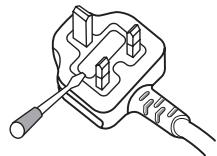
How to replace the fuse: Open the fuse compartment with a screwdriver and replace the fuse.
D3-4-2-1-2-2*A2_En

If you want to dispose this product, do not mix it with general household waste. There is a separate collection system for used electronic products in accordance with legislation that requires proper treatment, recovery and recycling.
Private households in the member states of the EU, in Switzerland and Norway may return their used electronic products free of charge to designated collection facilities or to a retailer (if you purchase a similar new one).
For countries not mentioned above, please contact your local authorities for the correct method of disposal.
By doing so you will ensure that your disposed product undergoes the necessary treatment, recovery and recycling and thus prevent potential negative effects on the environment and human health.
K058b_A1_En
WARNING
This equipment is not waterproof. To prevent a fire or shock hazard, do not place any container filled with liquid near this equipment (such as a vase or flower pot) or expose it to dripping, splashing, rain or moisture.
D3-4-2-1-3_A1_En
WARNING
Before plugging in for the first time, read the following section carefully.
The voltage of the available power supply differs according to country or region. Be sure that the power supply voltage of the area where this unit will be used meets the required voltage (e.g., 230 V or 120 V) written on the rear panel.
D3-4-2-1-4*A1_EN
WARNING
To prevent a fire hazard, do not place any naked flame sources (such as a lighted candle) on the equipment.
D3-4-2-1-7a_A1_En
VENTILATION CAUTION
When installing this unit, make sure to leave space around the unit for ventilation to improve heat radiation (at least 5 cm at rear, and 5 cm at each side).
WARNING
Slots and openings in the cabinet are provided for ventilation to ensure reliable operation of the product, and to protect it from overheating. To prevent fire hazard, the openings should never be blocked or covered with items (such as newspapers, table-cloths, curtains) or by operating the equipment on thick carpet or a bed.
D3-4-2-1-7b*A1En
Operating Environment
Operating environment temperature and humidity:
+5 °C to +35 °C (+41 °F to +95 °F); less than 85 % RH (cooling vents not blocked)
Do not install this unit in a poorly ventilated area, or in locations exposed to high humidity or direct sunlight (or strong artificial light)
D3-4-2-1-7c*A1_EN
When using this product, confirm the safety information shown on the bottom of the unit.
D3-4-2-2-4_B1_En
If the AC plug of this unit does not match the AC outlet you want to use, the plug must be removed and appropriate one fitted. Replacement and mounting of an AC plug on the power supply cord of this unit should be performed only by qualified service personnel. If connected to an AC outlet, the cut-off plug can cause severe electrical shock. Make sure it is properly disposed of after removal.
The equipment should be disconnected by removing the mains plug from the wall socket when left unused for a long period of time (for example, when on vacation).
D3-4-2-2-1a_A1_En
CAUTION
The switch on this unit will not completely shut off all power from the AC outlet. Since the power cord serves as the main disconnect device for the unit, you will need to unplug it from the AC outlet to shut down all power. Therefore, make sure the unit has been installed so that the power cord can be easily unplugged from the AC outlet in case of an accident. To avoid fire hazard, the power cord should also be unplugged from the AC outlet when left unused for a long period of time (for example, when on vacation).
D3-4-2-2-2a*A1_EN
POWER-CORD CAUTION
Handle the power cord by the plug. Do not pull out the plug by tugging the cord and never touch the power cord when your hands are wet as this could cause a short circuit or electric shock. Do not place the unit, a piece of furniture, etc., on the power cord, or pinch the cord. Never make a knot in the cord or tie it with other cords. The power cords should be routed such that they are not likely to be stepped on. A damaged power cord can cause a fire or give you an electrical shock. Check the power cord once in a while. When you find it damaged, ask your nearest PIONEER authorized service center or your dealer for a replacement.
S002*A1En
CAUTION
This product is a class 1 laser product classified under the Safety of laser products, IEC 60825-1:2007.
D58-5-2-2a_A1_En
How to read this manual
The names of displays, menus, and buttons in this manual are enclosed in brackets. (e.g. [MASTER] channel, [ON/OFF], [File] menu)
- The Operating Instructions of rekordbox can be viewed from the rekordbox [Help] menu after installing rekordbox.
01 Before start
Features 5
System setup example. 5
What's in the box. 5
02 Before you start
Supported sources. 6
Useable discs and USB devices 6
Playable music file formats. 7
Functions usable in combination with a computer. 8
About the rekordbox music management software. 9
About the driver software (Windows) 10
03 Connections
Names of terminals. 12
Basic style. 12
04 Operations
Control panel 14
Front panel. 15
Main unit display. 15
Setting the source to be played (source select section) 15
Basic Operations (player, source select and browse sections) 16
Operating the jog dial 17
Setting loops (loop and beat loop part) 18
Displaying track information (browse section) 18
Searching for tracks quickly using the library information. 19
About the playback history (HISTORY) 19
Using playlists 20
Adjusting the playing speed (tempo control section) 20
Using [BPM LOCK] 21
Operations in combination with a DJ mixer 21
Using the DJ software 21
Changing the settings 22
05 Additional information
Troubleshooting 23
Error messages 24
List of icons displayed on the main unit display section. 24
List of MIDI Messages 25
Cautions on use 25
Handling discs 25
Disclaimer 26
Cautions on copyrights. 26
Using the support site 26
Specifications 27
Before start
Features
This unit is a DJ player that carries over the technology of the Pioneer CDJ series, the world standard in club players. It is a multi player for DJs supporting a variety of sources, enabling full-fledged DJ play easily.
MULTI MEDIA, MULTI FORMAT
This unit can play not only music CDs (CD-DA), but also music files (MP3, AAC, WAV and AIFF) recorded on mass storage class USB devices (flash memory devices and hard discs) and CD-R/-RW discs. It can also be used as DJ software controller and audio interface.
rekordboxTM
rekordbox, a music management software application exclusively for Pioneer DJ players, is included. It allows music files on a computer to be managed in a variety of ways (analysis, setting, creation, storage of playback history, etc.). Also, music files managed withrekordbox can be transferred to USB devices for convenience in selecting tracks, operating playlists and so on when the USB device is connected to this unit.
BEAT DISPLAY
The beat position corresponding to the track's BPM and the playback position are shown on the main unit display. This allows you to check the beat visually for scratch and loop performances.
BPM LOCK
When the master BPM is set in advance, the playing speed of the currently playing track can be automatically set to the master BPM at the press of a button.
Full-fledged BPM mixing is possible easily, without moving the TEMPO slider.
PLAYLIST
The currently playing or selected track can be registered on the playlist, as desired (but only for tracks managed with rekordbox).
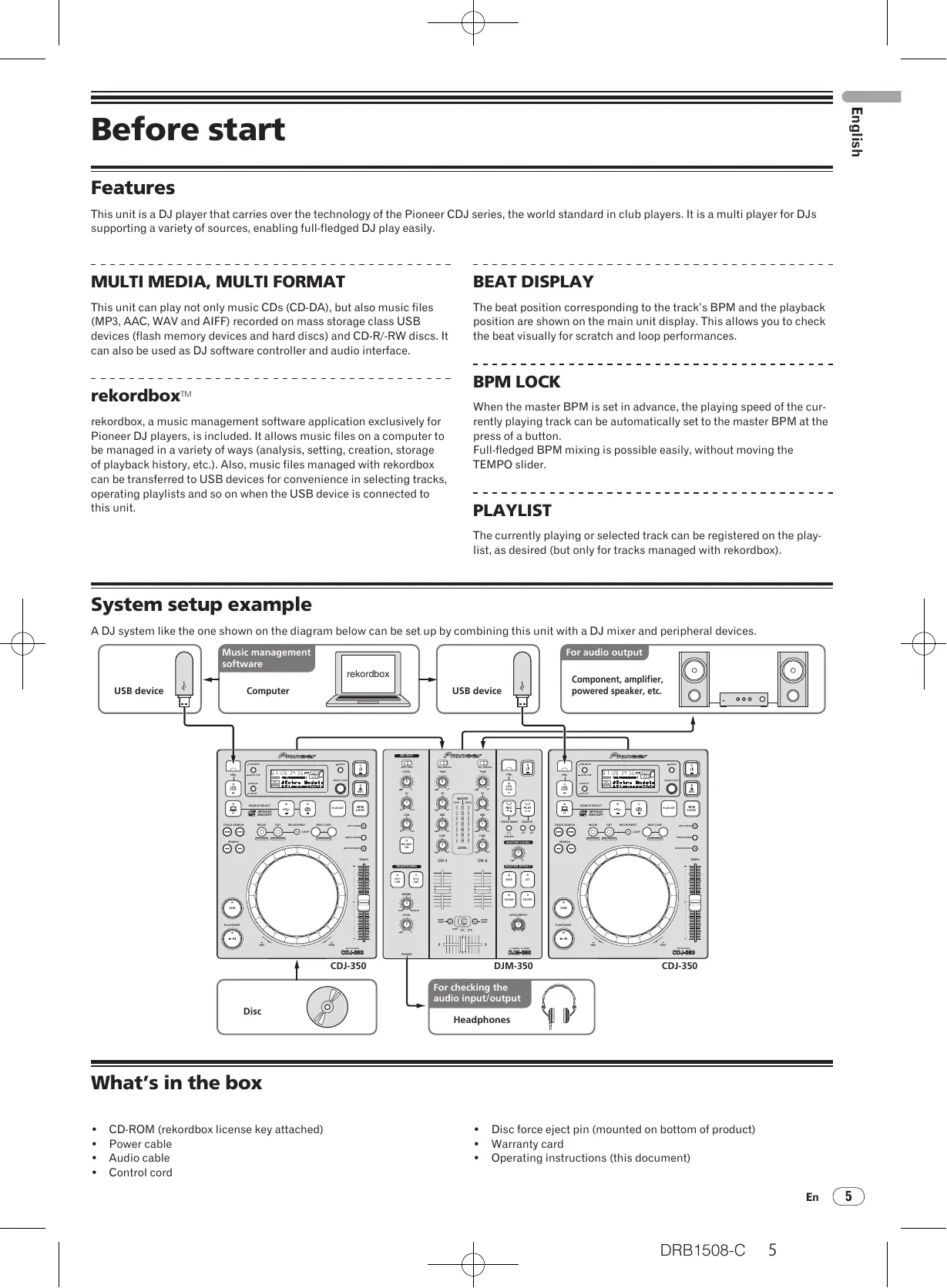
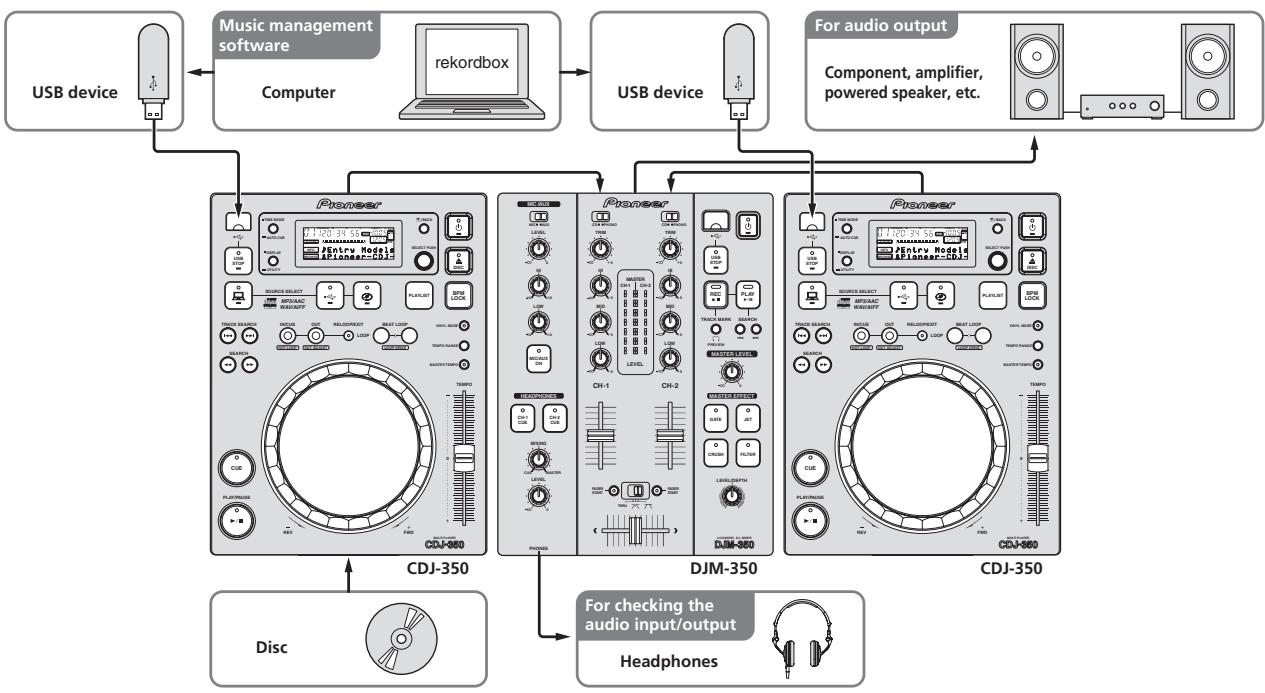
System setup example
A DJ system like the one shown on the diagram below can be set up by combining this unit with a DJ mixer and peripheral devices.
What's in the box
- CD-ROM (rekordbox license key attached)
Power cable
Audio cable
Control cord
Disc force eject pin (mounted on bottom of product)
Warranty card
- Operating instructions (this document)
Before you start
Supported sources
This unit supports the sources listed below.
Discs (page 6)
USB devices (page 7)
Computers (page 8)
Install the software onto the computer from the included CD-ROM.
The included CD-ROM contains the following two software programs.
—rekordbox music management software
- Driver software
Usable discs and USB devices
About discs
This unit can play the discs shown below.
| Type | Mark1 | Compatible formats |
| CD | COMPACT DISC DIGITAL AUDIO | Music CD (CD-DA) |
| CD-R | COMPACT DISC DIGITAL AUDIO Recordable | Music CD (CD-DA) MP3 AAC WAV AIFF |
| CD-RW | COMPACT DISC DIGITAL AUDIO ReWritable | |
| CD-TEXT2 | COMPACT DISC DIGITAL AUDIO TEXT | Music CD (CD-DA) |
1 Discs on which the marks on this table are indicated on the disc label, package or jacket can be played.
2 Titles, album names and artist names recorded in the CD-Text data are displayed. When multiple text data are recorded on the disc, the information for the first text data is displayed.
Discs that cannot be played
DTS-CD
Photo CDs
Video CDs
CD Graphics (CD-G) discs
- Unfinalized CDs
DVD
About CD-R/RW discs
Music files (MP3/AAC/WAV/AIFF) recorded on CD-R/-RW discs can be played.
| Folder layers | Max. 8 levels (files in folders beyond the 8th level cannot be played) |
| Max. number of folders | 1000 folders |
| Max. number of files | 1000 files |
When there are many folders or files, some time may be required for loading.
About discs created on computers
Depending on the application settings and the computer's environmental settings, it may not be possible to play certain discs. Record the disc in a format supported on this unit. For details, contact your application's retailer.
If the recording quality is poor due to the disc's properties, scratches or dirt on the disc or dirt on the recording lens, it may not be possible to play the disc.
Creating backup discs
When CD-R/-RW discs are paused or left in the pause mode at cue points for long periods of time, it may become difficult to play the disc at that point, due to the properties of the disc. Also, when a specific point is looped repeatedly an extremely large number of times, it may become difficult to play that point.
When playing valuable discs, we recommend making backup discs.
About Copy Control CDs and DualDiscs
This unit is designed to CD standards. Operation and performance of discs with standards other than CD standards is not guaranteed.
About 8 cm single CDs
8 cm single CDs cannot be played on the CDJ-350. Do not mount 8 cm adapters on CDs and play them on the CDJ-350. The adapter could fall off as the disc spins, damaging the disc or the player.
About USB devices
This unit supports USB mass storage class USB devices (external hard disks, portable flash memory devices, digital audio players, etc.).
| Folder layers | Max. 8 layers |
| Max. number of folders | 1 000 folders |
| Max. number of files | 10 000 files (1 000 files for files not managed by rekordbox) |
| Supported file systems | FAT16, FAT32 and HFS+ (NTFS is not supported.) |
When there are many folders or files, some time may be required for loading.
Folders and files exceeding the limits cannot be displayed.
USB devices that cannot be used
- Optical disk type devices such as external DVD/CD drives, etc., are not supported.
- USB hubs cannot be used.
Cautions on using USB devices
- Some USB devices may not operate properly. Please note that Pioneer will accept no responsibility whatsoever for loss of data recorded on USB devices.
- It may happen that, when a current above the allowable level is detected in this unit's USB port, the [USB STOP] indicator flashes, the power supply to the USB device is cut off and communications with the USB device are interrupted. To restore normal operation, disconnect the USB device from this unit. Avoid reusing USB devices for which an excess current has been detected. If normal operation is not restored (if communications cannot be established) after the above procedure is performed, try turning off this unit's power then turning it back on.
- If multiple partitions are set for the USB device, the device may not be recognized.
- USB devices equipped with flash card readers may not operate.
- Depending on the USB device you are using, the desired performance may not be achieved.
Playable music file formats
This unit supports music files in the formats shown below.
| Type | File extension | Compatible formats | Bit depth | Bit rate | Sampling frequency | Encoding method |
| MP3 | .mp3 | MPEG-1 | 16 bit | 32 kbps to 320 kbps | 32 kHz, 44.1 kHz, 48 kHz | CBR, VBR |
| AAC | .m4a, .aac and .mp4 | MPEG-4 AAC LC | 16 bit | 16 kbps to 320 kbps | 32 kHz, 44.1 kHz, 48 kHz | CBR, VBR |
| WAV | .wav | WAV | 16 bit, 24 bit | — | 44.1 kHz, 48 kHz | Uncompressed PCM |
| AIFF | .aif, .aiff | AIFF | 16 bit, 24 bit | — | 44.1 kHz, 48 kHz | Uncompressed PCM |
About MP3 files
MP3 files can have a constant bit rate (CBR) or a variable bit rate (VBR). Both types of files can be played on the CDJ-350, but the search and super fast search functions are slower with VBR files. If your priority is operability, we recommend recording MP3 files in CBR.
About AAC files
- AAC is the abbreviation of "Advanced Audio Coding", a basic format of audio compression technology used for MPEG-2 and MPEG-4.
- The file format and extension of AAC data depends on the application used to create the data.
- In addition to AAC files with the extension“.m4a” encoded with iTunes®, files with the extensions“.aac” and“.mp4” can also be played. Note, however, that copyright-protected AAC files purchased for example at the iTunes Music Store cannot be played.
Also, some files may not be playable, depending on the version of iTunes used for encoding.
Functions usable in combination with a computer
About the included CD-ROM
This unit can be used in combination with a computer when the software is installed onto the computer from the included CD-ROM. The included CD-ROM contains the following two software programs.
rekordbox music management software
Music files used for DJ play can be managed. The management information can be transferred using USB devices (page 9).
Driver software
When operating DJ software on the computer using this unit, the sound of the music file that is playing can be output from this unit (page 10).
There is no need to install the driver software when using Mac OS X.
Software end user license agreement
This Software End User License Agreement ("Agreement") is between you (both the individual installing the Program and any single legal entity for which the individual is acting) ("You" or "Your") and PIONEER CORPORATION ("Pioneer").
TAKING ANY STEP TO SET UP OR INSTALL THE PROGRAM MEANS THAT YOU ACCEPT ALL OF THE TERMS OF THIS LICENSE AGREEMENT. PERMISSION TO DOWNLOAD AND/OR USE THE PROGRAM IS EXPRESSLY CONDITIONED ON YOUR FOLLOWING THESE TERMS. WRITTEN OR ELECTRONIC APPROVAL IS NOT REQUIRED TO MAKE THIS AGREEMENT VALID AND ENFORCEABLE. IF YOU DO NOT AGREE TO ALL OF THE TERMS OF THIS AGREEMENT, YOU ARE NOT AUTHORIZED TO USE THE PROGRAM AND MUST STOP INSTALLING IT OR UNINSTALL IT, AS APPLICABLE.
1 Definitions
1 "Documentation" means written documentation, specifications and help content made generally available by Pioneer to aid in installing and using the Program.
2 "Program" means all or any part of Pioneer's software licensed to You by Pioneer under this Agreement.
2 Program license
1 Limited License. Subject to this Agreement's restrictions, Pioneer grants to You a limited, non-exclusive, nontransfer-able, license (without the right to sublicense):
a To install a single copy of the Program on the hard disk drive of Your computer, to use the Program only for Your personal purpose complying with this Agreement and the Documentation ("Authorized Use");
b To use the Documentation in support of Your Authorized Use; and
c To make one copy of the Program solely for backup purposes, provided that all titles and trademark, copyright and restricted rights notices are reproduced on the copy.
2 Restrictions. You will not copy or use the Program or Documentation except as expressly permitted by this Agreement. You will not transfer, sub license, rent, lease or lend the Program, or use it for third-party training, commercial time-sharing or service bureau use. You will not Yourself or through any third party modify, reverse engineer, disassemble or decompile the Program, except to the extent expressly permitted by applicable law, and then only after You have notified Pioneer in writing of Your intended activities. You will not use the Program on multiple processors without Pioneer's prior written consent.
Ownership. Pioneer or its licensor retains all right, title and interest in and to all patent, copyright, trademark, trade secret and other intellectual property rights in the Program and
Documentation, and any derivative works thereof. You do not acquire any other rights, express or implied, beyond the limited license set forth in this Agreement.
4 No Support. Pioneer has no obligation to provide support, maintenance, upgrades, modifications or new releases for the Program or Documentation under this Agreement.
3 Warranty disclaimer
THE PROGRAM AND DOCUMENTATION ARE PROVIDED "AS IS" WITHOUT ANY REPRESENTATIONS OR WARRANTYES, AND YOU AGREE TO USE THEM AT YOUR SOLE RISK. TO THE FULlest EXTENT PERMISSIBLE BY LAW, PIONEER EXPRESSLY DISCLAIMS ALL WARRANTYES OF ANY KIND WITH RESPECT TO THE PROGRAM AND DOCUMENTATION, WHETHER EXPRESS, IMPLIED, STATUTORY, OR ARISING OUT OF COURSE OF PERFORMANCE, COURSE OF DEALING OR USAGE OF TRADE, INCLUDING ANY WARRANTYES OF MERCHANTABILITY, FITNESS FOR A PARTICULAR PURPOSE, SATISFACTORY QUALITY, ACCURACY, TITLE OR NON-INFRINGEMENT.
4 Damages and remedies for breach
You agree that any breach of this Agreement's restrictions would cause Pioneer irreparable harm for which money damages alone would be inadequate. In addition to damages and any other remedies to which Pioneer may be entitled, You agree that Pioneer may seek injunctive relief to prevent the actual, threatened or continued breach of this Agreement.
5 Termination
Pioneer may terminate this Agreement at any time upon Your breach of any provision. If this Agreement is terminated, You will stop using the Program, permanently delete it from the computer where it resides, and destroy all copies of the Program and Documentation in Your possession, confirming to Pioneer in writing that You have done so. Sections 2.2, 2.3, 2.4, 3, 4, 5 and 6 will continue in effect after this Agreement's termination.
6 General terms
1 Limitation of Liability. In no event will Pioneer or its subsidiaries be liable in connection with this Agreement or its subject matter, under any theory of liability, for any indirect, incidental, special, consequential or punitive damages, or damages for lost profits, revenue, business, savings, data, use, or cost of substitute procurement, even if advised of the possibility of such damages or if such damages are foreseeable. In no event will Pioneer's liability for all damages exceed the amounts actually paid by You to Pioneer or its subsidiaries for the Program. The parties acknowledge that the liability limits and risk allocation in this Agreement are reflected in the Program price and are essential elements of the bargain between the parties, without which Pioneer would not have provided the Program or entered into this Agreement.
2 The limitations or exclusions of warranties and liability contained in this Agreement do not affect or prejudice Your statutory rights as consumer and shall apply to You only to the extent such limitations or exclusions are permitted under the laws of the jurisdiction where You are located.
3 Severability and Waiver. If any provision of this Agreement is held to be illegal, invalid or otherwise unenforceable, that provision will be enforced to the extent possible or, if incapable of enforcement, deemed to be severed and deleted from this Agreement, and the remainder will continue in full force and effect. The waiver by either party of any default or breach of this Agreement will not waive any other or subsequent default or breach.
4 No Assignment. You may not assign, sell, transfer, delegate or otherwise dispose of this Agreement or any rights or obligations under it, whether voluntarily or involuntarily, by operation of law or otherwise, without Pioneer's prior written consent. Any purported assignment, transfer or delegation by You will be null and void. Subject to the foregoing, this Agreement will be binding upon and will inure to the benefit of the parties and their respective successors and assigns.
5 Entire Agreement. This Agreement constitutes the entire agreement between the parties and supersedes all prior or contemporaneous agreements or representations, whether
written or oral, concerning its subject matter. This Agreement may not be modified or amended without Pioneer's prior and express written consent, and no other act, document, usage or custom will be deemed to amend or modify this Agreement.
6 You agree that this Agreement shall be governed and construed by and under the laws of Japan.
Cautions on installing the software
Read Software end user license agreement carefully before installing rekordbox and the driver software.
- The included CD-ROM contains installation programs in the following 12 languages.
English, French, German, Italian, Dutch, Spanish, Portuguese, Russian, Chinese (simplified characters), Chinese (traditional characters), Korean, Japanese.
- When using rekordbox with an operating system in a different language, follow the instructions on the screen to select [English].
| Supported operating systems | rekordbox | Driver software | |
| Mac OS X (10.4.6 and later) | ✓ | 1 | |
| Windows® 7 Home Pre-mium/Professional/Ultimate | 32-bit version | ✓ | ✓ |
| 64-bit version | ✓ | ✓2 | |
| Windows Vista®Home Basic/Home Pre-mium/Business/Ulti-mate (SP1 and later) | 32-bit version | ✓ | ✓ |
| 64-bit version | ✓ | ✓2 | |
| Windows® XP Home edi-tion/Professional (SP3 and later) | 32-bit version | ✓ | ✓ |
There is no need to install the driver software when using Mac OS X.
2 When using a 64-bit version of Windows, the driver software can only be used for 32-bit applications.
Minimum operating environment forrekordbox
CPU:
For Mac OS X, Macintosh computer equipped with a 1.83 GHz or greater Intel® Core™ Duo (or compatible) processor
For Windows® 7, Windows Vista® and Windows® XP, PC/AT compatible computer equipped with a 2 GHz or greater Intel® Pentium® 4 (or compatible) processor
- Required memory: 1 GB or more of RAM
- Hard disc: 250 MB or more of free space (not including space for storing music files, etc.)
- CD drive: Optical disc drive on which the CD-ROM can be read
Sound: Audio output to speakers, headphones, etc. (internal or external audio device) - Internet connection: For user registration and inquiries, use a web browser supporting 128-bit SSL (Safari 2.0 or greater, Internet Explorer® 6.0 or greater, etc.).
-
USB port: A USB port for connection of a USB device (flash memory, hard disc, etc.) is required to transfer music files to the USB device.
-
Operation is not guaranteed on all computers, even those with the operating environment described above.
-
Even with the required memory capacity indicated for the operating environment above, in the cases described below the software may not provide full functionality and performance due to lack of memory. In this case, take the necessary measures to ensure sufficient free memory. We recommend adding extra memory in order to achieve stable performance.
-
When there are many tracks being managed in the rekordbox library
- When resident programs and services are running
- Depending on the computer's power settings, etc., the CPU and hard disc processing capacity may be insufficient. When using laptop computers in particular, always keep the AC power connected and set the computer to maximum performance conditions when using rekordbox.
Note that problems may arise in the operation of rekordbox due to other software being used together with it.
About the rekordbox music management software
rekordbox is a software program for purchasers of the CDJ-350 or other Pioneer DJ players to manage the music files they use for DJ play.
- rekordbox may be used for classifying and searching for music files stored on your computer as well as creating playlists, all of which can help improve your DJ performance.
—rekordbox allows the detecting, measuring, and editing of beats, tempos (BPM), and other elements of your music files prior to a performance.
Installingrekordbox
About the installation procedure (Macintosh)
Read Cautions on installing the software carefully before installing rekordbox.
- Authorization of the computer's administrator is required to install and uninstall rekordbox. Log on as the user which was set as the computer's administrator before installing.
1 When the included CD-ROM is inserted into the computer's CD drive, the CD drive opens on the screen. Double-click the [CD_menu.app] icon.
- If the CD drive does not open on the screen when the CD-ROM is inserted, use Finder to open the CD drive, then double-click the [CD_menu.app] icon.
![PIONEER CDJ-350-W - When the included CD-ROM is inserted into the computer's CD drive, the CD drive opens on the screen. Double-click the [CD_menu.app] icon. - 1](/content/2024/12/118924/images/e5b8f47915369ff3a3c9d783c9190a4d999d1dd43019ae7917bebbb4c3af522d.jpg)
[ < \text{[CDmenu.app]} ] icon >
2 When the CD-ROM's menu is displayed, select [rekordbox: Install Music Management Software], then click [Start].
![PIONEER CDJ-350-W - When the CD-ROM's menu is displayed, select [rekordbox: Install Music Management Software], then click [Start]. - 1](/content/2024/12/118924/images/d787cce16b864302eadaa4bdfbb918fd1fa82495f77324004ade93cf54c00c1a.jpg)
- To close the CD-ROM menu, click [Exit].
3 Installrekordbox following the instructions on the screen.
About the installation procedure (Windows)
Read Cautions on installing the software carefully before installing rekordbox.
- Authorization of the computer's administrator is required to install and uninstall rekordbox. Log on as the user registered as the computer's administrator before installing rekordbox.
1 Insert the included CD-ROM into the computer's CD drive.
The CD-ROM menu is displayed.
- If the CD-ROM menu does not appear when the CD-ROM is inserted, open the CD drive from [Computer (or My Computer)] in the [Start] menu, then double-click the [CD_menu.exe] icon.
2 When the CD-ROM's menu is displayed, select [rekordbox: Install Music Management Software], then click [Start].
![PIONEER CDJ-350-W - When the CD-ROM's menu is displayed, select [rekordbox: Install Music Management Software], then click [Start]. - 2](/content/2024/12/118924/images/21d8288224da813867a292f81b6a62254395ced467d36966706584ee4e61b357.jpg)
- To close the CD-ROM menu, click [Exit].
3 Installrekordbox following the instructions on the screen. - Click [Cancel] to cancel installation after it has started.
Launchingrekordbox
Log on as the user which was set as the computer's administrator before using rekordbox.
- When rekordbox is started up for the first time, the license key must be input. The license key is affixed to the CD-ROM package.
- Whenrekordboxistartedup,theoperatinginstructions can be viewed from therekordbox [Help] menu.
For Mac OS X
Open the [Application] folder with Finder, then double-click [rekordbox 1.x.x.app].
The 1.x.x indicates the rekordbox version.
For Windows 7, Windows Vista and Windows XP
Click on the Windows [Start] menu button, then [All Programs] > [Pioneer] > [rekordbox 1.x.x] > [rekordbox 1.x.x].
The 1.x.x indicates the rekordbox version.
About the driver software (Windows)
This driver software is an exclusive ASIO driver for outputting audio signals from the computer. To use the CDJ-350 connected to a computer on which Windows is installed, install the driver software on the computer beforehand.
Installing the driver software
Before installing the driver software
- Read Cautions on installing the software on page 9 carefully.
- Turn off this unit's power switch, then disconnect the USB cable connecting this unit and the computer.
If any other programs are running on the computer, quit them. - To install or uninstall the driver software, you need to be authorized by the administrator of your computer. Log on as the administrator of your computer before proceeding with the installation.
- If you connect this unit to your computer without installing the driver software first, an error may occur on your computer depending on the system environment.
- If installation of the driver software is interrupted after it has started, start the installation procedure over again from the beginning.
1 Insert the included CD-ROM into the computer's CD drive.
The CD-ROM menu is displayed.
- If the CD-ROM menu does not appear when the CD-ROM is inserted, open the CD drive from [Computer (or My Computer)] in the [Start] menu, then double-click the [CD_menu.exe] icon.
2 When the CD-ROM menu appears, select [Install Driver Software (Pioneer_CDJ_Driver)], then click [Start].
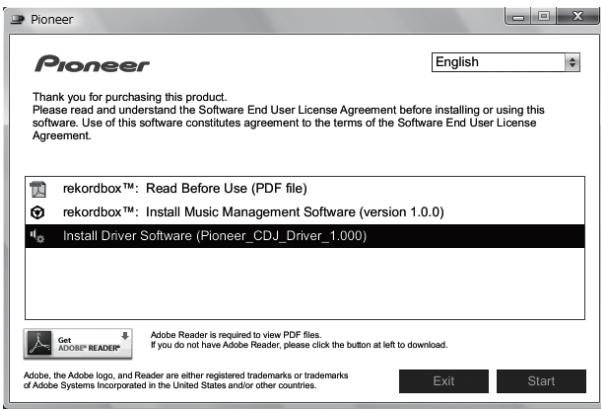
To close the CD-ROM menu, click [Exit].
3 Proceed with installation according to the instructions on the screen.
If [Windows Security] appears on the screen while the installation is in progress, click [Install this driver software anyway] and continue with the installation.
- When installing on Windows XP
If [Hardware Installation] appears on the screen while the installation is in progress, click [Continue Anyway] and continue with the installation. - When the installation program is completed, a completion message appears.
Connecting the CDJ-350 and computer
1 Connect this unit to your computer via a USB cable.
For instructions on connecting, see Using DJ software on page 13.
2 Press [O].
Turn on the power of this unit.
3 Press [ ] for at least 1 second.
The [CONTROL MODE] screen appears on the main unit display.
- The message [Installing device driver software] may appear when the CDJ-350 is connected to the computer for the first time or when it is reconnected to the computer's USB port. Wait until the [Your devices are ready for use] message appears.
-
When installing on Windows XP
-
[Can Windows connect to Windows Update to search for software?] may appear while the installation is in progress. Select [No, not this time] and click [Next] to continue with the installation.
- [What do you want the wizard to do?] may appear while the installation is in progress. Select [Install the software automatically (Recommended)] and click [Next] to continue with the installation.
- If [Hardware Installation] appears on the screen while the installation is in progress, click [Continue Anyway] and continue with the installation.
Adjusting the buffer size
This unit functions as an audio device conforming to the ASIO standards.
- If an application using this unit as the default audio device (DJ software, etc.) is running, quit that application before adjusting the buffer size.
Click Windows [Start] menu >[All Programs] >[Pioneer] > [Pioneer CDJ] > [Pioneer CDJ ASIO Settings Utility].
![PIONEER CDJ-350-W - Click Windows [Start] menu >[All Programs] >[Pioneer] > [Pioneer CDJ] > [Pioneer CDJ ASIO Settings Utility]. - 1](/content/2024/12/118924/images/8f4eef24d1343b856c9712fedcb1a4bb73845d9ecee3c1ffa56d69dd9d7900d0.jpg)
A sufficiently large buffer size decreases the chance of sound dropout (sound interruption) but increases audio signal transmission delay (latency).
Checking the version of the driver software
Click Windows [Start] menu >[All Programs] >[Pioneer] > [Pioneer CDJ] > [Pioneer CDJ Version Display Utility].
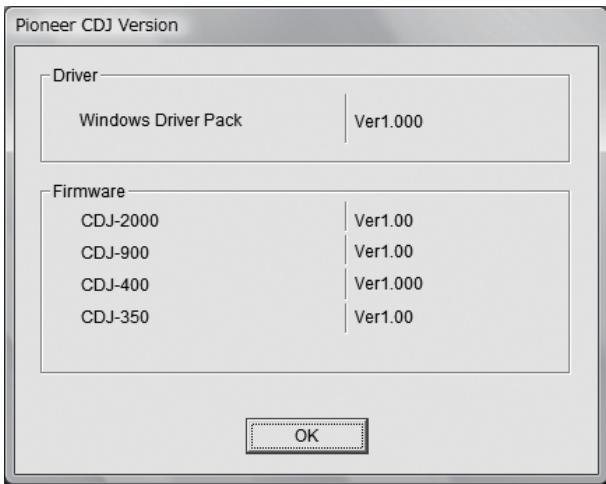
- You can check the firmware version of this unit on the screen.
- The firmware version is not displayed when the CDJ-350 is not connected to the computer or when the CDJ-350 and computer are not properly communicating.
Checking the latest information on the driver software
For the latest information on the driver software for exclusive use with this unit, visit our website shown below. http://www.prodjnet.com/support/
Connections
Be sure to turn off the power and unplug the power cord from the power outlet whenever making or changing connections.
Refer to the operating instructions for the component to be connected.
Connect the power cord after all the connections between devices have been completed.
Be sure to use the included power cord.
Names of terminals
Rear panel
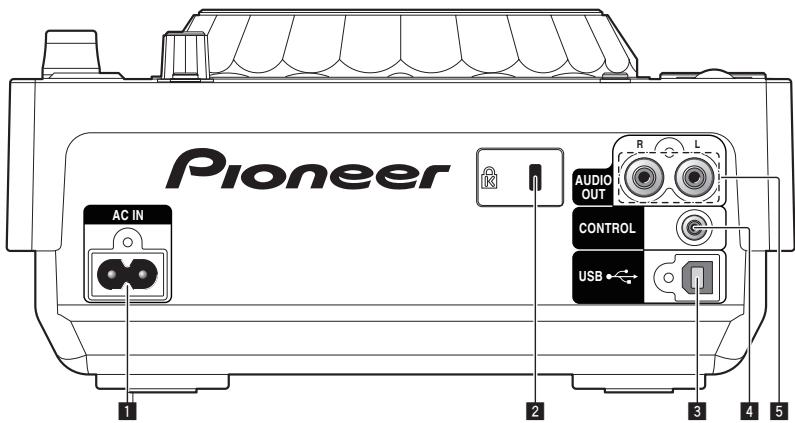
ACIN
Connect this to a power outlet.
Connect the power cord after all the connections between devices have been completed.
Be sure to use the included power cord.
2 Kensington security slot
3 USB (page 13)
Connect to a computer.
4 CONTROL (page 13)
Connect the control cord (included) here.
5 AUDIO OUT L/R (page 12)
Connect the audio cables (included) here.
Basic style
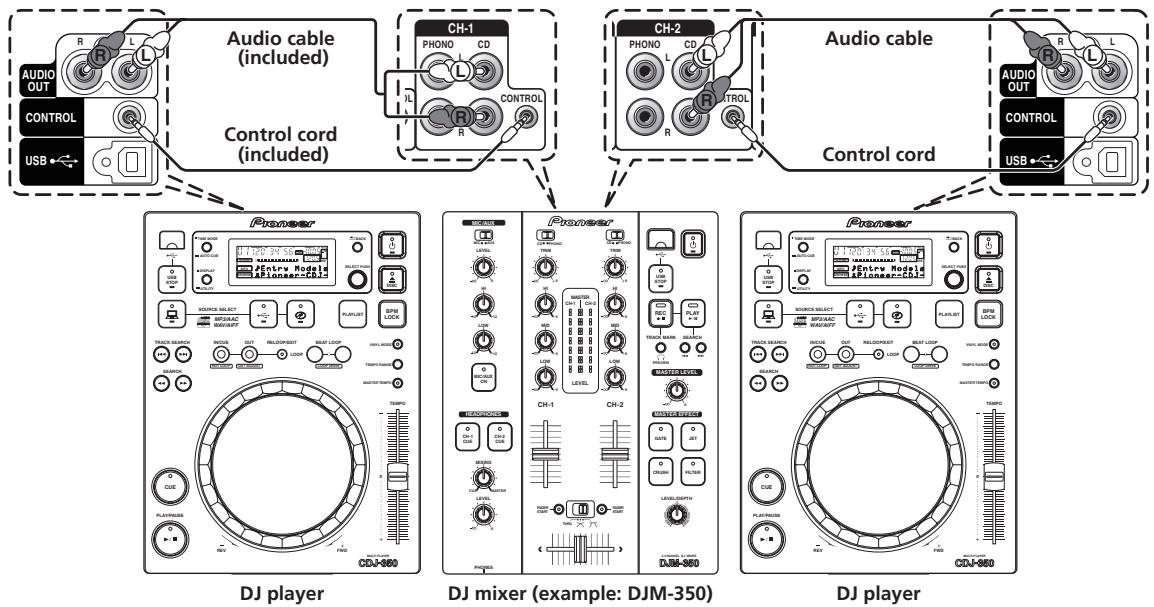
When connected to a Pioneer DJ mixer using the control cord (included), operations such as starting playback on this unit can be controlled using the DJ mixer's fader (page 21).
The fader start function can only be used when connected to a Pioneer DJ mixer.
Using the relay play function
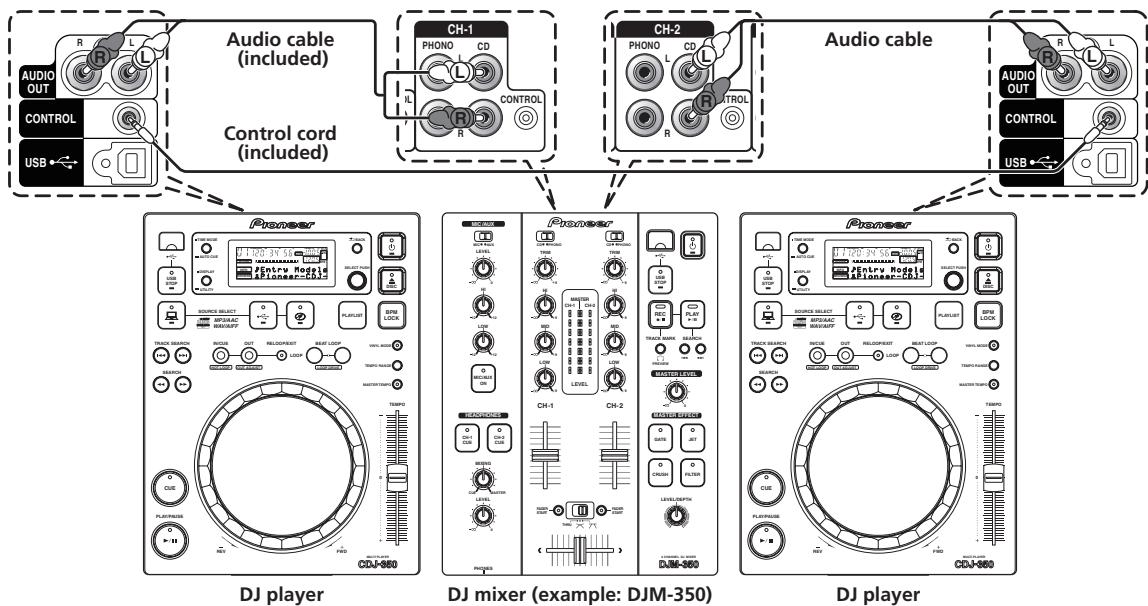
Relay playback on two DJ players is possible when the [CONTROL] terminals on this unit and the other Pioneer DJ player are interconnected using a control cord (page 21).
Using DJ software
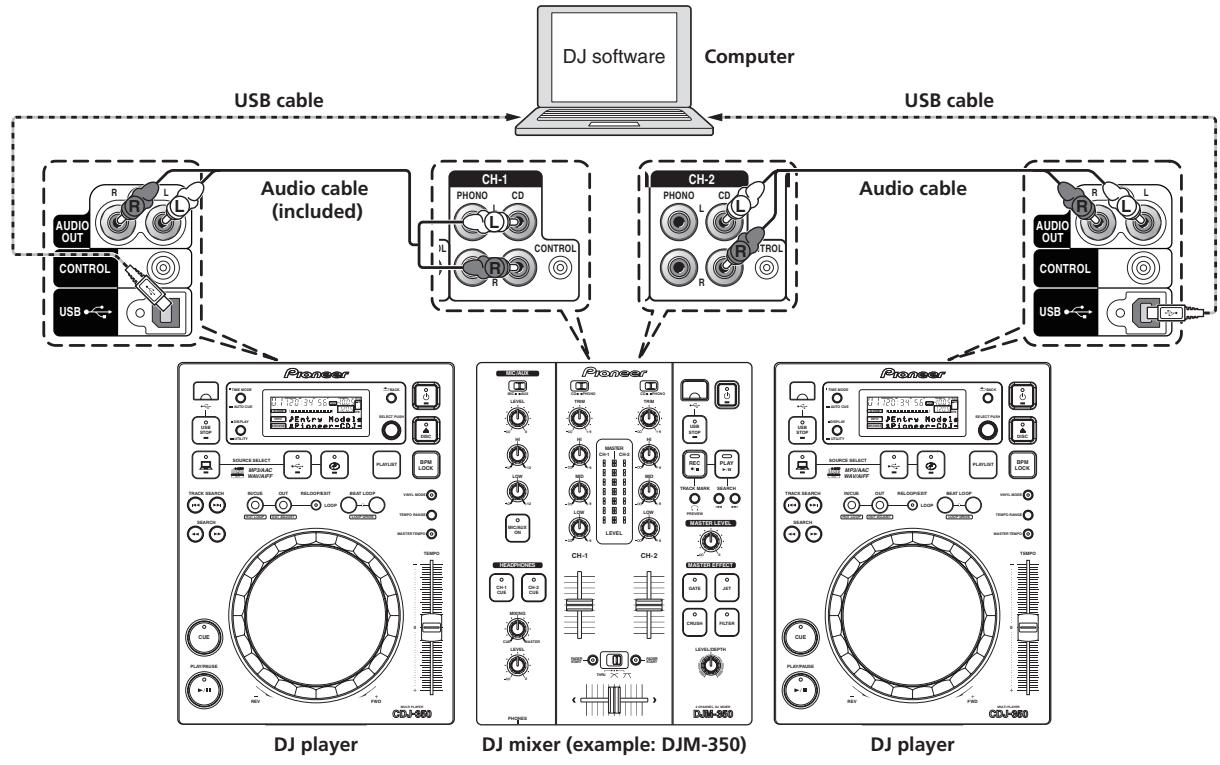
When connected to a computer by USB cable, the DJ software can be operated with this units (page 21). The sound of music files playing on the computer can be output from this unit (page 10).
Operations
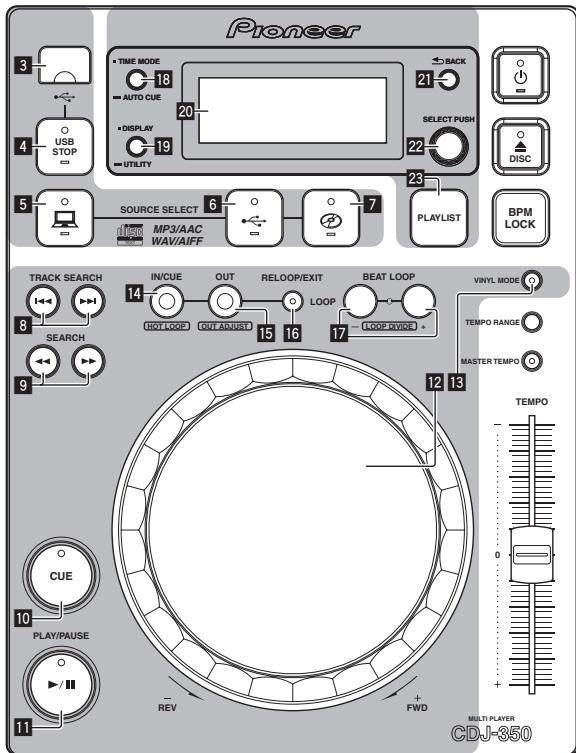
Control panel

1 (Power switch) (page 16)
2 △DISC (page 15)
Source select section
Select the source to be played with this unit here (page 15).
USB device insertion slot
4 USB STOP
5 (COMPUTER)
6 (USB)
7 (DISC)
Player section
These controls can be used for such basic DJ player operations as playing discs, setting cue/loop points and operating the jog dial (page 16).
3 TRACK SEARCH
9 SEARCH
10 CUE
11 PLAY/PAUSE 11
12 Jog dial
13 VINYL MODE
Loop and beat loop part
14 LOOP IN/CUE (HOT LOOP)
15 LOOP OUT (OUT ADJUST)
16 RELOOP/EXIT
17 BEAT LOOP (LOOP DIVIDE)
Browse section
Information on the device loaded on this unit, loaded tracks, etc., is displayed here (page 18).
TIME MODE (AUTO CUE)
19 DISPLAY (UTILITY)
20 Main unit display
2 BACK
2 Playlist part
22 SELECT PUSH (rotary selector)
23 PLAYLIST
Tempo control section
Adjust the track playing speed here (page 20).
When [BPM LOCK] is used, the playing speeds of two tracks can be matched easily (page 21).
24 BPM LOCK
25 TEMPO RANGE
26 MASTER TEMPO
27 TEMPO
Front panel
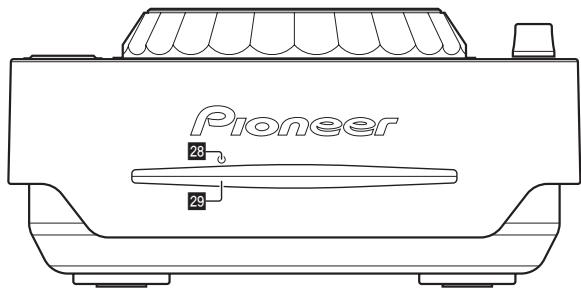
28 Disc force eject pin insertion hole (page 15)
29 Disc insertion slot (page 15)
Main unit display
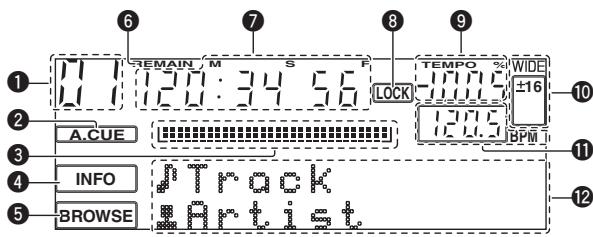
1 Track number
This displays the track number.
It is not possible to display more than 100 tracks.
2 A. CUE (page 17)
This lights when auto cue is set.
3 Playing address display
The track is displayed as a bar graph.
Turns off from the left side when the remaining time is displayed. The entire graph flashes slowly when the remaining track time is under 30 seconds, then flashes quickly when the remaining track time is under 15 seconds.
4 INFO (page 19)
BROWSE (page 19)
6 REMAIN
This lights when the time display is set to the remaining time.
M, S, F (time display)
"M" indicates minutes, "S" seconds, "F" frames.
There are 75 frames to a second.
This lights when the BPM is locked.
TEMPO %
This indicates the percentage by which the playing speed is changed.
10 WIDE, ±16, ±10, ±6
This indicates the range by which the playing speed can be adjusted.
BPM
Displays BPM (Beats Per Minute) of the track currently being played.
12 Information display section
Up to 13 characters can be displayed for each. The characters that can be displayed are letters A to Z, numbers 0 to 9 and certain symbols. "?" is displayed for other characters.
Setting the source to be played (source select section)
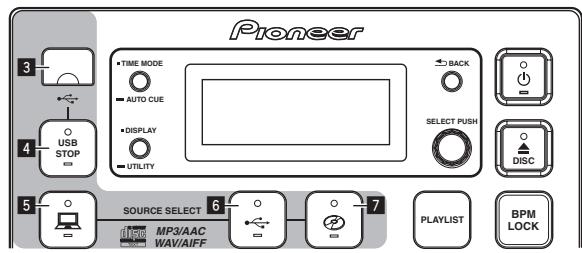

Loading discs
- Set the disc with the printed side facing up.
- Insert the disc horizontally into the disc insertion slot in the main unit's front panel.
Do not load more than 1 disc. - Do not force discs into the set's disc insertion slot when the set's power is off. Doing so could damage the disc or the set.
- When the disc is being drawn in or ejected, do not apply any force to the disc in the direction opposite its movement. Doing so could damage the disc or the set.
1 Press [O] 1.
Turn on the power of this unit.
2 Insert the disc into the disc insertion slot 29.
Playback starts.
- When auto cue is turned on, playback starts when [PLAY/PAUSE▶/II] is pressed. For details on the auto cue function, see Setting auto cue on page 17.
Ejecting discs
Press [△ DISC] 2.
The disc is ejected from the disc insertion slot.
- If you press [▲DISC] by mistake, press [PLAY/PAUSE▶/II] immediately to restore this unit to the status it was in just before [▲ DISC] was pressed. (No sound is output during this time.)
About ejecting discs by force
- If the disc is not ejected when [▲ DISC] is pressed, eject the disc forcibly by inserting the disc force eject pin into the disc force eject pin insertion hole.
- When forcibly ejecting a disc, be sure to do so following the procedure below.
1 Press [O] to turn this unit's power off, then wait at least 1 minute.
Never forcibly eject a disc directly after turning off the set's power. Doing so is dangerous for the reasons described below.
- The disc will still be spinning when ejected and could hit your fingers, etc., causing injury.
- Also, the disc clamp will rotate in an unstable way, and the disc could get scratched.
2 Use the included disc force eject pin. (Do not use anything else.)
The included disc force eject pin is mounted on the CDJ-350's bottom panel. When the pin is inserted all the way into the insertion hole, the disc is ejected 5mm to 10mm out of the disc insertion slot. Grasp the disc with your fingers and pull it out.
Loading USB devices
Connect the USB device to the USB device insertion slot 3.
The [USB STOP] indicator lights.
Removing USB devices from the set
- Be sure to follow the procedure below when removing USB devices from the set. Removing a USB device without following this procedure could erase the set's management data and make it impossible to read the USB device.
- When turning the set's power off, be sure to remove the USB device first.
1 Press [USB STOP] 4 for at least 2 seconds.
The [USB STOP] indicator turns off.
2 Disconnect the USB device.
Basic Operations (player, source select and browse sections)
About the power switch of this unit
To turn the power on
Press [O] 1.
Turn on the power of this unit.
The [O] indicator lights green.
To set to the standby mode
When this unit's power is on, press [O] 1 for at least 1 second.
This unit is set to the standby mode.
The [0] indicator lights red.
- When [] is pressed again, the power turns on.
- This unit is equipped with an auto standby function. For details, see About the auto standby function on page 22.
Playback
1 Load the source onto this unit.
2 Press [] 6 or [] 7 for at least 1 second.
This selects the source.
3 Turn the rotary selector 22.
Select the track.
- To move to lower layers in a folder, select the folder then press the rotary selector.
To return to higher layers, press [BACK] 21. - Press [BACK] for more than 1 second to move to the top layer.
4 Press the rotary selector 22.
The track is loaded and playback begins.
- When a disc containing music files recorded with a hierarchical structure is loaded, playback starts from the tracks in the upper-most level.
Pausing
During playback, press [PLAY/PAUSE▶/II] 11.
- Playback resumes when [PLAY/PAUSE▶II] is pressed again.
Resuming playback from the position playing just before the disc was ejected (Resume)
After ejecting the disc, immediately reload that same disc into this unit.
- The resume function only works when the same disc is ejected then reloaded before loading another disc.
- The resume function does not work for USB devices.
Forward and reverse scanning
Press [SEARCH , ] 9.
The disc is forwarded when [ ] is pressed and held in.
The disc is reversed when [] is pressed and held in.
Finding the beginnings of tracks (Track Search)
Press [TRACK SEARCH | , ] 8.
Press the [ ] to move to the beginning of the next track.
When [1] is pressed, playback returns to the beginning of the currently playing track. When pressed twice in a row, playback returns to the beginning of the previous track.
- When auto cue is turned on, the set searches for the beginning of the track and pauses there (page 17).
Setting Cue
1 During playback, press [PLAY/PAUSE▶/II] 11.
Playback is paused.
2 Press [CUE] 10.
The point at which the track is paused is set as the cue point. The [PLAY/PAUSE>II] indicator flashes and the [CUE] indicator lights. No sound is output at this time.
- When a new cue point is set, the previously set cue point is canceled.
Adjusting the cue point position
1 While pausing at the cue point, press [SEARCH , ] 9.
The [PLAY/PAUSE▶/II] and [CUE] indicators flash.
2 Press [SEARCH , ] 9.
The cue point can be fine-adjusted in units of single frames.
- The same operation is possible using the jog dial.
3 Press [CUE] 10.
The position at which the button was pressed is set as the new cue point.
- When a new cue point is set, the previously set cue point is canceled.
Returning to Cue Point (Back Cue)
During playback, press [CUE] 10.
The set immediately returns to the currently set cue point and pauses.
- When [PLAY/PAUSE▶/II] is pressed, playback starts from the cue point.
Checking Cue Point (Cue Point Sampler)
After returning to the cue point, press and hold in [CUE] 10.
Playback starts from the set cue point. Playback continues while the button is held in.
Setting Cue Point during playback (Real Time Cue)
During playback, press [LOOP IN/CUE (HOT LOOP)] 14.
The point at which the button was pressed is set as the cue point.
Setting auto cue
When a track is loaded or the track search operation is performed, the silent section at the beginning of the track is skipped and the cue point is automatically set at the point immediately before the sound starts.
Press [TIME MODE (AUTO CUE)] 18 for at least 1 second.
Auto cue is set to on.
[A. CUE] lights on the main unit display.
-
When [TIME MODE (AUTO CUE)] is pressed again for at least 1 second, auto cue is set to off.
-
The auto cue level setting remains in the memory, even when the power is turned off.
Changing the auto cue level
The acoustic pressure level identified as a silent section with the auto cue function can be selected from eight levels.
-36 dB, -42 dB, -48 dB, -54 dB, -60 dB, -66 dB, -72 dB and -78 dB
- The auto cue level setting remains in the memory, even when the power is turned off.
- The auto cue level can be changed using one of the procedures described below.
Using [DISPLAY (UTILITY)] 19
1 Press [DISPLAY (UTILITY)] for at least 1 second.
The [UTILITY] screen is displayed.
2 Turn the rotary selector 22, then press it.
Select [A.CUE LEVEL].
3 Turn the rotary selector 22, then press it.
The auto cue level setting changes.
Using [TIME MODE (AUTO CUE)] 18
1 Press [TIME MODE (AUTO CUE)] for at least 5 seconds.
The auto cue level setting changing mode is set.
The current auto cue level is shown on the main unit display.
2 Turn the rotary selector 22, then press it.
The auto cue level setting changes.
Operating the jog dial
- The top of the jog dial has an embedded switch. Do not place objects on the jog dial or subject it to strong forces.
Water or other liquids getting into the set will lead to malfunction.
Switching the jog dial mode
Press [VINYL MODE] 18.
The mode switches between VINYL and CDJ each time the button is pressed.
The indicator lights when the VINYL mode is selected.
— VINYL mode: When the top of the jog dial is pressed during playback, playback stops, and when the jog dial is spun at this time sound is produced according to the direction in which the jog dial is spun.
- CDJ mode: Playback does not stop even when the top of the jog dial is pressed. Such operations as scratching cannot be performed.
Scratch
1 Press [VINYL MODE] 16.
Set the jog mode to VINYL.
2 During playback, press the top of the jog dial 12.
Playback stops.
3 Spin the jog dial in the direction you want to play and at the desired speed.
The sound is played according to the direction and speed at which the jog dial is spun by spinning the top of the jog dial while pressing it.
4 Release your hand from the top of the jog dial 12.
Normal playback resumes.
Pitch bend
During playback, spin the outer section without touching the top of the jog dial 12.
The playing speed increases when spun clockwise, decreases when spun counterclockwise. When spinning is stopped, playback returns to the normal speed.
- When the jog mode is set to the CDJ mode, the same operation can be performed by spinning the top of the jog dial.
Frame search
In the pause mode, spin the jog dial 12.
The pause position can be moved in units of single frames.
- The position is moved in the direction of playback when the jog dial is spun clockwise, in the reverse direction when it is spun counterclockwise. The position moves 135 for one revolution of the jog dial.
Super fast search
Spin the jog dial 2 while pressing [SEARCH ,▶] 9.
The track is fast-forwarded/fast-reversed in the direction in which the jog dial is spun.
- This function is canceled when [SEARCH , ] is released.
- When you stop the jog dial from spinning, normal playback resumes.
- The fast-forward/fast-reverse speed can be adjusted according to the speed at which the jog dial is spun.
Super fast track search
When the jog dial 12 is spun while pressing [TRACK SEARCH ]
▶▶1] 8, tracks are searched at high speed in the direction in which the jog dial is spun.
Setting loops (loop and beat loop part)

1 During playback, press [LOOP IN/CUE (HOT LOOP)] 14.
Loop In Point is set.
- This operation is not necessary if you have already set a Cue Point as a Loop In Point.
2 Press [LOOP OUT (OUT ADJUST)] 15.
The loop out point is set, and loop playback begins.
Fine-adjusting the loop out point (loop out adjust)
1 During loop playback, press [LOOP OUT (OUT ADJUST)] 15.
[LOOP OUT (OUT ADJUST)] starts flashing quickly and [LOOP IN/CUE (HOT LOOP)] turns off.
The loop out point's time is displayed on the main unit display.
2 Press [SEARCH ,▶▶] 9.
The loop out point can be adjusted in units of single frames.
The same operation is possible using the jog dial.
- The loop out point adjustment range is anywhere after the loop in point.
3 Press [LOOP OUT (OUT ADJUST)] 15.
Loop playback resumes.
- Loop playback also resumes if no operation is performed for over 10 seconds.
Canceling Loop playback (Loop Exit)
During loop playback, press [RELOOP/EXIT] 16.
Playback continues beyond the Loop Out Point without returning to the Loop In Point.
Returning to Loop playback (Reloop)
After canceling loop playback, press [RELOOP/EXIT] 16 during playback.
The track returns to the previously set loop in point and loop playback begins.
Dividing loops (Loop Divide)
During loop playback, press [BEAT LOOP (LOOP DIVIDE)] 17.
The length of loop playback is divided in half each time [-] is pressed. When [+] is pressed, the loop playback length returns to the original length.
Returning to the loop in point (Hot Loop)
During loop playback, press [LOOP IN/CUE (HOT LOOP)] 14.
The track instantaneously returns to the set loop in point and loop playback starts.
Setting loops automatically based on the track's tempo (Beat Loop)
In the play or pause mode, press [BEAT LOOP (LOOP DIVIDE)] 17.
The loop out point is set automatically according to the track's tempo (BPM) and loop playback starts.
- Loop playback cannot be performed properly if the BPM value is not displayed.
Displaying track information (browse section)
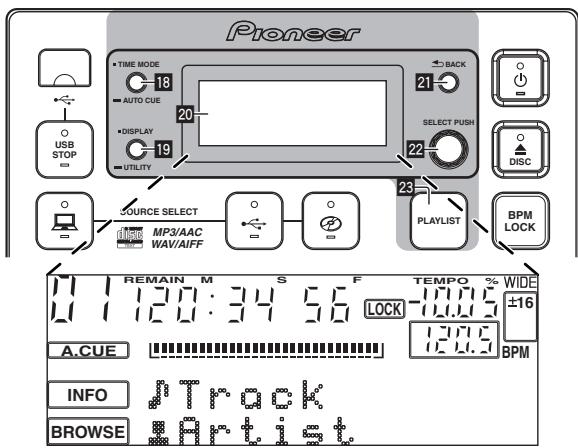
About the [BROWSE] and [INFO] displays
[BROWSE] display
This displays the loaded tracks, sorted in category or tree structure. The display on the information display section differs according to whether or not library information is recorded on the USB device.
- With library information Library browsing: The music files are displayed by the categories set inrekordbox (album, artist, etc.). The category types can be changed in the Preferences (environmental settings) inrekordbox.
- Without library information Folder browsing: The folders/tracks on the medium are displayed with a tree structure.
[INFO] display
This displays detailed information on the loaded tracks.
The artist name, album name and beat display are displayed here.
Switching the display mode
Press [DISPLAY (UTILITY)] 19.
The [BROWSE] and [INFO] displays switch each time the button is pressed.
Using the beat display function
This displays the beat and playback position of the currently playing track.
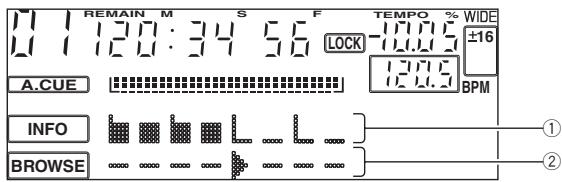
① Beat position
② Playback position
- The beat display screen is one item of the [INFO] display.
- When set to the [INFO] display, the display switches to the beat display screen automatically when scratching and looping.
1 Press [DISPLAY (UTILITY)] 19.
Switch to the [INFO] display.
2 Turn the rotary selector 22.
Display the beat display screen.
Searching for tracks quickly using the library information
When library information created using rekordbox is recorded on the USB device, the library information can be used to quickly search for tracks.
Searching by specifying the first character (jump)
When the item names in the category are sorted in alphabetical order, you can move to items beginning with the specified character.
This function may not work for some categories.
1 Press [DISPLAY (UTILITY)] 19.
Switch to the [BROWSE] display.
2 Turn the rotary selector 22, then press it.
Select the category.
3 Press the rotary selector 22 for at least 1 second.
The display switches to the character input screen.
The following information is displayed in the information display section.
Upper section: Specified character
Lower section: Items beginning with the character in the upper section
4 Turn the rotary selector 22.
The character displayed in the upper section of the information display switches.
The jump destination items corresponding to the character in the upper section are displayed in the lower section.
5 Press the rotary selector 22.
The display switches to the item selected in step 4.
Searching by inputting a character string
This function lets you display only the artists, albums, tracks or files containing the character string you input.
- Categories not selected in the Preferences (environmental settings) in rekordbox are not displayed.
1 Press [DISPLAY (UTILITY)] 19.
Switch to the [BROWSE] display.
2 Turn the rotary selector 22.
Select [SEARCH].
3 Press the rotary selector 22.
The display switches to the character input screen.
4 Use the rotary selector 22 to input a character.
Turn the rotary selector and select the desired character, then press the rotary selector to enter that character.
- Repeat this operation to input other characters.
5 Once you have completed inputting the character string, press the rotary selector 22.
Only items containing the character string you have input are displayed.
The following information is displayed in the information display section.
Upper section: Number of items containing the input character string
Lower section: Names of items containing the input character string
About the playback history (HISTORY)
When tracks managed with rekordbox are played, the playback history is registered at [HISTORY].
- The playback history is recorded on the USB device.
- The maximum number of tracks that can be recorded is 999.
- The playback history is not recorded if there is not enough free space on the USB device or if the USB device is write-protected.
- Playlists can be made based on the playback history usingrekord-box.For details, see therekordbox operating instructions.
- When a playback history is stored as a playlist using rekordbox, the playback history is deleted.
- A new [HISTORY] is created each time the power is turned on and off or the USB device is disconnected then reconnected.
Deleting the playback history
1 Turn the rotary selector 22.
Select [HISTORY].
2 Press the rotary selector 2 for at least 1 second.
The delete menu is displayed.
3 Turn the rotary selector 22 to select the range to be deleted.
- [CANCEL]: The [HISTORY]s are not deleted.
- [ONE]: The [HISTORY] selected with the cursor is deleted.
- [ALL]: All the [HISTORY]s are deleted.
4 Press the rotary selector 22.
The range selected in step 3 is deleted.
Using playlists
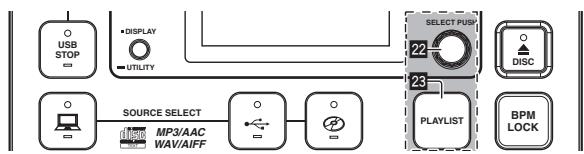
Adding tracks to playlists
First load the USB device onto this unit.
- To add the currently playing track, switch to the [INFO] screen.
To select and add a track, switch to the [BROWSE] screen. - The maximum number of tracks that can be registered in one playlist is 99.
1 Press [PLAYLIST] 23.
The display switches to the [ADD TO] screen.
2 Turn the rotary selector 22.
Select the playlist.
To create a new playlist, select [NEW PLAYLIST].
- Press [PLAYLIST] or [BACK] to return to the original screen.
3 Press the rotary selector 22.
The track is added to the playlist.
Editing playlists
Changing the order of the tracks
Select the track whose order in the playlist you want to change beforehand.
1 Press [PLAYLIST] 23.
The resorting screen is displayed.
2 Turn the rotary selector 22.
Select the position to which the track is to be moved.
The track is moved to the position between the two tracks displayed in the information display section.
3 Press the rotary selector 22.
The track order changes.
Removing tracks from playlists
Select the track you want to remove from the playlist beforehand.
1 Press [PLAYLIST] for at least 1 second.
The remove menu is displayed.
2 Turn the rotary selector 22, then press it.
- [CANCEL]: The track(s) is (are) not removed.
- [OK]: The track(s) is (are) removed.
Deleting playlists
Select the playlist you want to delete from the [PLAYLIST] category beforehand.
1 Press [PLAYLIST] 2 for at least 1 second.
The delete menu is displayed.
2 Turn the rotary selector 22, then press it.
- [CANCEL]: The playlist is not deleted.
- [OK]: The playlist is deleted.
Adjusting the playing speed (tempo control section)
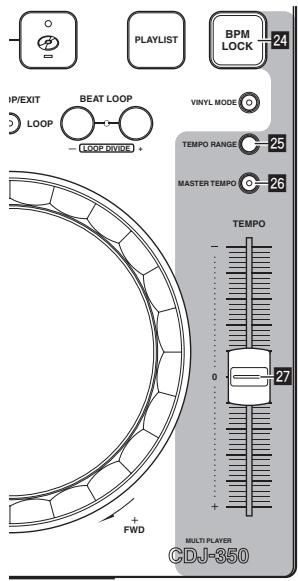
Move [TEMPO] 27 forward or backward.
The playing speed increases when the slider is moved to the [+] side (towards you), decreases when the slider is moved to the [-] side (away from you).
The percentage by which the playing speed is changed is displayed at [TEMPO %] on the main unit display.
Selecting the playing speed adjustment range
Press [TEMPO RANGE] 25.
The playing speed adjustment range switches each time the button is pressed.
[WIDE, ± 16,± 10,± 6] lights on the main unit display.
- The speed can be adjusted in units of 0.02% at [± 6]% , in units of 0.05% at [± 10]% , in units of 0.05% at [± 16]% , and in units of 0.5% at [WIDE].
- The [WIDE] adjustment range is ± 100% . When set to -100% , playback stops.
- [WIDE] can only be selected when playing music CDs (CD-DA).
Adjusting the playing speed without changing the pitch (Master Tempo)
Press [MASTER TEMPO] 26.
The [MASTER TEMPO] indicator lights. The pitch does not change even when the playing speed is changed with the [TEMPO] slider.
The sound is digitally processed, so the sound quality changes.
Using [BPM LOCK]
When the master BPM is set in advance, the playing speed of the currently playing track can be automatically set to the master BPM at the press of a button.
Setting the master BPM
1 Press [BPM LOCK] 24 for at least 1 second.
The master BPM changing mode is set.
The current BPM value or the master BPM set the previous time is displayed on the main unit display and [BPM] flashes.
2 Turn the rotary selector 22.
Change the BPM value to the value you want to set as the master BPM.
3 Press the rotary selector 22.
The master BPM is set.
If no operation is performed for over 10 seconds, the BPM value displayed in the information display section is set as the master BPM.
- When [BPM LOCK] is pressed for at least 1 second while in the master BPM changing mode, the BPM value of the currently playing track is set as the master BPM.
- To change the master BPM, start over from step 1.
Using the BPM lock function
First set the master BPM.
- The BPM lock function cannot be used for tracks for which the BPM cannot be measured correctly.
While the track is playing, press [BPM LOCK] 24.
The BPM of the currently playing track is synchronized with the master BPM.
[LOCK] appears on the main unit display.
- [TEMPOR RANGE] is set to [ ± 16 ]
- [LOCK] flashes when the BPM of the currently playing track changes. Press [BPM LOCK] while [LOCK] is flashing to re-lock the BPM.
About the tempo display in the BPM lock mode
When in the BPM lock mode, [TEMPO %] on the main unit displays switches at set intervals between the master BPM and the difference with the position of the [TEMPO] slider.
— [INC]: To match the master BPM with the position of the [TEMPO] slider, move [TEMPO] to the [+] side (towards you).
- [dEC]: To match the master BPM with the position of the [TEMPO] slider, move [TEMPO] to the [-] side (away from you).
Canceling the BPM lock mode
There are four ways to cancel the BPM lock mode.
By pressing [BPM LOCK] while in the BPM lock mode.
- Move the [TEMPO] slider to set the track's playing speed to faster or slower than the master BPM.
By loading a track.
- By searching for a track (track search).
Operations in combination with a DJ mixer
Also refer to the DJ mixer's operating instructions.
Starting playback using a DJ mixer's fader (Fader Start)
1 Connect the CDJ-350 with a Pioneer DJ mixer using the included control cord.
For instructions on connecting, see Basic style on page 12.
2 Turn on the fader start function from the DJ mixer.
3 Set the cue.
4 Move the DJ mixer's channel fader or cross fader.
This unit's pause mode is canceled and the track is played instantaneously.
- When the channel fader or cross fader is set back to its original position, playback cues back to the set cue point and the pause mode is set (Back Cue).
Relay play on two DJ players
1 Connect the CDJ-350 and a DJ mixer.
For instructions on connecting, see Using the relay play function on page 13.
2 Set the DJ mixer's cross fader to the center position.
3 Turn auto cue on for both DJ players.
The DJ players' auto cue indicators light.
4 Start playback on this unit.
When playback of the first track on this unit finishes, playback automatically begins on the other DJ player. This unit cues at the beginning of the next track and is set to the pause mode. This operation is repeated for relay play on the two DJ players.
- The medium can be changed and the cue point set on the DJ player that is in standby.
- The fader start function does not work during relay play.
- Relay play may not be possible if the two DJ players are not connected to the same DJ mixer.
- If the power of the currently playing DJ player is turned off, playback may start on the other DJ player.
Using the DJ software
The CDJ-350 also outputs the operating data for the buttons and dials in MIDI format. If you connect a computer with a built-in MIDI compatible DJ software via a USB cable, you can operate the DJ software on this unit. The sound of music files being played on the computer can also be output from the CDJ-350.
To use this unit as an audio device, install the driver software on the computer beforehand (page 10). This unit must also be selected in the DJ software's audio output device settings. For details, see your DJ software's operating instructions.
1 Connect the USB port on this unit to your computer.
For instructions on connecting, see Using DJ software on page 13.
2 Press [ ] for at least 1 second.
The [CONTROL MODE] screen appears on the main unit display.
3 Start the DJ software.
Communication with the DJ software starts.
The DJ software can be operated using this unit's buttons and controls.
- It may not be possible to use some buttons to operate the DJ software.
- For messages output by the CDJ-350, see List of MIDI Messages.
Changing the MIDI channel setting
1 Press [DISPLAY (UTILITY)] for at least 1 second.
The [UTILITY] screen is displayed.
2 Turn the rotary selector 22, then press it.
Select [MIDI CH.].
3 Turn the rotary selector 22, then press it.
Select the MIDI channel and change the setting. A setting from 1-16 can be selected.
4 Press the rotary selector 22.
The changed MIDI channel settings are stored.
- To close the [UTILITY] screen, press [DISPLAY (UTILITY)] or [BACK].
Changing the settings
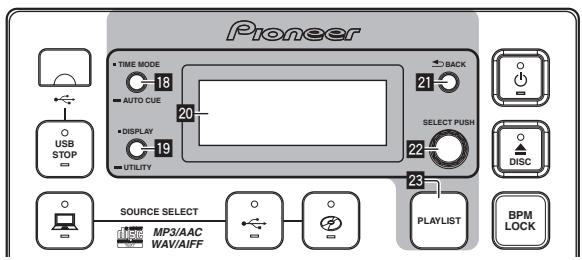
1 Press [DISPLAY (UTILITY)] for at least 1 second.
The [UTILITY] screen is displayed.
2 Use the rotary selector 2 to change the setting.
- Press [BACK] 21 to return to the previous screen.
3 Press the rotary selector 22.
The changed settings are stored.
- To close the [UTILITY] screen, press [DISPLAY (UTILITY)] or [BACK].
Setting preferences
| Options settings | Selection items | Descriptions |
| A. CUE LEVEL | -36 dB/-42 dB/-48 dB/ -54 dB/-60 dB*/-66 dB/ -72 dB/-78 dB | For details, see Chang-ing the auto cue level on page 17. |
| MIDI CHANNEL | 1* to 16 | — |
| AUTO STANDBY | OFF/20 min*/40 min/60 min | For details, see About the auto standby function on page 22. |
| LIBRARY CRE-ATOR | LIBRARY*/FOLDER | Sets the browsing method for media on which Pioneer MEP-7000 libraries are recorded. |
| VERSION No. | — | Displays the CDJ-350's software version. |
*: Setting upon purchase
About the auto standby function
When the auto standby function is turned on, the power is automatically set to the standby mode after the set time has passed with all of the conditions below met.
- That this unit's buttons, controls, etc., are not operated.
- That no track is played.
Additional information
Troubleshooting
Incorrect operation is often mistaken for trouble or malfunction. If you think that there is something wrong with this component, check the points below. Sometimes the trouble may lie in another component. Inspect the other components and electrical appliances being used. If the trouble cannot be rectified after checking the items below, ask your nearest Pioneer authorized service center or your dealer to carry out repair work.
This unit may not operate properly due to static electricity or other external influences. In this case, proper operation may be restored by turning the power off, waiting 1 minute, then turning the power back on.
Non-finalized (partial discs) CD-R/RW cannot be played on the CDJ-350.
- Irregularly shaped discs other than standard 12 cm discs cannot be played on the CDJ-350 (doing so will lead to damage or accidents).
- The BPM measured by the CDJ-350 may differ from the BPM indicated on the disc or that of a Pioneer DJ mixer, etc. This is due to the different methods used for measuring the BPM, and is not a malfunction.
| Problem | Check | Remedy |
| Disc cannot be ejected. | — | If [▲DISC] does not work, eject the disc by inserting the pin into the disc force eject hole. (page 15) |
| Playback does not start when disc is loaded. | Is the disc or file playable? | See About discs on page 6 or Playable music file formats on page 7. |
| Is the auto cue function activated? | Press [TIME MODE (AUTO CUE)] for at least 1 second to cancel the auto cue function. (page 17) | |
| File cannot be played. | Is the file copyright-protected (by DRM)? | Copyright-protected files cannot be played. |
| No sound is produced, or sound is distorted or noisy. | Are you operating the connected DJ mixer properly? | Check the operation of the DJ mixer. |
| Is the CDJ-350 placed near a TV? | Turn the TV's power off, or install the CDJ-350 and TV away from one another. | |
| Loud noise is produced or playback stops when a certain disc is played. | Is the disc scratched? | Scratched discs may not play. |
| Is the disc dirty? | Wipe the dirt off the disc. (page 25) | |
| Track search operation takes too long. | Is the auto cue function activated? | Track searching may take some time when there are long silent sections between tracks. |
| — | If track searching is not possible within 10 seconds, a cue point is set at the beginning of the track. | |
| Back cue function does not work. | Is a cue point set? | Set a cue point. (page 17) |
| Loop play function does not work. | Is a cue point set? | Set a cue point. (page 17) |
| Settings are not stored in the memory. | Has the power been turned off directly after changing the setting? | After changing settings, wait at least 10 seconds before turning the power off. |
| USB device is not recognized. | Is the USB device properly connected? | Connect the device securely (all the way in). |
| Is the USB device connected via a USB hub? | USB hubs cannot be used. | |
| Is the USB device supported by the CDJ-350? | This player only supports USB mass storage class devices. | |
| This player supports portable flash memory and digital audio playback devices. | ||
| Is the file format supported by the CDJ-350? | Check the file format of the connected USB device. For the file formats supported by the CDJ-350, see About USB devices on page 7. | |
| Are you using a USB device (such as a bus power-driven hard disk) whose current is higher than this unit's rated current (500 mA)? | Use a USB device within this unit's rated current (such as a hard disk driven by an AC adapter or other external power supply). | |
| — | Turn the power off, wait 1 minute, then turn the power back on. | |
| The playing address display is not displayed in the remaining time mode. | — | When playing files recorded in VBR, it may happen that the set cannot detect the length of the track immediately and that some time is required for the playing address display to appear. |
| Time is required to read USB devices (flash memory drives and hard discs). | Is there a large number of folders or files recorded on the USB device? | When there are many folders or files, some time may be required for loading. |
| Are files other than music files stored on the USB device? | When files other than music files are stored in folders, time is required to read them as well. Do not store files or folders other than music files on the USB device. | |
| The category is not displayed. | Are you playing a music CD? | The category is not displayed for music CDs. |
| Is the library information recorded on the USB device? | Use rekordbox to create the library information. | |
| Is the USB device write-protected? | Set the USB device so that files can be written on it. | |
| Set the USB device's write-protect switch to the off position. | ||
| Nothing is displayed. | Is the auto standby function activated? | This unit is shipped with the auto standby function turned on. If you do not want to use the auto standby function, set [AUTO STANDBY] to [OFF]. (page 22) |
| The [°] indicator flashes and the power does not turn on. | — | Normal operation can sometimes be restored by unplugging the power cord, waiting at least 1 minute, then plugging the power cord back in. If the symptom persists, unplug the power cord and request repairs. |
Error messages
When the CDJ-350 cannot operate normally, an error code appears on the display. Take the necessary measures, referring to the table below. If an error code not indicated on the table below is displayed or if the same error code appears after the indicated action has been taken, contact your store of purchase or nearby Pioneer service station.
| Error code | Error type | Description of error | Cause and action |
| E-7201 | TOC READ ERROR | TOC data cannot be read. | Disc is cracked.→Replace the disc. |
| E-8301 | Disc is dirty.→Clean the disc. | ||
| E-8302 | PLAYER ERROR | Disc that cannot be played normally is loaded. | If operation is normal with other discs, the problem is with that disc. |
| E-8303 | |||
| E-8304 | DECODE ERROR | Music files that cannot be played normally are loaded. | Format is wrong.→Replace with music files in the proper format. |
| E-8305 | DATA FORMAT ERROR | ||
| E-8306 | NO FILE | Track recorded in the library, playlist, etc., has been deleted from the USB device and cannot be played. | Do not delete that track from the USB device. |
| E-9101 | MECHANICAL TIME OUT | Mechanical operation has not stopped within speci-fied time. | There is a foreign object in the disc insertion slot.→Remove the foreign object. |
List of icons displayed on the main unit display section
| Genre | Time |
| Artist | ! Playback is not possible |
| Album | > Playing |
| Track/file name | # Played |
| Playlist | Remixer |
| Original artist | Folder |
| History | PC Control |
List of MIDI Messages
| SW Name | SW Type | MIDI Messages (3 Bytes) | Notes | ||
| Jog dial (scratch) | General Purpose Controller | Bn | 10 | dd | Linear value with respect to speed from stop to x4 speed. Stop: 40, FWD (CW) direction: 41 to 7F (x0.06 to x4 speed), REV (CCW) direction: 3F to 00 (x0.5 to x4 speed) |
| TEMPO | VR | Bn | 1D | dd | 00 to 7F (00 at - side, 7F at + side, 40 at center) |
| Jog dial (spin outer section) | General Purpose Controller | Bn | 30 | dd | Linear value with respect to speed from x0.5 speed to x4 speed. Stop (under x0.49 speed): 40, FWD (CW) direction: 41 to 7F (x0.5 to x4 speed), REV (CCW) direction: 3F to 00 (x0.5 to x4 speed) |
| SELECT PUSH (turn) | General Purpose Controller | Bn | 4F | dd | 98 - 127, 1 - 30 Difference of count from previous time is sent (±1 - ±30) When over ±30, set at ±30 |
| PLAY/PAUSE ➔ II | SW | 9n | 00 | dd | OFF=00, ON=7F |
| CUE | SW | 9n | 01 | dd | OFF=00, ON=7F |
| SEARCH ➔ | SW | 9n | 02 | dd | OFF=00, ON=7F |
| SEARCH ⇌ | SW | 9n | 03 | dd | OFF=00, ON=7F |
| TRACK SEARCH ➔ | SW | 9n | 04 | dd | OFF=00, ON=7F |
| TRACK SEARCH ➔ | SW | 9n | 05 | dd | OFF=00, ON=7F |
| LOOP IN/CUE (HOT LOOP) | SW | 9n | 06 | dd | OFF=00, ON=7F |
| LOOP OUT (OUT ADJUST) | SW | 9n | 07 | dd | OFF=00, ON=7F |
| RELOOP/EXIT | SW | 9n | 08 | dd | OFF=00, ON=7F |
| TIME MODE (AUTO CUE) | SW | 9n | 0E | dd | OFF=00, ON=7F |
| DISPLAY (UTIL-ITY) | SW | 9n | 0F | dd | OFF=00, ON=7F |
| TEMPO RANGE | SW | 9n | 10 | dd | OFF=00, ON=7F |
| MASTER TEMPO | SW | 9n | 11 | dd | OFF=00, ON=7F |
| VINYL MODE | SW | 9n | 12 | dd | OFF=00, ON=7F |
| BEAT LOOP (LOOP DIVIDE) + | SW | 9n | 16 | dd | OFF=00, ON=7F |
| BEAT LOOP (LOOP DIVIDE) - | SW | 9n | 17 | dd | OFF=00, ON=7F |
| Jog dial (press top) | SW | 9n | 20 | dd | OFF=00, ON=7F |
| BPM LOCK | SW | 9n | 26 | dd | OFF=00, ON=7F |
| PLAYLIST | SW | 9n | 2E | dd | OFF=00, ON=7F |
| ▲DISC | SW | 9n | 2F | dd | OFF=00, ON=7F |
| BACK | SW | 9n | 32 | dd | OFF=00, ON=7F |
| SELECT PUSH (press) | SW | 9n | 33 | dd | OFF=00, ON=7F |
n is the channel number.
Cautions on use
About condensation
Water droplets (condensation) may form inside the unit (on operating parts and lenses) in the winter, for example, if the unit is moved from a cold place into a warm room or if the temperature in the room in which the unit is installed rises suddenly (through heating, etc.). The unit will not operate properly and will not be playable with condensation inside. Let the unit stand for 1 to 2 hours at room temperature (though this time depends on the conditions of the condensation) without turning on the power. The water droplets will evaporate and the unit will become playable. Condensation can occur in the summer as well if the unit is exposed to the direct wind from an air-conditioner, etc. If this happens, move the unit to a different location.
Cleaning the lens
The player's lens should not become dirty in normal use, but if for some reason it should malfunction due to dust or dirt, consult your nearest Pioneer authorized service center. Although lens cleaners for players are commercially available, we advise against using them since some may damage the lens.
Handling discs
Storing
- Always place discs in their cases and store them vertically, avoiding hot, humid places, places exposed to direct sunlight and extremely cold places.
- Be sure to read the cautions included with the disc.
Cleaning discs
- Discs may not play if there are fingerprints or dust on them. In this case, use a cleaning cloth, etc., to gently wipe the disc from the inside towards the outside. Do not use dirty cleaning cloths.
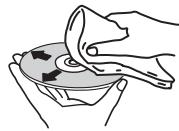
- Do not use benzene, thinner or other volatile chemicals. Also do not use record spray or antistatic agents.
- For tough dirt, apply some water to a soft cloth, wring out thoroughly, wipe off the dirt, then wipe off the moisture with a dry cloth.
- Do not use damaged (cracked or warped) discs.
- Do not let the signal surface of discs get scratched or dirty.
- Do not place two discs in the disc tray, one on top of the other.
- Do not attach pieces of paper or stickers to discs. Doing so could warp discs, making it impossible to play them. Also note that rental discs often have labels attached to them, and the label's glue may have oozed out. Check that there is no glue around the edges of such labels before using rented discs.
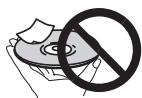
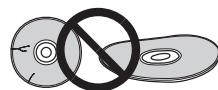
About specially shaped discs
Specially shaped discs (heart-shaped, hexagonal, etc.) cannot be played on this player. Do not attempt to play such discs, as they could damage the player.
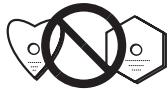
About condensation on discs
Water droplets (condensation) may form on the surface of discs if they are moved from a cold place (particularly in winter) into a warm room. Disks may not play normally if there is condensation on them.
Carefully wipe the water droplets off the surface of the disc before loading it.
Disclaimer
- Pioneer and rekordbox are trademarks or registered trademarks of the Pioneer Corporation.
- Microsoft®, Windows Vista®, Windows® and Internet Explorer® are registered trademarks or trademarks in the United States and other countries of the Microsoft Corporation of the United States.
- Apple, Macintosh, Mac OS, Safari, iTunes and Finder are registered trademarks of Apple Inc. in the United States and other countries.
- Pentium is a registered trademark of Intel Corporation.
- Adobe and Reader are either registered trademarks or trademarks of Adobe Systems Incorporated in the United States and/or other countries.
- ASIO is a trademark of Steinberg Media Technologies GmbH. The names of companies and products mentioned herein are the trademarks of their respective owners.
This product has been licensed for nonprofit use. This product has not been licensed for commercial purposes (for profit-making use), such as broadcasting (terrestrial, satellite, cable or other types of broadcasting), streaming on the Internet, Intranet (a corporate network) or other types of networks or distributing of electronic information (online digital music distribution service). You need to acquire the corresponding licenses for such uses. For details, visit http://www.mp3licensing.com.
Cautions on copyrights
rekordbbox restricts playback and duplication of copyright-protected music contents.
- When coded data, etc., for protecting the copyright is embedded in the music contents, it may not be possible to operate the program normally.
- When rekordbox detects that coded data, etc., for protecting the copyright is embedded in the music contents, processing (playback, reading, etc.) may stop.
Recordings you have made are for your personal enjoyment and according to copyright laws may not be used without the consent of the copyright holder.
- Music recorded from CDs, etc., is protected by the copyright laws of individual countries and by international treaties. It is the full responsibility of the person who has recorded the music to ensure that it is used legally.
- When handling music downloaded from the Internet, etc., it is the full responsibility of the person who has downloaded the music to ensure that it is used in accordance with the contract concluded with the download site.
Using the support site
Before making an inquiry about rekordbox operations and technical support, refer to the operating instructions for rekordbox and check the FAQs published on the support site for rekordbox.
rekordbox support site
http://www.prodjnet.com/rekordbox/support/
- To make an inquiry about rekordbox, you need to register as a user in advance on the support site for rekordbox.
- You need to enter the license key for your user registration. Have the license key ready. Also, be sure not to forget the login name (your e-mail address) and the password specified for your user registration, as well as the license key.
- Pioneer Corporation collects your personal information for the following purposes:
1 To provide customer support for your purchased product
2 To inform you of product or event information by e-mail
3 To reflect your opinions collected by survey on product planning
- Your personal information is kept confidential corresponding to the privacy policy set forth by our company.
- You can check our privacy policy on the support site forrekordbox.
- When making inquiries regarding rekordbox, please be sure to furnish your computer type and specifications (CPU, installed memory, other connected peripherals, etc.), the operating system and version used, as well as concrete information regarding the issue at hand.
For an inquiry about configuring your computer with peripheral devices other than our products and the corresponding technical support, contact each manufacturer or retailer.
-rekordbox is subject to upgrade for enhanced function and performance. The upgrade program can be downloaded on the support site. We strongly recommend you upgrade your software on a regular basis to keep the latest updates on your system.
Specifications
Power requirements.. AC 220 V to 240 V, 50 Hz/60 Hz
Power consumption 16 W
Power consumption (standby) 0.3 W
Main unit weight 2.3 kg
Max. dimensions. 220 mm (W) × 107 mm (H) × 288.5 mm (D)
Tolerable operating temperature. +5^ to +35^
Tolerable operating humidity. 5% to 85% (no condensation)
Analog audio output (AUDIO OUT L/R)
Output terminal.RCA terminal
Output Level 2.0 Vrms (1 kHz)
Frequency response 4 Hz to 20 kHz
S/N ratio. 115 dB
Total harmonic distortion. 0.006%
USB downstream section (USB)
Port .........Type A
Power supply. .5 V/500 mA or less
USB upstream section (USB)
Port .........Type B
Control output (CONTROL)
Port............ Mini-jack
- The specifications and design of this product are subject to change without notice.
- The articles concerning free repairs, etc., indicated on the warranty do not apply to the rekordbox music management software. Before installing or using rekordbox, carefully read the articles in Software end user license agreement on page 8.