USER MANUAL TM-92.14 H DOLMAR
8 ACCESSORIES OPTIONNELS 49
6.1 RECOMMANDATIONS POUR LA SÉCURITÉ
ATTENTION!
8. ACCESSORIES OPTIONNELS
1. KIT CONTREPOIDS FRONTAUX
Thank you for having chosen one of our products. We hope that you will get complete satisfaction from using your new machine and that it will fully meet all your expectations.
This manual has been compiled in order that you may get to know your machine and to be able to use it safely and efficiently. Don't forget that it forms an integral part of the machine, so keep it handy so that it can be consulted at any time, and pass it on to the purchaser if you resell the machine.
This new lawn tractor of yours has been designed and made in line with current regulations, and is safe and reliable if used for cutting and collecting grass in full accordance with the instructions given in this manual (proper usage). Using the machine in any other way or ignoring the instructions for safe usage, maintenance and repair is considered "incorrect usage" which will invalidate the guarantee, and the manufacturer will decline all responsibility, placing the blame with the user for damage or injury to himself or others in such cases.
Since the product is continually being improved, you may find slight differences between your machine and the descriptions contained in this manual. Certain modifications can be made to the machine without prior warning and without the obligation to update the manual, although the essential safety and function characteristics will remain unaltered. In case of any doubts, do not hesitate to contact your Retailer. And now enjoy your work!
AFTER-SALES SERVICE
This manual gives all the necessary instructions for using the machine and the basic maintenance that may be carried out by the user.
For all information not contained here, contact the Local Retailer or a Licensed Service Centre.
If you wish, your Retailer will be pleased to offer a maintenance programme personalised to your needs. This will help you keep your new purchase in peak performance, maintaining its value.
TABLE OF CONTENTS
- SAFETY 3
Regulations for using the machine safely
- IDENTIFICATION OF THE MACHINE AND COMPONENTS 7
Explanations on how to identify the machine and its main components
3.UNPACKING AND ASSEMBLY 9
Explanations on how to remove the packing and on how to assemble separated parts
4.CONTROLS AND INSTRUMENTS 14
Position and functions of all the controls
- HOW TO USE THE MACHINE 19
Provides indications for working efficiently and safely
5.1 Safety recommendations 19
5.2 Why the safety devices cut in 19
5.3 Preliminary operations before starting work 21
5.4 Using the machine 24
5.5 Using on slopes 32
5.6 Transporting 33
5.7 Advice on how to obtain a good cut 33
- MAINTENANCE 35
All the information for maintaining the machine in peak efficiency
6.1 Safety recommendations 35
6.2 Routine maintenance 36
6.3 Checks and adjustments 40
6.4 Dismantling and renewing parts 44
- TROUBLESHOOTING 46
A help in quickly resolving any problems
8 ACCESSORIES ON REQUEST 49
A description of the accessories available for particular types of work
- SPECIFICATIONS 50
A summary of the main specifications of your machine
- ALPHABETICAL INDEX 51
Where information can be found
1. SAFETY
1.1 HOW TO READ THE MANUAL
Some paragraphs in the manual containing information of particular importance for safety and operation are highlighted at various levels of emphasis, and signify the following:
NOTE or IMPORTANT These give details or further information on what has already been said, and aim to prevent damage to the machine..
WARNING! Non-observation will result in the risk of injury to oneself or others.
DANGER! Non-observation will result in the risk of serious injury or death to oneself or others.
This manual describes various versions of the machine, which mainly differ in:
- type of transmission: with mechanical gear-change or with hydrostatic continuous speed adjustment. The models with hydrostatic transmission can be recognised by the word "HYDRO" on the identification label (2.1);
- the inclusion of components or accessories which may not be available in some areas;
- special equipment fitted.
The symbol highlights all the differences in usage and is followed by the indication of the version to which it refers.
The symbol “ ” makes a reference to another part of the manual where further information or clarification can be found.
NOTE Whenever a reference is made to a position on the machine "front", "back", "left" or "right" hand side, this is determined by facing the direction of forward travel.
IMPORTANT For all usage and maintenance operations on the engine or the battery which are not described in this manual, consult the relevant manuals which form an integral part of all the documentation supplied with the machine.
1.2 SAFETY REGULATIONS
(read carefully before using the machine)
A) TRAINING
1) Read the instructions carefully. Be familiar with the controls and the proper use of the equipment.
2) Never allow children or people unfamiliar with these instructions to use the machine. Local regulations can restrict the age of the operator.
3) Never mow while people, especially children, or pets are nearby.
4) Keep in mind that the operator or user is responsible for accidents or hazards occurring to other people or their property.
5) Do not carry passengers.
6) All drivers should seek and obtain professional and practical instruction. Such instruction should emphasise:
- the need for care and concentration when working with ride-on machines;
- control of a ride-on machine sliding on a slope will not be regained by the application of the brake. The main reasons for loss of control are:
- insufficient wheel grip;
- being driven too fast;
- inadequate braking;
- the type of machine is unsuitable for its task;
- lack of awareness of the effect of ground conditions, especially slopes;
- incorrect hitching and load distribution.
B) PREPARATION
1) While mowing, always wear substantial footwear and long trousers. Do not operate the equipment when barefoot or wearing open sandals.
2) Thoroughly inspect the area where the equipment is to be used and remove all objects which can be thrown by the machine.
3) DANGER! Petrol is highly flammable:
- store fuel in containers specifically designed for this purpose;
- refuel outdoors only and do not smoke while refuelling;
- add fuel before starting the engine. Never remove the cap of the fuel tank or add petrol while the engine is running or when the engine is hot;
- If petrol is spilled, do not attempt to start the engine but move the machine away from the area of spillage and avoid creating any source of ignition until the petrol vapours have dissipated;
- replace all fuel tank and container caps securely.
4) Replace faulty silencers.
5) Before using, always visually inspect to see that the blades, blade bolts and cutter assembly are not worn or damaged. Replace worn or damaged blades and bolts in sets to preserve balance.
6) On multi-bladed machines, take care as rotating one blade can cause other blades to rotate.
C) OPERATION
1) Do not operate the engine in a confined space where dangerous carbon monoxide fumes can collect.
2) Mow only in daylight or good artificial light.
3) Before attempting to start the engine, disengage all blade attachment clutches and shift into neutral.
4) Do not use on slopes of more than 10^ (17%) .
5) Remember there is no such thing as a "safe" slope. Travelling on grass slopes requires particular care. To guard against overturning:
- do not stop or start suddenly when going up or downhill;
- engage the clutch slowly and always keep the machine in gear, especially when travelling downhill;
- machine speeds should be kept low on slopes and during tight turns;
- stay alert for humps and hollows and other hidden hazards;
- never mow across the face of the slope.
6) Use care when pulling loads or using heavy equipment:
- use only approved drawbar hitch points;
- limit loads to those you can safely control;
- do not turn sharply. Use care when reversing;
- use counterweight(s) or wheel weights when suggested in the instructions manual.
7) Stop the blades rotating before crossing surfaces other than grass.
8) Never operate the machine with defective guards, or without safety protective devices in place.
9) Do not change the engine governor settings or overspeed the engine. Operating the engine at excessive speed can increase the hazard of personal injury.
10) Before leaving the operator's position:
- disengage the power take-off and lower the attachments;
- change into neutral and set the parking brake;
- stop the engine and remove the key.
11) Disengage drive to attachments, stop the engine and remove the ignition key:
- before clearing blockages or unclogging chutes;
- before cleaning, checking or working on the machine;
- after striking a foreign object. Inspect the machine for damage and make repairs before restarting and operating the equipment;
- If the machine starts to vibrate abnormally (check immediately).
12) Disengage drive to blades when transporting or not in use.
13) Stop the engine and disengage drive to the attachment:
- before refuelling;
- before removing the grass-catcher.
14) Reduce the throttle setting during engine run-out and, if the engine is provided with a shut-off valve, cut off the fuel when you have finished mowing.
1) Keep all nuts, bolts and screws tight to be sure the equipment is in safe working condition.
2) Never store the equipment with petrol in the tank inside a building where fumes may reach an open flame or spark.
3) Allow the engine to cool before storing in any enclosure.
4) To reduce the fire hazard, keep the engine, silencer, battery compartment and petrol storage area free of grass, leaves, or excessive grease.
5) Check the grass-catcher frequently for wear or deterioration.
6) Replace worn or damaged parts for safety.
7) If the fuel tank has to be drained, this should be done outdoors.
8) On multi-bladed machines, take care as rotating one blade can cause other blades to rotate.
9) When the machine is to be stored or left unattended, lower the cutting deck.
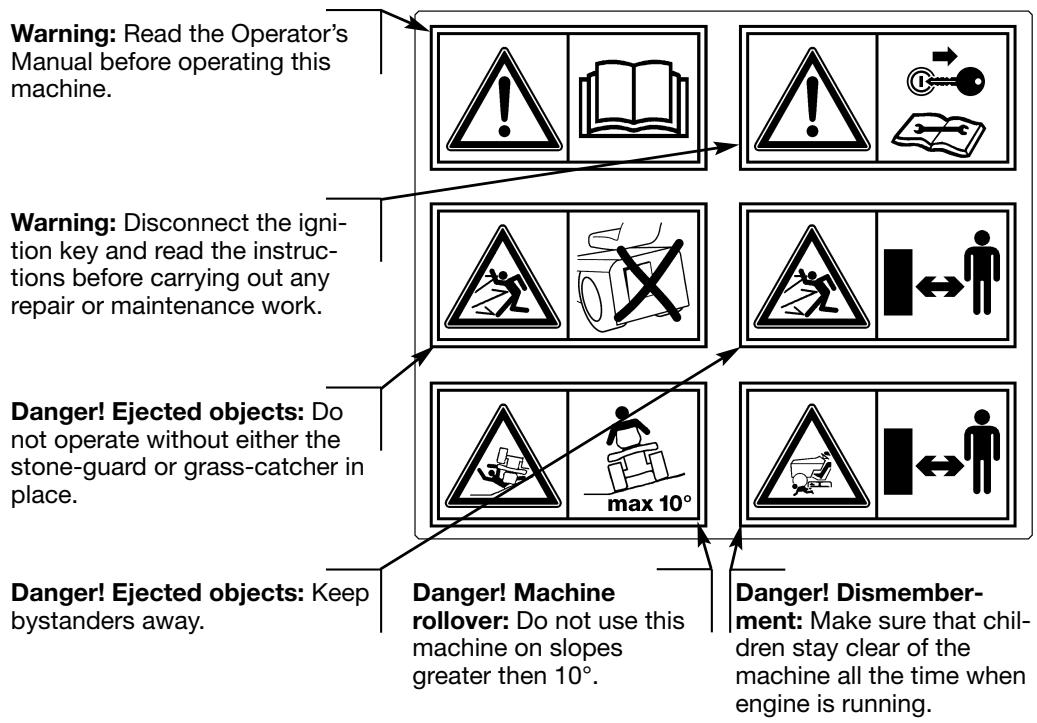
1.3 SAFETY LABELS
Your machine must be used with care. Therefore, labels have been placed on the machine, to remind you pictorially of the main precautions to take during use.
These labels are to be considered an integral part of the machine.
Should a label fall off or become illegible, contact your Retailer to replace it. Their meaning is explained below.

Danger of cutting yourself. Blades in movement. Do not put hands or feet near or under the opening of the cutting plate.
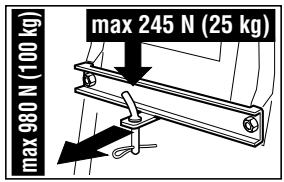
1.4 REGULATIONS FOR TOWING
A kit for towing a small trailer is available on request. This accessory is to be fitted as per the instructions provided.
When using, do not exceed the recommended drawbar loads stated on the label and follow the safety instructions, (1.2, C-6).
2. IDENTIFICATION OF THE MACHINE AND COMPONENTS
2.1 IDENTIFICATION OF THE MACHINE
The plate located near the battery housing has the essential data of each machine.
The serial number (6) must be quoted when you require technical assistance or spare parts.
- Acoustic power level according to directive 2000/14/CE
- Conformity mark according to directive 98/37/EEC
- Year of manufacture
- Operating engine speed in r.p.m (if indicated)
- Type of machine
- Serial number
- Weight in kg
- Name and address of Manufacturer
- Type of transmission (if indicated)
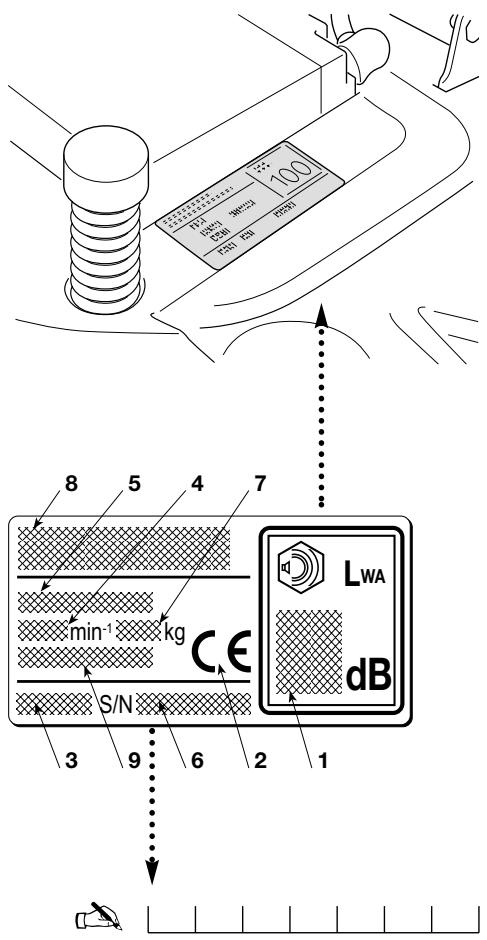
Note your machine serial number here
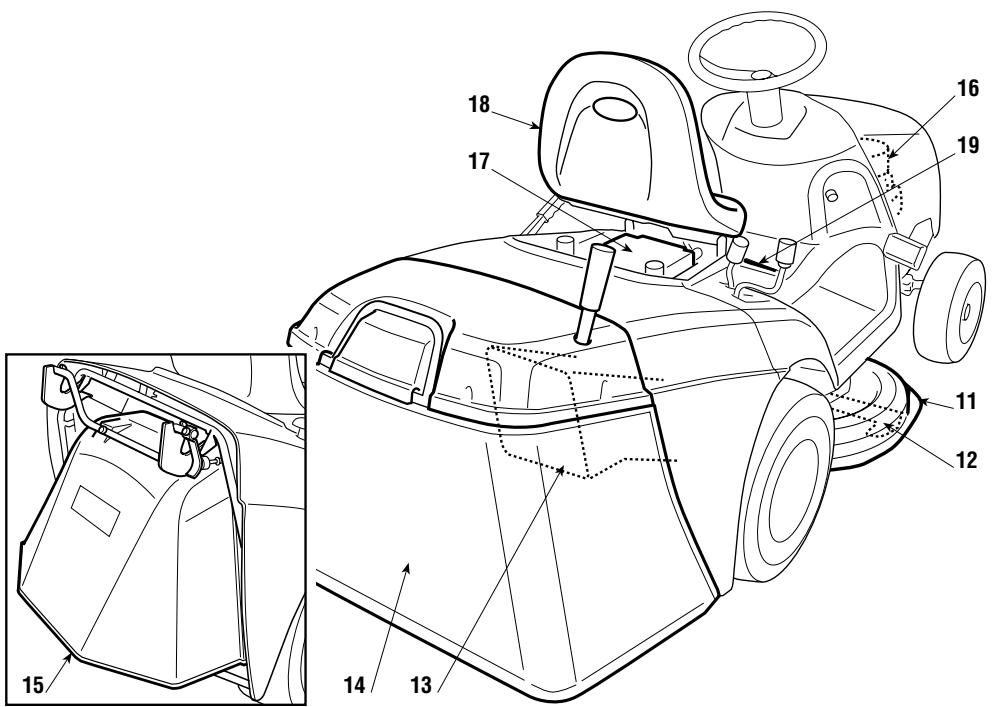
2.2 IDENTIFICATION OF MAIN COMPONENTS
Various main components can be seen on the machine, and these have the following functions:
-
Cutting deck: this is the guard enclosing the rotating blades.
-
Blades: these are what cut the grass. The wings at the ends help convey the cut grass towards the collector channel.
- Collector channel: this is the part connecting the cutting deck to the grass-catcher.
- Grass-catcher: as well as collecting the grass cuttings, this is also a safety element in that it stops any objects drawn up by the blades from being thrown outside of the machine.
- Stone-guard or deflector (available as optional part): this can be fitted in place of the grass-catcher and prevents objects drawn up by the blades from being thrown outside of the machine.
- Engine: this moves the blades and drives the wheels. Its specifications and regulations for use are described in a specific manual.
- Battery: provides the energy for starting the engine. Its specifications and regulations for use are described in a specific manual.
- Driver seat: this is where the machine operator sits. It has a sensor for detecting the presence of the operator which is a safety device.
- Labels for regulations and safety: give reminders on the main provisions for working safely, each of which is explained in chapter 1.
3. UNPACKING AND ASSEMBLY
For storage and transport reasons, some components of the machine are not directly installed in the factory, but have to be assembled after their removal from the packing. Final assembly is carried out by following these simple instructions.
IMPORTANT
The machine is supplied without engine oil or fuel. Before
starting up the engine, fill with oil and fuel following the instructions given in the engine manual.
3.1 UNPACKING
When unpacking the machine, take care to gather all individual parts and fittings, and do not damage the cutting deck when taking the machine off the base pallet.
The packing contents:
NOTE
To prevent damaging the cutting deck when getting the
machine down from the pallet, take it to the maximum height and be very careful.
For hydrostatic drive models: to make it easier to get the machine off the pallet and to move it, the drive disengage lever should be put in position «B» (4.33).
3.2 FITTING THE STEERING WHEEL
Put the machine on a flat surface and straighten up the front wheels.
Fit the steering wheel (1) onto the protruding shaft (2) with the spokes directed towards the seat.
Line up the hole in the steering wheel hub with the hole in the shaft and insert the pin supplied (3) using a hammer, ensuring that the end comes completely through to the opposite side.
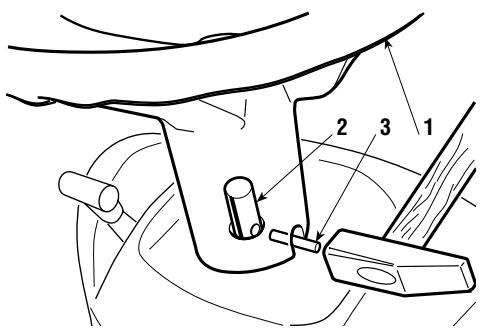
NOTE
To avoid damaging the steering wheel, use a punch or a same size as the pin when hammering it in the last part.
3.3 FITTING THE SEAT
Fit the seat (1) onto the plate (2) using the screws (3).
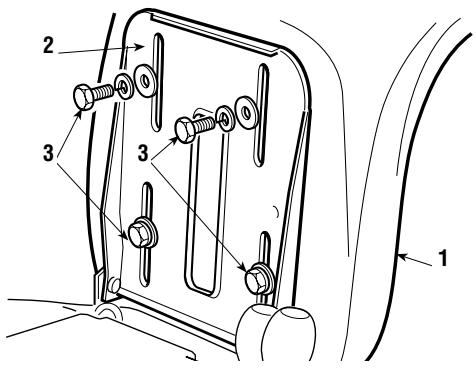
3.4 ASSEMBLY AND CONNECTING THE BATTERY
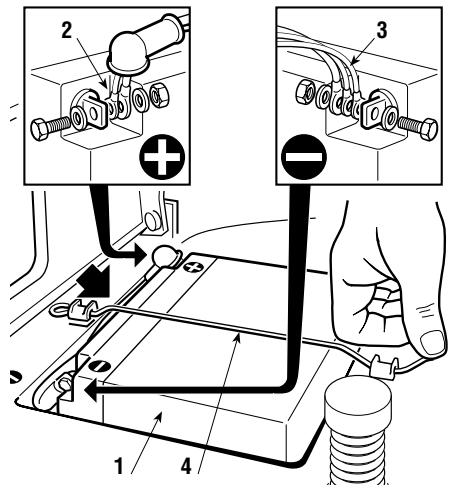
Position the battery (1) in its compartment under the seat.
Connect the two red cables (2) to the positive terminal (+) and the three black cables (3) to the negative terminal (-) using the supplied screws and following the illustrated sequence.
Fit the spring (4) to hold the battery in place and make sure all the wires are in front of the battery so that they don't get caught in the spring (4).
IMPORTANT
Always fully charge the battery according to the instructions in packet (6.2.5).
IMPORTANT
To prevent the safety device in the electronics card from cutting the engine until the battery is fully charged!
WARNING!
- Follow the battery manufacturer's instructions regarding food disposal.
3.5 FITTING THE GRASS-CATCHER BRACKETS
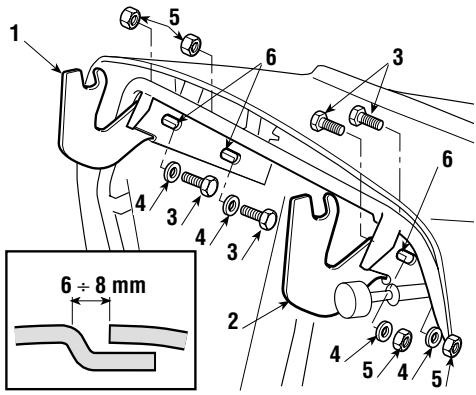
Fit the two brackets (1) and (2) onto the rear plate in the following order, using the screws (3) washers (4) and nuts (5) supplied:
Position the screws in the centre of the slots (6) without fully tightening them.
Attach the grass-catcher to the brackets and make sure that there is an even distance from 6 to 8mm between the two plastic covers.
This allows the grass-catcher to rotate properly during emptying and prevents grass from falling out.
To obtain this distance, adjust the fastening position of the brackets in relation to the slots (6) and finally tighten the screws (3).
3.6 GRASS-CATCHER ASSEMBLY
The grass-catcher is assembled in four stages:
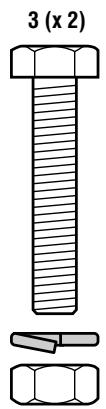
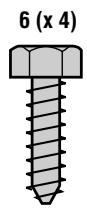
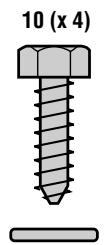
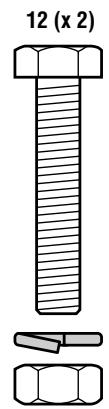
A) First of all assemble the frame, joining the upper part (1) to the lower part (2) using the supplied screws and nuts (3) as shown. Position the angle plates (4) and (5), making sure that they are for the right (R) and left (L) , sides, and attach them to the frame using the four self-threading screws (6).
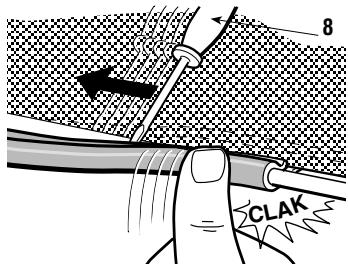
B) Insert the frame in the canvas cover (7) making sure it is correctly positioned on the base perimeter. Hook the plastic profiles onto the frame tubes with the aid of a screw-driver (8).
C) Fit the cover (9) onto the upper frame using the screws (10).
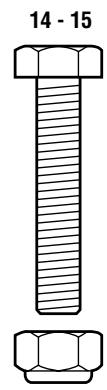
D) Attach the stiffening bar (11) under the frame with screws and nuts (12), keeping the flat part turned towards the canvas. Insert the emptying lever (13) in its position and fit the limit stop screw (14) with its nut (15).
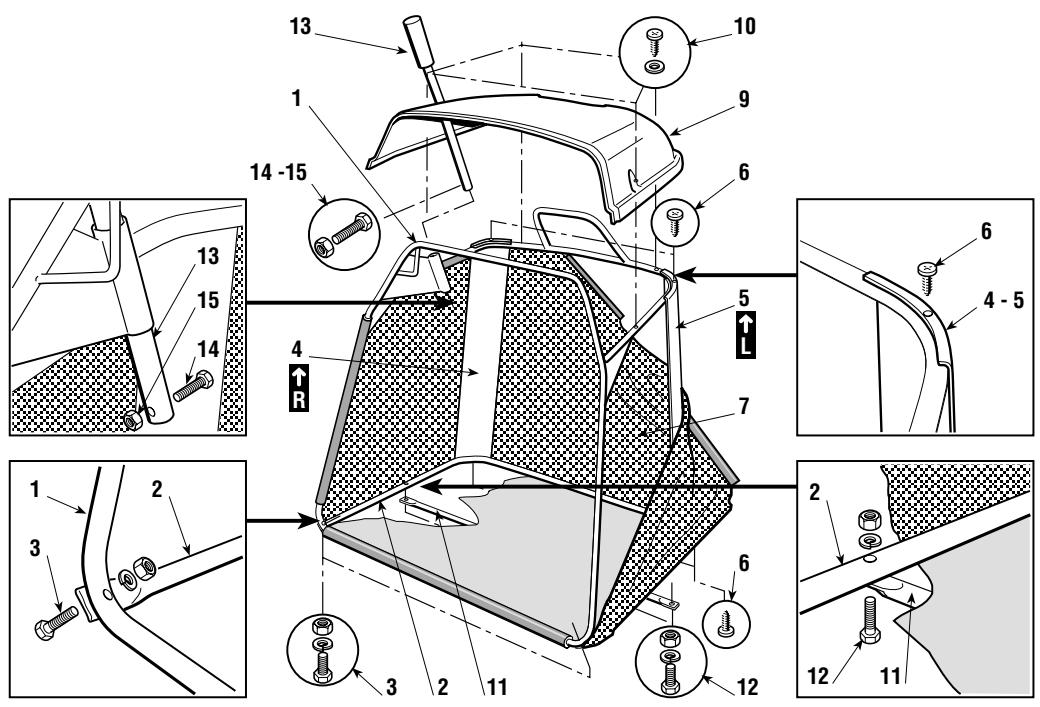
4. CONTROLS AND INSTRUMENTS
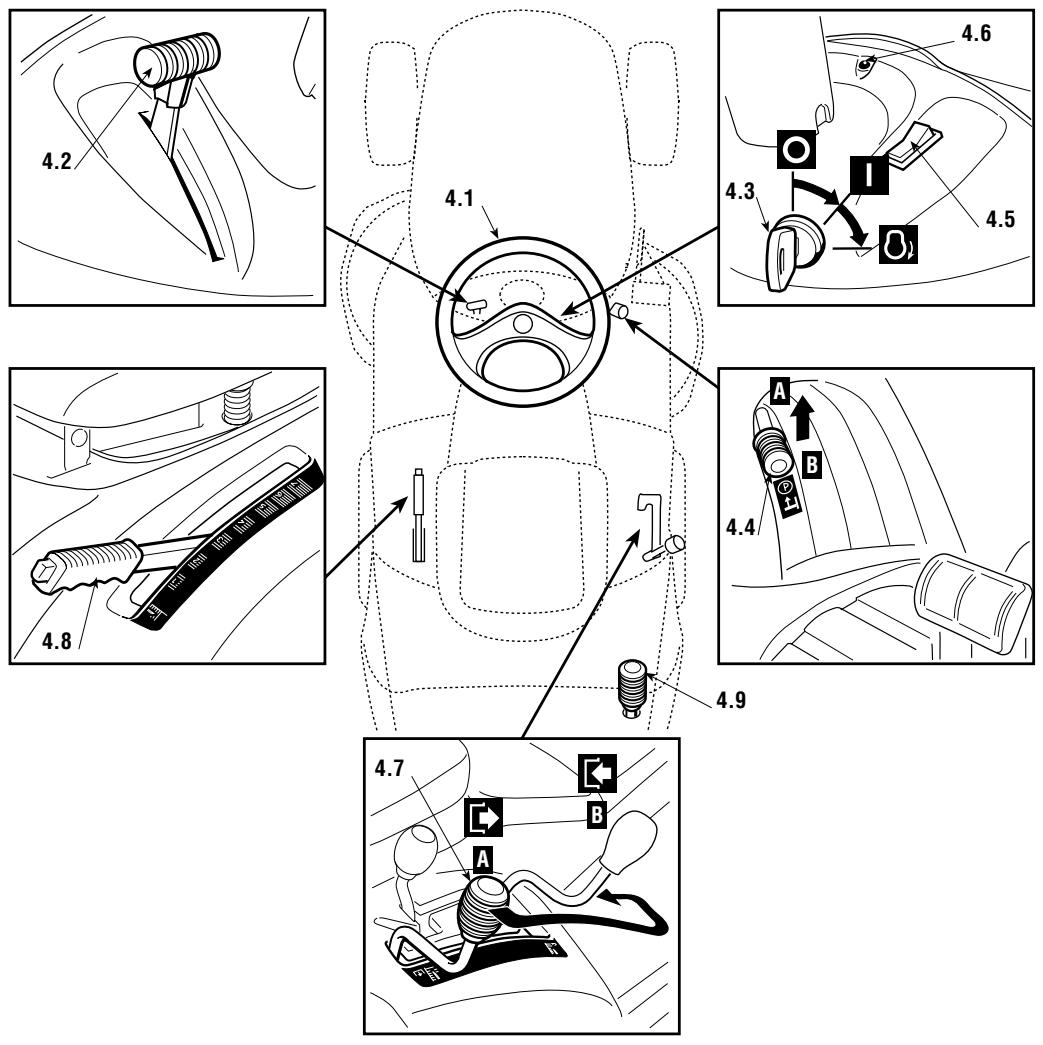
4.1 STEERING WHEEL
Turns the front wheels.
4.2 ACCELERATOR LEVER
This regulates the engine's r.p.m. The positions are indicated on a plate showing
the following symbols:
N «CHOKE»
starting from cold
《SLOW》
for minimum engine speed
《FAST》
for maximum engine speed
- The «CHOKE» position enriches the mixture so must only be used for the time necessary when starting from cold.
- When moving from one area to another, put the lever in a position between «SLOW» and «FAST».
- When cutting, go to the «FAST» position.
4.3 KEY IGNITION SWITCH
This key operated control has three positions:
O «OFF»
everything is switched off;
I «ON»
activates all parts;
0)
engages the starter motor.
On being released at the «START» position, the key will automatically return to «ON».
This lever is to stop the machine from moving when it has been parked. There are two positions:
A = Brake off
«B» = Brake engaged
- The brake is engaged by fully pressing the pedal (4.21 or 4.31) and moving the lever to position «B». When you take your foot off the pedal it will be blocked by the lever in the down position.
- To disengage the parking brake, press the pedal (4.21 or 4.31). The lever will return to position «A».
4.5 LIGHT SWITCH (if fitted)
For turning on the lights when the key (4.3) is in the «ON» position.
4.6 PILOT LAMP AND AUDIBLE WARNINGS
This lamp comes on when the key (6) is in the "ON" position and stays on while the machine is running.
- When it flashes, it means that it is not ready for starting (5.2).
- The audible warning signals that the grass-catcher is full (5.4.6).
4.7 BLADE ENGAGEMENT AND BRAKE CONTROL
The lever has two positions, as shown on the label:
A Blades disengaged
B B = Blades engaged
- If the blades are engaged when safety conditions have not been complied with, the engine shuts down and cannot be restarted (5.2).
- On disengaging the blades (Pos. «A»), a brake is simultaneously activated which stops their rotation in a few seconds.
4.8 CUTTING HEIGHT ADJUSTING LEVER
There are seven positions for this lever, shown as «1» to «7» on the label, which correspond to various heights between 3 and 8 cm.
- To go from one height to another, press the release button at the end of the lever.
This lever, when pulled out from its hole, is to tip the grass-catcher to empty it and reduce the effort required by the operator.
For mechanical drive models:
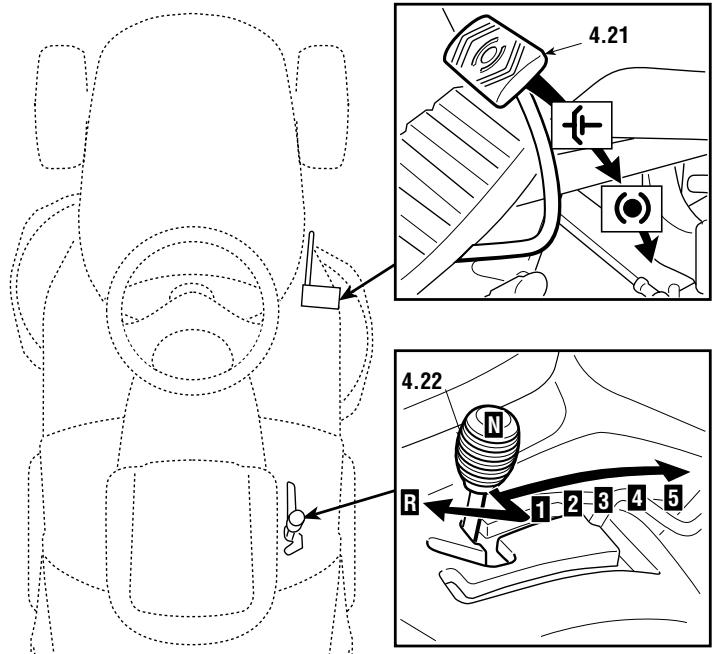
4.21 GLUTCH / BRAKE PEDAL
This pedal has a double function: during the first part of its travel it acts as a clutch, engaging and disengaging drive to the wheels, and in the second part it acts as a brake on the rear wheels
IMPORTANT
Do not keep the pedal half way between clutch engagement or disengagement,
as this can cause overheating and damage the transmission belt.
NOTE
When the machine is in movement, keep your foot off the
pedal.
This lever has seven positions for the 5 forward speeds, the neutral position «N», and reverse «R».
To go from one speed to another, press the pedal (4.21) half way and move the lever as per the indications on the label.
WARNING!
stopped.
Reverse must only be engaged when the machine is
For hydrostatic drive models:
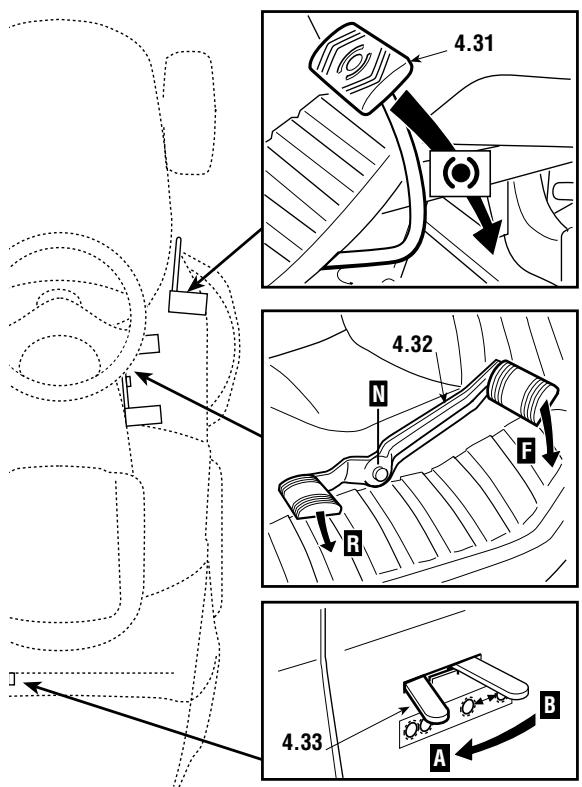
4.31 BRAKE PEDAL
This pedal works the brake on the rear wheels.
4.32 DRIVE ENGAGEMENT PEDAL
This pedal engages drive in the wheels as well as modulating the machine's forward and reverse speeds.
- To engage forward drive just press it in the «F» direction with your toe-cap, noting that increasing the pressure on the pedal progressively increases the speed of the machine.
- Reverse is engaged by pressing the pedal with the heel, in the «R» direction.
- The pedal automatically goes into neutral «N» when released.
WARNING!
Reverse must only be engaged when the machine is
stopped.
NOTE
If the drive pedal is used, whether forwards or for reverse,
when the parking brake (4.4) is engaged, the engine stops.
4.33 LEVER TO RELEASE THE HYDROSTATIC TRANSMISSION
This lever has two positions as shown on the label:
«A» = Transmission engaged: for all usage conditions, when moving and during cutting;
«B» = Transmission released: considerably reduces the effort required for moving the machine by hand, with the engine turned off.
IMPORTANT
To avoid damaging the transmission unit, this operation
must be carried out only when the engine has stopped with the pedal (4.32) at position “N”.
5. HOW TO USE THE MACHINE
5.1 SAFETY RECOMMENDATIONS
DANGER! The machine must only be used for the purpose for which it was designed (cutting and collection of grass).
Do not tamper with or remove the safety devices fitted to the machine. REMEMBER THAT THE USER IS ALWAYS RESPONSIBLE FOR DAMAGE AND INJURIES TO OTHERS. Before using the machine:
- read the general safety regulations ( 1.2), paying particular attention to driving and cutting on slopes;
- carefully read the instructions for use, become familiar with the controls and on how to quickly stop the blades and engine;
- never put your hands or feet next to or beneath the rotating parts and always keep away from the discharge opening.
Do not use the machine when in a precarious state of health or under the effect of medicines or other substances that can reduce your reflex actions and your ability to concentrate.
It is the user's responsibility to assess the potential risk of the area where work is to be carried out, as well as to take all the necessary steps to ensure his own safety and that of others, particularly on slopes or rough, slippery and unstable ground.
Do not leave the machine stopped on high grass with the engine running to avoid the risk of starting a fire.
WARNING!
This machine must not be used on slopes greater than
10^ (17%) ( 5.5). If the machine is likely to be used mostly on sloping ground (never above 10^ ), fit counterweights (supplied on request 8.1) beneath the cross-member of the front wheels which improve stability at the front and reduce the chance of tipping up.
IMPORTANT
All the references relating to the positions of controls are
those described in chapter 4.
5.2 WHY THE SAFETY DEVICES CUT IN
The safety devices work in two ways
a) To start the engine it will be necessary that:
- the transmission is in "neutral";
- the blades are not engaged;
- the operator is seated or the parking brake is engaged.
b) The engine stops when:
- the operator leaves his seat when the blades are engaged;
- the operator leaves his seat when the transmission is not in "neutral";
- the operator leaves his seat with the transmission in "neutral" but without engaging the parking brake;
- the grass-catcher is lifted or the stone-guard is removed when the blades are engaged;
- the parking brake is engaged without disengaging the blades.
The table below shows various operating conditions, highlighting why the safety device shuts down the engine.
| OPERATOR | GRASS-CATCHER | BLADES | TRANSMISSION | BRAKE | ENGINE |
| A) WHEN STARTING (Key in “START” position) |
| Sitting | Uninfluentia | Disengaged | 1...5 - F/R | Engaged | Does NOT start |
| Sitting | Uninfluentia | Engaged | “N” | Engaged | Does NOT start |
| Absent | Uninfluentia | Disengaged | “N” | Disengaged | Does NOT start |
| B) WHEN CUTTING (Key in “ON” position) |
| Absent | YES | Engaged | Uninfluentia | Engaged | Stops |
| Absent | Uninfluentia | Disengaged | 1...5 - F/R | Disengaged | Stops |
| Absent | YES | Disengaged | “N” | Disengaged | Stops |
| Sitting | NO | Engaged | Uninfluentia | Disengaged | Stops |
| Sitting | YES | Engaged | Uninfluentia | Engaged | Stops |
5.3 DIRECTIONS BEFORE STARTING THE WORK
Before starting work, it is necessary to carry out several checks and operations to ensure that the work gives the best results and is done in maximum safety
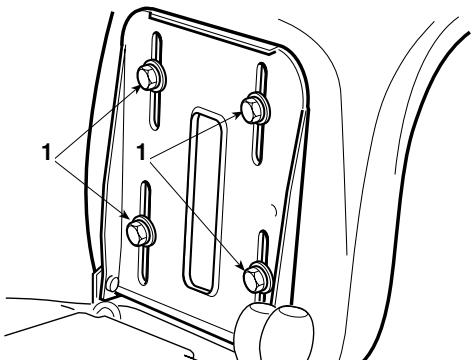
5.3.1 SEAT ADJUSTMENT
To change the seat position, loosen the four fixing bolts (1) and slide it along the bracket slots.
Once you have found the position, tighten the four screws (1).
5.3.2 TYRE PRESSURE
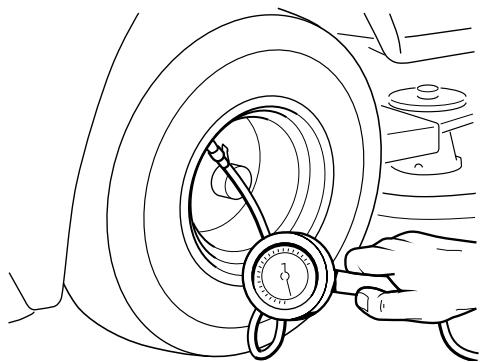
Having the correct tyre pressure is the main condition for ensuring that the cutting deck is horizontal and thus mows evenly.
Unscrew the valve caps and connect a compressed air line with a gauge to the valves.
The pressures are:
FRONT
1.5 bar
REAR
1.2 bar
5.3.3 FILLING WITH OIL AND FUEL
NOTE
The type of oil and fuel to use is given in the engine manual.
With the engine stopped, check its oil level: according to the exact methods
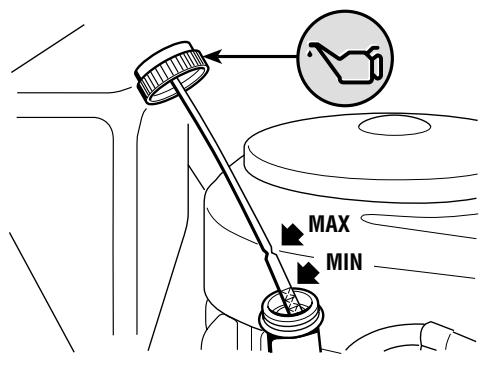
described in the engine manual, this must be between the MIN and MAX marks on the dipstick.
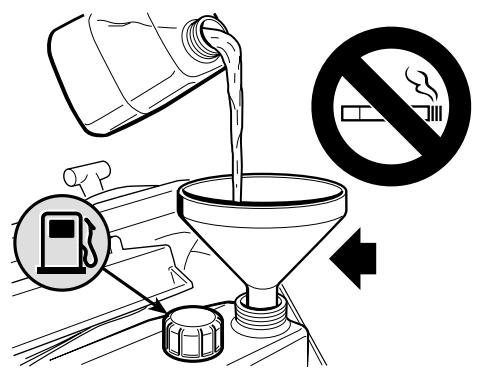
Refuel using a funnel, but do not completely fill the tank. The tank's capacity is about 5.5 litres.
DANGER!
Refuelling should be carried out in an open or well ventilated engine stopped. Always remember that petrol fumes are NOT TAKE A NAKED FLAME TO THE TANK'S OPENING. SEE THE TANK'S CONTENTS AND DO NOT SMOKE WHEN
IMPORTANT
Do not drip petrol onto the plastic parts to avoid ruining of accidental leaks, rinse immediately with water.
5.3.4 FITTING THE PROTECTION AT THE EXIT (GRASS-CATCHER OR STONE-GUARD)
WARNING!
Never use the
machine without having fitted the exit protection!
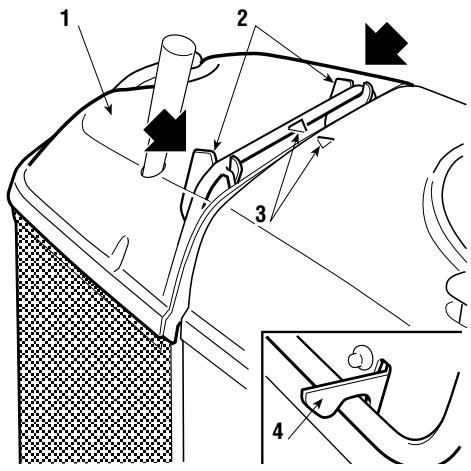
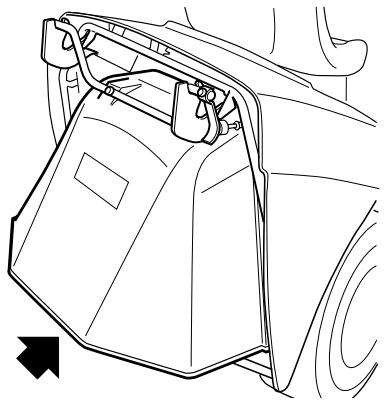
Hook the grass-catcher (1) onto the brackets (2) and centre it up with the rear plate, so that the two reference marks (3) coincide.
Centering is ensured by using the right bracket as lateral support.
Make sure that the lower tube of the opening of the grass-catcher clicks onto the pawl (4).
If you would like to mow without using the grass-catcher, an optional stone-guard kit (8.2) is available. This has to be attached to the rear plate as indicated in the relevant instructions.
5.3.5 CHECKING THE EFFECTIVENESS OF THE SAFETY DEVICES
Check that the safety systems are working properly by simulating the various situations of usage shown in the table (5.2) and making sure that the correct result is achieved for each situation.
Make sure that the machine's breaking capacity is suited to the conditions of use. Do not start mowing if you have any doubts on the brake efficiency. If doubts on its efficiency persist, consult a Licensed Service Centre.
5.3.7 CHECKING THE BLADES
Check that the blades are sharpened properly and firmly fixed to their hubs.
- A badly sharpened blade pulls at the grass and makes the lawn turn yellow.
- A loose blade causes unusual vibrations and can be dangerous.
5.4 USING THE MACHINE
5.4.1 STARTING
DANGER!
All starting operations have to be effected in an open or rea! ALWAYS REMEMBER THAT EXHAUST GASES ARE
To start the engine:
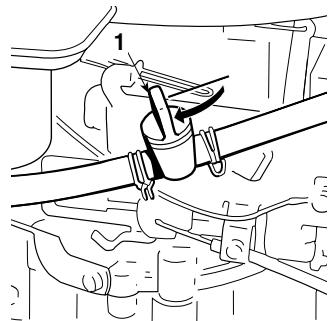
- open the fuel stopcock (1) ( if fitted);
- put the transmission into neutral («N») (4.22 or 4.32);
disengage the blades (4.7);
- engage the parking brake on sloping ground;
- when starting from cold, move the accelerator lever to the «CHOKE» position shown on the label;
- if the engine is already warm, just put the lever between «SLOW» and «FAST»;
- put in the key and turn to «ON» to make electrical contact, then turn to «START» to start the engine;
- release the key once the engine has started.
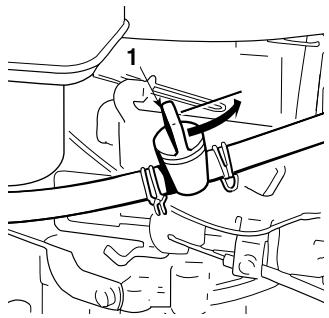
When the engine has started, put the accelerator in the «SLOW» position.
IMPORTANT
The choke must be closed as soon as the engine is running
smoothly. Using it when the engine is already warm can foul the spark plugs and cause the engine to run erratically.
NOTE
The choke must be closed as soon as the engine is running
smoothly. Using it when the engine is already warm can foul the spark plugs and cause the engine to run erratically. Turn the key to the «OFF» position, wait for a few seconds and then repeat the operation. If the malfunction continues, refer to chapter «7» of this manual and to the engine manual.
IMPORTANT
Always bear in mind that the safety devices prevent the
engine from starting if safety requirements have not been met (5.2). In these cases, once the situation has been corrected, the key must first be turned back to «OFF» before the engine can be restarted.
5.4.2 STARTING AND MOVING WITHOUT MOWING
WARNING! This machine has not been approved for use on public roads. It has to be used (as indicated by the highway code) in private areas closed to traffic.
NOTE When moving the machine, the blades must be disengaged and the cutting deck put at its highest position (position «7»).
For mechanical drive models:
-
Put the accelerator control between the «SLOW» and «FAST» positions, and the gear change lever in the 1st speed position (4.22).
-
Keep the pedal pressed down and disengage the parking brake. Slowly
- release the pedal which will turn from «brake» to «clutch», thus operating the rear wheels (4.21).
WARNING! The pedal has to be released gradually as a sudden engagement may cause tipping up and loss of control of the vehicle.
- Gradually reach the desired operating speed using the accelerator and gear lever. To change the gear speed the clutch must be used pushing the pedal half way down (4.21).
For hydrostatic drive models:
- When moving the machine from one area to another, put the accelerator lever in a midway position between «SLOW» and «FAST».
Disengage the parking brake and release the brake pedal (4.31).
- Press the drive pedal (4.32) in direction «F» and reach the required speed
- by progressively increasing pressure on the pedal and moving the accelerator appropriately.
WARNING! Drive must be engaged in the way already described
(4.32) to prevent sudden engagement from causing tipping up and loss
of control of the vehicle, particularly on slopes.
5.4.3 BRAKING
First, reduce the machine's speed by reducing the engine's r.p.m. and then push the brake pedal (4.21 or 4.31) to further reduce the speed until the machine stops.
For hydrostatic drive models:
NOTE The machine already slows down considerably by just releasing the drive pedal.
5.4.4 REVERSE
Reverse must be engaged ONLY when the machine is stopped.
For mechanical drive models:
- Push down the pedal until the machine stops and then go into reverse by
- moving the lever sideways and putting it into position «R» (4.22). Gradually release the pedal to engage the clutch and then begin moving in reverse.
For hydrostatic drive models:
- When the machine is stopped, start the reverse movement by pressing the
- drive pedal in the «R» direction (4.32).
5.4.5 GRASS CUTTING
To start cutting:
High and dense grass - wet lawn Average condition grass Low grass - dry lawn
2 km/h
3,5 ... 5,5 km/h
over 5,5 km/h
For hydrostatic drive models:
- The speed is controlled in a gradual and progressive way by the pressure on the drive pedal.
WARNING!
When cutting on sloping ground, the forward speed to ensure safe conditions ( 一 1 . 2 -5.5).
In any case, the speed should always be lowered if you note a reduction in engine speed, since a forward speed that is too fast compared to the amount of grass being cut will never mow the grass well.
Disengage the blades and put the cutting deck in the highest position whenever you need to get past an obstacle.
This operation can only be done with the blades disen
gaged, otherwise the engine stops.
Do not let the grass-catcher become too full as this may block the collector channel.
When the grass-catcher is full there is an audible warning. At this point:
- lower the engine speed;
-
shift into neutral (N) ( 4.22 -mechanical models or 4.32 - hydrostatic models) and stop forward movement;
disengage the blades (4.7) and the audible signal will stop;
-
engage the parking brake on slopes;
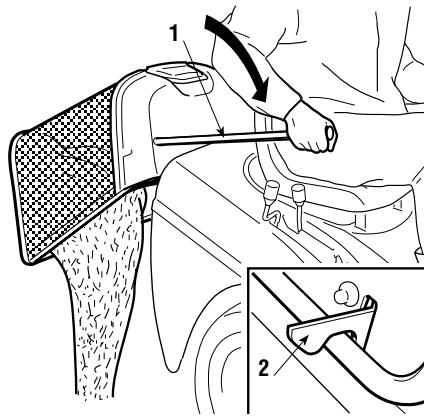
- pull out the lever (1) and tip up the grass-catcher to empty it;
- close up the grass-catcher so that it hooks onto the pawl (2).
NOTE
At times the audible
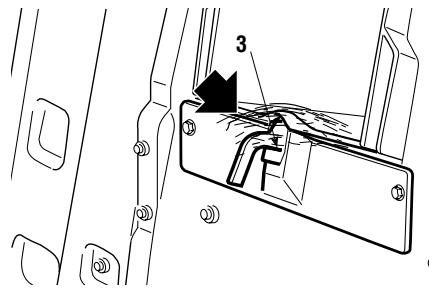
warning may be heard at the moment of engaging the blade even when the grass-catcher has been emptied. This is due to grass-cuttings left on the sensor (3) of the micro-switch. To stop the signal, disengage the blade and then immediately engage it again.
Always keep the sensor (3) free of grass-cuttings.
5.4.7 UNBLOCKING THE COLLECTOR CHANNEL
Cutting very tall or wet grass, particularly at too high speed, can cause the collector channel to become blocked. Should this happen, it will be necessary to:
- stop forward movement immediately, disengage the blades and stop the engine;
- take off the grass-catcher or stone-guard;
- remove the accumulated cuttings, reaching them from the exit of the collector channel.
WARNING!
This job must only be performed with the engine turned
off.
5.4.8 END OF MOWING
When you have finished mowing, disengage the blades, lower the engine speed and ride the machine with the cutting deck in the highest position.
5.4.9 END OF WORK
Stop the machine, put the accelerator lever in the «SLOW» position and turn off the engine by putting the key into the «OFF» position.
When the engine is stopped, close the fuel stopcock (1) (if fitted).
WARNING!
To avoid backfire, put the accelerator in the «SLOW» cond's before stopping the engine.
WARNING!
Always take out the ignition key if leaving the machine
unattended!
IMPORTANT
To keep the battery charged, do not leave the key in the
"ON" position when the engine is not running.
5.4.10 CLEANING AND STORAGE
After each mowing, clean the outside of the machine, empty the grass-catcher and shake it to remove residual grass and earth.
WARNING!
Always empty the grass-catcher and do not leave contact grass inside a room.
Clean the plastic parts of the body with a damp sponge using water and detergent, taking care not to wet the engine, the electrical parts or the electronic card located under the dashboard.
IMPORTANT
Never use hose-nozzles or harsh detergents for cleaning the
body and engine!
For washing the inside of the cutting deck and the collector channel the machine must be on firm ground with:
- the grass-catcher or stone-guard fitted;
- the operator seated;
- the engine running;
- the transmission in neutral;
- the blades engaged.
Connect a water hose to each of the pipe fittings (1) one at a time and run water through each one for a few minutes, with the blades moving.
When washing, the cutting deck should be in the fully lowered position. Take off the grass-catcher, empty and rinse it, and then put it in a position where it can dry quickly.
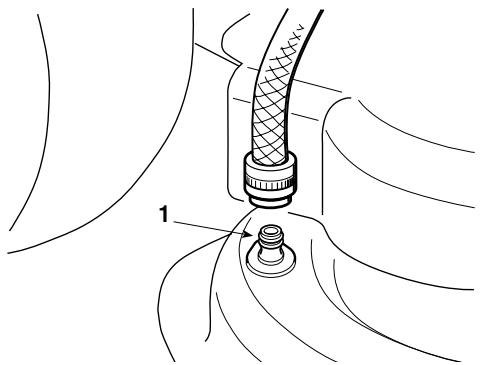
Put the machine away in a dry place protected from weather and, if possible, cover with a cloth (8.4).
5.4.11 STORAGE AND INACTIVITY FOR LONG PERIODS
If the machine is likely to be unused for a long period (more than 1 month), disconnect the cables from the battery and follow the instructions in the engine manual. Lubricate all joints as directed (6.2.1).
WARNING!
Carefully remove any dry
grass cuttings which may have collected around the engine or silencer to prevent their catching fire the next time the machine is used!
Empty the fuel tank by disconnecting the tube situated at the inlet of the fuel filter (1) and follow the instructions in the engine manual.
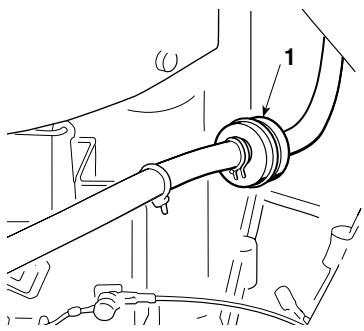
IMPORTANT
The battery must be kept in a cool and dry place. Before a
long storage period (more than 1 month), always charge the battery, and then recharge before using again (6.2.5).
The next time the machine is used, check that there are no fuel leaks from the tubes, fuel stopcock or carburettor.
5.4.12 CARD PROTECTION DEVICE
The electronic card has a self-resetting protector which breaks the circuit if there is a fault in the electrical system. It results in the stopping of the engine and the lighting up of the lamp.
The circuit automatically resets after a few seconds but the cause of the fault should be ascertained and dealt with to avoid reactivating the protection device.
IMPORTANT
To avoid activating the protection device.
- do not reverse the leads on the battery terminals;
- do not use the machine without its battery or damage may be caused to the charging regulator;
- be careful not to cause short-circuits.
5.4.13 SUMMARY OF THE MAIN ACTIONS TO BE CARRIED OUT WHEN USING THE MACHINE
| To ... | You will need to ... |
| Start the engine (▶ 5.4.1) | Open the fuel stopcock, ensure that all the conditions allowing starting are met, and then turn the key. |
| Go forward (▶ 5.4.2) | Move the accelerator; ▷ for mechanical drive models: push the pedal right down, engage the gear (▶ 4.22) and then gradually release the pedal; ▷ for hydrostatic drive models: press the drive pedal forward; (▶ 4.32); |
| Brake or stop (▶ 5.4.3) | Reduce the engine speed and press the brake pedal. |
| Reverse (▶ 5.4.4) | Stop the machine; ▷ for mechanical drive models: put into neutral (N), push the pedal right down, engage reverse, (▶ 4.22) and then gradually release the pedal; ▷ for hydrostatic drive models: press the drive pedal back (▶ 4.32). |
| Cut the grass (▶ 5.4.5) | Fit the grass-catcher or stone-guard and move the accelerator engage the blades and adjust the cutting height. ▷ for mechanical drive models: push the pedal right down, engage the gear (▶ 4.22) and then gradually release the pedal; ▷ for hydrostatic drive models: press the drive pedal forward; (▶ 4.32); |
| Empty the grass-catcher (▶ 5.4.6) | Stop advancing, disengage the blades and operate the lever to tip over the grass-catcher. |
| Unblock the collector channel (▶ 5.4.7) | Stop forward movement, disengage the blades and turn off the engine; remove the grass-catcher and clean the channel. |
| End mowing (▶ 5.4.8) | Disengage the blades and reduce the engine speed. |
| Stop the engine (▶ 5.4.9) | Reduce the engine speed, wait a few seconds, turn the key and close the fuel stopcock. |
| Store the machine (▶ 5.4.10) | Engage the parking brake, remove the key and, if necessary, wash the machine, the inside of the cutting deck, the collector channel and the grass-catcher. |
5.5 USING ON SLOPING GROUND
Only mow on slopes with gradients up to the maximum already mentioned (max 10^ - 17% ). Lawns on a slope have to be mowed moving up and down and never across them, taking great care when changing direction that the highest wheels do not hit obstacles (such as stones, branches, roots, etc.) that may cause the machine to slide sideways, tip over or otherwise cause loss of control.
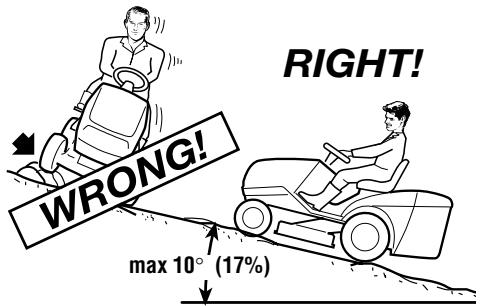
DANGER! REDUCE SPEED BEFORE ANY CHANGE OF DIRECTION ON SLOPES, and always engage the parking brake before leaving the machine stopped and unattended.
WARNING! Take care when beginning forward movement on sloping ground to prevent the risk of tipping up. Reduce the forward speed before going on a slope, particularly downhill.
DANGER! Never use reverse to reduce speed going downhill.
Control of the machine may be lost, particularly on slippery surfaces.
For mechanical drive models:
DANGER!
Never ride the machine on slopes in neutral gear or
with the clutch out! Always engage a low gear before leaving the machine stopped and unattended.
For hydrostatic drive models:
- Go down slopes without touching the pedal (4.32) to take advantage of the braking effect of the hydrostatic drive when the transmission is not engaged.
5.6 TRANSPORTING
WARNING!
If the machine is transported on a truck or trailer, use
suitable equipment for lifting and an appropriate number of people for the weight involved and the type of lifting system used. The machine must never be lifted by rope and tackle. While being transported, close the fuel stopcock ( if fitted), lower the cutting deck, engage the parking brake and fasten the machine securely with ropes or chains to the hauling device.
5.7 ADVICE ON HOW TO OBTAIN A GOOD CUT
- To keep a lawn green and soft with a good appearance it should be cut regularly without damaging the grass.
- It is always better to cut the grass when dry.
- The blades must be in good condition and well sharpened so that the grass is cut straight without any ragged edge that leads to yellowing at the ends.
- The engine must run at full speed, both to ensure a sharp cut of the grass and to get the necessary thrust to push the cuttings through the collector channel.
- The frequency of mowing should be in relation to the rate of growth of the
grass, which should not be left to grow too much between one cut and the next.
- During hot and dry periods, the grass should be cut a little higher to prevent the ground from drying out.
- If the grass is very tall, it should be cut twice in a twenty-four hour period. The
first time with the blades at maximum height, possibly reducing the cutting width, and the second cut at the heigh wanted.
8. The appearance of the lawn will improve if you alternate the cutting in both directions.
9. If the collector system tends to get blocked with grass, you should reduce the forward speed since this may be too high for the condition of the grass. If the
problem persists, the probable causes are either badly sharpened blades or deformed wings.
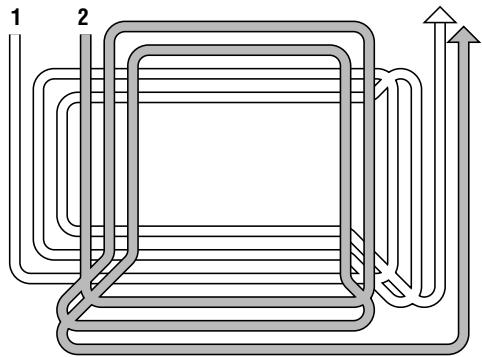
- Be very careful when mowing near bushes or kerbs since these could distort the horizontal position of the cutting deck, and damage its edge as well as the blades.
6. MAINTENANCE
6.1 SAFETY RECOMMENDATIONS
WARNING!
Before cleaning, maintenance or repair work, take out and read the relevant instructions. Wear suitable clothing as when dismantling and refitting the blades and in all situations for hands.
WARNING!
Never use the machine with worn or damaged parts.
Faulty or worn-out parts must always be replaced and not repaired. Only use genuine spare parts: those that are not of an equivalent quality may damage the machine or endanger the safety of yourself and others.
IMPORTANT
Never get rid of used oil, fuel or other pollutants in unautho-
rised places!
6.1.1 LIFTING THE MACHINE VERTICALLY
If you need to have easy access to the lower part of the machine it is possible to lift it vertically.
WARNING!
Place the machine on
firm and flat ground. At least two competent people should be involved in this operation to assure necessary safety.
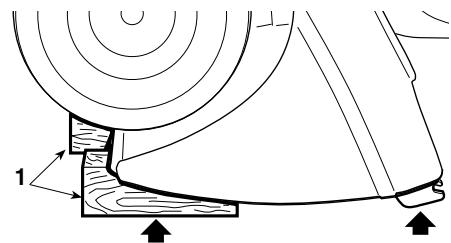
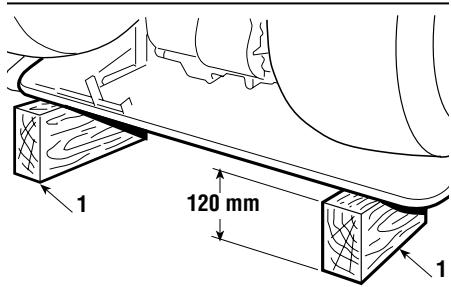
Make sure that the tank does not contain more than 2 litres of fuel and insert a block of around 120mm beneath the rear plate.
Lift the machine from the front, being careful to hold onto parts that offer a firm grip, and rest it on the points shown, taking care not to damage the grass-catcher brackets or the plastic parts.
DANGER!
Check that the machine is stable before doing any work
and avoid carrying out any operations that can cause it to fall.
6.2 ROUTINE MAINTENANCE
6.2.1 MAINTENANCE AND GENERAL LUBRICATION
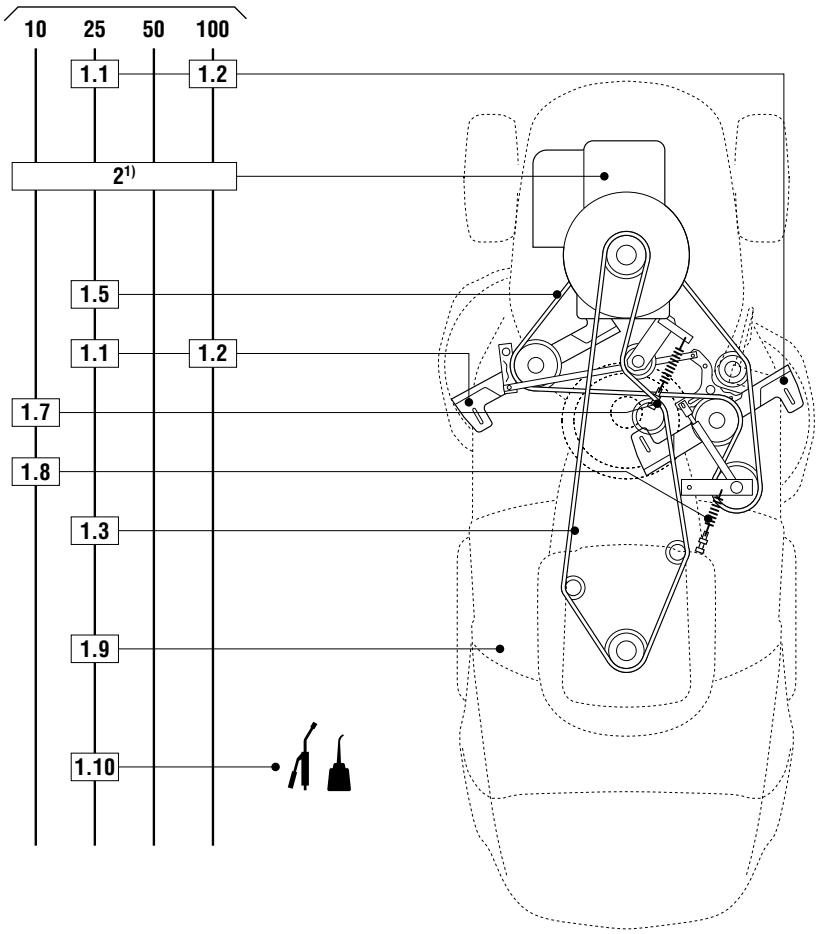
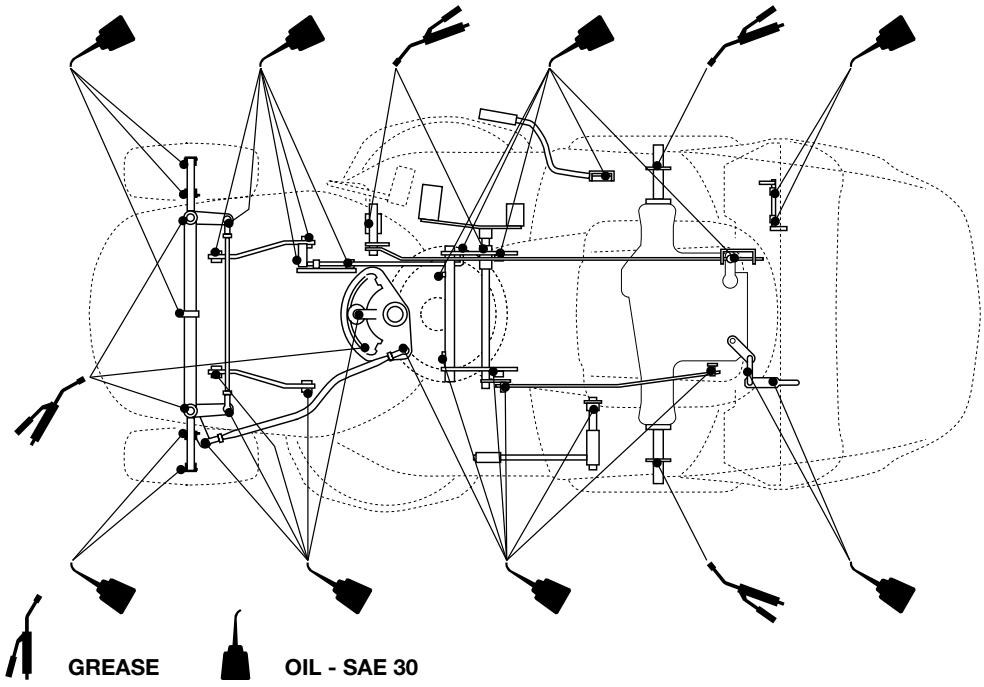
Follow the diagrams which show the points requiring checks, lubrication and routine maintenance, together with the type of lubricant to be used and the frequency required.
a) Routine maintenance (6.2.2)
HOURS
b) Lubrication
For mechanical drive models:
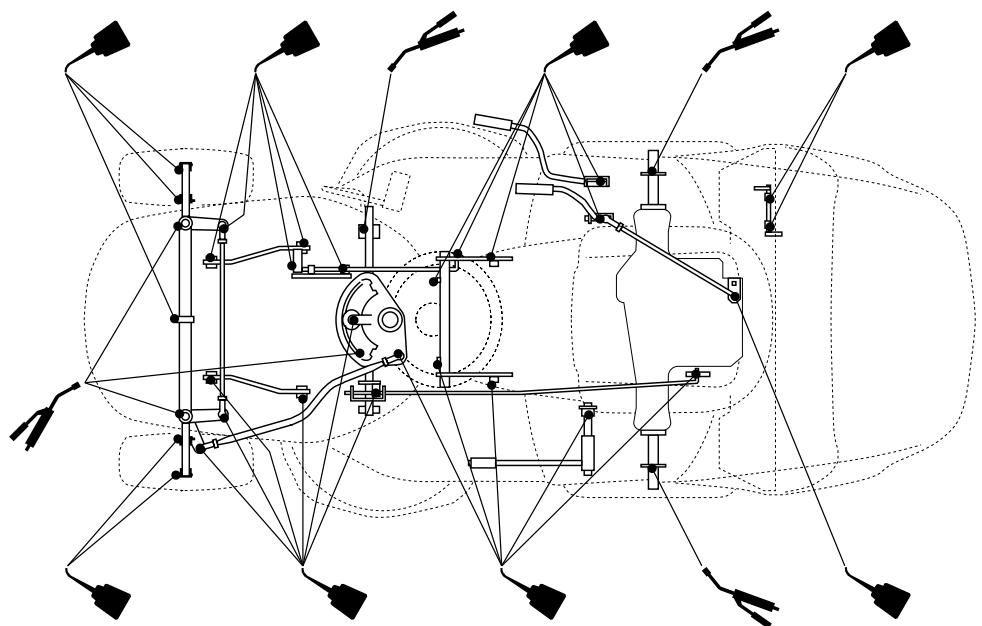
For hydrostatic drive models:
6.2.2 GUIDE TO SCHEDULED MAINTENANCE
This table is to help you maintain your machine's safety and performance. It shows the main maintenance and lubrication work, indicating the frequency with which it should be carried out. To the right of each item there is a box where you write the date or after how many hours of operation the work was carried out.
| WORK | HOURS | DONE (DATE OR N° OF HOURS) |
| 1. MACHINE |
| 1.1 Check of tight fixing and sharpness of blades 25 | | | | | | | | |
| 1.2 Blade replacement 100 | | | | | | | | |
| 1.3 Transmission belt check 25 | | | | | | | | |
| 1.4 Transmission belt replacement 2) - | | | | | | | | |
| 1.5 Check the blade drive belt 25 | | | | | | | | |
| 1.6 Blade drive belt replacement 2) - | | | | | | | | |
| 1.7 Check and adjustment of drive 10 | | | | | | | | |
| 1.8 Check engagement and brake of blade 10 | | | | | | | | |
| 1.9 Check all fastenings for tight fitting 25 | | | | | | | | |
| 1.10 General lubrication3 3) 25 | | | | | | | | |
| 2. ENGINE 1) |
| 2.1 Engine oil change .... | | | | | | | | |
| 2.2 Check and cleaning of air filter .... | | | | | | | | |
| 2.3 Air filter replacement .... | | | | | | | | |
| 2.4 Check fuel filter .... | | | | | | | | |
| 2.5 Fuel filter replacement .... | | | | | | | | |
| 2.6 Check and cleaning of spark plug points .... | | | | | | | | |
| 2.7 Replacement of spark plug .... | | | | | | | | |
1) See the engine manual for the full list and frequency.
2) Replace at the first signs of wear, contacting a Licensed Service Centre.
3) General lubrication should also be carried out whenever the machine is to be left unused for a long period.
6.2.3 ENGINE
Follow all the instructions in the engine manual.
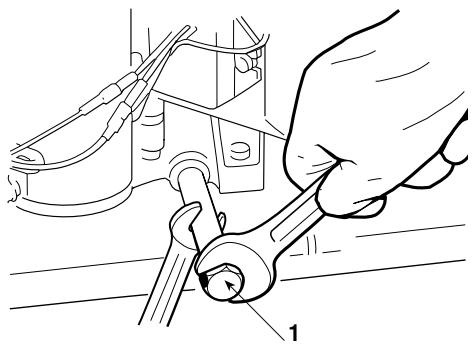
To empty the engine oil, unscrew the oil plug (1). When refitting the plug, make sure the seal is positioned correctly.
6.2.4 REAR AXLE
This is a sealed single unit that does not require maintenance. It is permanently lubricated and this lubricant does not need changing or topping up.
6.2.5 BATTERY
To ensure long life to the battery it is essential to keep it carefully maintained. The machine battery must always be charged:
- before using the machine for the first time after purchase;
- before leaving the machine for a prolonged period of disuse;
- before starting up the machine after a prolonged period of disuse.
- Carefully read and observe the recharging procedure described in the booklet provided with the battery. Failure in following the procedure or in charging the battery could permanently damage the battery elements.
- A flat battery must be recharged as soon as possible.
IMPORTANT
Recharging must be
done using a battery charger at constant voltage. Other recharging systems can irreversibly damage the battery.
The machine comes with a connector (1) for recharging, to be connected to the cor
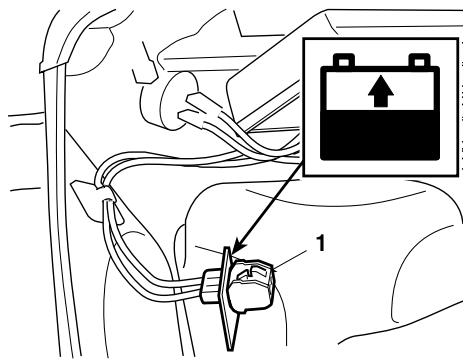
responding connector of the special "CB01" maintenance battery-charger supplied (if included) or available on request (8.5).
IMPORTANT
This connector must only be used for connection to the
"CB01" maintenance battery-charger. For its use:
- follow the instructions given in the relative user manual,
- follow the instructions given in the battery booklet.
6.3 CHECKS AND ADJUSTMENTS
Summary of the main situations where work may be required
| Every time that … | You will need to … |
| The blades vibrate | Check the bolts (←6.3.1) or balance the blades (←6.3.1). |
| The blades tear the grass and the lawn becomes yellow | Sharpen the blades (←6.3.1). |
| The cut is uneven | Adjust the alignment of the cutting deck (←6.3.2). |
| The blades engage in an abnormal way | Regulate the blade engagement adjuster (←6.3.3). |
| The machine does not brake | Check the brake (←6.3.4). |
| Forward movement is erratic | Adjust the stretcher spring (←6.3.5). |
6.3.1 DismantLING, SHARPENING AND BALANCING BLADES
Check that the blade is sharpened properly and firmly fixed to the bracket.
- A badly sharpened blade pulls at the grass and causes the lawn to turn yellow.
- A loose blade causes unusual vibrations and can be dangerous.
WARNING!
All operations on the blades (dismantling, sharpening, hunting and/or replacing) require a certain familiarity and or safety reasons, go to a specialized centre if you do not do skills or experience.
WARNING!
Wear strong gloves when handling the blades.
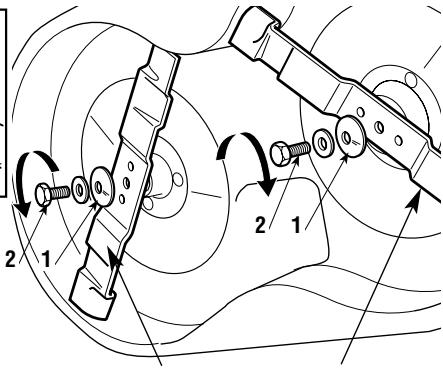
To remove a blade, hold it firmly and undo the central bolt (1) in the direction indicated by the arrow for each blade, noting that one of the fixing bolts has a right-hand thread and the other one has a left-hand thread.
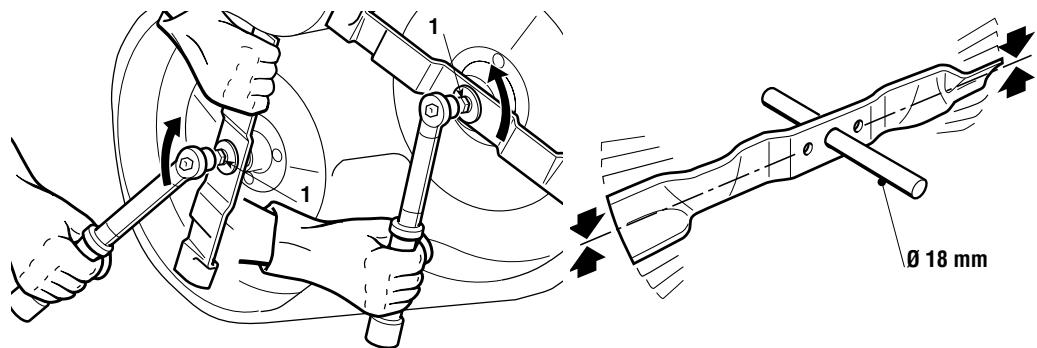
Sharpen the two cutting edges using a medium grade grinding wheel and check the balance by holding the blade up with a round 18mm bar inserted in the central hole.
WARNING!
Damaged or bent blades must always be replaced; for them! ALWAYS USE MANUFACTURER'S Genuine BLADES BEARING THE SYMBOL
WARNING!
The blades differ and are contra-rotating. When
installing them, make sure that they are correctly positioned by referring to the code number marked on the outside of each one.
WARNING!
When
assembling the blade, always follow the instructions given, making sure the blade wings are facing towards the inside of the
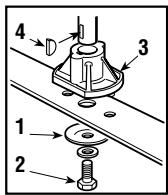
cutting deck and the cupped side of the elastic disc (1) is pressing against the blade. Tighten the fixing screws (2) using a torque wrench set to 45-50 Nm. If one or both shaft hubs (3) come off when dismantling the blades, make sure the keys (4) are securely lodged in place.
82004345/1 82004344/1
82004352/0 81004346/3
82004354/0 82004353/0
6.3.2 CUTTING DECK ALIGNMENT
The cutting deck should be properly set to obtain a good cut
should always be 5 - 6 mm lower than the rear.
- Put the machine onto a flat surface and check the tyre pressures;
- put 26 mm blocks (1) under the front edge of the deck and 32 mm blocks (2) under the rear edge, and then put the lifting lever into position «1»;
- fully loosen the adjuster (3), the nuts (4 - 6 - 8) and the locknuts (5 - 7 - 9) of the three trace rods until the deck is resting on the blocks;
- screw the two upper right nuts (6 - 8) and the lower left nut (4) until the deck starts rising; tighten the three locknuts (5 - 7 - 9) and turn the adjuster (3) until the control cable is taut.
Any difference in height from the ground between the right and left side of the deck can be compensated by turning the two nuts (4 - 8) and locknuts (5 - 9) of just the back rods.
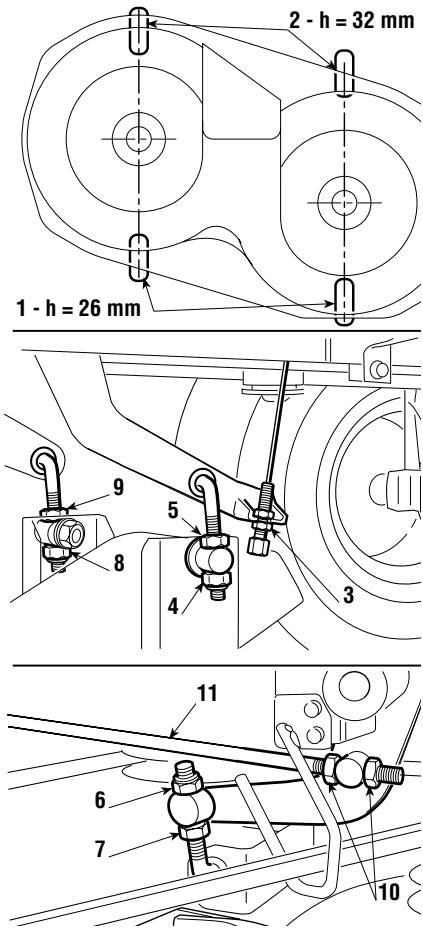
Move the control lever to 2 or 3 different positions, making sure that the deck rises evenly and that the difference in height from the ground remains the same between the front and rear edge.
If the front part rises too early or too late, you can regulate the movement by turning the nuts (10) on the connecting rod (11).
Screwing the nuts on the rod makes the rear part rise earlier, while unscrewing them does the opposite.
Always remember to fully tighten all the nuts and locknuts when the adjustment has been made.
If you are unable to get the cutting deck adjusted properly, consult a Licensed Service Centre.
6.3.3 ADJUSTMENT TO THE ENGAGEMENT AND BRAKE OF THE BLADES
When the blade disengagement lever is operated, it also brings the blade brake into operation which stops the blades within few seconds.
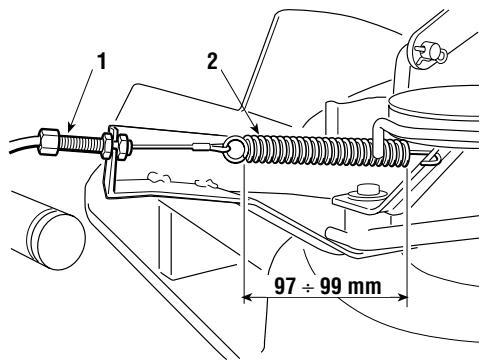
A stretched cable and changes in the length of the belt can impair the blades' engagement or rotation.
To compensate this, turn the adjuster (1) until the correct spring length (2) is
achieved (measured from the outer ends of the springs with the blades engaged).
6.3.4 BRAKE ADJUSTMENT
Should the brakes work poorly, consult a Licensed Service Centre immediately.
6.3.5 ADJUSTING THE TENSION OF THE DRIVE BELT
Should you notice a drop in forward drive power, adjust the tension of the spring of the stretcher to return to former conditions.
The adjustment is made by opening the engine hood to reach the right side of the engine.
Turn the nuts (2) as much as necessary to reach length "A" of the spring (1) of:
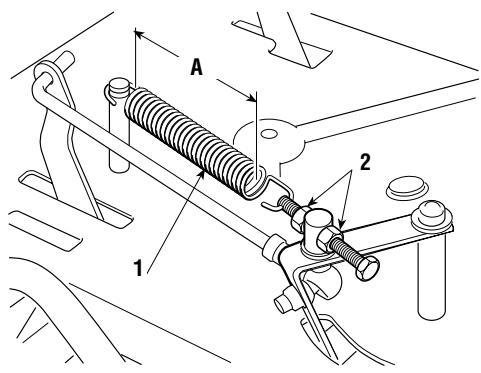
A = 119 - 121 mm (For mechanical drive models)
A = 120 - 122 mm (For hydrostatic drive models)
measured to the outside of the end of the spring. When the adjustment has been made, tighten the nuts (2).
NOTE
When replacing the belt, take great care when using for the engagement may be sudden until the belt is sufficiently run in.
6.4 DISMANTLING AND REPLACEMENT
6.4.1 REPLACING WHEELS
Stop the machine on a flat surface and put a block under a load-bearing part of
the frame on the side that the wheel is to be changed.
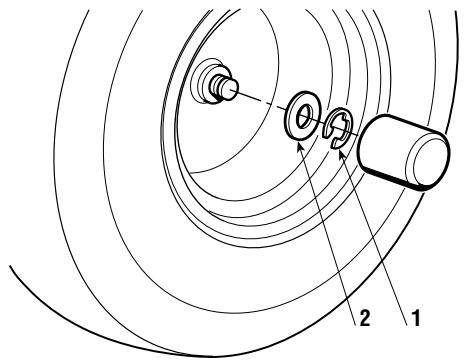
The wheels are held by a snap ring (1) which can be eased off with a screwdriver.
The rear wheels are directly coupled to the differential axle shaft and fastened by a key that forms part of the wheel's hub.
NOTE
Should you substitute one or both rear wheels, ensure that one diameter, and check that cutting deck is horizontal to pre-
IMPORTANT
Before refitting a wheel, smear some waterproof grease on
the axle and carefully refit the snap ring (1) and washer (2).
6.4.2 REPLACING AND REPAIRING TYRES
The tyres are of the «Tubeless» type and therefore all puncture repairs will have to be carried out by a tyre-repair expert in accordance with the methods for this kind of tyre.
6.4.3 REPLACING BULBS (if fitted)
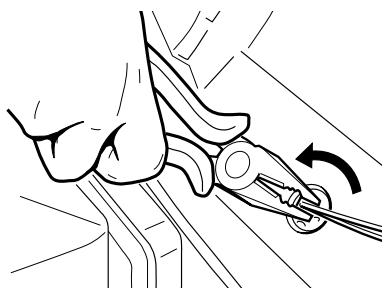
The bulbs (18W) have a bayonet fitting and are installed in the bulb holder which can be taken out by turning it anti-clockwise, using pliers.
6.4.4 REPLACING A FUSE
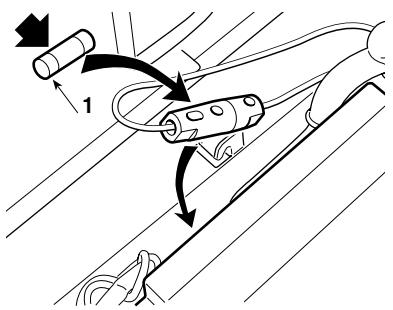
The machine is fitted with fuses (1) with different capacities and functions. Specifically:
- 6.3 A (delayed) fuse (1) = protects the main and power circuits of the electronic board. When it blows, the machine stops and the dashboard light switches off.
- 25 A fuse (2) = protects the battery charger circuit. When it blows, the battery gradually runs out and the machine will have problems starting.
The fuse capacity is indicated on the fuse.
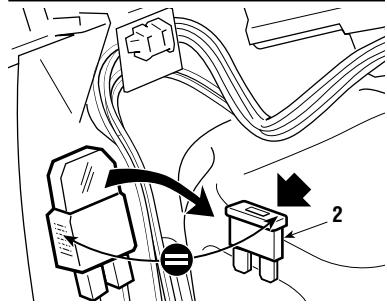
IMPORTANT
A blown fuse must always be replaced by one of the same rating, and never with one of another rating.
If you cannot find out why the fuse has blown, consult a Licensed Service Centre.
6.4.5 REPLACING BELTS
Replacing belts is quite a complicated process of dismantling and subsequent adjustment and must only be carried out by a Licensed Service Centre.
NOTE
Replace the belts as soon as they show obvious signs of
wear! ALWAYS USE GENUINE REPLACEMENT BELTS!
7. TROUBLESHOOTING
| PROBLEM | LIKELY CAUSE | SOLUTION |
| 1. With the key on «ON», the light remains off | The protection of the electronic card has cut in due to: | Turn the key to «STOP» and look for the cause of the problem: |
| - badly connected battery | - check connections (3.4) |
| - battery terminals crossed | - check connections (3.4) |
| - completely flat battery or eroded battery plates | - recharge battery (6.2.5) |
| - fuse blown | - replace fuse (6.3 A - delayed) (6.4.4) |
| - bad earthing to the engine or the frame | - check connections of black earth leads |
| - electronic card wet | - dry using tepid air |
| - earthed micro-switches | - check connections |
| 2. With the key on «START» the light flashes and the starter motor does not run | - you are not ready for starting | - check that the conditions allowing starting are met (5.2.a) |
| 3. With the key on «START» the light comes on but the starter motor does not run | - insufficiently charged battery | - recharge battery (6.2.5) |
| - battery charger fuse blown | - replace fuse (25 A) (6.4.4) |
| - badly earthed starter motor | - check earth connections |
| 4. With the key on «START», the starter motor runs, but the engine does not run | - insufficiently charged battery | - recharge battery (6.2.5) |
| - faulty fuel supply | - check the level in the tank (5.3.3) |
| - open the fuel stopcock (sif fitted) (5.4.1) |
| - check the wiring of the fuel open command (if fitted) |
| - check the fuel filter |
| - faulty ignition | - check that spark plug caps are firmly fitted |
| - check that the electrodes are clean and have the correct gap |
| 5. Starting is difficult or the engine runs erratically | - fault in carburation | - clean or replace the air filter |
| - flush out the float chamber |
| - empty fuel tank and refill with fresh fuel |
| - check and, if necessary, replace fuel filter |
| 6. Weak engine performance during cutting | - forward speed too high in relation to cutting height (≈ 5.4.5) | - reduce the forward speed and/or raise the cutting deck |
| 7. The engine stops but the light flashes | - the safety devices cut in | - check that the conditions allowing starting are met (≈ 5.2.b) |
| 8. The engine stops and the light goes off | The protection of the electronic card has cut in due to: | Put the key in position «STOP» and look for the cause of the problem: |
| - earthed micro-switch | - check connections |
| - battery contains electrolyte but is not charged | - recharge battery (≈ 6.2.5) |
| - overvoltage caused by the charge regulator | - contact a Licensed Service Centre |
| - badly connected battery (poor contact) | - check connections (≈ 3.4) |
| - engine badly earthed | - check engine earth connection |
| 9. The engine stops but the light stays on | - problems in the engine | - contact a Licensed Service Centre |
| 10. The blades do not engage | - cable lengthened or belt loosened | - turn the adjuster (≈ 6.3.3) |
| 11. Uneven cut and poor grass collection | - cutting deck not parallel to the ground | - check the tyre pressures (≈ 5.3.2) |
| - realign the cutting deck to the ground (≈ 6.3.2) |
| - blade cutting badly | - check that the blades are fitted properly (≈ 6.3.1) |
| - sharpen or fit new blades (≈ 6.3.1) |
| - check the tension of the belt and control cable of the blade engagement lever (≈ 6.3.3) |
| - forward speed too high compared to height of grass (≈ 5.4.5) | - reduce forward speed and/or raise the cutting deck |
| - wait for the grass to dry |
| - collector channel is blocked | - remove the grass-catcher and empty the collector channel (≈ 5.4.7) |
| - cutting deck full of grass | - clean the cutting deck (≈ 5.4.10) |
| 12. Unusual vibrations while working | - the blades are imbalanced | - balance or replace any damaged blades (← 6.3.1) |
| - blades loose | - check that the blades are firmly fitted (← 6.3.1) (remember the left-hand thread of the right-hand blade) |
| - fixing bolts loose | - check and tighten all the fixing bolts of the engine and frame |
| 13. With the engine running, the machine does not move when the drive pedal is pressed (▶ for hydrostatic drive mod-els) | - disengage lever in position «B» 4.33) | (▶ - put into position «A» |
If problems continue after having carried out these operations, contact a Licensed Service Centre.
8. ACCESSORIES ON REQUEST
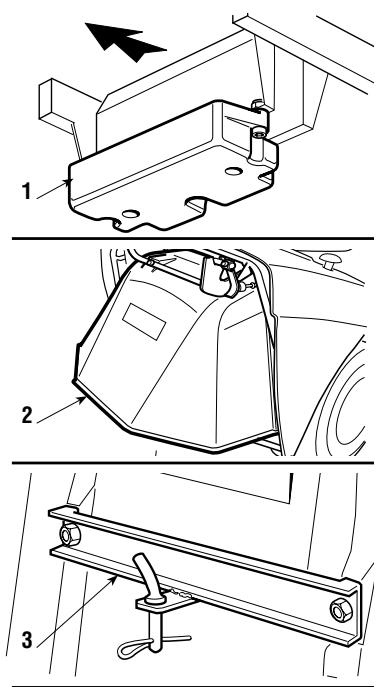
1. FRONT COUNTERWEIGHTS
These improve stability at the front of the machine, particularly when being used on ground which is mostly sloping.
2. STONE-GUARD KIT
For use in place of the grass-catcher when the cuttings are not to be collected.
3. TOWING HITCH
For towing a small trailer.
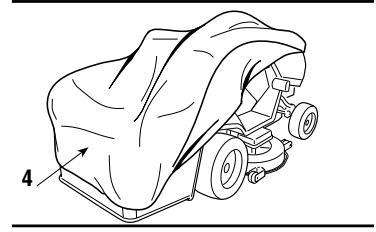
4. CLOTH COVER
Protects the machine from dust when not in use.
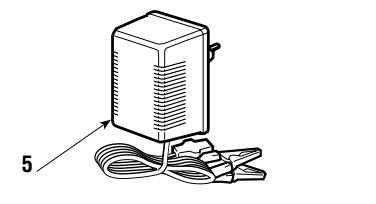
5. "CB01" MAINTENANCE BATTERY-CHARGER
This makes it possible to keep the battery in good working order when the machine is in storage, guaranteeing an optimum level of charge and a longer life to the battery.
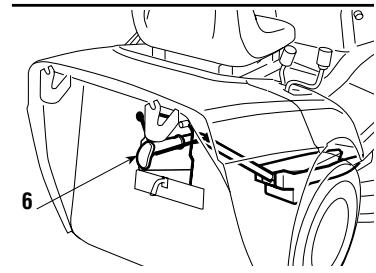
6. KIT FOR "MULCHING" (only on prearranged models)
It finely chops the grass cuttings and leaves them on the lawn, instead of collecting them in the grass-catcher.
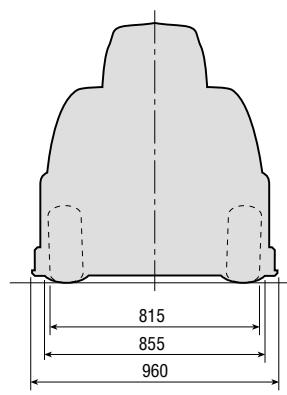
9. SPECIFICATIONS
Electrical system 12 V
Battery 18 Ah
Front tyres 13 x 5.00-6
Rear tyres 18 x 8.50-8
Front tyre pressure 1.5 bar
Rear tyre pressure 1.2 bar
Overall weight ....... from 182 to 196kg
Inside turning circle (minimum diameter of uncut grass)
left side 1.6 m
Cutting height from 3 to 8 cm
Cutting width 91 cm
Grass-catcher capacity 250 litres
For mechanical drive models:
- Forward speed (approximate) at 3000min^-1 :
in 1st 2.2 km/h
in 2nd 3.8 km/h
in 3rd 5.8 km/h
in 4th 6.4 km/h
in 5th 9.7 km/h
In Reverse 2.8 km/h
For hydrostatic drive models:
Forward speed (at 3000 min.):
in Forward ....from 0 to 8.8km / h
- in Reverse ......... from 0 to 3.8 ~km / h
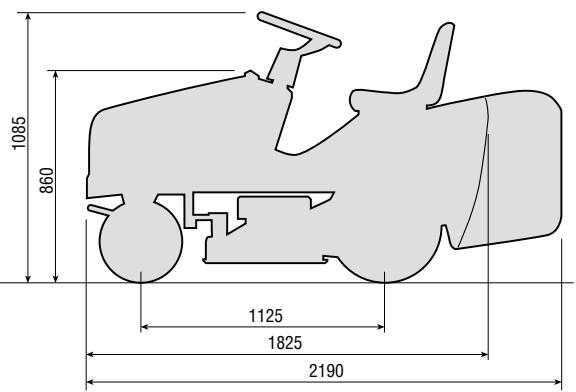
10. ALPHABETICAL INDEX
Accelerator
Function and use 4.2
Audible warning
Function 4.6
Work 5.4.6
Battery
Description 2.2-17
Connection 3.4
Inactivity for long periods. 5.4.11
Maintenance and recharging 6.2.5
Blades
Description 2.2 - 12
Engagement 4.7
Brake
Pedalfunction 4.31
Checking efficiency 5.3.6
Using the brake 5.4.3
Adjustment 6.3.4
Changing speed
Lever positions 4.22
Inforward 5.4.2
In reverse 5.4.4
Cleaning
How to carry out cleaning 5.4.10
Collector channel
Description 2.2 - 13
Emptying 5.4.7
Cutting
Cutting height adjustment 4.8
Cutting procedure 5.4.5
Finishing cutting 5.4.8
Advice for cutting 5.7
Cutting deck
Description 2.2-11
Washing inside 5.4.10
Alignment 6.3.2
Dismantling and sharpen
Adjustment to the engagement 6.3.3
Drive engagement pedal
Pedalfunction 4.32
In forward 5.4.2
In reverse 5.4.4
Drive to the wheels
Belt adjustment 6.3.5
Friction/Brake
Pedalfunction 4.21
Fuse
Replacement 6.4.4
Grass-catcher
Description 2.2-14
Lever for tipping the grass-catcher 4.10
Assembly 3.7
Assembling on the machine 5.3.4
Emptying 5.4.6
Release button 4.9
Key
Function 4.3
Lights
Switch 4.5
Bulb replacement 6.4.3
Maintenance
How to carry out maintenance .... 6.2.1 - 6.2.2
Parking brake
Lever function 4.4
Pilot lamp
Function 4.6
Work 5.4.12
Refuelling
How to refuel 5.3.3
Safety
General regulations 1.2
Labels and pictographs 1.3
Safety devices cutting in 5.2
Checking efficiency 5.3.5
Seat
Description 2.2-18
Assembling on the machine 3.3
Adjustment 5.3.1
Slopes
Precautions during use 5.5
Stone-guard
Description 2.2-15
Assembling on the machine 5.3.4
Starting
Starting procedure 5.4.1
Steering wheel
Function 4.1
Assembling on the machine 3.2
Tyres
Tyre pressure 5.3.2
Repairs and replacement 6.4.2
Towing
Regulations 1.4
Transport
How to carry out maintenance 5.6
Wheels
Replacement 6.4.1
EINFUHRUNG
These Maschine woke up in the morning. The machines were still working, but they were not yet fully activated. These machines were used to prepare for the next day. They were also ready to be activated on the first day of the week. The machines were then activated on the second day of the week. These machines were activated on the third day of the week. These machines were activated on the fourth day of the week. These machines were activated on the fifth day of the week. These machines were activated on the sixth day of the week. These machines were activated on the seventh day of the week. These machines were activated on the eighth day of the week. These machines were activated on the ninth day of the week. These machines were activated on the tenth day of the week. These machines were activated on the eleventh day of the week. These machines were activated on the thirteenth day of the week. These machines were activated on the fourteenth day of the week. These machines were activated on the fifteenth day of the week. These machines were activated on the sixteenth day of the week. These machines were activated on the seventeenth day of the week. These machines were activated on the eighteenth day of the week. These machines were activated on the nineteenth day of the week. These machines were activated on the thirteenth day of the week. These machines were activated on the fourteenth day of the week. These machines were activated on the eleventh day of the week. These machines were activated on the sixteenth day of the week. These machines were activated on the thirteenth day of the week. These machines were activated on the fourteenth day of the week. These machines were activated on the nineteenth day of the week. These machines were activated on the thirteenth day of the week. These machines were activated on the fourteenth day of the week. These machines were activated on the sixteenth day of the week. These machines were activated on the thirteenth day of the week. These machines were activated on the fourteenth day of the week. These machines were activated on the sixteenth day of the week. These machines were activated on the thirteenth day of the week. These machines were activated on the fourteenth day of the week. These machines were activated on the sixteenth day of the week. These machines were activated on the thirteenth day of the week.
5.4 USO DELLA MACCHINA
5.4.1 AWVIAMENTO
PERICOLO!
6.2.2GUIDA ALLAMANUTENZIONEPROGRAMMATA
5. ACCULADER BEHOUID "CB01"
In working treden 5.4.6
Geluidssignaal
Werking 4.6
In working treden 5.4.12
Handrem
Werking v/d hendel 4.4
Hellingen
In working treden v/d systemen 5.2
Doelmatigheidscontrole 5.3.5