
175V - Screen FUJITSU - Free user manual and instructions
Find the device manual for free 175V FUJITSU in PDF.


| Product Type | 17" CRT Color Monitor |
| Brand | Fujitsu |
| Model | 175V |
| Dimensions (W x H x D) | 410 mm x 410 mm x 430 mm |
| Weight | 16 kg |
| Power Supply | 100–240 V AC, 50–60 Hz (auto-switching) |
| Power Consumption (Normal) | < 100 W |
| Power Consumption (Standby) | < 15 W |
| Power Consumption (Suspend) | < 10 W |
| Power Consumption (Off) | < 5 W |
| Dot Pitch | 0.28 mm |
| Maximum Resolution | 1280 x 1024 pixels |
| Visible Diagonal | 40.6 cm (17") |
| Horizontal Frequency | 30–70 kHz (multi-scanning) |
| Refresh Rate | 50–160 Hz |
| Video Input | Analog, 0.7 Vpp, 75 Ohm |
| Synchronization | TTL |
| Interface | VESA-DDC compatible VGA (15-pin D-SUB) |
| Number of Storable Display Modes | 29 (9 preset) |
| Power Management | VESA DPMS, Energy Star |
| Compliance | TCO '99, ISO 9241-3, FCC Class B, CE |
| Features | OSD menu, degauss, moiré reduction, ergonomic color adjustment, tilt/swivel base |
| Accessories Included | Power cable (1.5 m), data cable, guarantee booklet, operating manual |
| Maintenance | Clean with soft damp cloth; unplug before cleaning; no abrasive cleaners |
| Safety | Do not expose to magnetic fields; ensure ventilation; use only supplied power cable; qualified repair only |
Frequently Asked Questions - 175V FUJITSU
User questions about 175V FUJITSU
0 question about this device. Answer the ones you know or ask your own.
Ask a new question about this device
Download the instructions for your Screen in PDF format for free! Find your manual 175V - FUJITSU and take your electronic device back in hand. On this page are published all the documents necessary for the use of your device. 175V by FUJITSU.
USER MANUAL 175V FUJITSU
... any technical problem or other question you need clarified?
Please contact our Help Desk (see Guarantee Card).
The latest information on our products, tips, updates, etc., can be found on the Internet under: http://www.fujitsu-siemens.com
This manual has been printed on recycled paper.
A26361-K609-Z100-1-5E19
175V Farbbildschirm Color monitor Moniteur couleur Monitor de color Monitor a colori Färgskärm Kleurenbeeldscherm
Deutsch
English
Français
Español
Italiano
Svenska
Nederlands
TCO'99
Betriebsanleitung
Operating Manual
Ausgabe Mai 2000
May 2000 edition
VESA, DDC and DPMS are registered trademarks of Video Electronics Standards Association.
All rights, including rights of translation, reproduction by printing, copying or similar methods, even of parts are reserved.
Offenders will be liable for damages.
All rights, including rights created by patent grant or registration of a utility model or design, are reserved.
Delivery subject to availability. Right of technical modification reserved.
Contents
Introduction....1
Notational conventions 1
Important notes 2
Safety 2
Manufacturer's notes....3
Note on X-ray radiation....3
FCC Class B Compliance Statement 4
Important note on power cable 4
Disposal and recycling....5
Checking the contents of the consignment 6
Installing an ergonomic video workstation 6
Attaching the monitor base 7
Connecting the monitor....8
Operation of the monitor....9
Switching the monitor on 10
Switching the monitor off 10
Notes on power management 10
Changing the monitor settings 11
Notes on ergonomic color adjustment....14
Technical data 15
VESA-DDC-compatible VGA interface....16
Preset operating modes....16
Pin assignment D-SUB (15-pin)....17
Error handling....17
Introduction
Your new 175V monitor supplies you with a high-quality color image with high resolution and ergonomic refresh rates. It possesses a whole range of useful features and functions, e. g.:
• 17" (40 cm) high-resolution CRT (0.28 mm dot pitch)
• automatic scanning of all horizontal frequencies from 30 to 70 kHz and all refresh rates (vertical frequencies) from 50 to 160 Hz
• digital screen controller with microprocessor for storing 29 different display modes
- freely adjustable color alignment for matching the screen colors to the colors of various input and output devices
• VESA-DDC compatibility
• power management for reducing power consumption by up to 95 % when the PC system is not in use
• compliance with the latest ergonomic standards (ISO 9241-3)
• compliance with the recommendations in accordance with TCO '99
This Operating Manual contains important information you require to start up and run your monitor. The monitor interacts closely with the screen controller (graphics card) of your PC. It processes the data supplied to it by the screen controller. The screen controller/the associated driver software is responsible for setting the modes (resolution and refresh rate).
Target group
You don't need to be an "expert" to perform the operations described here. Do, however, read the chapter "Important notes" in the Operating Manual of your PC and in this Operating Manual.
In the event of any problems occurring, please contact your sales outlet or our Help Desk.
Further information
Details of how you set the resolution and refresh rate are provided in the documentation on your screen controller/the associated driver software.
Notational conventions
The meanings of the symbols and fonts used in this manual are as follows:

Pay particular attention to texts marked with this symbol. Failure to observe this warning endangers your life, destroys the system, or may lead to loss of data.
Supplementary information, remarks and tips follow this symbol.
▶ Texts which follow this symbol describe activities that must be performed in the order shown. "Quotation marks" indicate names of chapters and terms that are being emphasized.
Important notes

In this chapter you will find information regarding safety which is essential to take note of with your monitor.
Safety
This device complies with the relevant safety regulations for data processing equipment, including electronic office machines for use in an office environment. If you have any questions, contact your sales outlet or our Help Desk.
- If the device is brought into the installation site from a cold environment, condensation can form. Before operating the device, wait until it is absolutely dry and has reached approximately the same temperature as the installation site.
- During installation and before operating the device, please observe the instructions on environmental conditions in the chapter entitled "Technical data" as well as the instructions in the chapter "Installing an ergonomic video workstation".
- To ensure adequate ventilation the monitor may only be operated with the monitor foot installed.
- The color monitor must not be exposed to strong magnetic fields (e. g. caused by magnetic paper clip holders or loudspeakers). Strong magnetic fields could result in a permanent blotchy image.
- The monitor is automatically degaussed when switched on. This results in a magnetic field around the metal edge of the picture tube, which may damage the data on data carriers nearby. Therefore, never keep magnetic data carriers near the monitor.
- The device automatically sets itself to the correct voltage within the range from 100 V to 120 V and 200 V to 240 V. Ensure that the local mains voltage lies within these limits.
- The device must be installed in such a way that the user has good access to the appliance socket.
- The ON/OFF switch does not disconnect the device from the line voltage. To disconnect the line voltage completely, remove the power plug from the socket.
- Lay all cables so that nobody can stand on them or trip over them. When attaching the device, observe the relevant notes in the chapter "Connecting the monitor".
• No data transmission cable should be connected or disconnected during a thunderstorm. - Please ensure that no objects (e.g. necklaces, paperclips etc.) or liquids can get into the interior of the device (this may cause an electrical shock or short circuit).
- In emergencies (e.g. damaged casing, elements or cables, penetration of liquids or foreign matter), switch off the unit, disconnect the power plug and contact your sales outlet or our Help Desk.
- Only qualified technicians should repair the device. Unauthorized opening and incorrect repair may greatly endanger the user (electric shock, fire risk).
- Tampering with the device, in particular adjusting the high voltage or installing a different type of CRT tube, may result in a large amount of X-ray radiation being emitted. Devices modified in this way no longer comply with their license and may not be used.
- You may set only those resolutions and refresh rates specified in the "Technical data" chapter. Otherwise you may damage your monitor. If you are in any doubt, contact your sales outlet or Help Desk.
- Keep this Operating Manual together with your device. If you pass on the device to third parties, you should include this manual.
Cleaning note175V
• Always pull out the power plug before you clean the monitor.
- Do not clean any interior parts yourself, leave this job to a service technician.
- Do not use any cleaning agents that contain abrasives or may corrode plastic.
• Ensure that no liquid will run into the system.
- Ensure that the ventilation areas of the monitor are free.
- When cleaning the surface of the screen, always use a soft, slightly damp cloth in order to avoid scratching the glass.
Wipe the monitor housing with a dry cloth. If the monitor is particularly dirty, use a cloth which has been moistened in mild domestic detergent and then carefully wrung out.
Transport notes
- When transporting the monitor ensure that it is not exposed to strong magnetic fields.
- Transport the monitor with care and only in its original packaging or another corresponding packaging fit to protect it against knocks and jolts.
- Above all, never drop the monitor. If the CRT is damaged, there is a risk of implosion!
Manufacturer's notes
Energy Star
The Fujitsu Siemens Computers color monitor 175V is designed to conserve electricity by dropping to less than 10 W when it goes into suspend mode and to less than 5 W when it goes into OFF mode. With this new power management the 175V qualifies for the U.S. Environmental Protection Agency's (EPA) Energy Star Computers award.
The EPA estimates that computer equipment uses 5% percent of all business electricity and it is growing rapidly. If all desktop PCs and peripherals enter a low-power mode when not in use, the overall savings in electricity could amount to \$2 billion annually. These savings could also prevent the emission of 20 million tons of carbon dioxide into the atmosphere - the equivalent of 5 million automobiles.
As an Energy Star Partner, Fujitsu Siemens Computers GmbH has determined that this product meets the Energy Star guidelines for energy efficiency.
CE certificate

The shipped version of this device complies with the requirements of the EEC directives 89/336/EEC "Electromagnetic compatibility" and 73/23/EEC "Low voltage directive".
Note on X-ray radiation
This device complies with the German X-ray regulations (Röntgenverordnung - RöV). The local dosage emitted is less than 1 Sv/h (micro-Sievert per hour) at a distance of 0.1m.
FCC Class B Compliance Statement
If there is an FCC statement on the device, then:
The following statement applies to the products covered in this manual, unless otherwise specified herein. The statement for other products will appear in the accompanying documentation.
NOTE:
This equipment has been tested and found to comply with the limits for a "Class B" digital device, pursuant to Part 15 of the FCC rules and meets all requirements of the Canadian Interference-Causing Equipment Regulations. These limits are designed to provide reasonable protection against harmful interference in a residential installation. This equipment generates, uses and can radiate radio frequency energy and, if not installed and used in strict accordance with the instructions, may cause harmful interference to radio communications. However, there is no guarantee that interference will not occur in a particular installation. If this equipment does cause harmful interference to radio or television reception, which can be determined by turning the equipment off and on, the user is encouraged to try to correct the interference by one or more of the following measures:
• Reorient or relocate the receiving antenna.
- Increase the separation between equipment and the receiver.
- Connect the equipment into an outlet on a circuit different from that to which the receiver is connected.
- Consult the dealer or an experienced radio/TV technician for help.
Fujitsu Siemens Computers GmbH is not responsible for any radio or television interference caused by unauthorized modifications of this equipment or the substitution or attachment of connecting cables and equipment other than those specified by Fujitsu Siemens Computers GmbH. The correction of interferences caused by such unauthorized modification, substitution or attachment will be the responsibility of the user.
The use of shielded I/O cables is required when connecting this equipment to any and all optional peripheral or host devices. Failure to do so may violate FCC rules.
Important note on power cable
To guarantee safe operation, use the cable supplied. Use the following guidelines if it is necessary to replace the original cable set.
• The female/male receptacles of the cord set must meet CEE-22 requirements.
- The cable has to be HAR-certified or VDE-certified. The mark HAR or VDE will appear on the outer sheath or on the insulation of one of the inner conductors.
- For devices which are mounted on a desk or table, type SVT or SJT cable sets may be used. For devices which sit on the floor, only SJT type cable sets may be used.
• The cable set must be selected according to the current rating for your device.
Power cable for devices distributed in the US and Canada
In the United States and Canada the cord set must also be UL-listed and CSA-labelled. The voltage rating should be min. 250 volts a.c.
Please consult the following table for the selection criteria for power cables used in the United States and Canada.
| Cable type | Size of conductors in cable | Maximum current rating of the device |
| SJT 18 AWG | 16 AWG14 AWG | 10 Amps12 Amps12 Amps |
| SVT 18 AWG | 17 AWG | 10 Amps12 Amps |
For the United Kingdom
Should the plug on the flexible cord not be of the type for your socket outlets, do not use an adapter but remove the plug from the cord and discard. Carefully prepare the end of the supply cord and fit a suitable plug.
WARNING
THIS APPLIANCE MUST BE EARTHED
IMPORTANT
The wires in this mains lead are coloured in accordance with the following code:
Green and Yellow: Earth
Blue: Neutral
Brown: Live
As the colours of the wires in the mains lead of this appliance may not correspond with the coloured markings identifying the terminals in your plug, proceed as follows:
- The wire which is coloured Green and Yellow must be connected to the terminal in the plug which is marked with the letter E or by the earth symbol or coloured Green or Green and Yellow.
- The wire which is coloured Blue must be connected to the terminal which is marked with the letter N or coloured Black.
- The wire which is coloured Brown must be connected to the terminal which is marked with the letter L or coloured Red.
Disposal and recycling
This device has been manufactured to the greatest possible degree from materials which can be recycled or disposed of in a manner that is not environmentally damaging.
The device is taken back after use, to be recycled, provided that it is returned in a condition that is the result of normal use. Any components not reclaimed will be disposed of in an environmentally acceptable manner.

We herewith declare that it will be possible to repair any device marked with the eco-label for at least 5 years after production of that device has discontinued.
If you have any questions on disposal, please contact your local office, our Help Desk, or:
Fujitsu Siemens Computers GmbH
Recyclingcenter
D-33106 Paderborn
Tel.: ++ 49 5251 - 818 010/ Fax: ++ 49 5251 - 818 015
Checking the contents of the consignment
▶ Unpack all the individual parts.
▶ Check the delivery for damage incurred during transportation.
▶ Check whether the delivery agrees with the details in the delivery note.
The complete shipment comprises:
- one monitor with data cable
- one power cable
- a Guarantee Booklet
- this Operating Manual
Should you discover that the delivery does not correspond to the delivery note, notify your local sales outlet immediately.

It is recommended not to throw away the original packing material. Keep it for future transportation.
Installing an ergonomic video workstation
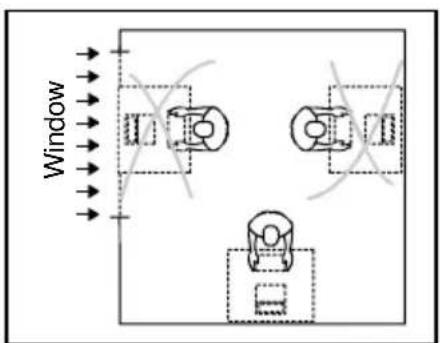
Before you set up your equipment you should select a suitable position for working at the monitor. Please observe the following advices when installing a video workstation.
flowchart
graph TD
    A["Device 1"] --> B["Device 2"]
    C["Device 3"] --> D["Device 4"]
    E["Device 5"] --> F["Device 6"]
    G["Window"] --> A
    G --> C
    G --> E
    style A fill:#f9f,stroke:#333
    style C fill:#f9f,stroke:#333
    style E fill:#f9f,stroke:#333
    style G fill:#f9f,stroke:#333
Avoid direct and reflected glare.
natural_image
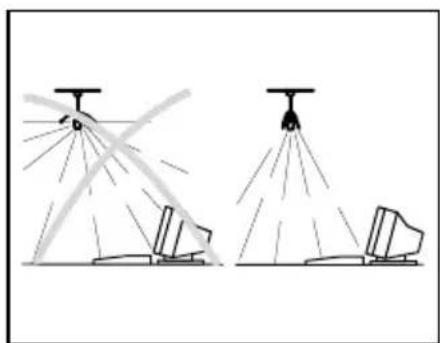
Diagram showing two identical scenarios of a spray gun spraying water onto a surface, with no text or symbols present.Avoid glare from electric lighting.
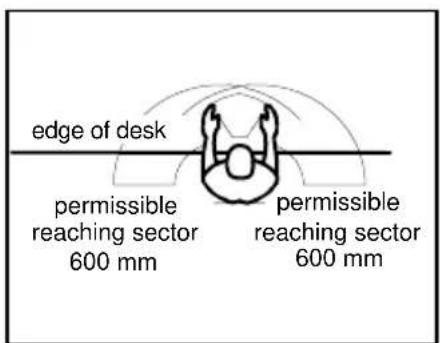
Position the keyboard where it is easiest to reach.
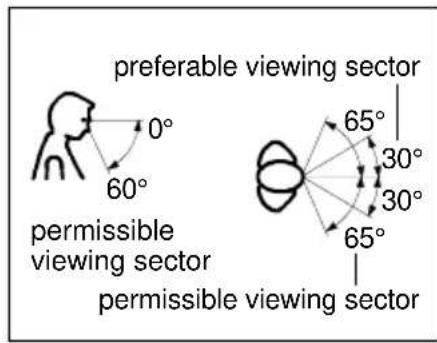
Position the monitor for optimum viewing. The viewing distance to the monitor should be approximately 50 cm.
natural_image
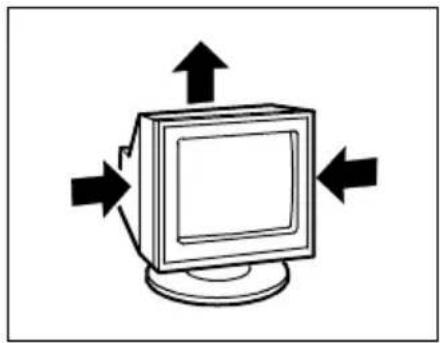
Simple line drawing of a computer monitor with directional arrows indicating orientation (no text or symbols)Keep ventilated areas clear.
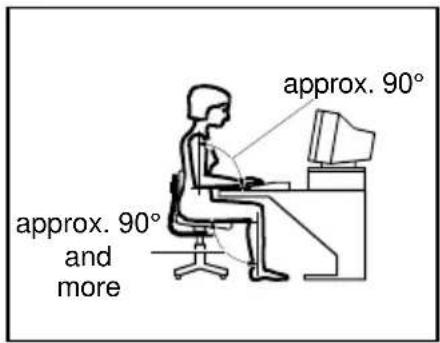
Remember to maintain correct posture.
Attaching the monitor base
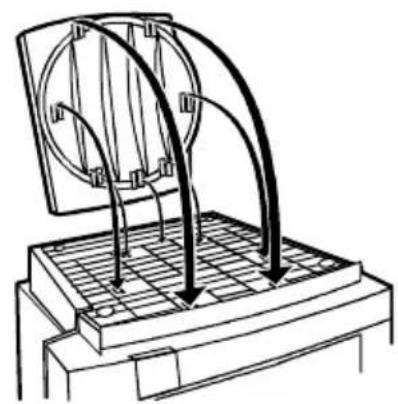
Your monitor is shipped with a base which allows you to rotate and tilt the monitor to the best position.
Attach the base as follows:
▶ Turn the monitor upside down.
natural_image
Diagram of a mechanical device with curved arrows indicating motion or force direction (no text or symbols)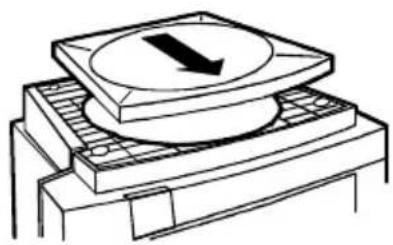
natural_image
Technical line drawing of a mechanical component with a circular component and a downward arrow (no text or symbols)▶ Fit the base so that its hooks slot into the recesses on the monitor.
▶ Press down on the base in the direction of the arrow until it clicks into position.
▶ Right the monitor onto its base.
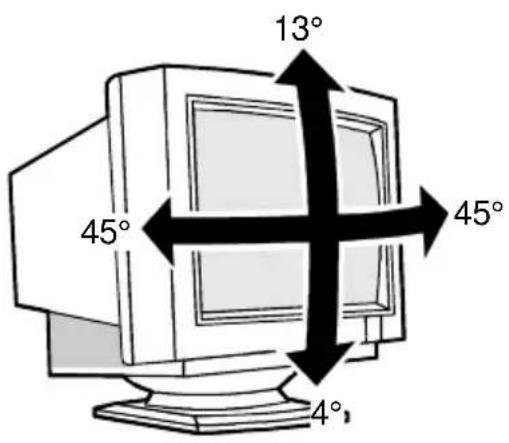
Tilting and turning area
Connecting the monitor
See your PC's operating manual for details of the ports on the system unit.

Please note the "Safety" information provided in the chapter "Important notes" in the Operating Manual of the PC.
Do not cover the ventilation openings of the monitor.
If you are assembling monitors beside each other, there must be a minimum distance of 30 cm between monitors of the same constructional type, to avoid image distortion. With different monitors, the distance must be increased, if necessary.
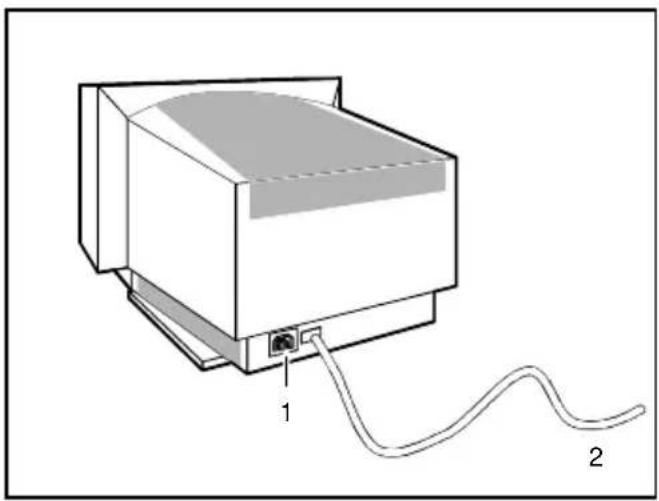
natural_image
Diagram of a computer monitor with two cables, labeled 1 and 2 (no text or symbols on the device itself)1 = Power connector
2 = Data cable
▶ Be sure that the monitor and the system unit are switched off.

The system unit's power plug must be pulled out!
The data cable (2) is permanently attached to the monitor. It has a 15-pin D-SUB connector for the screen controller of the system unit.
See your PC's operating manual for details of the ports on the system unit.
Connect the 15-pin connector of the data cable to the (active) monitor port on the system unit and secure the plug-in connection by tightening the safety screws.
If your system unit has two monitor ports ("onboard" screen controller and separate graphics card), the monitor port for the separate graphics card is usually active.
Plug the power cable supplied into the power connector (1) of the monitor.
Plug the power cable into the monitor connector at the rear of the system unit.
Plug the power connector of the system unit into a properly grounded power outlet.
When you start working with your monitor for the first time you should install the appropriate graphics drivers for your application software. Details of how to do this are provided in the documentation on your screen controller/the associated driver software.
Operation of the monitor
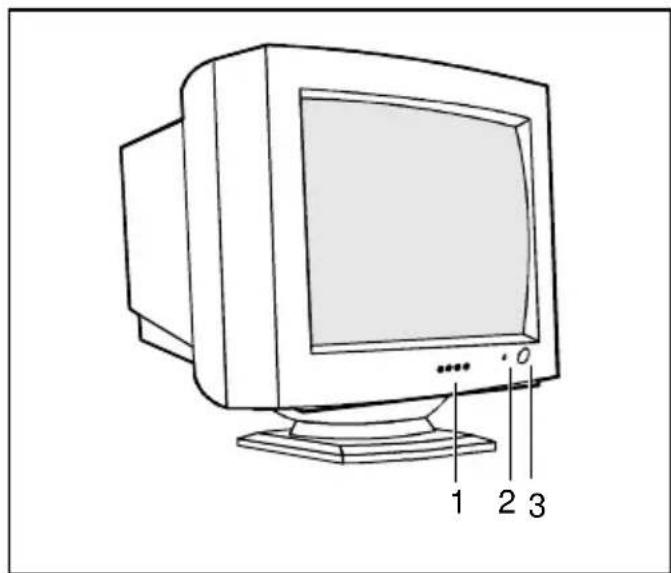
1 = Control panel with buttons for the OSD menu (On-Screen Display)
2 = Power indicator
3 = ON/OFF switch
Switching the monitor on
▶ Press the ON/OFF switch (3).
The power indicator (2) lights up green when the system unit is turned on.
If your PC has a power management function (energy-saving mode), you should read the "Notes on power management" of the monitor in this chapter.
Switching the monitor off
▶ Press the ON/OFF switch (3).
The power indicator (2) is dark.
Notes on power management
If your PC has a VESA DPMS (Video Electronics Standard Association, Display Power Management Signaling) power management function (energy-saving mode), your monitor will fully support this function. The monitor has a four-stage power management system.
| Stage ON | Standby | mode | Suspend mode OFF mode | |
| Power indicator | green amber amber | amber | ||
| Function Monitor | operating normally | Monitor is dark | Monitor is dark | Monitor is dark |
| Power consumption | normal < 100 W | reduced to < 15 W | reduced to < 10 W | reduced to < 5 W |
If your PC detects inactivity (no input) it sends an appropriate signal to the monitor to reduce the power consumption. The power indicator of the monitor changes color to indicate the status change. If there is still no input, power consumption is further reduced (OFF mode).
Once an input is made at the PC the screen contents are redrawn and full power is restored.
The length of the individual stages is determined by the power management system of the PC. For detailed information on how energy-saving mode operates refer to the Operating Manual or Technical Manual of your PC.
The service life of your monitor will be extended if the OFF mode is switched to after 30 minutes at the earliest (setting in screen saver or in your PC's BIOS setup).
When the monitor is switched to OFF mode by the power management system a power consumption of up to 5 W is maintained to feed the circuit for redrawing the screen contents.
To cut off power consumption totally, press the ON/OFF switch on the front of the monitor.
Changing the monitor settings
With the buttons on the control panel, call up and use the integrated OSD (On-Screen Display) menu.
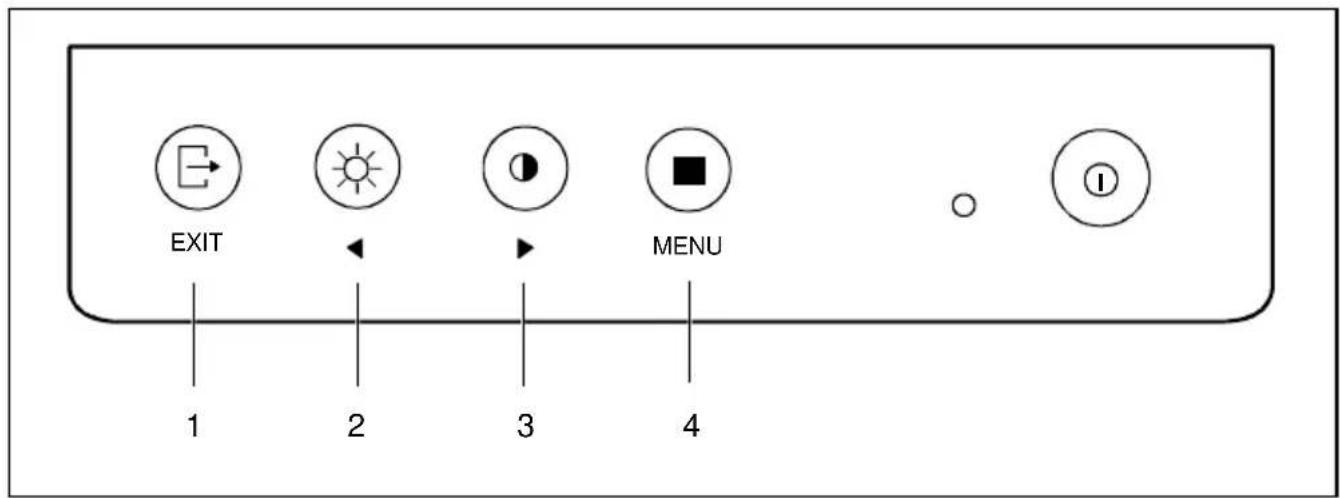
1 = EXIT button
2 = ◀ button (brightness)
3 = ▶ button (contrast)
4 = MENU button
Settings with the OSD menu
To set the OSD menu, perform the following steps:
▶ Press the MENU button to activate the OSD menu.
The main menu appears on the screen with icons for the setting functions.
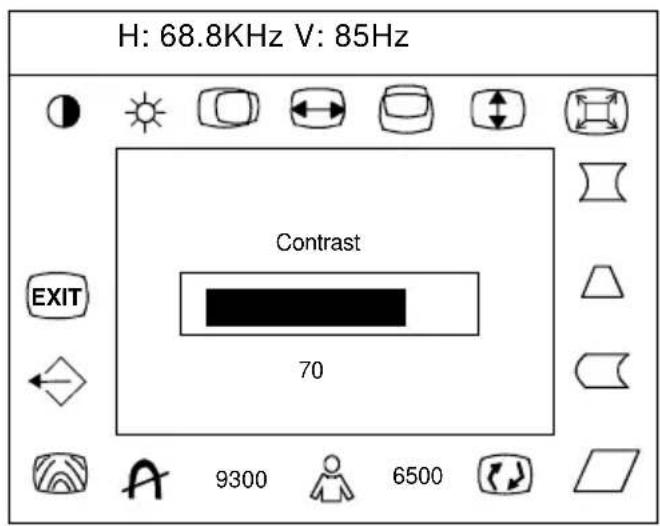
For preset modes you will find information about the resolution and refresh rate in the top line.
For all not preset modes, the horizontal frequency and refresh rate are displayed.
▶ Press the ◀ or ▶ button to select the icon you want.
The marked icon turns red.
▶ Press the MENU button to select the highlighted icon. (If you wish to exit the OSD menu, select EXIT).
Depending on the function, a window with a setting range or a selection menu is displayed.
▶ Press the ◀ key or the ▶ key to define the setting.
All changes are stored automatically. The OSD menu disappears after 10 seconds. The OSD menu can be hidden beforehand by choosing EXIT or pressing the EXIT button.
Adjusting the brightness and contrast

You can also set the brightness and contrast using the ◀ key (brightness) and the ▶ key (contrast).
You will increase the life of your screen if you adjust the contrast and brightness to medium.
 | CONTRAST: Increasing or decreasing the contrast between the foreground and background |
 | BRIGHTNESS: Increasing or decreasing the brightness of the background |
Adjusting size and position
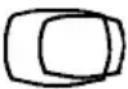 | Horizontal picture position (H-CENTER): Shifting the picture to the left or to the right |
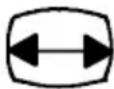 | Horizontal picture size (H. SIZE): Making the picture narrower or wider |
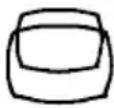 | Vertical picture position (V-CENTER): Shifting the picture down or up |
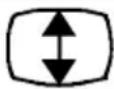 | Vertical picture size (V-SIZE): Making the picture shorter or longer |
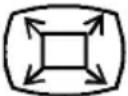 | Proportional picture size (ZOOM): Increasing or reducing picture size while retaining the side ratios |
Setting the picture geometry
Tilt distortion must be set when the screen display is not axially symmetrical.
Pincushion distortion is when the sides of the screen display are bent inward or outward. Trapezoid distortion is when the top or bottom of the screen display is too wide or too narrow. Parallelogram distortion means that the sides of the picture bend to the left or right.
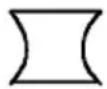 | Pincushion distortion (PINCUSHION): Bending the right and left side inward or outward |
 | Trapezoid distortion (TRAPEZOID): Making the bottom edge narrower and the top edge wider or making the top edge narrower and the bottom edge wider |
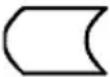 | Asymmetrical pincushion distortion (PIN-BALANCE): adjusting right and left side symmetrically |
 | Parallelogram distortion (PARALLELOGRAM): Reducing the angle of the left and right sides |
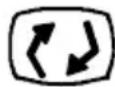
Picture rotation (ROTATION): Rotating the picture in a clockwise or counterclockwise direction
Setting color temperature and colors
The "warmth" of the screen colors is set using the color temperature. The screen has two preset color temperatures, 9300 K and 6500 K, and one user-defined color temperature (USER COLOR).
You can select any of both color temperatures as the starting point for setting your color percentage values. The user-defined color temperature is lost as soon as you select one of the preset color temperatures.
| 6,500°K | Color temperature (COLOR TEMPERATURE): Setting 6500 K |
| 9,300°K | Color temperature (COLOR TEMPERATURE): Setting 9300 K |
 | User-defined colors (USER COLOR):RED: Setting the red color ratioBLUE: Setting the blue color ratio |
Degaussing the screen
Magnetic fields can affect how colors are displayed on your monitor screen. The monitor is therefore degaussed every time you switch it on.
Only use the function of the OSD menu if you notice color distortions on the screen after switching on the monitor.

Degaussing the monitor (DEGAUSS) This function should only be carried out once within 30 minutes.
Setting moiré reduction
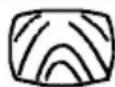
Correcting moiré effect (V-MOIRE REDUCE / H-MOIRE REDUCE)
If the picture you see on screen has light and dark stripes or appears dull and blurred, this may be due to what is known as the moiré effect. This effect usually has physical causes, being triggered by interference between the pixels in the matrix and the video signal. The intensity of the moiré effect is dependent on the screen resolution and picture size.
In some cases, moiré correction may cause the picture quality to deteriorate (reduced picture definition, slight flickering.)
V-MOIRE REDUCE = Vertical moiré correction H-MOIRE REDUCE = Horizontal moiré correction
☒ = Switching Moiré correction off
Activating the factory settings
Factory settings are provided for brightness and contrast, picture size and position and picture geometry in the predefined operating modes.

Activating the factory settings (RECALL)
ALL MODES = eset all settings
THIS MODE = Reset current setting
QUIT = Retain user settings
Masking out the OSD menu
Masking out the OSD menu. All changes are stored automatically.
Notes on ergonomic color adjustment
If you select colors for the display in your application programs, take note of the information below.
The primary colors blue and red on a dark background do not produce the minimum required contrast of 3:1 and are therefore not suitable for continuous text and data entry.
When using several colors for characters and background and giving the primary colors full modulation, you can obtain very suitable color combinations (see the following table):
| Background | Characters | |||||||
| black white purple blue cyan green yellow red | ||||||||
| black++ | - + + + - | |||||||
| white++ | + - - - + | |||||||
| purple | + | + | - | - | - | - | - | |
| blue- | +- | +-+ - | ||||||
| cyan | + - - + | - - | - | |||||
| green | + - - + - | - | - | |||||
| yellow+- | + + - - | + | ||||||
| red | - | + | - | - | - | - | + | |
- Color combination very suitable; light background colors are only suitable for devices which are operated with a refresh rate of at least 75 Hz.
- Color combination not suitable because color locations are too close together, thin characters are not identifiable or rigorous focusing is demanded of the human eye.
Technical data
Dimensions and weight
| CRT: | 43.20 cm (17") |
| Visible diagonals: | 40.60 cm |
| Dot pitch: | 0.28 mm |
| Maximal resolution: | 1280 x 1024 pixels |
| Preset display area: | 300 mm x 230 mm |
| Maximal display area: | 324 mm x 246 mm |
Dimensions (W x H x D): 4 10 mm x 4 10 mm x 4 30 mm
Weight: 16 kg
Accessories: Power cable (1.5 m)
Storable display modes: 29 (9 of which are preset)
Electrical data
| Video: | analog, positive, 0.7 Vpp, 75 Ohm |
| Synchronization: | TTL |
| Horizontal frequency: | 30 kHz .... 70 kHz (multi-scanning) |
| Refresh rate: | 50 Hz .... 160 Hz |
| Maximum pixel clock: | 108 MHz |
| Power supply: | switches automatically100 V .... 240 V, 50 Hz - 60 Hz |
| Power consumption:(see power management): | < 100 W (ON, Normal mode)< 15 W (Standby mode)< 10 W (Suspend mode)< 5 W (OFF mode) |
Environmental conditions
| Environment class 3K2, IEC 721 | |
| Rated range of operation: | 15 °C .... 35 °C |
| Humidity: | 20 % .... 85 % |
| Limit range of operation: | 5 °C .... 40 °C |
| Humidity: | 20 % .... 85 % |
| Condensation must be avoided. | |
VESA-DDC-compatible VGA interface
Your monitor is equipped with a VESA-DDC-compatible VGA interface. VESA-DDC (Video Electronics Standard Association, Display Data Channel) is used as the communications interface between the monitor and the PC. If your PC is equipped with a VESA-DDC-compatible VGA interface, it can automatically read the data for ensuring optimum operation from your monitor and select the appropriate settings.

If the monitor 175V is not yet displayed in the list of monitors, you can select one of the following monitors instead:
Fujitsu Siemens, Siemens or Siemens Nixdorf MCM 173V, MCM 171V, MCM 1510 NTD, MCM 1508, MCM 1755, MCM 1503
Preset operating modes
The display position and size have been set to optimum values at the factory for the operating modes listed above. Depending on the screen controller used, it may be necessary to adjust the display position and size. In this case, you can change and save the settings (see "Operation of the monitor").
| Horizontal frequency Refresh rate Screen resolution | ||
| 31.5 kHz | 70 Hz | 720 x 400 |
| 31.5 kHz | 60 Hz | 640 x 480 |
| 37.8 kHz | 100 Hz | 720 x 400 |
| 43.3 kHz | 85 Hz | 640 x 480 |
| 50.6 kHz | 110 Hz | 640 x 480 |
| 53.7 kHz | 85 Hz | 800 x 600 |
| 60.0 kHz | 100 Hz | 1024 x 768 |
| 63.9 kHz | 75 Hz | 800 x 600 |
| 68.7 kHz | 85 Hz | 1024 x 768 |
For ergonomic reasons we recommend a refresh rate of at least 75 Hz and a maximum resolution of 800 x 600 pixels.
Pin assignment D-SUB (15-pin)
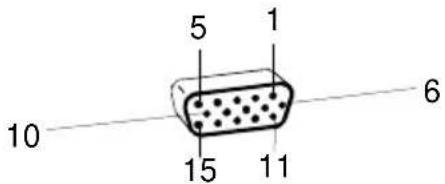
| Pin Meaning Pin Meaning | |
| 1 Red video input 9 not connected | |
| 2 Green video input 10 Logic ground | |
| 3 Blue video input 11 Ground | |
| 4 Ground 12 DDC data (SDA) | |
| 5 DDC Return 13 H. sync | |
| 6 Red video ground 14 V. sync | |
| 7 | Green video ground |
| 8 | Blue video ground |
| 15 | DDC Clock(SCL) |
Error handling
Should an error occur, first check the following points. If the distortion is still not eliminated, the monitor should, if possible, be checked on another PC.
If you cannot solve the problem, contact our Help Desk.
The screen display is too small or not centered
The monitor recognizes an undefined mode (see "Technical data").
Adjust the position and the size of the display and save your settings (see "Operation of the monitor").
Colors are impure or shifted
▶ Degauss the monitor (see "Operation of the monitor").
▶ Ensure that there are no devices or objects near the monitor which generate magnetic fields (e. g. loudspeakers).
The screen display is flickering
▶ Set an ergonomic refresh rate ( ≥ 75 Hz) using the PC software (see documentation for your PC or your screen controller/graphics card).
▶ Ensure that the monitor is kept at a distance of at least 30 cm from other monitors of the same construction type. With different monitors, the distance must be increased, if necessary.
The screen is blank (power indicator does not light)
▶ Check whether the monitor is switched on.
▶ Check whether the power cable on the monitor is connected correctly.
▶ Check whether the power outlet is live.
The screen is blank (power indicator lights)
▶ Check whether the system unit is switched on.
▶ Check whether the data cable for the monitor is correctly attached to the monitor and the monitor port on the system unit.
▶ Check whether the monitor connection of the system unit used is active.
▶ Press any key on the PC keyboard - the PC may be in energy saving mode.
▶ Change the brightness and/or the contrast; the monitor may be adjusted to the maximum dark setting.
A humming noise is heard after switch-on
The monitor is degaussed every time you switch it on. This produces the humming noise. There is no malfunction.
- 175V Farbbildschirm Color monitor Moniteur couleur Monitor de color Monitor a colori Färgskärm Kleurenbeeldscherm
- Contents
- Introduction
- Target group
- Further information
- Notational conventions
- Important notes
- Safety
- Cleaning note175V
- Transport notes
- Manufacturer's notes
- Energy Star
- CE certificate
- Note on X-ray radiation
- FCC Class B Compliance Statement
- NOTE:
- Important note on power cable
- Power cable for devices distributed in the US and Canada
- For the United Kingdom
- WARNING
- IMPORTANT
- Disposal and recycling
- Checking the contents of the consignment
- Installing an ergonomic video workstation
- Attaching the monitor base
- Connecting the monitor
- Operation of the monitor
- Switching the monitor on
- Switching the monitor off
- Notes on power management
- Changing the monitor settings
- Settings with the OSD menu
- Adjusting the brightness and contrast
- Adjusting size and position
- Setting the picture geometry
- Setting color temperature and colors
- Degaussing the screen
- Setting moiré reduction
- Activating the factory settings
- Masking out the OSD menu
- Notes on ergonomic color adjustment
- Technical data
- VESA-DDC-compatible VGA interface
- Preset operating modes
- Pin assignment D-SUB (15-pin)
- Error handling
- The screen display is too small or not centered
- Colors are impure or shifted
- The screen display is flickering
- The screen is blank (power indicator does not light)
- The screen is blank (power indicator lights)
- A humming noise is heard after switch-on
Brand : FUJITSU
Model : 175V
Category : Screen