639-220 - Accessoires vélo Kayoba - Free user manual and instructions
Find the device manual for free 639-220 Kayoba in PDF.


User questions about 639-220 Kayoba
0 question about this device. Answer the ones you know or ask your own.
Ask a new question about this device
Download the instructions for your Accessoires vélo in PDF format for free! Find your manual 639-220 - Kayoba and take your electronic device back in hand. On this page are published all the documents necessary for the use of your device. 639-220 by Kayoba.
USER MANUAL 639-220 Kayoba
User Instructions for Bike Helmet
639-210 - 639-223
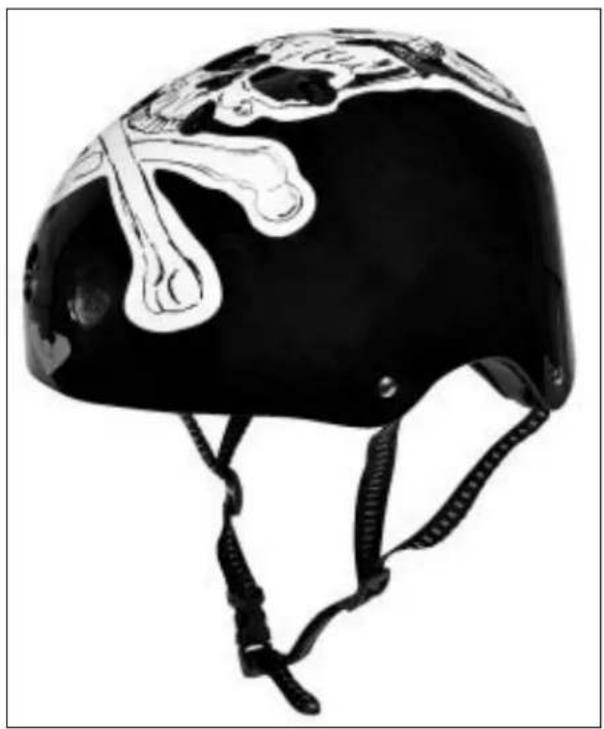
natural_image
Black and white photo of a helmet with white skull patterns and visible teeth (no text or symbols)SE - Bruksanvisning i original
EN - Operating instructions (Translation of the original instructions)
Jula reserves the right to make changes. In the event of problems, please contact our service department.
www.jula.com
Tillverkare/ Produsent / Produenci/ Manufacturer
Jula AB, Box 363, 532 24 SKARA
Importör/ Importör/ Importer/ Importer
natural_image
Side profile illustration of a person wearing a helmet and sunglasses (no text or symbols)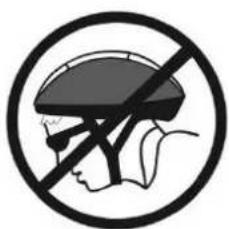
natural_image
Prohibition sign showing a helmet crossed out by a diagonal line, indicating no protection or exclusion (no text present)natural_image
Side profile illustration of a person wearing a helmet and sunglasses (no text or symbols)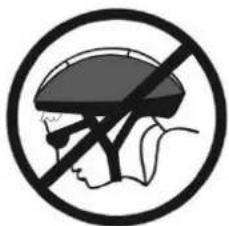
natural_image
Prohibition sign showing a cross-section of a person wearing a helmet, with no text or symbols present.natural_image
Side profile illustration of a person wearing a helmet and sunglasses (no text or symbols)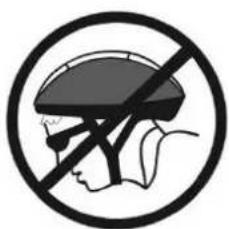
Read the User Instructions carefully before use.
Save these instructions for future reference.
Do not expose the helmet to high temperatures.
The helmet will be damaged if it is exposed to temperatures over 65^ C. This temperature can be exceeded in dark vehicles and storage cases during very hot weather. Heat deforms helmets and blisters the surface structure. Discard a damaged helmet immediately and replace it with a new one.
Important information
- The helmet is designed to absorb energy on impact, either by being destructed or damaged. The helmet should be disposed of and replaced after an accident, even if it does not show any visible signs of damage.
- No helmet can provide protection from all kinds of accidents. Even accidents at low speed can lead to serious head injuries and death, depending on the intensity of the force to which one has been exposed.
- Be careful and pay attention to what you are doing at all times when cycling, and make sure to read these instructions.
- The helmet is intended to be used for cycling and other similar activities.
- It is not intended, and does not provide adequate protection for motor sports or riding a moped. No helmet can protect the user from all types of accidents.
- Do not modify the helmet or remove any parts, unless this is specifically recommended by the manufacturer. The helmet must not be adapted, or fitted with accessories not recommended by the manufacturer.
USE
This bike helmet complies with the requirements in SS-EN 1078: Helmets for cyclists, skateboarders and roller skaters.
Protection and ventilation
The material in the outer shell makes the helmet very lightweight, but also very strong and hardwearing. Ventilation openings with inner air channels allow the air to pass through the helmet for maximum cooling.
Adjusting with pads
The helmet must fit properly to provide effective protection. When the helmet fits properly it will not slide backwards and forwards when the chin strap is fastened. If the helmet does not fit properly with the pads inside it, remove them and fit different sizes of pads. You can mix different sizes of pads to obtain the best possible fit for your head.
Straps and clasps
- The bike helmet has a quick-release clasp, which is easy to use and does not alter the adjustment of the straps.
- The straps should fit tightly to the head and be evenly adjusted. Put the helmet firmly on your head and fasten the clasp.
-
Check that none of the straps are loose. If so, take off the helmet and tighten the loose strap.
-
To tighten the chin strap, hold the clasp in one hand and pull the strap through it.
- To tighten the back strap, pull strap number 1.
- Hold the helmet with one hand and hold the straps running under your chin with the other hand.
- Pull from side to side to adjust the length of all four straps.
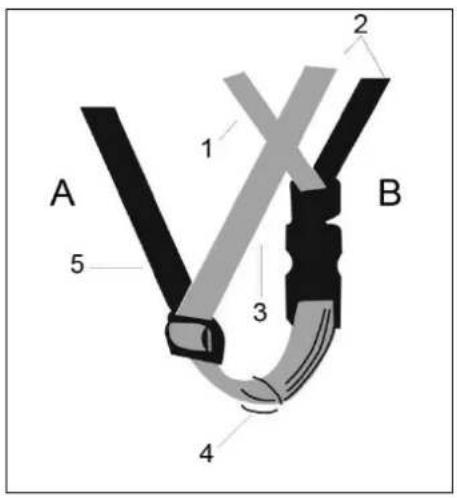
A. Back
B. Front
1. Back strap
2. Front chin strap
3. Strap 1
4. Fastener ring
5. Strap 2
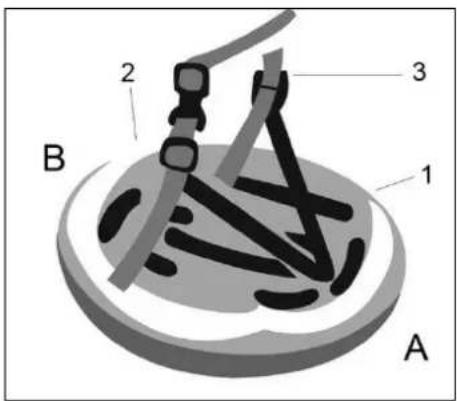
A. Back
B. Front
1. Back strap
2. Front chin strap
3. Pull here to adjust the strap lengths
The helmet should fit firmly and straight on the head.
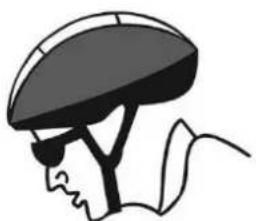
natural_image
Side profile illustration of a person wearing a helmet and sunglasses (no text or symbols)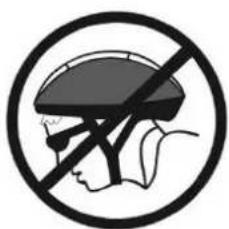
- To lower the front of the helmet so that it covers your forehead, tighen the chin strap and release the back strap.
- To raise the front of the helmet, release the chin strap and tighten the back strap.
To check that the straps are properly adjusted, put the helmet on your head and fasten the clasp. Open your mouth. You should feel the strap tighten against your chin. Try to pull the helmet backwards and forwards. If the helmet comes off, tighten the straps and check that the pads are the right size. The helmet should not move much in any direction. It should not be possible to take off the helmet without unfastening the clasp. NOTE: Always check that the helmet is properly adjusted before using it.
Final check
- The helmet should sit firmly on your head. If you can move it backwards and forwards, you will have to tighten the straps.
- The straps should be adjusted so that they do not cover your ears and so that the clasp is not on your jaw.
• Try on different sizes and choose the bike helmet that feels safe and fits comfortably on your head. - It is important that the helmet fits firmly on your head. The clasp must be fastened for the helmet to provide full protection.
- Check all the adjustments every time you use the helmet, and always check that it fits properly.
MAINTENANCE
- Clean the helmet with a mild solution of soap and water. NOTE: Do not use solvents.
- Do not paint or put stickers on the helmet, because this can damage it and prevent it from providing full protection in the event of an accident.