NEO12AC230V1AO - Air-conditioner GREE - Free user manual and instructions
Find the device manual for free NEO12AC230V1AO GREE in PDF.


User questions about NEO12AC230V1AO GREE
0 question about this device. Answer the ones you know or ask your own.
Ask a new question about this device
Download the instructions for your Air-conditioner in PDF format for free! Find your manual NEO12AC230V1AO - GREE and take your electronic device back in hand. On this page are published all the documents necessary for the use of your device. NEO12AC230V1AO by GREE.
USER MANUAL NEO12AC230V1AO GREE
natural_image
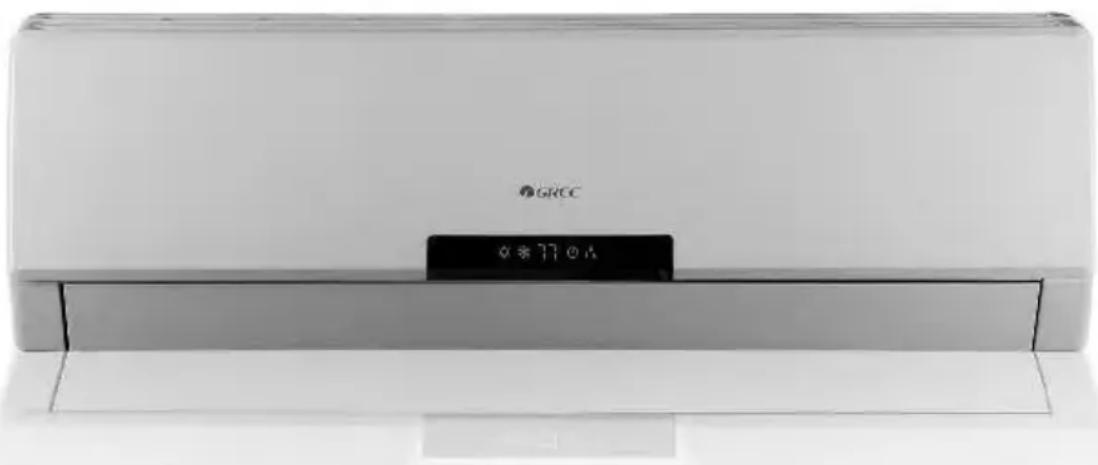
Front view of a white GRET air conditioner unit with a digital display showing 'x + 77.0 x' (no text or symbols on the device itself)Thank you for choosing a
Gree Neo Ductless A IR CONDITIONER for your customer.
Please read this installation manual carefully before installing and starting up the Neo System. Take a moment to fill out the product and installation form on the back cover. Retain both the manual and installation record for future reference.
Contents
- Safety Precautions 2
- System Requirements 4
- Suggested Tools 5
- Site Instructions 6
- Dimensions 7
- Indoor Unit 9
- Outdoor Unit 12
- Refrigerant Piping 13
• Power and Wiring 16
• Vacuum Testing 19 - Start-up 21
- Troubleshooting 22
natural_image
Exterior view of a white air conditioner unit with 'GRCC' branding and digital display (no text or symbols on body)SAFETY PRECAUTIONS
Please read the following before installation.
Recognize safety information. ⚠️ This is the safety-alert symbol. When you see this symbol on the unit and in instructions or manuals, be alert to the potential for personal injury. Understand these signal words: DANGER, WARNING, and CAUTION. These words are used with the safety-alert symbol.
DANGER identifies the most serious hazards which will result in severe personal injury or death.
WARNING signifies hazards which could result in personal injury or death.
CAUTION is used to identify unsafe practices which may result in minor personal injury or product and property damage.
NOTE is used to highlight suggestions which will result in enhanced installation, reliability, or operation.
NOTE: Your actual air conditioner system and related devices may differ from the images shown in this manual.
This appliance is not intended for use by children without responsible adult supervision. Proper care should be taken to ensure safety.

WARNING
Heat pumps, air conditioners & heating equipment should be installed, started up, and serviced only by qualified installers and service technicians. Air conditioning, heat pumps and refrigeration systems are hazardous due to high voltage electrical components, high refrigerant pressures, and moving parts.

CAUTION
- The unit should be installed and serviced only by trained, qualified installers and service mechanics. Untrained personnel can perform basic maintenance functions such as cleaning coils. All other operations should be performed by trained service personnel.
- Owner should be cautioned that children should not play with the appliance.

WARNING
ELECTRICAL SHOCK HAZARD
Failure to follow this warning could result in personal injury or death.
- Before installing, servicing or modifying the system, the main electrical disconnect switch must be in the OFF position. There may be more than one disconnect switch. Lock out and tag all switches with a warning label.
General Safety Precautions
- A dedicated power supply circuit should be used in accordance with local electrical safety regulations and National Electrical Codes (NEC).
- Ensure that the entire system is reliably grounded.
- Use proper size circuit breaker to protect equipment against short circuit and overload conditions.
- Observe all local codes and regulations.
INSTALLATION SITE INSTRUCTIONS
Proper installation site is vital for correct and reliable operation of the system.
Avoid the following installation locations :
• Strong heat sources, vapors, flammable gas or volatile liquids.
- High-frequency electro-magnetic waves, generated by radio equipment, welders or medical equipment.
SYSTEM REQUIREMENTS
Piping Requirements
PIPE SIZE in (mm)
| Unit Size (BtuH) | Voltage | Liquid Line Suction/Gas Line |
| 9,000 115v - 1ph 60hz 1/4 (6) 3/8 (9.5)12,000 115v - 1ph 60hz 1/4 (6) 3/8 (9.5)9,000 208/230v - 1ph 60hz 1/4 (6) 3/8 (9.5)12,000 208/230v - 1ph 60hz 1/4 (6) 3/8 (9.5)18,000 208/230v - 1ph 60hz 1/4 (6) 1/2 (12)24,000 208/230v - 1ph 60hz 1/4 (6) 5/8 (16)30,000 208/230v - 1ph 60hz 1/4 (6) 5/8 (16)36,000 208/230v - 1ph 60hz 1/4 (6) 5/8 (16) |
REFRIGERANT LINE LENGTHS ft (m)
| Unit Size (BtuH) | Voltage | Min Line Max Length | Line Max Elevation Length | (ID over OD) |
| 9,000 | 115v - 1ph 60hz | 10 (3) | 50 (15) | 33 (10) |
| 12,000 | 115v - 1ph 60hz | 10 (3) | 50 (15) | 33 (10) |
| 9,000 | 208/230v - 1ph 60hz | 10 (3) | 50 (15) | 33 (10) |
| 12,000 | 208/230v - 1ph 60hz | 10 (3) | 66 (20) | 33 (10) |
| 18,000 | 208/230v - 1ph 60hz | 10 (3) | 82 (25) | 33 (10) |
| 24,000 | 208/230v - 1ph 60hz | 10 (3) | 82 (25) | 33 (10) |
| 30,000 | 208/230v - 1ph 60hz | 10 (3) | 100 (30) | 33 (10) |
| 36,000 | 208/230v - 1ph 60hz | 10 (3) | 100 (30) | 33 (10) |
Notes: Insulate both refrigerant lines, separately.
REFRIGERANT CHARGE
| Unit Size (BtuH) | Voltage | Refrigerant Type | Factory System Charge oz (kg)* | Additional Charge oz/ft (g/m) |
| 9,000 | 115v - 1ph 60hz | R410A | 42.9 (1.2) | 0.2 (20) |
| 12,000 | 115v - 1ph 60hz | R410A | 46.4 (1.3) | 0.2 (20) |
| 9,000 | 208/230v - 1ph 60hz | R410A | 46.4 (1.3) | 0.2 (20) |
| 12,000 | 208/230v - 1ph 60hz | R410A | 46.4 (1.3) | 0.2 (20) |
| 18,000 | 208/230v - 1ph 60hz | R410A | 49.4 (1.4) | 0.2 (20) |
| 24,000 | 208/230v - 1ph 60hz | R410A | 56.5 (1.6) | 0.5 (50) |
| 30,000 | 208/230v - 1ph 60hz | R410A | 84.7 (2.4) | 0.5 (50) |
| 36,000 | 208/230v - 1ph 60hz | R410A | 91.7 (2.6) | 0.5 (50) |
*Precharge amount for up to 25-ft of refrigerant pipe.
ELECTRICAL REQUIREMENTS
| Unit Size (BtuH) | Voltage | Min Circuit Amps (MCA) | Max Overcurrent Main Protection (MOP) | Power Wire Size (AWG)** |
| 9,000 | 115v - 1ph 60hz | 22 | 35 10 | |
| 12,000 | 115v - 1ph 60hz | 23 | 40 10 | |
| 9,000 | 208/230v - 1ph 60hz | 10 | 15 14 | |
| 12,000 | 208/230v - 1ph 60hz | 10 | 15 14 | |
| 18,000 | 208/230v - 1ph 60hz | 13 | 20 12 | |
| 24,000 | 208/230v - 1ph 60hz | 16 | 25 10 | |
| 30,000 | 208/230v - 1ph 60hz | 20 | 30 10 | |
| 36,000 | 208/230v - 1ph 60hz | 24 | 40 10 |
**Main power wire from electrical panel to outdoor unit.
Notes: 1) System must be on a single dedicated circuit.
2) Main power is supplied to the outdoor unit.
3) Use table above to size over current protection.
4) Follow all local building codes and NEC (National Electrical Code) regulations.
Interconnecting Cable: Recommended cable - 14/4 AWG stranded bare copper conductors THHN 600V unshielded wire
Note: Use shield cable if installation is in close proximity of RF and EMI transmitting devices.
Condensate Drain Size: 5/8-in OD 7/16-in ID
Note: Insulate condensate drain hose to prevent sweating and possible water damage.

natural_image
Collection of black-and-white industrial tools including wrench, screwdriver, and pressure gauge (no text or symbols)- Standard Wrench
- Adjustable/Crescent Wrench
- Torque Wrench
• Hex Keys or Allen Wrenches - Drill & Drill Bits
- Hole Saw
- Pipe Cutter
- Screw drivers (Phillips & Flat blade)
- Manifold and Gauges
- Level
• R410A Flaring Tool - Clamp on Amp Meter
- Vacuum Pump
- Safety Glasses
- Work Gloves
- Refrigerant Scale
- Micron Gauge

Step 1
Installation Site of Indoor Unit
Select a site that allows for the following:
- Ensure the installation complies with the installation minimum dimensions and meets the minimum and maximum connecting piping length and maximum change in elevation.
- Air inlet and outlet will be clear of obstructions, ensuring proper airflow throughout the room.
- Condensate can be easily and safely drained.
- All connections can be easily made to outdoor unit.
- Indoor unit is out of reach of children.
- A wall strong enough to withstand the full weight and vibration of the unit.
- Filter can be easily accessed for cleaning.
- Leave enough free space to allow access for routine maintenance.
- Install at least 10 ft. (3 m) away from the antenna of TV set or radio. Operation of the air conditioner may interfere with radio or TV reception in areas where reception is weak. An amplifier may be required for the affected device.
- Do not install in a laundry room or by a swimming pool.
- Determine if condensate pump is required to properly drain condensate water from the indoor unit.
Installation Site of Outdoor Unit
Select a site that allows for the following:
- Outdoor location meets all minimum installation distances defined in the Installation Dimensions section.
• Sound from outdoor unit will not annoy neighbors. - All connections can be easily made to indoor unit.
• Air inlet and outlet will be clear of obstructions to ensure proper airflow. - Wall or roof is strong enough to withstand the full weight and vibration of the outdoor unit (for wall or roof installation only).
- Outdoor unit is out of reach of children and does not obstruct walkways.
- Outdoor unit is not exposed to direct sunlight or strong wind.
- Maintenance and repairs can be easily performed on the outdoor unit.
- Ensure the installation complies with the minimum and maximum connecting piping length and maximum change in elevation criteria.
Indoor unit

Outdoor unit
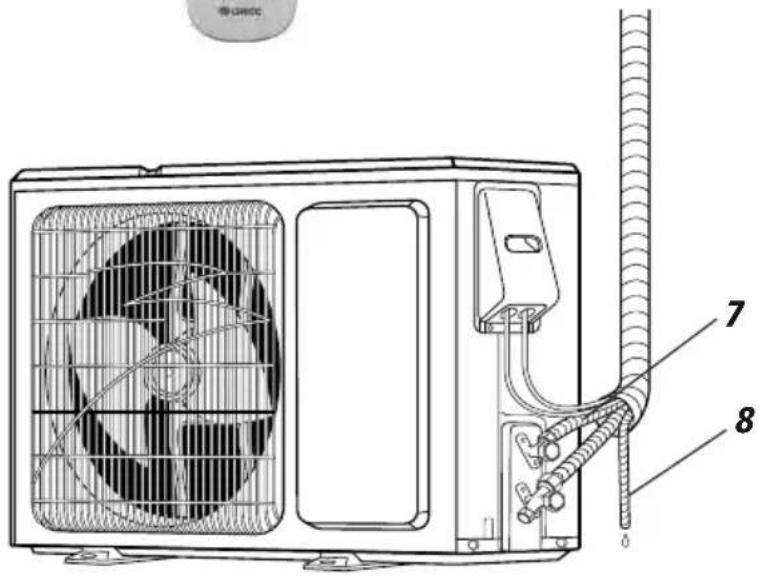
Minimum indoor clearances
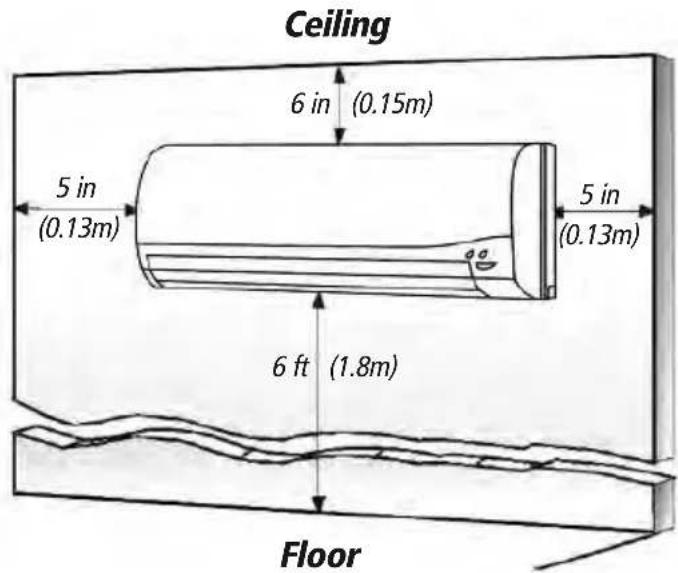
Minimum outdoor clearances
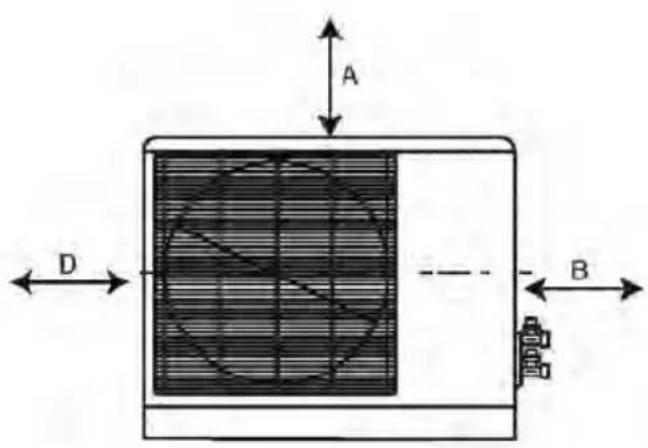
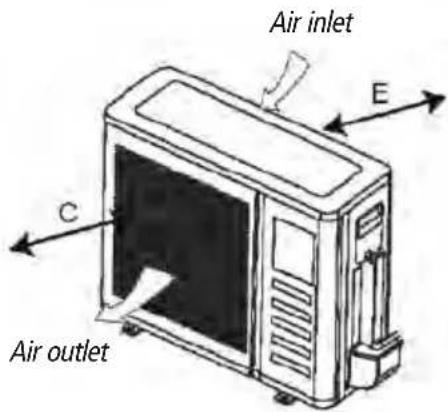
| Outdoor Unit | Minimum Distances in (mm) |
| A 20 (500) | |
| B 20 (500) | |
| C 24 (610) | |
| D 12 (305) | |
| E 12 (305) |
Step 2
Installation of Mounting Bracket
- Attach the mounting bracket to the indoor unit.
- Find the horizontal center of the indoor unit.
- Mark the center of the indoor unit on mounting bracket for future reference.
NOTE: The center of the mounting bracket is not the center of the indoor unit.
-
Remove the mounting brackets from the indoor unit and position the mounting bracket on the wall in desired location. Use centering mark on mounting bracket for centering the indoor unit on the wall.
-
Mounting bracket must be installed horizontally and level right to left.
NOTE: Condensate drain pan has built-in pitch for proper drainage.
- Secure mounting bracket to wall with a minimum of five screws, evenly spaced to properly support indoor unit weight.
NOTE: It is recommended to install screw anchors for sheet rock, concrete block, brick and such type of walls.
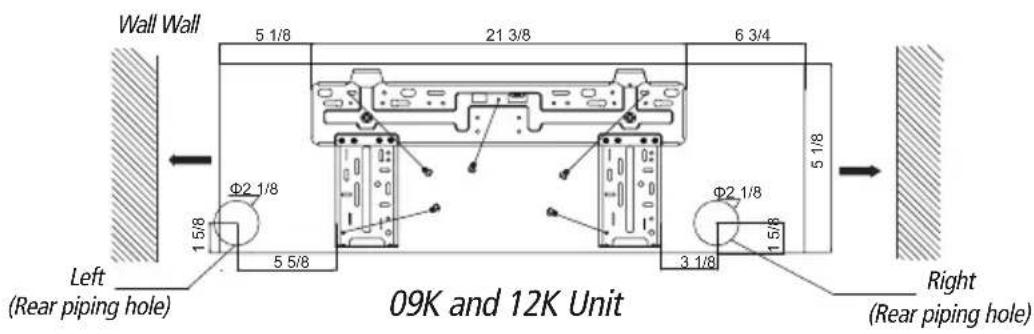
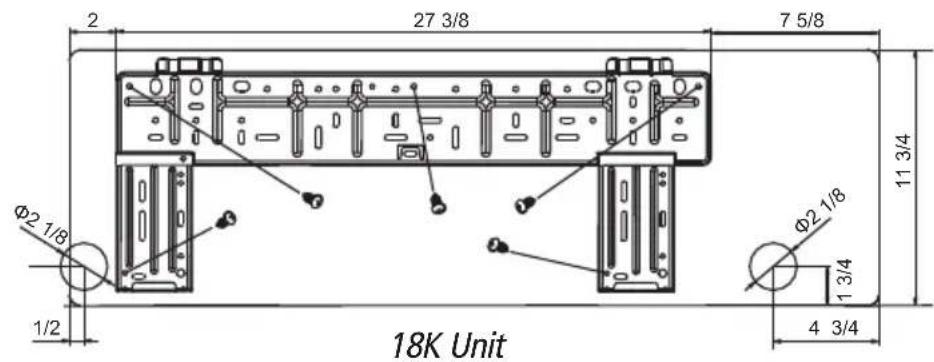
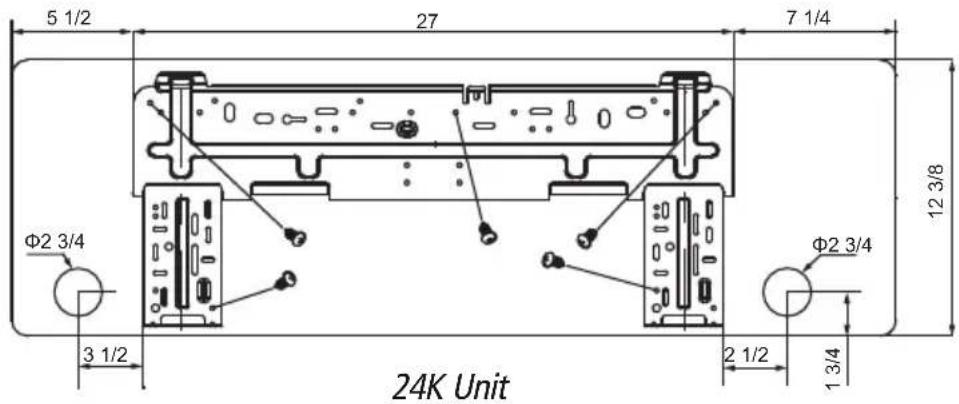
Mounting Bracket Diagrams and Dimensions
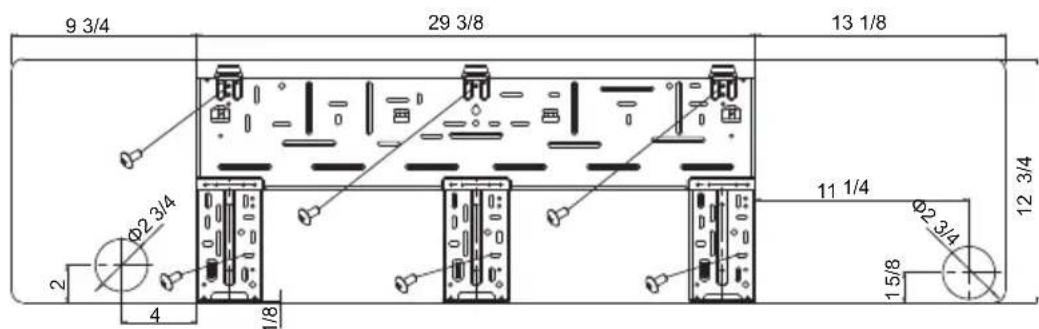
30K and 36K Unit
Step 3
Drill Hole in Wall for Interconnecting Piping, Drain & Wiring
If indoor unit refrigerant piping is going to exit from the rear:
- It is recommended that the refrigerant pipe flare connectors extend through the wall to the outside. In some situations field-fabricated piping extensions will be required to extend the indoor unit refrigerant flare connections to the outside of the wall.
- Use mounting bracket diagrams and dimensions to find and mark the proper location for the wall hole.
If refrigerant piping is going through the right or left side of front panel:
- Use a small saw blade to carefully cut a U-shaped hole in the side of the front panel. The hole must be large enough for refrigerant pipes, condensate hose and wires.
- Determine and mark proper location for wall hole.
- Use table below to determine recommended wall hole size for your unit size.
Table of Wall Hole Size per Unit Size
| Unit Size (BtuH) | Wall Hole Size (Diameter) | |
| in mm | ||
| 9,000 2 1/4 55 | ||
| 12,000 2 1/4 55 | ||
| 18,000 2 3/4 66 | ||
| 24,000 2 3/4 66 | ||
| 30,000 2 3/4 66 | ||
| 36,000 2 3/4 66 | ||
- Cut the wall hole with a 5^ to 10^ downward slant to the outdoors.
- Insert a wall hole sleeve into hole to prevent damage to refrigerant pipes, insulation, condensate drain hose and wiring.
- Seal around wall hole sleeve with caulk or foam to weatherproof.
Indoor Outdoor
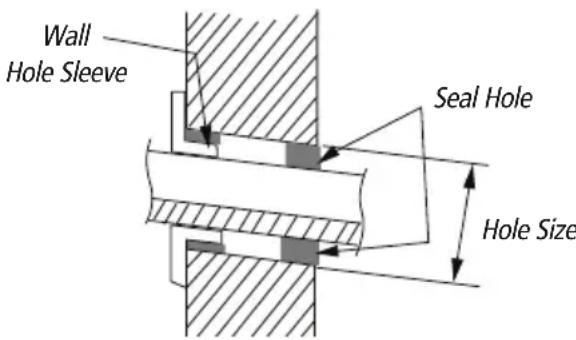
Wall Hole Diagram
Step 4
Install Ground Pad or Wall Hangers
- Determine proper location for outdoor unit.
- Follow all instructions provided by manufacturer for installing wall hangers or ground pad.
- Verify the wall hangers or ground pad can safely support the weight of the outdoor unit.
- Verify the wall hangers or ground pad is level and meets all outdoor dimensional clearances.
Install Outdoor Unit Risers
If the outdoor unit requires added elevation above the ground, installing riser legs will provide a sturdy and stable solution. Follow all instructions provided by manufacturer for installing riser legs to outdoor unit.
NOTE: Riser legs will also help absorb vibrations and noise while facilitating proper drainage.

WARNING
Florida Wind Load Requirements state that outdoor unit must be anchored to concrete pad using four 3/8-in diameter Power Wedge Bolt Plus (or equivalent) with 1-in diameter fender washers. Anchor bolts must be embedded into 3,000 PSI minimum concrete at a distance of 4 1/2-in from any concrete edge. The concrete thickness must exceed 1.5 times the anchor depth.
Install Condensate Drain for Outdoor Unit
The condenser water can be routed to a safe location through the drain hose.
- Locate drain hole on bottom of outdoor unit.
- Install the outdoor drain fitting into hole on the bottom of outdoor unit as shown.
- Connect the drain hose to drain fitting.
- Route drain hose to safe location for proper drainage of excess condensate water.
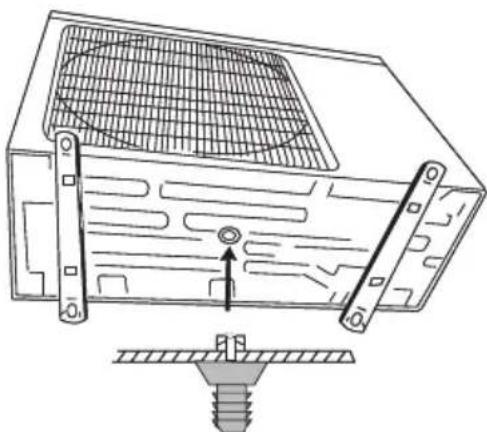
natural_image
Technical line drawing of a mechanical component with internal structure and mounting base (no text or symbols)Drain Fitting Installation
Step 5
Piping Connections to Outdoor Unit

CAUTION
Use refrigeration grade tubing ONLY. No other type of tubing may be used. Use of other types of tubing will void manufacturer's warranty. Make sure there is enough piping to cover the required length between the outdoor and indoor unit.
Piping Preparation
- Do not open service valves or remove protective caps from tubing ends until all connections are made.
- Keep tubing free of dirt, sand, moisture and contaminants.
- Use a flexible condensate drain hose to fit over the factory 5/8-inch (16mm) drainage hose.
- Insulate each refrigerant pipe and condensate hose with minimum 3/8" (10 mm) wall thermal pipe insulation.
NOTE: Insulate condensate hose to prevent sweating which may cause water stains or wall damage.
- Bind refrigerant pipes, condensate hose and interconnecting wire together with cable ties at 12 inch intervals.
NOTE: A condensate pump accessory (sold separately) is recommended for the indoor unit when adequate line pitch cannot be provided for drainage.
Piping and Drain Hose Connections to Indoor Unit
NOTE: For maximum serviceability, it is recommended to have refrigerant pipe flare connections and the drain connection on the outside.
- Feed refrigerant pipes, drain hose and interconnecting wires assembly through wall hole from outdoor to the indoor space.
- Set the indoor unit on mounting bracket. Allow the indoor unit to hinge on the top of the mounting bracket. Do not lock down bottom of unit to mounting bracket.
- Adjust the length of the interconnecting wires so that it can easily reach the indoor unit electrical control box. Route and fit the interconnecting wires into back side of indoor unit.
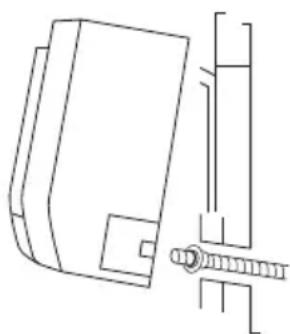
natural_image
Technical line drawing of a mechanical component with a bolt and bracket (no text or symbols)-
Open front cover of indoor unit and remove field wiring terminal block cover. Route the interconnecting wires to terminal block in control box.
-
Allow interconnecting wires to hang free. Wire connections will be handled later in these instructions.
-
Adjust the length of condensate drain hose to easily meet the drain pipe of the indoor unit. Make connection and secure with a hose clamp. Insulate the drainage hose and connection to prevent sweating.
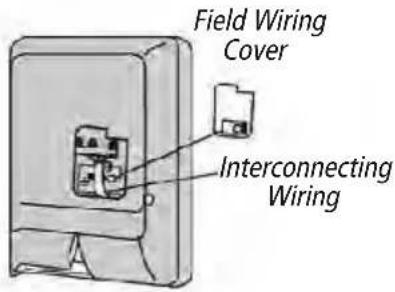
NOTE: Prevent condensate drain hose from sagging or kinking for proper drainage.
-
Adjust the length and carefully bend refrigerant pipes to meet indoor unit refrigerant pipe connections with proper tools to avoid kinks.
-
Apply a small amount of refrigerant oil to the flare connection on the refrigerant pipes.
-
Properly align piping and tighten flare nut using a standard wrench and a torque wrench as shown in figure to the right:
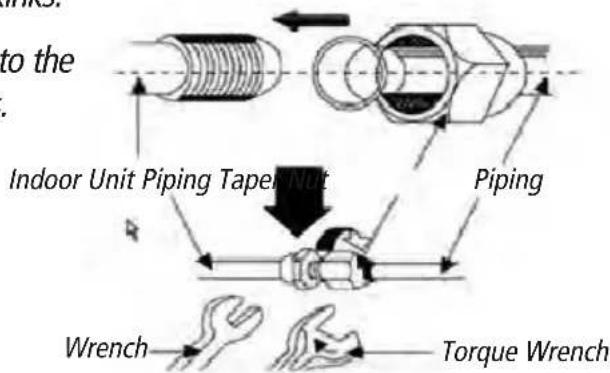
- Carefully tighten flare nuts to correct torque level referring to the following Torque Table: Torque Table
| Pipe Diameter Nut inch (mm) inch (mm) ft-lbs N-m | Size | Tightening Torque | |
| 1/4 (6.35) 1/4 (17) | 10 to 13 14 to 18 | ||
| 3/8 (9.5) 3/8 (22) | 25 to 30 34 to 42 | ||
| 1/2 (12.7) 1/2 (25) | 36 to 45 49 to 61 | ||
| 5/8 (15.9) 5/8 (29) | 50 to 60 68 to 82 | ||
NOTE: Over tightening may damage flare connections and cause leaks.
-
Apply insulation to refrigerant pipe joints to prevent sweating.
-
Gently and securely lock down bottom of indoor unit to wall mounting bracket.
Step 6
Piping Connections to Outdoor Unit
- Remove service valve cover (if provided) to access the service valves and refrigerant ports.
- Carefully bend and adjust length of refrigerant pipes to meet outdoor unit service valves connections with proper tools to avoid kinks.
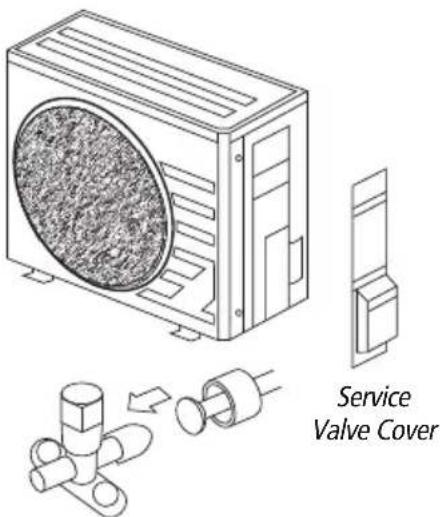
NOTE: Use proper techniques to cut and re-flare refrigerant pipes, if required. An R410A Flaring Tool is required for re-flaring refrigerant pipes.
- Apply a small amount of refrigerant oil to the flare connection on the refrigerant pipe.
- Properly align piping and tighten flare nut using a standard wrench and a torque wrench as shown in the indoor piping section.
- Carefully tighten flare nuts to correct torque level referring to the following Torque Table Torque Table
| Pipe Diameter Nut inch (mm) inch (mm) ft-lbs N-m | Size | Tightening Torque | ||
| 1/4 (6.35) 1/4 (17) | 10 to 13 14 to 18 | |||
| 3/8 (9.5) 3/8 (22) | 25 to 30 34 to 42 | |||
| 1/2 (12.7) 1/2 (25) | 36 to 45 49 to 61 | |||
| 5/8 (15.9) 5/8 (29) | 50 to 60 68 to 82 | |||
NOTE: Over tightening may damage flare connections and cause leaks.
Step 7
Indoor Unit Interconnecting Wire Connections

WARNING
Disconnect all electrical power to unit including disconnects, fuses and circuit breakers.
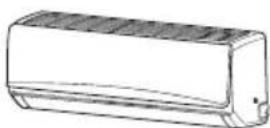
- Open front cover of indoor unit and remove field wiring terminal block cover.
- Pull interconnecting wires up from back of indoor unit and position in close to the terminal block on indoor unit.
NOTE: The indoor unit is powered from the outdoor unit, depending on local code, a disconnect switch may need to be installed to a power supply circuit.
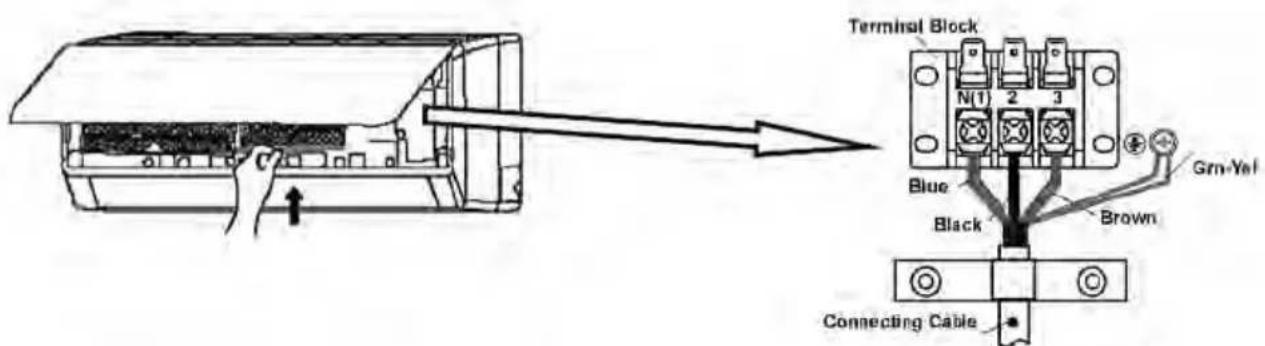
- Connect wiring to indoor unit per connection diagram.
NOTE: Record wire colors and terminal references for uses with Outdoor Unit wire connections.
- Replace field wiring cover and close front cover of indoor unit.
Step 8
Outdoor Unit Wire Connections

WARNING
Disconnect all electrical power to unit including disconnects, fuses and circuit breakers.
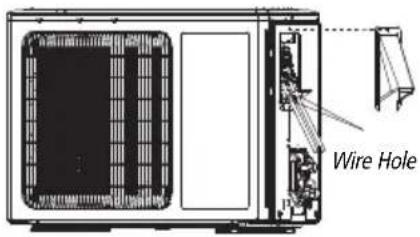
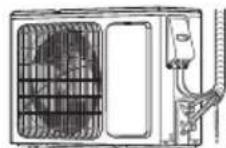
- Remove the service panel on right side of the outdoor unit.
- Insert interconnecting wires and main power wires through the wire holes on conduit mounting bracket.
- Secure main power conduit (and interconnecting wire conduit, if required) with locking nuts to conduit mounting bracket.
- Open wire clamp/strain relief and adjust wire lengths or proper connections to the outdoor unit terminal block.
Cable Cross Board
Indoor Unit
Outdoor Unit
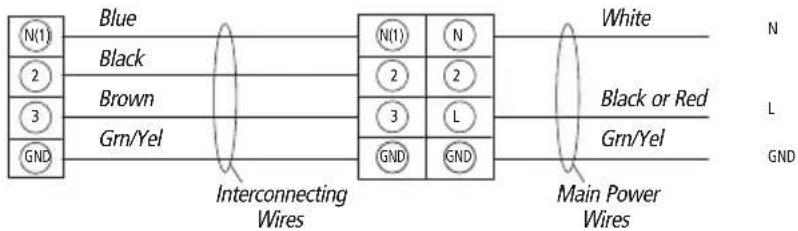
Wiring Diagram 9K and 12K BtuH (115V Models)
flowchart
graph LR
    A["Blue N(1)"] --> B["Black"]
    C["Brown 2"] --> D["Brown"]
    E["Gm/Yel 3"] --> F["Gm/Yel"]
    G["GND"] --> H["GND"]
    I["Interconnecting Wires"] --> J["N(1) N"]
    I --> K["N 2"]
    I --> L["N 2"]
    I --> M["L 3"]
    I --> N["GND"]
    O["White"] --> P["Black or Red"]
    Q["Gm/Yel"] --> R["Gm/Yel"]
    S["Main Power Wires"] --> T["Main Power"]
    U["N"] --> V["L"]
    W["GND"] --> X["GND"]
Wiring Diagram 9K and 12K BtuH (230V Models)
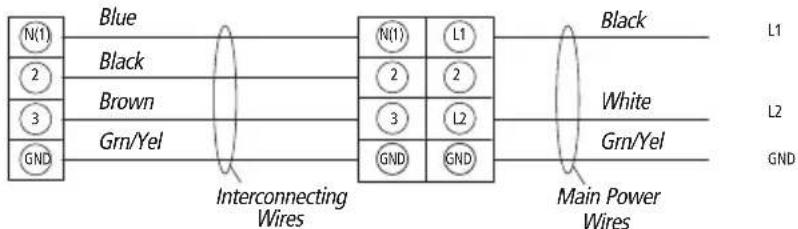
flowchart
graph LR
    A["Blue"] --> B["Black"]
    A --> C["Brown"]
    A --> D["Grn/Yel"]
    B --> E["Interconnecting Wires"]
    C --> E
    D --> E
    E --> F["Main Power Wires"]
    G["Black"] --> H["L1"]
    I["White"] --> J["L2"]
    K["Grn/Yel"] --> L["GND"]
    M["GND"] --> L
    style A fill:#f9f,stroke:#333
    style B fill:#ccf,stroke:#333
    style C fill:#ccf,stroke:#333
    style D fill:#ccf,stroke:#333
    style E fill:#cfc,stroke:#333
    style F fill:#cfc,stroke:#333
    style G fill:#fcc,stroke:#333
    style H fill:#ffc,stroke:#333
    style I fill:#ffc,stroke:#333
    style J fill:#ffc,stroke:#333
    style K fill:#ffc,stroke:#333
    style L fill:#ffc,stroke:#333
Wiring Diagram 18K to 36K BtuH
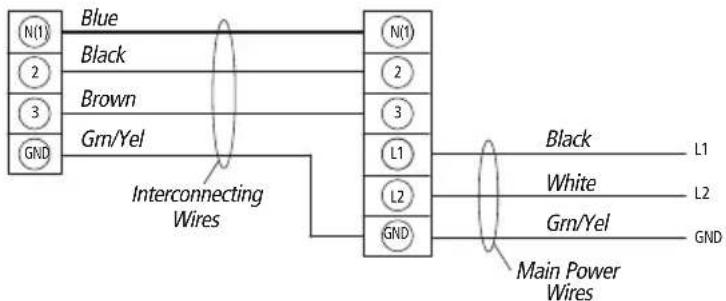
flowchart
graph LR
    A["Blue"] --> B["N(1)"]
    C["Black"] --> D["N(1)"]
    E["Brown"] --> F["N(1)"]
    G["GND"] --> H["Interconnecting Wires"]
    I["3"] --> J["L1"]
    K["GND"] --> L["L2"]
    M["2"] --> N["L1"]
    O["3"] --> P["L2"]
    Q["2"] --> R["L1"]
    S["3"] --> T["L2"]
    U["2"] --> V["L1"]
    W["3"] --> X["L2"]
    Y["2"] --> Z["L1"]
    AA["3"] --> AB["L2"]
    AC["2"] --> AD["L1"]
    AE["3"] --> AF["L2"]
    AG["2"] --> AH["L1"]
    AI["3"] --> AJ["L2"]
    AK["2"] --> AL["L1"]
    AM["3"] --> AN["L2"]
    AO["2"] --> AP["L1"]
    AQ["3"] --> AR["L2"]
    AS["2"] --> AT["L1"]
    AU["3"] --> AV["L2"]
    AW["2"] --> AX["L1"]
    AY["Black"] --> Z
    AZ["White"] --> AA
    BA["GND"] --> BB["Main Power Wires"]
- Following the same wire colors and terminal references from the indoor unit, tightly connect interconnecting wires to the outdoor unit terminal block per wiring diagram above.
NOTE: Crossing interconnecting wires will cause system malfunction and possible damage.
-
Tightly connect main power wires to outdoor unit terminal block per wiring diagram above.
-
Secure all wires inside wire clamp/strain relief. Verify wires are secure, not loose and no external force on wires affects the connections at the terminals.
-
Replace service panel on right side of the outdoor unit.
-
Connect main power wires and conduit to unit disconnect switch box per manufacturer's instructions, National Electrical Code (NEC) and local electrical codes.

CAUTION
- Electrical Disconnecting means must be provided and shall be located within sight and readily accessible from the unit.
- Failure to follow this caution may result in equipment damage or improper operation.
- All wires running from the indoor to outdoor unit must comply with National Electrical Code (NEC) and local codes.
- No wire should be allowed to touch refrigerant tubing, compressor or any moving parts.
- All wires must be connected firmly to terminal block to avoid unit malfunction, overheating and possible fire hazard.
Local codes may require a disconnect switch within sight of the indoor unit. Use a DFS Disconnect Switch Accessory Kit (Part No: DFS-SWITCH-A) to break wires going to the N(1), 2, 3, terminals on the indoor unit, as shown in the wiring diagram below:
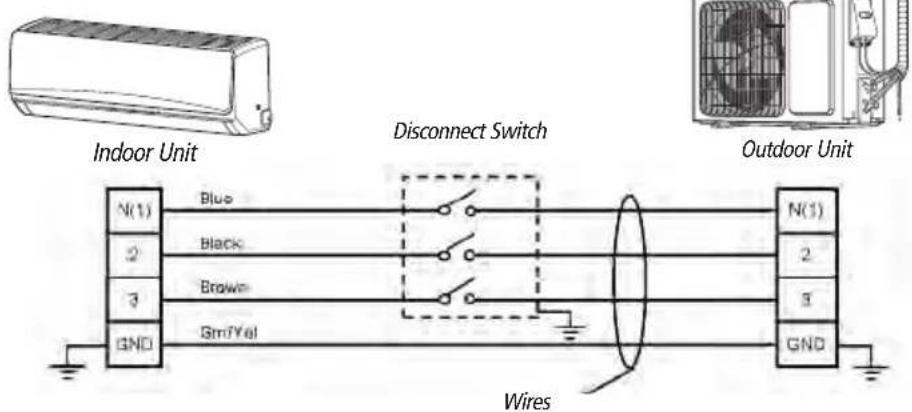

CAUTION
Never break or interrupt the ground wire with a switch or disconnect device.
Step 9
Leaking Test
- Connect the charging hose of the manifold valve to charge the end of the low-pressure valve.
- Add dry nitrogen to a pressure of 200 lbs. Tightly close both high- and low-pressure valves.
- Leak-test flare fittings with soap bubbles. If no leak is detected, release nitrogen.
Step 10
System Vacuum and Charge

CAUTION
UNIT DAMAGE HAZARD
Never use the system compressor as a vacuum pump. It may result in equipment damage or improper system operation.
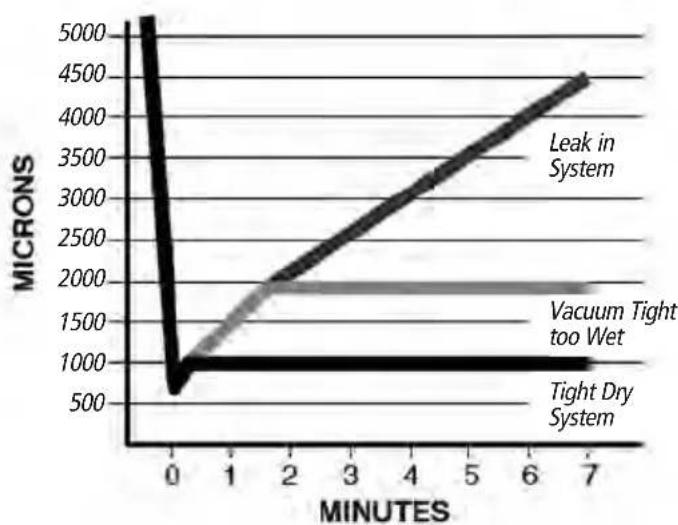
Refrigerant pipes and indoor coil should be evacuated using the recommended deep vacuum method of 500 microns. The alternate triple evacuation method may be used if the procedure outlined below is followed.
NOTE: Always break a vacuum with dry nitrogen.
Using Vacuum Pump
- Completely tighten flare nuts A, B, C, D, connect manifold gage charge hose to a charge port of the low side service valve.
- Connect charge hose to vacuum pump.
- Fully open the low side of manifold gage. See figure at right.
- Start vacuum pump.
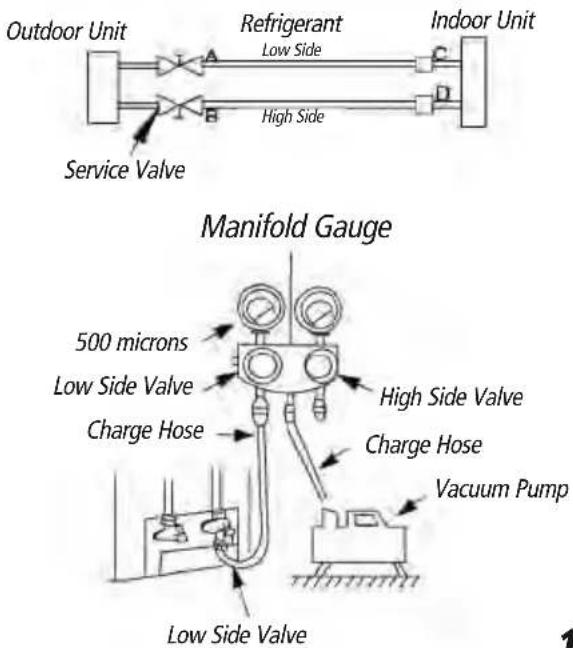
- Evacuate using either deep vacuum or triple evacuation method.
- After evacuation is complete, fully close the low side of manifold gage and stop operation of vacuum pump.
- The factory charge contained in the outdoor unit is good for up to 25 ft. (8 m) of line length.
NOTE: For refrigerant lines longer than 25 ft (8 m), add add'l refrigerant per foot of extra piping up to the maximum allowable length. See System Requirement section on page 4 for more info
- Disconnect charge hose from charge connection of the low side service valve.
- Fully open service valves B and A.
- Securely tighten caps of service valves.
Deep Vacuum Method
The deep vacuum method requires a vacuum pump capable of pulling a vacuum of 500 microns and a vacuum gage capable of accurately measuring this vacuum depth. The deep vacuum method is the most positive way of assuring a system is free of air and liquid water.
line
| MINUTES | Microns | | -------- | ------- | | 0 | 5000 | | 1 | 1000 | | 2 | 2000 | | 3 | 2500 | | 4 | 3000 | | 5 | 3500 | | 6 | 4000 | | 7 | 4500 |Deep Vacuum Graph
Step 11
Installing Photocatalytic Filter (optional)
- Lift front panel and remove air filter. (Fig. a).
- Attach photocatalytic filter onto air filter. (Fig. b).
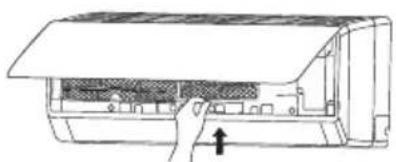
- Install air filter as shown; close panel. (Fig. c).
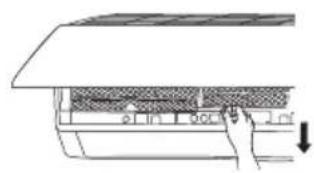
Fig. a
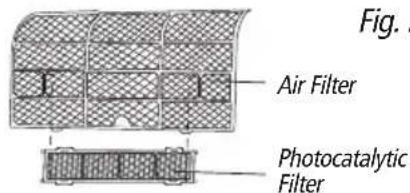
Fig. b
Step 12
Start-up and Checkout
Test Operation
natural_image
Technical line drawing of a mechanical or electronic component with no visible text or symbolsFig. c
Perform test operation after completing gas leak and electrical safety check.
- Turn on electrical disconnect to outdoor unit.
- Push the "ON/OFF" button on Remote Control to begin testing.
NOTE: A protection feature prevents the system from being activated for approx. 3 minutes.
- Push MODE button, select COOLING, FAN mode to confirm all functions.
System Checks
- Conceal refrigerant pipes where possible. 2. Make sure drain hose slopes downward along entire length. 3. Ensure all refrigerant pipes and connections are properly insulated.
- Fasten pipes to outside wall, when possible. 5. Seal and weatherproof wall hole which the interconnecting wires and refrigerant pipes pass through.
Indoor Unit
- Do all Remote Control buttons function properly? 2. Do the display panel lights work properly?
- Does the swing louver function properly? 4. Does the drain work?
Outdoor Unit
Push the mode button to COOL and adjust the room setting to 61^ F deg. Wait up to 3 minutes from compressor time guard. Does compressor and outdoor fan turn on in cooling mode?
Explain Following Items To Customer With The Aid Of The Owner's Manual:
- How to turn system on and off; selecting COOLING and other operating modes; setting a desired temperature; setting the timer to automatically start and stop system operation; and all other features of the Remote Control and display panel.
- How to remove and clean the air filter.
- How to set air with the swing louvers.
- Explain care and maintenance.
- Present the Owner's Manual and installation instructions to customer.
Troubleshooting
This unit has onboard diagnostics. Error codes will appear on the LED display on the front panel of the indoor unit in place of the temperature display. The table below explains the error codes for both units.
DIAGNOSTIC CODES
| Equipment Fault | Error Codes | Possible Causes |
| Indoor Configuration Jumper | C5 | Missing Configuration Jumper on Indoor Control Board |
| Indoor/Outdoor Mismatch | LP | Indoor and Outdoor Units Do Not Match (Model or Capacity) |
| High Current Protection | E5 | Power Supply is not Stable and Voltage Range is too Large |
| Communication Error | E6 | Mis-wired or Communication Failure |
| Indoor Air Temp. Thermistor | F1 | Bad Connection, or Indoor Air Sensor Failure |
| Indoor Coil Temp. Thermistor | F2 | Bad Connection, or Indoor Coil Sensor Failure |
| Outdoor Air Temp. Thermistor | F3 | Bad Connection, or Outdoor Ambient Sensor Failure |
| Outdoor Coil Temp. Thermistor | F4 | Bad Connection, or Outdoor Coil Sensor Failure |
| Compressor Discharge Temp. Thermistor | F5 | Bad Connection, or Discharge Sensor Failure |
| Compressor Overload Protection | H3 | Low Refrigerant Charge, Blocked Capillary, or Compressor Motor Failure |
| IPM Module Protection | H5 | IPM Module Temperature Too High, High Ambient, Low Voltage, or Bad Connections |
| Indoor Fan Malfunction | H6 | Indoor Fan Stopped or Running too Slow |
| Compressor Synchronism | H7 | High Pressure, Low Voltage, or Bad Connections |
| High Pressure Protection | E1 | Too much refrigerant or High Ambient conditions or low airflow. |
GREE ELECTRIC APPLIANCES, INC.
www.greecomfort.com
PRODUCT & INSTALLATION RECORD
For your convenience, please record the model and serial numbers of your new equipment in the spaces provided. This information, along with the installation data and dealer contact information, will be helpful should your system require maintenance or service.
UNIT INFORMATION
Model No. ____
Serial No.
INSTALLATION INFORMATION
Date Installed:
DEALERSHIP/INSTALLER INFORMATION
Company Name: ____
Address:
Phone Number:
Technician Name: ____