Captiva DUW350S - Video projector Christie - Free user manual and instructions
Find the device manual for free Captiva DUW350S Christie in PDF.


User questions about Captiva DUW350S Christie
0 question about this device. Answer the ones you know or ask your own.
Ask a new question about this device
Download the instructions for your Video projector in PDF format for free! Find your manual Captiva DUW350S - Christie and take your electronic device back in hand. On this page are published all the documents necessary for the use of your device. Captiva DUW350S by Christie.
USER MANUAL Captiva DUW350S Christie
The CD included with this printed manual contains an electronic copy in English. Please read all instructions before using or servicing this product.
3. Installation....14
3.1 Connecting the Projector 14
3.1.1 Connect to Computer/Notebook 14
3.1.2 Connect to Video Sources 15
3.2 Powering the Projector On/Off....16
3.2.1 Powering On the Projector 16
3.2.2 Powering off the projector 17
3.2.3 Warning Indicator....17
3.3 Adjusting the Projected Image....18
3.3.1 Adjusting the Projector's Height 18
3.3.2 Adjusting the Projector's Focus 19
3.3.3 Adjusting Projection Image Size (Diagonal) 20
4. User Controls 22
4.1 Control Panel & Remote Control 22
4.1.1 Control Panel 22
4.1.2 Remote Control....23
4.2 On-screen Display Menus 25
4.2.1 How to operate....25
4.2.2 Image 26
4.2.3 Configuration....28
4.2.4 Settings 30
4.2.5 Audio 32
4.2.6 Options....33
4.2.7 Options | Laser Settings 35
4.2.8 3D 36
4.2.9 Interactive 37
4.2.10 LAN 38
5. Multimedia....44
5.1 Accessing Multimedia Files 44
5.1.1 How to access Multimedia mode 44
6. Appendices 51
6.1 Installing and Cleaning the Optional Dust Filter 51
6.2 Compatibility Modes 52
6.2.1 VGA Analog 52
6.2.2 HDMI Digital....54
6.3 RS232 Commands and Protocol Function List 56
6.3.1 RS232 Port Setting 56
6.3.2 RS232 Signals Connection ....56
6.3.3 Commands Set List 57
6.4 Regulation & Safety Notices....60
6.5 Ceiling Mount Installation 63
USAGE NOTICE1.
COPYRIGHT AND TRADEMARKS1.1
Copyright ©2015 Christie Digital Systems USA, Inc. All rights reserved.
All brand names and product names are trademarks, registered trademarks or trade names of their respective holders.
Safety Information1.2
 | The lightning flash with arrow head within an equilateral triangle is intended to alert the user to the presence of uninsulated “dangerous voltage” within the product’s enclosure that may be of sufficient magnitude to constitute a risk of electric shock to persons. |
 | The exclamation point within an equilateral triangle is intended to alert the user to the presence of important operating and maintenance (servicing) instructions in the literature accompanying the projector. |
WARNING: TO REDUCE THE RISK OF FIRE OR ELECTRIC SHOCK, DO NOT EXPOSE THIS PROJECTOR TO RAIN OR MOISTURE. DANGEROUS HIGH VOLTAGES ARE PRESENT INSIDE THE ENCLOSURE. DO NOT OPEN THE CABINET. REFER SERVICING TO QUALIFIED PERSONNEL ONLY.
Class B emissions limits
This Class B digital apparatus meets all requirements of the Canadian Interference-Causing Equipment Regulations.
Important Safety Instruction
Do not block any ventilation openings. To ensure reliable operation of the projector 1. and to protect from over heating, it is recommended to install the projector in a location that does not block ventilation. As an example, do not place the projector on a crowded coffee table, sofa, bed and so on. Do not put the projector in an enclosure such as a bookcase or a cabinet that restricts air flow.
Do not use the projector near water or moisture. To reduce the risk of fire and/or 2. electric shock, do not expose the projector to rain or moisture.
Do not install near heat sources such as radiators, heaters, stoves or any other 3 apparatus such as amplifiers that emits heat.
Clean only with dry cloth.4.
Only use attachments/accessories specified by the manufacturer. 5.
Do not use the unit if it has been physically damaged or abused. 6.
Physical damage/abuse would be (but not limited to):
- Unit has been dropped.
Power supply cord or plug has been damaged. -
Liquid has been spilled on to the projector. -
Projector has been exposed to rain or moisture. -
Something has fallen in the projector or something is loose inside. -
Do not attempt to service the unit yourself. Opening or removing covers may expose you to dangerous voltages or other hazards.
Do not let objects or liquids enter the projector. They may touch dangerous voltage 7. points and short out parts that could result in fire or electric shock.
See projector enclosure for safety related markings.8.
The unit should only be repaired by appropriate service personnel.9.
Precautions1.3

Follow all warnings, precautions and maintenance as recommended in this user's guide.
WARNING
- Do not look into the projector's lens when the lamp is on. The bright light may hurt and damage your eyes.
- To reduce the risk of fire or electric shock, do not expose this projector to rain or moisture.
- Do not open or disassemble the projector as this may cause electric shock.
Do:
- Turn off and unplug the power plug from the AC outlet before cleaning the product.
- Use a soft dry cloth with mild detergent to clean the display housing.
- Disconnect the power plug from AC outlet if the product is not being used for a long period of time.
- Use a plat beneath the projector while portrait orientation to meet safety requirement.
Do not:
- Block the slots and openings on the unit provided for ventilation.
- Use abrasive cleaners, waxes or solvents to clean the unit.
• Use under the following conditions:
- In extremely hot, cold or humid environments.
▶Sea level to 6000 feet
Extremely hot: > 35°C
Extremely cool: < 5°C
▶6000 feet above
Extremely hot: > 30°C
Extremely cool: < 5°C
▶Extremely humid: > 70% R.H. (Relative Humidity)
In areas susceptible to excessive dust and dirt. - Near any appliance generating a strong magnetic field. - In direct sunlight. -
INTRODUCTION2.
Package Overview2.1
Unpack and inspect the box contents to ensure all parts listed below are in the box. If something is missing, contact your customer service center.
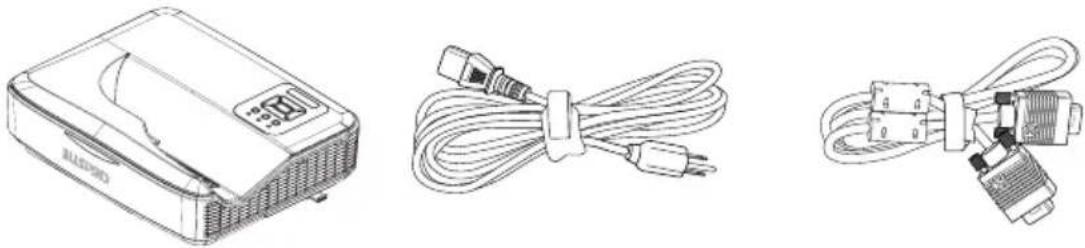
Projector Power Cord VGA Cable
Documentation :
User's Manual & Quick Start Guide
NOTE:
Due to different applications in each country, some regions may have different accessories.
Product Overview2.2
Main Unit2.2.1
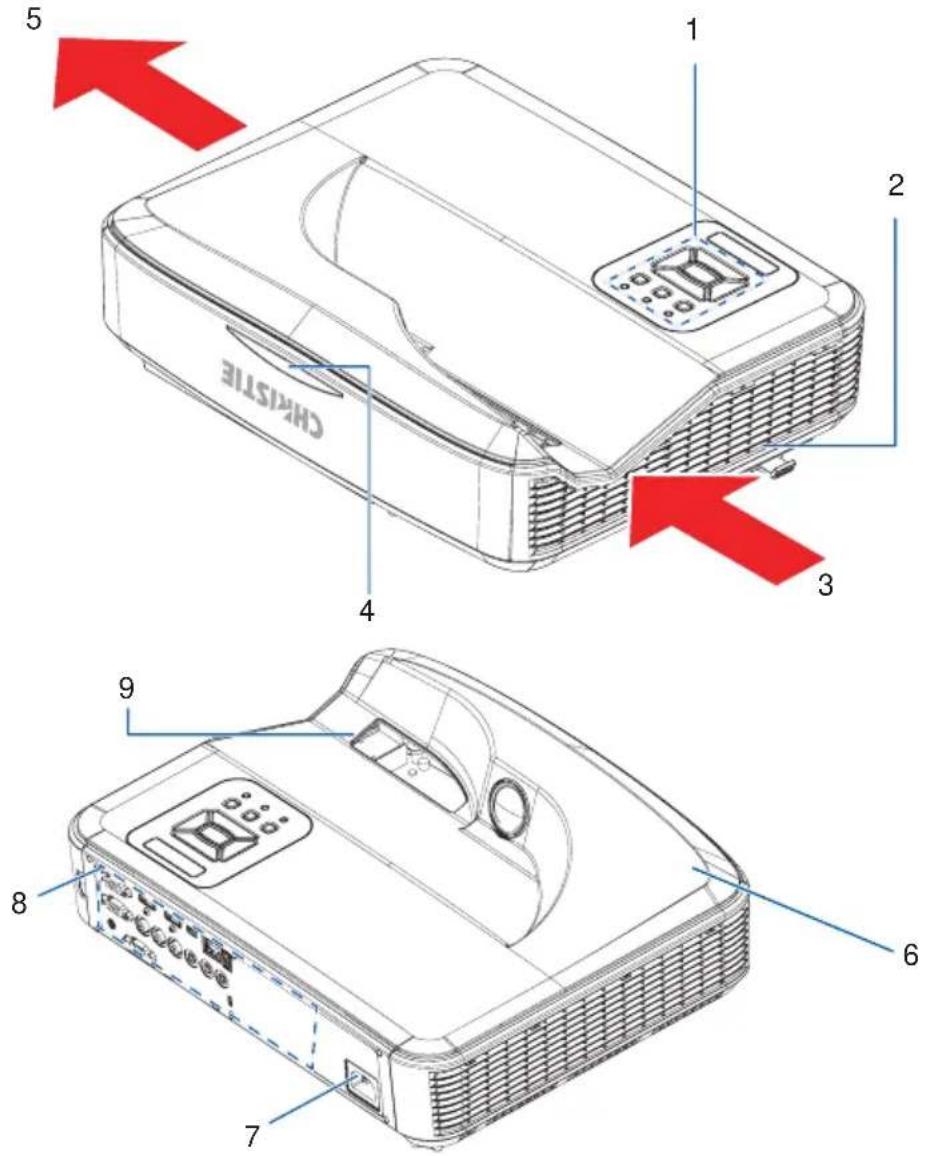
| Ind. Part Name Ind. Part Name | ||
| 1 Control Panel 6 Speaker | ||
| 2 Focus switch 7 Power Socket | ||
| 3 Ventilation (inlet) 8 Input/Output Connections | ||
| 4 IR Receiver 9 Lens | ||
| 5 Ventilation (outlet) |
NOTE:
The interface is subject to model's specifications.
Control Panel2.2.2
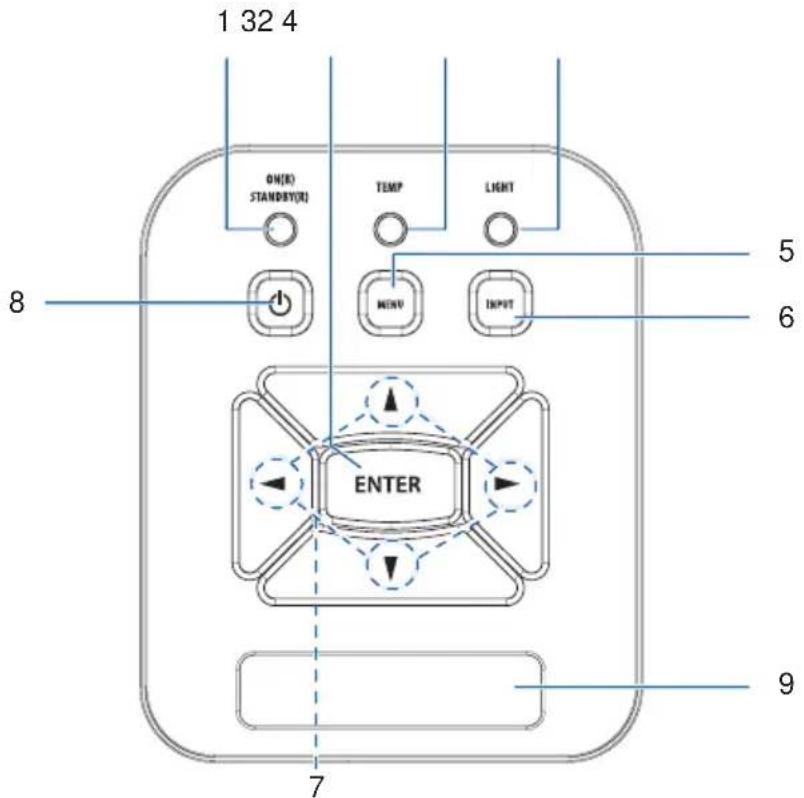
text_image
1 32 4 ON(R) STANDBY(R) TEMP LIGHT 8 5 6 ENTER 7 9| Ind. Part Name |
| 1 Power LED |
| 2 Enter |
| 3 Temp LED |
| 4 Lamp LED |
| 5 Menu |
| 6 Input |
| 7 Four Directional Select keys |
| 8 Power/Standby button |
| 9 IR Receiver |
Output Connections2.2.3
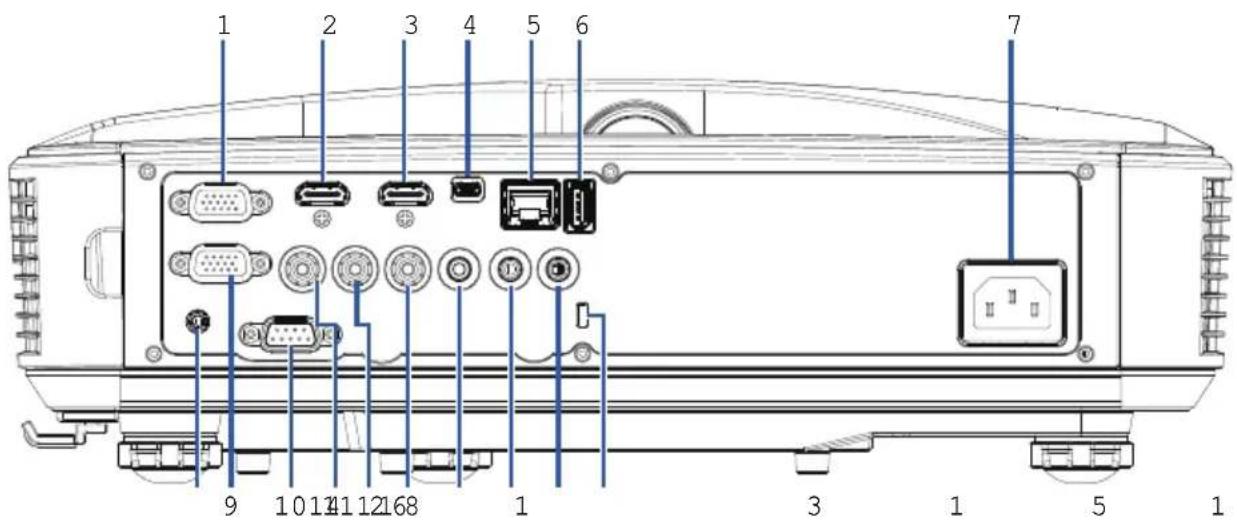
text_image
1 2 3 4 5 6 7 9 10 11 12 168 1 3 1 5 1| Ind. | Connector Name Ind. Connector Name | ||
| 1 | VGA1-In/YPbPr Connector(PC Analog Signal/ComponentVideo Input/HDTV/YPbPr) | 10 | RS-232 Connector (9-pin DCE type) |
| 2 | HDMI2 Input Connector | 11 | Composite Video Input Connector |
| 3 | HDMI1 Input Connector | 12 | Composite Audio Input (right) Connector |
| 4 | USB Connector (Connect PC for firmware upgrade or interactive) | 13 | Composite Audio Input (left) Connector |
| 5 | RJ45 connector | 14 | Audio Output Connector (3.5mm mini jack) |
| 6 | USB Type A Connector | 15 | Audio Input Connector (3.5mm mini jack) |
| 7 | Power Socket | 16 | Audio Input Connector (microphone) |
| 8 | Interactive Connector (3.5 mm mini jack) | 17 | KensingtonTM Lock Port |
| 9 | VGA-Out/VGA2-In Connector |
NOTE:
◆ Monitor loop through only support in VGA1-In/YPbPr.
Remote Control2.2.4
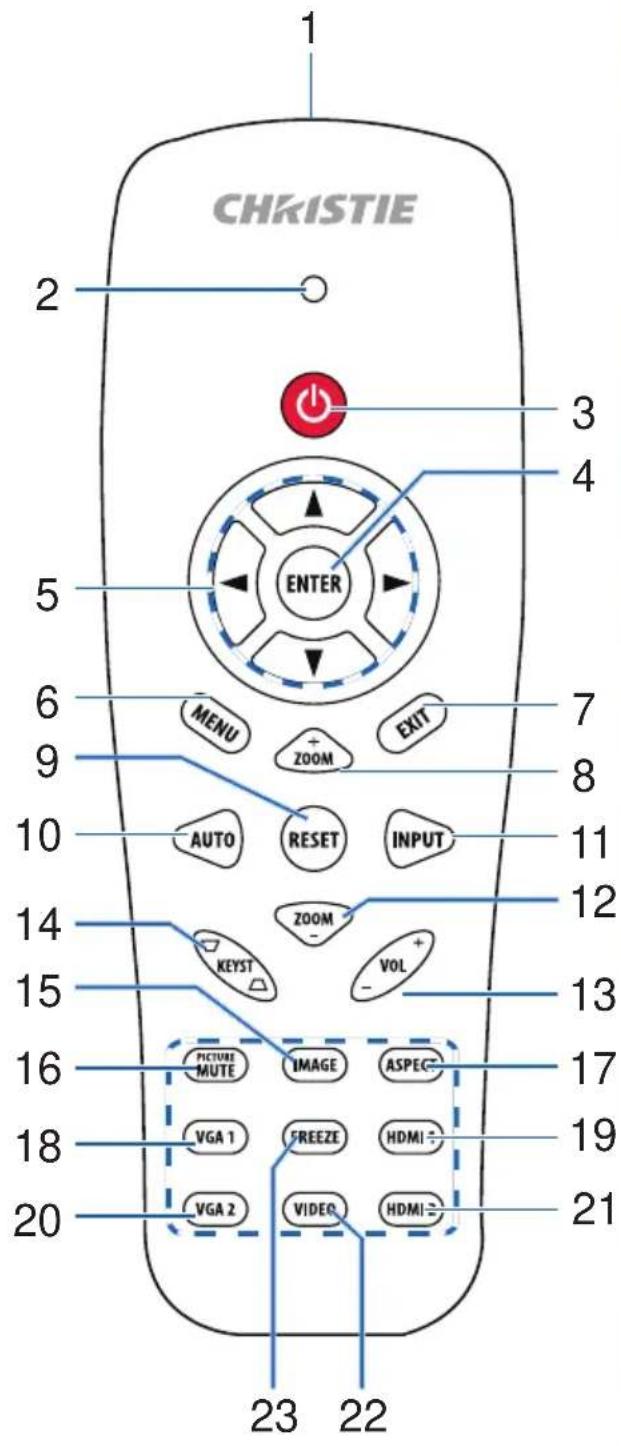
text_image
CHRISTIE 1 2 3 4 5 ENTER 6 MENU + ZOOM EXIT 7 8 9 AUTO RESET INPUT 10 11 12 14 KEYST - VOL 15 13 16 PICTURE MUTE IMAGE ASPECT 17 18 VGA 1 FREEZE HDMI 19 20 VGA 2 VIDEO HDMI 21 22 23| Ind. Part Name |
| 1 Infrared transmitter |
| 2 LED Indicator |
| 3 Power On/Off |
| 4 Enter |
| 5 Four Directional Select keys |
| 6 Menu |
| 7 Exit |
| 8 Zoom in |
| 9 Reset |
| 10 Auto |
| 11 Input |
| 12 Zoom out |
| 13 Volume +/- |
| 14 Keystone +/- |
| 15 Image |
| 16 Picture mute |
| 17 Aspect ratio |
| 18 VGA1 |
| 19 HDMI1 |
| 20 VGA2 |
| 21 HDMI2 |
| 22 Video |
| 23 Screen freeze |
INSTALLATION3.
Connecting the Projector3.1
Connect to Computer/Notebook3.1.1
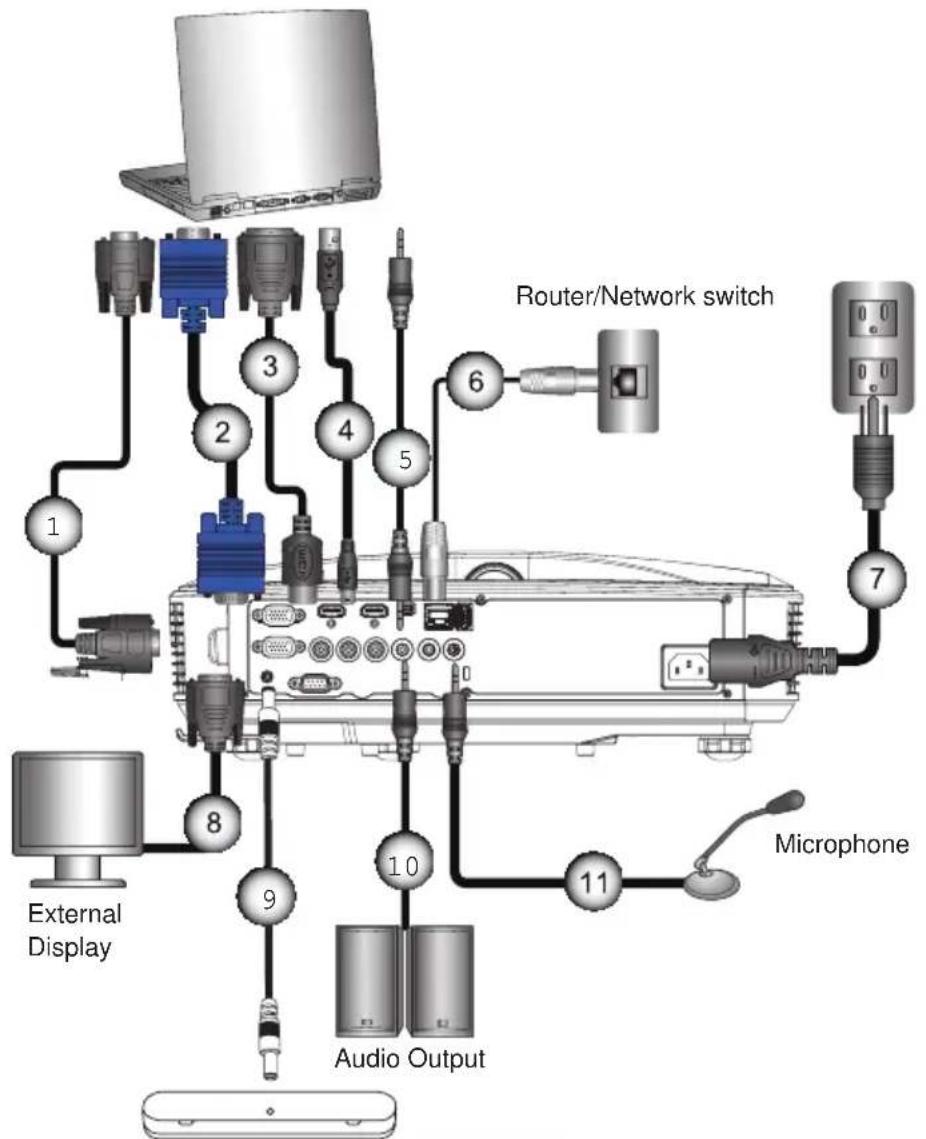
text_image
Router/Network switch 1 2 3 4 5 6 7 8 9 10 11 External Display Audio Output Microphone| Ind. Connector Name Ind. Connector Name | ||
| 1 RS232 Cable 7 Power Cord | ||
| 2 VGA Cable 8 VGA Output Cable | ||
| 3 HDMI Cable 9 DC to DC Cable | ||
| 4 USB Cable 10 Audio Output Cable | ||
| 5 Audio Cable/RCA 11 Audio Input Cable | ||
| 6 RJ45 Cable |
Connect to Video Sources3.1.2
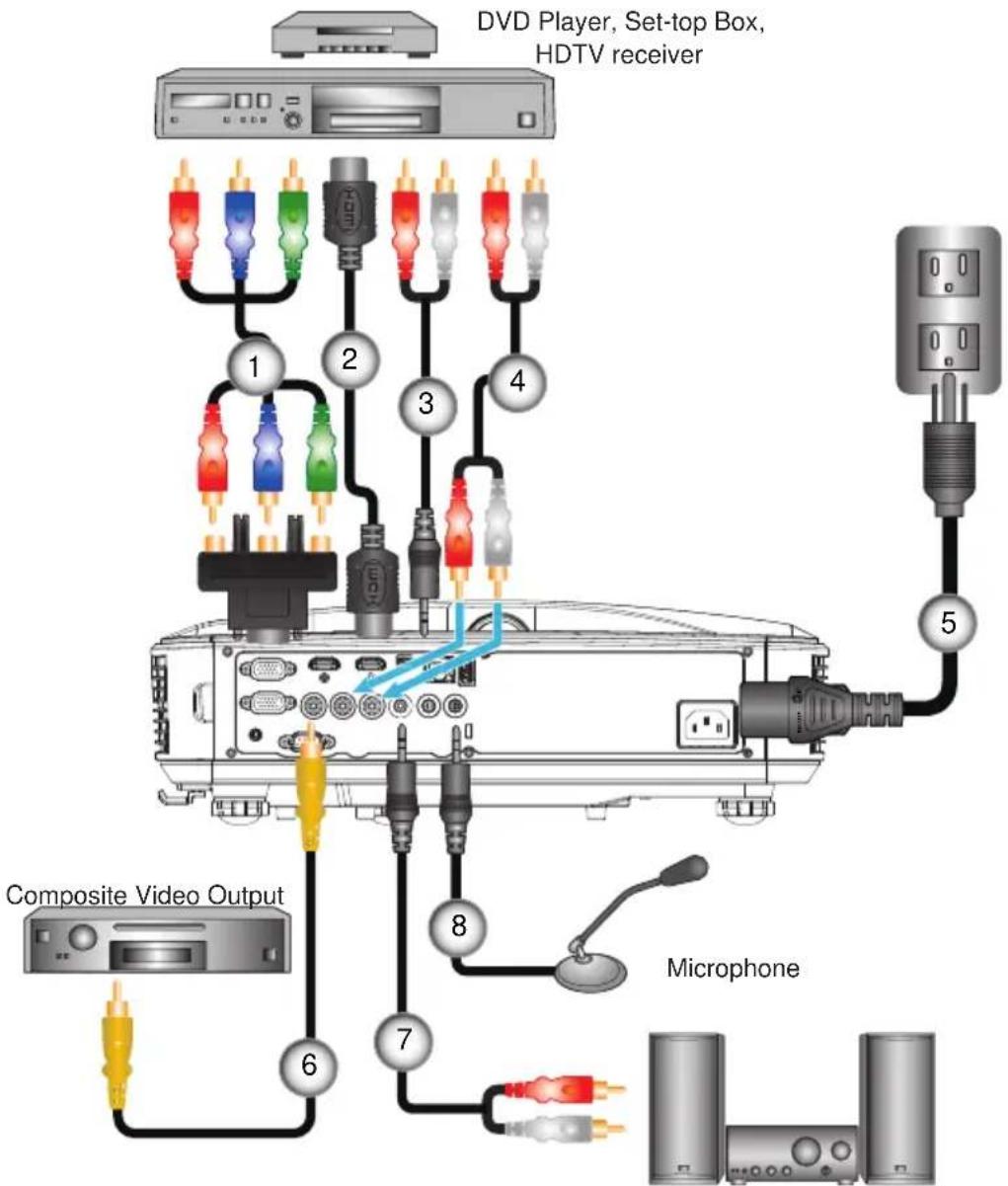
text_image
DVD Player, Set-top Box, HDTV receiver 1 2 3 4 5 Composite Video Output 6 7 8 MicrophoneAudio Output
| Ind. Connector Name Ind. Connector Name | ||
| 1 | 15-Pin to 3 RCA Component/HDTV Adaptor | 5 Power Cord |
| 2 HDMI Cable 6 Composite Video Cable | ||
| 3 Audio Cable 7 Audio Cable/RCA | ||
| 4 Audio Cable/RCA 8 Audio Input Cable | ||
Powering the Projector On/Off3.2
Powering On the Projector3.2.1
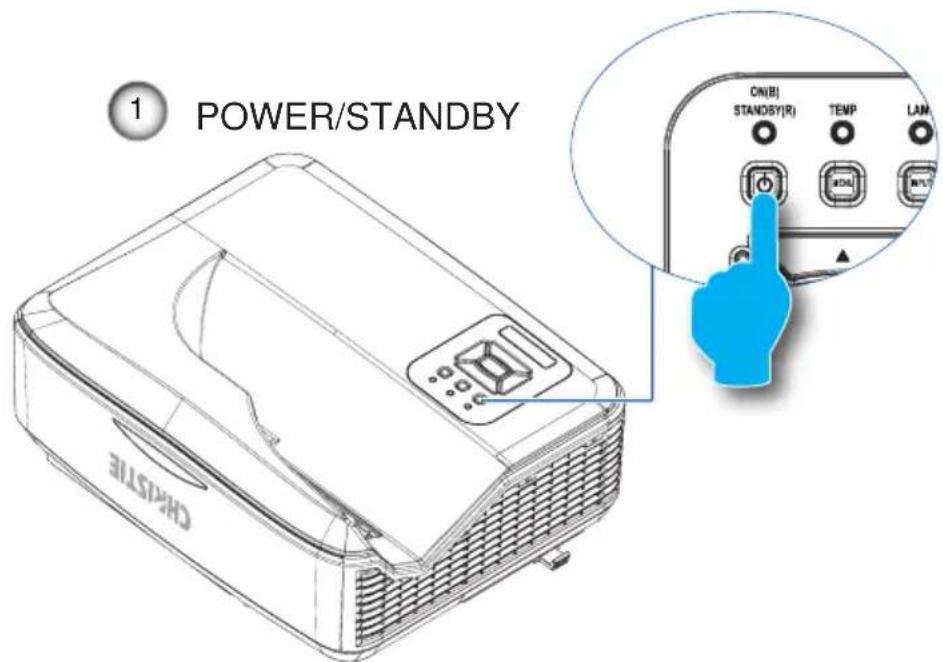
Securely connect the power cord and signal cable. When connected, 1. the POWER/STANDBY LED turns Orange.
. "Tiburton thithprojectoe byqjeetsing 20
or on the remote. At this moment, the POWER/STANDBY LED turns Blue.①
The startup screen will display in approximately 5 seconds. The first 3. time you use the projector, you will be asked to select the preferred language and power saving mode.
Turn on and connect the source that you want to display on the 4 screen (computer, notebook, video player, etc). The projector detects the source automatically. If not, push menu button and go to "OPTIONS".
Make sure that the "Source Lock" has been set to "Off".
NOTE:
If you connect multiple sources at the same time, press the "INPUT" button on the control panel or direct source keys on the remote control to switch between inputs.
When the power mode is in standby mode (power consumption < 0.5W), the VGA output/input and audio are deactivated when the projector is in standby.
text_image
1 POWER/STANDBY CD-ROM CHRYSTLEPowering off the projector3.2.2
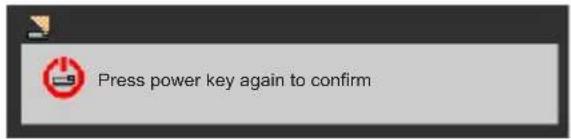
Press the “◀” button on the remote control or on the control panel to turn off the projector. The following message will be displayed on the screen.
text_image
Press power key again to confirmPress the “” button again to confirm otherwise the message will disappear after 10 seconds. When you press the “button for the second time, the fan will start cooling the system and will shut down.
The cooling fans continue to operate for about four seconds for 2 cooling cycle and the POWER/STANDBY LED will flash Orange. When the POWER/STANDBY LED lights solid Orange, the projector has entered standby mode.
If you want to turn the projector back on, you must wait until the projector has completed the cooling cycle and has entered standby mode. Once in standby mode, press "button to restart the projector.
. Disconnect the power cord from the electrical outlet and the projector.3
Warning Indicator3.2.3
When the warning indicators (see below) come on, the projector will automatically shutdown:
- "LAMP" LED indicator is lit red and if "POWER/STANDBY" indicator flashes amber.
- "TEMP" LED indicator is lit red, this indicates the projector has overheated. Under normal conditions, the projector can be switched back on.
- "TEMP" LED indicator flashes red and if "POWER/STANDBY" indicator flashes amber.
Unplug the power cord from the projector, wait for 30 seconds and try again. If the warning indicator light up again, contact your service center for assistance.
Adjusting the Projected Image3.3
Adjusting the Projector's Height3.3.1
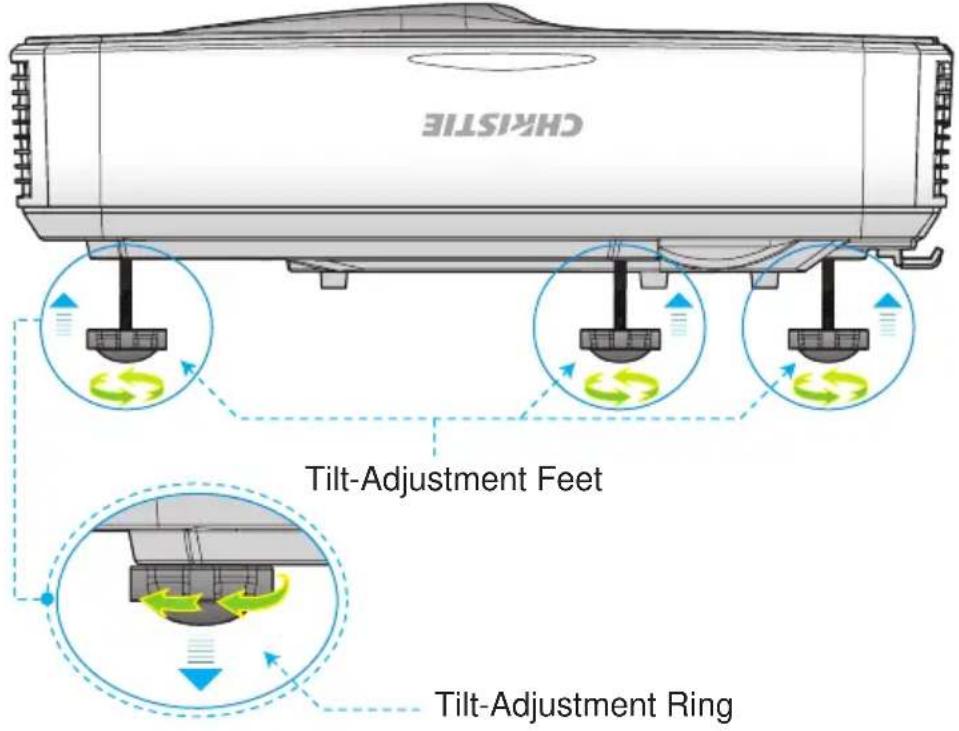
The projector is equipped with elevator feet for adjusting the image height.
Locate the adjustable foot you want to modify on the underside of the 1. projector.
Rotate the adjustable ring clockwise to raise the projector or counter 2 clockwise to lower it. Repeat with the remaining feet as needed.
text_image
CHRISTLE Tilt-Adjustment Feet Tilt-Adjustment RingAdjusting the Projector's Focus3.3.2
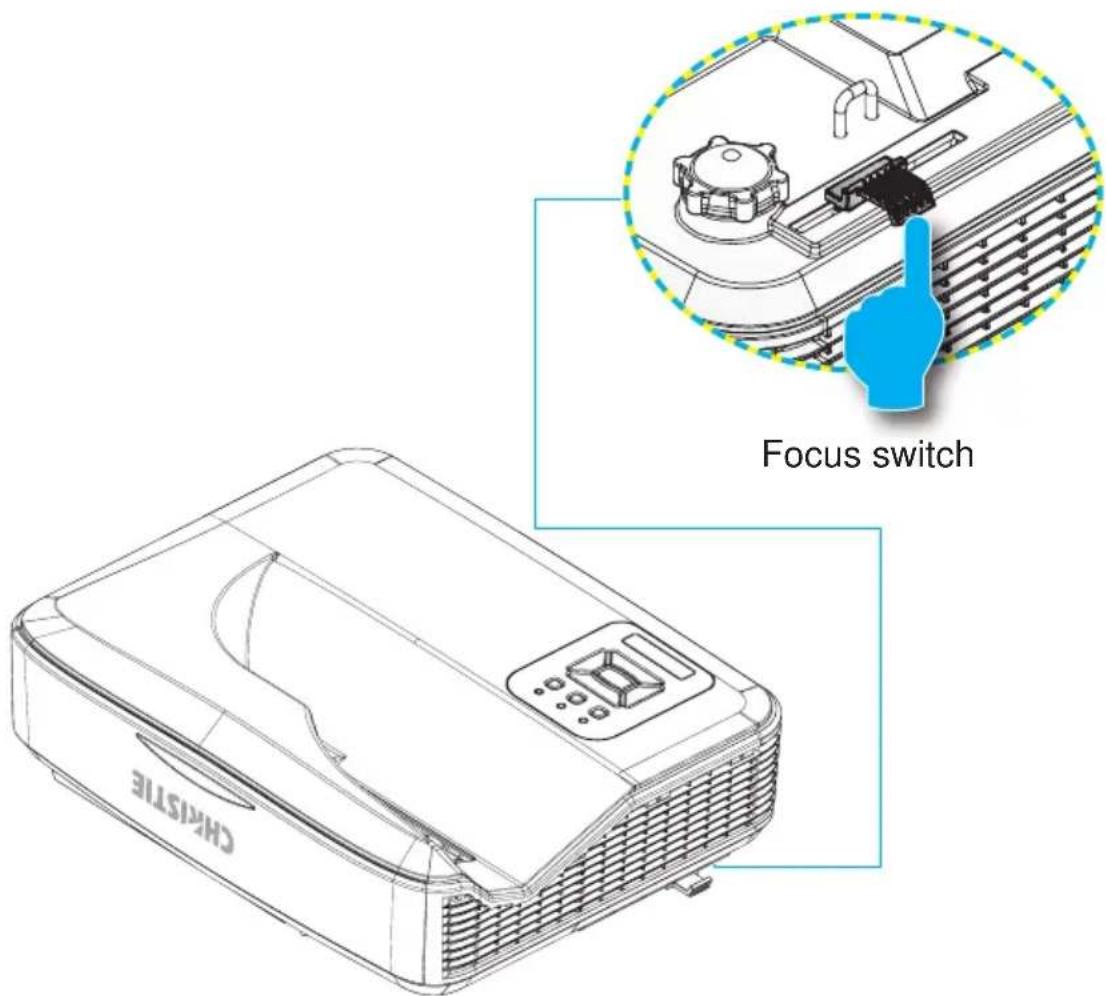
To focus the image, slide the focus switch to left/right until the image is clear.
• 1080p series: The projector will focus at distances from 1.443 to 1.887 feet (0.437 to 0.572 meters).
- Ultra Wide series: The projector will focus at distances from 1.413 to 1.884 feet (0.428 to 0.571 meters).
text_image
Christle Focus switchAdjusting Projection Image Size (Diagonal)3.3.3
- 1080p series: Projection Image Size from 80" to 100" (2.03 to 2.54 meters).
- Ultra Wide series: Projection Image Size from 120" to 140" (3.05 to 3.56 meters).
Top View
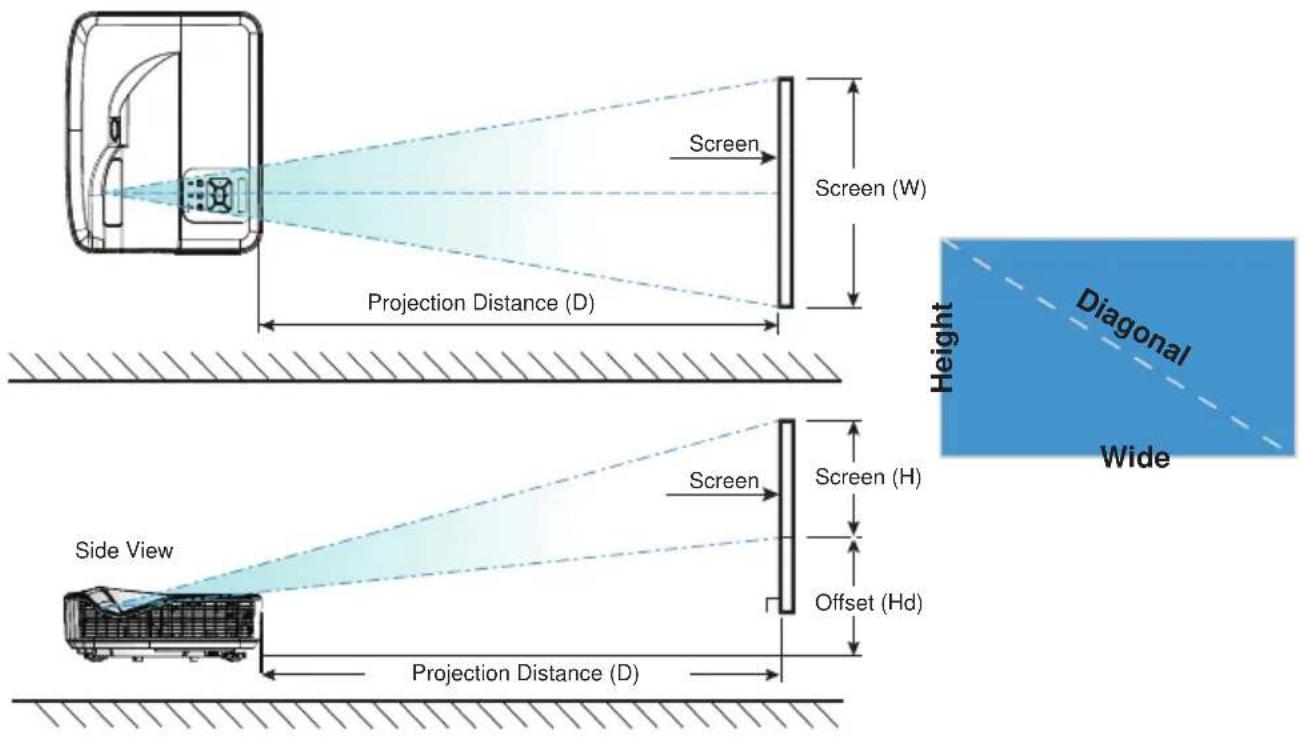
text_image
Screen Screen (W) Projection Distance (D) Screen Screen (H) Offset (Hd) Side View Projection Distance (D) Height Diagonal WideDHD400S
| Diagonal length (inch) size of 16:9 Screen | Screen Size W x H Projection Distance (D) | Offset (Hd) | ||||||||
| (mm) (inch) | (mm) (inch) | |||||||||
| Width | Height | Width | wide tele | wide tele | (mm) (inch) | |||||
| 87 192.6 | 108.3 | 75.8 | 42.6 | 23.3 | NA 9.2 | 28.9 | 11.4 | |||
| 90 | 199.2 | 112.1 | 78.4 | 44.1 | 24.9 | NA | 9.8 | NA | 29.6 | 11.7 |
| 95 | 210.3 | 118.3 | 82.8 | 46.6 | 27.7 | NA | 10.9 | NA | 30.9 | 12.2 |
| 100 | 221.4 | 124.5 | 87.2 | 49.0 | 30.5 | NA | 12.0 | NA | 32.2 | 12.7 |
| 102 | 225.8 | 127.0 | 88.9 | 50.0 | 31.6 | NA | 12.4 | NA | 32.7 | 12.9 |
DUW350S
| Diagonal length (inch) size of 16:9 Screen | Screen Size W x H Projection Distance (D) | Offset (Hd) | |||||||||
| (mm) (inch) (mm) (inch) | |||||||||||
| Width | Height | Width | Height | wide tele | wide tele | (mm) (inch) | |||||
| 120 285.4 | 107.0 | 112.4 | 42.1 | 46.7 | NA 18.4 | NA 36.9 | 14.5 | ||||
| 125 297.3 | 111.5 | 117.0 | 43.9 | 49.7 | NA 19.6 | NA 38.2 | 15.0 | ||||
| 130 309.2 | 115.9 | 121.7 | 45.6 | 52.6 | NA 20.7 | NA 39.5 | 15.6 | ||||
| 135 321.1 | 120.4 | 126.4 | 47.4 | 55.6 | NA 21.9 | NA 40.8 | 16.1 | ||||
| 140 333.0 | 124.9 | 131.1 | 49.2 | 58.6 | NA 23.1 | NA 42.0 | 16.5 | ||||
NOTE:
This table is for user's reference only.
USER CONTROLS4.
Control Panel & Remote Control4.1
Control Panel4.1.1
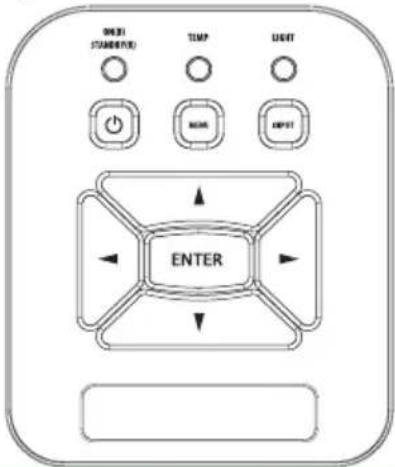
text_image
ON/OI STANDARD TEMP UNIT POWER INPUT ENTERUsing the Control Panel
POWER

Refer to the "Power On/Off the Projector" section on pages 16-17.
Enter Press Enter to
confirm your item selection.
INPUT Press INPUT to select an input signal.
| MENU | Press MENU to launch the on-screen display (OSD) menu. To exit OSD, press MENU again. |
| Four Directional Select Keys | Use ▲▼ ➔ to select items or make adjustments to your selection. |
| LAMP LED | Refer to the LED indicator of the projector light source status. |
| TEMP LED | Refer to the LED indicator of the projector temperature status. |
| ON/STANDBY LED | Refer to the LED indicator of the projector power status. |
Remote Control4.1.2
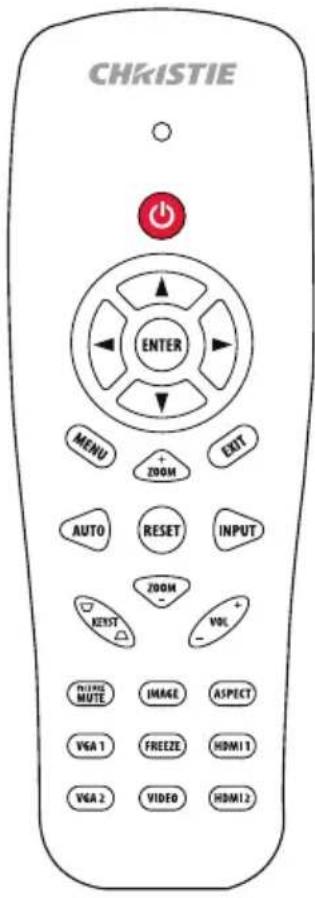
text_image
CHRISTIE ENTER MENU + ZOOM EXIT AUTO RESET INPUT ZOOM KEYST VOL + - TITLEM MUTE IMAGE ASPECT VGA 1 FREEZE HDMI 1 VGA 2 VIDEO HDMI 2| Using the Remote Control | |
| Infrared transmitter | Sends signals to the projector. |
| LED | LED Indicator. |
Power  | Refer to the “Power On/Off the Projector” section on pages 16-17. |
| Exit | Press “Exit” to close the OSD menu. |
| Zoom in | Zoom in the projector display. |
| Reset | Return the adjustments and settings to the factory default values (except for lamp counter). |
| Zoom out | Zoom out the projector display. |
| Enter | Confirm your item selection. |
| Input | Press “Input” to select an input signal. |
| Auto | Automatically synchronizes the projector to the input source. |
| Four Directional Select Keys | Use ▲▼▲to select items or make adjustments to your selection. |
| Keystone +/- | Adjust image distortion caused by tilting the projector. |
| Volume +/- | Adjust to increase/decrease the volume. |
| Aspect ratio | Use this function to choose your required aspect ratio. |
| Menu | Press “Menu” to launch the on-screen display (OSD) menu. To exit OSD, press “Menu” again. |
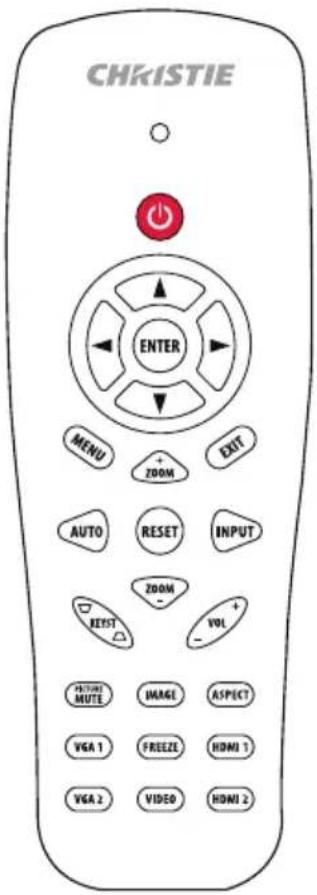
text_image
CHRISTIE ENTER MENU + ZOOM EXIT AUTO RESET INPUT ZOOM RESET + VOL + -| Using the Remote Control | |
| VGA1 | Press “VGA1” to choose VGA IN 1 connector. |
| Black screen | Momentarily turns off/on the audio and video. |
| HDMI1 | Press “HDMI1” to choose HDMI IN 1 connector. |
| HDMI2 | Press “HDMI2” to choose HDMI IN 2 connector. |
| VGA2 | Press “VGA2” to choose VGA IN 2 connector. |
| Video | Press “Video” to choose Composite video source. |
| Screen freeze | Pause the screen image. Press again to resume the screen image. |
| Image | Select the display mode from Bright, PC, Movie, Game, and User. |
On-screen Display Menus4.2
The Projector has multilingual On-screen Display menus that you can use to make image adjustments and change a variety of settings.
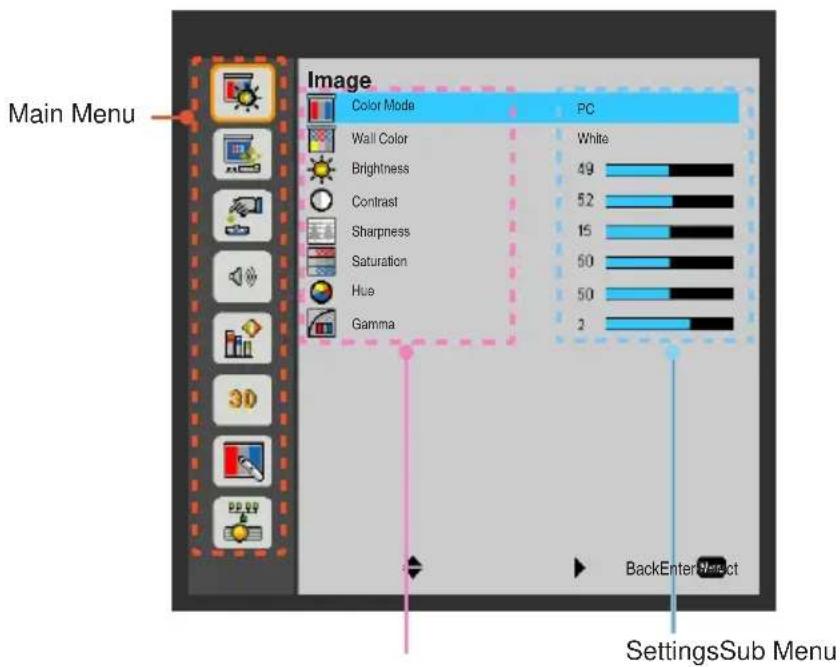
How to operate4.2.1
To open the OSD menu, press "Menu" on the Remote Control or 1. Projector Keypad.
. Weyes to SEleist displayed, in use the 2 ▼
main menu. While making a selection on a particular page, press the ▶ or "Enter" key to enter sub menu.
Use the 3 keys to select the desired item and adjust the settings using the ◀ key.
Select the next item to be adjusted in the sub menu and adjust as 4. described above.
Press "Enter" to confirm, and the screen will return to the main menu.5.
To exit, press "Menu" again. The OSD menu will close and the 6. projector will automatically save the new settings.
text_image
Main Menu Image Color Mode PC Wall Color White Brightness 49 Contrast 52 Sharpness 15 Saturation 50 Hue 50 Gamma 2 BackEnterNext SettingsSub MenuImage4.2.2
text_image
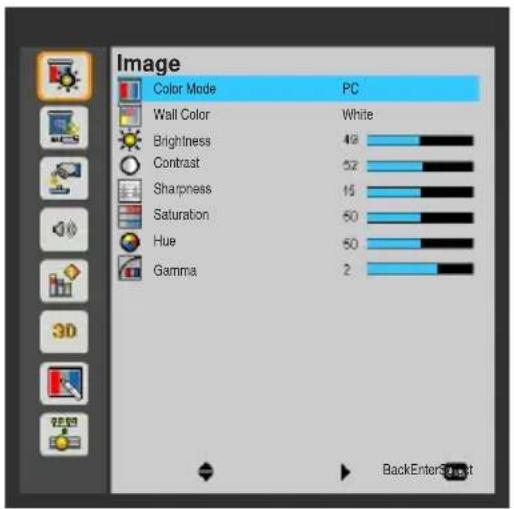
Image Color Mode PC Wall Color White Brightness 42 Contrast 52 Sharpness 16 Saturation 60 Hue 50 Gamma 2 BackEnterColor Mode
There are many factory presets optimized for various types of images. Use the ◀ or ▶ button to select the item.
Bright: For brightness optimization.
PC: For meeting presentation.
Movie: For playing video content.
Game: For game content.
User: Memorize user's settings.
Wall Color
Use this function to obtain an optimized screen image according to the wall color. You can select from "White", "Light Yellow", "Light Blue", "Pink", and "Dark Green".
Brightness
Adjust the brightness of the image.
Press the ◀ button to darken image.
Press the ▶ button to darken image.
Contrast
The Contrast controls the difference between the lightest and darkest parts of the picture. Adjusting the contrast changes the amount of black and white in the image.
Press the ◀ button to decrease the contrast.
Press the ▶ button to increase the contrast.
Sharpness
Adjust the sharpness of the image.
Press the ◀ button to decrease the sharpness.
Press the ▶ button to increase the sharpness.
Saturation
Adjust a video image from black and white to fully saturated color.
Press the ◀ button to decrease the amount of saturation in the image.
Press the ▶ button to increase the amount of saturation in the image.
Hue
Adjust the color balance of red and green.
Press the ◀ button to increase the amount of green in the image.
Press the ▶ button to increase the amount of red in the image.
Gamma
This allows you to adjust the gamma value to obtain the better image contrast for the input.
NOTE:
✿ Sharpness, Saturation and Hue functions are only supported under video mode.
Configuration4.2.3
text_image
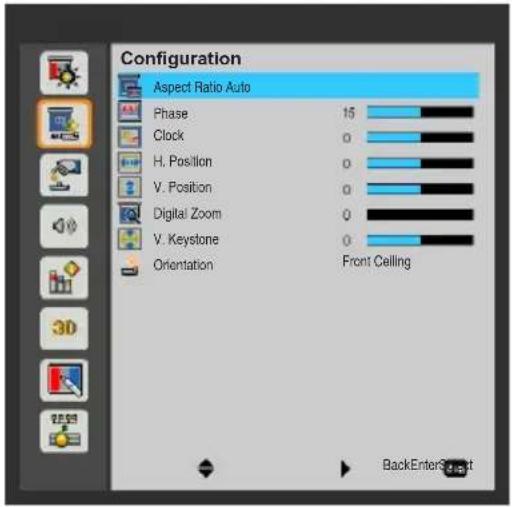
Configuration Aspect Ratio Auto Phase 15 Clock 0 H. Position 0 V. Position 0 Digital Zoom 0 V. Keystone 0 Orientation Front Ceiling BackEnterNextAspect Ratio
Auto: Keep the image with original width-height ratio and maximize the • image to fit native horizontal or vertical pixels.
4:3: The image will be scaled to fit the screen and displayed using a 4:3 ratio.
16:9: The image will be scaled to fit the width of the screen and the height adjusted to display the image using a 16:9 ratio.
16:10: The image will be scaled to fit the width of the screen and the height adjusted to display the image using a 16:10 ratio. (only for DHD400S).
UWHD: The image will be scaled to fit the width of the screen and the • height adjusted to display the image using a 16:6 ratio (only for DUW350S).
Phase
Synchronize the signal timing of the display with the graphic card. If the image appears unstable or flickers, use this function to correct it.
Clock
Adjust to achieve an optimal image when there is a vertical flicker in the image.
H. Position
Press the ◀ button to move the image left.
Press the ▶ button to move the image right.
V. Position
Press the ◀ button to move the image down.
Press the ▶ button to move the image up.
Digital Zoom
Press the ◀ button to reduce the size of an image.
Press the ▶ button to magnify an image on the projection screen.
V. Keystone
Press the ◀ or ▶ button to adjust image distortion vertically. If the image looks trapezoidal, this option can help make the image rectangular.
Orientation
Front: The image is projected straight on the screen.
Front Ceiling: This is the default selection. When selected, the image will turn upside down.
Rear: When selected, the image will appear reversed.
Rear Ceiling: When selected, the image will appear reversed in upside down position.
NOTE:
H. Position and V. Position ranges will depend on input source.
Settings4.2.4
text_image
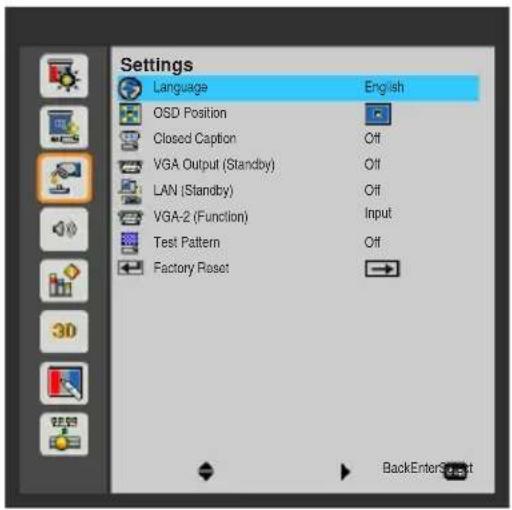
Settings Language English OSD Position Closed Caption Off VGA Output (Standby) Off LAN (Standby) Off VGA-2 (Function).Input Test Pattern Off Factory Reset BackEnterNextLanguage
Choose the multilingual OSD menu. Press the ◀ or ▶ button into the sub menu and then use the ▲ or ▼ button to select your preferred language. Press ▶ on the remote control to finalize the selection.
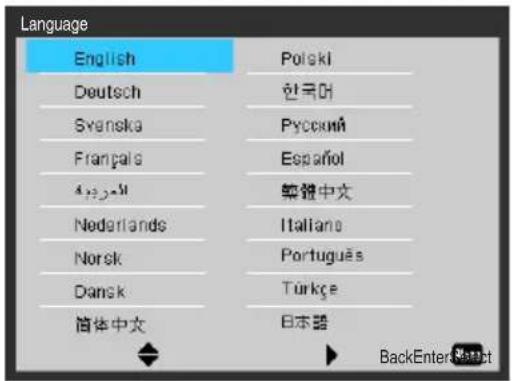
text_image
Language English Deutsch Svenska Français 45-20-11 Nederlands Norsk Dansk 简体中文 Poliski 한국어 Русский Español 繁體中文 Itallano Português Türkçe 日本語 BackEnterOSD Position
Choose the menu location on the display screen.
Closed Caption
Use this function to enable close caption menu. Select an appropriate closed captions option: Off, CC1, CC2, CC3, and CC4.
VGA Output (Standby)
Choose "On" to enable VGA OUT connection.
LAN (Standby)
Choose "On" to enable LAN connection. Choose "Off" to disable LAN connection.
VGA-2 (Function)
Input: Choose "Input" to let the VGA port works as a VGA input function.
Output: Choose "Output" to enable the VGA Out function once the projector is powered on.
Test Pattern
Display a test pattern.
Factory Reset
Choose "Yes" to return the parameters on all menus to the factory default settings.
Audio4.2.5
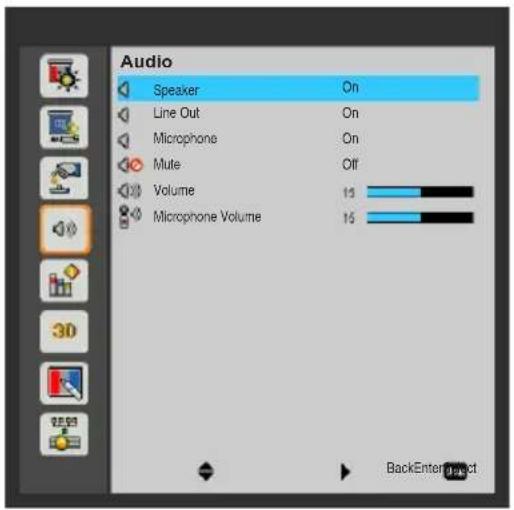
text_image
Audio Speaker On Line Out On Microphone On Mute Off Volume 15 Microphone Volume 16 BackEnter projectSpeaker
Choose "On" to enable the speaker.
Choose "Off" to disable the speaker.
Line Out
Choose "On" to enable the line out function.
Choose "Off" to disable the line out function.
Microphone
Choose "On" to enable the microphone.
Choose "Off" to disable the microphone.
Mute
Choose "On" to turn mute on.
Choose "Off" to turn mute off.
Volume
Press the ◀ button to decrease the volume.
Press the ▶ button to increase the volume.
Microphone Volume
Press the ◀ button to decrease the microphone volume.
Press the ▶ button to increase the microphone volume.
Options4.2.6
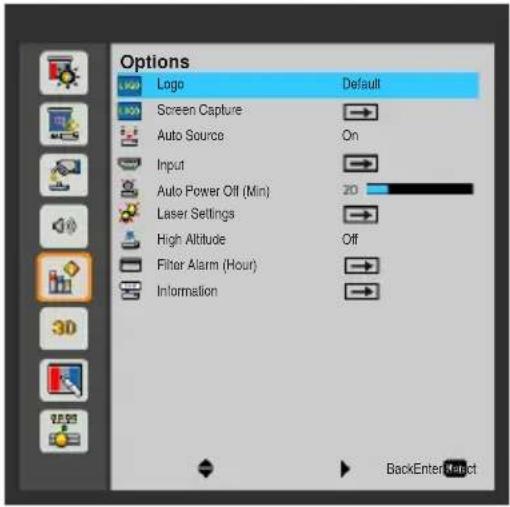
text_image
Options Logo Default Screen Capture Auto Source On Input Auto Power Off (Min) 20 Laser Settings High Altitude Off Filter Alarm (Hour) Information BackEnter Re-actLogo
Use this function to set the desired startup screen. If changes are made they will take effect the next time the projector is powered on.
Default: The default startup screen.
User: Use stored picture from "Screen Capture" function.
Screen Capture
Press ▶ button to capture an image of the picture currently displayed on screen.
Screen capture in progress...
Please Wait.
NOTE:
For successful logo capture, ensure that the on-screen image does not exceed the projector's native resolution. (1080P : 1920x1080 / UWHD : 1920x720).
◆ “Screen Capture” is not available when 3D is enabled.
Before active this function, it is recommended that "Aspect Ratio" is set to the "Auto".
Auto Source
On: The projector will search for other signals if the current input signal is lost.
Off: The projector will only search current input connection.
Input
Press ▶ button to enable/disable input sources. The projector will not search for inputs that are not selected.
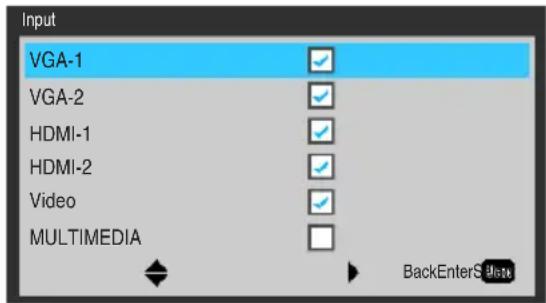
text_image
Input VGA-1 VGA-2 HDMI-1 HDMI-2 Video MULTIMEDIA BackEnterSAuto Power Off (Min)
Sets the countdown timer interval. The countdown timer will start, when there is no signal being sent to the projector. The projector will automatically power off when the countdown has finished (in minutes).
Laser Settings
Refer to page 35.
High Altitude
On: The built-in fans run at high speed. Select this option when using the projector at altitudes above 2500 feet/762 meters or higher.
Off: The built-in fans automatically run at a variable speed according to the internal temperature.
Filter Alarm (Hour)
Filters Alarm (Hour): Set the filter reminder time.
Cleaning Up Reminder: Select "Yes" to reset the dust filter hour counter • after replacing or cleaning the dust filter.
Information
Display the projector information for model name, SNID, source, resolution, software version, and aspect ratio on the screen.
Options | Laser Settings4.2.7
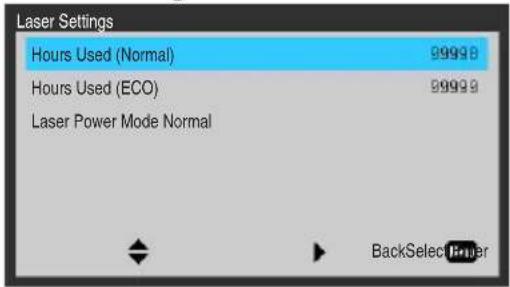
text_image
Laser Settings Hours Used (Normal) 99998 Hours Used (ECO) 99999 Laser Power Mode Normal BackSelect LinearHours Used (Normal)
Display the projection time of normal mode.
Hours Used (ECO)
Display the projection time of ECO mode.
Laser Power Mode
Normal: Normal mode.
ECO: Use this function to dim the projector lamp which will lower power consumption and extend the lamp life.
3D4.2.8
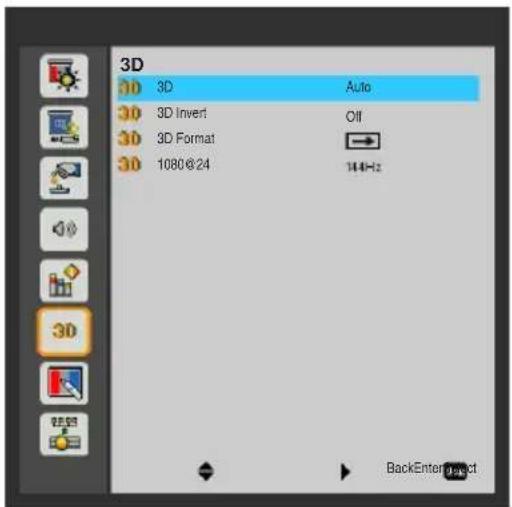
text_image
3D 3D 3D Auto 3D Invert Oil 3D Format 1080@24 14.4Hz BackEnter3D
Auto: When a HDMI 1.4a 3D timing identification signal is detected, the 3D • image is selected automatically.
Choose "On" to enable 3D function.
Choose "Off" to disable 3D function.
3D Invert
If you see a discrete or overlapping image while wearing DLP 3D glasses, you may need to execute "Invert" to get best match of left/right image sequence to get the correct image.
3D Format
Use this feature to select the 3D format. Options are: "Frame Packing", "Side-by-Side (Half)", "Top and Bottom", "Frame Sequential", and "Field Sequential".
1080p@24
Use this feature to select 96 or 144Hz refresh rate as using 3D glasses in the1080p @ 24 frame packing.
NOTE:
"Frame Sequential" is supported the DLP Link 3D input signals from VGA/HDMI connector.
"Frame Sequential"/"Field Sequential" are supported the HQFS 3D input signals from Video connector.
"Frame Packing"/"Side by Side(Half)" / "Top and Bottom" are supported from HDMI 1.4a 3D input signals.
Interactive4.2.9
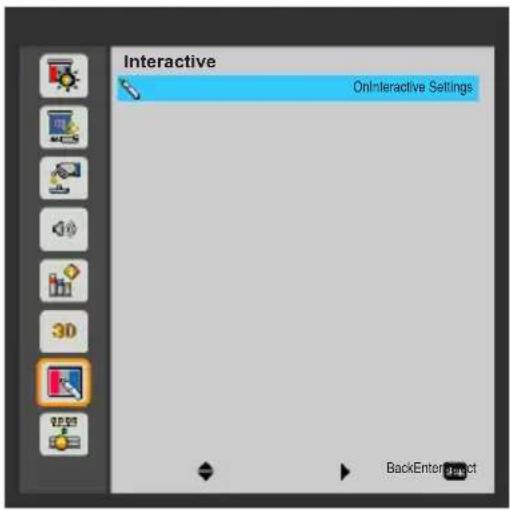
text_image
Interactive OnInteractive Settings BackEnterProjectInteractive Settings
Choose "On" to enable Interactive function.
Choose "Off" to disable Interactive function.
You must to unplug the Mini USB cable that connects NB/desktop with the projector before using the Interactive function. After you complete the Interactive Settings in OSD, use Mini USB cable to connect NB/desktop with the projector.
LAN4.2.10
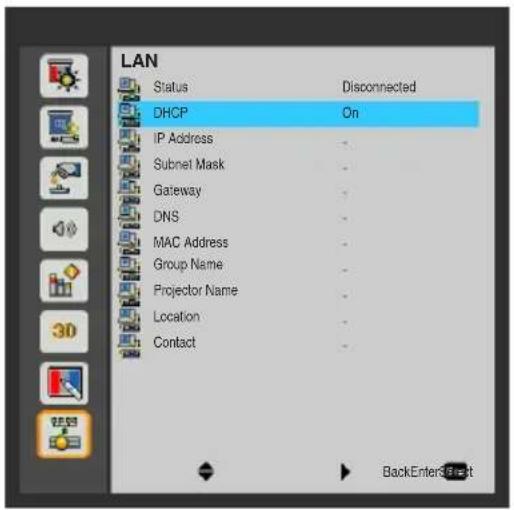
text_image
LAN Status Disconnected DHCP On IP Address Subnet Mask Gateway DNS MAC Address Group Name Projector Name Location Contact BackEnterSetStatus
Display the network connection status.
DHCP
Configure the DHCP settings.
On: Choose "On" to let the projector to obtain an IP address automatically • from your network.
Off: Choose "Off" to assign IP, Subnet Mask, Gateway, and DNS configuration manually.
IP Address
Display an IP address.
Subnet Mask
Display the subnet mask number.
Gateway
Display the default gateway of the network connected to the projector.
DNS
Display the DNS number.
MAC Address
Display the MAC address.
Group Name
Display the group name.
Projector Name
Display the projector name.
Location
Display the projector location.
Contact
Display the contact information.
How to use web browser to control your projector
Turn on DHCP to allow a DHCP 1. server to automatically assign an IP, or manually enter the required network information.
| Status | Connect |
| DHCP | Off |
| IP Address | 172.16.1.42 |
| Subnet Mask | 255.255.255.0 |
| Gateway | 172.16.1.254 |
| DNS | 172.16.1.1 |
- Chopper apply and press OK complete the configuration process.
- Open your web browser and type the IP Address from the OSD LAN screen. The web page will display as below:
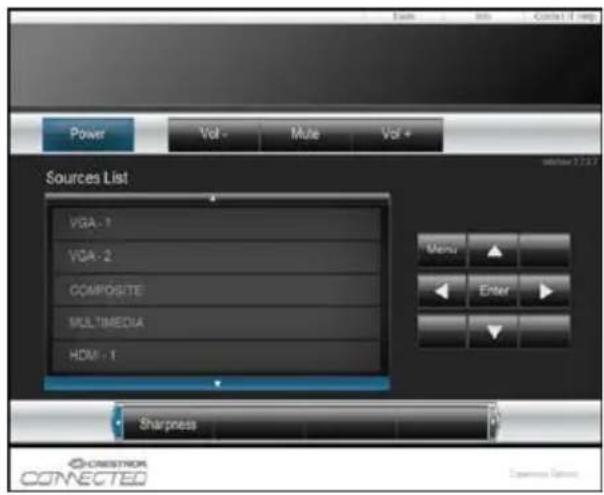
text_image
Power Vol - Mute Vol + Sources List VGA - 1 VDA - 2 COMPOSITE MULTIMEDIA HDMI - 1 Menu Enter Sharpness COWESTROM CONNECTEDNOTE:
When you used the projector IP address, you will can not link to your service server.
- Based on network web-page for the input-string in [tools] tab, the limitation for Input-Length is in the below list ("space" and the other punctuation key included):
| Category Item | Input-Length (characters) | |
| Crestron Control | IP Address 15 | |
| IP ID 2 | ||
| Port 5 | ||
| Projector | Projector Name 10 | |
| Location 9 | ||
| Assigned To 9 | ||
| Network Configuration | DHCP (Enabled) (N/A) | |
| IP Address 15 | ||
| Subnet Mask 15 | ||
| Default Gateway | 15 | |
| DNS Server | 15 | |
| User Password | Enabled | (N/A) |
| New Password | 15 | |
| Confirm | 15 | |
| Admin Password | Enabled | (N/A) |
| New Password | 15 | |
| Confirm | 15 | |
text_image
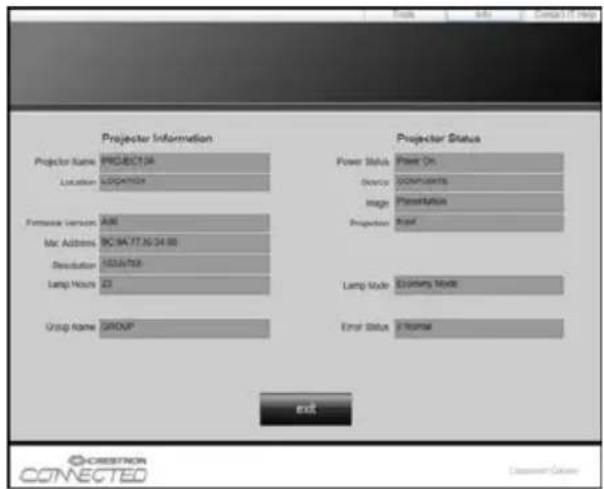
Projector Information Projector Name PROJECTOR Location ADJANDER Performance Version AIE Mar Address 9C.9A.77.26.24.80 Resolution 102A/70X Lamp Hours Z3 Group Name GROUP Projector Status Power Status Power On Device Components Image Presentation Projection Roof Lamp Style Existing Mode Error Status Error Exit CREATION CONNECTEDWhen making a direct connection from your computer to the projector
Step 1: Find an IP Address (192.168.0.100) from LAN function of projector.
| IP Address | 192 | 168 | 000 | 100 |
Step 2: Select apply and press "Enter" button to submit function or press "menu" key to exit.
Step 3: To open Network Connections, click Start, click Control Panel, click Network and Internet Connections, and then click Network Connections. Click the connection you want to configure, and then, under Network Tasks , click Change settings of this connection.
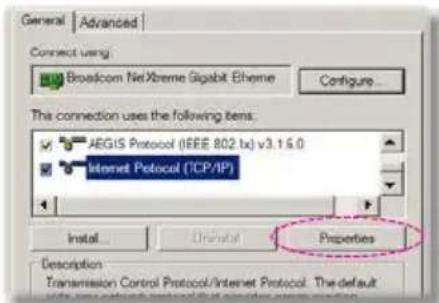
Step 4: On the General tab, under This connection uses the following items, click Internet Protocol (TCP/IP), and then click "Properties."
text_image
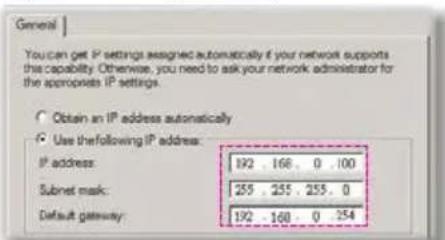
General | Advanced | Connect using Broadcom NetXreme Gigabit Ethene Configure... This connection uses the following items: AEGIS Protocol (IEEE 802 tx) v3.16.0 Internet Protocol (TCP/IP) Properties Description Transmission Control Protocol/Internet Protocol: The defaultStep 5: Click Use the following IP address, and type as below:
1) IP address: 192.168.0.100
2) Subnet mask: 255.255.255.0
3) Default gateway:192.168.0.254
text_image
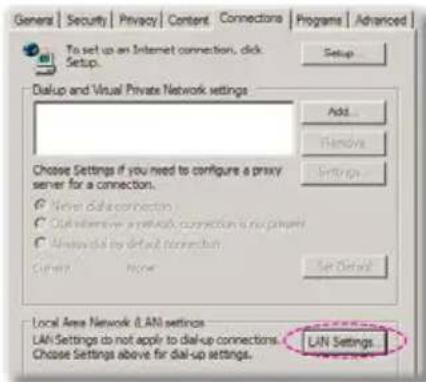
General You can get IP settings assigned automatically if your network supports this capability. Otherwise, you need to ask your network administrator for the appropriates IP settings. ○ Obtain an IP address automatically ● Use the following IP address: IP address: 192 166 0 100 Subnet mask: 255 255 255 0 Default gateway: 192 160 0 254Step 6: To open Internet Options, click IE web browser, click Internet Options, click the Connections tab and click "LAN Settings...".
text_image
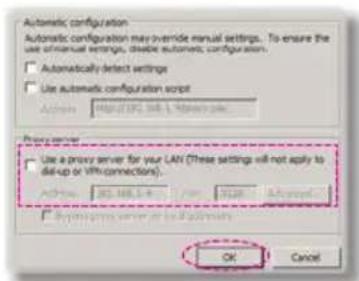
Genera | Security | Privacy | Content | Connectors | Programs | Advanced To set up an Internet connection, click Setup. Setup Dialup and Visual Private Network settings Add... Remove Settings Choose Settings if you need to configure a proxy server for a connection. ● Net user data connection ○ Optimize a network connection to no packet ● Unrealized dial-up default connection Current Now Set Default Local Area Network (LAN) settings LAN Settings do not apply to dial-up connections. Choose Settings above for dial-up settings. LAN SettingsStep 7: The Local Area Network (LAN) Setting dialog appears. In the Proxy Server area, cancel the Use a proxy server for your LAN checkbox, then click "OK" button twice.
text_image
Automatic configuration Automatic configuration may override manual settings. To ensure the use of manual settings, divide automers; configuration. □ Automatically detect settings □ Use automatic configuration script Action: MAX37392.168.1.00000000000000000000000000000000000000000000000000000000000000000000000000000000000000000000 Proxy server □ Use a proxy server for your LAN (These settings will not apply to dias-up or off connections). Action: 162.168.5.4 Use: 162.168.5.4 Access: □ Systematics server or use automatics OK CancelStep 8: Open Internet Explorer and type the IP address 192.168.0.100 in the address box. Press Enter.
Crestron RoomView Control Tool
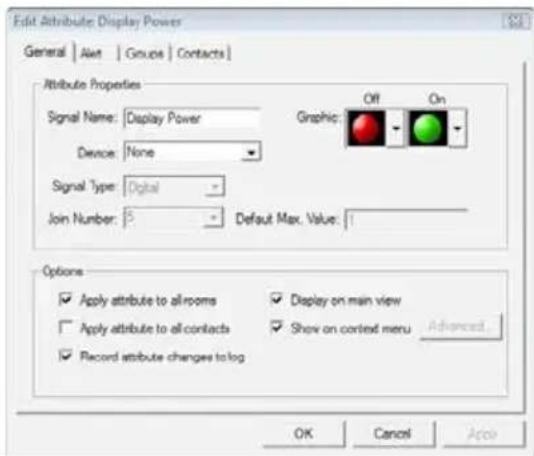
Crestron RoomView™ provides a central monitoring station for 250+ control systems on a single Ethernet network (more are possible, the number depends on the combination of IP ID and IP address). Crestron RoomView monitors each projector, including projector's online status, system power, lamp life, network setting and hardware faults, plus any custom attribute as defined by the Administrator. The Administrator can add, delete, or edit room information, contact information and events, which are logged automatically by the software for all users. (Operation UI as following image)
1. Main Screen
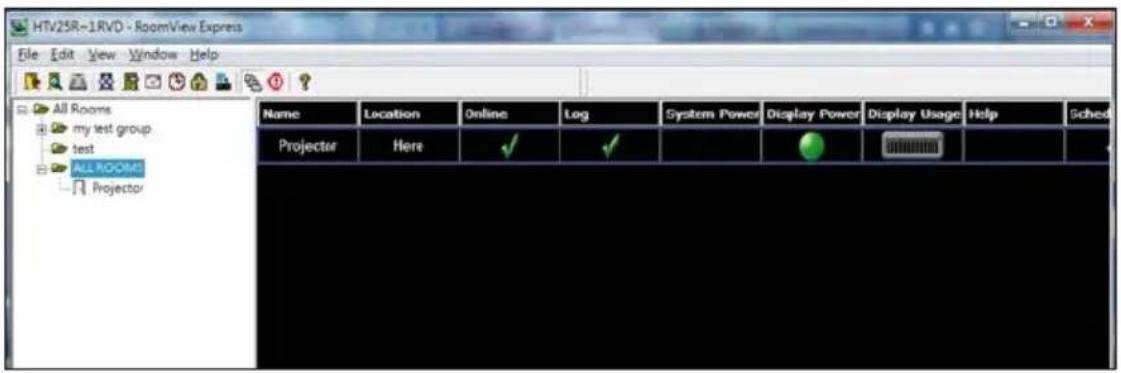
text_image
HTV25R-1RVD - RoomView Express File Edit View Window Help All Rooms my test group test ALL ROOMS Projector Name Location Online Log System Power Display Power Display Usage Help Sched Projector Here ✓ ✓ System Power [ ] [ ] [ ] [ ] [ ]2. Edit Room
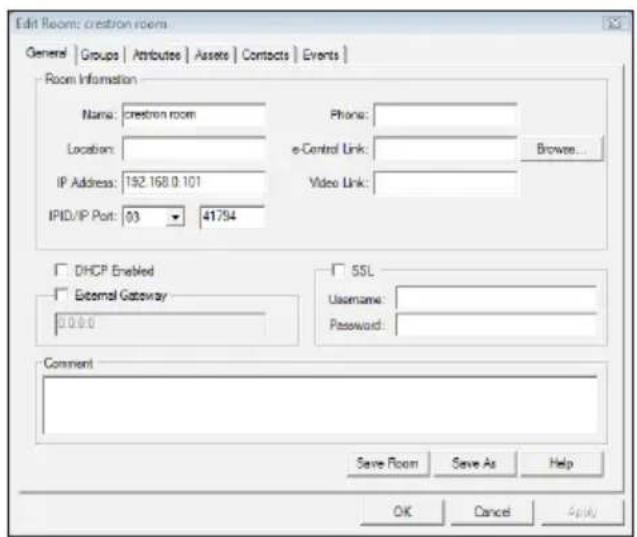
text_image
Edit Room: creation room General | Groups | Attributes | Assets | Contacts | Events | Room Information Name: crestron room Location: IP Address: 192.168.0.101 IPID/IP Port: 03 41794 Phone: e-Control Link: Video Link: Browse... DHCP Enabled External Gateway 0.0.0.0 55L Username: Password: Comment Save Room Save As Help OK Cancel ApplyNOTE: ❖ Crestron RoomView's function is set according to the products' models and specifications.
3. Edit Attribute
text_image
Edit Attribute: Display Power General | Alt | Groups | Contacts | Attribute Properties Signal Name: Display Power Device: None Signal Type: Digital Join Number: 5 Default Max. Value: 1 Options ✓ Apply attribute to all rooms ✓ Display on main view ✓ Apply attribute to all contacts ✓ Show on corded menu Advanced ✓ Record attribute changes to log OK Cancel Help4. Edit Event
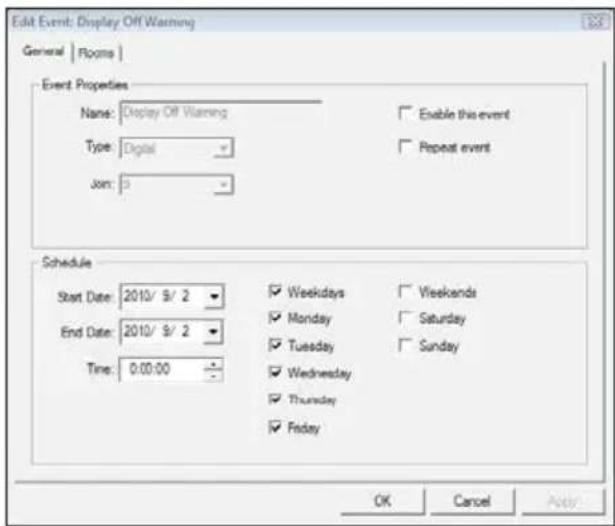
text_image
Edit Event: Display Off Warning General | Rooms | Event Properties Name: Display Off Warning Type: Digital Join: 0 Enable this event Repeat event Schedule Start Date: 2010/ 9/ 2 End Date: 2010/ 9/ 2 Time: 0:00:00 Weekdays Monday Tuesday Wednesday Thursday Friday Weekends Saturday Sunday OK Cancel ApplyFor further information, please visit:
http://www.crestron.com & www.crestron.com/getroomview.
MULTIMEDIA5.
Accessing Multimedia Files5.1
This projector supports two methods to project the media files (photos, videos, music, documents) stored on following devices:
WIFI dongle - wirelessly access the media files stored on your mobile a. phone, tablet PC, notebook, or desktop.
USB flash drive - directly access the media files stored in the device.b.
How to access Multimedia mode5.1.1
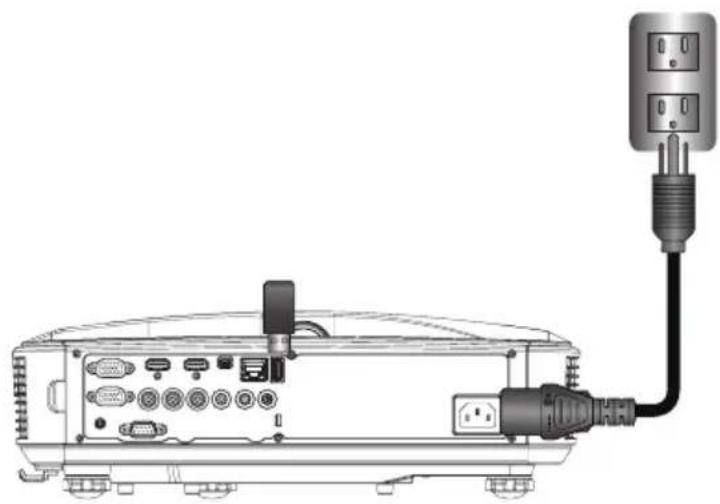
Plug a wireless dongle or a USB flash drive into the USB connector at 1. the back of projector.
natural_image
Line drawing of a projector with attached plug and socket (no text or symbols)Press "INPUT" 2. on the remote control or on the control panel to turn on the projector. When the Input menu appears, press the ▲▼keys to select "Multimedia" and the "Enter" key to confirm.
NOTE: ❖ Suggest to have the WIFI dongle with Realtek RTL8192CU chipset. The recommended WIFI dongles are WL-7200-V1, Abocom WU5508, EDUP EP-N1528.
Mobile Display
To access the media files stored on your mobile device or tablet PC, do the following:
- Multimedia menu, select Mobile/Tablet.
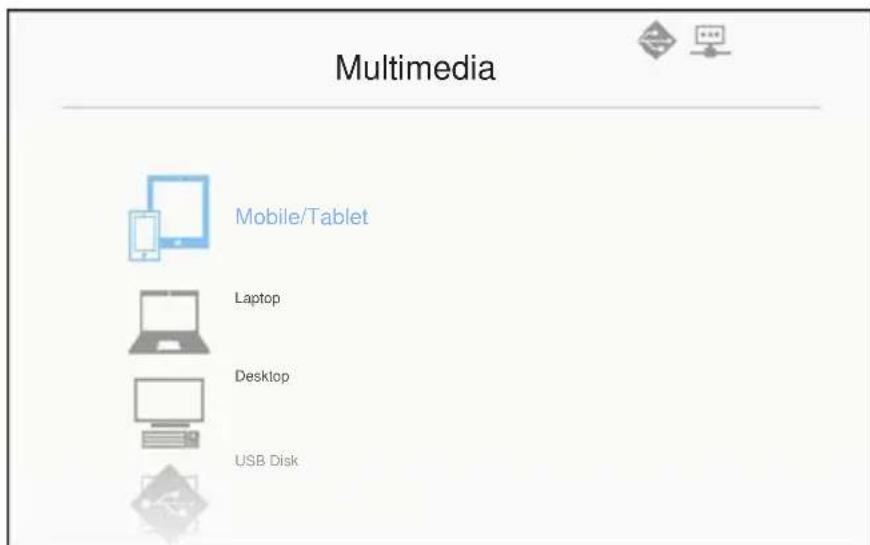
text_image
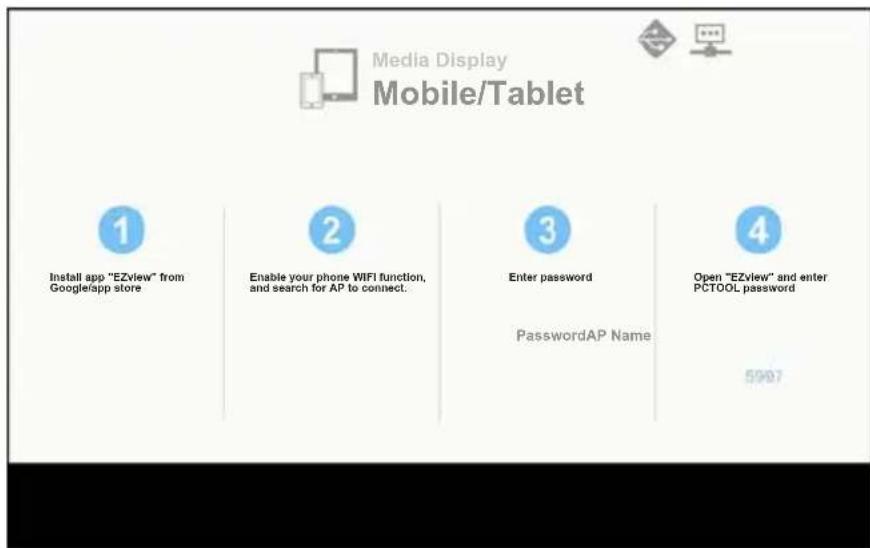
Multimedia Mobile/Tablet Laptop Desktop USB DiskOn your mobile device or tablet PC, download "EZview" application App 2. Store (iOS) or Play Store (Android).
text_image
Media Display Mobile/Tablet 1 Install app "EZview" from Google/app store 2 Enable your phone WIFI function, and search for AP to connect. 3 Enter password PasswordAP Name 4 Open "EZview" and enter PCTOOL password 5987Enable your mobile device or tablet PC WiFi function, and search the AP 3. name listed in the Wi-Fi network list.
- On the initial connection, you will be prompted to enter a password. Enter the password.
- Launch "EZview" application and enter the PCTOOL password. Wait until the connection is established. The media files on your mobile 6. device or tablet PC can be accessed using the projector.
Laptop Display
To access the media files stored on your laptop/notebook, do the following:
On 1. Multimedia menu, select Laptop.
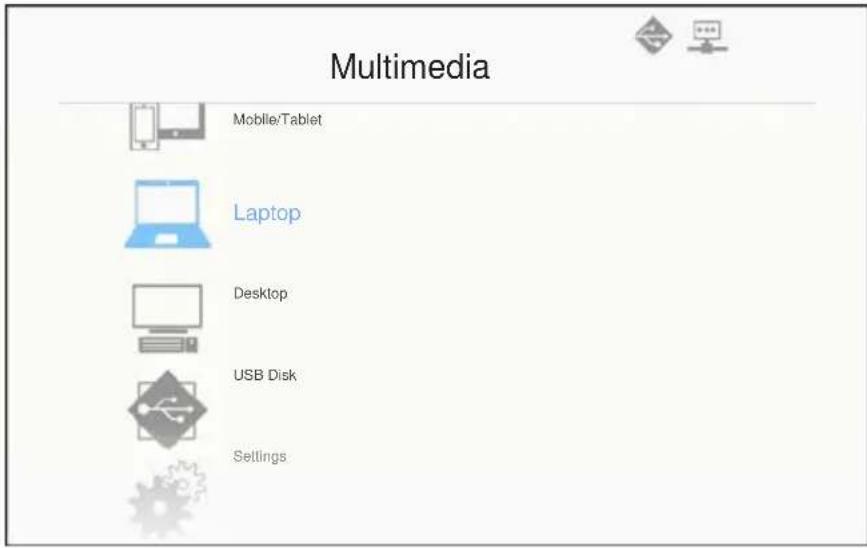
text_image
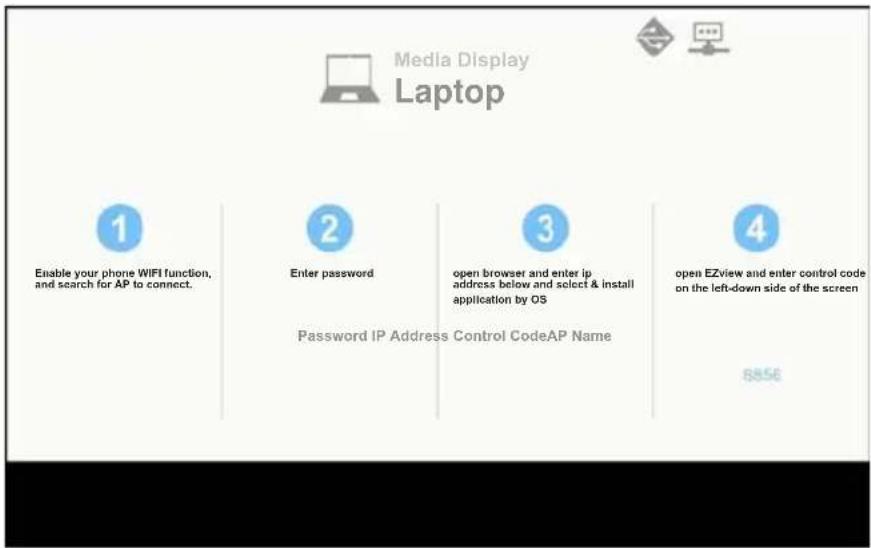
Multimedia Mobile/Tablet Laptop Desktop USB Disk SettingsEnable your laptop/notebook WiFi function, and search the AP name listed 2. in the Wi-Fi network list.
text_image
Media Display Laptop 1 Enable your phone WIFI function, and search for AP to connect. 2 Enter password Password IP Address Control CodeAP Name 3 open browser and enter ip address below and select & install application by OS 4 open EZview and enter control code on the left-down side of the screen 885€On the initial connection, you will be prompted to enter a password. Enter 3. the password.
- Open your web browser and type the IP address. Then select "Wifi" on the left side of the screen and install application required by the operation system.
- Launch "EZview" application and enter the control code shown on the right-bottom side of the screen.
- Wait until the connection is established. The media files on your laptop/notebook can be accessed using the projector.
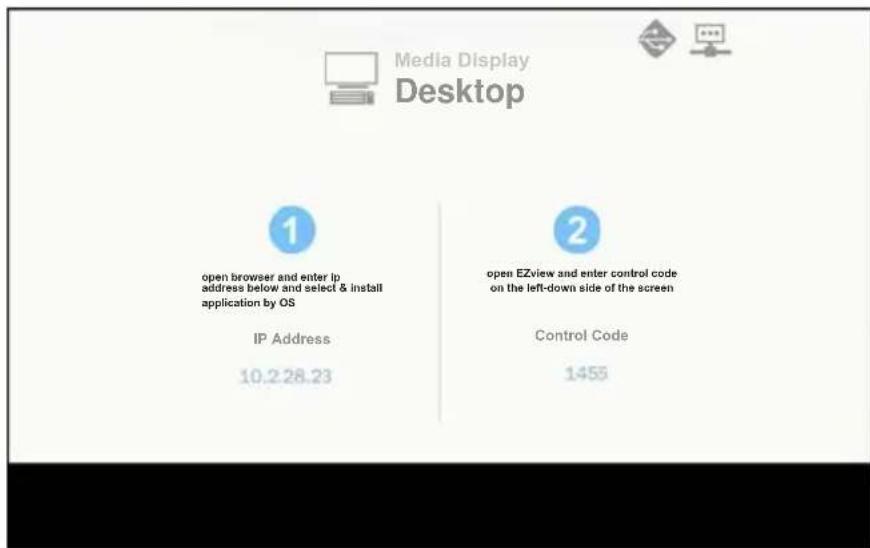
Desktop Display
To access the media files stored on your desktop, do the following:
On 1. Multimedia menu, select Desktop.
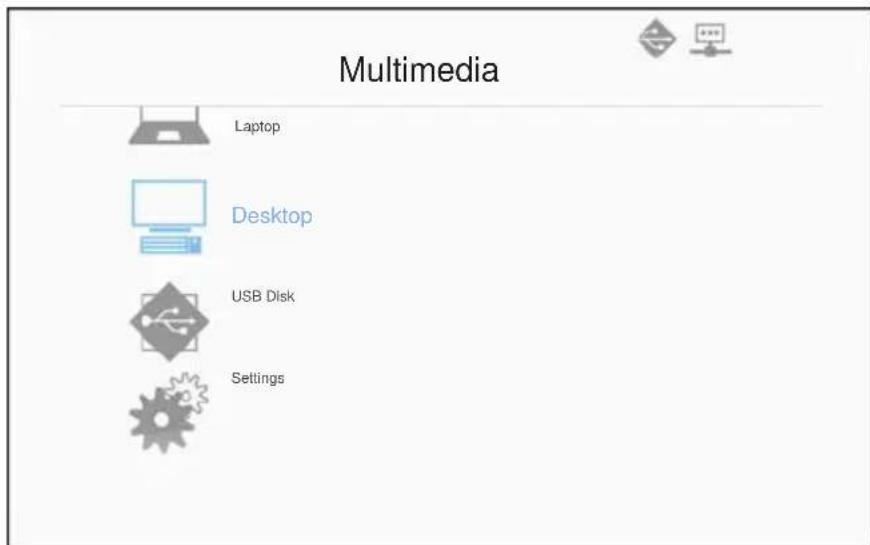
text_image
Multimedia Laptop Desktop USB Disk SettingsOpen your web browser and enter the IP address. Then select "Wifi" on 2. the left side of the screen and install application required by the operation system.
text_image
Media Display Desktop 1 open browser and enter Ip address below and select & install application by OS IP Address 10.2.28.23 2 open EZview and enter control code on the left-down side of the screen Control Code 1455Launch "EZview" application and type the control code shown on the right-3. bottom side of the screen.
- Wait until the connection is established. The media files on your desktop can be accessed using the projector.
USB Storage Display
To access the media files stored on your USB flash drive, do the following:
| Supported File Format | |
| Multimedia Category | File Format |
| Photo BMP, JPG, PNG | |
| Music MP3, WMA | |
| Video | AVI, MOV, MP4, RM, RMVB, DAT, MPG, ISO, TS, MKV, VOB, and WMV |
| Document WORD, EXCEL, PPT, PDF | |
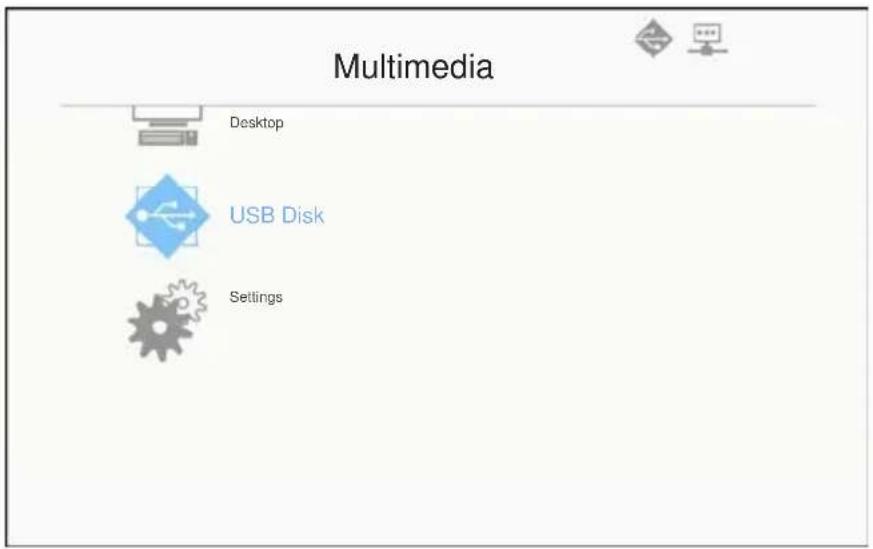
On 1. Multimedia menu, select USB Disk.
text_image
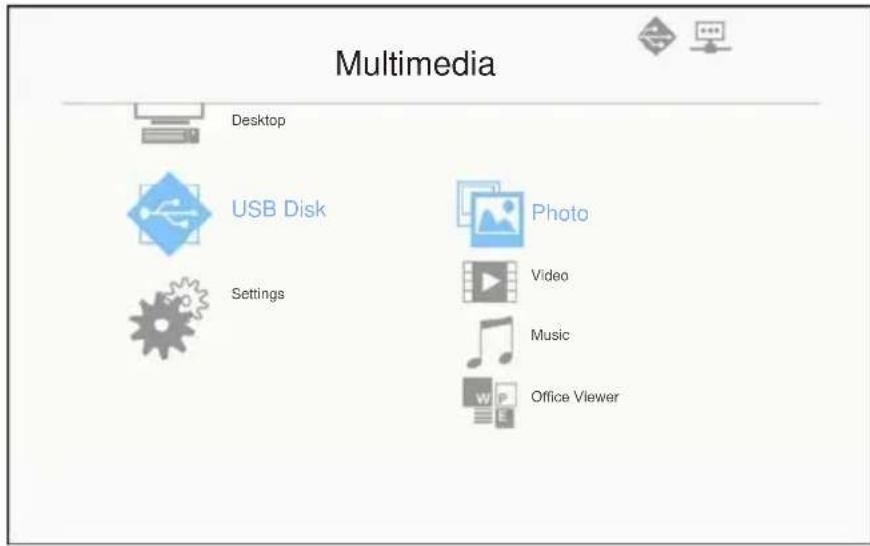
Multimedia Desktop USB Disk SettingsUse the ▲▼ keys to select the file category and press the "Enter" key.
text_image
Multimedia Desktop USB Disk Settings Photo Video Music Office ViewerUse the 3 ▼ keys to select the file to view/play and press the "Enter" key to confirm.
Configuring Multimedia Settings
To change the settings, do the following:
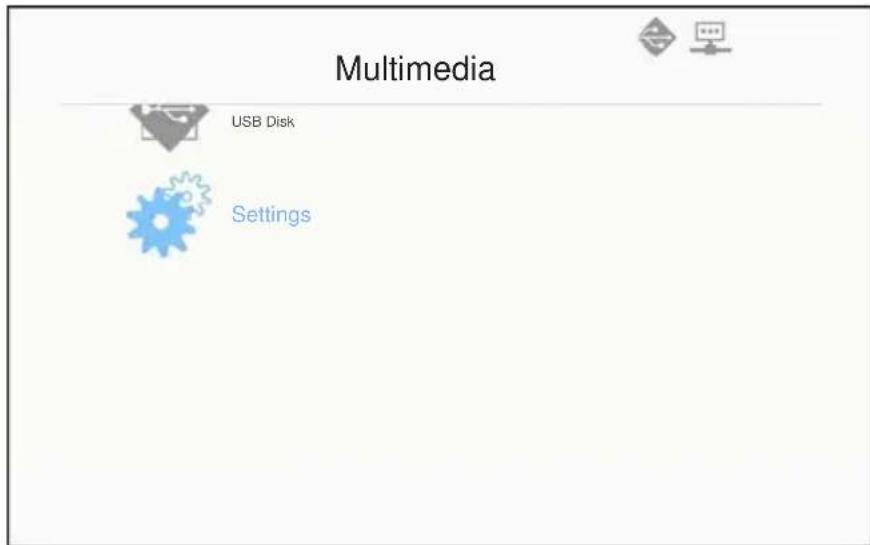
- Multimedia menu, select Settings.
text_image
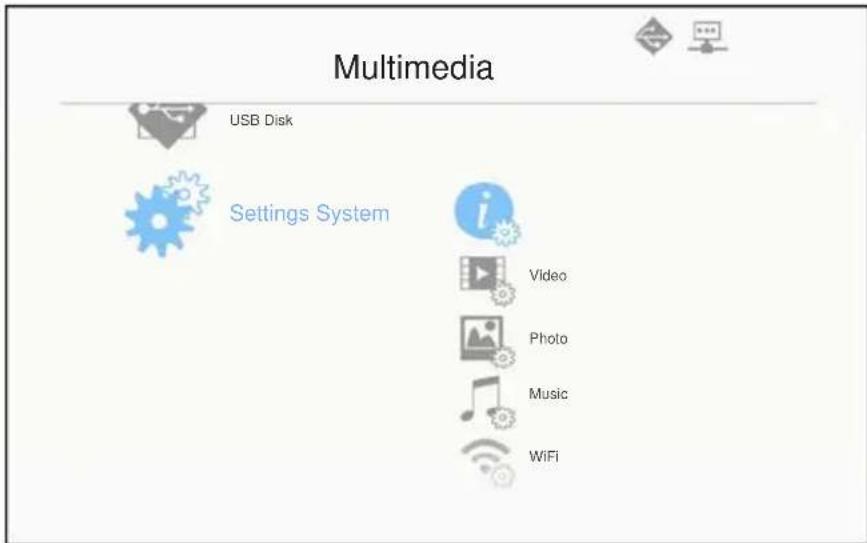
Multimedia USB Disk SettingsUse the ▲▼keys to select the desired menu option and press the "Enter" key to enter the submenu.
text_image
Multimedia USB Disk Settings System Video Photo Music WiFiSystem: Select this option to view the firmware version and update • firmware.
Video: Select this option to change the display ratio and set the • repeat mode.
Photo: Select this option to change the display ratio, slideshow pattern, and slideshow duration.
Music: Select this option to set the repeat mode.
WiFi: Select this option to configure the Wi-Fi connection.
- Use sets to select the adjust/select the setting and press the "Enter" key to confirm.
APPENDICES6.
Installing and Cleaning the Optional Dust Filter6.1
We recommend you clean the dust filter every 500 hours of operation, or more often if you are using the projector in a dusty environment.
When the warning message appears on the screen, do the following to clean the air filter:
The usage time of the dust filter is reached.
Please clean the dust filters for better performance.
NOTE:
The optional dust filter should be used in dusty environments.
If the dust filter is installed, a proper maintenance will prevent overheating and projector malfunction.
The dust filter is optional.
The specific interfaces are selected in terms of the specifications of types.
text_image
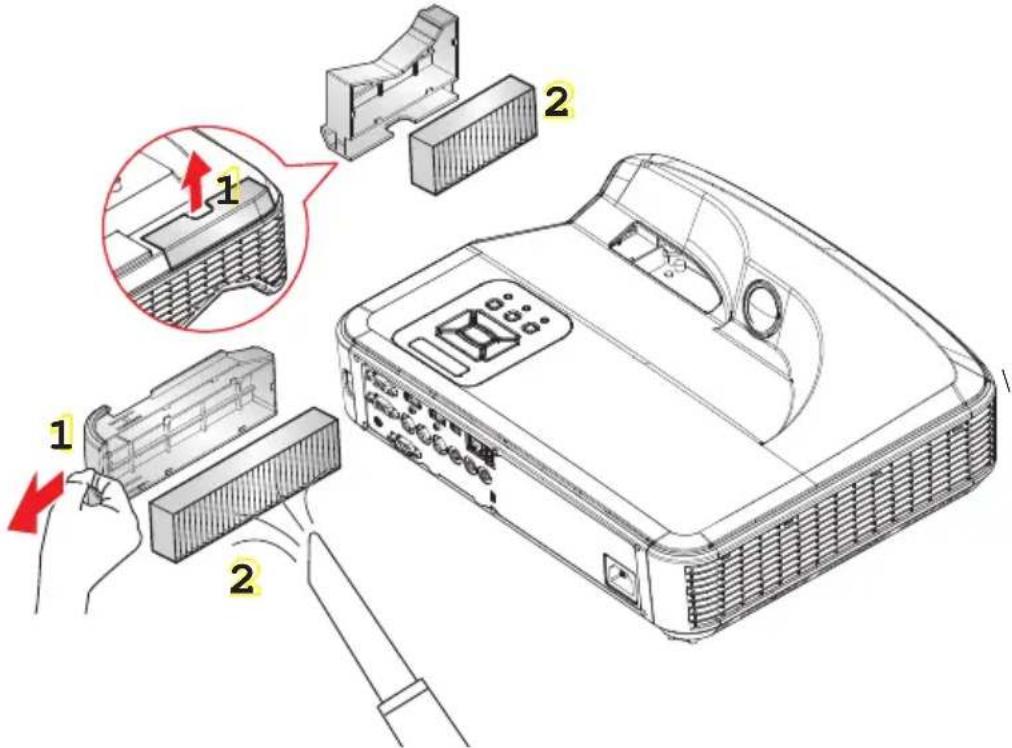
Diagram illustrating the process of inserting a component into a projector, with numbered parts and red arrows indicating steps.Air Filter Cleaning Procedure:
- Power off the projector by pressing the "button and unplug the power cord.
- Pull out the dust filter, as shown in the illustration (1).
- Carefully remove the dust filter. Then clean or change the filter in illustration (2).
To install the filter, reverse the previous steps. - Turn on the projector and reset the filter usage counter after the dust filter is replaced.
Compatibility Modes6.2
VGA Analog6.2.1
| a. PC signal | |||
| Modes Resolution V. Frequency [Hz] H. Frequency [Hz] | |||
| VGA | 640x480 60 31.5 | ||
| 640x480 67 35.0 | |||
| 640x480 72 37.9 | |||
| 640x480 75 37.5 | |||
| 640x480 85 43.3 | |||
| IBM 720x400 70 31.5 | |||
| SVGA | 800x600 56 35.1 | ||
| 800x600 60 37.9 | |||
| 800x600 72 48.1 | |||
| 800x600 75 46.9 | |||
| 800x600 85 53.7 | |||
| Apple, MAC II | 832x624 75 49.1 | ||
| XGA | 1024x768 60 48.4 | ||
| 1024x768 70 56.5 | |||
| 1024x768 75 60.0 | |||
| 1024x768 85 68.7 | |||
| 1024x768 120 99.0 | |||
| Apple, MAC II | 1152x870 75 68.7 | ||
| SXGA | 1280x1024 60 64.0 | ||
| 1280x1024 72 77.0 | |||
| 1280x1024 75 80.0 | |||
| QuadVGA | 1280x960 60 60.0 | ||
| 1280x960 75 75.2 | |||
| SXGA+ 1400x1050 60 65.3 | |||
| UXGA 1600x1200 60 75.0 | |||
| b. Extended wide timing | |||
| Modes Resolution V. Frequency [Hz] H. Frequency [Hz] | |||
| WXGA | 1280x720 60 44.8 | ||
| 1280x800 60 49.6 | |||
| 1366x768 60 47.7 | |||
| 1440x900 60 59.9 | |||
| WSXGA+ 1680x1050 60 65.3 | |||
| UWHD 1920x720 60 44.35 | |||
| c. Component signal | |||
| Modes Resolution V. Frequency [Hz] H. Frequency [Hz] | |||
| 480i | 720x480(1440x480) | 59.94(29.97) 15.7 | |
| 576i | 720x576(1440x576) | 50(25) 15.6 | |
| 480p 720x480 59.94 31.5 | |||
| 576p 720x576 50 31.3 | |||
| 720p | 1280x720 60 45.0 | ||
| 1280x720 50 37.5 | |||
| 1080i | 1920x1080 | 60(30) 33.8 | |
| 1920x1080 | 50(25) 28.1 | ||
| 1080p | 1920x1080 | 23.98/24 | 27.0 |
| 1920x1080 60 67.5 | |||
| 1920x1080 50 56.3 | |||
HDMI Digital6.2.2
| a. PC signal | |||
| Modes Resolution V. Frequency [Hz] H. Frequency [Hz] | |||
| VGA | 640x480 60 31.5 | ||
| 640x480 67 35.0 | |||
| 640x480 72 37.9 | |||
| 640x480 75 37.5 | |||
| 640x480 85 43.3 | |||
| IBM 720x400 70 31.5 | |||
| SVGA | 800x600 56 35.1 | ||
| 800x600 60 37.9 | |||
| 800x600 72 48.1 | |||
| 800x600 75 46.9 | |||
| 800x600 85 53.7 | |||
| Apple, MAC II | 832x624 75 49.1 | ||
| XGA | 1024x768 60 48.4 | ||
| 1024x768 70 56.5 | |||
| 1024x768 75 60.0 | |||
| 1024x768 85 68.7 | |||
| 1024x768 120 99.0 | |||
| Apple, MAC II | 1152x870 75 68.7 | ||
| SXGA | 1280x1024 60 64.0 | ||
| 1280x1024 72 77.0 | |||
| 1280x1024 75 80.0 | |||
| QuadVGA | 1280x960 60 60.0 | ||
| 1280x960 75 75.2 | |||
| SXGA+ 1400x1050 60 65.3 | |||
| UXGA 1600x1200 60 75.0 | |||
| b. Extended wide timing | |||
| Modes Resolution V. Frequency [Hz] H. Frequency [Hz] | |||
| WXGA | 1280x720 60 44.8 | ||
| 1280x800 60 49.6 | |||
| 1366x768 60 47.7 | |||
| 1440x900 60 59.9 | |||
| WSXGA+ 1680x1050 60 65.3 | |||
| UWHD 1920x720 60 44.35 | |||
| c. Video signal | |||
| Modes Resolution V. Frequency [Hz] H. Frequency [Hz] | |||
| 480p 640x480 59.94/60 31.5 | |||
| 480i | 720x480(1440x480) | 59.94(29.97) 15.7 | |
| 576i | 720x576(1440x576) | 50(25) 15.6 | |
| 480p 720x480 59.94 | 31.5 | ||
| 576p 720x576 | 50 31.3 | ||
| 720p | 1280x720 60 45.0 | ||
| 1280x720 50 37.5 | |||
| 1080i | 1920x1080 | 60(30) 33.8 | |
| 1920x1080 | 50(25) 28.1 | ||
| 1080p | 1920x1080 | 23.98/24 27.0 | |
| 1920x1080 60 67.5 | |||
| 1920x1080 50 56.3 | |||
| d. HDMI 1.4a mandatory 3D timing- Video Signal | |||
| Modes Resolution | V. Frequency [Hz] | H. Frequency [Hz] | |
| Frame Packing | 720p | 50 31.5 | |
| 720p | 59.94/60 15.7 | ||
| 1080p | 23.98/24 15.6 | ||
| Side-by-Side(Half) | 1080i | 50 31.5 | |
| 1080i 59.94/60 31.3 | |||
| Top and Bottom | 720p | 50 45.0 | |
| 720p | 59.94/60 37.5 | ||
| 1080p | 23.98/24 33.8 | ||
RS232 Commands and Protocol Function List6.3
RS232 Port Setting6.3.1
| Items Method | |
| Communication Method Asynchronous Communication | |
| Bits per seconds 19200 | |
| Data bits 8 bits | |
| Parity None | |
| Stop bits 1 | |
| Flow control None | |
RS232 Signals Connection6.3.2
Computer COM Port (D-Sub 9pin connector)
Projector COM Port (D-Sub 9pin connector)
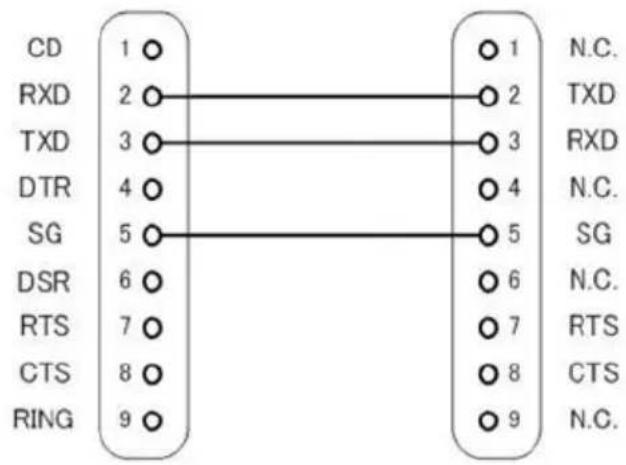
NOTE: ✿ RS232 shell is grounded.
Commands Set List6.3.3
| Command Description | Command Projector Return N value Note | |||
| Power (PWR n) Pass : P | Fail : F | 0 : Off1 : On | ||
| Keypad (KEY n) Pass : P | Fail : F | 1 : Up2 : Left3 : Right4 : Down5 : Menu6 : Source7 : Keystone+8 : Keystone-9 : Volume+10 : Volume- | ||
| Resync (RSC n) Pass : P | Fail : F | 1 VGA only | ||
| AV Mute (Blank) (AVM n) Pass : P | Fail : F | 0 : Off1 : On | ||
| Freeze (FRZ n) Pass : P | Fail : F | 0 : Unfreeze1 : Freeze | ||
| Input Source (SIN n) | Pass : PFail : F | 1 : VGA 12 : VGA 23 : HDMI 14 : HDMI 25 : Video6 : Multimedia | ||
| Color Mode | (PST n) Pass : P | Fail : F | 1 : Bright2 : PC3 : Movie4 : Game5 : User | |
| Brightness | (BRT n) Pass : P | Fail : F | Value: 0~100 | |
| Contrast | (CON n) | Pass : PFail : F | Value: 0~100 | |
| Sharpness | (SHA n) Pass : P | Fail : F | Video only | |
| Aspect Ratio (ASP n) Pass : P | Fail : F | 1 : Auto2 : 4:33 : 16:94 : 16:10 / Ultra Wide | ||
| Digital Zoom (DZM n) Pass : P | Fail : F | 0 : Zoom-1 : Zoom+ | ||
| Keystone (KST n) Pass : P | Fail : F | Value: -40 ~ 40 | ||
| Orientation (SOR n) Pass : P | Fail : F | 1 : Front2 : Rear3 : Front Ceiling4 : Rear Ceiling | ||
| Language (LOC n) Pass : P | Fail : F | 1 : English2 : German3 : Swedish4 : French5 : Arabic6 : Dutch7 : Norwegian8 : Danish9 : Simplified Chinese10 : Polish11 : Korean12 : Russian13 : Spanish14 : Traditional Chinese15 : Italian16 : Portuguese17 : Turkish18 : Japanese | ||
| Menu Location (MSP n) Pass : P | Fail : F | 1 : Top Left2 : Top Right3 : Center4 : Bottom Left5 : Bottom Right | ||
| Reset (RST n) Pass : P | Fail : F | |||
| Mute (MUT n) Pass : P | Fail : F | 0 : Off1 : On | ||
| Volume (VOL n) Pass : P | Fail : F | Value: 0~30 | ||
| Microphone Volume | (MIC n) Pass : P | Fail : F | Value: 0~30 | |
| Auto Power Off (min) | (ASH n) Pass : P | Fail : F | Step = 5(0,5,10,15,20...95,100,105,110,115,120) | |
| High Altitude (HAT n) | Pass : P | Fail : F | 0 : Off1 : On | |
| Color Mode Read (PST ?) | Pass : Okn | Fail : F | n :1 = Bright2 = PC3 = Movie4 = Game5 = User | |
| Aspect Ratio Read (ASP ?) | Pass : Okn | Fail : F | n :1 = Auto2 = 4:33 = 16:94 = 16:10 (Ultra Wide) | |
| Input Source (curr. src) | (SIN ?) Pass : Okn | Fail : F | n :0 = None1 = VGA12 = VGA23 = HDMI14 = HDMI25 = Video6 = Multimedia | |
| Software Version (VER ?) | Pass : Okddd | Fail : F | ddd : FW version | |
| Status (SST ?) | Pass:OkabbbbccdddeeFail : F | a = Power Statusb = LD Hourc = Input Sourced = Firmware Versione = Color mode | ||
Regulation & Safety Notices6.4
This appendix lists the general notices of your projector.
FCC notice
This device has been tested and found to comply with the limits for a Class B digital device pursuant to Part 15 of the FCC rules. These limits are designed to provide reasonable protection against harmful interference in a residential installation. This device generates, uses and can radiate radio frequency energy and, if not installed and used in accordance with the instructions, may cause harmful interference to radio communications.
However, there is no guarantee that interference will not occur in a particular installation. If this device does cause harmful interference to radio or television reception, which can be determined by turning the device off and on, the user is encouraged to try to correct the interference by one or more of the following measures:
Reorient or relocate the receiving antenna.
Increase the separation between the device and receiver. •
- Connect the device into an outlet on a circuit different from that to which the receiver is connected.
Consult the dealer or an experienced radio/television technician for • help.
Notice: Shielded cables
All connections to other computing devices must be made using shielded cables to maintain compliance with FCC regulations.
Caution
Changes or modifications not expressly approved by the manufacturer could void the user's authority, which is granted by the Federal Communications Commission, to operate this projector.
Operation conditions
This device complies with Part 15 of the FCC Rules. Operation is subject to the following two conditions:
. This device may not cause harmful interference and1
This device must accept any interference received, including 2. interference that may cause undesired operation.
Notice: Canadian users
This Class B digital apparatus complies with Canadian ICES-003.
Declaration of Conformity for EU countries
EMC Directive 2004/108/EC (including amendments) •
Low Voltage Directive 2006/95/EC •
R & TTE Directive 1999/5/EC (if product has RF function)•
Disposal instructions
Do not throw this electronic device into the trash when discarding. To minimize pollution and ensure utmost protection of the global environment, please recycle it.
Safety Notice
text_image
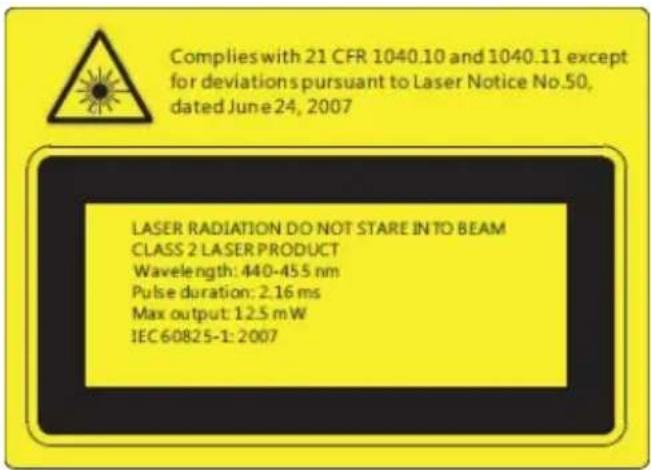
Complies with 21 CFR 1040.10 and 1040.11 except for deviations pursuant to Laser Notice No.50, dated June 24, 2007 LASER RADIATION DO NOT STARE IN TO BEAM CLASS 2 LASER PRODUCT Wavelength: 440-45.5 nm Pulse duration: 2.16 ms Max output: 12.5 mW IEC 60825-1: 2007WARNING
This projector is a Class 2 laser device that conforms with IEC - 60825-1:2007 and CFR 1040.10 and 1040.11.
- Class 2 laser product, Do Not Stare Into Beam.
- This projector has built-in Class 4 laser module. Disassembly or modification is very dangerous and should never be attempted.
Any operation or adjustment not specifically instructed by the user's - guide creates the risk of hazardous laser radiation exposure.
- Do not open or disassemble the projector as this may cause damage by the exposure of laser radiation.
- Do not stare into beam when the projector is on. The bright light may result in permanent eye damage.
- Without following the control, adjustment or operation procedure may cause damage by the exposure of laser radiation.
Adequate instructions for assembly, operation, and maintenance, - including clear warnings concerning precautions to avoid possible exposure to laser and collateral radiation in excess of the accessible emission limits in Class 2.
Ceiling Mount Installation6.5
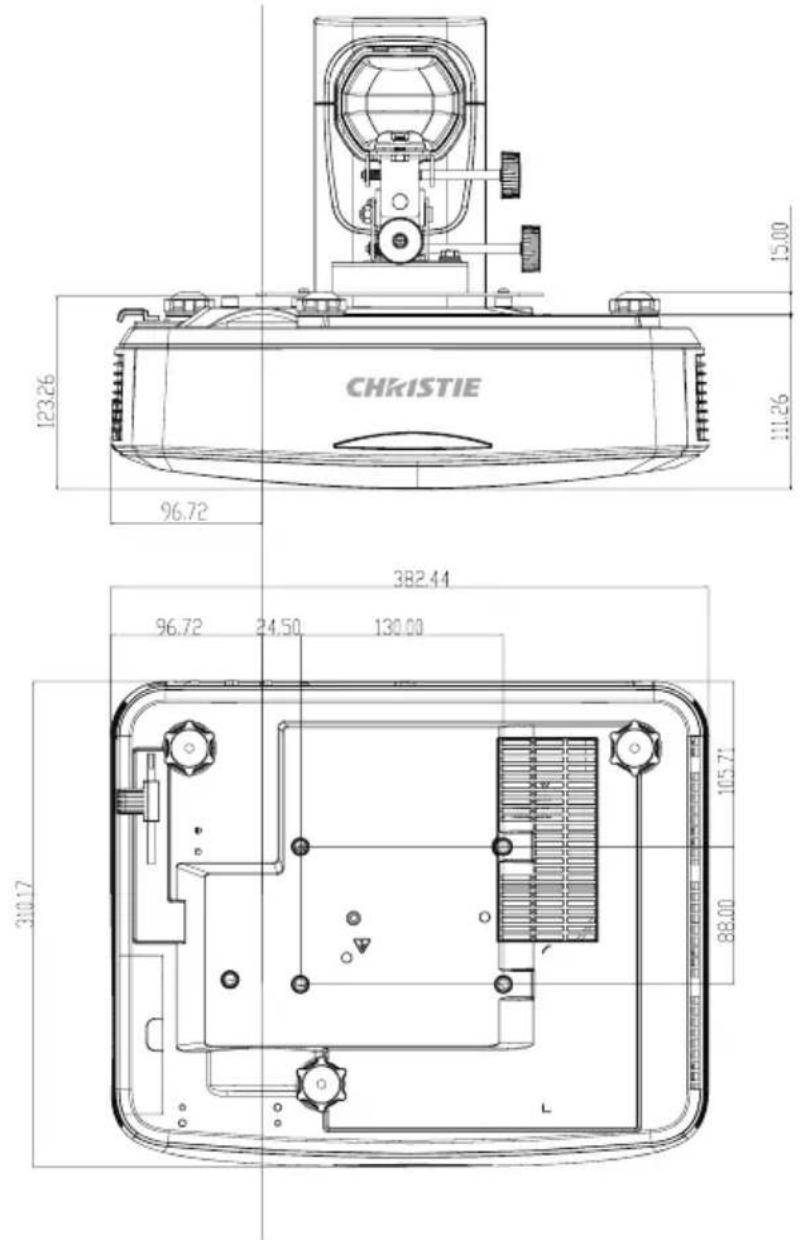
To prevent damage to your projector, please use ceiling mount (140-120104-01).1.
If you want to use a third-party ceiling mount kit, ensure the screws used to attach a 2. mount to the projector meet the following specifications:
- Screw type: M4*4
• Minimum screw length: 10mm
text_image
CHRISTIE 123.26 96.72 15.00 111.26 382.44 96.72 24.50 130.00 310.17 105.71 88.00 LNOTE:
◆ Damage resulting from incorrect installation will void the warranty.

WARNING
- If you buy a ceiling mount from another company, be sure to use the correct screw size. Screw size will vary depending on the thickness of the mounting plate.
- Be sure to keep at least 10 cm gap between the ceiling and the bottom of the projector. Avoid installing the projector near a heat source.
Corporate offices
USA-Cypress
ph:714-236-8610
Canada-Kitchener
ph:519-744-8005
Consultant offices
Italy
ph:+39(0)299021161
Worldwide offices
Australia
ph:+61(0)736244888
Brazil
ph: +55 (11) 2548 4753
China(Beijing)
ph:+861065610240
China(Shanghai)
ph:+862162787708
Eastern Europe and
Russian Federation
ph: +36 (0) 1 47 48 100
France
ph:+33(0)141214404
Germany
ph:+49 2161 664540
India
ph:+91(080)67089999
Japan
ph:81-3-3599-7481
Korea (Seoul)
ph:+82 27021601
Republic of South Africa
ph:+27(0)115100094
Singapore
ph:+656877-8737
Spain
ph:+34916339990
United Arab Emirates
phc+97143206688
United Kingdom
ph: +44 118 977 8000