
DD50 - Electronic drum YAMAHA - Free user manual and instructions
Find the device manual for free DD50 YAMAHA in PDF.


| Product type | Electronic drum |
| Brand | YAMAHA |
| Model | DD50 |
| Power supply | 6 C-type batteries (R14/SUM-2) or optional AC adapter (Yamaha PA-3/PA-3B) 10-12V DC |
| Number of pads | 7 drum pads |
| Number of pedals | 2 pedals (bass drum and hi-hat) |
| Number of voices | 75 drum and percussion voices |
| Number of kits | 20 preset kits + 1 custom kit |
| Number of songs | 100 accompaniment songs |
| Polyphony | 28 simultaneous notes |
| Main features | Reverb (3 levels), metronome, custom recording (600 notes), Break, A-B Repeat, Auto Kit Select, MIDI In/Out, headphone/Aux output |
| Connectivity | DC 10-12V jack, headphone/Aux output (6.35 mm jack), MIDI In/Out (DIN 5-pin), pedal inputs (x2) |
| Display | Digital segment display |
| Care and cleaning | Clean with a dry, soft cloth. A slightly damp cloth for stubborn dirt. Do not use alcohol or thinner. |
| Safety | Do not open the device, do not use an incompatible adapter, do not mix batteries, turn off before connections, avoid exposure to sunlight, heat, humidity, and dust. |
| Dimensions | Approximately 60 x 35 x 10 cm (estimated) |
| Weight | Approximately 2.5 kg (without batteries) |
| Included accessories | 2 pedals, 2 drumsticks, user manual |
Frequently Asked Questions - DD50 YAMAHA
User questions about DD50 YAMAHA
0 question about this device. Answer the ones you know or ask your own.
Ask a new question about this device
Download the instructions for your Electronic drum in PDF format for free! Find your manual DD50 - YAMAHA and take your electronic device back in hand. On this page are published all the documents necessary for the use of your device. DD50 by YAMAHA.
USER MANUAL DD50 YAMAHA
This product utilizes batteries or an external power supply (adaptor). DO NOT connect this product to any power supply or adaptor other than one described in the manual, on the name plate, or specifically recommended by Yamaha.
This product should be used only with the components supplied or; a cart, rack, or stand that is recommended by Yamaha. If a cart, etc., is used, please observe all safety markings and instructions that accompany the accessory product.
SPECIFICATIONS SUBJECT TO CHANGE:
The information contained in this manual is believed to be correct at the time of printing. However, Yamaha reserves the right to change or modify any of the specifications without notice or obligation to update existing units.
This product, either alone or in combination with an amplifier and headphones or speaker/s, may be capable of producing sound levels that could cause permanent hearing loss. DO NOT operate for long periods of time at a high volume level or at a level that is uncomfortable. If you experience any hearing loss or ringing in the ears, you should consult an audiologist. IMPORTANT: The louder the sound, the shorter the time period before damage occurs.
NOTICE:
Service charges incurred due to a lack of knowledge relating to how a function or effect works (when the unit is operating as designed) are not covered by the manufacturer's warranty, and are therefore the owners responsibility. Please study this manual carefully and consult your dealer before requesting service.
ENVIRONMENTAL ISSUES:
Yamaha strives to produce products that are both user safe and environmentally friendly. We sincerely believe that our products and the production methods used to produce them, meet these goals. In keeping with both the letter and the spirit of the law, we want you to be aware of the following:
Battery Notice:
This product MAY contain a small non-rechargeable battery which (if applicable) is soldered in place. The average life span of this type of battery is approximately five years. When replacement becomes necessary, contact a qualified service representative to perform the replacement.
This product may also use "household" type batteries. Some of these may be rechargeable. Make sure that the battery being charged is a rechargeable type and that the charger is intended for the battery being charged.
When installing batteries, do not mix batteries with new, or with batteries of a different type. Batteries MUST be installed correctly. Mismatches or incorrect installation may result in overheating and battery case rupture.
Warning:
Do not attempt to disassemble, or incinerate any battery. Keep all batteries away from children. Dispose of used batteries promptly and as regulated by the laws in your area. Note: Check with any retailer of household type batteries in your area for battery disposal information.
Disposal Notice:
Should this product become damaged beyond repair, or for some reason its useful life is considered to be at an end, please observe all local, state, and federal regulations that relate to the disposal of products that contain lead, batteries, plastics, etc. If your dealer is unable to assist you, please contact Yamaha directly.
NAME PLATE LOCATION:
The name plate is located on the bottom of the product. The model number, serial number, power requirements, etc., are located on this plate. You should record the model number, serial number, and the date of purchase in the spaces provided below and retain this manual as a permanent record of your purchase.
Model
Serial No.
Purchase Date
PLEASE KEEP THIS MANUAL
92-BP
FCC INFORMATION (U.S.A.)
IMPORTANT NOTICE: DO NOT MODIFY THIS UNIT!
This product, when installed as indicated in the instructions contained in this manual, meets FCC requirements. Modifications not expressly approved by Yamaha may void your authority, granted by the FCC, to use the product.
IMPORTANT:
When connecting this product to accessories and/or another product use only high quality shielded cables. Cable/s supplied with this product MUST be used. Follow all installation instructions. Failure to follow instructions could void your FCC authorization to use this product in the USA.
NOTE:
This product has been tested and found to comply with the requirements listed in FCC Regulations, Part 15 for Class "B" digital devices. Compliance with these requirements provides a reasonable level of assurance that your use of this product in a residential environment will not result in harmful interference with other electronic devices. This equipment generates/uses radio frequencies and, if not installed and used according to the instructions found in the users manual, may cause interference harmful to the operation of other electronic devices.
Compliance with FCC regulations does not guarantee that interference will not occur in all installations. If this product is found to be the source of interference, which can be determined by turning the unit "OFF" and "ON", please try to eliminate the problem by using one of the following measures:
- Relocate either this product or the device that is being affected by the interference.
- Utilize power outlets that are on different branch (circuit breaker or fuse) circuits or install AC line filter/s.
- In the case of radio or TV interference, relocate/reorient the antenna. If the antenna lead-in is 300 ohm ribbon lead, change the lead-in to co-axial type cable.
If these corrective measures do not produce satisfactory results, please contact the local retailer authorized to distribute this type of product. If you can not locate the appropriate retailer, please contact Yamaha Corporation of America, Electronic Service Division, 6600 Orangethorpe Ave, Buena Park, CA90620
- This applies only to products distributed by Yamaha Corporation of America.
The serial number of this product may be found on the bottom of the unit. You should note this serial number in the space provided below and retain this manual as a permanent record of your purchase to aid identification in the event of theft.
Model No. DD-50
Serial No.
Thank you for purchasing the Yamaha DD-50. The DD-50 has been developed to act and play like a drum set but with greater ease. Before you use the instrument, we recommend you to read through this manual.
Taking Care of Your DD-50
Your DD-50 will give you years of playing pleasure if you follow the simple rules given below:
Location
Do not expose the instrument to the following conditions to avoid deformation, discoloration, or more serious damage.
- Direct sunlight (e.g. near a window).
- High temperatures (e.g. near a heat source, outside, or in a car during the daytime).
- Excessive humidity.
- Excessive dust.
Strong vibration.
Power Supply
- Turn the power switch OFF when the instrument is not in use.
- An AC adaptor, if used (the DD-50 runs from either batteries or an optional AC adaptor), should be unplugged from the AC outlet if the instrument is not to be used for an extended period of time.
- Unplug the AC adaptor during electric storms.
- Avoid plugging the AC adaptor into the same AC outlet as appliances with high power consumption, such as electric heaters or ovens. Also avoid using multi-plug adaptors since these can result in reduced sound quality, operation errors, and possibly damage.
Turn Power OFF When Making Connections
- To avoid damage to the instrument and other devices to which it is connected, turn the power switches of all related devices OFF prior to connecting or disconnecting cables.
■ Handling and Transport
-
Never apply excessive force to the controls, connectors or other parts of the instrument.
-
Always unplug cables by gripping the plug firmly, not by pulling on the cable.
- Disconnect all cables before moving the instrument.
- Physical shocks caused by dropping, bumping, or placing heavy objects on the instrument can result in scratches and more serious damage.
■ Cleaning
- Clean the cabinet and panel with a dry soft cloth.
- A slightly damp cloth may be used to remove stubborn grime and dirt.
- Never use cleaners such as alcohol or thinner.
- Avoid placing vinyl objects on top of the instrument (vinyl can stick to and discolor the surface).
Electrical Interference
- This instrument contains digital circuitry and may cause interference if placed too close to radio or television receivers. If this occurs, move the instrument further away from the affected equipment.
Data Backup
- Custom data and some settings (see page 21) will be retained in memory even if the power switch is turned OFF as long as an AC power adaptor is connected or batteries are installed.
Service and Modification
- The DD-50 contains no user serviceable parts. Opening it or tampering with it in anyway can lead to irreparable damage and possibly electric shock. Refer all servicing to qualified YAMAHA personnel.
Table of Contents
Setting up the DD-50 3
Power Supply 3
When Using headphones (About the PHONES/AUX OUT jack) 3
Control Panel 4
Connecting the foot pedals 1/2 5
Supplied Accessories 5
Playing the Demo Song 6
MASTER VOLUME 6
SONG VOLUME 6
Play the Pads/Pedals 7
7
Assigning a Drum Kit to the Pads and Pedals 8
Assigning a Voice to Individual Pads and Pedals ("CU" Custom Kit) 8
REVERB ON/OFF 9
- Select the REVERB Depth 9
CLICK ON/OFF 9
Playing a SONG 10
Selecting a SONG 10
Auto Kit Select ON/OFF Setting. 10
Adjusting the TEMPO 11
Play along with a SONG 12
TRACK ON/OFF 12
TAP START 12
BREAK. 13
A-B REPEAT 14
Cancel the Repeat Points 14
Try Recording 15
RECORD 15
Playback 15
Using the MIDI/Utility Mode 16
What is MIDI? 16
What you can do with MIDI 16
Enter/Exit the MIDI/Utility Mode 17
Setting the Clock. 17
Local ON/OFF 18
Setting the MIDI Transmit Channel 18
Setting the MIDI Note Number 20
Initialize 21
Data Backup 21
Troubleshooting 22
Data 23
Drum Voice List 23
Drum Kit List 24
Song List 26
Drum Map 27
Specifications 28
MIDI Implementation Chart 29
Power Supply
Your DD-50 will run either from batteries or an optional power adaptor. Follow the instructions below according to the power source you intend to use.
Using an AC-Adaptor (sold separately)
Connect the optional power adaptor (Yamaha PA-3 or PA-3B) to the DC IN 10-12V jack located on the unit's left side panel, and plug the AC power adaptor into an AC power outlet.
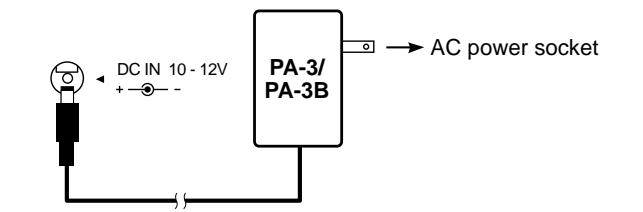

- Do not attempt to use an AC adaptor other than the PA-3 or PA-3B. Use of an incompatible adaptor may result in the instrument becoming hot or, irreparable damage to the DD-50. It may also result in fire. If the instrument is damaged due to use of an incompatible adaptor, YAMAHA is not responsible for the damage.
When Using Headphones (About the PHONES/AUX OUT Jack)
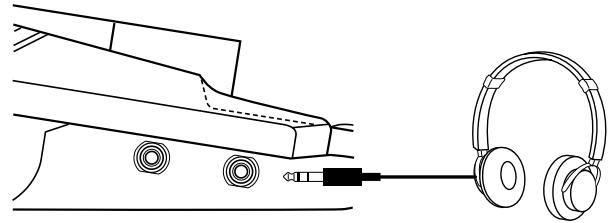
An optional set of stereo headphones (such as the Yamaha HPE-150 or HPE-3) can be connected to the PHONES/AUX OUT jack located on the side panel. When a pair of headphones is connected to the jack, the DD-50's internal speakers will switch off automatically, perfect for private practice or late night playing. If you want to use an external sound system, the headphone jack can also be used to connect the DD-50 to a stereo system or mixing console. (Use a standard plug pin plug adaptor to connect the DD-50 to a stereo system.)
- Turn the power OFF on all equipment before making any connections.
Installing Batteries
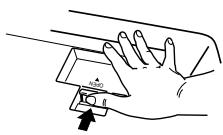
1 Open the battery compartment cover on the underside of the DD-50.
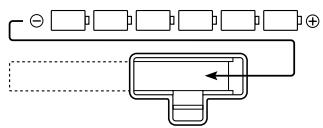
2 Insert six "C" size, R14, SUM-2 or equivalent batteries. When inserting the batteries, be careful to follow the polarity markings in the illustration.
3 Close the battery compartment cover securely.
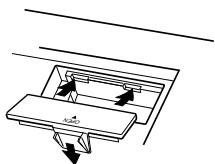

- Power will be automatically drawn from the AC adaptor if an optional AC adaptor is connected while batteries are installed in the instrument.

-
It is recommended that you replace worn batteries as soon as possible. When battery voltage drops, the DD-50's display will dim and/or the sound will become distorted. When this occurs, replace the batteries with a complete set of six new batteries of the same type.
-
NEVER mix old and new batteries, different types of batteries (alkaline, magnesium, etc.), batteries by different makers, or batteries from the same maker but of different types. Misuse may cause the instrument to become hot, result in fire, or battery leakage.
- Also, to prevent damage due to battery leakage, remove all of the batteries from the instrument when it is not to be used for an extended period of time. Batteries left in an unused instrument will also loose their power over time.
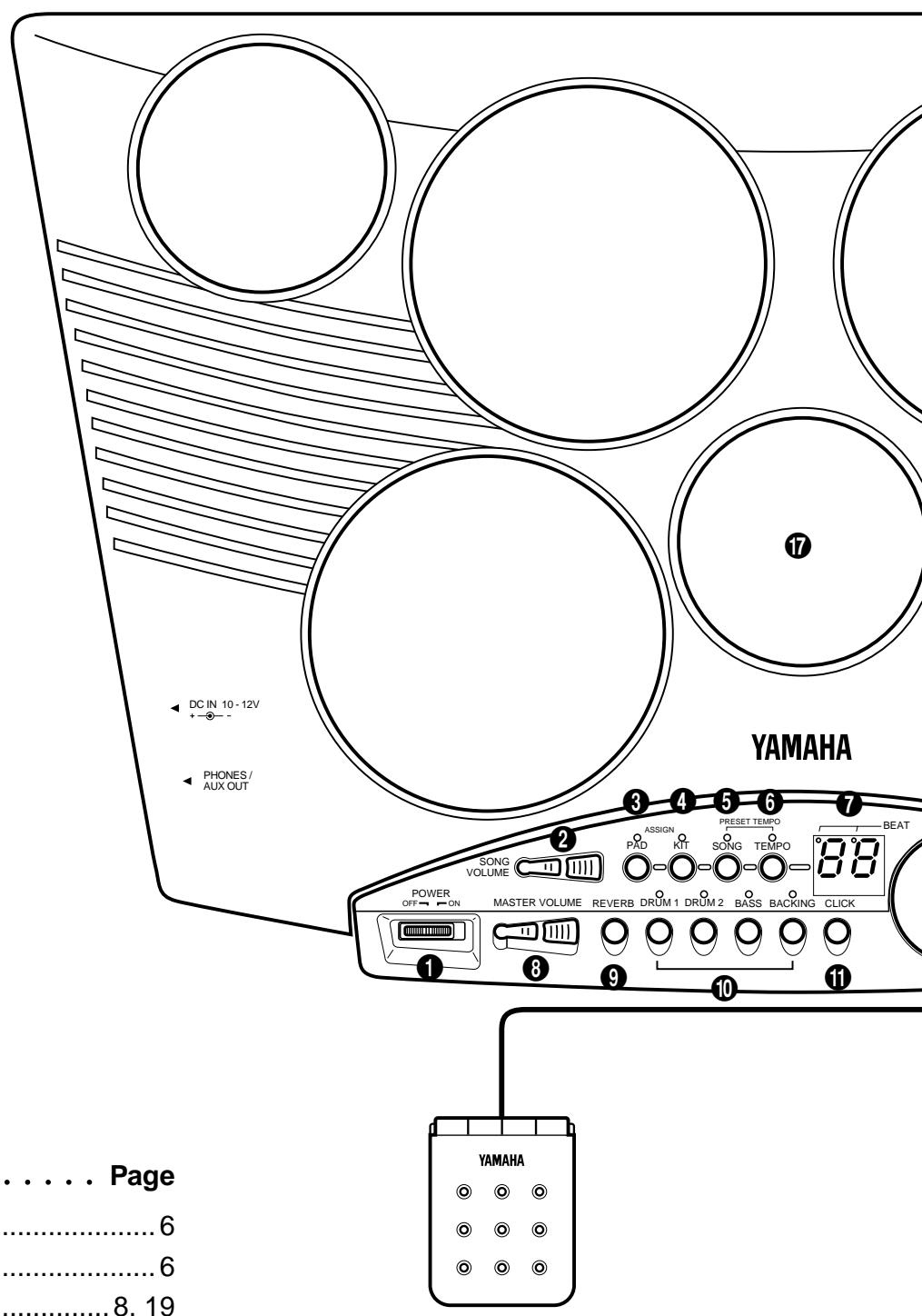
Front Panel Page
1 POWER ON/OFF Switch 6
2 SONG VOLUME buttons 6
PAD ASSIGN button 8,19
KIT ASSIGN button 8,20
SONG button 10
6 TEMPO button 11
7 Display 8
8 MASTER VOLUME buttons 6
9 REVERB button 9
10 Track buttons
DRUM 1 button 12, 17
DRUM2button 12,18
BASS button 12
BACKING button 11, 12
11 Click button 9
DIAL 8
8 START/STOP button 10
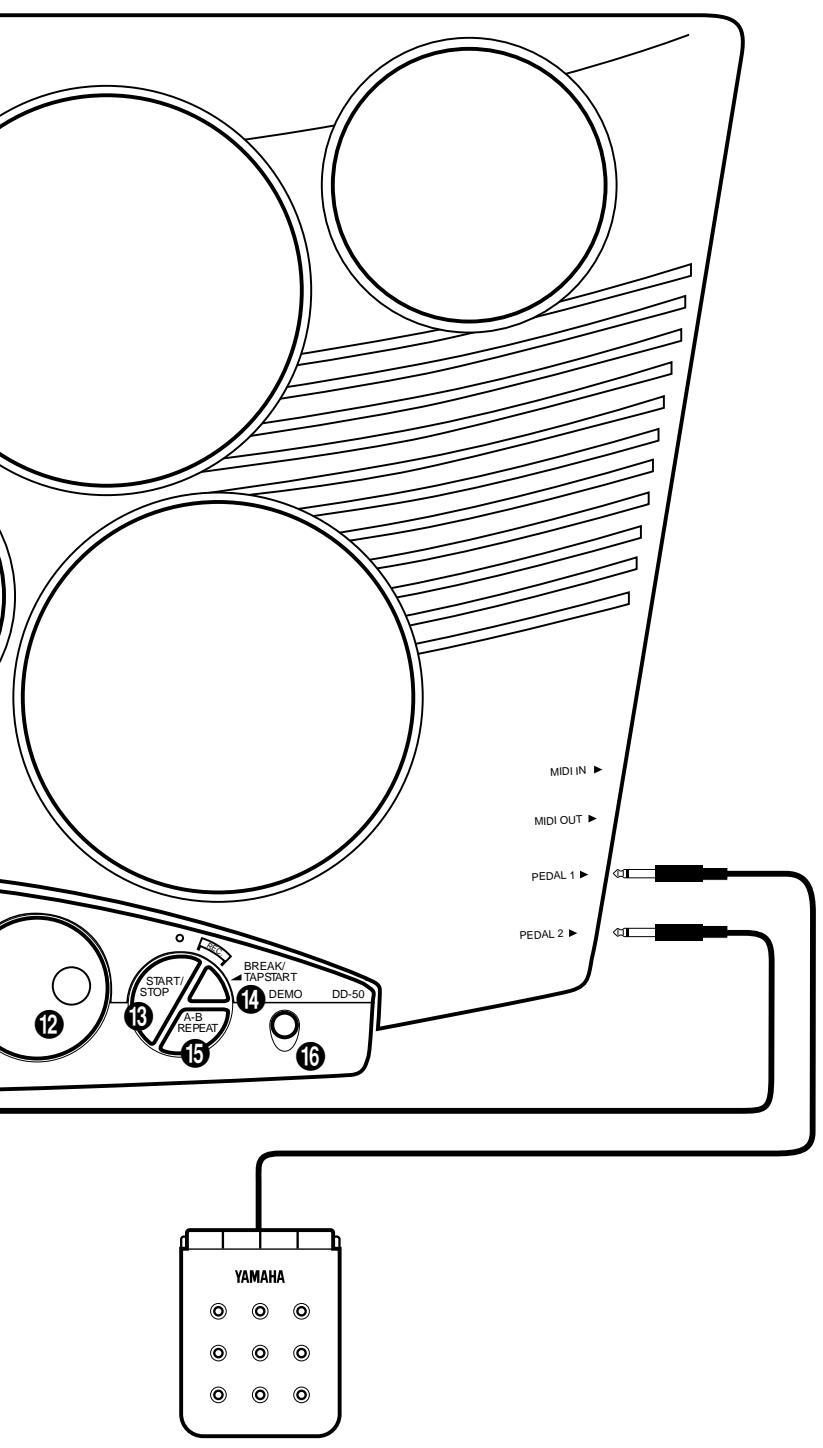
14 BREAK/TAP START button 12, 13
15 A-B REPEAT button 14
16 DEMO button 6
17 Drum Pads (x 7) 7
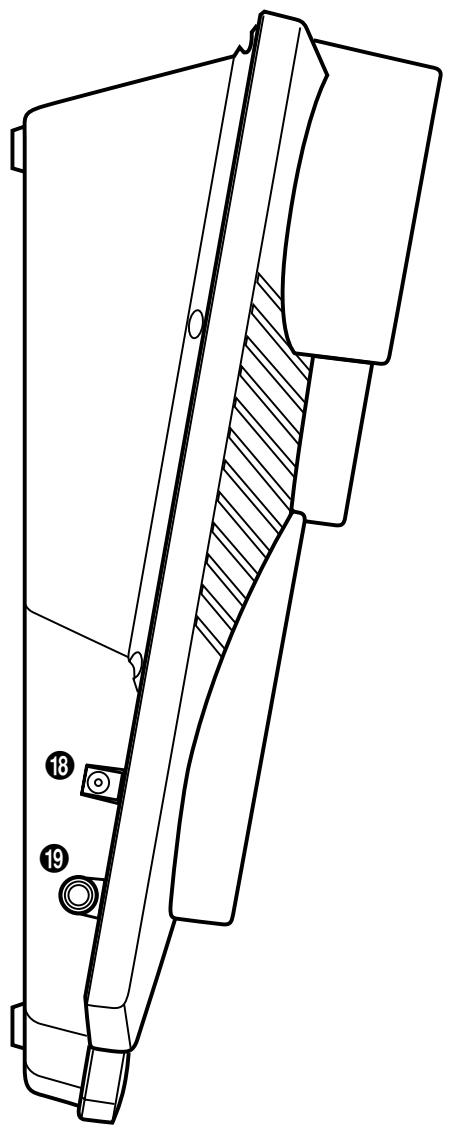
Side Panel (Left)
DC IN 10-12V (AC Adaptor) Jack
19 PHONES/AUX OUT Jack 3
Side Panel (Right)
20 MIDI IN/MIDI OUT Terminals 16
PEDAL 1/2 Jacks 5
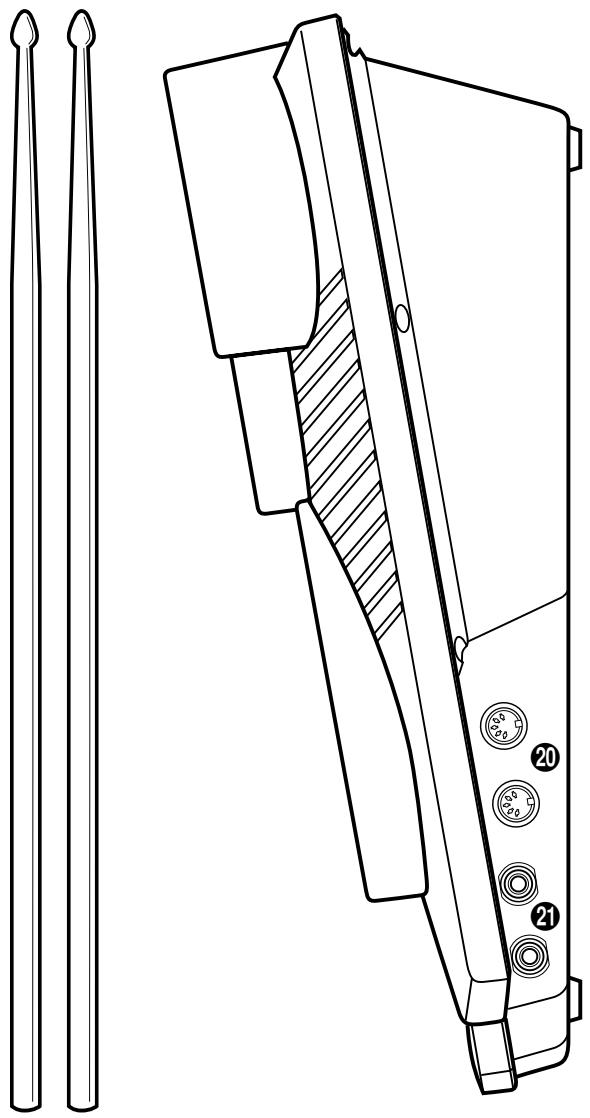
Connecting the Foot Pedals (1/2)
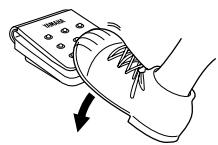
The supplied foot pedals can be connected to the DD-50 to similarly play the drum set's hi-hat pedal or bass drum voices or they can also be assigned to play other voices as well.
NOTES
- Do not press the pedal while connecting it to the DD-50 or while turning on the power. (Connecting in this manner with the power on, the pedal's function may be reversed.)
- Supplied Accessories
Foot Pedal x 2
Drum Stick x 2
Owner's Manual
To give you idea of the DD-50's possibilities, it comes with a demonstration song. To playback the demo song:
1 Turn on the power
Turn the [POWER] switch ON.
2 Start the Demo Song
Press the [DEMO] button, the demo song will start playback.
- MASTER VOLUME
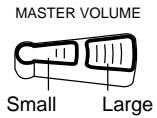
The overall volume level of the DD-50 is controlled by two [MAS-TER VOLUME] buttons (10 volume levels L0-L9).
Press the large [MASTER VOLUME] button to increase the overall volume by one level. Press the small [MASTER VOL-UME] button to decrease the overall volume one level. Holding down either of the buttons increases or decreases the volume level rapidly.
| L0 | <L5> | L9 |
| Small | <Volume Level> | Large |
*When the MASTER VOLUME is set to LO, the song's volume is silenced.
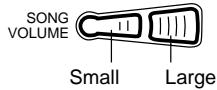
SONG VOLUME
The song's volume level is controlled by the two [SONG VOL-UME] buttons (10 volume levels L0-L9). (Demo Song, Song see page 10)
The SONG VOLUME can be used to adjust the balance between the song accompaniment and your own performance on the pads. Press the large [SONG VOLUME] button to increase the song volume by one level. Press the small [SONG VOLUME] button to decrease the song volume by one level. Holding either of the buttons increases or decreases the song volume level rapidly.
| L0 | <L5▶ | L9 |
| Small | <Volume Level▶ | Large |
- When the SONG VOLUME is set to L0, the song's volume is silenced.
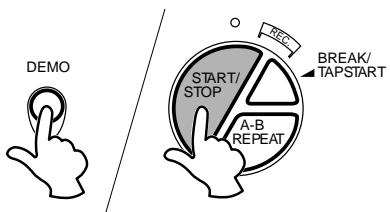
3 Stop the Demo Song
To stop playback, press either the [DEMO] button again or the [START/STOP] button.
Play the Pads/Pedals
Strike the pad with the supplied drum sticks to play the drum voices. Drum Kit "00" is automatically chosen whenever the power is turned on (see the "Drum Kit List" page 24).
Striking the pads with different force results in relatively loud or soft sounds accordingly. Loudness of the sound may vary according to which part of the pad is struck.
Pad Names
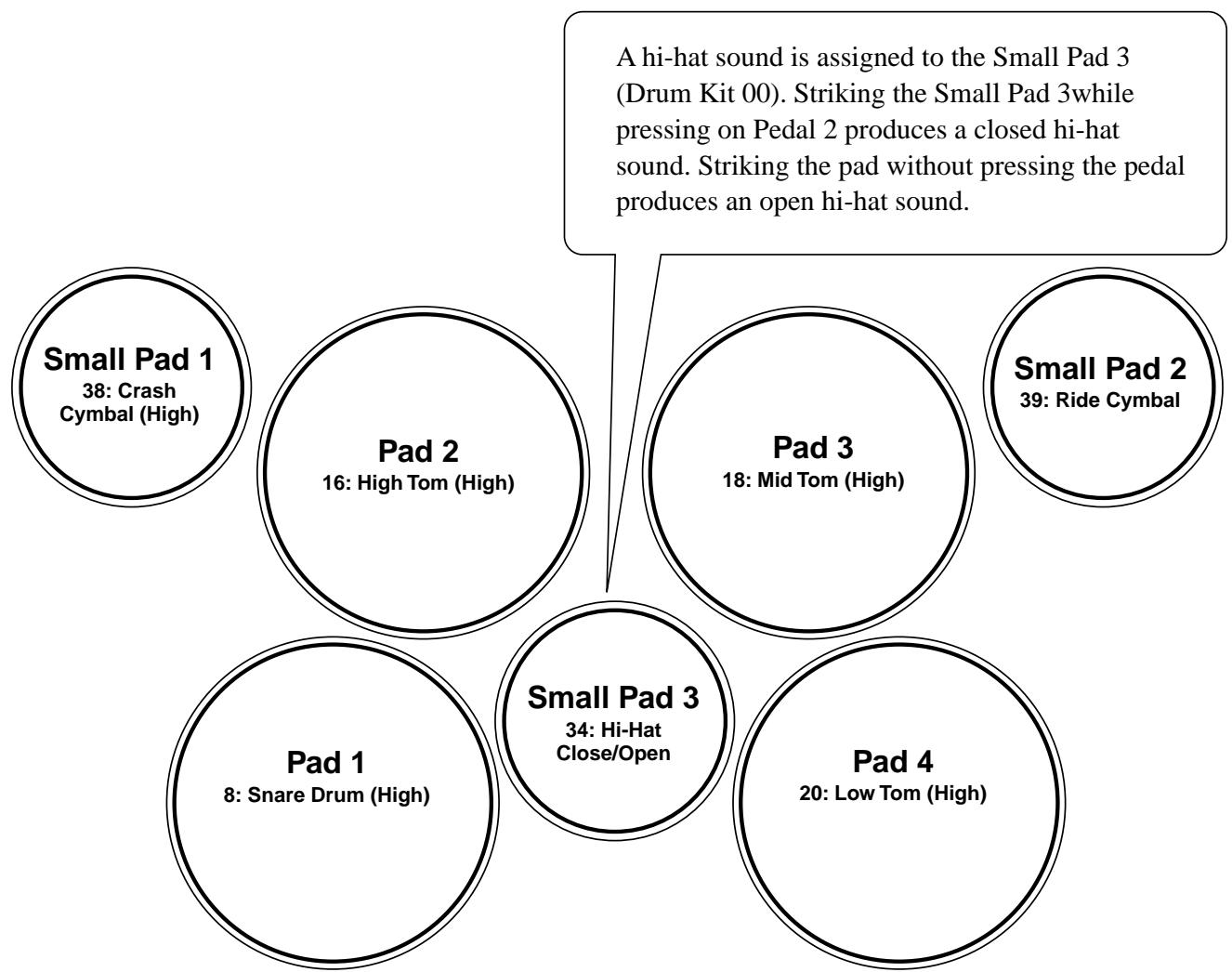
Pedal 2 : Hi-Hat Pedal
Ex. shown, Drum Kit 00 : Standard 1
The bass drum voice is controlled by pressing Foot Pedal 1. Use Foot Pedal 2 to control the Hi-hat. (This is in the case of Drum Kit 00.)
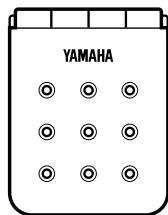
Pedal 1 1: Bass Drum (Mid)
Assigning a Drum Kit to the Pads and Pedals
The DD-50 allows you to choose from 20 different Drum Kits (00-19 : see the “Drum Kit List” page 24) quickly and easily. 20 of the kits have preset voice combinations that will be set to the pads and pedals when the kit is selected. Select some different kits and try playing them.
The DD-50 also has one Custom Drum Kit allowing you to assign the desired voices to the seven pads or two pedals (see "Assigning a Voice to Individual Pads and Pedals" below).
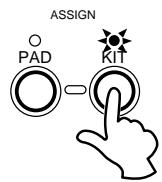
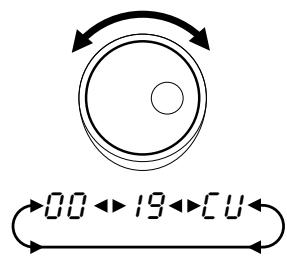
1 Press the [KIT ASSIGN] button
Pressing the [KIT ASSIGN] button, the button's lamp will light and the currently selected Drum Kit number appears on the display.
2 Select a Drum Kit Number
Turn the DIAL to select a Drum Kit number. Drum Kit numbers will increase as the DIAL is turned to the right (clockwise), and decrease as the DIAL is turned to the left (counter-clockwise).
NOTES
- Drum Kit number 00 is normally selected when the power is turned ON. However, if Auto Kit Select is set to OFF, the last Drum Kit selected before turning the power OFF, is automatically selected when the power is turned ON. (See "Auto Kit Select ON/OFF Setting" on page 11)
- The "CU" Drum Kit is the Custom Kit. Changes made to any one of the preset drum kits will be saved here. (See "Assigning a Voice to Individual Pads and Pedals" below.)
Assigning a Voice to Individual Pads and Pedals ("CU" Custom Kit)
The DD-50 contains a total of 75 high quality drum sounds (see the "Drum Voice List" page 23) that can be assigned to each of the 7 drum pads and 2 foot pedals. Try assigning some different voices to the "CU" Custom Drum Kit.
NOTES
- Any change made to one of the preset drum kits will automatically be saved in the "CU" Custom Drum Kit.
- Both the Custom and "00" drum kit contents are the same until modified (see the "Drum Kit List" page 24).
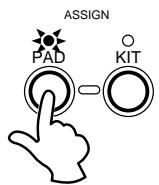
1 Press the [PAD ASSIGN] button
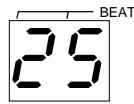
Press the [PAD ASSIGN] button, Pad 1's currently assigned voice number is shown in the display.
2 Select a Pad/Pedal
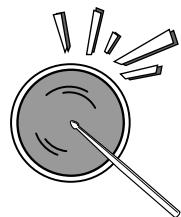
Strike any pad one time (or press a pedal), that pad's/pedal's currently assigned voice number is shown in the display.
3
Select a Voice Number
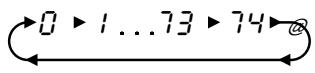
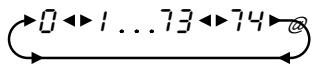
You can select the voice by repeatedly striking the pad, repeatedly pressing the pedal (while listening to the voice) or by turning the DIAL.
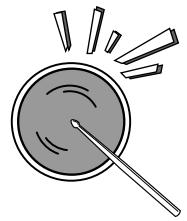
- Striking the pad or pressing the pedal to select a voice.
First, select a pad or pedal by striking or pressing it once. After the pad/pedal has been selected, every time the pad is struck or a pedal is pressed, voice numbers will increase by a value of one (1).
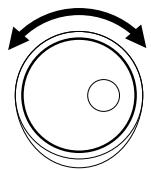
Using the DIAL to select a voice.
Turn the DIAL to the right (clockwise), and voice numbers will increase. Turn the DIAL to the left (counter-clockwise), and voice numbers will decrease.
4
Play the Pads and Pedals
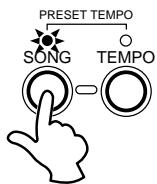
After assigning a voice to the desired pad/pedal, press the [SONG] button. You can now play the voice you have assigned to the pad/pedal.
Repeat the previous steps for any or all of the DD-50's pads and pedals and try playing your own original drum kit.
REVERB ON/OFF
REVERB
Different depths of the DD-50's reverb effect can be selected to add to the DD-50's overall sound.
To turn on the reverb effect, press the [REVERB] button. To turn off the reverb effect, press the [REVERB] button again.
- Select the REVERB Depth
EAT When the reverb has been turned on, press and hold the [REVERB] button, turn the DIAL to select one of the three reverb depths that appear in the display. [r1], [r2], [r3].
Selecting [r3] adds the most reverb depth to the effect.

- REVERB Depth data is not transmitted or received via MIDI.
CLICK ON/OFF
CLICK
The DD-50's CLICK feature produces a metronome click to make the tempo easier to follow and improve your timing while playing the pads.
To hear the metronome click, press the [CLICK] button. To turn the click off, press the button once again.
The DD-50 features 100 different songs that can be used to provide accompaniment (see the "Song List" page 26). Select one of the songs and have a listen.
Selecting a SONG
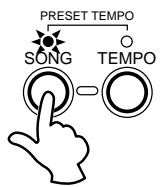
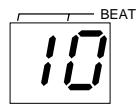
1 Press the [SONG] button
Press the [SONG] button, its LED indicator will light, and the currently selected song number will appear in the display.
![YAMAHA DD50 - Press the [SONG] button - 1](/content/2025/01/114547/images/e2790543af886feb71933652ce356ee82df78f2cf0ad7a3fe29cdc24a4157f3e.jpg)
2 Use the DIAL to select a song number
Song numbers will increase in value as the DIAL is turned to the right (clockwise) and decrease as the DIAL is turned to the left (counterclockwise). (See the "Song List" on page 26)

- Song number "00" is automatically selected whenever the power is turned ON.
- With the Auto Kit Select turned on, selecting a song will also automatically select the best suited Drum Kit for that song (see "Auto Kit Select ON/OFF Setting" below).
- Song numbers are arranged according to their complexity. Smaller numbers are easier to play than larger numbers.
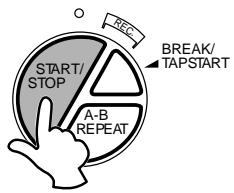
3 Press the [START/STOP] button
Press the [START/STOP] button, after a two-measure count-in (or one measure count-in), the song will start playback.
As the song is playing, the Song's current measure will be shown in the display. Try playing the pads and pedals along with the song.
To stop playback of the song, press the [START/STOP] button once again.
![YAMAHA DD50 - Press the [START/STOP] button - 1](/content/2025/01/114547/images/b8a0762b63fdf6d2aed94b602918992f8a8bd9de9e00cccb9a62cd164cbde05d.jpg)
- You can also use the TAP START function to start songs (see page 12).
![YAMAHA DD50 - Press the [START/STOP] button - 2](/content/2025/01/114547/images/102d5d445130928189e5e6237919e71f1a9b256c60781d0a18b69dfa06d3ccc7.jpg)
The DD-50's songs consists of two types, loop type and sequence type (see the "Song List" page 26).
Sequence type songs will automatically stop when the song reaches its end.
Loop type songs will continuously play from the time the [START/STOP] button is initially pressed, until the button is pressed once again.
Auto Kit Select ON/OFF Setting
The Auto Kit Select function automatically selects the best matching drum kit to the selected song. You can deactivate this feature by setting the Auto Kit Select to OFF.
1 Setting the Auto Kit Select to ON or OFF
Press the [DEMO] and [START/STOP] buttons simultaneously to enter the MIDI/Utility Mode.
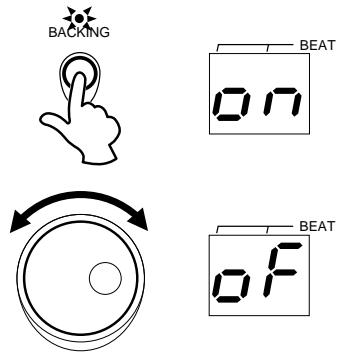
2 Select ON or OFF
Press the [BACKING] button and the current ON/OFF setting will appear in the display. Turn the DIAL to the right (clockwise) to activate the Auto Kit Select (on). Turn to the left (counter-clockwise) to deactivate the Auto Kit Select (oF).
3 Exit the Auto Kit Select
Press the [DEMO] and [START/STOP] buttons simultaneously once again to exit the MIDI/Utility Mode.

- The Auto Kit Select is automatically set to "OFF" when the MIDI Transmit Note is changed to another channel.
Adjusting the TEMPO
The song tempo can be set anywhere from 40 to 280 beats per minute. As tempo numbers increase, the tempo will become faster.
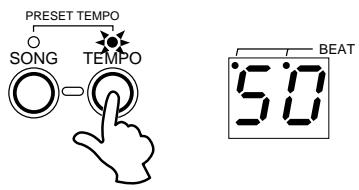
1 Press the [TEMPO] button
Press the [TEMPO] button, the current tempo value (40-280) appears in the display.
| Tempo | Display | Comment |
| J=90 | 90 | — |
| J=110 | ‘’0 | 100th digit (1) is shown as a single dot |
| J=250 | ‘’0 | 100th digit (2) is shown as two dots |
![YAMAHA DD50 - Press the [TEMPO] button - 1](/content/2025/01/114547/images/01b2e52cfce9a03a8102504945109a1690c6d2c42f8bec2e7dfdc72f5eaf4026.jpg)
2 Set the Tempo
Use the DIAL to select the TEMPO. Turn the DIAL to the right (clockwise) to increase Tempo values, turn to the left (counter-clockwise) to decrease Tempo values. (Tempo values will cycle to 40 or 280 then stop.)
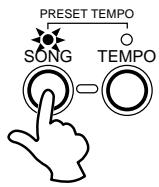
3 Exit the Tempo setting mode
Press the [SONG] button to exit from the Tempo setting mode.

- When both the SONG and TEMPO buttons are pressed simultaneously, the preset tempo of the currently selected song will automatically applied.
- About the Beat Indicator
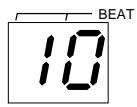
During song playback, the two beat lamps in the display will flash in a specific pattern to assist you in keeping the beat.
= 90 beats per minute.
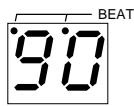
| 1st beat | 2nd beat | 3rd beat | 4th beat |
| 90 | 90 | 90 | 90 |
Use the pads and pedals to play along with a song accompaniment.
NOTES
- The DD-50 can play a total of 28 notes simultaneously. That includes notes produced by song accompaniment, pads, foot pedals, and note data received through the MIDI IN jack.
TRACK ON/OFF
The DD-50's song accompaniment consists of 4 tracks; Drum 1/2, Bass, and Backing tracks.
| DRUM 1 | Main Drum track |
| DRUM 2 | Main Percussion track |
| BASS | Bass track |
| BACKING | Main Backing Track |
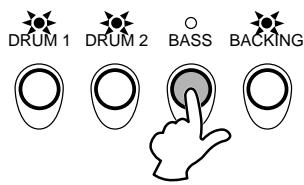
Pressing a Track button ([DRUM 1], [DRUM 2], [BASS], [BACKING]) will mute (turn off the sound) the corresponding track and its indicator lamp will turn off.
Muting DRUM 1 and DRUM 2 tracks allows you to practice your playing technique in Karaoke style (Minus One).
TAP START
The TAP START function allows you to set the song's overall tempo as well as start the accompaniment. The accompaniment will playback at the tempo with which the pads are struck or the pedals are pressed.
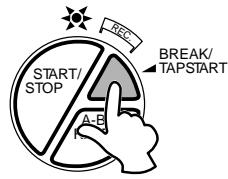
1 Press the [BREAK/TAP START] button
Press the [BREAK/TAP START] button when the song stops, its indicator will flash and the DD-50 is in Tap Start standby mode.
To cancel the Tap Start mode, simply press the [BREAK/TAP START] button once again (the indicator will turn off).
![YAMAHA DD50 - Press the [BREAK/TAP START] button - 1](/content/2025/01/114547/images/a627634d41e2b853e9d57e77464736d7eeff524f9d60b74ba3eb1bf3943749e6.jpg)
2 Tap Start
In the case of a song in 4/4 , strike any pad or press any pedal four times, the accompaniment will start at the desired tempo.
NOTES
- The number of times needed to strike the pad will change according to the following time signatures: 5/4, 5 times; 4/4, 4 times; 3/4, 3 times; 6/8, 2 times.
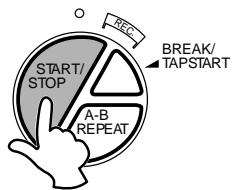
3 Stop the Song Playback
To stop playback, press the [START/STOP] button.
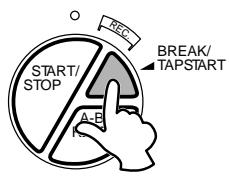
BREAK
With the BREAK function, you can liven up songs by adding your own solos or fills, whenever you want. Striking a pad while in the BREAK mode, the song's accompaniment will be muted until the end of the measure you have finished your fill or solo in.
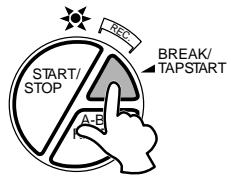
1 During song playback, press the BREAK/TAP START button
During song playback, press the [BREAK/TAP START] button, its indicator will flash and the DD-50 is in BREAK standby mode.
To cancel the Break mode, simply press the [BREAK/TAP START] button once again (its indicator will turn off).
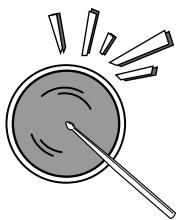
2 Break
Strike any pad and the accompaniment will mute until the end of the measure you played in. You can play a drum fill or drum solo during this break.
3 Exit the BREAK mode
The DD-50 returns to the BREAK standby mode when the BREAK measure is completed.
To exit the BREAK mode, press the [BREAK/TAP START] button.
The BREAK mode is also exited when the song is stopped.
A-B REPEAT
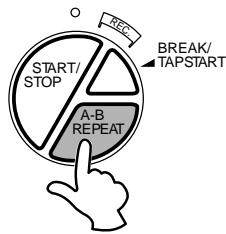
If you want to practice a particular section of a song, you can specify that section's "A" (start repeat) and "B" (end repeat) points. The accompaniment will continuously repeat between points "A" and "B" allowing you to practice between those points for as long as you like.
1 To set the "A" (start repeat) point
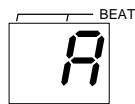
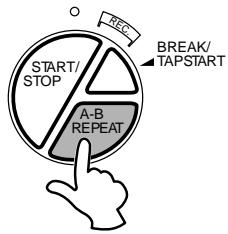
When the song playback has reached the start of the section you want to practice, press the [A-B REPEAT] button and the "A" repeat point is set. An "A" will appear in the display.
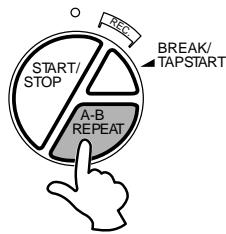
2 To set the "B" (end repeat) point
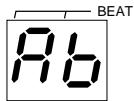
When the song playback has reached the end point of the section you want to practice, press the [A-B REPEAT] button once again and the A to B repeat points are set, "b" appears in the display. "Ab" will appear in the display and after a one measure count-in the repeat playback will start. The current measure number will appear in the display during the repeat playback.

- The A-B REPEAT start and end points can only be set in measure steps.
- Songs consist of two types; loop type and sequence type (see the "Song List" on page 26). When setting the A-B points for sequence songs, set both points before the end of the song. The set "A" point will be canceled if the "B" point is not set before the end of the song.
3 Stop the A-B REPEAT mode
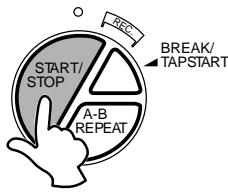
Press the [START/STOP] button and the song accompaniment will stop.
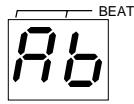
"Ab" will appear in the display indicating the A-B REPEAT mode is still engaged.
Press the [START/STOP] button once again and the accompaniment will again repeat between the set points.

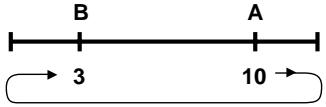
- In the case of a loop type song, it is possible, for example, to set the "A" point at measure 10 and set the "B" point at measure 3 (after the song has looped back to the beginning).
- Selecting another song will cancel any previously set A-B REPEAT points.
- Cancel the Repeat Points
To cancel the A-B REPEAT, press the [A-B REPEAT] button during playback or while playback is stopped, the A-B REPEAT mode will be canceled (the A-B REPEAT points will also be canceled) and normal playback of the accompaniment will continue.
The DD-50's Custom Song feature (song number "CU") allows you to record and playback one original song (600 notes approximately).
-
Data that can be recorded in the Custom Song Mode.
-
Drum pad and pedal data.
- Song data (the number cannot be changed while in the RECORD Mode).
- Track ON/OFF settings.
- Tempo setting (The tempo cannot be changed while in the RECORD mode).
- Song Volume setting.
- Reverb ON/OFF setting.
- Break ON/OFF setting.
- MIDI data cannot be recorded to the memory.
RECORD
1 Prepare to Record
Select the desired song, drum kit, tempo, track on/off setting, and reverb settings.
2 Start Recording
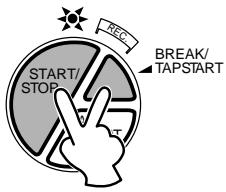
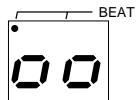
Press both the [START/STOP] and [BREAK/TAP START] buttons simultaneously, after a count-in (the indicator will flash) recording will start.

NOTES
- Data will not be recorded during the 2 measure count-in.
- Press the BREAK/TAP START button during the 2 measure count-in to enter Tap Start Record Standby mode (see page 12).
- Press the CLICK button to cancel the metronome during recording.
3 Stop Recording
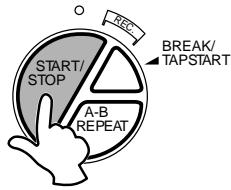
To stop recording, press the [START/STOP] button.
NOTES
- Any previously recorded data will be replaced with new data.
- If the memory becomes full while recording is in progress, "FL" will appear in the display and recording will automatically stop.
Playback
The recorded Custom Song (song number "CU") can be played back in the same manner as any song (song numbers "00"-99").
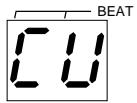
Song number "CU" follows Song number "99" (or prior to "00").
NOTES
- The A-B REPEAT mode (see 14 page) cannot be used in the Custom Song Mode.