
CBXK1 - Motorcycle YAMAHA - Free user manual and instructions
Find the device manual for free CBXK1 YAMAHA in PDF.


User questions about CBXK1 YAMAHA
0 question about this device. Answer the ones you know or ask your own.
Ask a new question about this device
Download the instructions for your Motorcycle in PDF format for free! Find your manual CBXK1 - YAMAHA and take your electronic device back in hand. On this page are published all the documents necessary for the use of your device. CBXK1 by YAMAHA.
USER MANUAL CBXK1 YAMAHA
This product, when installed as indicated in the instructions contained in this manual, meets FCC requirements. Modifications not expressly approved by Yamaha may void your authority, granted by the FCC, to use the product.
IMPORTANT:
When connecting this product to accessories and/or another product use only high quality shielded cables. Cable/s supplied with this product MUST be used. Follow all installation instructions. Failure to follow instructions could void your FCC authorization to use this product in the USA.
NOTE:
This product has been tested and found to comply with the requirements listed in FCC Regulations, Part 15 for Class “B” digital devices. Compliance with these requirements provides a reasonable level of assurance that your use of this product in a residential environment will not result in harmful interference with other electronic devices. This equipment generates/uses radio frequencies and, if not installed and used according to the instructions found in the user's manual, may cause interference harmful to the operation of other electronic devices. Compliance with FCC regulations does not guarantee that interference will not occur in all installations. If this product is found to be the source of interference, which can be determined by turning the unit “OFF” and “ON”, please try to eliminate the problem by using one of the following measures:
- Relocate either this product or the device that is being affected by the interference.
- Utilize power outlets that are on different branch (circuit breaker or fuse) circuits or install AC line filter/s.
- In the case of radio or TV interference, relocate/reorient the antenna. If the antenna lead-in is 300 ohm ribbon lead, change the lead-in to co-axial type cable.
If these corrective measures do not produce satisfactory results, please contact the local retailer authorized to distribute this type of product. If you can not locate the appropriate, please contact Yamaha Corporation of America, Electronic Service Division, 6600 Orangethorpe Ave, Buena Park CA, 90620
- This applies only to products distributed by Yamaha Corporation of America.
CANADA
THIS DIGITAL APPARATUS DOES NOT EXCEED THE “CLASS B” LIMITS FOR RADIO NOISE EMISSIONS FROM DIGITAL APPARATUS SET OUT IN THE RADIO INTERFERENCE REGULATION OF THE CANADIAN DEPARTMENT OF COMMUNICATIONS.
LE PRESENT APPAREIL NUMERIQUE N'EMET PAS DE BRUITS RADIOELECTRIQUES DEPASSANT LES LIMITES APPLICABLES AUX APPAREILS NUMERIQUES DE LA "CLASSE B" PRESCRITES DANS LE REGLEMENT SUR LE BROUILLAGE RADIOELECTRIQUE EDICTE PAR LE MINISTERE DES COMMUNICATIONS DU CANADA.
This product complies with the radio frequency interference requirements of the Council Directive 82/499/EEC and/or 87/308/EEC.
This product utilizes batteries or an external power supply (adapter). DO NOT connect this product to any power supply or adapter other than one described in the manual, on the name plate, or specifically recommended by Yamaha.
This product should be used only with the components supplied or; a cart, rack, or stand that is recommended by Yamaha. If a cart, etc., is used, please observe all safety markings and instructions that accompany the accessory product.
SPECIFICATIONS SUBJECT TO CHANGE:
The information contained in this manual is believed to be correct at the time of printing. However, Yamaha reserves the right to change or modify any of the specifications without notice or obligation to update existing units.
This product, either alone or in combination with an amplifier and headphones or speaker/s, may be capable of producing sound levels that could cause permanent hearing loss. DO NOT operate for long periods of time at a high volume level or at a level that is uncomfortable. If you experience any hearing loss or ringing in the ears, you should consult an audiologist. IMPORTANT: The louder the sound, the shorter the time period before damage occurs.
NOTICE:
Service charges incurred due to lack of knowledge relating to how a function or effect works (when the unit is operating as designed) are not covered by the manufacturer's warranty, and are therefore the owners responsibility. Please study this manual carefully and consult your dealer before requesting service.
ENVIRONMENTAL ISSUES:
Yamaha strives to produce products that are both user safe and environmentally friendly. We sincerely believe that our products and the production methods used to produce them, meet these goals. In keeping with both the letter and the spirit of the law, we want you to be aware of the following:
Battery Notice:
This product MAY contain a small non-rechargeable battery which (if applicable) is soldered in place. The average life span of this type of battery is approximately five years. When replacement becomes necessary, contact a qualified service representative to perform the replacement.
This product may also use “household” type batteries. Some of these may be rechargeable. Make sure that the battery being charged is a rechargeable type and that the charger is intended for the battery being charged.
When installing batteries, do not mix old batteries with new, or with batteries of a different type.
Batteries MUST be installed correctly. Mismatches or incorrect installation may result in overheating and battery case rupture.
Warning:
Do not attempt to disassemble, or incinerate any battery. Keep all batteries away from children.
Dispose of used batteries promptly and as regulated by the laws in your area. Note: Check with any retailer of household type batteries in your area for battery disposal information.
Disposal Notice:
Should this product become damaged beyond repair, or for some reason its useful life is considered to be at an end, please observe all local, state, and federal regulations that relate to the disposal of products that contain lead, batteries, plastics, etc. If your dealer is unable to assist you, please contact Yamaha directly.
NAME PLATE LOCATION:
The name plate is located on the bottom of the product. The model number, serial number, power requirements, etc., are located on this plate. You should record the model number, serial number, and the date of purchase in the spaces provided below and retain this manual as a permanent record of your purchase.
Model CBX-K1
Serial No. ____
Purchase Date ____
PLEASE KEEP THIS MANUAL
Welcome to the CBX-K1
Congratulations and thank you for purchasing the Yamaha CBX-K1 MIDI Keyboard!
The CBX-K1 is a sophisticated, yet compact MIDI keyboard controller, for use with computers and MIDI music systems. It allows you to play connected tone generators and rhythm machines, and enter performance data to sequencers and computers. It features a sophisticated touch-sensitive keyboard that can be adjusted to cover the full 128-note MIDI range. It also provides a wealth of MIDI controls that allow you to send virtually any MIDI message directly from the keyboard. Moreover, the CBX-K1 has a versatile ASSIGNABLE Wheel that lets you control a wide variety of parameters on your connected tone generator or sequencer in real time. Because of its exceptionally portable size, convenient battery/AC adaptor power supply, compatibility with General MIDI (GM) and XG, and extraordinarily powerful and comprehensive MIDI control functions, the CBX-K1 is an invaluable tool — a MIDI Swiss army knife, of sorts — for all MIDI musicians and performers.
IMPORTANT ■ The CBX-K1 does not contain an internal tone generator. In order to play sounds from the CBX-K1, you need an external tone generator, such as the Yamaha MU series or TG series tone generators.
NOTE ■ The many MIDI functions and features of the CBX-K1 may not be supported by your particular MIDI device. Be sure to refer to the owner's manual of your particular MIDI device when using it with the CBX-K1.
Table of Contents
The CBX-K1 — What It Is and What It Can Do ..... 1
Precautions 2
How to Use This Manual 3
Specifications 3
Panel Controls and Terminals 4
■ Front Panel 4
● Note Range of the CBX-K1 ....5
■ Rear Panel 6
● Default Settings of the CBX-K1 ..... 6
Power Supply 7
■ Using a Power Adaptor 7
■ Using Batteries ....7
■ When to Replace the Batteries .....7
Guided Tour
Setting Up Your CBX-K1 8
What You'll Need 8
Setup Examples 8
Making the Connections 9
Using the CBX-K1 — Basic Operations ..... 10
Playing the Keyboard and Other Operations .....10
Using the SHIFT-Related Functions .....12
● Basic Operations ..... 13
Setting the Functions 14
● Group A Operations ..... 14
● Group B Operations ..... 16
Reference
Group A Functions 18
Group B Functions 20
ASSIGNABLE Wheel — Controller Number List .... 22
Troubleshooting 23
MIDI Data Format 24
MIDI Implementation Chart 26
What It Is
The CBX-K1 is a compact, highly portable 37-key MIDI keyboard, designed especially for use with computers and MIDI music systems. The CBX-K1 does not generate any sound itself, but can be used as a keyboard controller for playing sounds on a connected tone generator or rhythm machine. It's also ideal for recording to sequencers and computers. The keyboard is touch-sensitive and its octave range can be changed to cover the full 128-note MIDI range.
The true power and flexibility of the CBX-K1 is in its comprehensive MIDI controls. The CBX-K1 allows you to send virtually any type of MIDI message to connected MIDI devices. Pre-programmed commands provide easy control of basic sequencer/rhythm machine functions such as Start, Stop, Tempo and Song Select, while comprehensive program change commands let you easily select program banks and voices.
Most importantly, though, the CBX-K1 has an ASSIGNABLE Wheel that can be set for control of any controller number. This means that you can use the ASSIGNABLE Wheel to control a wide variety of parameters on your connected tone generator — such as Volume, Pan, Brightness, and the Depth of various effects — in real time. This gives you expressive control over different aspects of the sound in live performance.
The CBX-K1 is also the latest instrument in the Yamaha line to support the XG format, a new addition to the General MIDI standard. In short, XG provides for more instrument sounds and variations, and greater expressive control over voices and effects. With the use of the ASSIGNABLE Wheel on the CBX-K1, you have direct real-time control over many of these newly supported functions and parameters.
What It Can Do
Here are a few application ideas on how you can use the CBX-K1. The list below is not comprehensive, but is meant to be a general guide to the possibilities and provide a starting point or springboard for your own creative ideas and explorations.
● Using With a MIDI Tone Generator
In one of the most basic setups, you can play a connected tone generator from the CBX-K1. Because it's so compact and portable, you can even use it as a hand-held keyboard for live performance.
● Using as a Second Keyboard or Dedicated MIDI Controller
The CBX-K1 is small enough to fit on top of nearly any keyboard, making it perfect as a second keyboard. Since the CBX-K1 has a MIDI IN terminal, you can connect it between your main keyboard and your tone generator, and use the extensive MIDI capabilities of the CBX-K1 for greater expressive control during your performance.
● Using in a MIDI Music System
Combined with a laptop computer and a compact tone generator (like the General MIDI/XG-compatible Yamaha MU80), the CBX-K1 gives you comprehensive music making power — for recording, composing, arranging, practicing, and editing — in a portable system that’s ready to go wherever you go. The CBX-K1 is an ideal addition to larger MIDI studios as well, since it provides far greater MIDI control and flexibility than nearly any other keyboard controller. Use it along side your main MIDI keyboard as a kind of MIDI Swiss army knife — sending necessary MIDI messages, working the real-time controllers, or editing already recorded sequencer tracks.
- Multimedia
Since it's portable and compatible with the General MIDI and XG formats, the CBX-K1 is a natural for multimedia applications. Because of its ease of use and comprehensive functions, it's the only keyboard you'll ever need for recording and editing MIDI data on your multimedia creations.
Your CBX-K1 will give you years of reliable service if you follow the simple precautions below:
- LOCATION
Keep the instrument away from locations where it is likely to be exposed to high temperatures (such as direct sunlight) or humidity. Also avoid locations which are subject to excessive dust accumulation or vibration which could damage the instrument.
● USE THE CORRECT POWER ADAPTOR
Use only the recommended PA-1B or PA-3 Power Adaptor for supplying power. Use of another adaptor may cause serious damage to the instrument or the adaptor itself. Also avoid using a multiple-plug adaptor; plug the adaptor directly into a wall outlet.
● MAKE SURE POWER IS OFF WHEN MAKING OR REMOVING CONNECTIONS
To prevent damage to the instrument and other connected equipment, always turn off the power prior to connecting or disconnecting cables. Also, turn the power off when the instrument is not in use, and disconnect the power adaptor during electric storms.
● NO MEMORY BACKUP
The CBX-K1 has no internal memory backup. As a result, all settings are returned to the factory default when turning the power off.
● HANDLE THE INSTRUMENT WITH CARE
Although the instrument has been constructed to withstand the rigors of normal use for optimum sturdiness and reliability, avoid subjecting it to strong physical shocks (such as dropping or hitting it). Since the CBX-K1 is a precision-made electronic device, also avoid applying excessive force to the various controls. When moving the instrument, first unplug the power adaptor and all other cables to prevent damage to cords and jacks. Always unplug cables by gripping the plug firmly, not by pulling on the cable.
● CLEAN WITH A SOFT, DRY CLOTH
Never use solvents such as benzine or thinner to clean the instrument, since these will damage the cabinet finish or dull the keys. Wipe clean with a soft, dry cloth. If necessary, use a soft, clean, slightly moistened cloth — making sure to wipe the instrument off again with a dry cloth. Do not leave vinyl on the panel as this may stick to and discolor the surface.
● ELECTROMAGNETIC INTERFERENCE
Avoid using the unit near televisions, radios or other equipment generating electromagnetic fields. Proximity to such equipment may cause the unit to malfunction, and may generate interference noise in the other appliance as well.
● DO NOT OPEN THE CASE OR TRY REPAIRING THE INSTRUMENT YOURSELF
The instrument contains no user-serviceable parts. Never open the case or tamper with the internal circuitry in any way, since doing so may result in damage to the instrument. Refer all servicing to qualified Yamaha service personnel.
● MIDI CABLES
When connecting the instrument to other MIDI equipment, be sure to use only high-quality cables made especially for MIDI data transmission. Also, avoid using cables longer than 15 meters, since long cables can result in data errors.
Yamaha is not responsible for damage caused by improper handling or operation.
By and large, the CBX-K1 is very easy to use and this manual is self-explanatory. However, we strongly recommend that you take time to read the manual — especially before trying some of the more sophisticated MIDI functions. Read through all of the initial sections first, then go on to the “Guided Tour” to set up your CBX-K1, learn how to use its various functions, and try out some of the practical application examples to help you become more familiar with its operations. For those who need to delve deeper, the “Reference” section provides at-a-glance information and important details on all functions.
The following conventions are used throughout this manual:
* Panel buttons and controls are indicated as they appear on the actual instrument. (For example, SHIFT) and OCTAVE SHIFT ▶.
* The functions and features assigned to the keyboard are shown like this: BANK SELECT and MIDI CH.
* Unless indicated otherwise, ENTER refers to either of the ENTER keys, HEXADECIMAL ENTER or DECIMAL ENTER. However, when you wish to enter a decimal value, make sure to press DECIMAL ENTER. Likewise, when entering a hexadecimal number, make sure to press HEXADECIMAL ENTER.
* Actual MIDI data messages (in hexadecimal) are indicated as follows: <
* Operation steps are indicated as follows:
| Example | Actual Operation |
| SHIFT + START | While holding down the SHIFT button, press START (D2). |
| SHIFT + GM ON → ENTER | While holding down the SHIFT button, first press GM ON (F#2), then press ENTER (either HEXADECIMAL ENTER or DECIMAL ENTER). |
Specifications
● Keyboard
37 mini key keyboard (C2-C5), velocity responsive
● Functions
Basic: Octave Shift (+/- 4 octaves), Pitch Bend, Assignable control, MIDI Merge (MIDI IN)
MIDI Data: Sequencer control, MIDI clock, Bank Select, Program Change, GM System On, XG System On, GM-B Reset, Control Change, All Sound Off, Reset All Controllers, and others
Assignable Parameters: Transpose (+/- 12 semitones), MIDI Transmit Channel, Fixed Velocity, Touch Sensitivity, Device Number, Merge On/Off (each channel)
● Panel Controls and Indicators
SHIFT button, OCTAVE SHIFT ◀/▶ buttons and lamps, PITCH Wheel, ASSIGNABLE Wheel, POWER ON/OFF switch
● Input/Output Terminals
MIDI IN, MIDI OUT, DC IN
● Power Supply
Yamaha PA-3 or PA-1B AC Power Adaptor (sold separately), or six “AA” size, SUM-3, R-6 or equivalent batteries (sold separately).
● Power Consumption
Approximately 35 mA (with battery use); approximately 2 W (with AC adaptor use).
● Dimensions (W x D x H)
509 x 155 x 55 mm (20-1/16" x 6-1/8" x 2-3/16")
● Weight (without batteries)
1.3 kg (2 lbs., 14 oz.)
■ Front Panel
text_image
2 3 7 PITCH ASSIGNABLE CONTROLLER NUMBER LIST 1 EQUITY CONTROL 1. EQUITY CONTROL 2. BREATH CONTROL 4. FOOT CONTROL 5. PORTAMENTO TIME 6. DATA ENTRY 7. MAIN VOLUME 8. BALANCE CONTROL 10. PAPOT 11. EXPRESSION 64. HOLD/(DAIPER) 65. PORTAMENTO 66. SOSTEN/(TO/CHORD HOLD) 67. SOFT PEAL 69. HOLD/(FREEZE) 71. HAMBONIC CONTENT 72. RELEASE TIME 73. ATTACK TIME 74. BRIGHTNESS 64. PORTAMENTO CONTROL 61. REVERB DEPTH 62. TRIMULO DEPTH 63. CHORDUS DEPTH 64. VARIATION DEPTH 65. PHASER DEPTH (RPN) 120. PITCH BEND SENSITIVITY 121. FINE TUNING 122. COARSE TUNING (NPPN) 123. VIBRATO RATE 124. VIBRATO DEPTH 125. VIBRATO DELAY 126. FILTER CUTOFF FREQUENCY 127. FILTER RESONANCE 128. EG ATTACK TIME 129. EG DECAV TIME 130. EG RELEASE TIME 131. DRUM FILTER CUTOFF FREQUENCY 132. DRUM FILTER RESONANCE 133. DRUM EG ATTACK RATE 134. DRUM EG DECAV RATE 135. DRUM PITCH COARSE 136. DRUM PITCH PINE 137. DRUM LEVELS 138. DRUM FINA 139. DRUM REVERB DEPTH 140. DRUM CHORDUS DEPTH 141. DRUM VARIATION DEPTH 142. CHANNEL PRESSURE 143. POLYPORANIC KEY PRESSURE 144. MASTER VOLUME 145. MASTER BALANCE 146. MASTER TUNING 147. VELOCITY 148. TEMPO MIDI KEYBOARD CBX-K1 YAMAHA STOP CONTINUE START TEMPO BANK PROGRAM CHANGE GM SOUND ON OFF XG MERCE ON/OFF MDI FIXED VELOCITY RPN CONTROLLER NRPN DRUM NUMBER 1 2 3 4 5 6 7 8 9 A B C D E F 0 HEXA DECIMAL DECIMAL STOP OUTAVE OCTAVE RESET OCTAVE RESET① Keyboard
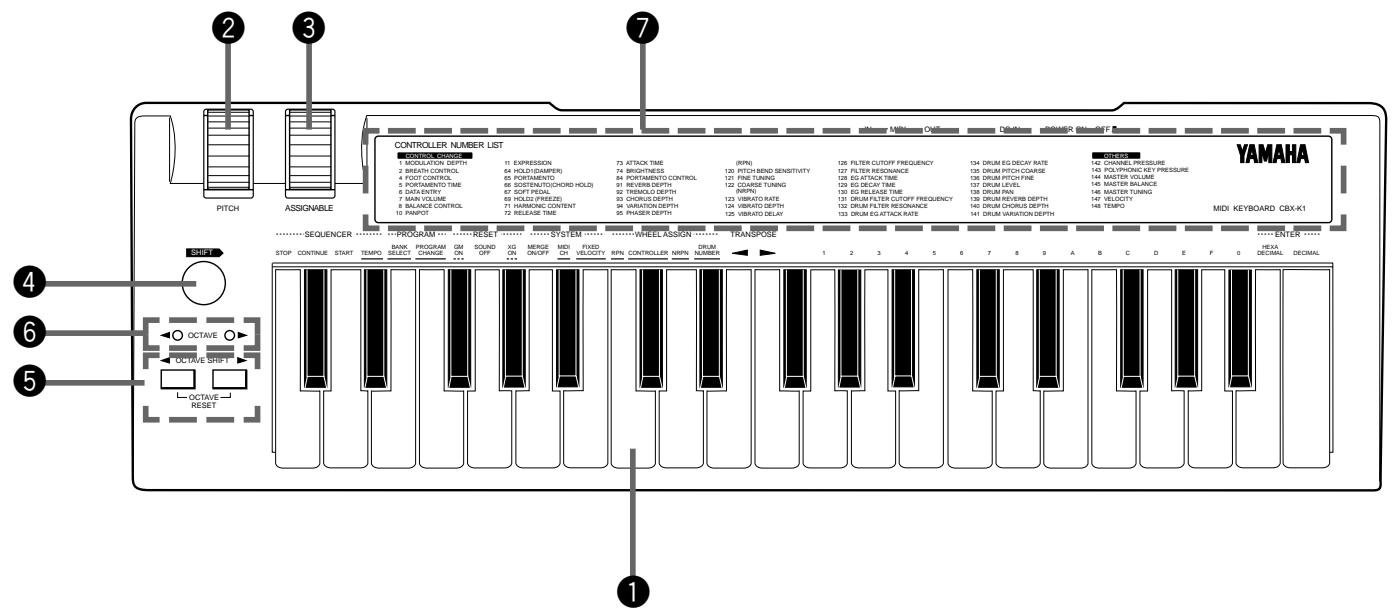
The CBX-K1 has a 37-key, 3-octave keyboard (C2 to C5), featuring initial touch (velocity) control. All note on, note off and velocity data is transmitted via the MIDI OUT terminal. When used with the SHIFT button, the keys are used for changing various settings and sending special MIDI messages. (See page 12.)
About the Functions of the CBX-K1: The functions are divided into two groups: Group A and Group B. The Group A functions are shown on the panel, above the left section of the keyboard. The Group B functions are “hidden” and are listed on pages 12 and 20. Several functions can be used by pressing only the relevant key; in other words, pressing ENTER is not necessary. These functions, such as Sequencer Stop and Start, are shown on the panel without underline. The right section of the keyboard serves as value entry and is used for those functions whose names are underlined on the panel and require value entry, such as Program Change and Tempo. Functions whose names appear with a dashed underline on the panel (for example, GM ON and XG ON) require pressing ENTER. Value entry on the CBX-K1 can be done in two number systems: Decimal and Hexadecimal. The keys labeled A through F are for Hexadecimal entry.
NOTE ■ The normal (default) velocity range of the CBX-K1 is from 16 to 127. The range differs according to the Touch Sensitivity setting (see page 20).
② PITCH Wheel (Pitch Bend)
This spring-loaded Wheel controls Pitch Bend. The Wheel's operation can be reversed. (See page 20.)
③ ASSIGNABLE Wheel
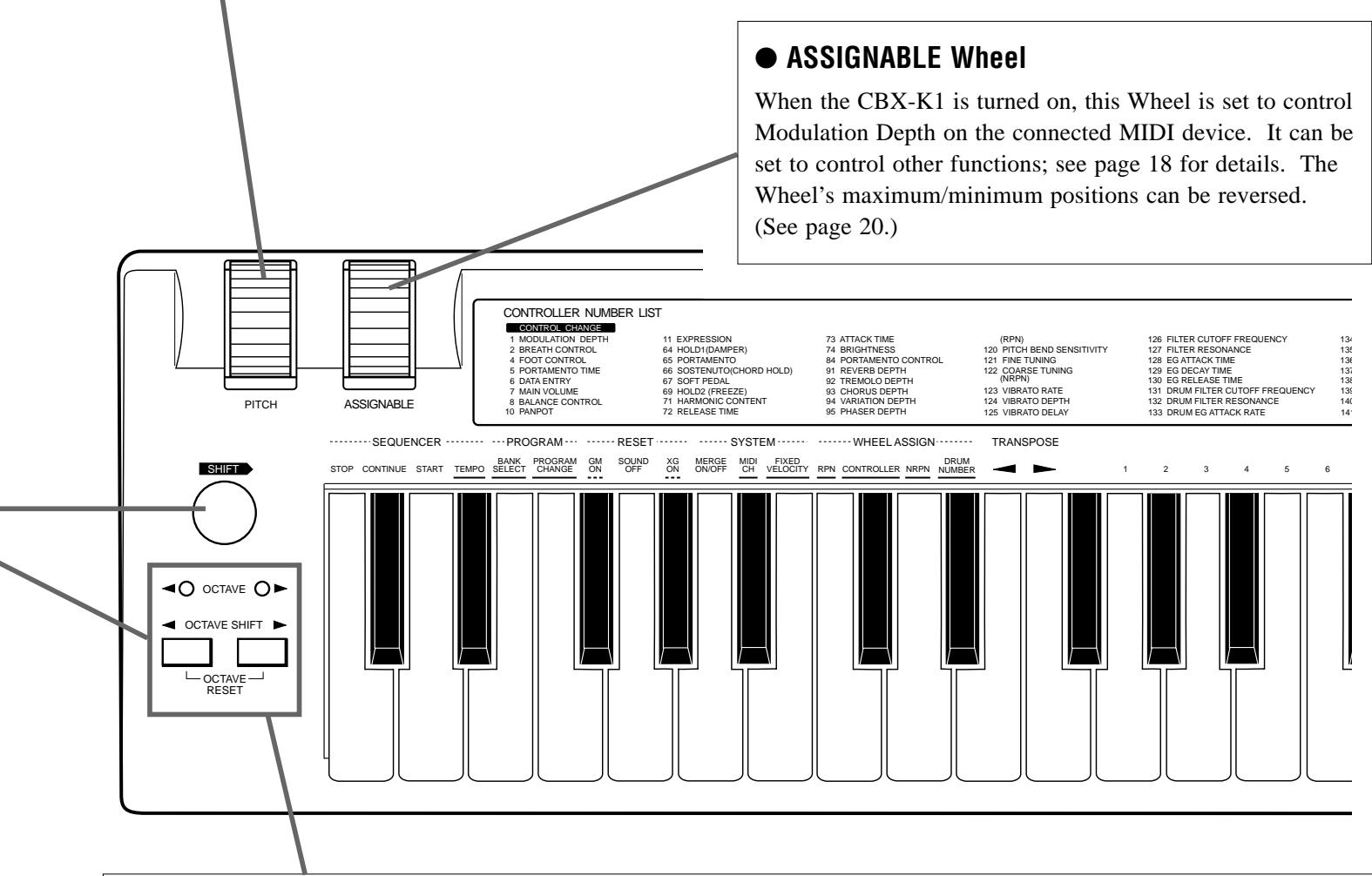
When the CBX-K1 is turned on, this Wheel (with center detent) is set to control Modulation Depth on the connected MIDI device. It can be set to control other functions; see pages 18 and 22 for details. The Wheel's operation can be reversed. (See page 20.)
4 SHIFT Button
This button is used to access the “hidden” functions of the CBX-K1. Used with the ◀OCTAVE SHIFT /
OCTAVE SHIFT▶ buttons, it allows you to step up or down through program numbers. (See page 10.) Used with the keys of the keyboard, it allows you to access the sophisticated MIDI control functions. (See page 12.)
5 ◀ OCTAVE SHIFT / OCTAVE SHIFT ▶ Buttons
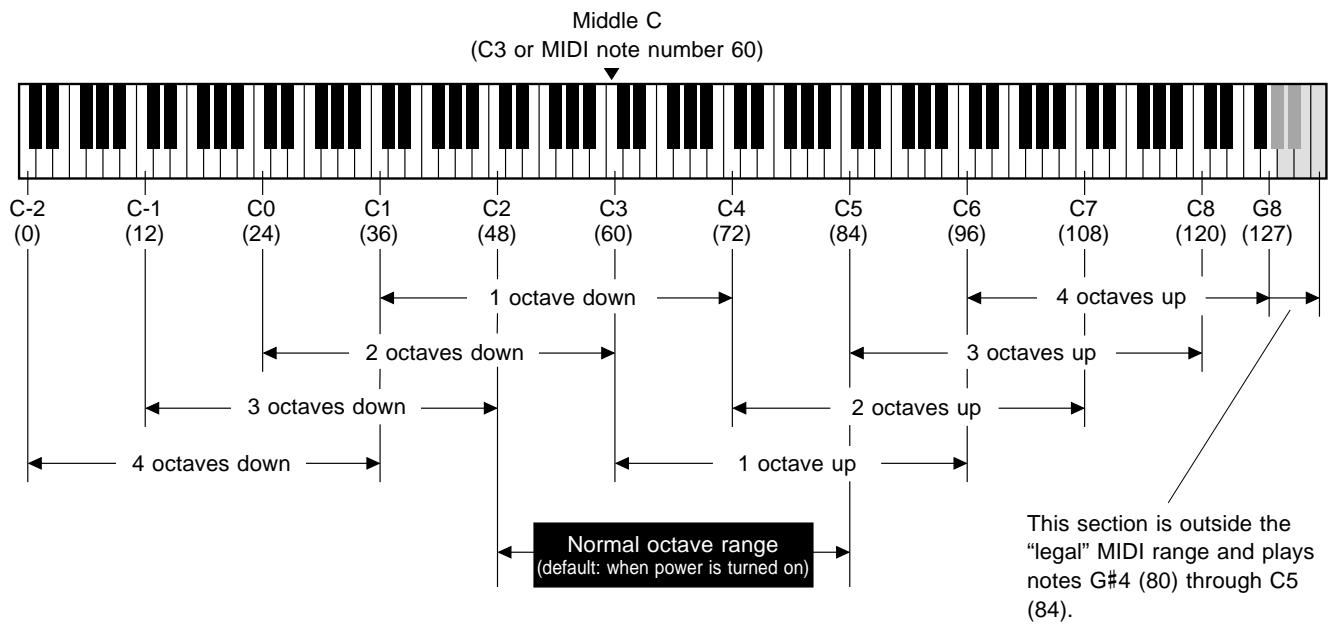
These buttons are used to change the octave range of the keyboard, allowing you to play across the entire range of MIDI notes (C-2 to G8). (See page 5.) Press both of these buttons together to restore the normal octave setting (C2 to C5). With the SHIFT button, these buttons can also be used to step up or down through program numbers on the connected MIDI device. (See page 10.)
6 ◀ OCTAVE / OCTAVE ▶ Lamps
These lamps provide several indications:
* During normal playing conditions, these indicate the octave setting of the keyboard, up (OCTAVE▶) or down (◀OCTAVE). Both light together for the normal octave setting. When changing the octave setting, these flash to indicate the number of octaves, up or down. (See page 11.)
* When using some of the “hidden” functions, these flash when a MIDI message is transmitted or when a function is executed.
* The left lamp flashes slowly when the battery power is too low for proper operation.
* The right lamp flashes quickly when there is some kind of MIDI receive error. The lamp flashes until you turn the power off and on again, or until you set MIDI Merge to ON. (See page 24.)
⑦ CONTROLLER NUMBER LIST
This shows the controller numbers that can be used with the ASSIGNABLE Wheel. (See page 22.)
● Note Range of the CBX-K1 (with Octave Shift)
text_image
Middle C (C3 or MIDI note number 60) C-2 (0) C-1 (12) C0 (24) C1 (36) C2 (48) C3 (60) C4 (72) C5 (84) C6 (96) C7 (108) C8 (120) G8 (127) 1 octave down 2 octaves down 3 octaves down 4 octaves down Normal octave range (default: when power is turned on) This section is outside the "legal" MIDI range and plays notes G#4 (80) through C5 (84).Rear Panel
text_image
POWER ON OFF DC IN OUT MIDI IN 8 9 10 118 POWER Switch
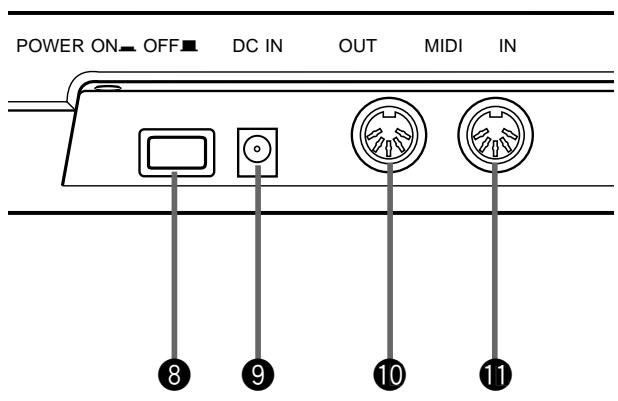
Push this switch in to turn on the power. Each time the power is turned on, the CBX-K1 returns to the default condition. (See boxed section below.)
⑨ DC IN Terminal
This is for connection to an optional PA-1B or PA-3 AC power adaptor.
10 MIDI OUT Terminal
This is for connection to the MIDI IN terminal of another MIDI device (such as a MIDI tone generator, sequencer or computer that has a MIDI interface), for sending MIDI messages to that device. By using the MIDI Merge function, data received at MIDI IN can be combined with the data generated by the CBX-K1 and transmitted via this terminal.
⑪ MIDI IN Terminal
This is for connection to the MIDI OUT terminal of another MIDI device (such as a MIDI keyboard, sequencer or computer that has a MIDI interface), for input of that device's data. By using the MIDI Merge function, that data can be combined with the data generated by the CBX-K1 and transmitted via the MIDI OUT terminal.
■ Default Settings of the CBX-K1
The CBX-K1 has no internal memory backup. As a result, all settings are returned to the factory default when turning the power off. The basic factory default settings are listed below.
* MIDI transmit channel: 1
* Octave range: C2-C5
* Transpose: normal (no transposition)
* Fixed velocity: Off (keyboard is velocity sensitive)
* ASSIGNABLE Wheel: Modulation
- User-configurable Defaults:
You can change certain power-on default settings of the CBX-K1. These include:
* Reversing the PITCH Wheel and ASSIGNABLE Wheel operation. Hold down ◀OCTAVE SHIFT and turn the power on. (See page 20.)
* Reversing the MSB, LSB order. Hold down OCTAVE SHIFT ▶ and turn the power on. (See page 20.)
Your CBX-K1 will run either from an optional power adaptor or batteries. Follow the instructions below according to the power source you intend to use.
NOTE ■ Before making any connections, make sure that all equipment to be connected is turned off.
Using a Power Adaptor
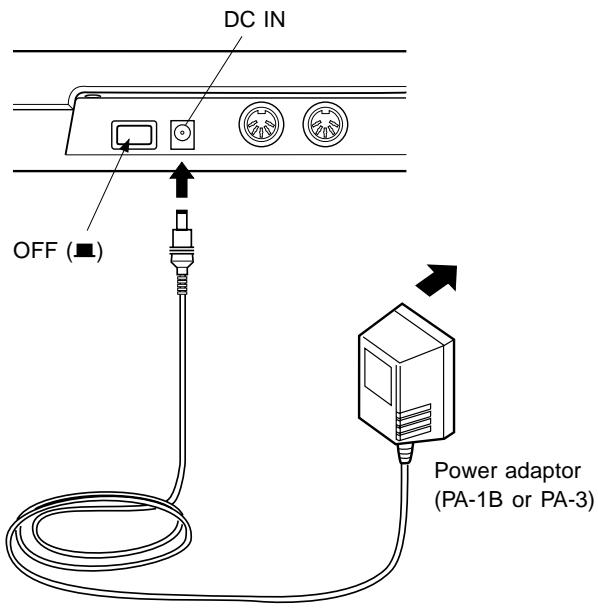
Connect one end of the power adaptor (the optional) Yamaha PA-1B or PA-3) to the DC IN jack on the rear panel, and the other end to a suitable electrical outlet.
text_image
DC IN OFF (■) Power adaptor (PA-1B or PA-3)CAUTION!
■ Do not attempt to use a power adaptor other than the PA-1B or PA-3. The use of an incompatible adaptor may result in irreparable damage to the CBX-K1, and even pose a serious shock hazard.
■ Be sure to disconnect the power adaptor from the outlet when the CBX-K1 is not in use.
Using Batteries
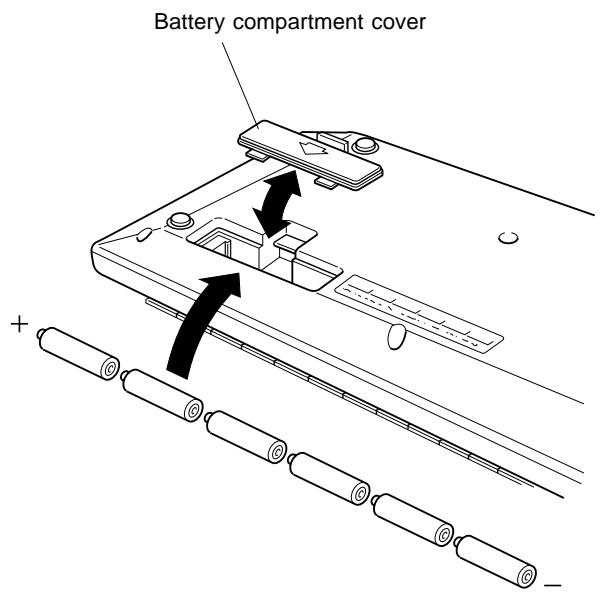
To use the CBX-K1 on battery power, remove the battery compartment cover (as shown below) and insert six 1.5V AA size (SUM-3, R-6 or equivalent) manganese or alkaline batteries in the battery compartment. Make sure to follow the polarity indications on the bottom case.
text_image
Battery compartment cover +Securely replace the battery compartment cover when done installing the batteries.
When to Replace the Batteries
When the battery power runs too low to properly operate the CBX-K1, the ◀OCTAVE lamp will flash slowly. When this happens, replace all batteries with a complete set of six new batteries of the same type.
CAUTION! ■ NEVER mix old and new batteries or different types of batteries! Also, to prevent possible damage due to battery leakage, remove the batteries from the instrument if it is not to be used for an extended period of time.
IMPORTANT ■ Turning the power off and on again resets all settings to the factory default, cancelling all user settings.
Guided Tour
When using your CBX-K1 for the first time, read through this short section of the manual. It guides you step-by-step in using many of the basic operations: setting the instrument up, connecting it properly to other equipment, and — most importantly — playing it.
Setting Up Your CBX-K1
In this introductory section, you'll learn how to set up the CBX-K1 for use in your music system. A variety of setups are covered here; read through the one that most closely matches your own setup.
What You'll Need
Since the CBX-K1 is strictly a MIDI controller and does not generate any sound by itself, you'll need other data-receiving and sound-producing equipment. Basically, you will need:
* The CBX-K1 and an optional PA-3 or PA-1B AC power adaptor (or a set of batteries).
* A MIDI device (such as a tone generator, keyboard or computer) which can receive and play back MIDI data, and at least one MIDI cable.
* (Optional) An amplifier/speaker system, preferably stereo, with proper audio connecting cables. Alternately, you can use a set of stereo headphones.
Setup Examples
NOTE ■ The setup examples below show only the MIDI connections. The audio connections would vary according to the particular equipment you use. Refer to the owner's manuals of your other equipment for audio connection instructions.
With Computer and Tone Generator
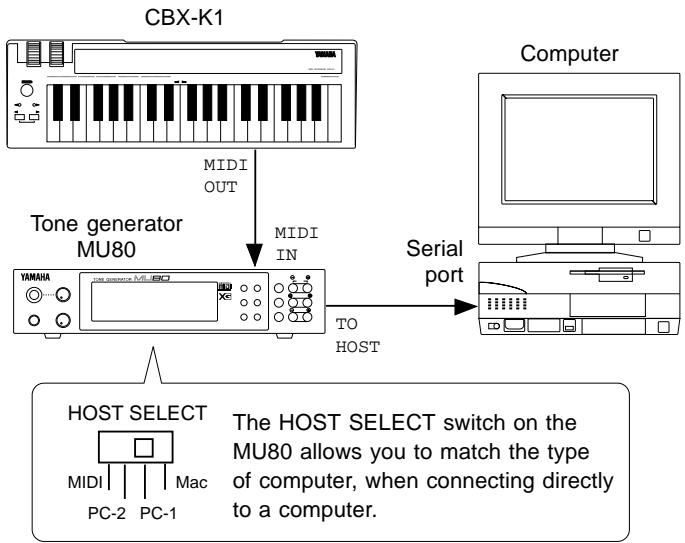
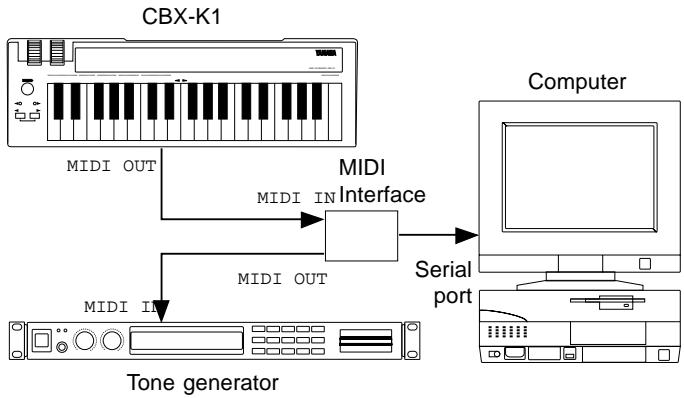
In the small MIDI system below, the CBX-K1 is connected to a computer and a single tone generator. With the proper sequencing software on the computer, the CBX-K1 can be used both for recording performance data to the computer and playing the sounds of the connected tone generator. You can also conveniently use the CBX-K1 to start and stop the sequencer.
For tone generators with a built-in MIDI interface (such as the Yamaha MU80)
flowchart
graph TD
    A["CBX-K1"] -->|MIDI OUT| B["Tone generator MU80"]
    B -->|MIDI IN| C["YAMAHA"]
    C --> D["Serial port"]
    D --> E["Computer"]
    F["HOST SELECT"] --> G["MIDI PC-2"]
    F --> H["Mac PC-1"]
    style F fill:#f9f,stroke:#333
    style G fill:#ccf,stroke:#333
    style H fill:#ccf,stroke:#333
Connect the MIDI OUT terminal on the CBX-K1 to the MIDI IN terminal on the MU80. The MU80 should be connected to the proper port on the computer. (For complete connection instructions, refer to the owner's manual of your particular tone generator.)
For tone generators without a built-in MIDI interface
flowchart
graph TD
    A["CBX-K1"] -->|MIDI OUT| B["MIDI Interface"]
    B -->|MIDI IN| C["Computer"]
    B -->|MIDI OUT| D["Tone generator"]
    D -->|MIDI IN| C
    C --> E["Serial port"]
Connect the MIDI OUT terminal on the CBX-K1 to the MIDI IN terminal on the computer's MIDI interface. The tone generator should be connected to a MIDI OUT on the interface.
With Sequencer
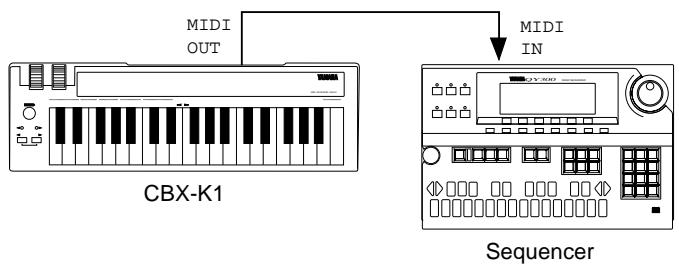
The CBX-K1 can be used with a stand-alone sequencer, for recording and editing performance data.
text_image
MIDI OUT MBI IN CBX-K1 SequencerConnect the MIDI OUT terminal on the CBX-K1 to the MIDI IN terminal on the sequencer.
With Tone Generator
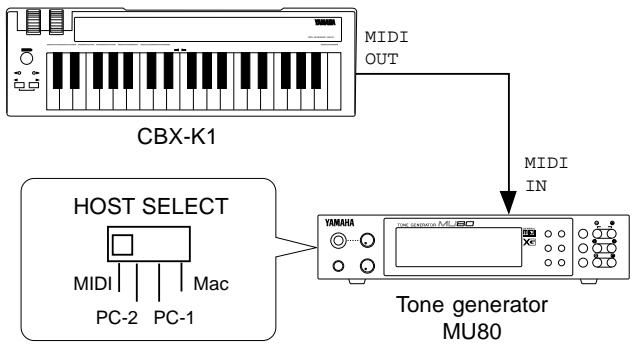
In the simple system below, the CBX-K1 is used to play the voices of the MU80 Tone Generator. This setup could also serve as a simple, yet powerful live performance rig, with the CBX-K1 being used as a portable, hand-held keyboard.
flowchart
graph TD
    A["CBX-K1"] -->|MIDI OUT| B["Tone generator MU80"]
    C["HOST SELECT"] --> D["MIDI PC-2, PC-1 Mac"]
    B --> E["YAMAHA"]
    style A fill:#f9f,stroke:#333
    style C fill:#ccf,stroke:#333
    style B fill:#cfc,stroke:#333
    style D fill:#fcc,stroke:#333
Connect the MIDI OUT terminal on the CBX-K1 to the MIDI IN terminal on the MU80.
With Main Keyboard and Tone Generator
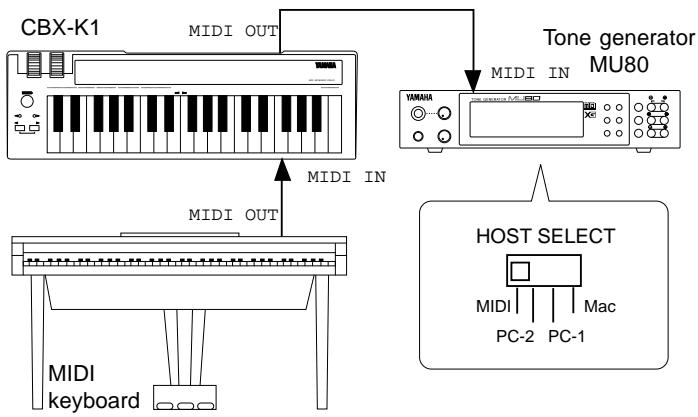
In this system, the CBX-K1 effectively serves as a second keyboard. The main keyboard (in this case, the Clavinova) is used to play both its own internal sounds and the sounds of the connected multi-timbral tone generator on one channel, while the CBX-K1 is used to play the sounds of the tone generator on another channel. This lets you play two sounds at once from the Clavinova, and play a third sound from the CBX-K1.
flowchart
graph TD
    A["CBX-K1"] -->|MIDI OUT| B["Tone generator MU80"]
    B -->|MIDI IN| C["Multi-Panel Display"]
    D["MIDI keyboard"] -->|MIDI OUT| E["MIDI In"]
    F["HOST SELECT"] --> G["MIDI PC-2 Mac"]
    style A fill:#f9f,stroke:#333
    style B fill:#ccf,stroke:#333
    style C fill:#cfc,stroke:#333
    style D fill:#fcc,stroke:#333
    style E fill:#cff,stroke:#333
    style F fill:#ffc,stroke:#333
Connect the MIDI OUT terminal on the main keyboard to the MIDI IN terminal on the CBX-K1. Also connect the MIDI OUT terminal on the CBX-K1 to the MIDI IN terminal on the tone generator.
In a variation of the above setup, set the Clavinova and CBX-K1 to transmit on the same channel, and set the CBX-K1's MIDI Merge function to ON. This lets you play the tone generator from either keyboard and use the versatile MIDI functions of the CBX-K1 to control the tone generator — for example, changing the brightness of the sound in real time with the ASSIGNABLE Wheel.
NOTE ■ When an external MIDI device is connected to the MIDI IN of the CBX-K1, the OCTAVE▶ lamp may flash, indicating a MIDI error. This is probably due to a longer-than-normal interval between active sensing messages received from the device. To remedy this, set the MIDI Merge of the CBX-K1 to ON. (See page 24.)
Making the Connections
CAUTION! ■ Before making any connections, make sure that all equipment to be connected is turned off.
Operation
- Connect the MIDI OUT terminal of the CBX-K1 to the MIDI IN terminal of the tone generator, sequencer or computer MIDI interface (as shown in the illustrations above).
- Make all necessary audio connections, making sure first that all level controls on those devices are set to the minimum. (Refer to the owner's manuals of the devices you are using for more information on connections.)
- Finally, turn on the power of the CBX-K1, then turn on the power of the connected equipment. (If necessary, follow the order as recommended in the owner's manuals of the devices you are using.) When turning off the power, be sure to turn off the CBX-K1 last.
Though the CBX-K1 has many sophisticated functions, it is very easy to use. All available functions can be controlled or executed by using the basic operations described in this section. (For details on individual functions, see pages 18-22.)
NOTE ■ This introductory section assumes that the MIDI transmit channel of the CBX-K1 and the MIDI receive channel of the connected device match. When the CBX-K1 is turned on, the MIDI transmit channel is automatically set to 1. For the sake of the following sections, set the MIDI receive channel of the connected device to 1 (or Omni).
Playing the Keyboard and Other Operations
The illustration below shows how to use the basic real-time controls of the CBX-K1.
● Changing Voices (Program Change Up/Down)
You can easily step up or down through the voices (program numbers) on the connected MIDI device.
To do this, hold down SHIFT and press OCTAVE SHIFT ▶ (to advance one program number), or press ◀ OCTAVE SHIFT (to go back one program number). The LEDs quickly flash on and off when a program number message is sent. Release SHIFT to play the new voice.
When the CBX-K1 is turned on, the starting point for program change is 0. This means that when you first hold down SHIFT and press OCTAVE SHIFT▶, program number 1 will be selected.
NOTE ■ Always release SHIFT before playing the CBX-K1 keyboard. Holding down SHIFT accesses the secondary or “hidden” functions, and you may inadvertently execute one of these functions by playing the keyboard while continuing to hold down SHIFT.
NOTE ■ This function does not “wrap around.” In other words, you cannot go back to program number 127 when at 0, or advance to program number 0 when at 127.
● PITCH Wheel
This Wheel controls Pitch Bend on the connected MIDI device. The Wheel's maximum/minimum positions can be reversed. (See page 20.)
bar
| Controller Number List | Control Function | Control Time | Control Position | | ---------------------- | ---------------- | ------------ | ---------------- | | 1 | MODULATION DEPTH | 11 | EXPRESSION | | 2 | BREATH CONTROL | 64 | HOLD1(DAMPER) | | 3 | FOOT CONTROL | 65 | PORTAMENTO | | 4 | PORTAMENTO TIME | 66 | SOSTENUTO(CHORD HOLD) | | 5 | DATA ENTRY | 67 | SOFT PEDAL | | 6 | MAIN VOLUME | 69 | HOLD2(FREEZE) | | 7 | BALANCE CONTROL | 71 | HARMONIC CONTENT | | 8 | PANPOT | 72 | RELEASE TIME | | 9 | SWITCH | | | | 10 | SEQUENCER | | | | 11 | PROGRAM | | | | 12 | RESET | | | | 13 | SYSTEM | | | | 14 | WHEEL ASSIGN | | | | 15 | TRANSPOSE | | | | 16 | STOP CONTINUE | | | | 17 | BANK SELECT | | | | 18 | PROGRAM CHANGE | GM ON | SOUND OFF | | 19 | MIDI CH | | FIXED VELOCITY | | 20 | RPN CONTROLLER | | DRUM NUMBER | | 21 | 1 | | | | 22 | 2 | | | | 23 | 3 | | | | 24 | 4 | | | | 25 | 5 | | | | 26 | 6 | | | The chart includes labels for the controller names and the number of controllers. The keyboard symbol is 'ASSIGNABLE' with a circle. The data is presented in a table format.● Changing the Octave Setting
You can easily change the octave range of the CBX-K1 keyboard while playing. In this way the three-octave keyboard can cover the entire range of MIDI notes, from C-2 to G8 (0-127).
To shift the keyboard up one octave, press OCTAVE SHIFT▶. To shift the keyboard down one octave, press ◀OCTAVE SHIFT. When the octave is changed, the LEDs rapidly flash one, two, three or four times, according to the selected octave range. For example, when the setting is changed to two octaves below normal, the left lamp flashes twice.
■ Normal octave setting.

NOTE ■ At the lowest and highest octave settings, keys outside the legal MIDI note range will repeat the center octave range.