
PL2D 31 - Hob CANDY - Free user manual and instructions
Find the device manual for free PL2D 31 CANDY in PDF.



| Product type | Gas hob |
| Brand | CANDY |
| Model | PL2D 31 |
| Dimensions (W x D) | 595 x 510 mm |
| Electrical supply | 230 V / 50 Hz |
| Total gas power (G20) | 8.2 kW |
| Number of burners | 4 |
| Burner types | 1 small, 1 semi-rapid, 1 rapid front, 1 rapid rear |
| Electronic ignition | Yes (spark) |
| Gas safety (thermocouple) | Yes |
| Compatible gas types | Natural gas (G20), butane (G30), propane (G31) after conversion |
| Total consumption (G30) | 597 g/h |
| Appliance class | 3 |
| Surface material | Stainless steel |
| Installation | Built-in, worktop thickness 25 to 40 mm |
| Cleaning | Warm soapy water, no abrasives |
| Spare parts | Available via after-sales service |
Frequently Asked Questions - PL2D 31 CANDY
User questions about PL2D 31 CANDY
0 question about this device. Answer the ones you know or ask your own.
Ask a new question about this device
Download the instructions for your Hob in PDF format for free! Find your manual PL2D 31 - CANDY and take your electronic device back in hand. On this page are published all the documents necessary for the use of your device. PL2D 31 by CANDY.
USER MANUAL PL2D 31 CANDY
natural_image
Technical line drawing of a mechanical component with mounting holes and internal channels (no text or symbols)natural_image
Diagram of a room setup with a lamp, brick wall, and a small box, labeled Fig. 4 (no text or symbols on diagram)natural_image
Technical line drawing of a mechanical device with clamping mechanism (no text or symbols)natural_image
Two technical diagrams showing mechanical assembly or disassembly process with no visible text or symbolsnatural_image
Symbol of a trash bin crossed with a diagonal line, no text or numbers presentnatural_image
Diagram of a rope knot with directional arrows indicating motion (no text or symbols)natural_image
Technical line drawing of a mechanical joint or connector (no text or symbols)stevig vast.
natural_image
Technical line drawing of a mechanical component with mounting holes and internal channels (no text or symbols)natural_image
Diagram of a room setup with a lamp, brick wall, and a baseplate, labeled Fig. 4 (no text or symbols on diagram)natural_image
Two technical diagrams showing mechanical assembly or disassembly process, with no visible text or symbols.Assistance technique
natural_image
Symbol of a trash bin crossed out by a diagonal line, with no text or labels present.natural_image
Diagram of a rope knot with directional arrows indicating motion (no text or symbols)natural_image
Technical line drawing of a pipe fitting with threaded end (no text or symbols)** Manufacturer setting
GB cat. II2H3 +
D
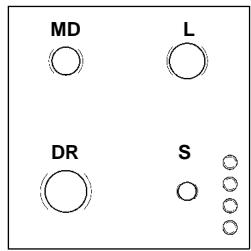
C
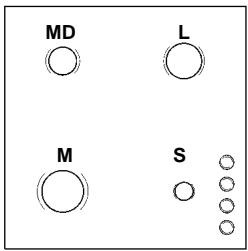
A

B

Fig. 1b
INSTALLATION
Instructions for the installer
The Purchaser is responsible for the installation of the hob. The Manufacturer does not accept any responsibility for any damage or loss resulting from incorrect installation, and as such this will not covered by the Manufacturer's Guarantee.
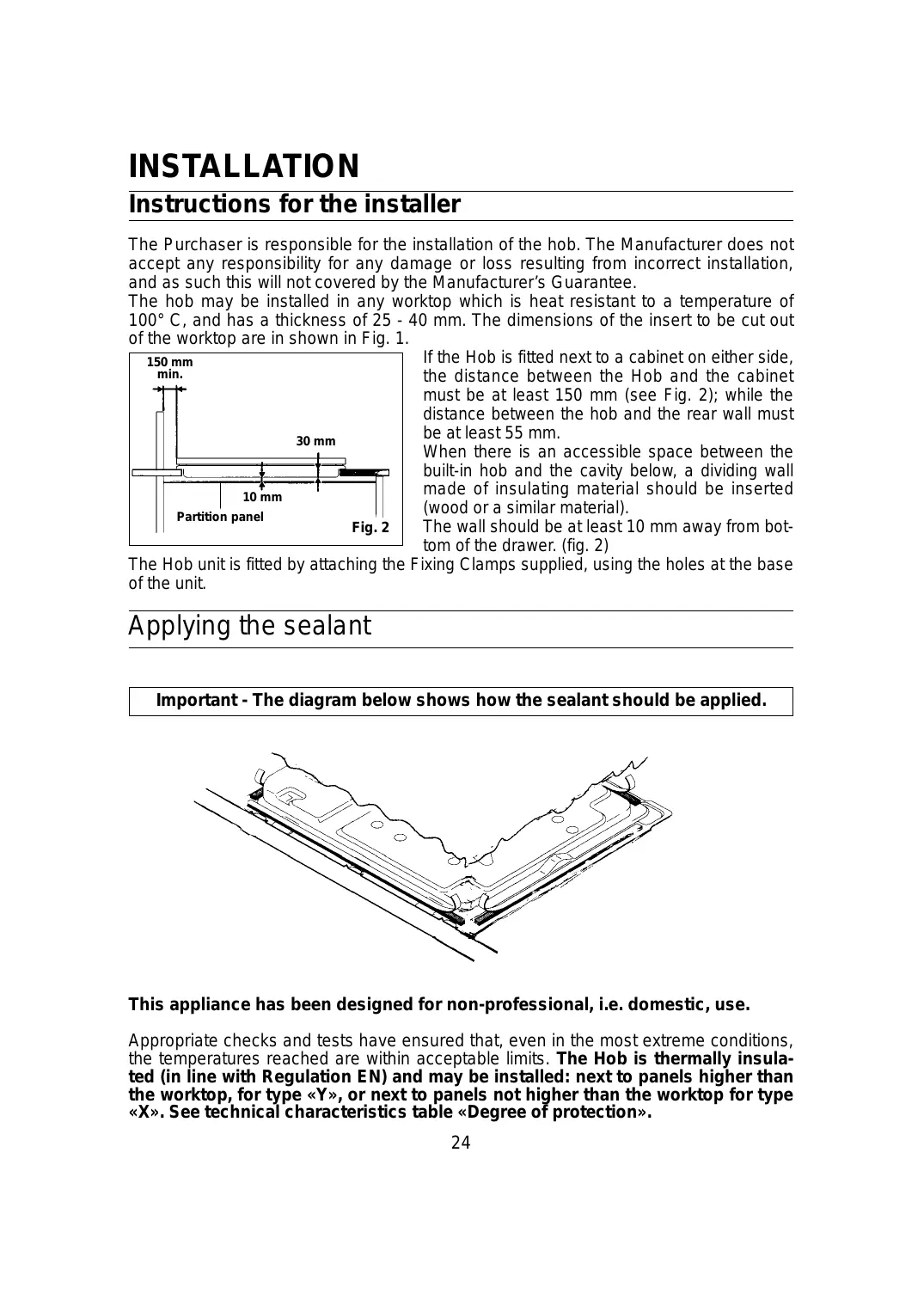
The hob may be installed in any worktop which is heat resistant to a temperature of 100irc C, and has a thickness of 25 - 40 mm. The dimensions of the insert to be cut out of the worktop are in shown in Fig. 1.

If the Hob is fitted next to a cabinet on either side, the distance between the Hob and the cabinet must be at least 150 mm (see Fig. 2); while the distance between the hob and the rear wall must be at least 55 mm.
When there is an accessible space between the built-in hob and the cavity below, a dividing wall made of insulating material should be inserted (wood or a similar material).
The wall should be at least 10 mm away from bottom of the drawer. (fig. 2)
The Hob unit is fitted by attaching the Fixing Clamps supplied, using the holes at the base of the unit.
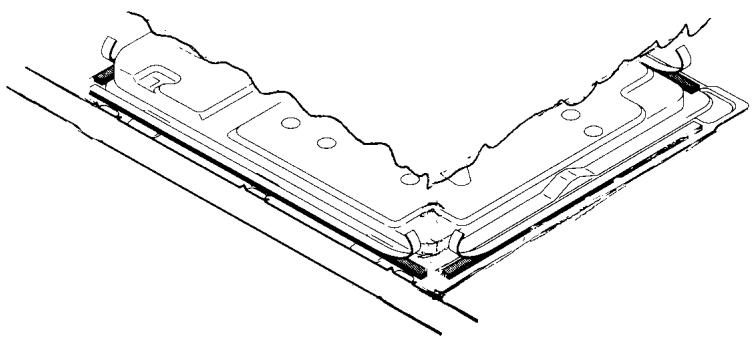
Applying the sealant
Important - The diagram below shows how the sealant should be applied.
natural_image
Technical line drawing of a mechanical component with mounting holes and internal channels (no text or symbols)This appliance has been designed for non-professional, i.e. domestic, use.
Appropriate checks and tests have ensured that, even in the most extreme conditions, the temperatures reached are within acceptable limits. The Hob is thermally insulated (in line with Regulation EN) and may be installed: next to panels higher than the worktop, for type «Y», or next to panels not higher than the worktop for type «X». See technical characteristics table «Degree of protection».
Suitable location
A gas-powered cooking appliance produces heat and humidity in the area in which it is installed. For this reason you should ensure good ventilation either by keeping all natural air passages open or by installing an extractor hood with an exhaust flue (Fig. 3-4). Intensive and prolonged use of the appliance may require extra ventilation, such the opening of a window or an increase in speed of the electric fan, if you have one.

If a hood cannot be installed, an electric fan should be fitted to an outside wall or window as long there are air vents in the area.
The electric fan should be able to carry out a complete change of air in the kitchen 3-5 times every hour.
The installer should follow the relevant national standards.

natural_image
Diagram of a room interior with a lamp, brick wall, and a small object near the base (no text or symbols)Instructions for the installer
The following information is intended for qualified and competent persons only who will ensure that your appliance is installed correctly. All current legislation concerning the installation of Gas appliances must be observed by the installer*
* For the U.K. only - By law, the gas installation/commissioning must be carried out by a «Corgi», registered installer.
This appliance must be installed in accordance with applicable regulations and should only be used in well-ventilated locations. Before using this appliance carefully study the instruction book.
Electrical connection
Warning - this appliance must be earthed
This appliance is designed for domestic use only. Connection to the mains supply must be made by a competent electrician, ensuring that all current regulations concerning such installations are observed.
The appliance must only be connected to a suitably rated spur point, a 3 pin 13 amp plug/socket is not suitable. A double pole switch must be provided and the circuit must have appropriate fuse protection. Further details of the power requirement of the individual product will be found in the users' instruction and on the appliance rating plate. In the case of built-in product you are advised, should you wish to use a longer cable than the one supplied, that a suitably rated heat resistant type must be used.
The wiring must be connected to the mains supply as follows:
CONNECT
Green & Yellow
Blue Wire
Brown Wire
TO SPUR TERMINAL
Wire Earth Connection
Neutral Connection
Live Connection
Note: We do not advocate the use of earth leakage devices with electric cooking appliances installed to spur points because of the «nuisance tripping» which may occur. You are again reminded that the appliance must be correctly earthed, the manufacturer declines any responsibility for any event occurring as a result of incorrect electrical installation.
Declaration of compliance: This equipment, in the parts intended to come into contact with food, complies with the regulations laid down in EEC directives 89/109.
CE This appliance complies with directive 89/336/EEC, 73/23/EEC, 90/396/EEC and the following changes.
Gas connection (see page 33)
The labels on the Hob indicate the types of gas that can be used.
It is possible to use other types of gas after carrying out simple modifications.
Warning: If gas can be smelt in the vicinity of this appliance turn off the gas supply to the appliance and call the engineer directly.
Do not search for a leak with a naked flame.
Adapting the hob to different types of gas
To adapt the Hob for use with different types of gas, carry out the following instructions:
— remove the grids and burners
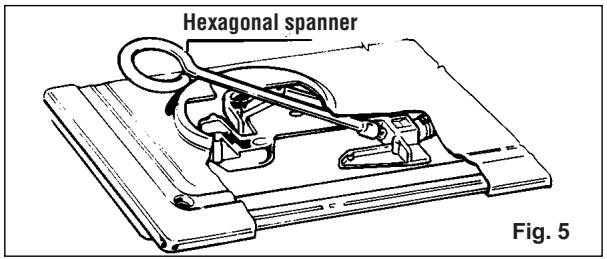
— insert the hexagonal spanner (supplied) into the burner support (Fig. 5)
— unscrew the injector and replace it with one suitable for the gas to be used (see Table of gas consumption)
— carry out regulation of the burner.
Table of gas consumption
1W = 0,860 kcal/h
Quota «X» depending on type of gas
| G20/G25 | G30 | G20/G30 | G25 | G20 | G30 | G25 | G31 | ||||||
| Working burner | ∅ injector 1/100 mm | ∅ injector 1/100 mm | Qn kW | l/h G20 | g/h G30 | g/h G31 | Qn kW | l/h G25 | Qmin. kW | air regul. | air regul. | air regul. | air regul. |
| large back right | 120 | 80 | 2,65 | 252 | 193 | 189 | 2,5 | 277 | 0,650 | 4 mm | 2 mm | 4 mm | 5 mm |
| large front left | 127 | 84 | 2,95 | 281 | 215 | 211 | 2,8 | 310 | 0,650 | 4 mm | 2 mm | 4 mm | 5 mm |
| medium | 93 | 61 | 1,5 | 143 | 109 | 107 | 1,45 | 161 | 0,380 | 2 mm | 5 mm | 2 mm | 7 mm |
| small | 80 | 54 | 1,1 | 105 | 80 | 79 | 1,05 | 116 | 0,280 | 6 mm | 4 mm | 6 mm | 6 mm |
| double ring | 2x94 | 2x65 | 3,3 | 314 | 238 | 236 | 3,1 | 314 | 0,900 | 13 mm | 0 mm | 15 mm | 15 mm |
| maxi | 2x94 | 2x65 | 3,3 | 314 | 238 | 236 | 3,1 | 314 | 0,900 | 13 mm | 0 mm | 13 mm | 13 mm |
Regulating the burners
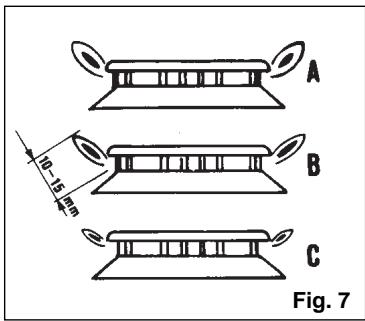
For maximum efficiency from the burners, the correct combustion of the flame is necessary (see table of gas consumptions quota "X"). A good flame must be well aligned and without yellow tips (Fig. 7/B). If there is insufficient air, the flame will be uneven with yellow tips (Fig. 7/A). If there is too much air, the flame will be very short and bright (Fig. 7/C). In these cases the combustion
must be adjusted by re-fitting the carburation tube to the Venturi (where there is insufficient air) or removing the carburation tube (in the case of too much air). To position the carburation tube, the fixing screws must be loosened, and retightened when the satisfactory combustion is obtained.
For dimensions «X» see table of gas consumption

Regulating the minimum flame
After lighting the burners, turn the control knob to the minimum setting and then remove the knob (this can easily be removed by apply a gentle pressure).
Using a small «Terminal» type screwdriver the regulating screw can be adjusted as in Fig. 8. Turning the screw clockwise reduces the gas flow, whilst turning it anticlockwise increases the flow – Use this adjustment to obtain a flame of approximately 3 to 4 mm in length and then replace the control knob.
If GPL (cylinder) gas is being used, turn the screw clockwise right to the end of the travel of the by-pass.
Screws regulating (for differend models)

natural_image
Two technical diagrams showing mechanical assembly or disassembly process, with no visible text or symbols.When you have carried out the new gas regulation, replace the old gas rating plate on your appliance with one (supplied with hob) suitable for the type of gas for which it has been regulated.
Lubricating the gas taps
If a gas tap becomes stiff, it should be dismantled, cleaned carefully with petrol and smeared with a drop of special heat resistant grease.
The following operations should be carried but:
— disconnect the electrical power supply, close the gas supply tap from the mains or cylinder.
— Remove the knobs and the plate by removing the screws located at the rear of the plate itself and beneath the individual burners.
— Remove the two screws holding down the head flange.
— Remove the head flange and the retaining spring on the knob shaft.
— Remove the gas regulation cone, clean it with petrol and smear it with some heat resistant grease, taking care not to obstruct any holes through which gas must pass.
— Re-assemble all the parts, making sure that the spring and the rotating axis of the cone fitted to the knob shaft are correctly seated.
USE OF HOB
User instructions
This appliance must only be used for the purpose for which it is intended, domestic cooking, and any other use will be considered improper and could therefore be dangerous. The Manufacturer will not be responsible for any damage or loss resulting from improper use.
Using the gas Burner
To ignite the burners, place a lighted taper close to the burner, press in and turn the control knob anti-clockwise.
If the burners have not been used for a couple of days, wait for a few seconds before lighting the burner, this will allow any air present in the pipes to escape.
For appliances fitted with electronic ignition carry out the following:
- push in and turn the knob anticlockwise to the symbol.
- ignite the burner by pressing the sparker button.
For hobs fitted with automatic ignition simply push in and turn the knob to the ★ symbol.
The ignition generator is a repetitive discharge type.
If the burner is not ignited within 5 seconds, turn the knob to the 0 position and repeat the operation.
For models fitted with a safety tap (which cuts-off the flow of gas if the flame is accidentally extinguished) the burners are ignited ad described above, but care must be taken to keep the knob pressed in for 5 or 6 seconds after the flame is ignited.
ATTENTION: When cleaning the hob, take care to replace the burners correctly, this will ensure that the ignition point is not blocked.
GENERAL ADVICE
For the best results, the flat-bottomed pans size should match the gas burner size as follows:
— Front right burner from 6 to 12 cm.
— Front left burner from 24 to 26 cm.
— Back left burner from 12 to 18 cm.
— Back right burner from 18 to 24 cm.
See fig. 1b pag. 23.
For smaller containers the gas burner should be regulated so that the flame does not overlap the base of the pan. Vessels with concave or convex base should not be used.
WARNING: If a burner is accidentally extinguished, turn the knob to the off position and do not attempt to re-ignite if for at least 1 minute.
To protect the glass lid from damage and in the interests of safety, the burners/plates must be turned off and the burner/pan support/plate area must be cool before closing the lid down.
Use of electric hotplates (electric hotplates)
For the best use of the electric hotplates and to minimise energy consumption, the following recommendations should be noted.
| POWER OUTPUT - ELECTRIC HOTPLATES | ||
| Setting | ||
| 0 | OFF | |
| 1 | VERY LOW | Warming dishes & melting butter and chocolate |
| 2 | LOW | Simmering, sauces, stews, milk puddings, poached eggs |
| 3 | MODERATE | Vegetables, frozen foods, boiling water |
| 4 | MEDIUM | Fresh Vegetables, pasta, fish, pancakes. |
| 5 | HIGH | Omelettes, steaks |
| 6 | VERY HIGH | Chops |
A neon indicator light adjacent to the control knob will glow when the electric plate is in use.
Only pans which have smooth flat bases should be used on the electric hotplates. The size of the pan should be as close as possible to the diameter of the hotplate, and never smaller (see Fig. 9). The base of the pan should be dry and spillages should be avoided. Empty pans should not be left on the plates, nor should the plates left switched on without a pan.

Maintenance and cleaning
Before cleaning the Hob, ensure the appliance has cooled down. Remove the plug from the socket or (if connected directly) switch off the electricity supply.
When cleaning the enamelled, varnished or chrome sections, use warm soapy water or a non caustic detergent. For stainless steel use an appropriate cleaning solution. Hotplates should only be cleaned with a cotton cloth coated with vaseline or seed oil. Never use abrasives, corrosive detergents, bleaching agents or acids. Avoid any acid or alkaline substances (lemon, juice, vinegar etc.) on the enamelled, varnisched or stainless steel sections.
The burners can be cleaned with soapy water. To restore their original shine, use a household stainless steel cleaner. After cleaning, dry the burners and replace.
It is important the Burners are replaced correctly.
Aftercare
Before calling out a Service Engineer please check the following:
— that the plug is correctly inserted and fused;
— that the gas supply is not faulty.
If the fault cannot be identified:
switch off the appliance — do not tamper with it — call the Aftercare Service Centre.

natural_image
Symbol of a trash bin crossed out by two crossed lines, with a solid black rectangle below (no text or labels)This appliance is marked according to the European directive 2002/96/EC on Waste Electrical and Electronic Equipment (WEEE).
By ensuring this product is disposed of correctly, you will help prevent potential negative consequences for the environment and human health, which could otherwise be caused by inappropriate waste handling of this product.
The symbol on the product indicates that this product may not be treated as household waste. Instead it shall be handed over to the applicable collection point for the recycling of electrical and electronic equipment.
Disposal must be carried out in accordance with local environmental regulations for waste disposal.
For more detailed information about treatment, recovery and recycling of this product, please contact your local city office, your household waste disposal service or the shop where you purchased the product.
COVER
The cover is available as optional accessory.
Before closing the cover, to protect it from excessive temperature changes, always wait until the burners or plates have completely cooled down.
Any spillages should be removed from the cover before opening it.
The Manufacturer will not be responsible for any inaccuracy resulting from printing or transcript errors contained in this brochure. We reserve the right to carry out modifications to products as required, including the interests of consumption, without prejudice to the characteristics relating to safety or function.
INSTRUCTIONS FOR ASSEMBLY OF THE HOB TO THE GAS SUPPLY PIPES
These instructions are for Fitters qualified for installation of equipment in line with the relevant national standard. All work must be carried out with the electricity supply disconnected.

For some models a conic link is furnished to outfit for the installation in the countries where this type of link is obligatory; in the following figures it is pointed out how to recognize the different types of links. In every case the cylindrical part of the link has to be connected to the hob.
ASSEMBLY PROCEDURE
2 Spanners, sizes 17 and 23 mm are required.

A) As illustrated, assemble parts in sequence:
A) fixed pipe
B) washer
C) Elbow fitting with tapered thred connection

natural_image
Diagram of a rope knot being lifted by a hook, showing rope movement and motion direction (no text or labels)2) Tighten the joints with the Spanners, remembering to twist the pipes into position before tightening.

natural_image
Technical line drawing of a mechanical joint or connector (no text or symbols)3) Attach fitting C to mains gas supply using rigid copper pipe or flexible steel pipe.
VERY IMPORTANT
For ease of installation and to avoid gas leaks, it is recommended to connect the pipes as follows:
First connect the pipe to the Hob and then
Connect the pipe to the gas supply.
In this sequence is not followed, there is a danger that gas will be trapped in the pipe.
AFTER INSTALLATION, CHECK THE TIGHTNESS OF ALL JOINTS USING A SOAPY SOLUTION
TECHNISCHE DATEN
C

A

B

Abb. 1b
INSTALLATION
natural_image
Technical line drawing of a mechanical bracket assembly (no text or symbols)natural_image
Simple line drawing of a room with a lamp, brick wall, and a small object on the floor (no text or symbols)natural_image
Diagram of a mechanical assembly with a tool and pipe connection (no text or labels)natural_image
Technical line drawing of a mechanical device with clamping mechanism (no text or symbols)natural_image
Two diagrams showing mechanical components on a surface, one with a circular component and others with curved elements, labeled Abb. 8 (no text or symbols on the diagrams themselves)natural_image
Symbol of a trash bin crossed out by a diagonal line, with no text or labels present.natural_image
Diagram of a rope knot being lifted by a rope, showing rope routing and directional arrows (no text or labels)natural_image
Technical line drawing of a mechanical joint or connector (no text or symbols)
- Assistance technique
- INSTALLATION
- Instructions for the installer
- Applying the sealant
- Suitable location
- Electrical connection
- Warning - this appliance must be earthed
- CONNECT
- TO SPUR TERMINAL
- Gas connection (see page 33)
- Adapting the hob to different types of gas
- Regulating the burners
- Regulating the minimum flame
- Lubricating the gas taps
- USE OF HOB
- User instructions
- Using the gas Burner
- GENERAL ADVICE
- Use of electric hotplates (electric hotplates)
- Maintenance and cleaning
- Aftercare
- Before calling out a Service Engineer please check the following:
- COVER
- INSTRUCTIONS FOR ASSEMBLY OF THE HOB TO THE GAS SUPPLY PIPES
- ASSEMBLY PROCEDURE
- VERY IMPORTANT
- TECHNISCHE DATEN
Brand : CANDY
Model : PL2D 31
Category : Hob