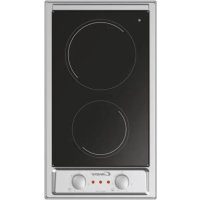
CH32XK - Hob CANDY - Free user manual and instructions
Find the device manual for free CH32XK CANDY in PDF.



| Product Type | Built-in ceramic hob |
| Brand | Candy |
| Model | CH32XK |
| Number of cooking zones | 2 radiant zones, 3 circuits |
| Front zone | Ø145 mm, 1200 W |
| Rear zone | Ø180 mm, 1700 W |
| Electrical supply | 220-240 V ~ 50/60 Hz |
| Total power | 2900 W (approx.) |
| Power cable section | 3 × 1.5 mm² (H05RR-F or H05V2V2-F) |
| Control type | 2 rotary knobs (7 positions) |
| Indicator lights | Power-on indicator, residual heat indicators per zone |
| Cooking functions | Melting, keep warm, simmering, boiling, grilling, frying |
| Surface material | Ceramic glass |
| Recommended cleaning | Ceramic scraper, damp cloth, non-abrasive detergent |
| Safety | Temperature limiter, shut-off if cracked, residual heat indicator |
| Hob dimensions (W × D) | Approx. 580 × 520 mm (estimate) |
| Cutout dimensions (W × D) | Approx. 560 × 490 mm (estimate) |
| Worktop thickness | 30 to 40 mm |
| Electrical insulation class | Class I |
| Usage | Household use only |
| Country of manufacture | Not specified |
Frequently Asked Questions - CH32XK CANDY
User questions about CH32XK CANDY
0 question about this device. Answer the ones you know or ask your own.
Ask a new question about this device
Download the instructions for your Hob in PDF format for free! Find your manual CH32XK - CANDY and take your electronic device back in hand. On this page are published all the documents necessary for the use of your device. CH32XK by CANDY.
USER MANUAL CH32XK CANDY
Thank you for having purchased and given your preference to our product.
The safety precautions and recommendations reported below are for your own safety and that of others. They will also provide a means by which to make full use of the features offered by your appliance.
Please preserve this booklet carefully. It may be useful in future, either to yourself or to others in the event that doubts should arise relating to its operation.
This appliance must be used only for the task it has explicitly been designed for, that is for cooking foodstuffs. Any other form of usage is to be considered as inappropriate and therefore dangerous.
The manufacturer declines all responsibility in the event of damage caused by improper, incorrect or illogical use of the appliance.
DECLARATION OF CE CONFORMITY
- This appliance has been designed to be used only for cooking. Any other use (such as heating a room) is improper and dangerous.
-
This appliance has been designed, constructed, and marketed in compliance with:
-
Safety requirements of the "Low voltage" Directive 2014/35/EU;
- Safety requirements of the "EMC" Directive 2014/30/EU;
- Requirements of EU Directive 93/68/EEC;
- Requirements of EU Directive 2011/65/EU.

IMPORTANT INFORMATION FOR CORRECT DISPOSAL OF THE PRODUCT IN ACCORDANCE WITH EC DIRECTIVE 2012/19/EC.
At the end of its working life, the product must not be disposed of as urban waste. It must be taken to a special local authority differentiated waste collection centre or to a dealer providing this service.
Disposing of a household appliance separately avoids possible negative consequences for the environment and health deriving from inappropriate disposal and enables the constituent materials to be recovered to obtain significant savings in energy and resources. As a reminder of the need to dispose of household appliances separately, the product is marked with a crossed-out wheeled dustbin.

IMPORTANT: This appliance is designed and manufactured solely for the cooking of domestic (household) food and is not suitable for any non domestic application and therefore should not be used in a commercial environment.
The appliance guarantee will be void if the appliance is used within a non domestic environment i.e. a semi commercial, commercial or communal environment.
Read the instructions carefully before installing and using the appliance.
- This appliance has been designed and manufactured in compliance with the applicable standards for the household cooking products and it fulfills all the safety requirements shown in this manual, including those for surface temperatures.
Some people with sensitive skin may have a more pronounced temperature perception with some components although these parts are within the limits allowed by the norms.
The complete safety of the appliance also depends on the correct use, we therefore recommend to always pay a extreme attention while using the product, especially in the presence of children. - After having unpacked the appliance, check to ensure that it is not damaged.
In case of doubt, do not use it and consult your supplier or a professionally qualified technician. - Packing elements (i.e. plastic bags, polystyrene foam, nails, packing straps, etc.) should not be left around within easy reach of children, as these may cause serious injuries.
- Some appliances are supplied with a protective film on steel and aluminium parts. This film must be removed before using the appliance.
-
IMPORTANT: The use of suitable protective clothing/gloves is recommended when handling or cleaning this appliance.
-
Do not attempt to modify the technical characteristics of the appliance as this may become dangerous to use. The manufacturer declines all responsibility for any inconvenience resulting from the inobservance of this condition.
- Do not operate your appliance by means of an external timer or separate remote-control system.
- Do not carry out cleaning or maintenance operations on the appliance without having previously disconnected it from the electric power supply.
- Do not use a steam cleaner because the moisture can get into the appliance therefore making it unsafe.
- Do not cover the hob with aluminium foils.
- Do not touch the appliance with wet or damp hands (or feet).
- Do not use the appliance whilst in bare feet.
- If you should decide not to use this appliance any longer (or decide to substitute another model), before disposing of it, it is recommended that it be made inoperative in an appropriate manner in accordance to health and environmental protection regulations, ensuring in particular that all potentially hazardous parts be made harmless, especially in relation to children who could play with unused appliances.
- The various components of the appliance are recyclable. Dispos. of them in accordance with the regulations in force in your country. If the appliance is to be scrapped, remove the power cord.
- After use, ensure that the knobs/controls are in the off position.
- Children less than 8 years of age shall be kept away unless continuously supervised.
-
This appliance can be used by children aged from 8 years and above and persons with reduced physical, sensory or mental capabilities or lack of experience and knowledge if they have been given supervision or instruction concerning use of the appliance in a safe way and understand the hazards involved. Children shall not play with the appliance. Cleaning and user maintenance shall not be made by children without supervision.
-
The manufacturer declines all liability for injury to persons or damage to property caused by incorrect or improper use of the appliance.
-
WARNING: During use the appliance and its accessible parts become hot; they remain hot for some time after use.
-
Care should be taken to avoid touching heating elements on the hob.
-
To avoid burns and scalds, young children should be kept away.
-
Make sure that electrical cables connecting other appliances in the proximity of the cooktop cannot come into contact with the hob.
- WARNING: Unattended cooking on a hob with fat or oil can be dangerous and may result in fire. NEVER try to extinguish a fire with water, but switch off the appliance and then cover flame e.g. with a lid or a fire blanket.
- WARNING: Danger of fire: do not store items on the cooking surfaces.
- Do not place or leave empty pans on the glass ceramic hob.
- Do not allow heavy or sharp objects to drop on the glass ceramic hob.
- Do not scratch the hob with sharp objects. Don't use the hob as a work surface.
- WARNING: If the hob is cracked or otherwise damaged by falling objects etc., disconnect the appliance from the electrical power supply to avoid the possibility of electric shock and call Customer Service.
- WARNING: When correctly installed, your product meets all safety requirements laid down for this type of product category. However special care should be taken around the underneath of the appliance as this area is not designed or intended to be touched and may contain sharp or rough edges, that may cause injury.
-
CAUTION: The cooking process has to be supervised. A short term cooking process has to be supervised continuously.
-
If the power supply cable is damaged, it must be replaced only by an authorized service agent in order to avoid a hazard.
- If the appliance is not fitted with a supply cord and a plug, or with other means for disconnection from the supply mains having a contact separation in all poles that provide full disconnection under overvoltage category III conditions, means for disconnection must be incorporated in the fixed wiring in accordance with the wiring rules.
- WARNING: The appliance and its accessible parts become hot during use.
Care should be taken to avoid touching heating elements.
Children less than 8 years of age shall be kept away unless continuously supervised.
- WARNING: Use only hob guards designed by the manufacturer of the cooking appliance or indicated by the manufacturer of the appliance in the instructions for use as suitable or hob guards incorporated in the appliance. The use of inappropriate guards can cause accidents.
ENERGY LABELLING/ECODESIGN
- Commission regulation (EU) No 66/2014 (implementing Directive 2009/125/EC of the European Parliament and of the Council).
Reference to the measurement and calculation methods used to establish compliance with the above requirements:
- Standard EN 60350-2 (hobs: electric cooking zones and/or areas).
USE OF THE APPLIANCE, ENERGY SAVING TIPS HOB
ELECTRIC COOKING ZONES AND/OR AREAS
- Avoid pouring liquids on the zones/areas while they are hot.
- Use flat-bottomed (electric hotplate type) pots and pans only.
- Use cooking receptacles which cover as much of the surface of the cooking zone/area as possible.
- To save electricity, use lids whenever possible.
- When the pan comes to the boil, turn the heat down to the level desired. Remember that the cooking zone/area will continue to produce heat for about five minutes after it has been turned off.
Advice for the installer
IMPORTANT :
- The appliance is designed and approved for domestic use only and should not be installed in a commercial, semi commercial or communal environment.
Your product will not be guaranteed if installed in any of the above environments and could affect any third party or public liability insurances you may have. - This appliance is to be installed, regulated and adapted to function only by an authorized person in compliance with the current local regulations in force and in observation of the instructions supplied by the manufacturer.
Failure to comply with this condition will render the guarantee invalid. - The appliance must be installed in compliance with regulations in force in your country and in observation of the manufacturer's instructions.
- Incorrect installation, for which the manufacturer accepts no responsibility, may cause personal injury or damage.
- This appliance shall only be serviced by authorized personnel.
- Always disconnect the appliance from mains power supply before carrying out any maintenance operations or repairs.
- Important: The use of suitable protective clothing/gloves is recommended when handling or cleaning of this appliance.
- The appliance must be housed in heat-resistant units.
- The walls of the units must not be higher than work top and must be capable of resisting temperatures of 70^ above room temperature.
- We would point out that the adhesive which bonds the plastic laminate to the furniture must withstand temperatures not less than 150^ to avoid delamination.
- Do not install the appliance near inflammable materials (eg. curtains).
WARNING!
When correctly installed, your product meets all safety requirements laid down for this type of product category. However special care should be taken around the underneath of the appliance as this area is not designed or intended to be touched and may contain sharp or rough edges, that may cause injury.
TECHNICAL INFORMATION FOR THE INSTALLER
Some models only: Before installing the cooktop, remove the protective film.
These cooking hobs are designed to be embedded into kitchen fixtures measuring 600 mm in depth and from 30 to 40 mm thick.
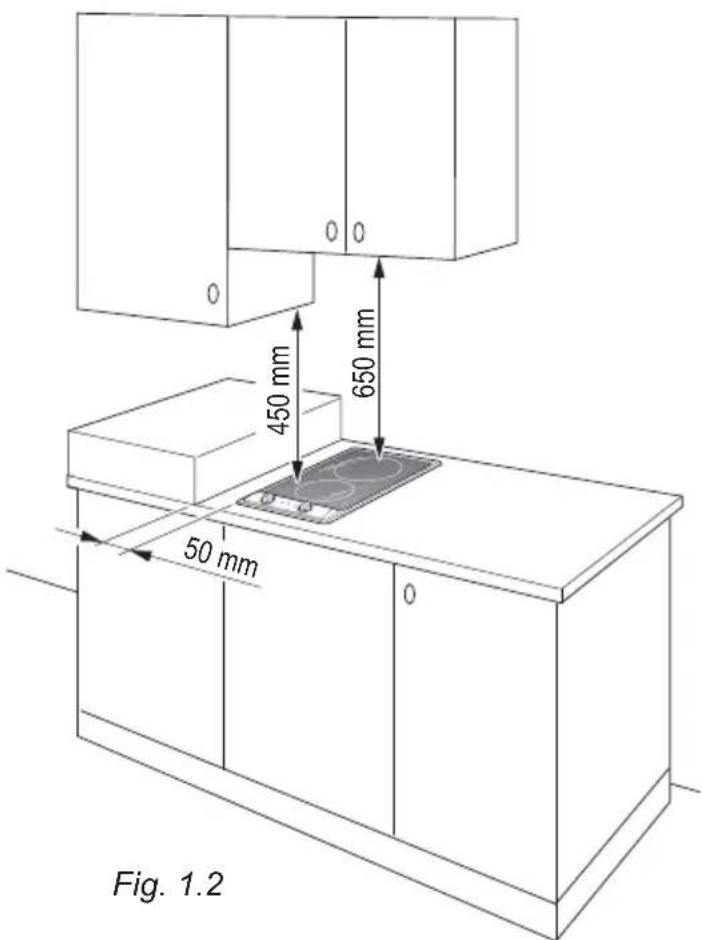
In order to install the cooker top into the kitchen fixture, a hole with the dimensions shown in fig. 1.1 has to be made, keeping in consideration the following:
- within the fixture, between the bottom side of the cooker top and the upper surface of any other appliance or internal shelf there must be a clearance of at least 30 mm;
- the cooker top must be kept no less than 50~mm away from any side wall (fig. 1.2);
- the cooker top must be kept at a distance of no less than 50~mm from the rear wall (fig. 1.1);
- there must be a distance of at least 650mm between the hob and any wall cupboard or extractor hood positioned immediately above (see fig. 1.2);
- the coatings of the walls of the unit or appliances near the cooktop must be heat resistant.
Do not install the appliance near inflammable materials (eg. curtains).
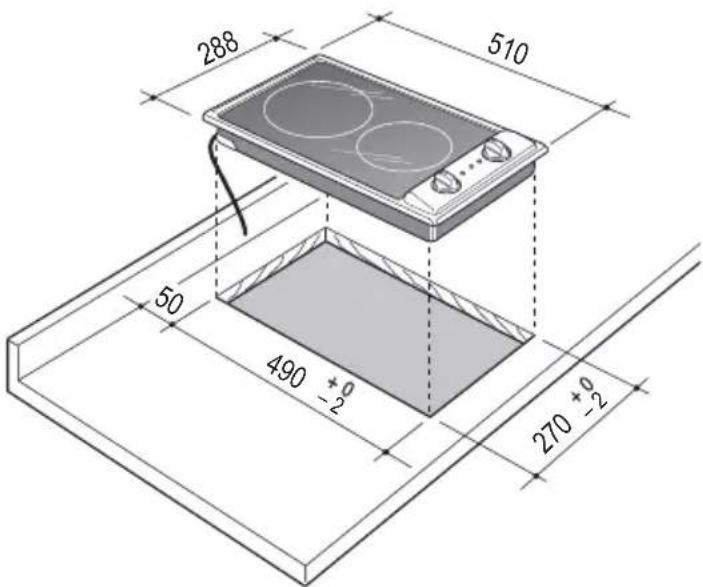
Fig. 1.1
FASTENING THE COOKTOP
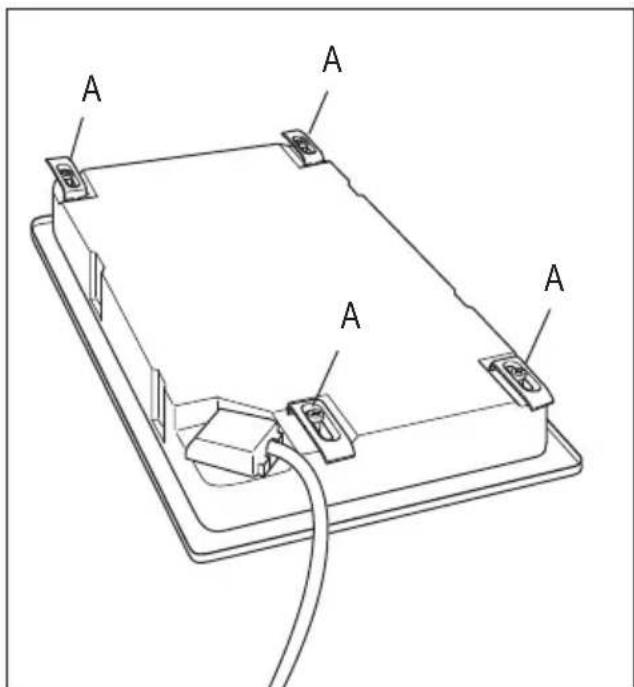
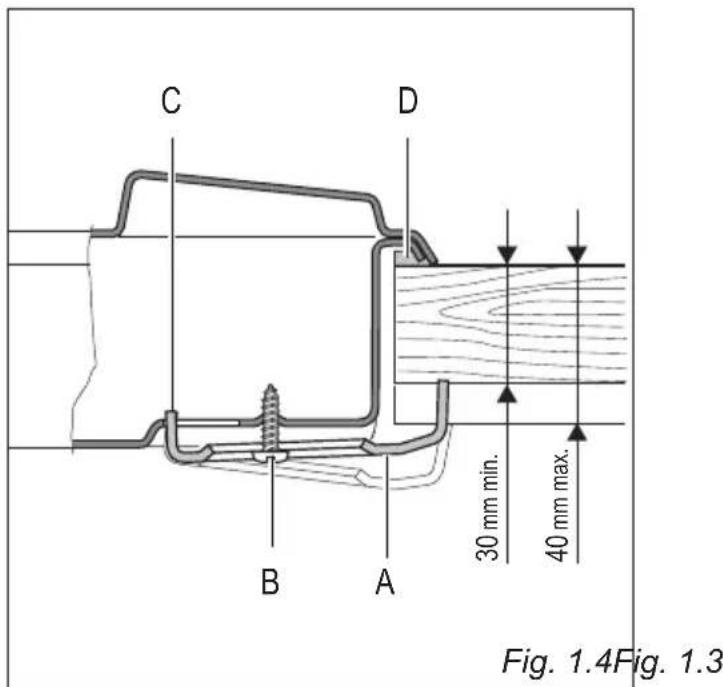
Each cooker top is provided with an installation kit including brackets and screws for fastening the top to fixture panels from 30 to 40mm thick, figs. 1.3, 1.4.
- Cut the unit.
- Stretch gasket "D" over the edge of the hole made, being careful to overlay the junction edges.
- Turn the cooktop over and put tabs "A" (fig. 1.3) into the mountings, only tighten screws "B" a few turns.
Make sure that the tabs are mounted correctly as shown in the figure 1.4. Turn the tabs so that the cooktop can be put into the hole.
- Put the cooktop into the hole cut into the unit and position it correctly.
Put tabs "A" into place, tooth "C" of the tabs should go into the hole. - Tighten screws "B" until the cooktop is completely secured.
Using a sharp tool cut off the part of gasket "D" which protrudes from the cooktop.
Take care not to damage the benchtop.

ELECTRICAL SECTION
IMPORTANT: Installation must be carried out according to the manufacturer's instructions. Incorrect installation may cause harm and damage to people, animals or property, for which the manufacturer accepts no responsibility.
Before carrying out any work on the electrical section of the appliance, it must be disconnected from the mains.
Connection to a good earth wiring system is absolutely essential.
The manufacturer accepts no responsibility for any inconvenience caused by failure to comply with this rule.
Before carrying out any work on the electrical section of the appliance, it must be disconnected from the mains.
If the hob surface is cracked disconnect the appliance from the mains and contact the After-Sales Service.
GENERAL
- Connection to the electric power supply must be carried out by a qualified technician and following the appropriate safety regulations.
- The appliance must be connected to the mains checking that the voltage corresponds to the value given in the rating plate and that the electrical cable sections can withstand the load specified on the plate.
- If the hob is supplied without plug, fit a standard plug which is suitable for the power absorbed by the appliance and in conformity with the local rules in force.
- The colours of the wires in the appliance power cable may not correspond with the colours marked on the terminals of your electrical plug.
The plug should always be wired as follows:
connect the green/yellow wire to the terminal marked with the letter E or the earth symbol 12 or coloured green/yellow;
connect the blue wire to the terminal marked with the letter N or coloured black;
connect the brown wire to the terminal marked with the letter L or coloured red.
- The plug must be connected to an outlet connected to the grounding unit in conformity to security norms.
- If the appliance is to be connected directly to the mains, it must be placed with an omnipolar switch with minimum opening between the contacts of 3mm between the appliance and the mains
- The power supply cable must not touch the hot parts and must be positioned so that it does not exceed 50^ above ambient.
- Once the appliance has been installed, the power switch or power plug must always be in a accessible position.
- If the power supply cable is damaged it must be substituted by a suitable cable available in the after sales service.
- The appliance must have its own supply; any other appliances installed near it must be supplied separately.
N.B. For connection to the mains, do not use adapters, reducers or branching devices as they can cause overheating and burning.
In the event that installation should require modifications to the mains supply wiring system, it is recommended that a qualified technician be called to carry out substitution.
The technician will also have to verify that the cross-section of the electric cables on the power point match the appliance's power rating.
REPLACING THE POWER SUPPLY CABLE
Important! This appliance must be connected to the electricity supply only by an authorised person.
WARNING: If the power supply cable is damaged, it must be replaced only by an authorised service agent in order to avoid a hazard.
- The supply cable must be replaced with a cable of the same type.
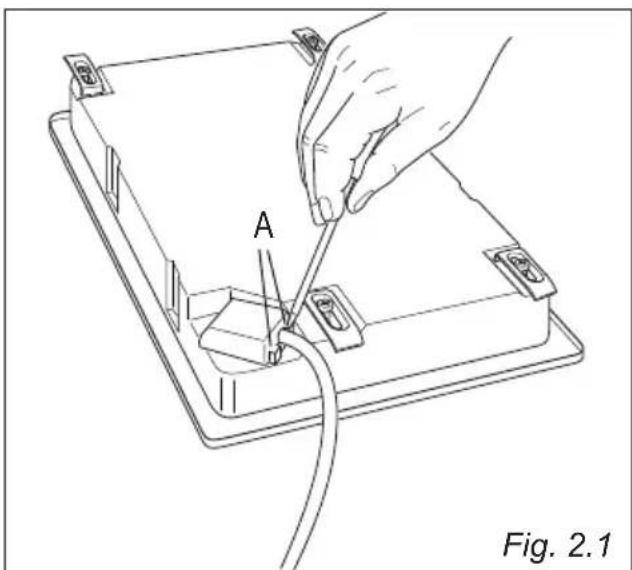
- Turn the cooktop over and unhook the terminal board cover by inserting a screwdriver into the two hooks "A" (fig. 2.1).
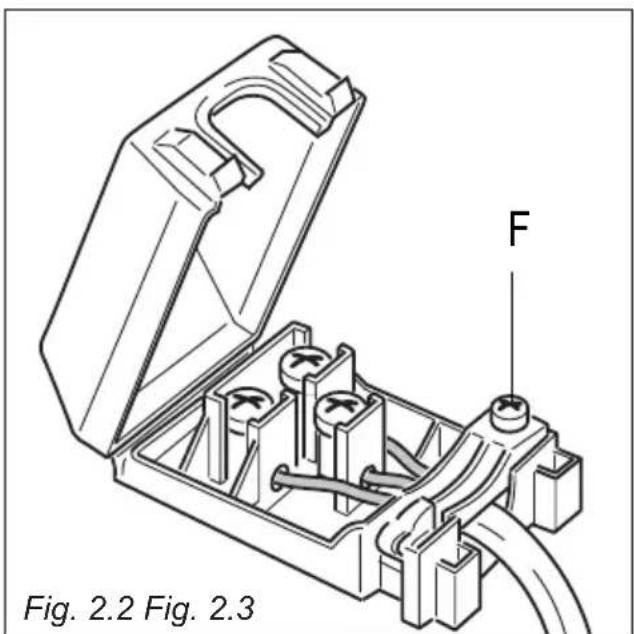
- Open the cable gland by unscrewing screw "F" (fig. 2.2), unscrew the terminal screws and remove the cable.
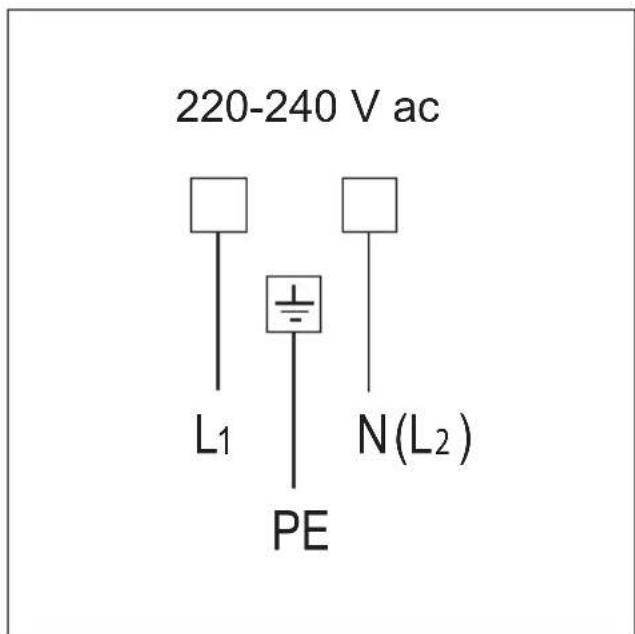
- The new supply cable, of suitable type and section, is connected to the terminal board following the diagram in fig. 2.3.
- Pull the feeder cable and block it with cable gland.
- Close the terminal block cover (check the two hooks "A" are correctly hooked).
Note: The earth conductor must be left about 3 cm longer than the others.
SECTION OF THE SUPPLY CABLE TYPE "H05RR-F" or "H05V2V2-F" (resistance to temperatures of 90^ )
220-240V50-60Hz3x1,5mm ^2()^(**)
(^) Connection possible with plug and outlet (^*) Connection with wall box connection.
Advice for the users

VITROCERAMIC HOB
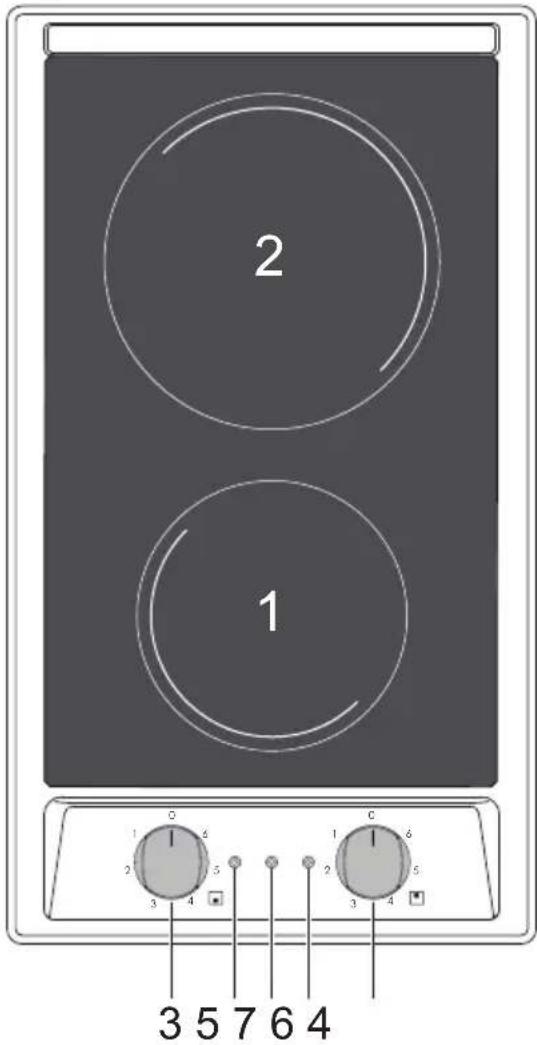
Fig. 1.1
FEATURES
- Electrical insulation Class I.
CONTROL PANEL
- "3-circuit" front cooking zone 145mm 1200 W
- "3-circuit" rear cooking zone 0 180 mm 1700 W
CONTROL PANEL DESCRIPTION
- Front zone control knob
- Rear zone control knob
- Front zone residual heat indicator
- Rear zone residual heat indicator
- Power on indicator light
Caution! Do not cover the hob with aluminium foils.
Attention: Detach the appliance from the mains if the ceramic glass is cracked and contact the After-Sales Service.
Metallic objects such as knives, forks, spoons and lids should not be placed on the hob surface since they can get hot.

HOW TO USE THE HOB
The ceramic surface of the hob allows a fast transmission of heat in the vertical direction, from the heating elements underneath the ceramic glass to the pans set on it.
The heat does not spread in the horizontal direction, so that the glass stays "cool" at only a few centimeters from the cooking plate.
Check that the hob is clean and then switch on by turning the control knob.
When the top is working, the pilot light will be on.
When the hob temperature is above 60^ , the corresponding indicator light will come on to indicate that the hob is hot.
This light will stay on even after the hob has been switched off to indicate that the hob is still hot.
The residual heat persists for some time after the hob has been switched off.
During this time avoid touching the hob and take particular care if there are children nearby.
The light will go out automatically when the hob temperature drops below 60^ .
NOTE: The knob and symbols may vary.
Fig. 2.1
IMPORTANT NOTE:
The heating elements incorporate a thermolimiter that switches ON/OFF the element in all settings to protect any overheating of the ceramic glass.
The use of incorrect pans and/or wrong pan positioning will cause the temperature limiter to operate more frequently, resulting in a reduction of cooking performance.
"3-CIRCUIT" RADIANT ZONES
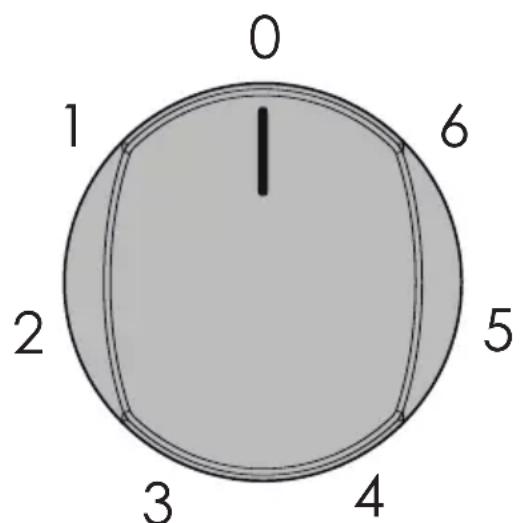
The heating element (fig. 2.2) consists of 3 electrical resistances which can operate together or separately according to the setting of the 7-position switch (fig. 2.1). It reaches the required temperature very quickly.
WARNING: If the surface is cracked, switch off the appliance to avoid the possibility of electric shock.
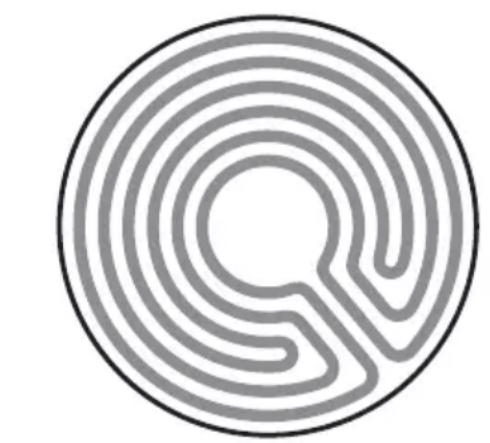
Fig. 2.2
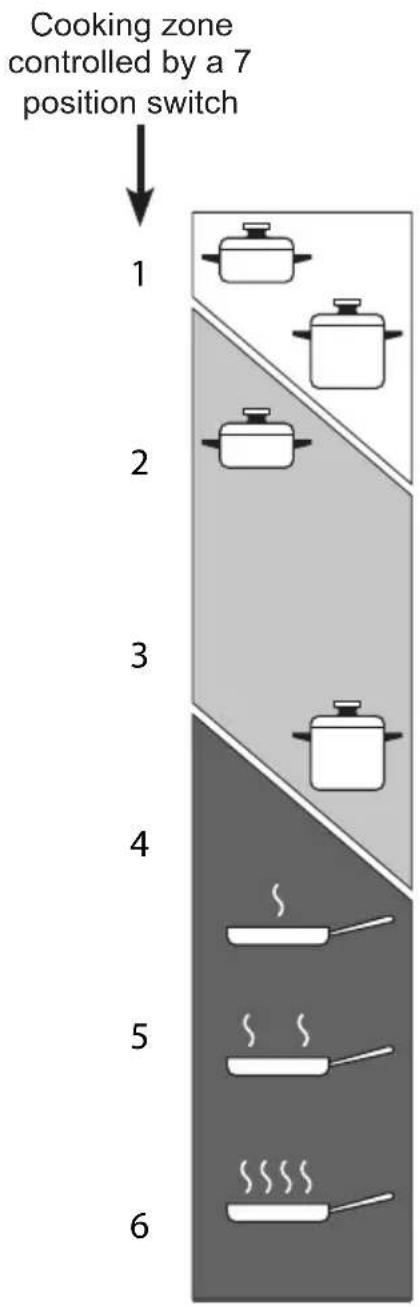

Heating

Cooking

Fig. 2.3
Roasting-frying
COOKING HINTS
| Knob setting | TYPE OF COOKING |
| 0 Switched OFF | |
| 1 | For melting operations (butter, chocolate). |
| 2 | To maintain food hot and to heat small quantities of liquid (saues, eggs). |
| 3 | To heat bigger quantities; to whip creams and sauces (vegetables, fruits, soups). |
| 34 | Slow boiling, i.e.: boiled meats, spaghetti, soups, continuations of steam cooking of roasts, stews, potatoes. |
| 4 | For every kind of frying, cutlets, uncovered cooking, i.e.: risotto. |
| 45 | Browning of meats, roasted potatoes, fried fish, omelettes, and for boiling large quantities of water. |
| 6 | Fast frying, grilled steaks, etc. |
After a short period of use, experience will teach you which setting is the right one for your needs.
COOKING HINTS:
- To reduce the cooking time, you can turn the control knob to the max when you switch the plate on. After a short time you can set the control knob to the position required for cooking.
- You should only use pots and pans with flat bases (pans with the test mark for glass-ceramic hobs are available from specialist shops). The diameter of the pan should match that of the cooking plate (or be slightly bigger) to make the most of the energy.
- Since the cooking surface will stays hot for a certain time after the plate has been switched off, you can switch it off 5 or 10 minutes before the end of the cooking. The residual heat of the hob will complete the cooking.
- To save electricity, use pan lids whenever possible.
- Never cook the food directly on the glass ceramic cooktop.
WARNING: Hobs become very hot with use, and retain their heat for a long time after cooking has finished (about 30 minutes).
Children should be supervised at all times and be prevented from touching the hot surfaces, until such time as the appliance has cooled.
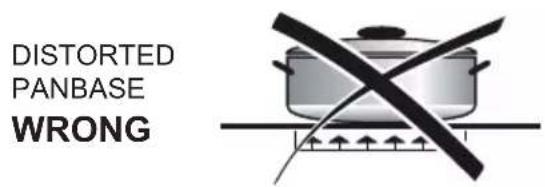
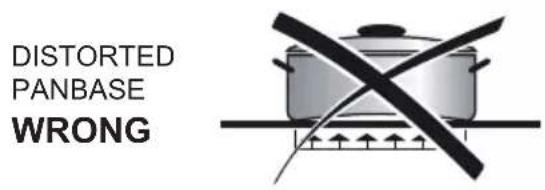
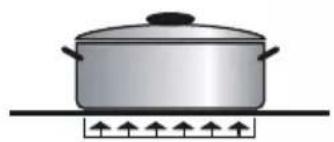
LEVEL PANBASE CORRECT
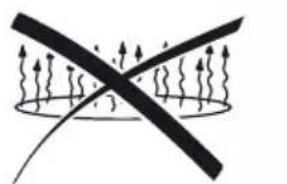
WRONG WASTING POWER
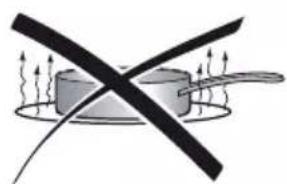
WRONG WASTING POWER
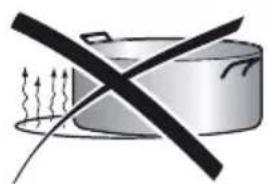
WRONG WASTING POWER
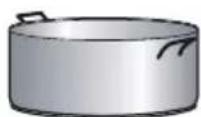
CORRECT COMPLETE USE OF THE HEAT
Fig. 2.4
Caution!
The cooking hob becomes very hot during operation.
Keep children well out of reach.
DO NOT USE GLASSWARE ON CERAMIC HOBS.
DO NOT USE PANS WITH ROUGHT CIRCULAR
MACHINED BASE.
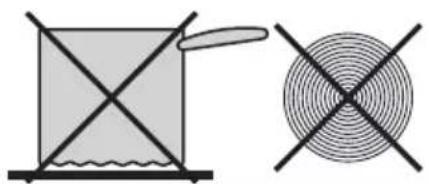
Fig. 2.5
ADVICE FOR SAFE USE OF THE COOKTOP
- Before switching on make sure that you have the correct knob for the hotplate chosen. It is advisable to put the pan on the hotplate before switching on and to take it away after switching off.
- Use cookware with flat and even bottoms (be careful when using cast iron vessels). Uneven bottoms can scratch the glass ceramic surfaces. Be careful that the bottom is clean and dry.
- Pots with aluminium bottoms may leave silver streaks or spots on the bob.
- Do not leave wet or damp lids on the bob.
- The glass-ceramic surface and pans must be clean. Carefully eliminate any food remains (especially containing sugar), dirt etc. with the aid of a cleansing agent.
- Make sure that the handles of cookware do not stick out over the edge of the cooker, to avoid them being knocked over by accident. This also makes it more difficult for children to reach the cooking vessels.
- Do not lean over the cooking zones when they are switched on.
- Do not drop heavy or sharp objects on the glass ceramic cooktop. If the surface is broken or damaged unplug the appliance and contact the after-sales service.
- Do not put aluminium foil or plastic objects on the cooking zones when they are hot.
- Remember that the cooking zones remain hot for some time after they are switched off (about 30mm ).
- Follow the cleaning instructions carefully.
- If you note a crack in the cooktop, switch the appliance off immediately and call the After-Sales Service.
Do not scratch the cooktop with cutting or sharp objects.
Do not use the glass ceramic surface as a work surface.
CLEANING THE CERAMIC HOB
Before you begin cleaning make sure that the appliance is switched off.
Remove any encrustation using a scraper specific for glass ceramic surfaces.
Dust or food particles can be removed with a damp cloth.
If you use a detergent, please make sure that it is not abrasive or scouring.
Abrasive or scouring powders can damage the glass surface of the hob. All traces of the cleaner have to be removed with a damp cloth.
It is highly recommended to keep off the hob any article which can melt: plastic, aluminium foil, sugar, sugar syrup mixtures etc.
If any of these products has melted on the ceramic surface, you should remove it immediately (when the surface is still hot) by using a scraper to avoid any permanent damage to the surface of the hob.
Avoid using any knife or sharp utensil since these can damage the ceramic.
Do not use steel wool or an abrasive sponge which could scratch the surface permanently.
ATTENTION: MOST IMPORTANT!
If cleaning the glass ceramic hob using a special tool (i.e. scraper) take extra care to avoid damage to the seal at the edges of the glass ceramic surface.
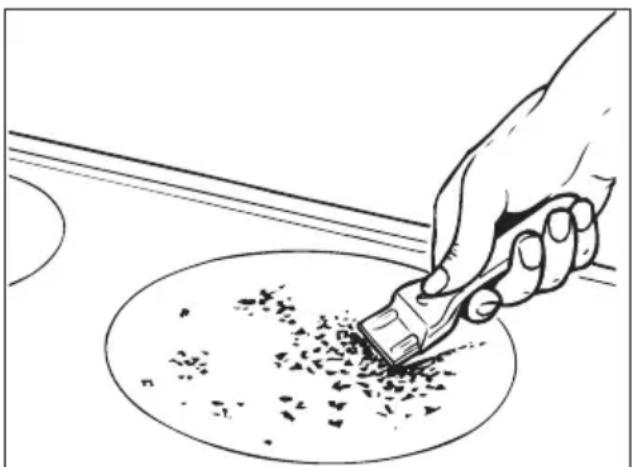
Fig. 2.6
GENERAL ADVICE
- Before you begin cleaning, you must ensure that the appliance is switched off.
- It is advisable to clean when the appliance is cold and especially when cleaning the enamelled parts.
- Be very careful that no water penetrates inside the appliance.
- Avoid leaving alkaline or acidic substances (lemon juice, vinegar, etc.) on the surfaces.
- Avoid using cleaning products with a chlorine or acidic base.
- Under no circumstances should any external covers be removed for servicing or maintenance except by suitable qualified personnel.
- Do not use a steam cleaner because the moisture can get into the appliance thus make it unsafe.
- Important: The use of suitable protective clothing/gloves is recommended when handling or cleaning of this appliance.
- Stainless steel surfaces: clean with a suitable product. Always dry thoroughly.
- IMPORTANT: Do not use any abrasive products (e.g. certain types of sponge) and/or aggressive products (e.g. caustic soda, products containing corrosive substances), which could cause irreparable surface damage.
WARNING
When correctly installed, your product meets all safety requirements laid down for this type of product category. However special care should be taken around the rear or the underneath of the appliance as these areas are not designed or intended to be touched and may contain sharp or rough edges, that may cause injury.
ENAMELLED PARTS
All the enamelled parts must be cleaned with a sponge and soapy water only or other non-abrasive products. Dry preferably with a microbre or soft cloth.
STAINLESS STEEL SURFACE
ONLY SOAP/WARM WATER MUST BE USED TO CLEAN THE STAINLESS STEEL SURFACES.
PAINTED PARTS AND SILKSCREEN PRINTED SURFACES
Clean using an appropriate product. Always dry thoroughly.
IMPORTANT: these parts must be cleaned very carefully to avoid scratching and abrasion. You are advised to use a soft cloth and neutral soap.
CAUTION: Do not use abrasive substances or non-neutral detergents as these will irreparably damage the surface.
Cher client,
The manufacturer will not be responsible for any inaccuracy resulting from printing or transcript errors contained in this brochure. We reserve the right to carry out modifications to products as required, including the interests of consumption, without prejudice to the characteristics relating to safety or function.
FR

- DECLARATION OF CE CONFORMITY
- IMPORTANT INFORMATION FOR CORRECT DISPOSAL OF THE PRODUCT IN ACCORDANCE WITH EC DIRECTIVE 2012/19/EC.
- ENERGY LABELLING/ECODESIGN
- USE OF THE APPLIANCE, ENERGY SAVING TIPS HOB
- ELECTRIC COOKING ZONES AND/OR AREAS
- Advice for the installer
- IMPORTANT :
- WARNING!
- TECHNICAL INFORMATION FOR THE INSTALLER
- FASTENING THE COOKTOP
- ELECTRICAL SECTION
- GENERAL
- REPLACING THE POWER SUPPLY CABLE
- SECTION OF THE SUPPLY CABLE TYPE "H05RR-F" or "H05V2V2-F" (resistance to temperatures of 90°C )
- Advice for the users
- VITROCERAMIC HOB
- FEATURES
- CONTROL PANEL
- CONTROL PANEL DESCRIPTION
- HOW TO USE THE HOB
- IMPORTANT NOTE:
- "3-CIRCUIT" RADIANT ZONES
- COOKING HINTS
- COOKING HINTS:
- Caution!
- ADVICE FOR SAFE USE OF THE COOKTOP
- CLEANING THE CERAMIC HOB
- ATTENTION: MOST IMPORTANT!
- GENERAL ADVICE
- WARNING
- ENAMELLED PARTS
- STAINLESS STEEL SURFACE
- PAINTED PARTS AND SILKSCREEN PRINTED SURFACES
- Cher client,
- FR
Brand : CANDY
Model : CH32XK
Category : Hob