Sara 630-087 - Bike Kayoba - Free user manual and instructions
Find the device manual for free Sara 630-087 Kayoba in PDF.


| Product Type | Bicycle |
| Brand | Kayoba |
| Model | Sara 630-087 |
| Frame Material | Steel |
| Wheel Size | 26 inches |
| Number of Gears | 6-speed |
| Brake Type | V-brakes |
| Weight | 15 kg |
| Dimensions (L x W x H) | 170 x 60 x 100 cm |
| Maximum Load Capacity | 100 kg |
| Seat Height Adjustment | Yes |
| Recommended Age | 12+ years |
| Assembly Required | Yes |
| Accessories Included | Rear rack, mudguards |
| Maintenance | Regular chain lubrication, tire pressure check |
Frequently Asked Questions - Sara 630-087 Kayoba
User questions about Sara 630-087 Kayoba
0 question about this device. Answer the ones you know or ask your own.
Ask a new question about this device
Download the instructions for your Bike in PDF format for free! Find your manual Sara 630-087 - Kayoba and take your electronic device back in hand. On this page are published all the documents necessary for the use of your device. Sara 630-087 by Kayoba.
USER MANUAL Sara 630-087 Kayoba
natural_image
Black and white children's bicycles with visible branding and wheels, no text or symbols on the bicycle body.EN User Instructions for bike
SE - Bruksanvisning i original
EN - Operating instructions (Translation of the original instructions)
Jula reserves the right to make changes. In the event of problems, please contact our service department.
www.jula.com
Tillverkare/ Produsent / Produenci/ Manufacturer
Jula AB, Box 363, 532 24 SKARA
Importör/ Importør/ Importer/ Importer
A Sadel H Cykelram
B Höjdjustering sadelstolpe I Barnanpassat handtag
natural_image
Technical line drawing of a mechanical device with a cart and a cylindrical component (no text or symbols)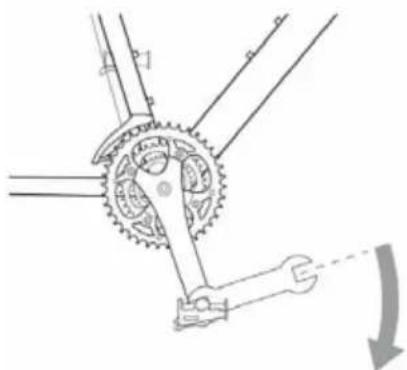
natural_image
Mechanical diagram showing a gear and shaft assembly with no visible text or symbolsnatural_image
Technical line drawing of a mechanical device and its gear mechanism (no text or symbols)natural_image
Two line drawings of a person riding bicycles, one in profile view and the other in side view (no text or symbols)1
natural_image
Line drawing of a mechanical device with a cart and a cylindrical component, no text or symbols present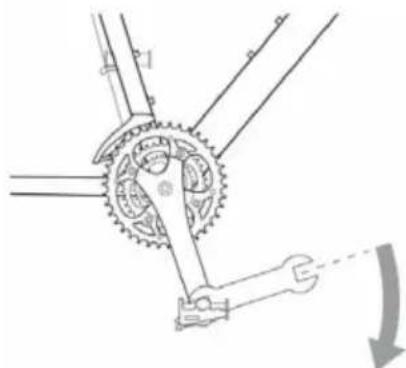
natural_image
Mechanical gear assembly diagram showing shaft, gear teeth, and wrench mechanism (no text or labels)natural_image
Technical line drawing of a mechanical device and its gear mechanism (no text or symbols)natural_image
Two line drawings of a person riding bicycles, one in motion and the other in motion (no text or symbols)VEDLIKEHOLD AV FELGER
VEDLIKEHOLD AV KJEDET
Smøre kjedet
A Siodełko H Rama roweru
natural_image
Line drawing of a mechanical device with a cart and a cylindrical component, no text or symbols present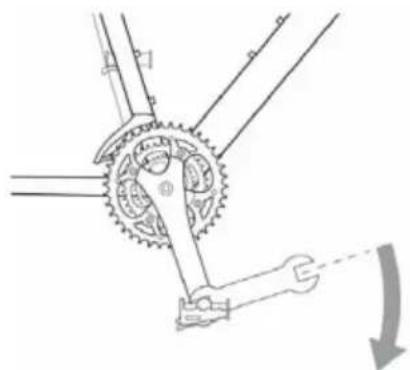
natural_image
Mechanical diagram showing a gear and shaft assembly with no visible text or symbolsnatural_image
Technical line drawing of a mechanical device with no visible text or symbols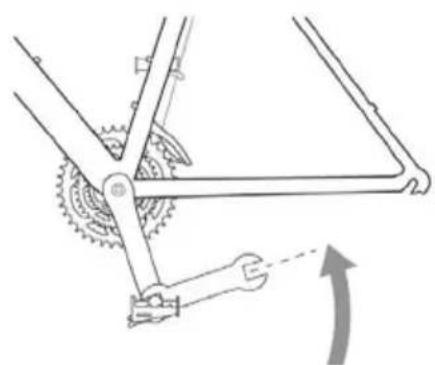
natural_image
Mechanical diagram showing a hand operating a gear mechanism with a rotating wheel (no text or symbols)natural_image
Two line drawings of a person riding bicycles, one in motion and the other in motion (no text or symbols)Read the operating instructions carefully before use.
Please retain for future reference.
Maximum load including cyclist and baggage is 50 kg.
WARNING! A bike is exposed to wear, like all mechanical equipment, when you use it. Different materials and components react in different ways to wear and stress. If the lifespan of any part of the bike (including the frame, forks and components) has been exceeded there is a risk of the part suddenly breaking, and that you lose control and fall off. Cracks, scratching or changes in colour in areas exposed to high levels of stress indicate that the component has reached the end of its life and should be replaced.
Check the following items before each use
- The rims are in good condition and undamaged. A worn rim is a safety risk and should be replaced.
- Screw joints and components are tightened properly and not worn or damaged.
- The sitting position is comfortable.
- The brakes work well.
- The steering is not binding or loose.
- The wheels are not warped and the wheel bearings are correctly adjusted.
- The wheels are correctly secured to the rear/front forks.
- The tyres are in good condition and at the correct air pressure.
- The pedals are correctly secured to the crank arms.
- The gears are properly adjusted.
- All reflectors are fitted.
- Following adjustment, check that all screw joints are correctly tightened and that the cables are undamaged and correctly routed along the frame.
- We recommend that you leave your bike in at the cycle repair shop every 6 months for a service (more frequently if you cycle a lot or put a heavy load on the bike). Complete the service record after each service.
Traffic safety
• Always wear a bike helmet.
- Follow local traffic regulations.
- Do not put anything on the bike that can get caught up and obstruct the functions of the bike.
- Do not cycle on the same side as oncoming traffic.
- Do not cycle 2-deep
- Do not take anyone on the bike who is not equipped for this.
- Do not swerve out onto the road.
- Do not hang anything onto the handlebars that will make it difficult to steer or that could get caught in the front wheel.
- Do not attach yourself to another vehicle.
- Do not cycle too close to the vehicle in front.
• Cycling in the rain or on a wet roadway:
– The effects of the brakes are reduced in water and ice
– Cycle more slowly in wet weather and brake earlier than you do in dry weather.
- If you cycle in the dark, you must follow the applicable legislation:
- The bike must have a front light with a white beam and a rear light with a red beam, in addition to the reflectors already on the bike.
- Preferably wear light clothing and a reflective vest or similar.
- Check that the bike's reflectors are positioned correctly, properly secured, clean and not obscured. Replace damaged reflectors immediately.
- Any shock absorbers on the bike should be maintained by a cycle repair shop. See the shock-absorber manufacturer's user instructions.
Owner's responsibility
The user instructions describe how to cycle safely and keep the bike in good and faultless condition.
- Read and follow the user instructions carefully. All major service work or adjustments to the bike should be carried out by a bicycle mechanic. Follow these instructions if you do not have access to a bicycle mechanic and would like to carry out the adjustments yourself.
IMPORTANT! All changes are made at your own risk.
- It can be dangerous to use the bike for freestyle cycling, stunts, competitions, cycling offroad etc. and you are personally responsible for any personal injury or other damage arising as a result of you using the bike in the above manner. The retailer renounces all responsibility in respect of the person buying the bike or a third party for consequential damage or specific damage.
- It is important to explain to the child how the bike works, especially the safe use of the brakes.
Service
Only use identical spare parts when replacing parts that are essential for safety. Check Julia's department store for original parts. This will guarantee that the bike remains safe to use.
DESCRIPTION
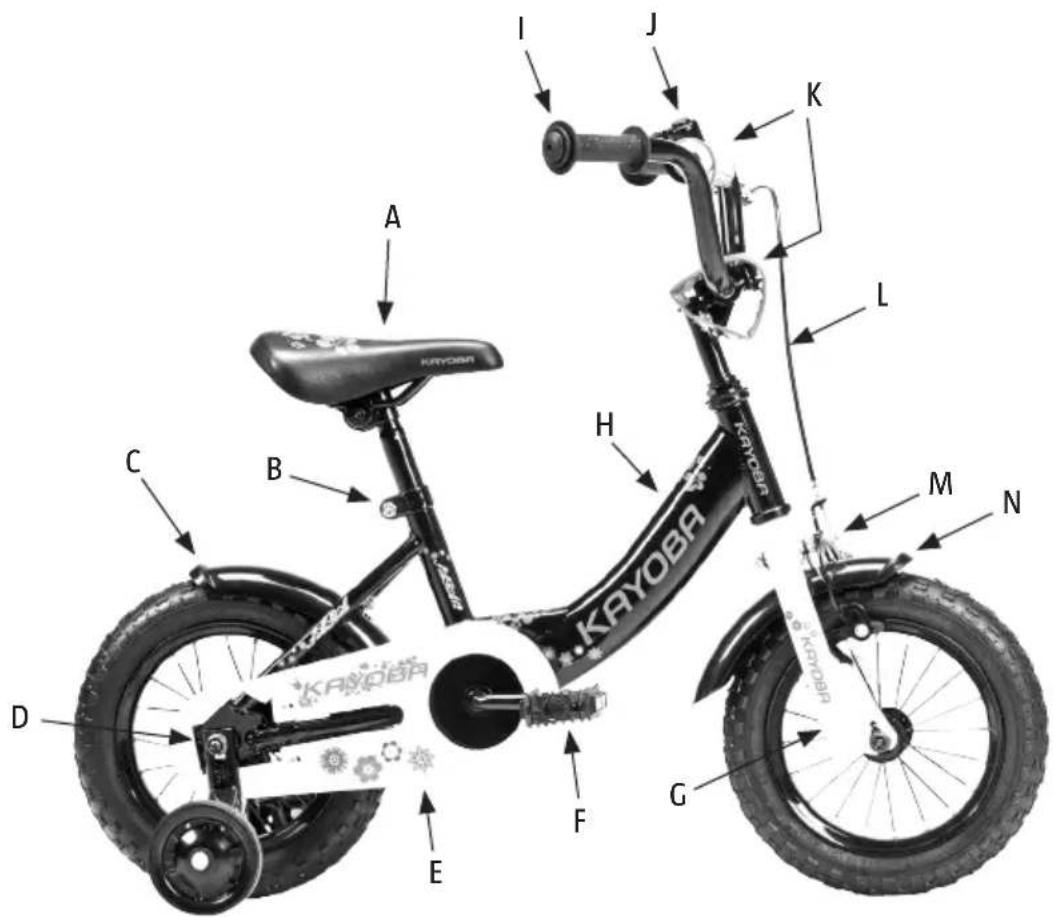
A Saddle H Bicycle frame
B Height adjustment saddle pillar I Child-compatible handle
C Rear mudguard J Bell
D Mounting support wheel K Protection (pads)
E Chainguard L Frame
F Pedal with reflex M Front V brakes
G Front fork N Front fork
ASSEMBLY
Accessories
- A carrier rack and child's seat can be fitted. NOTE: Some mountain bikes require special carrier racks, check that the carrier rack is suitable for your particular bike.
- A bike trailer can be used together with the bike.
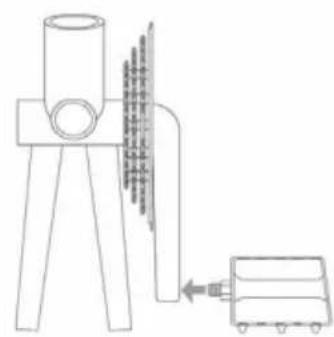
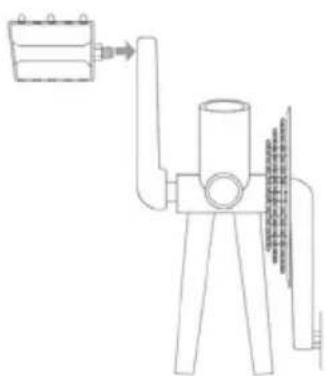
Assembling pedals
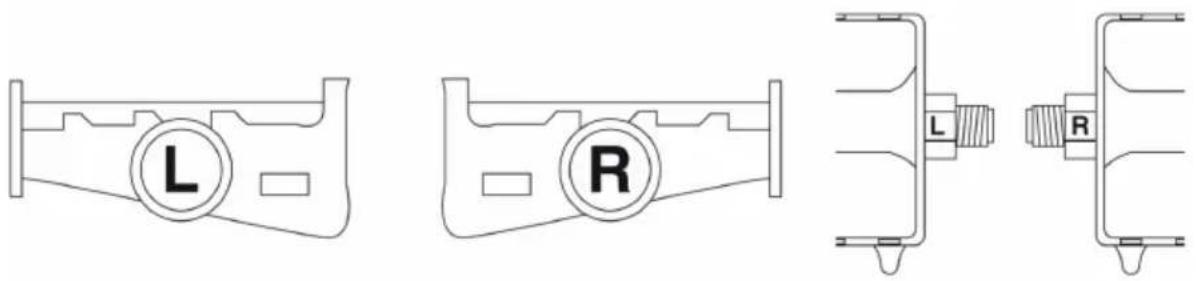
NB! The pedals are not identical – the pedal marked with an R needs to be fitted to the right crank arm and the pedal marked L to the left crank arm.
NOTE: Use a suitable lubricant on the pedal threads when fitting them.
1
natural_image
Technical line drawing of a mechanical device with a cart and conveyor system (no text or symbols)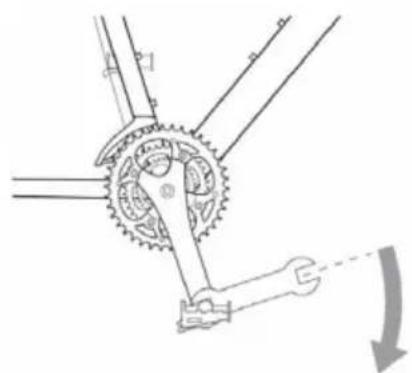
natural_image
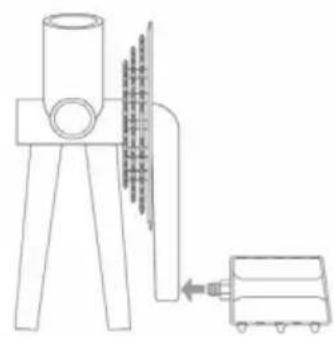
Mechanical diagram showing gear and wrench mechanism (no text or labels)Assembly of right pedal (R): Screw the pedal into the crank arm on the chain side and tighten carefully with a spanner.
2
natural_image
Line drawing of a mechanical device with a cylindrical body and attached lever, showing no text or symbols.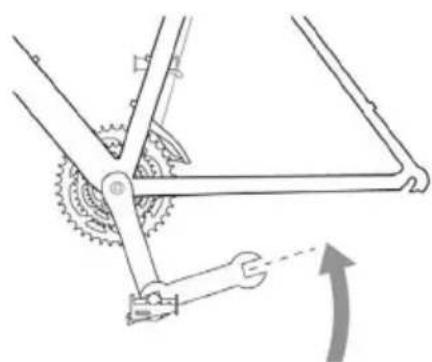
natural_image
Mechanical diagram showing a gear and linkage mechanism with no visible text or symbolsAssembly of left pedal (L): Screw in the pedal (anticlockwise) on the opposite side to the chain and tighten carefully with a spanner.
HANDLING
Sitting position
It is very important that the bike is correctly adjusted, from the point of view of both comfort and safety. There is information on the following pages on how you adjust your sitting position to make is comfortable, safe and effective.
Saddle adjustment
Slacken the nut that attaches the saddle to the saddle pillar so that you can push the saddle backwards or forwards.
Adjust it to the desired position. The saddle angle can also be adjusted. We recommend that the saddle is horizontal.
Adjust the saddle height by slackening the clamp bolt attaching the saddle pillar to the seat tube. Position
the saddle pillar at the desired height and tighten the clamp bolt.
IMPORTANT!
- The saddle pillar must be lower than the maximum height indicator. The maximum height indicator must not be visible.
- Tighten the saddle pillar's clamp bolt and nut to 30 Nm using a 6 mm Allen key or a 13 mm hex key. Check that the saddle pillar is securely attached by attempting to twist the saddle by hand. You must not be able to twist the saddle.
- Never cycle if the bike or saddle pillar is not properly tightened.
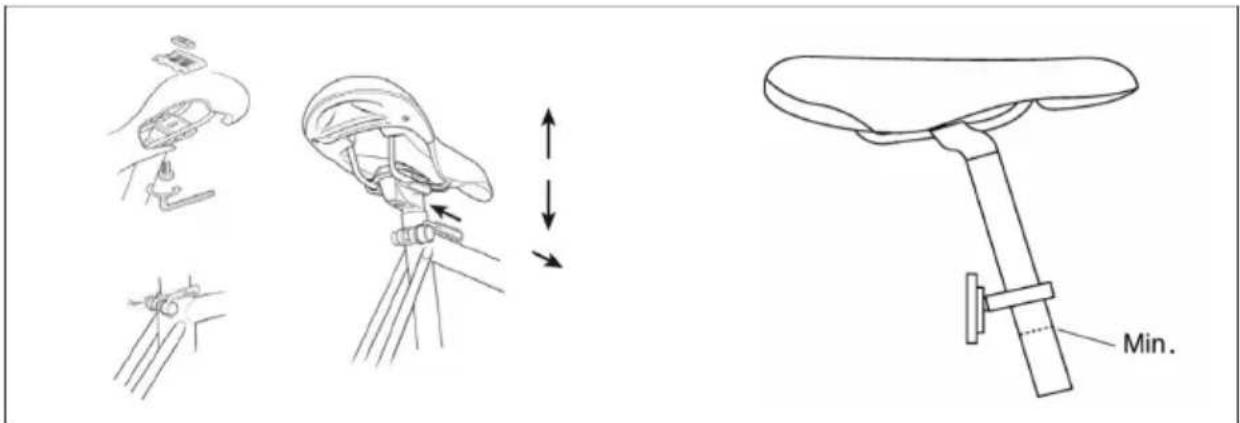
Different saddle pillars are used for different types of saddle, which is why the attachments vary. Contact the retailer if you are unsure of how the saddle should be assembled.
Saddle angle
The saddle should preferably be horizontal. You can change the saddle angle, but the saddle should usually be horizontal. If you sit best with the saddle at a great angle, you should check if you can change any other setting instead.
Saddle height
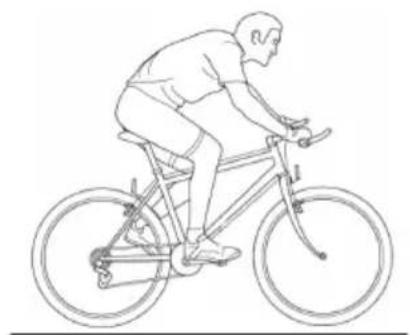
To check whether you have the right saddle height, you should put one of the pedals into its lowest position. Sit on the saddle wearing flat shoes and check that the heel reaches the pedal exactly when you keep your leg straight. When you cycle with the pad of your foot on the pedal, your leg should be slightly bent when the pedal is at its lowest position (see fig.).
natural_image
Line drawing of a person riding a bicycle with a full wheel (no text or symbols)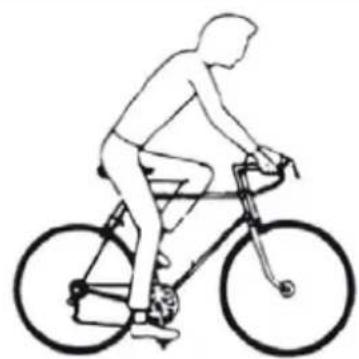
natural_image
Line drawing of a person riding a bicycle, no text or symbols presentThe position of the saddle above the pedals
Put the pad of one of your feet on the pedal with the crank arms horizontal. Adjust the position of the saddle forwards or backwards until the pedal is straight below the knee. Very small changes to the position of the saddle can affect both performance and comfort. Move the saddle a bit at a time until you find the right position.
Handlebars and handlebar stem/post
The bike may have a standard handlebar post or handlebar stem. Before use, check that all screw joints on the handlebar post/stem are properly tightened.
Standard handlebar post
Slacken tighten the expander screw on the lower part of the handlebar post until the expander wedge is loose. Carefully tap on the expander bolt if the the wedge does not loosen by itself. Once the expander wedge has loosened, move the handlebar post upwards or downwards into a position where you are sitting comfortably and can easily reach the handlebars and brake levers. The handlebars should usually be at the same height as or slightly lower than the saddle. Check that the handlebar post is in line with the front wheel.
IMPORTANT! The handlebar post has an indicator to show how far it can project from the fork. This indicator must not be visible when the handlebar post is fitted. The handlebar post must be far enough into the fork that the indicator is not visible. Once you have found the right height, position the handlebar at a right angle to the front wheel.
Tighten the expander bolt properly. It is extremely important that the expander bolt is properly tightened. Check that the handlebar post is properly secured by positioning yourself in front of the bike with your legs on either side of the front wheel. Squeeze the wheel with your legs and attempt to turn the handlebar sideways. The handlebar post must not rotate in the fork. Do not overtighten the handlebar post. There must be some give in it if the bike falls. Position the handles of the handlebars
horizontally and tighten the clamp bolts properly.
NB! If the bike has gear controls fitted to the handlebar post, these can be moved up or down to the desired position. Ensure that the gear controls face upward and that the cables are not twisted. Lubricate the expander bolt every time you remove the handlebar post from the fork tube. On certain off-road bikes, the brake cable must be adjusted when the height of the handlebar post has been adjusted. Do not attempt to adjust the brake cable if the bike has low-profile brakes with a cable stop on the handlebar post.
Handlebar stem
The handlebar stem has two locking bolts at its rear end, which clamp around the fork tube. Slacken the bolts and position the handlebar stem so that it is in line with the front wheel. Then retighten the locking bolts.
IMPORTANT! Do not adjust the upper compression bolt. This is set so as to eliminate bearing play. If it is overtightened, this could result in wear.
NB! On certain off-road bikes, the brake cable must be adjusted when the height of the handlebar post has been adjusted. Do not attempt to adjust the brake cable if the bike has low-profile brakes with a cable stop on the handlebar post.
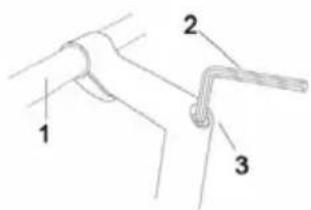 | Handlebar post with recessed bolt1. Handlebars2. Allen key, 6 mm3. Clamp bolt, Allen, handlebar post |
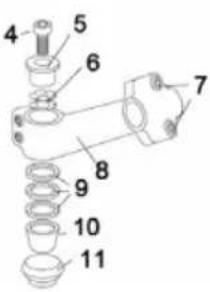 | Handlebar stem4. Compression bolt5. Compression cap6. Nut with locking washer7. Handlebar stem bolts8. Handlebar stem9. Spacers10. Bearing seat11. Handlebar bearing |
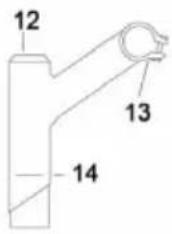 | Standard handlebar post12. Handlebar post expander13. Clamp bolt14. Handlebar maximum height indicator |
The handlebar position
Position the handlebars so that you can easily reach the gear controls and brake levers. Attempt to find a sitting position where your hands rest lightly on the handlebar. If you put too much weight on the handlebar, this leads to strain on the wrists and forearms. Do not forget to tighten all screw joints after adjustment.
NB! NEVER RAISE THE HANDLEBAR POST OR SADDLE PILLAR ABOVE THE MAXIMUM HEIGHT INDICATOR.
Adjustment of cotterless crankset
IMPORTANT! Check whether the bike's chain sprockets and crank arms are of the cotterless type. If this is the case, check that the nuts securing them to the crankset are properly tightened. We recommend that you check that the nuts are properly tightened once you have been using the bike for two weeks and then at three-monthly intervals.
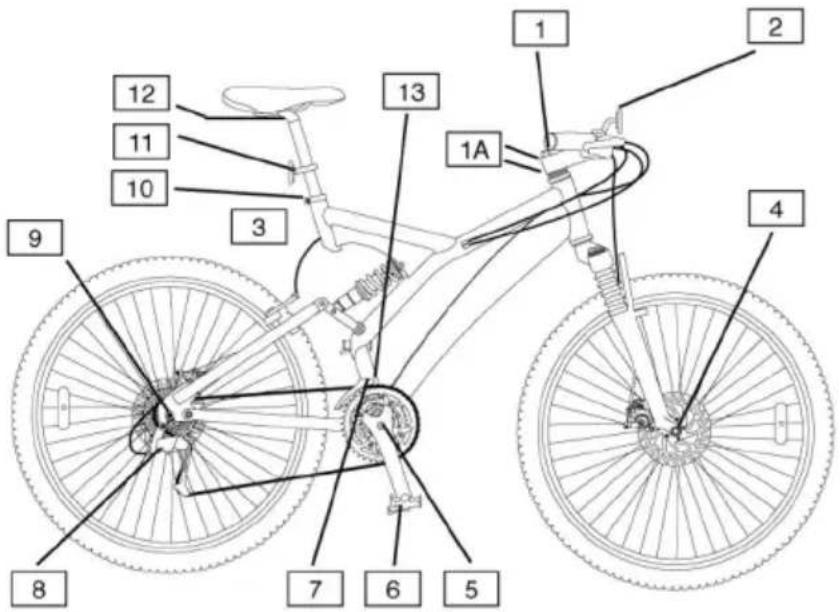
1 Expander bolt, handlebar post 20 Nm
1A Locking bolts for handlebar stem 20 Nm
2 Clamp bolt, handlebar stem 15 Nm
3 Mounting bolt for brakes (not disc brakes) 5 Nm
4 Front wheel axle nut 30 Nm
4 Front quick-release 5 Nm
5 Locking bolt for chain wheels 38 Nm
6 Pedal 40 Nm
7 Cable fixing bolt for front derailleur 4 Nm
8 Cable fixing bolt for rear derailleur 4 Nm
9 Rear wheel axle nut 30 Nm
9 Rear quick-release 5 Nm
10 Fixing bolt for saddle pillar 8 Nm
11 Fixing bolt for front and rear reflector 3 Nm
12 Saddle bolt 30 Nm
BRAKES
WARNING! It is very important that you understand how the bike's brakes work. If you use the brakes incorrectly you could lose control of the bike and seriously injure yourself. Different bikes may behave in different ways when you brake, so it is important that you learn how the bike behaves in different situation sand how hard you need to pull on the brake levers. Read the user instructions and practice cycling and braking. Contact the retailer if you require further information.
Safe braking
- Brake a bit earlier with the rear brake than with the front break.
- Never brake using the front brake when you are turning. It is particularly important that you bear this in mind when you are doing a tight turn or cycling on a loose surface.
IMPORTANT!
- If you brake too hard with the front break, you may brake so hard that you are thrown off the bike.
- The brakes are less effective in wet conditions. Cycle more slowly and brake earlier in wet conditions.
- Do not cycle if the brakes are not working correctly.
Rim brakes
Check the brake adjustment and lubricate the brake springs and pivot regularly. Lubricate the exposed part of the cable to protect against corrosion. If it is difficult to brake, this is often because the cables are insufficiently lubricated. The brake cable must be disassembled for lubrication. We recommend that you have a bicycle mechanic lubricate the brake cables.
Replace the brake pads when necessary and when the wear indicator shows.
NB! In order for the brakes to be applied evenly, the wheels must not be warped, they must be correctly adjusted and the sides of the rim must be even and without any markings. The brake linings must be correctly adjusted to the sides of the rim. Contact the retailer if you are unsure about how to adjust the wheels or brakes. Protect the end of the cable with end caps so that the cable does not fray.
IMPORTANT! The brakes must not bind or remain in contact with the rim when you release the brake lever. If the brakes bind, check that the callipers, cables and brake levers are clean and lubricated. Take the bike to the retailer if the brakes bind despite these components being clean and lubricated.
TYRE CARE AND WHEEL ADJUSTMENT
- In order for the bike's tyres to function well and last a long time, it is important that they are at the correct air pressure, which is indicated on the side of the tyre.
- Locking the brakes and skidding wear out the tyres.
- The tyres must not come into contact with oil, petrol, paraffin or other agents that dissolve rubber.
- Check that the wheels are not warped and that they are correctly aligned so that the side of the tyre does not come into contact with the frame or front fork.
- Check also that the tyres are not worn or have cracks. Ensure that the tyre tread has not been worn down and that there is no damage, cracks or uneven wear on the tyre. Replace a worn or damaged tyre immediately.
- If you cycle over sharp stones, holes in the road or onto kerbstones, the tyres may puncture.
- If the bike is to be stored away for a long period, we recommend that you remove the wheels to prevent them becoming warped.
- Pump up the tyres with a foot pump or hand pump with a suitable valve connection. Check the pressure with a manometer.
- Check regularly that the spokes are correctly tensioned. Check often if you cycle a lot on uneven roads.
MAINTAINING THE RIMS
Most rims have a wear indicator in the form of a line along the side of the rim.
The rim should be replaced when this line is completely or partially worn off. It is then worn.
MAINTAINING THE CHAIN
Lubricating the chain
The chain should be lubricated regularly; use a suitable chain oil. Check that the chain does not knock when
cycling, or is damaged. Always keep the chain oiled.
- Lubricate the chain.
- Pedal a few turns so that the oil comes in the links.
- Wipe the chain with a cloth or sponge.
Tension the chain
A chain that is not properly tensioned can be dangerous. If the chain can be moved more than 1 cm "up or down" it must be tensioned.
- Undo the nuts on the back wheel and pull the back wheel backwards.
- Tighten the nuts. Make sure the wheel is fitted straight.
- Check that the wheel is properly tightened.