
TJKU30 - Cordless drill Tryton - Free user manual and instructions
Find the device manual for free TJKU30 Tryton in PDF.


| Product Type | Multifunctional Kitchen Appliance |
| Brand | Tryton |
| Model | TJKU30 |
| Dimensions (W x D x H) | 30 x 25 x 20 cm |
| Weight | 2.5 kg |
| Power Supply | 220-240 V ~ 50/60 Hz, 1200 W |
| Main Functions | Blending, grinding, chopping, stirring, whipping |
| Speed Settings | Variable speed with pulse function |
| Capacity | 1.5 L blending jug |
| Material | Stainless steel blades, BPA-free plastic jug |
| Dishwasher Safe Parts | Jug, lid, and accessories |
| Cleaning | Wipe base with damp cloth; submerge jug in warm soapy water |
| Safety Features | Locking lid, non-slip feet, overload protection |
| Spare Parts & Repairability | Blade assembly, jug, and seals available separately |
| Noise Level | < 85 dB |
| Cable Length | 1.2 m |
| Warranty | 2 years |
| User Manual Languages | EN, CS, HU, LT, LV, PL, RO, RU |
Frequently Asked Questions - TJKU30 Tryton
User questions about TJKU30 Tryton
0 question about this device. Answer the ones you know or ask your own.
Ask a new question about this device
Download the instructions for your Cordless drill in PDF format for free! Find your manual TJKU30 - Tryton and take your electronic device back in hand. On this page are published all the documents necessary for the use of your device. TJKU30 by Tryton.
USER MANUAL TJKU30 Tryton
E E K T R O N A R Z I


natural_image
Line drawing of a 20V power drill with labeled brushless base (no text or symbols beyond branding)TJKU30
EN
Operating instruction
CORDLESS IMPACT WRENCH....5
PL

E

SYSTEM

TJV10AL
natural_image
Black-and-white photo of a handheld electric drill press with attached power strip (no visible text or symbols)TJP60
natural_image
Person operating a large solar panel on a cutting board (no visible text or symbols)TJ1LD

natural_image
Close-up of a black plastic electronic component with a cable, labeled '1 h' below (no other text or symbols)TJV10

natural_image
Black handheld electric drill bit with a base (no visible text or symbols)TJPS70

natural_image
Black-and-white photo of a person performing a push-up gesture (no visible text or symbols)TJ3LD

natural_image
Two black electronic devices with wires, labeled '3-5 h' below (no other text or symbols)TJV20
natural_image
Close-up of a black handheld electric drill bit with a base (no visible text or symbols)TJD90
natural_image
Black-and-white photo of a diagonal tool or mechanical component (no visible text or symbols)TJ15AK

natural_image
Black electronic device with a label indicating 1.5 Ah (no other text or symbols visible)TJS40
natural_image
Close-up of a mechanical tool or device with a cylindrical head and textured body (no visible text or symbols)TJE100
natural_image
Black metal tool with handle and lever (no text or symbols visible)TJ2AK

natural_image
Black electronic device with a labeled value of 2.0 Ah (no other text or symbols visible)TJR50

natural_image
Mechanical device with black components and a wooden base (no visible text or symbols)TJB110

natural_image
Simple line drawing of a handheld device with lever and handle (no text or symbols)TJ4AK

natural_image
Black plastic electrical connector with 4.0Ah label (text is part of the device, not part of the component)TJPS70AL

natural_image
Black and white photo of a saw cutting tool with attached power cord and accessories (no visible text or symbols)TJS120AL

natural_image
Close-up of a mechanical power tool with a flat blade and two separate components (no visible text or symbols)TJS120

natural_image
Close-up of a mechanical power tool with a black spoke and circular base (no visible text or symbols)EN
System 20 V lets you power several power tools with a single battery.
Choose one of our tools, batteries, and chargers and expand your workshop with System 20 V.
PL
Keep this document for future reference.

WARNING! Read all safety warnings marked with a symbol ⚠️ and all operating safety instructions.
To limit the risk of fire, electric shock and injury while using the device, follow all operating safety instructions and tips provided below.
Keep all work safety instructions and tips for future reference.
In warnings provided herein the expression "power tool" means a power tool powered from the mains (with a power cord) or a battery powered power tool (cordless).

WARNING! General work safety warnings for use of the tool.
Workplace safety:
a) Keep your workplace tidy and well lit. Untidiness and bad lighting result in higher accident rate.
b) Do not use the power tool in explosive environments, created by flammable liquids, gases or dusts. The power tool generates sparks that can ignite dust or vapors.
c) Keep children and unauthorized persons away from the place where the power tools are used. Inattention may result in losing control over your power tool.

WARNING! General warnings regarding the use of power tools.
Electric safety:
a) Plugs used in power tools must match wall outlets. Never modify the plug of your power tool. Do not use any extension cables when operating a power tool with a grounding/earthing conductor (PE). Any modifications of plugs and outlets increase the risk of electric shock.
b) Avoid touching earthed surfaces or grounded items like pipes, heaters, central heating radiators and refrigerators. Touching earthed or grounded surfaces increases the risk of electric shock.
c) Do not expose your power tool to rain or damp environments. Water penetrating the tool increases the risk of electric shock.
d) Do not damage the power cord. Never use the power cord to carry, pull the power tool and do not pull by its power cord to disconnect plug from the outlet. Keep the power cord away from sources of heat, oils, sharp edges and moving parts. Damaged or entangled power cords increase the risk of electric shock.
e) When your power tool is operated outdoors use extension cords intended for outdoor use only. Using an extension cable intended for outdoor use decreases the risk of electric shock.
f) It is recommended to connect the device to a mains supply equipped with a residual current device (RCD) with a rated current of 30 mA or less.
g) When it is unavoidable to use your power tool in a damp environment use an RCD (Residual Current Device) for protection. The use of RCDs decreases the risk of electric shock.

WARNING! General warnings regarding the use of power tools.
Personal safety:
a) This equipment is not intended for use by persons (including children) disabled physically, mentally, sensorial or persons with no experience and knowledge in operating the equipment unless they operate the equipment under supervision or follow user's instructions provided by persons responsible for their safety.
b) It is necessary to predict steps, watch and keep common sense when using power tools. Do not operate power tools when you are tired, under influence of drugs, medicine or alcohol. A moment of inattention while operating a power tool may result in serious personal injury.
c) Use personal protective equipment (PPE). Always wear safety goggles. Wearing personal protective equipment (PPE) including a dust mask, anti-slippery footwear, a helmet and ear protection reduces personal injury.
d) Avoid unexpected start up. Before connecting your power tool to the mains and/or inserting a battery make sure its power switch is in off position. Carrying your power tool with a finger on its power switch or without disconnecting it from the mains (switched on) may result in an accident.
e) Before starting your power tool remove any keys/wrenches. Leaving a key/wrench in the rotating part of your power tool may result in personal injury.
f) Do not lean forward too far. Always remain stable and maintain balance. It will allow you to have a better control over your power tool in unpredictable situations.
g) Wear appropriate clothing. Do not wear loose clothes or jewelry. Keep your hair tied. Keep your clothes away from moving parts. Loose clothes, jewelry or long hair may be caught by moving parts.
h) If your power tool allows for using an external dust extraction or collection system, make sure it is connected and used properly. Using dust collectors may reduce dust affected risks.
i) Do not let your skills gained through the frequent use of the power tool make you overconfident and disregard safety rules. Carelessness may cause injury in a fraction of a second.

WARNING! General warnings regarding the use of power tools.
Use and taking care of your power tool:
a) Do not overload your power tool. Use a power tool with power adjusted to work being done. An appropriately chosen power tool will allow you to work better and safer under load it has been designed for.
b) Do not use a power tool when its powerswitch is out of order (it does not switch it on or off). Any power tool with its power switch out of order is dangerous and must be repaired.
c) Always disconnect the plug from the power source and/or disconnect its battery before changing any settings, performing replacement or storage. Such preventive measures reduce the risk of accidental power tool start up.
d) Keep your power tool out of reach of children and do not allow unauthorized persons to use the power tool. Power tools in hands of untrained persons can be dangerous.
e) Power tools require maintenance. Check power tools for concentricity or jamming of moving parts, any cracks and all
other factors affecting the power tool work safety. If any damage to the power tool is detected, it should be repaired before use. Improper power tool maintenance is a reason for many accidents.
f) Cutting tools should be sharp and clean. Keeping sharp cutting edges in good condition reduces the risk of jamming and facilitates operation.
g) Power tools, equipment, working tools etc. should be used according to this user's manual taking into account operating conditions and the work to be done. Misusing a power tool can result in dangerous situations.
h) At low temperatures and after a long brakes in operation it is recommended to turn the power tool to operate it with no load for a few minutes to provide proper grease distribution inside its driving mechanism.
i) Use soft, damp (cannot be wet) cloth and soap to clean power tools. Do not use petrol, solvents and other agents that may damage your equipment.
j) Power tools can be stored/carried after making sure that all moving components are locked and protected against release with original devices intended for this purpose.
k) Store power tools in a dry, dust and water-protected place.
1) Carry your power tool in its original packaging to provide protection against mechanical damage.
m) Keep handles and grip surfaces clean and free from oil and grease. Secure grip and control over the tool in unexpected circumstances are impossible if handles and grip surfaces are slippery.

WARNING! General warnings regarding the use of power tools.
Repair:
a) Warranty and post-warranty repairs of its power tools are carried out by PROFIX Service, which guarantees the best quality or repair and use of genuine spare parts.

WARNING! Cordless impact wrench, security warnings
Personal Safety:
a) The device is designed for tightening and loosening bolts and nuts and should be used for this purpose only.
b) Use appropriate protection when working with the impact wrench, in particular ear protection, safety glasses, work gloves, and net for long hair.
c) Hold the device by insulated handles during use. The connector may be connected to invisible wires. Connectors connected to live wires may conduct electricity to metal parts of the tool and cause electric shock.
d) Hold the power tool with both hands during work and make sure your position is stable. High reaction torques may occur when tightening or loosening bolts and nuts.
e) Assume a position that can counteract normal or unexpected movements by the tool caused by torque. Vibration, jerks, or incorrect position can cause arm or hand injury. Stop working if you feel weary or pain.
f) Check the condition of the device. Before work, check the condition of those parts that wear down regularly to make sure they are operational. Check whether moving parts oscillate or show signs of a jam. Check whether all parts are mounted correctly and not cracked. Do not use the tool if the anvil on which sockets are placed shows any signs of damage.
g) Sockets and other implements need to be designed for impact operation. The implements have to be operational, clean, and free of damage. Their size has to fit the anvil. Do not modify sockets or the anvil. Never use sockets other than impact sockets.
h) Stop the wrench before changing the direction of rotation. Always turn the device off and wait for the wrench to stop completely before changing the direction of rotation.
i) When replacing the working attachment, disconnect the tool from the power supply or lock the switch to prevent it from being thrown out when the device is accidentally started.
j) Wait for the tool to stop before putting it down. Rotating attachments can become tangled in clothing and block, creating a hazard.
k) Bolts and nuts that need to be tightened at a specific torque should be tightened with a torque wrench.
1) Do not overload the tool. Do not exert an excessive force on the tool during use. When it is impossible to loosen a bolt, and the wrench will not start, stop the work immediately. In such a case, use a stronger tool or continue with a manual wrench.

WARNING! Safe use of rechargeable batteries and battery chargers -
Using the battery:
a) Use only the batteries that correspond to specifications required by the equipment manufacturer. Use of unsuitable batteries may lead to cracks and destruction of the battery, personal injuries or fires.
b) WARNING: In case of damage or improper use of the battery, explosive gases might be released. The battery must be kept away from fire and proper ventilation is to be assured during charging. It cannot be left for a longer period of time in a high temperature environment (areas with strong exposure to the sun, close to radiators or any other place with a temperature above 40 degrees).
c) The battery must be charged within the temperature range of 15 to 25°C.
d) Batteries can be charged exclusively with use of a power adapter recommended by the manufacturer of the tool. Application of any other power adapter may pose a risk of a fire.
e) Never expose the battery to the effect of water or moisture.
f) When another battery is to be charged in sequence the time gap between charging operations must be not less than 30 minutes.
g) In no case may you open the battery.
h) Under unfavourable conditions electrolyte may leak from batteries, be careful to avoid contacts with the liquid. In case of accidental contacts with the liquid wash the affected locations with water. When liquid penetrates eyes, seek also for medical assistance. The liquid that leaks from batteries may be a reason for irritation or scalds.
i) When the battery unit is not in use keep it far away from metallic items such as paper clips, coins, keys, nails, bolts or other metal things that may short the battery terminals. Shorts of battery terminals may cause burns or fires.
j) Never throw batteries to fireplaces.
k) Never charge a damaged battery.
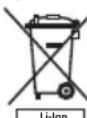
The batteries are intended for multiple use and contain harmful lithium.
Upon the battery lifetime expires the battery must be disposed in accordance with environmental regulations. Discharge the
battery first top the empty state and remove from the electric tool. Hand over to an organization that deals with utilization of batteries or take it back to the shop where the tool had been purchased.
Using the charger:
a) Use only dedicated power adapters to charge the battery. Application of a power adapter dedicated to charge another type of the battery unit poses a risk of fires.
b) Do not disassemble the charger.
c) The charger is designed exclusively for indoor use. It must not be exposed to water or moisture.
d) Charge only in an ambient temperature between 15-25 degrees.
e) Do not insert metal objects of any kind into the charger.
INTENDED USE AND DESCRIPTION:
A cordless impact wrench is a compact tool for tightening and loosening threaded connections with 1/2" (13 mm) impact sockets inserted onto the anvil. It is most useful when changing car wheels, installing or removing parts attached with bolts, repairing garden machinery etc.
You can use suitable adapters or universal connectors between the anvil and the socket.
ATTENTION! Use the tool and its equipment for their intended purpose and as instructed by the manufacturer. Do not use the tool for any other purpose.
Do not use the tool as a hammer to remove or straighten cross-shaped fittings. Never try to adapt the tool for other uses or modify it.
Remember that the tool is not intended for professional, workshop, or industrial use. If the device is used in professional workshops, industrial plants or similar facilities, the warranty is void.
Any use of the that is not in observance with the above-mentioned device purpose is forbidden, leads to the loss of warranty, and relieves the manufacturer from responsibility for the resulting damage.
Any modifications of the tool by the user relieve the manufacturer from responsibility for any damage and injuries to the user and the surroundings.
The intended use includes conformity with safety, installation, and operating instructions in the manual. Additionally, follow accident prevention (OSH) regulations as closely as possible.
Application of the tool in accordance with the intended use also refers to its maintenance, storage, transportation and repairs.
Defective electric tools can be handed over for repairs exclusively to service workshops appointed by the tool manufacturer.
Despite using the tool according to its intended application it is impossible to eliminate certain residual risk factors. Considering the tool construction the following risks may occur when operating the tool:
- Possible injury by ejected parts;
- Damage of hearing when appropriate hearing protectors are not used.
■ The set includes:
- Cordless impact wrench-1pc.
- Impact sockets – 4pcs. (17mm, 19mm, 21mm, 23mm)
• 1pc.Operating instruction - - Warranty card - 1 pc.
■ Device components (see pages 2-3):
Fig.A 1. Impactsocket
- Anvil 1/2"
- Rotation direction switch
- Handle
-
Fastener to hang on the belt
-
Battery*
- Batterylock clip*
- Control panel/Gear shifter
- On/off switch
- Auxiliary lighting
Fig.C 11. Charger*
- Adapter*
- Battery level indicator button*
- Battery indicator to show the battery status of charge*
* The accessories shown or described are not standard equipment. For the complete offer of auxiliary equipment, see our catalogue.
TECHNICAL PARAMETERS:
| Supply voltage | 20 V d.c. |
| Gear shifter I-II-III | yes |
| Rotation speed under no-load conditions | n_o=0-2300/min |
| Maximum torque | 350 Nm |
| Anvil size | 1/2" (13mm) |
| Weight (with battery) | 1,4 kg |
| Acoustic pressure level(LpA) | 91,7 dB(A) |
| Acoustic power (LwA) | 102,7 dB(A) |
| Tolerance of measurements K_LpA , K_LwA | 3 dB(A) |
| Vibration level according to EN 62841, maximum tightening torque a_t (Tolerance of measurements K=1,5 m/s^2 ) | 13,668 m/ s^2 |
| Recommended 20 V Li-ion batteries: TJ15AK (1,5Ah), TJ2AK (2Ah), TJ4AK (4Ah) | |
| Recommend chargers: TJ3LD(3-5h), TJ1LD (1h) | |
The vibration level value given refers to basic application of the tool. If the tool is used for other applications or with other tools, or if it is not maintained properly, the vibration level may differ from the values given. The above-mentioned causes may lead to higher exposure to vibrations during the whole work time.
One must implement additional safety measures to protect the operators from exposure to vibrations, such as maintenance of the electric tool and work tools, assurance of proper hand temperature, or determination of the sequence of work operations.
The declared total vibrations and declared noise emissions were measured in accordance with a standard test method and may be used for tool comparison.
The declared total vibrations and noise emissions can be used in preliminary exposure assessment.
Warnings:
The vibrations and noise emissions during the actual use of the power tool may differ from the declared values depending on how the tool is used and on the type of the workpiece in particular.
Determine safeguards to protect the operator. They should be based on the estimated exposure under actual operational conditions (taking into account all parts of the operating cycle such as when the tool is switched off or idle except the start time).
PREPARATION FOR WORK:
Prior to each use of the tool one has to check whether moving parts of the device are in operating conditions, not seized, cracked or damaged that may affect proper operation of the tool. Damaged tools must be handed over for repairs before they can be used again.
■ Charging the battery
NOTE! Battery and charger are not part of the delivery. Depending on your needs, you can purchase a 1.5 Ah battery TJ15AK, 2.0 Ah battery TJ2AK or 4.0Ah TJ4AK and a compatible charger TJ3LD (charging time 3–5 hours) or TJ1LD (charging time 1 hour).
You can check the battery level with the battery level indicator button (13). A single LED means the battery level is low, two LEDs mean medium level, and three LEDs mean full battery. Charge the battery fully before use.
Charger TJ3LD
The first charging procedure using TJ3LD should last at least 5 hours.
- Press the battery lock button (7) and take the battery (6) out of the impact wrench(see Fig. B).
- Connect the battery (6) to the charger (11) (see Fig. C).
- Connect the adapter plug (12) to the charger (11).
- Connect the adapter to a mains socket (110–240V, 50-60 Hz).
Charger TJ1LD
The first charging procedure using TJ1LD should last at least 1 hour.
- Press the battery lock button (7) and take the battery (6) out of the impact wrench(see Fig. B).
- Connect the battery (6) to the charger (11) (see Fig. D).
- Connect the charger plug to a mains socket (220–240 V, 50 Hz).
■ Battery charging indicator
A green LED light indicates that the charger is connected to a power source. After the battery is connected, the red LED is on to indicate charging. Blinking green battery LEDs also indicate that the battery is charging and show the current battery level.
When the battery is fully charged, the red LED goes off and the green LED is on.
After charging, disconnect the charger and remove the battery.
NOTE! The battery may get slightly hot when charging. This is not a malfunction.
The lithium-ion battery can be charged at any moment, without detriment to its life. Interrupting the charging process does not entail a risk of damaging the battery cells.
DURING WORK:
■ Tool change:

ATTENTION: It is recommended to switch the rotation direction switch (3) to the central position to lock the on/off switch (9) before replacing hex sockets to make sure the procedure is safe.
The implement of the cordless impact wrench is a socket, for example for hexagonal bolts, that is mounted onto the anvil (2). The prerequisite for using a socket is for its square opening to have the right size for the anvil as specified in Technical Data (1/2" - 13 mm).
Always use impact sockets that are the right size for the bolt or nut. An impact socket of a wrong size can lead to inaccurate and uneven torque and/or damage to the bolt or nut.
Put the socket (1) against the anvil (2) and press as far as possible (see Fig. A). A correctly mounted socket should not slip off the anvil. The spring-loaded safety catch at the end of the anvil holds the socket in place even at high RPM.
To replace the implement, pull the socket and take it off the anvil.
ATTENTION! Use forged, black sockets that are indented for impact wrenches. If you use a regular socket from a popular set of sockets, its bolt side will be damaged quickly, which may lead to the implement falling apart.
■ Switching on/off

ATTENTION: When loosening bolts and nuts, they are kept inside the socket—possible injury or damage by ejected parts, also to other people and objects.
The switch (9) offers a stepless RPM adjustment.
To switch the power tool on, press the switch. The RPM increases as the button is pressed more. To stop the power tool, release the switch.

ATTENTION!
Power tools should be switched on only after the socket is positioned on the bolt or nut.
Auxiliary light
The impact wrench has an auxiliary working light (10) controlled with the switch (9).
To turn the light off, release the switch trigger. The light is turned off approximately 10 seconds after the trigger is released.
ATTENTION! Do not look directly into the light source.
■ Rotation direction (see Fig.E)
The tool has a switch for changing the rotation direction.
- to set clockwise rotation, slide the rotation direction switch (3) left (looking from the rear). Clockwise rotation is usually for tightening.
- to set counter-clockwise rotation, slide the rotation direction switch (3) right (looking from the rear). Counter-clockwise rotation is for loosening.
When the rotation direction switch is in the central position, the switch (9) is blocked.
ATTENTION! When the tool is not used, always set the rotation direction slider (3) in the neutral position.
Gear switch
The electronic gear can be selected with a button on the control panel (8). Each time the button is pressed, it activates a consecutive RPM speed in the cycle outlined below.
Clockwise rotation:

Strong impact force: 2300rpm. 350Nm

Medium impact force: 1650rpm. 210Nm
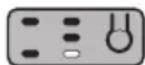
Weak impact force: 1320rpm. 170Nm
Counter-clockwise rotation

Continuous rotation
Strong impact force: 2300rpm. 150Nm
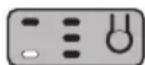
Intermittent rotation
Strong impact force: 2300rpm. 150Nm
WORK TIPS:
ATTENTION! Always check the direction of rotation before starting work.
- The work object should be fixed so that it cannot move accidentally during work. Small objects can be fixed in various holders, such as a vice.
- Before a bolt or nut is tightened with the wrench, screw it in several turns by hand. Make sure the socket size is right for the fastener. Incorrect socket size can damage the implement and bolt or nut.
- When working with the impact wrench below 0^ C, run the device idle for several minutes before work. It will warm up the grease inside the impact head.
• The electric wrench can tighten most bolt fasteners. Some fasteners
require a specific, measurable torque, so it is recommended to use a torque wrench for final tightening.
- Vibration from the impact wrench can be transferred to the operator. Always wear work gloves when using the device.
STORAGE AND MAINTENANCE:
The tool in principle does not require any special maintenance or service.
The tool must be stored in a place that is not accessible to children and must be kept clean and protected from moisture and dust. The storage conditions should prevent potential mechanical damage and impact of the weather conditions.
■ Cleaning
CAUTION: Remember to always disconnect the battery from the tool prior to starting the cleaning operations and unplug the charger from the outlet.
The charger may be cleaned exclusively with use of a dry cloth.
Use also a clean cloth to clean regularly the ventilation openings of the tool to keep them patent. From time to time disassemble the grip and remove dust and other rubbish from the interior.
The tool housing must be cleaned with use of a moistened cloth small quantity of soap and then wiped dry. Do not use any detergents or solvents as they can damage parts made from plastics. After cleaning let the tool dry completely before it is used again.
TRANSPORTATION:
Store and transport the tool in its transport box to protect it against humidity, dust penetration and small objects; remember to protect its ventilation openings. Small objects after getting into the casing can result in damage to the motor.
If the battery is removed for transport or storage, make sure the contacts will not short circuit. Remove metal items such as screws, nails, clasps, loose bits, wires, or metal filings from the case or transport container or otherwise prevent them from touching the battery.
MANUFACTURER:
PROFIX Co.Ltd.,
34 Marywilska Street,
03-228 Warsaw, POLAND.
This appliance is in conformity with national and European standards as well as with general safety guidelines.
NOTE: In case of technical issues, contact an authorised technical service. Any repairs are allowed to be carried out exclusively by qualified staff with use of original spare parts.
PICTOGRAMS:
Explanation of the icons located on the nominal plate and the information tags:

«Read this instruction before switching on the power supply and starting the work.»

— Wear hearing protection!

«Protect the battery against heat, e. g., against continuous intense sunlight.»

NOTE: The symbol nearby denotes that old equipment must never be thrown away together with other waste (with the penalty of a fine). Hazardous components of electronic equipment may adversely affect the natural environment and human health.
Each household may contribute to the recovery and reuse (recycling) of old machinery and equipment. Both in Poland and Europe a system for recovery of used equipment either exists or is being created. The system obliges all organizations that sell such equipment to collect the used machinery and appliances. Moreover, general purpose collecting points for such equipment are available.
TROUBLESHOOTING GUIDE:
| PROBLEM POSSIBLE | CAUSE | REMEDY |
| The impact wrench fails to operate. | No power voltage, damaged motor or the power trigger. | Check the battery status, recharge or replace with a new one when necessary. When the problem persists hand over the tool for repair at a service workshop. Please refer to the warranty sheet for addresses of authorized workshops. |
| Irregularities of the motor operation. | Battery low. | Recharge the battery. |

The policy of the PROFIX company consists in permanent improvements of the offered products and therefore the company reserves the right to make amendments to the product specification without a prior notice. The images included into the operation manual are only of the exemplary nature and may slightly differ from actual appearance of the device purchased.
This instruction manual is protected by copyright. Copying it without the written consent of PROFIX Co. Ltd. is prohibited.

INSTRUKCJA OBSŁUGI
TJKU30AKUMULATOROWY KLUCZ UDAROWY
(EN) EC/EU DECLARATION OF CONFORMITY (PL) DEKLARACJA ZGODNOŚCI WE/UE (RO) DECLARAȚIE DE CONFORMITATE CE/UE
(LV) EK/ES ATBILSTIBAS DEKLARACIJA (LT) EB/ES ATITIKTIES DEKLARACIJA (CS) ES/EU PROHLÁŠENÍ O SHODĚ
(HU) EK/EU-MEGFELELŐSÉGI NYILATKOZATA
(EN) MANUFACTURER
(PL) PRODUCENT
(RO) PRODUCĂTOR
(LV) RAŽOTĀJS
(LT) GAMINTOJAS
(CS) VÝROBCE
(HU) GYÁRTÓ
PROFIX Sp. z o.o. ul. Marywilska 34, 03-228 Warszawa
(EN) Person who was authorized to develop technical documentation:
(PL) Osoba upoważniona do przygotowania dokumentacji technicznej:
(RO) Persoana împuternicită pentru pregătirea documentației tehnice:
(LV) Persona atbildīga par tehniskās dokumentācljas sagatavošanu:
(LT) Asmuo jgaliotas parengti techninę dokumentaciją:
(CS) Osoba oprávněna připravit technickou dokumentacji:
(HU) Műszaki dokumentáció elkészítésére meghatalmazott személy:
(EN) and have been manufactured in accordance with the standards;
Representative of the Board for Certification

- E E K T R O N A R Z I
- TJKU30
- EN
- PL
- SYSTEM
- Workplace safety:
- Electric safety:
- Personal Safety:
- Using the charger:
- INTENDED USE AND DESCRIPTION:
- The intended use includes conformity with safety, installation, and operating instructions in the manual. Additionally, follow accident prevention (OSH) regulations as closely as possible.
- ■ The set includes:
- ■ Device components (see pages 2-3):
- Warnings:
- PREPARATION FOR WORK:
- ■ Charging the battery
- Charger TJ3LD
- Charger TJ1LD
- ■ Battery charging indicator
- After charging, disconnect the charger and remove the battery.
- DURING WORK:
- ■ Tool change:
- ■ Switching on/off
- ATTENTION!
- Auxiliary light
- ■ Rotation direction (see Fig.E)
- Gear switch
- Clockwise rotation:
- Counter-clockwise rotation
- WORK TIPS:
- STORAGE AND MAINTENANCE:
- ■ Cleaning
- TRANSPORTATION:
- MANUFACTURER:
- PICTOGRAMS:
- INSTRUKCJA OBSŁUGI
- TJKU30AKUMULATOROWY KLUCZ UDAROWY
- PROFIX Sp. z o.o. ul. Marywilska 34, 03-228 Warszawa
Brand : Tryton
Model : TJKU30
Category : Cordless drill