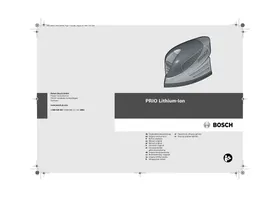
PRIO LITHIUM-ION - Rechargeable Battery BOSCH - Free user manual and instructions
Find the device manual for free PRIO LITHIUM-ION BOSCH in PDF.



| Product type | Rechargeable battery |
| Brand | BOSCH |
| Model | PRIO LITHIUM-ION |
| Nominal voltage | 7.2 V |
| Capacity | 1.0 Ah |
| Technology | Lithium-ion |
| Number of cells | 2 |
| Charging time | 33 ± 3 minutes |
| Charge indicator | 3 LEDs (green/red) |
| Protection | Electronic Cell Protection (ECP) against deep discharge |
| Weight (approx.) | 0.7 kg (battery integrated in the tool) |
| Compatible charger | Specific Bosch charger (part no. 2 607 225 ...) |
| Safety | Protection against internal overpressure, short circuits, leakage current |
| Maintenance | Keep clean, avoid moisture |
| Storage | Away from sun and fire, room temperature |
| Transport | Tested according to UN, lithium equivalent quantity < limit values |
| Recycling | Do not dispose of with household waste, mandatory recycling |
| Usage | For Bosch PRIO tools and other compatible tools |
Frequently Asked Questions - PRIO LITHIUM-ION BOSCH
User questions about PRIO LITHIUM-ION BOSCH
0 question about this device. Answer the ones you know or ask your own.
Ask a new question about this device
Download the instructions for your Rechargeable Battery in PDF format for free! Find your manual PRIO LITHIUM-ION - BOSCH and take your electronic device back in hand. On this page are published all the documents necessary for the use of your device. PRIO LITHIUM-ION by BOSCH.
USER MANUAL PRIO LITHIUM-ION BOSCH
Robert Bosch GmbH
Power Tools Division
70745 Leinfelden-Echterdingen
Germany
www.bosch-pt.com
1 609 929 S57 (2009.08) O / 121 WEU
PRIO Lithium-Ion

BOSCH
Dr. Egbert Schneider Senior Vice President Engineering
Dr. Eckerhard Strötgen Head of Product Certification

Robert Bosch GmbH, Power Tools Division D-70745 Leinfelden-Echterdingen 23.06.2009
Montage
General Power Tool Safety Warnings
WARNING Read all safety warnings and all instructions. Failure to follow
the warnings and instructions may result in electric shock, fire and/or serious injury.
Save all warnings and instructions for future reference.
The term “power tool” in the warnings refers to your mains-operated (corded) power tool or battery-operated (cordless) power tool.
1) Work area safety
a) Keep work area clean and well lit. Cluttered or dark areas invite accidents.
b) Do not operate power tools in explosive atmospheres, such as in the presence of flammable liquids, gases or dust. Power tools create sparks which may ignite the dust or fumes.
c) Keep children and bystanders away while operating a power tool. Distractions can cause you to lose control.
2) Electrical safety
a) Power tool plugs must match the outlet. Never modify the plug in any way. Do not use any adapter plugs with earthed (grounded) power tools. Unmodified plugs and matching outlets will reduce risk of electric shock.
b) Avoid body contact with earthed or grounded surfaces, such as pipes, radiators, ranges and refrigerators. There is an increased risk of electric shock if your body is earthed or grounded.
c) Do not expose power tools to rain or wet conditions. Water entering a power tool will increase the risk of electric shock.
d) Do not abuse the cord. Never use the cord for carrying, pulling or unplugging the power tool. Keep cord away from heat, oil, sharp edges and moving parts. Damaged or entangled cords increase the risk of electric shock.
e) When operating a power tool outdoors, use an extension cord suitable for outdoor use. Use of a cord suitable for outdoor use reduces the risk of electric shock.
f) If operating a power tool in a damp location is unavoidable, use a residual current device (RCD) protected supply. Use of an RCD reduces the risk of electric shock.
3) Personal safety
a) Stay alert, watch what you are doing and use common sense when operating a power tool. Do not use a power tool while you are tired or under the influence of drugs, alcohol or medication. A moment of inattention while operating power tools may result in serious personal injury.
b) Use personal protective equipment. Always wear eye protection. Protective equipment such as dust mask, non-skid safety shoes, hard hat, or hearing protection used for appropriate conditions will reduce personal injuries.
c) Prevent unintentional starting. Ensure the switch is in the off-position before connecting to power source and/or battery pack, picking up or carrying the tool. Carrying power tools with your finger on the switch or energising power tools that have the switch on invites accidents.
d) Remove any adjusting key or wrench before turning the power tool on. A wrench or a key left attached to a rotating part of the power tool may result in personal injury.
e) Do not overreach. Keep proper footing and balance at all times. This enables better control of the power tool in unexpected situations.
f) Dress properly. Do not wear loose clothing or jewellery. Keep your hair, clothing and gloves away from moving parts. Loose clothes, jewellery or long hair can be caught in moving parts.


16 | English
g) If devices are provided for the connection of dust extraction and collection facilities, ensure these are connected and properly used. Use of dust collection can reduce dust-related hazards.
4) Power tool use and care
a) Do not force the power tool. Use the correct power tool for your application. The correct power tool will do the job better and safer at the rate for which it was designed.
b) Do not use the power tool if the switch does not turn it on and off. Any power tool that cannot be controlled with the switch is dangerous and must be repaired.
c) Disconnect the plug from the power source and/or the battery pack from the power tool before making any adjustments, changing accessories, or storing power tools. Such preventive safety measures reduce the risk of starting the power tool accidentally.
d) Store idle power tools out of the reach of children and do not allow persons unfamiliar with the power tool or these instructions to operate the power tool. Power tools are dangerous in the hands of untrained users.
e) Maintain power tools. Check for misalignment or binding of moving parts, breakage of parts and any other condition that may affect the power tool's operation. If damaged, have the power tool repaired before use. Many accidents are caused by poorly maintained power tools.
f) Keep cutting tools sharp and clean. Properly maintained cutting tools with sharp cutting edges are less likely to bind and are easier to control.
g) Use the power tool, accessories and tool bits etc. in accordance with these instructions, taking into account the working conditions and the work to be performed. Use of the power tool for operations different from those intended could result in a hazardous situation.
5) Battery tool use and care
a) Recharge only with the charger specified by the manufacturer. A charger that is suitable for one type of battery pack may create a risk of fire when used with another battery pack.
b) Use power tools only with specifically designated battery packs. Use of any other battery packs may create a risk of injury and fire.
c) When battery pack is not in use, keep it away from other metal objects, like paper clips, coins, keys, nails, screws or other small metal objects, that can make a connection from one terminal to another. Shorting the battery terminals together may cause burns or a fire.
d) Under abusive conditions, liquid may be ejected from the battery; avoid contact. If contact accidentally occurs, flush with water. If liquid contacts eyes, additionally seek medical help. Liquid ejected from the battery may cause irritation or burns.
6) Service
a) Have your power tool serviced by a qualified repair person using only identical replacement parts. This will ensure that the safety of the power tool is maintained.
Safety Warnings for Sander
▶ Use the machine only for dry sanding. Penetration of water into the machine increases the risk of an electric shock.
▶ Caution, fire hazard! Avoid overheating the object being sanded as well as the sander. Always empty the dust collector before taking breaks. In unfavourable conditions, e. g., when sparks emit from sanding metals, sanding debris in the dust bag, micro filter or paper sack (or in the filter sack or filter of the vacuum cleaner) can self-ignite. Particularly when mixed with remainders of varnish, polyurethane or other chemical materials and when the sanding debris is hot after long periods of working.


- Secure the workpiece. A workpiece clamped with clamping devices or in a vice is held more secure than by hand.
- Keep your workplace clean. Blends of materials are particularly dangerous. Dust from light alloys can burn or explode.
Before any work on the machine (e.g. maintenance, changing the tool, etc.) as well as during its transport and storage, lock the On/Off switch in the off position. There is danger of injury when the On/Off switch is unintentionally actuated.

Protect the power tool against heat, e. g., also against continuous sun irradiation and fire. There is danger of explosion.
In case of damage and improper use of the battery, vapours may be emitted. Provide for fresh air and seek medical help in case of complaints. The vapours can irritate the respiratory system.
▶ When the battery is defective, liquid can escape and come into contact with adjacent components. Check any parts concerned. Clean such parts or replace them, if required.
Safety Warnings for battery chargers

Keep the battery charger away from rain or moisture. Penetration of water in the battery charger increases the risk of an electric shock.
▶ Do not charge other batteries. The battery charger is suitable only for charging Bosch lithium ion batteries within the listed voltage range. Otherwise there is danger of fire and explosion.
- Keep the battery charger clean. Contamination can lead to danger of an electric shock.
Before each use, check the battery charger, cable and plug. If damage is detected, do not use the battery charger. Never open the battery charger yourself. Have repairs performed only by a qualified technician and only using original spare parts. Damaged battery chargers, cables and plugs increase the risk of an electric shock.
▶ Do not operate the battery charger on easily inflammable surfaces (e. g., paper, textiles, etc.) or surroundings. The heating of the battery charger during the charging process can pose a fire hazard.
▶ Children should be supervised to ensure that they do not play with the battery charger.
Products sold in GB only: Your product is fitted with an BS 1363/A approved electric plug with internal fuse (ASTA approved to BS 1362). If the plug is not suitable for your socket outlets, it should be cut off and an appropriate plug fitted in its place by an authorised customer service agent. The replacement plug should have the same fuse rating as the original plug.
The severed plug must be disposed of to avoid a possible shock hazard and should never be inserted into a mains socket elsewhere.
Functional Description

Read all safety warnings and all instructions. Failure to follow the warnings and instructions may result in electric shock, fire and/or serious injury.
Intended Use
The machine is intended for dry sanding and polishing of wood, filler and coated surfaces. It is especially suitable for profiles, corners or hard to reach locations.
Use the battery charger only when you fully understand and can perform all functions without limitation, or have received appropriate instructions.
Product Features
The numbering of the product features refers to the illustration of the machine on the graphics page.
1 On/Off switch
2 Battery charge-control indicator
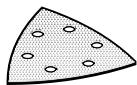
3 Sanding sheet*
4 Sanding plate


18 | English
5 Battery charger
6 Charge connector
7 Extraction outlet
8 Dust protection cap
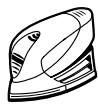
9 Extraction adapter*
10 Vacuum hose*
*Accessories shown or described are not part of the standard delivery scope of the product. A complete overview of accessories can be found in our accessories program.
Technical Data
| Cordless Multi Sander | PRIO Lithium-Ion | |
| Article number | 3 603 J19 7.. | |
| Rated voltage | V= | 7.2 |
| No-load speed | min-1 | 10000 |
| No-load orbital stroke rate | min-1 | 20000 |
| Sanding sheet surface | cm2 | 104 |
| Orbit diameter | mm | 1.2 |
| Weight according to EPTA-Procedure 01/2003 | kg | 0.7 |
| Battery | Li-Ion | |
| Capacity | Ah | 1.0 |
| Number of battery cells | 2 | |
| Battery Charger | ||
| Charging time | min | 33 ±3 |
| Article number | 2 607 225 085 (EU)2 607 225 087 (UK)2 607 225 147 (AUS) | |
Please observe the article number on the type plate of your machine. The trade names of the individual machines may vary.
Noise/Vibration Information
Measured values determined according to EN 60745.
Typically the A-weighted sound pressure level of the product is 76 dB(A). Uncertainty K=3 dB. The noise level when working can exceed 80 dB(A).
Wear hearing protection!
Vibration total values (triax vector sum) determined according to EN 60745:
Vibration emission value ah=5.5\ m/s2 , Uncertainty K=1.5\ m/s2 .
The vibration emission level given in this information sheet has been measured in accordance with a standardised test given in EN 60745 and may be used to compare one tool with another. It may be used for a preliminary assessment of exposure.
The declared vibration emission level represents the main applications of the tool. However if the tool is used for different applications, with different accessories or poorly maintained, the vibration emission may differ. This may significantly increase the exposure level over the total working period.
An estimation of the level of exposure to vibration should also take into account the times when the tool is switched off or when it is running but not actually doing the job. This may significantly reduce the exposure level over the total working period.
Identify additional safety measures to protect the operator from the effects of vibration such as: maintain the tool and the accessories, keep the hands warm, organisation of work patterns.
Declaration of Conformity CE
We declare under our sole responsibility that the product described under “Technical data” is in conformity with the following standards or standardization documents: EN 60745 (battery powered product) and EN 60335 (battery charger) according to the provisions of the directives 2006/95/EC, 2004/108/EC, 98/37/EC (until 28 Dec 2009), 2006/42/EC (from 29 Dec 2009).
Technical file at:
Robert Bosch GmbH, PT/ESC,
D-70745 Leinfelden-Echterdingen
CE 06
Dr. Egbert Schneider Senior Vice President Engineering
Dr. Eckerhard Strötgen Head of Product Certification

Robert Bosch GmbH, Power Tools Division D-70745 Leinfelden-Echterdingen 23.06.2009
Assembly
Before any work on the machine (e.g. maintenance, changing the tool, etc.) as well as during its transport and storage, lock the On/Off switch in the off position. There is danger of injury when the On/Off switch is unintentionally actuated.
Battery Charging (see figure A)
▶ Do not use other battery chargers. The supplied battery charger is designed for the Lithium-Ion battery in your machine.
▶ Observe the mains voltage! The voltage of the power supply must correspond with the data given on the nameplate of the battery charger. Battery chargers marked with 230 V can also be operated with 220 V.
Note: The battery is supplied partially charged. To ensure full capacity of the battery, completely charge the battery in the battery charger before using your power tool for the first time.
The lithium ion battery can be charged at any time without reducing its service life. Interrupting the charging procedure does not damage the battery.
The Li-ion battery is protected against deep discharging by the “Electronic Cell Protection (ECP)”. When the battery is empty, the machine is switched off by means of a protective circuit: The inserted tool no longer rotates.
WARNING
Do not continue to press the On/Off switch after the ma-
chine has been automatically switched off. The battery can be damaged.
Insert the machine into the battery charger 5 as shown in the figure. Pay attention that the charge connector 6 engages in the corresponding socket of the machine. The charging procedure begins as soon as the mains plug of the battery charger is plugged into a socket.
The charge-control indication 2 indicates the charging progress. During the charging procedure, the 3 LEDs light up one after the other and briefly go out. When the 3 LEDs light up continuously, the battery is fully charged.
During the charging procedure, the handle of the machine warms up. This is normal.
Disconnect the battery charger from the mains supply when not using it for longer periods.
▶ Protect the battery charger against moisture!
Observe the notes for disposal.
Dust/Chip Extraction
Dusts from materials such as lead-containing coatings, some wood types, minerals and metal can be harmful to one's health. Touching or breathing-in the dusts can cause allergic reactions and/or lead to respiratory infections of the user or bystanders.
Certain dusts, such as oak or beech dust, are considered as carcinogenic, especially in connection with wood-treatment additives (chromate, wood preservative). Materials containing asbestos may only be worked by specialists.
- Provide for good ventilation of the working place.
- It is recommended to wear a P2 filter-class respirator.
Observe the relevant regulations in your country for the materials to be worked.


20 | English
External Dust Extraction (see figure B)
When working without dust extraction, please plug the outlet piece 7 with the dust protection cap 8.
When working with dust extraction, remove the dust protection cap 8. Insert the extraction adapter 9 into the outlet piece 7. A suction hose with a diameter of 35 mm can be connected to the extraction adapter 9.
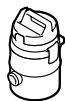
The vacuum cleaner must be suitable for the material being worked.
When vacuuming dry dust that is especially detrimental to health or carcinogenic, use a special vacuum cleaner.
Replacing the Sanding Sheet (see figure C)
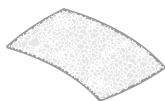
When attaching a new sanding sheet, remove any dust or debris from the sanding plate 4 (e. g. with a brush).
To ensure optimum dust extraction, pay attention that the punched holes in the sanding sheet match with the holes in the sanding plate.
The sanding plate 4 is fitted with Velcro backing for quick and easy fastening of sanding sheets with Velcro adhesion.
Before attaching the sanding sheet 3, free the Velcro backing of the sanding plate 4 from any debris by tapping against it in order to enable optimum adhesion.
The machine is fitted with 2 sanding sheets that can be changed individually, depending on the degree of wear.
▶ Only use the machine when both sanding sheets are mounted.
▶ Only use sanding sheets with the same grain size.
Position the sanding sheet 3 flush alongside one edge of the sanding plate 4, then lay the sanding sheet onto the sanding plate and press firmly.
To remove the sanding sheet 3, grasp it at one of the tips and pull it off from the sanding plate 4.
Sanding sheets of the Bosch Delta Sander can be used.
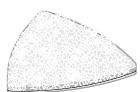
Sanding accessories, such as fleece pads/polishing cloth pads, are attached to the sanding plate in the same manner.
Selecting the Sanding Sheet
Depending on the material to be worked and the required rate of material removal, different sanding sheets are available:
Grain size
| red:Wood | 40-180 |
For the working of all wooden materials
| For coarse-sanding, e. g.of rough, unplaned beamsand boards | coarse | 40 |
| For face sanding and plan-ing small irregularities | medium | 80, 120 |
| For finish and fine sandingof hard woods | fine | 180 |
white:Paint
For the working of paint/enamel coats or primers and fillers
| For sanding off paint | coarse | 40 |
| For sanding primer | medium | 80, 120 |
| For final sanding of prim-ers before coating | fine | 180 |
For reworking or polishing, especially of metal and stone, use fleece/polishing cloth pad. Depending on the desired surface quality of the workpiece, different fleece types or polishing cloth pads are to be used.
Replacing the Sanding Plate (see figure D)
The supplied sanding plate 4 is fitted with Velcro backing and can be replaced. To remove the sanding plate 4, grasp it at one of the tips and pull it off.









Operation
Starting Operation
Switching On and Off
Press the On/Off switch 1 to start the machine.
To switch off the machine, press the On/Off switch 1 again.
Battery Charge-control Indication

The battery charge-control indication 2 indicates the charge condition of the battery during operation and consists of 2 green LEDs and a red LED.
| LED | Capacity |
| Continuous lighting, green-green-red | ≥50% |
| Continuous lighting, green-red | 25–50% |
| Flashing light, red (flash frequency increases with dropping capacity) | ≤25% |
Working Advice
▶ Wait until the machine has come to a stand-still before placing it down.
The removal capacity during sanding is mainly determined by the selection of the sanding sheet.
Only flawless sanding sheets achieve good sanding capacity and extend the service life of the machine.
Pay attention to apply uniform sanding pressure; this increases the working life of the sanding sheets.
Intensifying the sanding pressure does not lead to an increase of the sanding capacity, but to increased wear of the machine and the sanding sheet.
For precise on-the-spot sanding of edges, corners and hard to reach areas, it is also possible to work only with the tip or an edge of the sanding plate.
A sanding sheet that has been used for metal should not be used for other materials.
Use only original Bosch sanding accessories.
Maintenance and Service
Maintenance and Cleaning
▶ For safe and proper working, always keep the machine and ventilation slots clean.
▶ Before any work on the machine (e.g. maintenance, changing the tool, etc.) as well as during its transport and storage, lock the On/Off switch in the off position. There is danger of injury when the On/Off switch is unintentionally actuated.
When the battery is no longer operative, please refer to an authorised after-sales service agent for Bosch power tools.
If the machine should fail despite the care taken in manufacturing and testing procedures, repair should be carried out by an after-sales service centre for Bosch power tools.
In all correspondence and spare parts order, please always include the 10-digit article number given on the type plate of the machine.
After-sales Service and Customer Assistance
Our after-sales service responds to your questions concerning maintenance and repair of your product as well as spare parts. Exploded views and information on spare parts can also be found under:
www.bosch-pt.com
Our customer service representatives can answer your questions concerning possible applications and adjustment of products and accessories.
Great Britain
Robert Bosch Ltd. (B.S.C.)
P.O. Box 98
Broadwater Park
North Orbital Road
Denham
Uxbridge
UB 9 5HJ
Tel. Service: +44 (0844) 736 0109
Fax: +44 (0844) 736 0146
Australia, New Zealand and Pacific Islands
Robert Bosch Australia Pty. Ltd.
Power Tools
Locked Bag 66
Clayton South VIC 3169
Customer Contact Center
Inside Australia:
Phone: +61 (01300) 307 044
Fax: +61 (01300) 307 045
Inside New Zealand:
Phone: +64 (0800) 543 353
Fax: +64 (0800) 428 570
Outside AU and NZ:
Phone: +61 (03) 9541 5555
www.bosch.com.au
Republic of South Africa
Customer service
Hotline: +27 (011) 6 51 96 00
Gauteng - BSC Service Centre
35 Roper Street, New Centre
Johannesburg
Tel.: +27 (011) 4 93 93 75
Fax: +27 (011) 4 93 01 26
E-Mail: bsctools@icon.co.za
KZN - BSC Service Centre
Unit E, Almar Centre
143 Crompton Street
Pinetown
Tel.: +27 (031) 7 01 21 20
Fax: +27 (031) 7 01 24 46
E-Mail: bsc.dur@za.bosch.com
Western Cape - BSC Service Centre
Democracy Way, Prosperity Park
Milnerton
Tel.: +27 (021) 5 51 25 77
Fax: +27 (021) 5 51 32 23
E-Mail: bsc@zsd.co.za
Bosch Headquarters
Midrand, Gauteng
Tel.: +27 (011) 6 51 96 00
Fax: +27 (011) 6 51 98 80
E-Mail: rbsa-hq.pts@za.bosch.com
Transport
The battery is tested according to UN document ST/SG/AC.10/11/Rev.3 Part III, subsection 38.3. It has effective protection against internal overpressure and short circuiting as well as devices for the prevention of violent rupture and dangerous reverse current flow.
The lithium-equivalent content in the battery is below applicable limit values. Therefore, the battery is not subject to national or international regulations pertaining to dangerous mediums, neither as an individual component nor when inserted into a machine. However, the regulations governing dangerous goods may be relevant when transporting several batteries. In this case, it can be necessary to comply with special conditions (e.g., concerning the packaging). For more information, please refer to the instruction sheet (in English) under the following Internet address: http://purchasing.bosch.com/en/start/Allgemeines/Download/index.htm.
Disposal
The machine, accessories and packaging should be sorted for environmental-friendly recycling.
Only for EC countries:

Do not dispose of power tools into household waste!
According to the European Guideline 2002/96/EC for Waste Electrical and Electronic Equipment and its implementation into national
right, power tools that are no longer usable must be collected separately and disposed of in an environmentally correct manner.








Battery packs/batteries:
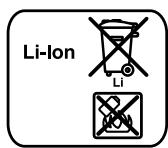
Li-ion:
Please observe the instructions in section "Transport", page 22.
Do not dispose of battery packs/batteries into household waste, fire or water. Battery packs/batteries should be collected, recycled or disposed of in an environmental-friendly manner.
Only for EC countries:
Defective or dead out battery packs/batteries must be recycled according the guideline 91/157/EEC.
Batteries no longer suitable for use can be directly returned at:
Great Britain
Robert Bosch Ltd. (B.S.C.)
P.O. Box 98
Broadwater Park
North Orbital Road
Denham
Uxbridge
UB 9 5HJ
Tel. Service: +44 (0844) 736 0109
Fax: +44 (0844) 736 0146
When removing the battery from the machine, actuate the On/Off switch 1 until the battery is completely discharged. Unscrew the screw in the casing and take off the casing shell. Disconnect the connections on the battery and remove the battery.
Subject to change without notice.



Bosch Power Tools
1 609 929 S57 | (8.7.09)





24 | Français
Dr. Egbert Schneider Senior Vice President Engineering
Dr. Eckerhard Strötgen Head of Product Certification
ppa. Macau i.v. Nuoyen
Robert Bosch GmbH, Power Tools Division D-70745 Leinfelden-Echterdingen 23.06.2009
Montage
Robert Bosch (France) S.A.S.
Dr. Egbert Schneider Senior Vice President Engineering
Dr. Eckerhard Strötgen Head of Product Certification
ppa. Macena i.v. Nuoyen
Robert Bosch GmbH, Power Tools Division D-70745 Leinfelden-Echterdingen 23.06.2009
Montaje
Dr. Egbert Schneider Dr. Eckerhard Strötgen Senior Vice President Head of Product Engineering Certification
ppa. Macaca i.v. Nuoyen
Robert Bosch GmbH, Power Tools Division D-70745 Leinfelden-Echterdingen 23.06.2009
Montagem
Dr. Egbert Schneider Senior Vice President Engineering
Dr. Eckerhard Strötgen Head of Product Certification

Robert Bosch GmbH, Power Tools Division D-70745 Leinfelden-Echterdingen 23.06.2009
Montaggio
Senior Vice President
Engineering
Dr. Eckerhard Strötgen
Head of Product
Certification
ppa. Macaca i.v. Nuoyen
Robert Bosch GmbH, Power Tools Division
D-70745 Leinfelden-Echterdingen
23.06.2009
Montage
Dr. Egbert Schneider Senior Vice President Engineering
Dr. Eckerhard Strötgen Head of Product Certification

Robert Bosch GmbH, Power Tools Division D-70745 Leinfelden-Echterdingen 23.06.2009
Montering
Bosch Service Center
Telegrafvej 3
2750 Ballerup
Tel. Service Center: +45 (4489) 8855
Fax: +45 (4489) 87 55
E-Mail: vaerktoej@dk.bosch.com
Dansk | 77
Transport
Akkuen er testet iht. UN-manualen
ST/SG/AC.10/11/rev.3 del III, underafsnit 38.3.
9 Utsugningsadapter*
10 Utsugningsslang*
Dr. Egbert Schneider Senior Vice President Engineering
Dr. Eckerhard Strötgen Head of Product Certification
ppa. Macena i.v. Nuoyen
Robert Bosch GmbH, Power Tools Division D-70745 Leinfelden-Echterdingen 23.06.2009
82 | Svenska
Montage
Bosch Service Center
Telegrafvej 3
2750 Ballerup
Danmark
Tel.: +46 (020) 41 44 55
Fax: +46 (011) 18 76 91
Transport
Dr. Egbert Schneider Senior Vice President Engineering
Dr. Eckerhard Strötgen Head of Product Certification

Robert Bosch GmbH, Power Tools Division D-70745 Leinfelden-Echterdingen 23.06.2009
Montering
Dr. Egbert Schneider Senior Vice President Engineering
Dr. Eckerhard Strötgen Head of Product Certification

Robert Bosch GmbH, Power Tools Division D-70745 Leinfelden-Echterdingen 23.06.2009
Asennus
Dr. Egbert Schneider Senior Vice President Engineering
Dr. Eckerhard Strötgen Head of Product Certification
i.v. Nguyen
Robert Bosch GmbH, Power Tools Division D-70745 Leinfelden-Echterdingen 23.06.2009
Συναρμολόγηση
Dr. Egbert Schneider Senior Vice President Engineering
Dr. Eckerhard Strötgen Head of Product Certification

Robert Bosch GmbH, Power Tools Division D-70745 Leinfelden-Echterdingen 23.06.2009
Montaj
Bosch San. ve Tic. A.S.
Ahi Evran Cad. No:1 Kat:22
Polaris Plaza
80670 Maslak/Istanbul
2 607 255 085 (EU)
2 607 225 087 (UK)
2 607 225 147 (AUS)
2 608 000 320




white:Paint
P 40 2 608 607 402
P 80 2 608 607 403
P 120 2 608 607 404
P 180 2 608 607 405
red:Wood
P 40 2 608 607 407
P 80 2 608 607 408
P 120 2 608 607 409
P 180 2 608 607 410

red:Wood white:Paint
P 40-180
2 608 607 417


2 608 607 419





∅ 35mm
1 600 499 005
3 m 2 609 390 392
5 m 2 609 390 393
PAS 11-21
PAS 12-27
PAS 12-27 F



















- PRIO LITHIUM-ION
- BOSCH
- MONTAGE
- GENERAL POWER TOOL SAFETY WARNINGS
- WARNING READ ALL SAFETY WARNINGS AND ALL INSTRUCTIONS. FAILURE TO FOLLOW
- SAVE ALL WARNINGS AND INSTRUCTIONS FOR FUTURE REFERENCE
- WORK AREA SAFETY
- ELECTRICAL SAFETY
- PERSONAL SAFETY
- 16 | ENGLISH
- SAFETY WARNINGS FOR SANDER
- SAFETY WARNINGS FOR BATTERY CHARGERS
- FUNCTIONAL DESCRIPTION
- INTENDED USE
- PRODUCT FEATURES
- 18 | ENGLISH
- NOISE/VIBRATION INFORMATION
- WEAR HEARING PROTECTION
- DECLARATION OF CONFORMITY CE
- ASSEMBLY
- BATTERY CHARGING (SEE FIGURE A)
- WARNING
- DO NOT CONTINUE TO PRESS THE ON/OFF SWITCH AFTER THE MA
- PROTECT THE BATTERY CHARGER AGAINST MOISTURE
- DUST/CHIP EXTRACTION
- 20 | ENGLISH
- EXTERNAL DUST EXTRACTION (SEE FIGURE B)
- REPLACING THE SANDING SHEET (SEE FIGURE C)
- SELECTING THE SANDING SHEET
- REPLACING THE SANDING PLATE (SEE FIGURE D)
- OPERATION
- STARTING OPERATION
- SWITCHING ON AND OFF
- BATTERY CHARGE-CONTROL INDICATION
- WORKING ADVICE
- MAINTENANCE AND SERVICE
- MAINTENANCE AND CLEANING
- AFTER-SALES SERVICE AND CUSTOMER ASSISTANCE
- WWW.BOSCH-PT.COM
- GREAT BRITAIN
- AUSTRALIA, NEW ZEALAND AND PACIFIC ISLANDS
- REPUBLIC OF SOUTH AFRICA
- CUSTOMER SERVICE
- GAUTENG - BSC SERVICE CENTRE
- KZN - BSC SERVICE CENTRE
- WESTERN CAPE - BSC SERVICE CENTRE
- BOSCH HEADQUARTERS
- TRANSPORT
- DISPOSAL
- ONLY FOR EC COUNTRIES
- BATTERY PACKS/BATTERIES
- LI-ION
- 24 | FRANÇAIS
- MONTAJE
- MONTAGEM
- MONTAGGIO
- MONTERING
- 82 | SVENSKA
- ASENNUS
- ΣΥΝΑΡΜΟΛΌΓΗΣΗ
- MONTAJ
Brand : BOSCH
Model : PRIO LITHIUM-ION
Category : Rechargeable Battery