
ERM 10471 WA++ - Refrigerator ECG - Free user manual and instructions
Find the device manual for free ERM 10471 WA++ ECG in PDF.


| Product Type | Refrigerator - Minibar |
| Brand | ECG |
| Model | ERM 10471 WA++ |
| Dimensions (H x W x D) | 472 x 450 x 492 mm |
| Weight | 17 kg |
| Power Supply | 220-240 V~, 50 Hz, 70 W |
| Energy Class | A++ |
| Total Volume | 46 L |
| Refrigerator Net Volume | 45 L |
| Noise Level | 45 dB (A) |
| Coolant Type | R600a (isobutane) |
| Coolant Weight | 16 g |
| Climate Class | ST/N |
| Number of Doors | 1 |
| Reversible Door | Yes |
| Handle Type | Built-in |
| Shelves | 1 wire shelf |
| Door Compartments | 1 standard, 1 for bottles |
| Adjustable Feet | Yes (2 front) |
| Temperature Control | Manual thermostat |
| Defrosting | Manual |
| Colour | White |
| Annual Energy Consumption | 84 kWh |
| Daily Energy Consumption | 0.23 kWh |
| Compressor | 1 piece |
| Safety Features | Flammable coolant (R600a), do not damage cooling circuit |
| Cleaning | Mild detergent, avoid abrasives; clean condenser yearly |
Frequently Asked Questions - ERM 10471 WA++ ECG
User questions about ERM 10471 WA++ ECG
0 question about this device. Answer the ones you know or ask your own.
Ask a new question about this device
Download the instructions for your Refrigerator in PDF format for free! Find your manual ERM 10471 WA++ - ECG and take your electronic device back in hand. On this page are published all the documents necessary for the use of your device. ERM 10471 WA++ by ECG.
USER MANUAL ERM 10471 WA++ ECG
natural_image
Interior view of a modern refrigerator with open storage compartments filled with fresh vegetables and beverages (no visible text or symbols)ERM 10471 WA++
CHLADNIČKA - MINIBAR
NÁVOD K OBSLUZE
CHLADNIČKA - MINIBAR
NÁVOD NA OBSLUHU
REFRIGERATOR - MINIBAR
INSTRUCTION MANUAL
KÜLMIK-MINIBAAR
KASUTUSJUHEND
ŠALDYTUVAS - MINI BARAS
INSTRUKCIJŲ VADOVAS
LEDUSSKAPIS - MINIBÄRS
ROKASGRĀMATA
CZ
SK
GB
ET
LT
LV
- Pred uvedením výrobku do provozu si důkladně pročtěte tento návod a bezpečnostní pokyny, které jsou v tomto návodu obsaženy. Návod musí být vždy priložen k přístroji. - Pred uvedením výrobku do prevádzky si dôkladne prečítajte tento návod a bezpečnostné pokyny, které sú v tomto návode obsiahnuté. Návod musí být vždy priložený k prístroju. - Always read the safety&use instructions carefully before using your appliance for the first time. The user's manual must be always included. - Enne seadme esmakordset kasutamist lugege ohutus- ja kasutusjuhised alati hoolikalt läbi. Kasutusjuhend peab alati kaasas olema. - Prieš naudodamiesi prietaisu pirmajj kartą, visuomet atidžiai perskaitykite saugos ir naudojimo instrukcijas. Kartu su gaminiu visada privalo būti jo naudotojo vadovas. - Pirms ierices pirmās lietošanas reizes vienmēr rūpīgi izlasiet drošības un lietošanas norádljumus. Rokasgrāmata vienmēr jāpievieno ierīcei.
BEZPEČNOSTNÍ POKYNY
INSTALACE A ZAPNUTÍ ZAŘÍZENÍ
Umístění
INŠTALÁCIA A ZAPNUTIE ZARIADENIA
Umiestnenie
Please read carefully and keep for future reference.
Warning: The safety measures and instructions contained in this manual do not include all potential conditions and scenarios. The user must understand that common sense, caution and care are factors that cannot be integrated into a product. Therefore, the user is responsible for these factors when using and operating this appliance. We are not liable for any damages caused during shipping, by incorrect use, voltage fluctuation or the modification or adjustment of any part of the appliance.
To prevent fire or risk of electric shock, you should maintain basic precautions when using electrical appliances, including the following:
- Make sure the voltage in your outlet corresponds to the voltage provided on the appliance label and that the socket is correctly grounded. The outlet must be installed according to valid safety instructions.
- Do not operate device with a damaged cord. All repairs or adjustments including cord replacements shall be performed by a professional service centre! Do not remove the protective covers from the appliance; there is a risk of electric shock!
- Protect the appliance against direct contact with water and other liquids, to prevent potential electric shock. Do not immerse cord or plug in water!
- Do not use the appliance in places, where a gas leak or a contact with an explosive atmosphere could occur. Do not touch the cord or device with wet hands. Risk of electric shock.
- The power cord must remain accessible once the device is installed. Do not shorten the cable nor use adapters in electrical outlets. Do not allow the cord to touch hot surfaces or lead the cord over sharp edges.
- Do not turn the appliance on or off by plugging or unplugging the power cord. Do not remove the power cord from the outlet by yanking the cord. Unplug the power cord from the outlet by grasping the plug.
- Do not insert any objects into the device, do not place any objects on the device (e.g. vases, cups, etc.). Never cover the ventilation openings!
- Do not use in the appliance other electrical devices and refrigeration equipment.
- If this appliance is replacing an old product equipped with a lock, destroy the lock of the old appliance, so that children would not lock themselves in (e.g. during a play).
- Do not use mechanical devices or other unnatural means to speed up the defrosting. Do not use electrical appliances in the space designed to store foods. Protect the cooling circuit of the appliance against damage.
- Do not allow children to play with the appliance. Also, may not sit on the shelves and hang on the door. Of the appliance.
- Do not use sharp metal objects to remove the ice from the refrigerator, because they may damage the refrigerating circuits and cause irreparable damage to the appliance. If necessary, use a plastic scraper.
- Do not store explosive substances in the appliance, e.g. sprays with propellant gas.
- Do not place containers with liquids (glass jars or tin cans) in the freezer. The container could burst.
- When you store bottles containing liquids with high content of alcohol, they must be properly closed and in vertical position.
- Do not expose the appliance to direct sunlight, do not use it outside and do not expose it to rain.
- Do not touch the cooling surfaces with wet hands. Risk of injury.
- Do not eat the ice removed from the freezer.
- This appliance is intended for household use and similar areas, such as:
-
kitchenettes in shops, offices and other work places
– appliances used in the agricultural industry
– by guests in hotels, motels and other residential areas
– in bed and breakfast establishments -
This appliance shall not be used by persons (including children), whose physical, sense or mental inability or insufficient experience and skills prevent him from safely using the appliance, if they are not supervised or if they have not been instructed regarding the use of the appliance by a person responsible for their safety.
-
Child supervision is essential to prevent them from playing with the appliance.
- The manufacturer is not liable for damages caused by improper grounding/use.

RISK OF FIRE!
This appliance contains R600a (the coolant isobutane), natural gas which is very environmentally friendly but fl ammable. When transporting and installing the equipment it is necessary to ensure that no part of the cooling circuit is damaged. In case of damage reduce the flame and vent for several minutes the premises where the appliance is located.
DESCRIPTION
This type of refrigerator finds wide application in places such as hotels, offices, student dormitories and households. It is ideal for cooling and storing food such as fruit and drinks. Its advantages are small size, light weight, low power consumption and ease of use.
This description is only for information about the components of the appliance. Individual parts may differ
according to the model of the appliance.
- Refrigerator shelves
- Evaporator
- Thermostat
- Door compartment
- Door compartment for bottles
- Adjustable feet

INSTALLATION AND TURNING ON THE APPLIANCE
Installing the device
- Do not tilt the refrigerator more than 45^ from the vertical during transport. Protect the refrigerator from mechanical stresses. Deformation, especially around the door and the evaporator, could adversely affect the performance of the appliance.
- Leave enough space around the refrigerator necessary for its proper functioning.
- Do not place the refrigerator in too warm or humid places, to avoid damage due to moisture and corrosion.
- Do not place heavy objects on the refrigerator.
• The refrigerator must stand firmly in a horizontal position. Use the two adjustable front feet for levelling.
Connection
- Before plugging into an electrical outlet, make sure the power supply voltage matches the voltage on the rating plate. The power cord of the appliance should be plugged into a single outlet power strip may cause overheating of the plug and cord.
• The outlet has to be accessible after you place the appliance.
USER'S INSTRUCTIONS
Start and operation
- Before first use, turn the refrigerator on without food and allow it to stabilize at the selected temperature. That takes about 2 to 3 hours. Then set the thermostat to the desired temperature and place the food in the refrigerator.
- You can set the temperature in the refrigerator using the thermostat control. For normal operation, it is best to set the controller to a medium value.
- Whenever the evaporator surface forms a frost layer with a thickness of 3–4 mm, perform defrosting of the refrigerator, see "Defrosting".
Tips for proper use
- Inserting larger quantities of food at one time, frequent door opening or long time open door leads to an increase in electricity consumption.
- Do not put in the refrigerator objects that are too heavy or sharp or aggressive materials.
- To reduce humidity and consequent increase of frost never put in the refrigerator liquids in unsealed containers. Frost tends to concentrate in the coldest parts of the evaporator. Storing of uncovered liquids is the cause of the more frequent need for defrosting.
- Never put warm foods in the refrigerator. These should cool down at room temperature and the be placed so as to ensure adequate air circulation in the refrigerator.
- Foods or food containers should not touch the back wall of the refrigerator, because they could freeze to the wall. After disconnecting the refrigerator from the power supply wait at least 10 minutes before plugging it in again.
- Do not store bottles in the freezing compartment. The packaging could break and damage the refrigerator.
- In case of power failure, open the refrigerator as little as possible.
- Never use sharp or metal objects to remove ice from the evaporator when defrosting. You could damage the evaporator.
- Do not touch the foods and containers in the freezer compartment with wet hands to avoid the risk of frostbite.
Using the refrigerator at home
- Try not to open the door too often, especially in hot and humid weather. When you open the door, remember to close it as soon as possible.
- Check from time to time if there is sufficient ventilation (adequate air circulation behind the appliance).
- Under normal temperature condition at home set the thermostat to the medium value.
- Before putting food in the refrigerator, let it cool first to room temperature.
- A layer of ice and frost increases energy consumption, therefore defrost the refrigerator when the frost layer reaches a thickness of 3–5 mm.
- If the refrigerator is equipped with an external cooler, the wall behind the refrigerator should be always clean and free of dust and dirt.
- Always keep in mind the instructions given in paragraph "Location". Otherwise the power consumption of the refrigerator could increase signifi cantly.
CLEANING AND MAINTENANCE
- Before you start cleaning the refrigerator, remove the power cord plug from the outlet.
- Carefully wipe the refrigerator with a cloth dipped in a mild detergent solution. Do not use abrasive cleaners, alkaline cleaners and lye, chemical cloths, thinners, alcohol, acid, petrol cleaners or hot water. You could damage the surface fi nish and plastic components.
- The door seal is easily clogged, clean it regularly.
- If the refrigerator is not used for long periods, unplug the power cord from the outlet, dry the freezer compartment and carefully close the door.
- At least once a year use a brush to clean the condenser at the back of the appliance. You will increase efficiency and lower the energy consumption.
Defrosting
- When defrosting, remove all the food from the refrigerator and set the thermostat dial to "OFF".
- Place a drip tray under the evaporator, which will collect the melted water.
• After the ice melts, pour away the melted water and wipe the interior of the refrigerator dry. - You can switch the refrigerator on again by setting the thermostat to the desired temperature.
GB
TROUBLESHOOTING
You can solve a number of common problems on your own. If the refrigerator is not working properly, check the following points before calling a service technician:
| Cause Check | |
| The refrigerator is not cooling. | Is the refrigerator turned on?Is the power supply in order?Did the fuses of the outlet on a circuit in which the refrigerator is plugged fail?Is the power cord plug correctly inserted in the outlet? |
| Low efficiency. • Is the thermostat set in correct position?Is there enough of free space around the refrigerator?Is the door opened too frequently or for long periods?Is the refrigerator exposed to direct sunlight or placed too close to heat sources?Are there too many foods inside?Do you put in foods, which are too warm? | |
| Frozen foods inside the refrigerator. | Is the thermostat set in correct position?Are the foods too cramped? |
| Noisy operation. • Is the refrigerator in a stable and horizontal position?Does the refrigerator touch other objects? | |
| It does not automatically shut off the compressor. | Did you put in too many foods?Is the door opened too frequently or for long periods? |
If the above mentioned tips do not solve the problem, contact the service centre immediately.
The following does not indicate a malfunction
The sound of running liquid:
- You can hear the sound of running liquid during a normal operation.
Exterior condensation:
- The condensation on the surface is a normal sign during high ambient humidity. You simply wipe off the wet surface.
Achieving the desired temperature
- It takes some time before the temperature in the refrigerator decreases to the required level. When the ambient temperature is high, the cooling takes longer time.
The surface of the compressor heats up.
- The surface of the compressor can become hot during normal operation. Do not touch it with bare hands.
TECHNICAL DATA
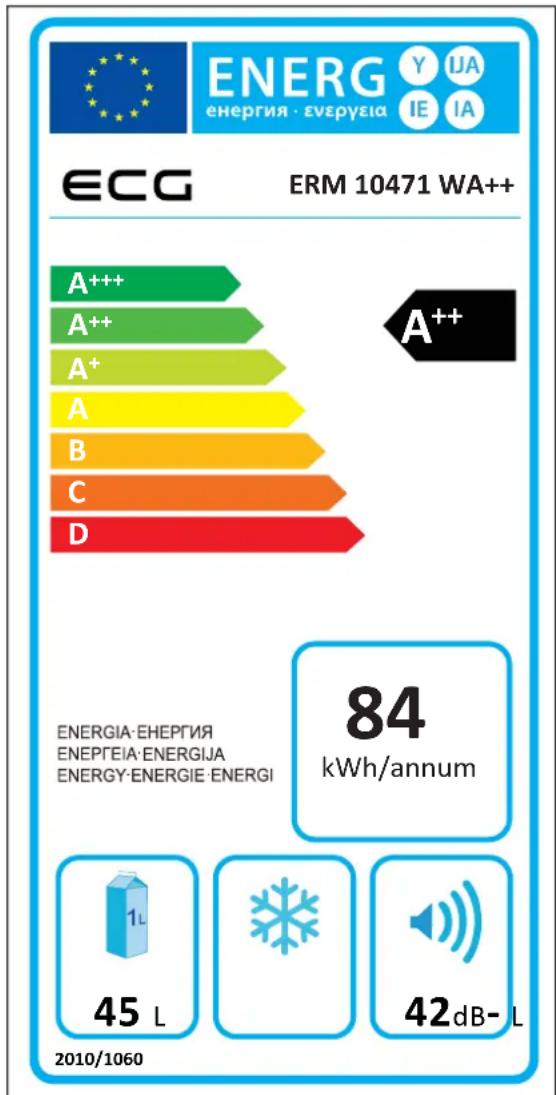
Specifications for the refrigerator in the home according to EU regulations no. 1060/2010
| Manufacturer ECG | |
| Model ERM 10471 WA++ | |
| EAN | |
| Type Single door - freestanding | |
| Product Dimensions (H x W x D) 472 × 450 × 492 mm | |
| Dimensions with packaging (H × W × D) 520 × 465 × 503 mm | |
| Product weight 17 kg | |
| Product weight including packaging 18.5 kg | |
| Climate class ST/N | |
| Energy class A++ | |
| Energy consumption/day 0.23 kWh | |
| Energy consumption/annual 84 kWh | |
| Total volume | 46 l |
| Net volume of the refrigerator | 45 l |
| Noise level | 45 dB (A) |
| Coolant | R600a |
| Weight of the cooling medium | 16 g |
| Compressor | 1 piece |
| Thermostat | 1 piece |
| Temperature control | manual |
| Defrosting | manual |
| Colour | white |
| Building-in option | no |
| Smooth back wall design | yes |
| Number of doors | 1 |
| Reverse door opening | yes |
| Handle | built-in |
| Adjustable feet | yes |
| Shelves type/number | wire / 1 |
| Door compartment | 1 |
| Door compartment for bottles | 1 |
| Power input | 70 W |
| Power | 0.5 A |
| Voltage/Frequency | 220–240 V~ / 50 Hz |
USE AND DISPOSAL OF WASTE
Wrapping paper and corrugated paperboard – deliver to scrapyard. Packing foil, PE bags, plastic elements – throw into plastic recycling containers.
DISPOSAL OF PRODUCTS AT THE END OF LIFETIME
Disposal of electric and electronic equipment (valid in EU member countries and other European countries with an implemented recycling system)
GB
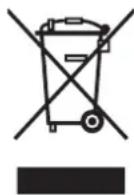
The represented symbol on the product or package means the product shall not be treated as domestic waste. Hand over the product to the specified location for recycling electric and electronic equipment. Prevent negative impacts on human health and the environment by properly recycling your product.
Recycling contributes to preserving natural resources. For more information on the recycling of this product, refer to your local authority, domestic waste processing organization or store, where you purchased the product.
This product complies with EU directive requirements on electromagnetic compatibility and electrical safety.
08/05

The instruction manual is available at website www.ecg-electro.eu.
Changes in text and technical parameters reserved.
Old refrigerators and freezers contain insulation gases and freezing media, which must be disposed off. Entrust the disposal to a competent local waste disposal service. In doubt contact your local authority or your vendor. Make sure that the pipes of the cooling unit, which will be removed by the appropriate waste disposal, service are not damaged.
bar
| Rating | Value | | ------ | ----- | | A+++ | | | A++ | | | A+ | | | A | | | B | | | C | | | D | |OHUTUSJUHISED
SEADME PAIGALDAMINE JA SISSE LÜLITAMINE
Seadme paigaldamine
PRIETAISO IRENGIMAS IR IJUNGIMAS
Prietaiso jrengimas
IERİCES UZSTÄDİŞANA UN IESLĖGŠANA
lerīces uzstādīšana
250 69 Klíčany, Czech Rep. e-post: ECG@kbexpert.cz
K+B Progres, a.s.
U Expertu 91 tel.: +420 272 122 111
250 69 Klíčany, Czech Rep. el. paštas: ECG@kbexpert.cz
K+B Progres, a.s.
U Expertu 91 tel.: +420 272 122 111
250 69 Klíčany, Czech Rep. e-pasts: ECG@kbexpert.cz
CZ
SK
ET
LT
LV


- ERM 10471 WA++
- CHLADNIČKA - MINIBAR
- REFRIGERATOR - MINIBAR
- KÜLMIK-MINIBAAR
- ŠALDYTUVAS - MINI BARAS
- LEDUSSKAPIS - MINIBÄRS
- BEZPEČNOSTNÍ POKYNY
- INSTALACE A ZAPNUTÍ ZAŘÍZENÍ
- Umístění
- INŠTALÁCIA A ZAPNUTIE ZARIADENIA
- Umiestnenie
- Please read carefully and keep for future reference.
- DESCRIPTION
- INSTALLATION AND TURNING ON THE APPLIANCE
- Installing the device
- Connection
- USER'S INSTRUCTIONS
- Start and operation
- Tips for proper use
- Using the refrigerator at home
- CLEANING AND MAINTENANCE
- Defrosting
- TROUBLESHOOTING
- The following does not indicate a malfunction
- The sound of running liquid:
- Exterior condensation:
- Achieving the desired temperature
- The surface of the compressor heats up.
- TECHNICAL DATA
- USE AND DISPOSAL OF WASTE
- DISPOSAL OF PRODUCTS AT THE END OF LIFETIME
- OHUTUSJUHISED
- SEADME PAIGALDAMINE JA SISSE LÜLITAMINE
- Seadme paigaldamine
- PRIETAISO IRENGIMAS IR IJUNGIMAS
- Prietaiso jrengimas
- IERİCES UZSTÄDİŞANA UN IESLĖGŠANA
- lerīces uzstādīšana
Brand : ECG
Model : ERM 10471 WA++
Category : Refrigerator