
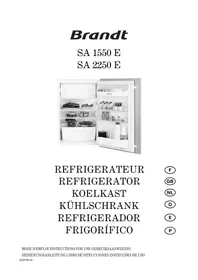
BFC2300NW - Refrigerator BRANDT - Free user manual and instructions
Find the device manual for free BFC2300NW BRANDT in PDF.



| Brand | BRANDT |
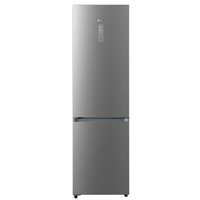
| Model | BFC2300NW |
| Product type | Fridge-freezer |
| Power supply | 220-240 V, earthed plug |
| Refrigerant | R600A |
| Climate class | Not specified |
| Super Cool function (refrigerator) | Activates maximum cooling for 6 hours |
| Super Freeze function (freezer) | Activates fast freezing for 52 hours |
| Holiday function | Reduces power consumption when the appliance is not in use |
| Winter function | Available on certain models to compensate for ambient cold |
| Open door alarm | Sounds after 2 minutes |
| High temperature alarm | Signals insufficient cold in the freezer |
| Interior lighting | E14 bulb, 220-240 V, 15/25 W |
| Charcoal filter | Absorbs odors and microorganisms, to be changed every 6 months |
| Interior cleaning | With sponge and baking soda |
| Exterior cleaning | Do not use steam cleaners |
| Rear grille | Clean once a year with a vacuum cleaner |
| Door reversal | Possible (instructions provided) |
| Energy consumption | Low thanks to use of energy-saving functions |
| Environmental standards | Environmentally friendly, recyclable |
Frequently Asked Questions - BFC2300NW BRANDT
User questions about BFC2300NW BRANDT
0 question about this device. Answer the ones you know or ask your own.
Ask a new question about this device
Download the instructions for your Refrigerator in PDF format for free! Find your manual BFC2300NW - BRANDT and take your electronic device back in hand. On this page are published all the documents necessary for the use of your device. BFC2300NW by BRANDT.
USER MANUAL BFC2300NW BRANDT
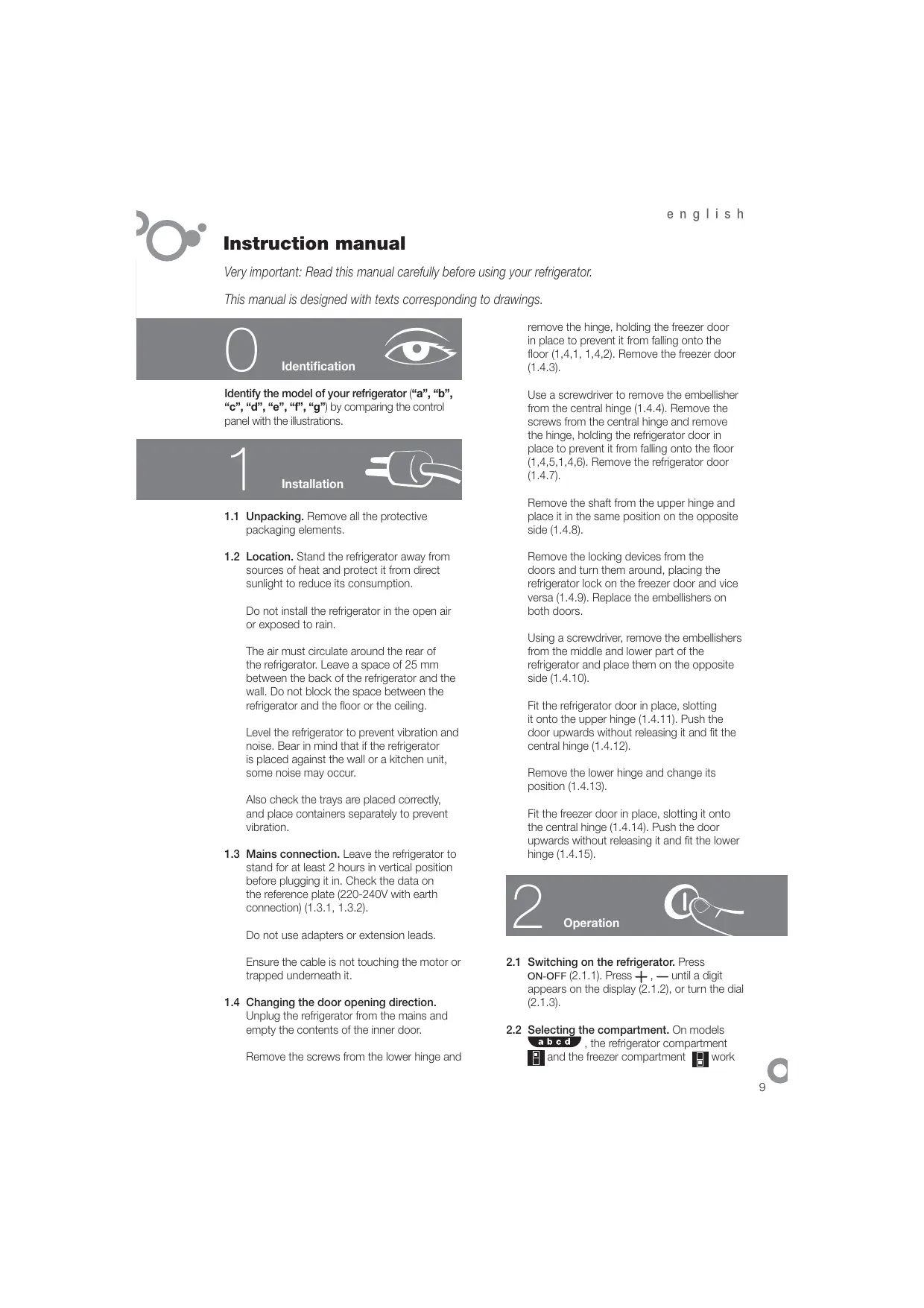
Very important: Read this manual carefully before using your refrigerator.
This manual is designed with texts corresponding to drawings.

Identification

Identify the model of your refrigerator ("a", "b", "c", "d", "e", "f", "g") by comparing the control panel with the illustrations.

Installation

1.1 Unpacking. Remove all the protective packaging elements. 1.2 Location. Stand the refrigerator away from sources of heat and protect it from direct sunlight to reduce its consumption.
Do not install the refrigerator in the open air or exposed to rain.
The air must circulate around the rear of the refrigerator. Leave a space of 25 mm between the back of the refrigerator and the wall. Do not block the space between the refrigerator and the floor or the ceiling.
Level the refrigerator to prevent vibration and noise. Bear in mind that if the refrigerator is placed against the wall or a kitchen unit, some noise may occur.
Also check the trays are placed correctly, and place containers separately to prevent vibration.
1.3 Mains connection. Leave the refrigerator to stand for at least 2 hours in vertical position before plugging it in. Check the data on the reference plate (220-240V with earth connection) (1.3.1, 1.3.2).
Do not use adapters or extension leads.
Ensure the cable is not touching the motor or trapped underneath it.
1.4 Changing the door opening direction.
Unplug the refrigerator from the mains and empty the contents of the inner door.
Remove the screws from the lower hinge and
remove the hinge, holding the freezer door in place to prevent it from falling onto the floor (1.4.1, 1.4.2). Remove the freezer door (1.4.3).
Use a screwdriver to remove the embellisher from the central hinge (1.4.4). Remove the screws from the central hinge and remove the hinge, holding the refrigerator door in place to prevent it from falling onto the floor (1.4.5, 1.4.6). Remove the refrigerator door (1.4.7).
Remove the shaft from the upper hinge and place it in the same position on the opposite side (1.4.8).
Remove the locking devices from the doors and turn them around, placing the refrigerator lock on the freezer door and vice versa (1.4.9). Replace the embellishers on both doors.
Using a screwdriver, remove the embellishers from the middle and lower part of the refrigerator and place them on the opposite side (1.4.10).
Fit the refrigerator door in place, slotting it onto the upper hinge (1.4.11). Push the door upwards without releasing it and fit the central hinge (1.4.12).
Remove the lower hinge and change its position (1.4.13).
Fit the freezer door in place, slotting it onto the central hinge (1.4.14). Push the door upwards without releasing it and fit the lower hinge (1.4.15).

Operation

2.1 Switching on the refrigerator. Press ON-OFF (2.1.1). Press +, — until a digit appears on the display (2.1.2), or turn the dial (2.1.3). 2.2 Selecting the compartment. On models a b c d , the refrigerator compartment and the freezer compartment work
separately. On models efg , the two compartments work together
2.3 Temperature selection. Turn the dial (2.3.1) or press the +, - buttons of the freezer compartment , followed by those of the refrigerator compartment (2.3.2).
When you have selected the temperature, you can find out the real temperature in the compartment by observing the indicator lights (2.3.3), or by holding down the + or - buttons of the desired compartment for 5 seconds. The temperature in the compartment will flash on the display (2.3.4).
Recommendation: The recommended temperature for the refrigerator compartment is 4 and for the freezer compartment it is -19 for already frozen food, and -24 if you wish to freeze food.
Remember that the temperature inside the appliance depends on the room temperature, where the refrigerator is located, and how often you open the door.
2.4 Refrigerator functions.
Quick cool function: This function activates the refrigerator at a cooler temperature for 6 hours. It is recommended to activate it when you place a large amount of food in the refrigerator.
To enable and disable this function: Press SUPER (2.4.1, 2.4.2). Models e, f, and g do not have this function.
Holiday function: The holiday function is very useful when you will not be using the refrigerator for a long period of time but you wish to keep food in the freezer. With this function, your refrigerator will consume very little power and bad smells will not be generated inside it. Models a, c, e, f, and g do not have this function.
Warning: The refrigerator door must be kept closed when this function is in use.
To enable and disable this function: Press HOLIDAY (2.4.3), or the +, - buttons of the refrigerator compartment until H appears on the display (2.4.4). To disable the function, repeat this operation.
2.5 Freezer functions.
Quick cool function: This function activates the freezer at a cooler temperature for 52 hours. It is recommended to activate it 24 hours before placing a large amount of food in the freezer. On model , it should be deactivated 24 hours later.
To enable and disable this function: Press SUPER (2.5.1, 2.5.2, 2.5.3). Model g does not have this function.
Winter function: Models only. Use this function if you notice that the freezer is becoming warmer. Hold down the SUPER button for 5 seconds until the orange pilot light begins to flash (2.5.4). The refrigerator light will remain on at half power so that the compressor functions for longer. When the freezer has reached the right temperature, switch off the winter function by holding down the SUPER button for 5 seconds again.
Switching the freezer on and off: Press the ON-OFF button of the freezer compartment (2.5.5). Press the + or - button until no temperature appears on the display (2.5.6), or turn the dial to ON-OFF (2.5.7). When the freezer is switched off the refrigerator compartment will also switch off.
2.6 Recommendations for use.
- Do not open the doors for any longer than necessary, and do not place hot food in the refrigerator. This will ensure a more efficient use of your refrigerator and will avoid excess power consumption.
- If your refrigerator is NO FROST type, do not obstruct the ventilation grilles, and leave space between the food for the air to circulate.
- Do not place bottles of fizzy drinks or glass bottles containing liquids in the freezer, as they may burst.
- Place food in sealed containers to prevent it from drying up.
- Do not consume ice cream or food that is very cold as this can cause burns.
3
Maintenance and cleaning

3.1 Cleaning the inside of the refrigerator. Use a sponge or a dish cloth soaked in water with bicarbonate of soda to clean the inside of the refrigerator, to prevent bad smells from forming.
Never use steam cleaning machines, solvents or abrasive detergents.
3.2 Cleaning the outside of the refrigerator. Do not use steam cleaning machines to
It is recommended to clean the rear grille with a vacuum cleaner once a year.
3.3 Cleaning the accessories. The accessories are not dishwasher-safe. Wash them by hand, using a sponge or a dish cloth. 3.4 Changing the light. If the light bulb blows: Unplug the refrigerator. Press the tab to remove the light cover (3.4.1, 3.4.3) and remove the blown bulb (3.4.2, 3.4.4). Replace it by another bulb with the same screw type, E14, 220-240V, 15/25W, or as indicated on the light fitting. 3.5 Changing the carbon filter. Your refrigerator may be equipped with a carbon filter to absorb the unpleasant smells generated by some foods and to retain the microorganisms (fungus and bacteria) in the circulating air.
The filter maintains its properties for a limited time of 6 months. When this time has elapsed, the filter should be changed and a new one fitted. The filter location depends on the model.
To change the filter: Press the tab and remove the cover (3.5.1, 3.5.5). Remove the used filter (3.5.2, 3.5.6).
If the filter needs activating: Remove the seals (3.5.3) and press the BIOFILTER display until you hear a slight click (3.5.4). In a few seconds the duration scale will begin to change colour. Fit the filter in its original location.
Keep used filters and spares out of reach of children; as swallowing large amounts of this substance can be dangerous.
Do not wet the filter as it will lose all its properties.
4
Diagnostics

4.1 Door open. If you leave the door open for longer than 2 minutes, an alarm will sound and the refrigerator light will switch off. The alarm will stop when you close the door.
4.2 The freezer is not cold enough
- If the freezer temperature is abnormally warm, an alarm light will come on (4.2.1, 4.2.2) and an intermittent beep will sound. Press SUPER (4.2.3, 4.2.4) to switch off the beeper manually.
- Model e only. If the winter function is activated, the alarm light will flash. To deactivate it, see (2.5.4).
- When you switch on the appliance for the first time, the alarm light will be activated, although the alarm beeper will not sound.
4.3 Electricity cuts
Open the refrigerator doors as infrequently as possible. When the electricity returns, check whether the frozen food has thawed.
4.4 Normal refrigerator noise
Your refrigerator may make some noise on functioning. Do not worry about the following noises, as they are normal.
- The refrigerant gas may cause a bubbling noise as it circulates around the refrigerator circuits.
- The compressor may make a buzzing noise or a slight tapping sound, particularly on start-up.
- Expansion and contraction of the materials used may cause tapping or crackling noises.
- The air moving the freezer fan may generate slight background noise.
Do not attempt to repair the refrigerator yourself. Call the technical assistance service.


Safety

- Keep the ventilation grilles free from any obstructions.
- Take care not to damage the refrigeration circuit.
- Do not use electrical appliances inside the refrigerator, unless they are of a type recommended by the manufacturer.
- Do not use mechanical devices or any other means to speed up the defrosting process, unless recommended by the manufacturer.
- This appliance is not designed for use by people (including children) whose physical, sensorial or mental capacities are impaired, or who lack sufficient experience or knowledge, unless they are supervised or have been instructed in the use of the appliance by a person responsible for their safety. Children must be supervised to ensure they do not play with the appliance.
- If the supply cable is damaged, it must be replaced by the manufacturer, the after-sales service or similar qualified staff to prevent hazard.

The environment

This refrigerator was designed with environmental conservation in mind.
The appliance operates with coolant R600A, which does not damage the environment.
Respect the environment. Use the recommended temperatures for each compartment. They will depend on the mode you need for efficient use of your refrigerator.
Disconnect the refrigerator or set it to holiday mode when you will not be using it for a prolonged period. You will reduce power consumption and save energy.
Avoid leaving the doors open more time than necessary. It causes an increase in power use.
Waste management of electrical and electronic appliances.
The symbol indicates that the appliance must not be disposed of in traditional bins for domestic waste.
Deliver your refrigerator to a special collection centre.
Recycling domestic appliances prevents negative impacts on health and the environment and helps save energy and resources.
For more information, contact your local authorities or the establishment where you purchased your refrigerator.

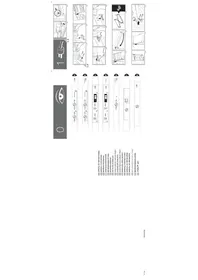
The manual is structured so that the textual information is related to the corresponding figures.

Identification
Determine which model of refrigerator you have ("a", "b", "c", "d", "e", "f", "g"). To do this, compare the control panel with the illustrations.

Installation
1.1. Unpacking. Remove all protective elements. 1.2. Placement. To reduce electricity consumption, the refrigerator should be installed away from heat sources in a specially designated place, protected from direct sunlight.
The refrigerator should not be installed outdoors or in a place where water jets can fall on it.
When installing the appliance, it is necessary to leave space for air circulation. Between the base of the appliance and the rear wall there should be at least 25 mm. Do not obstruct the space between the refrigerator and the wall, as well as between the refrigerator and the top of the room.
To avoid vibration and noise, the appliance must be leveled so that it is not tilted. Note that when the refrigerator is placed near a wall or furniture, slight noises may occur during operation.
To avoid vibration, it is also necessary to check the correct installation of the adjustable feet, and when placing dishes in the refrigerator, make sure that the shelves do not touch each other.
1.3. Connection to the electrical network. The appliance must be connected to the network only after it has been in a vertical position for at least 2 hours. Check that the actual parameters of the electrical network correspond to the data indicated in the nameplate (from 220 to 240 V with grounding) (1.3.1, 1.3.2).
The use of adapters (extension cords) is not allowed.
Check that the network cable does not touch the electric motor and does not get caught.
1.4. Changing the door opening side. Disconnect the refrigerator from the power supply and remove all accessories from the inside of the door.
Release the lower hinge pin and remove it, supporting the door so that it does not fall (1.4.1, 1.4.2). Remove the door of the freezer compartment (1.4.3).
Using a screwdriver, remove the decorative cover of the central hinge (1.4.4). Loosen the screws of the central hinge and remove it, supporting the door so that it does not fall (1.4.5, 1.4.6). Remove the door of the refrigerator compartment (1.4.7).
Remove the upper hinge and install it in a similar position on the opposite side (1.4.8).
Remove the accessories for automatic door closing and turn them so that the accessory of the refrigerator compartment becomes the accessory of the freezer compartment and vice versa (1.4.9). Install the decorative covers on both doors.
Using a screwdriver, remove the decorative covers of the central hinge, the middle and lower parts of the refrigerator body, and install them on the opposite side (1.4.10).
Install the refrigerator door by inserting it into the upper hinge (1.4.11). Without letting go of the door, press it upward and install the central hinge (1.4.12).
Remove and reposition the axis of the lower hinge (1.4.13).
Install the freezer door by inserting it into the middle hinge (1.4.14). Without letting go of the door, press it upward and install the lower hinge (1.4.15).


Operating procedure

2.1 Switching on the refrigerator. Press ON-OFF (2.1.1). Press + or –, holding the button until the desired value appears on the display (2.1.2). Alternatively, turn the knob (2.1.3). 2.2 Selecting the compartment. In models abcd, the refrigerator compartment and freezer compartment operate independently. In models A efg, both compartments operate in conjunction. 2.3 Setting the temperature. Turn the knob (2.3.1) or press + or – first for the freezer compartment and then for the refrigerator compartment (2.3.2).
After setting the required temperature, you can check the actual temperature in the compartment by looking at the light indicators (2.3.3) or by pressing and holding the + or – button of the required compartment for 5 seconds. The compartment temperature will be displayed (2.3.4).
Recommended temperature for the refrigerator compartment is 4°C, for the freezer compartment -19°C (for freezing fresh products). If you need to freeze fresh products, it is recommended to set the temperature to -24°C.
Remember that the temperature inside the refrigerator chambers depends on the ambient temperature, the location of the appliance, and the frequency of door openings.
2.4 Freezer modes.
Fast freeze mode. When this mode is switched on, the freezer compartment will maintain a lower temperature for 6 hours. Using this mode is recommended when placing a large quantity of products in the freezer.
Switching on and off: press SUPER (2.4.1, 2.4.2). In models efg this mode is not provided.
Holiday mode. Holiday mode is useful when the refrigerator will not be used for a long time, but you want to freeze
products in the freezer compartment. In this mode, the refrigerator consumes very little electricity, and no frost forms inside. In models acefg this mode is not provided.
Attention. When using this mode, the refrigerator door must be closed.
Switching on and off: press HOLIDAY (2.4.3), or press the + or - buttons of the refrigerator compartment, holding them pressed until the inscription disappears (2.4.4). Repeat the procedure to switch off.
2.5 Freezer compartment modes.
Fast freeze mode. When this mode is switched on, the freezer compartment will maintain a lower temperature for 52 hours. This mode is recommended to be switched on 24 hours before placing a large quantity of products in the freezer. In model f this mode must be switched off after 24 hours.
Switching on and off: press SUPER (2.5.1, 2.5.2, 2.5.3). In model 3 this mode is not provided.
Winter mode, available only in models e. This mode should be used if the room temperature is low, otherwise the refrigerator will lose cold. Press and hold the SUPER button for 5 seconds until the orange signal lamp lights up (2.5.4). The refrigerator lighting will be constantly switched on at low power, so that the compressor operates longer. When the required temperature in the refrigerator is reached, switch off the Winter mode by pressing and holding SUPER again for 5 seconds.
Switching on/off the freezer compartment. Press ON-OFF of the freezer compartment (2.5.5). Press the + or - button, holding it pressed until the temperature indication disappears from the display (2.5.6), or turn the knob to the ON-OFF position (2.5.7). After switching off the freezer compartment, the refrigerator compartment also switches off.
2.6 Operating recommendations.
Do not keep the doors open longer than necessary, and do not put hot products in the refrigerator. Thanks to this, the refrigerator will


operate more efficiently, and you will avoid increased electricity consumption.
- Do not block the ventilation openings and leave some space between products, allowing air to circulate between them. Do not place bottles of carbonated drinks or glass bottles with liquid in the freezer compartment, as they may explode. To prevent products from drying out, place them in the refrigerator in sealed containers. Do not consume very cold ice cream or heavily frozen products, as this may cause mouth burns.
3 Cleaning and maintenance

3.1 Cleaning the interior. To clean the interior, use a sponge or cloth dampened with a weak soda solution to remove stubborn odors. It is strictly forbidden to use steam cleaners, solvents, or abrasive cleaning agents for cleaning. 3.2 Cleaning the exterior. It is forbidden to use steam cleaners or abrasive sponges. It is recommended to wipe with a soft cloth. 3.3 Cleaning the accessories. It is forbidden to wash accessories in dishwashers. It is recommended to clean them by hand with a sponge or cloth. 3.4 Replacing the lamp. If the lamp no longer lights, the following steps must be performed. Disconnect the refrigerator from the power supply. Remove the cover, pressing on the side (3.4.1, 3.4.3), and pull out the faulty lamp (3.4.2, 3.4.4). Replace it with a new lamp of the same type (E14, 220-240 V, 15/25 W) and in accordance with the instructions for lighting. 3.5 Replacing the charcoal filter. In the refrigerator
Russian
there may be a charcoal filter that absorbs foreign odors produced by some products and traps microorganisms (mold and bacteria) from the circulating air.
The filter properties are maintained for a certain time, about 6 months. After this period, it is recommended to replace the filter. The location of the filter depends on the model.
Procedure for replacing the filter. Press the "PUSH" and remove the cover (3.5.1, 3.5.5). Pull out the used filter (3.5.2, 3.5.6).
If filter replacement is required, remove the protective caps (3.5.3) and press on the BIOFILTER until it clicks (3.5.4). After a few seconds, the filter life indicator will start to color. Install the filter in the original position.
Used and replaced filters must be stored out of the reach of children. Disposal of significant amounts of filter material may be dangerous. Do not allow the filter to get wet, as it may lose its properties.
4 Control functions of the refrigerator
4.1 Opening the door. If the door remains open for more than 2 minutes, the refrigerator will emit an audible signal, and the lighting of the refrigerator compartment will turn off. After closing the door, the alarm stops.
4.2 Insufficient cold in the freezer compartment
- The temperature in the freezer compartment is abnormally high, which triggers the alarm (4.2.1, 4.2.2) and, in turn, interrupts the audible alarm. To stop the audible alarm manually, press the SUPER button (4.2.3, 4.2.4). This is only available in models 8. If the "Winter" mode is enabled, the alarm will flash. For the order of enabling it, see section 2.5.4. When the appliance is switched on, the light alarm turns on, but the audible alarm does not sound.

4.3 Disconnecting the appliance from the power supply
Open the refrigerator doors as rarely as possible and for as short a time as possible. After the voltage in the network has reappeared, check that the products have not thawed.
4.4 Normal sounds of the refrigerator
During operation, the refrigerator may produce sounds that are completely normal due to the operation of the compressor and other components.
3.1
1
3.1.1, 3.1.3 (204-220)
4.1
1
(2.4.1, 1.4.1)
(3.4.1)
5.4.1) 2
(7.4.1) a 6.4.1
:
19 4
- 24 ① 25 ≤ x ≤ 24 ②
1 1
4.2
:
a 6
(2.4.2, 1.4.2)
efg
Therefore A(1,0), B(-3/4, sqrt(3)/4)
i 1
1 1
acefg
Therefore sin Δ = BC/AC = sqrt(3/5)
a
J (3.4.2) HOLIDAY
4.1.2.3.4.5.6.7.8.9
:
(3.5.2, 2.5.2, 1.5.2) SUPER
:
5d SUPER
: aai 1
(6.5.2)
all 7.5.2 ON-OFFa
Juaui 6.2
A
. 1
. 2.3
.
4.3
(4.4.3, 2.4.3) 120000000000000000000000000000000000000000000000
E14, 220-240, 15/25,
5.3
(5.5.3, 1.5.3)
(6.5.3, 2.5.3)
Section 5.5.3, 1.5.3
Calall biolg (3.5.3) Calall e jil
BIOFILTER
Section 4.5.3
1 1
y 8
Jabjglgla
J 1
jibill jiuoo
4

4.1
aal alal alal alal alal

J
5
A
Therefore, the area of triangle ACD equals the area of triangle COD plus the area of triangle CDA.
4
y
.


- IDENTIFICATION
- INSTALLATION
- OPERATION
- REFRIGERATOR FUNCTIONS
- FREEZER FUNCTIONS
- RECOMMENDATIONS FOR USE
- MAINTENANCE AND CLEANING
- DIAGNOSTICS
- THE FREEZER IS NOT COLD ENOUGH
- ELECTRICITY CUTS
- NORMAL REFRIGERATOR NOISE
- SAFETY
- THE ENVIRONMENT
- THIS REFRIGERATOR WAS DESIGNED WITH ENVIRONMENTAL CONSERVATION IN MIND
- WASTE MANAGEMENT OF ELECTRICAL AND ELECTRONIC APPLIANCES
- OPERATING PROCEDURE
- CLEANING AND MAINTENANCE
- RUSSIAN
- CONTROL FUNCTIONS OF THE REFRIGERATOR
- INSUFFICIENT COLD IN THE FREEZER COMPARTMENT
- DISCONNECTING THE APPLIANCE FROM THE POWER SUPPLY
- NORMAL SOUNDS OF THE REFRIGERATOR
Brand : BRANDT
Model : BFC2300NW
Category : Refrigerator