
NVR-5203 CVSD - Freezer NEVIR - Free user manual and instructions
Find the device manual for free NVR-5203 CVSD NEVIR in PDF.


| Product Type | Upright Freezer with drawers |
| Gross Capacity | 180 L |
| Storage Capacity | 173 L |
| Freezing Capacity | 13 kg/24h |
| Climate Class | N, ST (ambient temperature +16°C to +38°C) |
| Refrigerant | R600a (80 g) |
| Blowing Gas | Cyclopentane |
| Rated Voltage | 220–240 V ~ |
| Rated Frequency | 50 Hz |
| Rated Current | 1 A |
| Protection Class | I (earthing required) |
| Net Weight | 44 kg |
| Temperature Control | Mechanical dial (1 = warmest, 7 = coldest) |
| Defrost Type | Manual defrost for freezer compartment |
| Number of Drawers | 2 (upper and lower) |
| Adjustable Legs | Yes, front feet for leveling |
| Door Gasket | Magnetic seal |
| Door Hinge | Bottom hinge (non-reversible) |
| Power Cord Type | Type Y attachment (replaceable by qualified technician) |
| Child Safety | Warning: risk of child entrapment; doors must be removed before disposal |
Frequently Asked Questions - NVR-5203 CVSD NEVIR
User questions about NVR-5203 CVSD NEVIR
0 question about this device. Answer the ones you know or ask your own.
Ask a new question about this device
Download the instructions for your Freezer in PDF format for free! Find your manual NVR-5203 CVSD - NEVIR and take your electronic device back in hand. On this page are published all the documents necessary for the use of your device. NVR-5203 CVSD by NEVIR.
USER MANUAL NVR-5203 CVSD NEVIR
natural_image
Empty rectangular frame with a curved top and two small corner supports at the bottom (no text or symbols)To ensure proper use of this appliance and your safety, please read the following instruction completely before operating this appliance.
Dear customer:
Thank you for buying your new freezer. To ensure that you get the best results from your new freezer take time to read through these simple instructions in this booklet.
Please ensure that the packaging material is disposed of in accordance with the current environmental requirements.
If the freezer is visibly damaged, do not connect it to the power supply, Contact the store from where purchased the appliance.
CONTENTS
IMPORTANT SAFETY INSTRUCTIONS....2
INSTALLATION....4
Positioning....4
Electrical connection....4
NAMES OF THE PARTS....5
Operation - Temperature regulation....6
Storing food and drink....6
Storing frozen food/freezing fresh food....6
Important....6
The care required for best performance....6
Defrosting food.... 6
Defrosting the appliance....7
Prolonged periods of disuse....7
Cleaning the Appliance....7
TROUBLESHOOTING....7
HOW TO DISPOSE OF THE PACKING MATERIAL....8
Weee 8
CIRCUIT DIAGRAM....9
TECHNICAL INFORMATION....9
IMPORTANT SAFETY INSTRUCTIONS
WARNING
To reduce the risk of fire, electrical shock, or injury follow these basic precautions when using your refrigerator.
1) WARNING----Keep ventilation openings, in the appliance enclosure or in the built-in structure, clear of obstruction.
2) WARNING----Do not use mechanical devices or other means to accelerate the defrosting process, other than those recommended by the manufacturer.
3) WARNING----Do not damage the refrigerant circuit to increase the risk of a leak when handle, move, clean and use of refrigerator.
4) WARNING----Do not use electrical appliances inside the food storage compartments of the appliances, unless they are of the type recommended by the manufacturer.
5) WARNING----DANGER: Never allow children to play with, operate, or crawl inside the refrigerator. Risk of child entrapment. Before you throw away your old refrigerator or freeze
● Take off the doors
- Leave the shelves in place so that children may not easily climb inside.
6) The appliance has to be unplugged before carrying out user maintenance on the appliance.
7) This appliance is not intended for use by persons (including children) with reduced physical sensory or mental capabilities, or lack of experience and knowledge, unless they have been given supervision or instruction concerning use of the appliance by a person responsible for their safety. Children should be supervised to ensure that they do not play with the appliance. Cleaning and maintenance should not be made by children without supervision.
8) If the SUPPLY CORD is damaged, it must be replaced by the manufacturer, its service is or similar qualified persons in order to avoid a hazard.
9) Please abandon the refrigerator according to local regulations as the unit contains flammable blowing gas and refrigerant.
10) Follow local regulations regarding disposal of the appliance due to flammable refrigerant and blowing gas. All refrigeration products contain refrigerants, which under the guidelines of federal law must be removed before disposal. It is the consumer's responsibility to comply with federal and local regulations when disposing of this product.
11) This appliance is intended to be used in household and similar environments; such as:
- staffkitchen areas in shops, offices and other working environments;
● farm houses and by clients in hotels, motels and other residential type environments;
- bed and breakfast type environments;
● catering and similar non-retail applications.
12) Do not store or use gasoline or any inflammable liquors and liquids inside or in the vicinity of refrigerator.
13) Do not use extension cords or ungrounded (two prong) adapters with this appliance. If the power cord is too short, have a qualified electrician install an outlet near the appliance. Use extension can negatively affect the unit's performance.
14) Do not store explosive substances such as aerosol cans with a flammable propellant in this appliance.
BEFORE PUTTING INTO USE
● Before connecting the appliance to the power supply, let it stand for about 2 hours, which will reduce a possibility of malfunctions in the cooling system due to transport handling
- Clean the appliance, and be thorough, especially in the interior (See "HOW TO CLEAN"
- In case the interior accessories are not correctly placed, rearrange them as described in chapter “NAME OF THE PARTS”.
Instructions for Use
These instructions for use are intended for the user. They describe the appliance and its co and safe use. They were prepared for various types/models of fridges therefore you may find description of some functions and accessories that your appliance does not have.
TIPS FOR ENERGY SAVING
- Try not to open the door too often, especially when the weather is wet and hot. Once open the door, mind to close it as soon as possible.
- Every now and then check if the appliance is sufficiently ventilated (adequate air circulation around the appliance).
- Set thermostat from higher to lower settings as soon as possible (depends on how loaded appliance is ambient temperature etc).
- Before loading the appliance with packages of fresh foods, make sure they are cooled to ambient temperature.
- Ice and frost layer increase energy consumption, so defrost the appliance as soon as the layer is 1/8" thick.
IMPORTANT
● DANGER: Risk of child entrapment. Before you throw away your old fridge:
Take off the doors.
Leave the shelves in place so that children may not easily climb inside.
- The appliance must be correctly connected to the power supply. (See: “HOW TO INSTALL”).
- Do not use an extension cords or ungrounded (two prong) adapters.
- Do not touch the cooled surfaces while the appliance operates, especially not with wet h because the skin may stick to the cold surfaces.
- Do not freeze bottles containing liquid, especially soft drinks, such as mineral water, sparkling wine, beer, cola etc., because liquid expands during freezing and the glass bot very likely to blow up.
- Do not eat frozen food (bread, fruit, vegetables), because you can get frostbites.
- If the food has strange smell or color, throw it away, because it is very likely that it is spoiled and therefore dangerous to eat.
- Disconnect the appliance from the power supply before repairing it (only a qualified technician should repair it), before cleaning.
- Do not defrost the appliance with other electric devices (hair dryer etc.) and never scrape the ice or frost layer with sharp tools.
● The rating plate is inside the appliance or outside on the rear wall.
INSTALLATION
Positioning
Position the appliance away from heat sources such as stoves, radiators, direct sunlight etc.
Before connect the power supply, remove the supporting base and then screw down the front foot of ap correctly to make it leveled correctly.
This appliance is suitable in 'N.ST' climate.
| Climate Clas | Ambient Temperature |
| N,ST | From +16°C to +38 |
Appliances must not be exposed to rain. Sufficient air must be allowed to circulate in the lower rear so appliances, as poor air circulation can affect performance. Built-in appliances should be positioned away from heat sources such as heaters and radiators and out of direct sunlight. Behind the appliance there should free space of at least 3in. Kitchen units (e.g. cupboards) should be at least 2in. away from the appliance order to assure adequate ventilation. There should be 4in. between both sides of the appliance and other obstacles.
Electrical connection
Before connecting the appliance to the power supply, ensure that the voltage and frequency as indicated data plate correspond to those of the electrical mains.
A deviation of -6% to +6% is admissible with respect to the rated voltage. For operation with other v0 supplies, an adequately powered auto-transformer is required.
Always connect the appliance to an efficient earthing system.
Put the appliance in upright position for at least 2 hours before switching it on.
NAMES OF THE PARTS

(1) Temperature Control Box
(2) Upper drawer
(3) Lower drawer
(4) Adjustable legs
(5) Magnetic Gasket
(6) Hole button of door
(7) Bottom hinge
(8) Door stopper
(9) Top hinge cover
Operation - Temperature regulation
To control the internal temperature, adjust the thermostat dial. "1" is the warmest setting. "7" is the coldest. The Dial may be set any place on the scale. It does not have to be set exactly on a number. To make ice in the freezer compartment, adjust the thermostat to the coldest setting.

Note: Wait 3-5 minutes before restarting if you unplug the freezer. The unit may fail to operate properly if restarted too quickly.
Storing food and drink
For optimal use of the refrigerator compartment observe the following instructions:
- Never put hot liquids or food in the refrigerator;
- Cover or wrap food prior to storage
- Arrange food so that air can circulate freely inside the compartment.
Cooked food, cold meals etc. must be covered well and stored in proper position in the refrigerator.
Fruit and vegetables should be cleaned and stored in the relative drawer.
Bananas, potatoes, onions and garlic should not be stored in the refrigerator unless wrapped first.
Storing frozen food/freezing fresh food
Appliances with compartments can be used to store frozen food for a maximum time of one month.
- The interval between purchase and placing the food in the freezer should be as short as possible.
- Never exceed the storage period indicated on the food packaging.
- Only open the freezer door when necessary and as quick as possible.
In the event of operation after prolonged periods of disuse, switch on the appliance under no-load condit for 2-3 hours taking care to set the thermostat knob to the highest setting, then place food in the refri required and adjust the thermostat knob to an intermediate setting.
IMPORTANT
If food stored in the compartment is defrosted, e.g. due to a power failure, it should be consumed with short time, even if not completely thawed.
The care required for best performance, such as
1) Loadings in the refrigerating appliance should not exceed its storage volume. If the refrigerating applia stopped for a long time (due to interruption of power supply or failure of the refrigerating system), frozen food (fresh food) had better to be disposed of according to user's need.
2) It is better to arrange the food when storage, to avoid cross-contamination.
3) Some types of fresh vegetables and fruits are sensitive to cold; therefore they are not suitable for storage in chill compartment.
Defrosting food
For optimal cooking results with frozen food, we recommend defrosting inside the refrigerator or at am temperature, the latter obviously required less time. If you need to save time and cook food in the shop
you can cook small items directly from frozen by lengthening the cooking time slightly, or put the big items in a microwave oven to reduce the defrosting time.
Defrosting the appliance
Frost on the inner cooling walls of the refrigerator is eliminated automatically every time the motor compressor is shut down. Water from melted frost is collected by means of a channel which leads to a tray installed above the motor compressor at the rear of the unit. Heat generated by the motor compress ensures evaporation of the water. Periodically clean the defrost water drain outlet in the refrigerator compartment.
Defrost the freezer compartment when the ice/frost is approximately 3-4mm thick. Set the thermostat dial "OFF" or "0" to defrost. Remove all contents from the freezer compartment. Leave the freezer door open allow accumulated ice/frost to melt. Remove large pieces of ice as need. Do not use hot water or other heating devices to melt the accumulated ice. After defrosting, remove accumulated ice/water and wipe the freezer compartment with a soft cloth. Restart the unit per starting instructions.
Never use a knife or other sharp metal instrument to scrape ice/frost from the inside of the unit.
Prolonged periods of disuse
If you do not intend to use the appliance for long periods of time. Set the thermostat knob to the “O position and disconnect the power supply. Then take out the foods, defrost and clean the appliance. Leave door slightly open.
Cleaning the Appliance
Disconnect the power supply before cleaning the appliance.
Do not use coarse or aggressive cleaning agents as you may damage the surface.
Clean the exterior with cloth.
Remove the detachable accessories in the interior of the appliance and clean with water and liquid deterg Plastic parts cannot be washed in dishwashers.
Wash the interior of the appliance with wet cloth, adding one or two spoonfuls of vinegar.
After cleaning, connect the appliance to power supply and reload it.
TROUBLESHOOTING
Defective operation of the appliance is not always due to a technical fault but is often caused by incor installation or use. To avoid unnecessary technical assistance and relative expenses we recommend the following procedures.
- Internal temperature is not cool enough
Check:
- make sure that the door closes properly;
- make sure that the thermostat setting is correct;
- make sure that the refrigerator is not positioned close to heat sources;
—make sure that air can circulate freely at the rear of the appliance; -
make sure that the condenser is not blocked.
-
Internal temperature is too low
Check:
-make sure that the thermostat setting is correct.
- Excessive appliance noise level
Check:
- Make sure that the appliance is leveled correctly.
- Appliance operation failure
Check:
-make sure that the thermostat is not set to "OFF" or "0";
-make sure that the power supply is not disconnected;
-make sure that the plug is inserted correctly into the mains socket;
-make sure that the automatic cut-out on the mains line has not tripped or that the fuse has not broke.
-make sure that the power cable is not faulty.
NOTE
If the power cable need to be replaced, remove the plug from the power socket and install the new ca must be requested from the Service Center and installed by a qualified technician; ensure that it is prop connected and fixed.
If problems persist after the above procedures, contact your nearest Technical Assistance department.
HOW TO DISPOSE OF THE PACKING MATERIAL
The packing material is recyclable.
The following procedure is recommended:
- dispose of paper, card and carton in the relative containers;
- dispose of plastics in the relative containers.
- If you have no recycling bins in your area then you can put this material in the ordinary bins and/or the appropriate collection centers.
Type X attachment with specially prepared cord-Damaged supply cords must be replaced by a special cor assembly available from the manufacturer or its service agent.
Type Y attachment- Damaged supply cords to be replaced by the manufacturer, service agent or similarly qualified person to avoid hazard.
Type Z attachment-Damaged supply cord cannot be replaced and the appliance should be scrapped.
WEEE
DISPOSAL: Do not dispose this product as unsorted municipal waste. Collection of such waste separately for special treatment is necessary.
Meaning of crossed-out wheeled dustbin: Do not dispose of electrical appliances as
unsorted municipal waste, use separate collection facilities.
Contact you local government for information regarding the collect systems available.
If electrical appliances are disposed of in landfills or dumps, haz substances can leak into the groundwater and get into the food damaging your health and well-being.

natural_image
Simple line drawing of a trash bin with two crossed lines indicating no waste or discharge (no text or symbols)
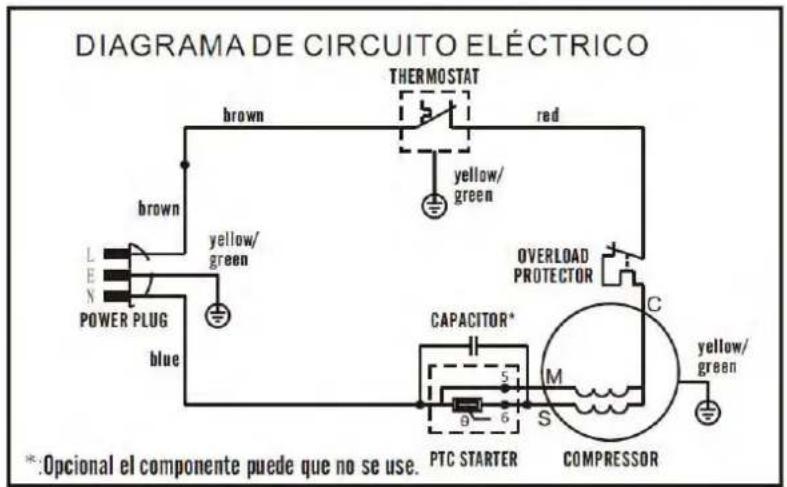
CIRCUIT DIAGRAM
TECHNICAL INFORMATION
| Modelo | NVR-5203 CVSD |
| Gross volume | 180L |
| Storage volume | 173L |
| Climatic class | N, ST |
| Refrigerant | R600a |
| Amount | 80g |
| Rated voltage | 220-240V~ |
| Rated frequency | 50Hz |
| Rated current | 1A |
| Freezing capacity | 13kg/24h |
| Protection class | I |
| Net weight | 44kg |
| Blowing gas | Cyclopentane |
DECLARATION OF CONFORMITY
natural_image
Empty rectangular frame with a small protrusion at the bottom (no text or symbols)(1) Caja de Control de Temperatura
(2) Cajón superior
(3) Cajón inferior
(4) Pies ajustables
(5) Junta magnética
| Modelo | NVR-5203 CVSD |
| Gross volume | 180L |
| Storage volume | 173L |
| Climatic class | N, ST |
| Refrigerant | R600a |
| Amount | 80g |
| Rated voltage | 220-240V~ |
| Rated frequency | 50Hz |
| Rated current | 1A |
| Freezing capacity | 13kg/24h |
| Protection class | I |
| Net weight | 44kg |
| Blowing gas | Cyclopentane |


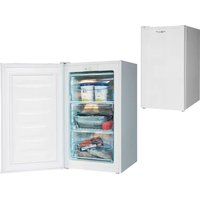
- Dear customer:
- CONTENTS
- IMPORTANT SAFETY INSTRUCTIONS
- WARNING
- BEFORE PUTTING INTO USE
- Instructions for Use
- TIPS FOR ENERGY SAVING
- IMPORTANT
- INSTALLATION
- Positioning
- Electrical connection
- NAMES OF THE PARTS
- Operation - Temperature regulation
- Storing food and drink
- Storing frozen food/freezing fresh food
- The care required for best performance, such as
- Defrosting food
- Defrosting the appliance
- Prolonged periods of disuse
- Cleaning the Appliance
- TROUBLESHOOTING
- Check:
- NOTE
- HOW TO DISPOSE OF THE PACKING MATERIAL
- WEEE
- CIRCUIT DIAGRAM
- TECHNICAL INFORMATION
- DECLARATION OF CONFORMITY
Brand : NEVIR
Model : NVR-5203 CVSD
Category : Freezer