
BDP421 - Sphygmomanometer INVENTUM - Free user manual and instructions
Find the device manual for free BDP421 INVENTUM in PDF.


| Product Type | Upper Arm Blood Pressure Monitor |
| Model | BDP421 |
| Brand | Inventum |
| Measurement Method | Oscillometric |
| Measurement Range (Blood Pressure) | 0 – 299 mmHg |
| Measurement Range (Pulse) | 40 – 199 beats/min |
| Accuracy (Blood Pressure) | ±3 mmHg |
| Accuracy (Pulse) | ±5% of reading |
| Cuff Size | 22 – 36 cm arm circumference |
| Display | LCD digital display |
| Memory | 2 x 120 readings (2 users) |
| Irregular Heartbeat Detection | Yes |
| WHO Classification Indicator | Yes |
| Power Supply | 4 x AA batteries (1.5V) or AC adapter (optional, 6V DC) |
| Dimensions (approx.) | 120 x 80 x 40 mm |
| Weight (without batteries) | 250 g |
| Automatic Shut-Off | After 1 minute inactivity |
| Cuff Material | Nylon fabric |
| Cleaning | Wipe with a soft dry cloth. Do not use solvents or immerse in water. |
| Storage Conditions | -20°C to 55°C, 15% – 90% relative humidity |
| Operating Conditions | 10°C to 40°C, 15% – 90% relative humidity |
| Classification | BF type applied part |
| Spare Parts | Replacement cuffs available (model BDP421-CUFF) |
Frequently Asked Questions - BDP421 INVENTUM
User questions about BDP421 INVENTUM
0 question about this device. Answer the ones you know or ask your own.
Ask a new question about this device
Download the instructions for your Sphygmomanometer in PDF format for free! Find your manual BDP421 - INVENTUM and take your electronic device back in hand. On this page are published all the documents necessary for the use of your device. BDP421 by INVENTUM.
USER MANUAL BDP421 INVENTUM
1 safety instructions page 26
2 appliance description page 29
3 things to know about blood pressure page 31
4 before first use page 32
5 measuring blood pressure page 36
6 evaluating results page 38
7 saved records page 39
8 delete all saved records page 40
9 tips for measurement page 41
10 cleaning & maintenance page 41
11 frequently asked questions page 42
12 troubleshooting
page 43
13 specifications page 44
14 complied European standards list
page 46
15 EMC guidance page 47
Guarantee & after sales Service page 51
index·3
Nederlands
line
| Blood Pressure Level | Systolic blood pressure (mmHg) | | :--- | :--- | | Optimal Blood Pressure | 120 | | Normal Blood Pressure | 130 | | High-removal Blood Pressure | 140 | | Subgroup borderline | 150 | | Grade 1 hyperintensiveness/mild | 160 | | Grade 2 hyperintensiveness/moderate | 170 | | Grade 3 hyperintensiveness/severe | 180 || Bloeddruk (mmHg) | Hypotonie (verlaagde bloeddruk) | Optimaal Normaal | Hoog normaal | Milde | hypertensie (type I) | Matige hypertensie (type II) | Ernstige hypertensie (type III) |
| SYS ≤ 105 106-120 | 120 120-129 130-139 | 140-159 | 160-179 | ≥ 180 | |||
| DIA ≤ 60 < 60-80 | 80-84 85-89 90 | -99 | 100-109 | ≥ 110 |
natural_image
Diagram of a device with battery and two batteries, no text or symbols present10 • Nederlands

PAS OP:
natural_image
Cartoon illustration of a person wearing a heart-shaped bandage and a wristband, with no text or symbols present.14 • Nederlands
Start de meting
1 safety instructions
The signs below might be in the user manual, on the labelling or on the appliance. The description of the symbols can be found in the table below.
| (KZ4A) | Symbol for “THE OPERATION GUIDE MUST BE READ” Symbol | [WSYC] | “TYPE BF APPLIED PARTS” |
| CE 0123 | Symbol for “COMPLIES WITH THE MDD 93/42/EEC REQUIREMENTS” | [SWSD] | Symbol for “ENVIRONMENTAL PROTECTION - Electrical waste products should not be disposed of with household waste. Please recycle where facilities exist. Check with your local authority or retailer for recycling advice.” |
| [SYW3] | Symbol for “MANUFACTURER” Symbol for “Authorised Representative in the European Community” | ||
 | Symbol for “DIRECT CURRENT” | ||
 | Symbol for “MANUFACTURE DATE” | ||
 | Caution: These notes must be observed to prevent any damage to the device. | ||
26 · English

CAUTION
• This device is intended for adult use only.
• This appliance is intended for indoor use only.
- This device is intended for non-invasive measuring and monitoring of arterial blood pressure. It is not intended for use on extremities other than the wrist or for functions other than obtaining a blood pressure measurement.
- Do not confuse self-monitoring with self-diagnosis. This unit allows you to monitor your blood pressure. Do not begin or end medical treatment without asking a physician for treatment advice.
- If you are taking medication, consult your physician to determine the most appropriate time to measure your blood pressure. Never change a prescribed medication without consulting your physician.
• This device is intended for indication of the blood pressure and heartbeat only. A test for clinical results can be done by a physician.
- If the cuff pressure exceeds 40 kPa (300 mmHg), the unit will automatically deflate. Should the cuff not deflate when pressures exceed 40 kPa (300 mmHg), detach the cuff from the wrist and press the START/STOP button to stop inflation.
- To avoid measurement errors, carefully read this manual before using the product.
- The equipment is not AP/APG equipment and not suitable for use in the presence of a flammable anaesthetic mixture with air of oxygen or nitrous oxide.
- The operator shall not touch the output of batteries and the patient simultaneously.
- Do not use the monitor under the conditions of strong electromagnetic field (e.g. medical RF equipment) that radiates interference signal or electrical fast transient/burst signal.
• The user must check that the equipment functions safely and see that it is in proper working condition before being used.
- Please use the ACCESSORIES and detachable parts specified/authorised by the MANUFACTURER. Otherwise, it may cause damage to the unit or danger to the user/patients.
- Manufacturer will make available on request circuit diagrams, component parts list etc.
- This unit is not suitable for continuous monitoring during medical emergencies or operations. Otherwise, the patient's wrist and fingers will become numb, swollen and even purple due to a lack of blood.
- Please use the device under the environment which was provided in the user manual. Otherwise, the performance and lifetime of the device will be impacted and reduced.
English • 27
- During use, the patient will be in contact with the cuff. The materials of the cuff have been tested and found to comply with requirements of ISO 10993-5:2009 and ISO 10993-10:2010. It will not cause any potential allergic reaction or contact injury.
- The device doesn't need to be calibrated during two years of reliable service.
- Please dispose of the ACCESSORIES, detachable parts and the ME EQUIPMENT according to the local guidelines.
- When the device was used to measure patients who have common arrhythmias such as atrial or ventricular premature beats or atrial fibrillation, the best result may occur with a deviation. Please consult your physician about the result.
- This device is contraindicated for any female subject who may be suspected of being, or is, pregnant. Besides providing inaccurate readings, the effects of this device on the foetus are unknown.
- Please keep the unit out of reach of infants, children or pets, since inhalation or swallowing of small parts is dangerous or even fatal.
- Too frequent and consecutive measurements could cause disturbances in blood circulation and injuries.
- When using this device, please pay attention to the following situation which may interrupt blood flow and influence blood circulation of the patient, thus cause harmful injury to the patient: too frequent and consecutive multiple measurements; the application of the CUFF and its pressurisation on any wrist where intravascular access or therapy, or an arterio-venous (A-V) shunt, is present; inflating the cuff on the wrist on the side of a mastectomy.
- Do not apply the cuff over a wound; otherwise, it can cause further injury.
- Do not inflate the cuff on the same limb which other monitoring ME EQUIPMENT is applied around simultaneously, because this could cause temporary loss of function of those simultaneously-used monitoring ME EQUIPMENT.
• Using it in this case can result in prolonged impairment of the circulation of the blood of the PATIENT. - Don't kink the connection tube; otherwise, the cuff pressure may continuously increase which can prevent blood flow and result in harmful injury to the PATIENT.
2 appliance description

English · 29
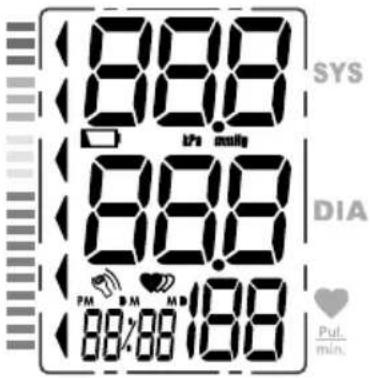
The following symbols can be found on the display:
| Symbol Description Explanation | ||
| SYS | Systolic blood pressure High pressure result | |
| DIA | Diastolic blood pressure Low pressure result | |
| Pulse Pulse/minute: heartbeats/minute | ||
| Shocking reminding Shocking will result in inaccurate | ||
| +Lo | Low battery Batteries are low and need to be replaced | |
| kPa Measurement unit of the blood pressure(1 kPa=7.5 mmHg) | ||
| mmHg | mmHg Measurement unit the blood pressure(1 mmHg=0.133 kPa) | |
| irregular heartbeat irregular heartbeat detection | ||
| Current time Month/Day/Year, Hour/Minute | ||
| Grade The grade of the blood pressure | ||
| Heartbeat Heartbeat detection during the measurement | ||
30·English
3 things to know about blood pressure
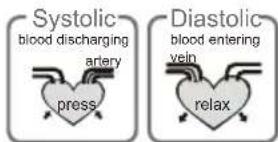
What are systolic pressure and diastolic pressure?
When ventricles contract and pump blood out of the heart, blood pressure reaches its maximum value, the highest pressure in the cycle is known as systolic pressure. When the heart relaxes between heartbeats, the lowest blood pressure is diastolic pressure.
What is the standard blood pressure classification?
The blood pressure classification published by World Health Organization (WHO) and International Society of Hypertension (ISH) in 1999 is as follows:

CAUTION:
Only a physician can tell your normal blood pressure range. Please contact a physician if your measuring result falls out of the range. Please note that only a physician can tell whether your blood pressure value has reached a dangerous point.

line
| Blood Pressure Category | Systolic blood pressure (mmHg) | | :--- | :--- | | Optimal Blood Pressure | 120 | | Normal Blood Pressure | 130 | | High-Normal Blood Pressure | 140 | | Subgroup Borderline | 150 | | Grade 1 hypertension(ml/dL) | 160 | | Grade 2 hypertension(moderate) | 170 | | Grade 3 hypertension(severe) | 180 || Blood pressure (mmHg) | Hypotonia (degraded bl. pr.) | Optimal Normal | High normal Mild | hypertension (Grade I) | Moderate hypertension (Grade II) | Severe hypertension (Grade III) | |
| SYS ≤ 105 106-120 | 120 120-129 130-139 | 140-159 160-179 | ≥ 180 | ||||
| DIA ≤ 60 < 60-80 | 80-84 85-89 90 | -99 100-109 | ≥ 110 |
English • 31
Irregular heartbeat detector
An irregular heartbeat is detected when a heartbeat rhythm varies while the unit is measuring the systolic and diastolic blood pressure. During each measurement, this equipment records the heartbeat intervals and works out the standard deviation. If the calculated value is larger than or equal to 15, the irregular heartbeat symbol appears on the symbol when the measurement results are displayed.

CAUTION:
The appearance of the IHB icon indicates that a pulse irregularity consistent with an irregular heartbeat was detected during measurement. Usually this is NOT a cause for concern. However, if the symbol appears often, we recommend you seek medical advice. Please note that the device does not replace a cardiac examination, but serves to detect pulse irregularities at an early stage.
4 before first use
Before you use the appliance for the first time, please do as follows: carefully unpack
the appliance and remove all the packaging material. Keep the material (plastic bags and cardboard) out of reach of children. Check the appliance after unpacking for any damage which may have occurred during transport.
- Slide off the battery cover.
• Install the batteries by matching the correct polarity, as shown below.
Always use the correct battery type (2 x AAA batteries). - Replace the cover.
Replace the batteries whenever the below happen:
The □+Lo shows
The display dims
The display does not light up

natural_image
Diagram of a device with battery and two cylindrical batteries, no text or symbols present32·English

CAUTION:
- Remove the batteries if the device is not likely to be used for some time.
• The old batteries are harmful to the environment; do not dispose of them with other daily trash. - Remove the old batteries from the device and follow your local recycling guidelines.
- Do not dispose of batteries in fire. Batteries may explode or leak.
Date, time and unit settings
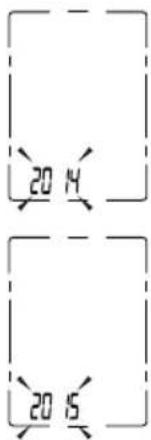
It is important to set the clock before using your blood pressure monitor, so that a time stamp can be assigned to each record that is stored in the memory. (year: 2014–2054, time format: 24 H/12 H)
-
When the monitor is off, hold down the "MEM" button for about 3 seconds to enter into setting mode. The blinking numeral represents [YEAR].
-
Press the "MEM" button to change the [YEAR]. Each press will increase the numeral by one in a cyclical manner.
English • 33
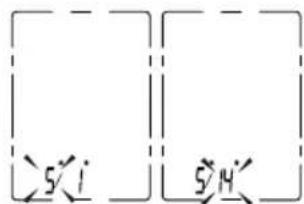
- When you get the right year, press the "START/STOP" button to confirm your selection and it will turn to the next step.
- Repeat steps 2 and 3 to confirm [MONTH] and [DAY].
- Then, the monitor diverts to the time format setting.


34 • English
-
Repeat steps 2 and 3 to confirm [HOUR] and [MINUTE].
-
Repeat steps 2 and 3 to confirm the [MEASUREMENT UNIT].
-
After confirming the measurement unit, the LCD will display all the settings you have done once again and then turn off.

English · 35
5 measuring blood pressure
Tie the cuff
- Remove all accessories (watch, bracelet, etc.) from your wrist. If your physician has diagnosed you with poor circulation in your wrist, use the other one.
- Roll or push up your sleeve to expose the skin.
- Apply the cuff to your wrist with your palm facing up. The display of the blood pressure monitor should be facing towards your body.
- Position the edge of the cuff about 1-1.5 cm from the wrist, as indicated on the cuff.
- Fasten the wrist cuff around your wrist, leaving no extra room between the cuff and your skin. If the cuff is too loose, the measurement will not be accurate.
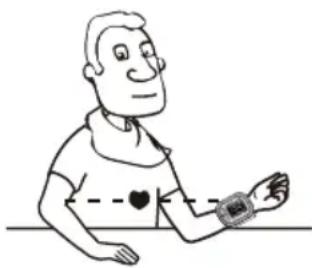
- Sit comfortably with your other wrist resting on a flat surface. It is important that during the measurement the appliance is at the heart-level. Keeping the appliance lower or higher than at the heart-level can affect the measurement.
- Patients with Hypertension: The middle of the cuff should be at the level of the right atrium of the heart; Before starting measurement, please sit comfortably with legs uncrossed, feet flat on the floor, back and wrist supported.
- Rest for 5 minutes before measuring.
- Wait at least 3 minutes between measurements. This allows your blood circulation to recover.
- The patient must relax as much as possible and do not talk during the measurement procedure.
- For a meaningful comparison, try to measure under similar conditions. For example, take daily measurements at approximately the same time, on the same wrist or as directed by a physician.
natural_image
Cartoon illustration of a person wearing a heart-shaped bandage and holding an ECG device (no text or symbols)36 · English
Start the measurement
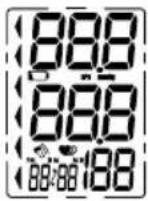
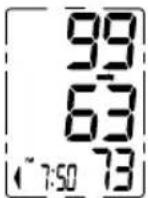
- When the monitor is off, press the "START/STOP" button to turn on the monitor, and it will finish the whole measurement automatically.
Adjust to zeroLCD display Inflating and measuring Result on display


- Press the "START/STOP" button to power off; otherwise, it will turn off automatically within 1 minute.
English·37
6 evaluating results
Irregular heartbeat indication
This instrument can identify possible cardiac arrhythmia disorders (irregular heartbeat) during measurement and if necessary indicates the measurement with the icon ♥. This may be an indicator of arrhythmia. Arrhythmia is a condition where the heart rhythm is abnormal as a result of defects in the bioelectrical system controlling the heartbeat. The symptoms (omitted or premature heart beats, slow or excessively fast heart rate) may be caused, among other things, by heart disease, age, physical predisposition, excessive use of stimulants, stress or lack of sleep. Arrhythmia can only be ascertained through examination by your doctor. Repeat the measurement if the flashing icon is displayed after the measurement. Please note that you should rest for 3 minutes between measurements and not talk or move during the measurement. If the icon appears often, please contact your doctor. Any self-diagnosis and treatment based on the results may be dangerous. It is vital to follow your doctor's instructions.
WHO classification
According to the WHO Guidelines/Definitions and the latest findings, the test results can be classified and evaluated according to the following chart. Your physician will tell you your normal blood pressure range as well as the point at which you will be considered at risk.
Table for classification of blood pressure values (unit of measurement mmHg) for adults:
| Blood pressure (mmHg) | Hypotonia (degraded bl. pr.) | Optimal Normal High normal Mild | hypertension (Grade I) | Moderate hypertension (Grade II) | Severe hyper-tension (Grade III) | |
| SYS | ≤ 105 | 106-120 120-129 130-139 140-159 160-179 | ≥ 180 | |||
| DIA | ≤ 60 | < 60-80 80-84 85-89 90-99 100-109 | ≥ 110 | |||
| Action | Check with doctor | -- Check with | doctor | Check with doctor | Seek medical advice | |
38 · English
7 saved records
After finishing a measurement the appliance will save the result automatically. The max. number of saved measurements is 60. If this is exceeded, it will automatically delete the oldest measurement so that the new measurement can be saved. To recall the saved records, follow the steps below.
- When the monitor is off, press the "MEM" button to show the average value of the latest three measurement records.

- Press the "MEM" button again, and it will display the latest measurement result, date and time. Press the "MEM" button again, it will display the next record, and so on. During the process of displaying the results, if there is no operation, the blood pressure monitor will turn off in one minute. Or you can press the "START/STOP" button to turn it off.
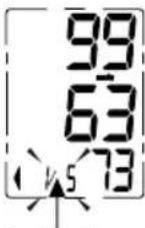
The record number, date and time will display alternately.
√5
It means the total records is 5, the current number is number 1.
5/4
The corresponding date is 14 May.
8:15
The corresponding time is 8:16 PM.
8 delete all saved records
You can delete all records by following the steps below.
-
In the memory mode, hold down the "MEM" button for 3 seconds, and the flash display "dEL ALL" will show.
-
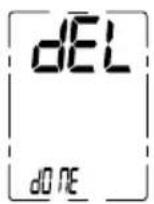
Press "MEM" to confirm deletion, and the LCD displays "dEL dONE" and the monitor will turn off.
Note: To exit out of delete mode without deleting any records, press the START/STOP button before pressing "MEM" to confirm any delete commands.
- If there is no record anymore, the display will show the following:
Please note that with this function all of the records will be deleted. It is not possible to delete only one, or a few records.


40 · English
9 tips for measurement
Measurements may be inaccurate if taken in the following circumstances.
• Results can be inaccurate when measuring within 1 hour after dinner or drinking.
• Results can be inaccurate when measuring immediate after drinking tea or coffee or after smoking.
- Results can be inaccurate when measuring within 20 minutes after taking a bath.
• Results can be inaccurate when measuring when talking or moving your fingers.
• Results can be inaccurate when measuring in a very cold environment.
• Results can be inaccurate when measuring when you want to discharge urine.
10 cleaning & maintenance
- Clean your blood pressure monitor carefully only with a slightly moistened cloth.
- Do not use detergents or solvents.
- Never immerse the appliance in water or any other liquid to protect against electrical hazards and damage.
- When storing the device, make sure that no heavy objects are placed on top of it. Remove the batteries. The cuff should not have any sharp kinks.
• Always store the blood pressure monitor in a dry place and avoid sunshine. - Avoid intense shaking and collisions.
- Avoid dusty and unstable temperature environments.
- The cuff is not washable and cannot be cleaned with any liquid.
English • 41
11 frequently asked questions
Why does my blood pressure fluctuate throughout the day?
- Individual blood pressure varies multiple times every day. It is also affected by the way you tie your cuff and your measurement position, so please take the measurement under the same conditions.
- If the person takes medicine, the pressure will vary more.
- Wait at least 3 minutes for another measurement.
- Blood pressure might fluctuate after eating and drinking.
Why do I get a different blood pressure at home compared to the hospital?
The blood pressure is different even throughout the day due to weather, emotion, exercise etc., Also, there is the “white coat” effect, which means blood pressure usually increases in clinical settings.
Is the result the same if measuring on the right upper arm?
It is ok for both wrists, but there will be some different results for different people. We suggest you measure the same wrist every time.
42 • English
12 troubleshooting
This section includes a list of error messages and frequently asked questions for problems you may encounter with your wrist blood pressure monitor. If the product is not operating as you think it should, check here before arranging for servicing.
| Problem Symptom | Check this Remedy | ||
| No power | Display doesn’t show anything. | Batteries are exhausted. Replace with new batteries. | |
| Batteries are inserted incorrectly. | Insert the batteries correctly according to the symbols. | ||
| Low batteries | ☐+Lo shown on the display | Batteries are low. Replace with new batteries | |
| Error message | E1 shows The inflation is too | low. Refasten the cuff and then measure again. | |
| E2 shows The cuff is not secure. Refasten the cuff and then measure again. | |||
| E3 shows | Can’t inflate the air during the process of measurement | Refasten the cuff and then measure again. | |
| E4 shows The cuff is too tight. Refasten the cuff and then measure again. | |||
| E5 shows | The pressure of the cuff is excessive. | Relax for a moment and then measure again. | |
| Error message | E6 shows | The voltage of the batteries is too low during the inflation | Measure again. If E6 appears again, please replace with new batteries. |
| E10 or E11 shows | The monitor detected motion while measuring. | Movement can affect the measurement. Relax for a moment and then measure again. | |
| E20 shows | The measurement process does not detect the pulse signal. | Loosen the clothing on the wrist and then measure again. | |
| E21 shows Measure incorrectly. Relax for a moment and then measure again. | |||
| EExx shows on the display A calibration error occurred. | Retake the measurement. If the problem persists, contact the retailer or our customer service for further assistance. Refer to the warranty for contact information and return instructions. | ||
13 specifications
| Power supply Battery powered mode: 2 x | AAA batteries (3V DC) |
| Display mode Digital LCD V.A. 32 mm x 45 mm | |
| Measurement mode Oscillographic testing mode | |
| Measurement principle | Oscillometric bloodpressure and heartbeat measuring with automatically 0-setting foratmospheric pressure at every measurement. |
44 • English
| Measurement range | Rated cuff pressure: 0 mmHg~300 mmHg (0 kPa ~40 kPa)Measurement pressure: SYS: 60mmHg~230mmHg (8.0kPa~30.7kPa)DIA: 40 mmHg~130 mmHg (5.3 kPa~17.3 kPa)Pulse value: (40-199) beat/minute |
| Accuracy | Pressure: 5°C-40°C within ±0.4 kPa(3 mmHg)Pulse value: ±5% |
| Normal working condition | Temperature: 5°C to 40°CRelative humidity: ≤85%RHAtmospheric pressure: 86 kPa to 106 kPa |
| Storage & transportation condition | Temperature: -20°C to 60°CRelative humidity: 10%RH to 93%RHAtmospheric pressure: 50 kPa to 106 kPa |
| Measurement perimeter of the wrist About 13.5 cm-21.5 cm | |
| Net weight Approx. 104 g (excluding the dry cells) | |
| External dimensions Approx. 85 mm x 67 mm x 23 mm (exclude the cuff) | |
| Attachment 2 x AAA batteries, user manual and storage case | |
| Mode of operation Continuous operation | |
| Degree of protection Type BF applied part | |
| Protection against ingress of water IP22 | |
| Software version V01 | |
| Device classification Internally Powered ME Equipment | |
English·45
14 complied European standards list
| Risk management EN ISO 14971: 2012 Medical devices - Application of risk management to medical devices | |
| Labelling EN ISO 15223-1: 2016 Symbols for use in the labelling of medical devices | |
| User manual EN 1041: 2008 Information supplied by the manufacturer of medical devices | |
| General requirements for safety | EN 60601-1: 2006+A1: 2013 Medical electrical equipment - Part 1: General requirements for basic safety and essential performanceEN 60601-1-11: 2010 Medical electrical equipment - Part 1-11: General requirements for basic safety and essential performance - Collateral standard: Requirements for medical electrical equipment and medical electrical systems used in the home healthcare environment |
| Electromagnetic compatibility | EN 60601-1-2: 2007 Medical electrical equipment: Part 1-2: General requirements for basic safety and essential performance - Collateral standard: Electromagnetic compatibility - Requirement and tests |
| Performance requirements | EN ISO 81060-1: 2012 Non-invasive sphygmomanometers - Part 1: Requirements and test methods for non-automated measurement typeEN 1060-3: 1997+A2: 2009 Non-invasive blood pressure Part 3: Supplementary requirements for electromechanical blood pressure measuring system |
| Clinical investigation | EN 1060-4: 2004 Non-invasive sphygmomanometers - Part 4: Test procedures to determine the overall system accuracy of automated non-invasive sphygmomanometers |
| Usability | EN 60601-1-6: 2010 Medical electrical equipment -Part 1-6: General requirements for basic safety and essential performance - Collateral standard: UsabilityEN 62366: 2008 Medical devices - Application of usability engineering to medical devices |
| Software life-cycle processes EN 62304: | 2006+AC: 2008 Medical device software - Software life cycle processes |
15 EMC guidance
- This equipment needs to be installed and put into service in accordance with the information provided in the user manual;
- Wireless communications equipment such as wireless home network devices, mobile phones, cordless telephones and their base stations, walkie-talkies can affect this equipment and should be kept at least at a distance d=3.3 m away from the equipment.
(Note: As indicated in Table 6 of IEC 60601-1-2: 2007 for ME Equipment, a typical cell phone with a maximum output power of 2 W yields d=3.3 m at an immunity level of 3 V/m)
English • 47
general terms and conditions of service and warranty
We do not need to remind you of the importance of service. After all, we develop our products to a standard so that you can enjoy them for many years, without any concerns. If, nevertheless, there is a problem, we believe you are entitled to a solution straight away. Hence our products come with an exchange service, on top of the rights and claims you are entitled to by law. By exchanging a product or part, we save you time, effort and costs.
2-year full manufacturer's warranty
- Customers enjoy a 2-year full manufacturer's warranty on all Inventum products. Within this period, a faulty product or part will always be exchanged for a new model, free of charge. In order to claim under the 2-year full manufacturer's warranty, you can either return the product to the shop you bought it from or contact the Inventum costumer service department via the form at www.inventum.eu/service-aanvraag.
- The 2-year warranty period starts from the date the product is bought.
- In order to claim under the warranty, you must produce a copy of the original receipt.
- The warranty applies only to normal domestic use of Inventum products within the Netherlands.
Breakdowns or faults outside the warranty period
- Breakdowns or faults in small or large domestic appliances outside the warranty period, can be reported to the costumer services department via the form at www.inventum.eu/service-aanyraag or by calling the costumer services department.
- The costumer services department may ask you to send the product for inspection or repair. The costs of dispatch will be at your expense.
- The inspection to establish whether repair is possible involves a charge. You need to grant your permission for this, in advance.
- In the event of a large domestic appliance, Inventum, at your request, can send out a service engineer. In that case, you will be charged the call-out costs, as well as parts and labour.
English • 51
- In the event of an instruction to repair, the repair costs must be paid in advance. In the event of a repair by a service engineer, the costs of the repair must be settled with the engineer onsite, preferably by means of PIN payment.
Warranty exclusions
- The following is excluded from the aforesaid warranties:
• normal wear and tear;
- improper use or misuse;
• insufficient maintenance;
- failure to comply with the operating and maintenance instructions;
- unprofessional installation or repairs by third parties or the customer himself;
• non-original parts used by the customer;
- use for commercial or business purposes;
- removal of the serial number and/or rating label.
-
In addition, the warranty does not apply to normal consumer goods, such as:
-
dough hooks, baking tins, (carbon) filters, etc.;
- batteries, bulbs, carbon filters, fat filters etc.;
• external connection cables; -
glass accessories and glass parts such as oven doors;
• and similar items. -
Transport damage not caused by Inventum is also excluded. Therefore, inspect your new device before starting to use it. If you detect any damage, you must report this to the store where you purchased the product within 5 working days, or to the Inventum customer service department via the form at www.inventum.eu/service-aanvraag. If transport damage is not reported within this period, Inventum does not accept any liability in this respect.
-
The following are excluded from warranty and/or replacement: faults, loss of and damage to the device as a result of an event that is normally insured under the home contents insurance.
52 · English
Important to know
- The replacement or repair of a faulty product, or a part thereof, does not lead to an extension of the original warranty period.
- If a complaint is unfounded, all costs arising from it will be at the customer's expense.
- Following expiry of the warranty period, all costs of repair or replacement, including administration costs, dispatch and call-out charges, will be charged to the customer.
- Inventum cannot be held liable for damage caused by external events, unless this liability arises from mandatory statutory provisions.
- These warranty and service provisions are governed by Dutch law. Disputes will be settled exclusively by the competent Dutch court.

Guangdong Transtek Medical Electronics Co., Ltd.
Zone A, No. 105, Dongli Road, Torch Development District, Zhongshan, 528437, Guangdong, China.
English • 53

klein huishoudelijk

witgoed vrijstaand

witgoed inbouw

twitter.com/inventum1908
facebook.com/inventum1908
youtube.com/inventum1908
C€0123
Model no. TMB-1581
ECREP
MDSS - Medical Device Safety Service GmbH
Schiffgraben 41,30175 Hannover, Germany
BDP421/03.0318


- Nederlands
- • Nederlands
- PAS OP:
- • Nederlands
- Start de meting
- safety instructions
- CAUTION
- appliance description
- things to know about blood pressure
- What are systolic pressure and diastolic pressure?
- What is the standard blood pressure classification?
- CAUTION:
- Irregular heartbeat detector
- before first use
- 32·English
- Date, time and unit settings
- measuring blood pressure
- Tie the cuff
- · English
- Start the measurement
- evaluating results
- Irregular heartbeat indication
- WHO classification
- · English
- saved records
- delete all saved records
- tips for measurement
- cleaning & maintenance
- frequently asked questions
- troubleshooting
- specifications
- • English
- EMC guidance
- general terms and conditions of service and warranty
- 2-year full manufacturer's warranty
- Breakdowns or faults outside the warranty period
- Warranty exclusions
- · English
- Important to know
Brand : INVENTUM
Model : BDP421
Category : Sphygmomanometer