CDD10180T52S - Drill Cotech - Free user manual and instructions
Find the device manual for free CDD10180T52S Cotech in PDF.


| Product Type | Cordless Drill/Driver |
| Brand | Cotech |
| Model | CDD10180T52S |
| Voltage | 18 V |
| Battery Type | NiMH |
| Battery Capacity | 1.8 Ah |
| Charger Input | 230 V~50 Hz |
| Charger Output | DC 18 V, 2 A |
| Charge Time | 1-2 hours |
| Speed Range (No Load) | 0-400 / 0-1150 rpm (2 gears) |
| Torque Settings | 16 |
| Chuck Capacity | 1.5-10 mm (keyless) |
| Sound Pressure Level | <70 dB(A) |
| Vibration Level | <2.5 m/s² |
| Gearbox | Yes (2-speed) |
| Electronic Brake | Yes |
| Forward/Reverse | Yes |
| Variable Speed Trigger | Yes |
| Keyless Chuck | Yes |
| Torque Selector | Yes |
| Safety Features | Read manual, wear ear protection, indoor use only |
| Care Instructions | Keep ventilation openings clean, wipe with damp cloth, charge regularly |
| Disposal | Follow local ordinances |
Frequently Asked Questions - CDD10180T52S Cotech
User questions about CDD10180T52S Cotech
0 question about this device. Answer the ones you know or ask your own.
Ask a new question about this device
Download the instructions for your Drill in PDF format for free! Find your manual CDD10180T52S - Cotech and take your electronic device back in hand. On this page are published all the documents necessary for the use of your device. CDD10180T52S by Cotech.
USER MANUAL CDD10180T52S Cotech
Cordless Drill/Driver
Sladdlösa borrmaskiner/skruvdragare Kabelfrie boremaskiner/skrutrekkere Akkuporakone/ruuvinväännin

Important!
Read the entire instruction manual carefully and make sure that you fully understand it before you use the equipment. Keep the manual for future reference.
Viktig information:
natural_image
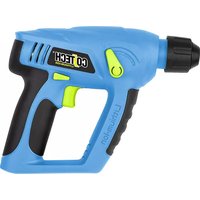
Exterior view of a CO TECH electric drill (no text or symbols on the device body)ART.NO. MODEL
18-3019 CDD10168T52S-UK
30-8763 CDD10168T52S
18-3020 CDD10180T52S-UK
Cordless Drill/Driver
ART.NO.: 18-3019 MODEL: CDD10168T52S-UK
30-8763 CDD10168T52S
18-3020 CDD10180T52S-UK
Please read the entire instruction manual before using and save for future use. We apologise for any text or photo errors and any changes of technical data. If you have any questions concerning technical problems please contact our Customer Service Department (see address on reverse).
Safety
General safety instructions for rechargeable electrical hand tools
Warning! Read all the instructions. Failure to adhere to the following instructions may lead to electric shocks, fires and/or serious injury. The term “electrical hand tools” in the warning text below is referring to your mains operated or battery operated hand tool. SAVE THE INSTRUCTIONS.
1) The work space
a) Keep the work space clean and well illuminated. Cluttered and poorly lit areas invite accidents.
b) Do not use electrical hand tools in explosive environments, i.e. nearby flammable liquids, gas or dust. Electrical hand tools generate sparks that could easily ignite dust or fumes.
c) Keep away from children and other spectators while using the electrical hand tool. Distractions can make you lose your concentration and control.
2) Electrical safety
a) The electrical hand tool's plug must fit correctly in the wall socket. Never modify the plug in any way. Never use an adaptor together with earthed electrical hand tools. Unmodified plugs and suitable wall sockets decrease the risk of electric shock.
b) Avoid body contact with earthed objects, such as pipes, radiators, ovens or refrigerators. There is an increased risk of electrical shock if your body is earthed.
c) Do not expose the electrical hand tool to rain or other wet conditions. If water gets inside an electrical hand tool it increases the risk of electrical shock.
d) Do not misuse the lead. Never use the lead to carry, drag or pull the plug out of the wall socket. Keep the lead away from heat, oil, sharp edges and movable parts. Damaged or tangled leads increase the risk of electrical shock.
e) When you use an electrical hand tool outdoors; use an extension cord suitable for this purpose. Use of an extension cord for outdoor use decreases the risk of electrical shock.
3) Personal safety
a) Pay attention to what you do and use common sense when using electrical hand tools. Never use an electrical hand tool if you are tired or under the influence of drugs, alcohol or medication. One moment of not paying attention while using an electrical hand tool may result in serious injury.
b) Use protective equipment. Always use safety glasses. Using protective equipment such as a face mask, slip resistant protection shoes, a helmet and ear defenders when needed decreases the risk of injury.
c) Avoid unexpected start. Make sure that the switch is set to OFF before you connect the device to the wall socket. Never carry an electrical hand tool with one finger on the trigger or never connect the hand tool to a wall socket when the switch is set to ON, since it may result in injury.
d) Remove all service tools/keys before switching on the hand tool. A forgotten service tool on a rotating part of the electrical hand tool may result in injury.
e) Do not overreach. Make sure you stand steady and well balanced at all times. This gives better control in unexpected situations.
f) Wear suitable clothing. Do not wear loose fitting clothes or jewellery. Keep hair, clothes and gloves away from movable parts. Loose fitting clothes, jewellery or long hair could get caught in movable parts.
g) If the equipment for suctioning or collecting dust is available make sure it is connected and used properly. Using technical aids may reduce dust related hazards.
4) Use and maintenance of the electrical hand tool
a) Do not overdrive the hand tool. Use a hand tool suitable for the work you are to perform. At the correct rate of feed, the correct tool will carry out the work better and more safely.
b) Never use the electrical hand tool if the switch does not work properly to turn on and shut off the tool. All electrical hand tools that can not be operated by the switch are dangerous and must be repaired.
c) Unplug the lead from the wall socket before making any adjustments, changes of accessories or storing the electrical hand tool away. These precautions reduce the risk of unexpected start of the electrical hand tool.
d) Store electrical hand tools that are not being used out of reach from children. Do not let people unfamiliar with the electrical hand tool or its instructions use it. Electrical hand tools can be dangerous if they get into the hands of inexperienced users.
e) Maintenance of electrical hand tools. Check if something is incorrectly set, if movable parts are getting jammed, or parts are broken or something else that might cause the electrical hand tool to malfunction. If something is damaged it must be repaired before use. Many accidents are caused by poorly maintained electrical hand tools.
f) Keep the tools sharp and clean. Properly maintained cutting tools with sharp blades are less likely to jam and are easier to control.
g) Use the electrical hand tool, accessories and such according to the instructions and in a way suitable for the type of electrical hand tool used. Using the electrical hand tool for work other than that for which it is intended could result in a dangerous situation.
5) Use and maintenance of the rechargeable electrical hand tool
a) Make sure that the power switch is set to OFF before the battery is inserted. Inserting a battery into an electrical hand tool with the power switch set to ON is inviting an accident.
b) Only charge the battery using a charger approved by the manufacturer. A charger suitable for one type of battery can constitute a fire hazard if used for another type of battery.
c) Only use the rechargeable electric hand tool with the correct batteries. The use of another type of battery can create the risk of damage or fire.
d) When not in use, the battery should be stored away from other metal objects such as paper clips, coins, keys, nails, screws or any small object that could bridge the gap between the battery terminals. A short circuit of the battery terminals can cause burns or fires.
e) If the battery is abused it can leak acid; avoid contact with this acid. If you accidentally come into contact with the acid, rinse with water. If the acid comes into contact with your eyes, consult a doctor. Battery acid can cause irritation and burns.
6) Service
a) Repairs and service should only be performed by qualified persons, and only with original spare parts. This guarantees the safety of the electrical hand tool.
Safety symbols

Read the instruction manual before use.

Wear ear protection.

For indoor use only.
Product Description
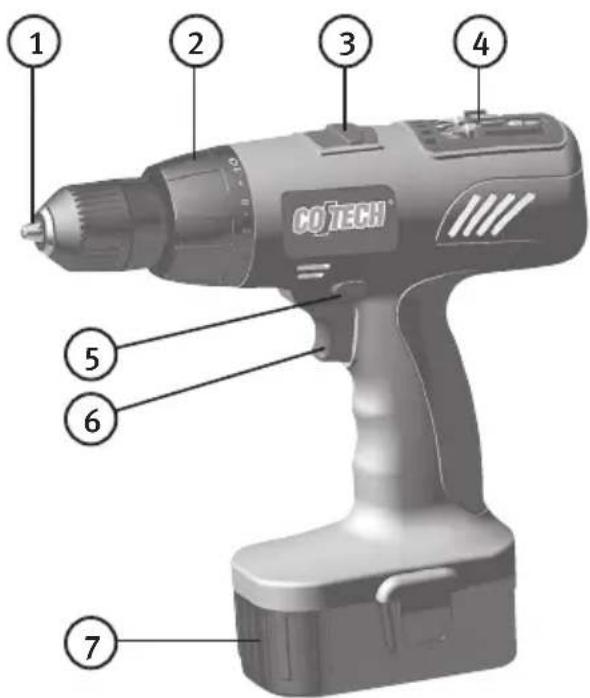
- Keyless Chuck
- Torque Selector
- Gear Selector
- Bits
- Forward/Reverse Selector
- Power Switch
- Rechargeable Battery (Accumulator)
Charging
Make sure that the charger is not plugged into the mains when inserting or removing the battery. Observe the polarity of the battery when inserting the battery into the charger. Plug the mains lead into the power point and check that the red LED comes on.
After about two hours (at 20^ ) the red LED goes out and the green LED comes on. The fully charged battery can now be removed. If a rechargeable battery that has just been used is inserted into the charger the red LED will not come on. Let the battery cool down a while before inserting it into the charger.

natural_image
Simple line drawing of a hand inserting a plug into a wall socket (no text or symbols)
Use
Forward /Reverse
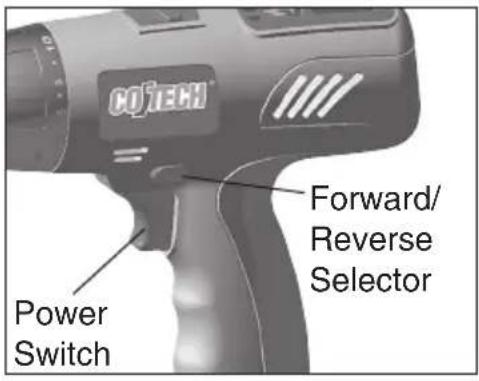
The machine is started and stopped by holding or releasing the power switch. To change the direction of rotation, release the power switch and move the selector to the desired setting. When viewing the machine from the rear, the chuck rotates clockwise when “forward” is selected and anticlockwise when “reverse” is selected. Set the selector half way between forward and reverse when the drill is not in use.
Torque Setting
The machine has ring for adjusting the torque setting. If set correctly the machine will stop tightening at the preset torque setting to prevent screws from being driven in too far and prevent damage to the machine. The torque setting depends upon the type of screw, its size and the type of material used. Always start on a low torque setting and increase in stages until the desired result is achieved.
Keyless Chuck
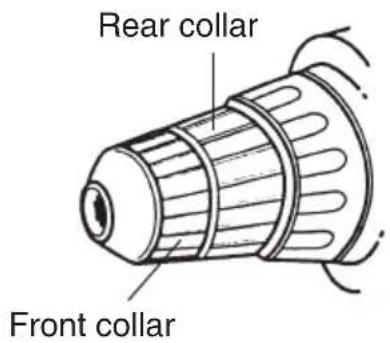
Hold the rear collar with one hand and twist the front collar with the other hand to tighten or undo the chuck.
Stepless Variable Speed Control
This feature is especially useful for screws. The more the power switch is pressed the greater the speed of the chuck. After running the tool at low speed for a long time, one should let the motor run at maximum speed for about 3 minutes to cool it down.
Changing Gears
- Stop the machine completely.
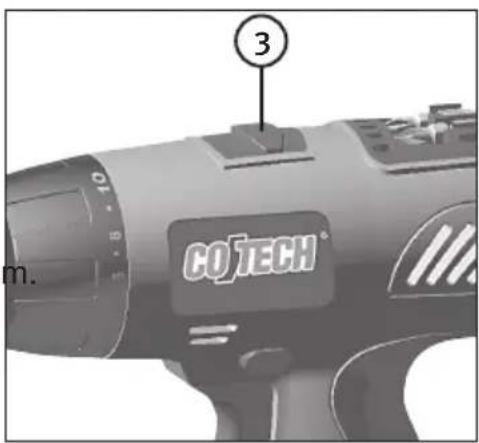
- Slide the gear selector (3) to position 1 for low gear 0-400 rpm and to 2 for high gear 0-1150 rpm. Always use the lowest gear (1) when the machine is under the greatest load, it provides the highest torque and better cooling. Never change gears when the chuck is rotating.

Electronic Brake
The machine has an electronic motor brake that stops the chuck from rotating when the power switch is released.
Troubleshooting
| Problem Possible cause Solution | ||
| The machine does not start. | Flat battery. Check battery charge. | |
| Short circuit. Contact our customer services. | ||
| Faulty power switch. Contact our customer services. | ||
| The machine runs slowly. | Worn/damaged tool. Sharpen or change. | |
| Not enough pressure on power switch. | Apply more pressure. | |
| The motor is overheated. Reduce the rate of feed. | ||
| The machine makes strange noises. | Mechanical fault. Contact our customer services. | |
| Winding short circuited. Contact our customer services. | ||
| Strong vibrations. Loose tool. Tighten the chuck and check fitting. | ||
| Sparks in the motor. | Winding short circuited. Contact our customer services. | |
| Dirty commutator. Contact our customer services. | ||
Care and Cleaning
- Always keep the motor's ventilation openings free of dust and debris.
- Clean the machine regularly using a moist cloth and washing up liquid. Avoid using strong detergents.
- Charge the battery regularly for best performance.
Disposal
Follow local ordinances when disposing of this product. If you are unsure about how to dispose of this product contact your municipality.

Specifications
Model: 18-3019/30-8763 18-3020/30-8764
Gearbox Yes Yes
Stepless Speed Control 0-400/1150 rpm 0-400/1150 rpm
Operating Voltage 16.8 V 18 V
Variable Torque 16 settings 16 settings
Keyless Chuck ∅ 1.5-10 mm ∅ 1.5-10 mm
Sound Pressure Level <70 dB(A) <70 dB(A)
Vibration Value <2.5 m/s ^4 <2.5 m/s ^2
Rechargeable Battery (Accumulator)
| Type | NiMH | NiMH |
| Voltage | 16.8 V | 18 V |
| Ah | 1.3 | 1.8 |
Charger
| Input Power | 230 V~50 Hz | 230 V~50 Hz |
| Output Power | DC, 16.8 V, 2 A | DC, 18 V, 2 A |
| Charge Time | 1-2 hours | 1-2 hours |
natural_image
Hand holding a plug connecting two wall-mounted electrical outlets (no text or symbols visible)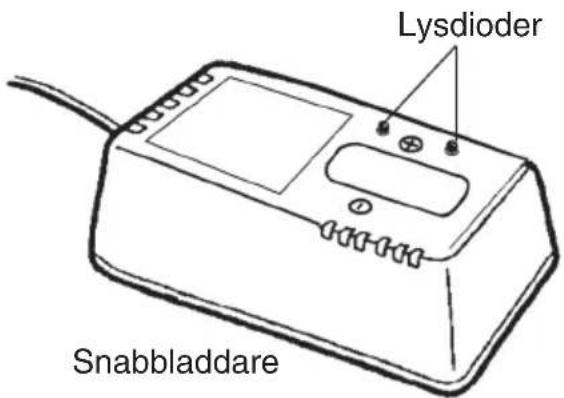
Användning
Höger/vänstergång
Declaration of Conformity
CE
Hereby, Clas Ohlson AB declares that the machinery:
CORDLESS DRILL CO/TECH
18-3019 / CDD10168T52S-UK
30-8763 / CDD10168T52S
18-3020 / CDD10180T52S-UK
Complies with the following Directives:
98/37/EC MACHINERY
2006/95/EC LOW VOLTAGE EQUIPMENT
89/336/EEC EMC
Insjön, Sweden, September 2008

K. Balkow
President
Clas Ohlson, 793 85 Insjön, Sweden
CO TECH®
SVERIGE
KUNDTJÄNST Tel: 0247/445 00
Fax: 0247/445 09
E-post: kundtjanst@clasohlson.se
INTERNET www.clasohlson.se
BREV Clas Ohlson AB, 793 85
INSJÖN
NORGE
KUNDESENTER Tlf.: 23 21 40 00
Faks: 23 21 40 80
E-post: kundesenter@clasohlson.no
INTERNETT www.clasohlson.no
POST Clas Ohlson AS, Postboks 485 Sentrum, 0105 OSLO
SUOMI
ASIAKASPALVELU Puh: 020 111 2222
Faksi: 020 111 2221
For consumer contact, please visit
www.clasohlson.co.uk and click on
customer service.
INTERNET www.clasohlson.co.uk
- Cordless Drill/Driver
- Important!
- Viktig information:
- Safety
- General safety instructions for rechargeable electrical hand tools
- Safety symbols
- Product Description
- Charging
- Use
- Forward /Reverse
- Torque Setting
- Keyless Chuck
- Stepless Variable Speed Control
- Changing Gears
- Electronic Brake
- Care and Cleaning
- Disposal
- Specifications
- Användning
- Höger/vänstergång
- Declaration of Conformity
- CE
- CO TECH®
- SVERIGE
- NORGE
- SUOMI
Brand : Cotech
Model : CDD10180T52S
Category : Drill