TeraStation 5000 - NAS BUFFALO - Free user manual and instructions
Find the device manual for free TeraStation 5000 BUFFALO in PDF.


| Product Type | Network Attached Storage (NAS) |
| Brand | Buffalo |
| Model | TeraStation 5000 |
| Form Factor | Tower |
| Number of Drive Bays | 4 |
| Supported Drive Types | 3.5" SATA HDD / SSD |
| Processor | Intel Celeron or similar (varies by model) |
| Memory | 2 GB DDR3 RAM (expandable) |
| Network Interfaces | 2 x Gigabit Ethernet (RJ-45) |
| Supported RAID Levels | RAID 0, 1, 5, 6, 10 |
| Maximum Raw Capacity | Up to 64 TB (with 16 TB drives) |
| Dimensions (H x W x D) | Approx. 220 x 170 x 190 mm |
| Weight | Approx. 5 kg (without drives) |
| Power Supply | Internal 100-240 V AC, 50/60 Hz |
| Power Consumption | Typical 60 W, max 80 W |
| Operating Temperature | 5°C to 35°C |
| Operating System | Buffalo NAS Navigator (custom Linux-based) |
| Supported File Systems | EXT4, NTFS, FAT32, HFS+ (via add-on) |
| Backup Functions | Local, remote, and cloud backup support |
| Security Features | ACL, encryption (AES-256), antivirus support |
| Maintenance | Hot-swap drives, online RAID expansion |
| Spare Parts & Repairability | Replacement fans, PSU, and drive trays available |
| General Information | Designed for small to medium business use |
Frequently Asked Questions - TeraStation 5000 BUFFALO
User questions about TeraStation 5000 BUFFALO
0 question about this device. Answer the ones you know or ask your own.
Ask a new question about this device
Download the instructions for your NAS in PDF format for free! Find your manual TeraStation 5000 - BUFFALO and take your electronic device back in hand. On this page are published all the documents necessary for the use of your device. TeraStation 5000 by BUFFALO.
USER MANUAL TeraStation 5000 BUFFALO
natural_image
Illustration of multiple server racks arranged diagonally (no text or symbols)www.buffalotech.com
35020018-04 2014-01
Contents
Chapter 1 Installation ....10
Diagrams ....10
Installation 13
Turning the TeraStation On and Off....15
Changing the Administrator Password ....17
Recovery Drive ....19
For Initializing Settings ....19
For Resetting Password ....19
Chapter 2 Configuration ......21
Opening Settings ......21
Opening Easy Admin 23
Chapter 3 Access Restrictions ......25
Configuring Access Restrictions for Users and Groups ......25
Adding a Shared Folder ....25
Adding Users 27
Adding Groups 28
Access Restrictions 29
Active Directory ....31
NT Domains ....33
Delegating Authority to an External SMB Server ....35
Chapter 4 Managing Your Storage ....38
RAID Arrays ....38
Working with RAID Arrays ....39
Using JBOD 40
Changing RAID Mode ....40
Configuring a Hot Spare ....41
RMM (RAID Mode Manager) 42
RAID Scanning....44
Adding an External Hard Drive ....45
Dismounting Drives 46
Checking Drives 47
Formatting Drives ....48
Encrypting Drives ....50
Media Cartridges ....50
Erase Data on the TeraStation Completely ....50
Disk Quotas ....52
Quotas for Users ....52
Quotas for Groups 52
Size Limits ....53
Using the TeraStation as an iSCSI Device ....55
Introduction 55
Using the iSCSI Connection Tool ....59
Creating and Expanding Volumes 62
Disconnecting Volumes 63
Setting Access Restrictions 64
Hard Drive Replacement ....66
Hard Drive Replacement Examples ....67
Chapter 5 Backup ....74
Back Up from the TeraStation ....74
Preparing a Backup Destination ....74
Configuring a Backup Job ....75
Replication 78
Failover 80
Ethernet Cable Connection Methods ....80
Configuring Failover 82
Backing Up Your Mac with Time Machine ....83
Copying from a USB Device ....86
Amazon S3 87
Chapter 6 Remote Access ....89
WebAccess 89
Configuration 89
WebAccess Remote 91
FTP 92
Chapter 7 BitTorrent ......94
Configuration 94
Chapter 8 Multimedia ......96
DLNA 96
Configuration 96
Playing Files 97
Connected DLNA-compatible Devices 97
Streaming to DLNA-compatible Devices 98
Disabling Playback from Specific Devices 99
iTunes Server 100
Squeezebox Server 101
Chapter 9 Surveillance Server ....103
Getting Started 103
Installing Client Tools 103
Connecting Devices to the Network 104
Enabling Surveillance Cameras 104
Enabling the Free License 106
Registering Recording Policies 108
Checking Recording 111
Email Error Notification.... 112
Configuration 112
Viewing Saved Video 112
Export Recorded Data as a MOV Video File 113
Viewing Video Real-time 115
Moving Recorded Video Data to Another TeraStation 115
Backing Up Recorded Video to Another TeraStation 116
Automatically Delete Old Data when Space is Low 117
Changing Where Recorded Video Is Saved 119
Client Utilities 119
Camera Policies 119
Live Viewer 120
Data Service Policies 121
Vault Admin 121
Surveillance Video Manager 122
Network Activity 123
Mini Vault Stats 123
Activating Additional Licenses 124
When the TeraStation is Connected to the Internet 124
TeraStation Not Connected to the Internet 126
Troubleshooting 129
Chapter 10 Advanced Features ....130
Antivirus Software 130
Licenses 130
Activating Virus Scanning 131
Configuring Security Settings 131
Connecting through a Proxy Server 132
Updating 133
Excluding a Specific Folder from Antivirus Scanning 134
Virus Scanning 134
Checking the Log 135
Online Help 136
Email Notification 136
Sleep Mode 137
Wake-on-LAN 139
UPS (Uninterruptible Power Supply) 139
Port Trunking 141
Connecting a Printer 142
Setting Up a Printer with Windows 8.1, Windows 8, Windows 7, or Windows Vista .... 142
Setting Up a Printer with Windows XP 143
TeraSearch 144
Offline Files 145
DFS 147
Accessing from a NFS Client 148
Encrypting Data Transmission 150
Encrypting Settings Data 150
Encrypting FTP Transfer Data 150
SSL Keys 151
Web Server 151
MySQL Server 152
SNMP 153
Saving and Applying Settings 154
Saving Settings 154
Applying Settings 155
Restoring Factory Defaults 156
Initializing from Settings 156
Creating an Initialization Drive 156
Initializing with the USB Drive 157
Resetting the Administrator Password 157
Creating a Password Reset Drive 157
Resetting with the USB Drive 158
Logs 158
Updating the Firmware 159
Name, Date, Time, and Language 160
Beep Alerts 161
LCD and LEDs 162
Jumbo Frames 163
Changing the IP Address 164
Chapter 11 Utilities ....166
NAS Navigator2 for Windows 166
Mount as Network Drive.... 168
Changing the IP Address 169
NAS Navigator2 for Mac 169
Mount as Network Drive.... 170
Changing the IP Address 171
iSCSI Connection Tool 172
Menu 173
Chapter 12 Appendix ......174
LCD Display 174
Modes 174
Errors 174
Status 175
Default Settings 178
Specifications 178
Compliance Information 179
FCC Statement 179
CE Mark Statement 180
Environmental Information 180
KC 180
BSMI 180
CCC 180
电池警告语 181
Models 181
Chapter 1 Installation
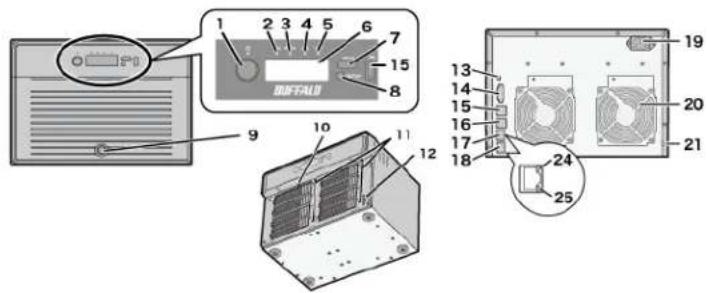
Diagrams
TS5800D
text_image
1 2 3 4 5 6 7 BUFFALU 15 8 9 10 11 12 13 14 15 16 17 18 24 25 19 20 21TS5600D

text_image
1 2 3 4 5 6 7 15 8 9 10 11 12 13 14 15 16 17 18 19 20 21 24 25TS5400D

text_image
1 2 3 4 5 6 DUFFALB 7 8 9 10 11 12 13 14 15 16 17 18 19 20 21 24 25TS5200D

text_image
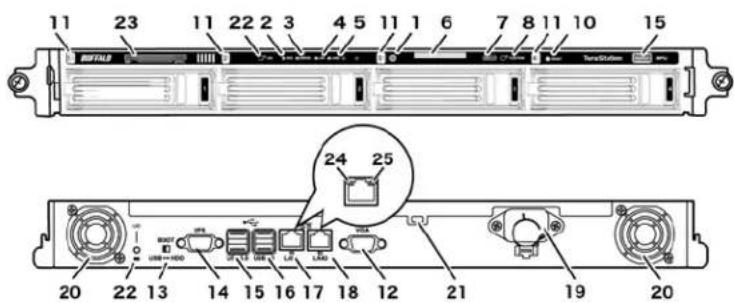
Diagram of computer hardware components with numbered labels pointing to different partsTS5400R
text_image
11 23 11 22 2 3 4 5 11 1 6 7 8 11 10 15 24 25 20 22 13 14 15 16 17 18 12 21 19 201 Power Button
To power on, connect the power cable and wait for 10 seconds, then press the power button. To power off, press the power button twice.
2 Info LED
If there is a status message, the amber info LED will light up. Check the LCD panel to see the status message.
3 Error LED
If there is an error, the red error LED will light up. Check the LCD panel to see the error message.
4 LAN1 LED
When LAN port 1 is connected, this LED glows green. It blinks when the connection is active.
5 LAN2 LED
When LAN port 2 is connected, this LED glows green. It blinks when the connection is active.
6 LCD Panel
This display shows the status of many TeraStation settings. It also displays errors and messages when available.
7 Display Button
Switches between the different display modes. Also, if the TeraStation is beeping, press this button to stop it.
8 Function Button
Use this button for Direct Copy, dismounting USB devices, rebuilding RAID arrays, and configuring failover.
9 Drive Lock
Open the front panel with the key to replace hard drives or access the reset button.
10 Reset Button
To shut down and reboot the TeraStation, hold down the reset button.
11 Status LEDs
Normally, these LEDs blink green when hard drives are accessed. If a drive fails, its LED will turn red or amber.
12 Factory Use Only
13 Boot Mode Switch
Leave the switch in the HDD position during normal operation. To recover settings, insert the recovery USB drive into a USB 2.0 port, move the boot switch to the USB position, and press the power button.
14 UPS Port
Connect to a UPS.
15 USB 3.0 Port
Compatible Buffalo USB 3.0 hard drives can be connected. USB hubs are not supported.
16 USB 2.0 Port
Compatible Buffalo USB hard drives, USB flash drives, digital cameras, and USB UPS connection can be connected. USB hubs are not supported.
17 LAN Port 1
Use an Ethernet cable to connect this port to your network.
18 LAN Port 2
This second Ethernet port may be used for network redundancy or backup. You may connect a second TeraStation directly to this port for backup.
19 Power Connector
Use the included power cable to connect to an UPS, surge protector, or outlet.
20 Fan
Do not block the fan.
21 Anti-Theft Security Slot
Use this slot to secure your TeraStation with a cable lock (not included).
22 UID Button
Press the UID button on the front or the back of the unit to cycle the blue LED on and off.
23 Serial Number
This sticker shows the TeraStation's serial number.
24 Link LED
Glows orange when the unit is connected to a network.
25 Act LED
This LED shows network activity. It blinks orange when the TeraStation is accessed over the network.
Installation
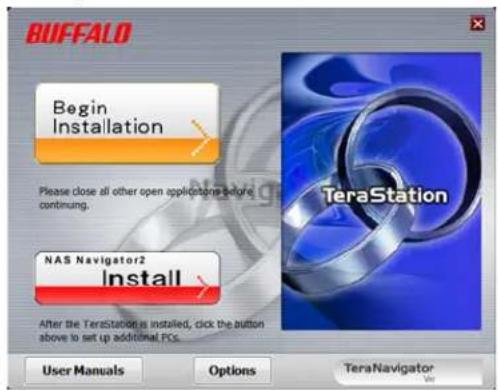
1 Insert the TeraNavigator CD into your computer. TeraNavigator will launch.
2 Click Begin Installation.
text_image
BUFFALO Begin Installation Please close all other open applications before continuing. NAS Navigator2 Install After the TeraStation is installed, click the button above to set up additional PCs. User Manuals Options TeraNavigator3 Follow the steps on the screen to connect the TeraStation's Ethernet and power cables and turn it on.
Note: Use LAN port 1 for initial setup. After setup, you may connect a second cable to LAN port 2. If you use LAN port 2, configure the IP address at Network - IP Address in Settings.
4 Follow the steps on the screen to install NAS Navigator2.
5 Click Finish. NAS Navigator2 will open.
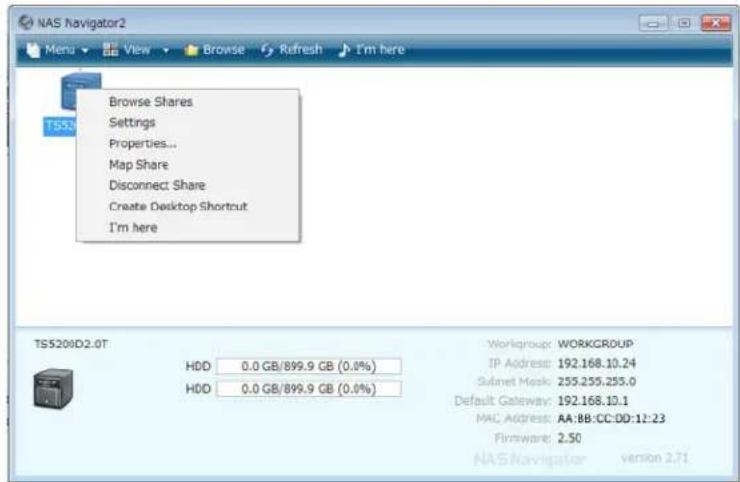
6 Right-click on your TeraStation's icon and choose Properties.
text_image
Browse Shares Settings Properties... Map Share Disconnect Share Create Desktop Shortcut I'm here TSS200D2.0T HDD 0.0 GB/899.9 GB (0.0%) HDD 0.0 GB/899.9 GB (0.0%) Workgroup: WORKGROUP IP Address: 192.168.10.24 Submit Mask: 255.255.255.0 Default Gateway: 192.168.10.1 MAC Address: AA:88:CC:DD:12:23 Firmware: 2.50 NAS Navigator version 2.71Note: For Mac OS, select the TeraStation's icon while holding down the control key, then click Configure.
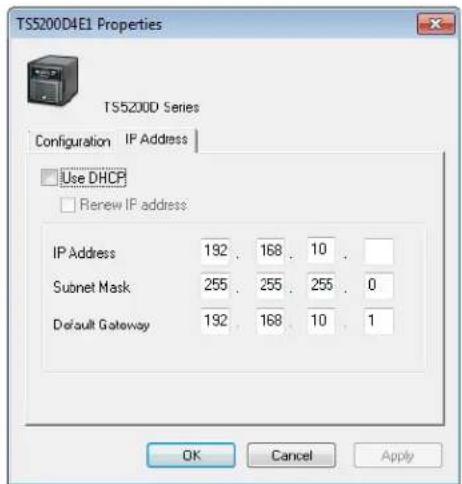
7 Click the IP Address tab, enter the desired settings, and click OK.
text_image
TS5200D4E1 Properties TS5200D Series Configuration IP Address Use DHCP Renew IP address IP Address 192 . 168 . 10 . Subnet Mask 255 . 255 . 255 . 0 Default Gateway 192 . 168 . 10 . 1 OK Cancel ApplyIf you are prompted to enter the administrator password for the TeraStation, it is "password" by default.
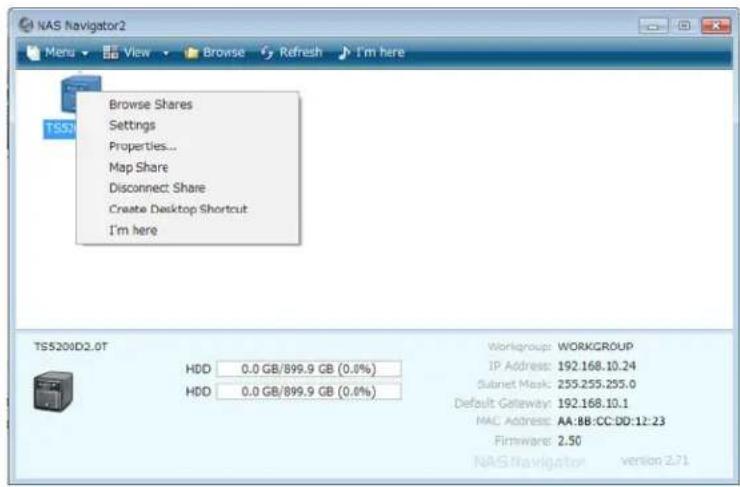
8 Right-click on your TeraStation's icon and choose Settings.
text_image
TSS200D2.0T HDD 0.0 GB/899.9 GB (0.6%) HDD 0.0 GB/899.9 GB (0.6%) Browse Shares Settings Properties... Map Share Disconnect Share Create Desktop Shortcut I'm here Workgroup: WORKGROUP IP Address: 192.168.10.24 Submit Mask: 255.255.255.0 Default Gateway: 192.168.10.1 MAC Address: AA:88:CC:DD:12:23 Firmware: 2.50 NAS Navigator version 2.719 Changing the password from the default is recommended.

text_image
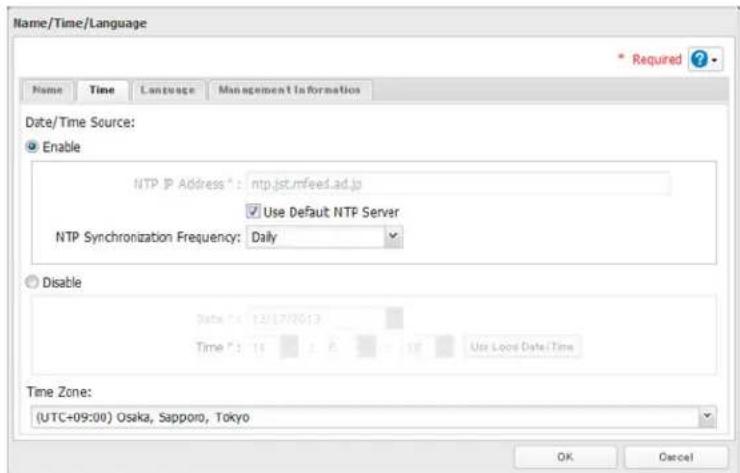
Easy Admin > Change Administrator Password Changes the administrator password. For security, please choose a new administrator password below. Show entered password. Password: Enter the password again to confirm. Confirm this Password:: The password may include up to 20 alphanumeric characters, hyphens (-), underscores (_), periods (-), and symbols I, #, &, φ, $, ^, ^, %. Skip Next10 Go to Management - Name/Time/Language and configure the TeraStation's time and date.
text_image
Name/Time/Language * Required ? Name Time Language Management Information Date/Time Source: Enable NTP IP Address*: ntp.jst.mfees.ad.jp Use Default NTP Server NTP Synchronization Frequency: Daily Disable Date #: 12/17/013 Time #: 16 2 3 4 5 6 Use Local Date/Time Time Zone: (UTC+09:00) Osaka, Sapporo, Tokyo OK CancelNotes:
- For best results, use an NTP server to maintain the time settings on the TeraStation and other network devices. Clocks for the network devices may run at slightly different speeds. If these devices get out of sync it may cause network problems.
- Buffalo is not responsible for any losses and damages incurred from using the ntp.jst.mfeed.ad.jp service or service outages.
- If the TeraStation cannot automatically obtain the time from an NTP server, check its DNS settings. If the NTP server is specified by a hostname instead of an IP address, make sure that a DNS server address is configured in Network - IP Address.
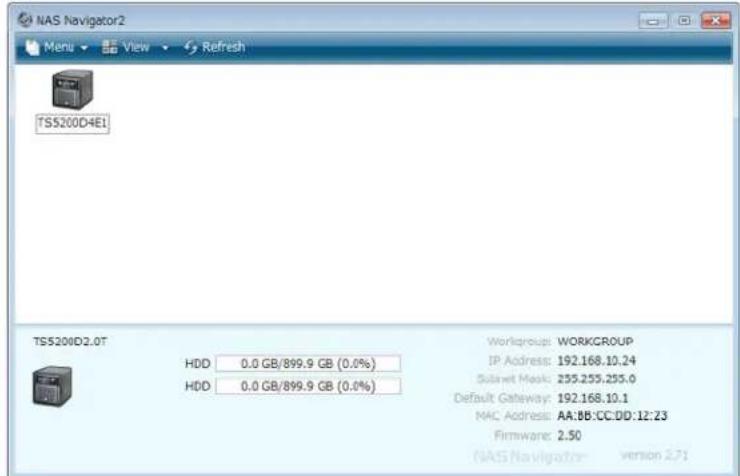
11 In NAS Navigator2, double-click your TeraStation's icon. This will open the shared folder of the TeraStation. For Mac OS, the TeraStation is mounted as a drive icon on the desktop or it is displayed in the sidebar of the Finder. You can now use the TeraStation's shared folder to save files just like any other folder.
text_image
NAS Navigator2 Menu View Refresh TSS200D4E1 TSS200D2.0T HDD 0.0 GB/899.9 GB (0.0%) HDD 0.0 GB/899.9 GB (0.0%) Workgroup: WORKGROUP IP Address: 192.168.10.24 Subset Mask: 255.255.255.0 Default Gateway: 192.168.10.1 MAC Address: AA:BB:CC:DD:12:23 Firmware: 2.50 NAS Navigator version 2.71Turning the TeraStation On and Off
Press the power button on the TeraStation to turn it on.
To turn off the TeraStation, press the power button twice. Don't unplug the TeraStation without turning it off first. You can also shut it down and restart it remotely from Settings.
Shutdown or Restart from Settings
1 Double-click the

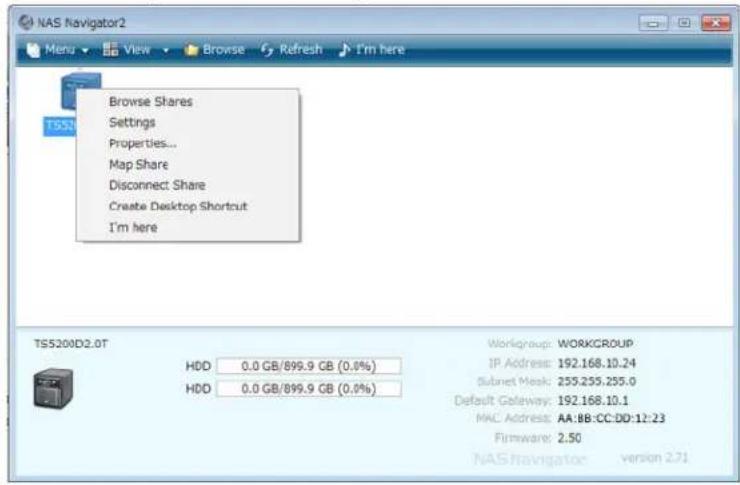
2 Right-click your TeraStation's icon and select Settings. For Mac OS, select the TeraStation's icon while holding down the control key, then select Settings.
text_image
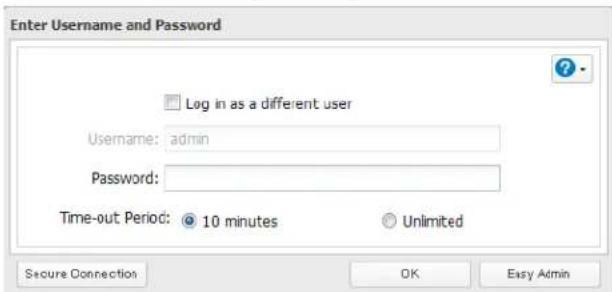
Browse Shares Settings Properties... Map Share Disconnect Share Create Desktop Shortcut I'm here TSS200D2.0T HDD 0.0 GB/899.9 GB (0.0%) HDD 0.0 GB/899.9 GB (0.0%) Workgroup: WORKGROUP IP Address: 192.168.10.24 Submit Mask: 255.255.255.0 Default Gateway: 192.168.10.1 MAC Address: AA:8B:CC:DD:12:23 Firmware: 2.50 NAS Navigator version 2.713 Enter the username and password, then click OK.
text_image
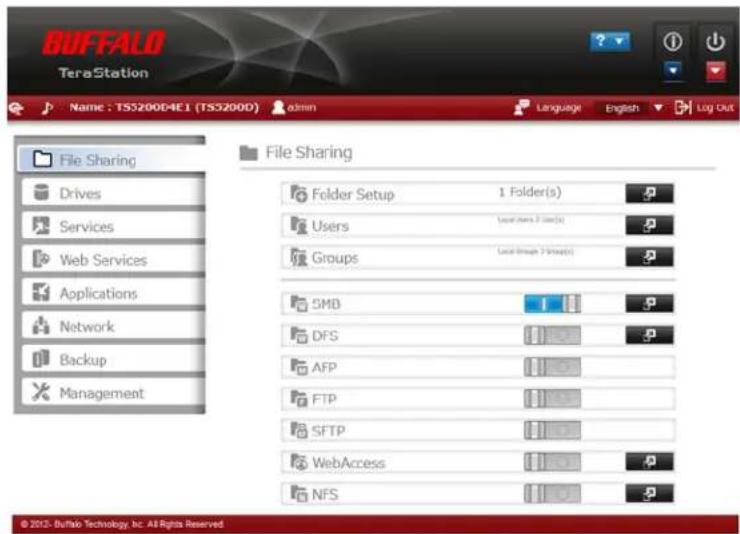
Enter Username and Password Log in as a different user Username: admin Password: Time-out Period: 10 minutes Unlimited Secure Connection OK Easy AdminNote: The default username and password are "admin" and "password".
4 Settings will open.
text_image
BUFFALO TeraStation Name : TS520004E1 (TS5200D) admin Language English Log Out File Sharing Drives Services Web Services Applications Network Backup Management File Sharing Folder Setup 1 Folder(s) Users Local Users 3 Image(s) Groups Local Images 7 Image(s) SMB 1 DFS AFP FTP SFTP WebAccess NFS © 2012- Buffalo Technology, Inc. All Rights Reserved5


text_image
Language Engl ? ↓ i ↓ i Restart Shut DownWhen all the LEDs on the front of the TeraStation turn off, the shutdown process is complete.
Changing the Administrator Password
After initial setup, follow this procedure to change your password.
1 Double-click the icon. NAS Navigator2 will start.
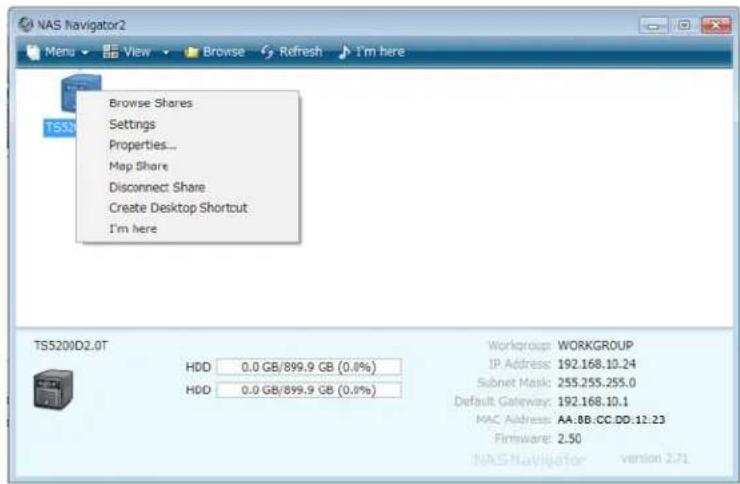
2 Right-click on your TeraStation's icon and select Settings. On the Mac, select the TeraStation's icon while holding down the control key, then select Settings.
text_image
Browse Shares Settings Properties... Map Share Disconnect Share Create Desktop Shortcut I'm here TSS200D2.0T HDD 0.0 GB/899.9 GB (0.0%) HDD 0.0 GB/899.9 GB (0.0%) Workgroup: WORKGROUP IP Address: 192.168.10.24 Subnet Mask: 255.255.255.0 Default Gateway: 192.168.10.1 MAC Address: AA:88:CC.D0:12:23 Firmware: 2.50 NAS Navigator version 2.713 Click Easy Admin.
text_image
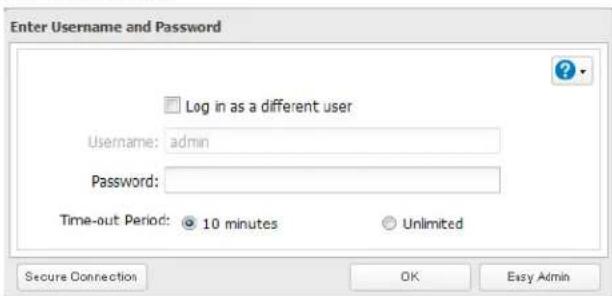
Enter Username and Password Log in as a different user Username: admin Password: Time-out Period: 10 minutes Unlimited Secure Connection OK Easy Admin4 Click Change Password.

5 If this screen is displayed, enter the current password and click OK. The default password is "password".

text_image
Enter Username and Password Log in as a different user Username: admin Password: Time-out Period: 10 minutes Unlimited Secure Connection OK Cancel6 Enter the new password (twice).

Easy Admin > Change Administrator Password
Changes the administrator password.
For security, please choose a new administrator password below.
□ Shew entered password.
Passwords:
Enter the password again to confirm.
Confirm the
Password.:
The password may include up to 20 alphanumeric characters, hyphens (•), underscores (•), periods (•), and symbols 1, 4, 5, 6, 7, 8, 9, 10, 11, 12, 13, 14, 15, 16, 17, 18, 19, 20, 21, 22, 23, 24, 25, 26, 27, 28, 29, 30, 31, 32, 33, 34, 35, 36, 37, 38, 39, 40, 41, 42, 43, 44, 45, 46, 47, 48, 49, 50, 51, 52, 53, 54, 55, 56, 57, 58, 59, 60, 61, 62, 63, 64, 65, 66, 67, 68, 69, 70, 71, 72, 73, 74, 75, 76, 77, 78, 79, 80, 81, 82, 83, 84, 85, 86, 87, 88, 89, 90, 91, 92, 93, 94, 95, 96, 97, 98, 99, 100.

7 Click OK. You have changed the admin password.
Recovery Drive
To initialize all of the TeraStation's settings, or just restore the admin password to its factory default value, create the recovery drives as described below.
For Initializing Settings
A system initialization drive can reset all settings to their default values.
Notes:
- Normally, making and using the system initialization drive will not affect data. However, always back up your data regularly!
- This USB drive can be used to recover the system if your TeraStation doesn't boot at all. In this case, if the data partition is damaged, then all your data will be deleted by the recovery process.
1 Insert a 1 GB or larger USB flash drive into a USB port on the TeraStation.
Note: All data on the USB flash drive will be erased!
2 In Settings, navigate to Management-Restore/Erase-USB Options.
3 Select Create a USB drive for initializing settings.
4 Select the USB memory device from "Target USB drive", then click Execute.
5 Enter the 4 digit confirmation number and click OK. The TeraStation will create the initialization drive. This will take about a minute.
6 When the "finished" dialog opens, the USB initialization drive is ready to use. Dismount the USB drive before unplugging it. See "Dismounting Drives" in chapter 4 for the instructions on dismounting drives.
For Resetting Password
A password initialization drive can reset the administrator password to its default value ("password"). This could be very
useful if you forget your admin password.
1 Insert a 1 GB or larger USB memory device (not included) to a USB 2.0 port on the TeraStation.
Note: All data on the USB flash drive will be erased!
2 In Settings, navigate to Management - Restore/Erase - USB Options.
3 Select Create a USB drive for resetting the admin password.
4 Select the USB memory device from "Target USB drive" list, then click Execute.
5 Enter the 4 digit confirmation number and click OK. The TeraStation will create the password reset drive. This will take about a minute.
6 When the "finished" dialog opens, the password reset drive is ready to use. Dismount the USB drive before unplugging it. See "Dismounting Drives" in chapter 4 for the instructions on dismounting drives.
For instructions on using system initialization or password initialization drives, see chapter 10.
Chapter 2 Configuration
Configure and administer your TeraStation using the Settings interface, accessible from a browser window. Open the interface using the procedure below or type the TeraStation's IP address in the URL field of your browser. Within Settings, the Easy Admin page gives you quick access to commonly used settings.
Note: Internet Explorer 9, Firefox 18, Google Chrome 24, Safari 5, and later are supported. If you have difficulty viewing Settings, check the following:
- If there are a large number of registered users, groups, or shared folders, use Firefox instead of Internet Explorer.
- If you have a proxy server enabled in the browser settings, disable the proxy server.
- With Internet Explorer, set security to Local intranet. On Windows Server 2008, higher-level security is configured by default. Set the security to a lower level temporarily.
Opening Settings
1 Open NAS Navigator2 by double-clicking the

2 Right-click on your TeraStation's icon in NAS Navigator and select Settings. For Mac OS, click your TeraStation's icon while holding down the control key, then select Settings.
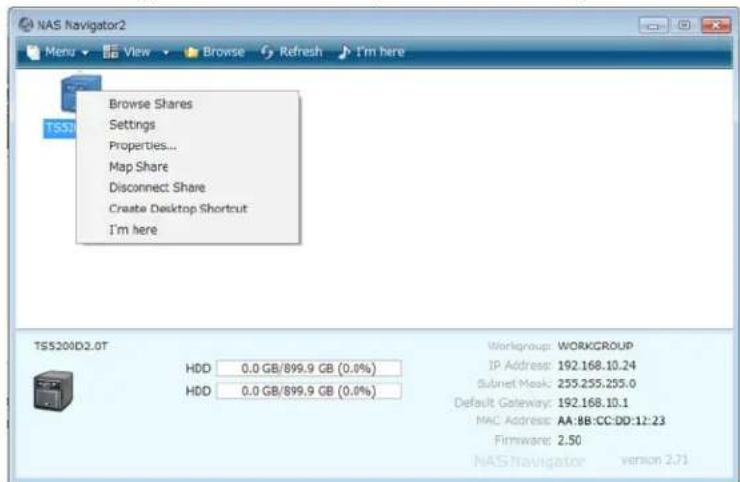
text_image
Browse Shares Settings Properties... Map Share Disconnect Share Create Desktop Shortcut I'm here TSS200D2.0T HDD 0.0 GB/899.9 GB (0.6%) HDD 0.0 GB/899.9 GB (0.6%) Workgroup: WORKGROUP IP Address: 192.168.10.24 Subnet Mask: 255.255.255.0 Default Gateway: 192.168.10.1 MAC Address: AA:BB:CC:DD:12:23 Firmware: 2.50. NAS Navigator version 2.713 Enter the username and password and click OK.

text_image
Enter Username and Password Log in as a different user Username: admin Password: Time-out Period: 10 minutes Unlimited Secure Connection OK Easy AdminUsername/Password Combinations:
| Username Password Settings Available | |
| admin password All | |
| guest blank | |
| your username your password |
Notes:
- If the time-out period is set to "10 minutes", you will be logged out of Settings after 10 minutes of inactivity.
- Click Secure Connection to log in with an encrypted connection.
4 Settings will open.
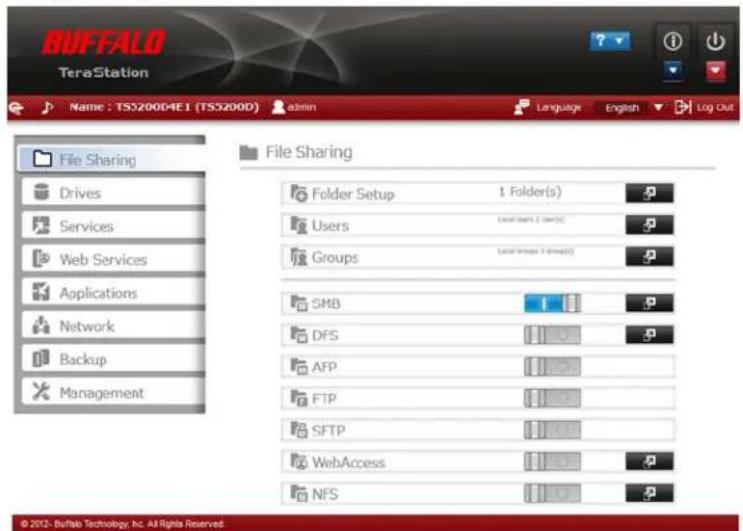
text_image
BUFFALO TeraStation Name : TS32000HE1 (TS3200D) admin Language English Log Out File Sharing Drives Services Web Services Applications Network Backup Management File Sharing Folder Setup 1. Folder(s) Users Local Users 2 (own(s)) Groups Local Groups 3 (own(s)) SMB 1 DFS AFP FTP SFTP WebAccess NFS © 2012- Buffalo Technology, Inc. All Rights Reserved.Notes:
- Click to open Easy Admin.
- Click to play a tone from the TeraStation for easy location.
- You can also use Bonjour to log in to Settings from OS X 10.4 or later. In Safari, click View - Show Bookmarks Bar. From Bookmarks, click Bonjour - TeraStation name.
Opening Easy Admin
The Easy Admin page makes it easy to change common settings. Follow the steps below to open Easy Admin.
1 Open NAS Navigator2 by double-clicking the

2 Right-click on your TeraStation's icon and choose Settings. For Mac OS, click the TeraStation icon while holding down the control key, then select Settings.
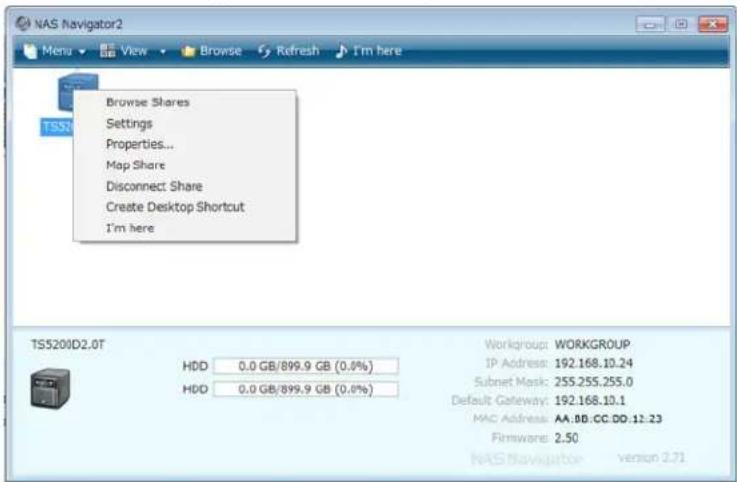
text_image
TSSZ Browse Shares Settings Properties... Map Share Disconnect Share Create Desktop Shortcut I'm here TS5200D2.0T HDD 0.0 GB/899.9 GB (0.0%) HDD 0.0 GB/899.9 GB (0.0%) Workgroup: WORKGROUP IP Address: 192.168.10.24 Subnet Mask: 255.255.255.0 Default Gateway: 192.168.13.1 MAC Address: AA.BB.CC.D0:12.23 Firmware: 2.50 NAS Navigator version 2.713 Click Easy Admin.

text_image
Enter Username and Password Log in as a different user Username: admin Password: Time-out Period: 10 minutes Unlimited Secure Connection OK Easy Admin4 The Easy Admin screen will open.

text_image
BUFFALD TeraStation Name : TSS20004E1 (TSS200D) admin Language English Log Out Easy Admin WebAccess Create a free personal cloud and access and share your files anytime, anywhere over the screen. Access Restrictions Create users, groups, and new folders. RAID Settings Change RAID settings. Active Domain Enable to sync Teratstation with Active Directory domain. Backup You can back up files on the Teratstation to an attached USB drive or to another folder on the TeraSearch Search all documents in Teratstation. Change Password Before using your Teratstation, change the default passwords. Advanced Settings All Teratstation functions can be configured from Advanced Settings. Copyright © 2013 Buffalo inc.Notes:
- If you click any buttons, you will need to enter a username and password.
- You can open Easy Admin anytime by clicking the text at the top left of Settings.
Chapter 3 Access Restrictions
You may restrict access to specific shared folders, including external USB drives.
Notes:
- Access restrictions can be set separately for each shared folder, but not for folders within the shared folders.
- Configure access restrictions through Settings. Configuring access restrictions through Windows is not supported and may cause unexpected behavior.
- You can also configure users, groups, and shared folders from Easy Admin by clicking Access Restrictions.
- Shared folders with limited access can still be used as backup destinations.
- If you change access restrictions for a user or group while they are accessing files, unexpected behavior may result.
Configuring Access Restrictions for Users and Groups
Adding a Shared Folder
1 In Settings, click the ☑ the right of "Folder Setup".

Folder Setup

the right of "Folder Setup".
1 Folder(s)

2 Click Create Folder.
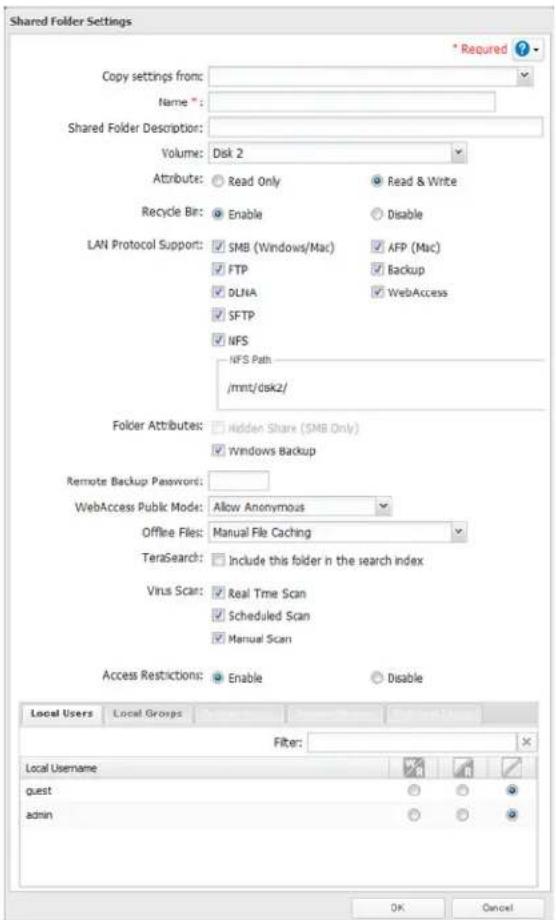
3 Configure the settings, then click OK.
text_image
Shared Folder Settings * Required Copy settings from: Name : : Shared Folder Description: Volume: Disk 2 Attribute: Read Only Read & Write Recycle Bin: Enable Disable LAN Protocol Support: SMB (Windows/Mac) AFP (Mac) FTP Backup DLNA WebAccess SFTP NFS NFS Path /mmt/dsk2/ Folder Attributes: Hidden Share (SMB Only) Windows Backup Remote Backup Password: WebAccess Public Mode: Allow Anonymous Offline Files: Manual File Caching TeraSearch: Include this folder in the search index Virus Scan: Real Time Scan Scheduled Scan Manual Scan Access Restrictions: Enable Disable Local Users Local Groups Filter: Local Username guest admin OK CancelNotes:
- Names may contain up to 27 alphanumeric characters, hyphens (-), and underscores (_). Do not use a symbol as the first character in a name.
- The description may contain up to 75 alphanumeric characters, hyphens (-), underscores (_), and spaces. Do not use a symbol or space as the first character.
- You may create up to 400 shared folders.
- The names of shared folders should not use characters from more than one language. For example, mixing Japanese and Korean characters in names is not supported.
- If multi-byte characters are used in shared folder names, configure the client language to match the characters in Management - Name/Time/Language.
Recycle Bin
To protect your data from accidental deletion, you may configure your TeraStation to use a recycle bin instead of deleting files immediately. The recycle bin will only work with SMB connections. To empty the recycle bin, click File Sharing - Folder Setup - Empty Recycle Bin in Settings.
Notes:
- You can prevent guests and other users from emptying the trash by navigating to File Sharing - SMB - Permissions for Trashbox and selecting "Administrator only".
- If you use Mac OS, make sure that your recycle bin enables "Exclude Mac OS temp files from recycle bin". If this setting is changed, files in the recycle bin may be corrupted.
Accounts
Your TeraStation username and password should be the same as your Windows username and password. If they are different, you may not be able to access folders on the TeraStation with access restrictions configured.
Read-only Shares
By default, new shares are set with read & write access, but you may change the attribute to Read-only in Shared Folder Attributes. Read-only shares and HFS+ formatted USB hard drives will have "Read-only" added to the shared folder description.
Hidden Shares
To hide a shared SMB folder, select "Hidden Share (SMB Only)" and click OK. To open a hidden folder, click Start - Search programs and files and enter "\TeraStation name\Shared folder name\" for the name. Example: If the TeraStation name is "TS-XX001" and the shared folder name is "share", then enter "-XX001\" to open it.
Note: FTP, SFTP, and AFP folders cannot be hidden.
Adding Users
1 In "File Sharing", select Users.

2 Click Create User.
3 Enter the desired settings, then click OK.

text_image
User Settings Username: * User ID: Enter a number from 1000 to 1999. Email: Password: * Confirm Password: * Description: Quota: Enable (Units: GB) Quota Alert: 1 Capacity: 0 Quota Capacity: 1 Disable * Required Filter: Group admin hdusers Select All Unselect All Primary Group: hdusers OK CancelNotes:
- Usernames may contain up to 128 characters, including hyphens (-), underscores (_), periods (.), !, #, &, @, \$, *, ^, and %. Do not use a symbol as the first character.
- For Windows 8.1 and Windows 8, use a local username instead of your Windows Live ID.
- The user ID should be a number from 1000 to 1999. Each user ID should be unique. If this field is left blank, a user ID is assigned automatically.
- Do not duplicate user IDs, group IDs, usernames, or group names. Each should be distinct and unique.
- The description may contain up to 75 alphanumeric characters, hyphens (-), underscores (_), and spaces. Do not use a symbol or space as the first character.
- When setting users with access privileges, a maximum of 300 users, including "admin" and "guest", can be registered in the TeraStation.
- Passwords may contain up to 20 alphanumeric characters and the following characters: - _@! # \$ % & ' () * + , . / ; < > = ? " [ ] ^ { } | \~. Do not use a symbol other than an underscore ( ) as the first character.
- Use the same username and password for both Windows and the TeraStation or you may not be able to access shared folders.
Importing User Information
You can import users in File Sharing - Users by clicking Import CSV File. Existing users will be overwritten.
Format for user data: Username (required), password (required), and user description (optional).
Examples:
username1, password1, comment1
username2, password2, comment2
username3, password3, comment3
Guidelines:
- Use commas (,) as separators. Do not put spaces before or after commas.
- If a line has an incorrect format, the user on that line will not be registered.
- If a username exists, the new user information will overwrite the old information.
- Do not use commas (,) in the username, password, or user description.
Note: Imported users are added to the "hdusers" group automatically.
Shared Folder Owners
To confirm the owner of a shared folder from Windows XP, from the Properties screen of the file or folder, open a new window from the Security tab. Click Advanced, then click the Owner tab.
Adding Groups
1 In "File Sharing", select Groups.

Groups
Local Groups 3 Group(s)

2 Click Add Group.
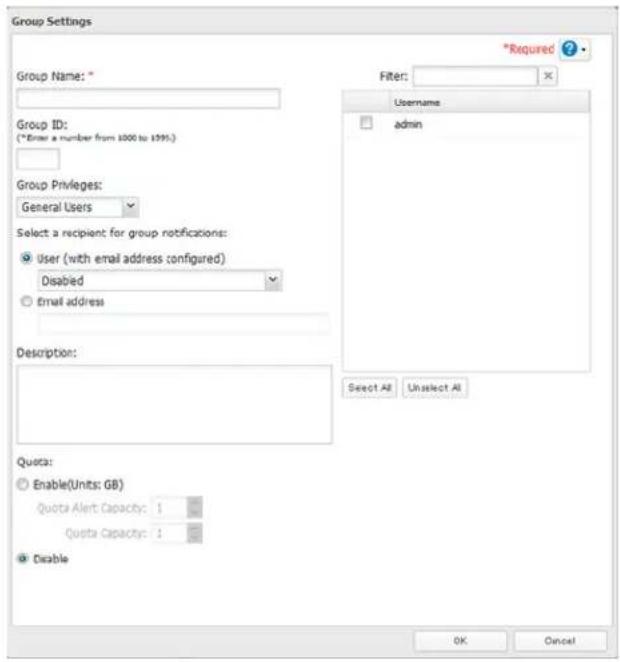
3 Enter settings, then click OK.
text_image
Group Settings *Required ? Group Name: * Filter: Username admin Group ID: (*Enter a number from 1000 to 100%) Group Privileges: General Users Select a recipient for group notifications: User (with email address configured) Disabled Email address Description: Select All Unselect All Quota: Enable(Units: GB) Quota Alert Capacity: 1 Quota Capacity: 1 Disable OK CancelNotes:
- Group names may contain up to 20 alphanumeric characters, hyphens (-), underscores (_), and periods (.). Do not use a symbol other than an underscore (_) as the first character.
- Group descriptions may contain up to 75 alphanumeric characters, hyphens (-), underscores (_), and spaces. Do not use a symbol or space as the first character.
- If the group ID field is left blank, a group ID is automatically assigned. Use numbers between 1000 and 1999 to set a group ID manually. Don't use duplicate group IDs.
- You may register up to 300 groups with the TeraStation.
- If you are logged in as a member of the general users group, you can only change your own password. If you're logged in as an administrator, you can change any settings, including other users' passwords. If you are logged in as a member of the power users group, you can create and edit shared folders, users, and groups.
Access Restrictions
1 In "File Sharing", select Folder Setup.

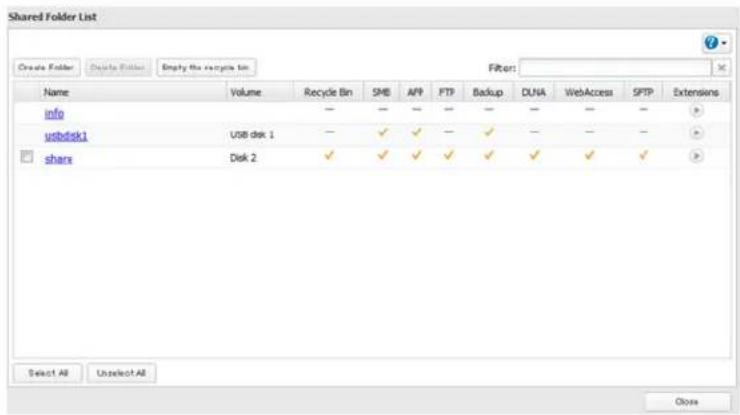
2 Click the shared folder that you want to set access restrictions for.
text_image
Shared Folder List Create Folder Delete Folder Empty the recycle bin Filter: Name Volume Recycle Bin SMB APP FTP Backup DUNA WebAccess SFTP Extensions info — — — — — — — — — usbdisk1 USB disk 1 — ✓ ✓ — ✓ — — — share Disk 2 ✓ ✓ ✓ ✓ ✓ ✓ ✓ ✓ Select All Unselect All Close3 Click Edit.
4 Enable "Access Restrictions".

text_image
Access Restrictions: Enable Disable5 Select the level of access for the user or group you added.
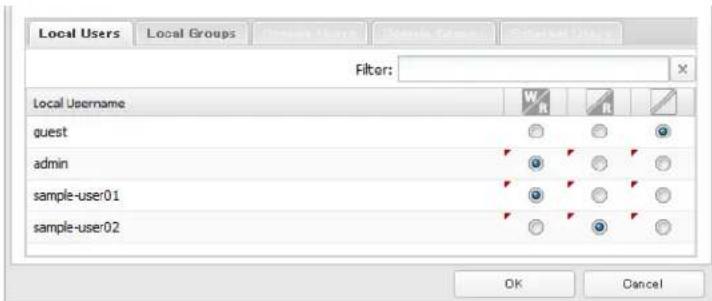
W: Read and write access allowed : R Read access allowed : Access prohibited
text_image
Local Users Local Groups Home Users Home Groups Local Users Filter: Local Username guest admin sample-user01 sample-user02 OK Cancel6 Click OK.
Notes
- The example above shows access restriction by user. To restrict access by group, click the Local Groups tab and select group permissions.
- If both read-only and read & write permissions are given to a user, the user will have read-only access. The most restrictive access always applies.
- The following characters are handled differently by Mac OS and Windows. Avoid using these characters when sharing data between Mac OS and Windows: — ∥ - ∑ ∑
- Windows does not support some characters that Mac OS and the TeraStation allow. If you create a filename on a Mac with any of the following characters, it will not display correctly on a Windows computer. With OS X 10.2 or later, you may have to connect to the TeraStation via AFP in order to display or copy any of the following characters.
$$ ? [ ] / \backslash = + < >;:"," | * $$
- Do not use any of the following words as a username or group name: root, bin, daemon, sys, adm, tty, disk, lp, sync, shutdown, halt, operator, nobody, mail, news, uucp, ftp, kmem, utmp, shadow, users, nogroup, all, none, hdusers, admin, guest, man, www, sshd, administrator, ftpuser, apache, mysql
- Do not use any of the following words as the name of a shared folder. These words are reserved for internal use by
the TeraStation: info, spool, lost+found, global, printers, homes, lp, authtest, ram, msdfs_root, mt-daapd, usbdisk# (where # is a number, for example: usbdisk1)
- Don't use the following unsupported characters in shared folder names, workgroup names, or filenames:

text_image
①②③④⑤⑥⑦⑧⑨⑩⑪⑫⑬⑭⑮⑯⑰⑱⑲⑳⑺ⅡⅢⅣVⅤVⅥⅧX i ii iii iv v viviviii ix x mmcmkmmgkgccm²No.KK Tel ⑫中下⑨⑩⑪(株)(有)代明治大正略和平成 纖襲鉄鉉記信託呈精鋅昇彎「仡任公仔但俛俛俛俛俛俛俛俛俛俛俛俛俛俛俛俛俛俛俛俛俛俛俛俛俛俛俛俛俛俛俛俛俛俛俛俛俛俛俛俛俛俛俛俛俛俛俛俛俛俛俾 間敞允鑑宜洽局弼孔弼勅勅匀勿匡邵匡廣級雙咤咾咩哥詰堅坦垛垅垅塚 增塊麥參萌荷頗好妹仔深霄寬寮茲峯峽峽嶼嶼嶼彌彌或德志忽 悅悲愷愷愷愷愷愷愷愷愷愷愷愷愷愷愷愷愷愷愷愷愷愷愷愷愷愷愷愷愷愷愷愷愷愷愷愷愷愷愷愷愷愷愷愷愷愷愷愷愷愷愶 嘻曹胎朗枚杷杷柳柚桐柚桐梓梓櫻檳櫻檳櫻檳氹汇沢沢沢涇涇涇 涇済渇済済済済済済済済済済済済済済済済済済済済済済済済済済済済済済済済済済済済済済済済済済済済済済済済済済渉 禪珉珘瑋瑗琇玲琦琦瑋瑗瑋瑋瑋瑋瑋瑋瑋瑋瑋瑋瑋瑋瑋瑋瑋瑋瑋瑋瑋瑋瑋瑋瑋瑋瑋瑋瑋瑋瑋瑋瑋瑋瑋瑋瑋瑋瑋瑋瑋瑋瑋瑋瑋瑋瑋瑋瑋瑋瑋瑋瑃 禪福礦庀靖淨寧精紉絮緒緒緒緒緒緒緒緒緒緒緒緒緒緒緒緒緒緒緒緒緒緒緒緒緒緒緒緒緒緒緒緒緒緒緒緒緒緒緒緒緒緒緒緒緒緒緒緒緒緒総 禪鶴訟諍諝諶闊諳諳諳諳諳諳諳諳諳諳諳諳諳諳諳諳諳諳諳諳諳諳諳諳諳諳諳諳諳諳諳諳諳諳諳諳諳諳諳諳諳諳諳諳諳諳諳諳諳諳諝 銘鈴鈴鈴鈴鈴鈴鈴鈴鈴鈴鈴鈴鈴鈴鈴鈴鈴鈴鈴鈴鈴鈴鈴鈴鈴鈴鈴鈴鈴鈴鈴鈴鈴鈴c 銘鈴鈴鈴鈴鈴鈴鈴鈴鈴鈴鈴鈴鈴鈴鈴鈴鈴鈴鈴鈴鈴鈴鈴鈴鈴鈴鈴鈴鈴鈴鈴鈴c 銜鯽鯽鯽鯽鯽鯽鯽鯽鯽鯽鯽鯽鯽鯽鯽鯽鯽鯽鯽鯽鯽鯽鯽鯽鯽鯽鯽鯽鯽鯽鯽鯽鯽鯽c 銜鯽鯽鯽鯽鯽鯽鯽鯽鯽鯽鯽鯽鯽鯽鯽鯽鯽鯽鯽c 銜鯽鯽鯽鯽鯽鯽鯽鯽鯽鯽鯽c 銜鯽鯽鯽鯽鯽c 銜鯽鯽鯽c 銜鯽鯽c 銜鯽c 銜鯽c 銜鯽c 銜鯽c 銜鯽c 銜鯽c 銜鯽c 銜鯽c 銜鯽c 銜鯽c 銜鯽c 銜鯽c 銜鯽c 銜鯽c 銜鰭 銜鰭 銜鰭 銜鰭 銜鰭 銜鰭 銜鰭 銜鰭 銜鰭 銜鰭 銜鰭 銜鰭 銜鰭 銜鰭 銜鰭 銜鰭 銜鰭 銜鸞 銜鸞 銜鸞 銜鸞 銜鸞 銜鸞 銜鸞 銜鸞 銜鸞 銜鸞 銜鸞 銜鸞 銜鸞 銜鸞 銜鸞 銜鸞 銜鸞 銜鸞 銜鸞 銜鸞 銜鸝 銜鸝 銜鸝 銜鸝 銜鸝 銜鸝 銜鸝 銜鸝 銜鸝 銜鸝 銜鸝 銜鸝 銜鸝 銜鸝 銜鸝 銜鸝 銜鸝 銜鸝 銜鸝 銜鸝 銜鸂 銜鸂 銜鸂 銜鸂 銜鸂 銜鸂 銜鸂 銜鸂 銜鸂 銜鸂 銜鸂 銜鸂 銜鸂 銜鸂 銜鸂 銜鸂 銜鸂 銜鸂 銜鸂- File and folder names may contain up to 255 single-byte characters.
- Configure hidden and read-only file attributes in Settings. Configuring them from within Windows is not supported and may cause unexpected behavior.
- Folder and workgroup names whose names contain non-Roman characters may not be displayed correctly.
- If shared folders are accessed from a Macintosh, information files for the Macintosh may be generated automatically. Do not delete these files. If they are deleted using Windows, this may prevent further access from a Macintosh.
- If an SMB connection is used with OS X 10.3.9, the names of mounted volumes may appear as unreadable characters in Finder and other applications. This is not a problem with the filename or data.
- With OS X 10.5 to 10.5.6, Spotlight searches are not supported over AFP connections. Use SMB connections or upgrade to OS X 10.5.7 or later.
- The TeraStation belongs to the default zone in AppleShareServer; the zone cannot be specified.
- When files are copied to the TeraStation or to a USB drive connected to the TeraStation, file information such as date created, date modified, and other date information may be updated or changed.
- Hard drive capacity is shown in Settings in actual gigabytes. The Properties window in Windows may show GiB instead, which will be a smaller number.
- During a file transfer, if settings are changed, the file transfer operation may be aborted.
- File copying to the TeraStation is protected by a journaling file system. If the Ethernet cable is disconnected or a power outage occurs while copying data, the following may occur:
- Preset data such as the TeraStation name, users, and groups may be erased.
- An incomplete file may be copied and the file can no longer be deleted. If this happens, restart the TeraStation, delete the file, and perform the copy operation again.
- After a drive is formatted, the "% Used" and "Amount Used" in Settings will not be 0. This is because some drive space is used for the system area.
Active Directory
The TeraStation can join an Active Directory domain. Up to 1000 domain users and 1000 groups may be downloaded from Active Directory.
Note: If usernames or group names from Active Directory include multi-byte characters, you will not be able to configure access restrictions for them.
1 In Settings, select Network.

Network
2 Select Workgroup/Domain.

3 Click Edit.
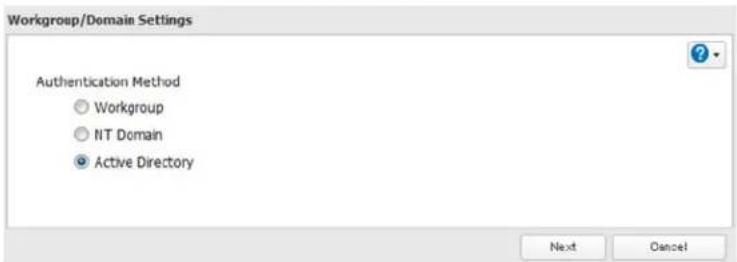
4 Select "Active Directory", then click Next.
text_image
Workgroup/Domain Settings Authentication Method Workgroup NT Domain Active Directory Next Cancel5 Click Yes.
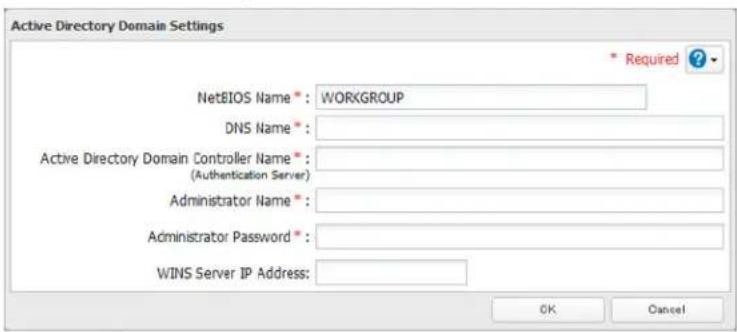
6 Enter the desired settings, then click OK.
text_image
Active Directory Domain Settings * Required ? NetBIOS Name * : WORKGROUP DNS Name * Active Directory Domain Controller Name * : (Authentication Server) Administrator Name * Administrator Password * WINS Server IP Address: OK Cancel7 Choose Folder Setup.

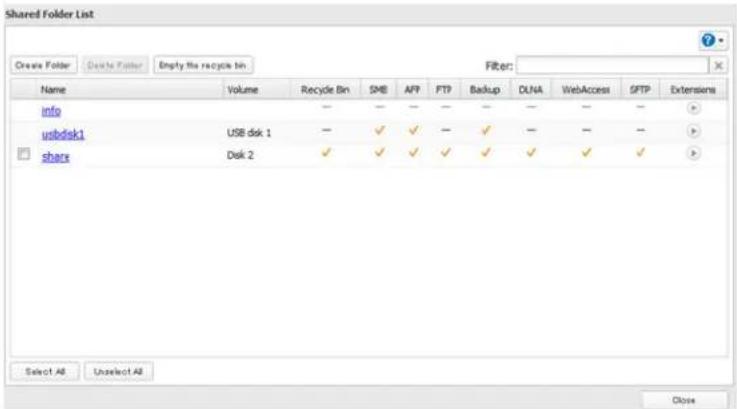
8 Click a shared folder that you want to set access restrictions for.
text_image
Shared Folder List Create Folder Delete Folder Empty this recycle bin Filter: Name Volume Recycle Bin SMB APP FTP Backup DLNA WebAccess SFTP Extensions info — — — — — — — — — + usbdisk1 USB disk 1 — ✓ ✓ — ✓ — — — + shares Disk 2 ✓ ✓ ✓ ✓ ✓ ✓ ✓ ✓ ✓ Select All Unselect All Close9 Click Edit.
10 Enable "Access Restrictions".
Access Restrictions: ☐ Enable
Disable
11 Select the level of access for the user or group.
W/R: Read and write access allowed
: Read access allowed
: Access prohibited
12 Click OK.
Notes:
- To have the TeraStation join an Active Directory domain, configure it to use a DNS server that can resolve names for the Active Directory domain.
• After building an Active Directory domain, the administrator password for joining the domain must be changed at least once, or joining the Active Directory domain will fail. - The DNS name and NetBIOS name of Active Directory domains should be identical.
- If both read-only and read & write permissions are given, the user will have read-only access. The most restrictive access setting will apply.
- If there are more than 5 minutes difference between the TeraStation's clock and the domain controller's clock, joining the domain or authenticating domain users and groups may fail. For best results, use an NTP server to set the time for all network devices.
- The TeraStation supports a domain environment with a maximum of 1000 users and 1000 groups. 10,000 users and 10,000 groups can be downloaded from the domain controller but are not supported.
- To use the TeraStation as a member server in an Active Directory domain, the TeraStation should be logged in to the domain and accessed from a computer that is not a member of the domain with a valid domain account.
- If the TeraStation is a member server of an Active Directory domain, you cannot connect as a guest user via AFP.
- If your TeraStation is a member server in an Active Directory domain and you change the authentication method to "Workgroup", the account on the domain controller will not be deleted automatically.
- When the TeraStation joins an Active Directory domain, FTP is disabled. Before use FTP, move the FTP switch back to the position.
- Don't disable the SMB protocol while Active Directory is used for access restrictions. If you do, you will need to enable SMB again and reconfigure AD from scratch.
NT Domains
In an NT domain environment, the TeraStation uses account information from the NT domain server to set access restrictions for files and folders on the TeraStation. There's no need to perform individual account management for the TeraStation. If multiple TeraStations are installed on the network, the account information is centrally managed in the NT domain, greatly reducing the operations required for installation and management.
Note: A maximum of 1000 domain users and 1000 groups can be downloaded from an NT domain server.
1 Create an account on the domain controller for the TeraStation.
2 In Settings, click Network.

3 Select Workgroup/Domain.

4 Click Edit.
5 Select "NT Domain", then click Next.

text_image
Workgroup/Domain Settings Authentication Method Workgroup NT Domain Active Directory Next CancelNote: To use Active Directory from Windows 2000 or Windows Server 2003, select "Active Directory" instead of "NT Domain".
6 Click Yes.
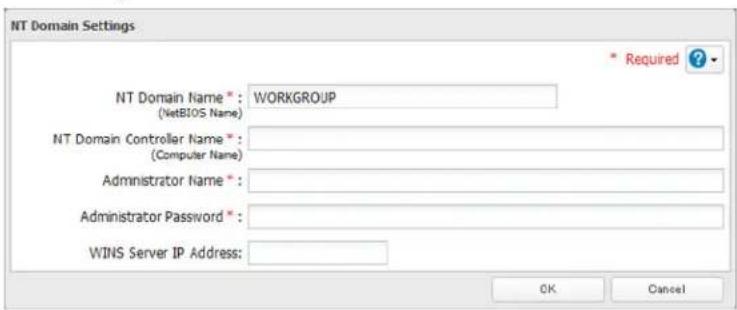
7 Enter settings and click OK.
text_image
NT Domain Settings NT Domain Name * : WORKGROUP (NetBIOS Name) NT Domain Controller Name * (Computer Name) Administrator Name * Administrator Password * WINS Server IP Address: * Required ? OK Cancel8 Click Light of "Folder Setup".

9 Click a shared folder for which you want to set access restrictions.

text_image
Shared Folder List Create Folder Delete Folder Empty the recycle bin Filters: Name Volume Recycle Bin SMB APP FTP Backup DLNA WebAccess SFTP Extensions info — — — — — — — — — usbdisk1 U08 disk 1 — ✓ ✓ — ✓ — — — share Disk 2 ✓ ✓ ✓ ✓ ✓ ✓ ✓ ✓ Select All Unselect All Close10 Click Edit.
11 Enable "Access Restrictions".
Access Restrictions: ☑ Enable
Disable
12 Select the level of access for "Domain Users" or "Domain Groups" you added.
W: Read and write access allowed : Read access allowed : Access prohibited
13 Click OK.
Notes:
- If you change the TeraStation's name, you will no longer be able to use domain users and groups or access restrictions. To repair this, rejoin the domain.
- If both read-only and read & write permissions are given to a user, the user will have read-only access.
- If a domain username is more than 20 bytes long, the TeraStation truncates it to 20 bytes.
- The TeraStation supports a domain environment with a maximum of 1000 users and 1000 groups. 10,000 users and 10,000 groups can be downloaded from the domain controller but are not supported.
- To use the TeraStation as a member server in an NT domain, the TeraStation should be logged in to the domain and accessed from a computer that is not a member of the domain with a valid domain account.
- If the TeraStation is a member server of an NT domain, you cannot connect as a guest user via AFP.
- When you change the user or group settings on the domain controller, these changes may not take effect immediately on the TeraStation until it is rebooted.
- If your TeraStation is a member server in an NT domain and you change the authentication method to "Workgroup", the account on the domain controller will not be deleted automatically.
- If the TeraStation has joined a domain network, you cannot connect to it via FTP.
- Don't disable the SMB protocol while an NT domain server is used for access restrictions. If you do, you will need to enable SMB again and reconfigure the NT domain settings from scratch.
Delegating Authority to an External SMB Server
TeraStations on your network can be linked to an authentication server for centralized management of user accounts and passwords. The authentication server should be a LinkStation or another TeraStation.
Notes:
- Other external SMB authentication servers are not supported. Use a TeraStation or a LinkStation for the authentication server.
- When saving changes to the external authentication server settings, clicking Yes will convert all local users to external authentication users. If external authentication is disabled, all local user passwords will need to be reconfigured.
- Disable SMB2 before using external authorization with Windows 8.1 or Windows 8.
- Using external authentication may require the default security settings in Windows to be changed. An easy way to do this is to run the File Sharing Security Level Change Tool, available from www.buffalotech.com. This simple tool will let you change or restore your Windows security settings to work with external authentication.
1 In Settings, click Network.

Network
2 Choose Workgroup/Domain.

3 Click Edit.
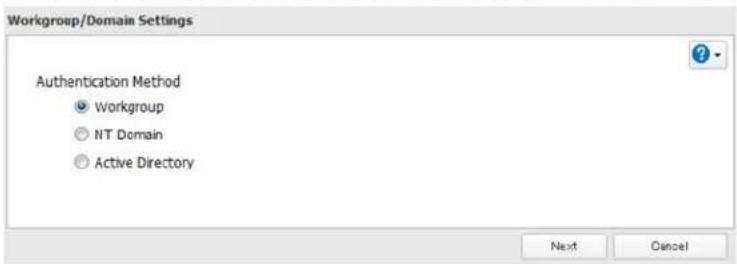
4 Select "Workgroup".
To use in a domain environment, select "NT Domain" or "Active Directory".
text_image
Workgroup/Domain Settings Authentication Method ● Workgroup ○ NT Domain ○ Active Directory Next Cancel5 Click Yes.
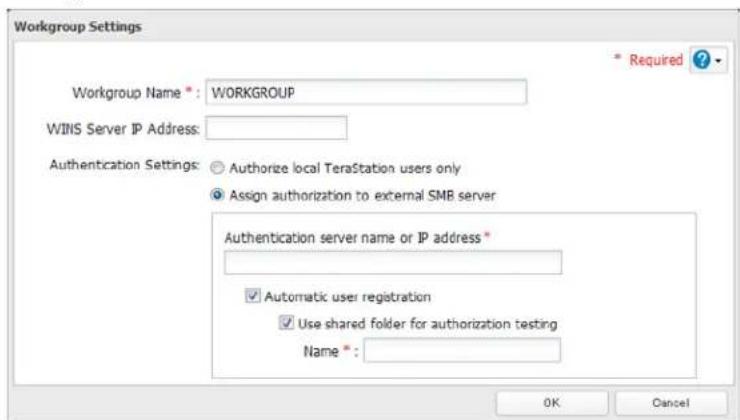
6 Enter a workgroup name. Select "Assign authorization to external SMB server" and enter the authentication server's IP address (recommended) or name. Check "Automatic user registration" and "Use shared folder for authorization testing" and enter the name of the folder to use. Click OK.
text_image
Workgroup Settings Workgroup Name * : WORKGROUP WINS Server IP Address: Authentication Settings: Authorize local TeraStation users only Assign authorization to external SMB server Authentication server name or IP address * Automatic user registration Use shared folder for authorization testing Name * : OK Cancel7 A shared folder for authentication will be created on the TeraStation. Users registered to the specified authentication server are automatically registered as users on the TeraStation when they open the shared folder for authentication. You can also register users directly. Connect to the authentication folder via SMB, not FTP or AFP.
8 Choose Folder Setup.

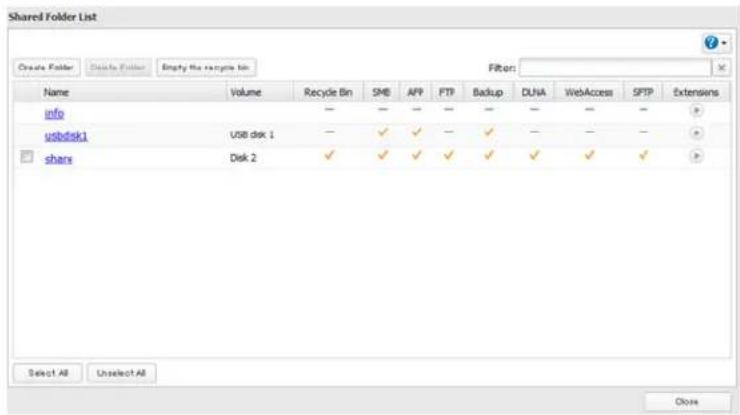
9 Choose a shared folder to set access restrictions on.
text_image
Shared Folder List Create Folder Delete Folder Empty the recycle bin Filters: Name Volume Recycle Bin SMB APP FTP Backup DUNA WebAccess SFTP Extensors info — — — — — — — — — usbdisk1 USB disk 1 — ✓ ✓ — ✓ — — — shares Disk 2 ✓ ✓ ✓ ✓ ✓ ✓ ✓ ✓ Select All Unselect All Close10 Click Edit.
11 Enable "Access Restrictions".

text_image
Access Restrictions: Enable Disable12 Select the level of access.
W: Read and write access allowed : Read access allowed : Access prohibited
13 Click OK.
Notes:
- If access restrictions are set for users and groups from the authentication server, guest and anonymous connections will not be possible with AFP or FTP connections.
- Users who are automatically registered belong to the "hdusers" group. They can be added to other groups from within group settings.
- If both read-only and read & write permissions are given to a user, the user will have read-only access.
- The names of registered users are listed in "Users" - "External Users". To delete a user who was registered automatically, select that user and click Delete External User.
- When connecting through AFP or FTP, always use an IP address. Using a server name may cause problems with authentication.
• To specify a server from another subnet, enter its IP address. - AFP and FTP connections do not support delegating authority to an external SMB server.
- Use AFP to access access-limited shared folders from OS X 10.7 instead of SMB. Enable "AFP (Mac)" under "LAN Protocol Support" on the destination folders to use AFP.
- Use OS X 10.5 or later with external authentication. Earlier versions of OS X aren't supported.
Chapter 4 Managing Your Storage
RAID Arrays
TeraStations support many types of RAID. The type of RAID arrays available for use depends on how many drives are installed in your TeraStation.
| TeraStation Default RAID Mode | |
| TS5800D | RAID 5 |
| TS5600D | |
| TS5400D | |
| TS5400R | |
| TS5200D RAID 1 |
Notes:
- If you change the RAID mode, all data on the array is deleted. This is true for every procedure in this chapter. Always back up any important data before performing actions that affect your RAID.
- After the RAID mode is changed (except when creating a RAID 0 array or JBOD), the TeraStation performs a RAID check that will take about 10 hours per TB. File transfers are slower during this period. While the message "RAID I17 ARRAYx Resyncing" is displayed on the LCD panel, do not turn off the TeraStation. If you do, the RAID check starts over.
- If the TeraStation is restarted or shut down while changing the RAID mode, the message displayed on the LCD panel changes from I46 or I47 to I18.
RAID 6\*
RAID 6 arrays are available for TeraStations with 4 or more hard drives. RAID 6 combines 4 or more drives into a single array. The usable space is equal to the sum of the capacity of all drives minus the capacity of two drives. For example, if 4 drives are combined into a RAID 6 array, the usable space is the sum of the capacity of 2 drives. If 2 drives in the array are damaged, you can recover data by replacing them. If 3 or more drives are damaged, your data is lost.
RAID 61\*\*\*
RAID 61 arrays are available for TeraStations with 8 or more drives. In this mode, two RAID 6 arrays are mirrored in a RAID 1 array. 8 drives in a RAID 61 array have a usable capacity of 2 x the capacity of the smallest drive.
RAID 60\*\*\*
RAID 60 arrays are available for TeraStations with 8 or more drives. In this mode, two RAID 6 arrays are combined in a RAID 0 array. 8 drives in a RAID 60 array will have a usable capacity of 4 x the capacity of the smallest drive.
RAID 5\*
RAID 5 arrays are available for TeraStations with 3 or more hard drives. RAID 5 combines 3 or more drives into a single
array. The usable space is equal to the sum of the capacity of the hard drives minus the capacity of one drive. For example, if 4 drives are combined into a RAID 5 array, the usable space is the sum of 3 drives. If one drive in the array is damaged, you can recover data by replacing the damaged drive. If two or more drives are damaged at the same time, your data is lost.
RAID 51\*\*
RAID 51 arrays are available for TeraStations with 6 or more hard drives. In this mode, two RAID 5 arrays are combined into a RAID 1 array. The total usable space for 6 drives in a RAID 51 array is 2 x the capacity of the smallest drive. For 8 drives, the total usable capacity is 3 x the capacity of the smallest drive.
RAID 50\*\*
RAID 50 arrays are available for TeraStations with 6 or more hard drives. In this mode, two RAID 5 arrays are combined into a RAID 0 array. The total usable space for 6 drives in a RAID 50 array is equal to 4 x the capacity of the smallest drive. For 8 drives, the total usable space is equal to 6 x the capacity of the smallest drive.
RAID 10\*
RAID 10 arrays are available for TeraStations with 4 or more hard drives. In this mode, mirrored pairs of drives in RAID 1 arrays are combined into a RAID 0 array. The usable space is equal to the capacity of the smallest drive multiplied by the number of hard drives divided by 2.
RAID 1
Combines 2 drives into a mirrored array. The available space in the array is the capacity of a single drive. Identical data is written to each drive. If a drive is damaged, data can be recovered by replacing the damaged drive. As long as one drive in the array remains undamaged, all data in the array can be recovered.
RAID 0
Combines 2 or more hard drives into a single array. The usable disk space is the total space of all drives used. This simple RAID mode offers faster performance than RAID modes that include parity. If a single drive in the array fails, then all data in the array is lost.
JBOD
This mode uses the hard drives inside the TeraStation as individual drives. The disk space you can use is the total capacity of all drives in the TeraStation. If any drive is damaged, then the data on that drive is lost.
*Available for TS5800D, TS5600D, TS5400D, and TS5400R series.
**Available for TS5800D and TS5600D series.
***Available for TS5800D series only.
Working with RAID Arrays
To change RAID settings, navigate to Drives - RAID in Settings.
Using JBOD
With JBOD, each hard drive in the TeraStation is addressed separately. To put drives from an array into JBOD, follow the steps below.
1 Select RAID.

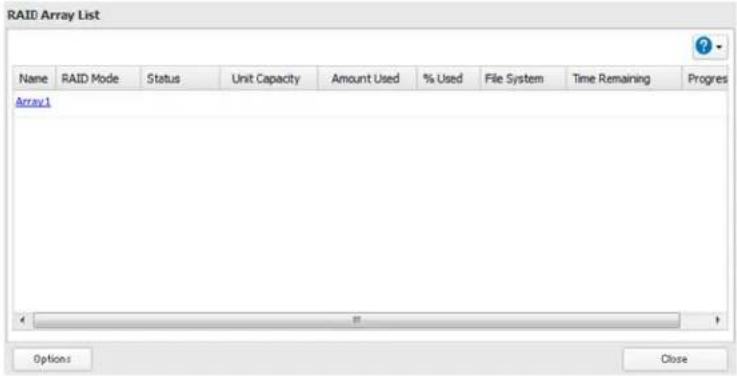
2 Select the array to delete.
text_image
RAID Array List Name RAID Mode Status Unit Capacity Amount Used % Used File System Time Remaining Progress Array1 Options Close3 Click Delete RAID Array.
Once JBOD is configured, create shared folders on each drive to use them.
Changing RAID Mode
To change the RAID mode, first put the drives in JBOD.
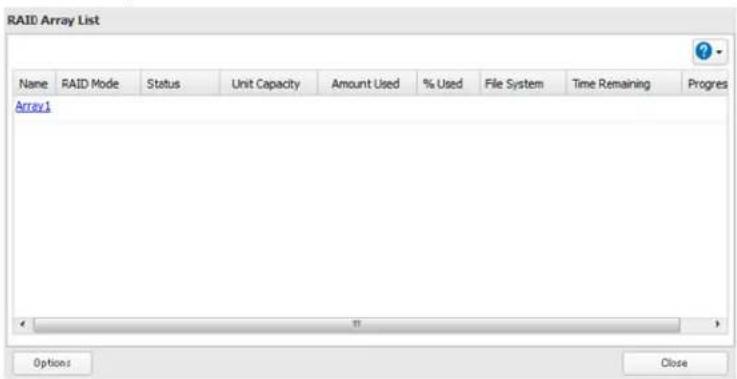
1 Select RAID.

2 Click the array to delete.
text_image
RAID Array List Name RAID Mode Status Unit Capacity Amount Used % Used File System Time Remaining Progress Array1 Options CloseNote: If the "RAID Mode" field is blank, the array is already in JBOD. Proceed to step 7.
3 Click Delete RAID Array.
4 The "Confirm Operation" screen will open. Enter the displayed number, then click OK.
5 Click OK.
6 Choose the array to configure.
7 Select a RAID mode and the drives to be used, then click Create RAID Array.

text_image
Array1 RAID Mode: RAID1 Add a disk to RAID array with RMM. Your data will be preserved. Select the drives to configure in a RAID array. Disk 1 Status Model Shared Folder Size Disk 1 Normal 1 > 899.9GB Disk 2 Normal - 899.9GB Select All Unselect All Resync after creating the RAID array Create RAID Array CancelNote: Normally, after a RAID array is created, it is "resynced", which optimizes the array, making it more stable. The resyncing process takes about 1 hour per terabyte of space in the array. File transfers will be slower during this period, but the array will remain fully usable. "RAID ARRAY x Resyncing" will be shown on the LCD display during the resync. If you uncheck "Resync after creating the RAID array", the resync will be skipped. This is not recommended for RAID 5 arrays, which should always be resynced. Resyncing is not needed for RAID 0 arrays. If the TeraStation is rebooted during the resyncing process, the resync will begin again from the beginning.
8 Step through the wizard to create the array.
Notes:
- You can also configure RAID settings from Easy Admin.
• After changing the RAID mode, create a shared folder.
Configuring a Hot Spare
If you have a hot spare configured and an array fails, the TeraStation immediately switches over to the hot spare. To use a hot spare, you need an extra drive that's not part of any array and a RAID 1, RAID 10, RAID 5, RAID 51, or RAID 6 array.
Notes:
- All data on the hot spare drive is deleted when it is configured as a hot spare and again when it changes from a spare to a drive in the array.
- A hot spare cannot be configured for TeraStation models with only two hard drives. Use RAID 1 instead.
1 In Settings, click Drives.

2 Choose RAID.

3 Choose a RAID array.
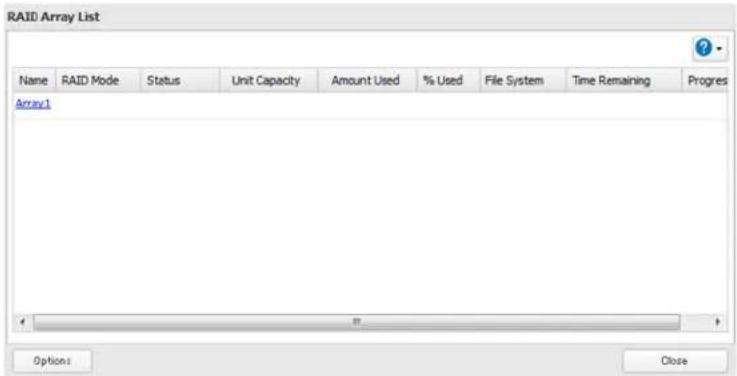
text_image
RAID Array List Name RAID Mode Status Unit Capacity Amount Used % Used File System Time Remaining Progress Array1 Options Close4 Click Set as a hot spare.
5 Step through the wizard.
6 When the "Confirm Operation" screen opens, enter the confirmation number and click OK.
Notes:
- To turn the hot spare back into a normal disk, choose Set as a normal disk.
- If a drive fails in the RAID array before it is rebooted, the hot spare will not automatically replace the failed drive. In this case, follow the steps below to repair the array.
(1) In Settings, navigate to Drives - Drives.
(2) Select the drive that was configured as a hot spare, then click Dismount Disk.
(3) Click Rediscover Disk.
(4) Navigate to Drives - RAID.
(5) Select the RAID array to repair.
(6) Select the drive that was previously configured as a hot spare, then click "Recover RAID Array".
This will rebuild the RAID array.
RMM (RAID Mode Manager)
With RMM, you can create or expand a RAID array without erasing the data on the drives.
Changing from JBOD to RAID 1
Hard drives that aren't in a RAID array show "Normal (RMM available)". You must have at least two drives available in JBOD (not in a RAID array) to build the RAID 1 array with RMM.
1 Click Drives.

2 Click RAID.

3 Choose a RAID array.
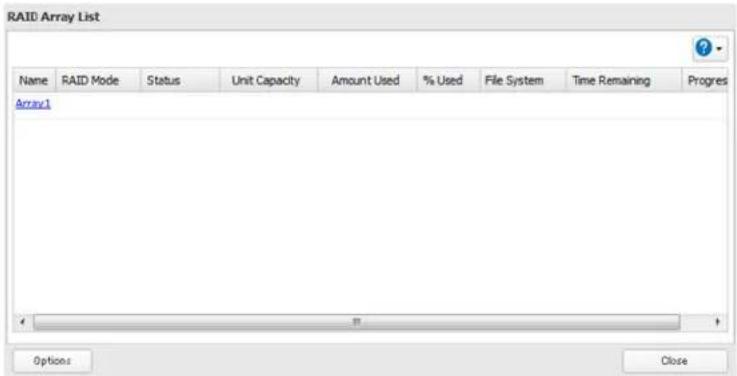
text_image
RAID Array List Name RAID Mode Status Unit Capacity Amount Used % Used File System Time Remaining Progress Array1 Options Close4 Select a RAID mode to "RAID 1".
5 Check "Add a disk to RAID array with RMM. Your data will be preserved.".

text_image
Array1 RAID Mode: RAID1 Add a disk to RAID array with RMM. Your data will be preserved. Select the disk to preserve: Disk 1 Select the drives to configure in a RAID array. Disk - Status Model Shared Folder Size Disk 1 Normal 1 > 899.9GB Disk 2 Normal - 899.9GB Select All Unselect All Create RAID Array Cancel6 Select the drive on which you do not want to erase data.
7 Select the drive to add to the RAID array.
8 Click Create RAID Array. The "Confirm Operation" screen will open.
9 Enter the confirmation number, then click OK.
Adding a drive to an Existing RAID Array
You can add a drive to a RAID 1, RAID 5, or RAID 6 array. Drives that can be added to the RAID array show "Normal (RMM available)" or "JBOD."
Notes:
• Each drive must have the same capacity.
- RMM can be used to expand an array by one drive per operation. To expand by two or more drives, RMM must be performed multiple times.
1 Click Drives.

2 Click RAID.

3 Choose a RAID array.
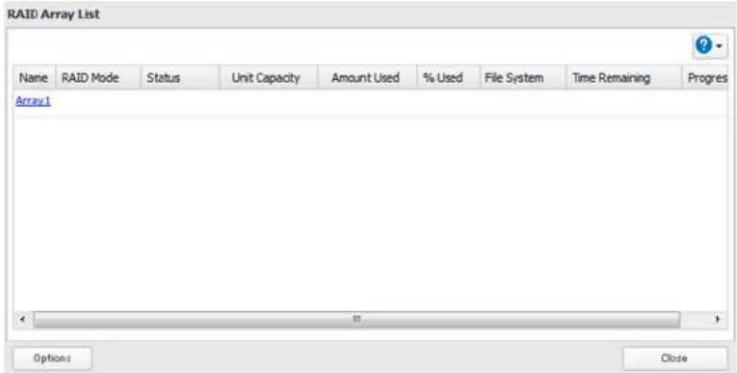
text_image
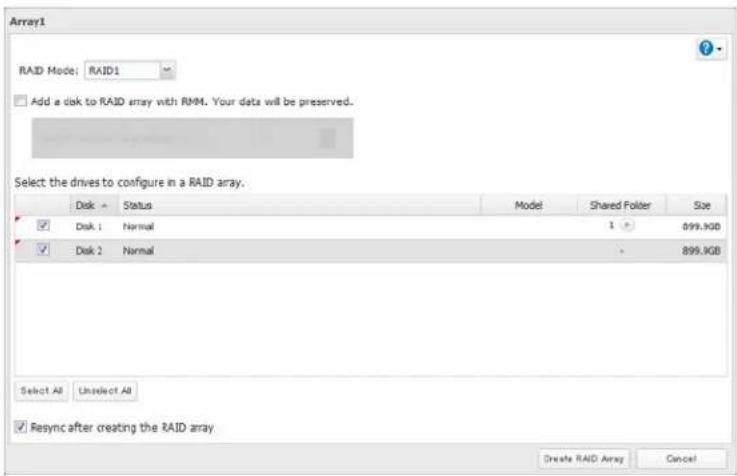
RAID Array List Name RAID Mode Status Unit Capacity Amount Used % Used File System Time Remaining Progress Array1 Options Close4 Select the drive to add to the RAID array.
text_image
Array1 RAID Mode: RAID1 Add a disk to RAID array with RMM. Your data will be preserved. Select the drives to configure in a RAID array. Disk Status Model Shared Folder Size Disk 1 Normal 1 999.9GB Disk 2 Normal 899.9GB Select All Unselect All Resync after creating the RAID array Create RAID Array Cancel5 Click Create RAID Array. The "Confirm Operation" screen will open.
6 Enter the confirmation number, then click OK.
Changing the RAID Mode while Adding a Drive
Select the drive you want to add to the RAID array and choose the mode for the array. Enter the "Confirm Operation" number and click OK.
RAID Scanning
RAID maintenance scans your RAID array for bad sectors and if it finds any it automatically repairs them. RAID 1, RAID 10, RAID 5 and RAID 6 arrays are supported. For best results, run RAID maintenance regularly.
1 In Settings, click Drives.

2 Click the 📋 the right of "RAID Scanning".

3 Click Edit.
4 Select the schedule for running RAID maintenance, then click OK.

text_image
RAID Maintenance Settings RAID Scan Schedule: Every 1st day of the month Sunday Start Time: 2 a.m. Immediately OK CancelNotes:
- Check "Immediately" to run RAID maintenance immediately.
- To stop a RAID scan, click Cancel RAID Scan.
5 Move the RAID scanning switch to the position to enable RAID scanning.

Adding an External Hard Drive
Connecting an External Drive
Your TeraStation includes USB ports (the number of ports depends on your model), and you can connect external drives to these ports. Once connected they appear as shared folders on the TeraStation. Formatted drives are detected automatically. Unformatted drives should be formatted in Settings.
After a USB drive is recognized, Windows adds "usbdisk X" under the TeraStation in "Network", where "X" is the USB port where the hard drive is connected.
The following USB devices are supported by the TeraStation:
- USB storage devices
- Card readers (except for card readers that can recognize two or more memory cards)
- Digital cameras
- USB-connected UPSs
- USB printers
Buffalo external USB drives are recommended.
These devices are not supported:
• DUB and DIU series drives
• Hubs, mice, and keyboards
Connect only one device to each USB port of the TeraStation. Some external drives with automatic power-on don't turn on automatically when connected to the TeraStation. Use their manual power switch to turn them on. Be sure to connect only one bus-powered drive at a time. If there is insufficient bus power for your USB drive, connect its AC adapter. Note that only the first partition of a connected USB hard drive is mounted. Additional partitions are not recognized. Do not connect bus-powered devices to the TS5200D.
Notes:
- Hubs are not supported. Connect a single USB drive to each USB port.
- Backup data from Mac OS may include characters that cannot be written to FAT16 or FAT32 drives such as ".DS_ Store". For best results, reformat the drive before using it as a backup target.
- If your USB 3.0 hard drive is not reconfigured after rebooting the TeraStation, unplug and reconnect it.
Dismounting Drives
If the TeraStation is powered on, dismount drives (internal and external) before unplugging them. You may dismount external drives with the function button, or any drive from Settings. If the TeraStation is off, then all drives are already dismounted and may be unplugged safely.
Dismounting with the Function Button
Hold down the function button for 8 seconds. The function button will light up blue for 30 seconds as your USB drives are dismounted. When the dismount is finished, the function button's LED will turn off, then come back on. You may now unplug any USB drives safely.
Note: After 60 seconds, the function LED will go out and any drives that have not yet been unplugged will be remounted.
Dismounting from Settings
1 In Settings, click Drives.

2 Select Drives to dismount an internal drive or USB drives to dismount an external drive.

text_image
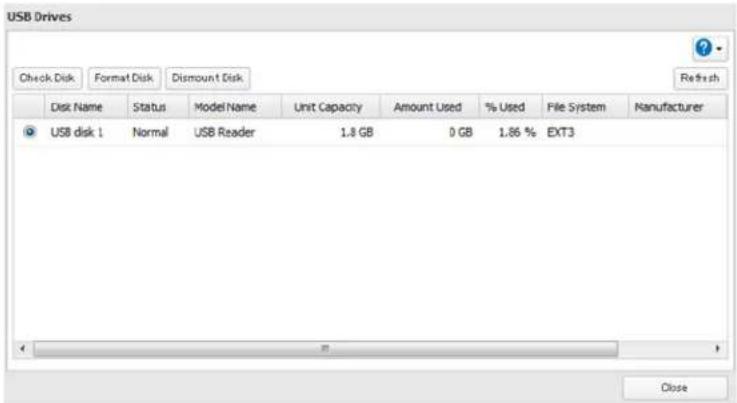
Drives USB Drives3 Select the drive to dismount and click Dismount Disk.
text_image
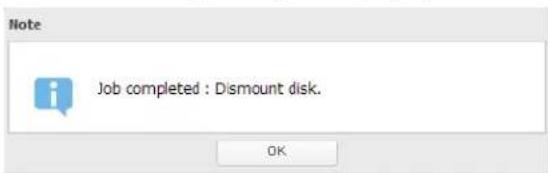
USB Drives Check Disk Format Disk Dismount Disk Disk Name Status Model Name Unit Capacity Amount Used % Used File System Nanufacturer USB disk 1 Normal USB Reader 1.8 GB 0 GB 1.86 % EXT3 Close4 When the following message is displayed, it is safe to unplug the drive.
text_image
Note Job completed : Dismount disk. OKNote: To remount the drive, unplug it and then plug it back in.
Checking Drives
A disk check tests the data on a drive in the TeraStation or connected via USB for integrity. Errors are fixed automatically. With large drives, a disk check may run for many hours. Shared folders cannot be accessed during a disk check. Do not turn off the TeraStation until the disk check is finished. Use the procedure below to run a disk check.
1 In Settings, click Drives.

2 Select Drives to check an internal drive or USB Drives to check an external drive.

text_image
Drives USB Drives3 Select the drive to test, then click Check Disk.

text_image
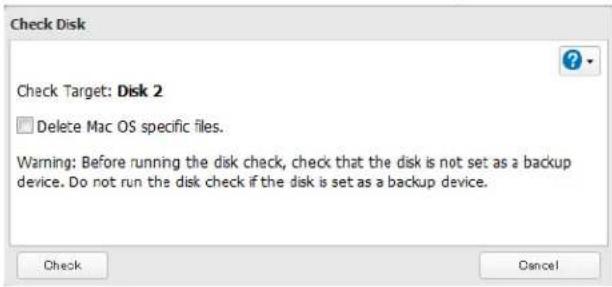
Drives Check Disk Format Disk Dismount Disk Radiscover Disk Disk Name Status Encryption Model Name Unit Capacity Amount Used % Used File System Disk 1 Normal — 899.9 GB 0 GB 0.00 % XFS Disk 2 Normal — 899.9 GB 0 GB 0.00 % XFS Close4 Click Check. You have the option of deleting information files from Mac OS during the check if desired.
text_image
Check Disk Check Target: Disk 2 Delete Mac OS specific files. Warning: Before running the disk check, check that the disk is not set as a backup device. Do not run the disk check if the disk is set as a backup device. Check CancelFormatting Drives
Note: Under some circumstances, data deleted when a drive is formatted can be recovered. To ensure that data is "gone forever", a format might not be sufficient. See "Erase Data on the TeraStation Completely".
1 In Settings, click Drives.

2 Select Drives to format an internal drive or USB Drives to format an external drive.

text_image
Drives USB Drives3 Select the drive to format, then click Format Disk.

text_image
Drives Check Disk Format Disk Dismount Disk Rediscover Disk Disk Name - Status Encryption施工单位 Name Unit Capacity Amount Used % Used File System Disk 1 Normal - 899.9 GB 0 GB 0.00 % XFS Disk 2 Normal - 899.9 GB 0 GB 0.00 % XFS Close4 Select a format type, then click Format.
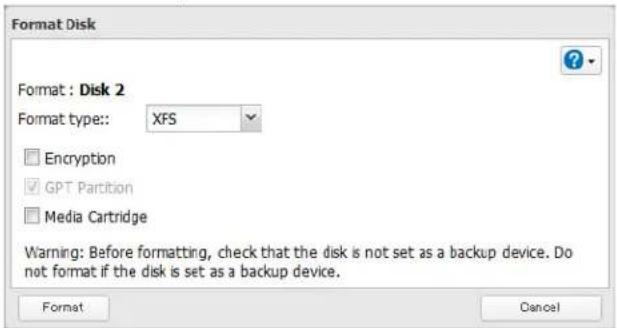
text_image
Format Disk Format : Disk 2 Format type: XFS Encryption GPT Partition Media Cartridge Warning: Before formatting, check that the disk is not set as a backup device. Do not format if the disk is set as a backup device. Format Cancel5 The "Confirm Operation" screen will open. Enter the displayed number, then click OK.
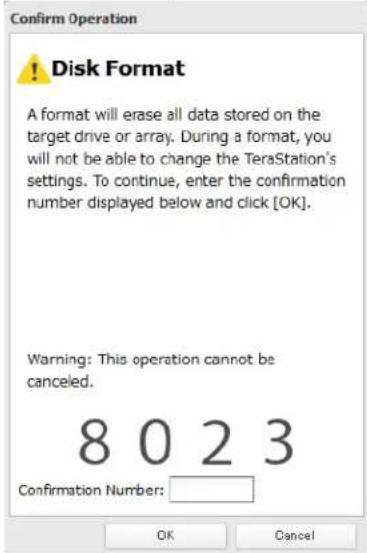
text_image
Confirm Operation ! Disk Format A format will erase all data stored on the target drive or array. During a format, you will not be able to change the TeraStation's settings. To continue, enter the confirmation number displayed below and click [OK]. Warning: This operation cannot be canceled. 8 0 2 3 Confirmation Number: OK Cancel6 Depending on the size of your drive, the format may take several minutes or several hours to complete. "Formatting" will be displayed on the LCD display until the format is complete.
Notes:
- Do not turn off or disconnect power to the TeraStation while formatting a hard drive.
- For drives of 2.2 TB or larger, make sure that the "GPT Partition" checkbox is selected.
Encrypting Drives
Internal drives (and arrays) can be encrypted with 128-bit AES during formatting. Encrypted drives and arrays are then readable only from that specific TeraStation. To unencrypt a drive or array, uncheck "Encryption" and format it again.
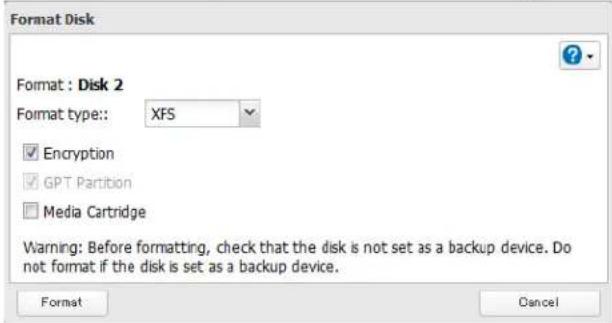
text_image
Format Disk Format : Disk 2 Format type: XFS ✓ Encryption ✓ GPT Partition □ Media Cartridge Warning: Before formatting, check that the disk is not set as a backup device. Do not format if the disk is set as a backup device. Format CancelMedia Cartridges
If configured as a media cartridge, an internal drive can be used as a removable storage device in the same way as an external drive. Media cartridges can be unplugged and connected to a different TeraStation with all data intact.
To configure a drive as a media cartridge, check "Media Cartridge" during formatting. To return it to its original state, uncheck "Media Cartridge" and reformat the drive.

text_image
Format Disk Format : Disk 2 Format type: XFS Encryption GPT Partition Media Cartridge Warning: Before formatting, check that the disk is not set as a backup device. Do not format if the disk is set as a backup device. Format CancelMedia cartridges do not support:
- RAID arrays
• LVM volumes - Access restrictions
- Direct connection to a Windows computer
Notes:
- Don't configure the boot drives (drives 1 and 2) as media cartridges.
- Configure media cartridges from the bottom drive up. For example, if your TeraStation has 4 drives, make drive 4 a media cartridge first, then drive 3 next.
- If the TeraStation fails to boot after drive 1 or 2 is replaced, remove any media cartridges, then replace them after the TeraStation has booted.
Erase Data on the TeraStation Completely
Under some circumstances, data from formatted drives can be recovered. The disk erasure process in this section does
a much more thorough job of erasing data. This procedure is recommended for removing all data from a drive in a way that makes it nearly impossible to recover with current tools. All data on the drives is completely erased. The TeraStation will then be in the following state:
- All drives in JBOD
• An empty shared folder on each drive - All settings returned to their default values
- All logs deleted
If you remove a drive and then erase all data on the TeraStation, the LCD will show the error "HDx Error E22 HDx Can't Mount" where X is the hard drive you removed. You can still use the TeraStation.
1 In Settings, click Management.

Management
2 Select Restore/Erase.

Restore/Erase

3 Click Erase TeraStation.
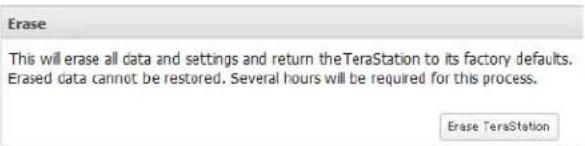
text_image
Erase This will erase all data and settings and return theTeraStation to its factory defaults. Erased data cannot be restored. Several hours will be required for this process. Erase TeraStation4 The "Confirm Operation" screen will open. Enter the displayed number, then click OK.
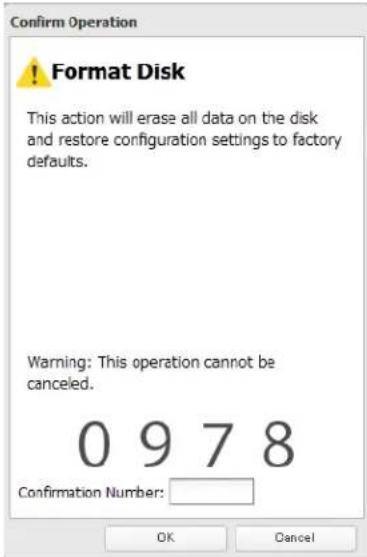
text_image
Confirm Operation ! Format Disk This action will erase all data on the disk and restore configuration settings to factory defaults. Warning: This operation cannot be canceled. 0 9 7 8 Confirmation Number: OK Cancel5 All data on the TeraStation will be permanently erased.
Disk Quotas
Notes:
- When using quotas, disable the recycle bin or empty the trash folder often. The limited space includes the space used for trash.
- Quotas apply per drive or per array. If a quota is set to 1 GB, each array or drive can use a maximum of 1 GB.
- Quotas cannot be set for external hard drives connected to the TeraStation and hard drives that are configured as media cartridges.
- If both user and group quotas are configured for a user, the most restrictive quota will always apply.
Quotas for Users
Follow this procedure to limit the shared folder disk space available for a user.
1 In Settings, click Light of "Users".

2 Select the user whose space will be limited.
3 Enable quotas, choose the maximum space the user will be allowed to use, and click OK.
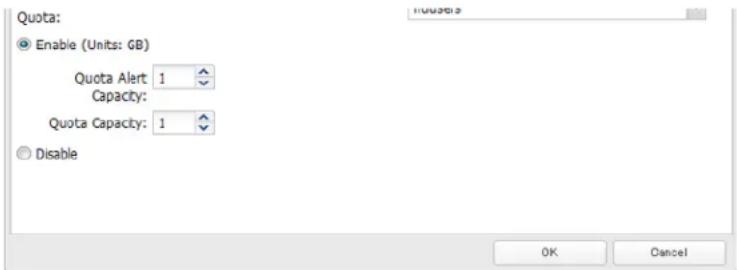
text_image
Quota: Enable (Units: GB) Quota Alert 1 Capacity: Quota Capacity: 1 Disable OK CancelNote: If you change the primary group, restart the TeraStation to apply the quota settings.
4 Click Close.
Quotas for Groups
Follow the procedure below to limit the space for shared folders that each group can use.
1 In Settings, click Light of "Groups".

2 Select the group whose space will be limited.
3 Enable quotas, choose the maximum space the group is allowed, and click OK.
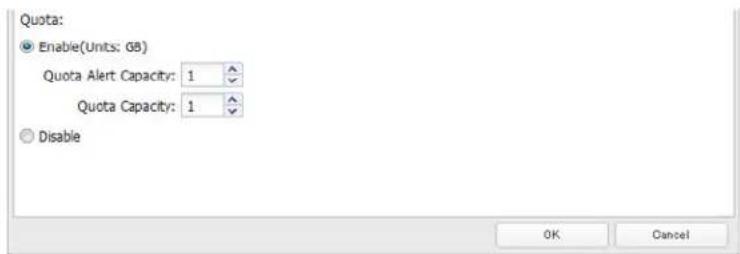
text_image
Quota: Enable(Units: GB) Quota Alert Capacity: 1 Quota Capacity: 1 Disable OK Cancel4 Click Close.
5 In Settings, click Light of "Users".


sers

text_image
light of "Users". Local Users 2 User(s)6 Change the user's primary group to the group with the quota, then click OK.
7 Click Close.
Size Limits
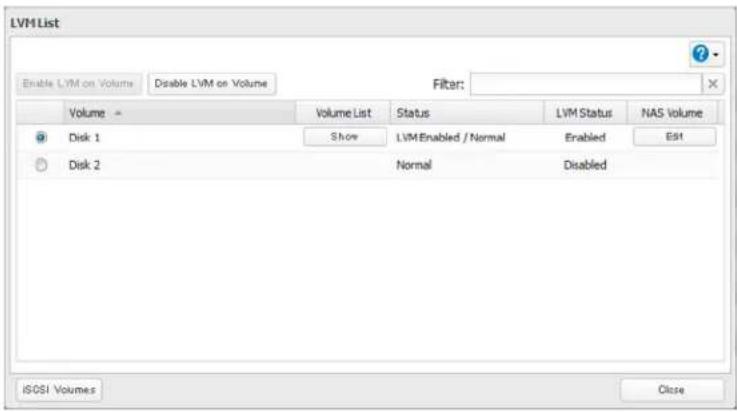
If LVM is enabled, volumes can be created with maximum size limits.
1 In Settings, click Drives.

2 Select LVM.

3 Select the drive or array where the volume will be located and click Enable LVM on Volume.
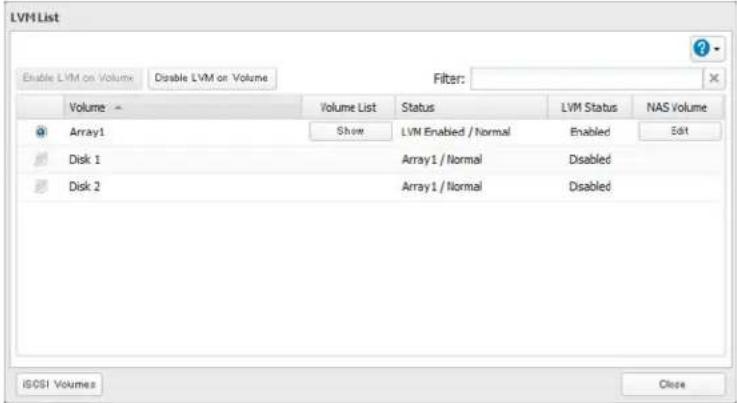
text_image
LVM List Enable LVM on Volume Disable LVM on Volume Filter: Volume Volume List Status LVM Status NAS Volume Array1 Show LVM Enabled / Normal Enabled Edit Disk 1 Array1 / Normal Disabled Disk 2 Array1 / Normal Disabled iOSOI Volumes Close4 The "Confirm Operation" screen will open. Enter the displayed number, then click OK.
5 Click OK.
6 Click Edit under "NAS Volume".
text_image
LVM List Enable LVM on Volume Disable LVM on Volume Filter: Volume Volume List Status LVM Status NAS Volume Disk 1 Show LVMEnabled / Normal Enabled Edit Disk 2 Normal Disabled iOSI Volumes Close7 Click Create Volume.

text_image
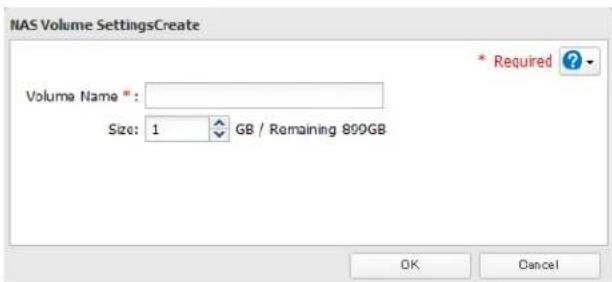
NAS Volume List: Disk 2 Create Volume Delete Volume Filter: Volume Name Size Close8 Configure the desired settings, then click OK.
text_image
NAS Volume SettingsCreate Volume Name *: Size: 1 GB / Remaining 890GB * Required ? OK Cancel9 Click OK.
10 Click Close.
11 Click Close.
12 Navigate to File Sharing - Folder Setup.

13 Click Create Folder.
14 Configure the settings.

text_image
Shared Folder Settings * Required ? Copy settings from: Name " : Shared Folder Description: Volume: Disk 2 Attribute: Read Only Read & Write Recycle Bit: Enable Disable LAN Protocol Support: SMB (Windows/Mac) AFP (Mac) FTP Backup DLNA WebAccess SFTP NFS NFS Path /mmt/dsk2/ Folder Attributes: Hidden Share (SMB Only) rwindows Backup Remote Backup Password: WebAccess Public Mode: Allow Anonymous Offline Files: Manual File Caching TeraSearch: Include this folder in the search index Virus Scan: Real Time Scan Scheduled Scan Manual Scan Access Restrictions: Enable Disable Local Users Local Groups Filter: Local Username guest admin OK CancelNotes:
- The name may contain up to 27 alphanumeric characters, hyphens (-), and underscores (_). Do not use a symbol as the first character.
- The description may contain up to 75 alphanumeric characters, hyphens (-), underscores (_), and spaces. Do not use a symbol or space as the first character.
- If multi-byte characters are used in a shared folder name used for both AFP and FTP, configure the client language to match the characters that are being used. Also, you may be unable to access the folder if certain characters are used in the name, so the use of letters and numbers only is recommended.
- The names of shared folders used for both AFP and FTP should not use characters from different language sets (such as mixing Japanese and Korean characters, for instance).
15 Select the volume that you created and click OK.
Using the TeraStation as an iSCSI Device
Introduction
iSCSI is a protocol for carrying SCSI commands over IP networks. Unlike traditional SAN protocols such as fibre channel, which requires special-purpose cabling, iSCSI can be run over long distances using existing network infrastructure.
Normal Windows formatting such as NTFS is supported.
Differences Between NAS and iSCSI
With iSCSI, the TeraStation is connected to a single computer, such as a server. Other computers on the network access files on the TeraStation through the computer it's connected to. The TeraStation can be used as a local drive from Windows Server. Features of Windows Server such as Active Directory can be used normally.
As a NAS, the TeraStation is a server, and computers (including other servers) on the network can access shared folders on it directly. A separate server is not required, and features such as backup are built-in.
Network Configuration
Use gigabit or faster network equipment with iSCSI. For best results, a dedicated network for iSCSI is recommended, separate from the regular network. Use fixed IP addresses for storage devices such as the TeraStation.
Install the Microsoft iSCSI Software Initiator
Windows XP, Windows 2000, Windows Server 2003, Windows 2000 Server
Before using iSCSI equipment with Windows XP, Windows 2000, Windows Server 2003, or Windows 2000 Server, download and install the "Microsoft iSCSI Software Initiator".
1 Go to http://www.microsoft.com.
2 Search for "Microsoft iSCSI Software Initiator".
3 Download the latest version of the Microsoft iSCSI Software Initiator.
4 When the download is complete, double-click on the installer. Check the "Initiator Service" and "Software Initiator" checkboxes.
5 Step through the wizard to install.
Windows 8.1, Windows 8, Windows 7, Windows Vista, Windows Server 2012, Windows Server 2008
If you are using Windows 8.1, Windows 8, Windows 7, Windows Vista, Windows Server 2012, or Windows Server 2008, the Microsoft iSCSI Software Initiator is already installed on your computer. You don't need to download and install it.
iSCSI Setup
To use the TeraStation as an iSCSI hard drive, configure it as described below.
1 Connect the TeraStation's Ethernet and power cables and configure the TeraStation's IP address and its clock.
2 In Settings, click Drives.

3 Choose LVM.

4 Select the drive or array where the volume will be created and click Enable LVM on Volume.

text_image
LVM List Enable LVM on Volume Disable LVM on Volume Filter: Volume → Volume List Status LVM Status NAS Volume Array1 Show LVM Enabled / Normal Enabled Edit Disk 1 Array 1 / Normal Disabled Disk 2 Array 1 / Normal Disabled ISOSI Volumes CloseNotes:
- Enabling LVM before using a drive as an iSCSI drive is optional. If LVM is not enabled, you can still create one iSCSI volume from the entire drive. However, enabling LVM is recommended for drives that will be used for iSCSI.
- If the LVM settings are changed, all data on the volume will be erased. Before changing the settings, back up any important data.
5 The "Confirm Operation" screen will open. Enter the displayed number, then click OK.
6 Click OK.
7 Move the iSCSI switch to the position to enable iSCSI.

8 Click right of "iSCSI".
9 Click Create Volume.
10 Enter a volume name, volume description, volume, and size, then click OK.
11 Click Close.
12 Connect the new volume. The process for this will depend on your iSCSI software.
Procedure using Buffalo's iSCSI Connection Tool
(1) Install the iSCSI Connection Tool on your computer from the CD supplied with the TeraStation, or download it from www.buffalotech.com.
(2) Click Start - All Programs - BUFFALO - iSCSI Connection Tool - iSCSI Connection Tool. For Windows 8.1 and Windows 8, click the iSCSI Connection Tool.
(3) Click Register iSCSI Device, select the volume to connect, and click Connect.

text_image
Buffalo iCSI Connection Tool File Configuration Help Target TS520004E1 Register iCSI Device Model TS52000 Series Series TS5200D IP Address 192.168.10.25 (DHCP) Subnet Mask 255.255.255.0 Firmware 2.20 MAC Address GC:52AF:EA:84:E1 iCSI Service Enabled Volume sample Status : Disconnected User Authentication : Disabled Connect on Start Up Connect Refresh ExitNotes:
- If you will use the TeraStation regularly, check "Connect on Start Up" before connecting.
• Always disconnect the volume before shutting down the TeraStation.
For the Microsoft iSCSI Software Initiator:
Navigate in Windows to Control Panel - Administrative Tools - iSCSI Initiator, enter the IP address of the TeraStation in the "Target" field, click Quick Connect.
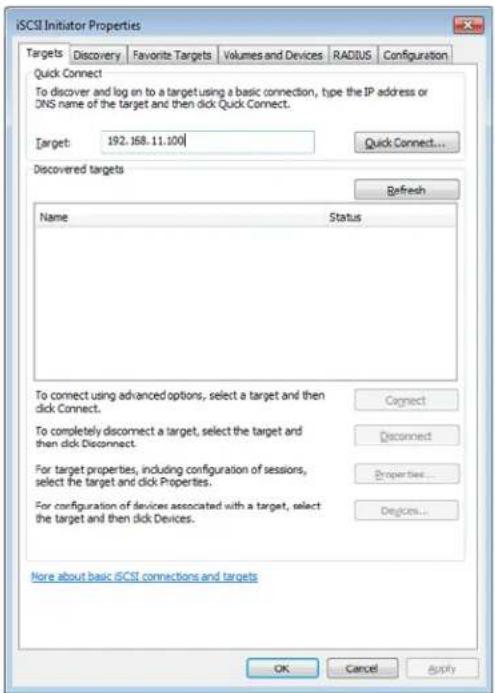
text_image
iSCSI Initiator Properties Targets Discovery Favorite TargetsVolumes and Devices RADIUS Configuration Quick Connect To discover and log on to a target using a basic connection, type the IP address or DNS name of the target and then click Quick Connect. Target: 192.168.11.100 Quick Connect... Discovered targets Refresh Name Status To connect using advanced options, select a target and then dick Connect. To completely disconnect a target, select the target and then click Disconnect. For target properties, including configuration of sessions, select the target and click Properties. For configuration of devices associated with a target, select the target and then click Devices. Connect Disconnect Properties... Devices... More about basic iSCSI connections and targets OK Cancel Apply13 The connected volume will be recognized by the computer as an unallocated volume. Assign and format the volume in Windows. When the format process is completed, the drive will be visible as an icon in "Computer" or "My Computer" and can be used as a normal drive on the computer.
Use with Multiple Computers
If the TeraStation is divided into multiple volumes (or drives), it can be used with multiple computers.
1 Create multiple LVM volumes, then create multiple iSCSI volumes. You can create up to 32 volumes.
2 Download and install the iSCSI Connection Tool from www.buffalotech.com.
3 Launch the tool at Start - All Programs - BUFFALO - iSCSI Connection Tool - iSCSI Connection Tool. For Windows 8.1 and Windows 8, click the iSCSI Connection Tool.
4 Click Register iSCSI Device, select the volume to connect, and click Connect.
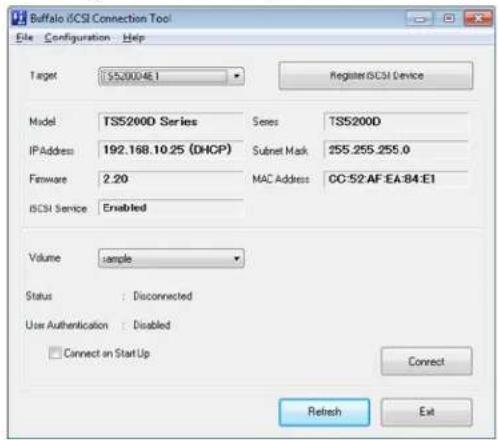
text_image
Buffalo iCSI Connection Tool File Configuration Help Target TS52004E1 Register iCSI Device Model TS52000 Series Series TS5200D IP Address 192.168.10.25 (DHCP) Subnet Mask 255.255.255.0 Firmware 2.20 MAC Address CG:52:AF:EA:B4:E1 iCSI Service Enabled Volume sample Status : Disconnected User Authentication : Disabled Connect on Start Up Connect Refresh ExitNotes:
• Volumes that are currently in use cannot be connected.
- If the TeraStation will be used regularly, check "Connect on Startup" before connecting.
5 The connected volume will be recognized by the computer as an unallocated volume. Assign and format the volume in Windows.
Checking Whether iSCSI Volume is Connected
To check whether an iSCSI volume is connected, navigate to Drives - iSCSI - iSCSI Settings and select Connection. If "Connected" is displayed, the TeraStation is currently connected from the client.
Using the iSCSI Connection Tool
Registering the TeraStation and Connecting the Volumes
If the TeraStation is divided into multiple volumes or drives, it can be used with multiple computers.
1 Connect the Ethernet cable of the TeraStation to the network.
2 Click Start - All Programs - BUFFALO - iSCSI Connection Tool - iSCSI Connection Tool. For Windows 8.1 and Windows 8, click the iSCSI Connection Tool.
3 Select the TeraStation from the Target product list, then click Register iSCSI Device.

text_image
Buffalo iCSI Connection Tool File Configuration Help Target TS52004E1 Register iCSI Device Model TS5200D Series Seres TS5200D IP Address 192.168.10.25 (DHCP) Subnet Mask 255.255.255.0 Firmware 2.20 MAC Address GG:52AF:EA:B4:E1 iCSI Service Enabled Value Refresh ExitNote: If access restrictions are configured, enter your username and password.
4 Select the volume to be connected and click Connect.

text_image
Buffalo iCSI Connection Tool File Configuration Help Target TS520004.E1 Register iCSI Device Model TS52000 Series Senes TS5200D IP Address 192.168.10.25 (DHCP) Subnet Mask 255.255.255.0 Firmware 2.20 MAC Address GC-52AF-EA-B4-E1 iCSI Service Enabled Volume sample Status : Disconnected User Authentication : Disabled Connect on Start Up Connect Refresh ExitThe connected volume is added as a local drive in Computer (or My Computer). Repeat these steps on each computer to connect multiple volumes.
Note: If using Windows XP or Windows 2000, use LVM to create volumes that are 2 TB or smaller.
Mutual Authentication with the TeraStation
The TeraStation can perform mutual authentication (two-way authentication). Dual passwords ensure that only authorized client computers can access the volume on the TeraStation.
Mutual Authentication Password Setup for the TeraStation
In Settings, navigate to Drives - iSCSI - Security - Access Restrictions for Entire System - Edit - Access Restrictions. Click Mutual Authentication and set a mutual authentication password.
Mutual Authentication Password Setup for Individual Volumes
In Settings, navigate to Drives - iSCSI - Create Volume. Enable access restrictions and mutual authentication. Set the mutual authentication password that will be required to connect to each volume.
Mutual Authentication Password Setup for Your Computer
Each computer tat connects to an iSCSI volume will need to enter the mutual authentication password for the volume. A computer cannot connect to multiple volumes with different mutual authentication passwords at the same time. To change the mutual authentication password at the computer to the mutual authentication password for another volume, navigate to Setup - Set Mutual CHAP Secret in the iSCSI Connection Tool menu.
Note: If different passwords are set for the mutual authentication password of the TeraStation (entire system) and mutual authentication passwords for each volume, after the volume is connected, the volume name will no longer be displayed in the "Volume" field of the iSCSI Connection Tool. If this happens, navigate to Setup - Set Mutual CHAP Secret in the iSCSI Connection Tool, enter the TeraStation's password, and click OK.
Disconnecting and Unregistering the TeraStation
To disconnect the TeraStation, disconnect the volume and remove the registration as shown below.
1 Click Start - All Programs - BUFFALO - iSCSI Connection Tool - iSCSI Connection Tool. For Windows 8.1 and Windows 8, click the iSCSI Connection Tool.
2 Select the volume to disconnect from "Volume", then click Disconnect.
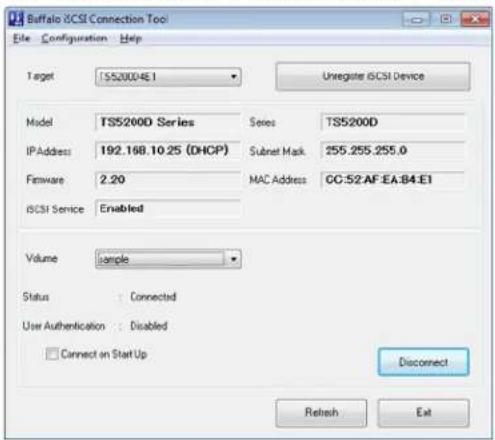
text_image
Buffalo iCSI Connection Tool File Configuration Help Target TS52004E1 Unregiate iCSI Device Model TS5200D Series IP Address 192.168.10.25 (DHCP) Firmware 2.20 iCSI Service Enabled Volume sample Status : Connected User Authentication : Disabled Connect on Start Up Disconnect Refresh Exit3 Click Yes.
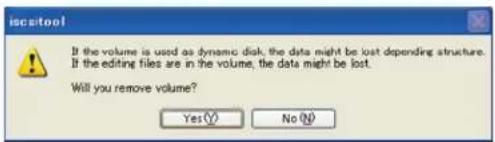
text_image
iscsitool If the volume is used as dynamic disk, the data might be lost depending structure. If the editing files are in the volume, the data might be lost. Will you remove volume? Yes(Y) No(N)4 Select the TeraStation to be disconnected from "Target", then click Unregister iSCSI Device.

text_image
Buffalo iCSI Connection Tool File Configuration Help Target TS52004E1 Unlegate iCSI Device Model TS5200D Series Senses TS5200D IP Address 192.168.10.25 (DHCP) Subnet Mask 255.255.255.0Note: When connecting to the TeraStation from multiple computers, follow the above procedure to remove the registration from each computer.
5 Disconnect the Ethernet cable of the TeraStation. The TeraStation is now disconnected.
Note: To disconnect multiple volumes in a single operation, follow the procedure below.
(1) Start the iSCSI Connection Tool.
(2) Click Setup - Remove the registered iSCSI Hard Disk.
(3) Select the IP address (port number) of each TeraStation that you want to disconnect and click Remove.
Creating and Expanding Volumes
Creating an iSCSI Volume
Up to 32 iSCSI volumes are supported. Each individual iSCSI volume can be connected to different computers (a single iSCSI volume cannot be connected to multiple computers).
Notes:
- When an iSCSI volume is deleted, all data contained in the iSCSI volume is erased. Before changing settings, back up any important data.
- Enable LVM (previous page) to delete or create volumes.
1 In Settings, click Drives.

2 Click iSCSI.

3 Click Create Volume.
4 Choose a name, description, volume, and size, then click OK.
5 Click Close.
Note: Before use, connect the new volume with an iSCSI connection tool and format the volume from within your OS.
Expanding the Volume Size
You can expand the size of a volume. If the iSCSI volume is on an LVM-enabled drive or array, you can also create or delete the volume.
1 In Settings, click Drives.

2 Choose iSCSI.

3 Click the volume you want to expand.
4 Enter a new size and click OK.
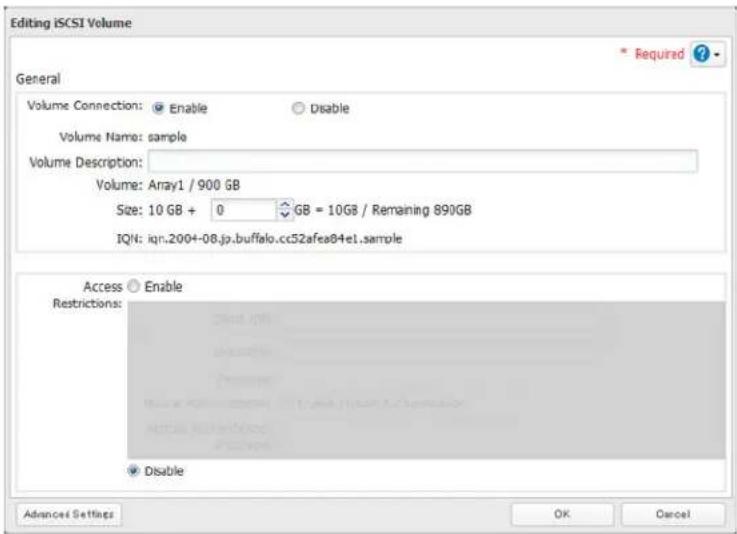
text_image
Editing iSCSI Volume General Volume Connection: Enable Disable Volume Name: sample Volume Description: Volume: Array1 / 900 GB Size: 10 GB + 0 GB = 10GB / Remaining 890GB IQN: iqn.2004-08.jx.buffalo.cc52afea84e1.sample Access Enable Restrictions: Disable Advanced Settings OK Cancel5 Click OK.
6 Click Close.
Disconnecting Volumes
From Settings, you may temporarily disconnect iSCSI volumes from any initiators and clients.

text_image
iSCSI Settings General Security Create Volume Delete Volume Enable Connection Disable Connection Refresh Volume List Connection Volume Name Volume IQN Access Restrictions Standing By sample Array1 ign.200+08.jp.buffalo.0056437786cc.sample - Select All Unselect All Show Connection History CloseNavigate to Drives - iSCSI. Select the iSCSI volume to disconnect and click Disable Connection. To reconnect the volume, click Enable Connection.

text_image
Editing iSCSI Volume General Volume Connection: Enable Disable Volume Name: sample Volume Description: Volume: Array1 / 900 GB Size: 10 GB + 0 GB = 10GB / Remaining 890GB IQN: iqn.2004-08.jp.buffalo.cc52afea84e1.sample Access Enable Restrictions: Disable Advanced Settings OK CancelSimilarly, you may connect or disconnect a volume from the editing page by enabling or disabling Volume Connection.
Setting Access Restrictions
A username and password can be set following the procedure below for the entire TeraStation iSCSI volume or for each volume. When the access restrictions are set, the system asks for entry of a username and password when the TeraStation is connected by the iSCSI Connection Tool.
Setting Access Restrictions for an Entire iSCSI Volume


1 In Settings, click Drives.
2 Click into iSCSI settings.
3 Click the Security tab.
4 Click Edit.
5 Enable "Access Restrictions", enter the username and password, and click OK.

text_image
ISCSI Access Restrictions * Required ? Access Restrictions: Disable Enable ✓ Mutual Authentication Username * Password * Mutual Authentication Password: OK CancelNote: To use mutual authentication with access restrictions, configure the settings:
- In the screen shown above, check "Mutual Authentication" and enter the password in the "Mutual Authentication Password" field.
- In the "User Authorization" window displayed when the TeraStation is connected, select "Enable Mutual Authentication" to connect. Enter the mutual authentication password.
- If using the iSCSI Initiator from Windows 8.1, Windows 8, Windows 7, Windows Vista, or Windows Server 2008, configure the CHAP login information to allow searching for or connecting to targets.
6 Click Close.
Setting Access Restrictions for Individual Volumes
1 In Settings, click Drives.

2 Click light of "iSCSI".

3 Click the volume where you want to set the access restrictions.
4 Enable "Access Restrictions", enter the username and password, then click OK.
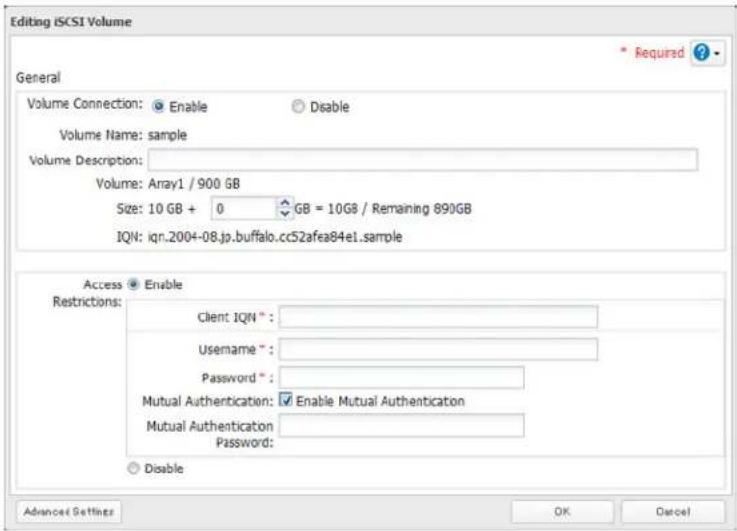
text_image
Editing iSCSI Volume General Volume Connection: Enable Disable Volume Name: sample Volume Description: Volume: Array1 / 900 GB Size: 10 GB + 0 GB = 10GB / Remaining 890GB IQN: iqn.2004-08.jp.buffalo.cc52afea84e1.sample Access Enable Restrictions: Client IQN*: Username*: Password*: Mutual Authentication: Enable Mutual Authentication Mutual Authentication Password: Disable Advanced Settings OK CancelNote: You have the option to use the client IQN for access restrictions.
5 Click Close.
Mutual Authentication Access Restrictions by Username and Password
To set access restrictions using mutual authentication in addition to regular access restrictions, configure the settings as shown below.
- In the screen above, check "Mutual Authentication" and enter the password in the "Mutual Authentication Password" field.
- In the "User Authorization" screen displayed when the TeraStation is connected, select "Enable Mutual Authentication".
- The entry screen for the mutual authentication password will be displayed again. Enter the password.
- If using the iSCSI Initiator included with Windows 8.1, Windows 8, Windows 7, Windows Vista, Windows Server 2012, or Windows Server 2008, set the CHAP login information for target searches and connections.
Hard Drive Replacement
Hard drives in the TeraStation show a blue status LED during normal operation. When a drive fails, its error LED will glow red.
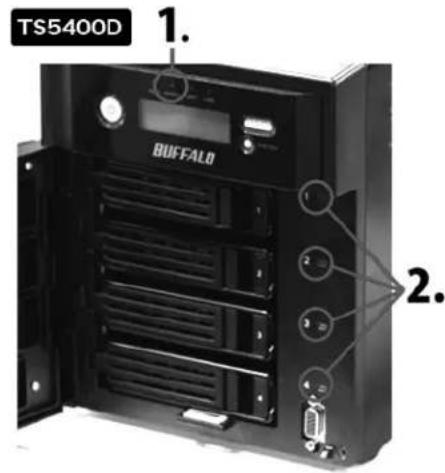
text_image
TS5400D 1. BUFFALO 2.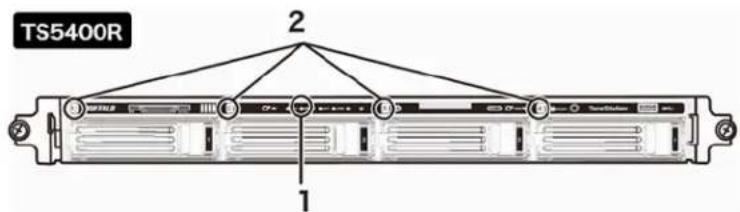
text_image
TS5400R 2 11. Error LED
Glows red if a drive has failed.
2. Status LEDs
The failed drive's status LED will be glowing a steady red. A drive with a red status LED is ready to hot-swap.
Notes:
- Do not unplug a drive whose status LED is green instead of red. Dismount it first or shut down the TeraStation before swapping a working drive. If you remove the drive without properly dismounting it, data may be lost or the TeraStation may malfunction.
- Use a Buffalo OP-HDS series drive of the same size or larger for the replacement drive. If a larger drive is used, the extra space will not be usable in a RAID array.
• To avoid damaging the TeraStation with static electricity, ground yourself by touching something made of metal before handling any sensitive electronic parts.
• After a drive is replaced, it takes about 30 minutes before normal file reading and writing are restored. Settings may not be accessible during this period.
- Do not change the order of the hard drives in the TeraStation. For example, pulling out drive 1 and replacing it with drive 2 may cause data to be corrupted or lost.
• If the LCD display does not change after a new drive is installed, click Rediscover Disk in Settings.
- If the message "HDx Error E22 HDx Can't Mount" remains on the LCD display after the RAID rebuild is finished, reboot your TeraStation.
Hard Drive Replacement Examples
Drive Replacement (using JBOD or a redundant RAID mode such as RAID 1, 5, or 6 with auto-shutdown disabled)
This section describes replacing a drive with the TeraStation on.
1 TS5800D,TS5600D,TS5400D,TS5200D: Open the front cover with the included key.
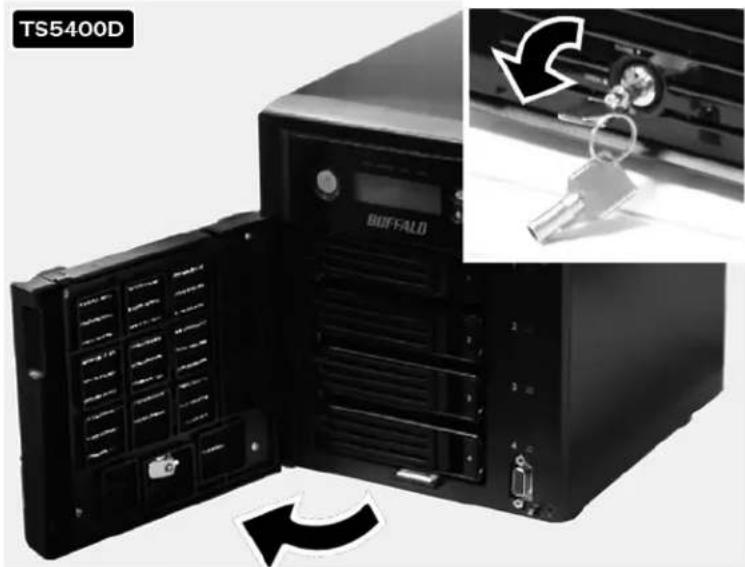
natural_image
Black-and-white photo of a Buffalo rack unit with open status panel and internal rack, showing a lock mechanism (no text or symbols visible)2 The failed drive's status LED will be glowing red. Push its unlock button and swing the lock mechanism out.
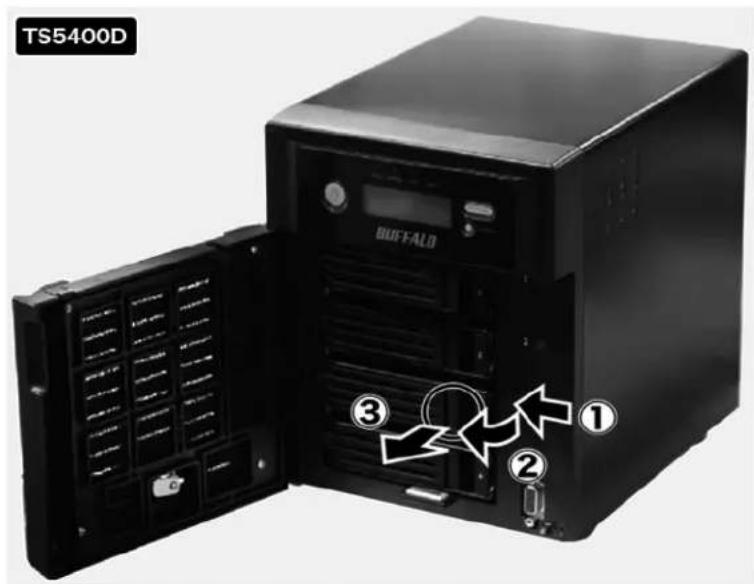
text_image
TS5400D BUFFALO ③ ② ①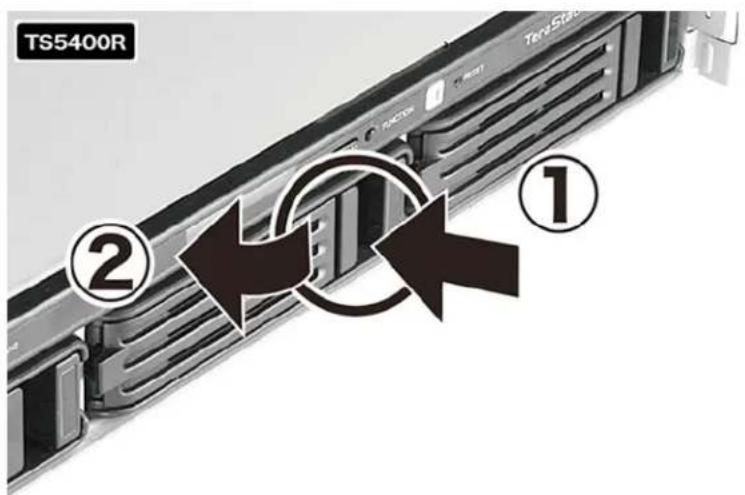
text_image
TS5400R ② ①Hard drives without red status LEDs lit are still on. Do not unplug or remove them.
3 Pull out the drive cartridge and remove it from the TeraStation.

natural_image
Black Buffalo 3D printer with open status panel and internal drive module (no visible text or symbols)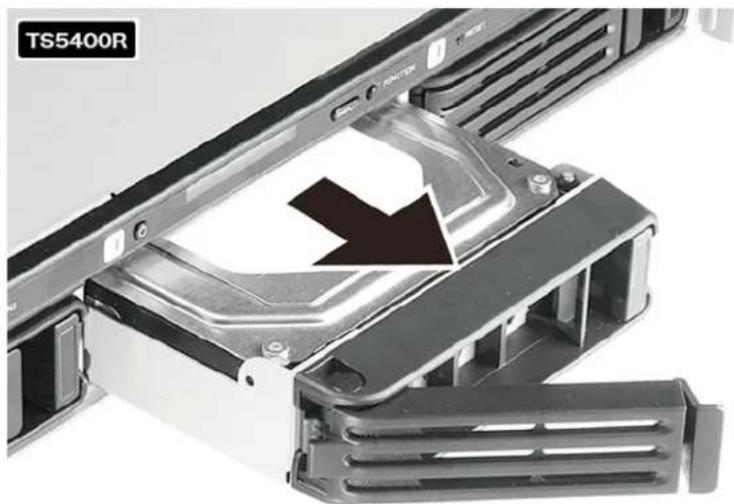
natural_image
Close-up of a mechanical device with a black arrow pointing to a component, no visible text or symbols on the main structure.4 Insert the new drive in the empty slot. Slide the drive in with the locking mechanism open.

natural_image
Black Buffalo 3D printer with open status panel and internal drive unit (no visible text or symbols)
natural_image
Close-up of a mechanical device component with a black arrow pointing to a curved internal structure (no text or symbols visible)5 Swing the lock back down until it clicks into place.
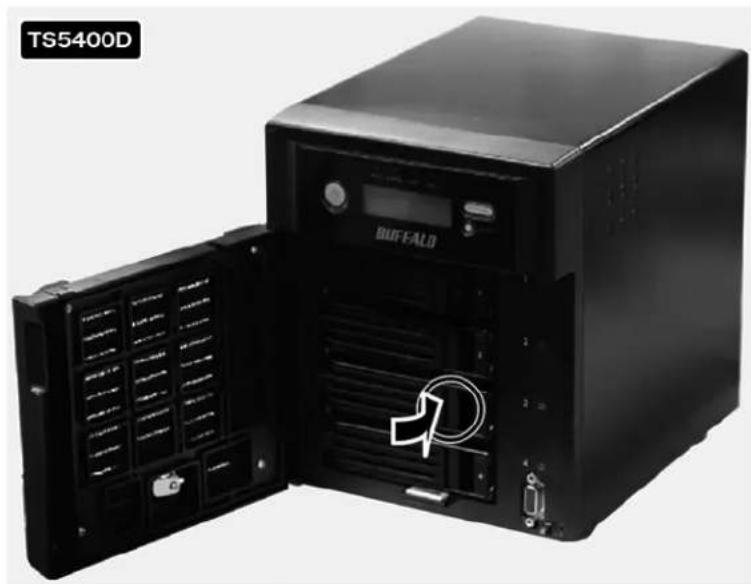
natural_image
Black Buffalo 3D server unit with open door, showing internal ventilation and ports (no readable text or symbols)
text_image
TS5400R TeraST6 FACTOR 1.8x10^3 2.0x10^36 When the replacement hard drive is recognized, the status LED will flash red and the message "Press FuncSW I31 New Disk x ready" will be displayed on the LCD panel.
7 Hold down the function button on the front of the TeraStation for 3 seconds until it beeps.
For RAID 1, 5, or 6:
The TeraStation will start rebuilding the RAID array automatically. After a few minutes, the message "RAID I18 ARRAY x Rebuilding" will be displayed until the array is rebuilt.
For RAID 51 or RAID 61:
The TeraStation will start rebuilding the RAID array automatically. After a few minutes, the message "RAID I18 ARRAY x Rebuilding" will be displayed until the array is rebuilt.
If more than 3 drives were replaced in a RAID 51 array, or if more than 4 drives were replaced in a RAID 61 array, wait 10 minutes after I18 appears and navigate to Drives - RAID in Settings. Select the RAID array and check if "Recover RAID Array" button is displayed. If so, select the drives that were not included in the RAID array and click Recover RAID Array.
For JBOD:
The drive will be formatted as an individual drive. Create a shared folder on the drive before use.
Drive Replacement (using a redundant RAID mode such as RAID 1, 5, or 6 with auto-shutdown enabled)
This section describes the process of replacing a drive while the TeraStation is off.
1 Open the front cover with the key.
2 Push the unlock button of the failed hard drive and swing the lock mechanism out.
3 Pull out the drive cartridge and remove it from the TeraStation.
4 Insert the new hard drive in the empty slot. Slide the drive in with the locking mechanism open. Swing the lock back down until it clicks into place.
5 Press the power button on the TeraStation.
6 When the replacement hard drive is recognized, the status LED will flash red and the message "Press FuncSW I31 New Disk x ready" will be displayed on the LCD panel.
7 Hold down the function button on the front of the TeraStation for 3 seconds until it beeps. The TeraStation will start rebuilding the RAID array automatically. It takes about 5 minutes before the message "RAID I18 ARRAYx Rebuilding" is displayed.
For RAID 51 or RAID 61:
The TeraStation will start rebuilding the RAID array automatically. After a few minutes, the message "RAID I18 ARRAY x Rebuilding" will be displayed until the array is rebuilt.
If more than 3 drives were replaced in a RAID 51 array, or if more than 4 drives were replaced in a RAID 61 array, wait 10 minutes after I18 appears and navigate to Drives - RAID in Settings. Select the RAID array and check if "Recover RAID Array" button is displayed. If so, select the drives that were not included in the RAID array and click Recover RAID Array.
Drive Replacement (RAID 0)
Drives in a RAID 0 array do not automatically turn off in the event of a malfunction. Before replacing the failed drive, either dismount the drive from Settings, or shut down the TeraStation.
This section describes the process of replacing a drive with the TeraStation on.
Note: If a hard drive malfunctions in RAID 0, all data on the RAID array will be lost. All of the settings for the shared folders (such as access restrictions) are erased after replacing a drive from a RAID 0 array.
1 Open the front cover with the included key.
2 In Settings, navigate to Drives - Drives.
3 Select the hard drive with the flashing status LED and click Dismount Disk.
Note: Once you reboot the TeraStation after the drive failed, the status LED will be back to normal flash (green). In such case, select "Unformatted" drive from the list and click Dismount Disk.
4 Enter the number that appears on the screen, then click OK.
5 The status LED will stop flashing and glow steadily.
6 Unlock the failed drive by pushing the unlock button and swinging the lock mechanism out.
7 Pull out the hard drive cartridge and remove it from the TeraStation.
8 Insert the new hard drive (sold separately) into the empty slot. Slide the drive in with the locking mechanism open. Swing the lock back down until it clicks into place.
9 When the replacement drive is recognized, the status LED will flash red.
Select the RAID array from Drives - RAID in Settings and click Delete RAID Array. In Drives - Drives, click Format Disk to format the new drive. In Drives - RAID, choose the type of RAID array desired. Enter the confirmation number and click OK. Create a shared folder before use.
Drive Replacement (using a redundant RAID mode such as RAID 1, 5, or 6 with a hot spare configured)
If your TeraStation's drives are in a redundant RAID mode, and you have a hot spare enabled, a malfunctioning drive in the array is replaced by the spare disk and the RAID array is rebuilt automatically. The status LED will continue to glow red for the failed drive even after the RAID array is rebuilt with the hot spare. This section describes the replacement process for a hard drive while the TeraStation is still on.
1 Open the front cover with the included key.
2 The failed drive's status LED will be glowing red. Push its unlock button and swing the lock mechanism out.
3 Pull out the drive cartridge and remove it from the TeraStation.
4 Insert the new drive in the empty slot. Slide the drive in with the locking mechanism open. Swing the lock back down until it clicks into place.
5 When the replacement drive is recognized, the status LED will flash red and the message "Press FuncSW I31 New Disk x ready" will be displayed on the LCD panel.
6 Hold down the function button on the front of the TeraStation for 3 seconds until it beeps. The replacement hard drive is automatically registered as a hot spare.
To use the replacement disk as a normal drive rather than a hot spare, navigate to Drives - RAID and click the RAID array, select the new drive, and click Set as a normal disk.
Replacing a Media Cartridge
Drives configured as media cartridges may be removed and moved to a different TeraStation for use. Before unplugging the drive, dismount it in Settings or shut down the TeraStation.
Chapter 5 Backup
Back Up from the TeraStation
You can back up TeraStation folders to:
• A different folder on the TeraStation
• Another LinkStation on the network
• Another TeraStation on the network
You can also configure backup jobs from Easy Admin.
Preparing a Backup Destination
First, configure a folder as a backup destination.
1 In Settings, navigate to Folder Setup.

Folder Setup
1 Folder(s)

2 Choose the folder to set as a backup destination.
3 Click Edit.
4 Check "Backup" from "LAN Protocol Support", then click OK.
Note: To configure a password, enter it in the "Remote Backup Password" field. Leave this field blank if you don't want a password. If the target device is configured with a backup password, you can easily find the backup target folder during configuration of the backup job by searching for the password.
Backing up to a LinkStation or TeraStation on another network when connected by a VPN
You can back up to a LinkStation or TeraStation on another network as long as the two networks are connected by a VPN. Follow this procedure to enter the IP address or hostname of the target LinkStation or TeraStation.
1 In Settings, click Backup.

Backup
2 Click - Right of "Backup".

Backup
Inactive

3 Click List of LinkStations and TeraStations.
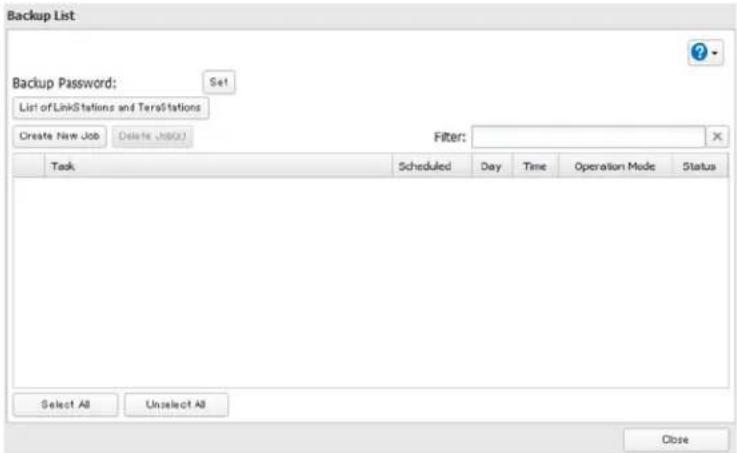
text_image
Backup List Backup Password: Set List of LinkStations and TeraStations Create New Job Delete User Filter: Task Scheduled Day Time Operation Mode Status Select A8 Unselect A8 Close4 Click Add, enter the IP address of the target LinkStation or TeraStation, and click Close.

text_image
List of LinkStations and TeraStations Detected LinkStations and TeraStations Refresh Filter: Name IP Address LS-WVL910 192.168.10.3 TS5200D4E1 192.168.10.12 Off-subnet Devices Add Delete Filter: IP Address or Hostname Select All Unselect All CloseIf your setup meets the requirements below, you don't have to configure these settings:
• The source and target TeraStations are on the same network.
- No backup password is set for the target TeraStation.
- No TeraStation from outside the subnet, or connected by a VPN, is used.
Notes:
- To back up data between LinkStations or TeraStations on a network using jumbo frames, make sure that both devices are configured to use identical (or similar) Ethernet frame sizes. If Ethernet frame sizes are significantly different, the backup job may not be properly performed. In such a case, select the default frame size (1518 bytes).
- You can also specify hostname by a fully qualified domain name (FQDN).
Configuring a Backup Job
1 In Settings, click Backup.

2 Click Right of "Backup".

Backup
Inactive

3 Click Create New Job.

text_image
Backup List Backup Password: Set List of LinkStations and TersStations Create New Job Delete Job(s) Filter: Task Scheduled Day Time Operation Mode Status Select All Unselect All CloseNote: Up to 8 backup jobs can be configured.
4 Select backup settings such as date and time to run.

text_image
Backup Job Settings Name *: Schedule: Not scheduled Date and Time: Sunday 0 Hour 0 Minutes Operation Mode: Normal backup Versions: 16 Unfunded Options: Create a subfolder for backup Create backup log file Encrypted data transfer Compress and transfer Ignore backup errors and continue backup job on schedule Do not back up recycle bin Overwrite unchanged files Add Delete Filter: Backup Source Folder Name Backup Target Folder Name Select All Unselect All LinkStation and TeraStation List Update Backup Target NAS List OK CancelThe following types of backup jobs may be selected:
| Type Files included | |
| Normal backup All files in the source will be backed up to the destination. | |
| Overwrite (incremental) | The first time the backup job runs like a normal backup. In subsequent backups, files added to the source as well as files deleted from the source are kept in the backup folder. |
| Overwrite (differential) | The first backup job runs like a normal backup. As each additional backup job runs, files are added to and deleted from the backup folder. The backup destination folder is always the same size as the backup source folder. |
| Management backup | Each time a backup is executed, management information is stored, and only files that have changed are copied or deleted. Data is retrieved from the previous backup file for files that were not changed. This is useful for making backups with limited space or for referencing status at a particular point in time (for use for data snapshot applications). The destination folder for a management backup should be a local folder on this TeraStation or on a USB drive attached to it. The target folder will be set to read-only. Do not use folders from drives formatted with FAT. |
5 Click Add.
6 Click Browse under "Backup Source Folder Name".
7 Select the shared folder that will be the backup source, then click OK.

text_image
Browse Folders Refresh share OK Cancel8 Click Browse under "Backup Target Folder Name".
9 Select the backup target and click OK.

text_image
Browse Folders Refresh TS5200D4E1@usbdisk1 TS5200D4E1@share OK CancelNote: If you will use the same folder for both Amazon S3 remote replication and as a backup target folder, create a new subfolder under "\wbfs\amazons3". Under "LAN Protocol Support", enable "Backup". Without these settings, that
shared folder will not be listed in the backup target folder list.
10 Click OK.
Tasks added to "Backup List" are displayed.
11 Click Close.
Replication
Replication copies all data from a share to a share on a different TeraStation. This is an easy way to configure a reliable system to provide data protection in the event your main TeraStation fails. To configure replication, connect an Ethernet cable to the LAN port of each TeraStation and follow the steps below.
Notes:
- For best results, use static IP addresses for both replication TeraStations (source and target).
- Replication source data is copied to the replication target folder with a differential overwrite. Any data that is not in the replication source will be overwritten.
1 In Settings, click Backup.

2 Click light of "Replication".

3 Click Edit.
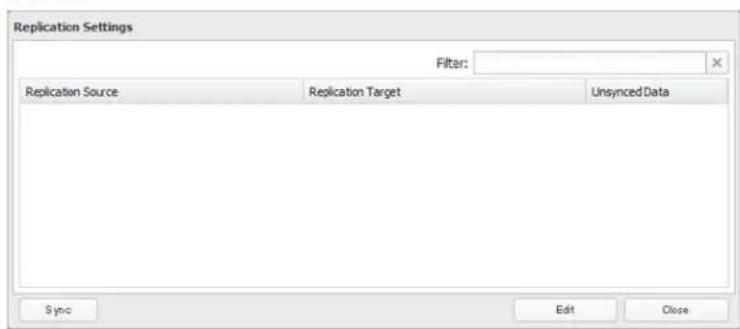
text_image
Replication Settings Filter: Replication Source Replication Target Unsynced Data Sync Edit CloseNote: Click Sync to synchronize the folders. All files from the source folder will be copied to the target folder.
4 Click Add.

text_image
Replication Settings Add Delete Filter: Replication Source Replication Target Select All Unselect All OK Cancel5 Click Browse under "Replication Source".
6 Select the shared folder that will be the replication source, then click OK.
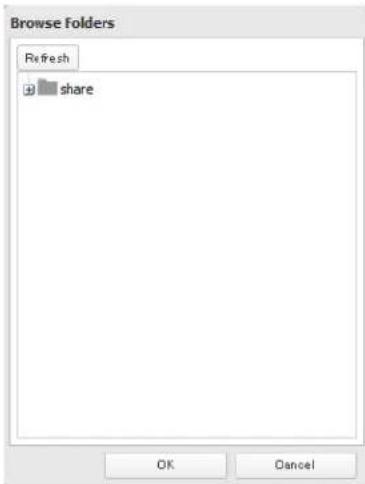
text_image
Browse Folders Refresh share OK Cancel7 Click Browse under "Replication Target".
8 Select the shared folder that will be the replication target, then click OK.
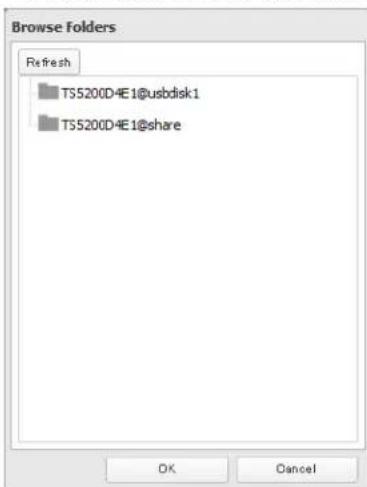
text_image
Browse Folders Refresh TS5200D4E1@usbdisk1 TS5200D4E1@share OK Cancel9 Click OK.
10 Click Yes.
Notes:
- A maximum of 64 shared folders can be configured for replication.
- Shared folders with a backup password set cannot be selected as replication targets.
- Replication can also be used to copy all data from a share to a share on an attached external drive. Format the drive with ext3 or XFS before using for replication. Drives with FAT32 partitions are not supported with replication.
- You can select subfolders as the replication source. Folders whose names contain more than 80 alphanumeric characters cannot be selected.
- Don't use the same TeraStation for both failover and replication, or replication and Time Machine.
- Don't configure replication from one source folder to multiple target folders.
- If replication is configured via LAN port 2 and DHCP is used, the TeraStations may not automatically recover from network disconnection. If this happens, restart the TeraStations. For best results, give both replication TeraStations static IP addresses.
Failover
With failover, two TeraStations are connected to the network for redundancy. If a problem occurs in the main TeraStation so that it can no longer be accessed, operation is automatically switched to the backup TeraStation.

flowchart
graph TD
    A["Main"] --> B["Data on both TeraStations stays up-to-date."]
    B --> C["Switches automatically if failure occurs."]
    C --> D["Backup"]
    D --> E["Laptop 1"]
    D --> F["Laptop 2"]
    D --> G["Laptop 3"]
    D --> H["Laptop 4"]
    D --> I["Laptop 5"]
    D --> J["Laptop 6"]
    D --> K["Laptop 7"]
    D --> L["Laptop 8"]
Notes:
- Use identical model and capacity TeraStations for the main TeraStation and backup TeraStation. If the capacity of the main TeraStation is larger than that of the backup TeraStation, a "Replication I33 ReplicateFailure" error will occur.
- All drive bays of a TeraStation should be occupied if it will be used for failover. Failover will not work if a drive is missing from any bay.
Ethernet Cable Connection Methods
Two different configurations for failover are available.
Connecting to the network at LAN port 1 and setting failover at LAN port 1
With the first setup, if the main TeraStation fails, the backup TeraStation will replace it completely, using the same name and IP address. The backup TeraStation is updated over normal network traffic.

flowchart
graph TD
    A["Network"] -->|LAN port 1| B["Main"]
    A -->|LAN port 1| C["Backup"]
Connecting to the network at LAN port 1 and setting failover at LAN port 2
With the second setup, the backup TeraStation and main TeraStation are connected by a second Ethernet cable connecting their LAN 2 ports. Updating is done over this dedicated network path, so updates are quicker and don't interfere with normal network traffic. With this setup, if the main TeraStation fails, the backup TeraStation will replace it by name, but will keep its original IP address.
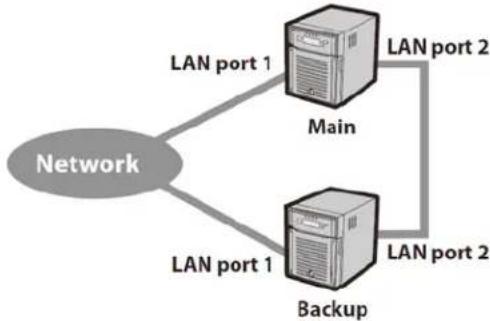
flowchart
graph TD
    A["Network"] -->|LAN port 1| B["Main"]
    A -->|LAN port 1| C["Backup"]
    B -->|LAN port 2| D["Main"]
    B -->|LAN port 2| E["Backup"]
Check if the main TeraStation is alive using LAN port 1 and back up data via LAN port 2
- Select LAN port 1 for the backup target and LAN port 2 for the backup LAN port.
- This is more efficient than the setup below and doesn't interfere with normal network traffic.
Check if the main TeraStation is alive and back up the data via LAN port 2
- Select LAN port 2 for the backup target and for the backup LAN port.
• This is fault-tolerant if network disconnections occur.
The main and backup TeraStations should be the same model and capacity. Use fixed IP addresses for both TeraStations. Because the IP address of the TeraStation designated as the backup cannot be changed, set its IP address before configuring failover.
Using with UPS
Once failover is configured, you cannot set up a UPS for the backup TeraStation. Configure your UPS before configuring failover. UPS recovery can be configured for both the main TeraStation and the backup TeraStation. However, the UPS settings of the main TeraStation will not be copied to the backup TeraStation.
If the backup TeraStation is configured to sync with the UPS connected to the main TeraStation, then if the main TeraStation shuts down, the backup TeraStation will no longer be able to detect if there was a power outage. In this case, move the UPS communication cable from the main TeraStation to the backup TeraStation and reconfigure the UPS link settings.
Configuring Failover
1 In Settings, click Backup.

2 Open Failover.

3 Click Edit Failover Status.
4 Select a TeraStation to be the target backup device.
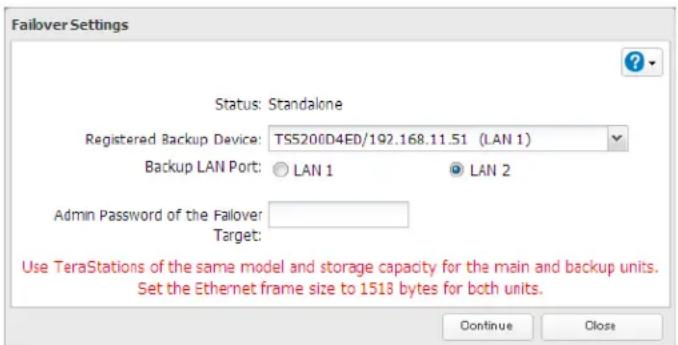
text_image
Failover Settings Status: Standalone Registered Backup Device: TSS200D4ED/192.168.11.51 (LAN 1) Backup LAN Port: LAN 1 LAN 2 Admin Password of the Failover: Target: Use TeraStations of the same model and storage capacity for the main and backup units. Set the Ethernet frame size to 1518 bytes for both units. Continue CloseNote: The target TeraStation's hostname, IP address, and LAN port number will be shown. The LAN port selected here will be used to check the main TeraStation for continued operation.
5 Enter the administrator password of the target backup device, then click Continue.
6 If the administrator password is correct, the backup TeraStation will beep.
7 To accept the settings from the main TeraStation, hold down the function button on the front of the backup TeraStation until it stops beeping.
Notes:
- If replication is configured for more than one folder, initialize the TeraStation before configuring failover.
- The main TeraStation cannot be used as the backup location for Time Machine.
- If email notification is enabled and failover occurs, navigate to Management - Email Notification - Edit in the main TeraStation's settings and click OK.
- Ethernet frame size settings for main and failover TeraStations should be 1518 bytes. To change the Ethernet frame size, navigate to Network - IP Address, click the LAN port and Edit, and change the Ethernet frame size to "1518" bytes.
- Files whose filenames contain more than 80 alphanumeric characters will not be backed up.
- If a "Replication I33 ReplicateFailure" error appears on the LCD display, navigate to Backup - Replication and click Sync.
- Don't use the same TeraStation for both failover and replication, or failover and Time Machine.
- If the "Approve/Deny" window is displayed repeatedly or failover does not start, shut down both the main and backup TeraStations. Turn on the main TeraStation first and let it boot up. Then power up the backup TeraStation. Reconfigure failover.
Maintenance Mode
If failover is configured, change to maintenance mode temporarily before turning off the TeraStation or updating the firmware. Maintenance mode can be enabled and disabled at Backup - Failover in the main TeraStation's Settings. You have an option to disable the maintenance mode with the function button. Hold down the function button on the main TeraStation.
Service IP Address
The "Service IP Address" will be the new address of the backup TeraStation when it takes over operation from the main TeraStation. If no service IP address is set, or a fixed IP address is set, an attempt is made to inherit the IP address from the main TeraStation.
Network Problems
If network problems occur, the following messages may appear on the TeraStation's LCD display even though neither TeraStation has failed. If this happens, disable and then reset failover.
- "FailOver I49 LostMainTarget" - This message (I49) is displayed on the LCD panel of the backup TeraStation when operation switches from the main TeraStation to the backup TeraStation.
- "E27: LostBackupTarget" - This message (E27) is displayed on the LCD panel of the main TeraStation if it is no longer able to detect the backup TeraStation on the network.
Switching to the Backup Unit
If "Switch to backup unit manually" is selected in Settings, the backup TeraStation will not replace the main TeraStation automatically. If the main TeraStation fails, there are two ways to have the backup unit replace the main unit on the network:
- In Settings, click on the "Set as Main Unit" button.
- Or, press and hold down the function button on the backup TeraStation.
Backing Up Your Mac with Time Machine
Time Machine is a backup program included with OS X 10.5 or later. Configure your TeraStation as shown to use Time Machine.
1 In Settings, move the AFP switch to the position to enable AFP.

2 Choose Folder Setup.

3 Choose a shared folder as your backup destination for Time Machine.
4 Click Edit.
5 Select AFP (Mac) from LAN Protocol Support and click OK.
6 Click OK.
7 Click Close.
8 Click Backup.

9 Click the 📋 the right of "Time Machine".

10 Click Edit.
11 Click Browse.
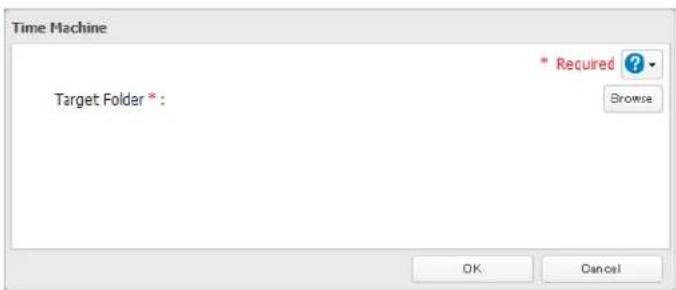
text_image
Time Machine * Required ? Target Folder * : Browse OK Cancel12 Select the shared folder that you set in the previous step, then click OK.

text_image
Browse Folders Refresh + share OK Cancel13 Click OK.
14 Click OK.
15 Move the Time Machine switch to the position to enable Time Machine.

16 On the Mac, open System Preferences.
17 Click Time Machine.

text_image
System Preferences Show All Personal Appearance Desktop & Screen Saver Dock Export & Spaces International Security Spotlight Hardware Bluetooth CDs & DVDs Displays Energy Saver Keyboard & Mouse Trackpad Print & Fax Sound Internet & Network MobileMe Network QuickTime Sharing System Accounts Date & Time Parental Controls Software Update Speech Startup Disk Time Machine Universal Access Other Control Center Disk FilmMac WMV Google Desktop Crowd Line E Audio- MIDI Devices MacFUSE PlugSuck18 Click Choose Backup Disk.

text_image
Time Machine Show All Q Choose Backup Disk... Time Machine keeps copies of everything on your Mac, including system files, applications, and settings, as well as your music, pictures, and other important files. Since Time Machine keeps daily backups, you can revisit your Mac as it appeared in the past. Show Time Machine status in the menu bar Click the lock to prevent further changes.19 Select the TeraStation, then click Use for Backup.
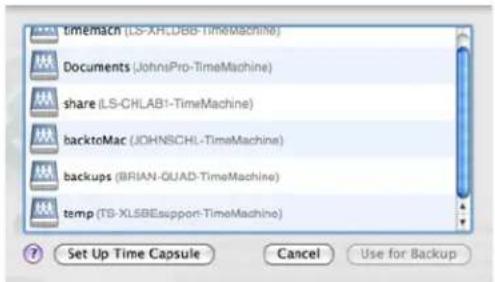
text_image
timemachn (LS-XH.DBB-TimeMachine) Documents (JohnsPro-TimeMachine) share (LS-CHLAB1-TimeMachine) backtoMac (JDKNSCHL-TimeMachine) backups (BRIAN-GUAD-TimeMachine) temp (TS-XLSBEsupport-TimeMachine)20 Enter a username and password with the rights to access the shared folder of the TeraStation, then click Connect.
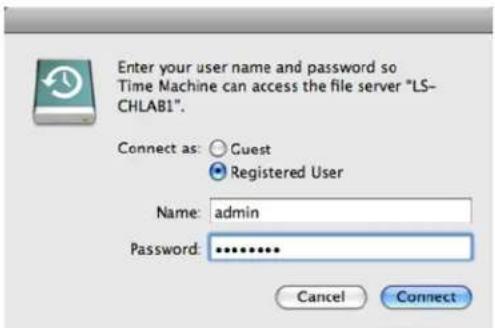
text_image
Enter your user name and password so Time Machine can access the file server "LS- CHLAB1". Connect as: Guest Registered User Name: admin Password: ******** Cancel ConnectNote: If access restrictions are not configured on the target share, log in with the administrator account. The default username and password for the administrator account are "admin" and "password". If access restrictions are
configured, log in with an account with write privileges.
21 Time Machine will count down from 120 seconds, and the backup will begin.
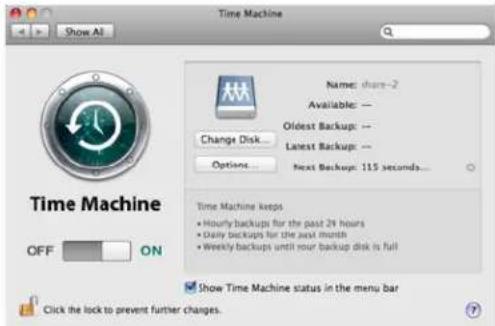
text_image
Time Machine Show All Name: share-2 Available: — Oldest Backup: — Latest Backup: — Next Backup: 115 seconds... Change Disk... Options... Time Machine keeps • Hourly backups for the past 24 hours • Daily backups for the past months • Weekly backups until your backup disk is full Show Time Machine status in the menu bar OFF ON Click the lock to prevent further changes.Copying from a USB Device
Use Direct Copy to copy from a USB device directly to the TeraStation.
Note: To use Direct Copy, connect only one USB device at a time.
These devices are supported:
• USB mass storage devices
- Card readers (except for card readers that can recognize two or more memory cards)
• Digital cameras and other PTP devices
- UPS devices that are specifically indicated as compatible
- USB printers
These devices are not supported:
- USB hubs
• Mice - Keyboards
1 In Settings, move the Direct Copy switch to the position to enable Direct Copy.

2 Connect the USB device. The function button will begin to flash.
Note: Devices that don't trigger the function button to flash are not supported.
3 You have 60 seconds to hold down the function button for 3 seconds. This will copy all files from the USB device to the Direct Copy folder of the TeraStation.
Notes:
- While the function button is flashing, press and release it quickly to cancel Direct Copy.
For digital cameras that are not in the USB mass storage class, all files in the digital camera are copied.
• To change the Direct Copy target folder, navigate to Backup - Direct Copy - Edit, select a new folder, and click OK.

text_image
Direct Copy Target: share Edit Close4 When the copy operation is finished, the access LED of the USB device will stop flashing. Hold down the function button for 6 seconds to dismount the device. The blue LED will go out and the and the device may be removed safely.
Amazon S3
Amazon S3 (Amazon Simple Storage Service) is a fee-based online storage service provided by Amazon. Follow the steps below to configure your TeraStation for use with Amazon S3:
1 Create an account at the Amazon S3 website: http://aws.amazon.com/s3
2 In Settings, click Web Services.

3 Click the 📋 the right of "Amazon S3".

4 Click Edit.
5 Click Browse.
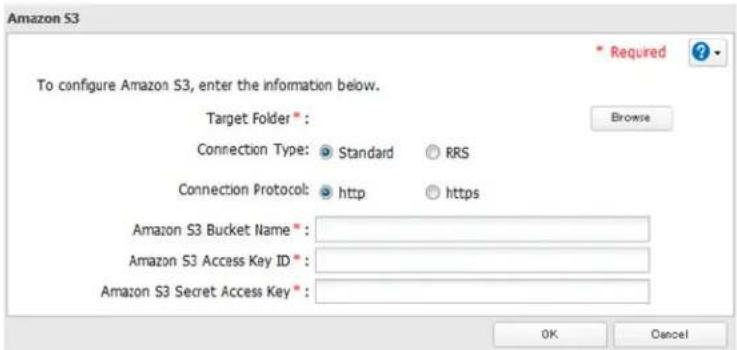
text_image
Amazon S3 To configure Amazon S3, enter the information below. Target Folder * Connection Type: Standard RRS Connection Protocol: http https Amazon S3 Bucket Name * Amazon S3 Access Key ID * Amazon S3 Secret Access Key * * Required Browse OK Cancel6 Select the shared folder for remote replication, then click OK.
Notes:
- This folder is used by Amazon S3. Files are not added to the selected folder and the amount of used space does not increase.
- If no folders are detected, disable Amazon S3 and WebAccess Remote (if enabled). Restart the TeraStation, then
reconfigure Amazon S3 starting from step 1 above.
7 Enter the bucket name, access key ID, and secret access key of the Amazon S3 bucket, then click OK.
8 Click Close.
9 Move the Amazon S3 switch to the position to enable Amazon S3.
Notes:
- Enter the path from the "Target Folder" field in a browser window to access the files saved to Amazon S3.
- To use after the network was temporarily disconnected, click Remount.
- If a file is added to the Amazon S3 bucket from a folder other than the TeraStation's Amazon S3 remote replication folder, it may take up to an hour for the file to appear in the TeraStation's Amazon S3 remote replication folder. However, when a file is added to the TeraStation's Amazon S3 remote replication folder, it immediately appears in the bucket.
- Do not copy more than 10,000 files at once to the Amazon S3 replication folder. If copying fails, try again with fewer files.
Chapter 6 Remote Access
WebAccess
WebAccess is a software program for accessing the files in the shared folder of your TeraStation from your computer, smartphone, or tablet through the Internet.
Notes:
- Be careful when configuring WebAccess. Certain settings can make the files in the shared folder available to anyone on the Internet, without any access restrictions.
- You can also configure WebAccess from Easy Admin.
- Use compatibility mode to use WebAccess with Windows 8.1 and Windows 8.
Configuration
1 Navigate to File Sharing - WebAccess.

2 Click Edit.

text_image
WebAccess Settings HTTPS/SSL Encryption: Disabled BuffaloNAS.com Enabled Registration: Disabled Other DNS Service Hostname: Automatic Router Setup Enabled (UPnP): Disabled NAS Internal Port: 9000 Exclusive Session: Disabled Session Timeout: 30 minutes WebAccess URL: - Edit Close3 Configure the desired settings, then click OK.

text_image
WebAccess Settings HTTPS/SSL Encryption: Enable Disable BuffaloNAS.com Registration: Enable BuffaloNAS.com Name*: samplename BuffaloNAS.com Key*: U8lnw2TrgNfk5zlgZ664 Random Generation Disable Automatic Router Setup (UPnP): Enable Disable NAS Internal Port*: 9000 Exclusive Session: Enable Disable Session Timeout*: 30 minutes Unlimited Local LAN Only OK Cancel * Required ?- You may use the default BuffaloNAS.com registration, or disable to use a different DNS server.
- Choose a "BuffaloNAS.com name" and "BuffaloNAS.com key" for your WebAccess account. Names and keys may use 3 to 20 alphanumeric characters, underscores (_), and hyphens (-).
- If "Exclusive Session" is enabled, users cannot log multiple computers into WebAccess. Only the last login will be active.
- Enter a time in minutes (1 to 120, or "Unlimited") before inactive users are logged out of WebAccess.
4 Click OK.
5 Move the WebAccess switch to the position to enable WebAccess.
6 Go to Folder Setup.

7 Select a shared folder to publish.
Notes:
- For best results, create a new dedicated share for WebAccess.
- When accessing shared folders through WebAccess from a remote location, a username and password may be required for certain operations. For best results, create a user account with permissions on the WebAccess share before using WebAccess.
8 Click Edit.
9 Navigate to File Sharing - Folder Setup and choose the folder you will use for WebAccess. Enable "WebAccess LAN protocol support".
Notes:
• The following levels of security are available:
"Allow Anonymous" - Anyone can access (view) shared folders.
"Allow All Groups and Users" - All groups and users registered on the LinkStation or TeraStation can use WebAccess.
"Use Inherited Folder Permissions" - Users and groups have the same access permissions with WebAccess that they do locally. If access restrictions are not set for the shared folder, then this option will not be shown.
- When a user or group can access a folder through WebAccess depends on a combination of WebAccess settings and the shared folder's settings.
| Folder Setup | WebAccess Public Mode | Allow Anonymous | Allow All Groups and Users | Use Inherited Folder Permissions | |||
| Folder Attribute | Read & Write | Read Only | Read & Write | Read Only | Read & Write | Read Only | |
| WebAccess Account | Not logged in R R ---- | ||||||
| User with read & write access R/W | R R/W | R R/W R | |||||
| User with read-only access R/W R | R/W R R | R | |||||
| Group with read & write access R/W | R W R R/W | R R/R W R | |||||
| Group with read-only access R/W | R R/W R | R R | |||||
| Other users R/W R R/W R -- | |||||||
R: Read only, R/W: Read and write, -: No access
10 There are many ways to access WebAccess folders depending on your device.
- From a computer, supported browsers include Internet Explorer 8 and later, Firefox 3.6 and later, Safari 4 and later.
Instructions: http://buffalonas.com/manual/en/
- Use compatibility mode to use WebAccess with Windows 8.1 and Windows 8 in desktop mode.
- To access from an iOS device, install the "WebAccess i" application from the App Store.
Instructions: http://buffalonas.com/manual/i/en/
- To access from an Android device, install the "WebAccess A" application from Google Play.
Instructions: http://buffalonas.com/manual/a/en/
- To access from a Windows Phone, install "WebAccess" from the Windows Phone Store.
Instructions: http://buffalonas.com/manual/wp/en/
WebAccess Remote
WebAccess Remote lets open a shared folder on a remote TeraStation or LinkStation from Explorer, My Computer, or other file manager.
To use WebAccess Remote, the following conditions must be satisfied.
- You have TeraStations or LinkStations in two different locations, such as at home and at a remote location.
- WebAccess is enabled for both devices.
1 In Settings, click Web Services.

Web Services
2 Click Light of "WebAccess Remote".
3 Click Edit.
4 From Target Folder, select the shared folder that will be connected.
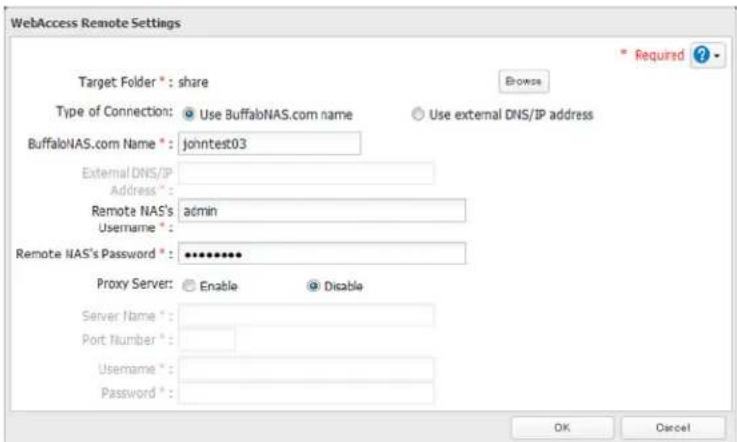
text_image
WebAccess Remote Settings Target Folder * : share Browse Type of Connection: Use BuffaloNAS.com name Use external DNS/IP address BuffaloNAS.com Name * : jointtest03 External DNS/IP Address * Remote NAS's admin Username * Remote NAS's Password * ****** Proxy Server: Enable Disable Server Name * Port Number * Username * Password * OK Cancel * Required ?Note: The selected folder is used internally by "WebAccess Remote". Files are not added to this folder and the amount of used space does not increase.
5 You may choose to enter a BuffaloNAS.com name or an external DNS/IP address. If "Use external DNS/IP address" is selected, enter either the IP address of your DNS server, or the global IP address of the remote TeraStation's WebAccess.
Note: Colons (:) are not supported in the external DNS/IP address field. If your DNS or IP address includes a colon, use your BuffaloNAS.com name instead.
6 Enter the remote TeraStation's WebAccess username and password.
7 Click OK.
8 Move the WebAccess Remote switch to the position to enable WebAccess Remote.
9 You can directly access the shared folder in the remote TeraStation by entering the path displayed in Target Folder into the address box in Explorer, My Computer, or other file manager.
Notes:
- If using after the network has been temporarily disconnected, click Remount.
- Do not copy more than 10,000 files at once to the WebAccess Remote target folder. If copying fails, try again with fewer files.
FTP
By default, the TeraStation's shares are only accessible by users connected to the same network or router as the TeraStation. The optional FTP server allows users outside the local network to access the TeraStation.
Note: FTP is intended for users who already have FTP client software and have experience with it.
1 In Settings, move the FTP switch to the position to enable FTP.

2 Open Folder Setup.

3 Choose a folder to enable remote FTP access on.
4 Click Edit.
5 Select read-only or read & write for the shared folder's attribute, check "FTP" under "LAN Protocol Support", and click OK.
Accessing the TeraStation with an FTP client:
- To access the TeraStation via FTP, configure your FTP client software with the following settings:
Hostname: IP address of the TeraStation
Username: The TeraStation's username
Password: The TeraStation's password
Port: 21
- Shared folders connected by FTP are available from the "/mnt" directory. The default locations are:
For RAID 0, RAID 5, or RAID 1:
/mnt/array1/share
/mnt/usbdisk1
/mnt/usbdisk2
For RAID 1 (two arrays):
/mnt/array1/share
/mnt/array2/share2
/mnt/usbdisk1
/mnt/usbdisk2
For JBOD:
/mnt/disk1/share
/mnt/disk2/share2
/mnt/disk3/share3
/mnt/disk4/share4
/mnt/usbdisk1
/mnt/usbdisk2
Accessing the TeraStation with an Anonymous user:
- To allow anonymous access to your FTP share, disable access restrictions.
- To access the TeraStation via anonymous FTP, configure your FTP client software with the following settings:
Hostname: IP address of the TeraStation
Username: anonymous
Password: any character string
Port: 21
Notes:
- If the TeraStation joins a domain, anonymous users cannot access it.
- If a file was created or copied by AFP, you may not be able to delete it using an FTP connection. If this occurs, use an SMB or AFP connection instead to delete the file.
- For FTP connections, make sure that the total filename including directory path is 250 single-byte characters or less.
Chapter 7 BitTorrent
BitTorrent is a protocol for distributing large amounts of data efficiently. The information in this chapter is for users who are familiar with BitTorrent.
Note: Use compatibility mode to use the download manager with Windows 8.1 and Windows 8.
Configuration
1 In Settings, click Applications.

Applications
2 Click the ☐ the right of "BitTorrent".

BitTorrent


3 Click Edit.
4 Click Browse.
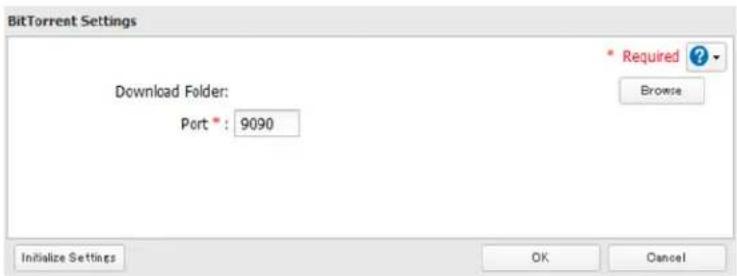
text_image
BitTorrent Settings Download Folder: Port * : 9090 * Required ? Browse Initialize Settings OK Cancel5 Select the shared folder where the downloaded file will be saved, then click OK.

text_image
Browse Folders Refresh + share OK Cancel6 Click OK.
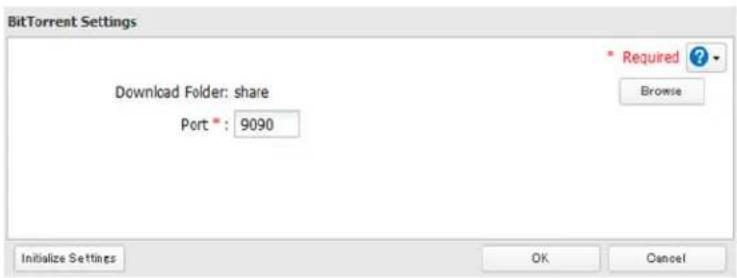
text_image
BitTorrent Settings Download Folder: share Port * : 9090 * Required ? Browse Initialize Settings OK Cancel7 Move the BitTorrent switch to the position to enable BitTorrent.

8 Click the ☐ the right of "BitTorrent".
9 Click Open Download Manager. The default username is "admin" and the default password is blank (no password).

text_image
BitTorrent Settings Download Folder: share Port: 9090 Open Download Manager Initialize Settings Edit Close10 The download manager will open.
Chapter 8 Multimedia
DLNA
DLNA is a set of guidelines for sharing digital media. The TeraStation includes a DLNA server compliant with the DLNA guidelines. The movies, photos, and music saved on this product can be played back on DLNA-compliant TVs, stereo equipment, game consoles, and other devices within the network.

flowchart
graph TD
    A["Computer"] --> B["TeraStation LinkStation"]
    C["Camera"] --> B
    B --> D["Wireless Link"]
    D --> E["Server"]
    D --> F["Block Box"]
    D --> G["Computer"]
Configuration
1 Navigate to File Sharing - Folder Setup.

Folder Setup
1 Folder(s)

2 Select the folder that you want to share with media players and other DLNA-compatible devices.
3 Click Edit.
4 Enable "DLNA" under "LAN Protocol Support", then click OK.
5 Click Services.

Services
6 Move the DLNA switch to the position to enable DLNA.

DLNA Server


7 Click the the right of "DLNA Server".
8 Click Edit.
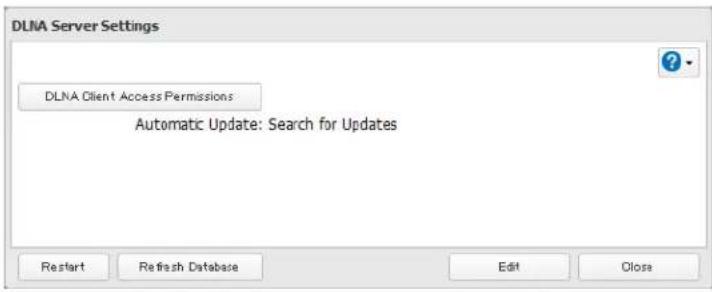
text_image
DLNA Server Settings DLNA Client Access Permissions Automatic Update: Search for Updates Restart Refresh Database Edit Close9 Select an interval for DLNA server database updates and click OK.

text_image
DLIA Server Settings DLNA Client Access Permissions Automatic Update: ● Search for Updates ○ Specify Update Interval Initialization of the database: ● Keep Current List ○ Initialize OK CancelPlaying Files
To play back content from a DLNA-compatible device:
1 Connect the DLNA-compatible device to the same network as the TeraStation and turn it on.
2 Select the TeraStation in the software of the DLNA-compatible device.
3 Select the content to be played back.
Connected DLNA-compatible Devices
Follow the procedure below to view the DLNA-compatible devices connected to your TeraStation.
1 In Settings, click Services.

Services
2 Click the the right of "DLNA Server".

DLNA Server


3 Click DLNA Client Access Permissions.
text_image
DLNA Server Settings DLNA Client Access Permissions Automatic Update: Search for Updates Restart Refresh Database Edit Close4 A list of the MAC addresses, IP addresses, and device names of the DLNA-compatible devices connected to the same network as the TeraStation is displayed. If your device is not listed, click Refresh Database.

text_image
Enable DLNA Clients Refresh Database MAC Address IP Address Device Name Allow 68:A3:C4:0C:E3:2C 192.168.1D.1G Windows 7 OK CancelStreaming to DLNA-compatible Devices
When new movies, photos, and music files are added to the TeraStation's DLNA folder, the database must be updated before the new file can be streamed. By default, the database is updated at startup and again every 60 minutes. You can change this interval or update the database manually.
1 In Settings, click Services.
2 Click the icon to the right of "DLNA Server", then click Edit.

3 You may change the update interval, or select Refresh Database to update the database immediately.
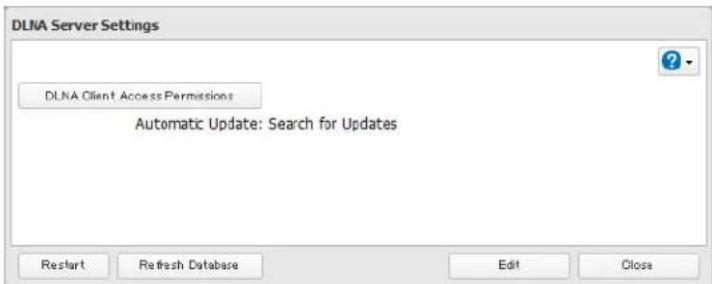
text_image
DLNA Server Settings DLNA Client Access Permissions Automatic Update: Search for Updates Restart Refresh Database Edit CloseDisabling Playback from Specific Devices
You may block specific DLNA devices from playing back media content.
1 In Settings, click Services.

2 Click the 📋 the right of "DLNA Server".

3 Click DLNA Client Access Permissions.

text_image
DLNA Server Settings DLNA Client Access Permissions Automatic Update: Search for Updates Restart Refresh Database Edit Close4 Uncheck the devices you do not want to allow to play media and click OK.

text_image
Enable DLNA Clients Refresh Database MAC Address IP Address Device Name Allow 68:A3:C4:0C:E3:2C 192,168,10,16 Windows 7 OK CancelSupported File Types
The TeraStation supports DLNA streaming of files with the extensions below.
| Types File Extensions | |
| Video files | .avi, .divx, .asf, .mpg, .mpe, .m1v, .vob, .mts, .m2ts, .m2t, .mpeg, .mpeg2, .vdr, .spts, .tp, .ts, .3gp, .mov, .m4v, .wmv, .dvr-ms, .xvid, .mp4, .m4v |
| Picture files .jpg, .jpeg, .gif, .png, .tif, .tiff, .yuv, .bmp | |
| Music files | .mp3, .mpa, .wma, .aac, .apl, .ac3, .lpcm, .pcm, .wav, .m3u, .m4a, .mp4, .3gp, .m4b, .aif, .aiff, .flac, .ogg, .mp2, .mp1, .mp4 |
iTunes Server
If iTunes server is enabled, computers on your network with iTunes can play music files stored on the TeraStation and transfer them to iPod, iPhone, and iPad devices. iTunes server supports playback from up to five computers.
Configuration
1 In Settings, click Services.

2 Click the 📋 the right of "iTunes Server".

3 Click Edit.
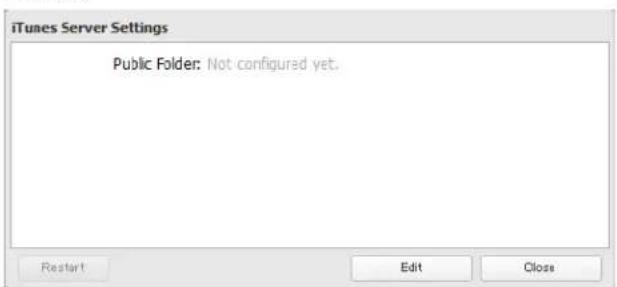
text_image
iTunes Server Settings Public Folder: Not configured yet. Restart Edit Close4 Click Browse.

text_image
iTunes Server Settings * Recruled ? Public Folder *: Browse OK Cancel5 Select the shared folder that you want to make available to iTunes, then click OK.
text_image
Browse Folders Refresh + share OK Cancel6 Click OK, then OK again.
7 Move the iTunes server switch to the position.
iTunes Server
Squeezebox Server
Squeezebox is a network music player by Logitech that can play back music stored on your network using your wired or wireless LAN without a computer. Squeezebox supports mp3, flac, ogg, he-aac v2 and wma.
Configuration
1 In Settings, click Services.

2 Move the Squeezebox server switch to the position to enable Squeezebox server.

3 Click Light of "Squeezebox Server".
4 Click Edit.
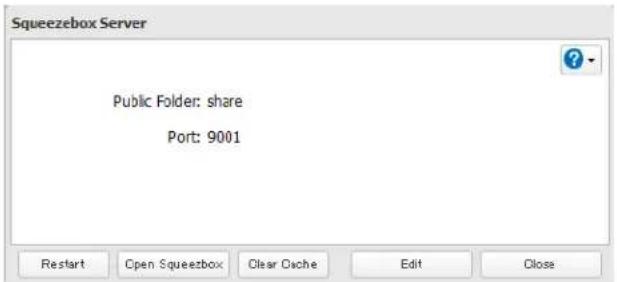
text_image
Squeezebox Server Public Folder: share Port: 9001 Restart Open Squeezebox Clear Cache Edit Close5 Click Browse.

text_image
Squeezebox Server Settings Public Folder * : share Port * : 9001 * Recured ? Browse OK Cancel6 Select the shared folder that you want to make available to Squeezebox, then click OK.
text_image
Browse Folders Refresh + share OK Cancel7 Enter port number (9001 is recommended), then click OK.
8 Click OK.
9 Click Open Squeezebox.

text_image
Squeezebox Server Public Folder: share Port: 9001 Restart Open Squeezebox Clear Cache Edit CloseThe Squeezebox's settings will open.
Chapter 9 Surveillance Server
The TeraStation supports streaming video from RTSP (Real Time Streaming Protocol) network cameras.

flowchart
graph TD
    A["RTSP Network Camera"] --> B["Hub"]
    B --> C["Host"]
    B --> D["PC"]
    B --> E["Recovery"]
    B --> F["Playback"]
    B --> G["Server"]
Getting Started
The following items are required:
• TeraStation with surveillance camera support
• Supported network camera
- Ethernet cable
- Ethernet hub
- Computer
Supported Operation Systems: Windows 8.1 (64-bit or 32-bit), Windows 8 (64-bit or 32-bit), Windows 7 (64-bit or 32-bit), Windows Vista (64-bit or 32-bit), Windows XP SP 3, Windows Server 2008 SP 2 (64-bit or 32-bit), Windows Server 2003 SP 2, OS X 10.5.8 or later
CPU: Intel Dual-core 2.20 GHz or faster
Hard drive: 10 GB or more of available space
RAM: 2 GB or more
Live Viewer Requirements:
Supported OSs: Windows 8.1 (64-bit or 32-bit), Windows 8 (64-bit or 32-bit), Windows 7 (64-bit or 32-bit), Windows Vista (64-bit or 32-bit), Windows XP SP 3
CPU: Quad-core 2.33 GHz or faster
Hard drive: 10 GB or more of available space
RAM: 2 GB or more
Note: Surveillance cameras cannot be used if failover is configured. Also, failover cannot be used if surveillance camera functionality is enabled. They're just not compatible.
Installing Client Tools
Download the client tools below from www.buffalotech.com and install them on your computer.
Camera Policies - Registers that a network camera is connected and ready to record.
Live Viewer - Lets you view video as it is being recorded. With some network cameras, pan, tilt, zoom, focus, and other remote operations may be unavailable.
Data Service Policies - Used to move, back up, and delete recorded video data.
Vault Admin - Used to perform license registration, self-diagnosis, check the remaining disk space, and other operations.
Surveillance Video Manager - Used to view recorded video data, perform searches, export, and other operations.
Network Activity - Displays the operating status of the TeraStation.
Notes:
• Install after logging into your computer using an account with administrator rights.
• Install another media player to play recorded videos if the version of Client Tools is 5.7.3.2 or later.
- Install VideoLAN VLC media player 1.11\~1.13, or Apple QuickTime 7 or later if the version of Client Tools is older than 5.6.19.3. VLC media player 2.0.x may not work with some network cameras. Using VLC media player is recommended if your network camera records MPEG-4 format.
- If VLC media player is installed, use the default installation location (C:\Program Files (x86)\VideoLAN\VLC in Windows 7 64-bit or the Application folder in Mac OS).
- If surveillance cameras or client tools installed under C:\Program Files (x86)\BUFFALO\SurveillanceServer\Bin) are blocked due to the OS firewall, refer to the OS help for instructions about how to disable the firewall.
- Install Client Tools on one or more computers connected to the same network as the network camera(s) and the TeraStation. Surveillance camera settings are shared for all cameras on the network.
Connecting Devices to the Network
Connect the following devices to the network.
• A TeraStation that supports surveillance cameras
• A compatible network camera
- A computer with the above client tools installed
Notes:
- Connect all devices on the same network subnet.
- Set the TeraStation's and network camera's time settings to the correct time. By default, the TeraStation adjusts its clock automatically by using a default NTP server. This NTP Server belongs to Internet Multi Feed Inc. For more information, visit www.jst.mfeed.ad.jp. You can select a different NTP Server by clicking Name/Time/Language on the Management screen. The Name/Time/Language screen opens.
- Click Time.
- Click Edit.
- Uncheck "Use Default NTP Server" and enter a new NTP IP address.
- Click OK.
If NTP is not used, disable it and enter the time and date manually. Click Use Local Date/Time to import the time and date from your computer.
In certain cases, the DNS server address must be set in order to access the NTP server.
- Use the dedicated utility provided with the network camera or other program to confirm that the network camera operates properly.
Enabling Surveillance Cameras
Enable surveillance cameras in Settings.
Note: First, complete the initial settings for the TeraStation and the network camera. For details on the procedure, see the manual supplied with the device.
1 In Settings, click Applications.

2 Click the 📋 the right of "Surveillance Cameras".

3 Click Edit.
4 From "LAN Port", select the LAN port connected to the same network as the network camera and computer where the client tools are installed.
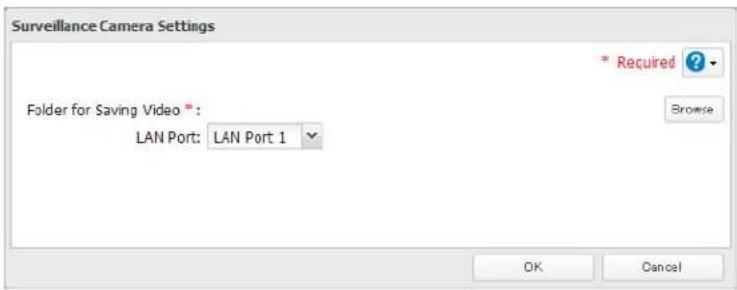
text_image
Surveillance Camera Settings Folder for Saving Video * LAN Port: LAN Port 1 * Required ? Browse OK Cancel5 Click Browse.
6 Choose a folder for recorded video, then click OK.
text_image
Browse Folders Refresh + share OK CancelNote: Use a folder with at least 100 GB of available space.
7 Click OK.
8 Click OK.
9 To enable surveillance cameras, change the switch from .
Notes:
- If the target shared folder specified as the storage location for recorded video is deleted, the surveillance camera is automatically disabled.
- Do not directly edit recorded video data in the shared storage folder. If a file is directly edited, the surveillance camera software may no longer operate properly.
- Do not duplicate or back up the shared storage folder with the built-in utilities in Settings. A separate backup license must be purchased to back up this data to another TeraStation.
- The client tools can only be used with the LAN connected to the selected LAN port.
Users with Two or More Network Cameras
In the default settings, only one network camera can be used. To use two or more network cameras, additional licenses (sold separately) must be purchased and registered.
Enabling the Free License
Your TeraStation comes with a license for one surveillance camera. Follow the procedure below to enable the included license.
1 Connect the TeraStation to the Internet.
2 Click Start- BUFFALO - BUFFALO Surveillance Server - Vault Admin. For Windows 8.1 and Windows 8, click the Vault Admin.
3 Select the TeraStation where you want to add the license, right-click it, and click Properties.

text_image
File View Actions Options Help Entire Network TS-8VHL094 TS-8VHL755 TS-QVHL TS-WVHL TS-WVHL Vault Stats Mini Vault Stats Secure/Unsecure Vault Shut Down Vault Vault Checkup Refresh Properties4 Open the License tab, then click Activate Free License.

text_image
TS-8VHL75E Properties Security Logs Notifications Diagnostics General Device Database License Summary Storage Capacity: "Unlimited" Camera Capacity: 20 cameras Product Type: Surveillance Platform Type: Buffalo Expiration: 2012/01/13 19:01:23] Host Id Installed Licenses Serial # Type Capacity Expiration Product Type PI Activate Free License OK Cancel HelpTo deactivate the license, click ✗
5 Check that the "SurveillanceCamera" and "HardDisk" were added to "Installed Licenses".
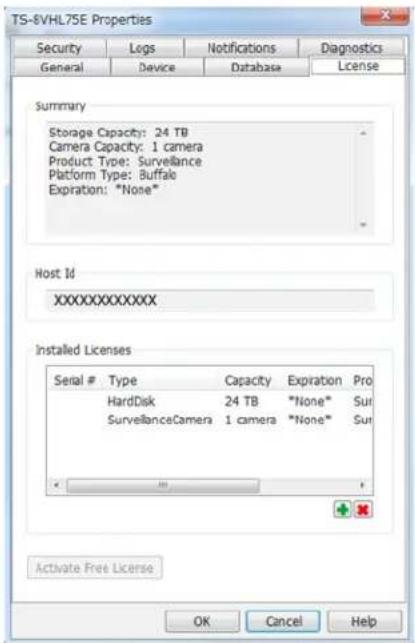
text_image
TS-8VHL75E Properties Security Logs Notifications Diagnostics General Device Database License Summary Storage Capacity: 24 TB Camera Capacity: 1 camera Product Type: Surveillance Platform Type: Buffalo Expiration: "None" Host Id XXXXXXXXXXXX Installed Licenses Serial # Type Capacity Expiration Pro HardDisk 24 TB "None" Sur SurveillanceCamera 1 camera "None" Sur Activate Free License OK Cancel HelpThe free license is now enabled.
Registering Recording Policies
Register the network camera that is used.
1 Click Start - BUFFALO - BUFFALO Surveillance Server - Camera Policies. For Windows 8.1 and Windows 8, click the Camera Policies.
2 Click the icon.
3 Click Next.

natural_image
Close-up of a metallic cylindrical object with a bright yellow starburst on top, against a plain light blue background (no text or symbols)Welcome to the Add Camera Wizard
This wizard helps you add and schedule a new camera. You may need to run this wizard with administrative rights.
To continue, click Next.

text_image
About Help < Back Next > Cancel4 Click Find Cameras.

natural_image
Close-up of a metallic cylindrical mechanical component with a metallic rim and threaded shaft (no text or symbols visible)Camera Information
Find cameras on my network to populate the information below. Find Cameras
Select the manufacturer and model. - Select Manufacturer - - Select Model -
What is the IP Address?
What credentials are needed to access this camera? User Name: Password:

text_image
Test Camera CameraNot Listed Help < Back Next > Cancel5 Select the detected network camera, then click OK.
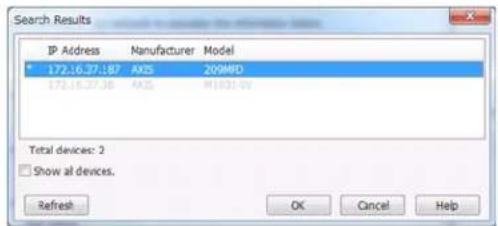
text_image
Search Results IP Address Manufacturer Model 172.16.37.187 AXIS 209MID 172.16.37.188 AXIS 210MID Total devices: 2 Show all devices. Refresh OK Cancel HelpNote: Network cameras that are already in use are indicated by an asterisk (*) and they are gray.

text_image
IP Address Manufacturer-model 192.168.1.13 AX5 Q6032 192.168.1.95 p+ Web 192.168.1.11_hp LaserJet 192.168.1.57 Canon M0870 192.168.1.229 ADTS 211 Show all devices. Refresh OK Cancel Help6 Enter the username and password, then click Next.

natural_image
Illustration of a metallic cylindrical mechanical component with blue and gold sections (no text or symbols)Camera Information
Find cameras on my network to populate the information below.
Find Cameras
Select the manufacturer and model.
Select Manufacturer
- Select Model -
What is the IP Address?

What credentials are needed to access this camera?
User Name:
Password:
Test Camera
Camera Not Listed
Help
< Back
Next >
Cancel
Note: Clicking Test Camera runs an operational check of the network camera.
7 Enter the description, then click Next.

natural_image
Yellow sticky note with red eraser on a light blue background (no text or symbols)Description
What is the name of this camera? (For example, 'Front Lobby')
Enter a brief description of this camera.
Help
< Back
Next >
Cancel
8 Select the recording schedule, then click Next.

Recording Schedule
When do you want to record video?
Always At selected times


9 Select the TeraStation where the video will be recorded, then click Next.

Recording Computer
What computer will be used for recording video?



10 Check the registration information, and if it is correct, click Next.

text_image
Ready to Add Review the summary below before clicking Next to add the camera. Camera name: Rear Entrance Description: Panasonic camera at back door onto Ash Street. Manufacturer: Panasonic Model: BL-C111A IP Address: 126.34.52.68 User Name:11 Click Next.
An additional network camera can be registered by selecting "Yes" when asked "Do you want to add an additional camera?"
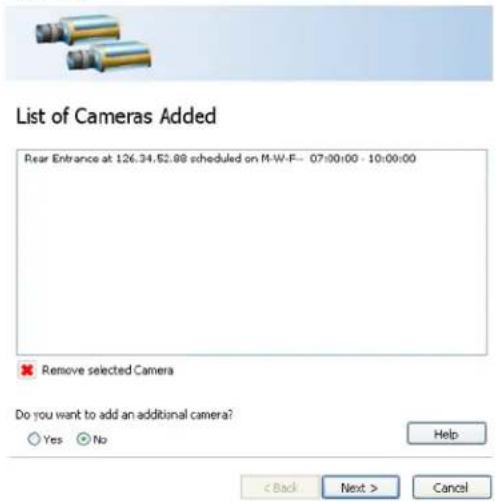
text_image
List of Cameras Added Rear Entrance at 126:34.52.98 scheduled on M-W-F- 07:00:00 - 10:00:00 Remove selected Camera Do you want to add an additional camera? Yes No Help < Back Next > Cancel12 Click Save.
Recording will begin. You've now registered the recording policy of the network camera.
Checking Recording
Wait at least 15 minutes after registering the recording policy before performing this procedure. To check that recording is working correctly, follow the procedure below.
1 Click Start - BUFFALO - BUFFALO Surveillance Server - Surveillance Video Manager. For Windows 8.1 and Windows 8, click the Surveillance Video Manager.
2 Click Search.

text_image
Add Search Items display3 Recorded video clips are shown in the center of the screen. Click a video clip to start playback.

text_image
Screenshot of a software interface showing menu options and a toolbar with icons and text labelsThis completes checking recording.
Email Error Notification
You may configure the TeraStation to send you an email notification when the available space for recording is low, or when recording fails due to a camera malfunction, network disconnection, or other cause.
Configuration
Viewing Saved Video
Follow the procedure below to view recorded data saved in the TeraStation.
1 Click Start - BUFFALO - BUFFALO Surveillance Server - Surveillance Video Manager. For Windows 8.1 and Windows 8, click the Surveillance Video Manager.
2 Click Search.
text_image
Add Search Items display3 Video clips are shown in the search results at the center of the screen. Click the clip to start playback.
text_image
Screenshot of a software interface showing a grid-based editor with a small embedded image and Chinese text labels.Export Recorded Data as a MOV Video File
To export recorded data saved to the TeraStation as a MOV format video file:
1 Click Start - BUFFALO - BUFFALO Surveillance Server - Surveillance Video Manager. For Windows 8, click the Surveillance Video Manager.
2 Select the search criteria on the left side of the search screen, then click Search.
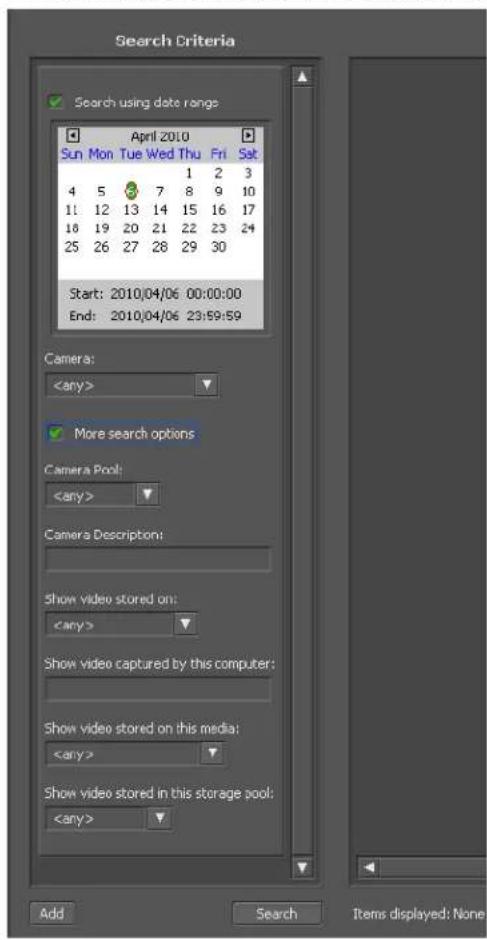
text_image
Search Criteria ✓ Search using date ranges April 2010 Sun Mon Tue Wed Thu Fri Sat 1 2 3 4 5 7 8 9 10 11 12 13 14 15 16 17 18 19 20 21 22 23 24 25 26 27 28 29 30 Start: 2010/04/06 00:00:00 End: 2010/04/06 23:59:59 Camera:3 The search results are displayed. Click a thumbnail to start the media viewer.
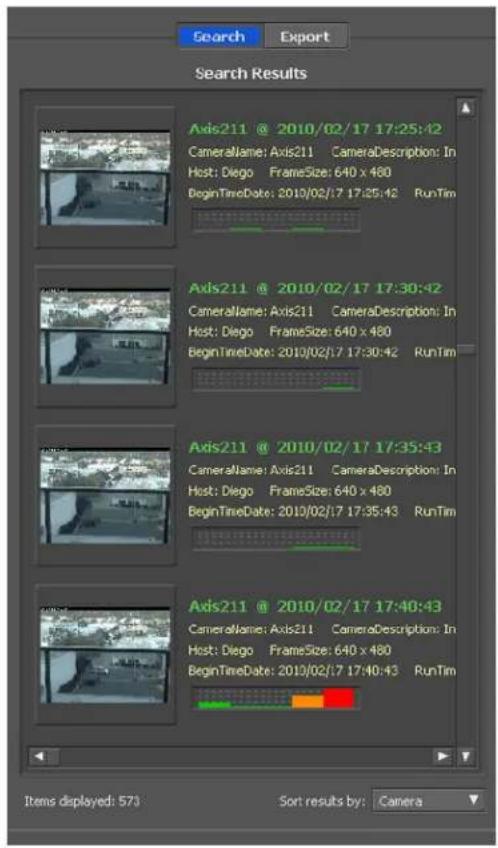
text_image
Search Export Search Results Axis211 @ 2010/02/17 17:25:42 CameraName: Axis211 CameraDescription: In Host: Diego FrameSize: 640 x 480 BeginTimeDate: 2010/02/17 17:25:42 RunTim Axis211 @ 2010/02/17 17:30:42 CameraName: Axis211 CameraDescription: In Host: Diego FrameSize: 640 x 480 BeginTimeDate: 2010/02/17 17:30:42 RunTim Axis211 @ 2010/02/17 17:35:43 CameraName: Axis211 CameraDescription: In Host: Diego FrameSize: 640 x 480 BeginTimeDate: 2010/02/17 17:35:43 RunTim Axis211 @ 2010/02/17 17:40:43 CameraName: Axis211 CameraDescription: In Host: Diego FrameSize: 640 x 480 BeginTimeDate: 2010/02/17 17:40:43 RunTim Items displayed: 573 Sort results by: Camera4 Select the section to export and click Export. This will register the video to the export queue.
text_image
2010/02/17 - 17:43:43 17:43:43 80.00 25 channels 1.0 Cancel Close Help
text_image
Export Date Add211_2010_1 In Time: 2010/02/04 Out Time: 2010/02/04 Op Duration: 58.29 Add211_2010_1 In Time: 2010/02/04 Out Time: 2010/02/04 Op Duration: 58.29 Status to export: 2 Close5 Open the Export screen, register the export information from "Export Job Configuration", and click "Start Export". The video is exported in MOV format.
text_image
Export Job Configurations How do you want to export the index file? Export Job Settings Where is the job server? From User in Microsoft Where do you want to send the corresponding job file? Subscriptions Where do you want to send the job file at the database or Database name. How do you want to create the existing job? Describe the job name on the user's website Job Status Job Name: 1275000000 (899999999.00) Recruitment: 1275000000 (899999999.00) Status: Export Status Next Next Next Help HelpThis completes exporting video in the MOV format.
Viewing Video Real-time
Follow this procedure to view the video as it is being recorded by the network camera.
Note: Live Viewer data cannot be viewed.
1 Click Start - BUFFALO - BUFFALO Surveillance Server - Live Viewer.
For Windows 8.1 and Windows 8, click the Live Viewer.
2 Registered network cameras are listed in the Camera folder on the right side of the screen. To view content of a video that is currently being recorded, double-click the camera whose video you want to view or drag to a frame of the camera viewer on the left side of the screen.
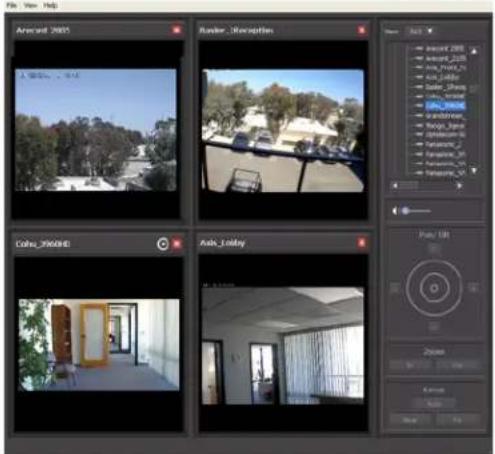
text_image
Aircraft 2001 Radiator_Rescognition Cohls_2001 Auto_Lobby Page 1/13 2001 Action_2001 Action_2002 Action_Front_20 Action_Floor Action_Sknee_20 Action_Sknee_20 Action_Sknee_20 Action_Sknee_20 Action_Sknee_20 Action_Sknee_20 Action_Sknee_20 Action_Sknee_20 Action_Sknee_20 Action_Sknee_20 Action_Sknee_20 Action_Sknee_20 Action_Sknee_20 Action_Ssknee_20 Action_Ssknee_20 Action_Ssknee_20 Action_Ssknee_20 Action_Ssknee_20 Action_Ssknee_20 Action_Ssknee_20 Action_Ssknee_20 Action_Ssknee_20 Action_Ssknee_20 Action_Ssknee_20 Action_Ssknee_20 Action_Ssknee_2This completes viewing current video.
Moving Recorded Video Data to Another TeraStation
Follow the procedure below to move (migrate) the recorded video data to another TeraStation.
Note: A separate Surveillance Server License Pack must be purchased to do this.
1 Click Start - BUFFALO - BUFFALO Surveillance Server - Data Service Policies.
For Windows 8.1 and Windows 8, click the Data Service Policies.
2 Click +, and when the Create a Policy screen is opened, enter "MigrateTest" into the "Policy Name" field, select "Migrate", and click OK.
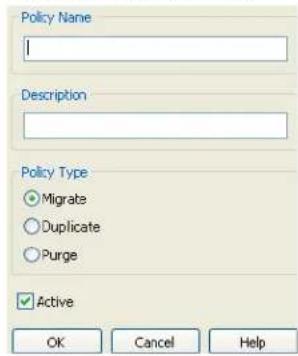
text_image
Policy Name I Description Policy Type Migrate Duplicate Purge Active OK Cancel Help3 Click the Source tab. Under "Vault", select the TeraStation where the recorded video data is saved. Select "Any" to migrate recorded data on all network-connected TeraStations.

text_image
Source Criteria Destination Scheduling Advanced Vault4 Click the Destination tab to select which TeraStation you want to move the data from "Vault" off of.

text_image
Source: Cibera Destination Scheduling Advanced Vault TS-BVHL75E Specify the name of the destination vault.5 Set the migration date and time on the "Scheduling" tab. To execute migration every hour, select "Repeatedly at a defined interval" and "Every 1 hour".
6 Click, and register the policy.
This completes the settings for moving recorded video to another TeraStation.
Backing Up Recorded Video to Another TeraStation
Follow this procedure to back up recorded video data to another TeraStation.
Note: A separate Surveillance Camera License Pack must be purchased to do this.
1 Click Start - BUFFALO - BUFFALO Surveillance Server - Data Service Policies. For Windows 8.1 and Windows 8, click the Data Service Policies.
2 Click + and when the Create a Policy screen opens, enter "DuplicateTest" into the "Policy Name" field, select "Duplicate", and click OK.
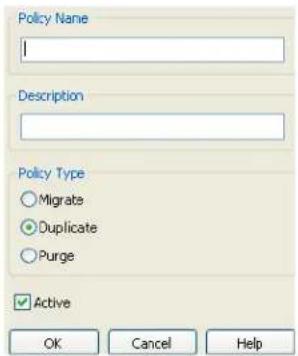
text_image
Policy Name Description Policy Type Migrats Duplicate Purge Active OK Cancel Help3 Click the "Source" tab and select the TeraStation where the recorded video data is saved under "Vault".
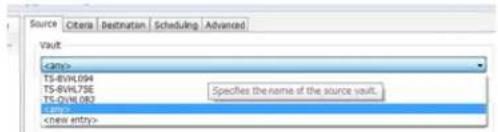
text_image
Source Criteria Destination Scheduling Advanced VaultNote: If "any" is selected, recorded data for all TeraStations connected to the network will be backed up. Click the Destination tab, then select the TeraStation where you want to move the data from "Vault".

text_image
Source Criteria Destruction Scheduling Advanced Vault TS-BVM4.75E Specifies the name of the destination vault.4 Set the job execution date and time from the "Scheduling" tab. For example, the settings below are made to repeatedly execute the backup job every hour. Select "Repeatedly at a defined interval" and "Every hour".
5 Click, and register the policy.
This completes the settings for backing up video to another TeraStation.
Automatically Delete Old Data when Space is Low
Follow the procedure below to delete (purge) recorded video starting from the oldest when available space for recording video becomes low.
Note: By default, old video data will be deleted automatically when 80% of available space is used. Old data will be removed at the same rate as new video is added, so there will always be enough video to fill about 80% of the total available space. To disable this setting, remove the "Remove Old Video" policy from "Data Service Policies".
1 Click Start - BUFFALO - BUFFALO Surveillance Server - Data Service Policies. For Windows 8.1 and Windows 8, click the Data Service Policies.
2 Click +, and when the Create a Policy screen is opened, enter "PurgeTest" into the "Policy Name" field, select "Purge", and click OK.

text_image
Policy Name Description Policy Type Migrate Duplicate Purge Active OK Cancel HelpClick the Source tab and select the TeraStation on which recorded video is saved under "Vault".
text_image
Source Criteria Destination Scheduling Advanced Vault3 Open the Criteria tab, and under "Miscellaneous Options", set "Watermark: High" and "Watermark: Low".
For example, the settings below delete old data when the amount of used media space exceeds 80% until it drops to 40%.
Set Watermark: High to "80" and Watermark: Low to "40".
4 Set the job execution date and time from the "Scheduling" tab. In this example, we'll configure a job to execute at 2:00 AM on weekdays.
- Select "On selected days each week".

- Select every day between Monday and Friday.

text_image
Days Sunday Monday Tuesday Wednesday Thursday Friday Saturday Select All Deselect All OK Cancel- Select "2:00" and "AM", then click OK.

text_image
Time Select Time 2 :00 AM OK Cancel5 Click, and register the policy.
This completes the registration of the policy. The job is executed at 2:00 AM Monday to Friday.
Changing Where Recorded Video Is Saved
Follow this procedure to change the TeraStation to which video is saved.
1 Click Start - BUFFALO - BUFFALO Surveillance Server - Camera Policies. For Windows 8.1 and Windows 8, click the Camera Policies.
2 Click the icon on the tool bar and open the "Camera Configuration" screen.
3 Double-click the camera to which video will be saved. This opens "Modify Camera".

text_image
Current Composites File Edit Tools Help Add Add Delete Cam Advertising Hardware Model Video Capture URL: Status Service No Recording Computer Description AIDS_011-14 HATS K0113-0 http://12.18.37.20/ass-media-media.asp root completely - more - root subscribed - new camera HATS_012 HATS K0122 http://12.18.37.22/ass-media-media.asp root completely - more - root subscribed - new camera Para_C:0121 Reromics K-01239 http://12.18.37.20/ophylogs/gp-prosecuted root completely - more - root subscribed - new camera TP-1504 TP-Latz L-012310 http://12.18.37.20/video.asp root completely - more - root subscribed - new camera TP-Latz TP-Latz L-012318 http://12.18.37.20/video.asp root completely - more - root subscribed - new camera Nuclear_JP124 Nuclear JF124 http://12.18.37.20 free.asp root completely - more - root subscribed - new camera4 Select the TeraStation you want to quit using as the "Recording Computer" and click OK.
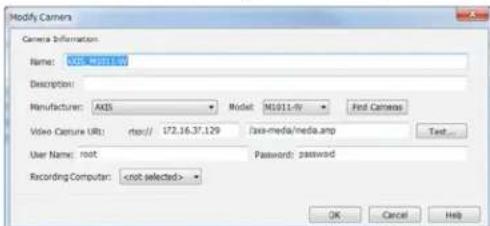
text_image
Modify Camera Camera Information: Name: AXS-M10011.89 Description: Manufacturer: AXS Model: M1011-IV First Camera Video Capture URL: mscu/ 172.16.37.129 /zsa-media/media.amp Text... User Name: root Password: password Recording Computer:5 Click and register the policy.
This completes changing the TeraStation where recorded video is saved.
Client Utilities
Camera Policies
Camera Policies is a software program that registers the network cameras and starts video recording.
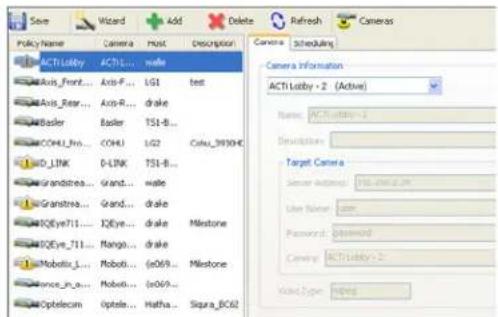
text_image
SOVE Wizard Add Delete Refresh Cameras Policy Name Camera Host Desorption Camera Scheduling ACTI_Lobby ACTI... male Axis_front... Acs-F... 1G1 test Axis_Rear... Acs-R... drake Basler ... Easier 751-8... CoOHU Pro... COHU 1G2 Colu_39304E S-D_LINK B-LINK 751-8... Grandsea... Grand... wale Granstra... Grand... drake IOEye711... IOEye... drake Milestone IOEye_711... Mango... drake Mobotiv_... Mobotiv... (o6/9) Milestone Ponce_in_a... Mobotiv... (o6/9) Optelecom Optele... Hatha... Sigra_BC62 Camera Information ACTI_Lobby - 2 (Active) Name: ACTI_Lobby - 2 Description: Target Camera Server Address: 751-800-2.2M User Name: cam Password: password Camera: ACTI_Lobby - 2 Vide Type: NoneClick to start a wizard to register network cameras and schedule recording.
Click to start the camera configuration screen where network cameras are registered.
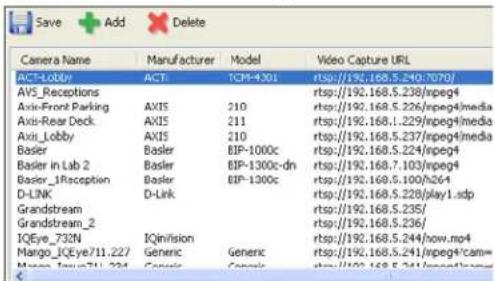
text_image
Save Add Delete Camera Name Manufactur Model Video Capture URL ACT-Lobby ACTI TCP-4.201 rsp://192.168.5.240/7070/ AVS_Receptions Axis-Front Parking AXIS 210 rsp://192.168.5.238/npeg4 Axis-Rear Deck AXIS 211 rsp://192.168.5.226/npeg4/media Axis_Lobby AXIS 210 rsp://192.168.5.237/npeg4/media Basler Basler BIP-1000c rsp//192.168.5.224/npeg4 Basler in Lab 2 Basler BIP-1300c-dn rsp//192.168.7.103/npeg4 Basler_IRsception Basler BIP-1300c rsp//192.168.5.100/n264 D-LINK D-Link rsp//192.168.5.228/play1.sdp Grandstream rsp//192.168.5.235/ Grandstream_2 rsp//192.168.5.236/ IQEye_732N IQin/sion rsp//192.168.5.244/how.mp4 Mango_JQEye/71.227 Generic Generic rsp//192.168.5.241/npeg4/cam= Mango_JQEye/71.224 Generic Generic rsp//192.168.5.241/npeg4/cam/Click to start a new registration screen for an additional network camera. You can also register the camera and define the recording video policy.

text_image
Camera Information Name: Description: Manufacturer: Generic Model: Generic Find Cameras Video Capture URL: http:// Test... User Name: Password: OK Cancel HelpLive Viewer
Live Viewer allows you to view video currently being recorded by a network camera.
Note: To view the current video, the network camera must be registered in Camera Policies.
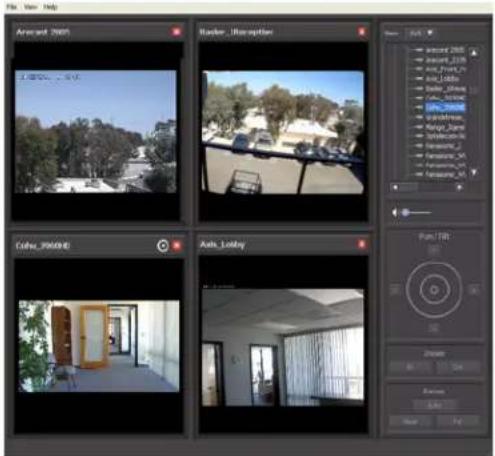
text_image
Aircraft 2007 Weather - Recognition Column 9999E Audio_Lobby- The layout of the camera view (numbers of rows and columns) and registered network cameras are displayed in the panel on the right side of the screen.
- The camera view (live video) is displayed on the left side panel. In the default setting, a 2x2 camera view is displayed. A layout view with up to 4x4 cameras can be displayed.
- Double-clicking the network camera name or dragging to the camera view frame enables viewing of the current video that is being recorded by the network camera.
The layout can be saved in View - Save Layout As.
text_image
Save As Layout Name: Description: OK CancelData Service Policies
Data Service Policies is a software program for creating data service policies. The policy types that can be created are shown below.
Note: To use migration and duplication, a separate Backup License must be purchased.
| Policy Type Action | |
| Migration Moves recorded video data to another TeraStation | |
| Duplication Copies recorded video data to another TeraStation and synchronizes the data. | |
| Purge Deletes the recorded video data. | |
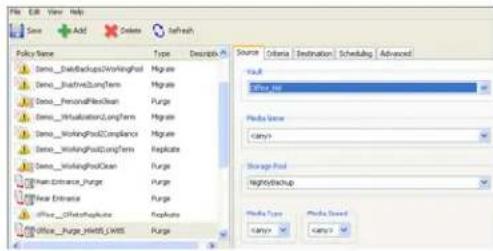
text_image
File Edit View Help Save Add Delete Refresh Policy Name Type Descript P Demo_DialBackups/WorkingProd Migrate Demo_IndustrialLongTerm Migrate Demo_FederalHealthcare Purge Demo_WralizationLongTerm Migrate Demo_WalizingProdCompliance Migrate Demo_WalizingProdLongTerm Replicate Demo_WalizingProdClean Purge New Entrance_Purge Purge New Entrance Purge Office_OffectorPackage Replicate Office_Purge_Industry_LAWB Purge Source Options Destination Scheduling Advanced Show Show Path Media View carry Storage Pool WageBackup Media Type Media Speed carry CarryThe right side of the screen includes tools for creating and updating data service policies. The left side of the screen shows an overview of all data service policies.
Notes:
- If is displayed for a policy in the left-side frame, the policy is disabled.
- Surveillance server functionality must be enabled beforehand for the TeraStation where migration or duplication files will be saved.
Vault Admin
Vault Admin is a software program for managing surveillance camera resources.

text_image
Data Network Dash_Shadow Information Current Clients Media 01 07 Drives Virtual@1 Virtual@2 Virtual@3 Virtual@4 Virtual@5 Virtual@6 Virtual@7 Virtual@8 Virtual@9 Virtual@10 Drake_HardDisk drake_TapeLibrary Vail Name Type Status Secured # Media Free Space Dash_Shadow ShadowHardDisk OK Yes 2 0 bytes Drake_HardDisk HardDisk OK Yes 2 285.22 GB drake_TapeLibrary TapeLibrary OK Yes 3 54.08 GB Pedractor0_HardDisk HardDisk OK Yes 0 0 bytes Lady_hardDisk HardDisk OK Yes 17 214.93 GB Lady_TapeLibrary TapeLibrary OK Yes 2 198.29 GB Office_YD HardDisk OK Yes 7 55.00 GB Office_Tape SingleType OK Yes 1 54.03 GB Tron_HardDisk HardDisk OK Yes 17 621.19 GBOperations are performed from the tool bar located in the top section of the screen.

The icons and their functions are shown below.
| Icon Description | |
| Starts “Mini Vault Status” for enabling the display of basic monitoring information. | |
| Sets the security status. | |
| Shuts down or restarts a portion (Vault) of the surveillance cameras. | |
| Changes the properties. | |
| Performs a diagnosis of the surveillance camera. | |
| Loads a media device. | |
| Prepares a media device. | |
| Unloads a media device. | |
| Erases a media device. | |
| Refreshes the current screen. |
Surveillance Video Manager
Surveillance Video Manager is a software program for performing searches and exporting recorded video data.
Search Window

text_image
Search Export Search Details Search Details Export Details Search Details Search Details Search Details Search Details Search Details Search Details Search Details Search Details Search Details Search Details Search Details Search Details Search Details Search Details Search Details Search Details Search Details Search Details Search Details Search Details Search Details Search Details Search Details Search Details Search Details Search Details Search Details Search Details Search Details Search Details Search Details Search Details Search Details Search DETAILS Search Details Search Details Search Details Search Details Search Details Search Details Search Details Search Details Search Details Search Details Search Details Search Details Search Details Search Details Search Details Search Details Search Details Search Details Search Details Search Details Search Details Search Details Search Details Search Details Search Details Search Details Search Details Search Details Search Details Search Details Search Details Search Details Search DetailsExport Window
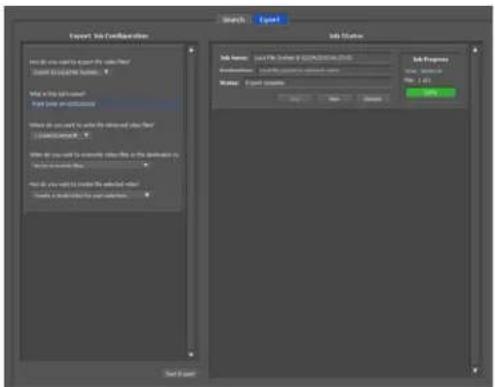
text_image
Export: Job Configuration Start to export the selected Start to export the selected. What is a job known? Start from an international Where do not want to write the required job that is a candidate. When do not want to create a job in the destination by from an international job. How do you want to import the selected job. To find a job in the target job. Sort if user Search Export Job Status Sub Name: Sub-IT, Sub-IT & C/C/SPC/SPC/SPC Sub-Item: Sub-IT, Sub-IT & C/C/SPC/SPC/SPC Name: Event Status Help Cancel Help Progress Help Help Help Help Help HelpNetwork Activity
Network Activity is a software program that displays the TeraStations on which surveillance cameras are operating on the network, in real time and in graphical form.
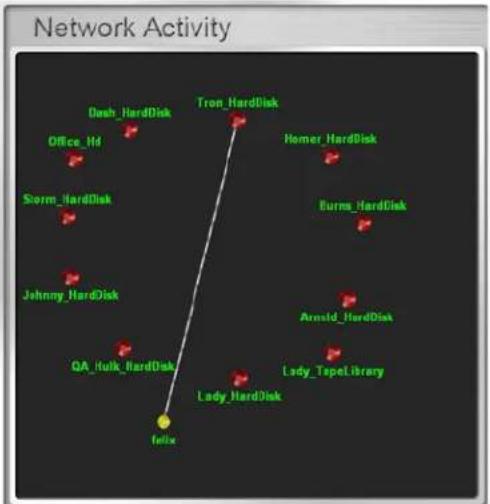
flowchart
graph TD
    A["Office_Hd"] --> B["Dash_HardDisk"]
    C["Sorm_HardDisk"] --> D["Tron_HardDisk"]
    E["Johnny_HardDisk"] --> F["Homer_HardDisk"]
    G["QA_Hulk_HardDisk"] --> H["Burns_HardDisk"]
    I["Lady_TapeLibrary"] --> J["Arnold_HardDisk"]
    K["felix"] --> L["Lady_HardDisk"]
All clients and TeraStations located on the network are indicated by and labels. These can be moved by dragging and dropping them. Clients are displayed only when a job is being executed and activities are indicated by a line linking the client and TeraStation.
Mini Vault Stats
Double-clicking the icon for a TeraStation on "Network Activity" starts "Mini Vault Stats". "Mini Vault Stats" shows the network traffic in graphical form.

text_image
Vault Performance Files per Second 35 Mbytes per Second 0.0 Vault Name Tron_HardDisk Media Technology Hdisk Security Status Secured NominalActivating Additional Licenses
Purchasing an additional license (sold separately) enables you to connect and use two or more cameras and use the migration and duplication functions. Use this procedure to activate an additional license.
When the TeraStation is Connected to the Internet
1 Click Start - BUFFALO - BUFFALO Surveillance Server - Vault Admin.
For Windows 8.1 and Windows 8, click the Vault Admin.
2 Select the TeraStation to which you want to add the license, right-click it, and click Properties.

text_image
File View Actions Options Help Entire Network TS-8VHL094 TS-8VHL755 TS-QVHL TS-WVHL TS-WVHL Vault Stats Mini Vault Stats Secure/Unsecure Vault Shut Down Vault Vault Checkup Refresh Properties3 Open the License tab, then click +.

text_image
TS-8VHL75E Properties Security Legs Notifications Diagnostics General Device Database License Summary Storage Capacity: 24 TB Camera Capacity: 1 camera Product Type: Surveillance Platform Type: Buffalo Expiration: "None" Host Id XXXXXXXXXXXX Installed Licenses Serial # Type Capacity Expiration Pro HardDisk 24 TB "None" Sur SurveillanceCamera 1 camera "None" Sur Activate Free License OK Cancel HelpIf your default free license activation is not installed, see "Enabling the Free License" to install it.
4 Enter the product key for the license pack (sold separately), then click OK.
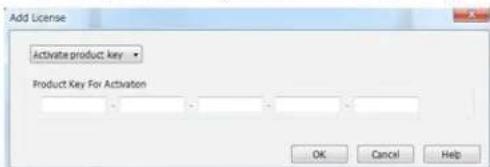
text_image
Add License Activate product key Product Key For Activation OK Cancel Help5 Confirm that the new license was added to "Installed License".
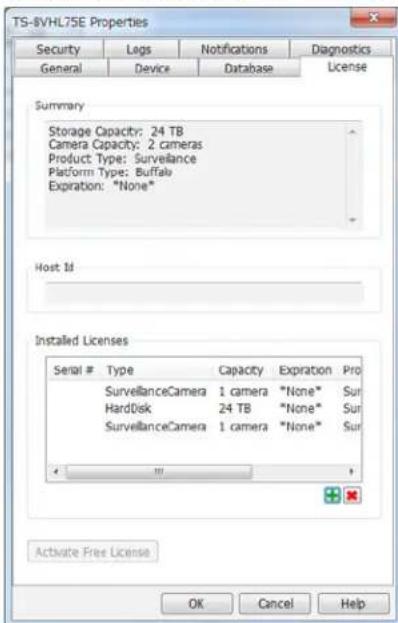
text_image
TS-SVHL75E Properties Security Legs Notifications Diagnostics General Device Database License Summary Storage Capacitr: 24 TB Camera Capacity: 2 cameras Product Type: Surveillance Platform Type: Buffalo Expiration: "None" Host Id Installed Licenses Serial # Type Capacity Expiration Pro SurveillanceCamera 1 camera "None" Sur HardDisk 24 TB "None" Sur SurveillanceCamera 1 camera "None" Sur Activate Free License OK Cancel HelpYou have now activated the additional license.
TeraStation Not Connected to the Internet
1 If the TeraStation is being used in an environment where Internet access is not available, a separate computer with access to the Internet is required to activate the additional license.
2 Click Start - BUFFALO - BUFFALO Surveillance Server - Vault Admin. For Windows 8.1 and Windows 8, click the Vault Admin.
3 Select the TeraStation where you want to add the license, right-click it, and click Properties.
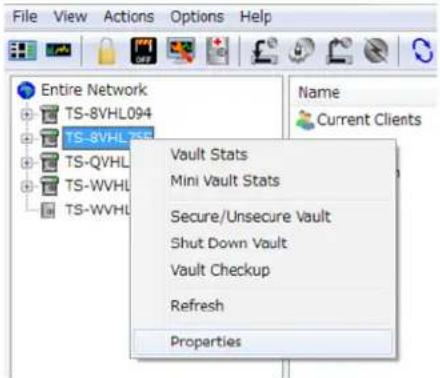
text_image
File View Actions Options Help Entire Network TS-8VHL094 TS-8VHL255 Vault Stats Mini Vault Stats Secure/Unsecure Vault Shut Down Vault Vault Checkup Refresh Properties4 Open the License tab, then make a note of the "Host Id".

text_image
TS-8VHL75E Properties Security Logs Notifications Diagnostics General Device Database License Summary Storage Capacity: 24 TB Camera Capacity: 1 camera Product Type: Surveillance Platform Type: Buffalo Expiration: "None" Host Id XXXXXXXXXXXX Installed Licenses Serial # Type Capacity Expiration Pro HardDisk 24 TB "None" Sur SurveillanceCamera 1 camera "None" Sur Activate Free License OK Cancel Help5 Open the website below in web browser. http://buffalo.jp/support_s/camera_licence/
6 From the license pack (sold separately), enter the product key and host ID code and click "Activate Software License".
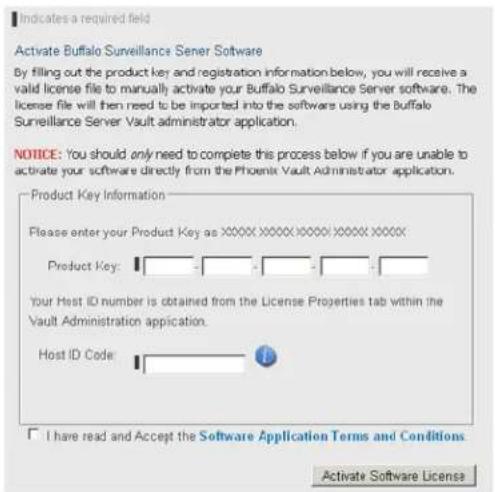
text_image
Indicates a required field Activate Buffalo Surveillance Sener Software By filling out the product key and registration information below, you will receive a valid license file to manually activate your Buffalo Surveillance Server software. The license file will then need to be imported into the softwares using the Buffalo Surveillance Server Vault administrator application. NOTICE: You should only need to complete this process below if you are unable to activate your software directly from the Phoenix Vault Administrator application. Product Key Information Please enter your Product Key as XXXXX XXXXX XXXXX XXXXX XXXXX Product Key: Your Host ID number is obtained from the License Properties tab within the Vault Administration application. Host ID Code:7 Downloading of the license file (*.lic) begins. Save the license file to a USB memory device or other storage device.
8 Copy the license file to a computer connected to the same network as the TeraStation.
9 In the computer connected to the same network as the TeraStation, click Start - BUFFALO - BUFFALO Surveillance Server - Vault Admin.
For Windows 8.1 and Windows 8, click the Vault Admin.
10 Select the TeraStation to which you want to add the license, right-click, and click Properties.
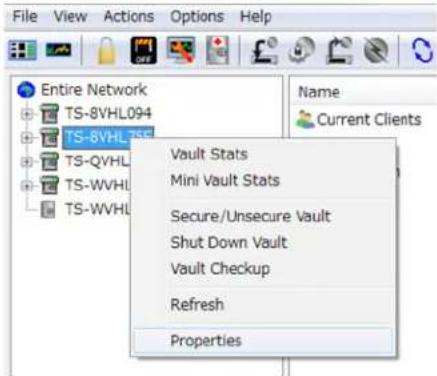
text_image
File View Actions Options Help Entire Network TS-8VHL094 TS-8VHL755 TS-QVHL TS-WVHL TS-WVHL Vault Stats Mini Vault Stats Secure/Unsecure Vault Shut Down Vault Vault Checkup Refresh Properties Name Current Clients11 Open the License tab, then click +.
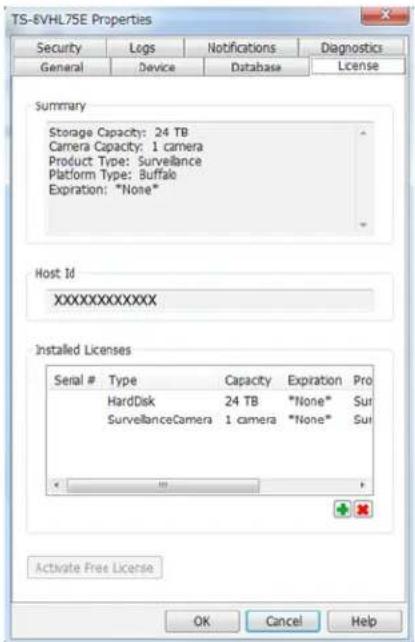
text_image
TS-8VHL75E Properties Security Legs Notifications Diagnostics General Device Database License Summary Storage Capacity: 24 TB Camera Capacity: 1 camera Product Type: Surveillance Platform Type: Buffalo Expiration: "None" Host Id XXXXXXXXXXXX Installed Licenses Serial # Type Capacity Expiration Pro HardDisk 24 TB "None" Sur SurveillanceCamera 1 camera "None" Sur Activate Free License OK Cancel Help12 Select "Import license file", then click Browse.
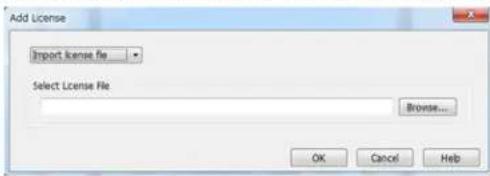
text_image
Add License Import license file Select License file Browse... OK Cancel Help13 Select the license file that was saved before, then click OK.
14 Check that the license pack was added to "Installed Licenses".
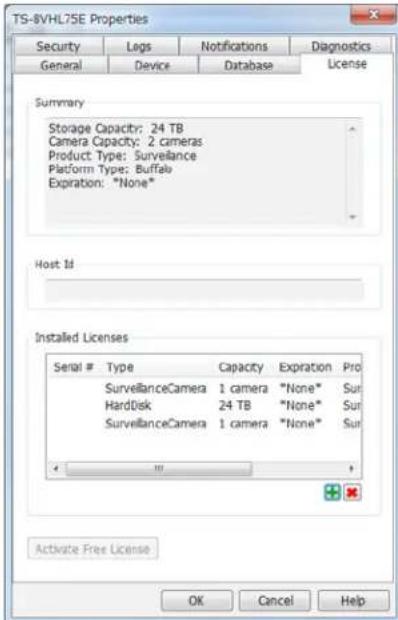
text_image
TS-8VHL75E Properties Security Legs Notifications Diagnostics General Device Database License Summary Storage Capacity: 24 TB Camera Capacity: 2 cameras Product Type: Surveillance Platform Type: Buffalo Expiration: "None" Host Id Installed Licenses Serial # Type Capacity Expiration Pro SurveillanceCamera 1 camera "None" Sur HardDisk 24 TB "None" Sur SurveillanceCamera 1 camera "None" Sur Activate Free License OK Cancel HelpThis completes authentication of an additional license.
Troubleshooting
| Issue Possible Cause Possible Solution | ||
| Video recording does not start. | Surveillance Camera is not enabled. | Enable Surveillance Camera in Settings. |
| A LAN cable between the TeraStation and network camera is disconnected, or the power is turned off. | Check that the LAN cables are inserted correctly. | |
| The video recording policy is not registered. | Register the video recording policy from Camera Policies. | |
| The device is not connected to a network on the same LAN, or the device is not connected to the LAN port that was set in Settings. | Connect the device to the network of the LAN port that was set in Settings. | |
| The disk is full. | Free available space on the disk by moving or deleting files. | |
| The time for the TeraStation and network camera is not correct. | Set the time in Settings. | |
| There are not enough camera licenses for the network cameras. | Purchase and register an additional license. | |
| I cannot enable the surveillance camera. | Failover is running. Disable failover. | |
| Surveillance cameras no longer record video. | The target shared folder for the recorded video was deleted. | Enable surveillance camera functionality in the Admin interface. |
| I cannot view the network camera using Live Viewer. | The network camera is not registered in some camera policies. | Register the network camera from camera policies. |
| There is an error in the network camera settings. | Verify the settings in the camera policies. | |
| There is no recorded data, or the recorded data cannot be found. | A camera was added in camera policies while Surveillance Video Manager was running. | If this is the case, this video may not be accessible. Restart Surveillance Video Manager to enable searching for recorded video from the new camera. |
Notes:
- QuickTime is a trademark of Apple Inc., registered in the U.S. and other countries.
• VLC media player is a trademark of Video LAN org.
• See www.buffalotech.com for supported cameras. - Refer to the "Buffalo Surveillance Server Administrator's Guide" for information about client tools.
Chapter 10 Advanced Features
Antivirus Software
Trend Micro NAS Security™ can protect your network and data from software viruses, malware, and spyware. To use Trend Micro NAS software, purchase an OP-TSVC license pack (sold separately). If your TeraStation includes activated antivirus software, no license registration is necessary.
Notes:
- To use the antivirus software effectively, the TeraStation should be connected to the Internet. The connection can be routed through a proxy server if the appropriate settings are configured in Administration - Proxy Settings from the left-side menu of the Trend Micro NAS Security settings page.
- Trend Micro is a registered trademark of Trend Micro Incorporated.
Licenses
If the antivirus software on your TeraStation is not activated or has expired, please purchase an OP-TSVC license pack (sold separately). If your TeraStation includes activated antivirus software, no license registration is necessary. The total period for antivirus software updates may be extended up to 5 years.
This example shows an initial 1-year period for updates extended by an additional year.

flowchart
graph LR
    A["1/1/2012"] --> B["Antivirus software updates activated"]
    B --> C["Extension (9/1/2012)"]
    C --> D["License period before extension"]
    D --> E["License period after extension"]
    E --> F["1/1/2014"]
    F --> G["Up to 5 years (Cannot be extended beyond 5 years)"]
    G --> H["1/1/2019"]
Note: It's not possible to register a serial number that would extend the total license period beyond 5 years, such as a second 3-year license after 3 years.
1 From the left-side menu, click Administration - Product License.
text_image
TREND MICRO | Trend Micro NAS Summary ► Scan Options ► Scheduled Update ► Logs ► Administration Proxy Settings Product License Debug Settings Summary System Information (2) Product version: Scan Results for Virus Summary Virus undecanable Virus quarantined2 Enter the serial number from the "Trend Micro NAS Security™ License Pack Guide", included in your package. Click Activate.

text_image
Product License Please enter the new serial number to activate your product. New Serial Number Product: Trend Micro NAS Security 1.0 Current serial number: abcd - abcd - abcd - abcd - abcd - abcd - abcd - abcd - abcd - abcd - abcd - abcd - abcd - abcd - abcd - abcd - abcd - abcd - abcd - abcd - abcd - abcd - abcd - abcd - abcd - abcd - abcd - abcd - abcd - abcd - abcd - abcd - abcd - abcd - Abcd - Abcd - Abcd - Abcd - Abcd - Abcd - Abcd - Abcd - Abcd - Abcd - Abcd - Abcd - Abcd - Abcd - Abcd - Abcd - Abcd - Abcd - Abcd - Abcd - Abcd - Abcd - Abcd - Abcd - Abcd - Abcd - Abcd - Abcd - Abcd - Abcd - Abcd - Abcd - Abcd - Abc New serial number: □-□-□-□-□-□-□ Activate CancelThe new license is now registered.
To check the status of the current license, open the Trend Micro NAS Security settings page and navigate to Administration - Product License on the left-side menu.
Activating Virus Scanning
Follow the procedure below to activate virus scanning.
1 In Settings, click Applications.

Applications
2 Move the antivirus switch to the position.

Antivirus


A quarantine folder named "TMNAS" is automatically created on the TeraStation. If a virus is detected, viruses are moved to this folder.
Configuring Security Settings
To configure Trend Micro NAS Security, follow this procedure.
1 In Settings, click Applications.

Applications
2 Click the 📋 the right of "Antivirus".

Antivirus

the right of "Antivirus".


3 Click Options.
text_image
Antivirus Settings Quarantine TMIAS Folder: Port: 14942 Initialize Options Edit Close4 Enter your username and password, then click Log On.

TREND MICRO
Trend Micro NAS Security™
text_image
LOGON Please type your user name and the password to access the web console. User name: Password: Log OnYou can log on with the TeraStation's admin account. The default username and password are "admin" and "password".
5 Trend Micro NAS Security settings will open.

text_image
TREND MICO Trend Micro NAS Security™ Summary System Information Product version: Trend Micro NAS Security 1.0 - build_1059 Scan Results For:is non-apply done deleted today.
Summary Today Last 7 days Virus undesignable # Virus quantified # Virus deleted # Virus passed # Virus cleaned # Virus released # Icon Status Real-time Scan: Enabled (Incoming Key) Scheduled Scan: Enabled Manual Scan: Start Now Update Status Update Now Component Current Version Last Updated Virus Pattern 7.276.80 2010-02-22 10:49:23 Spware/Broware Pattern 0.949.00 2010-02-22 10:49:23 Scantingine 9.200.0001 2009-15-18 17:11:05Connecting through a Proxy Server
If you must pass through a proxy server to connect to the Internet in your network environment, follow this procedure to set the IP address of the proxy server and other settings.
1 From the left-side menu, click Administration - Proxy Settings.

text_image
TREND M I C R O Trend Micro NAS Summary System Information (2) Product version: Scan Results for Virus Summary Virus undecanable Virus quarantined Summary ▶ Scan Options Scheduled Update ▶ Logs ▶ Administration Proxy Settings Product License Debug Settings2 Check "Use a proxy server to access the Internet (License update)". Enter the IP address and port of the proxy server, then click Save.
Proxy Settings
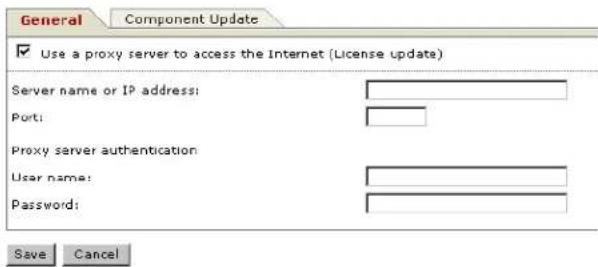
text_image
General Component Update Use a proxy server to access the Internet (License update) Server name or IP address: Port: Proxy server authentication User name: Password: Save CancelThe antivirus software is now configured to use a proxy server.
Updating
For best results, configure your antivirus software to update automatically as described below.
1 From the left-side menu, choose Scheduled Updates.
text_image
TREND M I C R O Trend Micro NAS Summary ► Scan Options Scheduled Update ► Logs ► Administration Summary System Information (2) Product version: Scan Results for Virus Summary2 Check "Enable Scheduled Update".

text_image
Scheduled Update Enable Scheduled Update Update Frequency Start time: 00 : 00 (hh:mm) Repeat interval: ○ Hourly ○ Daily, update for 2 hours3 Select a time for updates to begin, an interval for updates, and an amount of time for updates to continue. Select the components to update. Click Save.
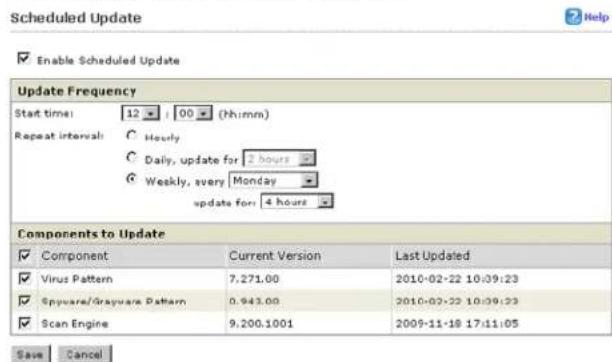
text_image
Scheduled Update Enable Scheduled Update Update Frequency Start time: 12 : 00 (hh:mm) Repeat interval: ○ Hourly ○ Daily, update for 2 hours ○ Weekly, every Monday update for 4 hours Components to Update ✓ Component Current Version Last Updated ✓ Virus Pattern 7.271.00 2010-02-22 10:09:23 ✓ Spware/Grayware Pattern 0.943.00 2010-02-22 10:09:23 ✓ Scan Engine 9.200.1001 2009-11-18 17:11:05 Save CancelThe antivirus software is now configured to update automatically at the scheduled time. Updates will not be downloaded if the TeraStation is turned off, in standby mode, or disconnected from the Internet.
Excluding a Specific Folder from Antivirus Scanning
By default, all folders on the TeraStation (including attached USB drives) will be scanned. Follow the procedure below to block specific shared folders from being scanned.
1 In Settings, click Light of "Folder Setup".

Folder Setup

light of "Folder Setup".
1 Folder(s)

2 Click the shared folder that you want to remove from the scan, then click Edit.
3 Uncheck items to exclude from the scan, then click OK.
Virus Scan:
Real Time Scan
Scheduled Scan
Manual Scan
Virus Scanning
Three types of virus scans are available:
Real-time Scan
The virus scan runs in the background, scanning every file that you read or write. This is the default type of scanning. Your TeraStation may run slower if real-time scanning is enabled.
Scheduled Scan
A scheduled scan is executed at specific regular intervals, such as every Tuesday at 3 am.
Manual Scan
A manual scan runs once when initiated. Initiate a manual scan as described below.
1 From the left-side menu, choose Scan Options - Manual Scan.

text_image
TREND MIGRC | Trend Micro Summary ✓ Scan Options Real-time Scan Scheduled Scan Manual Scan Summary System Inform Product version: Scan Results for2 Click Scan now.

text_image
Other Use the same action for all types Type All Types First Action Clean Save Cancel Scan nowThis starts the virus scan.
If the scan finds a virus, the user can be notified in two ways:
- The message "Virus alert I34" is normally shown on the LCD panel. Once the virus is removed from the quarantine folder, the message is no longer displayed. If the antivirus software is configured to delete viruses from the quarantine folder automatically, then "Virus alert I34" will not be displayed.
- If email notification is enabled In Settings, then the antivirus software notifies the user by email if a virus is found. Setting email notification is recommended.
Depending on how many files are on your TeraStation, a virus scan may take several hours. Estimated scanning times are shown below.
• 10,000 files: \~ 30 minutes
• 100,000 files: \~ 5 hours
• 1,000,000 files: \~ 50 hours
Checking the Log
Follow the procedure below to check the virus scan log.
1 From the left-side menu, choose "Logs".
text_image
TREND MICRO | Trend Micro NAS Summary ► Scan Options ► Scheduled Update ► Logs ► Administration Summary System Information (2) Product version: Scan Results for Virus Summary2 Click the log item that you want to check.

text_image
TREND MICRO | Trend Micro Summary System Inform ► Scan Options Scheduled Update ► Logs Virus Logs Spyware Logs Scan Logs System Logs Manual Delete Automatic Delete ► Administration Product version: Scan Results from Summary Virus undecanable Virus quarantined Virus deleted Virus passed Virus cleaned Virus renamed3 Click Display Log.

text_image
System Logs 34 log(s) stored from 2010-07-22 10:51:57 to 2010-08-03 11:47:52 Date range: Today Start date: 2010-08-03 End date: 2010-08-03 Sort by: Date/Time Descending Entries per page: 25 entries Note: Only the previous 2000 log entries will be retrieved for the specified log range. Display LogThis completes the procedure for checking the log.
Online Help
For more information on the antivirus software, refer to the online help. Follow the procedure below to access the online help.
1 From the right-top menu, choose Help - Contents and Index.

2 Online help will open.
text_image
Contents Search Help Search KnowledgeBase ? Welcome ? System Requirements ? Accessing the Trend Micro NAS Se ? Logging On and Off Using the Trend Micro NAS Securit ? Summary ? Scan Options ? Scheduled Updates ? Logs ? Administration Reference Welcome Trend Micro NAS Security™ other security risks such as through the Trend Micro NAS Micro NAS Security™ provide and antivirus configuration.Online help is now ready to use.
Email Notification
Your TeraStation can send you email reports daily, or when settings are changed or an error occurs. Notification emails may be triggered by any of the following events:
- Backup job completed
- Change to RAID configuration
- RAID error
- Fan error
- Hard drive read error
• Hard drive replacement - Quota exceeded
1 In Settings, click Management.

2 Move the email notification switch to the position to enable email notification.

3 Click Right of "Email Notification".
4 Click Edit.
5 Enter your mail server settings and choose what events will trigger notification. Click OK to send a test email.
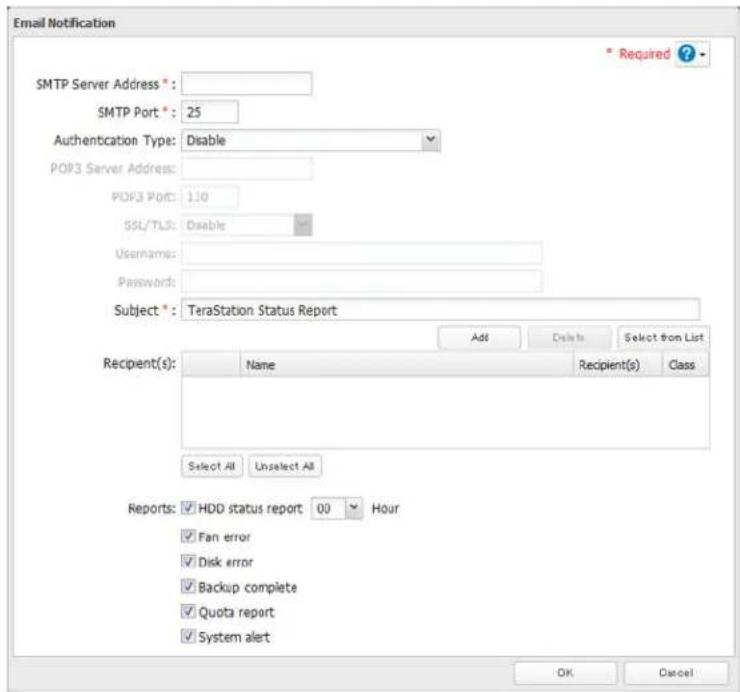
text_image
Email Notification * Required ? SMTP Server Address *: SMTP Port *: 25 Authentication Type: Disable POP3 Server Address: POP3 Port: 1.10 SSL/TLS: Disable Username: Password: Subject *: TeraStation Status Report Add Delete Select from List Recipient(s): Name Recipient(s) Class Select All Unselect All Reports: HDD status report 00 Hour Fan error Disk error Backup complete Quota report System alert OK CancelSleep Mode
To save energy, you can specify times to put the TeraStation into sleep (standby) mode, where the hard drive and LEDs are turned off.
1 In Settings, click Management.

2 Click Light of "Sleep Timer".

3 Click Edit.
4 Specify the timer interval, wake-up time, and time to go into sleep mode, then click OK.

text_image
Sleep Timer Settings Timer 1 Schedule: Weekly Monday Tuesday Wednesday Thursday Friday Saturday Sunday Wake Up at: 07 Hour 00 Minutes Begin Sleep at: 22 Hour 00 Minutes Timer 2 Schedule: Disable Wake Up at: 04 Hour 05 Minutes Begin Sleep at: 03 Hour 06 Minutes Timer 3 Schedule: Disable Wake Up at: 05 Hour 06 Minutes Begin Sleep at: 04 Hour 08 Minutes OK CancelNotes:
- Up to three timers can be set.
• The time to enter sleep mode can be set from 0:00 am to 3:45 of the next day.
The time to wake from sleep mode can be set from 0:00 to 23:45.
If the time to enter sleep mode is after 24:00, the wake-up time setting may be from 4:00 to 23:45.
- The time to enter sleep mode should not be set at the same time as or before the start time.
- If a backup task is scheduled during a disk check, disk format, backup job or within 5 minutes of the current time, the TeraStation will not change to standby mode when the configured time is reached.
- If scheduled times in the timer overlap, operation is performed using the widest time interval.
• Examples of multiple timer settings are shown below.
Example 1:
If running at a current time of 10:00 Wednesday
Timer 1: Daily 12:00–24:00
Timer 2: Not used
Timer 3: Not used
No operation is performed at 12:00 and the unit goes into sleep mode at 24:00.
Example 2:
If running at a current time of 10:00 Wednesday
Timer 1: Daily 9:00-18:00
Timer 2: Wednesday 10:00–20:00
Timer 3: Not used
On days other than Wednesday, normal operation begins at 9:00 and the unit goes into sleep mode at 18:00. On Wednesday, the unit goes into sleep mode at 20:00.
Example 3:
If running at the current time of 10:00 Wednesday
Timer 1: Daily 9:00-18:00
Timer 2: Wednesday 10:00–1 am of the next day
Timer 3: Not used
On days other than Wednesday, normal operation begins at 9:00 and the unit goes into sleep mode at 18:00. On Wednesday, normal operation begins at 10:00 and the unit goes into sleep mode at 1:00 am of the next day.
Example 4:
When running at a current time of 10:00 Wednesday
Timer 1: Daily 9:00-18:00
Timer 2: Wednesday 7:30–22:00
Timer 3: Not used
On days other than Wednesday, normal operation begins at 9:00 and the unit goes into sleep mode at 18:00. On Wednesday, normal operation begins at 7:30 and the unit goes into sleep mode at 22:00.
- To wake the TeraStation from sleep mode manually, press the power button.
Wake-on-LAN
The TeraStation supports Wake-on-LAN, which allows it to be turned on remotely.
1 In Settings, click Network.

Network
2 Click the right of "IP Address".

IP Address
LAN Port : 192.158.10.5
LAN Port 2 169.254.187.60

3 Click Change.
4 Enable "Wake-on-LAN", then click OK.

text_image
Network Settings Wake on LAN: Enable Disable Default Gateway Address: 192.168.10.1 Primary DNS Server: 0.0.0.0 Secondary DNS Server: OK CancelWake-on-LAN is now enabled. As long as it is connected to power and the network, you can turn on the TeraStation remotely.
Notes:
• After a power outage, wait 5 minutes after power is restored to send the Wake-on-LAN packet to the TeraStation.
• After receiving the Wake-on-LAN packet, the TeraStation may take approximately five minutes to be ready to use.
- To use Wake-on-LAN, you'll need Wake-on-LAN software such as AMD's Magic Packet utility. The TeraStation does not include Wake-on-LAN software.
- The TeraStation does not support using Wake-on-LAN and port trunking at the same time. You may use either feature, but not both at the same time.
- On the local network, Wake-on-LAN packets may be sent to port 2304 on either of the TeraStation's LAN ports. If the TeraStation is connected to a Buffalo wireless router configured for remote access, then it may be turned on from outside the local network (from the WAN side). To use this feature, connect the router to only LAN port 1 on the TeraStation.
UPS (Uninterruptible Power Supply)
If a UPS (sold separately) is attached, the TeraStation can be automatically shut down for protecting data in the event of
a power outage.
1 Plug the power cable of the UPS to a wall socket.
2 Connect the AC cable of the TeraStation to the UPS.
3 Connect the UPS and TeraStation using a USB cable or serial cable.
4 Turn on the UPS, then the TeraStation.
5 In Settings, click Management.

Management
6 Click light of "UPS Sync".

UPS Sync
Do not synchronize with UPS,

7 Click Edit.
8 Configure the desired settings, then OK.
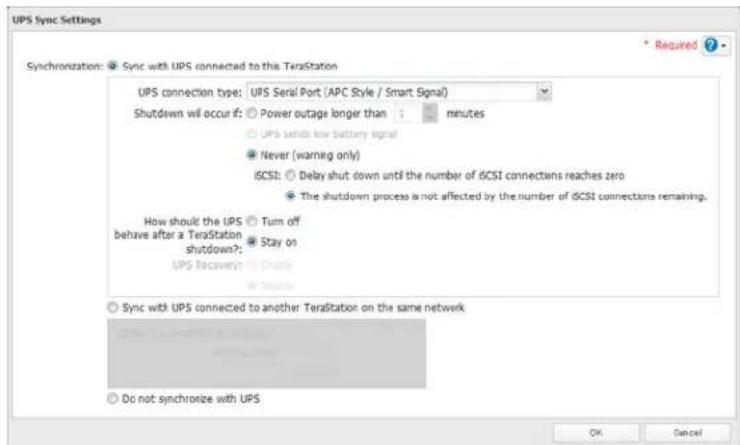
text_image
UPS Sync Settings Sync with UPS connected to this TeraStation UPS connection type: UPS Serial Port (APC Style / Smart Signal) Shutdown will occur if: Power outage longer than 1 minutes UPS serial low battery signal Never (warning only) iCSI: Delay shut down until the number of iCSI connections reaches zero The shutdown process is not affected by the number of iCSI connections remaining. How should the UPS Turn off behave after a TeraStation Stay on shutdown? UPS Recovery: Enable Do not synchronize with UPS Sync with UPS connected to another TeraStation on the same network OK CancelNotes:
- If the TeraStation is connected directly to a UPS, select "Sync with UPS connected to this TeraStation". If a different TeraStation is connected to the UPS, select "Sync with UPS connected to another TeraStation on the same network" After making this selection, enter the IP address of the TeraStation that will be the sync source in "Other TeraStation's IP Address".
- When the TeraStation is rebooted after an automatic shutdown (such as from a power outage or power supply problem), verify that the power supply has been restored. If the TeraStation is turned on while it is still running on the UPS and without the power supply restored, automatic shutdown is not performed, even after the specified time has elapsed.
- If the power supply from the UPS to the TeraStation is stopped and restarted when UPS recovery is enabled, the TeraStation is automatically restarted.
Port Trunking
Two Ethernet cables can be used to establish two separate communication routes providing LAN port redundancy and improving communication reliability. The use of two Ethernet cables enables access to the TeraStation even if one of the cables is disconnected.
The port trunking modes that can be set in the TeraStation are shown below.
| Trunking Mode Characteristics | |
| Round-robin* | Network packets are transmitted in sequential order from the first available NIC slave through the last. |
| Active-backup | Only one NIC slave in the bond is active. A different slave becomes active if and only if the active slave fails. |
| XOR* | Transmits network packets based on [(source MAC address XOR'd with destination MAC address) modulo NIC slave count]. This selects the same NIC slave for each destination MAC address. |
| Broadcast Transmits network packets on all slave network interfaces. | |
| Dynamic link aggregation** | Creates aggregation groups that share the network speed and duplex settings. Utilizes all slave network interfaces in the active aggregator group according to the 802.3ad specification. |
| TLB | The outgoing network packet traffic is distributed according to the current load (relative to the speed) on each network interface slave. |
*A separate intelligent switch that supports EtherChannel or other port trunking is required. Configure two LAN ports on the switch for port trunking first.
**A separate intelligent switch that supports IEEE 802.3ad is required. Configure LACP in the switch first.
Configuring Port Trunking
1 Use an Ethernet cable to connect the hub LAN port and TeraStation LAN port 1.
Notes:
- If the TeraStation is being used as an iSCSI hard drive, disable iSCSI before changing network settings such as port trunking. Navigate to Drives - iSCSI in Settings and move the iSCSI switch to the position temporarily.
- Do not connect the second Ethernet cable to the TeraStation yet.
- If using an intelligent switch, configure the LAN ports on the switch first, before connecting to the TeraStation.
2 In Settings, click Network.

Network
3 Click Light of "Port Trunking".

Port Trunking

4 Choose a port group.
5 Select the LAN port that will be used, select the port trunking mode, and click Accept.
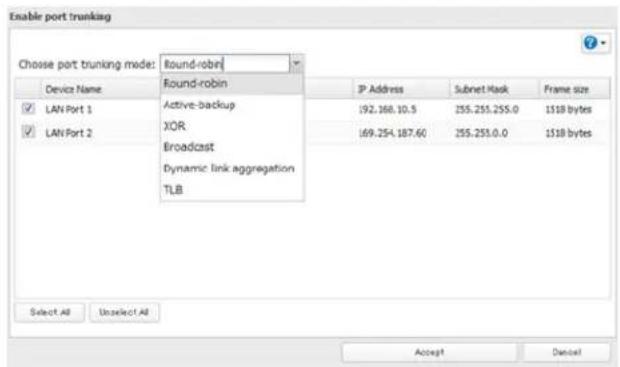
text_image
Enable port trunking Choose port trunking mode: Round-robin Device Name Round-robin IP Address Subnet Mask Frame size LAN Port 1 Active-backup 192.168.10.5 255.251.255.0 1518 bytes LAN Port 2 XOR 169.254.187.60 255.253.0.0 1518 bytes Broadcast Dynamic link aggregation TLB Select All Unselect All Accept Cancel6 Connect the second LAN port to the switch or hub.
7 Reboot the TeraStation before use.
Connecting a Printer
You can connect a printer to the USB port on the TeraStation.
Notes:
- Only one USB printer can be connected to the TeraStation.
- Bidirectional communication is not supported i.e., remaining ink quantities and other printer status information is not supported.
- If a multifunctional printer is connected, only the printer function can be used. Other functions such as scanning will not be available.
• The print server does not support Mac OS. - Don't disable the SMB protocol while the print server is enabled. If you do, you will need to enable SMB again and reconfigure the print server from scratch.
Setting Up a Printer with Windows 8.1, Windows 8, Windows 7, or Windows Vista
1 In Settings, click Services.

2 Move the print server switch to the position to enable the print server.

Print Server

to enable the print server.


3 Refer to the manual supplied with the printer and install the printer drivers.
4 Click Start - Network.
For Windows 8.1 and Windows 8, click the Network in File Explorer.
5 Double-click the TeraStation server name.
6 Double-click the icon of the connected printer (shared name is displayed).
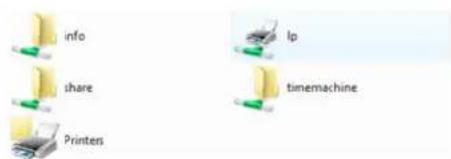
text_image
info share Printers lp timemachine7 Select your printer, then click OK.

text_image
Add Printer Wizard Select the manufacturer and model of your printer. If your printer came with an installation disk, click Have Disk. If your printer is not listed, consult your printer documentation for a compatible printer. Manufacturer Apollo Brother Canon Citizen Dell Printers Apollo P-1200 Apollo P2100/P2300U Apollo P2200 This driver is digitally signed. Tell me why driver signing is important Have Disk... OK Cancel8 Register the printer.
Setting Up a Printer with Windows XP
1 In Settings, click Services.

2 Move the print server switch to the position to enable the print server.

3 Refer to the manual supplied with the printer.
4 Click Start - Control Panel.
5 Click Network and Internet Connections.
6 Click My Network Places- View workgroup computers - (Name of the TeraStation Server).
7 Double-click your printer icon.
8 When "The server for the printer does not have the correct printer driver installed. If you want to search for the proper driver, Click OK." displays, click OK.
9 Register the printer.
TeraSearch
TeraSearch lets you search for character strings contained in files (text files, Word files, etc.) stored on the TeraStation. Follow the steps below to enable it.
1 Open Folder Setup.

2 Click the shared folder to be indexed.
3 Click Edit.
4 Check "Include this folder in the search index", then click OK.
5 Click OK.
6 Click Close.
7 Click Applications.

8 Move the TeraSearch switch to the position to enable TeraSearch.

9 Click Light of "TeraSearch".
10 Click Refresh Index
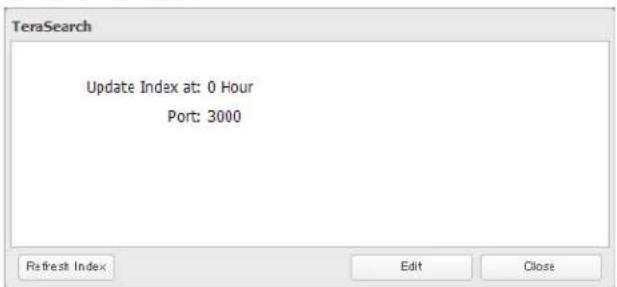
text_image
TeraSearch Update Index at: 0 Hour Port: 3000 Refresh Index Edit Close11 Click Edit.
12 Enter the port number that you want to use and the time that the index will be updated, then click OK.
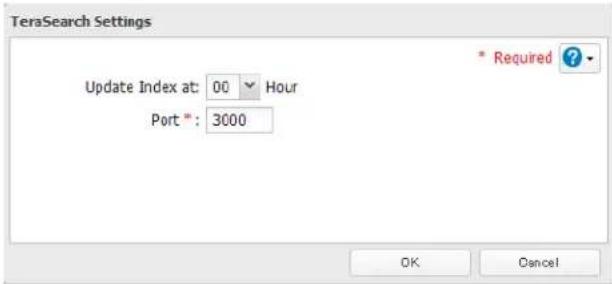
text_image
TeraSearch Settings Update Index at: 00 Hour Port*: 3000 * Required ? OK Cancel13 Open the following URL in your browser.
http://(IP address of your TeraStation):3000/
Note: You can identify your IP address from NAS Navigator2.
14 Enter your TeraStation's username and password, then click Login.
15 Enter a keyword in the "Search Text" field. Check "Advanced Search" to enable searches by specifying the filename, owner, date updated, and file size.
16 Click Search.
The search results are displayed. Click the filename in the results to open the file.
Offline Files
Offline files included with many versions of Windows, can be used to access files in the TeraStation, mimicking the computer's behavior even if it is disconnected from the network. When connected to the network again, the updated files are written and synchronized. Follow the procedure below to use offline files.
1 In Settings, click to the right of "Folder Setup".

Folder Setup
1 Folder(s)

2 Click the shared folder for offline files.
3 Click Edit.
4 Choose "Manual File Caching", "Automatic File Caching", or "Automatic Program and File Caching", then click OK.
Note:
"Manual File Caching" - User selects files that are cached.
"Automatic File Caching" - Opened files can be cached locally for offline use. Previous versions of files that are not synchronized are automatically replaced by the latest versions.
"Automatic Program and File Caching" - Opened files can be cached locally for usage offline. Previous versions of files and applications executed from the network that are not synchronized are automatically replaced by the latest version of the files and applications.
5 Click OK.
6 Click Close.
7 In Windows, navigate to Folder options. (Windows 8.1, Windows 8, and Windows 7 users should skip to step 9).
8 Check "Enable Offline Files", then click OK.
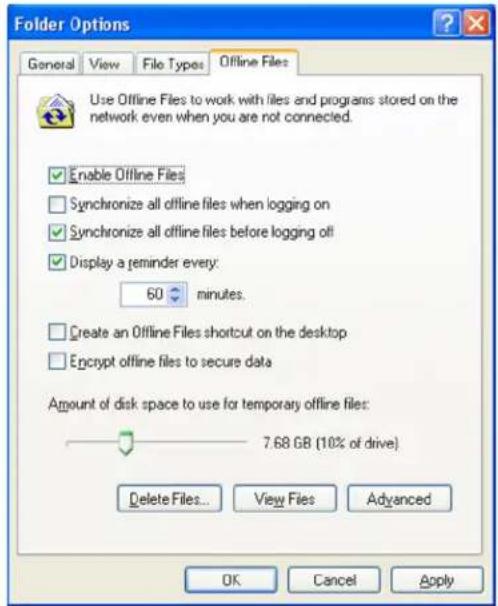
text_image
Folder Options General View File Types Offline Files Use Offline Files to work with files and programs stored on the network even when you are not connected. Enable Offline Files Synchronize all offline files when logging on Synchronize all offline files before logging off Display a reminder every: 60 minutes. Create an Offline Files shortcut on the desktop Encrypt offline files to secure data Amount of disk space to use for temporary offline files: 7.68 GB (10% of drive) Delete Files... View Files Advanced OK Cancel ApplyNote: Offline files cannot be enabled if "Use Fast User Switching" is enabled. To change the setting, open "User Accounts" in Control Panel and select "Change the way users log on or off".
9 Right-click the icon of the shared folder on the TeraStation for which you have set the offline feature, then click Make Available Offline.
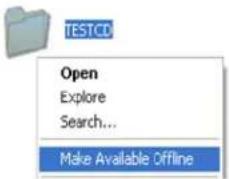
text_image
TESTCD Open Explore Search... Make Available Offline10 When the offline file wizard opens, follow the instructions on the screen. For more information, refer to the Windows help.
11 When the offline settings and sync settings are completed using the wizard, the files and folders set appear as shown:

12 If the network is disconnected after synchronization is completed, the offline file function can be used. Offline files can be accessed by the original Universal Naming Convention (UNC) where the data was saved.
Note: If offline files can be used, an icon appears in the system tray.

"Editing Offline Files" - Offline files can be edited and deleted in the same way as normal files. Differences that arise from the original data on the network due to editing or deleting of the file are resolved by resynchronization after the network is reconnected.
"Synchronizing Offline Files" -The offline file is automatically synchronized based on preset conditions, such as after
reconnection with the network, logging on, logging off, etc.
"Version Conflicts" - A file conflict occurs if different changes were made simultaneously to the offline file and original data on the network. The screen below is displayed when a file conflict is detected. Resolve the conflict by following the instructions on the screen.

text_image
Resolve File Conflicts While your computer was disconnected from the network, the following file was changed, both on your computer and on the network. Text.txt on 'WALS-SL-kmzNishare#TESTOD' To resolve this file conflict: ● Keep both versions. Save the version on my computer to the network as: Text (Administrator vt).txt ○ Keep only the version on my computer. Replace the network version. ○ Keep only the network version. Replace the version on my computer. Network Version Modified on '2009/12/14 15:05' Local Version Modified by 'Administrator' on '2009/12/14 15:04' Do this for all conflicts. View View OK CancelDFS
DFS (Distributed File System) is a set of client and server services that allows Windows users to organize many distributed SMB file shares into a distributed file system. Follow the steps below to enable DFS on the TeraStation.
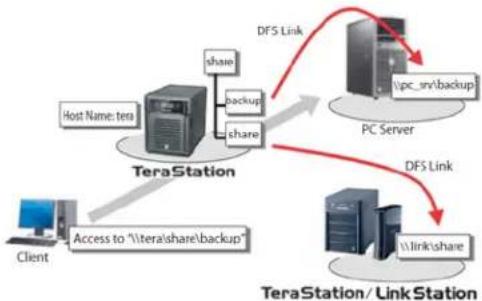
flowchart
graph TD
    A["Host Name: tera"] -->|share| B["TeraStation"]
    B -->|backup| C["PC Server"]
    C -->|DFS Link| D["Link Station"]
    D -->|DFS Link| E["Client"]
    E -->|Access to \"tera\share\backup'| B
    C -->|\\pc_srv\backup| C
    D -->|\link\share| D
Note: Don't disable the SMB protocol while DFS is enabled. If you do, you will need to enable SMB again and reconfigure DFS from scratch.
1 In File Sharing, click right of "DFS".

2 Click Edit.
3 Enable or disable "Set DFS Link to DFS Root".
Note: If enabled, a DFS link target shared folder is created under the DFS root. If disabled, up to eight DFS link target
shared folders can be created under the DFS root.
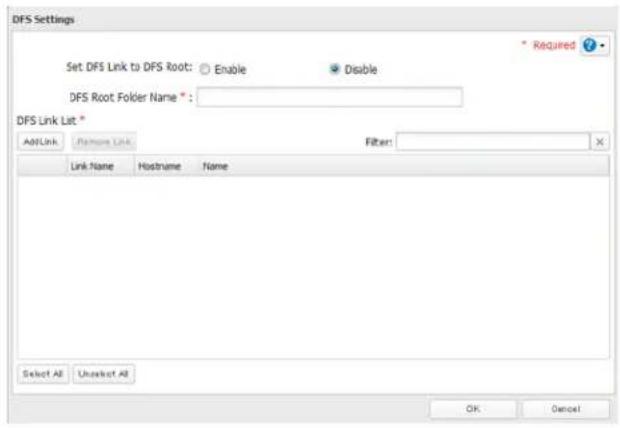
text_image
DFS Settings Set DFS Link to DFS Root: Enable Disable DFS Root Folder Name * : DFS Link List * A0Link Remove Link Filter: Link Name Hostrune Name Select All Unselect All OK Cancel * Required4 Enter DFS Root Folder Name.
5 Click Add Link.
6 Enter the link name, hostname, and shared folder name, then click OK.
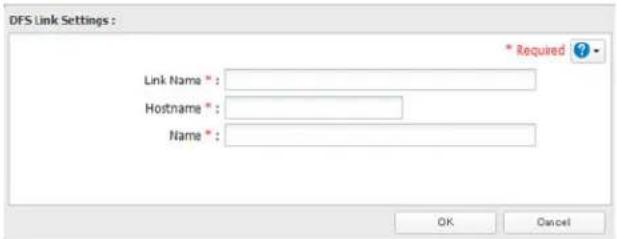
text_image
DFS Link Settings : Link Name * : Hostname * : Name * : * Required ? OK CancelNotes:
- TeraStations, LinkStations, and SMB-compatible Windows computers can be specified as DFS link targets (Mac OS and Linux are not supported).
- If "Set DFS Link to DFS Root" is disabled, you may create up to 8 hostnames and DFS links.
7 Click OK.
8 Move the DFS switch to the position to enable DFS.

Accessing from a NFS Client
Note: (US purchasers only) Buffalo's customer support will help configure the NFS settings on your TeraStation, and will support VMware and Windows clients but will not provide support for configuring your Linux or other UNIX clients. There are many types of UNIX and the procedures for configuring NFS with them will vary considerably. For help configuring your NetWare, Linux, or other UNIX clients for NFS support please consult each client's own documentation and support.
1 Open Folder Setup.

2 Choose the shared folder that will be accessible to the NFS client.
3 Click Edit.
4 Under "LAN Protocol Support", enable "NFS". Click OK.
Note the NFS path. It will be used later for accessing data from an NFS client.
5 Click Close.
6 Move the NFS switch to the position to enable NFS.
7 Click the the right of "NFS".
8 Click Client Settings.
9 Click Add Client.

text_image
NFS Settings Services Client Settings Add Client Delete Client Filter: Hostname IP Address Select All Unselect All Close10 Enter the IP address and hostname of the NFS client, then click OK.
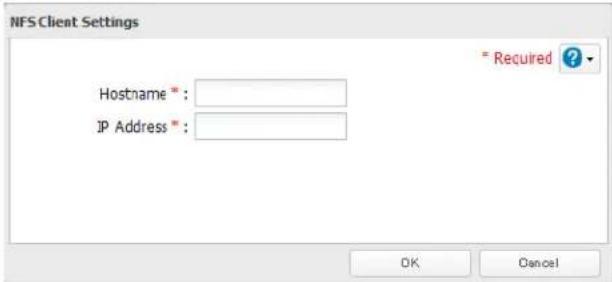
text_image
NFS Client Settings Hostname * IP Address *: = Recurred ? OK CancelTo delete the client, check the hostname and click Delete Client.
11 Click Close.
12 Enter the mount command to access the shared folder from the NFS client.
The mount command depends on your operating system. The examples below assume that IP address of your TeraStation is 192.168.11.10, "/mnt/array1/share" is the desired NFS path, and "/mnt/nas" or drive letter "z" is the mount point.
For Linux:
mount -t nfs 192.168.11.10:/mnt/array1/share /mnt/nas
For Windows Service for Unix 3.5:
mount 192.168.11.10:/mnt/array1/share z:
For Solaris 10:
mount -F nfs 192.168.11.10:/mnt/array1/share /mnt/nas
Notes:

text_image
NFS Settings Services Client Settings Public Network Address: 0.0.0.0 Public Subnet Mask: 0.0.0.0 Operation Mode: User Mode Guest Permission: Forced Edit Close• To configure access restrictions by IP address, click Services - Edit, then enter the desired settings.
- To use shared folders set for NFS as drives on VMware ESX/ESXi, change the operation mode from "User Mode" (default setting) to "Kernel Mode" on the screen navigating to Services - Edit.
- If you configure "Guest Permission" to "Forced" on the screen navigating to Services - Edit, user ID and group ID should be 99 when the data is written from NFS clients; this is recommended for SMB or other protocols as well. Use "Ignored" if the TeraStation only enables NFS connection.
Encrypting Data Transmission
Encrypting Settings Data
All communication to Settings can use SSL encryption if you access settings through https://.
Encrypting FTP Transfer Data
You can encrypt passwords and files using SSL/TLS for secure FTP communication. First, in the shared folders settings, select FTP under LAN Protocol Support in Settings. Enable SSL security in the setup screen for your FTP client. The procedure depends on the FTP client software.
SSL keys are used during setup screen operations and FTP communication. SSL (Secure Socket Layer) is a type of encryption system called public key encryption. Generally, SSL is managed by the two files below.
server.crt (SSL Certificates)
In this system, the TeraStation sends this file to the computer, and the computer uses this key to perform encryption. The TeraStation receives the encrypted data and uses server.key (private key) to decrypt the data.
In SSL, this key contains the server certificate, and depending on your computer environment, a check may be performed to determine the trustworthiness of the certificate. The server certificate included in the TeraStation in the default settings was created by Buffalo Technology, and in some cases the message "There is a problem with this website's security certificate" may be displayed in your browser or other software. Disregard this message and continue.
server.key (SSL Key)
This file is used as a pair with server.crt (server certificate). This is required for decrypting the data that was encrypted by the server certificate, and this is normally not revealed.
Updating SSL Key
To update a server certificate and a private key for SSL, follow this procedure.
1 Click Management - Light of "SSL".
2 Register "server.key" for "Secret Key" and "server.crt" for "Server Certificate (.crt)", then click Import.
Notes:
- Place the SSL key files (server.key, server.crt) directly below the C root drive. The SSL key may not be able to be updated if it is placed in folders or paths that contain multi-byte characters.
- Use the provided password for the SSL key.
- If Settings cannot be displayed after updating, initialize the TeraStation settings.
- Updating the firmware initializes an SSL key.
Web Server
The TeraStation can be used as a web server. In addition to HTML files, images, and JavaScript, the TeraStation also allows installation of Perl script and PHP script files. The web server uses version 1.4.23 of lighttpd, version 5.8.8 of Perl, and version 5.2.10 of PHP.
1 In Settings, click Services.

2 Move the web server switch to the position to enable the web server.

3 Click Light of "Web Server".
4 Click Edit.

text_image
Web Server Target Folder: Not configured Port: 81 Edit php ini Edit CloseNote: The settings of the PHP language interpreter can be changed from "Edit php.ini".
5 Click Browse.

text_image
Web Server Settings * Recurred ? Target Folder * ; Port * : 81 Browse OK Cancel6 Choose a shared folder for the web server, then click OK.
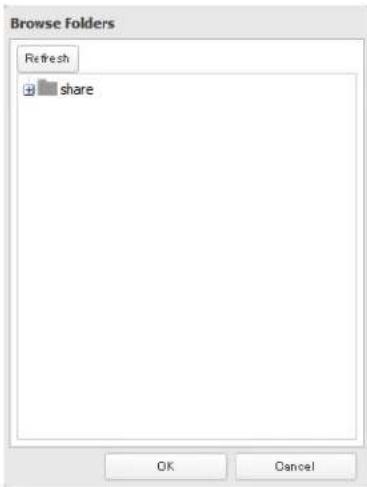
text_image
Browse Folders Refresh + share OK Cancel7 Choose an external port, then click OK.
MySQL Server
The TeraStation can be used as a MySQL server. A MySQL database may be installed and linked with the web server. The TeraStation uses version 5.0.70 of MySQL server and version 3.2.2 of PhpMyAdmin.
1 In Settings, click Services

2 Move the MySQL server switch to the position to enable the MySQL server.

3 Click Light of "MySQL Server".
4 Click Edit.
5 Click Browse.

text_image
MySQL Server Settings Database Folder * : Port * : 3306 * Recured ? Browse OK Cancel6 Choose a shared folder for the MySQL server, then click OK.
text_image
Browse Folders Refresh + share OK Cancel7 Choose an external port, then click OK.
SNMP
If SNMP is enabled, you can browse your TeraStation from SNMP-compatible network management software. The specific MIB (management information base) file for Buffalo is available from the Buffalo website (buffalotech.com).
1 In Settings, click Network.

2 Move the SNMP switch to the position to enable SNMP.

3 Click light of "SNMP".
4 Click Edit.
5 Configure the desired settings, then click OK.
Saving and Applying Settings
The TeraStation's settings can be saved to a USB memory device and restored to another TeraStation. Use this function to back up and copy settings to a new TeraStation.
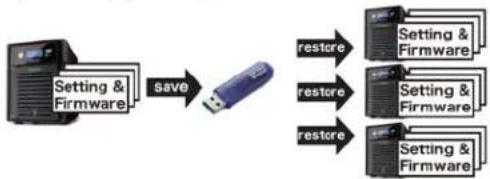
flowchart
graph LR
    A["Setting & Firmware"] -->|save| B["USB"]
    B --> C["Restore"]
    C --> D["Setting & Firmware"]
    C --> E["Setting & Firmware"]
    C --> F["Setting & Firmware"]
Make a note of the hard drive configuration (number of hard drives, RAID, LVM, etc.) of the TeraStation where the settings were saved. Make sure that any TeraStation that you apply these settings to has exactly the same hard drive configuration before you apply the settings. If the drive configuration is different, you may get unexpected results.
The following settings are not saved or restored:
| Category Settings | |
| File Sharing Shared folder information of USB drive and media cartridge | |
| Drives | All settings in "Drives" |
| All settings in "RAID" - "Options" - "RAID Array Settings" | |
| All settings in "LVM" | |
| All settings in "iSCSI" | |
| USB drive and media cartridge information | |
| Network | All settings in "IP Address" |
| All settings in "Port Trunking" | |
| Backup All settings in "Failover" | |
| Management | All settings in "Name" |
| All settings in "UPS Sync" | |
| All settings in "SSL" | |
| Display language in Settings | |
Saving Settings
1 Insert a USB memory device into a USB port on the TeraStation.
Notes:
- Use a USB 2.0 port. If your TeraStation has both USB 3.0 and USB 2.0 ports, make sure that you use one of the USB 2.0 ports.
- The USB memory device should have a capacity of at least 1 GB.
- Any data stored on the USB memory device will be deleted.
2 In Settings, click Management.

3 Click Light of "Restore/Erase".


4 From "Target USB drive", select the USB memory device that is connected to the USB 2.0 port of the TeraStation.

text_image
Restore/Erase USB Options Select from the following options: Save current configuration to a USB drive Transfer settings from a USB drive Create a USB drive for initializing settings Create a USB drive for resetting the admin password Target USB drive: USB disk 1 Execute5 Select "Save current configuration to a USB drive", then click Execute.
Troubleshooting:
If the settings are not saved to the USB memory device successfully, you may receive the error message "The specified operation cannot be executed.". Verify:
- The device is connected to a USB 2.0 port, not a USB 3.0 port.
• The device has a capacity of 1 GB or larger.
• The device is not write-protected.
Applying Settings
The saved settings can be applied to a different TeraStation.
1 Connect the USB memory device with the saved settings to a USB 2.0 port of the TeraStation (not a USB 3.0 port).
2 In Settings, click Management.

3 Click Right of "Restore/Erase".


4 From "Target USB drive", select the USB memory device that is connected to the USB 2.0 port of the TeraStation.

text_image
Restore/Erase USB Options Select from the following options: Save current configuration to a USB drive Transfer settings from a USB drive Create a USB drive for initializing settings Create a USB drive for resetting the admin password Target USB drive: USB disk 1 Execute5 Select "Transfer settings from a USB drive", then click Execute.
Restoring Factory Defaults
Initializing from Settings
To initialize the TeraStation to its factory defaults from Settings, follow this procedure.
1 In Settings, click Management.

2 Click Light of "Restore/Erase".

3 Click Initialize TeraStation.
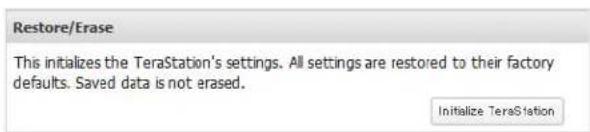
text_image
Restore/Erase This initializes the TeraStation's settings. All settings are restored to their factory defaults. Saved data is not erased. Initialize TeraStation4 The "Confirm Operation" screen will open. Enter the displayed number, then click OK.
5 The TeraStation will be restored to its factory default settings.
Creating an Initialization Drive
A system initialization drive will restore the settings on your TeraStation to their factory defaults. You can initialize them without logging in to Settings. Follow the steps below to create a system initialization drive.
Notes:
- Normally, making and using the system initialization drive will not affect data. However, always back up your data regularly!
- This USB drive can be used to recover the system if your TeraStation doesn't boot at all. In this case, if the data partition is damaged, then all your data will be deleted by the recovery process.
1 Insert a 1 GB or larger USB flash drive (not included) into a USB 2.0 port on the TeraStation.
2 In Settings, navigate to Management-Restore/Erase-USB Options.
3 Select Create a USB drive for initializing settings.
Note: All data on the USB flash drive will be erased!
4 Select the USB memory device from "Target USB drive", then click Execute.
5 Enter the 4 digit confirmation number and click OK. The TeraStation will create the initialization drive. This will take about a minute.
6 When the "finished" dialog opens, the USB initialization drive is ready to use. Dismount the USB drive before unplugging it. See "Dismounting Drives" in chapter 4 for the instructions on dismounting drives.
Initializing with the USB Drive
To initialize the settings on your TeraStation with the USB drive as created in above, follow the procedure below.
1 Create a USB "initialization drive" as described above.
2 Insert the USB drive into a USB 2.0 port (not a USB 3.0 port) on the TeraStation.
3 Set the boot mode switch to "USB".
4 Press the power button to turn on the TeraStation.
5 When the message "Recovery I41 PushFuncToStart" appears on the LCD panel, press the function button.
6 It will take several minutes for initializing the settings. The TeraStation will shut down when it's finished.
7 After shutdown, "Recovery I39 Change Boot" is displayed.
8 Set the boot mode switch to "HDD" position.
9 Press the power button to start the TeraStation.
Resetting the Administrator Password
Creating a Password Reset Drive
A password initialization drive can reset the administrator password to its default value ("password"). This could be very useful if you forget your admin password.
1 Connect a 1 GB or larger USB memory device (not included) to a USB 2.0 port on the TeraStation.
2 In Settings, navigate to Management - Restore/Erase - USB Options.
3 Select Create a USB drive for resetting the admin password.
Note: All data on the USB flash drive will be erased!
4 Select the USB memory device from "Target USB drive" list, then click Execute.
5 Enter the 4 digit confirmation number and click OK. The TeraStation will create the password reset drive. This will take about a minute.
6 When the "finished" dialog opens, the password reset drive is ready to use. Dismount the USB drive before unplugging it. See "Dismounting Drives" in chapter 4 for the instructions on dismounting drives.
Resetting with the USB Drive
To reset your admin password, follow the procedure below.
1 Create a USB "password initialization" drive as described above.
2 Insert the USB drive into a USB 2.0 port (not a USB 3.0 port) on the TeraStation.
3 Set the boot mode switch to "USB".
4 Press the power button to turn on the TeraStation.
5 When the message "Recovery I41 PushFuncToStart" appears on the LCD panel, press the function button.
6 The password will be reset to its factory default. The TeraStation will shut down when it's finished.
7 After shutdown, "Recovery I39 Change Boot" is displayed.
8 Set the boot mode switch to "HDD" position.
9 Press the power button to start the TeraStation.
Logs
Follow this procedure to check the TeraStation's logs.
1 In Settings, click Management.

Management
2 Click Light of "Logs".

Logs

3 Click Edit.
4 Select a log to view.
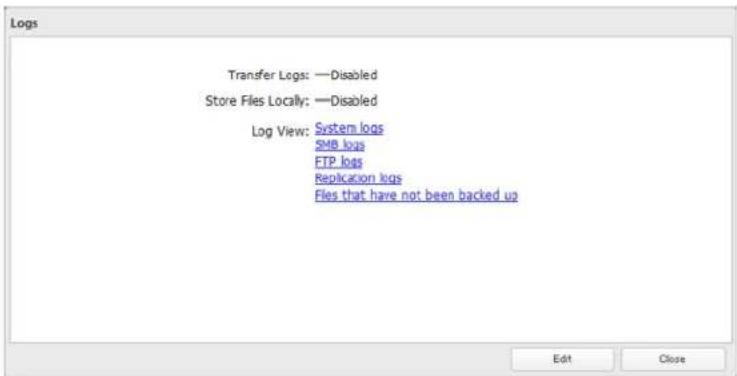
text_image
Transfer Logs: —Disabled Store Files Locally: —Disabled Log View: System logs SMB logs FTP logs Replication logs Files that have not been backed up Edit CloseThe file operation log stores file operations performed on the internal hard drives. File operations on USB drives are not logged.
To transfer logs
1 Click Edit.
2 Enable "Syslog Transfer".
3 Enter the IP address of the syslog server where you want to transfer the logs to.
4 Select the type of log that you want to transfer from "Logs To Transfer".
5 Click OK.
FTP logs cannot be written to a syslog server.
Logs are in UTF-8 format. Your syslog server must support UTF-8 encoding.
To create a link to the logs in the shared folder
1 Click Edit.
2 Enable "Share Link to Logs".
3 Select the shared folder where the link will be created in "Target Shared Folder".
4 Click OK.
Under the selected shared folder, a folder named "system_log" will now contain the logs.
Updating the Firmware
If a new firmware is available, a message is displayed when the TeraStation boots. You can update the firmware by the following ways:
To update from Settings:
1 In Settings, click Management.

Management
2 Choose Update.

Update
This TeraStation is using the latest firmware.

3 Click Install Update.
You can also download the firmware from www.buffalotech.com.
Note: Settings is not available while the firmware is updating. Don't try to access Settings from another computer until the update is complete.
Name, Date, Time, and Language
Configure the TeraStation's hostname, date, time, and language as follows.
Note: If the TeraStation is being used as an iSCSI hard drive, to change the settings, navigate to Drives - iSCSI in Settings and set the icon to
1 In Settings, click Management.

Management
2 Open Name/Time/Language.

Name/Time/Language

3 Click Edit.
4 Click the Name tab, then configure the TeraStation's name and description.
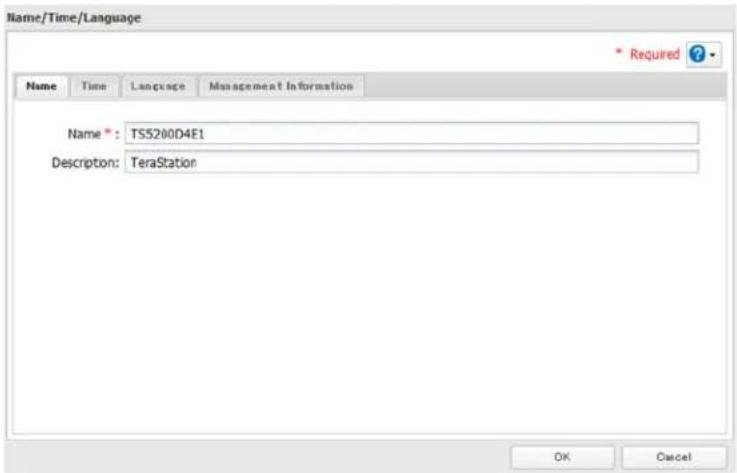
text_image
Name/Time/Language * Required ? Name Time Language Management Information Name*: TS5200D4E1 Description: TeraStation OK Cancel5 Click the Time tab.
Click Use Local Date/Time to use your computer's time settings for the TeraStation.
By default, the TeraStation adjusts its clock automatically by using a default NTP server. This NTP server belongs to Internet Multi Feed Inc. For more information, visit www.jst.mfeed.ad.jp.
To use a different NTP server, select Name/Time/Language from Management. Click Time, then Edit. Uncheck "Use Default NTP Server" and enter a new NTP IP address. Click OK.
If an NTP server is specified by name instead of IP address, make sure that a DNS server is configured for the TeraStation.
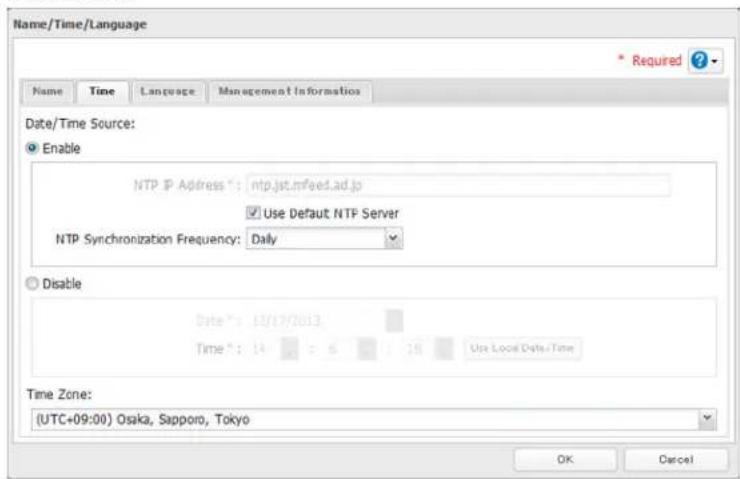
text_image
Name/Time/Language * Required ? Name Time Language Management Information Date/Time Source: Enable NTP IP Address*: ntp.jst.mfeed.ad.jp Use Default NTP Server NTP Synchronization Frequency: Daily Disable Date*: 11/17/2013 Time*: 14 = 6 = 18 Use Local Data.Time Time Zone: (UTC+09:00) Osaka, Sapporo, Tokyo OK CancelNote: The internal clocks of the TeraStation and other devices on your network may run at slightly different speeds. Over a long period of time your network devices may show somewhat different times, which can cause network problems. If clocks on your network vary by more than 5 minutes it may cause unexpected behavior. For best results, keep all clocks on the network set to the same time by adjusting them regularly, or use an NTP server to correct them all automatically.
6 Click the Language tab. Select the language to be used and click OK.

text_image
Name/Time/Language * Required ? None Time Language Management Information Client Language: CP437 Display Language: English OK CancelNote: This tab changes the language used by the TeraStation for email notifications, DLNA, and other functions. To change the language displayed in Settings, go to Advanced Settings or Easy Admin and click Language in the menu bar. Choose your desired language from the drop-down menu.
Beep Alerts
You can set the TeraStation to beep when certain errors occur.
1 In Settings, click Management.

Management
2 Select Notifications.

Notifications

3 Click Edit.
4 Select the conditions to beep the alert, then click OK.

text_image
Notification Alert Sound Settings Front Panel Display Settings Alert Sound Settings: ✓ Overheating ✓ Disk Error ✓ Fan Failure ✓ UPS Power Error OK CancelLCD and LEDs
You may configure the LEDs and LCD on the front of the TeraStation.
1 In Settings, click Management.

Management
2 Click Light of "Notifications".

Notifications

3 Click Edit.
4 Click Front Panel Display Settings.
5 Configure your settings, then click OK.
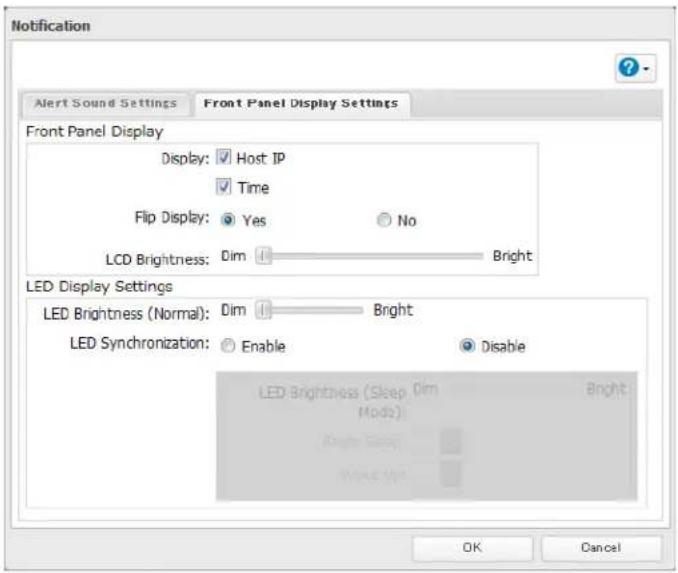
text_image
Notification Alert Sound Settings Front Panel Display Settings Front Panel Display Display: ✓ Host IP ✓ Time Flip Display: ○ Yes ○ No LCD Brightness: Dim Bright LED Display Settings LED Brightness (Normal): Dim Bright LED Synchronization: ○ Enable ○ Disable LED Brightness (Sleep Dim Bright) (Mode): (Right Light) (Move Light) OK CancelJumbo Frames
If your other network devices support it, you may be able to increase network performance with jumbo frames.
1 In Settings, click Network.

2 Click Light of "IP Address".

3 Click the LAN port where the jumbo frames will be used.
4 Click Edit.
5 Select the desired Ethernet frame size and click OK.
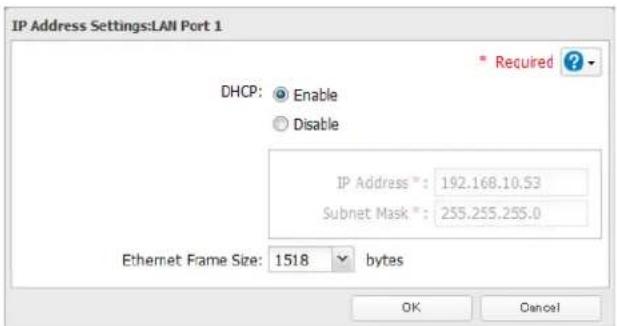
text_image
IP Address Settings:LAN Port 1 DHCP: Enable Disable * Required ? IP Address*: 192.168.10.53 Subnet Mask*: 255.255.255.0 Ethernet Frame Size: 1518 bytes OK Cancel| Connection | Transmission | |
| TeraStation Jumbo Frame (4102/7422/9694) | ○ | Transmit Jumbo Frame (4102/7422/9694) |
| TeraStation Jumbo Frame (4102/7422/9694) | △ | Transmit normally(1518) |
| TeraStation Jumbo Frame (4102/7422/9694) | △ | Transmit normally(1518) |
| TeraStation Jumbo Frame (4102/7422/9694) | × | No transmission |
Note: Make sure the TeraStation's Ethernet frame size is smaller than the hub or router's. Larger frame sizes may not transfer the data to the TeraStation correctly.
Changing the IP Address
Normally, the TeraStation's IP address is set automatically from a DHCP server on your network. If you prefer, you can set it manually. An easy way to do this is to change it from NAS Navigator2 running on a computer connected to the same router (subnet) as the TeraStation. The procedure to change the IP address in Settings is below.
Note: If the TeraStation is being used as an iSCSI hard drive, to change the settings, navigate to Drives - iSCSI in Settings and move the iSCSI switch to the temporarily before changing network settings.
1 In Settings, click Network.

2 Click Light of "IP Address".

3 Click the LAN port where the IP address will be changed.
4 Click Edit.
5 Disable "DHCP" and enter the desired network address settings, then click OK.
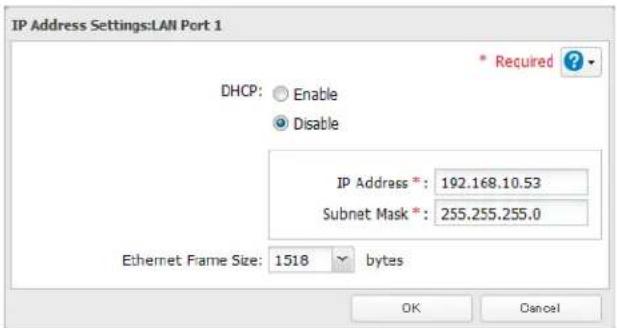
text_image
IP Address Settings:LAN Port 1 DHCP: Enable Disable * Required ? IP Address *: 192.168.10.53 Subnet Mask *: 255.255.255.0 Ethernet Frame Size: 1518 bytes OK CancelNotes:
- Do not set the same address for LAN port 1 and LAN port 2. This may cause unstable network communication.
- Use LAN port 1 to access different network subnets from the TeraStation. Access to a different network subnet is not possible from LAN port 2 since it doesn't have a default gateway.
- The following IP addresses are reserved and should not be used. If you configure one of them by accident, initialize all settings with the init button on the TeraStation.
Local loopback address: 127.0.0.1, 255.255.255.0
Network address: 0.0.0.0, 255.255.255.0
Broadcast address: 255.255.255.255, 255.255.255.0
The IP address range from 224.0.0.0 to 255.255.255.255
Chapter 11 Utilities
NAS Navigator2 for Windows
NAS Navigator2 is a utility program that makes it easy to display Settings, change the TeraStation's IP address, or check its hard drive. If you installed the TeraStation with the TeraNavigator CD, NAS Navigator2 was installed automatically.

To launch NAS Navigator2, double-click the icon.

text_image
NAS Navigator2 Menu View Refresh TSS200D4E1 TSS200D2.0T HDD 0.0 GB/899.9 GB (0.0%) HDD 0.0 GB/899.9 GB (0.0%) Workgroup: WORKGROUP IP Address: 192.168.10.24 Subset Mask: 255.255.255.0 Default Gateway: 192.168.10.1 MAC Address: AA:BB:CC:DD:12:23 Firmware: 2.50 NAS Navigator version 3.71Click your TeraStation's icon to open a share on the TeraStation and display:
• Total capacity
- Capacity in use
- IP address
• Workgroup
- Subnet mask
- Default gateway
- MAC address
- Firmware version
| Name Description | ||
| Menu | Map Share* | Assigns the TeraStation's shared folder as a network drive. |
| Disconnect Share* | Unmaps the network drive. | |
| Map All Remote Shares to Drive Letters | Assigns all the TeraStation's shared folders as network drives. | |
| Create Desktop Shortcut* | Creates a shortcut to the TeraStation's shared folder (share). | |
| Launch NAS Navigator2 on Startup | Launches NAS Navigator2 in the system tray when Windows boots. | |
| Display Errors | If an error occurs, an error message will pop up from the NAS Navigator2 icon in the system tray. | |
| Properties* | Opens the selected TeraStation's properties page. | |
| Close Closes NAS Navigator2. | ||
| View | View | Icons: Displays icon.Details: Displays hostname, product name, workgroup, IP address, subnet mask, and default gateway. |
| Sort by | Selects the sort order from following to display when multiple TeraStations are found:Hostname, product name, workgroup, IP address, subnet mask, default gateway | |
| Browse* | Opens the TeraStation's shared folder. | |
| Refresh Searches for NAS devices on the network again. | ||
| I'm here* | Causes your TeraStation to beep. | |
| Right-click your device's icon to show these options. | Browse Shares Opens the TeraStation's shared folder. | |
| Settings Opens Settings for the selected TeraStation. | ||
| Properties Opens the TeraStation's properties page. | ||
| Map Share Assigns the TeraStation's shared folder as a network drive. | ||
| Disconnect Share Unmaps the network drive. | ||
| Create Shortcut | Creates a shortcut icon to the shared folder "share" on the desktop. | |
| I'm here Causes your TeraStation to beep. | ||
*Click on the TeraStation's icon to display these options.
When NAS Navigator2 is minimized, right-click on the NAS Navigator2 icon in the system tray for the following options.
| Browse Shares | TSS200D4E1 |
| Settings | Refresh |
| Properties | Browse Shares |
| Map Share | Exit |
| Disconnect Share | |
| Create Shortcut | |
| I'm here |
| Name Description | ||
| TeraStation Name | Browse Shares Opens the TeraStation's shared folder. | |
| Settings Opens Settings for the selected TeraStation. | ||
| Properties Opens the TeraStation's properties page. | ||
| Map Share | Assigns the TeraStation's shared folder as a network drive. | |
| Disconnect Share | Unmaps the network drive. | |
| Create Shortcut | Creates a shortcut icon to the shared folder "share" on the desktop. | |
| I'm here | Causes your TeraStation to beep. | |
| Refresh | Refreshes list of NAS devices. | |
| Browse Shares Displays NAS Navigator2 window. | |
| Exit Exits NAS Navigator2. | |
The following tasks may be performed from the TeraStation's properties page.
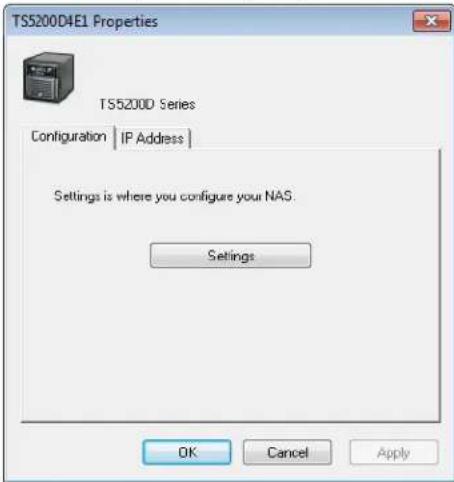
text_image
TS5200D4E1 Properties TS5200D Series Configuration | IP Address | Settings is where you configure your NAS. Settings OK Cancel Apply| Name Description | |
| Configuration Click Settings to open the configuration interface. | |
| IP Address | Check Use DHCP to assign an IP address from the DHCP server automatically. If there is no DHCP server in the network, you cannot use this function.Check Renew IP address to obtain an IP address from the DHCP server.You can manually enter an IP address, subnet mask, and default gateway. |
Mount as Network Drive
You can easily map a shared folder as a network drive using NAS Navigator2.
1 Double-click the icon on the desktop. NAS Navigator2 will start.
2 Right-click on the TeraStation's icon, then click Map Share.
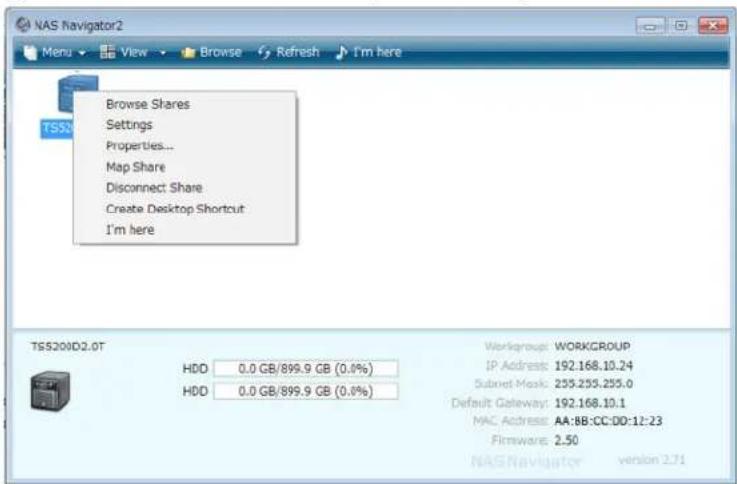
text_image
Browse Shares Settings Properties... Map Share Disconnect Share Create Desktop Shortcut I'm here TSS201D2.0T HDD 0.0 GB/899.9 GB (0.0%) HDD 0.0 GB/899.9 GB (0.0%) Workgroup: WORKGROUP IP Address: 192.168.10.24 Submit Mask: 235.255.255.0 Default Gateway: 192.168.10.1 MAC Address: AA:BB:CC:DD:12:23 Firmware: 2.50 NAS Navigator version 2.713 An icon for the mapped share will appear in Computer or My Computer. You can use this network drive just like any other hard drive.

Changing the IP Address
1 Double-click the icon on the desktop. NAS Navigator2 will start.
2 Right-click on your TeraStation's icon and choose Properties - IP Address.
3 Uncheck "Use DHCP" and enter the desired settings, then click OK.

text_image
TSS200D4E1 Properties TS52J00 Series Configuration IP Address Use DHCP Renew IP address IP Address 192 . 168 . 10 . Subnet Mask 255 . 255 . 255 . 0 Default Gateway 192 . 168 . 10 . 1 OK Cancel ApplyNote: The following IP addresses are reserved and should not be used. If you configure one of them by accident, initialize all settings with the init button on the TeraStation.
Local loopback address: 127.0.0.1, 255.255.255.0
Network address: 0.0.0.0, 255.255.255.0
Broadcast address: 255.255.255.255, 255.255.255.0
The IP address range from 224.0.0.0 to 255.255.255.255
NAS Navigator2 for Mac
NAS Navigator2 is a utility program that makes it easy to display Settings, change the TeraStation's IP address, or check its hard drive.
If you installed the TeraStation with the TeraNavigator CD, NAS Navigator2 was installed automatically. To launch it, click

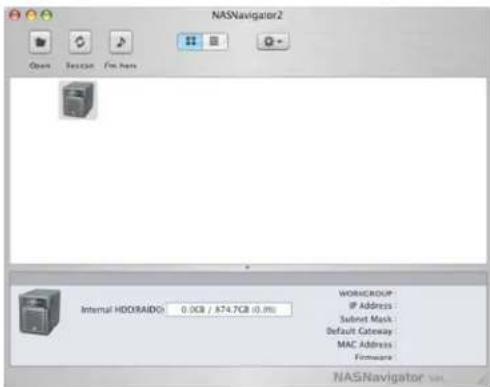
text_image
NASNavigator2 Open Session For Here Internal HDD/BAID0: 0.0GB / 874.7GB (0.0m) WORKGROUP IP Address Jacket Mask Default Gateway MAC Address Firmware NASNavigator vClick on a TeraStation's icon to display:
- Total capacity
• Used capacity - Workgroup
- IP address
- Subnet mask
- Default gateway
- MAC address
- Firmware version
Double-click it to open a share on the TeraStation.
| Name Description | ||
| Open Opens the default shared folder for a selected TeraStation. | ||
| Refresh Searches for NAS devices on the network again. | ||
| I'm here Causes your TeraStation to beep. | ||
| Settings Opens Settings for the selected TeraStation. | ||
| Configure | Opens a window that lets you configure NAS's IP address or open Settings. | |
| Label Color Selects the color of the name displayed below the icon. | ||
| View Options Lets you choose icon size, position, and view mode. | ||
| Auto Power Mode | Auto power mode can turn supported TeraStations and LinkStations on the network on and off automatically. | |
| To display these options, hold down the control key and select your TeraStation's icon. | Open Folder Opens the TeraStation's shared folder. | |
| Settings Opens Settings for the selected TeraStation. | ||
| Configure | Opens a window that lets you change the NAS's IP address or open Settings. | |
| I'm here Causes your TeraStation to beep. | ||
| Label Color | Selects the color of the name displayed below the icon. The menu below is displayed when you click the TeraStation icon while holding down the control key. | |
Mount as Network Drive
You can map the shared folder as a network drive using NAS Navigator2 on Mac OS.
1 Click the icon in the Dock. NAS Navigator2 will launch.
2 Double-click the TeraStation icon or click the TeraStation icon while holding down the control key, then select Open Folder. Enter a username and password with the rights to access the shared folder.
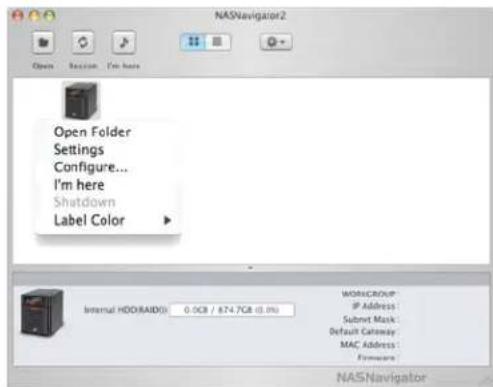
text_image
NASNavigator2 Open Session I'm here Open Folder Settings Configure... I'm here Shutdown Label Color Internal HDD/RAID(0) 0.0GB / 874.7GB (0.0m) WORKGROUP IP Address Submit Mask Default Gateway MAC Address Firmware NASNavigator3 Select the shared folder that you want to mount, then click OK.
4 The shared folder is now mounted as a network drive.
Changing the IP Address
1 Click the icon in the Dock. NAS Navigator2 will start.
2 Click the TeraStation icon while holding down the control key, then choose Configure... - IP Address.
3 Uncheck "Use DHCP" and enter the desired settings, then click OK.
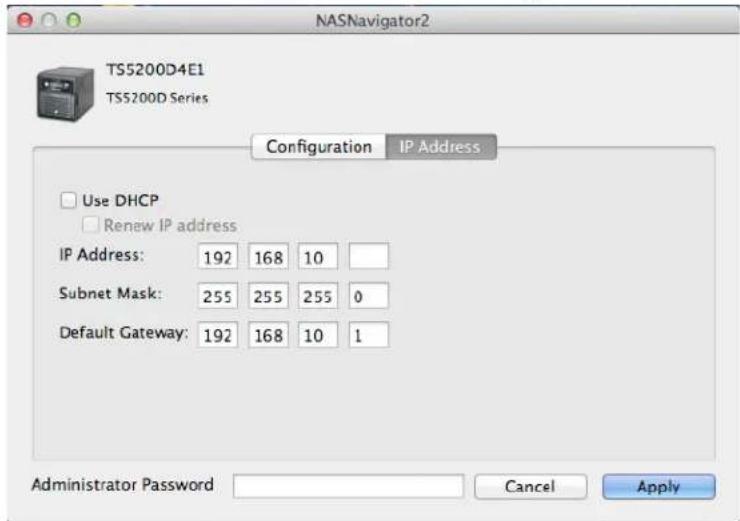
text_image
NASNavigator2 TS5200D4E1 TS5200D Series Configuration IP Address Use DHCP Renew IP address IP Address: 192 168 10 Subnet Mask: 255 255 255 0 Default Gateway: 192 168 10 1 Administrator Password Cancel ApplyNote: The following IP addresses are reserved and should not be used. If you configure one of them by accident, initialize all settings with the init button on the TeraStation.
Local loopback address: 127.0.0.1, 255.255.255.0
Network address: 0.0.0.0, 255.255.255.0
Broadcast address: 255.255.255.255, 255.255.255.0
The IP address range from 224.0.0.0 to 255.255.255.255
iSCSI Connection Tool
The iSCSI Connection Tool is a Windows utility that lets you use the TeraStation as an iSCSI drive.
To launch it, click Start - All Programs - BUFFALO - iSCSI Connection Tool - iSCSI Connection Tool.
For Windows 8.1 and Windows 8, click the iSCSI Connection Tool.
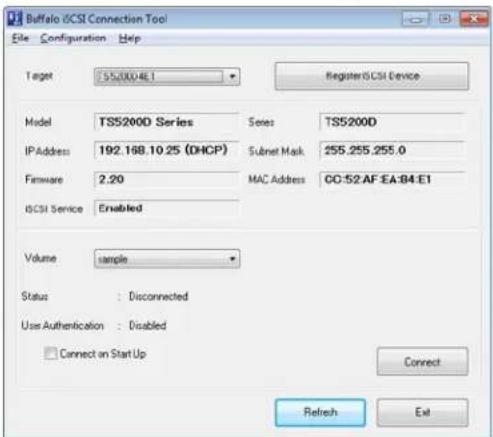
text_image
Buffalo iCSI Connection Tool File Configuration Help Target TS5200D4E1 RegisteriCSI Device Model TS5200D Series Sets TS5200D IP Address 192.168.10.25 (DHCP) Subnet Mask 255.255.255.0 Firmware 2.20 MAC Address GG:52AF-EA:B4:E1 iCSI Service Enabled Volume sample Status : Disconnected Use Authentication : Disabled Connect on Start Up Connect Refresh Exit| Name Description | |
| Target | If a TeraStation is selected, clicking Register iSCSI Device will register all the volumes in the TeraStation to the computer for enabling connection to individual volumes.If a volume is already registered, click Unregister iSCSI Device to unregister all volumes, disconnecting them from the TeraStation. |
| Model Displays TeraStation's model name. | |
| Series Displays TeraStation's series name. | |
| IP Address Displays TeraStation's IP address. | |
| Subnet Mask Displays TeraStation's subnet mask. | |
| Firmware Displays TeraStation's firmware version. | |
| MAC Address TeraStation's MAC address. | |
| iSCSI Service Shows whether the iSCSI service of the TeraStation is running or stopped. | |
| Volume | Select individual volumes from a registered TeraStation.Select a volume and click Connect, then the selected volume will be recognized as a local drive in My Computer on your computer. If a volume is connected, click Unregister to disconnect it. |
| Current status | Displays current status of the selected volume.- Disconnected: Volume is disconnected.- Connected: Volume is connected.- Connected to another PC: Volume is connected to another computer.Displays the other computer's IP address. |
| User authorization | - Disabled:No authentication.- Enabled:User authentication is needed to connect to a volume. |
| Connect on Start Up If selected, the computer will connect to the volume automatically at boot. | |
| Refresh Search for network devices on the LAN. | |
| Exit Exit iSCSI Connection Tool. | |
Menu
| Name Description | ||
| File | Refresh Search for network devices on the LAN. | |
| Exit Closes the iSCSI Connection Tool. | ||
| Setup | Configuration Opens Settings for the selected TeraStation. | |
| Change IP address You can change the IP address of the selected TeraStation. | ||
| Unregister iSCSI device | If you disconnect the TeraStation without unregistering it or changing its IP address, the registration information stays in your computer and searches will take longer. For better performance, unregister disconnected TeraStations with this command. | |
| Set mutual CHAP secret Set the CHAP password on the computer side. | ||
| Persistent Volume | If checked, your computer will reconnect to the TeraStation whenever it's restarted. | |
| Connect volumes Connect multiple volume at a time. | ||
| Disconnect volumes Displays the screen to disconnect multiple volume at a time. | ||
| Disk management Format drives. | ||
| Help About Displays version information. | ||
Chapter 12 Appendix
LCD Display
The LCD display can be cycled through different modes by pressing the display button on the front of the TeraStation. Also, the items displayed can be configured at Management - Notifications - Front Panel Display Settings in Settings.
Modes
| LCD Message Description Corrective Action | |||
| LINK SPEEDNote: When an Ethernet cable is connected to LAN Port 2, "LINK SPEED 2" is displayed. | LINK SPEEDNo LINK | Not connected to network. | Connect an Ethernet cable to the LAN port. |
| LINK SPEED10 Mbps HALF | Connected at 10 Mbps half duplex. - | ||
| LINK SPEED10 Mbps FULL | Connected at 10 Mbps full duplex. - | ||
| LINK SPEED100 Mbps HALF | Connected at 100 Mbps half duplex. - | ||
| LINK SPEED100 MbpsFULL | Connected at 100 Mbps full duplex. - | ||
| LINK SPEED1000 Mbps | Connected at 1000 Mbps full duplex. - | ||
| Hostname / IP Address | TS-xx xxx192.168.11.150 | Displays the hostname and IP address. At the end of the IP address, F (fixed IP address) or D (IP address automatically acquired from a DHCP server) is displayed.Note: When an Ethernet cable is connected to LAN port 2, "NETWORK2" is displayed in the hostname section. | - |
| Calendar / Clock | DATE TIME2012/1/1 11:11 | Displays the date and time set in the TeraStation. - | |
Errors
| LCD Message Description Corrective Action | ||
| BOOT FAIL Hard drive not found. | Contact Buffalo technical support for assistance. | |
| SYSTEM Error E04 Can’t Load Krnl! | The firmware is corrupted. | Contact Buffalo technical support for assistance. |
| UPS E10 Dependent Mode | The TeraStation is running on the UPS battery due to a power outage. The system will now be shut down safely. | Check that power is being supplied to the UPS, and if there are no problems, turn on the TeraStation. |
| SYSTEM I10TOO HOT ! | A rise in the system temperature may have exceeded the allowable safety value. | Move the TeraStation to a cool location. Do not place objects in the area around the TeraStation. |
| SYSTEM Error E11Fan Failure | An error occurred in the fan speed. | Check that no foreign objects or dust are clogging the fan. If any foreign objects or dust are found, use a pair of tweezers, air duster, or other tool to remove them. If the error is displayed again, contact Buffalo technical support for assistance. |
| SYSTEM Error E12Cooling Failure | A rise in the system temperature may have exceeded the allowable safety value. | Do not place objects in the area around the TeraStation. Also, move the TeraStation to a cool location. |
| RAID Arrayx E14Can’t Mount | RAID array x cannot be mounted. Run the RAID | array disk check in Settings. |
| HDx Error E16HDx Not Found | Unable to find hard drive x. | Hard drive x may be disconnected or may have failed. After shutting down, reinstall the hard drive. |
| HDx Error E22HDx Can’t Mount | Mounting of hard drive x failed. | Format the hard drive. After formatting, if the error still appears after rebooting, replace the hard drive. If the error is displayed again, contact Buffalo technical support for assistance. |
| FailOver E27LostBackupTarget | Unable to find the backup TeraStation. | In the main TeraStation’s settings, navigate to Backup - Failover to reconfigure the backup TeraStation for failover. |
| HDx Broken E30Replace the DISK | An error occurred, so hard drive x was removed from the RAID array. | Replace hard drive x. |
Status
After you change settings or format a hard drive, the current status is displayed on the LCD.
| LCD Message Description Corrective Action | ||
| HDx Warning I11Bad Sectors | The bad sectors in hard drive x may have reached a dangerous level. | Replace hard drive x. |
| Operation I12DEGRADE MODE | Operating in degraded mode. - | |
| RAID I13ARRAYxFormatting | Formatting RAID array x. - | |
| RAID I14ARRAYx Checking | Checking RAID array x. - | |
| RAID I15ARRAYx Scanning | Examining the error status of RAID array x.Note: Transfer speeds are slower during the examination process. | - |
| RAID I16ARRAYx Creating | Creating RAID array x. - | |
| RAID I17ARRAYx Resyncing | Resynchronizing RAID array x.Note: Transfer speeds are slower during resynchronization. | - |
| RAID I18ARRAYx Rebuilding | Rebuilding RAID array x.Note: Transfer speeds are slower during the rebuilding process. | - |
| RAID I19ARRAYx 0 Filling | Writing 0s to RAID array x, erasing all data. | - |
| RAID I20DISKx Formatting | Formatting hard drive x. - | |
| RAID I21DISKx Checking | Checking hard drive x. - | |
| RAID I22DISKx 0 Filling | Erasing the data for hard drive x. - | |
| SYSTEM I25F/WUPDATING | Updating the TeraStation firmware.Note: Do not turn off the power during the updating process. | - |
| Web Setting I26Initializing | Initializing all settings. - | |
| USB Diskx I27 Checking | Checking USB hard drive x. - | |
| USB Diskx I28 Formatting | Formatting USB hard drive x. - | |
| Press FuncSW I31New Diskx ready | Displayed when pressing the Function button to rebuild the RAID after replacing hard drive x. | Press the Function button to rebuild the RAID array. |
| Set From Web I32New Diskx ready | Displayed after replacing hard drive x when the RAID needs to be rebuilt in Settings or formatting is necessary. | In Settings, either rebuild the RAID array or format the hard drive. |
| Replication I33ReplicateFailure | An error occurred in replication, or synchronization between the main TeraStation and the backup TeraStation failed during failover configuration. | In Settings, navigate to Backup - Replication and choose “Resync” to execute resynchronization. If the error is displayed again, contact Buffalo technical support for assistance. |
| Virus alert I34Virus detected | A virus scan found a virus. | Once the virus is removed from the quarantine folder, the message is no longer displayed. If the antivirus software is configured to delete viruses from the quarantine folder automatically, then the message will not be displayed. |
| Cartridges I35Location error | A hard drive set as a media cartridge has been installed in the drive x slot. | Connect to the slot that was set as a media cartridge. |
| Cartridges I36Decryption error | Media cartridge cannot be decrypted. The media cartridge may have been encrypted by a TeraStation other than this product. | Connect to the TeraStation that performed encryption to decrypt. |
| Recovery I37SystemRecovering | System recovery in progress. - | |
| Recovery I38RecoveryFinished | System recovery is complete. - | |
| Recovery I39Change Boot | System recovery from the USB recovery device is complete. | Change the boot mode switch on the rear to HDD. |
| Recovery I40DataWillDeleted | Beginning recovery. All data in the drive 1 will be deleted. | - |
| Recovery I41PushFuncToStart | Pressing the function button on the front will start the recovery process. | - |
| Recovery I42Preparing | Preparing to start the recovery process. | - |
| Recovery I43Unsupported HW | The TeraStation was started from the USB recovery device, but the system cannot be recovered from this USB recovery device. | - |
| Recovery I44Disk1 not found | Recovery from the USB recovery device was initiated, but the drive 1 was not detected. | Make sure that Disk 1 is present and fully inserted in its slot. |
| Recovery I45Recovery Failed | Recovery failed. - | |
| RAID ARRAY I46RMM+Processing | Data migration or conversion (RAID migration) is in progress. | Do not turn off the TeraStation power. |
| SYSTEM I47Don't Power Off | ||
| FailOver I48PushFuncToStart | This TeraStation is ready to become the failover backup for the main TeraStation. | Hold down the function button on the front of the target TeraStation until it stops beeping to accept failover backup status. |
| FailOver I49LostMainTarget | The main TeraStation in the failover configuration cannot be found. | Make sure that the main TeraStation is on, working, and connected to the network. |
| FailOver I50Maintenance mode | Failover maintenance is in progress. Do not turn off the TeraStation power. | |
| FailOver I51Initializing | Initializing the failover configuration. Do not turn off the TeraStation power. | |
| New Firmware I52Available | A new firmware version has been released. | Update the firmware. |
| BackupTask xx I54Backup Failure | xxth backup task failed. | Make sure that the xxth backup task is configured correctly. Make sure that the NAS is not in standby mode. If the backup task still fails, check the network, backup source, and backup destination. |
| Recovery I55RecoveryAuthFail | Authentication during recovery of settings failed. | Settings can only be restored for the TeraStation whose settings were originally saved. To restore settings, insert the USB memory device, move the Boot Mode switch on the rear of the TeraStation to the USB position, and restart the TeraStation. Or, settings can be restored in Settings with the TeraStation powered on. |
| Surveillance I56Lack of License | There are not enough surveillance camera server licenses. | Purchase and register an additional license. |
| Surveillance I57No free space | There is not enough space to save additional surveillance video. | Delete or move some of the stored video. |
| Surveillance I58Recording Failure | Video not recorded. | Check your settings. Also, use the utilities provided with your camera to check that the camera is operating correctly. |
Default Settings
| Administrator's Name admin | |
| Password password | |
| Shared Folders | “share” (for both Windows and Mac computers). The recycle bin is enabled on “share” by default. |
| DHCP Client | Normally, the TeraStation will get its IP address automatically from a DHCP server on the network.If no DHCP server is available, then an IP address will be assigned as follows:IP Address: 169.254.xxx.xxx (xxx is assigned randomly when booting the TeraStation.)Subnet Mask: 255.255.0.0 |
| Registered Groups | “hdusers”, “admin”, and “guest”You cannot edit or delete these default groups. |
| Microsoft Network Group Name WORKGROUP | |
| Ethernet Frame Size 1518 bytes (Including 14 bytes of the header and 4 bytes of FCS) | |
| AFP Enabled | |
| FTP Disabled | |
| NTP Enabled | |
| Print Server Enabled | |
| WebAccess Disabled | |
| Time Machine Disabled | |
| TeraSearch | Disabled |
| RAID Mode | TS5800D, TS5600D, TS5400D, TS5400R: RAID 5TS5200D: RAID 1 |
Specifications
Check www.buffalotech.com for information about the latest products and specifications.
| LAN Port | Interface | IEEE 802.3ab (1000BASE-T)IEEE 802.3u (100BASE-TX)IEEE 802.3 (10BASE-T) |
| Transfer Speed | 1000 Mbps Full duplex (auto-negotiation)100 Mbps Full duplex/Half duplex (auto-negotiation)10 Mbps Full duplex/Half duplex (auto-negotiation) | |
| Number of Ports | 2 ports (supports Auto-MDIX) | |
| Connector Type | RJ-45 8-pin | |
| Protocol | TCP/IP | |
| Access Method | CSMA/CD | |
| File Sharing | SMB/CIFS, AFP, FTP, SFTP, NFS | |
| Management | HTTP/HTTPS | |
| Jumbo Frames | 1518/4102/7422/9216 bytes(Including 14 bytes of the header and 4 bytes of FCS) | |
| USB Port | TS5800D, TS5600D, TS5400R: USB 2.0 Port (Series A) x 2, USB 3.0 Port (Series A) x 3TS5400D, TS5200D: USB 2.0 Port (Series A) x 2, USB 3.0 Port (Series A) x 2Note: Supported USB devices include Buffalo USB hard drives, USB UPS devices, and printers. | |
| UPS Port | UPS Port (D-SUB 9 pin (Male)) x 1Note: Compatible UPS are manufactured by Omron or APC. | |
| Internal Hard Drive | If a hard drive in the TeraStation malfunctions, replace it with a Buffalo OP-HDS series drive of the same capacity, available from www.buffalotech.com. | |
| Power Supply AC 100-240 V, 50/60 Hz | ||
| Power Consumption | TS5800D: max ~170 WTS5600D: max ~120 WTS5400D: max ~86 WTS5400R: max ~140 WTS5200D: max ~47 W | |
| Dimensions (W x H x D) / Weight | TS5800D:300 x 215 x 230 mm; 11.8" x 8.5" x 9.1" (excluding protruding parts)/ ~ 12 kg (26.5 lb.)TS5600D:170 x 260 x 230 mm; 6.7" x 10.2" x 9.1" (excluding protruding parts)/ ~ 10 kg (22.1 lb.)TS5400D:170 x 215 x 230 mm; 6.7" x 8.5" x 9.1" (excluding protruding parts)/ ~ 8 kg (17.7 lb.)TS5400R:430 x 45 x 430 mm; 16.9" x 1.7" x 16.9" (excluding protruding parts)/ ~ 9 kg (19.8 lb.)TS5200D:170 x 170 x 230 mm; 6.7" x 6.7" x 9.1" (excluding protruding parts)/ ~ 4.5 kg (10 lb.) | |
| Operating Environment | Temperature: 5 - 35°C; 41 - 95°FEnvironment Humidity: 20 - 80% (no condensation) | |
| Compatibility | Windows and Mac computers with Ethernet interface.Note: The TeraStation requires an Ethernet connection with your computer for operation. It cannot be connected via USB. | |
| Supported OS | Windows 8.1*, Windows 8*, Windows 7*, Windows Vista*, Windows XP, Windows XP Media Center Edition (2004 or 2005), Windows Server 2012, Windows Server 2008 R2, Windows Server 2008, Windows Server 2003 R2, Windows Server 2003, Windows 2000 ServerOS X 10.9, 10.8, 10.7, 10.6, 10.5, 10.4, 10.3.9*32-bit and 64-bit | |
Compliance Information
The TeraStation uses GPL code. For source code, visit http://opensource.buffalo.jp
FCC Statement
This device complies with part 15 of the FCC Rules. Operation is subject to the following two conditions: (1) This device may not cause harmful interference, and (2) This device must accept any interference received, including interference that may cause undesired operation.
NOTE: This equipment has been tested and found to comply with the limits for a Class A digital device, pursuant to part
15 of the FCC Rules. These limits are designed to provide reasonable protection against harmful interference when the equipment is operated in a commercial environment. This equipment generates, uses, and can radiate radio frequency energy and, if not installed and used in accordance with the instruction manual, may cause harmful interference to radio communications. Operation of this equipment in a residential area is likely to cause harmful interference in which case the user will be required to correct the interference at his own expense.
CE Mark Statement
This is a Class A product. In a domestic environment, this product may cause radio interference, in which case the user may be required to take adequate measures.
Environmental Information
- The equipment that you have purchased required the extraction and use of natural resources for its production.
- The equipment may contain hazardous substances that could impact health and the environment.
- In order to avoid the dissemination of those substances in our environment and to diminish the load on natural resources, we encourage you to use the appropriate take-back systems.
- The take-back systems will reuse or recycle most of the materials of your end of life equipment appropriately.
- The crossed-out wheeled bin symbol invites you to use those systems.
If you need more information on the collection, reuse and recycling systems, please contact your local or regional waste administration.

KC