
SC-MAX4000E - Loudspeaker PANASONIC - Free user manual and instructions
Find the device manual for free SC-MAX4000E PANASONIC in PDF.



| Product Type | Powered speaker (hi-fi system) |
| Main unit dimensions (W x H x D) | 492 mm x 221 mm x 421 mm |
| Speaker dimensions (W x H x D) | 407 mm x 709 mm x 389 mm |
| Main unit weight | 5.8 kg |
| Speaker weight | 19 kg (each) |
| Total output power | 2400 W RMS |
| Power supply | AC 220-240 V, 50 Hz |
| Power consumption | 155 W (standby 0.4 W) |
| Disc playback | CD, CD-R/RW (CD-DA and MP3) |
| Wireless connectivity | Bluetooth® 2.1 + EDR, NFC One-Touch |
| Radio | FM (87.5-108 MHz) and AM (522-1629 kHz) |
| USB ports | 2 USB A ports (MP3 playback), 1 USB B port (recording) |
| Auxiliary inputs | AUX IN 1 (RCA), AUX IN 2 (3.5 mm jack) |
| Microphone input | 1 x 6.3 mm mono jack |
| DJ functions | DJ Jukebox, DJ Sampler, DJ Effect (Phaser, Filter, etc.) |
| Lighting effects | Color, Auto (color change), with ILLUMINATION wheel |
| Timers | Playback timer, recording timer, sleep timer |
| Maintenance and cleaning | Wipe with a soft, dry cloth; do not use alcohol, thinner, or benzene |
| Safety | Auto standby after 20 min, thermal protection, automatic shutdown in case of overload |
| Spare parts and repairability | Contact an authorized dealer; no user-serviceable parts; removal of covers prohibited |
| General information | Operating temperature: 0°C to +40°C; humidity: 35% to 80% RH |
Frequently Asked Questions - SC-MAX4000E PANASONIC
User questions about SC-MAX4000E PANASONIC
0 question about this device. Answer the ones you know or ask your own.
Ask a new question about this device
Download the instructions for your Loudspeaker in PDF format for free! Find your manual SC-MAX4000E - PANASONIC and take your electronic device back in hand. On this page are published all the documents necessary for the use of your device. SC-MAX4000E by PANASONIC.
USER MANUAL SC-MAX4000E PANASONIC
natural_image
Technical line drawing of two front-mounted speaker units with ventilation grilles and a back panel (no text or symbols)Panasonic®
Operating Instructions
Bedienungsanleitung
Mode d'emploi
Model No. SC-MAX4000
Thank you for purchasing this product.
For optimum performance and safety, please read these instructions carefully.
Please keep this manual for future reference.
Your system and the illustrations can look differently. These operating instructions are applicable to the following system.
| System | SC-MAX4000 |
| Main unit | SA-MAX4000 |
| Speakers | SB-MAX4000 |
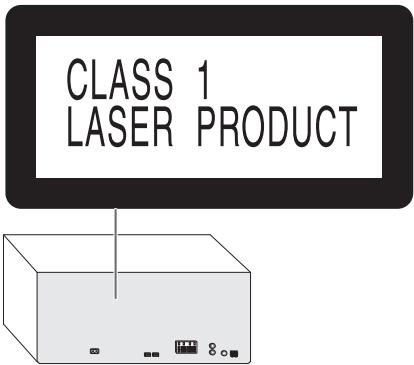
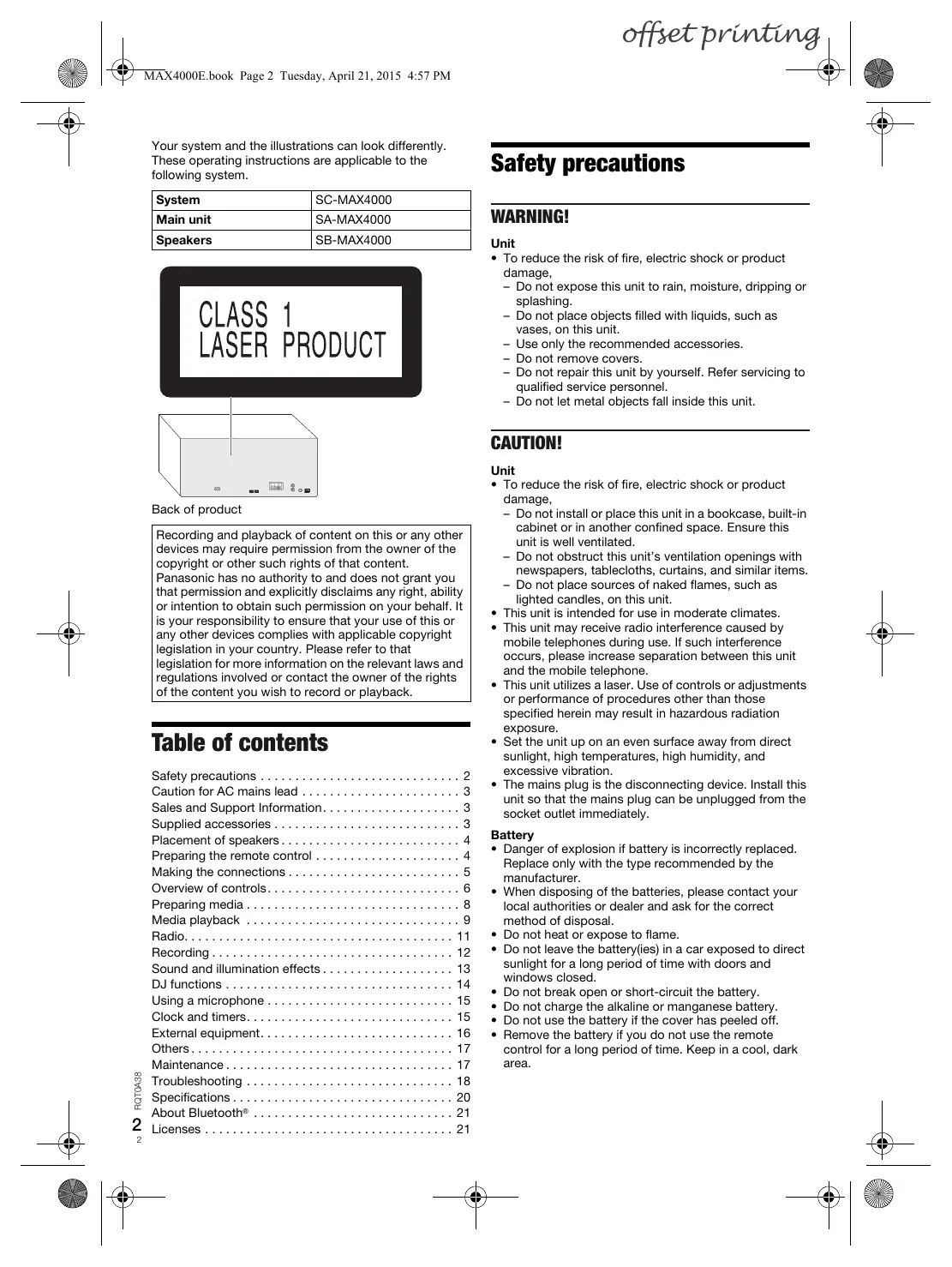
Back of product
Recording and playback of content on this or any other devices may require permission from the owner of the copyright or other such rights of that content. Panasonic has no authority to and does not grant you that permission and explicitly disclaims any right, ability or intention to obtain such permission on your behalf. It is your responsibility to ensure that your use of this or any other devices complies with applicable copyright legislation in your country. Please refer to that legislation for more information on the relevant laws and regulations involved or contact the owner of the rights of the content you wish to record or playback.
Table of contents
Safety precautions 2
Caution for AC mains lead 3
Sales and Support Information.... 3
Supplied accessories 3
Placement of speakers....4
Preparing the remote control 4
Making the connections....5
Overview of controls....6
Preparing media 8
Media playback 9
Radio....11
Recording 12
Sound and illumination effects.... 13
DJ functions 14
Using a microphone 15
Clock and timers.... 15
External equipment.... 16
Others....17
Maintenance....17
Troubleshooting 18
Specifications....20
About Bluetooth ^® 21
Licenses 21
Safety precautions
WARNING!
Unit
- To reduce the risk of fire, electric shock or product damage,
- Do not expose this unit to rain, moisture, dripping or splashing.
- Do not place objects filled with liquids, such as vases, on this unit.
- Use only the recommended accessories.
- Do not remove covers.
- Do not repair this unit by yourself. Refer servicing to qualified service personnel.
- Do not let metal objects fall inside this unit.
CAUTION!
Unit
- To reduce the risk of fire, electric shock or product damage,
- Do not install or place this unit in a bookcase, built-in cabinet or in another confined space. Ensure this unit is well ventilated.
- Do not obstruct this unit's ventilation openings with newspapers, tablecloths, curtains, and similar items.
- Do not place sources of naked flames, such as lighted candles, on this unit.
- This unit is intended for use in moderate climates.
- This unit may receive radio interference caused by mobile telephones during use. If such interference occurs, please increase separation between this unit and the mobile telephone.
- This unit utilizes a laser. Use of controls or adjustments or performance of procedures other than those specified herein may result in hazardous radiation exposure.
- Set the unit up on an even surface away from direct sunlight, high temperatures, high humidity, and excessive vibration.
- The mains plug is the disconnecting device. Install this unit so that the mains plug can be unplugged from the socket outlet immediately.
Battery
- Danger of explosion if battery is incorrectly replaced. Replace only with the type recommended by the manufacturer.
- When disposing of the batteries, please contact your local authorities or dealer and ask for the correct method of disposal.
- Do not heat or expose to flame.
- Do not leave the battery(ies) in a car exposed to direct sunlight for a long period of time with doors and windows closed.
- Do not break open or short-circuit the battery.
- Do not charge the alkaline or manganese battery.
- Do not use the battery if the cover has peeled off.
- Remove the battery if you do not use the remote control for a long period of time. Keep in a cool, dark area.
Caution for AC mains lead
(For the AC mains plug of three pins)
For your safety, please read the following text carefully.
This appliance is supplied with a moulded three pin mains plug for your safety and convenience.
A 5-ampere fuse is fitted in this plug.
Should the fuse need to be replaced please ensure that the replacement fuse has a rating of 5-ampere and that it is approved by ASTA or BSI to BS1362.
Check for the ASTA mark 📍 or the BSI mark 🍽 on the body of the fuse.
If the plug contains a removable fuse cover you must ensure that it is refitted when the fuse is replaced.
If you lose the fuse cover the plug must not be used until a replacement cover is obtained.
A replacement fuse cover can be purchased from your local dealer.
Before use
Remove the connector cover.
How to replace the fuse
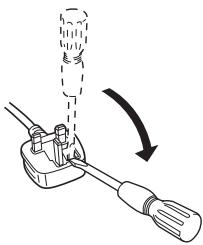
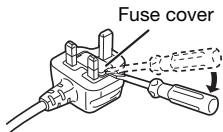
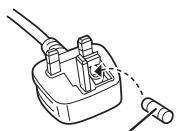
The location of the fuse differ according to the type of AC mains plug (figures A and B). Confirm the AC mains plug fitted and follow the instructions below.
Illustrations may differ from actual AC mains plug.
- Open the fuse cover with a screwdriver.
Figure A
natural_image
Diagram of a screwdriver using a tool to lift a surface, showing motion direction (no text or symbols)Figure B
- Replace the fuse and close or attach the fuse cover.
Figure A
natural_image
Line drawing of a plug with two connectors and a dashed line indicating a cable or wire connection (no text or symbols)Fuse (5 ampere)
Figure B
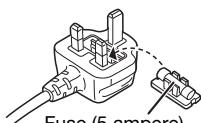
Fuse (5 ampere)
Sales and Support Information
For the United Kingdom and Ireland
Customer Communications Centre
- For customers within the UK: 0344 844 3899
• For customers within Ireland: 01 289 8333 - Monday – Friday 9:00am – 5:00pm (Excluding public holidays).
- For further support on your product, please visit our website: www.panasonic.co.uk
Direct Sales at Panasonic UK
- Order accessory and consumable items for your product with ease and confidence by phoning our Customer Communications Centre Monday – Friday 9:00am – 5:00pm (Excluding public holidays).
- Or go on line through our Internet Accessory ordering application at www.pas-europe.com.
- Most major credit and debit cards accepted.
- All enquiries transactions and distribution facilities are provided directly by Panasonic UK.
- It couldn't be simpler!
- Also available through our Internet is direct shopping for a wide range of finished products. Take a browse on our website for further details.
Supplied accessories
Check and identify the supplied accessories.
Use numbers indicated in parentheses when asking for replacement parts. (Product numbers correct as of May 2015. These may be subject to change.)
□ 2 AC mains leads
For the United Kingdom and Ireland
(K2CT2YY00097)
□ 1 AM loop antenna
(N1DYYYY00011)
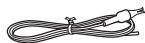
□ 1 FM indoor antenna
(RSAX0002)
□ 1 Remote control
(N2QAYB001022)
□ 1 Remote control battery
For the United Kingdom and Ireland
1 Antenna plug adaptor
(K1YZ02000013)

CAUTION!
Keep the antenna plug adaptor out of reach of children to prevent swallowing.
Note:
Use the AC mains lead that is suitable for your household mains socket.
Placement of speakers
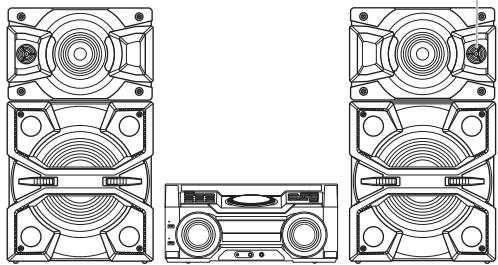
Put the speakers so that the tweeter is on the outside.
Tweeter
natural_image
Technical line drawing of four different speaker models with no visible text or symbolsUse only the supplied speakers.
You can cause damage to the system and decrease the sound quality if you use other speakers.
Note:
- Keep your speakers more than 10 mm from the main unit for ventilation.
- Put the speakers on a flat safe surface.
- More than one person is required to move, tilt or carry the speakers.
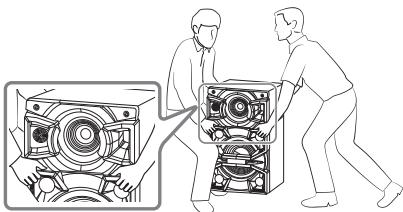
natural_image
Illustration of two people assembling or working on a mechanical device (no text or symbols visible)- These speakers do not have magnetic shielding. Do not put them near TVs, PCs or other equipment easily influenced by magnetism.
- When you play at high levels for a long period, it can cause damage to the speakers and decrease the life of the speakers.
- Decrease the volume in these conditions to prevent damage:
- When the sound is distorted.
- When you adjust the sound quality.
CAUTION!
- Use the speakers only with the recommended system. If not, you can cause damage to the amplifier and speakers and can cause a fire. Consult an approved service personnel if damage occurs or if there is a sudden apparent change in performance.
- Do not modify the speaker or speaker wires as this can cause damage to the system. - Do the procedures included in these instructions when you attach the speakers.
- Do not touch the speaker cone's reverberating surfaces:
- This may damage the speaker cone.
- The speaker cone may be hot.
- Be careful when babies or children are near.
- Do not stack the speakers.

natural_image
Illustration of a person reacting to a prohibition symbol on two stacked electronic devices (no text or symbols present)Preparing the remote control
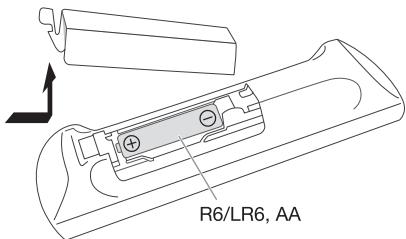
Use alkaline or manganese battery.
Install the battery so that the poles (+ and −) align with those in the remote control.
Making the connections
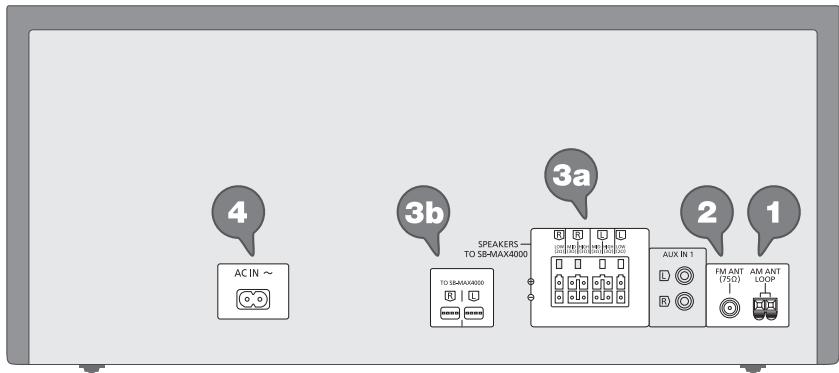
Connect the AC mains lead only after all the other connections have been made.
flowchart
graph LR
    A["AC IN ~"] --> B["SPEAKERS TO SB-MAX4000"]
    C["TO SB-MAX4000"] --> B
    D["AUX IN 1"] --> E["FM ANT (7Ω)"]
    E --> F["AM ANT LOOP"]
    B --> G["3a"]
    B --> H["3b"]
    G --> I["2"]
    H --> J["1"]
    style A fill:#f9f,stroke:#333
    style C fill:#f9f,stroke:#333
    style D fill:#f9f,stroke:#333
    style E fill:#f9f,stroke:#333
    style F fill:#f9f,stroke:#333
    style G fill:#ccf,stroke:#333
    style H fill:#ccf,stroke:#333
    style I fill:#cfc,stroke:#333
    style J fill:#cfc,stroke:#333
1 Connect the AM loop antenna.
Stand the antenna up on its base until it clicks.
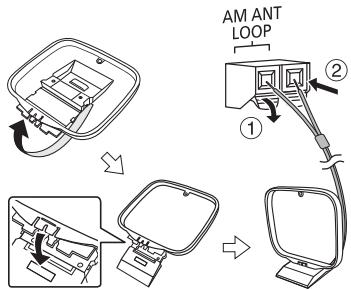
flowchart
graph TD
    A["Start"] --> B["Component ①"]
    B --> C["Component ②"]
    C --> D["End"]
    style A fill:#f9f,stroke:#333
    style D fill:#bbf,stroke:#333
2 Connect the FM indoor antenna.
Put the antenna where reception is best.
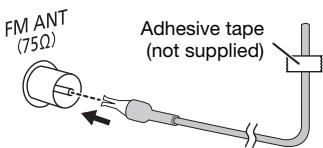
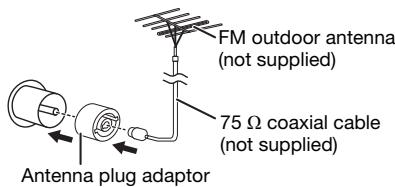
For the United Kingdom and Ireland
Connect the FM outdoor antenna.
Use an outdoor antenna if the reception is poor.
Note:
- Do not use the outdoor antenna during a lightning storm.
- Disconnect the outdoor antenna if you do not use the system.
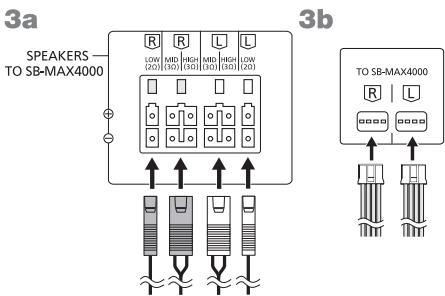
3 Connect the speakers.
Connect the speaker cables to the terminals of the same colour.
flowchart
graph TD
    subgraph_Speaker_3a["SPEAKERS TO SB-MAX4000"]
        R1["R"] --> L1["L"]
        R2["R"] --> L2["L"]
        L1 --> M1["MID (2/2)"]
        L2 --> M2["HOLD (2/2)"]
        M1 --> M3["MD (3/2)"]
        M2 --> M4["HOLD (3/2)"]
        M3 --> M5["MID (3/2)"]
        M4 --> M6["HOLD (3/2)"]
        M5 --> M7["MID (3/2)"]
        M6 --> M8["HOLD (3/2)"]
        M7 --> M9["MID (3/2)"]
        M8 --> M10["HOLD (3/2)"]
        M9 --> M11["MID (3/2)"]
        M10 --> M12["HOLD (3/2)"]
        M11 --> M13["MID (3/2)"]
        M12 --> M14["HOLD (3/2)"]
        M13 --> M15["MID (3/2)"]
        M14 --> M16["HOLD (3/2)"]
        M15 --> M17["MID (3/2)"]
        M16 --> M18["HOLD (3/2)"]
        M17 --> M19["MID (3/2)"]
        M18 --> M20["HOLD (3/2)"]
        M19 --> M21["MID (3/2)"]
        M20 --> M22["HOLD (3/2)"]
        M21 --> M23["MID (3/2)"]
        M22 --> M24["HOLD (3/2)"]
        M23 --> M25["MID (3/2)"]
        M24 --> M26["HOLD (3/2)"]
        M25 --> M27["MID (3/2)"]
        M26 --> M28["HOLD (3/2)"]
        M27 --> M29["MID (3/2)"]
        M28 --> M30["HOLD (3/2)"]
        M29 --> M31["MID (3/2)"]
        M30 --> M32["HOLD (3/2)"]
        M31 --> M33["MID (3/2)"]
        M32 --> M34["HOLD (3/2)"]
        M33 --> M35["MID (3/2)"]
        M34 --> M36["HOLD (3/2)"]
        M35 --> M37["MID (3/2)"]
        M36 --> M38["HOLD (3/2)"]
        M37 --> M39["MID (3/2)"]
        M38 --> M40["HOLD (3/2)"]
        M39 --> M41["MID (3/2)"]
        M40 --> M42["HOLD (3/2)"]
        M41 --> M43["MID (3/2)"]
        M42 --> M44["HOLD (3/2)"]
        M43 --> M45["MID (3/2)"]
        M44 --> M46["HOLD (3/2)"]
        M45 --> M47["MID (3/2)"]
        M46 --> M48["HOLD (3/2)"]
        M47 --> M49["MID (3/2)"]
        M48 --> M50["HOLD (3/2)"]
        M49 --> M51["MID (3/2)"]
        M50 --> M52["HOLD (3/2)"]
        M51 --> M53["MID (3/2)"]
        M52 --> M54["HOLD (3/2)"]
        M53 --> M55["MID (3/2)"]
        M54 --> M56["HOLD (3/2)"]
        M55 --> M57["MID (3/2)"]
        M56 --> M58["HOLD (3/2)"]
        M57 --> M59["MID (3/2)"]
        M58 --> M60["HOLD (3/2)"]
        M59 --> M61["MID (3/2)"]
        M60 --> M62["HOLD (3/2)"]
        M61 --> M63["MID (3/2)"]
        M62 --> M64["HOLD (3/2)"]
        M63 --> M65["MID (3/2)"]
        M64 --> M66["HOLD (3/2)"]
        M65 --> M67["MID (3/2)"]
        M66 --> M68["HOLD (3/2)"]
        M67 --> M69["MID (3/2)"]
        M68 --> M70["HOLD (3/2)"]
        M69 --> M71["MID (3/2)"]
        M70 --> M72["HOLD (3/2)"]
        M71 --> M73["MID (3/2)"]
        M72 --> M74["HOLD (3/2)"]
        M73 --> M75["MID (3/2)"]
        M74 --> M76["HOLD (3/2)"]
        M75 --> M77["MID (3/2)"]
        M76 --> M78["HOLD (3/2)"]
        M77 --> M79["MID (3/2)"]
        M78 --> M80["HOLD (3/2)"]
        M79 --> M81["MID (3/2)"]
        M80 --> M82["HOLD (3/2)"]
        M81 --> M83["MID (3/2)"]
        M82 --> M84["HOLD (3/2)"]
        M83 --> M85["MID (3/2)"]
        M84 --> M86["HOLD (3/2)"]
        M85 --> M87["MID (3/2)"]
        M86 --> M88["HOLD (3/2)"]
        M87 --> M89["MID (3/2)"]
        M88 --> M90["HOLD (3/2)"]
        1["SPREADER"] --> R
    end
    subgraph_3b["To SB-MAX4000"]
            R
            L
            G
            H
            I
            J
            K
            L
            N
            O
            P
            Q
            R
            L
            G
            H
            I
            J
            K
            L
            N
            O
            P
            Q
            R
            L
            G
            H
            I
            J
            K
            L
            N
            O
            P
            Q
            R
            L
            G
            H
            I
            J
            K
            L
            N
                    1
4 Connect the AC mains lead.
For the United Kingdom and Ireland
READ THE “Caution for AC mains lead” BEFORE CONNECTION.

Do not use an AC mains lead from other equipment.
Conserving power
The system consumes a small amount of power even when it is in standby mode. Disconnect the power supply if you do not use the system.
Some settings will be lost after you disconnect the system. You have to set them again.
Overview of controls
Do the procedures with the remote control. You can also use the buttons on the main unit if they are the same.
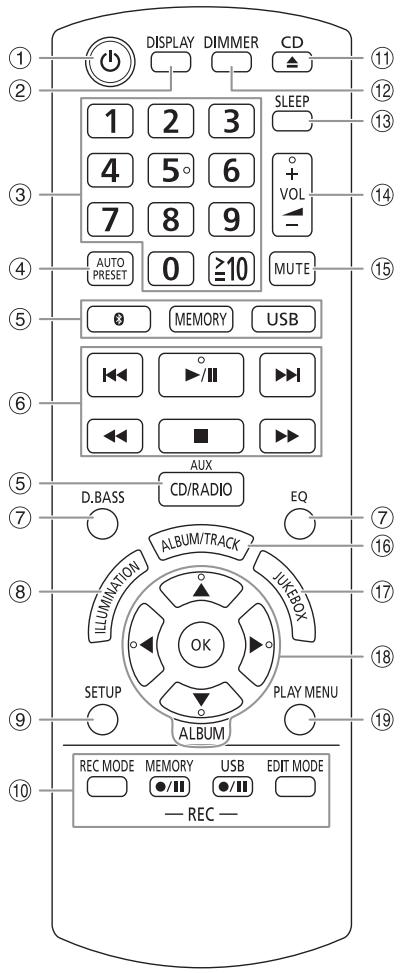
① Standby/on switch [⏻], [⏻/ɪ]
Press to switch the unit from on to standby mode or vice versa. In standby mode, the unit is still consuming a small amount of power.
② View the content information
③ Numeric buttons
To select a 2-digit number
Example: 16: [≥10]→[1]→[6]
④ Auto preset the radio station
⑤ Select the audio source
On the main unit:
To start Bluetooth® pairing, press and hold
[*] -PAIRING].
⑥ Basic playback control
⑦ Select the sound effects
⑧ Select the illumination effects
⑨ View the setup menu
⑩ Recording operation control
⑪ Open or close the disc tray
⑫ Decrease the brightness of the display panel
To cancel, press the button again.
⑬ Set the sleep timer
⑭ Adjust the volume level
⑮ Mute the sound
To cancel, press the button again.
“MUTE” is also cancelled when you adjust the volume or when you switch off the system.
⑯ Select MP3 album or track
⑰ Select DJ jukebox
⑱ Select or confirm the option
⑲ View the play menu
Top View
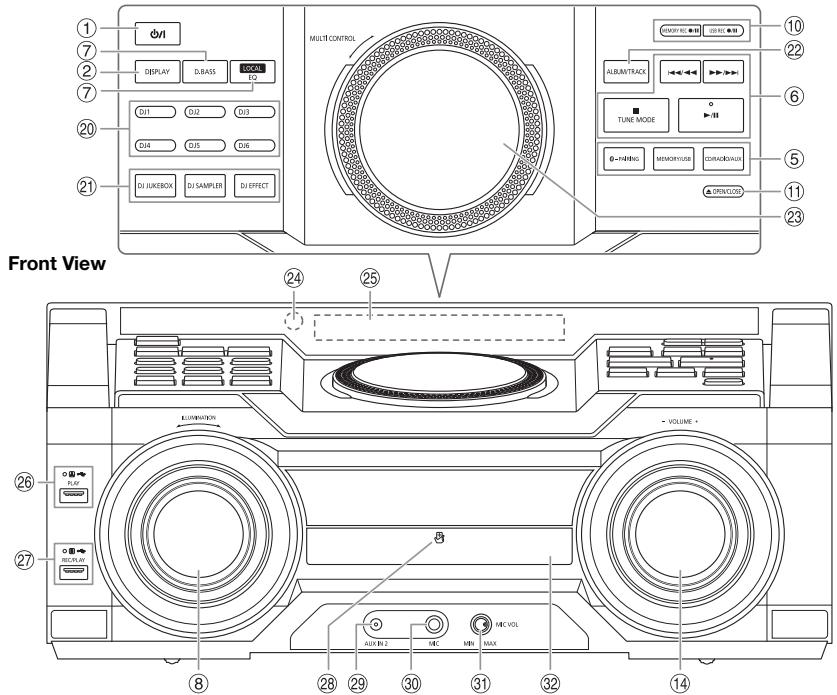
⑳ DJ function direct buttons
Press [DJ JUKEBOX], [DJ SAMPLER] or [DJ EFFECT] to switch on the DJ function.
Press [DJ1] to [DJ6] on the main unit to select the desired function.
To cancel, press the selected [DJ1] to [DJ6] again.
②1 Switch on the DJ function
To cancel, press the button again.
②2 Select MP3 album or track
Press [ALBUM/TRACK] to select album or track.
Browse tracks or albums
Turn [MULTI CONTROL] to browse.
To start playback from the selection, press [▶/■].
②3 Turntable for DJ and multi control
⑳ Remote control sensor
Distance: Within approximately 7 m
Angle: Approximately 20^ up and down, 30^ left and right
⑲ Display panel
26 USB A
USB port (●)
USB status indicator
Play MP3 tracks.
27 USB B
USB port (←)
USB status indicator
Play MP3 tracks.
Record sound or music tracks.
⑳ NFC touch area
⑲ AUX IN 2 jack
③0 Microphone jack
③1 Adjust the microphone volume level
③2 Disc tray
Preparing media
Disc
1 Press [CD ▲] (main unit: [▲ OPEN/CLOSE]) to open the disc tray.
Put in a disc with the label facing up.
Press again to close the disc tray.
2 Press [CD/RADIO/AUX] to select "CD".
USB
Preparation
Before you connect a USB device to the system, make sure you do a backup of the data.
1 Decrease the volume and connect the USB device to the USB port.
Hold the main unit when connecting or disconnecting the USB device.
2 Press [USB] (main unit: [MEMORY/USB]) to select "USB A" or "USB B".
USB status indicator lights up in red when selected.
Note:
Do not use a USB extension cable. The system cannot recognise USB device connected through a cable.
Bluetooth®
You can connect and play an audio device wirelessly through Bluetooth®.
Preparation
- Switch on the Bluetooth® feature of the device and put the device near the system.
- Read the operating instructions of the device for details.
Pairing a device
Preparation
If this system is connected to a Bluetooth ^® device, disconnect it ( “Disconnecting a device”).
1 Press [®].
If "PAIRING" is shown, continue with step 4.
2 Press [PLAY MENU] to select "PAIRING".
3 Press [◀, ▶] to select "OK? YES" and then press [OK].
"PAIRING" is shown.
To cancel, select "OK? NO".
4 Select "SC-MAX4000" from the Bluetooth® menu of the device.
If prompted for a passkey, input "0000".
The device connects with this system automatically after pairing is complete.
The name of the connected device is shown for a few seconds.
Using the main unit
1 Press and hold [☒ -PAIRING] until "PAIRING" is shown.
2 Select "SC-MAX4000" from the Bluetooth® menu of the device.
Note:
You can pair up to 8 devices with this system. If a 9th device is paired, the device that has not been used for the longest time will be replaced.
Connecting a device
Preparation
If this system is connected to a Bluetooth ^® device, disconnect it ( “Disconnecting a device”).
1 Press [®].
"BLUETOOTH READY" is shown.
2 Select "SC-MAX4000" from the Bluetooth® menu of the device.
The name of the connected device is shown for a few seconds.
3 Start playback on the device.
Note:
- A device must be paired to connect.
- This system can only connect to one device at a time.
- When “BLUETOOTH” is selected as the source, this system will automatically try to connect to the last connected device. (“LINKING” is shown during this process.)
Disconnecting a device
1 Press [®].
2 Press [PLAY MENU] to select "DISCONNECT?".
3 Press [◀, ▶] to select "OK? YES" and then press [OK].
"BLUETOOTH READY" is shown.
To cancel, select "OK? NO".
Using the main unit
Press and hold [✗ -PAIRING] until "PAIRING" is shown.
Note:
A device is disconnected when you:
- Select a different source.
- Move the device out of the maximum range.
- Disable the Bluetooth® transmission of the device.
- Switch off the system or the device.
One-Touch Connection (NFC)
For NFC-compatible Bluetooth® devices (Android™ devices) only
Simply by touching an NFC (Near Field Communication)-compatible Bluetooth® device on the system, you can complete all preparations, from registering a Bluetooth® device to establishing a connection.
Android device version lower than 4.1 requires the installation of the “Panasonic MAX Juke” app (free of charge).
① Enter “Panasonic MAX Juke” in the search box of Google Play™ to search and then select “Panasonic MAX Juke”.
② Start the app.
– Follow the instructions to complete the settings.
- Make sure to use the latest version of the app.
Preparation
Switch on the NFC feature of the device.
1 Press [®].
2 Touch and hold the device on the NFC touch area of the main unit [∅].
![PANASONIC SC-MAX4000E - Touch and hold the device on the NFC touch area of the main unit [∅]. - 1](/content/2019/08/105612/images/ce794f57a9a122e3333389468253ad935c20e8a71b2153857275a8c1cb91edb5.jpg)
natural_image
Technical line drawing of a multi-chamber electronic device with front panel and display (no text or symbols)Bluetooth ^® device (not supplied)
- Hold the device until it beeps, vibrates or displays a pop-up window, and then move the device away from the system.
- Once the registration and connection of the device is complete, the name of the connected device is shown on the system for a few seconds.
- When the connection is not established even if the device has touched the NFC touch area, change its touching position. The connection may improve if you use the “Panasonic MAX Juke” app.
3 Start playback on the device.
Note:
-
While connected, you can connect another device by touching and holding it on the NFC touch area of the main unit. The previous device will be disconnected automatically.
• Depending on the device: -
The one-touch connection may not work.
- The position of the NFC touch area of the device may be different.
- When the connection is established, playback may start automatically.
Media playback
The following marks indicate the availability of the feature.
CD: CD-R/RW in CD-DA format or with MP3 files.
USB : USB device with MP3 files.
BLUETOOTH : Bluetooth® device.
MEMORY: 2 GB internal memory (refer to "Recording" for adding tracks to the internal memory).
Basic playback
CD USB BLUETOOTH MEMORY
| Play | Press [▶/■]. |
| Stop | Press [■].USB MEMORYThe position is memorised.“RESUME” is shown.Press again to stop fully. |
| Pause | Press [▶/■].Press again to continue playback. |
| Skip | Press [I◀◀] or [▶▶] (main unit: [I◀◀/◀◀] or [▶▶/▶▶]]) to skip track.CD USB MEMORYPress [▲, ▼] to skip MP3 album. |
| Search | Press and hold [◀◀] or [▶▶] (main unit: [I◀◀/◀◀] or [▶▶/▶▶]]). |
Note:
Depending on the Bluetooth ^® device, some operations may not work.
Viewing available information
CD USB BLUETOOTH MEMORY
You can view the available information, such as MP3 album and track number, on the display panel.
Press [DISPLAY].
Note:
• Maximum characters that can be shown: Approximately 32
- This system supports ver. 1.0, 1.1 and 2.3 ID3 tags.
- Text data that the system does not support can show differently.
Play menu
CD USB MEMORY
1 Press [PLAY MENU].
2 Press [◀, ▶] to select the setting and then press [OK].
| OFFPLAYMODE | Cancel the setting. |
| 1-TRACK1 ➕ | Play one selected track.Press the numeric buttons to select the track. |
| 1-ALBUM1 ➔ | Play one selected MP3 album.Press [▲, ▼] to select the MP3 album. |
| RANDOMRND | Play all tracks randomly. |
| 1-ALBUM RANDOM1 ➔ RND | Play all tracks in one selected MP3album randomly.Press [▲, ▼] to select the MP3 album. |
| ALL REPEAT ⊙ | Repeat all tracks. |
| 1-TRACK REPEAT1 ➕ ⊙ | Repeat 1-TRACK. |
| 1-ALBUM REPEAT1 ➔ ⊙ | Repeat 1-ALBUM. |
| RANDOM REPEAT RND ⊙ | Repeat random playback. |
| 1-ALBUM RANDOM REPEAT1 ➔ RND ⊙ | Repeat 1-ALBUM RANDOM. |
Note:
- During random playback, you cannot skip to tracks which have been played.
- The setting is cancelled when you open the disc tray.
Link mode
BLUETOOTH
You can change the link mode to suit the connection type.
Preparation
If this system is connected to a Bluetooth® device, disconnect it (→“Disconnecting a device”).
1 Press [PLAY MENU] to select "LINK MODE".
2 Press [◀, ▶] to select the mode and then press [OK].
| MODE 1 | Emphasis on connectivity. |
| MODE 2 | Emphasis on sound quality. |
Note:
Select "MODE 1" if the sound is interrupted.
Note on disc
- This system can play CD-R/RW with CD-DA or MP3 format content.
- Before playback, finalise the disc on the device it was recorded on.
- Some CD-R/RW cannot be played because of the condition of the recording.
Note on USB device
- This system does not guarantee connection with all USB devices.
- This system supports USB 2.0 full speed.
- This system can support USB devices of up to 32 GB.
- Only FAT 12/16/32 file system is supported.
Note on MP3 file
- Files are defined as tracks and folders are defined as albums.
- Tracks must have the extension “.mp3” or “.MP3”.
- Tracks will not necessarily be played in the order you recorded them.
- Some files can fail to work because of the sector size.
MP3 file on disc
• This system can access up to:
- 255 albums (including root folder)
- 999 tracks
- 20 sessions
- Disc must conform to ISO9660 level 1 or 2 (except for extended formats).
MP3 file on USB device
• This system can access up to:
- 800 albums (including root folder)
- 8000 tracks
- 999 tracks in one album
Radio
Preparation
Press [CD/RADIO/AUX] to select "FM" or "AM".
Manual tuning
Press [◀◀] or [▶▶] to tune in to the station.
To tune automatically, press and hold the button until the frequency starts changing quickly.
“STEREO” is shown when a stereo broadcast is being received.
Using the main unit
1 Press [TUNE MODE] to select "MANUAL".
2 Press [◀◀/◀◀] or [▶▶/▶▶] to tune in to the station.
Memory presetting
You can preset up to 30 FM and 15 AM stations.
Automatic presetting
1 Press [AUTO PRESET] to select "LOWEST" or "CURRENT".
| LOWEST | Tuning begins from the lowest frequency. |
| CURRENT | Tuning begins from the current frequency. |
2 Press [OK] to start presetting.
The tuner presets all the stations it can receive into the channels in ascending order. To cancel, press [■].
Manual presetting
1 Press [◀◀] or [▶▶] (main unit: [|◀◀/◀◀] or [▶▶/▶▶-]) to tune in to the station.
2 Press [OK].
3 Press the numeric buttons to select a preset number.
Do steps 1 through 3 again to preset more stations. The new station replaces any station that occupies the same preset number.
Selecting a preset station
Press the numeric buttons, [|◀◀] or [▶▶|] to select the preset station.
Using the main unit
1 Press [TUNE MODE] to select "PRESET".
2 Press [◀◀/◀◀] or [▶▶/▶▶] to select the preset station.
Improving the sound quality
When "FM" is selected
1 Press [PLAY MENU] to select "FM MODE".
2 Press [◀, ▶] to select "MONO" and then press [OK].
To cancel, select "STEREO".
“MONO” is also cancelled when you change the frequency.
To memorise the setting
Continue with step 2 of "Manual presetting".
When "AM" is selected
1 Press [PLAY MENU] to select "BEATPROOF".
2 Press [◀, ▶] to select the setting that provides the best reception and then press [OK].
AM allocation setting
By main unit only
This system can also receive AM broadcasts allocated in 10 kHz steps.
1 Press [CD/RADIO/AUX] to select "FM" or "AM".
2 Press and hold [CD/RADIO/AUX].
After a few seconds, the display panel shows the current minimum radio frequency. Release the button when the minimum frequency changes.
- To go back to the initial setting, do the above steps again.
- Preset frequencies are erased after you change the setting.
Recording
This system can record up to 800 folders (maximum 999 tracks in an album) or a total of 8000 tracks, depending on the available storage capacity of the internal memory or the USB device in USB B.
To check storage space
In the stop mode, press [DISPLAY].
- "UPDATE" is shown when the system is reading the device.
- "NO DEVICE" is shown if there is no USB device connected to USB B.
Note:
- All recordings are in “.mp3” format.
- You cannot do recording when you are using random playback mode.
- The DJ function is switched off during recording.
- Repeat playback mode is cancelled during recording.
- A new album is added each time you do a recording.
- The sequence of album may change after the recording.
- The recordings are kept in a folder named "REC_DATA" in the USB device or the internal memory.
- USB status indicator blinks in red during USB recording.
Basic recording
1 Select the source you want to record.
CD-DA
Prepare the disc playback mode.
| Record all tracks | Select “OFF PLAYMODE” (→“Play menu”). |
| Record a specified track | Select “1-TRACK” (→“Play menu”). |
Make sure the disc is stopped.
Radio
Tune in to the radio station.
External equipment
Connect and play the equipment
(→ "External equipment").
2 Press [MEMORY REC ●/III] or [USB REC ●/III] to start recording.
The name of the folder that keeps the recording is shown.
| Stop recording | Press [■]. “WRITING” is shown. |
| Pause recording | Press [MEMORY REC ●/III] or [USB REC ●/II] during recording. Press again to continue recording.Note:You can pause during recording from the radio, AUX 1 or AUX 2 (except in “SYNCHRO” mode). A track mark is added every time you pause (⇒“Adding track marks”). |
Note:
- Wait for a few seconds for the system to prepare the USB device before you start recording.
- When the next track of the disc is being recorded, it will be shown on the display.
High-speed recording
CD-DA disc recording speed:
CD, CD-R: Three times (3x) the normal speed.
CD-RW: Two times (2x) the normal speed.
1 Put in the disc you want to record.
2 Press [REC MODE] to select "NORMAL" or "HI-SPEED" and then press [OK].
3 Press [USB REC ●/II] or [MEMORY REC ●/II] to start recording.
Note:
- If you cannot record at high-speed because of the condition of the disc, record at normal speed.
- The sound is muted during high-speed recording.
■ Adding track marks
When recording from radio or external equipment, you can divide tracks using various modes.
Before recording
Press [REC MODE] to select the mode.
| MANUAL | Add a track mark manually. Press [OK] during recording to add a track mark. |
| SYNCHRO (For AUX 1 or AUX 2 source) | Recording starts automatically when the other equipment starts to play. Recording pauses when it detects silence for 3 seconds. |
| TIME MARK | A track is automatically divided at 5-minute intervals. |
Note:
- During recording, if you press [OK] or pause recording while using “TIME MARK” mode, the 5-minute counter is reset.
- You cannot add track marks manually in "SYNCHRO" mode.
Recording MP3 tracks
You can record MP3 tracks from:
• MP3 disc to USB B or internal memory
• USB A to USB B or internal memory
• USB B to internal memory or vice versa
1 Prepare the source you want to record.
| Record all tracks | Select “OFF PLAYMODE” (→“Play menu”). |
| Record a specified album or track | Select “1-ALBUM” or “1-TRACK” (→“Play menu”). |
2 Press [MEMORY REC ●/II] or [USB REC ●/II] to start recording.
| Stop recording | Press [■].Recording stops at the last fully recorded track in the album. For example, if you stop recording during the fourth track, only the first three tracks are recorded.“NO FILE RECORDED” is shown if no track is recorded. |
Note:
- Some tracks can use a longer time to record.
- Some tracks cannot be recorded because of the condition of the source.
- When recording from an MP3 disc, the recorded file name is different from the original file.
- When recording from USB A, the recorded file name is the same as the original file (maximum 32 characters).
Deleting the recorded tracks
1 MEMORY
Press [MEMORY] (main unit: [MEMORY/USB]) to select "MEMORY".
USB B
Press [USB] (main unit: [MEMORY/USB]) to select "USB B".
2 Press [▲, ▼] to select the album.
3 Press [◀◀◀] or [▶▶▶] to select the track.
4 Press [EDIT MODE] to select the mode.
| TRACK DEL | Delete a single track. |
| ALBUM DEL | Delete one album (maximum 999 tracks). |
| FORMAT | Format the USB device. |
| ALL DEL | Delete all albums in the internal memory. |
5 Press [OK].
The selected item to be deleted is shown.
6 Press [OK].
"SURE? NO" is shown.
7 Press [◀, ▶] to select "SURE? YES" and then press [OK].
"WRITING" is shown.
To cancel, select "SURE? NO".
Sound and illumination effects
Sound effects
Preset EQ
1 Press [EQ] (main unit: [LOCAL EQ]) to select "PRESET EQ".
2 Press [▲, ▼] to select the desired preset EQ setting and then press [OK].
Or turn [MULTI CONTROL] to select the desired preset EQ setting.
Manual EQ
1 Press [EQ] (main unit: [LOCAL EQ]) to select "MANUAL EQ".
2 Press [▲, ▼] to select the sound effect.
Or turn [MULTI CONTROL] to select the sound effect.
3 Press [◀, ▶] to select the setting and then press [OK].
Or press [I◄◄/◄◄] or [►►/►►] to select the setting.
2 Press [▲, ▼] to select the setting and then press [OK].
Or turn [MULTI CONTROL] to select the setting.
Note:
D.BASS BEAT: This function emphasizes the attack level of the drum beat and produces a punchy sound. Depending on the track, the effect may be small.
Illumination effects
You can change the illumination effect on the system.
Press [ILLUMINATION] to select the desired effect.
| COLOR | Illuminate in one colour. |
| AUTO | Illuminate in one colour. The colour changes automatically. |
| OFF | Cancel the effect. |
You can also press [▲, ▼] to select the next or previous effect.
Using the main unit
Turn [ILLUMINATION].
DJ functions
You can use the DJ functions to add sound effect or sample sound between songs.
Using the "Panasonic MAX Juke" app
You can download and install the free Android app "Panasonic MAX Juke" on Google Play for additional features, such as to request song playback from multiple devices simultaneously.
Note:
The DJ function is switched off when you switch off the system, change to another source or during recording.
DJ jukebox
USB MEMORY
Press [JUKEBOX] (main unit: [DJ JUKEBOX]).
To cancel, select "OFF".
Note:
The system switches to repeat mode automatically when you switch on the DJ Jukebox.
Changing the repeat setting
1 Press [PLAY MENU].
2 Press [◀, ▶] to select the setting and then press [OK].
Using the main unit
In the stop mode, turn [MULTI CONTROL] to select the setting and then press [▶/II].
| RANDOM REPEAT RND ○ | Repeat random playback. |
| ALL TITLE REPEAT ○ | Repeat all tracks. |
| RANDOM MIX REPEAT RND ○ | Repeat random playback. Sample sound is added to the intervals of all tracks. |
When “WAITING REQUEST” is shown, you can proceed to the next step without using the “Panasonic MAX Juke” app.
Changing the DJ jukebox effect
Press [DJ1] to [DJ6] on the main unit to select the effect.
| [DJ1] | Cross-fade. The current track volume gradually becomes soft, and the next track volume gradually becomes loud. |
| [DJ2] to [DJ6] | Sample sound mix. Sample sound is added to the intervals of all tracks. |
To cancel, press the button again.
Note:
You cannot select the DJ jukebox effect when you are using "RANDOM MIX REPEAT" mode.
Using the "Panasonic MAX Juke" app
You can call up the tracks you want to play through the app.
- When “MAKING LIST” is shown, you can call up a part of tracks.
- When "WAITING REQUEST" is shown, you can call up the tracks you want to play through the app.
DJ sampler
(Except for AUX 1 and AUX 2 source)
By main unit only
By turning [MULTI CONTROL], you can apply a scratch sound or sample sound to the track you are playing.
1 Press [DJ SAMPLER].
2 Press [DJ1] to [DJ6] to select the desired sound.
3 Turn [MULTI CONTROL].
To cancel DJ sampler Press [DJ SAMPLER].
Using the "Panasonic MAX Juke" app
You can change the sample sound on the app. (To return all sample sounds to the factory preset, press and hold [DJ SAMPLER] when the DJ sampler is switched off.)
DJ effect
(Except for AUX 1 and AUX 2 source)
By main unit only
You can use the DJ effect function to add the sound effects.
1 Press [DJ EFFECT].
2 Press [DJ1] to [DJ6] to select the effect.
| [DJ1] | PHASERAdd space and dimension to the sound. |
| [DJ2] | FILTEREnhance or filter specific ranges of the sound. |
| [DJ3] | SOUND CHOPPERCut off the sound periodically. |
| [DJ4] | ELECTRO ECHOAdd digital echo to the sound. |
| [DJ5] | PITCH SHIFTERAdjust the keys of the sound. |
| [DJ6] | HARMONIZERAdd notes to the sound to create harmony. |
3 Turn [MULTI CONTROL] to select the setting.
To cancel DJ effect Press [DJ EFFECT].
Using a microphone
Preparation
Decrease the volume of the system to its minimum before you connect or disconnect a microphone.
1 Connect a microphone (not supplied) to the microphone jack.
Plug type: ∅ 6.3 mm monaural
2 Turn [MIC VOL, MIN/MAX] on the main unit to adjust the volume of the microphone.
If you want to sing with the background music.
3 Play the music source and adjust the volume of the system.
Note:
- If a strange noise (howling) is emitted, move the microphone away from the speakers, or decrease the volume of the microphone.
- When you do not use the microphone, disconnect it from the microphone jack, and decrease the volume of the microphone level to "MIN".
- This system cannot record from microphone.
Clock and timers
Setting the clock
This is a 24-hour clock.
1 Press [SETUP] to select "CLOCK".
2 Press [◀, ▶] to set the time and then press [OK].
To check the time
Press [SETUP] to select "CLOCK".
In standby mode, press [DISPLAY].
Note:
Reset the clock regularly to maintain accuracy.
Play timer and record timer
(Except for Bluetooth ^® , AUX 1 and AUX 2 source)
You can set the timer to come on at a certain time to:
- Wake you up (play timer).
• Record from the radio (record timer).
Play timer and record timer cannot be used together.
Preparation
Set the clock.
1 Press [SETUP] to select "TIMER ADJ".
2 Press [◀, ▶] to select “ⒶPLAY” or “ⒶREC” and then press [OK].
3 Press [◀, ▶] to set the start time and then press [OK].
4 Do step 3 again to set the end time.
5 Press [◀, ▶] to select the source you want to play or record and then press [OK].
6 For record timer, press [◀, ▶] to select "MEMORY" or "USB B" to keep the recording and then press [OK].
To start the timer
1 Prepare the source.
| Play timer | Prepare the source you want to listen to (disc, USB, internal memory or radio) and set the volume. |
| Record timer | Connect the USB device to USB B (for USB recording) and tune in to the radio station. |
2 Press [SETUP] to select "TIMER SET".
3 Press [◀, ▶] to select the setting and then press [OK].
| PLAY ON | Start the play timer. |
| PLAY OFF | Cancel the play timer. |
| REC ON | Start the record timer. |
| REC OFF | Cancel the record timer. |
“💡” is shown.
The system must be switched off for the timer to operate.
To check the setting
1 Press [SETUP] to select "TIMER ADJ".
2 Press [◀, ▶] to select “ⒶPLAY” or “ⒶREC” and then press [OK].
In standby mode, press [DISPLAY] two times.
Note:
- The play timer starts at a low volume and increases gradually to the preset level.
- The record timer starts 30 seconds before the set time with the volume muted.
- The timer comes on at the set time every day if the timer is on.
- If you switch off the system and then switch on again while a timer is in operation, the timer will not stop at the end time.
Sleep timer
The sleep timer switches off the system after the set time.
Press [SLEEP] to select the setting (in minutes).
To cancel, select "OFF".
$$ \begin{array}{c}3 0 \text {MIN} \rightarrow 6 0 \text {MIN} \rightarrow 9 0 \text {MIN} \rightarrow 1 2 0 \text {MIN} \rightarrow \text {OFF}\\uparrow\end{array} $$
Note:
- The remaining time is always shown on the display. The display changes temporarily when you perform other operations.
- The play timer and sleep timer or the record timer and sleep timer can be used together.
- The sleep timer always comes first. Be sure not to set an overlap of timers.
External equipment
Preparation
- Disconnect the AC mains lead.
- Switch off all equipment and read the appropriate operating instructions.
Note:
Components and cables are sold separately.
Using the auxiliary input
You can connect a VCR, DVD player etc. and listen to the audio through this system.
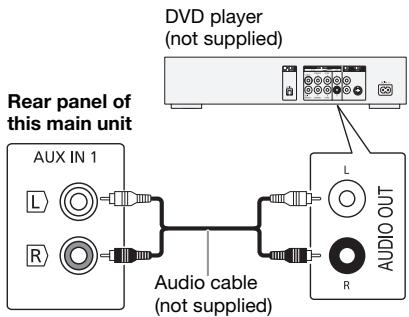
1 Connect the external equipment.
2 Press [CD/RADIO/AUX] to select "AUX 1".
3 Play the external equipment.
Note:
- If you want to connect equipment other than those described, refer to the audio dealer.
- Sound distortion can occur when you use an adaptor.
Connecting a portable audio equipment
You can play music from a portable audio equipment.
Preparation
- Switch off the equaliser (if any) of the portable audio equipment to prevent sound distortion.
- Decrease the volume of the system and the portable audio equipment before you connect or disconnect the portable audio equipment.
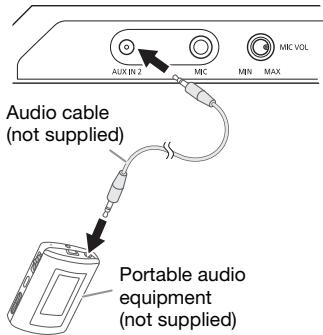
1 Connect the portable audio equipment.
Plug type: ∅ 3.5 mm stereo
2 Press [CD/RADIO/AUX] to select "AUX 2".
3 Play the portable audio equipment.
To adjust the input level
1 Press [PLAY MENU] to select "INPUT LEVEL".
2 Press [◀, ▶] to select "NORMAL" or "HIGH" and then press [OK].
Note:
- You cannot adjust the input level during recording.
- Select “NORMAL” if the sound is distorted during “HIGH” input level.
- Read the operating instructions of the portable audio equipment for details.
Others
Auto off
This system automatically switches off when you do not use it for approximately 20 minutes.
1 Press [SETUP] to select "AUTO OFF".
2 Press [◀, ▶] to select "ON" and then press [OK]. To cancel, select "OFF".
Note:
This function does not work when you are in radio source or when a Bluetooth ^® device is connected.
Bluetooth® standby
This function automatically switches on the system when you establish a Bluetooth ^® connection from a paired device.
1 Press [SETUP] to select "BLUETOOTH STANDBY".
2 Press [◀, ▶] to select "ON" and then press [OK]. To cancel, select "OFF".
Note:
Some devices may take longer to respond. If you are connected to a Bluetooth ^® device before switching off the system, wait for a minimum of 5 seconds before connecting to this system from your Bluetooth ^® device again.
Software version
You can check the software version of the system.
1 Press [SETUP] to select "SW VER." and then press [OK].
The software version is shown.
2 Press [OK] again to exit.
Maintenance
To clean this system, wipe with a soft, dry cloth.
- Never use alcohol, paint thinner or benzine to clean this system.
- Before using chemically treated cloth, read the instructions that came with the cloth carefully.
Troubleshooting
Before requesting service, make the following checks. If you are in doubt about some of the check points, or if the solutions indicated do not solve the problem, consult your dealer for instructions.
Common problems
The unit does not work.
- The safety device has been activated. Do the following:
-
Press [☐/☐] on the main unit to switch the unit to standby mode. If the unit does not switch to standby mode,
-
Press and hold the button for a minimum of 10 seconds. Or,
-
Disconnect the AC mains lead and then connect it again.
-
Press [☐/I] again to switch on the unit. If the problem persists, consult your dealer.
The display panel lights up and changes continuously in standby mode.
- Press and hold [■] on the main unit to select "DEMO OFF".
No operations can be done with the remote control.
- Examine that the battery is installed correctly.
Sound is distorted or no sound.
- Adjust the volume of the system.
- Switch off the system, determine and correct the cause, and then switch on again. It can be caused by straining of the speakers through excessive volume or power, and when using the system in a hot environment.
A humming sound can be heard during playback.
- An AC mains lead or fluorescent light is near the cables. Keep other appliances and cords away from the cables of this system.
The sound level reduces.
- The protection circuit has been activated due to the continuous use at high volume output. This is to protect the system and maintain the sound quality.
Disc
Display not shown correctly.
Playback does not start.
- You have not put in the disc correctly. Put it in correctly.
• Disc is dirty. Clean the disc. - Replace the disc if it is scratched, warped, or non-standard.
- There is condensation. Let the system dry for 1 to 2 hours.
The total number of tracks displayed is incorrect.
The disc cannot be read.
Distorted sound is heard.
- You put in a disc that the system cannot play. Change to a playable disc.
- You put in a disc that has not been finalised.
USB
The USB device or the contents in it cannot be read.
- The format of the USB device or the contents in it are not compatible with the system.
- USB devices with storage capacity of more than 32 GB cannot work in some conditions.
Slow operation of the USB device.
- Large content size or large memory USB device takes longer time to read.
Bluetooth®
Pairing cannot be done.
- Check the Bluetooth® device condition.
- The device is out of the 10 m communication range. Move the device nearer to the system.
The device cannot be connected.
- The pairing of the device was unsuccessful. Do pairing again.
- The pairing of the device has been replaced. Do pairing again.
- This system might be connected to a different device. Disconnect the other device and try pairing the device again.
- The system may have a problem. Switch off the system and then switch on again.
The device is connected but audio cannot be heard through the system.
- For some built-in Bluetooth® devices, you have to set the audio output to “SC-MAX4000” manually. Read the operating instructions of the device for details.
Sound from the device is interrupted.
- The device is out of the 10 m communication range. Move the device nearer to the system.
- Remove any obstacle between the system and the device.
- Other devices that use the 2.4 GHz frequency band (wireless router, microwaves, cordless phones, etc.) are interfering. Move the device nearer to the system and distance it from the other devices.
- Select "MODE 1" for stable communication.
The one-touch connection (NFC) is not working.
- Make sure the system and the NFC feature of the device are switched on.
- Touch and hold the device on the NFC touch area of this system again.
Playback image and sound are not synchronised.
- Restart the playback app of the device.
- Connect the device to the system with an audio cable (not supplied).
Radio
Sound is distorted.
- Use an optional FM outdoor antenna. The antenna should be installed by a competent technician.
A beat sound is heard.
- Switch off the TV or move it away from the system.
- Move mobile telephones away from the system if the interference is apparent.
- When in AM tuner mode, select the “BEATPROOF” setting that provides the best reception.
A low hum is heard during AM broadcasts.
- Move the antenna away from other cables and cords.
Main unit displays
"ADJUST CLOCK"
- The clock is not set. Adjust the clock.
"ADJUST TIMER"
- The play timer and/or record timer is not set. Adjust the play timer and/or record timer.
"ALB FULL"
- The number of albums has exceeded the supported limit.
"AUTO OFF"
- The system has not been used for 20 minutes and will switch off within a minute. To cancel, press any button.
"CAN'T REC"
"DEVICE FULL"
- You cannot do recording because the remaining recording time of the USB device is less than the total time of the music source. Change to a USB device which has enough recording time and do the recording again.
"ERROR"
- An incorrect operation was done. Read the instructions and try again.
"ERROR" (during recording)
- You cannot select other playback source (example: radio, USB etc.) or press [◀◀] or [▶▶] during recording. Stop the recording function. - You cannot open the disc tray when recording from an AM source.
“F61”
- Examine and correct the speaker cords connection. - Disconnect the USB device. Switch off the system and then switch on again.
“F70”
- Examine the Bluetooth® connection. - Disconnect the Bluetooth® device. Switch off the system and then switch on again.
“F76”
- There is a problem with the power supply. - Disconnect the AC mains lead and consult your dealer.
“F77”
- Disconnect the AC mains lead and consult your dealer.
"NO DEVICE"
- The USB device is not connected. Examine the connection. - You cannot do recording or check available storage space because there is no USB device connected to USB B.
"NO DISC"
- You have not put in a disc.
"NO PLAY"
"UNSUPPORT"
- Examine the content. You can only play supported format. - The files in the USB device can be corrupted. Format the USB device and try again. - The system may have a problem. Switch off the system and then switch on again.
"NO TRACK"
- There is no album or track in the USB device or the internal memory.
"PLAYEROR"
- You played an unsupported MP3 file. The system will skip that track and play the next one.
"REC ERROR"
- You disconnected the USB device during recording. Connect the USB device and do recording again. - An error occurred during USB recording. Disconnect the USB device and then connect it again.
"REMOTE 1"
"REMOTE 2"
- The remote control and the main unit are using different codes. Change the code of the remote control. - When “REMOTE 1” is shown, press and hold [OK] and [1] for a minimum of 4 seconds. - When “REMOTE 2” is shown, press and hold [OK] and [2] for a minimum of 4 seconds.
"TEMP NG"
- The temperature protection circuit has been activated, and the system will switch off. Let the unit cool down before switching it on again.
- Check that the ventilation opening of the unit is not obstructed.
- Ensure this unit is well ventilated.
"TRK FULL"
- The number of files has exceeded the supported limit.
"USB OVER CURRENT ERROR"
- The USB device is using too much power. Disconnect the USB device, switch off the system and then switch on again.
"VBR"
- The system cannot show the remaining play time for variable bit rate (VBR) tracks.
Remote control code
When other Panasonic equipment responds to the remote control of this system, change the remote control code for this system.
Preparation
Press [CD/RADIO/AUX] to select "AUX 1" or "AUX 2".
To set the code to "REMOTE 2"
1 Press and hold [CD/RADIO/AUX] on the main unit and [2] on the remote control until "REMOTE 2" is shown.
2 Press and hold [OK] and [2] for a minimum of 4 seconds.
To set the code to "REMOTE 1"
1 Press and hold [CD/RADIO/AUX] on the main unit and [1] on the remote control until "REMOTE 1" is shown.
2 Press and hold [OK] and [1] for a minimum of 4 seconds.
System memory reset
Reset the memory when the following situations occur:
- There is no response when buttons are pressed.
- You want to clear and reset the memory contents.
1 Disconnect the AC mains lead.
2 While you press and hold [⏻/ɪ] on the main unit, connect the AC mains lead again.
Continue to press and hold the button until “----” is shown.
3 Release [⏻/ɪ].
All the settings are set back to the factory preset. It is necessary to set the memory items again.
Specifications
Amplifier section
RMS output power stereo mode
| High Ch | 350 W per channel (3 Ω), 1 kHz, 30% THD |
| Mid Ch | 350 W per channel (3 Ω), 1 kHz, 30% THD |
| Low Ch | 500 W per channel (2 Ω), 100 Hz, 30% THD |
| Total RMS stereo mode power | |
| 2400 W | |
Disc section
Disc played (8 cm or 12 cm)
| CD, CD-R/RW (CD-DA, MP3*) |
* MPEG-1 Layer 3, MPEG-2 Layer 3
Pick up
| Wavelength | 790 nm (CD) |
Bluetooth® section
Version Bluetooth® Ver. 2.1 + EDR
Class Class 2
Supported profiles A2DP, AVRCP, SPP, OPP, FTP
Operating frequency 2.4 GHz band FH-SS
Operation distance 10 m line of sight
Tuner section
Frequency modulation (FM)
| Preset memory | 30 stations |
| Frequency range | |
| 87.50 MHz to 108.00 MHz (50 kHz step) | |
| Antenna terminals | 75 Ω (unbalanced) |
Amplitude modulation (AM)
| Preset memory | 15 stations |
| Frequency range | 522 kHz to 1629 kHz (9 kHz step) |
| 520 kHz to 1630 kHz (10 kHz step) |
Internal memory section
Memory
| Memory size | 2 GB |
| Media file format support | MP3 (*.mp3) |
Memory recording
| Bit rate | 128 kbps |
| Memory recording speed | 1x, 3x max (CD only) |
| Recording file format | MP3 (*.mp3) |
Terminal section
USB port
| USB standard | USB 2.0 full speed |
| Media file format support | MP3 (*.mp3) |
| USB device file system | FAT12, FAT16, FAT32 |
USB recording
| Bit rate | 128 kbps |
| USB recording speed | 1x, 3x (CD only) |
| Recording file format | MP3 (*.mp3) |
AUX IN 1
| Audio input | Pin jack |
AUX IN 2
| Terminal | Stereo, 3.5 mm jack |
Microphone
| Terminal | Mono, 6.3 mm jack |
Speaker section
Speaker unit(s)
| Tweeter | 6 cm cone type |
| Woofer | 20 cm cone type |
| Super Woofer | 30 cm cone type |
Impedance High 3 Ω / Mid 3 Ω / Low 2 Ω
Dimensions (W x H x D) 407 mm x 709 mm x 389 mm
Mass 19 kg
General
Power supply AC 220 V to 240 V, 50 Hz
Power consumption 155 W
Dimensions (W x H x D) 492 mm x 221 mm x 421 mm
Mass 5.8 kg
Operating temperature range 0°C to +40°C
Operating humidity range
| 35% to 80% RH (no condensation) |
Power consumption in standby mode (approximate)
0.4 W
Power consumption in standby mode (approximate)
(With "BLUETOOTH STANDBY" set to "ON")
0.5 W
Note:
- Specifications are subject to change without notice. Mass and dimensions are approximate.
- Total harmonic distortion is measured by the digital spectrum analyser.
About Bluetooth®
Panasonic bears no responsibility for data and/or information that can possibly be compromised during a wireless transmission.
Frequency band
- This system uses the 2.4 GHz frequency band.
Certification
- This system conforms to the frequency restrictions and has received certification based on frequency laws. Thus, a wireless permit is not necessary.
- The actions below are punishable by law:
- Taking apart or modifying the main unit.
- Removing specification indications.
Restrictions of use
- Wireless transmission and/or usage with all Bluetooth® equipped devices is not guaranteed.
- All devices must conform to standards set by Bluetooth SIG, Inc.
- Depending on the specifications and settings of a device, it can fail to connect or some operations can be different.
- This system supports Bluetooth® security features. But depending on the operating environment and/or settings, this security is possibly not sufficient. Transmit data wirelessly to this system with caution.
- This system cannot transmit data to a Bluetooth® device.
Range of use
- Use this device at a maximum range of 10 m.
- The range can decrease depending on the environment, obstacles or interference.
Interference from other devices
- This system may not function properly and troubles such as noise and sound jumps may arise due to radio wave interference if this unit is located too close to other Bluetooth ^® devices or the devices that use the 2.4 GHz band.
- This system may not function properly if radio waves from a nearby broadcasting station, etc. is too strong.
Intended usage
- This system is for normal, general use only.
- Do not use this system near an equipment or in an environment that is sensitive to radio frequency interference (example: airports, hospitals, laboratories, etc.).
Licenses
The Bluetooth ^® word mark and logos are registered trademarks owned by Bluetooth SIG, Inc. and any use of such marks by Panasonic Corporation is under license. Other trademarks and trade names are those of their respective owners.
Google Play and Android are trademarks of Google Inc.
MPEG Layer-3 audio coding technology licensed from Fraunhofer IIS and Thomson.
Disposal of Old Equipment and Batteries Only for European Union and countries with recycling systems

These symbols on the products, packaging, and/or accompanying documents mean that used electrical and electronic products and batteries must not be mixed with general household waste.
For proper treatment, recovery and recycling of old products and used batteries, please take them to applicable collection points in accordance with your national legislation. By disposing of them correctly, you will help to save valuable resources and prevent any potential negative effects on human health and the environment.
For more information about collection and recycling, please contact your local municipality.
Penalties may be applicable for incorrect disposal of this waste, in accordance with national legislation.

Note for the battery symbol (bottom symbol):
This symbol might be used in combination with a chemical symbol. In this case it complies with the requirement set by the Directive for the chemical involved.
CE1177
English
Declaration of Conformity (DoC)
Hereby, “Panasonic Corporation” declares that this product is in compliance with the essential requirements and other relevant provisions of Directive 1999/5/EC.
Customers can download a copy of the original DoC to our R&TTE products from our DoC server: http://www.doc.panasonic.de Contact to Authorised Representative: Panasonic Marketing Europe GmbH, Panasonic Testing Centre, Winsbergring 15, 22525 Hamburg, Germany
This product is intended for general consumer. (Category 3)
Magyar
Marketing Europe GmbH, Panasonic Testing Centre, Winsbergring 15, 22525 Hamburg, Germany
natural_image
Illustration of two people handling a multi-chamber electronic device with visible gears and buttons (no text or symbols)natural_image
Illustration of a person reacting to a prohibition symbol on two stacked electronic devices (no text or symbols present)Anschließen
350 W pro Kanal (an 3 Ω), 1 kHz, 30% THD
Mitte Kanal
350 W pro Kanal (an 3 Ω), 1 kHz, 30% THD
Niedrig Kanal
500 W pro Kanal (an 2 Ω), 100 Hz, 30% THD
Amplitudenmodulation (AM (MW))
natural_image
Illustration of two people handling a server rack with an inset close-up showing internal components (no text or symbols)natural_image
Illustration of a child crawling under a 'no stop' symbol with no other text or symbolsRaccordements
flowchart
graph TD
    A["AM ANT LOOP"] --> B["Internal components with lock"]
    B --> C["Internal parts with lock"]
    C --> D["Internal parts with lock"]
    D --> E["Internal parts with lock"]
    style A fill:#f9f,stroke:#333
    style E fill:#bbf,stroke:#333
natural_image
Technical line drawing of a multi-chamber electronic device with no visible text or symbolsnatural_image
Illustration of two people assembling or connecting a mechanical device (no text or symbols visible)natural_image
Illustration of a child crawling under a large speaker tower with no prohibition symbols (no text or labels)Collegamenti
Cercare brani o album
natural_image
Technical line drawing of a portable electronic device with front panel and screen (no text or symbols)natural_image
Illustration of two people assembling or working on a multi-chamber industrial machine (no text or symbols visible)natural_image
Illustration of a person reacting to a prohibition symbol on two speakers (no text or symbols present)Podłączenie
natural_image
Technical line drawing of a multi-chamber electronic device with no visible text or symbolsnatural_image
Illustration of two people assembling or lifting a mechanical device (no text or symbols visible)natural_image
Illustration of a baby crawling under a large speaker tower with no signage, symbolizing noise or prohibition (no text present)Provedení zapojení
Kadoma, Osaka, Japan
Importer for Europe:
Panasonic Marketing Europe GmbH
Panasonic Testing Centre
Winsbergring 15, 22525 Hamburg, Germany
EU

- Panasonic®
- Table of contents
- Safety precautions
- WARNING!
- Unit
- CAUTION!
- Battery
- Caution for AC mains lead
- (For the AC mains plug of three pins)
- Before use
- How to replace the fuse
- Sales and Support Information
- For the United Kingdom and Ireland
- Customer Communications Centre
- Direct Sales at Panasonic UK
- Supplied accessories
- Placement of speakers
- Use only the supplied speakers.
- Note:
- Preparing the remote control
- Making the connections
- Connect the AM loop antenna.
- Connect the FM indoor antenna.
- Connect the FM outdoor antenna.
- Connect the speakers.
- Connect the AC mains lead.
- Conserving power
- Overview of controls
- ⑳ DJ function direct buttons
- ②1 Switch on the DJ function
- ②2 Select MP3 album or track
- Browse tracks or albums
- ②3 Turntable for DJ and multi control
- ⑳ Remote control sensor
- ⑲ Display panel
- USB A
- USB B
- ⑳ NFC touch area
- ⑲ AUX IN 2 jack
- ③0 Microphone jack
- ③1 Adjust the microphone volume level
- ③2 Disc tray
- Preparing media
- Disc
- USB
- Preparation
- Bluetooth®
- Pairing a device
- Using the main unit
- Connecting a device
- Disconnecting a device
- One-Touch Connection (NFC)
- For NFC-compatible Bluetooth® devices (Android™ devices) only
- Press [®].
- Touch and hold the device on the NFC touch area of the main unit [∅].
- Start playback on the device.
- Media playback
- Basic playback
- Viewing available information
- CD USB BLUETOOTH MEMORY
- Press [DISPLAY].
- Play menu
- CD USB MEMORY
- Press [PLAY MENU].
- Press [◀, ▶] to select the setting and then press [OK].
- Link mode
- BLUETOOTH
- Press [PLAY MENU] to select "LINK MODE".
- Press [◀, ▶] to select the mode and then press [OK].
- Note on disc
- Note on USB device
- Note on MP3 file
- MP3 file on disc
- MP3 file on USB device
- Radio
- Manual tuning
- Press [◀◀] or [▶▶] to tune in to the station.
- Memory presetting
- Automatic presetting
- Manual presetting
- Selecting a preset station
- Improving the sound quality
- When "FM" is selected
- When "AM" is selected
- AM allocation setting
- By main unit only
- Recording
- To check storage space
- In the stop mode, press [DISPLAY].
- Basic recording
- Select the source you want to record.
- CD-DA
- External equipment
- Press [MEMORY REC ●/III] or [USB REC ●/III] to start recording.
- High-speed recording
- CD-DA disc recording speed:
- ■ Adding track marks
- Before recording
- Recording MP3 tracks
- Deleting the recorded tracks
- MEMORY
- Sound and illumination effects
- Sound effects
- Preset EQ
- Manual EQ
- Illumination effects
- DJ functions
- Using the "Panasonic MAX Juke" app
- DJ jukebox
- USB MEMORY
- Press [JUKEBOX] (main unit: [DJ JUKEBOX]).
- Changing the repeat setting
- Changing the DJ jukebox effect
- DJ sampler
- (Except for AUX 1 and AUX 2 source)
- DJ effect
- Using a microphone
- Clock and timers
- Setting the clock
- To check the time
- Play timer and record timer
- To start the timer
- To check the setting
- Sleep timer
- Press [SLEEP] to select the setting (in minutes).
- Using the auxiliary input
- Connecting a portable audio equipment
- To adjust the input level
- Others
- Auto off
- Bluetooth® standby
- Software version
- Maintenance
- Troubleshooting
- Common problems
- The unit does not work.
- The display panel lights up and changes continuously in standby mode.
- No operations can be done with the remote control.
- Sound is distorted or no sound.
- A humming sound can be heard during playback.
- The sound level reduces.
- Display not shown correctly.
- Playback does not start.
- The total number of tracks displayed is incorrect.
- The disc cannot be read.
- Distorted sound is heard.
- The USB device or the contents in it cannot be read.
- Slow operation of the USB device.
- Pairing cannot be done.
- The device cannot be connected.
- The device is connected but audio cannot be heard through the system.
- Sound from the device is interrupted.
- The one-touch connection (NFC) is not working.
- Playback image and sound are not synchronised.
- Sound is distorted.
- A beat sound is heard.
- A low hum is heard during AM broadcasts.
- Main unit displays
- "ADJUST CLOCK"
- "ADJUST TIMER"
- "ALB FULL"
- "AUTO OFF"
- "CAN'T REC"
- "DEVICE FULL"
- "ERROR"
- "ERROR" (during recording)
- “F61”
- “F70”
- “F76”
- “F77”
- "NO DEVICE"
- "NO DISC"
- "NO PLAY"
- "UNSUPPORT"
- "NO TRACK"
- "PLAYEROR"
- "REC ERROR"
- "REMOTE 1"
- "REMOTE 2"
- "TEMP NG"
- "TRK FULL"
- "USB OVER CURRENT ERROR"
- "VBR"
- Remote control code
- To set the code to "REMOTE 2"
- To set the code to "REMOTE 1"
- System memory reset
- Specifications
- Amplifier section
- Disc section
- Bluetooth® section
- Tuner section
- Internal memory section
- Terminal section
- Speaker section
- General
- About Bluetooth®
- Frequency band
- Certification
- Restrictions of use
- Range of use
- Interference from other devices
- Intended usage
- Licenses
- Disposal of Old Equipment and Batteries Only for European Union and countries with recycling systems
- Note for the battery symbol (bottom symbol):
- CE1177
- English
- Declaration of Conformity (DoC)
- Magyar
- Anschließen
- Amplitudenmodulation (AM (MW))
- Raccordements
- Collegamenti
- Cercare brani o album
- Podłączenie
- Provedení zapojení
Brand : PANASONIC
Model : SC-MAX4000E
Category : Loudspeaker