Classic Six - Barbecue MASPORT - Free user manual and instructions
Find the device manual for free Classic Six MASPORT in PDF.


| Product Type | Gas Barbecue |
| Brand | Masport |
| Model | Classic Six |
| Number of Burners | 4 |
| Cooking Area (Main) | Approximately 2,500 cm² |
| Material | Stainless Steel / Cast Iron |
| Ignition Type | Electronic / Piezo |
| Fuel Type | LPG / Natural Gas |
| Dimensions (L x W x H) | 120 cm x 60 cm x 110 cm |
| Weight | Approximately 45 kg |
| Main Features | Side burner, warming rack, temperature gauge |
| Cleaning | Hand wash with mild soap; avoid abrasive cleaners |
| Safety | Use outdoors only; keep away from flammable materials |
| Spare Parts Availability | Replaceable burners, grates, and ignition parts |
| Warranty | 5 years on manufacturing defects |
Frequently Asked Questions - Classic Six MASPORT
User questions about Classic Six MASPORT
0 question about this device. Answer the ones you know or ask your own.
Ask a new question about this device
Download the instructions for your Barbecue in PDF format for free! Find your manual Classic Six - MASPORT and take your electronic device back in hand. On this page are published all the documents necessary for the use of your device. Classic Six by MASPORT.
USER MANUAL Classic Six MASPORT
natural_image
Close-up of a metallic mechanical component with curved metal strips and mounting holes (no visible text or symbols)
natural_image
Close-up of a blue metal panel with ribbed texture and a dashed edge (no text or symbols visible)Barbecues
Masport 4/6 Burner
OWNER'S MANUAL
Please read these instructions carefully before assembly, to reduce risk of fire, burn hazard or other injury.
Keep these instructions in a safe place for future use.
This manual covers a range of barbecues which include: MB4000, S/S4, MB5000, MB6000, MB4400, and MB6600.
CONTENTS
SAFETY AND WARRANTY INFORMATION 2
PARTS DIAGRAM, PARTS LIST & FIXTURES 4
ASSEMBLY INSTRUCTIONS 8
LEAK TESTING 24
| INSTALLATION | 24 |
| OPERATION | 25 |
| TROUBLESHOOTING | 28 |
CARE AND MAINTENANCE 29
TECHNICAL DATA 32
SAFETY AND WARRANTY INFORMATION
KEEP THE INSTRUCTIONS IN A SAFE PLACE FOR FUTURE USE.

DO NOT OPERATE THIS BBQ BEFORE IT HAS BEEN ASSEMBLED CORRECTLY AND YOU HAVE READ AND UNDERSTOOD THESE INSTRUCTIONS.

These instructions are intended as a general guide and do not supersede national or local codes in any way. Contact local authorities for clarity of laws relating to the operation of this appliance.
SYMBOLS IN THIS OWNER'S MANUAL

Possible hazard or hazardous situation. Not observing this instruction can lead to injuries or cause damage to property.

Important information on proper handling. Not observing this instruction can lead to faults in the BBQ.

User information. This information helps you to use all the functions correctly.
Failure to follow these instructions could result in fire or explosion which could cause property damage, personal injury or death.
Accessible parts may be very hot. Keep young children away from the hot appliance at all times (even while cooling down). Some parts of this grill may have sharp edges especially as mentioned in this manual. Wear suitable protective gloves if necessary.
Assembled parts sealed by the manufacturer must not be altered by the user. Any modification of the appliance by unauthorised persons may be dangerous.
IMPORTANT SAFETY INFORMATION
Please read and understand this manual fully before assembly and use.
- The Manufacturer's Warranty may be voided by the incorrect use of this product.
- The Manufacturer or their Agents can accept no liability for the unsuitability of, or any damage to, food that is cocked on this appliance.
- Use the correctly specified fuel with this barbecue. Check with your dealer for the specific fuel for which this barbecue has been designed.
OWNER'S MANUAL
- The operator must understand all the safety requirements detailed in this manual before using the barbecue.
- If you have any queries regarding these instructions, contact your local dealer for clarification before you use your barbecue.
- The unit must be correctly assembled before use. Failure to follow the manual's instructions could result in serious damage or injury.
PERSONAL SAFETY
- The use of alcohol, prescription or non-prescription drugs may impair the consumer's ability to properly assemble or safely operate this barbecue.
- The barbecue should be carefully checked for operational use every time before use.
- Never try to move the barbecue when it is on, or before it has had time to cool down.
- The person operating this barbecue should pay constant attention to the food being cooked.
- Do not leave the barbecue unattended when it is aight. The
person should remain at the barbecue at all times when it is aight/cooking.
THIRD PARTY SAFETY
- The operator is responsible for the safety of all third parties while the barbecue is in use.
- Onlockers should be kept a safe distance away from the barbecue when it is in use.
- Keep children and animals well away while the barbecue is in use and while it is cooling down.
LOCATION
- Do not use indoors. Barbecue units are designed for OUTDOOR USE ONLY.
- Use in a weather-protected area, preferably under shelter.
- Ensure that the barbecue is on an even and secure surface before operating. Use the castor locks if tilted to lock the wheels in place.
- Do not use within one metre of any flammable surface of structure.
BURN AWARENESS
- Parts of the barbecue do get extremely hot and could cause serious burns – touch test the surface before applying a firm grip.
- The hood herole can become hot! The use of cooking gloves and long sleeves are advised.
- If cooking with the hood closed, be very careful opening the hood, a sudden rush of hot air could burn an unprotected arm.
GAS AWARENESS
- Ensure all gas couplings and hoses are in good condition and have been correctly fitted.
- Leak test all gas lines and connections before use.
- Do not store flammable materials near this barbecue.
- Do not place the gas bottle underneath the barbecue directly.
- Do not store spare LPG cylinders under or near this barbecue.
- Do not place or use aercools near this barbecue.
- Do not store or use gasoline or other flammable vapours or liquids in the vicinity of this barbecue.
- Ensure that the gas is turned OFF at the cylinder after use and while the barbecue is unattended.
- When turning off the barbecue, shut off the gas at the supply source before turning off all the bumer controls.
- Do not store gas cylinders below ground level. ULPG is heavier than air. Should a leak occur, the gas will collect and could ignite due to presence of a flame or electric spark.
ELECTRICAL AWARENESS
• Symbol IEC 60417 -5172 (2003-2) Class II equipment.
- This appliance is not intended for use by persons (including children) with reduced physical, sensory or mental capabilities, or lack of experience and knowledge, unless they have been given supervision or instruction concerning use of the appliance by a person responsible for their safety.
- Children should be supervised to ensure they do not play with the appliance.
- If the supply cord is damaged, it must be replaced by the manufacturer, its service agent or similarly qualified persons in order to avoid a hazard.
- BBCs with Grill Lights & USB parts run on AC power. It is IMPORTANT to ensure the care is taken to the location of the BBQ. See section in this manual which refers to "Location".
• Turn power OFF when not in use. - Avoid using in wet conditions.
- If an external lead is being used, ensure that it is correctly rated and meets current safety certification requirements.
- Ensure the power is turned OFF before connecting and disconnecting any components on the BBQ.
- Ensure power leads are kept away from any hot parts of the HBO. - Do not place the power lead where hot oil or fat can drip onto the load.
FOR YOUR SAFETY AND OTHERS
If you smell gas:
- Shut off the gas supply to the barbecue.
• Extinguish any open flame (candles, cigarettes, etc.)
- Clear the area to allow the unburned gas to dissipate.
Be aware of the reason for the gas smell, address this before continuing. Should the gas odour come from the LPG cylinder, immediately contact the fire department from an elevated sate distance.
Connecting the gas cylinder to the barbecue, refer to that section in the manual.
Leak testing, refer to that section in the manual.
SAFETY EQUIPMENT
When cooking with oil/grease, fire extinguishing materials should be readily accessible.
In the event of an oil/grease fire do not attempt to extinguish with water or alcohol. Use type BC dry chemical fire extinguisher or smother the fire with dirt, sand or baking soda.
RAIN HAZARD
In the event of ran while cooking with oil/gresse, turn off the gas supply and all burners, cover the barbecue as soon as possible. Move people/animals away from around the barbecue. Do not attempt to move the barbecue until it has cooled and can safely be moved.
INSTALLATION
This Cooking Appliance is For Outdoor Use Only and shall not be used in a building, garage or any other enclosed area.
NOTE:
Read carefully the pages containing the parts and assembly before assembling your gas grill.
Do not use your gas grill in garages, porches, breezeways, sheds or other enclosed areas. Your gas grill is to be used outdoor only, at least 43cm from the back and sole to any combustible surface. The grill should not be placed under any surface that will bum. Do not obstruct the flow of combustion and ventilation at around the grill housing. Keep his barbecue away from any flammable materials (Refer to page 20).
Gas grills are used safely by millions of people when following simple safety precautions. This barbecue is designed for ULPG use only. Bottle size of 4.5kg or greater is recommended for use with this barbecue. The regulator must have an outlet pressure of 2.75kPa. You must have the correct regulator and bottle for the barbecue to operate safely and officially. The items used in the fuel system are designed for operation with the grill.
(See parts list for replacement items).
WARRANTY
Refer to the warranty supplied with this BBQ. Should any part fail due to defective workmanship or faulty materials within the specified period from the date of purchase, Missport will replace or repair the
defective part free of charge. Refer to the warranty for details. Do not use a BDO that is unsafe.
LPG CYLINDER
The cylinder manufacturer/distributor is responsible for the safety and performance of the LPG cylinder. This is not included in the Masport BBQ warranty. Do not use a cylinder that is unsafe.
DISPOSAL OF PACKAGING
Remove all protective packaging including any protective film from stainless steel surfaces.
PARTS DIAGRAM, PARTS LIST & FIXTURES
4 BURNER (WITH REARBURNER) PARTS DIAGRAM
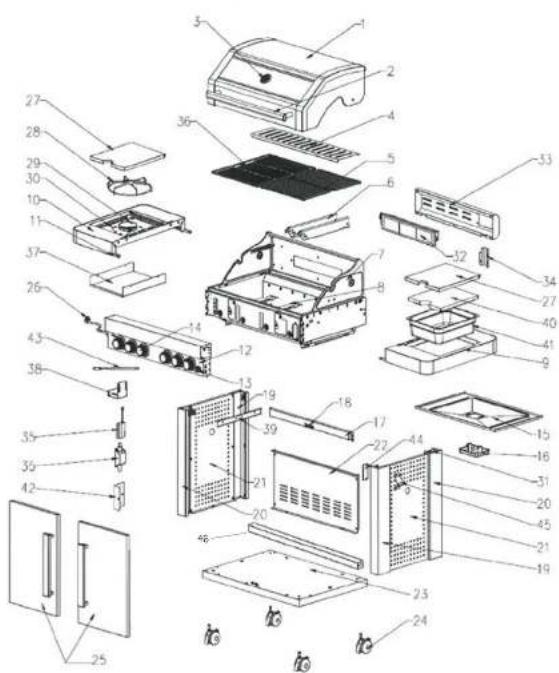
*IMAGE IS FOR ILLUSTRATION PURPOSE ONLY AND MAY SHOW COMPONENTS THAT ARE NOT INCLUDED ON ALL MODELS OF BOX
Make sure you properly dispose of, or recycle the packaging material where possible to comply with applicable waste disposal laws in your area.
NOTE!
The images/instructions in the next few pages cover many models of BDO, please ignore instructions or features that are not included with your BDO
4 BURNER WITH REARBURNER PARTS LIST
| Item No. | Description Qty | |
| 1 | Lid 1 | |
| 2 | Lid handle 1 | |
| 3 | Thermometer 1 | |
| 4 | Warning rack 1 | |
| 5 | Cast iron cooking grds. 1 | |
| 6 | Heat distribution panel 2 | |
| 7 | Tirebox assembly 1 | |
| 8 | Main burner tube assembly 4 | |
| 9 | Right side table 1 | |
| 10 | Side burner layor | 1 |
| 11 | Hentened air | 4 |
| 12 | Control panel assembly | 1 |
| 13 | Rear burner electronic ignition button | 1 |
| 14 | Control knob | 6 |
| 15 | Grease tray | 1 |
| 16 | Grease cup assembly | 1 |
| 17 | Cart front beam | 1 |
| 18 | Door magnet | 1 |
| 19 | Log - B | 2 |
| 20 | Leg - A | 2 |
| 21 | Side low panel | 2 |
| 22 | Rear side low panel | 1 |
| 23 | Bottom panel assembly | 1 |
| 24 | Sawler caster | 4 |
| 25 | Door assembly | 2 |
| 26 | Side burner nozzle base | 1 |
| 27 | Side burner cover | 1 |
| 28 | Side burner cooking grid | 1 |
| 29 | Side burner assembly | 1 |
| 30 | Side burner insert tray | 1 |
| 31 | Cart attachment bracket | 4 |
| 32 | Rear burner assembly | 1 |
| 33 | Rear burner windshield cover | 1 |
| 34 | Rear burner bellows protected cover | 1 |
| 35 | Battery nozzle/adampter | 1 |
| 36 | Cast iron cooking plate 1 | |
| 37 | Bottom panel of side burner | 1 |
| 38 | Gas cylinder hook | 1 |
| 39 | Fix beam for gas cylinder | 1 |
| 40 | Chopping board | 1 |
| 41 | Ice box | 1 |
| 42 | Fix panel for adapter | 1 |
| 43 | Not Required included | 0 |
| 44 | Fix panel for bottle opener | 1 |
| 45 | Bottle opener 1 | |
| 46 | Support bar | 1 |
6 BURNER (WITH REAR BURNER) - PARTS DIAGRAM
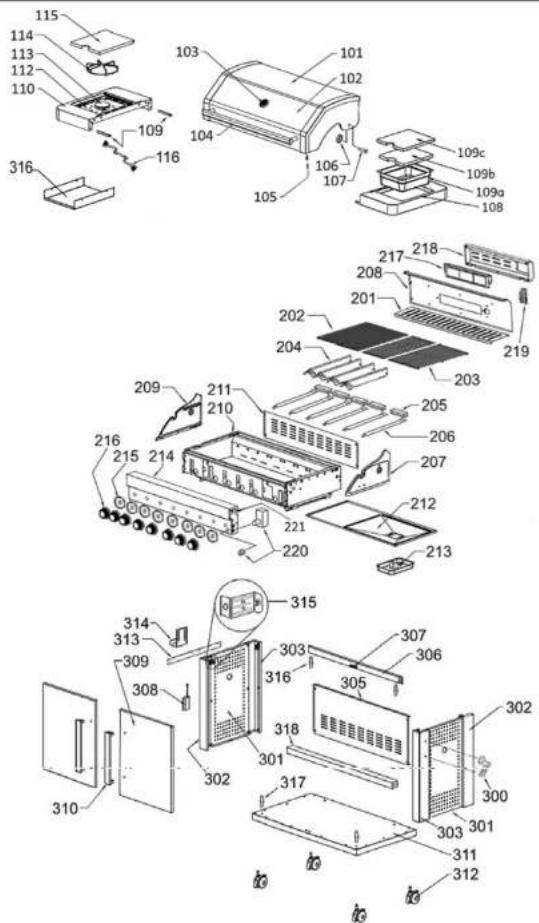
"IMAGE 8 FOR ILLUSTRATION PURPOSE ONLY AND MAY SHOW COMPONENTS THAT ARE NOT INCLUDED ON ALL MODELS OF BSO.
6 BURNER (WITH REAR BURNER) - PARTS LIST
| Item No. | Description Qty | |
| 101 | Hand | 1 |
| 102 | *Snacks - Window, Hood 1 | |
| 103 | *Gauge-Temperature, And 81mm 1 | |
| 104 | *Hando - Hood 5-1 | |
| 105 | Hander Bladder, 12lux x 25min 2 | |
| 106/107 | Federers - Hood 2 | |
| 108 | Right side table 1 | |
| 109a | Ice box | 1 |
| 109b | Chapping board | 1 |
| 109c | Sloor burner | 1 |
| 110 | Tape - Side, LH/S/Burnar | 1 |
| 112 | *Hand - Slabbage, Slice Lumber | 1 |
| 113 | *Burfer-Side | 1 |
| 114 | *Truck - Slice Burner | 1 |
| 115 | *11d - Slice Burner | 1 |
| 116 | Pots - Ice, Slice Lumber | 1 |
| 201 | Rear - Warming 560mm | 1 |
| 202 | Pots - P/- Matt Show 50h | 1 |
| 203 | Girl - P/L Mall 25w45D | 2 |
| 204 | Pane - Tarsen, 80x390 (Shall) P/E | 4 |
| 205 | Cross Light 9/5 | 5 |
| 206 | Rumber Tube 4 Pinmax 1 03048/5 2 | |
| 207 | Pane - Side, R/H Hood G/Body | 1 |
| 208 | Pane - Fear, Hood G/Body | 1 |
| 209 | Pane - Side, LH Hood G/Body | 1 |
| 210 | Girl - Body, BD P/L | 1 |
| 211 | Pane - Fear, Heat Shield 6 | 1 |
| 212 | Tray - Drip, 300x360 | 1 |
| 213 | Out - Grange | 1 |
| 214 | Dashboard | 1 |
| 215 | Bassel - Control knob | 8 |
| 216 | Knoll - BBQ, 8.0 | 8 |
| 217 | Rumber Floor | 1 |
| 218 | Cover - Rear Burner | 1 |
| 219 | Pane - Floor, RBB Ign Cover | 1 |
| 220 | Macture - Rear Burner | 1 |
| 221 | Usiport | 1 |
| 201 | Pane - Side, LH/Tit - Trolley | 2 |
| 300 | Log - Leaf Kit-bar | 2 |
| 300 | Legg - R/Tit - L/Rear | 2 |
| 305 | Pane - Rear, Trolley | 1 |
| 306 | Pane - Support, Front Trolley | 1 |
| 307 | Magier - Box, 40mm | 1 |
| 308 | Battery Holeer, LED | 1 |
| 309 | Door Assy RHL+ | 2 |
| 310 | Hando - Door (Not required for stainless steel model BBO) | 1 |
| 311 | Pane - Bottom, Lboxy 6 | 1 |
| 312 | Castor - Locking 4 | |
| 313 | Stray - Rearizer, TPO | 1 |
| 314 | Snaplet - Gas Cylinder | 1 |
| 315 | Draper - Trolley 4 | |
| 316 | Bottom Cover Pane - Slice Burner | 1 |
| 317 | Support bar | 1 |
FASTENERS
| A B C D E F G H I J | ||||||||||
| Mn-12 Mn-12 Mn-2 45 | ||||||||||
| QTY | x7x8x90x10x48x9x4x5x4x5 | |||||||||
For almost steel grade BBp - Fasteners & Jare no, required

CAUTION:
Although we take every effort to ensure that the assembly process is as easy as possible, it is inherent with donated steel parts that owners and edged can cause cuts if improperly handed during assembly procedures. Be careful while handling any parts during assembly. It is strongly recommended that you protect hands with a side of work givers.
ASSEMBLY INSTRUCTIONS
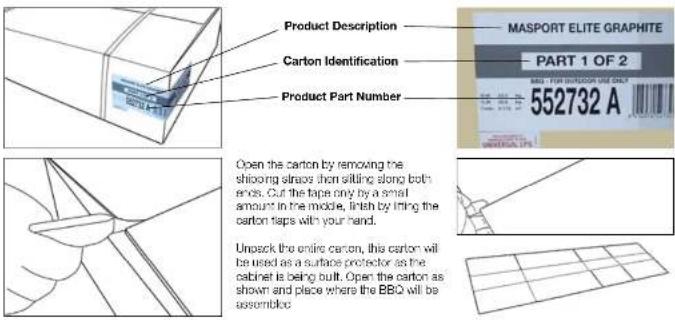
Tools needed for assembly: Crosshead screwdriver, 10mm A/F Spanner.

NOTE:
When assembling the barbecue, ensure it is sitting on a flat surface.
For illustration purposes 6.6 Burner with Rear Burner is used in assembly state shown in the next few pages. This bucket assembly is easier to assemble with two people:
Before attempting to assemble the BHO, lay out all of the components and identify each of them, this will make it easier to assemble the BHO.
STEP 1
Identify the two different types of legs. The left leg at the left front is the same as the right rear and the leg at the right front is the same as left rear. Assemble the legs to the side panels.
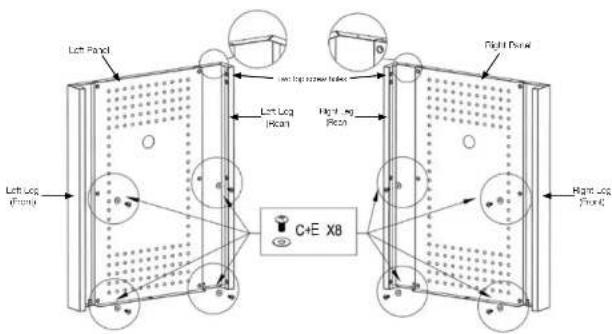
Alternate way of identifying can be aligning legs such that there are two screw holes on top facing inside the BBO.
STEP 2
Insert 6 x D (IV6) nut on the underside of the bottom panel. Asasmole the plastic push pins and the door stopper pins on the too face of the bottom panel.
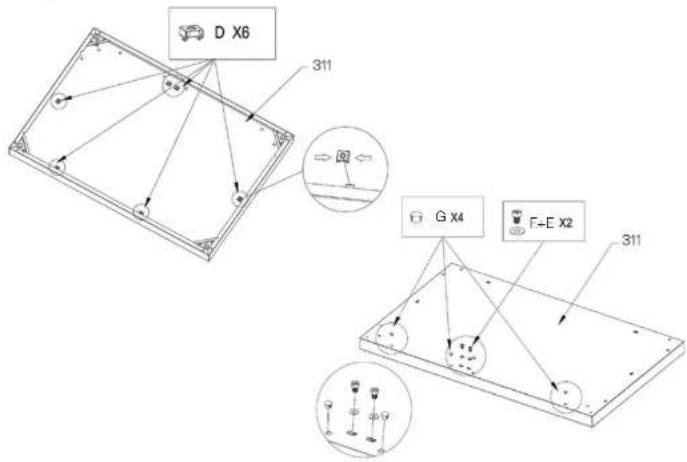
STEP 3
Assemble the side panels to the bottom panel. Then assemble the 4 casters on the bottom panel by pushing them in.
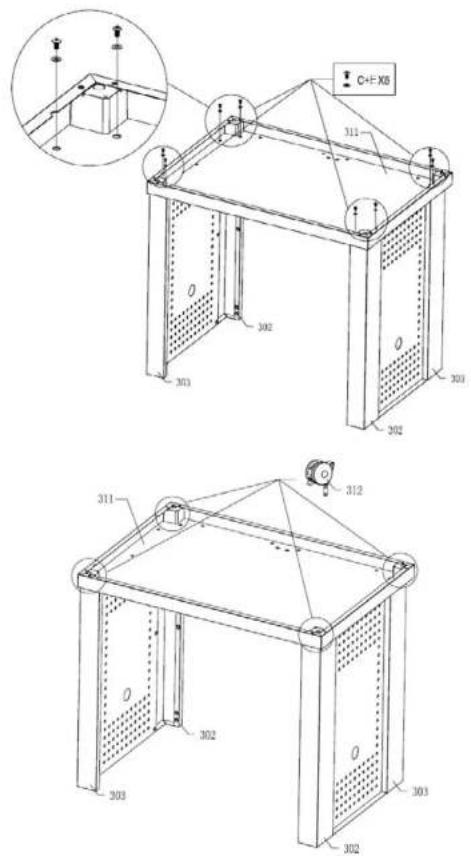
STEP 4
Assemble the rear panel.
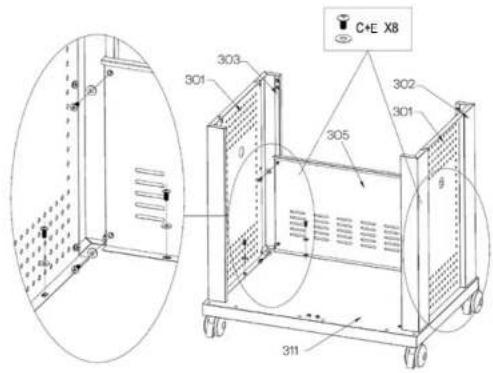
STEP 5
Attach the panel support to the front of the trolley and attach the trolley brackets on the top four corners. Trolley brackets need to be screwed in the top hole of the panel as shown below.
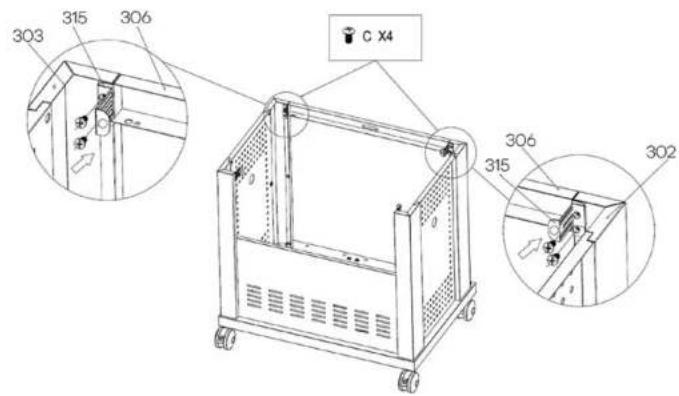
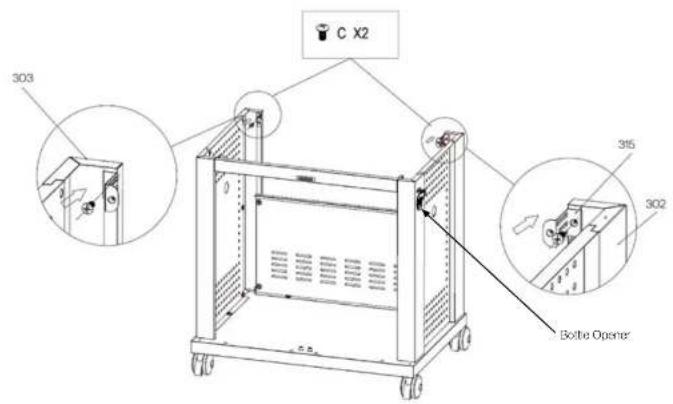
STEP 6
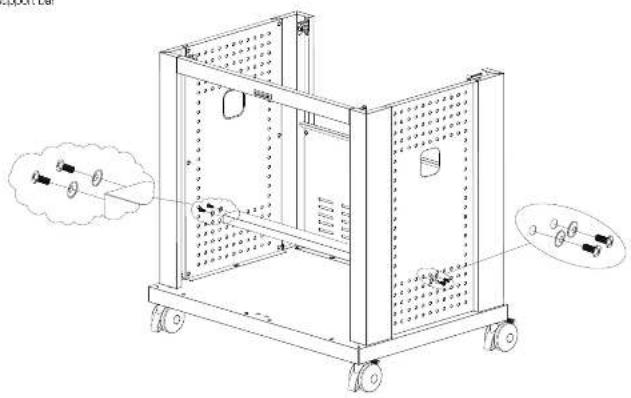
Insert support bar
natural_image
Technical line drawing of a mechanical device with wheels and internal components, no visible text or symbolsSTEP 7
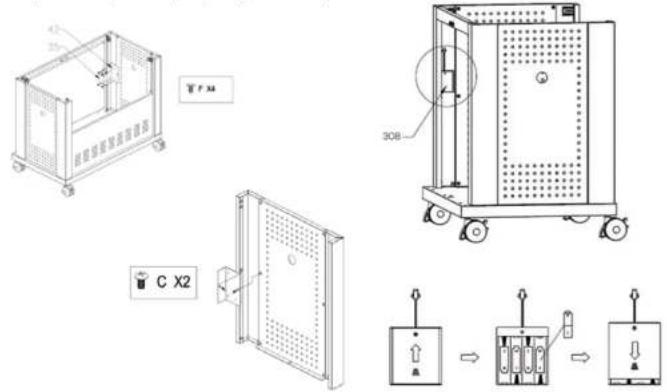
To power the LED Knob lights (not available on all models), the lead coming out from the grill body has to be connected to the battery box. Make sure that the battery box is positioned as low as the load allows, to protect the battery box from the float. Measure the length of the lead coming out from the grill body assembly and the length of the lead attached to the battery box. Attach the battery box to the left hand side panel at the farthest possible position (Approximately: 150mm from the bottom panel. Some EBO's may come with its panel for adapter (Part 42), Assemble the panel as shown below).
STEP 8
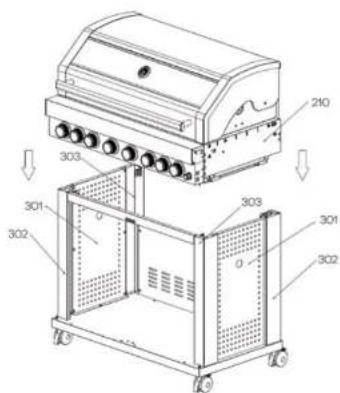
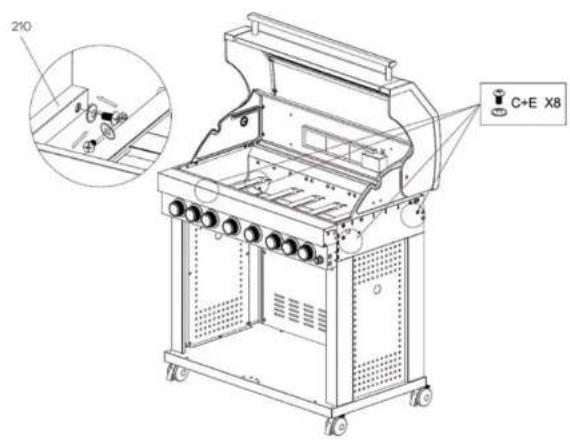
Assemble the hood and grill assembly to the cabinet Iroley.
STEP 9
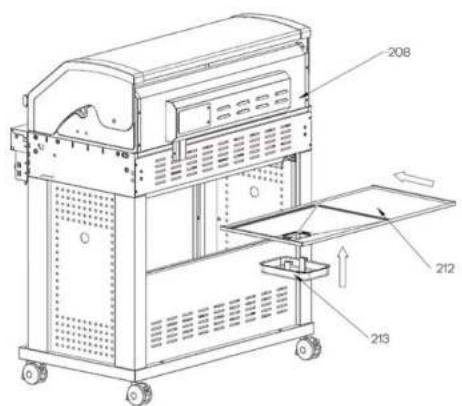
Attach the grease cup and slide & place the drip tray into the grill body.
STEP 10
Insert the door hinge pins & bottle opener.
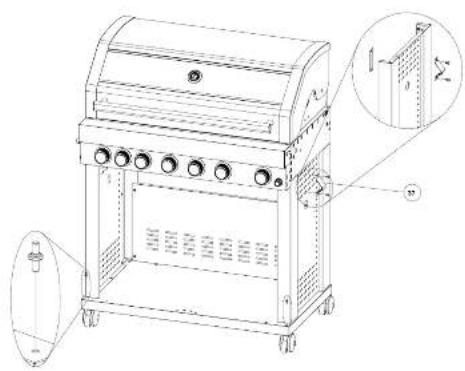
For stainless steel model HBCs: No assembly required for the door handles.
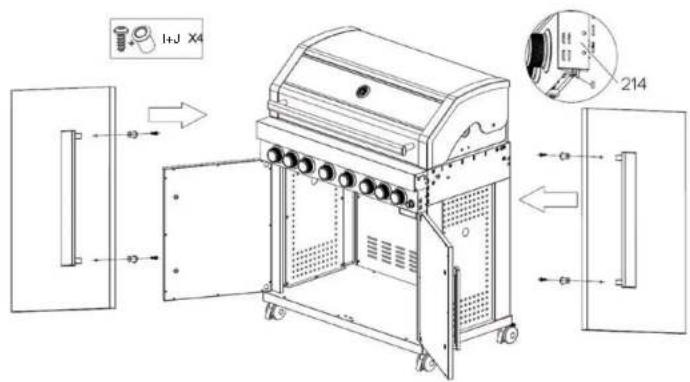
STEP 11
Assemble the side tables. Assemble the support rods on the side tables.
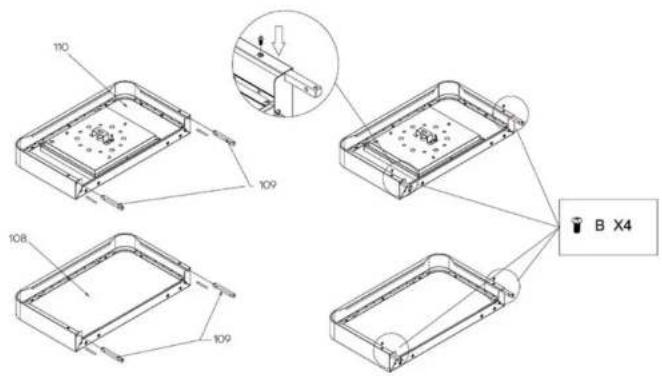
STEP 12
Side the side tables into the assembled grill body and secure the tables using screws from the grill body to the side tables.
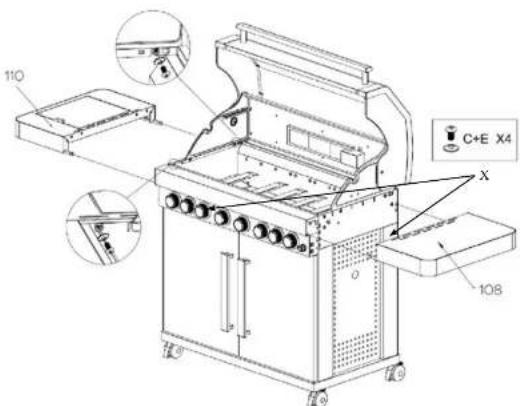
NOTE:
Inser front screw first and then insert the rear screw. Tighten the screws once corn of the screws are in place.
STEP 13
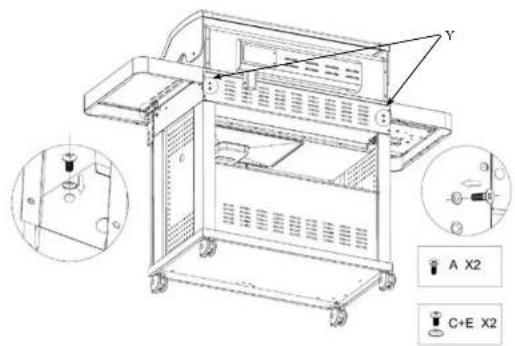
Secure the free end of the support root from the side table using screws (A x2) at the rear of the grill body. (see location Y)
STEP 14
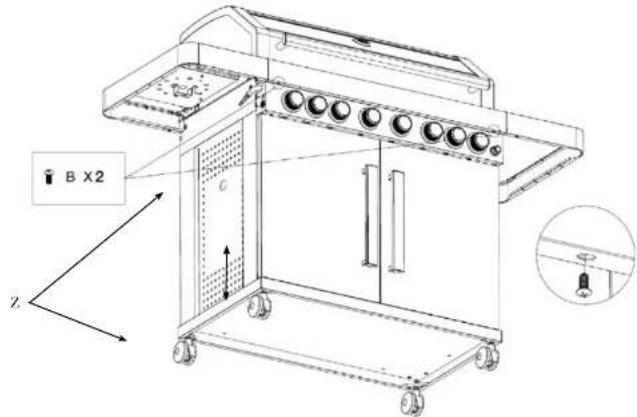
To secure the Side Tables at the front of the grill body, insert screws (3 x2) as shown below.
STEP 15
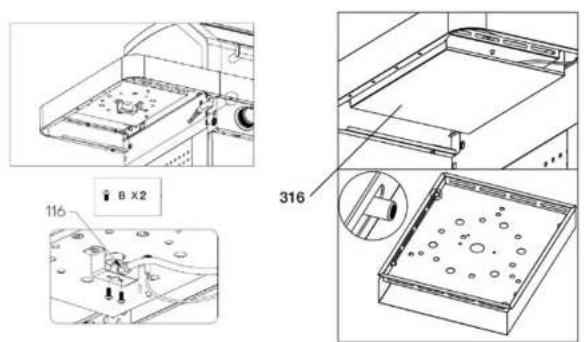
Attach the Side Burner Jet to the Side Burner using screws (B x2) at location Z. Then attach the bottom cover panel by sliding into place under the Side Burner.
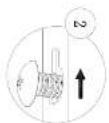
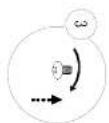
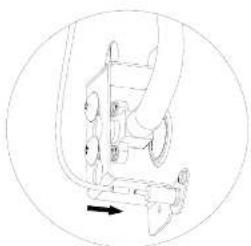
STEP 16
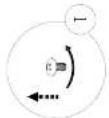
Side Burner connection.
natural_image
Technical line drawing of a mechanical assembly with no visible text or symbolsSTEP 17
Icebox assembly
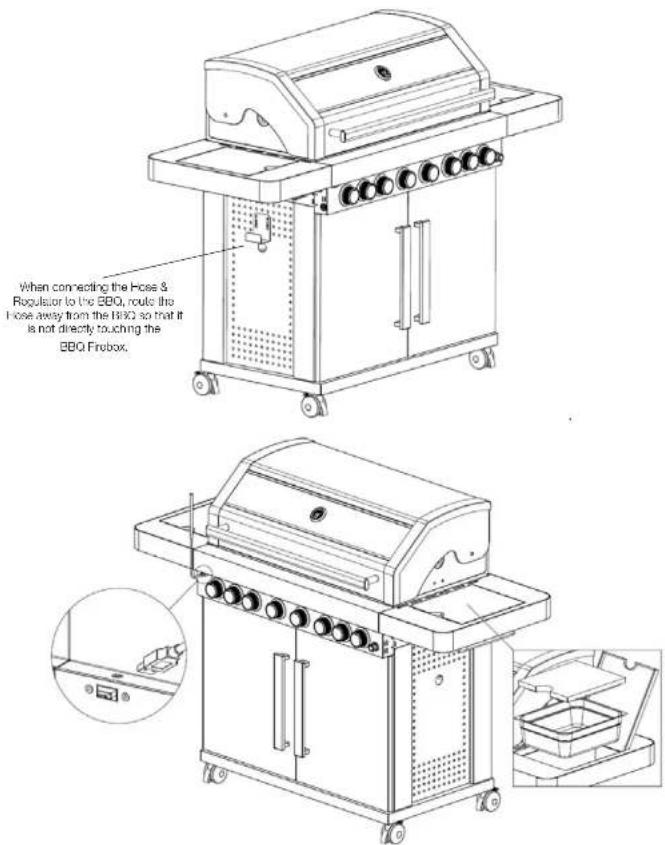
STEP 18
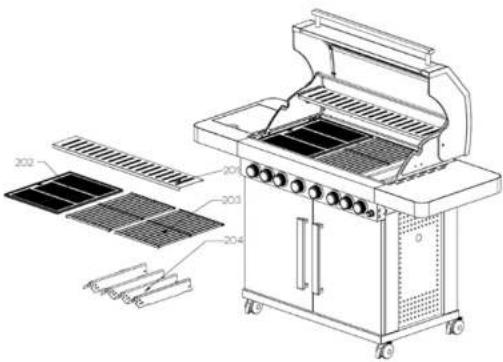
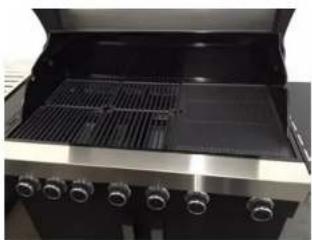
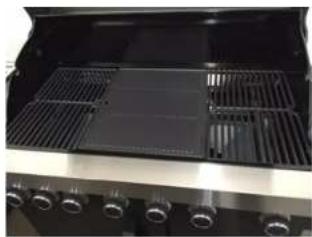
PLATE & GRILL CONFIGURATION.
As the 5 Burner BBQ has one Plate and two Grills, there are two different configurations which can be installed in to the 6 Burner BBQ (photos 1 & 2).
natural_image
Exterior view of a modern stainless steel grill with multiple grilles and a closed lid (no visible text or symbols)Photo 1 (can be left or right side)
natural_image
Exterior view of a modern stainless steel grill with grating and side-mounted fans (no text or symbols visible)FLAME TAMER CONFIGURATION.
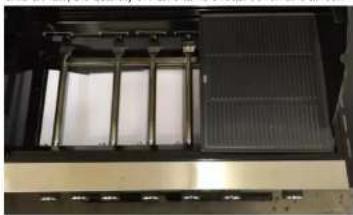
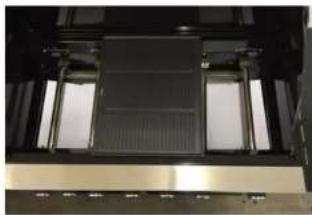
The Flame tamers are required to be inserted in to the BBQ directly above the stainless steel. Bumer tubes and under the 2 x Crills (Flame tamers are not required under the Plate), there are location points for these to fit in to.
Shown in photos 3 & 4 are the stainless steel burner tubes of the BBQ and depending on which Grill & Pate configuration used, the Flame tamers are to be placed so that they sit directly over these Burners. Whilst different Burners are exposed due to the configuration of the Gills & Plate, the quantity of Flame tamers required remains at four.
natural_image
Interior view of a mechanical device with internal compartments and ventilation grilles (no visible text or symbols)Photo 3 (note 4 Flame tamers required)
Photo 4 (note 4 Flame tamers required)
natural_image
Close-up of a mechanical device with internal components and metallic brackets (no visible text or symbols)STEP 19
**Please note that Flame tamers are not required underneath the Plate.
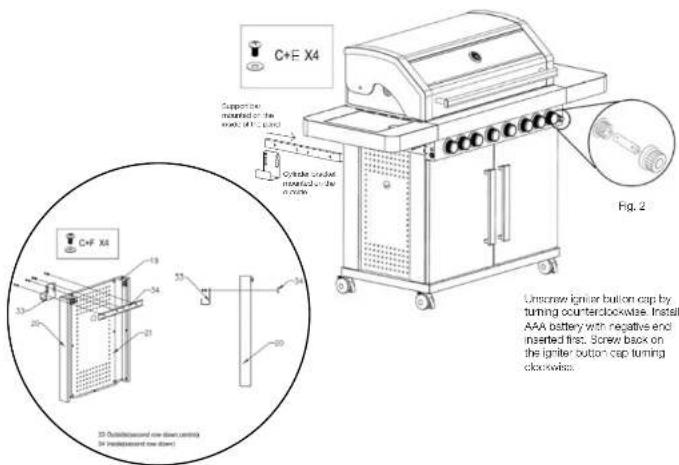
Assemble the cylinder bracket. Please note that the support bar is mounted on the Inside of the cabinet and the cylinder bracket is mounted on the outside (See Fig. 1). Install the ginter battery (See Fig. 2).

NOTE:
• Before operating the appliance LEAK TEST ALL JOINTS
- Read thoroughly the information on assembling the hose & regulator and also the section on Lock Testing
Unscrew igniter button cap by turning counterclockwise. Install AAA battery with negative end inserted first. Screw back on the igniter button cap turning clockwise.
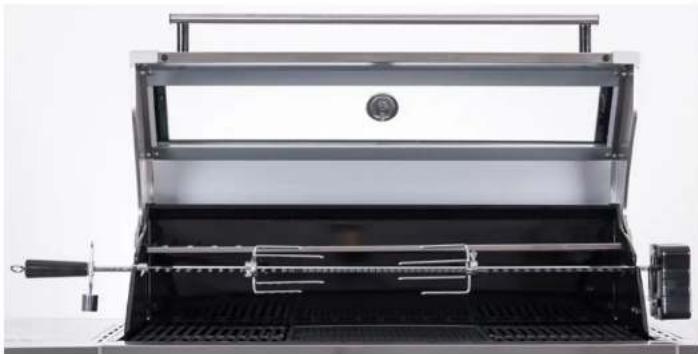
ROTISSERIE (OPTIONAL)
flowchart
graph LR
    A["Rotisserie Rod Handle"] --> B["Alignment Collar with screw"]
    C["Counter weight"] --> D["Counter weight washers"]
    E["Rotisserie Rod"] --> F["Rotation Motor"]
    G["Counter weight"] --> H["Rotation Bracket"]
    I["Prongs"] --> F
    J["Rotisserie Bracket"] --> F
Assembling the Rotisserie Rod with Pronga
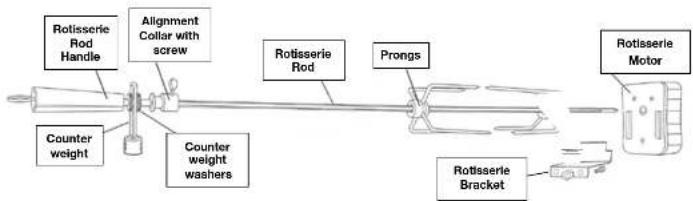
Side the pronge into the roliasene rod. Slide in the alignment collar with screw on the threaded end, use the round nut, counter weight, nut and then rolioscore handle in this order.

natural_image
Simple line drawing of a lever with a handle and spring, mounted on a black stand (no text or symbols)Attaching the Rotisserie Bracket onto the BBQ grill:
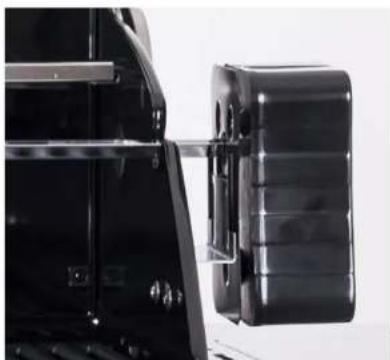
Open the BBQ hood. Use two screws provided with the rolisserie bracket in the mounting holes provided in the side panel of the grill body.
natural_image
Close-up of a black mechanical device with a cylindrical component inserted, showing no visible text or symbols.Side the Rotisserie motor on to the bracket and place the rotisserie rod assembly locating in the square bush in the motor as above.
natural_image
Close-up of a black and white industrial stove burner with metal grating and a coin on top (no visible text or symbols)While using the rotiseric, adjust the counter weight to your requirement.
LEAK TESTING
When to Test: The BBQ gas bottle, regulator & hose assembly should be checked for looks, using the soapy water leak test, every time you reconnect your regulator to the BBQ gas bottle. You should also test after any long period of non-use, such as at the beginning of BBQ season.
What to use: You will need a soapy water solution to check for any leaks. Mixing liquid hand soap with water will work fine (do not use any other household cleaning products).
How to Test: Put some soapy water in a spray bottle or a dish. Turn on the gas bottle but do not turn on the BBQ. Next, spray the entire valve, regulator and hose assembly with the soapy water including where the hose connects to the BBQ. Alternatively, you can apply the soapy water with a paint brush, hastling brush. Bubbles will form if there is a gas leak and you may also smell the gas. If you find a leak, turn off the gas bottle immediately!
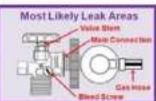
Do not turn back on or attempt to use the BBQ if a gsa leak has been detected, contact your local BBQ Dealer for repair.
INSTALLATION
This barbecue is for outdoor use only and should be placed in a well-ventilated area. Take care to ensure that the minimum clearances guidelines are followed.
MINIMUM CLEARANCES:
- From sides: 700mm; From back: 700mm - From above (vertical): 1600mm
Keep this barbecue away from any flammable materials. This appliance shall only be used in an above ground open air situation with natural ventilation, without stagnant areas, where gas leakage and products of combustion are rapidly dispersed by wind and natural convection. This barbecue is not designed for marine use.
ANY ENCLOSURE IN WHICH THE APPLIANCE IS USED SHALL COMPLY WITH ONE OF THE FOLLOWING:
-
An enclosure with walls on all sides, but at least one permanent opening at ground level and no overhead cover.
-
Within a partial enclosure that includes an overhead cover and no more than two walls.
-
Within a partial enclosure that includes an overhead cover and more than two walls, the following shall apply:
a) at least 75% of the total wall area is completely open and unrestricted
b) at least 30% of the remaining wall area is open and unrestricted
In the case of balconise, at least 20% of the total of the side, back and front wall areas shall be and remain open and unrestricted.
See following diagrams for further illustration:
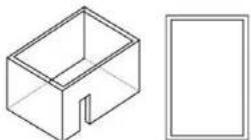
FIGURETT OUTDOOF A-PLA EXAMPLE
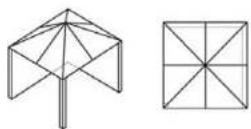
RIOJNE F2-OUTDOO AREA-FXAMDI F2
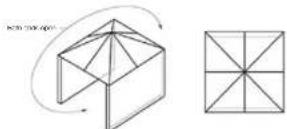
ROUTE F3-OUTDOO AREA-FHAMTS
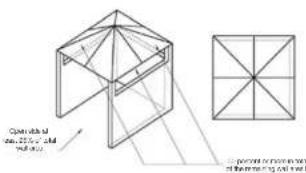
FIGURE 14-OUTDOCH-A-LA-LXAMPLI
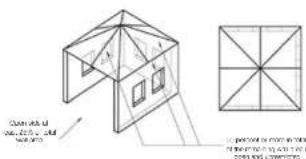
FIGURE TO OUTDOOR A-LA-LAMPLI
OTHER PRECAUTIONS
Do not obstruct any of the ventilation openings in the barbecue box. Also, poston the gas supply cylinder inside the cabinet. In the cylinder base positioning hole. Should you need to change the gas cylinder, confirm that the cylinder is on, and that there are no sources of ignition (cigarettes, open tams, sparks, etc.) near before proceeding. Be sure to inspect the gas hose and ensure it is free of any testing or tension. The hose should hang freely with no bends, folds, or kinds, when could obstruct free flow of gas. Asset from the connection point, no part of the hose should touch any hot barbecue pants. Inspect the hose before use. If the hose is damaged, it must be replaced with a hose suitable for use with UFGP and meet the national standards for the country of use. The length shall not exceed 1.5m. Should minimum clearance not be adhered to severe fire up may be experienced due to lack of airflow around the barbecue, thus voiding manufacturer's warranty
This barbecue is designed for LP gas use only. Bottle sizes of 4.5kg or greater are recommended for use with this barbecue. Suitable LPG regulators must have an outlet pressure of 2.75 kPa. You must have the proper regulator and bottle in order for the barbecue to operate safely and efficiently. Please consult your local gas dealer for the most suitable gas cylinders. Please note the regulator supplied with this barbecue is of an approved type.
The manifold thread type is 5/8" x 18.
For more information on pipe sizing, please refer to AS/NZS 5601/AG6C1.
The gas cylinder must always be stored or used in an upright position.
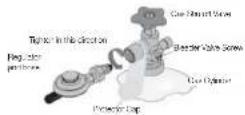
FIXING THE GAS REGULATOR TO THE CYLINDER
Confirm all barbecue control knows are in the off position. Hand-tighten the regulator supplied with this barbecue to the gas cylinder by screwing in an anti-clockwise direction. DO NOT OVER TIGHTEN!
As the regulator is fitted with a soft nose, it should only be tightened a further 1/4 tum after resistance is first felt.
OPERATION
A WARNING!
Before proceeding, be certain you understand the safety information contained in this manual.
This barbecue is not designed to be used with more than 66% of the cooking area as a solid plate. Full coverage of plates will cause excessive build-up of heat and damage the barbecue.
- Never leave burners on high for more than 10 minutes unless actually cooking. If the burner makes hissing sounds when it, it may be burning inside. Turn burner pit, allow it to cool and try again.
- Close the gas cylinder valve after each use.
- Never use plastic or glass utensils on the BBQ
• Never use the BBQ in strong winds
- Never ay the gas cylinder down (always keep upright)
- Never allow the flexible gas supply hose or any electrical cord to come in contact with any heated surface of the BBQ.
- Never lean heavily on the side shelves of your BBQ or attempt to transport your BBQ by lifting it from the side shelves.
- Before you start cooking for the first time, clean the BBQ thoroughly with hot soapy water. This is necessary to remove residues and apvents, oil and grease, which may have remained from the manufacturing process. The hotplate and grill should be thoroughly cleaned in the same manner.
NOTE:
Before using the barbecue for the first time, the barbecue must be lit and burning for 30 minutes on the "low" setting.
IMPORTANT
The regulator supplied with this BDO may incorporate an Excess Flow Control Safety Devon. The Excess Flow Control will activate to prevent gas flow should a regulator malfunction occur. It is important that the BDO operator understands that all gas valves on the BDO are closed in the CH position prior to opening the gas cylinder valve. If the BDO valves are open prior to opening the cylinder valve, the Excess Flow Control will be activated and prevent the BDO from being it. To react, class the BDO was and gas cylinder valves, wait for 1 minute and use correct lighting procedure as detailed below.
LIGHTING THE BBQ
Lighting the BBQ is easy, but must be done with due care. Make sure that the gas is turned on at the cylinder, or that gas is available to the BBQ. Also, if your BBQ has a roasting hood, ensure that the hood is up.
SPARK IGNITION
Push the knob control in and turn anticlockwise to the high position. You should hear clicking as the igniter creates sparks to light the gas. Once it, release the igniter button.
DIFFICULTY LIGHTING
If the burner doesn't light first go, check the gas controls and try a couple more times. If the burner still does not light, wait a few minutes to allow the gas to disperse before trying again. If satisfactory operation cannot be achieved, consult your restor before processing.
Note: Failure to follow the lighting procedures correctly can lead to a hazardous condition.
MAIN BURNER AND SIDE BURNER LIGHTING (INTEGRATED IGNITION)
-
Open the lid before lighting the barbecue
-
Check all the knobs are in the "OFF" position
-
Open the gas control valve at the gas cylinder
NOTE: The valves filed to this BBQ include a safety feature. If the valve must be depressed before turning. This feature prevents accidental activation of the knob
- From the "OFF" position, push in then turn control knob and clockwise to the "H" position until hear a "click" sound
-
Repeat step 4, 3-4 times until the burner is lit
-
If the burner fails to light, turn off and wait for 5 minutes, then begin from step 4
-
Once a burner is lit, similarly light the remaining burners.
- Turn the knob anticlockwise to adjust the heat from High - Medium - Low to your host requirement.
FOR MANUAL LIGHTING (MAIN BURNER)

IMPORTANT
Use a match holder and long match stick or BBQ lighter
for lighting the BBQ manually to avoid burning your hand
-
Open the lid before lighting the barbecue
-
Check all the knobs are in the "OFF" position.
-
Open the gas control valve at the gas cylinder
-
From the "OH" position, push in and then turn the control knob anticlockwise to the "HI" position.
-
Hold a lit match in a match holder, next to one of the man burners. The burner will light from the match.
Once a burner is lit, the burner next to it can be turned on and will light off the lit burner. Repeat until all burners are alight.
Each bumer can be adjusted. Turn the knob anticlockwise to adjust the heat from High - medium - Low to your heat requirement.
FOR MANUAL LIGHTING (SIDE BURNER)
-
Tum all knobs to "OFF" then open the LP tank valve. Always keep your face and body as far from the grill as possible when lighting.
-
Raise side bumer id.
-
Push in and then turn control knob and clockwise to high position.
-
Use a match holder and long match stick or BBQ lighter for lighting the BBQ manually to avoid burning your hand. Pace a lit match near the burner until the burner ignites.
-
If bumper fails to light, turn off and wait 5 minutes, then try again. If bumper still does not light after repeated attempts, call your local dealer for assistance.
REAR BURNER LIGHTING (ELECTRONIC IGNITION)
-
Open the lid before igniting the barbecue.
-
Check all the knobs are in the "OFF" position.
-
Open the gas control valve at the gas cylinder.
-
Operate the rear bumper knob in combination with the electronic ignition push button on the side bumper table.
b. From the "OFF" position, push in then turn control knob anti-clockwise to the "HI" position.
-
Keep the knob pushed in at the "HI" position for 4 seconds whilst pressing the electronic ignition push button.
-
Repeat the steps from beginning, 3-4 times until the burner is it.
-
Once the rear burner has ignited keep the knoo pushed in at the "HI" position for 20 seconds until stabilized then release the rear burner control knoo.
-
If the burner fails to light, turn off and wait for 5 minutes, then repeat the steps from beginning.
-
Turn the knob anticlockwise to adjust the heat from High Medium - Low to your heat requirement.
FOR MANUAL LIGHTING (REAR BURNER)
- Open the lid before igniting the barbecue.
- Check all the knobs are in the "OFF" position
- Open the gas control valve at the gas cylinder.
- From the "OFF" position, push in and then turn the rear burner control knob anticlockwise to the "HI" position.
- Hold a lit match in a match holder; next to rear burner. The burner will fight from the match. FOR REAR BURNER: LP gas takes longer time to travel from the valve to the rear burner. Keep the knob pushed in at the "HI" position for a turner 20 seconds until stabilized, then release the rear burner control knob. Repeat from step 4, 3-4 times until the burner is it.
- If the burner fails to light, turn off and wait 5 minutes, then begin from step 4.

IMPORTANT
Keep a spray bottle of asopy water near the gas supply valve and check the connections before each use.

WARNING!
- Do not light the grill favour of gas is present.
- It is important to ensure that all control valves, including the gas cylinder, are turns off after use.
- When using the rear turner and rotaserie use 1 or 2 of the main burners at the low heat setting if a little extra heat is required.
- Do not use the rear burner in combination with main burners on high heat selling when the hood is closed.
- Caution / Danger: Extreme care is required when cooking with hood in closed position. Frequent checks must be undertaken for the heat and temperature to ensure safe cooking.
• Too much heat can cause fire.
TURNING OFF A BURNER
Push in then turn each burner control knob clockwise to the "OFF" position.
When you have finished using your barbecue, turn off the gas at the bottle. Push in and then turn all the control valves fully clockwise to the "OFF" position. Wait until the barbecue is sufficiently cool before replacing the barbecue lid or closing its hood. Once cooled, a protective cover should always be filled to the barbecue to protect your investment from the ailments when not in use.
WARMING RACK
Warming racks are a convenient way to keep cooked food warm or to warm items such as bread rolls. Always check that your warning rack is properly tilted before use.
GRILL COOKING
The burners heat up the flame tamers underneath the grill, which in turn heats the food on the grill. The natural juices produced during cooking fall onto the flame tamers below and vaporise. The subsequent rising smoke bastes the food, as it travels upwards, imparting that unique barbecue flavour.
FLAT PLATE / FLAT-RIBBED PLATE
The burners heat the griddle plate directly, which then cooks the food on contact. These allow for the cooking of smaller items, such as seafood, which could fall through the soces of a grill. They are also suitable for cooking items that require high-temperature/short-duration cooking, such as vegetables and smaller cuts of fish. Similarly, these can be used in exactly the same way as a griddle in the kitchen, for seating steaks, cooking eggs, etc.
DO NOT use both the plate and deep dish at the same time. This will cause your BBQ to overheat and could cause a fire.
COOKING AND USE OF HOOD
Barbocytes equipped with a roasting hood give the option of cooking with hood closed to form an 'oven' for roasting food, such as joints of meat, whole chickens, etc.

WARNING!
Cooking with the hood closed and no burners an sign creates a free risk. When the hood is closed, a large amount of heat is trapped inside the barbecue. Thus, it is IMPORTANT to make sure that all the burners are turned to the low position to prevent burning or the hood and damaging the barbecue. Avoid lifting the hood unnecessarily as rest is lost, every time the hood is opened. Use the temperature gauge to check the heat of the barbecue.
For safety reasons, barbecue plates and grills will not cook as hot towards the front of the barbecue.
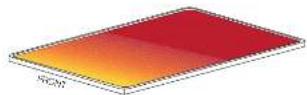
The slightly lower temperature at the front can easily be overcome by rotating the food being cooked around the barbecue plate or grill.
FLARE-UP CONTROL
Fare-ups occur when meat is barbeced, and its fats and juices fall upon the tams tamers. The smoke from some tare-up helps give cooked meat its barbeced flavour, but excessive fare-up will result in meat being burned. To control fare-up, it is advisable to trim away excess fat from meat and poultry before gilling. Also, the burners should always be placed on the cow setting during cooking. Finally, extinguish fare ups by applying baking soda or salt directly onto the tams tamers. Always protect your hands when handling anything near the cooking surface of the barbecue.
If a fat tire should occur in the drip tray, turn all knobs to the off position, turn off the gas at the bottle, and wait for the tire to go out. Do not pull out the drip tray or blouse with water.
COOKING USING OPTIONAL ACCESSORIES ROTISSERIE COOKING (OPTIONAL)
- Carefully remove the cast iron cooling surfaces and the warming rack from the barbecue.
- Place the flame tammers to the centre of the barbecue body. It is over this area that the meat will be cocked.
- Slide one of the salt forks onto the rod, red and light its thumb screw to secure it into place. Insert the pointed end of the spit rod into the meat being pocketed and slide the meat towards the centre of the roe. Make sure the fork is fully into the meat. Slide the other fork onto the rod, into the meat, and tighten the thumb screw once in place. For optimal rolissere cooking, food must be placed securely onto the mode of the spit rod and balanced so that the rolissere can rotate freely without interference from any barbecue surfaces. Any loose sections of meat should be secured so they do not hang down and interfere with the rotation of the spit rod.
- Insert the pointed end of the spit rod into the motor. Lay the other end of the spit rod onto the opposite bracket.
- Light the barbecue.
- Turn on the rotissere motor to begin rotissere cooking. The hood has been designed so that it may be closed during rotissere cooking.
- Always dock foods on the lowest flame setting to avoid burning or overcooking.
- DO NOT ALLOW YOUR BARBECUE TO OVERHEAT. A BARBECUE SHOULD NEVER BELT UNATTENDED WHILE COOKING!
- If cooking with rotisante using indirect heat (not using burners
directly under meal - oven style cooking, a baking dish (not supplied on some modest) can be placed under the food to catch fats and croopings.
INFRARED REAR BURNER & ROTISSERIE (OPTIONAL)
Preparing your barbecue.
You will need to remove both grill plate and sold plate, also the name tamers and warming rack. Place these in a safe place for later re-assembly. Place a baking dish (not supplied) onto the burners, the dish should be large and deep enough to capture the excess grease as it falls from the topc.
Centrally secure the food with the rotisserie prongs, turning the rotisserie rod by hand to test for balance, adjust the food position if required. Insert pointed end of rod into the motor, lost that everything is running correctly.
Using the Tear Burner for roasting on a barbecue can be different depending on our preferences. A suggestion might be to use 1:3 of the main burners to cook the roast and then use the Tear Burner towards the end of the cooking to "brown up" the roast. Using the Tear Burner by itself to do the cooking can take a long time depending on the size of the roast.
Do not use the rear burner in combination with main burners on high neat setting when the poor is closed.

WARNING!
- Caution / Danger: License care is required when cooking with hood in closed position. Frequent checks must be undertaken for the heat and temperature to ensure sale cooking.
• Too much heat can cause it.
Coloured BBQ's are more prone to feeding than Black BBQ's. To look after your BBQ, do not cook with the Hood down at High temperature for long periods of lime. Use the BBQ cover when BBQ is not being used to protect it from direct sunlight.
USB PORT
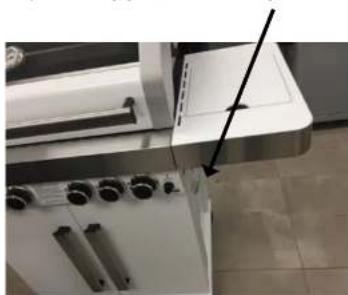
Some models of BBQ come with a USB Port and this can be found underneath the right hand Side table as shown. The USB Port is ideally suited for charging cell phones rather than larger devices.
natural_image
Close-up of a stainless steel kitchen appliance with a black arrow pointing to a component (no visible text or symbols)TROUBLESHOOTING
BEFORE CALLING FOR SERVICE
If the grill does not function properly, use the following checklist before contacting your dealer for service.
APPLIANCE APPROVED OUTDOOR USE ONLY
USE ONLY THE 5/8" x 18 GAS CONNECTION HOSE AND REGULATOR PROVIDED BY THE MANUFACTURER! It is replacement is necessary, please contact either our Masport Customer Service Department or your local dealer. The use of unauthorised parts can create unsafe conditions and environment.
Refer to your Masport warranty card for warranty information.
STORAGE OF THE GRILL
- Clean the BBQ.
- Store the BBQ outdoors in a dry, well ventilated area and out of reach of children when LP tank is connected to the grill.
- Store the BBQ indoors ONLY after the LP tank is turned off and removed, the LP tank must be stored outdoors, out of reach of children, NEVER store the tank in a building, garage or any other enclosed area.
- If using a cover for your barbecue, check your BBQ every few weeks.
| Problems Possible Cause Solutions | ||
| Integrated IgnitionWhen push the knob and turn anticlockwise: | ||
| - Won't light. Orifice blocked. Check the orifice for blockage | ||
| - No spark Dirty contacts of the electrode and or loose contacts | Remove the connecting wire, clean and reconnect finny | |
| - Still no spark. Electrode terminars are damaged. Inspect. electrode and replace it damage | ||
| - Weak spark Due to moisture / food residue on the electrodes Remove the moisture using paper towel / clean the electrode | ||
| - Spark at places other than the flow of electrode ignition wire damaged. Rep are the ignition wire | ||
| Electronic Ignition (Rear Bumer)When push the knob and turn anticlockwise: | ||
| - Won't light. Orifice blocked. Check the orifice for blockage | ||
| - No spark Dirty contacts of the electrode and or loose contacts | Remove the connecting wire, clean and reconnect finny | |
| - Still no spark Only / loose contacts at the battery Clean | ||
| Dead / discharged Battery Replace battery | ||
| Wrong polarity Check and insert the battery correctly | ||
| - Still no spark Circuit Incomplete duct I class contacts at the ignitor module | He asesende the ignition module make sure the assembly is light and makes a complete circuit | |
| - Still no spark Electrode terminars are damaged. Inspect. electrode and replace it damage | ||
| - Weak spark Due to moisture / food residue on the controllers Remove the immature using paper towel / clean the electrode | ||
| - Spark at places other than the lip of electrode ignition wire damaged. Rep are the ignition wire | ||
| Burner can't light by match | No gas | Open the LP tank valve |
| Case flow is not smooth | Clear burner tubes | |
| Incorrect assembly between burner and valve | He asesende | |
| Yellow or orange flames, with gas odour | Incorrect procedure | Check the burner inlet for obstruction such as spidersCheck air shutter for correct adjustmentCheck for the source |
| Low heat with knob in "high" position | Case hose lens or knissel | Straighten |
| Burner or orifice blocked | Clear | |
| Low gas pressure | Check Cylinder/ Regulator (refer to pg. 15) | |
| Grill not pressed | Pretreat the grill for 15 minutes | |
| Flano up | Excessive mass, fat | Cut off fat before grilling |
| Over high temperature | Adjust | |
| Grease deposit | Clean | |
| Flame out | Over high winds find a less windy place | |
| Flame lifting | Over high gas pressure | Cut the gas dealer |
| Flashback | Burner port blocked | Clean |
| Grease tire | Grease accumulated in food | Turn off inches, HP tank valve, leave lid open, lat fire burn out. Clean the grill when pool |
CARE AND MAINTENANCE
Regularly clean your barbecue between uses and especially after extended periods of storage. Ensure the barbecue and its components are sufficiently cool before cleaning. Do not leave the barbecue exposed to outside weather conditions or stored in damp moist areas.
- Never douse the barbecue with water when its surfaces are hot. - Never handle hot parts with unprotected hands.
Whilst our products are made to the highest standards and all care is taken to make them as weather proof as possible, we cannot accept responsibility for rust occurring on exposed metal parts unless this is a result of faulty manufacture of parts.
In order to extend the life and maintain the condition of your barbecue, we strongly recommend that the unit is covered when not in use, especially during the winter months.
STAINLESS STEEL CARE AND CLEANING ADVICE
Cleanliness and stainless steel are closely related. Stainless steel performs best when clean - cleanliness is essential for maximum resistance to corrosion and to maintain the good looks and life of your BBQ.
TYPES OF SURFACE CONTAMINANTS
Fingerprints and Stains
Fingerprints and mild stains resulting from normal use are the most common surface contaminates. They can be removed with a glass cleaner or with a soft rag. This should be followed by a thorough warm water rinse.
DIRT
Like any surface that is exposed to the environment especially in coastal areas, stainless steel can get dirty. Cleaning with warm water with or without a gentle detergent is sufficient. Next in order are mild non-scratching abrasive powders soon as typical household cleaners. These can be used with warm water, nylon bristle brushes, sponges, or clean cloths. Carbon steel brushes or steel wool should be avoided as they may leave particles embedded on the surface which can lead to RUSHING. Cleaning should always be followed by rinsing in clean hot water.
GREASE
Grease may soil stainless steel surfaces in food preparation. These soils may be mildly corrosive if left or may not allow the surface to maintain passivity, and so regular removal is a necessity for the appearance.
TYPES OF CLEANERS AND METHODS
Consider the possibility of scratching and the potential for post-cleaning corrosion caused by incompletely removed cleaners. Avoid using abrasive cleaners unless absolutely necessary.
CLEAN WATER AND WIPE
A soft cloth and clean warm water should always be the first choice for mic stairs and loose dirt and scis. A final rinse with clean water and a dry wipe will complete the process and eliminate the possibility of water stairs.
HOUSEHOLD CLEANERS
Household cleaners fall into two categories: detergent non-abrasive) and abrasive cleaners. Abrasive cleaners are more effective but introduce the possibility of scratching the surface. A neutral cleaner low in chloride is essential. The cleaning method generally employed with these cleaners is to apply them to the stainless surface and follow by cloth wiping in the direction of the grain or polish lines (not across them). The cleaned surface should be thoroughly rinsed with clean water and wiped dry with a soft cloth if water streaking is a consideration.
CARE OF STAINLESS STEEL IN YOUR BBQ
Your BBQ features Stainless Steel components. All Stainless Steel grades require a level of care and protection to retain their appearance. Stainless Steers are not immune to corrosion and neither are they maintenance-free, contrary to popular public perception. Even the highest marine grades of Stainless Steel require frequent cleaning to avoid oxidation and other corrosive issues.
Modern taste dictate that your BBQ features Stainless Steel with a brushed finish. This brushed finish is attained by running Stainless Steel sheets through an abrasive process that removes the minor finish and leaves the brushed finish. Brushed finish Stainless Steel requires frequent cleaning and care, to maintain its quality of appearance. Without adequate care it is realistic to expect that it will show signs of corrosion in time.
Stainless steel is definitely not a maintenance-free material. Cleanliness and Stainless Steel are closely related.
The cleaner stainless steel can be kept while in storage or during use, the greater the assurance of optimum corrosion resistance. In order to maintain the good looks and life of your BBQ, follow these summary tips on the care of stainless steel:
- When new or when cleaned and dried, we recommend the owner apply a thin coat of Olive Oil to stainless steel surfaces which should then be polished in. The Olive Oil will help greatly in protecting the stainless steel from corrosive contaminants and assisting removal of finger prints and other marks, keeping the appearance of the stainless steel in new condition. The Olive Oil coating also makes further polishing easier.
- Use clean, soft cloths or sponges to clean your grill.
- Carbon steel brushes or steel wool should never be used.
• Do routine cleaning of exposed surfaces
• After cleaning, rinse thoroughly with water
- Cleaning with chloride-containing detergents must be avoided. - On polished finishes, rubbing or wiping should be done in the direction of the polish lines. NOT across them.
- Care must be taken when clearing the fascia. Printed information may be erased with heavy clearing.
CAST IRON COOKING SURFACES
Before cooking with the grill, flat plate or cloud dish if supplied with your BBQ clean these with not soapy water to remove any oil or residue from the packaging or manufacturing process. Wash with clean water and lot the plates dry naturally. Prior to lighting your BBQ places them back into the BBQ. Then after lighting your BBQ, lot the plates warm up slowly over a period of 30 minutes, during this time increasing the heat. You will notice slight vapors rise from the plates, this is natural as residues are burned off. Turn on your BBQ to allow the plate to cool signals. The plates can now be prepared with the addition of cooking oil. Take cars that the plates are not at a temperature where adding the oil will cause a hazard. Brush the oil over the plate, allowing the oil to be absorbed into the surface. Allow the plate to fully cool, then remove any excess oil, the BBQ is now ready. Repeat the above to keep the plate and grill in a ready condition after each BBQ session.
PORCELAIN ENAMEL COOKING SURFACES
Porcelain Enamel surfaced items should be treated with care and should not be cleaned with an abrasive cleaner or scratchy cleaning item. Surfaces will crack or chip if hit or dropped. Porcelain Enamel surfaces should NOT be regarded as 'Non-stick', use of cooking oil is required as normal. Food will likely stick to an overheated or un-tied enamel surface. The surface will be more easily cleaned by first soaking overnight.
BURNER MAINTENANCE
Provided that they are operating correctly in normal usage, burning off the residue after cooking will keep the burners clean. The burners should be removed and cleaned annually, or whenever heavy build-up is found, to ensure that there are no signs of
Blockage (debris, insects) in either the burner portholes, the primary air inlet, or the neck of the stainless steel burners. Use a pipe cleaner to clear obstructions. When refilling the burners, be careful to check they are positioned as follows. The neck of the burner its over the valve outlet, the top flaps of the gas collector boxes it ever the top surfaces of the burners.
BURNER MAINTENANCE AND REPLACEMENT
Both the stainless steel burners and flame tamers do have a defined operating lifespan, these products are often exposed to cooking marinades and extreme heat in an area of the barbecue which can be neglected during regular cleaning.
Replacement parts are available from your local barbecue dealer.
SPIDER AND INSECT WARNING!
Spiders and insects can rest in the burners of the grill and cause the gas to flow from the front of the burner. This is a very dangerous condition, which can cause a fire to occur, thereby damaging the grill and making it unsafe to operate.
WHEN TO LOOK FOR SPIDERS
You should inspect the burners at least once a year or immediately after any of the following conditions occur:
- The smell of gas in conjunction with the burner flames appearing yellow.
• The BBQ does not reach temperature.
• The BBQ heats unevenly.
• The burners make popping noises.
PRIMARY AIR INLET WIDTH REQUIREMENT:
For 4 burner barbecues:
- Width for each side: 5.5-6.5mm
• Total width for two sides: 11–13mm
For 6 burner barbecues:
• Width for each side: 2-2.5mm
• Total width for two sides: 4 - 5mm
HOW TO ADJUST AIR INLET:
Adjust the primary air inlet width according to the pictures below.
(Burn or Image shown below is for illustration purpose only)
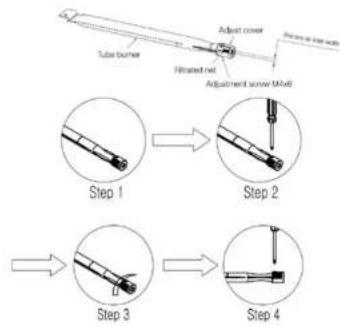
flowchart
graph TD
    A["Tube burnet"] --> B["Adjust collar"]
    B --> C["Filtrated net"]
    C --> D["Adjust collar with flanged steel"]
    D --> E["Adjust collar with M46"]
    E --> F["Step 1"]
    F --> G["Step 2"]
    G --> H["Step 3"]
    H --> I["Step 4"]
ELECTRODE SETTING
Electrode should have a sparking gap of approximately 4-6mm.
The distance away from the face of the rear burner should less than 8mm.
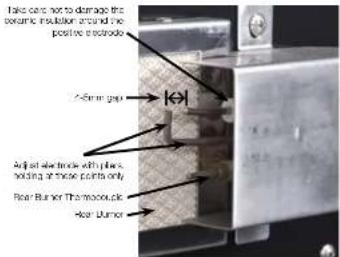
NOTE:
Cooking with the rear burner alone the food to "eat taste" as it is turned, any excess plaus will fall into the baking dish.
Your BBQ is safe to use with the hood closed however the internal temperature must be checked. Cooking with the rear burner is designed to be a slow cooking process, this allows the food to be succulent. External temperatures and breeze will select the internal temperature, as a guide this should be around 165°C to 180°C.
NOTE:
- Vegetables and herbs can be placed into the baking dish, these items will cook favour the food at the same time.
- When using the near-burner and roteesents use 1 or 2 of the main burners at the low heat setting if a little extra heat is required.
WARNING
- Do not use the rear burner in combination with main corners on high heat setting when the hot is closed.
- Caution / Danger: Extramo care is required when cooking with hood in closed position. I request checks must be undertaken for the heat and temperature to ensure safe cooking.
• Too much heat can cause fire.
DRIP TRAY
After every use, check the drip tray, drip pan, and foil pan for fat build-up. Failure to maintain these areas could result in a fat fire or excessive flare up. This can severely damage your barbecue and is not covered by the warranty.
BARBECUE BODY
WARNING! Not cleaning the barbecue can pose a fire risk!
Regularly remove excess grease or tail from the barbecue body with a soft paste or wooden scraper. It is not necessary to remove all the grease from the body. If you need to clean fully, use hot scapy water and a cloth, or nylon bristled brush only. Remove cooking surfaces and burners before full cleaning. Do not immerse the gas controls or manifold in water. Check burner operation after carefully renting into body.
FIXINGS
All screws and bolts, etc. should be checked and tightened on a regular basis.
END OF THE COOKING SESSION
After each cooking session, turn the BBQ burners to the "HIGH" position and burn off for 5 minutes. This procedure will burn off food residue, thus making cleaning easier.
STORAGE
Store your barbecue in a cook dry place. Cover the burners with aluminium foil in order to prevent insects or other debris from collecting in burner holes. A protective cover should always be filled as the barbecue to protect your involvement from the cornmets when not in use. If the barbecue is to be stored indoors, the gas bottle must be disconnected and left outside. The gas bottle should always be stored outside, in a dry, well ventilated area, away from any sources of heat or ignition. Do not let children smoke with the bottle.
To protect your investment it is recommended that BBQs are protected by a suitable BBQ cover. But please note that prior to using a protective cover, the BBQ should always be cool, cleaned of any surface contaminant or dirt and be thoroughly dry. Failure to follow this information can lead to a BBQ cover being a common breeder rather than a protective tool.
NOTE:
If leaving your RHO covers for long periods, occasionally check for corrosion and insect habitation. Of surfaces for extra protection.
SERIAL NUMBER
The serial number of your barbecue is located on the inside of the cabinet either on the right hand door or the side panel. If you do require any further assistance with your barbecue from your local dealer or Masport, please have this serial number handy as it will quickly slow us to identify the barbecue.
TECHNICAL DATA
| Name Model | IAPMO Approval | Injector (mm) | Pressure (kPa) | Imp/Burn (MJ/h) | Total (MJ/h) | |
| BBQ MASP MERIOR CHEMISTRY | GMC 10000 | ELPC | M/B 0.95S/B 0.91R/B 0.84 | 2.75 | 4 x 11.501 x 10.801 x 11.50 | 68.3 |
| NC | M/B 1.41S/B 1.43R/B 1.50 | 1.00 | 4 x 0.31 x 0.51 x 10.5 | 57.5 | ||
| BBQ MASP MERIOR CHEMISTRY | NOK 10000 | ELPC | M/B 0.95S/B 0.91R/B 0.84 | 2.75 | 5 x 11.501 x 10.801 x 11.50 | 91.80 |
| NC | M/B 1.41S/B 1.43R/B 1.50 | 1.00 | 5 x 0.31 x 0.51 x 10.5 | 78.1 | ||
| Gas Supply Pressure, ULPGMin: 2.70kPa; Max: 3.40kPA Gas Supply Pressure, NG 1kPa Gas Type: NZ: Universal LPG or NG Complies lo: EU 2016/426AUS: ULPG or NG Standard AS/NZS 52631.7.2016 | ||||||
| Minimum Clearance :From Top of BBQ: 1500mm, From Sides: 700mm, From Rear : 700mm | ||||||
| Distributed by MASPORT LIMITED | ||||||
| MISPORT LIMITEDST-30, Dallas, Texas, Fort-Texas,Augaland 2016, New ZealandFG Box 1450, Romania, Australia1471, New Zealand | Read the instructions before using the applianceUSE OUTDOOR ONLYWARNING: Parts of this appliance may be very hot, keep young children away | |||||
| MISPORT AUSTRALY PTY LIMITEDST: International Tower, San AntonioSouth, Virginia, Virginia 3116,AustraliaFG Box 385, Nebraska, Virginia 3165,Australia | ||||||
| For storage and cylinder exchange, disconnect hose at the cylinder only, do not disconnect hose from the appliance. | ||||||
| Name Model | IAPMO Approval | Injector (mm) | Pressure (kPa) | Inp/Burn (MJ/h) | Total (MJ/h) | ||
| Cause: 5 KIBREPC1 | HONK TANG | ULPS | M/B S/B R/B | 0.060.890.84 | 2.75 | 6 x 11.51 x 10.91 x 11.5 | 91.30 |
| NGL | M/D S/D R/B | 1.411.401.50 | 1.00 | 8 x 0.31 x 0.81 x 0.5 | 76.1 | ||
| Cause: 55 KIBREPC2-55 | HONK TANG | ULPS | M/B S/B R/B | 0.060.910.84 | 2.75 | 6 x 11.51 x 10.91 x 11.5 | 91.30 |
| NGL | M/D S/D R/B | 1.411.401.50 | 1.00 | 8 x 0.31 x 0.81 x 0.5 | 76.1 | ||
| Cause: 1 KIBREPC1 | HONK TANG | ULPS | M/B S/B R/B | 0.060.91 | 2.75 | 4 x 11.51 x 10.90 | 66.90 |
| NGL | M/D S/D R/B | 1.411.40 | 1.00 | 4 x 0.31 x 0.8 | 47 | ||
| Gas Supply Pressure, ULPGMin: 2.73kPa; Max: 3.40kPA Gas Type: NZ: Universal LPG or NGAUS; ULPG or NG Standard AS/NZS 5263.1.7:2016 | |||||||
| Minimum Clearance :From Top of BBQ: 1000mm, From Sides: 700mm, From Rear : 700mm | |||||||
| Distributed by MASPORT LIMITED | Read the instructions before using the applianceUSE OUTDOOR ONLYWARNING: Parts of this appliance may be very hot, keep young children away | ||||||
| MASPORT LIMITED | |||||||
| MASCOT LIMITED | |||||||
| MASCOT AUSTRALTY LIMITED | |||||||
| Commercial Dr. Dancing Spring Melbourne, Victoria 3175 AustraliaFC Box 530, Bresdale, Victoria 3165, Australia | |||||||
| Name | Model | IAPMO Approval | Injector (mm) | Pressure (kPa) | Inp/Bum (MJ/h) | Total (MJ/h) | |
| Classic Four | K104BEC3 | GMK10648 | ULPG: | M/B 5/9 | 0.90 | 2.75 | 5 x 11.51 x 10.8 |
| NG: | M/B 5/9 | 1.411.48 | 1.00 | 4 x 9.31 x 9.0 | |||
| Classic Six | K106BHEC3 | GMK10648 | ULPG: | M/B 5/9 | 0.90 | 2.75 | 5 x 11.51 x 10.8 |
| S/B 5/9 | 0.91 | 1 x 11.5 | |||||
| NG: | M/B 5/9 | 1.411.48 | 1.00 | 5 x 9.31 x 9.0 | |||
| S/B 5/9 | 1.59 | 1 x 10.5 | |||||
| MB6000 | K106BHEC3 | GMK10648 | ULPG: | M/B 5/9 | 0.90 | 2.75 | 5 x 11.51 x 10.8 |
| S/B 5/9 | 0.91 | 1 x 11.5 | |||||
| NG: | M/B 5/9 | 1.421.48 | 1.00 | 5 x 9.31 x 9.0 | |||
| S/B 5/9 | 1.59 | 1 x 10.5 | |||||
| MB4000 | K104BEC8 | GMK10648 | ULPG: | M/B 5/9 | 0.90 | 2.75 | 4 x 11.51 x 10.8 |
| S/B 5/9 | 0.91 | 1 x 10.5 | |||||
| NG: | M/B 5/9 | 1.411.48 | 1.00 | 4 x 9.31 x 9.0 | |||
| S/B 5/9 | 1.59 | 1 x 10.5 | |||||
| Gas Supply Pressure, ULPG Gas Supply Pressure, NG: 1.00 kPaMin: 2.70kPa; Max: 3.45kPaGas Type: NZ: Universal LPG or NG Complies to: EU 2016/426AUS: ULPG or NG Standard AS/NZS 52631.7:2016 | |||||||
| Minimum Clearance :From Top of BBQ: 1500mm, From Sides: 700mm, From Rear: 700mm | |||||||
| Distributed byMASPORT LIMITED | |||||||
| MASPORT LIMITED300 Ti Firakau Drive, Beat Temelki, Auckland 2010, New ZealandHO Hex 143KB, Frankfurt Auckland 1471, New Zealand | Read the instructions before Using the applianceUSE OUTDOOR ONLYWARNING: Parts of this appliance may be very hot, keep young children away | ||||||
| MASPORT AUSTRALIA PTY LIMITED2V Commerce Drive Denver South Melbourne, Victoria 3176, AustraliaPO Box 333, Brasile, Victoria 3195, Australia | |||||||
| For storage and cylinder exchange, disconnect hose at the cylinder only, do not disconnect hose from the appliance. | |||||||
Masport®
Masport Limited
320 Ti Rakau Drive, East Tamaki
Auckland 2013
New Zealand
P: 0800 627 767
Masport Australia Pty Limited
1/40 Abbots Road, Dandenong
South Victoria 3175
Australia
P: 1300 366 225