Praktika Plus XL 6L - Pan ELO - Free user manual and instructions
Find the device manual for free Praktika Plus XL 6L ELO in PDF.


| Product type | Wood stove |
| Brand | ELO |
| Model | Praktika Plus XL 6L |
| Capacity | 6 liters (combustion chamber volume) |
| Nominal power | 6 kW |
| Efficiency | 80% |
| Dimensions (H x W x D) | 80 cm x 50 cm x 40 cm |
| Weight | 50 kg |
| Fuel | Wood logs (max length 30 cm) |
| Main functions | Heating, primary and secondary air regulation, clean glass |
| Maintenance and cleaning | Regular glass cleaning, ash pan emptying, annual chimney sweeping |
| Safety | Cool handle, overheat protection, double combustion |
| Spare parts and repairability | Wear parts available (seals, glass, grate); repairability score 8/10 |
| General information | Wood heating appliance, standard EN 13240 |
Frequently Asked Questions - Praktika Plus XL 6L ELO
User questions about Praktika Plus XL 6L ELO
0 question about this device. Answer the ones you know or ask your own.
Ask a new question about this device
Download the instructions for your Pan in PDF format for free! Find your manual Praktika Plus XL 6L - ELO and take your electronic device back in hand. On this page are published all the documents necessary for the use of your device. Praktika Plus XL 6L by ELO.
USER MANUAL Praktika Plus XL 6L ELO
D-55595 Spabrücken - Germany
Telefon: +49 (0) 6706 - 914 0
Fax: +49 (0) 6706 - 914 222
E-Mail: info@elo.de
natural_image
Exterior view of a stainless steel cooking pot with black handle and lid (no text or symbols visible)
natural_image
Diagram of a mechanical tool with a circular component and force arrows, labeled Abb. 5 (no text or symbols on the diagram itself)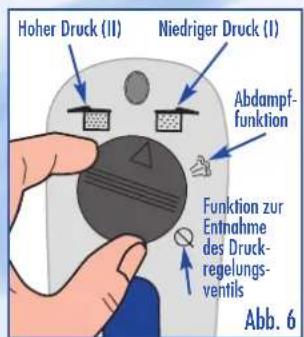
natural_image
Illustration of a hand pressing a cooking pot with a blue arrow indicating motion (no text or symbols)Important Safety Precautions
Please remember the following safety precautions:
• Read all instructions through carefully.
• Never use the pressure cooker near children.
- Do not place the pressure cooker in a hot baking oven.
- Move the pressure cooker very carefully if it is currently under pressure. Do not touch the hot surfaces, use the handles and knobs. Also use an oven glove where necessary.
- Use the pressure cooker only for the purpose for which it is intended.
- Food is prepared in this cooker under pressure. You could be badly burned if you use the cooker in the wrong way. Please make sure that the pressure cooker is properly closed before placing it on the heat source. You will find more information on this in the instruction booklet.
- Never open the pressure cooker by force. Make sure that the internal pressure has been fully reduced before opening the cooker. Please refer to the instructions for further details.
- Never heat the pressure cooker without first putting water into it. If heated without water, the cooker will be seriously damaged.
- Do not fill the pressure cooker more than 2/3 of its nominal volume. If you are preparing food such as rice or dried vegetables that may swell while cooking, fill the pressure cooking no more than half of its nominal value.
UK
- Use only heat sources which are denoted as approved in the instruction booklet:

- If you have cooked meat with the skin still intact, (e.g. ox tongue), the skin can swell under pressure. In this case, do not pierce the meat while the skin is still swollen. You could be badly burned.
- If you are preparing mushy food, please shake the pressure cooker gently before you open the lid - this will prevent hot spatter.
- Before each use, please make sure that the valves are not blocked. Please refer to the instructions for further details.
- Do not use the pressure cooker to fry food under pressure with oil.
- Never tamper with the cooker's safety systems. Details of care and maintenance which you may carry out are contained in the instruction booklet.
- Only use original spare parts for the respective model. Use pot and lid from the same manufacturer and make sure that they are compatible.
- Please keep these instructions.
Introduction
Congratulations on the purchase of your new Pressure Cooker! With two advanced design features: an encapsulated sandwich base and modern closing system, your new pressure cooker is the ideal way of preparing meals. Despite the reduced cooking time, pressure cooking preserves all vitamins, minerals and flavors in food.
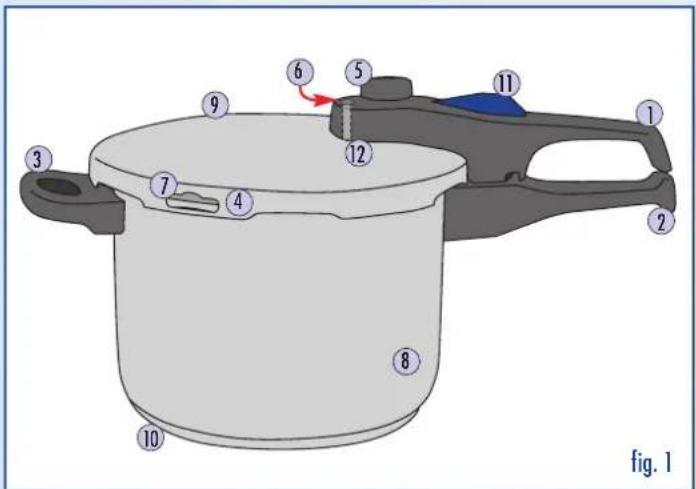
text_image
fig. 1①Lid handle
② Cooker handle
③ Small handle
④ Rubber gasket
⑤ Pressure regulating valve
⑥ Safety vent
⑦ Safety opening
⑧ Cooking pot
⑨ Lid
⑩ Sandwich base
⑪ Opening button
⑫ Silicon seal
Safety
UK
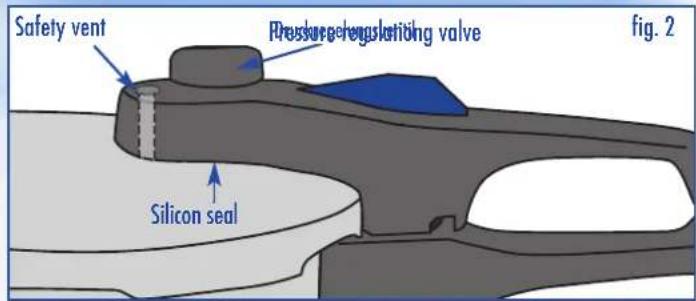
The pressure cooker system is very safe. Care should be taken to ensure that the lid closes properly so that the system can function as intended. The pressure cooker has a two-level pressure regulator which regulates the pressure you have selected as well as a built-in safety vent (see fig. 2) in the lid handle. PLEASE NOTE: fill the cooker only up to the maximum filling height (see interior marking).
text_image
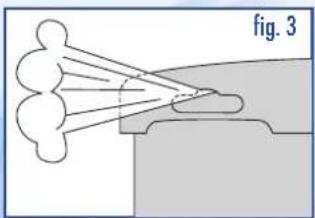
Safety vent Pressure-regulation valve Silicon seal fig. 2If the pressure increases too much, the rubber gasket is pushed out through an opening in the edge of the lid (fig. 1, no. Y) so that the pressure can escape (see fig. 3).
natural_image
Diagram showing light rays converging through a nozzle or duct (no text or symbols)All the items marked on the diagrams (except nos. and ) are available as spare parts.
Instructions for Use
Before you use your pressure cooker for the first time, wash and rinse it thoroughly in hot water and dry immediately.
We recommend lubricating the rubber gasket with a little cooking oil to make opening and closing the lid easier.
To ensure that the correct pressure to speed up the cooking process is produced in the cooker, the pot must contain a minimum quantity of liquid (water, stock, etc.).
If you are preparing a dish which creates a lot of froth, the pot must not be more than half full.
If you are making a puree, casserole or soup, etc., we recommend shaking the pot gently before opening.
Tips for energy-saving cooking
To save valuable energy when cooking, please bear the following in mind:
- Remember that the pot bottom has a larger diameter than the hot plate, and not vice-versa; this can save up to 15% energy.
• Always use the cooker with the lid on, this saves up to 20% energy. - Make use of the after-heat of electrical hot plates. Switch off approximately 10 minutes before the cooking process is finished. This can save up to 10% energy.
Closing the Pressure Cooker
UK
Please check the safety devices before closing the reassure cooker.
text_image
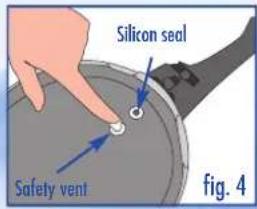
Silicon seal Safety vent fig. 4The pressure regulating valve opening (see fig. 4) must be clean and the safety vent must not be jammed. You can check this by pressing your finger on the safety vent stopper (see fig. 4).
If you are able to press the stopper in, the safety vent is working properly. If the stopper does not respond to the pressure and is jammed, it must be loosened and cleaned, as described on page 21. Place the lid on the cooking pot in such a way that
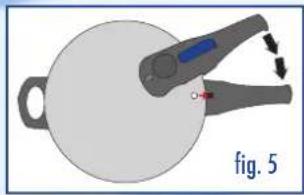
the markings on the cooker handle are aligned with the circle on the lid (see fig. 5). Then press the lid down slightly and turn it until both handles are on top of one another.
The pressure cooker is now properly closed.
Now set the pressure you require on the pressure regulating valve: High pressure (II), Low pressure (I) (see fig. 6)
natural_image
Diagram of a mechanical tool interacting with a circular component, labeled 'fig. 5' (no text or symbols on the diagram itself)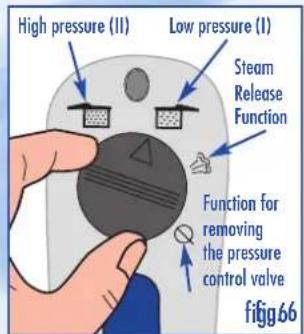
text_image
High pressure (II) Low pressure (I) Steam Release Function Function for removing the pressure control valve figg66Starting Cooking
When you start cooking, we recommend turning up the heat source to the highest setting so that the required pressure is reached as quickly as possible in the pot. Please bear in mind that you should never fill the pressure cooker above the interior filling mark ("Maximum"). Otherwise the food being cooked could soil the valve.
The safety vent will be pressed upwards by the pressure created in the pot and will block the opening button. When the pressure cooker is under pressure it cannot be opened.
As soon as steam comes out of the pressure regulating valve, this means that there is sufficient pressure in the pressure cooker. You can now turn down the heat so that the pressure is maintained but not too much steam escapes. Timing starts from this point onwards.
Opening the Pressure Cooker
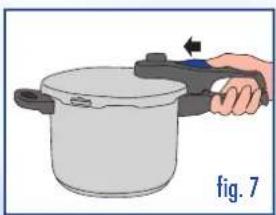
Turn the settings knob to "Steam Release Function" (see fig. 6, page 19). The steam will escape. Please wait until the safety valve falls downwards and the release button permits the pressure cooker to be opened. Push the release button in the direction of the cooker. Now turn the lid to the right to open the cooker.
NEVER USE FORCE TO OPEN THE LID!
natural_image
Illustration of a hand pressing a cooking pot with a blue arrow indicating motion (no text or symbols)Care and Maintenance
UK
After use, wash your pressure cooker with hot water and a non-abrasive washing-up liquid. The lid and rubber gasket cannot be washed in a dishwasher.
The rubber gasket must not be washed with washing-up liquid. After washing, the pot and the lid should be dried thoroughly and stored with the lid facing upwards. It is not a good idea to put the cooker away with the lid closed, as this will cause the rubber to deteriorate more quickly.
Cleaning the Safety Vent
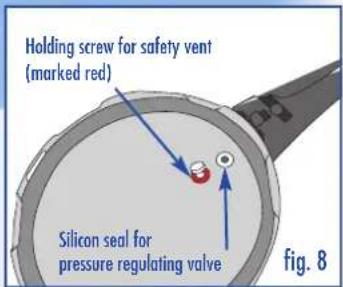
To clean the safety vent, first loosen the holding screw (see fig. 8). You can then lift the safety vent out and clean it thoroughly.
The safety vent may not be divided!
text_image
Holding screw for safety vent (marked red) Silicon seal for pressure regulating valve fig. 8Removing the Pressure control valve
To clean the silicone sealing ring, please remove the pressure control valve (see fig. 6, page 19).
Health warning
Please note that persons who are allergic to nickel may suffer complications through using stainless steel pots and pans.
What to do if
... steam is escaping between the lid and the pot?
This means either that the rubber gasket is defective or the pot is not properly closed. If the rubber gasket is just dirty, it should be washed.
... no steam is coming out of the pressure regulating valve?
This means that the pot is not correctly sealed and this should be checked. If the pressure regulating valve is dirty, the valve should be cleaned. Check also whether there is sufficient liquid in the pot. If the rubber gasket is dirty or defective, clean or replace it. The rubber gasket will need replacing once a year.
... too much steam is escaping from the pressure valve?
The heat source is probably turned up too high and should be turned down. It could also mean that the pressure regulating valve is dirty.
Table of Cooking Times
UK
The times given below are only approximate, as they naturally depend on the quality and condition of the food to be cooked.
You will very quickly learn from experience and know exactly how long each dish will take to cook.
It is not necessary to defrost frozen vegetables or fish before pressure cooking, just increase the cooking time slightly.
| Soups | High pressure | Low pressure | approx. cooking time in minutes |
| Bean soup • 20 | |||
| Pea or lentil soup (pre-soaked) | • 12 – 15 | ||
| Vegetable soup • 5 – 8 | |||
| Goulash soup • 15 – 20 | |||
| Chicken soup • 15 – 20 | |||
| Potato soup | • 6 – 8 | ||
| Meat stock | • 20 – 25 | ||
| Rice soup | • | 8 | |
| Beef soup | • 25 – 45 |
| Vegetables | High pressure | Low pressure | approx. cooking time in minutes | Added water |
Beans • 8 – 11 350 ml
Cauliflower • 3 – 5 350 ml
Unpeeled potatoes • 17 300 ml
Peeled potatoes • 7 350 ml
Cabbage • 8 – 10 250 ml
Kohlrabi • 4 – 5 300 ml
Peppers • 3 – 4 250 ml
Red cabbage • 8 – 10 250 ml
Pickled cabbage • 10 – 15 350-450 ml
Celeriac • 10 – 12 350 ml
Asparagus • 5 – 10 650 ml
Spinach • 3 250 ml
Meat High approx. cooking Added pressure time in minutes water
Beef olives • 10 – 12 250 ml
Diced meat • 5 – 8 250 ml
Goulash • 15 – 25 250 ml
Meat loaf • 10 – 15 300 ml
Mince • 6 – 10 250 ml
Veal joint • 25 – 30 300 ml
Leg of veal • 28 – 32 300 ml
Veal cutlet • 8 – 10 250 ml
| Meat | High pressure | approx. cooking time in minutes | Added water |
| Veal stew | ● | 15 – 23 250-350 ml | |
| Tongue of veal | ● | 15 – 10 | Cover with water |
| Lamb joint | ● | 25 – 30 250-300 ml | |
| Stewing beef | ● | 35 – 45 | to taste |
| Beef joint | ● | 35 – 45 350 ml | |
| Beef cutlet | ● | 10 – 15 250 ml | |
| Tongue of beef | ● | 45 – 55 | Cover with water |
| Rolled ham | ● | 15 – 20 | Cover with water |
| Pork (salted) | ● | 14 – 16 | Cover with water |
| Pork (cured) | ● | 17 – 19 | Cover with water |
| Pork joint | ● | 20 – 30 250-300 ml | |
| Pork cutlet | ● | 10 – 12 | Cover with water |
| Leg of pork | ● | 30 | 350 ml |
| Chicken ● 20 – 30 | Cover with water | ||
| Hare | ● | 15 – 20 250-300 ml | |
| Venison medallions | ● | 5 – 10 | 250 ml |
| Partridge | ● | 12 – 20 250 ml | |
| Jugged venison / hare / boar | ● | 15 – 18 300-350 ml | |
| Haunch of venison ● | 30 | 300-350 ml | |
| Venison cutlet | ● | 5 – 10 | 250 ml |
UK
natural_image
Diagram showing light rays projecting onto a surface, labeled 'fig. 3' (no text or symbols on diagram itself)natural_image
Diagram of a tool interacting with a circular object, labeled 'fig. 5' (no text or symbols on the diagram itself)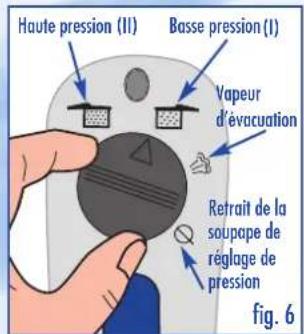
natural_image
Illustration of a hand pressing a cooking pot with a blue arrow indicating motion (no text or symbols)natural_image
Diagram showing light rays projecting off a surface, labeled 'fig. 3' (no text or symbols on diagram itself)natural_image
Diagram of a tool interacting with a circular object, labeled 'fig. 5' (no text or symbols on the diagram itself)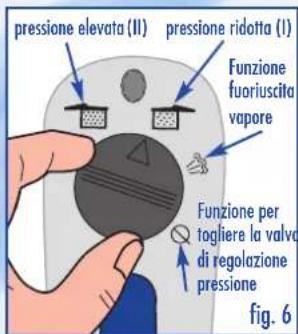
natural_image
Illustration of a hand pressing a cooking pot with a blue valve, labeled 'fig. 7' (no text or symbols on the pot itself)Manutenzione
I
If any part of your pressure cooker needs replacing, please ensure that you use an original spare part. For successful cooking with the pressure cooker, it must be at least one quarter to maximum three quarters full of liquid including all ingredients. When cooking dishes which create frothing, the pot should never be more than half full. Take care to ensure that all the liquid never evaporates, as this could lead to damage. Disposal: please dispose of your pressure cooker as residual waste.
Guarantee
The pressure cooker is made of high-quality 18/10 stainless steel and will last practically a lifetime if correctly used and looked after. We guarantee that the pressure cooker is free from material and design defects. The materials used in its manufacture have passed the highest quality standards. If, despite our careful inspection processes, your pressure cooker needs repairing within four years of purchase, and this is clearly due to a defect in manufacture or materials, this will be carried out free of charge.
We herewith confirm that the mentioned Pressure cookers complies with the allocated EU-directives (Pressure equipment) 97/23/EG and bulk production will be manufactured accordingly. Furthermore the articles complies with the standard DIN EN 12778:2005-09 which is necessary to obtain the CE-symbol.
EC Declaration of Conformity (EC Directive 97/23/EC, DIN EN 12778)
We:
Company: ELO-Stahlwaren Karl Grünewald & Sohn GmbH & Co. KG Address: Dalberger Straße 20 Postcode, city: D-55595 Spabrücken
declare under our sole responsibility that the pressure cooker
Article: Praktika Plus XS and XL
Brand: ELO
Art. No.: ASC22-3, ASC22-4, ASC22-6, ASC22-7, ASC18-2.7, ASC18-3.2
conforms to the EC Pressure Equipment Directive 97/23/EC.
The following directive, harmonised standards, national standards and specifications were applied:
97/23/EG (Module A, B)
DIN EN 12778/09.05
ZEK 01.2-08/12.08
Mr. Erwin Memmesheimer
The signatory of this declaration is the Operations Manager of the above mentioned company.
Important
Rue: Dalberger Straße 20