
AE160MNYDGH - Heat pump SAMSUNG - Free user manual and instructions
Find the device manual for free AE160MNYDGH SAMSUNG in PDF.


| Product Type | Heat Pump |
| Brand | Samsung |
| Model | AE160MNYDGH |
| Cooling Capacity (BTU/h) | 16,000 |
| Heating Capacity (BTU/h) | 18,000 |
| SEER Rating | 16.0 |
| COP (Heating) | 3.5 |
| Power Supply | 230V / 50Hz / Single Phase |
| Refrigerant | R32 |
| Dimensions (Outdoor Unit) (WxHxD) | 800 x 640 x 320 mm |
| Weight (Outdoor Unit) | 35 kg |
| Noise Level (Outdoor Unit) | 48 dB(A) |
| Compressor Type | Digital Inverter |
| Operating Temperature Range (Cooling) | -15°C to 46°C |
| Operating Temperature Range (Heating) | -20°C to 24°C |
| Key Functions | Cooling, Heating, Dehumidification, Fan Only |
| Air Purification | Triple Filter (Pre-filter, Deodorizing, Dust) |
| Self Cleaning | Auto Clean (Evaporator) |
| Remote Control | Infrared with LCD Display |
| Wi-Fi Connectivity | Optional (SmartThings compatible) |
| Energy Efficiency Class | A++ (Cooling) / A+ (Heating) |
| Maintenance Tips | Clean filter every 2 weeks; annual professional check |
| Safety Features | Auto restart, overcurrent protection, refrigerant leak detection |
| Repairability Index | 8.5 / 10 (Spare parts available for 10 years) |
Frequently Asked Questions - AE160MNYDGH SAMSUNG
User questions about AE160MNYDGH SAMSUNG
0 question about this device. Answer the ones you know or ask your own.
Ask a new question about this device
Download the instructions for your Heat pump in PDF format for free! Find your manual AE160MNYDGH - SAMSUNG and take your electronic device back in hand. On this page are published all the documents necessary for the use of your device. AE160MNYDGH by SAMSUNG.
USER MANUAL AE160MNYDGH SAMSUNG
SPLIT/TDM PLUS Hydro Unit
User manual
AE090JNYDEH / AE090JNYDGH / AE160JNYDEH / AE160JNYDGH / AE090MNYDEH / AE090MNYDGH / AE160MNYDEH / AE160MNYDGH
- Thank you for purchasing this Samsung air conditioner.
- Before operating this unit, please read this user manual carefully and retain it for future reference.
Contents
PREPARATION
4
Safety Information 4
Description of each icon 11
Description of each control 13
BASIC OPERATION 15
Operating basic mode of Hydro unit 15
Domestic Hot Water (DHW) mode operation 16
Outing mode 17
Silent mode 17
Checking current temperature 18
Checking set temperature 18
TDM (Time-Division Multi) Variables (TDM product Only) 19
Setting weekly timer 20
Setting a holiday with weekly timer 22
Canceling a weekly timer 23
Initializing a weekly timer 24
Setting daily timer 25
How to set the detailed setting (User setting mode) 27
Wired remote controller installation 31
Use of wired remote controller installation / service mode 33
Field specification setting mode of wired remote controller 36
Field setting mode 38
OTHERS
Maintaining the unit 53
Troubleshooting tips 55
Error codes 58
Product specification 60
Correct Disposal of This Product (Waste Electrical & Electronic Equipment)
(Applicable in countries with separate collection systems)
This marking on the product, accessories or literature indicates that the product and its electronic accessories (e.g. charger, headset, USB cable) should not be disposed of with other household waste at the end of their working life. To prevent possible harm to the environment or human health from uncontrolled waste disposal, please separate these items from other types of waste and recycle them responsibly to promote the sustainable reuse of material resources. Household users should contact either the retailer where they purchased this product, or their local government office, for details of where and how they can take these items for environmentally safe recycling. Business users should contact their supplier and check the terms and conditions of the purchase contract. This product and its electronic accessories should not be mixed with other commercial wastes for disposal.
For information on Samsung's environmental commitments and product-specific regulatory obligations, e.g. REACH, visit: www.samsung.com/uk/aboutsamsung/sustainability/environment/our-commitment/data/
Safety Information
Before using your new Air to Water Heat pump, please read this manual thoroughly to ensure that you know how to safely and efficiently operate the extensive features and functions of your new appliance.
Because the following operating instructions cover various models, the characteristics of your Air to Water Heat pump may differ slightly from those described in this manual. If you have any questions, call your nearest contact center or find help and information online at www.samsung.com.

WARNING
Hazards or unsafe practices that may result in severe personal injury or death.

CAUTION
Hazards or unsafe practices that may result in minor personal injury or property damage.
Follow directions.
Do NOT attempt.
Make sure the machine is grounded to prevent electric shock.
Cut off the power supply.
Do NOT disassemble.
FOR INSTALLATION

WARNING
Use the power line with the power specifications of the product or higher and use the power line for this appliance only. In addition, do not use an extension line.
- Extending the power line may result in electric shock or fire.
- Do not use an electric transformer. It may result in electric shock or fire.
- If the voltage/frequency/rated current condition is different, it may cause fire.
The installation of this appliance must be performed by a qualified technician or service company.
- Failing to do so may result in electric shock, fire, explosion, problems with the product, or injury.
Install a switch and circuit breaker dedicated to the Air to Water Heat pump.
- Failing to do so may result in electric shock or fire.
Fix the outdoor unit firmly so that the electric part of the outdoor unit is not exposed.
- Failing to do so may result in electric shock or fire.
Do not install this appliance near a heater or inflammable material. Do not install this appliance in a humid, oily, or dusty location, or in a location exposed to direct sunlight and water (rain drops). Do not install this appliance in a location where gas may leak.
• This may result in electric shock or fire.
Never install the outdoor unit in a location such as on a high external wall where it could fall.
- If the outdoor unit falls, it may result in injury, death, or property damage.
This appliance must be properly grounded. Do not ground the appliance to a gas pipe, plastic water pipe, or telephone line.
- Failure to do so may result in electric shock, fire, an explosion, or other problems with the product.
- Never plug the power cord into a socket that is not grounded correctly and make sure that it is in accordance with local and national codes.
CAUTION
Install your appliance on a level and hard floor that can support its weight.
- Failing to do so may result in abnormal vibrations, noise, or problems with the product.
Install the draining hose properly so that water is drained correctly.
- Failing to do so may result in water overflowing and property damage.
When installing the outdoor unit, make sure to connect the draining hose so that draining is performed correctly.
- The water generated during the heating operation by the outdoor unit may overflow and result in property damage. In particular, in winter, if a block of ice falls, it may result in injury, death or property damage.
Safety Information
- Our units must be installed in compliance with the spaces indicated in the installation manual to ensure either accessibility from both sides or ability to perform routine maintenance and repairs. The units' components must be accessible and that can be disassembled in conditions of complete safety either for people or things. For this reason, where it is not observed as indicated into the Installation Manual, the cost necessary to reach and repair the unit (in safety, as required by current regulations in force) with slings, trucks, scaffolding or any other means of elevation won't be considered in-warranty and charged to end user.
Do not disassemble and alter the heater at your own discretion.
FOR POWER SUPPLY

WARNING
When the circuit breaker is damaged, contact your nearest service center. Do not pull or excessively bend the power line. Do not twist or tie the power line. Do not hook the power line over a metal object, place a heavy object on the power line, insert the power line between objects, or push the power line into the space behind the appliance.
• This may result in electric shock or fire.

CAUTION
When not using the Air to Water Heat pump for a long period of time or during a thunder/lightning storm, cut the power at the circuit breaker.
- Failing to do so may result in electric shock or fire.

WARNING
If the appliance is flooded, please contact your nearest service center.
- Failing to do so may result in electric shock or fire.
If the appliance generates a strange noise, a burning smell or smoke, unplug the power plug immediately and contact your nearest service center.
- Failing to do so may result in electric shock or fire.
In the event of a gas leak (such as propane gas, LP gas, etc.), ventilate immediately without touching the power line. Do not touch the appliance or power line.
- Do not use a ventilating fan.
- A spark may result in an explosion or fire.
To reinstall the Air to Water Heat pump, please contact your nearest service center.
- Failing to do so may result in problems with the product, water leakage, electric shock, or fire.
- A delivery service for the product is not provided. If you reinstall the product in another location, additional construction expenses and an installation fee will be charged.
- Especially, when you wish to install the product in an unusual location such as in an industrial area or near the seaside where it is exposed to the salt in the air, please contact your nearest service center.

Do not touch the circuit breaker with wet hands.
• This may result in electric shock.
Do not turn the Air to Water Heat pump off with the circuit breaker while it is operating.
- Turning the Air to Water Heat pump off and then on again with the circuit breaker may cause a spark and result in electric shock or fire.
After unpacking the Air to Water Heat pump, keep all packaging materials well out of the reach of children, as packaging materials can be dangerous to children.
- If a child places a bag over its head, it may result in suffocation.
Do not insert your fingers or foreign substances into the outlet when the Air to Water Heat pump is operating.
- Take special care that children do not injure themselves by inserting their fingers into the product.
Do not insert your fingers or foreign substances into the air inlet/outlet of the Air to Water Heat pump.
- Take special care that children do not injure themselves by inserting their fingers into the product.
Do not strike or pull the Air to Water Heat pump with excessive force.
- This may result in fire, injury, or problems with the product.
Do not place an object near the outdoor unit that allows children to climb onto the machine.
- This may result in children seriously injuring themselves.
Do not use this Air to Water Heat pump for long periods of time in badly ventilated locations or near infirm people.
- Since this may be dangerous due to a lack of oxygen, open a window at least once an hour.
If any foreign substance such as water has entered the appliance, cut the power by unplugging the power plug and turning the circuit breaker off, and then contact your nearest service center.
- Failing to do so may result in electric shock or fire.
Do not attempt to repair, disassemble, or modify the appliance yourself.
- Do not use any fuse (such as copper, steel wire, etc.) other than the standard fuse.
- Failing to do so may result in electric shock, fire, problems with the product, or injury.

CAUTION
Check that the installation frame of the outdoor unit is not broken at least once a year.
- Failing to do so may result in injury, death or property damage.
Max current is measured according to IEC standard for safety and current is measured according to ISO standard for energy efficiency.
Do not stand on top of the appliance or place objects (such as laundry, lighted candles, lighted cigarettes, dishes, chemicals, metal objects, etc.) on the appliance.
- This may result in electric shock, fire, problems with the product, or injury.
Do not operate the appliance with wet hands.
• This may result in electric shock.
Do not spray volatile material such as insecticide onto the surface of the appliance.
- As well as being harmful to humans, it may also result in electric shock, fire or problems with the product.
Do not drink the water from the Air to Water Heat pump.
- The water may be harmful to humans.
Do not apply a strong impact to the remote controller and do not disassemble the remote controller.
Do not touch the pipes connected with the product.
• This may result in burns or injury.
Do not use this Air to Water Heat pump to preserve precision equipment, food, animals, plants or cosmetics, or for any other unusual purposes.
This may result in property damage.
Avoid directly exposing humans, animals, or plants to the airflow from the Air to Water Heat Pump for long periods of time.
This may result in harm to humans, animals, or plants.
Safety Information
This appliance is not intended for use by persons (including children) with reduced physical, sensory, or mental capabilities, or lack of experience and knowledge, unless they have been given supervision or instruction concerning use of the appliance by a person responsible for their safety. Children should be supervised to ensure that they do not play with the appliance.
For use in Europe: This appliance can be used by children aged from 8 years and above and persons with reduced physical, sensory, or mental capabilities or lack of experience and knowledge if they have been given supervision or instruction concerning use of the appliance in a safe way and understand the hazards involved. Children shall not play with the appliance. Cleaning and user maintenance shall not be made by children without supervision.
FOR CLEANING

WARNING
Do not clean the appliance by spraying water directly onto it. Do not use benzene, thinner, or alcohol to clean the appliance.
This may result in discoloration, deformation, damage, electric shock, or fire.
Before cleaning or performing maintenance, unplug the Air to Water Heat Pump from the wall socket and wait until the fan stops.
Failing to do so may result in electric shock or fire.

CAUTION
Take care when cleaning the surface of the heat exchanger of the outdoor unit since it has sharp edges.
To avoid cutting your fingers, wear thick cotton gloves when cleaning it.
Do not clean the inside of the Air to Water Heat Pump by yourself.
- For cleaning inside the appliance, contact your nearest service center.
- Failure to do so may result in damage, electric shock, or fire.
Description of each icon
Display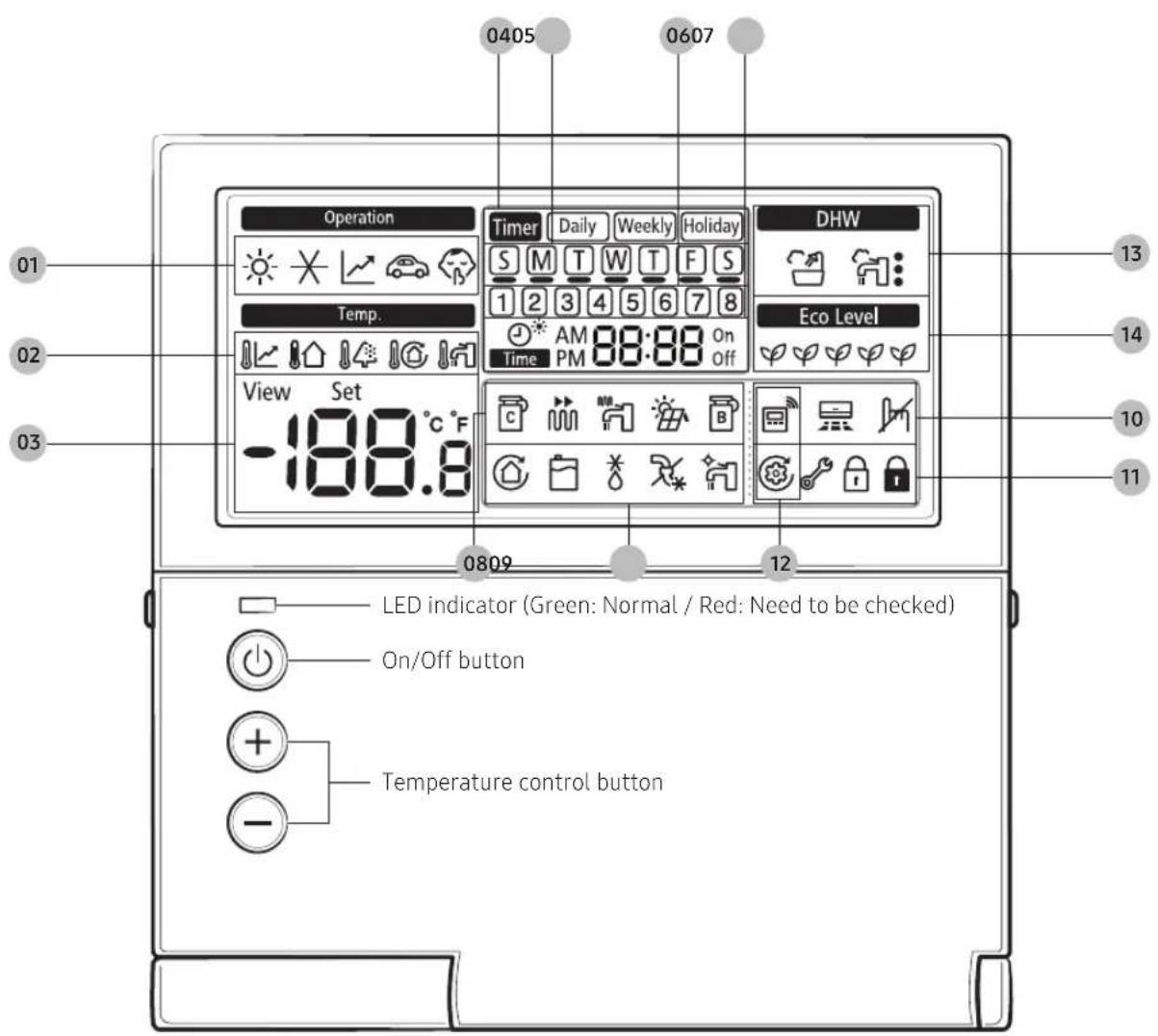

NOTE
- Without opening the cover of your wired remote controller, you can turn the Hydro unit on or off or set the desired temperature.
Description of each icon
| Classification Indication Function | |||
| Hydro unit | 01 | 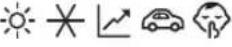 | Hydro unit operation (heat/cool/auto/outing/silent) |
| 02 |  | System temperature (water Law temp./indoor temp./outdoor temp./discharge water temp./hot water temp.) | |
| 03 | 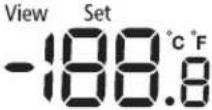 | Temperature (current/desired) | |
| Timer | 04 |  | Timer (Daily/Weekly/Holiday) |
| 05 |  | Current day or timer function | |
| 06 |  | Timer number | |
| 07 | 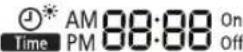 | Current time/summer time/ On or Off time | |
| General function | 08 |  | Operation status (COMP operation/Back up heater/Booster heater/Solar/Back up boiler) |
| 09 |  | Operation status (water pump/water tank/defrost operation/freezing control/water tank sterilization operation) | |
| 10 |  | Indoor thermostat installation(connection) status/air to air operation/no function | |
| 11 |  | Trial operation/check/partial lock/all lock | |
| 12 |  | Centralized control | |
| Hot water mode (DHW) | 13 | DHW | DHW (economic/standard/power/forced) |
| ECO level information | 14 | Eco Level | ECO level operation (Step 1~5) |
Description of each control
Buttons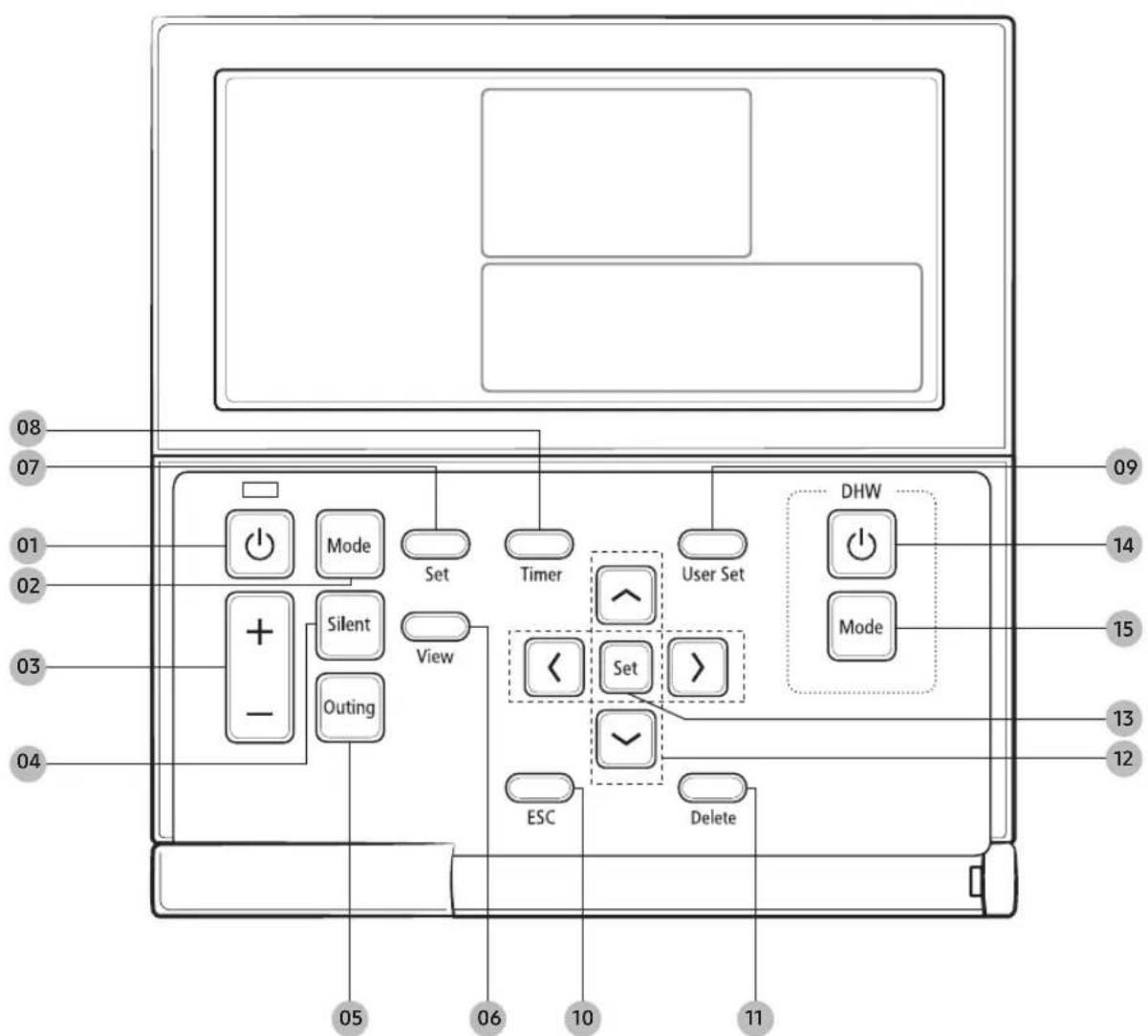
Description of each control
| Classification Button | Function | ||
| Basic operation button | 01 |  | Turn Hydro unit on or off |
| 02 |  | Select operation mode (Cool/Heat/Auto) | |
| 03 |  | Select desired temperature (discharge water/indoor/hot water) | |
| 04 |  | Outdoor unit silent operation mode | |
| 05 |  | Select outing mode | |
| 06 | [47WS] | Check current temperature of the system | |
| 07 |  | Set desired temperature of the system | |
| 08 |  | Select timer setting mode | |
| 09 |  | Select user setting mode | |
| 10 |  | Exit to normal mode when setting timer or detailed setting | |
| 11 |  | Delete a set timer | |
| 12 |  | Move to another section or change section value. | |
| 13 |  | Save settings | |
| Hot water function button (DHW) | 14 |  | Turn hot water mode on or off |
| 15 | [H7DS] | Select hot water mode (economic/standard/power/forced) | |

NOTE
- When pressing a button that is not supported by your model, will be displayed.
Operating basic mode of Hydro unit
Operate basic mode by pressing the Mode button.
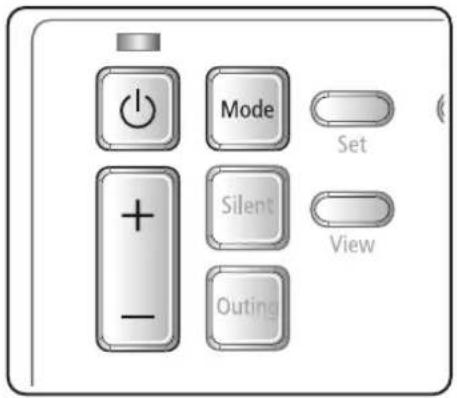
Start the Hydro unit operation by pressing the button.
Select the desired operating mode by pressing the button.

Adjust the desired temperature by pressing the button.
| Temperature of cooling discharge water | You can adjust the desired temperature by 0.5 °C. |
| Indoor cooling temperature | You can adjust the desired temperature by 0.5 °C. |
| Temperature of heating discharge water | You can adjust the desired temperature by 0.5 °C. |
| Indoor heating temperature | You can adjust the desired temperature by 0.5 °C. |
Water Law
The Hydro unit will automatically adjust the discharge water temperature in auto mode for indoor heating.

NOTE
- When "Water Law" is active, the target supply water temperature is determined automatically based on the outdoor temperature: for heating mode, colder outdoor temperatures result in warmer water.
Cool
You can adjust the cooling temperature as desired with cool mode to cool the indoor space.
- When selecting heat mode during cool mode, cool mode will be canceled.
Heat
Floor heating is available with heat mode by providing hot water in spring, autumn, and winter.
- Frost removal indicator ( )% - The frost removal indication will be displayed when frost formed around the outdoor unit starts being removed during heat mode, and the indication will disappear when frost removal is finished. (When frost is being removed, hot water does not come out from the Hydro unit.)
- When selecting cool mode during heat mode, heat mode will be canceled.

NOTE
- When setting standard cooling & heating temperature as indoor temperature, auto mode cannot be selected.
Domestic Hot Water (DHW) mode operation
You can adjust the temperature of the hot water tank by providing hot water.
- Select (economic), (standard), and (power): (forced) by pressing the Mode button in the DHW section.
NOTE
- To operate hot water mode, you need to set the hot water function '1 or 2' in the field specification setting mode (#3011) of the wired remote controller and connect the temperature sensor of the hot water tank.
- When cool/heat mode and DHW mode are selected at the same time, the heat/cool mode and DHW mode will operate alternately.
- (power) for DHW mode cannot be used when the Booster heater is not in use.
- If you want to enjoy a leisurely bath or need a lot of warm water urgently, select the Forced DHW mode. When this mode is enabled, it is assured that the full capacity of the heat pump is only delivered for domestic water heating.
CAUTION
- By default field setting value option, this function will not be turned off automatically.
- If you want a Forced DHW function for a certain amount of duration time, change the field setting value of the remote controller.
Outing mode
Heating can operate at low temperature while you are out with the Outing mode.
Select outing mode by pressing the Outing button.
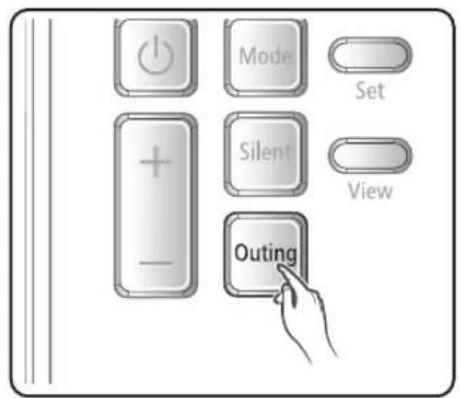
- will be displayed and outing mode will operate.
Cancel: Press any button on the remote controller.

NOTE
- When pressing the Outing button while the Hydro unit stops its operation, indication will appear.
Silent mode
Noise from operation can be reduced with the Silent mode.
Press the Silent button to operate the Silent mode.
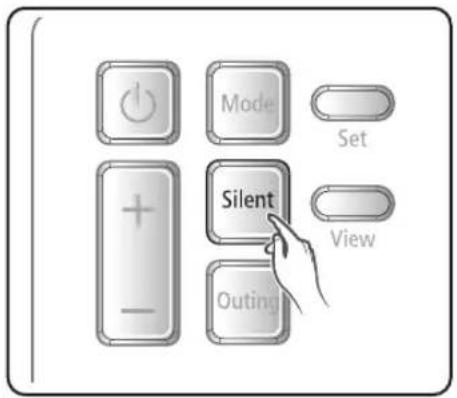
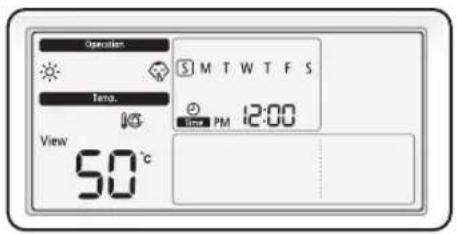
• will be displayed and Silent mode will operate. - Current set temperature will be maintained.
Cancel: Press the Silent button once again.

NOTE
- If you press the Silent button while the unit is not in operation, will be displayed.
- If the Silent mode operates by outdoor unit external contact, will be displayed but the Silent button on the wired remote controller will not work. If you press the Silent button on the wired remote controller, will be displayed.
- In the Silent mode, the capacity of the product may be less than rated capacity.
Checking current temperature
You can check current temperature.
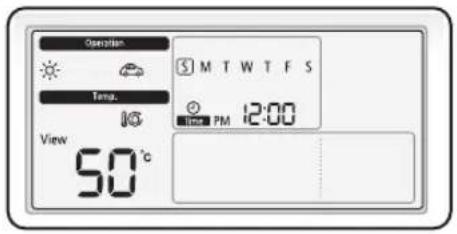
Check the current temperature by pressing the View button.
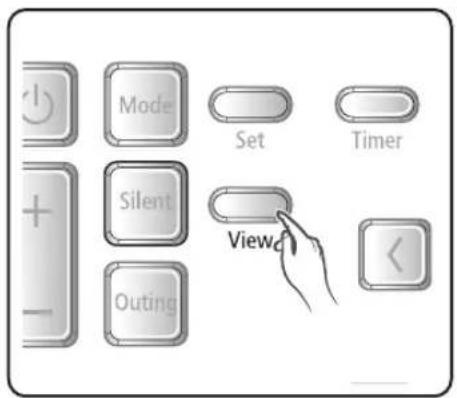
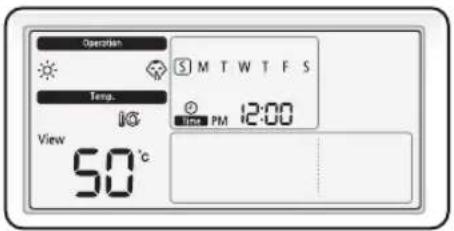
- Current temperature can be checked in order of (indoor) → (outdoor) → (discharge water) → (hot water) by pressing the View button.
- The temperature which a connected indoor unit does not support will not be displayed.
- After 10 seconds from current temperature display, the set desired temperature will appear.
Checking set temperature
You can check the set temperature of current operation mode by the set temperature check function.
Check the set temperature by pressing the Set button.
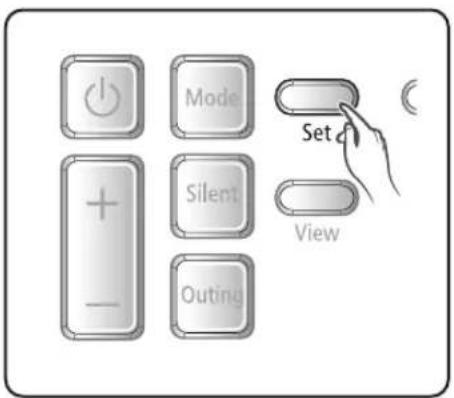
- The set temperature of basic operation mode and hot water mode can be checked by pressing the Set button repeatedly.
- When either basic operation mode or hot water mode is in operation, the set temperature of the mode in operation will be displayed.
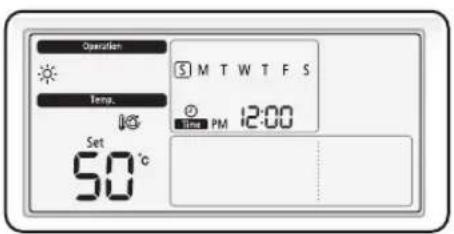
TDM (Time-Division Multi) Variables (TDM product Only)
- Under the installation of both A2A (Air-To-Air type air conditioner) and A2W (Air-To-Water type hydro unit) at the same time, our outdoor machine can supply its full capacity to the operating indoor machines (including A2A or A2W). If there are simultaneous operating demands from many A2A machines with A2W, the priority of controlling the outdoor machine (ex: compressor frequency) will be given to A2A, because of their fast response for user's comfort. Only the remaining capacity of outdoor machine will be given to A2W during A2A's normal operation. In this case, it might take very long time for A2W heating, so the outdoor machine will alternate the controlling priorities between A2A and A2W with time basis.
- Priority maximum operation time (at FSV #5033=0): FSV #5031 (Default "30 min.", Range 10 \~ 90 min.), After elapsing A2A maximum time, the outdoor machine will operate only for A2W to speed up the A2W's heating/cooling performance, even though there are A2A's continuous operation demands.
- Non priority minimum operation time (at FSV #5033=0): FSV #5032(Default "5 min.", Range 3 \~ 60 min.), in this minimum time, the outdoor machine will operate only for A2W, even though there are no more A2W's continuous operation demands.
| FSV setting | A2A Cooling + A2W Cooling | A2A Cooling + A2W Heating | A2A Heating + A2W Cooling | A2A Heating + A2W Heating |
| A2A Priority(#5033=0) | A2A CoolingA2W Cooling"Same cooling Mode TDS Control" | A2A CoolingA2W Cycle Off (The heater just operates without heating.) "Cooling Operation" | A2A HeatingA2W x (Not operation)"Heating Operation" | A2A HeatingA2W Heating"Same heating Mode TDS Control" |
| DHW Priority(#5033=1) | Same with A2A Priority setting | A2W HeatingA2A Cooling"(Heating + Cooling)TDS Control" | Same with A2A Priority setting | Same with A2A Priority setting |
※ A2A : Air to Air, A2W : Air to Water
- When DHW Priority is enabled, hot water (heating) operation is given priority only if the A2A & A2W simultaneous operation is on. Other operations are the same as when A2A Priority is enabled.
- How to set DHW Priority:
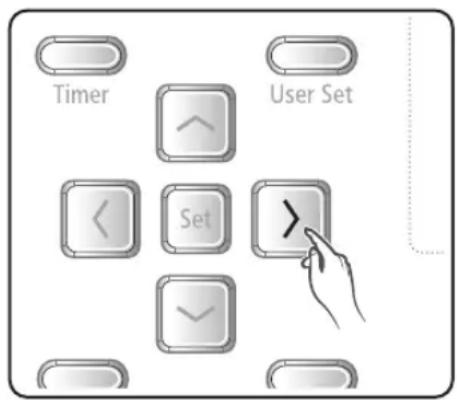
1. Press the key on the wired remote controller for 3 seconds. The setting value changes in order of DHW Priority (pink) → A2A Priority (blank) → DHW Priority (pink) → A2A Priority (blank) repeatedly.
2. Setting FSV #5033 to '0' becomes 'A2A Priority', and setting to '1' becomes 'DHW Priority'.

CAUTION
- While A2W is in operation, A2A does not operate. This is normal operation.
- While A2A or A2W is not in simultaneous operation, you can use any mode without operation mode restriction.
Setting weekly timer
You can operate or stop a desired mode on the day and time you reserve.
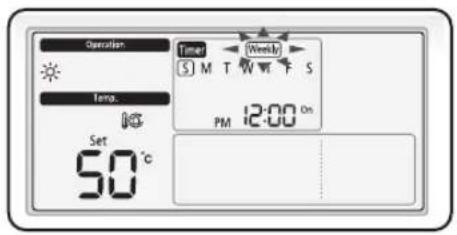
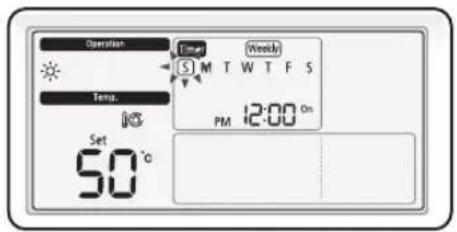
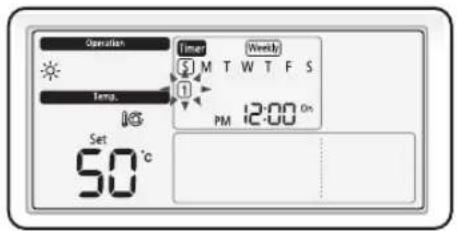
1. Press the Timer button. - (Timer) will be displayed and then select 'Weekly' among 'Daily', 'Weekly', or 'Holiday' by pressing the [N]/[Y] button. 2. After pressing the [ ] button, select the 'Day' you want to reserve. - Select the day you want to reserve (Sun~Sat) by pressing the [A/[] button.
NOTE
- You can set multiple timers by selecting multiple days and when multiple timers are set, you will move on to the time setting for the timer.
3. Select 'Timer number' by pressing the [ ] button until timer number is displayed. (When entering, the last available number for timer setting is set.)
- The timer already set is assigned with number in time sequence order.
- You can select timer number (1~8) by pressing the [A/[]V button.
- If there is no timer, the edge of the box for the timer number and the timer number will blink.
NOTE
- If the timer is already set, the square box surrounding the timer number will blink. If you want to change it, select the set timer number and change it.
4 After pressing the [ ] button, select 'AM/PM'. - You can select AM or PM by pressing the [A/[] button. 5 After pressing the [ ] button, select 'Hour'. - You can set hour by pressing the [A/[]button.
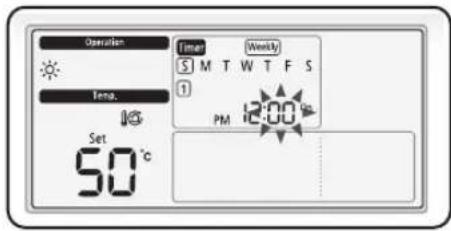
6 After pressing the [ ] button, select 'Minute'.
- You can select minute by pressing the [N[ ]button.

NOTE
- If the time setting is set as 24 hours a day, AM/PM setting will be omitted.
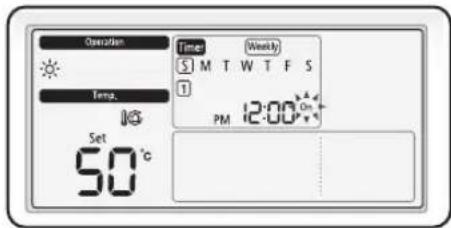
7 After pressing the [ ] button, select 'On/Off' timer.
- You can select On or Off by repeatedly pressing the [A/[]V button.
- When selecting 'Off', follow 10 or 11.
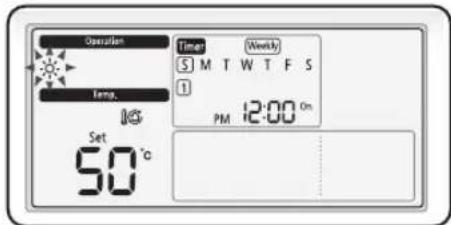
8 After pressing the [ ] button, select the operation mode.
- It is available only for setting Hydro unit On timer.
- You can set operation mode by pressing the [N[ ]or Mode button.
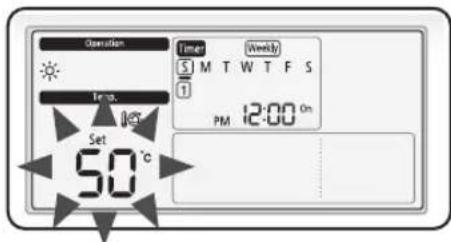
9 After pressing the [ ] button, select the desired temperature.
- It is available only for setting Hydro unit On timer.
- You can adjust the temperature in 0.5 °C increments by pressing the [A]/[ ] or [+]/[-] button.
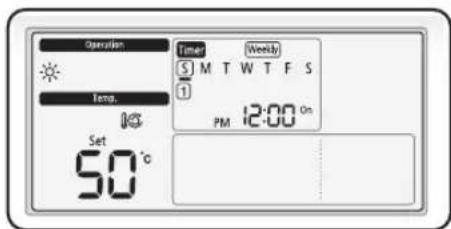
10 Complete the timer function by pressing the Set button.
- The reserved day will be displayed with '_' and will be saved within 3 seconds. [e.g., When Monday is reserved Ⓜ]
- If an additional timer is needed, re-select the setting from daily timer or weekly timer.
11 Press the ESC button to exit normal mode.

NOTE
- To cancel the setting during the weekly timer setting, press the ESC button to exit.
Setting a holiday with weekly timer
You can set a holiday with the weekly timer. The set weekly timer will not function when the holiday setting is applied.
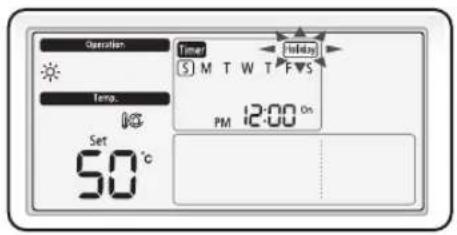
1 Press the Timer button.
- (Timer) is displayed, then select 'Holiday' among 'Daily', 'Weekly', or 'Holiday' by pressing the [ʌ/ʃv] button.
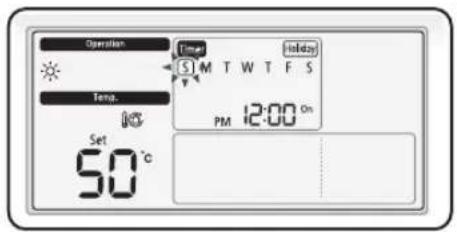
2 After pressing the [ ] button, select the 'day' you will set as a holiday.
- You can select the holiday (Sun~Sat) by pressing the [A/[]V button.
NOTE
- Multiple settings are available by selecting many days.
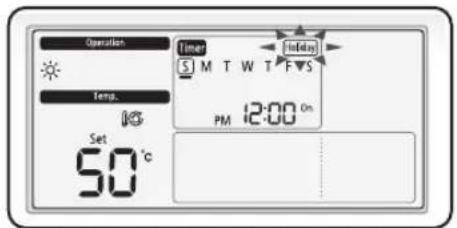
3 Complete the holiday setting with the weekly timer by pressing the Set button.
4 Press the ESC button to exit normal mode.
NOTE
- If you want to cancel your holiday with the weekly timer while you are setting them, press the ESC button.
- The weekly timer indicator '_' of the dates set as holidays will disappear on the display.
Canceling a weekly timer
You can cancel weekly timer function.
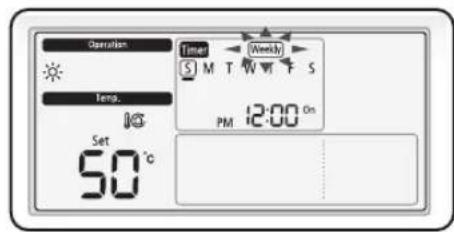
1 Press the Timer button. - (Timer) is displayed and (Weekly) will blink.
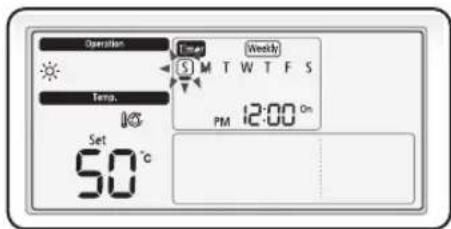
2 After pressing the [ ] button, select the 'Day' you want to cancel.
- Select a reserved day by pressing the [N][N]button.
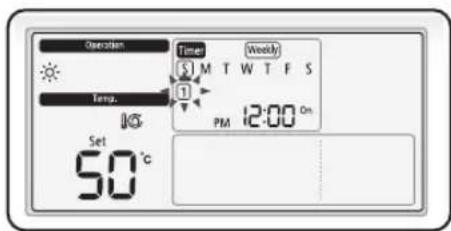
3 After pressing the [ ] button, select a 'timer number' to cancel.
- Select a timer number(1\~8) by pressing the [A][Nbutton.
- The square box around the selected number will blink.
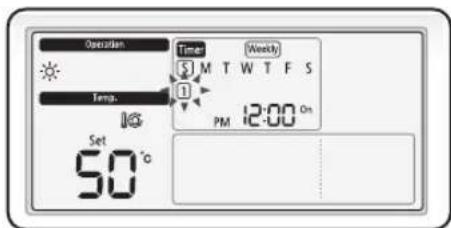
4 Cancel the weekly timer setting by pressing the Delete button.
- The canceled weekly timer number and the box for the number will blink.
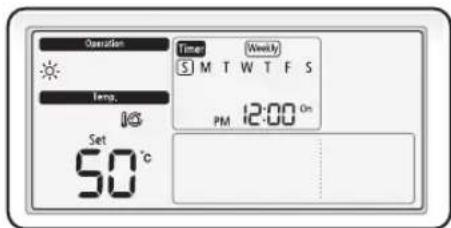
5 Save the weekly timer cancel setting by pressing the Set button.
6 Press the ESC button to exit to general mode.
Initializing a weekly timer
You can initialize all the weekly timer set with the wired remote controller.
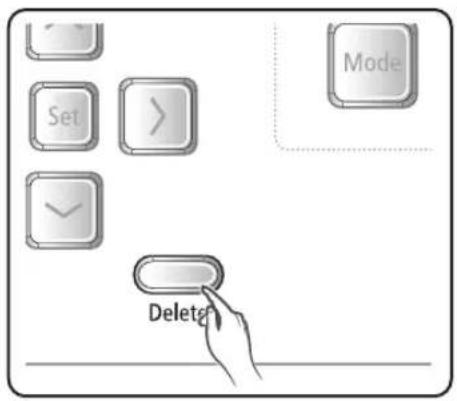
1 Press the Delete button for 5 seconds.
- All the weekly timer settings will be deleted.
NOTE
- You can't restore your old settings after deleting the weekly timer by pressing the Delete button, so be careful when you use this function.
Setting daily timer
Hydro unit can operate or stop at the time you reserve every day. (Silent mode and DHW mode can be reserved.) The reservation time for Silent mode and DHW mode should be different.
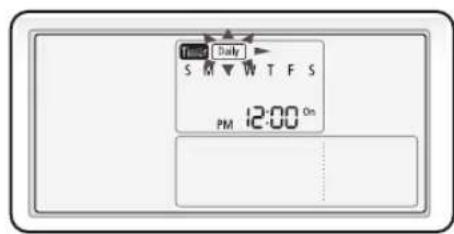
1 Press the Timer button.
- (Timer) will be displayed and then select 'Daily' among 'Daily', 'Weekly', or 'Holiday' by pressing the [N]/[Y]button.
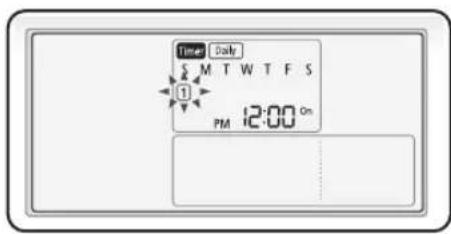
2 Select 'timer number' until the timer number is displayed by pressing the [▶] button. (When entering, the last available number for timer setting is set.)
- The timer already set is assigned with number in time sequence order.
- You can select timer number(1\~8) by pressing the [A/[]N button.
- If there is no timer, the edge of the box for the timer number and the timer number will blink.

NOTE
- If the timer is already set, then the square box surrounding the timer number will blink. If you want to change it, then select a timer number and change it.
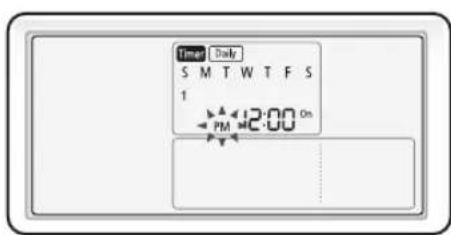
3 After pressing the [ ] button, select 'AM/PM'.
- You can select AM or PM by pressing the [A][M] button.
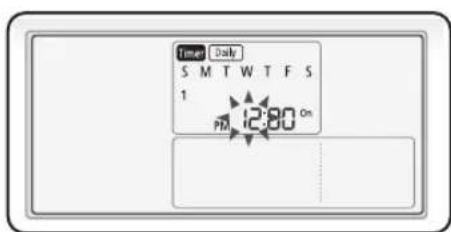
4 After pressing the [ ] button, select 'Hour'.
- You can select hour by pressing the [A][N] button.
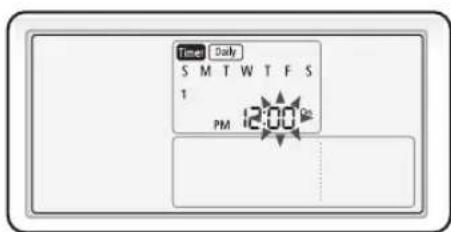
5 After pressing the [ ] button, select 'Minute'.
- You can select minute by pressing the [A][V] button.

NOTE
- If the time setting is set as 24 hours a day, AM/PM setting is omitted.
Setting daily timer
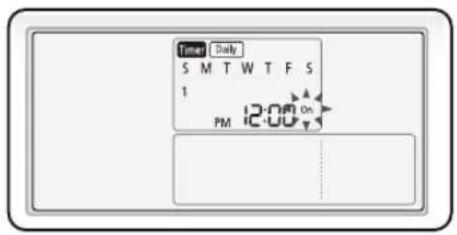
6 After pressing the [ ] button, select 'On/Off' timer.
- You can select On or Off by repeatedly pressing the [A]/[V] button.
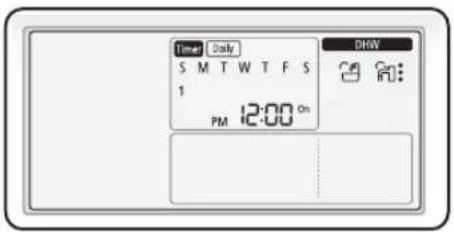
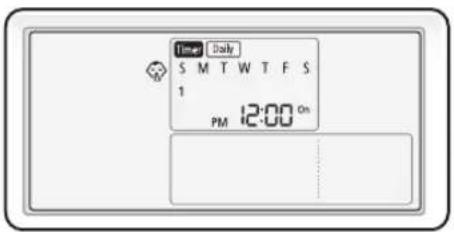
7 After pressing the [ ] button, select the reservation for DHW mode or Silent mode. Press the up or down button to select the DHW or Silent mode.
NOTE
- You cannot use the timer function for hot water mode (economic/standard/power) when you select the use of hot water function as "no use" in the field specification setting with the installation of a wired remote controller, or when a DHW thermostat is used (FSV Code: 3061 is set as "2").
- When the use of booster heater has selection 'no use' in the field specification setting with the installation of a wired remote controller, you cannot use the timer function for power hot water mode (DHW).
8 Complete the timer function by pressing the Set button.
▶ When an additional timer is needed, re-select the setting from daily timer or weekly timer.
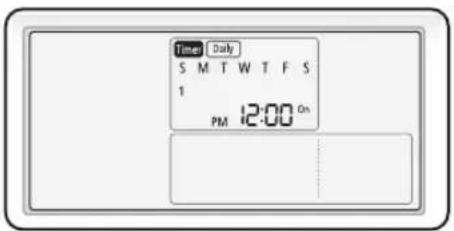
9 Press the ESC button to exit normal mode.
NOTE
- If you want to cancel the daily timer while you are setting it, press the ESC button.
How to set the detailed setting (User setting mode)
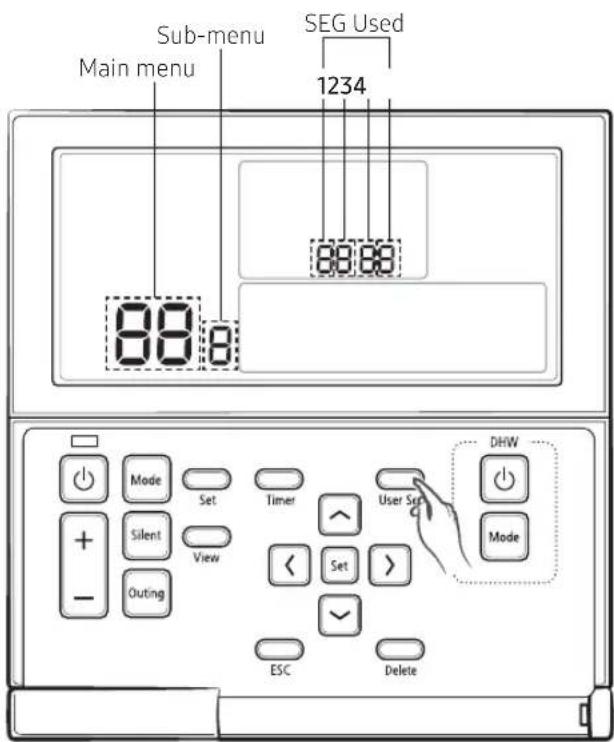
1 If you want to enter the user set mode, press the User set button. - You will enter the User Set mode, and the 'main menu' will be displayed. 2 Refer to the Wired Remote Controller's User Set list on the next page to select the desired menu. - By using the [N][ ] buttons, select a main menu number and press the [ ] button to enter the sub-menu setting screen. - By using the [N][ ] buttons, select a sub-menu number and press the [ ] button to enter the data setting screen. - Once you have entered the setting screen, the current setting value will be displayed. • Refer to the chart for data setting. - By using the [N][ ] buttons, change the setting value and press the [ ] button to move to the next setting value. - Press the Set button to save the setting value and exit to the sub-menu setting screen. - Press the ESC button to exit to general mode.

NOTE
- While setting the data, you can use the [<]/[>] buttons to move the range of SEG used.
- While configuring the setting, if you press the ESC button to exit, you will move to the sub-menu setting screen without saving the setting value.
- If you don't press any button for more than 3 minutes, general mode will appear.
- If you don't use summer time, you don't need to set year/month/day.
How to set the detailed setting (User setting mode)
User setting mode
| Main menu | Sub-menu | Function | SEG number | Default Range Unit | |||
| 1 | 1 All lock 10 0-Unlock, 1-Lock - | ||||||
| 2 | Partial key lock | Operation On/Off key lock 1 | 0 0-Unlock, 1-Lock | ||||
| Operation selection key lock | 2 0 0-Unlock, 1-Lock | ||||||
| Temperature setting key lock | 3 0 0-Unlock, 1-Lock | ||||||
| Timer setting key lock 4 0 | 0-Unlock, 1-Lock | ||||||
| 2 *1) | 1 | Current time setting(year) | 12/34 | 20** | 2000~2099 | Year | |
| 2 | Current time setting(month/date) | 12/34 | **/** | 1~12/1~31 | Month, Date | ||
| 3 | Current time setting(day/hour/minute) | Day, AM/PM, 24, 12/34 | (*, *, */*) | Sun~Sat/AM~PM/0~12/0~60 | Day, hour, minute | ||
| 3 | 1 | Summer time use and setting methods | Use of summer time (Y/N) | 10 | 0- Disuse1- Use | - | |
| Summer time application method | Summer time application method | 2 | 0 | 0- Weekly1- Daily | - | ||
| 2 | Summer time use (weekly)Start (? month, ? th Sunday) | 12, 4 | 03, F | Jan~Dec month1~4, F (last week) th week | - | ||
| 3 | Summer time use (weekly)End (? month, ? th Sunday) | 12, 4 | 10, F | Jan~Dec month1~4, F (last week) th week | - | ||
| 4 | Summer time use (daily)Start (? month, ? date) | 12, 34 | 0322 | Jan~Dec /1~31st day | Month, date | ||
| 5 | Summer time use (daily)End (? month, ? date) | 12, 34 | 0922 | Jan~Dec /1~31st day | Month, date | ||
| 4 | Backlight time Setting/Checking | 12 | 5 | 0~30 sec. | 1 sec | ||
| Use of LED(Green) (Y/N) | 3 | 1 | 0- Disuse1- Use | ||||
| Use of LED (Red) (Y/N) | 41 | 0- Disuse1- Use | |||||
| 0 | Reset to user mode defaults(except the current time) | 1 | 0 | 0- Disuse1- Use | |||
*1) Arbitrary value can be displayed.
Setting current time (example)
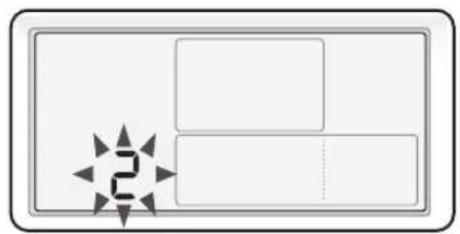
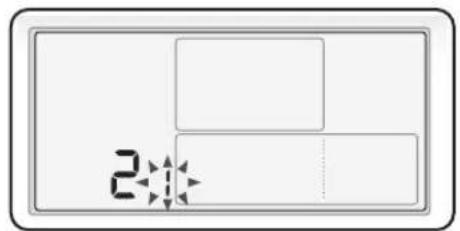
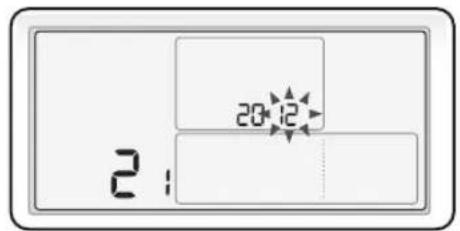
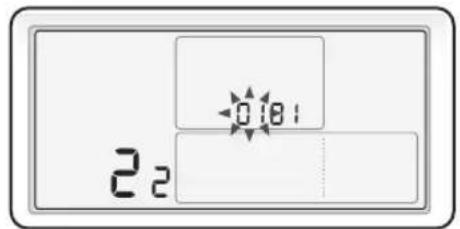
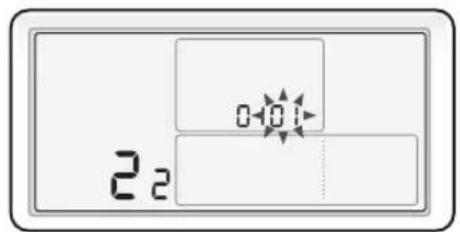
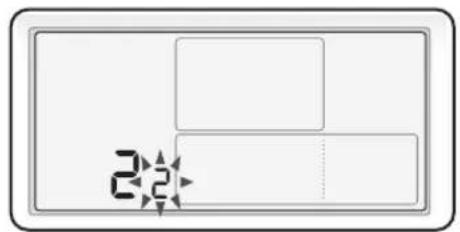
1 Press the User Set button.
- 'Main Menu' will be displayed and current time can be set by pressing the [A]/[M] buttons and selecting No.2.
2 Select the number to set 'year, month, date' in sub-menu by pressing the [▶] button.
- You can select 'year, month and date' by pressing the [A]/[V] buttons and selecting No.1.
3 Select the 'year' you want to set by pressing the [ ] button.
- You can select 'year (2000~2099)' by pressing the [A]/[V] buttons.
4 Select the 'month' you want to set by pressing the [ ] button.
- You can select 'month (01~12)' by pressing the [A]/[V] button.
5 Select the 'date' you want to set by pressing the [ ] button.
- You can select 'date (01~31)' by pressing the [A]/[V] button.
6 Complete the setting for 'year, month, and date' by pressing the Set button.
- The setting value will be applied and you can exit to the sub-menu.

NOTE
- When not using the summer time function, you don't need to set "Year", "Month" and "Day".
How to set the detailed setting (User setting mode)
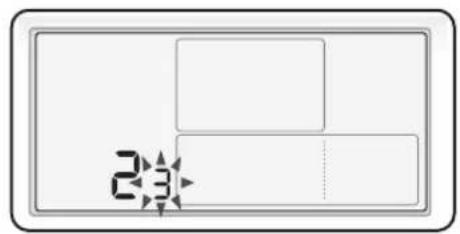
7 Select 'day, AM/PM, hour, and minute' in the 'sub-menu'.
- You can set 'day, AM/PM, hour, and minute' by pressing the [A/[] buttons and selecting No.3.
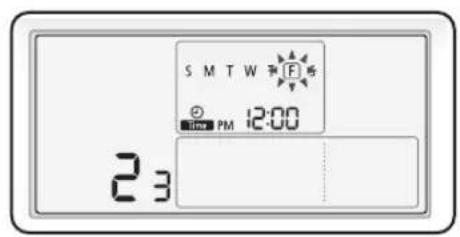
8 Select the 'day' you want to set by pressing the [▶button.
- You can select 'Day(Sun\~Sat)' by pressing the [A/[]v buttons.
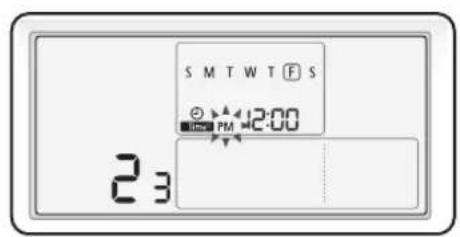
9 Select the 'AM/PM' you want to set by pressing the [] button.
- You can select 'AM/PM/ AM & PM' by pressing the [A/[]V buttons. 'AM & PM' is 24 hours a day setting mode.
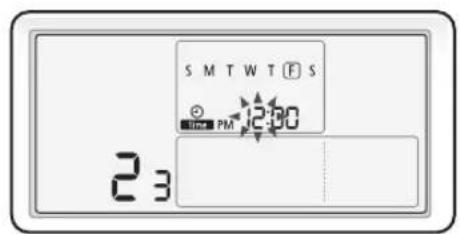
10 Select the 'Hour' you want to set by pressing the ▶ button.
- You can select 'Hour(01\~12)' by pressing the [A/[]N buttons. When it is 24 hours a day setting mode, 0\~23 setting is available.
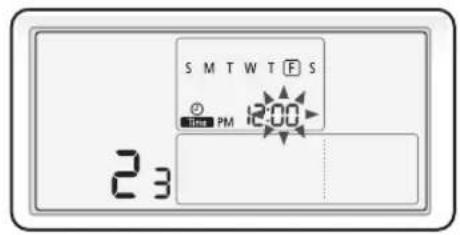
11 Select the 'Minute' you want to set by pressing the ▶ button.
- You can select 'Minute(00\~59)' by pressing the [A/[]V buttons.
12 Complete the current time setting by pressing the Set button.
- The setting value will be applied and you can exit to the sub-menu.
13 Whenever you press the ESC button, you will exit to general mode from sub-menu.
Wired remote controller installation
Initializing your wired remote controller communication
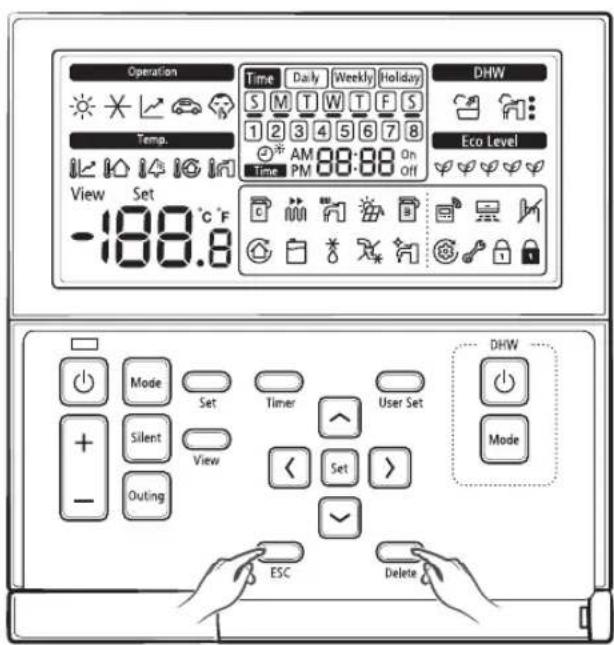
1 Press the Esc and Delete buttons at the same time for more than 5 seconds.
- The communication of your wired remote controller will be initialized, and the device will search for the Hydro unit connected to your wired remote controller again.
Wired remote controller installation
Error display on the wired remote controller
※ The address of Hydro unit is displayed "200000"
- Error codes for the wired remote controller and the product connected to your wired remote controller will be displayed in the LCD display.
Error indications are displayed as seen below.
a Hydro unit error
- The address of Error, "Ai" and the error code will be displayed alternately on the remote controller display.
![graph LR A["S M T W T F S\nA, 20"] --> B["S M T W T F S\n00:00"] B --> C["S M T W T F S\nE101"]](/content/2026/05/1050636/images/c2342f597372ba661192091dd2db35912c8620c6c44765b6b9f6ba6e260813d1.jpg)
b Outdoor unit error
- The address of Error, "Ao" and error code will be displayed alternately on the remote controller display.
![graph LR A["S M T W T F S\nRo 20"] --> B["S M T W T F S\n00:00"] B --> C["S M T W T F S\nE101"]](/content/2026/05/1050636/images/e443e6febda80c669b3e11d66314f24ce028d9f62557dc7e8c9ace736eba291b.jpg)
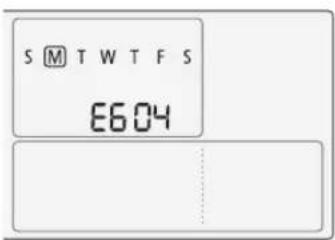
Wired remote controller error
The error code will blink at 0.5 second intervals on the remote controller display, and the address of the error will not be displayed.
Use of wired remote controller installation / service mode
Use of installation/service mode
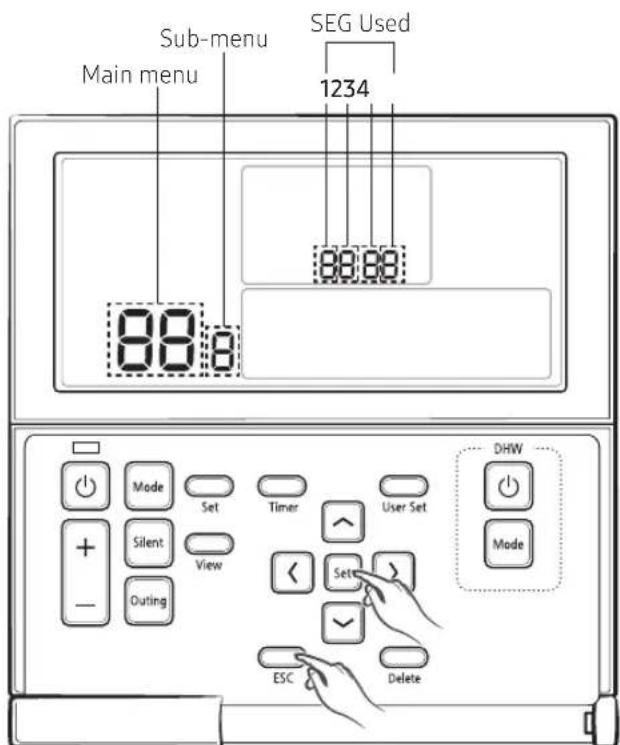
1. If you want to use the installation/service mode for your wired remote controller, press the Set and ESC buttons at the same time for more than 3 seconds.
You will enter the installation/service settings, and the 'main menu' will be displayed.
2. Refer to the list of installation / service setting modes for your wired remote controller on the next page, and select the desired menu.
Using the [X] [ ] buttons, select a main menu number and press the [ ] button to enter the sub-menu setting screen.
Using the [X] [ ] buttons, select a sub-menu number and press the [ ] button to enter the data setting screen.
When you enter the setting stage, the current setting value will be displayed.
Refer to the chart for data settings.
Using the [X] [ ] buttons, change the setting value. Press the [ ] button to move to the next setting value.
Press the Set button to save the setting value and exit to the sub-menu setting screen.
Press the ESC button to exit to normal mode.

NOTE
- When setting the data, you can move the SEG range with the [1/[] buttons.
- While configuring the setting, press the ESC button to exit to the sub-menu setting screen without saving your changes.
- If you do not press any buttons for more than 3 minutes, you will return to normal mode.
Use of wired remote controller installation / service mode
Installation/Service mode

NOTE
- 'NONE' will be displayed for the menu that setting modes don't support. In some cases, the setting may not be possible or it may not be applied though it is set on the unit.
- If communication initialization is needed after saving the setting, the system will reset automatically and communication will be initialized.
| Main menu | Sub-menu | Function | SEG number | Default | Range Unit | ||
| 1 | 1 | Wired remote controller's option function set / Check 1 | Cooling support Y / N 1 | 0 | 0 – Both cooling & heating1 – Heating Only | - | |
| Selecting the standard temperature of cooling and heating | 2 | 0 | 0-Water Outlet temperature1-Indoor temperature | - | |||
| Selecting a standard sensor of indoor temperature | 3 | 0 | 0-Temperature sensor of wired remote controller1-External temperature sensor | - | |||
| Selecting Master/ Slave | 4 | 0 | 0-Master,1-Slave | - | |||
| 2 | Wired remotecontroller's option function set /Check 2 1 | Checking current sensor temperature value | 123 0 | -9~40°C | |||
| 3 | Setting compensation temperature value | 123 0 | -9.9~9.9°C | 0.1 °C | |||
| 4 | Checking the number of connected devices | The number of connected device | 1,2 | 0 | 0~16 | 1 | |
| 5 | Setting desired temperature unit (Available only when the temperature display is °C) | 1 | 1 | 0-1°C, 1-0.5°C,2-0.1°C | - | ||
| 0 | Reset to option setting default value of wiredremote controller | 1 | 0 | 0-Disuse,1-Reset | - | ||
| 2 | 1 | Checking Micom code of wired remote controller | 1234, 4 | - | Micom code - | ||
| 2 | Checking version information of wired remote controller | 1234, 34 | - | Revision date - | |||
| 3 *1) | 1 | Setting Hydro unit option | Hydro unit address Set/Check | 1234 - | *2) | ||
| 2 | Basic Option Set / Check | 1234, 12 | Option code | ||||
| 3 | Install Option Set / Check | 1234, 12 | Option code | ||||
| 4 | Install (2) Option Set / Check | 1234, 12 | Option code | ||||
| 4 | 1 | View Master Set/Check | Hydro unit View Master Set / Check | 1234, 34 | - Address | ||
| 2 | Master Hydro unit Set/Check | Check the Master Hydro unit address | 1234, 34 | - Address | |||
| 3 | Master Hydro unit Set | 1 | - | 0-Disuse, 1-Use, 2-Reset | |||
| 0 | 1 | Reset | Wired remote controller factory Reset | 1 | 0 | 0-Disuse, 1-Reset | - |
| 2 | Power Master Reset | 1 | 0 | 0-Disuse, 1-Reset | - | ||
| 3 | Addressing Reset (Outdoor unit Reset) | 1 | 0 | 0-Disuse, 1-Reset | - | ||
*1) When entering the main menu 3, set and check the unit address and then move to the sub menu. The unit address will be displayed by blinking SEG 34 (Device ID) and SEG 1234 (Control Layer, Set Layer address).
*2) 1. Reservation No. 1 display, Main address setting and checking: Range of current main address (SEG 1, 2) and main address setting: 0x00 \~ 0x4F (hexadecimal) 2. Reservation No. 2 display, Group address setting and checking: Range of current group address (SEG 1, 2) and group address setting: 0x00 \~ 0xFE (hexadecimal)
Field specification setting mode of wired remote controller
Use of field specification setting mode
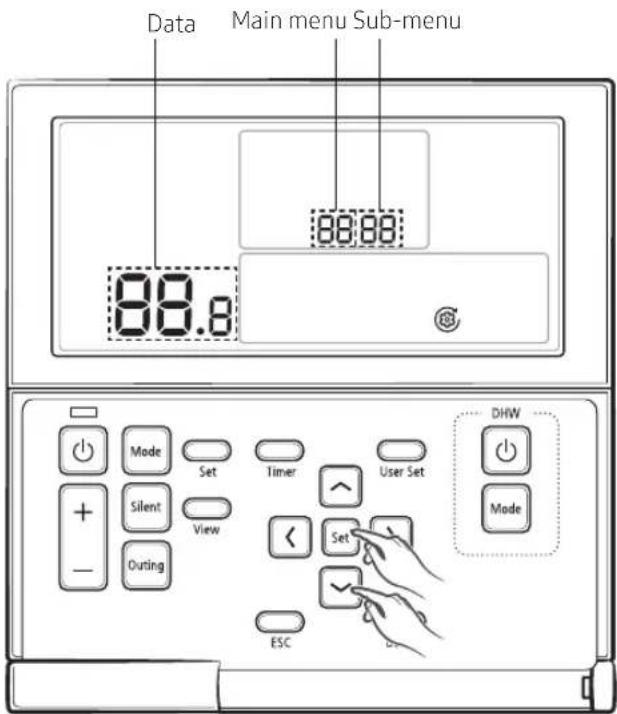
1 If you want to use the field specification setting mode for your wired remote controller, press the Set and [√]buttons at the same time for more than 3 seconds. 2 Refer to the list of field specification for your wired remote controller on the next page, and select the desired menu. - Using the [X[ ] buttons, select a main menu number and press the [ ] button to enter the sub-menu setting screen. - Using the [X[ ] buttons, select a sub-menu number and press the [] button to enter data setting screen. - When you enter the setting stage, the current setting value will be displayed. • Refer to the chart for data settings. - Using the [X[] buttons, change the setting value and press the Set button to save the setting value. Setting value will be displayed when it is saved. - Press the [ ] button to move previous setting value. - While configuring the sub manu setting, press the ESC button to exit to normal menu.

NOTE
- While configuring the setting, press the ESC button to exit to the sub-menu setting screen without saving your changes.
- When you don't enter any buttons for more than 3 minutes, you will be back to normal mode.
Use of field specification checking mode
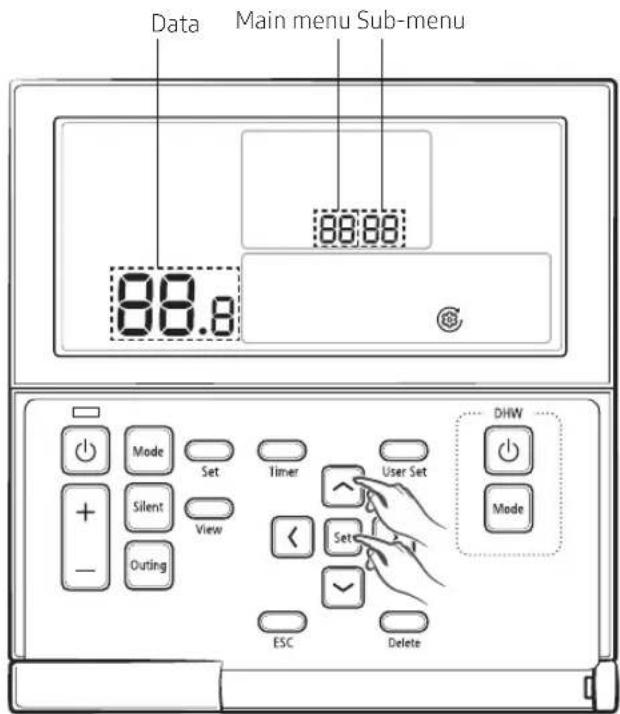
1 If you want to use the field specification checking mode for your wired remote controller, press the Set and [A] buttons at the same time for more than 3 seconds.
2 Refer to the list of field specification for your wired remote controller on the next page, and select the desired menu.
- Using the [X[ ] buttons, select a main menu number and press the [] button to enter the sub-menu checking screen.
- Using the [X[] buttons, select a sub-menu number and press the [] button to enter data checking screen.
- When you enter the checking stage, the current setting value will be displayed.
- Press the [ ] button to move previous setting value.
- While configuring the sub manu setting, press the ESC button to exit to normal menu.

NOTE
- While configuring the checking, press the ESC button to exit to the sub-menu setting screen.
- When you don't enter any buttons for more than 3 minutes, you will be back to normal mode.
Field Setting Value (FSV) Table

NOTE
- Reset the power after changing the Field Setting Value.
Code 10**: Upper and lower temperature limits of each operation mode of wired remote controller: Heating (Water Out, Room), Cooling (Water Out, Room), DHW (Tank).
Code 20**: Water law design and external room thermostat: Heating (2 WL's for floor & FCU), Cooling (2 WL's for floor & FCU), WL & Thermostat types.
| Field Setting Value | ||||||||
| Main Menu & Code | Sub Menu Function | Description | Sub Code | Default Min | Max Step | Unit | ||
| Remote Controller Setting Range Code 10** | Water Out Temp for Cooling | Max ** | 11 25 18 25 | °C | ||||
| Min | **12 | 16 | 5 | 18 | 1 | °C | ||
| Room Temp for Cooling | Max | **21 | 30 | 28 | 30 | 1 | °C | |
| Min | **22 | 18 | 18 | 28 | 1 | °C | ||
| Water Out Temp for Heating | Max | **31 | 55 | 37 | 55 | 1 | °C | |
| Min | **32 | 25 | 15 | 37 | 1 | °C | ||
| Room Temp for heating | Max | **41 | 30 | 18 | 30 | 1 | °C | |
| Min | **42 | 16 | 16 | 18 | 1 | °C | ||
| DHW Tank Temp | Max | **51 | 50 | 50 | 70 | 1 | °C | |
| Min | **52 | 40 | 30 | 40 | 1 | °C | ||
| Water Law Code 20** | Outdoor Temp for Water Law (Heating) | Point 1 | **11 | -10 | -20 | 5 | 1 | °C |
| Point 2 | **12 | 15 | 10 | 20 | 1 | °C | ||
| Water Out Temp for WL1 Heating (WL1-Floor) | Point 1 | **21 | 40 | 17 | 55 | 1 | °C | |
| Point 2 | **22 | 25 | 17 | 55 | 1 | °C | ||
| Water Out Temp for WL2 Heating (WL2-Fan Coil Unit) | Point 1 | **31 | 50 | 17 | 55 | 1 | °C | |
| Point 2 | **32 | 35 | 17 | 55 | 1 | °C | ||
| Heating Water Law for Auto Mode | WL Type | **41 | 1(WL1) | 1 | 2 | - | - | |
| Outdoor Temp for Water Law (Cooling) | Point 1 | **51 | 30 | 25 | 35 | 1 | °C | |
| Point 2 | **52 | 40 | 35 | 45 | 1 | °C | ||
| Water Out Temp for WL1 Cooling (WL1-Floor) | Point 1 | **61 | 25 | 5 | 25 | 1 | °C | |
| Point 2 | **62 | 18 | 5 | 25 | 1 | °C | ||
| Water Out Temp for WL2 Cooling (WL2-Fan Coil Unit) | Point 1 | **71 | 18 | 5 | 25 | 1 | °C | |
| Point 2 | **72 | 5 | 5 | 25 | 1 | °C | ||
| Cooling Water Law for Auto Mode | WL Type | **81 | 1(WL1) | 1 | 2 | - | - | |
| External Thermostat Application | #1 (Floor) | **91 | 0(No) | 0 | 4 | 1 | - | |
| #2 (FCU) | **92 | 0(No) | 0 | 4 | 1 | - | ||
Code 30**: User's options for domestic hot water (DHW) tank heating.
3011: Application of DHW tank in user's system. 302: Heat pump variables for tank temp. control and combination with booster heater. 303: Booster heater variables for combination with heat pump. 304: Periodical disinfection heating of water tank. 305: Off timer for power DHW mode by Forced DHW of wired remote controller. 306: "1" Combination of external field solar panel with heat pump for DHW heating; "2" Application of DHW Tank thermostat in user's system. 307: Default direction of the DHW valve or Zone #1, #2 valve.
When the 3-way valve is applied to DHW Valve terminal block instead of 2-way valve, default direction is Space Heating (Room).
| Field Setting Value | ||||||||
| Main Menu & Code | Sub Menu Function Description | Sub Code | Default | Min Max | Step Unit | |||
| DHW Code 30** | Domestic Hot Water Tank | Application **1 | 10 (No) | 0 2 1 - | ||||
| Heat Pump | Max Temp | **21 | 50 | 45 | 50 | 1 | °C | |
| Stop | **22 | 2 | 0 | 10 | 1 | °C | ||
| Start | **23 | 5 | 5 | 20 | 1 | °C | ||
| Min. Space heating/Cooling operation time | **24 | 5 | 1 | 20 | 1 | min | ||
| Max. DHW operation time | **25 | 30 | 5 | 95 | 5 | min | ||
| Max. Space heating/Cooling operation time | **26 | 3 | 0.5 | 10 | 0.5 | hour | ||
| Booster Heater | Application | **31 | 1 (On) | 0(Off) | 1 | - | - | |
| Delay Time | **32 | 20 | 20 | 95 | 5 | min | ||
| Overshoot | **33 | 0 | 0 | 4 | 1 | °C | ||
| Disinfection | Application | **41 | 1 (On) | 0(Off) | 1 | - | - | |
| Interval | **42 | Fri (5) | Sun(0) | All (7) | 1 | day | ||
| Start Time | **43 | 23 | 0 | 23 | 1 | o'clock | ||
| Target Temp | **44 | 70 | 40 | 70 | 5 | °C | ||
| Duration | **45 | 10 | 5 | 60 | 5 | min | ||
| Max time | **46 | 8 | 1 | 24 | 1 | hour | ||
| Forced DHW operation | Timer OFF Function | **51 | 0 (No) | 0 | 1 (Yes) | - | - | |
| Timer Duration | **52 | 6 | 3 | 30 | 1 | (x10) min | ||
| Solar Panel/DHW Thermostat | H/P Combination | **61 | 0 (No) | 0 | 2 | 1 | - | |
| Direction of DHW valve | DHW Tank **71 | 0 (Room) | 0 | 1 (Tank) | - | - | ||
Field Setting Value (FSV) Table
Code 40**: User's options for heating devices including internal backup heater and external boiler.
401: Space/DHW heating priority and control variables.
402: Backup/Booster heater priority and control variables.
403: Additional backup boiler operating variables.
Code 50**: User's options for extra functions.
501: New target temperatures of each mode by "Outgoing" hot key of remote controller.
502: Temperature difference between before & after values in "Economic" DHW mode.
503: TDM (time division multi) variables (TDM product only).
504: Power Peak control for Smart Grid.
| Field Setting Value | ||||||||
| Main Menu & Code | Sub Menu Function | Description | Sub Code | Default | Min Max Step Unit | |||
| Heating Code 40×× | Heat Pump | Heating/DHW Priority ✘ | ×11 0 (DHW) 0 | 1 (Heating) | - | - | ||
| Outdoor Temp for Priority | ××12 | 0 | -15 | 20 | 1 | °C | ||
| Heating Off | ××13 | 35 | 14 | 35 | 1 | °C | ||
| Backup Heater | Application | ××21 | 0 (No) | 0 | 1 (Yes) | - | - | |
| BUH/BSH Priority | ××22 | 0 (Both) | 0 | 2 (BSH) | 1 | - | ||
| Cold weather compensation | ××23 | 1 (Yes) | 0 (No) | 1 | - | - | ||
| Threshold Temp | ××24 | 0 | -25 | 35 | 1 | °C | ||
| Defrost Backup Temp. | ××25 | 15 | 10 | 55 | 5 | °C | ||
| Backup Boiler | Application | ××31 | 0 (No) | 0 | 1 (Yes) | - | - | |
| Boiler Priority | ××32 | 0 (No) | 0 | 1 (Yes) | - | - | ||
| Threshold Temp | ××33 | -15 | -20 | 5 | 1 | °C | ||
| Mixing valve | Application | ××41 | 0 (No) | 0 | 2 | 1 | - | |
| Target ΔT(Heating) | ××42 | 10 | 5 | 15 | 1 | °C | ||
| Target ΔT(Cooling) | ××43 | 10 | 5 | 15 | 1 | °C | ||
| Control factor | ××44 | 2 | 1 | 5 | 1 | - | ||
| Control interval | ××45 | 2 | 1 | 30 | 1 | min | ||
| Running Time | ××46 | 9 | 6 | 24 | 3 | (x10) sec | ||
| Inverter Pump | Application | ××51 | 1 | 0 | 2 | - | - | |
| Target ΔT | ××52 | 5 | 2 | 8 | 1 | °C | ||
| Control factor | ××53 | 2 | 1 | 3 | 1 | - | ||
| Others Code 50×× | Outing | Water Out Temp for Cooling | ××11 | 25 | 5 | 25 | 1 | °C |
| Room Temp for Cooling | ××12 | 30 | 18 | 30 | 1 | °C | ||
| Water Out Temp for Heating | ××13 | 15 | 15 | 55 | 1 | °C | ||
| Room Temp for Heating | ××14 | 16 | 16 | 30 | 1 | °C | ||
| Others Code 50** | Outing | Auto Cooling WL1 Temp | × × 15 | 25 | 5 | 25 | 1 | °C |
| Auto Cooling WL2 Temp | × × 16 | 25 | 5 | 25 | 1 | °C | ||
| Auto Heating WL1 Temp | × × 17 | 15 | 15 | 55 | 1 | °C | ||
| Auto Heating WL2 Temp | × × 18 | 15 | 15 | 55 | 1 | °C | ||
| Target Tank Temp | × × 19 | 30 | 30 | 70 | 1 | °C | ||
| DHW Saving Mode | Temp Difference | × × 21 | 5 | 0 | 40 | 1 | °C | |
| TDM Variable (TDM product Only) | Priority Max. Operation Time | × × 31 | 30 | 10 | 90 | 5 | min | |
| Non Priority Min. Operation Time | × × 32 | 5 | 3 | 60 | 1 | min | ||
| A2A / DHW Priority | × × 33 | 0 | 0 (A2A) | 1 (DHW) | 1 | - | ||
| Power Peak Control | Application | × × 41 | 0 (No) | 0 | 1 (Yes) | - | - | |
| Select forced off parts | × × 42 | 0 (All) | 0 | 3 | 1 | - | ||
| Using input voltage | × × 43 | 1 (High) | 0 (Low) | 1 | - | - | ||
| Frequency Ratio Control | × × 51 | 0 (No) | 0 | 1 (Yes) | - | |||
Remote Controller Setting Range : Code 10**
| Field Setting Value | ||||||||
| Main Menu & Code | Sub Menu Function | Description | Sub Code | Default | Min | Max | Step | Unit |
| Remote Controller Setting Range Code 10** | Water Out Temp for Cooling | Max | × × 11 | 25 | 18 | 25 | 1 | °C |
| Min | × × 12 | 16 | 5 | 18 | 1 | °C | ||
| Room Temp for Cooling | Max | × × 21 | 30 | 28 | 30 | 1 | °C | |
| Min | × × 22 | 18 | 18 | 28 | 1 | °C | ||
| Water Out Temp for Heating | Max | × × 31 | 55 | 37 | 55 | 1 | °C | |
| Min | × × 32 | 25 | 15 | 37 | 1 | °C | ||
| Room Temp for heating | Max | × × 41 | 30 | 18 | 30 | 1 | °C | |
| Min | × × 42 | 16 | 16 | 18 | 1 | °C | ||
| DHW Tank Temp | Max | × × 51 | 50 | 50 | 70 | 1 | °C | |
| Min | × × 52 | 40 | 30 | 40 | 1 | °C | ||
Space Cooling
- Target water outlet temperature : Upper limit(#1011, Default 25°C, Range : 18 \~ 25°C), Lower limit(#1012, Default 16°C, Range : 5 \~ 18°C)
- With this default FSV settings, user can change the target water outlet temperature within the range of 5 25°C for cooling.
- Target room temperature : Upper limit(#1021, Default 30°C), Lower limit(#1022, Default 18°C)
- With this default FSV settings, user can change the target room temperature within the range of 18 30° C for cooling.
Space Heating
- Target water outlet temperature : Upper limit(#1031, Default 55°C, Range : 37 \~ 55°C), Lower limit(#1032, Default 25°C, Range : 15 \~ 37°C)
- With this default FSV settings, user can change the target water outlet temperature within the range of 25 55° C for heating.
- Target room temperature : Upper limit(#1041, Default 30°C), Lower limit(#1042, Default 16°C)
- With this default FSV settings, user can change the target room temperature within the range of 16 30° C for heating.
DHW Heating
- Target DHW tank temperature : Upper limit(#1051, Default 50°C, Range : 50 \~ 70°C), Lower limit(#1052, Default 40°C, Range : 30 \~ 40°C)
- With this default FSV settings, user can change the target tank temperature within the range of 40 50° C for DHW heating.

NOTE
- The FSV #3011 in the wired remote controller should be set to "1 or 2" to use DHW function.
Water Law & Room Thermostat : Code 20**
| Field Setting Value | ||||||||
| Main Menu & Code | Sub Menu Function Description | Sub Code | Default | Min Max Step Unit | ||||
| Water Law Code 20×× | Outdoor Temp for Water Law (Heating) | Point 1 | ××11 -10 | -20 5 1 °C | ||||
| Point 2 | ××12 15 | 10 20 1 °C | ||||||
| Water Out Temp for WL1 Heating (WL1-Floor) | Point 1 | ××21 | 40 | 17 | 55 | 1 | °C | |
| Point 2 | ××22 25 | 17 55 | 1 °C | |||||
| Water Out Temp for WL2 Heating (WL2-Fan Coil Unit) | Point 1 | ××31 50 | 17 55 | 1 °C | ||||
| Point 2 | ××32 | 35 | 17 | 55 | 1 | °C | ||
| Heating Water Law for Auto Mode | WL Type | ××41 | 1(WL1) | 1 | 2 | - | - | |
| Outdoor Temp for Water Law (Cooling) | Point 1 | ××51 | 30 | 25 | 35 | 1 | °C | |
| Point 2 | ××52 | 40 | 35 | 45 | 1 | °C | ||
| Water Out Temp for WL1 Cooling (WL1-Floor) | Point 1 | ××61 | 25 | 5 | 25 | 1 | °C | |
| Point 2 | ××62 | 18 | 5 | 25 | 1 | °C | ||
| Water Out Temp for WL2 Cooling (WL2-Fan Coil Unit) | Point 1 | ××71 | 18 | 5 | 25 | 1 | °C | |
| Point 2 | ××72 | 5 | 5 | 25 | 1 | °C | ||
| Cooling Water Law for Auto Mode | WL Type | ××81 | 1(WL1) | 1 | 2 | - | - | |
| External Thermostat Application | #1(Floor) | ××91 | 0(No) | 0 | 4 | 1 | - | |
| #2(FCU) | ××92 | 0(No) | 0 | 4 | 1 | - | ||
Water Law for Heating
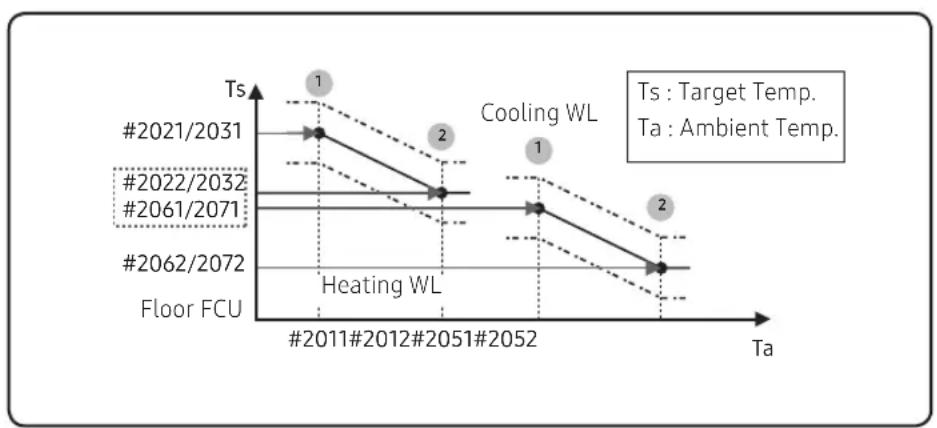
- Outdoor air temperature range : Lower limit 1 (#2011, Default -10°C, Range : -20 \~ 5°C), Upper limit 2 (#2012, Default 15°C, Range : 10 \~ 20°C)
- With this default settings, the water outlet temperature by heating water law can be changed within the outdoor temperature range of -10 15° C .
• Water out temperature range for floor/FCU applications respectively :
Upper limit 1 (#2021/2031, Default 40/50°C, Range: 17 \~ 55°C), Lower limit 2 (#2022/2032, Default 25/35°C, Range: 17 \~ 55°C)
- With this default settings, the water outlet temperature by heating water law can be changed within the range of 25/35 40/50°C .
- Type of water law for according to heating devices(floor/FCU) : #2041(Default "1"(WL1 for floor)), "2"(WL2 for FCU or radiator)
Water Law for Cooling
- Outdoor air temperature range: Lower limit 1 (#2051, Default 30°C , Range: 25 35°C ), Upper limit 2 (#2052, Default 40°C , Range: 35 45°C )
- With this default settings, the water outlet temperature by cooling water law can be changed within the outdoor temperature range of 30 40° C .
- Water out temperature range for floor/FCU applications respectively: Upper limit 1 (#2061/2071, Default 25/18°C), Lower limit 2 (#2062/2072, Default 18/5°C) - With this default settings, the water outlet temperature by cooling water law can be changed within the range of 5/18 \~ 18/25°C.
- Type of water law for according to cooling devices(floor/FCU): #2081(Default "1"(WL1 for floor), "2"(WL2 for FCU or radiator)
External Room Thermostat (Field Option)
- Terminal #1 (#2091, Default "0" for no usage), #2 (#2092, Default "0" for no usage)
- To use wired remote controller for heating/cooling operation, both of the above settings should be set to "0" simultaneously. If not, thermostat controls system.
- If set to #2091/#2092 1, the compressor can be turned on or off only by the thermostat.
- If set to #2091/#2092 2~4, the compressor can be turned on or off by the thermostat or according to the WL discharged water temperature. (#2092 2: WL Thermo off → Water pump off; #2092 3: WL Thermo off → Water pump on; #2092 4: WL Thermo off → Water pump 7min off → 3min on → ...).
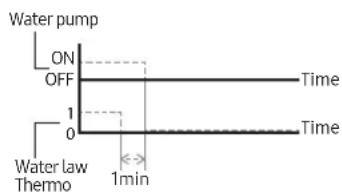
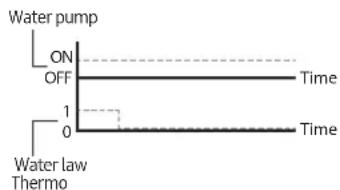
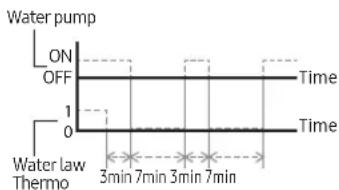
- Types of water law used by room thermostat operation will follow the FSV settings defined in #2041 (heating) and #2081 (cooling) respectively.
- During the thermostat operation, the user has the possibility to shift up or down the target water temperature within the range of -5 to +5°C.
- When the remote controller is used, floor valve should be connected to zone #1 and the FCU valve should be separately connected to zone #2 of the Hydro Unit PBA.
- When only floor cooling/heating is installed and if the Water Law or outlet water temperature is too low, 2way valve may close and E911 error may occur.
- When the floor and FCU units are installed together and operating in cooling mode, floor valve may close and E911 may occur to prevent floor condensation when the outlet water temperature is below 16°C. Therefore FCU should secure minimum value for the flow rate.
- Thermostat #2 which controls FCU has the priority for operation modes and the discharge water temperature.
- Samsung is not responsible for the accidents such as floor condensations which can occur by not connecting the valve to the zone #1 port of the Hydro Unit PBA.
T_U < T_HPMAX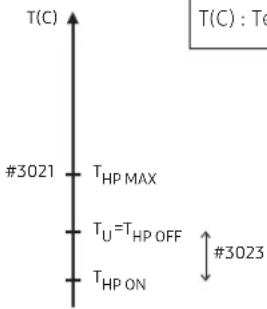
User set temp. T(C) : Temp. (Celsius)
| Field Setting Value | ||||||||
| Main Menu & Code | Sub Menu Function | Description Sub Code | Default Min | Max Step | Unit | |||
| DHW Code 30** | Domestic Hot Water Tank | Application **11 | 0(No) 0 | 2 1 - | ||||
| Heat Pump | Max Temp | **21 | 50 | 45 | 50 | 1 | °C | |
| Stop | **22 | 2 | 0 | 10 | 1 | °C | ||
| Start | **23 | 5 | 5 | 20 | 1 | °C | ||
| Min. Space heating/Cooling operation time | **24 | 5 | 1 | 20 | 1 | min | ||
| Max. DHW operation time | **25 | 30 | 5 | 95 | 5 | min | ||
| Max. Space heating/Cooling operation time | **26 | 3 | 0.5 | 10 | 0.5 | hour | ||
| Booster Heater | Application | **31 | 1(On) | 0(Off) | 1 | - | - | |
| Delay Time | **32 | 20 | 20 | 95 | 5 | min | ||
| Overshoot | **33 | 0 | 0 | 4 | 1 | °C | ||
| Disinfection | Application | **41 | 1(On) | 0(off) | 1 | - | - | |
| Interval | **42 | Fri(5) | Sun(0) | All(7) | 1 | day | ||
| Start Time | **43 | 23 | 0 | 23 | 1 | o'clock | ||
| Target Temp | **44 | 70 | 40 | 70 | 5 | °C | ||
| Duration | **45 | 10 | 5 | 60 | 5 | min | ||
| Max time | **46 | 8 | 1 | 24 | 1 | hour | ||
| Forced DHW operation | Timer OFF Function | **51 | 0(No) | 0 | 1(Yes) | - | - | |
| Timer Duration | **52 | 6 | 3 | 30 | 1 | (x10)min | ||
| Solar Panel/DHW Thermostat | H/P Combination | **61 | 0(No) | 0 | 2 | 1 | - | |
| Direction of DHW valve | DHW Tank | **71 | 0(Room) | 0 | 1(Tank) | - | - | |
DHW Application
The FSV #3011 in the wired remote controller should be set to "1 or 2" to use DHW function.
If FSV #3011 is set to 1, the DHW operation starts based on the thermo on temperature. If FSV #3011 is set to 2, the DHW operation starts based on the thermo off temperature.
(For example, when the current temperature becomes 45°C under the conditions that the thermo on temperature is 43°C and the thermo off temperature is 48°C, the DHW turns off if FSV #3011 is set to 1 and DHW turns on if FSV #3011 is set to 2.)
Heat Pump Variables for Controlling DHW Tank
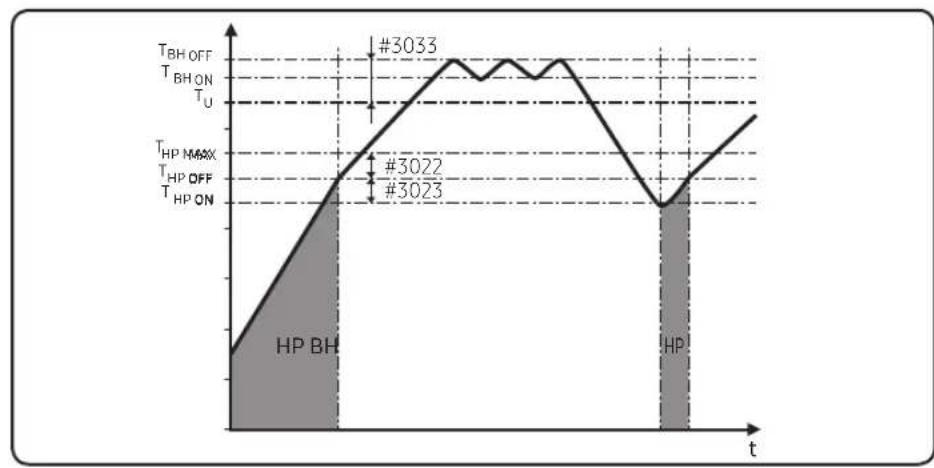
- Maximum DHW tank temperature with R-410A (refrigerant) heat pump operation: FSV #3021, Default 50°C, Range: 45 ~ 50°C.
- Temperature difference determining the heat pump OFF temperature: FSV #3022, Default 2°C, Range: 0 ~ 10°C.
- Temperature difference determining the heat pump ON temperature: FSV #3023, Default 5°C, Range: 5 ~ 20°C.
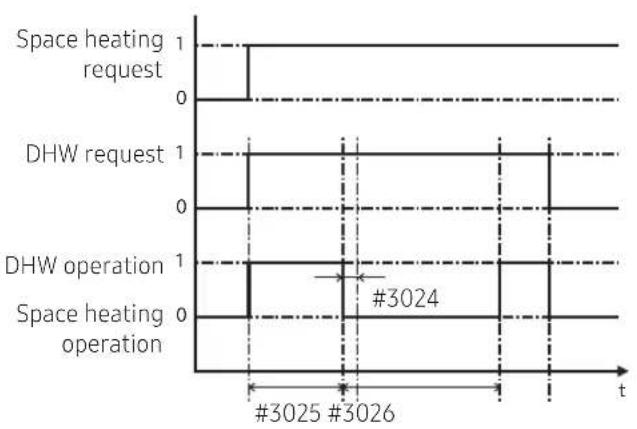
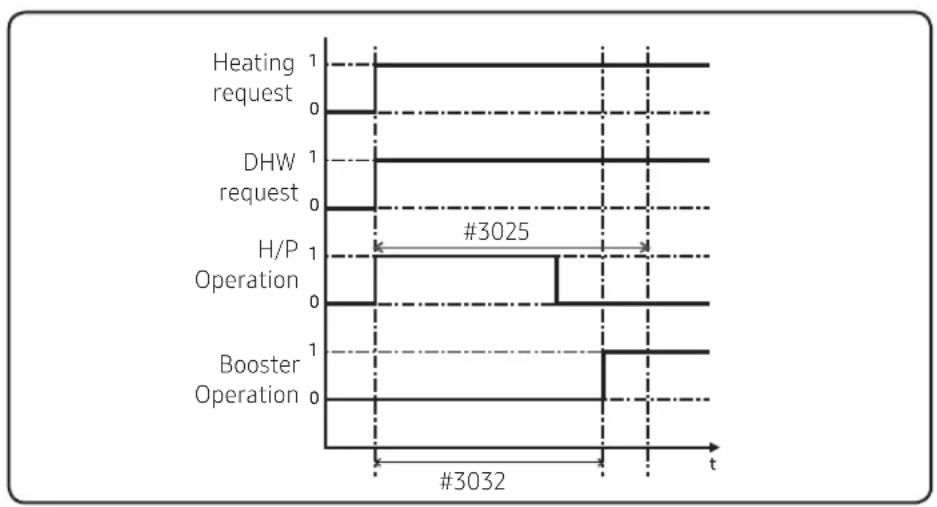
- DHW heating mode timer: Mode timer manages the operation terms when there are simultaneous requests of space heating/cooling and DHW.
- FSV #3024 (minimum Space heating operating time, Default 5 min., Range 1 ~ 20 min.), #3025 (maximum DHW time, Default 30 min., Range 5 ~ 95 min.), #3026 (maximum space heating operation time, Default 3 hour, Range 0.5 ~ 10 hour) – Maximum operation time is applied only when both DHW and Space heating request operation. DHW or Space heating operates continuously until reaching target temperature without time limitation in the single operation.

NOTE
- The FSV #4011 for DHW priority should be set to "0(DHW)" (Default). Space heating gets a priority by setting FSV #4011 "1", but this is only valid when the outdoor temperature is lower than the specified temperature defined by FSV #4012.
Booster Heater Variables for Controlling DHW Tank
- The FSV #3031 should be set to "1(On)" (Default) to use booster heater as an additional heat source for DHW tank.
- Booster heater startup delay timer: In case of DHW request, this timer will delay the operation of booster heater compared to heat pump.
- FSV #3032 (Default 20 min., Range 20 \~ 95 min.), In "Power" DHW mode, the delay timer will be neglected, and the booster starts immediately.
- In "Economic" DHW mode, the DHW heating will be conducted only with heat pump.
- 3032 should be smaller than the maximum H/P time (#3025). If the delay time is set too high, it might take very long time for DHW heating.
- Temperature difference determining the booster heater OFF temperature (T_BH OFF = Tu + #3033): FSV #3033, Default 0°C, Range: 0 \~ 4°C.
- Temperature difference determining the booster heater ON temperature (T_BH ON = T_BH OFF - 2)

NOTE
- The FSV #4022 for booster heater priority should be set to "0 (both)" (Default) or "2" (booster) to use booster heater.
- If not (backup heater priority), the booster heater can be operated in case of no backup heater demand.
Disinfection Function
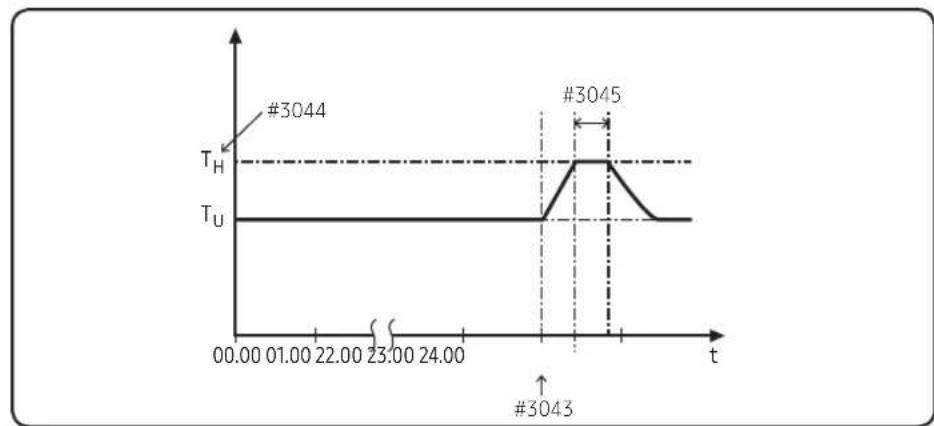
- The FSV #3041 should be set to "1 (On)" (Default) to use the disinfection function.
- Scheduling: Day (#3042, Default "Friday"), starting time (#3043, Default "23:00"), target tank temp. (#3044, Default "70°C"), duration (#3045, Default 10 min.)

NOTE
- The disinfection function is available only when a booster heater is connected.
- Check tank capacity, booster heater capacity, and booster heater for issues if disinfection operation does not work normally over the maximum operation time (E919 error).
Forced DHW by User's Input
- Forced DHW mode can be activated by changing the setting value from the default setting (#3011, "0" (No)).
- Forced DHW mode shall be working depending on Timer setting (#3051, #3052).
Additional Solar panel/DHW thermostat Installation for DHW with Heat Pump (Field Option)
- Solar panel and heat pump are able to operate simultaneously by default setting value. (FSV #3061, "1")
- When using DHW thermostat, set the FSV #3061, "2".
- Zone #1 and #2 valves always keep open except DHW mode in "ON" when the power is "ON" unless changing the FSV #3071. Default: Room direction valves are open and DHW valve is closed.
- Zone #1 and #2 can be open separately or simultaneously but all three zone valves cannot be open or closed at the same time.
- There is one minute delay of 2-way / 3-Way valve closing whereas no delay of valve opening.
- Individual zone control is only available with external thermostat.
| Field Setting Value | ||||||||
| Main Menu & Code | Sub Menu Function | Description | Sub Code | Default | Min Max Step Unit | |||
| Heating Code 40** | Heat Pump | Heating/DHW Priority ¥ | ¥11 0 (DHW) 0 | 1 (Heating) | - | - | ||
| Outdoor Temp for Priority | ¥×12 | 0 | -15 | 20 | 1 | °C | ||
| Heating Off | ¥×13 | 35 | 14 | 35 | 1 | °C | ||
| Backup Heater | Application | ¥×21 | 0 (No) | 0 | 1 (Yes) | - | - | |
| BUH/BSH Priority | ¥×22 | 0 (Both) | 0 | 2 (BSH) | 1 | - | ||
| Cold weather compensation | ¥×23 | 1 (Yes) | 0(No) | 1 | - | - | ||
| Threshold Temp | ¥×24 | 0 | -25 | 35 | 1 | °C | ||
| Defrost Backup Temp. | ¥×25 | 15 | 10 | 55 | 5 | °C | ||
| Backup Boiler | Application | ¥×31 | 0 (No) | 0 | 1 (Yes) | - | - | |
| Boiler Priority | ¥×32 | 0 (No) | 0 | 1 (Yes) | - | - | ||
| Threshold Temp | ¥×33 | -15 | -20 | 5 | 1 | °C | ||
| Mixing valve | Application | ¥×41 | 0 (No) | 0 | 2 | 1 | - | |
| Target ΔT (Heating) | ¥×42 | 10 | 5 | 15 | 1 | °C | ||
| Target ΔT (Cooling) | ¥×43 | 10 | 5 | 15 | 1 | °C | ||
| Control factor | ¥×44 | 2 | 1 | 5 | 1 | - | ||
| Control interval | ¥×45 | 2 | 1 | 30 | 1 | min | ||
| Running Time | ¥×46 | 9 | 6 | 24 | 3 | (x10)sec | ||
| Inverter Pump | Application | ¥×51 | 1 | 0 | 2 | - | - | |
| Target ΔT | ¥×52 | 5 | 2 | 8 | 1 | °C | ||
| Control factor | ¥×53 | 2 | 1 | 3 | 1 | - | ||
Heat Pump Variables for Space Heating
- FSV #4011 for DHW priority is set to "O(DHW)" (Default) as a default. Space heating gets a priority by setting FSV #4011 "1", but this is only valid when the outdoor temperature is lower than the specified temperature defined by FSV #4012.
- Cold weather compensation is applied when the space heating gets a priority (FSV #4011=1). It is due to position of heating coil and booster heater in the water tank. Heating coil is at the bottom part of the water tank and the booster heater is located at the middle part of the tank. So the heating coil is efficient to heat the whole water in the tank. Chances that hot water flows through the heating coil decrease with the space heating priority. And lower part of water in the tank might not get enough heat with the booster heater.
- Space heating off temperature (FSV #4013, Default "35°C", Range 14 \~ 35°C): At high outdoor temperature above this value, the space heating will be turned off, to avoid overheating.
Backup Heater Variables for Space Heating
- The FSV #4021 should be set to 1 (Yes) to use 2-stage electric backup heater in hydro unit as an additional heat source.
- To compensate the lowered heat pump heating performance under very cold weather conditions, the FSV #4023 should be set to "1 (On)" (Default).
- The threshold temperature to use backup heater for cold weather compensation: FSV #4024, Default "0°C", Range -25 \~ 35°C
- The backup heater operation is restricted to save energy in the threshold temperature range.
- The FSV #4022 for backup heater priority should be set to "0 (both)" (Default) or "1" (backup) to use backup heater. If not (booster heater priority), the backup heater can be operated in case of no booster heater demand.
- The threshold temperature for backup heater operation during defrost mode to prevent cold draft because of chilled water can be controlled by adjusting FSV #4025. Under FSV #4025 of water outlet temperature, backup heater will be turned on.

NOTE
- To use both heaters together at the same time, please check the capacity of the power circuit breaker of your house before use.
External Backup Boiler for Space Heating (Field Option)
- The FSV #4031 should be set to "1 (Yes)" to use a backup boiler as an additional heat source. (default: "0 (No installation)")
- Priority of backup boiler and heat pump is defined by FSV #4032 (default: "0 (OFF)")
- To compensate the lowered heat pump heating performance under very cold weather conditions, the backup boiler operates instead of heat pump under the threshold temperature (FSV #4033, Default “-15°C”, Range -20 \~ 5°C).
Mixing valve Installation (Field Option)
- The FSV #4041 should be set to "1 or 2" to use mixing valve. ※ 4041 = 1 : Controlled based on the temperature difference (4042, 4043) ※ 4041 =2 : Controlled based on the temperature difference of the WL value
ex) Heating <#4041=1> <#4041=2>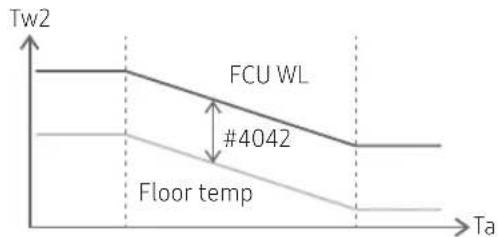
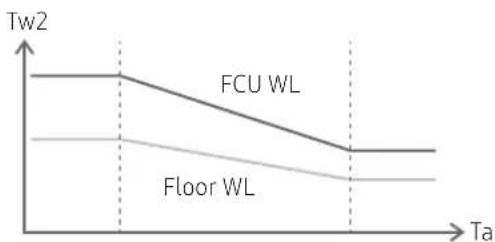
- FSV #4042 / #4043 is for adjusting temperature difference between Tw3(Tw2) and Tw4.
- When using mixing valve, FSV #4046 should be matched with mixing valve running time characteristic.
Inverter Pump Installation (Field Option)
- FSV #4051=1(Default) : Inverter pump use + Output 100%, FSV #4051=2 : Inverter pump use + Output 70%, FSV #4051=0 : Inverter pump Not use.
- FSV #4052 is for adjusting temperature difference between Tw2 and Tw1.

NOTE
- Tw1 (Inlet Water Temp), Tw2 (Discharge Water Temp), Tw3 (Backup Heater outlet Water Temp), Tw4 (Mixing valve Temp.)
Others : Code 50**
| Field Setting Value | ||||||||
| Main Menu & Code | Sub Menu Function | Description | Sub Code | Default | Min Max | Step Unit | ||
| Others Code 50×× | Outing | Water Out Temp for Cooling | ××11 | 25 | 5 | 25 | 1 | °C |
| Room Temp for Cooling | ××12 | 30 | 18 | 30 | 1 | °C | ||
| Water Out Temp for Heating | ××13 | 15 | 15 | 55 | 1 | °C | ||
| Room Temp for Heating | ××14 | 16 | 16 | 30 | 1 | °C | ||
| Auto Cooling WL1 Temp | ××15 | 25 | 5 | 25 | 1 | °C | ||
| Auto Cooling WL2 Temp | ××16 | 25 | 5 | 25 | 1 | °C | ||
| Auto Heating WL1 Temp | ××17 | 15 | 15 | 55 | 1 | °C | ||
| Auto Heating WL2 Temp | ××18 | 15 | 15 | 55 | 1 | °C | ||
| Target Tank Temp | ××19 | 30 | 30 | 70 | 1 | °C | ||
| DHW Saving Mode | Temp Difference | ××21 | 5 | 0 | 40 | 1 | °C | |
| TDM Variable (TDM product Only) | Priority Max. Operation Time | ××31 | 30 | 10 | 90 | 5 | min | |
| Non Priority Min. Operation Time | ××32 | 5 | 3 | 60 | 1 | min | ||
| A2A / DHW Priority | ××33 | 0 | 0 (A2A) | 1 (DHW) | 1 | - | ||
| Power Peak Control | Application | ××41 | 0 (No) | 0 | 1 (Yes) | - | - | |
| Select forced off parts | ××42 | 0 (All) | 0 | 3 | 1 | - | ||
| Using input voltage | ××43 | 1 (High) | 0 (Low) | 1 | - | - | ||
| Frequency Ratio Control | ××51 | 0 (No) | 0 | 1 (Yes) | - | - | ||
Outing Mode (Hot Key of Wired Remote Controller)
- All the target temperatures – space heating and cooling, water law, DHW, Room temperature – are set to the values defined in the above table under the holiday mode (outing hot key).

NOTE
- With the lowered target temperatures (FSV #5011 \~ #5019), the system operates normally.
- DHW heating only by the heat pump to save energy. Target DHW temperature is lower than the temperature set by user. The temperature difference is defined by FSV #5021. (default: 5°C)
- If user sets the temperature 45°C , the system sets the target temperature 40°C with the default setting.
Peak Power Control
- If users make contracts with local electric power company for limiting the amount of power consumption when a surge in power usage, users can set FSV of "Forced off".
- According to FSV (#5041), Default is Non-usage. And According to FSV (#5042), If input is "0 (default)", Back up heater (BUH) is unavailable while external contact is high.
If input is "1", Only Compressor(Heat Pump) is available.
If input is "2", Only Booster Heater (BSH) is available.
If input is "3", nothing is available.
- Applying the control when power voltage of input contact is high is default. According to FSV (#5043), it is available to adopt this logic in low condition exceptionally.
- When applying to this logic, SAMSUNG controller come to get "Thermo off" condition for all operation.
- If not used for a long time, anti-freeze fluid shall be used for preventing damage to the unit in cold condition.
TDM (Time-Division Multi) Variables (TDM product Only)
- Please refer to page 27.
Power peak control for Smart Grid
| [D-00] Compressor Back up heater Booster heater | ||
| 0 (Default) Permitted Forced off Permitted | ||
| 1 Permitted Forced off Forced off | ||
| 2 Forced off Forced off Permitted | ||
| 3 Forced off Forced off Forced off | ||
Maintenance activities
- In order to ensure optimal availability of the unit, a number of checks and inspections on the unit and the field wiring have to be carried out at regular intervals, preferably yearly. This maintenance should be carried out by a SAMSUNG local technician. Besides keeping the remote controller clean with a soft damp cloth, no maintenance is required by the operator.

WARNING
- During longer periods of standstill, e.g., during summer with a heating-only application, it is very important NOT TO SWITCH OFF THE POWER SUPPLY to the unit.
- Switching off the power supply stops the automatic repetitive movement of the motor in order to prevent it from getting jammed.
This product contains fluorinated greenhouse gases covered by the Kyoto Protocol.
Refrigerant type: R-410A GWP (1) value: 2088 (GWP = global warming potential)
- Periodical inspections for refrigerant leaks may be required depending on European or local legislation. Please contact your local dealer for more information.
Emergency heating / Emergency hot water supply
- Heating function is performed only by the backup heater if the outdoor unit malfunctions (available only when a backup heater is connected).
- Enabling the function: Turn off the Control kit Dip S/W #1, and then turn the power off and on.
- Disabling the function: Turn on the Control kit Dip S/W #1, and then turn the power off and on.
- Default operation: Automatic heating is performed at a set temperature of 35°C.
Maintaining the unit
- Hot water is supplied only by the booster heater if the outdoor unit malfunctions.
- Enabling the function: Turn off the Control kit Dip S/W #2, and then turn the power off and on.
- Disabling the function: Turn on the Control kit Dip S/W #2, and then turn the power off and on.
- Default operation: Automatic hot water supply is performed at a set temperature of 50°C.
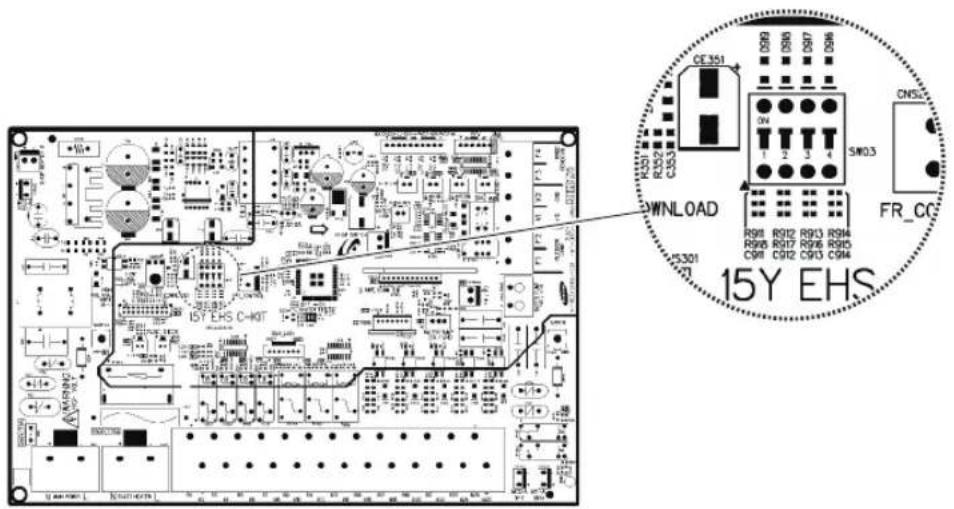
Troubleshooting tips
If the unit has some problem to work properly, error codes will be displayed on the wired remote controller. The following table describes the explanation of the error codes.
| Display Explanation | |
| 122 | EVA Inlet temp sensor SHORT or OPEN |
| 123 | EVA Outlet temp sensor SHORT or OPEN |
| 653 | Wired remote controller temp sensor SHORT or OPEN |
| 901 | Water Inlet temp sensor SHORT or OPEN |
| 902 | PHE Outlet temp sensor SHORT or OPEN |
| 903 | Water outlet (Back up Heater) temp sensor SHORT or OPEN |
| 904 | Water TANK temp sensor SHORT or OPEN |
| 916 | Mixing valve temp sensor SHORT or OPEN (When FSV #4041 “1 or 2”) |
![graph TD A["Heater"] --> B["Hydro Unit"] B --> C["Water Tank temp sensor E904"] B --> D["Water Inlet E901"] B --> E["Water Outlet Back up Heater E903"] B --> F["PHE Outlet E902"] B --> G["PHE"] B --> H["EVA Outlet E123 Ref' Out"] B --> I["EVA Inlet E122 Ref' In"]](/content/2026/05/1050636/images/cd368269d77b1e9be663c55e9f0733fffd75b9a42611165f52007b80c4af443e.jpg)
Troubleshooting tips
Communication
| Display Explanation | |
| 601 | Communication error between remote controller and the Hydro unit |
| 604 | Tracking error between remote controller and the Hydro unit |
| 654 | Memory (EEPROM) Read/Write Error (Wired remote Controller data error) |
E601, E604 E654
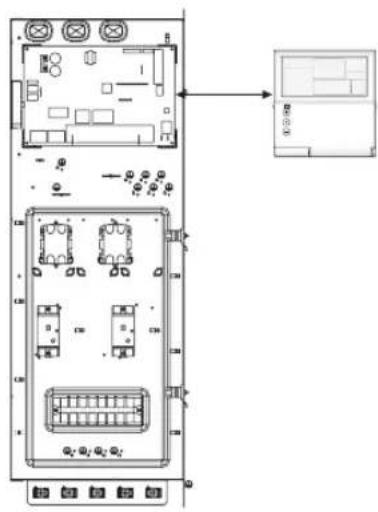
- MEMORY(EEPROM) Read/Write Error (Wired controller data error)
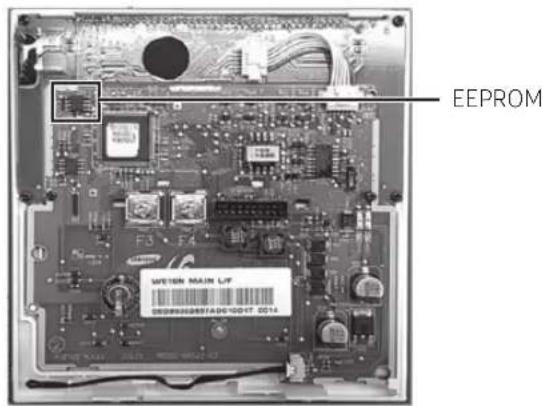
Water pump & Flow S/W
| Display Explanation | |
| 911 | Flow S/W OFF errorIn case of flow S/W OFF in 30sec during water pump signal is ON(Starting)In case of flow S/W OFF in 15sec during water pump signal is ON (After starting) |
| 912 | Flow S/W ON errorIn case of flow S/W ON in 10min during water pump signal is OFF |
E911
• Water pump ON (Flow S/W off) • Water pump ON (Flow S/W off): NOT enough water flow
Water flow < 7LPM ( **090** ) / 12LPM ( **160** )
E912
• Water pump OFF (Flow S/W on)
Water flow > 7LPM (*090*) / 12LPM (*160*)
If the unit has some problems and does not work normally, an error code is shown on the OUTDOOR UNIT main PBA or LCD of the wired remote controller.
| Display Explanation Error Source | ||
| 101 Hydro Unit / OUTDOOR UNIT wire connection error Hydro Unit, OUTDOOR UNIT | ||
| 122 EVA Inlet temp sensor SHORT or OPEN Hydro Unit | ||
| 123 EVA Outlet temp sensor SHORT or OPEN Hydro Unit | ||
| 162 EEPROM Error Hydro Unit | ||
| 198 Error of Terminal Block's Thermal Fuse (Open) Hydro Unit | ||
| 201 Hydro Unit/OUTDOOR UNIT communication error (Matching error) Hydro Unit, OUTDOOR UNIT | ||
| 202 Hydro Unit/OUTDOOR UNIT communication error (3 min) | Hydro Unit, OUTDOOR UNIT | |
| 203 Communication error between INVERTER and MAIN MICOM (6 min) | OUTDOOR UNIT | |
| 221 OUTDOOR UNIT temperature sensor error OUTDOOR UNIT | ||
| 231 condenser temperature sensor error OUTDOOR UNIT | ||
| 251 Discharge temperature sensor error OUTDOOR UNIT | ||
| 320 OLP sensor error OUTDOOR UNIT | ||
| 403 Detection of OUTDOOR UNIT compressor freezing (During cooling operation) | OUTDOOR UNIT | |
| 404 Protection of OUTDOOR UNIT when it is overload (during Safety Start, Normal operation state) | OUTDOOR UNIT | |
| 407 Comp down due to high pressure OUTDOOR UNIT | ||
| 416 Discharge of a compressor is overheated OUTDOOR UNIT | ||
| 419 OUTDOOR UNIT EEV operation error OUTDOOR UNIT | ||
| 425 Power source line missing error (only for 3-phase model) OUTDOOR UNIT | ||
| 440 Heating operation blocked (outdoor temperature over 35°C) OUTDOOR UNIT | ||
| 441 Cooling operation blocked (outdoor temperature under 9°C) OUTDOOR UNIT | ||
| 458 OUTDOOR UNIT fan1 error OUTDOOR UNIT | ||
| 461 [Inverter] Compressor startup error OUTDOOR UNIT | ||
| 462 [Inverter] Total current error/PFC over current error OUTDOOR UNIT | ||
| 463 OLP is overheated OUTDOOR UNIT | ||
| 464 [Inverter] IPM over current error OUTDOOR UNIT | ||
| 465 Compressor V limit error OUTDOOR UNIT | ||
| 466 DC LINK over/low voltage error OUTDOOR UNIT | ||
| 467 [Inverter] Compressor rotation error OUTDOOR UNIT | ||
| 468 [Inverter] Current sensor error OUTDOOR UNIT | ||
| 469 [Inverter] DC LINK voltage sensor error OUTDOOR UNIT | ||
| 470 Outdoor unit EEPROM Read/Write error (H/W) OUTDOOR UNIT | ||
| 471 Outdoor unit EEPROM Read/Write error (Option) OUTDOOR UNIT | ||
| 474 IPM(IGBT Module) or PFCM temperature sensor Error OUTDOOR UNIT | ||
| 475 OUTDOOR UNIT fan2 error OUTDOOR UNIT | ||
| 484 PFC Overload Error OUTDOOR UNIT | ||
| 485 Input current sensor error OUTDOOR UNIT | ||
| 500 IPM is overheated OUTDOOR UNIT | ||
| 554 Gas leak error OUTDOOR UNIT | ||
| 590 Inverter EEPROM Checksum error OUTDOOR UNIT | ||
| 601 | Communication error between the Hydro Unit and wired remote controller | Wired Remote Controller |
| 604 | Communication tracking error between the Hydro Unit and wired remote controller | Hydro Unit, Wired Remote Controller |
| 653 Wired remote controller temp sensor SHORT or OPEN | Hydro Unit, Wired Remote Controller | |
| 654 | Memory(EEPROM) Read/Write Error(Wired remote Controller data error) | Hydro Unit, Wired Remote Controller |
| 702 | Error due to closed EEV of indoor unit(1st detection) | Hydro unit, Indoor unit |
| 703 | Error due to opened EEV of indoor unit(1st detection) | Hydro unit, Indoor unit |
| 901 | Water inlet (PHE) temperature sensor error (open/short) | OUTDOOR UNIT |
| 902 | Water outlet (PHE) temperature sensor error (open/short) | OUTDOOR UNIT |
| 903 | Water outlet (backup heater) temperature sensor error. | Hydro Unit |
| 904 DHW tank temperature sensor error Hydro Unit | ||
| 906 | Refrigerant gas inlet (PHE) temperature sensor (open/short) | OUTDOOR UNIT |
| 911 Flow switch and water pump error Hydro Unit | ||
| 912 | Flow switch and water pump error | Hydro Unit |
| 916 | Mixing valve sensor (Tw4) error (Short/Open) | Hydro Unit |
| 919 | Error that the set temperature for disinfection operation is not reached, or, after reaching, the temperature fails to continue for the requested time. | Hydro Unit |

NOTE
- When the product does not work during or after the concrete curing function and it displays "CC" on the wired remote controller, contact the installer to cancel the concrete curing function.
Product specification
| Indoor AE090JN | NYDEH AE160JNYDEH | AE090JNYDGH AE160JNYDGH | ||
| Weight (Net) | kg | 45.0 | 45.0 | 46.5 |
| Dimensions (Net) | mm 85 | 0 x 510 x 315 850 x 510 | x 315 850 x 510 x 315 | 850 x 510 x 315 |
| Indoor AE090M | NYDEH AE160MNYDEH | AE090MNYDGH AE160MNYDGH | ||
| Weight (Net) kg | 45.5 4 | 6.5 46.5 46.5 | ||
| Dimensions (Net) | mm 85 | 0 x 510 x 315 850 x 510 | x 315 850 x 510 x 315 | 850 x 510 x 315 |
QUESTIONS OR COMMENTS?
| COUNTRY CALL OR VISIT US ONLINE AT | ||
| UK 0333 000 0333 www.samsung.com/uk/support | ||
| IRELAND (EIRE) 0818 717100 www.samsung.com/ie/support | ||
| GERMANY 06196 77 555 77 www.samsung.com/de/support | ||
| FRANCE 01 48 63 00 00 www.samsung.com/fr/support | ||
| ITALIA 800-SAMSUNG (800.7267864) www.samsung.com/it/support | ||
| SPAIN 91175 00 15 www.samsung.com/es/support | ||
| PORTUGAL | 808 207 267 | www.samsung.com/pt/support |
| LUXEMBURG | 261 03 710 | www.samsung.com/be_fr/support |
| NETHERLANDS | 088 90 90 100 | www.samsung.com/nl/support |
| BELGIUM | 02-201-24-18 | www.samsung.com/be/support (Dutch)www.samsung.com/be_fr/support (French) |
| NORWAY | 21629099 | www.samsung.com/no/support |
| DENMARK | 707 019 70 | www.samsung.com/dk/support |
| FINLAND | 030-6227 515 | www.samsung.com/fi/support |
| SWEDEN | 0771 726 786 | www.samsung.com/se/support |
| POLAND | 801-172-678* lub +48 22 607-93-33** (optata wedlug taryfy operatora) | http://www.samsung.com/pl/support/ |
| HUNGARY 0680SAMSUNG (0680-726-7864) www.samsung.com/hu/support | ||
| AUSTRIA | 0800 72 67 864 (0800-SAMSUNG) | www.samsung.com/at/support |
| SWITZERLAND | 0800 726 786 | www.samsung.com/ch/support (German)www.samsung.com/ch_fr/support (French) |
| CZECH | 800 - SAMSUNG (800-726786) | www.samsung.com/cz/support |
| SLOVAKIA | 0800 - SAMSUNG (0800-726 786) | www.samsung.com/sk/support |
| CROATIA | 072 726 786 www.samsung.com/hr/support | |
| BOSNIA | 055 233 999 www.samsung.com/support | |
| NORTH MACEDONIA | 023 207 777 www.samsung.com/mk/support | |
| MONTENEGRO | 020 405 888 | www.samsung.com/support |
| SLOVENIA | 080 697 267 (brezplačna številka) | www.samsung.com/si/support |
| SERBIA 011 321 6899 | www.samsung.com/rs/support | |
| ALBANIA | 045 620 202 | www.samsung.com/al/support |
| BULGARIA | 0800 111 31 - Безплатен за всички оператори*3000 - Цена на един градски разговор или според тарифата намобилният оператор09:00 до 18:00 - Понеделник до Петък | www.samsung.com/bg/support |
| ROMANIA | 0800872678 - Apel gratuit*8000 - Apel tarifat în rețea | www.samsung.com/ro/support |
| CYPRUS | 8009 4000 only from landline, toll free | www.samsung.com/gr/support |
| GREECE | 80111-SAMSUNG (80111 726 7864) only from land line(+30) 210 6897691 from mobile and land line | |
| LITHUANIA | 8-800-77777 | www.samsung.com/lt/support |
| LATVIA | 8000-7267 | www.samsung.com/lv/support |
| ESTONIA | 800-7267 | www.samsung.com/ee/support |
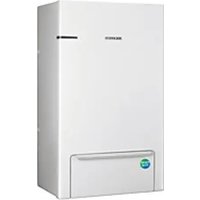


- SPLIT/TDM PLUS HYDRO UNIT
- USER MANUAL
- CONTENTS
- PREPARATION
- BASIC OPERATION
- OTHERS
- (APPLICABLE IN COUNTRIES WITH SEPARATE COLLECTION SYSTEMS)
- SAFETY INFORMATION
- WARNING
- CAUTION
- FOR INSTALLATION
- THE INSTALLATION OF THIS APPLIANCE MUST BE PERFORMED BY A QUALIFIED TECHNICIAN OR SERVICE COMPANY
- FOR POWER SUPPLY
- FOR CLEANING
- DESCRIPTION OF EACH ICON
- NOTE
- DESCRIPTION OF EACH CONTROL
- OPERATING BASIC MODE OF HYDRO UNIT
- WATER LAW
- COOL
- HEAT
- DOMESTIC HOT WATER (DHW) MODE OPERATION
- OUTING MODE
- SILENT MODE
- CHECKING CURRENT TEMPERATURE
- CHECKING SET TEMPERATURE
- TDM (TIME-DIVISION MULTI) VARIABLES (TDM PRODUCT ONLY)
- SETTING WEEKLY TIMER
- SETTING A HOLIDAY WITH WEEKLY TIMER
- CANCELING A WEEKLY TIMER
- INITIALIZING A WEEKLY TIMER
- SETTING DAILY TIMER
- HOW TO SET THE DETAILED SETTING (USER SETTING MODE)
- SETTING CURRENT TIME (EXAMPLE)
- WIRED REMOTE CONTROLLER INSTALLATION
- INITIALIZING YOUR WIRED REMOTE CONTROLLER COMMUNICATION
- ERROR DISPLAY ON THE WIRED REMOTE CONTROLLER
- ERROR INDICATIONS ARE DISPLAYED AS SEEN BELOW
- USE OF WIRED REMOTE CONTROLLER INSTALLATION / SERVICE MODE
- USE OF INSTALLATION/SERVICE MODE
- INSTALLATION/SERVICE MODE
- FIELD SPECIFICATION SETTING MODE OF WIRED REMOTE CONTROLLER
- USE OF FIELD SPECIFICATION SETTING MODE
- USE OF FIELD SPECIFICATION CHECKING MODE
- FIELD SETTING VALUE (FSV) TABLE
- SPACE COOLING
- SPACE HEATING
- DHW HEATING
- WATER LAW & ROOM THERMOSTAT : CODE
- WATER LAW FOR HEATING
- WATER LAW FOR COOLING
- EXTERNAL ROOM THERMOSTAT (FIELD OPTION)
- DHW APPLICATION
- HEAT PUMP VARIABLES FOR CONTROLLING DHW TANK
- BOOSTER HEATER VARIABLES FOR CONTROLLING DHW TANK
- DISINFECTION FUNCTION
- FORCED DHW BY USER'S INPUT
- ADDITIONAL SOLAR PANEL/DHW THERMOSTAT INSTALLATION FOR DHW WITH HEAT PUMP (FIELD OPTION)
- HEAT PUMP VARIABLES FOR SPACE HEATING
- BACKUP HEATER VARIABLES FOR SPACE HEATING
- EXTERNAL BACKUP BOILER FOR SPACE HEATING (FIELD OPTION)
- MIXING VALVE INSTALLATION (FIELD OPTION)
- INVERTER PUMP INSTALLATION (FIELD OPTION)
- OUTING MODE (HOT KEY OF WIRED REMOTE CONTROLLER)
- PEAK POWER CONTROL
- POWER PEAK CONTROL FOR SMART GRID
- MAINTENANCE ACTIVITIES
- THIS PRODUCT CONTAINS FLUORINATED GREENHOUSE GASES COVERED BY THE KYOTO PROTOCOL
- EMERGENCY HEATING / EMERGENCY HOT WATER SUPPLY
- MAINTAINING THE UNIT
- TROUBLESHOOTING TIPS
- WATER PUMP & FLOW S/W
- E
- PRODUCT SPECIFICATION
Brand : SAMSUNG
Model : AE160MNYDGH
Category : Heat pump