
SKI 1011 - Infrared transceiver SENNHEISER - Free user manual and instructions
Find the device manual for free SKI 1011 SENNHEISER in PDF.


| Product type | Portable mono infrared transmitter |
| Brand | SENNHEISER |
| Model | SKI 1011 |
| Dimensions (L x W x H) | 100 x 55 x 43 mm |
| Weight (with batteries and microphone) | Approx. 200 g |
| Color | Black |
| Power supply | 3 IEC R6 alkaline batteries or NiCd rechargeable batteries 1.2 V / 500 mAh |
| Battery life (NiCd rechargeable batteries) | Approx. 4.5 hours |
| Battery life (alkaline-manganese batteries) | Approx. 16 hours |
| Radiated power | Approx. 750 mW |
| Audio bandwidth (-3 dB) | 100 Hz to 7000 Hz |
| Microphone input | Tuchel 8-pin socket, impedance approx. 50 kΩ, sensitivity 4 mV |
| Line input | 3.5 mm jack socket, impedance approx. 250 kΩ, sensitivity 100 mV |
| Modulation technology | Pulse frequency modulation (PFM) |
| Optimal range | Up to 3.5 m ceiling height, light surfaces |
| Included accessories | Neck strap, chest strap |
| Compatible spare parts | Microphones MKE 2012 / MKE 4012, charger SZL 1011, induction loop EZT 1011, transponder SZT 1011 |
| Battery charging | Via charging contacts on the housing, with charger SZL 1011 |
| Intended use | Wireless transmission for the hearing impaired in schools, universities, etc. |
| Maintenance and cleaning | Clean with a soft, dry cloth. Do not use solvents. |
| Safety | Use only alkaline-manganese batteries or recommended rechargeable batteries. Do not cover the reception panel. |
| Repairability | Repairable by an authorized Sennheiser service center. Contact technical support. |
Frequently Asked Questions - SKI 1011 SENNHEISER
User questions about SKI 1011 SENNHEISER
0 question about this device. Answer the ones you know or ask your own.
Ask a new question about this device
Download the instructions for your Infrared transceiver in PDF format for free! Find your manual SKI 1011 - SENNHEISER and take your electronic device back in hand. On this page are published all the documents necessary for the use of your device. SKI 1011 by SENNHEISER.
USER MANUAL SKI 1011 SENNHEISER
Sennheiser's newly-developed transmission system is one which uses infrared light as its transmission medium and it has been designed in order to aid the integration of children and adults with hearing difficulties into normal schools and universities. With this system the user is no longer dependent on a signal which is liable to be disturbed by environmental sounds and weakened by the distance between himself and the speaker. The infrared system transmits the spoken word over a direct route, i.e. without interference and at sufficient volume. The practical realization of such a system was, until now, always hindered by the relatively high power consumption of a transmitter employing the conventional frequency modulation technique. However, the introduction of a new method of modulation – the so-called impulse-frequency modulation technique – has now made it possible to produce a battery-operated, portable infrared transmitter. With this form of modulation the current consumption of the transmitter is kept low and the transmission range is increased as compared to that of more conventional transmitters.
The system as a whole consists of the following components: Infrared transmitter SKI 1011, infrared receiver EKI 1011, transponder SZT 1011, induction loop EZT 1011 and charging unit SZL 1011. Alongside the operation of the transmitter SKI 1011 and the receiver EKI 1011 this user's guide also contains a rough outline of the roles played by the other units which make up this system. More detailed descriptions of each of these units are to be found in the appropriate user's guides.
Brief technical description
Infrared transmitter SKI 1011
The SKI 1011 is a portable, battery-driven mono infrared transmitter with a built-in radiator unit. The transmitter is fitted with two signal inputs: An 8-pin microphone socket for the connection of a plug-in microphone MKE 2012 or MKE 4012 (not included) and a 3.5mm jack socket for the connection of audio equipment. The transmitter is powered by three Mignon batteries. If, instead of these, rechargeable accus are used, they can be recharged whilst still inside the transmitter by means of two charging contacts situated on the sides of the SKI 1011 which fit into the charging unit SZL 1011. Supplied with the transmitter are one neck strap and one chest strap.
Infrared receiver EKI 1011
The EKI 1011 is a portable, battery-driven mono infrared receiver for use with the infrared transmitter SKI 1011. This receiver is suitable for the connection of headphones, stethoclip-type headphones, induction plates or the induction loop EZT 1011. The output volume is adjustable. As well as being able to receive signals directly over the infrared transmission path, the wearer of an EKI 1011 is also able to pick up environmental sounds (e.g. his neighbour talking) thanks to an 8-pin microphone socket to which (for example) the plug-in microphones MKE 2012 or MKE 4012 can be connected. By means of the appropriate switch, the receiver can be set for two different modes of operation: a) Infrared reception + microphone and b) infrared reception + microphone automatic. If a hearing-aid is plugged into the microphone socket, an automatic fade-out device built into the receiver ensures that the level of the microphone situated in the hearing-aid drops by around 20 dB every time a signal (e.g. speech or music) is received from the transmitter. Like the infrared transmitter, the receiver EKI 1011 can also be powered from either three Mignon batteries or from rechargeable Mignon accus. If accus are used, these can be recharged in the charger SZL 1011 via the two charging contacts situated one on either side of the receiver. Included in the packaging of the receiver are one neck strap and one chest strap.
Operating instructions
Infrared transmitter SKI 1011
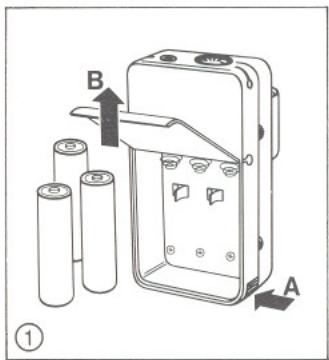
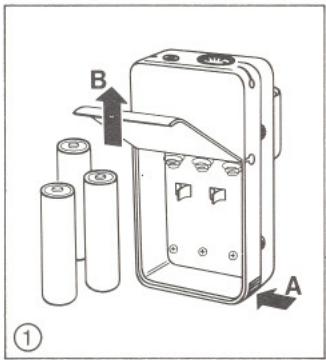
1
Open battery compartment by following first A and then B and insert batteries.
Important: Please pay attention to the polarity of the batteries!
Close battery compartment.
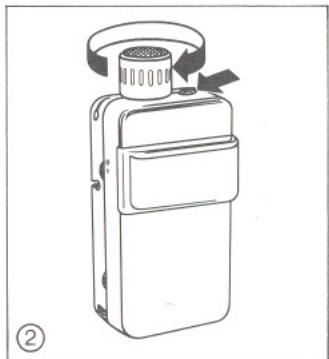
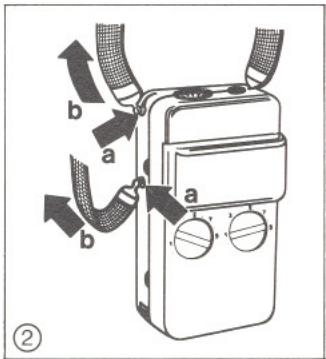
②
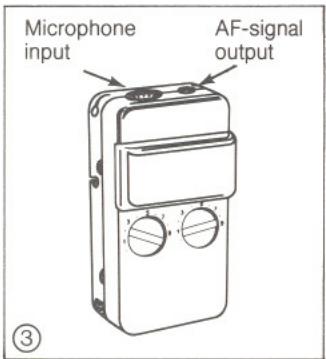
Plug in the microphone and screw tight. Audio equipment (tape recorders, record players) can be connected to the 3.5mm jack socket. The wiring and data of both sockets may be taken from the technical data.
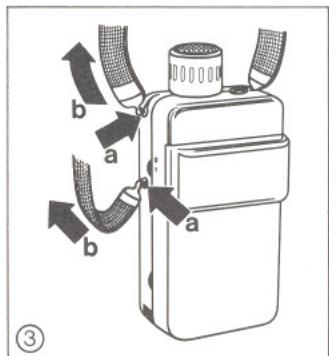
(3)
Hook the neck strap into the corresponding notches and lock into position by pulling upwards resp. backwards. Put on the transmitter and repeat the above with the chest strap.
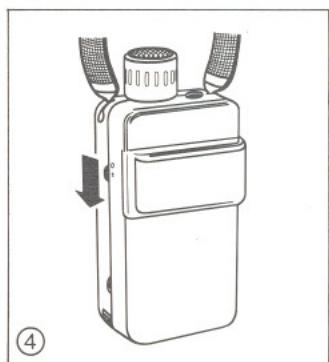
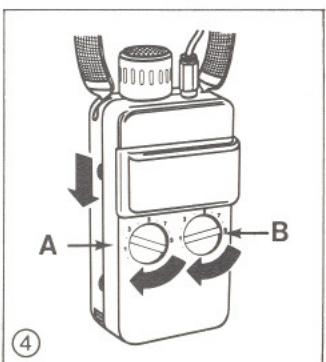
(4)
Switch on the transmitter. The SKI 1011 is now ready for operation.
Infrared receiver EKI 1011
1 Open battery compartment and insert batteries.
Important: Please pay attention to the polarity of the batteries.
Close battery compartment.
② Hook the neck strap into the corresponding notches and lock into position by pulling upwards resp. backwards. Put on the receiver and repeat the above with the chest strap.
Headphones, stethoclip-type headphones, induction plates or the induction loop EZT 1011 can be connected to the receiver's signal output. The impedance of the connected load should be at least 10
The microphone input is suitable for the connection of plug-in microphones of the type MKE 2012 (omnidirectional characteristic) or MKE 4012 (cardioid characteristic). If, instead of a plug-in microphone, a hearing-aid is connected to this socket, an automatic fade-out device already built into the EKI 1011 ensures that the sensitivity of the hearing-aid microphone is lowered by 20dB every time a signal is received over the infrared transmission path. However, this feature can only be taken advantage of when the hearing-aid in question is equipped with an audio-input.
Put on the receiver and switch on the transmitter.
Switch on the receiver and select the required mode of operation. IR/M = Infrared reception + microphone. In this mode, the microphone signal can be added to the infrared signal by means of dial A. The volume can be controlled by means of dial B.
IR = Infrared reception + microphone automatic. In this mode, the sensitivity of the microphone connected to the receiver is lowered by around 20 dB whenever a modulated infrared signal is present, i.e. whenever the transmitter's microphone is spoken into.
Please note that the receiving lens should not at any time be obstructed by a hand or clothing.
General operating instructions
Experience has shown that on first coming into contact with this transmission medium, operators of infrared systems sometimes make some grave mistakes. In order to avoid this, here are a few tips on infrared transmission in general: The invisible infrared light still obeys the same laws as visible light. Should it happen to strike e.g. a dark surface, it will be partially or totally absorbed and if it hits a flat, white surface, a large proportion of the infrared light will be reflected. Normal window panes are no obstacle for infrared light. On the SKI 1011, the infrared emitter diodes are arranged in such a way that a large part of the infrared light reaches the receiver EKI 1011 by reflecting off the walls and ceiling. This ensures that the room in question is illuminated in an even manner.
The conditions for the propagation of infrared light can be regarded as being optimal when:
- the ceiling-height amounts to no more than 3.5m
- the ceiling itself forms a flat, level surface,
- and when the walls are not hung or covered with any light-absorbing materials or objects.
The power radiated by the SKI 1011 is sufficient for illuminating rooms of up to approx. 30m^2 surface area. For illuminating rooms with a floor space greater than 30m^2 it is necessary to use one or more transponders (infrared light impulse amplifiers) of the type SZT 1011. The transponder picks up the infrared signal emitted by the transmitter with its own array of receiving diodes, amplifies it and transmits it further. With the aid of one SZT 1011, it is possible of illuminate rooms with a floor space of up to around 80m^2 . This mains-powered unit can be mounted either on a wall or on a floor stand.
Operation with batteries/accus
The infrared transmitter and receiver can both be powered either from batteries of the type Mignon IEC R 6 or from NiCd accus (sintered accu 1.2V / 500mAh ). The only primary batteries which may be used are Alkali-Manganese batteries as with other types of primary cell it is no longer possible to guarantee the problem-free operation of the transmitter and receiver. If the units are to be put to frequent use, a more practical solution is offered by rechargeable NiCd-accus. These can be recharged in the charging unit SZL 1011 which, in accordance with the different current consumptions of the transmitter and the receiver, is fitted with a quick charging bay for the transmitter and a normal charging bay for the receiver. In order to allow the accus to remain inside the units during the recharging process the transmitter and receiver have both been fitted with two charging contacts, one on each side. Depending on the type of battery used, the operating times for the transmitter and receiver vary as follows:
| NiCd-accu | Alkali Manganese | |
| SKI 1011 | approx. 4,5 hrs | approx. 16 hrs |
| EKI 1011 | approx. 20 hrs | approx. 72 hrs |
Technical Data
| SKU 1011 | |
| Radiated power | approx. 750 mW |
| Audio frequency response (-3 dB) | 100 ... 7000 Hz |
| Microphone input: | |
| Input socket | 8-pin Tuchel, screwable |
| Input impedance | approx. 50 kΩ |
| Input sensitivity | 4 mV for limiter action (lowered by 20 dB by swing control) |
| Socket wiring | Pin 1 → audioPin 2 + 3 → groundPin 8 → UBatt |
| Line input: | |
| Input socket | jack socket 3.5 mm |
| Input impedance | approx. 250 kΩ |
| Sensitivity for ± 15 kHz swing | 100 mV (lowered by 20 dB by swing control) |
| Power supply | 3 x Mignon (IEC R 6), either NiCd accus 1.2 V/500 mAh or Alkali-Manganese batteries |
| Operating time according to type of battery used | approx. 4.5 hrs. with NiCd accus, approx. 16 hrs. with Alkali-Manganese batteries |
| Dimensions in mm | 100 x 55 x 43 |
| Weight with battery and microphone | approx. 200 g |
| Colour | black |
EKI 1011
| Output: | |
| Output socket | 3.5 mm Ø jack socket |
| Impedance | >10 Ω |
| Output power | 50 mW into 50 Ω |
| Audio frequency response | 100...7000 Hz |
| Input: | |
| Input socket | 8-pin Tuchel socket, screwable |
| Impedance | approx. 3 kΩ (for limiting action) |
| Socket wiring | Pin 1 → audio |
| Pin 2 + 3 → ground | |
| Pin 8 → + UBatt | |
| Power supply | 3 x Mignon (IEC R 6), either |
| NiCd-accus 1.2 V/500 mAh or | |
| Alkali Manganese batteries | |
| Operating time according to type of battery used | approx. 20 hrs. with NiCd accus, |
| approx. 72 hrs. with Alkali | |
| Manganese batteries | |
| Dimensions in mm | 100 x 55 x 43 |
| Weight with batteries | approx. 180 g |
| Colour | black |
Introduction
Explications techniques
Brand : SENNHEISER
Model : SKI 1011
Category : Infrared transceiver