
CDR200BK - Cd player/recorder PHILIPS - Free user manual and instructions
Find the device manual for free CDR200BK PHILIPS in PDF.

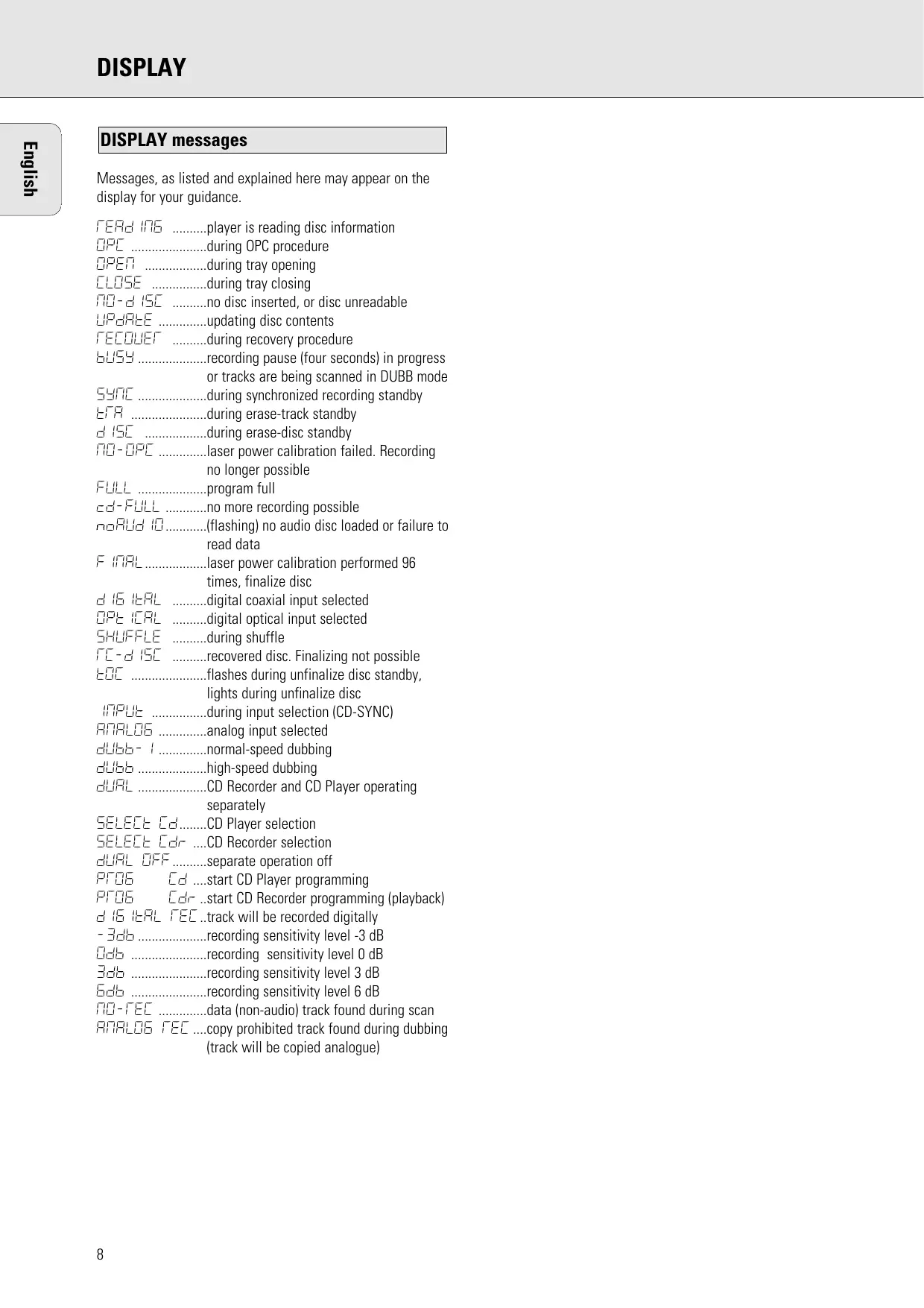


| Product Type | Dual CD Player/Recorder |
| Brand | Philips |
| Model | CDR200BK |
| Dimensions (W x D x H) | 435 x 305 x 88 mm |
| Weight | 4 kg |
| Power Supply | AC 120V, 50/60 Hz, 20 W |
| Compatible Disc Types | Audio CD, CD-R, CD-RW |
| Number of Decks | 2 (independent player and recorder) |
| Recording Functions | Digital (coaxial/optical), analog, high-speed and normal copy, CD-SYNC synchronization |
| Frequency Response | 0 - 22,050 Hz |
| Signal-to-Noise Ratio (Playback) | 100 dB |
| Dynamic Range (Playback) | 95 dB |
| Harmonic Distortion (Playback) | 0.0056% |
| Digital Inputs | Coaxial and optical (IEC 958) |
| Digital Outputs | Coaxial (0.5 Vpp/75 ohms) |
| Analog Inputs | 2 x RCA (500 mVrms/50 kohms) |
| Analog Outputs | 2 x RCA (2 V RMS) |
| Headphone Jack | Yes (0-5 V RMS/8-2000 ohms) |
| Remote Control Included | Yes (AAA batteries included) |
| Disc Finalization | Required for playback on other players (CD-R) or reversible (CD-RW) |
| Erasing | Possible on CD-RW (track or entire disc) |
| Care and Cleaning | Clean with a soft, lint-free cloth; lens with a cleaning disc; avoid moisture and extreme heat |
| Safety | Do not open; use specified voltage; avoid electric shock |
| Included Accessories | 2 RCA cables, 1 digital coaxial cable, power cord, 2 batteries, remote control, warranty booklet |
Frequently Asked Questions - CDR200BK PHILIPS
User questions about CDR200BK PHILIPS
0 question about this device. Answer the ones you know or ask your own.
Ask a new question about this device
Download the instructions for your Cd player/recorder in PDF format for free! Find your manual CDR200BK - PHILIPS and take your electronic device back in hand. On this page are published all the documents necessary for the use of your device. CDR200BK by PHILIPS.
USER MANUAL CDR200BK PHILIPS
CDR 765 CD Recorder/Player
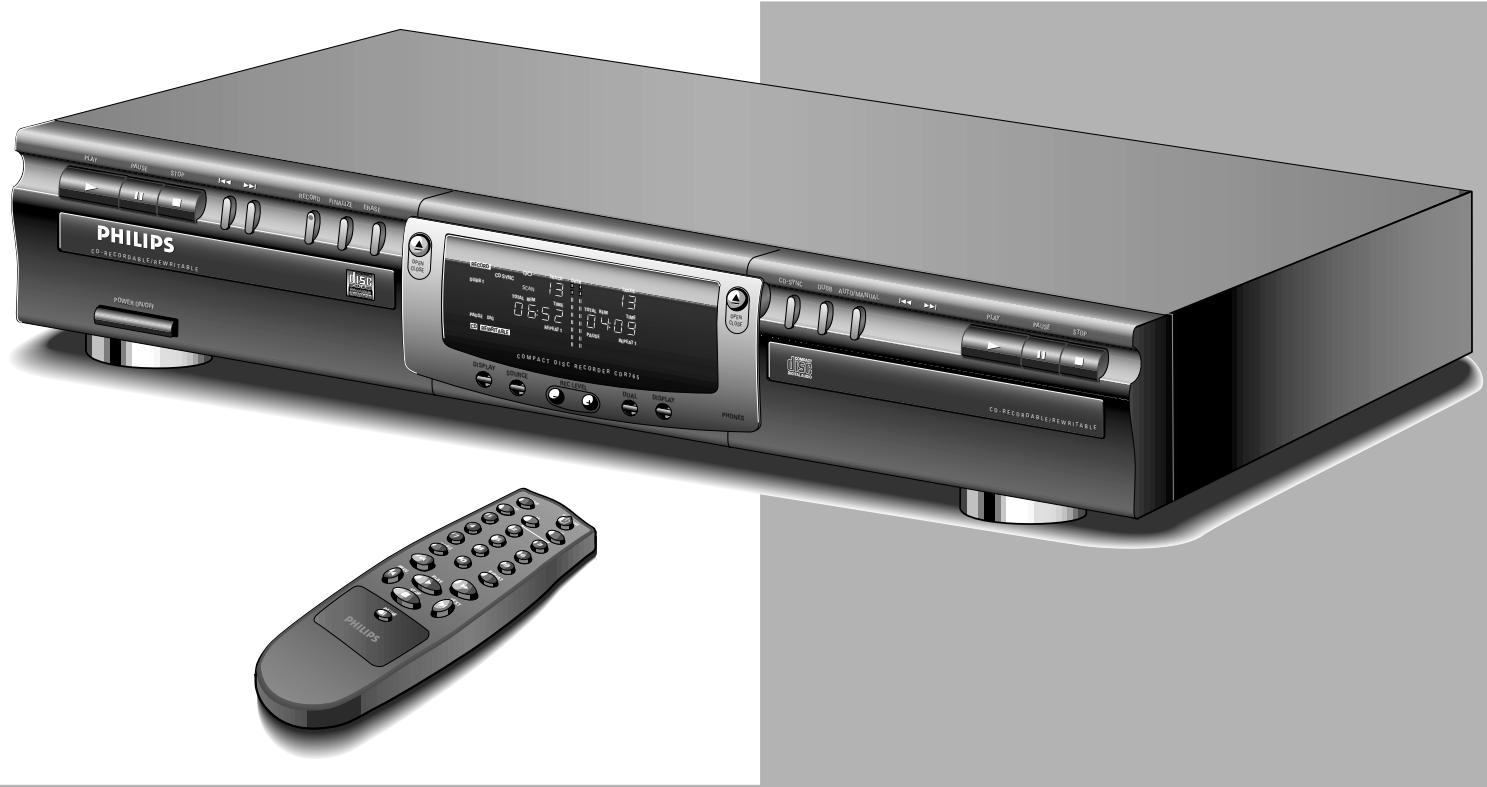
Instructions for use
Mode d'emploi
One Year Exchange Warranty on Parts
This product must be carried in for repair.
WHO IS COVERED?
You must have proof of purchase to receive warranty service. A sales receipt or other document showing that you purchased the product is considered proof of purchase.
WHAT IS COVERED?
Warranty coverage begins the day you buy your product. For 90 days thereafter, all parts will be repaired or replaced, and labor is free. From 90 days to one year from the day of purchase, all parts will be repaired or replaced, but you pay for all labor charges. After one year from the day of purchase, you pay for the replacement or repair of all parts, and for all labor charges.
All parts, including repaired and replaced parts, are covered only for the original warranty period. When the warranty on the product expires, the warranty on all replaced and repaired parts also expires.
WHAT IS EXCUSED?
Your warranty does not cover:
- labor charges for installation or setup of the product, adjustment of customer controls on the product, and installation or repair of antenna systems outside of the product.
- product repair and/or part replacement because of misuse, accident, unauthorized repair or other cause not within the control of Philips Consumer Electronics Company.
- reception problems caused by signal conditions or cable or antenna systems outside the unit.
- a product that requires modification or adaptation to enable it to operate in any country other than the country for which it was designed, manufactured, approved and/or authorized, or repair of products damaged by these modifications.
- incidental or consequential damages resulting from the product. (Some states do not allow the exclusion of incidental or consequential damages, so the above exclusion may not apply to you. This includes, but is not limited to, prerecorded material, whether copyrighted or not copyrighted.)
- a product that is used for commercial or institutional purposes (including but not limited to rental purposes).
WHERE IS SERVICE AVAILABLE?
Warranty service is available in all countries where the product is officially distributed by Philips Consumer Electronics Company. In countries where Philips Consumer Electronics Company does not distribute the product, the local Philips service organization will attempt to provide service (although there may be a delay if the appropriate spare parts and technical manual(s) are not readily available).
MAKE SURE YOU KEEP ...
Please keep your sales receipt or other document showing proof of purchase. Attach it to this owner's manual and keep both nearby. Also keep the original box and packing material in case you need to return your product.
BEFORE REQUESTING SERVICE...
Please check your owner's manual before requesting service. Adjustments of the controls discussed there may save you a service call.
TO GET WARRANTY SERVICE IN U.S.A., PUERTO RICO OR U.S. VIRGIN ISLANDS...
Take the product to a Philips factory service center (see enclosed list) or authorized service center for repair. When the product has been repaired, you must pick up the unit at the center. Centers may keep defective parts.
(In U.S.A., Puerto Rico and U.S. Virgin Islands, all implied warranties, including implied waarranties of merchantability and fitness for a particular purpose, are limited in duration to the duration of this express warranty. Because some states do not allow limitations on how long an implied warranty may last, this limitation may not apply to you.)
TO GET WARRANTY SERVICE IN CANADA...
Take the product to a Philips consumer service center (listed below), self-servicing dealer or authorized service depot.
Philips Electronics Ltd.
601 Milner Avenue, Scarborough, Ontario, MIB IM8
(416) 292-5161
4977 Levy Street, St. Laurent Quebec, H4R 2N9
(514) 956-0120
1741 Boundary Road, Vancouver, B.C. VSM 3Y7
(604) 294-3441
(In Canada, this warranty is given in lieu of all other warranties. No other warranties are expressed or implied, including any implied warranties of merchantability or fitness for a particular purpose. Philips is not liable under any circumstances for any direct, indirect, special, incidental or consequential damages, howsoever incurred, even if notified of the possibility of such damages.)
REMEMBER...
Please record the model and serial numbers found on the product below. Also, please fill out and mail your warranty registration card promptly. It will be easier for us to notify you if necessary.
MODEL#
SERIAL#
This warranty gives you specific legal rights. You may have other rights which vary from state/province to state/province.
Philips Service Company, P.O. Box 555, Jefferson City, Tennessee 37760, (423) 475-8869
CAUTION USE OF CONTROLS OR ADJUSTMENTS OR PERFORMANCE OF PROCEDURES OTHER THAN THOSE SPECIFIED HEREIN MAY RESULT IN HAZARDOUS RADIATION EXPOSURE.
The set complies with the FCC-Rules, Part 15 and with 21 CFR 1040.1
CDN
Canada
This digital apparatus does not exceed the Class B limits for radio noise emissions from digital apparatus as set out in the Radio Interference Regulations of the Canadian Department of Communications.
Beam divergence 60 degree
This warning label is located on the rearside and inside this laser product.
CAUTION: INVISIBLE
LASER RADIATION
WHEN OPEN. DO NOT STARE INTO BEAM
DANGER: INVISIBLE LASER RADIATION WHEN OPEN.
VARO!
AVOID DIRECT EXPOSURE TO BEAM
AVATTAESSA JA SUOJALUKITUS OHITEJTAESSA OLET
ALTTIUNANAKYMATTOMAALLE LASERSATEILYLLE ALA
KATSO SATEESEEN.
OSYNLIG LASERSTRALNING NAR DENNA DEL AR ÖPPNAD
OCH SPARREN AR URKOPPLAD, BETRAKTA EJ STRALEN
or
DANGER - Invisible laser radiation when open.
AVOID DIRECT EXPOSURE TO BEAM
THIS DEVICE COMPLIES WITH PART 15 OF THE FCC (U.S.A.) RULES.
OPERATION IS SUBJECT TO THE FOLLOWING TWO CONDITIONS : (1) THIS DEVICE MAY NOT CAUSE HARMFUL
INTERFERENCE, AND (2) THIS DEVICE MUST ACCEPT ANY INTERFERENCE RECEIVED, INCLUDING INTERFERENCE THAT MAY CAUSE UNDESIRED OPERATION.
NOTE
This equipment has been tested and found to comply with the limits for a Class B digital device, pursuant to part 15 of the FCC Rules. These limits are designed to provide reasonable protection against harmful interference in a residential installation. This equipment generates, uses and can be used in accordance with the instructions, may cause harmful interference to radio communications. However, there is no guarantee that interference will not occur in a particular installation.
If this equipment does cause harmful interference to radio or television reception, which can be determined by turning this equipment off and on, the user is encouraged to try to correct the interference by one or more of the following measures :
- reorient or relocate the receiving antenna.
- increase the separation between the equipment and receiver.
- connect the equipment into an outlet on a circuit different from that to which the receiver is connected.
- consult the dealer or an experienced radio/TV technician for help.
IMPORTANT
THIS PRODUCT WAS FCC VERIFIED UNDER TEST CONDITIONS THAT INCLUDED USE OF SHIELDED CABLES AND CONNECTORS BEWTEEN SYSTEM COMPONENTS. IT IS IMPORTANT THAT YOU USE SHIELDED CABLES TO REDUCE THE POSSIBILITY OF CAUSING INTERFERENCE TO RADIOS, TELEVISION SETS AND OTHER ELECTRONIC DEVICES. IF YOU HAVE ANY PROBLEMS CONTACT YOUR DEALER.
ANY CHANGE OR MODIFICATIONS TO THE EQUIPMENT BY THE USER NOT EXPRESSLY APPROVED BY THE GRANTEE OR MANUFACTURER COULD VOID THE USER'S AUTHORITY TO OPERATE SUCH EQUIPMENT.
English 4
Francais. 22
Espanol 40
- Read Instructions - All the safety and operating instructions should be read before the appliance is operated.
- Retain Instructions - The safety and operating instructions should be retained for future reference.
- HeedWarnings - All warnings on the appliance and in the operating instructions should be adhered to.
- Follow Instructions - All operating and use instructions should be followed.
- Water and Moisture - The appliance should not be used near water - for example, near a bathtub, washbowl, kitchen sink, laundry tub, in a wet basement, or near a swimming pool, and the like.
- Carts and Stands - The appliance should be used only with a cart or stand that is recommended by the manufacturer.
6A.

An appliance and cart combination should be moved with care. Quick stops, excessive force, and uneven surfaces may cause the appliance and cart combination to overturn.
- Wall or Ceiling Mounting - The applicance should be mounted to a wall or ceiling only as recommended by the manufacuter.
- Ventilation - The appliance should be situated so that its location or position does not interfere with its proper ventilation. For example, the appliance should not be situated on a bed, sofa, rug, or similar surface that may block the ventilation openings; or, placed in a built-in installation, such as a bookcase or cabinet that may impede the flow of air trough the ventilation openings.
- Heat - The applicance should be situated away from heat sources such as radiators, heat registers, stoves, or other appliances (including amplifiers) that produce heat.
-
Power Sources - The appliance should be connected to a power supply only of the type described in the operation instructions or as marked on the appliance.
-
Grounding or Polarization - The precautions that should be taken so that the grounding or polarization means of an appliance is not defeated.
-
Power-Cord Protection - Power-Supply cords should be routed so that they are not likely to be walked on or pinched by items placed upon or against them, paying particular attention to cords at plugs, convenience receptacles, and the point where they exit from the appliance.
-
Cleaning - The appliance should be cleaned only as recommended by the manufacturer.
-
Nonuse Periods - The power cord of the appliance should be unplugged from the outlet when left unused for a long period of time.
-
Object and Liquid Entry - Care should be taken so that objects do not fall and liquids are not spilled into the enclosure through openings.
-
Damage Requiring Service - The appliance should be seviced by qualified service personnel when :
a. The power-supply cord or plug has been damaged; or
b. Objects have fallen, or liquid has been spilled into the appliance; or
c. The appliance has been exposed to rain; or
d. The appliance does not appear to operate normally or exhibits a marked change in performance; or
e. The appliance has been dropped, or the enclosure damaged.
17 Servicing - The user should not attempt to service the appliance beyond that described in the operating instructions. All other servicing should be referred to qualified service personnel.
WARNING
TO REDUCE THE RISK OF FIRE OR ELECTRIC SHOCK, DO NOT EXPOSE THIS APPLIANCE TO RAIN OR MOISTURE.

CAUTION
RISK OF ELECTRIC SHOCK DO NOT OPEN
CAUTION: TO REDUCE THE RISK OF ELECTRIC SHOCK, DO NOT REMOVE COVER (OR BACK). NO USER-SERVICEABLE PARTS INSIDE. REFER SERVICING TO QUALIFIED SERVICE PERSONNEL.

The lightning flash with arrowhead symbol, within an equilateral triangle, is intended to alert the user to the presence of uninsulated "dangerous voltage" within the product's enclosure that may be of sufficient magnitude to constitute a risk of electric shock to persons.

The exclamation point within an equilateral triangle is intended to alert the user to the presence of important operating and maintenance (servicing) instructions in the literature accompanying the appliance.
Table of contents
GENERAL INFORMATION
Technical information 4
Disc for recording. 5
Discs for playback. 5
Maintenance 5
Accessories 5
OPERATING BUTTONS AND CONNECTIONS
Operating buttons on the front. 6
Connections on the back. 6
DISPLAY
DISPLAY explanation 7
DISPLAY messages 8
INSTALLATION
Connections general 9
Analogue connections CD Recorder & CD Player ....9
Analogue connections CD Player deck. 10
Digital coaxial connections CD Recorder 10
Digital optical connections CD Recorder 11
Power supply 11
Set-up recommendations. 11
Inserting batteries in the remote control 11
REMOTE CONTROL & INSERTING DISCS
Remote control commands 12
Inserting discs 12
RECORDING
Remarks about recording. 13
Normal and high-speed dubbing 13
Digital recording from external CD player 14
Synchronized digital recording from external
CD player: CD-SYNC 15
Analogue recording from an external source............16
Finalizing CD-R & CD-RW discs. 17
Unfinalizing CD-RW discs 17
ERASING & PLAYING
Erasing CD-RW discs 18
Playing CDs on deck 1 and/or deck 2. 18
Playing as a 2-disc changer 18
PLAYING
Selecting a track or searching. 19
Shuffle (random-order) play 19
Repeat CD, track or program 19
Programming 20
FIXING PROBLEMS
Troubleshooting 21
Diagnostic program 21
Welcome!
Thank you for purchasing this Philips Compact Disc
Recorder/Player Double Deck.
In the 1980s Philips invented a new audio system - the CD.
The CD (compact disc) revealed the new dimensions of digital sounds and enhanced the pleasures of audio.
Compact disc technology permits a high contrast in both loud and quiet passages, with perfect channel separation. Philips has continued to develop compact disc technology and the result is the CD recorder.
With your Philips CD Recorder/Player you can make your own, high-quality audio CDs, subject only to the legal restrictions on copying. You can either dub at high or normal speed from the Player to the Recorder or record from an external source.
Naturally all pre-recorded audio CDs can combined CDs - e.g. CD-Extra - can be played using one or both of the decks individually or together as a double-deck changer.
Recordings may only be made for personal use. It is forbidden to copy material protected by copyright, including computer programs, films, television and audio recordings.
This appliance may not be used for such applications.
Technical information
Subject to modification without notice.
Digital frequency response .0-22,050Hz
Playback S/N 100dB
Playback dynamic range. 95dB
Play back total harmonic distortion.0.0056%, -85dB
Recording S/N (Analogue). 90dB
Recording S/N (Digital) Equal to source
Recording dynamic range. 92dB
Recording total harmonic distortion.0.0056%, -85dB
Digital coaxial input (IEC 958) 44.1 kHz +/-100ppm
Digital optical input (IEC958) 44.1 kHz +/- 100ppm
Analogue input (4 steps -3, 0, 3 and 6 dB) .500 mVrms/50k =0dB
Audio output. 2V RMS ±2dB
Digital coaxial output .0.5 Vpp/75
Headphones. 0-5V RMS/8-2000
Dimensions 17 1/8 x 12 x 35 5/8 inches
Weight. 4kg
Power consumption. 20W
Operating temperature. 5 - 35^
Power Supply. AC 120V
Disc for recording
For recording use, special audio discs must be used (for music only). These Discs bear the logos as shown below. The text 'DIGITAL AUDIO' is present! Copyright fees have been paid on these discs in some countries.
With your recorder you can use two types of discs for recording purposes:
- CD-Audio Recordable (CD-R) discs: Fully recorded and finalized, these discs p on all CD players and recorders.

- CD-Audio ReWritable (CD-RW) discs: Can be recorded, erased and re-recorded hundreds of times. When finalized, they play on CD-RW compatible CD players and recorders.
In the course of 1999 most Philips CD players and recorders will be CD-RW compatible.
Discs for playback
Your CD Recorder/Player can play:
- All prerecorded audio CDs, and combined CDs such as CD Extra.
- All Audio CD-R and Audio CD-RW.
Note: CD-R discs recorded with a computer can only be used when they are correctly treated according the audio standard (IEC958: Consumer part). Single session only!
Maintenance
It is extremely important that the discs used for recording are free of dust and scratches.
To clean a CD, wipe it in a straight line from the center towards the outer edge using a soft, lint-free cloth. Cleaning agents may damage the disc! Write only on the printed side of a CD-R or CD-RW, and only with a soft felt-tipped pen.
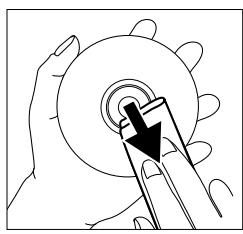
Clean the CD Recorder/Player using a soft, lint-free cloth that has been slightly dampened. Do not use a cleaning agent; this might have a corrosive effect.
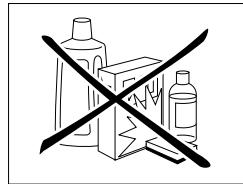
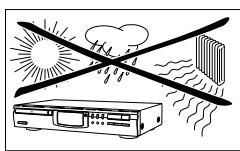
Do not expose the CD Recorder/ the Player batteries or CDs to extreme humidity, rain, sand or excessive heat from heating equipment or direct sunlight.
If the CD Recorder/Player does not read the CDs correctly, use a cleaning CD (commonly available) to clean the lens before taking the CD Recorder/Player in for repairs. Other cleaning methods may damage the lens. Keep the tray closed at all times to avoid getting dust on the lens.
The lens may become clouded when the CD Recorder/Player is moved from cold to warm surroundings; it will not be possible to play a CD when this happens. Leave the CD Recorder/Player in the warm surroundings to allow the moisture to evaporate.
Accessories
- 2 Analogue audio cables (with red and white plugs)
- 1 Digital coaxial cable (with black plugs)
- Power cord
- 2 Batteries
- Remote control
- Guarantee
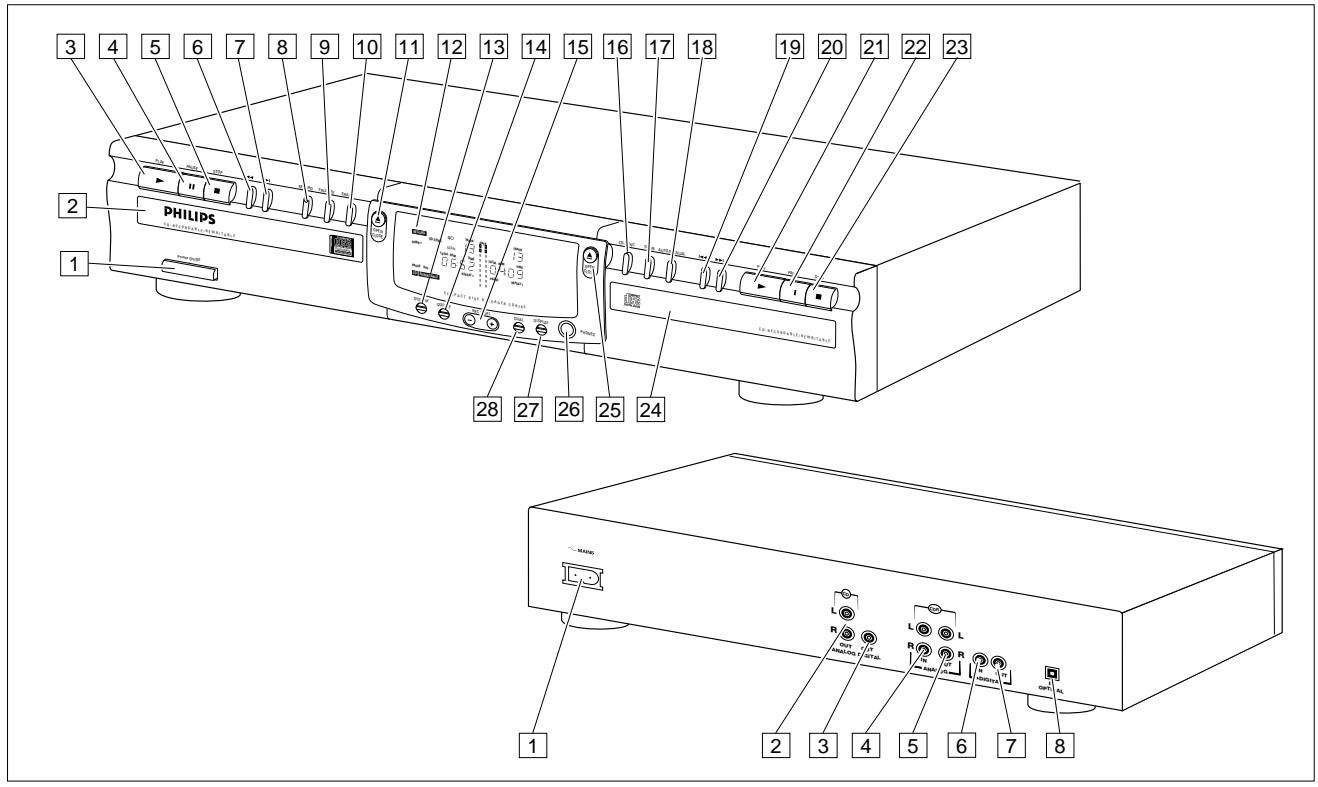
Operating buttons on the front
CD recorder
1 ON/OFF turn the CD recorder/player ON and OFF
2 Disc tray
3 PLAY .start play or record
4 PAUSE II . . . interrupt play
STOP stops
6 previous track/search back
7 next track/search forward/new track
RECORD. record
9 FINALIZE . . . . . . . . . . . . . . . . . . . . . . . . . . . . . . . . . . . . . . . . . . . . . . . . . . . . . . .
10 ERASE . . . . . . erase recording
11 OPEN/CLOSE . . .open/close disc tray
12 DISPLAY (information screen)
13 DISPLAY .select display information
14 SOURCE... .select digital or analogue input
15 REC LEVEL .adjusts the recording level (analogue)
16 CD-SYNC. synchronized recording; recording starts automatically
17 DUBB. digital dubbing (normal or high speed) from CD Player to CD Recorder
18 AUTO/MANUAL .. select track numbering method
CD player
19 previous track/search back
20 next track/search forward
21 PLAY .start play
22 PAUSE II . . . interrupt play
23 STOP stops
24 Disc tray
25 OPEN/CLOSE....open/close disc tray
26 PHONES . . . . . . . . . . . . . . . . . . . . . . . . . . . . . . . . . . . . . . . . . . . . . . . . . . . . . . . . . . . . . . . . . . . . . . . . . . . . . . . . . . . . . . . . . . . . .
27 DISPLAY .select display information
28 DUAL . plays CD Recorder and CD Player separately
Connections on the back
1 Connection to power supply
4 ANALOG IN . . . . . connects to the line output of an amplifier. (left and right)
5 ANALOG OUT CDR & CD . connection for input line on amplifier (left and right)
6 DIGITAL IN . . . . . . connection for digital coaxial input from external source, e.g. amplifier or recording device
7 DIGITAL OUT CDR & CD connects to the digital coaxial input of e.g. amplifier or recording device
8 OPTICAL IN.... connection for digital optical input from external CD player
For use only in the DUAL mode (simultaneous play-back):
3 DIGITAL OUT CD... connection for digital coaxial output from CD deck to external device, e.g. amplifier or recording device
2 ANALOG OUT CD . connection for analogue output from CD deck to input line on an amplifier (left and right)
DISPLAY explanation
The display has a section for the CD Recorder and a section for the CD Player.
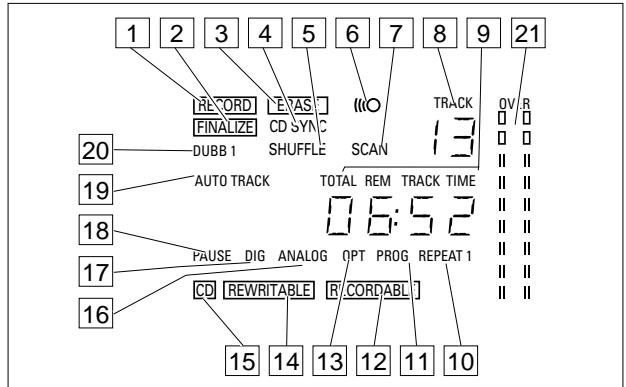
CD recorder section
1 RECORD. . lights up during recording and flashes in record standby
2 FINALIZE . lights up during finalizing and flashes in finalize standby
ERASE . lights up during erase recording and flashes in erase standby
4 CD-SYNC. .synchronized recording is active.
5 SHUFFLE . . . plays tracks in random order
6 . remote control active
7 SCAN. . . . . . . scans for COPY PROHIBIT or data track in dubbing mode.
8 TRACK . . . . . . track number
9 TOTAL REM TRACK TIME lights up according to selected time mode
10 REPEAT (1) . . . . repeat function activated during play
11 PROG .programmed play
12 RECORDABLE . . . Unfinalized CD-R disc inserted
13 OPT . digital optical input is selected
14 REWRITABLE .CD-RW disc inserted
15 CD inserted (a pre-recorded CD or finalized CD-R or CD-RW disc)
16 ANALOG .analogue input is selected
17 DIG. lights when digital input is selected and flashes when digital input is incorrect.
18 PAUSE . . . . . . . . . . . . . . . . . . . . . . . . . . . . . . . . . . . . . . . . . . . . . . . . . . . . . .
19 AUTO TRACK .... automatically increase track numbers
20 DUBB (1) . dubbing from CD player to CD recorder
21 Record/play level bar (analogue)
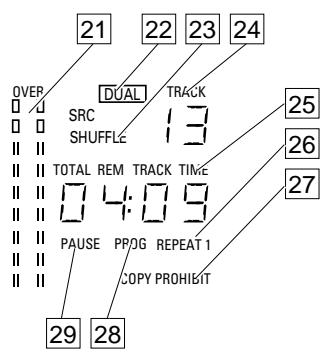
CD player section
22 DUAL . play CD Recorder and CD Player separately
23 SHUFFLE . . . . . . plays tracks in random order
24 TRACK . . . . . . . track number
25 TOTAL REM TRACK TIME lights up according to selected time mode
26 REPEAT 1..... repeat track
27 COPY PROHIBIT . . lights up when attempting to record a protected digital audio recording
PROG .programmed play
29 PAUSE . . . . . . . . . . . . . . . . . . . . . . . . . . . . . . . . . . . . . . . . . . . . . . . . . . . . . .
DISPLAY messages
Messages, as listed and explained here may appear on the display for your guidance.
FERd IN5 ......player is reading disc information
PC ......during OPC procedure
OPEN .........during tray opening
CLOSE ......during tray closing
10-15C .........no disc inserted, or disc unreadable
UPDAREE .updatings disc contents
RECOUER ......during recovery procedure
bU5y .recording pause (four seconds) in progress or tracks are being scanned in DUBB mode
SYNC ......during synchronized recording standby
E-17 during erase-track standby
15c ......during erase-disc standby
- - - - - - - - - - - - - - - - - - - - - - - - - - - - - - - - - - - - - - - - - - - - - - - - - - - - - - - - - - - - - - - - - - - - - - - - - - - - - - - - - - - - - - - - - - - - - - - - - - - - - no longer possible
FLILL .program full
c-d-FULL no more recording possible
noRUD .(flashing) no audio disc loaded or failure to read data
F INR.L . . . . . . . . . . . . . . . . . . . . . . . . . . . . . . . . . . . . . . . . . . . . . . . . . . . . . . . . . . . . . . . . . . . . . . . . . . . . . . . . . . . . . . . . . . . . . . ..
times, finalize disc
15 digital coaxial input selected
GPEICRL ....digital optical input selected
SHUFFLE ......during shuffle
- 15 ....recovered disc. Finalizing not possible
EOC .flashes during unfinalize disc standby, lights during unfinalize disc
IPPLI ......during input selection (CD-SYNC)
RANL05 ....analog input selected
dubb- normal-speed dubbing
..high-speed dubbing
CD Recorder and CD Player operating separately
SELECT CD......CD Player selection
SELECT Cdr ...CD Recorder selection
dURL OFF......separate operation off
PFOE CD...start CD Player programming
PFOE Edr...start CD Recorder programming (playback)
品 ~ B ~ 巴 ~ R ~ 工 E 已 .track will be recorded digitally
-3dB .recording sensitivity level -3 dB
□d recording sensitivity level 0 dB
3dB .recording sensitivity level 3 dB
......recording sensitivity level 6 dB
Fi - FEC ......data (non-audio) track found during scan
RANALOG TEC ...copy prohibited track found during dubbing (track will be copied analogue)
Connections general
For playing back on the CD Recorder and/or the CD Player deck, the following output connections are available:
- Digital coaxial output (CD & CD-R)
- Analogue output (CD & CD-R)
We recommend that these be connected to the TAPE or CD-R input on your amplifier.
For external recording, the following input connections are available:
- Digital optical input
- Digital coaxial input
- Analogue input
For playing back on the CD Recorder and CD Player decks separately (DUAL mode), the following output connections are available:
- Digital coaxial output (CD)
- Analogue output (CD)
We recommend that these be connected to the CD input on your amplifier.
The connections to be made depend upon the possibilities your audio equipment offers. Please refer to the user manuals for your other audio equipment first.
Digital recordings, either optical or coaxial, will give the best performance in terms of audio and versatility (e.g. auto-track). (The digital optical connection is less sensitive to external disturbances).
If your equipment does not allow for digital connections, the high quality Analogue/Digital Converter on the CD Recorder/Player will ensure excellent audio performance when recordings are made from an analogue source.
Playback via the digital coaxial output of the CD
Recorder/Player gives the best audio performance.
If your equipment does not offer digital connections the high quality Digital-Analog-Convertor of the CD Recorder/Player ensures a high sound quality via the analogue output.
We recommend that both digital and analogue connections be made, so that analogue recordings can be made when digital recording is not possible.
The most common ways of connecting the CD Recorder/Player are explained below. If you still have difficulties with the connections, feel free to contact the Philips Consumer Service desk in your country.
Analogue connections CD Recorder & CD Player
This connection must be established for the play-back CD Recorder deck and for the CD Player deck (cable ②)
Cable ① is used only if you want to make recordings from an external analogue source.
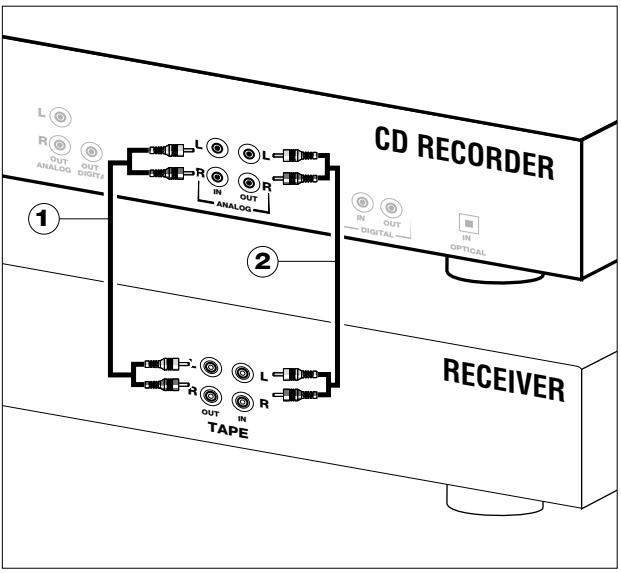
Use the audio cables supplied. Connect the red plugs to the R sockets, and the white plugs to the L sockets.
1 For recording from an external source, connect Cable ① to the ANALOGUE IN plug on the CD Recorder/Player and the LINE-OUT or TAPE-OUT plug on an amplifier.
Note: For recording directly from a CD player the analogue input of the CD Recorder/Player should be connected to the analogue output of the CD player.
2 For playing back, connect Cable ② to the ANALOGUE OUT plugs on the CD Recorder/Player and the INPUT plugs on an amplifier, e.g. TAPE IN, CD-R or AUX.
Note: Never use the PHONO input.
Analogue connection CD Player deck
This connection is only required if you want to play back on the CD Player deck separately from the CD Recorder deck. This is called the DUAL mode.
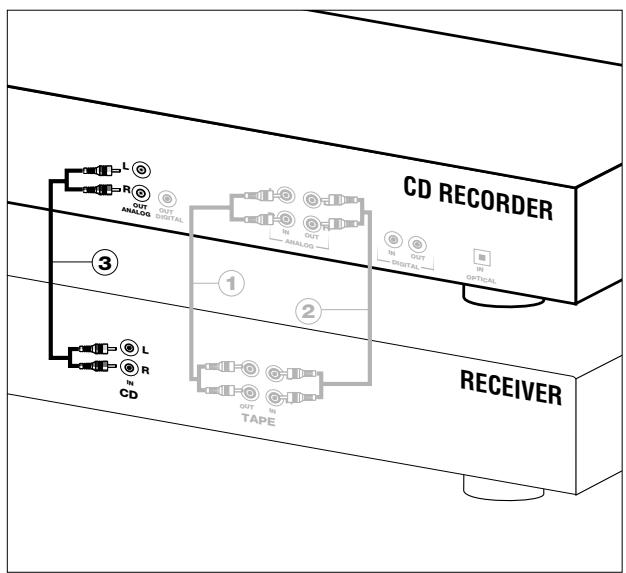
1 For playing back separately on the CD Player deck, connect a third cable (3) (not supplied) between the ANALOGUE OUT plugs on the CD Recorder and the INPUT plugs on an amplifier, e.g. CD or AUX.
(Connect the red line in the R plugs and the white line in the L plugs.)
Note:
- Never use the PHONO input
- Your CD Recorder/Player is equipped with a digital coaxial output for the CD Player deck. This output connection can be used for digital play-back.
Digital Coaxial Connection CD Recorder
This connection is only required if you want to record from an external CD player with a digital coaxial output.
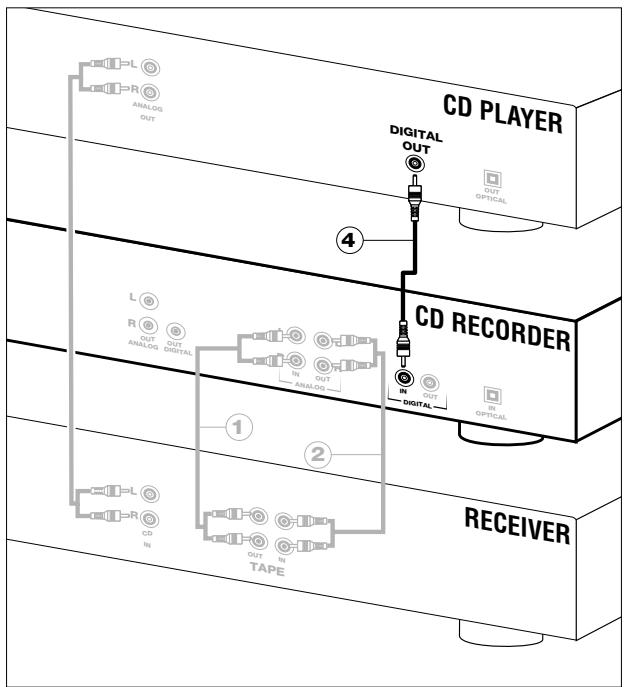
1 For recording from an external source, use a fourth cable (4) (not supplied) to connect the DIGITAL IN plug on the CD Recorder/Player to the DIGITAL OUT plug on an external CD player.
Note: Your CD Recorder/Player is equipped with a digital coaxial output plug (common plug for CD Recorder deck and CD Player deck). This output can be used for digital play-back.
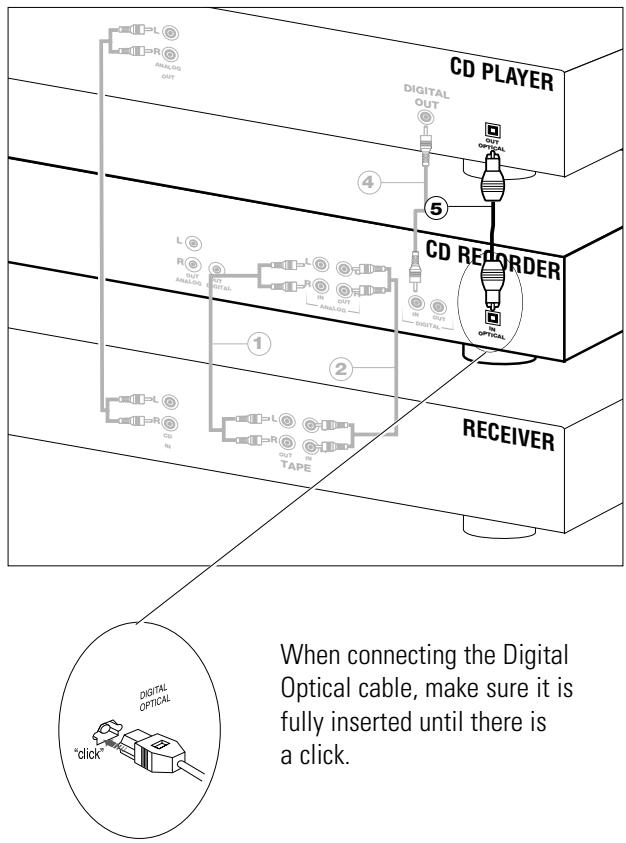
Digital Optical Connection CD Recorder
This connection is only required if you want to record from an external CD player with a digital optical output.
1 Remove the dust caps from the digital optical connections. (We recommend that you save the caps).
2 For recording from an external source, use a fiber-optic cable ⑤ to connect the digital optical input on the CD Recorder/Player and the digital optical output on an external CD player.
Note: For playing back, the digital coaxial outputs or analogue outputs on the CD Player and the CD Recorder must be connected to an amplifier.
Setup recommendations
- Place the CD Recorder/Player on a solid, vibration free surface.
- Do not place the CD Recorder/Player near a source of heat or in direct sunlight.
- Do not use the CD Recorder/Player under extremely damp conditions.
- If the CD Recorder/Player is placed in a cabinet, make sure that a one-inch space remains free on all sides of the recorder for proper ventilation.
Power supply
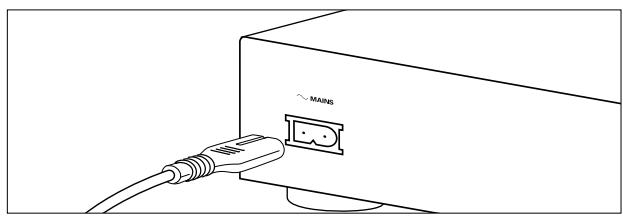
1 Plug the power cord supplied into the MAINS connector on the CD Recorder/Player, then into a wall socket.
2 Press ON/OFF to turn the CD Recorder/Player on.
Note:
- The CD Recorder/Player will automatically adjust to the local mains voltage.
- When the CD Recorder/Player is in the 'OFF' position, it is still consuming some power. If you wish to disconnect your CD Recorder/Player completely from the mains, withdraw the plug from the AC Outlet.
Inserting batteries in the remote control
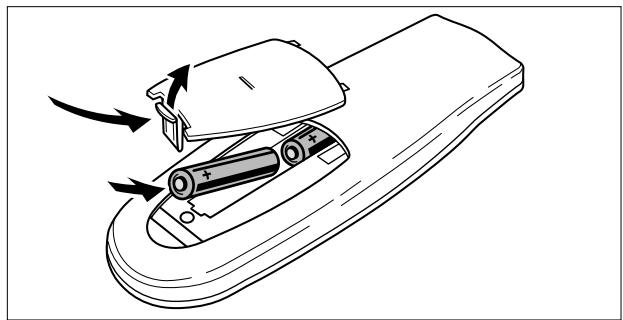
1 Open the battery compartment cover.
2 Insert 2 batteries (AAA, R03 or UM-4; as supplied) as shown.
3 Replace the cover.
Note: We recommend using 2 batteries of the same type and condition.
Batteries contain chemical substances; dispose of them properly.
Remote control commands
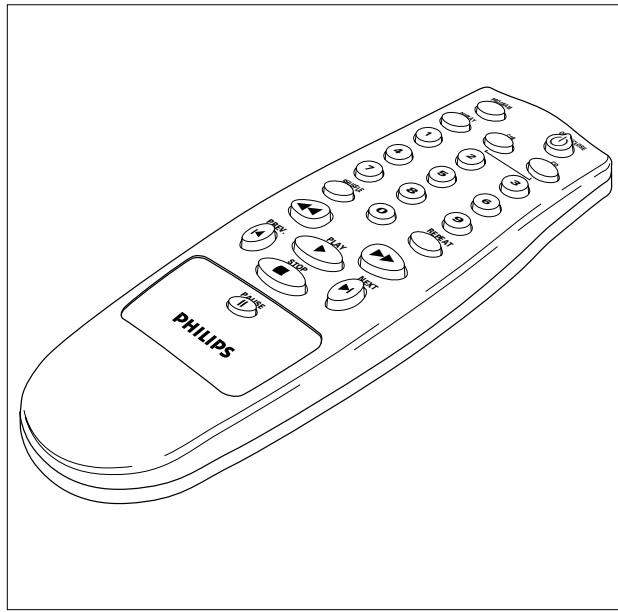
PROGRAM. . . . . . . programs track numbers
DISPLAY selects display information
Number keys 0 - 9 . . . selects a track by number
SHUFFLE plays CD(RW) or program in random order
searches backward
PREVIOUS selects the beginning of a previous track
STOP stops CD(RW) and clears a program
PAUSE II. interrupts CD(RW) play
NEXT selects the beginning of subsequent
PLAY .starts CD(RW) play
searches forward
REPEAT repeat play
CD select CD Player
CD-R. select CD Recorder
OPEN/CLOSE .opens or closes the disc tray
When you press a button on the remote control, the indicator on the display will light up.
Note: Unless indicated otherwise, all buttons are located on the front of the CD Recorder/Player. If also provided on the remote control, the corresponding buttons on the remote control can be used after the CD Recorder or the CD Player has been selected by pressing CD-R or CD.
Inserting discs
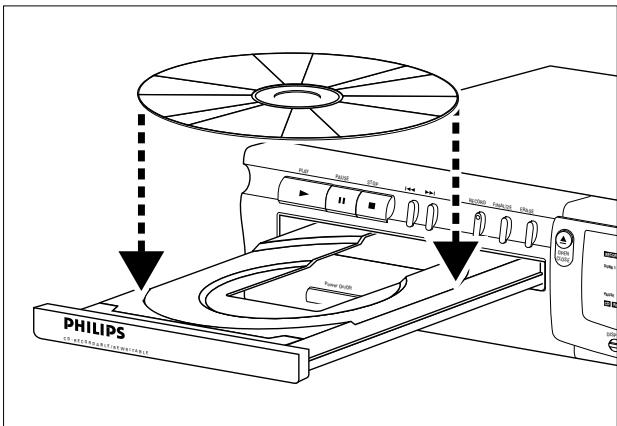
1 Press OPEN/CLOSE to open the disc tray.
2 Insert a CD, CD-R or, CD-RW in the appropriate recess in the tray, label side up.
IMPORTANT:
For recording it is important that the blank disc be completely free of dust particles or scratches. (see Disc Maintenance, p.5.)
Unfinalized discs cannot be played in the CD Player deck!
3 Gently push the front of the tray or press OPEN/CLOSE to close the tray (see also Playing a CD).
CD-Recorder only
The display will indicate the type of disc you have inserted.
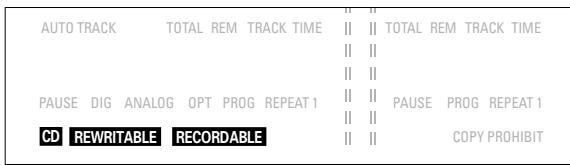
- If a CD-R is finalized the display will indicate CD.
- If a CD-RW is finalized it is still a CD-ReWritable and the display will indicate CD REWRITABLE.
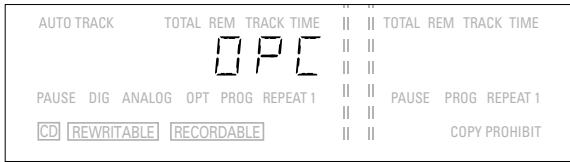
If you insert a blank or partly-recorded CD-R or CD-RW, the CD recorder will calibrate the disc for optimum recording. During this process the display will first show P C and then the number of audio tracks previously recorded. Calibration can take up to 25 seconds.
Note: Only Audio CDs will be accepted. If a non-audio disc is inserted, the display will indicate no RUID 10.
Remarks about recording
You will soon discover how easy it is to make your own CDs. Nevertheless, we recommend that you use a CD-RW disc for your first try. The two ways to make recordings are described below:
- Digital dubbing (normal or high-speed dubbing)
-
Recording from an external source:
-
Digital
- Digital with synchronized start using external CD player
-
Analogue
-
The recording procedure is the same for CD-Rs or CD-RWs.
- If the disc is a CD-RW and is already finalized you must uninitialize it first (page 17).
- If the disc already contains recordings, the CD recorder will automatically search for the end of the last track, so that you can start recording from there.
- There must be at least 7 seconds of recording time left on the disc, or you will not be able to activate the record standby mode.
- If the display indicates COPY PROHIBIT, no digital recording can be made of the source material. Recording will not start or will stop after 4 seconds.
-
The Serial Copy Management System (SCMS) only allows digital recording under specific conditions:
-
It is not possible to make a digital copy from a digital copy.
- Analogue recording is always possible!
-
The number of recordings from the original is unlimited.
-
A maximum of 99 tracks can be recorded on a disc. The minimum allowable track length is 4 seconds.
- Digital recordings can be made from CDs (or other sources with an output Sample Frequency of 44.1kHz + / - 100ppm ) via the digital input.
- Recordings from DAT or DCC players will not stop automatically.
Important:
If you want to play back the recorded CD-R disc on the CD Player deck or on any other regular CD player, it must be finalized first. See the instructions for finalizing discs (page 17).
Finalized CD-RW discs play only on CD-RW compatible CD players.
Normal and high-speed dubbing
Use the dubbing feature for high-speed recording from the CD Player deck to the CD Recorder deck. The quality of the original recording will be retained.
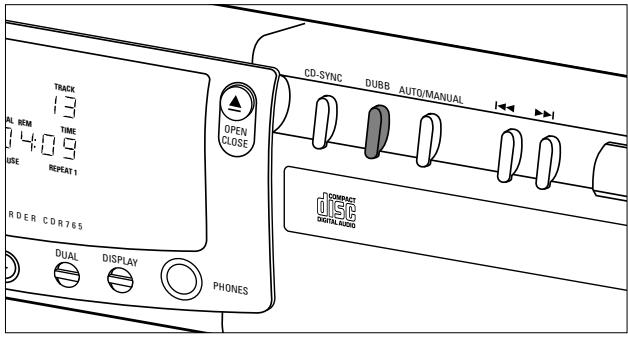
Some comments about dubbing:
- A complete disc or program can be copied at high speed (DUBB).
- Single tracks or programs can be copied at normal speed (DUBB-1).
- Track numbers will be increased automatically.
- Track numbers cannot be increased manually.
Preparing for normal and high-speed dubbing
1 Make sure that the recording disc is completely free of scratches and dust particles.
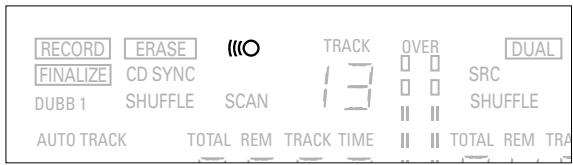
2 If necessary, press the DUAL button to switch off the DUAL mode on the display.
DUAL should be off.
| RECORD | ERASE | (IIIO) | TRACK | OVER | DUAL | TRACK |
| FINALIZE | CD SYNC | □ | □ | SRC | ||
| DUBB 1 | SHUFFLE | SCAN | □ | □ | SHUFFLE | |
| II | II | |||||
| AUTO TRACK | TOTAL REM | TRACK TIME | II | II | TOTAL REM | TRACK TIME |
| II | II | |||||
| II | II |
Start high-speed dubbing (Disc copy)
1 To record a complete disc or program, press DUBB repeatedly until:
dUbb appears and DUBB flashes on the display. After some time, bU54 and the track number will appear on the display. The CD Player will scan the tracks on the CD and then stop.
| FINALIZE CD SYNC | SRC | |||
| DUBB 1 | SHUFFLE | SCAN | SHUFFLE | |
| II | II | |||
| AUTO TRACK | TOTAL REM | TRACK TIME | II | TOTAL REM TRACK TIME |
| II | II | |||
| II | II | |||
| PAUSE | DIG ANALOG | OPT PROG REPEAT 1 | II | PAUSE PROG REPEAT 1 |
| II | II | |||
- To see the tracks that will be recorded, press DISPLAY.
The track numbers will be shown in sequence.
- If - appears, the track cannot be dubbed.
- If RARLOSUE FEC appears, the tracked will be dubbed analogue at normal speed.
- All other tracks will be copied in the normal fashion at double speed.
- Tracks for which IS RL EC appears will be digitally recorded at double speed.
2 To start dubbing, press PLAY on the CD Player deck. High-speed dubbing will start. DUBB will stop flashing and remain lighted. The track number and the recording time will be displayed.
- To check the (remaining) recording time, press Display (this can be done during recording).
- Dubbing will stop automatically.
3 To manually stop recording, press STOP DUBB will go out and dubbing will stop. The minimal track length must be four seconds, otherwise a pause will be added to the track.
After dubbing, the display will show for several seconds. The Total Time indications may differ slightly, but no audio information is lost.
Note:
- Pause cannot be operated during DUBB.
- Dubbing will be done one track at a time, meaning that short pauses will be added between the tracks. If you program all tracks in their original sequence and dub at normal speed (DUBB-1), pauses will not be added.
Start dubbing at normal speed (copy a track or program)
Copying one track at a time (DUBB-1) is done at normal speed.
1 For recording, press DUBB repeatedly until: dub appears on the display and DUBB-1 flashes. After some time, RECORD will flash.
2 To select a track for dubbing, briefly press or on the CD Player one or more times.
- If you want to copy a program, you must enter the program first before selecting DUBB-1 (see Programming, page 2.0)
- If you select a track using the digital key pad on the remote control, dubbing will start automatically.
3 To start dubbing, press PLAY on the CD Player. DUBB-1 will stop flashing and remain lighted and the selected track or program will be copied at normal speed. The track number and the recording time used will be shown on the display. - To check the (remaining) recording time, press Display. This can be done during recording.
Note: Copy prohibited tracks will be copied analogue.
4 To stop dubbing, press STOP. DUBB-1 will go out and the dubbing will stop. The minimal track length must be four seconds, otherwise a pause will be added to the track. After dubbing, UPDRIVE will appear on the display for several seconds. The Total Time indications may differ slightly, but no audio information will be lost.
Note: Pause cannot be operated during DUBB-1.
Digital recording from an external CD Player
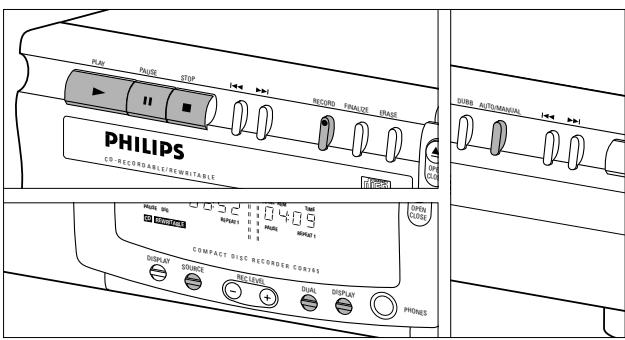
Preparing for digital recording
1 Make sure the disc is absolutely free of scratches and dust particles.
2 Press SOURCE repeatedly until (depending on the digital connection used): DIG d 15 IERL or DIG OPE ICRL appears on the display.
| FINALIZE | CD SYNC | SRC | |
| DUBB 1 | SHUFFLE | SCAN | SHUFFLE |
| AUTO TRACK | TOTAL REM TRACK TIME | II TOTAL REM TRACK TIME | |
| II | |||
| PAUSE DIG ANALOG | OPT PROG REPEAT 1 | II PAUSE PROG REPEAT 1 | |
- If necessary, press DUAL to switch off the DUAL mode; DUAL will no longer appear on the display.
3 Press AUTO/MANUAL to switch between automatic and manual track numbering. If AUTO is selected (the preferred method), AUTO TRAC will appear on the display.
| RECORD | ERASE | (II○) | TRACK | OVER | DUAL | TRACK |
| FINALIZE | CD SYNC | □ □ | SRC | |||
| DUBB 1 | SHUFFLE | SCAN | □ □ | SHUFFLE | ||
| II □ | II | |||||
| AUTO TRACK | TOTAL REM | TRACK TIME | II | II | TOTAL REM | TRACK TIME |
| II | II | |||||
| II | II |
- AUTO: The track increments are automatically copied from the digital source material.
- MANUAL: Track numbers can be incremented manually by pressing . (minimum track length is 4 seconds). (This can also be done in AUTO mode).
- Track numbers cannot be changed after recording.
Note: AUTO TRACK works only with Consumer Sources with a digital output signal according to the IEC 958 (consumer part) audio standard.
Start digital recording
1 With the recorder stopped, press RECORD to enter the Record standby mode.
RECORD flashes.
- If DIG also flashes, the digital connection is incorrect.
2 To start recording, press PLAY on the CD Recorder/Player and immediately start the source (from the stop mode). RECORD lights continuously. The track number and recording time used will be indicated on the display. - To record a three-second pause (silence) at the beginning of a track, press PAUSE on the CD Recorder/Player.
- To check the (remaining) recording time, press DISPLAY. (This can also be done during the recording.)
3 To stop recording, press STOP on the CD Recorder/Player. RECORD will go out. - To interrupt recording, press PAUSE. RECORD starts to flash. Resume at step 2.
After recording the display will show LIPAR for several seconds.
Note: With AUTO TRACK on, the recorder will stop automatically. Recordings from DAT or DCC will stop after 20 seconds silence. With AUTO TRACK off, the AUTO STOP mode is disabled.
Synchronized digital recording from an external CD player - CD-SYNC
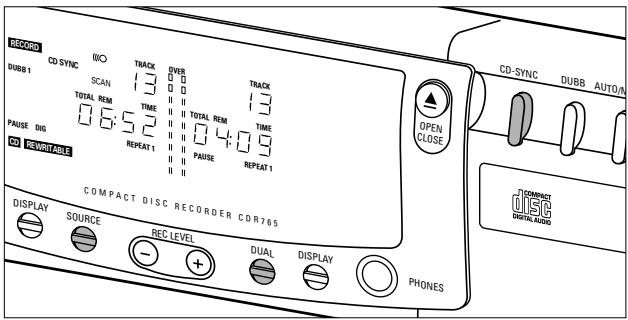
Preparing for synchronized digital recording
The CD-SYNC feature enables you to make fast and easy digital recording of a CD. Track increments are automatically detected from the digital source material. Track increments cannot be added manually.
1 Make sure the disc is absolutely free of scratches and dust particles.
2 Press SOURCE repeatedly until (depending on the connection used): DIG d i5 iERL or DIG OPE iCRL will appear on the display.
- If necessary, press DUAL to switch off the DUAL mode; DUAL will no longer appear on the display.
Start synchronized digital recording
1 With the CD Recorder/Player stopped, press CD-SYNC. On the display, CD-SYNC & 53 appear. After a time, RECORD starts to flash.
| [RECORD] | [ENASE] | [RO] | TRACK | OVER | [DUAL] | TRACK |
| FINALIZE | CD SYNC | □ □ | SRC | |||
| DUBB 1 | SHUFFLE | SCAN | □ □ | SHUFFLE | ||
| II □ | ||||||
| AUTO TRACK | TOTAL REM TRACK TIME | II □ | TOTAL REM TRACK TIME | |||
| 547C | II □ | |||||
| II □ | ||||||
| PAUSE DIG ANALOG OPT PROG REPEAT 1 | II □ | PAUSE PROG REPEAT 1 | ||||
- If DIG also flashes, the digital connection is incorrect.
2 To start recording, press PLAY on the external digital source.
The CD Recorder/Player automatically starts to record and RECORD lights continuously. The track number and recording time used will be indicated on the display
-
If you start the source during a track, CD-SYNC will not start recording until the beginning of the next track.
-
To check the (remaining) recording time, press DISPLAY. (This can also be done during recording)
3 To stop recording, press STOP on the CD Recorder/Player. CD-SYNC and RECORD go out. - To interrupt recording, press PAUSE. RECORD starts to flash. To resume, press PLAY on the CD Recorder/Player.
After recording the display will show L^^^^ for several seconds.
Note:
- The CD Recorder/Player will not start until it recognizes a digital signal. Although the reaction time is less than 200 milliseconds, the very beginning of the music may sometimes not be recorded. If this happens, you can start the recording manually (see digital recording - unsynchronized).
- Recordings from DAT or DCC will only stop after 20 seconds silence.
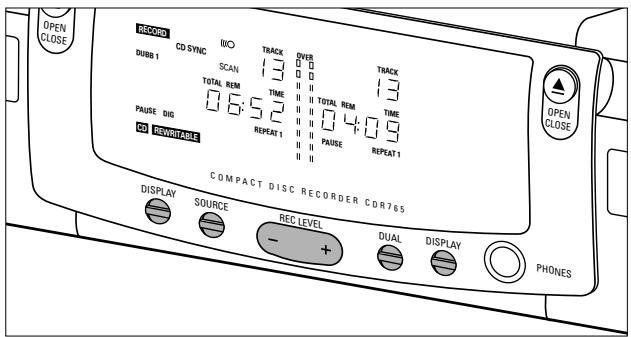
Analogue recording from an external source
Only make analog recordings if digital recording is not possible.
Preparing for analogue recording
1 Make sure the disc is absolutely free of scratches and dust particles.
2 Press SOURCE repeatedly until: ANALOG appears on the display.
| [FINALIZE] | CD SYNC | D | D | SRC | |
| DUBB1 | SHUFFLE | SCAN | D | D | SHUFFLE |
| II | II | ||||
| AUTO TRACK | TOTAL REM | TRACK TIME | II | TOTAL REM TRACK TIME | |
| ANALOG | G | II | II | ||
| II | II | ||||
| PAUSE | DIG | ANALOG OPT | PROG REPEAT 1 | II | PAUSE PROG REPEAT 1 |
| II | II | ||||
- If necessary, press DUAL to switch off the DUAL mode; DUAL will no longer appear on the display.
| RECORD | ERASE | (1) | TRACK | OVER | DUAL | TRACK |
| FINALIZE | CD SYNC | ☐ | ☐ | SRC | ||
| DUBB 1 | SHUFFLE | SCAN | ☐ | ☐ | SHUFFLE | |
| II | II | |||||
| AUTO TRACK | TOTAL | REM | TRACK | TIME | II | TOTAL REM TRACK TIME |
| II | II | |||||
| II | II |
3 Press AUTO/MANUAL to switch between auto and manual track numbering.
If Auto is selected (preferred), AUTO TRACK appears on the display.
- AUTO: The track number is automatically incremented after a silence on the original of at least 3 seconds.
- MANUAL: Track numbers can be incremented manually by pressing . (minimum track length is 4 seconds.) (This can also be done in AUTO mode)
- Track numbers cannot be changed after recording.
4 With the recorder stopped, press RECORD to enter Record standby mode.
RECORD will flash
| RECORD | ERASE | (FFFF) | TRACK | OVER | DUAL | TRACK |
| FINALIZE | CD SYNC | □ □ | SRC | |||
| DUBB 1 | SHUFFLE | SCAN | □ □ | SHUFFLE | ||
| II □ | II | |||||
| AUTO TRACK | TOTAL REM | TRACK TIME | II | II TOTAL REM | TRACK TIME | |
| II | II | |||||
| II | II |
5 Play the source first to set the optimal recording level on the CD Recorder/Player.
6 Press REC LEVEL (+ or -) repeatedly until all the blue segments on the Record/Play level bar light up continuously but the red segments do not during the loudest passages. The display will show -3db or 0db or 3db or 6db
7 Stop the source.
Start analogue recording
1 To start recording, press PLAY on the CD Recorder/Player and immediately start the source.
RECORD lights continuously. The track number and recording time used appear on the display.
- To record a 3-second silence at the start of a track, press PAUSE.
- To check the (remaining) recording time, press DISPLAY. (This can also be done during the recording)
2 To stop recording, press STOP on the CD Recorder/Player. RECORD will go out.
- To interrupt recording, press PAUSE. RECORD will start to flash. Resume at step 1.
After recording the display will show LIPdR for several seconds.
Note: With AUTO TRACK on, the recorder will stop automatically after a 20 seconds silence. With AUTO TRACK off, the AUTO STOP mode is disabled.
Finalizing CD-R & CD-RW discs
Finalizing is a simple procedure that is necessary in order to play back the discs on the CD Recorder/Player or on an external CD player.
Note: Finalizing prevents any further recording on a CD-R. A finalized CD-RW must be unfinalized to allow further recording or erasure of tracks.
1 Make sure the disc (in the CD Recorder/Player) is absolutely free of scratches and dust particles.
2 With the recorder stopped press FINALIZE and then within 3 seconds press RECORD.
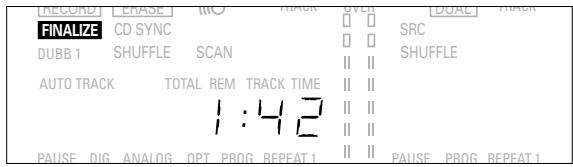
The approximate finalization time will appear in the display.
RECORD & FINALIZE lights up. The display counts down through the finalization.
On completion, the total number of tracks and the total time recorded will appear on the display.
For CD-R CD RECORDABLE will change to CD on the display.
For CD-RW no change will de seen on the display.
Finalizing will last at least 2 minutes.
Note: During finalisation, the CD Recorder/Player accepts no operating commands.
Unfinalizing CD-RW discs
For CD-RW discs only.
If you want to make more recordings (or to erase tracks) on a finalized disc you must uninitialize it first. The Table of Contents (TOC) on the disc will be removed.
To unfinalize:
1 Press ERASE twice.
On the display, and ERASE will flash.
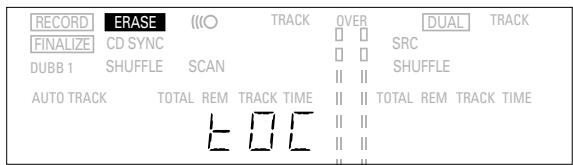
2 Press RECORD within 3 seconds.
E and ERASE light up continuously during erasure.
Note: This will take approximately 1 minute.
Erasing CD-RW discs
For CD-RW discs only.
You can erase:
- track by track from the end.
- the entire disc.
To erase the last track :
1 Make sure the disc is not finalized (Showing P C on display during start up). Otherwise uninitialize first (p.17)
2 Press ERASE.
On the display, 上 上 and ERASE will flash.
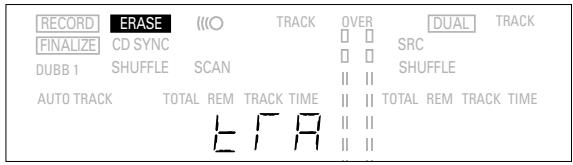
3 Press RECORD within 3 seconds.
and ERASE light continuously during erasure.
To erase the entire disc:
1 Press ERASE once (for finalized CD-RW) and twice (for unfinalized CD-RW)
On the display, and ERASE will flash.
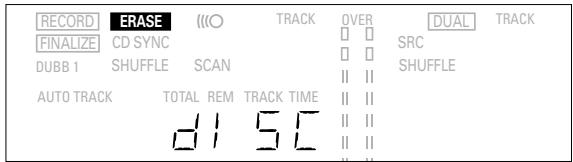
2 Press RECORD within 3 seconds.
and ERASE light continuously during erasure.
Erasure of a complete disc may take up to 1.5 minutes.
Playing CDs on Deck 1 and/or Deck 2
With your CD Double Deck, you can play the CD Recorder deck and/or the CD Player deck either simultaneously or separately (DUAL). For separate playing, the extra CD output must also be connected to an amplifier (see page 9.)
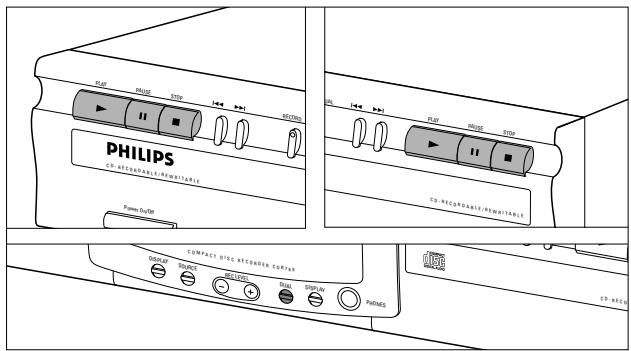
1 Press DUAL to switch DUAL on.
DUAL will light up continuously
2 On the deck you want to use, press PLAY to start CD play. The track number and the track time for the deck in play will appear on the display, together with the record/play level indicator.
3 Press DISPLAY once, twice or three times to see: Remaining track time, total remaining time, or total track time (without level indicator).
4 To interrupt play temporarily, press PAUSE.
PAUSE will light up on the display
5 To continue play, press PAUSE again or press PLAY.
6 To stop play, press STOP.
The number of tracks and the total playing time will appear on the display.
Playing as a 2-disc changer
Your CD Recorder/Player can play CDs in both decks either successively or in random order (SHUFFLE play).
1 Press DUAL to switch DUAL off
DUAL should be off.
2 On the deck you want to use, press PLAY to start CD play. The track number and track time of the deck in play appear on the display, together with the record/play level indicator.
After the first disc has played, the second disc will be played.
TIP:
Use SHUFFLE to play the tracks on the two discs in random order (see SHUFFLE, page 19).
3 Press DISPLAY once, twice or three times to see: Remaining track time, total remaining time, or total track time with level indicator off.
4 To temporarily interrupt play, press PAUSE. PAUSE will light up on the display.
5 To continue play, press PAUSE again or press PLAY.
6 To stop play, press STOP. The number of tracks and the total playing time on the CD will appear on the display.
Selecting a track or searching
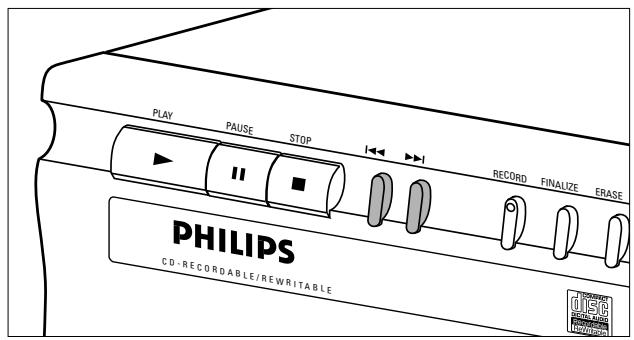
Selecting a track during play
1 Briefly press or one or more times. The player will skip to the beginning of the current, previous or next tracks, including tracks on the other disc when both decks are in use as a 2-disc changer. or
- Select CD-R or CD on the remote control, then press the desired track number using the numeric key pad on the remote control. For two-digit track numbers, press the numeric keys in rapid succession. For tracks on the other disc, select the desired deck first by pressing CD or CD-R. Play will skip to the beginning of the selected track.
Selecting a track when CD is not playing
1 Briefly press or one or more times.
or
Select CD-R or CD on the remote control, then press the desired track number using the numeric key pad on the remote control. For two-digit track numbers, press the numeric keys in rapid succession.
2 Press PLAY.
Play will start with the track selected.
Searching during CD play
1 Hold down or on the front of the deck or or on the remote control.
The player will search either forward or backward at ten times the normal speed with the sound on low level, and will then search at fifty times the normal speed with the sound muted. The search will extend over both discs if the changer mode (DUAL off) is activated.
2 Release the button when the desired passage has been found.
Play will start with the desired passage.
Note: During Shuffle, Repeat or Programmed play, search is restricted to within the track being played at the time.
Shuffle (random order) play
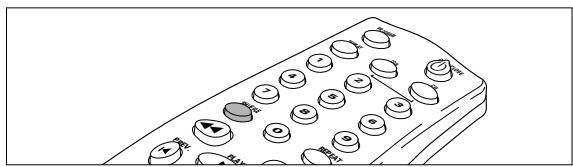
1 Press DUAL to switch off the DUAL mode and to switch on the two-disc changer mode.
DUAL should not be lighted on the display.
2 Press SHUFFLE on the remote control before starting or during play to activate shuffle play.
The tracks on the CD (or in program if programmed) will play in random order. SHUFFLE will appear on the display between tracks.
3 Press SHUFFLE again to return to normal CD play.
Note: Shuffle is also cleared when you open the disc tray.
Repeat CD, track or program
1 Press REPEAT on the remote control one or more times during CD play.
When REPEAT 1 appears on the display, the current track plays repeatedly. When REPEAT appears on the display, the discs or programmes play repeatedly.
2 To return to normal play, press REPEAT one or more times until:
The REPEAT message disappears from the display.
Note:
- You can use shuffle in combination with repeat CD or programmed play using the two-disc changer.
- Repeat will also be cleared if you open the disc tray.
Programming
You can program up to thirty tracks to play in a desired sequence using either the CD Player deck or the CD Recorder/Player. Individual tracks can be included in the program more than once, but will count as a track each time they are included.
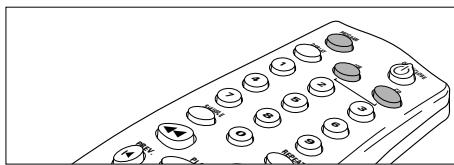
1 Press CD-R or CD on the remote control to select a deck. The message SELECT CD or SELECT CD will briefly appear on the display.
2 Press PROGRAM on the remote control to start programming. PROG will flash and PROS or PROS will briefly appear on the display.
3 Press a track number with the number keys. For 2-digit numbers, press the keys in rapid succession. On the display, the track number appears briefly, followed by the total programmed tracks and total program time.
4 Repeat step 2 for all tracks to be programmed.
5 Press STOP or PROGRAM to end programming. PROG lights continuously.
Note:
- To review the program, press or with the deck in the stop mode.
- To add more tracks to the program, repeat steps 1 through 6.
- If you try to store more than 30 tracks, FILL appears on the display
6 Press PLAY to start programmed play.
Clearing a program
1 Press STOP if necessary to stop programmed play.
2 Press STOP again to clear the program. PROG disappears from the display.
Note: The program is also cleared when you open the disc tray.
Troubleshooting
If you think your CD Recorder/Player is defective, it is wise to check this list first, and run the diagnostic program. Maybe you have forgotten a simple step.
Warning!
Under no circumstances should you attempt to repair the CD Recorder/Player yourself as this will invalidate the guarantee.
SYMPTOM: SOLUTION:
No power
- check to ensure that the ON/OFF button is on
- check to ensure that the power cable is plugged in correctly
- switch the recorder OFF and then immediately back ON
Auto track does not work
- check to ensure that auto track is selected.
- check to ensure that there are 3 seconds silence in between the tracks (analogue recording only)
- check to ensure that the source is a consumer source with the digital output according to the IEC audio standard.
No sound
- check the audio connections
- if using an amplifier, try using a different source
Amplifier sound is distorted
- check to ensure that the CD Recorder/Player analogue output is not connected to the amplifier Phono input.
Play will not start
- check to ensure that the label of the CD is facing up
clean the disc - check to ensure that the disc is not defective by trying another disc
- make sure that the disc has been finalized for play in a CD player.
Remote control does not work
- point the remote control directly at the CD Recorder/Player
- check the batteries and replace if necessary
- select the right source first
Will not record
clean the disc
- check to ensure that CD-RW is not finalized
- check to ensure that the disc is recordable and replace if necessary
- make sure the disc is an AUDIO disc ( n R i may not appear)
- wrong input source selected.
Analog recording is distorted
- make sure the recording level is correct
20 second pause between recordings
see Synchronized digital recording (CD-SYNC) p.15
Player does not react
- switch the ON/OFF button on the front of the player off and back on
RECOUER on display
- a power failure has occurred during recording, the CD Recorder/Player is attempting to repair the disc.
- if = then appears on the display, the disc cannot be recorded further, and cannot be finalized. It can, however, still be played on the CD Recorder/Player or on another CD recorder.
- on a CD-RW disc, the track being recorded is lost, but further recording and finalization can still be done.
- If - appears on the display, the disc cannot be used for recording. However, it can still be used as a CD on this recorder.
no-REC on display
- While scanning a CD before recording, a non-audio track was detected. This track cannot be copied and will be skipped.
Diagnostic program
If the malfunction persists, perform the Diagnostic Program:
1 Switch the CD Recorder/Player off using ON/OFF.
2 Simultaneously press PLAY and STOP and switch the CD Recorder/Player back on using ON/OFF.
The display will now indicate US and after a few minutes, the message will change to - - - - or PRSEd
- If the - - - - message appears, your recorder is defective and needs to be repaired. Consult your supplier or call the Philips Consumer Line to find the nearest service centre. The number of the Consumer Line can be found in the guarantee booklet.
- If the PRSSED message appears, you may be misinterpreting the user instructions or using an inappropriate disc, or there may be a mechanical defect or an incorrect connection. Carefully read the user instructions once again; and if necessary contact your supplier.
- If you cannot solve the problem, contact to the nearest service centre.
3 Switch off the CD Recorder/Player using ON/OFF to exit from the Diagnostic Program.
Table des matieres
GENÉRALITÉS
Después de la copia, en la pantalla se visualizará UPdRE durante algunossegundos. Lasindicacionesde tiempo totalSEOSEOSEOSEOSEOSEOSEOSEOSEOSEOSEOSEOSEOSEOSEOSEOSEOSEOSEOSEOSEOSEOSEOSEOSEOSEOSEOSEOSEOSEOSEOSEOSEOSEOSEOSEOSEOSEOSEOSEOSEOSEOSEOSEOSEOSEOSEOSEOSEOSEOSEOSEOSEOSEOSEOSEOSEOSEOSEOSEOSEOSEOSEOSEOSEOSEOSEOSEOSEOSEOSEOSEOSEOSEOSEOSEOSEOSEOSEOSEOSEOSEOSEOSEOSEOSEOSEOSEOSEOSEOSEOSEOSEOSEOSEOSEOSEOSEOSEOSEO SEOperdera informacionmusical.
The products and services described herein are not necessarily available in all contries.
The specifications and design of this product are subject of change without notice.
Printed in Hungary.