- Prendre le fil de la dernière bobine et l'enfiler en suivant le parcours jaune. Puis passer dans le chas de l'aiguille de gauche de l'avant vers l'arrière.
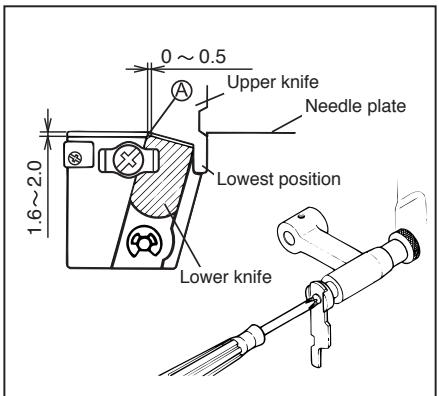
* Le couteau superieur étant très efile, faites attention lorsque vous deplacez cette piece.
| English | Español | |
| SETTING WASTE TRAY (Option on some models) | INSTALANDO LA BANDEJA DE RECORTES | |
| (1) Insert the right guide @ of the waste tray to the right leg of the overlock machine as illustrated. Turn the waste tray in the direction of arrow. | (1) Inserte la guía derecha @ de la bandeja de recortes a la pata derecha de la máquina overlock de la manera ilustrada. Gire la bandeja en dirección de la flecha. | 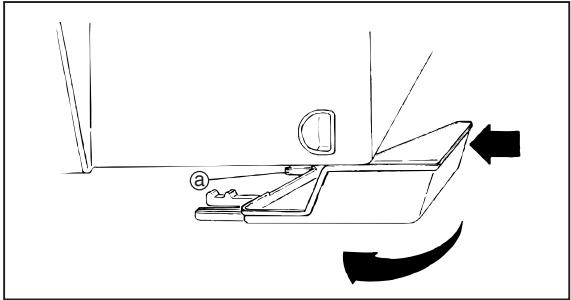 |
| (2) Push the left end of the waste tray in the direction of arrow. | (2) Empuje el extremo izquierdo de la bandeja en dirección de la flecha. | 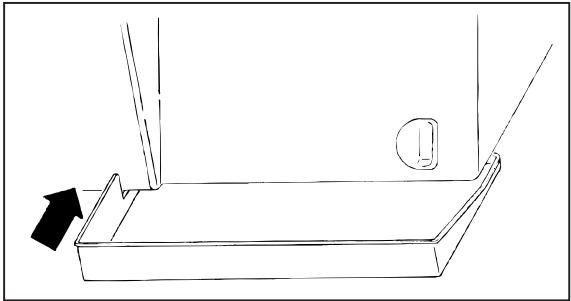 |
| THREE THREAD OVEREDGING STITCH USING ONE NEEDLE | ORILLADO CON TRES HILOS UTILIZANDO UNA AGUJA | 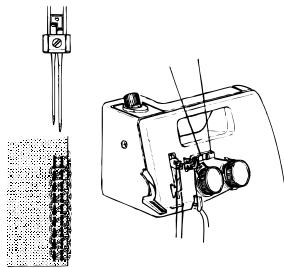 |
| Though this machine is made mainly for 4 thread stitch overedging using 2 needles, three-thread stitch overedging using 1 needle can be easily operated by just removing 1 needle. | Aunque ésta máquina ha sido diseñado principalmente para orillado de 4 hilos con dos agujas, el orillado con tres hilos y una aguja es posible con tan solo remover una aguja. |
| (1) By removing the right needleThree-thread overedging stitch using 1 needle for as wide as a 4-thread overedging stitch using 2 needles can be achieved.Use the left thread tension. (Dial 1). the bite width is normally 5 mm.※ The differential feed ratio is normally “N”. (See p.22) | (1) Extracción de removiendo la aguja derechaEs posible obtener un orillado con tres hilos y una aguja, del mismo ancho que con 4 hilos y dos agujas.Aplique la tensión del hilo izquierdo, (botón 1), el ancho del lazo es normalmente 5 mm.※ La proporción diferencial es normalmente “N”. | English: Left needleEspañol: Aguja izquilerdaFrançais: Aiguille gaucheDeutsch: Linke nadelNederlands: LinkernaaldItaliano: Ago destro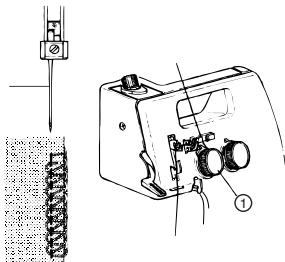 |
| (2) By removing the left needleThe right needle sews with a narrow width bite.Use the right thread tension. (Dial 2)The bite width is normally 3 mm.※ The differential feed ratio is normally “N”. (See p.22) | (2) Extracción de removieno la aguja izquierdaLa aguja derecha cose con un lazo de ancho reducido.Utilice la tensión para hilo derecho, (botón 2). El ancho normal del lazo es 3 mm.※ La proporción diferencial es normalmente “N”. | English: Right needleEspañol: Aguja derechaFrançais: Aiguille droiteDeutsch: Rechte nadelNederlands: RechternaaldItaliano: Ago sinistro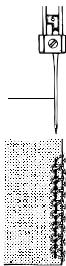 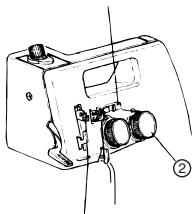 |
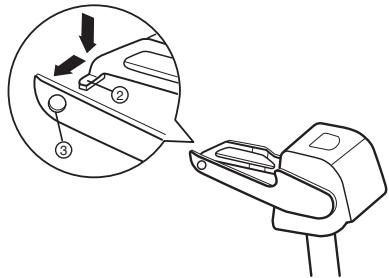
| TWO THREAD OVERLOCK1. Open the front cover.2. Use one needle thread (left or right needle) and lower looper thread.3. Turn the handwheel toward you to move the upper looper to the right side of the needle.4. Hold the 1 by hand and gently push it down.Warning:Pushing converter down too hard may bend converter.5. Insert the tip 2 of the 2-thread converter into the eye 3 of the upper looper.6. Close the front cover. | REMALLADO DE DOS HILOS1. Abra la tapa frontal.2. Utilice el hilo de una aguja (izquieda o derecha) y el hilo del áncora inferior.3. Gire el volante hacia usted para mover el áncora superior hacia la derecha de la aguja.4. Sujete el 1 con la mano y empuje ligeramente hacia abajo.¡Atención!Si empuja el convertidor hacia abajo demasiado fuerte puede doblarlo. | 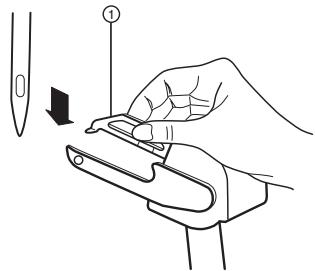 |
 |
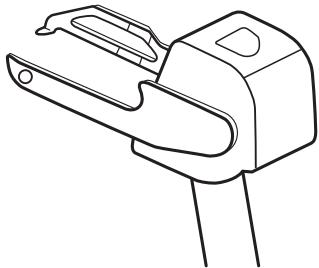 |
| For 3-thread/4-thread overlock sewing, set 2-thread overlock converter in the up position as illustrated, by removing the tip 2 out of the eye 3 of the upper looper. | Para remallado con 3 y 4 hilos, coloque el conversor de 2 hilos en posición alta como se muestra, quitando el extremo 2 del ojo de la aguja 3 del áncora superior. |
| English | Español | Français |
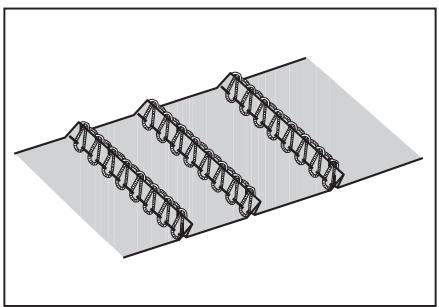
| ROLL HEMMING (Option on some models)Roll hemming is achieved by rolling the fabric and overlocking. the 2 types as illustrated on left is ideal for use with thin materials. | ORILLADO DOBLE (En opción en algunos modelos)Este orillado se obtiene enrollando la tela y cosiendo. Los tipos ilustrados a la izquierda son ideales para telas delgadas. | OURLET ROULE (En option sur certains modèles)L'ourlet roulé est effectué par roulement du tissu et surjet.Les 2 types d'ourlets roulés illustrés ci-contre sont idéals pour une utilisation sur tissus fins. |
F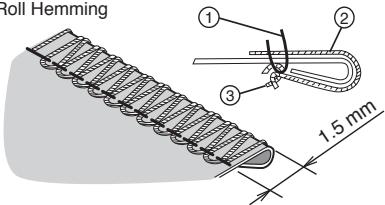 The fabric is rolled by adjusting.The thread tension and is overlocked with upper looper thread. The fabric is rolled by adjusting.The thread tension and is overlocked with upper looper thread. | 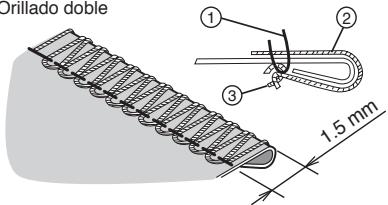 La tela es dobalda ajustando la tensión del hilo y es cosida con el hilo superior. La tela es dobalda ajustando la tensión del hilo y es cosida con el hilo superior. | C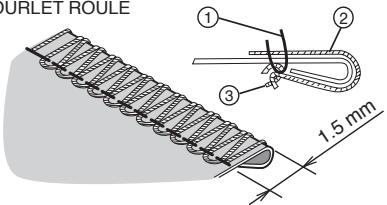 Le tissu ist roulé par le réglage de la tension de fil et est surfilé avec le fil du boucleur supérieur. Le tissu ist roulé par le réglage de la tension de fil et est surfilé avec le fil du boucleur supérieur. |
Fin Roll Hemming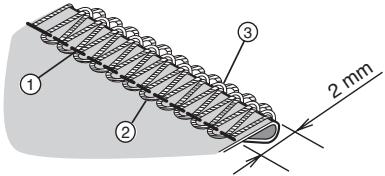 The fabric is rolled and overlocked with upper and lower looper thread. The fabric is rolled and overlocked with upper and lower looper thread. | Orillado doble fino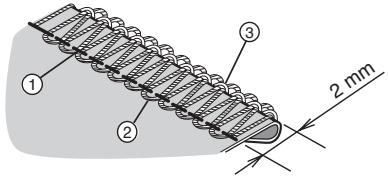 La tela es doblada y cosida con los hilos superior e inferior. La tela es doblada y cosida con los hilos superior e inferior. | OURLET ROULE FIN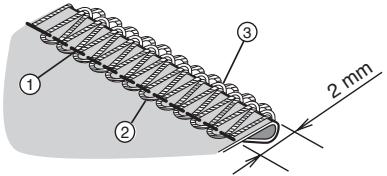 Le tissu est roulé et surfilé par les fils des boucleurs supérieur et inférieur. Le tissu est roulé et surfilé par les fils des boucleurs supérieur et inférieur. |