OT-980 - Téléphone mobile ALCATEL - Notice d'utilisation et mode d'emploi gratuit
Retrouvez gratuitement la notice de l'appareil OT-980 ALCATEL au format PDF.


| Intitulé | Valeur / Description |
|---|---|
| Type de produit | Smartphone tactile |
| Système d'exploitation | Android 2.2 (Froyo) |
| Écran | Écran TFT de 2,8 pouces, résolution 240 x 320 pixels |
| Processeur | Processeur ARM 11, 416 MHz |
| Mémoire interne | 128 Mo de RAM, 256 Mo de mémoire interne, extensible via microSD |
| Caméra | Caméra arrière de 2 MP |
| Connectivité | 3G, Wi-Fi 802.11 b/g, Bluetooth 2.1 |
| Batterie | Batterie Li-Ion 1300 mAh |
| Dimensions | 106 x 55 x 12 mm |
| Poids | 95 g |
| Fonctions principales | Appels, SMS, navigation Internet, applications Android |
| Entretien et nettoyage | Utiliser un chiffon doux, éviter les produits chimiques agressifs |
| Pièces détachées et réparabilité | Disponibilité variable, consulter un professionnel pour les réparations |
| Informations de sécurité | Éviter l'exposition à l'eau, ne pas utiliser en cas de surchauffe |
FOIRE AUX QUESTIONS - OT-980 ALCATEL
Questions des utilisateurs sur OT-980 ALCATEL
0 question sur cet appareil. Repondez a celles que vous connaissez ou posez la votre.
Poser une nouvelle question sur cet appareil
Téléchargez la notice de votre Téléphone mobile au format PDF gratuitement ! Retrouvez votre notice OT-980 - ALCATEL et reprennez votre appareil électronique en main. Sur cette page sont publiés tous les documents nécessaires à l'utilisation de votre appareil OT-980 de la marque ALCATEL.
MODE D'EMPLOI OT-980 ALCATEL
ALCATEL
mobile phones
www. alcatel-mobilephones.com
Table of Contents
Safety and use. 4
General information 9
Your mobile 12
1.1 Keys and connectors 12
1.2 Getting started 14
1.3 Home screen 18
2 Text input. 27
2.1 Using Hardware Keyboard 27
2.2 Using Onscreen Keyboard 28
2.3 Text editing 28
3 Phone call, Call log and Contacts. 29
3.1 Phone 29
3.2 Call log.. 33
3.3 Contacts 34
4 Google Messaging, Gmail/Email, Google Talk and Google Voice.... 42
4.1 Google Messaging 42
4.2 Gmail/Email 47
4.3 Google Talk 52
5 Google Calendar & Alarm clock & Calculator 56
5.1 Google Calendar 56
5.2 Alarm Clock 58
5.3 Calculator 59
6 Getting connected 61
6.1 Connecting to the Internet 61
6.2 Browser 64
6.3 Connecting to Bluetooth devices 72
6.4 Connecting to a computer via USB 73
6.5 Connecting to virtual private networks 75
7 Android Market. 77
7.1 Locate the item you want to download and install.. 77
7.2 Download and install 78
7.3 Manage your downloads 80
8 Multimedia applications 82
8.1 Camera/Camcorder/ 82
8.2 Gallery 85
8.3 YouTube 87
8.4 Music 88
9 Google Maps 91
9.1 Get My Location 91
9.2 Search for a location 92
9.3 Star a location 93
9.4 Get driving, public transport or walking directions 94
9.5 Arrangement of Layers 96
9.6 Join Latitude to see your friends' locations and share yours with them.... 97
10 Others 101
10.1FileManager 101
10.2 Notes 102
10.3 TaskManager 102
10.4 Videos 102
10.5 Voice Recorder 102
10.6 SyncMLClient 104
10.7 TSCalibration 104
10.8 Other applications 105
11 Settings 106
11.1 Wireless & networks 106
11.2 Call settings 108
11.3 Sound & display 110
11.4 Location & security 112
11.5 Applications 114
11.6 Accounts & sync. 116
11.7 Privacy 118
11.8 SD card, USB Mass Storage & phone storage 119
11.9 Search 120
11.10 Language & keyboard 121
11.11 Accessibility 122
11.12 Text-to-speech 123
11.13 Date & time 124
11.14 About phone 125
12 Making the most of your phone 126
12.1 PC suite 126
13 Telephone warranty 127
14 Accessories 129
15 Troubleshooting 130
16 Specifications. 134
Safety and use.
We recommend that you read this chapter carefully before using your phone. The manufacturer disclaims any liability for damage, which may result as a consequence of improper use or use contrary to the instructions contained herein.
- TRAFFIC SAFETY:
Given that studies show that using a mobile phone while driving a vehicle constitutes a real risk, even when the hands-free kit is used (car kit, headset...), drivers are requested to refrain from using their mobile when the vehicle is not parked.
When driving, do not use your phone and headphone to listen to music or to the radio. Using a headphone can be dangerous and forbidden in some areas.
When switched on, your phone emits electromagnetic waves that can interfere with the vehicle's electronic systems such as ABS anti-lock brakes or airbags. To ensure that there is no problem:
- do not place your phone on top of the dashboard or within an airbag deployment area,
- check with your car dealer or the car manufacturer to make sure that the dashboard is adequately shielded from mobile phone RF energy.
CONDITIONS OF USE:
You are advised to switch off the telephone from time to time to optimise its performance.
Switch the phone off before boarding an aircraft.
Switch the phone off when you are in health care facilities, except in designated areas. As with many other types of equipment now in regular use, mobile telephones can interfere with other electrical or electronic devices, or equipment using radio frequency.
Switch the phone off when you are near gas or flammable liquids. Strictly obey all signs and instructions posted in a fuel depot, petrol station, or chemical plant, or in any potentially explosive atmosphere.
When the phone is switched on, it should be kept at least 15cm from any medical device such as a pacemaker, a hearing aid or insulin pump, etc. In particular when using the phone, you should hold it against the ear on the opposite side to the device, if any.
To avoid hearing impairment, pick up the call before holding your phone to your ear. Also move the handset away from your ear while using the "hands-free" mode because the amplified volume might cause hearing damage.
Do not let children use the phone and/or play with the telephone and accessories without supervision.
When replacing the cover please note that your phone may contain substances that could create an allergic reaction.
Always handle your phone with care and keep it in a clean and dust-free place.
Do not allow your phone to be exposed to adverse weather or environmental conditions (moisture, humidity, rain, infiltration of liquids, dust, sea air, etc). The manufacturer's recommended operating temperature range is -10^ to +55^ .
At over 55^ the legibility of the phone's display may be impaired, though this is temporary and not serious.
Emergency call numbers may not be reachable on all cellular networks. You should never rely only on your phone for emergency calls.
Do not open, dismantle or attempt to repair your mobile phone yourself.
Do not drop, throw or bend your mobile phone.
Do not paint it.
Use only batteries, battery chargers, and accessories which are recommended by TCT Mobile Limited and its affiliates and are compatible with your phone model. TCT Mobile Limited and its affiliates disclaim any liability for damage caused by the use of other chargers or batteries.
Remember to make back-up copies or keep a written record of all important information stored in your phone.
Some people may suffer epileptic seizures or blackouts when exposed to flashing lights, or when playing video games. These seizures or blackouts may occur even if a person never had a previous seizure or blackout. If you have experienced seizures or blackouts, or if you have a family history of such occurrences, please consult your doctor before playing video games on your phone or enabling a flashing-lights feature on your phone.
Parents should monitor their children's use of video games or other features that incorporate flashing lights on the phones. All persons should discontinue use and consult a doctor if any of the following symptoms occur: convulsion, eye or muscle twitching, loss of awareness, involuntary movements, or disorientation. To limit the likelihood of such symptoms, please take the following safety precautions:
- Do not play or use a flashing-lights feature if you are tired or need sleep.
- Take a minimum of a 15-minute break hourly.
- Play in a room in which all lights are on.
- Play at the farthest distance possible from the screen.
- If your hands, wrists, or arms become tired or sore while playing, stop and rest for several hours before playing again.
- If you continue to have sore hands, wrists, or arms during or after playing, stop the game and see a doctor.
When you play games on your phone, you may experience occasional discomfort in your hands, arms, shoulders, neck, or other parts of your body. Follow the instructions to avoid problems such as tendinitis, carpal tunnel syndrome, or other musculoskeletal disorders.

Prolonged exposure to music at full volume on the music player may damage the listener's hearing.
Set your phone volume safely. Use only headphones recommended by TCT Mobile Limited and its affiliates.
- PRIVACY:
Please note that you must respect the laws and regulations in force in your jurisdiction or other jurisdiction(s) where you will use your mobile phone regarding taking photographs and recording sounds with your mobile telephone. Pursuant to such laws and regulations, it may be strictly forbidden to take photographs and/or to record the voices of other people or any of their personal attributes, and duplicate or distribute them, as this may be considered to be an invasion of privacy. It is the user's sole responsibility to ensure that prior authorisation be obtained, if necessary, in order to record private or confidential conversations or take a photograph of another person; the manufacturer, the seller or vendor of your mobile phone (including the operator) disclaim any liability which may result from the improper use of the mobile phone.
BATTERY:
Before removing the battery from your phone, please make sure that the phone is switched off. Observe the following precautions for battery use:
- Do not attempt to open the battery (due to the risk of toxic fumes and burns).
- Do not puncture, disassemble or cause a short-circuit in a battery,
- Do not burn or dispose of a used battery in household rubbish or store it at temperatures above 60^ .
Batteries must be disposed of in accordance with locally applicable environmental regulations. Only use the battery for the purpose for which it was designed. Never use damaged batteries or those not recommended by TCT Mobile Limited and/or its affiliates.

This symbol on your telephone, the battery and the accessories means that these products must be taken to collection points at the end of their life:
- Municipal waste disposal centres with specific bins for these items of equipment
- Collection bins at points of sale.

They will then be recycled, preventing substances being disposed of in the environment,
so that their components can be reused.
In European Union countries:
These collection points are accessible free of charge.
All products with this sign must be brought to these collection points.
In non European Union jurisdictions:
Items of equipment with this symbol are not to be thrown into ordinary bins if your jurisdiction or your region has suitable recycling and collection facilities; instead they are to be taken to collection points for them to be recycled.
CAUTION: RISK OF EXPLOSION IF BATTERY IS REPLACED BY AN INCORRECT TYPE. DISPOSE OF USED BATTERIES ACCORDING TO THE INSTRUCTIONS.
CHARGERS
Mains powered chargers will operate within the temperature range of: 0^ to 40^ .
The chargers designed for your mobile phone meet with the standard for safety of information technology equipment and office equipment use. Due to different applicable electrical specifications, a charger you purchased in one jurisdiction may not work in another jurisdiction. They should be used for this purpose only.
RADIO WAVES:
Proof of compliance with international standards (ICNIRP) or with European Directive 1999/5/ EC (R&TTE) is required of all mobile phone models before they can be put on the market. The protection of the health and safety for the user and any other person is an essential requirement of these standards or this directive.
THIS MOBILE PHONE COMPLIES WITH INTERNATIONAL AND EUROPEAN REQUIREMENTS REGARDING EXPOSURE TO RADIO WAVES.
Your mobile phone is a radio transmitter/receiver. It was designed and manufactured to comply with the radiofrequency (RF) exposure thresholds recommended by international requirements (ICNIRP)(1) and by the Council of the European Union (Recommendation 1999/519/EC)(2).
These limits are part of a set of requirements and establish authorised radiofrequency levels for the public. These limits were established by independent groups of experts on the basis of regular and detailed scientific assessments. They include a significant safety margin intended to ensure the safety of all, regardless of age or state of health.
The exposure standard for mobile phones is determined by a measurement unit known as the Specific Absorption Rate or "SAR". The SAR limit is set by international requirements or by the Council of the European Union at 2 watts/kilogram (W / kg) averaged over 10 grams of body tissue. The tests used to determine SAR levels were carried out on the basis of standard usage modes with the phones transmitting at their maximum power level over the entire range of frequency bands.
Although the SAR was established at the highest certified level, the actual SAR level for the mobile phone during use is generally much lower than the maximum values. In fact, since mobile phones are designed to operate at many different power levels, they only use the minimum level of power required to provide a connection to the network. In theory, the closer you are to a base station antenna, the lower the power level required by the mobile phone.
The highest tested SAR value for this mobile phone for use at the ear and compliance against the standard is 0.64W / kg . While there may be differences between the SAR levels on various phones and at various positions, they all meet the relevant International guidelines and EU requirements for RF (radio-waves) exposure.
The World Health Organisation (WHO) considers that present scientific information does not indicate the need for any special precautions for use of mobile phones. If individuals are concerned, they might choose to limit their own or their children's RF exposure by limiting the length of calls, or using "hands-free" devices to keep mobile phones away from the head and body (fact sheet n° 193). Additional information about electromagnetic fields and public health are available on the following site: http://www.who.int/peh-emf.
(1) The ICNIRP requirements are applicable in the following regions: Central America (except Mexico), South America, North and South Africa, Pacific Asia (except Korea), Australia.
(2) The European recommendation (1999/519/EC) is applicable in the following regions: Europe, Israel.
Although no danger relating to the use of telephone was ever proved, the World Health Organisation advises as a precautionary measure to use your telephone with a good level of network reception as indicated on the telephone display (4 to 5 bars). It is also advised to keep the telephone, during communications, away from the belly of pregnant women and from the lower abdomen for teenagers.
Your telephone is equipped with a built-in antenna. For optimal operation, you should avoid touching it or degrading it.
As mobile devices offer a range of functions, they can be used in positions other than against your ear. In such circumstances the device will be compliant with the guidelines when used with headset or usb data cable. If you are using another accessory ensure that whatever product is used is free of any metal and that it positions the phone at least 2cm away from the body.
LICENCES

microSD Logo is a trademark.

The Bluetooth word mark and logos are owned by the Bluetooth SIG, Inc. and any use of such marks by TCT Mobile Limited and its affiliates is under license. Other trademarks and trade names are those of their respective owners.
OT-980 Bluetooth QD ID B016877

The Wi-Fi Logo is a certification mark of the Wi-Fi Alliance.
Google, the Google logo, Android, the Android logo, Google Search™, Google Maps™, Gmail™, YouTube, Android Market, Google Latitude™ and Google Talk™ are trademarks of Google Inc.
General information
- Internet address: www. alcatel-mobilephones.com
- Hot Line Number: see “TCT Mobile Services” leaflet or go to our website.
On our website, you will find our FAQ (Frequently Asked Questions) section. You can also contact us by e-mail to ask any questions you may have.
An electronic version of this user guide is available in English and other languages according to availability on our server:
www. alcatel-mobilephones.com
Your telephone is a transceiver that operates on GSM/GPRS/EDGE in quad-band (850/900/1800/1900 MHz) or UMTS in dual-band (900/2100 MHz).
C∈1588①
This equipment is in compliance with the essential requirements and other relevant provisions of Directive 1999/5/EC. The entire copy of the Declaration of Conformity for your telephone can be obtained through our website: www.alcatel-mobilephones.com.
Protection against theft (1)
Your telephone is identified by an IMEI (phone serial number) shown on the packaging label and in the phone's memory. We recommend that you note the number the first time you use your telephone by entering * # 0 6 # and keep it in a safe place. It may be requested by the police or your operator if your telephone is stolen. This number allows your mobile telephone to be blocked preventing a third person from using it, even with a different SIM card.
Disclaimer
There may be certain differences between the user manual description and the phone's operation, depending on the software release of your telephone or specific operator services.
TCT Mobile shall not be held legally responsible for such differences, if any, nor for their potential consequences, which responsibility shall be borne by the operator exclusively.
This handset may contain materials, including applications and software in executable or source code form, which is submitted by third parties for inclusion in this handset ("Third Party Materials"). All third party materials in this handset are provided "as is", without warranty of any kind, whether express or implied, including the implied warranties of merchantability, fitness for a particular purpose or use/third party application, interoperability with other materials or applications of the purchaser and non-infringement of copyright. The purchaser undertakes that TCT Mobile has complied with all quality obligations incumbent upon it as a manufacturer of mobile devices and handsets in complying with Intellectual Property rights. TCT Mobile will at no stage be responsible for the inability or failure of the Third Party Materials to operate on this handset or in interaction with any other devices of the purchaser. To the maximum extent permitted by law, TCT Mobile disclaims all liability for any claims, demands, suits or actions, and more specifically - but not limited to - tort law actions, under any theory of liability, arising out of the use, by whatever means, or attempts to use, such Third Party Materials. Moreover, the present Third Party Materials, which are provided free of charge by TCT Mobile, may be subject to paid updates and upgrades in the future; TCT Mobile waives any responsibility regarding such additional costs, which shall be borne exclusively by the purchaser. The availability of the applications may vary depending on the countries and the operators where the handset is used; in no event shall the list of possible applications and software provided with the handsets be considered as an undertaking from TCT Mobile; it shall remain merely as information for the purchaser. Therefore, TCT Mobile shall not be held responsible for the lack of availability of one or more applications wished for by the purchaser, as its availability depends on the country and the operator of the purchaser. TCT mobile reserves the right at any time to add or remove Third Party Materials from its handsets without prior notice; in no event shall TCT Mobile be held responsible by the purchaser for any consequences that such removal may have on the purchaser regarding the use or attempt to use such applications and Third Party Materials.
I.1 Keys and connectors
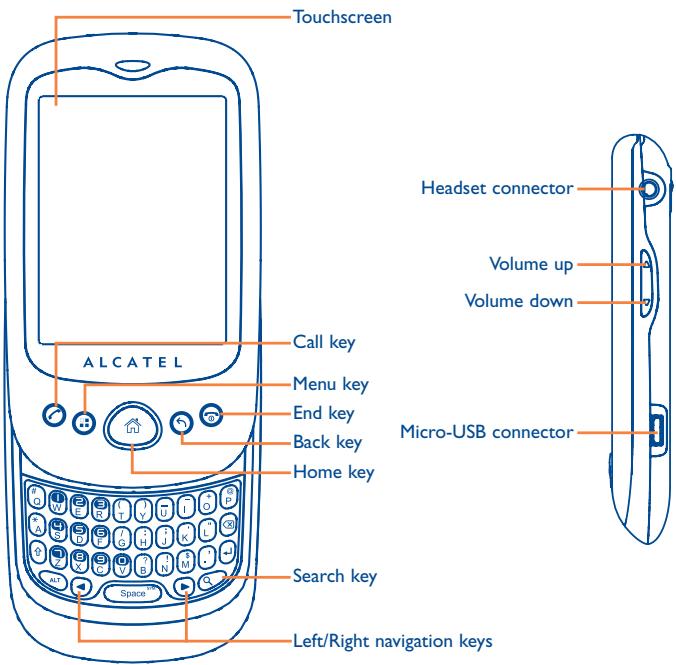

Pick up/Send a call
Enter Call Log
- Return to current call screen if the user navigates to other applications during call.

- On Home screen, press to quickly access Settings menu or Notification panel; to launch quick search; to customize your Home screen by adding applications or changing wallpaper.
- On other screens, press to view options list.

Short press: Return to the Home screen or back to the central Home screen if it is extended.
Long press: Enter the recently used applications list.

Go back to the previous menu or screen.

Short press: End a call Lock the screen
Long press: When phone is off, power on the phone.
When phone is on, enter Phone options: Silent mode, Airplane mode, Power off.

Press to adjust the Volume (in call/media playing mode)

Open Search bar for searching within an application, the phone or web.

Press to go left/right

Press to go up/down
1.2 Getting started
1.2.1 Set-up
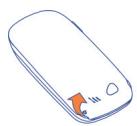
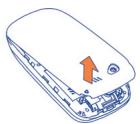
Removing or installing the back cover
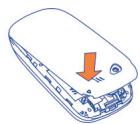
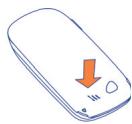
Inserting or removing the SIM card (1)
You must insert your SIM card to make phone calls. Please power off your phone and remove battery before inserting or removing the SIM card.
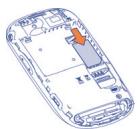

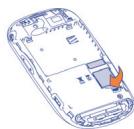
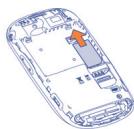
Place the SIM card with the chip facing downwards and slide it into its housing. Make sure that it is correctly inserted. To remove the card, press and slide it out.
(1) Check with your network operator to make sure that your SIM card is 3V or 1.8V compatible. The old 5 volt cards can no longer be used.
Installing or removing the battery
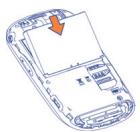
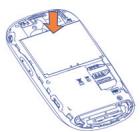
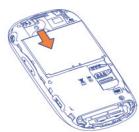
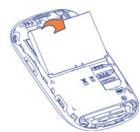
- Insert and click the battery into place, then close the phone cover.
- Unclip the cover, then remove the battery.
Installing and removing the memory card (MicroSD card)
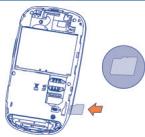
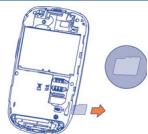
Insert the MicroSD card with golden contact facing downwards into the slot until it is locked. Gently push the memory card until it is unlocked.

To remove the microSD card while the phone is on, you must unmount the storage card from the phone first, to prevent corrupting or damaging the storage card.
Charging the battery
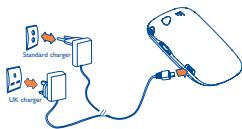
Connect the battery charger.
- Charging may take about 20 minutes to start if the battery is flat.
- Be careful not to force the plug into the socket.
- Make sure the battery is correctly inserted before connecting the charger.
- The mains socket must be near to the phone and easily accessible (avoid electric extension cables).
- When using your telephone for the first time, charge the battery fully (approximately 3 hours).
You are advised to fully charge the battery ( ).

Charging is complete when the animation stops
1.2.2 Power on your phone
Hold down the End key until the phone powers on, type in your PIN code if necessary and then confirm. The Home screen is displayed.
If you do not know your PIN code or if you have forgotten it, contact your network operator. Do not leave your PIN code with your telephone. Store this information in a safe place when not in use.
Set up your phone for the first time
The first time you power on the phone, you are required to touch the Android logo to begin and then sign into your Google Account to synchronize email, contacts, calendar and other Google applications (1).
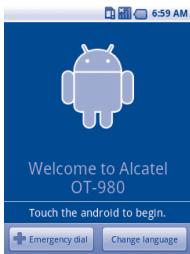
- Enter your user name and password, then touch Sign in. If you forget your password, you can go to http://www.google.com/ to retrieve it. If you don't own a Google Account, you are prompted to create one by touching Create.
- Read the setup information on the screen, then touch Next.
- Set up the date and time, then touch Next.
- Touch Finish setup.
In power on screen without SIM card inserted, you can also connect to a Wi-Fi network (refer to section 6.1.2 Wi-Fi) to sign into your Google Account and to use some features.
(1) Application availability depends on country and operator.
1.2.3 Power off your phone
Hold down the End key from the Home screen until the phone options appear, select Power off.
1.3 Home screen
You can bring all the items (applications, shortcuts, folders and widgets) you love or use most frequently to your Home screen for quick access. Press Home key to switch to Home screen.
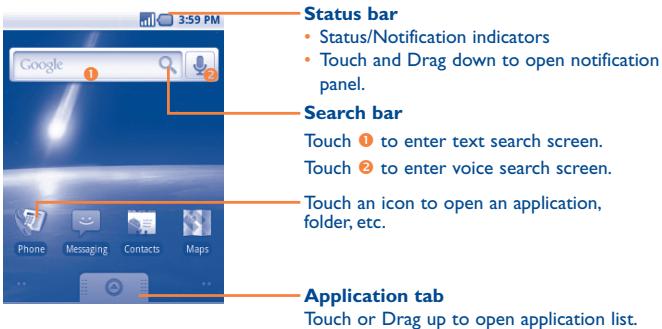
Home screen is provided in an extended format to allow more space for adding applications, shortcuts etc. Slide the Home screen horizontally left and right to get a complete view of the Home screen. Small dots at the lower left and right of the screen indicate which screen you are viewing.
1.3.1 Using the touchscreen
Touch
To access an application, touch it with your finger.
Touch and Hold
To enter the available options for an item, touch and hold the item. For example, select a contact in Directory, touch and hold this contact, an option list will then appear on screen.
Drag
Place your finger on the screen to drag an object to another location.
Slide/Swipe
Slide the screen to scroll up and down the applications, images, web pages... at your convenience.
Flick
Similar to swiping, but flicking makes it move quicker.
Rotate
Automatically change the screen orientation from portrait to landscape by turning the phone sideways to have a better screen view.
1.3.2 Status bar
From status bar, you can view both phone status (to the right side) and notification information (to the left side). When the status bar is full, “+” icon will appear, touch to display hidden icons.
Status icons
| GPRS connected | GPRS in use | H | Roaming |
| EDGE connected | EDGE in use | H | No signal |
| EDGE in use | EDGE in use | H | No SIM card installed |
| 3G connected | 3G in use | V | Vibrate mode |
| 3G in use | 3G in use | R | Ringer is silenced |
| HSPA (3G+) connected | HSPA (3G+) connected | N | Phone microphone is mute |
| HSPA (3G+) in use | HSPA (3G+) in use | O | Battery is very low |
| Connected to a Wi-Fi network | Connected to a Wi-Fi network | P | Battery is low |
| Bluetooth is on | Bluetooth is on | P | Battery is partially drained |
| Connected to a Bluetooth device | Connected to a Bluetooth device | Q | Battery is full |
| Airplane mode | Airplane mode | Q | Battery is charging |
| Alarm is set | Alarm is set | S | GPS is on |
| Signal strength | Signal strength | W | Receiving location data from GPS |
| Headset connected | Headset connected |
Notification icons
| New Gmail message | More notifications are hidden |
| New text or multimedia message | Call in progress (green) |
| Problem with text or multimedia message delivery | Call in progress using Bluetooth headset (blue) |
| New Google Talk message | Missed call |
| New voicemail | Call on hold |
| Upcoming event | Call forwarding is on |
| Data is synchronizing | Uploading data |
| Problem with sign-in or synchronization | Downloading data |
| microSD card is full | Download finished |
| An open Wi-Fi network is available | Connected to VPN |
| Phone is connected via USB cable | Disconnected from VPN |
| Song is playing | System update available |
Notification panel
Touch and drag down the Status bar or press Menu key and touch Notifications to open the notification panel. Touch and drag up to close it. From Notification panel, you can open items and other reminders indicated by notification icons or view wireless service information.
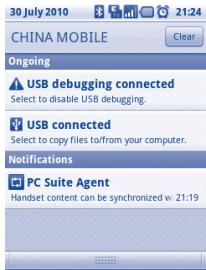
Touch Clear to clear all event-based notifications (other ongoing notifications will remain).
1.3.3 Search bar
The phone provides a Search function which can be used to locate information within applications, the phone or the web.
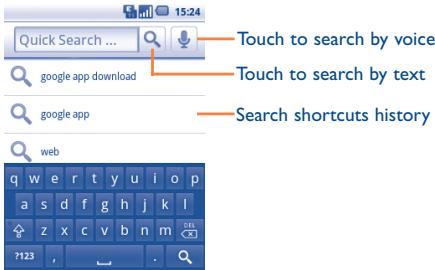
Search by text
- Touch from Home screen or press Search key from other applications screen.
- Enter the text/phrase you want to search for.
- Touch
Search by voice
- Touch from Search bar to display a dialog screen.
- Speak the word/phrase you want to search for. A list of search results will display for you to select from.
1.3.4 Lock/Unlock your screen
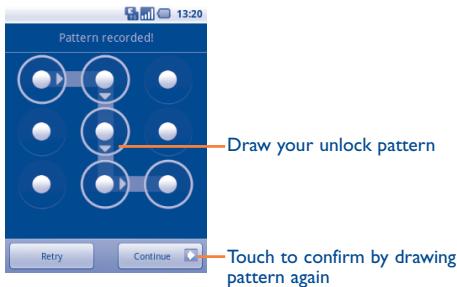
To protect your phone and privacy, you can lock the phone screen by creating a variety of patterns.
To create a screen unlock pattern (refer to section I.4.2 for detailed settings)
- Press Menu key from the home screen, touch Settings, then touch Location & Security\Screen unlock pattern.
- Draw your own pattern, you can also press Menu key for help.
To lock phone screen
Press End key once to lock the screen.
To unlock phone screen
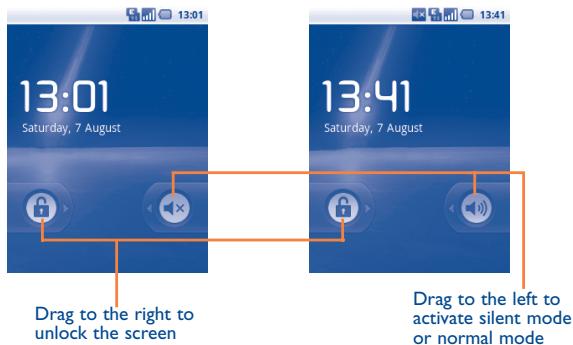
Draw the unlock pattern you have created to wake up the screen. If you did not set the unlock screen, drag the green lock icon to the right to unlock it.
1.3.5 Personalize your home screen
Add
Touch and hold an empty area or press Menu key and touch Add on the Home screen. The Add to Home screen will appear, offering a range of options.
Shortcuts
To add a shortcut to Home screen, such as applications, bookmark, contact, etc.
- Widgets
To add a widget to Home screen, such as clock, music player, etc.
- Folders
To add a folder to Home screen, such as new folder, contact folder, etc.
To improve the organization of the Home screen items (shortcuts, widgets), you can add them to a folder by touching and dragging them onto the folder of your choice. To rename a folder, open it, touch and hold the folder's title bar to open the Rename folder dialog box, then enter the new folder name and confirm with OK.
Reposition
Touch and hold the item to be repositioned to activate the Move mode, drag the item to the desired position and then release. Hold the icon on the left or right edge of the screen to drag the item to another Home screen page.
Remove
Touch and hold the item to be removed to activate the Move mode, drag the item to the top of the Application tab, which will then turn red, and release.
Wallpaper customization
Touch and hold an empty area or press Menu key and touch Wallpaper on the Home screen, a popup window named Select wallpaper from will appear, offering a range of options. Pictures include pictures you have taken, cropped or downloaded. Wallpaper gallery includes all preset wallpapers in the phone. Slide left and right to locate a desired image, touch Set wallpaper to confirm.
1.3.6 Application tab
Touch or drag up the on Home screen to enter applications list.
To close it, touch or drag it down.
Consult recently-used applications
To consult recently-used applications, you can press and hold the Home key from Home screen. Touch an icon in the window to open the related application.

1.3.7 Volume adjustment
Using volume key
Press Volume up/down key to adjust the volume. While in the lowest volume level (Silent mode), press Volume down key once, your phone will now be switched to Vibration mode. Press Volume up key once in Vibration mode and it will change to silent mode.
Using Settings menu
Press Menu key from Home screen, then touch Settings\Sound & display, you can set ringer, media and phone ringtone volume to your preference.
Besides the above two ways, you can also switch between silent mode and normal mode easily, refer to section 1.3.4.
2 Text input
Your phone is equipped with two kinds of keyboard: Hardware Keyboard and Onscreen Keyboard.
2.1 Using Hardware Keyboard
Slide up the phone to open the Hardware Keyboard.
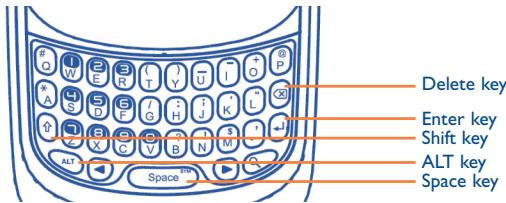

Press once: Input a capitalized character
Shift+Space: to select input method
Press twice: Lock the keyboard in capital letter input mode

Press once: Input a top-half character
Press twice: Lock the keyboard in top-half key input mode
Space
Enter a space
ALT+Space: to enter symbol table

Confirm an option
Enter the next line

Delete a word or character
2.2 Using Onscreen Keyboard
Onscreen keyboard will display automatically when a program requires entering text or numbers.
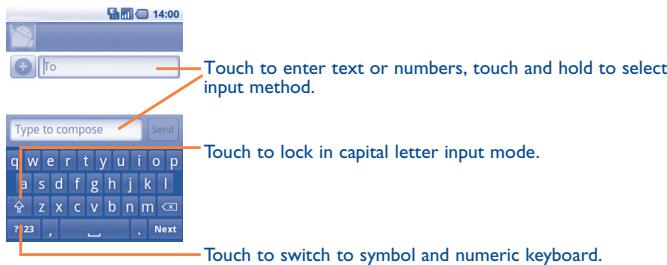
Onscreen keyboard settings
Press Menu key from Home screen, select Settings\Language & Keyboard settingsAndroid keyboard, a series of settings are available for your selection.
Adjust the onscreen keyboard orientation
Turn the phone sideways or upright to adjust the onscreen keyboard orientation. You can also adjust it by settings (Press Menu key on Home screen\Settings\Sound & display).
2.3 Text editing
You can edit the text you have entered.
- Touch and hold text you have entered
An option list pops up - Select the operation you need (Select all, Select text, Cut all, Copy all, etc.)
3 Phone call, Call log and Contacts.
3.1 Phone
3.1.1 Placing a call
The user can easily start a call using Phone.
Enter this menu using one of the following two ways:
- Touch Application tab from Home screen and select Phone.
- Press Call key, then select Phone tab.
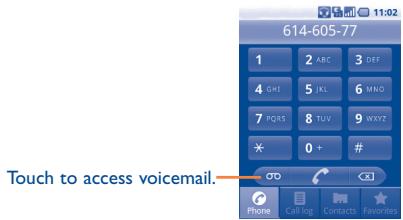
Enter the desired number from the keyboard directly or select a contact from Contacts, Call log or Favorites by touching tabs, then press Call key or touch to place the call. The number you entered can be saved to Contacts by pressing Menu key and touching Add to contacts.
If you make a mistake, you can delete the incorrect digits by touching
To hang up a call, press End key.
International call
To dial an international call, touch and hold 0 to enter “+”, then enter the international country prefix followed by the full phone number and finally touch or press Call key.
Emergency call
If your phone has network coverage, dial emergency number and press Call key or touch to make an emergency call. This works even without a SIM card and without typing the PIN code.
3.1.2 Answering or rejecting a call
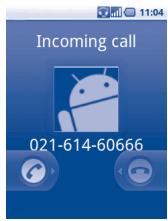
When you receive an incoming call, drag the green phone icon to the right or press Call key to answer. Hang up the call by pressing End key.
When you receive an incoming call, but don't want to answer, you may decline it by dragging the red phone icon to the left. The caller is sent directly to your voicemail box to leave a message.
To reduce the ringtone volume of an incoming call, press Volume down key.
3.1.3 Calling your voicemail
Your voicemail is provided by your network to avoid missing calls. It works like an answering machine that you can consult at any time.
To access your voicemail, touch on Phone tab.
To set your voicemail number, enter Settings\Call settings\Voicemail settings.
If you receive a voicemail, a voicemail icon appears on the Status bar. Open the Notification panel, touch New voicemail.
3.1.4 During a call
When a call is in progress, press Menu key to open the call options. To adjust the volume during a call, press Volume Up/Down key.
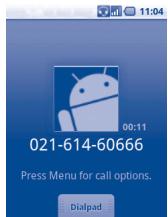

Touch to hold the current call. Touch this icon again to release the call.

Touch to mute the current call. Touch this icon again to unmute the call.

Touch to activate the speaker during the current call. Touch this icon again to deactivate the speaker.

Touch to switch between Bluetooth headset and the phone.

Touch to end the current call.
3.1.5 Managing multiple calls
With this phone you can handle multiple calls at the same time.
Swap calls
When you accept two calls, press Menu key to open option list, and touch icon . You can now switch between two lines. The current call is put on hold and you have joined in the other call.
Conference calls (1)
You can set up a conference call.
- Place a call to the first participant of the conference call.
- Press Menu key to display the option list, touch icon
- Enter the phone number of the person you want to add to conference and press Call key. You can also add participants from Contacts, Call log or Favorites.
- Press Menu key again, then touch icon to start conference call.
- During a conference call, touch Manage to drop a participant or to talk privately to one of the participants. Touch to drop the participant from the conference, touch to talk privately to the participant and hold on other participants.
- Touch End call or press End key to end the conference call and disconnect all callers.
3.2 Call log
You can access your call memory by pressing Call key from the Home screen and touching Call log tab. Touch to the right side of contact/ number to place a call directly. There are three kind of calls in Call log:

Missed calls

Dialled calls

Received calls
Touch or touch & hold a contact or number to view information or further operations.
You can view detailed information of a call, launch a new call or send message to a contact or number, or add number to Contacts (only available for phone numbers), etc.
To clear the entire call memory, press Menu key then touch Clear call log.
3.3 Contacts
Contacts enables quick and easy access to the people you want to reach.
You can view and create contacts on your phone and synchronize these with your Gmail contacts or other applications on the web or on your phone.

When using Contacts for the first time you are required to add new contacts, import contacts from SIM card (please refer to section 3.3.5 for detailed information), or synchronize contacts from other application accounts to your phone.
3.3.1 Consult your Contacts
To access the Contacts, touch Application tab on the Home screen, then select Contacts. You can also access this feature by pressing Call key, then selecting the Contacts tab.
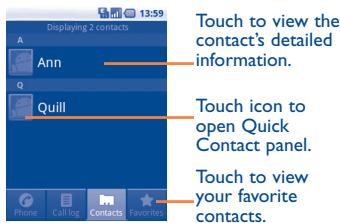
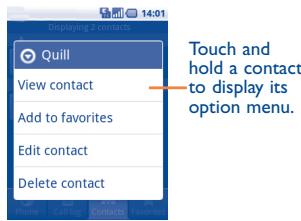
You can also press Menu key to display contact list option menu.
Following actions are enabled:
Search Search for a contact in phone.
- New contact Add new contact to phone.
- Display options Choose contacts to display, for example only contacts with phones, other application contacts if any, etc.
- Accounts Manage the synchronization settings for different accounts.
- Import/export Import or export contacts between phone, SIM card, and MicroSD card.
- More\Sync Launch synchronization with the account you set.
- More\Delete Select and delete unwanted contacts. contacts
3.3.2 Adding a contact
Press Menu key from contact list screen and touch New contacts.
You are required to enter the contact's name and other contact information. By scrolling up and down the screen, you can move from one field to another easily.
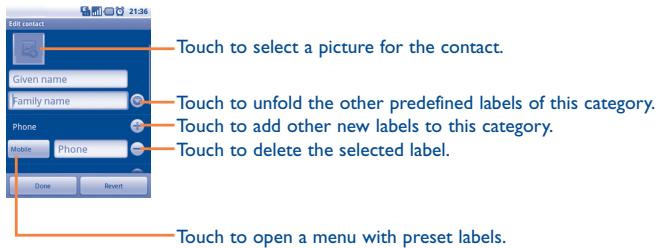
When finished, touch Done to save.
Add to/remove from favorites
To add a contact to favorites, touch and hold a contact to display the contact's option menu, then touch Add to favorites. Or you can also touch a contact to view details then touch to add the contact to favorites (the star will turn gold in color).
To remove a contact from favorites, select Remove from favorites on the contact's option menu or touch gold star on contact details screen.
3.3.3 Editing your contacts
To edit contact information, touch and hold the contact whose information is to be edited, then touch Edit contact. When finished, touch Save.
Change a contact's default phone number
The default phone number (the number which has priority when making a call or sending a message) will always be displayed under the contact name. To change the default phone number, touch and hold the number you want to set as the default number from the contact's details screen, then select Make default number. A appears after the number.
Divert calls to voicemail/Set ringtone for a contact
On the contact's detail screen, press Menu key to display contact list option menu, and touch Options, then select Incoming calls or Ringtone.
When one contact has been set to send calls directly to voicemail, if he/she calls, your phone doesn't ring and the caller will be sent directly to your voicemail.
Delete a contact
To delete a contact, press Menu key and touch Delete contact from contact details screen or directly touch & hold a contact from Contacts screen to display contact list option menu then touch Delete contact. Touch OK to confirm.

The contact you have deleted will also be removed from other applications on phone or web the next time you synchronize your phone.
3.3.4 Communicating with your contacts
From the contacts list, you can communicate with your contacts by making a call or exchanging messages.
To launch a call to a contact, locate the contact or number your want to call, then press Call key or touch . You can also touch & hold the contact or number, then touch Call contact.
To send a message to a contact, touch & hold the contact or number you want to send a message to, then touch Text contact. You can also touch to the right side of the contact from contact details screen.
Use Quick contact for Android
Touch a contact's picture to open Quick Contact for Android, you can touch the icon for the way you want to connect.
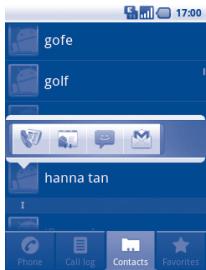
The icons available on Quick contact bar depend on the information you have for the contact and the applications and accounts on your phone.
3.3.5 Contacts importing, exporting and sharing
This phone enables you to import contacts from a SIM card/MicroSD card and export contacts to a MicroSD card which can then be used to back up your information.
From Contacts screen, press Menu key to open contact list option menu, touch Import/Export, then select Import from SIM, Import from SD card or Export to SD card.
To import/export a single contact, touch the contact your want to import/ export, then Done.
To import/export all contacts, press Menu key, then touch Import all/ Export all.
You can share a contact with others by sending the contact's vCard to them via Bluetooth, MMS, Email, etc.
Touch a contact you want to share, press Menu key and touch Share from contact details screen, then select the application to perform this action.
3.3.6 Displaying contacts
You can configure which groups of contacts, for each account, you want to display in the Contacts list. To hide/display contacts that don't have phone numbers, press Menu key from contacts list screen, touch Display options, then activate or deactivate Only contacts with phones by touching it. Finally, touch Done to save.
3.3.7 Joining/Separating contacts
To avoid duplication, you can add any new contact information to existing contacts in a single action.
Touch the contact which you want to add information to, press Menu key and touch Edit contact, then press Menu key again and touch Join.
At this time, you are required to select the contact whose information you want to join with the first contact. The information from the second contact is added to the first one, and the second contact will on longer be displayed in the Contacts list.
To separate contact information, touch the contact whose information you want to separate, press Menu key and touch Edit contact, then press Menu key again and touch Separate contact.
3.3.8 Accounts
Contacts, data or other information can be synchronized from multiple accounts, depending on the applications installed on your phone.
To add an account, press Menu key from Contacts list, touch Accounts, then touch Add account tab; or access it by pressing Menu key from Home screen, touch Settings, then selecting Accounts & Sync and finally touching Add account tab.
You are required to select the kind of accounts to add, like Google, Facebook, etc.
As with other account set-ups, you need to enter detailed information, like username, password, etc.
You can remove an account to delete it and all associated information from the phone.
Open the Accounts & Sync Settings screen, touch the account you want to delete, then touch Remove account and confirm.
Useful icons:

Indicates that the account is configured to synchronize automatically with your phone.

Indicates that the account is not configured to synchronize automatically with your phone.
Background data
Activate or deactivate Background data to control whether applications or services data can be transmitted when they are running in the background. Applications can synchronize, send, and receive data at any time if activated.
For example, if deactivated, Gmail will stop receiving new emails until you touch the Refresh or send an email.
Auto-sync
When activated, all changes to information on the phone or online will be automatically synchronized to each other.
Sync manually
You can synchronize an account manually on Accounts & Sync Settings screen by pressing Menu key and touching Sync now.
4 Google Messaging, Gmail/ Email, Google Talk and Google Voice .
4.1 Google Messaging

You can create, edit and receive SMS and MMS with this mobile phone.
To access this feature, touch Application tab from Home screen, then select Messaging.

All messages you receive or send out can only be saved in phone memory. To consult messages stored in SIM card, press Menu key from Messaging screen, then touch Settings\Manage SIM card message.
4.1.1 Create message
On message list screen, touch New message to create text/multimedia messages.
Sending a text message
Enter mobile phone number of the recipient on To bar, touch Type to compose bar to enter the text of the message. When finished, touch Send to send the text message.
An SMS message of more than 160 characters will be charged as several SMS.When the total number of characters you have entered is approaching the 160-character limit, a counter will appear on the top right corner of the text box to remind you how many characters are allowed to be entered in one message.
Sending a multimedia message
MMS enables you to send video clips, images, photos, animations, slides and sounds to other compatible mobiles and e-mail addresses.
An SMS will be converted to MMS automatically when media files (image, video, audio, slides, etc.) are attached or Subject or email addresses added.
To send a multimedia message, enter the recipient's phone number in the To bar, touch Type to compose bar to enter the text of the message. Press Menu key to open the option menu, touch Add subject to insert a subject, and touch Attach to attach picture, video, audio or slide. When finished, touch Send to send the multimedia message.
Attach options:
- Pictures Access Gallery application or File manager to select a picture as attachment.
- Capture picture Access Camera to capture a new picture for attaching.
- Videos Access Gallery application or File manager to select a video as attachment.
- Capture video Access Camcorder to record a new video for attaching.
- Audio Access to select an audio file as attachment.
- Record audio Enter voice message recorder to record a voice message for attaching.
- Contact Access Contacts to attach a vCard of a contact.
- Appointment Access Calendar to attach an appointment.
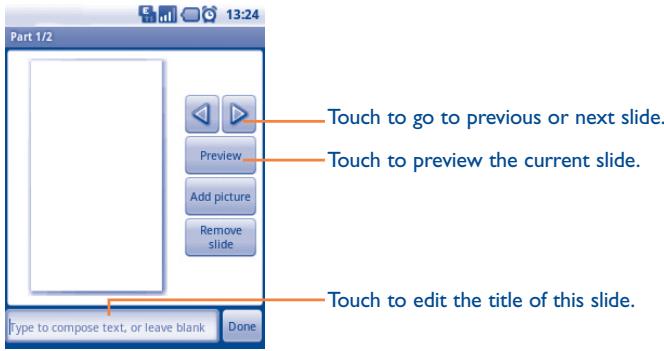
- Slide show Enter Edit slide show screen, touch Add slide to create a new slide, and touch currently existing slide to edit it (see following picture). Press Menu key to get more actions, like setting the slide duration, adding music, etc.
4.1.2 Manage messages
When receiving a message, an icon will appear on status bar as notification. Drag down the status bar to open Notification panel, touch the new message to open and read it. You can also access the Messaging application and touch the message to open.
Messages are displayed in conversational order.
To reply to a message, touch the current message to enter message-composing screen, enter the text, then touch Send.
To return to the message list from a text message thread, press Menu key and then touch All threads.
Touch and hold a message in message details screen. The following message options are available for selection:
Forward Touch to forward the message to another recipient.
Lock/Unlock message Touch to lock/unlock the message so it can/can't be deleted if you reach maximum number of stored messages.
View message Touch to view details of the message. details
Delete message Delete the current message.
Copy message text Copy the current message content. You can paste it to the enter bar of the new message you are going to compose.
4.1.3 Adjust message settings
You can adjust a set of message settings. From Messaging application screen, press Menu key and touch Settings.
Storage settings
- Delete old messages Select to delete old messages when the maximum number of stored messages is reached.
- Text message limit Touch to set number of text messages to save.
- Multimedia
- Touch to set number of multimedia messages to message limit
- save.
- Service center Touch to view service center number.
Text message settings
Delivery reports
Select to request a delivery report for each text message you send.
- Manage SIM card messages
Touch to manage text messages stored on your SIM card.
Multimedia message settings
Delivery reports
Select to request a delivery report for each multimedia message you send.
Read reports
Select to request a report on whether each recipient has or has not read a multimedia message sent by you.
Auto-retrieve
Select to download the full MMS message (including message body and attachment) automatically to your phone. Otherwise, download only the MMS message header.
Roaming auto-retrieve
Select to download the full MMS message (including message body and attachment) automatically when roaming. Otherwise, download only the MMS message header to avoid extra charges.
Maximum message Touch to set maximum message size.
Notification settings
- Notifications
Select to display message notifications in status bar.
- Select ringtone
Touch to select a ringtone as a new message notification tone.
Vibrate
Select to have phone vibrate as a notification when receiving a new message.
4.2 Gmail/Email
The first time you set up your phone, you can select to use an existing Gmail or to create a new Email account.
4.2.1 Gmail

As Google's web-based email service, Gmail is configured when you first set up your phone. Gmail on your phone can be automatically synchronized with your Gmail account on the web. Unlike other kinds of email account, each message and its replies in Gmail are grouped in your inbox as a single conversation; all emails are organized by labels but not by folders.
To access Gmail
From Home screen, touch the Application tab to enter the application list, then touch Gmail.
Gmail displays messages and conversations from one single Gmail account at a time, if you own more than one account, you can switch to another by pressing Menu key from Inbox screen, touching Accounts, then touching the account your want to view.
To create and send emails
- Press Menu key from Inbox screen, and touch Compose.
- Enter recipient(s)'s email address in To field, and if necessary, press Menu key and touch Add Cc/Bcc to include a copy or a blind copy to the message.
- Enter the subject and content of the message.
- Press Menu key, touch Attach to send an attachment to the receiver.
Finally, touch Send. - If you do not want to send the mail out right away, you can touch Save as draft to save copy. To view the draft, press Menu key and touch View labels, then select Drafts.
If you do not want to send or save the mail, you can touch Discard.
To add a signature to emails, press Menu key from inbox screen, and touch Settings, then select Signature.
To receive and read your emails
When a new email arrives, you will be notified by a ringtone or vibration, and an icon will appear on Status bar.
Touch and drag down the Status bar to display the Notification panel, touch the new email to view it. Or you can also access the Gmail Inbox label and touch the new mail to read it.
If you want to go back to the Inbox label while reading a new message, you can press Back key or press Menu key and touch Back to inbox.
The Google Talk online status is shown next to the name of the sender of each email. Touch this indicator to open Quick Contact.
You can search for an email by sender, by subject, by label, etc.
- from inbox screen, press Menu key and then touch Search
- enter the keyword you want to search for in the searching box and touch search icon.
To reply or forward emails
When viewing an email, you will see three icons offering further options at the bottom of the conversation.
Reply/ Reply to all
Touch to enter text-inputting mode, enter the message you want to reply, then touch Send to send this message to one single recipient or all people in a mail loop.
Forward
Touch to forward the message to another person. You are required to enter the new recipient's email address and then touch Send.
Managing G-mails by Label
To conveniently manage conversations and messages, you can organize them using a Label.
To label a conversation when reading a conversation's messages, press Menu key and touch Change Labels and select the label to assign to the conversation.
To view conversations by label when viewing your inbox or another conversation list, press Menu key and touch View labels. Touch a label to view a list of conversations with that label.
Touch and hold an email to produce the following options:
- Archive
To archive the email message. To display the archived messages, you can press Menu key in inbox screen and touch View labels, then All mail.
Mute
To mute the entire conversation. When muted, new mails related to this conversation will not be displayed in Inbox, but archived.
- Mark read/Mark unread
To mark an email message as read or unread.
- Delete
To delete the email message.
- Add star/Remove star
To assign a star or remove the star from the conversation.
Report spam
To report the email message/conversation as spam.
- Change labels
To add or change the label of the email message or conversation.
Gmail settings
To manage Gmail settings, press Menu key in Inbox screen and touch Settings.
- Signature To add a signature text to the end of each mail you send.
- Confirm delete Select to activate a query when deleting a message or conversation, for double confirmation.
- Batch operation Select to add conversation to a batch for further operation, like archive, delete, change label, etc.
- Clear search history Touch to remove the search history.
- Labels Touch to open the Label screen, where you can manage conversation synchronization.
- Email notifications Select to activate notification when a new email arrives.
- Select ringtone Touch to select a ringtone as notification tone when a new email arrives.
- Vibrate Select to activate vibration as notification method when a new email arrives.
4.2.2 Email
Besides your Gmail account, you can also set-up external POP3 or IMAP email accounts in your phone.
To access this function, touch Application tab from Home screen, then select Email.
An email wizard will guide you through the steps to set-up an email account.
- Enter the email address and password of the account you want to setup.
- Touch Next. If the account you entered is not provided by your service provider in the phone, you will be prompted to go to the email account settings screen to enter settings manually. Or you can touch Manual setup to directly enter the incoming and outgoing settings for the email account you are setting up.
- Enter the account name and display name in outgoing emails.
- Touch Done.
- To add another email account, you can press Menu key and touch Add account to create.
To create and send emails
- Press Menu key from Inbox screen, and touchCompose.
- Enter recipient(s)'s email address in To field, and if necessary, press Menu key and touch Add Cc/Bcc to include a copy or a blind copy to the message.
- Enter the subject and content of the message.
- Press Menu key, touch Attach to send an attachment to the receiver.
- Finally, touch Send.
- If you do not want to send the mail right away, you can touch Save as draft or press Back key to save a copy.
4.3 Google Talk
Google's instant messaging service, Google Talk, lets you communicate with your friends whenever they are connected to this service.
To access this feature and sign in, touch Application tab from Home screen, then touch Talk. All friends added by using Google Talk from the web or phone will be displayed in your friends list.
Touch to set your online status.

Available

Busy

Away

Signed out

Invisible
Touch the text box on the left of your online status icon and then enter your status message.
To sign out, press Menu key from Friends list to display options, touch More and then select Sign out.
4.3.1 Chatting with your friends
To start a chat, touch the name of a friend in your Friends list, then enter your message and finally touch Send.
You can invite other friends to join in a group chat by pressing Menu key, touching Add to chat and then select the friend you want to add.
When chatting with more than one friend, you can switch screens by pressing Menu key, then touching Switch chats.
To return to Friends list screen, press Menu key, then touch Friends list.
4.3.2 To add a new friend
From Friends list, press Menu key to open Option list and touch Add Friend to add a new friend. Enter the Google Talk ID or Gmail address of the friend you want to add, and then touch Send invitation.
A notification with this invitation will be received by the friend. By touching the invitation, the friend can select Accept or Cancel in response.
You can also check all invitations you have sent or received by pressing Menu key from Friends list and touching Invites.
4.3.3 To close a chat
When you want to end a chat, the following two ways are available:
- From Friends list screen, touch and hold the friend you want to stop chatting with to open Option menu, touch End chat.
- Press Menu key from chatting screen directly, and then touch End chat.
4.3.4 To manage your friends
Besides adding new friends to your friends list, the following actions are available for your choice:
To view all friends/ most popular friends
By default, only friends that you frequently communicate with are displayed in Friends list. To view all friends, press Menu key, then touch All friends. To return to displaying most popular friends screen, press Menu key again, then touch Most popular.
To make a friend popular
To ensure a friend is always displayed in your Most popular list, touch and hold the friend's name until the options menu pops up, then touch Always show friend. To remove a friend from Always show friend, touch and hold the friend, and touch Auto show friend.
To block a friend
To block a friend from exchanging messages and remove them from your friends list, touch and hold the friend, then touch Block friend. All blocked friends can be viewed by pressing Menu key and touching Linked. To unblock a friend, touch the name of this friend and touch OK when prompted.
4.3.5 Settings
A series of settings are available for your selection by pressing Menu key from Friends list screen, touch More and then Settings.
- IM notifications
Select to activate notification function on status bar when a new message arrives. You can also set a notification ringtone by touching Select ringtone or select Vibrate to activate vibration alert for this service.
- Mobile indicator
Select to display an indicator icon along with your name in other people's Friends list.
- Automatically sign-in
Select to sign in to your Google Talk account automatically every time you turn on your phone.
Automatic awaystatus
Select to set status as Away when the screen is turned off.
Clear search history
Touch to clear previous chat searches history from showing up in the Search box.
5 Google Calendar & Alarm clock & Calculator....
5.1 Google Calendar

Use Google Calendar to keep track of important meetings, appointments, etc.
To access this function, touch Application tab from Home screen, then touch Calendar.
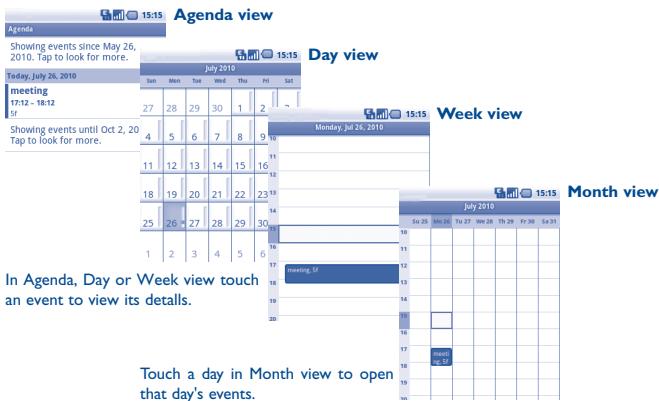
5.1.1 Multimode view
You can display the Calendar in daily, weekly, monthly, or agenda view.
To change your Calendar view, press Menu key, then touch Day, Week, Month or Agenda.
5.1.2 To create new events
You can add new events from any Calendar view.
- Press Menu key from Calendar screen, and touch New event to access new event edit screen.
- Fill in all required information for this new event. If it is a whole-day event, you can select All day.
- Invite guests to the event. Enter the email addresses of the guests you want to invite with commas to separate. If the guests use Google Calendar, they will receive an invitation from Calendar and email.
- When finished, touch Done from the end of the screen.
To quickly create an event from Day,Week or Month view screen, touch and hold an empty spot or an event to open Option menu, then touch New event to enter the event details screen of the time you have previously selected.
5.1.3 To delete or edit event
To delete or edit an event, touch the event to enter details screen, press Menu key, touch Edit event, or Delete event.
5.1.4 Event reminder
If a reminder is set for an event, the upcoming event icon appears on Status bar as a notification when the reminder time arrives.
Touch and drag down the status bar to open notification panel, touch event name to view Calendar notification list.
Touch Snooze all to turn off all event reminders for 5 minutes.
Touch Dismiss all to delete all reminders from the list.
Press Back key to keep the reminders pending in the status bar and notification panel.
Important options by pressing Menu key from Calendar main screen:
| My calendars | To show or hide, remove or add calendars |
| Settings | To set a series of Calendar settings |
5.2 Alarm Clock

Your mobile phone has a built-in alarm clock.
To access this function, touch the Application tab from Home screen, then touch Alarm Clock.
A clock graphic will display on the main screen of this application by default, you may select to hide it by pressing Menu key and touching Hide clock.
5.2.1 To set an alarm
From Alarm clock screen, touch a currently existing alarm or press Menu key and touch Add alarm to enter the alarm editing screen.
Time
Touch to set time.
- Ringtone
Touch to select a ringtone for the alarm
Vibrate
Select to activate vibration
Repeat
Touch to select days you want alarm to sound
Label
Touch to set a name for the alarm
When finished, touch Done to confirm.
5.2.2 To adjust alarm settings
Press Menu key from main screen, then touch Settings. The following options can now be adjusted:
- Alarm in silent mode
Select to play alarm with sound or vibration even when the phone is in Silent mode - Alarm volume
Touch to set volume of alarms - Snooze duration
Touch to set temporary turn off time of an alarm
Side button behavior
Touch to set side Volume up/down key behaviors when alarm sounds: None, Snooze or Dismiss
5.3 Calculator

With Calculator, you can solve many mathematical problems.
To access this function, touch Application tab from Home screen, then touch Calculator.
There are two panels available: Basic panel and Advanced panel.
To switch between panels, select one of the following two ways:
- Touch and drag the basic screen to the left to open the Advanced panel.
- Or press Menu key from basic panel to open option menu and touch Advanced panel.
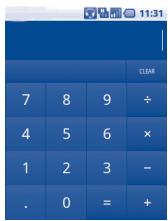
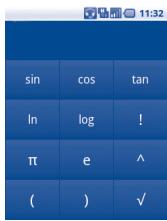
Enter a number and the arithmetic operation to be performed, and enter the second number, then touch “=” to display the result. Touch CLEAR to delete digits one by one, touch and hold CLEAR to delete all at one time. You can clear the calculator's history by pressing Menu key and touching Clear History.
When some number or operations have been entered, touch and hold the entering bar to open a menu offering these further operations:
- Select all To select all entered text
- Select text To select what you want to select from entered text
Cut all To delete all entered text - Copy all To copy all entered text
- Input method To select your preferred input method
- Paste (1) To paste what you have previously copied to the entering bar
(1) Option will not appear unless copy or cut operation has been made.
6 Getting connected.
To connect to the internet with this phone, you can use GPRS/EDGE/3G networks or WI-Fl, whichever is most convenient.
6.1 Connecting to the Internet
6.1.1 GPRS/EDGE/3G
The first time you turn on your phone with SIM card inserted, it will automatically configure network service: GPRS, EDGE or 3G.
To check the network connection you are using, press Menu key on Home screen, then touch Settings\Wireless & networks\Mobile networks\ GSM/UMTS options\Network operators or Access Point Names.
To create a new access point
A new GPRS/EDGE/3G network connection can be added to your phone with the following steps:
- Press Menu key from Home screen.
- Touch Settings\Wireless & networks\Mobile networks\GSM/ UMTS options\Access Point Names.
- Then press Menu key again and the touch New APN.
- Enter the required APN information.
- When finished, press Menu key and touch Save.
To activate/deactivate Data roaming
When roaming, you can decide to connect/disconnect to a data service.
- Press Menu key from Home screen.
- Touch Settings\Wireless & networks\Mobile networks\Data roaming.
- Mark/Unmark the checkbox to activate or deactivate data roaming.
- When Data roaming is deactivated, you can still perform data exchange with a Wi-Fi connection (refer to section 6.1.2 Wi-Fi).
To limit your data connection to 2G networks only
To save battery and extend battery life, you can set to activate 2G networks (GPRS or EDGE) only.
- Press Menu key from Home screen.
- Touch Settings\Wireless & networks\Mobile networks\GSM/ UMTS options\Use only 2G networks.
- Mark/Unmark the checkbox to activate/deactivate this function.
6.1.2 Wi-Fi
Using Wi-Fi, you can connect to the Internet when your phone is within range of a wireless network. Wi-Fi can be used on phone even without a SIM card inserted.
To turn Wi-Fi on and connect to a wireless network
- Press Menu key from Home screen.
- Touch Settings\Wireless & networks\Wi-Fi.
Mark/Unmark the checkbox to turn on/off Wi-Fi. - Touch Wi-Fi settings. The detailed information of detected Wi-Fi networks is displayed in the Wi-Fi networks section.
- Touch a Wi-Fi network to connect. If the network you selected is secured, you are required to enter a password or other credentials (you may contact network operator for details). When finished, touch Connect.
To activate notification when a new network is detected
When Wi-Fi is on and network notification is activated, the Wi-Fi icon will appear on the status bar whenever the phone detects an available wireless network within range. The following steps activate the notification function:
- Press Menu key from Home screen.
- Touch Settings\Wireless & networks\Wi-Fi settings\Network notification.
- Mark/Unmark the checkbox to activate/deactivate this function.
To add a Wi-Fi network
When Wi-Fi is on, you may add new Wi-Fi networks according to your preference.
- Press Menu key from Home screen.
- Touch Settings\Wireless & networks\Wi-Fi settings\Add Wi-Fi network.
- Enter the name of the network and any required network information.
- Touch Save.
When successfully connected, you phone will be connected automatically the next time you are within range of this network.
To a Wi-Fi network
The following steps prevent automatic connection to networks which you no longer wish to use.
- Turn on Wi-Fi, if it's not already on.
- In the Wi-Fi settings screen, touch & hold the name of the network.
- Touch Forget network in the dialog that opens.
6.2 Browser

Using Browser, you can enjoy surfing the Web.
To access this function, touch Application tab from Home screen, then touch Browser.
To go to a web page
On Browser screen, touch the URL box at the top, enter the address of the web page, then touch Go.
To set home page
- Press Menu key from Browser screen to display option menu, touch More\Settings\Set home page.
- Enter the URL of the website you want to set as your home page.
- Finally touch OK to confirm.
6.2.1 Viewing web pages
When opening a website, you can navigate on web pages by sliding your finger on the screen in any direction to locate the information you want to view.
To zoom in/out of a web page
Zoom controls will be activated when scrolling the screen using your finger. Touch the plus or minus to the side of the Zoom control to zoom in or out.
To quickly zoom into a section of a web page, double-tap on the section you want to view. To return to normal zoom level, double-tap again.
To find text on a web page
- Press Menu key from web page screen, then touch MoreFind on page.
- Enter the text or phrase you want to find.
- The first word with matching characters will be highlighted on the screen, and subsequent matches are boxed.
- Touch the left or right arrow to switch to the previous or next matching items.
- When finished, you can touch to close the search bar.
To copy text on a web page
You can copy text from a web page and paste it into emails or SMS/MMS messages.
- Press Menu key from web page screen, then touch More\Select text.
- Place your finger at the start of the text you want to copy and then drag it to the end of the text.
- Selected text is copied and highlighted in color.
- Release your finger.
To paste the copied text into an email or SMS/MMS message, touch and hold the enter box and then touch Paste on the options menu.
To open new window/switch between windows
Multiple windows can be opened at the same time for your convenience.
- Press Menu key from web page screen, and touch New window.
- To view all currently open windows, press Menu key then touch Windows.
- Touch a window you want to view.
To close a window, touch on the window you want to close.
Other options:
- Refresh To refresh the current page (press Menu key on web page screen, then touch Refresh).
- Exit To close all tabs (press Menu key on web page screen, then touch Exit).
- Page info To view more information about the current page (press Menu key on web page screen, then touch More\Page info).
- Forward To forward the pages you have opened (press Menu key on web page screen, then touch More\Forward).
- Share page To share the current page with your friends via various ways, like Message, Email, Bluetooth, etc. (press Menu key on web page screen, then touch More\Share page).
6.2.2 Manage links, history, downloads
To manage a link, phone number or address displayed on a web page
- Link Touch the link to open the web page.
Touch and hold the link to open options for further operation, like open in new window, save link, share link, copy link, etc.
- Phone number Touch to call the phone number.
- Address Touch to open Google Maps and locate the address
To view Browser history
- Press Menu key from Browser screen
- Touch Bookmarks
- Touch History tab to view browser history.
To view your most frequently visited pages
- Press Menu key from Browser screen
- Touch Bookmarks
- Touch Most visited tab to view your most frequently visited pages.
To download a web application/view your downloads
Before downloading a web application, you need to enable your phone to download web applications (press Menu key from Home screen, touch Settings\Applications, mark check box of Unknown sources, finally touch OK to confirm).
To download a file, touch and hold the item you want to download, then touch Save on the menu that opens.
To cancel a download, press Menu key and touch More\Downloads, then touch Menu key again and finally touch Cancel all downloads.
To view items you have downloaded, press Menu key and touch More Downloads. You can clear the downloaded item list by pressing Menu key and touching Clear list.
6.2.3 Manage bookmarks
To bookmark a web page
- Open the web page you want to bookmark.
- Touch the bookmark icon at the top of the screen, or press Menu key and touch Bookmarks.
- Touch AddBookmark
- Enter the name and location if needed and touch OK to confirm.
To open a bookmark
- Touch the bookmark icon at the top of the screen, or press Menu key and touch Bookmarks.
- On the Bookmarks tab, touch the bookmark you want to open.
- You can also touch and hold to display the options screen, then touch Open or Open in new window.
To edit a bookmark
- Touch the bookmark icon at the top of the screen, or press Menu key and touch Bookmarks.
- On the Bookmarks tab, touch and hold the bookmark you want to edit.
- Touch Edit bookmark.
- Enter your changes.
- When finished, touch OK to confirm.
Touch and hold a bookmark in the bookmark list to view these additional options:
- Share link To share the bookmark.
- Shortcut To add a bookmark shortcut to the Home screen.
- Delete bookmark To delete a bookmark.
6.2.4 Settings
A series of settings are available for your adjustment. To access Browser settings, press Menu key from Browser screen, and touch More\ Settings.
Page content settings
- Text size Touch to select the size of the text display: Tiny, Small, Normal, Large, or Huge.
- Default zoom Touch to select the magnification level by default.
- Open pages Mark the checkbox to open web pages zoomed in overview out, in an overview.
Text encoding Touch to select the character-encoding standard. - Block pop-up Mark the checkbox to prevent pop-up windows. windows
- Load images Mark to display images on web pages.
- Auto-fit pages Mark to format web pages to fit the screen.
- Landscape
- Mark to display pages only in landscape screen only display orientation.
- Enable JavaScript Mark to enable JavaScript.
- Enable plug-ins Mark to enable plug-ins.
- Open in Mark to open new windows behind the current background one.
- Set home page Touch to set home page.
Privacy settings
- Clear cache Touch to clear locally cached content and databases.
- Clear history Touch to clear the browser history.
- Accept cookies Mark to allow sites to save and read cookie data.
- Clear all cookie Touch to clear all browser cookies. data
- Remember form Mark to remember data in forms for later use. data
- Clear form data Touch to clear all the saved form data.
- Enable location Mark to allow sites to request access to your location.
- Clear location Touch to clear location access for all websites. access
Security settings
- Remember Mark to remember username and passwords for passwords websites.
- Clear passwords Touch to clear all saved passwords.
- Show security
- Mark to show warning if there is a problem with warning
- a site's security.
Advanced settings
- Website settings Touch to view advanced settings for individual websites.
- Reset to default Touch to clear all browser data and reset all settings to default.
6.3 Connecting to Bluetooth devices
Bluetooth is a short-range wireless communications technology that you can use to exchange data, or connect to other Bluetooth devices for various uses.
To access this feature, press Menu key from Home screen, touch Settings\ Wireless & Networks\Bluetooth or Bluetooth settings.
To turn on Bluetooth
- Press Menu key from Home screen,
- Touch Settings\Wireless & networks\Bluetooth or Bluetooth settings.
- Mark/Unmark the checkbox to activate/deactivate this function.
To change device name
To make your phone more recognizable, you can change your phone name which is visible to others.
- Press Menu key from Home screen,
- Touch Settings\Wireless & networks\Bluetooth settings\Device name.
- Enter a name, and touch OK.
To make device visible
- Press Menu key from Home screen,
- Touch Settings\Wireless & networks\Bluetooth settings\Discoverable.
Mark/Unmark the checkbox to activate/deactivate this function.
To pair/connect your phone with a Bluetooth device
To exchange data with another device, you need to turn Bluetooth on and pair your phone with the Bluetooth device with which you want to exchange data.
- Press Menu key from Home screen,
- Touch Settings\Wireless & networks\Bluetooth settings
- Touch Scan for devices
- Select a Bluetooth device you want to be paired with in the list.
- Enter a passcode (0000 or 1234)
If the pairing is successful, your phone connects to the device.
To disconnect/unpair from a Bluetooth device
- Touch & hold the device in the Bluetooth settings screen.
- Touch Unpair or Disconnect & Unpair in the menu that opens.
6.4 Connecting to a computer via USB
With the USB cable, you can transfer media files and other files between your phone's MicroSD card and the computer.
To connect/disconnect your phone to/from the computer
To connect your phone to the computer:
- Download PC suite from website (www. alcatel-mobilephones.com) and install it on your computer.
- Use the USB cable that came with your phone to connect the phone to a USB port on your computer. You will receive a notification that the USB is connected.
-
Open the Notifications panel and touch USB connected.
-
Touch Mount in the dialog that opens to confirm that you want to transfer files.
To disconnect:
- Unmount the microSD card on your computer.
- Open the Notifications panel and touch Turn off USB storage.
- Touch Turn off in the dialog that opens.
To safely remove the microSD card from your phone
The MicroSD card can be removed from your phone any time the phone is powered off. To remove the microSD card while the phone is on, you must unmount the storage card from the phone first, to prevent corrupting or damaging the storage card.
- Press Menu key from Home screen,
- Touch Settings\SD card, USB Mass Storage & phone storage.
- Touch Unmount SD card.
You can now safely remove the microSD card from the phone.
To format a microSD card
- Press Menu key from Home screen,
- Touch Settings\SD card, USB Mass Storage & phone storage.
- Touch Unmount SD card. You can format a microSD card only when it is unmounted.
- Touch Format SD card. On the screen that warns you that formatting the microSD card will erase its contents, touch Format SD card
6.5 Connecting to virtual private networks
Virtual private networks (VPNs) allow you to connect to the resources inside a secured local network, from outside that network. VPNs are commonly deployed by corporations, schools, and other institutions so that their users can access local network resources when not on campus, or when connected to a wireless network.
To add a VPN
- Press Menu key from Home screen,
- Touch Settings\Wireless & networks\VPN settings\Add VPN.
- Touch the type of VPN to add.
- In the screen that opens, follow the instructions from your network administrator to configure each component of the VPN settings.
Press Menu key and touch Save.
The VPN is added to the list on the VPN settings screen.
To connect/disconnect to a VPN
To connect to a VPN:
- Press Menu key from Home screen,
- Touch Settings\Wireless & networks\VPN settings.
- VPNs you have added are listed; touch the VPN you want to connect with.
- In the dialog that opens, enter any requested credentials and touch Connect.
To disconnect:
- Open the Notifications panel and touch the resulting notification for the VPN connection.
To edit/delete a VPN
To edit a VPN:
- Press Menu key from Home screen,
- Touch Settings\Wireless & networks\VPN settings.
- VPNs you have added are listed; touch & hold the VPN you want to edit.
- Touch Edit network.
After finishing, press Menu key and touch Save.
To delete:
- Touch and hold the VPN you want to delete, in the dialog that opens, touch Delete network.
- Touch OK to confirm.
Android Market is an online software store, where you can download and install applications and games to your Android Powered Phone.
To open Android Market:
- Touch Application tab from Home screen, and then touch Market.
- For the first time you access Android Market, a screen with terms of service pops up for your attention, touch Accept to continue.
Press Menu key, then touch Help to enter Android Market help page for more information on this function.
7.1 Locate the item you want to download and install
Android Market home page provides several ways to find applications. It showcases applications and games in categorized listings, and a link to all your downloads.
Touch Apps or Games on Android Market screen to browse its contents, and then select subcategory. Within each subcategory you can select to view items sorted by Top paid, Top free, or Just in.
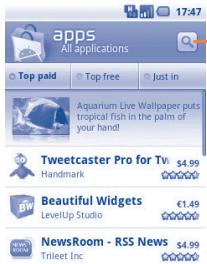
- Touch to search in Android market.
To return to Android Market Home screen, do one of the following:
- Touch the Market icon to the top left of the screen
- Press Menu key to display options list, then touch Home.
7.2 Download and install
To download & install:
- Navigate to the item you want to download, and select to enter the details screen from which you can read its overall rating or comments, view developer's information, etc.
- Press Menu key and touch Security to preview the functions and data the application can access on your phone if you install it.
- Touch Install.

Be especially cautious with applications that have access to many functions or to a significant amount of your data. Once you touch OK to continue, you are responsible for the results of using this item on your phone.
- To check the progress of the download, open the Notification panel. To stop the downloading of the item, touch the progress bar and Cancel download on the screen that opens.
- After download and installation have finished, you will see a notification icon on the status bar.
To open the application you have downloaded:
- On Android Market screen, touch Downloads.
- Touch the installed application in the list, then touch Open.
To buy an application
On Android Market, some applications are labeled as free, while some of them are to be paid for before downloading and installing.
- Touch the application you want to buy.
- Touch Buy on the bottom of the screen.
- When making your first purchase, you are prompted to log in to Google Checkout payment and billing service.
- If your Google Checkout account has multiple credit card accounts, select one to proceed.
- Select the Terms of service link and read the document. When finished, press Back key.
- Mark the check box if you agree with the terms of service.
- Touch Buy now at the bottom of the screen.
When finished,Android downloads the application.
To request a refund
If you are not satisfied with the application, you can ask for a refund within 24 hours of the purchase. Your credit card will not be charged and the application will be removed. If you change your mind, you can install the application again, but you will not be able to request a refund.
- Touch My downloads in Android Market Home.
- Touch the application that you want to uninstall.
- Touch OK in the Uninstall & refund dialog box. If the dialog box does not appear, your trial period has expired.
- In the survey form, select the answer that best matches your reason, and touch OK.
7.3 Manage your downloads
After you downloaded and installed an application, the following further operations are available for your selection.
View
On Android Market screen, press Menu key and touch Downloads.
Uninstall
On Android Market screen, press Menu key and touch Downloads. Touch the application you want to uninstall to enter the details screen, touch Uninstall, and finally touch OK to confirm.
Refund
On Android Market screen, press Menu key and touch Downloads. Touch the application you want to uninstall for a refund, touch Uninstall & refund, and finally touch OK to confirm.
Update notification
On Android Market screen, press Menu key and touch Downloads. Press Menu key and touch Notification, select whether or not to be notified of updates, and finally touch OK to confirm.
Rate
Open the details screen for an application, touch the stars under My review, touch the number of stars to award and confirm by touching OK.
Flag
You can report an inappropriate application to Android Market by flagging it. Open the details screen for the application, scroll to the bottom and touch Flag as inappropriate, enter the reason and finally touch Submit.
Multimedia applications
8.1 Camera/Camcorder

Your mobile phone is fitted with a Camera and Camcorder for taking photos and shooting videos.
Before using Camera or Camcorder, please ensure one MicroSD card where all pictures and videos are stored is correctly installed. Also, be sure to open the protective lens cover before use to avoid it affecting your picture quality.
To access this function, touch Application tab from Home screen and then touch Camera or Camcorder.
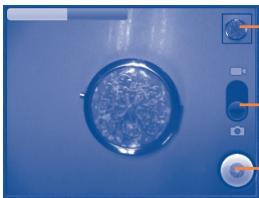
Touch to view pictures or videos you have taken.
Drag up or down to switch between Camera mode and Video mode.
Touch to take a picture or record a video.
To take a picture
The screen acts as the viewfinder. First position the object or landscape in the viewfinder, and touch icon to take the picture, which will be automatically saved.
Zoom in/zoom out
Touch anywhere on the screen to open the Zoom control and then touch the plus or minus icons to zoom in or out gradually. Touch the screen twice to zoom all the way in or out.
To shoot a video
Switch Camera mode to Video mode or access Camcorder directly from the application list. First position the object or landscape in the viewfinder, and touch icon to start recording. Touch icon to stop shooting. The video will be automatically saved.
Further operations when viewing a picture or a video you have taken:

Touch to delete the picture or video you have just taken or shot.

Touch to share the picture or video you have just taken or shot by MMS, Email, etc.

Touch to set the picture as contact ID, wallpaper, etc.

Touch to come back to frame mode after taking a picture or shooting a video.

Touch to play the video you have just shot.
8.1.1 Settings in framing mode
Before taking a photo/shooting a video, you can adjust a number of settings by pressing Menu key in framing mode and touching Settings.
Camera settings:
- White balance Touch to adjust color in different lights:Incandescent, Daylight, Fluorescent or Cloudy.
- Anti Banding Touch to set the banding value.
Color effect Touch to select a color effect: Mono, Sepia, Negative, etc. - Picture size Touch to adjust the size of the picture.
- Brightness Touch to adjust the brightness.
Night mode Touch to activate/deactivate night mode.
Video/Camcorder settings:
- White balance Touch to adjust color in different lights: Incandescent, Daylight, Fluorescent or Cloudy.
Color effect Touch to select a color effect: Mono, Sepia, Negative, etc. - Video quality Touch to set the quality of the video.
- Video Encoder Touch to select video encoder format: MPEG4, H263, H264.
- Audio Encoder Touch to select audio encoder format: AMRNB, QCELP, EVRC.
- Video duration Touch to set the duration of the video to be shot.
8.2 Gallery
Gallery acts as a media player for you to view photos and playback videos. In addition, a set of further operations to pictures and videos are available for your choice (refer to page 83).
To access this function, touch Application tab from Home screen, then touch Gallery. Alternatively you can access it from Camera/Camcorder framing mode by pressing Menu key and touching Gallery.
From this menu, you can access Camera or Camcorder for taking a picture or video.
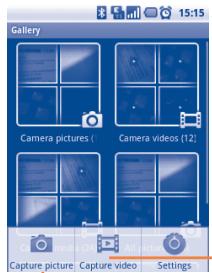
- Touch to access Camcorder framing mode.
- Touch to access Camera framing mode.
To view a picture/play a video
Pictures and videos are displayed by albums in Gallery.
- Touch an album, and scroll up or down to locate the picture/video you want to view or play.
- Touch the picture/video directly to view or play it.
- Touch screen to display icon to view previous or next pictures/ videos.
Working with pictures
You can work with pictures by rotating or cropping them, sharing them with friends, setting them as contact ID or wallpaper, etc.
Locate the picture you want to work on, press Menu key from full-screen picture view.
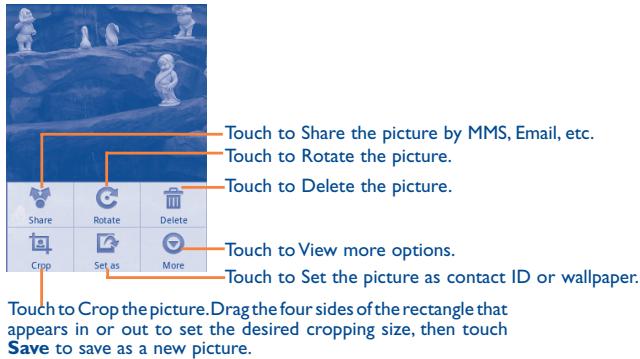
Batch operation
Gallery provides multi-select function, so that you can work with pictures/ videos in batches.
Press Menu key from Gallery screen, touch Multiselect, mark the checkbox before the file you want to work on, then perform further actions, like delete, share, etc.
8.3 YouTube
YouTube is an online video-sharing service where the user can download, share and view videos. It supports a streaming function that allows you to start watching videos almost as soon as they begin downloading from the Internet.
To access this function, touch Application tab from Home screen, then touch YouTube.

As an online video service, your phone must have a network connection to access YouTube.
All videos in YouTube are grouped into several categories, like Most popular, Most viewed, Top rated, and etc.
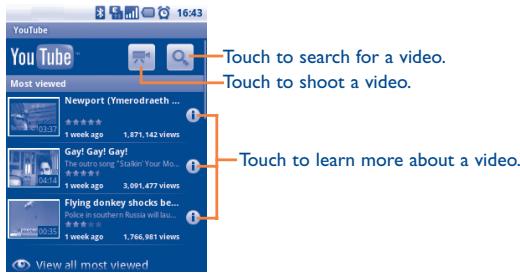
By pressing Menu key from YouTube screen, you can rate, share, label as favorite, etc. For details about these features, please visit the YouTube website: www.youtube.com
8.3.1 Watch videos
Touch a video to play it.
Touch video playing screen to display playback controls with which you can pause, skip forward or backward, or drag the progress bar to the point you want to watch.
To exit video playing screen, press Back key to return to video list.
8.4 Music

Using this menu, you can play music files stored on the MicroSD card in your phone. Music files can be downloaded from computer to MicroSD card using a USB cable.
To access this function, touch Application tab from Home screen, then touch Music.
You will find four libraries in which all songs are classified: Artists, Albums, Songs, and Playlists. Touch a category and view the list.
With the help of Search key on the keyboard, you can easily search for songs you want to play in libraries.
To delete a song, press Menu key from playback screen and then touch Delete to remove it from the MicroSD card.
You can also set a song as a ringtone, press Menu key from playback screen to display option menu, then touch Use as phone ringtone.
8.4.1 Playing music
From any of the four library screens, touch a song to play it back.
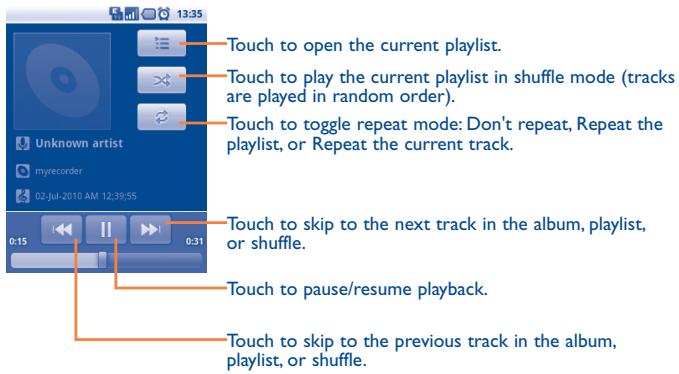
Adjust volume
To adjust the volume, you can press Volume up and Volume down key.
8.4.2 Using Party shuffle
All songs will be displayed in order by default. When Party shuffle is activated, all songs will be played randomly. Press Menu key, then touch Party shuffle to turn on this function. To turn it off, press Menu key again, then touch Party shuffle off.
8.4.3 Working with playlists
Playlists allow you to conveniently organize all the songs stored in the card.
You can create a new playlist, add a song to the list, rearrange the order of the list, and delete or rename a playlist.
To create a playlist
Press Menu key from playback screen to display the option menu, touch Add to playlist, then touch New, enter the name and finally touch Save.
To change the order of songs in a playlist
Enter a playlist, drag a song up or down to change the order within the playlist.
To delete a song or a playlist
Locate the song or playlist you want to delete, touch and hold or press Menu key from playback screen to display option menu, then touch Delete.
To rename a playlist
Locate the playlist you want to rename, touch and hold to display option menu, then touch Rename. When finished, touch Save.
9.1 Get My Location
9.1.1 Choose a data source to decide My Location
Press Menu key from Home screen, touch Settings|Location & Security.
- Mark the check box of Use wireless networks to set Wi-Fi and/or mobile networks as My Location data source.
- Or mark the check box of Use GPS satellites to set GPS as My Location data source.
9.1.2 Open Google Maps and view My Location
Press Menu key from Home screen, touch Maps.
Press Menu again and touch My Location.
The map will then center on a blue dot with a blue circle around. Your actual position is within the blue circle.
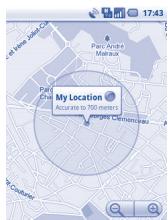
To move the map, drag the map with your finger.
To zoom in and out of a map, touch the plus or minus side of the zoom control 品 | 品 , or you can also zoom in/out by double-tapping a location on screen.
To clear the map history, press Menu key and touch More\Clear Map.
9.2 Search for a location
- While viewing a map, press Menu key and touch Search, or you can directly press Search key on keyboard to activate search function.
In the search box, enter an address, a city or a local business. - Touch the search icon and in a while your search results will appear on the map highlighted by markers with letter labels.
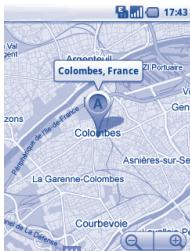
You can touch a marker to open a balloon that contains a label. Touch the balloon to open a screen with more handy information about the location.
9.3 Star a location
Just like bookmarking a web address on the Internet, you can star any position on the map for later use.
9.3.1 How to star (or unstar) a location
- Touch & hold a location on a map
- Touch the address rectangle that opens
- Touch the gray star at the top of the screen to star the location. (Or touch a gold star to unstar that location.)
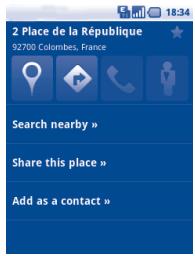
9.3.2 View a list of starred items
- Press Menu key from maps screen and touch More\Starred items.
- The list of your starred items and their addresses opens.
- Touch a location in the list to view it.
Press Menu key and touch Refresh to update the list.
9.4 Get driving, public transport or walking directions
9.4.1 Get suggested routes for your trip
- Press Menu key from maps screen and touch Directions.
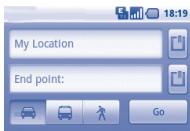
- Touch enter bar or to edit your start point by one of the following methods: entering an address, using My Location, selecting a start point on a map, selecting a starred item, selecting an address from your contacts or using search history.
- Do likewise for your end point.
To reverse directions, press Menu key and touch Reverse Start & End. - Then select a transport mode: driving by car, using public transport, or walking directions.
- Finally touch Go.
- A couple of suggested routes will appear in a list. Touch any routes to view their respective detailed directions.
To get reverse directions for a route you've already made, simply open that route's directions window and select Reverse. No need to enter your start point and end point again.
9.4.2 Preview suggested routes and decide on a route more preferable or feasible to you
You can preview each turn in your route in Navigation, Satellite, and other views.
- Touch a left or right arrow to preview the next or previous leg of your route.
- You can view turn-by-turn directions in a list by touching , press Back key to return to previous view.
When selecting a more preferable or feasible route, distance and time will be the two most important factors for your evaluation. Distance and estimated time will be displayed at the top of the directions screen.
9.4.3 Search for locations along your route
Please refer to section 7.2 for detailed information.
9.4.4 View route progress and calculate estimated arrival time
To view your route progress, pinpoint My Location, zoom out until the whole route goes into one screen, with both finished and unfinished miles in sight.
Start another Directions screen based on your current and intended destination locations. Estimated arrival time will be shown in the results. Please note that the estimated arrival time is not available for the public transport mode.
9.4.5 View traffic conditions on your route
At the lower-left corner of navigation view, a traffic light indicates the overall traffic conditions on your route, next to the estimated time of arrival at your destination. You can also view the traffic conditions on each segment of your route.
Touch the traffic light at the lower left of the Navigation View. Your route opens in TrafficView, with color coding to indicate the traffic along the way. Touch the navigation icon to return to your current location in Navigation View
9.4.6 Get an alternative route to your destination
If traffic is slow on your current route, or if you just want to try a different route, you can request an alternative route from Google Maps with turn-by-turn Navigation service.
Press Menu key and touch Route information. Touch the alternative route icon. An alternative route is drawn on the map.
9.5 Arrangement of Layers
Layers allow you to view locations and additional information overlaid on the map. You can add multiple layers or remove only certain layers so you control exactly what information you want visible on the map at one time.
9.5.1 To view multiple layers
- Press Menu key from maps screen.
- Touch Layers.
- All available layers are listed (like Traffic, Satellite, Latitude, etc), select one to view.
9.5.2 To open StreetView for a location
- Touch and hold a location to display a balloon with the address and a Street View thumbnail.
- Touch the balloon and touch Street view.
9.5.3 To clear the map
After you get directions or search on a map, you can clear the markers/ layers that have been drawn: press Menu key on maps screen and touch More\Clear Map, or you can also touch Clear Map on Layers screen.
9.5.4 To view more layers
You can browse more layers to add to the map such as My Maps, Transit Lines or Wikipedia, etc.
- Press Menu key from maps screen.
- Touch Layers.
- Touch More layers to the bottom of the screen.
- All available layers are listed for your selection.
9.6 Join Latitude to see your friends' locations and share yours with them
With Google Latitude, you can:
- see your friends' locations on a map or in a list.
- quickly contact your friends with a text message, instant message, or phone call.
- you can share, set, hide your location, or sign out of Google Latitude.
control who sees your location, and at what level of detail. - add Latitude widget to home screen to see nearby friends at a glance.
9.6.1 To join Latitude
- Press Menu key from maps screen.
- Touch Join Latitude.
When you joined Latitude, the menu item changes to Latitude.
To open Latitude, press Menu key from maps screen, then touch Latitude.
9.6.2 How to invite friends to share their locations
- Press Menu key from Latitude screen, touch Add friends.
- Touch Select from Contacts or Add via email address.
- After selecting your chosen contacts touch Add friends at the bottom of the screen.
When finished, an invitation will be sent to the friends you have invited.
To respond to an invitation, you can select one of the following:
- Accept and share You and your friend can share locations with back each other.
- Accept, but hide You can view your friend's location, but they can my location not view yours.
- Don't accept No locations can be shared between you and your friend.
9.6.3 To view your friends' location
You can view your friends' locations on a map or in a list.
Map view
When Google Maps is opened, your friends' locations will display with their photo icon for identification.
- List view
Press Menu key from maps screen, then touch Latitude. Your friends are displayed in a list.
9.6.4 To connect with your friends
Select a contact, you can communicate with your friend and set privacy options.
Show on map Locate the friend's position on the map.
Chat using Google Send instant message to the friend. Talk
- Send email Send email to the friend.
- Directions Get directions to this friend's location.
- Hide from Set to hide your location from this friend. this friend
- Share only Set to share only locations at city level, but not city level location street level, etc.
- Remove this friend from your list and stop sharing information with him or her.
9.6.5 To control what you share
You can control the information you want to share with your friends.
Press Menu key from maps screen, touch Latitude, touch your own name and then touch Edit privacy settings.
The following options are available to choose from:
- Detect your location Enable Latitude to detect your location automatically when you move around.
- Set your location Select a location on the map manually.
- Hide your location Hide your location from all friends.
- Turn off latitude Deactivate Latitude and stop sharing.
10.1 FileManager

To access this function, touch Application tab from Home screen, then touch FileManager.
FileManager works with your memory card instead of your phone memory. To use it, you have to install your memory card first. See page 14 for instructions on inserting the memory card.
FileManager displays all data stored on the MicroSD card, including applications, media files downloaded from Android Market, YouTube or other locations; video, pictures or audios you have captured; other data transferred via Bluetooth, USB cable, etc.
When you download an application from PC to MicroSD card, you can locate the application on FileManager, then touch it to install it in your phone.
FileManager allows you to perform and be really efficient with the following common operations: create (sub) folder, open folder/file, view, rename, move, copy, delete, play, share, etc.
10.2 Notes.
To access this function, touch Application tab from Home screen, then touch Notes.
Use Notes to note down inspirations, ideas, excerpts, things to do and all those things you may want to keep for future reference.
Existing notes can be sent via Bluetooth, Message or Email.
10.3 TaskManager

To access this function, touch Application tab from Home screen, then touch TaskManager.
TaskManager allows you to view or terminate running processes and applications and to schedule tasks.
10.4 Videos

To access this function, touch Application tab from Home screen, then touch Videos.
Videos is a small built-in video player that lists all your videos.
Touch an item from the list to play. While playing, use Pause, Forward and Back functional icons as required, press Menu key to go to full screen, or touch a point on the timeline to jump to and play from.
10.5 Voice Recorder

To access this function, touch Application tab from Home screen, then touch Voice Recorder.
Voice Recorder allows you to record voice/sound for seconds/hours.
To view all recordings you have made, press Menu key from recording screen, then touch All Records.
When recording is finished, press Menu key to display option menu, you can touch Share to send the recording to your friends via Bluetooth, Messaging, etc.; and touch Set as ringtone to set the recording as your incoming call ringtone.
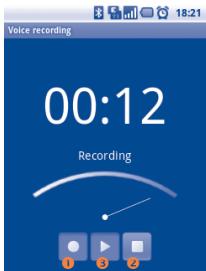
Recording

Playback
1 Touch to start recording
Touch to end recording, a popup window will display for you to rename, save or discard the recorded file.
3 Touch to play the files you have recorded.
4 Touch to play the previous file.
Touch to play the next file.
10.6 SyncMLClient
To access this function, touch Application tab from Home screen, then touch SyncMLClient.
You have to configure your own sync-hosting server account to locate the synchronization source at the other side. Also you might be asked to decide on the following options:
Who to sync: account name, username and password are needed to authenticate your identity
How to sync: available synchronization types are two-way synchronization, backup to server, restore from server, export to server, and import from server
What to sync: supported synchronization applications are Directory and Calendar, each with an independent secure database that doesn't allow anonymous access
When to sync: synchronize when roaming, synchronize when data is modified, synchronize when phone is turned on or synchronize at a regular basis (daily, weekly, and monthly)
10.7 TSCalibration

Follow the onscreen guide to go through the process: press Menu key to continue. Tap red circle several times. Press Back key to quit.
10.8 Other applications (1)
The previous applications in this section are preinstalled to your phone. To read a brief introduction of the preinstalled 3rd party applications, please refer to the leaflet provided with the phone. You can also download thousands more 3rd party applications by going to Android Market on your phone.
To access this function, touch Application tab from Home screen, and touch Settings on applications list, or you can also press Menu key from Home screen and touch Settings.
11.1 Wireless & networks
11.1.1 Airplane mode
Mark the check box of Airplane mode to simultaneously disable all wireless connections including Wi-Fi, Bluetooth and more.
11.1.2 Wi-Fi
Using Wi-Fi you can now surf the Internet without using your SIM card whenever you are in range of a wireless network. The only thing you have to do is to enter the Wi-Fi settings screen and configure an access point to connect your phone to the wireless network.
For detailed instructions on using Wi-Fi, please refer to section 6.1.2 Wi-Fi.
11.1.3 Bluetooth
Bluetooth allows your phone to exchange data (videos, images, music and more) over short distances with another Bluetooth supported device (phone, computer, printer, headset, car kit and more).
For more information on Bluetooth, please refer to section 6.3 Connecting to Bluetooth devices.
11.1.4 VPN settings
A mobile virtual private network (mobile VPN or mVPN) provides mobile devices with access to network resources and software applications on their home network, when they connect via other wireless or wired networks. Mobile VPNs are used in environments where workers need to keep application sessions open at all times, throughout the working day, as the user connects via various wireless networks, encounters gaps in coverage, or suspend-and-resumes their devices to preserve battery life. A conventional VPN cannot survive such events because the network tunnel is disrupted, causing applications to disconnect, time out, fail, or even the computing device itself to crash.
For more information of VPN, please refer to section 6.5 Connecting to virtual private networks.
11.1.5 Mobile networks
Data roaming
If you don't need to transmit data on other carriers' mobile networks, unmark the check box of Data roaming to avoid incurring significant roaming charges.
Network Mode
You can select your preferred network with this menu.
GSM/UMTS options
Touch to enter GSM/UMTS options, where you can view Access point names, you can select to use only 2G networks or select a network operator.
Cell broadcast/Cell broadcast settings
Enable receipt of CB messages by marking the check box of Cell broadcast.
You can access a series of adjustable CB settings by touching Cell broadcast settings.
11.2 Call settings
Use Call settings to configure normal phone call settings and other special features offered by your carrier. You can also use Call settings to configure the phone so that it can place outgoing calls only to a fixed set of phone numbers.
11.2.1 Fixed Dialing Numbers
Fixed Dialing Number (FDN) is a service mode of SIM, where outgoing calls are restricted to a set of phone numbers. These numbers are added to the FDN list. The most common practical application of FDN is for parents to restrict the phone numbers to which their children can dial.
For security reasons, you'll be prompted to enable FDN by entering SIM PIN2 which is usually acquired from your service provider or SIM maker.
11.2.2 Voicemail
Voicemail service
Opens a dialog where you can select your carrier's voicemail service or another service.
Voicemail Settings
If you are using your carrier's voicemail service, this opens a dialog where you can enter the phone number to use for listening to and managing your voicemail. You can enter a comma (,) to insert a pause into the number—for example, to add a password after the phone number.
11.2.3 Other call settings
TTY mode
TTY mode can be used by people who are deaf, have bad hearing or speech impairments.
After connecting the cell phone and TTY machine it connects to a relay service, which converts incoming speech to text for the person using the TTY and converts outgoing text from the TTY machine to a spoken voice for the person on the other end of the conversation.
DTMF Tones
Set the length of DTMF tones.
GSM call settings
Additional GSM only call settings.
CDMA call settings
Additional CDMA only call settings.
11.3 Sound & display
Use the Sound & Display settings to configure many aspects of call and notification ringtones, music, and other audio, as well as brightness and other screen settings.
Sound settings
- Silent mode Mark the check box to silence all sounds except media & alarms.
- Ringer volume Touch to set volume for incoming calls and notifications.
Media volume Touch to set volume for music and videos. - Phone ringtone Touch to set your default incoming call ringtone.
- Phone vibrate Mark the check box to vibrate phone for incoming calls.
- Notification Touch to set your default notification ringtone. ringtone
- Audible touch
- Mark the check box to enable playing tones when using dial pad.
- Audible selection Mark the check box to enable playing sound when making screen selection.
Haptic feedback Mark the check box to activate vibration when pressing soft keys and on certain UI interactions. - SD card
- Mark the check box to activate playing sound for notifications
- MicroSD card notifications.
Display settings
- Orientation Mark the check box to activate automatic orientation switch when rotating phone.
- Animation Touch to show all window animations.
- Brightness Touch to adjust the brightness of the screen.
- Screen timeout Touch to set screen timeout.
Slider settings
- Slider sound Mark the check box to activate playing sound when opening the slider.
- Slide ringtone Touch to set your default slider ringtone.
- Slide opens to answer Mark the check box to activate answering an incoming call when slider opens.
- Slide opens to unlock Mark the check box to activate unlocking the screen when slider opens.
- Slide closes Mark the check box to activate locking the screen to lock when slider closes.
11.4 Location & security
Use the Location & Security settings to set your preferences for using and sharing your location when your search for information and use location-aware applications, such as Google Maps. You can also configure settings that help secure your phone and its data.
11.4.1 My Location
Use wireless networks
Mark the check box to use information from Wi-Fi and mobile networks to determine your approximate location, for use in Google Maps, when you search, and so on. When you select this option, you're asked whether you consent to sharing your location anonymously with Google's location service.
Use GPS satellites
Check to use your phone's global positioning system (GPS) satellite receiver to pinpoint your location within an accuracy as close as several meters ("street level"). The process of accessing the GPS satellite and setting your phone's precise location for the first time will require up to 5 minutes. You will need to stand in a place with a clear view of the sky and avoid moving. After this, GPS will only need 20-40 seconds to identify your precise location.
Use assisted GPS
Mark the check box to use a server to assist GPS.
11.4.2 Screen unlock pattern
- Set unlock pattern Touch to open a set of screens that guide you through drawing a screen unlock pattern.
- Require pattern Mark the check box to set the requirement to draw a pattern when unlocking screen
- Use visible pattern Mark the check box to draw lines between points in the unlock pattern you draw.
- Use tactile feedback Mark the check box to have the phone vibrate briefly as you touch each dot when you draw an unlock pattern.
11.4.3 SIM/RUIM card lock
Set up SIM/RUIM card lock
Opens a screen where you can configure the PIN required to use the phone, and where you can change the SIM/RUIM PIN.
11.4.4 Passwords
Visible passwords
Mark the check box to show password as you type.
11.4.5 Credential storage
Use secure credentials
Mark the check box to allow applications to access your phone's encrypted store of secure certificates and related passwords and other credentials. Credential storage is used to establish some kinds of VPN and Wi-Fi connections. If you have not set a password for the credential storage, this setting is dimmed.
Install from SD card
Touch to install encrypted certificates from the MicroSD card.
Set password
Touch to set a password for the credential storage (at least 8 characters).
Clear storage
Touch to clear credential storage of all contents and reset its password.
11.5 Applications
You use the Applications settings to view details about the applications installed on your phone, to manage their data and force them to stop, and to set whether you want to permit installation of applications that you obtain from web sites and email.
Unknown sources
Mark the check box to permit installation of applications that you obtain from web sites, email, or other locations other than Android Market.
To protect your phone and personal data, download applications only from trusted sources, such as Android Market.
Quick Launch
Touch to set keyboard shortcuts to launch applications.
Manage applications
Touch to manage and remove installed applications.
Running services
Touch to open a list of services—applications or parts of applications that provide services to other applications, or that run even when their main application isn't running. Examples include the Android onscreen keyboard and the small portion of Google Talk that always listens for incoming messages. Above each service, one or more gray bars show what processes the running service needs and how much memory they're using (how much memory you would recover if you stopped the service). Depending on the service, when you touch it in the list it either opens a dialog in which you can stop it or opens its Settings screen.
Development
The Development screen contains settings that are useful for developing Android applications. For full information, including documentation of the Android applications and development tools, see the Android developer web site (http://developer.android.com).
- USB debugging: mark the check box to permit debugging tools on a computer to communicate with your phone via a USB connection.
- Stay awake: mark the check box to prevent the screen from dimming and locking when the phone is connected to a charger or to a USB device that provides power. Don't use this setting with a static image on the phone for long periods of time, or the screen may be marked with that image.
- Allow mock locations: mark the check box to permit a development tool on a computer to control where the phone believes it is located, rather than using the phone's own internal tools for this purpose.
11.6 Accounts & sync
Use the Accounts & Sync settings to add, remove, and manage your Google and other supported accounts. You also use these settings to control how and whether all applications send, receive, and synchronize data on their own schedules, and whether all applications can synchronize user data automatically.
Gmail, Google Calendar, and other applications may also have their own settings to control how they synchronize data; see the sections on those applications for details.
11.6.1 General synchronization settings
Background data
Mark the check box to permit applications to synchronize data in the background, whether or not you are actively working in them. Unmarking this setting can save battery power and lowers (but does not eliminate) data use.
Auto-sync
Mark the check box to permit applications to synchronize data on their own schedule. If you unmark this setting, you must touch an account in the list on this screen, press Menu key, and touch Sync now to synchronize data for that account.
Synchronizing data automatically is disabled if Background data is unchecked. In that case, the Auto-sync checkbox is dimmed.
11.6.2 Manage accounts
The rest of this screen lists the Google Accounts and other accounts you've added to the phone. If you touch an account in this screen, its account screen opens.
This screen contains different options, depending on the kind of account. For Google Accounts, it lists the kinds of data you can synchronize to the phone, with checkboxes so you can turn synchronizing on and off for each kind. You can also press Menu key and touch Sync now to synchronize data. Touch Remove Account to remove the account along with all its data (contacts, mail, settings, and so on).
11.7 Privacy
You use the Privacy settings to manage your personal information.
Use My Location
Mark the check box to include your position when using Google Search and other Google services. When you check this option, you're asked whether you consent to allowing Google to use your location when providing these services.
Back up my settings
Mark the check box to back up your phone's settings to Google Servers, with your Google Account. If you replace your phone, the settings you've backed up are restored onto the new phone the first time you sign in with your Google Account. If you mark this option, a wide variety of settings are backed up, including your Wi-Fi passwords, bookmarks, a list of the applications you've installed, the words you've added to the dictionary used by the onscreen keyboard, and most of the settings that you configure with the Settings application. If you unmark this option, you stop backing up your settings, and any existing backups are deleted from Google Servers.
Factory data reset
Erase all of your personal data from internal phone storage, including information about your Google Account, any other accounts, your system and application settings, and any downloaded applications. Resetting the phone does not erase any system software updates you've downloaded or any files on your microSD card, such as music or photos. If you reset the phone in this way, you're prompted to re-enter the same kind of information as when you first started Android.
11.8 SD card, USB Mass Storage & phone storage
Use the MicroSD card, USB Mass Storage & Phone Storage settings to monitor the used and available space on your phone and on your MicroSD card; to manage your MicroSD card; and if necessary, to reset the phone, erasing all of your personal information.
11.8.1 SD card
Total space/Available space
Lists the amount of space on any MicroSD card installed in your phone and the amount you have used to store photos, videos, music, and other files.
Unmount SD card
Unmounts the MicroSD card from your phone so that you can format the card or safely remove it when the phone is on. This setting is dimmed if there is no MicroSD card installed, if you have already unmounted it, or if you have mounted the MicroSD card on your computer.
Format SD card
Permanently erases everything on a MicroSD card and prepares it for use with your phone. You must unmount a MicroSD card before you can format it.
11.8.2 Internal phone storage
Available space
Touch to display the amount of internal phone storage used by the operating system, its components, applications (including those you downloaded), and their permanent and temporary data.
11.8.3 USB Mass Storage
Unmount/Eject UMS device
Touch to list available UMS Mount Points.
11.9 Search
You use the Search settings to configure Google Search, Quick Search Box, and the data on the phone that you want to include in searches.
11.9.1 Web Search
Google Search settings
Touch to adjust a range of settings to show web suggestions from Google as you type, to view and manage search history if any.
11.9.2 Quick Search Box
Searchable items
Touch to open a screen where you can check and uncheck the kinds of data to include in phone searches.
Clear search shortcuts
Touch to erase the list of search results that you touched below Quick Search Box.
11.10 Language & keyboard
Use the Language & Keyboard settings to select the language for the text on your phone and for configuring the onscreen keyboard, including words that you've added to its dictionary.
11.10.1 Select Locale
Touch to select language and region you want.
11.10.2 Android keyboard
For phones with physical keyboards, unmark to disable the onscreen keyboard
The Android keyboard settings apply to the onscreen keyboard that is included with your phone. The correction and capitalization features affect only the English version of the keyboard. Available options are as follows:
Vibrate on keypress
Mark the check box to have the phone vibrate briefly each time you touch a key on the onscreen keyboard.
Sound on keypress
Mark the check box to play a brief sound each time you touch a key on the onscreen keyboard.
- Auto-capitalization
Mark the check box to have the onscreen keyboard automatically capitalize the first letter of the first word after a period, the first word in a text field, and each word in name fields.
Quick fixes
Correct commonly typed mistakes.
Show suggestions
Display suggested words while typing.
- Auto-complete
Spacebar and punctuation automatically insert highlighted word.
11.10.3 Device keyboard
This setting is available only if your phone has a physical keyboard
11.10.4 User dictionary
Touch to open a list of the words you've added to the dictionary. Touch a word to edit or delete it. Press Menu key and touch Add to add a word.
11.11 Accessibility (1)
You use the Accessibility settings to configure any accessibility plug-ins you have installed on your phone.
Accessibility
Mark the check box to enable all installed accessibility plug-ins.
KickBack
Mark the check box to have the phone vibrate briefly as feedback as you navigate the user interface, press buttons, and so on.
TalkBack
Mark the check box to have an installed speech synthesizer speak the labels or names of items as you navigate the phone's user interface.
SoundBack
Mark the check box to play a sound as you navigate to the phone's user interface.
(1) Availability depending on your country and network operator.
11.12 Text-to-speech (1)
You use the Text-to-Speech settings to configure the Android text-to-speech synthesizer, for applications like TalkBack that can take advantage of it.
If you don't have speech synthesizer data installed, only the Install voice data setting is available.
Listen to an example
Touch to play a brief sample of the speech synthesizer, using your current settings.
Install voice data
If your phone does not have speech synthesizer data installed, connect to Android Market and find yourself guided through the process of downloading and installing the data. This setting is not available if the data is already installed.
Always use my settings
Mark the check box to use the settings on this screen in place of speech synthesizer settings available in other applications.
Speech rate
Touch to open a dialog where you can select how quickly you want the synthesizer to speak.
Language
Touch to open a dialog where you can select the language of the text you want the synthesizer to read. This is particularly useful in combination with Always Use My Settings, to ensure that text is spoken correctly in a variety of applications.
(1) Availability depending on your country and network operator.
11.13 Date & time
Use Date & Time settings to customize your preferences for how date and time are displayed.
Automatic
Mark the check box to use network-provided values. Or unmark to set all values manually.
Set date
Touch to open a dialog where you can manually set the phone's date.
Select time zone
Touch to open a dialog where you can set the phone's time zone.
Set time
Opens a dialog where you can set the phone's time.
Use 24-hour format
Mark the check box to display the time using 24-hour clock format.
Select date format
Touch to open a dialog where you can select the format for displaying dates.
11.14 About phone
Actually this contains information about a lot of things ranging from Legal information, Model number, Firmware version, Baseband version, Kernel version, Build number to those listed below:
Status
This contains the status of the Battery charging level, My phone number, Network, Signal strength, Mobile network type, Service state, Roaming, Mobile network state, IMEI, IMEI SV, Wi-Fi MAC address, Bluetooth address, Up time.
Battery use
Touch to open a list of the applications and operating system components you have used since you last connected the phone to a power source, sorted by the amount of power they have used. Touch an application in the list to view details about its power use and, if available, touch a button to open a settings or information screen for that component or application.
Legal information
Touch to view legal information.
User manual (1)
This is where you can read the user manual in the phone. It opens with PDF viewer by default.
12 Making the most of your phone
12.1 PC suite
You can download software upgrade for free from the website: www. alcatel-mobilephones.com. The PC suite includes:
- Contacts
It allows you to back up contact entries so that you don't have to worry about losing, breaking, switching phone or changing service providers.
Message
It frees you from painstakingly inputting text on the keyboards. All of your messages are easily accessible and well-organized.
File Manager
It allows you to organize Handset files with just a few clicks and files on the Handset can be at where you want them to be.
SyncManager
It allows you to synchronize the Contacts and Calendar in Outlook/Outlook Express and handset.
- Internet Modem
Use your phone to connect a PC to the internet.
Supported Operating Systems
Windows 2000/XP/Vista/Windows 7.
3 Telephone warranty ....
Your phone is warranted against any defect which may occur in conditions of normal use during the warranty period of twelve (12) months (1) from the date of purchase as shown on your original invoice.
Batteries (2) and accessories sold with your phone are also warranted against any defect which may occur during the first six (6) months (1) from the date of purchase as shown on your original invoice.
In case of any defect of your phone which prevents you from normal use thereof, you must immediately inform your vendor and present your phone with your proof of purchase.
If the defect is confirmed, your phone or part thereof will be either replaced or repaired, as appropriate. Repaired phone and accessories are entitled to a one (1) month warranty for the same defect. Repair or replacement may be carried out using reconditioned components offering equivalent functionality.
This warranty covers the cost of parts and labor but excludes any other costs.
(1) The warranty period may vary depending on your country.
(2) The life of a rechargeable mobile phone battery in terms of conversation time standby time, and total service life, will depend on the conditions of use and network configuration. Batteries being considered expendable supplies, the specifications state that you should obtain optimal performance for your phone during the first six months after purchase and for approximately 200 more recharges.
This warranty shall not apply to defects to your phone and/or accessory due to (without any limitation):
1) Non-compliance with the instructions for use or installation, or with technical and safety standards applicable in the geographical area where your phone is used,
2) Connection to any equipment not supplied or not recommended by TCT Mobile Limited,
3) Modification or repair performed by individuals not authorised by TCT Mobile Limited or its affiliates or your vendor,
4) Inclement weather, lightning, fire, humidity, infiltration of liquids or foods, chemical products, download of files, crash, high voltage, corrosion, oxidation...
Your phone will not be repaired in cases where labels or serial numbers (IMEI) have been removed or altered.
There are no express warranties, whether written, oral or implied, other than this printed limited warranty or the mandatory warranty provided by your jurisdiction.
In no event shall TCT Mobile Limited or any of its affiliates be liable for incidental or consequential damages of any nature whatsoever, including but not limited commercial loss, to the full extent those damages can be disclaimed by law.
Some countries/states do not allow the exclusion or limitation of incidental or consequential damages, or limitation of the duration of implied warranties, so the preceding limitations or exclusions may not apply to you.
14 Accessories (1)
The latest generation of Alcatel GSM mobile phones offers a built-in handsfree feature that allows you to use the telephone from a distance, placed on a table for example. For those who prefer to keep their conversations confidential, an earpiece is also available known as the headset.
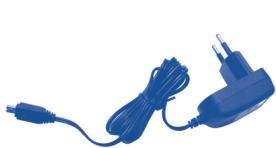

Standard charger
Battery
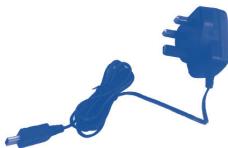
UK charger

USB cable
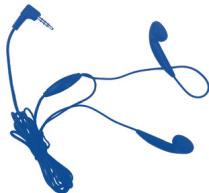
Stereo headset

Only use your telephone with the Alcatel batteries, chargers and accessories in your box.
(1) Pictures for reference only.
15 Troubleshooting............
Before contacting the aftersales department, you are advised to follow the instructions below:
- You are advised to switch off the phone from time to time to maintain optimal performance.
- You are advised to fully charge (□) the battery for optimal operation.
- Avoid storing large amounts of data in your phone as this may affect the performance of your phone.
and carry out the following checks:
My mobile phone can not switch on
Press until the screen comes on
- Check the battery charge level
- Check the battery contacts, remove and reinstall your battery, then turn your phone back on
My mobile phone has not responded for several minutes
Press the key
- Remove the battery and re-insert it, then switch the phone back on
My mobile phone turns off by itself
- Check that your keypad is locked when you are not using your mobile phone
- Check the battery charge level
My mobile phone will not charge properly
- Make sure you are using an Alcatel battery and charger provided in the box.
- Make sure your battery is inserted. It must be inserted before plugging in the charger
- Make sure that your battery is not completely discharged; the battery charge indicator can take several minutes
Make sure charging is carried out under normal conditions (0^ + 40^) - When abroad, check that the electrical current is compatible
My mobile phone can not connect to a network
Try connecting in another location
- Verify the network coverage with your operator
- Check with your operator that your SIM card is valid
Try selecting the available network(s) manually
Try connecting at a later time if the network is overloaded
SIM card error
- Make sure the SIM card has been correctly inserted
- Verify with your operator that your SIM card is 3V, I.8V compatible; the old 5V SIM cards cannot be used
- Make sure the chip on your SIM card is not damaged or scratched
Unable to make outgoing calls
Make sure you have dialled a valid number and press the key
- For international calls, check the country and area codes
- Make sure your mobile phone is connected to a network, and that the network is not overloaded or unavailable
- Check your subscription status with your operator (credit, SIM card valid, etc.)
Unable to receive incoming calls
- Make sure your mobile phone is switched on and connected to a network (check for overloaded or unavailable network)
- Check your subscription status with your operator (credit, SIM card valid, etc.)
Make sure you have not forwarded incoming calls
Make sure that you have not barred certain calls
The caller's name or number does not appear when a call is received
- Check that you have subscribed to this service with your operator
- Your caller has concealed his/her number
I cannot find my contacts
Make sure your SIM card is correctly inserted
- Import all contacts stored in SIM card to phone
The sound quality of the calls is not optimal
- You can adjust the volume during a call by means of the Volume key
Check the signal strength level
I am unable to use the features described in the manual
- Check with your operator to make sure that your subscription includes this service
I am unable to add a contact to my directory
- Make sure that your phone memory is not full; delete some contacts or save the contacts in the phone directory (i.e. your professional or personal directories)
My callers are unable to leave messages on my voicemail
- Contact your network operator to check service availability
I cannot access my voicemail
Make sure your operator's voicemail number is correctly entered
Try later if the network is busy
I am unable to send and receive MMS
- Check your phone's available memory as it might be full
- Contact your network operator to check service availability and check MMS parameters
- Verify the server centre number or your MMS profile with your operator
The server centre may be swamped; try again later
"No service" is displayed
- You are outside of the network coverage area.
I have already entered 3 incorrect PIN codes
- Contact your network operator to obtain the PUK code (Personal Unblocking Key)
I am unable to connect my phone to my computer
Install Alcatel's PC suite first of all
- Open Notification panel to check if the PC Suite Agent has activated
- Check that you have marked the checkbox of USB debugging in Settings\Applications\Development\USB debugging
- Check that your computer system meets the requirements for Alcatel's PC Suite installation
I am unable to download new files
- Check for free space of your MicroSD card
- Delete some files
- Check your subscription status with your operator
The phone can't be detected by others via Bluetooth
- Make sure that Bluetooth is turned on and your mobile phone is visible to other users
How to make your battery last longer
Make sure you followed the complete charge time (minimum 3 hours)
After a partial charge, the battery level indicator may not be exact. Wait for at least 20 minutes after removing the charger to obtain an exact indication
- Switch on the backlight upon request
- Extend email auto-check interval as long as possible
- Exit background-running applications if they are not being used for a long time
- Deactivate Bluetooth, Wi-Fi, or GPS when not in use
| Processor | Qualcomm® MSM7227™ |
| Platform | Android™ 2.1 |
| Memory | ROM: 512 MB RAM: 256 MB |
| Dimensions (LxWxT) | 112.5×60.4×15.9 mm |
| Weight | Around 152 grams with battery |
| Display | 2.8-inch TFT-LCD touchscreen with 240×320 QVGA resolution |
| Network | UMTS: Dual-band 900/2100 MHz GSM/GPRS/EDGE: Quad-band 850/900/1800/1900 MHz (Band frequency and data speed are operator dependent.) |
| GPS | Assisted GPS/Internal GPS antenna |
| Connectivity | • Bluetooth® 2.0 A2DP • Wi-Fi®: IEEE 802.11 b/g • 3.5 mm audio jack • Micro-USB |
| Camera | 2.0 megapixel color camera |
| Audio supported formats | MP3, AAC (AAC, AAC+), AMR-NB, MIDI, Ogg vorbis |
| Video supported formats | MPEG-4 (playback only), H.263, H.264 (playback only) |
| Battery | • Rechargeable Lithium-ion battery • Capacity: 1150 mAh |
| Expansion Slot | MicroSD™ memory card (Availability of MicroSD card depends on market) |
| Special Features | • G-sensor • Digital Compass |
Note Specifications are subject to change without prior notice.
ALCATEL is a trademark of Alcatel-Lucent and is used under license by TCT Mobile Limited.
Copyright 2010 TCT Mobile Limited All rights reserved
TCT Mobile Limited reserves the right to alter material or technical specification without prior notice.