
MFC-9340CDW - Imprimante multifonction laser couleur BROTHER - Notice d'utilisation et mode d'emploi gratuit
Retrouvez gratuitement la notice de l'appareil MFC-9340CDW BROTHER au format PDF.


| Type de produit | Imprimante multifonction laser couleur |
| Fonctions principales | Impression, copie, numérisation, télécopie (fax) |
| Technologie d'impression | Laser couleur |
| Affichage | Écran tactile LCD couleur de 3,7 pouces (93,4 mm) avec rétroéclairage |
| Connexions réseau | Ethernet 10/100 Base-TX, Wi-Fi 802.11b/g/n, Wi-Fi Direct |
| Connectivité | USB 2.0 Hi-Speed |
| Chargeur automatique de documents (ADF) | Oui |
| Impression recto-verso automatique | Oui |
| Fonctions de sécurité | Secure Function Lock 2.0, Setting Lock, restriction de numérotation |
| Modes d'économie d'énergie | Mode veille, mode veille profonde |
| Compatibilité mobile | Brother iPrint&Scan, AirPrint, Google Cloud Print |
| Poids de l'appareil | Plus de 20,0 kg |
| Consommables | Cartouches de toner couleur (CMJN) et tambour |
| Entretien périodique | Remplacement du fusible et du kit d'alimentation papier (PF Kit) |
| Réparabilité | Pièces détachées disponibles via le service client Brother |
FOIRE AUX QUESTIONS - MFC-9340CDW BROTHER
Questions des utilisateurs sur MFC-9340CDW BROTHER
0 question sur cet appareil. Repondez a celles que vous connaissez ou posez la votre.
Poser une nouvelle question sur cet appareil
Téléchargez la notice de votre Imprimante multifonction laser couleur au format PDF gratuitement ! Retrouvez votre notice MFC-9340CDW - BROTHER et reprennez votre appareil électronique en main. Sur cette page sont publiés tous les documents nécessaires à l'utilisation de votre appareil MFC-9340CDW de la marque BROTHER.
MODE D'EMPLOI MFC-9340CDW BROTHER
Advanced User's Guide
MFC-9140CDN MFC-9330CDW MFC-9340CDW
natural_image
Line drawing of a printer with front panel and internal components (no text or symbols)Not all models are available in all countries.
User's Guides and where do I find them?
| Which Guide? | What's in it? | Where is it? |
| Product Safety Guide | Read this Guide first. Please read the Safety Instructions before you set up your machine. See this Guide for trademarks and legal limitations. | Printed / In the box |
| Quick Setup Guide | Follow the instructions for setting up your machine and installing the drivers and software for the operating system and connection type you are using. | Printed / In the box |
| Basic User's Guide | Learn the basic Fax, Copy, Scan and Direct Print operations and how to replace consumables. See troubleshooting tips. | Printed / In the boxFor Czech Republic, Hungary, Republic of Bulgaria, Republic of Poland, Romania, Slovak Republic : PDF file / CD-ROM / In the box |
| Advanced User's Guide | Learn more advanced operations: Fax, Copy, security features, printing reports and performing routine maintenance. | PDF file / CD-ROM / In the box |
| Software User's Guide | Follow these instructions for Printing, Scanning, Network Scanning, Remote Setup, PC-Fax, and using the Brother ControlCenter utility. | HTML file / CD-ROM / In the box |
| Network User's Guide | This Guide provides useful information about wired and wireless network settings and security settings using the Brother machine. You can also find supported protocol information for your machine and detailed troubleshooting tips. | PDF file / CD-ROM / In the box |
| Wi-Fi DirectTM Guide (MFC-9330CDW and MFC-9340CDW) | This Guide provides details on how to configure and use your Brother machine for wireless printing directly from a mobile device supporting the Wi-Fi DirectTM standard. | PDF file / Brother Solutions Center1 |
| Google Cloud Print Guide | This Guide provides details on how to configure your Brother machine to a Google account and use Google Cloud Print services for printing over the Internet. | PDF file / Brother Solutions Center1 |
| Mobile Print/Scan Guide for Brother iPrint&Scan | This Guide provides useful information about printing from your mobile device and scanning from your Brother machine to your mobile device when connected on a Wi-Fi network. | PDF file / Brother Solutions Center1 |
| Web Connect Guide | This Guide provides details about how to configure and use your Brother machine to scan, load and view images and files on certain Web sites that provide these services. | PDF file / Brother Solutions Center1 |
| AirPrint Guide | This Guide provides information for using AirPrint to print from OS X v10.7.x, 10.8.x and your iPhone, iPod touch, iPad, or other iOS device to your Brother machine without installing a printer driver. | PDF file / Brother Solutions Center1 |
1 Visit us at http://solutions.brother.com/.
Table of Contents
1 General Setup 1
Memory storage....1
Automatic Daylight Saving Time....1
Ecology features....2
Toner Save 2
Sleep Time 2
Deep Sleep mode....3
Touchscreen 3
Setting the backlight brightness....3
Setting the Dim Timer for the backlight ....4
2 Security features 5
Secure Function Lock 2.0....5
Before you begin to use Secure Function Lock 2.0....6
Setting and changing the Administrator Password....6
Setting up restricted users....7
Setting up and changing the Public user mode 7
Turning Secure Function Lock on/off....8
Switching Users....9
Setting Lock....10
Setting up the administrator password 10
Changing the Setting Lock administrator password ....11
Turning Setting Lock on/off....11
Dial Restriction....12
Dial pad restriction....12
Address Book restriction....12
Shortcuts restriction....12
3 Sending a fax
13
Additional sending options....13
Sending faxes using multiple settings 13
Changing a 2-sided fax layout (MFC-9340CDW)....14
Contrast....15
Changing Fax Resolution 15
Additional sending operations....16
Sending a fax manually 16
Dual access....16
Broadcasting....17
Real Time Transmission....19
Overseas Mode 19
Delayed Fax 20
Delayed batch transmission 20
Checking and cancelling waiting jobs....21
Setting your changes as the new default....21
Restoring all fax settings to the factory settings 22
Saving fax options as a Shortcut....22
Electronic cover page 23
Destination Display 25
Polling....26
Polled transmit....26
4 Receiving a fax
28
Memory Receive Options ......28
Fax Forwarding....28
Fax Storage....29
Changing Memory Receive Options....29
Turning off Remote Fax Options 30
Remote retrieval .... 31
Setting a Remote Access Code....31
Using your Remote Access Code....31
Remote fax commands....32
Retrieving fax messages 33
Changing the Fax Forwarding number 33
Additional receiving operations....34
Printing a reduced incoming fax 34
2-sided printing for Fax mode 34
Setting the Fax Receive Stamp 35
Setting the Print Density 35
Printing a fax from the memory 36
Out of Paper Reception 36
Polling....37
Polling receive 37
5 Dialling and storing numbers 40
Telephone line services 40
BT Call Sign (U.K. only)......40
Additional dialling operations....40
Combining Address Book numbers 40
Additional ways to store numbers....42
Storing Address Book numbers from Outgoing Calls 42
Setting up Groups for Broadcasting 42
6 Printing reports 45
Fax reports....45
Transmission Verification Report....45
Fax Journal (Activity Report) 45
Reports 46
How to print a report....46
7 Making copies 47
Copy settings 47
Stop copying....47
Improving copy quality 47
Enlarging or reducing copies ....48
2-sided Copying 49
Adjusting Density and Contrast ....51
Sorting copies....52
Making N in 1 copies (page layout) ....52
2 in 1 ID Copy....54
Adjusting the Colour Saturation....55
Making 2-sided N in 1 copies (MFC-9340CDW) ....55
Removing Background Colour....56
Saving copy options as a Shortcut 57
Saving paper 57
A Routine maintenance 58
Checking the machine 58
Printing the test print....58
Checking the Page Counters....58
Checking the remaining life of toner cartridges ....58
Checking the remaining life of parts 58
Replacing periodic maintenance parts....59
Packing and shipping the machine 60
B Glossary 62
C Index 66
1 General Setup
NOTE
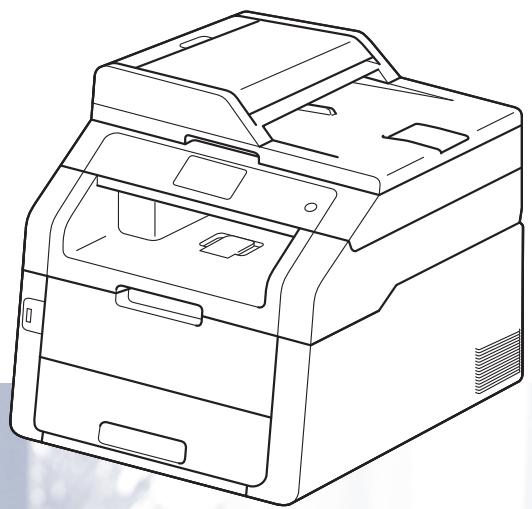
Most of the illustrations in this User's Guide show the MFC-9340CDW.
Memory storage
Your menu settings are stored permanently, and in the event of a power failure will not be lost. Temporary settings (for example, Contrast and Overseas Mode) will be lost. Also, during a power failure the machine will retain the date and time and programmed fax timer jobs (for example, Delayed Fax) for up to 60 hours. Other fax jobs in the machine's memory will not be lost.
Automatic Daylight Saving Time
You can set the machine to change automatically for Daylight Saving Time. It will set itself forward one hour in the spring, and back one hour in the autumn.
1 Press
2 Press (Date & Time).
3 Press Auto Daylight.
4 Press On or Off.
5 Press
Ecology features
Toner Save
You can save toner using this feature. When you set Toner Save to On, print appears lighter. The factory setting is Off.
1 Press
2 Press All Settings.
3 Swipe up or down, or press ▲ or ▼ to display General Setup.
4 Press General Setup.
5 Swipe up or down, or press ▲ or ▼ to display Ecology.
6 Press Ecology.
7 Press Toner Save.
8 Press On or Off.
9 Press
NOTE
We do not recommend Toner Save for printing Photo or Greyscale images.
Sleep Time
The Sleep Time setting can reduce power consumption. When the machine is in Sleep mode (Power Save mode) it acts as though it is turned off. The machine will wake up and start printing when it receives a print job.
You can choose how long the machine must be idle before it goes into Sleep mode. The timer will restart if any operation is carried out on the machine, such as receiving a fax or a print job. The factory setting is three minutes.
When the machine goes into Sleep mode, the Touchscreen backlight turns off.
1 Press
2 Press All Settings.
3 Swipe up or down, or press ▲ or ▼ to display General Setup.
4 Press General Setup.
5 Swipe up or down, or press ▲ or ▼ to display Ecology.
6 Press Ecology.
7 Press Sleep Time.
8 Using the keyboard on the Touchscreen, enter the length of time (0-50 minutes) the machine will remain idle before entering Sleep mode. Press OK.
9 Press
Deep Sleep mode
If the machine is in Sleep mode and does not receive any jobs for a certain length of time, the machine will go into Deep Sleep mode automatically. Deep Sleep mode uses less power than Sleep mode. The machine will wake up when it receives a job or if you press the Touchscreen.
When the machine is in Deep Sleep mode, the Touchscreen backlight turns off and blinks.
Touchscreen
Setting the backlight brightness
You can adjust the brightness of the Touchscreen LCD backlight. If you are having difficulty reading the Touchscreen, try changing the brightness setting.
1 Press
2 Press All Settings.
3 Swipe up or down, or press ▲ or ▼ to display General Setup.
4 Press General Setup.
5 Swipe up or down, or press ▲ or ▼ to display LCD Settings.
6 Press LCD Settings.
7 Press Backlight.
8 Press Light, Med or Dark.
9 Press
Setting the Dim Timer for the backlight
You can set how long the Touchscreen LCD backlight stays on after you go back to your Home screen.
1 Press
2 Press All Settings.
3 Swipe up or down, or press ▲ or ▼ to display General Setup.
4 Press General Setup.
5 Swipe up or down, or press ▲ or ▼ to display LCD Settings.
6 Press LCD Settings.
7 Press Dim Timer.
8 Press Off, 10Secs, 20Secs or 30Secs.
9 Press
2
Security features
Secure Function Lock 2.0
Secure Function Lock lets you restrict Public access to the following machine functions:
■ Fax Tx (Fax Sending)
■ Fax Rx (Fax Receiving)
Copy
Scan ^1
■ USB Direct Print ^3
■ Print ^2
■ Web Connect (Upload)
■ Web Connect (Download)
■ Color Print ^24
■ Page Limit ^4
1 Scan includes scan jobs via Brother iPrint&Scan.
2 Print and Color Print include print jobs via AirPrint, Google Cloud Print and Brother iPrint&Scan.
3 For MFC-9330CDW and MFC-9340CDW
4 Available for Print, USB Direct Print, Copy and Web Connect (Download).
This feature also prevents users from changing the default settings of the machine by limiting access to the Menu settings.
Before using the security features you must first enter an administrator password.
The administrator can set up restrictions for individual users along with a user password.
Make a careful note of your password. If you forget it, you will have to reset the password stored in the machine. For information about how to reset the password, contact Brother customer service.
NOTE
- Secure Function Lock can be set manually from the Touchscreen, or by using Web Based Management or BRAmin Professional 3 (Windows® only). We recommend using Web Based Management or BRAmin Professional 3 (Windows® only) to configure this feature (see Network User's Guide).
- Only administrators can set limitations and make changes for each user.
- Polling Receive is enabled only when both Fax Tx and Fax Rx are enabled.
Before you begin to use Secure Function Lock 2.0
You can configure the Secure Function Lock 2.0 settings using a web browser. Before configuration, the following preparations are needed.
1 Start your web browser.
2 Type "http://machine's IP address/" into your browser's address bar (where "machine's IP address" is the IP address of the Brother machine).
■ For example:
http://192.168.1.2/
NOTE
You can find the machine's IP address in the Network Configuration List (see Network User's Guide: Printing the Network Configuration Report).
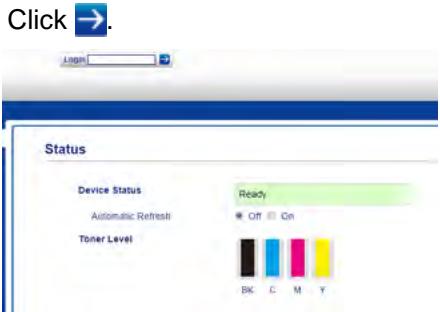
3 Type a password in the Login box. (This is a password to log on to the machine's web page, not the administrator password for Secure Function Lock.)
NOTE
If you are using a web browser to configure the machine's settings for the first time, set a password.
1 Click
Please configure the password.
2 Type a password (up to 32 characters).
3 Retype the password in the Confirm New Password field.
4 Click Submit.
Setting and changing the Administrator Password
You can configure these settings using a web browser. To set up the web page, see Before you begin to use Secure Function Lock 2.0 on page 6. Then set up the administrator.
Setting the administrator password
The administrator password is used to set up users and to turn Secure Function Lock on or off (see Setting up restricted users on page 7 and Turning Secure Function Lock on/off on page 8).
1 Click Administrator.
2 Click Secure Function Lock.
3 Type a four-digit number for the password in the New Password field.
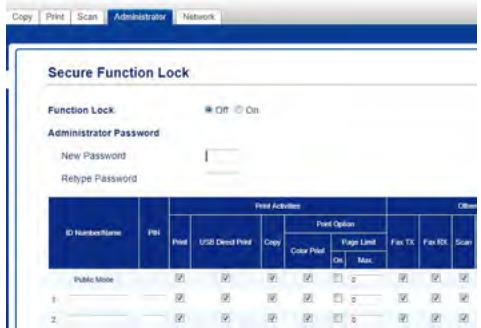
4 Retype the password in the Retype Password field.
5 Click Submit.
Changing the administrator password
1 Click Administrator.
2 Click Secure Function Lock.
3 Type a four-digit number for the password in the New Password field.
4 Retype the password in the Retype Password field.
5 Click Submit.
Setting up restricted users
You can set up users with restrictions and a password. You can set up to 25 restricted users.
You can configure these settings using a web browser. To set up the web page, see Before you begin to use Secure Function Lock 2.0 on page 6. Then follow these steps:
1 Click Administrator.
2 Click Secure Function Lock.
3 Type an alphanumeric Group name or User name (up to 15 characters) in the ID Number/Name field and then type a four-digit password in the PIN field.
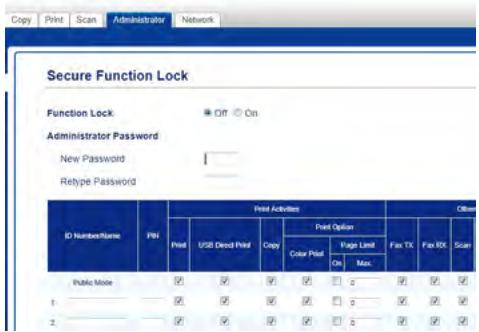
4 Clear the functions that you want to restrict in the Print check box and Others check box. To configure the maximum page count, select the On check box in Page Limit, and then type the number in the Max. field.
5 Click Submit.
Setting up and changing the Public user mode
Public user mode restricts the functions that are available for all users who do not have a password.
When you set up restrictions for Public users, you must do it through Web Based Management or BRAdmin Professional 3 (Windows® only) (see Network User's Guide).
1 Click Administrator.
2 Click Secure Function Lock.
3 Clear the functions that you want to restrict in the Print check box and Others check box. To configure the maximum page count, select the On check box in Page Limit, and then type the number in the Max. field.
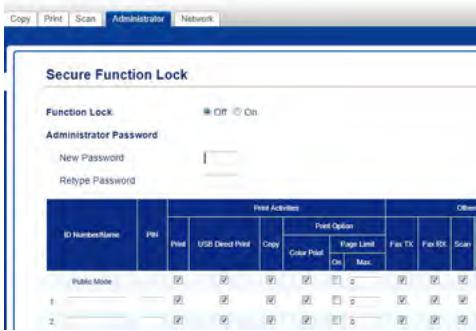
4 Click Submit.
Turning Secure Function Lock on/off
NOTE
Make a careful note of the administrator password. If you enter the wrong password, the Touchscreen will show Wrong Password. Enter the correct password. If you forget it, contact Brother customer service.
Turning Secure Function Lock on

1 Press
2 Press All Settings.
3 Swipe up or down, or press ▲ or ▼ to display General Setup.
4 Press General Setup.
5 Swipe up or down, or press ▲ or ▼ to display Security.
6 Press Security.
7 Press Function Lock.
8 Press Lock Off⇒On.
9 Enter the registered four-digit administrator password using the keyboard on the Touchscreen. Press OK.
NOTE
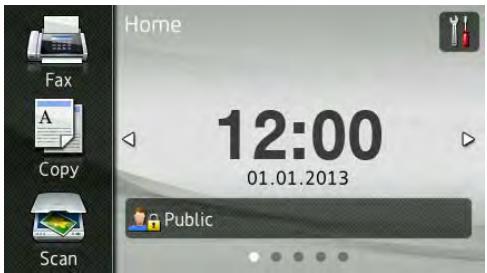
The Secure Function Lock icon is displayed beneath the time and date.
Turning Secure Function Lock off
1 Press

or

(Where xxxxx is the user's name.)
2 Press Lock On⇒Off.
3 Enter the registered four-digit administrator password using the keyboard on the Touchscreen. Press OK.
Switching Users
This setting allows you to switch between registered restricted users or Public mode when Secure Function Lock is turned on.
Changing to the restricted user mode
1 Press Public or

(Where xxxxx is the user's name.)
2 Press Change User.
3 Swipe up or down, or press ▲ or ▼ to display your user name.
4 Press your user name.
5 Enter your four-digit user password using the keyboard on the Touchscreen. Press OK.
NOTE
- If the current ID is restricted for the function you want, Access Denied will appear on the Touchscreen.
- If your ID has page limit restrictions and has already reached the maximum number of pages, the Touchscreen will show Limit Exceeded or Access Denied when you try to print. Contact your administrator to check your Secure Function Lock Settings.
Changing to the Public mode
1 Press XXXXX
(Where xxxxx is the user's name.)
2 Press Go to Public.
NOTE
- After a restricted user has finished using the machine, it will return to Public mode after one minute.
- If the function you want is restricted for all users, Access Denied will appear on the Touchscreen and Change User screen will appear. You cannot access the function. Contact your administrator to check your Secure Function Lock Settings.
- If your ID has Color Print restrictions to Disable, the Touchscreen will show No Permission when you try to print coloured data.
Setting Lock
Setting Lock lets you set a password to stop other people from accidentally changing your machine settings.
Make a careful note of your password. If you forget it, you will have to reset the passwords stored in the machine. Contact your administrator or Brother customer service.
While the Setting Lock is On, you cannot access the machine settings.
Machine settings cannot be changed through the Remote Setup utility while Setting Lock is On.
Setting up the administrator password

1 Press
2 Press All Settings.
3 Swipe up or down, or press ▲ or ▼ to display General Setup.
4 Press General Setup.
5 Swipe up or down, or press ▲ or ▼ to display Security.
6 Press Security.
7 Press Setting Lock.
8 Enter a four-digit number for the new password using the keyboard on the Touchscreen.
Press OK.
9 Enter the new password again when the Touchscreen shows Verify: Press OK.
10 Press
Changing the Setting Lock administrator password
1 Press

2 Press All Settings.
3 Swipe up or down, or press ▲ or ▼ to display General Setup.
4 Press General Setup.
5 Swipe up or down, or press ▲ or ▼ to display Security.
6 Press Security.
7 Press Setting Lock.
8 Press Set Password.
9 Enter the old four-digit password using the keyboard on the Touchscreen. Press OK.
10 Enter a four-digit number for the new password using the keyboard on the Touchscreen.
Press OK.
11 Re-enter the new password again when the Touchscreen shows Verify:. Press OK.
12 Press
Turning Setting Lock on/off
If you enter the wrong password, the Touchscreen will show Wrong Password. Enter the correct password.
Turning Setting Lock on
1 Press

2 Press All Settings.
3 Swipe up or down, or press ▲ or ▼ to display General Setup.
4 Press General Setup.
5 Swipe up or down, or press ▲ or ▼ to display Security.
6 Press Security.
7 Press Setting Lock.
8 Press Lock Off⇒On.
9 Enter the registered four-digit administrator password using the keyboard on the Touchscreen. Press OK.
Turning Setting Lock off
1 Press

Setting Lock
on the Touchscreen.
2 Enter the registered four-digit administrator password using the keyboard on the Touchscreen. Press OK.
Dial Restriction
This feature is to prevent users from sending a fax or call to a wrong number by mistake. You can set the machine to restrict dialling when you use the dial pad, Address Book and Shortcuts.
If you choose Off, the machine does not restrict the dialling method.
If you choose Enter # Twice, the machine will prompt you to re-enter the number, and then if you re-enter the same number correctly, the machine will start dialling. If you re-enter the wrong number, the Touchscreen will show an error message.
If you choose On, the machine will restrict all fax sending and outbound calls for that dialling method.
Dial pad restriction

1 Press
2 Press All Settings.
3 Swipe up or down, or press ▲ or ▼ to display Fax.
4 Press Fax.
5 Swipe up or down, or press ▲ or ▼ to display Dial Restriction.
6 Press Dial Restriction.
7 Press Dial Pad.
8 Press Enter # Twice, On or Off.
9 Press
Address Book restriction

1 Press
2 Press All Settings.
3 Swipe up or down, or press ▲ or ▼ to display Fax.
4 Press Fax.
5 Swipe up or down, or press ▲ or ▼ to display Dial Restriction.
6 Press Dial Restriction.
7 Press Address Book.
8 Press Enter # Twice, On or Off.
9 Press
Shortcuts restriction

1 Press
2 Press All Settings.
3 Swipe up or down, or press ▲ or ▼ to display Fax.
4 Press Fax.
5 Swipe up or down, or press ▲ or ▼ to display Dial Restriction.
6 Press Dial Restriction.
7 Press Shortcuts.
8 Press Enter # Twice, On or Off.
9 Press
3
Sending a fax
Additional sending options
Sending faxes using multiple settings
Before you send a fax, you can change any combination of these settings:
■ 2-sided Fax ^1
Contrast
Fax Resolution
Real Time TX
■ Overseas Mode
■ Delayed Fax
Batch TX
■ Coverpage Note
■ Coverpage Setup
■ Broadcasting
1 For MFC-9340CDW
1 Do one of the following:
■ When Fax Preview is set to Off,
■ When Fax Preview is set to On, press

(Fax) and Sending Faxes.
The Touchscreen shows:
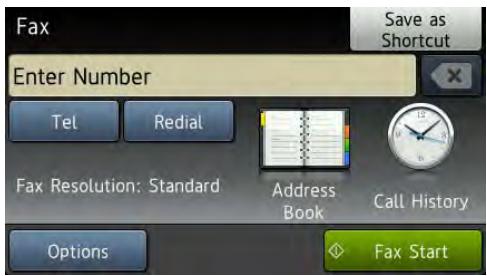
2 Press Options.
3 Swipe up or down, or press ▲ or ▼ to display the setting you want, and then press the setting.
4 Press the option you want.
5 Do one of the following:
■ Repeat steps ③ and ④ to change more settings.
If you are finished choosing settings, press OK. Go to the next step for sending your fax.
NOTE
- Most settings are temporary and the machine returns to its default settings after you send a fax.
- You can save some of the settings you use most often by setting them as the default settings. These settings will stay until you change them again (see Setting your changes as the new default on page 21).
- You can also save some of the settings you use most often by setting them as a Shortcut (see Saving fax options as a Shortcut on page 22).
Changing a 2-sided fax layout (MFC-9340CDW)
You must choose a 2-sided scanning format before you send a 2-sided fax. The format you choose will depend on the layout of your 2-sided document.
1 Load your document in the ADF.
2 Do one of the following:
■ When Fax Preview is set to Off,
press

(Fax).
■ When Fax Preview is set to On, press

(Fax) and Sending Faxes.
3 Press Options.
4 Swipe up or down, or press ▲ or ▼ to display 2-sided Fax.
5 Press 2-sided Fax.
6 Do one of the following:
If your document is flipped on the Long edge, press 2-sided Scan: Long Edge.
| Long edge | |
| Portrait | Landscape |
 | 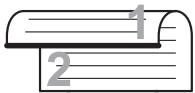 |
If your document is flipped on the Short edge, press 2-sided Scan: Short Edge.
| Short edge | |
| Portrait | Landscape |
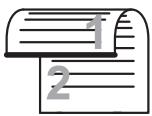 | 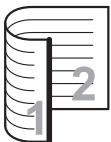 |
Contrast
For most documents the default setting of Auto will give the best results.
Auto automatically chooses the appropriate contrast for your document.
If your document is very light or very dark, changing the contrast may improve the quality of the fax.
Select Dark to make the faxed document lighter.
Select Light to make the faxed document darker.
1 Do one of the following:
■ When Fax Preview is set to Off,
■ When Fax Preview is set to On, press

2 Press Options.
3 Swipe up or down, or press ▲ or ▼ to display Contrast.
4 Press Contrast.
5 Press Auto, Light or Dark.
NOTE
Even if you choose Light or Dark, the machine will send the fax using the Auto setting if you choose Photo as the Fax Resolution.
Changing Fax Resolution
The quality of a fax can be improved by changing the Fax Resolution. Resolution can be changed for the next fax.
1 Do one of the following:
■ When Fax Preview is set to Off, press (Fax).
■ When Fax Preview is set to On, press

(Fax) and Sending Faxes.
2 Press Options.
3 Swipe up or down, or press ▲ or ▼ to display Fax Resolution.
4 Press Fax Resolution.
5 Press Standard, Fine, S. Fine or Photo.
NOTE
You can choose four different resolution settings.
| Black & white | |
| Standard | Appropriate for most typed documents. |
| Fine | Good for small print and transmits a little slower than Standard resolution. |
| S.Fine | Good for small print or artwork and transmits slower than Fine resolution. |
| Photo | Use when the document has varying shades of grey or is a photograph. This has the slowest transmission time. |
Additional sending operations
Sending a fax manually
Manual transmission
Manual transmission lets you hear the dialling, ringing and fax-receiving tones while sending a fax.
1 Load your document.
2 Pick up the handset of an external telephone and listen for a dial tone.
3 Dial the fax number using the external telephone.
4 When you hear the fax tones, press Fax Start.
■ If you are using the scanner glass, press Send.
5 Replace the handset of an external telephone.
Dual access
You can dial a number and start scanning the fax into memory—even when the machine is sending from memory, receiving faxes or printing computer data. The Touchscreen will show the new job number.
The number of pages you can scan into the memory will vary depending on the data that is printed on them.
NOTE
If you get an Out of Memory message while scanning the first page of a fax, press ✗ to cancel scanning. If you get an Out of Memory message while scanning a subsequent page, you can press Send Now to send the pages scanned so far, or press ✗ to cancel the operation.
Broadcasting
Broadcasting lets you send the same fax message to more than one fax number. You can include Groups, Address Book numbers and up to 50 manually dialled numbers in the same broadcast.
You can broadcast up to 250 different numbers.
Before you begin the broadcast
Address Book numbers must be stored in the machine's memory before they can be used in a broadcast (see Basic User's Guide: Storing Address Book numbers).
Group numbers must also be stored in the machine's memory before they can be used in a broadcast. Group numbers include many stored Address Book numbers for easier dialling (see Setting up Groups for Broadcasting on page 42).
How to broadcast a fax
1 Load your document.
2 Do one of the following:
■ When Fax Preview is set to Off,
press

(Fax).
■ When Fax Preview is set to On, press

(Fax) and Sending Faxes.
3 Press Options.
4 Swipe up or down, or press ▲ or ▼ to display Broadcasting.
5 Press Broadcasting.
6 Press Add Number.
NOTE
If you downloaded Internet Fax:
If you want to broadcast using an E-mail
address, press

enter the E-mail
address (see Basic User's Guide:
Entering text), and press OK.
7 You can add numbers to the broadcast in the following ways:
■ Press Add Number and enter a number using the keyboard on the Touchscreen (see Basic User's Guide: How to dial). Press OK.
■ Press Add from Address book. Swipe up or down, or press ▲ or ▼ to display the number you want to add to the broadcast. Select the check boxes of the numbers you want to add to the broadcast. After you select all the numbers you want, press OK.
■ Press Search in Address book. Press the first letter of the name and press OK. Press the name, and then press the number you want to add.
8 After you enter all the fax numbers by repeating steps ⑥ and ⑦, press OK.
9 Press Fax Start.
After the broadcast is finished, the machine will print a broadcast report to let you know the results.
NOTE
- If you did not use up any of the numbers for Groups, you can broadcast faxes to as many as 250 different numbers.
- The machine's available memory will vary depending on the types of jobs in the memory and the numbers used for broadcasting. If you broadcast to the maximum number available, you will not be able to use dual access and delayed fax.
- If the Out of Memory message appears, press ✗ to stop the job. If more than one page has been scanned, press Send Now to send the portion that is in the machine's memory.
Cancelling a Broadcast in progress
While broadcasting you can cancel the fax currently being sent or the whole broadcast job.
1 Press ✗
2 Do one of the following:
■ To cancel the entire broadcast, press Entire Broadcast. Go to step ③.
■ To cancel the current job, press the button that displays the number or name being dialled. Go to step 4.
■ To exit without cancelling, press ✗.
3 When the Touchscreen asks if you want to cancel the entire broadcast, do one of the following:
■ Press Yes to confirm.
■ To exit without cancelling, press No.
4 Do one of the following:
■ To cancel the current job, press Yes.
■ To exit without cancelling, press No.
Real Time Transmission
When you are sending a fax, the machine will scan the document into the memory before sending it. As soon as the telephone line is free, the machine will start dialling and sending.
Sometimes, you may want to send an important document immediately without waiting for memory transmission. You can turn on Real Time TX.
NOTE
- If the memory is full and you are sending a fax from the ADF, the machine will send the document in real time (even if Real Time TX is set to Off). If the memory is full, faxes from the scanner glass cannot be sent until you clear some of the memory.
- In Real Time Transmission, the automatic redial feature does not work when using the scanner glass.
1 Load your document.
2 Do one of the following:
■ When Fax Preview is set to Off,
press

(Fax).
■ When Fax Preview is set to On, press

(Fax) and Sending Faxes.
3 Press Options.
4 Swipe up or down, or press ▲ or ▼ to display Real Time TX.
5 Press Real Time TX.
6 Press On (or Off).
7 Press OK.
8 Enter the fax number.
9 Press Fax Start.
Overseas Mode
If you are having difficulty sending a fax overseas due to a bad connection, then turning on Overseas Mode may help.
This is a temporary setting, and will only be active for your next fax.
1 Load your document.
2 Do one of the following:
■ When Fax Preview is set to Off,
press

(Fax).
■ When Fax Preview is set to On, press

(Fax) and Sending Faxes.
3 Press Options.
4 Swipe up or down, or press ▲ or ▼ to display Overseas Mode.
5 Press Overseas Mode.
6 Press On.
7 Press OK.
8 Enter the fax number.
9 Press Fax Start.
Delayed Fax
You can store up to 50 faxes in the memory to be sent within a twenty-four hour period.
1 Load your document.
2 Do one of the following:
■ When Fax Preview is set to Off,
press

(Fax).
■ When Fax Preview is set to On, press

(Fax) and Sending Faxes.
3 Press Options.
4 Swipe up or down, or press ▲ or ▼ to display Delayed Fax.
5 Press Delayed Fax.
6 Press Delayed Fax.
7 Press On.
8 Press Set Time.
9 Enter the time you want the fax to be sent (in 24-hour format) using the keyboard on the Touchscreen. Press OK.
NOTE
The number of pages you can scan into the memory depends on the amount of data printed on each page.
Delayed batch transmission
Before sending the delayed faxes, your machine will help you economize by sorting all the faxes in the memory by destination and scheduled time.
All delayed faxes that are scheduled to be sent at the same time to the same fax number will be sent as one fax to save transmission time.
1 Press
2 Press All Settings.
3 Swipe up or down, or press ▲ or ▼ to display Fax.
4 Press Fax.
5 Swipe up or down, or press ▲ or ▼ to display Setup Send.
6 Press Setup Send.
7 Press Batch TX.
8 Press On or Off.
9 Press
Checking and cancelling waiting jobs
Check which jobs are still waiting in the memory to be sent. If there are no jobs, the Touchscreen will show No Jobs Waiting. You can cancel a fax job that is stored and waiting in the memory.
1
Press

2
Press All Settings.
3
Swipe up or down, or press ▲ or ▼ to display Fax.
4
Press Fax.
5
Swipe up or down, or press ▲ or ▼ to display Remaining Jobs.
6
Press Remaining Jobs. Jobs that are waiting will appear on the Touchscreen.
7
Swipe up or down, or press ▲ or ▼ to scroll through the waiting jobs and press the job you want to cancel.
8
Press Cancel.
9
Do one of the following:
■ To cancel, press Yes. If you want to cancel another job go to step ⑦.
■ To exit without cancelling, press No.
10
When you have finished cancelling jobs, press 📋.
Setting your changes as the new default
You can save the fax settings for
Fax Resolution, Contrast,
Glass Scan Size, Real Time TX and Coverpage Setup you use most often by setting them as the default. These settings will stay until you change them again.
1
Do one of the following:
■ When Fax Preview is set to Off,
(Fax).
■ When Fax Preview is set to On, press
(Fax) and Sending Faxes.

Press Options.
Swipe up or down, or press ▲ or ▼ to choose the setting you want to change, and then press the new option.
2
3
Repeat this step for each setting you want to change.
4
After changing the last setting, swipe up or down, or press ▲ or ▼ to display Set New Default.
5
Press Set New Default.
6
The Touchscreen asks you to confirm the change to the new default settings. Press Yes to confirm.
7
Press
Restoring all fax settings to the factory settings
You can restore all the fax settings you have changed to the factory settings. These settings will stay until you change them again.
1 Do one of the following:
■ When Fax Preview is set to Off, press (Fax).
■ When Fax Preview is set to On, press (Fax) and Sending Faxes.
2 Press Options.
3 After changing the last setting, swipe up or down, or press ▲ or ▼ to display Factory Reset.
4 Press Factory Reset.
5 The Touchscreen asks you to confirm to change back to the factory settings. Press Yes to confirm.
6 Press
Saving fax options as a Shortcut
You can store all the new fax options you use frequently by saving them as a Shortcut.
1 Do one of the following:
■ When Fax Preview is set to Off,
■ When Fax Preview is set to On, press

2 Enter the fax number.
3 Press Options.
4 Swipe up or down, or press ▲ or ▼ to display Fax Resolution, 2-sided Fax ^1 , Contrast, Real Time TX, Coverpage Setup, Overseas Mode or Glass Scan Size, and then press the setting you want to change. Then press the new option you want. Repeat this step for each setting you want to change.
5 When you have finished choosing new options, press OK.
6 Press Save as Shortcut.
7 Confirm the displayed list of options you chose for the Shortcut, and then press OK.
8 Enter a name for the Shortcut using the keyboard on the Touchscreen. (To help you enter letters, see Basic User's Guide: Entering text.) Press OK.
9 Press OK to confirm.
Electronic cover page
You will need to have programmed your Station ID in order to use this feature (see Quick Setup Guide).
You can automatically send a cover page with every fax. Your cover page includes your Station ID, a comment, and the name stored in the Address Book.
You can choose one of the following preset comments:
- Comment Off
- Please Call
- Urgent
- Confidential
Instead of using one of the preset comments, you can enter two personal messages of your own, up to 27 characters long.
(See Composing your own comments on page 23.)
- (User Defined)
- (User Defined)
Composing your own comments
You can set up two comments of your own.
1 Press
2 Press All Settings.
3 Swipe up or down, or press ▲ or ▼ to display Fax.
4 Press Fax.
5 Swipe up or down, or press ▲ or ▼ to display Setup Send.
6 Press Setup Send.
7 Press Coverpage Setting.
8 Press Coverpage Note.
9 Press 5. or 6. to store your own comment.
10 Enter your own comment using the keyboard on the Touchscreen. Press OK.
Press A 1 @ to choose numbers, letters or special characters (see Basic User's Guide: Entering text).
11 Press
Send a cover page for the next fax
If you want to send a cover page for the next fax, you can add the cover page.
1 Do one of the following:
■ When Fax Preview is set to Off, press (Fax).
■ When Fax Preview is set to On, press (Fax) and Sending Faxes.
2 Press Options.
3 Swipe up or down, or press ▲ or ▼ to display Coverpage Setup.
4 Press Coverpage Setup.
5 Press Coverpage Setup.
6 Press On.
7 Press Coverpage Note.
8 Swipe up or down, or press ▲ or ▼ to choose the comment you want to use, and then press the comment.
Press ↻.
9 Press OK.
10 Enter the fax number.
11 Press Fax Start.
Using a printed cover page
If you want a printed cover page you can write on, print the sample page and attach it to your fax.
1 Press
2 Press All Settings.
3 Swipe up or down, or press ▲ or ▼ to display Fax.
4 Press Fax.
5 Swipe up or down, or press ▲ or ▼ to display Setup Send.
6 Press Setup Send.
7 Press Coverpage Setting.
8 Press Print Sample.
9 Press OK.
Destination Display
When you send a fax, the machine displays the information from the Address Book or the number you dialled. You can set the machine to hide the destination information on the Touchscreen.
1 Press

2 Press All Settings.
3 Swipe up or down, or press ▲ or ▼ to display Fax.
4 Press Fax.
5 Swipe up or down, or press ▲ or ▼ to display Setup Send.
6 Press Setup Send.
7 Press Destination.
8 Press Hidden or Display.
9 Press
Polling
Polling lets you set up your machine so other people can receive faxes from you, but they pay for the call. It also lets you call somebody else's fax machine and receive a fax from it, so you pay for the call. The polling feature needs to be set up on both machines for this to work. Not all fax machines support polling.
Polled transmit
Polled transmit lets you set up your machine to wait with a document so another fax machine can call and retrieve it.
The document will be stored and can be retrieved by any other fax machine until you delete it from the memory.
Setup for polled transmit
1 Load your document.
2 Do one of the following:
■ When Fax Preview is set to Off,
press

(Fax).
■ When Fax Preview is set to On, press

(Fax) and Sending Faxes.
3 Press Options.
4 Swipe up or down, or press ▲ or ▼ to display Polled TX.
5 Press Polled TX.
6 Press Standard.
7 Press Fax Start.
If you are using the ADF, go to step 10.
8 If you are using the scanner glass, the Touchscreen will prompt you to choose one of the following options:
■ Press Yes to scan another page. Go to step ⑨.
■ Press No if you are finished scanning pages. Go to step 10.
9 Place the next page on the scanner glass and press OK.
Repeat steps ⑧ and ⑨ for each additional page.
10 Your machine will automatically send the fax when it is polled. Afterwards POLLED REPORT will be printed.
NOTE
To delete the fax from memory, press

All Settings, Fax,
Remaining Jobs (see Checking and cancelling waiting jobs on page 21).
Setup for polled transmit with a secure code
Secure polling lets you restrict who can get the documents you set up to be polled. Secure polling only works with Brother fax machines. If another person wants to retrieve a fax from your machine they will have to enter the secure code.
1 Load your document.
2 Do one of the following:
■ When Fax Preview is set to Off,
press

(Fax).
■ When Fax Preview is set to On, press

(Fax) and Sending Faxes.
3 Press Options.
4 Swipe up or down, or press ▲ or ▼ to display Polled TX.
5 Press Polled TX.
6 Press Secure.
7 Enter a four-digit number. Press OK.
8 Press Fax Start.
9 If you are using the scanner glass, the Touchscreen will prompt you to choose one of the following options:
■ Press Yes to scan another page. Go to step 10.
■ Press No if you are finished scanning pages.
10 Place the next page on the scanner glass and press OK. Repeat steps ⑨ and ⑩ for each additional page.
11 Your machine will automatically send the fax when it is polled.
4
Receiving a fax
Memory Receive Options
Memory Receive lets you receive faxes while you are away from the machine.
You can use only one Memory Receive option at a time:
Fax Forwarding
Fax Storage
■ PC-Fax Receive
(See Basic User's Guide: PC-Fax Receive.)
Off
Fax Forwarding
The Fax Forwarding feature lets you automatically forward your received faxes to another machine. If you choose Backup Print: On, the machine will also print the fax.
1 Press

2 Press All Settings.
3 Swipe up or down, or press ▲ or ▼ to display Fax.
4 Press Fax.
5 Swipe up or down, or press ▲ or ▼ to display Setup Receive.
6 Press Setup Receive.
7 Swipe up or down, or press ▲ or ▼ to display Memory Receive.
8 Press Memory Receive.
9 Press Fax Forward.
10 Do one of the following:
■ Press Manual to enter the forwarding fax number (up to 20 characters) using the keyboard on the Touchscreen (see Basic User's Guide: Entering text). Press OK.
■ Press Address Book.
Swipe up or down, or press ▲ or ▼ to display to scroll until you find the fax number you want your faxes to be forwarded to.
Press the fax number or E-mail address you want.
NOTE
- You can enter an E-mail address by pressing on the Touchscreen.
- If you choose a Group number from the Address Book, the faxes will be forwarded to multiple fax numbers.
11 If Fax Preview is set to Off, press
Backup Print: On or Backup Print: Off.
IMPORTANT
- If you choose Backup Print: On, the machine will also print received faxes at your machine so you will have a copy.
- When Fax Preview is set to On, the backup print feature does not work.
12 Press
Fax Storage
The Fax Storage feature lets you store your received faxes in the machine's memory. You can retrieve stored fax messages from a fax machine at another location using the remote retrieval commands (see Retrieving fax messages on page 33).
Your machine will print a backup copy of each stored fax.

1 Press
2 Press All Settings.
3 Swipe up or down, or press ▲ or ▼ to display Fax.
4 Press Fax.
5 Swipe up or down, or press ▲ or ▼ to display Setup Receive.
6 Press Setup Receive.
7 Swipe up or down, or press ▲ or ▼ to display Memory Receive.
8 Press Memory Receive.
9 Press Fax Storage.
10 Press
Changing Memory Receive Options
If received faxes are in your machine's memory when you change the Memory Receive operations, the Touchscreen will ask you one of the following questions:
If received faxes have already been printed
■ Erase all documents?
- If you press Yes, faxes in the memory will be erased before the setting changes.
- If you press No, faxes in the memory will not be erased and the setting will be unchanged.
If unprinted faxes are in the memory
■ Print all faxes?
- If you press Yes, faxes in the memory will be printed before the setting changes. If a backup copy has already been printed, it will not be printed again.
- If you press No, faxes in the memory will not be printed and the setting will be unchanged.
If received faxes are left in the machine's memory when you change to PC Fax Receive from another option (Fax Forward or Fax Storage), press USB or the name of the computer if you are on a network.
Press OK.
The Touchscreen will ask you this question:
■ Send Fax to PC?
- If you press Yes, faxes in the memory will be sent to your computer before the setting changes. You will be asked if you want to turn on Backup Print. (For more information, see Basic User's Guide: PC-Fax Receive.)
- If you press No, faxes in the memory will not be erased or transferred to your computer and the setting will be unchanged.
IMPORTANT
If you choose Backup Print On, the machine will also print received faxes at your machine so you will have a copy. This is a safety feature in case there is a power failure before the fax is forwarded or a problem at the receiving machine.
Turning off Remote Fax Options
1 Press
2 Press All Settings.
3 Swipe up or down, or press ▲ or ▼ to display Fax.
4 Press Fax.
5 Swipe up or down, or press ▲ or ▼ to display Setup Receive.
6 Press Setup Receive.
7 Swipe up or down, or press ▲ or ▼ to display Memory Receive.
8 Press Memory Receive.
9 Press Off.
NOTE
The Touchscreen will give you more options if there are received faxes still in your machine's memory (see Changing Memory Receive Options on page 29).
10 Press
Remote retrieval
You can call your machine from any touch-tone phone or fax machine and then use the remote access code and remote commands to retrieve fax messages.
Setting a Remote Access Code
The Remote Access Code lets you access the remote retrieval features when you are away from your machine. Before you can use the remote access and retrieval features, you must set up your own code. The factory default code is the inactive code (— — —*).
1 Press

2 Press All Settings.
3 Swipe up or down, or press ▲ or ▼ to display Fax.
4 Press Fax.
5 Swipe up or down, or press ▲ or ▼ to display Remote Access.
6 Press Remote Access.
7 Enter a three-digit code using the numbers 0 to 9, * or # using the keyboard on the Touchscreen. Press OK.
NOTE
DO NOT use the same code used for your Remote Activation code (*51) or Remote Deactivation code (#51) (see Basic User's Guide: Using Remote Codes).
8 Press

NOTE
You can change your code at any time. To make your code inactive, press and hold at step ⑦ to restore the default setting -- -*, and then press OK.
Using your Remote Access Code
1 Dial your fax number from a telephone or another fax machine using touch tone dialling.
2 When your machine answers, immediately enter your Remote Access Code.
3 The machine signals if it has received messages:
■ 1 long beep -- Fax messages
■ No beeps -- No messages
4 When the machine gives two short beeps, enter a command (see Remote fax commands on page 32). The machine will hang up if you wait longer than 30 seconds to enter a command. The machine will beep three times if you enter an invalid command.
5 Press 9 0 to reset the machine when you are finished.
6 Hang up.
NOTE
- If your machine is set to Manual mode and you want to use the remote retrieval features, wait for about 100 seconds after it starts ringing, and then enter the remote access code within 30 seconds.
- This function may not be available in some countries or supported by your local telephone company.
Remote fax commands
Follow the commands in the table to access features when you are away from the machine. When you call the machine and enter your remote access code (3 digits followed by * ), the system will give two short beeps and you must enter a remote command.
| Remote commands | Operation details | |
| 95 | Change the Fax Forwarding or Fax Storage Settings | |
| 1 OFF | You can choose off after you have retrieved or erased all your messages. | |
| 2 Fax Forwarding | One long beep means the change is accepted. If you hear three short beeps, you cannot make changes because the conditions have not been met (for example, registering a fax forwarding number). You can register the maximum number of rings (see Changing the Fax Forwarding number on page 33). When you have registered the number, fax forwarding will work. | |
| 4 Fax Forwarding number | ||
| 6 Fax Storage | ||
| 96 | Retrieve a fax | |
| 2 Retrieve all faxes | Enter the number of a remote fax machine to receive stored fax messages (see Retrieving fax messages on page 33). | |
| 3 Erase faxes from the memory | If you hear one long beep, fax messages have been erased from the memory. | |
| 97 | Check the receiving status | |
| 1 Fax | You can check whether your machine has received any faxes. If yes, you will hear one long beep. If no, you will hear three short beeps. | |
| 98 | Change the Receive Mode | |
| 1 External TAD | If you hear one long beep, your change has been accepted. | |
| 2 Fax/Tel | ||
| 3 Fax Only | ||
| 90 | Exit | Press 9 0 to stop remote retrieval. Wait for the long beep, then replace the handset. |
Retrieving fax messages
You can call your machine from any touch-tone telephone or fax machine and have your fax messages sent to another machine. Before you use this feature, you have to turn on Fax Storage or Fax Preview (see Fax Storage on page 29 or Basic User's Guide: Fax Preview (Black and White only)).
1 Dial your fax number.
2 When your machine answers, enter your Remote Access Code (3 digits followed by *). If you hear one long beep, you have messages.
3 When you hear two short beeps, press 9 6 2.
4 Wait for a long beep, and then use the dial pad to enter the number of the remote fax machine where you want your fax messages sent, followed by ## (up to 20 digits).
NOTE
You cannot use * and # as dial numbers. However, press # if you want to create a pause.
5 Hang up after you hear your machine beep. Your machine will call the other fax machine, which will then print your fax messages.
Changing the Fax Forwarding number
You can change your fax forwarding number from another touch-tone telephone or fax machine.
1 Dial your fax number.
2 When your machine answers, enter your Remote Access Code (3 digits followed by *). If you hear one long beep, you have messages.
3 When you hear two short beeps, press 9 5 4.
4 Wait for the long beep, enter the new number (up to 20 digits) of the remote fax machine you want your fax messages forwarded to using the dial pad, then enter ##.
NOTE
You cannot use * and # as dial numbers. However, press # if you want to create a pause.
5 Press 9 0 to stop Remote Access when you have finished.
6 Hang up after you hear your machine beep.
Additional receiving operations
Printing a reduced incoming fax
If you choose On, the machine reduces each page of an incoming fax to fit on one page of A4, Letter, Legal or Folio sized paper.
The machine calculates the reduction ratio by using the page size of the fax and your Paper Size settings (see Basic User's Guide: Paper settings).
1 Press

2 Press All Settings.
3 Swipe up or down, or press ▲ or ▼ to display Fax.
4 Press Fax.
5 Swipe up or down, or press ▲ or ▼ to display Setup Receive.
6 Press Setup Receive.
7 Swipe up or down, or press ▲ or ▼ to display Auto Reduction.
8 Press Auto Reduction.
9 Press On or Off.
10 Press
2-sided printing for Fax mode
Your machine prints received faxes on both sides of the paper when 2-sided is set to On.
Use A4 sized paper for this function (60 to 105 g/m^2 ).
1 Press
2 Press All Settings.
3 Swipe up or down, or press ▲ or ▼ to display Fax.
4 Press Fax.
5 Swipe up or down, or press ▲ or ▼ to display Setup Receive.
6 Press Setup Receive.
7 Swipe up or down, or press ▲ or ▼ to display 2-sided.
8 Press 2-sided.
9 Press On or Off.
10 Press
NOTE
When 2-sided is turned on, incoming faxes will automatically be reduced to fit the size of paper in the paper tray.
Setting the Fax Receive Stamp
You can set the machine to print the received date and time at the top centre of each received fax page.
1
Press

2
Press All Settings.
3
Swipe up or down, or press ▲ or ▼ to display Fax.
4
Press Fax.
5
Swipe up or down, or press ▲ or ▼ to display Setup Receive.
6
Press Setup Receive.
7
Swipe up or down, or press ▲ or ▼ to display Fax Rx Stamp.
8
Press Fax Rx Stamp.
9
Press On or Off.
10
Press

NOTE
- Make sure you have set the current date and time on the machine (see Quick Setup Guide).
• If you downloaded Internet Fax:
The received time and date will not appear when using Internet Fax.
Setting the Print Density
You can adjust the Print Density setting to make your printed pages darker or lighter.
1
Press

2
Press All Settings.
3
Swipe up or down, or press ▲ or ▼ to display Fax.
4
Press Fax.
5
Swipe up or down, or press ▲ or ▼ to display Setup Receive.
6
Press Setup Receive.
7
Swipe up or down, or press ▲ or ▼ to display Print Density.
8
Press Print Density.
9
Press a density level on the Touchscreen.
10
Press

Printing a fax from the memory
If you choose Fax Storage, you can still print a fax from the memory when you are at your machine (see Fax Storage on page 29).
1 Press
2 Press All Settings.
3 Swipe up or down, or press ▲ or ▼ to display Fax.
4 Press Fax.
5 Press ▲ or ▼ to display
Print Document.
6 Press Print Document.
7 Press OK.
8 Press
Out of Paper Reception
As soon as the paper tray becomes empty during fax reception, the Touchscreen shows No Paper. Load paper in the paper tray (see Basic User's Guide: Loading paper and print media).
Incoming faxes will continue to be stored in the memory until the memory becomes full or paper is loaded in the paper tray. When the memory is full the machine will stop automatically answering calls. To print the faxes, load fresh paper in the tray.
Polling
Polling lets you set up your machine so other people can receive faxes from you, but they pay for the call. It also lets you call somebody else's fax machine and receive a fax from it, so you pay for the call. The polling feature needs to be set up on both machines for this to work. Not all fax machines support polling.
Polling receive
Polling receive lets you call another fax machine to receive a fax.
1 Do one of the following:
■ When Fax Preview is set to Off,
■ When Fax Preview is set to On, press

2 Press Options.
3 Swipe up or down, or press ▲ or ▼ to display Polling RX.
4 Press Polling RX.
5 Press Standard.
6 Enter the fax number you are polling using Address Book or the dial pad on the Touchpanel.
7 Press Fax Start.
Secure polling
Secure polling lets you restrict who can get the documents you set up to be polled. Secure polling only works with Brother fax machines. If you want to get a fax from a secured Brother machine you have to enter the secure code.
1 Do one of the following:
■ When Fax Preview is set to Off,
■ When Fax Preview is set to On, press

2 Press Options.
3 Swipe up or down, or press ▲ or ▼ to display Polling RX.
4 Press Polling RX.
5 Press Secure.
6 Enter a four-digit number. Press OK.
7 Enter the fax number you are polling using Address Book or the dial pad on the Touchpanel.
8 Press Fax Start.
Delayed polling
Delayed polling lets you set the machine to begin polling receive at a later time. You can only set up one delayed polling operation.
1 Do one of the following:
■ When Fax Preview is set to Off,
■ When Fax Preview is set to On, press

2 Press Options.
3 Swipe up or down, or press ▲ or ▼ to display Polling RX.
4 Press Polling RX.
5 Press Timer.
6 Enter the time (in 24-hour format) you want to begin polling.
Press OK.
7 Enter the fax number you are polling using Address Book or the dial pad on the Touchpanel.
8 Press Fax Start.
Sequential polling
Sequential polling lets you request documents from several fax machines in one operation.
1 Do one of the following:
■ When Fax Preview is set to Off,
■ When Fax Preview is set to On, press

2 Press Options.
3 Swipe up or down, or press ▲ or ▼ to display Polling RX.
4 Press Polling RX.
5 Press Standard, Secure or Timer.
6 Choose one of the options below.
■ If you chose Standard, go to step ⑦.
If you chose Secure, enter a four-digit number, press OK. Go to step 7.
If you chose Timer, enter the time you want to begin polling (in 24-hours format) and press OK. Go to step ⑦.
7 Press Options.
8 Swipe up or down, or press ▲ or ▼ to display Broadcasting.
9 Press Broadcasting.
10 Press Add Number.
11 You can add numbers to the broadcast in the following ways:
■ Press Add Number and enter a number using the keyboard on the Touchscreen.
Press OK.
■ Press Add from Address book. Swipe up or down, or press ▲ or ▼ to display the numbers you want to add to the broadcast. Press the check boxes to add a check mark beside all the numbers you want, and then press OK.
■ Press Search in Address book. Enter the name and press OK. Press the name, and then number you want to add.
12 Repeat steps 10 and 11 for each number you want.
Press OK.
13 Press Fax Start.
The machine polls each number or Group number in turn for a document.
Stop Polling
To cancel the polling process, press ✗ while the machine is dialling.
To cancel all sequential polling receive jobs, see Cancelling a Sequential Polling Job on page 39.
Cancelling a Sequential Polling Job
1 Press ✗.
2 Do one of the following:
■ To cancel the entire sequential polling job, press Entire Seq. Poll. Go to step ③.
■ To cancel the current job, press the button that displays the number or name being dialled. Go to step 4.
■ To exit without cancelling, press ✗.
3 When the Touchscreen asks if you want to cancel the entire sequential polling job, do one of the following:
- Press Yes to confirm. - To exit without cancelling, press No.
4 Do one of the following:
- To cancel the current job, press Yes. - To exit without cancelling, press No.
5
Dialling and storing numbers
Telephone line services
BT Call Sign (U.K. only)
The BT Call Sign subscriber service is a way to have a separate number for your machine; it allows you to have at least two separate telephone numbers on one phone line. Each phone number has its own distinctive ringing pattern.
You can set up your machine so that it only responds to the second number.
When you set the BT Call Sign feature to ON, the receive mode is set to Manual automatically. Manual mode will not respond to incoming telephone calls since the number you use for telephone calls will use the normal ring pattern. If you turn the feature off, your receive mode will remain on Manual.
To enable the machine to work with BT Call Sign
This feature works with your external phone.
1 Press

2 Press All Settings.
3 Swipe up or down, or press ▲ or ▼ to display Fax.
4 Press Fax.
5 Swipe up or down, or press ▲ or ▼ to display Miscellaneous.
6 Press Miscellaneous.
7 Press BT Call Sign.
8 Press On or Off.
9 Press
Additional dialling operations
Combining Address Book numbers
Sometimes you may want to choose from several long-distance carriers when you send a fax. Rates may vary depending on the time and destination. To take advantage of low rates, you can store the access codes of long-distance carriers and credit card numbers as Address Book numbers. You can store these long dialling sequences by dividing them and setting them up as separate Address Book numbers in any combination. You can even include manual dialling using the dial pad (see Basic User's Guide: Storing numbers).
For example, you might have stored '01632' in Address Book: Brother 1 and '960555' in Address Book: Brother 2. You can use them both to dial '01632-960555' if you press the following:

1 Press
2 Press Address Book.
3 Swipe up or down, or press ▲ or ▼ to display the number of Brother 1.
4 Press the number.
5 Press Apply.
6 Press Address Book.
7 Swipe up or down, or press ▲ or ▼ to display the number of Brother 2.
8 Press the number.
9 Press Apply.

Press Fax Start. You will dial '01632-960555'.
To temporarily change a number, you can substitute part of the number by pressing it on the dial pad. For example, to change the number to '01632-960556', you could enter the number (Brother 1: 01632) using Address Book, press Apply and then press 960556 on the dial pad.
NOTE
If you must wait for another dial tone or signal at any point in the dialling sequence, create a pause in the number by pressing Pause. Each key press adds a 2.8-second delay. You can press Pause as many times as needed to increase the length of the pause.
Additional ways to store numbers
Storing Address Book numbers from Outgoing Calls
You can store Address Book numbers from the Outgoing Call history.
1 Press (Fax).
2 Press Call History.
3 Press Outgoing Call.
4 Press the number.
5 Press Edit.
6 Press Add to Address Book.
7 Press Name.
8 Enter the name (up to 15 characters) using the keyboard on the Touchscreen. (To help you enter letters, see Basic User's Guide: Entering text.) Press OK.
9 Press OK to confirm the fax or telephone number.
10 Press
Setting up Groups for Broadcasting
A Group, which can be stored in the Address Book, allows you to send the same fax message to many fax numbers by pressing Fax, Address Book, Group name, Apply and Fax Start.
First, you must store each fax number in Address Book (see Basic User's Guide: Storing Address Book numbers). Then you can include them as numbers in the Group. Each Group uses up an Address Book number. You can store up to 20 Groups, or you can assign up to 199 numbers to a large Group.
(See Broadcasting on page 17.)
1 Press (Fax).
2 Press Address Book.
3 Press Edit.
4 Press Setup Groups.
5 Press Name.
6 Enter the Group name (up to 15 characters) using the keyboard on the Touchscreen. Press OK.
7 Press Add/Delete.
8 Add Address Book numbers to the Group by pressing them to display a red checkmark. Press OK.
9 Read and confirm the displayed list of names and numbers you have chosen, and then press OK to save your Group.
10 Do one of the following:
■ To store another Group for broadcasting, repeat steps ③ - ⑨.
■ To finish storing Groups for broadcasting, press 📋.
NOTE
You can print a list of all the Address Book numbers (see Reports on page 46).
Changing a Group name
1 Press (Fax).
2 Press Address Book.
3 Press Edit.
4 Press Change.
5 Swipe up or down, or press ▲ or ▼ to display the Group you want.
6 Press the Group name.
7 Press the Name.
8 Enter the new Group name (up to 15 characters) using the keyboard on the Touchscreen.
Press OK.
NOTE
How to change the stored name:
To change a character, press ◀ or ▶ to position the cursor to highlight the incorrect character, and then press ✕. Enter the new character (see Basic User's Guide: Entering text).
9 Press OK.
10 Press
Deleting a Group
1 Press (Fax).
2 Press Address Book.
3 Press Edit.
4 Press Delete.
5 Swipe up or down, or press ▲ or ▼ to display the Group you want.
6 Press the Group name. Press OK.
7 When the Touchscreen asks Erase this data?, press Yes.
8 Press
Adding or deleting Group members
1 Press (Fax).
2 Press Address Book.
3 Press Edit.
4 Press Change.
5 Swipe up or down, or press ▲ or ▼ to display the Group you want.
6 Press the Group name.
7 Swipe up or down, or press ▲ or ▼ to display Add/Delete.
8 Press Add/Delete.
9 Swipe up or down, or press ▲ or ▼ to display the number you want to add or delete.
10 Do the following for each number you want to change:
■ To add a number to the Group, press the check box of the number to add a check mark.
■ To delete a number from the Group, press the check box of the number to remove the check mark.
11 Press OK.
12 Press OK.
13 Press
6
Printing reports
Fax reports
Press 📋 on the Touchscreen to set up the Transmission Verification Report and the Journal Period.
Transmission Verification Report
You can use the Transmission Verification Report as proof that you sent a fax (see Basic User's Guide: Transmission Verification Report).
Fax Journal (Activity Report)
You can set the machine to print a journal at specific intervals (every 50 faxes, 6, 12 or 24 hours, 2 or 7 days). The factory setting is Every 50 Faxes.
If you set the interval to Off, you can still print the report by following the procedure in Reports on page 46.
1 Press

2 Press All Settings.
3 Swipe up or down, or press ▲ or ▼ to display Fax.
4 Press Fax.
5 Swipe up or down, or press ▲ or ▼ to display Report Setting.
6 Press Report Setting.
7 Press Journal Period.
8 Press Journal Period.
9 Swipe up or down, or press ▲ or ▼ to choose an interval.
If you choose Every 50 Faxes, go to step 13.
■ 6, 12, 24 hours, 2 or 7 days
The machine will print the report at the chosen time and then erase all jobs from its memory.
If the machine's memory becomes full with 200 jobs before the time you chose has passed, the machine will print the Journal early and then erase all jobs from the memory. If you want an extra report before it is due to print, you can print it without erasing the jobs from the memory.
■ Every 50 Faxes
The machine will print the Journal when the machine has stored 50 jobs.
10 Press Time, and then enter the time to start printing (in 24-hour format) using the keyboard on the Touchscreen. (For example: enter 19:45 for 7:45 PM.) Press OK.
11 If you chose Every 7 Days, press Day.
12 Swipe up or down, or press ▲ or ▼ display Every Monday, Every Tuesday, Every Wednesday, Every Thursday, Every Friday, Every Saturday or Every Sunday, and then press the first day of the 7-day countdown.
13 Press
Reports
The following reports are available:
1 XMIT Verify
Displays the Transmission Verification Report for your last outgoing 200 faxes and prints the last report.
2 Address Book
Prints a list of names and numbers stored in the Address Book memory, in alphabetical order.
3 Fax Journal
Prints a list of information about your last 200 incoming and outgoing faxes. (TX: transmit.) (RX: receive.)
4 User Settings
Prints a list of your current settings.
5 Network Configuration
Prints a list of your current network settings.
6 Drum Dot Print
Prints the Drum Dot Check Sheet to troubleshoot a dotted print problem.
7 WLAN Report
(MFC-9330CDW and MFC-9340CDW)
Prints the result of wireless LAN connectivity diagnosis.
How to print a report
1 Press

2 Press All Settings.
3 Swipe up or down, or press ▲ or ▼ to display Print Reports.
4 Press Print Reports.
5 Swipe up or down, or press ▲ or ▼ to display the report you want.
6 Press the report name.
7 Do one of the following:
■ If you chose XMIT Verify, go to step 8.
■ For other reports, go to step ⑨.
8 Do one of the following:
■ To view the Transmission Verification Report, press View on LCD.
■ To print the Transmission Verification Report, press Print Report.
9 Press OK.
7
Making copies
Copy settings
You can change the copy settings for the next copy.
These settings are temporary. The machine returns to its default settings one minute after copying.
Press Copy and then press Options. Swipe up or down, or press ▲ or ▼ to scroll through the copy settings. When the setting you want is displayed, press it and choose your preferred option.
When you have finished changing settings, press Colour Start or Mono Start.
Stop copying
To stop copying, press ✗.
Improving copy quality
You can choose from a range of quality settings. The factory setting is Auto.
Auto
Auto is the recommended mode for ordinary printouts. Appropriate for documents that contain both text and photographs.
Text
Appropriate for documents containing mainly text.
Photo
Better copy quality for photographs.
Receipt
Appropriate for copying receipts.
1 Load your document.
2 Press (Copy).
3 Enter the number of copies.
4 Press Options.
5 Swipe up or down, or press ▲ or ▼ to display Quality.
6 Press Quality.
7 Press Auto, Text, Photo or Receipt.
8 If you do not want to change additional settings, press OK.
9 Press Colour Start or Mono Start.
Enlarging or reducing copies
To enlarge or reduce the next copy follow these steps:
1 Load your document.
2 Press (Copy).
3 Enter the number of copies you want.
4 Press Options.
5 Swipe up or down, or press ▲ or ▼ to display Enlarge/Reduce.
6 Press Enlarge/Reduce.
7 Press 100%, Enlarge, Reduce or Custom(25-400%).
8 Do one of the following:
■ If you chose Enlarge, press the enlargement or ratio you want.
If you chose Reduce, swipe up or down, or press ▲ or ▼ to display the reduction ratio you want and press it.
If you chose Custom(25-400%), press ✗ to erase the displayed percentage, or press ◀ to move the cursor, and then enter an enlargement or reduction ratio from 25% to 400% in 1% increments.
Press OK.
■ If you chose 100%, go to step ⑨.
| 100%* |
| 200% |
| 141% A5⇒A4 |
| 104% EXE⇒LTR |
| 97% LTR⇒A4 |
| 94% A4⇒LTR |
| 91% Full Page |
| 85% LTR⇒EXE |
| 83% LGL⇒A4 |
| 78% LGL⇒LTR |
| 70% A4⇒A5 |
| 50% |
| Custom(25-400%) ^1 |
* The factory setting is shown in Bold with an asterisk.
1 Custom(25-400%) allows you to enter a ratio from 25% to 400% in 1% increments.
9 If you do not want to change additional settings, press OK.
10 Press Colour Start or Mono Start.
NOTE
Page Layout is not available with Enlarge/Reduce.
2-sided Copying
You must choose a 2-sided copy layout from the following options before you can start 2-sided copying. The layout of your document determines which 2-sided copy layout you should choose.
MFC-9140CDN and MFC-9330CDW
Portrait
■ 1-sided→2-sided Long Edge Flip
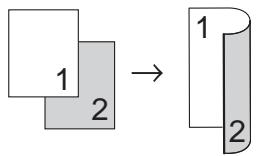
■ 1-sided→2-sided Short Edge Flip
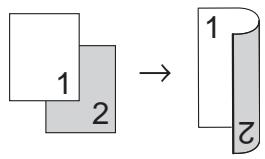
Landscape
■ 1-sided→2-sided Long Edge Flip
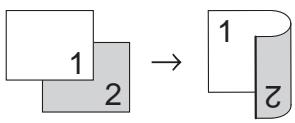
■ 1-sided→2-sided Short Edge Flip
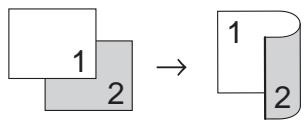
MFC-9340CDW
If you want to use the automatic 2-sided copy feature, load your document in the ADF.
Portrait
■ 2-sided→2-sided
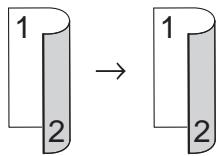
■ 1-sided→2-sided Long Edge Flip
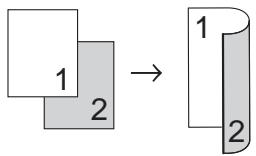
■ 2-sided→1-sided Long Edge Flip
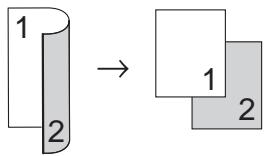
■ 1-sided→2-sided Short Edge Flip
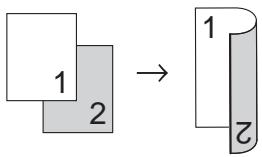
■ 2-sided→1-sided Short Edge Flip
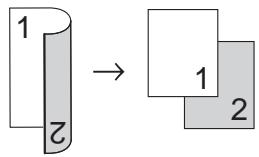
Landscape
2-sided→2-sided
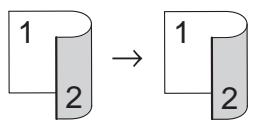
■ 1-sided→2-sided Long Edge Flip
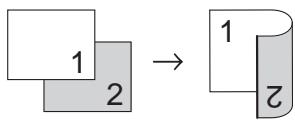
■ 2-sided→1-sided Long Edge Flip
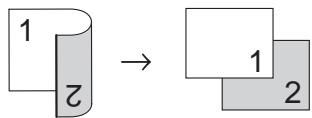
■ 1-sided→2-sided Short Edge Flip
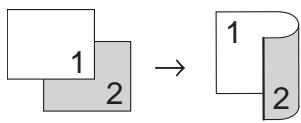
■ 2-sided→1-sided Short Edge Flip
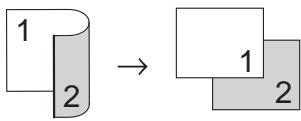
1 Load your document.
2 Press (Copy).
3 Enter the number of copies.
4 Press Options.
5 Swipe up or down, or press ▲ or ▼ to display 2-sided Copy.
6 Press 2-sided Copy.
7 Swipe up or down, or press ▲ or ▼ to display the following layout options: Off,
2-sided⇒2-sided ^1 , 1-sided⇒2-sided Long Edge Flip, 2-sided⇒1-sided Long Edge Flip ^1 , 1-sided⇒2-sided Short Edge Flip, 2-sided⇒1-sided Short Edge Flip ^1
1 For MFC-9340CDW
8 Press the option you want.
9 If you do not want to change additional settings, press OK.
10 Press Colour Start or Mono Start to scan the page.
If you placed the document in the ADF, the machine scans the pages and starts printing.
If you are using the scanner glass, go to step 11.
11 After the machine scans the page, press Scan to scan the next page.
12 Place the next page on the scanner glass.
13 Press OK. Repeat steps 11 and 13 for each page of the layout.
14 After scanning all the pages, press Complete in step 11 to finish.
Adjusting Density and Contrast
Density
Adjust the copy density to make copies darker or lighter.
1 Load your document.
2 Press (Copy).
3 Enter the number of copies.
4 Press Options.
5 Swipe up or down, or press ▲ or ▼ to display Density.
6 Press Density.
7 Press a level of density, from Light to Dark.
8 If you do not want to change additional settings, press OK.
9 Press Colour Start or Mono Start.
Contrast
Adjust the contrast to help an image look sharper and more vivid.
1 Load your document.
2 Press (Copy).
3 Enter the number of copies.
4 Press Options.
5 Swipe up or down, or press ▲ or ▼ to display Contrast.
6 Press Contrast.
7 Press a level of contrast.
8 If you do not want to change additional settings, press OK.
9 Press Colour Start or Mono Start.
Sorting copies
You can sort multiple copies. Pages will be sorted in the order 1 2 3, 1 2 3, 1 2 3, and so on.
1 Load your document.
2 Press (Copy).
3 Enter the number of copies.
4 Press Options.
5 Swipe up or down, or press ▲ or ▼ to display Stack/Sort.
6 Press Stack/Sort.
7 Press Sort.
8 Read and confirm the displayed list of settings you have chosen. If you do not want to change any other settings, press OK.
9 Press Colour Start or Mono Start to scan the page.
If you placed the document in the ADF, the machine scans the pages and starts printing.
If you are using the scanner glass, go to step 10.
10 After the machine scans the page, press Scan to scan the next page.
11 Place the next page on the scanner glass.
12 Press OK.
Repeat steps 10 and 12 for each page of the layout.
13 After scanning all the pages, press Complete in step 10 to finish.
Making N in 1 copies (page layout)
You can reduce the amount of paper used when copying by using the N in 1 copy feature. This allows you to copy two or four pages onto one page. If you want to copy both sides of an ID card onto one page, see 2 in 1 ID Copy on page 54.
IMPORTANT
- Make sure the paper size is set to A4, Letter, Legal or Folio.
- You cannot use the Enlarge/Reduce setting with the N in 1 feature.
- (P) means Portrait and (L) means Landscape.
1 Load your document.
2 Press (Copy).
3 Enter the number of copies.
4 Press Options.
5 Swipe up or down, or press ▲ or ▼ to display Page Layout.
6 Press Page Layout.
7 Swipe up or down, or press ▲ or ▼ to display Off(1in1), 2in1(P), 2in1(L), 2in1(ID) ^1 , 4in1(P) or 4in1(L).
1 For information about 2 in 1 (ID), see 2 in 1 ID Copy on page 54.
8 Press the option you want.
9 If you do not want to change additional settings, press OK.
10 Press Colour Start or Mono Start to scan the page.
If you placed the document in the ADF, the machine scans the pages and starts printing.
If you are using the scanner glass, go to step 11.
11 After the machine scans the page, press Scan to scan the next page.
12 Place the next page on the scanner glass.
13 Press OK.
Repeat steps 11 and 13 for each page of the layout.
14 After scanning all the pages, press Complete in step 11 to finish.
If you are copying from the ADF:
Place your document face up in the direction shown in the illustration:
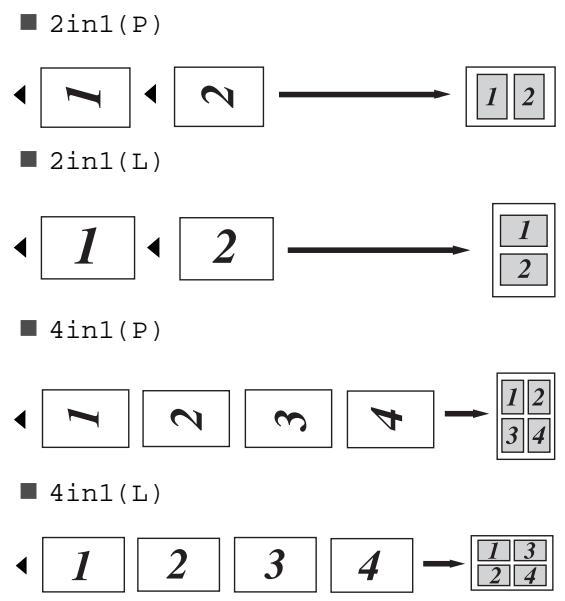
2in1(P)
2in1(L)
4in1(P)
4in1(L)
If you are copying from the scanner glass:
Place your document face down in the direction shown in the illustration:
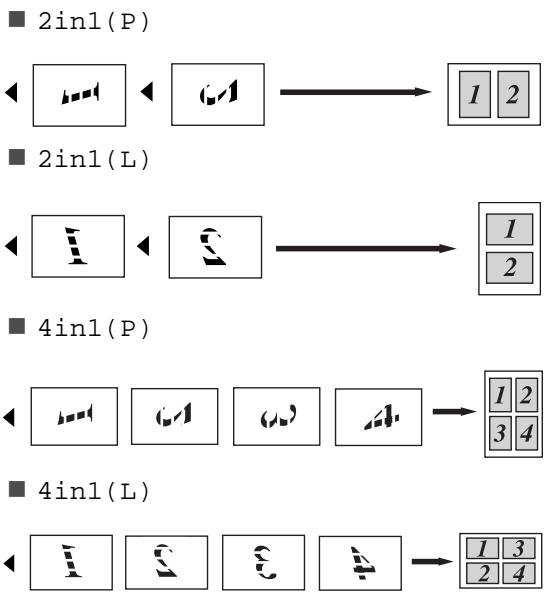
2in1(P)
■ 2in1(L)
4in1(P)
4in1(L)
2 in 1 ID Copy
You can copy both sides of your identification card onto one page, keeping the original card size.
NOTE
You can copy an identification card to the extent permitted under applicable laws (see Product Safety Guide: Unlawful use of copying equipment (MFC and DCP only).)
1 Place your identification card face down near the left corner of the scanner glass.
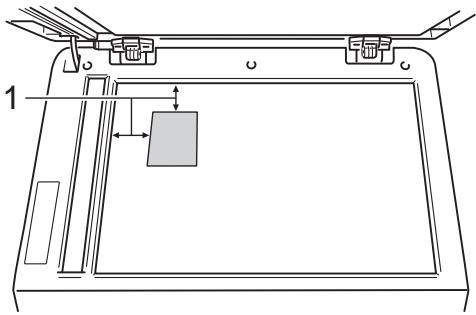
natural_image
Technical line drawing of a mechanical assembly with no visible text or symbols1 4 mm or greater (top, left)
■ Even if a document is placed on the ADF, the machine scans the data from the scanner glass when in this mode.
2 Press (Copy).
3 Enter the number of copies.
4 Press Options.
5 Swipe up or down, or press ▲ or ▼ to display Page Layout.
6 Press Page Layout.
7 Swipe up or down, or press ▲ or ▼ to display 2in1(ID).
8 Press 2in1(ID).
9 Read and confirm the displayed list of settings you have chosen, and then press OK.
10 Press Colour Start or Mono Start. The machine starts scanning one side of the identification card.
11 After the machine has scanned one side, press Scan. Turn over the identification card and place it near the left corner of the scanner glass, then press OK to scan the other side.
NOTE
When 2 in 1 ID Copy is chosen, the machine sets the quality to Photo and the contrast to +2.
12 Press
Adjusting the Colour Saturation
You can change the default setting for colour saturation.
1 Load your document.
2 Press (Copy).
3 Enter the number of copies.
4 Press Options.
5 Swipe up or down, or press ▲ or ▼ to display Colour Adjust.
6 Press Colour Adjust.
7 Press Red, Green or Blue.
8 Press a level of colour saturation.
9 Repeat steps ⑦ and ⑧ if you want to adjust the next colour.
After adjusting the colour settings, press ↩.
10 If you do not want to change additional settings, press OK.
11 Press Colour Start.
Making 2-sided N in 1 copies (MFC-9340CDW)
When you make 2-sided N in 1 copies from a 2-sided document, you must choose a layout option in 2-sided Copy Page Layout.
You will be able to access 2-sided Copy Page Layout after selecting
2-sided⇒2-sided for 2-sided Copy and any N in 1 layout for Page Layout.
You must select an appropriate option in the table.
| Bound Edge of the Document | Edge of the copies to be bound | Option you must choose |
| Long Edge | Long Edge | LongEdge⇒LongEdge |
| Short Edge | LongEdge⇒ShortEdge | |
| Short Edge | Long Edge | ShortEdge⇒LongEdge |
| Short Edge | ShortEdge⇒ShortEdge |
IMPORTANT
- Load your document in the ADF to use the 2-sided Copy Page Layout feature.
- The 2-sided Copy Page Layout feature does not work when you choose 2in1(ID) for Page Layout.
1 Load your document in the ADF.
2 Press (Copy).
3 Enter the number of copies.
4 Press Options.
5 Select 2-sided⇒2-sided in 2-sided Copy (see 2-sided Copying on page 49).
6 Select 2in1(P), 2in1(L), 4in1(P) or 4in1(L) in Page Layout (see Making N in 1 copies (page layout) on page 52).
7 Swipe up or down, or press ▲ or ▼ to display 2-sided Copy Page Layout.
8 Press 2-sided Copy Page Layout.
9 Press LongEdge⇒ LongEdge,
LongEdge⇒ ShortEdge,
ShortEdge⇒ LongEdge or
ShortEdge⇒ ShortEdge.
10 If you do not want to change additional settings, press OK.
11 Press Colour Start or Mono Start.
Removing Background Colour
Remove Background Colour removes the background colour of the document when copying. Using this function will make the copy clearer to read and may save toner.
NOTE
This function is for use only when making colour copies.
1 Load your document.
2 Press (Copy).
3 Enter the number of copies.
4 Press Options.
5 Swipe up or down, or press ▲ or ▼ to display Advanced Settings.
6 Press Advanced Settings.
7 Press Remove Background Colour.
8 Press Low, Medium or High.
9 If you do not want to change additional settings, press OK.
10 Press Colour Start.
Saving copy options as a Shortcut
You can store the copy options you use most often by saving them as a Shortcut.
1 Press (Copy).
2 Press Options.
3 Swipe up or down, or press ▲ or ▼ to display Quality, Enlarge/Reduce, 2-sided Copy, Density, Contrast, Stack/Sort, Page Layout, Colour Adjust, 2-sided Copy Page Layout or Remove Background Colour, and then press the setting you want.
4 Swipe up or down, or press ▲ or ▼ to display the available options, and then press your new option.
Repeat steps ③ and ④ for each setting you want to change.
5 When you have finished choosing new options, press Save as Shortcut.
6 Read and confirm the displayed list of options you have chosen for the Shortcut, and then press OK.
7 Enter a name for the Shortcut using the keyboard on the Touchscreen. (To help you enter letters: see Basic User's Guide: Entering text.) Press OK.
8 Press OK to save your Shortcut.
9 Press
Saving paper
You can use the Paper Save preset to reduce the amount of paper consumed for copies. Paper Save uses the 4 in 1 layout and 2-sided copy options.
1 Load your document.
2 Press (Copy).
3 Swipe left or right to display Paper Save.
4 Press Paper Save.
5 Enter the number of copies.
6 Do one of the following:
■ To change more settings, go to step ⑦.
■ When you have finished changing settings, go to step 10.
7 Press Options.
8 Swipe up or down, or press ▲ or ▼ to display the available settings, and then press the setting you want.
9 Swipe up or down, or press ▲ or ▼ to display the available options, and then press your new option.
Repeat steps ⑧ and ⑨ for each setting you want. When you have finished changing settings, press OK.
10 Press Colour Start or Mono Start.
A
Routine maintenance
Checking the machine
Printing the test print
You can print a Test Print page to check your print quality.

1 Press
2 Press Test Print.
3 The Touchsceen will show
Press [OK].
Press OK.
The machine will print the Test Print page.
4 Press
Checking the Page Counters
You can see the machine's Page Counters for copies, printed pages, reports and lists, faxes or a summary total.
1 Press

2 Press All Settings.
3 Swipe up or down, or press ▲ or ▼ to display Machine Info..
4 Press Machine Info..
5 Press Page Counter.
The Touchscreen shows number of pages for Total, Fax/List, Copy and Print.
6 Press
Checking the remaining life of toner cartridges
You can see the approximate remaining life of the toner cartridges.

1 Press
2 Press Toner Life.
The Touchscreen will show the approximate remaining life of the toner cartridges in a bar chart.
3 Press
Checking the remaining life of parts
You can see the machine's parts life on the Touchscreen.

1 Press
2 Press All Settings.
3 Swipe up or down, or press ▲ or ▼ to display Machine Info..
4 Press Machine Info..
5 Press Parts Life.
6 Press ▲ or ▼ to see the approximate remaining parts life of the
Drum Black(BK), Drum Cyan(C),
Drum Magenta(M),
Drum Yellow(Y), Belt Unit,
Fuser, PF kit.
7 Press
NOTE
The remaining life of the toner cartridge is listed on the User Settings report (see How to print a report on page 46).
Replacing periodic maintenance parts
The periodic maintenance parts will need to be replaced regularly to maintain the print quality. The Fuser Unit and PF Kit parts listed in the table must be replaced after printing approximately 50,000 pages ^1 . Contact Brother customer service when these messages appear on the Touchscreen.
| Touchscreen message | Description |
| Replace Fuser | Replace the fuser unit. |
| Replace PF kit | Replace the paper feeding kit for the paper tray. |
1 A4 or Letter size single-sided pages.
Packing and shipping the machine

WARNING
This machine is heavy and weighs more than 20.0 kg. To prevent possible injuries, at least two people should lift the machine. One person should hold the front of the machine, and one person should hold the back, as shown in the illustration. Be careful not to trap your fingers when you put the machine down.
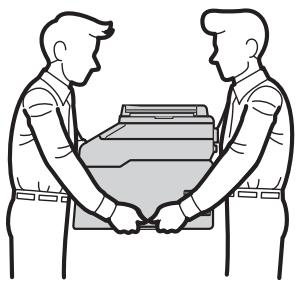
natural_image
Two uniformed personnel shaking hands around a cylindrical object (no text or symbols visible)NOTE
If for any reason you must ship your machine, carefully repack the machine in the original packaging to avoid any damage during transit. The machine should be adequately insured with the carrier.
1 Press and hold down ⏻ to turn off the machine. Leave the machine turned off for at least 10 minutes to cool down.
2 Disconnect all the cables, and then unplug the power cord from the electrical socket.
3 Place the packing material (1) into the carton.
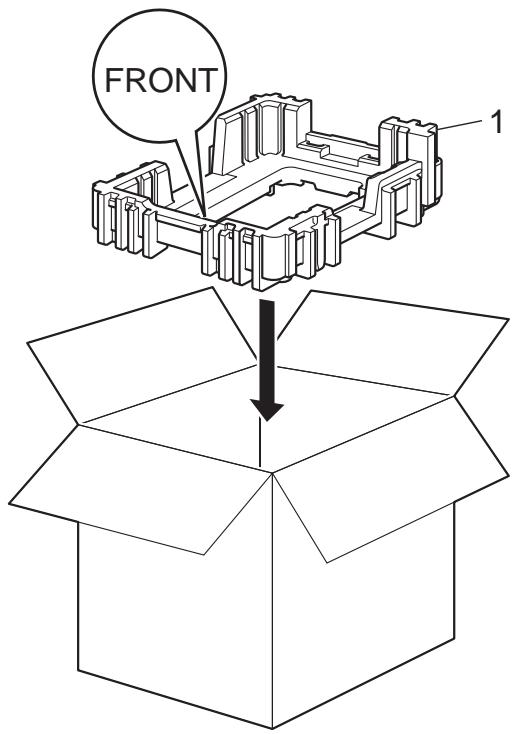
4 Wrap the machine in a plastic bag, then place it on the bottom packing material (1).
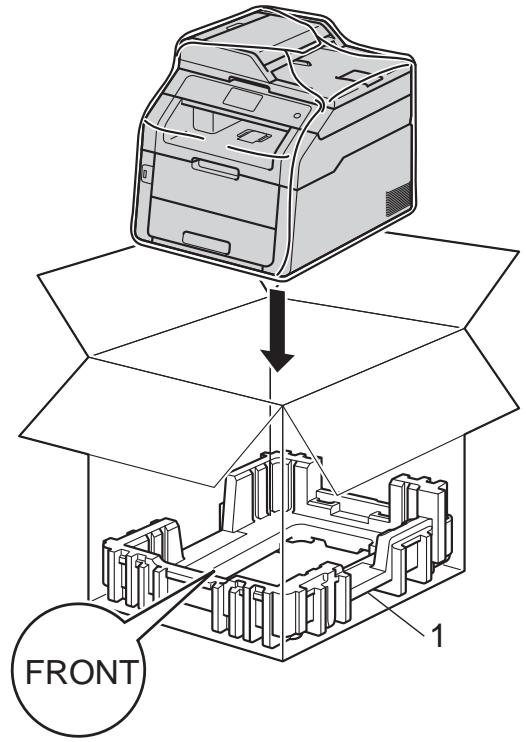
5 Place the packing material (2) marked "R" on the right of the machine. Place the packing material (3) marked "L" on the left of the machine. Place the AC power cord and printed materials in the original carton as shown in the illustration.
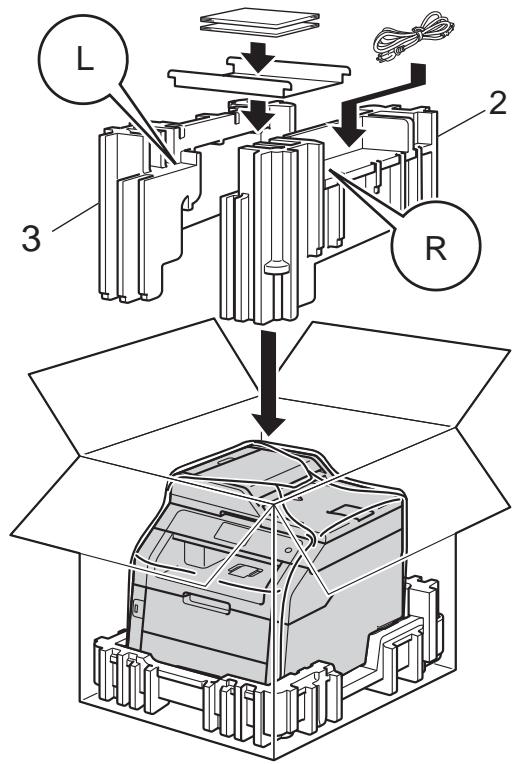
6 Close the carton and tape it shut.
B
Glossary
This is a comprehensive list of features and terms that appear in Brother manuals. Availability of these features depends on the model you purchased.
3.7 in. (93.4 mm) Touchscreen LCD and Touchpanel
The Touchscreen LCD (Liquid Crystal Display) on the machine shows interactive messages and prompts for using the machine. You can operate the Touchscreen by pressing or swiping on the screen. The Touchpanel, on the right side of the Touchscreen LCD, illuminates its LEDs when they are available for the current operation.
Address Book
Names and numbers you have stored for easy dialling.
Address Book List
A listing of names and numbers stored in the Address Book memory, in alphabetical order.
ADF (automatic document feeder)
The document can be placed in the ADF and scanned one page at a time automatically.
Auto Reduction
Reduces the size of incoming faxes.
Automatic fax transmission
Sending a fax without picking up the handset of the external telephone.
Automatic Redial
A feature that enables your machine to redial the last fax number after five minutes if the fax did not go through because the line was busy.
Backup Print
Your machine prints a copy of every fax that is received and stored in memory. This is a safety feature so you will not lose messages during a power failure.
Batch Transmission
As a cost saving feature, all delayed faxes to the same fax number will be sent as one transmission.
Beeper Volume
Volume setting for the sound when you press a key or make an error.
Broadcasting
The ability to send the same fax message to more than one location.
BT Call Sign
A subscriber service purchased from the telephone company in the U.K. that gives you another phone number on an existing phone line. The Brother machine uses the new number to simulate a dedicated fax line.
Cancel Job
Cancels a programmed print job and clears it from the machine's memory.
CNG tones
The special tones (beeps) sent by fax machines during automatic transmission to tell the receiving machine that a fax machine is calling.
Caller ID
A service purchased from the telephone company that lets you see the number (or name) of the party calling you.
Coding method
Method of coding the information contained in the document. All fax machines must use a minimum standard of Modified Huffman (MH). Your machine is capable of greater compression methods, Modified Read (MR), Modified Modified Read (MMR) and JBIG, if the receiving machine has the same capability.
Communication error (or Comm. Error)
An error during fax sending or receiving, usually caused by line noise or static.
Compatibility group
The ability of one fax unit to communicate with another. Compatibility is assured between ITU-T Groups.
Contrast
Setting to compensate for dark or light documents, by making faxes or copies of dark documents lighter and light documents darker.
Delayed Fax
Sends your fax at a specified later time that day.
Density
Changing the Density makes the whole image lighter or darker.
Dual Access
Your machine can scan outgoing faxes or scheduled jobs into the memory at the same time it is sending a fax, receiving a fax, or printing an incoming fax.
ECM (Error Correction Mode)
Detects errors during fax transmission and resends the pages of the fax that had an error.
Extension telephone
A telephone on the fax number that is plugged into a separate wall socket.
External phone
A TAD (telephone answering device) or telephone that is connected to your machine.
F/T Ring Time
The length of time that the Brother machine fast double-rings (when the Receive Mode setting is Fax/Tel) to notify you to pick up a voice call that it answered.
Fax Detect
Enables your machine to respond to CNG tones if you interrupt a fax call by answering it.
Fax Forwarding
Sends a fax received into the memory to another pre-programmed fax number.
Fax Journal
Lists information about the last 200 incoming and outgoing faxes. TX means Transmit. RX means Receive.
Fax Storage
You can store faxes in the memory.
Fax tones
The signals sent by sending and receiving fax machines while communicating information.
Fax/Tel
You can receive faxes and telephone calls. Do not use this mode if you are using a telephone answering device (TAD).
Fine resolution
Resolution is 203 × 196 dpi. It is used for small print and graphs.
Greyscale
The shades of grey available for copying and faxing photographs.
Group number
A combination of Address Book numbers that are stored in Address Book for Broadcasting.
Journal Period
The pre-programmed time period between automatically printed Fax Journal Reports. You can print the Fax Journal on demand without interrupting the cycle.
Manual fax
When you lift the handset of your external telephone so you can hear the receiving fax machine answer before you press Fax Start to begin transmission.
OCR (optical character recognition)
Nuance™ PaperPort™ 12SE or Presto! PageManager software application converts an image of text to text you can edit.
Out of Paper Reception
Receives faxes into the machine's memory when the machine is out of paper.
Overseas Mode
Makes temporary changes to the fax tones to accommodate noise and static on overseas telephone lines.
Pause
Allows you to place a 2.8 second delay in the dialling sequence while you are dialling using the dial pad or while you are storing numbers in Address Book. Press Pause as many times as needed for longer pauses.
Polling
The process of a fax machine calling another fax machine to retrieve waiting fax messages.
Pulse
A form of rotary dialling on a telephone line.
Real Time Transmission
When memory is full, you can send faxes in real time.
Remaining Jobs
You can check which programmed fax jobs are waiting in the memory and cancel the jobs individually.
Remote Access Code
Your own four-digit code (− − −*) that allows you to call and access your machine from a remote location.
Remote Activation code (Fax/Tel mode only)
Press this code (*51) when you answer a fax call on an extension or external telephone.
Remote Deactivation code (Fax/Tel mode only)
When the machine answers a voice call, it fast double-rings. You can pick up at an extension or external telephone by pressing this code (#51).
Remote Retrieval Access
The ability to access your machine remotely from a touch tone telephone.
Resolution
The number of vertical and horizontal lines per inch.
Ring Delay
The number of rings before the machine answers in Fax and Fax/Tel modes.
Ring Volume
Volume setting for the machine's ring.
Scanning
The process of sending an electronic image of a paper document into your computer.
Search
An alphabetical electronic listing of stored Address Book and Group numbers.
Settings Tables
At-a-glance instructions that show all the settings and options that are available for setting up your machine.
Station ID
The stored information that appears on the top of faxed pages. It includes the sender's name and fax number.
TAD (telephone answering device)
You can connect an external TAD to your machine.
Temporary settings
You can choose certain options for each fax transmission and copy without changing the default settings.
Tone
A form of dialling on the telephone line used for Touch Tone telephones.
Transmission
The process of sending faxes over the telephone lines from your machine to the receiving fax machine.
User Settings List
A printed report that shows the current settings of the machine.
Xmit Report (Transmission Verification Report)
A listing for each transmission, that shows its date, time and number.
Numerics
2-sided copy 49
A
Address Book
broadcasting ....17
using Groups ....17
Group dial
setting up Groups for broadcasting ....42
Apple Macintosh
See Software User's Guide.
B
Broadcasting 17
cancelling 18
setting up Groups for 42
C
Cancelling
broadcast in process ....18
fax jobs in memory 21
fax storage 29
jobs awaiting redial 21
remote fax options 30
ControlCenter2 (for Macintosh) See Software User's Guide.
ControlCenter4 (for Windows®) See Software User's Guide.
Copy
2 in 1 ID Copy .... 54
2-sided 49
button 47
contrast 51
Density 51
Enlarge/Reduce 48
N in 1 (page layout) 52
quality 47
saving paper 57
sort 52
temporary settings 47
using scanner glass ....50, 52, 53
Cover page 23
custom comments 23
printed form 24
D
Daylight Saving Time .... 1
Deep Sleep mode 3
Delayed batch transmission 20
Destination Display 25
Dialling
Groups (broadcasting) .... 17
restricting dialling .... 12
Drum unit
checking (remaining life) .... 58
Dual access 16
E
Enlarge/Reduce 48
F
Fax codes
changing 31
remote access code ....31
Fax forwarding
changing remotely 32, 33
programming a number 28
Fax storage
printing from memory 36
turning off 30
turning on 29
Fax, stand-alone
receiving
fax forwarding 28,32
fax receive stamp 35
into memory (fax storage) ......29
polling receive 37
reducing to fit on paper 34
retrieving from a remote site ..... 32, 33
sending ..
broadcasting 17
cancelling from memory 21
contrast 15
delayed batch 20
delayed fax 20
destination display 25
from memory (dual access) .....16
manual 16
overseas 19
polled transmit 26
real time transmission 19
resolution 15
G
Groups for broadcasting 42
M
Machine information
checking remaining life of parts 58
page counts 58
Macintosh
See Software User's Guide.
Maintenance, routine 58
checking the remaining life of parts ..... 58
Manual
transmission 16
Memory
storage 1
N
N in 1 (page layout) 52
Network
faxing
See Software User's Guide.
printing
See Network User's Guide.
scanning
See Software User's Guide.
Nuance™ PaperPort™ 12SE
See Software User's Guide and Help in the
PaperPort™ 12SE application to access
How-to-Guides.
O
Outgoing Calls
Add to Address Book 42
P
Page layout (N in 1) ....52
PC-Fax
See Software User's Guide.
Polling
polled transmit 26
polling receive 37
Power failure ....1
Presto! PageManager
See Software User's Guide. See also Help in the Presto! PageManager application.
fax from memory 36
reports 46
Printing
See Software User's Guide.
Q
Quality
copying 47
R
Reducing
copies 48
incoming faxes 34
Remote retrieval ....31
access code 31
commands 32
getting your faxes 33
Remote setup
See Software User's Guide.
Reports 45, 46
Drum Dot Print 46
Fax Journal 45, 46
journal period 45
how to print 46
Network Configuration 46
Tel Index List 46
Transmission Verification 45
User Settings 46
WLAN Report 46
Resolution
fax (standard, fine, superfine, photo) ....15
setting for next fax 15
S
Scanning
See Software User's Guide.
Security
restricting dialling 12
Secure function lock
administrator password 6
Setting lock 10
Sleep mode 2
Sort 52
T
Temporary copy settings 47
Toner Save 2
Touchscreen
backlight brightness 3
W
Windows®
See Software User's Guide.
Wireless Network
See Quick Setup Guide and
Network User's Guide.
brother®
Visit us on the World Wide Web http://www.brother.com/
These machines are approved for use in the country of purchase only. Local Brother companies or their dealers will only support machines purchased in their own countries.
- Advanced User's Guide
- Table of Contents
- General Setup 1
- Security features 5
- Sending a fax
- Receiving a fax
- Dialling and storing numbers 40
- Printing reports 45
- Making copies 47
- A Routine maintenance 58
- B Glossary 62
- C Index 66
- General Setup
- NOTE
- Memory storage
- Automatic Daylight Saving Time
- Ecology features
- Toner Save
- Sleep Time
- Deep Sleep mode
- Touchscreen
- Setting the backlight brightness
- Setting the Dim Timer for the backlight
- 2
- Security features
- Secure Function Lock 2.0
- Before you begin to use Secure Function Lock 2.0
- Setting and changing the Administrator Password
- Setting the administrator password
- Changing the administrator password
- Setting up restricted users
- Setting up and changing the Public user mode
- Turning Secure Function Lock on/off
- Turning Secure Function Lock on
- Turning Secure Function Lock off
- Switching Users
- Changing to the restricted user mode
- Changing to the Public mode
- Setting Lock
- Setting up the administrator password
- Changing the Setting Lock administrator password
- Turning Setting Lock on/off
- Turning Setting Lock on
- Turning Setting Lock off
- Dial Restriction
- Dial pad restriction
- Address Book restriction
- Shortcuts restriction
- 3
- Sending a fax
- Additional sending options
- Sending faxes using multiple settings
- Changing a 2-sided fax layout (MFC-9340CDW)
- Contrast
- Changing Fax Resolution
- Additional sending operations
- Sending a fax manually
- Manual transmission
- Dual access
- Broadcasting
- Before you begin the broadcast
- How to broadcast a fax
- Cancelling a Broadcast in progress
- Real Time Transmission
- Overseas Mode
- Delayed Fax
- Delayed batch transmission
- Checking and cancelling waiting jobs
- Setting your changes as the new default
- Restoring all fax settings to the factory settings
- Saving fax options as a Shortcut
- Electronic cover page
- Composing your own comments
- Send a cover page for the next fax
- Using a printed cover page
- Destination Display
- Polling
- Polled transmit
- Setup for polled transmit
- Setup for polled transmit with a secure code
- 4
- Receiving a fax
- Memory Receive Options
- Fax Forwarding
- IMPORTANT
- Fax Storage
- Changing Memory Receive Options
- If received faxes have already been printed
- If unprinted faxes are in the memory
- Turning off Remote Fax Options
- Remote retrieval
- Setting a Remote Access Code
- Using your Remote Access Code
- Remote fax commands
- Retrieving fax messages
- Changing the Fax Forwarding number
- Additional receiving operations
- Printing a reduced incoming fax
- 2-sided printing for Fax mode
- Setting the Fax Receive Stamp
- Setting the Print Density
- Printing a fax from the memory
- Out of Paper Reception
- Polling receive
- Secure polling
- Delayed polling
- Sequential polling
- Stop Polling
- Cancelling a Sequential Polling Job
- 5
- Dialling and storing numbers
- Telephone line services
- BT Call Sign (U.K. only)
- To enable the machine to work with BT Call Sign
- Additional dialling operations
- Combining Address Book numbers
- Additional ways to store numbers
- Storing Address Book numbers from Outgoing Calls
- Setting up Groups for Broadcasting
- Changing a Group name
- Deleting a Group
- Adding or deleting Group members
- 6
- Printing reports
- Fax reports
- Transmission Verification Report
- Fax Journal (Activity Report)
- Reports
- The following reports are available:
- How to print a report
- 7
- Making copies
- Copy settings
- Stop copying
- Improving copy quality
- Enlarging or reducing copies
- 2-sided Copying
- MFC-9140CDN and MFC-9330CDW
- MFC-9340CDW
- Landscape
- 2-sided→2-sided
- ■ 1-sided→2-sided Long Edge Flip
- ■ 2-sided→1-sided Long Edge Flip
- ■ 1-sided→2-sided Short Edge Flip
- ■ 2-sided→1-sided Short Edge Flip
- Load your document.
- Press (Copy).
- Enter the number of copies.
- Press Options.
- Swipe up or down, or press ▲ or ▼ to display 2-sided Copy.
- Press 2-sided Copy.
- Swipe up or down, or press ▲ or ▼ to display the following layout options: Off,
- Press the option you want.
- If you do not want to change additional settings, press OK.
- Press Colour Start or Mono Start to scan the page.
- If you are using the scanner glass, go to step 11.
- After the machine scans the page, press Scan to scan the next page.
- Place the next page on the scanner glass.
- Press OK. Repeat steps 11 and 13 for each page of the layout.
- After scanning all the pages, press Complete in step 11 to finish.
- Adjusting Density and Contrast
- Density
- Sorting copies
- Making N in 1 copies (page layout)
- If you are copying from the ADF:
- If you are copying from the scanner glass:
- in 1 ID Copy
- Adjusting the Colour Saturation
- Making 2-sided N in 1 copies (MFC-9340CDW)
- Removing Background Colour
- Saving copy options as a Shortcut
- Saving paper
- A
- Routine maintenance
- Checking the machine
- Printing the test print
- Checking the Page Counters
- Checking the remaining life of toner cartridges
- Checking the remaining life of parts
- Replacing periodic maintenance parts
- Packing and shipping the machine
- WARNING
- B
- Glossary
- in. (93.4 mm) Touchscreen LCD and Touchpanel
- Address Book
- Address Book List
- ADF (automatic document feeder)
- Auto Reduction
- Automatic fax transmission
- Automatic Redial
- Backup Print
- Batch Transmission
- Beeper Volume
- BT Call Sign
- Cancel Job
- CNG tones
- Caller ID
- Coding method
- Communication error (or Comm. Error)
- Compatibility group
- ECM (Error Correction Mode)
- Extension telephone
- External phone
- F/T Ring Time
- Fax Detect
- Fax Journal
- Fax tones
- Fax/Tel
- Fine resolution
- Greyscale
- Group number
- Journal Period
- Manual fax
- OCR (optical character recognition)
- Pause
- Pulse
- Remaining Jobs
- Remote Access Code
- Remote Activation code (Fax/Tel mode only)
- Remote Deactivation code (Fax/Tel mode only)
- Remote Retrieval Access
- Resolution
- Ring Delay
- Ring Volume
- Scanning
- Search
- Settings Tables
- Station ID
- TAD (telephone answering device)
- Temporary settings
- Tone
- Transmission
- User Settings List
- Xmit Report (Transmission Verification Report)
- Numerics
- C
- D
- E
- F
- G
- M
- N
- O
- P
- Q
- R
- S
- T
- W
- brother®
- Visit us on the World Wide Web http://www.brother.com/
Marque : BROTHER
Modèle : MFC-9340CDW
Catégorie : Imprimante multifonction laser couleur