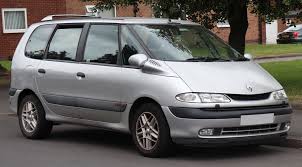
monospace ESPACE 3 - Monospace RENAULT - Notice d'utilisation et mode d'emploi gratuit
Retrouvez gratuitement la notice de l'appareil monospace ESPACE 3 RENAULT au format PDF.


| Type de produit | Monospace |
|---|---|
| Modèle | RENAULT ESPACE 3 |
| Années de production | 1996 - 2002 |
| Nombre de places | 5 à 7 places |
| Dimensions (L x l x H) | 4 610 mm x 1 830 mm x 1 700 mm |
| Poids | 1 500 kg |
| Type de moteur | Essence et Diesel |
| Puissance moteur | 90 à 150 ch |
| Transmission | Manuelle ou automatique |
| Consommation de carburant | Environ 7 à 10 L/100 km |
| Capacité du réservoir | 70 litres |
| Système de sécurité | Airbags, ABS, ESP |
| Entretien et nettoyage | Changement d'huile tous les 15 000 km, filtres à air et à carburant à vérifier régulièrement. |
| Pièces détachées et réparabilité | Disponibilité des pièces sur le marché, réparabilité modérée. |
| Compatibilités | Compatible avec divers accessoires Renault et pièces de rechange standard. |
| Options de confort | Climatisation, sièges chauffants, système audio amélioré. |
| Informations générales | Monospace spacieux, idéal pour les familles, bon rapport qualité/prix. |
FOIRE AUX QUESTIONS - monospace ESPACE 3 RENAULT
Questions des utilisateurs sur monospace ESPACE 3 RENAULT
0 question sur cet appareil. Repondez a celles que vous connaissez ou posez la votre.
Poser une nouvelle question sur cet appareil
Téléchargez la notice de votre Monospace au format PDF gratuitement ! Retrouvez votre notice monospace ESPACE 3 - RENAULT et reprennez votre appareil électronique en main. Sur cette page sont publiés tous les documents nécessaires à l'utilisation de votre appareil monospace ESPACE 3 de la marque RENAULT.
MODE D'EMPLOI monospace ESPACE 3 RENAULT
ESPACE
DRIVER'S HANDBOOK

RENault recommends ELF
ELF has developed a complete range of lubricants for RENAULT:
engine oils
manual and automatic gearbox oils
Warning: to ensure the engine operates optimally, the use of a lubricant may be restricted to certain vehicles. Please refer to your maintenance document.
Benefiting from the research applied to Formula 1, lubricants are very high-tech products.
Updated with the help of RENault's technical teams, this range is perfectly compatible with the specific features of the brand's vehicles.
ELF lubricants enhance your vehicle's performance significantly.
RENAULT recommends approved ELF lubricants for oil changes and top-ups. Contact your RENAULT Dealer or visit www.lubrifiants elf.com

Une marque de TOTAL
Welcome to your new vehicle
This Driver's Handbook contains the information necessary:
- for you to familiarise yourself with your vehicle, to use it to its best advantage and to benefit fully from the all the functions and the technical developments it incorporates.
to ensure that it always gives the best performance by following the simple, but comprehensive advice concerning regular maintenance. - to enable you to deal quickly with minor faults not requiring specialist attention.
It is well worth taking a few minutes to read this handbook to familiarise yourself with the information and guidelines it contains about the vehicle and its functions and new features. If certain points are still unclear, our Network technicians will be only too pleased to provide you with any additional information.
The following symbol will help you when reading this handbook:

To indicate a hazard, danger or safety recommendation.
The descriptions of the models given in this handbook are based on the technical specifications at the time of writing. This handbook covers all items of equipment (both standard and optional) available for these models but whether or not these are fitted to the vehicle depends on the version, options selected and the country where the vehicle is sold.
This handbook may also contain information about items of equipment to be introduced later in the model year.
Throughout the manual, the "approved Dealer" is your RENAULT Dealer.
Enjoy driving your new vehicle.
Translated from French. Copying or translation, in part or in full, is forbidden unless prior written permission has been obtained from the vehicle manufacturer.
0.1

C O N T E N T S
Sections
Getting to know your vehicle
Driving
Your comfort
Maintenance
Practical advice
Technical specifications
Alphabetical index
Section 1: Getting to know your vehicle
RENCAULT card: general information, use, deadlock 1.2
Doors. 1.7
Engine immobiliser system 1.13
Headrests - Seats 1.15
Seat belts. 1.20
Additional methods of restraint 1.23
to the seat belt 1.23
side protection devices. 1.27
Child safety: general information 1.29
choosing a child seat mounting 1.32
fitting a child seat 1.34
deactivating/activating the front passenger airbag 1.38
1.41
Driving position 1.42
Instrument panel 1.46
On-board computer 1.52
Clock and exterior temperature 1.63
Rear-view mirrors 1.64
Audible and visual signals 1.66
Lighting and exterior signals 1.67
Headlight beam adjustment. 1.70
Washers/Wipers 1.71
Fuel tank (filling with fuel) 1.74
1.1

"HANDS-FREE" RENAULT CARD: general information (1/3)
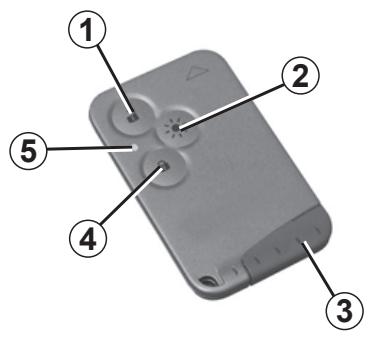
103A
1 Unlocking the doors and tailgate.
2 Locking all doors and tailgate.
3 Integrated key.
4 Switching on the lighting remotely.
5 Locking/unlocking the luggage compartment.
The RENAULT card is used for:
- locking/unlocking the doors and luggage compartment (doors, luggage compartment) and the fuel filler flap (see the following pages);
depending on the vehicle, automatic closing of windows and sunroof (refer to the information on the "Ontouch electric windows: remote control closing" and "Electric sunroof: remote control closing" in Section 3); - operation of certain devices (e.g.: radio, electrically controlled seats, etc.);
- starting the engine (see the information on "Starting the engine" in Section 2);
- switching off the "See-me-home lighting" function (refer to the information on "Exterior lighting and signals" in Section 1).
Battery life
RENVAULT cards are powered by a battery which must be replaced when battery tell-tale light 4 no longer lights up (refer to the information on the "RENVAULT card: battery" in Section 5).
Special note: for some vehicles, the RENAULT card records the settings selected by the card user: the choice of settings for the automatic climate control, some radios, electric seats (if this is stored), the rear view mirror positioning, etc. It is therefore advisable always to keep the same RENAULT card so that you can recall your personal settings.
"HANDS-FREE" RENAULT CARD: general information (2/3)
RENAULT card operating range
This varies according to the surroundings. It is important to make sure when handling the RENAULT card that you do not lock or unlock the doors by inadvertently pressing the buttons.
Advice
Avoid leaving the card in hot, cold or humid areas.
Do not keep the RENAULT card in a place where it could be bent or damaged accidentally, such as in a back pocket of a garment.
When the battery is flat, you can still lock/unlock and start your vehicle. Refer to the information on "Locking/unlocking the doors" in Section 1 and "Starting the engine" in Section 2.

Driver's responsibility
Never leave your vehicle with the RENAULT card inside and never leave a pet) unsupervised, even port while.
They may pose a risk to themselves or to others by starting the engine, activating equipment such as the electric windows or by locking the doors.
Risk of serious injury.
"HANDS-FREE" RENAULT CARD: general information (3/3)
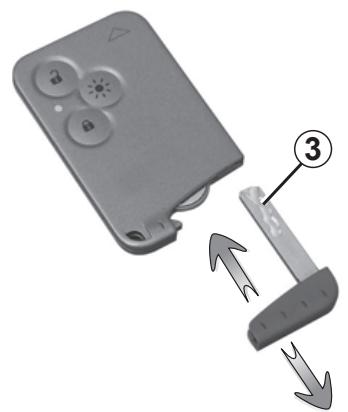
103C
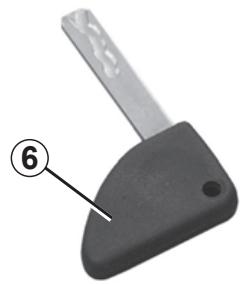
103Bbs
Integrated 3 or separate 6 emergency key (depending on vehicle)
This is only used in exceptional circumstances. It locks or unlocks the left-hand door if the RENAULT card does not work:
- if the vehicle is located in a zone of high electromagnetic radiation;
- use of devices using the same frequency as the card;
- when the RENAULT card battery is drained, flat battery, etc.
For instructions on how to use the emergency key, refer to the information on "Locking and unlocking the doors".
Once you have entered the vehicle using the emergency key, insert the RENAULT card into the card reader so that the engine can be started.
Replacement: need for an additional RENAULT Card
If you lose your RENAULT card or require another, you can obtain one from an approved dealer.
If a RENAULT card is replaced, it will be necessary to take the vehicle and all of its RENAULT cards to an approved dealer to initialise the system.
You may use up to four RENAULT cards per vehicle.
Faults with the RENAULT card
Make sure that the batteries are always in good condition: they have a service life of approximately two years.
Refer to the information on the "RENVAULT card: Batteries" in Section 5.
"HANDS-FREE" RENAULT CARD: use
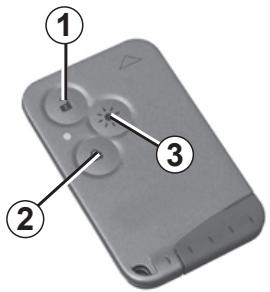
103A
Use
It allows the vehicle to be locked/unlocked without touching the RENAULT card, when present in the detection zone.
Unlocking the doors
Walk up to your vehicle carrying your RENAULT card.
As soon as you grip one of the handles (doors or tailgate), the locks will open automatically.
The hazard warning lights flash once to indicate that the doors have been unlocked.
Locking the doors
With the doors closed, walk away from the vehicle carrying your RENAULT card: the doors will lock automatically.
Note: the distance at which the vehicle locks depends on the surroundings.
The hazard warning lights flash twice and the side indicator lights light up (for approximately 10 seconds) to indicate that the doors have been locked. A beep also sounds.
This beep can be chosen from a range of several options or turned off.Consult an approved dealer.

Never leave your vehicle with the RENAULT card inside.
Operation in manual mode
If you wish, you can exit the hands-free mode by pressing button 1 or 2; you will then switch to manual mode and the RENAULT card operates as described in the section entitled "Hands-free RENAULT card: general information":
Returning to hands-free mode
Hands-Free mode returns automatically each time the vehicle ignition is switched on.
Distance lighting function
This can, for example, identify the vehicle from a distance when parked in a car park.
The side lights, dipped lights, indicators and interior lights light up for about 30 seconds when button 3 is pressed.
Note: pressing button 3 again during the 30 seconds turns the lights off.
DEADLOCKING
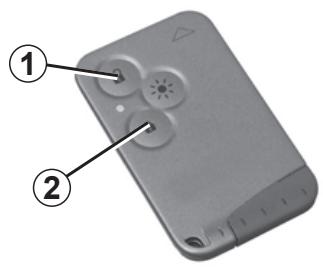
If the vehicle is equipped with a deadlocking function, this allows you to lock the opening elements and to prevent the doors from being unlocked using the interior handles (for example, by breaking the window and then trying to open the door from the inside).
103A
To activate deadlock, you can:
-
press button 2 twice, briefly;
-
press and hold button 2.
The hazard warning lights flash four times to indicate that the vehicle is locked.
Note: deadlock is not possible if the hazard warning lights or the side lights are lit.
Special notes for the Hands-Free mode
Activating the deadlock function exits hands-free mode.
To unlock the doors, you must press button 1 (refer to the information on the "Hands-free RENAULT card: use").
Hands-Free mode returns automatically each time the vehicle ignition is switched on.

Never use deadlock if someone is still inside the vehicle.
OPENING AND CLOSING THE DOORS
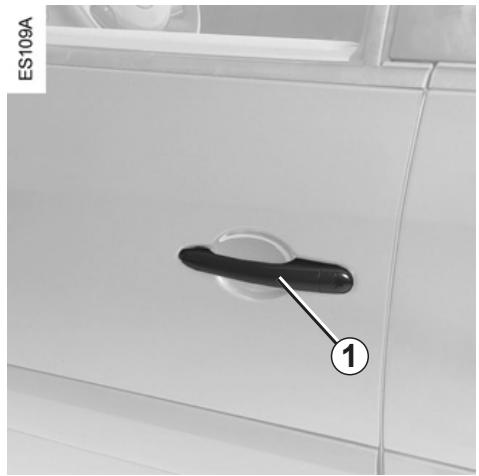
Opening from the outside
Once the doors have been unlocked, or with the hands-free RENAULT card on your person, pull handle 1 towards you to open the door.

As a safety precaution, the doors should only be opened or closed when the vehicle is stationary.
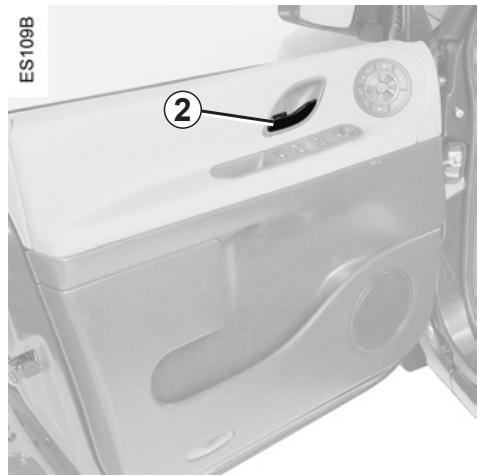
Opening from the inside
Pull handle 2.
Lights-on warning buzzer
If you have left the lights on after switching off the ignition, a reminder buzzer will sound when a door is opened (to prevent discharge of the battery, etc.).

Driver's responsibility when parking or stopping the vehicle
Never leave an animal, child or adult who is not self-sufficient alone on your vehicle, even for a short time.
They may pose a risk to themselves or to others by starting the engine, activating equipment such as the electric windows or locking the doors.
Also, in hot and/or sunny weather, please remember that the temperature inside the passenger compartment increases very quickly.
RISK OF DEATH OR SERIOUS INJURY.
OPENING AND CLOSING THE DOORS (continued)
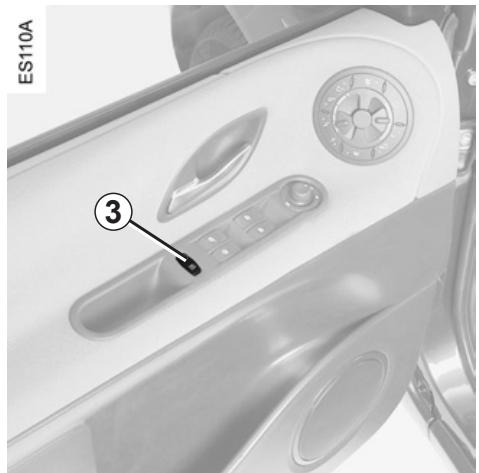
Child safety
Vehicles fitted with switch 3 with integrated indicator light
Press switch 3 to lock the rear doors and prevent operation of the rear electric windows.
The indicator light in the switch lights up to confirm that the doors have been locked.
Special note
This function also deactivates the rear heating and ventilation controls (refer to the information on "automatic climate control" in Section 3).

Safety of rear occupants
The driver can authorise operation of the rear doors and, depending on the ve
hicle, the electric windows by pressing switch 3 on the side with the symbol.
Depending on the vehicle, in the event of a fault:
- a beep sounds;
- a message is displayed on the instrument panel;
- the integrated indicator does not light up.
If the battery has been disconnected, press switch 3 on the side with the symbol to lock the rear doors.
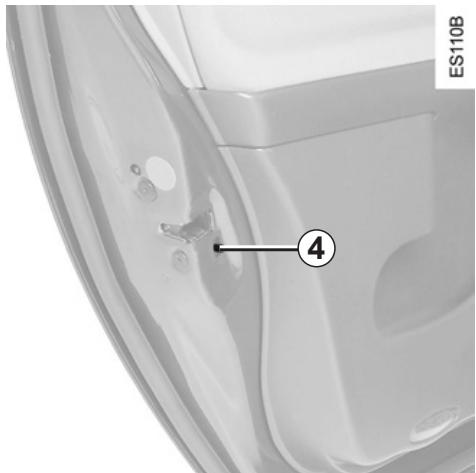
Vehicles not fitted with switch 3
To make it impossible for the rear doors to be opened from the inside, move lever 4 on each door and check from the inside that the doors are securely locked.
LOCKING/UNLOCKING THE DOORS (1/3)
Locking/unlocking the doors from the outside
This is done using the RENAULT card; refer to the information on the "RENAULT card" in Section 1.
In certain cases, the RENAULT card may not work:
- if the vehicle is located in a zone of high electromagnetic radiation;
- use of appliances operating on the same frequency as the card (mobile phone, etc.);
- when the RENAULT card battery is drained, flat battery, etc.
It is then possible:
to use the emergency key (integrated into the card or separate, depending on the vehicle) in the front left-hand door;
to lock using the emergency key (integrated into the card or separate, depending on the vehicle);
to use the interior door locking/unlocking control (refer to the following pages).
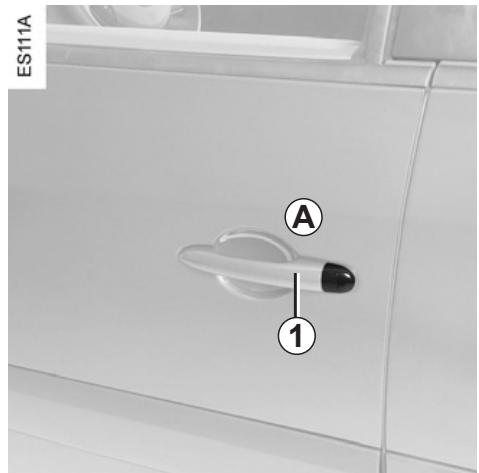
Unlocking using integrated emergency key 2
Remove cover A from the front left-hand door (using the end of the emergency key) in notch 1.
Move it upwards to remove cover A .
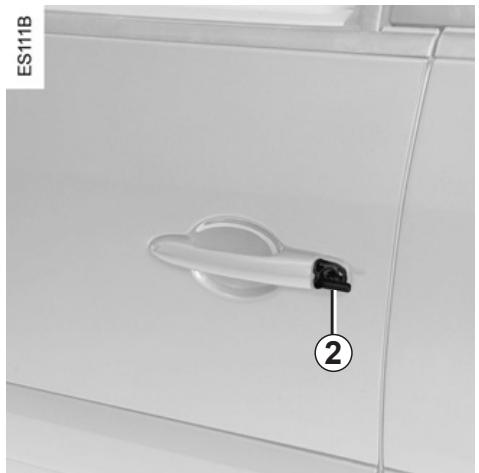
Insert the key 2 into the lock and lock or unlock the door.
LOCKING/UNLOCKING THE DOORS (2/3)
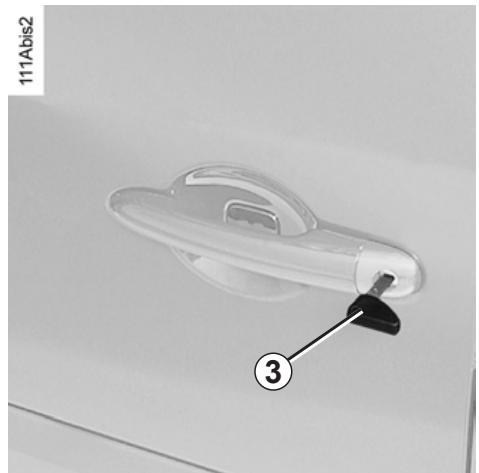
Unlocking using separate emergency key 3 (depending on vehicle)
Insert key 3 in the left-hand side door and lock or unlock the door.
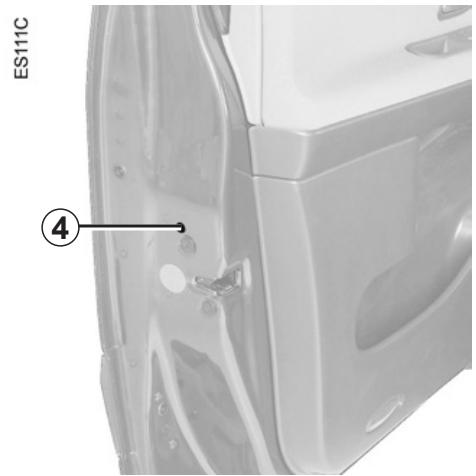
Locking the doors manually
Turn the screw 4 with the door open (using a tool such as a flat blade screwdriver) and close the door.
This means that the doors are then locked from the outside.
The door can only be opened from the inside of the vehicle.
LOCKING/UNLOCKING THE DOORS (3/3)
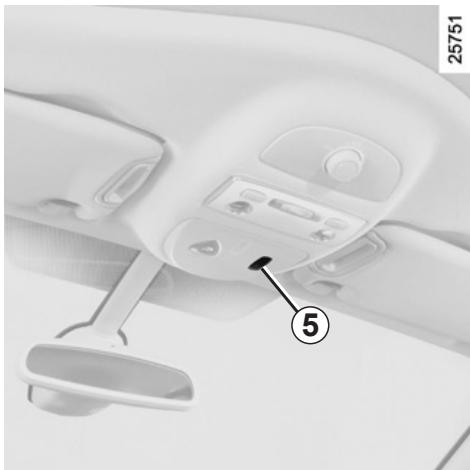
Interior locking/unlocking door control
Switch 5 controls the doors, the tailgate and the fuel filler flap simultaneously.
If a door or the tailgate is open or not closed properly, the doors and tailgate lock/unlock quickly.
Locking the doors without the RENAULT card
For example, in the event of a discharged battery or if the RENAULT card is temporarily not working, etc.
With the ignition switched off and a front door open, press switch 5 for more than five seconds.
When the door is closed, all the doors and the tailgate will be locked.
Unlocking the vehicle from the outside will only be possible with the RENAULT card.

Driver's responsibility
If you decide to keep the doors locked when you are driving, remember that it more difficult for those asyou to gain access to the ger compartment in the f an emergency.
Doors and tailgate status indicator light
When the ignition is switched on, the indicator light integrated in switch 5 informs you of the status of the doors and tailgate:
- light on, the doors and tailgate are locked,
- light off, the doors and tailgate are unlocked.
When you lock the doors, the indicator light remains lit for approximately one minute then goes out.
After locking/unlocking the vehicle only using the buttons on the RENAULT card, remote locking and unlocking in hands-free mode are deactivated.
To reactivate the "hands-free" mode: restart the vehicle.

Never leave your vehicle with the RENAULT card inside.
RENault Anti-Intruder Device (RAID)
You can decide whether you want to activate this function.
Operating principle
When the vehicle is started, the system automatically locks the doors when you are driving at approximately 6 mph (10 km/h) and over.
The door can be unlocked:
- by opening a front door (vehicle stationary).
Note: if a door is opened, it will automatically be locked again when the vehicle reaches a speed of approximately 6 mph (10 km/h); - by pressing door unlocking button 1.

Driver's responsibility
If you decide to keep the doors locked when you are driving, remember that it more difficult for those asyou to gain access to the ger compartment in the f an emergency.
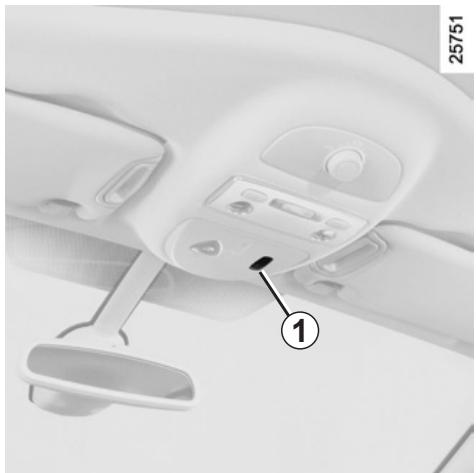
To activate
With the ignition on, press central locking button 1 on the locking side (padlock side) for approximately 5 seconds, until you hear the beep.
To deactivate
With the ignition on, press central locking button 1 on the unlocking side (opposite padlock side) for approximately 5 seconds, until you hear the beep.
Operating faults
If you notice an operating fault (automatic locking impossible), first check that all doors are correctly locked. If they are correctly locked and the fault is still present, contact an approved Dealer.
Also make sure that locking has not been inadvertently deactivated.
If it has, switch the ignition off and on again and reactivate it.
ENGINE IMMOBILISER
This prevents the vehicle from being started by anyone not in possession of the vehicle's RENAULT card.
The vehicle is automatically protected a few seconds after the engine is switched off.
24045
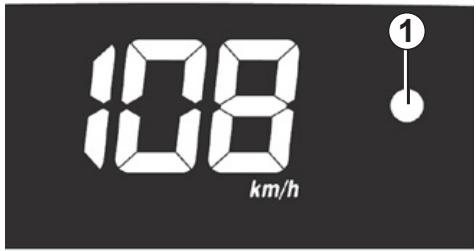
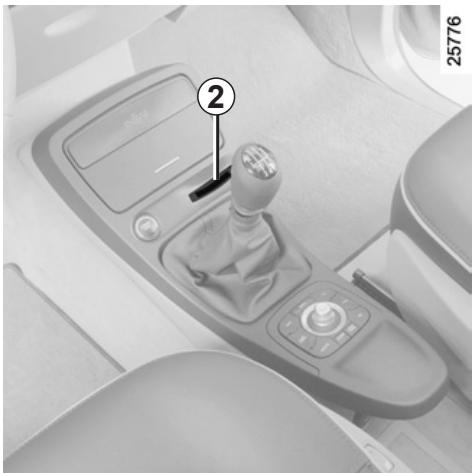
If the vehicle does not recognise the code, indicator light 1 and card reader 2 will flash (rapid flashing), and the vehicle cannot be started.

Any unauthorised work carried out on the engine immobiliser (computers, wiring, etc.) could be dan-Work must be carried out fied personnel.
ENGINE IMMOBILISER (continued)
24045
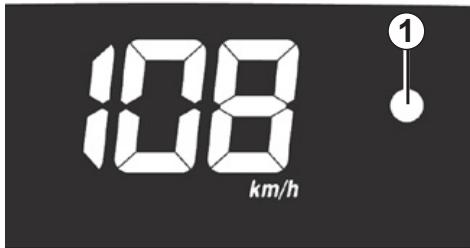
Indicator lights
Vehicle protection tell-tale light
A few seconds after the ignition has been switched off, warning light 1 will flash continuously.
Operating fault warning light
If there is interference and/or the hands-free RENAULT card is not recognised, insert it in card reader 2.
If warning light 1 continues to flash or remains continuously lit, then the card is present but it is not recognised; this indicates that there is an operating fault in the system.
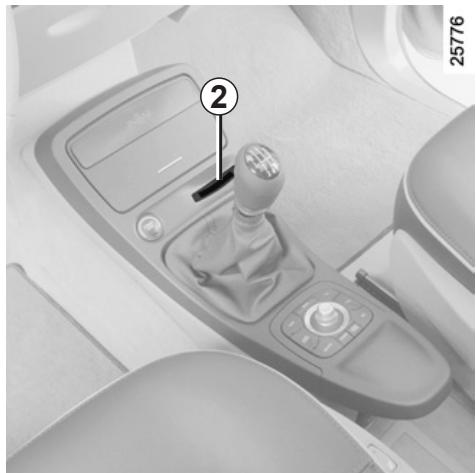
If the RENAULT card is faulty (card reader and warning light 1 flashing rapidly), use the second RENAULT card (supplied with the vehicle) if possible.
Call an approved dealer, who is the only person capable of repairing the engine immobiliser system.
FRONT HEADRESTS
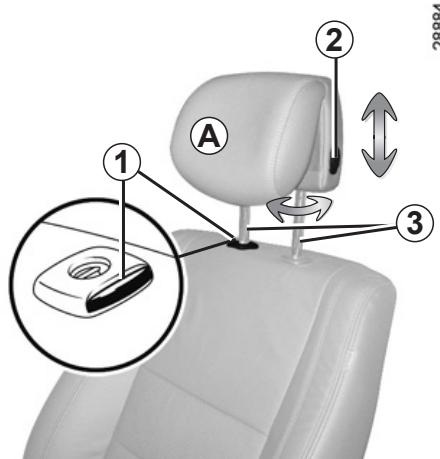
To raise the headrest
Pull the headrest upwards to the desired height.
To lower the headrest
Press button 2 and guide the headrest down to the desired height.
To adjust the angle of the headrest
Depending on the vehicle, tilt section A towards or away from you to the required position.
To remove the headrest
Raise the headrest to its highest position (tilt the seatback backwards if necessary). Press button 1 and lift the headrest to release it.
To refit the headrest
Pull out the headrest rods 3 as far as possible by pulling from the top. Take care to ensure they are clean and correctly aligned and, if there are any problems, check that the notches are facing forwards.
Insert the headrest rods into the holes (tilt the seatback backwards if necessary).
Lower the headrest until it locks, press button 1 and lower the headrest as far as possible.
Check that each headrest rod 3 is securely locked in the seatback by trying to pull them up or push them down.
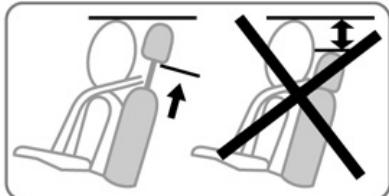
The three upper positions can be manipulated without pressing button 2. However, it is preferable to press this button to lower the headrest.

The headrest is an important safety component: it ensures that it is in place and is in the correct position. The line between your head and the rest and the distance between head and section A should be well as possible.
FRONT SEATS WITH MANUAL CONTROL
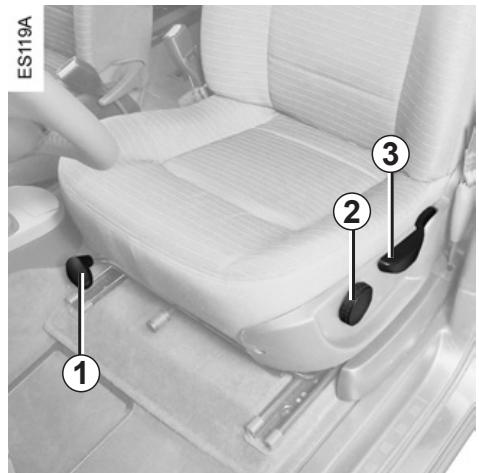
To move forwards or backwards
Lift lever 1 to unlock the seat. When the seat is in the required position, release the lever and ensure that the seat is locked in place.
To tilt the seatback
Lift lever 4 and tilt the seatback to the desired position.
To adjust the lumbar support on the driver's seat:
Pull handle 2.
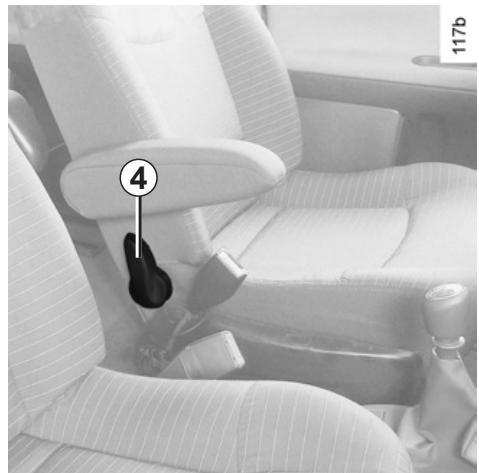
To adjust the driver's seat height:
Move lever 3 as many times as necessary:
- upwards to raise the seat,
- downwards to lower the seat.

For safety reasons, carry out any adjustments when the vehicle is not being driven.

We would advise you not to recline the seatbacks too far to ensure that the effectiveness of the seat belts is ensured.
Make sure that the seatbacks are locked in place correctly.
Nothing should be placed on the floor (area in front of driver) as such objects may slide under the pedal during braking manoeuvres, thus obstructing its use.
FRONT SEATS WITH ELECTRIC CONTROL
Switches 1 and 3 are the same shape as the seat squab and seatback: switch 1 is used for adjusting the seat squab and switch 3 is used for adjusting the seatback.
On equipped vehicles, button 2 is used to store the chosen driving position. It is possible to store a driving position using the RENAULT Card.
The system operates:
- hands-free RENAULT card detected or, depending on the vehicle, RENAULT remote control in 'accessories' position in the card reader;
- for vehicles with button 2, this also operates for about 40 minutes when the driver's door is opened and the ignition is switched off.

For safety reasons, carry out any adjustments when the vehicle is not being driven.
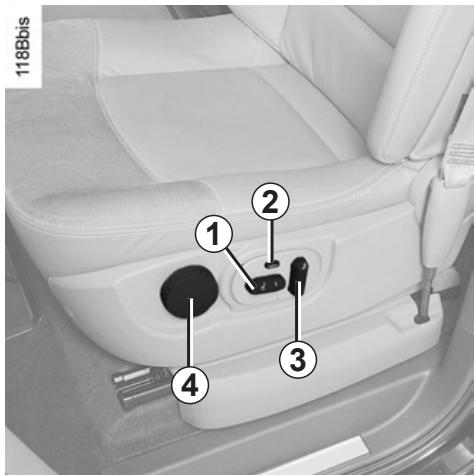
Adjusting the seat squab: switch 1
- To move forwards Move it forwards.
- To move backwards Move it backwards.
To raise Lift the rear of the switch. - To lower Lower the rear of the switch.
Adjusting the seatback: switch 3
To tilt the seatback
Move the switch forward or backwards.
Adjusting the lumbar support on the driver's seat
Pull handle 4.

We would advise you not to recline the seatbacks too far to ensure that the effectiveness of the seat belts is ensured.
Make sure that the seatbacks are locked in place correctly.
Nothing should be placed on the floor (area in front of driver) as such objects may slide under the pedal during braking manoeuvres, thus obstructing its use.
STORING THE DRIVER'S SEAT POSITION
It is possible to store a driving position using the RENAULT Card.
A driving position includes the driver's seat position and door mirror settings.
When a driving position is stored, the seat and door mirror settings linked to the RENAULT Card used are automatically recalled when the doors are unlocked and opened using the RENAULT Card.
The system operates:
- hands-free RENAULT card detected or, depending on the vehicle, RENAULT remote control in 'accessories' position in the card reader;
- when the driver's door is opened, with the ignition off, for about 40 minutes.
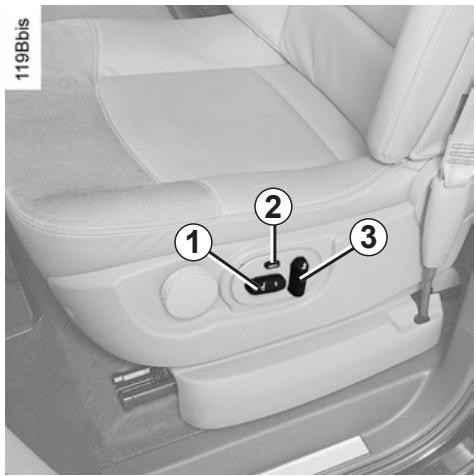
Driver's seat memory procedure
With the ignition on, adjust the seat using switches 1 and 3 (see information on "Front seats with electric control" in Section 1).
Press button 2 until you hear a beep: the driving position is stored.
Repeat this procedure for each of the RENAULT Cards.
Recalling a stored position
With the vehicle stationary, briefly press button 2.
Note: recall of the stored position is interrupted if one of the seat adjustment buttons is pressed during recall.
When driving, it is possible to adjust the driving position, but it is not possible to recall a driving position.
Special case
Several hands-free cards in the vehicle.
In this case:
- there is no automatic recall;
- it is possible to recall the driving position by inserting the RENAULT card in the card reader and pressing button 2.
FRONT ARMRESTS/HEATED SEATS
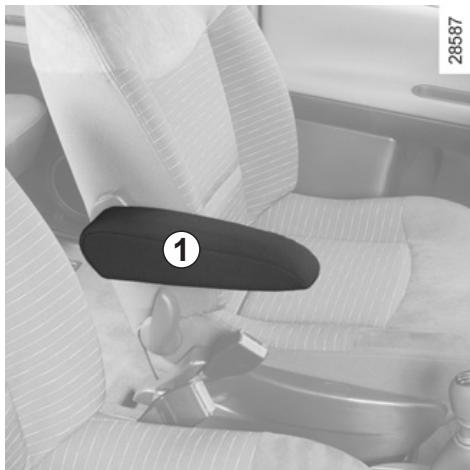
Armrests
Adjustment
If the vehicle is fitted with this, lift armrest 1 fully. Lower it fully then raise it to the desired height.
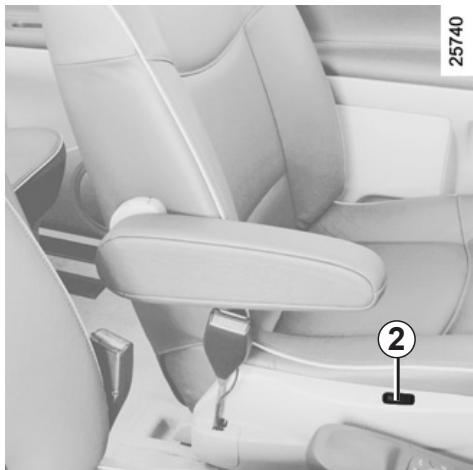
Heated seats
With the engine running, press switch 2. The indicator light in the switch lights up.
The system, which has a thermostat, decides whether or not the heating is needed.
Fasten the seat belt before adjusting the armrest.
SEAT BELTS (1/3)
Always wear your seat belt when travelling in your vehicle. You must also comply with the legislation of the particular country you are in.
Before starting, first adjust your driving position, then ask all occupants to adjust their seat belts to ensure optimum protection.

Incorrectly adjusted or twisted seat belts may cause injuries in the event of an accident.
Use one seat belt per person, whether child or adult.
Even pregnant women should wear a seat belt. In this case, ensure that the lap belt is not exerting too much pressure on the abdomen but do not allow any slack.
Adjusting your driving position
- Sit well back in your seat (having removed your coat or jacket etc.). This is essential to ensure your back is positioned correctly.
- Adjust the distance between the seat and the pedals. Your seat should be as far back as possible while still allowing you to depress the clutch pedal fully. The seatback should be adjusted so that your arms are slightly bent when you hold the steering wheel.
- Adjust the position of your headrest. For the maximum safety, your head must be as close as possible to the headrest.
The top of your head should be in line with the top of the headrest.
- Adjust the height of the seat. This adjustment allows you to select the seat position which offers you the best possible view.
- Adjust the position of the steering wheel.
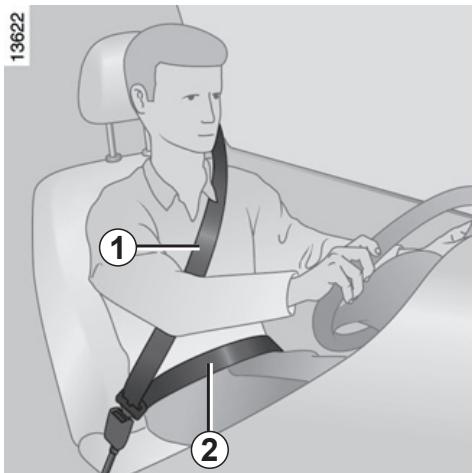
Adjusting the seat belts
Sit with your back firmly against the seatback.
Shoulder strap 1 should be as close as possible to the base of the neck but not on it.
Lap belt 2 should be worn flat over the thighs and against the pelvis.
The seat belt should be worn so that it is as close as possible to your body, i.e.: avoid wearing heavy clothing or keeping bulky objects under the belts, etc.
SEAT BELTS (2/3)
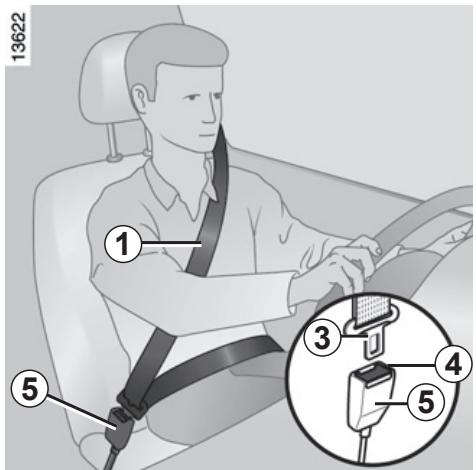
Fastening
Unwind the belt slowly and smoothly and ensure that buckle 3 locks into catch 5 (check that it is locked by pulling on buckle 3). If the belt jams, allow it to return slightly before attempting to unwind it again.
If your seat belt is completely jammed, pull slowly, but firmly, so that just over 3 cm unwinds. Allow it to return slightly before attempting to unwind it again.
If there is still a problem, contact an approved dealer.

Front seat belt reminder warning light
If this warning light on the instrument panel or the dashboard goes out, the front seat belts have been correctly fastened.
Unfastening
Press button 4 on buckle 5 and the seat belt will be rewound by the inertia reel. Guide the buckle to help the operation.
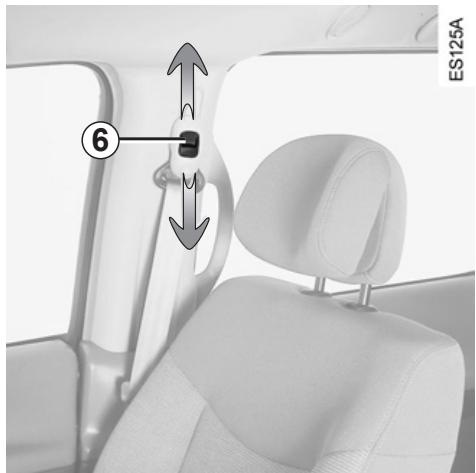
Adjusting the height of the front seat belts
Press button 6 to adjust the seat belt height so that the shoulder strap is worn as shown previously;
Press button 6 and raise or lower the seat belt.
Make sure that the seat belt is locked in position correctly after you have adjusted it.
SEAT BELTS (3/3)
The following information applies to the vehicle's front and rear seat belts.

- No modification may be made to the component parts of the originally fitted restraint system: belts, seats and their mountings. For special operations (e.g. fitting child seats), contact an authorised dealer.
-
Do not use devices which allow any slack in the belts (e.g. clothes pegs, clips, etc.): a seat belt which is worn too loosely may cause injury in the event of an accident.
-
Never wear the shoulder strap under your arm or behind your back.
- Never use the same belt for more than one person and never hold a baby or child on your lap with your seat belt around them.
- The belt should never be twisted.
- Following an accident, have the seat belts checked and replaced if necessary. Always replace your seat belts as soon as they show any signs of wear.
- When refitting the rear bench seat, take care that the seat belts are correctly positioned so that they can be used properly.
- Make sure that the buckle is inserted into the appropriate catch.
- Ensure that no objects are placed in the area around the seat belt catch as they could prevent it from being properly secured.
- Make sure the seat belt catch is properly positioned (it should not be hidden away, crushed or flattened by people or objects).
METHODS OF RESTRAINT IN ADDITION TO THE FRONT SEAT BELTS (1/4)
These are:
- buckle pretensioners,
- lap belt pretensioners in the front seats,
- force limiters,
- air bags for driver and front passenger.
These systems are designed to act independently or together when the vehicle is subjected to a frontal impact.
Depending on the severity of the impact, the system can trigger:
- seat belt locking;
- the buckle pretensioner (which engages to correct seat belt slack);
- the lap pretensioner, the low volume front air bag and the force limiter;
- the large volume front air bag.
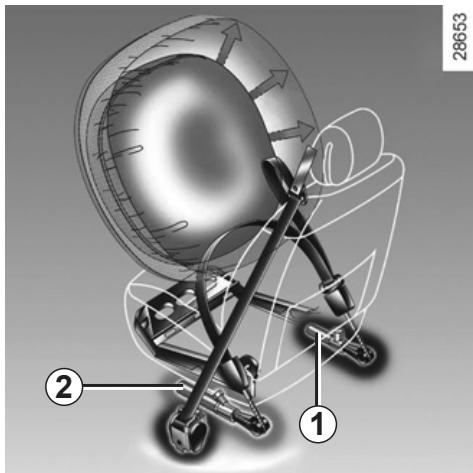
Pretensioners
In the event of a severe frontal impact and if the ignition is switched on, the system may engage the following depending on the force of the impact:
- piston 1 which immediately retracts the seat belt;
- piston 2.
The pretensioners hold the seat belt against the body and thus increase its efficiency.

-
Have the entire restraint system checked following an accident.
-
No operation whatsoever is permitted on any part of the system (pretensioners, air bags, computers, wiring) and the system components must not be reused on any other vehicle, even if identical.
-
To avoid incorrect triggering of the system which may cause injury, only qualified personnel from an approved dealer may work on the pretensioner and air bag system.
- The electric trigger system may only be tested by a specially trained technician using special equipment.
- When the vehicle is scrapped, contact an approved dealer for disposal of the pretensioner and air bag gas generators.
METHODS OF RESTRAINT IN ADDITION TO THE FRONT SEAT BELTS (2/4)
Force limiter
Above a certain level of impact force, this mechanism is used to limit the force of the belt against the body so that it is at an acceptable level.
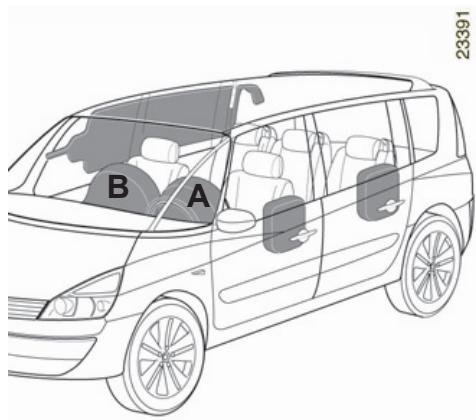
Air bags for driver A and front passenger B
An air bag may be provided for both the driver and the front passenger.
An "Air bag" marking on the steering wheel, dashboard and, depending on the vehicle, the lower section of the windscreen inform you of the presence of additional means of restraint (air bags, pretensioners, etc.) in the passenger compartment.
Each air bag system consists of:
- an air bag and gas generator fitted on the steering wheel for the driver and in the dashboard for the front passenger;
- a shared electronic unit which includes the impact detector and a monitoring system which controls the ignition module for the gas generator;
- a single warning light on the instrument panel.

The air bag system uses pyrotechnic principles. This explains why, when the air bag inflates, it will gener
ate heat, produce smoke (this does not mean that a fire is about to start) and make a noise upon detonation. In a situation where an air bag is required, it will inflate immediately and this may cause some minor, superficial grazing to the skin or other problems.
METHODS OF RESTRAINT IN ADDITION TO THE FRONT SEAT BELTS (3/4)
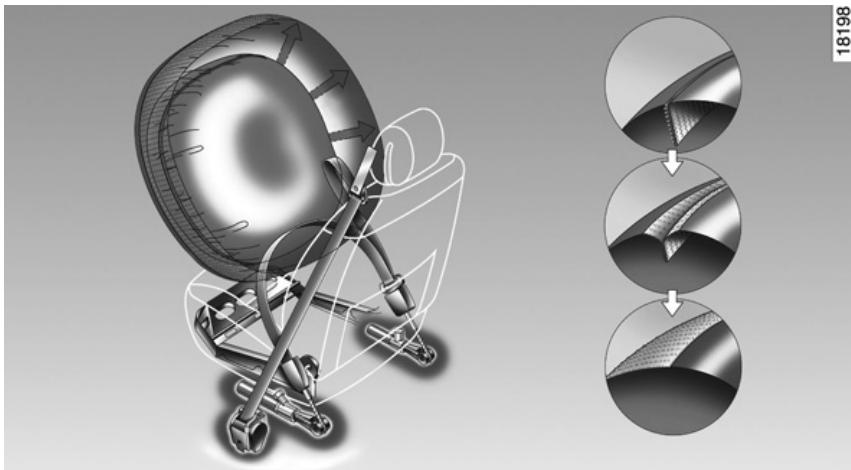
Operation
This system is only operational when the ignition is switched on.
If a severe frontal impact occurs, the air bag(s) inflate(s) rapidly, cushioning the impact of the driver's head and chest against the steering wheel and the front passenger's head against the dashboard. The air bag then deflates immediately so that the passengers are not impeded in any way when they get out of the vehicle.
Special feature of the front air bag
There are two volumes of operation depending on the severity of the impact:
- low volume air bag, this is the first stage of operation;
- large volume air bag, the air bag seams rip so that a larger volume of gas is released into the bag (for the most severe impacts).
Operating faults

This warning light will light up on the instrument panel when
the ignition is switched on and then go out after a few seconds.
If it does not light up when the ignition is switched on, or comes on when the engine is running, there is a fault in the system.
Contact your approved dealer as soon as possible. Your protection will be reduced until this fault is rectified.
METHODS OF RESTRAINT IN ADDITION TO THE FRONT SEAT BELTS (4/4)
All of the warnings below are given so that the air bag is not obstructed in any way when it is inflated and also to prevent the risk of serious injuries caused by items which may be dislodged when the air bag inflates.

Warnings concerning the driver's air bag
- Do not modify the steering wheel or the steering wheel boss.
- Do not cover the steering wheel boss under any circumstances.
-
Do not attach any objects (badge, logo, clock, telephone cradle, etc.) to the steering wheel boss.
-
The steering wheel must not be removed (except by qualified personnel from our Network).
- Do not sit too close to the steering wheel when driving: sit with your arms slightly bent (see Section 1 "Adjusting your driving position"). This will allow sufficient space for the air bag to deploy correctly and be fully effective.
Warnings concerning the passenger air bag
- Do not attach or glue any objects (badge, logo, clock, telephone cradle, etc.) to the dashboard in the air bag zone.
- Do not place anything between the dashboard and the passenger (animal, umbrella, walking stick, parcels, etc.).
The passenger must not put his or her feet on the dashboard or seat as there is a risk that serious injuries may occur. As a general rule, keep all body parts (knees, hands, head, etc.) away from the dashboard. - The devices in addition to the front passenger seat belt should be reactivated as soon as a child seat is removed, to ensure the protection of the passenger in the event of an impact.
A REAR-FACING CHILD SEAT MUST NOT BE FITTED TO THE FRONT PASSENGER SEAT UNLESS THE ADDITIONAL RESTRAINT SYSTEMS, I.E. THE PASSENGER AIR BAG, ARE DEACTIVATED.
(Refer to the information on "Child safety: deactivating/activating the front passenger air bag" in Section 1).
SIDE PROTECTION DEVICES
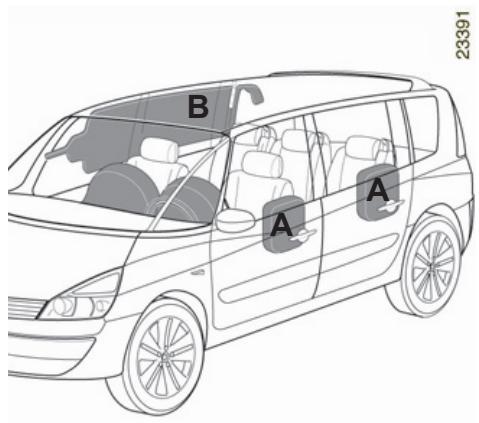
Side air bags A
These are fitted to the front seats and, depending on the vehicle, the rear door panels for the first rear row. They are triggered at the side of the seats (door side) to protect the occupants in the event of a severe side impact.

The slits on the seatbacks (door side) correspond to the area of air bag operation: Never place any ob-
Curtain air bags B
These are fitted on both upper sides of the vehicle. They deploy along the front and rear side windows to protect occupants in the event of a severe side impact.
Depending on the vehicle, a marking on the windscreen informs you of the presence of additional means of restraint (air bags, pretensioners, etc.) in the passenger compartment.

Warning concerning the side air bag
-
Fitting seat covers: seats equipped with an air bag require covers specifically designed for your vehicle. Contact an approved Dealer to find out if these covers are available. The use of any covers other than those designed for your vehicle (including those designed for another vehicle) may not be the operation of the air bags and reduce your protection.
-
Do not place any accessories, objects or even pets between the seatback, the door and the internal fittings. Do not cover the seatback with any items such as clothes or accessories. This may prevent the air bag from operating correctly or cause injury when the air bag is deployed.
- No work or modification whatsoever may be carried out on the seat or internal fittings, except by qualified personnel from an approved dealer.
ADDITIONAL METHODS OF RESTRAINT
All of the warnings below are given so that the air bag is not obstructed in any way when it is inflated and also to prevent the risk of serious injuries caused by items which may be dislodged when the air bag inflates.

The air bag is designed to complement the action of the seat belt. Both the air bags and seat belts are integral parts of the same protection system. It is therefore essential to wear seat belts at all times. If seat belts are not worn, the occupants are exposed to the risk of serious injury in the event of an accident. It may also increase the risk of minor superficial injuries occurring when the air bag is deployed, although such minor injuries are always possible with air bags.
The air bags are not always triggered if the vehicle should overturn or in the event of a rear impact, however severe. Impacts to the underside of the vehicle, e.g. from pavements, potholes or stones, can all trigger these systems.
- No work or modification whatsoever may be carried out on any part of the air bag system (air bags, arches, pretensioners, computer, wiring harness, etc.), except by qualified personnel from an approved dealer.
To ensure that the system is in good working order and to avoid accidental triggering of the system which may cause injury, only qualified Network personnel may work on the air bag system. - As a safety precaution, have the air bag system checked if your vehicle has been involved in an accident, or is stolen or broken into.
- When selling or lending the vehicle, inform the user of these points and hand over this driver's handbook with the vehicle.
- When scrapping your vehicle, contact your approved dealer for disposal of the gas generator(s).
CHILD SAFETY: General information (1/2)
Carrying children
Children, and adults, must be correctly seated and strapped in for all journeys. The children being carried in your vehicle are your responsibility.
A child is not a miniature adult. Children are at risk of specific injuries as their muscles and bones have not yet finished growing. The seat belt alone would not provide suitable protection. Use an approved child seat and ensure you use it correctly.

To prevent the doors being opened, use the "Child safety" device (refer to the information on "Opening using the doors" in Section 1).

A collision at 30 mph (50 km/h) is the same as falling a distance of 10 metres.
Transporting a child without a restraint is the equivalent of allowing him or her to play on a fourthfloor balcony without railings.
Never travel with a child held in your arms. In the event of an accident, you will not be able to keep hold of the child, even if you yourself are wearing a seat belt.
If your vehicle has been involved in a road accident, replace the child seat and have the seat belts and ISOFIX anchorage points checked.

Driver's responsibility when parking or stopping the vehicle
Never leave an animal, child or adult who is not self-sufficient alone on your vehicle, even for a short time.
They may pose a risk to themselves or to others by starting the engine, activating equipment such as the electric windows or by locking the doors.
Also, in hot and/or sunny weather, please remember that the temperature inside the passenger compartment increases very quickly.
RISK OF DEATH OR SERIOUS INJURY.
CHILD SAFETY: General information (2/2)
Using a child seat
The level of protection offered by the child seat depends on its ability to restrain your child and on its installation. Incorrect installation compromises the protection it offers the child in the event of harsh braking or an impact.
Before purchasing a child seat, check that it complies with the regulations for the country you are in and that it can be fitted in your vehicle. Consult an approved dealer to find out which seats are recommended for your vehicle.
Before fitting a child seat, read the manual and respect its instructions. If you experience any difficulties during installation, contact the manufacturer of the equipment. Keep the instructions with the seat.
Set a good example by always fastening your seat belt and teaching your child:
to strap themselves in correctly;
to always get in and out of the car at the kerb, away from busy traffic.
Do not use a second-hand child seat or one without an instruction manual.
Check that there are no objects in the vicinity of the child seat which could impede its operation.

Never leave a child unattended in the vehicle.
Check that your child is always strapped in and that the belt or safety harness used is correctly set and adjusted. Avoid wearing bulky clothing which could cause the belts to slacken.
Never let your child put their head or arms out of the window.
Check that the child is in the correct position for the entire journey, especially if asleep.
CHILD SAFETY: Choosing a child seat
31235
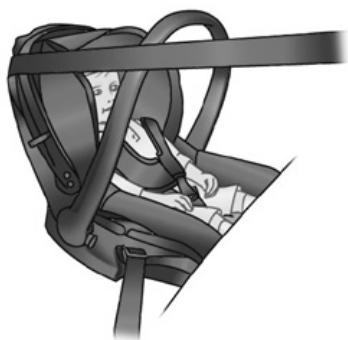
Rear-facing child seats
A baby's head is, proportionally, heavier than that of an adult and its neck is very fragile. Transport the child in this position as long as possible (until the age of 2 at the very least). It supports both the head and the neck.
Choose a bucket type seat for best side protection and change it as soon as the child's head is higher than the shell.
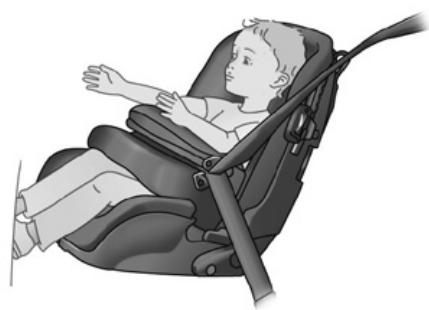
Forward-facing child seats
The child's head and abdomen need to be protected as a priority. A forward-facing child seat which is firmly attached to the vehicle will reduce the risk of impact to the head. Ensure your child travels in a forward-facing seat with a harness or buckle for as long as their size permits. Choose a bucket type seat for optimum side protection.w
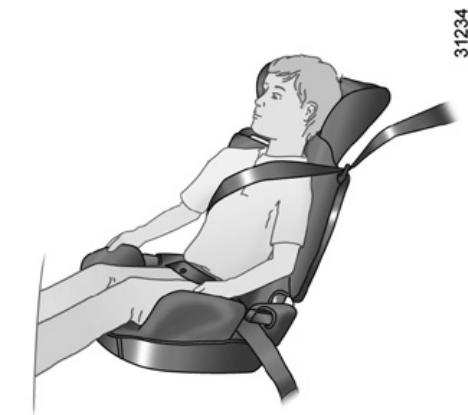
Booster cushions
From 15kg or 4 years, the child can travel using a booster seat, which will enable the seat belt to be adapted to suit his size and shape. The booster seat cushion must be fitted with guides to position the seat belt on the child's thighs rather than the stomach. It is recommended that you use a seatback which can be adjusted in terms of height to position the seat belt in the centre of the shoulder. It must never rest on the neck or on the arm.
Choose a bucket type seat for optimum side protection.
CHILD SAFETY: choosing a child seat mounting (1/2)
There are two ways of attaching child seats: via the seat belt or using the ISOFIX system.
Attachment via the seat belt
The seat belt must be adjusted to ensure that it is effective in the event of harsh braking or an impact.
Ensure that the strap paths indicated by the child seat manufacturer are respected.
Always check that the seat belt is correctly fastened by pulling it up, then pulling it out fully whilst pressing on the child seat.
Check that the seat is correctly held by moving it from side to side and back to front: the seat should remain firmly fixed.
Check that the child seat has not been installed at an angle and that it is not resting against a window.

No modifications may be made to the components of the restraint system (ISOFIX seat belts, seats in mountings) originally fitted.

Do not use the child seat if it may unfasten the seat belt restraining it: the base of the seat must not rest on,kle and/or catch of the seat

The seat belt must never be twisted or the tension is relieved. Never pass the shoulder strap under the behind the back.
Check that the seat belt has not been damaged by sharp edges. If the seat belt does not operate normally, it will not protect the child. Consult an approved dealer. Do not use this seat until the seat belt has been repaired.
Attachment using the ISOFIX system
Authorised ISOFIX child seats are approved in accordance with regulation ECE-R44 in one of the three following scenarios:
- ISOFIX universal 3-point forward-facing seat
- ISOFIX semi-universal 2-point seat
- specific
For the latter two, check that your child seat can be installed by consulting the list of compatible vehicles.
Attach the child seat with the ISOFIX locks, if these are provided. The ISOFIX system allows quick, easy, safe fitting.
The ISOFIX system consists of 2 rings and, in some cases, a third ring.

Before using an ISOFIX child seat that you purchased for another vehicle,
check that its installation is authorised. Consult the list of vehicles which can be fitted with the seat from the equipment manufacturer.
CHILD SAFETY: choosing a child seat mounting (2/2)
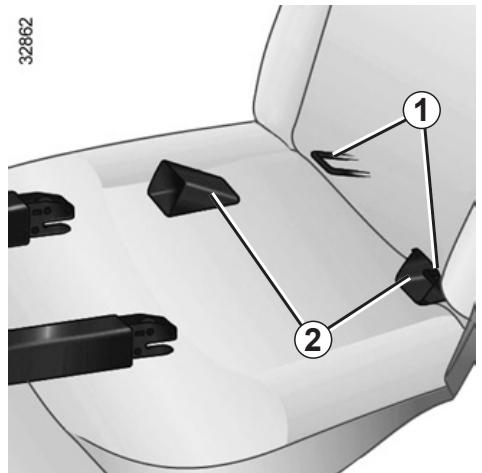
The two rings 1 are located between the seatback and the seat base of the seat and are identified by a marking.
To ensure your child seat can be easily fitted and locked on rings 1, use access guides 2 on the child seat.
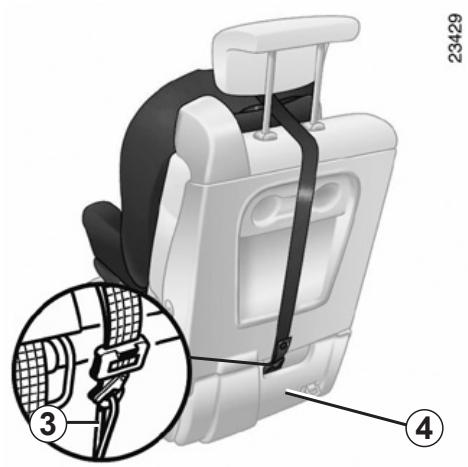
The third ring is used to attach the upper strap on some child seats.

The ISOFIX anchorage points have been exclusively designed for child seats with the ISOFIX system. Never fit a different type of child seat, seat belt or other objects to these anchorage points.
Check that nothing is obstructing the anchorage points.
If your vehicle has been involved in a road accident, have the ISOFIX anchorage points checked and replace your child seat.
To access ring 3, lower cover 4 shown by a marking on the back of the seat.
Fix the hook of the strap onto ring 3 and pull the strap so that the seatback of the child seat comes into contact with the seatback of the vehicle seat.
CHILD SAFETY: fitting a child seat (1/4)
Some seats are not suitable for fitting child seats. The diagram on the following page shows you how to attach a child seat.
The types of child seats indicated may not be available. Before using a different child seat, check with the manufacturer that it can be fitted.

Fit the child seat in a rear seat wherever possible.
Check that when installing the child seat in the vehicle
it is not at risk of coming loose from its base.
If you have to remove the headrest, check that it is correctly stored so that it does not come loose under harsh braking or impact.
Always attach the child seat to the vehicle even if it is not in use so that it does not come loose under harsh braking or impact.
In the front seat
The laws concerning children travelling in the front passenger seat differ in every country. Consult the legislation in force and follow the indications on the diagram on the following page.
Before fitting a child seat in this seat (if authorised):
- lower the seat belt as far as possible;
- move the seat as far back as possible;
- gently tilt the seatback away from vertical (approximately 25^ );
- on equipped vehicles, raise the seat base as far as possible.
Do not change these settings after the child seat is installed.

RISK OF DEATH OR SERIOUS INJURY: before
fitting a rear-facing child seat in this position, check
that the air bag has been deactivated (refer to the information on "Child safety: deactivating/activating the front passenger air bag" in Section 1).
In the rear seat
A carrycot can be installed across the vehicle and will take up at least two seats. Position the child with his or her feet nearest the door.
Move the front seat as far forward as possible to install a rear-facing child seat, then move back the seat in front as far as it will go, although without allowing it to come into contact with the child seat.
For the safety of the child in the forward-facing seat, do not move the seat in front back past the middle of the runner, do not tilt the seatback too far (maximum of 25^ ) and raise the seat as much as possible.
Check that the forward-facing child seat is resting against the back of the vehicle seat and that the headrest of the vehicle is not obstructing its use.
To install a large rear-facing ISOFIX child seat (size C) in the 2^nd row, fit the seats in the centred position or use the centre seat.
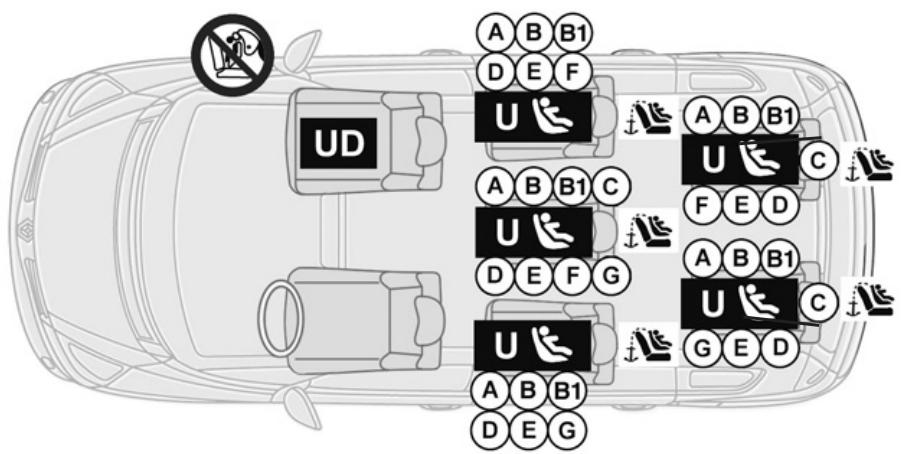
CHILD SAFETY: fitting a child seat (2/4)

Check the status of the air bag before fitting a child seat or allowing a passenger to use the seat.

RISK OF DEATH OR SERIOUS INJURY: before
fitting a rear-facing child seat to this seat, check that
the air bag has been deactivated (refer to the information on "Child safety: deactivating/activating the front passenger air bag" at the end of the paragraph).
Child seat attached using the belt
Seat which allows a child seat with "Universal" approval to be attached by a seat belt.
UD Seat which only allows a rear-facing seat with "Universal" approval to be attached with a seat belt.

Using a child safety system which is not approved for this vehicle will not correctly protect the baby or child. They risk serious or even fatal injury.
Child seat attached using the ISOFIX mounting

Seat which allows an ISOFIX child to be fitted.

The rear seats are fitted with chage point which allows a mid-facing ISOFIX child seat with seal approval to be fitted. The angle points are located at the back of rear seat.
The size of the ISOFIX child seat is indicated by a letter:
- A, B and B1: for forward-facing seats in group 1 (9 to 18kg );
- C: rear-facing seats in group 1 (9 to 18 kg);
- D and E: shell seat or rear-facing seats in group 0 or 0+ (less than 13kg );
- F and G: cots in group 0 (less than 10kg ).
CHILD SAFETY: fitting a child seat (3/4)
The table below summarises the information already shown on the diagram on the previous page, to ensure the regulations in force are respected.
| Type of child seat | Weight of the child | Seat size ISOFIX (2) | Seats suitable for fitting a child seat | ||
| Front passenger seat (1) (3) (4) | Rear seats, 1strow (4) | Rear seats, 2ndrow (4) | |||
| Carrycot fitted across the vehicle Group 0 | < 10 kg | F, G | X | U - IL (6) | U - IL (6) |
| Shell seat/rear-facing seat Group 0 and 0+ | < 13 kg | D, E | U (5) | U - IL | U - IL |
| Rear-facing seat Group 1 (8) | 9 to 18 kg | C | U (5) | U | U - IL |
| Forward-facing seat Group 1 | 9 to 18 kg | A, B, B1 | X | U - IUF - IL (7) | U - IUF - IL (7) |
| Booster seat Group 2 and 3 (9) | 15 to 25 kg and 22 to 36 kg | X | U (7) | U (7) | |

(1) RISK OF DEATH OR SERIOUS INJURY: before fitting a rear-facing child seat to this seat, check that the air bag has been deactivated (refer to the information on "Child safety: deactivating/activating the front passenger air bag" at the end of the paragraph).
CHILD SAFETY: fitting a child seat (4/4)
X = Seat not suitable for fitting child seats.
U = Seat which allows a child seat with "Universal" approval to be installed using a seat belt; check that it can be fitted.
IUF/IL = On equipped vehicles, seat which allows an approved "Universal"/"semi-universal" or "vehicle specific" child seat to be attached using the ISOFIX system; check that it can be fitted.

(2) The size of the child seat with the ISOFIX mounting is indicated by the G).
symbol followed by a letter (A, B, B1, C, D, E, F,
(3) Only a rear-facing child seat may be installed in this seat.
(4) Raise the seat to the maximum and position it as far back as possible, tilting the seatback slightly (approximately 25^ ).
(5) Only vehicles equipped with a seat with seat base height adjustment are authorised for fitting child seats.
(6) A carrycot can be installed across the vehicle and will take up two seats. Position the child with his or her feet nearest the door.
(7) Forward-facing child seat; position the seatback of the child seat in contact with the seatback of the vehicle seat. Adjust the height of the headrest or remove it if necessary; do not push the seat in front of the child more than halfway back on its runners and do not recline the seatback more than 25^ .
(8) To install a large rear-facing ISOFIX child seat (size C) in the 2nd row, fit the seats in the centred position or use the centre seat.
(9) A child over 10 years of age, weighing more than 36kg or taller than 1.36m can be strapped directly into the seat like an adult.
CHILD SAFETY: deactivating/activating the front passenger air bag (1/3)
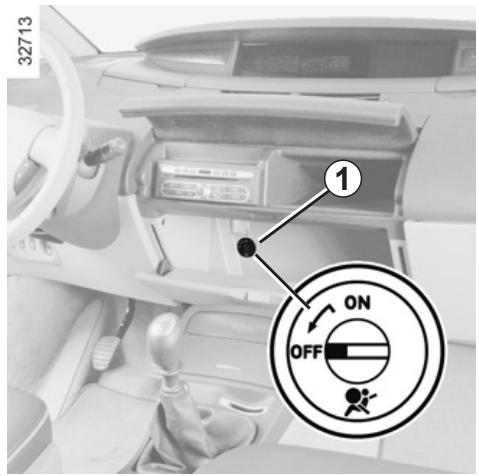
Deactivating the front passenger air bags (on equipped vehicles)
You must deactivate the devices in addition to the front passenger seat belt before fitting a child seat in the front passenger seat.
Passenger seats with seat base height adjustment
You must adjust the cushion to the highest position.
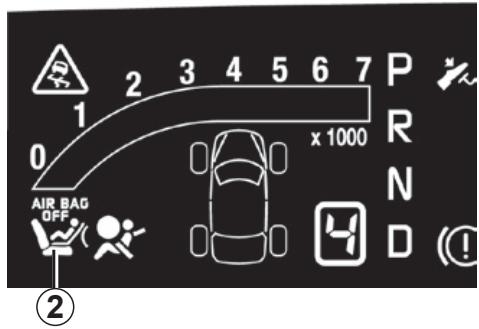
24082a
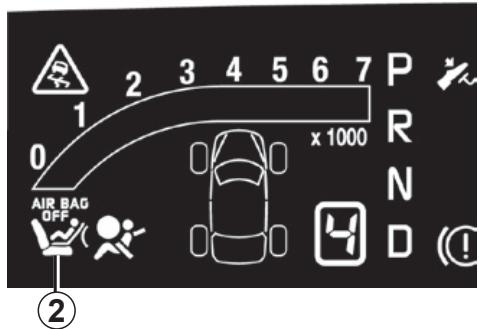
To deactivate the air bags: when the vehicle is stationary, push and turn lock 1 to the OFF position.
With the ignition on, you must check
that indicator light 2 is lit on the central display and, depending on the vehicle, that the message "Passenger air bag deactivated" is displayed.
This light remains permanently lit to let you know that you can fit a child seat.

The passenger air bag must only be deactivated or activated with the ignition off.
If it is interfered with when the vehicle is being driven, the

and SERVICE
warning lights will
come on.
Switch the ignition off then on again to reset the air bag in accordance with the lock.
CHILD SAFETY: deactivating/activating the front passenger air bag (2/3)

DANGER
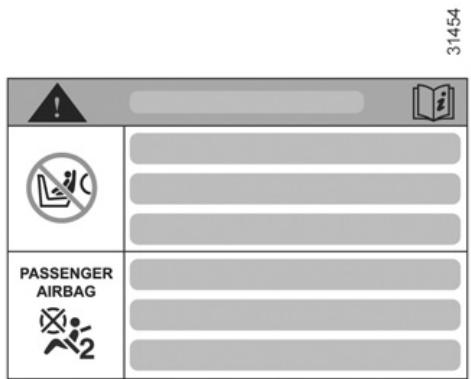
Since operation of the front passenger air bag is not compatible with the position of a rear-facing child seat, NEVER fit a rear-facing child seat on a front passenger seat with an active front air bag. The child may suffer very serious injuries if the air bag is triggered.
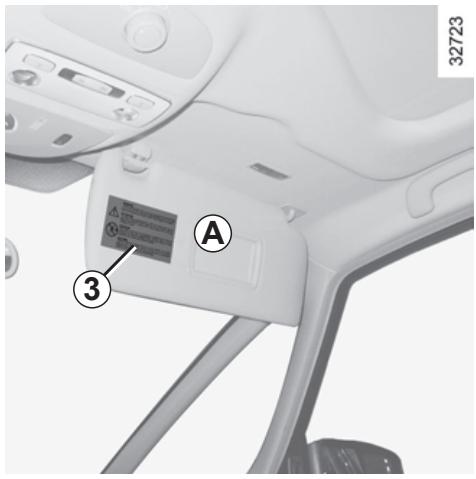
The markings on the dashboard and labels A on each side of passenger sun blind 3 (example: label shown above) remind you of these instructions.
CHILD SAFETY: deactivating/activating the front passenger air bag (3/3)
Activating the front passenger air bags
You should reactivate the air bag as soon as you remove the child seat from the front passenger seat to ensure the protection of the front passenger in the event of an impact.
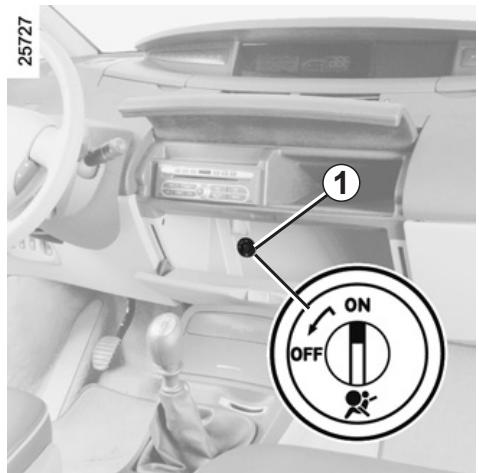
To reactivate the air bags: when the vehicle is stationary, push and turn lock 1 to the ON position.
With the ignition on, it is essential to
check that warning light 2, , is off.
The front passenger seat belt additional restraint systems are activated.
24082a
Operating faults
It is forbidden to fit a rear-facing child seat to the front passenger seat if the air bag activation/deactivation system is faulty.
Allowing any other passenger to sit in that seat is not recommended.
Contact your approved dealer as soon as possible.

DANGER
Since operation of the front passenger air bag is not compatible with the position
of a rear-facing child seat, NEVER fit a rear-facing child seat on a front passenger seat with an active front air bag. The child may suffer very serious injuries if the air bag is triggered.

The passenger air bag must only be deactivated or activated with the ignition off.
If it is interfered with when the vehicle is being driven, the

and SERVICE
warning lights will
come on.
Switch the ignition off then on again to reset the air bag in accordance with the lock.
STEERING WHEEL/POWER-ASSISTED STEERING

Steering wheel
Height and reach adjustment
Pull lever 1 and place the steering wheel in the required position; push the lever to lock the steering wheel in place.
Make sure that the steering wheel is correctly locked.

For safety reasons, only adjust the steering wheel when the vehicle is stationary.
Power-assisted steering
With the engine running, do not leave the steering wheel at full lock while stationary as this may damage the power-assisted steering pump.
With the engine switched off, or if there is a system fault, it is still possible to turn the steering wheel. The force required will be greater.

Never switch off the ignition when travelling downhill, and avoid doing so in normal driving (assistance provided).
DRIVER'S POSITION, LEFT-HAND DRIVE
DRIVER'S POSITION, LEFT-HAND DRIVE (continued)
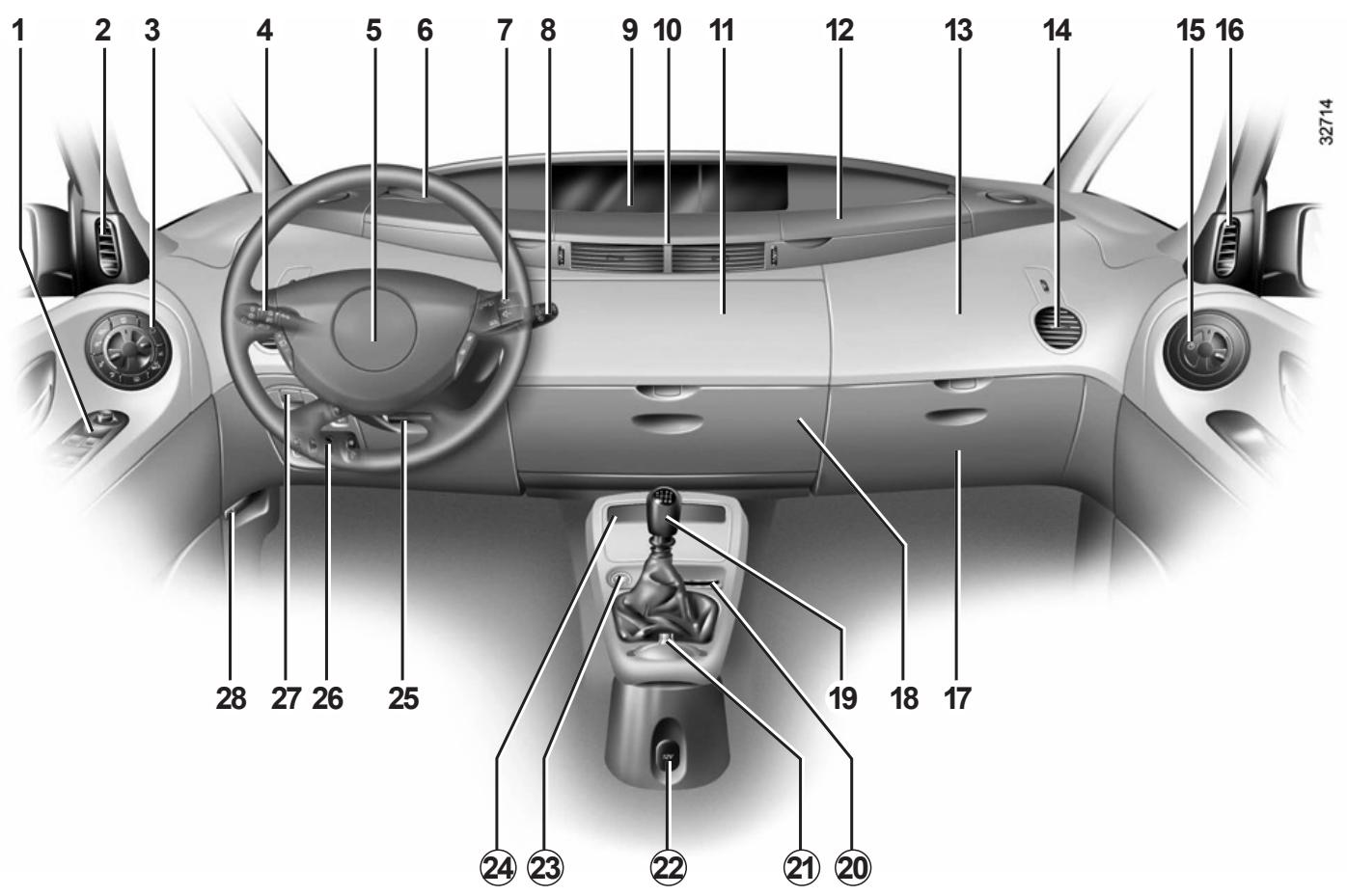
The equipment fitted, described below, depends on the version, the vehicle options and the country.
1 Electric controls for:
- windows;
door mirrors.
2 Side air vent.
3 Heating and ventilation controls.
4 Stalk for:
- direction indicator lights;
exterior lights; - front fog lights;
- rear fog lights.
5 Horn.
Location for driver's air bag.
6 Left-hand upper storage compartment;
location of fuses.
7 Radio remote control.
8 Controls for:
- windscreen and rear screen wash/wipe;
- trip computer and warning system information readout.
9 Instrument panel.
10 Centre air vents.
11 Upper centre storage compartment (split into one or several compartments, depending on the vehicle, integrating the audio system and the audio connection sockets).
12 Right-hand upper storage compartment.
13 Passenger air bag location.
14 Air vent.
15 Heating and ventilation controls.
16 Side air vent.
17 Passenger glove box.
18 Lower centre storage compartment.
19 Gear lever.
20 RENAULT card reader.
21 Multimedia equipment controls (depending on the vehicle).
22 Cigar lighter.
23 Engine Start/Stop button.
24 Location for cup holder and/or ash-tray.
25 Control for adjusting steering wheel height and reach.
26 Controls for:
- electric beam height adjustment;
- lighting dimmer for control instruments;
- Electronic Stability Program (ESP);
parking distance control; - cruise control and speed limiter.
27 Assisted parking brake.
28 Bonnet release control.
DRIVER'S POSITION, RIGHT-HAND DRIVE
DRIVER'S POSITION, RIGHT-HAND DRIVE (continued)
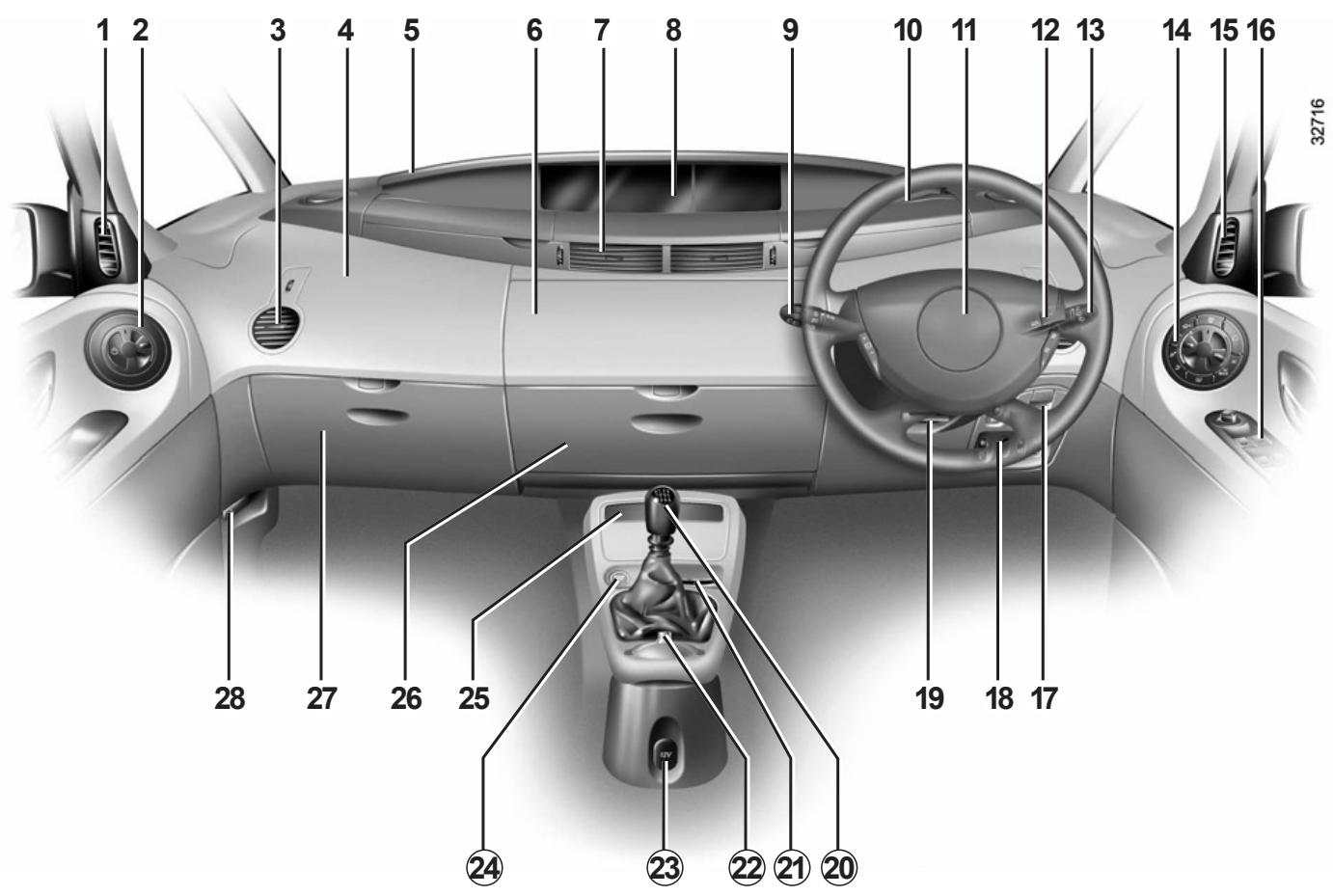
The equipment fitted, described below, depends on the version, the vehicle options and the country.
1 Side air vent.
2 Heating and ventilation controls.
3 Air vent.
4 Location for passenger air bag.
5 Left-hand upper storage compartment; fuse location.
6 Upper central storage compartment (one or more compartments depending on the vehicle, incorporating the audio system and audio connection sockets).
7 Centre air vents.
8 Instrument panel.
9 Stalk for: direction indicator lights;
- exterior lights;
- front fog lights;
- rear fog lights.
10 Right-hand upper storage compartment.
11 Horn. Location for driver's air bag.
12 Radio remote control.
13 Controls for: - windscreen and rear screen wash/wipe; - trip computer and warning system information readout.
14 Heating and ventilation controls.
15 Side air vent.
16 Electric controls for windows and door mirrors.
17 Assisted parking brake.
18 Controls for: - electric beam height adjustment; - lighting dimmer for control instruments; - Electronic Stability Program (E.S.P.); - parking distance control. - Cruise control and speed limiter.
19 Control for adjusting steering wheel height and reach.
20 Gear lever.
21 RENAULT card reader.
22 Multimedia equipment controls (depending on vehicle).
23 Cigar lighter.
24 Engine Start/Stop button.
25 Location for cup holder and/or ash-tray.
26 Lower centre storage compartment.
27 Passenger glove box.
28 Bonnet release control.
WARNING LIGHTS (1/4)
The presence and operation of the warning lights DEPEND ON THE EQUIPMENT AND COUNTRY.
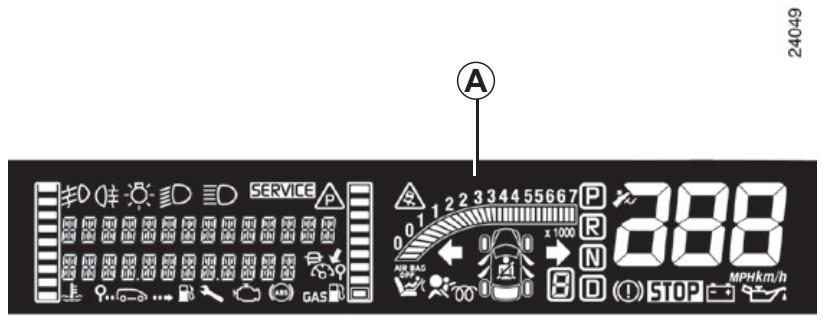
The instrument panel A lights up when the ignition is switched on. In some cases, the appearance of a warning light is accompanied by a message.
The SERVICE warning light means you should drive very carefully to an approved dealer as soon as possible. If you fail to follow this recommendation, you risk damaging your vehicle.

Right-hand direction indicator tell-tale light

Left-hand direction indicator tell-tale light

The STOP warning light requires you to stop immediately, for your own safety, as traffic conditions allow. Off the engine and do not re-Contact an approved Dealer.

Headlight main beam indicator light

Dipped beam headlight tell-tale light

Side light indicator light

Front fog light tell-tale light

Rear fog light tell-tale light

Assisted parking brake fault warning light
Refer to the information on the "Assisted parking brake" in Section 2.

If no lights or sounds are apparent, this indicates a fault in the instrument panel. This indicates that it is essential
to stop immediately (as soon as traffic conditions allow). Ensure that the vehicle is correctly immobilised and contact an approved Dealer.
WARNING LIGHTS (2/4)
The presence and operation of the warning lights DEPEND ON THE EQUIPMENT AND COUNTRY.

STOP light
This lights up when the ignition
is switched on and goes out as soon as the engine is started. It comes on with other warning lights and/or messages, and is accompanied by a beep.
It requires you to stop immediately, for your own safety, as soon as traffic conditions allow. Switch off the engine and do not restart it.
Contact an approved Dealer.

Engine coolant temperature warning light
This lights up when the ignition is switched on and goes out when the engine is started. If it comes on when the vehicle is being driven, accompa
nied by the STOP warning light and a beep, it is essential to stop and switch off the ignition.
Check the coolant level (refer to the information on "Levels" in Section 4). If the level is correct, the light has come on for another reason; contact an approved Dealer.

Battery charge warning light
This comes on when the engine is started then goes out as soon as the engine is running.
If it comes on when you are driving ac
companned by the STOP warning light and a beep, it indicates that the electrical circuit is overcharged or undercharged. Stop and have the circuit checked.

Assisted parking brake on and brake circuit fault warn't
If it comes on during braking and is ac
companned by the STOP warning light and a beep, it indicates that the fluid level in the circuit is low or that there is a braking system fault. Stop as soon as traffic conditions allow and contact an approved Dealer.

Oil pressure warning light
This comes on when the engine is started then goes out after a few seconds. If it comes on when the vehicle is being driven, accompanied
by the STOP warning light and a beep, it is essential to stop and switch off the ignition. Check the oil level. If the level is normal, this indicates another fault. Contact an approved Dealer.

Electronic stability program (E.S.P.) and traction control warning light
There are several reasons for the warning light to come on: refer Section 2: "Electronic stability program: E.S.P." and "Traction control: A.S.R."
WARNING LIGHTS (3/4)
The presence and operation of the warning lights DEPEND ON THE EQUIPMENT AND COUNTRY.

Warning light
This lights up when the ignition is switched on and goes out as soon as the engine is started. It can light up in conjunction with other indicator lights and/or messages on the instrument panel.
It means you should drive very carefully to an approved dealer as soon as possible. If you fail to follow this recommendation, you risk damaging your vehicle.

Passenger air bag OFF
This warning light comes on for several seconds after the engine is started when the front passenger air bags are deactivated (depending on the vehicle).

Driver or front passenger seat belt reminder warning
light
When the driver's seat belt is not fastened, the light stays on then, when the vehicle reaches a speed of approximately 12 mph (20 km/h), it flashes and a beep sounds for approximately 120 seconds. Then the warning light returns to being continuously lit.
Note: an object placed on the passenger seat base can activate the warning light.

Preheating warning light (diesel version)
With the ignition on, this light should come on; it indicates that the heater plugs are switched on. It goes out when preheating is complete and the engine can be started.

Air bag warning light
This comes on when the ignition is switched on and goes out after a few seconds.
If it does not light up when the ignition is switched on, or comes on when the engine is running, there is a fault in the system.
Contact your approved Dealer as soon as possible.

Toxic Fume Filter System Warning Light
For vehicles equipped with this option, the light comes on when the ignition is switched on then goes out.
- If it lights up continuously, consult an approved Dealer as soon as possible;
If it flashes, reduce the engine speed until the light stops flashing. Contact your approved Dealer as soon as possible.
Refer to the information on "Antipollution, fuel economy and driving" in Section 2.
WARNING LIGHTS (4/4)
The presence and operation of the warning lights DEPEND ON THE EQUIPMENT AND COUNTRY.

Speed limiter and cruise control warning light
See the information on the "Speed limiter" and "Cruise control" in Section 2.

Anti-lock braking warning light (ABS)
This lights up when the ignition is switched on and then goes out. If it lights up when you are driving, it indicates a fault in the anti-lock braking system.
Braking will then be as normal, without the ABS.
Contact an approved Dealer as soon as possible.

Low fuel level warning light
This comes on when the ignition is switched on and goes out after a few seconds. If it comes on when driving accompanied by a beep, fill up with fuel as soon as possible.

Tyre Pressure Monitor indicator light
Refer to the information on the "Tyre pressure monitor" in Section 2.

Not used

Door status warning light
INSTRUMENT PANEL: displays and indicators
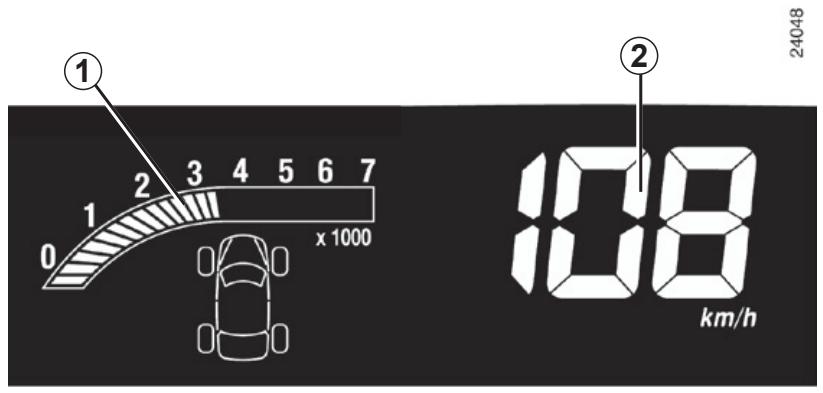
Rev counter 1
(scale × 1,000
Speedometer 2
In kilometres or miles per hour.
Overspeed buzzer
Depending on the vehicle, a buzzer sounds for approximately 10 seconds every 40 seconds, as long as the vehicle is travelling in excess of 72mph (120km / h)
Instrument panel in miles:
it is possible to switch to km/h.
with the ignition off, press button 3 and start button 4;
- the speed measurement unit indicator flashes for approximately five seconds, then the new unit is displayed: release button 3.
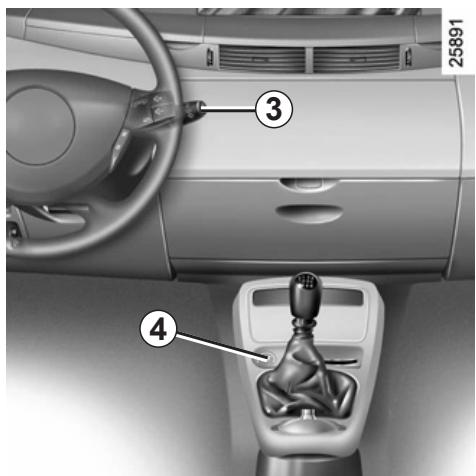
To return to the previous mode, repeat the operation.
Note: once the battery is disconnected, the trip computer and warning system automatically returns to the original unit of measurement.
INSTRUMENT PANEL: displays and indicators (continued)
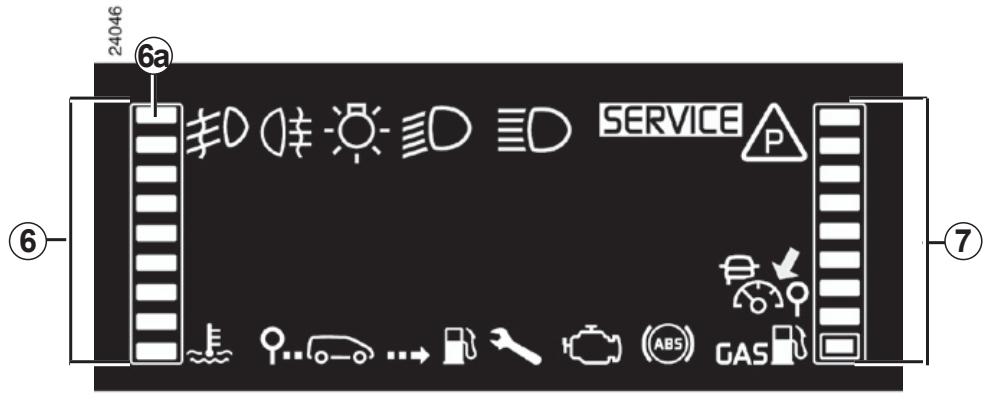
Coolant temperature indicator 6
Under normal use, the level must be below zone 6a. Under severe conditions the needle may approach this zone. This is not serious unless the
STOP warning light comes on, accompanied by the "engine overheating" message on the instrument panel, a beep, and the 6a warning light.
Fuel gauge 7
The number of lit squares shows the remaining fuel level.
When it is at minimum, the bottom square lights up and flashes. Then a beep will be heard: refill as soon as possible.
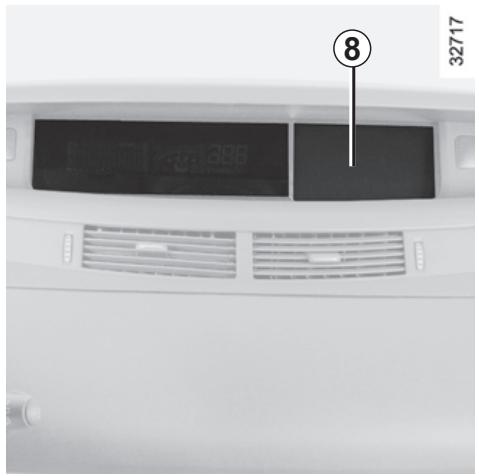
Information display 8
Depending on the vehicle, it includes:
the time;
the exterior temperature;
- radio information;
- navigation aid information.
TRIP COMPUTER: general information (1/2)
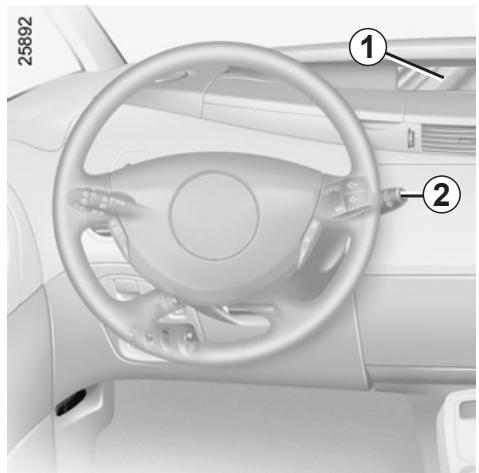
Trip computer and warning system
The following are given on the instrument panel display 1:
- information messages (journey parameters, etc.);
- operating fault messages (generally associated with the SERVICE warning light);
- warning messages (connected to the STOP warning light).
Display selection keys 2
Scroll through the following information by brief successive presses.
a) total mileage and trip mileage recorder,
b) journey parameters:
fuel used,
average fuel consumption,
- current fuel consumption,
- estimated range,
distance travelled,
average speed,
c) mileage before service,
d) Tyre pressures,
e) empty display (no message on the display),
f) programmed speed (speed limiter/ cruise control),
g) on-board log, operating fault and information message readout.
TRIP COMPUTER: general information (2/2)
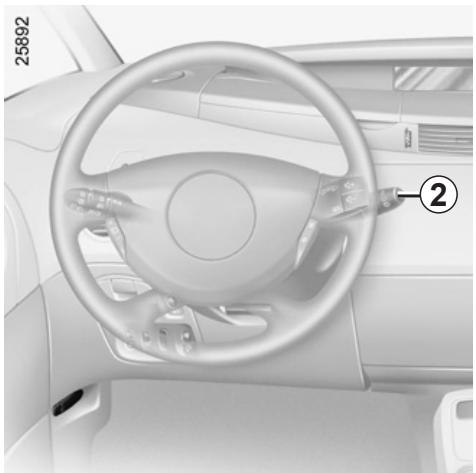
Trip mileage recorder reset buttons 2
To reset the trip mileage recorder, select the "Trip mileage recorder" display, then press button 2 until the recorder is reset.
Journey parameter reset buttons 2
With one of the trip parameters selected as the display, press button 2 until the display resets.
Interpreting some of the values displayed after resetting
The values showing average fuel consumption, range and average speed will become more stable and reliable the further you travel after pressing the reset button.
For the first few miles after pressing the reset button you may notice:
- That the range increases as you drive.
This is normal, as average fuel consumption may decrease when:
- the vehicle stops accelerating;
- the engine reaches its operating temperature (if the engine was cold when the reset key was pressed);
-
when driving from an urban area onto the open road.
-
You may also notice that the average fuel consumption increases when the vehicle is stationary and the engine idling.
This is normal, since the computer takes account of fuel used during idling.
Automatic resetting of the journey parameters
Resetting occurs automatically when the maximum value of any of the parameters is exceeded.
TRIP COMPUTER: trip settings (1/4)
The display of information shown below DEPENDS ON THE VEHICLE EQUIPMENT AND COUNTRY.
| Examples of selections | Interpreting the display selected |
| 24050 123456 KM 12345 KM | a) Total mileage and trip mileage recorder. |
| FUEL USED 37.1 L 9……… | b) Journey parameters. Fuel consumed since the last reset. |
| AVERAGE 7.2 L/100 | Average fuel consumption since the last reset. This value is displayed after driving 400 metres and takes into account the distance travelled and the fuel used since the last time the reset button was pressed. |
| CURRENT 9.2 L/100 | Current fuel consumption This value is displayed after a speed of approximately 18 mph (30 km/h) is reached. |
TRIP COMPUTER: trip settings (2/4)
The display of information shown below DEPENDS ON THE VEHICLE EQUIPMENT AND COUNTRY.
| Examples of selections | Interpreting the display selected |
| RANGE 623 KM | Estimated range with remaining fuel This range takes into account the average fuel consumption since the last time the reset button was pressed. The value is displayed after driving 400 metres. |
| DISTANCE 275.5 KM | Distance travelled since the last reset. |
| AVERAGE 78.9 KM/H | Average speed since the last reset. The value is displayed after driving 400 metres. |
TRIP COMPUTER: trip settings (3/4)
The display of information shown below DEPENDS ON THE VEHICLE EQUIPMENT AND COUNTRY.
| Examples of selections | Interpreting the display selected |
| SERVICE DUE | c) Oil change interval → Distance remaining until the next oil change (displayed in miles/kilometres and months), then when the time nears, several scenarios are possible: - distance/time remaining less than 900 miles (1,500 km) or one month: the message “oil change due” is displayed; - distance/time remaining 0 km/milesor service date reached: the message “change oil soon” is displayed, accompanied by the \ and \ SERVICE warning lights. The vehicle requires an oil change as soon as possible. |
| NB: depending on the vehicle, the interval between oil changes varies according to the driving style (frequent driving at low speed, door-to-door journeys, extensive use at idle speed, towing a trailer etc.). The distance remaining until the next oil change can therefore decrease more quickly in some cases than the actual distance travelled. The oil change intervals are independent of the vehicle's maintenance schedule: please refer to your vehicle's Maintenance Service Booklet. Resetting: to reset the oil change interval, press and hold one of the display reset buttons for approximately 10 seconds until the display shows the interval permanently. | |
TRIP COMPUTER: trip settings (4/4)
The display of information shown below DEPENDS ON THE VEHICLE EQUIPMENT AND COUNTRY.
| Examples of selections | Interpreting the display selected |
| FRONT TYRES 2.3 2.1 | d) Tyre pressure (refer to the information on the "Tyre pressure monitor" in section 2). e) Empty screen There will be no display on the screen when you select this page. |
| CRUISE CONTROL 90 KM/H | f) Cruise control/speed limiter programmed speed (depending on vehicle) Refer to the information on the "Speed Limiter" and "Cruise Control" in Section 2. |
| SPEED LIMITER 90 KM/H | |
| NOMESSAGE AVAILABLE | g) Trip log Successive display: - information messages (depending on the vehicle: automatic headlights, etc.), - of operating fault messages (check the injection system, etc.). |
TRIP COMPUTER AND WARNING SYSTEM: information messages
These can help in the vehicle starting phase, or give information about a selection or a driving status. Examples of information messages are given in the following pages.
| Messages | Interpretation of messages |
| « AUTO LIGHTS FUNCTION OFF » « TOP-UP OIL LEVEL » | Indicates that the automatic lights function is deactivated. Minimum engine oil level warning: on starting the engine, and for 30 seconds, the display warns that the minimum engine oil level has been reached. Refer to the information on the "Engine oil level" in Section 4. |
TRIP COMPUTER: operating fault messages (1/2)
These appear with the SERVICE warning light and mean that you should drive very carefully to an approved dealer as soon as possible. If you fail to follow this recommendation, you risk damaging your vehicle.
They disappear when the display selection key is pressed or after several seconds and are stored in the computer log. The warning light stays on. Examples of operating fault messages are given in the following pages.

| Messages | Interpretation of messages |
| « ESP OFF » | Deactivation of the A.S.R. traction control system (see information on the “A.S.R. traction control system” in Section 2). |
| « TYRE SENSOR ABSENT » | Sensor fault on the wheel not shown on the instrument panel: this is the case, for example, when the emergency spare wheel is fitted on the vehicle (see the information on “Tyre pressure monitor” in Section 2). |
| « CHECK TYRE PRESSURES » | Insufficient tyre pressure for the wheel shown on the multifunction display or on the instrument panel; correct the tyre pressure as soon as possible. |
| « CHECK FUEL FILTER » | Indicates that there is water present in the diesel fuel. Contact your approved Dealer as soon as possible. |
TRIP COMPUTER: operating fault messages (2/2)
These appear with the SERVICE warning light and mean that you should drive very carefully to an approved dealer as soon as possible. If you fail to follow this recommendation, you risk damaging your vehicle.
They disappear when the display selection key is pressed or after several seconds and are stored in the computer log. The warning light stays on. Examples of operating fault messages are given in the following pages.
SERVICE
| Messages | Interpretation of messages |
| « CHECK GEARBOX » | Indicates that a fault has occurred in the gearbox; contact an approved Dealer as soon as possible. |
| « CARD NOT DETECTED » | The RENAULT hands-free card is not in the detection zone, or the vehicle has not been able to detect it. Insert it in the reader; if the fault persists contact your approved Dealer. |
| « REPLACE CARD BATTERY » | Your RENAULT card battery has a service life of approximately two years. This message appears when the battery begins to run flat (see information on the “REN%AULT card: batteries” in Section 5). |
TRIP COMPUTER: warning messages (1/2)
These appear with the STOP warning light and require you to stop immediately, for your own safety, as soon as traffic conditions allow. Stop your engine and do not restart it. Contact an approved Dealer.
Examples of warning messages are given in the following pages. Note: the messages appear on the display either individually or alternately (when there are several messages to be displayed), and may be accompanied by a warning light and/or a beep.
| Messages | Interpretation of messages |
| « INJECTION FAULT » | Indicates that the vehicle has a serious engine fault. |
| « PUNCTURE CHANGE TYRE » | Indicates a puncture in the tyre shown on the tyre pressure monitor display. |
| « ENGINE OVERHEATING » | Indicates that the engine is overheating. |
| « CHECK STEERING » | Indicates a fault in the vehicle's power-assisted steering. |
TRIP COMPUTER: warning messages (2/2)
These appear with the STOP warning light and require you to stop immediately, for your own safety, as soon as traffic conditions allow. Stop your engine and do not restart it. Contact an approved Dealer.
Examples of warning messages are given in the following pages. Note: the messages appear on the display either individually or alternately (when there are several messages to be displayed), and may be accompanied by a warning light and/or a beep.
| Messages | Interpretation of messages |
| « BATTERY CHARGE FAULT » | Indicates a fault with the battery charging circuit. |
| « OIL PRESSURE FAULT » | Indicates an oil pressure fault. |
| « PARKING BRAKE FAULT » | Indicates an assisted parking brake fault. |
| « BRAKING FAULT » | Indicates a fault in the braking circuit. |
CLOCK AND EXTERIOR TEMPERATURE
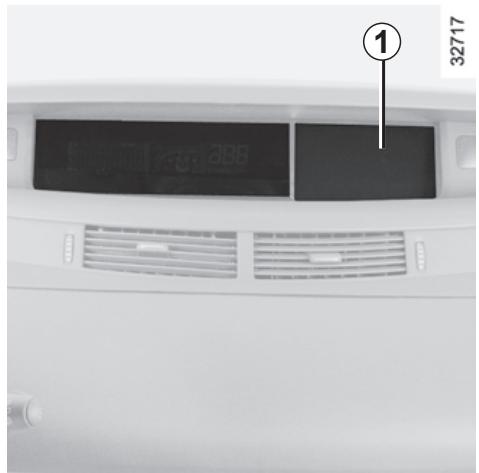
When the ignition is switched on, the clock and (depending on vehicle) external temperature are displayed.
Resetting the clock 1
Vehicles equipped with a navigation system, radio, etc.
Refer to the equipment instructions for the special features of these vehicles.
If the power supply is cut (battery disconnected, supply wire cut, etc.), the clock must be reset.
We recommend that you do not adjust these settings while driving.
External temperature indicator
Special note:
When the outside temperature is -3^ to +3^ , the ^ C characters flash (signalling a risk of black ice on the road).

External temperature indicator
As ice formation is related to exposure, local air hu
midity and temperature, the external temperature alone is not sufficient to indicate the presence of ice.
DOOR MIRRORS
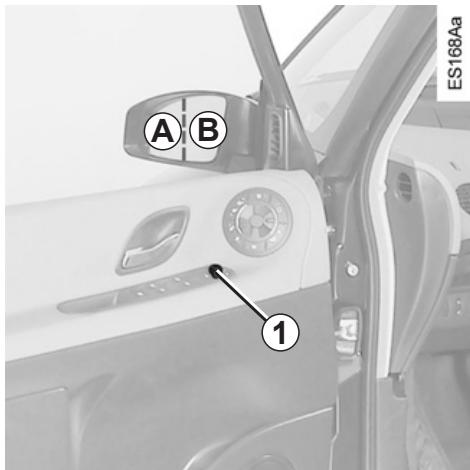
Adjustment
With the ignition on, turn button 1:
position C to adjust the left-hand door mirror;
position ±bE to adjust the right-hand door mirror;
±bD is the inactive position.
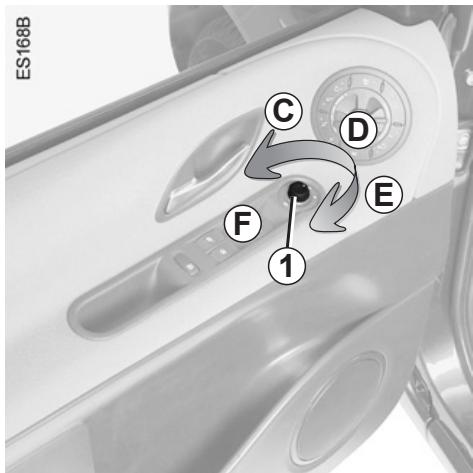
Folding door mirrors
Turn button 1 to position F and the door mirrors fold in.
To reset them for driving, return to position C , D or E .

Depending on the vehicle, when locking the doors, the door mirror fold in automatically.
Heated door mirrors
With the engine running, mirror de-icing is activated simultaneously with rear screen de-icing/demisting.

The door mirror on the driver's side has two clearly defined zones. Zone B shows
what can normally be seen, ordinary rear view mirror. For safety, zone A increases the visibility.
Objects in zone A look much further away than they really are.
REAR VIEW MIRRORS
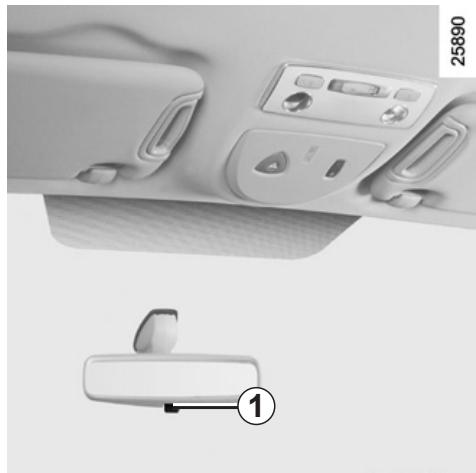
Interior rear view mirror
Its position can be adjusted. When driving at night, to avoid being dazzled by the headlights of the vehicle behind, depress the little lever 1 located behind the rear view mirror.
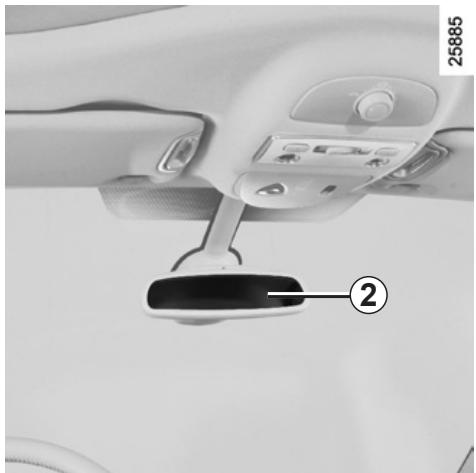
Auto-dimming rear view mirror
The rear view mirror 2 darkens automatically at night when you are followed by a vehicle using main beam headlights.
AUDIBLE AND VISUAL SIGNALS
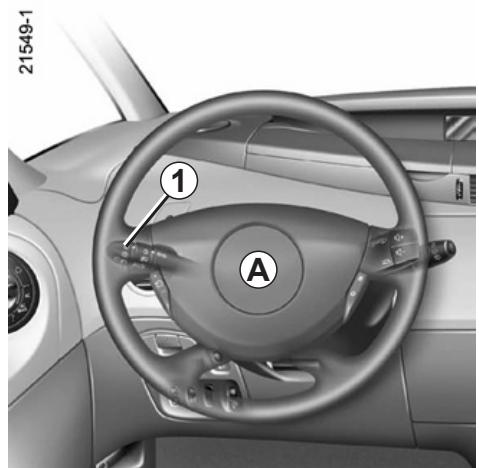
Horn
Press steering wheel boss A.
Headlight flasher
To flash the headlights, even if the lights are not on, pull stalk 1 towards you.
Special case
If automatic operation for dipped headlights is activated, first pull stalk 1 towards you to light the main beam headlight then again to turn them off.
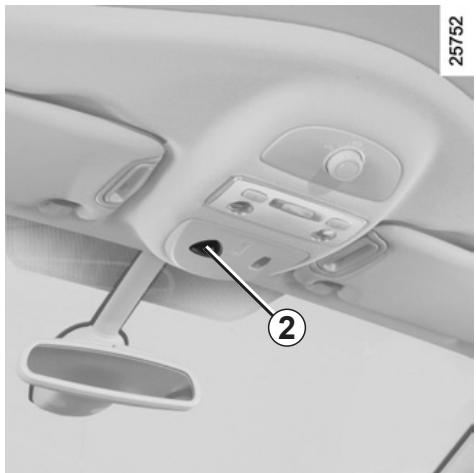

Hazard warning lights
Press switch 2.
This switch activates all four direction indicators and the side indicator lights simultaneously.
It must only be used in an emergency to warn drivers of other vehicles that you have had to stop in an area where stopping is prohibited or unexpected, or that you are obliged to drive under special conditions.
Depending on the vehicle, the hazard warning lights may come on automatically under heavy deceleration. You can switch them off by pressing switch 2.
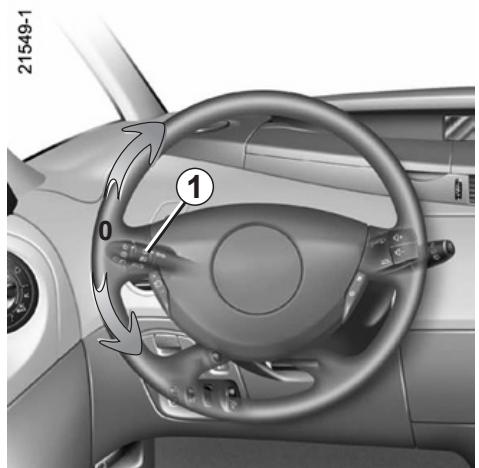
Direction indicators
Move stalk 1 parallel to the steering wheel and in the direction you are going to turn it.
When driving on the motorway, the steering wheel is not often turned enough to return the stalk automatically to 0. There is an intermediate position in which the stalk may be held when changing lanes.
When the stalk is released, it automatically returns to 0.
EXTERIOR LIGHTING AND SIGNALS (1/3)
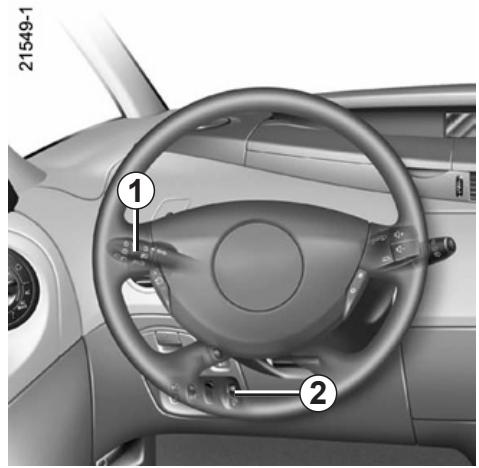

Side lights
- Turn the end of stalk 1 until there is opposite mark 3.
The instrument panel lights up, the brightness can be adjusted by using control knob 2.
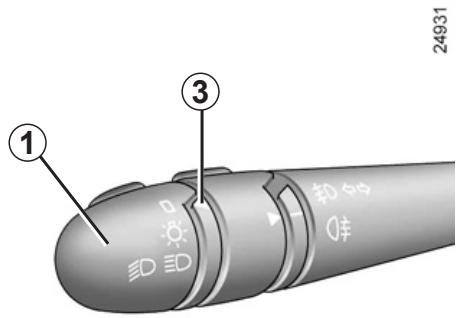

Dipped beam headlights
Automatic operation
With the engine running, the dipped beam headlights are switched on or off automatically depending on the level of ambient light, without the need to operate stalk 1 (position 0).
This function can be deactivated or reactivated.
-
To deactivate it, with the ignition on and engine switched off, turn stalk 1 twice consecutively from position 0 to side lights. This action is confirmed by an audible signal.
-
To activate it, with the ignition switched on and engine running or off, turn stalk 1 twice consecutively from position 0 to side lights. This action is confirmed by an audible signal.
- To select the main beam headlights, pull stalk 1 towards you. To return to the dipped beam headlight position, pull the stalk towards you again.
- The lights go out when the engine is stopped, when the driver's door is opened or when the vehicle is locked with the RENAULT card.
Manual operation
Turn the end of stalk 1 until the symbol is opposite mark 3.
An indicator light lights up on the instrument panel in all cases.
Daytime running lights
The daytime running lights come on when the engine is started if stalk 1 is in position 0.
If the dipped beam headlights operate automatically, the daytime running lights only come on if the side lights are off
EXTERIOR LIGHTING AND SIGNALS (2/3)
3 1
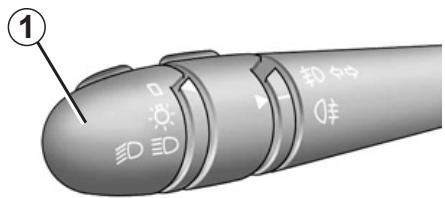

Main beam headlights
With the dipped beam head
lights lit, pull the switch stalk towards you.
When the main beam headlights are lit, an indicator light on the instrument panel comes on.
To return to the dipped beam headlight position, pull the stalk towards you.

Switching off the lights
Return stalk 1 to its original po
sition.
See-me-home lighting function
This function (useful, for example, for opening a gate, a garage, etc.) enables you briefly to switch on the dipped beam headlights momentarily.
With the ignition off and the RENAULT card removed from the reader, pull stalk 1 towards you: the dipped beam headlights come on for approximately thirty seconds.
This action may be carried out no more than four times for a maximum lighting period of two minutes.
Switching off the function
To switch the function off, press button 4.
Lights-on warning buzzer
A warning buzzer will sound when the driver's door is opened and the lights are left on after the ignition has been switched off (to prevent discharge of the battery etc.).
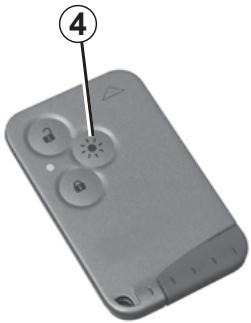
103A

Before driving at night: check the electrical equipment is operating correctly, and depending on the ve
hicle, adjust your headlights (if your vehicle is not carrying its normal load).
As a general precaution, check that the lights are not obscured (by dirt, mud, snow or objects which could cover them).
EXTERIOR LIGHTING AND SIGNALS (3/3)
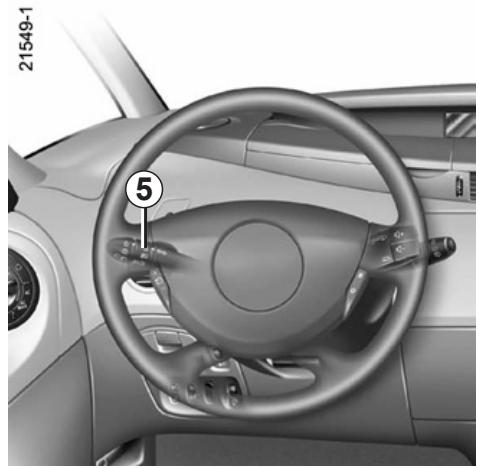

Front fog lights
With the lights on, turn centre
ring 5 on the stalk until the symbol faces mark 6.
An indicator light on the instrument panel then lights up.
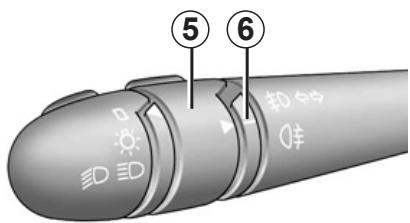
D0
Rear fog lights
With the lights on, turn centre ring 5 on the stalk until the symbol faces mark 6.
An indicator light on the instrument panel then lights up.
To avoid inconvenience other road users, remember to switch off the rear fog light when it is no longer needed.
The front and rear fog lights switch off when the exterior lights are switched off.
24931
Special case
Using the front and/or rear fog lights when automatic operation of dipped headlights is activated.
Turning on the fog lights
It is necessary to select the dipped headlights position before setting centre ring 6 in fog lights position.
Turning off the fog lights
Bring the centre ring 6 back to position 0 and turn the end of the stalk 1 from the dipped beam headlight position to position 0 to switch automatic operation of the dipped beam headlights back on.
ELECTRIC BEAM HEIGHT ADJUSTMENT
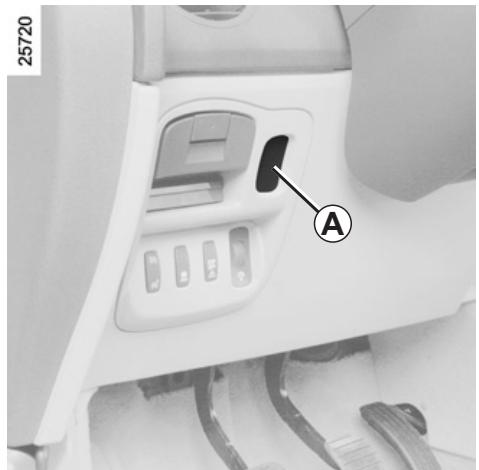
On equipped vehicles, control A allows you to adjust the height of the beams according to the load.
Turn control A downwards to lower the headlights and upwards to raise them.
Adjustment is automatic on other versions.
| Examples of the adjustment position of control A | ||||
| Standard chassis | Long chassis | |||
| 5 seater | 7 seater | 5 seater | 7 seater | |
| Driver alone or with front passenger | 0 | 0 | 0 | 0 |
| Driver with a front passenger and passengers in the rear | 1 | 1 | 1 | 1 |
| Driver with a front passenger, all rear passengers | 2 | 2 | 2 | 2 |
| Driver with a front passenger, all rear passengers and luggage | 3 | 3 | 3 | 3 |
| Driver with luggage or load reaching the maximum permissible all-up weight | 4 | 4 | 4 | 4 |
WINDSCREEN WASH/WIPE (1/2)
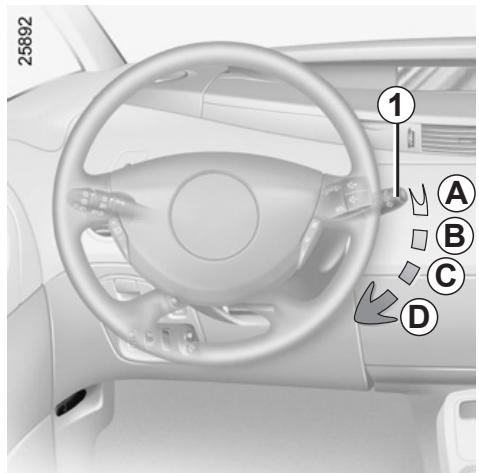

Vehicle fitted with intermittent
windscreen wipers
With the ignition on, move stalk 1
A park
B intermittent wiping
The wipers will pause for several seconds between sweeps. You can vary the time between sweeps by turning the centre ring on stalk 1.
C normal wiping speed
D fast wiping speed
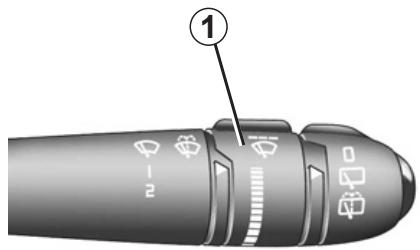
Special note
When driving the vehicle, the wiping speed slows down whenever the vehicle stops. For example, fast wiping speed will slow to normal wiping speed. As soon as the vehicle moves off, wiping will return to the speed originally selected.
If stalk 1 is operated, it overrides and cancels the automatic function.
13645
Vehicle fitted with front windscreen wiper rain sensor
With the ignition on, move stalk 1
A park
B "automatic wiper function" position
When this position is selected, the system detects water on the wind-screen and triggers the wipers at a suitable wiping speed.
The centre ring on stalk 1 enables you to vary the sensitivity of the automatic wiping from - to ■ :
- represents minimum sensitivity
represents maximum sensitivity.
C normal wiping speed
D fast wiping speed
WINDSCREEN WASH/WIPE (2/2)
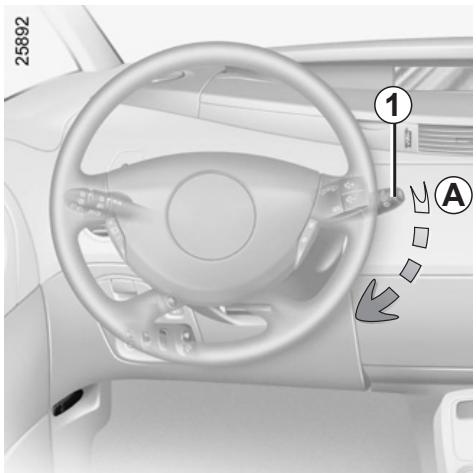
Windscreen washer, headlight washers
With the ignition on, pull stalk 1 towards you.
- Headlights off
The windscreen washer will be activated.
- Headlights on
The headlight washers will be activated at the same time.
In frosty weather, make sure that the wiper blades are not stuck by ice (risk of motor overheating).
If the wipers do not work, contact an approved dealer.
Keep an eye on the condition of the blades. Replace the wiper blades as soon as they begin to lose efficiency (approximately once a year).

Before any action involving the windscreen (washing the vehicle, de-icing, cleaning the windscreen, etc.)
return stalk 1 to position A (park).
Risk of injury and/or damage.

When working in the engine compartment, ensure that the windscreen wiper stalk is in the park position.
Risk of injury.

Before washing the vehicle, bring the stalk to position A (park) to avoid the risk of damage to the blades when tic wiping is activated.
REAR SCREEN WASH/WIPE
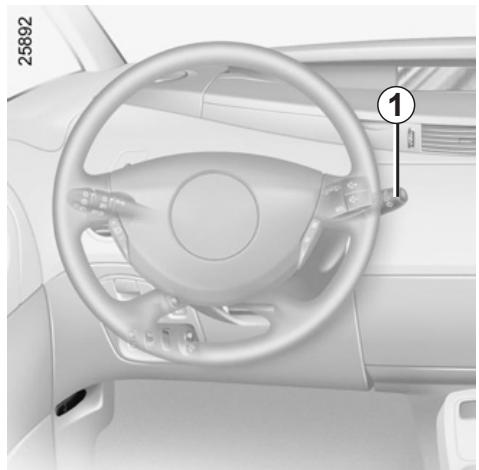

Rear screen wiper with timer
With the ignition on, turn the end of stalk 1 to align mark 2 with the symbol.

Rear screen wash/wipe
With the ignition on, turn the
end of stalk 1 to align mark 2 with the symbol.
When the stalk is released, it returns to the rear screen wiper position.
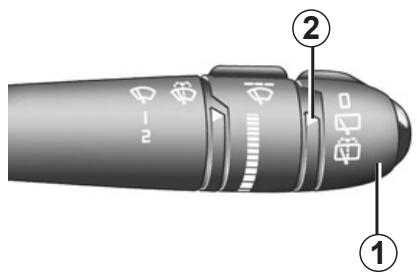
Special note
If the windscreen wipers are operational when you select reverse gear, the rear screen is wiped intermittently.
13645
Check the condition of the wiper blades. You are responsible for their service life:
- they must remain clean: clean the blades, windscreen and rear screen regularly with soapy water;
- do not use them when the wind-screen or rear screen are dry;
- free them from the windscreen or rear screen when they have not been used for a long time.
In all cases, replace them as soon as they begin to lose efficiency: approximately once a year.
Before using the rear wiper, check that no object obstructs the travel of the blade.
Do not use the wiper arm to open or close the tailgate.
In frosty weather, make sure that the wiper blades are not stuck by ice (risk of motor overheating).
FUEL TANK (1/3)
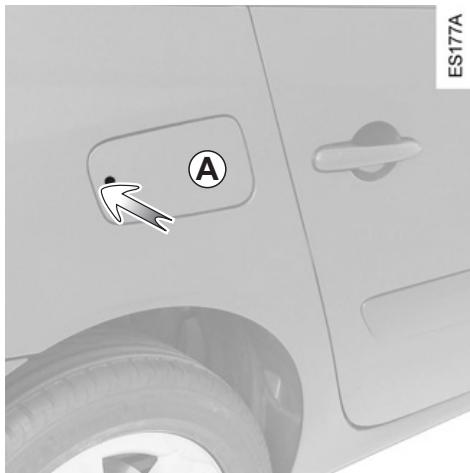
The fuel tank must be filled with the ignition off.
Capacity of fuel tank: 80 litres approximately.
To open flap A , press on the area shown by the arrow.
The flap opens a little. Twist it to open fully.
The filler cap is incorporated in the filler neck.
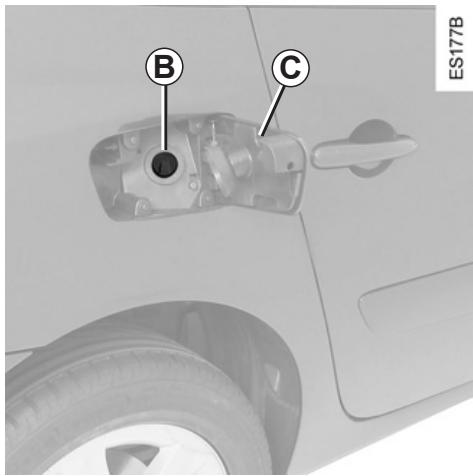
Special feature of the hands-free card
The flap locks a few minutes after the other doors on the vehicle.

Never press valve B with your fingers.
Do not wash the filler area with a high-pressure
washer.
Fuel grade
Use a high-grade fuel that complies with the legislation in force in each country and which complies with the specifications given on the label C on cover A. Please refer to the information on "Engine specifications" in Section 6.
Diesel versions
It is essential to use diesel fuel that conforms with the information given on the label C inside cover A.
Petrol versions
It is essential to use unleaded petrol. The octane rating (RON) must comply with the information given on the label C on the cover A. Refer to Section 6 for information on "Engine specifications".
FUEL TANK (2/3)
Vehicles running on ethanol-based fuel
It is essential to use unleaded petrol or fuel containing a maximum of 85% ethanol (E85).
In very cold conditions, it may be very difficult or even impossible to start the engine. To avoid this problem, use unleaded petrol or, on equipped vehicles, use the heater integrated in the engine: connect the special end of the extension piece supplied into the socket integrated into the radiator grille and the other end into a 220V socket for at least 6 hours before starting.
NB: you may notice an increase in fuel consumption with this type of fuel.

Do not mix even small amounts of petrol (unleaded or E85) with diesel.
Do not use ethanol-based your vehicle is not compatible as fuel.
Do not add any additives to the fuel, you risk damaging the engine.
Filling with fuel
Insert the nozzle to open valve ±bB and insert it fully before turning it on to fill the fuel tank (risk of splashing).
Keep the nozzle in this position throughout the entire filling operation.
When the pump cuts out automatically at the end of the filling procedure, a maximum of two further filling attempts may be made, as there must be sufficient space in the fuel tank to allow for expansion.
Make sure that no water enters the fuel tank during filling. Valve B and its surround must remain clean.
Petrol versions
Using leaded petrol will damage the antipollution system and may lead to a loss of warranty.
To ensure that the fuel tank is not filled with leaded petrol, the fuel tank filler neck contains a restrictor fitted with a foolproof system which only allows the nozzle for unleaded petrol to be used (at the pump).

Persistent smell of fuel
If you notice a persistent smell of fuel you should:
- stop the vehicle as soon as traffic conditions allow and switch off the ignition;
- switch on the hazard warning lights and ask your passengers to leave the vehicle and to keep away from traffic;
- contact an approved Dealer.

No modifications whatsoever are permitted on any part of the fuel supply system (electronic unit,
wiring, fuel circuit, injector, protective covers, etc.) as this may be dangerous (unless undertaken by qualified Network personnel).
FUEL TANK (3/3)
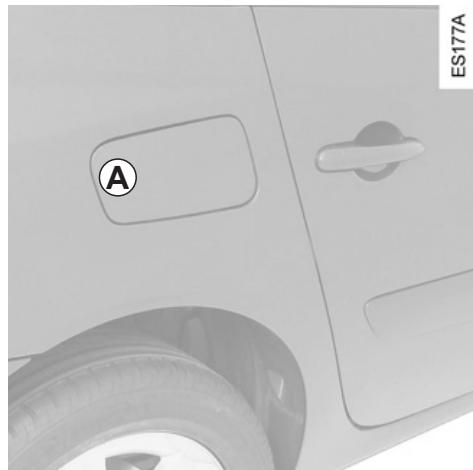
Special circumstances
If the RENAULT card is faulty, it is possible to unlock flap A by manually operating unlocking rod 1 (inside the luggage compartment).
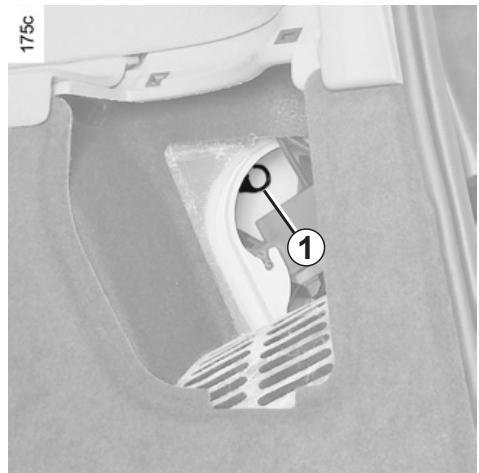
Section 2: Driving
(Advice on use relating to fuel economy and the environment)
Running in 2.2
Starting/stopping the engine 2.3
Special features of petrol versions 2.6
Special features of diesel versions 2.7
Electronic parking brake 2.8
Gear lever 2.11
Power-assisted steering 2.11
Advice on emission control/fuel economy 2.12
Environment 2.15
Tyre pressure monitoring system 2.16
Electronic Stability Programme: ESP 2.20
Traction control: ASR 2.21
Anti-lock braking system: ABS. 2.23
Emergency brake assist 2.25
Speed limiter 2.26
Cruise control 2.29
Parking distance control 2.33
Using the automatic gearbox. 2.37
2.1
RUNNING IN
- Petrol version
For the first 600 miles (1,000 km), do not exceed 78 mph (130 km/h) in the highest gear, or 3,000 to 3,500 rpm.
You may only expect top performance from your vehicle after 1,800 miles (3,000 km).
Service intervals: please refer to your vehicle's maintenance document.
- Diesel version
For the first 900 miles (1,500 km), do not exceed 2,500 rpm. After completing this mileage you may drive faster, although you may only expect top performance after approximately 3,600 miles (6,000 km).
During the running in period, do not accelerate hard while the engine is still cold and do not let the engine over-rev.
Service intervals: please refer to your vehicle's maintenance document.
STARTING/STOPPING THE ENGINE (1/3)
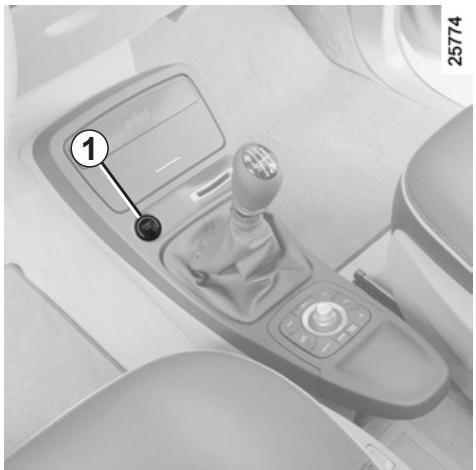
"Stop", "Accessories" and "+" After ignition feed" positions
With the engine switched off and without touching the pedals (brake and clutch), press button 1 successively to enable these positions to be selected one after another.
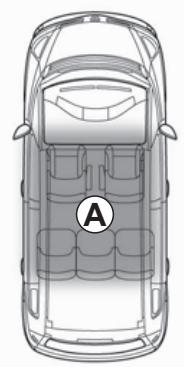
Starting the engine
With the RENAULT card inside the vehicle (area A) but not in high-up areas such as the sun visor, glasses holder, etc.:
- depress the clutch pedal and press button 1;
or
- shift the gear lever to neutral (vehicle with a manual gearbox) or position P or N (vehicle with an automatic gearbox), depress the brake pedal and press button 1.
Note: in both cases, the pedal must be depressed throughout while the engine is started.
66
Stopping the engine
When the vehicle is stationary, press button 1; any accessories such as audio equipment in use at that time will continue to operate.
When the driver's door is opened, the accessories are switched off and the steering column is locked.

If there is a child (or a pet) in the vehicle, never leave it unattended with the RENAULT card in the
reader. Otherwise, the child could start the engine or operate electrical equipment such as the electric windows and there is a risk that he or she may be injured (by trapping his or her neck, arm, hand, etc.). Risk of serious injury.
Never switch off the ignition before the vehicle has stopped completely. Once the engine has stopped, the brake servo, power-assisted steering, etc. and the passive safety devices such as air bags and pretensioners will no longer operate.
STARTING/STOPPING THE ENGINE (2/3)
Limited use
- When the engine is running, a vehicle door is open and the card is outside the vehicle (for example when the driver gets out to open the garage door): the engine continues to run.
- When the engine is running, the vehicle doors are closed and the card is outside the vehicle (for example when a passenger leaves the vehicle and takes the RENAULT card with them): the message "card not detected" appears on the instrument panel. The warning light flashes on emergency card reader 3 and a beep sounds when the vehicle is restarted to warn you.
- The RENAULT card's operation may be affected by interference from nearby devices, such as exterior installations or equipment operating on the same frequency as the RENAULT card.

When you leave your vehicle, especially if you have your RENAULT card with you, check that the engine pletedly switched off.
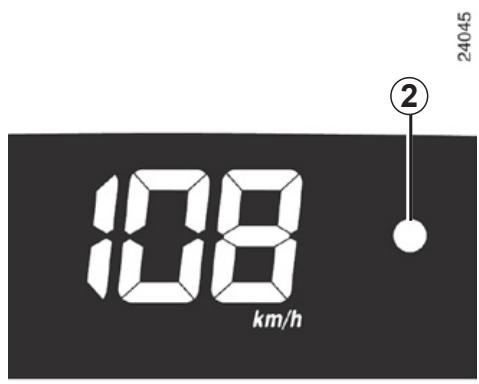
Hands-Free mode operating fault
Warning light 2 and card reader 3 flash. With the RENAULT card fully inserted in card reader 3 (until the steering column is heard to unlock), button 1 lights up to confirm the engine is authorised to start: press button 1 briefly to start the vehicle.
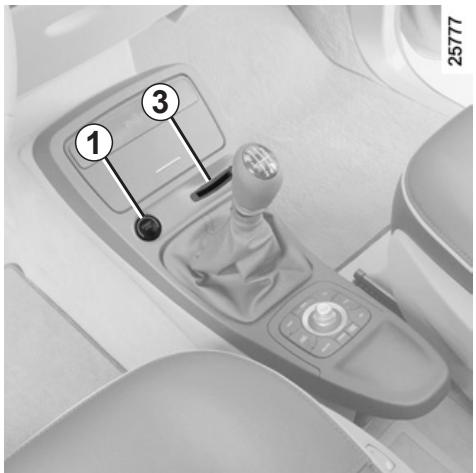
Note: button 1 is off if you are not in a position to start (e.g. diesel preheating, gear selected etc.).
In both cases, the pedal must be depressed throughout the engine starting phase.
Special circumstances
In some cases it will be necessary to move the steering wheel while pressing button 1 to unlock the steering column.
STARTING/STOPPING THE ENGINE (3/3)
"Engine start" position (continued)
For diesel versions, wait for the pre
heating warning light to go out on the instrument panel before pressing button 1.
Once the engine starts, light 1 goes out (the RENAULT is then locked in the card reader, whose light goes out).
Stopping the engine
With the vehicle stationary, briefly press button 1: the ignition will switch off.
For certain vehicles with automatic gearboxes, shift the lever to park position P.
Remove the card from card reader 3.
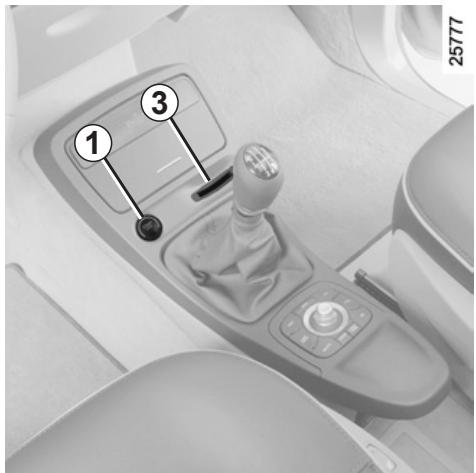
Withdrawing the Card results in the courtesy light coming on (when it is in "automatic lighting" position), the steering column locking and the accessories switching off.
Note: a beep will remind you if you have left the card in the reader when you open the driver's door, and the card reader will also flash.

When you leave your vehicle, especially if you have your RENAULT card with you, check that the engine pletedly switched off.

If there is a child (or a pet) in the vehicle, never leave it unattended with the RENAULT card in the
reader. Otherwise, the child could start the engine or operate electrical equipment such as the electric windows and there is a risk that he or she may be injured (by trapping his or her neck, arm, hand, etc.). Risk of serious injury.
Never switch off the ignition before the vehicle has stopped completely. Once the engine has stopped, the brake servo, power-assisted steering, etc. and the passive safety devices such as air bags and pretensioners will no longer operate.
SPECIAL FEATURES OF PETROL VERSIONS
The following operating conditions should be avoided:
driving for long periods when the low fuel level warning light is lit up,
using leaded petrol,
- using fuel or lubrication additives which are not approved.
Or operating faults such as:
- faulty ignition system, running out of fuel or disconnected spark plugs resulting in the engine misfiring or cutting out when driving;
- loss of power,
may cause the catalytic converter to overheat, reducing its efficiency which may irreparably damage it and cause heat damage to the vehicle.
If you notice any of the above operating faults, have the necessary repairs carried out as soon as possible by an approved dealer.
These faults may be avoided by regularly taking your vehicle to an approved Dealer at the intervals specified in the Maintenance Service Booklet.
Starting problems
To avoid damaging the catalytic converter, do not keep trying to start the engine (using the start button, or by pushing or towing the vehicle) without having identified and corrected the cause of the fault.
If the fault cannot be identified, do not continue to try and start the engine, but contact an approved dealer.

Do not park the vehicle or run the engine in locations where combustible sub
stances or materials such
as grass or leaves can come into contact with the hot exhaust system.
SPECIAL FEATURES OF DIESEL VERSIONS
Diesel engine speed
Diesel engines are fitted with injection equipment which prevents the engine speed being exceeded irrespective of the gear selected.
If the SERVICE warning light comes on, accompanied by the message "Check antipollution", consult an approved dealer as soon as possible.
When driving, depending on the fuel grade used, it is possible that white smoke may be emitted.
This is due to the exhaust particle filter being cleaned automatically, and does not affect the way the vehicle runs.
Running out of fuel
After filling the tank if you have run completely out of fuel, the engine may be started normally on condition that the battery is fully charged: see the information on the "Fuel tank" in Section 1 to find out more about the special features of diesel versions fitted with commonrail (high-pressure) injection.
However, if the engine fails to start after a few seconds and several attempts, contact an approved dealer.
Precautions to be taken in winter
To avoid faults in icy weather:
- Ensure that the battery is always well charged.
- Always keep the diesel tank relatively full to avoid water vapour condensing in it and accumulating at the bottom of the tank.

Do not park the vehicle or run the engine in locations where combustible sub
stances or materials such
as grass or leaves can come into
contact with the hot exhaust system.
ASSISTED PARKING BRAKE
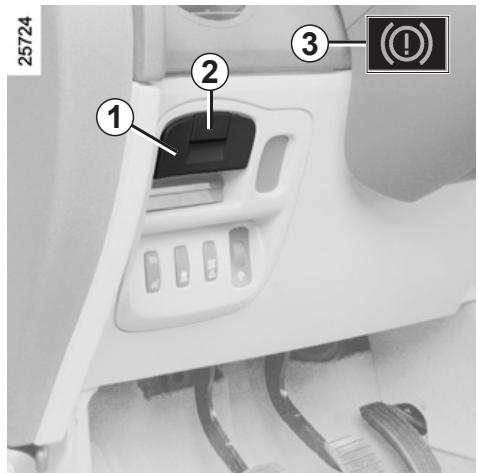
Applying the assisted parking brake
Manual mode
Pull out and release handle 1.
Automatic mode
(dependently on country)
The electronic parking brake ensures automatic vehicle immobilisation when the engine is stopped by pressing the engine start/stop button.
In all other instances, e.g. engine stall- ing, the assisted parking brake is not applied automatically. Manual mode must be used.
Indicator light 2 on the dashboard and indicator light 3 on the instrument panel light up to confirm that the assisted parking brake is applied. Indicator lights 3 and 2 go out when the doors are locked. Depending on the vehicle, the "parking brake applied" message may appear on the instrument panel.
Note:
When the driver's door is opened, if the assisted parking brake is not applied, a beep will sound and, depending on the vehicle, the message "apply parking brake" appears on the instrument panel, in this case, to immobilise the vehicle; you must then release handle 1. For some country-specific versions, the automatic application function is not activated. Refer to the information on "manual mode".

Before leaving the vehicle, check that the assisted parking brake is fully applied.
Indicator lights 2 on the dashboard and 3 on the instrument panel light up to confirm that it has been applied.
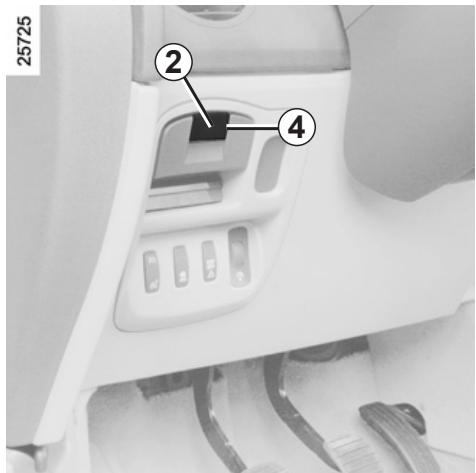
Releasing the assisted parking brake
Manual mode
To release the assisted parking brake: with the engine running, pull handle 1 while pressing unlocking button 4 and release. Indicator lights 3 and 2 go out.
Automatic mode
The brake will be released automatically as soon as the vehicle starts and accelerates.
ASSISTED PARKING BRAKE (continued)
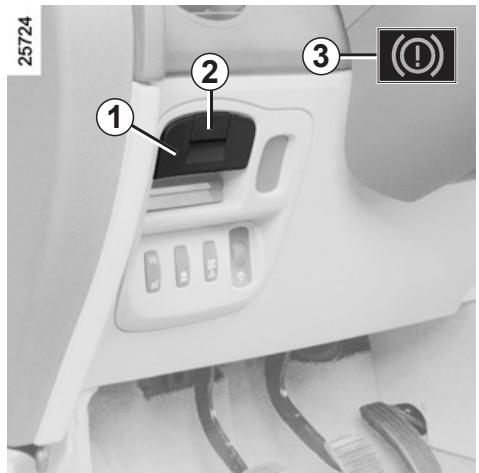
Special cases
If you have to park on a slope or are towing a trailer, keep handle 1 pulled out for a few seconds to obtain the maximum braking effect.

To park the vehicle without applying the assisted parking brake (if there is a risk of freezing, for example):
with the engine running, insert the RENAULT card into the reader or check that it is present in the reader;
- stop the engine by pressing the engine Start/Stop button;
- select a gear (manual gearbox) or position P (automatic gearbox);
- pull handle 1 while pressing unlocking button 4 and then release;
- remove the RENAULT card from the card reader.
Temporary stop
The assisted parking brake is not applied automatically when the engine is running.
In all cases, the assisted parking brake can be applied manually, e.g. when stopping at a red light or on a slope.
To do this, pull out and release handle 1.
The brake will be released automatically as soon as the vehicle starts again and accelerates.

When the engine is running, and if you leave the vehicle, you must apply the assisted parking brake manually.
Indicator lights 2 on the dashboard and 3 on the instrument panel light up to confirm that it has been applied.
ASSISTED PARKING BRAKE (continued)
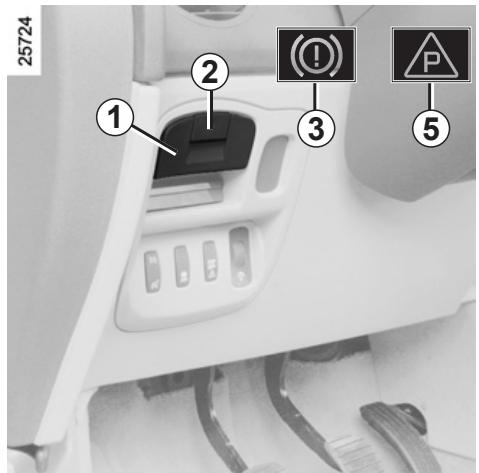
Versions with an automatic gearbox
Never leave your vehicle without moving the selector lever to position N or P.
For safety reasons, if the lever is not in one of these positions and the driver's door is open or incorrectly shut, the automatic release function is deactivated.
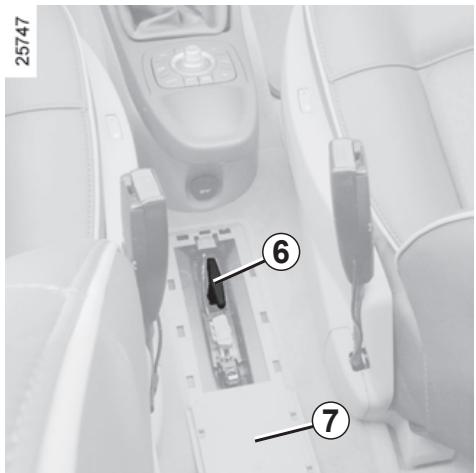
Emergency unlocking
(battery fault or system failure).
To release the assisted parking brake: lift cover 7 and pull handle 6 until the unlocking noise can be heard.
This control cannot be used to reapply the parking brake.
After having replaced the battery, the system will be operational from the first manual release command.
Operating faults
- In the event of a fault, a warning message appears on the display (depending on the vehicle) and depending on the case, warning light 2 flashes and warning light 5 lights up.
- If the assisted parking brake cannot be used, indicator light 3 flashes for approximately 10 seconds when the engine is started, then goes out.
Each time handle 1 is used and each time the engine is switched off indicator lights 2 and 3 will flash for 10 seconds.
Contact an approved dealer as soon as possible.

Never leave a child (or a pet) in the vehicle with the RENAULT card in the card reader or passenger comment. They could release the brake and cause the vehicle off unintentionally.
GEAR LEVER/POWER-ASSISTED STEERING
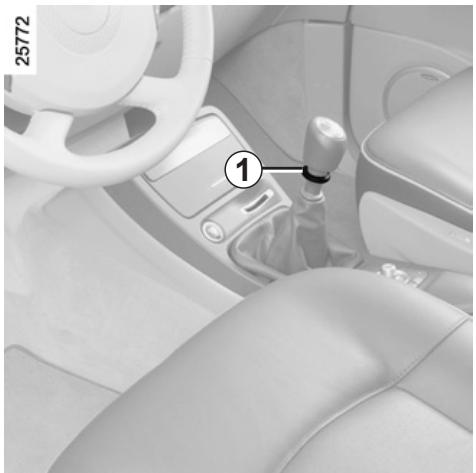
Gear lever
Selecting reverse gear
With the vehicle stationary, shift the gear lever into neutral then into reverse.
Vehicle with manual gearbox: follow the gate drawn on the knob, and depending on the vehicle, lift ring 1 against the gear lever knob to select reverse.
The reversing lights will come on as soon as reverse gear is selected with the ignition on.
Vehicles fitted with parking distance control: refer to the information on the "Parking distance control" in Section 2 for details of the special features.

An impact to the underside of the vehicle (e.g.: striking a post, raised kerb or other street furniture) may result
in damage to the vehicle (e.g.: deformation of an axle).
To avoid any risk of accident, have your vehicle checked by an approved Dealer.
Power-assisted steering
If you have power-assisted steering fitted, do not leave the steering wheel at full lock while stationary as this may damage the pump.
Variable power-assisted steering
The variable power-assisted steering system is equipped with an electronic control system which alters the level of assistance to suit the vehicle speed.
Steering is made easier during parking manoeuvres (for added comfort) whilst the force needed to steer increases progressively as the speed rises (for enhanced safety at high speeds).

Never switch off the ignition when travelling downhill, and avoid doing so in normal driving (assistance
is not provided).
ADVICE: antipollution, fuel economy and driving
Your vehicle complies with criteria for recycling and recovering vehicles at the end of their service life which will come into force in 2015.
Some parts of your vehicle have therefore been designed to facilitate future recycling.
These parts are easy to remove so that they can be recovered and reprocessed by recycling companies.
By virtue of its design, moderate fuel consumption and initial settings, your vehicle also conforms to current anti-pollution regulations. The manufacturer is actively striving to reduce pollutant exhaust gas emissions and to save energy. But the fuel consumption of your vehicle and the level of pollutant exhaust gas emissions are also your responsibility. Ensure that it is maintained and used correctly.
Maintenance
It is important to remember that failure to respect antipollution regulations could lead to legal action being taken against the vehicle owner. In addition, replacing engine, fuel supply system and exhaust components with parts other than those originally recommended by the manufacturer may alter your vehicle so that it no longer complies with antipollution regulations.
Have your vehicle adjusted and checked by an approved Dealer, in accordance with the instructions given in your Maintenance Service Booklet: they will have all the equipment necessary for ensuring that your vehicle is maintained to its original standard.
Engine adjustments
- ignition: this does not require adjustment.
- spark plugs: for optimum fuel economy, efficiency and performance the specifications laid down by our Design Department must be strictly applied.
If the spark plugs have to be changed, use the make, type and gap specified for your vehicle's engine. Contact an approved dealer for this.
- idle: this does not require adjustment.
- air filter, diesel filter: a clogged element reduces performance. It must be replaced.
ADVICE: antipollution, fuel economy and driving (continued)
Exhaust gas monitoring system
The exhaust gas monitoring system will detect any operating faults in the vehicle's antipollution system.
If this system malfunctions, toxic substances may be released into the atmosphere or damage may occur.

This warning light on the instrument panel will indicate if
there are any faults in the system:
This lights up when the ignition is switched on and goes out when the engine is started.
- If it lights up continuously, consult your approved dealer as soon as possible;
- if it flashes, reduce the engine speed until the light stops flashing. Contact your approved dealer as soon as possible.
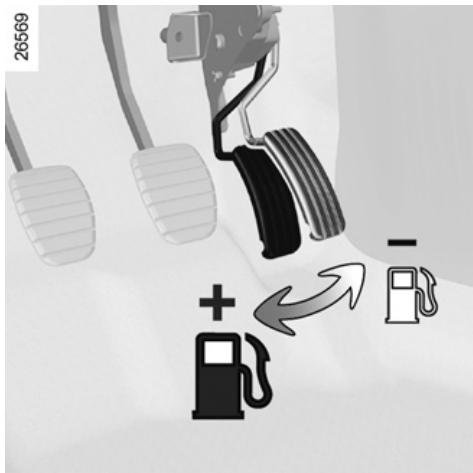
Driving
- Drive carefully for the first few miles until the engine reaches its normal operating temperature, rather than let it warm up while the vehicle is stationary.
- Speed is expensive.
- Sporty driving uses a lot of fuel: drive with a light right foot.
- Do not overrev the engine in the intermediate gears.
Always use the highest gear possible without labouring the engine.
On versions with an automatic transmission, it is preferable to keep the gear lever in position D.
- Brake as little as possible by suitably anticipating an obstacle or bend and then simply releasing the accelerator pedal.
- Avoid sudden acceleration.
- Do not try to maintain the same speed up a hill, accelerate no more than you would on the level. Keep your foot in the same position on the accelerator pedal.
- Double declutching and accelerating before switching off are unnecessary in modern vehicles.
- Bad weather, flooded roads.
Do not drive through floods if the water is above the lower edge of the wheel rims.

Obstructions to the driver
On the driver's side, only use mats adapted to the vehicle that attach to the pre
installed parts, and regularly check their mounting. Do not place several mats on top of each other.
Risk of pedals jamming
ADVICE: antipollution, fuel economy and driving (continued)
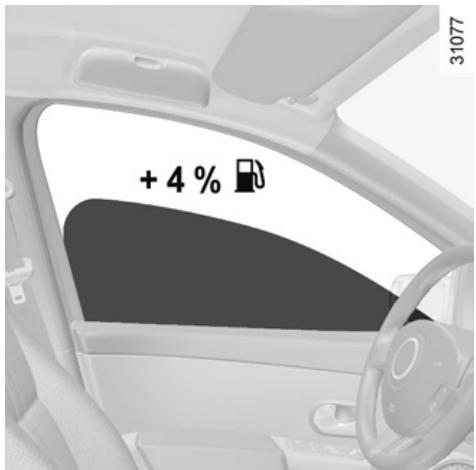
Advice on use
- Electricity is fuel: switch off all electrical components when you no longer need them. However (safety first), keep your lights on when the visibility is poor ("see and be seen").
- Use the air vents. Driving with the windows open at 60 mph (100 km/h) will increase fuel consumption by 4% .
-
Do not leave an empty roof rack fitted to the vehicle.
-
In vehicles fitted with air conditioning, it is normal to observe an increase in fuel consumption (especially in city conditions) when it is used. For vehicles fitted with manual air conditioning, switch off the system when it is not required.
In order to minimise consumption and help to protect the environment: it is recommended to drive with the air vents on and the windows closed. If the vehicle has been parked in the sun, open the doors for a few moments to let the hot air escape before starting the engine.
- Never fill the fuel tank right to the brim to avoid overflow.
- It is better to fit a trailer for bulky objects.
- When towing a caravan, fit a wind deflector and adjust it carefully.
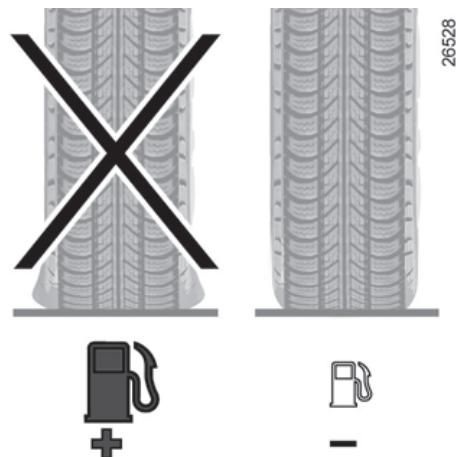
- Avoid using the vehicle for door-to-door calls (short journeys with long waits in between) because the engine never reaches its normal operating temperature.
Tyres
- Under-inflated tyres increase fuel consumption.
- The use of non-recommended tyres can increase fuel consumption.
ENVIRONMENT
Your vehicle has been designed with respect for the environment in mind for its entire service life: during production, use and at the end of its life.
This commitment is illustrated by the Renault eco ^2 signature.
Manufacture
Your vehicle has been manufactured at an factory which uses a progress policy to reduce the environmental impact on the surrounding area and nature (reduction of water and energy consumption, visual and noise pollution, atmospheric emissions and waste water, sorting and reusing waste).
Emissions
Your vehicle has been designed to emit fewer greenhouse gases (CO2) while in use, and therefore to consume less fuel (eg. 140 g/km, equivalent to 5.3 l/100 km for a diesel vehicle).
Our vehicles are also equipped with a particle filter system including a catalytic converter, an oxygen sensor and an active carbon filter (the latter prevents vapour from the fuel tank being released into the open air).
For certain diesel vehicles, this system also has a particle filter to reduce the volume of soot particles emitted.
Please make your own contribution towards protecting the environment too
-
Worn parts replaced in the course of routine vehicle maintenance (vehicle battery, oil filter, air filter, batteries, etc.) and oil containers (empty or filled with used oil) must be disposed of through specialist organisations.
-
At the end of the vehicle's service life, it should be sent to approved centres to ensure that it is recycled.
- In all cases, comply with local legislation.
Recycling
Your vehicle is 85% recyclable and 95% recoverable.
To achieve these objectives, many of the vehicle components have been designed to enable them to be recycled. The materials and structures have been carefully designed to allow these components to be easily removed and reprocessed by specialist companies.
In order to preserve raw material resources, this vehicle incorporates numerous parts made from recycled plastics or renewable materials (vegetable or animal-derived materials such as cotton or wool).
TYRE PRESSUREMONITOR
If the vehicle is equipped with the function, this system monitors the tyre pressure.
Operating principle
Each wheel (except for the emergency spare wheel) has a sensor in the inflation valve which periodically measures the tyre pressure.
The system informs the driver that the tyres are sufficiently inflated and warns if they are underinflated or if there is a leak.

This function is an additional driving aid.
However, the function does not take the place of the driver. It cannot, therefore, under any circumstances replace the vigilance or the responsibility of the driver.
Check the tyre pressures, including the emergency spare wheel, once a month.
The tyre pressures can be adjusted when cold (refer to the information on "Tyre pressure" for the values).
If tyre pressures cannot be checked when the tyres are cold, the normal pressures must be increased by 0.2 to 0.3 bar (or 3 PSI).
Never deflate a hot tyre.
TYRE PRESSUREMONITOR
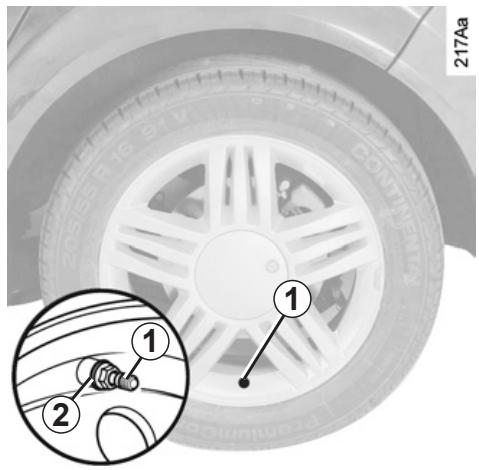
Non-interchangeability of wheels

Each of the sensors incorporated in the valves 1 is dedicated to a single wheel: under no circumstances you swap the wheels.
There is a risk of incorrect information which could have serious consequences.
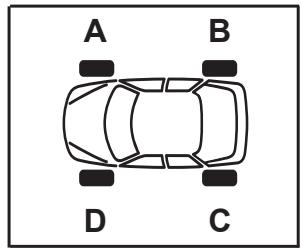
To mark the correct position of the wheel, note the colour of ring 2 (after cleaning, if necessary) on each valve:
A yellow ring
B black ring
C red ring
D green ring
Fitting tyres
(replacing tyres or fitting winter tyres)
Since replacing tyres requires special precautions, we advise you to contact your approved dealer.
Reading the tyre pressure on the instrument panel (if fitted to the vehicle).
After the vehicle's tyre pressures have been checked, the warning messages on the instrument panel and/or the values read on the trip computer and warning system are updated once you exceed 15 mph (25 km/h).
TYRE PRESSUREMONITOR
Emergency spare wheel
The emergency spare wheel has no sensor, and cannot be recognised by the system.
When it is fitted in the place of another wheel, the system then detects an operating fault.
Replacing wheels/tyres
This system requires specific equipment (wheels, hubcaps, etc.).
Contact an approved dealer to find out about accessories compatible with the system and which may be purchased from the brand's accessory outlets: the use of any other accessory could affect the correct operation of the system.
Tyre repair products
Because the valves are specially designed, use only products approved by our Technical Department.
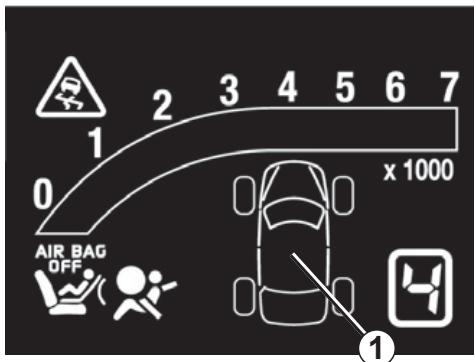
28042
Display
Display 1 on the instrument panel informs you of any tyre pressure faults (flat tyre, punctured tyre, system fault, etc.).
TYRE PRESSUREMONITOR
Examples of messages which may appear on the display
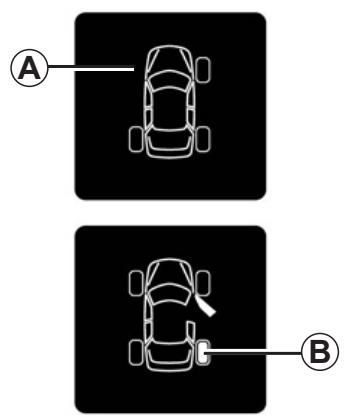
"Check tyre pressure"
A shaded wheel ±bB indicates a deflated tyre.
16
"Inflate tyres to motorway pressure"
The tyre pressure is not suitable for the speed of travel. Slow down or inflate all four tyres to "motorway pressure" (refer to the label located on the label on the edge of the driver's door).
"Wheel sensors missing"
One wheel A disappears, indicating that the sensor on this wheel is missing or faulty (e.g. if the emergency spare wheel is fitted).
"Stop! Tyre puncture"
Replace the wheel ±bB concerned or call your approved dealer.
This message appears along with the
STOP warning light.
Operating faults
In certain conditions involving readjustment of tyre pressures, the fault message may continue to be displayed (for approximately 1 hour and 45 minutes after the vehicle has stopped).
ELECTRONIC STABILITY PROGRAM: ESP
This system helps to keep control of the vehicle in critical driving situations (avoiding an obstacle, loss of grip when cornering, etc.) and works in conjunction with the understeer control system.

This function is an additional aid in the event of critical driving conditions,
enabling the vehicle behav
iour to be adapted to suit the driving conditions.
However, the function does not take the place of the driver. It does not increase the vehicle's limits and should not encourage you to drive more quickly.
Therefore, it can under no circumstances replace the vigilance or responsibility of the driver when manoeuvring the vehicle (the driver must always be ready for sudden incidents which may occur when driving).
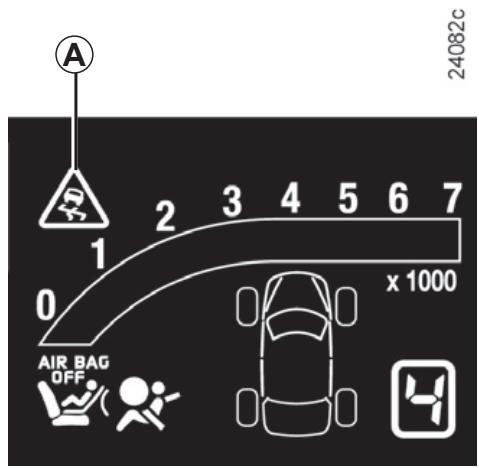
Operating principle
A sensor in the steering wheel detects the direction selected by the driver.
Other sensors throughout the vehicle measure the actual direction.
The system compares the direction selected by the driver and the actual direction of the vehicle and corrects this as necessary by applying the brakes selectively and/or acting on the engine power.
When the function begins to operate, warning light A flashes to warn you.
If the warning light comes on accompanied by the "ESP deactivated" message when the engine is started, turn the steering wheel from lock to lock to reinitialize the system.
Understeer control
This system optimises the action of the ESP in the case of pronounced understeering (loss of front axle road holding).
Operating faults
When the system detects an operating fault the message "Check ESP" appears on the instrument panel along
with the SERVICE warning light and warning light A.
Consult an approved dealer.
TRACTION CONTROL: ASR (1/2)
This system helps to limit wheelspin of the drive wheels and to control the vehicle when pulling away or accelerating.

This function is an additional aid in the event of critical driving conditions,
enabling the vehicle behav
iour to be adapted to suit the driving conditions.
However, the function does not take the place of the driver. It does not increase the vehicle's limits and should not encourage you to drive more quickly.
Therefore, it can under no circumstances replace the vigilance or responsibility of the driver when manoeuvring the vehicle (the driver must always be ready for sudden incidents which may occur when driving).
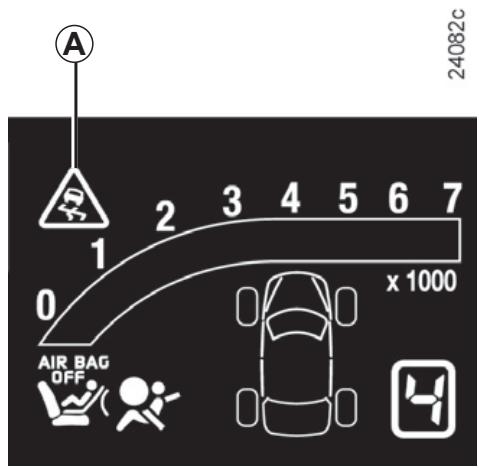
Operating principle
Using the wheel sensors, the system measures and compares the speed of the drive wheels at all times and slows down their over-rotation.
If a wheel is starting to slip, the system brakes automatically until the drive supplied becomes compatible with the level of grip under the wheel again.
The system also adjusts the engine speed to the grip available under the wheels, independently of the pressure exerted on the accelerator pedal.
When the function begins to operate, warning light A flashes to warn you.
TRACTION CONTROL: ASR (2/2)
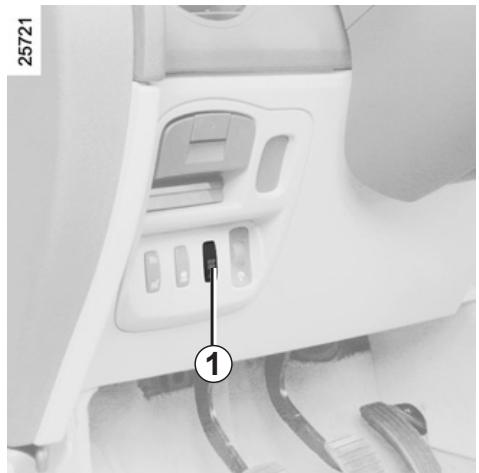
Disabling the function
In some situations (driving on very wet ground: snow, mud, etc. or driving with snow chains fitted), the system may reduce the engine output to limit wheelspin. If this is not required, it is possible to deactivate the function by pressing switch 1.
The message "ESP deactivated" appears to inform you, accompanied by warning light A.
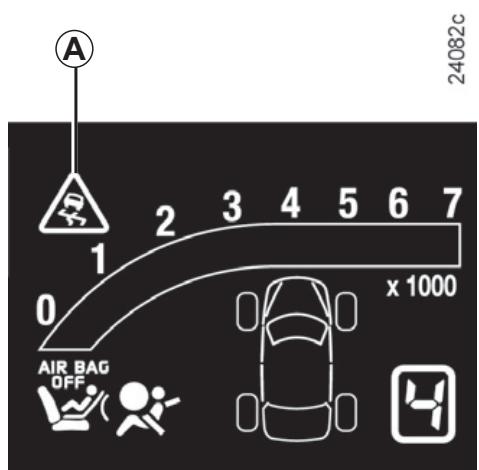
Disabling the function also disables the ESP function.
Correct this as soon as possible by pressing switch 1 again.
Traction control is automatically reactivated when the ignition is switched on.
Operating faults
If the system detects an operating fault, the message "Check ESP" is displayed on the instrument panel display along
with the SERVICE warning light and warning light A.
Consult an approved dealer.
If the warning light comes on accompanied by the "ESP deactivated" message when the engine is started, turn the steering wheel from lock to lock to reinitialize the system.
ANTI-LOCK BRAKING SYSTEM: ABS
Under heavy braking, the essential requirements are to limit the stopping distance and keep your vehicle under control. However, there is a risk that roadholding and directional control may be lost and the wheels may lock under braking, depending on the nature of the ground, weather conditions and your reactions. The Anti-lock Braking System (ABS) has been designed to combat this danger.
The safety enhancement is that the brake control system prevents the wheels from locking, even if the brakes are applied too sharply, and allows the vehicle to be steered and thus its direction to be controlled. Under these circumstances it is quite possible for the driver to steer the vehicle and to avoid an obstacle whilst at the same time applying the brake.
This system also allows you to optimise stopping distances when the grip of one or more wheels may be lost (wet roads, slippery or varying road surfaces).
Although this system allows you to benefit from optimum stopping distances, even with the ABS you must still take account of the actual condition of the road surface. It is still essential to follow the rules of good driving practice (such as driving at a safe distance from the vehicle in front). The fact that the vehicle's safety has been increased should not encourage you to take risks.
You will feel pulsing through the brake pedal each time the system is activated. These tangible signs will warn you that the adhesion between the tyres and the ground has reached its limit and enable you to adapt your driving style to suit the road conditions.
ANTI-LOCK BRAKING SYSTEM: ABS (continued)
One of two situations may arise if there is a fault in the ABS system:
1-Orange warning light is lit on the instrument panel.
Braking is still performed, but without the ABS system. Contact an approved Dealer as soon as possible.

2 - Orange warning light

cuit
incident warning
light are lit on the instrument panel.
This indicates that both the braking system and the ABS system are faulty. Your braking systems are only partially operational. However, it is dangerous to brake suddenly and it is essential to stop immediately, as soon as traffic conditions allow. Contact an approved Dealer.
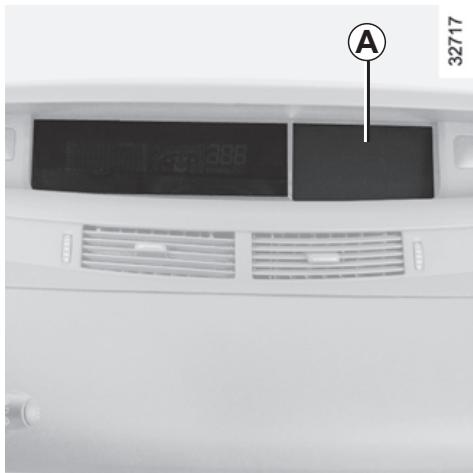
Also, on equipped vehicles, the message "Check ABS" appears on the display A.
The braking modulation provided by the ABS is independent of the effort applied to the brake pedal. In an emergency, apply firm and continuous pressure to the brake pedal. There is no need to pump it repeatedly.
EMERGENCY BRAKE ASSIST
This system is complementary to the ABS and helps reduce vehicle stopping distances.
Operating principle
The system allows an emergency braking situation to be detected via a sensor that measures the speed with which the brake pedal is depressed. In this case, the braking assistance instantly provides its maximum power.
ABS braking is maintained as long as the brake pedal is applied.
Hazard warning lights activation
These may light up in the event of rapid deceleration.
In this case, the hazard warning lights may be switched off by pressing the hazard warning lights switch twice.

This function is an additional aid in the event of a critical driving conditions, enabling the vehicle behavior to be adapted to suit the driving conditions.
However, the function does not take the place of the driver. It does not increase the vehicle's limits and should not encourage you to drive more quickly.
Therefore, it can under no circumstances replace the vigilance or responsibility of the driver when manoeuvring the vehicle (the driver must always be ready for sudden incidents which may occur when driving).
CRUISE CONTROL - SPEED LIMITER: limiter function
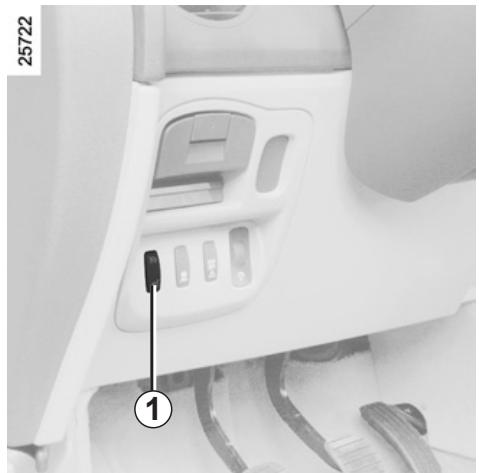
The speed limiter function helps you stay within the driving speed limit that you choose.
This may be useful, for example, driving in urban areas or areas with a speed restriction (roadworks), etc.
The system operates from a driving speed of about 18 mph (30 km/h).
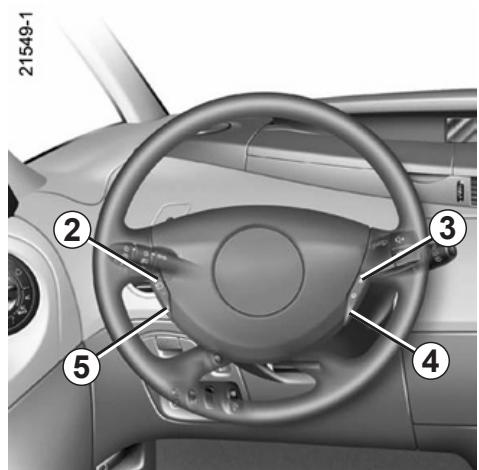
Controls
1 Main "On/Off" switch.
2 Limit speed memorisation and adjustment of limit speed (increasing).
3 Recall of stored limit speed.
4 Switching the function off (with limit speed storage).
5 Limit speed memorisation and adjustment of limit speed (decreasing).
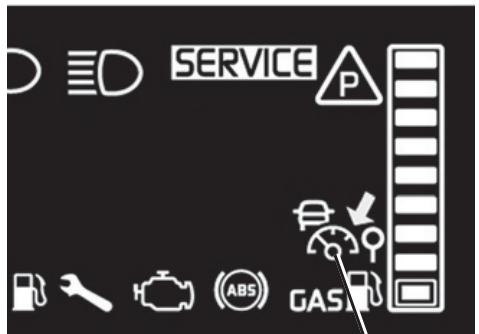
6

Indicator light
This indicator light on the instrument panel lights up to indicate that the limiter function is in operation.
The stored speed information appears on trip computer and warning system 6.
CRUISE CONTROL - SPEED LIMITER: limiter function (continued)
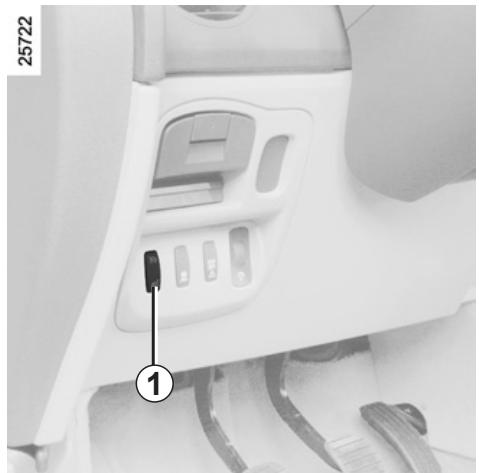
Switching on
Press switch 1 on the side showing

The indicator light on the instrument panel lights up and, depending on the vehicle, the trip computer or the information display enters "speed limiter" mode.
Limiting the speed
At a constant speed (above about 18 mph (30 km/h)) and in the correct gear (for vehicles with manual gearboxes), press switch 2: the speed is stored.
Driving
When a limit speed has been memorised, if this speed is not reached the vehicle behaves in a similar way to a vehicle without the speed limiter function.
Once this speed is reached, no effort on the accelerator pedal will allow you to exceed the programmed speed except in an emergency (refer to information on "Exceeding the limit speed").
The system is designed in such a way that it is possible to detect a difference between the programmed speed and the speed shown on the instrument panel.
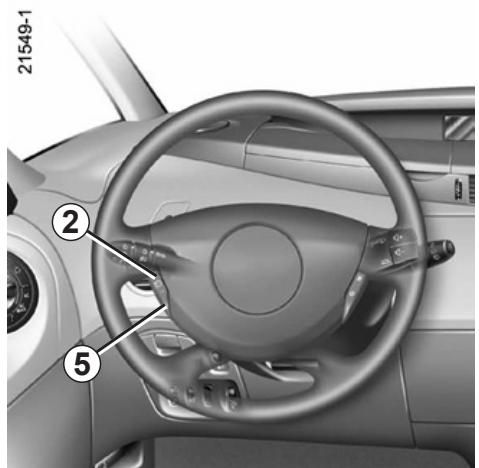
Varying the limit speed
The limit speed may be changed by pressing repeatedly or holding down:
- button 2 to increase the speed,
- button 5 to decrease the speed.
CRUISE CONTROL - SPEED LIMITER: limiter function (continued)
Exceeding the limit speed
In the event of an emergency
It is possible to exceed the limit speed at any moment. To do this: depress the accelerator pedal firmly and fully (beyond the kickdown point).
The speed flashes on the instrument panel (trip computer and warning system) while the speed is being exceeded.
When the emergency has passed, release the accelerator pedal: the speed limiter function will return as soon as you reach a speed lower than the limit speed before the emergency.
Limit speed cannot be maintained
In some driving conditions (for example when driving up or down a steep gradient), the system is unable to maintain the limit speed: the memorised speed on the instrument panel information display will flash to inform you of this situation.
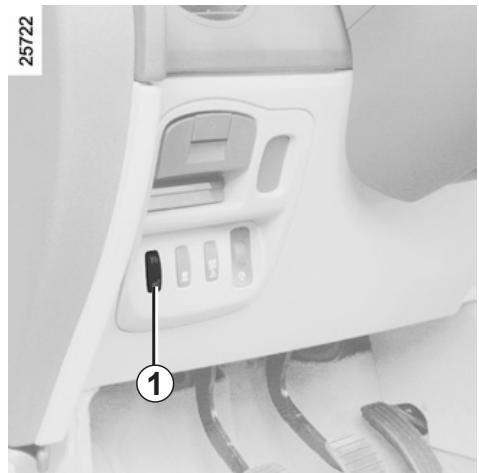
Switching off the function
The speed limiter function is interrupted when you press:
- button 4, in this case, the limit speed remains memorised,
- button 1, in this case, there is no longer a memorised limit speed.
The instrument panel indicator light goes out, confirming that the function is stopped.
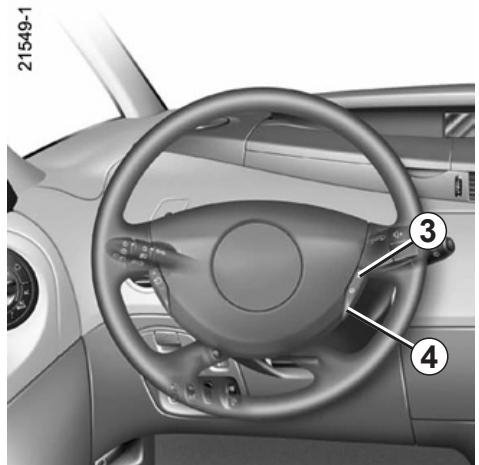
Recalling the limit speed
It is possible to recall a memorised speed by pressing button 3 once.
CRUISE CONTROL - SPEED LIMITER: cruise control function

The cruise control function helps you to maintain your driving speed at a speed that you choose, called the cruising speed.
This cruising speed may be set at any speed above 18 mph (30 km/h).

The cruise control function is in no way linked to the braking system.

This function is an additional driving aid. However, the function does not take the place of the driver.
Therefore, it can under no circumstances replace the driver's responsibility to respect speed limits and to be vigilant (the driver must always be ready to brake). Cruise control must not be used in heavy traffic, on winding or slippery roads (black ice, aquaplaning, gravel) and during bad weather (fog, rain, side winds etc.).
There is a risk of accidents.
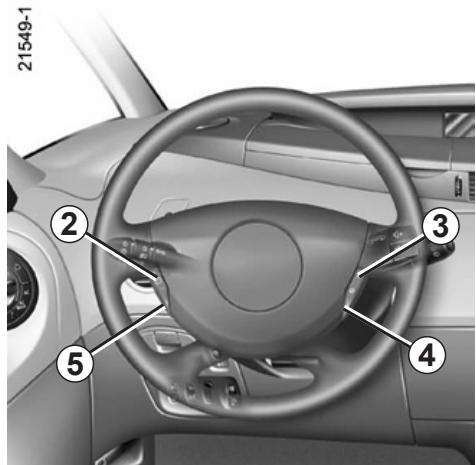
Controls
1 Main "On/Off" switch.
2 Cruising speed storage and activation. Cruising speed increase.
3 Recalling the cruising speed.
4 Switching the function off (with stored cruising speed).
5 Cruising speed storage and activation. Decrease cruising speed.
CRUISE CONTROL - SPEED LIMITER: cruise control function (continued)
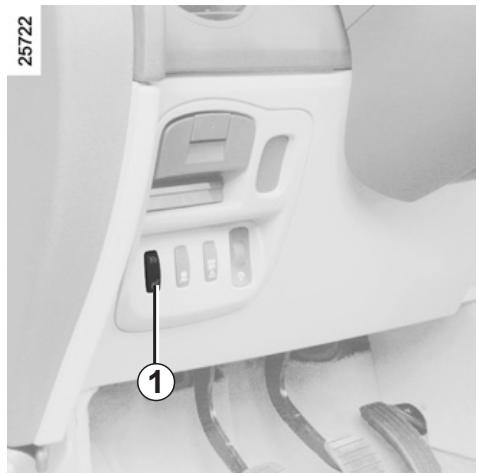
Switching on
Press switch 1 on the side showing

The indicator light in the instrument panel lights up and, depending on the vehicle, the trip computer or the information display enters cruise control mode.
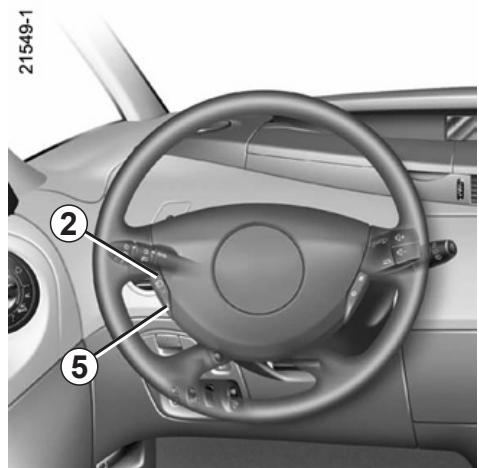
Activating cruise control
At a steady speed (above 18 mph (30km / h) ) and in the correct gear (for vehicles with manual gearboxes), press switch 2 or 5: the function is activated and the speed is stored.
Driving
Once a cruising speed is memorised and the cruise control function is active, you may lift your foot off the accelerator pedal.

Important: you are nevertheless advised to keep your feet close to the pedals in order to react if neces
sary.
The system is designed in such a way that it is possible to detect a difference between the programmed speed and the speed shown on the instrument panel.
CRUISE CONTROL - SPEED LIMITER: cruise control function (continued)
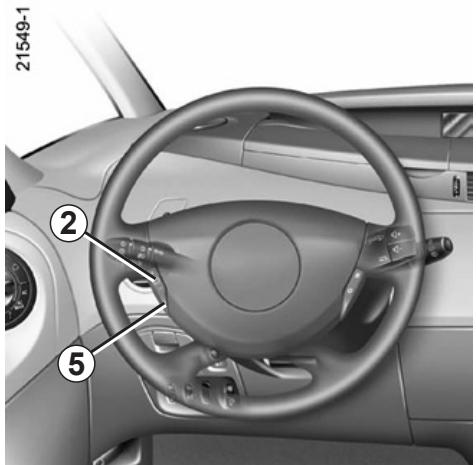
Adjusting the cruising speed
The cruising speed may be changed by pressing repeatedly or continuously on:
- button 2 to increase the speed,
- button 5 to decrease the speed.
Exceeding the cruising speed
In the event of an emergency
The cruising speed may be exceeded at any time by depressing the accelerator pedal. The speed flashes on the instrument panel (trip computer and warning system) while the speed is being exceeded.
Cruising speed cannot be maintained
In some driving conditions (for example when driving up or down a steep gradient), the system is unable to maintain the cruising speed: the speed flashes on the instrument panel to inform you of this situation.

The cruise control function is in no way linked to the braking system.
CRUISE CONTROL - SPEED LIMITER: cruise control function (continued)
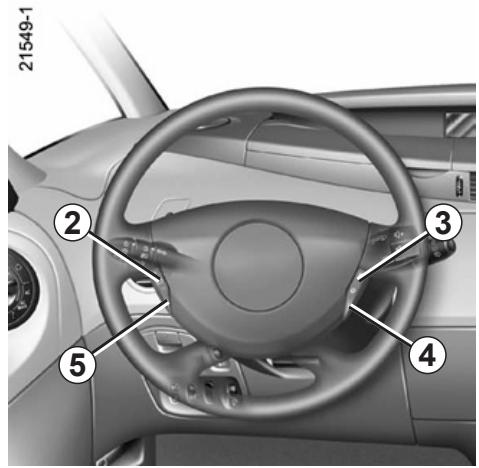
Putting the function on standby
The function is interrupted when you:
- depress the brake pedal,
- depress the clutch pedal or shift into neutral if the vehicle has an automatic gearbox,
- press button 4.
In all three cases, the cruising speed is memorised.
Recalling the cruising speed
If a speed has been memorised, it is possible to recall it by pressing button 3, on condition that you are driving faster than 18 mph (30 km/h) and that you are sure that the driving conditions are suitable (traffic, road surface condition, weather conditions, etc.).
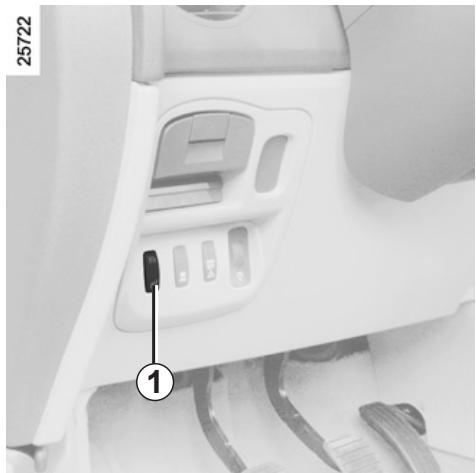
Switching off the function
Press on/off switch 1: in this case, the speed is no longer stored.
The instrument panel indicator light goes out, confirming that the function is stopped.
Pressing button 2 or 5 reactivates the cruise control function without taking into account the memorised speed: it is the speed at which the vehicle is moving that is taken into account.

Putting the cruise control on standby or switching it off does not cause a rapid reduction in speed: you
must brake by depressing the brake pedal.
PARKING DISTANCE CONTROL
Operating principle
Ultrasonic detectors, installed in the front or rear bumper depending on the vehicle, measure the distance between the vehicle and an obstacle whilst reversing.
This measurement is indicated by beeps which become more frequent the closer you come to the obstacle, until they become a continuous beep when the vehicle is approximately 32 centimetres from the obstacle.
Special features
Ensure that the ultrasonic sensors are not obscured (by dirt, mud, snow, etc.).
When the vehicle is being driven at a speed below 7 mph (12 km/h), certain noises (motorcycle, lorry, pneumatic drill, etc.) may trigger the beeping sound.
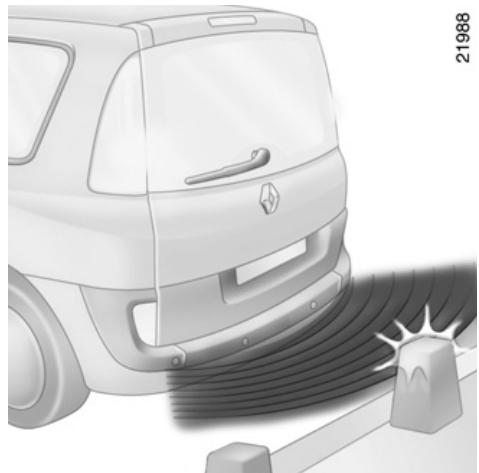
Operating faults
When the system detects an operating fault there will be a 5-second, continuous warning beep when reverse gear is selected. Consult an approved dealer.
98 108

This function is an additional aid that indicates the distance between the vehicle and an obstacle whilst鸣, using sound signals.
Under no circumstances should it replace the driver's care or responsibility whilst reversing.
The driver should always pay attention to sudden incidents during driving: always ensure that there are no moving obstacles (such as a child, animal, pram, bicycle, etc.) or small, narrow objects such as stones or posts in your path when manoeuvring.
PARKING DISTANCE CONTROL (continued)
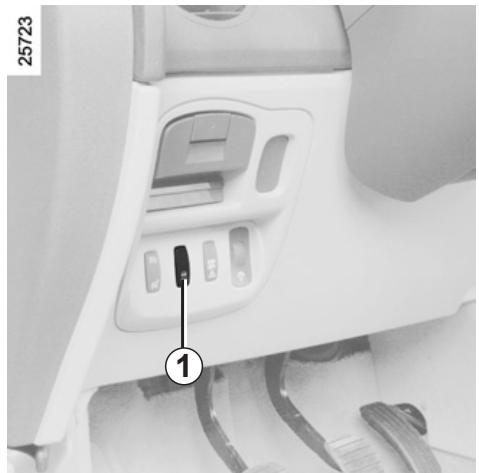
Vehicles fitted with rear parking distance control
Operation
Rear parking distance control is only activated when reverse is selected.
Deactivating the system
Press switch 1 to deactivate the system.
The warning light in the switch comes on to remind you that the system has been deactivated: the "parking distance control deactivated" message appears on the instrument panel for around 10 seconds.
You can reactivate the system by pressing the switch again: the warning light will go out and "parking distance control activated" message will be displayed on the instrument panel for approximately 10 seconds.
The system is automatically reactivated after the ignition is switched off and the engine restarted.
You can deactivate the system for prolonged periods by pressing the switch for longer than approximately three seconds.
The warning light in the switch stays on and the "parking distance control deactivated" message appears on the instrument panel for approximately 10 seconds.
Once deactivated, the system can be reactivated by pressing the button again for longer than approximately three seconds. The warning light on the switch will go out and the "parking distance control activated" message will be displayed on the instrument panel for approximately 10 seconds.

An impact to the underside of the vehicle (e.g.: striking a post, raised kerb or other street furniture) may result in damage to the vehicle (e.g.: deformation of an axle).
Dealer.
To avoid any risk of accident, have your vehicle checked by an approved
PARKING DISTANCE CONTROL (continued)
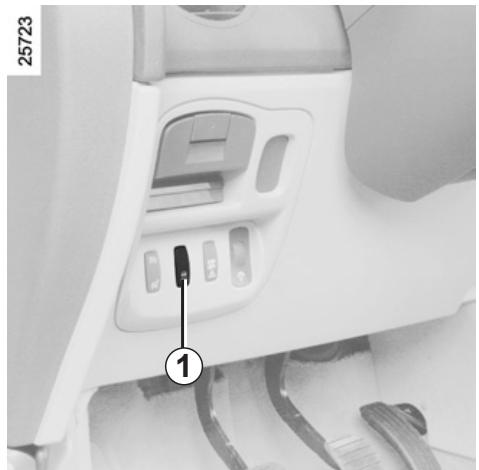
Vehicles fitted with front and rear parking distance control
Operation
As long as the vehicle is being driven at a speed below 7 mph (12 km/h) or thereabouts, the parking distance control system remains on.
Any object located less than approximately 60 centimetres away from the front of the vehicle is detected and a beep is emitted.
When reverse gear is selected, the system switches automatically to manoeuvre mode.
Any object located less than approximately 1 metre away from the front and/or less than 1.50 metres from the rear of the vehicle is detected and a beep sound is emitted.
If there are obstacles located close to both the front and rear of the vehicle, only the closest of the two will be acknowledged and the corresponding front or rear beep sound will be emitted.
If obstacles are detected both to the front and to the rear of the vehicle at the same time, and they are both within 30 centimetres from the vehicle, the corresponding front and rear beeps will be emitted alternately.
Manual activation/deactivation of the front and rear parking distance control
Press switch 1 quickly to deactivate the system.
The warning light on the switch comes on to remind you that the system has been deactivated; the message "parking distance control deactivated" appears on the instrument panel for approximately 10 seconds.
You can reactivate the system by pressing the switch again: the warning light will go out and the message "parking distance control activated" will be displayed on the instrument panel for approximately 10 seconds.
The system will reactivate automatically each time the engine is switched off.

An impact to the underside of the vehicle (e.g.: striking a post, raised kerb or other street furniture) may result in damage to the vehicle (e.g.: deformation of an axle).
To avoid any risk of accident, have your vehicle checked by an approved Dealer.
PARKING DISTANCE CONTROL (continued)

Manual activation/deactivation of the front and rear parking distance control
You can deactivate the system permanently by pressing switch 1 and holding it down for approximately three seconds
The warning light in the switch stays on and the message "parking distance control deactivated" appears on the instrument panel for approximately 10 seconds.
In this case you can reactivate the system by pressing and holding switch 1 for longer than three seconds: the warning light on the switch goes out and the message "parking distance control activated" will be displayed on the instrument panel for approximately 10 seconds.
Automatic activation/deactivation of the system
The system is activated when the vehicle is being driven at a speed below approximately 7 mph (12 km/h).
The system deactivates:
- when the parking brake is applied;
- when the vehicle speed is above 7 mph (12 km/h);
- when the vehicle is stationary for more than approximately five seconds (such as when in a traffic jam or waiting at red lights, etc.);
- when the vehicle is in neutral or when the gear lever has been shifted to N or P for automatic gearboxes;
- if a caravan or trailer is fitted with a detection system.
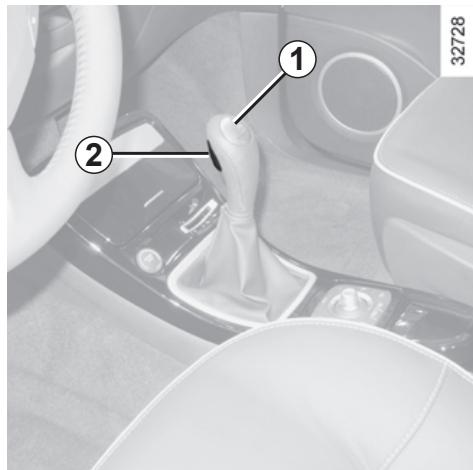
AUTOMATIC GEARBOX
Selector lever 1
Information display strip A indicates the position of the lever 1.
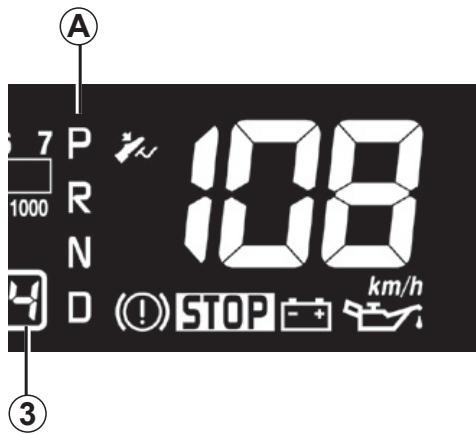
P: park
R: reverse
N: neutral
D: automatic mode
3: display of gear engaged in manual mode
warning light indicating that the brake pedal should be depressed so that the lever can be moved out of position P
Operation
With the selector lever 1 in position P or N, turn the ignition.
To move out of position P, you must depress the brake pedal before pressing unlocking button 2.
With the foot on the brake pedal (warning light on the display 3 goes out), move the lever out of position P.
Only engage D or R when the vehicle is stopped, with your foot on the brake and the accelerator pedal released.
AUTOMATIC GEARBOX (continued)
Driving in automatic mode
Select position D. In the majority of traffic conditions, you will not have to touch the gear selector lever again: the gear will be changed automatically at the right time and at the most suitable engine speed because the automatic system takes into account the vehicle load and road contour and adjusts itself to the particular driving style you have chosen.
Economical driving
When driving, always leave the lever in position D, keeping the accelerator pedal lightly depressed to ensure automatic gear changes at a lower engine speed.
Accelerating and overtaking
Depress the accelerator pedal firmly and fully (so that it goes beyond the kickdown point).
This will enable you to change down to the optimum gear within the engine range.
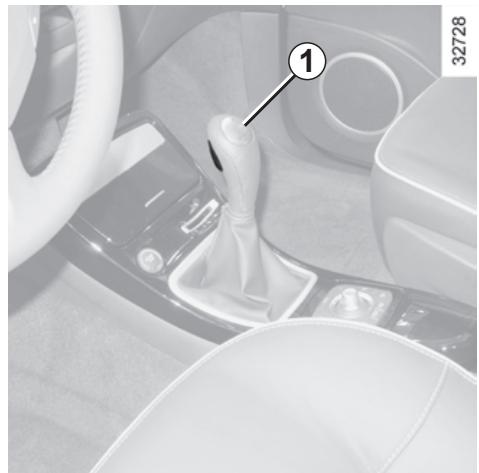
Driving in manual mode
With the lever in position D, shift the lever to the left-hand side.
Shifting lever 1 repeatedly allows you to change gears manually:
- To move down through the gears, push the lever backwards,
- To move up through the gears, push the lever forwards.
The gear ratio engaged appears on the instrument panel.
Special cases
In certain driving conditions (e.g.: engine protection, operation of the electronic stability program: ESP), the automated system may change the gear automatically.
Likewise, to prevent incorrect manoeuvres, a gear change may be refused by the automatic system: in this case the gear display flashes for a few seconds as a warning.
Using an emergency spare wheel may disrupt the operation of the automatic gearbox.
AUTOMATIC GEARBOX (continued)
Special circumstances
- If the bends and road surface do not allow you to stay in automatic mode (e.g. in the mountains), we recommend that you change to manual mode.
This will prevent the automatic gearbox from changing gear repeatedly when climbing, and permit engine braking on long descents.
- In cold weather, start the engine and wait a few seconds before moving the selector lever from position P or N and engaging it in D or R to prevent the engine stalling.
- Vehicles not fitted with traction control: on a slippery surface or surface with a low level of adhesion, change to manual mode and select second gear (or even third) before starting the engine to avoid wheel-spin when starting.
Parking the vehicle
When the vehicle is stopped, move the lever to position P while keeping your foot on the brake pedal: the gearbox is in neutral and the drive wheels are mechanically locked by the driveshaft.
Check that the parking brake is properly applied (refer to the information on the "Parking brake" in Section 2).
AUTOMATIC GEARBOX (continued)
Operating faults
- When driving, if the message "Check auto gearbox" appears on the instrument panel, this indicates there is a fault.
Contact your approved Dealer as soon as possible. - When driving, if the message "Auto gearbox overheating" appears on the instrument panel, stop the vehicle to allow the gearbox to cool down.
Contact your approved Dealer as soon as possible. - If a vehicle with an automatic gearbox breaks down, refer to the information on "Towing" in Section 5.
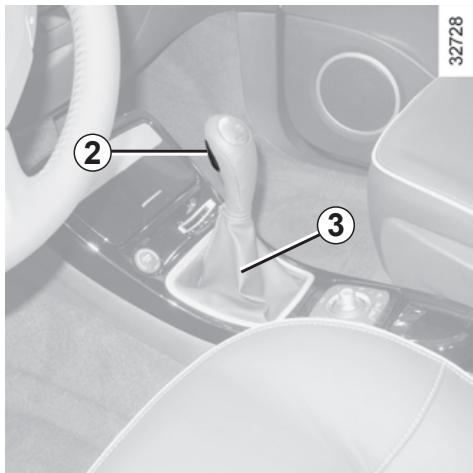
When setting off, if the lever is locked in position P even though you are depressing the brake pedal and pressing unlocking button 2, the lever can be released manually.
To do this, unclip the upper section of the gaiter 3.
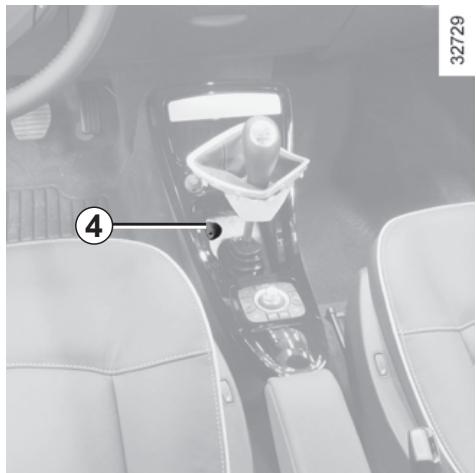
Push unlocking button 2 and button 4 under the gaiter at the same time to move the lever from position P.
Section 3: Your comfort
Air vents. 3.2
Heating and air conditioning 3.5
Electric windows 3.26
3.30
Fixed glass roof 3.30
Electric sunroof 3.31
Sun visor 3.33
Interior lighting 3.35
Passenger compartment storage/fittings 3.37
Ashtrays-Cigarettelighter 3.41
Rear seats 3.42
Luggage compartment. 3.51
Opening rear screen 3.52
Luggage cover. 3.53
Transporting objects in the boot 3.55
Luggage net. 3.56
Roof bars 3.57
Hands-free telephone integrated control 3.59
3.1
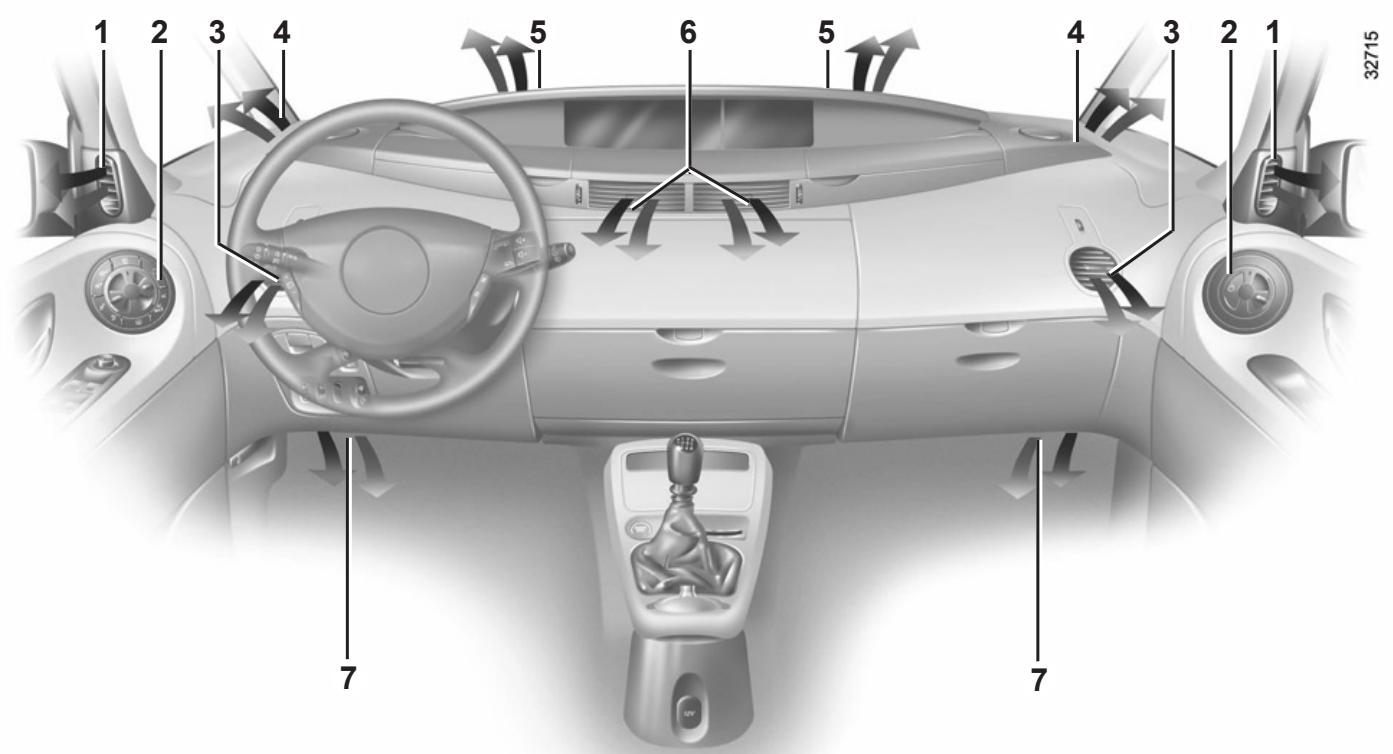
AIR VENTS: air outlets (1/3)
1 and 4 Side window demister outlets
2 Heating and ventilation controls
3 Side air vents
5 Windscreen demisting vents
6 Centre air vents
7 Front passenger footwell heater outlets
3.2
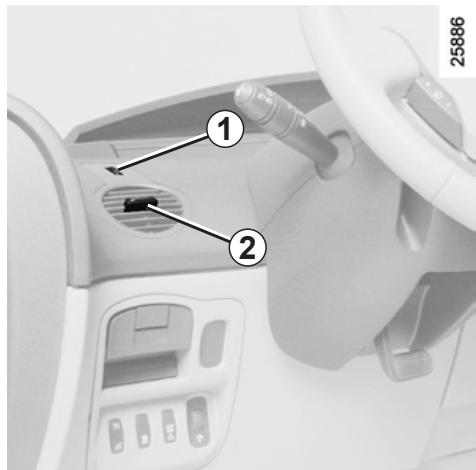
AIR VENTS: air outlets (2/3)
Dashboard air vents
Air flow
Move the control knob 1 (beyond the point of resistance).
Up: maximum air flow.
Down: closed.
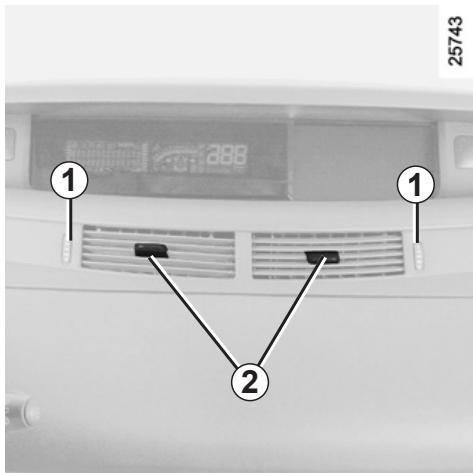
Direction
Right/left: move tabs 2.
Up/down: lower or raise tabs 2.
To remove bad odours from your vehicles, only use the systems designed for this purpose. Consult an approved Dealer.

Do not add anything to the vehicle's ventilation circuit (for example, to remove bad odours).
There is a risk of damage or of fire.
AIR VENTS: air outlets (3/3)
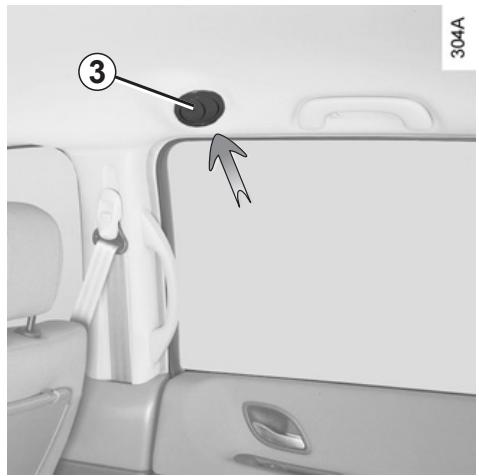
Rear air vents 3
To open, press on the air vent.
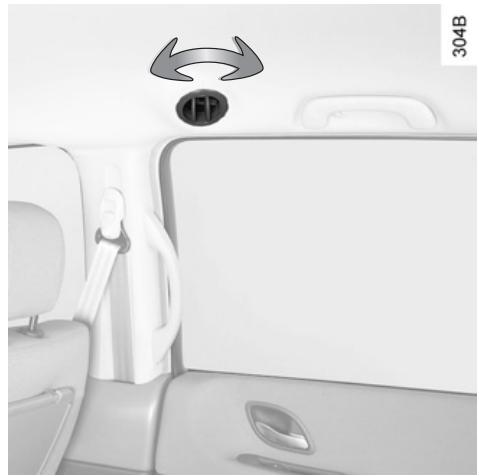
To direct, take hold of the air vent and turn it to the required position.
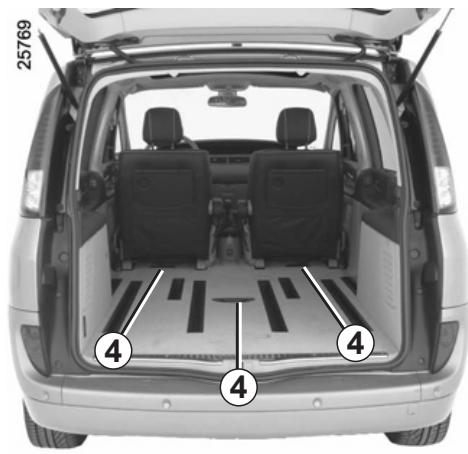
Rear seat air vents
Air vent 4 distributes air to the first row rear seats. Air vent 5 distributes air to the second row rear seats.
Avoid blocking these vents when there are passengers in the rear seats.
HEATING/AIR CONDITIONING (1/7)
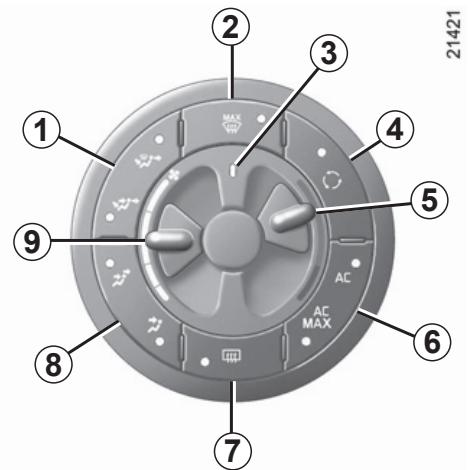
The controls
Driver's side
1 and 8 Choice of air distribution
2 "Clear View" button to demist and de-ice the windows.
3 Driver/passenger separate temperature adjustment operating tell-tale
4 Switching the air recirculation on
5 Air temperature adjustment tab
6 Switching the air conditioning on
7 Switching the rear screen de-icing on
9 Ventilation speed adjustment tab information and advice for use:
Refer to the end of the section on "Heating/air conditioning".
Buttons 1, 2, 4, 6, 7, 8 and 10 have operating tell-tales:
- if the indicator light is on, the function is switched on;
- if the indicator light is off, the function is switched off.
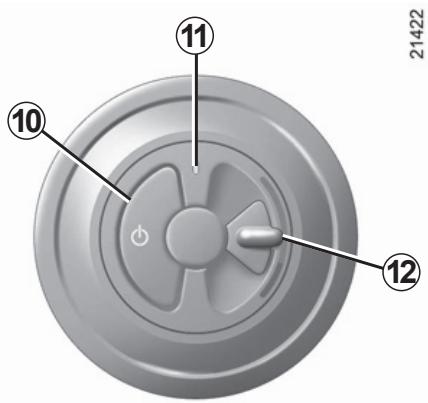
Passenger side
10 Switching the passenger air temperature adjustment on
11 Driver/passenger separate temperature adjustment operating tell-tale
12 Passenger air temperature adjustment tab
HEATING/AIR CONDITIONING (2/7)
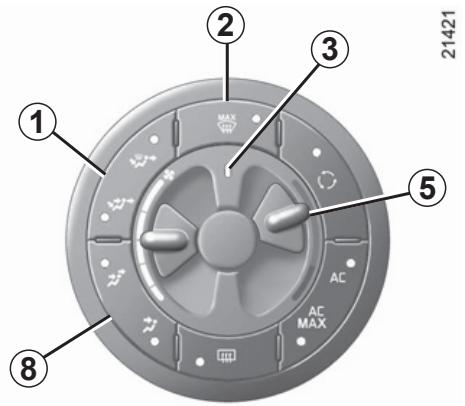
Adjusting the air temperature
Tabs 5 and 12 are used to adjust the air temperature in the passenger compartment. Pushing the tab upwards increases the temperature.
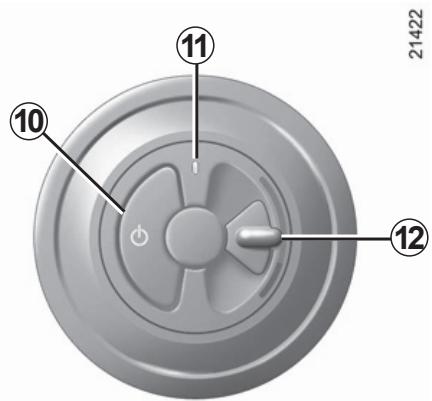
There are two ways of using it:
- operating tell-tales 3 and 11 are off.
Tab 5 on the driver's side adjusts the temperature in the entire passenger compartment (tab 12 on the passenger side, in this situation, is inactive);
- operating tell-tales 3 and 11 are on.
tab 5 adjusts the air temperature on the driver's side and tab 12 adjusts the air temperature on the passenger side.
If you are the passenger and you wish to set the air to a different temperature to the driver, press button 10: operating tell-tales 3 and 11 come on and you can then adjust the temperature with tab 12.
To return to a single temperature for the entire passenger compartment, there are two choices:
- on the driver's side, press one of air distribution buttons 1 or 8 for approximately two seconds;
- on the passenger side, press button 10 again.
Operating tell-tales 3 and 11 go out.
Note:
Each time the ignition is switched on, the setting returns to a single temperature for the entire passenger compartment: lights 3 and 11 are off.
- Tab 12 cannot be used if the "Clear View" function (button 2) is on. In this case, indicator lights 3 and 11 go out.
HEATING/AIR CONDITIONING (3/7)
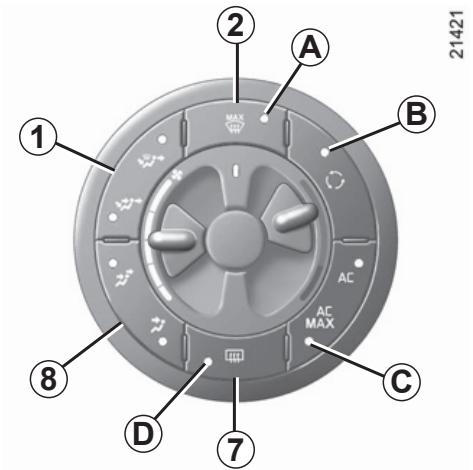
"Clear View" function
Press button 2: operating tell-tale light A comes on.
This function quickly demists and deices the windscreen, the front side windows, the door mirrors and the electric rear screen (operating tell-tale ±bD comes on).
For greater efficiency, the air conditioning is automatically switched on (operating tell-tale C comes on) and the air recirculation is switched off (operating tell-tale B goes off).
Optimum air flow is then directed towards the windscreen and front side windows.
There are two ways to switch this function off:
- press button 2 again;
- press one of the air distribution buttons 1 or 8.
De-icing/demisting the rear screen and rear view mirrors
Press button 7: operating tell-tale light D comes on.
This function rapidly defrosts and demists the rear screen and the heated door mirrors.
There are two ways to switch off:
- it stops automatically after a time specified by the system;
- by pressing button 7 again.
Note
The rear screen and rear view mirror de-icing function is automatically switched on when the "Clear View" function (button 2) is running.
HEATING/AIR CONDITIONING (4/7)
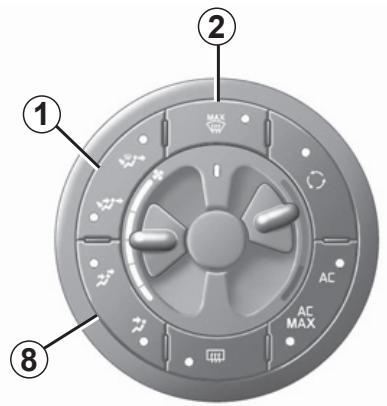
21421
Adjusting the distribution of air in the passenger compartment, buttons 1 and 8
The lit operating tell-tale indicates the position selected.
Note
If the "Clear View" function, button 2 is on, the air is automatically directed to the windscreen and side windows: the operating tell-tales for buttons 1 and 8 are off.
Button 1
Repeatedly pressing button 1 allows you to switch between the different modes of distribution.

Distribution
The air is directed to the windscreen, the side windows and the front and rear passenger footwells.
Advice on use: it is recommended that this distribution mode is used when it is cold outside.

Distribution
The air is distributed between the front and rear air vents and the front and rear passenger footwells.
Advice on use: it is recommended that this distribution mode is used when it is hot or sunny outside.
Button 8
Repeatedly pressing button 8 allows you to switch between the different modes of distribution.

Distribution
Air exits through the front and rear vents.
Advice on use: it is recommended that this distribution mode is used when it is very sunny outside or for lowering the temperature in the passenger compartment quickly if the vehicle has been sitting in the sun too long.

Distribution
Air exits through the front vents.
Advice on use: it is recommended that this distribution mode is used to inhibit the flow of air to the rear air vents.
HEATING/AIR CONDITIONING (5/7)
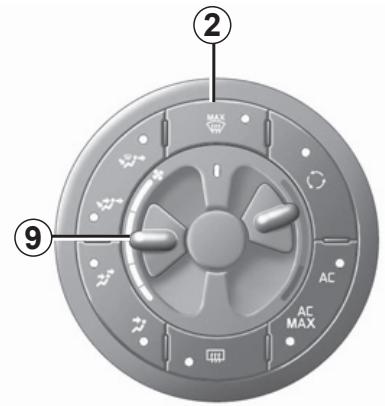
21421
Adjusting the ventilation speed
To adjust the ventilation speed, move tab 9.
Pushing tab 9 upwards increases the ventilation speed.
If tab 9 is pushed all the way down:
- the ventilation speed is zero;
- the air conditioning switches off automatically.
Advice on use of this function
For your comfort, it is recommended that you have at least a minimum level of ventilation to renew the air in the passenger compartment and to ensure that the air temperature is stable.
Note
When the "Clear View" function, button 2 is on, it is normal that the ventilation speed increases to de-ice and demist the windscreen and side windows more efficiently.
HEATING/AIR CONDITIONING (6/7)
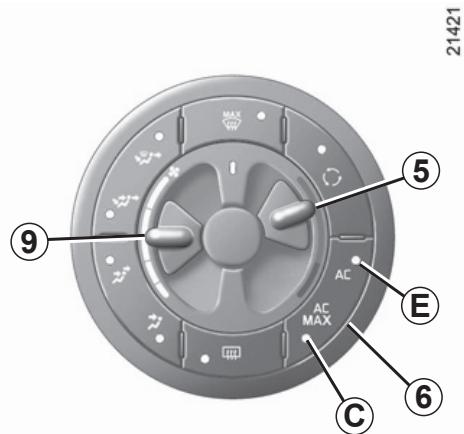
Air conditioning control
Button 6 starts or stops the air conditioning system.
The air conditioning system is used for:
- lowering the temperature inside the passenger compartment;
- eliminating condensation more quickly.
Repeatedly pressing button 6 enables you to:
- select the "air conditioning" function.
Operating tell-tale E comes on.
This is the most widely-used function: the system determines the level of cooling needed according to the external conditions. - select the "Maximum air conditioning" function.
Operating tell-tale ±bc comes on.
The air conditioning is at the maximum cooling level.
- switch the air conditioning off.
Operating tell-tales ±bE and ±bC are off.

Do not open the refrigerant fluid circuit. The fluid may damage eyes or skin.
Note:
- there is no cold air when tab 9 is positioned right at the bottom;
- you may adjust the air temperature in the passenger compartment at any point by moving air adjustment tab 5;
- the "Clear View" function automatically activates the air conditioning system: operating tell-tale C comes on.
If no cold air is produced
Check that the controls are set correctly and that the fuses are sound. Otherwise, switch off the air conditioning (press button 6 so that operating tell-tales ±bE and ±bC go out) and consult an approved dealer.
HEATING/AIR CONDITIONING (7/7)
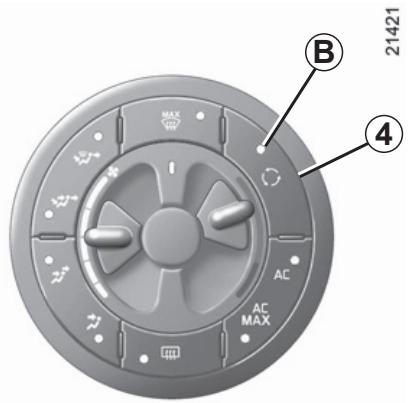
Air recirculation (isolation of the passenger compartment)
Press button 4: operating tell-tale light ±bB comes on.
Under these conditions, air is taken from the passenger compartment and is recirculated, with no air being taken from outside the vehicle.
Advice on use of the air recirculation
Air recirculation is for:
- isolating the vehicle from the external atmosphere (driving in polluted areas, etc.);
- bringing the passenger compartment to the desired temperature more quickly.
Note
Air recirculation is automatically switched off when the "Clear View" is on.
Prolonged use of air recirculation can lead to condensation forming on the side windows and windscreen, and discomfort due to the use of non-renewed air in the passenger compartment.
We therefore advise you to return to normal mode (external air) as soon as the air recirculation function is no longer required, by pressing button 4 again.
Depending on the external conditions, the system limits the air recirculation running time: operating telltale ±bB goes out.
AUTOMATIC CLIMATE CONTROL
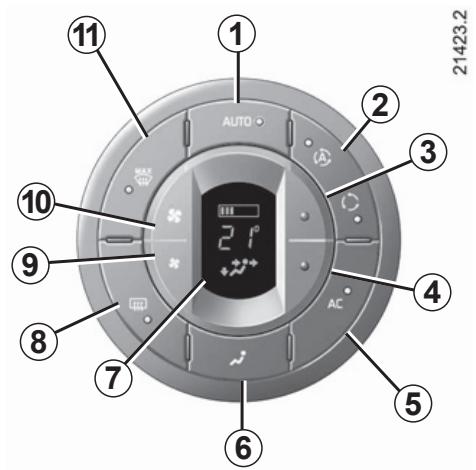
The controls
Driver's side
1 Button for switching automatic mode on
2 Air recirculation button for switching on the enforced or automatic recirculation system
3 and 4 Passenger compartment air temperature adjustment buttons
5 Button for switching the air conditioning on
6 Button for adjusting the distribution of air in the passenger compartment
7 Driver's control panel display
8 Button for switching on rear screen de-icing
9 and 10 Ventilation speed adjustment buttons
11 "Clear View" button to demist and de-ice the windows and wind-screen
Buttons 1, 2, 5, 8 and 11 have operating tell-tales:
- if the indicator light is on, the function is switched on;
- if the indicator light is off, the function is switched off.
Information and advice on use
Refer to the end of the section on "heating/air conditioning".
AUTOMATIC CLIMATE CONTROL (continued)
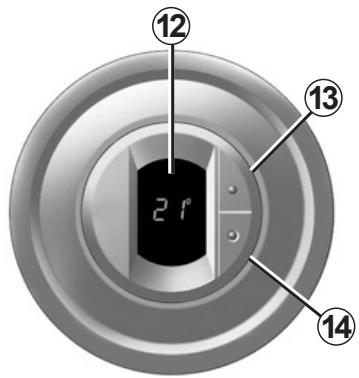
16612
Front passenger side
12 Front passenger control panel display
13 and 14 Passenger compartment air temperature adjustment buttons
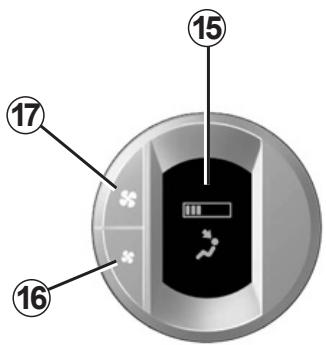
21424.1
Rear passenger sides
15 Rear passenger control panel display
16 and 17 Ventilation speed adjustment buttons
AUTOMATIC CLIMATE CONTROL (continued)
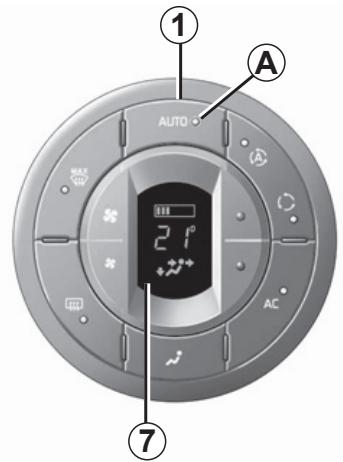
21423.2
166 12
21424.1
Automatic mode
Press button 1. Operating tell-tale A comes on.
The system controls:
- ventilation speed;
-air distribution; - air recirculation management;
- air conditioning (on or off);
- the temperature of the blown air to the right and left.
Automatic mode is the recommended mode of use
The automatic climate control system guarantees comfort in the passenger compartment and good visibility (except in the event of extreme conditions), while optimising consumption.
The types of adjustments that can be made are described in the following pages.
Return to automatic mode as soon as possible.
The operating tell-tales, along with the information shown on displays 7, 12 and 15 inform you which system has been chosen and its settings.
AUTOMATIC CLIMATE CONTROL (continued)
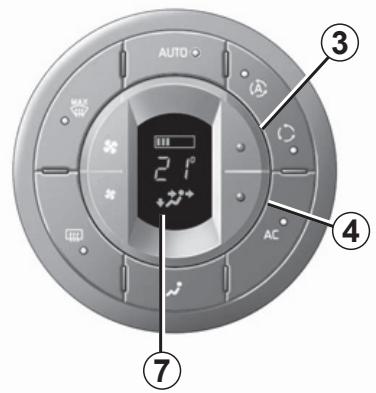
2
Adjusting the comfort level
Driver's side
Press button 3 to increase the temperature.
Press button 4 to decrease the temperature.
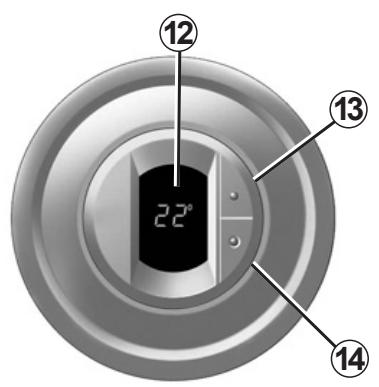
166-
Front passenger side
Press button 13 to increase the temperature.
Press button 14 to decrease the temperature.
The comfort level can be adjusted from 16 to 26^ .
The maximum and minimum settings of 16^ and 26^ , both on the left and right-hand sides, allow the system to produce a minimum or maximum temperature, whatever the ambient conditions.
If the maximum temperature settings are identical on both the passenger and driver sides, changing the temperature setting on one of the controls can lead to a forced air temperature variation on the side where the control is still set at the maximum temperature.
When the external temperature is lower than 2^ , it is normal for the system not to work.
There are two ways of using it:
- by using just buttons 3 and 4 on the driver's side, you can adjust the comfort level for the entire passenger compartment; the temperatures shown on displays 7 and 12 are always the same;
- by using buttons 13 and 14, you can adjust the comfort level independently for the left and the right-hand sides. Buttons 3 and 4 adjust the comfort level on the driver's side, buttons 13 and 14 adjust the comfort level on the passenger side.
AUTOMATIC CLIMATE CONTROL (continued)
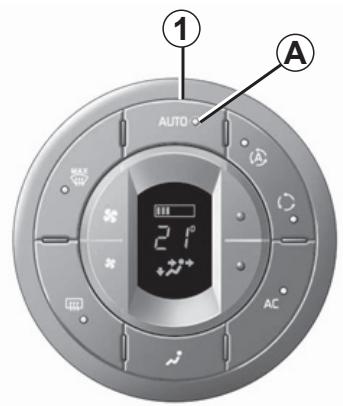
24
The are two options for enabling the driver to adjust the comfort level in the entire passenger compartment again:
- automatically, after the ignition has been switched off for at least 20 minutes;
- manually, by pressing and holding the AUTO button 1 until operating tell-tale A starts flashing, even if it was already lit.
Note: the temperature displayed on the passenger side will take on the same value as that shown on the driver's side.
Special note
The RENAULT card stores the settings selected by the user. It is therefore advisable always to keep the same RENAULT card so that you can find your personal settings.
The displayed temperature values show a comfort level.
When starting the engine, increasing or decreasing the value displayed will not allow the comfort level to be reached any more quickly. The system will always optimise the temperature increase or decrease (the ventilation system does not start instantly at maximum speed: it gradually increases). This may take several minutes.
Generally speaking, unless there is a particular reason not to, the dashboard air vents should remain open.
AUTOMATIC CLIMATE CONTROL (continued)
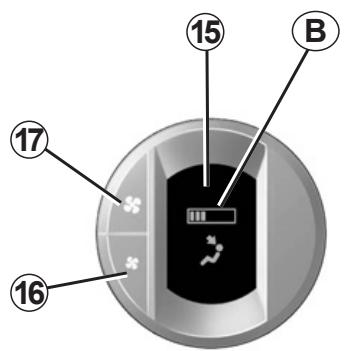
1 21424.1
Adjusting the ventilation speed in the rear seats (depending on vehicle)
The controls on each of the rear doors allow the ventilation speed of the air vents to be adjusted for the rear passengers.
Indicator B , made up of several bars which light up, shows the requested ventilation speed.
Press button 17 to increase the ventilation speed.
Press button 16 to decrease the ventilation speed.
To inhibit the air flow from the rear seat air vents, press button 16 until the last bar on indicator B goes out.
To return to normal ventilation speed (the minimum speed adjustment as defined by the system) in the rear seats, there are two options:
- after switching off the ignition;
- by pressing and holding the AUTO button 1 until operating tell-tale A starts flashing (even if it was already lit).
Special note
Depending on the vehicle, when the "child safety" switch is activated (indicator light on the switch is on), the rear heating and ventilation controls are deactivated. The last red bar on indicator B comes on and the ventilation speed in the rear is at the minimum speed setting as defined by the system.
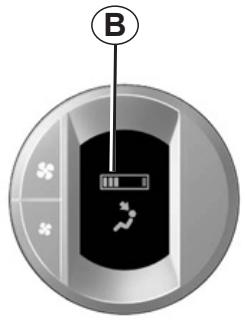
Conditions of use
In some cases (very warm passenger compartment, for example), if the last red bar on indicator ±bB is lit, this means that it is no longer possible to increase the ventilation speed. It will be possible to do so again once the red bar goes out.
AUTOMATIC CLIMATE CONTROL (continued)
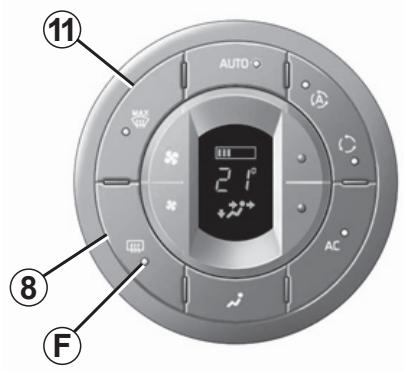
24
De-icing/demisting the rear screen and rear view mirrors
Press button 8: operating tell-tale light F comes on.
This function rapidly defrosts and demists the rear screen and the heated door mirrors.
To quit this function:
- It stops automatically after a time specified by the system;
- press button 8 again.
Note
The rear screen and rear view mirror de- icing function is automatically switched on when the "Clear View" button 11 is pressed.
The demisting/de-icing will still take priority over the air recirculation.
In some situations (high humidity, etc.) air recirculation is not activated automatically, to ensure visibility remains the priority (ventilation is maintained using air from the outside).
AUTOMATIC CLIMATE CONTROL (continued)
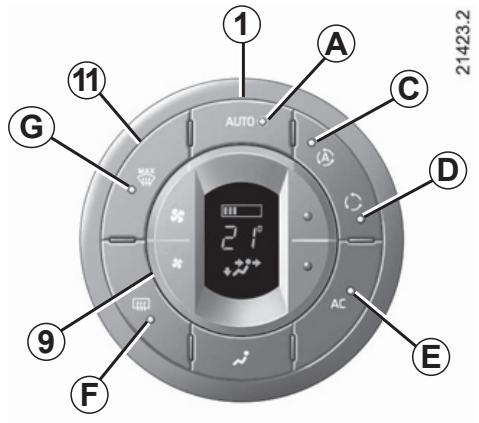
"Clear View" function
Press "Clear View" button 11, operating tell-tale light ±bF comes on. Indicator light ±bA on AUTO button 1 will go out.
This function quickly demists and devices the windscreen, the front side windows, the door mirrors and the rear screen.
For greater efficiency, it automatically switches on the air conditioning (operating tell-tale ±bE lit), the rear screen de-icing (operating tell-tale ±bF lit) and switches off the air recirculation (operating tell-tales ±bC and ±bD off).
Optimum air flow is then directed towards the windscreen and front side windows.
Note
If you wish to alter the air flow (which may be noisy in the passenger compartment), press button 9.
There are two ways to switch this function off:
- press AUTO button 1 (indicator light A lit);
- press button 11 again (indicator light G goes out).
AUTOMATIC CLIMATE CONTROL (continued)
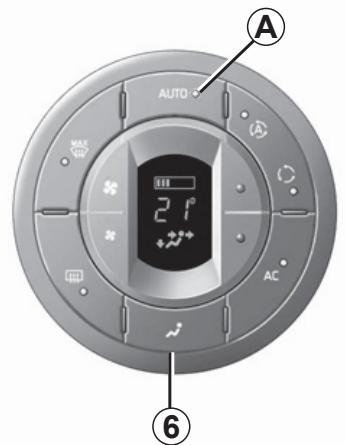
24
Adjusting automatic mode
Adjusting the distribution of air in the passenger compartment, button 6.
In automatic mode, the system manages the distribution of air in the passenger compartment (indicator light A lit), but you may alter the selections made by the system.
Exit automatic mode by pressing button 6 (indicator light A goes out). However, in this case, only the air distribution will no longer be controlled automatically by the system.
There are four choices for air distribution that are determined by pressing button 6 repeatedly.

Air exits through the front vents.

Air exits through the front and rear vents.

The air exits from all the vents and the vents next to the occu-et.

The air is directed towards the occupants feet and towards a screen.
This is the recommended mode of use: the automatic climate control system guarantees comfort (except in the event of extreme conditions) in the passenger compartment and good visibility while optimising consumption.
Return to automatic mode as soon as possible.
AUTOMATIC CLIMATE CONTROL (continued)
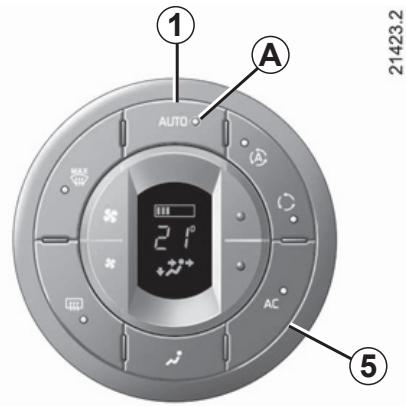
Adjusting automatic mode (continued)
Switching air conditioning on or off
In automatic mode, the system switches the air conditioning system on or off, depending on the climate conditions.
Exit automatic mode by pressing button 5 (indicator light A goes out).
Button 5 starts or stops the air conditioning system.
Press button 1 to return to automatic mode.
AUTOMATIC CLIMATE CONTROL (continued)
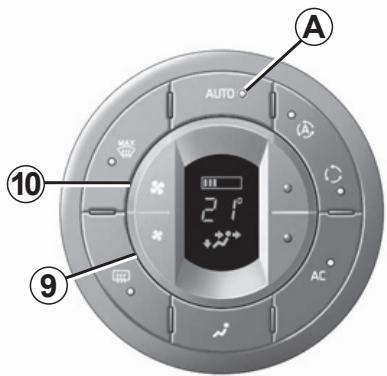
21423.2
Adjusting automatic mode (continued)
Ventilation speed
In automatic mode, the system uses the most suitable amount of air to reach and maintain the desired comfort level.
Exit automatic mode by pressing button 9 or 10 (indicator light A goes out).
Buttons 9 and 10 allow you to respectively decrease or increase the ventilation speed.
In automatic mode, depending on the outside air conditions, the ventilation may not start immediately at maximum power but will increase progressively until the engine temperature is warm enough to heat the passenger compartment air. This may take from a few seconds to several minutes.
AUTOMATIC CLIMATE CONTROL (continued)
Air recirculation (isolation of the passenger compartment)
The heating and air conditioning system uses air from the outside to heat or cool the passenger compartment.
However, when the "recirculation" function is in use, it is possible to isolate the passenger compartment from the atmosphere outside, e.g. when driving in polluted areas.
Note
Pressing the AUTO button 1 switches on the "automatic recirculation" function (indicator light C lit).
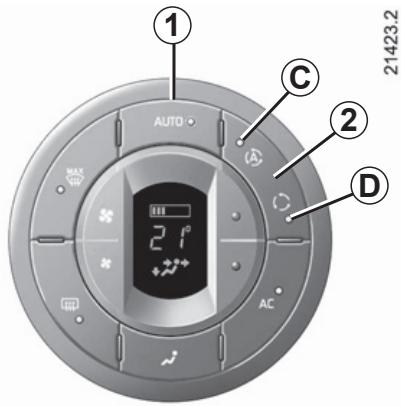
Repeatedly pressing button 2 enables you to select:
- automatic recirculation;
- enforced recirculation;
- exterior air.
With automatic recirculation
Indicator light C comes on. The system analyses the quality of the outside air and, when necessary, isolates the passenger compartment automatically.
With enforced recirculation
Indicator light D comes on. Air is taken from the passenger compartment and is recirculated without taking in air from the outside.
Note
Prolonged use of air recirculation can lead to condensation forming on the side windows and windscreen and discomfort due to the use of non-renewed air in the passenger compartment. We therefore advise you to switch back to automatic recirculation (light C lit) or outside air as soon as enforced recirculation is no longer necessary.
With air from the outside
Indicator lights C and D are off.
AUTOMATIC CLIMATE CONTROL (continued)
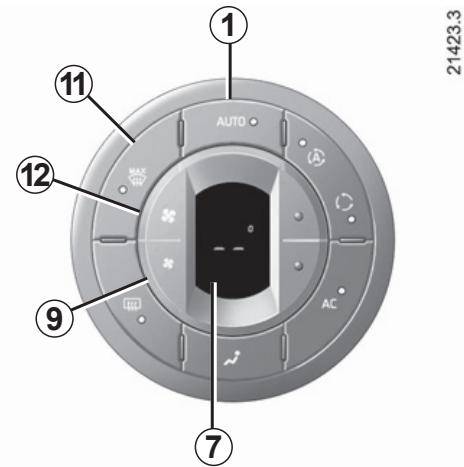
Stopping the system
Press button 9 until displays 7, 12 and 15 are shown.
The system is now switched off.
In this situation, the passenger compartment is isolated from the outside atmosphere.
To exit this function, press the AUTO button 1, on "Clear View" button 11 or button 10.
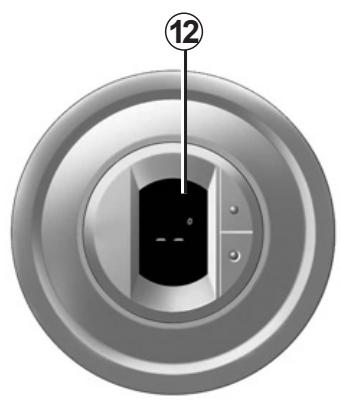
169
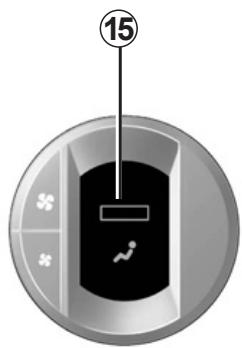
214243
AIR CONDITIONING: information and advice on use
Fuel consumption
You will normally notice an increase in fuel consumption (especially when driving in town) when the air conditioning is operating.
For vehicles fitted with manual air conditioning, switch off the system when it is not required.
Advice for reducing consumption and therefore helping to preserve the environment:
Drive with the air vents open and the windows closed.
If the vehicle has been parked in the sun, open the doors for a few moments to let the hot air escape before starting the engine.
Maintenance
Refer to the Maintenance Service Booklet for your vehicle for the inspection frequency.
Operating faults
As a general rule, contact your approved dealer in the event of an operating fault.
- Reduction in de-icing, demisting or air conditioning performance. This may be caused by the passenger compartment filter cartridge becoming clogged.
- No cold air is being produced. Check that the controls are set correctly and that the fuses are sound. Otherwise, switch off the system.
Notes
Presence of water under the vehicle. After prolonged use of the air conditioning system, it is normal for water to be present under the vehicle. This is caused by condensation.
Vehicles fitted with an auxiliary heater
Some vehicles are fitted with an auxiliary heater which heats the passenger compartment more quickly.
This device operates only when the engine is running and in cold weather.
When the device is functioning you can normally see a small amount of smoke on the right-hand side of the vehicle coming from the heater's exhaust system.

Do not add anything to the vehicle's ventilation circuit (for example, to remove bad odours).
There is a risk of damage or of fire.

Do not open the refrigerant fluid circuit. The fluid may damage eyes or skin.
ELECTRIC WINDOWS
With the ignition on
- Press the switch to open the window to the desired height (note: the rear windows do not open fully);
- lift the switch for the window concerned to raise it to the desired height.
From the driver's seat
Operate the switches as follows:
1 for the driver's side;
2 for the front passenger's side;
3 and 5 for the rear passengers.
From the front passenger seat
Press switch 6.
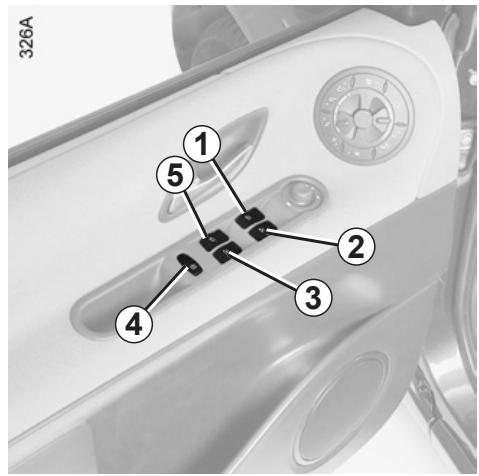
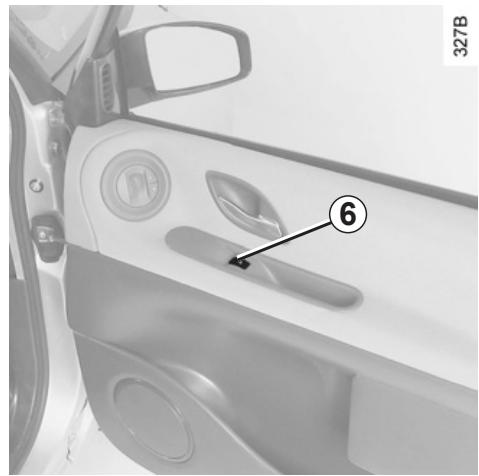

Safety of rear occupants
The driver can authorise operation of the rear doors and, depending on the vehicle, the rear electric windows by pressing switch 4. The integrated indicator on the switch confirms this.
Driver's responsibility
Never leave your vehicle with the RENAULT card inside and never leave a child (or a pet) unsupervised, even for a short while. The reason for this is that the child may endanger himself or others by starting the vehicle, activating equipment such as the windows, or locking the doors. If any part of the body becomes trapped, reverse the direction of the window immediately by pressing the relevant switch. Risk of serious injury.
ELECTRIC WINDOWS (continued)
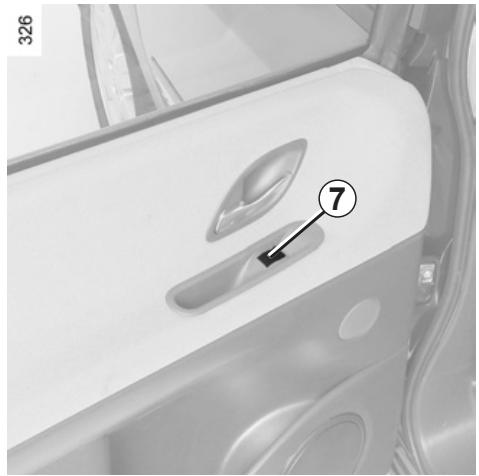
From the rear seats
Press switch 7.
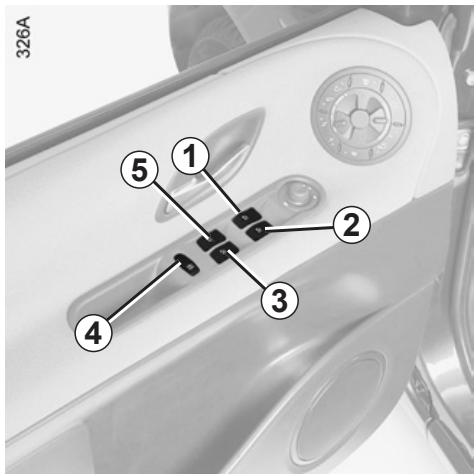
Using switch 4
In the driver's seat, switch 4 allows operation of the rear windows, rear door and rear heating and ventilation controls to be inhibited (refer to the information on "automatic climate control" in Section 3).

Safety of rear occupants
The driver can authorise operation of the rear doors and, depending on the vehicle rear electric windows by a switch 4. The integrated driver on the switch confirms this.
Driver's responsibility
Never leave your vehicle with the RENAULT card inside and never leave a child (or a pet) unsupervised, even for a short while. The reason for this is that the child may endanger himself or others by starting the vehicle, activating equipment such as the windows, or locking the doors. If any part of the body becomes trapped, reverse the direction of the window immediately by pressing the relevant switch. Risk of serious injury.
ONE-TOUCH ELECTRIC WINDOWS
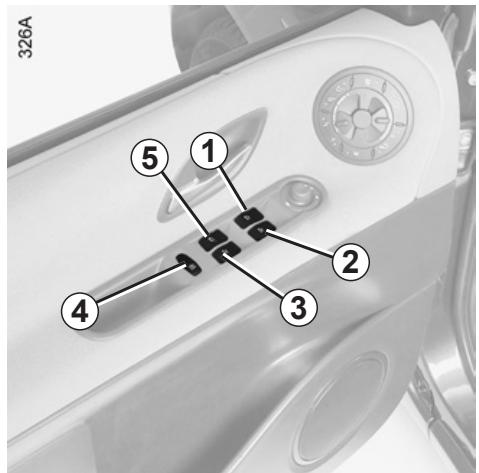
The one-touch mode works in addition to the operation of the electric windows described previously.
If it is fitted to the vehicle, it may be fitted: to the driver's window or to all four windows.
Press switches 1, 2, 3, 5, 6 or 7.
The system operates:
with the ignition on;
with the ignition off until one of the front doors is opened (limited to approximately 20 minutes).
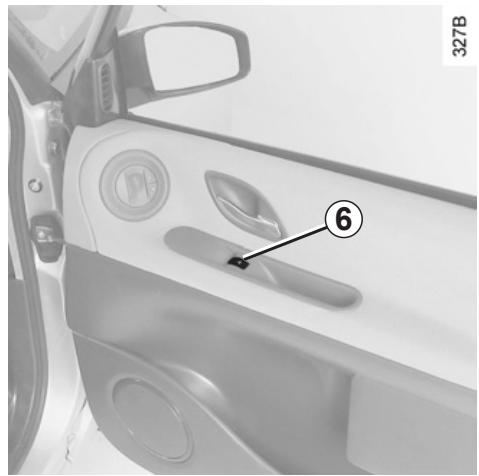
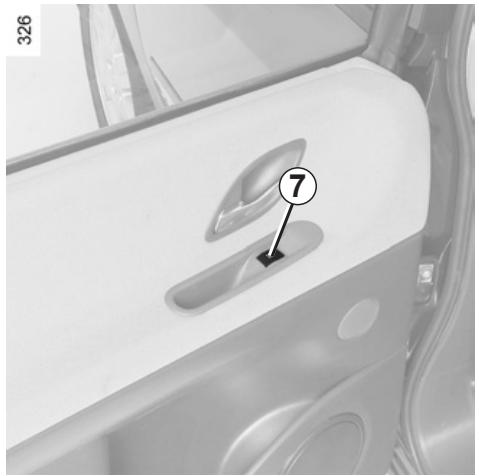

Safety of rear occupants
The driver can authorise operation of the rear doors and, depending on the vehicle, the rear electric windows by pressing switch 4. The integrated indicator on the switch confirms this.
Driver's responsibility
Never leave your vehicle with the RENAULT card or remote control inside and never leave a child (or a pet) unsupervised, even for a short while. The reason for this is that the child may endanger himself or others by starting the vehicle, activating equipment such as the windows, or locking the doors. If a body part gets trapped, reverse the direction of travel of the window as soon as possible by pressing the relevant switch.
Risk of serious injury.
ONE-TOUCH ELECTRIC WINDOWS (continued)
One-touch mode
Briefly press the relevant switch fully: the window is lowered completely.
Briefly raise the switch concerned fully: the window is raised completely.
Pressing the switch again while the window is moving will stop its movement.
Normal mode
Press the switch halfway to lower the window and release at the desired height.
Raise the relevant switch halfway to raise the window and release at the desired height.
Operating faults
If a window cannot be closed or if the battery is disconnected, the system reverts to normal mode: press the switch concerned as often as necessary to close the window, then hold the switch (still on the closure side) for one second to reinitialize the system. If necessary, contact an approved Dealer.
Remote control window closing
(for vehicles fitted with one-touch electric windows).
When locking the doors, pressing and holding the RENAULT card's locking button for more than 2 seconds will close the windows automatically.
Special note
If the window detects resistance when closing (e.g. a person's fingers, an animal's paw, the branch of a tree, etc.) it stops and then lowers again by a few centimetres.
The system should only be used if the driver can clearly see that nobody is inside the vehicle.

Closing windows can cause serious injury.
WINDSCREEN/FIXED GLASS SUNROOF
Heat reflecting windscreen
This windscreen reflects the sun and limits the infrared rays entering the passenger compartment.
There are two locations for storing pass cards (e.g.: for motorway tolls and car parks, etc.), located either side of the rear view mirror.
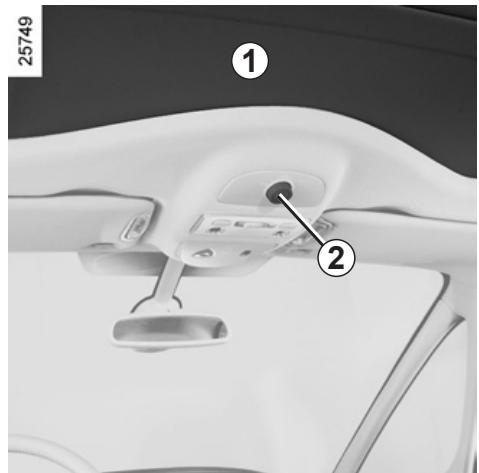
To slide screen 1
With the ignition on:
- to open: move mark 3 on button 2 to position A . The points in between correspond to the progressive opening positions of the screen;
- to close: move mark 3 on button 2 to position 0.
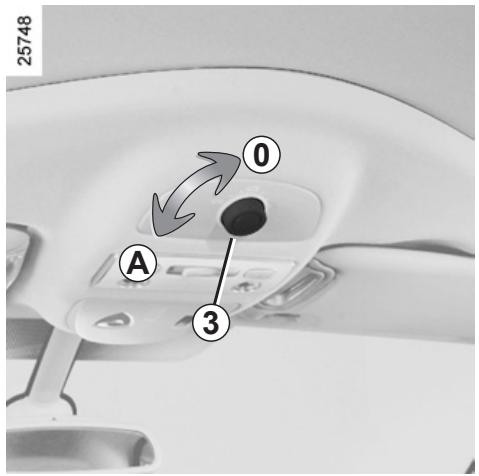
ELECTRIC SUNROOF
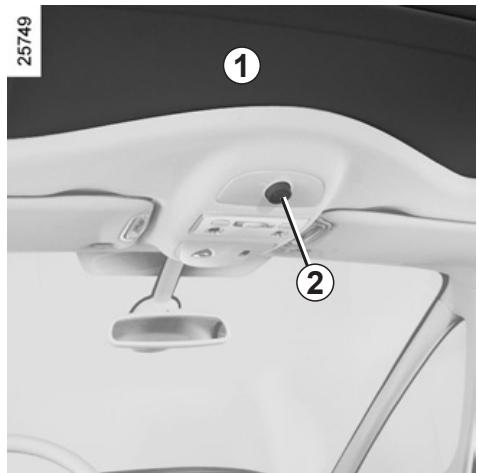
To slide screen 1
With the ignition on:
- to open: move mark 3 on button 2 to position A . The points in between correspond to the progressive opening positions of the screen;
- to close: move mark 3 on button 2 to position 0.
Special note
Pressing button 2 allows the screen to be automatically positioned depending on the position of the sunroof.
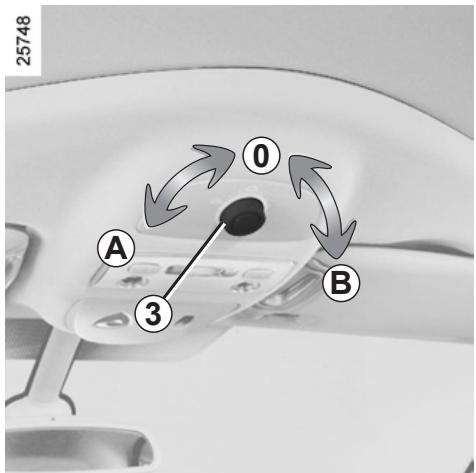
To slide the sunroof
With the ignition on:
- to open: move mark 3 on button 2 to position B, depending how far you wish it to open. The points in between correspond to the progressive opening positions;
- to close: move mark 3 on button 2 to position 0.
Precautions during use
- Vehicle with loaded roof bars.
As a general rule, if there is a load on the roof, use of the sunroof is not recommended.
Before using the sunroof, check the objects and/or accessories (bike racks, roof boxes, etc.) attached to the roof bars: they should be properly arranged and secured and should not interfere with the operation of the sunroof.
Contact an approved dealer for details of possible conversions;
- check that the sunroof is properly closed before leaving your vehicle;
- clean the seal every three months using products recommended by our Technical Department;
- do not open the sunroof immediately after it has rained or immediately after washing the vehicle.
ELECTRIC SUNROOF (continued)
Closing the sunroof by remote control
(vehicles with one-touch electric windows).
When locking the doors, pressing and holding the RENAULT card's locking button for more than 2 seconds will close the windows and sunroof automatically.
Special features
If the sunroof panel encounters resistance whilst closing, (somebody's fingers, an animal's paw or the branch of a tree), it stops and then moves back several centimetres.
It is recommended that the user only operates the system when the vehicle can be seen clearly and no one is inside. After closing the sunroof by remote control, pressing button 2 allows the sunroof to return to its previous position.

Closing the sunroof can cause severe injuries.
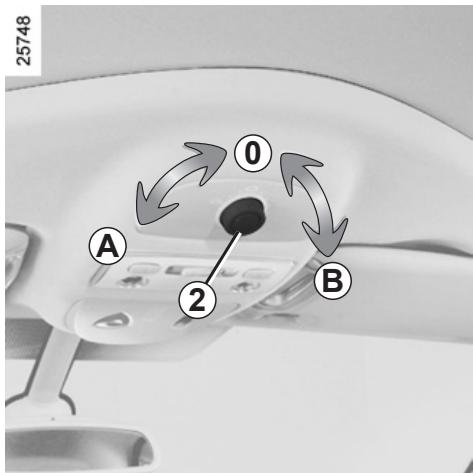
Sunroof closing operating fault
If the sunroof does not close, press switch 2, positioned at 0, until the sun-roof is fully closed: consult an approved Dealer.
Screen operating fault
If the screen does not close, press switch 2, positioned at 0, until the screen is fully closed: consult an approved Dealer.
- Never operate the sunroof with the blind closed.
- Never drive with the sunroof open and the sun blind closed.

Driver's responsibility
Never leave your vehiclewith the RENAULT cardinside and never leave a
child (or a pet) unsupervised, even for a short while.
They may pose a risk to themselves or to others by starting the engine, activating equipment such as the electric windows or by locking the doors.
If something gets trapped, reverse the direction of travel as soon as possible by turning button 2 fully to the right (position B).
Risk of serious injury.
SUN VISOR
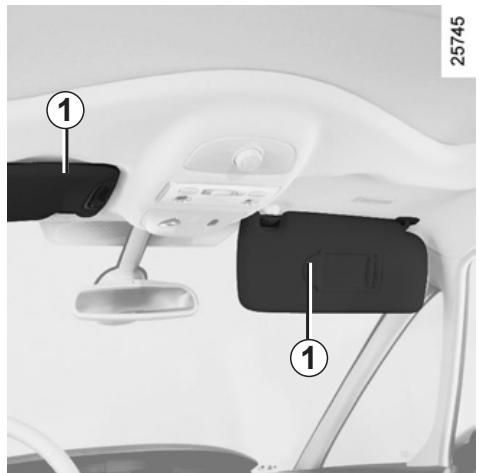
Front sun visor
Lower the sun visor 1 over the windscreen or unclip it and lower it over the side window. To fill in the space between the two front sun visors, pull out flap 2 in each of the sun visors.
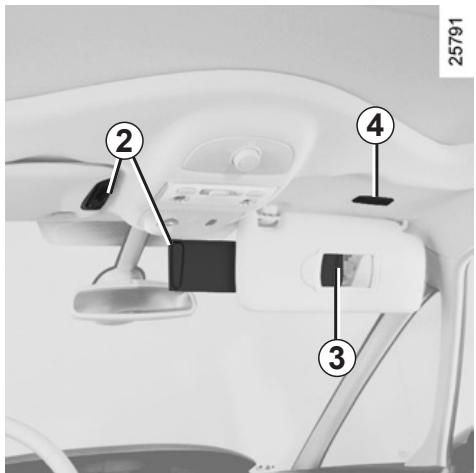
Courtesy mirror 3 without light
Slide cover 3.
Courtesy mirror with light
Slide cover 3.
Light 4 switches on automatically.
SUN VISOR (continued)
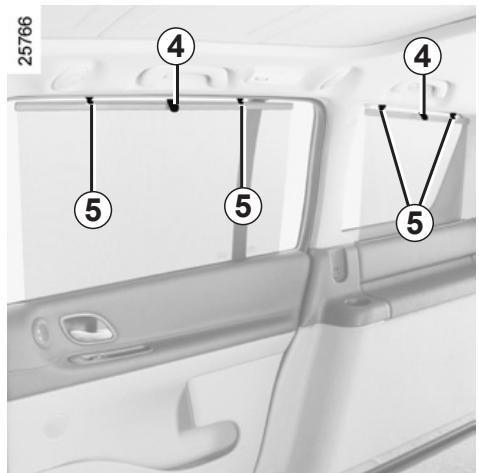
Side sun blind
Pull the sun visor up by tab 4 until hooks 5 engage in the housing (make sure the hooks are properly locked in position).
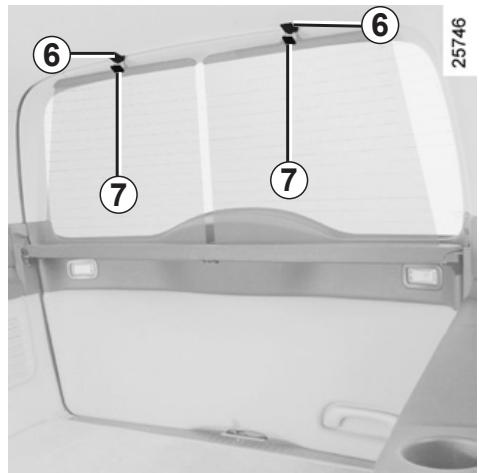
Rear sun blind
Using tab 7, pull the sun visor upwards until hook 6 engages in its housing (make sure that the hook is correctly clipped in).
INTERIOR LIGHTING
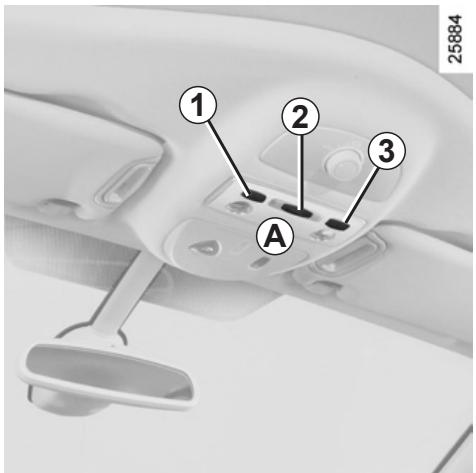
Courtesy light A or B
Press switch 2 or 5 for:
- continuous lighting;
- intermittent lighting, which comes on when a door is opened. The light only goes out when the doors are correctly closed;
- the light does not come on at all.
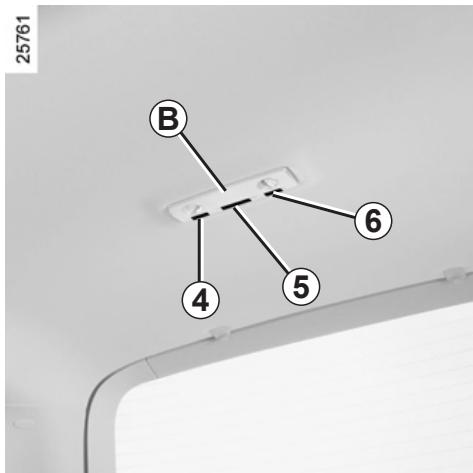
Map reading lights
In the front seats, press switch 1 for the driver and 3 for the front passenger. In the rear seats, press switch 4 or 6.
Remote unlocking of the doors activates the courtesy and floor lights temporarily. If a door is opened the timed light operation period will begin again. Then, the lighting goes out progressively.
INTERIOR LIGHTING (continued)
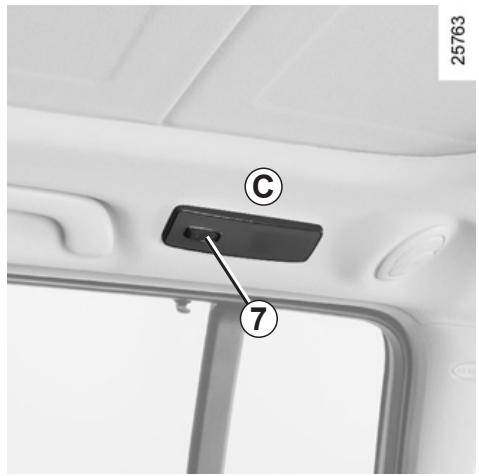
Courtesy lights C
Press switch 7 for:
- continuous lighting;
- intermittent lighting, which comes on when a door is opened. The light only goes out when the doors are correctly closed;
- the light does not come on at all.
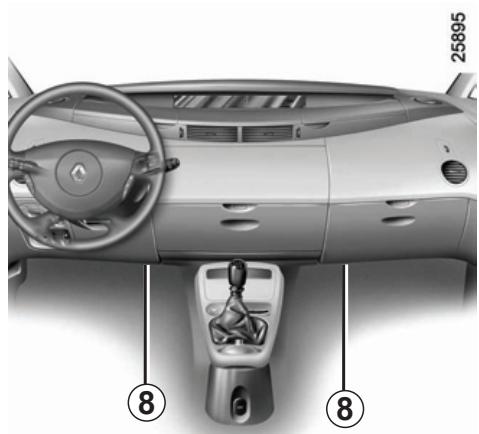
Floor lights 8
These are located underneath the dashboard: one on the driver's side and one on the passenger side.
Remote unlocking of the doors activates the courtesy and floor lights temporarily. If a door is opened the timed light operation period will begin again. Then, the lighting goes out progressively.
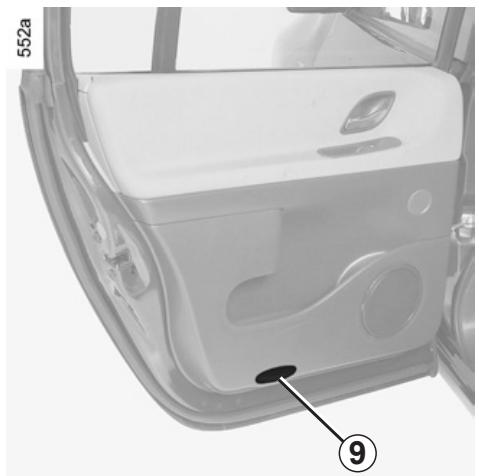
Door lights or retroreflectors 9
When the vehicle is fitted with lights, these come on when the door is opened.
DASHBOARD FITTINGS/STORAGE COMPARTMENTS (1/2)
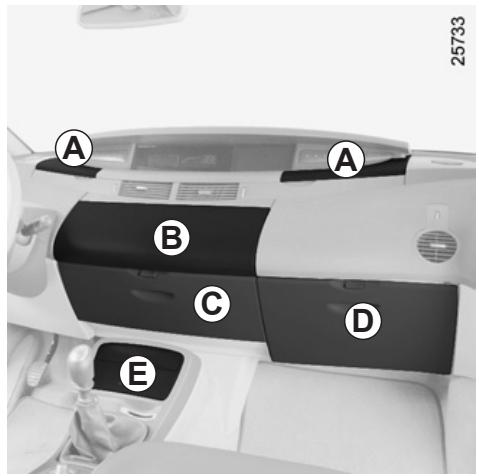
- Dashboard fittings and storage compartments
Upper storage compartments A
Centre storage compartment B
Centre storage compartment C
Glovecbox ±bD
Cup holder E
Upper storage compartments A
To open, lift cover 1.
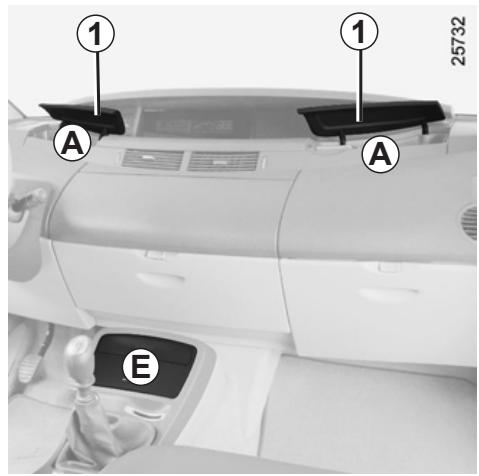
Cup holder E
Designed to accommodate cups or an ashtray.

When turning corners, accelerating or braking, ensure that the receptacle being held by the cups is not dislodged.
There is a risk of burning if hot liquid escapes.
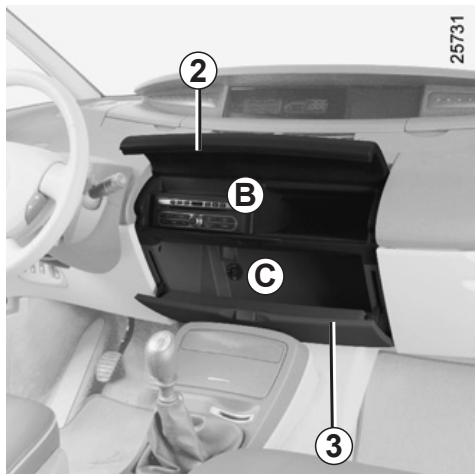
Centre storage compartment B
To open, lift cover 2.
Depending on the vehicle, this storage compartment may be split into one or more sections.
Centre storage compartment C
To open, press button 3 and lower the cover.
DASHBOARD FITTINGS/STORAGE COMPARTMENTS (2/2)
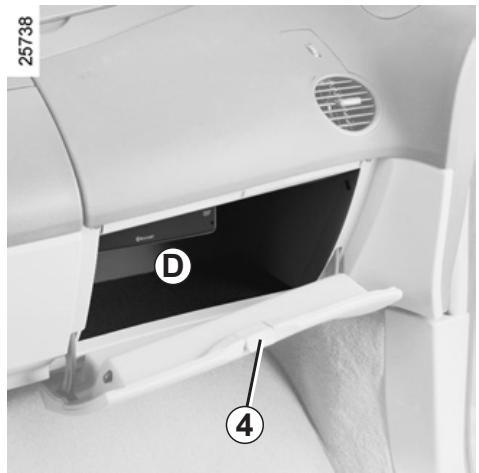
GlovecboxD
To open, press button 4 and lower the cover.
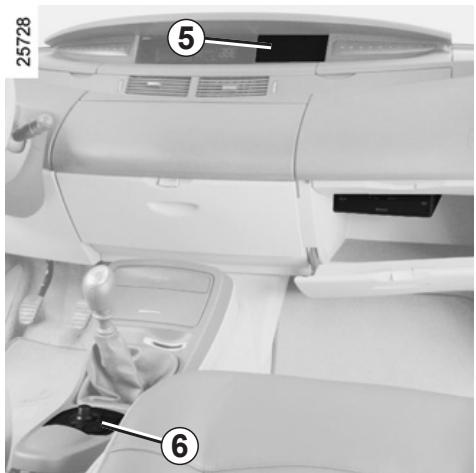
Navigation system
The system comprises:
display 5;
- controls 6 located on the centre console.
PASSenger COMPARTMENT STORAGE/Fittings (1/2)
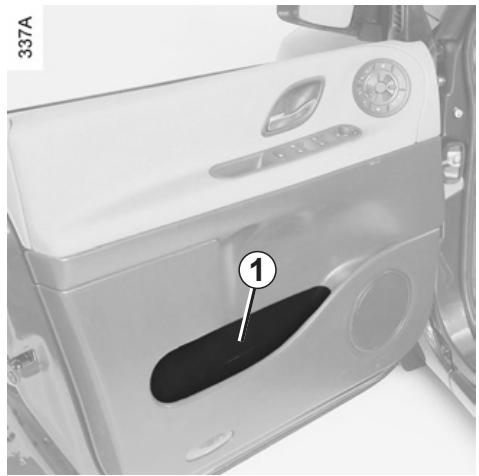
Door pockets 1
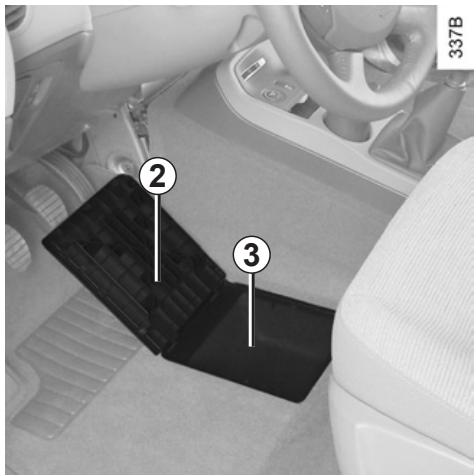
Driver footwell storage compartment 3
Depending on the vehicle, this location is provided for housing an electrical unit. Otherwise, it can be used as a storage compartment: lift cover 2.

Ensure that no hard, heavy or pointed objects are placed in the "open" storage compartments in such a
way that they may fall onto passengers during sudden turning, braking or in the event of an accident.

Nothing should be placed on the floor (area in front of driver) as such objects may slide under the pedal during
braking manoeuvres, thus obstructing its use.
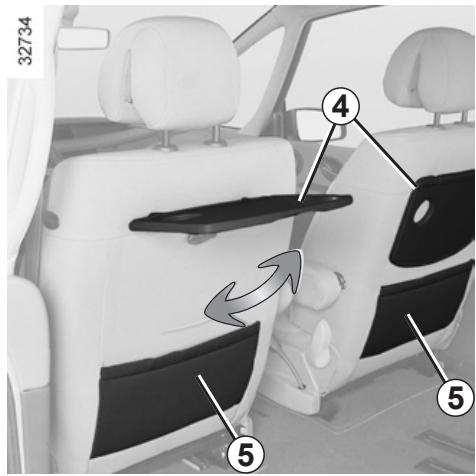
Rear parcel shelf 4
Front seat storage pockets 5
PASSenger COMPARTMENT STORAGE/Fittings (2/2)
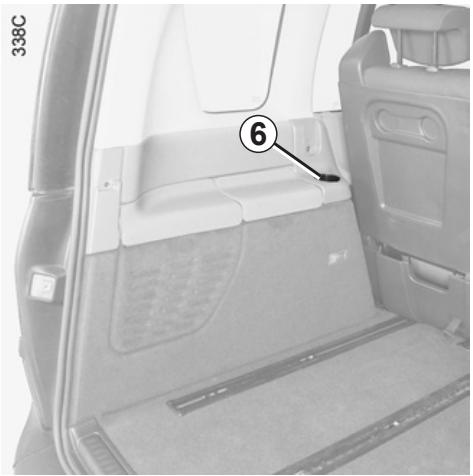
Cup holder 6
It can hold a can, a cup or the ashtray.

When turning corners, accelerating or braking, ensure that the receptacle being held by the cups is not dislodged.
There is a risk of burning if hot liquid escapes.
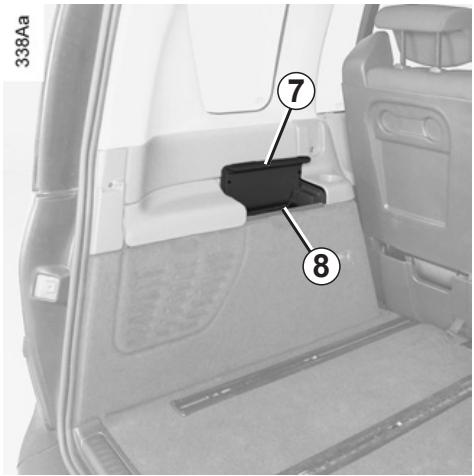
Rear side storage compartment 8
Lift cover 7.
It is possible to remove this storage compartment by lifting it using cover 7 to form a different type of storage compartment.
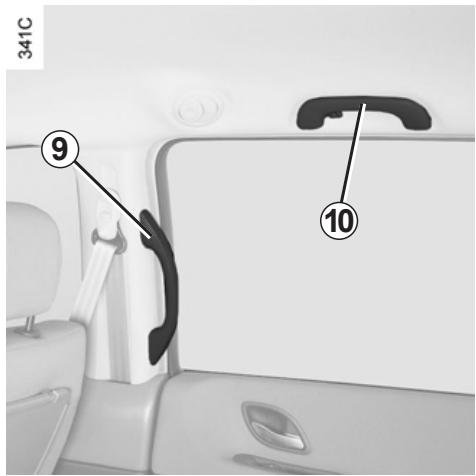
Grab handle 9
It enables you to get into or get out of the vehicle more easily.
Grab handle 10
This offers support and can be held when the vehicle is cornering. Do not use it for getting into or out of the vehicle.
ASHTRAYS/CIGAR LIGHTER/ACCESSORIES SOCKET
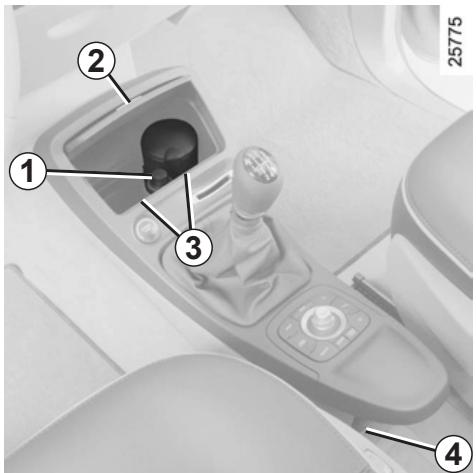
Ashtray
It can be housed in either position 3 or 5.
Press cover 2 to open.
Remove the ashtray to empty it.
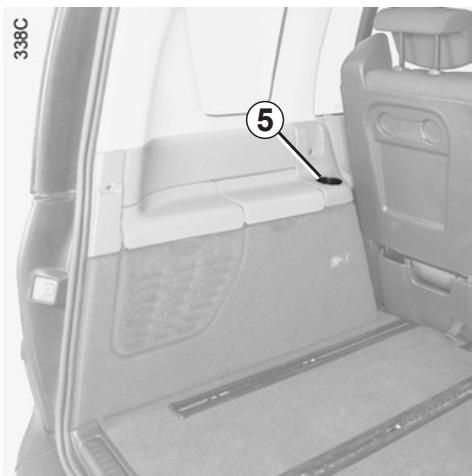
Cigar lighter
With the ignition on, push in the cigar lighter 1.
It will spring back with a click when it is ready. Pull it out to use. After use, replace it without pushing it all the way in.
If your vehicle is not fitted with a cigar lighter and an ashtray, these can be obtained from an approved Dealer.
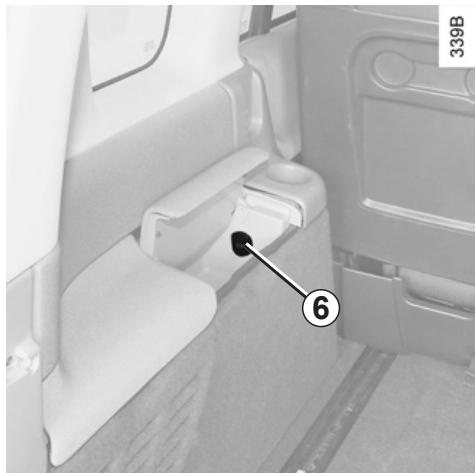
Accessories sockets
Either of socket locations 4 or 6 can be used. They are designed for connecting accessories with a maximum power rating of 120 Watts (voltage: 12V) which have been approved by our Technical Department.

Connect accessories with a maximum power of 120 Watts only.
Fire hazard.
REAR SEATS: headrests
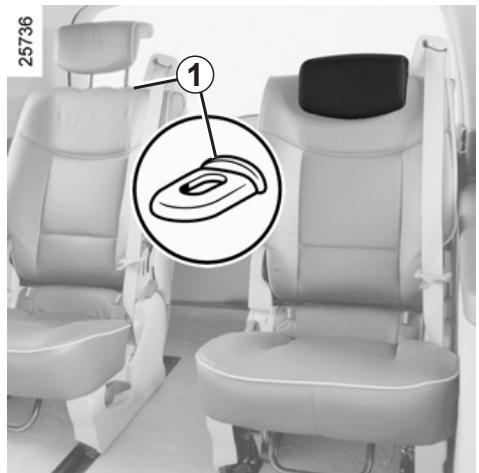
To adjust the height
Slide the headrest slowly while pulling it towards the front of the vehicle.
The headrest does not lower fully.
To remove the headrest
Press tab 1 on the headrest guide and lift the headrest. If the headrest is trapped against the roof of the vehicle, tilt the seatback.
To refit the headrest
Insert the rods into the sleeves, with the notches at bottom to the front, and lower the headrest to the desired height.
Rear headrest storage position
Press tab 1 on the headrest guide and lower the headrest completely.
The fully lowered headrest position is a storage position: it should not be in this position when a passenger is seated.
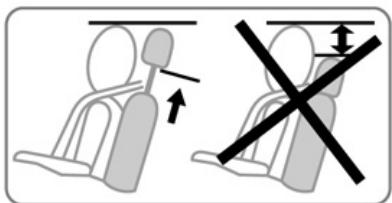

The headrest is a safety component, check that it is fitted and in the correct position. The distance between your head and the headrest is as small as possible. The your head should be in line to the top of the headrest.
CHILD'S CONVERTIBLE HEADREST
342A
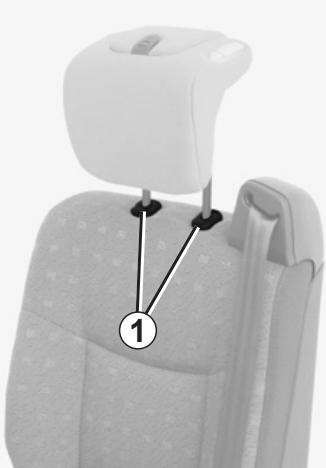
Depending on the vehicle, the child headrests are fitted to the rear side seats (for a normal chassis) or the side seats in the second row of rear seats (for a long chassis).
26342
To remove the headrest
Press tabs 1 and raise the headrest to remove it.
To refit the headrest
Insert the headrest rods into the holes, with the notches to the front, and lower the headrest to the desired height.
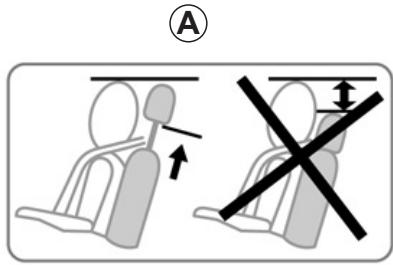
To adjust the height
Pull the headrest towards you and simultaneously slide it to the recommended height (see Figure A).

The headrest is a safety component, check that it is fitted and in the correct position.

The headrest is approved only for the vehicle on which it is originally fitted.
It must not be fitted to another vehicle under any circumstances.
CHILD'S CONVERTIBLE HEADREST (continued)
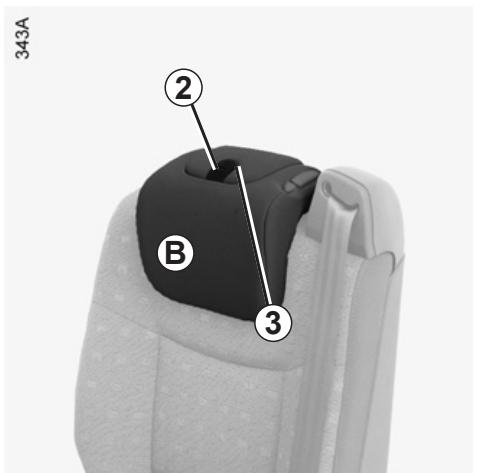
For child use
Lift latch 2, disengage strap 3, and then lower latch 2 again. Lower cushion B completely.
Place the child on the seat. The two side supports 4 must be positioned on either side of the neck. Then adjust the height of the headrest: the base of side supports 4 must be approximately two centimetres above the shoulders.
To improve comfort for the child, adjust the seat belt in retainer 5. Label C reminds you of the procedure to follow.
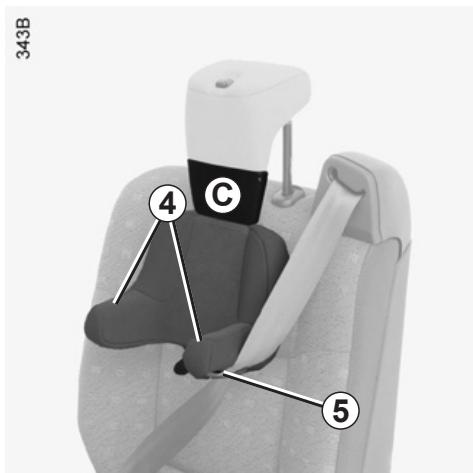
To refit the headrest
Lift latch 2 again, refit cushion B, engage strap 3, and then lower latch 2 to lock the headrest in place. Check that it is correctly locked in position.
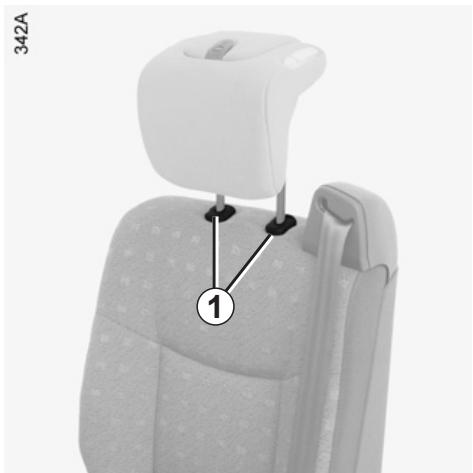
Child headrest storage position
Press tab 1 on the headrest guide and lower the headrest completely.
When the headrest is set at the lowest position, this is for storage only. It should not be in this position when a seat is occupied.

The child headrest can be used only with an approved booster seat for categories 2 (15 to 25kg ) and 3 (22 to 36kg ). Refer to the information on "Child safety: fitting a child seat" in Section 1.
In any other case, cushion ±bB must always be kept in the raised and locked position,
REAR SEATS: armrests
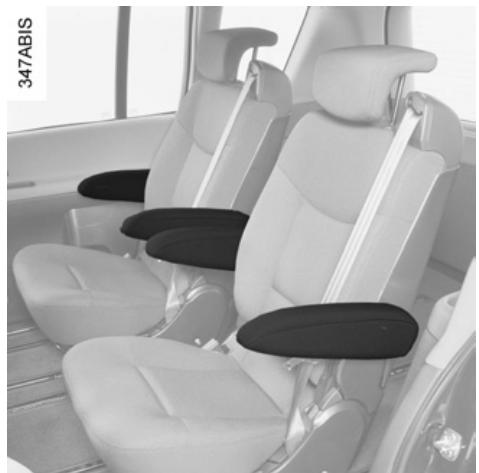
Rear armrests
On equipped vehicles, these can be fitted to the rear seats on a maximum of two seats per row.
To identify the correct side for fitting the armrests, refer to the letter inscribed on the armrest rotation shaft:
- L for the left-hand side;
- for the right-hand side.
Armrests must not be fitted to the centre rear seat in the first row when rear seats are fitted in the second row.
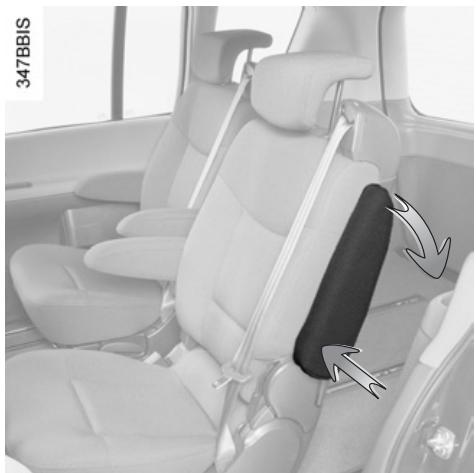
Removing armrests
position the armrest vertically;
- push down on the armrest at the rotation axis and at the same time tilt it back as far as possible;
- release the pressure to free the armrest from its mounting and remove the armrest;
- reposition blanking cover 1.
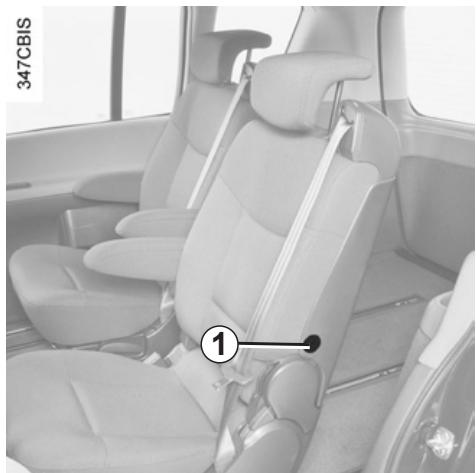
Refitting
- Remove blanking cover 1;
position the armrest vertically (in alignment with the seatback); - press down on the armrest and at the same time fold it down.
REAR SEATS: adjustment
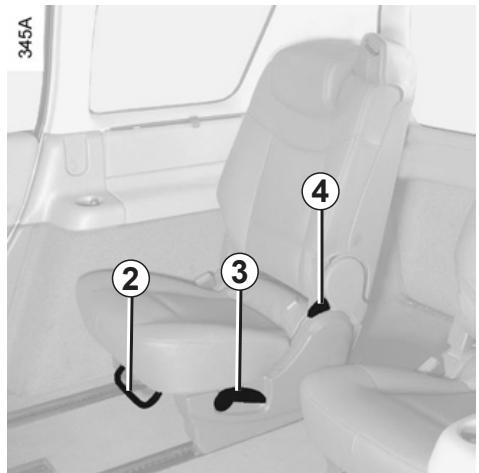
To move the seat forwards or back
Lift control 2, handle 3 or pull on release 6.
Release the control to the chosen position and the seat will lock into the nearest position. Make sure the seat is correctly locked in position.

When moving the rear seats, ensure that nothing obstructs the anchorage points (passenger's arm or jet, gravel, cloth, toys, etc.).
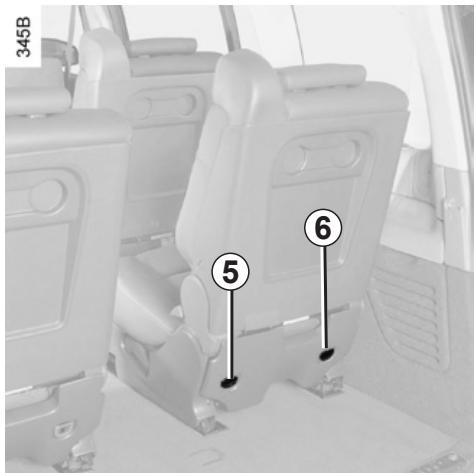
To adjust the angle of the seatback
- Pull handle 4 and adjust the angle of the seatback.
or
- Pull release 5 and adjust the angle of the seatback.
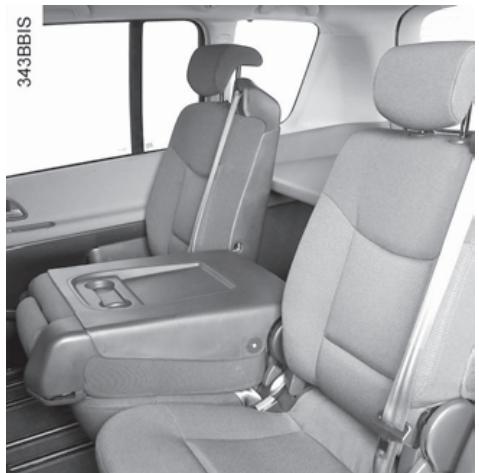
Table function
An occasional table position can be created by folding the seatback all the way down onto the seat cushion.
It is advisable to carry out any adjustments when the vehicle is stationary.
REAR SEATS: FUNCTIONS (1/4)
The rear seats are separate seats.
Each seat is anchored onto two rails.
There can be up to three seats on the first rear row and up to two seats on the second rear row.
They can be positioned forward-facing, which is the required position for driving the vehicle, or in the rear-facing position.
Some examples of seat positions are shown and details given next.

When moving the rear seats, ensure that nothing obstructs the anchorage points (passenger's arm or et, gravel, cloth, toys, etc.).
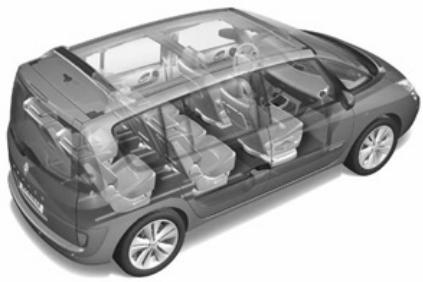
First example: the five rear seats are fitted.
If the vehicle is fitted with armrests, it is necessary to take them out before removing the three seats in the first back row (refer to the information on "Rear Seats: Armrests" on the preceding pages).
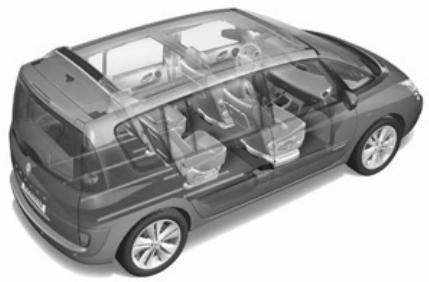
2
Second example: two seats fitted in the rear.
REAR SEATS: FUNCTIONS (2/4)
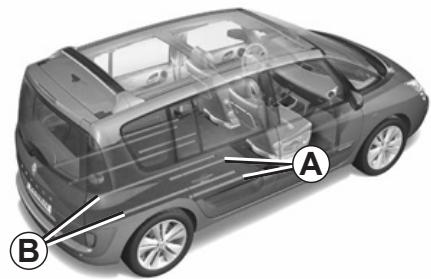
23467
Third example: all the seats are taken out.
Fourth example: the seats are in storage position.
Move front seat 1 forward. Install seat 2, with the seatback folded down, onto rails A , and move it as far forward as possible.
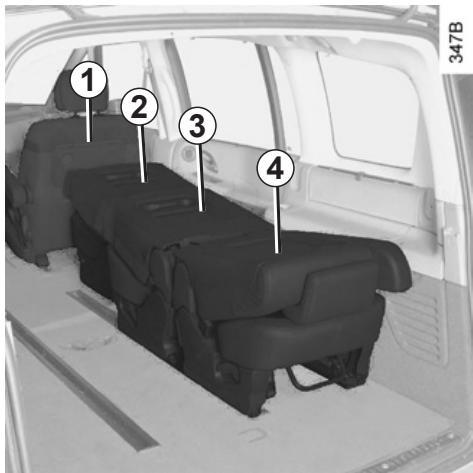
Next install seat 3 on rails B, with the seatback folded down, move it as far forward as possible, then install seat 4, in the rear-facing position with the seatback folded down, onto rails B and position it as far back in the vehicle as possible, move seats 3 then 2 back, followed by front seat 1.
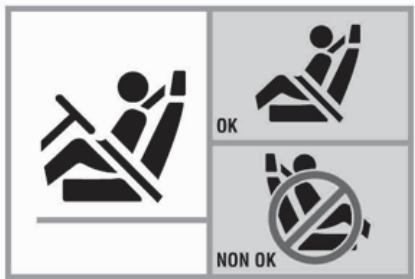
Special information for seats positioned in the rear-facing position

Seats must only be used in the rear-facing position when the vehicle is stationary.
REAR SEATS: FUNCTIONS (3/4)
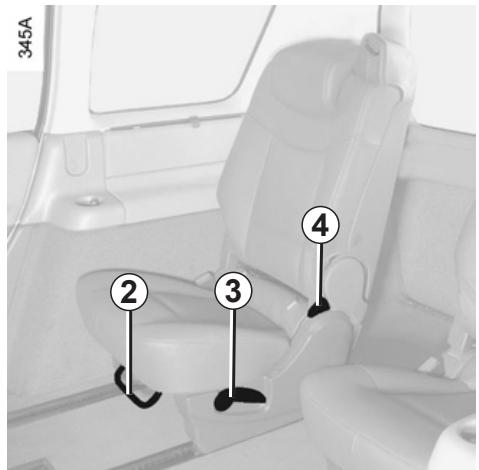
To remove a seat
Lower the headrest.
Move the seat back by lifting one of controls 2 or 3 or by pulling on release 6.
Fold the seat into the table position by lifting handle 4 or by pulling on release 5.
Pull release 6 fully, and move the seat forwards, pulling it off the rails.
Use bar 7 to remove the seat from vehicle.
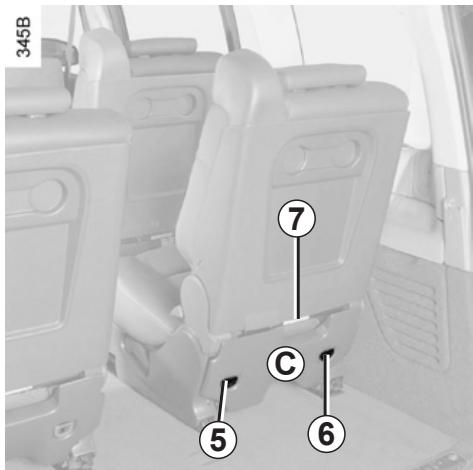
Check that there are no objects stored behind trim C.
Note: Release 6 can be released as soon as the seat has been completely removed from the rails.

When moving the rear seats, ensure that nothing obstructs the anchorage points (passenger's arm or et, gravel, cloth, toys, etc.).
- Do not attempt to pull a seat back if it is not in the table position.
- When the seat is removed from the rails, the seatback is locked in the table position.
Do not attempt to open the seatback as this may damage the seat.
- If seats are removed from the vehicle and stored elsewhere, make sure that they are kept in a clean place, so as to avoid contact with foreign bodies.
- The seats are not designed to be used other than in the vehicle. The seats are fitted with certain mechanisms and their function may be compromised if they are misused or dropped.
If a seat is dropped, contact an approved dealer.
REAR SEATS: FUNCTIONS (4/4)
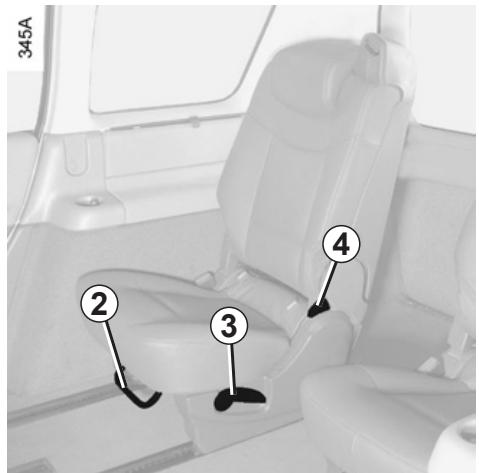
To fit a seat
The seats can be adjusted to your preferred position on the rails.
Place the seat on the rails.
The seat automatically locks itself onto the nearest notch when placed on the rails.
Check that the seat is locked correctly by moving it from left to right and then forwards and backwards.
Note: if the seat does not lock back onto the rails correctly, pull on release 6 again to reload the system.
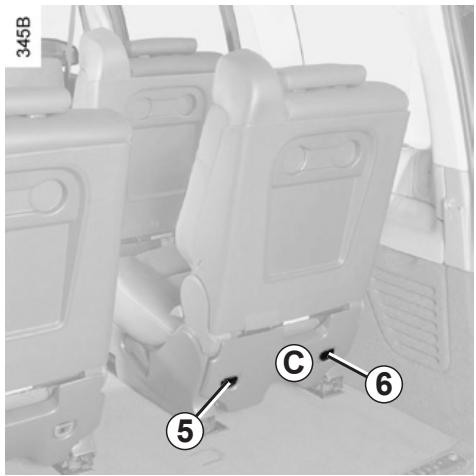

For safety reasons, after a seat has been fitted, check that it is correctly locked into place by moving it from ght and forwards and backIf there is still a problem, an approved dealer.
Accessing rear seats:
Lift control 2, handle 3 or pull on release 6 to move the seat forward and free up access to the rear seats.
Leaving the vehicle from the rear seats
Pull on release 6 and push the seat towards the front. The seat will go forward, creating access to the door.
You can also increase the amount of space by pulling down the seatback using release 5.

When moving the rear seats, ensure that nothing obstructs the anchorage points (passenger's arm or et, gravel, cloth, toys, etc.).

For safety reasons, carry out these operations when the vehicle is stationary.
Luggage COMPARTMENT
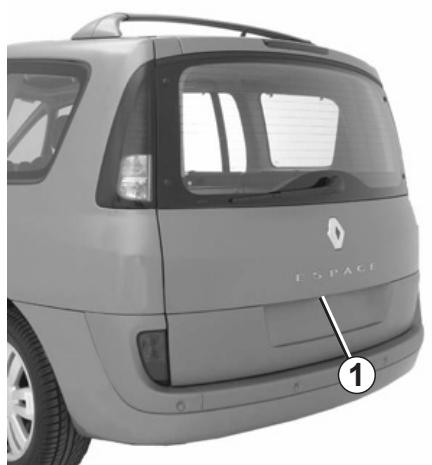
25771
The tailgate is locked and unlocked at the same time as the doors.
To open
Press button 1 and lift the tailgate.
Handle the tailgate with care if carrying equipment is fitted (bike rack), as the extra weight can cause it to close.
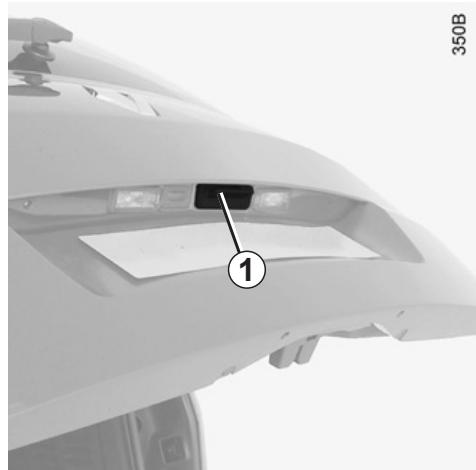
To close
Lower the tailgate using interior handles 2 to help you.
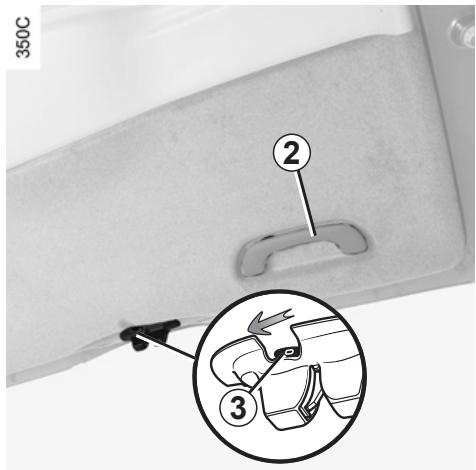
Opening manually from the inside
If it is impossible to unlock the tailgate, it can be done from inside.
- access the luggage compartment by tilting the rear seats;
- insert a pencil or similar object in cavity 3 and slide the unit as shown in the illustration;
push the tailgate to open it.
OPENING REAR SCREEN
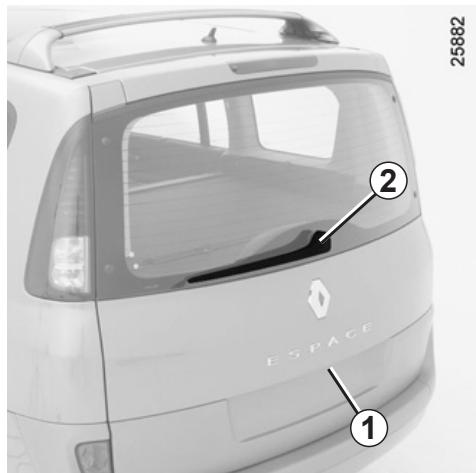
Vehicle with opening rear screen
The rear screen is locked and unlocked at the same time as the doors.
To open
Press button 1.
Lift the rear screen by the base of screen wiper 2.
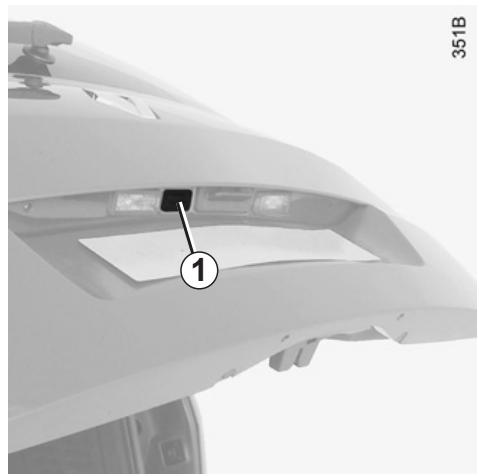
To close
Hold the base of screen wiper 2 and fold back the rear screen until it locks in position.
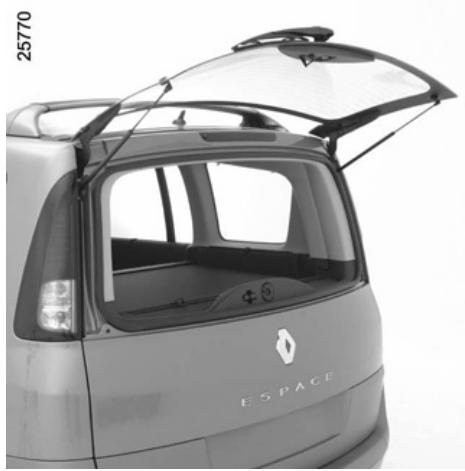

Driving with the rear screen open may be unpleasant for passengers as exhaust gases may enter the pas
senger compartment. This must only be done over short distances or when transporting bulky objects without having to open the tailgate. In that case, close the other windows and the sunroof and switch the ventilation to medium or maximum power, as this will help to prevent exhaust gas from entering the passenger compartment.
Luggage COMPARTMENT COVER
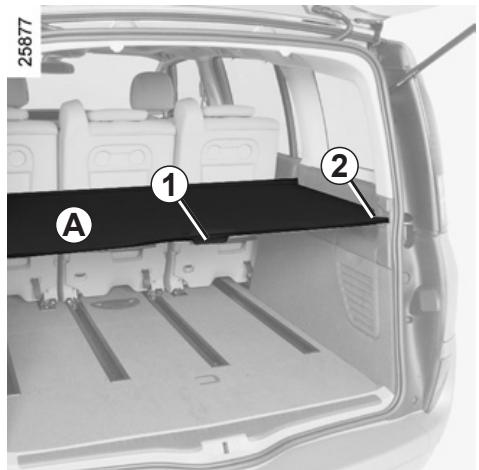
Depending on the vehicle, this is either luggage compartment cover A , or parcel shelf B with a luggage compartment cover which consists of soft section C plus a roller.
To roll up luggage compartment cover A
Pull handle 1 to detach pins 2 from their mounting point.
Guide the luggage cover onto the roller.
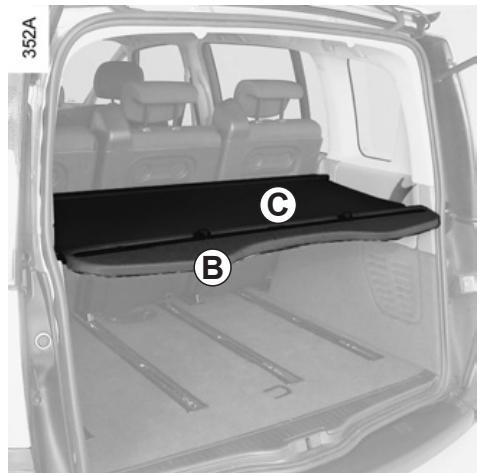
Parcel shelf ±bB can be fitted on its own (for example when the third row seats are in use).
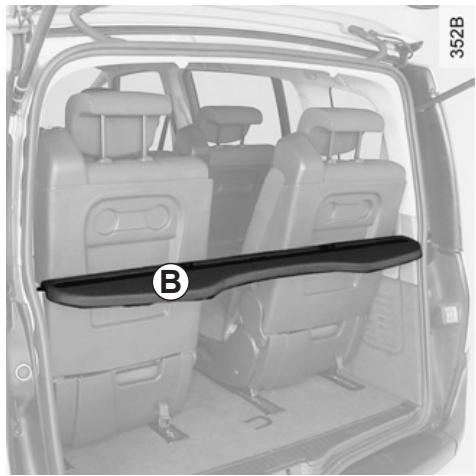

Do not place any objects, especially heavy or hard objects, on the parcel shelf.
These may pose a risk to the vehicle occupants if the driver has to brake suddenly or if the vehicle is involved in an accident.
Luggage COMPARTMENT COVER (continued)
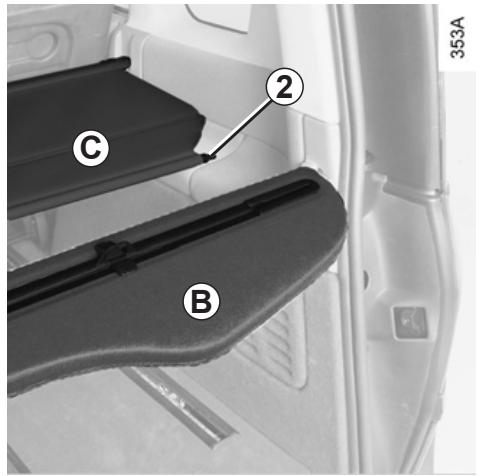
To roll up soft section C
Gently pull on the soft section to detach pins 2 from their mounting point located under parcel shelf B.
Guide the luggage cover onto the roller.
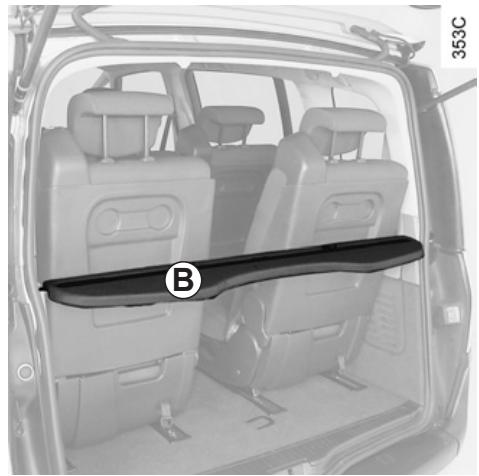
Removing parcel shelf B
With the soft section rolled up, gently pull parcel shelf ±bB to detach it from its contact points.
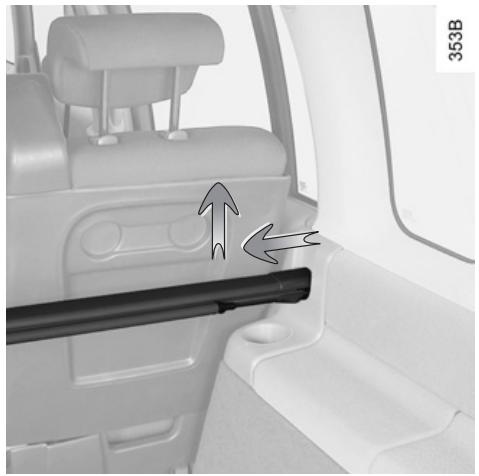
Removing the luggage cover
In all cases, once the luggage compartment cover has been rolled up, take hold of one of the ends of the roller. Move it inwards then lift it to release the roller from its contact point. Remove the roller.
TRANSPORTING OBJECTS IN THE Luggage COMPARTMENT
Always position the objects transported so that the largest surface is against:
- The rear seatbacks for normal loads (example A).
- The folded rear seats for heavier loads (example B ).
- The front seats, having removed the rear seats, for the heaviest loads (example C).
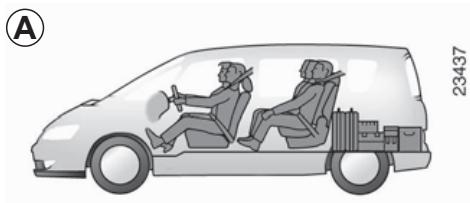
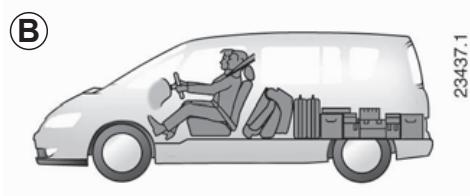
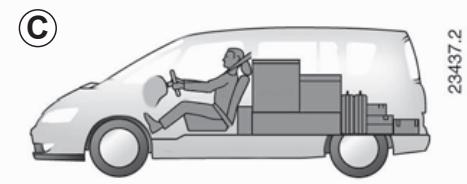
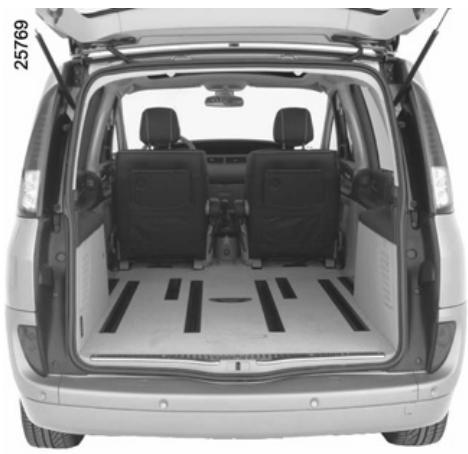
Lashing points
Always position the heaviest items directly on the floor. Use the anchorage points located on the luggage compartment floor to secure items. The luggage should be loaded in such a way that no items will be thrown forward and strike the occupants if the driver has to brake suddenly. Fasten the rear seat belts, even if the seats are not occupied.
LUGGAGE NET
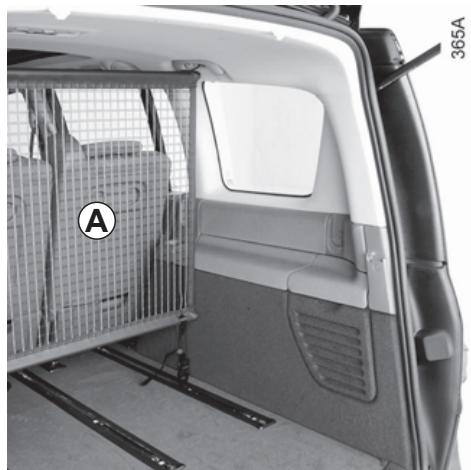
Luggage net A is fixed to either side of the inside of the vehicle.
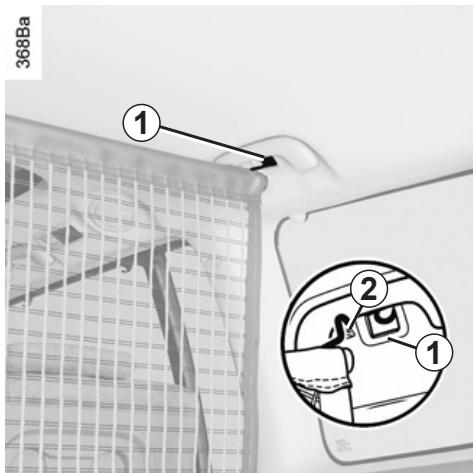
Upper mounting
Slide the cover upwards to access upper mounting point 1.
Attach hook 2 of the net onto the mounting point. Check that it is correctly hooked on.

Upper mounting
Slide tab 3 into runner 4 and then turn it anti-clockwise. Lock it with clip 6.
Adjust strap 5 so that the net is taut.
Removing the luggage net
Proceed in the reverse order:
- loosen strap 5;
- remove tab 3;
- detach upper hook 2.
ROOF BARS
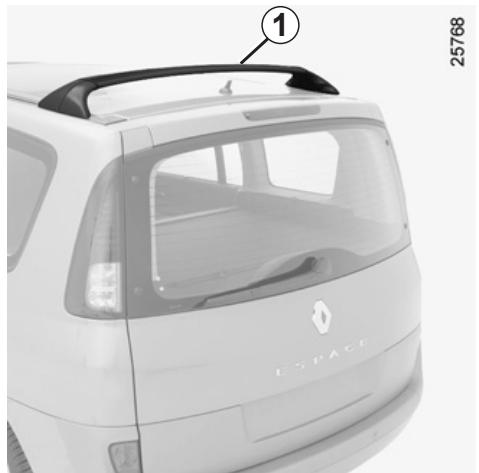
Storage position
To make the vehicle as aerodynamic as possible, roof bars 1 must be stored right at the rear of the vehicle.
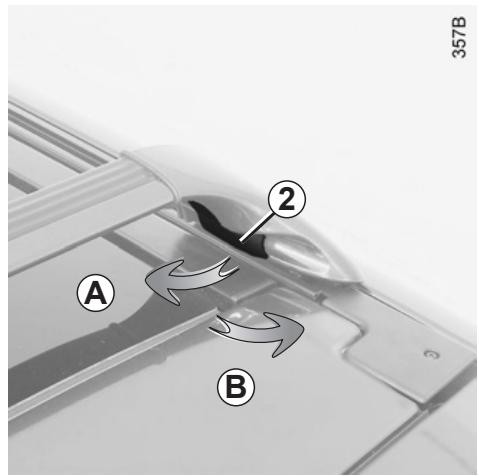
Moving the bars
On each side, pull lever 2 inwards to release it (movement A).
Slide bar 1 to the required position. On each side, push back lever 2 to secure the bar (movement B). Check that it is correctly locked.
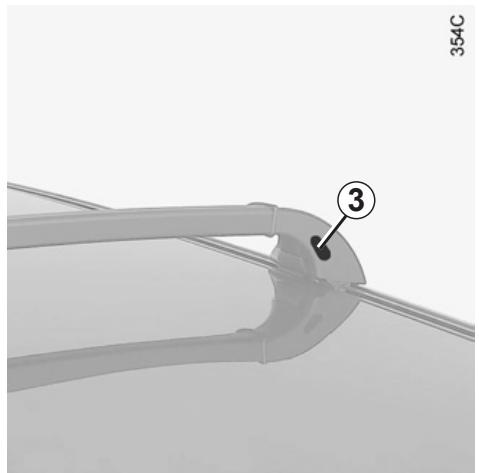
Loading
The load should be evenly distributed and must not exceed the maximum permissible weight per bar indicated on each bar (refer to the information on "Weights" in Section 6).
Ensure that any objects and/or accessories being transported are properly secured. Straps can be fed through recess 3.
Likewise, the two bars must be sufficiently spaced to prevent the load from rocking or falling off the bars.
ROOF BARS (continued)
355A
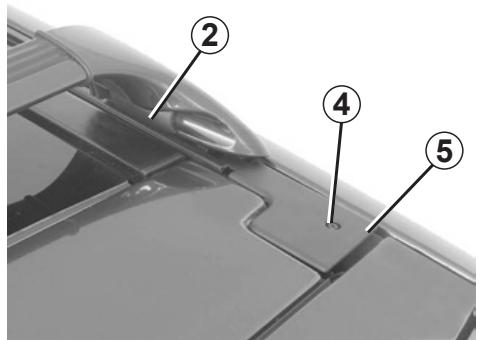
Removing the bars
It may sometimes be necessary to remove the roof bars. To do this:
- unscrew section 5 using screw 4;
- unlock the bars using levers 2 and slide them backwards to remove them;
- refit section 5.
For safety reasons, always ensure that the roof bars are properly secured if they are being stored inside the vehicle.
Refitting the bars
Proceed in the reverse order to removal.
Check the bars are correctly locked in position.
For information on the range of equipment adapted to your vehicle, we advise you to consult an approved Dealer.
Refer to the fitting instructions for information on how to fit roof bars and conditions of use.
Please keep these instructions with the rest of the vehicle documentation.
Maximum permissible load on roof rack: refer to the information on "Weights" in Section 6.
Precautions during use
Using the sunroof (on equipped vehicles) or the tailgate.
As a general rule, it is not advisable to use the sunroof when there is a load on the roof bars.
Before opening the sunroof or tailgate, check the objects and/or accessories (bike rack, roof box, etc.) fitted to the roof bars: these must be correctly positioned and secured, so as not to hinder the operation of the sunroof or luggage compartment lid.
Contact an approved dealer for details of possible conversions;
HANDS-FREE TELEPHONE INTEGRATED CONTROL
Telephone holder
For vehicles fitted with a telephone holder, it is located behind the gear lever.
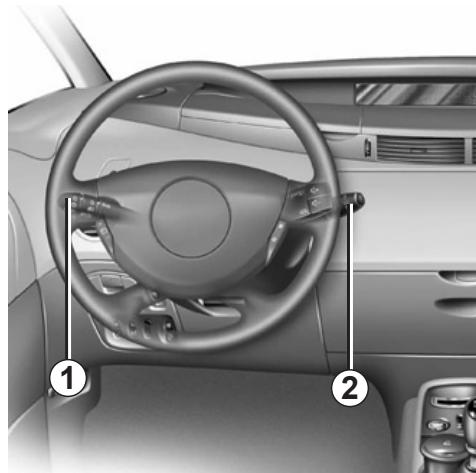
Steering wheel controls 1 and 2
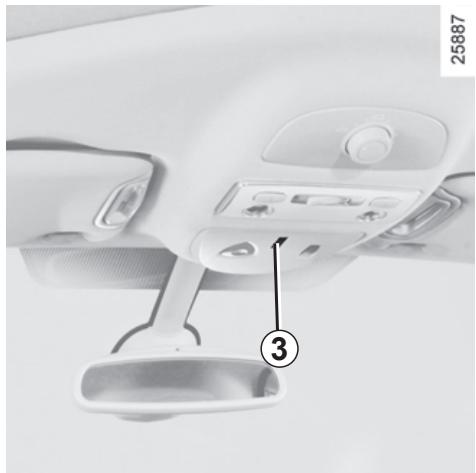
Position for microphone 3
As each telephone has its own technical specifications, it is essential to select the correct holder for the vehicle. Contact an approved dealer.

Using the telephone
We remind you of the need to conform to the legislation in force concerning the use equipment.
Refer to the manufacturer's instructions for information on how to operate this equipment.
Please keep these instructions with the rest of the vehicle documentation.
Section 4: Maintenance
Bonnet. 4.2
Engine oil level/Engine oil change. 4.4
Levels 4.8
coolant 4.8
power-assisted steering pump 4.9
brake fluid. 4.10
windscreen/headlight washer reservoir 4.11
Filters. 4.11
Tyre pressure. 4.12
Battery 4.13
Bodywork maintenance 4.14
Interior trim maintenance. 4.16
4.1

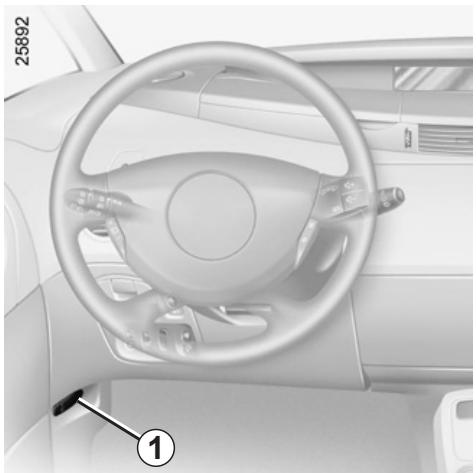
BONNET (1/2)
To open the bonnet, pull handle 1.
Unlocking the bonnet catch
To unlock, lift catch 2.
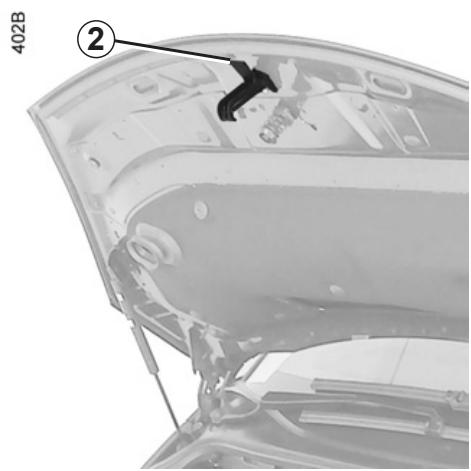

The engine may be hot when carrying out operations in close proximity. In addition, the engine cooling
fan can come on at any moment.
Risk of injury.

Do not press down on the bonnet: there is a risk that the bonnet will close inadvertently.

In the event of even a slight impact involving the radiator grille or bonnet, have the bonnet lock checked by a loved Dealer as soon as possible.
BONNET (2/2)
Opening the bonnet
Lift the bonnet; you will need to guide it as it is held by a strut.
Closing the bonnet
Before closing the bonnet, check to make sure that nothing has been left in the engine compartment. To close the bonnet again, hold the bonnet in the middle and lower it to 30~cm above the closed position, then release it. It will latch automatically under its own weight.

After carrying out any work in the engine compartment, check that nothing has been left behind (cloth, c.).
These may damage the engine or cause a fire.

Before opening the bonnet, remember to return the windscreen wiper stalk to park position (refer to the in
formation on the "Windscreen wash/ wipe" in Section 1).

Ensure that the bonnet is properly locked.
Check that nothing is preventing the catch from lock-vel, cloth, etc.).
ENGINE OIL LEVEL: general information
It is normal for an engine to use oil for lubrication and cooling of moving parts and it is normal to top up the level between oil changes. However, contact your approved Dealer if more than 0.5 litres is being consumed every 600 miles (1,000 km) after the running in period.
Oil change frequency: check the oil level from time to time and always before any long journey to avoid the risk of damaging your engine.
Reading the oil level
The vehicle must be parked on level ground and the engine should have been stopped for a long time beforehand to obtain an accurate reading.
Always use the dipstick to check the exact oil level and ensure that the maximum level is not exceeded (risk of engine damage): refer to the information on "Engine oil level/Topping-up/ Filling" on the following pages.
The instrument panel display only alerts the driver when the oil level is at its minimum.
NIVERAHUILE CORRECT
Message 1 Level above minimum
NIVEAU HUILE
Message 2 Minimum level
Reading the level on the instrument panel
When the ignition is switched on:
If the level is above the minimum, the display indicates 'Oil level OK': message 1.
For more information: press button 3.
The squares which appear on the display indicate the level. These squares disappear as the oil level drops and they are replaced by dashes.
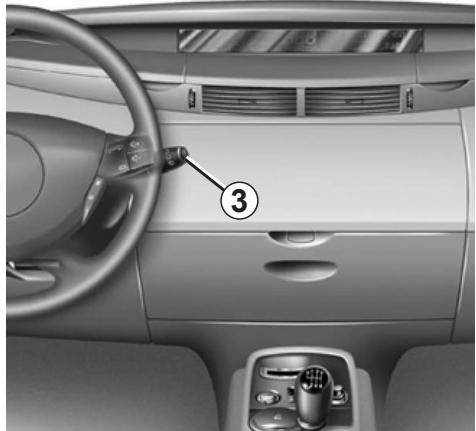
If the level is at the minimum, the 'Top Up Oil Level' message appears on the display. The squares are replaced by dashes: message 2.
Indicator light SERVICE comes on at the same time.
It is vital to top up the oil as soon as possible.

The display only warns the driver if the oil level is at the minimum level. It does not inform the driver that the oil
level has exceeded the maximum level as this can only be measured using a dipstick.
ENGINE OIL LEVEL: general information (continued)
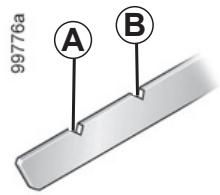
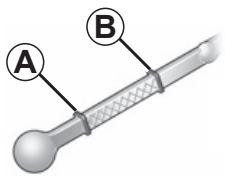
Reading the level using the dipstick
- remove the dipstick (refer to the following pages for its location) and wipe it with a clean lint-free cloth;
push the dipstick in as far as it will go (for vehicles equipped with "cap-type dipstick" C, screw the cap in completely); - take out the dipstick again;
- read the level: it should never fall below minimum mark A or exceed maximum mark B .
Once the level has been checked, ensure that the dipstick is pushed in as far as it will go or that the cap-type dipstick is completely screwed in.
Maximum engine oil level exceeded.
The oil level should only be read with the dipstick as explained above.
If the oil level exceeds the maximum level, do not start your vehicle and contact an approved Dealer.
Consult your approved Dealer at once if you notice an abnormal or repeated drop in any of the fluid levels.

Under no circumstances should maximum filling level ±bB be exceeded: this could damage the engine catalytic converter.
To prevent splashback, you are recommended to use a funnel to top up the oil.

When working in the engine compartment, ensure that the windscreen wiper stalk is in the park position.
Risk of injury.

The engine may be hot when carrying out operations in close proximity. In addition, the engine cooling
fan can come on at any moment.
Risk of injury.
ENGINE OIL LEVEL: topping up/filling (1/2)
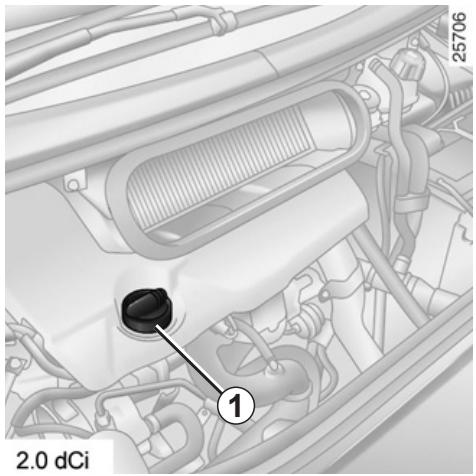
Topping up/filling
The vehicle must be parked on level ground and the engine should be cold (for instance, before the engine is started up for the first time in the day).
Engine oil grade
Refer to the Maintenance Service Booklet for your vehicle.
Do not exceed the max level and do not forget to refit cap 1 and dipstick 2.
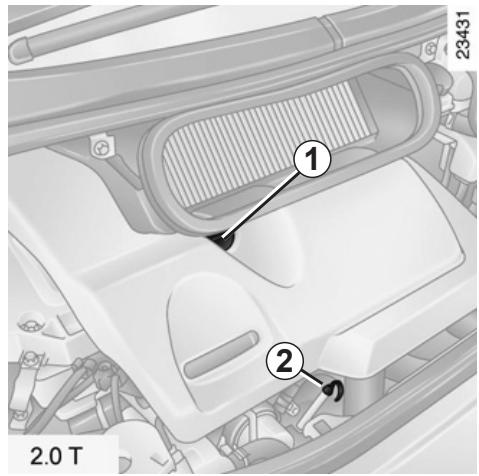
- Unscrew cap 1;
top up the level (as a guide, the capacity between the minimum and maximum reading on the dipstick 2 is between 1.5 and 2 litres, depending on the engine); - wait for approximately 10 minutes to allow the oil to flow into the engine;
- check the level using dipstick 2 or the dipstick integrated in cap 1 (as explained previously).
Once the operation has been completed, ensure that the dipstick is pushed in as far as it will go or that the cap-type dipstick is completely screwed in.
ENGINE OIL LEVEL: topping up/filling (2/2)
Oil change
Service intervals: please refer to your vehicle's maintenance document.
Average capacities for oil change oil filter included.
(for information)
2.0 T engine : 5.40 litres
Engine 2.0 dCi : 8.20 litres
Engine oil grade
Refer to the Maintenance Service Booklet for your vehicle.

Engine oil change: if you are changing the oil when the engine is hot, be careful not to scald yourself if the flows.
Consult your approved Dealer at once if you notice an abnormal or repeated drop in any of the fluid levels.

Filling: take care when topping up the oil that no oil drips onto engine components - risk of fire.
Remember to refit the cap securely as there is a risk of fire if oil splashes onto hot engine components.

Never run the engine in an enclosed space as exhaust gases are poisonous.

The engine may be hot when carrying out operations in close proximity. In addition, the engine cooling
fan can come on at any moment.
Risk of injury.
LEVELS (1/4)
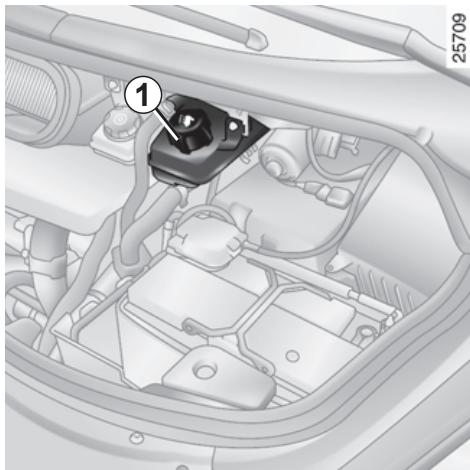
Coolant
With the engine switched off and on level ground, the level when cold must be between the MINI and MAXI marks on reservoir 1.
Top this level up when cold before it reaches the MINI mark.

No operations should be carried out on the cooling circuit when the engine is hot.
Risk of burns.
Checking intervals
Check the coolant level regularly (very severe damage is likely to be caused to the engine if it runs out of coolant).
If the level needs to be topped up, only use products approved by our Technical Department which ensure:
- protection against freezing;
- anticorrosion protection of the cooling system.
Consult your approved Dealer at once if you notice an abnormal or repeated drop in any of the fluid levels.
Replacement intervals
Refer to the Maintenance Service Booklet for your vehicle.
LEVELS (2/4)
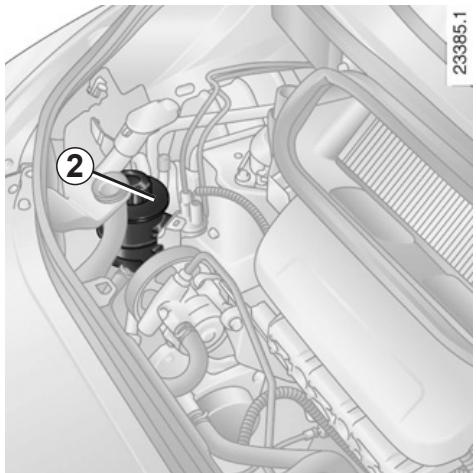
Power-assisted steering pump 2
Checking intervals:
Refer to the Maintenance Service Booklet for your vehicle.
Level
With the engine switched off and cold, and on level ground, the level must be visible between the MINI and MAXI levels on reservoir 2.
For topping up or refilling with oil, use products approved by our Technical Department.

The engine may be hot during operations in close proximity. In addition, the engine cooling fan may
come on at any moment.
Risk of injury.
LEVELS (3/4)
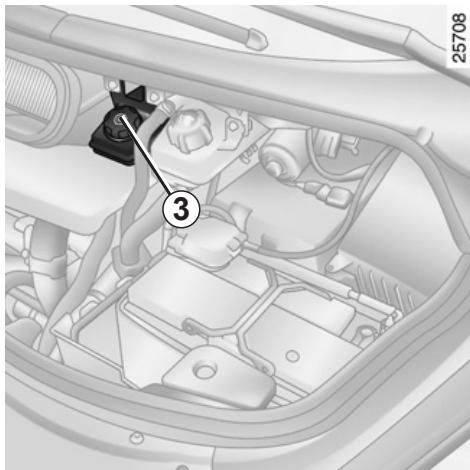
Brake fluid
This should be checked frequently, and immediately if you notice even the slightest loss in braking efficiency.
Top up with the engine switched off and on level ground.
Level 3
It is normal for the level to drop as the brake shoes become worn, but it must never drop lower than the "MINI" warning line.
If you wish to check the disc and drum wear yourself, you should obtain the document explaining the checking procedure from our network or from the manufacturer's website.
Consult your approved Dealer at once if you notice an abnormal or repeated drop in any of the fluid levels.

The engine may be hot during operations in close proximity. In addition, the engine cooling fan may
come on at any moment.
Risk of injury.
Filling
After any operation on the hydraulic circuit, a specialist must replace the fluid.
Only use fluids approved by our Technical Department (and taken from a sealed container).
Replacement intervals
Refer to the Maintenance Service Booklet for your vehicle.
LEVELS (4/4)/FILTERS
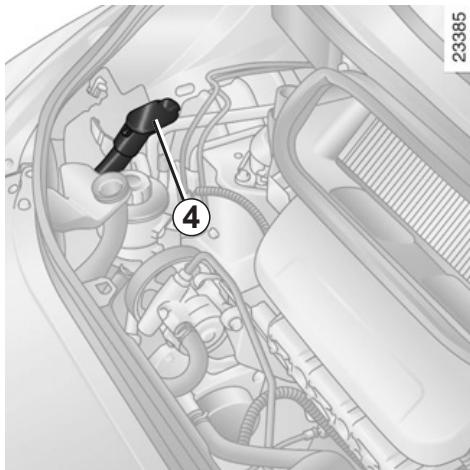
Windscreen/headlight washer reservoir
Filling
Through cap 4.
Fluid
Water + special windscreen washer fluid (antifreeze product in winter).
Jets
Use a flat-blade screwdriver to position the windscreen washer jets.
Filters
The replacement of filter elements (air filter, passenger compartment filter, diesel filter, etc.) is scheduled in the maintenance operations for your vehicle.
Replacement intervals for filter elements: refer to the Maintenance Service Booklet for your vehicle.

The engine may be hot during operations in close proximity. In addition, the engine cooling fan may run at any moment.
Risk of injury.
TYRE PRESSURE
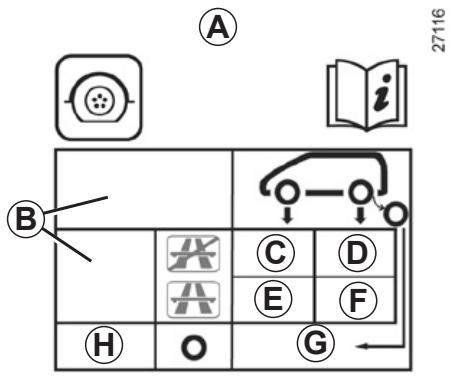
The tyre pressure is indicated on label A affixed to the edge of the driver's door. Open the door to read it.
B: dimension of the tyres fitted to the vehicle.
C: tyre pressures for the front wheels (non-motorway).
D : tyre pressures for the rear wheels (non-motorway).
E: tyre pressures for the front wheels (motorway).
F: tyre pressures for the rear wheels (motorway).
G: tyre pressure for the emergency spare wheel.
H: emergency spare wheel tyre dimension if different to the four tyres fitted to the vehicle.
Tyre safety and use of snow chains
Refer to the information on "Tyres" in Section 5 for the servicing conditions and, depending on the version, the use of chains.
Special note
For vehicles used fully laden (maximum permissible all-up weight) and towing a trailer. The maximum speed must be limited to 60 mph (100 km/h) and the tyre pressure increased by 0.2 bar.
Refer to the information on "Weights" in Section 6.

When they need to be replaced, only tyres of the same make, size, type and profile should be used.
Tyres fitted to the vehicle should either be identical to those fitted originally or conform to those recommended by your approved
dealer.
BATTERY
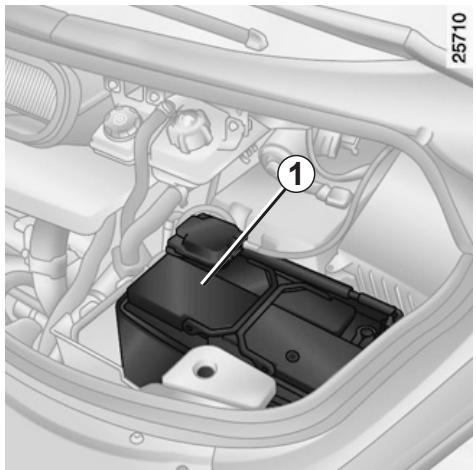
It does not need to be serviced: never open battery cover 1.

Handle the battery with care as it contains sulphuric acid, which must not come into contact with eyes or skin. If
it does, wash the affected area with plenty of cold water. If necessary, consult a doctor.
Ensure that naked flames, red hot objects and sparks do not come into contact with the battery as there is a risk of explosion.
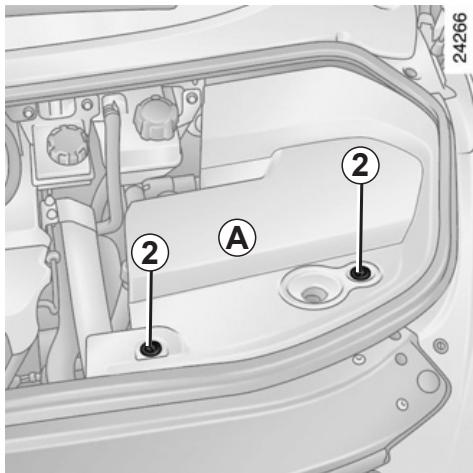
Access to the battery
Depending on the vehicle, remove cover A by turning screw 2 a quarter of a turn using the vehicle's emergency key or a coin.
Replacing the battery
As this operation is complex, we advise you to contact an approved Dealer.
Refer to the information on the Battery: repair in Section 5.

B
8


7

5

6
Label B
Observe the indications on the battery: 3 naked flames and smoking forbidden;
- 4 eye protection required;
- 5 keep away from children;
- 6 explosive materials;
- 7 refer to the handbook;
- 8 corrosive materials.

The battery is a specific type, please ensure it is replaced with the same type. Consult an approved
dealer.
BODYWORK MAINTENANCE (1/2)
A well-maintained vehicle will last longer. It is therefore recommended to maintain the exterior of the vehicle regularly.
Protection against the effects of corrosive agents
Although your vehicle has been treated with very effective anti-corrosion products, it nevertheless remains subject to the effects of different parameters.
Corrosive agents in the atmosphere:
- atmospheric pollution (built-up and industrial areas);
- saline atmospheres (near the sea, particularly in hot weather);
- seasonal and damp weather conditions, (e.g. road salt in winter, water from road cleaners, etc.).
Abrasive action
Wind-borne dust and sand, mud, road grit thrown up by other vehicles, etc.
Minor impacts
You should take a minimum number of precautions in order to safeguard your vehicle against such risks and not to lose the benefit of your vehicle's anticorrosion protection.
What you should not do
Do not degrease or clean mechanical components (e.g. the engine compartment), underneath the body, parts with hinges (e.g. inside the charging flap) and painted plastic external fittings (e.g. bumpers) using high-pressure cleaning equipment or by spraying on products not approved by our Technical Department. If adequate precautions are not taken, this could give rise to corrosion or operational faults.
Wash the vehicle in bright sunlight or freezing temperatures.
Scrape off mud or dirt without pre-wetting.
Allow dirt to accumulate on the exterior.
Allow rust to form following minor impacts.
Use solvents not approved by our Technical Department to remove stains as this could damage the paintwork.
Drive frequently in snow or muddy conditions without washing the vehicle, particularly under the wheel arches and body.
BODYWORK MAINTENANCE (2/2)
You should
Observe the vehicle stopping distances when driving on gravelled surfaces to prevent paint damage.
Repair, or have repaired quickly, areas where the paint has been damaged, to prevent corrosion spreading.
Remember to visit the body shop periodically in order to maintain your anti-corrosion warranty. Refer to the Maintenance Service Booklet.
Respect local regulations about washing vehicles (e.g. do not wash your vehicle on a public highway).
Wash your car frequently, with the engine off, with cleaning products recommended by the manufacturer (never use abrasive products). Rinse thoroughly beforehand with a jet:
- spots of tree resin and industrial grime;
-
mud in the wheel arches and underneath the body which forms damp patches;
-
bird droppings, which cause a chemical reaction with the paint that rapidly discolours paintwork and may even cause the paint to peel off;
Wash the vehicle immediately to remove these marks since it is impossible to remove them by polishing;
salt, particularly in the wheel arches and underneath the body after driving in areas where the roads have been gritted.
Using a roller type car wash
Return the windscreen wiper stalk to the Park position (refer to the information on the "Windscreen washer, wiper" in Section 1). Check the mounting of external accessories, additional lights and mirrors, and ensure that the wiper blades are secured with adhesive tape. Remove the radio aerial mast if your vehicle is fitted with this equipment.
Remember to remove the tape and refit the antenna after washing.
If it is necessary to clean mechanical components, hinges, etc., spray them with products approved by our Technical Department to protect them after they have been cleaned.
Cleaning the headlights
As the headlights are made of plastic "glass", use a soft cloth or cotton wool to clean them. If this does not clean them properly, moisten the cloth with soapy water, then wipe clean with a soft damp cloth or cotton wool.
Finally, carefully dry off with a soft dry cloth.
Cleaning products containing alcohol must not be used.
We have selected special products to care for your vehicle and you can obtain these from the manufacturer's accessory outlets.
INTERIOR TRIM MAINTENANCE (1/2)
A well-maintained vehicle will last longer. It is therefore recommended to maintain the interior of the vehicle regularly.
A stain should always be dealt with swiftly.
Whatever type of stain is on the trim, use cold (or warm) soapy water with natural soap.
Detergents (washing-up liquid, powdered products, alcohol-based products) should not be used.
Use a soft cloth.
Rinse and soak up the excess.
Glass instrument panel
(e.g. instrument panel, clock, exterior temperature display, radio display, etc.)
Use a soft cloth (or cotton wool).
If this does not clean it properly, use a soft cloth (or cotton wool) slightly moistened with soapy water and then wipe clean with a soft damp cloth or cotton wool.
Finally, carefully dry off with a soft dry cloth.
Cleaning products containing alcohol must not be used under any circumstances.
Seat belts
These must be kept clean.
Use products selected by our Technical Department (Approved outlets) or warm, soapy water and a sponge and wipe with a dry cloth.
Detergents or dyes must not be used under any circumstances.
Textiles (seats, door trim, etc)
Vacuum-clean the textiles regularly.
Liquid stain
Use soapy water.
Dab lightly (never rub) with a soft cloth, rinse and remove the excess.
Solid or pasty stain
Carefully remove the excess solid or pasty material immediately with a spatula (working from the edges to the centre to avoid spreading the stain).
Clean as for a liquid stain.
Special instructions for sweets or chewing gum
Put an ice cube on the stain to solidify it, then proceed as for a solid stain.
For further recommendations for maintaining the interior, and/or for any unsatisfactory results, please see an authorised dealer.
INTERIOR TRIM MAINTENANCE (2/2)
Removal/replacing removable equipment originally fitted in the vehicle
If you need to remove equipment in order to clean the passenger compartment (for example, mats), always ensure that they are correctly refitted and are the right way around (the driver's mat should be fitted on the driver's side, etc.) and fit them with the components supplied with the equipment (for example, the driver mat should always be fixed using the pre-fitted mounting components).
With the vehicle stationary, ensure that nothing will impede driving (anything obstructing the pedals, heel wedged by the mat, etc.).
You should not:
You are strongly advised not to position objects such as deodorants, scents, etc. near air vents, as this could damage your dashboard trim.

You are strongly recommended not to use high-pressure or spray cleaning equipment inside the pas
senger compartment: use of such equipment could impair the correct functioning of the electrical or electronic components in the vehicle, or have other detrimental effects.
Section 5: Practical advice
Puncture 5.2
Emergency spare wheel 5.2
Tyre inflation kit 5.4
Tool kit (jack, wheelbrace) 5.7
Wheel trims - Wheel 5.8
Changing a wheel 5.9
Tyres (tyre and wheel safety, use in winter) 5.11
Headlights (changing bulbs) 5.14
Rear lights (changing bulbs) 5.18
Indicator lights (changing bulbs) 5.21
Interior lighting (changing bulbs) 5.22
Fuses. 5.26
RENVAULT card: battery 5.28
Battery 5.29
Wipers (replacing blades) 5.32
Accessories 5.33
Towing 5.34
Operating faults 5.37
5.1

PUNCTURE/EMERGENCY SPARE WHEEL (1/2)
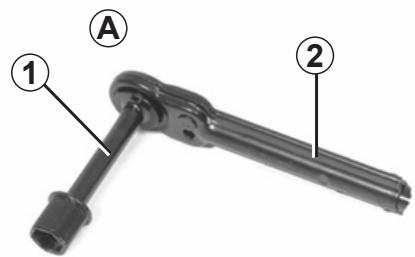
502A
In the event of a puncture, depending on the vehicle, you will have:
An emergency spare wheel or tyre inflation kit (refer to the information on the following pages).
If you have an emergency spare wheel, you need to use tool A comprising ratchet spanner 2 and end-piece 1.
NB: using other tools could damage the mechanism)
These components are stored in the tool kit in the luggage compartment (refer to the information on the "Took kit" in Section 5).
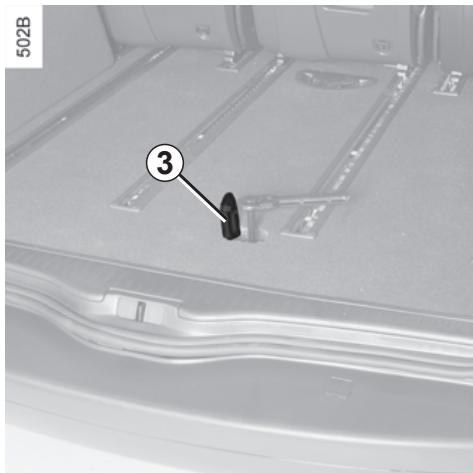
Ensure that the end piece 1 is securely attached to the ratchet spanner 2.
The ratchet spanner has one direction for tightening and another for loosening. Reverse the direction of the operation when moving from loosening to tightening and vice versa.
Emergency spare wheel B
It is located under the vehicle.
- In the luggage compartment, lift cover 3;
- remove the blanking cover;
- use tool A and turn it until the wheel retaining cable unwinds and the wheel drops to the ground;
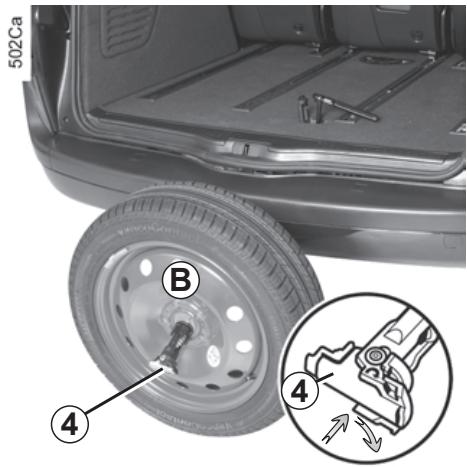
- stand the wheel up outside the vehicle;
- press on lock 4 and turn it a quarter of a turn
run the retaining cable across the wheel rim and release the wheel; - depending on the vehicle, take out the shim from inside the wheel rim.
Note: depending on the vehicle, the shim on the top of the emergency spare wheel should only be repositioned with this emergency spare wheel; it should not be used with the punctured wheel.
PUNCTURE/EMERGENCY SPARE WHEEL (2/2)
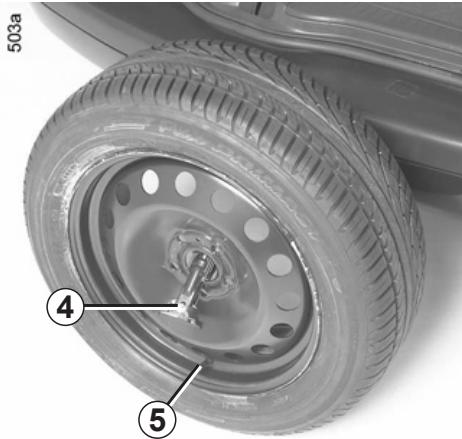
To refit the emergency spare wheel
Proceed in the reverse order.
- stand the punctured wheel up, with valve 5 towards you;
run the cable across and reposition lock 4; - lie the wheel down, with valve 5 facing the ground;
- in the luggage compartment, use the tool to completely to rewind the retaining cable.
Advice
Check the pressure of the emergency spare wheel regularly.
Note:
The bolts for the aluminium wheel may be used to secure the steel emergency spare wheel.
Using the emergency spare wheel
The "tyre pressure monitor" function does not monitor the emergency spare wheel (the wheel replaced by the emergency spare wheel disappears from the instrument panel and/or the information display). Refer to the information on the "Tyre pressure monitor" in Section 2.
Special note
Using an emergency spare wheel may disrupt certain functions (automatic gearbox, etc.).

If the emergency spare wheel has been stored for several years, have it checked by your Dealer to that it is safe to use.

Vehicles fitted with an emergency spare wheel which is different to the four other wheels:
- Never fit more than one emergency spare wheel to the same vehicle.
- Replace the emergency spare wheel as soon as possible with a wheel identical to the original one.
- When this is fitted to the vehicle, which must only be a temporary measure, the driving speed must not exceed the speed indicated on the label on the wheel.
- Fitting an emergency spare wheel may alter the way the vehicle usually runs. Avoid sudden acceleration or deceleration and reduce your speed when cornering.
- If you need to use snow chains, fit the emergency spare wheel to the rear axle and check the tyre pressure.
TYRE INFLATION KIT
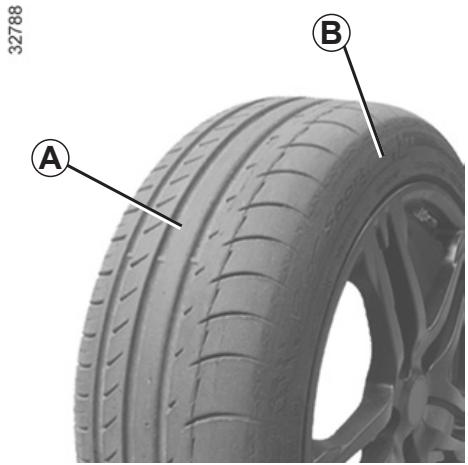

The kit repairs tyres with a tread A damaged by objects smaller than 4 mm. It cannot repair all types of tire, such as cuts more than 2 or cuts in the tyre sidewall B .
Ensure also that the wheel rim is in good condition.
Do not pull out the foreign body causing the puncture if it is still in the tyre.

Do not attempt to use the inflation kit if the tyre has been damaged as a result of driving with a puncture.
You should therefore carefully check the condition of the tyre sidewalls before any operation.
Driving with underinflated, flat or punctured tyres can be dangerous and may make the tyre impossible to repair.
This repair is temporary
A tyre which has been punctured should always be inspected (and repaired, where possible) as soon as possible by a specialist.
Contact an approved dealer to replace the inflation tube and repair product bottle.
When taking a tyre which has been repaired using this kit to be replaced, you must inform the specialist.

When driving, vibration may be felt due to the presence of the repair product injected into the tyre.
The kit is only approved for inflating the tyres of the vehicle originally equipped with the kit.
It must never be used to inflate the tyres of another vehicle, or any other inflatable object (rubber ring, rubber boat, etc.).
Avoid spillage on skin when handling the repair liquid bottle. If droplets do leak out, rinse them off with plenty of water.
Keep the repair kit away from children.
Do not dispose of the empty bottle in the countryside. Return it to an approved dealer or to a recycling organisation.
The bottle has a limited service life which is indicated on its label. Check the expiry date regularly.
TYRE INFLATION KIT (continued)
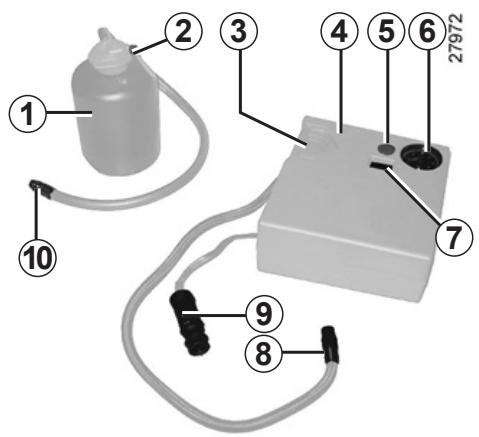
Depending on the vehicle, in the event of a puncture, use the tyre inflation kit.

Before using this kit, park the vehicle at a sufficient distance from traffic, switch on the hazard warning apply the handbrake, ask all drivers to leave the vehicle and then away from traffic.
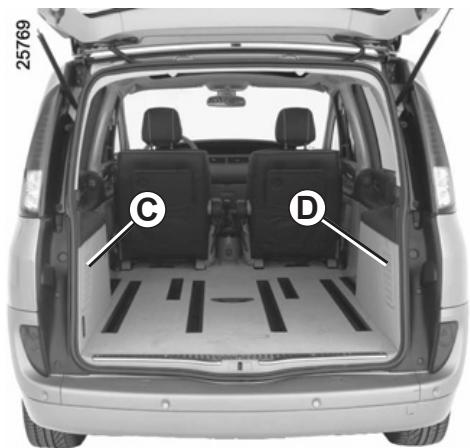
- Retrieve compressor 4 and bottle 1 from rear storage compartment C (in vehicles with a normal chassis) or D (in vehicles with a long chassis);
- unroll inflation hose 8 and lead 9 located under the compressor and inflation hose 10. Attach the bottle to its mounting 3 and screw inflation hose 8 onto end piece 2.
With the engine running and the parking brake applied,
- unscrew the valve cap of the wheel concerned and screw the inflation hose 10 onto the valve;
- connect end piece 9 to one of the vehicle's accessories sockets (refer to the information on the "Accessories socket" in Section 3) then press switch 7 to inflate the tyre to the recommended pressure (refer to the label located on the edge of the driver's door);
- After a maximum of 5 minutes, stop inflating and read the pressure on pressure gauge 6. To adjust the pressure if necessary: continue inflating to increase the pressure or press button 5 to decrease it.
If a minimum pressure of 1.8 bar is not reached after 15 minutes, repair is not possible; do not drive the vehicle but contact an approved dealer.
TYRE INFLATION KIT (continued)
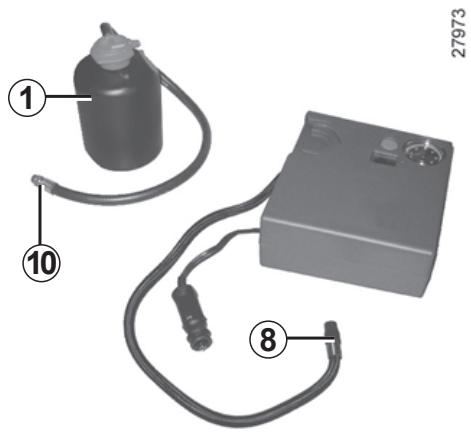
Once the tyre is inflated correctly:
stop using the kit;
- slowly unscrew the two inflation adapters 8 and 10 and screw endpiece 10 onto the bottle to prevent the product from spraying;

Nothing should be placed around the driver's feet as such objects may slide under the pedals during
sudden braking manoeuvres and obstruct their use.
- affix the driving recommendation label, located under bottle 1, to the dashboard where it can easily be seen by the driver;
store the kit; - after the first inflation procedure the tyre will still be leaking; it is vital to drive in order to plug the hole;
- Start immediately and drive at between 12 and 36 mph (20 and 60km / h ) to distribute the product evenly throughout the tyre, stopping after a distance of 2 miles (3 kilometres) to check the pressure;

Following repair with the kit, do not travel further than 120 miles (200 km). In addition, reduce your speed and
under no circumstances exceed 48 mph (80 km/h). The sticker, which you must affix in a prominent position on the dashboard, reminds you of this.
Depending on the country or local legislation, a tyre repaired with the inflation kit may need to be replaced.
- If the pressure is above 1.3 bar but lower than the recommended pressure, readjust it (refer to the label affixed to the edge of the driver's door), otherwise contact an approved dealer: repair is not possible.
Note: after using the inflation kit, you should visit an approved dealer to replace the inflation hose and the bottle of repair product.
Precautions when using the kit
The kit should not be operated for more than 15 consecutive minutes.

Please be aware that a poorly tightened or missing valve cap can make the tyres less airtight and lead to sure loss.
Always use valve caps identical to those fitted originally and tighten them fully.
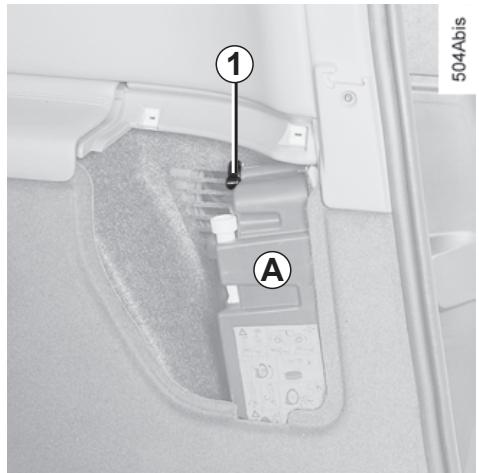
TOOL KIT (1/2)
Tool kit A is located in the luggage compartment.
The tools included in the tool kit depend on the vehicle.
To access it, open the flap and loosen nut 1.
Remove the kit.
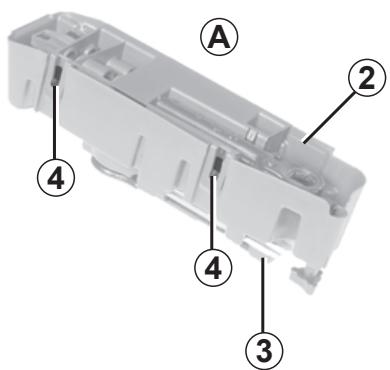
Some of the tools are stored inside the kit and others are stored on lid 2 or on base 3.
To open the kit, release tabs 4.
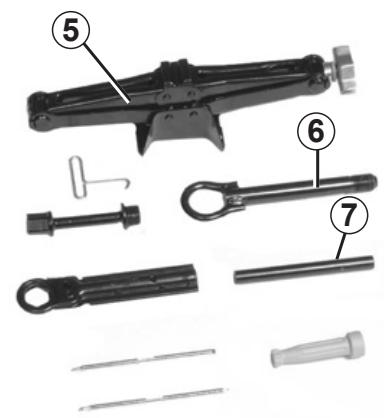
1
Jack 5
Towing hitch 6
For methods of use refer to the information on "Towing" in Section 5.
Extension piece 7
Ratchet spanner extension piece.

Do not leave the tools unsecured inside the vehicle as they may come loose under braking. After use, check that all the tools are correctly clipped into the tool kit, then position it correctly in its housing: risk of injury.
If wheel bolts are supplied in the tool kit, only use these bolts for the emergency spare wheel: refer to the label affixed to the emergency spare wheel.
The jack is designed for wheel changing purposes only. Under no circumstances should it be used for carrying out repairs underneath the vehicle or to gain access to the underside of the vehicle.

The jack is designed for wheel changing purposes only. It should never be used for repairs or gaining to the underside of the ve
TOOL KIT (2/2)/WHEEL TRIM - WHEEL

Screwdriver handle 8
Two screwdriver heads 9
Comprising four different tips.
Ratchet spanner 10
Jack extension piece 11
Hubcap tool 12

Nothing should be placed on the floor area in front of the driver as such objects may slide under the pedal braking manoeuvres, thus tiring its use.
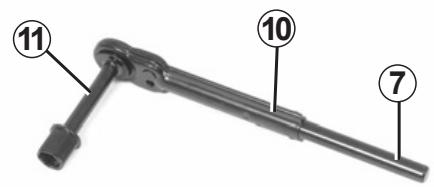
Assembling the wheelbrace
Use jack extension piece 11, ratchet spanner 10 and its extension piece 7.
Screw extension piece 7 into the handle of the ratchet spanner until the extension piece tabs click securely into position.
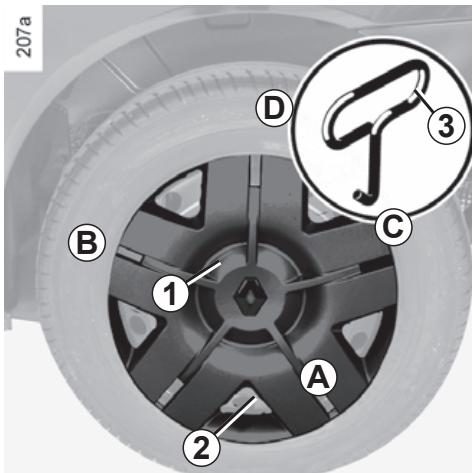
505C
Wheel trim
Remove the wheel trim using hubcap tool 3 (located in the tool kit) by fitting the hook into one of the openings around the edge of the wheel trim.
To refit it, align it with valve 2. Push the retaining hooks in fully, starting with side A near the valve, followed by B and C, finishing at D opposite the valve.
CHANGING A WHEEL (1/2)
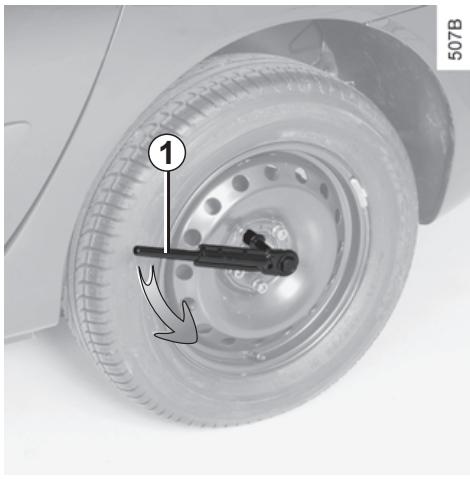

Switch on the hazard warning lights.
Keep the vehicle away from traffic and on a level sur
face where it will not slip (if necessary, place a solid support under the jack base).
Apply the parking brake and engage a gear (first or reverse, or P for automatic transmissions).
Ask all the passengers to leave the vehicle and keep them away from traffic.
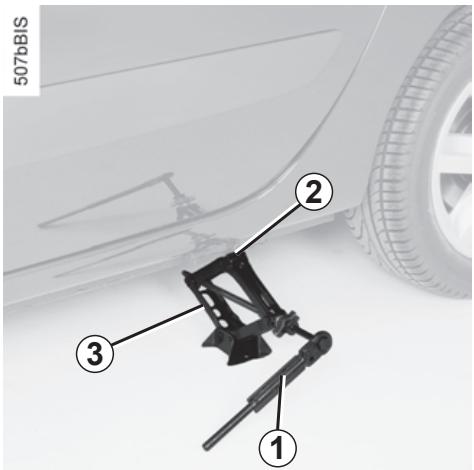
Vehicles equipped with a jack and wheelbrace
Put together wheelbrace 1 using the tools stored in the tool kit: refer to the information on the "Tool kit" on the previous pages.
Use wheelbrace 1 to loosen the wheel bolts. Fit it so that you press downwards rather than pulling upwards.
If the vehicle is not equipped with a jack or wheelbrace, you can obtain these from your approved dealer.
Position the jack horizontally, with the jack head positioned at the same height as support 2 provided in the lower section of the bodywork, closest to the wheel concerned.
Start cranking up jack 3 by hand to align the base plate (which should be pushed slightly under the vehicle). Place a plank of wood under the base plate if on soft ground.
Turn the wheelbrace to lift the wheel off the ground.

To prevent any risk of injury or damage to the vehicle, only crank the jack until the wheel you are replacing is
a maximum of 3 centimetres off the ground.
CHANGING A WHEEL (2/2)
Undo the bolts and take off the wheel.
Fit the emergency spare wheel on the central hub and turn it to locate the mounting holes in the wheel and the hub.
Tighten the bolts and lower the jack.
With the wheels on the ground, tighten the bolts as fully as possible and check the tightness as soon as possible (tightening torque 130 Nm).
Anti-theft bolt
If you use anti-theft bolts, fit these nearest the valve (wheel embellisher may not be able to fit).

If you have a puncture, replace the wheel as soon as possible.
A tyre which has been punctured should always be inspected (and repaired, where possible) by a specialist.

If the vehicle is parked on the hard shoulder, you must warn other road users of your vehicle's presence
with a warning triangle or with other devices as per the legislation applying to the country you are in.
TYRES (1/3)
Tyre and wheel safety
The tyres are the only contact between the vehicle and the road, so it is essential to keep them in good condition.
You must make sure that your tyres conform to local road traffic regulations.

When they need to be replaced, only tyres of the same make, size, type and profile should be used.
Tyres fitted to the vehicle should either be identical to those fitted originally or conform to those recommended by your approved dealer.
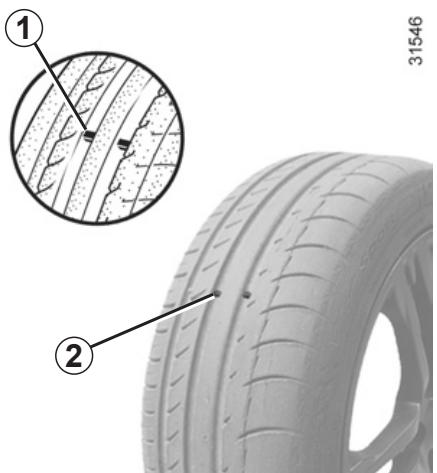
Maintaining the tyres
The tyres must be in good condition and the tread form must have sufficient depth; tyres approved by our Technical Department have tread wear indicators 1 which are indicators moulded into the tread at several points.
When the tyre tread has been worn to the level of the warning strips, they become visible 2: it is then necessary to replace your tyres because the tread rubber is now only 1.6mm deep at most, resulting in poor road holding on wet roads.
An overloaded vehicle, long journeys by motorway, particularly in very hot weather, or continual driving on poorly surfaced minor roads will lead to more rapid tyre wear and affect safety.

Incidents which occur when a driver, such as striking the kerb, may damage the tyres and wheel rims, and could lead to misalignment of the rear axle geometry. In this we have the condition of these used by an approved dealer.
TYRES (2/3)
Tyre pressures
Tyre pressures must be adhered to (including the emergency spare wheel). Pressures must be checked at least once a month and always before a long journey (refer to the label affixed to the edge of the driver's door).

Incorrect tyre pressures
lead to abnormal tyre wear and unusually hot running.
These are factors which
may seriously affect safety and lead to:
- poor road holding;
- the risk of blow-outs or of throwing a tread.
Tyre pressures depend on the load and the driving speed. Adjust the pressures according to the conditions of use (refer to the label affixed to the edge of the driver's door).
Pressures should be checked when the tyres are cold; ignore higher pressures which may be reached in hot weather or following a fast journey.
If tyre pressures cannot be checked when the tyres are cold, the normal pressures must be increased by 0.2 to 0.3 bar (or 3 PSI).
Never deflate a hot tyre.
Note: depending on the vehicle, the tyre pressures are indicated on a label affixed to the edge of the driver's door.
Changing wheels around
This practice is not recommended.

Each of the sensors incorporated in the valves is dedicated to a single wheel: under no circumstances you swap the wheels.
There is a risk of incorrect information which could have serious consequences.

Please be aware that a poorly tightened or missing valve cap can make the tyres less airtight and lead
to pressure loss.
Always use valve caps identical to those fitted originally and tighten them fully.
TYRES (3/3)
Fitting new tyres

For safety reasons, this operation must be carried out by a specialist.
Fitting different tyres may change your vehicle as follows:
- may mean that your vehicle no longer conforms to current regulations;
- it may change the way it handles when cornering;
- it may cause the steering to be heavy;
- It may affect the use of snow chains.
Emergency spare wheel
Refer to the information on the "Emergency spare wheel" and "Changing a wheel" in Section 5.
Use in winter
- Chains
For safety reasons, fitting snow chains to the rear axle is strictly forbidden.
Chains must not be fitted to tyres which are larger than those originally fitted to the vehicle.

Chains may only be fitted to tyres of the same size as those originally fitted to your vehicle.
Only certain chains can be fitted to tyres. Consult an approved dealer.
Special note on versions fitted with 18" wheels: snow chains may not be fitted.
If you wish to fit snow chains, you must use special equipment.
Consult your approved dealer.
- Snow or winter tyres
We would recommend that these be fitted to all four wheels to ensure that your vehicle retains maximum adhesion.
NB: We would point out that these tyres may sometimes have:
- a direction of travel;
- a maximum speed index which may be lower than the maximum speed of your vehicle.
- Studded tyres
This type of equipment may only be used for a limited period and as laid down by local legislation.
It is necessary to observe the speed specified by current legislation.
These tyres must, as a minimum, be fitted to the two wheels on the front axle.
In all cases, we would recommend that you contact an approved dealer who will be able to advise you on the choice of equipment which is most suitable for your vehicle.
HALOGEN HEADLIGHTS: changing bulbs
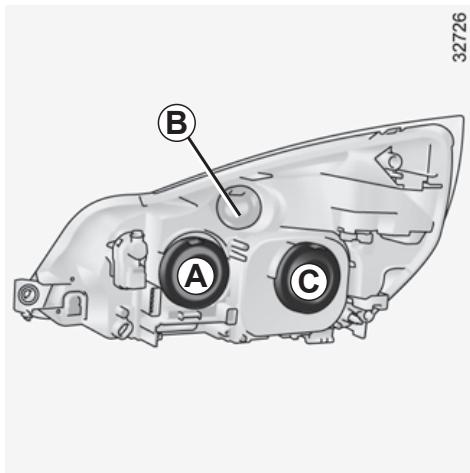
Dipped headlights A Main beam headlights C
Remove the cover A or C .
Remove the connector from the bulb.
Unclip spring 1 or 3 and take out the bulb.
Bulb type: 5 H7 6 H1
It is essential to use anti-U.V. 55W bulbs so as not to damage the plastic on the headlights.
Do not touch the bulb glass. Hold it by its base.
When the bulb has been changed, make sure you refit the cover correctly.
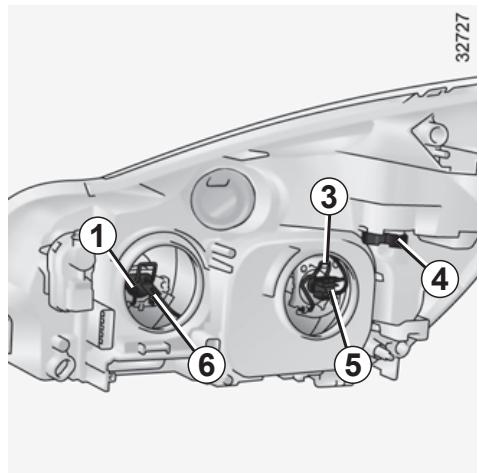
Direction indicator lights
Turn bulb holder 4 a quarter of a turn and take out the bulb.
Bulb type: orange pear-shaped, bayonet type PY21 W bulb.

The bulbs are under pressure and can break when replaced.
Risk of injury.
Front side light B
Never remove cover B
Consult an approved dealer.
Daytime running light
Consult an approved dealer.
To comply with current legislation, or as a precaution, you can obtain an emergency kit from an approved dealer containing a set of spare bulbs and fuses.
XENON HEADLIGHTS: changing bulbs
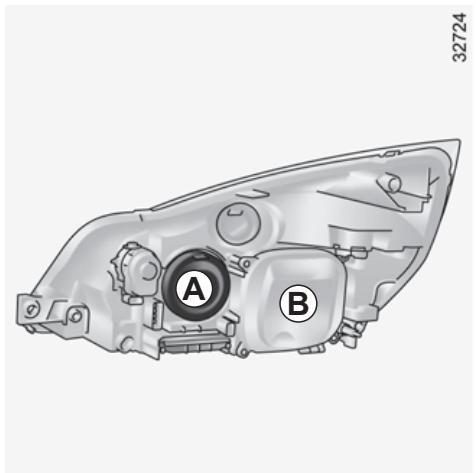
Dipped beam headlights and Xenon headlights
Never remove cover B
Bulb type: D1S.
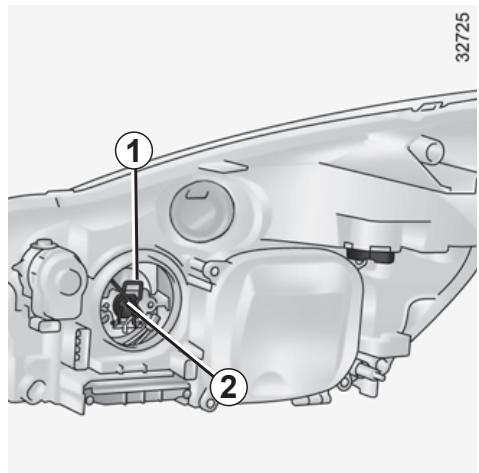
Main beam headlights
Remove cover A.
Unclip spring 1 and remove the bulb.
Remove connector 2.

dealer.
Due to the danger involved in handling high-voltage devices, this type of bulb must be replaced by an approved

Fitting this device requires a special technology; it is prohibited to fit a headlight with xenon bulbs to the point that is not designed for the use of headlight.
Bulb type: H1
It is essential to use anti-U.V. 55W bulbs so as not to damage the plastic on the headlights.
Do not touch the bulb glass. Hold it by its base.
When the bulb has been changed, make sure you refit cover A correctly.
To comply with current legislation, or as a precaution, you can obtain an emergency kit from an approved dealer containing a set of spare bulbs and fuses.

The bulbs are under pressure and can break when replaced.
Risk of injury.
XENON HEADLIGHTS: changing bulbs (continued)
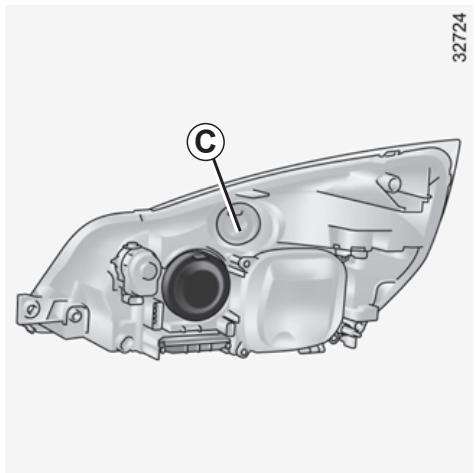
Direction indicators
Turn bulb holder 4 a quarter of a turn and take out the bulb.
Bulb type: orange pear-shaped, bayonet type PY21 W Silver bulb.
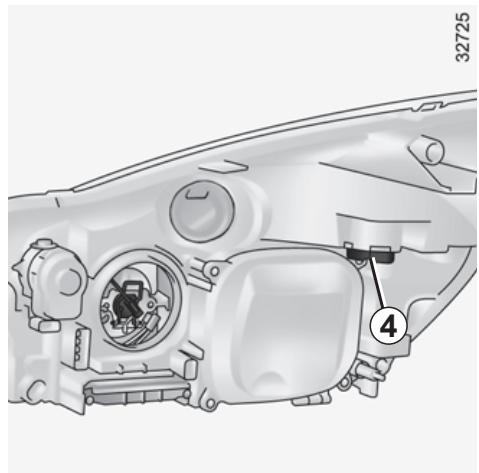
Front side lights C
Never remove cover C.
Consult an approved dealer.
Daytime running lights
Consult an approved dealer.
HEADLIGHTS: fog lights/additional lights
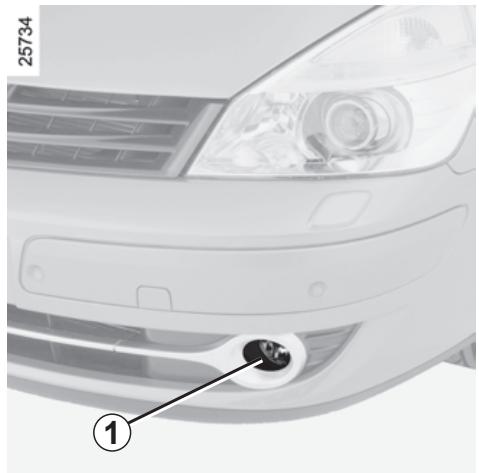
Front fog lights 1
Changing a bulb
Consult an approved dealer.
Bulb type: H11.

The bulbs are under pressure and can break when replaced.
Risk of injury.
Additional lights
If you wish to fit fog lights or long range headlights to your vehicle, consult an approved dealer.

Any operation on (or modification to) the electrical system must be performed by an approved dealer in incorrect connection might be the electrical equipment, components and in particular alternator). In addition, your has all the parts required for these units.
REAR LIGHTS: changing bulbs
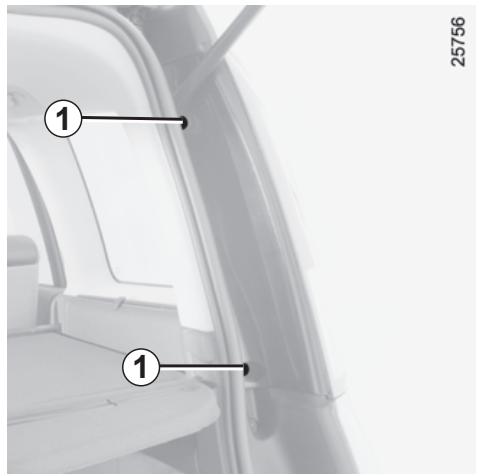
Upper light unit
With the tailgate open, remove screw 1 (using the screwdriver from the kit in the luggage compartment).
Face the light unit, and always pull it straight towards you.
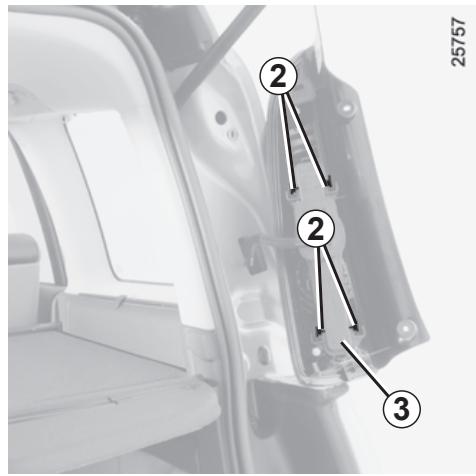
Disconnect and remove the unit.
Move aside tabs 2 to release bulb holder 3 and to access the bulbs.

The bulbs are under pressure and can break when replaced.
Risk of injury.
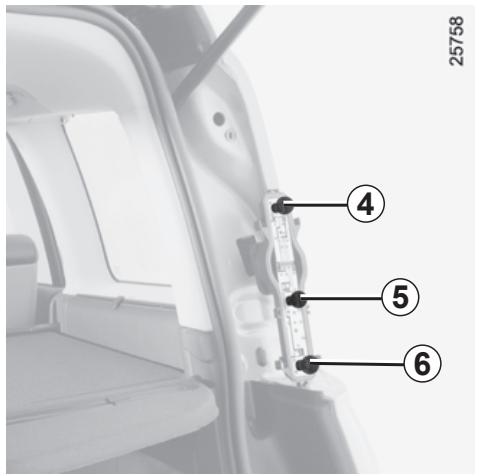
6 Reversing light
4 Side lights and stop lights
Pear-shaped, bayonet type bulb with two filaments: P21/5W.
5 Direction indicator lights
Orange pear-shaped bayonet type bulb: PY21W.
Pear-shaped, bayonet type bulb: P21W.
REAR LIGHTS: changing bulbs (continued)
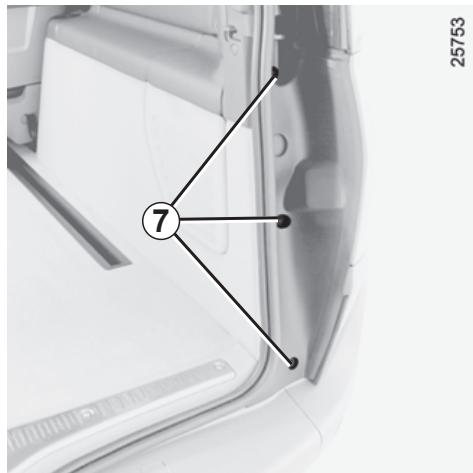
Lower light unit
With the tailgate open, remove screw 7 (using the screwdriver from the kit in the luggage compartment) and remove the trim.
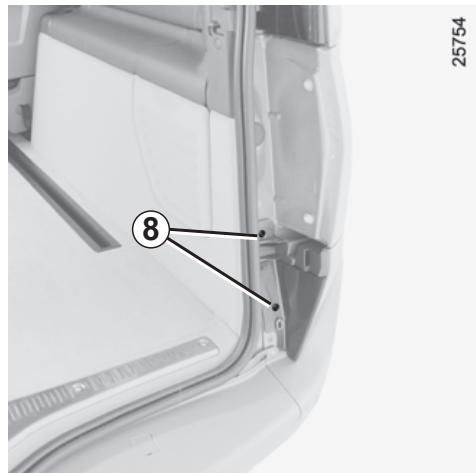
Remove screw 8.
Turn the unit to remove it.
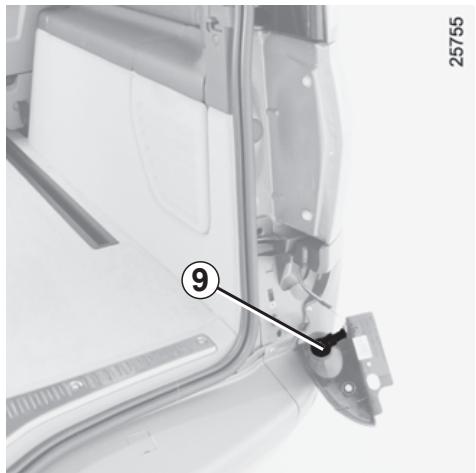
Turn bulb holder 9 a quarter of a turn and take out the bulb.
Rear fog light
Pear-shaped, bayonet type bulb: P21W.
REAR LIGHTS: changing bulbs (continued)

High level brake light 10
Consult an approved dealer.
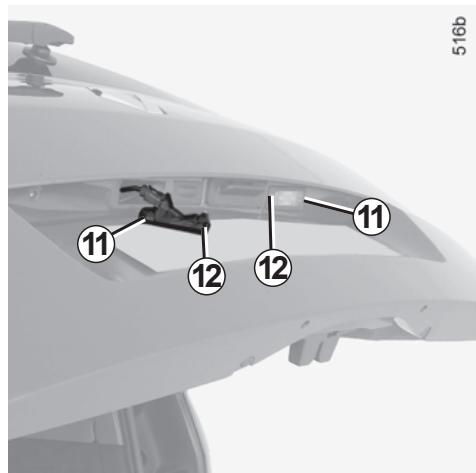
Number plate lights 11
Unclip light 11 by pressing the tab 12.
Remove the light cover to gain access to the bulb.
Bulb type: W5W.

The bulbs are under pressure and can break when replaced.
Risk of injury.
5.20
INDICATOR LIGHTS: changing bulbs
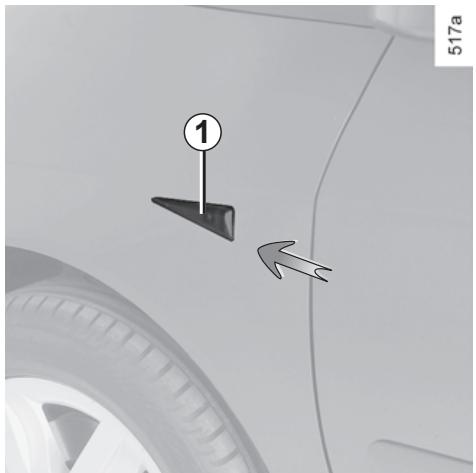
Unclip indicator light 1 (using a tool such as a flat-blade screwdriver) on the side indicated by the arrow.
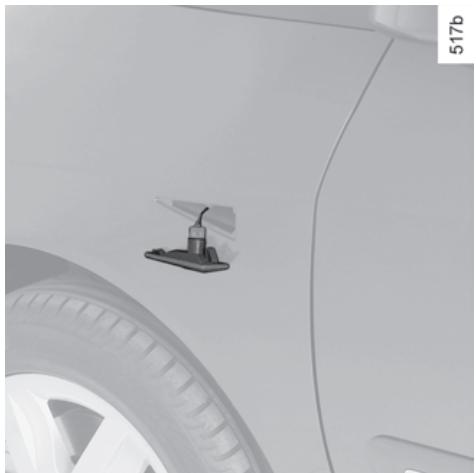
Turn the bulb holder a quarter of a turn and take out the bulb.
Bulb type: W5W.
INTERIOR LIGHTING: changing bulbs
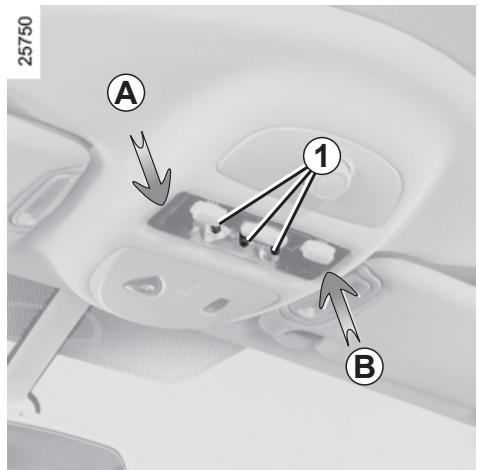
Courtesy light
Insert a flat-blade screwdriver type tool to unclip the light cover on side A then side B.
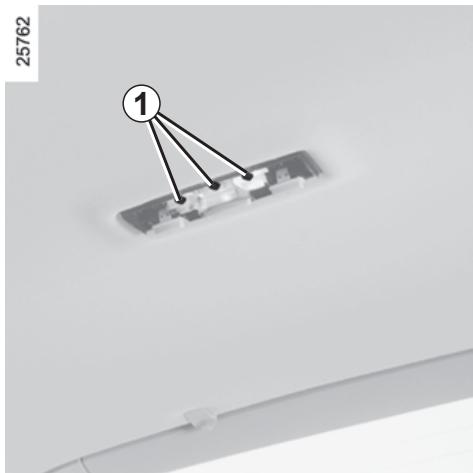
Remove the bulb concerned.
Bulb type 1: W5W.
INTERIOR LIGHTING: changing bulbs (continued)
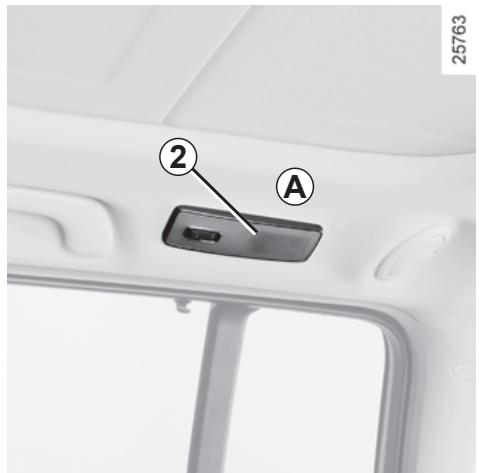
Courtesy light A
Unclip cover 2 (using a flat-blade screwdriver or similar).
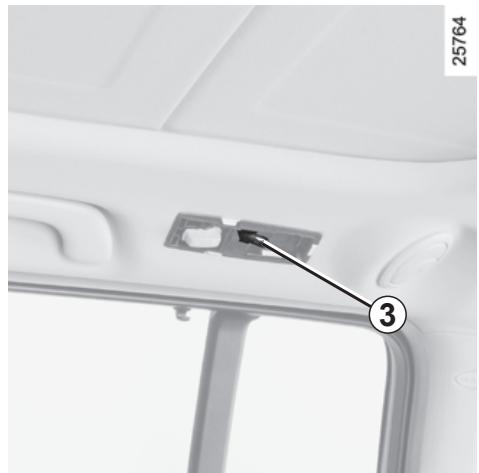
Release the bulb.
Bulb type 3: W5W.
INTERIOR LIGHTING: changing bulbs (continued)
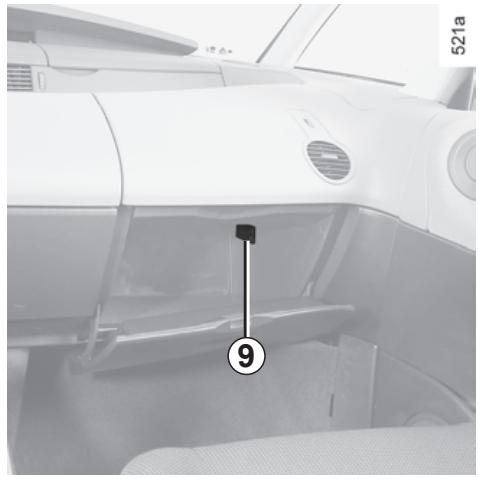
- Dashboard storage compartment light
Using a flat-blade screwdriver or similar, unclip the light by pressing tab 9.
Disconnect the light.
Bulb type: C5W festoon type bulb.
Front floor lights
They are located under the dashboard.
Turn the bulb holder a quarter of a turn and take out the bulb.
Bulb type: W5W.
Rear floor lights
They are located under the front seats.
Remove the bulb holder from its housing and take out the bulb.
Bulb type: W5W.
INTERIOR LIGHTING: changing bulbs (continued)
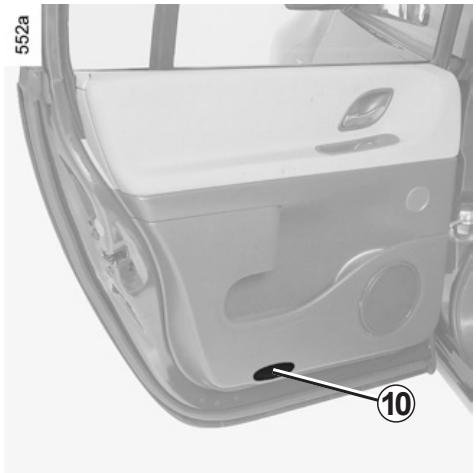
Door lights
Unclip light 10 (using a flat-blade screwdriver or similar).
Turn the bulb holder a quarter of a turn and take out the bulb.
Bulb type: W5W.
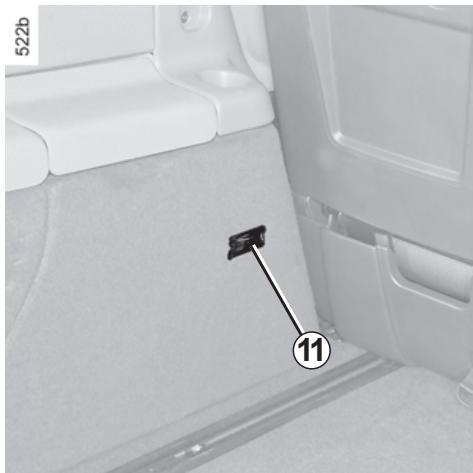
Luggage compartment light
Unclip light 11 by pressing the tabs on each side (using a flat-blade screwdriver or similar).
Disconnect the light.
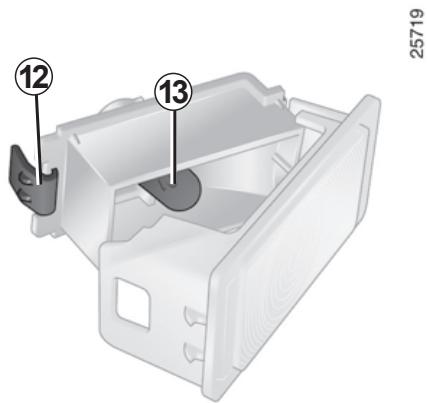
Press tab 12 to release the bulb holder and gain access to bulb 13.
Bulb type: W5W.
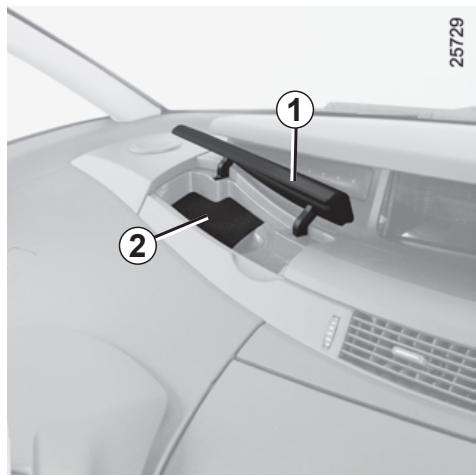
FUSES
Fuse box 3
If an electrical component fails to operate, check that the fuses are sound before carrying out any other checks.
Open cover 1 then lift flap 2.
Refer to the fuse allocation label under flap 2 to identify the fuses (see opposite page).
It is not advisable to use the free fuse locations.
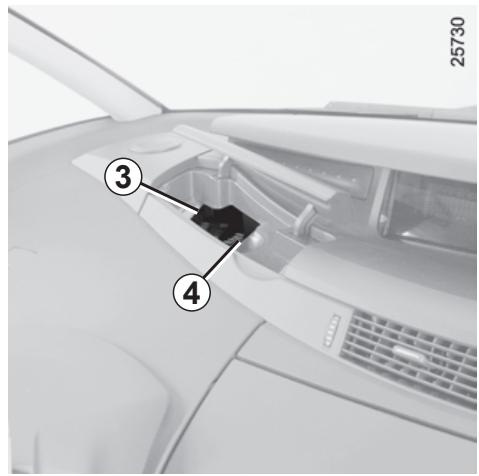

Check the fuse in question and replace it, if necessary, by a fuse of the same rating.
If a fuse is fitted where the rating is too high, it may cause the electrical circuit to overheat (risk of fire) in the event of an item of equipment using an excessive amount of current.
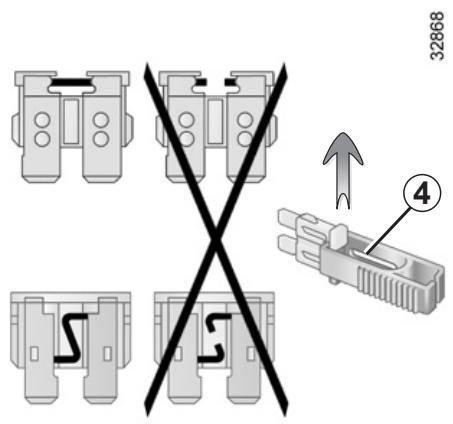
Disconnect the fuse using tweezers 4.
To remove the fuse from the tweezers, slide the fuse to the side.
In accordance with local legislation or as a precautionary measure:
Obtain an emergency kit containing a set of spare bulbs and fuses from an approved Dealer.
FUSES (continued)
Allocation of fuses (DEPENDING ON THE EQUIPMENT LEVEL)
| Numbers | Allocation | Numbers | Allocation | Numbers | Allocation |
| ALIM UCH | Electrical management unit/Engine immobiliser | Δ | Hazard warning lights/Indicators | ∅ | Passenger compartment accessory socket |
| D | Not used | ABS | Anti-lock Braking System (ABS) | ∅‡ | Rear fog light |
| IC | Instrument panel/Remote headlight adjustment | Horn | Air bags/Pretensioners | MEMO INJECT | Heated door mirrors |
| C | Air conditioning/Parking proximity sensor/Reversing light | 3 | Electric windows/Electric door mirrors | ∅ | Door locking/unlocking |
| T | Interior lighting | €D | Front fog lights/Instrument panel | ∅ | Cigar lighter |
| STOP | Stop lights/Cruise control | Communication system/ Radio/Electric seats | ∅ | Rear screen demisting/ Steering column lock | |
| D | Left-hand dipped beam headlight | Rear wiper/Main beam headlights | ∅ | Right-hand dipped beam headlight | |
| L | Left-hand side light/Internal control lighting | Rear wiper/Main beam headlights | ∅ | ||
| R | Right-hand side lights |
RENault CARD: battery
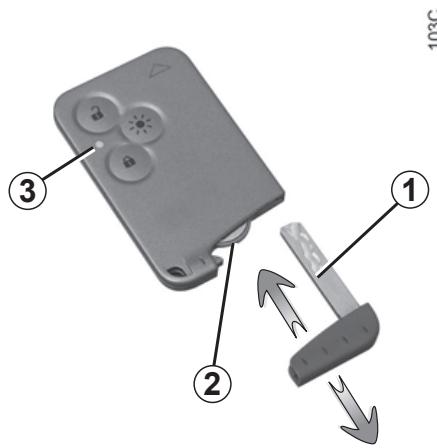
Replacing the battery
Pull firmly on emergency key 1.
Replace battery 2 in accordance with the polarity denoted on the emergency key (check that indicator light 3 lights up properly by pressing a button on the RENAULT card).
The batteries are available from approved dealers. Their service life is approximately two years. Check that there is no dye on the battery: risk of an incorrect electrical contact.
Do not throw away your used batteries; give them to an organisation responsible for collecting and recycling batteries.
BATTERY: troubleshooting
To avoid all risk of sparks:
- Ensure that any electrical consumers (courtesy lights, etc.) are switched off before disconnecting or reconnecting the battery.
- When charging, stop the charger before connecting or disconnecting the battery.
- Do not place metal objects on the battery to avoid creating a short circuit between the terminals.
- Always wait at least one minute after the engine has been switched off before disconnecting a battery.
- Make sure that you reconnect the battery terminals after refitting.

Handle the battery with care as it contains sulphuric acid, which must not come into contact with eyes or skin. If
it does, wash the affected area with plenty of cold water. If necessary, consult a doctor.
Ensure that naked flames, red hot objects and sparks do not come into contact with the battery as there is a risk of explosion.
The engine may be hot when carrying out operations in close proximity. In addition, the engine cooling fan can come on at any moment.
Risk of injury.
BATTERY: troubleshooting (continued)
Connecting a battery charger
The battery charger must be compatible with a battery with a nominal voltage of 12 volts.
It is essential to disconnect both battery leads from the terminals (engine stopped) starting with the negative terminal.
Do not disconnect the battery when the engine is running. Follow the instructions given by the manufacturer of the battery charger you are using.
Only a fully charged and well-maintained battery will have a long and useful life and enable you to start the vehicle's engine normally.
The battery must be kept clean and dry.
Have the battery's charge status checked regularly:
-
Especially if you use your vehicle for short journeys or for frequent driving in town.
-
When the exterior temperature drops (in winter), the charge decreases. In winter, only use electrical equipment which is really necessary.
- Finally, you should understand that the charge decreases naturally as a result of certain permanent electrical consumers such as the clock, after-sales accessories, etc.
When a large number of accessories are fitted to the vehicle, have them connected to the + after ignition feed. In this case, it is advisable to have your vehicle fitted with a battery which has an increased nominal capacity. Contact an approved dealer.
If your vehicle is to be left stationary for a relatively long time, disconnect the battery or have it recharged regularly, particularly during cold weather. The equipment with a memory, radio etc. will then have to be reprogrammed. The battery must be stored in a cool dry place, protected from frost.

Special procedures may be required to charge some batteries. Contact your approved dealer.
Avoid all risk of sparks which may cause an immediate explosion, and charge the battery in a well-ventilated area. Risk of serious injury.
BATTERY: troubleshooting (continued)
Starting the vehicle using the battery from another vehicle
If you have to use the battery from another vehicle to start, obtain suitable jump leads (with a large cross section) from an approved dealer or, if you already have jump leads, ensure that they are in perfect condition.
The two batteries must have an identical nominal voltage of 12 volts. The battery supplying the current should have a capacity (amp-hours, Ah) which is at least the same as that of the discharged battery.
Ensure that there is no risk of contact between the two vehicles (risk of short circuiting when the positive terminals are connected) and that the discharged battery is properly connected. Switch off your vehicle ignition.
Start the engine of the vehicle supplying the current and run it at an intermediate engine speed.
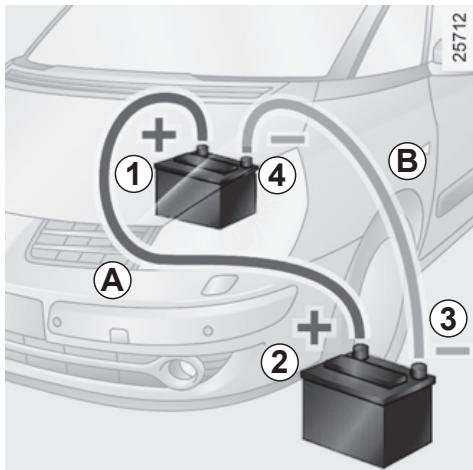
Connect positive (+) lead A to (+) terminal 1 of the discharged battery, then to (+) terminal 2 of the battery supplying the current.
Connect negative (-) lead ±bB to (-) terminal 3 of the battery supplying the current and then to (-) terminal 4 of the discharged battery.
Check that there is no contact between leads A and B and that the positive (+) lead A is not touching any metal parts on the vehicle supplying the current.
Start the engine as you would normally. As soon as it is running, disconnect leads A and B in the reverse order (4-3-2-1).

Check that there is no contact between leads A and B and that the positive lead A is not touching any metal
parts on the vehicle supplying the current.
Risk of injury and/or damage to the vehicle.
WINDSCREEN WIPER BLADES
21987
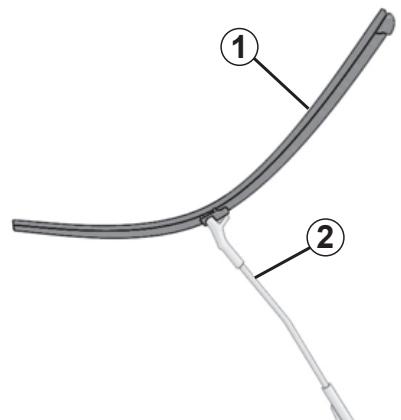
Replacing windscreen wiper blades 1
- Lift wiper arm 2;
- move blade 1 into a horizontal position;
- slide blade 1 until catch 3 on the wiper arm is released.
Refitting
To refit the wiper blade, proceed in the reverse order to removal. Make sure that the blade is correctly locked in position.
21986
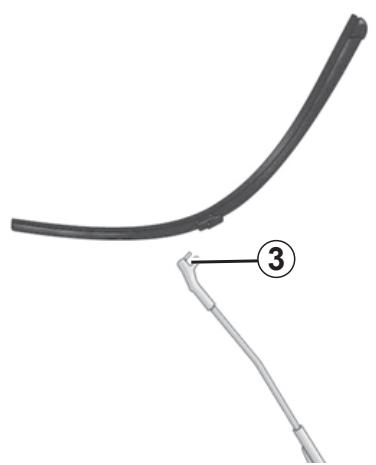
Windscreen washer jets
These can be adjusted using a tool such as a flat-blade screwdriver.

-In frosty weather, make sure that the wiper blades are not stuck by ice (risk of motor overheating).
- Check the condition of the wiper blades. Replace the wiper blades as soon as they begin to lose efficiency (approximately once a year).
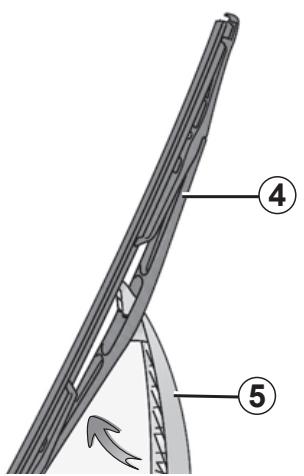
6
Rear screen wiper blade 4
- Lift wiper arm 5 as far as it will go;
- pivot blade 4 until it is removed from its hinge.
Refitting
To refit the wiper blade, clip the blade onto its hinge. Make sure that the blade is correctly locked in position.
ACCESSIONS

Before fitting an electrical or electronic device (particularly for transmitters/receivers: frequency bandwidth,
power level, position of the aerial etc.), ensure that it is compatible with your vehicle.
Contact an approved dealer for this information.

Use of transmission/receiving devices (telephones, CB equipment etc.).
Telephones and CB equipment with integrated aerials may cause interference to the original electronic systems fitted to the vehicle: it is advisable only to use equipment with an external aerial.
Furthermore, we remind you of the need to comply with the legislation in force concerning the use of such equipment.

Fitting after-market accessories
If you wish to install accessories on the vehicle: consult an approved dealer.
Also, to ensure the correct operation of your vehicle, and to avoid any risk to your safety, we recommend that you use only specific accessories, designed for your vehicle, which are the only accessories for which the manufacturer will provide a warranty.

If you are using an anti-theft device, only attach it to the brake pedal.

Electrical and electronic accessories
- Connect accessories with a maximum power of 120 Watts only.
Fire hazard.
- No work may be carried out on the vehicle's electrical or radio circuits, except by approved Dealers: an incorrectly connected system may result in damage being caused to the electrical equipment and/or the components connected to it;
- if the vehicle is fitted with any aftermarket electrical equipment, make sure that the unit is correctly protected by a fuse. Establish the rating and position of this fuse.
TOWING: breakdown
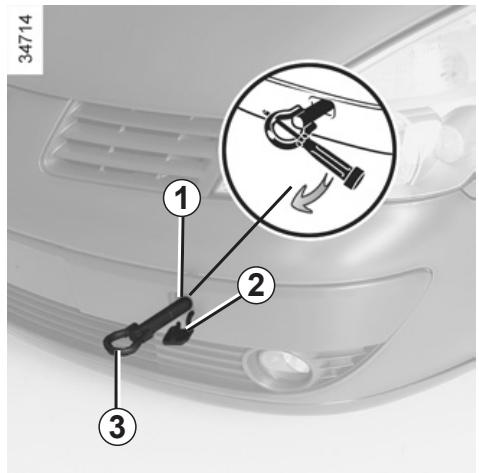
Insert the card fully into the card reader to unlock the steering wheel and to be able to use the signal lights (brake lights, indicators, etc.). The towed vehicle's lights must be switched on at night.
The speed specified by current legislation for towing must always be observed. If your vehicle is the towing vehicle, do not exceed the maximum towing weight for your vehicle (refer to the information on "Weights" in Section 6).
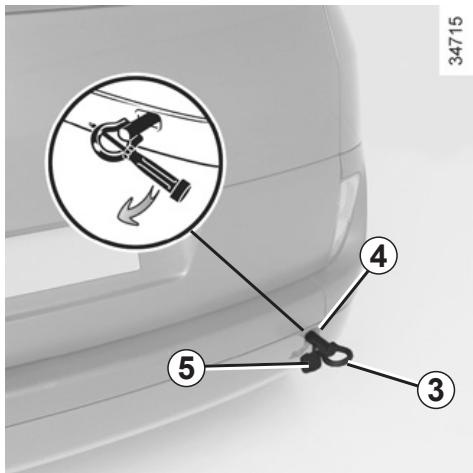
Only use the front 1 and rear 4 towing points (never use the driveshfts or any other part of the vehicle). These towing points may only be used for towing: never use them for lifting the vehicle directly or indirectly.
Access to towing points
Unclip cover 2 or 5.
Use the towing hitch from the tool kit (refer to the information on the "Tool kit" in Section 5).
Tighten towing hitch 3 fully: first by hand as far as it will go, then finish tightening it using the wheelbrace from the tool kit.
Towing hitch 3 is located in the tool kit (refer to information on the "Tool kit" in Section 5).

Do not remove the RENAULT card from the reader when the vehicle is being towed.

When the engine is stopped, steering and braking assistance are not operational.

Do not leave the tools unsecured inside the vehicle as they may come loose under braking.
TOWING: breakdown (continued)

-
Use a rigid towing bar. If a rope or cable is used (where the law allows this), the vehicle being towed be able to brake.
-
A vehicle must not be towed if it is not fit to be driven.
- Avoid accelerating or braking suddenly when towing, as this may result in damage being caused to the vehicle.
- When towing a vehicle, it is advisable not to exceed 15 mph (25 km/h).
Towing a vehicle with an automatic transmission: special features
With the engine switched off: the gearbox is no longer lubricated. It is preferable to tow this type of vehicle on a trailer or tow it with the front wheels off the ground.
Under exceptional circumstances, you may tow the vehicle with all four wheels on the ground, only going forward, with the gear lever in the N position, and for a distance not exceeding 30 miles (50 km).

When the engine is stopped, steering and braking assistance are not operational.
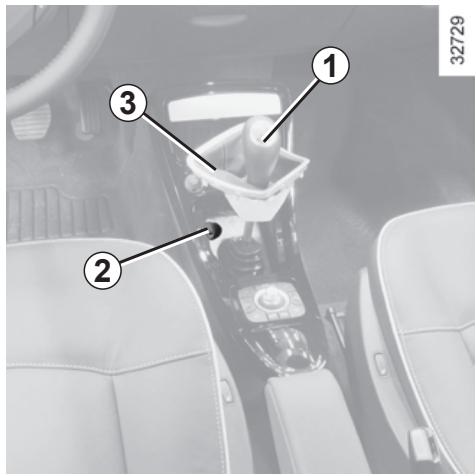

If the lever is stuck in P, even though you are depressing the brake pedal, the lever can be released.
To do this, unclip the cover at the base of the lever.
Press simultaneously on button 2 and on the unlocking button on lever 1.
TOWING: towing equipment
Permissible nose weight, maximum permissible towing weight, braked and unbraked: refer to the information on "Weights" in Section 6.
Please refer to the manufacturer's instructions on how to fit and use the bars.
Please keep these instructions with the rest of the vehicle documentation.
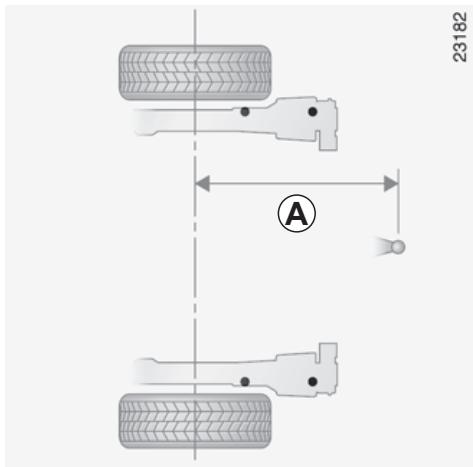
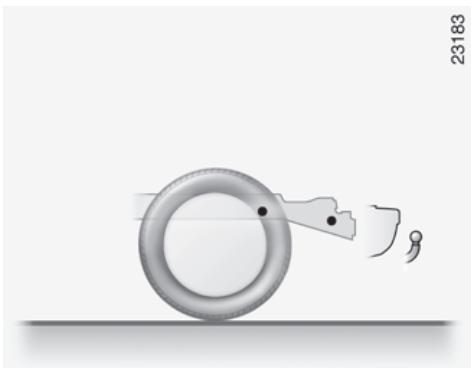
A: normal chassis: 907 mm
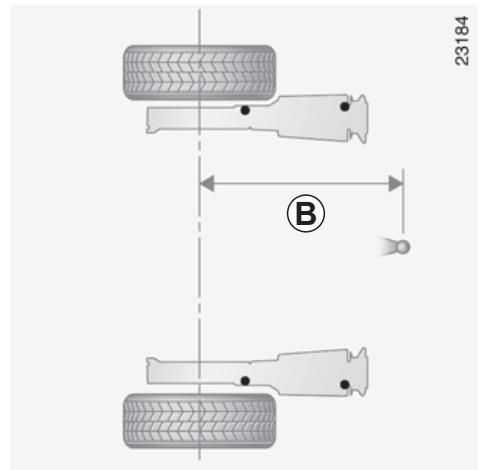
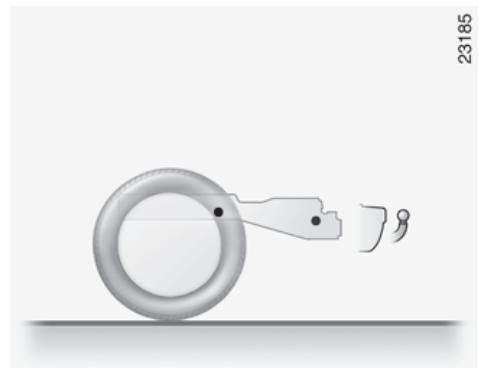
B: long chassis 1,030 mm
OPERATING FAULTS (1/5)
The following advice will enable you to carry out quick, temporary repairs. For safety reasons you should always contact an approved dealer as soon as possible.
| Using the RENAULT card | POSSIBLE CAUSES | WHAT TO DO |
| The RENAULT card does not lock or unlock the doors. | Card battery is flat. | Replace the battery. You can still lock/unlock and start your vehicle (refer to the information on “Locking/unlocking the doors” in Section 1 and “Starting/Stopping the engine” in Section 2). |
| Use of appliances operating on the same frequency as the card (mobile phone, etc.). | Stop using the equipment or use the emergency key (refer to the information on “Locking/unlocking the doors” in Section 1). | |
| Vehicle located in a high electromagnetic radiation zone. | Use the emergency key integrated in the card (refer to the information on “Locking/ unlocking the doors” in Section 1). | |
| Vehicle battery flat. |
OPERATING FAULTS (2/5)
| The starter is activated | POSSIBLE CAUSES | WHAT TO DO |
| The instrument panel indicator lights are weak or fail to light up and the starter does not turn. | Battery terminals not tight, battery terminals disconnected or oxidised. | Retighten or reconnect the terminals, or clean them if they are oxidised. |
| Discharged battery or not operational. | Connect another battery to the faulty battery. Refer to information on "Battery: troubleshooting" in Section 5 or replace the battery if necessary. Do not push the vehicle if the steering column is locked. | |
| The engine will not start. | Starting conditions are not fulfilled. | Refer to the information on "Starting/stopping the engine" in Section 2. |
| The hands-free RENAULT card does not work. | Insert the card in the card reader in order to start the engine. Refer to the information on "Starting/stopping the engine" in Section 2. | |
| The engine cannot be switched off. | Card not detected. | Insert the card in card reader. |
| Electronic fault. | Press the starter button quickly five times. |
OPERATING FAULTS (3/5)
| On the road | POSSIBLE CAUSES | WHAT TO DO |
| Vibrations. | Tyres not inflated to correct pressures, incorrectly balanced or damaged. | Check the tyre pressures: if this is not the problem, have them checked by an approved dealer. |
| White smoke from the exhaust. | This is not necessarily a fault. Smoke may be caused by regeneration of the particle filter. | Refer to the information on “Special features of diesel versions” in Section 2. |
| Smoke under the bonnet. | Short-circuit or cooling system leak. | Stop, switch off the ignition, stand away from the vehicle and contact an approved dealer. |
| The oil pressure warning light comes on: | ||
| on a bend or when braking. | The level is too low. | Top up the engine oil (refer to the information on “Engine oil level – Topping up/refilling” in Section 4). |
| is slow to go out or remains lit when accelerating. | Loss of oil pressure. | Stop the vehicle and contact an approved Dealer. |
OPERATING FAULTS (4/5)
| On the road | POSSIBLE CAUSES | WHAT TO DO |
| Steering becomes heavy. | Assistance overheating. | Consult an approved dealer. |
| The engine overheats. The coolant temperature indicator is in the warning zone and the STOP warning light comes on. | Engine cooling fan not working. | Stop the vehicle, switch off the engine and contact an approved dealer. |
| Coolant leaks. | Check the coolant reservoir: it should contain fluid. If there is no coolant, consult an approved dealer as soon as possible. |

Radiator: If there is a significant lack of coolant, remember that it must never be topped up using cold coolant while the engine is very warm. After any procedure on the vehicle which has involved even partial draining of the cooling system, it must be refilled with a new mixture prepared in the correct proportions. Reminder: only products approved by our Technical Department may be used for this purpose.
OPERATING FAULTS (5/5)
| Electrical equipment | POSSIBLE CAUSES | WHAT TO DO |
| The wipers do not work. | Wiper blades stuck. | Free the blades before using the wipers. |
| Faulty electrical circuit. | Consult an approved dealer. | |
| The wiper does not stop. | Faulty electrical controls. | Consult an approved dealer. |
| Direction indicators flashing more quickly. | Blown bulb. | See information on “Headlights: changing the bulbs” or “Rear lights: changing the bulbs” in section 5. |
| The direction indicators do not work. | Faulty electrical circuit. | Consult an approved dealer. |
| The lights do not come on or go off. | Faulty electrical circuit or control. | Consult an approved dealer. |
| Traces of condensation in the lights. | Traces of condensation may be a natural phenomenon caused by variations in temperature. In this situation, these traces soon disappear when the lights are switched on. |
Section 6: Technical specifications
Vehicle identification plates 6.2
Engine identification plates 6.3
Engine specifications. 6.4
Weights 6.5
Towing weights 6.5
Dimensions 6.6
Replacement parts and repairs 6.7
Service sheets 6.8
Anti-corrosion check 6.14
6.1
VEHICLE IDENTIFICATION PLATES
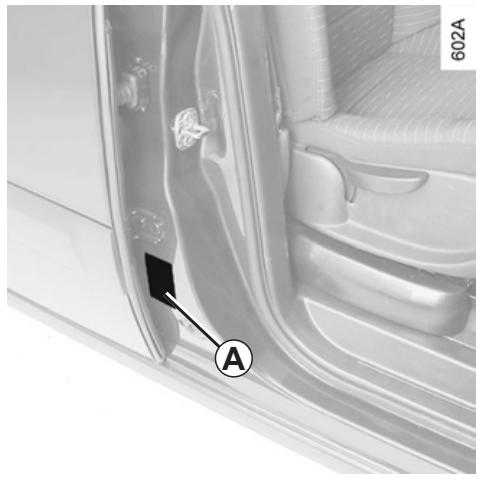
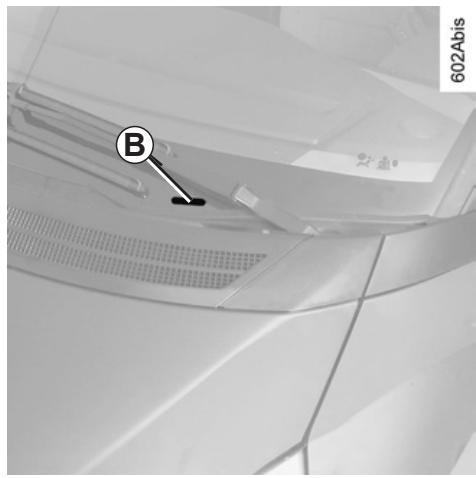
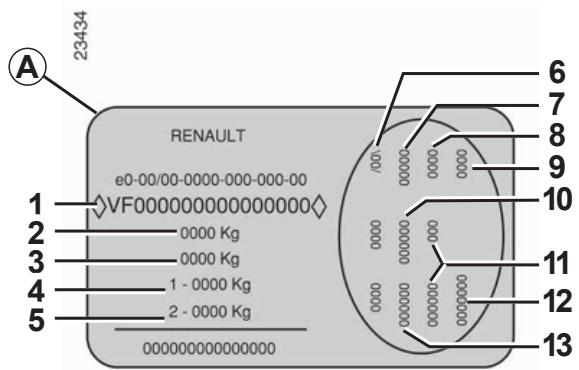
Quote the manufacturer's plate (right-hand side) in all correspondence or when ordering parts.
The presence and location of the information depends on the vehicle.
Vehicle identification plate A
1 Vehicle type and chassis number.
Depending on the vehicle, this information is also given on marking B .
2 Maximum permissible all-up weight of the vehicle.
3 GTW (Gross train weight - vehicle fully loaded, with trailer).
4 Front axle maximum permissible all-up weight.
5 Rear axle maximum permissible all-up weight.
6 Technical specifications of vehicle.
7 Paint reference.
8 Equipment level.
9 Vehicle type.
10Trim code.
11 Additional equipment specification.
12Production number.
13 Interior trim code.
ENGINE IDENTIFICATION PLATES
362
Quote the information on the identification plate (or label) in all correspondence or when ordering parts.
Engine marking A
1 Engine type.
2 Engine suffix.
3 Engine number.
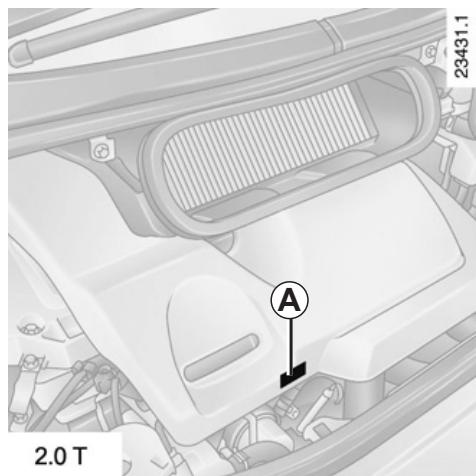
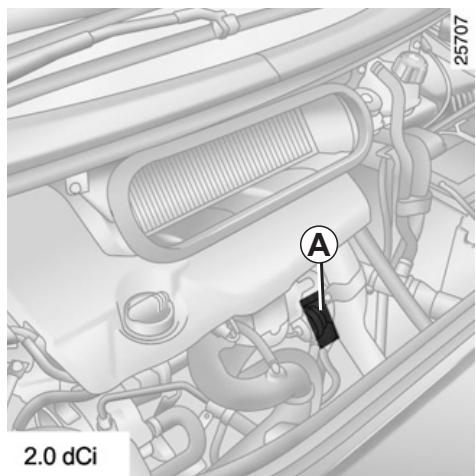
ENGINE SPECIFICATIONS
| Versions | 2.0 T | 2.0 dCi |
| Engine type (see engine plate) | F4R turbo | M9R turbo |
| Cubic capacity (cc) | 1998 | 1998 |
| Type of fuel Octane rating | It is essential that you use unleaded petrol of the octane rating stated on the label inside the fuel filler flap. If not available, for a limited time only, use unleaded fuel: - with an octane rating of 91 for a label showing 95 or 98; - with an octane rating of 87 for a label showing 91, 95 or 98. | Diesel The label located in the fuel filler flap indicates authorised fuels. |
| Spark plugs | Only use the spark plugs specified for your vehicle's engine. The type should be marked on a label affixed inside the engine compartment. If it is not, contact an approved dealer. Fitting spark plugs which are not to specification may damage the engine. | - |
WEIGHTS (in kg)
The weights indicated for a basic vehicle without options: they vary depending on the your vehicle's equipment. Consult your approved Dealer.
| Maximum permissible all-up weight (MMAC) Total train weight (MTR) | Weights are indicated on the vehicle identification plate (refer to the information on "Vehicle identification plates" in Section 6) |
| Braked Trailer Weight* | found by calculating: MTR - MMAC |
| Unbraked Trailer Weight* | 750 |
| Permissible nose weight* | 80 |
| Permissible load on the roof with the carrying device | 80 kg (including the carrying device) |
- Towing weight (Towing a caravan, boat, etc.)
Towing is prohibited when the calculation MTR (Total train weight) - MMAC (Maximum permissible all-up weight) is zero.
-
It is important to comply with the towing weights, governed by local legislation in each country and, in particular, laid down in the Road Traffic Regulations. Contact an approved Dealer about any towing equipment.
-
When towing, under no circumstances may the total train weight (vehicle + trailer) be exceeded. However the following is permitted:
-
the Maximum permissible weight at the rear may be exceeded by no more than 15% ,
- the maximum permissible all-up weight may be exceeded by no more than 10% or 100kg (whichever occurs first).
In either case, the maximum speed of the towing assembly must not exceed 60 mph (100 km/h) and the tyre pressure must be increased by 0.2 bar (3 PSI).
- The engine output and climbing capability are reduced with altitude. We recommend that the maximum load be reduced by 10% at an altitude of 1,000 metres and by an additional 10% for each 1,000 metres thereafter.
Weight transfer
If the Maximum Authorised Mass of the vehicle has not been reached, up to 500kg can be transferred to the braked trailer, within the limits of the Gross Train Weight.
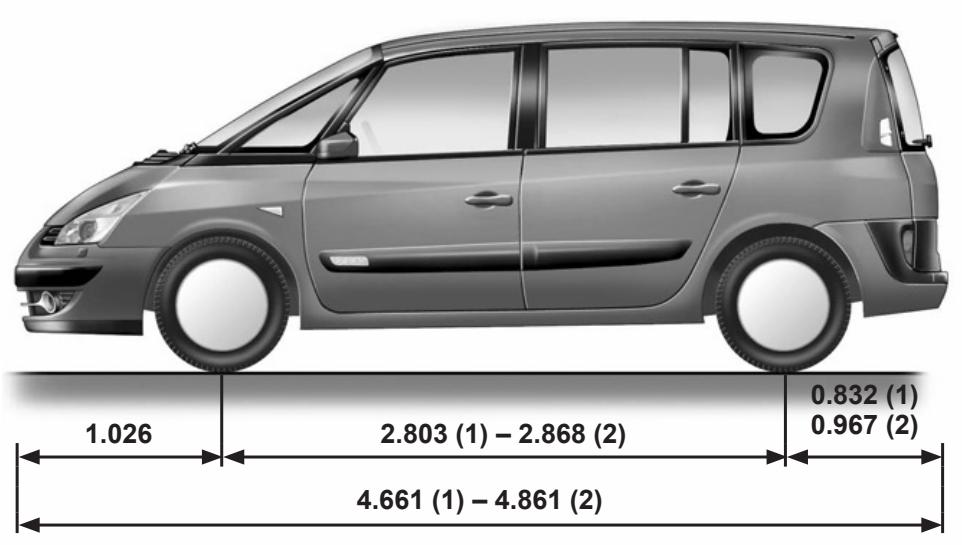
DIMENSIONS (in metres)
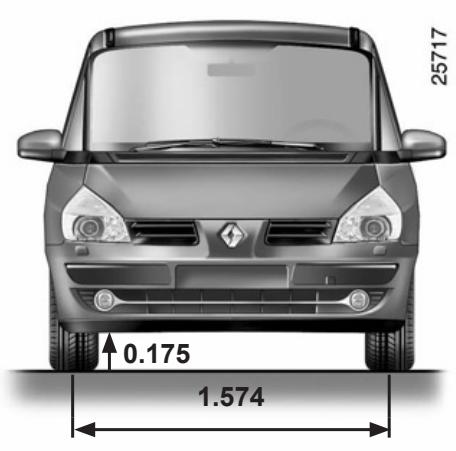
(1) normal chassis
(2) long chassis
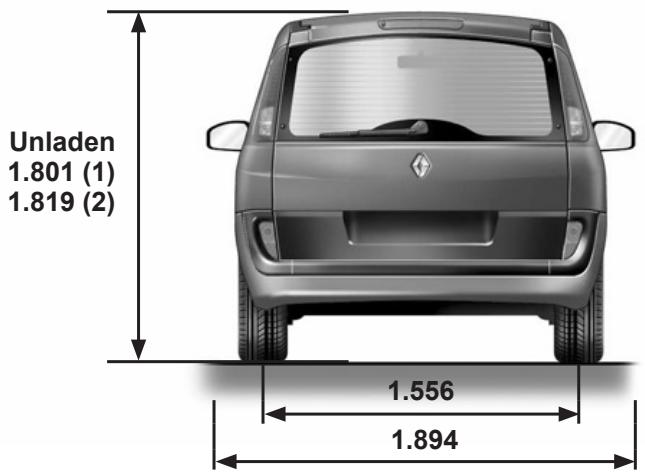
6.6
REPLACEMENT PARTS AND REPAIRS
Original parts are based on strict specifications and are subject to highly-specialised tests. Therefore, they are of at least the same level of quality as the parts fitted originally.
If you always fit genuine replacement parts to your vehicle, you will ensure that it performs well. Furthermore, repairs carried out within the manufacturer's Network using original parts are guaranteed according to the conditions set out on the reverse of the repair order.
SERVICE SHEETS (1/6)
VIN:
| Date: Miles (km):Invoice number: | Comments/miscellaneous | |
| Type of operation:Service☐☐☐ | ||
| Anticorrosion check:OK ☐ Not OK* ☐*See specific page | ||
| Date: Miles (km):Invoice number: | Comments/miscellaneous | |
| Type of operation:Service☐☐☐ | ||
| Anticorrosion check:OK ☐ Not OK* ☐*See specific page | ||
| Date: Miles (km):Invoice number: | Comments/miscellaneous | |
| Type of operation:Service☐☐☐ | ||
| Anticorrosion check:OK ☐ Not OK* ☓*See specific page | ||
SERVICE SHEETS (2/6)
VIN:
| Date: Miles (km):Invoice number: | Comments/miscellaneous | |
| Type of operation:Service☐☐☐ | ||
| Anticorrosion check:OK ☐ Not OK* ☐*See specific page | ||
| Date: Miles (km):Invoice number: | Comments/miscellaneous | |
| Type of operation:Service☐☐☐ | ||
| Anticorrosion check:OK ☐ Not OK* ☐*See specific page | ||
| Date: Miles (km):Invoice number: | Comments/miscellaneous | |
| Type of operation:Service☐☐☐ | ||
| Anticorrosion check:OK ☐ Not OK* ☓*See specific page | ||
SERVICE SHEETS (3/6)
VIN:
| Date: Miles (km):Invoice number: | Comments/miscellaneous | |
| Type of operation:Service☐☐☐ | ||
| Anticorrosion check:OK ☐ Not OK* ☐*See specific page | ||
| Date: Miles (km):Invoice number: | Comments/miscellaneous | |
| Type of operation:Service☐☐☐ | ||
| Anticorrosion check:OK ☐ Not OK* ☐*See specific page | ||
| Date: Miles (km):Invoice number: | Comments/miscellaneous | |
| Type of operation:Service☐☐☐ | ||
| Anticorrosion check:OK ☐ Not OK* ☓*See specific page | ||
SERVICE SHEETS (4/6)
VIN:
| Date: Miles (km):Invoice number: | Comments/miscellaneous | |
| Type of operation:Service☐☐☐ | ||
| Anticorrosion check:OK ☐ Not OK* ☐*See specific page | ||
| Date: Miles (km):Invoice number: | Comments/miscellaneous | |
| Type of operation:Service☐☐☐ | ||
| Anticorrosion check:OK ☐ Not OK* ☐*See specific page | ||
| Date: Miles (km):Invoice number: | Comments/miscellaneous | |
| Type of operation:Service☐☐☐ | ||
| Anticorrosion check:OK ☐ Not OK* ☓*See specific page | ||
SERVICE SHEETS (5/6)
VIN:
| Date: Miles (km):Invoice number: | Comments/miscellaneous | |
| Type of operation:Service☐☐☐ | ||
| Anticorrosion check:OK ☐ Not OK* ☐*See specific page | ||
| Date: Miles (km):Invoice number: | Comments/miscellaneous | |
| Type of operation:Service☐☐☐ | ||
| Anticorrosion check:OK ☐ Not OK* ☐*See specific page | ||
| Date: Miles (km):Invoice number: | Comments/miscellaneous | |
| Type of operation:Service☐☐☐ | ||
| Anticorrosion check:OK ☐ Not OK* ☓*See specific page | ||
SERVICE SHEETS (6/6)
VIN:
| Date: Miles (km):Invoice number: | Comments/miscellaneous | |
| Type of operation:Service☐☐☐ | ||
| Anticorrosion check:OK ☐ Not OK* ☐*See specific page | ||
| Date: Miles (km):Invoice number: | Comments/miscellaneous | |
| Type of operation:Service☐☐☐ | ||
| Anticorrosion check:OK ☐ Not OK* ☐*See specific page | ||
| Date: Miles (km):Invoice number: | Comments/miscellaneous | |
| Type of operation:Service☐☐☐ | ||
| Anticorrosion check:OK ☐ Not OK* ☓*See specific page | ||
ANTICORROSION CHECK (1/5)
If the continuation of the warranty is subject to repair, it is indicated below.
VIN:
| Corrosion repair operation to be carried out: | Stamp | |
| Date of repair: | ||
| Repair to be carried out: | Stamp | |
| Date of repair: | ||
| Repair to be carried out: | Stamp | |
| Date of repair: | ||
6.14
ANTICORROSION CHECK (2/5)
If the continuation of the warranty is subject to repair, it is indicated below.
VIN:
| Corrosion repair operation to be carried out: | Stamp | |
| Date of repair: | ||
| Repair to be carried out: | Stamp | |
| Date of repair: | ||
| Repair to be carried out: | Stamp | |
| Date of repair: | ||
ANTICORROSION CHECK (3/5)
If the continuation of the warranty is subject to repair, it is indicated below.
VIN:
| Corrosion repair operation to be carried out: | Stamp | |
| Date of repair: | ||
| Repair to be carried out: | Stamp | |
| Date of repair: | ||
| Repair to be carried out: | Stamp | |
| Date of repair: | ||
6.16
ANTICORROSION CHECK (4/5)
If the continuation of the warranty is subject to repair, it is indicated below.
VIN:
| Corrosion repair operation to be carried out: | Stamp | |
| Date of repair: | ||
| Repair to be carried out: | Stamp | |
| Date of repair: | ||
| Repair to be carried out: | Stamp | |
| Date of repair: | ||
ANTICORROSION CHECK (5/5)
If the continuation of the warranty is subject to repair, it is indicated below.
VIN:
| Corrosion repair operation to be carried out: | Stamp | |
| Date of repair: | ||
| Repair to be carried out: | Stamp | |
| Date of repair: | ||
| Repair to be carried out: | Stamp | |
| Date of repair: | ||
6.18
ALPHABETICAL INDEX (1/5)
A
ABS 1.48,2.23-2.24
accessories 5.33
accessories socket 1.45
additional methods of restraint 1.23 1.26, 1.28
adjusting the seats. 1.20
adjusting your driving position 1.20
advice on antipollution 2.12 2.14
air bag. 1.48
activating the front passenger air bags. 1.39
deactivating the front passenger air bags. 1.38
air conditioning 3.2 3.25
air vents. 3.2 3.4
anti-corrosion check 6.14 → 6.18
anti-corrosion protection 4.14
anti-lock braking system: ABS 2.23 - 2.24
antipollution advice 2.12 2.14 armrest 3.45
armrests front. 1.19
ashtrays 3.41
ASR (traction control) 1.47
audible and visual signals 1.7
automatic gearbox (use) 2.37 → 2.40
automatic gearbox selector lever. 2.37 2.40
B
battery. 4.13
troubleshooting 5.29 5.31
bonnet. 4.2
brake fluid 4.10
bulbs changing .5.14 5.25
C
card emergency key 1.4
catalytic converter 2.6
central door locking 1.7 → 1.11
changing a bulb 5.14 5.25
changing a wheel 5.9
child headrest 3.43-3.44
child restraint/seat 1.29-1.30,1.32→1.37
child safety.....1.3, 1.8, 1.29 - 1.30, 1.32 1.37, 3.27 - 3.28,
3.32, 3.43-3.44
child seats. 1.29-1.30, 1.32 1.37
children. 1.8, 1.29 - 1.30, 3.27 - 3.28, 3.32, 3.43 - 3.44
cigarlighter 3.41
cleaning: inside the vehicle 4.16-4.17
clock 1.63
control instruments 1.46 → 1.53
controls. 1.42 → 1.45
coolant 4.8
courtesylight 3.33,3.35-3.36, 5.22 5.25
courtesy mirrors 3.33
cruise control 1.48, 2.29 2.32
cruise control-speed limiter. 2.26, 2.29 2.32
D
dashboard. 1.42 → 1.45
de-icing windscreen 3.19
demisting rear screen. 3.5, 3.7, 3.12, 3.18 windscreen 3.5, 3.7, 3.12
dimensions 6.6
dipstick. 4.4 → 4.7
display 1.46 → 1.49
doors/tailgate 1.7→1.12
driver's position 1.42 → 1.45
ALPHABETICAL INDEX (2/5)
driving. 2.2→2.14,2.16→2.19,2.21→2.40
E
electric windows 3.26 3.29
Electronic Stability Program: ESP 2.20
emergency brake assist. 2.25
emergency braking 2.25
emergency spare wheel 5.2-5.3
engine technical specifications 6.4
engine immobiliser 1.13
system 1.13-1.14
engine oil 1.47, 4.4 → 4.7
engine oil capacity 4.7
engine oil level 4.4-4.5
engine specifications 6.4
engine start/stop button. 2.3 2.5
environment 2.15
ESP: Electronic Stability Program 1.47, 2.20
external temperature 1.63
F
faults operating faults 5.37 → 5.41
filter. 4.11
air filter 4.11
oil filter 4.7-4.8, 4.11
passenger compartment filter 4.11
fittings 3.39-3.40
fixed sunroof 3.30
fog lights. 1.69, 5.17 → 5.20
front passenger air bag deactivation 1.38
front seat adjustment electric controls. 1.17, 1.19
manual controls 1.16, 1.19
front seats
adjustment 1.15, 1.19
fuel
advice on fuel economy. 2.12 2.14
filling. 1.74 1.76
grade 1.74 → 1.76
fuel economy 2.12→2.14
fuel filler cap 1.74 → 1.76
fuel level 1.50-1.51
fuel tank
capacity. 1.74 → 1.76
fuel tank capacity 1.74 → 1.76
fuses 5.26-5.27
G
gear lever 2.11
H
hands-free telephone integrated control 3.59
hazard warning lights signal 1.66
headlight beam adjustment 1.70
headrest 1.15
heated seats 1.19
heating and air conditioning system 3.12 3.25
heating system 3.2 3.25
hubcap tool 5.8
1
ignition switch 2.2→2.5
indicator lights. 5.21
indicators 1.46, 1.66, 5.14, 5.16, 5.18, 5.21
indicators:
direction indicators 1.66
instrument panel 1.46 → 1.53
instrument panel 1.46 → 1.53
instrument panel messages. 1.52-1.53
ALPHABETICAL INDEX (3/5)
interior trim maintenance 4.16-4.17
J jack 5.7-5.8
L levels 4.2, 4.4 → 4.11
levels: brake fluid 4.10 coolant 4.8
lifting the vehicle changing a wheel 5.9-5.10
lights additional 5.17 adjustment 1.70 front .5.14-5.15,5.17
lights: adjusting 1.70 brake lights 5.18, 5.20 dipped beam headlights.. 1.46, 1.67, 5.14
direction indicators 1.46, 1.66, 5.14, 5.18, 5.21
fog lights 1.46, 1.68, 5.15, 5.17, 5.19
- hazard warning 1.7, 5.16
- main beam headlights 1.46, 1.68, 5.14 - 5.15
- number plate lights 5.20
- reversing lights 5.18
- side lights 1.67, 5.14, 5.16, 5.18
load permitted on the roof. 6.5
locking the doors 1.7 → 1.12
luggage compartment cover 3.53-3.54
luggage retaining net 3.56
M
maintenance:
bodywork 4.14-4.15 interior trim 4.16-4.17 mechanical . 4.4 4.11 , 4.13, 6.8 6.13 mileage before service . 6.8 6.13 map reading lights 3.35-3.36
o
oil change 4.7
opening rear screen 3.52
operating faults . 5.37 5.41
P
paintwork
maintenance. 4.14-4.15
reference.. 6.2
parking brake. 1.47, 2.8 2.10
parking distance control. 2.33 → 2.36
power-assisted steering. 2.11, 4.9
power-assisted steering pump. 4.9
practical advice. 5.2 - 5.3, 5.7 → 5.9, 5.11 → 5.18, 5.26 → 5.32, 5.34 → 5.36
puncture. 5.2-5.3, 5.7-5.8
R
rear screen
demisting 3.5,3.7,3.12,3.18
rear seats 3.42, 3.45 - 3.46
functions 3.47 → 3.50
rear view mirrors. 1.64 - 1.65
RENAULT card battery 5.28 use .1.2 1.8
replacement parts 6.7
ALPHABETICAL INDEX (4/5)
reverse gear selecting. 2.11
roof bars 3.57-3.58
roof rack roof bars 3.57-3.58
running in 2.2
s
seat belt pretensioners front seat belt 1.23
seat belts 1.20→1.22,1.48
service sheets. 6.8 → 6.13
side protection devices 1.27
signals and lights 1.66, 1.70
special features of diesel versions 2.7
special features of petrol vehicles 2.6
speed limiter 1.48, 2.26 → 2.28
starting the engine 2.2 2.5
steering wheel adjustment 1.41
storage compartment. 3.37 3.40
storage compartments. 3.37 3.40
storing the driver's seat position 1.18
sun blinds 3.33-3.34
sun visor 3.33
sunroof 3.31-3.32
T
tailgate 3.51
tanks and reservoirs brake fluid 4.10
coolant 4.8
tanks and reservoirs: windscreen washer 4.11
technical specifications 6.2, 6.5, 6.7
temperature regulation 3.2 3.25
tool kit. 5.7-5.8
towing
breakdown 5.34-5.35
towing a caravan 5.36
towing a caravan 6.5
towing hitch 5.34-5.35
towing rings 3.55
towing weights 6.5
traction control 2.21-2.22
traction control: ASR. 2.21 - 2.22
transporting children. 1.29 - 1.30, 1.32 → 1.37
transporting objects in the luggage compartment 3.55
luggage net 3.56
on the roof. 6.5
trims 5.8
trip computer and warning system. 1.52 - 1.53
tyre inflation kit. .5.4 5.6
tyre pressure. 2.16, 4.12, 5.12
tyre pressure monitor. 2.16
tyre pressures. 4.12
tyres. 2.16, 4.12, 5.8 - 5.9, 5.11 5.13
V
vehicle identification 6.2
vehicle identification plates. 6.2-6.3
ventilation 3.2→3.25
W
warning buzzer 1.68
warning lights. 1.46 → 1.53
washing 4.14-4.15
weights 6.5
wheelbrace 5.8
wheels (safety) 5.2-5.3,5.8-5.9,5.11 5.13
windscreen 3.30
ALPHABETICAL INDEX (5/5)
windscreenwasher. 1.71→1.73
wiper blades 5.32
wipers 1.71 1.73
blades 5.32
( www.e-guide. renault.com )
RENVAULT S.A.S. SOCIÉTÉ PAR ACTIONS SIMPLIFIÉE AU CAPITAL DE 533 941 113 € / 13-15, QUAI LE GALLO
92100 BOULOGNE-BILLANCOURT R.C.S. NANTERRE 780 129 987 — SIRET 780 129 987 03591 / TÉL . : 0810 40 50 60
NU 932-3 - 99 91 057 31R - 10/2011 - Edition anglaise

999105731R