
MZ-RH710 - Lecteur MiniDisc SONY - Notice d'utilisation et mode d'emploi gratuit
Retrouvez gratuitement la notice de l'appareil MZ-RH710 SONY au format PDF.


| Type de produit | Lecteur/enregistreur MiniDisc Hi-MD portable |
| Alimentation | 1 pile alcaline AA (LR6) ou adaptateur secteur optionnel (AC-ES3010K/AC-E30HG) |
| Autonomie de la pile (enregistrement Hi-MD) | Environ 2,5 h (PCM), 3,5 h (Hi-SP), 4 h (Hi-LP) sur disque 1 Go |
| Autonomie de la pile (lecture Hi-MD) | Environ 9,5 h (PCM), 16,5 h (Hi-SP), 19,5 h (Hi-LP), 19 h (MP3) sur disque 1 Go |
| Formats audio pris en charge | Linear PCM, Hi-SP (ATRAC3plus), Hi-LP (ATRAC3plus), SP, LP2, LP4, MP3 (via transfert PC) |
| Modes d'enregistrement | PCM, Hi-SP, Hi-LP (uniquement en mode Hi-MD) |
| Modes de lecture | Normal, groupe, artiste (Hi-MD), album (Hi-MD), bookmark, répétition, aléatoire, A-B répétition |
| Fonctions d'édition | Division, combinaison, déplacement, effacement, formatage, attribution de groupes, saisie de titres |
| Égaliseur | 6 bandes réglables (Heavy, Pops, Jazz, Unique, Custom1/2) |
| Connectivité | USB 1.1 (dédié), entrée LINE IN (optique/minijack), sortie casque (minijack stéréo) |
| Protection auditive | AVLS (limiteur automatique de volume) |
| Protection contre les chocs | G-PROTECTION (mémoire tampon anti-saut) |
| Sécurité laser | Classe 1M – rayonnement laser invisible à l'ouverture, ne pas regarder directement avec des instruments optiques |
| Verrouillage des touches | Interrupteur HOLD sur le côté |
| Stockage de données non audio | Possible sur disque Hi-MD (fichiers texte, images) via connexion PC |
| Logiciel fourni | SonicStage 3.0, MD Simple Burner 2.0 (CD-ROM) |
| Accessoires fournis | Casque/écouteurs, câble USB dédié, 4 filtres antiparasites (sauf modèle Mexique), housse avec clip ceinture (modèle Mexique) |
| Entretien | Nettoyer avec un chiffon doux sec ; éviter l'humidité, les chocs et les températures extrêmes |
FOIRE AUX QUESTIONS - MZ-RH710 SONY
Questions des utilisateurs sur MZ-RH710 SONY
0 question sur cet appareil. Repondez a celles que vous connaissez ou posez la votre.
Poser une nouvelle question sur cet appareil
Téléchargez la notice de votre Lecteur MiniDisc au format PDF gratuitement ! Retrouvez votre notice MZ-RH710 - SONY et reprennez votre appareil électronique en main. Sur cette page sont publiés tous les documents nécessaires à l'utilisation de votre appareil MZ-RH710 de la marque SONY.
MODE D'EMPLOI MZ-RH710 SONY
Instructions d'utilisation
MZ-RH710
Enregistreur
Fonctionnement
page 12
Logiciel
Fonctionnement
page 86
Hi-MD Walkman
Portable
Enregistreur MD

Hi-MD
AUDIO

NetMD
MDLP
"WALKMAN" est une marque déposée de Sony
Corporation pour représenter les produits stéréo à casque.
WALKMAN est une marque de Sony Corporation.
AVERTISSEMENT
Pour éviter tout risque d'incendie ou de choc électrique, n'exposez pas l'appareil à la pluie ou à l'humidité.
N'installez pas l'appareil dans un espace confiné, comme une bibliothèque ou un meuble encastré.
Pour éviter tout risque d'incendie, ne couvrez pas les ouvertures de ventilation de l'appareil avec des journaux, des nappes, des rideaux, etc. Et ne placez pas de bougies allumées sur l'appareil.
Pour éviter tout risque d'incendie ou de choc électrique, ne placez pas d'objets remplis de liquides, tels que des vases, sur l'appareil.
Certains pays peuvent réglementer l'élimination de la batterie qui alimente ce produit. Veuillez consulter les autorités locales.
Attention
L'utilisation d'instruments optiques avec ce produit augmente le risque de lésions oculaires.
ATTENTION — RAYONNEMENT LASER INVISIBLE EN CAS D'OUVERTURE
ÉVITER TOUTE EXPOSITION AU FAISCEAU
ATTENTION — RAYONNEMENT LASER INVISIBLE DE CLASSE 1M EN CAS D'OUVERTURE
NE PAS REGARDER DIRECTEMENT AVEC DES INSTRUMENTS OPTIQUES
Information
EN AUCUN CAS LE VENDEUR NE SAURAIT ÊTRE TENU RESPONSABLE DE DOMMAGES DIRECTS, ACCESSOIRES OU CONSÉCUTIFS DE QUELQUE NATURE QUE CE SOIT, NI DE PERTES OU DÉPENSES RÉSULTANT DE L'UTILISATION D'UN PRODUIT DÉFECTUEUX OU DE L'UTILISATION DE TOUT PRODUIT.
La validité du marquage CE est limitée aux seuls pays où il est légalement applicable, principalement dans les pays de l'EEE (Espace économique européen).
Élimination des équipements électriques et électroniques usagés (applicable dans l'Union européenne et dans les autres pays européens disposant de systèmes de collecte séparés)


Ce symbole sur le produit ou sur son emballage indique que ce produit ne doit pas être traité comme un déchet ménager. Il doit être remis au point de collecte applicable pour le recyclage des équipements électriques et électroniques.
En vous assurant que ce produit est éliminé correctement, vous contribuerez à prévenir les conséquences négatives potentielles pour l'environnement et la santé humaine, qui pourraient autrement être causées par une manipulation inappropriée de ce produit. Le recyclage des matériaux contribuera à préserver les ressources naturelles. Pour plus d'informations détaillées sur le recyclage de ce produit, veuillez contacter votre mairie, votre service d'élimination des déchets ménagers ou le magasin où vous avez acheté le produit.
Accessoire applicable : casque/écouteurs
Avis aux utilisateurs
Sur le logiciel fourni
• Les lois sur le droit d'auteur interdisent de reproduire le logiciel ou le manuel qui l'accompagne, en tout ou en partie, ou de louer le logiciel sans l'autorisation du détenteur du droit d'auteur. - En aucun cas SONY ne pourra être tenu responsable des dommages financiers ou des pertes de profits, y compris les réclamations de tiers, découlant de l'utilisation du logiciel fourni avec cet enregistreur. - En cas de problème avec ce logiciel résultant d'un défaut de fabrication, SONY le remplacera. Cependant, SONY n'assume aucune autre responsabilité.
- Le logiciel fourni avec cet enregistreur ne peut pas être utilisé avec un équipement autre que celui désigné. - Veuillez noter que, en raison des efforts continus pour améliorer la qualité, les spécifications du logiciel peuvent être modifiées sans préavis.
- Le fonctionnement de cet enregistreur avec un logiciel autre que celui fourni n'est pas couvert par la garantie.
- La capacité d'afficher les langues sur le logiciel dépendra du système d'exploitation installé sur votre PC. Pour de meilleurs résultats, assurez-vous que le système d'exploitation installé est compatible avec la langue souhaitée.
— Nous ne garantissons pas que toutes les langues pourront être affichées correctement sur le logiciel. — Les caractères créés par l'utilisateur et certains caractères spéciaux peuvent ne pas être affichés.
- Selon le type de texte et de caractères, le texte affiché sur le logiciel peut ne pas s'afficher correctement sur l'appareil. Cela est dû à : — La capacité de l'appareil connecté. — L'appareil ne fonctionne pas normalement.
- SonicStage et le logo SonicStage sont des marques commerciales ou des marques déposées de Sony Corporation.
- MD Simple Burner, OpenMG, « Magic Gate », « MagicGate Memory Stick », « Memory Stick », Hi-MD, Net MD, ATRAC, ATRAC3, ATRAC3plus et leurs logos sont des marques commerciales de Sony Corporation.
- Microsoft, Windows, Windows NT et Windows Media sont des marques commerciales ou des marques déposées de Microsoft Corporation aux États-Unis et/ou dans d'autres pays.
- IBM et PC/AT sont des marques déposées d'International Business Machines Corporation. • Macintosh est une marque commerciale d'Apple Computer, Inc. aux États-Unis et/ou dans d'autres pays.
- Pentium est une marque commerciale ou une marque déposée d'Intel Corporation.
- Toutes les autres marques commerciales et marques déposées sont des marques commerciales ou des marques déposées de leurs détenteurs respectifs.
- Les marques TM et ® sont omises dans ce manuel.
- CD et données liées à la musique de Gracenote, Inc., copyright © 2000-2004 Gracenote. Logiciel client Gracenote CDDB®, copyright 2000-2004 Gracenote. Ce produit et ce service peuvent utiliser un ou plusieurs des brevets américains suivants : #5,987,525 ; #6,061,680 ; #6,154,773, #6,161,132, #6,230,192, #6,230,207, #6,240,459, #6,330,593, et d'autres brevets délivrés ou en attente. Services fournis et/ou appareil fabriqué sous licence pour le brevet américain 6,304,523 d'Open Globe, Inc. Gracenote est une marque déposée de Gracenote. Le logo et le logotype Gracenote, et le logo « Powered by Gracenote » sont des marques commerciales de Gracenote.
Programme © 2001, 2002, 2003, 2004, 2005
Sony Corporation
Documentation © 2005 Sony Corporation
Table des matières
À propos des fonctions disponibles et des manuels fournis 10
Fonctionnement de l'enregistreur
Examen des commandes 14
Pour commencer 16
Enregistrement immédiat d'un disque ! 18
Lecture immédiate d'un disque ! 22
Utilisation des menus 24
Comment utiliser les éléments de menu ....24
Liste des menus 25
Différentes méthodes d'enregistrement 27
Avant l'enregistrement 27
Affichage de diverses informations 28
Enregistrement à partir d'un téléviseur ou d'une radio (enregistrement analogique) 29
Sélection du mode d'enregistrement ....30
Réglage manuel du niveau d'enregistrement ....31
Ajout de marques de piste pendant l'enregistrement 32
Enregistrement sans créer de nouveau groupe ....33
Pour démarrer/arrêter l'enregistrement en synchronisation avec la source sonore
(Enregistrement synchronisé) 34
Différentes façons de lecture 35
Affichage de diverses informations ....35
Sélection du mode de lecture ....36
Recherche d'une plage (Recherche) 40
Sélection de la qualité sonore (Égaliseur 6 bandes) 41
Édition des plages enregistrées 43
Avant l'édition 43
Ajout de titres (Saisie de titre) 43
Affectation de plages ou de groupes comme nouveau groupe (Définition de groupe) ....47
Libération d'un réglage de groupe (Libération de groupe) 48
Déplacement de plages ou de groupes enregistrés (Déplacer) 49
Effacement de plages et du disque entier (Effacer) 50
Division d'une plage (Divide) 52
Combinaison de plages (Combine) 52
Formatage du disque (Format) 53
Autres opérations 55
Modification des éléments de menu affichés (Menu Mode) 55
Protection de votre ouïe (AVLS) 55
Désactivation du signal sonore 56
Mémorisation des réglages pour chaque disque (Disc Memory) ....56
Démarrage rapide de la lecture (Quick Mode) 57
Sélection du mode disque (Disc Mode) 58
Réglage du contraste de la fenêtre d'affichage (Contrast Adjustment) .....58
Changement du sens de fonctionnement de l'affichage 59
Utilisation de l'enregistreur avec un ordinateur 60
Ce que vous pouvez faire via la connexion à un ordinateur 60
Connexion de l'enregistreur à votre ordinateur 60
Stockage de données non audio sur un disque 62
Informations complémentaires 64
Précautions 64
Spécifications 66
Dépannage et explications 68
Dépannage 68
Messages 76
Explications 80
Ce que vous pouvez faire avec SonicStage/MD Simple Burner 86
Installation 88
Configuration système requise 88
Installation du logiciel sur votre ordinateur 89
Utilisation de SonicStage 91
Importation de données audio 91
Transfert de données audio de votre ordinateur vers le MD Walkman .....93
Transfert des données audio du MD Walkman vers votre ordinateur ...95
Écriture de données audio sur un disque CD-R/CD-RW 98
Utilisation de l'aide de SonicStage 100
Consultation de l'aide de SonicStage 102
Utilisation de MD Simple Burner 104
Avant d'utiliser MD Simple Burner 104
Enregistrement à l'aide des opérations du MD Walkman (mode Simple) 105
Enregistrement par opérations sur ordinateur (mode Standard) 106
Autres informations 108
Désinstallation de SonicStage/MD Simple Burner 108
Protection des droits d'auteur 109
Dépannage 110
Index 113
À propos des fonctions disponibles et des manuels fournis
Cette section explique les fonctions de cet enregistreur MiniDisc portable et les manuels fournis avec celui-ci. Veuillez vous référer au manuel correspondant à chaque utilisation de l'enregistreur.
En savoir plus sur Hi-MD
« Hi-MD » est un nouveau format MiniDisc offrant des capacités avancées par rapport au format MD standard.

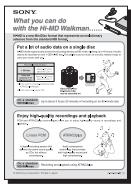
Le dépliant « Ce que vous pouvez faire avec le Walkman Hi-MD »
Ce dépliant explique les principales caractéristiques du Walkman Hi-MD et en quoi il diffère du Walkman MD standard.
Utilisation de l'enregistreur
Vous pouvez enregistrer à partir d'un lecteur CD, puis écouter les enregistrements que vous avez réalisés.
![graph TD A["Audio Input"] --> B["Adder"] B --> C["Audio Record"] C --> D["Output"] D --> E["Audio Display"] style A fill:#f9f,stroke:#333 style E fill:#bbf,stroke:#333](/content/2019/09/47007/images/353480e2ebfb463e1ebb5e8fb46f42dada16f26b247f4b83a3b80371c96b2089.jpg)

Fonctionnement de l'enregistreur (pages 12 à 84)
Cette section explique toutes les fonctions de l'enregistreur. Elle donne également des détails sur les problèmes que vous pouvez rencontrer lors de l'utilisation de l'enregistreur et sur la façon de les résoudre, ainsi que sur la conduite à tenir lorsqu'un message s'affiche à l'écran.
→ En cas de problème ou si vous avez besoin d'explications supplémentaires
Reportez-vous à la section « Dépannage et explications » (page 68).
Utilisation de l'enregistreur connecté à un ordinateur
Le logiciel SonicStage fourni vous permet de transférer des données audio entre l'enregistreur et l'ordinateur.
Le logiciel MD Simple Burner fourni vous permet d'enregistrer des données audio sur l'enregistreur.
![graph LR A["Audio CDs"] --> B["Music files"] B --> C["Laptop"] C <--> D["External Device"] E["Internet"] --> B](/content/2019/09/47007/images/e245f7b1d72bb73fa33b64d7ba5e49762f995ea8cad3d8c7db95a149e5a51bd1.jpg)

Fonctionnement du logiciel (pages 86 à 112)
Cette section explique l'installation et les opérations de base des logiciels SonicStage/MD Simple Burner fournis.
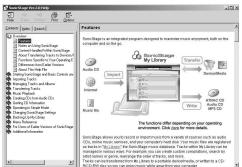
Aide SonicStage
Il s'agit d'une aide en ligne que vous pouvez consulter sur l'écran de votre ordinateur.
L'aide en ligne explique les opérations détaillées et les informations sur le logiciel SonicStage. Vous pouvez également consulter l'aide en ligne si vous rencontrez des problèmes lors de l'utilisation de SonicStage.
Remarques sur la section « Utilisation du logiciel »
- Dans la section « Utilisation du logiciel », « Net MD » désigne l'enregistreur avec un disque standard inséré et « Hi-MD » désigne l'enregistreur avec un disque Hi-MD ou un disque standard en mode Hi-MD inséré.
- Les éléments affichés dans les illustrations de cette section peuvent différer des éléments réellement affichés par le logiciel.
- Les explications de cette section supposent une familiarité avec les opérations de base de Windows. Pour plus de détails sur l'utilisation de votre ordinateur et du système d'exploitation, veuillez vous référer aux manuels correspondants.
- Les explications de cette section couvrent les produits Hi-MD/Net MD généraux. Pour cette raison, certaines explications (et certaines illustrations) peuvent ne pas s'appliquer à votre Hi-MD/Net MD. Veuillez également vous référer aux instructions d'utilisation de votre Hi-MD/Net MD.
Vérification des accessoires fournis
Casque/écouteurs (1)
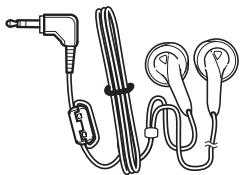
Les filtres anti-parasites ne sont pas fixés au cordon pour le modèle Mexique
Câble USB dédié (1)
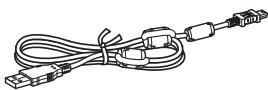
Les filtres anti-parasites ne sont pas fixés au cordon pour le modèle Mexique
Filtre anti-parasites (petite taille) (4)
- sauf modèle Mexique
CD-ROM (SonicStage/MD Simple Burner) (1)*
Sacoche de transport avec clip de ceinture (1) (pour le modèle Mexique uniquement)
*Ne pas lire un CD-ROM sur un lecteur de CD audio.
Remarque
Lors de l'utilisation de cet appareil, veuillez respecter les précautions suivantes afin d'éviter de déformer le boîtier ou de provoquer un dysfonctionnement.
Veillez à ne pas vous asseoir avec l'appareil dans la poche arrière de votre pantalon.
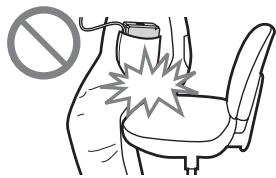
Utilisation des filtres à pince fournis
Lorsque vous utilisez l'enregistreur connecté à l'ordinateur, assurez-vous de fixer les filtres à pince de la manière décrite. (Vous devez fixer un filtre à pince pour respecter les normes CEM applicables.) Il n'est pas nécessaire de fixer les filtres à pince si vous utilisez l'appareil sans le connecter à l'ordinateur.
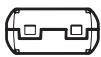
- Pour l'adaptateur secteur en option (AC-ES3010K/AC-E30HG) : filtre à pince de petite taille/ESD-SR-110 (sauf modèle Mexique)
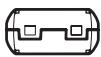
- Pour le câble ligne en option (RK-G129/RK-G136) : filtre à pince de petite taille/ESD-SR-110 (sauf modèle Mexique).
1
2-a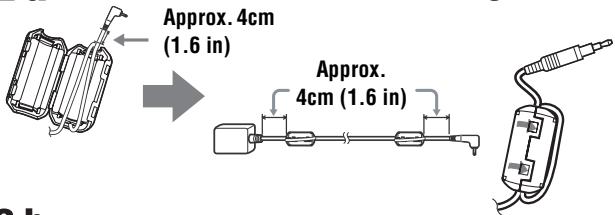
2-b
![graph LR A["Image of device"] --> B["To LINE IN (OPTICAL)"] B --> C["To a digital (optical) out jack"] C --> D["Approx. 4cm (1.6 in)"] D --> E["CD player, MD player, DVD video player, etc."]](/content/2019/09/47007/images/15245b3579c042623832d64e0ddc53bd864c4c3cb2e289b931b08bb6f81e0d85.jpg)
1 Ouvrez les filtres à pince. 2 Fixez les filtres à pince comme suit.
Pour l'adaptateur secteur en option : Enroulez le cordon autour du filtre à pince une fois/à environ 4 cm (1,6 po) de la fiche et du boîtier (voir le schéma 2-a ci-dessus).
Pour le câble en option : faites passer le cordon à travers le filtre antiparasite, près de la fiche connectée à l'enregistreur et à environ 4 cm (1,6 po) de la fiche connectée à un composant externe (voir le schéma 2-b ci-dessus).
3 Fermez le filtre antiparasite. Assurez-vous que les fermoirs sont complètement enclenchés.
Aperçu des commandes
L'enregistreur
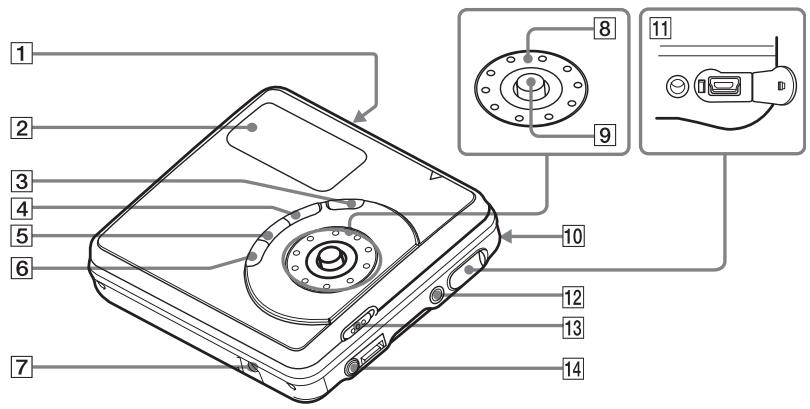
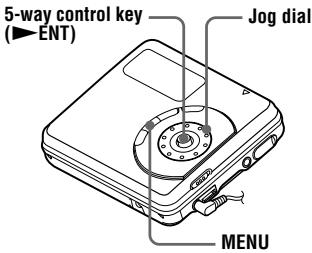
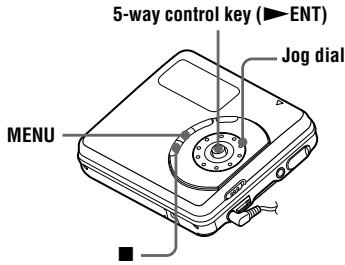
① Interrupteur OPEN 2 Fenêtre d'affichage 3 Bouton REC (+▶)/T MARK 4 Bouton II (pause) 5 Bouton •SEARCH/ ●MENU Appuyez brièvement pour accéder au mode de réglage SEARCH (page 40). Appuyez pendant 2 secondes ou plus pour accéder au mode de réglage MENU (page 24). 6 Bouton ■ (stop) • CANCEL 7 Prise DC IN 3V
Lorsque vous utilisez l'adaptateur secteur en option, connectez-le à cette prise.
8 Molette Jog
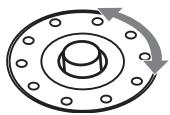
9 Touche de commande à 5 directions
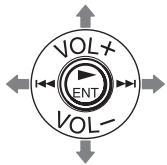
| Operation | Function |
| Press ▶ENT 1) | play, enter |
| Press towards ◀◀◀ | find the beginning of the previous track, rewind |
| Press towards ▶▶│ | find the beginning of the next track, fast forward |
| Press towards VOL +1) or VOL −. | volume |
1) Il y a des points tactiles à côté des boutons ▶ENT et VOL +.
10 Compartiment à piles (en bas) 11 Prise de connexion du câble USB 12 Prise LINE IN (OPTICAL)
13 Interrupteur HOLD Faites glisser l'interrupteur dans le sens de la flèche pour désactiver les boutons de l'enregistreur. Pour éviter que les boutons ne soient actionnés accidentellement lorsque vous transportez l'enregistreur, utilisez cette fonction.
14 Prise Ⓝ (casque/écouteurs)
La fenêtre d'affichage de l'enregistreur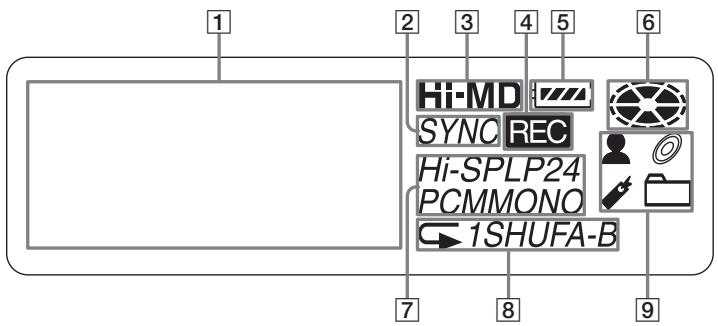
1 Affichage des informations de caractères Affiche les noms de disque et de piste, la date, les messages d'erreur, les numéros de piste, etc. ② Indication SYNC (enregistrement synchronisé) ③ Indication Hi-MD/MD « Hi-MD » s'allume lorsque le mode de fonctionnement de l'enregistreur est en mode Hi-MD et « MD » s'allume lorsque le mode de fonctionnement est en mode MD. 4 Indication REC S'allume pendant l'enregistrement ou les transferts de fichiers depuis l'ordinateur. Lorsqu'il clignote, l'enregistreur est en mode veille d'enregistrement.
⑤ Indication de batterie Indique approximativement la puissance restante de la batterie. Si la batterie est faible, l'indication devient vide et commence à clignoter. ⑥ Indication de disque Indique que le disque tourne pour l'enregistrement ou la lecture. 7 Indication du mode de piste (PCM, Hi-SP, Hi-LP, SP, LP2, LP4, MONO) 8 Indications de mode de lecture secondaire/répétition Affiche le mode de lecture secondaire sélectionné (lecture d'une seule piste, lecture aléatoire, etc.) ou la lecture répétée. 9 Indications de mode de lecture principal Affiche le mode de lecture principal sélectionné (lecture par groupe, lecture par signet, etc.).
Pour commencer
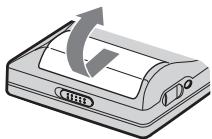
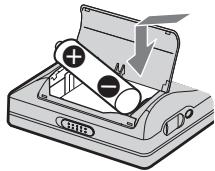
1 Insérez une pile alcaline sèche.
1 Faites glisser OPEN pour ouvrir le couvercle du compartiment à piles.
② Insérez une pile alcaline sèche de taille AA (borne négative en premier).
③ Fermez le couvercle.
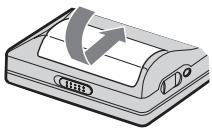
2 Effectuez les connexions et déverrouillez les commandes.
1 Connectez les écouteurs/casque à
② Faites glisser HOLD dans la direction opposée à la flèche ( → ) sur l'enregistreur pour déverrouiller les commandes.
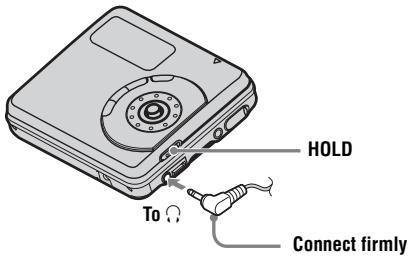
Quand remplacer la pile sèche
Vous pouvez vérifier l'état de la pile sur la fenêtre d'affichage de l'enregistreur.
L'indication du niveau de la pile est approximative. Elle peut être plus ou moins précise selon les conditions de fonctionnement ou l'environnement d'utilisation.
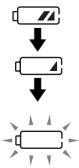
La puissance de la pile diminue
Pile faible
La pile est épuisée. « LOW BATTERY » clignote à l'écran, et l'appareil s'éteint.
Remarque
Assurez-vous d'utiliser une pile sèche alcaline. Si vous utilisez une pile sèche autre qu'alcaline, la durée de vie de la pile peut être raccourcie.
Durée de vie de la pile 1)
Lors d'un enregistrement continu en mode Hi-MD
(unité : heures approx.) (JEITA 2)
| Disc type | Linear PCM | Hi-SP | Hi-LP |
| 1 GB Hi-MD disc | 2.5 | 3.5 | 4.0 |
| 60/74/80-minute standard disc | 4.5 | 7.0 | 8.0 |
1) Lors de l'utilisation d'une pile sèche alcaline neuve Sony LR6 (taille AA) (fabriquée au Japon)
2) Mesurée conformément à la norme JEITA (Japan Electronics and Information Technology Industries Association).
Lors d'une lecture continue en mode Hi-MD
(unité : heures approx.) (JEITA)
| Disc type | Linear PCM | Hi-SP | Hi-LP | MP3 1) |
| 1 GB Hi-MD disc | 9.5 | 16.5 | 19.5 | 19.0 |
| 60/74/80-minute standard disc | 8.5 | 16.0 | 19.0 | 18.5 |
1) Pistes transférées à 128 kbps
Lors d'une lecture continue en mode MD
(unité : heures approx.) (JEITA)
| Disc type | SP | LP2 | LP4 |
| 60/74/80-minute standard disc | 18.0 | 21.5 | 23.5 |
Remarques
- Arrêtez l'enregistreur avant de remplacer la pile.
- Il est préférable d'utiliser l'enregistreur sur secteur (à l'aide de l'adaptateur secteur en option) lors de l'enregistrement ou du montage. Lorsque vous alimentez l'enregistreur avec une pile, assurez-vous d'utiliser une pile sèche alcaline neuve.
- Lors de l'utilisation d'un disque Hi-MD de 1 Go, la durée d'enregistrement continu peut être raccourcie si vous effectuez de courts enregistrements à plusieurs reprises.
Enregistrement immédiat d'un disque !
Cette section explique la procédure de base pour effectuer des enregistrements numériques à l'aide d'un câble optique connecté à un lecteur CD, à un téléviseur numérique ou à un autre équipement numérique. Assurez-vous d'utiliser le câble optique.
Remarque
L'enregistrement ne peut pas être effectué en mode MD lorsque vous enregistrez directement avec cet enregistreur sans utiliser d'ordinateur. Vous pouvez enregistrer en mode Hi-MD sur cet enregistreur.
1 Connectez le câble optique à l'enregistreur et à un composant externe. (Insérez les câbles fermement et complètement dans les prises appropriées.)
![graph TD A["CD player, MD player, DVD video player, etc."] -->|To a digital (optical) out jack| B["Optical plug"] B --> C["Optical cable*"] C --> D["Optical mini-plug"] D --> E["To LINE IN (OPTICAL)"] E --> F["* See "Optional accessories" (page 67)."]](/content/2019/09/47007/images/fe1b80bbac9a601bb92a40bccca9d1fe3f5dea818f837b459a3f8a1aad0748ba.jpg)
Remarque
Assurez-vous de débrancher le câble USB dédié avant d'enregistrer.
2 Insérez un disque enregistrable.
1 Faites glisser OPEN pour ouvrir le couvercle.
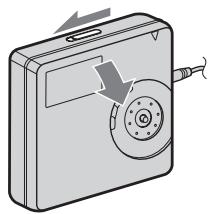
2 Insérez un disque avec l'étiquette vers l'avant, puis appuyez sur le couvercle pour le fermer.
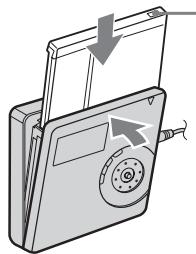
Assurez-vous que la languette de protection contre l'écriture est fermée.
3 Confirmez le mode de fonctionnement.
Cet enregistreur dispose de deux modes de fonctionnement : « mode Hi-MD » et « mode MD ». Le mode de fonctionnement est automatiquement reconnu à chaque insertion du disque. Après avoir inséré un disque, vérifiez le mode de fonctionnement sur la fenêtre d'affichage de l'enregistreur.
Vous ne pouvez enregistrer sur cet enregistreur qu'en « mode Hi-MD ». Il n'est pas possible d'enregistrer en « mode MD ». Si vous souhaitez enregistrer en « mode MD », par exemple pour permettre la lecture du disque sur un autre composant qui ne prend pas en charge Hi-MD, connectez l'enregistreur à un ordinateur et utilisez le logiciel fourni pour enregistrer en mode MD (reportez-vous à la section « Utilisation du logiciel »).
« Hi-MD » s'allume lorsque le mode de fonctionnement est Hi-MD et « MD » s'allume lorsque le mode de fonctionnement est MD.
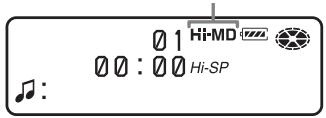
- Lors de l'utilisation d'un disque Hi-MD de 1 Go, le mode de fonctionnement sera uniquement Hi-MD.
- Lors de l'utilisation d'un disque standard (60/74/80 minutes), le mode de fonctionnement peut être réglé comme suit.
| Disc condition | Operation mode |
| Blank disc | The mode set for the “Disc Mode” in the menu.1)→ When recording on this recorder, set “Disc Mode” to “Hi-MD” so that the operation mode will be “Hi-MD mode”. |
| The disc contains material recorded in Hi-MD mode | Hi-MD |
| The disc contains material recorded in MD mode | MD→ You cannot use this recorder to record in MD mode. Recording in “MD mode” is possible if you use the supplied software. |
1) Reportez-vous à « Sélection du mode de disque (Disc Mode) » (page 58) pour le réglage du « Disc Mode ».
4 Enregistrez un disque.
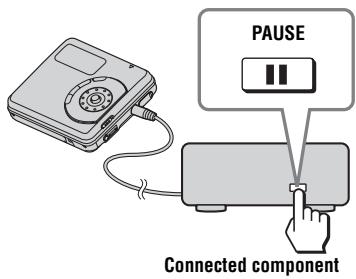
1 Sélectionnez et mettez en pause la source sonore à enregistrer.
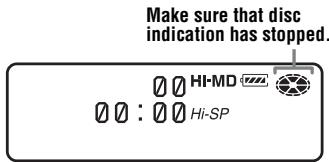
2 Assurez-vous que l'indicateur de disque a cessé de tourner dans la fenêtre d'affichage de l'enregistreur.
3 Lorsque l'enregistreur est arrêté, maintenez enfoncée la touche REC (+▶)/T MARK et appuyez sur ▶ENT sur l'enregistreur.
« REC » s'allume et l'enregistrement commence.
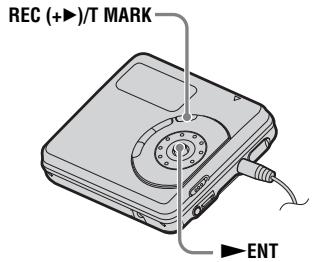
4 Lisez la source que vous souhaitez enregistrer.
Si vous insérez un disque déjà enregistré, l'enregistrement commence après le contenu existant. Les marques de piste sont automatiquement ajoutées au même point que la source sonore, et le contenu est enregistré ensemble en tant que groupe.
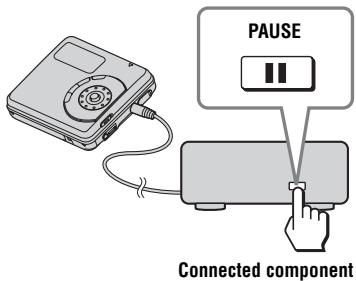
| To | Press |
| Stop | Press ■. |
| Pause | Press III1) .Press II again to resume recording. |
| Remove the disc | Press ■ and open the lid. (The lid does not open while “SYSTEM FILE WRITING” flashing in the display.) |
1) Une marque de piste est ajoutée au point où vous appuyez à nouveau sur ■ pour reprendre l'enregistrement pendant une pause ; ainsi, le reste de la piste sera compté comme une nouvelle piste.
Remarques
- Lorsque vous enregistrez sur un disque Hi-MD de 1 Go, utilisez une pile alcaline neuve (l'indication du niveau de pile affiche □□□□), ou connectez l'adaptateur secteur en option à l'enregistreur. Lorsque vous tentez de démarrer l'enregistrement sur un disque Hi-MD de 1 Go, le message « NotENOUGH POWER TO REC » peut apparaître et l'enregistrement ne peut pas être effectué même si l'indication du niveau de pile affiche une puissance restante suffisante lorsque l'enregistreur est arrêté ou en lecture. Cela est dû à un mécanisme qui désactive l'enregistrement lorsque la puissance restante de la pile est estimée insuffisante par l'enregistreur en raison de la consommation d'énergie élevée requise pour l'enregistrement sur disque Hi-MD de 1 Go.
- Avant d'effectuer un enregistrement avec l'adaptateur secteur en option, insérez toujours une pile alcaline neuve dans l'enregistreur pour garantir que l'opération d'enregistrement se termine correctement.
- Assurez-vous de placer l'enregistreur dans un endroit stable et sans vibrations pendant l'enregistrement.
- Si vous commencez l'enregistrement alors que l'indicateur de disque tourne encore à l'écran, les premières secondes du contenu risquent de ne pas être enregistrées. Assurez-vous que l'indicateur de disque a cessé de tourner avant de commencer l'enregistrement.
- Ne changez pas la pile sèche pendant le fonctionnement, même si l'enregistreur est branché sur l'adaptateur secteur (non fourni). L'opération pourrait s'arrêter.
- Ne déplacez pas ou ne secouez pas l'enregistreur et ne débranchez pas la source d'alimentation pendant l'enregistrement, ou pendant que « DATA SAVE » ou « SYSTEM FILE WRITING » clignote à l'écran. Si vous le faites, les données enregistrées jusqu'à ce point pourraient ne pas être enregistrées sur le disque, ou les données sur le disque pourraient être endommagées.
- L'enregistrement ne peut pas être effectué lorsque le disque ne dispose pas de suffisamment d'espace pour l'enregistrement.
- Si l'alimentation est interrompue (par exemple, la pile est retirée ou épuisée) pendant une opération d'enregistrement ou d'édition, ou pendant que « DATA SAVE » ou « SYSTEM FILE WRITING » apparaît à l'écran, il ne sera pas possible d'ouvrir le couvercle jusqu'à ce que l'alimentation soit rétablie.

- L'enregistreur est réglé en usine pour créer un nouveau groupe à chaque enregistrement. Si vous ne souhaitez pas créer de groupe, réglez « ☐ :REC » sur « ☐ :REC Off » (page 33).
- Pour commencer l'enregistrement à partir d'un point précis du disque, mettez l'enregistreur en pause au point souhaité, puis commencez l'enregistrement à partir de ce point.
- Vous pouvez surveiller le son pendant l'enregistrement. Le changement du niveau de volume n'affectera pas le niveau d'enregistrement.
Lire un disque tout de suite !
1 Insérez un disque enregistré.
1 Faites glisser OPEN pour ouvrir le couvercle.
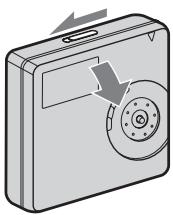
2 Insérez un disque avec le côté étiquette vers l'avant, puis appuyez sur le couvercle pour le fermer.
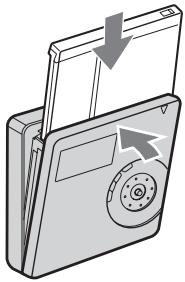
2 Lisez un disque.
1 Appuyez sur la touche de commande à 5 directions (▶ENT) de l'enregistreur.
Un bref bip sonore se fait entendre dans le casque/les écouteurs lorsque vous effectuez une opération.
2 Appuyez sur la touche de commande à 5 directions vers VOL + ou - pour régler le volume de l'enregistreur.
Le volume s'affiche à l'écran.
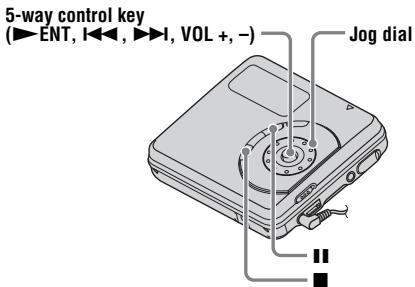
Pour arrêter la lecture, appuyez sur ■.
Un long bip retentit dans le casque/les écouteurs lorsque vous effectuez une opération. La lecture reprend à partir du point où vous l'avez arrêtée. Après l'arrêt de l'enregistreur, celui-ci s'éteint automatiquement au bout d'environ 10 secondes (avec piles) ou d'environ 3 minutes (avec un adaptateur secteur en option).
| To | Operation on the recorder |
| Stop | Press ■. |
| Pause | Press ||. Press || again to resume play. |
| Select a track directly viewing track number or name | Turn the jog dial to select a track, and then press ▶ENT to enter. |
| Find the beginning of the current track or the previous track | Press the 5-way control key towards ◀◀◀. Press the 5-way control key towards ◀◀◀ repeatedly until you reach the beginning of the desired track. |
| Find the beginning of the next track | Press the 5-way control key towards ▶▶▶. |
| Go backwards or forward while playing | Press and hold the 5-way control key towards ◀◀◀ or ▶▶▶. |
| Search for a point in a track while viewing the elapsed time (Time search) | While pausing, press and hold the 5-way control key towards ◀◀◀ or ▶▶▶. |
| Search for a specific track while viewing track numbers (Index search) | While the recorder is stopped, press and hold the 5-way control key towards ◀◀◀ or ▶▶▶. |
| Start with the first track of the disc | While the recorder is stopped, press ▶ENT for 2 seconds or more. |
| Remove the disc | Press ■ and open the lid.1) |
1) Une fois le couvercle ouvert, le point de départ de la lecture change pour le début de la première plage.
Remarque
Le son peut sauter si :
- l'enregistreur subit des chocs continus plus forts.
- un disque sale ou rayé est lu. Lors de l'utilisation d'un disque en mode Hi-MD, le son peut être interrompu pendant 12 secondes au maximum.
Utilisation des éléments de menu
L'enregistreur dispose de nombreux menus avec des fonctions utiles pour l'enregistrement, la lecture, l'édition, etc. Pour régler les éléments de menu, procédez comme suit.
Si vous effectuez une opération de menu pour la première fois après l'achat de l'enregistreur, « Menu Mode » clignote à l'écran. Avant l'opération de menu, vous pouvez régler « Menu Mode » sur « Advanced » (tous les éléments de menu apparaissent) ou « Simple » (seuls les éléments de menu de base apparaissent). Reportez-vous à « Modification des éléments de menu affichés (Menu Mode) » (page 55) pour le réglage du mode de menu.
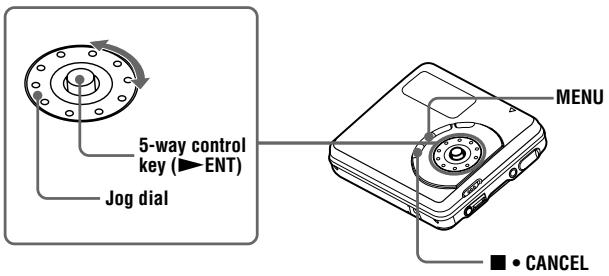
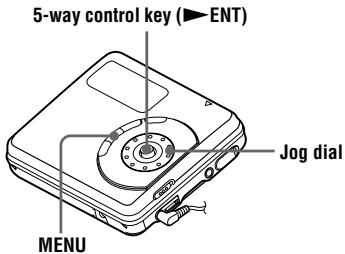
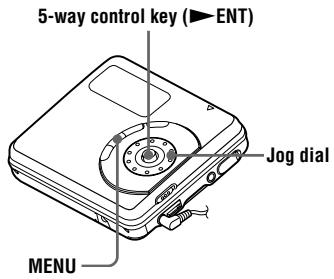
1 Maintenez enfoncée la touche MENU pendant 2 secondes ou plus pour accéder au menu.
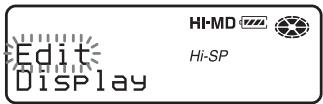
2 Tournez la molette jog pour sélectionner l'élément. 3 Appuyez sur la touche de commande à 5 directions (▶ENT) pour valider la sélection. 4 Répétez les étapes 2 et 3.
Le réglage est validé lorsque vous appuyez sur la touche de commande à 5 directions (▶ENT) à la fin.
Pour revenir au réglage précédent
Appuyez sur ■ • CANCEL.
Pour annuler l'opération pendant le réglage
Appuyez sur ■ • CANCEL pendant 2 secondes ou plus.
Liste des menus
Le tableau suivant présente les éléments de menu que vous pouvez sélectionner. Les éléments de menu peuvent être réglés uniquement avec l'enregistreur.
Les éléments listés sous « Menu 1 » sont les éléments sélectionnables qui apparaissent lorsque vous entrez dans le menu, et les éléments listés sous « Menu 2 » sont les éléments sélectionnables qui apparaissent lorsque vous sélectionnez un élément du Menu 1.
Il est possible d'afficher tous les éléments de menu uniquement lorsque « Mode Menu » est réglé sur « Avancé ».
Les éléments de menu avec un astérisque (*) ne sont pas affichés lorsque « Mode Menu » est réglé sur « Simple ».
Pour plus de détails, voir « Modification des éléments de menu affichés (Mode Menu) » (page 55).
Remarque
Une indication différente peut être affichée selon les conditions d'utilisation et les réglages du disque.
| Menu 1 | Menu 2 | Function | Site page |
| Edit | Title* | Adding a track name, artist name, album name, group name, or disc name. | page 43 |
| : Set* | Assigns recorded tracks or groups to a new group. | page 47 | |
| : Release* | Releases group settings. | page 48 | |
| Move* | Changes the order of tracks or groups. | page 49 | |
| Erase | Erases tracks, groups, or the entire disc contents. | page 50 | |
| Format* | Formats the disc and restores it to the condition it was in at the time of purchase (in Hi-MD mode only). | page 53 | |
| Display | Lap Time | Displays various information such as the recorder status, etc. in the display window. | page 28, page 35 |
| RecRemain (while recording and stopped)/ 1 Remain (while playing) | |||
| AllRemain | |||
| Title1/Title2 | |||
| Sound* | |||
| Codec/ TrackMode* | |||
| Play Mode | MainPMode | Selects tracks by category, such as track name or group name. | page 36 |
| SubPMode | Selects the type of play, such as single-track play or shuffle play. | ||
| Repeat | Repeats playback. | ||
| Sound | Normal | Plays with normal sound quality. | page 41 |
| Sound EQ | Customizes the sound quality. | ||
| REC Set | REC Mode | Selects the recording mode (PCM, Hi-SP, or Hi-LP). | page 30 |
| REC Level* | Manually adjusts the recording level. | page 31 | |
| Time Mark* | Adds track marks automatically in a specific time interval. | page 32 | |
| ☐:REC* | Selects or deselects creation of a new group for each recording operation (Group Recording). | page 33 | |
| SYNC REC* | Simplifies operations during digital recording (Synchro-Recording). | page 34 | |
| Option | Menu Mode | Changes the displayed menu items. | page 55 |
| AVLS* | Sets a limit on the maximum volume to protect your hearing. | page 55 | |
| Beep* | Turns the beep sound on or off. | page 56 | |
| Disc Mem* | Stores the recorder settings (Disc Memory). | page 56 | |
| QuickMode* | Sets the recorder to start playback quickly. | page 57 | |
| Disc Mode | Selects MD mode or Hi-MD mode when a blank disc is inserted. | page 58 | |
| Contrast* | Adjusts the contrast of the display window on the recorder. | page 58 | |
| Jog Dial* | Changes the operational direction on the display when turning the jog dial. | page 59 |
Avant l'enregistrement
À propos du mode de fonctionnement
Cet enregistreur dispose de deux modes de fonctionnement : « Mode Hi-MD » et « Mode MD ». Le mode de fonctionnement est automatiquement reconnu à chaque insertion du disque. Après avoir inséré un disque, vérifiez le mode de fonctionnement sur la fenêtre d'affichage de l'enregistreur.
Vous ne pouvez enregistrer sur cet enregistreur qu'en mode « Hi-MD ». Il n'est pas possible d'enregistrer en mode « MD ». Si vous souhaitez enregistrer en mode « MD », par exemple pour permettre la lecture du disque sur un autre appareil qui ne prend pas en charge Hi-MD, connectez l'enregistreur à un ordinateur et utilisez le logiciel fourni pour enregistrer en mode MD (reportez-vous à la section « Utilisation du logiciel »).
« Hi-MD » s'allume lorsque le mode de fonctionnement est Hi-MD et « MD » s'allume lorsque le mode de fonctionnement est MD.
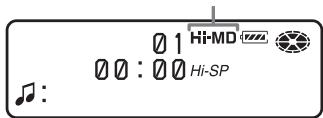
Pour plus de détails sur le mode de fonctionnement selon les différents états du disque, reportez-vous à « Confirmer le mode de fonctionnement » (page 19).
Sélection du mode de menu
Si le mode de menu « Simple » est sélectionné, certains éléments de menu ne seront pas affichés. Si vous ne trouvez pas certains éléments de menu lors de l'utilisation de l'enregistreur, assurez-vous que le mode de menu est réglé sur « Avancé ».
Pour plus de détails sur la sélection du mode de menu, voir « Modification des éléments de menu affichés (Mode de menu) » (page 55).
Remarques
- Lorsque vous enregistrez sur un disque Hi-MD de 1 Go, utilisez une pile alcaline neuve (l'indicateur de niveau de pile affiche 📄) ou connectez l'adaptateur secteur en option à l'enregistreur. Si vous tentez de démarrer l'enregistrement sur un disque Hi-MD de 1 Go, « PAS ASSEZ D'ÉNERGIE POUR ENREGISTRER » peut s'afficher et l'enregistrement peut être impossible même si l'indicateur de niveau de pile affiche une puissance restante suffisante lorsque l'enregistreur est arrêté ou en lecture. Cela est dû à un mécanisme qui désactive l'enregistrement lorsque la puissance restante de la pile est estimée insuffisante par l'enregistreur en raison de la consommation d'énergie élevée requise pour l'enregistrement sur disque Hi-MD de 1 Go.
- Avant d'effectuer un enregistrement avec l'adaptateur secteur en option, insérez toujours une pile alcaline neuve dans l'enregistreur pour garantir la réussite de l'opération d'enregistrement.
- L'enregistrement peut ne pas se produire si le câble USB dédié est connecté à l'enregistreur. Assurez-vous de déconnecter le câble USB dédié avant d'enregistrer.
- Si vous démarrez l'enregistrement alors que l'indicateur de disque tourne encore dans l'affichage, les premières secondes du contenu ne seront pas enregistrées. Assurez-vous que l'indicateur de disque a cessé de tourner avant de démarrer l'enregistrement.
- Ne déplacez pas ou ne secouez pas l'enregistreur et ne déconnectez pas la source d'alimentation pendant l'enregistrement, ou pendant que « DATA SAVE » ou « SYSTEM FILE WRITING » clignote à l'écran. Si vous le faites, les données enregistrées jusqu'à ce point peuvent ne pas être enregistrées sur le disque, ou les données sur le disque peuvent être endommagées.
Affichage de diverses informations
Vous pouvez vérifier le temps restant, le numéro de piste, etc. lors de l'enregistrement ou pendant l'arrêt.
1 Entrez dans le menu et sélectionnez « Affichage ». 2 Tournez la molette jog jusqu'à ce que l'information souhaitée apparaisse à l'écran, puis appuyez sur ▶ENT pour valider la sélection.
Chaque rotation modifie l'affichage comme suit.
Lorsque l'enregistreur est arrêté :
« Lap Time » → « RecRemain » →
« AllRemain » → « Title1/Title2 (Hi-
MD) » → « Sound »
Pendant l'enregistrement :
« Lap Time » → « RecRemain » →
« Title1/Title2 (Hi-MD) »
Lorsque vous appuyez sur ▶ENT, les informations sélectionnées apparaissent en A, B et C.
Fenêtre d'affichage
Les indications ont les significations suivantes :
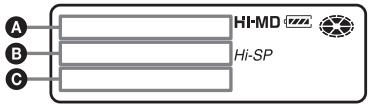
G : Nom du disque ♪ : Nom de la piste : Nom du groupe : Nom de l'artiste © : Nom de l'album
Lorsque l'enregistreur est arrêté A/B/C
1) Le numéro de piste apparaît si la piste actuellement sélectionnée n'est pas dans un groupe. 2) Ceci n'apparaît pas lorsque « Menu Mode » est réglé sur « Simple » (page 55). 3) Le nom du disque apparaît lorsque la piste actuellement sélectionnée n'est pas dans un groupe.
| A | B | C |
| Group number and track number | Elapsed time | Track name and artist name (Hi-MD)Track name(MD) |
| Group number and track number | Remaining time for recording / remaining free space (Hi-MD)Remaining time for recording (MD) | “RecRemain” and “FreeSpace” (Hi-MD)“RecRemain” (MD) |
| Numbers of tracks after the current track | Remaining time after the current location in the disc. | “AllRemain” |
| Disc name and artist name (Hi-MD) 1) Disc name (MD) 1) | Group name and album name (Hi-MD) 3) Group name (MD) 3) | Track name |
| Sound mode name 2) | Indication of the selected sound mode 2) | (none) 2) |
1) Le numéro de piste apparaît si la piste actuellement sélectionnée n'est pas dans un groupe. 2) Cela n'apparaît pas lorsque « Mode Menu » est réglé sur « Simple » (page 55). 3) Le nom du disque apparaît lorsque la piste actuellement sélectionnée n'est pas dans un groupe.
Pendant l'enregistrement A/B/C
| A | B | C |
| Group number and track number | Elapsed time | Level meter |
| Group number and track number | Remaining time for recording. | “RecRemain” |
| Disc name and artist name (Hi-MD) 1) | Group name and album name (Hi-MD) 2) | Track name |
1) Le numéro de piste apparaît si la piste sélectionnée ne fait pas partie d'un groupe. 2) Le nom du disque apparaît lorsque la piste sélectionnée ne fait pas partie d'un groupe.
Remarques
- Lorsqu'un disque utilisé en mode Hi-MD est inséré dans l'enregistreur, l'espace libre s'affiche comme « 2,0 Mo » lorsque le temps d'enregistrement restant devient « -00:00 ». Il s'agit d'une limitation du système, « 2,0 Mo » étant la capacité du domaine de réserve.
- Selon les paramètres du groupe, les conditions d'utilisation et les paramètres du disque, il se peut que vous ne puissiez pas sélectionner certaines indications ou que les indications apparaissent différemment.

Si vous souhaitez vérifier la position de lecture ou le nom de la piste pendant la lecture, consultez « Affichage de diverses informations » (page 35).
Enregistrement à partir d'un téléviseur ou d'une radio (enregistrement analogique)
Cette section explique comment enregistrer à partir d'un équipement avec sortie analogique, tel qu'un magnétophone à cassettes, une radio ou un téléviseur.
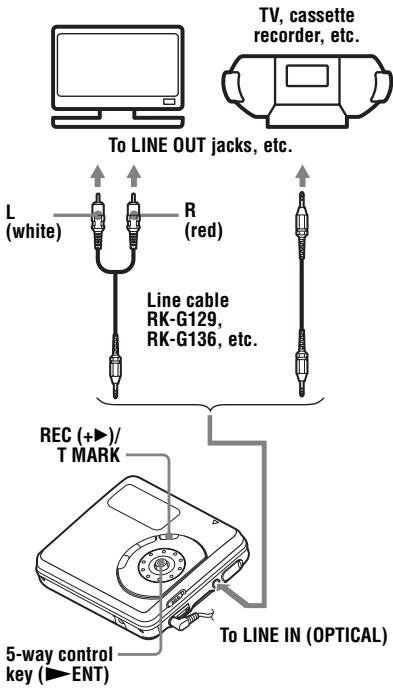
1 Effectuez les connexions. Utilisez le cordon de connexion approprié à l'équipement source. Pour plus de détails, voir « Accessoires en option » (page 67). 2 Appuyez sur ▶ENT tout en maintenant enfoncée la touche REC (+▶)/T MARK pour démarrer l'enregistrement. 3 Lisez la source que vous souhaitez enregistrer.
Sélection du mode d'enregistrement
Sélectionnez chaque mode d'enregistrement en fonction de la durée d'enregistrement souhaitée. Vous ne pouvez enregistrer qu'en mode Hi-MD sur cet enregistreur. Si vous souhaitez enregistrer en mode MD, connectez l'enregistreur à un ordinateur et enregistrez ou transférez des données audio à l'aide du logiciel fourni (voir la section « Utilisation du logiciel »).
1 Pendant que l'enregistreur est arrêté, entrez dans le menu et sélectionnez « REC Set » - « REC Mode ». 2 Tournez la molette jog pour sélectionner le mode d'enregistrement souhaité, puis appuyez sur ▶ENT pour valider la sélection.
Le mode d'enregistrement est mémorisé sur l'enregistreur jusqu'à ce qu'il soit modifié.
| Recording mode | Display | Recording time |
| Linear PCM | PCM | Approx. 28 min.on an 80-minute standard discApprox. 94 min.on a 1GB Hi-MD disc |
| Hi-SP | Hi-SP | Approx. 140 min.on an 80-minute standard discApprox. 475 min.on a 1GB Hi-MD disc |
| Hi-LP | Hi-LP | Approx. 610 min.on an 80-minute standard discApprox. 2,040 min.on a 1GB Hi-MD disc |

Les composants audio prenant en charge les modes linéaire PCM, Hi-SP et Hi-LP sont identifiés par le logo Hi-MD ou Hi-MD.
Remarques
- Il est recommandé d'utiliser l'adaptateur secteur (non fourni) pour les enregistrements de longue durée.
- Il est recommandé d'utiliser l'enregistreur pour éditer (diviser ou combiner) les pistes longues enregistrées en PCM linéaire. Le transfert de ces pistes et leur édition sur un ordinateur peuvent prendre un temps extrêmement long.
Réglage manuel du niveau d'enregistrement
Le niveau d'enregistrement est ajusté automatiquement pendant l'enregistrement. Si nécessaire, vous pouvez régler manuellement le niveau d'enregistrement lors d'un enregistrement analogique ou numérique.
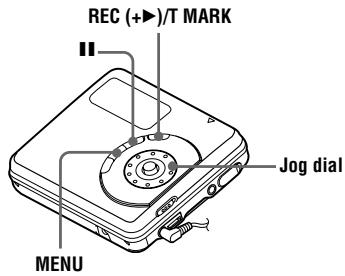
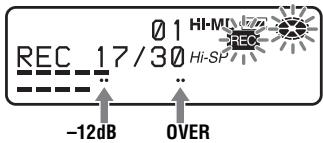
1 Appuyez sur REC (+▶)/T MARK tout en maintenant Ⅱ enfoncé. L'enregistreur se met en pause d'enregistrement. 2 Entrez dans le menu et sélectionnez "REC Set" - "REC Level" - "Manual". 3 Lancez la lecture de la source. 4 Tout en observant le vumètre à l'écran, ajustez le niveau d'enregistrement en tournant la molette jog.
Réglez le niveau de sorte que les segments du vumètre s'allument autour du segment -12 dB.
Si un niveau sonore élevé fait atteindre le segment OVER au vumètre, baissez le niveau d'enregistrement.
Chaque vumètre indique ce qui suit.
Supérieur — niveau d'entrée du canal gauche Inférieur — niveau d'entrée du canal droit
5 Appuyez à nouveau sur Ⅱ pour démarrer l'enregistrement. Si votre source est un composant externe connecté, lancez la lecture de la source jusqu'au début du matériel à enregistrer, puis démarrez l'enregistrement.
Pour revenir au contrôle automatique du niveau
Sélectionnez "Auto (AGC)" à l'étape 2.
Remarques
- Vous ne pouvez pas régler séparément les niveaux des canaux gauche et droit.
- Une fois que vous arrêtez l'enregistrement, l'enregistreur reviendra au mode de réglage automatique du niveau d'enregistrement la prochaine fois que vous démarrerez une opération d'enregistrement.
- Pour régler manuellement le niveau d'enregistrement lors d'un enregistrement synchronisé, effectuez les étapes 1 à 4 de la procédure de cette section avec « SYNC REC » réglé sur « SYNC Off ». Ensuite, réglez « SYNC REC » sur « SYNC On » et commencez l'enregistrement (page 34).
Ajout de marques de piste pendant l'enregistrement
Vous pouvez ajouter des marques de piste (numéro de piste) pendant l'enregistrement pour diviser le matériau en parties distinctes, ce qui vous permet d'accéder rapidement et facilement à une piste spécifique.
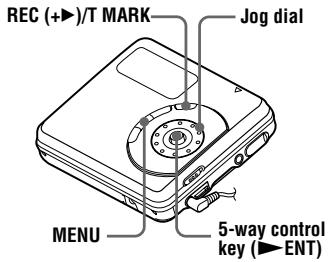
Ajout manuel de marques de piste
Pendant que l'enregistreur enregistre, appuyez sur REC (+▶)/T MARK au point où vous souhaitez ajouter une marque de piste.
Ajout automatique de marques de piste (Auto Time Mark)
Utilisez cette fonction pour ajouter automatiquement des marques de piste à intervalles spécifiés lors de l'enregistrement via le connecteur d'entrée analogique. Cette fonction est pratique pour enregistrer sur une longue période, comme des cours, des réunions, etc.
1 Pendant que l'enregistreur enregistre ou est en pause d'enregistrement, entrez dans le menu et sélectionnez « REC Set » - « Time Mark » - « On ».
2 Tournez la molette jog jusqu'à ce que l'intervalle de temps souhaité apparaisse à l'écran, puis appuyez sur ▶ENT pour valider la sélection.
Un tour complet modifie le réglage de temps (Time:) de 1 minute, dans la plage de 1 à 60 minutes.
Pour annuler Time Mark
Sélectionnez « Off » à l'étape 1.
Utilisation de Time Mark pour ajouter des marques de piste pendant l'enregistrement
Lorsque le temps d'enregistrement écoulé dépasse l'intervalle de temps défini pour Time Mark :
L'enregistreur ajoute des marques de piste au point où vous avez défini l'intervalle de temps, et à partir de ce point, il ajoute une marque de piste à chaque fois que l'intervalle de temps s'est écoulé.
Exemple : Huit minutes d'enregistrement ont été effectuées lorsque l'intervalle de temps du repère temporel est réglé sur 5 minutes.
Un repère de piste sera ajouté au point de 8 minutes (après le début de l'enregistrement) et après chaque intervalle de 5 minutes par la suite.
Lorsque l'intervalle de temps défini pour le repère temporel dépasse le temps d'enregistrement écoulé :
L'enregistreur ajoute des repères de piste lorsque l'intervalle de temps défini pour le repère temporel s'est écoulé.
Exemple : Trois minutes d'enregistrement ont été effectuées lorsque l'intervalle de temps du repère temporel est réglé sur 5 minutes.
Un repère de piste sera ajouté au point de 5 minutes (après le début de l'enregistrement) et après chaque intervalle de 5 minutes par la suite.

« T » apparaît avant l'affichage de l'heure pour les repères de piste ajoutés par le repère temporel.
Remarques
- Si vous ajoutez un repère de piste en appuyant sur REC (+▶)/T MARK ou ▪, etc. pendant l'enregistrement, l'enregistreur commencera à ajouter automatiquement des repères de piste chaque fois que l'intervalle de temps sélectionné se sera écoulé.
- Le réglage est annulé lorsque vous connectez un câble optique numérique à l'enregistreur.
Enregistrement sans créer un nouveau groupe
L'enregistreur est réglé en usine pour créer automatiquement un nouveau groupe pour chaque enregistrement. Pour enregistrer sans créer un nouveau groupe, réglez l'enregistreur comme suit.
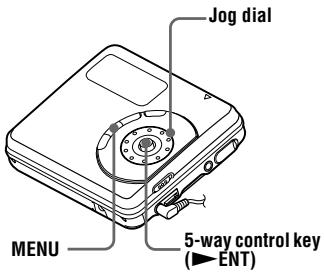
Lorsque l'enregistreur est arrêté, entrez dans le menu et sélectionnez « REC Set » - « ☐:REC » - « ☐:REC Off ».
Qu'est-ce que la fonction groupe ?
La fonction groupe vous permet de placer plusieurs pistes dans une seule unité.
Par exemple, si vous créez un groupe pour tous vos morceaux préférés, vous pouvez sélectionner ce groupe pour lire ces morceaux.
La figure suivante montre la différence entre un disque sur lequel des groupes sont enregistrés et un disque sur lequel aucun groupe n'est enregistré.
Disque avec groupes enregistrés
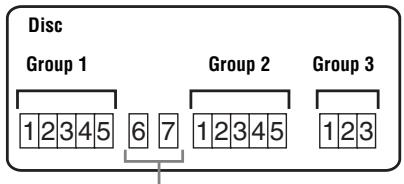
Les morceaux qui n'ont pas été assignés à un groupe sont traités comme faisant partie du "Groupe - -".
Disque sans groupes enregistrés
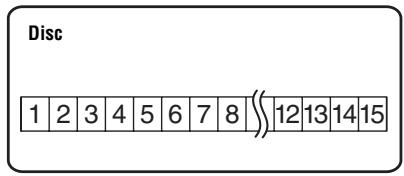
Vous pouvez enregistrer un maximum de 255 groupes sur un disque.
Si vous enregistrez un morceau sans créer de groupe, mais que vous souhaitez ensuite créer un groupe pour ce morceau, reportez-vous à "Assignation de morceaux ou de groupes comme nouveau groupe (Group Set)" (page 47).
Pour démarrer/arrêter l'enregistrement en synchronisation avec la source sonore (Enregistrement synchronisé)
Lors d'un enregistrement numérique (par exemple, à partir d'un CD), cette fonction démarre et arrête automatiquement l'enregistreur en synchronisation avec la source sonore. Cela élimine le besoin de faire fonctionner séparément l'enregistreur et la source sonore.
1 Effectuez les connexions.
Utilisez le câble optique approprié pour l'équipement source. Pour plus de détails, voir "Accessoires en option" (page 67).
2 Pendant que l'enregistreur est arrêté, entrez dans le menu et sélectionnez "REC Set" - "SYNC REC" - "SYNC On".

Lorsqu'il n'y a pas de son provenant du lecteur pendant environ 3 secondes pendant l'enregistrement synchronisé, l'enregistreur passe automatiquement en mode veille. Lorsque le son provient à nouveau du lecteur, l'enregistreur reprend l'enregistrement synchronisé. Si l'enregistreur reste en mode veille pendant 5 minutes ou plus, il s'arrête automatiquement.
Remarques
- La fonction pause ne peut pas être activée ou désactivée manuellement pendant l'enregistrement synchronisé.
- Ne modifiez pas le réglage « SYNC REC » pendant l'enregistrement. L'enregistrement pourrait ne pas se faire correctement.
- Même lorsqu'il n'y a pas de son sur la source sonore, il peut arriver que l'enregistrement ne se mette pas en pause automatiquement pendant l'enregistrement synchronisé en raison du niveau de bruit émis par la source sonore.
- Si une partie silencieuse d'environ 2 secondes est rencontrée pendant l'enregistrement synchronisé à partir d'une source sonore autre qu'un CD ou un MD, une nouvelle marque de piste est automatiquement ajoutée à l'endroit où la partie silencieuse se termine.
Affichage de diverses informations
Vous pouvez vérifier le nom de la piste, le nom du disque, etc. pendant la lecture.
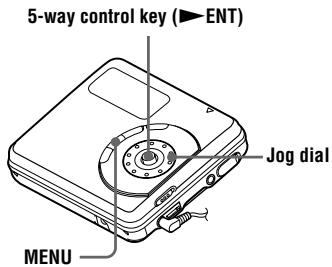
1 Pendant la lecture, entrez dans le menu et sélectionnez « Display » 2 Tournez la molette jog jusqu'à ce que l'information souhaitée apparaisse à l'écran, puis appuyez sur ▶ENT pour valider la sélection.
Chaque tour modifie l'affichage comme suit.
« Lap Time » → « 1 Remain » →
« AllRemain » → « Title1/Title2 (Hi-MD) » → « Sound » → « Codec (Hi-MD)/TrackMode (MD) »
Lorsque vous appuyez sur ▶ENT, l'information sélectionnée apparaît à A, B et C.
Fenêtre d'affichage
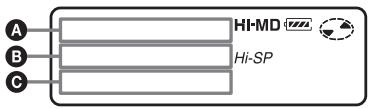
Les indications ont les significations suivantes :
G : Nom du disque ♪ : Nom de la piste : Nom du groupe : Nom de l'artiste © : Nom de l'album
Fenêtre d'affichage A/B/C
| A | B | C |
| Group number and track number | Elapsed time | Track name and artist name (Hi-MD)Track name (MD) |
| Track name and artist name (Hi-MD)Track name (MD) | Remaining time of the current track | “1 Remain” |
| Numbers of tracks after the current track | Remaining time after the current location in the disc. | “AllRemain” |
| Disc name and artist name (Hi-MD) 1) Disc name (MD) 1) | Group name and album name (Hi-MD) 3) Group name (MD) 3) | Track name |
| Sound mode name 2) | Indication of the selected sound mode 2) | (none) 2) |
| Codec (Hi-MD) 2) (none) (MD) 2) | Track mode, and bitrate (Hi-MD) 2) 4) Track mode (MD) 2) | “Codec” (Hi-MD) 2) “TrackMode” (MD) 2) |
1) Le numéro de piste apparaît si la piste actuellement sélectionnée n'est pas dans un groupe. 2) Cela n'apparaît pas lorsque « Menu Mode » est réglé sur « Simple » (page 55). 3) Le nom du disque apparaît lorsque la piste actuellement sélectionnée n'est pas dans un groupe. 4) Dans le cas d'une piste MP3 prenant en charge VBR (débit binaire variable), le débit binaire affiché ici peut ne pas correspondre à celui affiché par le logiciel SonicStage.
Note
Selon les paramètres du groupe, les conditions de fonctionnement et les réglages du disque, il se peut que vous ne puissiez pas sélectionner certaines indications ou que celles-ci apparaissent différemment.

Si vous souhaitez vérifier le temps restant ou la position d'enregistrement pendant l'enregistrement ou en mode arrêt, consultez « Affichage de diverses informations » (page 28).
Sélection du mode de lecture
Vous pouvez écouter des plages dans différents modes de lecture. Le mode de lecture peut être une combinaison du mode de lecture principal, du mode de lecture secondaire et de la lecture répétée.
- Mode de lecture principal : sélectionne l'unité de lecture, comme les plages ou les groupes
- Mode de lecture secondaire : sélectionne le type de lecture
- Lecture répétée : sélectionne la lecture répétée
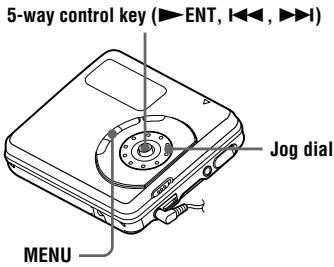
Lecture des plages en mode de lecture principal
1 Pendant la lecture, entrez dans le menu et sélectionnez « Play Mode » - « MainPMode ». L'affichage du mode de lecture principal apparaît.
2 Tournez la molette jog pour sélectionner le mode de lecture souhaité, puis appuyez sur ▶ENT pour valider la sélection. Chaque fois que vous tournez la molette jog, Ⓐ change comme suit. Lorsque vous appuyez sur ▶ENT, Ⓑ apparaît à l'écran.
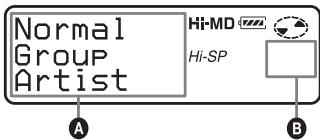
| IndicationA/B | Play mode |
| Normal/(none) | Normal play (All tracks after the selected track are played.) |
| Group/☐ | Group play (Tracks in a specified group are played.) |
| Artist/☐1) | Artist play (Tracks by a specified artist are played.) |
| Album/☐1) | Album play (Tracks in a specified album are played.) |
| Bookmark/☐ | Bookmark play(Bookmarked tracks are played.) |
1) N'apparaît que pour les disques utilisés en mode Hi-MD.
Lecture des plages en mode normal (lecture normale)
1 Effectuez l'étape 1 et sélectionnez « Normal » à l'étape 2 de « Lecture des plages en mode de lecture principal » (page 36). 2 Lors de la sélection d'une plage hors d'un groupe, ignorez cette étape.
Lors de la sélection d'une plage dans un groupe, tournez la molette jog jusqu'à ce que le groupe auquel appartient la plage souhaitée apparaisse à l'écran, puis appuyez sur ▶ENT pour valider.
Une liste des pistes du groupe sélectionné s'affiche.
3 Tournez la molette jog jusqu'à ce que la piste souhaitée apparaisse à l'écran, puis appuyez sur ▶ENT pour valider la sélection. La piste sélectionnée commence à être lue. L'enregistreur lit de la piste sélectionnée jusqu'à la dernière piste du disque.
Écoute des pistes d'un groupe spécifique (lecture de groupe)
1 Effectuez l'étape 1 et sélectionnez « Groupe » à l'étape 2 de « Lecture des pistes en mode de lecture principale » (page 36). Une liste des groupes du disque apparaît. 2 Tournez la molette jog jusqu'à ce que le groupe souhaité apparaisse à l'écran, puis appuyez sur ▶ENT pour valider.
Une liste des pistes du groupe sélectionné apparaît.
3 Tournez la molette jog jusqu'à ce que la piste souhaitée apparaisse à l'écran, puis appuyez sur ▶ENT pour valider la sélection. La piste sélectionnée commence à être lue. L'enregistreur lit les pistes de ce groupe, de la piste sélectionnée jusqu'à la dernière piste.

Les pistes qui n'appartiennent à aucun groupe sont regroupées dans « Groupe - - » et affichées en fin de liste des groupes.
Écoute des pistes d'un artiste spécifique (lecture par artiste) (uniquement en mode Hi-MD)
Si les données de la piste incluent le nom de l'artiste, vous pouvez écouter uniquement les pistes d'un artiste spécifique.
1 Effectuez l'étape 1 et sélectionnez « Artiste » à l'étape 2 de « Lecture des pistes en mode de lecture principale » (page 36). Une liste des artistes du disque apparaît dans l'ordre alphabétique. 2 Tournez la molette jog jusqu'à ce que le nom de l'artiste souhaité apparaisse à l'écran, puis appuyez sur ▶ENT pour valider. Une liste des pistes de l'artiste sélectionné apparaît dans l'ordre d'enregistrement. 3 Tournez la molette jog jusqu'à ce que la piste souhaitée apparaisse à l'écran, puis appuyez sur ▶ENT pour valider la sélection. La piste sélectionnée commence à être lue. L'enregistreur lit les pistes du même artiste sur le disque, de la piste sélectionnée jusqu'à la dernière piste.

Les pistes sans données de nom d'artiste sont regroupées dans « #:_ (espace) » et affichées en fin de liste des artistes.
Écoute des pistes d'un album sélectionné (lecture d'album) (uniquement en mode Hi-MD)
Si les données de la piste incluent le nom de l'album, vous pouvez écouter uniquement les pistes d'un album sélectionné.
1 Effectuez l'étape 1 et sélectionnez « Album » à l'étape 2 de « Lecture des pistes en mode de lecture principale » (page 36).
Une liste des albums du disque apparaît dans l'ordre alphabétique.
2 Tournez la molette jusqu'à ce que le nom de l'album souhaité s'affiche, puis appuyez sur ▶ENT pour valider.
Une liste des pistes de l'album sélectionné apparaît dans l'ordre d'enregistrement.
3 Tournez la molette jusqu'à ce que la piste souhaitée s'affiche, puis appuyez sur ▶ENT pour valider la sélection.
La piste sélectionnée commence à jouer. L'enregistreur lit les pistes de cet album, de la piste sélectionnée à la dernière piste.

Les pistes sans nom d'album sont regroupées sous « ☐:__ (espace) » et sont affichées en fin de liste des albums.
Écoute de pistes sélectionnées uniquement (lecture avec signet)
Vous pouvez marquer des pistes sur un disque et les lire uniquement. L'ordre des pistes marquées ne peut pas être modifié.
Pour marquer les pistes
1 Pendant la lecture de la piste à marquer, appuyez sur ▶ENT pendant 2 secondes ou plus.
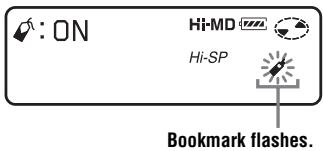
La première piste de la lecture avec signet est définie.
2 Répétez l'étape 1 pour marquer les autres pistes.
Pour lire les pistes marquées
1 Effectuez l'étape 1 et sélectionnez « Bookmark » à l'étape 2 de « Lecture des pistes en mode de lecture principal » (page 36).
2 Tournez la molette pour sélectionner une piste, puis appuyez sur ▶ENT pour valider la sélection.
L'enregistreur lit les pistes marquées dans l'ordre de leurs numéros de piste.
Pour effacer des signets
Pendant la lecture de la piste pour laquelle vous souhaitez effacer le signet, maintenez enfoncée la touche
▶ENT pendant 2 secondes ou plus.
Lecture de pistes en mode de lecture secondaire
En spécifiant des modes de lecture secondaire, vous pouvez écouter les pistes sélectionnées en mode de lecture principal de différentes manières.
Par exemple, en sélectionnant « Groupe » en mode de lecture principal et « Aléatoire » en mode de lecture secondaire, l'enregistreur lira les pistes du groupe sélectionné dans un ordre aléatoire.
1 Entrez dans le menu et sélectionnez « Mode de lecture » - « Sous-mode ». 2 Tournez la molette jog pour sélectionner le mode de lecture souhaité, puis appuyez sur ▶ENT pour valider la sélection.
Chaque fois que vous tournez la molette jog, A change comme suit. Lorsque vous appuyez sur ▶ENT, B apparaît à l'écran.
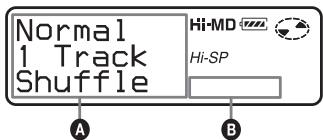
| IndicationA/B | Play mode |
| Normal/(none) | Normal play (All tracks are played once.) |
| 1 Track/1 | Single-track play (A single track is played.) |
| Shuffle/SHUF | Shuffle play (All tracks in the selected Main Play Mode are played in random order.) |
| A-BRepeat/A-(A-B ⇌ )1) | A-B Repeat play (Tracks between the selected points A and B are played repeatedly.) |
1) « A-BRepeat » n'apparaît pas lorsque le « Mode menu » est réglé sur « Simple » (page 55).
Écoute répétée d'une section d'une piste (Répétition A-B)
Vous pouvez écouter une section spécifique d'une piste en boucle en sélectionnant le point de départ A et le point de fin B. Assurez-vous que les points A et B se trouvent dans la même piste.
1 Pendant la lecture d'une piste contenant la section à répéter, effectuez l'étape 1 et sélectionnez « A-BRepeat » à l'étape 2 de « Lecture de pistes en mode de lecture secondaire » (page 39). « A- » clignote à l'écran. 2 Appuyez sur ▶ENT au point de départ (A). Le point A est défini et « B » clignote à l'écran. 3 Appuyez sur ▶ENT au point de fin (B). Le point B est défini, « A-B » et « ⊂ » s'allument, et la section entre les points A et B commence à être lue en boucle.

Vous pouvez réinitialiser les points A et B en appuyant sur la touche de commande à 5 directions vers ▶▶ pendant la lecture en répétition A-B.
Remarque
Si l'enregistreur atteint la fin de la dernière piste du disque pendant que vous sélectionnez le point A, le réglage est annulé.
Lecture répétée des plages (lecture répétée)
Vous pouvez utiliser la fonction de lecture répétée pour répéter des plages dans tous les modes de lecture, sauf lors de la sélection de la lecture répétée A-B.
1 Pendant la lecture, entrez dans le menu et sélectionnez « Mode de lecture » - « Répéter ». 2 Tournez la molette jog pour sélectionner « Répéter activé », puis appuyez sur ▶ENT pour valider. ⊨ apparaît à l'écran.
Pour annuler la lecture répétée
Sélectionnez « Répéter désactivé » à l'étape 2.
Recherche d'une plage (Recherche)
Vous pouvez facilement rechercher une plage par nom de plage, nom de groupe, nom d'artiste ou nom d'album.
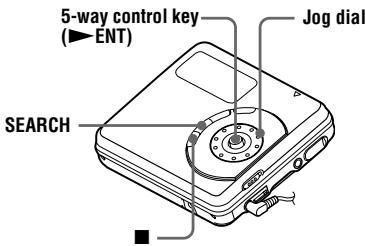
1 Appuyez sur « RECHERCHE ». 2 Tournez la molette jog pour sélectionner l'élément que vous souhaitez utiliser pour la recherche, puis appuyez sur ▶ENT pour valider.
| Display | To |
| by Track | search by track name |
| by Group | search by group name |
| by Artist1) | search by artist name |
| by Album1) | search by album name |
1) N'apparaît que pour les disques utilisés en mode Hi-MD.
3 Si vous sélectionnez « par plage » à l'étape 2, passez cette étape.
Si vous sélectionnez un élément autre que « par plage » à l'étape 2, tournez la molette jog pour sélectionner le groupe, l'artiste ou l'album souhaité, puis appuyez sur ▶ENT pour valider.
Une liste des plages du groupe, de l'artiste ou de l'album sélectionné apparaît à l'écran.
4 Tournez la molette jog pour sélectionner la plage souhaitée, puis appuyez sur ▶ENT pour valider la sélection.
La plage sélectionnée commence à jouer.
Remarques
• Après l'étape 4, la lecture A-B répétée est annulée. - Pendant une recherche, les pistes sans nom apparaissent à la fin de chaque liste. - Pendant une recherche, les pistes non groupées sont placées ensemble sous « Groupe - - » et apparaissent à la fin de la liste des groupes. - Pendant une recherche, les pistes sans nom d'artiste sont placées ensemble sous « #:_ (espace) », et les pistes sans nom d'album sont placées ensemble sous « #:_ (espace) » et apparaissent à la fin de la liste. - Pendant que l'enregistreur trie les éléments sélectionnés, « SORTING » s'affiche. - La fonction Recherche est automatiquement annulée si aucune opération n'est effectuée pendant 3 minutes.
Sélection de la qualité sonore (égaliseur 6 bandes)
L'ÉGALISEUR 6 BANDES offre 6 qualités sonores différentes. Vous pouvez varier le son virtuel pour créer différentes acoustiques, ou modifier le son selon vos goûts et le mémoriser pour une utilisation ultérieure.
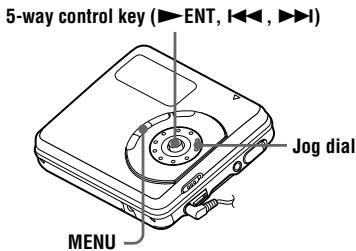
1 Pendant la lecture, entrez dans le menu et sélectionnez « Son » - « Égaliseur sonore ». 2 Tournez la molette jog à plusieurs reprises pour sélectionner le mode sonore, puis appuyez sur ▶ENT pour valider la sélection.
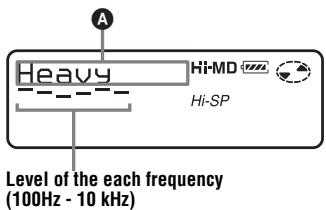
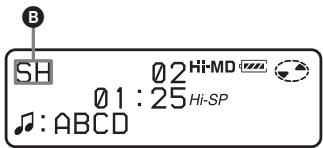
Chaque fois que vous tournez la molette jog, Ⓐ change comme suit. Lorsque vous appuyez sur ▶ENT, Ⓑ apparaît.
| A | B |
| Heavy | SH |
| Pops | SP |
| Jazz | SJ |
| Unique | SU |
| Custom11) | S1 |
| Custom21) | S2 |
1) « Custom1 » et « Custom2 » n'apparaissent pas sur les modèles européens. « Custom1 » et « Custom2 » n'apparaissent pas lorsque le « Mode menu » est réglé sur « Simple » (page 55).
Pour annuler le réglage
Sélectionnez « Normal » à l'étape 1.
Pour modifier et mémoriser le son (pour les modèles autres que les modèles européens)
Vous pouvez modifier le son et mémoriser les résultats dans « Custom1 » et « Custom2 ».
1 Effectuez les étapes 1 et sélectionnez « Custom1 » ou « Custom2 » à l'étape 2 de « Sélection de la qualité sonore (égaliseur 6 bandes) » (page 41).
2 Appuyez sur la touche de commande 5 directions vers ◀◀◀ ou ▶▶◀ pour sélectionner la fréquence.
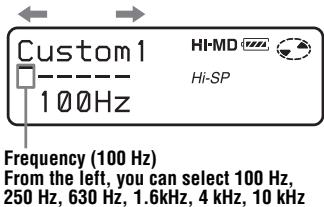
3 Tournez la molette jog pour régler le niveau.
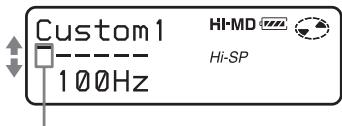
Niveau (+10 dB)
Vous pouvez choisir parmi sept niveaux. -10 dB, -6 dB, -3 dB, 0 dB, +3 dB, +6 dB, +10 dB
4 Après avoir sélectionné le niveau, appuyez sur ▶ENT pour valider la sélection.
Remarque
L'égaliseur 6 bandes ne fonctionnera pas pendant l'enregistrement.
Avant de modifier
Remarques
- Lorsque vous modifiez le contenu d'un disque Hi-MD de 1 Go, utilisez une pile alcaline neuve (l'indicateur de niveau de pile affiche 📄) ou branchez l'adaptateur secteur en option sur l'enregistreur. Si vous tentez de modifier un disque Hi-MD de 1 Go, le message « NotENOUGH POWER TO EDIT » peut apparaître et la modification ne peut pas être effectuée même si l'indicateur de niveau de pile affiche une puissance restante suffisante lorsque l'enregistreur est arrêté ou en lecture. Cela est dû à un mécanisme qui désactive la modification lorsque la puissance restante de la pile est estimée insuffisante par l'enregistreur en raison de la consommation d'énergie élevée requise pour la modification d'un disque Hi-MD de 1 Go.
- Avant d'effectuer une modification en utilisant l'adaptateur secteur en option, insérez toujours une pile alcaline neuve dans l'enregistreur d'abord pour garantir que l'opération de modification se termine avec succès.
- Les disques prémasterisés ne peuvent pas être modifiés.
- Fermez la languette de protection contre l'écriture sur le côté du disque avant de modifier.
- Ne déplacez pas ou ne secouez pas l'enregistreur et ne débranchez pas la source d'alimentation pendant la modification ou lorsque « SYSTEM FILE WRITING » clignote à l'écran. Si vous le faites, les données modifiées jusqu'à ce point peuvent ne pas être enregistrées sur le disque, ou les données sur le disque peuvent être endommagées. « SYSTEM FILE WRITING » clignote pendant que les résultats de la modification sont enregistrés.
- Pendant que « SYSTEM FILE WRITING » clignote, le couvercle est verrouillé.
Ajout de titres (saisie de titre)
Vous pouvez ajouter des titres aux pistes, aux groupes et aux disques. Vous pouvez également ajouter des noms d'artistes et des noms d'albums aux pistes d'un disque utilisé en mode Hi-MD.
Caractères disponibles
- Lettres majuscules et minuscules de l'alphabet pour l'anglais et les langues européennes 1)
- Chiffres de 0 à 9
- Symboles 2) 1) Les alphabets européens n'apparaissent que pour les disques utilisés en mode Hi-MD. 2) Les symboles disponibles diffèrent entre le mode Hi-MD et le mode MD (voir « À propos de la palette de caractères » à la page 44).
Nombre maximal de caractères par nom
Noms de pistes, noms de groupes et nom de disque : environ 200 chacun (contenant un mélange de tous les caractères disponibles)
Nombre maximal de caractères pouvant être saisis par disque*
En mode Hi-MD :
Un maximum d'environ 55 000 caractères. En mode MD :
Un maximum d'environ 1 700 caractères
* Le nombre de titres pouvant être stockés sur un disque dépend du nombre de caractères saisis pour les noms de pistes, les noms de groupes, les noms d'artistes, les noms d'albums et le nom du disque.
À propos de la palette de caractères
Lors des opérations sur l'enregistreur, les caractères peuvent être sélectionnés dans la palette de caractères affichée à l'écran. La palette de caractères a la configuration suivante.
Palette de caractères pour le mode Hi-MD
| ABCDEFGHIJKLMNOPQRSTUVWXYZ |
| 012345678 |
| 9?!" . , ; |
| () { } [ ] «»& |
| AÄÄ ÄÄ AÉCÈ |
| ÉÉ EÏ IÏ ÍDÑ |
| OÖÖÖÖÜUÜ |
| ÜYßä a ä ää |
| äæçé eè ii |
| i ðööööö |
| øüú üüybý |
| ¿i %$£¥○+ |
| -± *X/÷= |
| \@#©° 012 |
| 31⁄4 1⁄2 3⁄4 짶· |
| !I~ ~ |
Palette de caractères pour le mode MD
| ABCDEFGHIJKLMNOPQRSTUVWXYZ abcdefghi jklmnopqr stuvwxyz 012345678 9?!”,.;;( )&%$+-*/=<>@#` |
Comme seule une partie de la palette de caractères est visible à l'écran, utilisez les commandes ou les boutons pour déplacer le curseur et saisir les caractères.
Zone de saisie des lettres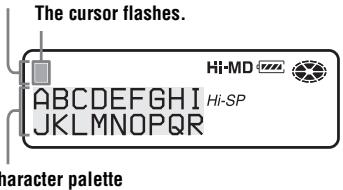
Note
Si vous saisissez le symbole « // » entre les caractères des noms de disques, par exemple « abc//def », vous risquez de ne pas pouvoir utiliser la fonction de groupe (uniquement en mode MD).
Étiquetage
Vous pouvez effectuer une opération d'étiquetage pendant que l'enregistreur est arrêté ou en lecture. Vous pouvez également attribuer des noms d'artistes et d'albums aux pistes d'un disque utilisé en mode Hi-MD. Pour étiqueter une piste avec un nom de piste, un nom d'artiste ou un nom d'album, vous devez d'abord sélectionner la piste que vous souhaitez étiqueter. Pour ajouter un nom de groupe, vous devez d'abord sélectionner une piste appartenant au groupe que vous souhaitez étiqueter.
1 Entrez dans le menu et sélectionnez « Edit » - « Title ». 2 Tournez la molette jog pour sélectionner l'affichage souhaité, puis appuyez sur ▶ENT pour valider.
| Title | Display |
| Track name | “Track” |
| Group name | “Group” |
| Artist name (to a track) 1) | “Artist” |
| Album name (to a track) 1) | “Album” |
| Disc name | “Disc” |
1) N'apparaît que pour les disques utilisés en mode Hi-MD.
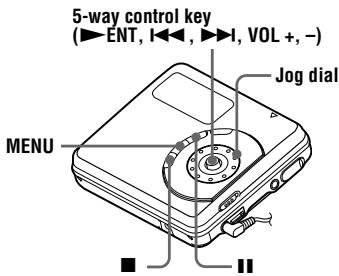
Le curseur clignote dans la zone de saisie des lettres.
Le curseur clignote.
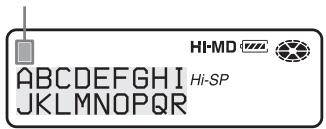
3 Appuyez sur la touche de commande à 5 directions vers VOL –.
Le curseur se déplace de la zone de saisie des lettres vers la palette de caractères.
Le curseur et le caractère alternent.
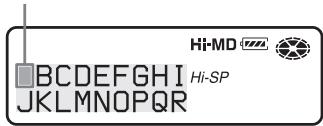
4 Sélectionnez une lettre à l'aide de la touche de commande à 5 directions et appuyez sur ▶ENT pour valider.
La lettre sélectionnée apparaît dans la zone de saisie des lettres et le curseur se déplace vers la position de saisie suivante.
Le curseur clignote à la position de saisie suivante.
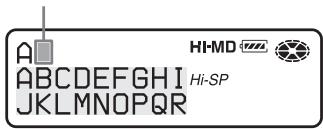
Les boutons utilisés pour la saisie des caractères et leurs fonctions sont listés ci-dessous.
1) Les fonctions des boutons ou de la commande peuvent différer selon que le curseur se trouve dans la zone de saisie des lettres ou dans la palette de caractères. 5 Répétez l'étape 4, puis saisissez tous les caractères du nom de l'étiquette. 6 Appuyez sur ▶ENT pendant 2 secondes ou plus pour valider le titre.
| Functions1) | Operations |
| To move the cursor in the character palette. | 5-way control key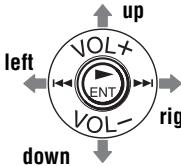 htTurn the jog dial (move the cursor to the right or left). htTurn the jog dial (move the cursor to the right or left). |
| To select a letter in the letter input area. | Turn the jog dial. |
| To enter a letter. | Press ▶ENT. |
| To enter a title. | Press ▶ENT for 2 seconds or more. |
| Functions1) | Operations |
| To insert a blank space. | Press REC (+▶)/T MARK and press the 5-way control key towards ▶▶▶ at the same time. |
| To delete a letter. | Press REC (+▶)/T MARK and press the control key towards ◀◀◀ at the same time. |
| To cancel labeling. | Press ■ for 2 seconds or more. |
| To move the cursor from the letter input area to the character palette. | Press the 5-way control key towards VOL –. |
| To move the cursor from the character palette to the letter input area. | Press ■. |
| To display “–(space)”, “:”, “/” or “–” at the input position in the letter input area. | Press ||. |
| To switch between capital letters and small letters. | Press ||. |
Remarque
Lorsque l'enregistrement est arrêté ou passe à la piste suivante pendant le titrage en cours d'enregistrement, la saisie effectuée à ce moment est entrée automatiquement.
Ré-étiquetage
Vous pouvez modifier les titres en suivant la procédure décrite dans « Étiquetage » (page 45).
Remarques
- L'enregistreur peut afficher, mais ne peut pas étiqueter en utilisant les caractères japonais « Katakana ».
- L'enregistreur ne peut pas réécrire un nom de disque ou de piste de plus de 200 lettres créé par un autre appareil (uniquement en mode MD).
Affectation de pistes ou de groupes à un nouveau groupe (Group Set)
Avec cette fonction, vous pouvez affecter des pistes ou des groupes existants à un nouveau groupe, et également affecter une piste qui n'appartient actuellement à aucun groupe à un groupe existant.
Vous pouvez créer un maximum de 255 groupes sur un disque utilisé en mode Hi-MD et 99 groupes sur un disque utilisé en mode MD.
![graph TD A["Track number"] --> B["Group 1"] A --> C["Group 2"] B --> D["Assigning tracks 1 to 3 to a new group"] C --> E["Assigning group 1 and group 2 to a new group"] D --> F["Disc"] E --> F](/content/2019/09/47007/images/b74c9aa68458e65df19ac96d9bd678c80a83b7efe053515ae152ed35898c830d.jpg)
L'enregistrement de pistes non consécutives n'est pas possible (par exemple, la piste 3 et les pistes 7 et 8 ne peuvent pas être affectées à un nouveau groupe).
Il n'est pas possible de créer un nouveau groupe si la première ou la dernière piste du groupe a été sélectionnée au milieu d'un groupe existant.
Les numéros de piste apparaissent selon leur ordre sur le disque, et non selon leur ordre dans le groupe.
Remarques
- Lorsque le nombre total de caractères dans les titres d'un disque dépasse le maximum pouvant être saisi :
—Si le disque est utilisé en mode Hi-MD, vous pouvez définir un groupe, mais vous ne pouvez pas ajouter de nom de groupe à l'étape 4.
—Si le disque est utilisé en mode MD, vous ne pouvez pas définir de groupe.
- Les plages ou les groupes doivent être séquentiels. Si les plages ou les groupes souhaités ne sont pas consécutifs, vous devez les déplacer pour les rendre consécutifs avant de pouvoir les assigner (« Déplacement de plages ou de groupes enregistrés (Move) », page 49).
1 Entrez dans le menu et sélectionnez « Edit » - « ☐ : Set ».
2 Tournez la molette jog jusqu'à ce que le numéro de la première plage souhaitée apparaisse à l'écran, puis appuyez sur ▶ENT pour valider.
Ceci sélectionne la première plage d'un nouveau groupe. Si le disque contient des groupes, seul le numéro de la première plage de chaque groupe est affiché.
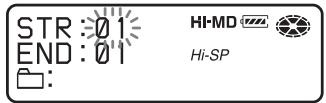
3 Tournez la molette jog jusqu'à ce que le numéro de la dernière plage souhaitée apparaisse à l'écran, puis appuyez sur ▶ENT pour valider.
Ceci sélectionne la dernière plage du nouveau groupe et le groupe peut être nommé. Si le disque contient des groupes, seul le numéro de la dernière plage de chaque groupe est affiché.
4 Nommez le groupe (voir « Ajout de titres (Saisie de titre) » (page 43)).
Remarques
- À l'étape 2, la première plage doit être soit la première plage d'un groupe existant, soit une plage n'appartenant à aucun groupe.
- Lors de la sélection de la dernière plage à l'étape 3, assurez-vous qu'elle vient après celle sélectionnée à l'étape 2. La dernière plage doit être soit la dernière plage d'un groupe existant, soit une plage n'appartenant à aucun groupe.
Annulation d'un réglage de groupe (Group Release)
Sélectionnez un groupe à annuler et vérifiez son contenu (voir « Écoute de plages dans un groupe spécifique (Lecture de groupe) » (page 37)).
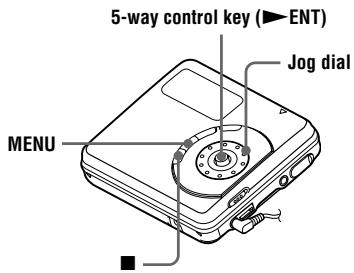
1 Sélectionnez un groupe que vous souhaitez libérer et vérifiez son contenu (voir page 37). 2 Appuyez sur ■. 3 Entrez dans le menu et sélectionnez "Edit" - "☐ : Release". 4 Tournez la molette pour sélectionner "OK", puis appuyez sur ▶ENT pour libérer un groupe. Le réglage de groupe du groupe sélectionné est libéré.
Déplacement de plages ou de groupes enregistrés (Move)
Vous pouvez modifier l'ordre des plages ou des groupes enregistrés.
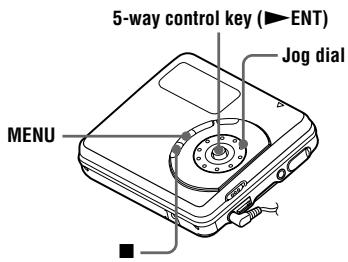
Déplacement d'une plage sur un disque
Vous pouvez déplacer une plage d'un groupe à un autre ou de l'intérieur d'un groupe à l'extérieur du groupe. Lorsque vous déplacez des plages, les numéros de plage sont automatiquement renumérotés.
1 Pendant la lecture de la plage à déplacer, entrez dans le menu et sélectionnez "Edit" - "Move" - "♪ : Move".
Si la plage sélectionnée se trouve dans un groupe, le nom du groupe auquel appartient la plage actuellement sélectionnée clignote à l'écran.
Lorsque la plage actuellement sélectionnée se trouve dans un groupe
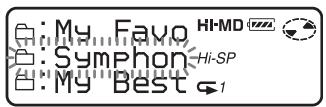
Si la plage sélectionnée ne se trouve pas dans un groupe, le nom de la plage actuellement sélectionnée clignote à l'écran.
Lorsque la plage actuellement sélectionnée ne se trouve pas dans un groupe
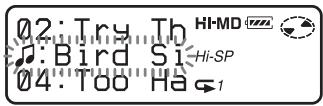
2 Si vous déplacez une plage de l'intérieur d'un groupe vers l'extérieur du groupe, ou s'il n'y a pas de groupe sur le disque, ignorez cette étape.
Si vous déplacez une plage vers un autre groupe, tournez la molette pour sélectionner le groupe de destination, puis appuyez sur ▶ENT pour valider.
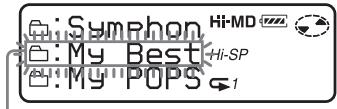
Nom du groupe de destination
Si vous déplacez une plage dans le même groupe, sélectionnez le groupe auquel appartient la plage actuellement sélectionnée.
3 Tournez la molette pour sélectionner la position de destination, puis appuyez sur ▶ENT pour valider la sélection.
La piste se déplace vers la destination sélectionnée.
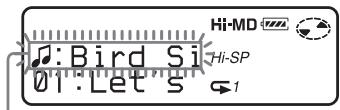
Position de destination
Changement de l'ordre d'un groupe sur un disque
1 Pendant la lecture d'une piste d'un groupe dont vous voulez changer l'ordre, entrez dans le menu et sélectionnez « Modifier » - « Déplacer » - « ☐ : Déplacer ».
Le nom du groupe auquel appartient la piste actuellement sélectionnée clignote à l'écran.
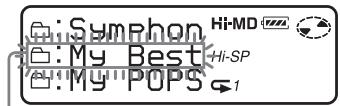
Nom du groupe que vous voulez déplacer
2 Tournez la molette jog pour sélectionner la position de destination, puis appuyez sur ▶ENT pour valider la sélection.
Exemple : lors du déplacement du groupe « My Best » vers la position après le groupe « Single Collection »
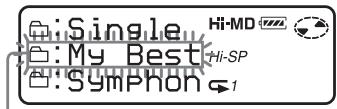
Position de destination sur le disque
Remarque
Si toutes les pistes sont déplacées hors du groupe, le groupe disparaît automatiquement du disque.
Effacement des pistes et du disque entier (Effacer)
Notez qu'une fois qu'un élément enregistré a été effacé, il ne peut pas être récupéré. Assurez-vous de confirmer le contenu de l'élément sélectionné avant de l'effacer.
Lors de l'effacement de pistes transférées depuis l'ordinateur
Lorsque vous essayez d'effacer des pistes transférées depuis l'ordinateur, « TrkFromPC » apparaît à l'écran. Si vous effacez des pistes transférées depuis l'ordinateur, l'autorisation de transfert des pistes sera la suivante.
- Si les pistes ont été transférées en mode Hi-MD, l'autorisation de transfert des pistes est restaurée automatiquement lorsque vous insérez le disque dans l'enregistreur puis connectez l'enregistreur à l'ordinateur.
- Si les pistes ont été transférées en mode MD, l'autorisation de transfert des pistes est perdue. Si vous ne voulez pas perdre l'autorisation de transfert, restaurez l'autorisation en transférant à nouveau les pistes vers l'ordinateur avant de les effacer.
Remarque
Vous ne pouvez pas effacer les données non audio (par exemple, les données texte ou image) sur un disque utilisé en mode Hi-MD.
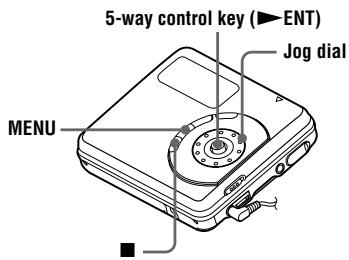
Pour effacer une piste
1 Pendant la lecture de la piste à effacer, entrez dans le menu et sélectionnez "Edit" - "Erase" - "♪ : Erase". 2 Tournez la molette jog pour sélectionner "OK", puis appuyez sur ▶ENT pour effacer la piste. La piste est effacée et la piste suivante commence à jouer. Toutes les pistes après celle effacée sont automatiquement renumérotées.
Remarque
Si toutes les pistes d'un groupe sont effacées, le groupe est automatiquement supprimé du disque.
Pour effacer une partie d'une piste
Ajoutez des marques de piste au début et à la fin de la partie à effacer, puis effacez la partie (page 52).
Pour effacer un groupe
1 Sélectionnez un groupe à effacer et vérifiez son contenu (voir page 37). 2 Appuyez sur ■. 3 Entrez dans le menu et sélectionnez "Edit" - "Erase" - "☐ : Erase". 4 Tournez la molette jog pour sélectionner "OK", puis appuyez sur ▶ENT pour effacer le groupe. Le groupe est effacé.
Pour effacer tout le disque
1 Lisez le disque à effacer pour vérifier son contenu. 2 Appuyez sur ■. 3 Entrez dans le menu et sélectionnez "Edit" - "Erase" - "AllErase". 4 Tournez la molette jog pour sélectionner "OK", puis appuyez sur ▶ENT pour effacer tout le disque. "SYSTEM FILE WRITING" apparaît à l'écran, et toutes les pistes seront effacées.
Lorsque l'effacement est terminé, "NO TRACK" apparaît à l'écran en mode Hi-MD et "BLANKDISC" et "00:00" apparaissent en mode MD.
Division d'une plage (Divide)
Vous pouvez diviser une plage à l'aide d'un repère de plage, créant ainsi une nouvelle plage à partir de la partie qui suit le repère. Les numéros de plage augmentent comme suit.
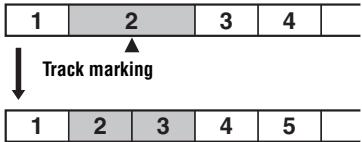
Les numéros de plage augmentent.
Remarque
Vous ne pouvez pas diviser une plage si :
- la plage a été transférée depuis un ordinateur.
- la plage a été enregistrée en mode Hi-MD à l'aide du logiciel MD Simple Burner.
- le point de division se trouve au début ou à la fin de la plage.
- la division entraînerait un dépassement du nombre maximal de plages sur le disque (2 047 plages pour un disque utilisé en mode Hi-MD ou 254 plages pour un disque utilisé en mode MD).
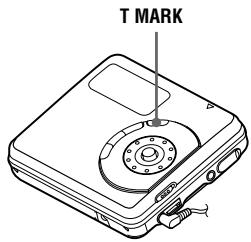
Division directe d'une plage
Pendant la lecture ou la pause, appuyez sur T MARK sur l'enregistreur au point où vous souhaitez marquer.
« MARK ON » s'affiche, et un repère de plage est ajouté. Le numéro de plage augmente de un.
Pour ajouter des repères de plage pendant l'enregistrement (sauf en enregistrement synchronisé)
Appuyez sur T MARK au point où vous souhaitez ajouter un repère de plage.
Vous pouvez utiliser « Time Mark » pour ajouter automatiquement des repères de plage à intervalles spécifiés (sauf en enregistrement numérique) (page 32).
Combinaison de plages (Combine)
Lorsque vous enregistrez avec une entrée analogique (ligne), des marques de plage inutiles peuvent être enregistrées lorsque le niveau d'enregistrement est faible. Vous pouvez effacer une marque de plage pour combiner les plages avant et après la marque.
Les numéros de plage changeront comme suit.
![graph TD A["1"] --> B["2"] B --> C["3"] C --> D["4"] E["Erase a track mark"] --> F["1"] F --> G["2"] G --> H["3"]](/content/2019/09/47007/images/ea06445a53ce75e6dd1fa63dc1b2eafa4ab9a825fcd2cc8d9e17d1c40c60ad9c.jpg)
Les numéros de plage diminuent
Remarque
Vous ne pouvez pas combiner des plages si :
- l'une des deux plages ou les deux ont été transférées depuis l'ordinateur.
- l'une des deux plages ou les deux ont été enregistrées en mode Hi-MD à l'aide du logiciel MD Simple Burner.
- les plages sont enregistrées dans un mode d'enregistrement différent.
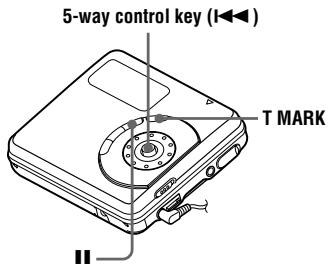
1 Pendant la lecture de la plage dont vous voulez effacer la marque, appuyez sur Ⅱ pour mettre en pause. 2 Trouvez la marque de plage en appuyant légèrement sur la touche de contrôle à 5 directions vers ◀◀◀.
Par exemple, pour effacer la troisième marque de plage, trouvez le début de la troisième plage. « 00:00 » apparaît à l'écran. « MARK » apparaît à l'écran pendant quelques secondes.
3 Appuyez sur T MARK pour effacer la marque. « MARK OFF » apparaît à l'écran. La marque de plage est effacée et les deux plages sont combinées.

Lorsqu'une marque de plage est effacée lors de la combinaison de deux plages, le titre et la date d'enregistrement de la deuxième plage deviennent ceux de la première plage.
Remarque
Lorsque vous effacez une marque de plage entre deux plages consécutives assignées à des groupes différents, la deuxième plage est réassignée au groupe contenant la première plage. De plus, si vous combinez une plage assignée à un groupe avec une plage non assignée à un groupe (deux plages consécutives), la deuxième plage prend le même paramètre d'enregistrement que la première plage.
Formatage du disque (Format)
Lorsque vous utilisez un disque en mode Hi-MD, vous pouvez utiliser la fonction Format pour restaurer le disque dans l'état où il était au moment de l'achat.
Vous ne pouvez utiliser cette fonction que lorsque vous utilisez un disque en mode Hi-MD.
| Disc type | After disc formatting |
| 1GB Hi-MD disc | “NO TRACK” appears. All data including non-audio data will be erased. |
| NOTE: Transfer authorization of the transferred tracks can be restored by inserting the disc into the recorder and connecting the recorder to the computer. | |
| 60/74/80-minute standard disc | “BLANKDISC” appears. All data including non-audio data will be erased. |
| NOTE: Transfer authorization of the transferred tracks will be decreased by one. |
Remarques
- Le formatage d'un disque efface toutes les données (y compris les données non audio). Si vous pensez qu'un disque contient de telles données, insérez le disque dans l'enregistreur et connectez l'enregistreur à l'ordinateur pour vérifier le contenu du disque.
- Si vous formatez un disque, les pistes transférées sur le disque seront également effacées et le nombre d'autorisations de transfert pour ces pistes sera réduit de un. Pour éviter la réduction des autorisations de transfert, restaurez l'autorisation de transfert en transférant à nouveau les pistes vers l'ordinateur avant de formater le disque.
- Le mode de fonctionnement défini dans le menu « Disc Mode » est appliqué à un disque standard vierge de 60/74/80 minutes utilisé sur l'enregistreur, même si un mode de fonctionnement différent a été sélectionné dans le logiciel SonicStage ou si un mode de fonctionnement différent est apparu à l'écran après le formatage du disque par le logiciel SonicStage.
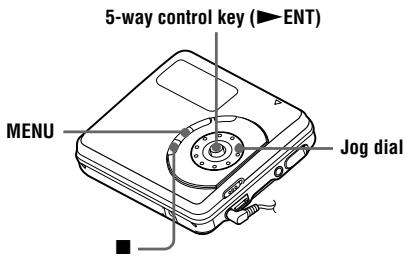
1 Lorsque l'enregistreur est arrêté, entrez dans le menu et sélectionnez « Edit » - « Format ». 2 Tournez la molette jog pour sélectionner « OK », puis appuyez sur ▶ENT pour valider la sélection.
Lorsque le formatage est terminé, « NO TRACK » apparaît à l'écran si un disque Hi-MD de 1 Go est inséré dans l'enregistreur, ou « BLANKDISC » apparaît si un disque standard en mode Hi-MD est inséré.
Modification des éléments de menu affichés (Menu Mode)
Vous pouvez spécifier l'affichage de tous les éléments du menu (mode Avancé) ou uniquement des éléments de base (mode Simple).
Reportez-vous à « Liste des menus » (page 25) pour vérifier les éléments de menu qui ne peuvent pas être affichés.
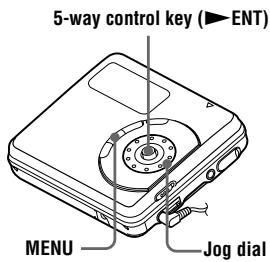
1 Entrez dans le menu et sélectionnez « Option » - « Menu Mode ». 2 Tournez la molette jog pour sélectionner « Advanced » ou « Simple », puis appuyez sur ▶ENT pour valider la sélection.
Protection de votre ouïe (AVLS)
La fonction AVLS (Automatic Volume Limiter System) empêche le volume d'être augmenté au-dessus d'un niveau donné afin de minimiser les fuites sonores, la pression sonore sur les oreilles et le danger lié à l'incapacité d'entendre les sons extérieurs importants.
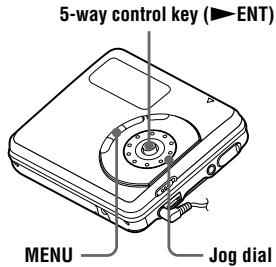
1 Entrez dans le menu et sélectionnez "Option" - "AVLS". 2 Tournez la molette pour sélectionner "AVLS On", puis appuyez sur ▶ENT pour valider la sélection. Lorsque vous essayez d'augmenter le volume trop fort, "AVLS NO VOLUME OPERATION" s'affiche à l'écran. Le volume est maintenu à un niveau modéré.
Pour annuler l'AVLS
Sélectionnez "AVLS Off" à l'étape 2.
Désactivation du bip sonore
Vous pouvez désactiver ou activer le bip sonore.
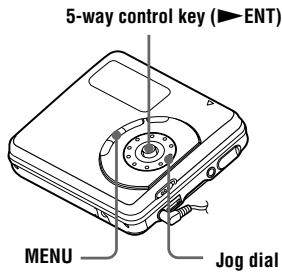
1 Entrez dans le menu et sélectionnez "Option" - "Beep". 2 Tournez la molette pour sélectionner "Beep Off", puis appuyez sur ▶ENT pour valider la sélection.
Pour activer le bip sonore
Sélectionnez "Beep On" à l'étape 2.
Mémorisation des réglages pour chaque disque (Disc Memory)
L'enregistreur est réglé en usine pour mémoriser automatiquement les réglages de chaque disque.
L'enregistreur mémorise automatiquement les réglages d'un disque et les récupère à chaque insertion du disque.
Le réglage suivant peut être mémorisé :
- Signet
- Réglages "Custom1" et "Custom2" de l'égaliseur 6 bandes (pour les modèles hors modèles européens)
Vous pouvez vérifier le réglage comme suit.
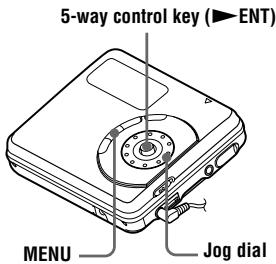
1 Entrez dans le menu et sélectionnez "Option" - "Disc Mem". 2 Tournez la molette jog pour sélectionner "On", puis appuyez sur ▶ENT pour valider la sélection.
Pour régler l'enregistreur afin que les réglages du disque ne soient pas mémorisés
Sélectionnez "Off" à l'étape 2.
Effacement des informations du disque
1 Insérez le disque dont les informations doivent être effacées et vérifiez son contenu. 2 Sélectionnez "1MemErase" à l'étape 2. Les informations du disque sont effacées.

"DISC MEMORY" apparaît lorsque le disque avec son réglage mémorisé est inséré.
Remarques
- Les réglages pour jusqu'à 30 disques peuvent être mémorisés. Tous les réglages mémorisés ensuite remplaceront les réglages les moins fréquemment utilisés parmi les 30. Le nombre de disques pouvant être mémorisés dépend du nombre de pistes enregistrées sur les disques. Plus il y a de pistes enregistrées par disque, moins il y a de disques pouvant être mémorisés.
- Si vous essayez d'effacer les informations d'un disque qui n'a jamais été mémorisé, "NO DISC MEMORY" apparaît à l'écran pendant quelques secondes.
Démarrage rapide de la lecture (Mode rapide)
Après avoir appuyé sur le bouton de lecture ou fait une recherche de piste, la lecture peut démarrer rapidement.
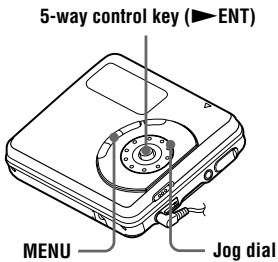
1 Entrez dans le menu et sélectionnez "Option" - "QuickMode". 2 Tournez la molette jog pour sélectionner "Quick On", puis appuyez sur ▶ENT pour valider la sélection.
Pour revenir au réglage normal
Sélectionnez "Quick Off" à l'étape 2.
Remarques
- Lorsque le mode rapide est réglé sur « Quick On », l'alimentation reste allumée dans l'enregistreur même si rien n'apparaît à l'écran. Cela entraîne une durée de vie de la batterie plus courte.
- Si aucune opération sur l'enregistreur (y compris l'ouverture ou la fermeture du couvercle) ne se produit pendant une heure, l'alimentation de l'enregistreur s'éteint automatiquement. Pour cette raison, la prochaine fois que vous démarrez la lecture ou effectuez une autre opération, l'enregistreur ne répondra pas rapidement. L'appareil reviendra toutefois en mode rapide par la suite.
Sélection du mode disque (Disc Mode)
Lorsque vous insérez un disque standard vierge de 60/74/80 minutes dans l'enregistreur, vous pouvez utiliser cette fonction pour spécifier l'utilisation du disque en mode Hi-MD ou en mode MD. Lorsque vous enregistrez sur cet enregistreur sans utiliser d'ordinateur, réglez « Disc Mode » sur « Hi-MD ». L'enregistrement n'est pas possible si « Disc Mode » est réglé sur « MD ». Pour permettre à un disque enregistré sur cet enregistreur d'être utilisé sur un autre composant qui ne prend pas en charge Hi-MD, réglez « Disc Mode » sur « MD » et utilisez un ordinateur pour enregistrer en mode MD (reportez-vous à la section « Fonctionnement du logiciel »).
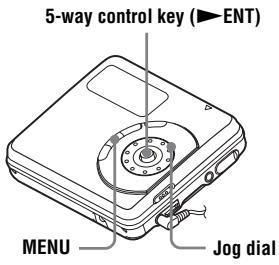
1 Entrez dans le menu et sélectionnez « Option » - « Disc Mode ». 2 Tournez la molette jog pour sélectionner « Hi-MD » (réglage d'usine) ou « MD », puis appuyez sur ▶ENT pour valider la sélection.
Remarques
- Même si vous sélectionnez « MD » comme réglage « Disc Mode », le mode de fonctionnement ne peut être que « Hi-MD » lors de l'utilisation d'un disque Hi-MD de 1 Go.
- Le mode de fonctionnement défini dans le menu « Disc Mode » est appliqué à un disque standard vierge de 60/74/80 minutes utilisé sur l'enregistreur, même si un mode de fonctionnement différent a été sélectionné dans le logiciel SonicStage ou si un mode de fonctionnement différent est apparu à l'écran après le formatage du disque par le logiciel SonicStage.
Réglage du contraste de la fenêtre d'affichage (réglage du contraste)
Vous pouvez régler le contraste de la fenêtre d'affichage.
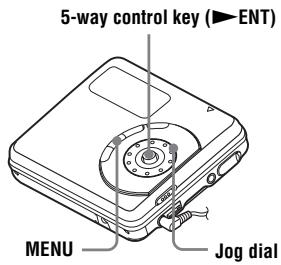
1 Lorsque l'enregistreur est arrêté, entrez dans le menu et sélectionnez « Option » - « Contraste ». 2 Tournez la molette jog pour régler le contraste, puis appuyez sur ▶ENT pour valider la sélection.
Changement du sens de fonctionnement de l'affichage
Lorsque vous tournez la molette jog dans le sens horaire, l'affichage défile vers le bas. C'est le réglage d'usine. Vous pouvez modifier le réglage d'usine pour faire défiler dans le sens opposé.
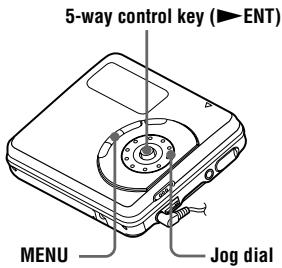
1 Entrez dans le menu et sélectionnez « Option » - « Molette jog ». 2 Tournez la molette jog pour sélectionner « Inverser », puis appuyez sur ▶ENT pour valider la sélection.
Pour rétablir le réglage normal
Sélectionnez « Default » à l'étape 2.
Ce que vous pouvez faire en connectant l'appareil à un ordinateur
Pour utiliser l'enregistreur connecté à un ordinateur, vous devez installer le logiciel fourni sur le CD-ROM. Pour plus de détails sur la procédure d'installation, reportez-vous à la section « Utilisation du logiciel ».
Lors de l'utilisation du logiciel fourni
Pour des explications détaillées, consultez la section « Utilisation du logiciel » ou l'aide en ligne.
- Transfert de données audio entre l'ordinateur et l'enregistreur : Le logiciel SonicStage fourni vous permet de transférer des données audio entre l'enregistreur et l'ordinateur. Lorsqu'un disque utilisé en mode Hi-MD est inséré dans l'enregistreur, les plages enregistrées à partir d'un lecteur CD vers l'enregistreur peuvent être transférées sur votre ordinateur. • Enregistrement direct d'un CD vers un MD : Le logiciel MD Simple Burner fourni vous permet d'enregistrer un CD du lecteur de CD de l'ordinateur directement sur un disque dans l'enregistreur.
Lorsque vous utilisez le disque de l'enregistreur comme périphérique de stockage
Lorsqu'un disque utilisé en mode Hi-MD est inséré dans l'enregistreur, celui-ci apparaît dans l'Explorateur Windows comme un lecteur externe, vous permettant de transférer des données non audio telles que des fichiers texte et image. Pour plus de détails, reportez-vous à « Stockage de données non audio sur un disque » (page 62).

Si vous lisez des fichiers audio à l'aide du logiciel, le son est émis par les haut-parleurs de l'ordinateur lorsqu'un disque utilisé en mode Hi-MD est inséré, et par les écouteurs connectés à l'enregistreur lorsqu'un disque utilisé en mode MD est inséré dans l'enregistreur.
Connexion de l'enregistreur à votre ordinateur
Lorsque vous connectez le câble USB dédié directement à la prise USB de l'enregistreur, l'alimentation (bus power) est fournie par le port USB de l'ordinateur. Cela permet d'utiliser l'enregistreur sans alimentation par batterie.
Remarque
Lors de l'utilisation de Windows ME ou Windows 98SE
- Si vous connectez l'enregistreur à l'ordinateur avec le mode disque de l'enregistreur réglé sur « Hi-MD » (réglage d'usine), puis insérez un disque standard de 60/74/80 minutes, le mode de fonctionnement du disque peut passer automatiquement en mode Hi-MD même si vous n'enregistrez rien.
- Lorsque vous déconnectez le câble USB dédié, le message « Unsafe Removal of Device » apparaît sur l'écran de l'ordinateur. Ce n'est pas un problème. Cliquez simplement sur « OK » pour faire disparaître le message.
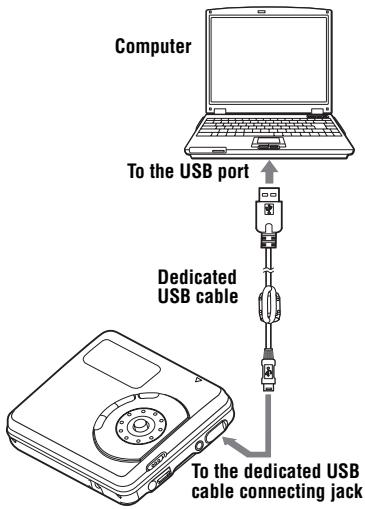
1 Insérez un disque enregistrable dans l'enregistreur. 2 Effectuez les connexions comme suit.
① Connectez le câble USB dédié à l'enregistreur et à l'ordinateur. ② Assurez-vous que l'enregistreur est arrêté et que HOLD est désactivé.
3 Vérifiez les connexions.
Lorsque les connexions sont correctement établies, « PC – –MD » s'affiche à l'écran.
Hi-MD

PC--MD
Lorsque vous débranchez le câble USB dédié de l'ordinateur ou retirez le disque de l'enregistreur
Assurez-vous de retirer l'enregistreur ou le disque comme suit. Sinon, des dommages aux données peuvent survenir.
1 Assurez-vous que « REC » n'est pas affiché dans la fenêtre d'affichage de l'enregistreur. 2 Appuyez sur ■ sur l'enregistreur. « EJECT DISC OK » s'affiche à l'écran. Selon les conditions, il peut s'écouler un certain temps avant que « EJECT DISC OK » ne s'affiche. 3 Débranchez le câble USB dédié de l'ordinateur ou retirez le disque de l'enregistreur.
Remarques
- Si vous utilisez l'enregistreur connecté à l'ordinateur, il est recommandé d'insérer une nouvelle pile alcaline comme précaution contre les pannes de courant, la déconnexion du câble USB dédié ou d'autres événements imprévus. Nous ne garantissons pas les résultats en cas de mauvaise manipulation, d'échec de transfert ou de destruction des données audio causés par des événements imprévus.
- Si vous débranchez le câble USB dédié de l'enregistreur et souhaitez le reconnecter, attendez au moins 2 secondes avant de le reconnecter.
- Assurez-vous de placer l'enregistreur dans un endroit stable et sans vibrations pendant l'enregistrement.
- Assurez-vous de ne pas connecter l'enregistreur à votre ordinateur pendant l'enregistrement ou la lecture.
- Le système peut mal fonctionner si votre ordinateur passe en mode veille, veille prolongée ou hibernation pendant la connexion à l'enregistreur. Assurez-vous de désactiver tout changement de mode veille, veille prolongée ou hibernation.
- Assurez-vous de ne pas connecter l'enregistreur et l'ordinateur via un concentrateur USB.
- Lorsque l'enregistreur est connecté à un ordinateur, l'alimentation (alimentation par bus) est fournie à l'enregistreur via le port USB de l'ordinateur. Si l'ordinateur (par exemple, un ordinateur portable) fonctionne sur batterie, cette connexion peut entraîner une décharge de la batterie de l'ordinateur. Il est donc recommandé d'utiliser l'ordinateur avec un adaptateur secteur.
- Nous ne garantissons pas un fonctionnement sans problème sur tous les ordinateurs qui satisfont aux exigences système.
Stockage de données non audio sur un disque
Si vous connectez l'enregistreur à un ordinateur avec un disque en mode Hi-MD inséré, le disque est reconnu comme un support de stockage par l'Explorateur Windows, ce qui vous permet de stocker des données non audio telles que des données texte ou des données image.
Pour l'espace de stockage de chaque disque, reportez-vous à la page suivante.
Lorsque vous insérez un disque en mode Hi-MD dans l'enregistreur et que vous le connectez à l'ordinateur, l'enregistreur est reconnu comme un périphérique externe et peut être visualisé dans l'Explorateur Windows. Vous pouvez utiliser l'enregistreur de la même manière que d'autres périphériques.
Remarques
- Lorsque le logiciel SonicStage est actif, l'enregistreur n'est pas reconnu comme un périphérique de stockage de données.
- Si vous formatez un disque sur l'ordinateur, assurez-vous de le formater à l'aide du logiciel SonicStage.
- Assurez-vous de ne pas supprimer le dossier de gestion des fichiers (dossier HMDHIFI et fichier Hi-MD.IND) dans l'Explorateur Windows.
L'espace de stockage pour chaque disque (formaté avec l'enregistreur/le logiciel SonicStage)
| Disc type | Total size | Disc management space1)2) | Free space |
| 60-minute standard disc | 219 MB(229,965,824 bytes) | 832 KB(851,968 bytes) | 218 MB(229,113,856 bytes) |
| 74-minute standard disc | 270 MB(283,312,128 bytes) | 832 KB(851,968 bytes) | 269 MB(282,460,160 bytes) |
| 80-minute standard disc | 291 MB(305,856,512 bytes) | 832 KB(851,968 bytes) | 290 MB(305,004,544 bytes) |
| 1GB Hi-MD disc | 964 MB(1,011,613,696 bytes) | 832 KB(851,968 bytes) | 963 MB(1,010,761,728 bytes) |
1) Il s'agit de l'espace utilisé pour la gestion des fichiers sur le disque. 2) La taille de l'espace de gestion du disque change en fonction des conditions de fonctionnement de votre ordinateur et d'autres facteurs. Par conséquent, l'espace réel disponible peut être inférieur à celui affiché par l'Explorateur Windows.
Précautions
Sur la sécurité
Ne placez aucun objet étranger dans la prise DC IN 3V (l'adaptateur secteur est un accessoire en option).
Sources d'alimentation
- Utilisez le courant domestique ou des piles LR6 (format AA).
- Si vous n'utilisez pas cet enregistreur pendant une longue période, assurez-vous de débrancher l'alimentation.
Accumulation de chaleur
De la chaleur peut s'accumuler dans l'enregistreur s'il est utilisé pendant une période prolongée. Cela n'indique toutefois pas un dysfonctionnement.
Installation
- Si vous utilisez l'enregistreur dans un endroit soumis à des décharges statiques ou à du bruit électrique, l'enregistrement peut ne pas se faire correctement ou les données enregistrées peuvent être perdues. Si vous effectuez une opération de transfert dans un tel endroit, l'autorisation de transfert de la piste peut être perdue.
- N'utilisez jamais l'enregistreur dans un endroit soumis à des conditions extrêmes de lumière, de température, d'humidité ou de vibrations.
- N'enveloppez jamais l'enregistreur dans un quelconque matériau lorsqu'il est utilisé avec l'adaptateur secteur (non fourni). L'accumulation de chaleur dans l'enregistreur peut provoquer un dysfonctionnement ou des dommages.
Casques et écouteurs
Sécurité routière
N'utilisez pas de casques ou d'écouteurs en conduisant, en faisant du vélo ou en utilisant un véhicule motorisé. Cela peut créer un danger pour la circulation et est illégal dans de nombreux endroits. Il peut également être dangereux d'écouter votre enregistreur à volume élevé en marchant, en particulier aux passages pour piétons. Vous devez faire preuve d'une extrême prudence ou cesser l'utilisation dans des situations potentiellement dangereuses.
Prévention des dommages auditifs
Évitez d'utiliser des casques ou des écouteurs à volume élevé. Les experts en audition déconseillent une écoute continue, forte et prolongée. Si vous ressentez un bourdonnement dans les oreilles, réduisez le volume ou cessez l'utilisation.
Prendre soin des autres
Maintenez le volume à un niveau modéré. Cela vous permettra d'entendre les sons extérieurs et de respecter les personnes autour de vous.
Sur la cartouche MiniDisc
- Lorsque vous transportez ou rangez le MiniDisc, conservez-le dans son boîtier.
- N'ouvrez pas de force l'obturateur.
- Ne placez pas la cartouche dans un endroit exposé à la lumière, à des températures extrêmes, à l'humidité ou à la poussière.
- Fixez l'étiquette de disque fournie uniquement dans l'espace prévu à cet effet sur le disque. Ne la collez sur aucune autre surface du disque.
Nettoyage
- Nettoyez le boîtier de l'enregistreur avec un chiffon doux légèrement humidifié avec de l'eau ou une solution détergente douce. N'utilisez pas de tampon abrasif, de poudre à récurer ou de solvant tel que l'alcool ou le benzène, car cela pourrait ternir la finition du boîtier.
- Essuyez la cartouche du disque avec un chiffon sec pour éliminer la saleté.
- La poussière sur la lentille peut empêcher l'appareil de fonctionner correctement. Assurez-vous de fermer le couvercle du compartiment à disque après avoir inséré ou éjecté un disque.
- Pour obtenir la meilleure qualité sonore, utilisez un chiffon sec pour essuyer les fiches des écouteurs/casque. Des fiches sales peuvent provoquer une distorsion du son ou des coupures intermittentes.
Piles
Une utilisation incorrecte des piles peut entraîner une fuite de liquide ou l'éclatement de la pile. Pour éviter de tels accidents, respectez les précautions suivantes :
- Installez correctement les pôles + et – de la pile.
- Lorsque l'enregistreur ne doit pas être utilisé pendant une longue période, veillez à retirer la batterie.
- En cas de fuite de la batterie, essuyez soigneusement et complètement le liquide de la batterie du compartiment à piles avant d'insérer de nouvelles piles.
Bruit mécanique
L'enregistreur émet un bruit mécanique pendant son fonctionnement, causé par le système d'économie d'énergie de l'enregistreur, ce n'est pas un problème.
Pour protéger un disque enregistré
Pour protéger un disque contre l'enregistrement, faites glisser la languette sur le côté du disque pour ouvrir l'encoche. Dans cette position, le disque ne peut pas être enregistré. Pour réenregistrer, faites glisser la languette en arrière pour qu'elle soit visible.
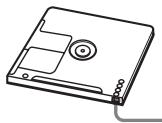
Dos du disque
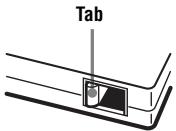
Le contenu enregistré est protégé.
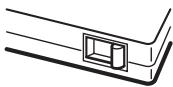
Le contenu enregistré n'est pas protégé.
Si vous avez des questions ou des problèmes concernant votre enregistreur, veuillez consulter votre revendeur Sony le plus proche. (Si un problème survient alors que le disque est dans l'enregistreur, nous recommandons de laisser le disque dans l'enregistreur lorsque vous consultez votre revendeur Sony afin que la cause du problème puisse être mieux comprise.)
Spécifications
Système de lecture audio
Système audio numérique MiniDisc
Propriétés de la diode laser
Matériau : GaAlAs
Longueur d'onde : λ = 790nm
Durée d'émission : continue
Sortie laser : moins de 44,6 μW
(Cette sortie est la valeur mesurée à une distance de 200 mm de la surface de la lentille sur le bloc de lecture optique avec une ouverture de 7 mm.)
Temps d'enregistrement et de lecture
Voir « Liste des temps d'enregistrement pour chaque disque » (page 81).
Vitesses de rotation
350 tr/min à 3 000 tr/min (CLV)
Correction d'erreurs
Hi-MD :
LDC (Long Distance Code)/BIS (Burst Indicator Subcode)
MD :
ACIRC (Advanced Cross Interleave Reed Solomon Code)
Fréquence d'échantillonnage
44,1 kHz
Convertisseur de fréquence d'échantillonnage
Entrée numérique (optique) : 32 kHz/44,1 kHz/48 kHz
Formats audio pris en charge par cet enregistreur
Enregistrement :
PCM linéaire (44,1 kHz/16 bits) ATRAC3plus (Adaptive TRansform Acoustic Coding 3 plus) (Hi-SP/Hi-LP)
Lecture :
PCM linéaire
ATRAC3plus
ATRAC3
ATRAC
MP3 (MPEG-1 Audio Layer-3 / Fréquence d'échantillonnage 44,1 kHz / Débit binaire 32 - 320 kbps (débit constant/variable))
Système de modulation
Hi-MD :
1-7RLL (Run Length Limited)/PRML (Partial Response Maximum Likelihood)
MD :
EFM (Eight to Fourteen Modulation)
Réponse en fréquence
20 à 20 000 Hz ± 3 dB
Entrées
ENTRÉE LIGNE (OPTIONNELLE) 1) : mini-prise stéréo pour entrée analogique (niveau d'entrée minimal 49 mV) mini-prise optique (numérique) pour entrée optique (numérique)
Sorties
: mini-prise stéréo
Sortie maximale (CC)
Casque :
2,8 mW + 2,8 mW (16 Ω) (modèles européens) 5 mW + 5 mW (16 Ω) (autres modèles)
Alimentation
Une pile alcaline LR6 (format AA) Adaptateur secteur CC 3 V
Température de fonctionnement
+5°C à +35°C
Durée de fonctionnement sur pile 2)
Voir "Autonomie de la batterie" (page 17)
Dimensions
Environ 83,6 × 29,5 × 77,0 mm (l/h/p) (hors parties saillantes et commandes)
Masse
Environ 107 g (enregistreur seul)
1) La prise LINE IN (OPTICAL) sert à connecter soit un câble numérique (optique), soit un câble analogique (ligne).
2) Mesuré conformément à la norme JEITA.
Brevets américains et étrangers sous licence de Dolby Laboratories.
La conception et les spécifications sont sujettes à modification sans préavis.
Accessoires en option
Adaptateur secteur
AC-ES3010K (modèles Singapour, Australie et
Nouvelle-Zélande)
AC-E30HG (autres modèles)
Câble optique
POC-15B, POC-15AB
Câble de liaison
RK-G129, RK-G136
Casques/écouteurs stéréo de la série MDR*
Enceintes actives de la série SRS
MD enregistrables de la série MDW
Disque Hi-MD enregistrable
HMD1G
Votre revendeur peut ne pas proposer certains des accessoires listés ci-dessus. Veuillez demander à votre revendeur des informations détaillées sur les accessoires disponibles dans votre pays.
* Lors de l'utilisation d'un casque en option, utilisez uniquement des casques/écouteurs avec des fiches mini-stéréo. Vous ne pouvez pas utiliser de casques/écouteurs avec des fiches micro.
Dépannage
Si un problème survient pendant le fonctionnement de l'enregistreur, suivez les étapes décrites ci-dessous avant de consulter le revendeur Sony le plus proche. Si des messages apparaissent, il est recommandé de prendre des notes.
1 Vérifiez si le problème est répertorié dans la section « Dépannage » (page 68). Consultez également la section « Messages » (page 76) pour le problème.
2 Si après l'étape 1 vous ne parvenez toujours pas à résoudre le problème, consultez votre revendeur Sony le plus proche.
Pendant l'enregistrement
| Symptom | Cause/Remedy |
| “NotENOUGH POWER TO REC” appears and recording cannot be done on a 1GB Hi-MD disc. | Recording is not possible when using a 1GB Hi-MD disc even when the battery level indication shows enough power remaining while the recorder is stopped or playing. This is because of a mechanism that disables recording when the remaining battery power is estimated by the recorder to be insufficient due to the high power consumption required for 1GB Hi-MD disc recording.Insert a new alkaline dry battery or connect the AC power adaptor (not supplied) to the recorder. |
| The remaining recording time appears as “-00:00” and recording cannot be done, even though 2.0MB of free space is displayed. | This is a system limitation. 2.0MB is the capacity of the reserve domain. |
| The recorder always creates a new group when recording. | The group recording (“☐ :REC”) is set to “☐ :REC On”. (You cannot overwrite tracks.)Set the group recording setting to “☐ :REC Off” (page 33). |
| The first few seconds of a track cannot be recorded. | If you start recording while the disc indication is rotating, data will not be recorded to the first few seconds of the first track.Wait until the disc indication stops rotating before you start recording. |
| Recording cannot be done correctly. | You tried to record in MD mode on this recorder.→ Only Hi-MD mode can be used to record directly on this recorder without using a computer. To record in MD mode, connect the recorder to a computer and use the supplied software (pages 19 and 27).Audio sources may not be securely connected.→ Disconnect the audio sources once and connect them again (pages 18 and 29).There is no digital signal from the portable CD player.When recording digitally from a portable CD player, use the AC power adaptor and disable the anti-skip function (such as ESP) on the CD player.The analog recording was made using a connecting cord with an attenuator.→ Use a connecting cord without an attenuator.Recording level is too small to record (when adjusting the recording level manually).→ Pause the recorder and adjust the recording level (page 31).The recorder is connected to the computer.Disconnect the recorder from the computer when recording.The power sources was disconnected or a power outage occurred during recording.The recording result is not recorded on the disc. Make recording again.The premastered disc is inserted.Replace to the recordable disc.Recording may not be done if the remaining recordable time on the disc is 48 seconds or less (“DISC FULL” appears).Replace the disc. |
| The lid does not open after recording. | The lid does not open until “SYSTEM FILE WRITING” disappears in the display. |
| “TRACK FULL” appears even before the disc has reached the maximum recording time and the recording cannot be done. | This is due to the MiniDisc system limitation. When 2,047 tracks (on a disc used in Hi-MD mode) have been recorded on the disc, “TRACK FULL” appears regardless of the total recorded time. More than 2,047 tracks cannot be recorded on the disc.To continue recording, erase unnecessary tracks. |
| The remaining recording time does not increase even after erasing numerous short tracks. | This is due to the MiniDisc system limitation (in MD mode only). Tracks of under 12 seconds (in SP mode), 24 seconds (in LP2 mode or monaural), or 48 seconds (in LP4 mode) in length are not counted and so erasing them may not lead to an increase in the recording time. |
| Symptom | Cause/Remedy |
| The total recorded time and the remaining time on the disc may not total the maximum recording time (60, 74, or 80 minutes). | This is due to the MiniDisc system limitation (in MD mode only). Normally, recording is done in minimum units of approximately 2 seconds (in SP mode), 4 seconds (in LP2 mode or monaural), or 8 seconds (in LP4 mode). When recording is stopped, the last unit of recording always uses this unit of 2 seconds, 4 seconds, or 8 seconds even if the actual recording is shorter. Likewise, when recording is restarted after the stop, the recorder will automatically insert a blank space amounting to 2 seconds, 4 seconds, or 8 seconds before the next recording. (This is to prevent accidental erasing of a previous track whenever a new recording is started). Therefore, the actual recording time will decrease whenever a recording is stopped by a maximum of 6 seconds, 12 seconds, or 24 seconds. |
| “TRACK FULL” appears even before the disc has reached the maximum track number or recording time. | This is due to the MiniDisc system limitation. Repeated recording and erasing may cause fragmentation and scattering of data. Although those scattered data can be read, each fragment is counted as a track. In this case, the number of tracks may reach 2,047 (on a disc used in Hi-MD mode) and further recording is not possible.To continue recording, erase unnecessary tracks. |
Pendant la lecture
| Symptom | Cause/Remedy |
| A disc is not played normally. | Repeat play is selected. → Set the Repeat play to “RepeatOff” to change back to the normal play (page 40).Playback mode is changed. → Enter the Main play mode or Sub play mode to change back to the normal play (page 36). |
| A disc is not played from the first track. | Disc playing stopped before it came to the last track. → Press the 5-way control key (▶ENT) on the recorder for 2 seconds or more to start playing. |
| Playback sound skips. | The recorder is placed where it receives continuous vibration. → Put the recorder on a stable place.A very short track may cause sound to skip. → Try not to create a short track. |
| Sound has a lot of static. | Strong magnetism from a television or such device is interfering with operation. → Move the recorder away from the source of strong magnetism. |
| The volume of the recorded track is low. | The track was recorded in analog mode (in digital mode, the recording level is automatically set to the same level as that of the sound source). Or you used a connecting cord with an attenuator. → Use a correct connecting cord without an attenuator.The recording level was low. → Adjust the recording level manually while recording (page 31). |
| Symptom | Cause/Remedy |
| Volume cannot be turned up. | AVLS is on.→ Release AVLS settings (page 55). |
| No sound comes through the headphones/earphones. | The headphones/earphones plug is not firmly connected.→ Plug in the plug of the headphones/earphones firmly to ☐.The plug is dirty.→ Clean the plug. |
| The disc cannot be played on another component | The component does not support Hi-MD.→ Discs recorded on this recorder can be played only on components that supports Hi-MD. |
| The edited tracks may exhibit sound dropout during search operations. | This occurs due to the MiniDisc system limitation. The fragmentation of data may cause sound dropout while searching because the tracks are played in higher speed than normal playback. |
| There is no R-channel sound output when playing a track recorded from a cassette deck or through an amplifier, or when listening to sound from a cassette deck or amplifier. | There is no R-channel output if the cassette deck or an amplifier is connected with a monaural cord.→ Make sure to use a stereo connecting cord. If, however, the connected equipment is monaural, there will be no R-channel sound output even with a stereo connecting cord. |
| The recorder cannot play MP3 tracks. | You tried to play an MP3 track with a format not supported by this recorder.→ This recorder only supports MP3 tracks (MPEG-1 Audio Layer-3/Sampling frequency 44.1 kHz) that have been transferred using the SonicStage software. |
| Momentary noise is heard. | Due to the special digital audio compression technology used in LP4 mode, momentary noise may occur on very rare occasions with certain sound sources. |
Pendant l'édition
| Symptom | Cause/Remedy |
| “NotENOUGH POWER TO EDIT” appears and editing cannot be done on a 1GB Hi-MD disc. | • Editing is not possible when using a 1GB Hi-MD disc even when the battery level indication shows enough power remaining while the recorder is stopped or playing. This is because of a mechanism that disables editing when the remaining battery power is estimated by the recorder to be insufficient due to the high power consumption required for 1GB Hi-MD disc editing.→ Insert a new alkaline dry battery or connect the AC power adaptor (not supplied) to the recorder. |
| The lid does not open. | • The recorder is saving the contents of an editing operation. The lid will not open until “SYSTEM FILE WRITING” disappears from the display. |
| Editing cannot be done. | The power source has been disconnected or a power outage has occurred during editing.→ The editing done to that point is not saved to the disc. Do the editing operation again. |
| Non-audio data cannot be erased. | Non-audio data cannot be erased with the Erase function.→ Confirm the contents by connecting the recorder to your computer. If it is okay to delete the contents, then perform the Format function (page 53). |
| Tracks cannot be combined. | This is due to the MiniDisc system limitations. When the tracks are scattered and the length of each track is short*, you may not be able to combine the tracks.* Combining tracks of the following lengths may not be possible.Hi-MD modeLinear PCM: 9 seconds or lessHi-SP: 8 seconds or lessHi-LP: 32 seconds or lessMD modeSP: 12 seconds or lessLP2/Monaural: 24 seconds or lessLP4: 48 seconds or lessYou cannot combine tracks recorded in different recording modes, e.g., a track recorded in stereo and a track recorded in monaural; nor can you combine a track recorded with digital connection and a track recorded with analog connection. |
| The disc cannot edit on other component. | The component does not support Hi-MD.→ Edit on other component that support Hi-MD. |
Pendant l'utilisation de la fonction de groupe
| Symptom | Cause/Remedy |
| The group function does not operate. | While using a disc without group setting, an attempt was made to select some group-related menu.→ Use a disc with group setting. |
| A new group cannot be created. | This is due to the MiniDisc system limitations (in MD mode only). Group information has been written to the area where the disc name is stored. The disc name and track names are recorded in the same area, which can store a maximum of approximately 1,700 characters. If the total number exceeds this amount, it is impossible to make group settings. |
Lorsque l'enregistreur est connecté à l'ordinateur
| Symptom | Cause/Remedy |
| The recorder is not recognized by the computer. | The dedicated USB cable is not firmly connected.→ Connect the dedicated USB cable firmly to the recorder and the computer.A USB hub is used.→ Connect the dedicated USB cable directly to the USB port of the computer.Network communication has failed.→ Disconnect the dedicated USB cable, wait at least 2 seconds, and then reconnect it. If the recorder is still not recognized, disconnect the dedicated USB cable, restart the computer, and then connect the dedicated USB cable again.When using Windows 2000 Professional, you turned on or restarted the computer while the dedicated USB cable was connected, and then disconnected it afterwards.→ Disconnect the dedicated USB cable, restart the computer, and then reconnect the dedicated USB cable. This problem may be resolved by updating your Windows operating system so that it contains all the latest features. |
| Even though the recorder is recognized by the computer, it does not operate normally. | A USB hub is used.→ Connect the dedicated USB cable directly to the USB port of the computer.You are using the recorder at a place with vibration.→ Use the recorder at a place with no vibration. |
| The recorder cannot be used as a storage device. | The SonicStage or MD Simple Burner software is active.→ Close the SonicStage or MD Simple Burner software.A disc which is not used in Hi-MD mode is inserted.→ Insert a disc used in Hi-MD mode. Only discs used in Hi-MD mode can be used as a storage media. |
| The playing time of a transferred track is different from the time that appears on your computer monitor. | This is due to a calculation discrepancy between the recorder and the computer. |
| You cannot transfer tracks that will fill up the remaining recording time on the disc. | The minimum recordable time on a disc is normally 2 seconds in SP mode, 4 seconds in LP2 mode, and 8 seconds in LP4 mode. When you transfer a track from your computer, the recorder needs a 2-second (or 4- or 8-second) space for a track even if the track is under 2 seconds (or 4 or 8 seconds) in length. Also, the recorder inserts a 2-second (or 4 -or 8-second) space in between tracks during transfer operation. For this reason, the recorder needs an additional 6 seconds (or 12 or 24 seconds) for each track. This reduces the maximum recording time for each track by 6 seconds (or 12 or 24 seconds) during transfer operation (in MD mode only). |
| The disc size displayed on the computer is not the same as the disc size printed on the disc. | The difference is due to the use of the binary system to indicate the disc size on the computer and the decimal system to express the disc size on the disc and other recording media. For details on the disc size, see page 63. |
| You cannot operate the recorder (“PC – –MD” appears). | You cannot operate the recorder while the recorder is connected to the computer. |
| The lid does not open. | It happens if you disconnect the dedicated USB cable in the middle of a data transfer, recording, or editing operation on the computer, but while the dry alkaline battery is drained.→ Reconnect the dedicated USB cable or insert a new dry alkaline battery into the recorder, and then press ■. |
Autres
| Symptom | Cause/Remedy |
| “Advanced” or “Simple” is displayed. | You attempted to do a menu operation for the first time after purchase of the recorder (by pressing the MENU button for 2 seconds or more).→ Select the Menu mode (page 55). |
| Some menu items cannot be displayed. | “Menu Mode” is set to “Simple”.→ Set the “Menu Mode” to “Advanced” to display all the menu items. |
| The recorder does not work or works poorly. | The volume is low.→ Turn up the volume.No disc is inserted.→ Insert a recorded disc.The HOLD function is turned on (“HOLD” appears in the display when you press an operation button on the recorder).→ On the recorder, disable HOLD by sliding the HOLD switch to the opposite direction of the arrow (pages 15, 16).The lid is not firmly closed.→ Close the lid until it clicks. Then slide OPEN to open the lid.Moisture has condensed inside the recorder (for example, when the recorder has been brought in from a cold place to a warm place).→ Take the disc out and leave the recorder in a warm place for several hours until the moisture evaporates.The dry battery is weak (“LOW BATTERY” flashes or nothing appears).→ Replace the dry battery with a new one.The disc is damaged or does not contain proper recording or editing data.→ Reinsert the disc. Rerecord the disc. If the error message still appears, replace it with another disc.There is a built-in malfunction in the system.While operating, the recorder received a mechanical shock, too much static, abnormal power voltage caused by lightning, etc.→ Restart the operation as follows.1 Disconnect all the power sources and the dedicated USB cable.2 Leave the recorder for about 30 seconds.3 Connect the power source. |
| The display window is not normal. | The recorder was disconnected from the power source.→ Let the recorder sit for a while, or disconnect the power source, reconnect it, and then press any of the operation buttons. |
| The operation mode of the blank 60/74/80-minute standard disc differs from the mode following formatting or the mode selected in the SonicStage software. | When using a blank 60/74/80-minute standard disc in the recorder, the operation mode set in the “Disc Mode” menu is applied.→ Use the “Disc Mode” menu to change the operation mode as desired. |
Messages
Si les messages suivants s'affichent dans la fenêtre d'affichage, consultez le tableau ci-dessous.
| Message | Meaning/Remedy |
| AVLS NO VOLUME OPERATION | • AVLS is set to “AVLS On” and so the volume cannot rise higher.→ Set AVLS to “AVLS Off” (page 55). |
| BLANKDISC | • A disc with no recording on it is inserted. |
| BUSY WAIT A MOMENT | • The recorder is accessing disc information.• You tried to operate the recorder while it was accessing the recorded data.→ Wait until the message goes out (in rare cases, it may take a few minutes). |
| CANNOT EDIT | • You selected, “☐ : Set”, “☐ : Release”, “Move”, or “Erase” while recording.• You tried to erase the track mark at the beginning of the first track or group.• You tried to erase a track mark to combine tracks the recorder cannot combine (a track recorded in stereo and in mono, for example).• You tried to overwrite a track marks.• You tried to change a title that includes characters the recorder cannot edit.→ Editing titles cannot be done if the title includes characters that cannot be input on the recorder. |
| CANNOT PLAY | • You tried to play a track that is subject to play restrictions.• You tried to play a MP3 track which format is not supported by this recorder.→ This recorder only supports MP3 tracks (MPEG-1 Audio Layer-3/ sampling frequency 44.1 kHz) that have been transferred using the SonicStage software. |
| CANNOT RECORD | • You tried to record on a disc that has already been recorded in MD mode.→ On this recorder, you cannot do additional recording on a disc that is already recorded in MD mode. If you want to do additional recording on such a disc, connect the recorder to a computer and use the supplied software. |
| CANNOT OPERATE | • You tried to press || or T MARK during synchro-recording. |
| CANNOT RECORD OR PLAY | • There is no audio data that can be played on the recorder.• The audio data or disc management file has been damaged.→ Erase the whole disc (page 51) or perform the Format function (page 53). |
| CANNOT SET | You tried to make the “Time Mark” setting during synchro-recording.You selected “REC Level” while the recorder is not in recording-pause.→ Set “REC Level” while the recorder is in recording-pause.You tried to make the following settings while recording.— Disc Memory— Play mode— Recording mode— Selection of “☐:REC” in menu |
| DATA SAVE | The recorder is writing information to the system file, such as the recorded data or editing information.→ Wait until the message disappears from the display. |
| DC IN TOO HIGH | Voltage of the power supply is too high (The recommended optional AC power adaptor is not used).→ Use the recommended (optional) AC power adaptor. |
| DISC FULL | Recording may not be done if the remaining recordable time on the disc is 48 seconds or less.→ Replace the disc. |
| D-L READY | MD Simple Burner is now ready to record an audio CD to the disc in the recorder using Simple mode (see “Software Operation”). |
| EJECT DISC OK | The recorder has finished communicating with the computer and it is safe to eject the disc from the recorder or disconnect the dedicated USB cable. |
| END | The recorder reached to the end of the disc while playing or pressing▶▶I. |
| ERROR | There is an internal malfunction in the system.→ Restart the operation by doing steps 1 to 3 on page 75. |
| ERROR XX | There is an internal malfunction in the system.→ Restart the operation by doing steps 1 to 3 on page 75. If the message appears again, please consult your nearest Sony dealer. |
| FORMAT ERROR DISC | A disc with a format that the recorder does not support was inserted.→ Insert a disc used in Hi-MD mode.A disc formatted on the computer was inserted.→ When formatting a disc on the computer, make sure to use the SonicStage software. |
| GROUP FULL | You tried to create a 256th group on a disc used in Hi-MD mode or 100th group on a disc used in MD mode.→ You can create only up to 255 groups (on a disc used in Hi-MD mode) or 99 groups (on a disc used in MD mode) on a disc. Keep the group number within 255 or 99. |
| HOLD | The recorder is locked.→ Slide HOLD against the arrow to unlock the recorder (page 16). |
| LOW BATTERY | Battery is weak.→ Replace the dry battery (page 16). |
| MEMORY OVER | You tried to record with the recorder placed where it receives continuous vibration.→ Put the recorder on a stable place, and start recording again. |
| NO BOOKMARK TRACK | You selected bookmark play without setting bookmarks.→ Set bookmarks (page 38). |
| NO DIGITAL COPY | You tried to make a copy from a disc that is protected by the Serial Copy Management System. You cannot make copies from a digitally connected source which was itself recorded using digital connection.→ Use analog connection instead (page 29). |
| NO DISC | You tried to play or record with no disc in the recorder.→ Insert a disc. |
| NO DISC MEMORY | You tried to erase a setting in the Disc Memory on a disc that contains no settings in the Disc Memory (page 56). |
| NO GROUP | You tried to release a group setting with a disc that has no groups.→ Insert a disc with group settings.You selected “☐ : Erase” with a disc without group setting.→ You cannot erase groups with a disc with no groups. |
| NO INPUT SIGNAL | The recorder could not detect digital input signals.→ Make sure that the source is connected firmly (page 18). |
| NON GROUPED TRACK | You selected “☐ : Move” or “☐ : Erase”, or you tried to label a group while the recorder is stopped or while playing a track that does not belong to a group.→ Select a track within a group you want to edit, and then do the editing operation again. |
| NotENOUGH POWER TO EDIT | You tried to edit the contents of a 1GB Hi-MD disc with insufficient battery power for editing (page 71).→ Insert a new alkaline dry battery or connect the AC power adaptor (not supplied) to the recorder. |
| NotENOUGH POWER TO REC | You tried to record on a 1GB Hi-MD disc with insufficient battery power for recording (page 68).→ Insert a new alkaline dry battery or connect the AC power adaptor (not supplied) to the recorder. |
| NO TRACK | You tried to play a disc with no recorded tracks.→ Insert a recorded disc. |
| NO TRACK IS SELECTED | You selected “♪: Move” or “♪: Erase”, or you tried to lable a track without first selecting a track.→ Do the editing operation again after selecting the desired track first. |
| P/B ONLY DISC | You tried to record or edit on a premastered disc (P/B stands for “ playback”).→ Insert a recordable disc. |
| PC --MD | The recorder is connected to the computer. |
| PROTECTED DISC | You tried to record or edit on a disc with the tab in the record-protect position.→ Slide the tab back (page 65). |
| PUSH STOP BUTTON | You tried to open the lid by sliding the OPEN switch or operate the recorder while the recorder was storing disc information with the dedicated USB cable connecting the recorder to a computer.→ Operation must be done only after pressing ■ and “SYSTEM FILE WRITING” has disappeared from the display. |
| READ ERROR | The recorder cannot read the disc information correctly.→ Reinsert the disc. |
| REC ERROR | Recording was not correctly done.→ Place the recorder at a place with no vibrations and record again.The disc is soiled with an oil film or finger prints, is scratched, or is not a standard disc.→ Try recording again with another disc. |
| SYSTEM FILE WRITING | The recorder is storing information (track start and end position) from the memory to the disk.→ Wait until this process is completed. Do not expose the player to physical shock, nor disrupt power supply. |
| TEMP OVER REC STOP | Heat has built up in the recorder.→ Let the recorder cool down. |
| TITLE FULL | You tried to enter more than 200 letters to label a single track, group, or disc.You tried to enter a total of more than approximately 55,000 letters (in Hi-MD mode) or 1,700 letters (in MD mode) for titles. |
| TOC DATA ERROR | The recorder cannot read the disc information correctly.→ Insert another disc.→ If it is no problem to erase the entire disc, do so (page 51). |
| TRACK FULL | You tried to record more than 2,047 tracks on a disc in Hi-MD mode.→ Erase unnecessary tracks (page 51). |
| TrkFromPC NO EDIT | You tried to combine or divide tracks that were transferred from the computer.→ You cannot combine or divide transferred tracks.You tried to combine or divide tracks that were recorded in Hi-MD mode using the MD Simple Burner software.→ You cannot combine or divide tracks recorded in Hi-MD mode with the MD Simple Burner software. |
| TrkFromPC NO REC | You tried to record in the middle of a protected track that has been transferred from the computer.You tried to record in the middle of a track that was recorded in Hi-MD mode with the MD Simple Burner software.→ You cannot record new material in the middle of a protected track or a track that was recorded in Hi-MD mode with the MD Simple Burner software. |
Explications
À propos de Hi-MD
« Hi-MD » est un nouveau format MiniDisc.
Intégrant la nouvelle technologie de compression audio ATRAC3plus, Hi-MD est un nouveau format d'enregistrement qui offre des durées d'enregistrement plus longues que les MD ordinaires. Les disques Hi-MD peuvent également être utilisés comme support de stockage informatique pour des données non audio telles que du texte et des images. Cet enregistreur prend en charge uniquement Hi-MD.
Pour plus de détails sur Hi-MD, reportez-vous au dépliant fourni « Ce que vous pouvez faire avec le Walkman Hi-MD ».
À propos d'ATRAC3plus
ATRAC3plus est une version améliorée d'ATRAC3.
Comparé à ATRAC3 (utilisé dans les modes d'enregistrement LP2 et LP4 des composants MiniDisc), qui atteint un taux de compression 10 fois supérieur à celui d'un CD, ATRAC3plus (utilisé dans les modes Hi-SP et Hi-LP de l'enregistreur) atteint un taux de compression plus élevé, 20 fois supérieur à celui d'un CD, mais sans perte de qualité sonore.
Modes « Hi-MD » et « MD »
Cet enregistreur possède deux modes de fonctionnement : le mode « Hi-MD » et le mode « MD ». Le mode de fonctionnement est reconnu automatiquement à chaque insertion du disque.
- Lors de l'utilisation d'un disque Hi-MD de 1 Go, le mode de fonctionnement sera uniquement le mode Hi-MD.
- Lors de l'utilisation d'un disque standard (60/74/80 minutes), le mode de fonctionnement peut être réglé comme suit.
| Disc condition | Operation mode |
| Blank disc | The mode set for the “Disc Mode” in the menu.1)→ When recording on this recorder without using a computer, set “Disc Mode” to “Hi-MD” so that the operation mode will be “Hi-MD mode”. |
| The disc contains material recorded in Hi-MD mode | Hi-MD |
| The disc contains material recorded in MD mode | MD→ You cannot use this recorder to record in MD mode without using a computer. Recording in “MD mode” is possible if you use the supplied software. |
1) Reportez-vous à « Sélection du mode de disque (Disc Mode) » (page 58) pour le réglage du « Disc Mode ».
À propos du PCM linéaire
Le PCM linéaire est un système de codage audio numérique non compressé. Vous pouvez profiter d'une qualité sonore élevée, équivalente à celle des CD, en enregistrant dans ce mode.
Signification de « aucun son »
« Aucun son » décrit une condition de l'enregistreur dans laquelle le niveau d'entrée est d'environ 4,8 mV en entrée analogique ou inférieur à -89 dB en entrée optique (numérique) (avec 0 dB comme bit plein (le niveau d'enregistrement maximal pour un MiniDisc)).
À propos du « fichier système »
Le fichier système est un espace sur le disque utilisé pour stocker des informations autres que les fichiers audio ; par exemple, les numéros de piste.
Si le MiniDisc était un livre, le fichier système correspondrait à l'index ou à la table des matières.
L'enregistreur réécrit le fichier système chaque fois qu'une opération telle que l'enregistrement, l'ajout ou la suppression de marques de piste, ou le déplacement de pistes est effectuée. (« SYSTEM FILE WRITING » apparaît à l'écran lorsque l'enregistreur réécrit le fichier système.) Pendant que l'enregistreur écrit les informations du disque, assurez-vous de ne pas le déplacer ou le secouer, ni de débrancher la source d'alimentation, car cela pourrait entraîner un enregistrement incorrect des informations ou la perte du contenu du disque.
Liste des durées d'enregistrement pour chaque disque
Lors de l'utilisation d'un disque en mode Hi-MD
| When recording on the recorder | Recording\ time1) | ||||
| Recording mode on the recorder | Codec/ Bit rate | 1GB Hi-MD disc | 80-minute standard disc | 74-minute standard disc | 60-minute standard disc |
| PCM | Linear PCM/ 1.4Mbps | 1 hour and 34 minutes | 28 minutes | 26 minutes | 21 minutes |
| Hi-SP | ATRAC3plus/ 256kbps | 7 hours and 55 minutes | 2 hours and 20 minutes | 2 hours and 10 minutes | 1 hour and 40 minutes |
| Hi-LP | ATRAC3plus/ 64kbps | 34 hours | 10 hours and 10 minutes | 9 hours and 20 minutes | 7 hours and 40 minutes |
| When transferring from the computer | Recording\ time1)2) | ||||
| Codec/Bit rate | 1GB Hi-MD disc | 80-minute standard disc | 74-minute standard disc | 60-minute standard disc | |
| Linear PCM/1.4Mbps | 1 hour and 34 minutes | 28 minutes | 26 minutes | 21 minutes | |
| ATRAC3plus/256kbps | 7 hours and 55 minutes | 2 hours and 20 minutes | 2 hours and 10 minutes | 1 hour and 40 minutes | |
| ATRAC3plus/64kbps | 34 hours | 10 hours and 10 minutes | 9 hours and 20 minutes | 7 hours and 40 minutes | |
| ATRAC3plus/ 48 kbps | 45 hours | 13 hours and 30 minutes | 12 hours and 30 minutes | 10 hours | |
| ATRAC3/132kbps | 16 hours and 30 minutes | 4 hours and 50 minutes | 4 hours and 30 minutes | 3 hours and 40 minutes | |
| ATRAC3/105kbps | 20 hours and 40 minutes | 6 hours and 10 minutes | 5 hours and 40 minutes | 4 hours and 40 minutes | |
| ATRAC3/66kbps | 32 hours and 40 minutes | 9 hours and 50 minutes | 9 hours | 7 hours and 20 minutes | |
| MP3/128kbps | 17 hours | 5 hours | 4 hours and 30 minutes | 3 hours and 30 minutes | |
1) Durée approximative 2) Lors du transfert de morceaux de 4 minutes
Lors de l'utilisation d'un disque en mode MD
Vous ne pouvez pas enregistrer en mode MD sur cet enregistreur.
| When transferring from the computer | Recording\ time1)2) | ||
| Codec/Bit rate | 80-minute standard disc | 74-minute standard disc | 60-minute standard disc |
| ATRAC(stereo)/292kbps | 80 minutes | 74 minutes | 60 minutes |
| ATRAC3/132, 105kbps | 2 hours and 40 minutes | 2 hours and 28 minutes | 2 hours |
| ATRAC3/66kbps | 5 hours and 20 minutes | 4 hours and 56 minutes | 4 hours |
1) Durée approximative 2) Lors du transfert de morceaux de 4 minutes
À propos du format audio enregistrable
Les formats audio pouvant être enregistrés sur cet enregistreur varient selon le type de disque et la méthode d'enregistrement. Consultez le tableau suivant pour plus de détails.
| Disc type | Recording method | Format | Component used for playback | ||
| Component that supports Hi-MD1) | Components that supports MDLP2) | MD component | |||
| 1GB Hi-MD disc | When recording on the recorder | Hi-MD | √ | ||
| When transferring from the computer | Hi-MD | √ | |||
| 60/74/80-minute standard disc | When recording on the recorder | Hi-MD | √ | ||
| When transferring from the computer | Hi-MD | √ | |||
| MDLP | √ | √ | |||
| MD | √ | √ | √ | ||
Hi-MD
1) Composants audio portant le logo Hi-MD ou Hi-MD
2) Composants audio portant uniquement le logo MDLP ou MDLP
Remarque sur l'enregistrement numérique
Cet enregistreur utilise le système de gestion de copie en série, qui permet de faire uniquement des copies numériques de première génération à partir de logiciels pré-masterisés. Vous ne pouvez faire des copies d'un disque enregistré à la maison qu'en utilisant les connexions analogiques (sortie ligne).
Logiciels pré-masterisés tels que les CD ou les MD.![graph TD A["Home-recorded disc"] --> B["No digital recording"] B --> C["Recordable disc"] D["Digital recording"] --> A](/content/2019/09/47007/images/e759be33226419647fc490a1f278b9e9457a4c843d91b87e25e4422f1b8206b3.jpg)
Microphone, platine disque, tuner, etc. (avec prises de sortie analogique).![graph TD A["Analog recording"] --> B["Home-recorded disc"] B --> C["Digital recording"] C --> D["Recordable disc"] D --> E["No digital recording"] E --> F["Recordable disc"]](/content/2019/09/47007/images/df01f688890fd0f3e93418be714102e9d8020d77f78f6adec576120c2f412541.jpg)
Restrictions sur l'édition des morceaux transférés depuis votre ordinateur
Cet appareil a été conçu pour que les fonctions d'édition (c'est-à-dire l'ajout et la suppression de marqueurs de piste) ne fonctionnent pas pour les morceaux transférés depuis votre ordinateur. Cela permet d'éviter la perte de l'autorisation de transfert des morceaux transférés. Pour éditer ces morceaux, transférez-les d'abord sur l'ordinateur, puis éditez-les sur l'ordinateur.
À propos du DSP TYPE-S pour ATRAC/ATRAC3
Cet enregistreur prend en charge DSP TYPE-S, une spécification pour les platines MiniDisc Sony haut de gamme équipées de processeurs de signal numérique (DSP). Cette spécification permet à l'enregistreur de produire un son de haute qualité à partir de pistes enregistrées en mode MDLP. Comme il conserve la prise en charge de DSP TYPE-R, l'enregistreur produit des résultats supérieurs lors de la lecture en mode SP (stéréo normale).
Suppression des sauts de son (G-PROTECTION)
La fonction G-PROTECTION a été développée pour offrir un niveau de résistance aux chocs supérieur à celui des lecteurs existants.
Différence entre les entrées numérique (optique) et analogique (ligne)
La prise d'entrée de cet enregistreur fonctionne à la fois comme entrée numérique et analogique. Connectez l'enregistreur à un lecteur CD ou à une platine à cassettes en utilisant soit l'entrée numérique (optique), soit l'entrée analogique (ligne). Pour enregistrer, voir « Enregistrement immédiat d'un disque ! » (page 18) pour enregistrer via l'entrée numérique (optique), et « Enregistrement à partir d'un téléviseur ou d'une radio (enregistrement analogique) » (page 29) pour enregistrer via l'entrée analogique (ligne).
| Difference | Digital (optical) input | Analog (line) input |
| Connectable source | Equipment with a digital (optical) output jack (CD player, DVD player, etc.) | Equipment with an analog (line) output jack (Casette deck, radio, record player, etc.) |
| Usable cord | Optical cable (with an optical or an optical-mini plug) (page 18) | Line cable (with 2 phono plugs or a stereo-mini plug) (page 29) |
| Signal from the source | Digital | AnalogEven when a digital source (such as a CD) is connected, the signal sent to the recorder is analog. |
| Track marks 1) | Marked (copied) automaticallyat the same positions as the source (when the sound source is a CD or an MD).after more than 2 seconds of no sound (page 80) or low-level segment (with a sound source other than a CD or an MD).when the recorder is paused (3 seconds of no sound is encountered while synchro-recording) | Marked automaticallyafter more than 2 seconds of no sound (page 80) or low-level segment.when the recorder is paused while recording. |
| Recorded sound level | Same as the source.Can also be adjusted manually (Digital REC level control) (“Adjusting the recording level manually”, page 31). | Adjusted automatically. Can also be adjusted manually (“Adjusting the recording level manually”, page 31). |
1) Vous pouvez effacer les marques inutiles après l'enregistrement. (« Combinaison de pistes (Combine) », page 52).
Remarque
Les marques de piste peuvent être copiées incorrectement :
- lorsque vous enregistrez à partir de certains lecteurs CD ou lecteurs multi-disques en utilisant l'entrée numérique (optique).
- lorsque la source est en mode de lecture aléatoire ou programmée pendant l'enregistrement via l'entrée numérique (optique). Dans ce cas, lisez la source en mode de lecture normale.
- lorsque des programmes dont l'audio est diffusé numériquement (par exemple, la télévision numérique) sont enregistrés via l'entrée numérique (optique).
Ce que vous pouvez faire avec SonicStage/MD Simple Burner
Ce que vous pouvez faire avec SonicStage
SonicStage vous permet d'importer des données audio sur votre ordinateur à partir de sources musicales telles que les CD audio et Internet, puis de transférer les données audio stockées sur votre ordinateur vers un MD.
![graph LR A["Audio CD"] -->|Import| B["Laptop with icons"] C["Internet"] -->|Music files in the MP3,WAV, and WMA* formats| B D["MD Walkman"] -->|Transfer| B](/content/2019/09/47007/images/3bcbbf4058bd30b86a0e2f898e3ca427a31267887fffa8b8df6ea88250c0534b.jpg)
Les fichiers WMA protégés par des droits d'auteur ne peuvent pas être transférés.
Ce que vous pouvez faire avec MD Simple Burner
MD Simple Burner vous permet d'enregistrer des pistes musicales d'un CD audio dans le lecteur de CD de votre ordinateur vers un Walkman MD, sans avoir à enregistrer d'abord les pistes musicales sur l'ordinateur.
![graph LR A["Audio CD"] -->|Music| B["Laptop"] B --> C["MD Walkman"] C -->|Music| B B -->|Music| A](/content/2019/09/47007/images/b2c6c6f2bd241531a67ca129d8893dd7c0bb83ea32a42070537d7bf11e2d058d.jpg)
Flux opérationnel de base avec un Walkman MD

SonicStage

MD Simple Burner
Fournir l'environnement système requis (page 88)

Installer le logiciel sur votre ordinateur (page 89)

Importer des données audio sur votre ordinateur (page 91)


Connecter un Walkman MD à votre ordinateur (voir page 60 sur « Fonctionnement de l'enregistreur »)
Connecter un Walkman MD à votre ordinateur (voir page 60 sur « Fonctionnement de l'enregistreur »)


Transférer des données audio depuis votre ordinateur (page 93)
Enregistrer des pistes musicales d'un CD audio dans le lecteur de CD de votre ordinateur (page 104)


Écouter un MD
Fournir l'environnement système requis
Configuration requise
L'environnement système suivant est requis pour utiliser les logiciels SonicStage Ver. 3.0/MD Simple Burner Ver. 2.0 pour le MD Walkman.
| Computer | IBM PC/AT or Compatible |
| CPU: Pentium III 450 MHz or higherHard disk drive space: 200 MB or more (1.5 GB or more is recommended) (The amount space will vary according to Windows version and the number of music files stored on the hard disk.)RAM: 128 MB or more | |
| OthersCD drive (capable of digital playback by WDM) (A CD-R/RW drive is necessary for CD writing)Sound BoardUSB port | |
| Operating System | Factory installed:Windows XP Media Center Edition 2005/Windows XP Media Center Edition 2004/Windows XP Media Center Edition/Windows XP Professional/Windows XP Home Edition/Windows 2000 Professional/Windows Millennium Edition/Windows 98 Second Edition |
| Display | High Color (16bit) or higher, 800 × 600 dots or better ( 1024 × 768 dots or better is recommended) |
| Others | Internet access: for Web registration, EMD services and CDDBWindows Media Player (version 7.0 or higher) installed for playing WMA files |
Ce logiciel n'est pas pris en charge par les environnements suivants :
- Systèmes d'exploitation autres que ceux indiqués ci-dessus
- PC montés personnellement ou systèmes d'exploitation
- Un environnement qui est une mise à niveau du système d'exploitation installé par le fabricant d'origine
- Environnement multi-démarrage
- Environnement multi-moniteur
- Macintosh
Remarques
- Nous ne garantissons pas un fonctionnement sans problème sur tous les ordinateurs qui satisfont aux exigences système.
- Le format NTFS de Windows XP/Windows 2000 Professional ne peut être utilisé qu'avec les paramètres standard (d'usine).
- Pour les utilisateurs de Windows 2000 Professional, installez le Service Pack 3 ou une version ultérieure avant d'utiliser le logiciel.
- Nous ne garantissons pas un fonctionnement sans problème de la fonction de suspension, de veille ou d'hibernation du système sur tous les ordinateurs.
Installation du logiciel sur votre ordinateur
Avant d'installer le logiciel
- Assurez-vous de fermer tout logiciel antivirus, car ce type de logiciel exige généralement beaucoup de ressources système.
- Lorsque vous utilisez le MD Walkman, assurez-vous d'installer le logiciel avec le CD-ROM fourni. — Si OpenMG Jukebox, SonicStage ou Net MD Simple Burner est déjà installé, le logiciel précédent sera remplacé par la nouvelle version. La nouvelle version conserve les fonctions de l'ancienne version, mais avec de nouvelles fonctions ajoutées. — Si SonicStage Premium ou SonicStage Simple Burner est déjà installé, le logiciel précédent coexistera avec la nouvelle version. — Vous pourrez toujours utiliser les données musicales enregistrées par une version plus ancienne du logiciel même après l'installation de SonicStage. Par précaution, nous vous recommandons de sauvegarder vos données musicales. Pour sauvegarder les données, reportez-vous à [Sauvegarde de ma bibliothèque] dans l'aide de SonicStage. La méthode de gestion des données musicales diffère en partie des méthodes conventionnelles. Pour plus de détails, reportez-vous à [Pour les utilisateurs des versions antérieures de SonicStage] dans l'aide de SonicStage.
- Si le MD Walkman est connecté à l'ordinateur avec le câble USB, assurez-vous de débrancher d'abord le câble USB avant d'installer le logiciel.
1 Allumez votre ordinateur et démarrez Windows.
2 Insérez le CD-ROM fourni dans le lecteur de CD de votre ordinateur. Le programme d'installation démarre automatiquement et la fenêtre d'installation apparaît.
3 Lorsque l'écran [Sélection de la région] apparaît, sélectionnez la région où le logiciel SonicStage sera utilisé, puis cliquez sur [Suivant].
4 Cliquez sur [Installer SonicStage et MD Simple Burner] puis suivez les instructions affichées.
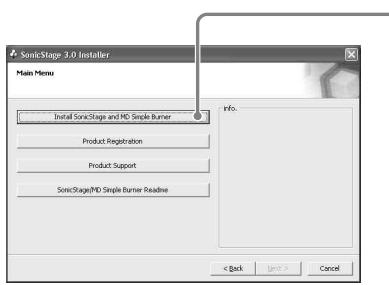
Cliquez sur [Installer SonicStage et MD Simple Burner]
Lisez attentivement les instructions.
Selon votre région, les boutons autres que [Installer SonicStage et MD Simple Burner] peuvent différer de ceux de l'illustration ci-dessus.
L'installation peut prendre de 20 à 30 minutes, selon votre environnement système.
Assurez-vous de redémarrer votre ordinateur uniquement après la fin de l'installation.
L'installation a-t-elle réussi ?
Si un problème survient pendant l'installation, consultez la section « Dépannage » (page 110).
Importation de données audio
Cette section explique comment enregistrer et stocker des données audio d'un CD audio vers Ma bibliothèque de SonicStage sur le disque dur de votre ordinateur. Vous pouvez également attribuer une pochette d'album aux albums importés.
Vous pouvez enregistrer ou importer de la musique à partir d'autres sources telles que l'Internet et le disque dur de votre ordinateur. Reportez-vous à l'aide de SonicStage pour plus de détails.
Remarques
- Seuls les CD audio portant la marque COMPACT DISC peuvent être utilisés avec SonicStage.
- Nous ne garantissons pas un fonctionnement normal dans le cas des CD à protection contre la copie.
![Section de commande de lecture [▼ Source musicale] Affichage de la pochette [Infos CD] [Paramètres]](/content/2019/09/47007/images/6a7e4421cfd898088d18f19da47747be2429b2bc5d1da9cb9f74421eb9b90637.jpg)
1 Démarrez SonicStage.
Sélectionnez [Démarrer] - [Tous les programmes]* - [SonicStage] - [SonicStage].
*[Programmes] dans le cas de Windows 2000 Professional/Windows Millennium Edition/Windows 98 Deuxième édition
SonicStage démarre et la fenêtre principale apparaît.

Vous pouvez également démarrer SonicStage en double-cliquant sur [SonicStage] (icône [SonicStage]) sur le bureau.
2 Insérez le CD audio que vous souhaitez enregistrer dans le lecteur de CD de votre ordinateur.
3 Pointez sur [▼ Source musicale] en haut à gauche de l'écran et cliquez sur [Importer un CD].
L'écran bascule sur l'écran « Source musicale » (Importation de CD) et toutes les pistes du CD audio sont répertoriées.
4 Si nécessaire, cliquez sur ☑ pour décocher les pistes que vous ne souhaitez pas enregistrer.
Si vous avez décoché une case par erreur, cliquez de nouveau dessus pour rétablir la coche.
Pour cocher toutes les cases, cliquez sur ☑.
Pour décocher toutes les cases, cliquez sur ☐.
5 Si nécessaire, modifiez le format et le débit binaire pour l'enregistrement d'un CD audio.
Lorsque vous cliquez sur [Paramètres] sur le côté droit de l'écran, la boîte de dialogue « Format d'importation de CD » apparaît. Cette boîte de dialogue vous demande de sélectionner le format et le débit binaire pour l'enregistrement d'un CD audio.
6 Cliquez sur →.
L'enregistrement des pistes sélectionnées à l'étape 4 commence.
Pour arrêter l'enregistrement
Cliquez sur .
Pour attribuer une pochette aux albums importés
Recherchez le fichier image souhaité (fichier jpg, gif, bmp) à l'aide de l'Explorateur Windows et faites-le glisser vers l'affichage de la pochette dans la section de contrôle de lecture.

Si les informations du CD telles que le titre de l'album, le nom de l'artiste et les noms des pistes n'ont pas pu être obtenues automatiquement, cliquez sur [Infos CD] sur le côté droit de l'écran. Dans ce cas, votre ordinateur doit être connecté à Internet.
Transfert de données audio de votre ordinateur vers le MD Walkman
Les données audio stockées dans Ma bibliothèque de SonicStage peuvent être transférées vers votre MD Walkman un nombre illimité de fois.
![[Transfert ▼] La liste Ma bibliothèque [Paramètres]](/content/2019/09/47007/images/0b00fe24cc2151a10cc00c39124c7ab0b93e727e1f6e860c26d9b4f0b34d4c4a.jpg)
1 Insérez un disque dans le MD Walkman et connectez le MD Walkman à votre ordinateur.
Utilisez le câble USB dédié au MD Walkman fourni pour connecter le MD Walkman à votre ordinateur.
Pour plus de détails sur les connexions, voir la page 60 de « Fonctionnement de l'enregistreur ».
Ne déconnectez pas la source d'alimentation ni le câble USB dédié avant la fin du transfert.
2 Pointez sur [Transfert ▼] en haut à droite de l'écran et cliquez sur [Hi-MD] ou [Net MD].
L'écran bascule sur l'écran de transfert (Hi-MD ou Net MD).
3 Cliquez sur les pistes que vous souhaitez transférer dans la liste Ma bibliothèque à gauche de l'écran.
Pour transférer plusieurs pistes, maintenez la touche [Ctrl] enfoncée tout en sélectionnant les pistes.
Pour transférer toutes les pistes de l'album, cliquez sur l'album.
4 Si nécessaire, modifiez le mode de transfert.
Par défaut, les pistes au format OpenMG (PCM/ATRAC3/ATRAC3plus) seront transférées dans le même format et le même débit binaire (transfert normal).
Si le périphérique connecté à l'ordinateur ne prend pas en charge le format ci-dessus, le format et le débit binaire seront convertis en ceux du périphérique. Dans certains cas, ce processus peut prendre du temps.
Si vous souhaitez modifier le format et le débit binaire, cliquez sur [Paramètres] au centre de l'écran pour afficher la boîte de dialogue « Paramètres du mode de transfert ».
5 Cliquez sur
Le transfert des pistes sélectionnées à l'étape 3 commence.
Pour arrêter le transfert
Cliquez sur .
Pour lire un disque sur un appareil Net MD qui ne prend pas en charge Hi-MD
Si vous souhaitez lire les titres transférés sur un Walkman Net MD qui ne prend pas en charge Hi-MD, sélectionnez [Net MD] pour le mode (mode de fonctionnement) sur le côté droit de l'écran après l'étape 2. Ce mode de fonctionnement ne peut être sélectionné que lors de l'utilisation d'un disque standard de 60/74/80 minutes en mode Hi-MD pour l'enregistrement.
Remarques
- Un transfert échouera et un message d'erreur apparaîtra dans les cas suivants : — lorsqu'il n'y a pas assez d'espace libre sur le disque. — lorsque le titre est soumis à des restrictions de lecture.
- Pendant le transfert, les fonctions de suspension, de veille ou d'hibernation du système ne fonctionneront pas.
- Selon le type de texte et le nombre de caractères, le texte saisi via SonicStage peut ne pas s'afficher sur le Walkman MD connecté. Cela est dû aux limitations du Walkman MD connecté.

Si vous utilisez un Walkman Hi-MD avec appareil photo en mode Hi-MD, chaque fois que vous sélectionnez un album pour lequel une pochette d'album a été enregistrée, la pochette est transférée sur le Walkman Hi-MD avec l'album. La pochette n'est pas transférée dans le cas de titres individuels.
Retransférer des données audio du Walkman MD vers votre ordinateur
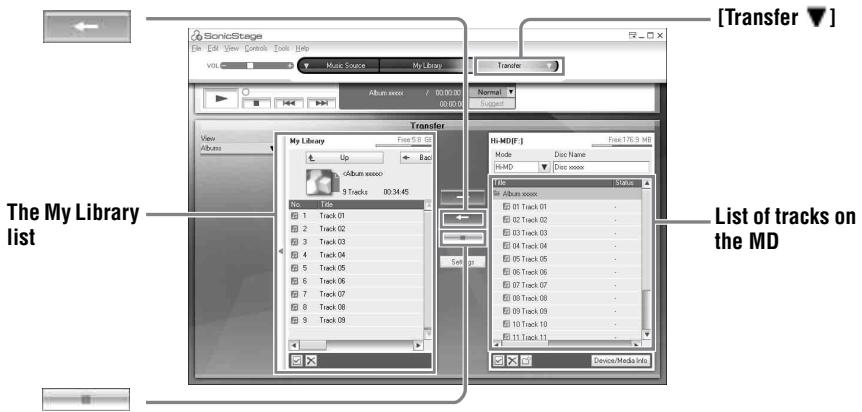
Transfert du Walkman MD vers votre ordinateur
Les données audio qui ont été transférées depuis votre ordinateur et stockées sur le MD peuvent être retransférées vers Ma bibliothèque de SonicStage sur votre ordinateur.
1 Insérez un disque dans le Walkman MD et connectez le Walkman MD à votre ordinateur.
Utilisez le câble USB dédié fourni pour le Walkman MD afin de connecter le Walkman MD à votre ordinateur.
Pour plus de détails sur les connexions, voir page 60 de « Fonctionnement de l'enregistreur ».
Ne déconnectez pas la source d'alimentation ou le câble USB dédié avant la fin du transfert.
2 Cliquez sur [Transfert ▼] en haut à droite de l'écran, puis cliquez sur [Hi-MD] ou [Net MD].
L'écran bascule sur l'écran de transfert (Hi-MD ou Net MD).
3 Dans la liste à droite de l'écran (Hi-MD ou Net MD), cliquez pour sélectionner les pistes que vous souhaitez transférer sur votre ordinateur.
4 Cliquez sur ← au milieu de l'écran.
Le transfert des pistes sélectionnées à l'étape 3 commence.
Pour arrêter le transfert
Cliquez sur
Pour importer dans Ma bibliothèque les pochettes d'album définies à l'aide d'un Walkman Hi-MD avec appareil photo
Si vous utilisez un Walkman Hi-MD avec appareil photo en mode Hi-MD, vous pouvez modifier la pochette d'album de tout groupe transféré depuis Ma bibliothèque, ainsi qu'enregistrer la pochette d'un autre groupe. Les deux méthodes suivantes permettent d'importer la pochette dans Ma bibliothèque.
- Insérez le disque avec la pochette mise à jour, puis appuyez sur le bouton [Importation automatique] en bas à droite de l'écran. La pochette dans Ma bibliothèque est automatiquement mise à jour.
- Sélectionnez le groupe pour lequel vous souhaitez importer la pochette en cliquant dessus à droite (côté Hi-MD) de l'affichage, sélectionnez [Importer la pochette] dans le menu contextuel, puis sélectionnez l'album auquel vous souhaitez ajouter la pochette dans la boîte de dialogue « Sélectionner un album ».
Remarque
Les pistes transférées vers le Walkman MD depuis un autre ordinateur ne peuvent pas être retransférées vers Ma bibliothèque sur votre ordinateur.
Importation de pistes enregistrées sur un Walkman Hi-MD* vers votre ordinateur
Les pistes enregistrées sur un Walkman Hi-MD* ne peuvent être importées qu'une seule fois dans Ma bibliothèque de SonicStage sur votre ordinateur.
* Uniquement les pistes enregistrées en mode Hi-MD
1 Insérez un disque enregistrable dans le Walkman Hi-MD et connectez le Walkman Hi-MD à votre ordinateur.
2 Pointez sur [Transfert ▼] en haut à droite de l'écran et cliquez sur [Hi-MD]. L'écran bascule sur l'écran de transfert (Hi-MD).
3 Cliquez sur les pistes que vous souhaitez transférer dans la liste Hi-MD sur le côté droit de l'écran.
Pour transférer plusieurs pistes, maintenez la touche [Ctrl] enfoncée tout en sélectionnant les pistes. Pour transférer toutes les pistes du groupe, cliquez sur le groupe.
4 Cliquez sur ← au milieu de l'écran.
La boîte de dialogue « Importer » apparaît.
5 Cliquez sur [Oui].
L'importation des pistes sélectionnées à l'étape 3 commence.
Pour arrêter l'importation
Cliquez sur

Lorsque des pistes enregistrées en analogique sont incluses sur un Hi-MD, une boîte de dialogue apparaît pour confirmer si vous souhaitez enregistrer ces pistes au format WAV. Pour enregistrer les pistes sous forme de fichiers musicaux au format WAV, cochez la case à côté de « Enregistrer au format WAV lors de l'importation », cliquez sur le bouton Parcourir et spécifiez un dossier de destination si nécessaire, puis cliquez sur le bouton [OK].
Remarques
- Vous ne pouvez pas importer sur votre ordinateur les pistes enregistrées en mode Net MD (mode MD), ni les pistes enregistrées sur un appareil qui ne prend pas en charge le mode Hi-MD.
- Avant d'importer des pistes enregistrées sur le Walkman Hi-MD vers l'ordinateur, cliquez sur [Paramètres] au milieu de l'écran pour afficher la boîte de dialogue « Paramètres du mode de transfert », puis vérifiez l'état de la case à cocher [Paramètres d'importation] (elle est cochée par défaut) dans [Avancé...]. Ensuite, procédez comme suit : — Pour importer des pistes dans Ma bibliothèque tout en les supprimant du Walkman Hi-MD, décochez la case. — Pour importer des pistes dans Ma bibliothèque tout en laissant une copie sur le Walkman Hi-MD, cochez la case. Les pistes laissées sur le Walkman Hi-MD sont traitées de la même manière que les pistes transférées automatiquement depuis l'ordinateur. Pour cette raison, elles ne peuvent pas être divisées ou combinées sur le Walkman Hi-MD.
- Lorsque vous transférez des pistes enregistrées en PCM linéaire sur le Walkman Hi-MD vers un ordinateur pour les éditer (division ou combinaison) dans My Library, l'édition peut prendre beaucoup de temps, selon la durée des pistes et les capacités de votre ordinateur. Cela est dû aux limitations du système MiniDisc. Si vous souhaitez éditer de longues pistes enregistrées en PCM linéaire, nous vous recommandons de faire l'édition sur le Walkman Hi-MD d'abord, puis de transférer les données éditées sur un ordinateur ensuite.
Écriture de données audio sur un disque CD-R/CD-RW
Vous pouvez écrire des pistes de My Library de SonicStage sur un disque CD-R/CD-RW. Les pistes analogiques enregistrées sur un appareil Hi-MD et importées dans My Library peuvent être écrites et lues sur un CD-R/CD-RW. Le nombre de fois où les données peuvent être écrites peut être limité en raison des restrictions de droits d'auteur.
![[Transfert ▼] Affichage de l'état de l'opération La liste Ma bibliothèque La liste provisoire des éléments à écrire sur le disque CD-R/CD-RW](/content/2019/09/47007/images/6f7feedf3b54568a046fd0425ddbe997684ef182a31b9bcf20d9c7e6ff898cf7.jpg)
1 Cliquez sur [Transfert ▼] en haut à droite de l'écran, puis sélectionnez le type de CD à créer.
Pour créer un CD audio, sélectionnez [Créer un CD audio]. Pour créer un CD ATRAC, sélectionnez [Créer un CD ATRAC]. Pour créer un CD MP3, sélectionnez [Créer un CD MP3].
Les CD ATRAC ne peuvent être lus que sur des appareils prenant en charge les CD ATRAC. Les CD MP3 ne peuvent être lus que sur des appareils prenant en charge les CD MP3.
2 Insérez un disque CD-R/CD-RW vierge dans le lecteur de disque de votre ordinateur.
Utilisez un CD-R/CD-RW d'une capacité d'enregistrement de 650 Mo ou 700 Mo. Les données peuvent ne pas être écrites correctement si un disque d'une autre capacité est utilisé.
3 Sélectionnez les albums ou les pistes à écrire sur le disque CD-R/CD-RW en cliquant dessus dans la liste My Library sur le côté gauche de l'écran.
En double-cliquant sur un album, vous pouvez voir une liste des pistes de l'album et sélectionner les pistes souhaitées.
4 Cliquez sur → au milieu de l'écran.
Les albums ou pistes sélectionnés apparaissent sur le côté droit de l'écran (le CD-R/CD-RW) comme une liste provisoire des éléments à écrire.
5 Cliquez sur dans la partie droite de l'écran.
La boîte de dialogue « Paramètres d'écriture » apparaît, vous permettant de définir les options d'écriture.
6 Cliquez sur [OK].
L'écriture sur le disque commence.
Un message apparaît lorsque l'écriture est terminée.
7 Cliquez sur [OK].
Le disque est éjecté automatiquement et l'écran revient à l'écran Transfert (Création de CD).
Pour annuler l'écriture de pistes
1 Cliquez dans l'affichage de l'état de l'opération pendant que les pistes sont écrites sur le disque. L'écriture sur le disque est annulée et un message apparaît.
2 Cliquez sur [OK].
Le disque est éjecté automatiquement et l'écran revient à l'écran Transfert (Création de CD).
Remarques
- Seules les pistes au format MP3 peuvent être écrites sur un CD MP3.
- Les pistes enregistrées numériquement sur un appareil Hi-MD puis importées dans SonicStage ne peuvent pas être écrites sur un CD audio. Cependant, les pistes analogiques enregistrées sur un appareil Hi-MD peuvent être écrites sur un CD.
Utilisation de l'aide de SonicStage
L'aide de SonicStage fournit des détails supplémentaires sur l'utilisation de SonicStage. L'aide de SonicStage vous permet de rechercher facilement des informations à partir d'une liste d'opérations, telles que « Importation de pistes » ou « Transfert de pistes », ou à partir d'une grande liste de mots-clés, ou en saisissant des mots qui pourraient vous mener aux explications appropriées.
Pour afficher l'aide de SonicStage
Cliquez sur [Aide] - [Aide de SonicStage] pendant que SonicStage est en cours d'exécution.
![[Aide SonicStage] Aide SonicStage F1 Enregistrement du produit Support produit Sites Web associés À propos de SonicStage Ma bibliothèque Transfert / 00:34:45 Normal 00:00:00 Suggérer Ma bibliothèque](/content/2019/09/47007/images/ebc8ac40e45606e56ea30269dea650d9f0b4111d9b62665b430efbee2ae758d3.jpg)

Vous pouvez afficher l'aide de SonicStage en sélectionnant : [Démarrer] – [Tous les programmes]* – [SonicStage] – [Aide SonicStage]
* [Programmes] dans le cas de Windows 2000 Professionnel / Windows Millennium Edition / Windows 98 Deuxième édition
Remarques
- Dans l'aide de SonicStage, « Périphérique/Support » est le terme général désignant le périphérique externe tel que le Walkman MD, le Network Walkman et le Walkman CD.
- Suivez les instructions de votre fournisseur d'accès Internet concernant, par exemple, l'environnement système recommandé lors de l'utilisation des services EMD.
Comprendre l'aide de SonicStage
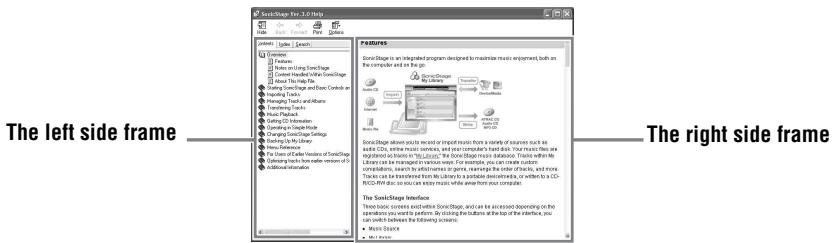
1 Double-cliquez sur [Vue d'ensemble] dans le cadre de gauche. 2 Cliquez sur [À propos de ce fichier d'aide].
L'explication apparaîtra dans le cadre de droite.
3 Lisez le texte.
Faites défiler l'affichage si nécessaire.
Cliquez sur les mots soulignés pour accéder à leurs explications.
Recherche d'un mot dans une explication
![Zone de recherche : saisissez le mot-clé à trouver. Liste des sujets : la liste des mots que vous avez recherchés. [Afficher] [Rechercher] A B C D E H M O R T W IN Album Gestionnaire de groupes/albums "couleur de fond" album. Par exemple, lors de la conversion de l'audio en texte, Gone/Blage crée au…](/content/2019/09/47007/images/6dae4b64cc8c35f62982e9c261a49a7190f37a641039253d92fea62b3ce3ef4b.jpg)
1 Cliquez sur [Rechercher] pour ouvrir la fenêtre « Rechercher ». 2 Saisissez les mots. 3 Cliquez sur [Liste des rubriques]. Une liste des mots recherchés s'affiche. 4 Cliquez pour sélectionner l'élément souhaité parmi ceux affichés. 5 Cliquez sur [Afficher]. 4 Cliquez pour sélectionner l'élément souhaité parmi ceux affichés. 5 Cliquez sur [Afficher]. Une explication de l'élément sélectionné s'affiche.
Référence à l'aide de SonicStage
Cliquez sur [Sommaire] sur le côté gauche de la fenêtre d'aide pour afficher une liste des éléments pour chaque opération. Cliquez sur n'importe quel élément pour plus de détails.
Importation de données audio sur l'ordinateur
| To | SonicStage Help |
| Import audio data from the Internet | [Importing Tracks] – [Purchasing Tracks from a Music Service Site] |
| Import audio files on the computer in SonicStage | [Importing Tracks] – [Importing Music Files] |
Écoute de données audio sur l'ordinateur
| To | SonicStage Help |
| Listen to audio data from the CD drive or My Library | [Music Playback] – [Playing Back an Audio CD] or [Playing Back a Track in My Library] |
| Listen to audio data on the MD Walkman connected to the computer | [Music Playback] – [Playing Back a Track on a Device/Media] |
Gestion et édition des pistes importées
| To | SonicStage Help |
| Change information related to CD information downloading | [Changing SonicStage Settings] – [Changing Settings for the CD Drive] |
| Edit an albumDelete the tracks | [Managing Tracks and Albums] – [Creating/Editing Albums] |
| Change the destination directly for track storage | [Changing SonicStage Settings] – [Changing the Location for Saving Imported Files] |
Sauvegarde des données audio
Nous vous recommandons de sauvegarder vos données musicales par précaution contre les pannes de disque dur ou le remplacement de l'ordinateur.
| To | SonicStage Help |
| Back up audio data in My Library | [Backing Up My Library] – [Backing Up Data to a Disk] |
| Look up about SonicStage backup | [Backing Up My Library] – [FAQ-About SonicStage Backup Tool] |
Dépannage
| To | SonicStage Help |
| Look up troubleshooting procedure | [Additional Information] – [Troubleshooting] |
Quand vous voulez savoir
| To | SonicStage Help |
| Look up unknown words | [Additional Information] – [Glossary] |
| Look up the kinds of audio data that can be managed by SonicStage | [Overview] – [Content Handled Within SonicStage] |
| Look up the kinds of functions that can be used with SonicStage | [Overview] – [Features] |
| Look up changes since an earlier version | [For Users of Earlier Versions of SonicStage] – [Differences from Earlier Versions] |
Avant d'utiliser MD Simple Burner
MD Simple Burner vous permet d'enregistrer des pistes musicales à partir d'un CD audio dans le lecteur de CD de votre ordinateur vers le MD Walkman.
Il existe deux façons d'enregistrer à partir d'un CD audio.
- Mode simple (page 105)
Vous pouvez utiliser les opérations du MD Walkman pour enregistrer un CD entier ou seulement la première piste sans lancer MD Simple Burner.
- Mode standard (page 106)
Vous pouvez lancer MD Simple Burner pour enregistrer à l'aide des opérations de l'ordinateur. Enregistrez un CD entier ou des pistes sélectionnées.
Remarques
- Vous ne pouvez pas enregistrer en mode simple lorsque le MD Simple Burner en mode standard ou le logiciel OpenMG (SonicStage, OpenMG Jukebox, etc.) est actif.
- Seuls les CD audio portant la marque COMPACT DISC peuvent être utilisés avec MD Simple Burner.
- Nous ne garantissons pas le fonctionnement normal dans le cas de CD à protection contre la copie.
Enregistrement à l'aide des opérations du MD Walkman (mode simple)
1 Insérez un disque enregistrable dans le MD Walkman, puis connectez le MD Walkman à l'ordinateur.
Pour plus de détails sur les connexions, voir la page 60, section « Fonctionnement de l'enregistreur ».
Ne déconnectez pas la source d'alimentation ou le câble USB dédié avant la fin du transfert.
2 Insérez le CD audio que vous souhaitez enregistrer dans le lecteur de CD de votre ordinateur.
La fenêtre d'enregistrement CDDB apparaît lorsque vous utilisez CDDB pour la première fois.
Vous devez connecter l'ordinateur à Internet pour utiliser CDDB.
3 Appuyez sur la molette (▶ ENT) tout en maintenant enfoncée la touche REC (+▶)/T MARK sur le MD Walkman.
L'enregistrement démarre.
Toutes les pistes du CD sont enregistrées comme un nouveau groupe.
Pour arrêter l'enregistrement
Cliquez sur ▶ Abort sur l'écran de l'ordinateur.
Pendant l'enregistrement de la première piste, vous pouvez utiliser le bouton ■ (stop) pour arrêter sur le MD Walkman.
Réglage du mode d'enregistrement
Avant de commencer l'enregistrement, cliquez avec le bouton droit sur l'icône MD Simple Burner dans la barre des tâches, puis sélectionnez [mode d'enregistrement].
• [Net MD] : [LP2] ou [LP4] • [Hi-MD] : [PCM], [Hi-SP], [Hi-LP] ou [48kbps]
Enregistrement de la première piste uniquement
Avant de commencer l'enregistrement, cliquez avec le bouton droit sur l'icône MD Simple Burner dans la barre des tâches, puis sélectionnez [Paramètres d'enregistrement] – [Enregistrer uniquement la 1ère piste].
Réglage lorsque la base CDDB contient plusieurs informations
Cliquez avec le bouton droit sur l'icône MD Simple Burner dans la barre des tâches, puis sélectionnez le réglage en cliquant sur [CDDB(r)] – [Correspondances multiples].
— [Sélection utilisateur] : une fenêtre de sélection s'affiche — [Ne pas résoudre] : aucune information CD n'est téléchargée — [Premier choix] : le premier élément est téléchargé
Enregistrement par opérations sur l'ordinateur (mode standard)
Pour démarrer MD Simple Burner, cliquez sur [Démarrer] – [Tous les programmes]* – [MD Simple Burner] – [MD Simple Burner].
* [Programmes] dans le cas de Windows 2000 Professional/Windows Millennium Edition/Windows 98 Second Edition

Il existe d'autres façons de démarrer MD Simple Burner :
- Double-cliquez sur l'icône MD Simple Burner en mode standard dans la barre des tâches, ou cliquez avec le bouton droit et sélectionnez [Afficher
- Double-cliquez sur l'icône de raccourci MD Simple Burner sur le bureau.
La fenêtre pour enregistrer tous les morceaux du CD
![[ENREG/STOP] Pour démarrer l'enregistrement de toutes les pistes du CD en un nouveau groupe, cliquez ici. Pour arrêter l'enregistrement, cliquez sur [STOP]. Icône CD Temps total des pistes sélectionnées du CD Icône MD Nom du disque (MD) CD Artiste Album Temps Hi-SP REC Hi-MD Nom du disque Restant Di…](/content/2019/09/47007/images/2ca958ae08adf66e8e086fd443c208aabe612e1a528c1662fed696d9471cf884.jpg)
La fenêtre pour enregistrer les morceaux sélectionnés d'un CD audio
![Informations sur la piste (CD) Nom de l'artiste Temps total des pistes sélectionnées du CD Titre de l'album [ENREG/STOP] Nom du disque (MD) Informations sur la piste (MD) Vous pouvez modifier le nom de la piste et le numéro de piste CD Artiste xxxx Album xxxxx 47.06 N° Titre Temps 1 Piste 01 7.04 2…](/content/2019/09/47007/images/50887aa75d8d1ec6458ae8080127122af056eeae16c326a369725fb438d29fab.jpg)
Cases à cocher
Cochez la case des morceaux
que vous souhaitez enregistrer
Temps restant du MD inséré
Désinstallation de SonicStage/MD Simple Burner
Pour désinstaller SonicStage/MD Simple Burner, suivez les procédures ci-dessous.
1 Cliquez sur [Démarrer]–[Panneau de configuration]*.
* [Paramètres]–[Panneau de configuration] dans le cas de Windows 2000 Professional/Windows Millennium Edition/Windows 98 Second Edition
2 Double-cliquez sur [Ajout/Suppression de programmes]. 3 Cliquez sur [SonicStage 3.0.xx] ou [MD Simple Burner 2.0.xx] dans la liste « Programmes actuellement installés », puis cliquez sur [Modifier et supprimer]*.
Suivez les instructions affichées et redémarrez votre ordinateur. La désinstallation est terminée lorsque l'ordinateur a redémarré.
* [Modifier/Supprimer] dans le cas de Windows 2000 Professional, [Ajouter/Supprimer] dans le cas de Windows Millennium Edition/Windows 98 Second Edition
Remarque
Lorsque vous installez SonicStage Ver. 3.0/MD Simple Burner Ver. 2.0, OpenMG Secure Module 4.1 est installé en même temps. Ne supprimez pas OpenMG Secure Module 4.1 car il peut être utilisé par d'autres logiciels.
Protection des droits d'auteur
La technologie OpenMG vous permet de profiter de la musique numérique tout en respectant les droits d'auteur de ses détenteurs.
Restrictions sur le contenu audio
Un contenu audio numérique de haute qualité est largement disponible via les services de distribution de musique sur Internet. Pour protéger les droits d'auteur de ses détenteurs contre toute distribution non autorisée, certains contenus audio sont distribués avec des restrictions sur l'enregistrement et la lecture. Par exemple, la durée de lecture ou le nombre de lectures des données peuvent être limités.
Dépannage
Veuillez vous référer aux étapes suivantes si vous rencontrez un problème lors de l'utilisation de SonicStage/MD Simple Burner.
1 Vérifiez les symptômes dans cette section « Dépannage ». 2 Vérifiez les symptômes dans l'aide de SonicStage lorsque vous utilisez SonicStage. 3 Si le problème ne peut pas être résolu après avoir vérifié les références ci-dessus, consultez le tableau suivant puis contactez votre revendeur Sony le plus proche.
| Computer• Manufacturer:• Model:• Type: Desktop type / Laptop type |
| Name of operating system: |
| RAM capacity: |
| Hard disk drive (containing SonicStage/MD Simple Burner and audio data)• Capacity of the drive:• Free space: |
| Version of the software• SonicStage Ver. 3.01)• MD Simple Burner Ver. 2.02) |
| Error Message (if one appear): |
| If an externally connected CD-ROM drive is used• Manufacturer:• Model:• Type: CD-ROM / CD-R/RW / DVD-ROM / Other ( )• Type of connection to the computer: PC card / USB / IEEE1394 / Other ( ) |
| If another device with USB connection is used• Name of the device (or devices): |
1) Pour vérifier la version du logiciel SonicStage, allez dans [Aide] – [À propos de SonicStage] dans la fenêtre SonicStage.
2) Pour vérifier la version du logiciel MD Simple Burner, allez dans [CONFIG] – [Version] dans la fenêtre MD Simple Burner.
Le logiciel ne peut pas être installé sur votre ordinateur
| Problem | Cause/Remedy |
| The installation was not successful. | You are using an OS that does not support this software.→See page 88 for more details.All windows applications are not closed.→If you start the installation while other programs are running, a malfunction may occur. This is especially true for programs that require large amounts of system resources, such as virus-check software.There is not enough hard disk space on your hard disk.→You need 200MB or more free space on your hard disk. |
| The installation appears to have stopped before it has completed. | Check for the appearance of an error message beneath the installation window.→Press the [Tab] key while holding down the [Alt] key. If an error message has appeared, press the [Enter] key. The installation will resume. If there is no message, the installation is still in progress. Wait a little while longer. |
| The progress bar on the display is not moving. The access lamp has not lit for a few minutes. | The installation is progressing normally.→Please wait.The installation may take 30 minutes or more, depending on your CD drive or system environment. |
Utilisation d'un MD Walkman connecté à l'ordinateur
| Problem | Cause/Remedy |
| Your computer does not recognize the MD Walkman. | The MD Walkman is not firmly connected with the supplied dedicated USB cable to the computer.→Reconnect the MD Walkman to the computer firmly.→Remove and reconnect the MD Walkman. If the computer still does not recognize the MD Walkman, disconnect the cable, restart the computer, and then make the connection again.A disc is not inserted in the MD Walkman.→Check if a disc is inserted in the MD Walkman.The Net MD driver is not be installed.→Install the SonicStage/MD Simple Burner software using the supplied CD-ROM.The software installation failed.→Disconnect the connected device and install the software again using the supplied CD-ROM.The supplied dedicated USB cable is disconnected.→Connect the supplied dedicated USB cable firmly.The connections are made through a USB hub.→Operations are not guaranteed for USB-hub connections. Connect the MD Walkman directly to the USB connector on the computer. |
| Even though the dedicated USB cable is used to connect the MD Walkman to the computer, the display on the MD Walkman does not indicate it is connected. | It takes time to recognize SonicStage.→Please wait.The other application software is running.→Reconnect the supplied dedicated USB cable after a while. If the computer still does not recognize the MD Walkman, disconnect the MD Walkman, restart the computer, and connect the dedicated USB cable again. |
| Even though your computer recognize the MD Walkman, it does not operate normally. | The supplied dedicated USB cable is disconnected.→Connect the supplied dedicated USB cable firmly.The connections are made through a USB hub.→Operations are not guaranteed for USB-hub connections. Connect the MD Walkman directly to the USB connector on the computer. |
Index
A
A-B Repeat 39
Accessoires
optionnel 67
fourni 12
ATRAC3plus 80
AVLS 55
B
Batterie
autonomie de la batterie 17
BIP 56
Signet 38
C
lecteur CD 88
CDDB 88, 105
lecteur CD-R/RW 88
CD-ROM 89
Palette de caractères 44
Filtre de serrage 13
Nettoyage 64
Combinaison de pistes 52
Ordinateur 60
Connexion 105
analogique 29
numérique 18
Contraste 58
Protection contre la copie 109
D
Stockage de données 62
Mémoire disque 56
Mode disque 58
Diviser 52
DSP TYPE-S 83
Service EMD 88
Effacement 51
Format 53
G-PROTECTION 83
Groupe
effacement 51
enregistrement 33
libération 48
réglage 47
Disque dur
espace libre 88
Hi-MD 80
HOLD 15, 16
I
Importation 91
Installation 88
L
Étiquetage 45
PCM linéaire 80
M
MD Simple Burner 104
Liste des menus 25
Mode Menu 55
Déplacer
groupes 50
pistes 49
Ma bibliothèque 91
0
Module sécurisé OpenMG 4.1 108
Mode de fonctionnement 19
P
Mode de lecture
Mode de lecture principal 36
Lecture répétée 40
Mode de lecture secondaire 39
Q
Mode rapide 57
R
Enregistrement
analogique 29
numérique 18
niveau 31
mode d'enregistrement 30
enregistrement synchronisé 34
durée 81
mode d'enregistrement 105
mode d'enregistrement (débit binaire) 92
renommage 46
s
recherche 40
mode simple 105
SonicStage 91
Aide SonicStage 100
Démarrage (logiciel)
MD Simple Burner 106
SonicStage 91
Espace de stockage 63
Environnement système 88
Limites du système 88
T
Marque temporelle 32
Saisie du titre 43
Marque de piste
Ajouter (diviser) 32, 52
Effacer (combiner) 52
Recherche de piste 40
Transfert
vers le MD Walkman 93
vers votre ordinateur 95
U
Désinstallation 108
Alimentation USB 60
Câble USB 12, 60
Port USB 88
W
WAV 97
Windows 2000 Professionnel 88, 91, 100,
106, 108
Windows 98 Deuxième édition 88, 91, 100,
106, 108
Windows Millennium Édition 88, 91, 100,
106, 108
Windows XP Édition familiale 88
Windows XP Édition Media Center 88
Windows XP Édition Media Center 2004 88
Windows XP Édition Media Center 2005 88
Windows XP Professionnel 88
WMA 86, 88
- AVERTISSEMENT
- POUR ÉVITER TOUT RISQUE D'INCENDIE OU DE CHOC ÉLECTRIQUE, N'EXPOSEZ PAS L'APPAREIL À LA PLUIE OU À L'HUMIDITÉ
- ATTENTION
- INFORMATION
- ÉLIMINATION DES ÉQUIPEMENTS ÉLECTRIQUES ET ÉLECTRONIQUES USAGÉS (APPLICABLE DANS L'UNION EUROPÉENNE ET DANS LES AUTRES PAYS EUROPÉENS DISPOSANT DE SYSTÈMES DE COLLECTE SÉPARÉS)
- AVIS AUX UTILISATEURS
- SUR LE LOGICIEL FOURNI
- TABLE DES MATIÈRES
- À PROPOS DES FONCTIONS DISPONIBLES ET DES MANUELS FOURNIS
- FONCTIONNEMENT DE L'ENREGISTREUR
- EXAMEN DES COMMANDES
- POUR COMMENCER
- ENREGISTREMENT IMMÉDIAT D'UN DISQUE
- LECTURE IMMÉDIATE D'UN DISQUE
- UTILISATION DES MENUS
- DIFFÉRENTES MÉTHODES D'ENREGISTREMENT
- DIFFÉRENTES FAÇONS DE LECTURE
- ÉDITION DES PLAGES ENREGISTRÉES
- AUTRES OPÉRATIONS
- UTILISATION DE L'ENREGISTREUR AVEC UN ORDINATEUR
- INFORMATIONS COMPLÉMENTAIRES
- DÉPANNAGE ET EXPLICATIONS
- CE QUE VOUS POUVEZ FAIRE AVEC SONICSTAGE/MD SIMPLE BURNER
- INSTALLATION
- UTILISATION DE SONICSTAGE
- UTILISATION DE MD SIMPLE BURNER
- AUTRES INFORMATIONS
- EN SAVOIR PLUS SUR HI-MD
- LE DÉPLIANT « CE QUE VOUS POUVEZ FAIRE AVEC LE WALKMAN HI-MD
- UTILISATION DE L'ENREGISTREUR
- FONCTIONNEMENT DE L'ENREGISTREUR (PAGES 12 À 84)
- → EN CAS DE PROBLÈME OU SI VOUS AVEZ BESOIN D'EXPLICATIONS SUPPLÉMENTAIRES
- UTILISATION DE L'ENREGISTREUR CONNECTÉ À UN ORDINATEUR
- FONCTIONNEMENT DU LOGICIEL (PAGES 86 À 112)
- AIDE SONICSTAGE
- REMARQUES SUR LA SECTION « UTILISATION DU LOGICIEL
- VÉRIFICATION DES ACCESSOIRES FOURNIS
- REMARQUE
- UTILISATION DES FILTRES À PINCE FOURNIS
- APERÇU DES COMMANDES
- L'ENREGISTREUR
- INSÉREZ UNE PILE ALCALINE SÈCHE
- EFFECTUEZ LES CONNEXIONS ET DÉVERROUILLEZ LES COMMANDES
- QUAND REMPLACER LA PILE SÈCHE
- DURÉE DE VIE DE LA PILE 1)
- LORS D'UN ENREGISTREMENT CONTINU EN MODE HI-MD
- LORS D'UNE LECTURE CONTINUE EN MODE HI-MD
- LORS D'UNE LECTURE CONTINUE EN MODE MD
- REMARQUES
- CONNECTEZ LE CÂBLE OPTIQUE À L'ENREGISTREUR ET À UN COMPOSANT EXTERNE. (INSÉREZ LES CÂBLES FERMEMENT ET COMPLÈTEMENT DANS LES PRISES APPROPRIÉES.)
- INSÉREZ UN DISQUE ENREGISTRABLE
- FAITES GLISSER OPEN POUR OUVRIR LE COUVERCLE
- INSÉREZ UN DISQUE AVEC L'ÉTIQUETTE VERS L'AVANT, PUIS APPUYEZ SUR LE COUVERCLE POUR LE FERMER
- CONFIRMEZ LE MODE DE FONCTIONNEMENT
- ENREGISTREZ UN DISQUE
- SÉLECTIONNEZ ET METTEZ EN PAUSE LA SOURCE SONORE À ENREGISTRER
- ASSUREZ-VOUS QUE L'INDICATEUR DE DISQUE A CESSÉ DE TOURNER DANS LA FENÊTRE D'AFFICHAGE DE L'ENREGISTREUR
- LORSQUE L'ENREGISTREUR EST ARRÊTÉ, MAINTENEZ ENFONCÉE LA TOUCHE REC (+▶)/T MARK ET APPUYEZ SUR ▶ENT SUR L'ENREGISTREUR
- LISEZ LA SOURCE QUE VOUS SOUHAITEZ ENREGISTRER
- LIRE UN DISQUE TOUT DE SUITE
- INSÉREZ UN DISQUE ENREGISTRÉ
- INSÉREZ UN DISQUE AVEC LE CÔTÉ ÉTIQUETTE VERS L'AVANT, PUIS APPUYEZ SUR LE COUVERCLE POUR LE FERMER
- LISEZ UN DISQUE
- APPUYEZ SUR LA TOUCHE DE COMMANDE À 5 DIRECTIONS (▶ENT) DE L'ENREGISTREUR
- APPUYEZ SUR LA TOUCHE DE COMMANDE À 5 DIRECTIONS VERS VOL + OU - POUR RÉGLER LE VOLUME DE L'ENREGISTREUR
- POUR ARRÊTER LA LECTURE, APPUYEZ SUR
- UTILISATION DES ÉLÉMENTS DE MENU
- POUR REVENIR AU RÉGLAGE PRÉCÉDENT
- POUR ANNULER L'OPÉRATION PENDANT LE RÉGLAGE
- LISTE DES MENUS
- AVANT L'ENREGISTREMENT
- À PROPOS DU MODE DE FONCTIONNEMENT
- SÉLECTION DU MODE DE MENU
- AFFICHAGE DE DIVERSES INFORMATIONS
- LES INDICATIONS ONT LES SIGNIFICATIONS SUIVANTES
- ENREGISTREMENT À PARTIR D'UN TÉLÉVISEUR OU D'UNE RADIO (ENREGISTREMENT ANALOGIQUE)
- SÉLECTION DU MODE D'ENREGISTREMENT
- RÉGLAGE MANUEL DU NIVEAU D'ENREGISTREMENT
- POUR REVENIR AU CONTRÔLE AUTOMATIQUE DU NIVEAU
- AJOUT DE MARQUES DE PISTE PENDANT L'ENREGISTREMENT
- AJOUT MANUEL DE MARQUES DE PISTE
- AJOUT AUTOMATIQUE DE MARQUES DE PISTE (AUTO TIME MARK)
- POUR ANNULER TIME MARK
- UTILISATION DE TIME MARK POUR AJOUTER DES MARQUES DE PISTE PENDANT L'ENREGISTREMENT
- LORSQUE LE TEMPS D'ENREGISTREMENT ÉCOULÉ DÉPASSE L'INTERVALLE DE TEMPS DÉFINI POUR TIME MARK
- LORSQUE L'INTERVALLE DE TEMPS DÉFINI POUR LE REPÈRE TEMPOREL DÉPASSE LE TEMPS D'ENREGISTREMENT ÉCOULÉ
- ENREGISTREMENT SANS CRÉER UN NOUVEAU GROUPE
- QU'EST-CE QUE LA FONCTION GROUPE
- DISQUE AVEC GROUPES ENREGISTRÉS
- DISQUE SANS GROUPES ENREGISTRÉS
- POUR DÉMARRER/ARRÊTER L'ENREGISTREMENT EN SYNCHRONISATION AVEC LA SOURCE SONORE (ENREGISTREMENT SYNCHRONISÉ)
- EFFECTUEZ LES CONNEXIONS
- PENDANT QUE L'ENREGISTREUR EST ARRÊTÉ, ENTREZ DANS LE MENU ET SÉLECTIONNEZ "REC SET" - "SYNC REC" - "SYNC ON
- FENÊTRE D'AFFICHAGE
- NOTE
- SÉLECTION DU MODE DE LECTURE
- LECTURE DES PLAGES EN MODE DE LECTURE PRINCIPAL
- LECTURE DES PLAGES EN MODE NORMAL (LECTURE NORMALE)
- ÉCOUTE DES PISTES D'UN GROUPE SPÉCIFIQUE (LECTURE DE GROUPE)
- ÉCOUTE DES PISTES D'UN ARTISTE SPÉCIFIQUE (LECTURE PAR ARTISTE) (UNIQUEMENT EN MODE HI-MD)
- ÉCOUTE DES PISTES D'UN ALBUM SÉLECTIONNÉ (LECTURE D'ALBUM) (UNIQUEMENT EN MODE HI-MD)
- ÉCOUTE DE PISTES SÉLECTIONNÉES UNIQUEMENT (LECTURE AVEC SIGNET)
- POUR MARQUER LES PISTES
- POUR LIRE LES PISTES MARQUÉES
- POUR EFFACER DES SIGNETS
- LECTURE DE PISTES EN MODE DE LECTURE SECONDAIRE
- ÉCOUTE RÉPÉTÉE D'UNE SECTION D'UNE PISTE (RÉPÉTITION A-B)
- LECTURE RÉPÉTÉE DES PLAGES (LECTURE RÉPÉTÉE)
- POUR ANNULER LA LECTURE RÉPÉTÉE
- RECHERCHE D'UNE PLAGE (RECHERCHE)
- SÉLECTION DE LA QUALITÉ SONORE (ÉGALISEUR 6 BANDES)
- POUR ANNULER LE RÉGLAGE
- POUR MODIFIER ET MÉMORISER LE SON (POUR LES MODÈLES AUTRES QUE LES MODÈLES EUROPÉENS)
- AVANT DE MODIFIER
- AJOUT DE TITRES (SAISIE DE TITRE)
- CARACTÈRES DISPONIBLES
- NOMBRE MAXIMAL DE CARACTÈRES PAR NOM
- NOMBRE MAXIMAL DE CARACTÈRES POUVANT ÊTRE SAISIS PAR DISQUE
- À PROPOS DE LA PALETTE DE CARACTÈRES
- ÉTIQUETAGE
- RÉ-ÉTIQUETAGE
- AFFECTATION DE PISTES OU DE GROUPES À UN NOUVEAU GROUPE (GROUP SET)
- ANNULATION D'UN RÉGLAGE DE GROUPE (GROUP RELEASE)
- DÉPLACEMENT DE PLAGES OU DE GROUPES ENREGISTRÉS (MOVE)
- DÉPLACEMENT D'UNE PLAGE SUR UN DISQUE
- NOM DU GROUPE DE DESTINATION
- CHANGEMENT DE L'ORDRE D'UN GROUPE SUR UN DISQUE
- EFFACEMENT DES PISTES ET DU DISQUE ENTIER (EFFACER)
- LORS DE L'EFFACEMENT DE PISTES TRANSFÉRÉES DEPUIS L'ORDINATEUR
- POUR EFFACER UNE PISTE
- POUR EFFACER UNE PARTIE D'UNE PISTE
- POUR EFFACER UN GROUPE
- POUR EFFACER TOUT LE DISQUE
- DIVISION D'UNE PLAGE (DIVIDE)
- DIVISION DIRECTE D'UNE PLAGE
- POUR AJOUTER DES REPÈRES DE PLAGE PENDANT L'ENREGISTREMENT (SAUF EN ENREGISTREMENT SYNCHRONISÉ)
- COMBINAISON DE PLAGES (COMBINE)
- FORMATAGE DU DISQUE (FORMAT)
- MODIFICATION DES ÉLÉMENTS DE MENU AFFICHÉS (MENU MODE)
- PROTECTION DE VOTRE OUÏE (AVLS)
- POUR ANNULER L'AVLS
- DÉSACTIVATION DU BIP SONORE
- POUR ACTIVER LE BIP SONORE
- MÉMORISATION DES RÉGLAGES POUR CHAQUE DISQUE (DISC MEMORY)
- POUR RÉGLER L'ENREGISTREUR AFIN QUE LES RÉGLAGES DU DISQUE NE SOIENT PAS MÉMORISÉS
- EFFACEMENT DES INFORMATIONS DU DISQUE
- DÉMARRAGE RAPIDE DE LA LECTURE (MODE RAPIDE)
- POUR REVENIR AU RÉGLAGE NORMAL
- SÉLECTION DU MODE DISQUE (DISC MODE)
- RÉGLAGE DU CONTRASTE DE LA FENÊTRE D'AFFICHAGE (RÉGLAGE DU CONTRASTE)
- CHANGEMENT DU SENS DE FONCTIONNEMENT DE L'AFFICHAGE
- POUR RÉTABLIR LE RÉGLAGE NORMAL
- CE QUE VOUS POUVEZ FAIRE EN CONNECTANT L'APPAREIL À UN ORDINATEUR
- LORS DE L'UTILISATION DU LOGICIEL FOURNI
- LORSQUE VOUS UTILISEZ LE DISQUE DE L'ENREGISTREUR COMME PÉRIPHÉRIQUE DE STOCKAGE
- CONNEXION DE L'ENREGISTREUR À VOTRE ORDINATEUR
- LORSQUE VOUS DÉBRANCHEZ LE CÂBLE USB DÉDIÉ DE L'ORDINATEUR OU RETIREZ LE DISQUE DE L'ENREGISTREUR
- STOCKAGE DE DONNÉES NON AUDIO SUR UN DISQUE
- PRÉCAUTIONS
- SUR LA SÉCURITÉ
- SOURCES D'ALIMENTATION
- ACCUMULATION DE CHALEUR
- CASQUES ET ÉCOUTEURS
- SÉCURITÉ ROUTIÈRE
- PRÉVENTION DES DOMMAGES AUDITIFS
- PRENDRE SOIN DES AUTRES
- SUR LA CARTOUCHE MINIDISC
- NETTOYAGE
- PILES
- BRUIT MÉCANIQUE
- POUR PROTÉGER UN DISQUE ENREGISTRÉ
- SPÉCIFICATIONS
- SYSTÈME DE LECTURE AUDIO
- PROPRIÉTÉS DE LA DIODE LASER
- TEMPS D'ENREGISTREMENT ET DE LECTURE
- VITESSES DE ROTATION
- CORRECTION D'ERREURS
- FRÉQUENCE D'ÉCHANTILLONNAGE
- CONVERTISSEUR DE FRÉQUENCE D'ÉCHANTILLONNAGE
- FORMATS AUDIO PRIS EN CHARGE PAR CET ENREGISTREUR
- SYSTÈME DE MODULATION
- RÉPONSE EN FRÉQUENCE
- ENTRÉES
- SORTIES
- SORTIE MAXIMALE (CC)
- ALIMENTATION
- TEMPÉRATURE DE FONCTIONNEMENT
- DURÉE DE FONCTIONNEMENT SUR PILE 2)
- DIMENSIONS
- MASSE
- ACCESSOIRES EN OPTION
- DÉPANNAGE
- PENDANT L'UTILISATION DE LA FONCTION DE GROUPE
- LORSQUE L'ENREGISTREUR EST CONNECTÉ À L'ORDINATEUR
- AUTRES
- MESSAGES
- EXPLICATIONS
- À PROPOS DE HI-MD
- À PROPOS D'ATRAC3PLUS
- MODES « HI-MD » ET « MD
- À PROPOS DU PCM LINÉAIRE
- SIGNIFICATION DE « AUCUN SON
- À PROPOS DU « FICHIER SYSTÈME
- LISTE DES DURÉES D'ENREGISTREMENT POUR CHAQUE DISQUE
- LORS DE L'UTILISATION D'UN DISQUE EN MODE MD
- À PROPOS DU FORMAT AUDIO ENREGISTRABLE
- REMARQUE SUR L'ENREGISTREMENT NUMÉRIQUE
- RESTRICTIONS SUR L'ÉDITION DES MORCEAUX TRANSFÉRÉS DEPUIS VOTRE ORDINATEUR
- À PROPOS DU DSP TYPE-S POUR ATRAC/ATRAC
- SUPPRESSION DES SAUTS DE SON (G-PROTECTION)
- DIFFÉRENCE ENTRE LES ENTRÉES NUMÉRIQUE (OPTIQUE) ET ANALOGIQUE (LIGNE)
- CE QUE VOUS POUVEZ FAIRE AVEC SONICSTAGE
- CE QUE VOUS POUVEZ FAIRE AVEC MD SIMPLE BURNER
- FLUX OPÉRATIONNEL DE BASE AVEC UN WALKMAN MD
- SONICSTAGE
- MD SIMPLE BURNER
- FOURNIR L'ENVIRONNEMENT SYSTÈME REQUIS (PAGE 88)
- INSTALLER LE LOGICIEL SUR VOTRE ORDINATEUR (PAGE 89)
- IMPORTER DES DONNÉES AUDIO SUR VOTRE ORDINATEUR (PAGE 91)
- CONNECTER UN WALKMAN MD À VOTRE ORDINATEUR (VOIR PAGE 60 SUR « FONCTIONNEMENT DE L'ENREGISTREUR »)
- TRANSFÉRER DES DONNÉES AUDIO DEPUIS VOTRE ORDINATEUR (PAGE 93)
- ENREGISTRER DES PISTES MUSICALES D'UN CD AUDIO DANS LE LECTEUR DE CD DE VOTRE ORDINATEUR (PAGE 104)
- ÉCOUTER UN MD
- FOURNIR L'ENVIRONNEMENT SYSTÈME REQUIS
- CONFIGURATION REQUISE
- CE LOGICIEL N'EST PAS PRIS EN CHARGE PAR LES ENVIRONNEMENTS SUIVANTS
- INSTALLATION DU LOGICIEL SUR VOTRE ORDINATEUR
- AVANT D'INSTALLER LE LOGICIEL
- CLIQUEZ SUR [INSTALLER SONICSTAGE ET MD SIMPLE BURNER] PUIS SUIVEZ LES INSTRUCTIONS AFFICHÉES
- IMPORTATION DE DONNÉES AUDIO
- DÉMARREZ SONICSTAGE
- INSÉREZ LE CD AUDIO QUE VOUS SOUHAITEZ ENREGISTRER DANS LE LECTEUR DE CD DE VOTRE ORDINATEUR
- POUR ARRÊTER L'ENREGISTREMENT
- POUR ATTRIBUER UNE POCHETTE AUX ALBUMS IMPORTÉS
- TRANSFERT DE DONNÉES AUDIO DE VOTRE ORDINATEUR VERS LE MD WALKMAN
- SI NÉCESSAIRE, MODIFIEZ LE MODE DE TRANSFERT
- CLIQUEZ SUR
- POUR ARRÊTER LE TRANSFERT
- POUR LIRE UN DISQUE SUR UN APPAREIL NET MD QUI NE PREND PAS EN CHARGE HI-MD
- RETRANSFÉRER DES DONNÉES AUDIO DU WALKMAN MD VERS VOTRE ORDINATEUR
- TRANSFERT DU WALKMAN MD VERS VOTRE ORDINATEUR
- CLIQUEZ SUR ← AU MILIEU DE L'ÉCRAN
- POUR IMPORTER DANS MA BIBLIOTHÈQUE LES POCHETTES D'ALBUM DÉFINIES À L'AIDE D'UN WALKMAN HI-MD AVEC APPAREIL PHOTO
- IMPORTATION DE PISTES ENREGISTRÉES SUR UN WALKMAN HI-MD* VERS VOTRE ORDINATEUR
- CLIQUEZ SUR [OUI]
- POUR ARRÊTER L'IMPORTATION
- ÉCRITURE DE DONNÉES AUDIO SUR UN DISQUE CD-R/CD-RW
- CLIQUEZ SUR → AU MILIEU DE L'ÉCRAN
- CLIQUEZ SUR DANS LA PARTIE DROITE DE L'ÉCRAN
- CLIQUEZ SUR [OK]
- POUR ANNULER L'ÉCRITURE DE PISTES
- UTILISATION DE L'AIDE DE SONICSTAGE
- POUR AFFICHER L'AIDE DE SONICSTAGE
- COMPRENDRE L'AIDE DE SONICSTAGE
- RECHERCHE D'UN MOT DANS UNE EXPLICATION
- RÉFÉRENCE À L'AIDE DE SONICSTAGE
- SAUVEGARDE DES DONNÉES AUDIO
- QUAND VOUS VOULEZ SAVOIR
- AVANT D'UTILISER MD SIMPLE BURNER
- IL EXISTE DEUX FAÇONS D'ENREGISTRER À PARTIR D'UN CD AUDIO
- MODE SIMPLE (PAGE 105)
- MODE STANDARD (PAGE 106)
- ENREGISTREMENT À L'AIDE DES OPÉRATIONS DU MD WALKMAN (MODE SIMPLE)
- RÉGLAGE DU MODE D'ENREGISTREMENT
- ENREGISTREMENT DE LA PREMIÈRE PISTE UNIQUEMENT
- RÉGLAGE LORSQUE LA BASE CDDB CONTIENT PLUSIEURS INFORMATIONS
- ENREGISTREMENT PAR OPÉRATIONS SUR L'ORDINATEUR (MODE STANDARD)
- LA FENÊTRE POUR ENREGISTRER TOUS LES MORCEAUX DU CD
- LA FENÊTRE POUR ENREGISTRER LES MORCEAUX SÉLECTIONNÉS D'UN CD AUDIO
- DÉSINSTALLATION DE SONICSTAGE/MD SIMPLE BURNER
- PROTECTION DES DROITS D'AUTEUR
- RESTRICTIONS SUR LE CONTENU AUDIO
- LE LOGICIEL NE PEUT PAS ÊTRE INSTALLÉ SUR VOTRE ORDINATEUR
- INDEX
- A
- B
- C
- D
- I
- L
- M
- P
- Q
- R
- S
- T
- U
- W
Marque : SONY
Modèle : MZ-RH710
Catégorie : Lecteur MiniDisc