
MZ-N910 - Lecteur MiniDisc SONY - Notice d'utilisation et mode d'emploi gratuit
Retrouvez gratuitement la notice de l'appareil MZ-N910 SONY au format PDF.


| Type de produit | Lecteur/enregistreur MiniDisc portable avec NetMD |
| Marque | Sony |
| Modèle | MZ-N910 |
| Année de commercialisation | 2003 |
| Modes d'enregistrement | SP stéréo, LP2 stéréo, LP4 stéréo, Mono |
| Formats audio supportés | ATRAC, ATRAC3 (via NetMD) |
| Groupes | Jusqu'à 99 groupes par disque |
| Égaliseur | 6 bandes préréglages (Heavy, Pops, Jazz, Unique, Custom 1, Custom 2) |
| Surround virtuel | 4 modes (Studio, Live, Club, Arena) |
| Contrôle de hauteur | Digital Pitch Control : -50% à +100% (13 crans) |
| Alimentation | Batterie rechargeable NH-14WM Ni-MH ou pile alcaline LR6 ; adaptateur secteur 3V CC |
| Autonomie (lecture SP) | Environ 31 h (batterie rechargeable seule), 47 h (pile alcaline seule) |
| Autonomie (enregistrement SP) | Environ 11 h (batterie rechargeable seule) |
| Connectique | USB dédié (NetMD), entrée optique LINE IN, micro (plug-in power), sortie casque/LINE OUT |
| Fonctions de lecture | Normal, plage unique, bookmark, aléatoire, programmé, répétition |
| Minuterie mélodique | Alarme réglable de 1 à 99 minutes (3 sonneries) |
| Entretien et nettoyage | Nettoyer avec un chiffon sec et doux. Ne pas utiliser de solvants ni de produits abrasifs. |
| Sécurité | Ne pas exposer à l'humidité, ne pas ouvrir le boîtier, ne pas obstruer les ventilations, éteindre en cas d'orage. |
| Pièces détachées et réparabilité | Pièces disponibles auprès des centres de service agréés Sony. La réparation doit être effectuée par un technicien qualifié. |
| Informations générales | Notice d'utilisation au format PDF disponible sur notice-facile.com. |
FOIRE AUX QUESTIONS - MZ-N910 SONY
Questions des utilisateurs sur MZ-N910 SONY
0 question sur cet appareil. Repondez a celles que vous connaissez ou posez la votre.
Poser une nouvelle question sur cet appareil
Téléchargez la notice de votre Lecteur MiniDisc au format PDF gratuitement ! Retrouvez votre notice MZ-N910 - SONY et reprennez votre appareil électronique en main. Sur cette page sont publiés tous les documents nécessaires à l'utilisation de votre appareil MZ-N910 de la marque SONY.
MODE D'EMPLOI MZ-N910 SONY
Enregistreur MiniDisc portable
Mode d'emploi
Utilisation de l'enregistreur
page 11
Utilisation du logiciel
page 92

WALKMAN
NetMD

MDLP
"WALKMAN" est une marque déposée de Sony Corporation pour représenter les produits de casque stéréo. WALKMAN est une marque de Sony Corporation.
MZ-N910
©2003 Sony Corporation
AVERTISSEMENT
Pour éviter tout risque d'incendie ou de choc électrique, n'exposez pas l'appareil à la pluie ou à l'humidité.
N'installez pas l'appareil dans un espace confiné, comme une bibliothèque ou une armoire encastrée.
Pour éviter tout risque d'incendie, ne couvrez pas les ouvertures de ventilation de l'appareil avec des journaux, des nappes, des rideaux, etc. Ne placez pas non plus de bougies allumées sur l'appareil.
Pour éviter tout risque d'incendie ou de choc électrique, ne placez pas d'objets remplis de liquide, tels que des vases, sur l'appareil.
Certains pays peuvent réglementer l'élimination de la pile qui alimente ce produit. Veuillez consulter les autorités locales.
Attention
L'utilisation d'instruments optiques avec ce produit augmente le risque de lésions oculaires.
ATTENTION : RAYONNEMENT LASER INVISIBLE EN CAS D'OUVERTURE
ÉVITER TOUTE EXPOSITION AU FAISCEAU
Informations
EN AUCUN CAS LE VENDEUR NE SAURAIT ÊTRE TENU RESPONSABLE DE DOMMAGES DIRECTS, ACCESSOIRES OU CONSÉCUTIFS DE QUELQUE NATURE QUE CE SOIT, NI DE PERTES OU DE DÉPENSES RÉSULTANT D'UN PRODUIT DÉFECTUEUX OU DE L'UTILISATION D'UN PRODUIT QUELCONQUE.
La validité du marquage CE est limitée aux pays où il est légalement exigé, principalement dans les pays de l'EEE (Espace économique européen).
- SonicStage, OpenMG et le logo OpenMG, MagicGate Memory Stick et le logo MagicGate Memory Stick, Memory Stick et le logo Memory Stick, Net MD et le logo Net MD sont des marques commerciales de Sony Corporation.
- Microsoft, Windows, Windows NT et Windows Media sont des marques commerciales ou des marques déposées de Microsoft Corporation aux États-Unis et/ou dans d'autres pays.
- IBM et PC/AT sont des marques déposées d'International Business Machines Corporation.
- Macintosh est une marque commerciale d'Apple Computer, Inc. aux États-Unis et/ou dans d'autres pays.
- MMX et Pentium sont des marques commerciales ou des marques déposées d'Intel Corporation.
- Toutes les autres marques commerciales et marques déposées sont des marques commerciales ou des marques déposées de leurs détenteurs respectifs. Les marques TM et ® sont omises dans ce manuel.
Avis aux utilisateurs
Sur le logiciel fourni
Les lois sur le droit d'auteur interdisent de reproduire le logiciel ou le manuel qui l'accompagne, en tout ou en partie, ou de louer le logiciel sans l'autorisation du détenteur du droit d'auteur. - En aucun cas, SONY ne sera responsable de tout dommage financier ou perte de profits, y compris les réclamations faites par des tiers, découlant de l'utilisation du logiciel fourni avec cet enregistreur. - En cas de problème avec ce logiciel résultant d'un défaut de fabrication, SONY le remplacera. Cependant, SONY n'assume aucune autre responsabilité. - Le logiciel fourni avec cet enregistreur ne peut pas être utilisé avec un équipement autre que celui qui est désigné. - Veuillez noter que, en raison des efforts continus pour améliorer la qualité, les spécifications du logiciel peuvent être modifiées sans préavis. L'utilisation de cet enregistreur avec un logiciel autre que celui fourni n'est pas couverte par la garantie.
Programme © 2001, 2002 Sony Corporation Documentation © 2003 Sony Corporation
Table des matières
Fonctionnement de l'enregistreur
Examen des commandes 12
Pour commencer 16
Enregistrement d'un MD immédiatement ! 19
Lecture d'un MD immédiatement ! 23
Différentes façons d'enregistrer 25
Affichage de diverses informations 25
Pour démarrer/arrêter l'enregistrement en synchronisation avec la source sonore (enregistrement synchronisé) 26
Enregistrement longue durée (MDLP) 27
Enregistrement à partir d'un téléviseur ou d'une radio (enregistrement analogique) 28
Enregistrement à partir d'un microphone 29 Pour sélectionner la sensibilité du microphone .29
Ajout de marques de piste pendant l'enregistrement 30 Ajout manuel de marques de piste 30
Ajout automatique de marques de piste (Auto Time Mark) 30
Réglage manuel du niveau d'enregistrement 31
Différentes méthodes de lecture 32
Affichage de diverses informations 32
Sélection du mode de lecture 32
Lecture répétée d'une piste (Lecture répétée) 33
Écoute de pistes sélectionnées uniquement (Lecture par signet) 33
Écoute de pistes dans un ordre souhaité (Lecture programmée) 34
Réglage du son (Virtual-Surround · Égaliseur 6 bandes) 34
Variation du son virtuel pour créer différentes acoustiques (Virtual-Surround) 34
Sélection de la qualité sonore (Égaliseur 6 bandes) 35
Changement de la vitesse de lecture (Contrôle de hauteur numérique) 36
Réglage de l'alarme (Minuterie mélodique) 36
Connexion à un système stéréo (SORTIE LIGNE) 38
Édition des pistes enregistrées 39
Avant l'édition 39
Étiquetage d'une piste ou d'un disque (Nom) 39
Étiquetage 40
Ré-étiquetage 41
Déplacement des pistes enregistrées (Déplacer) 42
Division d'une piste (Diviser) 43
Division directe d'une piste 43
Ajustement du point de division avant de diviser une piste (Répétition de division) 43
Combinaison de pistes (Combiner) 44
Effacement de pistes et de tout le disque (Effacer) 44
Pour effacer une piste 45
Pour effacer tout le disque 45
Utilisation de la fonction de groupe 46
Qu'est-ce que la fonction de groupe ? 46
Utilisation de la fonction de groupe lors de l'enregistrement 46
Enregistrement de pistes dans un nouveau groupe 46
Enregistrement d'une piste dans un groupe existant 47
Utilisation de la fonction de groupe lors de la lecture 47
Lecture d'une piste en lecture de groupe 47
Sélection du mode de lecture pour la lecture de groupe (Mode de lecture de groupe) 48
Lecture répétée pour le mode de lecture de groupe sélectionné (Lecture répétée de groupe) 48
Lecture de groupes dans une séquence souhaitée (Lecture programmée de groupe) 48
Modification des groupes 49
Affectation de pistes ou de groupes comme nouveau groupe (Réglage de groupe) 49
Annulation d'un réglage de groupe 50
Étiquetage des groupes enregistrés 50
Déplacement d'une piste dans un disque avec réglage de groupe 51
Changer l'ordre d'un groupe sur un disque (Group Move) 52
Pour effacer un groupe 52
Autres opérations 54
Réglages utiles 54
Comment utiliser les éléments de menu 57
Réglage de l'horloge pour horodater l'enregistrement 58
Désactivation du bip sonore 58
Changement du sens de fonctionnement de l'affichage 59
Préserver la batterie (mode d'économie d'énergie) 59
Enregistrement sans écraser les éléments existants 59
Création d'un nouveau groupe lors de l'enregistrement 60
Sélection du mode de lecture 60
Réglage du son (Virtual-Surround · Égaliseur 6 bandes) 62
Changement de la vitesse de lecture (Digital Pitch Control) 63
Démarrage rapide de la lecture (mode rapide) 63
Protection de votre ouïe (AVLS) 64
Affichage de diverses informations 64
Activation/désactivation du rétroéclairage 65
Réglage du contraste de la fenêtre d'affichage (Réglage du contraste) 65
Étiquetage (Nom) 65
Déplacement de plages enregistrées 66
Effacement de plages, de tout le disque ou de groupes (Effacement) 67
Affectation de plages ou de groupes comme nouveau groupe (Réglage de groupe) 67
Libération d'un réglage de groupe 67
Utilisation de l'alarme (Minuterie de mélodie) 68
Mémorisation des réglages pour chaque disque (Mémoire de disque personnel) 68
Liste des menus 70
Sources d'alimentation 72
Durée de vie des piles 72
Informations supplémentaires 73
Précautions 73
Spécifications 75
Dépannage et explications 77
Dépannage 77
Pendant la charge 77
Pendant l'enregistrement 78
Pendant la lecture 80
Pendant le montage 82
Utilisation de la fonction de groupe 83
Autres 83
Messages 85
Explications 89
Utilisation du logiciel
Qu'est-ce qu'un Net MD ? 93
Opérations de base 94
Flux opérationnel de base utilisant le Net MD 94
Fourniture de l'environnement système requis 95
Configuration système requise 95
Installation du logiciel sur votre ordinateur 96
Avant d'installer le logiciel 96
Installation de SonicStage Ver.1.5 97
Connexion du Net MD à votre ordinateur 99
Stockage des données audio sur votre ordinateur 100
Démarrage de SonicStage 100
Enregistrement de CD audio sur le disque dur 101
Étiquetage des données audio 103
Transfert des données audio de votre ordinateur vers le
Net MD (Check-out) 104
Extraction de fichiers audio vers le Net MD 104
Écoute d'un MD 107
Écoute d'un MD avec le Net MD connecté à l'ordinateur 107
Écoute d'un MD avec le Net MD déconnecté de l'ordinateur 107
Opérations avancées 108
Utilisation d'autres fonctions ! 108
Utilisation de l'aide en ligne de SonicStage 108
Autres informations 110
Paramètres et précautions 110
Paramètres selon le système d'exploitation 110
Pour les utilisateurs ayant OpenMG Jukebox, SonicStage ou SonicStage Premium installé sur leur ordinateur 112
Remarque sur l'espace du disque dur 113
Remarques sur le mode veille/hibernation du système 113
Sauvegarde des données audio 113
Désinstallation du logiciel SonicStage 114
Pour les utilisateurs de Windows XP 114
Pour les utilisateurs de Windows Millennium Edition/Windows 98 Second Edition 114
Pour les utilisateurs de Windows 2000 115
Dépannage 116
Si votre ordinateur ne reconnaît pas le Net MD 118
Si l'installation n'a pas réussi 118
Informations et explications 120
FAQ Net MD 120
Sur la protection des droits d'auteur 122
Glossaire 124
Index 126
Avant d'utiliser ce produit
Ce manuel explique les opérations de l'enregistreur ainsi que l'installation et l'utilisation de base du logiciel SonicStage fourni. Pour plus de détails sur les différentes opérations, reportez-vous aux pages indiquées ci-dessous.
Lors de l'utilisation de l'enregistreur
Fonctionnement de l'enregistreur (pages 11 à 91)
Les pages 11 à 91 de ce manuel expliquent l'utilisation du Net MD comme un MiniDisc Walkman ordinaire.
Dépannage et explications (page 77)
Cette section présente les problèmes que vous pouvez rencontrer lors de l'utilisation de l'enregistreur, ainsi que leurs solutions.
Lors de l'utilisation du Net MD (l'enregistreur) connecté à votre ordinateur
Utilisation du logiciel (pages 92 à 125)
Les pages 92 à 125 de ce manuel expliquent l'installation et les opérations de base du logiciel SonicStage fourni. Reportez-vous à ces pages pour plus de détails.
Autres informations (page 110)
Cette section présente les problèmes que vous pouvez rencontrer lors de l'utilisation du logiciel SonicStage, ainsi que leurs solutions. Elle contient également la liste des questions fréquemment posées et leurs réponses.
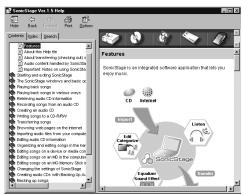
Aide de SonicStage Ver. 1.5
Il s'agit d'une aide en ligne que vous pouvez consulter sur l'écran de votre ordinateur.
Reportez-vous à l'aide en ligne pour plus de détails sur l'utilisation du logiciel. Pour afficher la fenêtre d'aide, voir page 108.
Remarques sur la section "Utilisation du logiciel"
- Les éléments affichés dans les illustrations de cette section peuvent différer de ceux réellement affichés par le logiciel.
- Les explications de cette section supposent une connaissance de base des opérations Windows. Pour plus de détails sur l'utilisation de votre ordinateur et du système d'exploitation, veuillez vous référer aux manuels correspondants.
- Les explications de cette section couvrent les produits Net MD génériques. Pour cette raison, certaines explications (et certaines illustrations) peuvent ne pas s'appliquer à votre Net MD. Veuillez également vous référer au mode d'emploi de votre Net MD.
Vérification des accessoires fournis
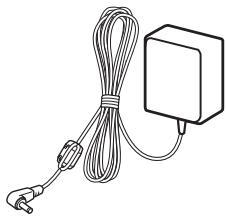
Adaptateur secteur (1)
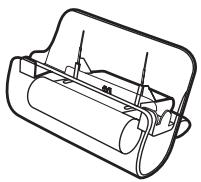
Support de charge de batterie (1)
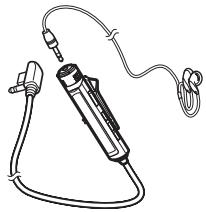
Casque/écouteurs avec télécommande (1)
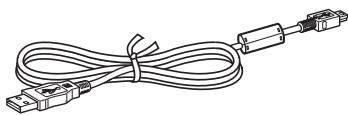
Câble USB dédié (1)
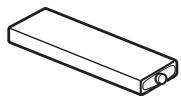
Batterie rechargeable nickel-hydrure métallique NH-14WM (1)
Étui de transport pour batterie (1)
Boîtier pour piles sèches (1)
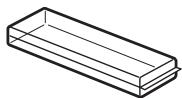
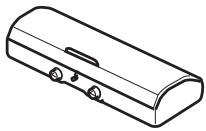
Câble optique (1)
CD-ROM (SonicStage Ver. 1.5) (1)*
Pochette de transport / étui avec clip ceinture (1)
- Ne pas lire un CD-ROM sur un lecteur de CD audio.
Description des commandes
L'enregistreur
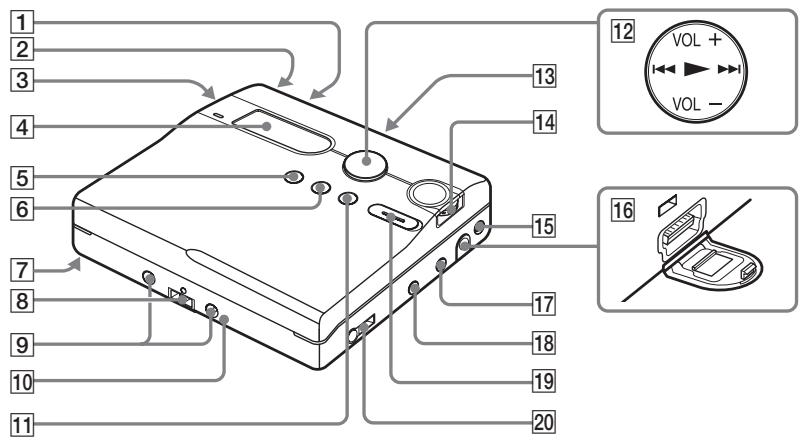
1 Bouton END SEARCH 2 Bouton T MARK 3 Compartiment à piles 4 Fenêtre d'affichage 5 Bouton GROUP 6 Bouton CHG Interrupteur HOLD : faites glisser l'interrupteur dans le sens de la flèche pour désactiver les boutons de l'enregistreur. Pour éviter que les boutons ne soient actionnés accidentellement lorsque vous transportez l'enregistreur, utilisez cette fonction. 8 Bornes pour fixer un support de charge de batterie 9 Bornes pour fixer un boîtier de piles sèches Prise DC IN 3V 11 Bouton
12 Touche de commande à 5 directions
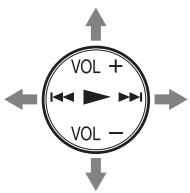
| Operation | Function |
| Press▶* | play |
| Press|← | rewind |
| Press▶ | fast forward |
| Press VOL+*,- | volume |
- La touche ▷ et VOL + comporte un point tactile.
13 Interrupteur OPEN
14 Molette Jog (MENU/ENTRÉE)
Tournez pour sélectionner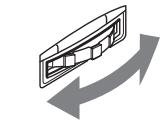
Appuyez pour valider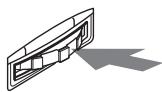
15 Trou pour dragonne
Utilisez ce trou pour attacher votre propre dragonne.
Câble USB dédié, prise de connexion 17 Prise LINE IN (OPT) Prise MIC (PLUG IN POWER) Il y a un point tactile à côté de la prise MIC (PLUG IN POWER). Interrupteur REC (enregistrement) 20 Prise (casque/écouteurs)/LINE OUT
La fenêtre d'affichage de l'enregistreur
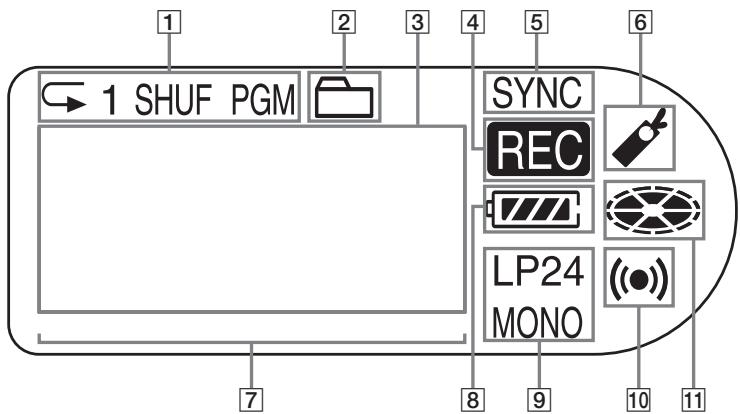
1 Indication du mode de lecture Affiche le mode de lecture (lecture aléatoire, lecture programmée, lecture répétée, etc.) du MD. 2 Indication de groupe 3 Affichage des informations de caractères Affiche les noms de disque et de piste, la date, les messages d'erreur, les numéros de piste, etc. 4 Indication REC S'allume pendant l'enregistrement. En clignotant, l'enregistreur est en mode veille d'enregistrement. Indication SYNC (enregistrement synchronisé)
6 Indication de signet S'allume lors de la lecture d'une piste marquée d'un signet. 7 Vumètre 8 Indication de batterie Affiche l'état approximatif de la batterie restante. 9 Indication LP2, LP4, MONO (mono) 10 Indication de minuterie de mélodie 11 Indication de disque Indique que le disque tourne pour l'enregistrement ou la lecture.
Le casque/les écouteurs avec télécommande
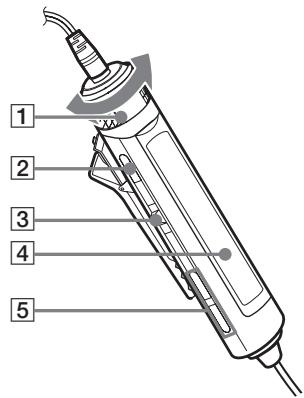
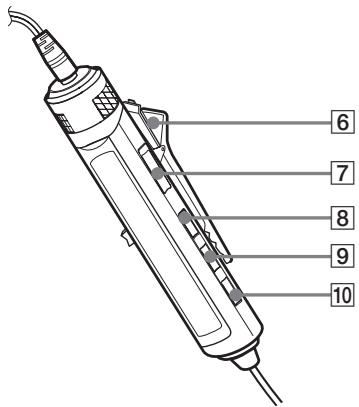
Contrôle du volume (VOL+, - ) Tournez pour régler le volume. 2 Bouton (stop) 3 Levier Jog (▶ENT,▶),
ENT (appuyer) : lecture, pause, entrée
(glisser vers) : REW
(glisser vers) : FF
4 Fenêtre d'affichage (5) (groupe) +, -
6 Interrupteur HOLD du clip
Faites glisser l'interrupteur dans le sens de la flèche (un repère jaune apparaît) pour désactiver les boutons de la télécommande. Pour éviter que les boutons ne soient actionnés accidentellement lorsque vous transportez l'enregistreur, utilisez cette fonction.
Bouton DISPLAY 9 Bouton P MODE/ 一 10 Bouton SOUND
Utilisation du clip pour la télécommande
Il peut être difficile de lire les indications à l'écran si la télécommande est fixée à l'envers avec le clip dans sa position actuelle. Dans ce cas, fixez le clip dans la direction opposée comme indiqué ci-dessous.
1 Retirez le clip.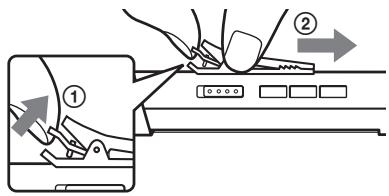
2 Fixez le clip dans la direction opposée.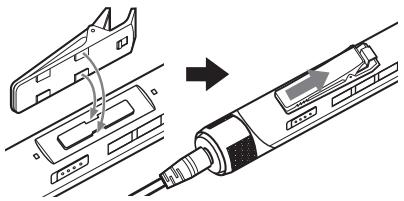
La fenêtre d'affichage de la télécommande
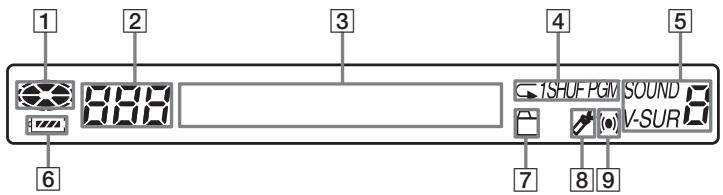
1 Indication du disque 2 Affichage du numéro de piste 3 Affichage des informations de caractères 4 Indication du mode de lecture 5 Indication SOUND
6 Indication du niveau de batterie 7 Indication du groupe 8 Indication du signet 9 Indication de la minuterie de mélodie
Pour commencer
Chargez la batterie rechargeable avant utilisation. Même si la batterie rechargeable n'est pas chargée, vous pouvez utiliser l'enregistreur tant que l'adaptateur secteur est connecté.
1 Insérez la batterie rechargeable.
Faites glisser OPEN pour ouvrir le couvercle du compartiment à batterie.
Insérez la batterie rechargeable NH-14WM en commençant par la borne négative.
Fermez le couvercle.
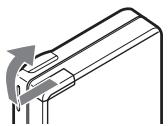
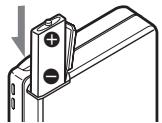
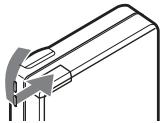
2 Chargez la batterie rechargeable.
1 Connectez l'adaptateur secteur au chargeur de batterie et branchez l'adaptateur sur une prise murale.
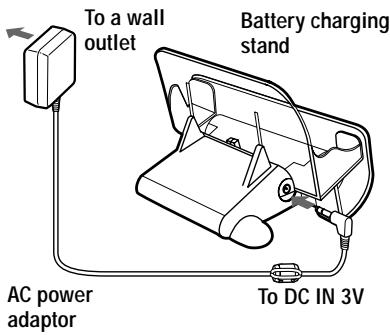
Placez l'enregistreur sur le chargeur de batterie.
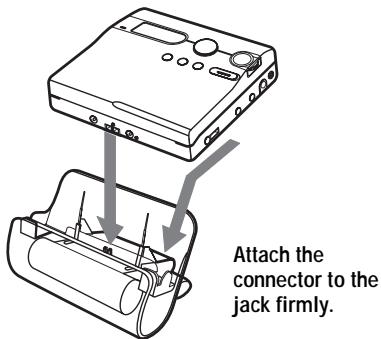
"Charging" clignote, apparaît à l'écran et la charge commence. Lorsque la charge est terminée, l'indication de batterie disparaît. La charge complète d'une batterie rechargeable entièrement déchargée prend environ 3,5 heures. L'enregistreur peut être utilisé lorsque disparaît de l'écran. La batterie sera complètement chargée après 2 heures de charge supplémentaires.
3 Retirez l'enregistreur du chargeur de batterie.
Pour les modèles fournis avec l'adaptateur de prise secteur
Si l'adaptateur secteur ne correspond pas à la prise murale, utilisez l'adaptateur de prise secteur.
Utilisation de la pile alcaline sèche
Fixez le boîtier de pile sèche à l'enregistreur.
Insérez la pile en commençant par la borne négative.
Arrière de l'enregistreur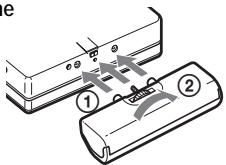
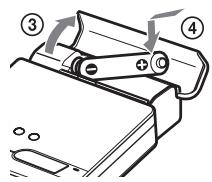
Insérez une pile alcaline sèche LR6 (format AA).
Pour utiliser l'enregistreur le plus longtemps possible, utilisez la pile sèche avec une batterie rechargeable complètement chargée.
Effectuez les connexions et déverrouillez les commandes.
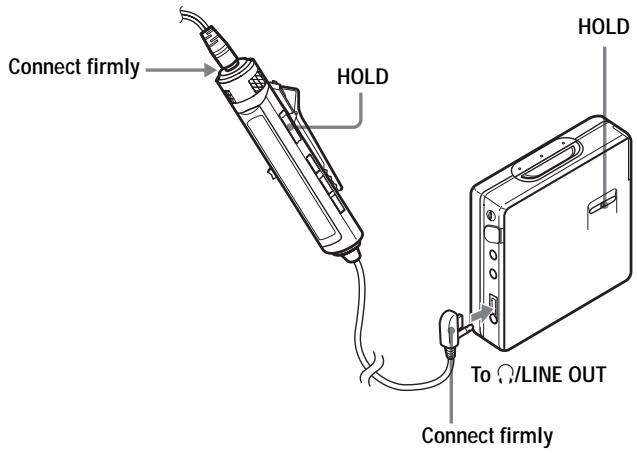
1 Connectez le casque/les écouteurs avec la télécommande à la prise LINE OUT.
Faites glisser HOLD dans le sens opposé à la flèche (→) sur l'enregistreur ou la télécommande pour déverrouiller les commandes.

Vous pouvez également charger la batterie rechargeable en branchant directement l'adaptateur secteur sur l'enregistreur.
Connectez l'adaptateur secteur à la prise DC IN 3V de l'enregistreur, puis appuyez sur CHG pendant que l'enregistreur est arrêté.
« Charging » et le symbole correspondant apparaissent à l'écran et la charge commence. La charge complète prend environ 3,5 heures. La charge est terminée lorsque le symbole disparaît. La durée de charge peut varier selon l'état de la batterie.
Remarques
- Si vous démarrez la lecture ou effectuez une autre opération pendant la charge, la charge s'arrête.
- « Charging » et le symbole peuvent ne pas apparaître immédiatement après avoir placé l'enregistreur sur le socle de chargement. L'indication commencera toutefois à clignoter après quelques minutes et la charge commencera.
- Chargez la batterie à une température comprise entre +5 °C (+41 °F) et +40 °C (+104 °F).
Autonomie de la batterie
L'autonomie de la batterie est mesurée avec le mode d'économie d'énergie activé (voir « Préservation de la batterie (mode d'économie d'énergie) » (page 59)). Pour plus de détails, reportez-vous à « Autonomie de la batterie » (page 72).
Lors de l'enregistrement
(Unité : heures approximatives)
| Batteries | SP Stereo | LP2 Stereo | LP4 Stereo |
| NH-14WM nickel metal hydride rechargeable battery | 11 | 16 | 20 |
| LR6 (SG) Sony alkaline dry battery | 11 | 16 | 21 |
| NH-14WM nickel metal hydride rechargeable battery + LR6 (SG) | 29 | 38 | 50 |
Lors de la lecture
| Batteries | SP Stereo | LP2 Stereo | LP4 Stereo |
| NH-14WM nickel metal hydride rechargeable battery | 31 | 38 | 45 |
| LR6 (SG) Sony alkaline dry battery | 47 | 57 | 69 |
| NH-14WM nickel metal hydride rechargeable batter + LR6 (SG) | 80 | 95 | 114 |
Enregistrer un MD immédiatement !
Cette section explique la procédure de base pour réaliser des enregistrements numériques à l'aide d'un câble optique connecté à un lecteur CD, un téléviseur numérique ou tout autre équipement numérique. Assurez-vous d'utiliser le câble optique. Il est recommandé d'utiliser l'enregistreur avec l'adaptateur secteur lors de l'enregistrement. Pour d'autres opérations d'enregistrement, consultez « Diverses méthodes d'enregistrement » (page 25).
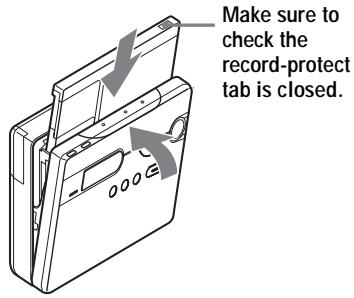
1 Insérez un MD.
• Faites glisser OPEN pour ouvrir le couvercle.
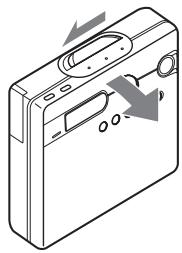
• Insérez un MD dans le sens de la flèche, l'étiquette vers l'avant, puis appuyez sur le couvercle pour le fermer.
Effectuez les connexions. (Insérez fermement et complètement les câbles dans les prises appropriées.)
2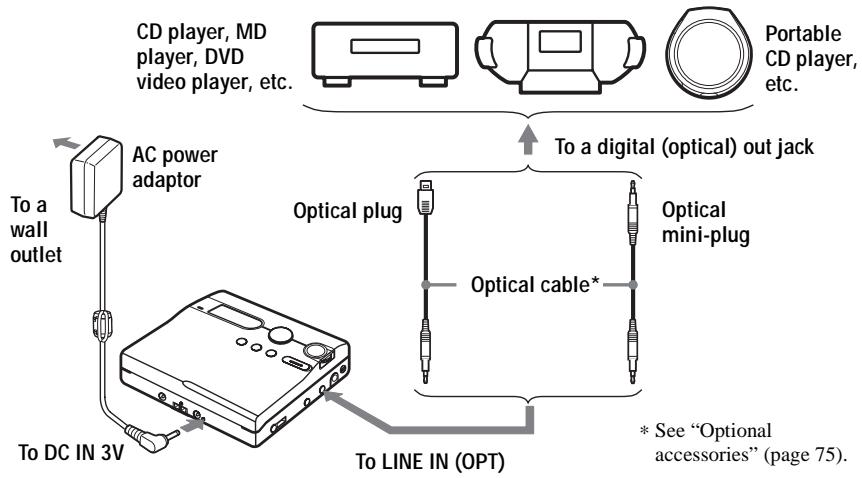
Remarque
Il est recommandé de connecter l'adaptateur secteur directement à l'enregistreur pendant l'enregistrement. Si vous enregistrez à l'aide du socle de charge, assurez-vous que la batterie rechargeable complètement chargée est insérée dans l'enregistreur au cas où l'enregistreur se détacherait du socle de charge.
Enregistrez un MD.
3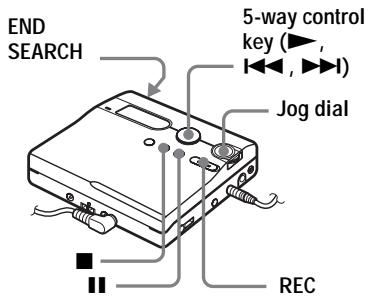
1 Sélectionnez et mettez en pause la source sonore à enregistrer. Pendant que l'enregistreur est arrêté, appuyez et faites glisser REC.
« REC » et la LED REC s'allument et l'enregistrement commence. 3 Lisez la source que vous souhaitez enregistrer. Les marques de piste sont automatiquement ajoutées au même point que la source sonore.
Pour arrêter l'enregistrement, appuyez sur
Note
Si vous enregistrez sur un disque déjà enregistré, l'enregistreur est réglé en usine pour écraser tout le contenu du disque. Si vous souhaitez que l'enregistrement commence après le contenu existant, effectuez la procédure "Enregistrement sans écraser le contenu existant" (page 59) avant d'effectuer l'étape 3, "Enregistrer un MD" (page 20).
| To | Press |
| Record from the end of the current contents1) | Press END SEARCH, and then press and slide REC.1) |
| Record over previous material from a point partway through1) | Press ▶, or press ↘, or ▷ to find the start point of recording, and then press ■ to stop. Then press and slide REC. |
| Pause | Press Ⅱ.2) Press Ⅲ again to resume recording. |
| Remove the MD | Press ▪ and open the lid.3) (The lid does not open while “TOC Edit” flashing in the display.) |
1) Si "REC-Posi" est réglé sur "From End", les opérations d'enregistrement commenceront toujours à partir de la fin du contenu précédemment enregistré sans appuyer sur le bouton END SEARCH (page 59). 2) Une marque de piste est ajoutée au point où vous appuyez à nouveau pour reprendre l'enregistrement pendant la pause ; ainsi, le reste de la piste sera compté comme une nouvelle piste. 3) Si vous ouvrez le couvercle alors que "REC-Posi" est réglé sur "From Here", l'enregistrement commencera depuis le début du disque la prochaine fois que vous enregistrerez. Vérifiez le point de départ de l'enregistrement sur l'afficheur.
Si l'enregistrement ne démarre pas
- Assurez-vous que l'enregistreur n'est pas verrouillé (pages 12, 17).
- Assurez-vous que le MD n'est pas protégé en écriture (pages 19, 74).
- Les MD préenregistrés ne peuvent pas être réenregistrés.
Pour connaître l'état de l'enregistrement
La LED REC s'allume ou clignote selon l'état de l'enregistrement.
| Recording condition | REC LED |
| While recording | lights up flashes according to the loudness of the source while recording with a microphone (voice mirror) |
| Recording standby | flashes |
| Less than 3 minutes’ recording time available | flashes slowly |
| A track mark has been added¹⁾ | goes off momentarily |
| While checking-out | flashes faster |
1) Sauf lorsque le marquage de piste a été effectué manuellement ou automatiquement à l'aide de la fonction Auto Time Mark (page 30).
Remarques
- Ne changez pas la batterie rechargeable pendant le fonctionnement, même si l'enregistreur est connecté à l'adaptateur secteur. L'opération pourrait s'arrêter.
- "TOC Edit" clignote pendant que les données de l'enregistrement (les points de début et de fin des pistes, etc.) sont en cours d'enregistrement. Ne déplacez pas l'enregistreur, ne le secouez pas et ne débranchez pas la source d'alimentation pendant que l'indication clignote à l'écran.
- Si l'alimentation est interrompue (par exemple, la batterie est retirée ou épuisée, ou l'adaptateur secteur est débranché) pendant une opération d'enregistrement ou d'édition, ou pendant que "TOC Edit" apparaît à l'écran, il ne sera pas possible d'ouvrir le couvercle jusqu'à ce que l'alimentation soit rétablie.
- Notez ce qui suit lors de l'enregistrement à partir d'un lecteur CD portable :
Certains lecteurs de CD portables peuvent ne pas être capables de sortie numérique lorsque l'adaptateur secteur est débranché. Si c'est le cas, connectez l'adaptateur secteur au lecteur de CD portable et utilisez-le sur secteur comme source d'alimentation. Sur certains lecteurs de CD portables, la sortie optique peut ne pas être possible lors de l'utilisation d'une fonction anti-saut (par exemple, ESP* ou G-PROTECTION). Si c'est le cas, désactivez la fonction anti-saut.
- Protection électronique anti-chocs

- Le niveau d'enregistrement est réglé automatiquement. Pour régler le niveau manuellement, voir "Réglage manuel du niveau d'enregistrement" (page 31).
- Vous pouvez surveiller le son pendant l'enregistrement. Connectez le casque/les écouteurs avec télécommande à Ω /LINE OUT et réglez le volume en tournant la commande de la télécommande (en appuyant sur VOL + ou - sur l'enregistreur). Cela n'affecte pas le niveau d'enregistrement.
Lecture d'un MD immédiatement !
1 Insérez un MD.
Appuyez sur OPEN pour ouvrir le couvercle.
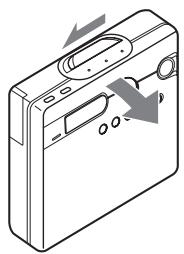
● Insérez un MD dans le sens de la flèche, l'étiquette vers l'avant, et appuyez sur le couvercle pour le fermer.
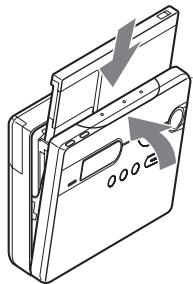
2 Lisez un MD.
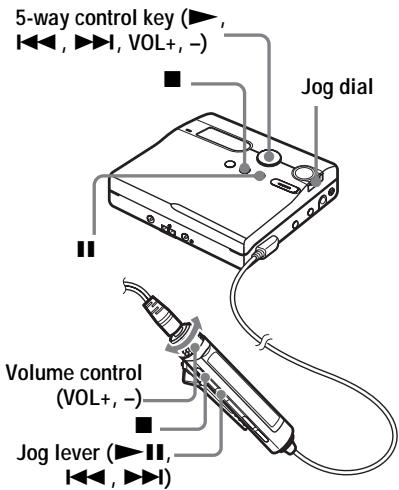
Appuyez sur l'enregistreur. Appuyez sur le levier jog (▶ – ||) sur la télécommande.
Un bip court retentit dans le casque/les écouteurs lors de l'opération.
● Appuyez sur VOL + ou - pour régler le volume sur l'enregistreur.
Tournez la commande de volume vers VOL + ou - sur la télécommande.
Le volume s'affiche à l'écran.
Pour arrêter la lecture, appuyez sur ■.
Un long bip retentit dans le casque/les écouteurs lorsque vous utilisez l'appareil. Après avoir arrêté l'enregistreur, il s'éteindra automatiquement au bout d'environ 10 secondes (avec des piles) ou d'environ 3 minutes (avec un adaptateur secteur).
La lecture reprend à partir du point où vous l'avez arrêtée.
Pour démarrer à partir de la première piste du disque, appuyez sur l'enregistreur ou sur la molette de défilement (▶II) de la télécommande pendant 2 secondes ou plus.
| To | Operation on the recorder | Operation on the remote control |
| Pause | Press Ⅱ. Press Ⅲ again to resume play. | Press ▷ Ⅱ. Press ▷ Ⅱ again to resume play. |
| Select a track directly viewing track number or name | Turn the jog dial, and then press to enter. | — |
| Find the beginning of the current track | Press ▷. Press ▷ repeatedly until you reach the beginning of the desired track. | Slide the jog lever towards Ⅱ. Slide the jog lever towards Ⅱ repeatedly until you reach the beginning of the desired track. |
| Find the beginning of the next track | Press ▷. | Slide the jog lever towards Ⅱ. |
| Go backwards or forward while playing | Press and hold Ⅱ or ▷. | Slide and hold the jog lever towards Ⅱ or ▷. |
| Search for a point in a track while viewing the elapsed time (Time search) | While pausing, press and hold Ⅱ or ▷. | While pausing, slide and hold the jog lever towards Ⅱ or ▷. |
| Search for a specific track while viewing track numbers (Index search) | While the recorder is stopped, press and hold Ⅱ or ▷. | While the recorder is stopped, slide and hold the jog lever towards Ⅱ or ▷. |
| Cue to the beginning of every 10th track (only during playback of the disc with no group settings)¹) | Press GROUP, and then press Ⅱ or ▷. | Press □ + or -. |
| Remove the MD | Press □ and open the lid.²) | Press □ and open the lid. |
1) Pour plus de détails, voir "Utilisation de la fonction groupe" (page 46). 2) Une fois le couvercle ouvert, le point de départ de la lecture revient au début de la première piste (sauf si les informations du disque sont stockées dans la mémoire personnelle du disque).
Si la lecture ne démarre pas
Assurez-vous que l'enregistreur n'est pas verrouillé (pages 12, 17).
Remarque
Le son peut sauter pendant la lecture si :
- l'enregistreur reçoit des chocs continus plus forts.
- un MiniDisc sale ou rayé est lu.
Affichage de diverses informations
Vous pouvez vérifier le temps restant, le numéro de piste, etc. pendant l'enregistrement ou à l'arrêt. Les éléments liés au groupe n'apparaissent que lorsqu'une piste avec des paramètres de groupe est lue puis arrêtée.
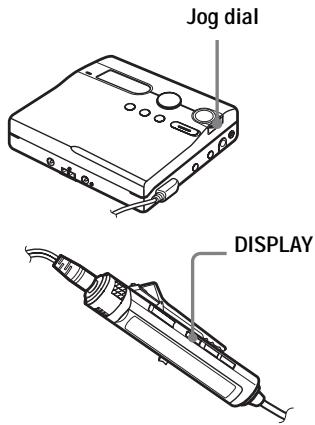
Sur l'enregistreur
1 Appuyez sur la molette de défilement. 2 Tournez la molette jusqu'à ce que "DISPLAY" apparaisse à l'écran, puis appuyez sur la molette. 3 Tournez la molette jusqu'à ce que l'information souhaitée apparaisse à l'écran, puis appuyez sur la molette pour valider la sélection.
Fenêtre d'affichage de l'enregistreur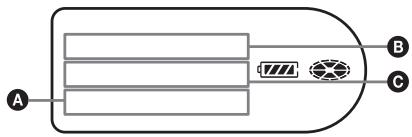
Chaque rotation modifie l'affichage comme suit.
Temps au tour → Reste enregistrement → Reste GP → Reste total → Titre → Son → Horloge
Lorsque vous appuyez sur la molette, les informations sélectionnées apparaissent en A, B et C.
| (A (selected item) | B | C |
| — (LapTime) | Track number | Elapsed time |
| RecRemain | Track number | Remaining time for recording |
| GP Remain | Numbers of tracks after the current tracks in the group | Remaining time after the current location within the group |
| AllRemain | Numbers of tracks after the current track | Remaining time after the current location |
| Track name | Disc name | Group name |
| Sound mode name | Indication of the selected sound mode | — |
| Clock | Current date | Current time |
Remarque
Selon les réglages du groupe, les conditions d'utilisation et les réglages du disque, il se peut que vous ne puissiez pas sélectionner certaines indications ou que celles-ci s'affichent différemment.
Sur la télécommande
1 Appuyez sur DISPLAY.
Chaque pression sur le bouton modifie l'affichage comme suit.
Fenêtre d'affichage de la télécommande
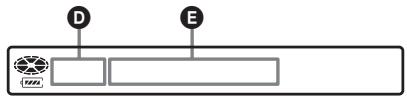
Affichage : D/E
| D | E |
| Track number | Elapsed time |
| Track number | Track name |
| Numbers of tracks in the group | Group name |
| Numbers of tracks in the disc | Disc name |
| Track number | Disc name |
| Track number | Indication of the selected sound mode |
| — | Current time |
Remarque
Selon les réglages du groupe, les conditions d'utilisation et les réglages du disque, il se peut que vous ne puissiez pas sélectionner certaines indications ou que celles-ci s'affichent différemment.

Si vous souhaitez vérifier la position de lecture ou le nom du morceau pendant la lecture, voir "Affichage de diverses informations" (page 32).
Pour démarrer/arrêter l'enregistrement en synchronisation avec la source sonore (enregistrement synchronisé)
Pendant l'enregistrement synchronisé, le début et la fin de l'enregistrement sont synchronisés avec la source sonore. Cela simplifie les enregistrements numériques (par exemple, à partir d'un lecteur CD) car il n'est plus nécessaire de manipuler l'enregistreur ou la source sonore. L'enregistrement synchronisé n'est possible qu'avec le câble optique connecté.
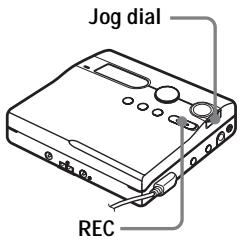
1 Effectuez les connexions. Utilisez le câble optique approprié à l'équipement source. Pour plus de détails, voir "Accessoires en option" (page 75). 2 Pendant que l'enregistreur est arrêté, appuyez sur la molette. 3 Tournez la molette jusqu'à ce que "REC SET" apparaisse à l'écran, puis appuyez sur la molette. 4 Tournez la molette jusqu'à ce que "SYNC REC" apparaisse à l'écran, puis appuyez sur la molette. 5 Tournez la molette jusqu'à ce que "SYNC ON" apparaisse à l'écran, puis appuyez sur la molette. 6 Appuyez sur REC et faites-le glisser.
"REC" et le témoin REC de l'enregistreur s'allument à l'écran et l'enregistreur se met en veille d'enregistrement.
7 Lancez la lecture de la source que vous souhaitez enregistrer. L'enregistreur commence l'enregistrement automatiquement lorsqu'il reçoit le son de lecture.
Pour arrêter l'enregistrement
Appuyez sur ■.

Lorsqu'aucun son ne provient du lecteur pendant environ 3 secondes pendant l'enregistrement synchronisé, l'enregistreur passe automatiquement en mode veille. Lorsque le son du lecteur revient, l'enregistreur reprend l'enregistrement synchronisé. Si l'enregistreur reste en mode veille pendant 5 minutes ou plus, il s'arrête automatiquement.
Remarques
- La fonction de pause ne peut pas être activée ou désactivée manuellement pendant l'enregistrement synchronisé.
- Ne modifiez pas le réglage "SYNC REC" pendant l'enregistrement. L'enregistrement pourrait ne pas se faire correctement. Même lorsqu'il n'y a pas de son sur la source, il peut y avoir des cas où l'enregistrement ne se met pas en pause automatiquement pendant l'enregistrement synchronisé en raison du niveau de bruit émis par la source.
- Si une partie silencieuse d'environ 2 secondes est rencontrée pendant l'enregistrement synchronisé à partir d'une source autre qu'un CD ou un MD, une nouvelle marque de piste est automatiquement ajoutée à l'endroit où la partie silencieuse se termine.
Enregistrement longue durée (MDLP)
Sélectionnez chaque mode d'enregistrement en fonction de la durée d'enregistrement souhaitée. L'enregistrement stéréo est possible à 2 fois (LP2) ou 4 fois (LP4) la durée d'enregistrement normale (stéréo). L'enregistrement monaural à 2 fois la durée normale est également possible.
Les MD enregistrés en mode MDLP ne peuvent être lus que sur des lecteurs ou enregistreurs MD compatibles avec le mode de lecture MDLP.
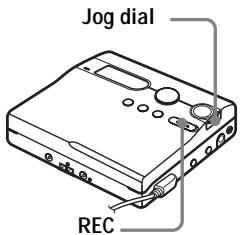
1 Pendant que l'enregistreur est arrêté, appuyez sur la molette. 2 Tournez la molette jusqu'à ce que "REC SET" apparaisse à l'écran, puis appuyez sur la molette. 3 Tournez la molette jusqu'à ce que "REC MODE" apparaisse à l'écran, puis appuyez sur la molette.
4 Tournez la molette pour sélectionner le mode d'enregistrement souhaité, puis appuyez sur la molette pour valider la sélection.
| Recording mode1) | Display window on the recorder | Recording time3) |
| SP stereo | SP | Approx. 80 min. |
| LP2 stereo | LP2 | Approx. 160 min. |
| LP4 stereo | LP4 | Approx. 320 min. |
| Monaural2) | MONO | Approx. 160 min. |
1) Pour une meilleure qualité sonore, enregistrez en stéréo normale (stéréo) ou en mode stéréo LP2. 2) Si vous enregistrez une source stéréo en monaural, les sons des canaux gauche et droit seront mélangés. 3) Lors de l'utilisation d'un MD enregistrable de 80 minutes
5 Appuyez sur REC et faites-le glisser pour démarrer l'enregistrement. 6 Lisez la source que vous souhaitez enregistrer.
Pour arrêter l'enregistrement
Appuyez sur ■.
L'enregistreur conserve le réglage du mode d'enregistrement lors du prochain enregistrement.

Les composants audio prenant en charge les modes stéréo LP2 ou stéréo LP4 sont indiqués par les logos MDLP ou MDLP.
Remarques
- Il est recommandé d'utiliser l'adaptateur secteur pour les enregistrements de longue durée.
- Lors de l'enregistrement en mode LP4, un bruit momentané peut être produit dans de très rares cas avec certaines sources sonores. Cela est dû à la technologie spéciale de compression audio numérique qui permet un temps d'enregistrement 4 fois plus long que la normale. Si du bruit est produit, il est recommandé d'enregistrer en mode stéréo normal ou LP2 pour obtenir une meilleure qualité sonore.
Enregistrement à partir d'un téléviseur ou d'une radio (enregistrement analogique)
Cette section explique comment enregistrer à partir d'un équipement analogique tel qu'un magnétophone à cassettes, une radio ou un téléviseur.
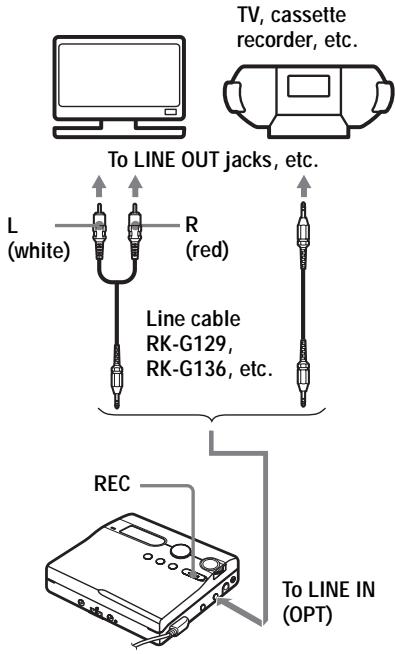
1 Effectuez les connexions.
Utilisez le cordon de connexion approprié à l'équipement source. Pour plus de détails, voir "Accessoires en option" (page 75).
2 Appuyez sur REC et faites-le glisser pour démarrer l'enregistrement. 3 Lisez la source que vous souhaitez enregistrer.
Enregistrement à partir d'un microphone
* Voir "Accessoires en option" (page 75).
1 Connectez le microphone stéréo à la prise MIC (PLUG IN POWER). L'enregistreur passe automatiquement en entrée microphone. 2 Appuyez sur REC et faites-le glisser pour démarrer l'enregistrement.
Pour sélectionner la sensibilité du microphone
1 Pendant que l'enregistreur enregistre ou est arrêté, appuyez sur la molette. 2 Tournez la molette jusqu'à ce que "REC SET" apparaisse à l'écran, puis appuyez sur la molette. 3 Tournez la molette jusqu'à ce que "MIC SENS" apparaisse à l'écran, puis appuyez sur la molette.
4 Tournez la molette jusqu'à ce que "SENS HIGH" ou "SENS LOW" apparaisse à l'écran, puis appuyez sur la molette pour valider la sélection.
SENS HIGH : pour enregistrer un son doux ou un son de volume normal.
SENS LOW : pour enregistrer un son fort ou un son à courte distance.
Lorsque vous utilisez un microphone de type à alimentation par la prise, le microphone peut fonctionner même si son interrupteur d'alimentation est éteint, car l'alimentation est fournie par l'enregistreur lui-même.
Remarques
- L'enregistreur commute automatiquement l'entrée dans l'ordre suivant : entrée optique, entrée microphone, entrée analogique. Vous ne pouvez pas enregistrer via le microphone lorsqu'un câble optique est connecté à la prise LINE IN (OPT).
- Le microphone peut capter le bruit de fonctionnement de l'enregistreur lui-même. Dans ce cas, éloignez le microphone de l'enregistreur. Veuillez noter que le bruit des opérations de l'enregistreur peut être capté si le microphone que vous utilisez a un connecteur court.
- Seul le son du canal gauche est enregistré lorsqu'un microphone monaural est utilisé.
Ajout de marques de piste pendant l'enregistrement
Vous pouvez ajouter des marques de piste (numéro de piste) pendant l'enregistrement pour diviser le matériau en parties distinctes.
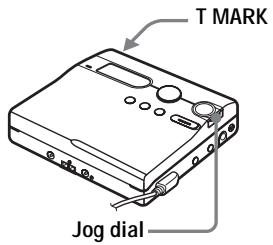
Ajout manuel de marques de piste
1 Pendant l'enregistrement, appuyez sur T MARK (appuyez sur P MODE / ⊊ sur la télécommande).
Ajout automatique de repères de plage (Auto Time Mark)
Utilisez cette fonction pour ajouter automatiquement des repères de plage à intervalles spécifiés lors de l'enregistrement via la prise d'entrée analogique ou un microphone. Cette fonction est pratique pour enregistrer sur une longue période, comme des cours, des réunions, etc.
1 Pendant l'enregistrement ou en pause d'enregistrement, appuyez sur la molette. 2 Tournez la molette jusqu'à ce que "REC SET" s'affiche, puis appuyez sur la molette. 3 Tournez la molette jusqu'à ce que "TIME MARK" s'affiche, puis appuyez sur la molette. "OFF" clignote à l'écran.
4 Tournez la molette jusqu'à ce que "ON" s'affiche, puis appuyez sur la molette. 5 Tournez la molette jusqu'à ce que l'intervalle de temps souhaité s'affiche, puis appuyez sur la molette pour valider la sélection.
Un tour de molette modifie le réglage de temps (Time:) de 1 minute, dans une plage de 1 à 99 minutes.
Pour annuler Auto Time Mark
Sélectionnez "OFF" à l'étape 4 ou arrêtez l'enregistrement.
Utilisation d'Auto Time Mark pour ajouter des repères de plage pendant l'enregistrement
Lorsque le temps d'enregistrement écoulé dépasse l'intervalle de temps défini pour Auto Time Mark :
L'enregistreur ajoute des repères de plage au moment où vous définissez l'intervalle de temps, puis ajoute un repère à chaque fois que l'intervalle s'est écoulé.
Exemple : Huit minutes d'enregistrement ont été effectuées lorsque l'intervalle Auto Time Mark est réglé sur 5 minutes. Un repère sera ajouté au point de 8 minutes (après le début de l'enregistrement) puis toutes les 5 minutes.
Lorsque l'intervalle de temps défini pour Auto Time Mark dépasse le temps d'enregistrement écoulé :
L'enregistreur ajoute des repères de plage lorsque l'intervalle Auto Time Mark défini s'est écoulé.
Exemple : Trois minutes d'enregistrement ont été effectuées lorsque l'intervalle Auto Time Mark est réglé sur 5 minutes. Un repère sera ajouté au point de 5 minutes (après le début de l'enregistrement) puis toutes les 5 minutes.

Le « T » apparaît avant l'affichage de l'heure sur l'enregistreur pour les marques de plage ajoutées par le marquage automatique de plage, et « T » apparaît après l'affichage de l'heure sur la télécommande.
Remarques
- Si vous ajoutez une marque de plage en appuyant sur T MARK ou II, etc. pendant l'enregistrement, le marquage automatique de plage commencera à ajouter automatiquement une marque de plage à chaque fois que l'intervalle de temps sélectionné s'est écoulé.
- Le réglage sera perdu lorsque l'enregistrement sera arrêté.
Réglage manuel du niveau d'enregistrement
Le niveau sonore est ajusté automatiquement pendant l'enregistrement. Si nécessaire, vous pouvez régler manuellement le niveau d'enregistrement pendant l'enregistrement analogique et numérique.
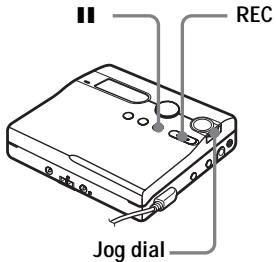
1 Tout en appuyant sur II, appuyez sur REC et faites-le glisser.
L'enregistreur se met en veille pour l'enregistrement.
2 Appuyez sur la molette jog. 3 Tournez la molette jog jusqu'à ce que « REC SET » apparaisse à l'écran, puis appuyez sur la molette jog. 4 Tournez la molette jusqu'à ce que « RecVolume » apparaisse à l'écran, puis appuyez sur la molette jog.
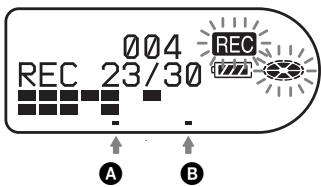
5 Tournez la molette jog jusqu'à ce que « ManualREC » apparaisse à l'écran, puis appuyez sur la molette jog. 6 Lancez la lecture de la source. 7 Tout en observant le vumètre à l'écran, réglez le niveau d'enregistrement en tournant la molette jog.
Réglez le niveau de sorte que les segments du vumètre s'allument entre A et B. Si les segments du vumètre s'allument à droite de B, réduisez le niveau d'entrée. Chaque vumètre indique ce qui suit. Supérieur - niveau d'entrée du canal gauche Inférieur - niveau d'entrée du canal droit
Appuyez à nouveau pour démarrer l'enregistrement. Si votre source est un composant connecté en externe, lancez la lecture de la source jusqu'au début du matériel à enregistrer, puis démarrez l'enregistrement.
Pour revenir au contrôle automatique du niveau
Sélectionnez « Auto REC » à l'étape 5.
Remarques
- Vous ne pouvez pas régler séparément les niveaux des canaux gauche et droit.
- Une fois l'enregistrement arrêté, l'enregistreur reviendra au mode de réglage automatique du niveau d'enregistrement la prochaine fois que vous démarrerez une opération d'enregistrement. Pour régler manuellement le niveau d'enregistrement pendant l'enregistrement synchronisé, suivez les étapes 1 à 7 de la procédure de cette section avec "SYNC REC" réglé sur "SYNC OFF". Ensuite, réglez "SYNC REC" sur "SYNC ON" et démarrez l'enregistrement (page 26).
Différentes méthodes de lecture
Cette section explique les opérations effectuées sur la télécommande. Pour plus de détails sur les opérations effectuées sur l'enregistreur, reportez-vous aux pages indiquées pour chaque opération.
Affichage de diverses informations
Vous pouvez vérifier le nom de la piste, le nom du disque, etc. pendant la lecture. Les éléments liés au groupe n'apparaissent que lorsqu'une piste avec des paramètres de groupe est lue.
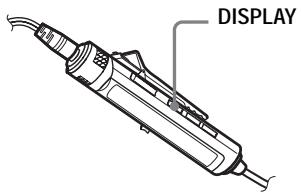
1 Pendant la lecture, appuyez sur DISPLAY. Chaque fois que vous appuyez sur DISPLAY, l'affichage change comme suit.
Fenêtre d'affichage sur la télécommande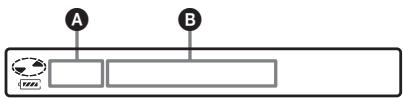
Affichage : A/B
| A | B |
| Track number | Elapsed time |
| Track number | Track name |
| Numbers of tracks in the group | Group name |
| Numbers of tracks in the disc | Disc name |
| Track number | Disc name |
| Track number | Indication of the selected sound mode |
| A | B |
| — | Recorded time |
| Track number | SP/LP mode of the current track |
Remarque
Selon les paramètres de groupe, les conditions de fonctionnement et les paramètres du disque, certaines indications peuvent ne pas être sélectionnables ou peuvent apparaître différemment.

Si vous souhaitez vérifier le temps restant ou la position d'enregistrement pendant l'enregistrement ou en mode arrêt, voir "Affichage de diverses informations" (page 25).
Pour l'opération de l'enregistreur, voir page 64.
Sélection du mode de lecture
Vous pouvez sélectionner différents modes de lecture à l'aide du bouton P MODE/ .
Levier Jog (I 1 , >, ENT)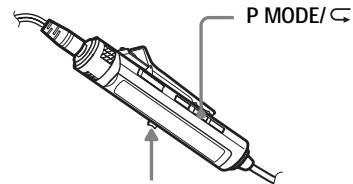
1 Appuyez plusieurs fois sur P MODE/ . Chaque pression sur le bouton change le mode de lecture comme suit :
Indication du mode de lecture
| Indication1) | Play mode |
| (none) (normal Play) | All the tracks are played once. |
| 1 (single-track play) | A single track is played once. |
| © (Bookmark play) | Bookmark tracks play back in order of their track number. |
| SHUF (shuffle play) | All the tracks are played in random order. |
| PGM (program play) | Tracks are played in the order that you specified. |
1) Le mode de lecture par groupe ( ) apparaît chaque fois que vous lisez un disque avec des réglages de groupe. Pour plus de détails, voir « Lecture d'une plage en mode groupe » (page 47).
Pour le fonctionnement de l'enregistreur, voir page 60.
Lecture répétée d'une plage (Lecture répétée)
Vous pouvez utiliser la fonction de répétition pour la lecture normale, la lecture d'une seule plage, la lecture aléatoire et le mode de lecture programmée.
1 Pendant la lecture dans le mode sélectionné, appuyez sur P MODE/ pendant 2 secondes ou plus.
apparaît à l'écran.
Pour annuler la lecture répétée
Appuyez sur P MODE/ pendant 2 secondes ou plus.

En appuyant sur le bouton P MODE/ pendant la lecture répétée, vous pouvez changer le mode de lecture pour l'utiliser avec la lecture répétée.
Pour le fonctionnement de l'enregistreur, voir page 60.
Écoute de plages sélectionnées uniquement (Lecture avec signet)
Vous pouvez marquer des plages sur un disque et les lire uniquement. La séquence des plages marquées ne peut pas être modifiée.
Pour marquer les pistes
1 Pendant la lecture de la piste que vous souhaitez marquer, appuyez sur le levier jog pendant 2 secondes ou plus.

Clignotement lent
La première piste de la lecture de marque-pages est définie.
2 Répétez l'étape 1 pour marquer les autres pistes.
Vous pouvez définir jusqu'à 20 marque-pages dans un disque.
Pour lire les pistes marquées
1 Pendant la lecture, appuyez sur P MODE/ à plusieurs reprises jusqu'à ce que "TrPLAY?" apparaisse à l'écran. 2 Appuyez sur le levier jog.
Les pistes marquées commencent à jouer, en commençant par le numéro de piste le plus petit.
Pour effacer les marque-pages
Pendant la lecture de la piste dont vous souhaitez effacer le marque-page, appuyez sur le levier jog pendant 2 secondes ou plus.
Remarque
Si vous ouvrez le couvercle, tous les marque-pages sont annulés.
Pour le fonctionnement de l'enregistreur, voir page 60.
Écoute de plages dans une séquence souhaitée (lecture programmée)
1 Pendant la lecture, appuyez plusieurs fois sur P MODE/ ← jusqu'à ce que « PGM » s'affiche. 2 Faites glisser le levier jog à plusieurs reprises pour sélectionner une plage, puis appuyez dessus pour entrer cette plage.
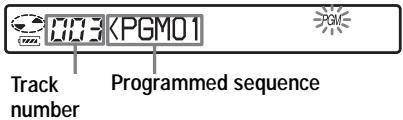
3 Répétez l'étape 2 pour programmer d'autres plages. Vous pouvez programmer jusqu'à 20 plages. 4 Après avoir programmé les plages, appuyez sur le levier jog pendant 2 secondes ou plus. Le programme est mémorisé et la lecture démarre à partir de la première plage.
Le réglage de la lecture programmée reste en mémoire même après la fin ou l'arrêt de la lecture.
Remarque : Si vous ouvrez le couvercle, tous les réglages du programme sont annulés.
Pour le fonctionnement de l'enregistreur, voir page 61.
Réglage du son (Virtual-Surround · Égaliseur 6 bandes)
Vous pouvez varier le son virtuel pour créer différentes acoustiques, ou modifier le son selon vos goûts et le mémoriser pour une utilisation ultérieure. Voici quelques-unes des plus populaires
Les deux effets suivants peuvent être sélectionnés. V-SUR (Virtual-Surround VPT Acoustic Engine)
Fournit 4 types de conditions de son surround virtuel.
ÉGALISEUR 6 BANDES
Fournit 6 qualités sonores différentes.
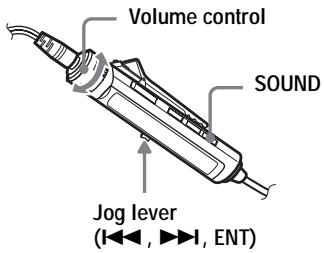
Variation du son virtuel pour créer différentes acoustiques (Virtual-Surround)
1 Pendant la lecture, appuyez plusieurs fois sur SOUND pour sélectionner « V-SUR ». 2 Appuyez sur SOUND pendant 2 secondes ou plus. 3 Faites glisser le levier jog à plusieurs reprises pour sélectionner le mode surround.
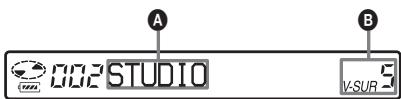
Chaque fois que vous faites glisser le levier jog, A et B changent comme suit :
| A | B |
| STUDIO | V-SUR S |
| LIVE | V-SUR L |
| CLUB | V-SUR C |
| ARENA | V-SUR A |
4 Appuyez sur le levier de défilement pour entrer dans le mode surround sélectionné.
Sélection de la qualité sonore (égaliseur 6 bandes)
1 Pendant la lecture, appuyez plusieurs fois sur SOUND pour sélectionner « SOUND ». 2 Appuyez sur SOUND pendant 2 secondes ou plus. 3 Faites glisser le levier de défilement à plusieurs reprises pour sélectionner le mode sonore.
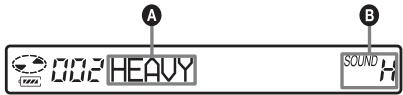
Chaque fois que vous faites glisser le levier de défilement, A et B changent comme suit :
| A | B |
| HEAVY | SOUND H |
| POPS | SOUND P |
| JAZZ | SOUND J |
| UNIQUE | SOUND U |
| CUSTOM1 | SOUND 1 |
| CUSTOM2 | SOUND 2 |
4 Appuyez sur le levier de défilement pour entrer dans le mode sonore sélectionné.
Pour annuler la procédure
Appuyez sur pendant 2 secondes ou plus.
Pour annuler le réglage
Appuyez plusieurs fois sur SOUND jusqu'à ce que l'indication à l'étape 3 disparaisse.
Pour modifier et mémoriser le son
Vous pouvez modifier le son et mémoriser les résultats dans « CUSTOM1 » et « CUSTOM2 ».
1 Effectuez les étapes 1 à 3 de « Sélection de la qualité sonore (égaliseur 6 bandes) » (page 35), et faites glisser le levier de défilement jusqu'à ce que « CUSTOM1 » ou « CUSTOM2 » apparaisse. 2 Appuyez sur le levier de défilement. 3 Faites glisser le levier de défilement à plusieurs reprises pour sélectionner la fréquence.
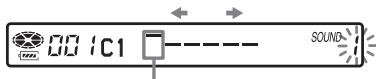
Fréquence (100 Hz) À partir de la gauche, vous pouvez sélectionner 100 Hz, 250 Hz, 630 Hz, 1,6 kHz, 4 kHz ou 10 kHz
4 Tournez la commande de volume à plusieurs reprises pour régler le niveau.
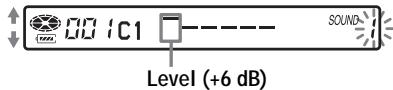
Vous pouvez sélectionner parmi sept niveaux. -6 dB, -3 dB, 0 dB, +3 dB, +6 dB
5 Répétez les étapes 3 et 4 pour régler le niveau pour chaque fréquence. 6 Appuyez sur le levier de commande pour valider la sélection.
Pour annuler la procédure
Appuyez pendant 2 secondes ou plus.
Pour revenir au réglage précédent
Appuyez sur ■.
Remarque
Lorsque vous affectez les réglages "SOUND" à "CUSTOM1" ou "CUSTOM2", le volume maximal est limité à un certain niveau ("VOL 24") pour éviter un volume excessif.
Pour le fonctionnement de l'enregistreur, voir page 62.
Changement de la vitesse de lecture (Digital Pitch Control)
La fonction de contrôle de vitesse est utile pour l'étude des langues et autres usages. Cette fonction modifie la vitesse de lecture sans changer la hauteur tonale. La vitesse de lecture peut varier de +100 % à -50 % de la vitesse normale, en 13 crans.
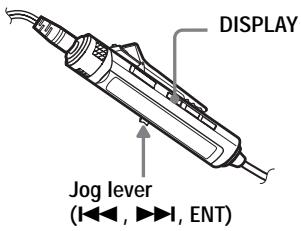
1 Pendant la lecture, appuyez sur DISPLAY pendant 2 secondes ou plus. 2 Faites glisser le levier de commande à plusieurs reprises jusqu'à ce que "USEFUL" apparaisse à l'écran, puis appuyez sur le levier de commande. 3 Faites glisser le levier de commande à plusieurs reprises jusqu'à ce que "DPC" apparaisse à l'écran, puis appuyez sur le levier de commande. Le lecteur passe en mode de réglage de vitesse. Sélectionnez la vitesse tout en écoutant le son.

DPC< 0%>
4 Faites glisser le levier de commande à plusieurs reprises pour sélectionner la vitesse de lecture souhaitée, puis appuyez sur le levier de commande pour valider la sélection.
"DPC" apparaît à l'écran.
Pour annuler la procédure
Appuyez sur la touche pendant 2 secondes ou plus.
Pour revenir au réglage précédent
Appuyez sur ■.

Une fois le couvercle ouvert, la vitesse de lecture revient à la vitesse normale (0%).
Remarque
Lors de l'utilisation du contrôle de hauteur de ton numérique, vous pouvez entendre un bruit ou un écho pendant la lecture.
Pour le fonctionnement de l'enregistreur, voir page 63.
Réglage de l'alarme (Minuterie mélodique)
L'alarme est un moyen pratique de vous rappeler des moments importants, comme l'heure de descendre du train. L'alarme peut être réglée pour se déclencher dans 1 à 99 minutes. L'alarme se déclenchera également lorsque l'enregistreur est arrêté.
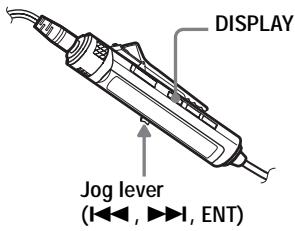
1 Appuyez sur DISPLAY pendant 2 secondes ou plus. 2 Faites glisser la molette de jogging à plusieurs reprises jusqu'à ce que "USEFUL" apparaisse à l'écran, puis appuyez sur la molette de jogging. 3 Faites glisser la molette de jogging à plusieurs reprises jusqu'à ce que "M-TIMER" apparaisse à l'écran, puis appuyez sur la molette de jogging.
4 Faites glisser la molette de jogging à plusieurs reprises jusqu'à ce que "ON" apparaisse à l'écran, puis appuyez sur la molette de jogging.
(●) apparaît.

5 Faites glisser la molette de jogging à plusieurs reprises pour sélectionner le son de l'alarme, puis appuyez sur la molette de jogging.
Vous pouvez choisir parmi trois types de sons.
| Display | Alarm sound |
| TIMER 1 | Classical music 1 |
| TIMER 2 | Classical music 2 |
| TIMER 3 | Classical music 3 |
6 Faites glisser la molette de jogging à plusieurs reprises pour sélectionner le temps écoulé.

Chaque fois que vous faites glisser le levier de jog, le réglage du temps écoulé (TIME :) change par incréments de 1 minute, dans une plage de 1 à 99 minutes.
7 Appuyez sur le levier de jog pour valider le réglage. Le temps restant avant l'alarme s'affiche à l'écran lorsque l'enregistreur est arrêté.
Pour annuler la procédure
Appuyez sur la touche pendant 2 secondes ou plus.
Pour revenir au réglage précédent
Appuyez sur ■.
Pour vérifier le temps restant avant l'alarme
Arrêtez la lecture. Le temps restant s'affiche à l'écran après un court instant. Répétez les étapes 1 à 6 pour afficher le temps restant pendant la lecture ou la pause de lecture.
Pour annuler le réglage de l'alarme
Sélectionnez « OFF » à l'étape 4.
Pour arrêter l'alarme
Appuyez sur n'importe quelle touche.

- Si vous terminez la procédure après l'étape 4, le réglage d'alarme précédent est automatiquement utilisé.
- Après avoir sonné pendant une minute, l'alarme s'arrête automatiquement et le réglage de l'alarme est annulé. Si l'alarme sonne en mode arrêt, l'appareil s'éteint automatiquement 10 secondes après l'arrêt de l'alarme. Si l'alarme s'arrête pendant la lecture d'un MD, la lecture continue sans interruption.
Remarques
- Les réglages seront perdus lorsque vous commencerez l'enregistrement.
- Le minuteur commencera à décompter à partir du moment où vous sélectionnez "ON" à l'étape 4. L'enregistreur recommencera à décompter à partir du moment où vous modifiez le temps écoulé à l'étape 6.
Pour le fonctionnement de l'enregistreur, voir page 68.
Connexion à un système stéréo (LINE OUT)
Vous pouvez écouter le son de lecture depuis un composant connecté. Connectez la prise LINE OUT de l'enregistreur aux prises LINE IN d'un amplificateur ou d'un lecteur de cassette avec un câble ligne.
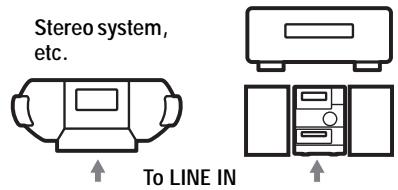
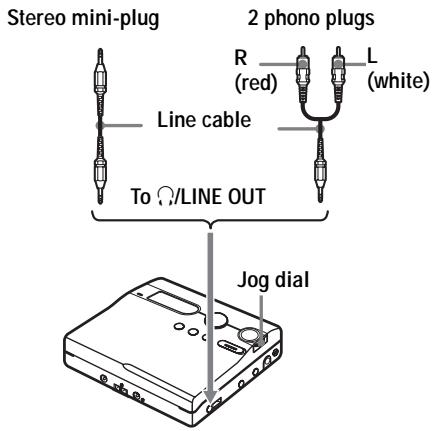
Lors de la connexion d'un câble ligne à la prise LINE OUT de l'enregistreur, assurez-vous de régler le paramètre "AUDIO OUT" pour la prise LINE OUT.
1 Appuyez sur la molette. 2 Tournez la molette jusqu'à ce que "USEFUL" apparaisse à l'écran, puis appuyez sur la molette. 3 Tournez la molette jusqu'à ce que "AUDIO OUT" apparaisse à l'écran, puis appuyez sur la molette.
4 Tournez la molette jusqu'à ce que "LINE OUT" apparaisse à l'écran, puis appuyez sur la molette pour valider la sélection.
Remarques
- Si le paramètre "AUDIO OUT" pour la prise LINE OUT est réglé sur "LINE OUT", les touches VOL + ou -, le Virtual Surround ou l'égaliseur 6 bandes ne fonctionneront pas.
- Le paramètre "AUDIO OUT" pour la prise LINE OUT ne peut pas être réglé sur "LINE OUT" lorsque la télécommande est connectée.
- Lorsque vous connectez le casque/les écouteurs directement à l'enregistreur, réglez le paramètre "AUDIO OUT" pour la prise LINE OUT sur "HeadPhone" à l'étape 4.
Cette section explique les opérations effectuées sur l'enregistreur. Pour plus de détails sur les opérations effectuées avec la télécommande, reportez-vous aux pages indiquées pour chaque opération.
Avant le montage
Vous pouvez modifier vos enregistrements en ajoutant/effaçant des marques de plage ou en étiquetant des plages et des MD.
Notes
- Les MD prémasterisés ne peuvent pas être modifiés.
- Fermez la languette de protection contre l'enregistrement sur le côté du MD avant de modifier.
- Lorsque "TOC Edit" clignote, les résultats de la modification sont en cours d'enregistrement.
—Ne déplacez pas et ne faites pas avancer l'enregistreur. -Ne débranchez pas la source d'alimentation. Le couvercle se verrouille.
Nommer une piste ou un disque (Nom)
Vous pouvez nommer des pistes et des disques à l'aide de la palette de caractères de l'enregistreur.
Remarque
Pour nommer un groupe, voir page 50.
Caractères disponibles
- Lettres majuscules et minuscules de l'alphabet anglais
- Chiffres de 0 à 9 •! " # $ % & ( ) * . ; < = > ? @ _ ` + - ' , / : _ (espace)
Nombre maximal de caractères par nom
Noms de pistes, de groupes et de disque : environ 200 chacun (contenant un mélange de tous les caractères disponibles)
Nombre maximal de caractères pouvant être saisis par disque
Caractères alphanumériques et symboles uniquement : environ 120 titres d'environ 10 caractères chacun (maximum d'environ 1 700 caractères)
Le nombre de titres pouvant être stockés sur un disque dépend du nombre de caractères saisis pour les noms de plage, les noms de groupe et le nom du disque.
À propos de la palette de caractères
Lors des opérations sur l'enregistreur, les caractères peuvent être sélectionnés dans la palette de caractères affichée à l'écran.
La palette de caractères a la configuration suivante.
ABCDEFGHIJKLMNOPQRSTUVWXYZ 1 2 3 abcdefghijklmnopqrstuvwxyz 4 5 6 , - ?! \ amp; / @; ∴ () # * lt; == gt;^+%0 789
Zone de saisie des lettres
Le curseur clignote.
Palette de caractères
Comme seule une partie de la palette de caractères est visible à l'écran, utilisez la barre de contrôle pour déplacer le curseur et saisir des caractères.
Remarque
Si vous saisissez le symbole 1// entre les caractères des noms de disque, par exemple "abc//def", vous risquez de ne pas pouvoir utiliser la fonction de groupe.
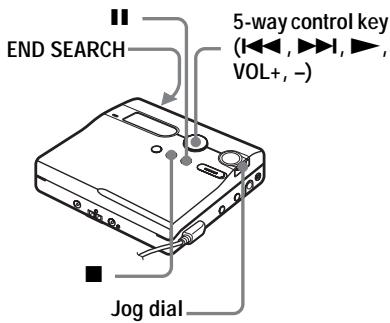
Étiquetage
Vous pouvez étiqueter une plage ou un disque lorsque l'enregistreur est arrêté, en enregistrement ou en lecture. Notez que si vous étiquetez une plage alors que l'enregistreur est arrêté, la plage doit être celle actuellement sélectionnée.
1 Appuyez sur la molette jog. 2 Tournez la molette jog jusqu'à ce que "EDIT" apparaisse à l'écran, puis appuyez sur la molette jog. 3 Tournez la molette jog jusqu'à ce que "Name" apparaisse à l'écran, puis appuyez sur la molette jog. 4 Tournez la molette jog jusqu'à ce que l'élément suivant apparaisse à l'écran, puis appuyez sur la molette jog.
| When labeling a track | “ ∥ : Name” |
| When labeling a disc | “ ⋅ : Name” |
Le curseur clignote dans la zone de saisie des lettres et le morceau, le groupe ou le disque est prêt à être étiqueté.
Le curseur clignote.
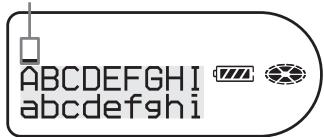
5 Appuyez sur VOL -.
Le curseur se déplace de la zone de saisie des lettres vers la palette de caractères.
Le curseur et le caractère alternent.
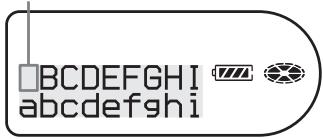
6 Sélectionnez une lettre à l'aide de la touche de contrôle et appuyez sur pour la saisir.
La lettre sélectionnée apparaît dans la zone de saisie des lettres et le curseur se déplace à la position de saisie suivante.
Le curseur clignote à la position de saisie suivante.
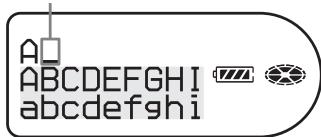
Les boutons utilisés pour la saisie des caractères et leurs fonctions sont listés ci-dessous.
| Functions1) | Operations |
| To move the cursor in the character palette. | Control key up left VOL + right down Turn the jog dial (move the cursor upward or downward). |
| To select a character in the letter input area. | Turn the jog dial. |
| To enter a letter. | Press ▲ Press the jog dial. |
| To move the cursor from the letter input area to the character palette. | Press VOL - . |
| To move the cursor from the character palette to the letter input area. | Press ■ . |
| To enter a name. | Press the jog dial or ▶ for 2 seconds or more. |
| To insert a blank space before the cursor. | Press END SEARCH and VOL + at the same time. |
| To delete a letter. | Press END SEARCH and VOL - at the same time. |
| To display “:”, “-” or “/” at the input position in the letter input area. | Press ■ . |
| To switch capital and small letters. | Press ■ . |
| To cancel labeling. | Press ■ in the letter input area. |
1) Les fonctions des boutons ou de la commande peuvent différer selon que le curseur se trouve dans la zone de saisie des lettres ou dans la palette de caractères. 7 Répétez l'étape 6, puis saisissez tous les caractères du nom de l'étiquette. 8 Appuyez sur la molette jog pendant 2 secondes ou plus.
Un morceau ou un disque est étiqueté.
Remarque
Lorsque l'enregistrement est arrêté pendant l'étiquetage d'un morceau ou d'un disque pendant l'enregistrement, ou lorsque l'enregistrement passe au morceau suivant pendant l'étiquetage d'un morceau, la saisie à ce moment-là est entrée automatiquement.
Ré-étiquetage
Vous pouvez modifier l'étiquette du disque ou d'un morceau en suivant la procédure "Étiquetage d'un morceau ou d'un disque (Nom)" (page 39).
Pour renommer une plage :
Commencez à lire la plage que vous souhaitez renommer, puis modifiez le nom de la plage pendant la lecture, ou modifiez le nom de la plage pendant que l'enregistreur est arrêté et que la plage à renommer est sélectionnée.
Pour renommer un disque :
Vous pouvez renommer le disque pendant que l'enregistreur est arrêté, en enregistrement ou en lecture.
Pour annuler le renommage
Appuyez pendant 2 secondes ou plus.
Pour revenir aux réglages précédents
Appuyez sur ■.
Remarques
- L'enregistreur peut afficher, mais ne peut pas renommer en utilisant les caractères japonais "Katakana".
- L'enregistreur ne peut pas réécrire un nom de disque ou de plage de plus de 200 lettres créé par un autre appareil.
Pour l'utilisation de la télécommande, voir page 65.
Déplacement des plages enregistrées (Move)
Vous pouvez changer l'ordre des plages enregistrées.
Remarque
Pour déplacer des plages dans un disque avec des réglages de groupe, voir page 51.
Exemple
Déplacer la plage C (numéro de plage 3) de la troisième à la deuxième plage.
Après déplacement
| A | B | C | D | |
| Before moving | ||||
| A | C | B | D | |
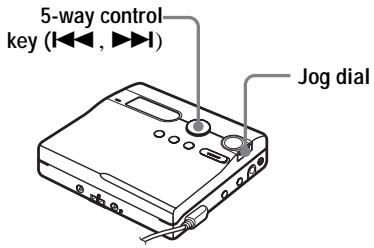
1 Pendant la lecture de la plage à déplacer, appuyez sur la molette jog. 2 Tournez la molette jog jusqu'à ce que "EDIT" apparaisse à l'écran, puis appuyez sur la molette jog.
L'enregistreur lit la plage sélectionnée en boucle.
3 Tournez la molette jog jusqu'à ce que "Move" apparaisse à l'écran, puis appuyez sur la molette jog.
4 Tournez la molette jog jusqu'à ce que "Move" apparaisse à l'écran, puis appuyez sur la molette jog.
Le numéro de la plage sélectionnée clignote dans la rangée du milieu de l'écran.
Si la plage a été étiquetée, appuyez pour faire apparaître le nom de la plage à l'écran. Appuyez pour afficher à nouveau le numéro de la plage.
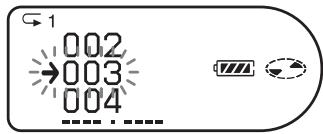
5 Tournez la molette jog jusqu'à ce que le numéro de la plage de destination clignote à l'écran. Pour l'exemple, puisque la plage C sera déplacée vers la plage "002", tournez la molette jog jusqu'à ce que "002" clignote à l'écran.
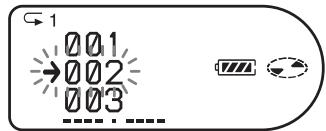
6 Appuyez sur la molette jog pour valider la sélection.
La plage est déplacée vers la plage de destination sélectionnée.
Pour annuler le déplacement
Appuyez pendant 2 secondes ou plus.
Pour revenir aux réglages précédents
Appuyez sur ■.
Pour l'utilisation de la télécommande, voir page 66.
Division d'une plage (Divide)
Vous pouvez diviser une plage avec un repère de plage, créant ainsi une nouvelle plage à partir de la partie suivant le repère. Vous pouvez également effectuer des réglages fins sur la position du repère avant de procéder à la division réelle. Les numéros de plage augmenteront comme suit.
Cette fonction ne peut être réglée qu'avec l'enregistreur.
Remarque
Vous ne pouvez pas ajouter un repère de plage sur une plage qui a été extraite de votre ordinateur.
| 1 | 2 | 3 | 4 | ||
| Track marking | |||||
| 1 | 2 | 3 | 4 | 5 | |
Les numéros de plage augmentent.
Division directe d'une plage
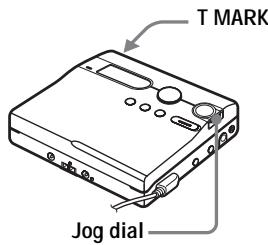
1 Pendant la lecture ou la pause d'un MD, appuyez sur T MARK sur l'enregistreur au point où vous souhaitez marquer.
"MARK ON" apparaît à l'écran, et un repère de plage est ajouté. Le numéro de plage augmentera de un.
Réglage du point de division avant de diviser une plage (Répétition de division)
1 Pendant la lecture, appuyez sur T MARK pendant 2 secondes ou plus.
Quatre secondes de la plage à partir du point où T MARK est enfoncé sont lues en boucle.
Le point T MARK est enfoncé.
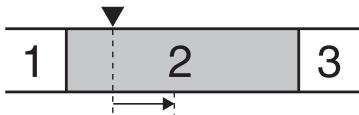
Quatre secondes du morceau sont lues en boucle.
2 Tournez la molette jog pour régler le point de division.
Tourner la molette jog déplace le point de division vers l'avant ou l'arrière. Le point de division peut être déplacé jusqu'à un maximum de 8 secondes vers l'avant ou l'arrière à partir du point où T MARK a été enfoncé à l'étape 1.
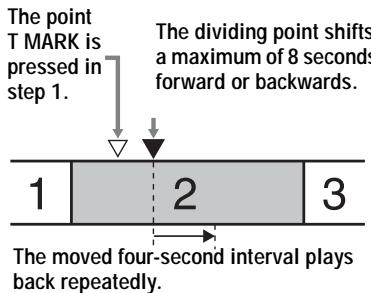
3 Appuyez sur la molette jog pour valider le point de division.
Pour ajouter des marques de piste pendant l'enregistrement (sauf en enregistrement synchronisé)
Appuyez sur T MARK sur l'enregistreur (P MODE/⊂ sur la télécommande) au point où vous souhaitez ajouter une marque de piste. Vous pouvez utiliser la fonction Auto Time Mark pour ajouter automatiquement des marques de piste à intervalles spécifiés (sauf en enregistrement numérique) (page 30).
Combinaison de pistes (Combine)
Lors d'un enregistrement avec entrée analogique (ligne), des marques de piste inutiles peuvent être enregistrées lorsque le niveau d'enregistrement est faible. Vous pouvez effacer une marque de piste pour combiner les pistes avant et après cette marque.
Les numéros de piste changeront comme suit. Cette fonction ne peut être réglée qu'avec l'enregistreur.
Remarques
- Vous ne pouvez pas effacer une marque de piste sur une piste extraite de votre ordinateur.
- Pour combiner des groupes ou des pistes sur un disque avec des réglages de groupe, voir page 49.
- Vous ne pouvez pas combiner des pistes enregistrées dans des modes d'enregistrement différents.
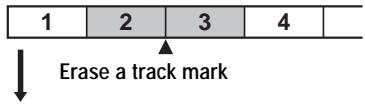

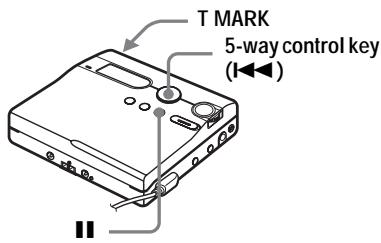
1 Pendant la lecture de la piste dont vous voulez effacer la marque, appuyez sur I pour mettre en pause. 2 Trouvez la marque de piste en appuyant légèrement.
Par exemple, pour effacer la troisième marque de plage, trouvez le début de la troisième plage. "00:00" apparaît à l'affichage. "MARK" apparaît à l'affichage pendant quelques secondes.
3 Appuyez sur T MARK pour effacer la marque. "MARK OFF" apparaît à l'affichage. La marque de plage est effacée et les deux plages sont combinées.

Lorsque vous effacez une marque de plage, la date, l'heure et le nom attribués à la marque sont également effacés.
Remarque
Lorsque vous effacez une marque de plage entre deux plages consécutives qui sont assignées à des groupes différents, la deuxième plage est réassignée au groupe contenant la première plage. De plus, si vous combinez une plage assignée à un groupe avec une plage non assignée à un groupe (deux plages consécutives), la deuxième plage prend le même réglage d'enregistrement que la première plage.
Effacement de plages et du disque entier (Effacer)
Vous pouvez effacer des plages inutiles ou toutes les plages d'un disque.
Remarque
- Vous ne pouvez pas effacer les plages qui ont été extraites de votre ordinateur. Vous ne pouvez pas effacer un disque entier s'il contient une plage extraite. Dans ce cas, réintégrez la ou les plages à l'ordinateur.
- Pour effacer des groupes, voir page 52.
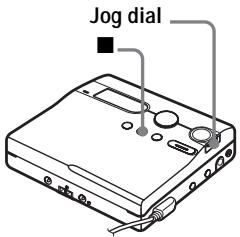
Pour effacer une plage
Notez qu'une fois qu'un enregistrement a été effacé, vous ne pouvez pas le récupérer. Assurez-vous de la plage que vous effacez.
1 Pendant la lecture de la plage que vous voulez effacer, appuyez sur la molette. 2 Tournez la molette jusqu'à ce que "EDIT" apparaisse à l'affichage, puis appuyez sur la molette. 3 Tournez la molette jusqu'à ce que "Erase" apparaisse à l'affichage, puis appuyez sur la molette. 4 Tournez la molette jusqu'à ce que " : Erase" apparaisse à l'affichage, puis appuyez sur la molette. "Erase OK?" et "PushENTER" apparaissent à l'affichage. 5 Appuyez sur la molette pour effacer la plage. La plage est effacée et la plage suivante commence à jouer. Toutes les plages après celle effacée sont automatiquement renumérotées.
Pour effacer une partie d'une plage
Ajoutez des marques de plage au début et à la fin de la partie que vous voulez effacer, puis effacez la partie (page 43).
Pour effacer tout le disque
Vous pouvez effacer rapidement toutes les plages et les données du MD en même temps.
Notez qu'une fois un enregistrement effacé, vous ne pouvez pas le récupérer. Assurez-vous de vérifier le contenu du disque avant de l'effacer.
1 Lisez le disque que vous voulez effacer pour vérifier son contenu. 2 Appuyez sur pour arrêter. 3 Appuyez sur la molette. 4 Tournez la molette jusqu'à ce que "EDIT" apparaisse à l'écran, puis appuyez sur la molette. 5 Tournez la molette jusqu'à ce que "Erase" apparaisse à l'écran, puis appuyez sur la molette. 6 Tournez la molette jusqu'à ce que " : Erase" apparaisse à l'écran, puis appuyez sur la molette. "AllErase?" et "PushENTER" apparaissent à l'écran. 7 Appuyez sur la molette pour effacer tout le disque.
"TOC Edit" apparaît à l'écran, et toutes les plages seront effacées. Lorsque l'effacement est terminé, "BLANKDISC" clignote et "00:00" apparaît à l'écran.
Pour annuler l'effacement
Appuyez sur pendant 2 secondes ou plus.
Pour revenir aux réglages précédents
Appuyez sur ■.
Pour l'utilisation de la télécommande, voir page 67.
Qu'est-ce que la fonction de groupe ?
La fonction de groupe est prévue pour permettre la lecture de disques avec des réglages de groupe. La fonction de groupe est pratique pour la lecture de MD sur lesquels plusieurs albums ou singles CD ont été enregistrés en mode MDLP (LP2/LP4).
Qu'est-ce qu'un disque avec des réglages de groupe ?
L'enregistreur peut utiliser diverses fonctions par unité de groupe ; c'est-à-dire des plages qui ont été enregistrées sur un disque comme faisant partie de groupes séparés, comme indiqué ci-dessous.
Avant de faire des réglages de groupe
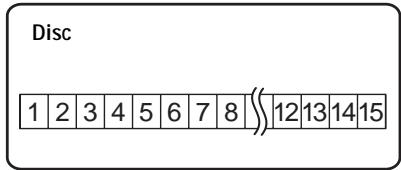

Les pistes 1 à 5 sont assignées au groupe 1. Les pistes 8 à 12 sont assignées au groupe 2. Les pistes 13 à 15 sont assignées au groupe 3. Les pistes 6 à 7 ne sont assignées à aucun groupe.
Après avoir effectué les assignations de groupes
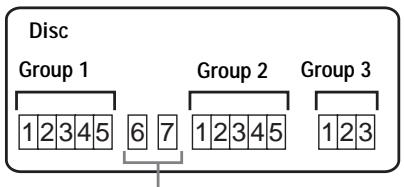
Les pistes qui n'ont pas été assignées à un groupe sont considérées comme faisant partie du "Groupe - -".
Vous pouvez créer un maximum de 99 groupes sur un disque.
Remarque
Il ne sera pas possible de définir un groupe si les pistes, les groupes et le nom du disque sur un disque dépassent le nombre maximal pouvant être saisi.
Utilisation de la fonction de groupe lors de l'enregistrement
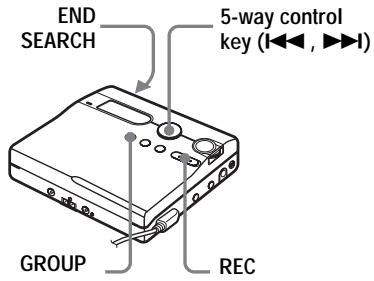
Enregistrement de pistes dans un nouveau groupe
Pendant l'enregistrement, vous pouvez ajouter un nouveau groupe à la fin des pistes actuellement enregistrées sur un disque.
1 Pendant que l'enregistreur est arrêté, appuyez sur END SEARCH. 2 Tout en maintenant GROUP enfoncé, appuyez et faites glisser REC. 3 Lisez le son source.
Un nouveau groupe sera ajouté après le contenu actuel du disque.
Pour arrêter l'enregistrement
Appuyez sur ■.
Le matériel enregistré jusqu'à ce que vous ayez appuyé sur ■ est entré comme un nouveau groupe.
Enregistrement d'une piste dans un groupe existant
Vous pouvez ajouter une piste à un groupe existant.
1 Appuyez sur GROUP et appuyez sur l ou jusqu'à ce que le groupe auquel vous voulez ajouter une piste apparaisse à l'écran. 2 Tout en maintenant GROUP enfoncé, appuyez et faites glisser REC. 3 Jouez le son source.

- Pour ajouter une piste en cours de lecture à un groupe, arrêtez ou mettez en pause la lecture de la piste d'abord, puis effectuez la procédure à partir de l'étape 2.
- Vous pouvez configurer l'enregistreur pour qu'il crée toujours un nouveau groupe sans appuyer sur le bouton GROUP. Voir page 60 pour plus de détails.
Utilisation de la fonction de groupe lors de la lecture
L'enregistreur peut effectuer diverses lectures avec un disque qui a un réglage de groupe.
Cette section explique les opérations effectuées sur la télécommande. Pour plus de détails sur les opérations effectuées sur l'enregistreur, voir page 61.
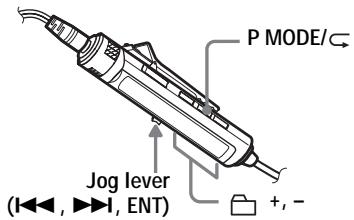
Lecture d'une piste en lecture de groupe
En lecture de groupe, tous les groupes sont lus dans l'ordre, en commençant par le groupe 1, suivi des pistes non assignées ("Groupe --"). La lecture s'arrête après que toutes les pistes ont été lues.
1 Pendant la lecture, appuyez sur P MODE/ 一 jusqu'à ce que " ” apparaisse à l'écran.
Pour repérer le début d'un groupe (Saut de groupe)
1 Pendant la lecture, appuyez sur + ou - . Appuyer sur le bouton permet de repérer la première piste du groupe actuel. Appuyer à nouveau sur le bouton permet de repérer la première piste du groupe précédent.
Sélection du mode de lecture pour la lecture de groupe (Mode de lecture de groupe)
La lecture aléatoire et la lecture programmée peuvent être utilisées pendant le mode de lecture de groupe.
1 Appuyez plusieurs fois sur P MODE/ .
Après une lecture normale, les modes de lecture suivants s'affichent.
| Display | Play mode |
| (Normal Group Play) | All tracks in the groups play back once (starting with the first track in group 1). |
| , SHUF (In-Group Shuffle) | Shuffle play starts with the group that is currently playing, and continues with the succeeding groups. |
| , PGM (Group Program) | The groups are played in the order that you specified. |
Répétition de la lecture pour le mode de lecture du groupe sélectionné (lecture répétée du groupe)
1 Pendant la lecture en mode de lecture du groupe sélectionné, appuyez sur P MODE/⊂ pendant 2 secondes ou plus.
La lecture se répète dans le mode de groupe respectif.
| Display | Play mode |
| ☐ ☐ | Repeat play of tracks within a group. |
| ☐ SHUF ☐ | Repeat shuffle play of tracks within a group. |
| ☐ PGM ☐ | Repeat play for group program. |
Lecture des groupes dans un ordre souhaité (lecture programmée des groupes)
Suivez la procédure expliquée dans « Écoute de plages dans un ordre souhaité (lecture programmée) » (page 34) pour lire les groupes dans un ordre souhaité. Vous pouvez programmer jusqu'à 10 groupes. L'ordre des plages dans les groupes ne peut pas être modifié.
Modification des groupes
Cette section explique les opérations effectuées sur l'enregistreur. Pour plus de détails sur les opérations effectuées avec la télécommande, reportez-vous aux pages indiquées pour chaque opération.
Affectation de plages ou de groupes à un nouveau groupe (réglage de groupe)
Avec cette fonction, vous pouvez affecter des plages ou des groupes existants à un nouveau groupe, et également affecter une plage qui n'appartient actuellement à aucun groupe à un groupe existant.
Vous pouvez créer un maximum de 99 groupes sur un disque.
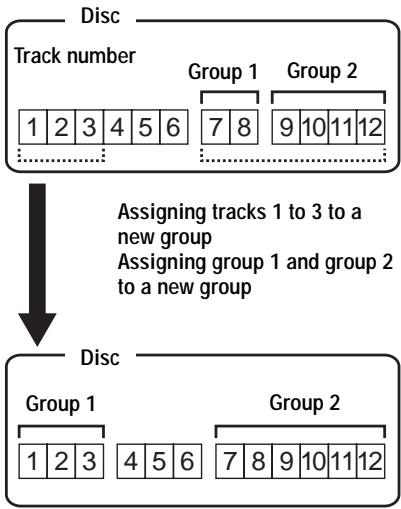
L'enregistrement de plages non consécutives n'est pas possible (par exemple, la plage 3 et les plages 7 et 8 ne peuvent pas être affectées à un nouveau groupe).
Les numéros de plage apparaissent selon leur ordre sur le disque, et non selon leur ordre dans le groupe.
Remarques
- Il n'est pas possible de faire un réglage de groupe si les plages, les groupes et le nom du disque sur un disque contiennent plus que le nombre maximal de caractères pouvant être stockés.
- Les plages ou les groupes doivent être séquentiels. Si les plages ou les groupes souhaités ne sont pas consécutifs, vous devez les déplacer pour les rendre consécutifs avant de pouvoir les assigner ("Déplacement des plages enregistrées (Move)", page 42).
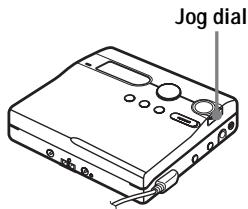
1 Appuyez sur la molette. 2 Tournez la molette jusqu'à ce que "EDIT" apparaisse à l'écran, puis appuyez sur la molette. 3 Tournez la molette jusqu'à ce que "□: Set" apparaisse à l'écran, puis appuyez sur la molette.
Le numéro de la première plage ("STR") apparaît à l'écran.
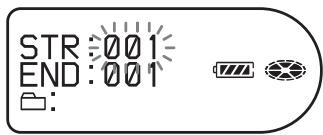
4 Tournez la molette jusqu'à ce que le numéro de la première plage souhaitée apparaisse à l'écran, puis appuyez sur la molette. Cela sélectionne la première plage du nouveau groupe.
5 Tournez la molette jusqu'à ce que le numéro de la dernière plage souhaitée apparaisse à l'écran, puis appuyez sur la molette pour valider la sélection. Cela sélectionne la dernière plage du nouveau groupe et le groupe peut être nommé. 6 Nommez le groupe (voir "Nommage des groupes enregistrés" (page 50)).
Pour annuler la procédure
Appuyez pendant 2 secondes ou plus.
Pour revenir au réglage précédent
Appuyez sur ■.
Remarques
- À l'étape 4, la première plage doit être soit la première plage d'un groupe existant, soit une plage n'appartenant à aucun groupe.
- Lors de la sélection de la dernière plage à l'étape 5, assurez-vous que la plage vient après celle sélectionnée à l'étape 4. La dernière plage doit être soit la dernière plage d'un groupe existant, soit une plage n'appartenant à aucun groupe.
Pour l'utilisation de la télécommande, voir page 67.
Annulation d'un réglage de groupe
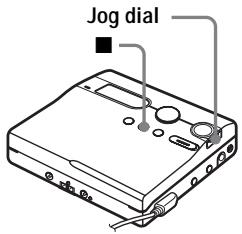
1 Sélectionnez un groupe à annuler et vérifiez son contenu (voir "Lecture d'une plage en lecture de groupe" (page 47)). 2 Appuyez sur 3 Appuyez sur la molette.
4 Tournez la molette jusqu'à ce que "EDIT" s'affiche, puis appuyez sur la molette. 5 Tournez la molette jusqu'à ce que " : Release" s'affiche, puis appuyez sur la molette. "Release?" et "PushENTER" s'affichent. 6 Appuyez sur la molette pour libérer un groupe. Le réglage de groupe du groupe sélectionné est libéré.
Pour annuler l'opération
Appuyez pendant 2 secondes ou plus.
Pour revenir au réglage précédent
Appuyez sur ■.
Pour l'utilisation de la télécommande, voir page 67.
Étiquetage des groupes enregistrés
Vous pouvez étiqueter un groupe pendant que l'enregistreur enregistre ou lit une plage du groupe. Vous pouvez également étiqueter un groupe pendant qu'une plage du groupe est sélectionnée et que l'enregistreur est arrêté.
1 Effectuez la procédure "Étiquetage" (page 40) et sélectionnez " : Name" à l'étape 4, puis effectuez les étapes 5 à 8.
Pour l'utilisation de la télécommande, voir page 66.
Déplacement d'une plage dans un disque avec réglage de groupe
Vous pouvez déplacer une plage d'un groupe vers l'extérieur du groupe ou vers un autre groupe. Vous pouvez également déplacer une plage qui n'appartient pas à un groupe vers un groupe existant.
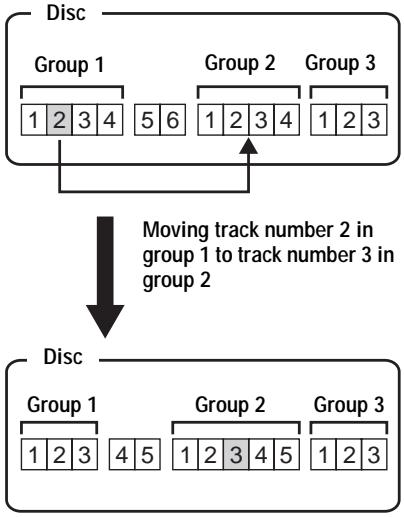
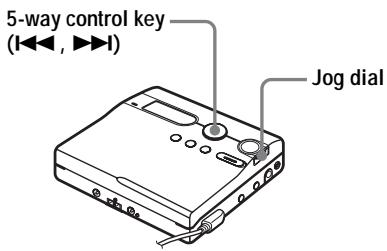
1 Pendant la lecture de la plage à déplacer, appuyez sur la molette.
2 Tournez la molette jusqu'à ce que "EDIT" s'affiche, puis appuyez sur la molette.
L'enregistreur lit la plage sélectionnée en boucle.
3 Tournez la molette jusqu'à ce que « Move » s'affiche, puis appuyez sur la molette. 4 Tournez la molette jusqu'à ce que « Move » s'affiche, puis appuyez sur la molette. 5 Lorsque vous déplacez une plage hors d'un groupe, ignorez cette étape. Lorsque vous déplacez une plage vers un autre groupe, tournez la molette jusqu'à ce que le groupe de destination s'affiche, puis appuyez sur la molette. Si le groupe a été étiqueté, appuyez sur pour afficher le nom du groupe. Appuyez sur pour revenir à l'affichage du numéro de groupe.
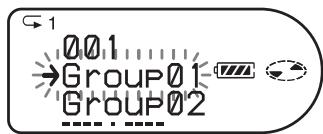
6 Tournez la molette jusqu'à ce que le numéro de la plage de destination (le numéro de plage dans un groupe si la destination est un autre groupe) s'affiche, puis appuyez sur la molette pour valider votre sélection.
Le numéro de plage sélectionné apparaît dans la rangée du milieu de l'affichage. Si la plage a été étiquetée, appuyez pour faire apparaître le nom de la plage à l'écran. Appuyez pour revenir à l'affichage du numéro de plage.
Pour annuler le déplacement
Appuyez pendant 2 secondes ou plus.
Pour revenir au réglage précédent
Appuyez sur ■.
Pour l'utilisation de la télécommande, voir page 66.
Changement de l'ordre d'un groupe sur un disque (Group Move)
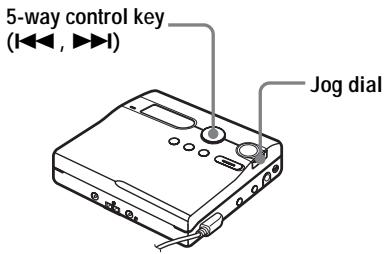
1 Pendant la lecture d'une plage dans un groupe dont vous voulez changer l'ordre, appuyez sur la molette. 2 Tournez la molette jusqu'à ce que « EDIT » s'affiche, puis appuyez sur la molette. 3 Tournez la molette jusqu'à ce que « Move » s'affiche, puis appuyez sur la molette. 4 Tournez la molette jusqu'à ce que « : Move » s'affiche, puis appuyez sur la molette.
Le numéro du groupe auquel appartient la plage en cours de lecture apparaît dans la section du milieu de l'affichage. Si le groupe a été étiqueté, appuyez sur pour afficher le nom du groupe. Appuyez sur pour revenir à l'affichage du numéro de groupe.
Exemple : Déplacement du premier groupe du disque (Group01) à la position entre le deuxième (Group02) et le troisième (Group03) groupe.
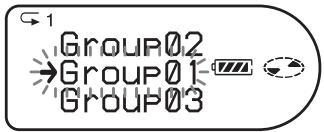
5 Tournez la molette pour sélectionner le point de destination sur le disque, puis appuyez sur la molette pour valider la sélection.
Pour annuler le déplacement
Appuyez pendant 2 secondes ou plus.
Pour revenir au réglage précédent
Appuyez sur ■.
Pour l'utilisation de la télécommande, voir page 66.
Pour effacer un groupe
Vous pouvez effacer des plages dans un groupe sélectionné. Notez qu'une fois un enregistrement effacé, vous ne pouvez pas le récupérer. Assurez-vous de vérifier le contenu du groupe avant de l'effacer.
Remarque
Vous ne pouvez pas effacer les plages extraites de votre ordinateur. Vous ne pouvez pas effacer un groupe s'il contient une plage extraite. Dans ce cas, réintégrez la ou les plages à l'ordinateur.
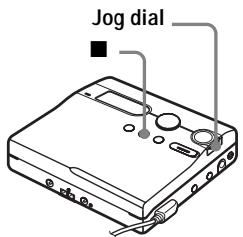
1 Sélectionnez le groupe à effacer et vérifiez son contenu (voir "Pour localiser le début d'un groupe (Group Skip)" (page 47)).
2 Appuyez sur 3 Appuyez sur la molette.
4 Tournez la molette jusqu'à ce que "EDIT" apparaisse à l'écran, puis appuyez sur la molette. 5 Tournez la molette jusqu'à ce que "Erase" apparaisse à l'écran, puis appuyez sur la molette. 6 Tournez la molette jusqu'à ce que "□: Erase" apparaisse à l'écran, puis appuyez sur la molette. Le nom du groupe et "GP Erase?" apparaissent, et "PushENTER" clignote à l'écran. 7 Appuyez sur la molette pour effacer le groupe. Le groupe est effacé.
Pour annuler l'effacement
Appuyez sur pendant 2 secondes ou plus.
Pour revenir au réglage précédent
Appuyez sur ■.
Pour l'utilisation de la télécommande, voir page 67.
Réglages utiles
L'enregistreur dispose de nombreux menus avec des fonctions utiles pour l'enregistrement, la lecture, l'édition, etc. Le tableau suivant montre les éléments de menu que vous pouvez sélectionner. Certains éléments peuvent être réglés à la fois avec l'enregistreur et la télécommande, et d'autres uniquement avec l'un ou l'autre.
| Category | Function | What it does | Operation | Site page |
| Preparation | Clock setting | Sets the date and time. | recorder | page 58 |
| General operations | Beep on/off | Turns the beep sound on or off. | recorder | page 58 |
| remote control | page 58 | |||
| Jog dial | Turning the jog dial changes the operational direction on the display. | recorder | page 59 | |
| Power saving | Maximizes the battery life. | recorder | page 59 | |
| remote control | page 59 | |||
| Recording | Synchro-Recording | Simplifies operations during digital recording. | recorder | page 26 |
| Long-time recording | Selects the recording mode (SP, LP2, LP4, or monaural). | recorder | page 27 | |
| Selecting the microphone sensitivity | Sets the microphone sensitivity to suit the source sound. | recorder | page 29 | |
| Adding track marks (Divide) | Adds track marks automatically at specified intervals. | recorder | page 30 | |
| Adjusting the recording level | Manually adjusts the recording level. | recorder | page 31 | |
| Selecting the record-starting point | Allows you to specify whether material is overwritten or not when recording. | recorder | page 59 | |
| Group recording | Sets the recorder to create a new group with each recording operation. | recorder | page 60 | |
| Playing | Selecting the play mode | Selects the play mode, such as repeat play, program play, etc. | recorder | page 60 |
| remote control | page 32 | |||
| Changing the sound quality | Customizes the surround or equalizer mode settings. | recorder | page 62 | |
| remote control | page 34 | |||
| Changing the playback speed | Varies the playback speed without changing the pitch. | recorder | page 63 | |
| Listening to playback from connected component | Outputs sound from the Ω/ LINE OUT jack when listening to a connected component. | recorder | page 38 | |
| Starting playback quickly | Sets the recorder to start playback or cue to a track quickly. | recorder | page 63 | |
| remote control | page 63 | |||
| Limiting the maximum volume | Sets a limit on the maximum volume to protect your hearing. | recorder | page 64 | |
| remote control | page 64 | |||
| Display | Viewing information | Displays various information such as the remaining time, etc. in the display window. | recorder | pages 25 and 64 |
| remote control | pages 25 and 32 | |||
| Selecting the backlight status | Selects the status of the backlight in the display window on the remote control. | remote control | page 65 | |
| Adjusting the contrast | Adjusts the contrast of the display window on the recorder. | recorder | page 65 | |
| Editing | Labeling (Name) | Labels tracks, groups, or the disc. | recorder | page 39 (track and disc) page 50 (group) |
| remote control | page 40 (track and disc) page 66 (group) | |||
| Moving | Changes the order of tracks or groups. | recorder | page 42 (track) page 51 (group) | |
| remote control | page 66 | |||
| Erasing | Erases tracks, groups, or the entire disc contents. | recorder | page 44 (track and disc) page 52 (group) | |
| remote control | page 67 | |||
| Assigning tracks to groups | Assigns recorded tracks or groups to a new group. | recorder | page 49 | |
| remote control | page 67 | |||
| Releasing a group | Releases group settings. | recorder | page 50 | |
| remote control | page 67 | |||
| Useful functions | Melody Timer | Sets the alarm to go off after a desired time interval. | recorder | page 68 |
| remote control | page 36 | |||
| Personal Disc Memory | Stores the recorder settings. | recorder | page 68 | |
| remote control | page 68 |
Comment utiliser les éléments de menu
Pour régler les éléments de menu, procédez comme suit.
Sur l'enregistreur :
1 Appuyez sur la molette pour entrer dans le menu. 2 Tournez la molette pour sélectionner l'élément. 3 Appuyez sur la molette pour valider la sélection. 4 Répétez les étapes 2 et 3.
Le réglage sera enregistré lorsque vous appuierez sur la molette à la fin.
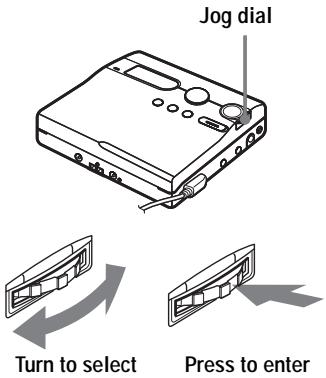
Sur la télécommande :
1 Appuyez sur DISPLAY pendant 2 secondes ou plus pour entrer dans le menu. 2 Faites glisser la molette pour sélectionner l'élément. 3 Appuyez sur la molette pour valider la sélection. 4 Répétez les étapes 2 et 3.
Le réglage sera enregistré lorsque vous appuierez sur la molette à la fin.
Pour revenir au réglage précédent
Appuyez sur ■.
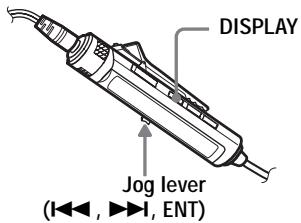
Pour annuler l'opération pendant le réglage
Appuyez pendant 2 secondes ou plus.
Réglage de l'horloge pour horodater l'heure d'enregistrement
Pour horodater l'enregistrement sur le MD, vous devez d'abord régler l'horloge. Une fois l'horloge réglée, l'enregistreur inclura un horodatage à chaque enregistrement. La date d'enregistrement n'est pas enregistrée pour les pistes extraites de votre ordinateur. Cette fonction ne peut être réglée qu'avec l'enregistreur.
1 Lorsque l'enregistreur est arrêté, entrez dans le menu et sélectionnez "OPTION" - "CLOCK SET".
Les chiffres de l'année clignotent.
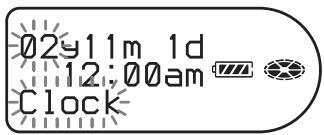
2 Modifiez l'année en cours en tournant la molette, puis appuyez sur la molette. Le chiffre du mois clignote. 3 Répétez l'étape 2 pour saisir le mois, le jour, l'heure et la minute en cours. Lorsque vous appuyez sur la molette pour saisir les minutes, l'horloge démarre.
Si vous faites une erreur lors du réglage de l'horloge
Appuyez pour revenir à l'élément mal saisi, puis saisissez la valeur correcte. Vous pouvez passer une étape en appuyant sur
Pour afficher l'heure actuelle
- Sur l'enregistreur
Lorsque l'enregistreur est arrêté ou en enregistrement, entrez dans le menu et sélectionnez "DISPLAY" - "Clock".
- Sur la télécommande
Lorsque l'enregistreur est arrêté ou en enregistrement, appuyez plusieurs fois sur DISPLAY.
Pour afficher l'heure au format 24 heures
Lors du réglage de l'horloge, appuyez sur T MARK. Pour afficher l'heure au format 12 heures, appuyez à nouveau sur T MARK.
Pour conserver l'heure exacte
Une fois l'horloge réglée, elle conservera l'heure exacte tant que l'enregistreur est connecté à une source d'alimentation, telle qu'une batterie rechargeable chargée, une pile alcaline sèche ou un adaptateur secteur. Cependant, si aucune source d'alimentation n'est connectée, le réglage de l'horloge reviendra au réglage d'usine après environ 3 minutes. Lors du remplacement de la pile alcaline sèche, assurez-vous de le faire dans les 3 minutes.
Notes
- Assurez-vous que l'heure est correctement réglée si vous souhaitez que l'horodatage soit enregistré avec précision pour un enregistrement important.
- Dans des conditions normales, l'horloge peut varier d'environ plus ou moins 3 minutes par mois.
Désactivation du signal sonore
Vous pouvez activer/désactiver le signal sonore sur l'enregistreur et la télécommande.
1 Entrez dans le menu et sélectionnez "OPTION" - "BIP". 2 Sélectionnez "BIP OFF".
Pour activer le signal sonore
Sélectionnez "BIP ON".
Changement du sens de défilement de l'affichage
Lorsque vous tournez la molette jog vers le bas, l'affichage défile vers le bas. C'est le réglage d'usine. Vous pouvez modifier ce réglage pour que le défilement se fasse dans le sens opposé.
Cette fonction ne peut être réglée qu'avec l'enregistreur.
1 Entrez dans le menu et sélectionnez "OPTION" - "MOlette JOG". 2 Sélectionnez "INVERSER".
Pour revenir au réglage normal, sélectionnez "DÉFAUT".
Préserver la batterie (mode d'économie d'énergie)
Cette fonction vous permet de maximiser la durée de vie de la batterie lors de la lecture avec un casque/écouteurs (avec télécommande) ou un câble ligne connecté à la prise /LINE OUT. La consommation d'énergie est réduite en éteignant l'affichage lorsqu'aucune opération n'est effectuée pendant un certain temps.
1 Entrez dans le menu et sélectionnez "OPTION" - "PowerMode". 2 Sélectionnez "PowerSave".
Pour revenir au réglage normal, sélectionnez "NORMAL".
Enregistrement sans écraser les éléments existants
Si vous souhaitez éviter d'enregistrer par-dessus le contenu actuel d'un MD, procédez comme suit. Tout nouveau matériel sera alors enregistré à partir de la fin du contenu actuel. L'enregistreur est réglé en usine pour enregistrer par-dessus le contenu existant. Cette fonction ne peut être réglée qu'avec l'enregistreur.
1 Entrez dans le menu et sélectionnez "OPTION" - "REC-Posi". 2 Sélectionnez "From End".
Pour commencer à enregistrer par-dessus le contenu actuel
Sélectionnez "From Here".

- Pour enregistrer temporairement sans écraser le contenu actuel, appuyez sur END SEARCH avant le début de l'enregistrement. L'enregistrement commencera après la dernière piste, même si "REC-Posi" est réglé sur "From Here" (réglage d'usine). Le temps d'enregistrement restant sur le disque apparaîtra à l'écran lorsque vous appuierez sur END SEARCH.
- Si le réglage d'enregistrement de groupe ("REC") est réglé sur "REC ON", l'enregistreur n'écrasera pas les éléments existants.
Création d'un nouveau groupe lors de l'enregistrement
En faisant glisser REC vers la droite, vous pouvez régler l'enregistreur pour créer automatiquement un nouveau groupe à chaque enregistrement. Ceci est pratique lors de l'enregistrement de plusieurs CD à la suite.
Cette fonction ne peut être réglée qu'avec l'enregistreur.
1 Pendant que l'enregistreur est arrêté, entrez dans le menu et sélectionnez "REC SET" - "□:REC". 2 Sélectionnez "□:RECON".
Pour revenir au réglage normal
Sélectionnez "REC OFF".
Sélection du mode de lecture
1 Entrez dans le menu et sélectionnez « MODE DE LECTURE ». 2 Sélectionnez le mode de lecture souhaité.
Lorsque vous sélectionnez A, B apparaît.
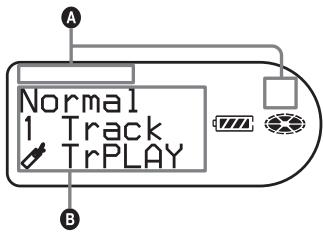
| Indication A/B1) | Play mode |
| — /Normal | All the tracks are played once. |
| 1/1 Track | A single track is played once. |
| Indication A/B1) | Play mode |
| / TrPLAY | Bookmarkited tracks play back in order of their track number. |
| SHUF/Shuffle | All tracks are played in random order |
| PGM/Program | Tracks are played in the order that you specified. |
1) Le mode de lecture par groupe apparaît chaque fois que vous lisez un disque avec des réglages de groupe. Pour plus de détails, voir « Sélection du mode de lecture pour la lecture par groupe (mode de lecture par groupe)/Lecture répétée pour le mode de lecture par groupe sélectionné (lecture répétée par groupe) » (page 61). 3 Sélectionnez « Répéter ON » (lecture répétée d'une piste) ou « Répéter OFF ».
Lorsque vous sélectionnez « Répéter ON », apparaît sur B et la lecture se répète avec le mode de lecture sélectionné à l'étape 2.
Pour plus de détails et l'utilisation de la télécommande, voir page 32.
Écoute de pistes sélectionnées uniquement (lecture avec signet)
Pour marquer les pistes avec un signet
1 Pendant la lecture de la piste que vous souhaitez marquer, appuyez sur pendant 2 secondes ou plus.
La première piste de la lecture avec signet est définie.
2 Répétez l'étape 1 pour marquer les autres pistes.
Pour lire les pistes marquées
1 Sélectionnez « LECTURE PISTE ? » à l'étape 2 de « Sélection du mode de lecture » (page 60). 2 Sélectionnez « Répéter ON » ou « Répéter OFF ».
Pour effacer les signets
Pendant la lecture de la piste dont vous souhaitez effacer le signet, appuyez sur le levier de commande pendant 2 secondes ou plus.
Pour les détails et l'utilisation de la télécommande, voir page 33.
Écoute des plages dans un ordre souhaité (lecture programmée)
1 Sélectionnez « Program » à l'étape 2 de « Sélection du mode de lecture » (page 60). 2 Sélectionnez « RepeatON » ou « RepeatOFF ». 3 Tournez la molette jog pour sélectionner une plage, puis appuyez sur la molette jog. La plage sélectionnée est entrée.
Plage
numéro
Numéro de programme
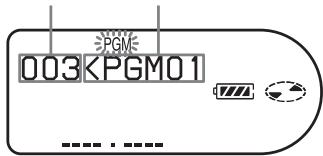
4 Répétez l'étape 3 pour programmer d'autres plages. 5 Appuyez sur la molette jog pendant 2 secondes ou plus.
Le programme est défini et la lecture commence à partir de la première plage.
Pour les détails et l'utilisation de la télécommande, voir page 34.
Lecture d'une plage en lecture groupée
1 Effectuez les étapes 1 et 2 de « Sélection du mode de lecture » (page 60) et sélectionnez « Normal » à l'étape 2.
Pour repérer le début d'un groupe (saut de groupe)
1 Pendant la lecture, appuyez sur GROUP. 2 Appuyez sur ou
Pour les détails et l'utilisation de la télécommande, voir page 47.
Sélection du mode de lecture pour la lecture groupée (mode de lecture groupée)/lecture répétée pour le mode de lecture groupée sélectionné (lecture répétée de groupe)
1. Effectuez les étapes 1 et 2 de « Sélection du mode de lecture » (page 60). Les modes de lecture de groupe suivants apparaissent après les modes de lecture normaux.
| Display | Play mode |
| ☐:Normal (Normal Group Play) | All tracks in the groups play back once (starting with the first track in group 1). |
| ☐: Shuffle (In-Group Shuffle) | Shuffle play starts with the group that is currently playing, and continues with the succeeding groups. |
| ☐:Program (Group Program) | The groups are played in the order that you specified. |
2. Sélectionnez « RepeatON » ou « RepeatOFF ».
Lecture d'un groupe dans un ordre souhaité (lecture programmée de groupe)
Suivez la procédure expliquée dans « Écoute de plages dans un ordre souhaité (lecture programmée) » (page 61) pour lire des groupes dans un ordre souhaité. Vous pouvez programmer jusqu'à 10 groupes. L'ordre des plages à l'intérieur des groupes ne peut pas être modifié.
Pour plus de détails et l'utilisation de la télécommande, voir page 48.
Réglage du son (Virtual-Surround · Égaliseur 6 bandes)
Variation du son virtuel pour créer différentes acoustiques (Virtual-Surround)
1. Entrez dans le menu et sélectionnez « SOUND » - « V-SUR ». 2. Tournez la molette Jog à plusieurs reprises pour sélectionner le mode surround, puis appuyez sur la molette Jog pour valider la sélection.
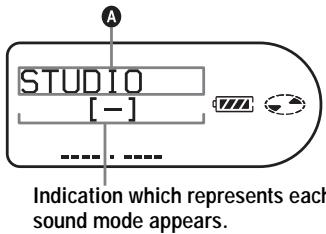
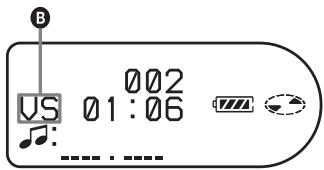
Chaque fois que vous tournez la molette, A change. Lorsque vous appuyez sur la molette Jog, B apparaît.
| A | A |
| STUDIO | VS |
| LIVE | VL |
| CLUB | VC |
| ARENA | VA |
Sélection de la qualité sonore (égaliseur 6 bandes)
1. Pendant la lecture, entrez dans le menu et sélectionnez « SOUND » - « SOUND EQ ».
2. Tournez la molette Jog à plusieurs reprises pour sélectionner le mode sonore, puis appuyez sur la molette Jog pour valider la sélection.
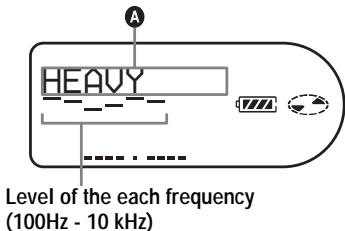
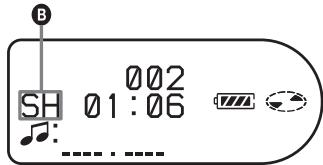
Chaque fois que vous tournez la molette Jog, A change. Lorsque vous appuyez sur la molette Jog, B apparaît.
| A | B |
| HEAVY | SH |
| POPS | SP |
| JAZZ | SJ |
| UNIQUE | SU |
| CUSTOM1 | S1 |
| CUSTOM2 | S2 |
Pour modifier et mémoriser le son
1. Pendant que l'enregistreur est en lecture, entrez dans le menu et sélectionnez « SOUND » - « SOUND EQ » - « CUSTOM1 » ou « CUSTOM2 ». 2. Appuyez sur \(\Vdash\) ou \(\triangleright\) pour sélectionner la fréquence.
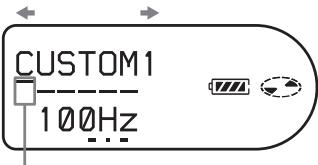
Fréquence (100 Hz) : à partir de la gauche, vous pouvez sélectionner 100 Hz, 250 Hz, 630 Hz, 1,6 kHz, 4 kHz, 10 kHz
3 Appuyez sur VOL + ou - pour régler le niveau.
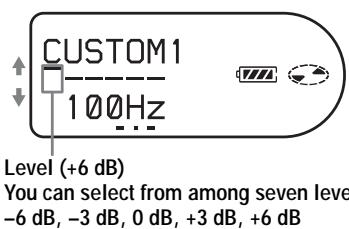
4 Après avoir sélectionné le niveau, appuyez sur la molette pour valider.
Pour annuler le réglage
Sélectionnez "SOUND OFF".
Pour plus de détails et l'utilisation de la télécommande, voir page 34.
Changement de vitesse de lecture (Digital Pitch Control)
1 Pendant la lecture de l'enregistreur, entrez dans le menu et sélectionnez "USEFUL" - "DPC". 2 Tournez la molette pour sélectionner la vitesse de lecture souhaitée, puis appuyez pour valider.
Exemple : lors de la sélection de la vitesse de lecture de +50 % par rapport à la normale.
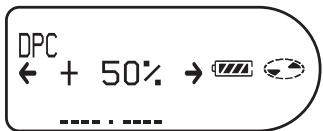
Pour plus de détails et l'utilisation de la télécommande, voir page 36.
Démarrage rapide de la lecture (Quick Mode)
Après avoir appuyé sur le bouton de lecture ou fait une repère sur la piste, la lecture peut démarrer rapidement.
1 Pendant que l'enregistreur est arrêté ou en lecture, entrez dans le menu et sélectionnez "OPTION" - "PowerMode". 2 Sélectionnez "QUICK".
Fenêtre d'affichage sur l'enregistreur
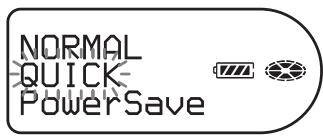
Fenêtre d'affichage sur la télécommande

Pour revenir au réglage normal
Sélectionnez « NORMAL ».
Remarques
- Lorsque le mode d'alimentation est réglé sur « QUICK », l'enregistreur reste sous tension même si rien ne s'affiche à l'écran. Cela réduit l'autonomie de la batterie. Pour cette raison, il est recommandé de charger la batterie quotidiennement.
- Si aucune opération n'est effectuée sur l'enregistreur (y compris l'ouverture ou la fermeture du couvercle) pendant 17 heures, l'enregistreur s'éteint automatiquement. Pour cette raison, la prochaine fois que vous démarrerez la lecture ou effectuerez une autre opération, l'enregistreur ne répondra pas rapidement. L'appareil reviendra ensuite en mode rapide.
Protection de votre ouïe (AVLS)
La fonction AVLS (Automatic Volume Limiter System) maintient le volume maximal à un niveau modéré pour protéger vos oreilles.
1. Entrez dans le menu et sélectionnez « OPTION » - « AVLS ». 2. Sélectionnez « AVLS ON ».
Lorsque vous essayez d'augmenter le volume trop fort, « AVLS » s'affiche à l'écran. Le volume est alors maintenu à un niveau modéré.
Pour annuler l'AVLS
Sélectionnez « AVLS OFF ».
Affichage de diverses informations
1. Pendant la lecture, entrez dans le menu et sélectionnez « DISPLAY ». 2. Sélectionnez l'information souhaitée.
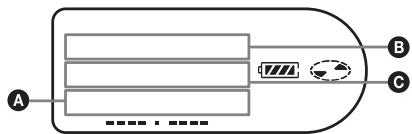
Indication : A (élément sélectionné)/B/C
| (A (selected item) | B | C |
| — (LapTime) | Track number | Elapsed time |
| 1 Remain | Track number | Remaining time of the current track |
| GP Remain | Group name | Remaining time after the current location in the group |
| (A (selected item) | B | C |
| AllRemain | Number of tracks after the current track | Remaining time after the current location in the disc |
| Track name (Title) | Disc name | Group name |
| Sound mode name (Sound) | Indication of the selected sound mode | — |
| RecDate | Recorded date | Recorded time |
Remarque
Selon les paramètres du groupe, les conditions de fonctionnement et les réglages du disque, il se peut que vous ne puissiez pas sélectionner certaines indications ou que celles-ci apparaissent différemment.
Pour plus de détails et pour l'utilisation de la télécommande, voir page 32.
Activation/désactivation du rétroéclairage
Le rétroéclairage de la fenêtre d'affichage de la télécommande peut être réglé pour rester allumé ou éteint.
Cette fonction ne peut être réglée qu'avec la télécommande.
1. Lorsque l'enregistreur est arrêté, entrez dans le menu et sélectionnez "OPTION" - "BACKLIGHT". 2. Sélectionnez l'élément souhaité.
| Display | Setting |
| AUTO | The backlight lights when you operate the recorder or the remote control, and automatically turns off when no operation is made for a few seconds. |
| ON | The backlight lights when the recorder is operating. |
| OFF | The backlight stays off. |
Réglage du contraste de la fenêtre d'affichage (Réglage du contraste)
Vous pouvez régler le contraste de la fenêtre d'affichage de l'enregistreur.
Cette fonction ne peut être réglée qu'avec l'enregistreur.
1. Lorsque l'enregistreur est arrêté, entrez dans le menu et sélectionnez "OPTION" - "CONTRAST". 2. Tournez la molette jog pour régler le contraste, puis appuyez sur la molette jog pour valider la sélection.
Remarque
Vous ne pouvez pas régler le contraste avec la télécommande, ni régler le contraste de l'affichage de la télécommande.
Étiquetage (Nom)
1. Entrez dans le menu et sélectionnez "EDIT" - "Name". 2. Sélectionnez l'une des options suivantes.
| When labeling a track | “ ∥ : Name” |
| When labeling a disc | “ ⋅ : Name” |
3. Tournez la commande de volume à plusieurs reprises pour sélectionner une lettre et appuyez sur le levier jog pour valider.
La lettre sélectionnée cesse de clignoter et le curseur passe à la position de saisie suivante.
Le curseur clignote à la position de saisie suivante.

Les boutons et commandes utilisés pour la saisie des caractères et leurs fonctions sont énumérés ci-dessous.
| Functions | Operation |
| To move the cursor to the left or right. | Slide the jog lever (▶,▶) |
| To change the letter to the one before/next one. | Turn the volume control (VOL+, -). |
| To enter a letter. | Press the jog lever (▶■/ENT). |
| To enter a name. | Press the jog lever for 2 seconds or more (▶■/ENT). |
| To switch between capital letters, small letters, and numbers/ marks. | Press P MODE/<. |
| To insert a blank space. | Press □+ . |
| To delete a letter. | Press □- . |
| To cancel labeling. | Press ■ for 2 seconds or more. |
4 Répétez l'étape 3 et saisissez tous les caractères du nom de l'étiquette. 5 Appuyez sur le levier de jog pendant 2 secondes ou plus.
Pour plus de détails et le fonctionnement de l'enregistreur, voir page 39.
Étiquetage des groupes enregistrés
1 Sélectionnez " : Nom" à l'étape 2 de "Étiquetage (Nom)" (page 65) et effectuez les étapes 3 à 5 pour étiqueter un groupe.
Pour plus de détails et le fonctionnement de l'enregistreur, voir page 50.
Ré-étiquetage
Vous pouvez ré-étiqueter des enregistrements en suivant la procédure de "Étiquetage (Nom)" (page 65).
Pour plus de détails et le fonctionnement de l'enregistreur, voir page 41.
Déplacement de pistes enregistrées
1 Pendant la lecture de la piste à déplacer, entrez dans le menu et sélectionnez "EDIT" - "Move" - " : Move".
Exemple : lors du déplacement de la piste numéro 3, "Tr003" apparaît à l'écran.

2 Faites glisser le levier de jog à plusieurs reprises jusqu'à ce que le numéro de la piste de destination apparaisse à l'écran.
Exemple : lors du passage à la piste numéro 2, « Tr002 » s'affiche à l'écran.

3 Appuyez sur le levier jog pour valider la sélection.
Pour plus de détails et pour l'utilisation de l'enregistreur, voir page 42.
Déplacement d'une piste sur un disque avec réglage de groupe
1 Pendant la lecture de la piste à déplacer, entrez dans le menu et sélectionnez « EDIT » - « Move » - « √ : Move ». 2 Pour déplacer une piste hors d'un groupe, ignorez cette étape. Pour déplacer une piste dans un autre groupe, faites glisser le levier jog jusqu'à ce que le groupe de destination apparaisse à l'écran, puis appuyez sur le levier jog.

3 Faites glisser le levier jog à plusieurs reprises jusqu'à ce que le numéro de la piste de destination (dans un groupe lors du déplacement vers un autre groupe) apparaisse à l'écran, puis appuyez pour valider la sélection.
Pour plus de détails et pour l'utilisation de l'enregistreur, voir page 51.
Changement de l'ordre d'un groupe sur un disque (Group Move)
1 Pendant la lecture d'une piste dans un groupe dont vous souhaitez modifier l'ordre, entrez dans le menu et sélectionnez « EDIT » - « Move » - « □ : Move ». 2 Faites glisser le levier jog à plusieurs reprises pour sélectionner un point de destination sur le disque, puis appuyez pour valider la sélection.
Exemple : lors du déplacement du premier groupe (GP01) vers le deuxième groupe (GP02)

Pour plus de détails et pour l'utilisation de l'enregistreur, voir page 52.
Effacement de pistes, de tout le disque ou de groupes (Erase)
Effacement de pistes
1 Pendant la lecture de la piste à effacer, entrez dans le menu et sélectionnez « EDIT » - « Erase » - « : Erase ». « Erase OK? » et « PushENTER » s'affichent à l'écran. 2 Appuyez sur le levier jog pour effacer une piste.
Pour effacer tout le disque
1 Lisez le disque que vous voulez effacer pour vérifier son contenu. 2 Appuyez sur pour arrêter. 3 Entrez dans le menu et sélectionnez "EDIT" - "Erase" - " : Erase". "AllErase?" et "PushENTER" apparaissent à l'écran. 4 Appuyez sur le levier de jog pour effacer tout le disque.
Pour plus de détails et le fonctionnement de l'enregistreur, voir page 44.
Pour effacer un groupe
1 Sélectionnez un groupe à effacer et vérifiez son contenu (voir "Pour repérer le début d'un groupe (Group Skip)" (page 47)). 2 Appuyez sur pour arrêter. 3 Entrez dans le menu et sélectionnez "EDIT" - "Erase" - "□ : Erase". "GP Erase?" et "PushENTER" apparaissent à l'écran. 4 Appuyez sur le levier de jog pour effacer un groupe.
Pour plus de détails et le fonctionnement de l'enregistreur, voir page 52.
Assigner des plages ou des groupes comme nouveau groupe (Group Setting)
1 Entrez dans le menu et sélectionnez "EDIT" - "□: Set". 2 Faites glisser le levier de jog à plusieurs reprises jusqu'à ce que le numéro de la première plage souhaitée apparaisse à l'écran, puis appuyez sur le levier de jog.
003STR:001
3 Faites glisser le levier de jog à plusieurs reprises jusqu'à ce que le numéro de la dernière plage souhaitée apparaisse à l'écran, puis appuyez sur le levier de jog. 4 Étiquetez un groupe (voir "Étiquetage des groupes enregistrés" (page 66)).
Pour plus de détails et le fonctionnement de l'enregistreur, voir page 49.
Annulation d'un réglage de groupe
1 Sélectionnez un groupe à annuler et vérifiez son contenu (voir "Pour repérer le début d'un groupe (Group Skip)" (page 47)). 2 Appuyez sur 3 Entrez dans le menu et sélectionnez - "EDIT" - "▶: Release". "Release?" et "PushENTER" apparaissent à l'écran. 4 Appuyez sur le levier de jog pour valider la sélection.
Pour plus de détails et le fonctionnement de l'enregistreur, voir page 50.
Utilisation de l'alarme (Melody Timer)
1 Entrez dans le menu et sélectionnez "USEFUL" - "M-TIMER" - "ON".
S'allume à l'écran et le son de l'alarme peut être sélectionné.
2 Tournez la molette Jog à plusieurs reprises pour sélectionner le son de l'alarme, puis appuyez sur la molette Jog.
Voir l'étape 5 de « Réglage de l'alarme (Minuterie mélodique) » (page 37) pour les variétés de sons d'alarme.
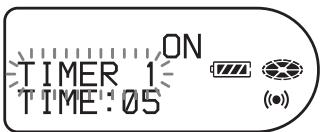
3 Tournez la molette Jog pour sélectionner le temps écoulé.
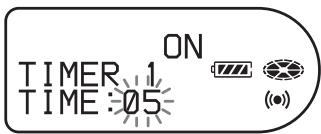
Une rotation de la commande modifie le réglage du temps écoulé (TIME:) de 1 minute, dans une plage de 1 à 99 minutes. Pour changer le temps rapidement, continuez à tourner la molette Jog.
4 Appuyez sur la molette Jog pour valider la sélection.
Le temps restant avant l'alarme est affiché à l'écran lorsque l'enregistreur est arrêté.
Pour annuler le réglage de l'alarme
Sélectionnez « OFF ».
Pour arrêter l'alarme
Appuyez sur n'importe quel bouton.
Pour plus de détails et le fonctionnement de la télécommande, voir page 36.
Mémorisation des réglages pour chaque disque (Mémoire de disque personnel)
L'enregistreur peut mémoriser les différents réglages pour chaque disque, puis les récupérer automatiquement à chaque insertion du disque.
Le réglage suivant peut être mémorisé :
Volume - Mode de lecture - Mode groupe - Lecture programmée Qualité sonore (Virtual Surround/Égaliseur 6 bandes) - Vitesse de lecture (Contrôle numérique de hauteur tonale) - Signet
1 Lorsque l'enregistreur est arrêté, en lecture ou en pause de lecture, entrez dans le menu et sélectionnez "UTILE" - "PERSONNEL".
"Entrée ?" s'affiche à l'écran.
Fenêtre d'affichage sur l'enregistreur
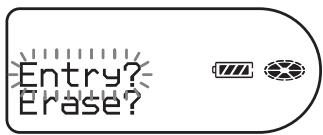
Fenêtre d'affichage sur la télécommande

2 Tournez la molette (sur l'enregistreur) ou le levier (sur la télécommande) pour valider la sélection.
"Entrée OK" s'affiche à l'écran et les réglages du disque sont mémorisés dans l'enregistreur.
Effacement des informations du disque
1 Insérez le disque dont vous souhaitez effacer les informations et vérifiez son contenu. 2 Sélectionnez "Effacer ?" après l'étape 1. "Effacement OK" s'affiche à l'écran et les informations du disque sont effacées.
Remarque
Si vous tentez d'effacer les informations d'un disque qui n'ont jamais été mémorisées, "Aucune entrée !" s'affiche à l'écran pendant quelques secondes.

"PERSONNEL" s'affiche lorsque le disque dont les réglages sont mémorisés est inséré.
Remarques
- Les réglages de 20 disques maximum peuvent être mémorisés. Les réglages mémorisés ensuite remplaceront ceux du disque le moins utilisé parmi les 20.
- Si vous ajoutez des plages ou effectuez une opération d'édition (à l'exception de l'étiquetage) sur un disque dont les réglages ont été mémorisés sur l'enregistreur, le disque ne sera plus reconnu par l'enregistreur et les informations mémorisées deviendront inutiles. Dans ce cas, mémorisez à nouveau les réglages.
Liste des menus
Menu sur l'enregistreur
Les éléments listés sous "Menu 1" sont les éléments sélectionnables qui apparaissent lorsque vous appuyez sur la molette jog, les éléments listés sous "Menu 2" sont les éléments sélectionnables qui apparaissent lorsque vous sélectionnez un élément du Menu 1, et "Menu 3" sont les éléments sélectionnables qui apparaissent lorsque vous sélectionnez un élément du Menu 2.
Remarque
Des indications différentes peuvent s'afficher selon les conditions d'utilisation et les réglages du disque.
| Menu 1 | Menu 2 | Menu 3 |
| EDIT | Name | \(\square : \text{Name} \leftrightarrow \square : \text{Name} \leftrightarrow \square : \text{Name}\) |
| \(□: Set\) | — | |
| \(□: Release\) | — | |
| Move | \(\square : \text{Move} \leftrightarrow \square : \text{Move}\) | |
| Erase | \(\square : \text{Erase} \leftrightarrow \square : \text{Erase} \leftrightarrow \square : \text{Erase}\) | |
| DISPLAY | LapTime | — |
| RecRemain (while recording and stopped)/1 Remain (while playing) | — | |
| GP Remain | — | |
| AllRemain | — | |
| Title | — | |
| Sound | — | |
| Clock(while recording and stopped)/Rec Date (while playing) | — | |
| PLAY MODE | Normal | RepeatOFF (factory setting) \( \longleftrightarrow \) RepeatON |
| 1 Track | ||
| \(\square TrPLAY\) | ||
| Shuffle | ||
| Program | ||
| \(□ : \text{Normal}\) | ||
| \(□ : \text{Shuffle}\) | ||
| \(□ : \text{Program}\) | ||
| SOUND | SOUND OFF | — |
| V-SUR | STUDIO \( \longleftrightarrow \) LIVE \( \longleftrightarrow \) CLUB \( \longleftrightarrow \) ARENA | |
| SOUND EQ | HEAVY \( \longleftrightarrow \) POPS \( \longleftrightarrow \) JAZZ \( \longleftrightarrow \) UNIQUE \( \longleftrightarrow \) CUSTOM1 \( \longleftrightarrow \) CUSTOM2 | |
| USEFUL | PERSONAL | Entry?←→Erase? |
| M-TIMER | OFF (factory setting)←→ON | |
| DPC | — | |
| AUDIO OUT | HeadPhone (factory setting)←→LINE OUT | |
| REC SET | REC MODE | SP (factory setting)←→LP2←→LP4←→MONO |
| RecVolume | Auto REC (factory setting)←→ManualREC | |
| TIME MARK | OFF (factory setting)←→ON | |
| MIC SENS | SENS HIGH (factory setting)←→SENS LOW | |
| ☐:REC | ☐:REC OFF (factory setting)←→☐:REC ON | |
| SYNC REC | SYNC OFF (factory setting)←→SYNC ON | |
| OPTION | AVLS | AVLS OFF (factory setting)←→AVLS ON |
| BEEP | BEEP OFF←→BEEP ON (factory setting) | |
| REC-Posi | From Here (factory setting)←→From End | |
| PowerMode | NORMAL (factory setting)←→QUICK←→PowerSave | |
| CONTRAST | — | |
| JOG DIAL | DEFAULT (factory setting)←→REVERSE | |
| CLOCK SET | — |
Sur la télécommande
| Menu 1 | Menu 2 | Functions |
| EDIT | Name | \(\square : \text{Name} \longleftrightarrow \square : \text{Name} \longleftrightarrow \square : \text{Name}\) |
| \(□ : \text{Set}\) | — | |
| \(□ : \text{Release}\) | — | |
| Move | \(\square : \text{Move} \longleftrightarrow \square : \text{Move}\) | |
| Erase | \(\square : \text{Erase} \longleftrightarrow \square : \text{Erase} \longleftrightarrow \square : \text{Erase}\) | |
| USEFUL | PERSONAL | Entry? \(longleftrightarrow\)Erase? |
| M-TIMER | OFF (factory setting) \(longleftrightarrow\)ON | |
| DPC | — | |
| OPTION | AVLS | AVLS OFF (factory setting) \(longleftrightarrow\)AVLS ON |
| BEEP | BEEP OFF \(longleftrightarrow\)BEEP ON (factory setting) | |
| BACKLIGHT | AUTO (factory setting) \(longleftrightarrow\)ON \(longleftrightarrow\)OFF | |
| PowerMode | NORMAL (factory setting) \(longleftrightarrow\)QUICK \(longleftrightarrow\)PowerSave |
Vous pouvez utiliser l'enregistreur sur secteur ou comme suit.
- une batterie rechargeable à hydrure métallique de nickel NH-14WM
- pile alcaline LR6 (format AA) (utilisée avec le boîtier à piles fourni)
Il est préférable d'utiliser l'enregistreur sur secteur lors d'un enregistrement de longue durée. Lorsque vous alimentez l'enregistreur avec des piles, assurez-vous que la batterie rechargeable est complètement chargée ou que la pile alcaline est neuve pour éviter l'épuisement des piles en cours d'enregistrement.
Autonomie des piles1)
L'autonomie des piles peut être plus courte selon les conditions d'utilisation, la température ambiante ou le type de pile alcaline utilisée.
Lors de l'enregistrement (Unité : heures approx.)(JEITA2)
| Batteries | SP Stereo | LP2 Stereo | LP4 Stereo |
| Nickel metal hydride rechargeable battery3) | 11 | 16 | 20 |
| LR6 (SG) Sony alkaline dry battery4) | 11 | 16 | 21 |
| Nickel metal hydride rechargeable battery3) + One LR6 (SG)4) | 29 | 38 | 50 |
1) Mesuré avec le mode d'économie d'énergie activé (voir "Préserver l'énergie des piles (Mode d'économie d'énergie)" (page 59)). 2) Mesuré conformément à la norme JEITA (Japan Electronics and Information Technology Industries Association). 3) Lors de l'utilisation d'une batterie rechargeable à hydrure métallique de nickel complètement chargée à 100 %.
4) Lors de l'utilisation d'une pile alcaline Sony LR6 (SG) "STAMINA" (fabriquée au Japon).
Durée de lecture (approx. heures) (JEITA)
| Batteries | SP Stereo | LP2 Stereo | LP4 Stereo |
| Nickel metal hydride rechargeable battery | 31 | 38 | 45 |
| LR6 (SG) Sony alkaline dry battery | 47 | 57 | 69 |
| Nickel metal hydride rechargeable battery + One LR6 (SG) | 80 | 95 | 114 |
Quand remplacer les piles
Lorsque la pile sèche ou la batterie rechargeable est faible, un symbole clignotant ou « LOW BATT » apparaît à l'écran. Remplacez la pile sèche ou chargez la batterie rechargeable.
L'indicateur de niveau de batterie est approximatif. Il peut varier plus ou moins selon les conditions d'utilisation ou l'environnement de fonctionnement.
Remarque
Arrêtez l'enregistreur avant de remplacer la pile.
Précautions
Sécurité
N'introduisez aucun objet étranger dans la prise DC IN 3V.
Sources d'alimentation
- Utilisez le courant domestique, une batterie rechargeable nickel-hydrure métallique, une pile LR6 (format AA) ou une batterie de voiture.
- Pour une utilisation à la maison : pour le socle de charge fourni, utilisez l'adaptateur secteur fourni avec cet enregistreur. N'utilisez aucun autre adaptateur secteur car cela pourrait provoquer un dysfonctionnement de l'enregistreur.
Polarité de la fiche
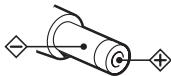
- Branchez l'adaptateur secteur sur une prise secteur facilement accessible. Si vous remarquez une anomalie dans l'adaptateur secteur, débranchez-le immédiatement de la prise secteur.
- L'enregistreur n'est pas déconnecté de la source d'alimentation secteur tant qu'il est branché sur la prise murale, même si l'enregistreur lui-même est éteint.
- Si vous n'avez pas l'intention d'utiliser cet enregistreur pendant une longue période, assurez-vous de débrancher l'alimentation (adaptateur secteur, pile sèche, batterie rechargeable ou cordon de batterie de voiture). Pour retirer l'adaptateur secteur de la prise murale, saisissez la fiche de l'adaptateur elle-même ; ne tirez jamais sur le cordon.
À propos de l'accumulation de chaleur
De la chaleur peut s'accumuler dans l'enregistreur s'il est utilisé pendant une période prolongée. Cela n'est toutefois pas un dysfonctionnement.
À propos de l'installation
- N'utilisez jamais l'enregistreur dans des endroits soumis à des conditions extrêmes de lumière, de température, d'humidité ou de vibrations.
- N'enveloppez jamais l'enregistreur dans un tissu lorsqu'il est utilisé avec l'adaptateur secteur. L'accumulation de chaleur dans l'enregistreur peut provoquer un dysfonctionnement ou des dommages.
À propos des casques/écouteurs
Sécurité routière
N'utilisez pas de casques/écouteurs en conduisant, en faisant du vélo ou en utilisant un véhicule motorisé. Cela peut créer un danger pour la circulation et est illégal dans de nombreux endroits. Il peut également être potentiellement dangereux d'écouter votre enregistreur à volume élevé en marchant, en particulier aux passages pour piétons. Vous devez faire preuve d'une extrême prudence ou cesser l'utilisation dans des situations potentiellement dangereuses.
Prévention des dommages auditifs
Évitez d'utiliser des casques/écouteurs à volume élevé. Les experts en audition déconseillent une écoute continue, forte et prolongée. Si vous ressentez un bourdonnement dans les oreilles, réduisez le volume ou cessez l'utilisation.
Respect des autres
Maintenez le volume à un niveau modéré. Cela vous permettra d'entendre les sons extérieurs et de faire preuve de considération envers les personnes autour de vous.
À propos de la télécommande
La télécommande fournie est conçue pour être utilisée uniquement avec cet enregistreur. L'enregistreur ne peut pas être utilisé avec une télécommande fournie avec un autre appareil.
Lors de la charge
- Le socle de charge de batterie fourni ne peut être utilisé qu'avec cet enregistreur. Aucun autre modèle ne peut être chargé.
- N'utilisez pas le socle de charge de batterie fourni pour charger une autre batterie que celle fournie ou celle désignée pour celui-ci (NH-14WM).
- Assurez-vous d'utiliser l'adaptateur secteur fourni.
- Chargez la batterie rechargeable à une température de +5 °C (+41 °F) à +40 °C (+104 °F).
- Bien que le socle de charge et la batterie puissent devenir chauds pendant la procédure de charge, cela ne présente aucun danger.
- Si vous chargez la batterie pour la première fois ou après une longue période d'inutilisation, la batterie peut ne pas se charger à sa capacité nominale. C'est une caractéristique normale. Après avoir utilisé et rechargé la batterie plusieurs fois, elle retrouvera sa capacité de charge normale.
- Si la capacité de la batterie rechargeable tombe à la moitié de la normale, remplacez-la par une neuve.
Sur le boîtier de piles sèches
Le boîtier de piles sèches fourni est destiné uniquement à cet enregistreur.
Sur la cartouche MiniDisc
- Lorsque vous transportez ou stockez le MiniDisc, conservez-le dans son boîtier.
- N'ouvrez pas le volet.
- Ne placez pas la cartouche là où elle sera exposée à la lumière, à des températures extrêmes, à l'humidité ou à la poussière.
- Fixez l'étiquette MD fournie uniquement dans l'espace prévu à cet effet sur le disque. Ne la collez pas sur une autre surface du disque.
Nettoyage
- Nettoyez le boîtier de l'enregistreur avec un chiffon doux légèrement humidifié avec de l'eau ou une solution détergente douce. N'utilisez pas de tampon abrasif, de poudre à récurer ou de solvant tel que l'alcool ou le benzène, car cela pourrait ternir la finition du boîtier.
- Essuyez la cartouche de disque avec un chiffon sec pour éliminer la saleté.
- La poussière sur la lentille peut empêcher l'appareil de fonctionner correctement. Assurez-vous de fermer le couvercle du compartiment à disque après avoir inséré ou éjecté un MD.
- Pour obtenir la meilleure qualité sonore, utilisez un chiffon sec pour essuyer les fiches des écouteurs/casque ou de la télécommande. Des fiches sales peuvent provoquer une distorsion du son ou des coupures intermittentes.
Piles
Une utilisation incorrecte des piles peut entraîner une fuite de liquide ou l'éclatement de la pile. Pour éviter de tels accidents, respectez les précautions suivantes :
- Installez correctement les pôles + et - des piles.
- N'essayez pas de recharger des piles sèches.
- Lorsque l'enregistreur n'est pas utilisé pendant une longue période, retirez les piles.
- En cas de fuite de pile, essuyez soigneusement et complètement le liquide de la pile du compartiment à piles avant d'insérer de nouvelles piles.
Bruit mécanique
L'enregistreur émet un bruit mécanique pendant son fonctionnement, causé par le système d'économie d'énergie de l'enregistreur, ce n'est pas un problème.
Pour protéger un MD enregistré
Pour protéger un MD contre l'enregistrement, faites glisser la languette sur le côté du MD pour ouvrir l'encoche. Dans cette position, le MD ne peut pas être enregistré. Pour réenregistrer, faites glisser la languette en arrière afin qu'elle soit visible.
Dos du MD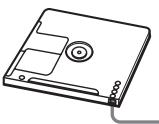
Le contenu enregistré est protégé.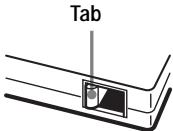
Le contenu enregistré n'est pas protégé.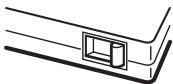
Entretien
Nettoyez périodiquement les bornes avec un coton-tige ou un chiffon doux comme illustré.
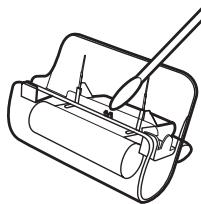
Si vous avez des questions ou des problèmes concernant votre enregistreur, veuillez consulter votre revendeur Sony le plus proche. (Si un problème survient alors que le disque est dans l'enregistreur, nous vous recommandons de laisser le disque dans l'enregistreur lorsque vous consultez votre revendeur Sony afin que la cause du problème puisse être mieux comprise.)
Spécifications
Système de lecture audio
Système audio numérique MiniDisc
Propriétés de la diode laser
Matériau : GaAlAs
Longueur d'onde : λ = 790 nm
Durée d'émission : continue
Puissance de sortie du laser : moins de 44,6 μW
(Cette puissance est la valeur mesurée à une distance de 200 mm de la surface de la lentille sur le bloc de lecture optique avec une ouverture de 7 mm.)
Durée d'enregistrement et de lecture (avec un MDW-80)
160 min maximum en monaural
320 min maximum en stéréo LP4
Vitesses de rotation
350 à 3 600 tr/min (CLV)
Correction d'erreurs
ACIRC (Advanced Cross Interleave Reed
Solomon Code)
Fréquence d'échantillonnage
44,1 kHz
Convertisseur de fréquence d'échantillonnage
Entrée : 32 kHz / 44,1 kHz / 48 kHz
Codage
ATRAC (Adaptive TRansform Acoustic
Coding)
ATRAC3 - LP2/LP4
Modulation system
EFM (Eight to Fourteen Modulation)
Frequency response
20 à 20 000 Hz ± 3 dB
Entrées 1)
MIC : mini-jack stéréo
(niveau d'entrée minimal 0,25 mV)
Entrée ligne :
mini-jack stéréo pour entrée analogique
(niveau d'entrée minimal 49 mV)
mini-jack optique (numérique) pour entrée optique
(numérique)
Sorties
Prise casque / LINE OUT 2) : mini-jack stéréo (prise dédiée à la télécommande) / 194 mV (10 kΩ)
Sortie maximale (DC)2
Casque :
4 mW + 4 mW (16 Ω)
Alimentation
Adaptateur secteur Sony branché sur la prise DC IN 3V :
120 V AC, 60 Hz (modèles pour les États-Unis, le Canada, le Mexique et Taïwan)
230 V AC, 50/60 Hz (modèles pour l'Europe continentale)
240 V AC, 50 Hz (modèle pour l'Australie)
220 V AC, 50 Hz (modèles pour la Chine et l'Argentine)
230 V AC, 50 Hz (modèles pour le Royaume-Uni et Hong Kong)
100 - 240 V AC, 50/60 Hz (autres modèles)
L'enregistreur :
L'enregistreur :
Batterie rechargeable nickel-hydrure métallique NH-14WM, 1,2 V, 1350 mAh (MIN), Ni-MH
Pile alcaline LR6 (format AA)
Station de charge de batterie :
Adaptateur secteur DC 3V
Autonomie de la batterie3)
Voir « Autonomie de la batterie » (page 72)
Dimensions
Environ 78,9 × 72,2 × 15,9 mm (l / h / p)
(3 1/8 × 2 7/8 × 2 1/32 po) (hors parties saillantes et commandes)
Masse
Environ 93 g (3,3 oz)
1) La prise LINE IN (OPT) sert à connecter soit un câble numérique (optique), soit un câble ligne (analogique).
2) La prise /LINE OUT permet de connecter soit un casque/des écouteurs, soit un câble ligne.
3) Mesuré conformément à la norme JEITA.
Licences américaines et étrangères accordées par Dolby Laboratories.
La conception et les spécifications sont sujettes à modification sans préavis.
Accessoires en option
Câble optique
POC-151HG, POC-152HG, POC-MZ1,
POC-MZ2, POC-15B, POC-15AB, POC-DA12SP
Câble de ligne
RK-G129, RK-G136
Microphones stéréo ECM-719, ECM-MS907, ECM-MS957
Casques/écouteurs stéréo de la série MDR*
Enceintes actives de la série SRS
MD enregistrables de la série MDW
Votre revendeur peut ne pas proposer certains des accessoires ci-dessus. Veuillez demander au revendeur des informations détaillées sur les accessoires disponibles dans votre pays.
- Lors de l'utilisation de casques en option, utilisez uniquement des casques/écouteurs avec des fiches mini stéréo. Vous ne pouvez pas utiliser de casques/écouteurs avec des fiches micro.
Dépannage
Si un problème survient pendant le fonctionnement de l'enregistreur, suivez les étapes décrites ci-dessous avant de consulter le revendeur Sony le plus proche. Si des messages apparaissent, il est recommandé de prendre des notes.
1. Vérifiez si le problème est répertorié dans la section « Dépannage » (page 77). Consultez également « Messages » (page 85) pour le problème. 2. Si après l'étape 1 vous ne pouvez toujours pas résoudre le problème, consultez votre revendeur Sony le plus proche.
Pendant la charge
| Symptom | Cause/Solution |
| The rechargeable battery does not start charging. The rechargeable battery cannot be fully charged. | ·The rechargeable battery or the dry battery has been inserted incorrectly or the AC power adaptor has been connected incorrectly. →Insert the battery correctly or connect the AC power adaptor correctly. ·The terminals of the battery charging stand is dirty. →Clean the terminals with a dry cloth. ·Because of the battery's characteristics, the capacity of the rechargeable battery may be smaller than normal when it is used for the first time or after a long period of disuse. →Charge and discharge the battery several times. The normal battery life will be restored. ·The rechargeable battery is drained (nothing appears in the display window). →Charge the rechargeable battery. It takes one minute after placing the recorder on the battery charging stand for an indication to appear and charging to start. If charging does not start even after a minute, replace the recorder on the battery charging stand again. |
| The rechargeable battery has become drained even when the recorder was not used for a while. | ·The quick mode was set to “QUICK”. →If you set the quick mode to “QUICK”, the power stays on inside recorder even when there is no operation, causing the battery life to shorten. If the battery is not fully charged, the rechargeable battery may become drained after a while. If this happens, charge the rechargeable battery again (page 63). |
| Even when fully charged, the life of the battery is only about half what it normally is. | ·The useful life of the rechargeable battery may be ending. →Replace the rechargeable battery with the new one. |
| The battery charging stand and the recorder become hot during the charging procedure. | This is normal and poses no danger. |
Pendant l'enregistrement
| Symptom | Cause/Remedy |
| The recorder overwrites existing materials when record. | ·The record starting-position setting (“REC-Posi”) is set to “From Here”.→Set “REC-Posi” setting to “From End”. |
| The recording starts from the end of the disc even when “REC-Posi” is set to “From Here”. | ·The group recording (“□:REC”) is set to “□:REC ON”.(You cannot overwrite tracks when “□:REC” is set to “□:REC ON”).→Set the group recording setting to “□:REC OFF” (page 60). |
| “REC-Posi” (the record-starting point) cannot be set to “From Here”. | ·The group recording (“□:REC”) is set to “□:REC ON”.→Set the group recording setting to “□:REC OFF” (page 60), and then set “REC-Posi” to “From Here”. |
| Recording cannot be done correctly. | ·Audio sources may not be securely connected.→Disconnect the audio sources once and connect them again (pages 20, 26, 28).·There is no digital signal from the portable CD player.→When recording digitally from a portable CD player, use the AC power adaptor and disable the anti-skip function (such as ESP) on the CD player (page 22).·The analog recording was made using a connecting cord with an attenuator.→Use a connecting cord without an attenuator.·Recording level is too small to record (when adjusting the recording level manually).→Pause the recorder and adjust the recording level (page 31).·The power sources was disconnected or a power outage occurred during recording.→The recording result is not recorded on the disc. Make recording again.·The premastered MD is inserted.→Replace to the recordable MD.·The remaining recordable time on the disc is 12 seconds or less (“DISC FULL” appears).→Replace the disc. |
| Recording stops automatically in the middle of a recording operation. | You tried to overwrite a track which is checked out from the computer.(Tracks that are checked out from the computer cannot be overwritten. The recording stops automatically.)Check the checked-out track back into the computer.Record from the end of the disc. |
| Stereo sound is heard in the headphones/earphones while recording in monaural. | This is normal. During digital recording, the sound will be stereo in the headphones/earphones, even though the recorded sound is monaural. |
| Momentary noise is heard when recording. | Due to the special digital audio compression technology used in LP4 stereo mode, momentary noise may occur on very rare occasions with certain sound sources.Record in SP or LP2 mode. |
| The lid does not open after recording. | The lid does not open until “TOC Edit” disappears in the display. |
| “TR FULL” appears even before the disc has reached the maximum recording time (60, 74, or 80 minutes) and the recording cannot be done. | This is due to the MiniDisc system limitation. When 254 tracks have been recorded on the disc, “TR FULL” appears regardless of the total recorded time. More than 254 tracks cannot be recorded on the disc.To continue recording, erase unnecessary tracks. |
| The remaining recording time does not increase even after erasing numerous short tracks. | This is due to the MiniDisc system limitation. Tracks of under 12 seconds (in SP stereo), 24 seconds (in LP2 stereo mode or monaural), or 48 seconds (in LP4 stereo mode) in length are not counted and so erasing them may not lead to an increase in the recording time. |
| The total recorded time and the remaining time on the disc may not total the maximum recording time (60, 74, or 80 minutes). | This is due to the MiniDisc system limitation. Normally, recording is done in minimum units of approximately 2 seconds (in SP stereo), 4 seconds (in LP2 stereo mode or monaural), or 8 seconds (in LP4 stereo mode). When recording is stopped, the last unit of recording always uses this unit of 2 seconds, 4 seconds, or 8 seconds even if the actual recording is shorter. Likewise, when recording is restarted after the stop, the recorder will automatically insert a blank space amounting to 2 seconds, 4 seconds, or 8 seconds before the next recording.(This is to prevent accidental erasing of a previous track whenever a new recording is started). Therefore, the actual recording time will decrease whenever a recording is stopped by a maximum of 6 seconds, 12 seconds, or 24 seconds. |
| You cannot check out tracks that will fill up the remaining recording time on the disc. | ·The minimum recordable time on a disc is normally 2 seconds in stereo, 4 seconds in LP2 stereo mode, and 8 seconds in LP4 stereo mode. When you check out a track from your computer, the recorder needs a 2-second (or 4- or 8-second) space for a track even if the track is under 2 seconds (or 4 or 8 seconds) in length. Also, the recorder inserts a 2-second (or 4 - or 8-second) space in between tracks during check out so as not to overwrite the previous track by mistake. For this reason, the recorder needs an additional 6 seconds (or 12 or 24 seconds) for each track. This reduces the maximum recording time for each track by 6 seconds (or 12 or 24 seconds) during check out. |
| “TR FULL” appears even before the disc has reached the maximum track number or recording time. | ·This is due to the MiniDisc system limitation. Repeated recording and erasing may cause fragmentation and scattering of data. Although those scattered data can be read, each fragment is counted as a track. In this case, the number of tracks may reach 254 and further recording is not possible. →To continue recording, erase unnecessary tracks. |
Pendant la lecture
| Symptom | Cause/Remedy |
| An MD is not played normally. | ·Repeat play is selected. →Use the jog dial on the recorder or press P MODE/⊂ on the remote control to change back to the normal play (page 32). ·Playback mode is changed. →Use the jog dial on the recorder or press P MODE/⊂ on the remote control to change back to the normal play (page 32). |
| An MD is not played from the first track. | ·Disc playing stopped before it came to the last track. →Press▶on the recorder or press the jog lever (▷■) on the remote control for 2 seconds or more to start playing. ·The disc information has been stored to the Personal Disc Memory. →Erase the disc information from the Personal Disc Memory (page 68). |
| Playback sound skips. | ·The recorder is placed where it receives continuous vibration. →Put the recorder on a stable place. ·A very short track may cause sound to skip. →Try not to create a short track. |
| Sound has a lot of static. | ·Strong magnetism from a television or such device is interfering with operation. →Move the recorder away from the source of strong magnetism. |
| The volume of the recorded track is low. | ·The track was recorded in analog mode (in digital mode, the recording level is automatically set to the same level as that of the sound source). Or you used a connecting cord with an attenuator. →Use a correct connecting cord without an attenuator. ·The recording level was low. →Adjust the recording level manually while recording (page 31). |
| Volume cannot be turned up. | ·AVLS is on. →Release AVLS settings (page 64). ·The “CUSTOM1” or “CUSTOM2” on “SOUND” settings are being applied. →This is not malfunction. When either of these settings is applied, the maximum volume setting will be limited to a certain level (“VOL 24”) to prevent excessive loudness. |
| No sound comes through the headphones/earphones. | ·The headphones/earphones plug is not firmly connected. →Plug in the plug of the headphones/earphones firmly to the remote control. Plug in the plug of the remote control firmly to ∩/LINE OUT. ·The plug is dirty. →Clean the plug. |
| VOL + or -, Virtual Surround, or 6-Band Equalizer does not function or noise is heard. | ·The “AUDIO OUT” parameter is set to “LINE OUT”. →Set to “HeadPhone”. |
| The volume from connected speaker or amplifier is low (when analog connection) | ·The “AUDIO OUT” parameter is set to “HeadPhone”. →Set to “LINE OUT”. |
| The volume from the headphones/earphones is too loud. | ·The “AUDIO OUT” parameter is set to “LINE OUT”. →Set to “HeadPhone”. |
| The recorder skips several tracks ahead or behind whenever you try to fast forward or rewind on the recorder. | ·The group skip is on. →The recorder returns to normal if no operation is made for 5 seconds. |
| The edited tracks may exhibit sound dropout during search operations. | ·This occurs due to the MiniDisc system limitation. The fragmentation of data may cause sound dropout while searching because the tracks are played in higher speed than normal playback. |
| There is no R-channel sound output when playing a track recorded from a cassette deck or through an amplifier, or when listening to sound from a cassette deck or amplifier. | There is no R-channel output if the cassette deck or an amplifier is connected with a monaural cord. →Make sure to use a stereo connecting cord. If, however, the connected equipment is monaural, there will be no R-channel sound output even with a stereo connecting cord. |
Pendant le montage
| Symptom | Cause/Remedy |
| The lid does not open. | ·The power sources have been disconnected during recording or editing, or the battery have been exhausted. →Set the power sources again, or replace the exhausted battery with new ones. |
| Editing cannot be done. | ·The power source has been disconnected or a power outage has occurred during editing. →The editing done to that point is not saved to the disc. Do the editing operation again. |
| You cannot erase a track checked out from your computer. | ·This is due to the MiniDisc system limitations. To erase a track that has been checked out from your computer, check it back in first, and then erase it using the SonicStage software. |
| Track marks cannot be erased. | ·This is due to the MiniDisc system limitations. When the data of a track is fragmented, the track mark of a fragment under 12 seconds long (in SP stereo), 24 seconds long (in LP2 stereo mode or monaural mode), or 48 seconds long (in LP4 stereo mode) cannot be erased. You cannot combine tracks recorded in different recording modes, e.g., a track recorded in stereo and a track recorded in monaural; nor can you combine a track recorded with digital connection and a track recorded with analog connection. |
| The disc cannot edit on other component. | ·The component does not support MDLP. →Edit on other component that support MDLP. |
Pendant l'utilisation de la fonction de groupe
| Symptom | Cause/Remedy |
| The group function does not operate. | While using a disc without group setting, an attempt was made to select some group-related menu. → Use a disc with group setting. |
| A track cannot be recorded to a new group. A new group cannot be created. | This is due to the MiniDisc system limitations. Group information has been written to the area where the disc name is stored. The disc name and track names are recorded in the same area, which can store a maximum of approximately 1,700 characters. If the total number exceeds this amount, a new group cannot be created even though group mode is on. It is also impossible to make group settings at this time. |
Autres
| Symptom | Cause/Remedy |
| The recorder does not work or works poorly. | ·The rechargeable battery is not charged. →Charge the rechargeable battery. ·The volume is low. →Turn up the volume. ·No disc is inserted. →Insert a recorded disc. ·The HOLD function is turned on (“HOLD” appears in the display when you press an operation button on the recorder). →On the recorder, disable HOLD by sliding the HOLD switch to the opposite direction of the arrow (pages 12, 17). ·The lid is not firmly closed. →Close the lid until it clicks. Then slide OPEN to open the lid. ·Moisture has condensed inside the recorder. →Take the MD out and leave the recorder in a warm place for several hours until the moisture evaporates. ·The AC power adaptor is not firmly connected. →Connect the AC power adaptor firmly to the DC IN 3V jack on the recorder or the battery charging stand and to the house current. ·The rechargeable battery or dry battery is weak (“LOW BATT” flashes or nothing appears). →Charge the rechargeable battery or replace the dry battery with a new one (page 16), or use the supplied AC power adaptor. ·The dry battery have been inserted incorrectly. →Insert the battery correctly (page 17). |
| The recorder does not work or works poorly. | ·The disc is damaged or does not contain proper recording or editing data. →Reinsert the disc. Rerecord the disc. If the error message still appears, replace it with another disc. ·There is an internal malfunction in the system. →Remove the dedicated USB cable from the recorder, restart your computer, and then connect the cable to the recorder again. ·While operating, the recorder received a mechanical shock, too much static, abnormal power voltage caused by lightning, etc. →Restart the operation as follows. 1 Disconnect all the power sources. 2 Leave the recorder for about 30 seconds. 3 Connect the power source. |
| The clock does not work correctly, the clock does not appear, or time and date stamping did not occur when recording. | ·The recorder was disconnected from the power source for 3 minutes or more, causing the clock to return to its factory setting. →Charge the rechargeable battery, and then set the clock again. ·The clock is not set. →Set the clock (page 58). ·Time and date will not be stamped on tracks which are checked out from a computer. |
| During playback, the display on the remote control does not turn on. | ·Power save mode is activated. →In power save mode, the display on the remote control turns on whenever the remote control is operated, but not when the controls on the recorder are operated. (The exception is when the GROUP button on the recorder is pressed.) |
| The display window is not normal. | ·The recorder was disconnected from the power source. →Let the recorder sit for a while, or disconnect the power source, reconnect it, and then press any of the operation buttons. |
| When using with the AC power adaptor, the display window of the recorder will remain faintly lit for some time even after the recorder is stopped. | ·This is due to the MiniDisc system limitation. The recorder turns off 3 minutes after the recorder has stopped in order to allow the charging time on the dedicated USB cradle to be calculated. |
| The playing time of a checked-out track is different from the time that appears on your computer monitor. | This is due to a calculation discrepancy between the recorder and the computer. |
Messages
Si les messages d'erreur suivants clignotent dans la fenêtre d'affichage, consultez le tableau ci-dessous.
| Error message | Meaning/Remedy |
| ✔FULL | • You tried to set a 21st bookmark. →You can set only up to 20 bookmarks. Keep the number of bookmarks within 20. |
| AVLS | • AVLS is set to “AVLS ON” and so the volume cannot rise higher. →Set AVLS to “AVLS OFF” (page 64). |
| BLANKDISC | • An MD with no recording on it is inserted. |
| BUSY | • You tried to operate the recorder while it was accessing the recorded data. →Wait until the message goes out (in rare cases, it may take a few minutes). |
| CannotCHG | • You tried to charge the battery at a place with a temperature outside the specified range for the recorder. →Charge the battery at a temperature of +5°C (+41°F) to +40°C (+104°F). |
| Charging | • The rechargeable battery is being charged. |
| DISC FULL | • The remaining recording time on the disc is 12 seconds (SP stereo), 24 seconds (LP2 stereo or monaural), 36 seconds (LP4 stereo), or less. →Replace the disc. |
| ERROR | • There is an internal malfunction in the system. →Restart the operation by doing steps 1 to 3 on page 84. If the message appears again, please consult your nearest Sony dealer. |
| GroupFULL | • You tried to create a 100th group. →You can create only up to 99 groups on a disc. Keep the group number within 99. |
| Hi DC in | • Voltage of the power supply is too high (The supplied AC power adaptor or the recommended car battery cord is not used). →Use the supplied AC power adaptor or the recommended car battery cord. |
| HOLD | • The recorder is locked. →Slide HOLD against the arrow to unlock the recorder (page 17). |
| LINE OUT | • You pressed VOL+, – while the “AUDIO OUT” parameter was set to “LINE OUT”. →Use the jog dial to set the “AUDIO OUT” parameter to “HeadPhone”. |
| LOW BATT | ·Batteries are weak. →Charge the rechargeable battery or replace the dry battery (page 16). |
| MEM OVER | ·You tried to record with the recorder placed where it receives continuous vibration. →Put the recorder on a stable place, and start recording again. |
| MENU | ·You pressed a key on the remote control while selecting a menu on the recorder. ·You pressed a key on the recorder while selecting a menu on the remote control. |
| NAME FULL | ·You tried to enter more than 200 letters to label a single track, group, or disc. ·You tried to enter a total of more than approximately 1,700 letters for track or disc names. |
| NO COPY | ·You tried to make a copy from a disc that is protected by the Serial Copy Management System. You cannot make copies from a digitally connected source which was itself recorded using digital connection. →Use analog connection instead (page 28). |
| NO DISC | ·You tried to play or record with no disc in the recorder. →Insert an MD. |
| NO EDIT | ·You selected “☐: Erase” with a disc without group setting. →You cannot erase groups with a disc with no groups. ·You selected, “☐: Set”, “☐: Release”, “Move”, or “Erase” while recording. ·You tried to erase the track mark at the beginning of the first track or group. ·You tried to erase a track mark to combine tracks the recorder cannot combine (a track recorded in stereo and in mono, for example). ·You tried to overwrite a track marks. |
| No Entry! | ·You tried to erase a setting in the Personal Disc Memory on a disc that contains no settings in the Personal Disc Memory (page 68). |
| No MARK | ·You selected bookmark play without setting bookmarks. →Set bookmarks (page 33). |
| NO SET | You tried to set Digital Pitch Control while the “AUDIO OUT” parameter was set to “LINE OUT”.→ Use the jog dial to set the “AUDIO OUT” parameter to “HeadPhone”.You tried to make the following settings while recording. — Personal Disc Memory — Melody Timer — Digital Pitch Control — Recording mode — Recording level — Selection of “☐: REC” in menu — Selection of “REC-Posi” during recording to a group. |
| NoOPERATE | You pressed ☑ + or - while programming a track using the remote control.You tried to make the Auto Time Mark setting while recording through digital connection.You tried to press ☑ or T MARK during synchro-recording. |
| NO SIGNAL | The recorder could not detect digital input signals.→ Make sure that the source is connected firmly (page 20). |
| P/B ONLY | You tried to record or edit on a pre mastered MD (P/B stands for “playback”).→ Insert a recordable MD. |
| PROTECTED | You tried to record or edit on a MD with the tab in the record-protect position.→ Slide the tab back (page 74). |
| Push STOP | You tried to open the lid while the recorder was storing disc information.→ Open the lid only after pressing ☐ and “TOC Edit” has disappeared from the display. |
| READ ERR | The recorder cannot read the disc information correctly.→ Reinsert the disc. |
| REC ERR | Recording was not correctly done.→ Place the recorder at a place with no vibrations and record again.The disc is soiled with an oil film or finger prints, is scratched, or is not a standard disc.→ Try recording again with another disc. |
| Rehearsal | You tried to operate a button and or a lever (other than the control) on the remote control while the recorder is performing rehearsal play during a track division operation. |
| SEL Group | You selected “□: Name”, “□: Move”, or “□: Erase” while the recorder is stopped or while playing a track that does not belong to a group. → Select a track within a group you want to edit, and then do the editing operation again. |
| SEL Track | You selected “□: Name”, “□: Move”, or “□: Erase” after playback has already finished or after END SEARCH was pressed, and the recorder has stopped. → Do the editing operation again after selecting the desired track first. |
| SLOW CHG | You tried to charge at a place where the temperature is too low. → Charge the battery at a temperature of +5°C (+41°F) to +40°C (+104°F). |
| TEMP OVER | Heat has built up in the recorder. → Let the recorder cool down. |
| TOC Edit | The MD player is recording information (track start and end position) from the memory to the disk. → Wait until this process is completed. Do not expose the player to physical shock, nor disrupt power supply. |
| TOC ERR | The recorder cannot read the disc information correctly. → Insert another disc. → If it is no problem to erase the entire disc, do so (page 44). |
| TR FULL | Track number 254 has been reached. → Erase unnecessary tracks (page 44). |
| TrPROTECT | You tried to record or edit a track that is protected from erasing. → Record or edit on other tracks. → You tried to edit a track that has been checked out from a computer. → Check the track back in to the computer and then edit. |
Explications
Différence entre les entrées numériques (optiques) et analogiques (lignes)
La prise d'entrée de cet enregistreur fonctionne à la fois comme prise d'entrée numérique et analogique. Connectez l'enregistreur à un lecteur CD ou à un magnétophone à cassettes en utilisant soit l'entrée numérique (optique), soit l'entrée analogique (ligne). Pour enregistrer, voir « Enregistrement immédiat d'un MD ! » (page 19) pour enregistrer en utilisant l'entrée numérique (optique), et « Enregistrement à partir d'un téléviseur ou d'une radio (enregistrement analogique) » (page 28) pour enregistrer en utilisant l'entrée analogique (ligne).
| Difference | Digital (optical) input | Analog (line) input |
| Connectable source | Equipment with an digital (optical) output jack (CD player, DVD player, etc.) | Equipment with an analog (line) output jack (Casette deck, radio, record player, etc.) |
| Usable cord | Optical cable (with an optical or an optical-mini plug) (page 20) | Line cable (with 2 phono plugs or a stereo-mini plug) (page 28) |
| Signal from the source | Digital | Analog Even when a digital source (such as a CD) is connected, the signal sent to the recorder is analog. |
| Track marks¹) | Marked (copied) automatically • at the same positions as the source (when the sound source is a CD or an MD). • after more than 2 seconds of no sound (page 90) or low-level segment (with a sound source other than a CD or an MD). • when the recorder is paused (3 seconds of no sound is encountered while synchro-recording) | Marked automatically • after more than 2 seconds of no sound (page 90) or low-level segment. • when the recorder is paused while recording. |
| Recorded sound level | Same as the source. Can also be adjusted manually (Digital REC level control) (“Adjusting the recording level manually”, page 31). | Adjusted automatically. Can also be adjusted manually (“Adjusting the recording level manually”, page 31). |
1) Vous pouvez effacer les marques inutiles après l'enregistrement. (« Combinaison de plages (Combine) », page 44).
Remarque
Les marques de plage peuvent être copiées incorrectement :
- lors de l'enregistrement à partir de certains lecteurs CD ou lecteurs multi-disques via l'entrée numérique (optique).
- lorsque la source est en mode de lecture aléatoire ou programmée pendant l'enregistrement via l'entrée numérique (optique). Dans ce cas, lisez la source en mode de lecture normale.
- lorsque des programmes avec un son diffusé numériquement (par exemple, la télévision numérique) sont enregistrés via l'entrée numérique (optique).
La signification de « aucun son »
« Aucun son » décrit une condition de l'enregistreur dans laquelle le niveau d'entrée est d'environ 4,8 mV lors d'une entrée analogique ou inférieur à -89 dB lors d'une entrée optique (numérique) (avec 0 dB comme bit plein (le niveau d'enregistrement maximal pour un MiniDisc)).
Remarque sur l'enregistrement numérique
Cet enregistreur utilise le système de gestion de copie en série, qui ne permet de faire que des copies numériques de première génération à partir de logiciels pré-masterisés. Vous ne pouvez faire des copies d'un MD enregistré à la maison qu'en utilisant les connexions analogiques (sortie ligne).
Logiciels pré-masterisés tels que les CD ou les MD.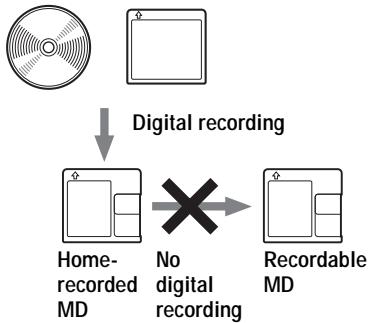
Microphone, platine disque, tuner, etc. (avec prises de sortie analogique).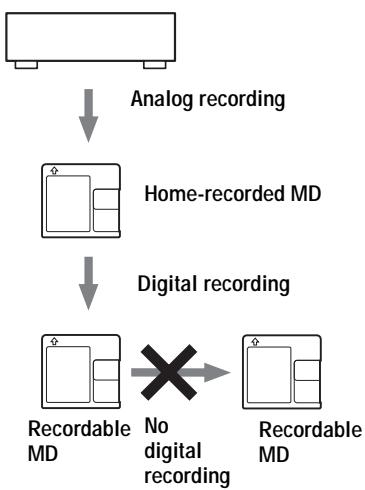
Restrictions sur l'édition de plages extraites de votre ordinateur
Cet appareil a été conçu pour que les fonctions d'édition (c'est-à-dire l'effacement de plages, l'ajout de marques de plage et l'effacement de marques de plage) ne fonctionnent pas pour les plages qui ont été extraites de votre ordinateur. Cela permet d'éviter la perte de l'autorisation de réintégration des plages extraites. Pour modifier ces plages, réintégrez-les d'abord dans l'ordinateur, puis modifiez-les sur l'ordinateur.
À propos du DSP TYPE-S pour ATRAC/ATRAC3
Cet enregistreur prend en charge DSP TYPE-S, une spécification pour les platines MiniDisc Sony haut de gamme équipées de processeurs de signal numérique (DSP). Cette spécification permet à l'enregistreur de produire un son de haute qualité à partir de plages enregistrées en mode MDLP. Comme il conserve la prise en charge de DSP TYPE-R, l'enregistreur produit des résultats supérieurs lors de l'enregistrement ou de la lecture en mode SP (stéréo normale).
Suppression des sauts de son (G-PROTECTION)
La fonction G-PROTECTION a été développée pour offrir un niveau de résistance aux chocs supérieur à celui des lecteurs existants.
Enregistrement de données audio sur votre ordinateur
Vous pouvez enregistrer des données audio sur votre ordinateur à partir de sources telles que les CD audio et Internet (page 100).
CD audio
Internet
Sur l'ordinateur
Écoute
Vous pouvez écouter un CD audio dans le lecteur de CD-ROM de votre ordinateur, ou des données audio sur le disque dur (page 107).

Qu'est-ce qu'un Net MD ?
Net MD est une norme qui permet le transfert de données audio d'un ordinateur vers un appareil MiniDisc. Pour utiliser ce Net MD avec votre ordinateur, vous avez besoin d'un logiciel appelé "SonicStage".
Le logiciel SonicStage fournit une base de données pour gérer les données audio sur l'ordinateur et des fonctions pour lire les données audio dans différents modes de lecture, éditer les données et transférer les résultats vers d'autres appareils et matériels connectés à l'ordinateur. C'est un logiciel intégré avec une variété de fonctions pour profiter de la musique.
Transfert de données audio vers le Net MD
Vous pouvez transférer des données audio stockées sur votre ordinateur vers un MD (page 104).
Édition
Vous pouvez facilement éditer des données audio ou ajouter des étiquettes à partir du clavier (page 103).
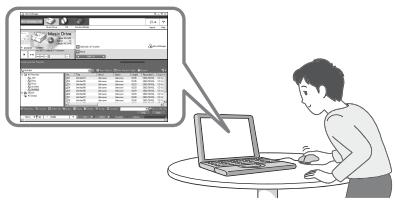
Vers un Net MD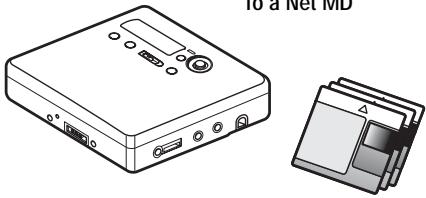
Création d'une bibliothèque musicale
Vous pouvez créer une bibliothèque musicale de vos chansons préférées sur votre ordinateur.
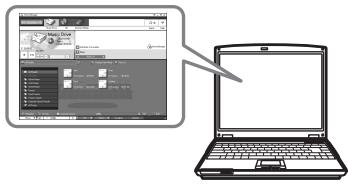
Flux de fonctionnement de base avec le Net MD
Voici les étapes de base que vous suivrez après l'achat de votre enregistreur. Grâce à ces étapes, vous préparerez et configurerez votre ordinateur pour utiliser votre enregistreur en tant que Net MD. Suivez les étapes ci-dessous et reportez-vous aux pages indiquées pour plus de détails.
1 Fournir l'environnement système requis. (page 95) 2 Installer le logiciel sur votre ordinateur. (page 96) 3 Connecter le Net MD à votre ordinateur. (page 99) 4 Stocker les données audio sur votre ordinateur.
Dans ce manuel, l'enregistrement à partir d'un CD audio est expliqué.
(page 100)
5 Transférer les données audio de votre ordinateur vers un MD (Check-out).
(page 104)
6 Écouter un MD.
Vous pouvez écouter les données audio qui ont été extraites de votre ordinateur vers votre Net MD.
(page 107)
Fournir l'environnement système requis
Configuration système requise
Le matériel et les logiciels suivants sont nécessaires pour utiliser le logiciel SonicStage pour le Net MD.
| Computer | IBM PC/AT or Compatible |
| • CPU: Pentium II 400 MHz or higher (Pentium III 450 MHz or higher is recommended.)• Hard disk drive space1): 120 MB or more• RAM: 64 MB or higher (128 MB or higher is recommended) | |
| Others• CD-ROM drive (capable of digital playback by WDM)• Sound Board• USB port (supports USB 2.0 Full Speed (previously USB 1.1)) | |
| Operating System | Factory installed:Windows XP Home Edition/Windows XP Professional/Windows Millennium Edition/Windows 2000 Professional/Windows 98 Second Edition |
| Display | High Color (16bit) or greater, 800 × 480 dots or more (800 × 600 dots or more is recommended) |
| Others | • Internet access: for Web registration and EMD services• Windows Media Player (version 7.0 or higher) installed for playing WMA files |
1) Voir page 113 pour plus de détails.
Ce logiciel n'est pas pris en charge par les environnements suivants :
Macintosh - Windows XP versions autres que Home Edition ou Professional - Windows 2000 versions autres que Professional - Windows 98 versions autres que Second Edition - Windows NT - Windows 95 - PC assemblés personnellement ou systèmes d'exploitation - Environnement qui est une mise à niveau du système d'exploitation installé par le fabricant d'origine - Environnement multi-démarrage - Environnement multi-écran
Remarques
- Nous ne garantissons pas un fonctionnement sans problème sur tous les ordinateurs qui satisfont aux exigences système.
- Nous ne garantissons pas le bon fonctionnement de la fonction de suspension, de veille ou d'hibernation du système sur tous les ordinateurs.
Installation du logiciel sur votre ordinateur
Cette section explique l'installation du logiciel SonicStage Ver.1.5 fourni avec votre Net MD.
Avant d'installer le logiciel
1 Assurez-vous de noter les points suivants avant d'installer le logiciel.

Ne connectez pas le câble USB dédié avant l'installation !
Le logiciel SonicStage peut ne pas se charger ou fonctionner correctement si le câble USB dédié est connecté à votre ordinateur pendant l'installation.

Fermez toutes les autres applications Windows avant de commencer l'installation !
Assurez-vous de fermer tout logiciel antivirus, car ces logiciels demandent généralement de grandes quantités de ressources système.
2 Selon le système d'exploitation ou le logiciel déjà installé sur votre ordinateur, reportez-vous aux pages de référence avant d'installer le logiciel.
| Windows XP → page 110 | ·To install this software, you must log on with a user name with “Computer Administrator”. ·If you perform the “System Restore” function in the Windows “System Tools” menu, the tracks managed by SonicStage may become corrupted and rendered unplayable. |
| Windows Millennium Edition → page 111 | ·If you perform the “System Restore” function of the Windows “System Tools” menu, the tracks managed by SonicStage may become corrupted and rendered unplayable. |
| Windows 2000 → page 111 | ·You must log on as “Administrator” before installing the software. |
| OpenMG Jukebox, SonicStage, or SonicStage Premium → page 112 | ·Depending on the version of your software, the existing software may be overwritten by the new version or it may co-exist with SonicStage Ver.1.5. As the installation process will depend on the version, see the reference page for details. |
Installation de SonicStage Ver.1.5
1 Allumez votre ordinateur et démarrez Windows. 2 Insérez le CD-ROM d'installation de SonicStage dans le lecteur de CD-ROM de votre ordinateur.
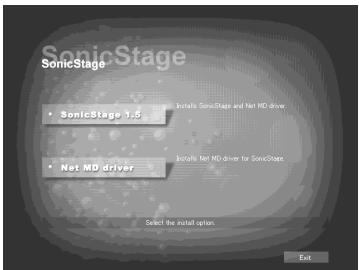
Le programme d'installation démarre automatiquement et la fenêtre d'installation de SonicStage Ver.1.5 apparaît.
3 Cliquez pour sélectionner [SonicStage 1.5].
Pour utiliser ce logiciel avec le Net MD, vous devez installer SonicStage Ver.1.5 et le pilote Net MD.
Cliquez sur [SonicStage 1.5]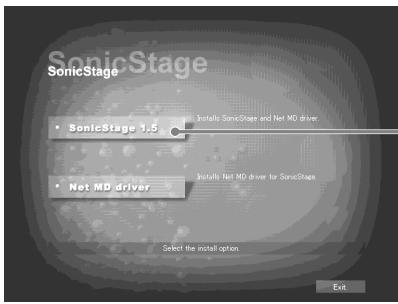
- Lors de la première installation de SonicStage
- Lorsque SonicStage, SonicStage Premium ou OpenMG Jukebox est déjà installé sur l'ordinateur
4 Suivez les instructions affichées.
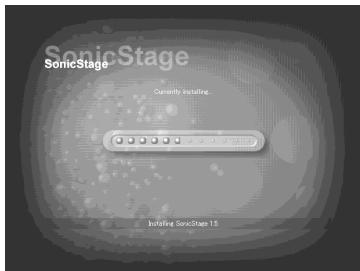
Lisez attentivement les instructions.
L'installation peut prendre de 20 à 30 minutes, selon votre environnement système (page 119).
5 Une fois l'installation terminée, cliquez sur [Redémarrer] pour redémarrer l'ordinateur.
![SONY MZ-N910 - Une fois l'installation terminée, cliquez sur [Redémarrer] pour redémarrer l'ordinateur. - 1](/content/2019/09/46985/images/1d044bb4b265590c2e7ef1df6d986e638d22b419339df322f47eb52aad30c4da.jpg)
Assurez-vous de redémarrer votre ordinateur uniquement après la fin de l'installation.
L'installation a-t-elle réussi ?
Si un problème survient pendant l'installation, consultez la section « Dépannage » (page 116).
Notes
- Ne supprimez, ne déplacez ni ne modifiez aucun des dossiers installés à l'aide de l'Explorateur ou de toute autre application. Cela pourrait rendre la base de données SonicStage instable ou corrompue.
- Pendant que l'installation est encore en cours, n'interrompez pas l'opération et ne retirez pas le CD-ROM du lecteur de CD-ROM. Cela pourrait rendre impossible l'installation du logiciel par la suite.
Connexion du Net MD à votre ordinateur
Une fois l'installation du logiciel terminée, connectez le Net MD à votre ordinateur.
Reportez-vous également au mode d'emploi du Net MD.
1 Insérez un disque enregistrable dans le Net MD. 2 Connectez la source d'alimentation et le câble USB dédié au Net MD et à l'ordinateur.
Adaptateur secteur * Si une station d'accueil est fournie avec votre Net MD, connectez le câble USB dédié à la station d'accueil USB et placez le Net MD sur la station d'accueil USB.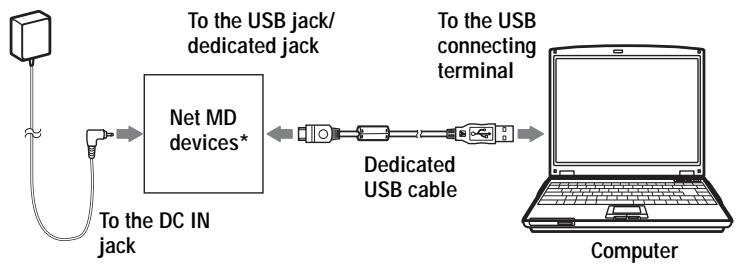
3 Vérifiez les connexions.
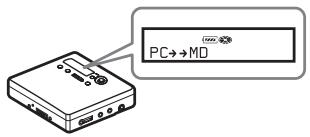
Lorsque les connexions sont correctement établies, « PC → MD »* apparaît sur l'écran du Net MD.
*Selon l'appareil, « Net MD » peut être affiché.
Notes
- Lorsque vous utilisez le Net MD connecté à votre ordinateur, il est recommandé de l'alimenter à partir d'une prise secteur. Si vous utilisez une pile pour alimenter le Net MD, assurez-vous d'utiliser une pile sèche neuve ou une batterie rechargeable complètement chargée. Nous ne garantissons pas les résultats en cas de mauvais fonctionnement, d'échec de l'extraction ou de destruction des données audio causés par une puissance de pile insuffisante.
- Lorsque vous utilisez le Net MD avec la station d'accueil, placez la station d'accueil sur une surface stable afin que le câble USB dédié ne se détache pas.
Stockage des données audio sur votre ordinateur
Cette section explique comment enregistrer et stocker des données audio d'un CD audio sur le disque dur de votre ordinateur.
La procédure décrite dans cette section est utilisée pour enregistrer toutes les pistes d'un CD audio. Pour enregistrer uniquement certaines pistes d'un CD ou d'autres sources sonores, consultez l'aide en ligne pour plus de détails (page 108).
Remarque
Le système peut mal fonctionner si votre ordinateur passe en mode veille ou hibernation pendant que le logiciel lit, enregistre ou se connecte à un périphérique externe ou à un support* tel qu'un Net MD. Assurez-vous de désactiver tout changement de mode veille ou hibernation. Voir page 113 pour plus de détails.
- Pour ce logiciel, le mot « MD » désigne la fente MD intégrée à l'ordinateur, et « Périphérique/Support » désigne un Net MD connecté en externe via un câble USB.
Démarrage de SonicStage
Effectuez l'une des opérations suivantes :
- Double-cliquez sur SonicStage (icône [SonicStage]) sur l'ordinateur.
- Sélectionnez [Démarrer] - [Programmes]* - [SonicStage] - [SonicStage].
- [Tous les programmes] dans le cas de Windows XP
SonicStage démarre et la fenêtre principale apparaît.
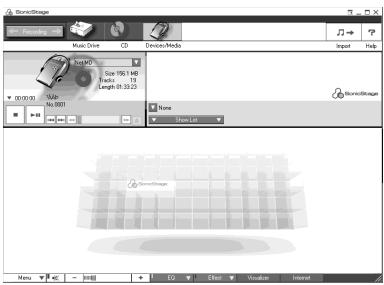
Enregistrement de CD audio sur le disque dur
Dans SonicStage Ver.1.5, le disque dur est appelé « Music Drive ». Le Music Drive gère toutes les données audio stockées par SonicStage.
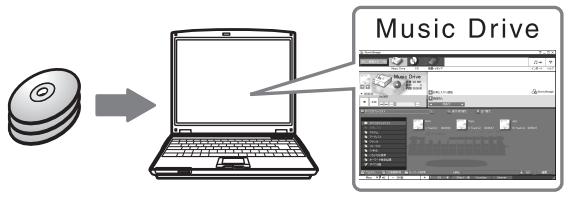
1 Insérez le CD audio que vous souhaitez enregistrer dans le lecteur de CD-ROM de votre ordinateur.
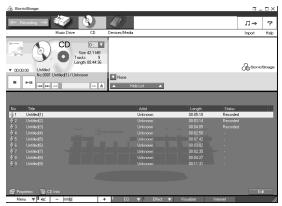
La fenêtre du CD apparaît à l'écran.
Remarque
Lorsque vous enregistrez un CD audio à partir de votre lecteur de CD-ROM pour la première fois, la boîte de dialogue "Optimisation du lecteur de CD" apparaît lorsque vous insérez le CD audio. Cliquez sur [Démarrer] pour lancer une vérification du lecteur de CD-ROM afin de confirmer qu'il est capable d'effectuer l'enregistrement correctement.
2 Cliquez sur Enregistrement
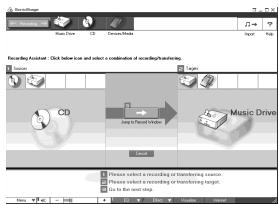
La fenêtre de navigation d'enregistrement* apparaît à l'écran.
*La fenêtre de navigation d'enregistrement facilite la réalisation d'un enregistrement. En effectuant simplement les étapes 1, 2 et 3 de l'étape suivante, vous pouvez sélectionner la source audio dans le panneau de gauche et la destination d'enregistrement dans le panneau de droite.
3 Sélectionnez CD) pour [1 Sources] et (Music Drive) pour [2 Cibles], puis cliquez sur 3 → [Aller à la fenêtre d'enregistrement].
![SONY MZ-N910 - Sélectionnez CD) pour [1 Sources] et (Music Drive) pour [2 Cibles], puis cliquez sur 3 → [Aller à la fenêtre d'enregistrement]. - 1](/content/2019/09/46985/images/cced3c24662d044f2fe1939e7a1edd7f3b40fcfeda7dd4da7013ff8fcbdeb8a9.jpg)
L'affichage change pour la fenêtre d'enregistrement.
4 Cliquez sur ATRAC3 132kbps au milieu de la fenêtre d'enregistrement et sélectionnez le mode d'enregistrement.
![SONY MZ-N910 - Sélectionnez CD) pour [1 Sources] et (Music Drive) pour [2 Cibles], puis cliquez sur 3 → [Aller à la fenêtre d'enregistrement]. - 2](/content/2019/09/46985/images/b6ea63559fc8f7abbec2ccb55c4499da1e854db109c1eb6d04efc27f427ef409.jpg)
Lors de l'enregistrement de données en mode LP2 : sélectionnez ATRAC3 132kbps. Lors de l'enregistrement de données en mode LP4 : sélectionnez ATRAC3 66kbps.
5 Si le panneau de liste n'est pas affiché, cliquez sur Afficher la liste
![SONY MZ-N910 - Sélectionnez CD) pour [1 Sources] et (Music Drive) pour [2 Cibles], puis cliquez sur 3 → [Aller à la fenêtre d'enregistrement]. - 3](/content/2019/09/46985/images/39b11ba91c37fce55f049e0849c40973ad805ee241ba58fbf33b8292b0144144.jpg)
Les panneaux de liste apparaissent sous la fenêtre d'enregistrement. Le contenu du CD audio apparaît dans le panneau de liste de gauche.
6 Cliquez sur [Enregistrer tout].
L'enregistrement démarre. Une fois terminé, les pistes enregistrées apparaissent dans le panneau de liste de droite.
Pour arrêter l'enregistrement
Cliquez sur ([Stop]). Pour reprendre l'enregistrement, cliquez sur . Lorsque l'enregistrement reprend, il commence depuis le début de la piste qui a été arrêtée en dernier.
Étiquetage des données audio
Une fois l'enregistrement terminé, vous pouvez étiqueter les données audio dans le Music Drive. Une fois les données audio du Music Drive étiquetées, les informations d'étiquette seront transférées sur un disque avec les données audio, ce qui vous permet de visualiser les données sur votre Net MD.
1 Démarrez SonicStage (page 100) et cliquez sur (Music Drive).
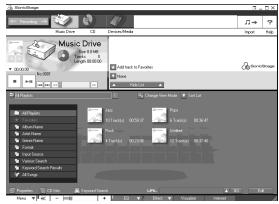
"Toutes les listes de lecture" apparaît et tous les albums stockés sur le Music Drive apparaissent dans la fenêtre Music Drive.
2 Double-cliquez sur le nom de l'album souhaité.
Une liste des fichiers audio de cet album apparaît.
3 Cliquez sur Modifier dans la partie inférieure droite de l'écran.
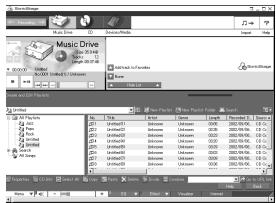
Le panneau d'édition apparaît à l'écran.
4 Sélectionnez un élément en cliquant sur [Titre], [Album], [Artiste] ou [Genre], puis cliquez avec le bouton droit et sélectionnez [Renommer].
Vous pouvez également cliquer sur [] à côté de [Album] ou [Artiste] pour afficher une liste déroulante, puis sélectionner un élément dans la liste.
5 Lorsque le titre de la piste est surligné, saisissez les données texte à partir du clavier.

Vous pouvez également importer des noms à partir d'une base de données avec le bouton ([CD Info]) pour les utiliser pour étiqueter des pistes ou des albums. Voir l'aide en ligne pour plus de détails (page 108).
Transfert de données audio de votre ordinateur vers le Net MD (Check-out)
Les données audio stockées sur le Music Drive peuvent être transférées vers votre Net MD. Ce processus est appelé « Check-out ». Le nombre de fois qu'un morceau peut être extrait est limité dans ce logiciel pour la protection des droits d'auteur (page 122).
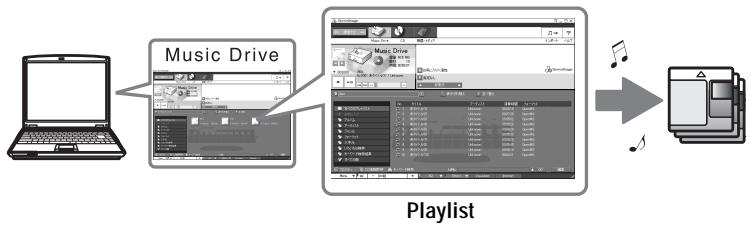
Extraction de fichiers audio vers le Net MD
Cette section explique comment extraire tous les fichiers audio d'une playlist*.
- Une playlist est un conteneur qui permet de classer les fichiers audio stockés dans le Music Drive par genre, artiste, etc.
1 Cliquez sur ← Enregistrement pour afficher la fenêtre de navigation d'enregistrement.
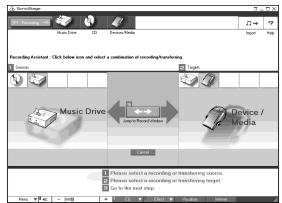
2 Sélectionnez (Music Drive) pour [1 Sources] et (Périphérique/Média) pour [2 Cibles], puis cliquez sur 3 ↔ ([Aller à la fenêtre d'enregistrement]).
L'affichage change pour la fenêtre d'enregistrement.
3 Cliquez sur Normal au milieu de l'affichage et sélectionnez le mode d'enregistrement (page 102).
Mode de transfert standard : les données sont transférées dans le format des fichiers d'origine.
Espace de transfert maximal disponible : toutes les données sont transférées en mode LP4.
Mode de transfert SP : toutes les données sont converties et transférées en mode stéréo normal. Sélectionnez ce mode si vous écoutez les données extraites sur un équipement qui ne prend pas en charge le mode MDLP.
4 Si le panneau de liste n'est pas affiché, cliquez sur Afficher la liste
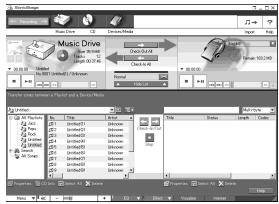
Une playlist apparaît à l'écran.
5 Vérifiez que les fichiers audio que vous êtes sur le point d'extraire sont autorisés à l'extraction.
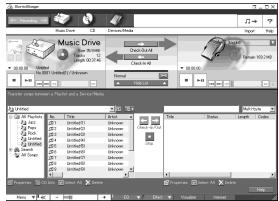
Les notations musicales à côté du numéro de piste dans le panneau gauche de la liste représentent le nombre de fois que le fichier peut être extrait (par exemple, 是 = la piste peut être extraite trois fois de plus). Si 是 apparaît à côté du numéro de piste, le fichier ne peut pas être extrait.
6 Cliquez sur [Check-Out All].
L'extraction des fichiers commence.
Tous les fichiers de la liste de lecture sont extraits vers le Net MD connecté.
Pour annuler une extraction
Cliquez sur ([Stop]).
Remarques
- Une fois qu'une extraction (ou une réintégration) a commencé, ne débranchez pas le câble USB dédié ni la source d'alimentation avant la fin de l'opération. Ces actions peuvent endommager les données ou provoquer un dysfonctionnement du système.
- Veillez à ne pas heurter le Net MD après le début de l'extraction. Si vous le faites, le contenu de l'enregistrement risque de ne pas être stocké correctement.
- En raison des limitations du système MD, il se peut que vous ne puissiez pas enregistrer la totalité du temps d'enregistrement restant.
- En raison des limitations du système MD, un maximum d'environ 1 700 caractères peut être stocké pour le nom du disque, les noms de groupes et les noms de pistes sur le disque. Tenez compte de ce fait lors de l'extraction d'un grand nombre de pistes.
Écoute d'un MD
Vous pouvez écouter un MD sur le Net MD pendant qu'il est connecté à votre ordinateur. Lorsqu'il est déconnecté de votre ordinateur, le Net MD peut être utilisé comme un appareil MiniDisc ordinaire.
Pour plus de détails sur les opérations du Net MD, reportez-vous à la section « Fonctionnement de l'enregistreur ».
Écoute d'un MD avec le Net MD connecté à l'ordinateur
Si vous écoutez un MD avec le Net MD connecté à l'ordinateur, assurez-vous d'écouter avec le Net MD lui-même (en connectant les écouteurs/casques, les haut-parleurs, etc.). Le son du MD ne peut pas être entendu depuis les écouteurs/casques connectés à l'ordinateur.
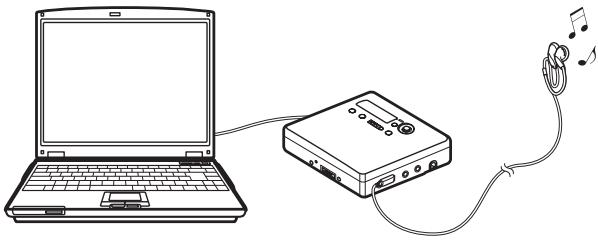
Écoute d'un MD avec le Net MD déconnecté de l'ordinateur
Écoutez le MD après avoir déconnecté le câble USB dédié de l'ordinateur et du Net MD.

Remarques
En général, vous ne pouvez pas effacer ou diviser/combiner des fichiers audio extraits. Si vous souhaitez modifier ces fichiers, réimportez-les d'abord. Les fichiers extraits peuvent être modifiés sur certains appareils MD ; cependant, effacer une piste diminuera le nombre de fois où le fichier peut être extrait, et diviser ou combiner des pistes rendra le fichier impossible à réimporter dans l'ordinateur (page 120).
Utilisation d'autres fonctions !
Utilisation de l'aide en ligne SonicStage
Ce manuel explique uniquement les opérations de base du logiciel SonicStage. Cependant, le logiciel possède de nombreuses autres fonctions qui vous permettent d'effectuer diverses opérations, telles que l'importation de fichiers audio depuis Internet, la classification et la gestion des fichiers audio, et la lecture dans différents modes de lecture. Pour plus d'informations et de détails sur les différents menus et opérations, consultez l'aide en ligne.
Pour afficher l'aide en ligne
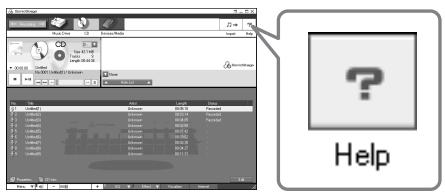
Cliquez sur [Aide] pendant que le logiciel SonicStage est en cours d'exécution.

Vous pouvez afficher l'aide en ligne en sélectionnant ce qui suit :
[Démarrer] - [Programmes]* - [SonicStage] - [Aide SonicStage]
- [Tous les programmes] dans le cas de Windows XP.
Consultation de l'aide en ligne
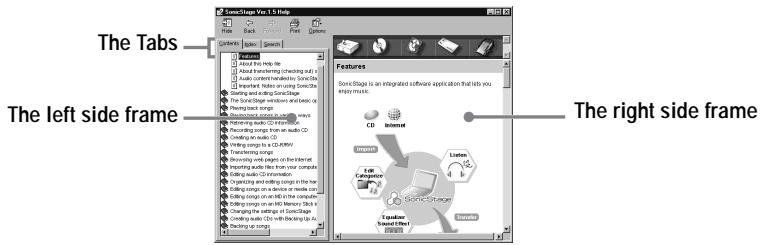
Découvrons d'abord comment utiliser l'aide en ligne. Une explication sur l'utilisation de l'aide en ligne se trouve également dans l'aide en ligne.
1 Double-cliquez sur [Vue d'ensemble] dans le cadre de gauche. 2 Cliquez sur [À propos de ce fichier d'aide].
L'explication apparaîtra dans le cadre de droite. 3 Lisez le texte.
Faites défiler l'affichage si nécessaire.
Cliquez sur les mots soulignés pour accéder à leurs explications.
Remarque
Dans l'aide en ligne, « Périphérique/Support » est le terme général désignant les périphériques externes tels que les Net MD, les Network Walkman (c'est-à-dire les lecteurs audio portables à IC ou les lecteurs audio portables à Memory Stick) et les MusicClips.
Paramètres et précautions
Paramètres selon le système d'exploitation
Les paramètres et les précautions diffèrent selon le système d'exploitation utilisé.
Vérifiez les éléments qui s'appliquent à votre système.

Pour les utilisateurs de Windows XP
Restrictions lors de l'exécution du logiciel SonicStage sous Windows XP
- Pour installer ce logiciel, vous devez vous connecter avec un nom d'utilisateur ayant l'attribut « Administrateur de l'ordinateur »*.
- Vous devez vous connecter avec le nom d'utilisateur « Administrateurs » ou « Utilisateurs avec pouvoir » pour utiliser le logiciel SonicStage.
- Les deux éditions de Windows XP (Édition familiale/Professionnelle) peuvent être utilisées.
- Le format NTFS de Windows XP Édition familiale ou Windows XP Professionnel (installé en usine) ne peut être utilisé qu'avec les paramètres standard (d'usine).
- Pour vérifier si le nom d'utilisateur possède l'attribut "Administrateur de l'ordinateur"
Allez dans [Démarrer] - [Panneau de configuration] - [Comptes d'utilisateurs], puis vérifiez le nom d'utilisateur affiché dans la
fenêtre.
Lors de l'utilisation de SonicStage sous Windows XP
Si vous utilisez la fonction "Restauration du système" dans les "Outils système" de Windows, les données audio gérées par SonicStage peuvent être corrompues et devenir illisibles.
Avant d'exécuter la procédure de restauration du système, vous devez d'abord sauvegarder tous les fichiers audio et les restaurer après avoir effectué la restauration du système.
Pour plus de détails sur les procédures de sauvegarde, reportez-vous à l'aide en ligne.
Remarque
La restauration des données de sauvegarde nécessite un accès à Internet. Si un fichier audio devient illisible après la restauration du système, une boîte de dialogue d'erreur peut apparaître. Si cela se produit, suivez les instructions du message.
Lors de l'utilisation de SonicStage sous Windows Millennium Édition
Si vous utilisez la fonction "Restauration du système" dans les "Outils système" de Windows, les données audio gérées par SonicStage peuvent être corrompues et devenir illisibles.
Avant d'exécuter la procédure de restauration du système, vous devez d'abord sauvegarder tous les fichiers audio et les restaurer après avoir effectué la restauration du système.
Pour plus de détails sur les procédures de sauvegarde, reportez-vous à l'aide en ligne.
Note
La restauration des données de sauvegarde nécessite un accès à Internet. Si un fichier audio devient illisible après la restauration du système, une boîte de dialogue d'erreur peut apparaître. Si cela se produit, suivez les instructions du message.

Pour les utilisateurs de Windows 2000
Restrictions lors de l'utilisation du logiciel SonicStage sous Windows 2000
- Vous devez vous connecter en tant qu'« Administrateur » pour installer le logiciel SonicStage.
- Vous devez vous connecter avec le nom d'utilisateur « Administrateurs » ou « Utilisateurs avec pouvoir » pour utiliser le logiciel SonicStage.
- Parmi les versions de Windows 2000, SonicStage n'est pris en charge que par Windows 2000 Professional.
- Le format NTFS de Windows 2000 Professional (installé en usine) ne peut être utilisé qu'avec les paramètres standard (d'usine).

Pour les utilisateurs de Windows 98 Second Edition
Importation de fichiers MP3 sur l'ordinateur ou lecture de fichiers WAV sur l'ordinateur
Microsoft Media Player version 7.0 ou ultérieure est requis pour importer des fichiers MP3 ou lire des fichiers WAV. Les utilisateurs de versions antérieures peuvent télécharger la version la plus récente depuis le site Web de Microsoft (http://www.microsoft.com/).
Pour les utilisateurs ayant OpenMG Jukebox, SonicStage ou SonicStage Premium installé sur leur ordinateur
Note
Confirmez si des pistes ont été extraites de votre ordinateur. Si des pistes ont été extraites d'OpenMG Jukebox, d'une version antérieure de SonicStage ou de SonicStage Premium, il peut être impossible de les réintégrer avec SonicStage Ver.1.5. Il est recommandé de réintégrer les pistes avant d'installer SonicStage Ver.1.5.
Vérifiez les points suivants avant d'installer SonicStage Ver.1.5.
Les éléments d'installation et la procédure varient selon le logiciel installé sur votre ordinateur.
Utilisateurs avec OpenMG Jukebox installé
| Installed Version | What to do |
| Ver.1.0~2.1 | Install SonicStage 1.5. OpenMG Jukebox Ver.1.0-2.1 is automatically uninstalled and replaced.1) |
| Ver.2.2 | OpenMG Jukebox Ver.2.2 and SonicStage Ver.1.5 can co-exist in the computer.If you install SonicStage Ver.1.5, then OpenMG Jukebox Ver.2.2 will be automatically upgraded to the latest version. |
1) Les fichiers audio enregistrés avec OpenMG Jukebox Ver.1.0-2.1 sont automatiquement convertis en fichiers SonicStage Ver.1.5. Par mesure de sécurité, il est recommandé de sauvegarder vos données audio avec l'outil de sauvegarde avant de procéder à la mise à niveau vers SonicStage Ver.1.5.
Utilisateurs avec une version antérieure de SonicStage installée
| Installed Version | What to do |
| Ver.1.0~1.5 | Install SonicStage Ver.1.5. The earlier version is automatically uninstalled and replaced.1) |
1) Les fichiers audio enregistrés avec SonicStage Ver.1.0-1.5 sont automatiquement convertis en fichiers SonicStage Ver.1.5. Par mesure de sécurité, il est recommandé de sauvegarder vos données audio avec l'outil de sauvegarde avant de procéder à la mise à niveau vers SonicStage Ver.1.5.
Utilisateurs avec SonicStage Premium installé
| Installed Version | What to do |
| SonicStage Premium | Install SonicStage Ver.1.5. SonicStage Ver.1.5 and SonicStage Premium can co-exist in the computer. |
Précautions concernant la coexistence de SonicStage Ver. 1.5 avec OpenMG Jukebox Ver.2.2 ou SonicStage Premium
- Assurez-vous que l'icône OpenMG Jukebox Ver.2.2 n'est pas affichée dans la barre des tâches. Si c'est le cas, le Net MD pourrait ne pas être reconnu par votre ordinateur.
- Les données audio enregistrées sur l'ordinateur sont stockées dans un fichier commun et utilisées par les deux applications. Par conséquent, si vous supprimez un fichier audio (par exemple, un album) dans une application, il sera également supprimé dans l'autre logiciel.
Précaution lors de l'utilisation d'un ordinateur sur lequel OpenMG Jukebox Ver.1.0-2.1 ou SonicStage Ver.1.0-1.2 est installé
Après l'installation de SonicStage Ver.1.5, assurez-vous de ne pas remplacer SonicStage Ver.1.5 par OpenMG Jukebox Ver.1.0-2.1 ou SonicStage Ver.1.0-1.2, car toutes les données audio du lecteur de musique pourraient être perdues. Si vous commencez l'installation d'OpenMG Jukebox Ver.1.0-2.1 ou de SonicStage Ver.1.0-1.2 par erreur, arrêtez immédiatement l'installation.
Remarque sur l'espace disque dur
Un espace libre de 120 Mo ou plus sur le disque dur est requis. Si votre ordinateur ne dispose pas de suffisamment d'espace, le logiciel ne sera pas installé correctement. L'espace libre requis varie selon la version de votre système d'exploitation Windows ou la quantité de fichiers audio que vous gérez.
Remarques sur le mode veille/hibernation du système
- Si l'ordinateur passe en mode veille/hibernation pendant l'enregistrement d'un CD ou l'extraction/le transfert d'un fichier de données, les données audio peuvent être perdues ou l'ordinateur peut ne pas se réveiller correctement. La fonction de veille/hibernation de l'ordinateur doit donc être désactivée.
- Si vous changez le support pendant que l'ordinateur est en mode veille ou hibernation, les données audio peuvent être perdues après le réveil de l'ordinateur.
- Si l'ordinateur passe en mode veille ou hibernation, il se peut qu'il ne reconnaisse pas le Net MD au réveil. Si cela se produit, déconnectez le câble USB puis reconnectez-le.
Sauvegarde des données audio
Avant d'effectuer toute opération susceptible d'affecter le système d'exploitation lui-même (comme une restauration du système), vous devez sauvegarder toutes vos données audio à l'aide de l'outil [SonicStage backup tool] accessible depuis [Démarrer] - [Programmes] - [SonicStage].
Désinstallation du logiciel SonicStage
Pour désinstaller le logiciel SonicStage, suivez les procédures ci-dessous.
Pour les utilisateurs de Windows XP
Connectez-vous avec un nom d'utilisateur ayant l'attribut "Administrateur de l'ordinateur". Reportez-vous au manuel d'instructions de votre ordinateur pour plus de détails sur la connexion en tant qu'administrateur.
1 Cliquez sur [Démarrer]–[Panneau de configuration].
La fenêtre "Panneau de configuration" s'affiche.
2 Double-cliquez sur [Ajout/Suppression de programmes].
La boîte de dialogue "Ajout/Suppression de programmes" s'affiche.
3 Cliquez sur [Modifier ou supprimer des programmes]. 4 Cliquez sur [SonicStage 1.5.XX] dans la liste des programmes actuellement installés, puis cliquez sur [Modifier/Supprimer]. 5 Cliquez sur [OpenMG Secure Module 3.1]* dans la liste des programmes actuellement installés, puis cliquez sur [Modifier/Supprimer].
Suivez les instructions du message et redémarrez l'ordinateur. Une fois l'ordinateur redémarré, la désinstallation sera terminée.
- Si SonicStage Ver.1.5 coexiste avec OpenMG Jukebox Ver.2.2 ou SonicStage Premium sur votre ordinateur et que vous désinstallez l'un ou l'autre, assurez-vous que [OpenMG Secure Module 3.1] n'est pas désinstallé car il est utilisé en commun par les deux logiciels.
Pour les utilisateurs de Windows Millennium Edition/Windows 98 Deuxième édition
1 Cliquez sur [Démarrer] – [Paramètres] – [Panneau de configuration].
La fenêtre "Panneau de configuration" apparaît.
2 Double-cliquez sur [Ajout/Suppression de programmes]. La fenêtre Propriétés de Ajout/Suppression de programmes apparaît. 3 Cliquez sur [SonicStage 1.5.XX] dans la liste des programmes à supprimer automatiquement, puis cliquez sur [Ajouter/Supprimer]. 4 Cliquez sur [OpenMG Secure Module 3.1]* dans la liste des programmes à supprimer automatiquement, puis cliquez sur [Ajouter/Supprimer].
Suivez les instructions du message et redémarrez l'ordinateur. Lorsque l'ordinateur redémarre, la désinstallation est terminée.
Pour les utilisateurs de Windows 2000
Connectez-vous en tant qu'"Administrateur", puis suivez les instructions ci-dessous.
Reportez-vous au manuel d'utilisation de votre ordinateur pour plus de détails sur la connexion en tant qu'administrateur.
1 Cliquez sur [Démarrer] – [Paramètres] – [Panneau de configuration]. La fenêtre "Panneau de configuration" apparaît. 2 Double-cliquez sur [Ajout/Suppression de programmes]. La boîte de dialogue "Ajout/Suppression de programmes" apparaît. 3 Cliquez sur [Modifier ou supprimer des programmes]. 4 Cliquez sur [SonicStage 1.5.XX] dans la liste "Programmes actuellement installés", puis cliquez sur [Modifier/Supprimer]. 5 Cliquez sur [OpenMG Secure Module 3.1]* dans la liste "Programmes actuellement installés", puis cliquez sur [Modifier/Supprimer].
Suivez les instructions du message et redémarrez l'ordinateur. Lorsque l'ordinateur redémarre, la désinstallation est terminée.
Dépannage
Veuillez suivre les étapes suivantes si vous rencontrez un problème lors de l'utilisation du logiciel SonicStage. Si un message apparaît, il est recommandé de le noter.
Étape 1 : Vérifiez les symptômes dans cette section "Dépannage".
Vous trouverez également diverses informations dans les procédures d'utilisation et dans "Paramètres et précautions" (page 110).
Étape 2 : Vérifiez les symptômes dans l'aide en ligne de SonicStage 1.5 (page 108).
Consultez la rubrique « Dépannage » dans « Informations complémentaires » de l'aide en ligne.
Des informations utiles peuvent également se trouver dans d'autres sections de l'aide en ligne.
Étape 3 : Si le problème ne peut pas être résolu après avoir consulté les références ci-dessus.
Consultez le tableau suivant, puis contactez votre revendeur Sony le plus proche.
| Computer • Manufacturer: • Model: • Type: Desktop type / Laptop type |
| Name of operating system: |
| RAM capacity: |
| Hard disk drive (containing SonicStage and audio data) • Capacity of the drive: • Free space: |
| Installed folder containing SonicStage (if other than the default folder)1) • Location of the installed folder: |
| Version of the software (SonicStage Ver.1.5)2): |
| Error Message (if one appear): |
| If an externally connected CD-ROM drive is used • Manufacturer: • Model: • Type: CD-ROM / CD-R/RW / DVD-ROM / Other ( ) • Type of connection to the computer: PC card / USB / IEEE1394 / Other ( ) |
| If another device with USB connection is used • Name of the device (or devices): |
1) Si vous ne spécifiez pas le dossier de destination, le logiciel est installé dans C:\Program Files\Sony\SonicStage. 2) Pour vérifier la version du logiciel SonicStage, allez dans [Menu] - [À propos de SonicStage] dans la fenêtre SonicStage, ou consultez les informations de version sur le CD-ROM fourni.
Si votre ordinateur ne reconnaît pas le Net MD
- Le Net MD est-il correctement connecté à votre ordinateur ?
- Si le Net MD n'est pas fermement connecté à l'ordinateur, il ne sera pas reconnu par celui-ci.
- Rebranchez le câble USB dédié. Si l'ordinateur ne reconnaît toujours pas le Net MD, débranchez le Net MD, redémarrez l'ordinateur, puis rebranchez le câble USB dédié.
Un MD est-il inséré dans le Net MD ?
Vérifiez si un MD est inséré dans le Net MD.
- Si votre ordinateur ne reconnaît pas votre Net MD même lorsqu'il est connecté et qu'un disque est inséré, le pilote du Net MD n'est peut-être pas correctement installé.
Allez dans [Contrôleur USB] dans la fenêtre du Gestionnaire de périphériques Windows pour vérifier que votre Net MD est correctement reconnu.
Un point d'exclamation [!] dans la fenêtre du Gestionnaire de périphériques indique que votre Net MD n'est pas correctement reconnu. Réinstallez le pilote Net MD.
1 Cliquez sur [Démarrer] – [Paramètres] – [Panneau de configuration]. 1) 2 Double-cliquez sur [Système] dans le panneau de configuration. 2) 3 Cliquez sur l'onglet [Matériel] 3), puis sur [Gestionnaire de périphériques].
La fenêtre du Gestionnaire de périphériques s'affiche.
1) Sous Windows XP, sélectionnez [Démarrer] – [Panneau de configuration]. 2) Sous Windows XP, double-cliquez sur [Système] si le panneau de configuration est au format « classique », ou cliquez sur [Performances et maintenance] puis sur [Système] si le panneau de configuration est au format « par catégorie ». 3) Selon votre système, l'onglet [Matériel] peut ne pas être disponible. Dans ce cas, cliquez sur l'onglet [Gestionnaire de périphériques] pour afficher la fenêtre du Gestionnaire de périphériques.
Si l'installation n'a pas réussi
- Assurez-vous de fermer toutes les applications Windows avant de commencer l'installation.
Si vous démarrez l'installation alors que d'autres programmes sont en cours d'exécution, un dysfonctionnement peut se produire. Cela est particulièrement vrai pour les programmes qui nécessitent d'importantes ressources système, comme les logiciels antivirus.
- Assurez-vous de ne pas connecter le Net MD à votre ordinateur avant de commencer l'installation.
Si le câble USB dédié est connecté à votre ordinateur avant l'installation, l'installation ne peut pas être effectuée correctement. Connectez le câble USB dédié après la fin de l'installation.
- Assurez-vous que votre ordinateur dispose de suffisamment d'espace sur le disque dur.
120 Mo d'espace libre ou plus sur le disque dur sont requis. Si votre ordinateur ne dispose pas de suffisamment d'espace, l'installation peut ne pas être possible.
- Si l'installation semble être bloquée
L'installation peut prendre 30 minutes ou plus, selon votre ordinateur ou votre lecteur de CD-ROM.
Pendant l'installation, surveillez l'apparition de l'un des problèmes suivants.
| Problem | Cause/Remedy |
| The installation appears to have stopped before it has completed. | Check for the appearance of an error message beneath the installation window. →Press the [Tab] key while holding down the [Alt] key. If an error message has appeared, press the [Enter] key. The installation will resume. If there is no message, the installation is still in progress. Wait a little while longer. |
| The progress bar on the display is not moving. The access lamp has not lit for a few minutes. | The installation is progressing normally. Please wait. |
- Si l'installation échoue toujours après tout ce que vous avez fait.
- L'installation peut être effectuée en copiant tous les fichiers sur le disque dur comme suit : 1 Créez un nouveau dossier sur le disque dur. 2 Insérez le CD-ROM fourni (SonicStage Ver.1.5) dans le lecteur de CD-ROM. 3 Lorsque la fenêtre d'installation apparaît, cliquez sur [Quitter] pour annuler l'installation. 4 Cliquez avec le bouton droit sur le menu Démarrer et lancez l'Explorateur. 5 Sélectionnez [SS15E] sur le lecteur de CD-ROM, puis cliquez sur [Edition] - [Sélectionner tout]. 6 Cliquez sur [Edition] - [Copier vers le dossier] (ou [Edition] - [Copier]) pour copier tous les fichiers dans le dossier créé à l'étape 1. 7 Retirez le CD-ROM du lecteur, ouvrez le dossier copié sur le disque dur et double-cliquez sur [setup.exe]. 8 Lorsque la fenêtre d'installation apparaît, suivez les instructions affichées pour installer [SonicStage 1.5].
- L'installation peut également être effectuée en installant le logiciel à partir de [Démarrer] - [Exécuter].
Informations et explications
FAQ Net MD
Cette section présente les questions fréquemment posées et leurs réponses concernant le Net MD.

À propos du Net MD
Qu'est-ce qu'un « Net MD » ?
Net MD est une spécification qui permet de transférer des données audio d'un ordinateur vers un MiniDisc via un câble USB.
Jusqu'à présent, les MiniDiscs ne pouvaient être utilisés que pour enregistrer des sources analogiques (via un microphone ou une entrée analogique) ou des sources PCM telles que les CD. L'enregistrement de fichiers audio sur un ordinateur était impossible. Cependant, grâce à SonicStage et à d'autres logiciels de gestion musicale basés sur des technologies de protection des droits d'auteur telles que « OpenMG » et « MagicGate », la conversion de fichiers audio au format ATRAC ou ATRAC3 utilisé sur les MD est devenue possible, permettant l'enregistrement de fichiers informatiques sur des MD.
1) Technologie de protection des droits d'auteur pour gérer les données audio enregistrées sur des ordinateurs, etc. 2) Technologie pour vérifier le statut de protection des droits d'auteur des données audio lors des opérations d'extraction/retour entre un ordinateur et un périphérique Net MD. 3) Type de fichier pour l'enregistrement sur un MD.
Comment le logiciel SonicStage rend-il l'utilisation des MD plus pratique ?
- Il vous permet d'enregistrer des données audio de votre ordinateur sur votre MD.
- Les opérations d'édition sont facilement effectuées à l'aide d'opérations à l'écran.
- Étiquetage : permet d'utiliser le clavier pour étiqueter facilement le contenu.
- Déplacement de pistes ou de groupes : permet de déplacer simplement des pistes ou des groupes par glisser-déposer. Les déplacements de pistes sont faciles à visualiser.
- Paramètres de groupe : les groupes sont faciles à créer ou à dissocier.
Ces opérations peuvent être utilisées pour éditer les pistes d'un disque dans le Net MD. Si vous souhaitez modifier le contenu d'un MD, connectez le Net MD à votre ordinateur et éditez les pistes dans la fenêtre SonicStage Device/Media.
Les pistes enregistrées sur le Net MD peuvent-elles être réimportées sur un ordinateur ?
Non, elles ne le peuvent pas.
Les données audio initialement extraites d'un ordinateur ne peuvent être réimportées que sur le même ordinateur. Les pistes enregistrées sur le Net MD à l'aide d'un microphone ou via une connexion analogique ou numérique ne peuvent pas être transférées vers l'ordinateur ni copiées.
Ordinateur ⇒ MiniDisc : OK.
MiniDisc ⇒ Ordinateur : OK uniquement pour les pistes initialement extraites de l'ordinateur.

À propos de l'édition
Les pistes extraites peuvent-elles être modifiées sur le Net MD ?
- Choses que vous pouvez faire sur le Net MD :
- Étiqueter le contenu. Assigner ou dissocier des groupes. Déplacer des pistes ou des groupes.
- Choses que vous ne pouvez pas faire sur le Net MD :
- Ajouter des marques de piste (diviser) / effacer des marques de piste (combiner).
- Supprimer des pistes, des groupes ou tout le contenu du disque.
Protection des droits d'auteur
La technologie OpenMG* vous permet de profiter de la musique numérique, tout en respectant les droits de ses détenteurs. OpenMG Jukebox chiffre les fichiers audio au format OpenMG et les stocke sur le disque dur de votre ordinateur pour empêcher toute distribution non autorisée.
- La technologie de protection des droits d'auteur de ce logiciel est conforme aux spécifications SDMI (Secure Digital Music Initiative).
Ce logiciel impose certaines restrictions sur l'enregistrement et la lecture afin de protéger les droits d'auteur.
Vous ne pouvez extraire des fichiers audio que vers le même ordinateur à partir duquel ils ont été extraits. Ils ne peuvent pas être copiés ou réintégrés sur d'autres ordinateurs.
Pour plus de détails, voir "Fonctionnalités de protection des droits d'auteur par OpenMG" (page 123).
Vous ne pouvez réintégrer des fichiers audio que sur l'ordinateur à partir duquel ils ont été extraits.

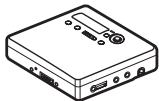

L'extraction peut être effectuée trois fois.

Vous ne pouvez pas copier ou déplacer des fichiers audio vers un autre ordinateur.
Restrictions sur le contenu audio
Le contenu audio numérique de haute qualité est largement disponible via les services de distribution de musique sur Internet. Pour protéger les droits d'auteur de ses détenteurs contre la distribution non autorisée, certains contenus audio sont distribués avec certaines restrictions sur l'enregistrement et la lecture. Par exemple, la période de lecture ou le nombre de lectures des données peuvent être limités. Dans de tels cas, l'extraction (check-out) des contenus audio peut ne pas être possible.
Selon le contenu, certaines données audio qui ont pu être extraites sont soumises à des restrictions d'édition sur le Net MD ; par exemple, les contenus audio ne peuvent pas être effacés ou les marques de piste ne peuvent pas être ajoutées ou effacées.
Il n'est pas possible de réintégrer (check-in) des pistes autres que celles qui ont été extraites de votre ordinateur (par exemple, les pistes enregistrées à l'aide d'un microphone ou via une connexion analogique ou numérique).
Fonctionnalités de protection des droits d'auteur par OpenMG
Le logiciel SonicStage comprend OpenMG, une technologie de protection des droits d'auteur développée par Sony pour protéger les droits d'auteur musicaux. OpenMG utilise une technologie cryptographique de haut niveau pour protéger les contenus musicaux sur les ordinateurs.
Les utilisateurs doivent être conscients des restrictions décrites ci-dessous.
- La musique enregistrée sur le disque dur à l'aide du logiciel SonicStage ne peut pas être lue lorsqu'elle est copiée sur d'autres ordinateurs.
- L'installation du même logiciel SonicStage sur d'autres ordinateurs n'est pas autorisée. Règles d'utilisation
Si des règles d'utilisation sont incluses dans la musique par le détenteur des droits d'auteur ou le distributeur, l'exploitation sera limitée à l'utilisation autorisée par la règle d'utilisation. Pour la musique, telle que les disques compacts, qui ne contient pas de règle d'utilisation, la règle d'utilisation par défaut de SDMI s'appliquera. Cette règle d'utilisation par défaut stipule qu'un fichier ne peut être extrait que trois fois au maximum.
- Sur les contenus musicaux incompatibles avec le logiciel SonicStage
Sous la supervision de SDMI, ce logiciel interdit l'enregistrement de musique avec un signal de copie interdite. - Mise à niveau du logiciel SonicStage
Ce logiciel a été développé conformément à l'accord actuel entre Sony et SDMI. Si cet accord est modifié à l'avenir, certaines fonctions du logiciel peuvent devenir indisponibles. Sony peut proposer un kit de mise à niveau dans ce cas, moyennant des frais supplémentaires pour l'utilisateur.
Glossaire
ATRAC3
ATRAC3, qui signifie Adaptive Transform Acoustic Coding3, est une technologie de compression audio qui répond à la demande de haute qualité sonore et de taux de compression élevés. Le taux de compression ATRAC3 est environ 10 fois supérieur à celui du CD audio, ce qui augmente la capacité de données du support.
"Check-In / Check-Out"
Le check-out consiste à transférer des fichiers musicaux d'un ordinateur personnel vers un périphérique externe/support (tel qu'un Network Walkman). Le fait de renvoyer les fichiers musicaux extraits vers le même ordinateur s'appelle le check-in. (Vous ne pouvez pas déplacer les fichiers musicaux extraits vers un autre ordinateur.)
Vous pouvez extraire un fichier musical, le réintégrer, puis l'extraire à nouveau un nombre infini de fois. Les règles SDMI prévoient que jusqu'à quatre copies d'un fichier musical peuvent être extraites à la fois. OpenMG utilise une méthode permettant d'extraire simultanément trois copies d'une chanson, tandis que la quatrième copie est conservée comme copie maîtresse sur votre PC.
Service de distribution de musique électronique (EMD)
EMD est un site Web qui distribue des fichiers musicaux disponibles à l'achat.
MP3
MP3, qui signifie MPEG-1 Audio Layer 3, est une norme de compression de fichiers audio déterminée par le Motion Picture Experts Group, un groupe de travail de l'ISO (Organisation internationale de normalisation). Elle permet de compresser les fichiers audio à environ 1/10 de la taille des données d'un disque compact standard. Étant donné que l'algorithme d'encodage MP3 est divulgué, il existe divers encodeurs/décodeurs conformes à cette norme, y compris des logiciels gratuits disponibles sans frais. La norme MP3 est donc largement utilisée dans le domaine informatique.
Music Drive
Music Drive est une base de données musicale permettant de gérer les données audio sur un ordinateur. Dans Music Drive, les fichiers audio peuvent être gérés avec des informations telles que les noms d'artistes, les titres de pistes et les images de pochettes de CD, ou peuvent être combinés et classés dans différentes listes de lecture.
OpenMG
Technologie de protection des droits d'auteur pour l'importation et la gestion de contenu musical provenant de services de distribution ou de CD. En utilisant des logiciels conformes à OpenMG, les contenus audio peuvent être chiffrés avant d'être stockés sur un disque dur afin de permettre la lecture de ces fichiers audio sur cet ordinateur. OpenMG empêche également la distribution non autorisée du contenu via Internet ou d'autres réseaux.
[Liste de lecture]
Une liste de lecture est comme un conteneur qui peut être utilisé pour contenir et classer les fichiers stockés dans Music Drive. Par exemple, en créant une liste de lecture "jazz" et en y plaçant vos morceaux de jazz préférés, vous pouvez lire tous les morceaux en boucle ou les extraire tous en même temps.
Mode d'enregistrement (débit binaire)
Il s'agit d'une mesure du volume de données par seconde. Le débit est exprimé en bps (bits par seconde). Dans SonicStage, le débit binaire peut être sélectionné pour l'enregistrement d'un CD audio ou la conversion de fichiers audio MP3 et WAV au format ATRAC3 parmi trois débits : 132 kbps, 105 kbps ou 66 kbps. Dans le cas de 105 kbps, 105 000 bits d'information sont traités par seconde. Si le débit binaire est élevé, cela signifie qu'une grande quantité d'informations est utilisée pour jouer la musique. Ainsi, un débit de 105 kbps produit une meilleure qualité sonore qu'un débit de 66 kbps, et un débit de 132 kbps offre une meilleure qualité sonore qu'un débit de 105 kbps. Cependant, les fichiers audio dans des formats tels que MP3 ont des méthodes d'encodage différentes, et la qualité sonore n'est donc pas déterminée uniquement par le débit binaire.
SDMI
SDMI, qui signifie Secure Digital Music Initiative, est un forum composé de plus de 130 entreprises dans les domaines du contenu audio enregistré, de l'informatique et de l'électronique grand public. Il est dédié au développement de technologies intégrées de protection des droits d'auteur utilisables dans le monde entier.
SDMI travaille à la création d'un cadre pour empêcher l'utilisation inappropriée des fichiers audio et pour promouvoir les services légaux de distribution de musique. La technologie de protection des droits d'auteur OpenMG est basée sur la norme SDMI.
Windows Media Audio
Il s'agit d'une technologie de compression audio qui inclut le système de gestion appelé "Windows Media Rights Manager".
Windows Media Technology
Il s'agit d'une technologie qui inclut un système de gestion de contenu appelé Windows Media Rights Manager qui crypte le contenu et distribue le contenu musical avec ses conditions d'utilisation, de distribution, etc. Les fichiers audio prenant en charge Windows Media Technologies (WMT) téléchargés via EMD* peuvent être importés et gérés dans OpenMG Jukebox.
- EMD peut ne pas être disponible dans certaines régions du monde.
Index
Numériques
Égaliseur 6 bandes 35
A
Accessoires
en option 75
fourni 11
ATRAC3 120,124
Audio CD 92, 101
Auto Time Mark 30
AVLS 64
B
sauvegarde 113
Rétroéclairage 65
Batterie
autonomie de la batterie 18
batterie intégrée 16
pile sèche 17
BIP 58
Signet
ajouter 33
play 33
C
CD-ROM 95
Charging 16
Check-in 120, 124
Checking
clock 58
playing position 32
remaining time 25, 32
Check-out 104, 120, 124
Cleaning 74
Clock 58
Combining tracks 44
Connecting 99
analog 28
digital 20
when charging 16
Connection 38
Contrast 65
copyright protection 122
D
delete (software) 114
Device/Media 104, 109
Digital Pitch Control 36
Digital Sound Preset 34
Divide
directly 43
rehearsal 43
DSP TYPE-S 90
E
EMD services 124
Effacement
d'un disque entier 45
groupes 52
plages 45
G
G-PROTECTION 91
Groupe
effacement 52
déplacement 52
lecture 47
enregistrement 46
libération 50
réglage 49
saut 47
Group Program Play 48
H
disque dur
espace libre 95, 113
stockage 101
HOLD 12
1
Installation 97
L
Étiquetage
un disque 40
pistes 40
étiquetage 103
M
Enregistrement manuel 31
MDLP 27
Melody Timer 36
Menu 70
Move
groupes 51
pistes 42
MP3 124
Music Drive 101, 124
N
Nom
adisc39
groupes 50
pistes 39
Net MD 93, 120
pilote Net MD 118
Aide en ligne 108
OpenMG 124
Logiciel OpenMG Jukebox 96, 112
P
Mémoire de disque personnel 68
Mode de lecture
groupes 47
plages 32
Liste de lecture 104, 124
Lecture programmée 34
Mode rapide 63
R
Enregistrement
adding track marks 30
analog 28
digital 19
from microphone 29
level 31
MDLP mode 27
without overwriting tracks 59
Recording mode (Bit rate) 102, 105, 125
Recording navigation window 101
Relabeling 41
s
SDMI 125
SonicStage Premium 96, 112
SonicStage software (earlier version) 96, 112
start (software) 100
Enregistrement synchronisé 26
Environnement système 95
Limites du système 95
T
Marque de piste
Ajouter (Diviser) 43
Effacer (Combiner) 44
Transfert
vers l'ordinateur 100
vers le Net MD 104
U
Désinstallation
Windows 2000 115
Windows 98 Deuxième édition 114
Windows Millennium Edition 114
Windows XP 114
USB
câble 11
station d'accueil 16
V
Virtual Surround 34
W
Windows 2000 115
Windows 98 Second Edition 114
Windows Millennium Edition 114
Windows XP 114
WMA 125
WMT 125

Imprimé sur papier 100 % recyclé
COV (composé organique volatil)-
Encre à base d'huile végétale gratuite.
http://www.sony.net/
Imprimé au Japon
- ENREGISTREUR MINIDISC PORTABLE
- MODE D'EMPLOI
- AVERTISSEMENT
- POUR ÉVITER TOUT RISQUE D'INCENDIE OU DE CHOC ÉLECTRIQUE, N'EXPOSEZ PAS L'APPAREIL À LA PLUIE OU À L'HUMIDITÉ
- ATTENTION
- INFORMATIONS
- AVIS AUX UTILISATEURS
- SUR LE LOGICIEL FOURNI
- TABLE DES MATIÈRES
- FONCTIONNEMENT DE L'ENREGISTREUR
- DIFFÉRENTES FAÇONS D'ENREGISTRER
- DIFFÉRENTES MÉTHODES DE LECTURE
- ÉDITION DES PISTES ENREGISTRÉES
- UTILISATION DE LA FONCTION DE GROUPE
- AUTRES OPÉRATIONS
- SOURCES D'ALIMENTATION
- INFORMATIONS SUPPLÉMENTAIRES
- DÉPANNAGE ET EXPLICATIONS
- UTILISATION DU LOGICIEL
- QU'EST-CE QU'UN NET MD
- OPÉRATIONS DE BASE
- OPÉRATIONS AVANCÉES
- AUTRES INFORMATIONS
- AVANT D'UTILISER CE PRODUIT
- LORS DE L'UTILISATION DE L'ENREGISTREUR
- FONCTIONNEMENT DE L'ENREGISTREUR (PAGES 11 À 91)
- DÉPANNAGE ET EXPLICATIONS (PAGE 77)
- LORS DE L'UTILISATION DU NET MD (L'ENREGISTREUR) CONNECTÉ À VOTRE ORDINATEUR
- UTILISATION DU LOGICIEL (PAGES 92 À 125)
- AUTRES INFORMATIONS (PAGE 110)
- AIDE DE SONICSTAGE VER
- REMARQUES SUR LA SECTION "UTILISATION DU LOGICIEL
- VÉRIFICATION DES ACCESSOIRES FOURNIS
- DESCRIPTION DES COMMANDES
- L'ENREGISTREUR
- LA FENÊTRE D'AFFICHAGE DE L'ENREGISTREUR
- LE CASQUE/LES ÉCOUTEURS AVEC TÉLÉCOMMANDE
- UTILISATION DU CLIP POUR LA TÉLÉCOMMANDE
- LA FENÊTRE D'AFFICHAGE DE LA TÉLÉCOMMANDE
- POUR COMMENCER
- INSÉREZ LA BATTERIE RECHARGEABLE
- CHARGEZ LA BATTERIE RECHARGEABLE
- POUR LES MODÈLES FOURNIS AVEC L'ADAPTATEUR DE PRISE SECTEUR
- UTILISATION DE LA PILE ALCALINE SÈCHE
- EFFECTUEZ LES CONNEXIONS ET DÉVERROUILLEZ LES COMMANDES
- REMARQUES
- AUTONOMIE DE LA BATTERIE
- LORS DE L'ENREGISTREMENT
- ENREGISTRER UN MD IMMÉDIATEMENT
- INSÉREZ UN MD
- EFFECTUEZ LES CONNEXIONS. (INSÉREZ FERMEMENT ET COMPLÈTEMENT LES CÂBLES DANS LES PRISES APPROPRIÉES.)
- REMARQUE
- ENREGISTREZ UN MD
- NOTE
- SI L'ENREGISTREMENT NE DÉMARRE PAS
- POUR CONNAÎTRE L'ÉTAT DE L'ENREGISTREMENT
- LECTURE D'UN MD IMMÉDIATEMENT
- APPUYEZ SUR OPEN POUR OUVRIR LE COUVERCLE
- LISEZ UN MD
- POUR ARRÊTER LA LECTURE, APPUYEZ SUR
- SI LA LECTURE NE DÉMARRE PAS
- AFFICHAGE DE DIVERSES INFORMATIONS
- SUR L'ENREGISTREUR
- SUR LA TÉLÉCOMMANDE
- APPUYEZ SUR DISPLAY
- FENÊTRE D'AFFICHAGE DE LA TÉLÉCOMMANDE
- AFFICHAGE : D/E
- POUR DÉMARRER/ARRÊTER L'ENREGISTREMENT EN SYNCHRONISATION AVEC LA SOURCE SONORE (ENREGISTREMENT SYNCHRONISÉ)
- POUR ARRÊTER L'ENREGISTREMENT
- ENREGISTREMENT LONGUE DURÉE (MDLP)
- ENREGISTREMENT À PARTIR D'UN TÉLÉVISEUR OU D'UNE RADIO (ENREGISTREMENT ANALOGIQUE)
- ENREGISTREMENT À PARTIR D'UN MICROPHONE
- POUR SÉLECTIONNER LA SENSIBILITÉ DU MICROPHONE
- AJOUT DE MARQUES DE PISTE PENDANT L'ENREGISTREMENT
- AJOUT MANUEL DE MARQUES DE PISTE
- AJOUT AUTOMATIQUE DE REPÈRES DE PLAGE (AUTO TIME MARK)
- POUR ANNULER AUTO TIME MARK
- UTILISATION D'AUTO TIME MARK POUR AJOUTER DES REPÈRES DE PLAGE PENDANT L'ENREGISTREMENT
- LORSQUE LE TEMPS D'ENREGISTREMENT ÉCOULÉ DÉPASSE L'INTERVALLE DE TEMPS DÉFINI POUR AUTO TIME MARK
- LORSQUE L'INTERVALLE DE TEMPS DÉFINI POUR AUTO TIME MARK DÉPASSE LE TEMPS D'ENREGISTREMENT ÉCOULÉ
- RÉGLAGE MANUEL DU NIVEAU D'ENREGISTREMENT
- POUR REVENIR AU CONTRÔLE AUTOMATIQUE DU NIVEAU
- SÉLECTION DU MODE DE LECTURE
- LECTURE RÉPÉTÉE D'UNE PLAGE (LECTURE RÉPÉTÉE)
- POUR ANNULER LA LECTURE RÉPÉTÉE
- ÉCOUTE DE PLAGES SÉLECTIONNÉES UNIQUEMENT (LECTURE AVEC SIGNET)
- POUR MARQUER LES PISTES
- POUR LIRE LES PISTES MARQUÉES
- POUR EFFACER LES MARQUE-PAGES
- ÉCOUTE DE PLAGES DANS UNE SÉQUENCE SOUHAITÉE (LECTURE PROGRAMMÉE)
- RÉGLAGE DU SON (VIRTUAL-SURROUND · ÉGALISEUR 6 BANDES)
- VARIATION DU SON VIRTUEL POUR CRÉER DIFFÉRENTES ACOUSTIQUES (VIRTUAL-SURROUND)
- SÉLECTION DE LA QUALITÉ SONORE (ÉGALISEUR 6 BANDES)
- POUR ANNULER LA PROCÉDURE
- POUR ANNULER LE RÉGLAGE
- POUR MODIFIER ET MÉMORISER LE SON
- POUR REVENIR AU RÉGLAGE PRÉCÉDENT
- POUR LE FONCTIONNEMENT DE L'ENREGISTREUR, VOIR PAGE
- CHANGEMENT DE LA VITESSE DE LECTURE (DIGITAL PITCH CONTROL)
- RÉGLAGE DE L'ALARME (MINUTERIE MÉLODIQUE)
- POUR VÉRIFIER LE TEMPS RESTANT AVANT L'ALARME
- POUR ANNULER LE RÉGLAGE DE L'ALARME
- POUR ARRÊTER L'ALARME
- CONNEXION À UN SYSTÈME STÉRÉO (LINE OUT)
- AVANT LE MONTAGE
- NOTES
- NOMMER UNE PISTE OU UN DISQUE (NOM)
- CARACTÈRES DISPONIBLES
- NOMBRE MAXIMAL DE CARACTÈRES PAR NOM
- NOMBRE MAXIMAL DE CARACTÈRES POUVANT ÊTRE SAISIS PAR DISQUE
- À PROPOS DE LA PALETTE DE CARACTÈRES
- ZONE DE SAISIE DES LETTRES
- PALETTE DE CARACTÈRES
- ÉTIQUETAGE
- RÉ-ÉTIQUETAGE
- POUR RENOMMER UNE PLAGE
- POUR RENOMMER UN DISQUE
- POUR ANNULER LE RENOMMAGE
- POUR REVENIR AUX RÉGLAGES PRÉCÉDENTS
- DÉPLACEMENT DES PLAGES ENREGISTRÉES (MOVE)
- EXEMPLE
- POUR ANNULER LE DÉPLACEMENT
- DIVISION D'UNE PLAGE (DIVIDE)
- DIVISION DIRECTE D'UNE PLAGE
- RÉGLAGE DU POINT DE DIVISION AVANT DE DIVISER UNE PLAGE (RÉPÉTITION DE DIVISION)
- POUR AJOUTER DES MARQUES DE PISTE PENDANT L'ENREGISTREMENT (SAUF EN ENREGISTREMENT SYNCHRONISÉ)
- COMBINAISON DE PISTES (COMBINE)
- EFFACEMENT DE PLAGES ET DU DISQUE ENTIER (EFFACER)
- POUR EFFACER UNE PLAGE
- POUR EFFACER UNE PARTIE D'UNE PLAGE
- POUR EFFACER TOUT LE DISQUE
- POUR ANNULER L'EFFACEMENT
- QU'EST-CE QUE LA FONCTION DE GROUPE
- QU'EST-CE QU'UN DISQUE AVEC DES RÉGLAGES DE GROUPE
- UTILISATION DE LA FONCTION DE GROUPE LORS DE L'ENREGISTREMENT
- ENREGISTREMENT DE PISTES DANS UN NOUVEAU GROUPE
- ENREGISTREMENT D'UNE PISTE DANS UN GROUPE EXISTANT
- UTILISATION DE LA FONCTION DE GROUPE LORS DE LA LECTURE
- LECTURE D'UNE PISTE EN LECTURE DE GROUPE
- POUR REPÉRER LE DÉBUT D'UN GROUPE (SAUT DE GROUPE)
- SÉLECTION DU MODE DE LECTURE POUR LA LECTURE DE GROUPE (MODE DE LECTURE DE GROUPE)
- APPUYEZ PLUSIEURS FOIS SUR P MODE
- RÉPÉTITION DE LA LECTURE POUR LE MODE DE LECTURE DU GROUPE SÉLECTIONNÉ (LECTURE RÉPÉTÉE DU GROUPE)
- PENDANT LA LECTURE EN MODE DE LECTURE DU GROUPE SÉLECTIONNÉ, APPUYEZ SUR P MODE/⊂ PENDANT 2 SECONDES OU PLUS
- LECTURE DES GROUPES DANS UN ORDRE SOUHAITÉ (LECTURE PROGRAMMÉE DES GROUPES)
- MODIFICATION DES GROUPES
- AFFECTATION DE PLAGES OU DE GROUPES À UN NOUVEAU GROUPE (RÉGLAGE DE GROUPE)
- ANNULATION D'UN RÉGLAGE DE GROUPE
- POUR ANNULER L'OPÉRATION
- ÉTIQUETAGE DES GROUPES ENREGISTRÉS
- DÉPLACEMENT D'UNE PLAGE DANS UN DISQUE AVEC RÉGLAGE DE GROUPE
- CHANGEMENT DE L'ORDRE D'UN GROUPE SUR UN DISQUE (GROUP MOVE)
- POUR EFFACER UN GROUPE
- RÉGLAGES UTILES
- COMMENT UTILISER LES ÉLÉMENTS DE MENU
- POUR ANNULER L'OPÉRATION PENDANT LE RÉGLAGE
- RÉGLAGE DE L'HORLOGE POUR HORODATER L'HEURE D'ENREGISTREMENT
- SI VOUS FAITES UNE ERREUR LORS DU RÉGLAGE DE L'HORLOGE
- POUR AFFICHER L'HEURE ACTUELLE
- POUR AFFICHER L'HEURE AU FORMAT 24 HEURES
- POUR CONSERVER L'HEURE EXACTE
- DÉSACTIVATION DU SIGNAL SONORE
- POUR ACTIVER LE SIGNAL SONORE
- CHANGEMENT DU SENS DE DÉFILEMENT DE L'AFFICHAGE
- PRÉSERVER LA BATTERIE (MODE D'ÉCONOMIE D'ÉNERGIE)
- ENREGISTREMENT SANS ÉCRASER LES ÉLÉMENTS EXISTANTS
- POUR COMMENCER À ENREGISTRER PAR-DESSUS LE CONTENU ACTUEL
- CRÉATION D'UN NOUVEAU GROUPE LORS DE L'ENREGISTREMENT
- POUR REVENIR AU RÉGLAGE NORMAL
- ÉCOUTE DE PISTES SÉLECTIONNÉES UNIQUEMENT (LECTURE AVEC SIGNET)
- POUR MARQUER LES PISTES AVEC UN SIGNET
- POUR EFFACER LES SIGNETS
- POUR LES DÉTAILS ET L'UTILISATION DE LA TÉLÉCOMMANDE, VOIR PAGE
- ÉCOUTE DES PLAGES DANS UN ORDRE SOUHAITÉ (LECTURE PROGRAMMÉE)
- LECTURE D'UNE PLAGE EN LECTURE GROUPÉE
- SÉLECTION DU MODE DE LECTURE POUR LA LECTURE GROUPÉE (MODE DE LECTURE GROUPÉE)/LECTURE RÉPÉTÉE POUR LE MODE DE LECTURE GROUPÉE SÉLECTIONNÉ (LECTURE RÉPÉTÉE DE GROUPE)
- LECTURE D'UN GROUPE DANS UN ORDRE SOUHAITÉ (LECTURE PROGRAMMÉE DE GROUPE)
- POUR PLUS DE DÉTAILS ET L'UTILISATION DE LA TÉLÉCOMMANDE, VOIR PAGE
- CHANGEMENT DE VITESSE DE LECTURE (DIGITAL PITCH CONTROL)
- DÉMARRAGE RAPIDE DE LA LECTURE (QUICK MODE)
- PROTECTION DE VOTRE OUÏE (AVLS)
- POUR ANNULER L'AVLS
- ACTIVATION/DÉSACTIVATION DU RÉTROÉCLAIRAGE
- RÉGLAGE DU CONTRASTE DE LA FENÊTRE D'AFFICHAGE (RÉGLAGE DU CONTRASTE)
- ÉTIQUETAGE (NOM)
- DÉPLACEMENT DE PISTES ENREGISTRÉES
- DÉPLACEMENT D'UNE PISTE SUR UN DISQUE AVEC RÉGLAGE DE GROUPE
- EFFACEMENT DE PISTES, DE TOUT LE DISQUE OU DE GROUPES (ERASE)
- EFFACEMENT DE PISTES
- ASSIGNER DES PLAGES OU DES GROUPES COMME NOUVEAU GROUPE (GROUP SETTING)
- STR
- UTILISATION DE L'ALARME (MELODY TIMER)
- MÉMORISATION DES RÉGLAGES POUR CHAQUE DISQUE (MÉMOIRE DE DISQUE PERSONNEL)
- EFFACEMENT DES INFORMATIONS DU DISQUE
- LISTE DES MENUS
- MENU SUR L'ENREGISTREUR
- AUTONOMIE DES PILES1)
- QUAND REMPLACER LES PILES
- PRÉCAUTIONS
- SÉCURITÉ
- À PROPOS DE L'ACCUMULATION DE CHALEUR
- À PROPOS DE L'INSTALLATION
- À PROPOS DES CASQUES/ÉCOUTEURS
- SÉCURITÉ ROUTIÈRE
- PRÉVENTION DES DOMMAGES AUDITIFS
- RESPECT DES AUTRES
- À PROPOS DE LA TÉLÉCOMMANDE
- LORS DE LA CHARGE
- SUR LE BOÎTIER DE PILES SÈCHES
- SUR LA CARTOUCHE MINIDISC
- NETTOYAGE
- PILES
- BRUIT MÉCANIQUE
- POUR PROTÉGER UN MD ENREGISTRÉ
- ENTRETIEN
- SPÉCIFICATIONS
- SYSTÈME DE LECTURE AUDIO
- PROPRIÉTÉS DE LA DIODE LASER
- DURÉE D'ENREGISTREMENT ET DE LECTURE (AVEC UN MDW-80)
- VITESSES DE ROTATION
- CORRECTION D'ERREURS
- FRÉQUENCE D'ÉCHANTILLONNAGE
- CONVERTISSEUR DE FRÉQUENCE D'ÉCHANTILLONNAGE
- CODAGE
- MODULATION SYSTEM
- FREQUENCY RESPONSE
- ENTRÉES 1)
- SORTIES
- CASQUE
- ADAPTATEUR SECTEUR SONY BRANCHÉ SUR LA PRISE DC IN 3V
- STATION DE CHARGE DE BATTERIE
- AUTONOMIE DE LA BATTERIE3)
- VOIR « AUTONOMIE DE LA BATTERIE » (PAGE 72)
- DIMENSIONS
- MASSE
- ACCESSOIRES EN OPTION
- DÉPANNAGE
- PENDANT LA CHARGE
- MESSAGES
- EXPLICATIONS
- DIFFÉRENCE ENTRE LES ENTRÉES NUMÉRIQUES (OPTIQUES) ET ANALOGIQUES (LIGNES)
- LA SIGNIFICATION DE « AUCUN SON
- REMARQUE SUR L'ENREGISTREMENT NUMÉRIQUE
- RESTRICTIONS SUR L'ÉDITION DE PLAGES EXTRAITES DE VOTRE ORDINATEUR
- À PROPOS DU DSP TYPE-S POUR ATRAC/ATRAC
- SUPPRESSION DES SAUTS DE SON (G-PROTECTION)
- ENREGISTREMENT DE DONNÉES AUDIO SUR VOTRE ORDINATEUR
- SUR L'ORDINATEUR
- ÉCOUTE
- TRANSFERT DE DONNÉES AUDIO VERS LE NET MD
- ÉDITION
- CRÉATION D'UNE BIBLIOTHÈQUE MUSICALE
- FLUX DE FONCTIONNEMENT DE BASE AVEC LE NET MD
- FOURNIR L'ENVIRONNEMENT SYSTÈME REQUIS
- CONFIGURATION SYSTÈME REQUISE
- CE LOGICIEL N'EST PAS PRIS EN CHARGE PAR LES ENVIRONNEMENTS SUIVANTS
- INSTALLATION DU LOGICIEL SUR VOTRE ORDINATEUR
- AVANT D'INSTALLER LE LOGICIEL
- NE CONNECTEZ PAS LE CÂBLE USB DÉDIÉ AVANT L'INSTALLATION
- FERMEZ TOUTES LES AUTRES APPLICATIONS WINDOWS AVANT DE COMMENCER L'INSTALLATION
- INSTALLATION DE SONICSTAGE VER
- SUIVEZ LES INSTRUCTIONS AFFICHÉES
- UNE FOIS L'INSTALLATION TERMINÉE, CLIQUEZ SUR [REDÉMARRER] POUR REDÉMARRER L'ORDINATEUR
- L'INSTALLATION A-T-ELLE RÉUSSI
- CONNEXION DU NET MD À VOTRE ORDINATEUR
- STOCKAGE DES DONNÉES AUDIO SUR VOTRE ORDINATEUR
- DÉMARRAGE DE SONICSTAGE
- ENREGISTREMENT DE CD AUDIO SUR LE DISQUE DUR
- INSÉREZ LE CD AUDIO QUE VOUS SOUHAITEZ ENREGISTRER DANS LE LECTEUR DE CD-ROM DE VOTRE ORDINATEUR
- CLIQUEZ SUR ENREGISTREMENT
- SÉLECTIONNEZ CD) POUR [1 SOURCES] ET (MUSIC DRIVE) POUR [2 CIBLES], PUIS CLIQUEZ SUR 3 → [ALLER À LA FENÊTRE D'ENREGISTREMENT]
- ÉTIQUETAGE DES DONNÉES AUDIO
- DÉMARREZ SONICSTAGE (PAGE 100) ET CLIQUEZ SUR (MUSIC DRIVE)
- DOUBLE-CLIQUEZ SUR LE NOM DE L'ALBUM SOUHAITÉ
- CLIQUEZ SUR MODIFIER DANS LA PARTIE INFÉRIEURE DROITE DE L'ÉCRAN
- SÉLECTIONNEZ UN ÉLÉMENT EN CLIQUANT SUR [TITRE], [ALBUM], [ARTISTE] OU [GENRE], PUIS CLIQUEZ AVEC LE BOUTON DROIT ET SÉLECTIONNEZ [RENOMMER]
- LORSQUE LE TITRE DE LA PISTE EST SURLIGNÉ, SAISISSEZ LES DONNÉES TEXTE À PARTIR DU CLAVIER
- TRANSFERT DE DONNÉES AUDIO DE VOTRE ORDINATEUR VERS LE NET MD (CHECK-OUT)
- EXTRACTION DE FICHIERS AUDIO VERS LE NET MD
- POUR ANNULER UNE EXTRACTION
- ÉCOUTE D'UN MD
- ÉCOUTE D'UN MD AVEC LE NET MD CONNECTÉ À L'ORDINATEUR
- ÉCOUTE D'UN MD AVEC LE NET MD DÉCONNECTÉ DE L'ORDINATEUR
- UTILISATION D'AUTRES FONCTIONS
- UTILISATION DE L'AIDE EN LIGNE SONICSTAGE
- POUR AFFICHER L'AIDE EN LIGNE
- CONSULTATION DE L'AIDE EN LIGNE
- PARAMÈTRES ET PRÉCAUTIONS
- PARAMÈTRES SELON LE SYSTÈME D'EXPLOITATION
- POUR LES UTILISATEURS DE WINDOWS XP
- RESTRICTIONS LORS DE L'EXÉCUTION DU LOGICIEL SONICSTAGE SOUS WINDOWS XP
- LORS DE L'UTILISATION DE SONICSTAGE SOUS WINDOWS XP
- LORS DE L'UTILISATION DE SONICSTAGE SOUS WINDOWS MILLENNIUM ÉDITION
- POUR LES UTILISATEURS DE WINDOWS
- RESTRICTIONS LORS DE L'UTILISATION DU LOGICIEL SONICSTAGE SOUS WINDOWS
- POUR LES UTILISATEURS DE WINDOWS 98 SECOND EDITION
- IMPORTATION DE FICHIERS MP3 SUR L'ORDINATEUR OU LECTURE DE FICHIERS WAV SUR L'ORDINATEUR
- POUR LES UTILISATEURS AYANT OPENMG JUKEBOX, SONICSTAGE OU SONICSTAGE PREMIUM INSTALLÉ SUR LEUR ORDINATEUR
- VÉRIFIEZ LES POINTS SUIVANTS AVANT D'INSTALLER SONICSTAGE VER
- UTILISATEURS AVEC OPENMG JUKEBOX INSTALLÉ
- UTILISATEURS AVEC UNE VERSION ANTÉRIEURE DE SONICSTAGE INSTALLÉE
- UTILISATEURS AVEC SONICSTAGE PREMIUM INSTALLÉ
- PRÉCAUTIONS CONCERNANT LA COEXISTENCE DE SONICSTAGE VER. 1.5 AVEC OPENMG JUKEBOX VER.2.2 OU SONICSTAGE PREMIUM
- PRÉCAUTION LORS DE L'UTILISATION D'UN ORDINATEUR SUR LEQUEL OPENMG JUKEBOX VER.1.0-2.1 OU SONICSTAGE VER.1.0-1.2 EST INSTALLÉ
- REMARQUE SUR L'ESPACE DISQUE DUR
- REMARQUES SUR LE MODE VEILLE/HIBERNATION DU SYSTÈME
- SAUVEGARDE DES DONNÉES AUDIO
- DÉSINSTALLATION DU LOGICIEL SONICSTAGE
- POUR LES UTILISATEURS DE WINDOWS MILLENNIUM EDITION/WINDOWS 98 DEUXIÈME ÉDITION
- ÉTAPE 1 : VÉRIFIEZ LES SYMPTÔMES DANS CETTE SECTION "DÉPANNAGE
- ÉTAPE 2 : VÉRIFIEZ LES SYMPTÔMES DANS L'AIDE EN LIGNE DE SONICSTAGE 1.5 (PAGE 108)
- ÉTAPE 3 : SI LE PROBLÈME NE PEUT PAS ÊTRE RÉSOLU APRÈS AVOIR CONSULTÉ LES RÉFÉRENCES CI-DESSUS
- SI VOTRE ORDINATEUR NE RECONNAÎT PAS LE NET MD
- SI L'INSTALLATION N'A PAS RÉUSSI
- SI L'INSTALLATION SEMBLE ÊTRE BLOQUÉE
- SI L'INSTALLATION ÉCHOUE TOUJOURS APRÈS TOUT CE QUE VOUS AVEZ FAIT
- INFORMATIONS ET EXPLICATIONS
- FAQ NET MD
- À PROPOS DU NET MD
- QU'EST-CE QU'UN « NET MD
- COMMENT LE LOGICIEL SONICSTAGE REND-IL L'UTILISATION DES MD PLUS PRATIQUE
- LES PISTES ENREGISTRÉES SUR LE NET MD PEUVENT-ELLES ÊTRE RÉIMPORTÉES SUR UN ORDINATEUR
- À PROPOS DE L'ÉDITION
- LES PISTES EXTRAITES PEUVENT-ELLES ÊTRE MODIFIÉES SUR LE NET MD
- PROTECTION DES DROITS D'AUTEUR
- RESTRICTIONS SUR LE CONTENU AUDIO
- FONCTIONNALITÉS DE PROTECTION DES DROITS D'AUTEUR PAR OPENMG
- GLOSSAIRE
- ATRAC
- CHECK-IN / CHECK-OUT
- SERVICE DE DISTRIBUTION DE MUSIQUE ÉLECTRONIQUE (EMD)
- MP
- MUSIC DRIVE
- OPENMG
- [LISTE DE LECTURE]
- MODE D'ENREGISTREMENT (DÉBIT BINAIRE)
- SDMI
- WINDOWS MEDIA AUDIO
- WINDOWS MEDIA TECHNOLOGY
- INDEX
- NUMÉRIQUES
- A
- B
- C
- D
- E
- G
- H
- L
- M
- N
- P
- R
- S
- T
- U
- USB
- V
- W
Marque : SONY
Modèle : MZ-N910
Catégorie : Lecteur MiniDisc