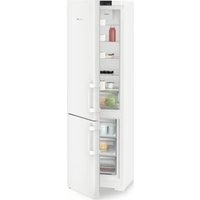
ICP3334 - Réfrigérateur LIEBHERR - Notice d'utilisation et mode d'emploi gratuit
Retrouvez gratuitement la notice de l'appareil ICP3334 LIEBHERR au format PDF.


| Caractéristiques | Détails |
|---|---|
| Type de produit | Réfrigérateur combiné |
| Capacité totale | 265 litres |
| Dimensions approximatives | Hauteur : 145 cm, Largeur : 55 cm, Profondeur : 62 cm |
| Poids | 60 kg |
| Classe énergétique | A++ |
| Alimentation électrique | 220-240 V, 50 Hz |
| Consommation d'énergie annuelle | 250 kWh |
| Fonctions principales | Réfrigération, congélation, contrôle de température |
| Système de refroidissement | Froid statique |
| Entretien et nettoyage | Nettoyage régulier des surfaces intérieures et extérieures, dégivrage du congélateur si nécessaire |
| Pièces détachées et réparabilité | Disponibilité de pièces de rechange via le service après-vente |
| Sécurité | Verrouillage de porte, protection contre les surcharges électriques |
| Compatibilités | Compatible avec les accessoires Liebherr |
| Garantie | 2 ans |
FOIRE AUX QUESTIONS - ICP3334 LIEBHERR
Questions des utilisateurs sur ICP3334 LIEBHERR
0 question sur cet appareil. Repondez a celles que vous connaissez ou posez la votre.
Poser une nouvelle question sur cet appareil
Téléchargez la notice de votre Réfrigérateur au format PDF gratuitement ! Retrouvez votre notice ICP3334 - LIEBHERR et reprennez votre appareil électronique en main. Sur cette page sont publiés tous les documents nécessaires à l'utilisation de votre appareil ICP3334 de la marque LIEBHERR.
MODE D'EMPLOI ICP3334 LIEBHERR
20190517 7086526 - 00
ICS/ICP
Contents
1 Appliance at a glance. 2
1.1 Description of appliance and equipment 2
1.2 Appliance range of use 2
1.3 Conformity 3
1.4 Product data.. 3
1.5 Saving energy 3
2 General safety information. 3
3 Controls and displays. 4
3.1 Operating and control elements 4
3.2 Temperature display.. 5
4 Putting into operation. 5
4.1 Switching on the appliance 5
5 Control 5
5.1 Childproofing 5
5.2 Temperature alarm.. 5
5.3 Refrigerator compartment.. 5
5.4 Freezer compartment 8
6 Maintenance. 9
6.1 Manual defrosting 9
6.2 Cleaning the appliance 10
6.3 Customer service 10
7 Malfunctions. 10
8 Decommissioning 12
8.1 Switching off the appliance 12
8.2 Taking the appliance out of service 12
9 Disposing of the appliance. 12
The manufacturer works constantly on the further development of all the types and models. Therefore please understand that we have to reserve the right to make design, equipment and technical modifications.
To get to know all the benefits of your new appliance, please read the information contained in these instructions carefully.
The instructions apply to several models. Differences may occur. Text relating only to specific appliances is marked with an asterisk () .
Instructions for action are marked with a , the results of action are marked with a .
1 Appliance at a glance
1.1 Description of appliance and equipment
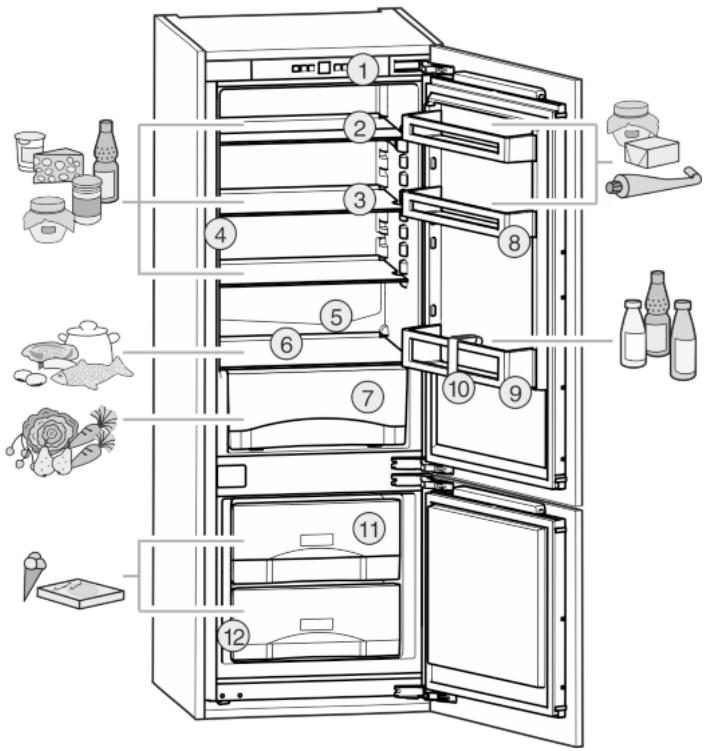
Fig. 1
(1) Operating and control elements
(2) Shelf, sectioned*
(3) Shelf
(4) LED interior light
(5) Drain hole
(6) Coldest zone
(7) Vegetable bin
(8) Can rack
(9) Bottle rack
(10) Bottle holder*
(11) Freezer compartment drawer
(12) Type plate.
Note
Place food inside the appliance as shown in the diagram. This allows the appliance to save energy during operation.
Shelves, drawers and baskets are arranged for optimum energy efficiency on delivery.
1.2 Appliance range of use
Intended use
The appliance is only suitable for cooling food products in a domestic or household-like environment. This includes, for example, use:
- in staff kitchens, bed and breakfast establishments,
- by guests in country houses, hotels, motels and other accommodation,
- for catering and similar services in the wholesale trade.
All other types of use are not permitted.
Foreseeable misuse
The following applications are expressly forbidden:
- Storing and refrigerating medicines, blood plasma, laboratory preparations or similar substances and products based on the Medical Device Directive 2007/47/EC
- Use in areas at risk of explosions
Misusing the appliance may lead to damage to the goods stored or they may spoil.
Climate classifications
Depending on the climate classification the appliance is designed to operate in restricted ambient temperatures. The climate classification applying to your appliance is printed on the rating plate.
Note
- Keep to the specified ambient temperatures in order to guarantee that the appliance works properly.
| Climate classi-fication | for ambient temperatures of |
| SN | 10 °C to 32 °C |
| N | 16 °C to 32 °C |
| ST | 16 °C to 38 °C |
| T | 16 °C to 43 °C |
1.3 Conformity
The refrigerant circuit has been tested for leaks. In installed condition, this appliance complies with the applicable safety stipulations and with directives 2014/35/EU, 2014/30/EU, 2009/125/EG, 2011/65/EU and 2010/30/EU.
1.4 Product data
Product data is included with the appliance, as per Directive (EU) 2017/1369. The complete product data sheet is available on the Liebherr website under Downloads.
1.5 Saving energy
- Pay attention to good ventilation. Do not cover ventilation holes or grids.
- Always keep the fan air slits clear.*
- Do not install the appliance in direct sunlight, next to an oven, radiator or similar.
- Energy consumption is dependent on the installation conditions, e.g. ambient temperature (see 1.2). If the ambient temperature deviates from the standard temperature of 25^ , the energy consumption may differ.
- Open the appliance for as short a time as possible.
- The lower the temperature is set the higher the energy consumption.
- Arrange the food in an organised way (see 1).
- Keep all food properly packed and covered. This prevents frost from forming.
- Only take food out for as long as necessary so that it doesn't warm up too much.
- Inserting warm food: allow to cool down to room temperature first.
- Thaw frozen food in the refrigerator.
-
If there is a thick layer of frost in the appliance: defrost the appliance.
-
If you intend to be on holiday for a long time empty the refrigerator and switch it off.
2 General safety information
Danger for the user:
-
This device can be used by children and people with impaired physical, sensory or mental abilities or with a lack of experience and knowledge provided that they are supervised or have received instruction in the safe use of this device, and about the resulting hazards. Children must not play with this appliance. Cleaning and user maintenance work must not be carried out by children without adult supervision. Children aged between 3 and 8 are allowed to load and unload the appliance. Children below the age of 3 must be kept away from the appliance unless they are under continuous adult supervision.
-
When disconnecting the appliance from the supply, always take hold of the plug. Do not pull the cable.
- In the event of a fault pull out the mains plug or deactivate the fuse.
- Do not damage the mains power cable. Do not operate the appliance with a defective mains power cable.
- Repairs, interventions on the appliance and the replacement of mains connection line may only be carried out by After-Sales Service or other suitably trained specialist personnel.
- Only install, connect and dispose of the appliance according to the instructions.
- Only use the appliance when it is installed.
- Please keep these instructions in a safe place and pass them on to any subsequent owners.
- Special lights, such as LED lights on the appliance, are used to illuminate the interior of the appliance and are not suitable for room lighting.
Fire hazard:
-
The coolant used (information on the model plate) is eco-friendly but also flammable. Any leaking coolant may ignite.
-
Do not damage the refrigerant circuit pipes.
- Do not use an open flame or other source of ignition inside the appliance.
- Do not use electrical appliances inside the appliance (e.g. steam cleaners, heaters, ice cream makers, etc.).
-
If the refrigerant leaks: remove any naked flames or ignition sources from the vicinity of the leakage point. Properly air the room. Inform customer services.
-
Do not store explosives or sprays using combustible propellants such as butane, propane, pentane, etc. in the appliance. To identify these spray cans, look for the list of contents printed on the can, or a flame symbol. Gases possibly escaping may ignite due to electrical components.
- Please be sure to store alcoholic drinks or other packaging containing alcohol in tightly closed containers. Any alcohol that leaks out may be ignited by electrical components.
Danger of tipping and falling:
- Do not misuse the plinth, drawers, doors etc. as a step or for support. This applies particularly to children.
Danger of food poisoning:
- Do not consume food which has been stored too long.
Danger of frostbite, numbness and pain:
- Avoid lasting skin contact with cold surfaces or refrigerated/frozen food or take protective steps, e.g. wear gloves. Do not consume ice cream, water ice or ice cubes immediately and do not consume them too cold.
Danger of injury and damage:
- Hot steam can lead to injury. Do not use electrical heating or steam cleaning equipment, open flames or defrosting sprays to defrost.
- Do not use sharp implements to remove the ice.
Danger of crushing:
- Do not hold the hinge when opening and closing the door. Fingers may get caught.
Symbols on the appliance:
| The symbol can be located on the compressor. It refers to the oil in the compressor and indicates the following danger: Swallowing or inhaling can be fatal. This is only relevant for recycling. There is no danger in normal operation. | |
| This symbol is found on the compressor and indicates the danger of flammable materials. | |
| VIP/P-D | A sticker to this effect may be applied to the rear of the appliance. It refers to the foam-padded panels in the door and/or the housing. This is only relevant for recycling. Do not remove the sticker. |
Please observe the specific information in the other sections:
| ! | DANGER | identifies a situation involving direct danger which, if not obviated, may |
| result in death or severe bodily injury. | ||
| WARNING | identifies a dangerous situation which, if not obviated, may result in death or severe bodily injury. | |
| CAUTION | identifies a dangerous situation which, if not obviated, may result in minor or medium bodily injury. | |
| NOTICE | identifies a dangerous situation which, if not obviated, may result in damage to property. | |
| Note | identifies useful information and tips. |
3 Controls and displays
3.1 Operating and control elements

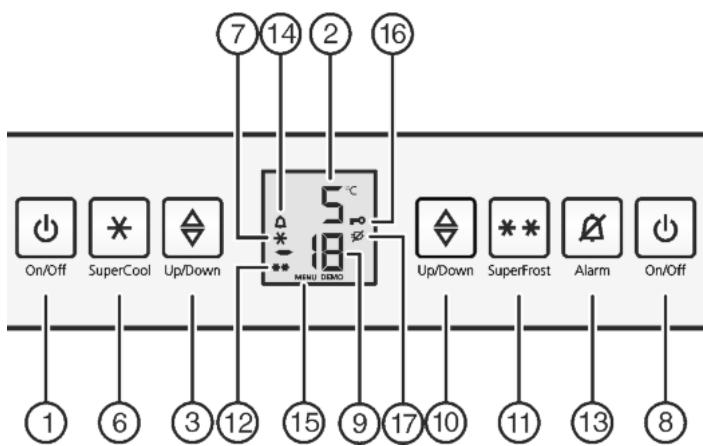
Fig. 2
(1) Refrigerator compartment On/Off button
(2) Refrigerator compartment temperature display
(3) Refrigerator compartment setting button
(4) Ventilation button
(5) Ventilation symbol
(6) SuperCool button
(7) SuperCool symbol
(8) Refrigerator compartment On/Off button
(9) Freezer compartment temperature display
(10) Freezer compartment setting button
(11) SuperFrost button
(12) SuperFrost symbol
(13) Alarm button
(14) Alarm symbol
(15)Menu symbol
(16) Child lock symbol
(17) Power failure symbol
3.2 Temperature display
During normal operation, the display shows:
- the freezer temperature setting
- the chiller temperature setting
The freezer temperature display flashes if/when:
- You change the temperature setting
- The appliance is not cold enough after switching on
- The temperature rises by several degrees
The following displays indicate a fault. Possible causes and solutions: (see 7).
- F0 to F9
The power failure symbol flashes.
4 Putting into operation
4.1 Switching on the appliance
Note
The manufacturer recommends:
Store frozen produce at -18^ or colder.
Switch on the appliance approx. 4 hours before loading for the first time.
4.1.1 Switching on the entire appliance at the freezer compartment
Open the door.
Press the freezer On/Off Fig. 2 (8) button.
The fridge and freezer sections are on.
The temperature displays light up.
When you open the door the interior light comes on.
If "DEMO" is displayed, demo mode is activated. Please contact the after sales service.
4.1.2 Switch on refrigerator compartment
Note
Before going on holiday, or other prolonged periods of non-use
- You can switch the fridge section on/off separately from the freezer section.
Open the door.
Press the fridge On/Off Fig. 2 (1) button.
The temperature displays light up.
When you open the door the interior light comes on.
The fridge is on.
5 Control
5.1 Child proofing
The child-proofing function enables you to make sure that the appliance is not inadvertently switched off by playing children.

5.1.1 Setting the child lock
To switch on the function:
Activate setting mode: press the SuperFrost button Fig. 2 (11) for approx. 5 seconds.
The Menu symbol Fig. 2 (15) is shown on the display.
c flashes on the display.
Briefly confirm with the SuperFrost button, Fig. 2 (11).
c! appears in the display.
Briefly confirm with the SuperFrost button, Fig. 2 (11).
The child lock symbol Fig. 2 (16), lights up on the display.
c flashes on the display.
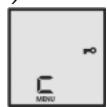
The child lock function is switched on.
If setting mode is to be terminated:
Briefly press the freezer compartment On/Off button Fig.2 (8).
-or-
Wait for 5 minutes.
The temperature display shows the temperature again.
To switch off the function:
Activate setting mode: press the SuperFrost button Fig. 2 (11) for approx. 5 seconds.
The Menu symbol Fig. 2 (15) is shown on the display.
c flashes on the display.
Briefly confirm with the SuperFrost button, Fig. 2 (11).
c0 appears in the display.
Briefly confirm with the SuperFrost button, Fig. 2 (11).
The child lock symbol Fig. 2 (16) goes out.
c flashes on the display.
The child lock function is switched off. If setting mode is to be terminated:
Briefly press the freezer compartment On/Off button Fig.2 (8).
-or-
Wait for 5 minutes.
The temperature display shows the temperature again.
5.2 Temperature alarm
The audible alarm sounds if the freezer temperature is not cold enough.
The temperature display and the alarm symbol Fig. 2 (14) flash at the same time.
The cause of the temperature being too high may be:
warm fresh food was placed inside
- too much warm ambient air flowed in when rearranging and removing food
- Prolonged power outage
- the appliance is faulty
The audible alarm is automatically silenced, the alarm symbol Fig. 2 (14) goes out and the temperature display stops flashing when the temperature is sufficiently cold again.
If the alarm status persists: (see 7).
Note
Food may be spoilt if the temperature is not cold enough.
Check the quality of the food. Do not consume spoiled food.
5.2.1 Muting the temperature alarm
The audible alarm can be muted. When the temperature is sufficiently cold again, the alarm function is active again.
Press alarm button Fig. 2 (13).
The audible alarm is silenced.
5.3 Refrigerator compartment
The natural circulation of air in the refrigerator compartment results in zones differing in temperature. It is coldest directly above the vegetable drawers and at the rear wall. It is warmest at the top front of the compartment and in the door.
5.3.1 Food refrigeration
Note
The energy consumption increases and the cooling performance decreases if the ventilation is inadequate.*
Always keep the air slits of the fan free.
- Store perishable food such as ready-to-serve dishes, meat products and sausages in the coldest zone. Place butter and preserves in the upper area and in the door (see 1).
Use recyclable plastic, metal, aluminium and glass containers and cling film for wrapping.
Always store raw meat and fish in clean, sealed containers on the bottom shelf of the refrigerator, to prevent them coming into contact with or dripping onto other foods.
Always store liquids and food which is subject to odour or taste transfer in closed containers or cover them. - Use the front area of the refrigerator compartment floor only for briefly putting down cooled products, e.g. when rearranging and sorting. However do not leave cooled products there otherwise they may be pushed back or tipped over when the door is closed.
Do not store food too close together to enable good air circulation.
5.3.2 Setting the temperature
The temperature depends on the following factors:
- the frequency of opening the door
- how long the door is open for
- the room temperature of the installation location
- the type, temperature and quantity of the food
Recommended temperature setting: 5^
The temperature can be adjusted continually. Once the 1^ C setting is reached, the sequence starts again at 9^ C .
Call up the temperature function: press the refrigerator compartment setting button Fig. 2 (3).
The previously-set value will flash in the temperature display.
Change the temperature in 1^ steps: Press the refrigerator compartment setting button Fig. 2 (3) until the required temperature is indicated in the temperature display.
Change temperature continually: hold down setting button.
During adjustment the value flashes on the display.
The new setting is adopted approx. 5 seconds after the last time the button was pressed and the set temperature displayed again. The temperature in the interior gradually adjusts to the new value.
5.3.3 SuperCool*
With SuperCool you switch to the highest cooling performance to reach lower cooling temperatures. Use SuperCool, to rapidly cool large amounts of food.

When SuperCool is activated, the fan may run. The appliance operates with maximum cooling performance, which means that the noise of the refrigeration unit may be temporarily louder.
When SuperCool is activated, the appliance operates with maximum cooling performance. The noise of the refrigeration unit may be temporarily louder as a result.*
The SuperCool function uses slightly more energy.
Cooling with SuperCool*
Briefly press SuperCool button Fig. 2 (6).
The SuperCool symbol Fig. 2 (7) lights up in the display.
The cooling temperature drops to the coldest value. SuperCool is activated.
SuperCool is automatically deactivated after 12 hours. The appliance continues to operate in the energy-saving, normal mode.
To prematurely deactivate SuperCool*
Briefly press SuperCool button Fig. 2 (6).
The SuperCool symbol Fig. 2 (7) goes out in the display.
SuperCool is deactivated.
5.3.4 Fan*
With the fan you can rapidly cool large quantities of fresh food or achieve a relatively even distribution of temperature across all the storage levels.
The forced-air cooling is to be recommended:
- at high room temperature (above 33^ )
- at high humidity
The forced-air cooling uses slightly more energy. To save energy, the fan switches off automatically when the door is open.
Switching on the fan*
Briefly press the fan button Fig. 2 (4).
The fan symbol Fig. 2 (5) shines.
The fan is active. In some appliances, the fan is only activated when the compressor is running.
To switch off the fan*
Briefly press the fan button Fig. 2 (4).
The fan symbol Fig. 2 (5) goes out.
The fan is switched off.
5.3.5 Shelves
Moving or removing shelves
The shelves are prevented from being pulled out accidentally by pull out stops.
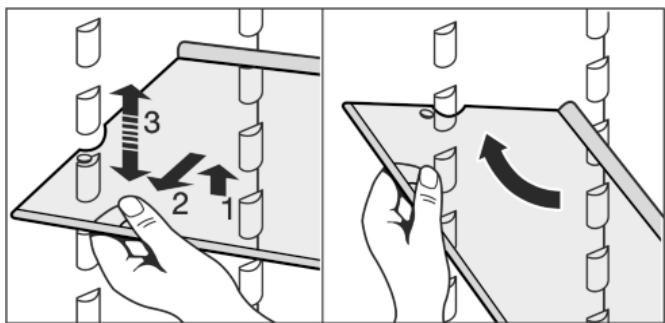
Fig. 3
Lift the shelf and pull forward a little.
Adjust the height of the shelf. To do this move the slots along the supports.
In order to remove the shelf fully, place it at a slant and pull out towards the front.
Insert shelf with the raised edge pointing upwards at the back.
The food does not freeze onto the rear wall.
Dismantling shelves
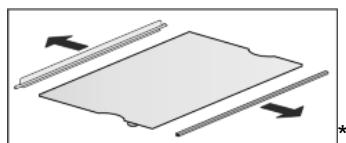
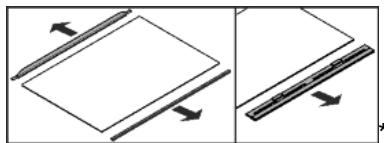
The shelves can be dismantled for cleaning.
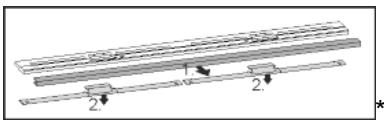
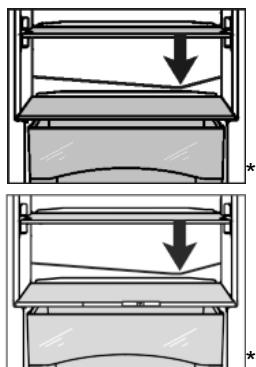
▶ Slide the sectioned shelf under, as shown in the illustration.
5.3.6 Using the sectioned shelf*
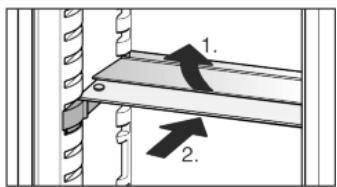
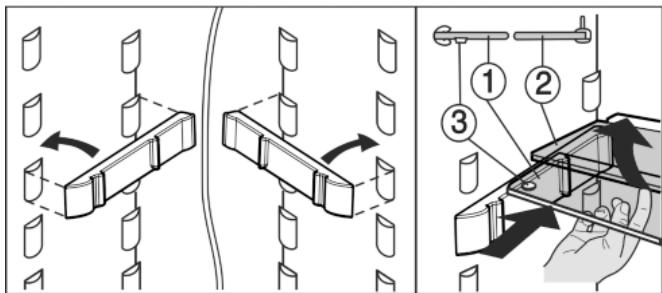
Fig. 4
The glass shelf with stop face (2) has to be at the back.
The glass plate (1) with pull-out stops must be at the front so that the stops (3) face downwards.
5.3.7 Door racks

Moving the storage rack
Fig. 5^*
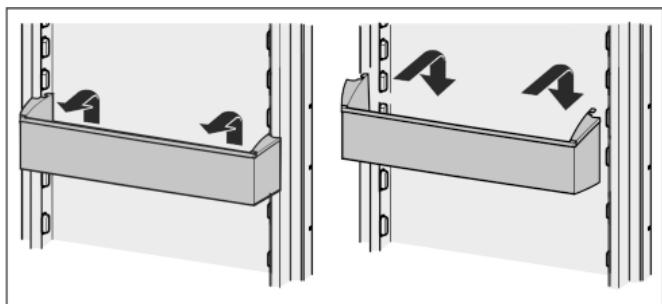
Fig. 6*
Dismantling door racks
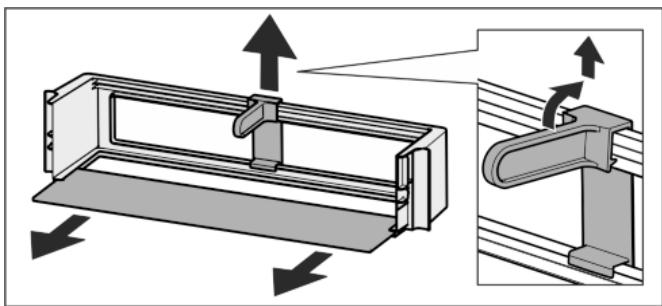
Fig. 7
The door racks can be dismantled for cleaning.
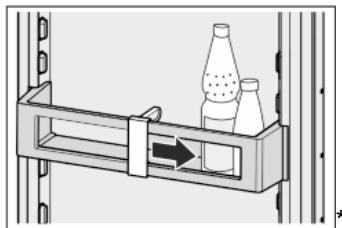
5.3.8 Using the bottle holder
To avoid the bottles tipping over, push the bottle holder along.
5.3.9 Egg tray*
You can take out and rotate the egg tray. You can use the two parts of the egg tray to mark different use-by dates, for example.
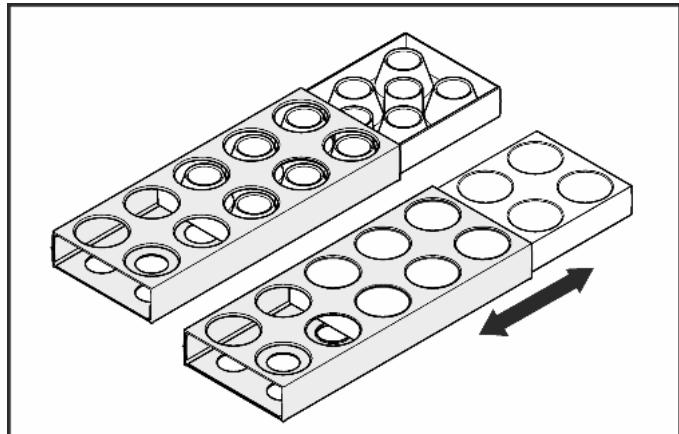
Use the top part to store e.g. chicken eggs.
Use the bottom part to store quails' eggs.
5.3.10 Vegetable drawers on roller plates*
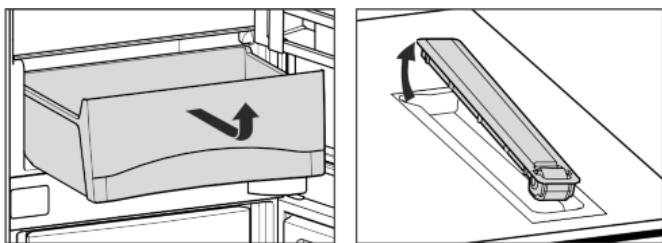
Fig. 8
Roller plates can be removed for cleaning.
5.3.11 BioCool box*
Controlling humidity

Low humidity: Move the slide controller forward.

High humidity: slide controller
Removing the BioCool box
BioCool box on roller plates:
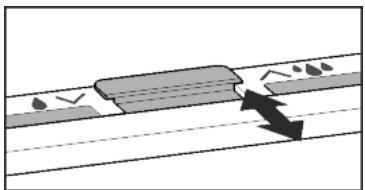
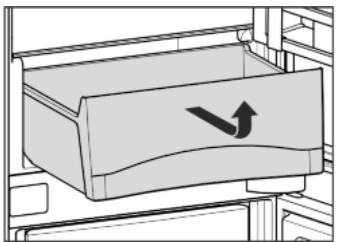
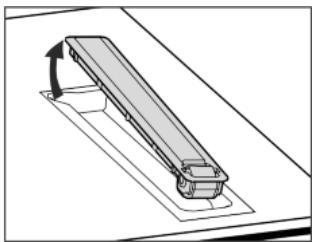
Fig. 9
BioCool box and roller plates can be removed for cleaning.
5.4 Freezer compartment
You can store frozen food, make ice cubes and freeze fresh food in the freezer compartment.
5.4.1 Freezing food
The rating plate indicates the maximum quantity of fresh food you can freeze within 24 hours (see 1) under "Freezing capacity ... kg/24h".
Each drawer can hold a max. of 25kg of frozen food.
The shelves can each be loaded with 35kg of frozen food.
A vacuum is generated after the door is closed. After closing the door, wait for about 1 minute and then it opens more easily.

CAUTION
Risk of injury due to broken glass!
Bottles and cans containing drinks may burst when being frozen. This applies particularly to sparkling drinks.
Do not freeze bottles and cans containing drinks!
So that the food is rapidly frozen through to the core, do not exceed the following quantities per pack
- Fruit, vegetables up to 1 kg
- Meat up to 2.5kg
Pack the food in portions in freezer bags, reusable plastic, metal or aluminium containers
5.4.2 Storage life
| Standard values for the storage life of various types of food in the freezer compartment: | |
| Ice-cream | 2 to 6 months |
| Sausage, ham | 2 to 6 months |
| Bread, bakery products | 2 to 6 months |
| Game, pork | 6 to 10 months |
| Fatty fish | 2 to 6 months |
| Lean fish | 6 to 12 months |
| Cheese | 2 to 6 months |
| Poultry, beef | 6 to 12 months |
Standard values for the storage life of various types of food in the freezer compartment:
Vegetables, fruit
6 to 12 months
The values indicated for storage life are standard ones.
5.4.3 Thawing food
- in the refrigerator compartment
- in a microwave oven
- in a conventional or fan oven
- at room temperature
Remove only as much food as is required. Use thawed food as quickly as possible. - Food once thawed should be re-frozen only in exceptional cases.
5.4.4 Setting the temperature
The temperature depends on the following factors:
- the frequency of opening the door
- how long the door is open for
- the room temperature of the installation location
- the type, temperature and quantity of the food
Recommended temperature setting: -18 °C
The temperature can be adjusted continually. Once the setting -26^ is reached, the cycle is begun again at -15^ .
Call up temperature function: press the freezer compartment setting button Fig. 2 (10) once.
The previously-set value will flash in the temperature display.
Change the temperature in 1^ steps: Press the freezer compartment setting button Fig. 2 (10) until the required temperature is indicated in the temperature display.
Change temperature continually: hold down setting button.
During adjustment the value flashes on the display.
The new setting is adopted approx. 5 seconds after the last time the button was pressed and the set temperature displayed again. The temperature in the interior gradually adjusts to the new value.
5.4.5 SuperFrost
With this function you can freeze fresh food quickly through to the core. The appliance operates with maximum refrigeration. The noise of the refrigeration unit may be temporarily louder as a result.
In addition, frozen food already in storage is given a "cold reserve". The food stays frozen longer as a result when you defrost the appliance.
You can freeze as many kilograms of fresh food within 24 hrs as is indicated on the type plate under "Freezing capacity ... kg/24hrs". This maximum freezing quantity can vary depending on model and climate class.
You have to activate SuperFrost in good time, depending on how much fresh food is to be frozen: about 6 hours before placing the food inside in case of small amounts and about 24 hours in advance in case of the maximum amount of food to be frozen.
Wrap produce and spread it out as far as possible. Do not allow produce to be frozen to touch produce that is already frozen to prevent the latter thawing.
You do not have to activate SuperFrost in the following cases:
- when placing frozen food in the freezer
- when freezing up to approx. 1 kg fresh food daily
Freezing with SuperFrost
Briefly press the SuperFrost button Fig. 2 (11) once.
The SuperFrost symbol Fig. 2 (12) shines.
The freezing temperature drops, the appliance operates with the maximum cooling capacity. For a smaller quantity of produce to be frozen:
wait approx. 6 h.
Place wrapped produce in the bottom drawers. For the maximum quantity of produce to be fro
wait approx. 24 h.
Remove bottom drawer and place produce directly in the appliance so that it touches the base or sides.
SuperFrost is automatically deactivated after 65 hours.
The SuperFrost symbol Fig. 2 (12) extinguishes once freezing is completed.
Place produce in the drawers and push the latter back in again.
The appliance continues to operate in the energy-saving, normal mode.
5.4.6 Drawers
Note
The energy consumption increases and the cooling performance decreases if there is insufficient ventilation.
For appliances with NoFrost:
Leave the bottom drawer in the appliance!
Always keep the air slits of the fan free at the rear wall!
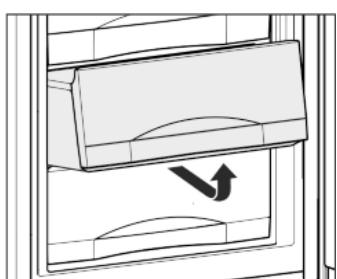
To store frozen food directly on the shelves pull the drawer forward and lift it out.
5.4.7 Shelves
Moving shelves
To remove the shelf: lift up at the front and pull out.
To put the shelf back: simply push in as far as it will go.
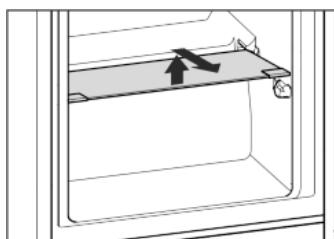
Removing shelves
The shelves may removed for cleaning.
be
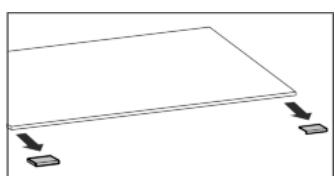
5.4.8 VarioSpace
You can remove the shelves and drawers. This leaves more room for larger food items such as poultry, meat, large game and tall baked goods, which can be frozen whole before further preparation.
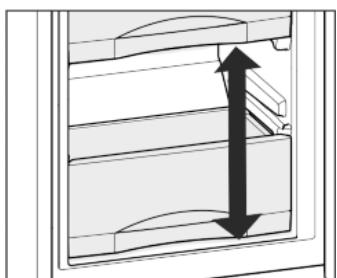
Each drawer can hold max. 25kg of frozen food.
The shelves can each be loaded with 35kg of frozen food.
5.4.9 Ice cube tray*
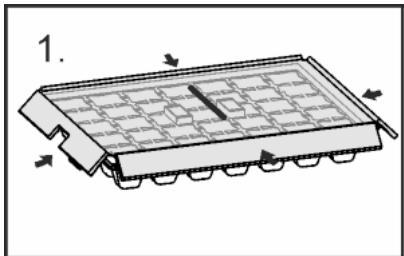
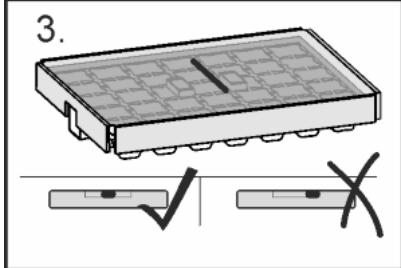
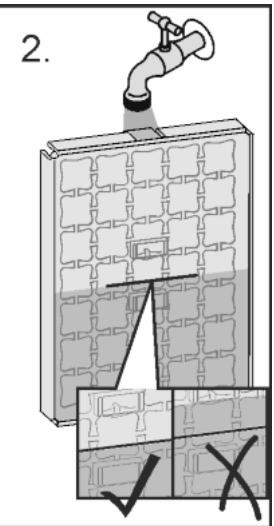
Fig. 10 When the water is frozen:
Hold ice cube tray under hot water for a short time.
Remove the lid.
Gently turn the ends of the ice cube tray in opposite directions and release the cubes.
Dismantling the ice cube tray
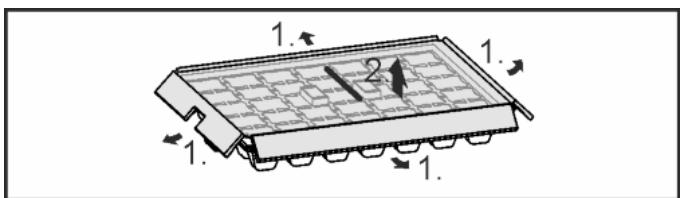
Fig. 11
You can take the ice cube tray apart for cleaning.
6 Maintenance
6.1 Manual defrosting
Fridge compartment:
The refrigerator compartment is defrosted automatically. The defrost water evaporates as a result of the heat of the compressor. Drops of water on the rear wall are perfectly normal.
Regularly clean the drain opening to allow the water to flow away (see 6.2).
Freezer compartment:
A layer of frost or ice can build up in the freezer compartment after a long period of operation.
The layer of frost or ice builds up faster if the appliance is opened often or if the food is warm when placed inside. However, a thick layer of ice will increase the appliance's energy consumption. You should therefore defrost the appliance regularly.
Thawing process:

WARNING
Danger of injury and damage
Do not use any mechanical aids or other means not recommended by the manufacturer in order to accelerate the defrosting process.
Do not use electrical heating or steam cleaning equipment, open flames or defrosting sprays to defrost.
Do not use sharp implements to remove the ice.
Do not damage the pipework in the refrigerant circuit.
Switch on SuperFrost one day before defrosting.
The frozen goods are provided with a "cold reserve".
Switch off the appliance.
The temperature display goes out.
If the temperature display does not go out, the child lock function (see 5.1) is active.
Pull out the power plug or switch off the fuse.
If possible, put the frozen goods in the freezer drawer, wrapped in newspaper or a blanket, and store in a cool place.
Place a pan with hot, not boiling water on a middle shelf.
-or-
Half-fill the two lower drawers with lukewarm water and put them in the appliance.
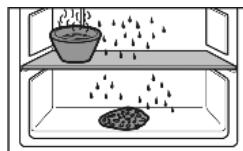
Defrosting is speeded up.
Defrost water is collected in the drawers.
Leave the door of the appliance open while defrosting.
Remove detached pieces of ice.
Pay attention that the defrost water does not run into the kitchen unit.
If necessary, pick up defrost water several times, using a sponge or cloth.
Clean the appliance (see 6.2) and rub dry.
6.2 Cleaning the appliance
Clean the appliance regularly.

WARNING
Risk of injury and damage as a result of hot steam! Hot steam can lead to burns and can damage the surfaces.
Do not use any steam cleaners!
NOTICE
Incorrect cleaning damages the appliance!
Do not use cleaning agents in concentrated form.
Do not use any scouring or abrasive sponges or steel wool.
Do not use any sharp or abrasive cleaning agents, nor any that contain sand, chloride or acid.
Do not use chemical solvents.
Do not damage or remove the type plate on the inside of the appliance. It is important for the customer service.
Do not pull off, bend or damage cables or other components.
- Do not allow any cleaning water to enter the drain channel, ventilation grille or electrical parts.
Please use soft cleaning cloths and a universal pH-neutral cleaning agent.
Please use cleaning and care products suitable for contact with foodstuffs in the appliance interior.
Empty appliance.
Pull out the power plug.
Clean plastic outer and inner surfaces with lukewarm water and a little washing-up liquid.
Clean drain hole: Remove deposits with a narrow instrument, e.g. a cotton bud.
Most of the parts can be dismantled for cleaning: see the relevant chapter.
Clean drawers by hand with lukewarm water and a little washing up liquid.
All the other fittings can be put in the dishwasher.
After cleaning:
Wipe dry the appliance and items of equipment.
Connect the appliance and switch it on again.
Switch on SuperFrost (see 5.4.5)
When the temperature is sufficiently cold:
Put the food back inside.
6.3 Customer service
First check whether you can correct the fault yourself by reference to the list (see 7). If this is not the case, please contact the customer service whose address is given in the enclosed customer service list.

WARNING
Risk of injury if repair work is not carried out professionally!
Have any repairs and action - not expressly specified - on the appliance and mains cable carried out by service personnel only. (see 6)
Read the appliance designation
Fig. 12 (1), service
No. Fig. 12 (2) and
serial No. Fig. 12 (3)
off the type plate
located inside the
appliances on the loft
apppliance on the left-hand side.
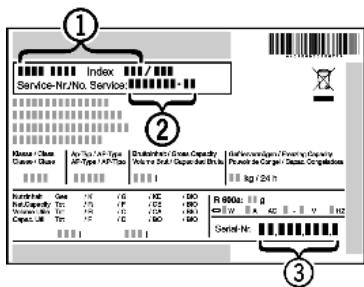
Fig. 12
Notify the customer service, specifying the fault, appliance designation Fig. 12 (1), service No. Fig. 12 (2) and serial No. Fig. 12 (3).
This will help us to provide you with a faster and more accurate service.
- Keep the appliance closed until the customer service arrives.
The food will stay cool longer.
Pull out the mains plug (not by pulling the connecting cable) or switch off the fuse.
7 Malfunctions
Your appliance is designed and manufactured for a long life span and reliable operation. If a malfunction nonetheless occurs during operation, check whether it is due to a handling error. In this case you will have to be charged for the costs incurred, even during the warranty period. You may be able to rectify the following faults yourself:
Appliance does not work.
→ The appliance is not switched on.
Switch on the appliance.
The power plug is not properly inserted in the wall socket.
Check power plug.
The fuse of the wall socket is not in order.
Check fuse.
The compressor runs for a long time.
The compressor switches to a low speed when little cold is needed. Although the running time is increased as a result, energy is saved.
This is normal in energy-saving models.
SuperFrost is activated.
The compressor runs for longer in order to rapidly cool the food. This is normal.
SuperCool is activated.
The compressor runs for longer in order to rapidly cool the food. This is normal.
A LED on the bottom rear of the appliance (at the compressor) flashes repeatedly every 5 seconds*.
There is a fault.
Please contact the after-sales service (see 6).
Excessive noise.
Due to the various speed steps, speed-regulated* compressors can generate different running noises.
The sound is normal.
A bubbling and gurgling noise.
This noise comes from the refrigerant flowing in the refrigeration circuit.
The sound is normal.
A quiet clicking noise.
The noise is produced whenever the refrigeration unit (motor) automatically switches on or off.
The sound is normal.
A hum. It is briefly a little louder when the refrigeration unit (the motor) switches on.
→ The refrigeration increases automatically when the SuperFrost, function is activated, fresh food has just been placed in the appliance or the door has been left open for a while.
The sound is normal.
The refrigeration increases automatically when the SuperCool function is activated, fresh food has just been placed in the appliance or the door has been left open for a while.*
The sound is normal.*
The ambient temperature is too high.
Solution: (see 1.2)
A low hum.*
The sound is produced by air flow noise of the fan.
The sound is normal.
Vibration noises
The appliance is not standing firmly on the floor. As a result objects and adjacent units start to vibrate when the refrigerator is running.
Check the installation and realign the appliance.
- Keep bottles and jars apart.
The temperature display indicates: F0 to F9
There is a fault.
Please contact the after-sales service (see 6).
Power failure flashes in the temperature display. The highest temperature reached during power failure is indicated in the temperature display.
The freezer temperature rose too high over the last hours or days due to a power failure or power interruption. When the
power interruption is over, the appliance will continue to operate in the last temperature setting.
To cancel the display of the warmest temperature: press alarm button Fig. 2 (13).
- Check the quality of the food. Do not consume spoiled food.
- Do not re-freeze thawed food.
DEMO shines in the temperature display.
The demo mode is activated.
Please contact the after-sales service (see 6).
The outer surfaces of the appliance are warm*.
The heat of the refrigeration circuit is used to prevent condensate from forming.
This is normal.
The temperature is not cold enough.
The door of the appliance is not properly closed.
Close the door of the appliance.
Insufficient ventilation.
- Keep ventilation grille clear, and clean it.
The ambient temperature is too high.
Solution: (see 1.2).
The appliance was opened too frequently or for too long.
Wait to see whether the appliance reaches the required temperature by itself. If not, please contact the after sales service (see 6).
Too much fresh food was placed inside without SuperFrost.
Solution: (see 5.4.5)
The temperature is incorrectly set.
Set the temperature to a colder setting and check after 24 hours.
→ The appliance is too close to a source of heat (stove, heater etc).
Change the position of the appliance or the source of heat.
→ The appliance was not inserted properly into the recess.
Check whether the appliance was inserted correctly and the door closes properly.
The internal light does not come on.
→ The appliance is not switched on.
Switch the appliance on.
The door was open for longer than 15 minutes.
The internal light switches itself off automatically after about 15 minutes if the door is open.
→ The LED illumination is faulty or the cover is damaged:

WARNING
Risk of injury due to electric shock!
Live parts are located under the cover.
Have the LED interior light changed or repaired only by the customer service or by specialized personnel trained for the purpose.

WARNING
Danger of injury by LED lamp!
The light intensity of the LED lighting corresponds to risk group RG 2.
If the cover is defective:
Do not look into the illumination with optical lenses from the immediate proximity. This can cause injury to the eyes.
The door gasket is defective or should be replaced for other reasons.*
In some units, the seal around the door can be replaced. You will not need any special tools to do this.
Please contact the after-sales service (see 6).
The unit has iced up or condensation has formed.*
The door seal may have also slipped out of its groove.
Check to ensure that the door seal is seated properly in the groove.
8 Decommissioning
8.1 Switching off the appliance
Note
To switch off the entire appliance, only the freezer compartment need be switched off. The refrigerator compartment is automatically switched off at the same time.
The refrigerator compartment can be switched off separately (e.g. during extended periods of absence such as holidays), while the freezer compartment remains in operation.
If the appliance or fridge compartment cannot be switched off, the Child Safety function is still activated (see 5.1).
8.1.1 Switching the whole appliance off via the freezer compartment
Press the freezer compartment On/Off button Fig. 2 (8) for approx. 2 seconds.
A long beep sounds.
The temperature displays are dark.
The appliance (fridge and freezer) is off.
8.1.2 Switch off refrigerator compartment
Note
Before going on holiday, or other prolonged periods of non-use
- You can switch the fridge section on/off separately from the freezer section.
Press the refrigerator compartment On/Off button Fig. 2 (1) for approx. 2 seconds.
The fridge temperature display Fig. 2 (2) is dark.
The fridge compartment is switched off.
The freezer section stays on.
8.2 Taking the appliance out of service
Empty the appliance.
Switch off the appliance (see 8).
Remove mains connector.
Clean the appliance (see 6.2).
Leave the door open to prevent odour.
9 Disposing of the appliance
The appliance contains some reusable materials and should be disposed of properly - not simply with unsorted household refuse. Appliances which are no longer needed must be disposed of in a professional and appropriate way, in accordance with the current local regulations and laws.

When disposing of the appliance, ensure that the refrigeration circuit is not damaged to prevent uncontrolled escape of the refrigerant it contains (data on type plate) and oil.
Disable the appliance.
Pull out the plug.
Cut through the connecting cable.

Liebherr-Hausgeräte Ochsenhausen GmbH
Memminger Straße 77-79
88416 Ochsenausen
Deutschland
home.liebherr.com